EP1557447A1 - Curing composition and antireflective multilayer body using same - Google Patents
Curing composition and antireflective multilayer body using same Download PDFInfo
- Publication number
- EP1557447A1 EP1557447A1 EP03769940A EP03769940A EP1557447A1 EP 1557447 A1 EP1557447 A1 EP 1557447A1 EP 03769940 A EP03769940 A EP 03769940A EP 03769940 A EP03769940 A EP 03769940A EP 1557447 A1 EP1557447 A1 EP 1557447A1
- Authority
- EP
- European Patent Office
- Prior art keywords
- weight
- refractive
- curing
- index
- parts
- Prior art date
- Legal status (The legal status is an assumption and is not a legal conclusion. Google has not performed a legal analysis and makes no representation as to the accuracy of the status listed.)
- Withdrawn
Links
- 239000000203 mixture Substances 0.000 title claims abstract description 125
- 230000003667 anti-reflective effect Effects 0.000 title claims abstract description 36
- GWEVSGVZZGPLCZ-UHFFFAOYSA-N Titan oxide Chemical compound O=[Ti]=O GWEVSGVZZGPLCZ-UHFFFAOYSA-N 0.000 claims abstract description 88
- 239000002245 particle Substances 0.000 claims abstract description 79
- OGIDPMRJRNCKJF-UHFFFAOYSA-N titanium oxide Inorganic materials [Ti]=O OGIDPMRJRNCKJF-UHFFFAOYSA-N 0.000 claims abstract description 77
- 150000001875 compounds Chemical class 0.000 claims abstract description 44
- 239000000758 substrate Substances 0.000 claims abstract description 28
- 239000003054 catalyst Substances 0.000 claims abstract description 17
- 229910052751 metal Inorganic materials 0.000 claims abstract description 9
- XUIMIQQOPSSXEZ-UHFFFAOYSA-N Silicon Chemical compound [Si] XUIMIQQOPSSXEZ-UHFFFAOYSA-N 0.000 claims abstract description 6
- 229910052710 silicon Inorganic materials 0.000 claims abstract description 6
- 239000010703 silicon Substances 0.000 claims abstract description 6
- 229910052782 aluminium Inorganic materials 0.000 claims abstract description 5
- XAGFODPZIPBFFR-UHFFFAOYSA-N aluminium Chemical compound [Al] XAGFODPZIPBFFR-UHFFFAOYSA-N 0.000 claims abstract description 5
- ATJFFYVFTNAWJD-UHFFFAOYSA-N Tin Chemical compound [Sn] ATJFFYVFTNAWJD-UHFFFAOYSA-N 0.000 claims abstract description 4
- RTAQQCXQSZGOHL-UHFFFAOYSA-N Titanium Chemical compound [Ti] RTAQQCXQSZGOHL-UHFFFAOYSA-N 0.000 claims abstract description 4
- HCHKCACWOHOZIP-UHFFFAOYSA-N Zinc Chemical compound [Zn] HCHKCACWOHOZIP-UHFFFAOYSA-N 0.000 claims abstract description 4
- QCWXUUIWCKQGHC-UHFFFAOYSA-N Zirconium Chemical compound [Zr] QCWXUUIWCKQGHC-UHFFFAOYSA-N 0.000 claims abstract description 4
- 229910052787 antimony Inorganic materials 0.000 claims abstract description 4
- WATWJIUSRGPENY-UHFFFAOYSA-N antimony atom Chemical compound [Sb] WATWJIUSRGPENY-UHFFFAOYSA-N 0.000 claims abstract description 4
- 229910052718 tin Inorganic materials 0.000 claims abstract description 4
- 229910052719 titanium Inorganic materials 0.000 claims abstract description 4
- 239000010936 titanium Substances 0.000 claims abstract description 4
- 229910052725 zinc Inorganic materials 0.000 claims abstract description 4
- 239000011701 zinc Substances 0.000 claims abstract description 4
- 229910052726 zirconium Inorganic materials 0.000 claims abstract description 4
- 125000002887 hydroxy group Chemical group [H]O* 0.000 claims description 23
- -1 melamine compound Chemical class 0.000 claims description 23
- 229910052731 fluorine Inorganic materials 0.000 claims description 19
- 229920000642 polymer Polymers 0.000 claims description 19
- YCKRFDGAMUMZLT-UHFFFAOYSA-N Fluorine atom Chemical compound [F] YCKRFDGAMUMZLT-UHFFFAOYSA-N 0.000 claims description 17
- 239000011737 fluorine Substances 0.000 claims description 17
- 239000003960 organic solvent Substances 0.000 claims description 13
- LZCLXQDLBQLTDK-UHFFFAOYSA-N ethyl 2-hydroxypropanoate Chemical compound CCOC(=O)C(C)O LZCLXQDLBQLTDK-UHFFFAOYSA-N 0.000 claims description 10
- 229920000877 Melamine resin Polymers 0.000 claims description 6
- LRHPLDYGYMQRHN-UHFFFAOYSA-N N-Butanol Chemical compound CCCCO LRHPLDYGYMQRHN-UHFFFAOYSA-N 0.000 claims description 6
- 239000002904 solvent Substances 0.000 claims description 6
- ARXJGSRGQADJSQ-UHFFFAOYSA-N 1-methoxypropan-2-ol Chemical compound COCC(C)O ARXJGSRGQADJSQ-UHFFFAOYSA-N 0.000 claims description 5
- 229940116333 ethyl lactate Drugs 0.000 claims description 5
- 125000000524 functional group Chemical group 0.000 claims description 4
- 230000000694 effects Effects 0.000 abstract description 14
- 229960005196 titanium dioxide Drugs 0.000 description 75
- 238000004519 manufacturing process Methods 0.000 description 42
- 239000010410 layer Substances 0.000 description 39
- 239000007787 solid Substances 0.000 description 36
- VYPSYNLAJGMNEJ-UHFFFAOYSA-N Silicium dioxide Chemical compound O=[Si]=O VYPSYNLAJGMNEJ-UHFFFAOYSA-N 0.000 description 34
- 239000000463 material Substances 0.000 description 30
- 230000000052 comparative effect Effects 0.000 description 22
- OKKJLVBELUTLKV-UHFFFAOYSA-N Methanol Chemical group OC OKKJLVBELUTLKV-UHFFFAOYSA-N 0.000 description 20
- 238000000034 method Methods 0.000 description 19
- 229920005989 resin Polymers 0.000 description 17
- 239000011347 resin Substances 0.000 description 17
- 239000000377 silicon dioxide Substances 0.000 description 17
- DKGAVHZHDRPRBM-UHFFFAOYSA-N Tert-Butanol Chemical compound CC(C)(C)O DKGAVHZHDRPRBM-UHFFFAOYSA-N 0.000 description 16
- 229920002037 poly(vinyl butyral) polymer Polymers 0.000 description 16
- MCMNRKCIXSYSNV-UHFFFAOYSA-N Zirconium dioxide Chemical compound O=[Zr]=O MCMNRKCIXSYSNV-UHFFFAOYSA-N 0.000 description 14
- NTIZESTWPVYFNL-UHFFFAOYSA-N Methyl isobutyl ketone Chemical compound CC(C)CC(C)=O NTIZESTWPVYFNL-UHFFFAOYSA-N 0.000 description 13
- UIHCLUNTQKBZGK-UHFFFAOYSA-N Methyl isobutyl ketone Natural products CCC(C)C(C)=O UIHCLUNTQKBZGK-UHFFFAOYSA-N 0.000 description 13
- 229920003270 Cymel® Polymers 0.000 description 12
- 238000000576 coating method Methods 0.000 description 12
- JDSHMPZPIAZGSV-UHFFFAOYSA-N melamine Chemical compound NC1=NC(N)=NC(N)=N1 JDSHMPZPIAZGSV-UHFFFAOYSA-N 0.000 description 12
- 239000012528 membrane Substances 0.000 description 12
- 229910044991 metal oxide Inorganic materials 0.000 description 11
- 150000004706 metal oxides Chemical class 0.000 description 11
- 239000000843 powder Substances 0.000 description 11
- 239000011248 coating agent Substances 0.000 description 10
- 238000003860 storage Methods 0.000 description 9
- 239000006185 dispersion Substances 0.000 description 8
- 150000007974 melamines Chemical class 0.000 description 8
- 238000006116 polymerization reaction Methods 0.000 description 8
- 238000002360 preparation method Methods 0.000 description 8
- 241000282326 Felis catus Species 0.000 description 7
- 239000011521 glass Substances 0.000 description 7
- 239000000178 monomer Substances 0.000 description 7
- ZWEHNKRNPOVVGH-UHFFFAOYSA-N 2-Butanone Chemical compound CCC(C)=O ZWEHNKRNPOVVGH-UHFFFAOYSA-N 0.000 description 6
- LFQSCWFLJHTTHZ-UHFFFAOYSA-N Ethanol Chemical compound CCO LFQSCWFLJHTTHZ-UHFFFAOYSA-N 0.000 description 6
- PNEYBMLMFCGWSK-UHFFFAOYSA-N aluminium oxide Inorganic materials [O-2].[O-2].[O-2].[Al+3].[Al+3] PNEYBMLMFCGWSK-UHFFFAOYSA-N 0.000 description 6
- 239000011324 bead Substances 0.000 description 6
- 238000006243 chemical reaction Methods 0.000 description 6
- 238000011156 evaluation Methods 0.000 description 6
- MBHRHUJRKGNOKX-UHFFFAOYSA-N [(4,6-diamino-1,3,5-triazin-2-yl)amino]methanol Chemical class NC1=NC(N)=NC(NCO)=N1 MBHRHUJRKGNOKX-UHFFFAOYSA-N 0.000 description 5
- 229910010272 inorganic material Inorganic materials 0.000 description 5
- 239000011147 inorganic material Substances 0.000 description 5
- 125000002496 methyl group Chemical group [H]C([H])([H])* 0.000 description 5
- 238000004528 spin coating Methods 0.000 description 5
- 238000012360 testing method Methods 0.000 description 5
- KFZMGEQAYNKOFK-UHFFFAOYSA-N Isopropanol Chemical compound CC(C)O KFZMGEQAYNKOFK-UHFFFAOYSA-N 0.000 description 4
- 125000003277 amino group Chemical group 0.000 description 4
- 239000011247 coating layer Substances 0.000 description 4
- 229920001577 copolymer Polymers 0.000 description 4
- FJKIXWOMBXYWOQ-UHFFFAOYSA-N ethenoxyethane Chemical compound CCOC=C FJKIXWOMBXYWOQ-UHFFFAOYSA-N 0.000 description 4
- HCDGVLDPFQMKDK-UHFFFAOYSA-N hexafluoropropylene Chemical group FC(F)=C(F)C(F)(F)F HCDGVLDPFQMKDK-UHFFFAOYSA-N 0.000 description 4
- 229910000000 metal hydroxide Inorganic materials 0.000 description 4
- 150000004692 metal hydroxides Chemical class 0.000 description 4
- VUIWJRYTWUGOOF-UHFFFAOYSA-N 2-ethenoxyethanol Chemical compound OCCOC=C VUIWJRYTWUGOOF-UHFFFAOYSA-N 0.000 description 3
- IJGRMHOSHXDMSA-UHFFFAOYSA-N Atomic nitrogen Chemical compound N#N IJGRMHOSHXDMSA-UHFFFAOYSA-N 0.000 description 3
- XEKOWRVHYACXOJ-UHFFFAOYSA-N Ethyl acetate Chemical compound CCOC(C)=O XEKOWRVHYACXOJ-UHFFFAOYSA-N 0.000 description 3
- 239000004372 Polyvinyl alcohol Substances 0.000 description 3
- 239000000654 additive Substances 0.000 description 3
- 239000011230 binding agent Substances 0.000 description 3
- 238000007598 dipping method Methods 0.000 description 3
- 238000004299 exfoliation Methods 0.000 description 3
- 239000010419 fine particle Substances 0.000 description 3
- 230000009477 glass transition Effects 0.000 description 3
- 238000010438 heat treatment Methods 0.000 description 3
- 230000003287 optical effect Effects 0.000 description 3
- 229920001296 polysiloxane Polymers 0.000 description 3
- 229920002451 polyvinyl alcohol Polymers 0.000 description 3
- 229920001187 thermosetting polymer Polymers 0.000 description 3
- BQCIDUSAKPWEOX-UHFFFAOYSA-N 1,1-Difluoroethene Chemical compound FC(F)=C BQCIDUSAKPWEOX-UHFFFAOYSA-N 0.000 description 2
- 229920000178 Acrylic resin Polymers 0.000 description 2
- 239000004925 Acrylic resin Substances 0.000 description 2
- LSNNMFCWUKXFEE-UHFFFAOYSA-M Bisulfite Chemical compound OS([O-])=O LSNNMFCWUKXFEE-UHFFFAOYSA-M 0.000 description 2
- RTZKZFJDLAIYFH-UHFFFAOYSA-N Diethyl ether Chemical compound CCOCC RTZKZFJDLAIYFH-UHFFFAOYSA-N 0.000 description 2
- IAYPIBMASNFSPL-UHFFFAOYSA-N Ethylene oxide Chemical compound C1CO1 IAYPIBMASNFSPL-UHFFFAOYSA-N 0.000 description 2
- CERQOIWHTDAKMF-UHFFFAOYSA-N Methacrylic acid Chemical compound CC(=C)C(O)=O CERQOIWHTDAKMF-UHFFFAOYSA-N 0.000 description 2
- QYKIQEUNHZKYBP-UHFFFAOYSA-N Vinyl ether Chemical compound C=COC=C QYKIQEUNHZKYBP-UHFFFAOYSA-N 0.000 description 2
- 125000003158 alcohol group Chemical group 0.000 description 2
- 150000007933 aliphatic carboxylic acids Chemical class 0.000 description 2
- XXROGKLTLUQVRX-UHFFFAOYSA-N allyl alcohol Chemical compound OCC=C XXROGKLTLUQVRX-UHFFFAOYSA-N 0.000 description 2
- 125000003118 aryl group Chemical group 0.000 description 2
- QVGXLLKOCUKJST-UHFFFAOYSA-N atomic oxygen Chemical compound [O] QVGXLLKOCUKJST-UHFFFAOYSA-N 0.000 description 2
- 239000003795 chemical substances by application Substances 0.000 description 2
- 239000003085 diluting agent Substances 0.000 description 2
- HQQADJVZYDDRJT-UHFFFAOYSA-N ethene;prop-1-ene Chemical group C=C.CC=C HQQADJVZYDDRJT-UHFFFAOYSA-N 0.000 description 2
- 238000010304 firing Methods 0.000 description 2
- 125000001153 fluoro group Chemical group F* 0.000 description 2
- 238000005227 gel permeation chromatography Methods 0.000 description 2
- 239000004973 liquid crystal related substance Substances 0.000 description 2
- 239000002184 metal Substances 0.000 description 2
- 239000001301 oxygen Substances 0.000 description 2
- 229910052760 oxygen Inorganic materials 0.000 description 2
- 230000001699 photocatalysis Effects 0.000 description 2
- 230000000704 physical effect Effects 0.000 description 2
- 229920000139 polyethylene terephthalate Polymers 0.000 description 2
- 239000005020 polyethylene terephthalate Substances 0.000 description 2
- 239000003505 polymerization initiator Substances 0.000 description 2
- 239000002244 precipitate Substances 0.000 description 2
- 238000007639 printing Methods 0.000 description 2
- LLHKCFNBLRBOGN-UHFFFAOYSA-N propylene glycol methyl ether acetate Chemical compound COCC(C)OC(C)=O LLHKCFNBLRBOGN-UHFFFAOYSA-N 0.000 description 2
- 150000003839 salts Chemical class 0.000 description 2
- 230000003595 spectral effect Effects 0.000 description 2
- 238000003756 stirring Methods 0.000 description 2
- 229920002554 vinyl polymer Polymers 0.000 description 2
- KHXKESCWFMPTFT-UHFFFAOYSA-N 1,1,1,2,2,3,3-heptafluoro-3-(1,2,2-trifluoroethenoxy)propane Chemical compound FC(F)=C(F)OC(F)(F)C(F)(F)C(F)(F)F KHXKESCWFMPTFT-UHFFFAOYSA-N 0.000 description 1
- VZXTWGWHSMCWGA-UHFFFAOYSA-N 1,3,5-triazine-2,4-diamine Chemical class NC1=NC=NC(N)=N1 VZXTWGWHSMCWGA-UHFFFAOYSA-N 0.000 description 1
- CTRPRMNBTVRDFH-UHFFFAOYSA-N 2-n-methyl-1,3,5-triazine-2,4,6-triamine Chemical class CNC1=NC(N)=NC(N)=N1 CTRPRMNBTVRDFH-UHFFFAOYSA-N 0.000 description 1
- GCYHRYNSUGLLMA-UHFFFAOYSA-N 2-prop-2-enoxyethanol Chemical compound OCCOCC=C GCYHRYNSUGLLMA-UHFFFAOYSA-N 0.000 description 1
- IGDCJKDZZUALAO-UHFFFAOYSA-N 2-prop-2-enoxypropane-1,3-diol Chemical compound OCC(CO)OCC=C IGDCJKDZZUALAO-UHFFFAOYSA-N 0.000 description 1
- OJXVWULQHYTXRF-UHFFFAOYSA-N 3-ethenoxypropan-1-ol Chemical compound OCCCOC=C OJXVWULQHYTXRF-UHFFFAOYSA-N 0.000 description 1
- HMBNQNDUEFFFNZ-UHFFFAOYSA-N 4-ethenoxybutan-1-ol Chemical compound OCCCCOC=C HMBNQNDUEFFFNZ-UHFFFAOYSA-N 0.000 description 1
- BCTDCDYHRUIHSF-UHFFFAOYSA-N 5-ethenoxypentan-1-ol Chemical compound OCCCCCOC=C BCTDCDYHRUIHSF-UHFFFAOYSA-N 0.000 description 1
- ASPUDHDPXIBNAP-UHFFFAOYSA-N 6-ethenoxyhexan-1-ol Chemical compound OCCCCCCOC=C ASPUDHDPXIBNAP-UHFFFAOYSA-N 0.000 description 1
- QTBSBXVTEAMEQO-UHFFFAOYSA-M Acetate Chemical compound CC([O-])=O QTBSBXVTEAMEQO-UHFFFAOYSA-M 0.000 description 1
- ZTQSAGDEMFDKMZ-UHFFFAOYSA-N Butyraldehyde Chemical compound CCCC=O ZTQSAGDEMFDKMZ-UHFFFAOYSA-N 0.000 description 1
- GAWIXWVDTYZWAW-UHFFFAOYSA-N C[CH]O Chemical group C[CH]O GAWIXWVDTYZWAW-UHFFFAOYSA-N 0.000 description 1
- CURLTUGMZLYLDI-UHFFFAOYSA-N Carbon dioxide Chemical compound O=C=O CURLTUGMZLYLDI-UHFFFAOYSA-N 0.000 description 1
- 239000004593 Epoxy Chemical class 0.000 description 1
- 238000004566 IR spectroscopy Methods 0.000 description 1
- YIVJZNGAASQVEM-UHFFFAOYSA-N Lauroyl peroxide Chemical compound CCCCCCCCCCCC(=O)OOC(=O)CCCCCCCCCCC YIVJZNGAASQVEM-UHFFFAOYSA-N 0.000 description 1
- 239000004640 Melamine resin Substances 0.000 description 1
- FXHOOIRPVKKKFG-UHFFFAOYSA-N N,N-Dimethylacetamide Chemical compound CN(C)C(C)=O FXHOOIRPVKKKFG-UHFFFAOYSA-N 0.000 description 1
- 229910019142 PO4 Inorganic materials 0.000 description 1
- 239000004793 Polystyrene Substances 0.000 description 1
- 239000006087 Silane Coupling Agent Substances 0.000 description 1
- 239000002250 absorbent Substances 0.000 description 1
- 230000002745 absorbent Effects 0.000 description 1
- 239000011354 acetal resin Substances 0.000 description 1
- PWIGYBONXWGOQE-UHFFFAOYSA-N alizarin complexone Chemical compound O=C1C2=CC=CC=C2C(=O)C2=C1C=C(CN(CC(O)=O)CC(=O)O)C(O)=C2O PWIGYBONXWGOQE-UHFFFAOYSA-N 0.000 description 1
- 239000003963 antioxidant agent Substances 0.000 description 1
- 230000003078 antioxidant effect Effects 0.000 description 1
- 239000002216 antistatic agent Substances 0.000 description 1
- 125000000751 azo group Chemical group [*]N=N[*] 0.000 description 1
- WPYMKLBDIGXBTP-UHFFFAOYSA-N benzoic acid Chemical class OC(=O)C1=CC=CC=C1 WPYMKLBDIGXBTP-UHFFFAOYSA-N 0.000 description 1
- 230000015572 biosynthetic process Effects 0.000 description 1
- 238000012662 bulk polymerization Methods 0.000 description 1
- 235000011089 carbon dioxide Nutrition 0.000 description 1
- 238000005266 casting Methods 0.000 description 1
- 229910052681 coesite Inorganic materials 0.000 description 1
- 229910052906 cristobalite Inorganic materials 0.000 description 1
- 238000007766 curtain coating Methods 0.000 description 1
- 238000000354 decomposition reaction Methods 0.000 description 1
- 239000004205 dimethyl polysiloxane Substances 0.000 description 1
- 229910001873 dinitrogen Inorganic materials 0.000 description 1
- 239000003995 emulsifying agent Substances 0.000 description 1
- 238000007720 emulsion polymerization reaction Methods 0.000 description 1
- 239000003822 epoxy resin Substances 0.000 description 1
- 125000003709 fluoroalkyl group Chemical group 0.000 description 1
- 238000001879 gelation Methods 0.000 description 1
- 238000007646 gravure printing Methods 0.000 description 1
- 239000003112 inhibitor Substances 0.000 description 1
- 239000003999 initiator Substances 0.000 description 1
- 230000000977 initiatory effect Effects 0.000 description 1
- 238000007641 inkjet printing Methods 0.000 description 1
- 239000011256 inorganic filler Substances 0.000 description 1
- 229910003475 inorganic filler Inorganic materials 0.000 description 1
- 238000011835 investigation Methods 0.000 description 1
- 239000012948 isocyanate Substances 0.000 description 1
- 239000007788 liquid Substances 0.000 description 1
- 238000005259 measurement Methods 0.000 description 1
- 229910052757 nitrogen Inorganic materials 0.000 description 1
- RVTZCBVAJQQJTK-UHFFFAOYSA-N oxygen(2-);zirconium(4+) Chemical compound [O-2].[O-2].[Zr+4] RVTZCBVAJQQJTK-UHFFFAOYSA-N 0.000 description 1
- 150000002989 phenols Chemical class 0.000 description 1
- 239000013034 phenoxy resin Substances 0.000 description 1
- 229920006287 phenoxy resin Polymers 0.000 description 1
- 235000021317 phosphate Nutrition 0.000 description 1
- 150000003013 phosphoric acid derivatives Chemical class 0.000 description 1
- 239000000049 pigment Substances 0.000 description 1
- 239000004014 plasticizer Substances 0.000 description 1
- 229920000435 poly(dimethylsiloxane) Polymers 0.000 description 1
- 229920005668 polycarbonate resin Polymers 0.000 description 1
- 239000004431 polycarbonate resin Substances 0.000 description 1
- 229920000647 polyepoxide Polymers 0.000 description 1
- 229920001225 polyester resin Polymers 0.000 description 1
- 239000004645 polyester resin Substances 0.000 description 1
- 229920006324 polyoxymethylene Polymers 0.000 description 1
- 150000007519 polyprotic acids Polymers 0.000 description 1
- 229920002223 polystyrene Polymers 0.000 description 1
- 239000011164 primary particle Substances 0.000 description 1
- 239000000047 product Substances 0.000 description 1
- 230000001737 promoting effect Effects 0.000 description 1
- 238000010791 quenching Methods 0.000 description 1
- 239000007870 radical polymerization initiator Substances 0.000 description 1
- 150000003254 radicals Chemical class 0.000 description 1
- 239000011342 resin composition Substances 0.000 description 1
- 238000007650 screen-printing Methods 0.000 description 1
- XJKVPKYVPCWHFO-UHFFFAOYSA-N silicon;hydrate Chemical compound O.[Si] XJKVPKYVPCWHFO-UHFFFAOYSA-N 0.000 description 1
- 239000000344 soap Substances 0.000 description 1
- 238000005507 spraying Methods 0.000 description 1
- 229910001220 stainless steel Inorganic materials 0.000 description 1
- 239000010935 stainless steel Substances 0.000 description 1
- 229910052682 stishovite Inorganic materials 0.000 description 1
- 239000000126 substance Substances 0.000 description 1
- 239000004094 surface-active agent Substances 0.000 description 1
- 238000010557 suspension polymerization reaction Methods 0.000 description 1
- 230000002195 synergetic effect Effects 0.000 description 1
- BFKJFAAPBSQJPD-UHFFFAOYSA-N tetrafluoroethene Chemical group FC(F)=C(F)F BFKJFAAPBSQJPD-UHFFFAOYSA-N 0.000 description 1
- 229910052905 tridymite Inorganic materials 0.000 description 1
- 150000003672 ureas Chemical class 0.000 description 1
- XLYOFNOQVPJJNP-UHFFFAOYSA-N water Substances O XLYOFNOQVPJJNP-UHFFFAOYSA-N 0.000 description 1
- 229910001928 zirconium oxide Inorganic materials 0.000 description 1
Images

Classifications
-
- C—CHEMISTRY; METALLURGY
- C08—ORGANIC MACROMOLECULAR COMPOUNDS; THEIR PREPARATION OR CHEMICAL WORKING-UP; COMPOSITIONS BASED THEREON
- C08K—Use of inorganic or non-macromolecular organic substances as compounding ingredients
- C08K9/00—Use of pretreated ingredients
- C08K9/02—Ingredients treated with inorganic substances
-
- G—PHYSICS
- G02—OPTICS
- G02B—OPTICAL ELEMENTS, SYSTEMS OR APPARATUS
- G02B1/00—Optical elements characterised by the material of which they are made; Optical coatings for optical elements
- G02B1/10—Optical coatings produced by application to, or surface treatment of, optical elements
- G02B1/11—Anti-reflection coatings
- G02B1/113—Anti-reflection coatings using inorganic layer materials only
- G02B1/115—Multilayers
-
- C—CHEMISTRY; METALLURGY
- C08—ORGANIC MACROMOLECULAR COMPOUNDS; THEIR PREPARATION OR CHEMICAL WORKING-UP; COMPOSITIONS BASED THEREON
- C08L—COMPOSITIONS OF MACROMOLECULAR COMPOUNDS
- C08L101/00—Compositions of unspecified macromolecular compounds
-
- Y—GENERAL TAGGING OF NEW TECHNOLOGICAL DEVELOPMENTS; GENERAL TAGGING OF CROSS-SECTIONAL TECHNOLOGIES SPANNING OVER SEVERAL SECTIONS OF THE IPC; TECHNICAL SUBJECTS COVERED BY FORMER USPC CROSS-REFERENCE ART COLLECTIONS [XRACs] AND DIGESTS
- Y10—TECHNICAL SUBJECTS COVERED BY FORMER USPC
- Y10T—TECHNICAL SUBJECTS COVERED BY FORMER US CLASSIFICATION
- Y10T428/00—Stock material or miscellaneous articles
- Y10T428/25—Web or sheet containing structurally defined element or component and including a second component containing structurally defined particles
- Y10T428/256—Heavy metal or aluminum or compound thereof
-
- Y—GENERAL TAGGING OF NEW TECHNOLOGICAL DEVELOPMENTS; GENERAL TAGGING OF CROSS-SECTIONAL TECHNOLOGIES SPANNING OVER SEVERAL SECTIONS OF THE IPC; TECHNICAL SUBJECTS COVERED BY FORMER USPC CROSS-REFERENCE ART COLLECTIONS [XRACs] AND DIGESTS
- Y10—TECHNICAL SUBJECTS COVERED BY FORMER USPC
- Y10T—TECHNICAL SUBJECTS COVERED BY FORMER US CLASSIFICATION
- Y10T428/00—Stock material or miscellaneous articles
- Y10T428/31504—Composite [nonstructural laminate]
- Y10T428/3154—Of fluorinated addition polymer from unsaturated monomers
Definitions
- the present invention relates to a curing composition and an antireflective multilayer body using the same. More specifically, the invention relates to a curing composition capable of yielding a cured film which has a refractive index of 1.60 or more and is excellent in light resistance, and an antireflective multilayer body excellent in antireflection, using the same.
- thermosetting polysiloxane compositions are known as materials for forming an antireflection film (see, for example, Japanese Patent Application Laid-open No. 61-247743, Japanese Patent Application Laid-open No. 6-25599, Japanese Patent Application Laid-open No. 7-331115, and Japanese Patent Application Laid-open No. 10-232301).
- thermosetting polysiloxane composition since it is necessary to subject the antireflection film obtained from a thermosetting polysiloxane composition to heating treatment at high temperature for a long time, the film has problems that the film is low in productivity and the kind of a substrate to which the film is applied is restrictive. Since the thermosetting polysiloxane composition is poor in storage stability, the composition also has a problem that the composition is generally used as a two-liquid type one, in which a main agent and a curing compound are separated, and is troublesome to handle.
- a fine particle layer made of metal oxide particles or the like, having a size of 200 nm or less, is beforehand formed on a process paper sheet and the resultant is compressed onto a high-refractive-index binder resin on a substrate, thereby embedding and localizing the fine particle layer into the high-refractive-index binder resin.
- a thin membrane having a membrane thickness of 200 nm or less is obtained by curing a resin composition comprising; 100 parts by weight of a fluorine-containing copolymer which has a fluorine content of 60 to 70% by weight and is obtained by copolymerizing a monomer composition containing 30 to 90% by weight of vinylidene fluoride and 5 to 50% by weight of hexafluoropropylene; 30 to 150 parts by weight of a polymerizable compound having an ethylenic unsaturated group; and a polymerization initiator, the amount of which is from 0. 5 to 10 parts by weight for 100 parts by weight of the total of the above-mentioned components.
- this optically functional film has a problem that curing reaction therefor is easily affected by oxygen (air) present in the surroundings to result in curing failure easily since the polymerization initiator is used in the low-refractive-index material.
- the step of producing the membrane is complicated. As a result, forming a stable optically functional film is difficult.
- the high-refractive-index material is poor in storage stability since the kind of a compound or the kind of a curing compound used in the high-refractive-index material is unsuitable.
- This optionally functional film also has problems that affinity between the low-refractive-index membrane and the high-refractive-index membrane therein is not good so that the film is insufficient in antireflection and the membranes are easily peeled off on the interface therebetween.
- a high-refractive-index material for antireflection film having a refractive index of about 1.7 and improved storage stability in which zirconium oxide is used for metal oxide particles (see, for example, Japanese Patent Application Laid-open No. 2000-186216).
- titanium oxide particles which are metal oxide particles having a high refractive index, are used in the above-mentioned optically functional film and high-refractive-index material for antireflection film in order to make the refractive index thereof larger.
- An object of the present invention is to provide a curing composition capable of yielding a cured film having a high refractive index and an excellent light resistance, and an antireflective multilayer body which uses this composition and has an excellent antireflection.
- a curing composition in which 1) titanium oxide particles coated with oxide of one or more metal elements selected from the group consisting of silicon, aluminum, titanium, zirconium, tin, antimony and zinc (hereinafter referred to as "coated titanium oxide particles"), (2) a curing compound, and (3) a curing catalyst are mixed in added amounts within given ranges, or a curing composition in which (4) a hydroxyl-containing compound is further mixed therewith in an added amount within a given range.
- a curing composition including: 100 parts by weight of (1) coated titanium oxide particles, 1 to 300 parts by weight of (2) a curing compound, and 0.1 to 30 parts by weight of (3) a curing catalyst.
- This curing composition preferably comprises 1 to 150 parts by weight of (4) a hydroxyl-containing compound.
- the use of the (1) coated titanium oxide particles makes it possible to adjust the refractive index of a cured film to 1.60 or more on the basis of the addition of a relatively small amount thereof.
- the coated titanium oxide particles have an advantage that the particles have high transparency (small colorability).
- a cured film which has a refractive index of 1. 60 or more and is excellent in light resistance (high-refractive-index film) can be obtained.
- Such a high-refractive-index film made from the curing composition is good in affinity with a low-refractive-index film and is excellent in antireflection and adhesiveness.
- the (2) curing compound is a melamine compound
- the (3) curing catalyst is an aromatic sulfonic acid or aromatic sulfonic acid salt
- the (4) hydroxyl-containing compound is polyvinyl butyral resin.
- the use of the melamine compound as the (2) curing compound makes it possible to improve the storage stability of the curing composition, and further cure the composition at a relatively low temperature, for example, 20 °C or lower for a short time.
- the use of the polyvinyl butyral resin as the (4) hydroxyl-containing compound makes it easy to disperse the coated titanium oxide particles uniformly when the curing composition is prepared.
- the use thereof also makes it possible to improve the adhesiveness of the resultant high-refractive-index film to the substrate layer and the low-refractive-index film and the mechanical properties thereof.
- this curing composition further comprises 100 to 10000 parts by weight of an organic solvent.
- an antireflective multilayer body having a cured film which has a refractive index of 1.60 or more and is formed by curing the above-mentioned curing composition.
- an antireflective multilayer body including a substrate layer and the above-mentioned cured film (high-refractive-index film), thereby having a cured film of a low refractive index (low-refractive-index film).
- An excellent antireflection for example, a reflectance of 1% or less can be obtained when the composition contains such a high-refractive-index film and this film is combined with the low-refractive-index film.
- This high-refractive-index film has a good affinity with the low-refractive-index film and is excellent in adhesiveness thereto and light resistance.
- a low-refractive-index film formed by curing a low-refractive-index material containing a fluorine-containing polymer in formed on the high-refractive-index film and further the refractive index of the low-refractive-index film is set to less than 1.60.
- a preferable example of the fluorine-containing polymer is a cured body of a composition containing the following components: (A) a fluorine-containing polymer having a hydroxyl group, (B) a curing compound having a functional group reactive with a hydroxyl group and (C) a curing catalyst.
- the high-refractive-index film and the low-refractive-index film are formed by curing a curing compound of the same kind. That is, it is preferable that a curing compound of the same kind is contained in the high-refractive-index material and the low-refractive-index material.
- Examples of the curing compound of the same kind include melamine compounds such as melamine compounds containing a hydroxylalkylated amino group, and melamine compounds containing an alkoxyalkylated amino group.
- the shape of the substrate layer is usually a film, plate or lens shape.
- a cured film which has a high refractive index and a good light resistance is obtained.
- a good antireflection is obtained.
- a better antireflection can be obtained, for example, a reflectance of 1.0% or less can be obtained.
- the curing composition of the present invention comprises 100 parts by weight of (1) coated titanium oxide particles, 1 to 300 parts by weight of (2) a curing compound, and 0.1 to 30 parts by weight of (3) a curing catalyst.
- the coated titanium oxide particles are titanium oxide particles coated with oxide of one or more metal elements selected from the group consisting of silicon, aluminum, titanium, zirconium, tin, antimony and zinc.
- the method of coating the titanium oxide particles is not particularly limited. However, an example thereof is a method of treating titanium oxide particles in a solution of a given metal salt in a manner described in, for example, "Titanium Oxide Physical Property and Applied Technique" (written by Manabu Kiyono), GIHODO SHUPPAN Co. , Ltd. , pp. 28-31 (1991), thereby coating the particles with metal hydroxide, and subsequently firing the resultant. In this case, almost all of the metal hydroxide turns into metal oxide by the firing. For this reason, in the present invention, the concept of the coated titanium oxide particles is a concept which also includes an embodiment in which metal hydroxide remains in the metal oxide which constitutes the coating portion.
- coated is not necessarily limited to an embodiment in which the entire surface of the titanium oxide particles is coated with the metal oxide, but also means an embodiment in which the titanium oxide particles are coated with a dense or porous film.
- coated titaniumoxide particles are not limited to particles having a coating layer separated definitely from titanium oxide particles, but also include particles in which the above-mentioned metal oxide or metal hydroxide is present mainly in the vicinity of the outer shells of particles so that a coating layer and the titanium oxide particles do not form a definitely-separated layer.
- the coating can be performed by oxide of two or more metal elements out of the above-mentioned oxides of metal elements.
- coatings based on the respective metal oxides may form coating layers, or oxides of two or more metal elements co-precipitate to form a single coating layer.
- the metal oxide contains zirconia, a small added amount of particles thereof makes it possible to obtain a high refractive index. Therefore, the metal oxide is preferred since a cured film having a high refractive index can be obtained without damaging the transparency of the cured film.
- the number-average particle size of the coated titanium oxide particles (the primary particle size thereof when the particles aggregate) is preferably 0.1 ⁇ m or less. If the number-average particle size is more than 0.1 ⁇ m, it may become difficult to disperse the coated titanium oxide particles uniformly. Moreover, the coated titanium oxide particles precipitate easily so that the storage stability thereof may become insufficient. Furthermore, the transparency of the resultant cured film may lower or the turbidity (haze value) thereof may rise.
- the number-average particle size is more preferably from 0.01 to 0.08 ⁇ m, even more preferably from 0.02 to 0.05 ⁇ m.
- coated titanium oxide particles makes it possible to restrain the photocatalytic activity of titanium oxide and suppress the decomposition of the cured material. As a result, a cured film having a high refractive index and an excellent light resistance can be obtained.
- the curing compound may be only one from or a combination of two or more frommelamine compounds, urea compounds, guanamine compounds, phenol compounds, epoxy compounds, isocyanate compounds, polybasic acids and others.
- melamine compounds having, in the molecule thereof, a methylol group and an alkoxylated methyl group, or two or more of any one of methylol groups or alkoxylated methyl groups are the most preferable since the compounds are relatively good in storage stability and can be cured at a relatively low temperature.
- methylated melamine compounds such as hexamethyl-etherized methylolmelamine compounds, hexabutyl-etherized methylolmelamine compounds, methyl-butyl-mix-etherized methylolmelamine compounds, methyl-etherized methylolmelamine compounds, and butyl-etherized methylolmelamine compounds.
- the added amount of the curing compound is from 1 to 300 parts by weight, preferably from 10 to 250 parts by weight for 100 parts by weight of the coated titanium oxide particles. If the added amount is less than 1 part by weight, the mechanical strength of the resultant coating film lowers. On the other hand, if the added amount is more than 300 parts by weight, the storage stability of the curing composition lowers.
- Any catalyst for promoting the reaction of the curing compound can be used as the curing catalyst. More specific examples thereof include aliphatic sulfonic acids, aliphatic sulfonic acid salts, aliphatic carboxylic acids, aliphatic carboxylic acid salts, aromatic sulfonic acids, aromatic sulfonic acid salts, aromatic carboxylic acids, aromatic carboxylic acid salts, metal salts, and phosphates, which may be used alone or in combination of two or more thereof.
- aromatic sulfonic acids are the most preferable since the curing speed of the curing compound such as a methylated melamine compound can be made better.
- the added amount of the curing catalyst is from 0.1 to 30 parts by weight, preferably from 0.5 to 30 parts by weight, and more preferably from 0.5 to 20 parts by weight for 100 parts by weight of the coated titanium oxide particles. If the added amount is less than 0.1 part by weight, the effect of the curing catalyst addition is not exhibited. On the other hand, if the added amount is more than 30 parts by weight, the storage stability of the curing composition lowers.
- a hydroxyl-containing compound is added to the curing composition of the invention.
- a polymer having in the molecule thereof a hydroxyl group can be preferably used as the hydroxyl-containing compound. More specific examples thereof include polyvinyl acetal resins (polyvinyl butyral resin and polyvinyl formal resin), polyvinyl alcohol resins, polyacrylic type resins, polyphenolic type resins, and phenoxy resins, which may be used alone or in combination of two or more thereof.
- polyvinyl butyral resins (which may be modifiedpolyvinylbutyral resins), are the most preferable since the resins are excellent in adhesiveness to the substrate layer and mechanical properties and the coated titanium oxide particles are uniformly dispersed therein with relative ease.
- polyvinyl butyral resins more preferable are resins having the following physical properties: an average polymerization degree of 1, 000 or less, a content of polyvinyl alcohol units in a single molecule of 18% or more by weight, and a glass transition temperature of 70 °C or higher.
- the added amount of the hydroxyl-containing compound is preferably from 1 to 150 parts by weight for 100 parts by weight of the coated titanium oxide particles.
- the amount is 1 part or more by weight, the adhesiveness to the substrate layer and the mechanical properties are improved.
- the amount is 150 parts or less by weight, a relatively sufficient amount of the coated titanium oxide particles can be maintained.
- a sufficient refractive index property of the cured film after the composition is cured can be obtained.
- the added amount of the hydroxyl-containing compound is more preferably from 1 to 50 parts by weight, even more preferably from 1 to 30 parts by weight.
- an organic solvent to the curing composition.
- the addition of an organic solvent makes it possible to form a thin cured film uniformly.
- examples of such an organic solvent include methyl isobutyl ketone, methyl ethyl ketone, methanol, ethanol, t-butanol, isopropanol, ethyl lactate, propylene glycol monomethyl ether, and n-butanol, which may be used alone or in combination of two or more thereof.
- a preferable solvent depends on the method of applying the curing composition.
- preferable is one or a combination of two or more out of methyl isobutyl ketone, methyl ethyl ketone, methanol, ethanol, t-butanol, isopropanol and others since it gives a good applying power.
- preferable is ethyllactate, propylene glycol monomethyl ether, or n-butanol since it gives a good applying power.
- the added amount of the organic solvent is not particularly limited, and is preferably from 100 to 10,000 parts by weight for 100 parts by weight of the coated titanium oxide particles. If the added amount is less than 100 parts by weight, the viscosity of the curing composition may not be adjusted with ease. On the other hand, if the added amount is more than 20,000 parts by weight, the storage stability of the curing composition may lower and the composition may have an excessively low viscosity so as not to be handled with ease.
- the added amount of the organic solvent is more preferably from 300 to 10,000 parts by weight, even more preferably from 500 to 5,000 parts by weight.
- additives can be further incorporated into the curing composition, examples of the additives including a radical photopolymerization initiator, an optical sensitizer, a polymerization inhibitor, a polymerization initiation aid, a leveling agent, a wettability improver, a surfactant, a plasticizer, an ultraviolet absorbent, an antioxidant, an antistatic agent, a silane coupling agent, an inorganic filler, a pigment, and a dye.
- the refractive index (refractive index about the Na-D line at a measuring temperature of 25 °C) of the cured film (high-refractive-index film) formed by curing the curing composition of the invention is 1. 60 or more. If the refractive index is less than 1.60, the combination of the film with a low-refractive-index film gives a remarkably low antireflection effect.
- the refractive index is more preferably from 1.60 to 2.20, even more preferably from 1. 65 to 2.20. If the refractive index is more than 2.20, the kind of the material that can be used may be excessively limited.
- the other high-refractive-index film(s) may have a refractive index of less than 1.60.
- the second embodiment of the invention is an antireflective multilayer body 16 which successively comprises, on a substrate layer 12, a high-refractive-index film 10 obtained from the curing composition and a low-refractive-index film 14 obtained from a low-refractive-index material.
- this antireflective multilayer body 16 since no hard coat layer is formed and the high-refractive-index film 10 ensures the function of a hard coat layer, the structure of the antireflective multilayer body 16 becomes simple and the antireflective multilayer body 16 can be formed with a high precision.
- the second embodiment is specifically described hereinafter.
- the curing composition used in the second embodiment, the value of the refractive index of the high-refractive-index film, and others are equivalent to those in the first embodiment. Thus, specific description thereon will not be repeated herein.
- the low-refractive-index material for forming the low-refractive-index film is preferably composed of 100 parts by weight of (A) a fluorine-containing polymer having a hydroxyl group, 1 to 70 parts by weight of (B) a curing compound having a functional group reactive with a hydroxyl group, 0.1 to 15 parts by weight of (C) a curing catalyst, and 500 to 10, 000 parts by weight of (D) an organic solvent.
- any fluorine-containing polymer having in the molecule thereof a hydroxyl group can be preferably used. More specifically, the polymer can be obtained by copolymerizing a monomer containing a fluorine atom (a component) with a monomer containing a hydroxyl group (b component). It is preferable to add thereto an ethylenic unsaturated monomer (c component) other than the a component and the b component, if necessary.
- the monomer containing a fluorine atom which is the a component, include tetrafluoroethylene, hexafluoropropylene, vinylidene fluoride, chlorotrifluoroethylene, trifluoroethylene, tetrafluoroethylene, (fluoroalkyl) vinyl ether, (fluoroalkoxyalkyl) vinyl ether, perfluoro (alkyl vinyl ether), perfluoro(alkoxyvinyl ether), fluorine-containing (meth)acrylic acid ester, which may be used alone or in combination of two or more thereof.
- the blended amount of the a component is not particularly limited.
- the amount is preferably from 10 to 99% by mole, more preferably from 15 to 97% by mole.
- the monomer containing a hydroxyl group which is the b component
- the monomer containing a hydroxyl group include hydroxyethyl vinyl ether, hydroxypropyl vinyl ether, hydroxybutyl vinyl ether, hydroxypentyl vinyl ether, hydroxyhexyl vinyl ether, hydroxyethyl allyl ether, hydroxybutyl allyl ether, glycerol monoallyl ether, allyl alcohol, and hydroxyethyl(meth)acrylic acid esters, which may be used alone or in combination of two or more thereof.
- the blended amount of the b component is not particularly limited.
- the amount is preferably from 1 to 20% by mole, more preferably from 3 to 15% by mole.
- the viscosity of the (A) fluorine-containing polymer having a hydroxyl group is preferably decided, considering the applying power thereof and the mechanical strength of the low-refractive-index film.
- the intrinsic viscosity (at a measuring temperature of 25 °C, using a solvent of N,N-dimethylacetoamide) is set preferably into the range of 0.05 to 2.0 dl/g, more preferably into the range of 0.1 to 1.5 dl/g.
- the polymerization method for giving such an intrinsic viscosity is not particularly limited, and the following can be adopted: a solvent polymerization, suspension polymerization, emulsion polymerization or bulk polymerization method using a radical polymerization initiator, or some other method.
- the same curing compound as in the high-refractive-index material can be used. It is preferable to use, for example, a melamine compound having, in the molecule thereof, a methylol group and an alkoxylated methyl group, or two or more of any one of methylol groups or alkoxylated methyl groups.
- the kind of the curing compound in the low-refractive-index material is made equal to that of the curing compound in the high-refractive-index material. That is, it is preferable that the high-refractive-index film and the low-refractive index film are each a film formed by curing a curing compound of the same kind. This makes affinity between the high-refractive-index film and the low-refractive-index film better so that better antireflection and adhesiveness can be obtained.
- Examples of the curing compound of the same kind include the above-mentionedmelamine compounds. More specific examples thereof include melamine compounds which have a hydroxylalkylated amino group, and melamine compounds which have an alkoxyalkylated amino group.
- the kind and the added amount of the curing catalyst (C) and the organic solvent (D) are the same as those in the high-refractive-index material. Thus, description thereon will not be repeated.
- the refractive index (the refractive index about the Na-D line at a measuring temperature of 25 °C) in the low-refractive-index film is lower, the combination of the film with the high-refractive-index film gives a better antireflection effect.
- the refractive index is preferably less than 1. 60. If the refractive index is more than 1. 60, the combination of the film with the high-refractive-index film may give a remarkably low antireflection effect.
- the refractive index of the low-refractive-index film is more preferably from 1. 30 to 1. 60, more preferably from 1.30 to 1.50. If the refractive index is less than 1. 30, the kind of the material that can be used may be excessively limited.
- the other low-refractive-index film(s) may have a refractive index of more than 1.60.
- the difference of the refractive index of the film is set to 0. 05 or more since a better antireflection effect can be obtained. If the refractive index difference is less than 0.05, synergistic effects based on these antireflection films cannot be obtained. Conversely, the antireflection effect may lower.
- the refractive index difference is preferably from 0.1 to 0.8, more preferably from 0.15 to 0.7.
- the thickness of the high-refractive-index film is not particularly limited.
- the thickness is preferably from 50 to 30,000 nm. If the thickness of the high-refractive-index film is less than 50 nm, the combination of the film with the low-refractive-index film may give a low antireflection effect and a low adhesiveness thereof to the substrate layer. On the other hand, if the thickness is more than 30,000 nm, light interference is generated. Conversely, the antireflection effect may lower.
- the thickness of the high-refractive-index film is more preferably from 50 to 1, 000 nm, even more preferably from 60 to 500 nm.
- the total thickness thereof In order to obtain a higher antireflection effect when a plurality of the high-refractive-index films are formed, it is advisable to set the total thickness thereof into the range of 50 to 30,000 nm.
- the thickness of the high-refractive-index film can be set into the range of 50 to 300 nm.
- the thickness of the low-refractive-index film is not particularly limited either, and is preferably from, for example, 50 to 300 nm. If the thickness of the low-refractive-index film is less than 50 nm, the adhesiveness thereof to the high-refractive-index film as an undercoat may lower. On the other hand, if the thickness is more than 300 nm, light interference is generated so that the antireflection effect may lower.
- the thickness of the low-refractive-index film is more preferably from 50 to 250 nm, even more preferably from 60 to 200 nm.
- the total thickness thereof In order to obtain a higher antireflection effect when a plurality of the low-refractive-index films are formed, it is advisable to set the total thickness thereof into the range of 50 to 300 nm.
- the substrate layer on which the high-refractive-index film, the hard coat layer or the like is formed is not particularly limited.
- the substrate layer may be, for example, a substrate layer made of glass, polycarbonate resin, polyester resin, acrylic resin, triacetyl acetate resin (TAC) or the like.
- TAC triacetyl acetate resin
- the shape of the substrate layer is not particularly limited. Examples thereof include the shape of a flat plate such as a film or a plate, the shape of a curved surface such as a CRT surface, and the shape of a spherical or nonspherical lens such as a micro-lens.
- an antireflective multilayer body including these substrate layers makes it possible to give an excellent antireflection effect in a wide field in which an antireflection film is used, for example, various optical lenses such as a Fresnel lens, a lenticular lens and a micro-lens array of a CCD, a lens section in a camera, a screen display section of a television (CRT), and a color filter of a liquid crystal display device.
- various optical lenses such as a Fresnel lens, a lenticular lens and a micro-lens array of a CCD, a lens section in a camera, a screen display section of a television (CRT), and a color filter of a liquid crystal display device.
- the substrate layer the member to be applied.
- coating the following methods can be used: dipping, spraying, bar coating, roll coating, spin coating, curtain coating, gravure printing, silk screen printing, ink-jet printing or the like.
- An appropriate coating method is decided in accordance with the size of the substrate layer, an obj ect to which the antireflective multilayer body is to be applied, and others.
- the use of dipping is preferable for workability.
- spin coating is superior since a uniform cured film is easily obtained.
- Means for curing the high-refractive-index material or the low-refractive-index material is not particularly limited.
- the heating thereof is preferable.
- the heating in this way makes it possible to yield an antireflective multilayer body excellent in antireflection more effectively without damaging the substrate layer or the antireflection film to be formed.
- the material is heated preferably at 50 to 180 °C for 2 to 120 minutes, more preferably at 80 to 150 °C for 5 to 60 minutes.
- the degree of the curing of the high-refractive-index material or the low-refractive-index material can be quantitatively checked by analyzing the amount of a methylol group or alkoxylated methyl group by infrared spectroscopy or measuring the gelation ratio thereof with a Soxhlet extractor.
- the third embodiment is an antireflective multilayer body 24 which successively comprises, on a substrate layer 12, a hard coat layer 18, a high-refractive-index film 20, and a low-refractive-index film 22, in which the hard coat layer 18 is interposed between the substrate layer 12 and the high-refractive-index film 20.
- the interposition of the hard coat layer 18 makes it possible to improve the adhesiveness of the high-refractive-index film 20 to the substrate layer 12 further.
- the mechanical property of the hard coat layer 18 also makes it possible to improve the endurance of the antireflective multilayer body 24 further.
- the substrate layer, the high-refractive-index film and the low-refractive-index film, or methods for forming them are the same as those in the second embodiment. Thus, description thereon will not be repeated herein.
- the hard coat layer is preferably made of, for example, SiO 2 , epoxy resin, acrylic resin, or melamine resin.
- the thickness of the hard coat layer is not particularly limited. Specifically, the thickness is preferably from 1 to 50 ⁇ m, more preferably from 5 to 10 ⁇ m. If the thickness is less than 1 ⁇ m, the adhesiveness of the antireflection film to the substrate layer may not be improved. On the other hand, if the thickness is more than 50 ⁇ m, it may be difficult to form the hard coat layer uniformly.
- the particles were dispersed with glass beads for 10 hours, and then the glass beads were removed to yield 24 parts by weight of a silica-coated titanium oxide particle dispersion-1.
- the resultant coated titanium oxide particle dispersion-1 was weighed on an aluminum plate, and dried on a hot plate of 120 °C temperature for 1 hour. The concentration of all solid contents therein was measured. The concentration was 17% by weight.
- This silica-coated titanium oxide particle dispersion-1 was weighed into a magnetic crucible, and then pre-dried on a hot plate of 80 °C temperature for 30 minutes. Thereafter, the resultant was fired in a muffle furnace of 750 °C temperature for 1 hour. From the amount of the resultant inorganic residues and the concentration of all solid contents therein, the amount of inorganic materials in all the solid contents was calculated. The amount was 85% by weight.
- the particles were dispersed with glass beads for 10 hours, and then the glass beads were removed to yield 24 parts by weight of a silica-coated titanium oxide particle dispersion-2.
- the concentration of all solid contents in this coated titanium oxide particle dispersion-2 and the amount of inorganic materials in all the solid contents were measured in the same way as in Production Example 1. The concentration and the amount were 17% by weight and 85% by weight, respectively.
- the particles were dispersed with glass beads for 10 hours, and then the glass beads were removed to yield 24 parts by weight of a coated titanium oxide particle dispersion-3.
- the concentration of all solid contents in this coated titanium oxide particle dispersion-3 and the amount of inorganic materials in all the solid contents were measured in the same way as in Production Example 1. The concentration and the amount were 17% by weight and 85% by weight, respectively.
- a rutile type titanium oxide particle dispersion was prepared in the same way as in Production Example 2 except that rutile type titanium oxide fine powder was used instead of the titanium oxide fine powder coated with silica.
- the concentration of all solid contents in this rutile type titanium oxide particle dispersion and the amount of inorganic materials in all the solid contents were measured in the same way as in Production Example 1. The concentration and the amount were 17% by weight and 85% by weight, respectively.
- An anatase type titanium oxide particle dispersion was prepared in the same way as in Comparative Production Example 1 except that anatase type titanium oxide fine powder was used instead of the rutile type titanium oxide fine powder.
- the concentration of all solid contents in this anatase type titanium oxide particle dispersion and the amount of inorganic materials in all the solid contents were measured in the same way as in Production Example 1. The concentration and the amount were 17% by weight and 85% by weight, respectively.
- a curing composition was yielded in the same way as in Example 9 except that 59 parts by weight of propylene glycol monomethyl ether were used as a diluting agent instead of ethyl lactate.
- the concentration of all solid contents in this curing composition was measured in the same way as in Production Example 1. The concentration was 8% by weight.
- the viscosity (25 °C) of this curing composition was 2 mPa ⁇ s.
- a curing composition was yielded in the same way as in Example 10 except that 59 parts by weight of methyl isobutyl ketone were used as a diluting agent instead of propylene glycol monomethyl ether acetate.
- the concentration of all solid contents in this curing composition was measured in the same way as in Production Example 1. The concentration was 8% by weight.
- the viscosity (25 °C) of this curing composition was 2 mPa ⁇ s.
- Cured films for evaluating the refractive index were prepared by applying the curing compositions by methods suitable for the organic solvents used in each curing composition.
- the curing composition prepared in each of Examples shown in Table 1 was applied onto a silicon water with a wire bar coater (#3) so as to have a thickness of about 0.1 ⁇ m after being dried (the method being described as "Bar coating” in Tables 3 and 4).
- a wire bar coater #3
- an oven was used to heat the composition at 120 °C for 10 minutes, thereby yielding a high-refractive-index cured film.
- a spin coater (1H-360S model, manufactured by MIKASA Co., Ltd.) was used to apply it. About rotating conditions of the spin coater, the coater was rotated at 300 rpm for 5 seconds, and then rotated further at 2000 rpm for 20 seconds. The composition was applied onto a silicon wafer by spin coating, so as to have a thickness of about 0.1 ⁇ m after being dried (the method being described as "Spin coating” in Table 3). Next, an oven was used to heat the composition at 120 °C for 10 minutes, thereby yielding a high-refractive-index cured film.
- Cured films for evaluating the turbidity, adhesiveness, light resistance, and applying power were prepared by applying the curing compositions by methods suitable for the organic solvents used in each curing composition.
- the curing composition prepared in each of Examples shown in Table 1 was applied onto a polyethylene terephthalate (PET) filmA4100 (manufacturedbyTOYOBOCO., LTD., film thickness: 188 ⁇ m), a single surface thereof being able to be easily bonded, with a wire bar coater (#3) so as to have a thickness of about 0.1 ⁇ m after being dried.
- PET polyethylene terephthalate
- the film surface to which the composition was applied was the surface treated for the easy-bonding, or the other surface untreated. In an oven, the composition was then heated at 120 °C for 10 minutes, thereby yielding a high-refractive-index cured film.
- an ellipsonmeter was used to measure the refractive index (n D 25 ) thereof about a wavelength of 589 nm at 25 °C.
- a haze meter was used to measure the turbidity (haze values) of the resultant cured films, and they were evaluated on the basis of the following criterion:
- the reflectance of the resultant cured films was measured with a spectral reflectance measuring device (an auto-printing spectrophotometer U-3410 into which a large-sized sample-chamber integrating-sphere attachment 150-09090 was integrated, manufactured by Hitachi, Ltd.) and evaluated. Specifically, the reflectance of each of the cured film was measured about each wavelength on the basis of the reflectance (100%) of an aluminum-evaporated film. Furthermore, a QUV accelerating weather resistance tester (manufactured by Q-Panel Co.) was used for the cured film, and ultraviolet rays were radiated thereon for 150 hours. Thereafter, the reflectance was measured in the same way, and evaluated on the basis of the following criterion:
- the applying power was evaluated from the external appearance of each of the cured films on the basis of the following criterion.
- a curing composition was produced, using the silica-coated titanium oxide fine powder (coated titanium oxide particle dispersion-2) of Production Example 2 instead of the titanium oxide fine powder coated with zirconia and alumina and used in Example 19.
- This curing composition was used to form a cured film in the same way as in Example 19.
- the refractive index of the cured film was 1.89.
- the refractive index was 1.85.
- a cured film was yielded in the same way as in Example 12 except that each of the high-refractive-index curing compositions prepared in Comparative Examples 1 to 4 was used.
- the evaluation results are shown in Table 4.
- Example 12 the low-refractive-index curing composition prepared in Production Example 5 was applied onto the high-refractive-index cured film obtained by the method of the (1-2) with a wire bar coater (#3), and then heat-cured at 120 °C for 1 hour to form a low-refractive-index cured film.
- the film thickness of this low-refractive-index cured film was roughly calculated from the reflectance measurement. The thickness was about 0.1 ⁇ m.
- obtained was an antireflective multilayer body composed of the high-refractive-index cured film (about 0.1 ⁇ m) and the low-refractive-index cured film (about 0.1 ⁇ m).
- the antireflection, turbidity, adhesiveness and light resistance of thisantireflective multilayer body were evaluated on the basis of criteria described below. The results are shown in Table 5.
- the antireflection of the resultant antireflective multilayer body was evaluated by measuring the reflectance thereof within the wavelength range of 340 to 700 nmwith a spectral reflectance measuring device (an auto-printing spectrophotometer U-3410 into which a large-sized sample-chamber integrating-sphere attachment 150-09090 was integrated, manufactured by Hitachi, Ltd.). Specifically, the reflectance of the antireflective multilayer body (antireflection film) was measured about each wavelength on the basis of the reflectance (100%) of an aluminum-evaporated film. The antireflection was evaluated from the reflectance about light having a wavelength of 550 nm, among the resultant reflectances, on the basis of the following criterion:
- the turbidity was evaluated in the same way as in Examples 12 to 22 and Comparative Examples 5 to 8.
- the reflectance was measured in the same way as in Examples 12 to 22 and Comparative Examples 5 to 8, and the light resistance was evaluated on the basis of the following criterion:
- Example 23 An antireflective multilayer body was yielded in the same way as in Example 23 except that each of the high-refractive-index cured films obtained in Examples 12 to 22 was used. The evaluation results are shown in Table 5.
- Example 23 An antireflective multilayer body was yielded in the same way as in Example 23 except that each of the high-refractive-index cured films obtained in Comparative Examples 5 to 8 was used. The evaluation results are shown in Table 6.
- the curing composition, the cured product and the antireflective multilayer body of the present invention can be usefully utilized in various antireflection films of various optical lenses such as a Fresnel lens, a lenticular lens and a micro-lens array of a CCD, a lens section of a camera, a screen display section of a television (CRT), and a color filter in a liquid crystal display device.
- various optical lenses such as a Fresnel lens, a lenticular lens and a micro-lens array of a CCD, a lens section of a camera, a screen display section of a television (CRT), and a color filter in a liquid crystal display device.
Landscapes
- Chemical & Material Sciences (AREA)
- Physics & Mathematics (AREA)
- Chemical Kinetics & Catalysis (AREA)
- General Physics & Mathematics (AREA)
- Optics & Photonics (AREA)
- Health & Medical Sciences (AREA)
- Inorganic Chemistry (AREA)
- Medicinal Chemistry (AREA)
- Polymers & Plastics (AREA)
- Organic Chemistry (AREA)
- Laminated Bodies (AREA)
- Surface Treatment Of Optical Elements (AREA)
- Compositions Of Macromolecular Compounds (AREA)
Abstract
A curing composition including: 100 parts by weight of
(1) titanium oxide particles coated with oxide of one or more
metal elements selected from the group consisting of silicon,
aluminum, titanium, zirconium, tin, antimony and zinc, 1 to 150
parts by weight of (2) a curing compound, and 0.1 to 100 parts
by weight of (3) a curing catalyst. An antireflective multilayer
body (16) which successively includes, on a substrate layer (12),
a high-refractive-index film (10) which is formed by curing this
curing composition and has a refractive index of 1.60 or more
and a low-refractive-index film (14) having a lower refractive
index than that thereof exhibits excellent antireflection effect
in the field in which an antireflection film is used.
Description
The present invention relates to a curing composition and
an antireflective multilayer body using the same. More
specifically, the invention relates to a curing composition
capable of yielding a cured film which has a refractive index
of 1.60 or more and is excellent in light resistance, and an
antireflective multilayer body excellent in antireflection,
using the same.
For example, thermosetting polysiloxane compositions are
known as materials for forming an antireflection film (see, for
example, Japanese Patent Application Laid-open No. 61-247743,
Japanese Patent Application Laid-open No. 6-25599, Japanese
Patent Application Laid-open No. 7-331115, and Japanese Patent
Application Laid-open No. 10-232301).
However, since it is necessary to subject the
antireflection film obtained from a thermosetting polysiloxane
composition to heating treatment at high temperature for a long
time, the film has problems that the film is low in productivity
and the kind of a substrate to which the film is applied is
restrictive. Since the thermosetting polysiloxane composition
is poor in storage stability, the composition also has a problem
that the composition is generally used as a two-liquid type one,
in which a main agent and a curing compound are separated, and
is troublesome to handle.
Thus, there is suggested an optically functional film
comprising, on a substrate, the following membranes which are
successively laminated: a high-refractive-index membrane
(refractive index = 1.6 or more) in which fine particles are
localized in a high-reflective-index binder resin; and a
low-refractive-index membrane (refractive index = less than 1.6)
comprising a fluorine-containing copolymer (see, for example,
Japanese Patent Application Laid-open No. 8-94806).
More specifically, in order to form the
high-refractive-index membrane, a fine particle layer made of
metal oxide particles or the like, having a size of 200 nm or
less, is beforehand formed on a process paper sheet and the
resultant is compressed onto a high-refractive-index binder
resin on a substrate, thereby embedding and localizing the fine
particle layer into the high-refractive-index binder resin.
About the low-refractive-index membrane, a thin membrane
having a membrane thickness of 200 nm or less is obtained by
curing a resin composition comprising; 100 parts by weight of
a fluorine-containing copolymer which has a fluorine content
of 60 to 70% by weight and is obtained by copolymerizing a monomer
composition containing 30 to 90% by weight of vinylidene fluoride
and 5 to 50% by weight of hexafluoropropylene; 30 to 150 parts
by weight of a polymerizable compound having an ethylenic
unsaturated group; and a polymerization initiator, the amount
of which is from 0. 5 to 10 parts by weight for 100 parts by weight
of the total of the above-mentioned components.
However, this optically functional film has a problem that
curing reaction therefor is easily affected by oxygen (air)
present in the surroundings to result in curing failure easily
since the polymerization initiator is used in the
low-refractive-index material.
Also about the high-refractive-index membrane, the step
of producing the membrane is complicated. As a result, forming
a stable optically functional film is difficult.
Furthermore, there arises a problem that the
high-refractive-index material is poor in storage stability
since the kind of a compound or the kind of a curing compound
used in the high-refractive-index material is unsuitable.
This optionally functional film also has problems that
affinity between the low-refractive-index membrane and the
high-refractive-index membrane therein is not good so that the
film is insufficient in antireflection and the membranes are
easily peeled off on the interface therebetween.
On the other hand, disclosed is a high-refractive-index
material for antireflection film, having a refractive index of
about 1.7 and improved storage stability in which zirconium oxide
is used for metal oxide particles (see, for example, Japanese
Patent Application Laid-open No. 2000-186216).
It is suggested that titanium oxide particles, which are
metal oxide particles having a high refractive index, are used
in the above-mentioned optically functional film and
high-refractive-index material for antireflection film in order
to make the refractive index thereof larger.
However, since titanium oxide particles generally have
photocatalytic capability, antireflection films containing
such metal oxide particles have a problem that the light
resistance thereof deteriorates.
Thus, it has been desired to develop a
high-refractive-index material for antireflection film which
overcomes such drawbacks, contains titanium oxide particles and
has excellent light resistance.
An object of the present invention is to provide a curing
composition capable of yielding a cured film having a high
refractive index and an excellent light resistance, and an
antireflective multilayer body which uses this composition and
has an excellent antireflection.
The eager investigations by the present inventors have
revealed that the above-mentioned problems can be solved by using,
as a high-refractive-index material, a curing composition in
which 1) titanium oxide particles coated with oxide of one or
more metal elements selected from the group consisting of silicon,
aluminum, titanium, zirconium, tin, antimony and zinc
(hereinafter referred to as "coated titanium oxide particles"),
(2) a curing compound, and (3) a curing catalyst are mixed in
added amounts within given ranges, or a curing composition in
which (4) a hydroxyl-containing compound is further mixed
therewith in an added amount within a given range.
According to a first aspect of the present invention,
provided is a curing composition including: 100 parts by weight
of (1) coated titanium oxide particles, 1 to 300 parts by weight
of (2) a curing compound, and 0.1 to 30 parts by weight of (3)
a curing catalyst. This curing composition preferably
comprises 1 to 150 parts by weight of (4) a hydroxyl-containing
compound.
The use of the (1) coated titanium oxide particles makes
it possible to adjust the refractive index of a cured film to
1.60 or more on the basis of the addition of a relatively small
amount thereof. The coated titanium oxide particles have an
advantage that the particles have high transparency (small
colorability).
By making such a curing composition, a cured film which
has a refractive index of 1. 60 or more and is excellent in light
resistance (high-refractive-index film) can be obtained. Such
a high-refractive-index film made from the curing composition
is good in affinity with a low-refractive-index film and is
excellent in antireflection and adhesiveness.
In the curing composition of the present invention, it
is preferable that the (2) curing compound is a melamine compound,
the (3) curing catalyst is an aromatic sulfonic acid or aromatic
sulfonic acid salt, and the (4) hydroxyl-containing compound
is polyvinyl butyral resin.
The use of the melamine compound as the (2) curing compound
makes it possible to improve the storage stability of the curing
composition, and further cure the composition at a relatively
low temperature, for example, 20 °C or lower for a short time.
The use of the polyvinyl butyral resin as the (4)
hydroxyl-containing compoundmakes it easy to disperse the coated
titanium oxide particles uniformly when the curing composition
is prepared. The use thereof also makes it possible to improve
the adhesiveness of the resultant high-refractive-index film
to the substrate layer and the low-refractive-index film and
the mechanical properties thereof.
Preferably, this curing composition further comprises 100
to 10000 parts by weight of an organic solvent.
According to a second aspect of the present invention,
provided is an antireflective multilayer body having a cured
film which has a refractive index of 1.60 or more and is formed
by curing the above-mentioned curing composition.
According to a third aspect of the present invention,
provided is an antireflective multilayer body including a
substrate layer and the above-mentioned cured film
(high-refractive-index film), thereby having a cured film of
a low refractive index (low-refractive-index film).
An excellent antireflection, for example, a reflectance
of 1% or less can be obtained when the composition contains such
a high-refractive-index film and this film is combined with the
low-refractive-index film. This high-refractive-index film
has a good affinity with the low-refractive-index film and is
excellent in adhesiveness thereto and light resistance.
In the antireflective multilayer body of the present
invention, it is preferable that a low-refractive-index film
formed by curing a low-refractive-index material containing a
fluorine-containing polymer in formed on the
high-refractive-index film and further the refractive index of
the low-refractive-index film is set to less than 1.60.
This makes better the adhesiveness between the
high-refractive-index film and the low-refractive-index film
so that a better antireflection, for example, a reflectance of
1% or less can be obtained.
A preferable example of the fluorine-containing polymer
is a cured body of a composition containing the following
components: (A) a fluorine-containing polymer having a hydroxyl
group, (B) a curing compound having a functional group reactive
with a hydroxyl group and (C) a curing catalyst.
In the antireflective multilayer body of the present
invention, it is preferable that the high-refractive-index film
and the low-refractive-index film are formed by curing a curing
compound of the same kind. That is, it is preferable that a
curing compound of the same kind is contained in the
high-refractive-index material and the low-refractive-index
material.
This makes the affinity between the high-refractive-index
film and the low-refractive-index film better, so that a better
antireflection and adhesiveness can be obtained.
Examples of the curing compound of the same kind include
melamine compounds such as melamine compounds containing a
hydroxylalkylated amino group, and melamine compounds
containing an alkoxyalkylated amino group.
The shape of the substrate layer is usually a film, plate
or lens shape.
According to the curing composition of the present
invention, a cured film which has a high refractive index and
a good light resistance is obtained. According to the
antireflective multilayer body of the invention, a good
antireflection is obtained. Furthermore, according to the
antireflective multilayer body of the invention in which a
high-refractive-index layer made of the cured film of the
invention is combined with a specific low-refractive-index layer,
a better antireflection can be obtained, for example, a
reflectance of 1.0% or less can be obtained.
The following specifically describes an embodiment (first
embodiment) about the curing composition of the present invention,
and embodiments (second and third embodiments) about the
antireflective multilayer body thereof.
The curing composition of the present invention comprises
100 parts by weight of (1) coated titanium oxide particles, 1
to 300 parts by weight of (2) a curing compound, and 0.1 to 30
parts by weight of (3) a curing catalyst.
The coated titanium oxide particles are titanium oxide
particles coated with oxide of one or more metal elements selected
from the group consisting of silicon, aluminum, titanium,
zirconium, tin, antimony and zinc. The method of coating the
titanium oxide particles is not particularly limited. However,
an example thereof is a method of treating titanium oxide
particles in a solution of a given metal salt in a manner described
in, for example, "Titanium Oxide Physical Property and Applied
Technique" (written by Manabu Kiyono), GIHODO SHUPPAN Co. , Ltd. ,
pp. 28-31 (1991), thereby coating the particles with metal
hydroxide, and subsequently firing the resultant. In this case,
almost all of the metal hydroxide turns into metal oxide by the
firing. For this reason, in the present invention, the concept
of the coated titanium oxide particles is a concept which also
includes an embodiment in which metal hydroxide remains in the
metal oxide which constitutes the coating portion.
The word "coated" is not necessarily limited to an
embodiment in which the entire surface of the titanium oxide
particles is coated with the metal oxide, but also means an
embodiment in which the titanium oxide particles are coated with
a dense or porous film. Also, the coated titaniumoxide particles
are not limited to particles having a coating layer separated
definitely from titanium oxide particles, but also include
particles in which the above-mentioned metal oxide or metal
hydroxide is present mainly in the vicinity of the outer shells
of particles so that a coating layer and the titanium oxide
particles do not form a definitely-separated layer.
The coating can be performed by oxide of two or more metal
elements out of the above-mentioned oxides of metal elements.
In this case, coatings based on the respective metal oxides may
form coating layers, or oxides of two or more metal elements
co-precipitate to form a single coating layer.
When the above-mentioned metal oxide contains zirconia,
a small added amount of particles thereof makes it possible to
obtain a high refractive index. Therefore, the metal oxide is
preferred since a cured film having a high refractive index can
be obtained without damaging the transparency of the cured film.
The number-average particle size of the coated titanium
oxide particles (the primary particle size thereof when the
particles aggregate) is preferably 0.1 µm or less. If the
number-average particle size is more than 0.1 µm, it may become
difficult to disperse the coated titanium oxide particles
uniformly. Moreover, the coated titanium oxide particles
precipitate easily so that the storage stability thereof may
become insufficient. Furthermore, the transparency of the
resultant cured film may lower or the turbidity (haze value)
thereof may rise. The number-average particle size is more
preferably from 0.01 to 0.08 µm, even more preferably from 0.02
to 0.05 µm.
The use of such coated titanium oxide particles makes it
possible to restrain the photocatalytic activity of titanium
oxide and suppress the decomposition of the cured material. As
a result, a cured film having a high refractive index and an
excellent light resistance can be obtained.
The curing compound may be only one from or a combination
of two or more frommelamine compounds, urea compounds, guanamine
compounds, phenol compounds, epoxy compounds, isocyanate
compounds, polybasic acids and others.
Among these, melamine compounds having, in the molecule
thereof, a methylol group and an alkoxylated methyl group, or
two or more of any one of methylol groups or alkoxylated methyl
groups are the most preferable since the compounds are relatively
good in storage stability and can be cured at a relatively low
temperature. Among these melamine compounds, more preferable
are methylated melamine compounds such as hexamethyl-etherized
methylolmelamine compounds, hexabutyl-etherized
methylolmelamine compounds, methyl-butyl-mix-etherized
methylolmelamine compounds, methyl-etherized methylolmelamine
compounds, and butyl-etherized methylolmelamine compounds.
The added amount of the curing compound is from 1 to 300
parts by weight, preferably from 10 to 250 parts by weight for
100 parts by weight of the coated titanium oxide particles. If
the added amount is less than 1 part by weight, the mechanical
strength of the resultant coating film lowers. On the other
hand, if the added amount is more than 300 parts by weight, the
storage stability of the curing composition lowers.
Any catalyst for promoting the reaction of the curing
compound can be used as the curing catalyst. More specific
examples thereof include aliphatic sulfonic acids, aliphatic
sulfonic acid salts, aliphatic carboxylic acids, aliphatic
carboxylic acid salts, aromatic sulfonic acids, aromatic
sulfonic acid salts, aromatic carboxylic acids, aromatic
carboxylic acid salts, metal salts, and phosphates, which may
be used alone or in combination of two or more thereof.
Among these, aromatic sulfonic acids are the most
preferable since the curing speed of the curing compound such
as a methylated melamine compound can be made better.
The added amount of the curing catalyst is from 0.1 to
30 parts by weight, preferably from 0.5 to 30 parts by weight,
and more preferably from 0.5 to 20 parts by weight for 100 parts
by weight of the coated titanium oxide particles. If the added
amount is less than 0.1 part by weight, the effect of the curing
catalyst addition is not exhibited. On the other hand, if the
added amount is more than 30 parts by weight, the storage stability
of the curing composition lowers.
It is desired that a hydroxyl-containing compound is added
to the curing composition of the invention. A polymer having
in the molecule thereof a hydroxyl group can be preferably used
as the hydroxyl-containing compound. More specific examples
thereof include polyvinyl acetal resins (polyvinyl butyral resin
and polyvinyl formal resin), polyvinyl alcohol resins,
polyacrylic type resins, polyphenolic type resins, and phenoxy
resins, which may be used alone or in combination of two or more
thereof.
Among these, polyvinyl butyral resins, (which may be
modifiedpolyvinylbutyral resins), are the most preferable since
the resins are excellent in adhesiveness to the substrate layer
and mechanical properties and the coated titanium oxide particles
are uniformly dispersed therein with relative ease. Among the
polyvinyl butyral resins, more preferable are resins having the
following physical properties: an average polymerization degree
of 1, 000 or less, a content of polyvinyl alcohol units in a single
molecule of 18% or more by weight, and a glass transition
temperature of 70 °C or higher.
The added amount of the hydroxyl-containing compound is
preferably from 1 to 150 parts by weight for 100 parts by weight
of the coated titanium oxide particles. When the amount is 1
part or more by weight, the adhesiveness to the substrate layer
and the mechanical properties are improved. On the other hand,
when the amount is 150 parts or less by weight, a relatively
sufficient amount of the coated titanium oxide particles can
be maintained. Thus, a sufficient refractive index property
of the cured film after the composition is cured can be obtained.
The added amount of the hydroxyl-containing compound is
more preferably from 1 to 50 parts by weight, even more preferably
from 1 to 30 parts by weight.
It is preferable to add an organic solvent to the curing
composition. The addition of an organic solvent makes it
possible to form a thin cured film uniformly. Examples of such
an organic solvent include methyl isobutyl ketone, methyl ethyl
ketone, methanol, ethanol, t-butanol, isopropanol, ethyl
lactate, propylene glycol monomethyl ether, and n-butanol, which
may be used alone or in combination of two or more thereof. A
preferable solvent depends on the method of applying the curing
composition. In the case of using a dipping method or casting
method, preferable is one or a combination of two or more out
of methyl isobutyl ketone, methyl ethyl ketone, methanol, ethanol,
t-butanol, isopropanol and others since it gives a good applying
power. In the case of using a spin coating method, preferable
is ethyllactate, propylene glycol monomethyl ether, or n-butanol
since it gives a good applying power.
The added amount of the organic solvent is not particularly
limited, and is preferably from 100 to 10,000 parts by weight
for 100 parts by weight of the coated titanium oxide particles.
If the added amount is less than 100 parts by weight, the viscosity
of the curing composition may not be adjusted with ease. On
the other hand, if the added amount is more than 20,000 parts
by weight, the storage stability of the curing composition may
lower and the composition may have an excessively low viscosity
so as not to be handled with ease.
The added amount of the organic solvent is more preferably
from 300 to 10,000 parts by weight, even more preferably from
500 to 5,000 parts by weight.
As long as the objects or advantageous effects of the
invention are not damaged, additives can be further incorporated
into the curing composition, examples of the additives including
a radical photopolymerization initiator, an optical sensitizer,
a polymerization inhibitor, a polymerization initiation aid,
a leveling agent, a wettability improver, a surfactant, a
plasticizer, an ultraviolet absorbent, an antioxidant, an
antistatic agent, a silane coupling agent, an inorganic filler,
a pigment, and a dye.
The refractive index (refractive index about the Na-D line
at a measuring temperature of 25 °C) of the cured film
(high-refractive-index film) formed by curing the curing
composition of the invention is 1. 60 or more. If the refractive
index is less than 1.60, the combination of the film with a
low-refractive-index film gives a remarkably low antireflection
effect. The refractive index is more preferably from 1.60 to
2.20, even more preferably from 1. 65 to 2.20. If the refractive
index is more than 2.20, the kind of the material that can be
used may be excessively limited.
When a plurality of the high-refractive-index films are
formed, it is sufficient that at least one thereof has a refractive
index within the above-mentioned range. Accordingly, the other
high-refractive-index film(s) may have a refractive index of
less than 1.60.
As illustrated in Fig. 1, the second embodiment of the
invention is an antireflective multilayer body 16 which
successively comprises, on a substrate layer 12, a
high-refractive-index film 10 obtained from the curing
composition and a low-refractive-index film 14 obtained from
a low-refractive-index material. In this antireflective
multilayer body 16, since no hard coat layer is formed and the
high-refractive-index film 10 ensures the function of a hard
coat layer, the structure of the antireflective multilayer body
16 becomes simple and the antireflective multilayer body 16 can
be formed with a high precision. The second embodiment is
specifically described hereinafter.
The curing composition used in the second embodiment, the
value of the refractive index of the high-refractive-index film,
and others are equivalent to those in the first embodiment. Thus,
specific description thereon will not be repeated herein.
The low-refractive-index material for forming the
low-refractive-index film is preferably composed of 100 parts
by weight of (A) a fluorine-containing polymer having a hydroxyl
group, 1 to 70 parts by weight of (B) a curing compound having
a functional group reactive with a hydroxyl group, 0.1 to 15
parts by weight of (C) a curing catalyst, and 500 to 10, 000 parts
by weight of (D) an organic solvent.
As the (A) fluorine-containing polymer having a hydroxyl
group, any fluorine-containing polymer having in the molecule
thereof a hydroxyl group can be preferably used. More
specifically, the polymer can be obtained by copolymerizing a
monomer containing a fluorine atom (a component) with a monomer
containing a hydroxyl group (b component). It is preferable
to add thereto an ethylenic unsaturated monomer (c component)
other than the a component and the b component, if necessary.
Preferable examples of the monomer containing a fluorine
atom, which is the a component, include tetrafluoroethylene,
hexafluoropropylene, vinylidene fluoride,
chlorotrifluoroethylene, trifluoroethylene,
tetrafluoroethylene, (fluoroalkyl) vinyl ether,
(fluoroalkoxyalkyl) vinyl ether, perfluoro (alkyl vinyl ether),
perfluoro(alkoxyvinyl ether), fluorine-containing
(meth)acrylic acid ester, which may be used alone or in
combination of two or more thereof.
The blended amount of the a component is not particularly
limited. For example, the amount is preferably from 10 to 99%
by mole, more preferably from 15 to 97% by mole.
Preferable examples of the monomer containing a hydroxyl
group, which is the b component, include hydroxyethyl vinyl ether,
hydroxypropyl vinyl ether, hydroxybutyl vinyl ether,
hydroxypentyl vinyl ether, hydroxyhexyl vinyl ether,
hydroxyethyl allyl ether, hydroxybutyl allyl ether, glycerol
monoallyl ether, allyl alcohol, and hydroxyethyl(meth)acrylic
acid esters, which may be used alone or in combination of two
or more thereof.
The blended amount of the b component is not particularly
limited. For example, the amount is preferably from 1 to 20%
by mole, more preferably from 3 to 15% by mole.
The viscosity of the (A) fluorine-containing polymer
having a hydroxyl group is preferably decided, considering the
applying power thereof and the mechanical strength of the
low-refractive-index film. For example, the intrinsic
viscosity (at a measuring temperature of 25 °C, using a solvent
of N,N-dimethylacetoamide) is set preferably into the range of
0.05 to 2.0 dl/g, more preferably into the range of 0.1 to 1.5
dl/g. By setting the viscosity into such a range, excellent
mechanical strength and applying power can be obtained in the
low-refractive-index film.
The polymerization method for giving such an intrinsic
viscosity is not particularly limited, and the following can
be adopted: a solvent polymerization, suspension polymerization,
emulsion polymerization or bulk polymerization method using a
radical polymerization initiator, or some other method.
As the curing compound (B), which has a functional group
reactive with a hydroxyl group, the same curing compound as in
the high-refractive-index material can be used. It is
preferable to use, for example, a melamine compound having, in
the molecule thereof, a methylol group and an alkoxylated methyl
group, or two or more of any one of methylol groups or alkoxylated
methyl groups.
It is preferable that the kind of the curing compound in
the low-refractive-index material is made equal to that of the
curing compound in the high-refractive-index material. That
is, it is preferable that the high-refractive-index film and
the low-refractive index film are each a film formed by curing
a curing compound of the same kind. This makes affinity between
the high-refractive-index film and the low-refractive-index
film better so that better antireflection and adhesiveness can
be obtained.
Examples of the curing compound of the same kind include
the above-mentionedmelamine compounds. More specific examples
thereof include melamine compounds which have a
hydroxylalkylated amino group, and melamine compounds which have
an alkoxyalkylated amino group.
The kind and the added amount of the curing catalyst (C)
and the organic solvent (D) are the same as those in the
high-refractive-index material. Thus, description thereon
will not be repeated.
As the refractive index (the refractive index about the
Na-D line at a measuring temperature of 25 °C) in the
low-refractive-index film is lower, the combination of the film
with the high-refractive-index film gives a better
antireflection effect. Specifically, the refractive index is
preferably less than 1. 60. If the refractive index is more than
1. 60, the combination of the film with the high-refractive-index
film may give a remarkably low antireflection effect. The
refractive index of the low-refractive-index film is more
preferably from 1. 30 to 1. 60, more preferably from 1.30 to 1.50.
If the refractive index is less than 1. 30, the kind of the material
that can be used may be excessively limited.
When a plurality of the low-refractive-index films are
formed, it is sufficient that at least one thereof has a refractive
index within the above-mentioned range. Accordingly, the other
low-refractive-index film(s) may have a refractive index of more
than 1.60.
When the low-refractive-index film is formed, it is
preferable to set the difference of the refractive index of the
film from that of the high-refractive-index film to 0. 05 or more
since a better antireflection effect can be obtained. If the
refractive index difference is less than 0.05, synergistic
effects based on these antireflection films cannot be obtained.
Conversely, the antireflection effect may lower. The
refractive index difference is preferably from 0.1 to 0.8, more
preferably from 0.15 to 0.7.
The following describes the thicknesses of the
high-refractive-index film and the low-refractive-index film.
First, the thickness of the high-refractive-index film is not
particularly limited. For example, the thickness is preferably
from 50 to 30,000 nm. If the thickness of the
high-refractive-index film is less than 50 nm, the combination
of the film with the low-refractive-index film may give a low
antireflection effect and a low adhesiveness thereof to the
substrate layer. On the other hand, if the thickness is more
than 30,000 nm, light interference is generated. Conversely,
the antireflection effect may lower. The thickness of the
high-refractive-index film is more preferably from 50 to 1, 000
nm, even more preferably from 60 to 500 nm.
In order to obtain a higher antireflection effect when
a plurality of the high-refractive-index films are formed, it
is advisable to set the total thickness thereof into the range
of 50 to 30,000 nm.
When a hard coat layer is interposed between the
high-refractive-index film and the substrate layer, the
thickness of the high-refractive-index film can be set into the
range of 50 to 300 nm.
The thickness of the low-refractive-index film is not
particularly limited either, and is preferably from, for example,
50 to 300 nm. If the thickness of the low-refractive-index film
is less than 50 nm, the adhesiveness thereof to the
high-refractive-index film as an undercoat may lower. On the
other hand, if the thickness is more than 300 nm, light
interference is generated so that the antireflection effect may
lower. The thickness of the low-refractive-index film is more
preferably from 50 to 250 nm, even more preferably from 60 to
200 nm.
In order to obtain a higher antireflection effect when
a plurality of the low-refractive-index films are formed, it
is advisable to set the total thickness thereof into the range
of 50 to 300 nm.
The following describes the substrate layer on which the
high-refractive-index film, the hard coat layer or the like is
formed. The kind of this substrate layer, on which the
high-refractive-index film or the like is formed, is not
particularly limited. The substrate layer may be, for example,
a substrate layer made of glass, polycarbonate resin, polyester
resin, acrylic resin, triacetyl acetate resin (TAC) or the like.
The shape of the substrate layer is not particularly limited.
Examples thereof include the shape of a flat plate such as a
film or a plate, the shape of a curved surface such as a CRT
surface, and the shape of a spherical or nonspherical lens such
as a micro-lens. The formation of an antireflective multilayer
body including these substrate layers makes it possible to give
an excellent antireflection effect in a wide field in which an
antireflection film is used, for example, various optical lenses
such as a Fresnel lens, a lenticular lens and a micro-lens array
of a CCD, a lens section in a camera, a screen display section
of a television (CRT), and a color filter of a liquid crystal
display device.
When the high-refractive-index film and the
low-refractive-index film are formed from the
high-refractive-index material and the low-refractive-index
material, respectively, it is preferable to apply coating to
the substrate layer (the member to be applied). As such coating,
the following methods can be used: dipping, spraying, bar coating,
roll coating, spin coating, curtain coating, gravure printing,
silk screen printing, ink-jet printing or the like. An
appropriate coating method is decided in accordance with the
size of the substrate layer, an obj ect to which the antireflective
multilayer body is to be applied, and others. When the
antireflective multilayer body is applied to, for example, a
large-area display device, the use of dipping is preferable for
workability. When the antireflective multilayer body is
applied to, for example, a micro-lens array, spin coating is
superior since a uniform cured film is easily obtained.
Means for curing the high-refractive-index material or
the low-refractive-index material is not particularly limited.
For example, the heating thereof is preferable. In this case,
it is preferable to heat the material at 30 to 200 °C for 1 to
180 minutes. The heating in this way makes it possible to yield
an antireflective multilayer body excellent in antireflection
more effectively without damaging the substrate layer or the
antireflection film to be formed. The material is heated
preferably at 50 to 180 °C for 2 to 120 minutes, more preferably
at 80 to 150 °C for 5 to 60 minutes.
In the case of using, for example, a melamine compound
as the curing compound, the degree of the curing of the
high-refractive-index material or the low-refractive-index
material can be quantitatively checked by analyzing the amount
of a methylol group or alkoxylated methyl group by infrared
spectroscopy or measuring the gelation ratio thereof with a
Soxhlet extractor.
As illustrated in Fig. 2, the third embodiment is an
antireflective multilayer body 24 which successively comprises,
on a substrate layer 12, a hard coat layer 18, a
high-refractive-index film 20, and a low-refractive-index film
22, in which the hard coat layer 18 is interposed between the
substrate layer 12 and the high-refractive-index film 20. The
interposition of the hard coat layer 18 makes it possible to
improve the adhesiveness of the high-refractive-index film 20
to the substrate layer 12 further. The mechanical property of
the hard coat layer 18 also makes it possible to improve the
endurance of the antireflective multilayer body 24 further.
The following describes the hard coat layer, which is a
characteristic of the third embodiment. The substrate layer,
the high-refractive-index film and the low-refractive-index
film, or methods for forming them are the same as those in the
second embodiment. Thus, description thereon will not be
repeated herein.
The hard coat layer is preferably made of, for example,
SiO2, epoxy resin, acrylic resin, or melamine resin.
The thickness of the hard coat layer is not particularly
limited. Specifically, the thickness is preferably from 1 to
50 µm, more preferably from 5 to 10 µm. If the thickness is
less than 1 µm, the adhesiveness of the antireflection film to
the substrate layer may not be improved. On the other hand,
if the thickness is more than 50 µm, it may be difficult to form
the hard coat layer uniformly.
Examples of the invention are described in detail
hereinafter. However, the scope of the invention is not limited
by these examples.
The following were added: 3.5 parts by weight of titanium
oxide fine powder coated with silica, 0. 6 part by weight of Denka
Butyral #2000-L (polyvinyl butyral resin manufactured by DENKI
KAGAKU KOGYO KABUSHIKI KAISHA, average polymerization degree:
about 300, polyvinyl alcohol units in the single molecule: 21%
or more by weight, a glass transition point (Tg): 71 °C, PVB
#2000L), 12 parts by weight of methyl isobutyl ketone (MIBK),
and 8 parts by weight of t-butanol. The particles were dispersed
with glass beads for 10 hours, and then the glass beads were
removed to yield 24 parts by weight of a silica-coated titanium
oxide particle dispersion-1. The resultant coated titanium
oxide particle dispersion-1 was weighed on an aluminum plate,
and dried on a hot plate of 120 °C temperature for 1 hour. The
concentration of all solid contents therein was measured. The
concentration was 17% by weight. This silica-coated titanium
oxide particle dispersion-1 was weighed into a magnetic crucible,
and then pre-dried on a hot plate of 80 °C temperature for 30
minutes. Thereafter, the resultant was fired in a muffle furnace
of 750 °C temperature for 1 hour. From the amount of the resultant
inorganic residues and the concentration of all solid contents
therein, the amount of inorganic materials in all the solid
contents was calculated. The amount was 85% by weight.
The following were added: 3.5 parts by weight of titanium
oxide fine powder coated with silica, 0.6 part by weight of
ethylene oxide/propylene oxide copolymer (average
polymerization degree: about 20), 12 parts by weight of MIBK,
and 8 parts by weight of t-butanol. The particles were dispersed
with glass beads for 10 hours, and then the glass beads were
removed to yield 24 parts by weight of a silica-coated titanium
oxide particle dispersion-2. The concentration of all solid
contents in this coated titanium oxide particle dispersion-2
and the amount of inorganic materials in all the solid contents
were measured in the same way as in Production Example 1. The
concentration and the amount were 17% by weight and 85% by weight,
respectively.
The following were added: 3.5 parts by weight of titanium
oxide fine powder coated with zirconia and alumina, 0.6 part
by weight of ethylene oxide/propylene oxide copolymer (average
polymerization degree: about 20), 20 parts by weight of propylene
glycol monomethyl ether. The particles were dispersed with
glass beads for 10 hours, and then the glass beads were removed
to yield 24 parts by weight of a coated titanium oxide particle
dispersion-3. The concentration of all solid contents in this
coated titanium oxide particle dispersion-3 and the amount of
inorganic materials in all the solid contents were measured in
the same way as in Production Example 1. The concentration and
the amount were 17% by weight and 85% by weight, respectively.
A rutile type titanium oxide particle dispersion was
prepared in the same way as in Production Example 2 except that
rutile type titanium oxide fine powder was used instead of the
titanium oxide fine powder coated with silica. The
concentration of all solid contents in this rutile type titanium
oxide particle dispersion and the amount of inorganic materials
in all the solid contents were measured in the same way as in
Production Example 1. The concentration and the amount were
17% by weight and 85% by weight, respectively.
An anatase type titanium oxide particle dispersion was
prepared in the same way as in Comparative Production Example
1 except that anatase type titanium oxide fine powder was used
instead of the rutile type titanium oxide fine powder. The
concentration of all solid contents in this anatase type titanium
oxide particle dispersion and the amount of inorganic materials
in all the solid contents were measured in the same way as in
Production Example 1. The concentration and the amount were
17% by weight and 85% by weight, respectively.
An autoclave having an internal volume of 1.5 L, made of
stainless steel and equipped with an electromagnetic stirrer,
was sufficiently purged with nitrogen gas, and then thereto were
added 500 g of ethyl acetate, 43.2 g of perfluoro(propyl vinyl
ether) (FPVE), 41.2 g of ethyl vinyl ether (EVE), 21.5 g of
hydroxyethyl vinyl ether (HEVE), 40.5 g of an "Adekaria Soap
(transliteration) NE-30" (manufactured by Asahi Denka Co., Ltd.)
as a nonionic reactive emulsifier, 6.0 g of a "VPS-1001"
(manufactured by Wako Pure Chemical Industries, Ltd.) as
azo-group-containing polydimethylsiloxane, and 1.25 g of
lauroyl peroxide. The mixture was cooled with dry ice/methanol
to -50 °C, and subsequently oxygen in the system was again removed
with nitrogen.
Next, thereto was added 97. 4 g of hexafluoropropylene (HFP),
and the temperature of the mixture was started to be raised.
When the temperature of the inside of the autoclave reached 60 °C,
the pressure therein was 5.3 x 10⁵ Pa. Thereafter, the reaction
was continued at 70 °C for 20 hours under stirring. When the
pressure lowered to 1.7 x 10⁵ Pa, the autoclave was cooled with
water to quench the reaction. After the temperature reached
room temperature, unreacted monomers were discharged and the
autoclave was opened to yield a polymer solution having a solid
content concentration of 26.4%. The resultant polymer solution
was poured into methanol to precipitate a polymer. The polymer
was washed with methanol, and was vacuum-dried at 50 °C to yield
220 g of a fluorine-containing polymer.
About the resultant polymer, it were proved that the
number-average molecular weight (Mn) thereof relative to
standard polystyrene by gel permeation chromatography (GPC) was
48, 000, and the glass transition point (Tg) by DSC was 26.8 °C,
and the fluorine content by percentage by the Alizarin Complexone
method was 50.3%.
Into 900 g of a solvent of MIBK was dissolved 100 g of
the fluorine-containing polymer obtained in Production Example
4 together with 30 g of a methoxylated methyl melamine "Cymel
303" (manufactured by Mitsui Cytec, Inc.) as a curing compound,
and then the components were caused to react with each other
at 100 °C for 5 hours under stirring. In this way, a reaction
solution was obtained. To 900 g of MIBK were added 100g of the
resultant reaction solution and 2 g of a Catalyst 4050 (cat 4050)
(an aromatic sulfonic acid compoundmanufacturedbyMitsui Cytec,
Inc., solid content concentration: 32% by weight) as a curing
catalyst, so as to dissolve the solid components in the solvent,
thereby preparing a low-refractive-index curing composition.
This solution of the curing composition in MIBK was applied onto
a silicon wafer with a spin coater to have a thickness of about
0.1 µm after being dried. Next, an oven was used to heat the
resultant at 120 °C for 60 minutes to yield a low-refractive-index
cured film. About the resultant cured film, the refractive index
(nD 25) thereof about a wavelength of 589 nm was measured at 25 °C
with an ellipsometer. The refractive index was 1.41.
The following describes preparation examples of the curing
composition (high-refractive-index curing composition) of the
invention in Examples 1 to 11 and Comparative Examples 1 to 4.
Into a vessel were charged 24 parts by weight of the
silica-coated titanium oxide particle dispersion-1 prepared in
Production Example 1 (3.5 parts by weight as the weight of the
silica-coated titanium oxide particles, and 0.6 part by weight
as the weight of PVB #2000L), 0.7 part by weight of the Cymel
303, 0.16 part by weight of the cat 4050 (solid content
concentration: 32% by weight), 45 parts by weight of MIBK, and
30 parts by weight of t-butanol, so as to yield an even solution
of a curing composition. The concentration of all solid contents
in this curing composition was measured in the same way as in
Production Example 1. The concentration was 5% by weight. The
viscosity (25 °C) of this curing composition was 2 mPa·s.
Into a vessel were charged 10 parts by weight of the
silica-coated titanium oxide particle dispersion-2 prepared in
Production Example 2 (1.5 parts by weight as the weight of the
silica-coated titanium oxide particles), 1.6 parts by weight
of PVB #2000L, 1.6 parts by weight of the Cymel 303, 0.32 part
by weight of the cat 4050 (solid content concentration: 32% by
weight), 52 parts by weight of MIBK, and 35 parts by weight of
t-butanol, so as to yield an even solution of a curing composition.
The concentration of all solid contents in this curing
composition was measured in the same way as in Production Example
1. The concentration was 5% by weight. The viscosity (25 °C)
of this curing composition was 2 mPa·s.
An even solution of a curing composition was yielded in
the same way as in Example 2 except that the PVB #2000L was not
charged and the charging amount of the Cymel 303 was set to 3.2
parts by weight. The concentration of all solid contents in
this curing composition was measured in the same way as in
Production Example 1. The concentration was 5% by weight. The
viscosity (25 °C) of this curing composition was 2 mPa·s.
Into a vessel were charged 24 parts by weight of the
silica-coated titanium oxide particle dispersion-2 prepared in
Production Example 2 (3.5 parts by weight as the weight of the
silica-coated titanium oxide particles), 0.35 part by weight
of PVB #2000L, 0.35 part by weight of the Cymel 303, 0.16 part
by weight of the cat 4050 (solid content concentration: 32% by
weight), 45 parts by weight of MIBK, and 30 parts by weight of
t-butanol, so as to yield an even solution of a curing composition.
The concentration of all solid contents in this curing
composition was measured in the same way as in Production Example
1. The concentration was 5% by weight. The viscosity (25 °C)
of this curing composition was 2 mPa·s.
An even solution of a curing composition was yielded in
the same way as in Example 4 except that the PVB #2000L was not
charged and the charging amount of the Cymel 303 was set to 0. 7
part by weight. The concentration of all solid contents in this
curing composition was measured in the same way as in Production
Example 1. The concentration was 5% by weight. The viscosity
(25 °C) of this curing composition was 2 mPa·s.
Into a vessel were charged 36 parts by weight of the
silica-coated titanium oxide particle dispersion-2 prepared in
Production Example 2 (5.2 parts by weight as the weight of the
silica-coated titanium oxide particles), 0.1 part by weight of
PVB #2000L, 0.1 part by weight of the Cymel 303, 0.032 part by
weight of the cat 4050 (solid content concentration: 32% by
weight), 39 parts by weight of MIBK, and 26 parts by weight of
t-butanol, so as to yield an even solution of a curing composition.
The concentration of all solid contents in this curing
composition was measured in the same way as in Production Example
1. The concentration was 5% by weight. The viscosity (25 °C)
of this curing composition was 2 mPa·s.
An even solution of a curing composition was yielded in
the same way as in Example 6 except that the PVB #2000L was not
charged and the charging amount of the Cymel 303 was set to 0.2
part by weight. The concentration of all solid contents in this
curing composition was measured in the same way as in Production
Example 1. The concentration was 5% by weight. The viscosity
(25 °C) of this curing composition was 2 mPa·s.
Into a vessel were charged 40 parts by weight of the coated
titanium oxide particle dispersion-3 prepared in Production
Example 3 (5.7 parts by weight as the weight of titanium oxide
coated with zirconia and alumina, and 0.99 part by weight as
the weight of ethylene/propylene oxide), 1.15 parts by weight
of the Cymel 303, 0.26 part by weight of the cat 4050 (solid
content concentration: 32% by weight), and 59 parts by weight
of ethyl lactate, so as to yield an even solution of a curing
composition. The concentration of all solid contents in this
curing composition was measured in the same way as in Production
Example 1. The concentration was 8% by weight. The viscosity
(25 °C) of this curing composition was 2 mPa·s.
A curing composition was yielded in the same way as in
Example 9 except that 59 parts by weight of propylene glycol
monomethyl ether were used as a diluting agent instead of ethyl
lactate. The concentration of all solid contents in this curing
composition was measured in the same way as in Production Example
1. The concentration was 8% by weight. The viscosity (25 °C)
of this curing composition was 2 mPa·s.
Into a vessel were charged 40 parts by weight of the titanium
oxide particle coated with zirconia and alumina dispersion-3
prepared in Production Example 3 (5.7 parts by weight as the
weight of titanium oxide coated with zirconia and alumina, and
0.99 part by weight as the weight of ethylene/propylene oxide),
1.15 parts by weight of the Cymel 303, 0.26 part by weight of
the cat 4050 (solid content concentration: 32% by weight), and
59 parts by weight of propylene glycol monomethyl ether acetate,
so as to yield an even solution of a curing composition. The
concentration of all solid contents in this curing composition
was measured in the same way as in Production Example 1. The
concentration was 8% by weight. The viscosity (25 °C) of this
curing composition was 2 mPa·s.
A curing composition was yielded in the same way as in
Example 10 except that 59 parts by weight of methyl isobutyl
ketone were used as a diluting agent instead of propylene glycol
monomethyl ether acetate. The concentration of all solid
contents in this curing composition was measured in the same
way as in Production Example 1. The concentration was 8% by
weight. The viscosity (25 °C) of this curing composition was
2 mPa·s.
An even solution of a curing composition was yielded in
the same way as in Example 4 except that the rutile type titanium
oxide particle dispersion prepared in Comparative Production
Example 1 was used. The concentration of all solid contents
in this curing composition was measured in the same way as in
Production Example 1. The concentration was 5% by weight. The
viscosity (25 °C) of this curing composition was 2 mPa·s.
An even solution of a curing composition was yielded in
the same way as in Comparative Example 1 except that the PVB
#2000L was not charged and the charging amount of the Cymel 303
was set to 0.7 part by weight. The concentration of all solid
contents in this curing composition was measured in the same
way as in Production Example 1. The concentration was 5% by
weight. The viscosity (25 °C) of this curing composition was
2 mPa·s.
An even solution of a curing composition was yielded in
the same way as in Example 4 except that the anatase type titanium
oxide particle dispersion prepared in Comparative Production
Example 2 was used. The concentration of all solid contents
in this curing composition was measured in the same way as in
Production Example 1. The concentration was 5% by weight. The
viscosity (25 °C) of this curing composition was 2 mPa·s.
An even solution of a curing composition was yielded in
the same way as in Comparative Example 3 except that the PVB
#2000L was not charged and the charging amount of the Cymel 303
was set to 0.7 part by weight. The concentration of all solid
contents in this curing composition was measured in the same
way as in Production Example 1. The concentration was 5% by
weight. The viscosity (25 °C) of this curing composition was
2 mPa·s.
The composition of the curing composition of each of
Examples 1 to 11 and Comparative Examples 1 to 4, the concentration
of all solid contents therein, and viscosity thereof are shown
in Tables 1 and 2.


Production examples of the cured film
(high-refractive-index cured film) of the invention are
described in Examples 12 to 22 and Comparative Examples 5 to
8 hereinafter.
Cured films for evaluating the refractive index were
prepared by applying the curing compositions by methods suitable
for the organic solvents used in each curing composition.
Specifically, about each of the curing compositions of
Examples 1 to 7, the curing composition prepared in each of
Examples shown in Table 1 was applied onto a silicon water with
a wire bar coater (#3) so as to have a thickness of about 0.1
µm after being dried (the method being described as "Bar coating"
in Tables 3 and 4). Next, an oven was used to heat the composition
at 120 °C for 10 minutes, thereby yielding a
high-refractive-index cured film.
About each of the curing compositions of Examples 8 to
11, a spin coater (1H-360S model, manufactured by MIKASA Co.,
Ltd.) was used to apply it. About rotating conditions of the
spin coater, the coater was rotated at 300 rpm for 5 seconds,
and then rotated further at 2000 rpm for 20 seconds. The
composition was applied onto a silicon wafer by spin coating,
so as to have a thickness of about 0.1 µm after being dried (the
method being described as "Spin coating" in Table 3). Next,
an oven was used to heat the composition at 120 °C for 10 minutes,
thereby yielding a high-refractive-index cured film.
The refractive indexes of the resultant
high-refractive-index cured films were measured under
conditions described below. The results are shown in Table 3.
Cured films for evaluating the turbidity, adhesiveness,
light resistance, and applying power were prepared by applying
the curing compositions by methods suitable for the organic
solvents used in each curing composition.
Specifically, about each of the curing compositions of
Examples 1 to 7, the curing composition prepared in each of
Examples shown in Table 1 was applied onto a polyethylene
terephthalate (PET) filmA4100 (manufacturedbyTOYOBOCO., LTD.,
film thickness: 188 µm), a single surface thereof being able
to be easily bonded, with a wire bar coater (#3) so as to have
a thickness of about 0.1 µm after being dried. The film surface
to which the composition was applied was the surface treated
for the easy-bonding, or the other surface untreated. In an
oven, the composition was then heated at 120 °C for 10 minutes,
thereby yielding a high-refractive-index cured film.
About the curing compositions of Examples 8 to 11,
high-refractive-index cured films were obtained in the same way
as in the (1-1).
The turbidity, adhesiveness, light resistance and
applying power of the resultant high-refractive-index cured
films were evaluated on the basis of criteria described below.
The results are shown in Table 3.
About each of the resultant cured films, an ellipsonmeter
was used to measure the refractive index (nD 25) thereof about
a wavelength of 589 nm at 25 °C.
A haze meter was used to measure the turbidity (haze values)
of the resultant cured films, and they were evaluated on the
basis of the following criterion:
About the resultant cured films, a check pattern test
according to JIS K5400 was made, and the results were evaluated
on the basis of the following criterion:
The reflectance of the resultant cured films was measured
with a spectral reflectance measuring device (an auto-printing
spectrophotometer U-3410 into which a large-sized
sample-chamber integrating-sphere attachment 150-09090 was
integrated, manufactured by Hitachi, Ltd.) and evaluated.
Specifically, the reflectance of each of the cured film was
measured about each wavelength on the basis of the reflectance
(100%) of an aluminum-evaporated film. Furthermore, a QUV
accelerating weather resistance tester (manufactured by Q-Panel
Co.) was used for the cured film, and ultraviolet rays were
radiated thereon for 150 hours. Thereafter, the reflectance
was measured in the same way, and evaluated on the basis of the
following criterion:
The applying power was evaluated from the external
appearance of each of the cured films on the basis of the following
criterion.

A curing composition was produced, using the silica-coated
titanium oxide fine powder (coated titanium oxide particle
dispersion-2) of Production Example 2 instead of the titanium
oxide fine powder coated with zirconia and alumina and used in
Example 19. This curing composition was used to form a cured
film in the same way as in Example 19. As a result, in Example
19, using the titanium oxide fine powder coated with zirconia
and alumina, the refractive index of the cured film was 1.89.
On the other hand, in the case of using the silica-coated titanium
oxide fine powder, the refractive index was 1.85.
A cured film was yielded in the same way as in Example
12 except that each of the high-refractive-index curing
compositions prepared in Comparative Examples 1 to 4 was used.
The evaluation results are shown in Table 4.
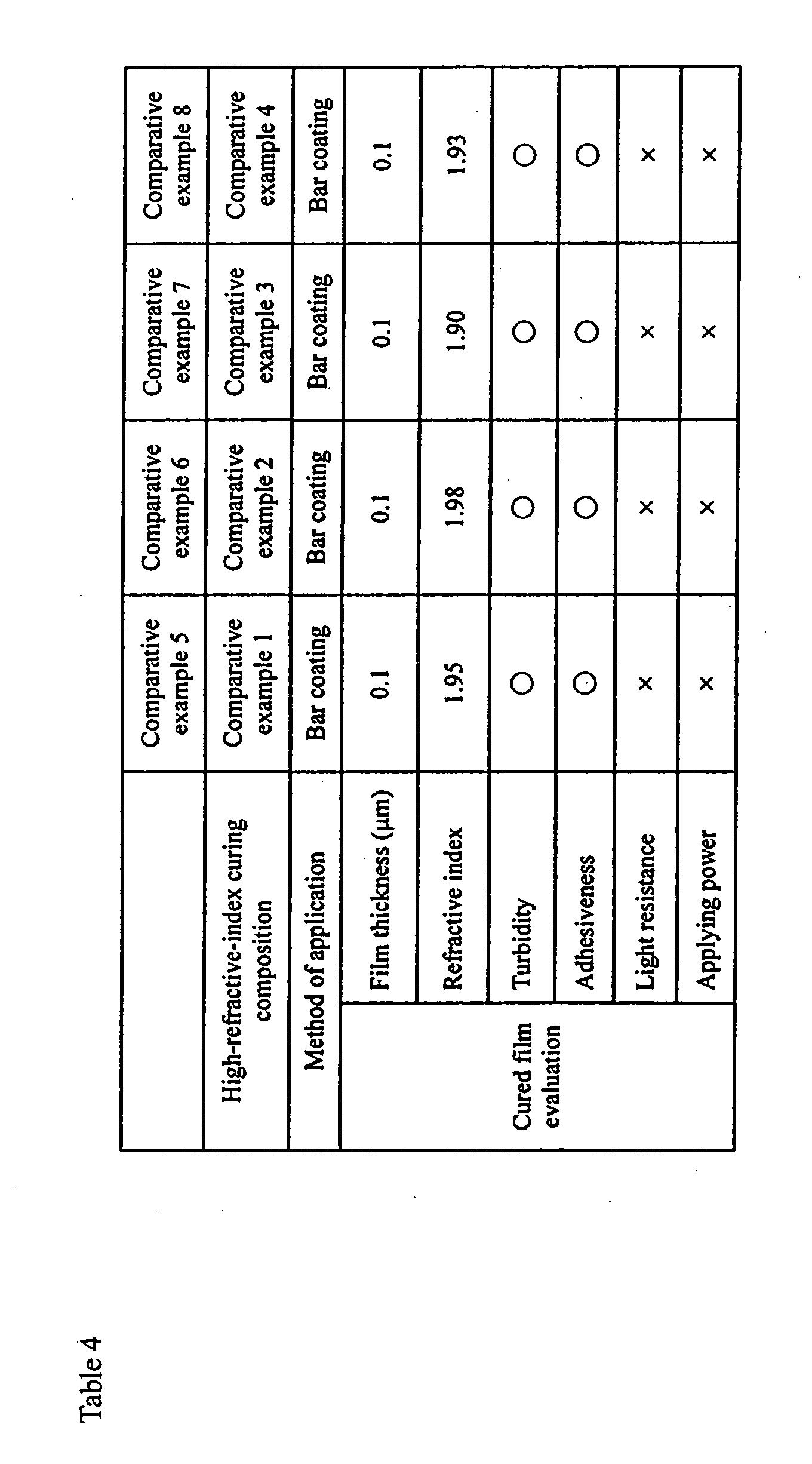
Hereinafter, production examples of the antireflective
multilayer body of the invention are described in Examples 23
to 33 and Comparative Examples 9 to 12.
In Example 12, the low-refractive-index curing
composition prepared in Production Example 5 was applied onto
the high-refractive-index cured film obtained by the method of
the (1-2) with a wire bar coater (#3), and then heat-cured at
120 °C for 1 hour to form a low-refractive-index cured film.
The film thickness of this low-refractive-index cured film was
roughly calculated from the reflectance measurement. The
thickness was about 0.1 µm. In this way, obtained was an
antireflective multilayer body composed of the
high-refractive-index cured film (about 0.1 µm) and the
low-refractive-index cured film (about 0.1 µm). Furthermore,
the antireflection, turbidity, adhesiveness and light
resistance of thisantireflective multilayer body were evaluated
on the basis of criteria described below. The results are shown
in Table 5.
The antireflection of the resultant antireflective
multilayer body was evaluated by measuring the reflectance
thereof within the wavelength range of 340 to 700 nmwith a spectral
reflectance measuring device (an auto-printing
spectrophotometer U-3410 into which a large-sized
sample-chamber integrating-sphere attachment 150-09090 was
integrated, manufactured by Hitachi, Ltd.). Specifically, the
reflectance of the antireflective multilayer body
(antireflection film) was measured about each wavelength on the
basis of the reflectance (100%) of an aluminum-evaporated film.
The antiref lection was evaluated from the reflectance about light
having a wavelength of 550 nm, among the resultant reflectances,
on the basis of the following criterion:
The turbidity was evaluated in the same way as in Examples
12 to 22 and Comparative Examples 5 to 8.
The adhesiveness was evaluated in the same way as in
Examples 12 to 22 and Comparative Examples 5 to 8.
The reflectance was measured in the same way as in Examples
12 to 22 and Comparative Examples 5 to 8, and the light resistance
was evaluated on the basis of the following criterion:
An antireflective multilayer body was yielded in the same
way as in Example 23 except that each of the high-refractive-index
cured films obtained in Examples 12 to 22 was used. The
evaluation results are shown in Table 5.

An antireflective multilayer body was yielded in the same
way as in Example 23 except that each of the high-refractive-index
cured films obtained in Comparative Examples 5 to 8 was used.
The evaluation results are shown in Table 6.

The curing composition, the cured product and the
antireflective multilayer body of the present invention can be
usefully utilized in various antireflection films of various
optical lenses such as a Fresnel lens, a lenticular lens and
a micro-lens array of a CCD, a lens section of a camera, a screen
display section of a television (CRT), and a color filter in
a liquid crystal display device.
Claims (10)
- A curing composition, comprising:100 parts by weight of (1) titanium oxide particles coated with oxide of one or more metal elements selected from the group consisting of silicon, aluminum, titanium, zirconium, tin, antimony and zinc,1 to 300 parts by weight of (2) a curing compound, and0.1 to 30 parts by weight of (3) a curing catalyst.
- The curing composition according to claim 1, which further comprises 1 to 150 parts by weight of a hydroxyl-containing compound.
- The curing composition according to claim 1, wherein the curing compound is a melamine compound.
- The curing composition according to any one of claims 1 to 3, which further comprises 100 to 10000 parts by weight of an organic solvent.
- The curing composition according to claim 4, wherein the organic solvent comprises one or more solvents selected from the group consisting of ethyl lactate, propylene glycol monomethyl ether, and n-butanol.
- A cured film which has a refractive index of 1.60 or more and is formed by curing the curing composition according to claim 1.
- An antireflective multilayer body, comprising:a substrate layer,a cured film according to claim 6 and,a cured film of a lower refractive index than that of the cured film according to claim 6.
- The antireflective multilayer body according to claim 7, wherein the low-refractive-index cured film is a cured body of a composition containing a fluorine-containing polymer.
- The antireflective multilayer body according to claim 7, wherein the low-refractive-index cured film is a cured body of a composition containing the following components:(A) a fluorine-containing polymer having a hydroxyl group,(B) a curing compound having a functional group reactive with a hydroxyl group and(C) a curing catalyst.
- The antireflective multilayer body according to any one of claims 7 to 9, wherein the shape of the substrate layer is a film, plate or lens shape.
Applications Claiming Priority (3)
| Application Number | Priority Date | Filing Date | Title |
|---|---|---|---|
| JP2002314199 | 2002-10-29 | ||
| JP2002314199 | 2002-10-29 | ||
| PCT/JP2003/013827 WO2004039891A1 (en) | 2002-10-29 | 2003-10-29 | Curing composition and antireflective multilayer body using same |
Publications (2)
| Publication Number | Publication Date |
|---|---|
| EP1557447A1 true EP1557447A1 (en) | 2005-07-27 |
| EP1557447A4 EP1557447A4 (en) | 2007-05-30 |
Family
ID=32211608
Family Applications (1)
| Application Number | Title | Priority Date | Filing Date |
|---|---|---|---|
| EP03769940A Withdrawn EP1557447A4 (en) | 2002-10-29 | 2003-10-29 | Curing composition and antireflective multilayer body using same |
Country Status (6)
| Country | Link |
|---|---|
| US (1) | US20060128836A1 (en) |
| EP (1) | EP1557447A4 (en) |
| KR (1) | KR100635412B1 (en) |
| CN (1) | CN1290930C (en) |
| TW (1) | TW200420648A (en) |
| WO (1) | WO2004039891A1 (en) |
Families Citing this family (15)
| Publication number | Priority date | Publication date | Assignee | Title |
|---|---|---|---|---|
| US20070261601A1 (en) * | 2004-09-22 | 2007-11-15 | Fujifilm Corporation | Hardening Composition, Antireflective Film, Method of Producing the Same, Polarizing Plate and Image Display Unit |
| US7265176B2 (en) * | 2005-01-31 | 2007-09-04 | E. I. Du Pont De Nemours And Company | Composition comprising nanoparticle TiO2 and ethylene copolymer |
| JP3947751B2 (en) * | 2005-10-07 | 2007-07-25 | セイコーエプソン株式会社 | Plastic lens and method for manufacturing plastic lens |
| KR100687493B1 (en) * | 2006-07-03 | 2007-02-27 | 주식회사 우진종합건축사사무소 | Prefabricated Door Frame Width Control Structure |
| KR101375485B1 (en) * | 2007-01-12 | 2014-03-18 | 코니카 미놀타 어드밴스드 레이어즈 인코포레이티드 | Antireflection film, process for producing antireflection film, polarizing plate, and display device |
| JP5130503B2 (en) * | 2007-08-21 | 2013-01-30 | デクセリアルズ株式会社 | Antireflection film |
| EP2174989A1 (en) | 2008-10-08 | 2010-04-14 | ChemIP B.V. | Aqueous metaloxide dispersions and coating materials prepared thereof. |
| CN101782698B (en) * | 2009-01-20 | 2016-10-26 | 欧睿控股股份有限公司 | The liquid crystal display of ambient light auxiliary |
| US8654436B1 (en) * | 2009-10-30 | 2014-02-18 | E Ink Corporation | Particles for use in electrophoretic displays |
| JP5484025B2 (en) | 2009-12-15 | 2014-05-07 | キヤノン株式会社 | Titanium oxide sol, resin composition using the same, optical material and optical element |
| US9664831B2 (en) | 2011-10-12 | 2017-05-30 | Konica Minolta, Inc. | Near-infrared shielding film and near-infrared shielding body |
| CN104884537A (en) * | 2012-12-28 | 2015-09-02 | 富士胶片株式会社 | Curable resin composition, infrared cut-off filter, and solid-state imaging element using same |
| US12517286B2 (en) * | 2020-11-27 | 2026-01-06 | International Advanced Research Centre For Powder Metallurgy And New Materials (Arci) | Method of producing single layer omnidirectional broadband antireflective and super hydrophilic (antifogging) coatings for solar and other applications |
| TWI805021B (en) * | 2021-06-10 | 2023-06-11 | 大立光電股份有限公司 | Camera module, electronic device and vehicle tool |
| CN216900993U (en) | 2021-06-10 | 2022-07-05 | 大立光电股份有限公司 | Camera module, electronic device and vehicle tool |
Family Cites Families (32)
| Publication number | Priority date | Publication date | Assignee | Title |
|---|---|---|---|---|
| GB2064987B (en) * | 1979-11-14 | 1983-11-30 | Toray Industries | Process for producing transparent shaped article having enhanced anti-reflective effect |
| JPS5774369A (en) * | 1980-10-28 | 1982-05-10 | Mitsui Petrochem Ind Ltd | Coating composition |
| US4373076A (en) * | 1981-10-26 | 1983-02-08 | Hoya Lens Corporation | Terpolymer with a high refractive index |
| US4496469A (en) * | 1982-01-12 | 1985-01-29 | Otsuka Kagaku Yakuhin Kabushiki Kaisha | Heat-insulating refractory material consisting alkali titanate and silicon resin |
| US4590117A (en) * | 1983-03-10 | 1986-05-20 | Toray Industries, Inc. | Transparent material having antireflective coating |
| JP2952962B2 (en) * | 1989-05-31 | 1999-09-27 | 旭硝子株式会社 | Pollution prevention equipment |
| JP2814456B2 (en) * | 1989-11-06 | 1998-10-22 | 東芝シリコーン株式会社 | High strength room temperature curable polyorganosiloxane composition |
| JPH059373A (en) * | 1991-07-03 | 1993-01-19 | Toshiba Silicone Co Ltd | Room temperature curable composition |
| US5260094A (en) * | 1991-09-30 | 1993-11-09 | Cornell Research Foundation, Inc. | Preparing densified low porosity titania sol-gel forms |
| JP3186868B2 (en) * | 1992-12-04 | 2001-07-11 | 積水化学工業株式会社 | Photocurable conductive coating composition |
| FR2693558B1 (en) * | 1992-07-09 | 1994-08-19 | Commissariat Energie Atomique | Method for manufacturing thin layers having optical properties. |
| JP3770625B2 (en) * | 1993-03-12 | 2006-04-26 | 旭硝子株式会社 | Optical article having antireflection layer |
| US5424354A (en) * | 1993-12-28 | 1995-06-13 | Three Bond Co., Ltd. | Room temperature curable polyoganosiloxane composition |
| US5909314A (en) * | 1994-02-15 | 1999-06-01 | Dai Nippon Printing Co., Ltd. | Optical functional materials and process for producing the same |
| US6296943B1 (en) * | 1994-03-05 | 2001-10-02 | Nissan Chemical Industries, Ltd. | Method for producing composite sol, coating composition, and optical element |
| US5789476A (en) * | 1995-03-03 | 1998-08-04 | Seiko Epson Corporation | Film-forming coating solution and synthetic resin lens |
| JP3196558B2 (en) * | 1995-03-06 | 2001-08-06 | 信越化学工業株式会社 | Hard Coating Agent and Article with Hard Coat Film Formed |
| US6777070B1 (en) * | 1998-10-14 | 2004-08-17 | Tomoegawa Paper Co., Ltd. | Antireflection material and polarizing film using the same |
| JP3952619B2 (en) * | 1998-12-22 | 2007-08-01 | Jsr株式会社 | High refractive index material and antireflection laminate using the same |
| KR100717490B1 (en) * | 1999-03-26 | 2007-05-14 | 가부시키가이샤 시세이도 | Titanium silica complex and cosmetics containing it |
| JP2001025666A (en) * | 1999-07-14 | 2001-01-30 | Nippon Sheet Glass Co Ltd | Laminated body and method for manufacturing the same |
| EP1077236B1 (en) * | 1999-08-16 | 2004-05-26 | Nissan Chemical Industries Ltd. | Modified metal oxide sol, coating composition and optical element |
| JP4062392B2 (en) * | 2000-08-04 | 2008-03-19 | 信越化学工業株式会社 | Silicone resin for coating composition, method for producing the same, coating composition and article having this cured film |
| EP1486801A3 (en) * | 2001-04-24 | 2004-12-22 | Hoya Corporation | Optical composition, process for producing optical element using the same, and optical element |
| JP2003119207A (en) * | 2001-10-11 | 2003-04-23 | Jsr Corp | Photocurable composition, cured product thereof, and laminate |
| JP4004886B2 (en) * | 2002-07-31 | 2007-11-07 | Tdk株式会社 | Anti-reflection film and anti-reflection treated object |
| JP3960307B2 (en) * | 2003-05-15 | 2007-08-15 | Jsr株式会社 | Liquid resin composition, cured film and laminate |
| WO2006046855A1 (en) * | 2004-10-27 | 2006-05-04 | Jsr Corporation | Curable composition, cured product, and laminate |
| US20080096033A1 (en) * | 2004-10-28 | 2008-04-24 | Jsr Corporation | Curable Composition, Cured Layer, and Laminate |
| US7758956B2 (en) * | 2005-02-16 | 2010-07-20 | Fujifilm Corporation | Antireflection film and polarizing plate and image display device using same |
| US7982953B2 (en) * | 2005-03-07 | 2011-07-19 | Fujifilm Corporation | Antireflection film, and polarizing plate and image display device using the same |
| JP4740184B2 (en) * | 2006-05-16 | 2011-08-03 | 日東電工株式会社 | Polarizing plate and image display device using the same |
-
2003
- 2003-10-29 US US10/533,252 patent/US20060128836A1/en not_active Abandoned
- 2003-10-29 WO PCT/JP2003/013827 patent/WO2004039891A1/en not_active Ceased
- 2003-10-29 EP EP03769940A patent/EP1557447A4/en not_active Withdrawn
- 2003-10-29 TW TW92130100A patent/TW200420648A/en not_active IP Right Cessation
- 2003-10-29 CN CNB2003801024075A patent/CN1290930C/en not_active Expired - Lifetime
- 2003-10-29 KR KR1020057007357A patent/KR100635412B1/en not_active Expired - Lifetime
Also Published As
| Publication number | Publication date |
|---|---|
| EP1557447A4 (en) | 2007-05-30 |
| CN1290930C (en) | 2006-12-20 |
| TWI292417B (en) | 2008-01-11 |
| KR20050084885A (en) | 2005-08-29 |
| KR100635412B1 (en) | 2006-10-18 |
| WO2004039891A1 (en) | 2004-05-13 |
| US20060128836A1 (en) | 2006-06-15 |
| CN1708559A (en) | 2005-12-14 |
| TW200420648A (en) | 2004-10-16 |
Similar Documents
| Publication | Publication Date | Title |
|---|---|---|
| KR101918682B1 (en) | Low refractive layer and anti-reflective film comprising the same | |
| US20060128836A1 (en) | Curing composition and antireflective multilayer body using same | |
| US6245428B1 (en) | Low reflective films | |
| KR101615782B1 (en) | Flexible high refractive index antireflective film | |
| CN100537654C (en) | Liquid resin composition, cured film and laminate | |
| JP4179163B2 (en) | Antireflection film laminate and manufacturing method thereof | |
| JP4419267B2 (en) | Curable composition for high refractive index film, high refractive index film, and laminate for antireflection | |
| TWI541533B (en) | Fingerprint-resistant anti-reflection film | |
| JP3952619B2 (en) | High refractive index material and antireflection laminate using the same | |
| JP2002372601A (en) | Anti-reflection film, image display device and fluorine-containing copolymer | |
| US20110117345A1 (en) | Optical Article | |
| KR101956830B1 (en) | Low refractive layer and anti-reflective film comprising the same | |
| JP2003026732A (en) | Fluorine-containing copolymer, film-forming composition, antireflection film, antireflection film, and image display device | |
| JPH08110401A (en) | Transparent high refractive index film and transparent laminate | |
| JP3817180B2 (en) | Antireflection film, antireflection film and image display device | |
| JP4701492B2 (en) | Structure | |
| JP2004169018A (en) | Curable composition and antireflection laminate using the same | |
| CN1379250A (en) | Antireflection substrate having weak reflective colour | |
| JP4419809B2 (en) | Manufacturing method of laminate | |
| JP2002120311A (en) | Structure | |
| JPH07119843B2 (en) | Anti-reflection high refractive index plastic lens | |
| CN100513477C (en) | Liquid curable resin composition and method for producing laminate using same | |
| JP2002006764A (en) | Display window material for portable telephone | |
| JPH08231807A (en) | Primer composition and plastic lens | |
| JP2002120346A (en) | Structure manufacturing method |
Legal Events
| Date | Code | Title | Description |
|---|---|---|---|
| PUAI | Public reference made under article 153(3) epc to a published international application that has entered the european phase |
Free format text: ORIGINAL CODE: 0009012 |
|
| 17P | Request for examination filed |
Effective date: 20050428 |
|
| AK | Designated contracting states |
Kind code of ref document: A1 Designated state(s): AT BE BG CH CY CZ DE DK EE ES FI FR GB GR HU IE IT LI LU MC NL PT RO SE SI SK TR |
|
| RBV | Designated contracting states (corrected) |
Designated state(s): DE FR GB |
|
| A4 | Supplementary search report drawn up and despatched |
Effective date: 20070427 |
|
| STAA | Information on the status of an ep patent application or granted ep patent |
Free format text: STATUS: THE APPLICATION HAS BEEN WITHDRAWN |
|
| 18W | Application withdrawn |
Effective date: 20081029 |