EP1557420A1 - Process for producing optically active sulfoxide - Google Patents
Process for producing optically active sulfoxide Download PDFInfo
- Publication number
- EP1557420A1 EP1557420A1 EP03758784A EP03758784A EP1557420A1 EP 1557420 A1 EP1557420 A1 EP 1557420A1 EP 03758784 A EP03758784 A EP 03758784A EP 03758784 A EP03758784 A EP 03758784A EP 1557420 A1 EP1557420 A1 EP 1557420A1
- Authority
- EP
- European Patent Office
- Prior art keywords
- group
- process according
- tartrate
- compound
- optically active
- Prior art date
- Legal status (The legal status is an assumption and is not a legal conclusion. Google has not performed a legal analysis and makes no representation as to the accuracy of the status listed.)
- Withdrawn
Links
- 238000000034 method Methods 0.000 title claims description 92
- 150000003462 sulfoxides Chemical class 0.000 title description 6
- -1 cyclic sulfoxides Chemical class 0.000 claims abstract description 200
- 239000000203 mixture Substances 0.000 claims abstract description 54
- LFQSCWFLJHTTHZ-UHFFFAOYSA-N Ethanol Chemical compound CCO LFQSCWFLJHTTHZ-UHFFFAOYSA-N 0.000 claims abstract description 51
- FEWJPZIEWOKRBE-UHFFFAOYSA-N Tartaric acid Natural products [H+].[H+].[O-]C(=O)C(O)C(O)C([O-])=O FEWJPZIEWOKRBE-UHFFFAOYSA-N 0.000 claims abstract description 43
- XLYOFNOQVPJJNP-UHFFFAOYSA-N water Substances O XLYOFNOQVPJJNP-UHFFFAOYSA-N 0.000 claims abstract description 38
- 235000002906 tartaric acid Nutrition 0.000 claims abstract description 25
- 239000011975 tartaric acid Substances 0.000 claims abstract description 25
- FRIBMENBGGCKPD-UHFFFAOYSA-N 3-(2,3-dimethoxyphenyl)prop-2-enal Chemical compound COC1=CC=CC(C=CC=O)=C1OC FRIBMENBGGCKPD-UHFFFAOYSA-N 0.000 claims abstract description 15
- 239000012442 inert solvent Substances 0.000 claims abstract description 14
- ORMDVQRBTFCOGC-UHFFFAOYSA-N (2-hydroperoxy-4-methylpentan-2-yl)benzene Chemical compound CC(C)CC(C)(OO)C1=CC=CC=C1 ORMDVQRBTFCOGC-UHFFFAOYSA-N 0.000 claims abstract description 8
- 238000004519 manufacturing process Methods 0.000 claims abstract description 8
- 150000001875 compounds Chemical class 0.000 claims description 71
- 125000001997 phenyl group Chemical group [H]C1=C([H])C([H])=C(*)C([H])=C1[H] 0.000 claims description 31
- 125000001424 substituent group Chemical group 0.000 claims description 28
- FEWJPZIEWOKRBE-LWMBPPNESA-L D-tartrate(2-) Chemical compound [O-]C(=O)[C@@H](O)[C@H](O)C([O-])=O FEWJPZIEWOKRBE-LWMBPPNESA-L 0.000 claims description 24
- 230000003287 optical effect Effects 0.000 claims description 24
- 125000005843 halogen group Chemical group 0.000 claims description 23
- XEBCWEDRGPSHQH-UHFFFAOYSA-N diisopropyl tartrate Chemical compound CC(C)OC(=O)C(O)C(O)C(=O)OC(C)C XEBCWEDRGPSHQH-UHFFFAOYSA-N 0.000 claims description 19
- 125000006239 protecting group Chemical group 0.000 claims description 18
- 125000002924 primary amino group Chemical group [H]N([H])* 0.000 claims description 17
- VXUYXOFXAQZZMF-UHFFFAOYSA-N titanium(IV) isopropoxide Chemical compound CC(C)O[Ti](OC(C)C)(OC(C)C)OC(C)C VXUYXOFXAQZZMF-UHFFFAOYSA-N 0.000 claims description 17
- 125000000999 tert-butyl group Chemical group [H]C([H])([H])C(*)(C([H])([H])[H])C([H])([H])[H] 0.000 claims description 16
- 239000002253 acid Substances 0.000 claims description 14
- 239000003795 chemical substances by application Substances 0.000 claims description 14
- 125000004435 hydrogen atom Chemical group [H]* 0.000 claims description 14
- 238000007254 oxidation reaction Methods 0.000 claims description 14
- IWYDHOAUDWTVEP-UHFFFAOYSA-N mandelic acid Chemical compound OC(=O)C(O)C1=CC=CC=C1 IWYDHOAUDWTVEP-UHFFFAOYSA-N 0.000 claims description 13
- 230000003647 oxidation Effects 0.000 claims description 13
- 125000004430 oxygen atom Chemical group O* 0.000 claims description 13
- 125000000041 C6-C10 aryl group Chemical group 0.000 claims description 12
- YSAVZVORKRDODB-UHFFFAOYSA-N Diethyl tartrate Chemical compound CCOC(=O)C(O)C(O)C(=O)OCC YSAVZVORKRDODB-UHFFFAOYSA-N 0.000 claims description 12
- 125000001309 chloro group Chemical group Cl* 0.000 claims description 12
- 125000004433 nitrogen atom Chemical group N* 0.000 claims description 12
- 125000004434 sulfur atom Chemical group 0.000 claims description 12
- 125000001495 ethyl group Chemical group [H]C([H])([H])C([H])([H])* 0.000 claims description 11
- 125000001153 fluoro group Chemical group F* 0.000 claims description 11
- 125000001072 heteroaryl group Chemical group 0.000 claims description 11
- 125000002496 methyl group Chemical group [H]C([H])([H])* 0.000 claims description 11
- 125000000956 methoxy group Chemical group [H]C([H])([H])O* 0.000 claims description 10
- 125000004044 trifluoroacetyl group Chemical group FC(C(=O)*)(F)F 0.000 claims description 10
- FEWJPZIEWOKRBE-XIXRPRMCSA-N Mesotartaric acid Chemical compound OC(=O)[C@@H](O)[C@@H](O)C(O)=O FEWJPZIEWOKRBE-XIXRPRMCSA-N 0.000 claims description 9
- XEBCWEDRGPSHQH-HTQZYQBOSA-N dipropan-2-yl (2r,3r)-2,3-dihydroxybutanedioate Chemical compound CC(C)OC(=O)[C@H](O)[C@@H](O)C(=O)OC(C)C XEBCWEDRGPSHQH-HTQZYQBOSA-N 0.000 claims description 9
- 125000003754 ethoxycarbonyl group Chemical group C(=O)(OCC)* 0.000 claims description 9
- 125000005931 tert-butyloxycarbonyl group Chemical group [H]C([H])([H])C(OC(*)=O)(C([H])([H])[H])C([H])([H])[H] 0.000 claims description 9
- 125000000229 (C1-C4)alkoxy group Chemical group 0.000 claims description 8
- 125000001584 benzyloxycarbonyl group Chemical group C(=O)(OCC1=CC=CC=C1)* 0.000 claims description 8
- UYWQUFXKFGHYNT-UHFFFAOYSA-N phenylmethyl ester of formic acid Natural products O=COCC1=CC=CC=C1 UYWQUFXKFGHYNT-UHFFFAOYSA-N 0.000 claims description 8
- 125000001160 methoxycarbonyl group Chemical group [H]C([H])([H])OC(*)=O 0.000 claims description 7
- 150000003839 salts Chemical class 0.000 claims description 7
- 125000003831 tetrazolyl group Chemical group 0.000 claims description 7
- YONLFQNRGZXBBF-ZIAGYGMSSA-N (2r,3r)-2,3-dibenzoyloxybutanedioic acid Chemical compound O([C@@H](C(=O)O)[C@@H](OC(=O)C=1C=CC=CC=1)C(O)=O)C(=O)C1=CC=CC=C1 YONLFQNRGZXBBF-ZIAGYGMSSA-N 0.000 claims description 6
- 125000004169 (C1-C6) alkyl group Chemical group 0.000 claims description 6
- FEWJPZIEWOKRBE-JCYAYHJZSA-N Dextrotartaric acid Chemical compound OC(=O)[C@H](O)[C@@H](O)C(O)=O FEWJPZIEWOKRBE-JCYAYHJZSA-N 0.000 claims description 6
- MIOPJNTWMNEORI-MHPPCMCBSA-N [(4r)-7,7-dimethyl-3-oxo-4-bicyclo[2.2.1]heptanyl]methanesulfonic acid Chemical compound C1C[C@]2(CS(O)(=O)=O)C(=O)CC1C2(C)C MIOPJNTWMNEORI-MHPPCMCBSA-N 0.000 claims description 6
- 125000001301 ethoxy group Chemical group [H]C([H])([H])C([H])([H])O* 0.000 claims description 6
- 125000002887 hydroxy group Chemical group [H]O* 0.000 claims description 6
- 235000011090 malic acid Nutrition 0.000 claims description 6
- JMXKSZRRTHPKDL-UHFFFAOYSA-N titanium ethoxide Chemical compound [Ti+4].CC[O-].CC[O-].CC[O-].CC[O-] JMXKSZRRTHPKDL-UHFFFAOYSA-N 0.000 claims description 6
- 125000004178 (C1-C4) alkyl group Chemical group 0.000 claims description 5
- 125000004191 (C1-C6) alkoxy group Chemical group 0.000 claims description 5
- 125000003161 (C1-C6) alkylene group Chemical group 0.000 claims description 5
- 125000005809 3,4,5-trimethoxyphenyl group Chemical group [H]C1=C(OC([H])([H])[H])C(OC([H])([H])[H])=C(OC([H])([H])[H])C([H])=C1* 0.000 claims description 5
- 125000004453 alkoxycarbonyl group Chemical group 0.000 claims description 5
- 125000002947 alkylene group Chemical group 0.000 claims description 5
- 125000005279 aryl sulfonyloxy group Chemical group 0.000 claims description 5
- 125000003236 benzoyl group Chemical group [H]C1=C([H])C([H])=C(C([H])=C1[H])C(*)=O 0.000 claims description 5
- 125000001570 methylene group Chemical group [H]C([H])([*:1])[*:2] 0.000 claims description 5
- 125000002861 (C1-C4) alkanoyl group Chemical group 0.000 claims description 4
- IWYDHOAUDWTVEP-SSDOTTSWSA-N (R)-mandelic acid Chemical compound OC(=O)[C@H](O)C1=CC=CC=C1 IWYDHOAUDWTVEP-SSDOTTSWSA-N 0.000 claims description 4
- 125000001088 1-naphthoyl group Chemical group C1(=CC=CC2=CC=CC=C12)C(=O)* 0.000 claims description 4
- 125000001216 2-naphthoyl group Chemical group C1=C(C=CC2=CC=CC=C12)C(=O)* 0.000 claims description 4
- BJEPYKJPYRNKOW-UWTATZPHSA-N (R)-malic acid Chemical compound OC(=O)[C@H](O)CC(O)=O BJEPYKJPYRNKOW-UWTATZPHSA-N 0.000 claims description 3
- BJEPYKJPYRNKOW-REOHCLBHSA-N (S)-malic acid Chemical compound OC(=O)[C@@H](O)CC(O)=O BJEPYKJPYRNKOW-REOHCLBHSA-N 0.000 claims description 3
- BJEPYKJPYRNKOW-UHFFFAOYSA-N alpha-hydroxysuccinic acid Natural products OC(=O)C(O)CC(O)=O BJEPYKJPYRNKOW-UHFFFAOYSA-N 0.000 claims description 3
- MIOPJNTWMNEORI-UHFFFAOYSA-N camphorsulfonic acid Chemical compound C1CC2(CS(O)(=O)=O)C(=O)CC1C2(C)C MIOPJNTWMNEORI-UHFFFAOYSA-N 0.000 claims description 3
- PCYQQSKDZQTOQG-UHFFFAOYSA-N dibutyl 2,3-dihydroxybutanedioate Chemical compound CCCCOC(=O)C(O)C(O)C(=O)OCCCC PCYQQSKDZQTOQG-UHFFFAOYSA-N 0.000 claims description 3
- PVRATXCXJDHJJN-QWWZWVQMSA-N dimethyl (2r,3r)-2,3-dihydroxybutanedioate Chemical group COC(=O)[C@H](O)[C@@H](O)C(=O)OC PVRATXCXJDHJJN-QWWZWVQMSA-N 0.000 claims description 3
- PVRATXCXJDHJJN-UHFFFAOYSA-N dimethyl 2,3-dihydroxybutanedioate Chemical group COC(=O)C(O)C(O)C(=O)OC PVRATXCXJDHJJN-UHFFFAOYSA-N 0.000 claims description 3
- ITWOKJQQGHCDBL-UHFFFAOYSA-N ditert-butyl 2,3-dihydroxybutanedioate Chemical compound CC(C)(C)OC(=O)C(O)C(O)C(=O)OC(C)(C)C ITWOKJQQGHCDBL-UHFFFAOYSA-N 0.000 claims description 3
- YQXQWFASZYSARF-UHFFFAOYSA-N methanol;titanium Chemical group [Ti].OC YQXQWFASZYSARF-UHFFFAOYSA-N 0.000 claims description 3
- HKJYVRJHDIPMQB-UHFFFAOYSA-N propan-1-olate;titanium(4+) Chemical compound CCCO[Ti](OCCC)(OCCC)OCCC HKJYVRJHDIPMQB-UHFFFAOYSA-N 0.000 claims description 3
- LSNNMFCWUKXFEE-UHFFFAOYSA-M Bisulfite Chemical compound OS([O-])=O LSNNMFCWUKXFEE-UHFFFAOYSA-M 0.000 claims description 2
- 150000001732 carboxylic acid derivatives Chemical class 0.000 claims description 2
- 150000004294 cyclic thioethers Chemical class 0.000 abstract 1
- KFZMGEQAYNKOFK-UHFFFAOYSA-N Isopropanol Chemical compound CC(C)O KFZMGEQAYNKOFK-UHFFFAOYSA-N 0.000 description 57
- MVPPADPHJFYWMZ-UHFFFAOYSA-N chlorobenzene Chemical compound ClC1=CC=CC=C1 MVPPADPHJFYWMZ-UHFFFAOYSA-N 0.000 description 40
- 125000005605 benzo group Chemical group 0.000 description 33
- RFFLAFLAYFXFSW-UHFFFAOYSA-N 1,2-dichlorobenzene Chemical compound ClC1=CC=CC=C1Cl RFFLAFLAYFXFSW-UHFFFAOYSA-N 0.000 description 30
- RTZKZFJDLAIYFH-UHFFFAOYSA-N Diethyl ether Chemical compound CCOCC RTZKZFJDLAIYFH-UHFFFAOYSA-N 0.000 description 25
- OKKJLVBELUTLKV-UHFFFAOYSA-N Methanol Chemical compound OC OKKJLVBELUTLKV-UHFFFAOYSA-N 0.000 description 24
- YXFVVABEGXRONW-UHFFFAOYSA-N Toluene Chemical compound CC1=CC=CC=C1 YXFVVABEGXRONW-UHFFFAOYSA-N 0.000 description 21
- VLKZOEOYAKHREP-UHFFFAOYSA-N n-Hexane Chemical compound CCCCCC VLKZOEOYAKHREP-UHFFFAOYSA-N 0.000 description 21
- AASLZTXNLVEPJM-UHFFFAOYSA-N tert-butyl spiro[1h-2-benzothiophene-3,4'-piperidine]-1'-carboxylate Chemical compound C1CN(C(=O)OC(C)(C)C)CCC21C1=CC=CC=C1CS2 AASLZTXNLVEPJM-UHFFFAOYSA-N 0.000 description 20
- HEMHJVSKTPXQMS-UHFFFAOYSA-M Sodium hydroxide Chemical compound [OH-].[Na+] HEMHJVSKTPXQMS-UHFFFAOYSA-M 0.000 description 18
- 238000004128 high performance liquid chromatography Methods 0.000 description 18
- 239000011541 reaction mixture Substances 0.000 description 18
- 238000006243 chemical reaction Methods 0.000 description 17
- WYURNTSHIVDZCO-UHFFFAOYSA-N Tetrahydrofuran Chemical compound C1CCOC1 WYURNTSHIVDZCO-UHFFFAOYSA-N 0.000 description 16
- QTBSBXVTEAMEQO-UHFFFAOYSA-N Acetic acid Chemical compound CC(O)=O QTBSBXVTEAMEQO-UHFFFAOYSA-N 0.000 description 15
- UHOVQNZJYSORNB-UHFFFAOYSA-N Benzene Chemical compound C1=CC=CC=C1 UHOVQNZJYSORNB-UHFFFAOYSA-N 0.000 description 15
- YMWUJEATGCHHMB-UHFFFAOYSA-N Dichloromethane Chemical compound ClCCl YMWUJEATGCHHMB-UHFFFAOYSA-N 0.000 description 15
- XEKOWRVHYACXOJ-UHFFFAOYSA-N Ethyl acetate Chemical compound CCOC(C)=O XEKOWRVHYACXOJ-UHFFFAOYSA-N 0.000 description 15
- KWYUFKZDYYNOTN-UHFFFAOYSA-M Potassium hydroxide Chemical compound [OH-].[K+] KWYUFKZDYYNOTN-UHFFFAOYSA-M 0.000 description 15
- 239000000243 solution Substances 0.000 description 15
- WEVYAHXRMPXWCK-UHFFFAOYSA-N Acetonitrile Chemical compound CC#N WEVYAHXRMPXWCK-UHFFFAOYSA-N 0.000 description 14
- VEXZGXHMUGYJMC-UHFFFAOYSA-N Hydrochloric acid Chemical compound Cl VEXZGXHMUGYJMC-UHFFFAOYSA-N 0.000 description 14
- LRHPLDYGYMQRHN-UHFFFAOYSA-N N-Butanol Chemical compound CCCCO LRHPLDYGYMQRHN-UHFFFAOYSA-N 0.000 description 14
- 239000002904 solvent Substances 0.000 description 14
- GQHTUMJGOHRCHB-UHFFFAOYSA-N 2,3,4,6,7,8,9,10-octahydropyrimido[1,2-a]azepine Chemical compound C1CCCCN2CCCN=C21 GQHTUMJGOHRCHB-UHFFFAOYSA-N 0.000 description 12
- ZMXDDKWLCZADIW-UHFFFAOYSA-N N,N-Dimethylformamide Chemical compound CN(C)C=O ZMXDDKWLCZADIW-UHFFFAOYSA-N 0.000 description 12
- 239000002585 base Substances 0.000 description 11
- HEDRZPFGACZZDS-UHFFFAOYSA-N Chloroform Chemical compound ClC(Cl)Cl HEDRZPFGACZZDS-UHFFFAOYSA-N 0.000 description 10
- IMNFDUFMRHMDMM-UHFFFAOYSA-N N-Heptane Chemical compound CCCCCCC IMNFDUFMRHMDMM-UHFFFAOYSA-N 0.000 description 10
- CDBYLPFSWZWCQE-UHFFFAOYSA-L Sodium Carbonate Chemical compound [Na+].[Na+].[O-]C([O-])=O CDBYLPFSWZWCQE-UHFFFAOYSA-L 0.000 description 10
- QAOWNCQODCNURD-UHFFFAOYSA-N Sulfuric acid Chemical compound OS(O)(=O)=O QAOWNCQODCNURD-UHFFFAOYSA-N 0.000 description 10
- HEDRZPFGACZZDS-MICDWDOJSA-N Trichloro(2H)methane Chemical compound [2H]C(Cl)(Cl)Cl HEDRZPFGACZZDS-MICDWDOJSA-N 0.000 description 10
- 229910052783 alkali metal Inorganic materials 0.000 description 10
- 238000001816 cooling Methods 0.000 description 10
- 150000002170 ethers Chemical class 0.000 description 10
- 239000012299 nitrogen atmosphere Substances 0.000 description 10
- BWHMMNNQKKPAPP-UHFFFAOYSA-L potassium carbonate Chemical compound [K+].[K+].[O-]C([O-])=O BWHMMNNQKKPAPP-UHFFFAOYSA-L 0.000 description 10
- BDERNNFJNOPAEC-UHFFFAOYSA-N propan-1-ol Chemical compound CCCO BDERNNFJNOPAEC-UHFFFAOYSA-N 0.000 description 10
- VZGDMQKNWNREIO-UHFFFAOYSA-N tetrachloromethane Chemical compound ClC(Cl)(Cl)Cl VZGDMQKNWNREIO-UHFFFAOYSA-N 0.000 description 10
- CSCPPACGZOOCGX-UHFFFAOYSA-N Acetone Chemical compound CC(C)=O CSCPPACGZOOCGX-UHFFFAOYSA-N 0.000 description 9
- WMFOQBRAJBCJND-UHFFFAOYSA-M Lithium hydroxide Chemical compound [Li+].[OH-] WMFOQBRAJBCJND-UHFFFAOYSA-M 0.000 description 9
- SJRJJKPEHAURKC-UHFFFAOYSA-N N-Methylmorpholine Chemical compound CN1CCOCC1 SJRJJKPEHAURKC-UHFFFAOYSA-N 0.000 description 9
- DKGAVHZHDRPRBM-UHFFFAOYSA-N Tert-Butanol Chemical compound CC(C)(C)O DKGAVHZHDRPRBM-UHFFFAOYSA-N 0.000 description 9
- ZMANZCXQSJIPKH-UHFFFAOYSA-N Triethylamine Chemical compound CCN(CC)CC ZMANZCXQSJIPKH-UHFFFAOYSA-N 0.000 description 9
- 150000001298 alcohols Chemical class 0.000 description 9
- RYHBNJHYFVUHQT-UHFFFAOYSA-N 1,4-Dioxane Chemical compound C1COCCO1 RYHBNJHYFVUHQT-UHFFFAOYSA-N 0.000 description 8
- OAKJQQAXSVQMHS-UHFFFAOYSA-N Hydrazine Chemical compound NN OAKJQQAXSVQMHS-UHFFFAOYSA-N 0.000 description 8
- BAVYZALUXZFZLV-UHFFFAOYSA-N Methylamine Chemical compound NC BAVYZALUXZFZLV-UHFFFAOYSA-N 0.000 description 8
- WQDUMFSSJAZKTM-UHFFFAOYSA-N Sodium methoxide Chemical compound [Na+].[O-]C WQDUMFSSJAZKTM-UHFFFAOYSA-N 0.000 description 8
- DTQVDTLACAAQTR-UHFFFAOYSA-N Trifluoroacetic acid Chemical compound OC(=O)C(F)(F)F DTQVDTLACAAQTR-UHFFFAOYSA-N 0.000 description 8
- YLQBMQCUIZJEEH-UHFFFAOYSA-N tetrahydrofuran Natural products C=1C=COC=1 YLQBMQCUIZJEEH-UHFFFAOYSA-N 0.000 description 8
- 150000008282 halocarbons Chemical class 0.000 description 7
- GETTZEONDQJALK-UHFFFAOYSA-N (trifluoromethyl)benzene Chemical compound FC(F)(F)C1=CC=CC=C1 GETTZEONDQJALK-UHFFFAOYSA-N 0.000 description 6
- SCYULBFZEHDVBN-UHFFFAOYSA-N 1,1-Dichloroethane Chemical compound CC(Cl)Cl SCYULBFZEHDVBN-UHFFFAOYSA-N 0.000 description 6
- ZPQOPVIELGIULI-UHFFFAOYSA-N 1,3-dichlorobenzene Chemical compound ClC1=CC=CC(Cl)=C1 ZPQOPVIELGIULI-UHFFFAOYSA-N 0.000 description 6
- 238000005160 1H NMR spectroscopy Methods 0.000 description 6
- VHYFNPMBLIVWCW-UHFFFAOYSA-N 4-Dimethylaminopyridine Chemical compound CN(C)C1=CC=NC=C1 VHYFNPMBLIVWCW-UHFFFAOYSA-N 0.000 description 6
- XTHFKEDIFFGKHM-UHFFFAOYSA-N Dimethoxyethane Chemical compound COCCOC XTHFKEDIFFGKHM-UHFFFAOYSA-N 0.000 description 6
- IAZDPXIOMUYVGZ-UHFFFAOYSA-N Dimethylsulphoxide Chemical compound CS(C)=O IAZDPXIOMUYVGZ-UHFFFAOYSA-N 0.000 description 6
- ZHNUHDYFZUAESO-UHFFFAOYSA-N Formamide Chemical compound NC=O ZHNUHDYFZUAESO-UHFFFAOYSA-N 0.000 description 6
- JGFZNNIVVJXRND-UHFFFAOYSA-N N,N-Diisopropylethylamine (DIPEA) Chemical compound CCN(C(C)C)C(C)C JGFZNNIVVJXRND-UHFFFAOYSA-N 0.000 description 6
- JLTDJTHDQAWBAV-UHFFFAOYSA-N N,N-dimethylaniline Chemical compound CN(C)C1=CC=CC=C1 JLTDJTHDQAWBAV-UHFFFAOYSA-N 0.000 description 6
- NBIIXXVUZAFLBC-UHFFFAOYSA-N Phosphoric acid Chemical compound OP(O)(O)=O NBIIXXVUZAFLBC-UHFFFAOYSA-N 0.000 description 6
- JUJWROOIHBZHMG-UHFFFAOYSA-N Pyridine Chemical compound C1=CC=NC=C1 JUJWROOIHBZHMG-UHFFFAOYSA-N 0.000 description 6
- UIIMBOGNXHQVGW-UHFFFAOYSA-M Sodium bicarbonate Chemical compound [Na+].OC([O-])=O UIIMBOGNXHQVGW-UHFFFAOYSA-M 0.000 description 6
- 125000001931 aliphatic group Chemical group 0.000 description 6
- 150000004945 aromatic hydrocarbons Chemical class 0.000 description 6
- GGSUCNLOZRCGPQ-UHFFFAOYSA-N diethylaniline Chemical compound CCN(CC)C1=CC=CC=C1 GGSUCNLOZRCGPQ-UHFFFAOYSA-N 0.000 description 6
- 150000002148 esters Chemical class 0.000 description 6
- 239000012046 mixed solvent Substances 0.000 description 6
- 239000007800 oxidant agent Substances 0.000 description 6
- 125000002023 trifluoromethyl group Chemical group FC(F)(F)* 0.000 description 6
- ZAFNJMIOTHYJRJ-UHFFFAOYSA-N Diisopropyl ether Chemical compound CC(C)OC(C)C ZAFNJMIOTHYJRJ-UHFFFAOYSA-N 0.000 description 5
- CTQNGGLPUBDAKN-UHFFFAOYSA-N O-Xylene Chemical compound CC1=CC=CC=C1C CTQNGGLPUBDAKN-UHFFFAOYSA-N 0.000 description 5
- XBDQKXXYIPTUBI-UHFFFAOYSA-M Propionate Chemical compound CCC([O-])=O XBDQKXXYIPTUBI-UHFFFAOYSA-M 0.000 description 5
- 150000001338 aliphatic hydrocarbons Chemical class 0.000 description 5
- 229910000288 alkali metal carbonate Inorganic materials 0.000 description 5
- 150000008041 alkali metal carbonates Chemical class 0.000 description 5
- 150000008044 alkali metal hydroxides Chemical class 0.000 description 5
- 125000000217 alkyl group Chemical group 0.000 description 5
- 150000001408 amides Chemical class 0.000 description 5
- 239000011259 mixed solution Substances 0.000 description 5
- 150000002825 nitriles Chemical class 0.000 description 5
- 150000007530 organic bases Chemical class 0.000 description 5
- 239000003208 petroleum Substances 0.000 description 5
- 229910000027 potassium carbonate Inorganic materials 0.000 description 5
- 235000011181 potassium carbonates Nutrition 0.000 description 5
- 239000002994 raw material Substances 0.000 description 5
- 229910000029 sodium carbonate Inorganic materials 0.000 description 5
- 239000007858 starting material Substances 0.000 description 5
- 238000003786 synthesis reaction Methods 0.000 description 5
- 239000008096 xylene Substances 0.000 description 5
- BMYNFMYTOJXKLE-UHFFFAOYSA-N 3-azaniumyl-2-hydroxypropanoate Chemical compound NCC(O)C(O)=O BMYNFMYTOJXKLE-UHFFFAOYSA-N 0.000 description 4
- ROSDSFDQCJNGOL-UHFFFAOYSA-N Dimethylamine Chemical compound CNC ROSDSFDQCJNGOL-UHFFFAOYSA-N 0.000 description 4
- QUSNBJAOOMFDIB-UHFFFAOYSA-N Ethylamine Chemical compound CCN QUSNBJAOOMFDIB-UHFFFAOYSA-N 0.000 description 4
- VZCYOOQTPOCHFL-OWOJBTEDSA-N Fumaric acid Chemical compound OC(=O)\C=C\C(O)=O VZCYOOQTPOCHFL-OWOJBTEDSA-N 0.000 description 4
- CPELXLSAUQHCOX-UHFFFAOYSA-N Hydrogen bromide Chemical compound Br CPELXLSAUQHCOX-UHFFFAOYSA-N 0.000 description 4
- FXHOOIRPVKKKFG-UHFFFAOYSA-N N,N-Dimethylacetamide Chemical compound CN(C)C(C)=O FXHOOIRPVKKKFG-UHFFFAOYSA-N 0.000 description 4
- SECXISVLQFMRJM-UHFFFAOYSA-N N-Methylpyrrolidone Chemical compound CN1CCCC1=O SECXISVLQFMRJM-UHFFFAOYSA-N 0.000 description 4
- ISWSIDIOOBJBQZ-UHFFFAOYSA-N Phenol Chemical compound OC1=CC=CC=C1 ISWSIDIOOBJBQZ-UHFFFAOYSA-N 0.000 description 4
- KXKVLQRXCPHEJC-UHFFFAOYSA-N acetic acid trimethyl ester Natural products COC(C)=O KXKVLQRXCPHEJC-UHFFFAOYSA-N 0.000 description 4
- 230000015572 biosynthetic process Effects 0.000 description 4
- 229910052801 chlorine Inorganic materials 0.000 description 4
- 239000013078 crystal Substances 0.000 description 4
- 125000000753 cycloalkyl group Chemical group 0.000 description 4
- IIEWJVIFRVWJOD-UHFFFAOYSA-N ethylcyclohexane Chemical compound CCC1CCCCC1 IIEWJVIFRVWJOD-UHFFFAOYSA-N 0.000 description 4
- 238000001914 filtration Methods 0.000 description 4
- IXCSERBJSXMMFS-UHFFFAOYSA-N hydrogen chloride Substances Cl.Cl IXCSERBJSXMMFS-UHFFFAOYSA-N 0.000 description 4
- 229910000041 hydrogen chloride Inorganic materials 0.000 description 4
- BDAGIHXWWSANSR-UHFFFAOYSA-N methanoic acid Natural products OC=O BDAGIHXWWSANSR-UHFFFAOYSA-N 0.000 description 4
- LPNYRYFBWFDTMA-UHFFFAOYSA-N potassium tert-butoxide Chemical compound [K+].CC(C)(C)[O-] LPNYRYFBWFDTMA-UHFFFAOYSA-N 0.000 description 4
- 230000035484 reaction time Effects 0.000 description 4
- QDRKDTQENPPHOJ-UHFFFAOYSA-N sodium ethoxide Chemical compound [Na+].CC[O-] QDRKDTQENPPHOJ-UHFFFAOYSA-N 0.000 description 4
- 239000000126 substance Substances 0.000 description 4
- XEMRAKSQROQPBR-UHFFFAOYSA-N (trichloromethyl)benzene Chemical compound ClC(Cl)(Cl)C1=CC=CC=C1 XEMRAKSQROQPBR-UHFFFAOYSA-N 0.000 description 3
- SGUVLZREKBPKCE-UHFFFAOYSA-N 1,5-diazabicyclo[4.3.0]-non-5-ene Chemical compound C1CCN=C2CCCN21 SGUVLZREKBPKCE-UHFFFAOYSA-N 0.000 description 3
- DKPFZGUDAPQIHT-UHFFFAOYSA-N Butyl acetate Natural products CCCCOC(C)=O DKPFZGUDAPQIHT-UHFFFAOYSA-N 0.000 description 3
- 229940122540 Neurokinin receptor antagonist Drugs 0.000 description 3
- KEAYESYHFKHZAL-UHFFFAOYSA-N Sodium Chemical compound [Na] KEAYESYHFKHZAL-UHFFFAOYSA-N 0.000 description 3
- 125000002252 acyl group Chemical group 0.000 description 3
- 229910000102 alkali metal hydride Inorganic materials 0.000 description 3
- 150000008046 alkali metal hydrides Chemical class 0.000 description 3
- 229910000147 aluminium phosphate Inorganic materials 0.000 description 3
- 239000007864 aqueous solution Substances 0.000 description 3
- 238000001514 detection method Methods 0.000 description 3
- 125000001028 difluoromethyl group Chemical group [H]C(F)(F)* 0.000 description 3
- SBZXBUIDTXKZTM-UHFFFAOYSA-N diglyme Chemical compound COCCOCCOC SBZXBUIDTXKZTM-UHFFFAOYSA-N 0.000 description 3
- 238000001035 drying Methods 0.000 description 3
- 125000004216 fluoromethyl group Chemical group [H]C([H])(F)* 0.000 description 3
- GNOIPBMMFNIUFM-UHFFFAOYSA-N hexamethylphosphoric triamide Chemical compound CN(C)P(=O)(N(C)C)N(C)C GNOIPBMMFNIUFM-UHFFFAOYSA-N 0.000 description 3
- FUZZWVXGSFPDMH-UHFFFAOYSA-N hexanoic acid Chemical compound CCCCCC(O)=O FUZZWVXGSFPDMH-UHFFFAOYSA-N 0.000 description 3
- 238000009776 industrial production Methods 0.000 description 3
- 239000000543 intermediate Substances 0.000 description 3
- XGZVUEUWXADBQD-UHFFFAOYSA-L lithium carbonate Chemical compound [Li+].[Li+].[O-]C([O-])=O XGZVUEUWXADBQD-UHFFFAOYSA-L 0.000 description 3
- 229910052808 lithium carbonate Inorganic materials 0.000 description 3
- 229910000103 lithium hydride Inorganic materials 0.000 description 3
- SIAPCJWMELPYOE-UHFFFAOYSA-N lithium hydride Chemical compound [LiH] SIAPCJWMELPYOE-UHFFFAOYSA-N 0.000 description 3
- 229910000032 lithium hydrogen carbonate Inorganic materials 0.000 description 3
- HQRPHMAXFVUBJX-UHFFFAOYSA-M lithium;hydrogen carbonate Chemical compound [Li+].OC([O-])=O HQRPHMAXFVUBJX-UHFFFAOYSA-M 0.000 description 3
- PYLWMHQQBFSUBP-UHFFFAOYSA-N monofluorobenzene Chemical compound FC1=CC=CC=C1 PYLWMHQQBFSUBP-UHFFFAOYSA-N 0.000 description 3
- YKYONYBAUNKHLG-UHFFFAOYSA-N n-Propyl acetate Natural products CCCOC(C)=O YKYONYBAUNKHLG-UHFFFAOYSA-N 0.000 description 3
- 239000012044 organic layer Substances 0.000 description 3
- 229910000028 potassium bicarbonate Inorganic materials 0.000 description 3
- 235000015497 potassium bicarbonate Nutrition 0.000 description 3
- 239000011736 potassium bicarbonate Substances 0.000 description 3
- 229910000105 potassium hydride Inorganic materials 0.000 description 3
- NTTOTNSKUYCDAV-UHFFFAOYSA-N potassium hydride Chemical compound [KH] NTTOTNSKUYCDAV-UHFFFAOYSA-N 0.000 description 3
- TYJJADVDDVDEDZ-UHFFFAOYSA-M potassium hydrogencarbonate Chemical compound [K+].OC([O-])=O TYJJADVDDVDEDZ-UHFFFAOYSA-M 0.000 description 3
- 229940086066 potassium hydrogencarbonate Drugs 0.000 description 3
- NLKNQRATVPKPDG-UHFFFAOYSA-M potassium iodide Chemical compound [K+].[I-] NLKNQRATVPKPDG-UHFFFAOYSA-M 0.000 description 3
- 229940090181 propyl acetate Drugs 0.000 description 3
- 125000001436 propyl group Chemical group [H]C([*])([H])C([H])([H])C([H])([H])[H] 0.000 description 3
- UMJSCPRVCHMLSP-UHFFFAOYSA-N pyridine Natural products COC1=CC=CN=C1 UMJSCPRVCHMLSP-UHFFFAOYSA-N 0.000 description 3
- 125000004076 pyridyl group Chemical group 0.000 description 3
- 125000000714 pyrimidinyl group Chemical group 0.000 description 3
- 238000001953 recrystallisation Methods 0.000 description 3
- 229910000030 sodium bicarbonate Inorganic materials 0.000 description 3
- 235000017557 sodium bicarbonate Nutrition 0.000 description 3
- 239000012312 sodium hydride Substances 0.000 description 3
- 229910000104 sodium hydride Inorganic materials 0.000 description 3
- FVAUCKIRQBBSSJ-UHFFFAOYSA-M sodium iodide Chemical compound [Na+].[I-] FVAUCKIRQBBSSJ-UHFFFAOYSA-M 0.000 description 3
- 239000002462 tachykinin receptor antagonist Substances 0.000 description 3
- IMFACGCPASFAPR-UHFFFAOYSA-N tributylamine Chemical compound CCCCN(CCCC)CCCC IMFACGCPASFAPR-UHFFFAOYSA-N 0.000 description 3
- 125000003866 trichloromethyl group Chemical group ClC(Cl)(Cl)* 0.000 description 3
- IMNIMPAHZVJRPE-UHFFFAOYSA-N triethylenediamine Chemical compound C1CN2CCN1CC2 IMNIMPAHZVJRPE-UHFFFAOYSA-N 0.000 description 3
- NQPDZGIKBAWPEJ-UHFFFAOYSA-N valeric acid Chemical compound CCCCC(O)=O NQPDZGIKBAWPEJ-UHFFFAOYSA-N 0.000 description 3
- 0 **(CC1)CCC11N(C(N)O)NC2C1CCCCCC2 Chemical compound **(CC1)CCC11N(C(N)O)NC2C1CCCCCC2 0.000 description 2
- DURPTKYDGMDSBL-UHFFFAOYSA-N 1-butoxybutane Chemical compound CCCCOCCCC DURPTKYDGMDSBL-UHFFFAOYSA-N 0.000 description 2
- PAMIQIKDUOTOBW-UHFFFAOYSA-N 1-methylpiperidine Chemical compound CN1CCCCC1 PAMIQIKDUOTOBW-UHFFFAOYSA-N 0.000 description 2
- ZWEHNKRNPOVVGH-UHFFFAOYSA-N 2-Butanone Chemical compound CCC(C)=O ZWEHNKRNPOVVGH-UHFFFAOYSA-N 0.000 description 2
- 125000004189 3,4-dichlorophenyl group Chemical group [H]C1=C([H])C(Cl)=C(Cl)C([H])=C1* 0.000 description 2
- OSWFIVFLDKOXQC-UHFFFAOYSA-N 4-(3-methoxyphenyl)aniline Chemical compound COC1=CC=CC(C=2C=CC(N)=CC=2)=C1 OSWFIVFLDKOXQC-UHFFFAOYSA-N 0.000 description 2
- ZCYVEMRRCGMTRW-UHFFFAOYSA-N 7553-56-2 Chemical group [I] ZCYVEMRRCGMTRW-UHFFFAOYSA-N 0.000 description 2
- WKBOTKDWSSQWDR-UHFFFAOYSA-N Bromine atom Chemical group [Br] WKBOTKDWSSQWDR-UHFFFAOYSA-N 0.000 description 2
- VTYYLEPIZMXCLO-UHFFFAOYSA-L Calcium carbonate Chemical compound [Ca+2].[O-]C([O-])=O VTYYLEPIZMXCLO-UHFFFAOYSA-L 0.000 description 2
- OKKJLVBELUTLKV-MZCSYVLQSA-N Deuterated methanol Chemical compound [2H]OC([2H])([2H])[2H] OKKJLVBELUTLKV-MZCSYVLQSA-N 0.000 description 2
- MHAJPDPJQMAIIY-UHFFFAOYSA-N Hydrogen peroxide Chemical compound OO MHAJPDPJQMAIIY-UHFFFAOYSA-N 0.000 description 2
- CSNNHWWHGAXBCP-UHFFFAOYSA-L Magnesium sulfate Chemical compound [Mg+2].[O-][S+2]([O-])([O-])[O-] CSNNHWWHGAXBCP-UHFFFAOYSA-L 0.000 description 2
- BZLVMXJERCGZMT-UHFFFAOYSA-N Methyl tert-butyl ether Chemical compound COC(C)(C)C BZLVMXJERCGZMT-UHFFFAOYSA-N 0.000 description 2
- 102000009493 Neurokinin receptors Human genes 0.000 description 2
- 108050000302 Neurokinin receptors Proteins 0.000 description 2
- SMWDFEZZVXVKRB-UHFFFAOYSA-N Quinoline Chemical compound N1=CC=CC2=CC=CC=C21 SMWDFEZZVXVKRB-UHFFFAOYSA-N 0.000 description 2
- 125000002777 acetyl group Chemical group [H]C([H])([H])C(*)=O 0.000 description 2
- 150000001340 alkali metals Chemical class 0.000 description 2
- 125000003545 alkoxy group Chemical group 0.000 description 2
- 125000004390 alkyl sulfonyl group Chemical group 0.000 description 2
- AYJRCSIUFZENHW-UHFFFAOYSA-L barium carbonate Chemical compound [Ba+2].[O-]C([O-])=O AYJRCSIUFZENHW-UHFFFAOYSA-L 0.000 description 2
- 125000001797 benzyl group Chemical group [H]C1=C([H])C([H])=C(C([H])=C1[H])C([H])([H])* 0.000 description 2
- 125000004106 butoxy group Chemical group [*]OC([H])([H])C([H])([H])C(C([H])([H])[H])([H])[H] 0.000 description 2
- 125000000484 butyl group Chemical group [H]C([*])([H])C([H])([H])C([H])([H])C([H])([H])[H] 0.000 description 2
- 125000004744 butyloxycarbonyl group Chemical group 0.000 description 2
- 150000001735 carboxylic acids Chemical class 0.000 description 2
- JHIVVAPYMSGYDF-UHFFFAOYSA-N cyclohexanone Chemical compound O=C1CCCCC1 JHIVVAPYMSGYDF-UHFFFAOYSA-N 0.000 description 2
- 150000002009 diols Chemical class 0.000 description 2
- 229910052731 fluorine Inorganic materials 0.000 description 2
- 235000019253 formic acid Nutrition 0.000 description 2
- 125000002485 formyl group Chemical group [H]C(*)=O 0.000 description 2
- 239000001530 fumaric acid Substances 0.000 description 2
- 125000002541 furyl group Chemical group 0.000 description 2
- 229910000042 hydrogen bromide Inorganic materials 0.000 description 2
- 125000002883 imidazolyl group Chemical group 0.000 description 2
- 229910052740 iodine Inorganic materials 0.000 description 2
- HJOVHMDZYOCNQW-UHFFFAOYSA-N isophorone Chemical compound CC1=CC(=O)CC(C)(C)C1 HJOVHMDZYOCNQW-UHFFFAOYSA-N 0.000 description 2
- 125000001449 isopropyl group Chemical group [H]C([H])([H])C([H])(*)C([H])([H])[H] 0.000 description 2
- 125000001786 isothiazolyl group Chemical group 0.000 description 2
- 125000000842 isoxazolyl group Chemical group 0.000 description 2
- 150000002576 ketones Chemical class 0.000 description 2
- 239000010410 layer Substances 0.000 description 2
- JILPJDVXYVTZDQ-UHFFFAOYSA-N lithium methoxide Chemical compound [Li+].[O-]C JILPJDVXYVTZDQ-UHFFFAOYSA-N 0.000 description 2
- 125000000449 nitro group Chemical group [O-][N+](*)=O 0.000 description 2
- LQNUZADURLCDLV-UHFFFAOYSA-N nitrobenzene Chemical compound [O-][N+](=O)C1=CC=CC=C1 LQNUZADURLCDLV-UHFFFAOYSA-N 0.000 description 2
- 239000003960 organic solvent Substances 0.000 description 2
- 125000002971 oxazolyl group Chemical group 0.000 description 2
- 125000003232 p-nitrobenzoyl group Chemical group [N+](=O)([O-])C1=CC=C(C(=O)*)C=C1 0.000 description 2
- 125000002572 propoxy group Chemical group [*]OC([H])([H])C(C([H])([H])[H])([H])[H] 0.000 description 2
- 125000003373 pyrazinyl group Chemical group 0.000 description 2
- 125000003226 pyrazolyl group Chemical group 0.000 description 2
- 125000002098 pyridazinyl group Chemical group 0.000 description 2
- 125000000168 pyrrolyl group Chemical group 0.000 description 2
- 229940044551 receptor antagonist Drugs 0.000 description 2
- 239000002464 receptor antagonist Substances 0.000 description 2
- 238000010898 silica gel chromatography Methods 0.000 description 2
- HRZFUMHJMZEROT-UHFFFAOYSA-L sodium disulfite Chemical compound [Na+].[Na+].[O-]S(=O)S([O-])(=O)=O HRZFUMHJMZEROT-UHFFFAOYSA-L 0.000 description 2
- 235000010262 sodium metabisulphite Nutrition 0.000 description 2
- RMBAVIFYHOYIFM-UHFFFAOYSA-M sodium methanethiolate Chemical compound [Na+].[S-]C RMBAVIFYHOYIFM-UHFFFAOYSA-M 0.000 description 2
- QJDUDPQVDAASMV-UHFFFAOYSA-M sodium;ethanethiolate Chemical compound [Na+].CC[S-] QJDUDPQVDAASMV-UHFFFAOYSA-M 0.000 description 2
- 150000003457 sulfones Chemical class 0.000 description 2
- 230000002194 synthesizing effect Effects 0.000 description 2
- CIHOLLKRGTVIJN-UHFFFAOYSA-N tert‐butyl hydroperoxide Chemical compound CC(C)(C)OO CIHOLLKRGTVIJN-UHFFFAOYSA-N 0.000 description 2
- 125000000335 thiazolyl group Chemical group 0.000 description 2
- 125000001544 thienyl group Chemical group 0.000 description 2
- VZCYOOQTPOCHFL-UHFFFAOYSA-N trans-butenedioic acid Natural products OC(=O)C=CC(O)=O VZCYOOQTPOCHFL-UHFFFAOYSA-N 0.000 description 2
- 238000005406 washing Methods 0.000 description 2
- 125000006570 (C5-C6) heteroaryl group Chemical group 0.000 description 1
- IWYDHOAUDWTVEP-ZETCQYMHSA-N (S)-mandelic acid Chemical class OC(=O)[C@@H](O)C1=CC=CC=C1 IWYDHOAUDWTVEP-ZETCQYMHSA-N 0.000 description 1
- 125000005918 1,2-dimethylbutyl group Chemical group 0.000 description 1
- OCJBOOLMMGQPQU-UHFFFAOYSA-N 1,4-dichlorobenzene Chemical compound ClC1=CC=C(Cl)C=C1 OCJBOOLMMGQPQU-UHFFFAOYSA-N 0.000 description 1
- DVWQNBIUTWDZMW-UHFFFAOYSA-N 1-naphthalen-1-ylnaphthalen-2-ol Chemical compound C1=CC=C2C(C3=C4C=CC=CC4=CC=C3O)=CC=CC2=C1 DVWQNBIUTWDZMW-UHFFFAOYSA-N 0.000 description 1
- UTQNKKSJPHTPBS-UHFFFAOYSA-N 2,2,2-trichloroethanone Chemical group ClC(Cl)(Cl)[C]=O UTQNKKSJPHTPBS-UHFFFAOYSA-N 0.000 description 1
- 125000000453 2,2,2-trichloroethyl group Chemical group [H]C([H])(*)C(Cl)(Cl)Cl 0.000 description 1
- 125000004206 2,2,2-trifluoroethyl group Chemical group [H]C([H])(*)C(F)(F)F 0.000 description 1
- YQTCQNIPQMJNTI-UHFFFAOYSA-N 2,2-dimethylpropan-1-one Chemical group CC(C)(C)[C]=O YQTCQNIPQMJNTI-UHFFFAOYSA-N 0.000 description 1
- HVHZEKKZMFRULH-UHFFFAOYSA-N 2,6-ditert-butyl-4-methylpyridine Chemical compound CC1=CC(C(C)(C)C)=NC(C(C)(C)C)=C1 HVHZEKKZMFRULH-UHFFFAOYSA-N 0.000 description 1
- 125000005999 2-bromoethyl group Chemical group 0.000 description 1
- 125000001340 2-chloroethyl group Chemical group [H]C([H])(Cl)C([H])([H])* 0.000 description 1
- 125000006176 2-ethylbutyl group Chemical group [H]C([H])([H])C([H])([H])C([H])(C([H])([H])*)C([H])([H])C([H])([H])[H] 0.000 description 1
- 125000004777 2-fluoroethyl group Chemical group [H]C([H])(F)C([H])([H])* 0.000 description 1
- 125000004493 2-methylbut-1-yl group Chemical group CC(C*)CC 0.000 description 1
- 125000005916 2-methylpentyl group Chemical group 0.000 description 1
- BSKHPKMHTQYZBB-UHFFFAOYSA-N 2-methylpyridine Chemical compound CC1=CC=CC=N1 BSKHPKMHTQYZBB-UHFFFAOYSA-N 0.000 description 1
- 125000005917 3-methylpentyl group Chemical group 0.000 description 1
- RGUKYNXWOWSRET-UHFFFAOYSA-N 4-pyrrolidin-1-ylpyridine Chemical compound C1CCCN1C1=CC=NC=C1 RGUKYNXWOWSRET-UHFFFAOYSA-N 0.000 description 1
- XVZXOLOFWKSDSR-UHFFFAOYSA-N Cc1cc(C)c([C]=O)c(C)c1 Chemical group Cc1cc(C)c([C]=O)c(C)c1 XVZXOLOFWKSDSR-UHFFFAOYSA-N 0.000 description 1
- ZAMOUSCENKQFHK-UHFFFAOYSA-N Chlorine atom Chemical compound [Cl] ZAMOUSCENKQFHK-UHFFFAOYSA-N 0.000 description 1
- XBPCUCUWBYBCDP-UHFFFAOYSA-N Dicyclohexylamine Chemical compound C1CCCCC1NC1CCCCC1 XBPCUCUWBYBCDP-UHFFFAOYSA-N 0.000 description 1
- OIFBSDVPJOWBCH-UHFFFAOYSA-N Diethyl carbonate Chemical compound CCOC(=O)OCC OIFBSDVPJOWBCH-UHFFFAOYSA-N 0.000 description 1
- NTIZESTWPVYFNL-UHFFFAOYSA-N Methyl isobutyl ketone Chemical compound CC(C)CC(C)=O NTIZESTWPVYFNL-UHFFFAOYSA-N 0.000 description 1
- UIHCLUNTQKBZGK-UHFFFAOYSA-N Methyl isobutyl ketone Natural products CCC(C)C(C)=O UIHCLUNTQKBZGK-UHFFFAOYSA-N 0.000 description 1
- KDYFGRWQOYBRFD-UHFFFAOYSA-N Succinic acid Natural products OC(=O)CCC(O)=O KDYFGRWQOYBRFD-UHFFFAOYSA-N 0.000 description 1
- 125000003647 acryloyl group Chemical group O=C([*])C([H])=C([H])[H] 0.000 description 1
- 150000005325 alkali earth metal hydroxides Chemical class 0.000 description 1
- 229910001516 alkali metal iodide Inorganic materials 0.000 description 1
- 229910052784 alkaline earth metal Inorganic materials 0.000 description 1
- 125000005092 alkenyloxycarbonyl group Chemical group 0.000 description 1
- 125000005194 alkoxycarbonyloxy group Chemical group 0.000 description 1
- 125000005103 alkyl silyl group Chemical group 0.000 description 1
- 125000003277 amino group Chemical group 0.000 description 1
- 238000004458 analytical method Methods 0.000 description 1
- 125000005098 aryl alkoxy carbonyl group Chemical group 0.000 description 1
- 125000005129 aryl carbonyl group Chemical group 0.000 description 1
- 125000003118 aryl group Chemical group 0.000 description 1
- 125000004391 aryl sulfonyl group Chemical group 0.000 description 1
- 125000002785 azepinyl group Chemical group 0.000 description 1
- RQPZNWPYLFFXCP-UHFFFAOYSA-L barium dihydroxide Chemical compound [OH-].[OH-].[Ba+2] RQPZNWPYLFFXCP-UHFFFAOYSA-L 0.000 description 1
- 229910001863 barium hydroxide Inorganic materials 0.000 description 1
- 125000000499 benzofuranyl group Chemical group O1C(=CC2=C1C=CC=C2)* 0.000 description 1
- 125000004196 benzothienyl group Chemical group S1C(=CC2=C1C=CC=C2)* 0.000 description 1
- GDTBXPJZTBHREO-UHFFFAOYSA-N bromine Substances BrBr GDTBXPJZTBHREO-UHFFFAOYSA-N 0.000 description 1
- 229910052794 bromium Inorganic materials 0.000 description 1
- KDYFGRWQOYBRFD-NUQCWPJISA-N butanedioic acid Chemical compound O[14C](=O)CC[14C](O)=O KDYFGRWQOYBRFD-NUQCWPJISA-N 0.000 description 1
- 125000004063 butyryl group Chemical group O=C([*])C([H])([H])C([H])([H])C([H])([H])[H] 0.000 description 1
- 229910000019 calcium carbonate Inorganic materials 0.000 description 1
- AXCZMVOFGPJBDE-UHFFFAOYSA-L calcium dihydroxide Chemical compound [OH-].[OH-].[Ca+2] AXCZMVOFGPJBDE-UHFFFAOYSA-L 0.000 description 1
- 239000000920 calcium hydroxide Substances 0.000 description 1
- 229910001861 calcium hydroxide Inorganic materials 0.000 description 1
- 150000004649 carbonic acid derivatives Chemical class 0.000 description 1
- 230000003197 catalytic effect Effects 0.000 description 1
- 239000003153 chemical reaction reagent Substances 0.000 description 1
- 239000000460 chlorine Substances 0.000 description 1
- 125000002668 chloroacetyl group Chemical group ClCC(=O)* 0.000 description 1
- 230000000052 comparative effect Effects 0.000 description 1
- WRKRMDNAUJERQT-UHFFFAOYSA-N cumene hydroxyperoxide Chemical compound OOOO.CC(C)C1=CC=CC=C1 WRKRMDNAUJERQT-UHFFFAOYSA-N 0.000 description 1
- 125000004122 cyclic group Chemical group 0.000 description 1
- 229940117389 dichlorobenzene Drugs 0.000 description 1
- 125000004772 dichloromethyl group Chemical group [H]C(Cl)(Cl)* 0.000 description 1
- YSAVZVORKRDODB-WDSKDSINSA-N diethyl tartrate Chemical compound CCOC(=O)[C@@H](O)[C@H](O)C(=O)OCC YSAVZVORKRDODB-WDSKDSINSA-N 0.000 description 1
- BNIILDVGGAEEIG-UHFFFAOYSA-L disodium hydrogen phosphate Chemical compound [Na+].[Na+].OP([O-])([O-])=O BNIILDVGGAEEIG-UHFFFAOYSA-L 0.000 description 1
- 229910000397 disodium phosphate Inorganic materials 0.000 description 1
- 239000011982 enantioselective catalyst Substances 0.000 description 1
- 125000005949 ethanesulfonyloxy group Chemical group 0.000 description 1
- 125000000816 ethylene group Chemical group [H]C([H])([*:1])C([H])([H])[*:2] 0.000 description 1
- 238000011156 evaluation Methods 0.000 description 1
- WBJINCZRORDGAQ-UHFFFAOYSA-N formic acid ethyl ester Natural products CCOC=O WBJINCZRORDGAQ-UHFFFAOYSA-N 0.000 description 1
- 229910052736 halogen Inorganic materials 0.000 description 1
- 125000004836 hexamethylene group Chemical group [H]C([H])([*:2])C([H])([H])C([H])([H])C([H])([H])C([H])([H])C([H])([H])[*:1] 0.000 description 1
- 125000003104 hexanoyl group Chemical group O=C([*])C([H])([H])C([H])([H])C([H])([H])C([H])([H])C([H])([H])[H] 0.000 description 1
- 125000004051 hexyl group Chemical group [H]C([H])([H])C([H])([H])C([H])([H])C([H])([H])C([H])([H])C([H])([H])* 0.000 description 1
- 125000001041 indolyl group Chemical group 0.000 description 1
- 150000007529 inorganic bases Chemical class 0.000 description 1
- 239000011630 iodine Substances 0.000 description 1
- 125000000959 isobutyl group Chemical group [H]C([H])([H])C([H])(C([H])([H])[H])C([H])([H])* 0.000 description 1
- 125000005929 isobutyloxycarbonyl group Chemical group [H]C([H])([H])C([H])(C([H])([H])[H])C([H])([H])OC(*)=O 0.000 description 1
- LRDFRRGEGBBSRN-UHFFFAOYSA-N isobutyronitrile Chemical compound CC(C)C#N LRDFRRGEGBBSRN-UHFFFAOYSA-N 0.000 description 1
- 125000004491 isohexyl group Chemical group C(CCC(C)C)* 0.000 description 1
- 125000001972 isopentyl group Chemical group [H]C([H])([H])C([H])(C([H])([H])[H])C([H])([H])C([H])([H])* 0.000 description 1
- 125000005928 isopropyloxycarbonyl group Chemical group [H]C([H])([H])C([H])(OC(*)=O)C([H])([H])[H] 0.000 description 1
- 125000005956 isoquinolyl group Chemical group 0.000 description 1
- 239000007788 liquid Substances 0.000 description 1
- 125000005948 methanesulfonyloxy group Chemical group 0.000 description 1
- XMSZANIMCDLNKA-UHFFFAOYSA-N methyl hypofluorite Chemical group COF XMSZANIMCDLNKA-UHFFFAOYSA-N 0.000 description 1
- 125000000325 methylidene group Chemical group [H]C([H])=* 0.000 description 1
- 125000004170 methylsulfonyl group Chemical group [H]C([H])([H])S(*)(=O)=O 0.000 description 1
- 150000007522 mineralic acids Chemical class 0.000 description 1
- 125000001624 naphthyl group Chemical group 0.000 description 1
- 125000001971 neopentyl group Chemical group [H]C([*])([H])C(C([H])([H])[H])(C([H])([H])[H])C([H])([H])[H] 0.000 description 1
- 230000003472 neutralizing effect Effects 0.000 description 1
- 150000002828 nitro derivatives Chemical class 0.000 description 1
- MCSAJNNLRCFZED-UHFFFAOYSA-N nitroethane Chemical compound CC[N+]([O-])=O MCSAJNNLRCFZED-UHFFFAOYSA-N 0.000 description 1
- 238000010534 nucleophilic substitution reaction Methods 0.000 description 1
- 150000007524 organic acids Chemical class 0.000 description 1
- 235000005985 organic acids Nutrition 0.000 description 1
- 125000005440 p-toluyl group Chemical group [H]C1=C([H])C(=C([H])C([H])=C1C(*)=O)C([H])([H])[H] 0.000 description 1
- 125000003538 pentan-3-yl group Chemical group [H]C([H])([H])C([H])([H])C([H])(*)C([H])([H])C([H])([H])[H] 0.000 description 1
- 125000001147 pentyl group Chemical group C(CCCC)* 0.000 description 1
- 125000003170 phenylsulfonyl group Chemical group C1(=CC=CC=C1)S(=O)(=O)* 0.000 description 1
- 238000002360 preparation method Methods 0.000 description 1
- 230000001737 promoting effect Effects 0.000 description 1
- 125000001501 propionyl group Chemical group O=C([*])C([H])([H])C([H])([H])[H] 0.000 description 1
- 125000004742 propyloxycarbonyl group Chemical group 0.000 description 1
- 238000000746 purification Methods 0.000 description 1
- 125000002294 quinazolinyl group Chemical group N1=C(N=CC2=CC=CC=C12)* 0.000 description 1
- 125000005493 quinolyl group Chemical group 0.000 description 1
- 125000002914 sec-butyl group Chemical group [H]C([H])([H])C([H])([H])C([H])(*)C([H])([H])[H] 0.000 description 1
- 125000005930 sec-butyloxycarbonyl group Chemical group [H]C([H])([H])C([H])([H])C([H])(OC(*)=O)C([H])([H])[H] 0.000 description 1
- 238000000926 separation method Methods 0.000 description 1
- 235000009518 sodium iodide Nutrition 0.000 description 1
- 239000011877 solvent mixture Substances 0.000 description 1
- QHQVQVARAGAWCR-UHFFFAOYSA-N spiro[1h-2-benzothiophene-3,4'-piperidine] 2-oxide Chemical compound O=S1CC2=CC=CC=C2C11CCNCC1 QHQVQVARAGAWCR-UHFFFAOYSA-N 0.000 description 1
- 150000003460 sulfonic acids Chemical class 0.000 description 1
- 125000000472 sulfonyl group Chemical group *S(*)(=O)=O 0.000 description 1
- 125000001973 tert-pentyl group Chemical group [H]C([H])([H])C([H])([H])C(*)(C([H])([H])[H])C([H])([H])[H] 0.000 description 1
- 125000001113 thiadiazolyl group Chemical group 0.000 description 1
- 125000001425 triazolyl group Chemical group 0.000 description 1
- 125000005951 trifluoromethanesulfonyloxy group Chemical group 0.000 description 1
- 125000001889 triflyl group Chemical group FC(F)(F)S(*)(=O)=O 0.000 description 1
- YFTHZRPMJXBUME-UHFFFAOYSA-N tripropylamine Chemical compound CCCN(CCC)CCC YFTHZRPMJXBUME-UHFFFAOYSA-N 0.000 description 1
- 125000003774 valeryl group Chemical group O=C([*])C([H])([H])C([H])([H])C([H])([H])C([H])([H])[H] 0.000 description 1
- 239000003021 water soluble solvent Substances 0.000 description 1
Classifications
-
- C—CHEMISTRY; METALLURGY
- C07—ORGANIC CHEMISTRY
- C07D—HETEROCYCLIC COMPOUNDS
- C07D495/00—Heterocyclic compounds containing in the condensed system at least one hetero ring having sulfur atoms as the only ring hetero atoms
- C07D495/02—Heterocyclic compounds containing in the condensed system at least one hetero ring having sulfur atoms as the only ring hetero atoms in which the condensed system contains two hetero rings
- C07D495/10—Spiro-condensed systems
Definitions
- the present invention relates to a process for preparing an optically active cyclic sulfoxide that serves as a synthesis intermediate of a superior neurokinin receptor antagonist (EP0987269).
- Examples of known methods for synthesizing cyclic sulfoxides having an excess of enantiomer capable of serving as important synthesis intermediates of neurokinin receptor antagonists include a method in which asymmetric oxidation is carried out directly using an asymmetric oxidation agent in accordance with the method of F.A. Davis et al., and a method in which a racemic sulfoxide obtained by ordinary oxidation is optically resolved by the diastereomer method (US Patent No. 6159967 (Columns 254-257, Preparation 6) and T. Nishi, et al., Tetrahedron Asymmetry, 1998, 9, 2567-2570).
- a method of synthesizing cyclic sulfoxides uses tert-butylhydroperoxide as an oxidation agent by combining an optically active diol, such as diethyl tartrate or binaphthol, titanium (IV) isopropoxide and water (T. Nishi et al., Tetrahedron Asymmetry, 1998, 9, 2567-2570).
- an optically active diol such as diethyl tartrate or binaphthol, titanium (IV) isopropoxide and water
- the yields of cyclic sulfoxide with this method are 20% and 46%, respectively, and the enantiomeric excesses are 54% and 17%, respectively, with both being extremely low, thereby making this method unsuitable as an industrial production process.
- the present invention relates to (1) a process for preparing a compound of formula (1): [wherein G 1 represents a C 1 -C 6 alkylene group; Ar represents a C 6 -C 10 aryl group which may be substituted by one or more group(s) selected from Substituent group ⁇ or a 5 to 7-membered heteroaryl group containing 1 to 3 sulfur atoms, oxygen atoms and/or nitrogen atoms which may be substituted by one or more group(s) selected from Substituent group ⁇ ; R 2 represents a hydrogen atom or an amino protecting group; and Substituent group ⁇ consists of a C 1 -C 6 alkyl group, a C 1 -C 6 alkoxy group and a halogen atom; and * represents an asymmetrical center] or an acid addition salt thereof, which is characterized by reacting a compound of formula (2): [wherein G 1 and Ar have the same meanings as defined above; R 1 represents an amino protecting group] with cumene
- the present invention is directed to a process for preparing a compound of the following formula (4): (wherein G 1 represents a C 1 -C 6 alkylene group; Ar represents a C 6 -C 10 aryl group which may be substituted by one or more group(s) selected from Substituent group ⁇ or a 5 to 7-membered heteroaryl group containing 1 to 3 sulfur atoms, oxygen atoms and/or nitrogen atoms which may be substituted by one or more group(s) selected from Substituent group ⁇ ; Substituent group ⁇ consists of C 1 -C 6 alkyl groups, C 1 -C 6 alkoxy groups and halogen atoms; R 3 represents a phenyl group substituted by from 1 to 3 groups selected from hydroxyl groups, C 1 -C 4 alkoxy groups, halogenated C 1 -C 4 alkyl groups and a tetrazolyl group; R 4 represents a phenyl group substituted by 1
- the "C 1 -C 6 alkylene group" in the definition of G 1 can be, for example, a straight or branched alkylene group such as a methylene, ethylene, trimethylene, propylene, tetramethylene, 1-methyltrimethylene, 2-methyltrimethylene, 1,1-dimethylethylene, pentamethylene, 1,1-dimethyltrimethylene, 2,2-dimethyltrimethylene, 1,2-dimethyltrimethylene or hexamethylene group, preferably a C 1 -C 3 straight or branched alkylene group, more preferably a C 1 -C 3 straight alkylene group, still more preferably a methylene or ethylene group, most preferably a methylene group.
- a straight or branched alkylene group such as a methylene, ethylene, trimethylene, propylene, tetramethylene, 1-methyltrimethylene, 2-methyltrimethylene, 1,1-dimethylethylene, pentamethylene, 1,1-dimethyltrimethylene
- the aryl moiety of the "C 6 -C 10 aryl group which may be substituted by one or more group(s) selected from Substituent group ⁇ " in the definition of Ar can be, for example, a phenyl or naphthyl group, preferably a phenyl group.
- C 6 -C 10 aryl group may be condensed with a C 3 -C 10 cycloalkyl (preferably C 5 -C 6 cycloalkyl) group.
- Ar represents "a C 6 -C 10 aryl group substituted by one or more group(s) selected from Substituent group ⁇ "
- it is preferably a C 6 -C 10 aryl group substituted by from 1 to 4 groups selected from Substituent group ⁇ , more preferably a C 6 -C 10 aryl group substituted by from 1 to 3 groups selected from Substituent group ⁇ , still more preferably a C 6 -C 10 aryl group substituted by from 1 to 3 groups selected from the group consisting of fluorine atoms, chlorine atoms, methyl, ethyl, methoxy and ethoxy groups.
- the "5- to 7-membered heteroaryl group containing from 1 to 3 sulfur atoms, oxygen atoms and/or nitrogen atoms" moiety of the "5- to 7-membered heteroaryl group containing from 1 to 3 sulfur atoms, oxygen atoms and/or nitrogen atoms which may be substituted by one or more group(s) selected from Substituent group ⁇ " in the definition of Ar can be, for example, a furyl, thienyl, pyrrolyl, pyrazolyl, imidazolyl, oxazolyl, isoxazolyl, thiazolyl, isothiazolyl, triazolyl, thiadiazolyl, pyridyl, pyridazinyl, pyrimidinyl, pyrazinyl or azepinyl group, preferably a 5- or 6-membered heteroaryl group containing 1 or 2 sulfur atoms, oxygen atoms and/or nitrogen atoms such as
- the aforementioned "5- to 7-membered heteroaryl group containing from 1 to 3 sulfur atoms, oxygen atoms and/or nitrogen atoms” may be condensed with another cyclic group [for example, a C 6 -C 10 aryl (preferably phenyl) or C 3 -C 10 cycloalkyl (preferably C 5 -C 6 cycloalkyl) group and such a group can be, for example, an indolyl, benzofuranyl, benzothienyl, quinolyl, isoquinolyl, quinazolinyl, tetrahydroquinolyl or tetrahydroisoquinolyl group.
- a C 6 -C 10 aryl preferably phenyl
- C 3 -C 10 cycloalkyl preferably C 5 -C 6 cycloalkyl
- Ar represents a "5- to 7-membered heteroaryl group containing from 1 to 3 sulfur atoms, oxygen atoms and/or nitrogen atoms substituted by one or more group(s) selected from Substituent group ⁇ "
- it is preferably a 5- to 7- membered heteroaryl group containing from 1 to 3 sulfur atoms, oxygen atoms and/or nitrogen atoms substituted by from 1 to 3 groups selected from Substituent group ⁇ , more preferably a 5-to 7-membered heteroaryl group containing from 1 to 3 sulfur atoms, oxygen atoms and/or nitrogen atoms substituted by 1 or 2 groups selected from Substituent group ⁇ , still more preferably a 5- to 7-membered heteroaryl group containing from 1 to 3 sulfur atoms, oxygen atoms and/or nitrogen atoms substituted by 1 or 2 groups selected from the group consisting of fluorine atoms, chlorine atoms, methyl, ethyl, methoxy
- amino protecting group in the definition of R 1 is not particularly limited, provided that it is a group generally used as an amino protecting group in the field of organic synthesis chemistry and provided that it is an acyl type (including sulfonyl type) group, and can be, for example, a C 1 -C 6 alkanoyl group such as a formyl, acetyl, propionyl, butyryl, isobutyryl, pentanoyl, pivaloyl, isovaleryl or hexanoyl group; a C 1 -C 4 alkanoyl group substituted by halogen atom(s) or a C 1 -C 4 alkoxy such as a chloroacetyl, dichloroacetyl, trichloroacetyl, trifluoroacetyl, 3-fluoropropionyl, 4,4-dichlorobutyryl, methoxyacetyl, butoxyacetyl, eth
- the "C 1 -C 6 alkyl group" in the definition of Substituent group ⁇ can be a straight or branched alkyl group such as a methyl, ethyl, propyl, isopropyl, butyl, isobutyl, sec-butyl, tert-butyl, pentyl, isopentyl, 2-methylbutyl, neopentyl, 1,1-dimethylpropyl, 1-ethylpropyl, hexyl, isohexyl, 3-methylpentyl, 2-methylpentyl, 1-methylpentyl, 3,3-dimethylbutyl, 2,2-dimethylbutyl, 1,1-dimethylbutyl, 1,2-dimethylbutyl, 1,3-dimethylbutyl, 2,3-dimethylbutyl or 2-ethylbutyl group; and, as for Substituent group ⁇ , it is preferably a C 1 -
- C 1 -C 6 alkoxy group in the definition of Substituent group ⁇ is a group in which an oxygen atom is bonded to the above "C 1 -C 6 alkyl group", preferably a C 1 -C 4 straight or branched alkoxy group, more preferably a methoxy, ethoxy, propoxy, isopropoxy or butoxy group, particularly preferably a methoxy, ethoxy or propoxy group.
- halogen atom in the definition of Substituent group ⁇ and the halogen atom of "a phenyl group substituted by 1 or 2 halogen atoms" in the definition of R 4 are a fluorine atom, a chlorine atom, a bromine atom or an iodine atom, preferably a fluorine atom or a chlorine atom.
- the C 1 -C 4 alkoxy group of "a phenyl group substituted by from 1 to 3 groups selected from hydroxyl groups, C 1 -C 4 alkoxy group, C 1 -C 4 halogenated alkyl groups and a tetrazolyl group" in the definition of R 3 can be a straight or branched alkoxy group such as a methoxy, ethoxy, propoxy, isopropoxy or butoxy group, preferably a methoxy, ethoxy or propoxy group, more preferably a methoxy or ethoxy group, particularly preferably a methoxy group.
- the C 1 -C 4 halogenated alkyl group of "a phenyl group substituted by from 1 to 3 groups selected from hydroxyl groups, C 1 -C 4 alkoxy groups, C 1 -C 4 halogenated alkyl groups and a tetrazolyl group" in the definition of R 3 is a group in which 1 or 2 or more hydrogen atoms of C 1 -C 4 alkyl group are replaced with the above "halogen atoms”, and it is preferably a trifluoromethyl, trichloromethyl, difluoromethyl, dichloromethyl, dibromomethyl, fluoromethyl, 2,2,2-trichloroethyl, 2,2,2-trifluoroethyl, 2-bromoethyl, 2-chloroethyl, 2-fluoroethyl or 2,2-dibromoethyl group, more preferably a trifluoromethyl, trichloromethyl, difluoromethyl or fluoromethyl group
- Y is a leaving group that is used during nucleophilic substitution reactions
- it can be, for example, a halogen atom such as chlorine, bromine or iodine; a lower alkoxycarbonyloxy group such as a methoxycarbonyloxy or ethoxycarbonyloxy group; a lower alkanesulfonyloxy group such as a methanesulfonyloxy or ethanesulfonyloxy group; a halogeno lower alkanesulfonyloxy group such as a trifluoromethanesulfonyloxy or pentafluoroethanesulfonyloxy group; or an arylsulfonyloxy group such as a benzenesulfonyloxy, p-toluenesulfonyloxy or 4-nitrobenzenesulfonyloxy group,
- Ar is preferably a phenyl group which may be substituted by one or more group(s) selected from Substituent group ⁇ , more preferably a phenyl group or a phenyl group substituted by 1 or 2 groups selected from the group consisting of methyl, ethyl, methoxy, fluorine atom and chlorine atom, particularly preferably a phenyl group.
- Substituent group ⁇ preferably consists of C 1 -C 4 alkyl groups, C 1 -C 4 alkoxy groups and halogen atoms, more preferably fluorine atoms, chlorine atoms, methyl, ethyl, methoxy and ethoxy groups.
- R 2 is preferably a hydrogen atom, ethoxycarbonyl or tert-butoxycarbonyl, particularly preferably a hydrogen atom.
- R 3 is preferably a phenyl group substituted by from 1 to 3 groups selected from the group consisting of hydroxyl, methoxy, ethoxy, trifluoromethyl, trichloromethyl, difluoromethyl, fluoromethyl and tetrazolyl groups, more preferably a phenyl group substituted by from 1 to 3 groups selected from the group consisting of hydroxyl, methoxy, trifluoromethyl and tetrazolyl groups (for example, 3,5-bis(trifluoromethyl)phenyl, 3,4,5-trimethoxyphenyl, 3-hydroxy-4,5-dimethoxyphenyl, 4-hydroxy-3,5-dimethoxyphenyl or 2-methoxy-5-(1-tetrazolyl)phenyl, still more preferably a phenyl group substituted by from 1 to 3 groups selected from the group consisting of methoxy, trifluoromethyl and tetrazolyl groups (for example, 3,5-bis(trifluoromethyl)
- R 4 is preferably a phenyl group substituted by one or two fluorine atoms or chlorine atoms, more preferably a phenyl group substituted by two fluorine atoms or chlorine atoms, still more preferably 3,4-difluorophenyl or 3,4-dichlorophenyl, particularly preferably 3,4-dichlorophenyl.
- n is preferably 2.
- a preferable compound is spiro[benzo[c]thiophene-1(3H),4'-piperidine] 2-oxide and a more preferable compound is (2S)-spiro[benzo[c]thiophene-1(3H),4'-piperidine] 2-oxide.
- the present invention is carried out by the following steps.
- the oxidation of the compound of the above formula (2) is carried out by reacting it with an oxidizing agent in the presence of alcohol, water or a mixture of water and alcohol and in the presence of a complex of an optically active tartaric acid diester and a titanium (IV) alkoxide in an inert solvent.
- the inert solvent to be used is not particularly limited, provided that it does not inhibit the reaction and provided that it dissolves the starting material, and can be, for example, aliphatic hydrocarbons such as hexane, heptane or petroleum ether; aromatic hydrocarbons such as benzene, toluene or xylene; ethers such as diethyl ether, diisopropyl ether, dibutyl ether, tert-butyl methyl ether, tetrahydrofuran or dioxane; esters such as methyl acetate, ethyl acetate, propyl acetate or butyl acetate; aliphatic halogenated hydrocarbons such as methylene chloride, chloroform, carbon tetrachloride or dichloroethane; aromatic halogenated hydrocarbons such as chlorobenzene, fluorobenzene, o-dichlorobenzene, m-dichlorobenz
- the titanium (IV) alkoxide to be used for forming the complex can be, for example, titanium (IV) methoxide, titanium (IV) ethoxide, titanium (IV) propoxide or titanium (IV) isopropoxide, preferably titanium (IV) isopropoxide.
- the amount of titanium (IV) alkoxide to be used is preferably, relative to 1 equivalent of the compound of formula (2), from 0.01 to 0.4 equivalents, more preferably from 0.05 to 0.2 equivalents.
- optically active tartaric acid diester to be used for forming the complex can be, for example, an optically active tartaric acid diester such as dimethyl (+)- or (-)-tartrate, diethyl (+)- or (-)-tartrate, diisopropyl (+)- or (-)-tartrate, dibutyl (+)- or (-)-tartrate or di-tert-butyl (+)- or (-)-tartrate, preferably diethyl (+)- or (-)-tartrate or diisopropyl (+)- or (-)-tartrate, more preferably diisopropyl (+)- or (-)-tartrate.
- an optically active tartaric acid diester such as dimethyl (+)- or (-)-tartrate, diethyl (+)- or (-)-tartrate, diisopropyl (+)- or (-)-tartrate, dibutyl (+)- or (-)-tartrate or
- dimethyl (-)-tartrate, diethyl (-)-tartrate, diisopropyl (-)-tartrate, dibutyl (-)-tartrate or di-tert-butyl (-)-tartrate is preferably used, more preferably diethyl (-)-tartrate or diisopropyl (-)-tartrate is used, and particularly preferably diisopropyl (-)-tartrate is used.
- the amount of optically active diol to be used is preferably, relative to 1 equivalent of titanium (IV) alkoxide, from 1 to 10 equivalents, more preferably from 2 to 5 equivalents, particularly preferably about 4 equivalents.
- the complex of the optically active tartaric acid diester and titanium (IV) alkoxide is used in the presence of alcohol, water or a mixture of water and alcohol.
- the alcohol to be used here can be, for example, methanol, ethanol, propyl alcohol, isopropyl alcohol, butyl alcohol, tert-butyl alcohol or phenol, preferably methanol, ethanol, isopropyl alcohol or phenol, more preferably isopropyl alcohol.
- the amount of alcohol to be used is preferably, relative to 1 equivalent of titanium (IV) alkoxide, from 0.5 to 100 equivalents, more preferably from 1 to 20 equivalents.
- the amount of water to be used is preferably, relative to 1 equivalent of titanium (IV) alkoxide, from 0.01 to 4 equivalents, more preferably from 0.02 to 2 equivalents.
- the above complex is preferably used in the presence of alcohol (most preferably isopropyl alcohol) and it is further desirable that from 0.01 to 4 equivalents (preferably from 0.02 to 2 equivalents, more preferably from 0.03 to 1.5 equivalents) of water relative to 1 equivalent of titanium (IV) alkoxide is present.
- alcohol most preferably isopropyl alcohol
- 0.01 to 4 equivalents preferably from 0.02 to 2 equivalents, more preferably from 0.03 to 1.5 equivalents
- the complex of the optically active tartaric acid diester and titanium (IV) alkoxide [1] after the optically active tartaric acid diester is added to the inert solvent, the titanium (IV) alkoxide is added thereto, then the alcohol, water or a mixture of water and alcohol is added thereto and the compound of formula (2) is finally added thereto; or [2] after the optically active tartaric acid diester is added to the inert solvent containing the compound of formula (2), the titanium (IV) alkoxide is added thereto and then the alcohol, water or a mixture of water and alcohol is added thereto.
- the temperature in the case where the present operation is carried out is from 0 to 100°C, preferably from 15 to 30°C.
- the oxidizing agent to be used can be cumene hydroperoxide or isopropylcumyl hydroperoxide, preferably cumene hydroperoxide.
- the amount of oxidizing agent to be used is preferably, relative to 1 equivalent of the compound of formula (2), from 0.5 to 10 equivalents, more preferably from 1 to 1.5 equivalents.
- the temperature in the case where the oxidizing agent is allowed to be reacted is from -80 to 100°C, preferably from -20 to -5°C.
- the reaction time in the case where the oxidizing agent is allowed to be reacted varies depending on the reaction temperature, etc. but it is normally from 10 minutes to 20 hours, preferably from 3 hours to 10 hours.
- the desired compound is recovered from the reaction mixture in accordance with ordinary methods.
- the resulting compound can be separated and purified by ordinary methods such as silica gel column chromatography as necessary.
- the enantiomeric excess of the desired compound recovered from the reaction mixture can be enhanced by separation, purification or the like by recrystallization or by using an optically active column [for example, CHRALCEL (trade name, manufactured by Daicel Chemical Industries, LTD.)].
- an optically active column for example, CHRALCEL (trade name, manufactured by Daicel Chemical Industries, LTD.)
- the enantiomeric excess can be enhanced by carrying out the recrystallization without removing the protecting group of the amino group; or (a) removing the amino protecting group and then (b) carrying out the optical resolution by the diastereomer method.
- the removal of the amino protecting group is carried out according to well known methods and, for example, the amino protecting group can be removed by treating it with an acid or a base in an inert solvent.
- the solvent to be used here is not particularly limited, and provided that it does not inhibit the reaction and provided that it dissolves the starting material to a certain degree, and can be, for example, aliphatic hydrocarbons such as hexane, heptane, ligroin or petroleum ether; aromatic hydrocarbons such as benzene, toluene or xylene; halogenated hydrocarbons such as dichloromethane, chloroform, carbon tetrachloride, dichloroethane, chlorobenzene, o-dichlorobenzene, m-dichlorobenzene, fluorobenzene, trichloromethylbenzene or trifluoromethylbenzene; ethers such as diethyl ether, diisopropyl ether, tetrahydrofuran, dioxane, 1,2-dimethoxyethane or diethylene glycol dimethyl ether; esters such as methyl acetate or ethyl
- the acid to be used can be, for example, hydrogen chloride, hydrochloric acid, sulfuric acid, phosphoric acid, hydrogen bromide, hydrobromic acid or trifluoroacetic acid, preferably hydrochloric acid, sulfuric acid, hydrobromic acid or trifluoroacetic acid.
- the base to be used can be, for example, alkali metal carbonates such as sodium carbonate, potassium carbonate or lithium carbonate; alkali metal bicarbonates such as sodium hydrogencarbonate, potassium hydrogencarbonate or lithium hydrogencarbonate; alkali metal hydrides such as lithium hydride, sodium hydride or potassium hydride; alkali metal hydroxides such as sodium hydroxide, potassium hydroxide or lithium hydroxide; alkali metal alkoxides such as sodium methoxide, sodium ethoxide, potassium tert-butoxide or lithium methoxide; alkali metal thioalkoxides such as sodium thiomethoxide or sodium thioethoxide; or organic bases such as hydrazine, methylamine, dimethylamine, ethylamine, triethylamine, tributylamine, diisopropylethylamine, N-methylmorpholine, pyridine, 4-dimethylaminopyridine, N,N-dimethylaniline
- reaction temperature varies depending on the raw material compound, solvent or acid or base used, it is normally from -10°C to 150°C, preferably from 0°C to 100°C.
- reaction time varies depending on the raw material compound, solvent or acid or base used, it is normally from 5 minutes to 48 hours, preferably from 10 minutes to 15 hours.
- the optical resolution by the diastereomer method is carried out, for example, by recrystallizing from aliphatic hydrocarbons such as hexane, heptane or petroleum ether; aromatic hydrocarbons such as benzene, toluene or xylene; ethers such as diethyl ether, diisopropyl ether, dibutyl ether, tert-butyl methyl ether, tetrahydrofuran or dioxane; esters such as methyl acetate, ethyl acetate, propyl acetate or butyl acetate; aliphatic halogenated hydrocarbons such as methylene chloride, chloroform, carbon tetrachloride or dichloroethane; alcohols such as methanol, ethanol, propyl alcohol, isopropyl alcohol, butyl alcohol or tert-butyl alcohol; nitriles such as acetonitrile; ketones such as
- optical resolution agent to be used is not particularly limited, provided that it is normally used as an optical resolution agent, and it can be, for example, optically active sulfonic acids such as (+)- or (-)-camphor-10-sulfonic acid; or optically active carboxylic acids such as (+)- or (-)-tartaric acid, diacetyl (+)- or (-)-tartaric acid, dibenzoyl (+)- or (-)-tartaric acid, (+)- or (-)-mandelic acid or (+)- or (-)-malic acid, preferably optically active carboxylic acids, more preferably (+)- or (-)-mandelic acid.
- optically active sulfonic acids such as (+)- or (-)-camphor-10-sulfonic acid
- optically active carboxylic acids such as (+)- or (-)-tartaric acid, diacetyl (+)- or (-)-tartaric acid, dibenzoyl (+)- or (-)
- (+)-tartaric acid, dibenzoyl (+)-tartaric acid, (-)-camphor-10-sulfonic acid or (+)-mandelic acid is preferably used, more preferably (+)-mandelic acid is used.
- the compound (2) i.e., the starting material in the process of the present invention, is disclosed, for example, in US6159967 and US6362179.
- the compound of formula (1) can be easily led to a neurokinin receptor antagonist by the method disclosed in, for example, WO95/28389 and USP6159967.
- the neurokinin receptor antagonist can be prepared by carrying out the reaction according to the following process: (wherein Ar, G 1 , R 2 , R 3 , R 4 , Y, n and * have the same meanings as defined above).
- the present step is a step to prepare the compound (4) by reacting the compound (1) with the compound (3).
- R 2 is an amino protecting group
- R 2 is firstly removed and then the resulting compound is reacted with the compound (3).
- the removal of the amino protecting group is carried out according to well known methods and the amino protecting group can be removed, for example, by treating with an acid or a base in an inert solvent.
- the solvent to be used is not particularly limited, provided that it does not inhibit the reaction and provided that it dissolves the starting material to a certain degree, and can be, for example, aliphatic hydrocarbons such as hexane, heptane, ligroin or petroleum ether; aromatic hydrocarbons such as benzene, toluene or xylene; halogenated hydrocarbons such as dichloromethane, chloroform, carbon tetrachloride, dichloroethane, chlorobenzene, o-dichlorobenzene, m-dichlorobenzene, fluorobenzene, trichloromethylbenzene or trifluoromethylbenzene; ethers such as diethyl ether, diisopropyl ether, tetrahydrofuran, dioxane, 1,2-dimethoxyethane or diethylene glycol dimethyl ether; esters such as methyl acetate or ethyl a
- the acid to be used can be, for example, hydrogen chloride, hydrochloric acid, sulfuric acid, phosphoric acid, hydrogen bromide, hydrobromic acid or trifluoroacetic acid, preferably hydrochloric acid, sulfuric acid, hydrobromic acid or trifluoroacetic acid.
- the base to be used can be, for example, alkali metal carbonates such as sodium carbonate, potassium carbonate or lithium carbonate; alkali metal bicarbonates such as sodium hydrogencarbonate, potassium hydrogencarbonate or lithium hydrogencarbonate; alkali metal hydrides such as lithium hydride, sodium hydride or potassium hydride; alkali metal hydroxides such as sodium hydroxide, potassium hydroxide or lithium hydroxide; alkali metal alkoxides such as sodium methoxide, sodium ethoxide, potassium tert-butoxide or lithium methoxide; alkali metal thioalkoxides such as sodium thiomethoxide or sodium thioethoxide;,or organic bases such as hydrazine, methylamine, dimethylamine, ethylamine, triethylamine, tributylamine, diisopropylethylamine, N-methylmorpholine, pyridine, 4-dimethylaminopyridine, N,N-dimethylani
- reaction temperature varies depending on the raw material compound, the solvent or the acid or base used, it is normally from -10°C to 150°C, preferably from 0°C to 100°C.
- reaction time varies depending on the raw material compound, the solvent or the acid or base used, it is normally from 5 minutes to 48 hours, preferably from 10 minutes to 15 hours.
- reaction of the compound (1) in which R 2 is a hydrogen atom with the compound (3) is carried out in the presence of a base in an inert solvent.
- the inert solvent to be used is not particularly limited, provided that it does not inhibit the reaction and provided that it dissolves the starting material to a certain degree, and can be, for example, aliphatic hydrocarbons such as hexane, heptane, ligroin or petroleum ether; aromatic hydrocarbons such as benzene, toluene or xylene; halogenated hydrocarbons such as dichloromethane, chloroform, carbon tetrachloride, dichloroethane, chlorobenzene or dichlorobenzene; esters such as ethyl formate, ethyl acetate, propyl acetate, butyl acetate or diethyl carbonate; ethers such as diethyl ether, diisopropyl ether, tetrahydrofuran, dioxane, 1,2-dimethoxyethane or diethylene glycol dimethyl ether; ketones such as acetone, ethyl
- the base to be used is not particularly limited, provided that it is used as a base in a normal reaction, and can be, for example, alkali metal carbonates such as sodium carbonate, potassium carbonate or lithium carbonate; alkali earth metal carbonates such as calcium carbonate or barium carbonate; alkali metal hydrogencarbonates such as sodium hydrogencarbonate, potassium hydrogencarbonate or lithium hydrogencarbonate; alkali metal hydrides such as lithium hydride, sodium hydride or potassium hydride; alkali metal hydroxides such as sodium hydroxide, potassium hydroxide or lithium hydroxide; or alkali earth metal hydroxides such as calcium hydroxide or barium hydroxide;: or organic bases such as N-methylmorpholine, triethylamine, tripropylamine, tributylamine, diisopropylethylamine, dicyclohexylamine, N-methylpiperidine, pyridine, 4-pyrrolidinopyridine, picoline, 4-dimethylaminopyridine, 2,6-
- the reaction temperature can be, for example, from 0°C to 150°C, preferably from 20°C to 120°C.
- reaction time varies mainly depending on the reaction temperature, the raw material compound, the reaction reagent or the kind of the inert solvent used, it can be from 30 minutes to 48 hours, preferably from 1 hour to 12 hours.
- the desired compound is recovered from the reaction mixture in accordance with ordinary methods.
- water is added to the reaction mixture followed by extracting with an immiscible organic solvent like toluene, washing with water and so forth, drying the extract with anhydrous magnesium sulfate and so forth and distilling off the solvent to obtain the desired compound.
- an immiscible organic solvent like toluene
- washing with water and so forth washing with water and so forth
- drying the extract with anhydrous magnesium sulfate and so forth distilling off the solvent to obtain the desired compound.
- the resulting compound can be separated and purified by ordinary methods such as silica gel column chromatography as necessary.
- the compound (4) can be easily led to a pharmaceutically acceptable salt, if desired, by treating it according to ordinary methods using an acid (said acid can be, for example, inorganic acids such as hydrogen chloride, sulfuric acid or phosphoric acid; or organic acids such as acetic acid, fumaric acid or succinic acid, preferably hydrogen chloride or fumaric acid).
- an acid can be, for example, inorganic acids such as hydrogen chloride, sulfuric acid or phosphoric acid; or organic acids such as acetic acid, fumaric acid or succinic acid, preferably hydrogen chloride or fumaric acid).
- both of the enantiomeric excess and the diastereomeric excess in the respective Examples are values based on an analysis by high performance liquid chromatography (HPLC).
- HPLC condition (1) The enantiomeric excess was analyzed under the condition of the following "HPLC condition (1)" and the diastereomeric excess was analyzed under the condition of the following "HPLC condition (2)”. Further, HPLC for analyzing the composition of the reaction mixture was carried out under the condition of the following "HPLC condition (3)".
- the mixture was constituted by 86.7 % tert-butyl (2S)-spiro[benzo[c]thiophene-1(3H),4'-piperidine]-1'-carboxylate 2-oxide, 5.5% tert-butyl spiro[benzo[c]thiophene-1(3H),4'-piperidine]-1'-carboxylate 2,2-dioxide and 1.0% tert-butyl spiro[benzo[c]thiophene-1(3H),4'-piperidine]-1'-carboxylate and the enantiomeric excess of the title compound was 84.9%.
- the reaction mixture was analyzed by HPLC, and the mixture was constituted by 87.0% tert-butyl (2S)-spiro[benzo[c]thiophene-1(3H),4'-piperidine]-1'-carboxylate 2-oxide, 3.5% tert-butyl spiro[benzo[c]thiophene-1(3H),4'-piperidine]-1'-carboxylate 2,2-dioxide and 0.7% tert-butyl spiro[benzo[c]thiophene-1(3H),4'-piperidine)-1'-carboxylate and the enantiomeric excess of the title compound was 88.9%.
- the reaction mixture was analyzed by HPLC, and the mixture was constituted by 87.7% tert-butyl (2S)-spiro[benzo[c]thiophene-1(3H),4'-piperidine]-1'-carboxylate 2-oxide, 2.7% tert-butyl spiro[benzo[c]thiophene-1(3H),4'-piperidine]-1'-carboxylate 2,2-dioxide and 0.8% tert-butyl spiro[benzo[c]thiophene-1(3H),4'-piperidine]-1'-carboxylate and the enantiomeric excess of the title compound was 90.2%.
- the reaction mixture was analyzed by HPLC, and the mixture was constituted by 86.7% tert-butyl (2S)-spiro[benzo[c]thiophene-1(3H),4'-piperidine]-1'-carboxylate 2-oxide, 3.9% tert-butyl spiro[benzo[c]thiophene-1(3H),4'-piperidine]-1'-carboxylate 2,2-dioxide and 1.4% tert-butyl spiro[benzo[c]thiophene-1(3H),4'-piperidine]-1'-carboxylate and the enantiomeric excess of the title compound was 88.4%.
- the reaction mixture was analyzed by HPLC, and the mixture was constituted by 76.4% tert-butyl (2S)-spiro[benzo[c]thiophene-1(3H),4'-piperidine]-1'-carboxylate 2-oxide, 4.4% tert-butyl spiro[benzo[c]thiophene-1(3H),4'-piperidine]-1'-carboxylate 2,2-dioxide and 15.0% tert-butyl spiro[benzo[c]thiophene-1(3H),4'-piperidine]-1'-carboxylate and the enantiomeric excess of the title compound was 69.7%.
- the compound of the general formula (1) is an important synthesis intermediate of superior neurokinin receptor antagonists (USP 6159967), and according to the process of the present invention, the compound of the general formula (2) can be obtained more economically and at higher yield than methods of the prior art (USP 6159967 and T. Nishi et al., Tetrahedron Asymmetry, 1998, 9, 2567-2570), and thus the process of the present invention is industrially useful.
Landscapes
- Chemical & Material Sciences (AREA)
- Organic Chemistry (AREA)
- Organic Low-Molecular-Weight Compounds And Preparation Thereof (AREA)
- Heterocyclic Carbon Compounds Containing A Hetero Ring Having Oxygen Or Sulfur (AREA)
Abstract
Description
- The present invention relates to a process for preparing an optically active cyclic sulfoxide that serves as a synthesis intermediate of a superior neurokinin receptor antagonist (EP0987269).
- Examples of known methods for synthesizing cyclic sulfoxides having an excess of enantiomer capable of serving as important synthesis intermediates of neurokinin receptor antagonists include a method in which asymmetric oxidation is carried out directly using an asymmetric oxidation agent in accordance with the method of F.A. Davis et al., and a method in which a racemic sulfoxide obtained by ordinary oxidation is optically resolved by the diastereomer method (US Patent No. 6159967 (Columns 254-257, Preparation 6) and T. Nishi, et al., Tetrahedron Asymmetry, 1998, 9, 2567-2570).
- In the former method, namely the method that uses an asymmetric oxidation agent, although the yield is high (95%) and cyclic sulfoxide is obtained with a high enantiomeric excess (96%), this method is not suitable as an industrial production process due to the fact that it is an equimolar reaction, and due to the asymmetric oxidation agent being expensive, and difficult to recover.
- On the other hand, in the latter method, namely the optical resolution by the diastereomer method, although cyclic sulfoxide with a high enantiomeric excess (99% or more) is obtained, this method is also not suitable as an industrial production process from the economical viewpoint due to the low yield (30-36%) as a result of having to discard half of the sulfoxide, namely the reverse side enantiomer.
- Moreover, a method of synthesizing cyclic sulfoxides is known that uses tert-butylhydroperoxide as an oxidation agent by combining an optically active diol, such as diethyl tartrate or binaphthol, titanium (IV) isopropoxide and water (T. Nishi et al., Tetrahedron Asymmetry, 1998, 9, 2567-2570). However, the yields of cyclic sulfoxide with this method are 20% and 46%, respectively, and the enantiomeric excesses are 54% and 17%, respectively, with both being extremely low, thereby making this method unsuitable as an industrial production process.
- In order to solve these problems, the inventors of the present invention conducted extensive research on an industrial process for producing cyclic sulfoxides. As a result, it was found that by carrying out an oxidation reaction using a specific oxidation agent (cumene hydroxyperoxide or isopropyl cumyl hydroperoxide) in the presence of alcohol, water or a mixture of alcohol and water and using a complex of an optically active tartaric acid diester and a titanium (IV) alkoxide as an asymmetric catalyst, a cyclic sulfoxide can be obtained at high yield (90-95%) and with a high enantiomeric excess (87-89% or higher), thereby leading to completion of the present invention.
- The present invention relates to (1) a process for preparing a compound of formula (1):[wherein G1 represents a C1-C6 alkylene group; Ar represents a C6-C10 aryl group which may be substituted by one or more group(s) selected from Substituent group α or a 5 to 7-membered heteroaryl group containing 1 to 3 sulfur atoms, oxygen atoms and/or nitrogen atoms which may be substituted by one or more group(s) selected from Substituent group α; R2 represents a hydrogen atom or an amino protecting group; and Substituent group α consists of a C1-C6 alkyl group, a C1-C6 alkoxy group and a halogen atom; and * represents an asymmetrical center] or an acid addition salt thereof, which is characterized by reacting a compound of formula (2):
 [wherein G1 and Ar have the same meanings as defined above; R1 represents an amino protecting group] with cumene hydroperoxide or isopropylcumyl hydroperoxide in the presence of alcohol, water or a mixture of water and alcohol and in the presence of a complex of an optically active tartaric acid diester and a titanium (IV) alkoxide in an inert solvent.
- Of the above processes, preferred are:
- (2) the process comprising a step of removing R1, if desired, and carrying out optical resolution, after the oxidation step;
- (3) the process comprising a step of removing R1, followed by carrying out optical resolution by the diastereomer method, after the oxidation step;
- (4) the process wherein G1 is a C1-C3 straight alkylene group;
- (5) the process wherein G1 is a methylene group;
- (6) the process wherein Ar is a phenyl group which may be substituted by one or more group(s) selected from Substituent group α;
- (7) the process wherein Ar is a phenyl group or a phenyl group substituted by 1 or 2 groups selected from the group consisting of fluorine atoms, chlorine atoms, methyl, ethyl, methoxy and ethoxy groups;
- (8) the process wherein Ar is a phenyl group;
- (9) the process wherein R1 is a C1-C4 alkanoyl, trifluoroacetyl, methoxyacetyl, benzoyl, 1-naphthoyl, 2-naphthoyl, anisoyl, nitrobenzoyl, C1-C4 alkoxycarbonyl, 2,2,2-trichloroethoxycarbonyl, triethylsilylmethoxycarbonyl, 2-(trimethylsilyl)ethoxycarbonyl, vinyloxycarbonyl, allyloxycarbonyl, benzyloxycarbonyl or nitrobenzyloxycarbonyl group;
- (10) the process wherein R1 is trifluoroacetyl, methoxycarbonyl, ethoxycarbonyl or tert-butoxycarbonyl;
- (11) the process wherein R2 is a hydrogen atom;
- (12) the process wherein the titanium (IV) alkoxide is titanium (IV) methoxide, titanium (IV) ethoxide, titanium (IV) propoxide or titanium (IV) isopropoxide;
- (13) the process wherein the titanium (IV) alkoxide is titanium (IV) isopropoxide;
- (14) the process wherein the optically active tartaric acid diester is dimethyl (+)- or (-)-tartrate, diethyl (+)- or (-)-tartrate, diisopropyl (+)- or (-)-tartrate, dibutyl (+)- or (-)-tartrate or di-tert-butyl (+)- or (-)-tartrate;
- (15) the process wherein the optically active tartaric acid diester is diethyl (+)- or (-)-tartrate or diisopropyl (+)- or (-)-tartrate;
- (16) the process wherein the optically active tartaric acid diester is diisopropyl (+)- or (-)-tartrate;
- (17) the process wherein the optical resolution agent used in the optical resolution is an optically active sulfonic acid or optically active carboxylic acid;
- (18) the process wherein the optical resolution agent used in the optical resolution is (+)- or (-)-camphor-10-sulfonic acid, (+)- or (-)-tartaric acid, diacetyl (+)- or (-)-tartaric acid, dibenzoyl (+)- or (-)-tartaric acid, (+)- or (-)-mandelic acid or (+)- or (-)-malic acid;
- (19) the process wherein the compound of the formula (1) is a compound having the S configuration and the optically active tartaric acid diester is dimethyl (-)-tartrate, diethyl (-)-tartrate, diisopropyl (-)-tartrate, dibutyl (-)-tartrate or di-tert-butyl (-)-tartrate and the optical resolution agent used in the case where optical resolution is carried out is (-)-camphor-10-sulfonic acid, (+)-tartaric acid, dibenzoyl (+)-tartaric acid or (+)-mandelic acid;
- (20) the process wherein the optically active tartaric acid diester is diethyl (-)-tartrate or diisopropyl (-)-tartrate; and
- (21) the process wherein the optically active tartaric acid diester is diisopropyl (-)-tartrate.
-
- Further, the present invention is directed to a process for preparing a compound of the following formula (4):(wherein G1 represents a C1-C6 alkylene group; Ar represents a C6-C10 aryl group which may be substituted by one or more group(s) selected from Substituent group α or a 5 to 7-membered heteroaryl group containing 1 to 3 sulfur atoms, oxygen atoms and/or nitrogen atoms which may be substituted by one or more group(s) selected from Substituent group α; Substituent group α consists of C1-C6 alkyl groups, C1-C6 alkoxy groups and halogen atoms; R3 represents a phenyl group substituted by from 1 to 3 groups selected from hydroxyl groups, C1-C4 alkoxy groups, halogenated C1-C4 alkyl groups and a tetrazolyl group; R4 represents a phenyl group substituted by 1 or 2 halogen atoms; n represents 1 or 2; and * represents an asymmetrical center) or a pharmacologically acceptable salt thereof, which substantially consists of the following step A and step B: {wherein step A is a step to prepare the compound of formula (1) :
 [wherein G1, Ar and * have the same meanings as defined above; and R2 represents a hydrogen atom or a group which is the same group as the group as defined for R1] or an acid addition salt thereof, by reacting a compound of formula (2):
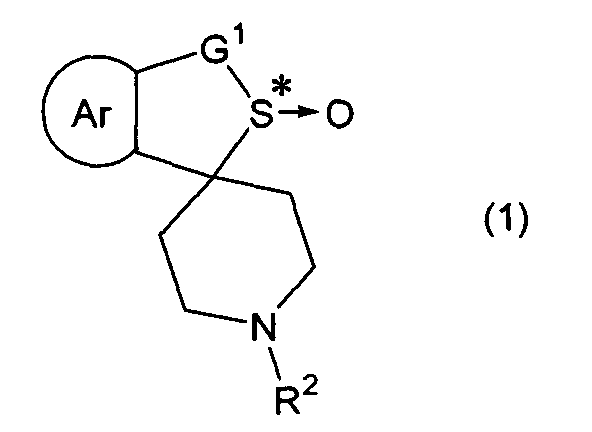 [wherein G1 and Ar have the same meanings as defined above; and R1 represents an amino protecting group] with cumene hydroperoxide or isopropylcumyl hydroperoxide in the presence of alcohol, water or a mixture of water and alcohol and in the presence of a complex of an optically active tartaric acid diester and a titanium (IV) alkoxide in an inert solvent; and step B is a step to prepare the compound of formula (4) by removing R2 in the case where R2 of the compound (1) obtained in step A is an amino protecting group and reacting the compound (1), wherein R2 is a hydrogen atom, with the compound of formula (3):
 (wherein R3, R4 and n have the same meanings as defined above; and Y represents a leaving group).}
- Of the above processes, preferable processes are:
- the process in which G1 is a methylene group;
- the process in which Ar is a phenyl group;
- the process in which R1 is trifluoroacetyl, methoxycarbonyl, ethoxycarbonyl, tert-butoxycarbonyl or benzyloxycarbonyl;
- the process in which R2 is a hydrogen atom;
- the process in which Y is a halogen atom, a lower alkanesulfonyloxy group, a halogeno lower alkanesulfonyloxy group or an arylsulfonyloxy group;
- the process in which n is 2;
- the process in which R3 is 3,5-bis(trifluoromethyl)phenyl, 3,4,5-trimethoxyphenyl, 3-hydroxy-4,5-dimethoxyphenyl, 4-hydroxy-3,5-dimethoxyphenyl or 2-methoxy-5-(1-tetrazolyl)phenyl; and
- the process in which R4 is a phenyl group substituted by 1 or 2 fluorine atoms or chlorine atoms.
-
- In the above general formulae (1), (2), (3) and (4), the "C1-C6 alkylene group" in the definition of G1 can be, for example, a straight or branched alkylene group such as a methylene, ethylene, trimethylene, propylene, tetramethylene, 1-methyltrimethylene, 2-methyltrimethylene, 1,1-dimethylethylene, pentamethylene, 1,1-dimethyltrimethylene, 2,2-dimethyltrimethylene, 1,2-dimethyltrimethylene or hexamethylene group, preferably a C1-C3 straight or branched alkylene group, more preferably a C1-C3 straight alkylene group, still more preferably a methylene or ethylene group, most preferably a methylene group.
- The aryl moiety of the "C6-C10 aryl group which may be substituted by one or more group(s) selected from Substituent group α" in the definition of Ar can be, for example, a phenyl or naphthyl group, preferably a phenyl group.
- Further, the above "C6-C10 aryl group" may be condensed with a C3-C10 cycloalkyl (preferably C5-C6 cycloalkyl) group.
- In the case where Ar represents "a C6-C10 aryl group substituted by one or more group(s) selected from Substituent group α", it is preferably a C6-C10 aryl group substituted by from 1 to 4 groups selected from Substituent group α, more preferably a C6-C10 aryl group substituted by from 1 to 3 groups selected from Substituent group α, still more preferably a C6-C10 aryl group substituted by from 1 to 3 groups selected from the group consisting of fluorine atoms, chlorine atoms, methyl, ethyl, methoxy and ethoxy groups.
- The "5- to 7-membered heteroaryl group containing from 1 to 3 sulfur atoms, oxygen atoms and/or nitrogen atoms" moiety of the "5- to 7-membered heteroaryl group containing from 1 to 3 sulfur atoms, oxygen atoms and/or nitrogen atoms which may be substituted by one or more group(s) selected from Substituent group α" in the definition of Ar can be, for example, a furyl, thienyl, pyrrolyl, pyrazolyl, imidazolyl, oxazolyl, isoxazolyl, thiazolyl, isothiazolyl, triazolyl, thiadiazolyl, pyridyl, pyridazinyl, pyrimidinyl, pyrazinyl or azepinyl group, preferably a 5- or 6-membered heteroaryl group containing 1 or 2 sulfur atoms, oxygen atoms and/or nitrogen atoms such as a furyl, thienyl, pyrrolyl, pyrazolyl, imidazolyl, oxazolyl, isoxazolyl, thiazolyl, isothiazolyl, pyridyl, pyridazinyl, pyrimidinyl or pyrazinyl group, more preferably a pyridyl or pyrimidinyl group.
- Furthermore, the aforementioned "5- to 7-membered heteroaryl group containing from 1 to 3 sulfur atoms, oxygen atoms and/or nitrogen atoms" may be condensed with another cyclic group [for example, a C6-C10 aryl (preferably phenyl) or C3-C10 cycloalkyl (preferably C5-C6 cycloalkyl) group and such a group can be, for example, an indolyl, benzofuranyl, benzothienyl, quinolyl, isoquinolyl, quinazolinyl, tetrahydroquinolyl or tetrahydroisoquinolyl group.
- In the case where Ar represents a "5- to 7-membered heteroaryl group containing from 1 to 3 sulfur atoms, oxygen atoms and/or nitrogen atoms substituted by one or more group(s) selected from Substituent group α", it is preferably a 5- to 7- membered heteroaryl group containing from 1 to 3 sulfur atoms, oxygen atoms and/or nitrogen atoms substituted by from 1 to 3 groups selected from Substituent group α, more preferably a 5-to 7-membered heteroaryl group containing from 1 to 3 sulfur atoms, oxygen atoms and/or nitrogen atoms substituted by 1 or 2 groups selected from Substituent group α, still more preferably a 5- to 7-membered heteroaryl group containing from 1 to 3 sulfur atoms, oxygen atoms and/or nitrogen atoms substituted by 1 or 2 groups selected from the group consisting of fluorine atoms, chlorine atoms, methyl, ethyl, methoxy and ethoxy groups.
- The "amino protecting group" in the definition of R1 is not particularly limited, provided that it is a group generally used as an amino protecting group in the field of organic synthesis chemistry and provided that it is an acyl type (including sulfonyl type) group, and can be, for example, a C1-C6 alkanoyl group such as a formyl, acetyl, propionyl, butyryl, isobutyryl, pentanoyl, pivaloyl, isovaleryl or hexanoyl group; a C1-C4 alkanoyl group substituted by halogen atom(s) or a C1-C4 alkoxy such as a chloroacetyl, dichloroacetyl, trichloroacetyl, trifluoroacetyl, 3-fluoropropionyl, 4,4-dichlorobutyryl, methoxyacetyl, butoxyacetyl, ethoxypropionyl or propoxybutyryl group; an unsaturated C2-C4 alkanoyl group such as an acryloyl, propioloyl, methacryloyl, crotonoyl or isocrotonoyl group; a C6-C10 arylcarbonyl group which may be substituted by halogen atom(s), C1-C4 alkyl, C1-C4 alkoxy, C1-C4 alkoxycarbonyl, C6-C10 aryl or nitro such as a benzoyl, 1-naphthoyl, 2-naphthoyl, 2-fluorobenzoyl, 2-bromobenzoyl, 2,4-dichlorobenzoyl, 6-chloro-1-naphthoyl, p-toluoyl, 4-propylbenzoyl, 4-tert-butylbenzoyl, 2,4,6-trimethylbenzoyl, 6-ethyl-1-naphthoyl, p-anisoyl, 4-propoxybenzoyl, 4-tert-butoxybenzoyl, 6-ethoxy-1-naphthoyl, 2-ethoxycarbonylbenzoyl, 4-tert-butoxycarbonylbenzoyl, 6-methoxycarbonyl-1-naphthoyl, 4-phenylbenzoyl, 4-phenyl-1-naphthoyl, 6-α-naphthylbenzoyl, 4-nitrobenzoyl, 2-nitrobenzoyl or 6-nitro-1-naphthoyl group; a C1-C4 alkoxycarbonyl group which may be substituted by halogen or tri-C1-C4 alkylsilyl such as a methoxycarbonyl, ethoxycarbonyl, propoxycarbonyl, isopropoxycarbonyl, butoxycarbonyl, isobutoxycarbonyl, sec-butoxycarbonyl, tert-butoxycarbonyl, chloromethoxycarbonyl, 2,2,2-trichloroethoxycarbonyl, 2-fluoropropoxycarbonyl, 2-bromo-1,1-dimethylethoxycarbonyl, 2,2-dibromo-1,1-dimethylethoxycarbonyl, triethylsilylmethoxycarbonyl, 2-(trimethylsilyl)ethoxycarbonyl, 4-tripropylsilylbutoxycarbonyl or 3-(tert-butyldimethylsilyl)propoxycarbonyl group; a C2-C5 alkenyloxycarbonyl group such as a vinyloxycarbonyl, allyloxycarbonyl, 1,3-butadienyloxycarbonyl or 2-pentenyloxycarbonyl group; or a C7-C15 aralkyloxycarbonyl group which may be substituted by methoxy or nitro such as a benzyloxycarbonyl, (1-phenyl)benzyloxycarbonyl, 1-naphthylmethyloxycarbonyl, 2-naphthylmethyloxycarbonyl, 9-anthrylmethyloxycarbonyl, 4-methoxybenzyloxycarbonyl or 4-nitrobenzyloxycarbonyl group; a lower alkanesulfonyl group such as a methanesulfonyl or ethanesulfonyl group; a halogeno lower alkanesulfonyl group such as a trifluoromethanesulfonyl group or pentafluoroethanesulfonyl group; or an arylsulfonyl group such as a benzenesulfonyl, p-toluenesulfonyl or 4-nitrobenzenesulfonyl group, preferably a C1-C4 alkanoyl, trifluoroacetyl, methoxyacetyl, benzoyl, 1-naphthoyl, 2-naphthoyl, anisoyl, nitrobenzoyl, C1-C4 alkoxycarbonyl, 2,2,2-trichloroethoxycarbonyl, triethylsilylmethoxycarbonyl, 2-(trimethylsilyl)ethoxycarbonyl, vinyloxycarbonyl, allyloxycarbonyl, benzyloxycarbonyl or nitrobenzyloxycarbonyl group, more preferably a formyl, acetyl, trifluoroacetyl, benzoyl, p-anisoyl, 4-nitrobenzoyl, methoxycarbonyl, ethoxycarbonyl, butoxycarbonyl, tert-butoxycarbonyl, benzyloxycarbonyl or 4-nitrobenzyloxycarbonyl group, particularly preferably a methoxycarbonyl, ethoxycarbonyl, tert-butoxycarbonyl, benzyloxycarbonyl or trifluoroacetyl group, most preferably an ethoxycarbonyl or tert-butoxycarbonyl group.
- The "C1-C6 alkyl group" in the definition of Substituent group α can be a straight or branched alkyl group such as a methyl, ethyl, propyl, isopropyl, butyl, isobutyl, sec-butyl, tert-butyl, pentyl, isopentyl, 2-methylbutyl, neopentyl, 1,1-dimethylpropyl, 1-ethylpropyl, hexyl, isohexyl, 3-methylpentyl, 2-methylpentyl, 1-methylpentyl, 3,3-dimethylbutyl, 2,2-dimethylbutyl, 1,1-dimethylbutyl, 1,2-dimethylbutyl, 1,3-dimethylbutyl, 2,3-dimethylbutyl or 2-ethylbutyl group; and, as for Substituent group α, it is preferably a C1-C4 straight or branched alkyl group, more preferably a methyl, ethyl, propyl, isopropyl or butyl group, particularly preferably a methyl, ethyl or propyl group.
- The "C1-C6 alkoxy group" in the definition of Substituent group α is a group in which an oxygen atom is bonded to the above "C1-C6 alkyl group", preferably a C1-C4 straight or branched alkoxy group, more preferably a methoxy, ethoxy, propoxy, isopropoxy or butoxy group, particularly preferably a methoxy, ethoxy or propoxy group.
- The "halogen atom" in the definition of Substituent group α and the halogen atom of "a phenyl group substituted by 1 or 2 halogen atoms" in the definition of R4 are a fluorine atom, a chlorine atom, a bromine atom or an iodine atom, preferably a fluorine atom or a chlorine atom.
- The C1-C4 alkoxy group of "a phenyl group substituted by from 1 to 3 groups selected from hydroxyl groups, C1-C4 alkoxy group, C1-C4 halogenated alkyl groups and a tetrazolyl group" in the definition of R3 can be a straight or branched alkoxy group such as a methoxy, ethoxy, propoxy, isopropoxy or butoxy group, preferably a methoxy, ethoxy or propoxy group, more preferably a methoxy or ethoxy group, particularly preferably a methoxy group.
- The C1-C4 halogenated alkyl group of "a phenyl group substituted by from 1 to 3 groups selected from hydroxyl groups, C1-C4 alkoxy groups, C1-C4 halogenated alkyl groups and a tetrazolyl group" in the definition of R3 is a group in which 1 or 2 or more hydrogen atoms of C1-C4 alkyl group are replaced with the above "halogen atoms", and it is preferably a trifluoromethyl, trichloromethyl, difluoromethyl, dichloromethyl, dibromomethyl, fluoromethyl, 2,2,2-trichloroethyl, 2,2,2-trifluoroethyl, 2-bromoethyl, 2-chloroethyl, 2-fluoroethyl or 2,2-dibromoethyl group, more preferably a trifluoromethyl, trichloromethyl, difluoromethyl or fluoromethyl group, and particularly preferably a trifluoromethyl group.
- Although there are no particular limitations on the "leaving group" in the definition of Y, provided that it is a leaving group that is used during nucleophilic substitution reactions, it can be, for example, a halogen atom such as chlorine, bromine or iodine; a lower alkoxycarbonyloxy group such as a methoxycarbonyloxy or ethoxycarbonyloxy group; a lower alkanesulfonyloxy group such as a methanesulfonyloxy or ethanesulfonyloxy group; a halogeno lower alkanesulfonyloxy group such as a trifluoromethanesulfonyloxy or pentafluoroethanesulfonyloxy group; or an arylsulfonyloxy group such as a benzenesulfonyloxy, p-toluenesulfonyloxy or 4-nitrobenzenesulfonyloxy group, more preferably a halogen atom, a halogeno lower alkanesulfonyloxy group or arylsulfonyloxy group, and even more preferably an arylsulfonyloxy group.
- Ar is preferably a phenyl group which may be substituted by one or more group(s) selected from Substituent group α, more preferably a phenyl group or a phenyl group substituted by 1 or 2 groups selected from the group consisting of methyl, ethyl, methoxy, fluorine atom and chlorine atom, particularly preferably a phenyl group.
- Substituent group α preferably consists of C1-C4 alkyl groups, C1-C4 alkoxy groups and halogen atoms, more preferably fluorine atoms, chlorine atoms, methyl, ethyl, methoxy and ethoxy groups.
- R2 is preferably a hydrogen atom, ethoxycarbonyl or tert-butoxycarbonyl, particularly preferably a hydrogen atom.
- R3 is preferably a phenyl group substituted by from 1 to 3 groups selected from the group consisting of hydroxyl, methoxy, ethoxy, trifluoromethyl, trichloromethyl, difluoromethyl, fluoromethyl and tetrazolyl groups, more preferably a phenyl group substituted by from 1 to 3 groups selected from the group consisting of hydroxyl, methoxy, trifluoromethyl and tetrazolyl groups (for example, 3,5-bis(trifluoromethyl)phenyl, 3,4,5-trimethoxyphenyl, 3-hydroxy-4,5-dimethoxyphenyl, 4-hydroxy-3,5-dimethoxyphenyl or 2-methoxy-5-(1-tetrazolyl)phenyl, still more preferably a phenyl group substituted by from 1 to 3 groups selected from the group consisting of methoxy, trifluoromethyl and tetrazolyl groups (for example, 3,5-bis(trifluoromethyl)phenyl, 3,4,5-trimethoxyphenyl or 2-methoxy-5-(1-tetrazolyl)phenyl), particularly preferably 3,5-bis(trifluoromethyl)phenyl or 3,4,5-trimethoxyphenyl.
- R4 is preferably a phenyl group substituted by one or two fluorine atoms or chlorine atoms, more preferably a phenyl group substituted by two fluorine atoms or chlorine atoms, still more preferably 3,4-difluorophenyl or 3,4-dichlorophenyl, particularly preferably 3,4-dichlorophenyl.
- n is preferably 2.
- Of the compounds of formula (1), a preferable compound is spiro[benzo[c]thiophene-1(3H),4'-piperidine] 2-oxide and a more preferable compound is (2S)-spiro[benzo[c]thiophene-1(3H),4'-piperidine] 2-oxide.
- Of the compounds of formula (2), preferable compounds are
- methyl spiro[benzo[c]thiophene-1(3H),4'-piperidine]-1'-carboxylate,
- ethyl spiro[benzo[c]thiophene-1(3H),4'-piperidine]-1'-carboxylate,
- tert-butyl spiro[benzo[c]thiophene-1(3H),4'-piperidine]-1'-carboxylate,
- benzyl spiro[benzo[c]thiophene-1(3H),4'-piperidine]-1'-carboxylate, and
- 1'-trifluoroacetylspiro[benzo[c]thiophene-1(3H),4'-piperidine]; and more preferable compounds are ethyl spiro[benzo[c]thiophene-1(3H),4'-piperidine]-1'-carboxylate, and
- tert-butyl spiro[benzo[c]thiophene-1(3H),4'-piperidine]-1'-carboxylate.
-
- The present invention is carried out by the following steps.
-

- The oxidation of the compound of the above formula (2) is carried out by reacting it with an oxidizing agent in the presence of alcohol, water or a mixture of water and alcohol and in the presence of a complex of an optically active tartaric acid diester and a titanium (IV) alkoxide in an inert solvent.
- The inert solvent to be used is not particularly limited, provided that it does not inhibit the reaction and provided that it dissolves the starting material, and can be, for example, aliphatic hydrocarbons such as hexane, heptane or petroleum ether; aromatic hydrocarbons such as benzene, toluene or xylene; ethers such as diethyl ether, diisopropyl ether, dibutyl ether, tert-butyl methyl ether, tetrahydrofuran or dioxane; esters such as methyl acetate, ethyl acetate, propyl acetate or butyl acetate; aliphatic halogenated hydrocarbons such as methylene chloride, chloroform, carbon tetrachloride or dichloroethane; aromatic halogenated hydrocarbons such as chlorobenzene, fluorobenzene, o-dichlorobenzene, m-dichlorobenzene, trichloromethylbenzene or trifluoromethylbenzene; amides such as N,N-dimethylformamide or N,N-dimethylacetamide; alcohols such as methanol, ethanol, propyl alcohol, isopropyl alcohol, butyl alcohol or tert-butyl alcohol; or nitriles such as acetonitrile, preferably aromatic hydrocarbons, esters, aliphatic halogenated hydrocarbons or aromatic halogenated hydrocarbons, more preferably the aliphatic halogenated hydrocarbons or aromatic halogenated hydrocarbons, still more preferably dichloroethane, chlorobenzene, o-dichlorobenzene, m-dichlorobenzene or trifluoromethylbenzene, most preferably chlorobenzene or o-dichlorobenzene.
- The titanium (IV) alkoxide to be used for forming the complex can be, for example, titanium (IV) methoxide, titanium (IV) ethoxide, titanium (IV) propoxide or titanium (IV) isopropoxide, preferably titanium (IV) isopropoxide. The amount of titanium (IV) alkoxide to be used is preferably, relative to 1 equivalent of the compound of formula (2), from 0.01 to 0.4 equivalents, more preferably from 0.05 to 0.2 equivalents.
- The optically active tartaric acid diester to be used for forming the complex can be, for example, an optically active tartaric acid diester such as dimethyl (+)- or (-)-tartrate, diethyl (+)- or (-)-tartrate, diisopropyl (+)- or (-)-tartrate, dibutyl (+)- or (-)-tartrate or di-tert-butyl (+)- or (-)-tartrate, preferably diethyl (+)- or (-)-tartrate or diisopropyl (+)- or (-)-tartrate, more preferably diisopropyl (+)- or (-)-tartrate. In the case where the compound of formula (1) having the S configuration is prepared, dimethyl (-)-tartrate, diethyl (-)-tartrate, diisopropyl (-)-tartrate, dibutyl (-)-tartrate or di-tert-butyl (-)-tartrate is preferably used, more preferably diethyl (-)-tartrate or diisopropyl (-)-tartrate is used, and particularly preferably diisopropyl (-)-tartrate is used. The amount of optically active diol to be used is preferably, relative to 1 equivalent of titanium (IV) alkoxide, from 1 to 10 equivalents, more preferably from 2 to 5 equivalents, particularly preferably about 4 equivalents.
- The complex of the optically active tartaric acid diester and titanium (IV) alkoxide is used in the presence of alcohol, water or a mixture of water and alcohol. The alcohol to be used here can be, for example, methanol, ethanol, propyl alcohol, isopropyl alcohol, butyl alcohol, tert-butyl alcohol or phenol, preferably methanol, ethanol, isopropyl alcohol or phenol, more preferably isopropyl alcohol. The amount of alcohol to be used is preferably, relative to 1 equivalent of titanium (IV) alkoxide, from 0.5 to 100 equivalents, more preferably from 1 to 20 equivalents. The amount of water to be used is preferably, relative to 1 equivalent of titanium (IV) alkoxide, from 0.01 to 4 equivalents, more preferably from 0.02 to 2 equivalents.
- The above complex is preferably used in the presence of alcohol (most preferably isopropyl alcohol) and it is further desirable that from 0.01 to 4 equivalents (preferably from 0.02 to 2 equivalents, more preferably from 0.03 to 1.5 equivalents) of water relative to 1 equivalent of titanium (IV) alkoxide is present.
- In the embodiment in which the complex of the optically active tartaric acid diester and titanium (IV) alkoxide is used, [1] after the optically active tartaric acid diester is added to the inert solvent, the titanium (IV) alkoxide is added thereto, then the alcohol, water or a mixture of water and alcohol is added thereto and the compound of formula (2) is finally added thereto; or [2] after the optically active tartaric acid diester is added to the inert solvent containing the compound of formula (2), the titanium (IV) alkoxide is added thereto and then the alcohol, water or a mixture of water and alcohol is added thereto. The temperature in the case where the present operation is carried out is from 0 to 100°C, preferably from 15 to 30°C.
- The oxidizing agent to be used can be cumene hydroperoxide or isopropylcumyl hydroperoxide, preferably cumene hydroperoxide. The amount of oxidizing agent to be used is preferably, relative to 1 equivalent of the compound of formula (2), from 0.5 to 10 equivalents, more preferably from 1 to 1.5 equivalents.
- The temperature in the case where the oxidizing agent is allowed to be reacted is from -80 to 100°C, preferably from -20 to -5°C. The reaction time in the case where the oxidizing agent is allowed to be reacted varies depending on the reaction temperature, etc. but it is normally from 10 minutes to 20 hours, preferably from 3 hours to 10 hours.
- After the reaction, the desired compound is recovered from the reaction mixture in accordance with ordinary methods.
- For example, after suitably neutralizing the reaction mixture and removing any insoluble matter by filtration if present, water is added followed by extracting with an immiscible organic solvent like toluene, washing with water and so forth, drying the extract with anhydrous magnesium sulfate and so forth and distilling off the solvent to obtain the desired compound.
- The resulting compound can be separated and purified by ordinary methods such as silica gel column chromatography as necessary.
- The enantiomeric excess of the desired compound recovered from the reaction mixture can be enhanced by separation, purification or the like by recrystallization or by using an optically active column [for example, CHRALCEL (trade name, manufactured by Daicel Chemical Industries, LTD.)].
- For example, in the case of purifying it by recrystallization, the enantiomeric excess can be enhanced by carrying out the recrystallization without removing the protecting group of the amino group; or (a) removing the amino protecting group and then (b) carrying out the optical resolution by the diastereomer method.
- The removal of the amino protecting group is carried out according to well known methods and, for example, the amino protecting group can be removed by treating it with an acid or a base in an inert solvent.
- The solvent to be used here is not particularly limited, and provided that it does not inhibit the reaction and provided that it dissolves the starting material to a certain degree, and can be, for example, aliphatic hydrocarbons such as hexane, heptane, ligroin or petroleum ether; aromatic hydrocarbons such as benzene, toluene or xylene; halogenated hydrocarbons such as dichloromethane, chloroform, carbon tetrachloride, dichloroethane, chlorobenzene, o-dichlorobenzene, m-dichlorobenzene, fluorobenzene, trichloromethylbenzene or trifluoromethylbenzene; ethers such as diethyl ether, diisopropyl ether, tetrahydrofuran, dioxane, 1,2-dimethoxyethane or diethylene glycol dimethyl ether; esters such as methyl acetate or ethyl acetate; alcohols such as methanol, ethanol, propyl alcohol, isopropyl alcohol or butyl alcohol; amides such as formamide, N,N-dimethylformamide, N,N-dimethylacetamide or hexamethylphosphorotriamide; sulfoxides or sulfones such as dimethyl sulfoxide or sulforane; aliphatic acids such as formic acid or acetic acid; or water or a mixed solvent of water and the above solvents, preferably halogenated hydrocarbons, ethers, alcohols, aliphatic acids or a mixed solvent of water and the above solvents, more preferably halogenated hydrocarbons (particularly chlorobenzene, o-dichlorobenzene, m-dichlorobenzene or trifluoromethylbenzene), ethers (particularly tetrahydrofuran or dioxane), aliphatic acids (particularly acetic acid), alcohols (particularly methanol or ethanol) or a mixed solvent of water and the above solvents.
- The acid to be used can be, for example, hydrogen chloride, hydrochloric acid, sulfuric acid, phosphoric acid, hydrogen bromide, hydrobromic acid or trifluoroacetic acid, preferably hydrochloric acid, sulfuric acid, hydrobromic acid or trifluoroacetic acid.
- The base to be used can be, for example, alkali metal carbonates such as sodium carbonate, potassium carbonate or lithium carbonate; alkali metal bicarbonates such as sodium hydrogencarbonate, potassium hydrogencarbonate or lithium hydrogencarbonate; alkali metal hydrides such as lithium hydride, sodium hydride or potassium hydride; alkali metal hydroxides such as sodium hydroxide, potassium hydroxide or lithium hydroxide; alkali metal alkoxides such as sodium methoxide, sodium ethoxide, potassium tert-butoxide or lithium methoxide; alkali metal thioalkoxides such as sodium thiomethoxide or sodium thioethoxide; or organic bases such as hydrazine, methylamine, dimethylamine, ethylamine, triethylamine, tributylamine, diisopropylethylamine, N-methylmorpholine, pyridine, 4-dimethylaminopyridine, N,N-dimethylaniline, N,N-diethylaniline, 1,5-diazabicyclo[4.3.0]non-5-ene, 1,4-diazabicyclo[2.2.2]octane (DABCO) or 1,8-diazabicyclo[5.4.0]undec-7-ene (DBU), preferably alkali metal carbonates (particularly sodium carbonate or potassium carbonate), alkali metal hydroxides (particularly sodium hydroxide or potassium hydroxide), alkali metal alkoxides (particularly sodium methoxide, sodium ethoxide or potassium tert-butoxide) or organic bases (particularly hydrazine or methylamine).
- While the reaction temperature varies depending on the raw material compound, solvent or acid or base used, it is normally from -10°C to 150°C, preferably from 0°C to 100°C.
- While the reaction time varies depending on the raw material compound, solvent or acid or base used, it is normally from 5 minutes to 48 hours, preferably from 10 minutes to 15 hours.
- The optical resolution by the diastereomer method is carried out, for example, by recrystallizing from aliphatic hydrocarbons such as hexane, heptane or petroleum ether; aromatic hydrocarbons such as benzene, toluene or xylene; ethers such as diethyl ether, diisopropyl ether, dibutyl ether, tert-butyl methyl ether, tetrahydrofuran or dioxane; esters such as methyl acetate, ethyl acetate, propyl acetate or butyl acetate; aliphatic halogenated hydrocarbons such as methylene chloride, chloroform, carbon tetrachloride or dichloroethane; alcohols such as methanol, ethanol, propyl alcohol, isopropyl alcohol, butyl alcohol or tert-butyl alcohol; nitriles such as acetonitrile; ketones such as acetone; or a solvent mixture of a water-soluble solvent such as alcohols, tetrahydrofuran, dioxane, acetonitrile or acetone with water, using an optical resolution agent.
- The optical resolution agent to be used is not particularly limited, provided that it is normally used as an optical resolution agent, and it can be, for example, optically active sulfonic acids such as (+)- or (-)-camphor-10-sulfonic acid; or optically active carboxylic acids such as (+)- or (-)-tartaric acid, diacetyl (+)- or (-)-tartaric acid, dibenzoyl (+)- or (-)-tartaric acid, (+)- or (-)-mandelic acid or (+)- or (-)-malic acid, preferably optically active carboxylic acids, more preferably (+)- or (-)-mandelic acid.
- In the case of obtaining a compound of formula (1) having the S configuration, (+)-tartaric acid, dibenzoyl (+)-tartaric acid, (-)-camphor-10-sulfonic acid or (+)-mandelic acid is preferably used, more preferably (+)-mandelic acid is used.
- The compound (2), i.e., the starting material in the process of the present invention, is disclosed, for example, in US6159967 and US6362179.
- The compound of formula (1) can be easily led to a neurokinin receptor antagonist by the method disclosed in, for example, WO95/28389 and USP6159967. In more detail, the neurokinin receptor antagonist can be prepared by carrying out the reaction according to the following process:(wherein Ar, G1, R2, R3, R4, Y, n and * have the same meanings as defined above).
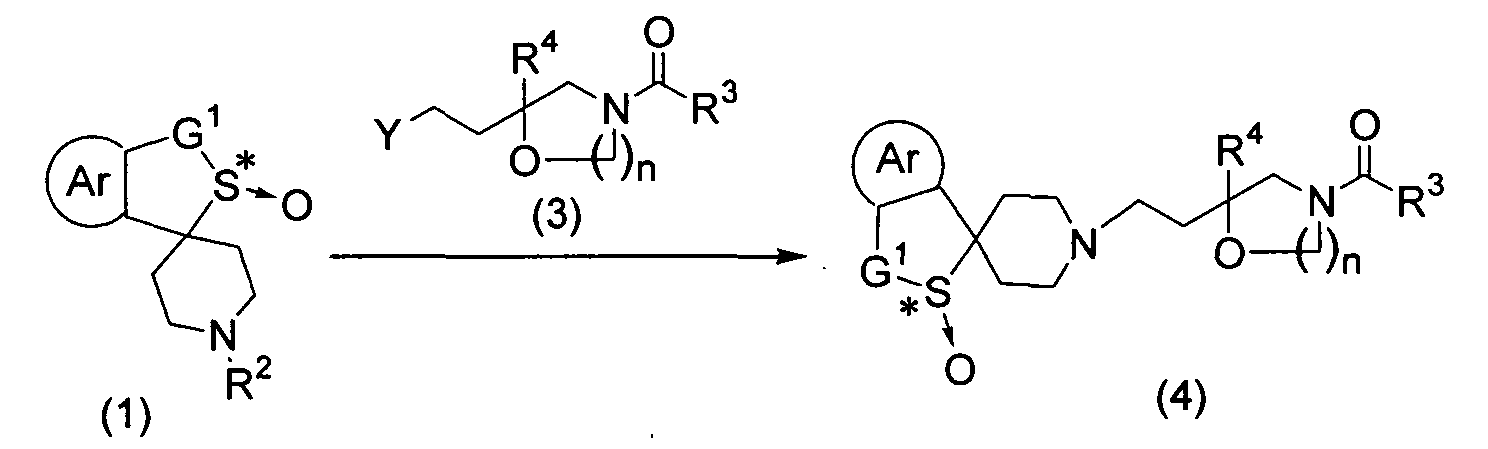
- The present step is a step to prepare the compound (4) by reacting the compound (1) with the compound (3). In the case where R2 is an amino protecting group, R2 is firstly removed and then the resulting compound is reacted with the compound (3).
- The removal of the amino protecting group is carried out according to well known methods and the amino protecting group can be removed, for example, by treating with an acid or a base in an inert solvent.
- The solvent to be used is not particularly limited, provided that it does not inhibit the reaction and provided that it dissolves the starting material to a certain degree, and can be, for example, aliphatic hydrocarbons such as hexane, heptane, ligroin or petroleum ether; aromatic hydrocarbons such as benzene, toluene or xylene; halogenated hydrocarbons such as dichloromethane, chloroform, carbon tetrachloride, dichloroethane, chlorobenzene, o-dichlorobenzene, m-dichlorobenzene, fluorobenzene, trichloromethylbenzene or trifluoromethylbenzene; ethers such as diethyl ether, diisopropyl ether, tetrahydrofuran, dioxane, 1,2-dimethoxyethane or diethylene glycol dimethyl ether; esters such as methyl acetate or ethyl acetate; alcohols such as methanol, ethanol, propyl alcohol, isopropyl alcohol or butyl alcohol; amides such as formamide, N,N-dimethylformamide, N,N-dimethylacetamide or hexamethylphosphorotriamide; sulfoxides or sulfones such as dimethyl sulfoxide or sulforane; aliphatic acids such as formic acid or acetic acid; or water or a mixed solvent of water and the above solvents, preferably halogenated hydrocarbons, ethers, alcohols, aliphatic acids or a mixed solvent of water and the above solvents, more preferably halogenated hydrocarbons (particularly chlorobenzene, o-dichlorobenzene, m-dichlorobenzene or trifluoromethylbenzene), ethers (particularly tetrahydrofuran or dioxane), aliphatic acids (particularly acetic acid), alcohols (particularly methanol or ethanol) or a mixed solvent of water and the above solvents.
- The acid to be used can be, for example, hydrogen chloride, hydrochloric acid, sulfuric acid, phosphoric acid, hydrogen bromide, hydrobromic acid or trifluoroacetic acid, preferably hydrochloric acid, sulfuric acid, hydrobromic acid or trifluoroacetic acid.
- The base to be used can be, for example, alkali metal carbonates such as sodium carbonate, potassium carbonate or lithium carbonate; alkali metal bicarbonates such as sodium hydrogencarbonate, potassium hydrogencarbonate or lithium hydrogencarbonate; alkali metal hydrides such as lithium hydride, sodium hydride or potassium hydride; alkali metal hydroxides such as sodium hydroxide, potassium hydroxide or lithium hydroxide; alkali metal alkoxides such as sodium methoxide, sodium ethoxide, potassium tert-butoxide or lithium methoxide; alkali metal thioalkoxides such as sodium thiomethoxide or sodium thioethoxide;,or organic bases such as hydrazine, methylamine, dimethylamine, ethylamine, triethylamine, tributylamine, diisopropylethylamine, N-methylmorpholine, pyridine, 4-dimethylaminopyridine, N,N-dimethylaniline, N,N-diethylaniline, 1,5-diazabicyclo[4.3.0]non-5-ene, 1,4-diazabicyclo[2.2.2]octane (DABCO) or 1,8-diazabicyclo[5.4.0]undec-7-ene (DBU), preferably alkali metal carbonates (particularly sodium carbonate or potassium carbonate), alkali metal hydroxides (particularly sodium hydroxide or potassium hydroxide), alkali metal alkoxides (particularly sodium methoxide, sodium ethoxide or potassium tert-butoxide) or organic bases (particularly hydrazine or methylamine).
- While the reaction temperature varies depending on the raw material compound, the solvent or the acid or base used, it is normally from -10°C to 150°C, preferably from 0°C to 100°C.
- While the reaction time varies depending on the raw material compound, the solvent or the acid or base used, it is normally from 5 minutes to 48 hours, preferably from 10 minutes to 15 hours.
- The reaction of the compound (1) in which R2 is a hydrogen atom with the compound (3) is carried out in the presence of a base in an inert solvent.
- The inert solvent to be used is not particularly limited, provided that it does not inhibit the reaction and provided that it dissolves the starting material to a certain degree, and can be, for example, aliphatic hydrocarbons such as hexane, heptane, ligroin or petroleum ether; aromatic hydrocarbons such as benzene, toluene or xylene; halogenated hydrocarbons such as dichloromethane, chloroform, carbon tetrachloride, dichloroethane, chlorobenzene or dichlorobenzene; esters such as ethyl formate, ethyl acetate, propyl acetate, butyl acetate or diethyl carbonate; ethers such as diethyl ether, diisopropyl ether, tetrahydrofuran, dioxane, 1,2-dimethoxyethane or diethylene glycol dimethyl ether; ketones such as acetone, ethyl methyl ketone, isobutyl methyl ketone, isophorone or cyclohexanone; nitro compounds such as nitroethane or nitrobenzene; nitriles such as acetonitrile or isobutyronitrile; amides such as formamide, N,N-dimethylformamide, N,N-dimethylacetamide, N-methyl-2-pyrrolidone, N-methylpyrrolidinone or hexamethylphosphorotriamide; or sulfoxides such as dimethyl sulfoxide or sulforane, preferably amides, ethers or nitriles, particularly preferably nitriles.
- The base to be used is not particularly limited, provided that it is used as a base in a normal reaction, and can be, for example, alkali metal carbonates such as sodium carbonate, potassium carbonate or lithium carbonate; alkali earth metal carbonates such as calcium carbonate or barium carbonate; alkali metal hydrogencarbonates such as sodium hydrogencarbonate, potassium hydrogencarbonate or lithium hydrogencarbonate; alkali metal hydrides such as lithium hydride, sodium hydride or potassium hydride; alkali metal hydroxides such as sodium hydroxide, potassium hydroxide or lithium hydroxide; or alkali earth metal hydroxides such as calcium hydroxide or barium hydroxide;: or organic bases such as N-methylmorpholine, triethylamine, tripropylamine, tributylamine, diisopropylethylamine, dicyclohexylamine, N-methylpiperidine, pyridine, 4-pyrrolidinopyridine, picoline, 4-dimethylaminopyridine, 2,6-di(tert-butyl)-4-methylpyridine, quinoline, N,N-dimethylaniline, N,N-diethylaniline, 1,5-diazabicyclo[4.3.0]non-5-ene (DBN), 1,4-diazabicyclo[2.2.2]octane (DABCO) or 1,8-diazabicyclo[5.4.0]undec-7-ene (DBU), preferably inorganic bases, most preferably alkali metal hydrogencarbonates. Further, for the purpose of promoting the reaction, it is also useful to add a catalytic amount of alkali metal iodides such as potassium iodide or sodium iodide.
- The reaction temperature can be, for example, from 0°C to 150°C, preferably from 20°C to 120°C.
- While the reaction time varies mainly depending on the reaction temperature, the raw material compound, the reaction reagent or the kind of the inert solvent used, it can be from 30 minutes to 48 hours, preferably from 1 hour to 12 hours.
- After the reaction, the desired compound is recovered from the reaction mixture in accordance with ordinary methods.
- For example, water is added to the reaction mixture followed by extracting with an immiscible organic solvent like toluene, washing with water and so forth, drying the extract with anhydrous magnesium sulfate and so forth and distilling off the solvent to obtain the desired compound.
- The resulting compound can be separated and purified by ordinary methods such as silica gel column chromatography as necessary.
- Further, the compound (4) can be easily led to a pharmaceutically acceptable salt, if desired, by treating it according to ordinary methods using an acid (said acid can be, for example, inorganic acids such as hydrogen chloride, sulfuric acid or phosphoric acid; or organic acids such as acetic acid, fumaric acid or succinic acid, preferably hydrogen chloride or fumaric acid).
- The present invention will be more specifically explained below by referring to Examples but the present invention is not limited to these.
- It should be noted that both of the enantiomeric excess and the diastereomeric excess in the respective Examples are values based on an analysis by high performance liquid chromatography (HPLC). The enantiomeric excess was analyzed under the condition of the following "HPLC condition (1)" and the diastereomeric excess was analyzed under the condition of the following "HPLC condition (2)". Further, HPLC for analyzing the composition of the reaction mixture was carried out under the condition of the following "HPLC condition (3)".
-
- Column: CHRALCEL OD (trade name, manufactured by Daicel Chemical Industries, LTD.) 4.6 × 250 mm
- Mobile phase: Hexane:EtOH = 90:10
- Column temperature: 40°C
- Detection: UV (220 nm)
- Flow rate: 1 ml/min
-
-
- Column: CHRALCEL OD (trade name, manufactured by Daicel Chemical Industries, LTD.) 4.6 × 250 mm
- Mobile phase: Hexane:EtOH = 85:15
- Column temperature: 40°C
- Detection: UV (220 nm)
- Flow rate: 1 ml/min
-
-
- Column: L-column ODS (trade name, manufactured by
- Kagaku Busshitu Hyoka Kenkyu Kiko (Chemicals Evaluation and Research Institute, Japan) 4.6 × 250 mm
- Mobile phase: CH3CN:0.01M Na2HPO4 = 40:60 → 75:25 (gradient)
- Column temperature: 40°C
- Detection: UV (220 nm)
- Flow rate: 1 ml/min
-
- Under a nitrogen atmosphere, 0.99 ml (3.23 mmol) of titanium (IV) isopropoxide was added dropwise to a mixed solution of 1.35 ml (6.45 mmol) of diisopropyl (-)-tartrate and 40 ml of chlorobenzene at room temperature. After this solution was stirred at room temperature for approximately 20 minutes, 0.25 ml (3.22 mmol) of isopropyl alcohol was added thereto at room temperature and the mixture was further stirred for approximately 10 minutes. After cooling it to -10°C or lower, 5.00 g (16.2 mmol) of tert-butyl spiro[benzo[c]thiophene-1(3H),4'-piperidine]-1'-carboxylate were added thereto. A solution of 2.95 ml (17.7 mmol) of cumene hydroperoxide in 10 ml of chlorobenzene was added dropwise to the mixture at -10°C or lower and the mixture was stirred at -10°C for 5 hours. When the reaction mixture was analyzed by HPLC, the mixture was constituted by 86.7 % tert-butyl (2S)-spiro[benzo[c]thiophene-1(3H),4'-piperidine]-1'-carboxylate 2-oxide, 5.5% tert-butyl spiro[benzo[c]thiophene-1(3H),4'-piperidine]-1'-carboxylate 2,2-dioxide and 1.0% tert-butyl spiro[benzo[c]thiophene-1(3H),4'-piperidine]-1'-carboxylate and the enantiomeric excess of the title compound was 84.9%.
- 25 ml of 5% aqueous solution of sodium pyrosulfite were added to the reaction mixture and the mixture was stirred at 0 to 5°C for 30 minutes. Any insoluble matter was filtered off and after the separated organic layer was concentrated under reduced pressure, 50 ml of ethylcyclohexane were added and the mixture was stirred at room temperature for 1 hour and further at 0 to 5°C for 30 minutes. Further, 25 ml of ethylcyclohexane were added thereto and the mixture was stirred at 0 to 5°C for 30 minutes. After the precipitated crystals were collected by filtration, followed by drying at 50°C under reduced pressure for 15 hours to obtain tert-butyl (2S)-spiro[benzo[c]thiophene-1(3H),4'-piperidine]-1'-carboxylate 2-oxide having crude yield: 49.0% (2.58 g) and the enantiomeric excess: 99.1% as white crystals.
1H-NMR (400 MHz, CDCl3) δ ppm: 1.50 (s, 9H), 1.60-1.66 (m, 1H), 1.86-1.94 (m, 1H), 2.16-2.24 (m, 1H), 2.40-2.48 (m, 1H), 3.10-3.30 (m, 2H), 4.05 (d, J=16.8 Hz, 1H), 4.10-4.30 (m, 2H), 4.37 (d, J=16.8 Hz, 1H), 7.20-7.40 (m, 4H). - Under a nitrogen atmosphere, 74.4 g (243.5 mmol) of tert-butyl spiro[benzo[c]thiophene-1(3H),4'-piperidine]-1'-carboxylate and 525 ml of chlorobenzene were mixed and 22.8 g (97.4 mmol) of diisopropyl (-)-tartrate were further added thereto at room temperature. Then, 7.47 ml (24.3 mmol) of titanium (IV) isopropoxide were added dropwise thereto at room temperature and the mixture was stirred at the same temperature for approximately 20 minutes. 7.48 ml (97.3 mmol) of isopropyl alcohol were added thereto at room temperature and the mixture was further stirred for approximately 20 minutes. After cooling it to -10°C or lower, a solution of 55.6 g (292.2 mmol) of cumene hydroperoxide in 150 ml of chlorobenzene was added dropwise thereto at -10°C or lower and the mixture was stirred at -10°C for 5 hours. When the reaction mixture was analyzed by HPLC, the mixture was constituted by 87.3% tert-butyl (2S)-spiro[benzo[c]thiophene-1(3H),4'-piperidine]-1'-carboxylate 2-oxide, 3.3% tert-butyl spiro[benzo[c]thiophene-1(3H),4'-piperidine]-1'-carboxylate 2,2-dioxide and 0.6% tert-butyl spiro[benzo[c]thiophene-1(3H),4'-piperidine]-1'-carboxylate and the enantiomeric excess of the title compound was 87.2%.
- 194.5 ml of 10% aqueous solution of sodium pyrosulfite were added dropwise to the reaction mixture and the mixture was stirred at 0 to 5°C for 30 minutes. 122 ml (1.46 mol) of conc. hydrochloric acid were added to the mixture and the mixture was stirred at 50°C for 4 hours. The organic layer was separated and 375 ml of butanol and 273 g of 25% aqueous solution of sodium hydroxide were added to the aqueous layer to extract it. The aqueous layer was separated and extracted with 375 ml of butanol. After the organic layer was combined, it was concentrated under reduced pressure until the amount of liquid became 150 ml. Any insoluble matter was removed by filtration and 600 ml of isopropyl alcohol and 18.6 ml of water were added thereto, followed by addition of 34.8 g (226.7 mmol) of (+)-mandelic acid. After the mixture was stirred at 55°C for 30 minutes, it was stirred at room temperature for 30 minutes and was further stirred at 0 to 5°C for 1 hour. The precipitated crystals were collected by filtration and dried at 60°C under reduced pressure for 15 hours to obtain the title compound [yield: 82.1% (75.1 g), diastereomeric excess: 99.3%] as white crystals.
1H-NMR (400 MHz, CD3OD) δ ppm: 1.96 (m, 1H), 2.14 (ddd, J=15.9, 12.9, and 3.4 Hz, 1H), 2.44 (m, 1H), 2.55 (ddd, J=15.9, 13.2, 4.4 Hz, 1H), 3.21 (ddd, J=13.2, 13.2, 3.4 Hz, 1H), 3.28 (ddd, J=13.7, 12.9, 3.4 Hz, 1H), 3.45 (m, 1H), 3.51 (m, 1H), 4.14 (d, J=17.1 Hz, 1H), 4.65 (d, J=17.1 Hz, 1H), 4.90 (s, 1H), 7.18-7.50 (m, 9H). - Under a nitrogen atmosphere, 0.198 ml (0.64 mmol) of titanium (IV) isopropoxide was added dropwise to a mixed solution of 0.27 ml (1.29 mmol) of diisopropyl (-)-tartrate and 9 ml of o-dichlorobenzene at room temperature. After the solution was stirred at room temperature for approximately 20 minutes, 49.5 µl (0.64 mmol) of isopropyl alcohol were added thereto at room temperature and the mixture was further stirred for approximately 10 minutes. After cooling it to -10°C or lower, 0.85 g (3.22 mmol) of methyl spiro[benzo[c]thiophene-1(3H),4'-piperidine]-1'-carboxylate was added thereto. Then, a solution of 0.59 ml (3.54 mmol) of cumene hydroperoxide in 2 ml of o-dichlorobenzene was added dropwise thereto at -10°C or lower. After the mixture was stirred at -10°C for 5 hours, the reaction mixture was analyzed by HPLC, and the mixture was constituted by 84.7% methyl (2S)-spiro[benzo[c]thiophene-1(3H),4'-piperidine]-1'-carboxylate 2-oxide, 5.9% methyl spiro[benzo[c]thiophene-1(3H),4'-piperidine]-1'-carboxylate 2,2-dioxide and 1.3% methyl spiro[benzo[c]thiophene-1(3H),4'-piperidine]-1'-carboxylate and the enantiomeric excess of the title compound was 85.6%.
1H-NMR (400 MHz, CDCl3) δ ppm: 1.55-1.68 (m, 1H), 1.82-2.00 (m, 1H), 2.13-2.28 (m, 1H), 2.39-2.51 (m, 1H), 3.15-3.35 (m, 2H), 3.76 (s, 3H), 4.06 (d, J=16.8 Hz, 1H), 4.10-4.45 (m, 2H), 4.38 (d, J=16.8 Hz, 1H), 7.17-7.40 (m, 4H). - Under a nitrogen atmosphere, 0.198 ml (0.64 mmol) of titanium (IV) isopropoxide was added dropwise to a mixed solution of 0.27 ml (1.29 mmol) of diisopropyl (-)-tartrate and 9 ml of o-dichlorobenzene at room temperature. After the solution was stirred at room temperature for approximately 20 minutes, 49.5 µl (0.64 mmol) of isopropyl alcohol were added thereto at room temperature and the mixture was further stirred for approximately 10 minutes. After cooling it to -10°C or lower, 0.89 g (3.22 mmol) of ethyl spiro[benzo[c]thiophene-1(3H),4'-piperidine]-1'-carboxylate was added thereto. Then, a solution of 0.59 ml (3.54 mmol) of cumene hydroperoxide in 2 ml of o-dichlorobenzene was added dropwise thereto at -10°C or lower. After the mixture was stirred at -10°C for 5 hours, the reaction mixture was analyzed by HPLC, and the mixture was constituted by 88.2% ethyl (2S)-spiro[benzo[c]thiophene-1(3H),4'-piperidine]-1'-carboxylate 2-oxide and 5.2% ethyl spiro[benzo[c]thiophene-1(3H),4'-piperidine]-1'-carboxylate 2,2-dioxide and the enantiomeric excess of the title compound was 83.3%.
1H-NMR (400 MHz, CDCl3) δ ppm: 1.30 (t, J=7.1 Hz, 3H), 1.55-1.65 (m, 1H), 1.83-1.98 (m, 1H), 2.15-2.28 (m, 1H), 2.40-2.50 (m, 1H), 3.15-3.35 (m, 2H), 4.06 (d, J=16.6 Hz, 1H), 4.20 (q, J=7.1 Hz, 2H), 4.10-4.45 (m, 2H), 4.38 (d, J=16.6 Hz, 1H), 7.20-7.40 (m, 4H) . - Under a nitrogen atmosphere, 0.198 ml (0.64 mmol) of titanium (IV) isopropoxide was added dropwise to a mixed solution of 0.27 ml (1.29 mmol) of diisopropyl (-)-tartrate and 9 ml of o-dichlorobenzene at room temperature. After the solution was stirred at room temperature for approximately 20 minutes, 49.5 µl (0.64 mmol) of isopropyl alcohol were added thereto at room temperature and the mixture was further stirred for approximately 10 minutes. After cooling it to -10°C or lower, 1.10 g (3.24 mmol) of benzyl spiro[benzo[c]thiophene-1(3H),4'-piperidine]-1'-carboxylate were added thereto. Then, a solution of 0.59 ml (3.54 mmol) of cumene hydroperoxide in 2 ml of o-dichlorobenzene was added dropwise thereto at -10°C or lower. After the mixture was stirred at -10°C for 5 hours, the reaction mixture was analyzed by HPLC, and the mixture was constituted by 84.6% benzyl (2S)-spiro[benzo[c]thiophene-1(3H),4'-piperidine]-1'-carboxylate 2-oxide, 6.1% benzyl spiro[benzo[c]thiophene-1(3H),4'-piperidine]-1'-carboxylate 2,2-dioxide and 3.4% benzyl spiro[benzo[c]thiophene-1(3H),4'-piperidine]-1'-carboxylate and the enantiomeric excess of the title compound was 85.0%.
1H-NMR (400 MHz, CDCl3) δ ppm: 1.50-1.70 (m, 1H), 1.83-1.99 (m, 1H), 2.13-2.32 (m, 1H), 2.38-2.53 (m, 1H), 3.12-3.45 (m, 2H), 4.06 (d, J=16.8 Hz, 1H), 4.10-4.50 (m, 2H), 4.37 (d, J=16.8 Hz, 1H),5.19 (s, 2H), 7.15-7.50 (m, 9H). - Under a nitrogen atmosphere, 0.198 ml (0.64 mmol) of titanium (IV) isopropoxide was added dropwise to a mixed solution of 0.27 ml (1.29 mmol) of diisopropyl (-)-tartrate and 9 ml of o-dichlorobenzene at room temperature. After the solution was stirred at room temperature for approximately 20 minutes, 49.5 µl (0.64 mmol) of isopropyl alcohol were added thereto at room temperature and the mixture was further stirred for approximately 10 minutes. After cooling it to -10°C or lower, 0.98 g (3.24 mmol) of 1'-trifluoroacetyl-spiro[benzo[c]thiophene-1(3H),4'-piperidine] was added thereto. Then, a solution of 0.59 ml (3.54 mmol) of cumene hydroperoxide in 2 ml of o-dichlorobenzene was added dropwise thereto at -10°C or lower. After the mixture was stirred at -10°C for 5 hours, the reaction mixture was analyzed by HPLC, and the mixture was constituted by 82.9% (2S)-1'-trifluoroacetyl-spiro[benzo[c]thiophene-1(3H),4'-piperidine] 2-oxide and 13.2% 1'-trifluoroacetyl-spiro[benzo[c]thiophene-1(3H),4'-piperidine] 2,2-dioxide and the enantiomeric excess of the title compound was 76.9%.
1H-NMR (400 MHz, CDCl3) δ ppm: 1.72-1.82 (m, 1H), 1.95-2.09 (m, 1H), 2.18-2.32 (m, 1H), 2.55-2.66 (m, 1H), 3.20-3.32 (m, 1H), 3.58-3.70 (m, 1H), 4.10 (d, J=14.4 Hz, 1H), 4.14 (d, J=14.4 Hz, 1H), 4.38-4.48 (m, 1H), 4.60-4.73 (m, 1H), 7.15-7.45 (m, 4H). - Under a nitrogen atmosphere, 9.70 g (31.8 mmol) of tert-butyl spiro[benzo[c]thiophene-1(3H),4'-piperidine]-1'-carboxylate and 70 ml of chlorobenzene were mixed and 2.66 ml (12.7 mmol) of diisopropyl (-)-tartrate and 0.017 ml (0.96 mmol) of water were further added thereto at room temperature. Then, 0.975 ml (3.18 mmol) of titanium (IV) isopropoxide was added dropwise thereto at room temperature and the mixture was stirred at the same temperature for approximately 20 minutes. 0.98 ml (12.7 mmol) of isopropyl alcohol was added thereto at room temperature and the mixture was further stirred for approximately 20 minutes. After cooling it to -10°C or lower, a solution of 7.25 g (38.1 mmol) of cumene hydroperoxide in 18 ml of chlorobenzene was added dropwise thereto at -10°C or lower and the mixture was stirred at -10°C for 4 hours. The reaction mixture was analyzed by HPLC, and the mixture was constituted by 87.0% tert-butyl (2S)-spiro[benzo[c]thiophene-1(3H),4'-piperidine]-1'-carboxylate 2-oxide, 3.5% tert-butyl spiro[benzo[c]thiophene-1(3H),4'-piperidine]-1'-carboxylate 2,2-dioxide and 0.7% tert-butyl spiro[benzo[c]thiophene-1(3H),4'-piperidine)-1'-carboxylate and the enantiomeric excess of the title compound was 88.9%.
- Under a nitrogen atmosphere, 4.85 g (15.9 mmol) of tert-butyl spiro[benzo[c]thiophene-1(3H),4'-piperidine]-1'-carboxylate and 35 ml of chlorobenzene were mixed and 2.66 ml (12.7 mmol) of diisopropyl (-)-tartrate were further added thereto at room temperature. Then, 0.49 ml (1.59 mmol) of titanium (IV) isopropoxide was added dropwise thereto at room temperature and the mixture was stirred at the same temperature for approximately 20 minutes. 0.49 ml (6.35 mmol) of isopropyl alcohol was added thereto at room temperature and the mixture was further stirred for approximately 20 minutes. After cooling it to -10°C or lower, a solution of 3.30 g (19.1 mmol) of cumene hydroperoxide in 8.5 ml of chlorobenzene was added dropwise thereto at -10°C or lower and the mixture was stirred at -10°C for 6 hours. The reaction mixture was analyzed by HPLC, and the mixture was constituted by 87.7% tert-butyl (2S)-spiro[benzo[c]thiophene-1(3H),4'-piperidine]-1'-carboxylate 2-oxide, 2.7% tert-butyl spiro[benzo[c]thiophene-1(3H),4'-piperidine]-1'-carboxylate 2,2-dioxide and 0.8% tert-butyl spiro[benzo[c]thiophene-1(3H),4'-piperidine]-1'-carboxylate and the enantiomeric excess of the title compound was 90.2%.
- Under a nitrogen atmosphere, 4.85 g (15.9 mmol) of tert-butyl spiro[benzo[c]thiophene-1(3H),4'-piperidine]-1'-carboxylate and 35 ml of chlorobenzene were mixed and 1.33 ml (6.35 mmol) of diisopropyl (-)-tartrate were further added thereto at room temperature. Then, 0.49 ml (1.59 mmol) of titanium (IV) isopropoxide was added dropwise thereto at room temperature and the mixture was stirred at the same temperature for approximately 20 minutes. 0.49 ml (6.35 mmol) of isopropyl alcohol was added thereto at room temperature and the mixture was further stirred for approximately 20 minutes. After cooling it to -10°C or lower, a solution of 6.86 g (19.1 mmol) of isopropylcumyl hydroperoxide in 8.5 ml of chlorobenzene was added dropwise thereto at -10°C or lower and the mixture was stirred at -10°C for 5 hours. The reaction mixture was analyzed by HPLC, and the mixture was constituted by 86.7% tert-butyl (2S)-spiro[benzo[c]thiophene-1(3H),4'-piperidine]-1'-carboxylate 2-oxide, 3.9% tert-butyl spiro[benzo[c]thiophene-1(3H),4'-piperidine]-1'-carboxylate 2,2-dioxide and 1.4% tert-butyl spiro[benzo[c]thiophene-1(3H),4'-piperidine]-1'-carboxylate and the enantiomeric excess of the title compound was 88.4%.
- Under a nitrogen atmosphere, 4.85 g (15.9 mmol) of tert-butyl spiro[benzo[c]thiophene-1(3H),4'-piperidine]-1'-carboxylate and 35 ml of chlorobenzene were mixed and 1.33 ml (6.35 mmol) of diisopropyl (-)-tartrate were further added thereto at room temperature. Then, 0.49 ml (1.59 mmol) of titanium (IV) isopropoxide was added dropwise thereto at room temperature and the mixture was stirred at the same temperature for approximately 20 minutes. 0.49 ml (6.35 mmol) of Isopropyl alcohol was added thereto at room temperature and the mixture was further stirred for approximately 20 minutes. After cooling it to -10°C or lower, a solution of 6.14 g (19.1 mmol) of p-mentyl hydroperoxide in 8.5 ml of chlorobenzene was added dropwise thereto at -10°C or lower and the mixture was stirred at -10°C for 17 hours. The reaction mixture was analyzed by HPLC, and the mixture was constituted by 76.4% tert-butyl (2S)-spiro[benzo[c]thiophene-1(3H),4'-piperidine]-1'-carboxylate 2-oxide, 4.4% tert-butyl spiro[benzo[c]thiophene-1(3H),4'-piperidine]-1'-carboxylate 2,2-dioxide and 15.0% tert-butyl spiro[benzo[c]thiophene-1(3H),4'-piperidine]-1'-carboxylate and the enantiomeric excess of the title compound was 69.7%.
- The compound of the general formula (1) is an important synthesis intermediate of superior neurokinin receptor antagonists (USP 6159967), and according to the process of the present invention, the compound of the general formula (2) can be obtained more economically and at higher yield than methods of the prior art (USP 6159967 and T. Nishi et al., Tetrahedron Asymmetry, 1998, 9, 2567-2570), and thus the process of the present invention is industrially useful.
| Gradient condition | |
| Time (minute) | CH3CN concentration (%) |
| 5.00 | 40 |
| 15.00 | 75 |
| 26.00 | 75 |
| 26.01 | 40 |
| 30.00 | Stop |
Claims (30)
- A process for preparing a compound of formula (1):[wherein G1 represents a C1-C6 alkylene group; Ar represents a C6-C10 aryl group which may be substituted by one or more group(s) selected from Substituent group α or a 5 to 7-membered heteroaryl group containing 1 to 3 sulfur atoms, oxygen atoms and/or nitrogen atoms which may be substituted by one or more group(s) selected from Substituent group α; R2 represents a hydrogen atom or an amino protecting group; and Substituent group α consists of a C1-C6 alkyl group, a C1-C6 alkoxy group and a halogen atom; and * represents an asymmetrical center] or an acid addition salt thereof, which is characterized by reacting a compound of formula (2):
 [wherein G1 and Ar have the same meanings as defined above; R1 represents an amino protecting group] with cumene hydroperoxide or isopropylcumyl hydroperoxide in the presence of alcohol, water or a mixture of water and alcohol and in the presence of a complex of an optically active tartaric acid diester and a titanium (IV) alkoxide in an inert solvent.
- The process according to Claim 1, comprising a step of removing R1, if desired, and carrying out optical resolution, after the oxidation step.
- The process according to Claim 1, comprising a step of removing R1, followed by carrying out optical resolution by the diastereomer method, after the oxidation step.
- The process according to any one of Claims 1 to 3, wherein G1 is a C1-C3 straight alkylene group.
- The process according to any one of Claims 1 to 3, wherein G1 is a methylene group.
- The process according to any one of Claims 1 to 5, wherein Ar is a phenyl group which may be substituted by one or more group(s) selected from Substituent group α.
- The process according to any one of Claims 1 to 5, wherein Ar is a phenyl group or a phenyl group substituted by 1 or 2 groups selected from the group consisting of fluorine atoms, chlorine atoms, methyl, ethyl, methoxy and ethoxy groups.
- The process according to any one of Claims 1 to 5, wherein Ar is a phenyl group.
- The process according to any one of Claims 1 to 8, wherein R1 is a C1-C4 alkanoyl, trifluoroacetyl, methoxyacetyl, benzoyl, 1-naphthoyl, 2-naphthoyl, anisoyl, nitrobenzoyl, C1-C4 alkoxycarbonyl, 2,2,2-trichloroethoxycarbonyl, triethylsilylmethoxycarbonyl, 2-(trimethylsilyl)ethoxycarbonyl, vinyloxycarbonyl, allyloxycarbonyl, benzyloxycarbonyl or nitrobenzyloxycarbonyl group.
- The process according to any one of Claims 1 to 8, wherein R1 is trifluoroacetyl, methoxycarbonyl, ethoxycarbonyl or tert-butoxycarbonyl.
- The process according to any one of Claims 1 to 10, wherein R2 is a hydrogen atom.
- The process according to any one of Claims 1 to 11, wherein the titanium (IV) alkoxide is titanium (IV) methoxide, titanium (IV) ethoxide, titanium (IV) propoxide or titanium (IV) isopropoxide.
- The process according to any one of Claims 1 to 11, wherein the titanium (IV) alkoxide is titanium (IV) isopropoxide.
- The process according to any one of Claims 1 to 13, wherein the optically active tartaric acid diester is dimethyl (+)- or (-)-tartrate, diethyl (+)- or (-)-tartrate, diisopropyl (+)- or (-)-tartrate, dibutyl (+)- or (-)-tartrate or di-tert-butyl (+)- or (-)-tartrate.
- The process according to any one of Claims 1 to 13, wherein the optically active tartaric acid diester is diethyl (+)- or (-) -tartrate or diisopropyl (+)- or (-)-tartrate.
- The process according to any one of Claims 1 to 13, wherein the optically active tartaric acid diester is diisopropyl (+)- or (-)-tartrate.
- The process according to any one of Claims 2 to 16, wherein the optical resolution agent used in the optical resolution is an optically active sulfonic acid or optically active carboxylic acid.
- The process according to any one of Claims 2 to 16, wherein the optical resolution agent used in the optical resolution is (+)- or (-)-camphor-10-sulfonic acid, (+)- or (-)-tartaric acid, diacetyl (+)- or (-)-tartaric acid, dibenzoyl (+)- or (-)-tartaric acid, (+)- or (-)-mandelic acid or (+)- or (-)-malic acid.
- The process according to any one of Claims 1 to 18, wherein the compound of formula (1) is a compound having the S configuration and the optically active tartaric acid diester is dimethyl (-)-tartrate, diethyl (-)-tartrate, diisopropyl (-)-tartrate, dibutyl (-)-tartrate or di-tert-butyl (-)-tartrate and the optical resolution agent used in the case where optical resolution is carried out is (-)-camphor-10-sulfonic acid, (+)-tartaric acid, dibenzoyl (+)-tartaric acid or (+)-mandelic acid.
- The process according to Claim 19, wherein the optically active tartaric acid diester is diethyl (-)-tartrate or diisopropyl (-)-tartrate.
- The process according to Claim 19, wherein the optically active tartaric acid diester is diisopropyl (-)-tartrate.
- A process for preparing a compound of formula (4):(wherein G1 represents a C1-C6 alkylene group; Ar represents a C6-C10 aryl group which may be substituted by one or more group(s) selected from Substituent group α or a 5 to 7-membered heteroaryl group containing 1 to 3 sulfur atoms, oxygen atoms and/or nitrogen atoms which may be substituted by one or more group(s) selected from Substituent group α; Substituent group α consists of C1-C6 alkyl groups, C1-C6 alkoxy groups and halogen atoms; R3 represents a phenyl group substituted by from 1 to 3 groups selected from hydroxyl groups, C1-C4 alkoxy groups, halogenated C1-C4 alkyl groups and a tetrazolyl group; R4 represents a phenyl group substituted by 1 or 2 halogen atoms; n represents 1 or 2; and * represents an asymmetrical center) or a pharmacologically acceptable salt thereof, which substantially consists of the following step A and step B:

{wherein the step A is a step to prepare the compound of formula (1) :[wherein G1, Ar and * have the same meanings as defined above; and R2 represents a hydrogen atom or a group which is the same group as the group as defined for R1] or an acid addition salt thereof, by reacting a compound of formula (2): [wherein G1 and Ar have the same meanings as defined above; and R1 represents an amino protecting group] with cumene hydroperoxide or isopropylcumyl hydroperoxide in the presence of alcohol, water or a mixture of water and alcohol and in the presence of a complex of an optically active tartaric acid diester and a titanium (IV) alkoxide in an inert solvent; and step B is a step to prepare the compound of formula (4) by removing R2 in the case where R2 of the compound (1) obtained in step A is an amino protecting group and reacting the compound (1), wherein R2 is a hydrogen atom, with the compound of formula (3):
 (wherein R3, R4 and n have the same meanings as defined above; and Y represents a leaving group).}.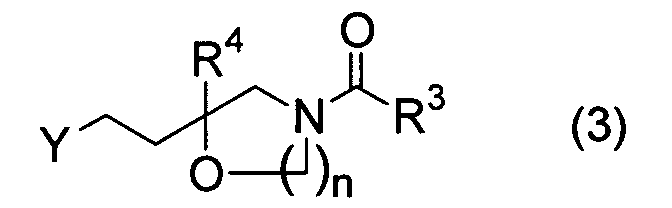
- The process according to Claim 22, wherein G1 is a methylene group.
- The process according to Claim 22 or 23, wherein Ar is a phenyl group.
- The process according to any one of Claims 22 to 24, wherein R1 is trifluoroacetyl, methoxycarbonyl, ethoxycarbonyl, tert-butoxycarbonyl or benzyloxycarbonyl.
- The process according to any one of Claims 22 to 25, wherein R2 is a hydrogen atom.
- The process according to any one of Claims 22 to 26, wherein Y is a halogen atom, a lower alkanesulfonyloxy group, a halogeno lower alkanesulfonyloxy group or an arylsulfonyloxy group.
- The process according to any one of Claims 22 to 27, wherein n is 2.
- The process according to any one of Claims 22 to 28, wherein R3 is 3,5-bis(trifluoromethyl)phenyl, 3,4,5-trimethoxyphenyl, 3-hydroxy-4,5-dimethoxyphenyl, 4-hydroxy-3,5-dimethoxyphenyl or 2-methoxy-5-(1-tetrazolyl)phenyl.
- The process according to any one of Claims 22 to 29, wherein R4 is a phenyl group substituted by 1 or 2 fluorine atoms or chlorine atoms.
Applications Claiming Priority (3)
| Application Number | Priority Date | Filing Date | Title |
|---|---|---|---|
| JP2002309653 | 2002-10-24 | ||
| JP2002309653 | 2002-10-24 | ||
| PCT/JP2003/013495 WO2004037828A1 (en) | 2002-10-24 | 2003-10-22 | Process for producing optically active sulfoxide |
Publications (2)
| Publication Number | Publication Date |
|---|---|
| EP1557420A1 true EP1557420A1 (en) | 2005-07-27 |
| EP1557420A4 EP1557420A4 (en) | 2007-06-27 |
Family
ID=32171014
Family Applications (1)
| Application Number | Title | Priority Date | Filing Date |
|---|---|---|---|
| EP03758784A Withdrawn EP1557420A4 (en) | 2002-10-24 | 2003-10-22 | Process for producing optically active sulfoxide |
Country Status (10)
| Country | Link |
|---|---|
| US (1) | US20050209262A1 (en) |
| EP (1) | EP1557420A4 (en) |
| JP (1) | JP2004161757A (en) |
| KR (1) | KR20050065613A (en) |
| CN (1) | CN1729196A (en) |
| AU (1) | AU2003275592A1 (en) |
| BR (1) | BR0315415A (en) |
| CA (1) | CA2503520A1 (en) |
| TW (1) | TW200409741A (en) |
| WO (1) | WO2004037828A1 (en) |
Families Citing this family (6)
| Publication number | Priority date | Publication date | Assignee | Title |
|---|---|---|---|---|
| CN101323609B (en) * | 2007-06-15 | 2013-05-01 | 成都福瑞生物工程有限公司 | Method for synthesizing high antipode content benzimidazole derivative by unsymmetrical oxidizing thioether into sulphoxide |
| CA2812526A1 (en) | 2010-05-06 | 2011-11-10 | Vertex Pharmaceuticals Incorporated | Heterocyclic chromene-spirocyclic piperidine amides as modulators of ion channels |
| BR112013019211A2 (en) | 2011-02-02 | 2021-07-06 | Vertex Pharma | pyrrolopyrazine spirocyclic piperidine amides as ion channel modulators |
| CN103443105A (en) | 2011-02-18 | 2013-12-11 | 沃泰克斯药物股份有限公司 | Chroman-spirocyclic piperidine amides as modulators of ion channels |
| US8828996B2 (en) | 2011-03-14 | 2014-09-09 | Vertex Pharmaceuticals Incorporated | Morpholine-spirocyclic piperidine amides as modulators of ion channels |
| KR102055702B1 (en) * | 2017-12-12 | 2019-12-13 | 주식회사 아미노로직스 | Method for the preparation of optically active 2-Octylglycine ester |
Family Cites Families (1)
| Publication number | Priority date | Publication date | Assignee | Title |
|---|---|---|---|---|
| HU224225B1 (en) * | 1995-12-01 | 2005-06-28 | Sankyo Co. Ltd. | Heterocyclic compounds having tachykinin receptor antagonist activity, their preparation, and their use for the preparation of pharmaceutical compositions |
-
2003
- 2003-10-22 JP JP2003361552A patent/JP2004161757A/en not_active Withdrawn
- 2003-10-22 EP EP03758784A patent/EP1557420A4/en not_active Withdrawn
- 2003-10-22 CA CA002503520A patent/CA2503520A1/en not_active Abandoned
- 2003-10-22 WO PCT/JP2003/013495 patent/WO2004037828A1/en not_active Ceased
- 2003-10-22 KR KR1020057006837A patent/KR20050065613A/en not_active Withdrawn
- 2003-10-22 AU AU2003275592A patent/AU2003275592A1/en not_active Abandoned
- 2003-10-22 CN CNA2003801072100A patent/CN1729196A/en active Pending
- 2003-10-22 BR BR0315415-7A patent/BR0315415A/en not_active IP Right Cessation
- 2003-10-23 TW TW092129379A patent/TW200409741A/en unknown
-
2005
- 2005-04-14 US US11/107,950 patent/US20050209262A1/en not_active Abandoned
Non-Patent Citations (3)
| Title |
|---|
| FUKUZUMI, S. ET AL.: "Mechanisms of hydrogen-, oxygen-, and electron-transfer reactions of cumylperoxyl radical" JOURNAL OF THE AMERICAN CHEMICAL SOCIETY., vol. 125, 2003, pages 9074-9082, XP002433021 USA * |
| KORPICS, C.J. ET AL.: "Some symmetrical biphenolic sulfoxides" TRANSACTIONS OF THE KENTUCKY ACADEMY OF SCIENCES, vol. 16, no. 3, 1955, pages 66-71, XP008078754 US * |
| See also references of WO2004037828A1 * |
Also Published As
| Publication number | Publication date |
|---|---|
| CA2503520A1 (en) | 2004-05-06 |
| BR0315415A (en) | 2005-08-16 |
| JP2004161757A (en) | 2004-06-10 |
| WO2004037828A1 (en) | 2004-05-06 |
| US20050209262A1 (en) | 2005-09-22 |
| EP1557420A4 (en) | 2007-06-27 |
| TW200409741A (en) | 2004-06-16 |
| KR20050065613A (en) | 2005-06-29 |
| CN1729196A (en) | 2006-02-01 |
| AU2003275592A1 (en) | 2004-05-13 |
Similar Documents
| Publication | Publication Date | Title |
|---|---|---|
| ES2291293T3 (en) | NEW DERIVATIVES AMIDA CICLICOS. | |
| RU2518073C2 (en) | Novel bicyclic heterocyclic compound | |
| KR20140028049A (en) | Derivatives of 1-phenyl-2-pyridinyl alkyl alcohols as phosphodiesterase inhibitors | |
| AU2013348091A1 (en) | Synthesis of spirocyclic isoxazoline derivatives | |
| ES2393540T3 (en) | Synthesis of solifenacin monosuccinate | |
| CN119585275A (en) | Compounds for restoring p53 mutation function and their application | |
| US20050209262A1 (en) | Process for producing optically active sulfoxide | |
| KR20050074605A (en) | New tricyclic derivatives as ltd4 antagonists | |
| EP4463455B1 (en) | Heteroalicyclic derivatives and their use in the treatment of cns disorders | |
| EP1440075B1 (en) | Novel 3beta-amino azabicyclooctane heteroaromatic amide derivatives, preparation method and therapeutic uses thereof | |
| HK1079529A (en) | Process for producing optically active sulfoxide | |
| CN112996566B (en) | Chroman-4-one derivatives for the treatment and prevention of hepatitis B virus infection | |
| US8198455B2 (en) | Process for the preparation of dexlansoprazole | |
| US7560549B2 (en) | Sulfonyloxy derivatives | |
| EP4617268A1 (en) | Quinazoline derivatives | |
| EP1533314A1 (en) | Process for producing cyclic thioether and synthetic intermediate thereof | |
| RU2128178C1 (en) | Piperidinyl-substituted methanoanthracenes and their pharmaceutically acceptable salts, a pharmaceutical composition based on said and methods of their synthesis | |
| CN119490501A (en) | Imidazole bicyclic compound and its preparation method and use | |
| KR100484358B1 (en) | Heterocyclic Compounds Having Takkinin Receptor Antagonism, Preparations thereof, and Uses thereof | |
| AU2006327245A1 (en) | Biaryl substituted nitrogen containing heterocycle inhibitors of LTA4H for treating inflammation | |
| WO2012078608A1 (en) | Preparation of phantasmidine and analogues thereof | |
| HK1072257A (en) | Process for producing cyclic thioether and synthetic intermediate thereof | |
| JP2004067673A (en) | Method for producing cyclic thioether and synthetic intermediate of the same |
Legal Events
| Date | Code | Title | Description |
|---|---|---|---|
| PUAI | Public reference made under article 153(3) epc to a published international application that has entered the european phase |
Free format text: ORIGINAL CODE: 0009012 |
|
| 17P | Request for examination filed |
Effective date: 20050412 |
|
| AK | Designated contracting states |
Kind code of ref document: A1 Designated state(s): AT BE BG CH CY CZ DE DK EE ES FI FR GB GR HU IE IT LI LU MC NL PT RO SE SI SK TR |
|
| AX | Request for extension of the european patent |
Extension state: AL LT LV MK |
|
| DAX | Request for extension of the european patent (deleted) | ||
| REG | Reference to a national code |
Ref country code: HK Ref legal event code: DE Ref document number: 1079529 Country of ref document: HK |
|
| A4 | Supplementary search report drawn up and despatched |
Effective date: 20070525 |
|
| 17Q | First examination report despatched |
Effective date: 20090723 |
|
| R17C | First examination report despatched (corrected) |
Effective date: 20090930 |
|
| STAA | Information on the status of an ep patent application or granted ep patent |
Free format text: STATUS: THE APPLICATION IS DEEMED TO BE WITHDRAWN |
|
| 18D | Application deemed to be withdrawn |
Effective date: 20100211 |
|
| REG | Reference to a national code |
Ref country code: HK Ref legal event code: WD Ref document number: 1079529 Country of ref document: HK |