EP1557418B1 - Quinoxaline derivatives - Google Patents
Quinoxaline derivatives Download PDFInfo
- Publication number
- EP1557418B1 EP1557418B1 EP03758937A EP03758937A EP1557418B1 EP 1557418 B1 EP1557418 B1 EP 1557418B1 EP 03758937 A EP03758937 A EP 03758937A EP 03758937 A EP03758937 A EP 03758937A EP 1557418 B1 EP1557418 B1 EP 1557418B1
- Authority
- EP
- European Patent Office
- Prior art keywords
- compound
- derivative
- substituted
- lower alkyl
- working example
- Prior art date
- Legal status (The legal status is an assumption and is not a legal conclusion. Google has not performed a legal analysis and makes no representation as to the accuracy of the status listed.)
- Expired - Lifetime
Links
- 0 CCCN(CC(C1)OC)C1C=* Chemical compound CCCN(CC(C1)OC)C1C=* 0.000 description 19
- BTYALDWSBYNMBR-UHFFFAOYSA-N CC1(CCO)CCCC1 Chemical compound CC1(CCO)CCCC1 BTYALDWSBYNMBR-UHFFFAOYSA-N 0.000 description 1
- ZLMYSZIWRRVIIE-UHFFFAOYSA-N CCCCC1N=C=CCCCCCCC1 Chemical compound CCCCC1N=C=CCCCCCCC1 ZLMYSZIWRRVIIE-UHFFFAOYSA-N 0.000 description 1
- SMBYUOXUISCLCF-UHFFFAOYSA-N CCCN(C)CC Chemical compound CCCN(C)CC SMBYUOXUISCLCF-UHFFFAOYSA-N 0.000 description 1
- TVTTVGSURDKARG-UHFFFAOYSA-N CCN(CC)Cc(cc1OCCCCCN2Nc(c3ccc4)c4C2=O)cc(N2)c1N=C3C2=O Chemical compound CCN(CC)Cc(cc1OCCCCCN2Nc(c3ccc4)c4C2=O)cc(N2)c1N=C3C2=O TVTTVGSURDKARG-UHFFFAOYSA-N 0.000 description 1
- SGRLZKGRIHKPTI-UHFFFAOYSA-N CN(CCN1Sc(c2ccc3)c3C1=O)CCOc1cc(Br)cc(N3)c1N=C2C3=O Chemical compound CN(CCN1Sc(c2ccc3)c3C1=O)CCOc1cc(Br)cc(N3)c1N=C2C3=O SGRLZKGRIHKPTI-UHFFFAOYSA-N 0.000 description 1
- UBDJFWHIOPBJFY-UHFFFAOYSA-N CN(CCN1Sc(c2ccc3)c3C1=O)CCOc1cccc(N3)c1N=C2C3=O Chemical compound CN(CCN1Sc(c2ccc3)c3C1=O)CCOc1cccc(N3)c1N=C2C3=O UBDJFWHIOPBJFY-UHFFFAOYSA-N 0.000 description 1
- GFGUUQAOLQMCOG-UHFFFAOYSA-N CNCCOc1cccc(N2)c1N=C(c1cccc3c1NNC3=O)C2=O Chemical compound CNCCOc1cccc(N2)c1N=C(c1cccc3c1NNC3=O)C2=O GFGUUQAOLQMCOG-UHFFFAOYSA-N 0.000 description 1
- WFGADMZTVOFDEZ-UHFFFAOYSA-N COCC1CN(Cc(cc2OCC(CC3)NC3C3)cc(NC4O)c2N=C4c2cccc4c2SN3C4=O)CCC1 Chemical compound COCC1CN(Cc(cc2OCC(CC3)NC3C3)cc(NC4O)c2N=C4c2cccc4c2SN3C4=O)CCC1 WFGADMZTVOFDEZ-UHFFFAOYSA-N 0.000 description 1
- QTJBALJTKTUSQO-INIZCTEOSA-N COCCOCc(cc1O[C@@H](CC2)CN2CCN2Nc(c3ccc4)c4C2=O)cc(N2)c1N=C3C2=O Chemical compound COCCOCc(cc1O[C@@H](CC2)CN2CCN2Nc(c3ccc4)c4C2=O)cc(N2)c1N=C3C2=O QTJBALJTKTUSQO-INIZCTEOSA-N 0.000 description 1
- VEQYDDXMAKBKJW-WUBHUQEYSA-N CO[C@H]1C(CCS)N(Cc(cc2N3)cc(OC(CC4)CCN4CCN4Sc(c5ccc6)c6C4=O)c2N=C5C3=O)CCC1 Chemical compound CO[C@H]1C(CCS)N(Cc(cc2N3)cc(OC(CC4)CCN4CCN4Sc(c5ccc6)c6C4=O)c2N=C5C3=O)CCC1 VEQYDDXMAKBKJW-WUBHUQEYSA-N 0.000 description 1
- PZMFPBUXTYPGMS-AWEZNQCLSA-N COc1c(-c2cccc3c2SN(CCN(CC2)C[C@H]2O2)C3=O)nc3c2cc(CO)cc3n1 Chemical compound COc1c(-c2cccc3c2SN(CCN(CC2)C[C@H]2O2)C3=O)nc3c2cc(CO)cc3n1 PZMFPBUXTYPGMS-AWEZNQCLSA-N 0.000 description 1
- LVDOAAPXAXSDLG-UONOGXRCSA-N COc1c(-c2cccc3c2SN(C[C@H](CC2)O[C@H]2CO2)C3=O)nc3c2cc(CO)cc3n1 Chemical compound COc1c(-c2cccc3c2SN(C[C@H](CC2)O[C@H]2CO2)C3=O)nc3c2cc(CO)cc3n1 LVDOAAPXAXSDLG-UONOGXRCSA-N 0.000 description 1
- RLYJBXREKVXQBN-LBPRGKRZSA-N C[C@@H](CN(C)CCN1Sc(c2ccc3)c3C1=O)Oc1cccc(N3)c1N=C2C3=O Chemical compound C[C@@H](CN(C)CCN1Sc(c2ccc3)c3C1=O)Oc1cccc(N3)c1N=C2C3=O RLYJBXREKVXQBN-LBPRGKRZSA-N 0.000 description 1
- WZTPOJJLQKIWGV-MJGOQNOKSA-N C[C@H](C[C@@H](C1)Oc2c(CN3CCCCC3)ccc(N3)c2N=C(c2ccc4)C3=O)N1CCN1Nc2c4C1=O Chemical compound C[C@H](C[C@@H](C1)Oc2c(CN3CCCCC3)ccc(N3)c2N=C(c2ccc4)C3=O)N1CCN1Nc2c4C1=O WZTPOJJLQKIWGV-MJGOQNOKSA-N 0.000 description 1
- WFFMQOKFIQEEQG-HDKHEFTPSA-N C[C@H](C[C@@H](C1)Oc2cc(/C(/I)=N/C=C(/CCCC3)\C3=[IH])cc(N3)c2N=C(c2ccc4)C3=O)N1CCN1Nc2c4C1=O Chemical compound C[C@H](C[C@@H](C1)Oc2cc(/C(/I)=N/C=C(/CCCC3)\C3=[IH])cc(N3)c2N=C(c2ccc4)C3=O)N1CCN1Nc2c4C1=O WFFMQOKFIQEEQG-HDKHEFTPSA-N 0.000 description 1
- KBLPHMRCKHFBJB-OLZOCXBDSA-N C[C@H](C[C@@H](C1)Oc2cccc(N3)c2N=C(c2ccc4)C3=O)N1CCN1Nc2c4C1=O Chemical compound C[C@H](C[C@@H](C1)Oc2cccc(N3)c2N=C(c2ccc4)C3=O)N1CCN1Nc2c4C1=O KBLPHMRCKHFBJB-OLZOCXBDSA-N 0.000 description 1
- VOKLACGEBSUEES-KRWDZBQOSA-N Cc1cc(C)n[n]1-c(cc1O[C@@H](CC2)CN2CCN2Nc(c3ccc4)c4C2=O)cc(N2)c1N=C3C2=O Chemical compound Cc1cc(C)n[n]1-c(cc1O[C@@H](CC2)CN2CCN2Nc(c3ccc4)c4C2=O)cc(N2)c1N=C3C2=O VOKLACGEBSUEES-KRWDZBQOSA-N 0.000 description 1
- PMCOWOCKUQWYRL-UHFFFAOYSA-N Cc1ccnc(C)n1 Chemical compound Cc1ccnc(C)n1 PMCOWOCKUQWYRL-UHFFFAOYSA-N 0.000 description 1
- RHOOLJLEYYXKTK-UHFFFAOYSA-N Cc1cnc(C)nc1 Chemical compound Cc1cnc(C)nc1 RHOOLJLEYYXKTK-UHFFFAOYSA-N 0.000 description 1
- FHDIFALVIWPFJX-AWEZNQCLSA-N Cc1nc(-c(cc2O[C@@H](CC3)CN3CCN3Nc(c4ccc5)c5C3=O)cc(N3)c2N=C4C3=O)n[o]1 Chemical compound Cc1nc(-c(cc2O[C@@H](CC3)CN3CCN3Nc(c4ccc5)c5C3=O)cc(N3)c2N=C4C3=O)n[o]1 FHDIFALVIWPFJX-AWEZNQCLSA-N 0.000 description 1
- ITFWOIPXUKIGIT-UHFFFAOYSA-N Cc1ncc(CC(CCN2CCCCC2)CC2)c2n1 Chemical compound Cc1ncc(CC(CCN2CCCCC2)CC2)c2n1 ITFWOIPXUKIGIT-UHFFFAOYSA-N 0.000 description 1
- BGJROUYOWPXIDL-HNNXBMFYSA-N O=C(CCC1)N1c(cc1N2)cc(O[C@@H](CC3)CN3CCN3Nc4c5cccc4C3=O)c1N=C5C2=O Chemical compound O=C(CCC1)N1c(cc1N2)cc(O[C@@H](CC3)CN3CCN3Nc4c5cccc4C3=O)c1N=C5C2=O BGJROUYOWPXIDL-HNNXBMFYSA-N 0.000 description 1
- HBBGRNOIKSAFEC-UHFFFAOYSA-N O=C1N(CCN(CC2)CC2Oc2ccc3)Sc4c1cccc4C1=Nc2c3NC1=O Chemical compound O=C1N(CCN(CC2)CC2Oc2ccc3)Sc4c1cccc4C1=Nc2c3NC1=O HBBGRNOIKSAFEC-UHFFFAOYSA-N 0.000 description 1
- KLDPWKHFESKJQH-INIZCTEOSA-N O=C1N(CCN(CC2)C[C@H]2Oc2cc(-c(cc3O4)ccc3OC4(F)F)c3)Nc4c1cccc4C1=Nc2c3NC1=O Chemical compound O=C1N(CCN(CC2)C[C@H]2Oc2cc(-c(cc3O4)ccc3OC4(F)F)c3)Nc4c1cccc4C1=Nc2c3NC1=O KLDPWKHFESKJQH-INIZCTEOSA-N 0.000 description 1
- AOIJDOLWWCOEBC-SFHVURJKSA-N O=C1N(CCN(CC2)C[C@H]2Oc2cc(-c3cc(F)cc(F)c3)c3)Nc4c1cccc4C1=Nc2c3NC1=O Chemical compound O=C1N(CCN(CC2)C[C@H]2Oc2cc(-c3cc(F)cc(F)c3)c3)Nc4c1cccc4C1=Nc2c3NC1=O AOIJDOLWWCOEBC-SFHVURJKSA-N 0.000 description 1
- QGKRQFJVEAKWGY-KRWDZBQOSA-N O=C1N(CCN(CC2)C[C@H]2Oc2cc(-c3cccnc3)c3)Nc4c1cccc4C1=Nc2c3NC1=O Chemical compound O=C1N(CCN(CC2)C[C@H]2Oc2cc(-c3cccnc3)c3)Nc4c1cccc4C1=Nc2c3NC1=O QGKRQFJVEAKWGY-KRWDZBQOSA-N 0.000 description 1
- NMJZCNYYSGJBIP-SFHVURJKSA-N O=C1N(CCN(CC2)C[C@H]2Oc2cc(-c3ncc(CCCC4)c4n3)c3)Nc4c1cccc4C1=Nc2c3NC1=O Chemical compound O=C1N(CCN(CC2)C[C@H]2Oc2cc(-c3ncc(CCCC4)c4n3)c3)Nc4c1cccc4C1=Nc2c3NC1=O NMJZCNYYSGJBIP-SFHVURJKSA-N 0.000 description 1
- QTAQQSXGNZGCSO-INIZCTEOSA-N O=C1N(CCN(CC2)C[C@H]2Oc2cc(-c3ncccc3)c3)Nc4c1cccc4C1=Nc2c3NC1=O Chemical compound O=C1N(CCN(CC2)C[C@H]2Oc2cc(-c3ncccc3)c3)Nc4c1cccc4C1=Nc2c3NC1=O QTAQQSXGNZGCSO-INIZCTEOSA-N 0.000 description 1
- GYJLSBPQPSVFDB-DJZRFWRSSA-N O=C1N(CCN(CC2)C[C@H]2Oc2cc(C3OCCCC3)c3)Nc4c1cccc4C1=Nc2c3NC1=O Chemical compound O=C1N(CCN(CC2)C[C@H]2Oc2cc(C3OCCCC3)c3)Nc4c1cccc4C1=Nc2c3NC1=O GYJLSBPQPSVFDB-DJZRFWRSSA-N 0.000 description 1
- APMJIYPKBFKLOY-LBPRGKRZSA-N O=C1N(CCN(CC2)C[C@H]2Oc2ccc3)Nc4c1cccc4C1=Nc2c3NC1=O Chemical compound O=C1N(CCN(CC2)C[C@H]2Oc2ccc3)Nc4c1cccc4C1=Nc2c3NC1=O APMJIYPKBFKLOY-LBPRGKRZSA-N 0.000 description 1
- IECOIFCTGZDQMV-UHFFFAOYSA-N O=C1N2Nc3c1cccc3C(C(Nc1cc(CN(CC3)CCC3F)c3)=O)=Nc1c3OCCCCC2 Chemical compound O=C1N2Nc3c1cccc3C(C(Nc1cc(CN(CC3)CCC3F)c3)=O)=Nc1c3OCCCCC2 IECOIFCTGZDQMV-UHFFFAOYSA-N 0.000 description 1
- PCEQMDLBMZZNTI-UHFFFAOYSA-N O=C1N2Nc3c1cccc3C(C(Nc1cc(CN3CCCCC3)c3)=O)=Nc1c3OCCCCC2 Chemical compound O=C1N2Nc3c1cccc3C(C(Nc1cc(CN3CCCCC3)c3)=O)=Nc1c3OCCCCC2 PCEQMDLBMZZNTI-UHFFFAOYSA-N 0.000 description 1
- UJXYZLJICIZMPZ-SFHVURJKSA-N O=C1N2Nc3c1cccc3C(C(Nc1cc(N3CCCCCC3)c3)=O)=Nc1c3O[C@@H](CC1)CN1CC2 Chemical compound O=C1N2Nc3c1cccc3C(C(Nc1cc(N3CCCCCC3)c3)=O)=Nc1c3O[C@@H](CC1)CN1CC2 UJXYZLJICIZMPZ-SFHVURJKSA-N 0.000 description 1
- MLMSUINEEOLGCB-SFHVURJKSA-N Oc(cc1)ccc1-c(cc1O[C@@H](CC2)CN2CCN2Nc3c4cccc3C2=O)cc(N2)c1N=C4C2=O Chemical compound Oc(cc1)ccc1-c(cc1O[C@@H](CC2)CN2CCN2Nc3c4cccc3C2=O)cc(N2)c1N=C4C2=O MLMSUINEEOLGCB-SFHVURJKSA-N 0.000 description 1
- XXODXVZDRBJLIM-INIZCTEOSA-N [O-][N+](c1ccccc1-c(cc1O[C@@H](CC2)CN2CCN2Nc(c3ccc4)c4C2=O)cc(N2)c1N=C3C2=O)=O Chemical compound [O-][N+](c1ccccc1-c(cc1O[C@@H](CC2)CN2CCN2Nc(c3ccc4)c4C2=O)cc(N2)c1N=C3C2=O)=O XXODXVZDRBJLIM-INIZCTEOSA-N 0.000 description 1
Classifications
-
- C—CHEMISTRY; METALLURGY
- C07—ORGANIC CHEMISTRY
- C07D—HETEROCYCLIC COMPOUNDS
- C07D487/00—Heterocyclic compounds containing nitrogen atoms as the only ring hetero atoms in the condensed system, not provided for by groups C07D451/00 - C07D477/00
- C07D487/12—Heterocyclic compounds containing nitrogen atoms as the only ring hetero atoms in the condensed system, not provided for by groups C07D451/00 - C07D477/00 in which the condensed system contains three hetero rings
- C07D487/18—Bridged systems
-
- A—HUMAN NECESSITIES
- A61—MEDICAL OR VETERINARY SCIENCE; HYGIENE
- A61K—PREPARATIONS FOR MEDICAL, DENTAL OR TOILETRY PURPOSES
- A61K31/00—Medicinal preparations containing organic active ingredients
- A61K31/33—Heterocyclic compounds
- A61K31/395—Heterocyclic compounds having nitrogen as a ring hetero atom, e.g. guanethidine or rifamycins
- A61K31/495—Heterocyclic compounds having nitrogen as a ring hetero atom, e.g. guanethidine or rifamycins having six-membered rings with two or more nitrogen atoms as the only ring heteroatoms, e.g. piperazine or tetrazines
- A61K31/4995—Pyrazines or piperazines forming part of bridged ring systems
-
- A—HUMAN NECESSITIES
- A61—MEDICAL OR VETERINARY SCIENCE; HYGIENE
- A61K—PREPARATIONS FOR MEDICAL, DENTAL OR TOILETRY PURPOSES
- A61K31/00—Medicinal preparations containing organic active ingredients
- A61K31/33—Heterocyclic compounds
- A61K31/395—Heterocyclic compounds having nitrogen as a ring hetero atom, e.g. guanethidine or rifamycins
- A61K31/495—Heterocyclic compounds having nitrogen as a ring hetero atom, e.g. guanethidine or rifamycins having six-membered rings with two or more nitrogen atoms as the only ring heteroatoms, e.g. piperazine or tetrazines
- A61K31/505—Pyrimidines; Hydrogenated pyrimidines, e.g. trimethoprim
- A61K31/506—Pyrimidines; Hydrogenated pyrimidines, e.g. trimethoprim not condensed and containing further heterocyclic rings
-
- A—HUMAN NECESSITIES
- A61—MEDICAL OR VETERINARY SCIENCE; HYGIENE
- A61K—PREPARATIONS FOR MEDICAL, DENTAL OR TOILETRY PURPOSES
- A61K31/00—Medicinal preparations containing organic active ingredients
- A61K31/33—Heterocyclic compounds
- A61K31/395—Heterocyclic compounds having nitrogen as a ring hetero atom, e.g. guanethidine or rifamycins
- A61K31/495—Heterocyclic compounds having nitrogen as a ring hetero atom, e.g. guanethidine or rifamycins having six-membered rings with two or more nitrogen atoms as the only ring heteroatoms, e.g. piperazine or tetrazines
- A61K31/505—Pyrimidines; Hydrogenated pyrimidines, e.g. trimethoprim
- A61K31/517—Pyrimidines; Hydrogenated pyrimidines, e.g. trimethoprim ortho- or peri-condensed with carbocyclic ring systems, e.g. quinazoline, perimidine
-
- A—HUMAN NECESSITIES
- A61—MEDICAL OR VETERINARY SCIENCE; HYGIENE
- A61K—PREPARATIONS FOR MEDICAL, DENTAL OR TOILETRY PURPOSES
- A61K31/00—Medicinal preparations containing organic active ingredients
- A61K31/33—Heterocyclic compounds
- A61K31/395—Heterocyclic compounds having nitrogen as a ring hetero atom, e.g. guanethidine or rifamycins
- A61K31/535—Heterocyclic compounds having nitrogen as a ring hetero atom, e.g. guanethidine or rifamycins having six-membered rings with at least one nitrogen and one oxygen as the ring hetero atoms, e.g. 1,2-oxazines
- A61K31/5375—1,4-Oxazines, e.g. morpholine
- A61K31/5377—1,4-Oxazines, e.g. morpholine not condensed and containing further heterocyclic rings, e.g. timolol
-
- A—HUMAN NECESSITIES
- A61—MEDICAL OR VETERINARY SCIENCE; HYGIENE
- A61K—PREPARATIONS FOR MEDICAL, DENTAL OR TOILETRY PURPOSES
- A61K31/00—Medicinal preparations containing organic active ingredients
- A61K31/33—Heterocyclic compounds
- A61K31/395—Heterocyclic compounds having nitrogen as a ring hetero atom, e.g. guanethidine or rifamycins
- A61K31/55—Heterocyclic compounds having nitrogen as a ring hetero atom, e.g. guanethidine or rifamycins having seven-membered rings, e.g. azelastine, pentylenetetrazole
-
- A—HUMAN NECESSITIES
- A61—MEDICAL OR VETERINARY SCIENCE; HYGIENE
- A61P—SPECIFIC THERAPEUTIC ACTIVITY OF CHEMICAL COMPOUNDS OR MEDICINAL PREPARATIONS
- A61P35/00—Antineoplastic agents
-
- A—HUMAN NECESSITIES
- A61—MEDICAL OR VETERINARY SCIENCE; HYGIENE
- A61P—SPECIFIC THERAPEUTIC ACTIVITY OF CHEMICAL COMPOUNDS OR MEDICINAL PREPARATIONS
- A61P43/00—Drugs for specific purposes, not provided for in groups A61P1/00-A61P41/00
-
- C—CHEMISTRY; METALLURGY
- C07—ORGANIC CHEMISTRY
- C07D—HETEROCYCLIC COMPOUNDS
- C07D498/00—Heterocyclic compounds containing in the condensed system at least one hetero ring having nitrogen and oxygen atoms as the only ring hetero atoms
- C07D498/12—Heterocyclic compounds containing in the condensed system at least one hetero ring having nitrogen and oxygen atoms as the only ring hetero atoms in which the condensed system contains three hetero rings
- C07D498/18—Bridged systems
-
- C—CHEMISTRY; METALLURGY
- C07—ORGANIC CHEMISTRY
- C07D—HETEROCYCLIC COMPOUNDS
- C07D498/00—Heterocyclic compounds containing in the condensed system at least one hetero ring having nitrogen and oxygen atoms as the only ring hetero atoms
- C07D498/22—Heterocyclic compounds containing in the condensed system at least one hetero ring having nitrogen and oxygen atoms as the only ring hetero atoms in which the condensed system contains four or more hetero rings
-
- C—CHEMISTRY; METALLURGY
- C07—ORGANIC CHEMISTRY
- C07D—HETEROCYCLIC COMPOUNDS
- C07D515/00—Heterocyclic compounds containing in the condensed system at least one hetero ring having nitrogen, oxygen, and sulfur atoms as the only ring hetero atoms, not provided for in groups C07D463/00, C07D477/00 or C07D499/00 - C07D507/00
- C07D515/12—Heterocyclic compounds containing in the condensed system at least one hetero ring having nitrogen, oxygen, and sulfur atoms as the only ring hetero atoms, not provided for in groups C07D463/00, C07D477/00 or C07D499/00 - C07D507/00 in which the condensed system contains three hetero rings
- C07D515/18—Bridged systems
-
- C—CHEMISTRY; METALLURGY
- C07—ORGANIC CHEMISTRY
- C07D—HETEROCYCLIC COMPOUNDS
- C07D515/00—Heterocyclic compounds containing in the condensed system at least one hetero ring having nitrogen, oxygen, and sulfur atoms as the only ring hetero atoms, not provided for in groups C07D463/00, C07D477/00 or C07D499/00 - C07D507/00
- C07D515/22—Heterocyclic compounds containing in the condensed system at least one hetero ring having nitrogen, oxygen, and sulfur atoms as the only ring hetero atoms, not provided for in groups C07D463/00, C07D477/00 or C07D499/00 - C07D507/00 in which the condensed system contains four or more hetero rings
Definitions
- the present invention relates to a novel quinoxalinone derivative of formula (I) which is useful as pharmaceuticals and a composition containing the same as an active ingredient.
- Cdk cyclin-dependent kinase
- a cyclin itself also have a family, and each Cdk molecule is considered to regulate the progression of a certain cell cycle by forming a complex with a cyclin molecule which is expressed specifically at the corresponding stage of the cell cycle.
- D type cyclin in combination with Cdk4 or Cdk6, regulates the progression of G1 phase
- cyclin E-Cdk2 regulates G1/S boundary
- cyclin A-Cdk2 regulates the progression of S phase
- cyclin B-cdc2 regulates the progression of G2/M, respectively.
- D1, D2 and D3 are known as a D type cyclin, and moreover the activity of Cdk is considered to be regulated not only by its association with cyclins but also by phosphorylation/dephosphorylation of Cdk molecules, degradation of cyclin molecules and binding with Cdk inhibitor proteins ( Advanced Cancer Research, Vol.66, pp 181-212(1995 ); Current Opinion in Cell Biology, Vol.7, pp773-780(1995 ): Nature, Vol.374, pp131-134 (1995 )).
- Cdk inhibitor proteins in a mammalian cell are classified roughly into two kinds due to the differences in structure and property; Cip/Kip family and INK4 family.
- the former inhibits cyclin-Cdk complex widely, while the latter binds with Cdk4 or Cdk6, thereby specifically inhibiting cyclin-Cdk complex ( Nature, vol.366, pp704-707(1993 ); Molecular and Cellular Biology, vol.15, pp2627-2681(1995 ): Genes and Development, vol.9, pp1149-1163 (1995 )).
- P21(Sdi1/Cip1/Waf1) is nominated for a representative example of the former, of which RNA transcription is induced by a cancer repressor gene product, p53.
- p16 (INK4a /MTS1 /CDK4I /CDKN2) is one of the Cdk inhibitor proteins belonging to the latter.
- the P16 gene is located on the human chromosome 9p21 which are found to be abnormal with a high frequency in human cancer cells. Actually, many cases of deletion of the p16 gene have been reported in clinical patients. Also, high-frequency of tumorigenesis in a p16 knockout-mouse has been reported ( Nature Genetics, vol.8, pp27-32(1994 ); Trends in Genetics, vol.11, pp136-140(1995 ); Cell, vol.85, pp27-37(1996 )).
- the RB protein plays an important role in progression from G1 phase to S phase and is rapidly phosphorylated during the term from late G1 phase to initial S phase. It is considered that this phosphorylation is carried out by cyclin D-Cdk4/Cdk6 complex followed by cyclin E-Cdk2 complex, following progression of cell cycle.
- the complex composed of hypophosphorylated RB and transcription factor E2F in early G1 phase dissociates when the RB protein becomes hyperphosphorylated.
- E2F becomes a transcriptional activator, and at the same time, the suppression of the promoter activity by RB-E2F complex is removed, thus leading to the activation of E2F dependent transcription.
- the Cdk-RB pathway consisting of E2F, its suppressor RB protein, Cdk4/Cdk6 which repressively regulates the function of RB protein, Cdk inhibitory protein which controls the kinase activity of Cdk4/Cdk6, and D-type cyclin is thought to be an important mechanism to regulate the progression from G1 phase to S phase ( Cell, vol.58, pp1097-1105(1989 ); Cell, vol.65, pp1053-1061(1991 ); Oncogene, vol.7, pp1067-1074(1992 ); Current Opinion in Cell Biology, Vol.
- E2F-binding DNA sequence is located, for example, upstream of the sequence of many cell growth-related genes which are important in S phase, and it is reported that in several genes among them the transcription is activated in an E2F-dependent manner during the term from late G1 phase to initial S phase( The EMBO Journal, vol.9, pp 2179-2184, (1990 ); Molecular and Cellular Biology, vol. 13, pp1610-1618 (1993 )).
- chromone derivatives represented, for example, by flavopiridol are known ( WO97/16447 , 98/13344 ); however, the inhibitory activity of those chromone derivatives is not sufficient.
- the present inventors previously prepared a novel pyrazinone derivative having inhibitory activity against Cdk, and filed a PCT international application ( PCT/JP01/05545 ; WO 02/02550 ).
- the present inventors conducted intensive studies in order to provide a novel compound having an excellent cell growth-inhibitory activity as well as CdK inhibitory activity. As a result, we found that a novel quinoxalinone derivative has both an inhibitory activity against Cdk and cell growth-inhibitory activity, and thus completed the present invention. It is obvious that the quinoxalinone derivative of the present invention has completely structural originality as compared to the above pyrazinone derivative in light of its cyclic structure containing a quinoxalinone core structure.
- the present invention relates to a quinoxalinone derivative of the formula (I): or a pharmaceutically acceptable salt or ester thereof, wherein;
- B' 1 , B' 2 , ??, B' n-1 and B' n are each independently hydrogen, halogen, hydroxy, oxo, lower alkoxy, amino, lower alkylamino, di-lower alkylamino, lower alkyl or lower alkenyl (wherein said lower alkyl and said lower alkenyl may be substituted with one or more, same or different substituents selected from the group consisting of hydroxy, lower alkoxy, amino and lower alkylamino, and
- B' 1 , B' 2 , ??, B' n-1 and B' n , B' 1 and B' i+2 (in which i is 1, 2 or 3) taken together with B i , B i+1 and B i+2 , or B' i and B' i+3 (in which i is 1 or 2) taken together with B i , B i+1 , B i+2 and B i+3 , may form a cycloalkyl having five to six carbon atoms or an aliphatic heterocyclic group selected from ⁇ substituent group ⁇ 1 >, and said cycloalkyl and said aliphatic heterocyclic group may be substituted with one or more, same or different substituents selected from lower alkyl and ⁇ substituent group ⁇ >);
- R is hydrogen, lower alkyl, lower alkenyl, amino of which nitrogen is di-substituted with R a and R b , amino-lower alkyl of which nitrogen is di-substituted with R a and R b , or L, wherein R a and R b are each independently hydrogen, lower alkyl, lower alkoxyalkyl or halogenated lower alkyl, and L is L 1 -L 2 -L 3 (wherein L 1 is a single bond, -(CH 2 ) k1 -, -(CH 2 ) k1 -O- or -(CH 2 ) k1 -NH- (in which k1 is an integer of 1 to 3); L 2 is a single bond or -(CH 2 ) k2 -(in which k2 is an integer of 1 to 3); and L 3 is lower alkyl, lower alkoxy, cycloalkyl having three to six carbon atoms, phenyl, pyr
- a substituent selected from ⁇ substituent group ⁇ > which may be substituted with one or more, same or different substituents selected from ⁇ substituent group ⁇ >, or lower alkyl substituted with said substituent; or
- J is J 1 -J 2 -J 3 ;
- J 2 is a single bond or -(CH 2 ) k4 - (in which k4 is an integer of 1 to 3);
- J 3 is lower alkyl, lower alkoxy, -CONR a R b (wherein R a and R b each have the same meaning as defined above), phenyl, pyridy
- ⁇ substituent group ⁇ >, ⁇ substituent group ⁇ 1 >, ⁇ substituent group ⁇ 2 > and ⁇ substituent group ⁇ > each have the meaning shown below:
- ⁇ substituent group ⁇ > hydroxy, hydroxy-lower alkyl, cyano, halogen, carboxyl, lower alkanoyl, lower alkoxycarbonyl, lower alkoxy, lower alkoxyalkyl, amino, lower alkylamino, lower alkylsulfonyl, halogenated lower alkyl, halogenated lower alkoxy, halogenated lower alkylamino, nitro and lower alkanoylamino,
- cycloalkyl having three to six carbon atoms lower alkyl substituted with cycloalkyl having three to six carbon atoms, phenyl, lower alkyl substituted with phenyl, pyridyl, pyrrolidinyl and piperidinyl, wherein said cycloalkyl having three to six carbon atoms, phenyl, pyridyl, pyrrolidinyl and piperidinyl may be substituted with one or more fluorine atoms.
- lower alkyl in the above formula (I) refers to a straight- or branched-chain alkyl group having one to six carbon atoms; for example, methyl, ethyl, propyl, isopropyl, butyl, isobutyl, sec-butyl, tert-butyl, pentyl, hexyl ; preferably methyl, ethyl, propyl, isopropyl, tert-butyl or pentyl; particularly preferably methyl.
- lower alkenyl in the above formula (I) refers to a straight- or branched-chain alkenyl group having two to six carbon atoms; for example, vinyl, 1-propenyl, allyl, isopropenyl, 1-butenyl, 3-butenyl, 1,3-butanedienyl, 2-pentenyl, 4-pentenyl, 1-hexenyl, 3-hexenyl, 5-hexenyl ; preferably 1-propenyl.
- halogen in the above formula (I) refers to, for example, fluorine atom, chlorine atom, bromine atom, iodine atom ; preferably fluorine atom, chlorine atom or bromine atom; more preferably fluorine atom.
- lower alkoxy in the above formula (I) refers to a group in which oxygen atom is substituted with “lower alkyl”; concretely for example, methoxy, ethoxy, propoxy, isopropoxy, butoxy, isobutoxy, sec-butoxy, tert-butoxy, pentyloxy, neopentyloxy, hexyloxy, isohexyloxy ; preferably methoxy, ethoxy, isopropyloxy or tert-butoxy; more preferably methoxy or ethoxy, particularly preferably methoxy.
- lower alkoxyalkyl in the above formula (I) refers to the above “lower alkyl” substituted with the above “lower alkoxy”;for example, methoxymethyl, ethoxymethyl, isopropoxymethyl, butoxymethyl, isobutoxymethyl, sec-butoxymethyl, tert-butoxymethyl, pentyloxymethyl, neopentyloxymethyl, hexyloxymethyl, isohexyloxymethyl, 1-methoxyethyl, 1-ethoxyethyl, 1-isopropoxyethyl, 1-butoxyethyl, 1-isobutoxyethyl, 1-sec-butoxyethyl, 1-tert-butoxyethyl, 1-pentyloxyethyl, 1-neopentyloxyethyl, 1-hexyloxyethyl, 1-isohexyloxyethyl, 2-methoxyethyl, 2-ethoxyethyl,
- halogenated lower alkyl in the above formula (I) refers to "lower alkyl” substituted with “halogen”; preferably “lower alkyl” substituted with one to three fluorine atoms; more preferably “lower alkyl” substituted with three fluorine atoms. Concrete examples thereof include trifluoromethyl, difluoromethyl, 2,2,2-trifluoroethyl, pentafluoroethyl ; preferably trifluoromethyl.
- halogenated lower alkoxy in the above formula (I) refers to "lower alkoxy” substituted with “halogen”; preferably “lower alkoxy” substituted with one to three fluorine atoms; more preferably “lower alkoxy” substituted with three fluorine atoms. Concrete examples thereof include trifluoromethoxy, difluoromethoxy, 2,2,2-trifluoroethoxy, pentafluoroethoxy ; preferably trifluoromethoxy.
- lower alkoxycarbonyl in the above formula (I) refers to a carbonyl group substituted with the above “lower alkoxy”; concretely for example, methoxycarbonyl, ethoxycarbonyl, propoxycarbonyl, isopropoxycarbonyl, butoxycarbonyl, isobutoxycarbonyl, sec-butoxycarbonyl, tert-butoxycarbonyl, pentyloxycarbonyl, neopentyloxycarbonyl, hexyloxycarbonyl, isohexyloxycarbonyl, preferably methoxycarbonyl, ethoxycarbonyl, isopropoxycarbonyl or tert-butoxycarbonyl; more preferably methoxycarbonyl or ethoxycarbonyl; particularly preferably methoxycarbonyl.
- lower alkanoyl in the above formula (I) refers to a carbonyl group substituted with the above “lower alkyl”; for example, acetyl, propionyl, butyryl, isobutyryl, pivaloyl ; preferably acetyl.
- lower alkylamino in the above formula (I) refers to an amino group which is N-substituted with the above “lower alkyl”; for example, N-methylamino, N-ethylamino, N-propylamino, N-isopropylamino, N-butylamino, N-isobutylamino, N-tert-butylamino, N-pentylamino, N-hexylamino; preferably, for example, N-methylamino, N-ethylamino, N-butylamino or N-tert-butylamino, particularly preferably N-tert-butylamino.
- halogenated lower alkylamino in the above formula (I) refers to "lower alkylamino" substituted with “halogen”; preferably “lower alkylamino” substituted with one to three fluorine atoms; more preferably “lower alkylamino” substituted with three fluorine atoms.
- Concrete examples thereof include 2, 2 , 2-trichloroethyl, 2,2,2-trifluoroethyl ; particularly preferably 2,2,2-trifluoroethyl.
- di-lower alkylamino in the above formula (I) refers to an amino group which is N,N-disubstituted with the above “lower alkyl”; for example, N,N-dimethylamino, N,N-diethylamino, N,N-dipropylamino, N,N-diisopropylamino, N,N-dibutylamino, N,N-diisobutylamino, N,N-di-tert-butylamino, N,N-dipentylamino, N,N-dihexylamino, N-ethyl-N-methylamino, N-methyl-N-propylamino ; preferably, for example, N,N-dimethylamino, N,N-diethylamino, N,N-dibutylamino, N-ethyl-N-methylamino or N-methyl-N-
- lower alkylsulfonyl in the above formula (I) refers to a sulfonyl group substituted with the above “lower alkyl”; for example, methylsulfonyl, ethylsulfonyl, butylsulfonyl ; preferably, for example, methylsulfonyl or ethylsulfonyl; particularly preferably methylsulfonyl.
- cycloalkyl having three to six carbon atoms refers to cyclopropyl, cyclobutyl, cyclopentyl or cyclohexyl, preferably cyclopropyl or cyclopentyl.
- cycloalkyl having five to six carbon atoms refers to cyclopentyl or cyclohexyl, preferably cyclopentyl.
- hydroxy-lower alkyl in the above formula (I) refers to the above “lower alkyl” substituted with a hydroxy group; preferably “lower alkyl” substituted with one to three hydroxy groups; particularly preferably “lower alkyl” substituted with one hydroxy group.
- Concrete examples thereof include hydroxymethyl, 1-hydroxyethyl, 2-hydroxyethyl, 1-hydroxypropyl, 2-hydroxypropyl, 3-hydroxypropyl, 1-hydroxy-2-methylethyl, 1-hydroxybutyl, 1-hydroxy-2-methylpropyl, 1-hydroxy-2,2-dimethylethyl, 1-hydroxypentyl, 1-hydroxy-2-methylbutyl, 1-hydroxyhexyl, 1-hydroxy-2-methylpentyl ; preferably hydroxymethyl,1-hydroxyethyl, 2-hydroxyethyl and 1-hydroxy-2-methylethyl.
- amino-lower alkyl in the above formula (I) refers to the above “lower alkyl” substituted with an amino group; concretely for example, aminomethyl, 1-amino, 2-aminoethyl, 1-aminopropyl, 2-aminopropyl, 3-aminopropyl, 1-amino-2-methylethyl, 1-aminobutyl, 1-amino-2-methylpropyl, 1-amino-2,2-dimethylethyl, 1-aminopentyl, 1-amino-2-methylbutyl, 1-aminohexyl, 1-amino-2-methylpentyl , preferably aminomethyl, 1-aminoethyl, 2-aminoethyl, or 1-amino-2-methylethyl.
- lower alkanoyl in the above formula (I) refers to a carbonyl group substituted with the above "lower Alkyl”; preferably a carbonyl group substituted with an alkyl group having one to five carbon atoms. Concrete examples thereof include acetyl, propionyl, butyryl, isobutyryl, valeryl, isovaleryl, pivaloyl, pentanoyl ; preferably acetyl , propionyl and pivaloyl; particularly preferably acetyl.
- lower alkanoylamino in the above formula (I) refers to an amino group substituted with the above “lower alkanoyl”; for example, N-acetylamino, N-propionylamino, N-butyrylamino ; preferably, for example, N-acetylamino or N-propionylamino.
- Cdk2 is cyclin-dependent kinase 2
- Cdc2 is a cell division cycle 2
- Cdk1 is a cyclin-dependent kinase 1
- Cdk4 is a cyclin-dependent kinase 4
- Cdk6 is a cyclin-dependent kinase 6
- Cdk7 is a cyclin-dependent kinase 7.
- Cdk inhibitor means an inhibitor against a cyclin-dependent kinase including Cdk2, Cdc2, Cdk4, Cdk6, Cdk7 .
- X is NH, S,O or CH 2 ; preferably NH or S; particularly preferably NH.
- Y is O or NR' (wherein R' is hydrogen or lower alkyl), preferably O.
- the partial structure preferably the following formula:
- B 1 , B 2 , B 4 and B 5 are each independently CH and B 3 is N.
- a compound of the above formula (I) includes any optical isomer thereof as well as a racemate thereof .
- said lower alkyl and said lower alkenyl may be substituted with one or more, same or different substituents selected from the group consisting of hydroxy, lower alkoxy, amino and lower alkylamino.
- B' 1 , B' 2 , ..., B' n-1 and B' n , B' i and B' i+2 (in which i is 1, 2 or 3) taken together with B i , B i+1 and B i+2 , or B' i and B' i+3 (in which i is 1 or 2) taken together with B i , B 1+1 , B i+2 and B i+3 may form a cycloalkyl having five to six carbon atoms or an aliphatic heterocyclic group selected from the group consisting of (hereinafter referred to as ⁇ substituent group ⁇ 1 >), and said cycloalkyl and said aliphatic heterocycle may be substituted with one or more, same or different substituents selected from the group consisting of hydroxy, hydroxy-lower alkyl, cyano, halogen, carboxyl, lower alkanoyl, lower alkoxycarbonyl, lower alk
- B' 1 , B' 2 , ??, B' n-1 and B' n when the partial structure is the formula: then preferably all of B' 1 , B' 2 , B' 3 , B' 4 and B' 5 are hydrogen; or one of B' 1 , B' 2 , B' 3 , B' 4 and B' 5 is lower alkyl or lower alkenyl, and all the others are hydrogen; or at least two of B' 1 , B' 2 , B' 3 , B' 4 and B' 5 are each independently lower alkyl or lower alkenyl, and all the others are hydrogen; or among B' 1 , B' 2 , B' 3 , B' 4 and B' 5 , B' i and B' i+2 (in which i is 1, 2 or 3) taken together with B i , B i+1 and B i+2 , form an aliphatic heterocycle selected from the group of (hereinafter referred to as ⁇ substit
- B 1 , B 2 , B 4 and B 5 are each independently CH, B 3 is N, and all of B' 1 , B' 2 , B' 3 , B' 4 and B' 5 are hydrogen; or
- B' 1 , B' 2 , B' 3 , B' 4 and B' 5 is lower alkyl or lower alkenyl, and all the others are hydrogen; or
- B' 1 , B' 2 , B' 3 , B' 4 and B' 5 are each independently lower alkyl or lower alkenyl, and all the others are hydrogen; or
- B' i and B' i+3 (in which i is 1 or 2) among B' 1 , B' 2 , B' 3 , B' 4 , B' 5 and B' 6 , taken together with B i , B i+1 ,B i+2 and B i+3 , form and all the others are hydrogen; more preferably B' 1 , B' 2 , B' 3 , B' 5 and B' 6 are each independently CH, B 4 is N, and B' i and B' i+3 (in which i is 1 or 2) among B' 1 , B' 2 , B' 3 , B' 4 , B' 5 and B' 6 , taken together with B i , B i+1 , B i+2 and B i+3 , form and all the others are hydrogen.
- the partial structure includes, for example, and preferably wherein R" is hydrogen or methyl, more preferably particularly preferably
- any one of B 1 , B 2 , ising, B n-1 and B n is a nitrogen atom.
- R is hydrogen, lower alkyl, lower alkenyl, amino of which nitrogen is di-substituted with R a and R b , amino-lower alkyl of which nitrogen is di-substituted with R a and R b , or L, wherein R a and R b are each independently hydrogen, lower alkyl, lower alkoxyalkyl or halogenated lower alkyl; and L is L 1 -L 2 -L 3 (wherein L 1 is a single bond, -(CH 2 ) k1 -, -(CH 2 ) k1 -O- or -(CH 2 ) k1 -NH- (in which k1 is an integer of 1 to 3); L 2 is a single bond or -(CH 2 ) k2 -(in which k2 is an integer of 1 to 3); and L 3 is lower alkyl, lower alkoxy, cycloalkyl having three to six carbon atoms, phenyl, pyr
- a substituent selected from ⁇ substituent group ⁇ > which may be substituted with one or more, same or different substituents selected from the group consisting of cycloalkyl having three to six carbon atoms, lower alkyl substituted with cycloalkyl having three to six carbon atoms, phenyl, lower alkyl substituted with phenyl, pyridyl, pyrrolidinyl and piperidinyl, said cycloalkyl having three to six carbon atoms, phenyl, pyridyl, pyrrolidinyl and piperidinyl being optionally substituted with one or more fluorine atoms (hereinafter referred to as ⁇ substituent group ⁇ >, or lower alkyl substituted with said substituent; or
- R is preferably hydrogen, amino-lower alkyl of which nitrogen is di-substituted with R a and R b , or L, wherein R a and R b are each independently lower alkyl, and L is L 1 -L 2 -L 3 (wherein L 1 is a single bond, -(CH 2 ) k1 -, -(CH 2 ) k1 -O- or -(CH 2 ) k1 -NH-(in which k1 is 1 or 2); L 2 is a single bond or - (CH 2 ) n - (in which k2 is 1 or 2); and L 3 is lower alkoxy or cycloalkyl having three to six carbon atoms); or
- the above R includes, for example, ; preferably includes more preferably includes
- the present invention relating to a compound of the formula (I), including a pharmaceutically acceptable salt or ester thereof, may also be described as follows.
- the partial structure is selected from the following formula: or
- the compound of the formula (I) may also be defined as the compound of the formula (I): wherein X, Y, n; B 1 , B 2 , across, B n-1 and B n ; B' 1 , B' 2 , across, B' n-1 and B' n ; R, ⁇ substituent group ⁇ >, ⁇ substituent group ⁇ 1 >, ⁇ substituent group ⁇ 2 > and ⁇ substituent group ⁇ > each have the same meaning as defined above.
- Removal of the protecting group can be carried out according to the method described in Protective Groups in Organic Synthesis (T. W. Greene, John Wiley & Sons, Inc, 1981 ) or its analogous methods, such as solvolysis using an acid, though it depends on the kind of protecting groups and the stability of compounds used.
- the compound of the above formula (II) or (III) wherein Y is an oxygen atom can be prepared by subjecting the compound of the below formula (IV) or (V): wherein X, Y, n; B 1 , B 2 , across,B n-1 and B n ; B' 1 , B' 2 , across, B' n-1 and B' n ; R, ⁇ substituent group ⁇ >, ⁇ substituent group ⁇ 1 >, ⁇ substituent group ⁇ 2 >, ⁇ substituent group ⁇ > and PG each have the same meaning as defined above, to the Mitsunobu reaction for intramolecular cyclization ( Synthesis, 1981, 1 ).
- the compound of the above formula (II) or (III) can be prepared by reacting the compound of the above formula (IV) or (V)with triphenylphosphine and diethyl azodicarboxylate in a solvent such as tetrahydrofuran, 1,4-dioxan, methylene chloride, chloroform, toluene.
- a solvent such as tetrahydrofuran, 1,4-dioxan, methylene chloride, chloroform, toluene.
- the reaction temperature is usually 0°C to room temperature, although it may be appropriately chosen depending on the starting material or the reaction solvent to be used. Further, the reaction is usually completed within 1 to 24 hours, but the reaction time may be appropriately adjusted to make it longer or shorter.
- the compound of the above formula (IV) can be prepared by removing the protecting group represented by PG 2 or PG 3 from the compound of the formula (VI): wherein n; B 1 , B 2 , whil,B n-1 and B n ; B' 1 , B' 2 , whil,B' n-1 and B' n ; R, ⁇ substituent group ⁇ >, ⁇ substituent group ⁇ 1 >, ⁇ substituent group ⁇ 2 > and ⁇ substituent group ⁇ > each have the same meaning as defined above; PG 1 , PG 2 , and PG 3 are each a protecting group; PG, and PG 2 are the same or different and are each 4-methoxybenzyl, 2,4-dimethoxybenzyl, benzyl, t-butyl, methyl, ethyl, methoxymethyl, 2-(trimethylsilylethoxy) methyl, t-butyldimethylsilyl,
- Removal of the protecting group can be carried out according to the method described in Protective Groups in Organic Synthesis (T. W. Greene, John Wiley & Sons, Inc, 1981 ) or its analogous methods such as solvolysis using an acid or a base, chemical reduction using a metal complex hydride, and catalytic reduction using a palladium carbon catalyst or Raney nickel catalyst, though it depends on the kind of protecting groups and the stability of compounds used.
- the compounds of the above formula (VI) wherein X is S can be prepared by reacting the compound of the formula (VII) or (VIII): wherein n; B 1 , B 2 , whil,B n-1 and B n ; B' 1 , B' 2 , whil, B' n-1 and B' n ; R, ⁇ substituent group ⁇ >, ⁇ substituent group ⁇ 1 >, ⁇ substituent group ⁇ 2 > and ⁇ substituent group ⁇ >, PG 1 , PG 2 and PG 3 each have the same meaning as defined above; and W is a leaving group such as methanesulfonyloxy, with a base such as sodium hydroxide, lithium hydroxide in a solvent such as 1,4-dioxan .
- the reaction temperature is usually room temperature to the boiling point of the solvent used, preferably 100°C, though it may be appropriately chosen depending on the starting material or the reaction solvent used. Further, the reaction is usually completed within 1 to 24 hours, but the reaction time may be appropriately adjusted to make it longer or shorter.
- the compound of the above formula (VII) can be prepared by reacting the compound of the formula (IX): wherein R, ⁇ substituent group ⁇ >, ⁇ substituent group ⁇ 1 >, ⁇ substituent group ⁇ 2 >, ⁇ substituent group ⁇ >, PG 1 and PG 2 each have the same meaning as defined above, with a base such as lithium hexamethyldisilazide in a solvent such as tetrahydrofuran.
- the reaction temperature is usually 0°C to the boiling point of the solvent used, preferably room temperature, though it may be appropriately chosen depending on the starting material or the reaction solvent to be used. Further, the reaction is usually completed within 1 to 24 hours, preferably for 1 hour, but the reaction time may be appropriately adjusted to make it longer or shorter.
- the compound of the above formula (IX) can be prepared from the compound of the formula (X): wherein R 1 is lower alkyl such as methyl, ethyl ; R, ⁇ substituent group ⁇ >, ⁇ substituent group ⁇ 1 >, ⁇ substituent group ⁇ 2 >, ⁇ substituent group ⁇ > and PG 2 each have the same meaning as defined above, and 2-cyanoethylamine, according to a method similar to the Preparation Method B-1 described in WO 02/02550 .
- the compound of the above formula (X) can be prepared from the compound of the formula (XI): wherein R 1 and R 2 are the same or different and are each lower alkyl such as methyl, ethyl, according to a method similar to the Preparation Method A described in WO 02/02550 .
- the compound of the above formula (XI) can be prepared by reacting a corresponding (2-fluoro-3-iodophenyl)oxoacetic acid ester with carbon monoxide in a mixed solvent of a solvent such as N,N-dimethylacetamide, N-methylpyrrolidone, N,N-dimethylformamide, and an alcohol such as methanol, ethanol, in the presence of a ligand such as 1,1'-bis(diphenylphosphino)ferrocene, a palladium catalyst such as palladium (II) acetate, and a base such as triethylamine.
- a solvent such as N,N-dimethylacetamide, N-methylpyrrolidone, N,N-dimethylformamide
- an alcohol such as methanol, ethanol
- a ligand such as 1,1'-bis(diphenylphosphino)ferrocene
- a palladium catalyst such as palladium (
- the reaction temperature is usually 50°C to the boiling point of the solvent to be used, though it may be appropriately chosen depending on the starting material or the reaction solvent to be used. Further, the reaction is usually completed within 1 to 24 hours, but the reaction time may be appropriately adjusted to make it longer or shorter.
- the compound of the above formula (VI) wherein X is S can be prepared from the compound of the above formula (X) and the compound of the below formula (XII): wherein n; B 1 , B 2 , whil, B n-1 and B n ; B' 1 , B' 2 , whil,B' n-1 and B' n ; ⁇ substituent group ⁇ >, ⁇ substituent group ⁇ 1 >, ⁇ substituent group ⁇ 2 >, ⁇ substituent group ⁇ > and PG 3 each have the same meaning as defined above, according toa method similar to the Preparation Method B-1 described in WO 02/02550 .
- the compound of the above formula (VI) wherein X is NH can be prepared from the compound of the above formula (X) and the compound of the below formula (XIII): wherein n; B 1 , B 2 , whil,B n-1 and B n; B' 1 , B' 2 , whil,B' n-1 and B' n ; ⁇ substituent group ⁇ >, ⁇ substituent group ⁇ 1 >, ⁇ substituent group ⁇ 2 >, ⁇ substituent group ⁇ > and PG 3 each have the same meaning as defined above; and PG 4 ist -butoxycarbonyl, benzyloxycarbonyl, allyloxycarbonyl, formyl, acetyl, trifluoroacetyl, preferably t-butoxycarbonyl, allyloxycarbonyl, according to a method similar to the Preparation Method B-2b described in WO 02/02550 .
- the compound of the above formula (VI) wherein X is O can be prepared from the compound of the above formula (X) and the compound of the below formula (XIV): wherein n; B 1 , B 2 , ising, B n-1 and B n ; B' 1 , B' 2 , ising, B' n-1 and B' n ; ⁇ substituent group ⁇ >, ⁇ substituent group ⁇ 1 >, ⁇ substituent group ⁇ 2 >, ⁇ substituent group ⁇ > and PG 3 each have the same meaning as defined above, according to a method similar to the Preparation Method B-3 described in WO 02/02550 .
- the compound of the above formula (V) wherein X is S can be prepared from the compound of the below formula (XV): wherein n; B 1 , B 2 , ising, B n-1 and B n ; B' 1 , B' 2 , ising, B' n-1 and B' n ; R, ⁇ substituent group ⁇ >, ⁇ substituent group ⁇ 1 >, ⁇ substituent group ⁇ 2 >, ⁇ substituent group ⁇ >, PG 1 , PG 2 and PG 3 each have the same meaning as defined above, according to a method similar to the Preparation Method B-1 described in WO 02/02550 .
- the compound of the above formula (XV) can be prepared from the compound of the below formula (XVI): wherein n; B 1 , B 2 , ising, B n-1 and B n ; B' 1 , B' 2 , ising, B' n-1 and B' n ; R, ⁇ substituent group ⁇ >, ⁇ substituent group ⁇ 1 >, ⁇ substituent group ⁇ 2 >. ⁇ substituent group ⁇ >, PG 1 , PG 2 and PG 3 each have the same meaning as defined above, according to the Preparation Method B-1 described in WO 02/02550 .
- the compound of the above formula (XV) can be prepared by an improved version of the Preparation Method B-1 described in WO 02/02550 . That is, the compound of the above formula (XV) can also be prepared by reacting the compound of the above formula (XVI) with sulfuryl chloride in a solvent such as methylene chloride in the presence of an organic base such as N-methylpyrrolidine, triethylamine. In this reaction, the reaction temperature is usually -78°C to -50°C, though it may be appropriately chosen depending on the starting material or the reaction solvent to be used. The reaction is usually completed within 10 to 60 minutes, but the reaction time may be appropriately adjusted to make it longer or shorter.
- the compound of the above formula (XVI) can be prepared from the compound of the below formula (XVII): wherein R, ⁇ substituent group ⁇ >, ⁇ substituent group ⁇ 1 >, ⁇ substituent group ⁇ 2 >, ⁇ substituent group ⁇ >, R 1 , PG 1 and PG 2 each have the same meaning as defined above, according to a method similar to the Preparation Method B-1 described in WO 02/02550 .
- the compound of the above formula (XVII) can be prepared by reacting the compound of the below formula (XVIII): wherein R, ⁇ substituent group ⁇ >, ⁇ substituent group ⁇ 1 >, ⁇ substituent group ⁇ 2 >, ⁇ substituent group ⁇ >, R 1 and PG 2 each have the same meaning as defined above, with an alkali metal alkoxide such as sodium methoxide in a solvent such as tetrahydrofuran, methanol.
- the reaction temperature is usually room temperature to 50°C, preferably room temperature, though it may be appropriately chosen depending on the starting material or the reaction solvent to be used. Further, the reaction is usually completed within 1 to 24 hours, but the reaction time may be appropriately adjusted to make it longer or shorter.
- the compound of the above formula (XVIII) can be prepared by reacting the compound of the above formula (X) with thionyl chloride and N,N-dimethylformamide.
- the reaction temperature is usually room temperature to the boiling point of the solvent to be used, preferably the boiling point, although it may be appropriately chosen depending on the starting material to be used. Further, the reaction is usually completed within 10 to 60 minutes, but the reaction time may be appropriately adjusted to make it longer or shorter.
- the compound of the above formula (V) wherein X is NH can be prepared from the compound of the below formula (XIX): wherein n; B 1 , B 2 , ising, B n-1 and B n ; B' 1 , B' 2 , ising, B' n-1 and B' n ; R, ⁇ substituent group ⁇ >, ⁇ substituent group ⁇ 1 >, ⁇ substituent group ⁇ 2 >, ⁇ substituent group ⁇ >, PG 1 , PG 2 and PG 3 each have the same meaning as defined above, according to a method similar to the Preparation Method B-2b described in WO 02/02550 .
- the compound of the above formula (XIX) can be prepared from the compound of the above formula (XVII) and the compound of the above formula (XIII) according to a method similar to the Preparation Method B-2b described in WO 02/02550 .
- the compound of the above formula (XIX) can also be prepared from the compound of the below formula (XX): wherein n; B 1 , B 2 , ising, B n-1 and B n ; B' 1 , B' 2 , ...., B' n-1 and B' n ; R, ⁇ substituent group ⁇ >, ⁇ substituent group ⁇ 1 >, ⁇ substituent group ⁇ 2 >, ⁇ substituent group ⁇ >, PG 1 , PG 2 and PG 3 each have the same meaning as defined above, with a nucleophile such as diethylamine, formic acid in a solvent such as tetrahydrofuran in the presence of a pal
- the reaction temperature is usually 0°C to room temperature, although it may be appropriately chosen depending on the starting materials and the reaction solvent to be used. Further, the reaction is usually completed within 1 to 24 hours, but the reaction time may be appropriately adjusted to make it longer or shorter.
- the compound of the above formula (XX) can be prepared from the compound of the above formula (XVII) and the compound of the above formula (XIII) wherein PG 4 is allyloxycarbonyl, according to a method similar to the Preparation Method B-2b described in WO 02/02550 .
- the compound of the above formula (II) or (III) wherein Y is an oxygen atom can be prepared by reacting the compound of the below formula (XXI) or (XXII): wherein X, n; B 1 , B 2 , whil, B n-1 and B n ; B' 1 , B' 2 , whil, B' n-1 and B' n ; R, ⁇ substituent group ⁇ >, ⁇ substituent group ⁇ 1 >, ⁇ substituent group ⁇ 2 >, ⁇ substituent group ⁇ > and PG each have the same meaning as defined above; and W is a leaving group such as a iodine atom, a bromine atom, a methanesulfonyloxy group, with a base such as potassium carbonate in an aprotic polar solvent such as N,N-dimethylformamide.
- the reaction temperature is usually room temperature to 100°C, preferably 60°C to 80°C, although it may be appropriately chosen depending on the starting material and the reaction solvent to be used. Further, the reaction is usually completed within 1 to 24 hours, but the reaction time may be appropriately adjusted to make it longer or shorter.
- the compound of the above formula (XXI) or (XXII) can be prepared according to a method similar to the Preparation Method A as mentioned above.
- the compound of the above formula (II) or (III) wherein X is NH and Y is a nitrogen atom can be prepared by reacting the compound of the below formula (XXIII) or (XXIV) with the compound of the below formula (XXV): wherein X, n; B 1 , B 2 , across,B n-1 and B n; B' 1 , B' 2 , ising, B' n-1 and B' n ; R, ⁇ substituent group ⁇ >, ⁇ substituent group ⁇ 1 >, ⁇ substituent group ⁇ 2 >, ⁇ substituent group ⁇ > and PG each have the same meaning as defined above; and W 1 and W 2 are each independently a leaving group such as a iodine atom, a bromine atom, a methanesulfonyloxy group, in an aprotic polar solvent such as N,N-dimethylformamide.
- the reaction temperature is usually room temperature to the boiling point of the solvent used, preferably 60°C to 80°C, although it may be appropriately chosen depending on the starting materials and the reaction solvent to be used. Further, the reaction is usually completed within 10 to 60 minutes, but the reaction time may be appropriately adjusted to make it longer or shorter.
- the compound of the above formula (XXIII) or (XXIV) can be prepared according to a method similar to the above Preparation Method A and the methods described in WO 02/02550 .
- the introduction or conversion of R may be carried out at any one of steps in the preparation of the above synthetic intermediates.
- introduction or conversion of R in the compound of the above formula (II) or (III) is described.
- the compound of the above formula (II) or (III) wherein R is methyl can be prepared from the corresponding compound of the above formula (II) or (III)wherein R is hydroxymethyl. That is, the compound of the above formula (II) or (III) wherein R is methyl can be prepared by converting said hydroxymethyl group into methanesulfonyloxymethyl group, chloromethyl group , followed by catalytic hydrogenation using a transition metal catalyst.
- the compound of the above formula (II) or (III) wherein R is methanesulfonyloxymethyl is reacted in a solvent such as tetrahydrofuran, methanol, 1,4-dioxane, or a mixed solvent thereof in the presence of a transition metal catalyst such as 10% palladium-carbon catalyst under a hydrogen atmosphere, thereby to produce the compound of the above formula (II) or (III) wherein R is methyl.
- the reaction temperature is usually 0°C to the boiling point of the solvent used, although it maybe appropriately chosen depending on the starting material and the solvent to be used in the reaction. Further, the reaction is usually completed within 1 to 24 hours, but the reaction time may be appropriately adjusted to make it longer or shorter.
- the compound of the above formula (II) or (III) wherein R is vinyl can be prepared from the corresponding compound of the above formula (II) or (III) wherein R is a bromine atom.
- R is a bromine atom
- the compound of the above formula (II) or (III) wherein R is a bromine atom is reacted with tributylvinyltin in a solvent such as toluene, 1,4-dioxane, N,N-dimethylformamide , preferably toluene, in the presence of a palladium catalyst such as tetrakis(triphenylphosphine)palladium(O) , thereby to produce the compound of the above formula (II) or (III) wherein R is vinyl.
- the reaction temperature is usually room temperature to the boiling point of the solvent used, preferably 80°C to 100°, although it may be appropriately chosen depending on the starting material and the reaction solvent to be used. Further, the reaction is usually completed within 1 to 24 hours, but the reaction time may be appropriately adjusted to make it longer or shorter.
- the compound of the above formula (II) or (III) wherein R is N-alkyl-lower alkanoylamino can be prepared from the corresponding compound of the above formula (II) or (III) wherein R is a bromine atom.
- the compound of the above formula (II) or (III) wherein R is a bromine atom is reacted with an amide such as 2-pyrrolidinone, in a solvent such as toluene, 1, 4-dioxane, N,N-dimethylformamide, preferably 1,4-dioxane, in the presence of a phosphine such as 4,5-bis(diphenylphosphino)-9,9-dimethylxanthene, a palladium catalyst such as tris(benzylideneacetone)dipalladium(0)-chloroform adduct , and a base such as cesium carbonate, thereby to produce the compound of the above formula (II) or (III) wherein R is N-alkyl-lower alkanoylamino.
- an amide such as 2-pyrrolidinone
- a solvent such as toluene, 1, 4-dioxane, N,N-dimethylformamide, preferably
- the reaction temperature is usually room temperature to the boiling point of the solvent used, preferably 60°C to 120°C, though it may be appropriately chosen depending on the starting material and the reaction solvent to be used. Further, the reaction is usually completed within 1 to 24 hours, but the reaction time may be appropriately adjusted to make it longer or shorter.
- the compound of the above formula (II) or (III) wherein R is (dialkyl)aminomethyl or (monoalkyl)aminomethyl can be prepared from the compound of the above formula (II) or (III) wherein R is hydroxymethyl. That is, the hydroxymethyl of the compound of the above formula (II) or (III) wherein R is (dialkyl)aminomethyl or (monoalkyl)aminomethyl is converted into the methanesulfonyloxymethyl thereof, the chloromethyl thereof, followed by alkylation of the resulting product with dialkylamine or (monoalkyl)amine, or alkylation of the resulting product with dialkylamine in the presence of an acid catalyst.
- the compound of the above formula (II) or (III) wherein R is methanesulfonyloxymethyl can be prepared by reacting the compound of the above formula (II) or (III) wherein R is hydroxymethyl, with methanesulfonyl chloride in a solvent such as chloroform, methylene chloride, tetrahydrofuran, N,N-dimethylformamide, diethyl ether, ethyl acetate, in the presence of an organic base such as triethylamine, diisopropylethylamine.
- a solvent such as chloroform, methylene chloride, tetrahydrofuran, N,N-dimethylformamide, diethyl ether, ethyl acetate
- the reaction temperature is usually 0°C to room temperature, although it may be appropriately chosen depending on the starting material to be used, and the reaction is usually completed within 1 to 2 hours, but the reaction time may be appropriately adjusted to make it longer or shorter.
- a dialkylamine such as piperidine, morpholine, N-methylpiperazine, diethylamine , or (monoalkyl)amine such as cyclopentylamine, t-butylamine in a solvent such as chloroform, methylene chloride, tetrahydrofuran, N,N-dimethylformamide in the presence of an inorganc base such as potassium carbonate, thereby to produce the compound of the above formula (II) or (III) wherein R is (dialkyl)aminomethyl or (monoalkyl)aminomethyl.
- reaction temperature is usually 0°C to the boiling point of the reaction solvent used, although it may be appropriately chosen depending on the starting material and the reaction solvent to be used, and the reaction is usually completed within 1 to 24 hours, but the reaction time may be appropriately adjusted to make it longer or shorter.
- the compound of the above formula (II) or (III) wherein R is hydroxymethyl is reacted with a dialkylamine such as piperidine, morpholine, N-methylpiperazine, diethylamine in a solvent such as chloroform, methylene chloride, tetrahydrofuran, N,N-dimethylformamide, diethyl ether, ethyl acetate, toluene in the presence of an acid catalyst such as acetic acid, hydrochloric acid, sulfuric acid, 4-toluenesulfonic acid , thereby to produce the compound of the above formula (II) or (III) wherein R is (dialkyl)aminomethyl.
- a dialkylamine such as piperidine, morpholine, N-methylpiperazine, diethylamine in a solvent such as chloroform, methylene chloride, tetrahydrofuran, N,N-dimethylformamide, diethyl ether,
- the reaction temperature is usually room temperature to the boiling point of the solvent used for the reaction, although it may be appropriately chosen depending on the starting material and the reaction solvent to be used, and the reaction is usually completed within 1 to 3 days, but the reaction time may be appropriately adjusted to make it longer or shorter.
- the compound of the above formula (II) or (III) wherein R is 2-[(dialkyl)amino] ethyl can be prepared by addition reaction of the dialkylamino to the corresponding compound of the above formula (II) or (III) wherein R is vinyl, and the production is mentioned above.
- the compound of the above formula (II) or (III) wherein R is vinyl is reacted in a sealed tube using a dialkylamine such as pyrrolidine as a solvent usually at 100°C to 150°C, preferably 120°C although the reaction temperature may be appropriately chosen depending on the starting material and the reaction solvent to be used, thereby to produce the compound of the above formula (II) or (III) wherein R is 2-[(dialkyl)amino]ethyl.
- the reaction is completed within 1 to 24 hours, but the reaction time may be appropriately adjusted to make it longer or shorter.
- the compound of the above formula (II) or (III) wherein R is alkoxycarbonyl can be prepared from the corresponding compound of the above formula (II) or (III) wherein R is a bromine atom.
- R is a bromine atom
- the compound of the above formula II) or (III) wherein R is a bromine atom is reacted with carbon monooxide in a solvent including a mixture of a solvent such as N,N-dimethylacetamide, N-methylpyrrolidone, N,N-dimethylacetamide, and an alcohol such as methanol, ethanol, in the presence of a ligand such as 1,1'-bis (diphenylphosphino)ferrocene, a palladium catalyst such as palladium (II) acetate, and a base such as sodium hydrogencarbonate, thereby to produce the compound of the above formula (II) or (III) wherein R is an alkoxycarbonyl group.
- a solvent such as
- reaction temperature is usually 50°C to the boiling point of the solvent used in the reaction, though it may be appropriately chosen depending on the starting material and the reaction solvent to be used, and the reaction is usually completed within 1 to 24 hours, but the reaction time may be appropriately adjusted to make it longer or shorter.
- the compound of the above formula (II) or (III) wherein R is amino can be prepared from the compound of the above formula (II) or (III) wherein R is a bromine atom.
- R is a bromine atom
- the compound of the above formula (II) or (III) wherein R is a bromine atom is reacted with a dialkylamine such as N-methylpiperazine, piperidine, morpholine in a solvent such as toluene, 1,4-dioxane,N,N-dimethylformamide, preferably toluene, in the presence of a palladium catalyst such as tris(benzylideneacetone) dipalladium- chloroform adduct , a phosphine such as (R) - (+) -2,2'-bis(di-4-tolylphosphino)-1,1'-binaphthyl and a base such as sodium t-butoxide, thereby to
- the reaction temperature is usually room temperature to the boiling point of the solvent used in the reaction, preferably 60°C to 120°C, though it may be appropriately chosen depending on the starting material and the reaction solvent to be used, and the reaction is usually completed within 1 to 24 hours, but the reaction time may be appropriately adjusted to make it longer or shorter.
- the compound of the above formula (II) or (III) wherein R is hydroxycarbonyl can be prepared by reacting the corresponding compound of the above formula (II) or (III) wherein R is alkoxycarbonyl, with an aqueous solution of sodium hydroxide, potassium hydroxide, lithium hydroxide in a solvent such as tetrahydrofuran,1,4-dioxane, methanol, ethanol .
- the reaction temperature is usually 0°C to the boiling point of the solvent used in the reaction, preferably room temperature, though it may be appropriately chosen depending on the starting material and the reaction solvent to be used, and the reaction is usually completed within 1 to 24 hours, but the reaction time may be appropriately adjusted to make it longer or shorter.
- the compound of the above formula (II) or (III) wherein R is hydroxymethyl can be prepared by reducing the corresponding compound of the above formula (II) or (III) wherein R is hydroxycarbonyl.
- a condensing agent such as benzotriazol-1-yloxytripyrrolidinophosphonium hexafluorophosphate
- a solvent such as tetrahydrofuran
- an organic base such as N,N-diisopropylethylamine at 0°C to room temperature for 5 minutes to 1 hour
- a reducing agent such as lithium tetrahydroborate
- the reaction temperature is usually 0°C to room temperature, though it may be appropriately chosen depending on the starting material and the reaction solvent to be used, and the reaction is usually completed within 10 minutes to 24 hours, but the reaction time may be appropriately adjusted to make it longer or shorter.
- the compound of the above formula (II) or (III) wherein R is alkoxymethyl can be prepared by alkylation of the corresponding compound of the above formula (II) or (III) wherein R is hydroxymethyl.
- R is hydroxymethyl
- the compound of the above formula (II) or (III) wherein R is hydroxymethyl is reacted with an alkylating agent such as methyl iodide, dimethyl sulfate in a solvent such as N,N-dimethylformamide, 1,4-dioxane, tetrahydrofuran in the presence of an inorganic base such as sodium hydride, potassium, t-butoxide , thereby to produce the compound of the above formula (II) or (III) wherein R is alkoxymethyl.
- an alkylating agent such as methyl iodide, dimethyl sulfate
- a solvent such as N,N-dimethylformamide, 1,4-dioxane, te
- the reaction temperature is usually 0°C to the boiling point of the solvent used in the reaction, preferably room temperature, though it may be appropriately chosen depending on the starting material and the reaction solvent to be used, and the reaction is usually completed within 1 to 24 hours, but the reaction time may be appropriately adjusted to make it longer or shorter.
- the compound of the above formula (II) or (III) wherein R is an aromatic cyclic group or an aromatic heterocyclic group attached via the carbon atom to the quinoxalinone core structure can be prepared from the corresponding compound of the above formula (II) or (III) wherein R is a bromine atom.
- the compound of the above formula (II) or (III) wherein R is a bromine atom is reacted with a boronic acid such as pyrimidine-5-boronic acid in a solvent such as 1,2-dimethoxyethane-water, toluene-water, 1,4-dioxane-water, N,N-dimethylamide in the presence of a palladium catalyst such as tetrakis (triphenylphosphine) palladium and a base such as potassium carbonate, thereby to produce the compound of the above formula (II) or (III) wherein R is an aromatic cyclic group or an aromatic heterocyclic groups attached via the carbon atom to the quinoxalinone core structure.
- a boronic acid such as pyrimidine-5-boronic acid
- a solvent such as 1,2-dimethoxyethane-water, toluene-water, 1,4-dioxane-water, N,N-dimethylamide
- the reaction temperature is usually room temperature to the boiling point of the solvent used in the reaction, preferably 60°C to 120°C, though it maybe appropriately chosen depending on the starting material and the reaction solvent to be used, and the reaction is usually completed within 1 to 24 hours, but the reaction time may be appropriately adjusted to make it longer or shorter.
- the compound of the above formula (II) or (III) wherein R is an aromatic heterocyclic group attached via the nitrogen atom to the quinoxalinone core structure can be prepared from the corresponding compound of the above formula (II) or (III) wherein R is a bromine atom.
- the compound of the above formula (II) or (III) wherein R is a bromine atom is reacted with an aromatic heterocyclic compound such as indole in a solvent such as toluene, 1,4-dioxane, N,N-dimethylformamide or the like, preferably 1,4-dioxane, in the presence of a phosphine such as 4,5-bis(diphehylphosphino) -9,9-dimethylxanthene, a palladium catalyst such as tris(benzylideneacetone)dipalladium(0)-chloroform adduct and a base such as cesium carbonate, thereby to produce the compound of the above formula (II) or (III) wherein R is an aromatic heterocyclic group attached via the nitrogen atom to the quinoxalinone core structure.
- an aromatic heterocyclic compound such as indole in a solvent such as toluene, 1,4-dioxane, N
- the reaction temperature is usually room temperature to the boiling point of the solvent used in the reaction, preferably 60°C to 120°C, though it may be appropriately chosen depending on the starting material and the reaction solvent to be used, and the reaction is usually completed within 1 to 24 hours, but the reaction time may be appropriately adjusted to make it longer or shorter.
- the compounds having other groups represented by R such as lower alkyl such as ethyl ; lower alkyl substituted by aliphatic heterocyclic group; and aliphatic heterocyclic group bonded via the nitrogen atom to the quinoxaline core structure, may be prepared according to the aforementioned methods.
- the starting materials, reagents, (2-fluoro-3-iodophenyl) oxoacetic acid ester, and the compounds of the above formulae (VIII), (XII),(XIII), (XIV) and (XXV) used in the preparation of the compounds of the formula (I) are all known, or they can be prepared by the per se known method utilizing the known compounds.
- the (2-fluoro-3-iodophenyl)oxoacetic acid ester can be prepared by reacting a commercially available 2-fluoro-1-iodobenzene with a strong base such as lithium diisopropylamide, in an ether solvent such as tetrahydrofuran at a low temperature and then reacting the resultant lithio compound with a chlorooxoacetate derivative or an oxalic acid diester.
- the compound of the above formula (VIII) can be prepared from the diol compound of the following formula (XXVI): wherein n; B 1 , B 2 , whil, B n-1 and B n ; B' 1 , B' 2 , owing, B' n-1 and B' n ; ⁇ substituent group ⁇ >, ⁇ substituent group ⁇ 1 >, ⁇ substituent group ⁇ 2 > and ⁇ substituent group ⁇ each have the same meaning as defined above, and the diol compound is commercially available or can be prepared from the known compounds such as corresponding diesters , dicarboxylic acids by the known method such as reduction with lithium aluminum hydride.
- the compound of the above formula (VIII) can be prepared by introducing a protecting group into one of the hydroxy groups in the diol compound of the above formula (XXVI) to convert into the compound of the formula (XXVII): wherein n; B 1 , B 2 , ......., B n-1 and B n ; B' 1 , B' 2 whil, B' n-1 and B' n ; ⁇ substituent group ⁇ >, ⁇ substituent group ⁇ 1 >, ⁇ substituent group ⁇ 2>, substituent group ⁇ > and PG 3 each have the same meaning as defined above, and then reacting the other hydroxy group with methanesulfonyl chloride in the presence of a base such as triethylamine.
- a base such as triethylamine
- the aminoalcohol derivative of the above formula (XII) is commercially available, or can be prepared by introducing a protecting group into the hydroxy group of the commercially available aminoalcohol.
- the aminoalcohol derivative of the above formula (XII) can be prepared by substituting the leaving group W of the compound of the above formula (VIII) with an azido group using sodium azide in a polar solvent such as dimethylformamide and then subjecting the resulting product to catalytic hydrogenation using a palladium catalyst, thereby to reduce the azide group into the amino group,
- the hydrazine derivative of the above formula (XIII) can be prepared by oxidizing a commercially available aldehyde or ketone or the hydroxy group of the compound of the above formula (XXVII) with a sulfur trioxide-pyridine complex and then obtaining the objective compound from the resultant aldehyde or ketone.
- the carbonyl group of these compounds is converted into the hydrazide group, and then the resultant compound is reacted with a reducing agent such as sodium tetrahydroborate, sodium cyanotrihydroborate, sodium triacetoxyhydroborate in the presence of an acid such as acetic acid, trifluoroacetic acid, hydrochloric acid, 4-toluenesulfonic acid, zinc chloride, thereby to give the compound of the above formula (XIII).
- a reducing agent such as sodium tetrahydroborate, sodium cyanotrihydroborate, sodium triacetoxyhydroborate in the presence of an acid such as acetic acid, trifluoroacetic acid, hydrochloric acid, 4-toluenesulfonic acid, zinc chloride
- the hydroxylamine derivatives of the above formula (XIV) can be prepared by introducing a protecting group into the two hydroxy groups of a hydroxylamine obtained by the reduction of a commercially available oxime according to a method similar to the aforementioned method.
- the dihalogenated alkyl derivative or disulfonic acid ester derivative of the above formula (XXV) is commercially available or can be prepared by converting the two hydroxy groups of the compound of the above formula (XXVI) into the disulfonic acid ester with methanesulfonyl chloride. Further, the disulfonic acid ester is reacted with sodium iodide in a polar solvent such as dimethylformamide to produce the corresponding dihalogenated alkyl derivative.
- Cdk inhibitory activity cyclin D2-Cdk4 inhibitory activity and cyclin D2-Gdk6 inhibitory activity are described as examples
- inhibitory activity of 5-bromo-2'-deoxyuridine:BrdU) uptake are shown below.
- cDNAs of Cdk4 and its activating factor cyclin D2 were each introduced into a baculovirus expression vector to obtain a recombinant baculovirus; it was then co-infected to an insect cell Sf9 to highly express active cyclin D2/Cdk4 complexes. The cells were recovered, solubilized and the enzymes were purified by HPLC column chromatography ( The Embo Journal, vol.15, 7060-7069 (1996 )).
- the reaction was carried out according to a method partially modifying Kitagawa et al. (Oncogene, vol.7, 1067-1074 (1992 )).
- Purified cyclin D2-Cdk4 100 ⁇ m substrate peptide, 50 ⁇ M non-labeled adenosine triphosphate (ATP) and 1 ⁇ Ci [ ⁇ -33P]-labeled ATP (2000-4000 Ci/mmole) were added to a reaction buffer (referred to as R buffer) consisting of 20 mM Tris-HCl buffer (pH 7.4), 10 mM magnesium chloride, 4.5 mM 2-mercaptoethanol and 1 mM ethylene glycol bis( ⁇ -aminoethyl ether)-N,N,N',N'-tetraacetic acid (EGTA) to make a total volume of 21.1 ⁇ l.
- R buffer reaction buffer consisting of 20 mM Tris-HCl buffer (pH 7.4), 10 mM magnesium chloride, 4.5
- the mixture was incubated at 30°C for 45 minutes. After that, 350 mM phosphate buffer (10 ⁇ l) was added to the reaction solution to stop the reaction.
- the peptide substrate was adsorbed on a P81 paper filter in a 96-well plate, and the plate was washed several times with 75 mM phosphate buffer, and then its radioactivity was measured by a liquid scintillation counter.
- the [ ⁇ -33P]-labeled ATP was purchased from Daiichi Pure Chemicals.
- test compounds added to the reaction system in such a manner that the compounds were dissolved in dimethyl sulfoxide to prepare a series of diluted solutions, and then each aliquot (1.1 ⁇ l) was added to the reaction system.
- a control group was prepared by addition of only dimethyl sulfoxide (1.1 ⁇ l) to the reaction system.
- cyclin D2-Cdk4 cDNAs of Cdk6 and its activating factor cyclin D2 were each introduced into a baculovirus expression vector to obtain a recombinant vaculovirus; it was then co-infected to an insect cell Sf9 to highly express active cyclin D2/Cdk6 complexes. The cells were recovered, solubilized and the enzymes were purified by a HPLC column chromatography.
- the reaction was carried out according to a method partially modifying Kitagawa et al. (Oncogene, vol. 7, 1067-1074 (1992 )).
- Purified cyclin D2-Cdk6, 100 ⁇ M substrate peptide, 50 ⁇ M non-labeled ATP and 1.5 ⁇ Ci [ ⁇ -33P] -labeled ATP (2000-4000 Ci/mmole) were added to R buffer to make a total volume of 21.1 ⁇ l.
- the mixture was reacted at 30°C for 40 minutes, and then 350 mM phosphate buffer (10 ⁇ l) was added to the reaction solution to stop the reaction.
- the peptide substrate was adsorbed on a P81 paper in a 96-well plate, and the plate was washed with 75 mM phosphate buffer, and then its radioactivity was measured by a liquid scintillation counter.
- test compounds added to the reaction system in such a manner that the compounds were dissolved in DMSO to prepare a series of diluted solutions, and then each aliquot (1.1 ⁇ l) was added to the reaction system.
- a control group was prepared by addition of only dimethyl sulfoxide (1.1 ⁇ l) to the reaction system.
- the compounds of the present invention have strong Cdk inhibitory activities, they are useful as a Cdk inhibitory agent.
- the Cdk inhibitory agent may contain a pharmaceutically acceptable carrier or diluent.
- HCT116 cells derived from human colon cancer were cultured in Dulbecco's modified Eagle's medium containing 10% fetal bovine serum at 37°C in the presence of 5% carbon dioxide under an atmosphere of saturated steam.
- Cell culture medium (100 ⁇ l each) containing 2.5 ⁇ 10 3 of HCT116 cells was dispensed into each well of a 96-well cell culture dish, and then the cells were pre-cultured overnight.
- a series of diluted solutions was prepared with DMSO from a DMSO solution containing the compounds of the present invention.
- a series of diluted solutions, or DMSO only as a control without addition of the compound was added in an amount of 1% to the cell culture medium.
- 100 ⁇ l of culture medium containing the above diluted solution containing the compounds or DMSO only were each added to the cells which had been pre-cultured in the 96-well dish, and then the cells were cultured for 12 hours.
- BrdU uptake was performed using the Cell Proliferation ELISA, BrdU (chemiluminescence) (Roche Diagnostics). Each 20 ⁇ L of 10 ⁇ concentrated BrdU labeling reagent was added to the cells which had been cultured together with the compound for 12 hours, which were subjected to pulse labeling at 37°C for 1 hour, and then the culture solution was removed. Then, after addition of a FixDenat solution to the cells, the cells were incubated at room temperature for 30 minutes for fixation of cells and denaturation of DNA. After removal of the FixDenat solution, anti-BrdU antibody labeled with peroxidase was added to the cells, and then the cells were incubated at room temperature for 90 minutes. The cells were washed four times with a washing solution, and a substrate was added thereto. The cells were incubated at room temperature for 10 minutes and chemical luminescence was determined with a luminometer.
- the compounds of the present invention are useful as anti-cancer agents (cancer remedies) for treatment of cancers, because they strongly inhibit BrdU uptake and thus apparently have cell growth-inhibitory activity. That is, a pharmaceutical composition containing a novel quinoxalinone derivative or a pharmaceutically acceptable salt or ester thereof according to the present invention, or an anti-cancer agent containing a novel quinoxalinone derivative or a pharmaceutically acceptable salt or ester thereof according to the present invention are effective for the treatment of cancer patients. Also, said pharmaceutical composition and anti-cancer agent may contain a pharmaceutically acceptable carrier or diluent.
- pharmaceutically acceptable carrier or diluent means excipients (e.g.
- fat e.g. distilled water, especially distilled water for injection
- water e.g. distilled water, especially distilled water for injection
- physiological saline e.g. ethanol
- alcohols e.g. ethanol
- glycerol e.g. glycerol
- polyol e.g. aqueous glucose, mannitol, vegetable oil
- additives e.g.
- fillers disintegrating agents, binders, lubricants, wetting agents, stabilizers, emulsifiers, dispersing agents, preservatives, sweeteners, pigments, condiments or perfumes, thickening agents, diluting agents, buffers, solvents or solubilizers, agents for attaining storage effect, salts for adjusting osmotic pressure, coating agents or anti-oxidants).
- Suitable tumors against which the compounds of the present invention are expected to exhibit a therapeutic effect are, for example, human solid cancers.
- human solid cancers are brain cancer, head and neck cancer, esophagus cancer, thyroid cancer, small cell cancer, non-small cell cancer, breast cancer, stomach cancer, gallbladder/bile duct cancer, hepatic cancer, pancreatic cancer, colon cancer, rectal cancer, ovarian cancer, chorioepithelioma, uterine cancer, cervical cancer, renal pelvic/ureteral cancer, bladder cancer, prostate cancer, penile cancer, testicular cancer, embryonal cancer, Wilms cancer, skin cancer, malignant melanoma, neuroblastoma, osteosarcoma, Ewing's sarcoma and soft tissue sarcoma.
- the compounds of the present invention When used as an anti-cancer agent, they may be used as a pharmaceutically acceptable salt thereof.
- Typical examples of such pharmaceutically acceptable salt are a salt with an alkali metal such as sodium, potassium, hydrochloride, and trifluoroacetate.
- a pharmaceutically, if desired, acceptable salt of the present invention may be prepared by combination of conventional methods employed in the field of synthetic organic chemistry.
- a specific example includes neutralization of a free-form solution of the compounds of the present invention with an alkali solution or an acidic solution.
- esters of the compounds of the present invention include, for example, methyl ester and ethyl ester. These esters can be prepared by esterification of a free carboxyl group of the compounds according to a conventional method.
- the dosage form of the compounds of the present invention can be chosen from a variety of forms, and include, for example, oral formulations such as tablets, capsules, powders, granules, solution, and sterilized liquid parenteral formulations such as solutions, suspensions .
- the solid pharmaceutical preparations may be manufactured as tablets, capsules, granules or powders, with or without a suitable additive according to a conventional method.
- a suitable additive includes, for example, sugars such as lactose and glucose; starches such as corn starch, wheat, and rice; fatty acids such as stearic acid; inorganic salts such as sodium metasilicate, magnesium aluminate, and anhydrous calcium phosphate; synthetic polymers such as polyvinylpyrrolidone, and polyalkylene glycol; fatty acid salts such as calcium stearate, and magnesium stearate; alcohols such as stearyl alcohol, and benzyl alcohol; synthetic cellulose derivatives such as methylcellose, carboxymethyl cellulose, ethyl cellulose, and hydroxypropylmethyl cellulose; and other additives commonly used such as water, gelatin, talc, vegetable oil, gum arabic .
- These solid preparations such as tablets, capsules, granules or powders may generally contain 0.1 to 100%, preferably 5 to 100%, more preferably 5 to 85%, particularly preferably 5 to 30%, by weight, of an active ingredient.
- liquid preparations such as suspensions, syrups or injections can be prepared by using a suitable additive (e.g. water, alcohols, or plant-derived oils such as soy bean oil, peanut oil or sesame oil) commonly used for the preparation of liquid preparations.
- a suitable additive e.g. water, alcohols, or plant-derived oils such as soy bean oil, peanut oil or sesame oil commonly used for the preparation of liquid preparations.
- suitable solutions or diluents for parenteral administration such as intramuscular, intravenous, or subcutaneous injection are distilled water for injection, aqueous solution of lidocaine hydrochloride (for intramuscular injection), physiological saline, aqueous glucose solution, ethanol, intravenous injection solutions (e.g. aqueous solutions of citric acid or sodium solutions (e.g. intravenous drip infusion, intravenous injection) and a mixed solution thereof.
- injection preparations can be in a previously-dissolved form as well as a powder itself with or without additives which are to be dissolved when used.
- These injection solutions usually may contain 0.1 to 10%, preferably 1 to 5%, by weight, of an active ingredient.
- the preferred practical dosage of the compounds of the present invention may be properly determined depending on the kind of compounds to be used, the kind of compositions to be combined, administration frequency, a specific part of human body to be treated, and the conditions of patients.
- a daily dose per adult is: in the case of oral administration, 10 to 500mg, preferably 10 to 200 mg; in the case of parenteral administration, preferably intravenous injection, 10 to 100 mg, preferably 10 to 30 mg.
- administration frequency varies depending on the administration route and the diseases of patients, it can be administered in single or two to five divisions, preferably two to three divisions.
- Thin-layer chromatography in Working Examples and Reference Examples was carried out using silica gel 60 F 254 (Merck) as a plate and a UV detector as a detection method.
- Wakogel TM C-300 or C-200 (Wako Pure Chemical Industries, Ltd.) or NH (Fuji Silysia Chemical) was used as silica gel for the column chromatography.
- Mass spectrum was measured by use of JMS-SX102A(JEOL Ltd.) or QUATTROII (Micromass Ltd.).
- reaction solution was stirred at the same temperature for 30 minutes, and then 1N aqueous sodium hydroxide (100 mL) and methanol (100 mL) were added thereto; the reaction solution was stirred at 60°C for 150 minutes. After the reaction solution was cooled down to 0°C, it was neutralized using 1N hydrochloric acid. Saturated aqueous ammonium chloride was added to the reaction solution and it was subjected to extraction with chloroform. The organic layer was dried over anhydrous magnesium sulfate, filtered, and concentrated. The resulting residue was purified by a column chromatography on silica gel to obtain the above carboxylic acid derivative (11.4 g) as a pale yellow solid.
- Triethylamine (79 ⁇ L, 561 ⁇ mol) and 5-amino-1-pentanol (29 mg, 281 ⁇ mol) were added to a chloroform solution (1 mL) containing the carboxylic acid derivative (100 mg, 151 ⁇ mol) prepared in the above (1).
- a chloroform solution (1 mL) of 2-chloro-1,3-dimethylimidazolinium chloride (47 mg, 281 ⁇ mol) was added dropwise thereto with stirring under ice-cooling. The mixture was stirred at room temperature for 30 minutes, and then concentrated in vacuo. The residue was purified by thin layer chromatography to obtain the above amide derivative (102 mg) as a pale yellow oil.
- reaction solution was stirred under heating at reflux for 1 hour, and the temperature of the reaction solution was lowered to room temperature.
- the reaction solution was diluted with chloroform, and washed with water and saturated brine.
- the organic layer was dried over anhydrous magnesium sulfate, filtered, and the filtrate was concentrated.
- the resulting residue was purified by a thin layer chromatography to obtain the above benzoisothiazolone derivative (80 mg) as a yellow solid.
- the cyclic compound obtained in the above (5) was dissolved in 4N hydrogen chloride/1,4-dioxane solution (2 mL), and the solution was stirred in a sealed tube at 100°C for 2 hours. Diethyl ether was added to the reaction solution, and the resulting precipitated solid was filtered off to obtain the objective compound [1] (6.3 mg) as a yellow solid.
- the objective compound [2] (20 mg) which is a racemate was obtained as a yellow solid from the above carboxylic acid derivative (100 mg, 154 ⁇ mol) obtained in Working Example 1-(1) and racemic 5-amino-1-hexanol synthesized by referring to the method described in J. Med. Chem., 25(8) 964 (1982 ).
- the hydrochloride (2 mg) of the objective compound [4] was obtained as a yellow solid from the benzoisothiazolone derivative (15 mg, 24 ⁇ mol) obtained in Working Example 3-(1) and the sulfonamide derivative [A-3-2] (19 mg, 51 ⁇ mol).
- the hydrochloride (2 mg) of the objective compound [5] was obtained as a yellow solid from the benzoisothiazolone derivative (15 mg, 24 ⁇ mol) obtained in Working Example 3-(1) and the sulfonamide derivative [A-3-3](19 mg, 51 ⁇ mol).
- the hydrochloride (31 mg) of the objective compound [10] as a racemate was obtained as a yellow solid from the racemic amine derivative (95 mg, 171 ⁇ mol) obtained in the above (3).
- the quinoxalinone derivative (101 mg, 0.20 mmol) obtained in the above (1) was suspended in thionyl chloride (1 mL), and N,N-dimethylformamide (15.5 ⁇ L, 0.20 mmol) was added thereto. Then, the reaction solution was heated under reflux for 20 minutes. After this reaction solution was cooled to room temperature, the thionyl chloride was removed by evaporation in vacuo. The resulting residue was diluted with ethyl acetate, washed successively with water, sodium hydrogencarbonate and saturated brine. The organic layer was dried over anhydrous magnesium sulfate, filtered, and concentrated in vacuo to obtain the above chloroquinoxaline derivative (106 mg) as a pale yellow solid.
- the resulting reaction solution was stirred at room temperature for 1 hour, and saturated aqueous ammonium chloride was added to stop the reaction.
- the whole reaction solution was poured into water, and extracted with ethyl acetate.
- the organic layer was washed successively with water and saturated brine. Then, the organic layer was dried over anhydrous magnesium sulfate, filtered, and concentrated in vacuo to obtain the above methoxyquinoxaline derivative (49 mg) as a white solid.
- the methoxyquinoxaline derivative (45 mg, 100 ⁇ mol) obtained in the above (3) was dissolved in toluene (3mL), and to this solution were added tributylvinyltin (36 ⁇ L, 120 ⁇ mol) and tetrakis (triphenylphosphine) palladium (0) (16mg, 2.5 ⁇ mol). The mixture was heated at reflux for 4 hours. The resulting reaction solution was cooled down to room temperature, and filtered through a Celite pad. The filtrate was concentrated in vacuo, and the resulting residue was purified by thin layer chromatography to obtain the above vinyl derivative (30 mg) as a pale yellow solid.
- the aldehyde derivative (640 mg, 1.59 mmol) obtained in the above (6) was dissolved in chloroform (15mL) and methanol (10 mL), and then sodium tetrahydroborate (120 mg, 3.18 mmol) was added thereto under ice-cooling.
- the resulting reaction solution was stirred for 15 minutes under ice-cooling.
- saturated aqueous ammonium chloride was added to the reaction solution, the mixture was extracted with chloroform.
- the organic layer was washed successively with water and saturated brine, dried over anhydrous magnesium sulfate, filtered, and concentrated.
- the resulting residue was purified by a column chromatography on silica gel to obtain the above benzyl alcohol derivative (416 mg) as a pale yellow solid.
- the benzyl alcohol derivative (11.0g, 27.3mmol) obtained in the above (7) was dissolved in chloroform (120 mL), and to this solution were added 3,4-dihydro-2H-pyran (60 mL) and pyridinium p-toluenesulfonate (1.50 g, 5.97 mmol) at room temperature. The resulting reaction solution was stirred at room temperature for 4 hours, and diluted with ethyl acetate.
- the tetrahydropyranyl ether derivative (3.00 g, 6.17 mmol) obtained in the above (8) was dissolved in tetrahydrofuran (50 mL) and methanol (50 mL), and then 1N aqueous sodium hydroxide (50 mL) was added. The mixture was stirred for 30 minutes. The resulting reaction solution was diluted with ethyl acetate, and washed successively with 1N hydrochloric acid, water, and saturated brine. The resulting organic layer was dried over anhydrous magnesium sulf ate, filtered, and concentrated in vacuo to obtain the above carboxylic acid derivative (3.00 g) as a white solid.
- chloroform solution 60 mL containing the carboxylic acid derivative (1.50 g, 3.17 mmol) obtained in the above (9) was added pyridine (1.54 mL, 19.0 mmol), and then chloroform solution (10 mL) containing 2-chloro-1,3-dimethylimidazolinium chloride (1.07 g, 6.35 mmol) was added dropwise thereto with stirring under ice-cooling. The mixture was stirred at room temperature for 15 minutes. After that, chloroform solution(20 mL) containing the hydrazine derivative [A-17] (2.59 g, 9.51 mmol) was added to the solution, and the mixture was stirred at room temperature for 5 hours.
- N,N-diisopropylethylamine (509 ⁇ L, 2.92 mmol) was added to N,N-dimethylformamide solution (50 mL) containing the de-Alloc derivative (628 mg, 974 ⁇ mol) obtained in the above (11), and the mixture was stirred at 120°C for 3 hours. After that, the resulting reaction solution was cooled down to room temperature, and concentrated in vacuo. Chloroform (10 mL) was added to the resulting residue, and the resulting solid was filtered off. This solid was dried in vacuo to obtain the above 3-indazolinone derivative (251 mg) as a yellow solid.
- N,N-diisopropylethylamine (264 ⁇ L, 1.52 mmol) was added to tetrahydrofuran solution (3.5 mL) of the amine derivative (176 mg, 303 ⁇ mol) obtained in the above (13), and then methanesulfonyl chloride (70.5 ⁇ L, 910 ⁇ mol) was added thereto under ice-cooling.
- the solution was stirred for 30 minutes under ice-cooling, and 1N aqueous sodium hydroxide (3.5 mL) was added dropwise to the solution, followed by addition of methanol (3.5 mL).
- the solution was stirred for 15 minutes under ice-cooling, and then water was added.
- the solution was extracted with chloroform, and washed with saturated brine.
- the organic layer was dried over anhydrous magnesium sulfate, filtered, and concentrated to obtain the above mesylated derivative (170 mg) as a yellow solid.
- the mesylated derivative (170 mg, 258 ⁇ mol) obtained in the above (14) was dissolved in trifluoroacetic acid (15 mL) and water (1.5 mL), and the solution was stirred at room temperature for 1 hour. The resulting reaction solution was concentrated in vacuo, followed by azeotropic evaporation with ethanol and toluene to obtain the above phenol derivative (170 mg) as a yellow solid.
- the cyclic compound (30 mg, 69 ⁇ mol) prepared in the above (16) was dissolved in chloroform (1 mL), and to this solution were added N,N-diisopropylethylamine (48 ⁇ L, 276 ⁇ mol) and methanesulfonyl chloride (13 ⁇ L, 173 ⁇ mol), then the mixture was stirred for 30 minutes.
- An aqueous solution (1 mL) in which sodium hydrogencarbonate (60 mg) was dissolved was added to the reaction solution.
- the amine [A-23] (30 mg) was added to the solution, the mixture was stirred at 60°C for 1 hour.
- the reaction solution was cooled down to room temperature, and the organic layer was separated, concentrated, and purified by a thin layer chromatography to obtain the above benzylamine derivative (30 mg) as a yellow solid.
- the benzylamine derivative obtained in the above (17) was dissolved in trifluoroacetic acid (5 mL) and water (500 ⁇ L), and the solution was heated at reflux for 3 days. The reaction solution was cooled down to room temperature, and concentrated in vacuo. After the resulting residue was dissolved in a mixed solution of chloroform and methanol, the solution was washed successively with water and saturated brine. The organic layer was dried over anhydrous magnesium sulfate, filtered, and concentrated. The resulting residue was purified by thin layer chromatography to give a yellow solid.
- the hydrochloride (26 mg) of the objective compound [12] was obtained as an orange solid from the cyclic derivative (30 mg, 69 ⁇ mol) obtained in Working Example 11-(16) and the amine derivative [A-24].
- the hydrochloride (25 mg) of the objective compound [13] was obtained as an orange solid from the cyclic compound derivative (30 mg, 69 ⁇ mol) obtained in Working Example 11-(16) and morpholine.
- the quinoxalinone derivative (100 mg, 0.20 mmol) obtained in Working Example 11-(1) was dissolved in tetrahydrofuran (5 mL), and then chloromethyl 2-(trimethylsilyl)ethyl ether (37 ⁇ L, 0.30 mmol) was added to the solution. Then, the solution was stirred at room temperature, and to this solution was added potassium t-butoxide (29 mg, 0.26 mmol) at 0°C. The resulting reaction solution was warmed up to room temperature, and stirred for 30 minutes.
- the carboxylic acid derivative (3.78 g, 5.08 mmol) obtained in the above (2) was dissolved in chloroform (30 mL), and to this solution were added 1-hydroxybenzotriazole (1.01 g, 6.60 mmol) and 1- ⁇ (3-dimethylamino)propyl ⁇ -3-ethylcarbodiimide hydrochloride (1.36 g, 6.60 mmol). After this solution was stirred at room temperature for 5 minutes, 3-aminopropionitrile (0.49 mL, 6.60 mmol) was added thereto. The resulting solution was stirred at the same temperature for 4 hours, diluted with chloroform, and washed successively with aqueous sodium hydrogencarbonate and saturated aqueous ammonium chloride. The resulting organic layer was dried over anhydrous magnesium sulfate, filtered, and concentrated. The resulting residue was purified by a column chromatography on silica gel to obtain the above amide derivative (3.28 g) as a pale yellow solid
- the benzoisothiazolone derivative (2.33 g, 3.31 mmol) obtained in the above (4) was dissolved in a mixed solution of N,N-dimethylformamide (25 mL) and methanol (25 mL), and then sodium hydrogencarbonate (800 mg, 9.93 mmol) was added. After substituting the reaction system with nitrogen gas, palladium(II) acetate (75 mg, 0.33 mmol) and 1,1'-bis (diphenylphosphino) ferrocene (185 mg, 0.33 mmol) were added to the reaction solution at room temperature under a nitrogen atmosphere. Then, the atmosphere in the reaction system was substituted with carbon monooxide.
- This reaction solution was stirred at 70°C for 2 hours, cooled down to room temperature, diluted with chloroform, and washed successively with water and saturated aqueous ammonium chloride. The resulting organic layer was dried over anhydrous magnesium sulfate, filtered, and concentrated. The resulting residue was purified by a column chromatography on silica gel to obtain the above ester derivative (2.03 g) as a yellow solid.
- the ester derivative (2.03 g, 2.97 mmol) obtained in the above (5) was dissolved in a mixed solution of tetrahydrofuran (150 mL) and methanol (50 mL), and then 1N sodium hydroxide (50 mL) was added thereto at room temperature. After the resulting reaction solution was stirred at room temperature for 1 hour, the pH of the solution was adjusted to 2 using 1N hydrochloric acid. After removal of the tetrahydrofuran and methanol from the solution by evaporation in vacuo, the resulting precipitates were filtered off. The precipitates were washed with water, and dried in vacuo to obtain the above carboxylic acid derivative (1.78 g) as a yellow solid.
- the carboxylic acid derivative (50 mg, 75 ⁇ mol) obtained in the above (6) was dissolved in tetrahydrofuran (5 mL), and to this solution were added benzotriazo-1-yloxytripyrrolidinophosphonium hexafluorophosphate (47mg, 90 ⁇ mol) and N,N-diisopropylethylamine (17 ⁇ L, 97 ⁇ mol) at room temperature. After the resulting reaction solution was stirred at the same temperature for 5 minutes, 2M tetrahydrofuran solution (80 ⁇ L) containing lithium tetrahydroborate was added, and the solution was stirred for 20 minutes.
- This reaction solution was poured into aqueous ammonium chloride solution, and extracted with chloroform. The organic layer was dried over anhydrous magnesium sulfate, filtered, and concentrated. The resulting residue was purified by a thin layer chromatography to obtain the above benzyl alcohol derivative (33.5 mg) as a pale yellow oil.
- the benzyl alcohol derivative (675 mg, 1.03 mmol) obtained in the above (7) was dissolved in N,N-dimethylformamide (8 mL), and to the solution were added successively imidazole (106 mg, 1. 55 mmol) and t-butyldimethylsilyl chloride (202 mg, 1. 34 mmol) in an ice-bath, and then the reaction solution was stirred at room temperature overnight.
- the resulting reaction solution was diluted with ethyl acetate, and washed successively with water and saturated brine.
- the organic layer was dried over anhydrous magnesium sulfate, filtered, and concentrated in vacuo to obtain the above protected derivative with TBS (812 mg) as a yellow oil.
- the protected derivative (78mg) with TBS obtained in the above (8) was dissolved in tetrahydrofuran (2 mL), and to this solution was dropwise added 1M tetrahydrofuran solution (0.30 mL, 0.30 mmol) containing lithium hexamethyldisilazide in an ice-bath. After the resulting solution was stirred for 20 minutes in an ice-bath, saturated aqueous ammonium chloride was added thereto to stop the reaction. The whole solution was poured into water, extracted with ethyl acetate, and the organic layer was washed successively with water and saturated brine. The organic layer was dried over anhydrous magnesium sulfate, filtered, and concentrated in vacuo to obtain the above de-propionitrile derivative (73 mg) as an orange solid.
- the de-propionitrile derivative (296 mg) obtained in the above (9) and the mesylated derivative [A-5] (258 mg) were dissolved in 1,4-dioxane (15 mL), and then 4N aqueous lithium hydroxide (103 ⁇ L, 413 ⁇ mol) was added to the solution. After the solution was heated at reflux for 5 hours, it was cooled down to room temperature, and 4N aqueous lithium hydroxide (824 ⁇ L, 3.30 mmol) was added thereto, whereby the reaction solution was suspended. After 1,4-dioxan and water were added to the reaction solution to dissolve the suspension, the solution was heated at reflux for 1 hour.
- reaction solution was cooled down to room temperature, and saturated aqueous ammonium chloride was added thereto.
- the solution was extracted with chloroform.
- the resulting organic layer was washed with saturated brine, dried over anhydrous magnesium sulfate, and filtered.
- the filtrate was concentrated, and the resulting residue was purified by a column chromatography on silica gel to obtain the above N-alkylbenzoisothiazolone derivative (247 mg) as a yellow solid.
- N-alkylbenzoisothiazolone derivative (247 mg, 346 ⁇ mol) obtained in the above (10) was dissolved in chloroform (25 mL), and to the solution were added successively imidazole (28 mg, 415 ⁇ mol) and t-butyldimethylsilyl chloride (52 mg, 346 ⁇ mol) in an ice-bath.
- the reaction solution was stirred overnight at room temperature.
- the resulting reaction solution was diluted with ethyl acetate, and washed successively with water and saturated brine.
- the organic layer was dried over anhydrous magnesium sulfate, filtered, and concentrated in vacuo.
- the resulting residue was purified by a chromatography on silica gel to obtain the above protected derivative (170 mg) with TBS as a yellow solid.
- the protected derivative (170 mg, 205 ⁇ mol) with TBS obtained in the above (11) was dissolved in chloroform (5 mL), and to the solution were added triethylamine (57 ⁇ L, 410 ⁇ mol) and methane sulfonyl chloride (24 ⁇ L, 308 ⁇ mol) under ice-cooling, and the mixture was stirred for 1 hour. After aqueous sodium hydrogencarbonate was added the resulting reaction solution, the mixture was extracted with chloroform. This organic layer was washed with saturated brine, dried over anhydrous magnesium sulfate, and filtered. The filtrate was concentrated to obtain a yellow oil.
- the mesylated derivative (82 mg, 154 ⁇ mol) obtained in the above (12) was dissolved in N-methylpyrrolidone (4 mL), and to the solution was added potassium carbonate (64 mg, 462 ⁇ mol). The solution was stirred at 90°C for 5 hours. The resulting reaction was cooled down to room temperature, and ethyl acetate was added thereto. The organic layer was washed successively with water and saturated brine. After the solution was filtered and the filtrate was concentrated, and the resulting residue was purified by a thin layer chromatography to obtain the above cyclic derivative (23 mg) as a yellow solid.
- the cyclic derivative (23 mg, 40.6 ⁇ mol) obtained in the above (13) was dissolved in chloroform (1 mL), and to the solution were added triethylamine (11 ⁇ L, 81.3 ⁇ mol) and methanesulfonyl chloride (6.3 ⁇ L, 81.3 ⁇ mol) under ice-cooling. After stirring the solution for 30 minutes, piperidine (40 ⁇ L, 406 ⁇ mol) was added to the resulting reaction solution. The mixture was heated at reflux for 30 minutes. The reaction solution was cooled down to room temperature, and purified by a thin layer chromatography to obtain the above benzylamine derivative (24 mg) as a yellow solid.
- the hydrochloride (21 mg) of the objective compound [14] was obtained from the benzylamine derivative (21 mg) obtained in the above (14).
- the racemic N-alkylbenzoisothiazolone derivative (2.2 g, 2.2 mmol) obtained in the above (3) was dissolved in tetrahydrofuran (30 mL), and to the solution was added 1M tetrahydrofuran solution (16 mL) containing tetrabutylammonium fluoride. The solution was stirred at room temperature for 2 hours. The resulting reaction solution was diluted with chloroform (150 mL), and washed with 0.1M phosphate buffer (pH 6.8) and saturated brine. The organic layer was dried over anhydrous magnesium sulfate, filtered, and the filtrate was concentrated. The resulting residue was purified by a column chromatography on silica gel to obtain the above racemic alcohol derivative(1.53 g) as a yellow solid.
- the above benzylamine derivative as a diastereomer mixture (64 mg, 80 ⁇ mol) obtained in the above (6) was dissolved in chloroform (1 mL), and to the solution were added dichlorobis (triphenylphosphine) palladium(II) (23mg, 30 ⁇ mol), acetic acid (20 mg, 340 ⁇ mol), tributyltin hydride (73 mg, 250 ⁇ mol). The mixture was stirred at room temperature for 30 minutes. The resulting reaction solution was purified by a thin layer chromatography to obtain the above de-Alloc derivative as a diastereomer mixture (50 mg) as a yellow oil.
- the above de-Alloc derivative (131 mg) as a diastereomer mixture was obtained as a yellow oil from the benzylamine derivative as a diastereomer mixture (183 mg, 240 ⁇ mol) obtained in the above (1).
- the hydrochloride (51.4 mg) of the objective compound [17] was obtained as a yellow solid from the de-Alloc derivative (131 mg, 240 ⁇ mol) as a diastereomer mixture obtained in the above (2).
- the racemic benzylamine derivative (22 mg, 30 ⁇ mol) obtained in the above (1) was dissolved in tetrahydrofuran (1 mL), and to the solution were added formic acid (7 mg, 150 ⁇ mol), diethylamine (16 ⁇ L, 830 ⁇ mol) and tetrakis (triphenylphosphine) palladium(0) (1.73 mg, 1.5 ⁇ mol) under ice-cooling. The mixture was stirred at room temperature for 3 hours. Aqueous sodium hydrogencarbonate was added to the resulting reaction solution, followed by extraction with chloroform. The organic layer was washed with saturated brine, dried over anhydrous magnesium sulfate, and filtered.
- the filtrate was concentrated, and purified by a thin layer chromatography to obtain the above racemic N-allyl derivative (7.1 mg, 11 ⁇ mol) as a yellow solid and the above racemic N-H derivative (6.9 mg) as a yellow solid, respectively.
- the hydrochloride (36 mg) of the objective compound [20] was obtained as a yellow solid from the cyclic derivative (82 mg, 0.145 mmol) obtained in the above (1).
- the hydrochloride (90 mg) of the objective compound [21] was obtained as a yellow solid from the de-propionitrile derivative (547 mg, 0.797 mmol) obtained in the Example 15-(2) and the mesylated derivative [A-8].
- the hydrochloride (130 mg) of the objective compound [22] was obtained as a yellow solid from the de-propionitrile derivative (755 mg, 1.10 mol) obtained in the Working Example 15-(2) and the mesylated derivative [A-9].
- the hydrochloride (59 mg) of the objective compound [23] was obtained as a yellow solid from the de-propionitrile derivative (523 mg, 762 ⁇ mol) obtained in Working Example 15-(2) and the mesylated derivative [A-4].
- the hydrochloride (59 mg) of the objective compound [24] was obtained from the de-propionitrile derivative obtained in Working Example 15-(2) and the mesylated derivative [A-6].
- the hydrochloride (14 mg) of the objective compound [25] was obtained as a yellow solid from the de-propionitrile derivative (145 mg) obtained in Working Example 14-(9) and the mesylated derivative [A-7] (193 mg).
- the hydrochloride (63 mg) of the objective compound [27] was obtained from the mesylated derivative [A-11] and the de-propionitile derivative obtained in Working Example 14-(9).
- the above alcohol derivative (120 mg) was obtained as a pale yellow solid from the benzoisothiazolone derivative (120 mg, 171 ⁇ mol) obtained in the above (2).
- the above benzoisothiazolone derivative (1.81 g) was obtained as a pale yellow solid from the carboxylic acid derivative (1.31 g, 2.26 mmol) obtained in Working Example 28-(1) and the amine derivative [A-15].
- the above alcohol derivative (1.08 g) was obtained as a yellow solid from the benzoisothiazolone derivative (1.81 g, 1.89 mmol) obtained in the above (1).
- the benzoisothiazolone derivative (278 mg, 520 ⁇ mol) obtained in the above (1) was dissolved in methylene chloride (5 mL), and to the solution were added triethylamine (220 ⁇ L, 1.56 mmol) and methanesulfonyl chloride (60 ⁇ L, 780 ⁇ mol) with stirring at 0°C. The mixture was stirred at the same temperature for 1 hour. 1N aqueous potassium hydrogensulfate was added the resulting reaction solution, and the solution was stirred at room temperature for 30 minutes. Then, the reaction solution was extracted with chloroform. The organic layer was washed with saturated brine, dried with anhydrous sodium sulfate, and filtered.
- the hydrochloride (13 mg) of the objective compound [31] was obtained as a yellow solid from the cyclic derivative (12 mg, 21 ⁇ mol) obtained in the above (3) and piperidine.
- the hydrochloride (88 mg) of the objective compound [32] was obtained as a yellow solid from the cyclic derivative (143 mg, 317 ⁇ mol) obtained in Working Example 31-(3) and morpholine.
- the above cyclic derivative was obtained from the benzoisothiazolone derivative obtained in Working Example 31-(1) and (S)-3-hydroxypyrrolidine hydrochloride.
- the trifluoroacetate (27 mg) of the objective compound [34] was obtained as a yellow solid from the cyclic derivative (60 mg, 133 ⁇ mol) obtained in Working Example 31-(3) and the racemic amine derivative [A-23].
- the trifluoroacetate (25 mg) of the objective compound [35] was obtained as a yellow solid from the cyclic derivative (60 mg, 133 ⁇ mol) obtained in Working Example 31-(3) and the amine derivative [A-24].
- the trifluoroacetate (41 mg) of the objective compound [36] was obtained as a yellow solid from the cyclic derivative (70 mg, 150 ⁇ mol) obtained in Working Example 31-(3) and the amine derivative [A-27].
- the trifluoroacetate (41 mg) of the objective derivative [37] was obtained as a yellow solid from the cyclic derivative (70 mg, 150 ⁇ mol) obtained in Working Example 31-(3) and the amine derivative [A-28].
- the above amide derivative (250 mg) was obtained as an orange solid from the carboxylic acid derivative (200 mg, 340 ⁇ mol) obtained in Working Example 28-(1) and the amine derivative [A-16].
- the amide derivative (190 mg, 0.26 mmol) obtained in the above (1) was dissolved in methylene chloride (5.0 mL) under a nitrogen atmosphere, and N-methylpyrrolidine (104 ⁇ L, 1.04 mmol) was added thereto.
- the reaction solution was cooled to -78°C, and a solution of sulfuryl chloride in methylene chloride (1.04 mL, 0.5M, 0.52 mmol) was added dropwise at -78°C.
- reaction solution was stirred at the same temperature for 1 hour.
- the resulting reaction solution was poured into an aqueous solution of sodium sulfite and potassium carbonate, and then extracted with chloroform twice. The organic layer was dried over anhydrous sodium sulfate, filtered, and concentrated. The resulting residue was purified by a column chromatography on silica gel to obtain the above benzoisothiazolone derivative (169 mg) as a yellow solid.
- the trifluoroacetate (41 mg) of the objective compound [38] was obtained as a yellow solid from the cyclic derivative (70 mg, 150 ⁇ mol) obtained in the above (3) and the amine derivative [A-23].
- the racemic carboxylic acid derivative (464 mg, 820 ⁇ mol) obtained in the above (2) was dissolved in tetrahydrofuran (50 mL) and N,N-dimethylformamide (14 mL), and then 1,1'-carbonylbis-1H-imidazole (199 mg, 1.23 mmol) was added thereto.
- the reaction solution was stirred at room temperature for 11 hours, and then lithium tetrahydroborate (35.6 mg, 1.64 mmol) was added.
- Lithium tetrahydroborate (35.6 mg, 1.64 mmol) was added to the resulting reaction solution, and the mixture was stirred at room temperature for 30 minutes.
- lithium tetrahydroborate (35.6 mg, 1.64 mmol) was further added thereto, and the mixture was stirred at room temperature for 30 minutes, and then chloroform (50 mL) was added to the reaction solution. After addition of saturated aqueous ammonium chloride (30 mL), the solution was extracted with chloroform. The organic layer was washed with saturated brine, and dried over anhydrous magnesium sulfate, and filtered. The filtrate was concentrated in vacuo, and the resulting residue was evaporated azeotropically using toluene. The resulting residue was dissolved in methylene chloride (30 mL) and chloroform (30 mL).
- the racemic benzyl alcohol derivative (298 mg, 540 ⁇ mol) obtained in the above (3) was dissolved in chloroform (20 mL), and manganese dioxide (468 mg, 5.38 mmol) was added thereto. The mixture was stirred at room temperature for 11 hours. The resulting reaction solution was filtered through a Celite pad, and the filtrate was concentrated in vacuo. The resulting residue was purified by a thin layer chromatography to obtain the above racemic aldehyde (175 mg) as a yellowish brown solid.
- the hydrochloride (49 mg) of the objective compound [40] as a racemate was obtained as a yellow solid from the racemic benzylamine derivative (70 mg, 120 ⁇ mol) obtained in the above (5).
- the hydrochloride (12 mg) of the objective compound [41] as a racemate was obtained as a yellowish brown solid from the racemic aldehyde derivative (20 mg, 36 ⁇ mol) obtained in Working Example 40-(4) and morpholine.
- the racemic cyclic derivative (143 mg, 51 ⁇ mol) obtained in Working Example 40-(1) was dissolved in toluene (1.5 mL), and to this solution were added N-methylpiperazine (136 ⁇ L, 122 ⁇ mol), (R)-(+)-2,2'-bis(di-4-tolylphosphino)-1,1'-binaphthyl (9.5 mg, 15 ⁇ mol), tris(dibenzylideneacetone) dipalladium(0)-chloroform adduct (5.3 mg, 5 ⁇ mol) and sodium t-butoxide (9.8 mg, 102 ⁇ mol). The mixture was stirred at 80°C for 5 hours.
- the resulting reaction solution was cooled down to room temperature, extracted with chloroform, and the extract was washed successively with water and saturated brine.
- the organic layer was dried over anhydrous magnesium sulfate, filtered, and concentrated in vacuo.
- the resulting residue was purified by a thin layer chromatography to obtain the above racemic 6-piperazine derivative (30 mg) as a yellowish brown liquid.
- the hydrochloride (11 mg) of the objective compound [43] as a racemate was obtained as a yellowish brown solid from the racemic 6-piperazine derivative (30 mg, 48 ⁇ mol) obtained in the above (1).
- the hydrochloride (95 mg) of the objective compound [46] was obtained as a purple solid from the alcohol derivative (531 mg, 940 ⁇ mol) obtained in the above (2) and piperidine.
- the hydrochloride of the objective compound [47] was obtained from the carboxylic acid derivative obtained in Working Example 11-(9) and the hydrazine derivative [A-19].
- Triethylamine (167 ⁇ L, 1.20 mmol) and 2-chloro-1,3-dimethylimidazolinium chloride (102 mg, 602 ⁇ L) were added to chloroform solution (5 mL) of the carboxylic acid derivative (200 mg, 367 ⁇ mol) obtained by reference to Working Example 110-2) described in WO02/02550 , and the mixture was stirred for 10 minutes. After that, to this solution was added the hydrazine derivative [A-20] (275 mg, 602 ⁇ L), and the mixture was stirred at room temperature for 2 hours. The resulting reaction solution was purified by a thin layer chromatography to obtain the above hydrazide derivative (213 mg) as a yellow oil.
- the objective compound [48](8 mg) was obtained as an orange solid from the 3-indazolinone derivative (14 mg, 27 ⁇ mol) obtained in the above (3).
- the above racemic cyclic derivative (6.9 mg) was obtained as a yellowish brown solid from the carboxylic acid derivative (15.6 mg, 33 ⁇ mol) obtained in the above (1) and the racemic hydrazine derivative [A-21].
- the racemic carboxylic acid derivative (188 mg, 340 ⁇ mol) obtained in the above (3) was dissolved in tetrahydrofuran (10 mL), and to the solution was added 1,1'-carbonylbis-1H-imidazole (83 mg, 510 ⁇ mol). The mixture was stirred at room temperature for 17 hours. To the resulting reaction solution were slowly added sodium tetrahydroborate (26 mg, 680 ⁇ mol) and water (10 mL), and the mixture was stirred at room temperature for 20 minutes. After saturated aqueous ammonium chloride solution was added to this reaction solution, the mixture was extracted with chloroform.
- the organic layer was washed with saturated brine, dried over anhydrous magnesium sulfate, filtered, and concentrated in vacuo.
- the resulting residue was purified by a thin layer chromatography.
- the resulting compound was dissolved in methylene chloride (6 mL), and manganese dioxide (133 mg, 1.53 mmol) was added thereto. The mixture was stirred at room temperature for 18 hours.
- the resulting reaction solution was filtered through a Celite pad and the filtrate was concentrated in vacuo.
- the resulting residue was purified by a thin layer chromatography to obtain the above racemic aldehyde derivative (44 mg) as an orange solid.
- the hydrochloride (12 mg) of the racemic objective compound [49] as a racemate was obtained as a deep purple solid from the racemic aldehyde derivative (22 mg, 41 ⁇ mol) obtained in the above(4) and pyrrolidine.
- the hydrochloride (79 mg) of the racemic objective compound [50] as a racemate was obtained as a deep green solid from the racemic aldehyde derivative (102 mg, 169 ⁇ mol) obtained in Working Example 49-(4) and piperidine.
- the carboxylic acid derivative (580 mg, 1.08 mmol) obtained in the above (1) was dissolved in tetrahydrofuran (60 mL) and N,N-dimethylformamide (60 mL), and to this solution was added 1,1'-carbonylbis-1H-imidazole (262 mg, 1.62 mmol). The mixture was stirred at 60°C for 30 minutes, and further at room temperature for 11 hours. Lithium tetrahydroborate (47 mg, 2.16 mmol) was added to the resulting reaction solution, and it was stirred at room temperature for 30 minutes.
- lithium tetrahydroborate 500 mg, 23 mmol was further added to this solution, and the mixture was stirred at room temperature for 1 hour, followed by addition of chloroform (100 mL). Then, saturated aqueous ammonium chloride solution (50 mL) was added to this solution, and the mixture was extracted with chloroform. The organic layer was washed with saturated brine, dried over anhydrous magnesium sulfate, and filtered. The filtrate was concentrated in vacuo and evaporated azeotropically using toluene. The resulting residue was dissolved in chloroform (100 mL), and then manganese dioxide (282 mg, 3.24 mmol) was added to the solution.
- the hydrochloride (55 mg) of the objective compound [51] was obtained as a deep purple solid from the benzyl alcohol derivative (88 mg, 168 ⁇ mol) obtained in the above (2) and piperidine.
- the hydrochloride (28 mg) of the objective compound [52] was obtained as a deep green solid from the benzyl alcohol derivative (66 mg, 127 ⁇ mol) obtained in the above (2) and piperidine. in Working Example 51-(2) and pyrrolidine.
- the hydrochloride (7 mg) of the objective compound [53] was obtained as a yellow green solid from the benzyl alcohol derivative (10 mg, 19 ⁇ mol) obtained in Working Example 51-(2) and morpholine.
- the hydrochloride (6 mg) of the racemic objective compound [53] as a racemate was obtained as a deep green solid from the benzyl alcohol derivative (10 mg, 19 ⁇ mol) obtained in Working Example 51-(2) and a racemic 2-methylpiperidine.
- the hydrochloride (7 mg) of the objective compound [55] as a racemate was obtained as a green solid from the benzyl alcohol derivative (10 mg, 19 ⁇ mol) obtained in Example 51-(2) and a racemic 3-methylpiperidine.
- the hydrochloride (8 mg) of the objective compound [56] as a racemate was obtained as a yellow green solid from the benzyl alcohol derivative (10 mg, 19 ⁇ mol) obtained in Working Example 51-(2) and a racemic 3-methoxycarbonylpiperidine.
- the hydrochloride (8 mg) of the objective compound [59] was obtained as a deep purple solid from the benzyl alcohol derivative (10 mg, 19 ⁇ mol) obtained in Working Example 51-(2) and thiomorpholine.
- the hydrochloride (6 mg) of the objective compound [60] was obtained as an ocher solid from the benzyl alcohol derivative (10 mg, 19 ⁇ mol) obtained in Working Example 51-(2) and the amine derivative [A-29].
- the hydrochloride (8 mg) of the objective compound [61] as a racemate was obtained as a green solid from the benzyl alcohol derivative (10 mg, 19 ⁇ mol) obtained in Working Example 51-(2) and the racemic amine derivative [A-22].
- the hydrochloride (7 mg) of the objective compound [62] as a racemate was obtained as a green solid from the benzyl alcohol derivative (10 mg, 19 ⁇ mol) obtained in Working Example 51-(2) and the racemic amine derivative [A-25].
- the hydrochloride (6 mg) of the objective compound [63] as a racemate was obtained as a deep purple solid from the benzyl alcohol derivative (10 mg, 19 ⁇ mol) obtained in Working Example 52-(2) and the racemic amine derivative [A-26].
- the hydrochloride (8 mg) of the objective compound [64] was obtained as a deep purple solid from the benzyl alcohol derivative (10 mg, 19 ⁇ mol) obtained in Working Example 51-(2) and 4,4-difluoropiperidine.
- the hydrochloride (5 mg) of the objective compound [66] was obtained as a brown solid from the benzyl alcohol derivative (10 mg, 19 ⁇ mol) obtained in Working Example 51-(2) and diethylamine.
- the hydrochloride (11 mg) of the objective compound [68] as a racemate was obtained as a deep green solid from the racemic cyclic derivative (20 mg, 34 ⁇ mol) obtained in Working Example 49-(2) and morpholine.
- the hydrochloride (11 mg) of the objective compound [69] as a racemate was obtained as a deep green solid from the racemic cyclic derivative (20 mg, 34 ⁇ mol) obtained in Working Example 49-(2) and piperidine.
- the objective compound [70] (9 mg) was obtained as a yellow solid from the 3 - benzoisoxazolone derivative (40 mg) obtained in the above (2).
- the hydrochloride (84 mg) of the objective compound [71] was obtained as a yellow solid from the carboxylic acid derivative (711 mg, 1.27 mmol) which is a starting material in Working Example 48-(1) and the hydrazine derivative [A-31] (576 mg, 1.65 mmol).
- the racemic diol derivative (370 mg, 0.705 mmol) obtained in the above (1) was dissolved in tetrahydrfuran (10 mL), and to this solution were added 1N sodium hydroxide (1 mL) and 35% aqueous formalin solution (2.5 mL) at room temperature. The mixture was stirred at room temperature overnight, and the resulting reaction solution was stirred at 50°C for 2 hours. This reaction solution was cooled down to room temperature, diluted with ethyl acetate, and washed successively with water and saturated brine. The organic layer was dried over anhydrous magnesium sulfate, filtered and concentrated in vacuo to obtain the racemic triol derivative (366 mg) as an orange oil.
- the racemic triol derivative (55 mg, 0.10 mmol) obtained in the above (2) was dissolved in toluene (3 mL), and to the solution were added acetic acid (0.3 mL) and pyrrolidine (0.3 mL). The solution was stirred under heating at 50°C for 2 days. The resulting reaction solution was cooled down to room temperature, poured into water, and extracted twice with ethyl acetate. The organic layer was washed with saturated brine, dried over anhydrous magnesium sulfate, filtered and then concentrated in vacuo. The resulting residue was purified by a thin layer chromatography to obtain the racemic benzylamine derivative (46 mg) as an orange oil.
- the ester derivative (191 mg, 0.40 mmol) obtained in the above (3) was dissolved in ethanol (10 mL), and to this solution were added saturated aqueous ammonium chloride solution (2 mL) and iron powder (110 mg). After the resulting reaction solution was heated under reflux for 20 minutes, saturated aqueous ammonium chloride solution (2 mL) and iron powder (300 mg) were added thereto. Further, after this reaction solution was heated under ref lux for 20 minutes, iron powder (500 mg) was added thereto. Then, the resulting reaction solution was heated under reflux for 20 minutes, cooled down to room temperature, and water and chloroform were added. After the reaction solution was filtered, the filtrate was extracted with chloroform, and dried over anhydrous magnesium sulfate. After removal of the insolubles by filtration, the filtrate was concentrated in vacuo to obtain the aniline derivative (168 mg) as a yellow solid.
- the objective compound [74] (1.8 mg) was obtained as a yellow solid from the cyclic derivative (2.5 mg, 5.1 ⁇ mol) obtained in the above (7).
- the objective compound [75] (10 mg) was obtained as a yellow solid from the carboxylic acid derivative (30 mg, 45 ⁇ mol) obtained in Working Example 1-(1) and 6-amino-1-hexanol.
- Diisoproylethylamine (2.90 mL, 16.7 mmol), trioctylsilane (5.98 mL, 13.3 mmol) and dichloro-bistriphenylphosphine palladium (777 mg, 1.11 mmol) were successively added to a mixed solution of N,N-dimethylformamide (75 mL) and 1,4-dioxane (75 mL) containing the methoxyquinoxaline derivative (5.00 g, 11.1 mmol) obtained in Working Example 11-(3).
- the resulting reaction solution was stirred at 90°C for 30 minutes, and then cooled down to room temperature.
- the hydrochloride (510 mg) of the objective compound [76] was obtained as a yellow solid from the reduced derivative (2.13 g) obtained in the above (2).
- the stereo chemistry of the position with the symbol * is of cis-configuration.
- the racemic benzoisothiazolone derivative (177 mg) was obtained as a yellow oil from the carboxylic acid derivative (665 mg, 1.00 mmol) obtained in Working Example 1-(1) and the racemate derivative [A-32].
- the objective compound [77](6 mg) as a racemate was obtained as a yellow solid from the racemic benzoisothiazolone derivative (177mg, 264 ⁇ mol) obtained in the above (1).
- Ozone was bubbled at -78°C through a mixed solution of dichloromethane (14 mL) and methanol (6 mL) containing the derivative (1.00 g, 1.63 mmol) protected with SEM obtained in the above (4), and the mixture was stirred at the same temperature for 30 minutes. Nitrogen gas was bubbled through the solution, and dimethyl sulfide (5 ml) was added dropwise thereto. The reaction solution was warmed up to room temperature. After sodium tetrahydroborate (100 mg) was added thereto under ice-cooling, the mixture was stirred for 1 hour. After saturated aqueous ammonium chloride solution was added to the reaction solution, it was extracted with ethyl acetate.
- the mesylated derivative (3.0 mg, 4.75 ⁇ mol) obtained in the above (9) was dissolved in toluene (450 ⁇ L), and to this solution were added pyrrolidine (45 ⁇ L) and aqueous sodium hydrogencarbonate solution (45 mg, 450 ⁇ L)) at room temperature. The mixture was stirred in a sealed tube at 130°C for 12 hours. After this reaction solution was cooled down to room temperature. it was extracted with ethyl acetate. The organic layer was washed with saturated brine, dried over anhydrous magnesium sulfate, and filtered. The filtrate was concentrated, and the resulting residue was purified by a column chromatography on silica gel to obtain the pyrrolidinoethyl derivative (3.0 mg) as a pale yellow solid.
- the hydrochloride (2.0 mg) of the objective compound [80] was obtained as a yellow solid from the mesylated derivative (3 mg, 19 ⁇ mol) obtained in Working Example 79-(9) and piperidine (45 ⁇ L).
- the hydrochloride (1.2 mg) of the objective compound [81] was obtained as a yellow solid from the mesylated derivative (3 mg, 19 ⁇ mol) obtained in Working Example 79-(9) and N-methylpiperazine (45 ⁇ L).
- the hydrochloride (14.5 mg) of the objective compound [82] was obtained as a yellow solid from themesylated derivative (20mg, 19 ⁇ mol) obtained in Working Example 79-(9) and 4,4-difluoropiperidine (300 ⁇ L).
- N,N-Diisopropylethylamine (12.8 mL, 73.5 mmol) was added to chloroform solution (300 mL) containing the 3-indazolidinone derivative (10.0 g, 19.6 mmol) obtained in Working Example 11-(12), and methanesulfonyl chloride (5.00 mL, 64.6 mmol) was added dropwise thereto under ice-cooling. The mixture was stirred for 30 minutes. Water was added to the resulting reaction solution, and the organic layer was separated, washed successively with saturated aqueous sodium hydrogencarbonate, water and saturated brine, dried over anhydrous magnesium sulfate and filtered. The filtrate was concentrated.
- the resulting residue was dissolved in ethyl acetate, and the solution was washed with water. The resulting organic layer was dried over anhydrous magnesium sulfate, filtered, and concentrated. The resulting residue was dissolved in 1,4-dioxane (30 mL), and the pyrrolidine derivative [A-33] (11.9 g, 118 mmol) was added thereto. The mixture was stirred at 85°C for 2 hours and then cooled down to room temperature. The reaction solution was concentrated and the resulting residue was purified by a column chromatography on silica gel to produce the above amine derivative (9.61 g) as a yellow solid.
- the above cyclic derivative (4.68 g) was obtained as a yellow solid from the amine derivative (9.61 g, 16.2 mmol) obtained in the above (1).
- the above aldehyde derivative (1.62 g) was obtained as an orange solid from the cyclic derivative (2.34 g, 5.23 mmol) obtained in the above (2).
- the resulting precipitates were dissolved in methanol, and the solution was diluted with ethyl acetate and water. After N,N-diisopropylethylamine (3 mL) and sodium chloride were added to the mixed solution until the aqueous layer was saturated with them, the organic layer was separated. The resulting organic layer was washed with saturated brine, dried over anhydrous magnesium sulfate, and filtered. The filtrate was concentrated, and chloroform (2 mL) was added to the resulting residue. The mixture was stirred for 15 minutes to give a suspension.
- the amidine derivative (4.6 mg, 8.63 ⁇ mol) obtained in the above (5) was suspended in 1,1,3,3-tetramethoxypropane (500 ⁇ L). The suspension was stirred in a sealed tube at 180°C for 2 hours. The reaction solution was cooled down to room temperature, and diluted with methanol. After triethylamine (1 mL) was added to the suspension, it was concentrated in vacuo. The resulting residue was purified by a silica gel chromatography to obtain the hydrochloride (0.90 mg) of the objective compound [83] as an orange solid.
- Acetylacetone (7.7 ⁇ L, 75.1 ⁇ mol) and acetic acid (8.6 ⁇ L, 150 ⁇ mol) were added to 1-pentanol solution (4.0 mL) containing the amidine derivative (10.0 mg, 18.8 ⁇ mol) obtained in Working Example 83-(5). The mixture was stirred at 135°C for 1.5 hours. Acetylacetone (77.2 ⁇ L, 751 ⁇ mol) and acetic acid (86.0 ⁇ L, 1.50 mmol) were further added thereto. The mixture was stirred at 135°C for 27 hours. The resulting reaction solution was cooled down to room temperature, and saturated aqueous sodium hydrogencarbonate was added to the reaction solution.
- the cyclic derivative (15 mg, 24.5 ⁇ mol) obtained in the above (4) was dissolved in a mixture of 1,2-dimethoxyethane and water (9:1) (1 mL). To the solution were added tetrakis(triphenylphospine)palladium (10 mg), potassium carbonate (10 mg) and dimethyl 2-pyridylboronate (10 mg), and the mixture was stirred at 85°C for 12 hours. Water and ethyl acetate were added to the resulting reaction solution, and the organic layer was separated, then washed successively with water and saturated brine. This organic layer was dried over anhydrous magnesium sulfate, filtered, and concentrated. The resulting residue was purified by a silica gel chromatography to obtain the above pyridine derivative (5 mg) as a yellow solid.
- the trifluoroacetate (2.4 mg) of the objective compound [90] was obtained as a dark yellow solid from the pyridine derivative (5 mg, 8.19 ⁇ mol) obtained in the above (5).
- the trifluoroacetate (1.9 mg) of the objective compound [91] was obtained as a dark yellow solid from the cyclic derivative (15 mg, 24.5 ⁇ mol) obtained in Working Example 90-(4) and pyrimidine-5-boronic acid.
- the hydrochloride (7.7 mg) of the objective compound [92] was obtained as a dark yellow solid from the cyclic derivative (50 mg, 81.6 ⁇ mol) obtained in Working Example 90-(4) and thiazole-2-boronic acid.
- the trifluoroacetate (2.6 mg) of the objective compound [93] was obtained as a dark yellow solid from the cyclic derivative (10 mg, 16.3 ⁇ mol) obtained in Working Example 90-(4) and 5-acetyl-2-thiopheneboronic acid.
- the trifluoroacetate (7.3 mg) of the objective compound [94] was obtained as a dark purple solid from the cyclic derivative (10 mg, 16.3 ⁇ mol) obtained in Working Example 90-(4) and pyridine-3-boronic acid.
- the trifluoroacetate (5.9 mg) of the objective compound [95] was obtained as a dark yellow solid from the cyclic derivative (10 mg, 16.3 ⁇ mol) obtained in Working Example 90-(4) and pyridine-4-boronic acid.
- the hydrochloride (14.5 mg) of the objective compound [101] was obtained as a dark purple solid from the cyclic derivative (30 mg, 49.0 ⁇ mol) obtained in Working Example 90-(4) and 3,5-dimethylphenylboronic acid.
- the hydrochloride (7.0 mg) of the objective compound [102] was obtained as a dark purple solid from the cyclic derivative (10 mg, 16.3 ⁇ mol) obtained in Working Example 90-(4) and phenylboronic acid.
- the trifluoroacetate (5.1 mg) of the objective compound [103] was obtained as a dark purple solid from the cyclic derivative (10 mg, 16.3 ⁇ mol) obtained in Working Example 90-(4) and 3-(trifluoromethoxy)phenylboronic acid.
- the trifluoroacetate (9.0 mg) of the objective compound [104] was obtained as a dark purple solid from the cyclic derivative (10 mg, 16.3 ⁇ mol) obtained in Working Example 90-(4) and 3,4-dimethoxyphenylboronic acid.
- the hydrochloride (5.2 mg) of the objective compound [105] was obtained as a dark purple solid from the cyclic derivative (10 mg, 16.3 ⁇ mol) obtained in Working Example 90-(4) and 2,2-difluorobenzodioxole-5-boronic acid.
- the hydrochloride (1.1 mg) of the objective compound [106] was obtained as a dark purple solid from the cyclic derivative (10 mg, 16.3 ⁇ mol) obtained in Working Example 90-(4) and4-(difluoromethoxy)phenylboronic acid.
- the trifluoroacetate (20.9 mg) of the objective compound [107] was obtained as a dark purple solid from the cyclic derivative (20 mg, 32.6 ⁇ mol) obtained in Working Example 90-(4) and 3-methoxyphenylboronic acid.
- the trifluoroacetate (14.3 mg) of the objective compound [108] was obtained as a dark purple solid from the cyclic derivative (20 mg, 32.6 ⁇ mol) obtained in Working Example 90-(4) and 3-acetylphenylboronic acid.
- the trifluoroacetate (13.2 mg) of the objective compound [109] was obtained as a dark purple solid from the cyclic derivative (20 mg, 32.6 ⁇ mol) obtained in working Example90-(4)and 3-acetamidophenylboronic acid.
- the trifluoroacetate (8.8 mg) of the objective compound [110] was obtained as a dark purple solid from the cyclic derivative (20 mg, 32.6 ⁇ mol) obtained in Working Example 90-(4) and 3-isopropylphenylboronic acid.
- the trifluoroacetate (10.7 mg) of the objective compound [111] was obtained as a dark purple solid from the cyclic derivative (20 mg, 32.6 ⁇ mol) obtained in Working Example 90-(4) and 3,5-difluorophenylboronic acid.
- the trifluoroacetate (8.6 mg) of the objective compound [112] was obtained as a dark purple solid from the cyclic derivative (10 mg, 16.3 ⁇ mol) obtained in Working Example 90-(4) and 2-methoxyphenylboronic acid.
- the trifluoroacetate (5.3 mg) of the objective compound [113] was obtained as a dark purple solid from the cyclic c derivative (10 mg, 16.3 ⁇ mol) obtained in Working Example 90-(4) and 4-methoxyphenylboronic acid.
- the trifluoroacetate (6.8 mg) of the objective compound [114] was obtained as a dark purple solid from the cyclic derivative (10 mg, 16.3 ⁇ mol) obtained in Working Example 90-(4) and 2-nitrophenylboronic acid.
- the trifluoroacetate (8.5 mg) of the objective compound [115] was obtained as a dark purple solid from the cyclic derivative (10 mg, 16.3 ⁇ mol) obtained in Working Example 90-(4) and 4-aminophenylboronic acid.
- the trifluoroacetate (1.3 mg) of the objective compound [116] was obtained as a dark purple solid from the cyclic derivative (10 mg, 16.3 ⁇ mol) obtained in Working Example 90-(4) and 4-hydroxyphenylboronic acid.
- the trifluoroacetate (10.8 mg) of the objective compound [117] was obtained as a dark purple solid from the cyclic derivative (10 mg, 16.3 ⁇ mol) obtained in Working Example 90-(4) and 3-aminophenylboronic acid.
- the trifluoroacetate (5.6 mg) of the objective compound [118] was obtained as a dark purple solid from the cyclic derivative (10 mg, 16.3 ⁇ mol) obtained in Working Example 90-(4) and 4-(trifluoromethoxy)phenylboronic acid.
- the trifluoroacetate (5.5 mg) of the objective compound [119] was obtained as a dark purple solid from the cyclic derivative (10 mg, 16.3 ⁇ mol) obtained in Working Example 90-(4) and 4-(N,N-dimethylaminocarbonyl)phenylboronic acid.
- the trifluoroacetate (4.8 mg) of the objective compound [120] was obtained as a dark purple solid from the cyclic derivative (10 mg, 16.3 ⁇ mol) obtained in Working Example 90-(4) and 4-(pyrrolidine-1-carbonyl)phenylboronic acid.
- the trifluoroacetate (7.3 mg) of the objective compound [121] was obtained as a dark purple solid from the cyclic derivative (10 mg, 16.3 ⁇ mol) obtained in Working Example 90-(4) and 4-methylsulfonylphenylboronic acid.
- the trifluoroacetate (1.5 mg) of the objective compound [122] was obtained as a dark purple solid from the cyclic derivative (10 mg, 16.3 ⁇ mol) obtained in Working Example 90-(4) and pyrrolidine.
- the trifluoroacetate (1.5 mg) of the objective compound [124] was obtained as a dark purple solid from the cyclic derivative (10 mg, 16.3 ⁇ mol) obtained in Working Example 90-(4) and 3-azabicyclo[3,2,2]nonane.
- the trifluoroacetate (1.9 mg) of the objective compound [125] was obtained as a dark purple solid from the cyclic derivative (10 mg, 16.3 ⁇ mol) obtained in Working Example 90-(4) and (R)-2-methoxymethylpyrrolidine.
- the trifluoroacetate (1.4 mg) of the objective compound [126] was obtained as a dark purple solid from the cyclic derivative (10 mg, 16.3 ⁇ mol) obtained in Working Example 90-(4) and 4-methylpiperidine.
- the trifluoroacetate (1.7 mg) of the objective compound [127] was obtained as a dark purple solid from the cyclic derivative (10 mg, 16.3 ⁇ mol) obtained in Working Example 90-(4) and hexamethyleneimine.
- the trifluoroacetate (1.1 mg) of the objective compound [128] was obtained as a dark purple solid from the cyclic derivative (10 mg, 16.3 ⁇ mol) obtained in Working Example 90-(4) and 1-(2-fluorophenyl)-piperazine.
- the trifluoroacetate (1.1 mg) of the objective compound [129] was obtained as a dark purple solid from the cyclic derivative (10 mg, 16.3 ⁇ mol) obtained in Working Example 90-(4) and 1-(2-pyridyl)piperazine.
- the amine derivative (320 mg, 4 21 ⁇ mol) obtained in Working Example 90-(3) was dissolved in tetrahydrofuran (18 mL) and methanol (6 mL), and 10% palladium-carbon catalyst (64 mg) was added thereto under a nitrogen atmosphere.
- the reaction system was substituted by hydrogen gas, and the mixture was stirred at room temperature for 1 hour.
- the resulting reaction solution was filtered through a Celite pad to remove the catalyst.
- the filtrate was concentrated in vacuo and the resulting residue was purified by a silica gel chromatography to obtain the reduced derivative (290 mg) as a yellowish brown solid.
- the hydrochloride (4.6 mg) of the objective compound [131] was obtained as a yellow green solid from the alcohol derivative (11.3 mg, 20.1 ⁇ mol) obtained in the above (5) and piperidine.
- the hydrochloride (49 mg) of the objective compound [136] was obtained as a yellow solid from the mesylated derivative (80 mg, 179 ⁇ mol) obtained in Working Example 135-(1) and morpholine.
- the hydrochloride (40 mg) of the objective compound [137] was obtained as a purple solid from the methoxymethyl derivative (56 mg, 121 ⁇ mol) obtained in the above (1).
- the alcohol derivative (74 mg) which was a diastereomer mixture obtained in the above (1) was resolved by Chiralpack AD to produce the chiral alcohol derivative A (430 mg) with a shorter retention time as a yellow solid and the chiral alcohol derivative B (38 mg) with a longer retention time as a yellow solid.
- N-dimethylformamide solution 15 mL containing the chiral alcohol derivative A (30 mg, 61.5 ⁇ mol) obtained in the above (2) was added sodium hydride (16 mg, 60% dispersion in oil) at 70°C, and the mixture was stirred at the same temperature for 10 minutes.
- the resulting reaction solution was kept at 0°C, and allyl bromide (34 ⁇ L) was added thereto, and then the mixture was further stirred for 30 minutes.
- acetic acid 100 ⁇ L
- pyrrolidine 55pL was added dropwise thereto.
- This reaction solution was diluted with ethyl acetate, and the organic layer was washed with saturated brine, dried over anhydrous magnesium sulfate and filtered. The filtrate was concentrated in vacuo, and the resulting residue was purified by a column chromatography on silica gel to obtain the allyl ether derivative (5.1 mg) as a yellow solid.
- the hydrochloride (2.0 mg) of the objective compound [139] was obtained as a dark purple solid from the tetrahydropyran derivative (2.0 mg, 3.98 ⁇ mol) obtained in the above (5).
- the indazolinone derivative (250 mg) was obtained as a yellowish brown viscous liquid from the carboxylic acid (382 mg, 696 ⁇ mol) which is a starting material of Example 48-(1), and the hydrazine derivative [A-34] (304 mg, 1.05 mmol).
- the hydrochloride (1.4 mg) of the objective compound [142] was obtained as a dark purple solid from the amine derivative (6.8 mg, 9.77 ⁇ mol) obtained in the above (2).
- the hydrochloride (6.4 mg) of the objective compound [143] was obtained as a yellowish green solid from the alcohol derivative (10.0 mg, 17.7 ⁇ mol) obtained in Working Example 131-(5) and cyclopentylamine.
- the hydrochloride (4.7 mg) of the objective compound [144] was obtained as a yellowish green solid from the alcohol derivative (10.0 mg, 17.7 ⁇ mol) obtained in Working Example 131-(5) and cyclopropylamine.
- the hydrochloride (4.7 mg) of the objective compound [145] was obtained as a yellowish green solid from the alcohol derivative (10.0 mg, 17.7 ⁇ mol) obtained in Working Example 131-(5) and t-butylamine.
- the hydrochloride (5.0 mg) of the objective compound [146] was obtained as a yellowish green solid from the alcohol derivative (10.0 mg, 17.7 ⁇ mol) obtained in Working Example 131-(5) and trifluoroethylamine.
- the protected derivative with TBS (140 mg, 0.50 mmol) obtained in the above (1) was dissolved in ethyl acetate (2 mL), and to the solution was added gradually N-bromosuccinimide (98 mg, 0.55 mmol) inawater-bath.
- the reaction solution was stirred at room temperature for 10 minutes.
- the resulting reaction solution was diluted with ethyl acetate, and washed successively with saturated aqueous sodium sulfite, aqueous sodium hydrogencarbonate and saturated brine.
- the organic layer was dried over anhydrous magnesium sulfate, filtered, and concentrated in vacuo to obtain the above brominated derivative (169 mg) as a deep yellow solid.
- the brominated derivative (165 mg, 0.48 mmol) obtained in the above (2) was dissolved in tetrahydrofuran (2 mL), and 5% platinum carbon catalyst (33 mg) was added thereto under a nitrogen atmosphere. After substitution of the atmosphere of the reaction system with hydrogen, the solution was stirred at room temperature for 8 hours. The resulting reaction solution was filtered through a Celite pad to remove the catalyst, and the filtrate was concentrated in vacuo to obtain the objective compound [A-1] (151 mg) as a deep brown oil.
- Ethyl (2-fluoro-3-iodophenyl)oxoacetate (10.0 g, 31.1 mmol) according to a method similar to the method of general formula (II-d) described in WO 02/02550 pamphlet was dissolved in N,N-dimethylformamide (100 mL) and methanol (100 mL), and to this solution was added sodium hydrogencarbonate (7.84 g, 93.3 mmol). The atmosphere in the reaction system was substituted with nitrogen gas.
- the TBS derivative (9.8 g, 40 mmol) obtained in the above (1) was dissolved in toluene (150 mL), and to the solution was added 40% toluene solution (35 mL, 80 mmol) containing benzoic acid (9.8 g, 80 mmol), triphenylphosphine (21 g,80 mmol) and diethyl azodicarboxylate under ice-cooling.
- the solution was stirred for 1 hour under ice-cooling, and water was added thereto.
- the solution was stirred at room temperature for 30 minutes, and the resulting solid was filtered off, and the filtrate was washed with saturated brine.
- the organic layer was dried over anhydrous magnesium sulfate, filtered, and concentrated.
- the resulting residue was purified by a column chromatography on silica gel to obtain the above benzoyl derivative (9.8 g) as a colorless oil.
- the benzoyl derivative (4.5 g, 12.9 mmol) obtained in the above (2) was dissolved in methanol (20 mL), and then 0.05M methanol solution (150 mL) containing sodium hydroxide was added thereto under ice-cooling. The solution was stirred at room temperature for 12 hours. The resulting reaction solution was diluted with t-butyl methyl ether, and the organic layer was washed successively with water and saturated brine, dried over anhydrous magnesium sulfate, filtered, and concentrated. The resulting residue was purified by a column chromatography on silica gel to obtain the above alcohol derivative (2.6 g) as a colorless oil.
- the alcohol derivative (566 mg, 2.31 mmol) obtained in the above (3) was dissolved in chloroform (10 mL), and to the solution were added triethylamine (414 ⁇ L, 2.97 mmol) and methanesulfonyl chloride (231 ⁇ L, 2.97 mmol) under ice-cooling. The mixture was stirred for 1 hour. After aqueous sodium hydrogencarbonate was added to the reaction solution, it was extracted with chloroform. The organic layer was washed with saturated brine, dried over anhydrous magnesium sulfate, filtered, and concentrated to obtain the objective derivative [A-4] (746 mg) as a pale yellow oil.
- the above benzoyl compound was obtained from the diol derivative obtained in the above (1) according to a method similar to the procedures of Reference Examples 4-(1) to 4-(2).
- the benzoyl derivative (4.5 g, 12.9 mmol) obtained in the above (2) was dissolved in chloroform (80 mL), and hydrochloric acid/methanol (20 mL) was added thereto under ice-cooling. The resulting reaction solution was stirred for 15 minutes under ice-cooling, and chloroform was added thereto. The organic layer was washed successively with water, saturated aqueous sodium hydrogencarbonate and saturated brine. Then, the organic layer was dried over anhydrous magnesium sulfate, filtered, and concentrated. The resulting residue was purified by a column chromatography on silica gel to obtain the above alcohol derivative (2.7 g) as a colorless oil.
- the objective compound [A-5] (258 mg) was obtained as a pale yellow oil from the alcohol derivative (194 mg, 826 ⁇ mol) obtained according to the procedure of Reference Example 4-(4).
- the objective compound [A-6] was obtained from the benzoyl derivative obtained in Reference Example 5-(2).
- the TBS-derivative (4 g, 16 mmol) obtained in Reference Example 4-(1) was dissolved in chloroform (80 mL), and to the solution were added triethylamine (3.4 mL, 21 mmol), 4-dimethylaminopyridine (600mg, 4.3mmol), and benzoyl chloride (2.2 mL, 17 mmol). The mixture was stirred at room temperature for 3 hours. Aqueous sodium hydrogencarbonate solution was added to the resulting reaction solution, and it was extracted with chloroform. The organic layer was washed with saturated brine, dried over anhydrous magnesium sulfate, filtered, and the filtrate was concentrated. The resulting residue was purified by a column chromatography on silica gel to obtain the above benzoyl derivative (5.6 g) as a colorless oil.
- the objective compound [A-7] (670 mg) was obtained as a colorless oil from the benzoyl derivative (583 mg, 1.68 mmol) obtained in the above (1)
Landscapes
- Chemical & Material Sciences (AREA)
- Health & Medical Sciences (AREA)
- Organic Chemistry (AREA)
- General Health & Medical Sciences (AREA)
- Veterinary Medicine (AREA)
- Pharmacology & Pharmacy (AREA)
- Life Sciences & Earth Sciences (AREA)
- Animal Behavior & Ethology (AREA)
- Medicinal Chemistry (AREA)
- Public Health (AREA)
- Epidemiology (AREA)
- Chemical Kinetics & Catalysis (AREA)
- General Chemical & Material Sciences (AREA)
- Nuclear Medicine, Radiotherapy & Molecular Imaging (AREA)
- Engineering & Computer Science (AREA)
- Bioinformatics & Cheminformatics (AREA)
- Pharmaceuticals Containing Other Organic And Inorganic Compounds (AREA)
- Nitrogen And Oxygen Or Sulfur-Condensed Heterocyclic Ring Systems (AREA)
- Plural Heterocyclic Compounds (AREA)
Abstract
Description
- The present invention relates to a novel quinoxalinone derivative of formula (I) which is useful as pharmaceuticals and a composition containing the same as an active ingredient.
- In the process of normal cell proliferation, cell division and its pause occur orderly in accordance with cell cycle, while cancer cell proliferation is characterized by disorder. For this reason, abnormality in the cell cycle control mechanism is supposed to have a direct relation with oncogenesis or malignant alteration of cancer. The cell cycle of a mammalian cell is regulated by a serine/threonine kinase called cyclin-dependent kinase (hereinafter abbreviated as Cdk) family, and Cdk needs to form a complex with the regulatory subunit called cyclin in order to exhibit its enzymatic activity. A cyclin itself also have a family, and each Cdk molecule is considered to regulate the progression of a certain cell cycle by forming a complex with a cyclin molecule which is expressed specifically at the corresponding stage of the cell cycle. For example, D type cyclin, in combination with Cdk4 or Cdk6, regulates the progression of G1 phase, cyclin E-Cdk2 regulates G1/S boundary, cyclin A-Cdk2 regulates the progression of S phase, and cyclin B-cdc2 regulates the progression of G2/M, respectively. In addition, three sub-types D1, D2 and D3 are known as a D type cyclin, and moreover the activity of Cdk is considered to be regulated not only by its association with cyclins but also by phosphorylation/dephosphorylation of Cdk molecules, degradation of cyclin molecules and binding with Cdk inhibitor proteins (Advanced Cancer Research, Vol.66, pp 181-212(1995); Current Opinion in Cell Biology, Vol.7, pp773-780(1995): Nature, Vol.374, pp131-134 (1995)).
- Cdk inhibitor proteins in a mammalian cell are classified roughly into two kinds due to the differences in structure and property; Cip/Kip family and INK4 family. The former inhibits cyclin-Cdk complex widely, while the latter binds with Cdk4 or Cdk6, thereby specifically inhibiting cyclin-Cdk complex (Nature, vol.366, pp704-707(1993); Molecular and Cellular Biology, vol.15, pp2627-2681(1995): Genes and Development, vol.9, pp1149-1163 (1995)).
- For example, P21(Sdi1/Cip1/Waf1) is nominated for a representative example of the former, of which RNA transcription is induced by a cancer repressor gene product, p53.
- On the other hand, for example, p16 (INK4a /MTS1 /CDK4I /CDKN2) is one of the Cdk inhibitor proteins belonging to the latter. The P16 gene is located on the human chromosome 9p21 which are found to be abnormal with a high frequency in human cancer cells. Actually, many cases of deletion of the p16 gene have been reported in clinical patients. Also, high-frequency of tumorigenesis in a p16 knockout-mouse has been reported (Nature Genetics, vol.8, pp27-32(1994); Trends in Genetics, vol.11, pp136-140(1995); Cell, vol.85, pp27-37(1996)).
- Each Cdk regulates the progression of cell cycle by phosphorylation of a certain target protein in a specific phase of cell cycle, and above all, the retinoblastoma (RB) protein is considered to be one of the most important target proteins. The RB protein plays an important role in progression from G1 phase to S phase and is rapidly phosphorylated during the term from late G1 phase to initial S phase. It is considered that this phosphorylation is carried out by cyclin D-Cdk4/Cdk6 complex followed by cyclin E-Cdk2 complex, following progression of cell cycle. The complex composed of hypophosphorylated RB and transcription factor E2F in early G1 phase dissociates when the RB protein becomes hyperphosphorylated. As a result, E2F becomes a transcriptional activator, and at the same time, the suppression of the promoter activity by RB-E2F complex is removed, thus leading to the activation of E2F dependent transcription. At present, the Cdk-RB pathway consisting of E2F, its suppressor RB protein, Cdk4/Cdk6 which repressively regulates the function of RB protein, Cdk inhibitory protein which controls the kinase activity of Cdk4/Cdk6, and D-type cyclin is thought to be an important mechanism to regulate the progression from G1 phase to S phase (Cell, vol.58, pp1097-1105(1989); Cell, vol.65, pp1053-1061(1991); Oncogene, vol.7, pp1067-1074(1992); Current Opinion in Cell Biology, Vol. 8, pp805-814(1996); Molecular and Cellular Biology, vol. 18, pp753-761(1998)). In fact, E2F-binding DNA sequence is located, for example, upstream of the sequence of many cell growth-related genes which are important in S phase, and it is reported that in several genes among them the transcription is activated in an E2F-dependent manner during the term from late G1 phase to initial S phase(The EMBO Journal, vol.9, pp 2179-2184, (1990); Molecular and Cellular Biology, vol. 13, pp1610-1618 (1993)).
- Abnormalities of any factors which relates to in the Cdk-RB pathway such as, for example, deletion of functional p16, high expression of cyclin D1, high expression of Cdk4 and deletion of functional RB protein are frequently found in human cancer cells (Science, vol.254, pp1138-1146(1991); Cancer Research, Vol. 53, pp5535-5541 (1993); Current Opinion in Cell Biology, Vol. 8, pp805-814(1996). These are abnormal to such an extent that they tend to promote the progression from G1 phase to S phase, and thus it is obvious that this pathway plays an important role in malignant alteration or abnormal growth of cancer cells.
- Previously, as known compounds having an inhibitory activity on Cdk family, a series of chromone derivatives represented, for example, by flavopiridol are known (
WO97/16447 98/13344 - The present inventors previously prepared a novel pyrazinone derivative having inhibitory activity against Cdk, and filed a PCT international application (
PCT/JP01/05545 WO 02/02550 - Although the above pyrazinone derivative showed Cdk inhibitory activity, its cell growth-inhibitory activity was not sufficient.
- Therefore, a compound with a novel basic structure having an excellent cell growth-inhibitory activity as well as inhibitory activity against CdK is now desired.
- The present inventors conducted intensive studies in order to provide a novel compound having an excellent cell growth-inhibitory activity as well as CdK inhibitory activity. As a result, we found that a novel quinoxalinone derivative has both an inhibitory activity against Cdk and cell growth-inhibitory activity, and thus completed the present invention. It is obvious that the quinoxalinone derivative of the present invention has completely structural originality as compared to the above pyrazinone derivative in light of its cyclic structure containing a quinoxalinone core structure.
- Thus, the present invention relates to a quinoxalinone derivative of the formula (I):

- X is NH, S, O or CH2;
- Y is O or NR', wherein R' is hydrogen or lower alkyl;
- the partial structure
- B'1, B'2, ....., B'n-1 and B'n are each independently hydrogen, halogen, hydroxy, oxo, lower alkoxy, amino, lower alkylamino, di-lower alkylamino, lower alkyl or lower alkenyl (wherein said lower alkyl and said lower alkenyl may be substituted with one or more, same or different substituents selected from the group consisting of hydroxy, lower alkoxy, amino and lower alkylamino, and
- among B'1, B'2, ......, B'n-1 and B'n, B'1 and B'i+2 (in which i is 1, 2 or 3) taken together with Bi, Bi+1 and Bi+2, or B'i and B'i+3 (in which i is 1 or 2) taken together with Bi, Bi+1, Bi+2 and Bi+3, may form a cycloalkyl having five to six carbon atoms or an aliphatic heterocyclic group selected from <substituent group β1>, and said cycloalkyl and said aliphatic heterocyclic group may be substituted with one or more, same or different substituents selected from lower alkyl and <substituent group α>);
- R is hydrogen, lower alkyl, lower alkenyl, amino of which nitrogen is di-substituted with Ra and Rb, amino-lower alkyl of which nitrogen is di-substituted with Ra and Rb, or L, wherein Ra and Rb are each independently hydrogen, lower alkyl, lower alkoxyalkyl or halogenated lower alkyl, and L is L1-L2-L3 (wherein L1 is a single bond, -(CH2)k1-, -(CH2)k1-O- or -(CH2)k1-NH- (in which k1 is an integer of 1 to 3); L2 is a single bond or -(CH2)k2-(in which k2 is an integer of 1 to 3); and L3 is lower alkyl, lower alkoxy, cycloalkyl having three to six carbon atoms, phenyl, pyridyl, pyrrolidinyl or piperidinyl, said lower alkyl, lower alkoxy, cycloalkyl having three to six carbon atoms, phenyl, pyridyl, pyrrolidinyl or piperidinyl being optionally substituted with one or more fluorine atoms); or
- a substituent selected from <substituent group α>, which may be substituted with one or more, same or different substituents selected from <substituent group γ>, or lower alkyl substituted with said substituent; or
- a cyclic group selected from <substituent group β2>, which may be substituted with one or more, same or different substituents selected from a lower alkyl, <substituent group α> and <substituent group γ>, and also may be substituted with J (wherein J is J1-J2-J3; J1 is a single bond, -C(=O)-, -O-, -NH-, -NHCO-, -(CH2)k3- or -(CH2)k3-O- (in which k3 is an integer of 1 to 3); J2 is a single bond or -(CH2)k4- (in which k4 is an integer of 1 to 3); and J3 is lower alkyl, lower alkoxy, -CONRaRb (wherein Ra and Rb each have the same meaning as defined above), phenyl, pyridyl, pyrrolidinyl or piperidinyl, said lower alkyl, lower alkoxy, phenyl, pyridyl, pyrrolidinyl or piperidinyl being optionally substituted with one or more fluorine atoms), or lower alkyl substituted with said cyclic group, and
- in the above, <substituent group α>, <substituent group β1>, <substituent group β2> and <substituent group γ> each have the meaning shown below:
- <substituent group α> hydroxy, hydroxy-lower alkyl, cyano, halogen, carboxyl, lower alkanoyl, lower alkoxycarbonyl, lower alkoxy, lower alkoxyalkyl, amino, lower alkylamino, lower alkylsulfonyl, halogenated lower alkyl, halogenated lower alkoxy, halogenated lower alkylamino, nitro and lower alkanoylamino,
-

-


- cycloalkyl having three to six carbon atoms, lower alkyl substituted with cycloalkyl having three to six carbon atoms, phenyl, lower alkyl substituted with phenyl, pyridyl, pyrrolidinyl and piperidinyl, wherein said cycloalkyl having three to six carbon atoms, phenyl, pyridyl, pyrrolidinyl and piperidinyl may be substituted with one or more fluorine atoms.
- The symbols and terms described in the present specification are hereinafter explained.
- The term "lower alkyl" in the above formula (I)refers to a straight- or branched-chain alkyl group having one to six carbon atoms; for example, methyl, ethyl, propyl, isopropyl, butyl, isobutyl, sec-butyl, tert-butyl, pentyl, hexyl ; preferably methyl, ethyl, propyl, isopropyl, tert-butyl or pentyl; particularly preferably methyl.
- The term "lower alkenyl"in the above formula (I) refers to a straight- or branched-chain alkenyl group having two to six carbon atoms; for example, vinyl, 1-propenyl, allyl, isopropenyl, 1-butenyl, 3-butenyl, 1,3-butanedienyl, 2-pentenyl, 4-pentenyl, 1-hexenyl, 3-hexenyl, 5-hexenyl ; preferably 1-propenyl.
- The term "halogen" in the above formula (I) refers to, for example, fluorine atom, chlorine atom, bromine atom, iodine atom ; preferably fluorine atom, chlorine atom or bromine atom; more preferably fluorine atom.
- The term "lower alkoxy" in the above formula (I) refers to a group in which oxygen atom is substituted with "lower alkyl"; concretely for example, methoxy, ethoxy, propoxy, isopropoxy, butoxy, isobutoxy, sec-butoxy, tert-butoxy, pentyloxy, neopentyloxy, hexyloxy, isohexyloxy ; preferably methoxy, ethoxy, isopropyloxy or tert-butoxy; more preferably methoxy or ethoxy, particularly preferably methoxy.
- The term "lower alkoxyalkyl" in the above formula (I) refers to the above "lower alkyl" substituted with the above "lower alkoxy";for example, methoxymethyl, ethoxymethyl, isopropoxymethyl, butoxymethyl, isobutoxymethyl, sec-butoxymethyl, tert-butoxymethyl, pentyloxymethyl, neopentyloxymethyl, hexyloxymethyl, isohexyloxymethyl, 1-methoxyethyl, 1-ethoxyethyl, 1-isopropoxyethyl, 1-butoxyethyl, 1-isobutoxyethyl, 1-sec-butoxyethyl, 1-tert-butoxyethyl, 1-pentyloxyethyl, 1-neopentyloxyethyl, 1-hexyloxyethyl, 1-isohexyloxyethyl, 2-methoxyethyl, 2-ethoxyethyl, 2-isopropoxyethyl, 2-butoxyethyl, 2-isobutoxyethyl, 2-sec-butoxyethyl, 2-tert-butoxyethyl, 2-pentyloxyethyl, 2-neopentyloxyethyl, 2-hexyloxyethyl, 2-isohexyloxyethyl, 1-methoxy-1-methylethyl, 1-ethoxy-1-methylethyl, 1-isopropoxy-1-methylethyl, 1-butoxy-1-methylethyl , 1-isobutoxy-1-methylethyl, 1-sec-butoxy-1-methylethyl, 1-tert-butoxy-1-methylethyl, 1-pentyloxy-1-methylethyl, 1-neopentyloxy-1-methylethyl, 1-hexyloxy-1-methylethyl, 1-isohexyloxy-1-methylethyl ; preferably, for example, methoxymethyl, ethoxymethyl or isopropoxymethyl; particularly preferably methoxymethyl.
- The term "halogenated lower alkyl" in the above formula (I) refers to "lower alkyl" substituted with "halogen"; preferably "lower alkyl" substituted with one to three fluorine atoms; more preferably "lower alkyl" substituted with three fluorine atoms. Concrete examples thereof include trifluoromethyl, difluoromethyl, 2,2,2-trifluoroethyl, pentafluoroethyl ; preferably trifluoromethyl.
- The term "halogenated lower alkoxy" in the above formula (I) refers to "lower alkoxy" substituted with "halogen"; preferably "lower alkoxy" substituted with one to three fluorine atoms; more preferably "lower alkoxy" substituted with three fluorine atoms. Concrete examples thereof include trifluoromethoxy, difluoromethoxy, 2,2,2-trifluoroethoxy, pentafluoroethoxy ; preferably trifluoromethoxy.
- The term "lower alkoxycarbonyl" in the above formula (I) refers to a carbonyl group substituted with the above "lower alkoxy"; concretely for example, methoxycarbonyl, ethoxycarbonyl, propoxycarbonyl, isopropoxycarbonyl, butoxycarbonyl, isobutoxycarbonyl, sec-butoxycarbonyl, tert-butoxycarbonyl, pentyloxycarbonyl, neopentyloxycarbonyl, hexyloxycarbonyl, isohexyloxycarbonyl, preferably methoxycarbonyl, ethoxycarbonyl, isopropoxycarbonyl or tert-butoxycarbonyl; more preferably methoxycarbonyl or ethoxycarbonyl; particularly preferably methoxycarbonyl.
- The term "lower alkanoyl" in the above formula (I) refers to a carbonyl group substituted with the above "lower alkyl"; for example, acetyl, propionyl, butyryl, isobutyryl, pivaloyl ; preferably acetyl.
- The term "lower alkylamino" in the above formula (I) refers to an amino group which is N-substituted with the above "lower alkyl"; for example, N-methylamino, N-ethylamino, N-propylamino, N-isopropylamino, N-butylamino, N-isobutylamino, N-tert-butylamino, N-pentylamino, N-hexylamino; preferably, for example, N-methylamino, N-ethylamino, N-butylamino or N-tert-butylamino, particularly preferably N-tert-butylamino.
- The term "halogenated lower alkylamino" in the above formula (I) refers to "lower alkylamino" substituted with "halogen"; preferably "lower alkylamino" substituted with one to three fluorine atoms; more preferably "lower alkylamino" substituted with three fluorine atoms. Concrete examples thereof include 2, 2 , 2-trichloroethyl, 2,2,2-trifluoroethyl ; particularly preferably 2,2,2-trifluoroethyl.
- The term "di-lower alkylamino" in the above formula (I) refers to an amino group which is N,N-disubstituted with the above "lower alkyl"; for example, N,N-dimethylamino, N,N-diethylamino, N,N-dipropylamino, N,N-diisopropylamino, N,N-dibutylamino, N,N-diisobutylamino, N,N-di-tert-butylamino, N,N-dipentylamino, N,N-dihexylamino, N-ethyl-N-methylamino, N-methyl-N-propylamino ; preferably, for example, N,N-dimethylamino, N,N-diethylamino, N,N-dibutylamino, N-ethyl-N-methylamino or N-methyl-N-propylamino.
- The term "lower alkylsulfonyl" in the above formula (I) refers to a sulfonyl group substituted with the above "lower alkyl"; for example, methylsulfonyl, ethylsulfonyl, butylsulfonyl ; preferably, for example, methylsulfonyl or ethylsulfonyl; particularly preferably methylsulfonyl.
- The term "cycloalkyl having three to six carbon atoms" in the above formula (I) refers to cyclopropyl, cyclobutyl, cyclopentyl or cyclohexyl, preferably cyclopropyl or cyclopentyl. The term "cycloalkyl having five to six carbon atoms" in the above formula (I) refers to cyclopentyl or cyclohexyl, preferably cyclopentyl.
- The term "hydroxy-lower alkyl" in the above formula (I) refers to the above "lower alkyl" substituted with a hydroxy group; preferably "lower alkyl" substituted with one to three hydroxy groups; particularly preferably "lower alkyl" substituted with one hydroxy group. Concrete examples thereof include hydroxymethyl, 1-hydroxyethyl, 2-hydroxyethyl, 1-hydroxypropyl, 2-hydroxypropyl, 3-hydroxypropyl, 1-hydroxy-2-methylethyl, 1-hydroxybutyl, 1-hydroxy-2-methylpropyl, 1-hydroxy-2,2-dimethylethyl, 1-hydroxypentyl, 1-hydroxy-2-methylbutyl, 1-hydroxyhexyl, 1-hydroxy-2-methylpentyl ; preferably hydroxymethyl,1-hydroxyethyl, 2-hydroxyethyl and 1-hydroxy-2-methylethyl.
- The term "amino-lower alkyl" in the above formula (I) refers to the above "lower alkyl" substituted with an amino group; concretely for example, aminomethyl, 1-amino, 2-aminoethyl, 1-aminopropyl, 2-aminopropyl, 3-aminopropyl, 1-amino-2-methylethyl, 1-aminobutyl, 1-amino-2-methylpropyl, 1-amino-2,2-dimethylethyl, 1-aminopentyl, 1-amino-2-methylbutyl, 1-aminohexyl, 1-amino-2-methylpentyl , preferably aminomethyl, 1-aminoethyl, 2-aminoethyl, or 1-amino-2-methylethyl.
- The term "lower alkanoyl" in the above formula (I) refers to a carbonyl group substituted with the above "lower Alkyl"; preferably a carbonyl group substituted with an alkyl group having one to five carbon atoms. Concrete examples thereof include acetyl, propionyl, butyryl, isobutyryl, valeryl, isovaleryl, pivaloyl, pentanoyl ; preferably acetyl , propionyl and pivaloyl; particularly preferably acetyl.
- The term "lower alkanoylamino" in the above formula (I) refers to an amino group substituted with the above "lower alkanoyl"; for example, N-acetylamino, N-propionylamino, N-butyrylamino ; preferably, for example, N-acetylamino or N-propionylamino.
- "Cdk" refers to a cyclin-dependent kinase including Cdk2, Cdc2(=Cdk1), Cdk4, Cdk6, Cdk7 . Here, Cdk2 is cyclin-dependent kinase 2, Cdc2 is a cell division cycle 2, Cdk1 is a cyclin-dependent kinase 1, Cdk4 is a cyclin-dependent kinase 4, Cdk6 is a cyclin-dependent kinase 6, and Cdk7 is a cyclin-dependent kinase 7. The term "Cdk inhibitor" means an inhibitor against a cyclin-dependent kinase including Cdk2, Cdc2, Cdk4, Cdk6, Cdk7 .
- The aforementioned term "pharmaceutically acceptable salt or ester thereof" is explained later.
- The embodiments of the compound of the formula (I) will be described in more detail below.
- X is NH, S,O or CH2; preferably NH or S; particularly preferably NH.
- Y is O or NR' (wherein R' is hydrogen or lower alkyl), preferably O.
- The partial structure


- The above B1, B2, ......, Bn-1 and Bn, and B'1, B'2, ....., B'n-1 and B'n (in which n is 4 , 5 or 6) are explained below. In the above formula (I), B1, B2, ...., Bn-1 and Bn, and B'1, B'2, ....., B'n-1 and B'n (in which n is 4, 5 or 6) mean B1, B2, B3 and B4, and B'1, B'2, B'3 and B'4 when n=4; B1, B2, B3, B4 and B5, and B'1, B'2, B'3, B'4 and B'5 when n=5; B1, B2, B3, B4, B5 and B6, and B'1, B'2, B'3, B'4, B'5 and B'6 when n=6, respectively.
- When the partial structure


- Also, when at least one carbon atom of B1, B2, B3, B4 and B5 is an asymmetric carbon, a compound of the above formula (I) includes any optical isomer thereof as well as a racemate thereof .
- In the above B'1, B'2, ....... B'n-1 and B'n, said lower alkyl and said lower alkenyl may be substituted with one or more, same or different substituents selected from the group consisting of hydroxy, lower alkoxy, amino and lower alkylamino.
- Also, among the above B'1, B'2, ....., B'n-1 and B'n, B'i and B'i+2 (in which i is 1, 2 or 3) taken together with Bi, Bi+1 and Bi+2, or B'i and B'i+3 (in which i is 1 or 2) taken together with Bi, B1+1, Bi+2 and Bi+3, may form a cycloalkyl having five to six carbon atoms or an aliphatic heterocyclic group selected from the group consisting of

- Moreover, in the above B'1, B'2, ....., B'n-1 and B'n, when the partial structure


all of B'1, B'2, B'3, B'4 and B'5 are hydrogen; or one of B'1, B'2, B'3, B'4 and B'5 is lower alkyl or lower alkenyl, and all the others are hydrogen; or
at least two of B'1, B'2, B'3, B'4 and B'5 are each independently lower alkyl or lower alkenyl, and all the others are hydrogen; or
among B'1, B'2, B'3, B'4 and B'5, B'i and B'i+2 (in which i is 1, 2 or 3) taken together with Bi, Bi+1 and Bi+2, form an aliphatic heterocycle selected from the group of
- B1, B2, B4 and B5 are each independently CH, B3 is N, and all of B'1, B'2, B'3, B'4 and B'5 are hydrogen; or
- one of B'1, B'2, B'3, B'4 and B'5 is lower alkyl or lower alkenyl, and all the others are hydrogen; or
- at least two of B'1, B'2, B'3, B'4 and B'5 are each independently lower alkyl or lower alkenyl, and all the others are hydrogen; or
- among B'1, B'2, B'3, B'4 and B'5, B'i and B'i+2 (in which i is 1, 2 or 3) taken together with Bi, Bi+1 and Bi+2, form an aliphatic heterocycle selected from <substituent group β1a>, wherein said aliphatic heterocycle may be substituted with one or more, same or different substituents selected from lower alkyl and <substituent group αa>, and the others are hydrogen, lower alkyl or lower alkenyl;
particularly preferably, - X is NH;
- B1, B2, B4 and B5 are each independently CH and B3 is N;
- among B'1, B'2, B'3, B'4 and B'5, B'i and B'i+2 (in which i is 1) taken together with Bi, Bi+1 and Bi+2 form an aliphatic heterocycle selected from <substituent group β1a>, wherein said aliphatic heterocycle may be substituted with lower alkyl, and the others are hydrogen.
- Furthermore, in the above B'1, B'2, ....., B'n-1 and B'n, when the partial structure


- The partial structure


more preferably

- As mentioned above, in terms of improvement in solubility of compounds of the formula (I), it is preferable that any one of B1, B2, ......, Bn-1 and Bn is a nitrogen atom.
- R is hydrogen, lower alkyl, lower alkenyl, amino of which nitrogen is di-substituted with Ra and Rb, amino-lower alkyl of which nitrogen is di-substituted with Ra and Rb, or L, wherein Ra and Rb are each independently hydrogen, lower alkyl, lower alkoxyalkyl or halogenated lower alkyl; and L is L1-L2-L3 (wherein L1 is a single bond, -(CH2)k1-, -(CH2)k1-O- or -(CH2)k1-NH- (in which k1 is an integer of 1 to 3); L2 is a single bond or -(CH2)k2-(in which k2 is an integer of 1 to 3); and L3 is lower alkyl, lower alkoxy, cycloalkyl having three to six carbon atoms, phenyl, pyridyl, pyrrolidinyl or piperidinyl, said L3 is lower alkyl, lower alkoxy, cycloalkyl having three to six carbon atoms, phenyl, pyridyl, pyrrolidinyl or piperidinyl being optionally substituted with one or more fluorine atoms); or
- a substituent selected from <substituent group α> which may be substituted with one or more, same or different substituents selected from the group consisting of cycloalkyl having three to six carbon atoms, lower alkyl substituted with cycloalkyl having three to six carbon atoms, phenyl, lower alkyl substituted with phenyl, pyridyl, pyrrolidinyl and piperidinyl, said cycloalkyl having three to six carbon atoms, phenyl, pyridyl, pyrrolidinyl and piperidinyl being optionally substituted with one or more fluorine atoms (hereinafter referred to as <substituent group γ>, or lower alkyl substituted with said substituent; or
- a cyclic group selected from the group consisting of


- In addition, R is preferably hydrogen, amino-lower alkyl of which nitrogen is di-substituted with Ra and Rb, or L, wherein Ra and Rb are each independently lower alkyl, and L is L1-L2-L3 (wherein L1 is a single bond, -(CH2)k1-, -(CH2)k1-O- or -(CH2)k1-NH-(in which k1 is 1 or 2); L2 is a single bond or - (CH2)n- (in which k2 is 1 or 2); and L3 is lower alkoxy or cycloalkyl having three to six carbon atoms); or
- a cyclic group selected from <substituent group β2> which may be substituted with one or more, same or different substituents selected from lower alkyl and <substituent group α>, or lower alkyl substituted with said cyclic group, wherein <substituent group β2> is selected from

- lower alkyl substituted with a substituent selected from the group consisting of lower alkylamino and lower alkylamino substituted with one to three fluorine atoms.
- The above R binds to the quinoxalinone structure preferably as described in the following formula:

- The above R includes, for example,





- The present invention relating to a compound of the formula (I), including a pharmaceutically acceptable salt or ester thereof, may also be described as follows.
- (i) A quinoxalinone derivative of the formula (I):

- (ii) The compound according to the above (i) or a pharmaceutically acceptable salt or ester thereof, wherein;
X is NH or S; and
Y is O; or - (iii) The compound according to the above (ii) or a pharmaceutically acceptable salt or ester thereof, wherein;
the partial structure

- (iv) The compound according to the above (iii) or a pharmaceutically acceptable salt or ester thereof, wherein;
B1, B2, ...B3, B4 and B5 are each independently CH; or
B1, B2, ....., B4 and B5 are each independently CH, and B3 is N or O; or - (v) The compound according to the above (iv) or a pharmaceutically acceptable salt or ester thereof, wherein;
the <substituent group α> is selected from hydroxy, hydroxy-lower alkyl, halogen, lower alkoxycarbonyl, lower alkoxy, lower alkoxyalkyl , lower alkylamino, methyl substituted with one to three fluorine atoms, methoxy substituted with one to three fluorine atoms and lower alkylamino substituted with one to three fluorine atoms, and the <substituent group β1> is
- (vi) The compound according to the above (v) or a pharmaceutically acceptable salt or ester thereof, wherein;
B1, B2, B4 and B5 are each independently CH, B3 is N, and all of B'1, B'2, B'3, B'4 and B'5 are hydrogen; or
one of B'1, B'2, B'3, B'4 and B'5 is lower alkyl or lower alkenyl, and all the others are hydrogen; or
at least two of B'1, B'2, B'3, B'4 and B'5 are each independently lower alkyl or lower alkenyl, and all the others are hydrogen; or
among B'1, B'2, B'3, B'4 and B'5, B'1 and B'1+2 (in which i is 1, 2 or 3) taken together with B1, B1+1 and B1+2 form an aliphatic heterocycle selected from <substituent group β1> (wherein said aliphatic heterocycle may be substituted with one or more, same or different substituents selected from lower alkyl and <substituent group α>), and the others are hydrogen, lower alkyl or lower alkenyl; or - (vii) The compound according to the above (vi) or a pharmaceutically acceptable salt or ester thereof, wherein;
X is NH;
B1, B2, B4 and B5 are each independently CH, and B3 is N;
among B'1, B'2, B'3, B'4 and B'5, B'1 and B'1+2 (in which i is 1) taken together with B1, B1+1 and B1+2 form an aliphatic heterocycle selected from <substituent group β1> (wherein said aliphatic heterocycle may be substituted with lower alkyl), and the others are hydrogen; or - (viii) The compound according to the above (ii) or a pharmaceutically acceptable salt or ester thereof, wherein;
the partial structure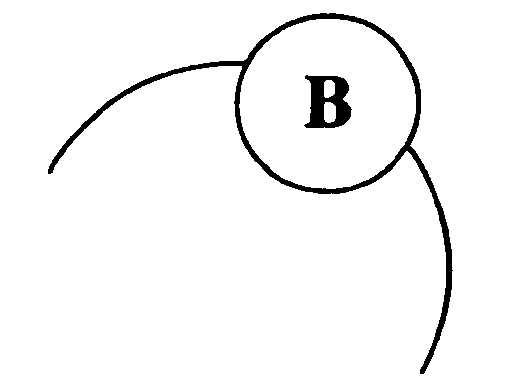


- (ix) The compound according to any one of the above (vi) to (viii) or a pharmaceutically acceptable salt or ester thereof, wherein the R binds to quinoxalinone as described in the following formula:

- (x) The compound according to the above (ix) or a pharmaceutically acceptable salt or ester thereof, wherein;
R is hydrogen, amino-lower alkyl in which the nitrogen atom is di-substituted with Ra and Rb, or L, wherein Ra and Rb are each independently lower alkyl, and L is L1-L2-L3 (wherein L1 is a single bond, -(CH2)k1-, -(CH2)k1-O- or -(CH2)k1-NH- (in which k1 is an integer of 1 or 2; L2 is a single bond or -(CH2)k2-(in which k2 is an integer of 1 or 2); and L3 is lower alkoxy or cycloalkyl having three to six carbon atoms); or
a cyclic group selected from <substituent group β2>, which may be substituted with one or more, same or different substituents selected from lower alkyl and <substituent group α>, or lower alkyl substituted with said cyclic group, wherein the <substituent group β2> is selected from
- (xi) The compound according to the above (ii) or a pharmaceutically acceptable salt or ester thereof, wherein;
the partial structure


R is selected from the group consisting of

- (xii) The compound according to the above (xi) or a pharmaceutically acceptable salt or ester thereof, wherein;
X is NH; and
the partial structure

- (xiii) The compound according to the above (i) or a pharmaceutically acceptable salt or ester thereof, wherein;
the quinoxalinone derivative is


- (xiv) A pharmaceutical composition comprising one or more kinds of the quinoxalinone derivative according to the above (i) as an active ingredient, together with a pharmaceutically acceptable carrier or diluent; or
- (xv) A Cdk inhibitor comprising one or more kinds of the quinoxalinone derivative according to the above (i) as an active ingredient, together with a pharmaceutically acceptable carrier or diluent; or
- (xvi) An anti-cancer agent comprising one or more kinds of the quinoxalinone derivative according to the above (i) as an active ingredient, together with a pharmaceutically acceptable carrier or diluent.
- As mentioned above, in the compound of the formula (I):


- Therefore, the compound of the formula (I) may also be defined as the compound of the formula (I):
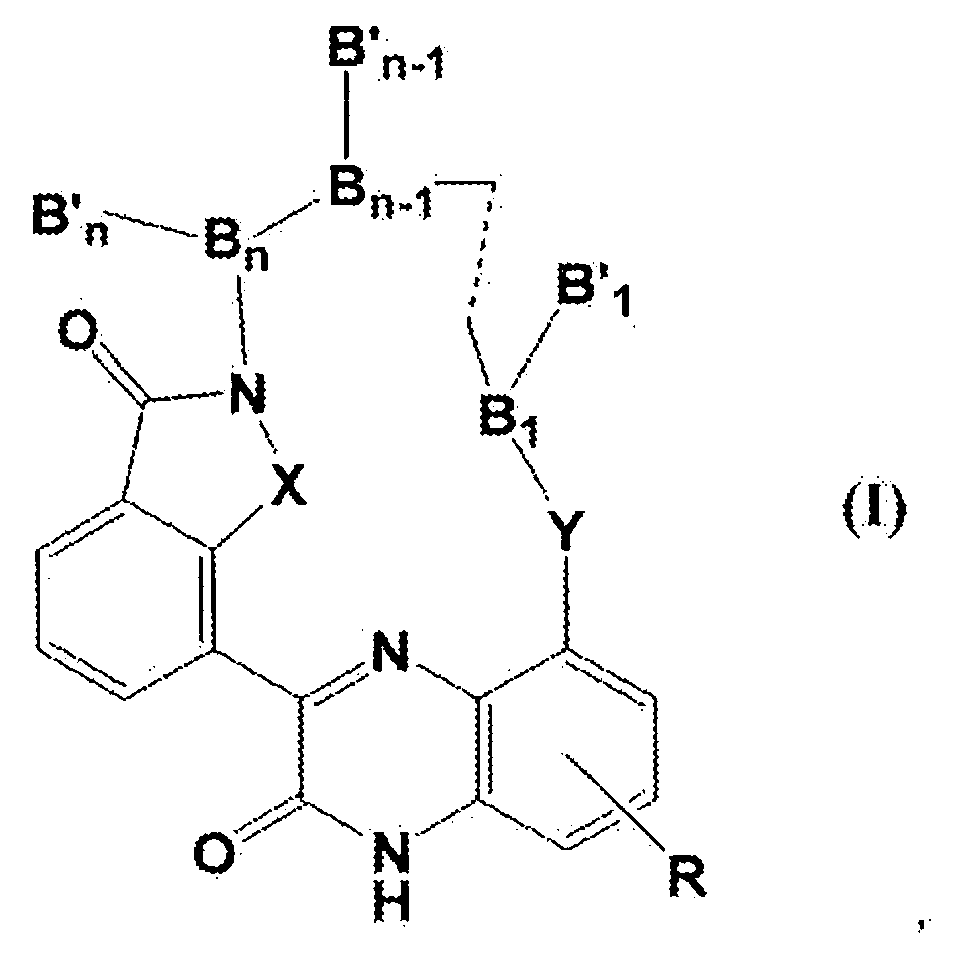
- On the basis of the above newly defined formula (I), a preparation method of the compound of the formula (I) is hereinafter described.
- The compound of the formula (I):


- The preparation methods of the compounds of the formula (II) or (III):

- The compound of the above formula (II) or (III) wherein Y is an oxygen atom can be prepared by subjecting the compound of the below formula (IV) or (V):

- The compound of the above formula (IV) can be prepared by removing the protecting group represented by PG2 or PG3 from the compound of the formula (VI):
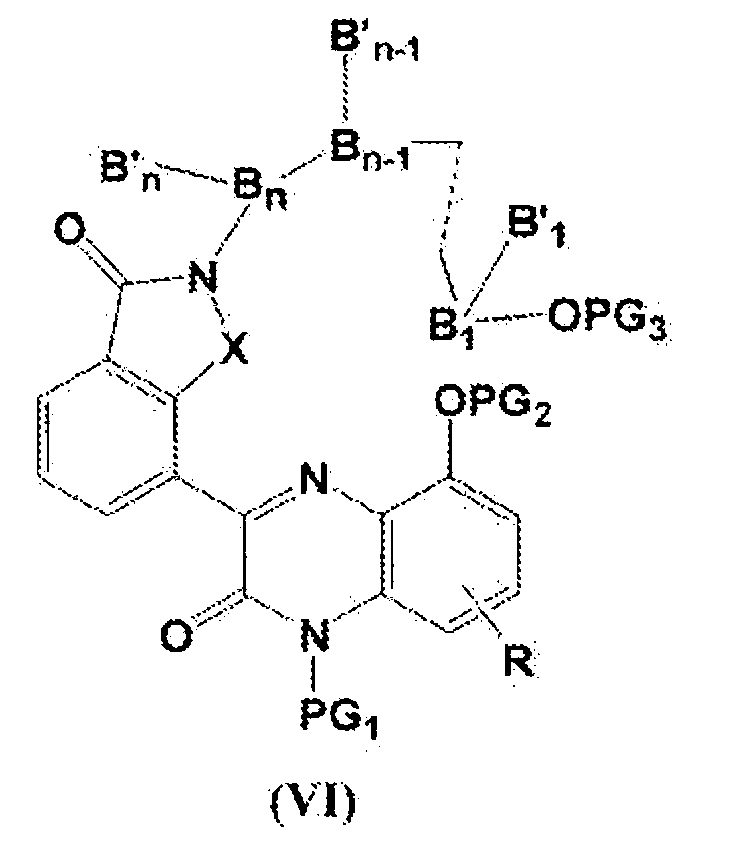
- Removal of the protecting group can be carried out according to the method described in Protective Groups in Organic Synthesis (T. W. Greene, John Wiley & Sons, Inc, 1981) or its analogous methods such as solvolysis using an acid or a base, chemical reduction using a metal complex hydride, and catalytic reduction using a palladium carbon catalyst or Raney nickel catalyst, though it depends on the kind of protecting groups and the stability of compounds used.
- The compounds of the above formula (VI) wherein X is S can be prepared by reacting the compound of the formula (VII) or (VIII):

- The compound of the above formula (VII) can be prepared by reacting the compound of the formula (IX):

- The compound of the above formula (IX) can be prepared from the compound of the formula (X):

WO 02/02550 - The compound of the above formula (X) can be prepared from the compound of the formula (XI):

WO 02/02550 - The compound of the above formula (XI) can be prepared by reacting a corresponding (2-fluoro-3-iodophenyl)oxoacetic acid ester with carbon monoxide in a mixed solvent of a solvent such as N,N-dimethylacetamide, N-methylpyrrolidone, N,N-dimethylformamide, and an alcohol such as methanol, ethanol, in the presence of a ligand such as 1,1'-bis(diphenylphosphino)ferrocene, a palladium catalyst such as palladium (II) acetate, and a base such as triethylamine. In this reaction, the reaction temperature is usually 50°C to the boiling point of the solvent to be used, though it may be appropriately chosen depending on the starting material or the reaction solvent to be used. Further, the reaction is usually completed within 1 to 24 hours, but the reaction time may be appropriately adjusted to make it longer or shorter.
- In addition to the aforementioned method, the compound of the above formula (VI) wherein X is S can be prepared from the compound of the above formula (X) and the compound of the below formula (XII):

WO 02/02550 - The compound of the above formula (VI) wherein X is NH can be prepared from the compound of the above formula (X) and the compound of the below formula (XIII):

WO 02/02550 - The compound of the above formula (VI) wherein X is O can be prepared from the compound of the above formula (X) and the compound of the below formula (XIV):

WO 02/02550 - The compound of the above formula (V) wherein X is S can be prepared from the compound of the below formula (XV):

WO 02/02550 - The compound of the above formula (XV) can be prepared from the compound of the below formula (XVI):

WO 02/02550 WO 02/02550 - The compound of the above formula (XVI) can be prepared from the compound of the below formula (XVII):

WO 02/02550 - The compound of the above formula (XVII) can be prepared by reacting the compound of the below formula (XVIII):

- The compound of the above formula (XVIII) can be prepared by reacting the compound of the above formula (X) with thionyl chloride and N,N-dimethylformamide. In this reaction, the reaction temperature is usually room temperature to the boiling point of the solvent to be used, preferably the boiling point, although it may be appropriately chosen depending on the starting material to be used. Further, the reaction is usually completed within 10 to 60 minutes, but the reaction time may be appropriately adjusted to make it longer or shorter.
- The compound of the above formula (V) wherein X is NH can be prepared from the compound of the below formula (XIX):

WO 02/02550 - The compound of the above formula (XIX) can be prepared from the compound of the above formula (XVII) and the compound of the above formula (XIII) according to a method similar to the Preparation Method B-2b described in
WO 02/02550 
- The compound of the above formula (XX) can be prepared from the compound of the above formula (XVII) and the compound of the above formula (XIII) wherein PG4 is allyloxycarbonyl, according to a method similar to the Preparation Method B-2b described in
WO 02/02550 - The compound of the above formula (II) or (III) wherein Y is an oxygen atom can be prepared by reacting the compound of the below formula (XXI) or (XXII):

- The compound of the above formula (XXI) or (XXII) can be prepared according to a method similar to the Preparation Method A as mentioned above.
- The compound of the above formula (II) or (III) wherein X is NH and Y is a nitrogen atom can be prepared by reacting the compound of the below formula (XXIII) or (XXIV) with the compound of the below formula (XXV):

- The compound of the above formula (XXIII) or (XXIV) can be prepared according to a method similar to the above Preparation Method A and the methods described in
WO 02/02550 - The introduction or conversion of R may be carried out at any one of steps in the preparation of the above synthetic intermediates. Hereinafter, such introduction or conversion of R in the compound of the above formula (II) or (III) is described.
- The compound of the above formula (II) or (III) wherein R is methyl can be prepared from the corresponding compound of the above formula (II) or (III)wherein R is hydroxymethyl. That is, the compound of the above formula (II) or (III) wherein R is methyl can be prepared by converting said hydroxymethyl group into methanesulfonyloxymethyl group, chloromethyl group , followed by catalytic hydrogenation using a transition metal catalyst. Also, the compound of the above formula (II) or (III) wherein R is methanesulfonyloxymethyl is reacted in a solvent such as tetrahydrofuran, methanol, 1,4-dioxane, or a mixed solvent thereof in the presence of a transition metal catalyst such as 10% palladium-carbon catalyst under a hydrogen atmosphere, thereby to produce the compound of the above formula (II) or (III) wherein R is methyl. In this reaction, the reaction temperature is usually 0°C to the boiling point of the solvent used, although it maybe appropriately chosen depending on the starting material and the solvent to be used in the reaction. Further, the reaction is usually completed within 1 to 24 hours, but the reaction time may be appropriately adjusted to make it longer or shorter.
- Also, the compound of the above formula (II) or (III) wherein R is vinyl can be prepared from the corresponding compound of the above formula (II) or (III) wherein R is a bromine atom. For example, the compound of the above formula (II) or (III) wherein R is a bromine atom is reacted with tributylvinyltin in a solvent such as toluene, 1,4-dioxane, N,N-dimethylformamide , preferably toluene, in the presence of a palladium catalyst such as tetrakis(triphenylphosphine)palladium(O) , thereby to produce the compound of the above formula (II) or (III) wherein R is vinyl. In this reaction, the reaction temperature is usually room temperature to the boiling point of the solvent used, preferably 80°C to 100°, although it may be appropriately chosen depending on the starting material and the reaction solvent to be used. Further, the reaction is usually completed within 1 to 24 hours, but the reaction time may be appropriately adjusted to make it longer or shorter.
- The compound of the above formula (II) or (III) wherein R is N-alkyl-lower alkanoylamino can be prepared from the corresponding compound of the above formula (II) or (III) wherein R is a bromine atom. For example, the compound of the above formula (II) or (III) wherein R is a bromine atom is reacted with an amide such as 2-pyrrolidinone, in a solvent such as toluene, 1, 4-dioxane, N,N-dimethylformamide, preferably 1,4-dioxane, in the presence of a phosphine such as 4,5-bis(diphenylphosphino)-9,9-dimethylxanthene, a palladium catalyst such as tris(benzylideneacetone)dipalladium(0)-chloroform adduct , and a base such as cesium carbonate, thereby to produce the compound of the above formula (II) or (III) wherein R is N-alkyl-lower alkanoylamino. In this reaction, the reaction temperature is usually room temperature to the boiling point of the solvent used, preferably 60°C to 120°C, though it may be appropriately chosen depending on the starting material and the reaction solvent to be used. Further, the reaction is usually completed within 1 to 24 hours, but the reaction time may be appropriately adjusted to make it longer or shorter.
- The compound of the above formula (II) or (III) wherein R is (dialkyl)aminomethyl or (monoalkyl)aminomethyl can be prepared from the compound of the above formula (II) or (III) wherein R is hydroxymethyl. That is, the hydroxymethyl of the compound of the above formula (II) or (III) wherein R is (dialkyl)aminomethyl or (monoalkyl)aminomethyl is converted into the methanesulfonyloxymethyl thereof, the chloromethyl thereof, followed by alkylation of the resulting product with dialkylamine or (monoalkyl)amine, or alkylation of the resulting product with dialkylamine in the presence of an acid catalyst.
- According to the former method, the compound of the above formula (II) or (III) wherein R is methanesulfonyloxymethyl can be prepared by reacting the compound of the above formula (II) or (III) wherein R is hydroxymethyl, with methanesulfonyl chloride in a solvent such as chloroform, methylene chloride, tetrahydrofuran, N,N-dimethylformamide, diethyl ether, ethyl acetate, in the presence of an organic base such as triethylamine, diisopropylethylamine. In this reaction, the reaction temperature is usually 0°C to room temperature, although it may be appropriately chosen depending on the starting material to be used, and the reaction is usually completed within 1 to 2 hours, but the reaction time may be appropriately adjusted to make it longer or shorter. Further, the compound of the above formula (II) or (III) wherein R is methanesulfonyloxymethyl is reacted with a dialkylamine such as piperidine, morpholine, N-methylpiperazine, diethylamine , or (monoalkyl)amine such as cyclopentylamine, t-butylamine in a solvent such as chloroform, methylene chloride, tetrahydrofuran, N,N-dimethylformamide in the presence of an inorganc base such as potassium carbonate, thereby to produce the compound of the above formula (II) or (III) wherein R is (dialkyl)aminomethyl or (monoalkyl)aminomethyl. In this reaction, the reaction temperature is usually 0°C to the boiling point of the reaction solvent used, although it may be appropriately chosen depending on the starting material and the reaction solvent to be used, and the reaction is usually completed within 1 to 24 hours, but the reaction time may be appropriately adjusted to make it longer or shorter. According to the latter method, the compound of the above formula (II) or (III) wherein R is hydroxymethyl is reacted with a dialkylamine such as piperidine, morpholine, N-methylpiperazine, diethylamine in a solvent such as chloroform, methylene chloride, tetrahydrofuran, N,N-dimethylformamide, diethyl ether, ethyl acetate, toluene in the presence of an acid catalyst such as acetic acid, hydrochloric acid, sulfuric acid, 4-toluenesulfonic acid , thereby to produce the compound of the above formula (II) or (III) wherein R is (dialkyl)aminomethyl. In this reaction, the reaction temperature is usually room temperature to the boiling point of the solvent used for the reaction, although it may be appropriately chosen depending on the starting material and the reaction solvent to be used, and the reaction is usually completed within 1 to 3 days, but the reaction time may be appropriately adjusted to make it longer or shorter.
- Further, the compound of the above formula (II) or (III) wherein R is 2-[(dialkyl)amino] ethyl can be prepared by addition reaction of the dialkylamino to the corresponding compound of the above formula (II) or (III) wherein R is vinyl, and the production is mentioned above. For example, the compound of the above formula (II) or (III) wherein R is vinyl is reacted in a sealed tube using a dialkylamine such as pyrrolidine as a solvent usually at 100°C to 150°C, preferably 120°C although the reaction temperature may be appropriately chosen depending on the starting material and the reaction solvent to be used, thereby to produce the compound of the above formula (II) or (III) wherein R is 2-[(dialkyl)amino]ethyl. The reaction is completed within 1 to 24 hours, but the reaction time may be appropriately adjusted to make it longer or shorter.
- Also, the compound of the above formula (II) or (III) wherein R is alkoxycarbonyl can be prepared from the corresponding compound of the above formula (II) or (III) wherein R is a bromine atom. For example, the compound of the above formula II) or (III) wherein R is a bromine atom is reacted with carbon monooxide in a solvent including a mixture of a solvent such as N,N-dimethylacetamide, N-methylpyrrolidone, N,N-dimethylacetamide, and an alcohol such as methanol, ethanol, in the presence of a ligand such as 1,1'-bis (diphenylphosphino)ferrocene, a palladium catalyst such as palladium (II) acetate, and a base such as sodium hydrogencarbonate, thereby to produce the compound of the above formula (II) or (III) wherein R is an alkoxycarbonyl group. In this reaction, the reaction temperature is usually 50°C to the boiling point of the solvent used in the reaction, though it may be appropriately chosen depending on the starting material and the reaction solvent to be used, and the reaction is usually completed within 1 to 24 hours, but the reaction time may be appropriately adjusted to make it longer or shorter.
- The compound of the above formula (II) or (III) wherein R is amino can be prepared from the compound of the above formula (II) or (III) wherein R is a bromine atom. For example, the compound of the above formula (II) or (III) wherein R is a bromine atom is reacted with a dialkylamine such as N-methylpiperazine, piperidine, morpholine in a solvent such as toluene, 1,4-dioxane,N,N-dimethylformamide, preferably toluene, in the presence of a palladium catalyst such as tris(benzylideneacetone) dipalladium- chloroform adduct , a phosphine such as (R) - (+) -2,2'-bis(di-4-tolylphosphino)-1,1'-binaphthyl and a base such as sodium t-butoxide, thereby to propduce the compound of the above formula (II) or (III) wherein R is a dialkylamino group. In this reaction, the reaction temperature is usually room temperature to the boiling point of the solvent used in the reaction, preferably 60°C to 120°C, though it may be appropriately chosen depending on the starting material and the reaction solvent to be used, and the reaction is usually completed within 1 to 24 hours, but the reaction time may be appropriately adjusted to make it longer or shorter.
- The compound of the above formula (II) or (III) wherein R is hydroxycarbonyl can be prepared by reacting the corresponding compound of the above formula (II) or (III) wherein R is alkoxycarbonyl, with an aqueous solution of sodium hydroxide, potassium hydroxide, lithium hydroxide in a solvent such as tetrahydrofuran,1,4-dioxane, methanol, ethanol . In this reaction, the reaction temperature is usually 0°C to the boiling point of the solvent used in the reaction, preferably room temperature, though it may be appropriately chosen depending on the starting material and the reaction solvent to be used, and the reaction is usually completed within 1 to 24 hours, but the reaction time may be appropriately adjusted to make it longer or shorter.
- Further, the compound of the above formula (II) or (III) wherein R is hydroxymethyl can be prepared by reducing the corresponding compound of the above formula (II) or (III) wherein R is hydroxycarbonyl. For example, the compound of the above formula (II) or (III) wherein R is hydroxycarbonyl is reacted with a condensing agent such as benzotriazol-1-yloxytripyrrolidinophosphonium hexafluorophosphate in a solvent such as tetrahydrofuran in the presence of an organic base such as N,N-diisopropylethylamine at 0°C to room temperature for 5 minutes to 1 hour, followed by reaction with a reducing agent such as lithium tetrahydroborate , thereby to produce the compound of the above formula (II) or (III) wherein R is hydroxymethyl. In this reaction, the reaction temperature is usually 0°C to room temperature, though it may be appropriately chosen depending on the starting material and the reaction solvent to be used, and the reaction is usually completed within 10 minutes to 24 hours, but the reaction time may be appropriately adjusted to make it longer or shorter.
- In addition, the compound of the above formula (II) or (III) wherein R is alkoxymethyl can be prepared by alkylation of the corresponding compound of the above formula (II) or (III) wherein R is hydroxymethyl. For example, the compound of the above formula (II) or (III) wherein R is hydroxymethyl is reacted with an alkylating agent such as methyl iodide, dimethyl sulfate in a solvent such as N,N-dimethylformamide, 1,4-dioxane, tetrahydrofuran in the presence of an inorganic base such as sodium hydride, potassium, t-butoxide , thereby to produce the compound of the above formula (II) or (III) wherein R is alkoxymethyl. In this reaction, the reaction temperature is usually 0°C to the boiling point of the solvent used in the reaction, preferably room temperature, though it may be appropriately chosen depending on the starting material and the reaction solvent to be used, and the reaction is usually completed within 1 to 24 hours, but the reaction time may be appropriately adjusted to make it longer or shorter.
- The compound of the above formula (II) or (III) wherein R is an aromatic cyclic group or an aromatic heterocyclic group attached via the carbon atom to the quinoxalinone core structure can be prepared from the corresponding compound of the above formula (II) or (III) wherein R is a bromine atom. For example, the compound of the above formula (II) or (III) wherein R is a bromine atom is reacted with a boronic acid such as pyrimidine-5-boronic acid in a solvent such as 1,2-dimethoxyethane-water, toluene-water, 1,4-dioxane-water, N,N-dimethylamide in the presence of a palladium catalyst such as tetrakis (triphenylphosphine) palladium and a base such as potassium carbonate, thereby to produce the compound of the above formula (II) or (III) wherein R is an aromatic cyclic group or an aromatic heterocyclic groups attached via the carbon atom to the quinoxalinone core structure. In this reaction, the reaction temperature is usually room temperature to the boiling point of the solvent used in the reaction, preferably 60°C to 120°C, though it maybe appropriately chosen depending on the starting material and the reaction solvent to be used, and the reaction is usually completed within 1 to 24 hours, but the reaction time may be appropriately adjusted to make it longer or shorter.
- The compound of the above formula (II) or (III) wherein R is an aromatic heterocyclic group attached via the nitrogen atom to the quinoxalinone core structure can be prepared from the corresponding compound of the above formula (II) or (III) wherein R is a bromine atom. For example, the compound of the above formula (II) or (III) wherein R is a bromine atom is reacted with an aromatic heterocyclic compound such as indole in a solvent such as toluene, 1,4-dioxane, N,N-dimethylformamide or the like, preferably 1,4-dioxane, in the presence of a phosphine such as 4,5-bis(diphehylphosphino) -9,9-dimethylxanthene, a palladium catalyst such as tris(benzylideneacetone)dipalladium(0)-chloroform adduct and a base such as cesium carbonate, thereby to produce the compound of the above formula (II) or (III) wherein R is an aromatic heterocyclic group attached via the nitrogen atom to the quinoxalinone core structure. In this reaction, the reaction temperature is usually room temperature to the boiling point of the solvent used in the reaction, preferably 60°C to 120°C, though it may be appropriately chosen depending on the starting material and the reaction solvent to be used, and the reaction is usually completed within 1 to 24 hours, but the reaction time may be appropriately adjusted to make it longer or shorter.
- Further, the compounds having other groups represented by R, such as lower alkyl such as ethyl ; lower alkyl substituted by aliphatic heterocyclic group; and aliphatic heterocyclic group bonded via the nitrogen atom to the quinoxaline core structure, may be prepared according to the aforementioned methods.
- The starting materials, reagents, (2-fluoro-3-iodophenyl) oxoacetic acid ester, and the compounds of the above formulae (VIII), (XII),(XIII), (XIV) and (XXV) used in the preparation of the compounds of the formula (I) are all known, or they can be prepared by the per se known method utilizing the known compounds.
- Hereinafter, (2-fluoro-3-iodophenyl)oxoacetic acid ester, and the compounds of the above formulae (VIII), (XII), (XIII), (XIV) and (XXV) are described.
- The (2-fluoro-3-iodophenyl)oxoacetic acid ester can be prepared by reacting a commercially available 2-fluoro-1-iodobenzene with a strong base such as lithium diisopropylamide, in an ether solvent such as tetrahydrofuran at a low temperature and then reacting the resultant lithio compound with a chlorooxoacetate derivative or an oxalic acid diester.
- The compound of the above formula (VIII) can be prepared from the diol compound of the following formula (XXVI):


- The aminoalcohol derivative of the above formula (XII) is commercially available, or can be prepared by introducing a protecting group into the hydroxy group of the commercially available aminoalcohol. Alternatively,the aminoalcohol derivative of the above formula (XII) can be prepared by substituting the leaving group W of the compound of the above formula (VIII) with an azido group using sodium azide in a polar solvent such as dimethylformamide and then subjecting the resulting product to catalytic hydrogenation using a palladium catalyst, thereby to reduce the azide group into the amino group,
- The hydrazine derivative of the above formula (XIII) can be prepared by oxidizing a commercially available aldehyde or ketone or the hydroxy group of the compound of the above formula (XXVII) with a sulfur trioxide-pyridine complex and then obtaining the objective compound from the resultant aldehyde or ketone. That is, the carbonyl group of these compounds is converted into the hydrazide group, and then the resultant compound is reacted with a reducing agent such as sodium tetrahydroborate, sodium cyanotrihydroborate, sodium triacetoxyhydroborate in the presence of an acid such as acetic acid, trifluoroacetic acid, hydrochloric acid, 4-toluenesulfonic acid, zinc chloride, thereby to give the compound of the above formula (XIII).
- The hydroxylamine derivatives of the above formula (XIV) can be prepared by introducing a protecting group into the two hydroxy groups of a hydroxylamine obtained by the reduction of a commercially available oxime according to a method similar to the aforementioned method.
- The dihalogenated alkyl derivative or disulfonic acid ester derivative of the above formula (XXV) is commercially available or can be prepared by converting the two hydroxy groups of the compound of the above formula (XXVI) into the disulfonic acid ester with methanesulfonyl chloride. Further, the disulfonic acid ester is reacted with sodium iodide in a polar solvent such as dimethylformamide to produce the corresponding dihalogenated alkyl derivative.
- With respect to the novel quinoxalinone compounds prepared by the above methods, Cdk inhibitory activity (cyclin D2-Cdk4 inhibitory activity and cyclin D2-Gdk6 inhibitory activity are described as examples) and inhibitory activity of 5-bromo-2'-deoxyuridine:BrdU) uptake are shown below.
- cDNAs of Cdk4 and its activating factor cyclin D2 were each introduced into a baculovirus expression vector to obtain a recombinant baculovirus; it was then co-infected to an insect cell Sf9 to highly express active cyclin D2/Cdk4 complexes. The cells were recovered, solubilized and the enzymes were purified by HPLC column chromatography (The Embo Journal, vol.15, 7060-7069 (1996)).
- In the determination of cyclin D2-Cdk4 activity, a synthetic peptide Arg-Pro-Pro-Thr-Leu-Ser-Pro-Ile-Pro-His-Ile-Pro-Arg corresponding to the amino acid number 775-787 of RB protein was used as a substrate [The EMBO Journal, vol.15, 7060-7069 (1996)].
- The reaction was carried out according to a method partially modifying Kitagawa et al. (Oncogene, vol.7, 1067-1074 (1992)). Purified cyclin D2-Cdk4, 100 µm substrate peptide, 50 µM non-labeled adenosine triphosphate (ATP) and 1 µCi [γ-33P]-labeled ATP (2000-4000 Ci/mmole) were added to a reaction buffer (referred to as R buffer) consisting of 20 mM Tris-HCl buffer (pH 7.4), 10 mM magnesium chloride, 4.5 mM 2-mercaptoethanol and 1 mM ethylene glycol bis(β-aminoethyl ether)-N,N,N',N'-tetraacetic acid (EGTA) to make a total volume of 21.1 µl. The mixture was incubated at 30°C for 45 minutes. After that, 350 mM phosphate buffer (10 µl) was added to the reaction solution to stop the reaction. The peptide substrate was adsorbed on a P81 paper filter in a 96-well plate, and the plate was washed several times with 75 mM phosphate buffer, and then its radioactivity was measured by a liquid scintillation counter. The [γ-33P]-labeled ATP was purchased from Daiichi Pure Chemicals.
- Addition of test compounds to the reaction system was carried out in such a manner that the compounds were dissolved in dimethyl sulfoxide to prepare a series of diluted solutions, and then each aliquot (1.1µl) was added to the reaction system. A control group was prepared by addition of only dimethyl sulfoxide (1.1µl) to the reaction system.
- The compounds in the following Working Examples were chosen as typical compounds of the present invention, and IC50 values against cyclin D2-Cdk4 activity of those compounds were determined. The results are shown in the table below.
[Table 1] Compound of Working Example (shown by the number only) IC50 (nM) [1] 3.6 [4] 2.5 [5] 4.3 [6] 2.9 [7] 3.5 [8] 6.1 [9] 11 [10] 6.3 [11] 12 [12] 11 [14] 2.2 [20] 1.6 [23] 2.1 [25] 8.2 [28] 16 [31] 6.4 [32] 9 [34] 12 [35] 12 [36] 34 [37] 17 [38] 12 [39] 6.9 [45] 14 [46] 3.1 [48] 3.6 [51] 6.1 [54] 8.5 [55] 7.9 [56] 9.2 [65] 6.9 [71] 13 [80] 1.7 [83] 2 [84] 6.2 [85] 6.7 [86] 2.7 [87] 2.6 [89] 2.7 [90] 3.7 [91] 3.2 [92] 2.8 [94] 3.6 [95] 4.1 [99] 5.2 [100] 2.4 [102] 1.4 [104] 1.6 [107] 7.7 [111] 5.5 [118] 14 [122] 2.5 [123] 9.6 [124] 8.2 [125] 15 [126] 9.4 [127] 11 [128] 3.5 [129] 4.9 [130] 6.5 [131] 8.2 [134] 6.4 [135] 2.5 [136] 3.2 [137] 3.4 [138] 4.2 [139] 3 [140] 3 [141] 26 [142] 15 [143] 2.2 [144] 2.9 [145] 2.7 [146] 5.2 - These results clearly show that the compounds of the present invention exhibit strong inhibitory activities against cyclin D2-Cdk4.
- In the same manner as with cyclin D2-Cdk4, cDNAs of Cdk6 and its activating factor cyclin D2 were each introduced into a baculovirus expression vector to obtain a recombinant vaculovirus; it was then co-infected to an insect cell Sf9 to highly express active cyclin D2/Cdk6 complexes. The cells were recovered, solubilized and the enzymes were purified by a HPLC column chromatography.
- In the determination of cyclin D2-Cdk6 activity, a synthetic peptide Arg-Pro-Pro-Thr-Leu-Ser-Pro-Ile-Pro-His-Ile-Pro-Arg was used.
- The reaction was carried out according to a method partially modifying Kitagawa et al. (Oncogene, vol. 7, 1067-1074 (1992)). Purified cyclin D2-Cdk6, 100 µM substrate peptide, 50 µM non-labeled ATP and 1.5 µCi [γ-33P] -labeled ATP (2000-4000 Ci/mmole) were added to R buffer to make a total volume of 21.1 µl. The mixture was reacted at 30°C for 40 minutes, and then 350 mM phosphate buffer (10 µl) was added to the reaction solution to stop the reaction. The peptide substrate was adsorbed on a P81 paper in a 96-well plate, and the plate was washed with 75 mM phosphate buffer, and then its radioactivity was measured by a liquid scintillation counter.
- Addition of test compounds to the reaction system was carried out in such a manner that the compounds were dissolved in DMSO to prepare a series of diluted solutions, and then each aliquot (1.1µl) was added to the reaction system. A control group was prepared by addition of only dimethyl sulfoxide (1.1µl) to the reaction system.
- The compounds of [11], [51] and [134] were chosen as typical compounds of the present invention, and IC50 values against cyclin D2-Cdk6 activity of those compounds were determined. The results are shown in the table below.
[Table 2] Compound of Working Example (shown by the number only) IC50 (nM) [11] 24 [51] 25 [134] 12 - These results clearly show that the compounds of the present invention exhibit strong inhibitory activities against cyclin D2-Cdk6.
- As mentioned above, since the compounds of the present invention have strong Cdk inhibitory activities, they are useful as a Cdk inhibitory agent. Further, the Cdk inhibitory agent may contain a pharmaceutically acceptable carrier or diluent.
- Growing cells perform DNA duplication in the S phase of the cell cycle, and divide into daughter cells in the M phase via the G2 phase. As an index for the cell growth, there is a method to determine the amount of BrdU taken into newly synthesized DNAs in the DNA duplicating cells ((J. Immunol Methods, vol. 82, p.169-179 (1985); J. Immunolog. Methods, vol. 106, p.95-100 (1988); Cytometry, vol. 14, p.640-648 (1993)). Inhibitory activities of BrdU uptake was determined in order to investigate the effect of the compounds of the present invention against cancer cells.
- HCT116 cells derived from human colon cancer were cultured in Dulbecco's modified Eagle's medium containing 10% fetal bovine serum at 37°C in the presence of 5% carbon dioxide under an atmosphere of saturated steam.
- Cell culture medium (100 µl each) containing 2.5×10³ of HCT116 cells was dispensed into each well of a 96-well cell culture dish, and then the cells were pre-cultured overnight. On the next day, a series of diluted solutions was prepared with DMSO from a DMSO solution containing the compounds of the present invention. Then, a series of diluted solutions, or DMSO only as a control without addition of the compound, was added in an amount of 1% to the cell culture medium. Finally, 100 µl of culture medium containing the above diluted solution containing the compounds or DMSO only were each added to the cells which had been pre-cultured in the 96-well dish, and then the cells were cultured for 12 hours.
- Quantitative determination of BrdU uptake was performed using the Cell Proliferation ELISA, BrdU (chemiluminescence) (Roche Diagnostics). Each 20 µL of 10× concentrated BrdU labeling reagent was added to the cells which had been cultured together with the compound for 12 hours, which were subjected to pulse labeling at 37°C for 1 hour, and then the culture solution was removed. Then, after addition of a FixDenat solution to the cells, the cells were incubated at room temperature for 30 minutes for fixation of cells and denaturation of DNA. After removal of the FixDenat solution, anti-BrdU antibody labeled with peroxidase was added to the cells, and then the cells were incubated at room temperature for 90 minutes. The cells were washed four times with a washing solution, and a substrate was added thereto. The cells were incubated at room temperature for 10 minutes and chemical luminescence was determined with a luminometer.
- As typical compounds of the present invention, the compounds [11], [12], [39], [51], [71], [83], [85], [134] and [141] were chosen, and IC50 values of these compounds on BrdU uptake were determined. The results are shown in table 3.
Table 3 Compounds of Working Examples (hereinafter shown by the number only) IC50(nM) [11] 16 [12] 9.7 [39] 9.4 [51] 23 [71] 75 [83] 30 [85] 20 [134] 7.8 [141] 20 - The compounds of the present invention are useful as anti-cancer agents (cancer remedies) for treatment of cancers, because they strongly inhibit BrdU uptake and thus apparently have cell growth-inhibitory activity. That is, a pharmaceutical composition containing a novel quinoxalinone derivative or a pharmaceutically acceptable salt or ester thereof according to the present invention, or an anti-cancer agent containing a novel quinoxalinone derivative or a pharmaceutically acceptable salt or ester thereof according to the present invention are effective for the treatment of cancer patients. Also, said pharmaceutical composition and anti-cancer agent may contain a pharmaceutically acceptable carrier or diluent. In the above description, "pharmaceutically acceptable carrier or diluent" means excipients (e.g. fat, bees wax, semi-solid or liquid polyol, natural or hydrogenated (hardened) oil); water (e.g. distilled water, especially distilled water for injection); physiological saline, alcohols (e.g. ethanol), glycerol, polyol, aqueous glucose, mannitol, vegetable oil ; and additives (e.g. fillers, disintegrating agents, binders, lubricants, wetting agents, stabilizers, emulsifiers, dispersing agents, preservatives, sweeteners, pigments, condiments or perfumes, thickening agents, diluting agents, buffers, solvents or solubilizers, agents for attaining storage effect, salts for adjusting osmotic pressure, coating agents or anti-oxidants).
- Suitable tumors against which the compounds of the present invention are expected to exhibit a therapeutic effect are, for example, human solid cancers. Examples of the human solid cancers are brain cancer, head and neck cancer, esophagus cancer, thyroid cancer, small cell cancer, non-small cell cancer, breast cancer, stomach cancer, gallbladder/bile duct cancer, hepatic cancer, pancreatic cancer, colon cancer, rectal cancer, ovarian cancer, chorioepithelioma, uterine cancer, cervical cancer, renal pelvic/ureteral cancer, bladder cancer, prostate cancer, penile cancer, testicular cancer, embryonal cancer, Wilms cancer, skin cancer, malignant melanoma, neuroblastoma, osteosarcoma, Ewing's sarcoma and soft tissue sarcoma.
- The aforementioned "a pharmaceutically acceptable salt or ester" is described below.
- When the compounds of the present invention are used as an anti-cancer agent, they may be used as a pharmaceutically acceptable salt thereof. Typical examples of such pharmaceutically acceptable salt are a salt with an alkali metal such as sodium, potassium, hydrochloride, and trifluoroacetate.
- A pharmaceutically, if desired, acceptable salt of the present invention may be prepared by combination of conventional methods employed in the field of synthetic organic chemistry. A specific example includes neutralization of a free-form solution of the compounds of the present invention with an alkali solution or an acidic solution.
- The esters of the compounds of the present invention include, for example, methyl ester and ethyl ester. These esters can be prepared by esterification of a free carboxyl group of the compounds according to a conventional method.
- The dosage form of the compounds of the present invention can be chosen from a variety of forms, and include, for example, oral formulations such as tablets, capsules, powders, granules, solution, and sterilized liquid parenteral formulations such as solutions, suspensions .
- Here, the solid pharmaceutical preparations may be manufactured as tablets, capsules, granules or powders, with or without a suitable additive according to a conventional method. Such additive includes, for example, sugars such as lactose and glucose; starches such as corn starch, wheat, and rice; fatty acids such as stearic acid; inorganic salts such as sodium metasilicate, magnesium aluminate, and anhydrous calcium phosphate; synthetic polymers such as polyvinylpyrrolidone, and polyalkylene glycol; fatty acid salts such as calcium stearate, and magnesium stearate; alcohols such as stearyl alcohol, and benzyl alcohol; synthetic cellulose derivatives such as methylcellose, carboxymethyl cellulose, ethyl cellulose, and hydroxypropylmethyl cellulose; and other additives commonly used such as water, gelatin, talc, vegetable oil, gum arabic .
- These solid preparations such as tablets, capsules, granules or powders may generally contain 0.1 to 100%, preferably 5 to 100%, more preferably 5 to 85%, particularly preferably 5 to 30%, by weight, of an active ingredient.
- The liquid preparations such as suspensions, syrups or injections can be prepared by using a suitable additive (e.g. water, alcohols, or plant-derived oils such as soy bean oil, peanut oil or sesame oil) commonly used for the preparation of liquid preparations.
- Especially, examples of suitable solutions or diluents for parenteral administration such as intramuscular, intravenous, or subcutaneous injection are distilled water for injection, aqueous solution of lidocaine hydrochloride (for intramuscular injection), physiological saline, aqueous glucose solution, ethanol, intravenous injection solutions (e.g. aqueous solutions of citric acid or sodium solutions (e.g. intravenous drip infusion, intravenous injection) and a mixed solution thereof.
- Further, these injection preparations can be in a previously-dissolved form as well as a powder itself with or without additives which are to be dissolved when used. These injection solutions usually may contain 0.1 to 10%, preferably 1 to 5%, by weight, of an active ingredient.
- The preferred practical dosage of the compounds of the present invention may be properly determined depending on the kind of compounds to be used, the kind of compositions to be combined, administration frequency, a specific part of human body to be treated, and the conditions of patients. For example, a daily dose per adult is: in the case of oral administration, 10 to 500mg, preferably 10 to 200 mg; in the case of parenteral administration, preferably intravenous injection, 10 to 100 mg, preferably 10 to 30 mg. Although administration frequency varies depending on the administration route and the diseases of patients, it can be administered in single or two to five divisions, preferably two to three divisions.
- The present invention will be described in more detail in conjunction with Working Examples hereinafter, but it is to be construed that the present invention is not limited thereto.
- For example, when a racemate is described in Working Examples, chiral compounds thereof should be included in the present invention. Also, preparation methods of the compounds represented by the formulae [A-1] to [A-34] are described in Reference Examples 1 to 34.
- Thin-layer chromatography in Working Examples and Reference Examples was carried out using silica gel 60F254 (Merck) as a plate and a UV detector as a detection method. Wakogel™C-300 or C-200 (Wako Pure Chemical Industries, Ltd.) or NH (Fuji Silysia Chemical) was used as silica gel for the column chromatography. Mass spectrum was measured by use of JMS-SX102A(JEOL Ltd.) or QUATTROII (Micromass Ltd.). Determination of NMR spectrum by use of deutero dimethyl sulfoxide was carried out with Gemini-200 spectrometer (200MHz; Varian Inc.), Gemini-300 spectrometer (300MHz; Varian Inc.) or VXR-300 spectrometer (300MHz; Varian Inc.), respectively using dimethyl sulfoxide as an internal standard. All δ values were expressed in terms of ppm.
- The abbreviations used in the determination of NMR spectrum are as follows:
- s: singlet
- d: doublet
- dd: double doublet
- t: triplet
- dt: double triplet
- q: quartet
- m: multiplet
- br: broad
- J: coupling constant
- Hz: herz
- DMSO-d6: deutero dimethyl sulfoxide
- The abbreviations used in Working Examples and Reference Examples are as follows:
- TBS: t-butyldimethylsilyl
- Ms: methanesulfonyl
- Bz: benzoyl
- TBDPS: t-butyldiphenylsilyl
- Alloc: allyloxycarbonyl
- Ac: acetyl
- DMTrt: 4,4'-dimethoxytrityl
- Boc: t-butoxycarbonyl
- SEM: 2-(trimethylsilyl)ethoxymethyl
- Bn: benzyl
- MOM: methoxymethyl
- Me: methyl
- Et: ethyl
- Synthesis of the compound of the following formula [1]:

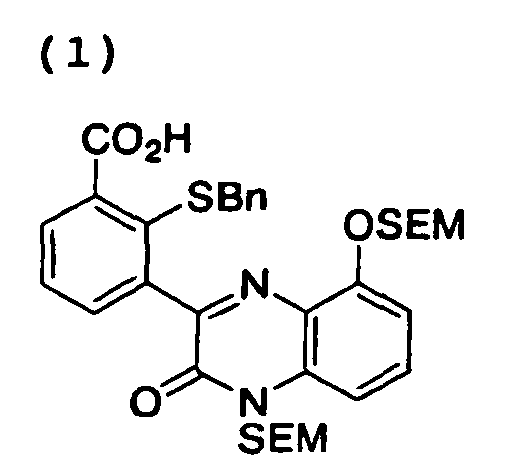
- The methyl ester derivative (9.90 g, 17.2 mmol) of the following formula:

WO 02/02550 
- Triethylamine (79 µL, 561 µmol) and 5-amino-1-pentanol (29 mg, 281 µmol) were added to a chloroform solution (1 mL) containing the carboxylic acid derivative (100 mg, 151 µmol) prepared in the above (1). After that, a chloroform solution (1 mL) of 2-chloro-1,3-dimethylimidazolinium chloride (47 mg, 281 µmol) was added dropwise thereto with stirring under ice-cooling. The mixture was stirred at room temperature for 30 minutes, and then concentrated in vacuo. The residue was purified by thin layer chromatography to obtain the above amide derivative (102 mg) as a pale yellow oil.


- The above amide derivative (102 mg, 136 µmol) prepared in the above (2) was dissolved in chloroform (2 mL). After the solution was cooled to 0°C, 3-chloroperbenzoic acid (about 80 %, 23 mg, 136 µmol) was added. The reaction solution was stirred at the same temperature for 1 hour, and triethylamine (114 µL, 816 µmol) and trichloroacetic anhydride (99 µL, 544 µmol) were added. Then, the temperature of the reaction solution was raised to room temperature, and the solution was stirred for 30 minutes, followed by addition of methanol (4 mL). After the reaction solution was stirred under heating at reflux for 1 hour, and the temperature of the reaction solution was lowered to room temperature. The reaction solution was diluted with chloroform, and washed with water and saturated brine. The organic layer was dried over anhydrous magnesium sulfate, filtered, and the filtrate was concentrated. The resulting residue was purified by a thin layer chromatography to obtain the above benzoisothiazolone derivative (80 mg) as a yellow solid.

- The benzoisothiazolone derivative (80 mg, 122 µmol) obtained in the above (3) was dissolved in chloroform (2 mL) and methanol (1 mL), and to this solution 4N hydrogen chloride/1,4-dioxane (3 mL) was added, and then the mixture was stirred at room temperature for 3 hours. The resulting reaction solution was neutralized with aqueous sodium hydrogencarbonate under ice-cooling, extracted with chloroform, and the organic layer was washed with saturated brine. Then, the organic layer was dried over anhydrous magnesium sulfate, filtered, and the filtrate was concentrated. The residue was purified by a thin layer chromatography to obtain the above phenol derivative (52 mg) as a yellow solid.

- To tetrahydrofuran solution (1 nL) containing the phenol derivative (10 mg, 19 µmol) obtained in the above (4) were added triphenylphosphine (15 mg, 57 µmol) and 40% toluene solution (25 µL) containing diethyl azodicarboxylate, and the mixture was stirred at room temperature for 30 minutes. The reaction solutionwasconcentrated, and the resulting residue was purified by a thin layer chromatography to obtain the above cyclic compound (10 mg) as a yellow solid.


- The cyclic compound obtained in the above (5) was dissolved in 4N hydrogen chloride/1,4-dioxane solution (2 mL), and the solution was stirred in a sealed tube at 100°C for 2 hours. Diethyl ether was added to the reaction solution, and the resulting precipitated solid was filtered off to obtain the objective compound [1] (6.3 mg) as a yellow solid.
- Spectral data of the compound of the above formula [1] are shown below.
1H-NMR(DMSO-d6) δ: 1.80-2.40(6H,m), 3.79-3.90(2H,m), 4.15-4.30( 2H,m), 6.81-6.97(2H,m), 7.40-7.62(2H,m), 7.99(1H,d, J=7.7Hz), 9. 27(1H,d, J=7.7Hz), 12.8(1H,brs).
mass:380(M+1)+ - Synthesis of the compound of the following formula [2]:

- According to a method similar to the procedure described in Working Example 1, the objective compound [2] (20 mg) which is a racemate was obtained as a yellow solid from the above carboxylic acid derivative (100 mg, 154 µmol) obtained in Working Example 1-(1) and racemic 5-amino-1-hexanol synthesized by referring to the method described in J. Med. Chem., 25(8) 964 (1982).
- Spectral data of the compound of the above formula [2] are shown below.
1H-NMR(DMSO-d6)δ:1.24(3H, d, J=6.6Hz),1.70-2.05(3H,m), 2.20-2. 65(3H,m), 4.05-4.65(3H,m), 6.95-6.98(2H,m), 7.51(1H,t,J=8.2Hz) , 7.61(1H, t, J=7.7Hz), 8.02(1H, d, J=7.7Hz), 9.42(1H, d, J=8.0Hz), 1 2.8(1H,s).
mass:394(M+1)+ - Synthesis of the compound of the following formula [3]:


- According to a method similar to the procedures described in Working Examples 1-(2) to 1-(3), the above benzoisothiazolone derivative (480 mg) was obtained as a yellow solid from the carboxylic acid derivative (1.08 g, 1.46 mmol) obtained in
- Working Example 1-(1) and 2-aminoethanol.

- To chloroform solution (1 mL) containing the above benzoisothiazolone derivative (30 mg, 48 µmol) obtained in the above (1) were added triphenylphosphine (38 mg, 98 µmol), the sulfonamide derivative [A-3-1] (38 mg, 101 µmol) and 40% toluene solution containing diethyl azodicarboxylate (43 µL, 98 µmol), and the mixture was stirred at room temperature for 4 hours. The resulting solution was purified by thin layer chromatography to obtain the above benzoisothiazolone (41 mg) as a yellow solid.

- According to a method similar to the procedures described in Working Examples 1-(4) to 1-(5), the above cyclic derivative (11 mg) was obtained as a yellow solid from the above benzoisothiazolone derivative (29 mg, 30 µmol).

- To N,N-dimethylformamide solution (1 mL) of the cyclic derivative (11 mg, 15 µmol) obtained in the above (3) were added thiophenol (19 µL, 18 µmol) and sodium carbonate (6 mg, 55 µmol), and the mixture was stirred at room temperature for 15 hours. After addition of water, the resulting reaction solution was extracted with chloroform and the organic layer was washed with saturated brine. Then, the organic layer was dried over anhydrous magnesium sulfate, filtered and the filtrate was concentrated. The resulting residue was purified by a thin layer chromatography to obtain the amine derivative (7 mg) as a yellow solid.

- According to a method similar to the procedure described in Working Example 1-(6), the hydrochloride (2 mg) of the objective compound [3] was obtained as a yellow solid from the amine derivative (3 mg, 5.7 µmol) obtained in the above (4).
- Spectral data of the compound of the above formula [3] are shown below.
1H-NMR(DMSO-d6)δ:1.41(3H, d, J=6.0Hz), 3.20-3.90(4H, m), 4.00-4. 20(1H, m), 4.35-4.50(1H,m), 5.05-5.18(1H,m), 7.00-7.15(2H,m), 7. 52-7.78(2H,m), 8.15(1H,d, J=7.5Hz), 9.42(1H, d, J=7.7Hz), 13.0 (1H ,s).
mass:395(M+1)+. - Synthesis of the compound of the following formula [4]:

- According to a method similar to the procedures described in Working Example 3-(2) to 3-(5), the hydrochloride (2 mg) of the objective compound [4] was obtained as a yellow solid from the benzoisothiazolone derivative (15 mg, 24 µmol) obtained in Working Example 3-(1) and the sulfonamide derivative [A-3-2] (19 mg, 51 µmol).
- Spectral data of the compound of the above formula [4] are shown below.
1H-NMR(DMSO-d6)δ: 1.41(3H, d, J=6.0Hz), 3.20-3.90(4H,m) 4.00-4. 20(1H,m), 4.35-4.50(1H,m), 5.05-5.18(1H,m), 7.00-7.15(2H,m), 7. 52-7.78(2H,m), 8.15(1H,d,J=7.5Hz), 9.42(1H,d,J=7.7Hz), 13.0(1H ,s).
mass:395(M+1)+. - Synthesis of the compound of the following formula [5]:

- According to a method similar to the procedures described in Working Examples 3-(2) to 3-(5), the hydrochloride (2 mg) of the objective compound [5] was obtained as a yellow solid from the benzoisothiazolone derivative (15 mg, 24 µmol) obtained in Working Example 3-(1) and the sulfonamide derivative [A-3-3](19 mg, 51 µmol).
- Spectral data of the compound of the above formula [5] are shown below.
1H-NMR(DMSO-d6)δ:1.44(3H, d, J=6.2Hz), 3.10-4.55(7H,m), 7.04-7. 13(2H,m), 7.58-7.77(2H,m), 8.15(1H,d, J=7.7Hz), 8.43(1H,brs), 9 39(1H,d,J=7.8Hz),9.98(1H,brs),13.0(1H,s).
mass:395(M+1)+. - Synthesis of the compound of the following formula [6]:


- To methanol solution (500 µL) containing the amine derivative (4 mg, 7.6 µmol) obtained in Working Example 3-(4) was added 35% aqueous formalin solution (8µL), and then methanol solution (500 µL) containing zinc chloride (10 mg, 75 µmol) and sodium cyanotrihydroborate (9.4 mg, 150 µmol) was added dropwise thereto. The mixture was stirred at room temperature for 1 hour. The reaction solution was purified by a thin layer chromatography to obtain the above N-methyl derivative (4 mg) as a yellow solid.

- According to a method similar to the procedure of Working Example 1-(6), the hydrochloride (3 mg) of the objective compound [6] was obtained as a yellow solid from the N-methyl derivative (4 mg, 7.4 µmol) obtained in the above (1).
- Spectral data of the compound of the above formula [6] are shown below.
1H-NMR(DMSO-d6)δ: 1.41(3H, d, J=6.0Hz), 2.37(3H,s), 2.40-4.30(6H m), 4.85-4.98(1H,m), 6.90-7.01(2H,m), 7.45-7.61(2H,m), 8,02(1H d, J=7.6Hz), 9.34(1H,d,J=8.1Hz), 12.7(1H,brs). mass:409(M+1)+. - Synthesis of the compound of the following formula [7]:

- According to a method similar to the procedures of Working Examples 3-(2) to 3-(4) and 6, the hydrochloride (3 mg) of the objective compound [7] was obtained as a yellow solid from the benzoisothiazolone derivative (15 mg, 24 µmol) obtained in Working Example 3-(1) and the sulfonamide derivative [A-3-4] (19 mg, 51 µmol). [0173]
- Spectral data of the compound of the above formula [7] are shown below.
1H-NMR(DMSO-d6)δ:0.90-1.40(3H,m),2.20-4.40(10H,m),6.90-7.05 (2H,m), 7.50-7.70(2H,m), 8.00-8.15(1H,m), 9.37(1H,d,J=7.9Hz), 1 2.8(1H,brs).
mass:409(M+1)+. - Synthesis of the compound of the following formula [8]:

- According to a method similar to the procedures described in Working Examples 3-(2) to 3-(4) and 6, the hydrochloride (2 mg) of the objective compound [8] was obtained as a yellow solid from the benzoisothiazolone derivative (15 mg, 24 µmol) obtained in Working Example 3-(1) and the sulfonamide derivative [A-3-3] (19 mg, 51 µmol).
- Spectral data of the compound of the above formula [8] are shown below.
1H-NMR(DMSO-d6)δ:0.90-1.40(3H,m),2.20-4.40(10H,m),6.90-7.05 (2H,m), 7.50-7.70(2H,m), 8.00-8.15(1H,m), 9.37(1H,d,J=7.9Hz), 1 2.8(1H,brs).
mass:409(M+1)+. - Synthesis of the compound of the following formula [9]:

- According to a method similar to the procedures described in Working Example 3-(2) to 3-(4) and 6, the hydrochloride (2 mg) of the objective compound [9] was obtained as a yellow solid from the benzoisothiazolone derivative (15 mg, 24 µmol) obtained in Working Example 3-(1) and the sulfonamide derivative [A-3-5] (19 mg, 51 µmol).
- Spectral data of the compound of the above formula [9] are shown below.
1H-NMR(DMSO-d6)δ:2.30-4.90(11H,m), 6.82-7.18(2H,m), 7.40-7.80 (2H,m), 7.95-8.20(1H,m), 9.38(1H,d,J=7.8Hz), 12.7-13.1(1H,m).
mass:395(M+1)+ - Synthesis of the compound of the following formula [10]:

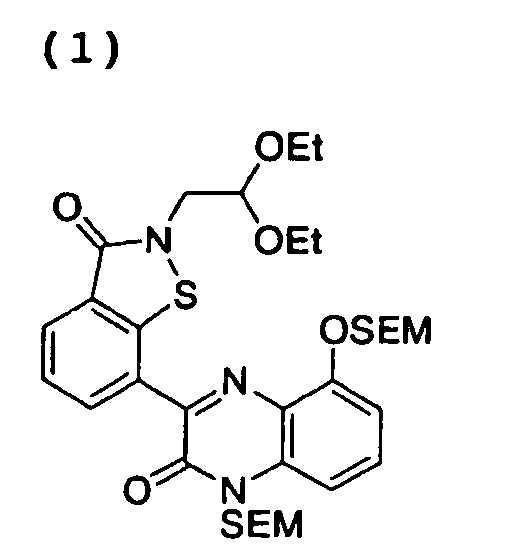
- According to a method similar to the procedures described in Working Examples 1-(2) to 1-(3), the above benzoisothiazolone derivative (1.94 g) was obtained as a yellow solid from the calboxylic acid derivative (2.00 g, 3.00 mmol) obtained in Working Example 1-(1) and aminoacetaldehyde diethylacetal (873 µL, 6.02 mmol).

- To tetrahydrofuran solution (600 mL) of the benzoisothiazolone derivative (1.94 g, 2.82 mmol) obtained in the above (1) was addedwater (50 mL), and then 4N hydrogen chloride /1,4-dioxane (50 mL) was added thereto. The mixture was stirred at room temperature for 15 hours. The reaction solution was concentrated to about 100 mL, and the resulting yellow solid was filtered off. After that, this solid was washed with diethylether, and dried in vacuo to obtain the above aldehyde derivative (1.01 g) as a yellow solid.

- To methanol solution (5 mL) containing the aldehyde derivative (100 mg, 207 µmol) obtained in the above (2) was added racemic 3-hydroxypyrrolidine (34 µL, 414 µmol), and then methanol solution (2.8 mL) containing zinc chloride (56 mg, 414 µmol) and sodium cyanotrihydroborate (52 mg, 828 µmol) were added dropwise thereto. The mixture was stirred at room temperature for 15 hours, and the reaction solution was concentrated. The resulting residue was purified by a thin layer chromatography to obtain the above racemic amine derivative (95 mg) as a yellow solid.

- According to a method similar to the procedures described in Working Examples 1-(5) to 1-(6), the hydrochloride (31 mg) of the objective compound [10] as a racemate was obtained as a yellow solid from the racemic amine derivative (95 mg, 171 µmol) obtained in the above (3).
- Spectral data of the compound of the above formula [10] are shown below.
1H-NMR(DMSO-d6)δ:1.80-4.00(8H,m), 4.00-4.40(2H,m),5.38-5.42( 1H,m), 6.80-7.30(2H,m), 7.40-7.80(2H,m), 7.95-8.18(1H,m), 9.24-9.36(1H,m), 12.7(1H,s).
mass:407(M+1)+. - Synthesis of the compound of the following formula [11]:


- To toluene solution (4 mL) containing the keto ester derivative [A-2] (515 mg, 2.03 mmol) and the phenylenediamine derivative [A-1] (643 mg, 2.03 mmol) was added acetic acid (0.4 mL), and the mixture was stirred at room temperature for 3 days. The resultingprecipitates were filtered off, washed with diethyl ether and toluene, and dried in vacuo to obtain the above quinoxalinone derivative (340 mg) as a white solid.

- The quinoxalinone derivative (101 mg, 0.20 mmol) obtained in the above (1) was suspended in thionyl chloride (1 mL), and N,N-dimethylformamide (15.5 µL, 0.20 mmol) was added thereto. Then, the reaction solution was heated under reflux for 20 minutes. After this reaction solution was cooled to room temperature, the thionyl chloride was removed by evaporation in vacuo. The resulting residue was diluted with ethyl acetate, washed successively with water, sodium hydrogencarbonate and saturated brine. The organic layer was dried over anhydrous magnesium sulfate, filtered, and concentrated in vacuo to obtain the above chloroquinoxaline derivative (106 mg) as a pale yellow solid.

- The chloroquinoxaline derivative (53 mg, 0.10 mmol) obtained in the above (2) and chloromethyl methyl ether (23 µL, 0.30 mmol) were dissolved in tetrahydrofuran (2 mL), and then 1.0M tetrahydrofuran solution (0.2 mL, 0.20 mmol) containing tetrabutyl ammonium fluoride was added dropwise at room temperature. After the dropwise addition was completed, the reaction solution was cooled in an ice-bath, methanol (1 mL) was added, and sodium hydride (14 mg, 60% dispersion in oil, 0.35 mmol) was gradually added thereto. The resulting reaction solution was stirred at room temperature for 1 hour, and saturated aqueous ammonium chloride was added to stop the reaction. The whole reaction solution was poured into water, and extracted with ethyl acetate. The organic layer was washed successively with water and saturated brine. Then, the organic layer was dried over anhydrous magnesium sulfate, filtered, and concentrated in vacuo to obtain the above methoxyquinoxaline derivative (49 mg) as a white solid.

- The methoxyquinoxaline derivative (45 mg, 100 µmol) obtained in the above (3) was dissolved in toluene (3mL), and to this solution were added tributylvinyltin (36 µL, 120 µmol) and tetrakis (triphenylphosphine) palladium (0) (16mg, 2.5 µmol). The mixture was heated at reflux for 4 hours. The resulting reaction solution was cooled down to room temperature, and filtered through a Celite pad. The filtrate was concentrated in vacuo, and the resulting residue was purified by thin layer chromatography to obtain the above vinyl derivative (30 mg) as a pale yellow solid.

- To acetonitrile solution (3 mL) containing the vinyl derivative (20 mg, 50 µmol) obtained in the above (4) were added water (1 mL), 50% aqueous solution (15 µL, 65 µmol) of N-methylmorpholine N-oxide, and 0.05M aqueous osmium tetraoxide solution (50 µL, 0.25 µmol). After the resulting solution was stirred at room temperature for 16 hours, saturated aqueous sodium thiosulfate solution was added thereto, and the mixture was stirred at room temperature for 30 minutes. After this solution was extracted with ethyl acetate, the organic layer was washed with saturated brine, dried over anhydrous magnesium sulfate, filtered, and concentrated. The resulting residue was purified by a thin layer chromatography to obtain the above diol derivative (18 mg) as a pale yellow solid.

- To tetrahydrofuran solution (2 mL) containing the diol derivative (18 mg) obtained in the above (5) were added water (2 mL) and potassium periodate (13 mg, 54 µmol). The resulting mixture was stirred at room temperature for 2 hours, and water was added thereto. This solution was extracted with ethyl acetate, and the organic layer was washed with saturated brine. Then, the organic layer was dried over anhydrous magnesium sulfate, filtered, and the filtrate was concentrated. The resulting residue was purified by a thin layer chromatography to obtain the above aldehyde derivative (12 mg) as a pale yellow solid.

- The aldehyde derivative (640 mg, 1.59 mmol) obtained in the above (6) was dissolved in chloroform (15mL) and methanol (10 mL), and then sodium tetrahydroborate (120 mg, 3.18 mmol) was added thereto under ice-cooling. The resulting reaction solution was stirred for 15 minutes under ice-cooling. After saturated aqueous ammonium chloride was added to the reaction solution, the mixture was extracted with chloroform. The organic layer was washed successively with water and saturated brine, dried over anhydrous magnesium sulfate, filtered, and concentrated. The resulting residue was purified by a column chromatography on silica gel to obtain the above benzyl alcohol derivative (416 mg) as a pale yellow solid.

- The benzyl alcohol derivative (11.0g, 27.3mmol) obtained in the above (7) was dissolved in chloroform (120 mL), and to this solution were added 3,4-dihydro-2H-pyran (60 mL) and pyridinium p-toluenesulfonate (1.50 g, 5.97 mmol) at room temperature. The resulting reaction solution was stirred at room temperature for 4 hours, and diluted with ethyl acetate. The organic layer was washed successively with aqueous sodium hydrogencarbonate and saturated brine, dried over anhydrous magnesium sulfate, filtered, and concentrated in vacuo to obtain the above tetrahydropyranyl ether derivative (11.1 g) as a white solid.

- The tetrahydropyranyl ether derivative (3.00 g, 6.17 mmol) obtained in the above (8) was dissolved in tetrahydrofuran (50 mL) and methanol (50 mL), and then 1N aqueous sodium hydroxide (50 mL) was added. The mixture was stirred for 30 minutes. The resulting reaction solution was diluted with ethyl acetate, and washed successively with 1N hydrochloric acid, water, and saturated brine. The resulting organic layer was dried over anhydrous magnesium sulf ate, filtered, and concentrated in vacuo to obtain the above carboxylic acid derivative (3.00 g) as a white solid.

- To chloroform solution (60 mL) containing the carboxylic acid derivative (1.50 g, 3.17 mmol) obtained in the above (9) was added pyridine (1.54 mL, 19.0 mmol), and then chloroform solution (10 mL) containing 2-chloro-1,3-dimethylimidazolinium chloride (1.07 g, 6.35 mmol) was added dropwise thereto with stirring under ice-cooling. The mixture was stirred at room temperature for 15 minutes. After that, chloroform solution(20 mL) containing the hydrazine derivative [A-17] (2.59 g, 9.51 mmol) was added to the solution, and the mixture was stirred at room temperature for 5 hours. Water was added to the resulting reaction solution, and the mixture was extracted with ethyl acetate. The organic layer was washed successively with 1N hydrochloric acid, water, and saturated brine, and purified by a silica gel chromatography to obtain the above hydrazide derivative (1.59 g) as a pale yellow oil.

- To tetrahydrofuran solution (20 mL) containing the hydrazide derivative (1.59 g, 2.18 mmol) obtained in the above (10) were added diethylamine (1.13 mL, 10.9 mmol) and formic acid (0.411 mL), and then tetrakis(triphenylphosphine)palladium(0)(252 mg, 0.218 mmol) was added thereto. After stirring the solution at room temperature for 2 hours, water was added to the reaction solution, and the mixture was extracted with ethyl acetate. The organic layer was washed successively with aqueous sodium hydrogencarbonate, water, and saturated brine, and purified by a silica gel chromatography to obtain the above de-Alloc derivative (1.10 g) as a pale yellow oil.

- N,N-diisopropylethylamine (509 µL, 2.92 mmol) was added to N,N-dimethylformamide solution (50 mL) containing the de-Alloc derivative (628 mg, 974 µmol) obtained in the above (11), and the mixture was stirred at 120°C for 3 hours. After that, the resulting reaction solution was cooled down to room temperature, and concentrated in vacuo. Chloroform (10 mL) was added to the resulting residue, and the resulting solid was filtered off. This solid was dried in vacuo to obtain the above 3-indazolinone derivative (251 mg) as a yellow solid.

- To chloroform solution (10 mL) containing the 3-indazolinone derivative (250 mg, 489 µmol) obtained in the above (12) was added N,N-diisopropylethylamine (426 µL, 2.45 mmol), and then methanesulfonyl chloride (113 µL, 1.47 mmol) was added thereto, followed by stirring for 30 minutes under ice-cooling. After addition of water to the resulting reaction solution, the organic layer was separated, and washed successively with 0.5N hydrochloric acid, water, and saturated brine. Then, the organic layer was dried over anhydrous magnesium sulfate, filtered, and concentrated. The resulting residue was dissolved in N-methylpyrrolidone (2.5 mL), and then(R)-3-hydroxypyrrolidine (250 mg, 2.87 mmol) was added. The mixture was stirred at 70°C for 1 hour, and cooled down to room temperature. After that, aqueous sodium hydrogencarbonate was added to the solution, and the solution was extracted with ethyl acetate, and washed successively with water and saturated brine. The organic layer was dried over anhydrous magnesium sulfate, filtered, and concentrated. The resulting residue was purified by a silica gel chromatography to obtain the above amine (176 mg) as a yellow solid.
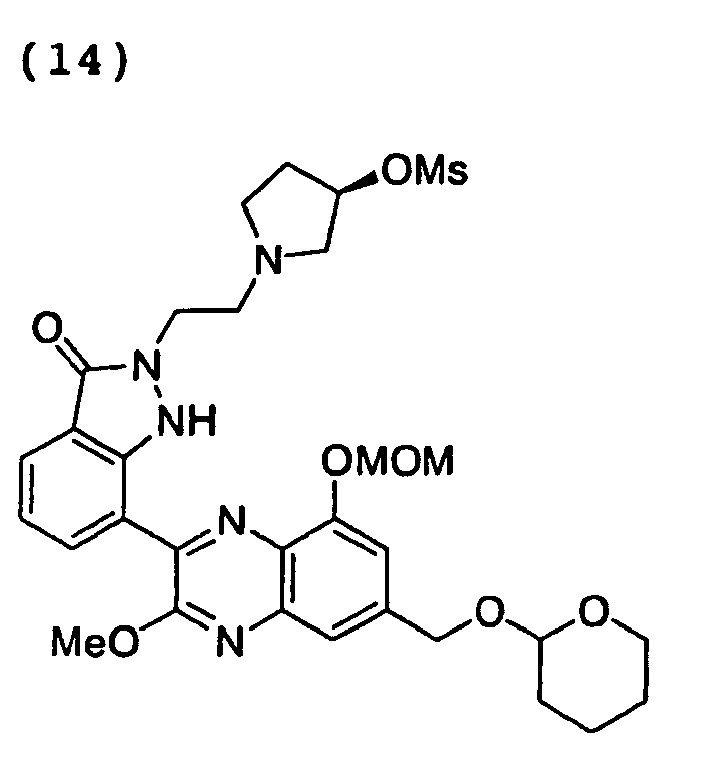
- N,N-diisopropylethylamine (264 µL, 1.52 mmol) was added to tetrahydrofuran solution (3.5 mL) of the amine derivative (176 mg, 303 µmol) obtained in the above (13), and then methanesulfonyl chloride (70.5 µL, 910 µmol) was added thereto under ice-cooling. The solution was stirred for 30 minutes under ice-cooling, and 1N aqueous sodium hydroxide (3.5 mL) was added dropwise to the solution, followed by addition of methanol (3.5 mL). The solution was stirred for 15 minutes under ice-cooling, and then water was added. The solution was extracted with chloroform, and washed with saturated brine. The organic layer was dried over anhydrous magnesium sulfate, filtered, and concentrated to obtain the above mesylated derivative (170 mg) as a yellow solid.

- The mesylated derivative (170 mg, 258 µmol) obtained in the above (14) was dissolved in trifluoroacetic acid (15 mL) and water (1.5 mL), and the solution was stirred at room temperature for 1 hour. The resulting reaction solution was concentrated in vacuo, followed by azeotropic evaporation with ethanol and toluene to obtain the above phenol derivative (170 mg) as a yellow solid.


- The phenol (170 mg) obtained in the above (15) was dissolved in N, N-dimethylformamide (35 mL), and then potassium carbonate (400 mg, 2.89 mmol) was added thereto. The mixture was stirred at 70°C for 1.5 hours. The resulting reaction solution was cooled down to room temperature, filtered, and the mother liquor was concentrated in vacuo. The resulting residue was dissolved in a mixed solution of chloroform and methanol, and washed with saturated brine. The organic layer was dried over anhydrous magnesium sulfate, filtered, and concentrated. The resulting residue obtained again was purified by a silica gel chromatography to obtain the above cyclic derivative (92 mg) as a yellow solid.

- The cyclic compound (30 mg, 69 µmol) prepared in the above (16) was dissolved in chloroform (1 mL), and to this solution were added N,N-diisopropylethylamine (48 µL, 276 µmol) and methanesulfonyl chloride (13 µL, 173 µmol), then the mixture was stirred for 30 minutes. An aqueous solution (1 mL) in which sodium hydrogencarbonate (60 mg) was dissolved was added to the reaction solution. In addition, after the amine [A-23] (30 mg) was added to the solution, the mixture was stirred at 60°C for 1 hour. The reaction solution was cooled down to room temperature, and the organic layer was separated, concentrated, and purified by a thin layer chromatography to obtain the above benzylamine derivative (30 mg) as a yellow solid.

- The benzylamine derivative obtained in the above (17) was dissolved in trifluoroacetic acid (5 mL) and water (500 µL), and the solution was heated at reflux for 3 days. The reaction solution was cooled down to room temperature, and concentrated in vacuo. After the resulting residue was dissolved in a mixed solution of chloroform and methanol, the solution was washed successively with water and saturated brine. The organic layer was dried over anhydrous magnesium sulfate, filtered, and concentrated. The resulting residue was purified by thin layer chromatography to give a yellow solid. To a stirred solution of the solid in chloroform (5 mL) was added dropwise 4N hydrogen chloride/1,4-dioxan solution (500 pL), and the resulting precipitates were collected by filtration, washed with diethyl ether, and dried in vacuo to obtain the hydrochloride (26 mg) of the objective compound [11] as a yellow solid.
- Spectral data of the compound of the above formula [11] are shown below.
1H-NMR(DMSO-d6) δ:1.50-4.50(24H, m), 5.15-5.35(1H, m), 7.00-7.50 (3H, m), 7.86(1H, d, J=7.8Hz), 9.25(1H, bs), 9.51-9.68(1H, brs), 11. 8(1H, brs), 12.9(1H, brs).
mass:517(M+1)+. - Synthesis of the compound of the following formula [12]:

- According to a method similar to the procedures described in Working Examples 11-(17) to 11-(18), the hydrochloride (26 mg) of the objective compound [12] was obtained as an orange solid from the cyclic derivative (30 mg, 69 µmol) obtained in Working Example 11-(16) and the amine derivative [A-24].
- Spectral data of the compound of the above formula [12] are shown below.
1H-NMR(DMSO-d6) δ:1.50-4.50(24H, m), 5.15-5.35(1H, m), 7.00-7.50 (3H, m), 7.86(1H, d, J=7.8Hz), 9.25(1H, bs), 9.51-9.68(1H, brs), 11. 8(1H, brs), 12.9(1H ,brs).
mass:517(M+1)+. - Synthesis of the compound of the following formula [13]:

- According to a method similar to the procedures described in Working Examples 11-(17) to 11-(18), the hydrochloride (25 mg) of the objective compound [13] was obtained as an orange solid from the cyclic compound derivative (30 mg, 69 µmol) obtained in Working Example 11-(16) and morpholine.
- Spectral data of the compound of the above formula [13] are shown below.
1H-NMR(DMSO-d6) δ:1.60-4.20(18H, m), 4.41(2H, s), 5.15-5.40(1H, m ), 7.00-7.96(4H, m), 9.10-9.40(1H, m), 10.8-12.0(2H, m), 12.8-13.0 (1H,m).
mass:489(M+1)+. - Synthesis of the compound of the following formula [14]:


- The quinoxalinone derivative (100 mg, 0.20 mmol) obtained in Working Example 11-(1) was dissolved in tetrahydrofuran (5 mL), and then chloromethyl 2-(trimethylsilyl)ethyl ether (37 µL, 0.30 mmol) was added to the solution. Then, the solution was stirred at room temperature, and to this solution was added potassium t-butoxide (29 mg, 0.26 mmol) at 0°C. The resulting reaction solution was warmed up to room temperature, and stirred for 30 minutes. After chloromethyl 2-(trimethylsilyl)ethyl ether (37 µL, 0.30 mmol) was added thereto, and then 1M tetrabutylammonium fluoride/tetrahydrofuran (260 µL, 0.26 mmol) was added thereto. The resulting reaction solution was stirred at room temperature for 40 minutes. Then chloromethyl 2-(trimethylsilyl)ethyl ether (37 µL, 0.30 mmol) was added thereto, and the mixture was stirred at room temperature for 2 hours. Water was added to the resulting reaction solution, and the solution was extracted with chloroform, and the extract was washed with saturated brine. The organic layer was dried over anhydrous magnesium sulfate, filtered in vacuo, and concentrated. The resulting residue was purified by a thin layer chromatography on silica gel to obtain the above protected derivative with SEM (83 mg) as a white solid.


- According to a method similar to the procedures described in Working Example 1-(1), the above carboxylic acid derivative (121 mg) was obtained as a pale yellow solid from the protected derivative with SEM (100 mg, 0.15 mmol) obtained in the above (1).

- The carboxylic acid derivative (3.78 g, 5.08 mmol) obtained in the above (2) was dissolved in chloroform (30 mL), and to this solution were added 1-hydroxybenzotriazole (1.01 g, 6.60 mmol) and 1-{(3-dimethylamino)propyl}-3-ethylcarbodiimide hydrochloride (1.36 g, 6.60 mmol). After this solution was stirred at room temperature for 5 minutes, 3-aminopropionitrile (0.49 mL, 6.60 mmol) was added thereto. The resulting solution was stirred at the same temperature for 4 hours, diluted with chloroform, and washed successively with aqueous sodium hydrogencarbonate and saturated aqueous ammonium chloride. The resulting organic layer was dried over anhydrous magnesium sulfate, filtered, and concentrated. The resulting residue was purified by a column chromatography on silica gel to obtain the above amide derivative (3.28 g) as a pale yellow solid.

- According to a method similar to the procedure described in Working Example 1-(3), the above benzisothiazolone derivative (2. 93 g) was obtained as a yellow solid from the amide derivative (3.28 g, 4.12 mmol) obtained in the above (3).

- The benzoisothiazolone derivative (2.33 g, 3.31 mmol) obtained in the above (4) was dissolved in a mixed solution of N,N-dimethylformamide (25 mL) and methanol (25 mL), and then sodium hydrogencarbonate (800 mg, 9.93 mmol) was added. After substituting the reaction system with nitrogen gas, palladium(II) acetate (75 mg, 0.33 mmol) and 1,1'-bis (diphenylphosphino) ferrocene (185 mg, 0.33 mmol) were added to the reaction solution at room temperature under a nitrogen atmosphere. Then, the atmosphere in the reaction system was substituted with carbon monooxide. This reaction solution was stirred at 70°C for 2 hours, cooled down to room temperature, diluted with chloroform, and washed successively with water and saturated aqueous ammonium chloride. The resulting organic layer was dried over anhydrous magnesium sulfate, filtered, and concentrated. The resulting residue was purified by a column chromatography on silica gel to obtain the above ester derivative (2.03 g) as a yellow solid.

- The ester derivative (2.03 g, 2.97 mmol) obtained in the above (5) was dissolved in a mixed solution of tetrahydrofuran (150 mL) and methanol (50 mL), and then 1N sodium hydroxide (50 mL) was added thereto at room temperature. After the resulting reaction solution was stirred at room temperature for 1 hour, the pH of the solution was adjusted to 2 using 1N hydrochloric acid. After removal of the tetrahydrofuran and methanol from the solution by evaporation in vacuo, the resulting precipitates were filtered off. The precipitates were washed with water, and dried in vacuo to obtain the above carboxylic acid derivative (1.78 g) as a yellow solid.


- The carboxylic acid derivative (50 mg, 75 µmol) obtained in the above (6) was dissolved in tetrahydrofuran (5 mL), and to this solution were added benzotriazo-1-yloxytripyrrolidinophosphonium hexafluorophosphate (47mg, 90 µmol) and N,N-diisopropylethylamine (17 µL, 97 µmol) at room temperature. After the resulting reaction solution was stirred at the same temperature for 5 minutes, 2M tetrahydrofuran solution (80 µL) containing lithium tetrahydroborate was added, and the solution was stirred for 20 minutes. This reaction solution was poured into aqueous ammonium chloride solution, and extracted with chloroform. The organic layer was dried over anhydrous magnesium sulfate, filtered, and concentrated. The resulting residue was purified by a thin layer chromatography to obtain the above benzyl alcohol derivative (33.5 mg) as a pale yellow oil.

- The benzyl alcohol derivative (675 mg, 1.03 mmol) obtained in the above (7) was dissolved in N,N-dimethylformamide (8 mL), and to the solution were added successively imidazole (106 mg, 1. 55 mmol) and t-butyldimethylsilyl chloride (202 mg, 1. 34 mmol) in an ice-bath, and then the reaction solution was stirred at room temperature overnight. The resulting reaction solution was diluted with ethyl acetate, and washed successively with water and saturated brine. The organic layer was dried over anhydrous magnesium sulfate, filtered, and concentrated in vacuo to obtain the above protected derivative with TBS (812 mg) as a yellow oil.

- The protected derivative (78mg) with TBS obtained in the above (8) was dissolved in tetrahydrofuran (2 mL), and to this solution was dropwise added 1M tetrahydrofuran solution (0.30 mL, 0.30 mmol) containing lithium hexamethyldisilazide in an ice-bath. After the resulting solution was stirred for 20 minutes in an ice-bath, saturated aqueous ammonium chloride was added thereto to stop the reaction. The whole solution was poured into water, extracted with ethyl acetate, and the organic layer was washed successively with water and saturated brine. The organic layer was dried over anhydrous magnesium sulfate, filtered, and concentrated in vacuo to obtain the above de-propionitrile derivative (73 mg) as an orange solid.

- The de-propionitrile derivative (296 mg) obtained in the above (9) and the mesylated derivative [A-5] (258 mg) were dissolved in 1,4-dioxane (15 mL), and then 4N aqueous lithium hydroxide (103 µL, 413 µmol) was added to the solution. After the solution was heated at reflux for 5 hours, it was cooled down to room temperature, and 4N aqueous lithium hydroxide (824 µL, 3.30 mmol) was added thereto, whereby the reaction solution was suspended. After 1,4-dioxan and water were added to the reaction solution to dissolve the suspension, the solution was heated at reflux for 1 hour. Then, the reaction solution was cooled down to room temperature, and saturated aqueous ammonium chloride was added thereto. The solution was extracted with chloroform. The resulting organic layer was washed with saturated brine, dried over anhydrous magnesium sulfate, and filtered. The filtrate was concentrated, and the resulting residue was purified by a column chromatography on silica gel to obtain the above N-alkylbenzoisothiazolone derivative (247 mg) as a yellow solid.


- The N-alkylbenzoisothiazolone derivative (247 mg, 346 µmol) obtained in the above (10) was dissolved in chloroform (25 mL), and to the solution were added successively imidazole (28 mg, 415 µmol) and t-butyldimethylsilyl chloride (52 mg, 346 µmol) in an ice-bath. The reaction solution was stirred overnight at room temperature. The resulting reaction solution was diluted with ethyl acetate, and washed successively with water and saturated brine. The organic layer was dried over anhydrous magnesium sulfate, filtered, and concentrated in vacuo. The resulting residue was purified by a chromatography on silica gel to obtain the above protected derivative (170 mg) with TBS as a yellow solid.

- The protected derivative (170 mg, 205 µmol) with TBS obtained in the above (11) was dissolved in chloroform (5 mL), and to the solution were added triethylamine (57 µL, 410 µmol) and methane sulfonyl chloride (24µL, 308 µmol) under ice-cooling, and the mixture was stirred for 1 hour. After aqueous sodium hydrogencarbonate was added the resulting reaction solution, the mixture was extracted with chloroform. This organic layer was washed with saturated brine, dried over anhydrous magnesium sulfate, and filtered. The filtrate was concentrated to obtain a yellow oil. The resulting yellow oil was dissolved in chloroform (4 mL) and methanol (2 mL), and then 4N hydrogen chloride in 1,4-dioxane (4 mL) was added thereto. The solution was stirred for 3 hours at room temperature. This solution was neutralized with aqueous sodium hydrogencarbonate under ice-cooling, extracted with chloroform, and the organic layer was washed with saturated brine. After the organic layer was filtered, it was concentrated. The resulting residue was purified by a column chromatography on silica gel to obtain the above mesylated derivative(82 mg) as a yellow solid.

- The mesylated derivative (82 mg, 154 µmol) obtained in the above (12) was dissolved in N-methylpyrrolidone (4 mL), and to the solution was added potassium carbonate (64 mg, 462 µmol). The solution was stirred at 90°C for 5 hours. The resulting reaction was cooled down to room temperature, and ethyl acetate was added thereto. The organic layer was washed successively with water and saturated brine. After the solution was filtered and the filtrate was concentrated, and the resulting residue was purified by a thin layer chromatography to obtain the above cyclic derivative (23 mg) as a yellow solid.

- The cyclic derivative (23 mg, 40.6 µmol) obtained in the above (13) was dissolved in chloroform (1 mL), and to the solution were added triethylamine (11 µL, 81.3 µmol) and methanesulfonyl chloride (6.3 µL, 81.3 µmol) under ice-cooling. After stirring the solution for 30 minutes, piperidine (40 µL, 406 µmol) was added to the resulting reaction solution. The mixture was heated at reflux for 30 minutes. The reaction solution was cooled down to room temperature, and purified by a thin layer chromatography to obtain the above benzylamine derivative (24 mg) as a yellow solid.

- According to a method similar to the procedure described in Working Example 1-(6), the hydrochloride (21 mg) of the objective compound [14] was obtained from the benzylamine derivative (21 mg) obtained in the above (14).
- Spectral data of the compound of the above formula [14] are shown below.
1H-NMR(DMSO-d6)δ:1.30-1.47(1H,m), 1.60-2.39(14H,m), 2.80-3.00 (2H,m),3.25-3.40(2H,m),3.70-4.22(2H,m),4.30-4.45(2H,m),5.39 (1H,m),7.02(1H,s),7.43(1H,s),7.65(1H,t,J=7.7Hz),8.06(1H,d,J =7.7Hz), 9.30(1H,d,J=7.7Hz), 10.2(1H,brs), 13.0(1H,s).
mass:503(M+1)+. - Synthesis of the compound of the following formula [15] :

- In the above formula, the stereo chemistry of the position with the symbol * is of cis-configuration(hereinafter, the same until Working Example 19).

- According to a method similar to the procedure described in Working Example 11-(8), the above tetrahydropyranyl ether derivative (78 mg) was obtained as a yellow solid from the benzyl alcohol derivative (65 mg, 0.10 mmol) obtained in Working Example 14-(7).

- According to a method similar to the procedure described in Working Example 14-(9), the above de-propionitrile derivative (73 mg) was obtained as an orange solid from the tetrahydropyranyl ether derivative (78 mg, 0.10 mmol) obtained in the above (1).

- According to a method similar to the procedure described in Working Example 14-(10), the above racemic N-alkylbenzoisothiazolone derivative (1.4 g) was obtained as a yellow solid from the de-propionitrile derivative (3.1 g, 4.6 mmol) and the racemic mesylated derivative [A-12] (3.7 g, 9.2 mmol) obtained in the above (2).

- The racemic N-alkylbenzoisothiazolone derivative (2.2 g, 2.2 mmol) obtained in the above (3) was dissolved in tetrahydrofuran (30 mL), and to the solution was added 1M tetrahydrofuran solution (16 mL) containing tetrabutylammonium fluoride. The solution was stirred at room temperature for 2 hours. The resulting reaction solution was diluted with chloroform (150 mL), and washed with 0.1M phosphate buffer (pH 6.8) and saturated brine. The organic layer was dried over anhydrous magnesium sulfate, filtered, and the filtrate was concentrated. The resulting residue was purified by a column chromatography on silica gel to obtain the above racemic alcohol derivative(1.53 g) as a yellow solid.

- According to a method similar to the procedures described in Working Examples 14-(12) to 14-(13), the above racemic cyclic derivative (124 mg) was obtained as a yellow solid from the racemic alcohol derivative (1.53 g, 1.7 mmol) obtained in the above (4).

- According to a method similar to the procedure described in Working Example 14-(14), the above benzylamine derivative as a diastereomer mixture (64 mg) was obtained as a yellow oil from the racemic cyclic derivative (100 mg, 150 µmol) and the racemic amine derivative [A-25] obtained in the above (5).

- The above benzylamine derivative as a diastereomer mixture (64 mg, 80 µmol) obtained in the above (6) was dissolved in chloroform (1 mL), and to the solution were added dichlorobis (triphenylphosphine) palladium(II) (23mg, 30µmol), acetic acid (20 mg, 340 µmol), tributyltin hydride (73 mg, 250 µmol). The mixture was stirred at room temperature for 30 minutes. The resulting reaction solution was purified by a thin layer chromatography to obtain the above de-Alloc derivative as a diastereomer mixture (50 mg) as a yellow oil.

- According to a method similar to the procedure described in Working Example 1-(6), the above hydrochloride (27 mg) of the objective compound [15] as a diastereomer mixture was obtained as a yellow solid from the de-Alloc derivative (50 mg, 70 µmol) as a diastereomer mixture obtained in the above (7).
- Spectral data of the compound of the above formula [15] are shown below.
1H-NMR(DMSO-d6)δ:1.60-2.40(9H,m), 2.60-3.80(11H,m), 4.20-4.80 (6H,m), 7.15(1H,J=4.8Hz), 7.75(2H,m), 8.18(1H,d,J=7.7Hz), 9.43( 1H,d, J=7.7Hz).11.2(1H,brs), 13.2(1H,brs).
mass:548(M+1)+. - Synthesis of the compound of the following formula [16]:

- According to a method similar to the procedure described in Working Example 6-(1), the hydrochloride (6.4 mg) of the objective compound [16] as a diastereomer mixture was obtained as a yellow solid from the compound (10 mg, 20 µmol) obtained as a diastereomer mixture in Working Example 15.
- Spectral data of the compound of the above formula [16] are shown below.
1H-NMR(DMSO-d6)δ:1.60-2.20(9H,m), 2.20-3.00(4H,m), 3.00-3.80( 10H,m), 4.00-4.60(6H,m), 7.06(1H,s), 7.60(2H,m), 8.07(1H,d,J=7. 6Hz), 9.37(1H,d,J=7.6Hz), 10.0(1H,brs), 13.0(1H,brs) mass:562(M+1)+. - Synthesis of the compound of the following formula [17]:


- According to a method similar to the procedure described in Working Example 14-(14), the above benzylamine derivative (183 mg) as a diastereomer mixture was obtained as a yellow oil from the racemic cyclic derivative (210 mg, 320 µmol) obtained in Working Example 15-(5) and the racemic amine derivative [A-22] (147 mg, 970 µmol).

- According to a method similar to the procedure described in Working Example 15-(7), the above de-Alloc derivative (131 mg) as a diastereomer mixture was obtained as a yellow oil from the benzylamine derivative as a diastereomer mixture (183 mg, 240 µmol) obtained in the above (1).

- According to a method similar to the procedure described in Working Example 11-(18), the hydrochloride (51.4 mg) of the objective compound [17] was obtained as a yellow solid from the de-Alloc derivative (131 mg, 240 µmol) as a diastereomer mixture obtained in the above (2).
- Spectral data of the compound of the above formula [17] are shown below.
1H-NMR(DMSO-d6)δ:1.60-2.40(12H,m), 3.20-3.80(7H,m), 4.20-4.80 (5H,m), 7.20(1H,m), 7.75(2H,m), 8.18(1H,d,J=8.0Hz), 9.42(1H,d,J =8.0Hz), 9.80(1H,brs), 11.7(1H,brs).
mass:534(M+1)+. - Synthesis of the compound of the following formula [18]:


- According to a method similar to the procedure described in Working Example 14-(14), the above racemic benzylamine derivative (22 mg) was obtained as a yellow solid from the racemic cyclic derivative (65 mg, 100 µmol) obtained in the Working Example 15-(5) and piperidine.


- The racemic benzylamine derivative (22 mg, 30 µmol) obtained in the above (1) was dissolved in tetrahydrofuran (1 mL), and to the solution were added formic acid (7 mg, 150 µmol), diethylamine (16 µL, 830 µmol) and tetrakis (triphenylphosphine) palladium(0) (1.73 mg, 1.5 µmol) under ice-cooling. The mixture was stirred at room temperature for 3 hours. Aqueous sodium hydrogencarbonate was added to the resulting reaction solution, followed by extraction with chloroform. The organic layer was washed with saturated brine, dried over anhydrous magnesium sulfate, and filtered. The filtrate was concentrated, and purified by a thin layer chromatography to obtain the above racemic N-allyl derivative (7.1 mg, 11 µmol) as a yellow solid and the above racemic N-H derivative (6.9 mg) as a yellow solid, respectively.

- According to a method similar to the procedure described in Working Example 1-(6), the hydrochloride (5.6 mg) of the racemic objective derivative [18] was obtained as a yellow solid from the racemic N-H derivative (6.9 mg, 11 µmol) obtained in the above (2).
- Spectral data of the compound of the above formula [18] are shown below.
1H-NMR(DMSO-d6) δ:1.20-2.50(10H,m), 2.60-3.80(4H,m), 4.20-4.80 (8H,m), 7.17(1H,s), 7.75(1H,t,J=7.7Hz), 7.75(1H,s), 8.18(1H,d,J =7.7Hz), 9.42(1H,d,J=7.7Hz), 11.2(1H,brs), 13.2(1H,brs).
mass:506(M+1)+. - Synthesis of the compound of the following formula:

- According to a method similar to the procedure described in Working Example 1-(6), the hydrochloride (4.5 mg, 11 µmol) of the racemic objective derivative [19] was obtained as a yellow solid from the racemic N-allyl derivative (7.1 mg, 11 µmol) obtained in Working Example 18-(2).
- Spectral data of the compound of the above formula [19] are shown below.
1H-NMR(DMSO-d6)δ:1.20-2.20(10H,m), 2.20-3.10(4H,m), 3.10-4.60 (10H,m), 5.10-5.40(2H,m), 6.05(1H,m), 7.06(1H,s), 7.51(1H,s),7. 63(1H,t,J=7.5Hz), 8.06(1H,d,J=7.7Hz), 9.37(1H,d,J=7.7Hz), 10.8 (1H,brs), 13.0(1H,brs).
mass:544(M+1)+. - Synthesis of the compound of the following formula [20]:


- According to a method similar to the procedures described in Working Example 15-(3) to 15-(5), the above cyclic derivative (82 mg) was obtained as an orange solid from the de-propionitrile derivative (617 mg, 0.900 mmol) obtained in the Working Example 15-(2) and the mesylated derivative [A-13].

- According to a method similar to the procedures described in Working Examples 14-(14) and 1-(6), the hydrochloride (36 mg) of the objective compound [20] was obtained as a yellow solid from the cyclic derivative (82 mg, 0.145 mmol) obtained in the above (1).
- Spectral data of the compound of the above formula [20] are shown below.
1H-NMR(DMSO-d6)δ:1.30-2.10(13H,m), 2.90-3.10(4H,m), 3.30-3.40 (2H,m),4.20-4.40(4H,m),4.83(1H,s),7.05(1H,s),7.39(1H,s),7.6 3(1H,t,J=J.0Hz), 8.09(1H,d,J=8.0Hz), 9.18(1H,d,J=8.0Hz), 10.6( 1H,brs), 13.0(1H,s).
mass:503(M+1)+. - Synthesis of the compound of the following formula [21]:

- According to a method similar to the procedures described in Working Example 20, the hydrochloride (90 mg) of the objective compound [21] was obtained as a yellow solid from the de-propionitrile derivative (547 mg, 0.797 mmol) obtained in the Example 15-(2) and the mesylated derivative [A-8].
- Spectral data of the compound of the above formula [21] are shown below.
1H-NMR(DMSO-d6) δ:1.23(3H, d, J=8.0 Hz), 1.30-2.00(9H, m), 2.30-2. 60(3H,m), 2.80-3.00(2H,m), 3.20-3.40(2H,m), 4.15(1H,t,J=10.0Hz ), 4.30-4.60(4H, m), 7.03(1H, s), 7.51(1H, s), 7.62(1H, t, J=8.0Hz), 8.03(1H, d, J=8.0Hz), 9.41(1H, d, J=8.0Hz), 10.8(1H, brs), 13.1(1H, s).
mass:491(M+1)+. - Synthesis of the compound of the following formula [22]:

- According to a method similar to the procedure described in Working Example 20, the hydrochloride (130 mg) of the objective compound [22] was obtained as a yellow solid from the de-propionitrile derivative (755 mg, 1.10 mol) obtained in the Working Example 15-(2) and the mesylated derivative [A-9].
- Spectral data of the compound of the above formula [22 ] are shown below.
1H-NMR(DMSO-d6) δ:1.22(3H, d, J=8.0Hz), 1.30-2.00(9H, m), 2.30-2. 60(3H, m), 2.80-3.00(2H, m), 3.20-3.40(2H, m), 4.14(1H, t, J=10.0Hz ), 4.32-4.34(2H, m), 4.43-4.48(1H, m), 4.55-4.60(1H, m), 7.02(1H, s ), 7.50(1H, s), 7.61(1H, t, J=8.0Hz), 8.02(1H, d, J=8.0Hz), 9.40(1H, d, J=8.0Hz), 10.8(1H, brs), 13.0(1H, s).
mass:491(M+1)+. - Synthesis of the compound of the following formula [23]:

- According to a method similar to the procedure described in Working Example 20, the hydrochloride (59 mg) of the objective compound [23] was obtained as a yellow solid from the de-propionitrile derivative (523 mg, 762 µmol) obtained in Working Example 15-(2) and the mesylated derivative [A-4].
- Spectral data of the compound of the above formula [23] are shown below.
1H-NMR(DMSO-d6) δ:1.50-1.70(1H, m), 1.90-2.30(8H, m), 2.40-2.58( 2H,m),2.60-3.00(4H,m),3.10-3.30(2H,m),3.50-3.80(2H,m),4.58-4.64(3H, m), 4.82-5.00(1H, m), 5.18-5.22(1H, m), 7.36(1H, s), 7.80( 1H, s), 7.90(1H, t, J=7.7Hz), 8.30(1H, d, J=7.7Hz) 9.54(1H, d, J=7.7H z), 13.2(1H, s).
mass:503(M+1)+. - Synthesis of the compound of the following formula [24]:

- According to a method similar to the same procedure as Working Example 23, the hydrochloride (59 mg) of the objective compound [24] was obtained from the de-propionitrile derivative obtained in Working Example 15-(2) and the mesylated derivative [A-6].
- Spectral data of the compound of the above formula [24] are shown below.
1H-NMR(DMSO-d6) δ:1.50-1.70 (1H, m), 1.90-2.30 (8H, m), 2.40-2.58( 2H,m),2.60-3.00(4H,m),3.10-3.30(2H,m),3.50-3.80(2H,m),4.58-4.64(3H, m), 4.82-5.00(1H, m), 5.18-5.22(1H, m), 7.36(1H, s), 7.80( 1H,s),7.90(1H,t,J=7.7Hz),8.30(1H,d,J=7.7Hz)9.54(1H,d,J=7.7H z), 10.8(1H, brs), 13.2(1H, s).
mass:503(M+1)+. - Synthesis of the compound of the following formula [25]:

- According to a method similar to the procedures described in Working Examples 14-(10) to 14-(14) and 1-(6), the hydrochloride (14 mg) of the objective compound [25] was obtained as a yellow solid from the de-propionitrile derivative (145 mg) obtained in Working Example 14-(9) and the mesylated derivative [A-7] (193 mg).
- Spectral data of the compound of the above formula [25] are shown below.
1HNMR(DMSO-d6) δ:1.30-1.55(2H, m), 1.60-1.75(4H, m), 1.75-2.05(5 H, m), 2.32(2H, m), 2.65(4H, m), 2.85-2.95(2H, m), 4.00-4.15(1H, m), 4.30-4.40(2H, m), 4.50-4.60(1H, m), 5.27(1H, m), 7.00(1H, s),7.16( 1H, s), 7.63(1H, m), 8.08(1H, d, J=7.6Hz), 9.31(1H, d, J=7.2Hz), 9.88 (1H, brs).
mass:503(M+1)+. - Synthesis of the compound of the following formula [26]:

- According to a method similar to the procedures described in Working Examples 14-(10) to 4-(14), and 1-(6), the hydrochloride (63.9 mg) of the objective compound [26] was obtained as a yellow solid from the de-propionitrile derivative (456 mg, 637 µmol) obtained in Working Example 14-(9) and the mesylated derivative [A-10].
- Spectral data of the compound of the above formula [26] are shown below.
1H-NMR(DMSO-d6) δ:1.39-1.50(4H, m), 1.69-1.86(7H, m),2.08-2.11( 4H, m), 2.88-2.93(2H, m), 3.25-3.37(2H, m), 3.55-3.70(1H, m), 4.01-4.41(3H, m), 4.91-4.92(1H, m), 6.96(1H, s), 7.44(1H, s), 7.50-7.62( 1H,m),7.95(1H,d,J=7.3Hz),9.27(1H,d,J=8.1Hz),13.0(1H,brs).
mass:491(M+1)+. - Synthesis of the compound of the following formula [27]:

- According to a method similar to the procedure as Working Example 26, the hydrochloride (63 mg) of the objective compound [27] was obtained from the mesylated derivative [A-11] and the de-propionitile derivative obtained in Working Example 14-(9).
- Spectral data of the compound of the above formula [27] are shown below.
1H-NMR(DMSO-d6) δ:1.39-1.50(4H, m), 1.69-1.86(7H, m), 2.08-2.11( 4H, m), 2.88-2.93(2H, m), 3.25-3.37(2H, m), 3.55-3.70(1H, m), 4.01-4.41(3H, m), 4.91-4.92(1H, m), 6.96(1H, s), 7.44(1H, s), 7.50-7.62( 1H, m), 7.95(1H, d, J=7.3Hz), 9.27(1H, d, J=8.1Hz), 13.0(1H, brs).
mass:491(M+1)+. - Synthesis of the compound of the following formula [28]:


- According to a method similar to the procedure described in Working Example 1-(1), the above carboxylic acid derivative (2.98 g) was obtained as a white solid from the tetrahydropyranyl ether derivative (3.00 g, 6.17 mmol) obtained in Working Example 11-(8).

- According to a method similar to the procedures described in Working Examples 1-(2) to 1-(4), the above benzoisothiazolone derivative (120 mg) was obtained as a yellow solid from the carboxylic acid derivative (426 mg, 740 µmol) obtained in the above (1) and the amine derivative [A-14].

- According to a method similar to the procedure described in Working Example 11-(9), the above alcohol derivative (120 mg) was obtained as a pale yellow solid from the benzoisothiazolone derivative (120 mg, 171 µmol) obtained in the above (2).

- According to a method similar to the procedures described in Working Examples 14-(12) to 14-(13), the above cyclic derivative (32 mg) was obtained as a yellow solid from the alcohol derivative (120 mg) obtained in the above (3).

- According to a method similar to the procedures described in Working Examples 14-(14) and 11-(18), the above hydrochloride (34 mg) of the objective compound [28] was obtained as a yellow solid from the cyclic derivative (32 mg, 70.9 µmol) obtained in the above (4) and the amine derivative [A-27].
- Spectral data of the compound of the above formula [28] are shown below.
1H-NMR(DMSO-d6) δ:1.35-2.10(10H, m), 2.20-4.80(16H, m), 7.07(1H, s),7.37(1H,s),7.64(1H,t,J=7.7Hz),8.07(1H,d,J=7.7Hz),9.33(1H , d, J=7.7Hz), 10.3(1H, brs), 13.0(1H, brs).
mass:549(M+1)+. - Synthesis of the compound of the following formula [29]:
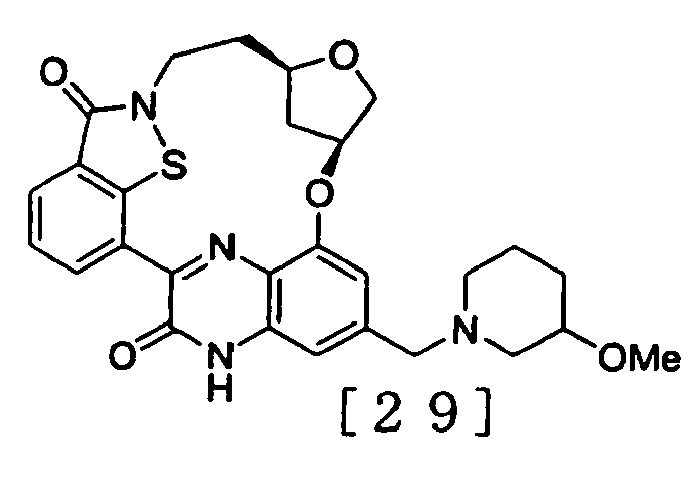

- According to a method similar to the procedures described in Working Examples 1-(2) to 1-(3), the above benzoisothiazolone derivative (1.81 g) was obtained as a pale yellow solid from the carboxylic acid derivative (1.31 g, 2.26 mmol) obtained in Working Example 28-(1) and the amine derivative [A-15].


- According to a method similar to the procedures described in Working Examples 14-(12) to 14-(13), the above cyclic derivative (740 mg) was obtained as a yellow solid from the alcohol derivative (1.08 g, 1.81 mmol) obtained in the above (2).


- According to a method similar to the procedures described in Working Examples 14-(14) and 11-(18), the trifluoroacetate (20 mg) of the objective compound [29] as a diastereomer mixture was obtained as a yellow solid from the cyclic derivative (42 mg, 93 µmol) obtained in the above (3) and the racemic amine derivative [A-22].
- Spectral data of the compound of the above formula [29] are shown below.
1H-NMR(DMSO-d6) δ:1.45-1.95(5H, m), 2.25-2.31(2H, m), 2.80-3.15( 4H,m),3.20-3.29(3H,m),3.57-3.69(2H,m),3.82-3.95(2H,m),4.02-4.43(5H, m), 5.60(1H, m), 7.11(1H, s), 7.43(1H, s), 7.61(1H, t, J=7.6 Hz), 8.05(1H, d, J=7.6Hz), 9.31(1H, d, J=7.6Hz), 9.49(1H, brs), 13.0 (1H, brs).
mass:535(M+1)+. - Synthesis of the compound of the following formula [30]:

- According to a method similar to the procedures described in Working Examples 14-(14) and 11-(18), the trifluoroacetate (17 mg) of the objective compound [30] as a diastereomer mixture was obtained as a yellow solid from the alcohol derivative (49 mg, 109 µmol) obtained in Working Example 29-(3) and the racemic amine derivative [A-26].
- Spectral data of the compound of the above formula [30] are shown below.
1H-NMR(DMSO-d6) δ:1.42-1.65(2H, m), 1.64-1.80(3H, m), 1.94(1H, m) , 2.80-3.15(3H, m), 3.40(3H, m), 3.55-3.65(4H, m), 3.82-3.95(4H, m) , 4.05-4.30(4H, m), 4.70(1H, m), 5.6(1H, m), 7.09(1H, s), 7.39(1H, s) , 7.61(1H, t, J=7.6Hz), 8.05(1H, d, J=7.6Hz), 9.31(1H, d, J=7.6Hz), 9 .35(1H, brs), 13.0(1H, brs).
mass:549(M+1)+. - Synthesis of the compound of the following formula [31]:


- According to a method similar to the procedure described in Working Example 3-(1), the above benzoisothiazolone derivative (313 mg) was obtained as a pale yellow solid from the carboxylic acid derivative (576 mg, 1. 00 mmol) obtained in Working Example 28-(1).

- The benzoisothiazolone derivative (278 mg, 520 µmol) obtained in the above (1) was dissolved in methylene chloride (5 mL), and to the solution were added triethylamine (220 µL, 1.56 mmol) and methanesulfonyl chloride (60 µL, 780 µmol) with stirring at 0°C. The mixture was stirred at the same temperature for 1 hour. 1N aqueous potassium hydrogensulfate was added the resulting reaction solution, and the solution was stirred at room temperature for 30 minutes. Then, the reaction solution was extracted with chloroform. The organic layer was washed with saturated brine, dried with anhydrous sodium sulfate, and filtered. The filtrate was concentrated, and the resulting residue was dried with a vacumpump, and dissolved in N,N-dimethylformamide (10 mL). After potassium carbonate (222 mg, 1.56 mmol) and (R)-3-hydroxypyrrolidine hydrochloride (200 mg, 1.56 mmol) were added thereto, the mixture was heated with stirring at 70°C for 4 hours. To this reaction solution was added 1N aqueous potassium hydrogensulfate, and the mixture was stirred at room temperature for 30 minutes, then extracted with chloroform. The organic layer was washed with saturated brine, dried over anhydrous sodium sulfate, and filtered. The filtrate was concentrated, and the resulting residue was purified by a column chromatography on silica gel to obtain the above amine derivative (114 mg) as a pale yellow solid.

- According to a method similar to the procedures described in Working Example 14-(12) to 14-(13), the above cyclic derivative (10 mg) was obtained as a yellow oil from the amine derivative (13 mg, 21 µmol) obtained in the above (2).

- According to a method similar to the procedures described in Working Examples 14-(14) and 11-(18), the hydrochloride (13 mg) of the objective compound [31] was obtained as a yellow solid from the cyclic derivative (12 mg, 21 µmol) obtained in the above (3) and piperidine.
- Spectral data of the compound of the above formula [31] are shown below.
1H-NMR(DMSO-d6) δ:1.20-2.10(8H, m), 2.20-3.50 (8H, m), 3.50-4.40( 6H, m), 5.50(1H, m), 6.98-7.10(1H, m), 7.50-7.80(2H, m), 7.98-8.10( 1H, m), 9.28(1H, d, J=8.2Hz).
mass:504(M+1)+. - Synthesis of the compound of the following formula [32]:

- According to a method similar to the procedures described in Working Examples 14-(14) and 11-(18), the hydrochloride (88 mg) of the objective compound [32] was obtained as a yellow solid from the cyclic derivative (143 mg, 317 µmol) obtained in Working Example 31-(3) and morpholine.
- Spectral data of the compound of the above formula [32] are shown below.
1H-NMR(DMSO-d6) δ:1.80-2.60(6H, m), 2.80-3.50(3H, m), 3.50-4.30( 10H, m), 4.30-4.50(1H, m)5.50(1H, m), 6.90-7.05(1H, m), 7.40-7.80( 2H, m), 7.90-8.10(1H, m), 9.20-9.30(1H, m).
mass:506(M+1)+. - Synthesis of the compound of the following formula [33]:


- According to a method similar to the procedures as Working Examples 31-(2) and 32-(3), the above cyclic derivative was obtained from the benzoisothiazolone derivative obtained in Working Example 31-(1) and (S)-3-hydroxypyrrolidine hydrochloride.

- According to a method similar to the procedures described in Working Examples 14-(14) and 11-(18), the trifluoroacetate (37 mg) of the objective compound [33] as a diastereomer mixture was obtained as a yellow solid from the cyclic derivative (68 mg, 151 µmol) obtained in the above (1) and the racemic amine derivative [A-22].
- Spectral data of the compound of the above formula [33] are shown below.
1H-NMR(DMSO-d6) δ:0.80-1.20(2H, m), 1.40-2.60(8H, m), 2.60-3.80( 8H, m), 3.20(3H, s), 4.10-4.50(3H, m)5.30(1H, m), 6.90-7.02(1H, m), 7.10-7.20(1H, m), 7.58(1H, m), 8.01-8.02(1H, m), 9.30(1H, m), 9.48( 1H, brs), 13.0(1H, brs).
mass:534(M+1)+. - Synthesis of the compound of the following formula [34]:

- According to a method similar to the procedures described in Working Examples 14-(14) and 11-(18), the trifluoroacetate (27 mg) of the objective compound [34] was obtained as a yellow solid from the cyclic derivative (60 mg, 133 µmol) obtained in Working Example 31-(3) and the racemic amine derivative [A-23].
- Spectral data of the compound of the above formula [34] are shown below.
1H-NMR(DMSO-d6) δ:1.50-2.09(5H, m), 2.25-2.33(1H, m), 2.71-3.22( 3H,m),3.24-3.28(3H,m),3.31-3.43(3H,m),3.66-3.73(2H,m),3.80-4.00(2H, m), 4.05-4.50(5H, m), 5.31-5.43(1H, m), 7.00-7.29(1H, m), 7.55-7.75(2H, m), 8.03-8.15(1H, m), 9.30-9.35(1H, m), 9.65 (1H, brs), 12.9-13.2(1H, m).
mass:534(M+1)+. - Synthesis of the compound of the following formula [35]:

- According to a method similar to the procedures described in Working Examples 14-(14) and 11-(18), the trifluoroacetate (25 mg) of the objective compound [35] was obtained as a yellow solid from the cyclic derivative (60 mg, 133 µmol) obtained in Working Example 31-(3) and the amine derivative [A-24].
- Spectral data of the compound of the above formula [35] are shown below.
1H-NMR(DMSO-d6) δ:1.17-1.96(5H, m), 2.12-2.40(1H, m), 2.72-3.23( 3H, m), 3.23-3.28(3H, m), 3.38-3.60(5H, m), 3.60-3.74(2H, m), 4.12-4.43(5H, m), 5.35-5.41(1H, m), 7.06-7.30(1H, m), 7.50-7.80(2H, m), 8.03-8.06(1H, m), 9.31-9.34(1H, m), 9.64 (1H, brs), 12.9-13.0(1H, m).
mass:534(M+1)+ - Synthesis of the compound of the following formula [36]:

- According to a method similar to the procedures described in Working Examples 14-(14) and 11-(18), the trifluoroacetate (41 mg) of the objective compound [36] was obtained as a yellow solid from the cyclic derivative (70 mg, 150 µmol) obtained in Working Example 31-(3) and the amine derivative [A-27].
- Spectral data of the compound of the above formula [36] are shown below.
1H-NMR(DMSO-d6) δ:1.30-1.80(7H, m), 2.06-2.93(7H, m), 3.06-3.87( 10H, m), 4.25-4.39(2H, m), 5.35(1H, brs), 7.02(1H,s), 7.19(1H, s), 7 .57(1H, t, J=7.2Hz), 8.03(1H, d, J=7.2Hz), 9.30(1H, d, J=7.2Hz), 12. 9(1H, s).
mass:548(M+1)+. - Synthesis of the compound of the following formula [37]:

- According to a method similar to the procedures described in Working Examples 14-(14) and 11-(18), the trifluoroacetate (41 mg) of the objective derivative [37] was obtained as a yellow solid from the cyclic derivative (70 mg, 150 µmol) obtained in Working Example 31-(3) and the amine derivative [A-28].
- Spectral data of the compound of the above formula [37] are shown below.
1H-NMR(DMSO-d6) δ:1.30-1.80(7H, m), 2.06-2.93(7H, m), 3.06-3.87( 10H, m), 4.25-4.39(2H, m), 5.35(1H, brs), 7.02(1H, s), 7.19(1H, s), 7 .57 (1H, tJ=7.2Hz), 8.03(1H, d, J=7.2Hz), 9.30(1H, d, J=7.2Hz), 12.9 (1H, s).
mass:548(M+1)+. - Synthesis of the compound of the following formula [38]:


- According to a method similar to the procedure described in Working Example 1-(2), the above amide derivative (250 mg) was obtained as an orange solid from the carboxylic acid derivative (200 mg, 340 µmol) obtained in Working Example 28-(1) and the amine derivative [A-16].


- According to a method similar to the procedures described in Working Examples 11-(9), and 14-(12) to 14-(13), the above cyclic derivative (46 mg) was obtained as a yellow solid from the benzoisothiazolone derivative (225 mg, 340 µmol) obtained in the above (2).

- According to a method similar to the procedures described in Working Examples 14-(14) and 11-(18), the trifluoroacetate (41 mg) of the objective compound [38] was obtained as a yellow solid from the cyclic derivative (70 mg, 150 µmol) obtained in the above (3) and the amine derivative [A-23].
- Spectral data of the compound of the above formula [38] are shown below.
1H-NMR(DMSO-d6) δ:1.23-2.25(9H, m), 2.90-3.14(2H, m), 3.25(3H, s) , 3.28-3.38(2H, m), 3.43-3.58(2H, m), 3.63-3.78(2H, m), 4.10-5.10( 6H, m), 5.43(1H, brs), 7.02-7.14(1H, m), 7.32-7.46(1H, m), 7.66-7.7 5(1H, m), 8.08-8.18(1H, m), 9.46-9.52(1H, m), 12.9(1H, s).
mass:548(M+1)+. - Synthesis of the compound of the following formula [39]:

- According to a method similar to the procedures described in Working Examples 14-(14) and 11-(18), the hydrochloride (14 mg) of the objective compound [39] was obtained as a yellow solid from the cyclic derivative (46 mg, 100 µmol) obtained in Working Example 38-(3) and morpholine.
- Spectral data of the compound of the above formula [39] are shown below.
1H-NMR(DMSO-d6) δ:2.08-2.33(4H, m), 3.03-3.80(12H, m), 3.84-4.03 (4H, m), 4.20-4.55(2H, m), 5.58(1H, brs), 7.03(1H, s), 7.66(1H, t, J= 8.0Hz), 7.89(1H, s), 8.07(1H, d, J=8.0Hz), 9.42(1H, d, J=8.0Hz), 12. 9(1H, s).
mass:520(M+1)+. - Synthesis of the compound of the following formula [40]:


- According to a method similar to the procedures of Working Examples 1-(2) to 1-(5), the above racemic cyclic derivative (2.01 g) was obtained as a yellow solid from the carboxylic acid derivative (6.61 g, 8.88 mmol) prepared in Working Example 14-(2) and a racemate of 5-amino-1-hexanol synthesized by referring to a method similar to the method described in J. Med. Chem. , 25(8) 964 (1982).

- According to a method similar to the procedures described in Working Examples 14-(5) to 14-(6), the above racemic carboxylic acid derivative (464 mg) was obtained as an orange solid from the racemic cyclic derivative (529 mg, 880 µmol) obtained in the above (1).


- The racemic carboxylic acid derivative (464 mg, 820 µmol) obtained in the above (2) was dissolved in tetrahydrofuran (50 mL) and N,N-dimethylformamide (14 mL), and then 1,1'-carbonylbis-1H-imidazole (199 mg, 1.23 mmol) was added thereto. The reaction solution was stirred at room temperature for 11 hours, and then lithium tetrahydroborate (35.6 mg, 1.64 mmol) was added. Lithium tetrahydroborate (35.6 mg, 1.64 mmol) was added to the resulting reaction solution, and the mixture was stirred at room temperature for 30 minutes. After that, lithium tetrahydroborate (35.6 mg, 1.64 mmol) was further added thereto, and the mixture was stirred at room temperature for 30 minutes, and then chloroform (50 mL) was added to the reaction solution. After addition of saturated aqueous ammonium chloride (30 mL), the solution was extracted with chloroform. The organic layer was washed with saturated brine, and dried over anhydrous magnesium sulfate, and filtered. The filtrate was concentrated in vacuo, and the resulting residue was evaporated azeotropically using toluene. The resulting residue was dissolved in methylene chloride (30 mL) and chloroform (30 mL). After manganese dioxide (214 mg, 2.45 mmol) was added to this solution, the mixture was stirred at room temperature for 2 hours. The resulting reaction solution was filtered through a Celite pad, and then concentrated in vacuo. The residue was purified by a column chromatography on silica gel to obtain the above racemic benzyl alcohol derivative (298 mg) as a yellowish brown solid.

- The racemic benzyl alcohol derivative (298 mg, 540 µmol) obtained in the above (3) was dissolved in chloroform (20 mL), and manganese dioxide (468 mg, 5.38 mmol) was added thereto. The mixture was stirred at room temperature for 11 hours. The resulting reaction solution was filtered through a Celite pad, and the filtrate was concentrated in vacuo. The resulting residue was purified by a thin layer chromatography to obtain the above racemic aldehyde (175 mg) as a yellowish brown solid.

- To chloroform solution (20 mL) containing the racemic aldehyde derivative (100 mg, 180 µmol) obtained in the above (4) and pyrrolidine (121 µL, 1.45 mmol) was added methanol solution (2.42 mL) containing zinc chloride (50 mg, 364 µmol) and sodium cyanotrihydroborate (47 mg, 726 µmol), and the mixture was stirred at room temperature for 12 hours. The resulting reaction solution was concentrated, and the resulting residue was diluted with chloroform, and washed with water and saturated brine. The organic layer was dried over anhydrous magnesium sulfate, and filtered. The filtrate was concentrated in vacuo, and the resulting residue was purified by a thin layer chromatography to obtain the above racemic benzylamine derivative (70 mg) as a yellowish brown solid.

- According to a method similar to the procedure described in Working Example 1-(6), the hydrochloride (49 mg) of the objective compound [40] as a racemate was obtained as a yellow solid from the racemic benzylamine derivative (70 mg, 120 µmol) obtained in the above (5).
- Spectral data of the compound of the above formula [40] are shown below.
1H-NMR(DMSO-d6) δ:1.24(3H, d, J=6.6Hz), 1.80-2.08(10H, m), 3.05-3 .12(2H, m), 3.38-3.45(2H, m), 4.14-4.21(1H, m), 4.43-4.52(3H, m), 4 .58-4.63(1H, m), 7.06(1H, s), 7.39(1H, s), 7.65(1H, t, J=7.8Hz), 8.0 6(1H, d, J=7.8Hz), 9.45(1H, d, J=7.8Hz), 10.8(1H ,brs), 13.0(1H, s).
mass:477(M+1)+. - Synthesis of the compound of the following formula [41]:

- According to a method similar to the procedures described in Working Examples 40-(5) to 40-(6), the hydrochloride (12 mg) of the objective compound [41] as a racemate was obtained as a yellowish brown solid from the racemic aldehyde derivative (20 mg, 36 µmol) obtained in Working Example 40-(4) and morpholine.
- Spectral data of the compound of the above formula [41] are shown below.
1H-NMR(DMSO-d6) δ:1.22(3H, d, J=6.3Hz), 1.76-1.97(4H, m), 2.24-2. 43(2H, m), 3.11-3.29(4H, m), 3.81-3.95(4H, m), 4.11-4.17(1H, m), 4. 41-4.47(3H, m),4.56-4.59(1H, m), 7.02(1H, s), 7.49(1H, s), 7.60(1H , t, J=7.8Hz), 8.01(1H, d, J=7.8Hz), 9.44(1H, d, J=7.8Hz), 11.5(1H, b rs), 13.0(1H, s).
mass:493(M+1)+. - Synthesis of the compound of the following formula [42]:

- According to a method similar to the procedures described in Working Examples 14-(14) and 1-(6), the hydrochloride (40 mg) of the objective compound [42] as a racemate was obtained as a yellowish brown solid from the racemic benzyl alcohol derivative (177 mg, 140 µmol) obtained in Working Example 40-(3) and 4-methylpiperidine.
- Spectral data of the compound of the above formula [42] are shown below.
1H-NMR(DMSO-d6)δ:0.91(3H,d,J=6.3Hz),1.24(3H,d,J=6.9Hz),1.38 -1.64(4H,m),1.74-2.01(5H,m),2.25-2.40(2H,m),2.88-3.00(2H,m) ,3.11-3.18(1H,m),3.25-3.45(1H,m),4.15-4.22(1H,m),4.33-4.38( 2H,m),4.45-4.51(1H,m),4.58-4.64(1H,m),7.04(1H,s),7.34(1H,s) ,7.66(1H,t,J=7.8Hz),8.07(1H,d,J=7.8Hz),9.45(1H,d,J=7.8Hz),1 0.1(1H,brs),13.1(1H,s).
mass:505(M+1)+. - Synthesis of the compound of the following formula [43]:


- The racemic cyclic derivative (143 mg, 51 µmol) obtained in Working Example 40-(1) was dissolved in toluene (1.5 mL), and to this solution were added N-methylpiperazine (136 µL, 122 µmol), (R)-(+)-2,2'-bis(di-4-tolylphosphino)-1,1'-binaphthyl (9.5 mg, 15 µmol), tris(dibenzylideneacetone) dipalladium(0)-chloroform adduct (5.3 mg, 5 µmol) and sodium t-butoxide (9.8 mg, 102 µmol). The mixture was stirred at 80°C for 5 hours. The resulting reaction solution was cooled down to room temperature, extracted with chloroform, and the extract was washed successively with water and saturated brine. The organic layer was dried over anhydrous magnesium sulfate, filtered, and concentrated in vacuo. The resulting residue was purified by a thin layer chromatography to obtain the above racemic 6-piperazine derivative (30 mg) as a yellowish brown liquid.

- According to a method similar to the procedure described in Working Example 1-(6), the hydrochloride (11 mg) of the objective compound [43] as a racemate was obtained as a yellowish brown solid from the racemic 6-piperazine derivative (30 mg, 48 µmol) obtained in the above (1).
- Spectral data of the compound of the above formula [43] are shown below.
1H-NMR(DMSO-d6)δ:1.22(3H,d,J=6.6Hz),1.78-1.90(4H,m),2.23-2. 39(2H,m),2.83(3H,d,J=3.9Hz),3.14-3.39(6H,m),3.96-4.11(3H,m) ,4.38-4.44(1H,m),4.53-4.58(1H,m),6.31(1H,s),6.68(1H,s),7.57 (1H,t,J=7.8Hz),7.94(1H,d,J=7.8Hz),9.27(1H,d,J=7.8Hz),10.9 (1H,brs),12.5(1H,s).
mass:492(M+1)+. - Synthesis of the compound of the following formula [44]:


- According to a method similar to the procedure described in Working Example 11-(4), the above racemic vinyl derivative (60 mg) was obtained as an orange solid from the racemic cyclic derivative (116 mg, 139 µmol) obtained in Working Example 40-(1).

- Pyrrolidine (4 mL) was added to the racemic vinyl derivative (23.5 mg, 43 µmol) obtained in the above (1), and the mixture was heated in a sealed tube at 120°C for 15 hours. The resulting reaction solution was concentrated in vacuo, and the resulting residue was diluted with chloroform, and washed with water and saturated brine. The organic layer was dried over anhydrous magnesium sulfate, and filtered, and concentrated in vacuo. The resulting residue was purified by a thin layer chromatography to obtain the above racemic pyrrolidinylethyl derivative (6.3 mg) as a yellowish brown solid.

- According to a method similar to the procedure described in Working Example 1-(6), the hydrochloride (2.9 mg) of the objective compound [44] as a racemate was obtained as a yellowish brown solid from the racemic pyrrolidinylethyl derivative (6.3 mg, 10 µmol) obtained in the above (2).
- Spectral data of the compound of the above formula [44] are shown below.
1H-NMR(DMSO-d6)δ:1.23(3H,d,J=6.3Hz),1.85-2.02(6H,m),2.26-2. 62(4H,m),3.05-3.12(2H,m),3.25-3.59(6H,m),4.10-4.25(1H,m),4. 40-4.48(1H,m),4.54-4.68(1H,m),6.84(1H,s),6.98(1H,s),7.63(1H ,t,J=7.8Hz),8.03(1H,d,J=7.8Hz),9.41(1H,d,J=7.8Hz),10.5 (1H,brs),12.9(1H,s).
mass:491(M+1)+. - Synthesis of the compound of the following formula [45]:


- The cyclic derivative (18.9 mg, 42 µmol) obtained in Working Example 31-(3) and methyl iodide (4 µL, 63 µmol) were dissolved in N,N-dimethylformamide (10 mL). Sodium hydride (2.0 mg, 60% dispersion in oil, 50 µmol) was added to this solution in an ice-bath, and the solution was stirred at the same temperature for 2 hours. After methyl iodide (12 µL, 189 µmol) and sodium hydride (6.0 mg, 60% dispersion in oil, 150 µmol) were further added thereto in an ice-bath, the solution was stirred at room temperature for 7.5 hours. After saturated aqueous ammonium chloride was added to the resulting reaction solution, it was extracted with chloroform. The organic layer was washed with water and saturated brine, dried over anhydrous magnesium sulfate, and filtered. The filtrate was concentrated in vacuo, and the residue was evaporated azeotropically using toluene, and the resulting residue was purified by a thin layer chromatography to obtain the above methoxymethyl derivative (15.6 mg) as a yellowish brown oil.
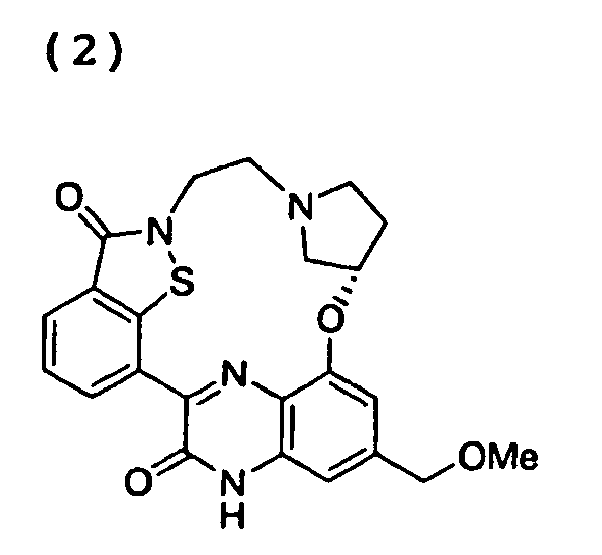
- According to a method similar to the procedure described in Working Example 11-(18), the hydrochloride (6.9 mg) of the objective compound [45] was obtained as a yellowish brown solid from the methoxymethyl derivative (15.6 mg, 33 µmol) obtained in the above (1).
- Spectral data of the compound of the above formula [45] are shown below.
1H-NMR(DMSO-d6)δ:1.93-2.06(1H,m),2.21-2.30(1H,m),2.72-3.16( 4H,m),3.25-3.45(4H,m),3.59-4.10(2H,m),4.10-4.15(1H,m),4.46-4.55(2H,m),5.33-5.43(1H,m),6.78-7.04(2H,m),7.54-7.71(1H,m), 8.00-8.12(1H,m),9.31 (1H,brs),12.8(1H,s).
mass:451(M+1)+. - Synthesis of the compound of the following formula [46]:


- According to a method similar to the procedures described in Working Examples 11-(10) to 11-(12), the above 3-indazolinone derivative (737 mg) was obtained as an orange solid from the carboxylic acid derivative (944 mg, 2.0 mmol) obtained in Working Example 11-(9) and the hydrazine derivative [A-18].
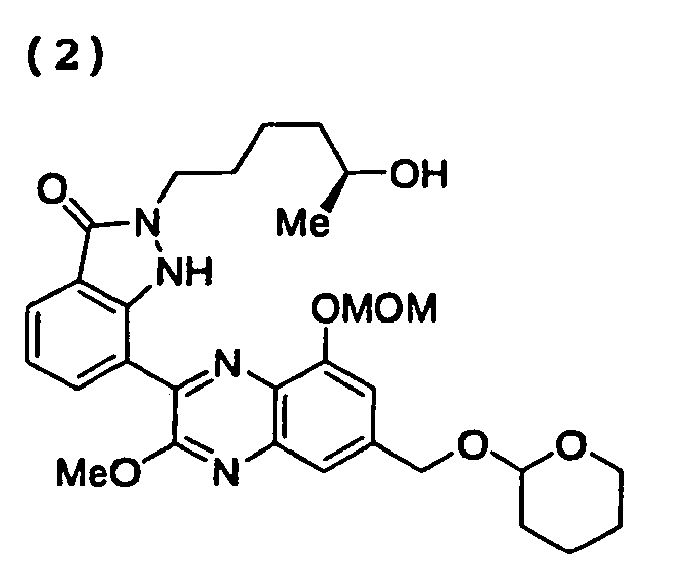
- According to a method similar to the procedure described in Working Example 11-(9), the above alcohol derivative (531 mg) was obtained as an orange solid from the 3-indazolinone derivative (737 mg) obtained in the above (1).

- According to a method similar to the procedure described in Working Examples 11-(14) to 11-(18), the hydrochloride (95 mg) of the objective compound [46] was obtained as a purple solid from the alcohol derivative (531 mg, 940 µmol) obtained in the above (2) and piperidine.
- Spectral data of the compound of the above formula [46] are shown below.
1H-NMR(DMSO-d6)δ:1.30-1.44(1H,m),1.48(3H,d,J=6.0Hz),1.65-2. 00(10H,m),2.05-2.15(1H,m),2.82-2.96(2H,m),3.20-3.28(1H,m),3 .30-3.38(1H,m),3.86-3.98(1H,m),4.12-4.22(1H,m),4.24-4.34(1H ,m),4.36-4.44(1H,m),4.76-4.88(1H,m),6.95(1H,s),7.17(1H,t,J= 8.0Hz),7.45(1H,s),7.83(1H,d,J=8.0Hz),9.22(1H,d,J=8.0Hz),10. 8-10.9(1H,brs),11.4(1H,s),12.8(1H,s).
mass:474(M+1)+. - Synthesis of the compound of the following formula [47]:

- According to a method similar to the procedures as Working Example 46, the hydrochloride of the objective compound [47] was obtained from the carboxylic acid derivative obtained in Working Example 11-(9) and the hydrazine derivative [A-19].
- Spectral data of the compound of the above formula [47] are shown below.
1H-NMR(DMSO-d6)δ:1.30-1.44(1H,m),1.48(3H,d,J=6.0Hz),1.65-2. 00(10H,m),2.05-2.15(1H,m),2.82-2.96(2H,m),3.20-3.28(1H,m),3 .30-3.38(1H,m),3.86-3.98(1H,m),4.12-4.22(1H,m),4.24-4.34(1H ,m),4.36-4.44(1H,m),4.76-4.88(1H,m),6.95(1H,s),7.17(1H,t,J= 8.0Hz),7.45(1H,s),7.83(1H,d,J=8.0Hz),9.22(1H,d,J=8.0Hz),10. 8-10.9(1H,brs),11.4(1H,s),12.8(1H,s).
mass:474(M+1)+. - Synthesis of the compound of the following formula [48]:


- Triethylamine (167 µL, 1.20 mmol) and 2-chloro-1,3-dimethylimidazolinium chloride (102 mg, 602 µL) were added to chloroform solution (5 mL) of the carboxylic acid derivative (200 mg, 367 µmol) obtained by reference to Working Example 110-2) described in
WO02/02550 

- 10% hydrochloric acid/methanol (2 mL) was added to the hydrazide derivative (50 mg, 50.9 µmol) obtained in the above (1), and the mixture was stirred at room temperature for 15 hours. The resulting reaction solution was concentrated, and the resulting residue was purified by a thin layer chromatography to obtain the above de-Boc derivative (28 mg) as a yellow oil.

- According to a method similar to the procedure described in Working Example 11-(12), the above 3-indazolinone derivative (14 mg, 27 µmol) was obtained as an orange solid from the de-Boc derivative (28 mg) obtained in the above (2).

- According to a method similar to the procedures described in Working Examples 1-(5) to 1-(6), the objective compound [48](8 mg) was obtained as an orange solid from the 3-indazolinone derivative (14 mg, 27 µmol) obtained in the above (3).
- Spectral data of the compound of the above formula [48] are shown below.
1H-NMR(DMSO-d6)δ:1.73-2.10(6H,m),4.00-4.11(2H,m),4.15-4.23( 2H,m),6.84-6.90(2H,m),7.17(1H,t,J=7.7Hz),7.45(1H,t,J=8.2Hz) 7.83(1H,d,J=7.7Hz),9.24(1H,d,J=7.7Hz),11.6(1H,s),12.6(1H,b rs).
mass:363(M+1)+ - Synthesis of the compound of the following formula [49]:


- According to a method similar to the procedure described in Working Example 11-(9), the above carboxylic acid derivative (8.42 g) was obtained as a pale yellow solid from the protected derivative (10 g) with SEM obtained in Working Example 14-(1).

- According to a method similar to the procedures including the steps of up to the macrocyclization described in Working Examples 48-(1) to 48-(4), the above racemic cyclic derivative (6.9 mg) was obtained as a yellowish brown solid from the carboxylic acid derivative (15.6 mg, 33 µmol) obtained in the above (1) and the racemic hydrazine derivative [A-21].

- According to a method similar to the procedure described in Working Example 14-(5) to 14-(6), the above racemic carboxylic acid derivative (188 mg) was obtained as an orange solid from the racemic cyclic derivative (192 mg, 326 µmol) obtained in the above (2).


- The racemic carboxylic acid derivative (188 mg, 340 µmol) obtained in the above (3) was dissolved in tetrahydrofuran (10 mL), and to the solution was added 1,1'-carbonylbis-1H-imidazole (83 mg, 510 µmol). The mixture was stirred at room temperature for 17 hours. To the resulting reaction solution were slowly added sodium tetrahydroborate (26 mg, 680 µmol) and water (10 mL), and the mixture was stirred at room temperature for 20 minutes. After saturated aqueous ammonium chloride solution was added to this reaction solution, the mixture was extracted with chloroform. The organic layer was washed with saturated brine, dried over anhydrous magnesium sulfate, filtered, and concentrated in vacuo. The resulting residue was purified by a thin layer chromatography. The resulting compound was dissolved in methylene chloride (6 mL), and manganese dioxide (133 mg, 1.53 mmol) was added thereto. The mixture was stirred at room temperature for 18 hours. The resulting reaction solution was filtered through a Celite pad and the filtrate was concentrated in vacuo. The resulting residue was purified by a thin layer chromatography to obtain the above racemic aldehyde derivative (44 mg) as an orange solid.


- According to a method similar to the procedures described in Working Examples 40-(5) to 40-(6), the hydrochloride (12 mg) of the racemic objective compound [49] as a racemate was obtained as a deep purple solid from the racemic aldehyde derivative (22 mg, 41 µmol) obtained in the above(4) and pyrrolidine.
- Spectral data of the compound of the above formula [49] are shown below.
1H-NMR(DMSO-d6)δ:1.05(3H,d,J=5.7Hz),1.71-1.85(6H,m),1.92-2. 17(4H,m),2.96-3.05(2H,m),3.25-3.45(2H,m),4.08-4.15(1H,m),4. 31-4.39(3H,m),4.48-4.54(1H,m),6.95(1H,s),7.16(1H,t,J=7.8Hz) ,7.35(1H,s),7.75(1H,d,J=7.8Hz),9.02(1H,d,J=7.8Hz),10.5 (1H,brs),10.9(1H,s),12.8(1H,s).
mass:460(M+1)+. - Synthesis of the compound of the following formula [50]:
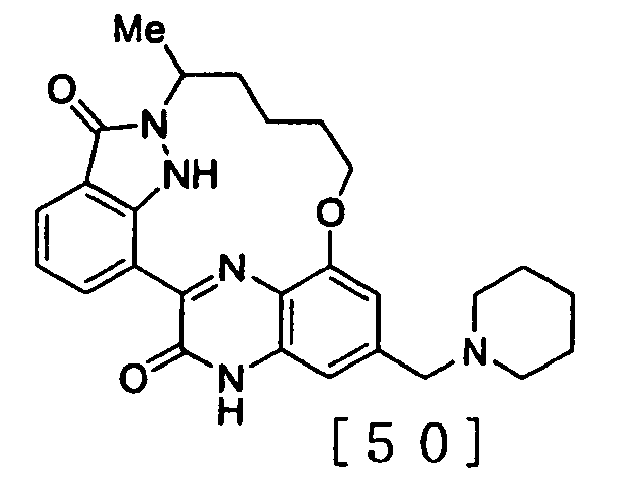
- According to a method similar to the procedures described in Working Example 40-(5) to 40-(6), the hydrochloride (79 mg) of the racemic objective compound [50] as a racemate was obtained as a deep green solid from the racemic aldehyde derivative (102 mg, 169 µmol) obtained in Working Example 49-(4) and piperidine.
- Spectral data of the compound of the above formula [50] are shown below.
1H-NMR(DMSO-d6)δ:1.14(3H,d,J=6.0Hz),1.75-1.86(10H,m),2.05-2 .19(2H,m),2.88-2.95(2H,m),3.25-3.56(2H,m),4.17-4.24(1H,m),4 .32-4.46(3H,m),4.56-4.73(1H,m),7.04(1H,s),7.25(1H,t,J=7.8Hz ),7.46(1H,s),7.85(1H,d,J=7.8Hz),9.10(1H,d,J=7.8Hz),10.2 (1H,brs),11.0(1H,s),12.9(1H,s).
mass:474(M+1)+. - Synthesis of the compound of the following formula [51]:


- According to a method similar to the procedures up to the step of the macrocyclization described in Working Examples 48-(1) to 48-(4), and 14-(5) to 14-(6), the above carboxylic acid derivative (580 mg) was obtained as a yellowish brown solid from the carboxylic acid derivative (2.48 g, 3.87 mmol) obtained in Working Example 49-(1).

- The carboxylic acid derivative (580 mg, 1.08 mmol) obtained in the above (1) was dissolved in tetrahydrofuran (60 mL) and N,N-dimethylformamide (60 mL), and to this solution was added 1,1'-carbonylbis-1H-imidazole (262 mg, 1.62 mmol). The mixture was stirred at 60°C for 30 minutes, and further at room temperature for 11 hours. Lithium tetrahydroborate (47 mg, 2.16 mmol) was added to the resulting reaction solution, and it was stirred at room temperature for 30 minutes. After that, lithium tetrahydroborate (500 mg, 23 mmol) was further added to this solution, and the mixture was stirred at room temperature for 1 hour, followed by addition of chloroform (100 mL). Then, saturated aqueous ammonium chloride solution (50 mL) was added to this solution, and the mixture was extracted with chloroform. The organic layer was washed with saturated brine, dried over anhydrous magnesium sulfate, and filtered. The filtrate was concentrated in vacuo and evaporated azeotropically using toluene. The resulting residue was dissolved in chloroform (100 mL), and then manganese dioxide (282 mg, 3.24 mmol) was added to the solution. The mixture was stirred at room temperature for 1 hour. The resulting reaction solution was filtered through a Celite pad and concentrated in vacuo. The resulting residue was purified by a column chromatography on silica gel to obtain the above benzyl alcohol derivative (320 mg) as an orange liquid.

- According to a method similar to the procedures described in Working Examples 11-(17) and 1-(6), the hydrochloride (55 mg) of the objective compound [51] was obtained as a deep purple solid from the benzyl alcohol derivative (88 mg, 168 µmol) obtained in the above (2) and piperidine.
- Spectral data of the compound of the above formula [51] are shown below.
1H-NMR(DMSO-d6)δ:1.35-1.40(1H,m),1.66-2.26(11H,m),2.88-2.94 (2H,m),3.25-3.45(2H,m),4.04-4.10(2H,m),4.24-4.30(2H,m),4.31 -4.37(2H,m),7.00(1H,s),7.21(1H,t,J=7.8Hz),7.30(1H,s),7.87(1 H,d,J=7.8Hz),9.26(1H,d,J=7.8Hz),10.3(1H,brs),11.6(1H,s),12. 9(1H,s).
mass:460(M+1)+. - Synthesis of the compound of the following formula [52]:

- According to a method similar to the procedures described in Working Examples 11-(17) and 1-(6), the hydrochloride (28 mg) of the objective compound [52] was obtained as a deep green solid from the benzyl alcohol derivative (66 mg, 127 µmol) obtained in the above (2) and piperidine.
in Working Example 51-(2) and pyrrolidine. - Spectral data of the compound of the above formula [52] are shown below.
1H-NMR(DMSO-d6)δ:1.83-1.90(6H,m),1.92-2.03(4H,m),3.03-3.10( 2H,m),3.36-3.44(2H,m),4.05-4.09(2H,m),4.22-4.26(2H,m),4.41-4.43(2H,m),7.00(1H,s),7.19(1H,t,J=7.8Hz),7.33(1H,s),7.85(1H ,d,J=7.8Hz),9.25(1H,d,J=7.8Hz),11.0 (1H,brs),11.6(1H,s),12.9(1H,s).
mass:446(M+1)+. - Synthesis of the compound of the following formula [53]:

- According to a method similar to the procedures described in Working Examples 11-(17) and 1-(6), the hydrochloride (7 mg) of the objective compound [53] was obtained as a yellow green solid from the benzyl alcohol derivative (10 mg, 19 µmol) obtained in Working Example 51-(2) and morpholine.
- Spectral data of the compound of the above formula [53] are shown below.
1H-NMR(DMSO-d6)δ:1.81-1.95(4H,m),2.04-2.26(2H,m),3.11-3.21( 4H,m),3.69-3.81(2H,m),3.91-3.99(2H,m),4.05-4.10(2H,m),4.26-4.31(2H,m),4.41-4.46(2H,m),7.02(1H,s),7.21(1H,t,J=7.8Hz),7. 26(1H,s),7.88(1H,d,J=7.8Hz),9.28(1H,d,J=7.8Hz),10.7 (1H,brs),11.6(1H,s),12.9(1H,s).
mass:462(M+1)+. - Synthesis of the compound of the following formula [54]:

- According to a method similar to the procedures described in Working Examples 11-(17) and 1-(6), the hydrochloride (6 mg) of the racemic objective compound [53] as a racemate was obtained as a deep green solid from the benzyl alcohol derivative (10 mg, 19 µmol) obtained in Working Example 51-(2) and a racemic 2-methylpiperidine.
- Spectral data of the compound of the above formula [54] are shown below.
1H-NMR(DMSO-d6)δ:1.36-1.50(3H,m),1.66-1.92(10H,m),1.94-2.08 (2H,m),2.71-2.82(1H,m),3.01-3.11(2H,m),4.03-4.13(3H,m),4.23 -4.35(2H,m),4.71-4.77(1H,m),6.99-7.18(1H,m),7.21(1H,t,J=7.8 Hz),7.31-7.40(1H,m),7.87(1H,d,J=7.8Hz),9.26(1H,d,J=7.8Hz),1 0.2(1H,brs),11.6(1H,s),12.9(1H,s).
mass:474(M+1)+. - Synthesis of the compound of the following formula [55]:

- According to a method similar to the procedures described in Working Examples 11-(17) and 1-(6), the hydrochloride (7 mg) of the objective compound [55] as a racemate was obtained as a green solid from the benzyl alcohol derivative (10 mg, 19 µmol) obtained in Example 51-(2) and a racemic 3-methylpiperidine.
- Spectral data of the compound of the above formula [55] are shown below.
1H-NMR(DMSO-d6)δ:0.86(3H,d,J=6.6Hz),1.75-2.12(11H,m),3.20-3 .40(4H,m),4.04-4.10(2H,m),4.25-4.28(2H,m),4.32-4.34(2H,m),6 .99(1H,s),7.20(1H,t,J=7.8Hz),7.32(1H,s),7.87(1H,d,J=7.8Hz), 9.26(1H,d,J=7.8Hz),10.4 (1H,brs),11.6(1H,s),12.9(1H,s). mass:474(M+1)+. - Synthesis of the compound of the following formula [56]:
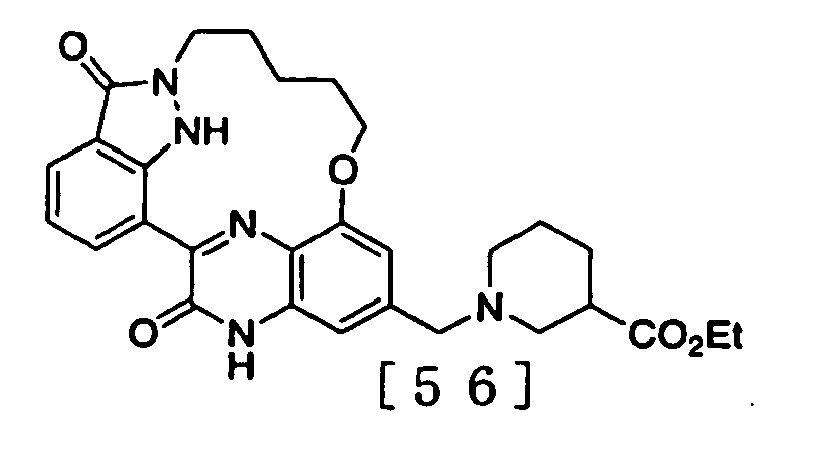
- According to a method similar to the procedures described in Working Example 11-(17) and 1-(6), the hydrochloride (8 mg) of the objective compound [56] as a racemate was obtained as a yellow green solid from the benzyl alcohol derivative (10 mg, 19 µmol) obtained in Working Example 51-(2) and a racemic 3-methoxycarbonylpiperidine.
- Spectral data of the compound of the above formula [56] are shown below.
1H-NMR(DMSO-d6)δ:1.17(3H,t,J=7.2Hz),1.44-1.49(1H,m),1.72-1. 97(6H,m),2.01-2.12(3H,m),2.89-3.09(4H,m),3.50-3.58(1H,m),4. 04-4.12(4H,m),4.25-4.31(2H,m),4.40-4.44(2H,m),7.01(1H,s),7. 22(1H,t,J=7.8Hz),7.24(1H,s),7.89(1H,d,J=7.8Hz),9.29(1H,d,J= 7.8Hz),10.3 (1H,brs),11.6(1H,s),12.9(1H,s).
mass:532(M+1)+. - Synthesis of the compound of the following formula [57]:

- According to a method similar to the procedures described in Working Examples 11-(17) and 1-(6), the hydrochloride (6 mg) of the objective compound [57] was obtained as a deep green solid from the benzyl alcohol derivative (10 mg, 19 µmol) obtained in Working Example 51-(2) and (S)-2-methoxymethylpyrrolidine.
- Spectral data of the compound of the above formula [57] are shown below.
1H-NMR(DMSO-d6)δ:1.67-2.07(9H,m),2.12-2.25(1H,m),3.06-3.28( 2H,m),3.32(3H,s),3.66-3.92(3H,m),3.95-4.10(2H,m),4.11-4.34( 3H,m),4.57-4.63(1H,m),6.97(1H,s),7.16(1H,t,J=7.8Hz),7.29-7. 69(1H,m),7.83(1H,d,J=7.8Hz),9.21(1H,d,J=7.8Hz),10.8 (1H,brs),11.5(1H,s),12.8(1H,s).
mass:490(M+1)+. - Synthesis of the compound of the following formula [58]:

- According to a method similar to the procedures described in Working Examples 11- (17) and 1-(6), the hydrochloride (9 mg) of the objective compound [58] was obtained as a deep green solid from the benzyl alcohol derivative (10 mg, 19 µmol) obtained in Working Example 51-(2) and (R)-2-methoxymethylpyrrolidine.
- Spectral data of the compound of the above formula [58] are shown below.
1H-NMR(DMSO-d6)δ:1.68-2.20(10H,m),3.12-3.19(2H,m),3.32(3H,s ),3.61-3.83(3H,m),4.03-4.06(2H,m),4.22-4.34(3H,m),4.58-4.63 (1H,m),7.00(1H,s),7.19(1H,t,J=7.8Hz),7.29(1H,m),7.83(1H,d,J =7.8Hz),9.25(1H,d,J=7.8Hz),10.6 (1H,brs),11.6(1H,s),12.9(1H,s).
mass:490(M+1)+. - Synthesis of the compound of the following formula [59]:

- According to a method similar to the procedures described in Working Examples 11-(17) and 1-(6), the hydrochloride (8 mg) of the objective compound [59] was obtained as a deep purple solid from the benzyl alcohol derivative (10 mg, 19 µmol) obtained in Working Example 51-(2) and thiomorpholine.
- Spectral data of the compound of the above formula [59] are shown below.
1H-NMR(DMSO-d6)δ:1.83-1.90(4H,m),2.03-2.08(2H,m) 2.71-2.87( 2H,m),3.05-3.21(2H,m),3.40-3.45(2H,m),3.56-3.75(2H,m),4.05-4.11(2H,m),4.23-4.32(2H,m),4.40-4.49(2H,m),7.02(1H,s),7.21( 1H,t,J=7.8Hz),7.29(1H,s),7.88(1H,d,J=7.8Hz),9.27(1H,d,J=7.8 Hz),10.7 (1H,brs),11.6(1H,s),12.9(1H,s).
mass:478(M+1)+. - Synthesis of the compound of the following formula [60]:

- According to a method similar to the procedures described in Working Examples 11-(17) and 1-(6), the hydrochloride (6 mg) of the objective compound [60] was obtained as an ocher solid from the benzyl alcohol derivative (10 mg, 19 µmol) obtained in Working Example 51-(2) and the amine derivative [A-29].
- Spectral data of the compound of the above formula [60] are shown below.
1H-NMR(DMSO-d6)δ:1.55-1.65(1H,m),1.81-1.98(5H,m),2.02-2.27( 4H,m),2.95-3.22(5H,m),3.26(3H,s),4.05-4.11(2H,m),4.25-4.30( 2H,m),4.35-4.42(2H,m),7.00-7.04(1H,m),7.21(1H,t,J=7.8Hz),7. 27(1H,s),7.88(1H,d,J=7.8Hz),9.28(1H,d,J=7.8Hz),10.2 (1H,brs),11.6(1H,s),12.9(1H,s).
mass:490(M+1)+. - Synthesis of the compound of the following formula [61]:

- According to a method similar to the procedures described in Working Examples 11-(17) and 1-(6), the hydrochloride (8 mg) of the objective compound [61] as a racemate was obtained as a green solid from the benzyl alcohol derivative (10 mg, 19 µmol) obtained in Working Example 51-(2) and the racemic amine derivative [A-22].
- Spectral data of the compound of the above formula [61] are shown below.
1H-NMR(DMSO-d6)δ:1.21-1.23(1H,m),1.38-1.56(1H,m),1.61-1.95 (6H,m),2.01-2.10(2H,m),2.95-3.20(1H,m),3.20-3.56(5H,m),3.56 -3.80(2H,m),4.02-4.10(2H,m),4.18-4.24(2H,m),4.24-4.41(2H,m) ,6.97-7.04(1H,m),7.15-7.40(2H,m),7.85-7.86(1H,m),9.24-9.25( 1H,m),11.2(1H,brs),11.6(1H,s),12.8-12.9(1H,m).
mass:490(M+1)+. - Synthesis of the compound of the following formula [62]:

- According to a method similar to the procedures described in Working Examples 11-(17) and 1-(6), the hydrochloride (7 mg) of the objective compound [62] as a racemate was obtained as a green solid from the benzyl alcohol derivative (10 mg, 19 µmol) obtained in Working Example 51-(2) and the racemic amine derivative [A-25].
- Spectral data of the compound of the above formula [62] are shown below.
1H-NMR(DMSO-d6)δ:1.12-1.24(1H,m),1.66-1.74(1H,m),1.78-1.96( 6H,m),2.00-2.07(2H,m),2.17-2.26(1H,m),2.67-2.87(2H,m),3.20( 3H,s),3.61-3.81(4H,m),4.06-4.09(2H,m),4.22-4.25(2H,m),4.33-4.36(2H,m),6.98(1H,s),7.19(1H,t,J=7.8Hz),7.34(1H,s),7.86(1H ,d,J=7.8Hz),9.26(1H,d,J=7.8Hz),10.6 (1H,brs),11.6(12H,s),12.9(1H,s).
mass:504(M+1)+. - Synthesis of the compound of the following formula [63]:

- According to a method similar to the procedures described in Working Examples 11-(17) and 1-(6), the hydrochloride (6 mg) of the objective compound [63] as a racemate was obtained as a deep purple solid from the benzyl alcohol derivative (10 mg, 19 µmol) obtained in Working Example 52-(2) and the racemic amine derivative [A-26].
- Spectral data of the compound of the above formula [63] are shown below.
1H-NMR(DMSO-d6)δ:1.40-2.00(10H,m),2.00-2.12(2H,m),2.82-3.18 (2H,m),3.40(3H,s),3.77-3.88(2H,m),4.02-4.10(2H,m),4.11-4.40 (4H,m),4.66-4.73(1H,m),7.01-7.07(1H,m),7.18-7.24(2H,m),7.88 (1H,d,J=7.8Hz),9.28(1H,d,J=7.8Hz),9.96 (1H,brs),11.6(1H,s),12.9(1H,s).
mass:504(M+1)+. - Synthesis of the compound of the following formula [64]:

- According to a method similar to the procedures described in Working Examples 11-(17) and 1-(6), the hydrochloride (8 mg) of the objective compound [64] was obtained as a deep purple solid from the benzyl alcohol derivative (10 mg, 19 µmol) obtained in Working Example 51-(2) and 4,4-difluoropiperidine.
- Spectral data of the compound of the above formula [64] are shown below.
1H-NMR(DMSO-d6)δ:1.81-1.96(4H,m),2.03-2.10(2H,m),2.25-2.45( 2H,m),2.45-2.56(2H,m),3.18-3.29(4H,m),4.05-4.11(2H,m),4.25-4.31(2H,m),4.44-4.73(2H,m),7.01(1H,s),7.21(1H,t,J=7.8Hz),7. 32(1H,s),7.88(1H,d,J=7.8Hz),9.27(1H,d,J=7.8Hz),11.0 (1H,brs),11.6(1H,s),12.9(1H,s).
mass:496(M+1)+. - Synthesis of the compound of the following formula [65]:

- According to a method similar to the procedures described in Working Examples 11-(17) and 1-(6), the hydrochloride (5 mg) of the objective compound [65] was obtained as a brown solid from the benzyl alcohol derivative (10 mg, 19 µmol) obtained in Working Example 51-(2) and 4-fluoropiperidine.
- Spectral data of the compound of the above formula [65] are shown below.
1H-NMR(DMSO-d6)δ:1.80-2.00(4H,m),2.01-2.20(6H,m),3.02-3.35( 4H,m),4.05-4.09(2H,m),4.25-4.29(2H,m),4.30-4.44(2H,m),4.92-5.08(1H,m),7.03(1H,s),7.21(1H,t,J=7.8Hz);7.32(1H,s),7.88(1H ,d,J=7.8Hz),9.27(1H,d,J=7.8Hz),10.6 (1H,brs),11.6(1H,s),12.9(1H,s).
mass:478(M+1)+. - Synthesis of the compound of the following formula [66]:

- According to a method similar to the procedures described in Working Examples 11-(17) and 1-(6), the hydrochloride (5 mg) of the objective compound [66] was obtained as a brown solid from the benzyl alcohol derivative (10 mg, 19 µmol) obtained in Working Example 51-(2) and diethylamine.
- Spectral data of the compound of the above formula [66] are shown below.
1H-NMR(DMSO-d6)δ:1.25(6H,t,J=7.5Hz),1.82-1.93(4H,m),2.00-2. 10(2H,m),3.06-3.23(4H,m),4.05-4.11(2H,m),4.24-4.30(2H,m),4. 37-4.40(2H,m),7.03(1H,s),7.22(1H,t,J=7.8Hz),7.24(1H,s),7.88 (1H,d,J=7.8Hz),9.28(1H,d,J=7.8Hz),9.94 (1H,brs),11.6(1H,s),12.9(1H,s).
mass:448(M+1)+. - Synthesis of the compound of the following formula [67]:

- According to a method similar to the procedure described in Working Example 43, the hydrochloride (8.1 mg) of the objective compound [67] as a racemate was obtained was obtained as a deep green solid from the racemic cyclic derivative (30 mg, 51 µmol) obtained in Working Example 49-(2).
- Spectral data of the compound of the above formula [67] are shown below.
1H-NMR(DMSO-d6)δ:1.14(3H,d,J=6.3Hz),1.76-1.86(4H,m),2.08-2. 28(2H,m),2.84(3H,d,J=4.8Hz)3.13-3.29(4H,m),3.40-3.60(2H,m ,3.99-4.10(2H,m),4.10-4.17(1H,m),4.38-4.45(1H,m),4.60-4.66( 1H,m),6.33(1H,s),6.88(1H,s)7.21(1H,t,J=7.8Hz),7.75(1H,d,J=7 .8Hz),8.98(1H,d,J=7.8Hz),10.6 (1H,brs),11.0(1H,s),12.5(1H,s).
mass:475(M+1)+. - Synthesis of the compound of the following formula [68]:

- According to a method similar to the procedure described in Working Example 43, the hydrochloride (11 mg) of the objective compound [68] as a racemate was obtained as a deep green solid from the racemic cyclic derivative (20 mg, 34 µmol) obtained in Working Example 49-(2) and morpholine.
- Spectral data of the compound of the above formula [68] are shown below.
1H-NMR(DMSO-d6)δ:1.14(3H.d,J=6.0Hz),1.71-1.86(4H,m),2.06-2. 27(2H,m),3.17-3.31(4H,m),3.75-3.80(4H,m),4.01-4.17(1H,m),4. 37-4.43(1H,m),4.58-4.64(1H,m),6.28(1H,s),6.80(1H,s),7.19(1H ,t,J=7.8Hz),7.73(41H,d,J=7.8Hz),8.96(1H,d,J=7.8Hz),11.0 (1H,s),12.4(1H,s).
mass:462(M+1)+. - Synthesis of the compound of the following formula [69]:

- According to a method similar to the procedure described in Working Example 43, the hydrochloride (11 mg) of the objective compound [69] as a racemate was obtained as a deep green solid from the racemic cyclic derivative (20 mg, 34 µmol) obtained in Working Example 49-(2) and piperidine.
- Spectral data of the compound of the above formula [69] are shown below.
1H-NMR(DMSO-d6)δ:1.14(3H,d,J=6.3Hz),1.73-1.87(6H,m),2.06-2. 28(4H,m),2.72-2.85(2H,m),3.12-3.36(2H,m),4.01-4.18(3H,m),4. 38-4.45(1H,m),4.53-4.65(1H,m),6.32(1H,s),6.88(1H,s),7.21(1H ,t,J=7.8Hz),7.75(1H,d,J=7.8Hz),8.98(1H,d,J=7.8Hz),10.6 (1H,brs),11.0 (1H,s),12.5(1H,s).
mass:460(M+1)+. - Synthesis of the compound of the following formula [70]:


- According to a method similar to the procedure described in Working Example 1-(2), the above hydroxylamide (71 mg) was obtained as a pale yellow oil from the carboxylic acid derivative (82 mg, 190 µmol) which is a starting material in Working Example 48-(1) and the above hydroxylamine derivative [A-30] (98 mg, 282 µmol).


- According to a method similar to the procedure described in Working Example 15-(4), the above 3-benzoisoxazolone derivative (40 mg) was obtained as a yellow solid from the hydroxylamide derivative (71 mg, 80 µmol) obtained in the above (1).

- According to a method similar to the procedures described in Working Examples 1-(4) to 1-(6), the objective compound [70] (9 mg) was obtained as a yellow solid from the 3 - benzoisoxazolone derivative (40 mg) obtained in the above (2).
- Spectral data of the compound of the above formula [70] are shown below.
1H-NMR(DMSO-d6)δ:1.82(4H,m),2.05(2H,m),4.05(2H,m),4.20(2H,m ),6.91(2H,m),7.44(2H,m),7.87(1H,d,J=7.6Hz),9.05(1H,d=7.6Hz) ,12.6(1H,s).
mass:364(M+1)+. - Synthesis of the compound of the following formula [71]:

- According to a method similar to the procedure described in Working Example 48, the hydrochloride (84 mg) of the objective compound [71] was obtained as a yellow solid from the carboxylic acid derivative (711 mg, 1.27 mmol) which is a starting material in Working Example 48-(1) and the hydrazine derivative [A-31] (576 mg, 1.65 mmol).
- Spectral data of the compound of the above formula [71] are shown below.
1H-NMR(DMSO-d6)δ:3.00(3H,brs),3.55-3.75(2H,m),4.20-4.65(6H, m),6.93(1H,d,J=7.5Hz),6.98(1H,d,J=7.5Hz),7.26(1H,d,J=7.5Hz) ,7.53(1H,t,J=7.5Hz),7.87(1H,d,J=7.5Hz),9.24(1H,d,J=7.5Hz),9 .78(1H,brs),11.5(1H,brs),12.8(1H,s).
mass:378(M+1)+. - Synthesis of the compound of the following formula [72]:


- According to a method similar to the procedures described in Working Examples 48-(1) to 48-(3), the above racemic diol derivative (121 mg) was obtained as a yellow oil from the carboxylic acid (287 mg, 0.50 mmol) which is a starting material in Working Example 48-(1) and the racemic hydrazine derivative [A-21].

- The racemic diol derivative (370 mg, 0.705 mmol) obtained in the above (1) was dissolved in tetrahydrfuran (10 mL), and to this solution were added 1N sodium hydroxide (1 mL) and 35% aqueous formalin solution (2.5 mL) at room temperature. The mixture was stirred at room temperature overnight, and the resulting reaction solution was stirred at 50°C for 2 hours. This reaction solution was cooled down to room temperature, diluted with ethyl acetate, and washed successively with water and saturated brine. The organic layer was dried over anhydrous magnesium sulfate, filtered and concentrated in vacuo to obtain the racemic triol derivative (366 mg) as an orange oil.
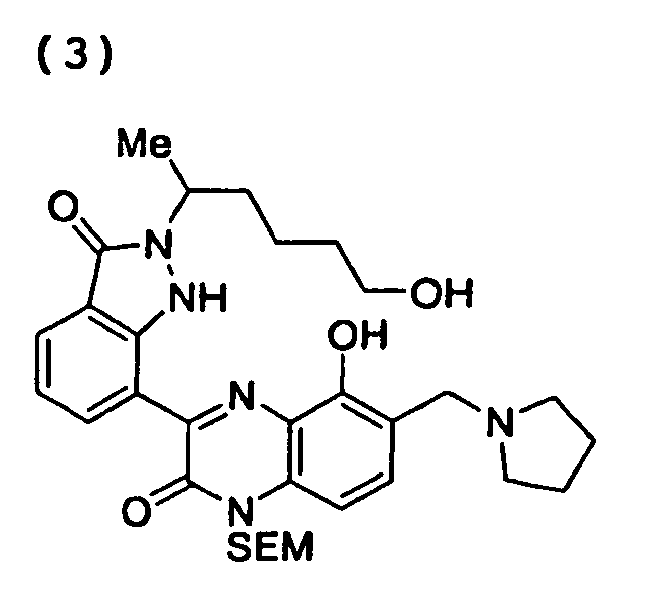
- The racemic triol derivative (55 mg, 0.10 mmol) obtained in the above (2) was dissolved in toluene (3 mL), and to the solution were added acetic acid (0.3 mL) and pyrrolidine (0.3 mL). The solution was stirred under heating at 50°C for 2 days. The resulting reaction solution was cooled down to room temperature, poured into water, and extracted twice with ethyl acetate. The organic layer was washed with saturated brine, dried over anhydrous magnesium sulfate, filtered and then concentrated in vacuo. The resulting residue was purified by a thin layer chromatography to obtain the racemic benzylamine derivative (46 mg) as an orange oil.

- According to a method similar to the procedures described in Working Examples 1-(5) to 1-(6), the hydrochloride (5 mg) of the objective compound [72] as a racemate was obtained as a yellow solid from the racemic benzylamine derivative (10 mg, 17 µmol) obtained in the above (3).
- Spectral data of the compound of the above formula [72] are shown below.
1H-NMR(DMSO-d6)δ:1.20(3H,d,J=6.5Hz),1.30-1.50(2H,m),1.80-2. 10(7H,m),2.20-2.40(1H,m),3.02-3.25(2H,m),3.30-3.42(1H,m),3. 42-3.55(1H,m),4.00-4.10(2H,m),4.30-4.50(3H,m),7.23(1H,d,J=8 .0Hz),7.25(1H,t,J=8.0Hz),7.87(1H,d,J=8.0Hz),7.88(1H,d,J=8.0 Hz),9.20(1H,d,J=8.0HZ),10.50-10.60(1H,m),10.84(1H,s),12.94( 1H,s).
mass:460(M+1)+. - Synthesis of the compound of the following formula [73]:

- According to a method similar to the procedures described in Working Examples 72-(3), and 1-(5) to 1-(6), the hydrochloride (28 mg) of the objective compound [73] as a racemate was obtained as a yellow solid from the racemic triol derivative (55 mg, 0.10 mmol) obtained in Working Example 72-(2) and piperidine.
- Spectral data of the compound of the above formula [73] are shown below.
1H-NMR(DMSO-d6)δ:1.19(3H,d,J=6.5Hz),1.30-1.50(2H,m),1.60-2. 05(9H,m),2.20-2.38(1H,m),2.80-2.95(1H,m),2.95-3.10(1H,m),3. 22-3.32(1H,m),3.36-3.46(1H,m),4.00-4.05(2H,m),4.30-4.50(3H, m),7.24(1H,d,J=8.0Hz),7.26(1H,t,J=8.0Hz),7.87(1H,d,J=8.0Hz) ,7.93(1H,d,J=8.0Hz),9.20(1H,d,J=8.0Hz),10.15-10.25(1H,m),10 .84(1H,s),12.95(1H,s).
mass:474(M+1)+. - Synthesis of the compound of the following formula [74]:


- According to a method similar to the procedure of Example 11-(1), a mixture (21.6 g) of the above 5-nitroquinoxalin-2-one derivative and the above 8-nitroquinoxalin-2-one derivative was obtained as a yellow solid from ethyl (2-fluoro-3-iodophenyl)oxoacetate (21.5 g, 66.8 mmol) obtained according to a method similar to the method of the general formula (II-d) described in
WO 02/02550 
- Chloromethyl 2-(trimethylsilyl)ethyl ether (10.0 mL, 56.3 mmol) was added to tetrahydrofuran solution (500 mL) containing a mixture (21.6 g) of the 5-nitroquinoxalin-2-one derivative and the 8-nitroquinoxalin-2-one derivative obtained in the above (1), and then sodium hydride (2.30 g, 60% dispersion in oil, 57.3 mmol) was added thereto under ice-cooling. After the resulting reaction solution was stirred at room temperature for 1.5 hours, aqueous ammonium chloride solution was added thereto, and the mixture was extracted with chloroform. After the organic layer was washed with saturated brine, it was dried over anhydrous magnesium sulfate, filtered, and concentrated in vacuo. To the resulting residue was added 4N hydrogen chloride/1,4-dioxane solution (100 mL), and the solution was stirred at room temperature for 1 hour. After removal of the insolubles by filtration, the filtrate was concentrated in vacuo. The resulting residue was purified by a column chromatography on silica gel to obtain the above 5-nitroquinoxaline-2-one derivative (11.6 g) protected with SEM, as a yellow solid.


- According to a method similar to the procedure described in Working Example 14-(5), the above ester derivative (8.06 g) was obtained as a yellow solid from the protected derivative with SEM (11.6 g, 21.4 mmol) obtained in the above (2).

- The ester derivative (191 mg, 0.40 mmol) obtained in the above (3) was dissolved in ethanol (10 mL), and to this solution were added saturated aqueous ammonium chloride solution (2 mL) and iron powder (110 mg). After the resulting reaction solution was heated under reflux for 20 minutes, saturated aqueous ammonium chloride solution (2 mL) and iron powder (300 mg) were added thereto. Further, after this reaction solution was heated under ref lux for 20 minutes, iron powder (500 mg) was added thereto. Then, the resulting reaction solution was heated under reflux for 20 minutes, cooled down to room temperature, and water and chloroform were added. After the reaction solution was filtered, the filtrate was extracted with chloroform, and dried over anhydrous magnesium sulfate. After removal of the insolubles by filtration, the filtrate was concentrated in vacuo to obtain the aniline derivative (168 mg) as a yellow solid.

- Hydrazine monohydrate (5 mL) was added to ethanol solution (20 mL) containing the aniline derivative (1.60 g, 3.61 mmol) obtained in the above (4), and the mixture was stirred at room temperature for 2 hours. The resulting reaction solution was concentrated in vacuo to obtain the above hydrazide derivative (1.60 g) as a yellow solid.

- According to a method similar to the procedure described in Working Example 11-(12),the above 3-indazolinone derivative (684 mg) was obtained as a yellow solid from the hydrazide derivative (1.60 g, 3.61 mmol) obtained in the above (5).


- The 3-indazolinone derivative (10 mg, 24 µmol)obtained in the above (6) was dissolved in N,N-dimethylformamide (1 mL), and then 1,5-diiodopentane (50 µL, 340 µmol) was added thereto. The mixture was stirred at 100°C for 3.5 hours. After the resulting reaction solution was cooled down to room temperature, it was concentrated invacuo. The resulting residue was purified by a thin layer chromatography to obtain the cyclic derivative (2.5 mg) as a yellow solid.

- According to a method similar to the procedure described in Working Example 1-(6), the objective compound [74] (1.8 mg) was obtained as a yellow solid from the cyclic derivative (2.5 mg, 5.1 µmol) obtained in the above (7).
- Spectral data of the compound of the above formula [74] are shown below.
1H-NMR(DMSO-d6)δ:1.62(2H,m),1.95(4H,m),3.20(4H,m),7.19(1H,t ,J=7.8Hz),7.20-7.70(4H,m),7.86(1H,d,J=7.8Hz),9.18(1H,br),12 .18(1H,br),12.78(1H,br).
mass:362(M+1)+. - Synthesis of the compound of the following formula [75]:

- According to a method similar to the procedures described in Working Examples 1-(2) to 1-(6), the objective compound [75] (10 mg) was obtained as a yellow solid from the carboxylic acid derivative (30 mg, 45 µmol) obtained in Working Example 1-(1) and 6-amino-1-hexanol.
- Spectral data of the compound of the above formula [75] are shown below.
1H-NMR(DMSO)δ:1.60-2.00(8H,m),3.80-3.90(2H,m),4.15-4.30(2H, m),6.90-6.98(2H,m),7.43-7.65(2H,m),8.01(1H,d,J=7.6Hz),9.51( 1H,d,J=7.8Hz),12.8(1H,brs).
mass:394(M+1)+. - Synthesis of the compound of the following formula [76]:


- Diisoproylethylamine (2.90 mL, 16.7 mmol), trioctylsilane (5.98 mL, 13.3 mmol) and dichloro-bistriphenylphosphine palladium (777 mg, 1.11 mmol) were successively added to a mixed solution of N,N-dimethylformamide (75 mL) and 1,4-dioxane (75 mL) containing the methoxyquinoxaline derivative (5.00 g, 11.1 mmol) obtained in Working Example 11-(3). The resulting reaction solution was stirred at 90°C for 30 minutes, and then cooled down to room temperature. After hexane and water were added to this reaction solution, it was filtered through a Celite pad and the filtrate was extracted with ethyl acetate. The resulting organic layer was washed with saturated brine, dried over anhydrous magnesium sulfate, filtered, and concentrated in vacuo. The resulting residue was purified by a column chromatography on silica gel to obtain the reduced derivative (4.10 g) as a gray solid.


- According to a method similar to the procedures described in Working Examples 11-(9) to 11-(12), the above alcohol derivative (2.13 g) was obtained as a yellow solid from the reduced derivative (4.10 g) obtained in the above (1).

- According to a method similar to the procedures described in Working Examples 11-(13) to 11-(16), and 11-(18), the hydrochloride (510 mg) of the objective compound [76] was obtained as a yellow solid from the reduced derivative (2.13 g) obtained in the above (2).
- Spectral data of the compound of the above formula [76] are shown below.
1H-NMR(DMSO)δ:1.75-2.40(3H,m),2.40-2.55(1H,m),3.00-3.35(2H, m),3.50-3.80(1H,m),3.82-4.35(3H,m),5.34-5.42(1H,m),6.96-7.2 7(3H,m),7.49-7.56(1H,m),7.84(1H,d,J=7.8Hz),9.20-9.30(1H,m) ,11.8-12.0(1H,m),12.7-12.8(1H,m).
mass:390(M+1)+. - Synthesis of the compound of the following formula [77]:

- In the formula, the stereo chemistry of the position with the symbol * is of cis-configuration.

- According to a method similar to the procedures described in Working Examples 1-(2) to 1-(3), the racemic benzoisothiazolone derivative (177 mg) was obtained as a yellow oil from the carboxylic acid derivative (665 mg, 1.00 mmol) obtained in Working Example 1-(1) and the racemate derivative [A-32].

- According to a method similar to the procedures described in Working Examples 14-(12) to 14-(13), and 1-(6), the objective compound [77](6 mg) as a racemate was obtained as a yellow solid from the racemic benzoisothiazolone derivative (177mg, 264 µmol) obtained in the above (1).
- Spectral data of the compound of the above formula [77] are shown below.
1H-NMR(DMSO-d6)δ:1.78-1.90(1H,m),1.95-2.04(2H,m),2.61-2.70( 2H,m),2.85-2.92(2H,m),4.50-4.58(1H,m),4.70-4.82(2H,m),7.00-7.02(2H,m),7.50-7.65(2H,m),8.05(1H,d,J=7.3Hz),9.01(1H,d,J=6 .6Hz),12.8(1H,brs).
mass:392(M+1)+. - Synthesis of the compound of the following formula [78]:

- According to a method similar to the procedures described in Working Examples 3-(1) to 3-(4) and 6, the hydrochloride (6 mg) of the objective compound [78] was obtained as a yellow solid from the carboxylic acid derivative (475 mg, 0.64 mmol) obtained in Working Example 14-(2) and the sulfonamide derivative [A-3-5].
- Spectral data of the compound of the above formula [78] are shown below.
1H-NMR(DMSO-d6)δ:2.30-4.80(11H,m),7.10(1H,s),7.45-7.70(2H,m ),7.97-8.05(1H,m),9.25-9.32(1H,m),12.9(1H,brs).
mass:473(M+1)+. - Synthesis of the compound of the following formula [79]:


- According to a method similar to the procedure described in Working Example 1-(4), the above phenol derivative (774 mg) was obtained as a white solid from the methyl ester derivative (1.00 g, 1. 74 mmol) which is a starting material of Example 1-(1).

- To tetrahydrofuran solution (20 mL) of the phenol derivative (774 mg, 1.74 mmol) obtained in the above (1) was added 40% toluene solution (1.52 mL) containing triphenylphosphine (912 mg, 3.48 mmol), allyl alcohol (202 mg, 3.48 mmol) and diethyl azodicarboxylate, and the mixture was stirred at room temperature for 30 minutes. After addition of water (100 µL), the reaction solution was concentrated in vacuo, and the resulting residue was purified by a column chromatography on silica gel to obtain the allyl ether derivative (725 mg) as a white solid.

- Xylene solution (100 mL) containing the allyl ether derivative (725 mg, 1.50 mmol) obtained in the above (2) was stirred at 180°C for 3 days. The reaction solution was concentrated, and the resulting residue was purified by a column chromatography on silica gel to obtain the above allyl rearrangement derivative (543 mg) as a white solid.

- Chloromethyl 2-(trimethylsilyl)ethylether(400 µL, 2.26 mmol) was added to tetrahydrofuran solution (20 mL) of the allyl rearrangement derivative (543 mg, 1.13 mmol) obtained in the above (3), under ice-cooling, and sodium hydride (90 mg, 60% dispersion in oil, 2.26 mmol) was added thereto. The mixture was stirred at room temperature for 2 hours. After saturated aqueous ammonium chloride solution was added to the reaction solution, it was extracted with ethyl acetate. The organic layer was washed with water and saturated brine, dried over anhydrous magnesium sulfate, and filtered. The filtrate was concentrated and the resulting residue was purified by a column chromatography on silica gel to obtain the protected derivative (695 mg) with SEM as a white solid.

- Ozone was bubbled at -78°C through a mixed solution of dichloromethane (14 mL) and methanol (6 mL) containing the derivative (1.00 g, 1.63 mmol) protected with SEM obtained in the above (4), and the mixture was stirred at the same temperature for 30 minutes. Nitrogen gas was bubbled through the solution, and dimethyl sulfide (5 ml) was added dropwise thereto. The reaction solution was warmed up to room temperature. After sodium tetrahydroborate (100 mg) was added thereto under ice-cooling, the mixture was stirred for 1 hour. After saturated aqueous ammonium chloride solution was added to the reaction solution, it was extracted with ethyl acetate. The organic layer was washed with water and saturated brine, dried over anhydrous magnesium sulfate, and filtered. The filtrate was concentrated, and the resulting residue was purified by silica gel chromatography on to obtain the hydroxyethyl derivative (800 mg) as a pale yellow solid.

- According to a method similar to the procedure described in Working Example 11-(8), the above derivative (820 mg) protected with THP was obtained as a pale yellow solid from the hydroxyethyl derivative (800 mg, 1.29 mmol) obtained in the above (5).

- According to a method similar to the procedures described in Working Examples 1-(1) to 1-(3), the above benzoisothiazolone derivative (129 mg) was obtained as a yellow solid from the derivative protected with THP (820 mg, 1.16 mmol) obtained in the above (6).


- According to a method similar to the procedures described in Working Examples 11-(19), and 14-(12) to 14-(13), the above cyclic derivative (42 mg) was obtained as a yellow solid from the benzoisothiazolone derivative (110 mg, 118 µmol) obtained in the above (7).

- According to a method similar to the procedure described in Working Example 11-(14), the above mesylated derivative (3.0 mg) was obtained as a yellow solid from the cyclic derivative (3.0 mg, 5.42 µmol) obtained in the above (8).

- The mesylated derivative (3.0 mg, 4.75 µmol) obtained in the above (9) was dissolved in toluene (450 µL), and to this solution were added pyrrolidine (45 µL) and aqueous sodium hydrogencarbonate solution (45 mg, 450 µL)) at room temperature. The mixture was stirred in a sealed tube at 130°C for 12 hours. After this reaction solution was cooled down to room temperature. it was extracted with ethyl acetate. The organic layer was washed with saturated brine, dried over anhydrous magnesium sulfate, and filtered. The filtrate was concentrated, and the resulting residue was purified by a column chromatography on silica gel to obtain the pyrrolidinoethyl derivative (3.0 mg) as a pale yellow solid.

- According to a method similar to the procedure described in Working Example 1-(6), the above hydrochloride (2 mg) of the objective compound [79] was obtained as a yellow solid from the pyrrolidinoethyl derivative (2.5 mg, 4.12 µmol) obtained in the above (10).
- Spectral data of the compound of the above formula [79] are shown below.
1H-NMR(DMSO-d6)δ:1.80-2.12(9H,m), 2.18-2.33(3H,m), 3.01-3.20( 4H,m),3.53-3.70(2H,m),3.71-3.85(2H,m),4.30-4.41(2H,m),7.20( 1H,d,J=8.7Hz),7.59(1H,d,J=8.7Hz),7.66(1H,dd,J=7.6Hz,8.0Hz), 8.08(1H,d,J=7.6Hz),9.53(1H,d,J=8.0Hz),10.15-10.32(1H,m),12. 94 (1H,s).
mass:477(M+1)+. - Synthesis of the compound of the following formula [80]:

- According to a method similar to the procedures described in Working Examples 79-(10) and 1-(6), the hydrochloride (2.0 mg) of the objective compound [80] was obtained as a yellow solid from the mesylated derivative (3 mg, 19 µmol) obtained in Working Example 79-(9) and piperidine (45 µL).
- Spectral data of the compound of the above formula [80] are shown below.
1H-NMR(DMSO-d6) δ:1.30-2.18(11H,m),2.19-2.36(3H,m),2.90-3.06 (2H,m),3.10-3.21(2H,m),3.50-3.65(2H,m),3.72-3.88(2H,m),4.28 -4.42(2H,m),7.21(1H,d,J=8.7Hz),7.57(1H,d,J=8.7Hz),7.66(1H,d d,J=7.4Hz,7.9Hz),8.08(1H,d,J=7.4Hz),9.53(1H,d,J=7.9Hz),9.70 -9.90(1H,m),12.93(1H,s).
mass:491(M+1)+. - Synthesis of the compound of the following formula [81]:

- According to a method similar to the procedure described in Working Examples 79-(10) and 1-(6), the hydrochloride (1.2 mg) of the objective compound [81] was obtained as a yellow solid from the mesylated derivative (3 mg, 19 µmol) obtained in Working Example 79-(9) and N-methylpiperazine (45 µL).
- Spectral data of the compound of the above formula [81] are shown below.
1H-NMR(DMSO-d6) δ:1.90-4.00 (23H,m), 4.28-4.42 (2H,m) 7.20(1H,d ,J=8.7Hz), 7.55-7.75 (2H,m), 8.08(1H,d,J=7.5Hz),9.30-9.48(1H,m ),9.53(1H,d,J=8.0Hz),12.94(1H,s).
mass:506(M+1)+. - Synthesis of the compound of the following formula [82]:

- According to a method similar to the procedures described in Working Examples 79-(10) and 1-(6), the hydrochloride (14.5 mg) of the objective compound [82] was obtained as a yellow solid from themesylated derivative (20mg, 19 µmol) obtained in Working Example 79-(9) and 4,4-difluoropiperidine (300 µL).
- Spectral data of the compound of the above formula [82] are shown below.
1H-NMR(DMSO-d6) δ:1.92-2.18(4H,m),2.20-2.78(6H,m),3.12-3.38( 5H,m),3.70-3.88(5H,m),4.28-4.42(2H,m),7.21(1H,d,J=8.5Hz),7. 57(1H,d,J=8.9Hz),7.66(1H,dd,J=7.4Hz,8.2Hz),8.08(1H,d,J=7.4H z),9.53(1H,d,J=8.2Hz), 10.70-10.88(1H,m), 12.93(1H,s).
mass:527(M+1)+. - Synthesis of the compound of the following formula [83]:


- N,N-Diisopropylethylamine (12.8 mL, 73.5 mmol) was added to chloroform solution (300 mL) containing the 3-indazolidinone derivative (10.0 g, 19.6 mmol) obtained in Working Example 11-(12), and methanesulfonyl chloride (5.00 mL, 64.6 mmol) was added dropwise thereto under ice-cooling. The mixture was stirred for 30 minutes. Water was added to the resulting reaction solution, and the organic layer was separated, washed successively with saturated aqueous sodium hydrogencarbonate, water and saturated brine, dried over anhydrous magnesium sulfate and filtered. The filtrate was concentrated. The resulting residue was dissolved in ethyl acetate, and the solution was washed with water. The resulting organic layer was dried over anhydrous magnesium sulfate, filtered, and concentrated. The resulting residue was dissolved in 1,4-dioxane (30 mL), and the pyrrolidine derivative [A-33] (11.9 g, 118 mmol) was added thereto. The mixture was stirred at 85°C for 2 hours and then cooled down to room temperature. The reaction solution was concentrated and the resulting residue was purified by a column chromatography on silica gel to produce the above amine derivative (9.61 g) as a yellow solid.

- According to a method similar to the procedures described in Working Examples 11-(14) to 11-(16), the above cyclic derivative (4.68 g) was obtained as a yellow solid from the amine derivative (9.61 g, 16.2 mmol) obtained in the above (1).


- To tetrahydrofuran solution (3 mL) containing the aldehyde derivative (171 mg, 384 µmol) obtained in the above (3) were added 2M isopropanol solution (6.2 mL) containing ammonia and anhydrous magnesium sulfate (1.49 g). After the reaction solution was stirred for 1 hour, manganese dioxide (1.27g) was added thereto, and the mixture was stirred for 15 hours. The resulting reaction solution was filtered through a Celite pad, and the mother liquor was concentrated. The residue was purified by a silica gel chromatography to obtain the above nitrile derivative (106 mg) as an orange solid.

- To tetrahydrofuran solution (1 mL) containing the nitrile derivative (11 mg, 24.8µmol) obtained in the above (4) was added 1M tetrahydrofuran solution (1 mL) containing lithium bis (trimethylsilyl) amide at room temperature, and the solution was stirred for 15 minutes. The reaction solution was subjected to ice-cooling, and 6N hydrogen chloride/ethanol (1 mL) was added dropwise. The solution was stirred at room temperature for 30 minutes. After the reaction solution was diluted in diethyl ether, the resulting precipitates were filtered off, and washed with diethyl ether. The resulting precipitates were dissolved in methanol, and the solution was diluted with ethyl acetate and water. After N,N-diisopropylethylamine (3 mL) and sodium chloride were added to the mixed solution until the aqueous layer was saturated with them, the organic layer was separated. The resulting organic layer was washed with saturated brine, dried over anhydrous magnesium sulfate, and filtered. The filtrate was concentrated, and chloroform (2 mL) was added to the resulting residue. The mixture was stirred for 15 minutes to give a suspension. After 4N hydrogen chloride/1,4-dioxane (100 µL) was added dropwise to the suspension, diethyl ether (3 mL) was added thereto. The resulting precipitates were filtered off, washed with diethyl ether, and dried in vacuo to obtain the above amidine derivative (9.7 mg) as a purple solid.


- The amidine derivative (4.6 mg, 8.63 µmol) obtained in the above (5) was suspended in 1,1,3,3-tetramethoxypropane (500 µL). The suspension was stirred in a sealed tube at 180°C for 2 hours. The reaction solution was cooled down to room temperature, and diluted with methanol. After triethylamine (1 mL) was added to the suspension, it was concentrated in vacuo. The resulting residue was purified by a silica gel chromatography to obtain the hydrochloride (0.90 mg) of the objective compound [83] as an orange solid.
- Spectral data of the compound of the above formula [83] are shown below.
1H-NMR(DMSO-d6) δ : 0.60-0.80 (3H,m), 1.00-4.00(8H,m) , 4.40-4.55( 1H,m), 5.32-5.42(1H,m), 7.12-7.23(1H,m), 7.48-7.57(1H,m) , 7.84-7.95(2H,m) , 8.09(1H,s) , 8.95-9.03(2H,m) , 9.42-9.53(1H,m), 12.29 -12.40(1H,m), 12.81 (1H,brs).
mass:482(M+1)+. - Synthesis of the compound of the following formula [84]:
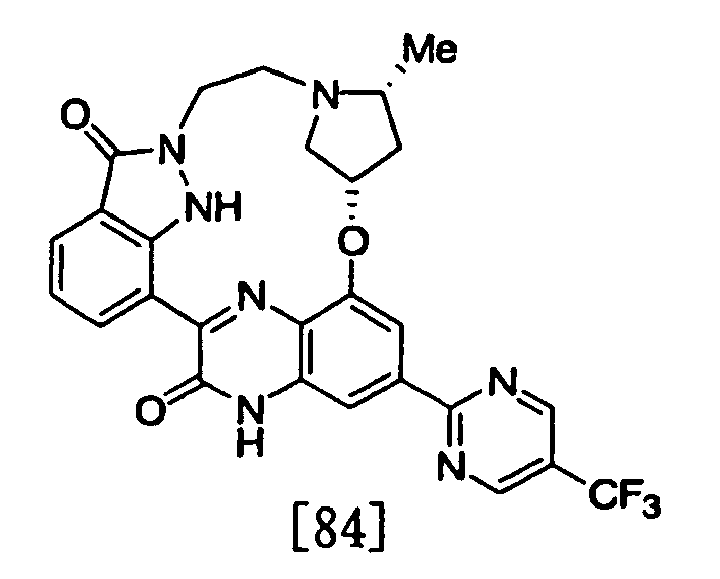
- The amidine derivative (5.0 mg, 9.4 µmol) obtained in Working Example 83-(5) was suspended in acetonitrile (2 mL). To the suspension were added β-trifluoromethyl vinamidinium chloride (4.4 mg, 18.8 µool) synthesized according to a method similar to the method described in Tetrahedron Lett., 37(11) 1829 (1996) and 1.0 M methanol solution (22.5 µL, 22.5 µmol) containing sodium methoxide. The mixture was stirred at room temperature for 2.5 hours. Water was added to the reaction solution, and it was extracted with amixed solvent of chloroform : methanol = 9 : 1. The organic layer was washed with saturated brine, dried over anhydrous sodium sulfate, and filtered. The filtrate was concentrated, and the resulting residue was purified by a thin layer chromatography, followed by treatment according to a method similar to the procedure described in Working Example 1-(6), thereby to obtain the hydrochloride (2.5 mg) of the objective compound [84] as a brown solid
- Spectral data of the compound of the above formula [84] are shown below.
1H-NMR(DMSO-d6) δ : 0.64-0.78(3H,m), 1.35-1.45(1H,m), 2.23-2.40( 2H,m),2.52-2.63(1H,m), 2.71-2.85(1H,m) , 2.94-3.08(1H,m), 3.77-3.91(2H,m), 4.44-4.51(1H,m), 5.35-5.39(1H,m), 7.13-7.20(1H,m), 7.84-7.91(2H,m), 8.12(1H,s),9.39(2H,s), 9.45(1H,d,J=7.8Hz),12 .28-12.30(1H,m),12.9(1H,s).
mass:550(M+1)+. - Synthesis of the compound of the following formula [85]:

- 3-(Dimethylamino)-2-methyl-2-propenal (4.5 mg, 39.4 µmol) and 1.0 M methanol solution (47.3 µL, 47.3 µmol) containing sodium methoxide were added to methanol solution (3.0 mL) containing the amidine derivative (10.5 mg, 19.7 µmol) obtained in Working Example 83-(5). The solution was heated at reflux with stirring for 6.5 hours. Further, 3-(dimethylamino)-2-methyl-2-propenal (27.0 mg, 238 µmol) and 1.0 M methanol solution (284 µL, 284 µmol) containing sodium methoxide were added thereto. The mixture was heated at reflux with stirring for 18 hours. After the resulting reaction solution was cooled down to room temperature, water was added to the solution, which was then extracted with a mixed solvent of chloroform : methanol = 9 : 1. The organic layer was washed with saturated brine, dried over anhydrous sodium sulfate, filtered. The filtrate was concentrated, and the resulting residue was purified by a thin layer chromatography, followed by treatment according to a method similar to the procedure described in Working Example 1-(6), thereby to obtain the hydrochloride (4.8 mg) of the objective compound [85] as a deep purple solid.
- Spectral data of the compound of the above formula [85] are shown below.
1H-NMR(DMSO-d6)δ:0.66-0.90(3H,m),1.38-1.47(1H,m),2.31(3H,s) ,2.25-2.41(2H,m),2.75-3.20(2H,m),3.82-3.93(2H,m),4.25-4.56( 2H,m),5.36-5.42(1H,m),7.15-7.23(1H,m),7.87(1H,d,J=7.8Hz),7. 89(1H,s),8.06(1H,s),8.81(2H,s),9.40-9.47(1H,m),12.2-12.4(1H ,m),12.8(1H,s).
mass:496(M+1)+. - Synthesis of the compound of the following formula [86]:

- The amidine derivative (9.9 mg, 18.6 µmol) obtained in Working Example 83-(5) was suspended in ethanol (3 mL), and to the suspension were added 2-methoxymethylene cyclohexanone (5.2 mg, 37.2 µmol) synthesized according to a method similar to the method described in J. Heterocycl. Chem., 27, 1537 (1990) and sodium acetate (3.7 mg, 44.6 µmol). The mixture was stirred under heating at reflux for 6.5 hours. Then, after further addition of 2-methoxymethylene cyclohexanone (10.4 mg, 74.3 µmol) and sodium acetate (37.3 mg, 89.3 µmol), the mixture was stirred under heating at reflux for 10 hours. The resulting reaction solution was cooled down to room temperature, and 10% aqueous sodium carbonate solution (2 mL) was added thereto. The mixture was stirred at room temperature for 5 minutes and then extracted with a mixed solvent of chloroform : methanol = 9 : 1. The organic layer was washed with water and saturated brine, dried over anhydrous sodium sulfate, and filtered. The filtrate was concentrated, and the resulting residue was purified by thin layer chromatography, followed by treatment according to a method similar to the procedure described in Working Example 1-(6), thereby to obtain the hydrochloride (0.4 mg) of the objective compound [86] as a brown solid.
- Spectral datum of the compound of the above formula [86] is shown below.
mass:536(M+1)+. - Synthesis of the compound of the following formula [87]:

- To methanol solution (3.0 mL) containing the amidine derivative (10.0 mg, 18.8 µmol) obtained in Working Example 83-(5) were added acetylacetaldehyde dimetyhlacetal (5.0 µL, 37.6 µmol) and 1.0 M methanol solution(45.1 µL, 45.1 µmol) containing sodium methoxide. The mixture was stirred at 50°C for 4.5 hours. Then, acetylacetaldehyde dimetyhlacetal (10.0 µL, 75.2 µmol) and 1.0 M methanol solution (90.2 µL, 90.2 µmol) containing sodium methoxide were added thereto. The mixture was stirred at 50°C for 13 hours. After the resulting reaction solution was cooled down to room temperature, water was added thereto, and the reaction solution was extracted with a mixed solvent of chloroform : methanol = 9 : 1. The organic layer was washed with saturated brine, dried over anhydrous sodium sulfate, and filtered. The filtrate was concentrated and the resulting residue was purified by a thin layer chromatography, followed by treatment according to a method similar to the procedure described in Working Example 1-(6), thereby to obtain the hydrochloride (7.2 mg) of the objective compound [87] as a deep purple solid.
- Spectral data of the compound of the above formula [87] are shown below.
1H-NMR(DMSO-d6)δ:0.67-0.82(3H,m),1.40-1.45(1H,m),2.25-2.42( 2H,m),2.58(3H,s),2.56-3.07(3H,m),3.83-3.98(2H,m),4.50-4.65( 1H,m),5.34-5.41(1H,m),7.15-7.24(1H,m),7.40(1H,d,J=5.1Hz),7. 88(1H,d,J=8.1Hz),7.92(1H,s),8.10(1H,s),8.80(1H,d,J=5.1Hz),9 .38-9.45(1H,m),12.2-12.3(1H,m),12.8(1H,s).
mass:496(M+1)+. - Synthesis of the compound of the following formula [88]:


- Acetylacetone (7.7 µL, 75.1 µmol) and acetic acid (8.6 µL, 150 µmol) were added to 1-pentanol solution (4.0 mL) containing the amidine derivative (10.0 mg, 18.8 µmol) obtained in Working Example 83-(5). The mixture was stirred at 135°C for 1.5 hours. Acetylacetone (77.2 µL, 751 µmol) and acetic acid (86.0 µL, 1.50 mmol) were further added thereto. The mixture was stirred at 135°C for 27 hours. The resulting reaction solution was cooled down to room temperature, and saturated aqueous sodium hydrogencarbonate was added to the reaction solution. The solution was extracted with a mixed solvent of chloroform : methanol = 9 : 1. The organic layer was washed with water and saturated brine, dried over anhydrous sodium sulfate, and filtered. The filtrate was concentrated and the resulting residue was purified by a thin layer chromatography, followed by treatment according to a method similar to the procedure described in Working Example 1-(6), thereby to obtain the hydrochloride (1.3 mg) of the objective compound [88] as a deep purple solid.
- Spectral data of the compound of the above formula [88] are shown below.
1H-NMR(DMSO-d6)δ:0.65-0.79(3H,m),1.38-1.59(1H,m),2.08-2.50( 3H,m),2.55(6H,s),2.78-3.08(2H,m),3.71-3.90(2H,m),4.44-4.49( 1H,m),5.32-5.38(1H,m),7.13-7.26(1H,m),7.27(1H,s),7.90(1H,d, J=8.1Hz),7.90(1H,s),8.10(1H,s),9.40-9.47(1H,m),12.2-12.4(1H ,m),12.7(1H,s).
mass:510(M+1)+. - Synthesis of the compound of the following formula [89]:

- Hydroxylamine (12.6mg, 181 µmol) and triethylamine (25.2 µg, 181 µmol) were added to methanol solution (4.0 mL) containing the nitrile derivative (20 mg, 45.2 µmol) obtained in Working Example 83-(4). The mixture was stirred at room temperature for 10 hours. Hydroxylamine (12.6 mg, 181 µmol) and triethylamine (25.2 pg, 181 µmol) were further added thereto. The mixture was stirred at room temperature for 3 days. The resulting reaction solution was concentrated in vacuo. Acetic anhydride (15 mL) was added to the resulting residue, and the mixture was stirred at 100°C for 24 hours. After the resulting reaction solution was concentrated in vacuo, it was evaporated azeotropically using toluene. The resulting residue was dissolved in tetrahydrofuran (10 mL) and methanol (10 mL), and 1N sodium hydroxide (10 mL) was added to the solution. The solution was stirred at room temperature for 30 minutes. After the resulting reaction solution was neutralized using 1N hydrochloric acid, it was extracted with a mixed solvent of chloroform : methanol = 9 : 1. The organic layer was washed with water and saturated brine, dried over anhydrous sodium sulfate, and filtered. The filtrate was concentrated and the resulting residue was purified by a thin layer chromatography, followed by treatment according to a method similar to the procedure described in Working Example 1-(6), thereby to obtain the hydrochloride (8.4 mg) of the objective compound [89] as an ocher solid.
- Spectral data of the compound of the above formula [89] are shown below.
1H-NMR(DMSO-d6)δ : 0.65-0.76(3H,m), 1.35-1.41(1H,m),2.25-2.45( 2H,m),2.69(3H,s),2.55-2.80(2H,m),2.91-3.05(1H,m),3.77-3.94( 2H,m),4.42-4.51(1H,m),5.36-5.41(1H,m),7.14-7.21(1H,m),7.48( 1H,s),7.62(1H,s),7.85(1H,d,J=7.8Hz),9.44(1H,d,J=7.8Hz),12.2 5-12.29(1H,m),12.8(1H,s).
mass:486(M+1)+. - Synthesis of the compound of the following formula [90]:


- According to a method similar to the procedures described in Working Examples 11-(10) to 11-(11), the above hydrazide derivative (24.3 g) was obtained as an orange solid from the carboxylic acid derivative (24.4 g, 36.9 mmol) obtained in Working Example 49-(1).

- N,N-Diisopropylethylamine (13.3 mL, 76.3 mmol) was added to n-butanol solution (200 mL) containing the hydrazide derivative (22.2 g, 27.3 mmol) obtained in the above (1). The mixture was stirred at 120 °C for 5 hours. After that, the resulting reaction solution was cooled down to room temperature, and concentrated in vacuo to give a residue, to which was added ether (200 mL). The resulting solid was filtered off and dried in vacuo, followed by treatment according to a method similar to the procedure described in Working Example 15-(4), thereby to obtain the above alcohol derivative (17.5 g, 25.8mmol) as a yellow solid

- According to a method similar to the procedure described in Working Example 83-(1), the above amine derivative (10.6 g) was obtained as a yellow solid from the alcohol derivative (12.5 g, 18.4 mmol) obtained in the above (2).

- According to a method similar to the procedures described in Working Examples 1-(4) to 1-(5), the above cyclic derivative (7.06 g) was obtained as a yellow solid from the amine derivative (9.78 g, 12.8 mmol) obtained in the above (3).

- The cyclic derivative (15 mg, 24.5 µmol) obtained in the above (4) was dissolved in a mixture of 1,2-dimethoxyethane and water (9:1) (1 mL). To the solution were added tetrakis(triphenylphospine)palladium (10 mg), potassium carbonate (10 mg) and dimethyl 2-pyridylboronate (10 mg), and the mixture was stirred at 85°C for 12 hours. Water and ethyl acetate were added to the resulting reaction solution, and the organic layer was separated, then washed successively with water and saturated brine. This organic layer was dried over anhydrous magnesium sulfate, filtered, and concentrated. The resulting residue was purified by a silica gel chromatography to obtain the above pyridine derivative (5 mg) as a yellow solid.

- According to a method similar to the procedure described in Working Example 11-(18), the trifluoroacetate (2.4 mg) of the objective compound [90] was obtained as a dark yellow solid from the pyridine derivative (5 mg, 8.19 µmol) obtained in the above (5).
- Spectral data of the compound of the above formula [90] are shown below.
1H-NMR(DMSO-d6)δ:0.68-0.70(3H,m),1.38-1.44(1H,m),2.24-2.38( 1H,m),2.40-2.60(2H,m),2.70-2.79(1H,m),2.90-3.02(1H,m),3.76-3.86(2H,m),4.41-4.48(1H,m),5.38-5.40(1H,m),7.12-7.18(1H,m), 7.40-7.42(1H,m),7.66(1H,s),7.70(1H,s),7.81-7.84(1H,m),7.90-8.00(1H,m),8.01-8.02(1H,m),8.70-8.72(1H,m),9.42-9.44(1H,m), 12.3(1H,bs),12.7(1H,bs).
mass:481(M+1)+. - Synthesis of the compound of the following formula [91]:

- According to a method similar to the procedures described in Working Examples 90-(5) and 11-(18), the trifluoroacetate (1.9 mg) of the objective compound [91] was obtained as a dark yellow solid from the cyclic derivative (15 mg, 24.5 µmol) obtained in Working Example 90-(4) and pyrimidine-5-boronic acid.
- Spectral datum of the compound of the above formula [91] is shown below.
mass:482(M+1)+. - Synthesis of the compound of the following formula [92]:

- According to a method similar to the procedures described in Working Examples 90-(5) and 11-(18), the hydrochloride (7.7 mg) of the objective compound [92] was obtained as a dark yellow solid from the cyclic derivative (50 mg, 81.6 µmol) obtained in Working Example 90-(4) and thiazole-2-boronic acid.
- Spectral datum of the compound of the above formula [92] is shown below.
mass:487(M+1)+. - Synthesis of the compound of the following formula [93]:

- According to a method similar to the procedures described in Working Examples 90-(5) and 11-(18), the trifluoroacetate (2.6 mg) of the objective compound [93] was obtained as a dark yellow solid from the cyclic derivative (10 mg, 16.3 µmol) obtained in Working Example 90-(4) and 5-acetyl-2-thiopheneboronic acid.
- Spectral datum of the compound of the above formula [93] is shown below.
mass:528(M+1)+. - Synthesis of the compound of the following formula [94]:

- According to a method similar to the procedures described in Example 90-(5) and 11-(18), the trifluoroacetate (7.3 mg) of the objective compound [94] was obtained as a dark purple solid from the cyclic derivative (10 mg, 16.3 µmol) obtained in Working Example 90-(4) and pyridine-3-boronic acid.
- Spectral datum of the compound of the above formula [94] is shown below.
mass:481(M+1)+. - Synthesis of the compound of the following formula [95]:

- According to a method similar to the procedures described in Example 90-(5) and 11-(18), the trifluoroacetate (5.9 mg) of the objective compound [95] was obtained as a dark yellow solid from the cyclic derivative (10 mg, 16.3 µmol) obtained in Working Example 90-(4) and pyridine-4-boronic acid.
- Spectral datum of the compound of the above formula [95] is shown below.
mass:481(M+1)+. - Synthesis of the compound of the following formula [96]:


- The cyclic derivative (20 mg, 32.7 µmol) obtained in Working Example 90-(4) was dissolved in 1,4-dioxane (1 mL). To this solution were added 2-pyrrolidinone (4.97 µL, 65.4 µmol), 4,5-bis(diphenylphosphino)-9,9-dimethylxanthene (5.68 mg, 9.81 µmol), tris(dibenzylideneacetone)dipalladium(0)-chloroform adduct (3.38 mg, 3.27 µmol) and cesium carbonate (23.4 mg, 71.9 µmol). The mixture was stirred at 110°C for 1 hour under an argon atmosphere. The resulting reaction solution was cooled down to room temperature and concentrated in vacuo. The resulting residue was purified by a thin layer chromatography to obtain the above amide derivative (18 mg) as a yellow solid.


- According to a method similar to the procedure described in Working Example 1-(6), the hydrochloride (14 mg) of the objective compound [96] was obtained as a dark purple solid from the amide derivative (18 mg, 29.2 µmol) obtained in the above (1).
- Spectral data of the compound of the above formula [96] are shown below.
1H-NMR(DMSO-d6)δ:0.58-0.75(3H,m),1.22-1.45(1H,m),2.00-4.00( 13H,m),4.35-4.53(1H,m),5.18-5.28(1H,m),7.07-7.20(1H,m),7.29 -7.42(2H,m),7.78-7.86(1H,m),9.37-9.43(1H,m),12.25(1H,brs),1 2.56(1H,s).
mass:487(M+1)+. - Synthesis of the compound of the following formula [97]:

- According to a method similar to the procedures described in Working Examples 96-(1) and 1-(6), the hydrochloride (3.3 mg) of the objective compound [97] was obtained as a dark purple solid from the cyclic derivative (10 mg, 16.3 µmol) obtained in Working Example 90-(4) and indole.
- Spectral datum of the compound of the above formula [97] is shown below.
mass:519(M+1)+. - Synthesis of the compound of the following formula [98]:

- According to a method similar to the procedures described in Working Examples 96-(1) and 1-(6), the trifluoroacetate (5.9 mg) of the objective compound [98] was obtained as a dark purple solid from the cyclic derivative (10 mg, 16.3 µmol) obtained in Working Example 90-(4) and 3,5-dimethylpyrazole.
- Spectral datum of the compound of the above formula [98] is shown below.
mass:498(M+1)+. - Synthesis of the compound of the following formula [99]:

- According to a method similar to the procedures described in Working Examples 96-(1) and 1-(6), the trifluoroacetate (4.6 mg) of the objective compound [99] was obtained as a dark purple solid from the cyclic derivative (10 mg, 16.3 µmol) obtained in Working Example 90-(4) and indazole.
- Spectral datum of the compound of the above formula [99] is shown below.
mass:520(M+1)+. - Synthesis of the compound of the following formula [100]:

- According to a method similar to the procedures described in Working Examples 96-(1) and 1-(6), the trifluoroacetate (6.3 mg) of the objective compound [100] was obtained as a dark purple solid from the cyclic derivative (10 mg, 16.3 µmol) obtained in Working Example 90-(4) and 7-azaindole.
- Spectral datum of the compound of the above formula [100] is shown below.
mass:520(M+1)+. - Synthesis of the compound of the following formula [101]:

- According to a method similar to the procedures described in Working Examples 90-(5) and 11-(18), the hydrochloride (14.5 mg) of the objective compound [101] was obtained as a dark purple solid from the cyclic derivative (30 mg, 49.0 µmol) obtained in Working Example 90-(4) and 3,5-dimethylphenylboronic acid.
- Spectral datum of the compound of the above formula [101] is shown below.
mass:508(M+1)+. - Synthesis of the compound of the following formula [102]:

- According to a method similar to the procedures described in Working Examples 90-(5) and 11-(18), the hydrochloride (7.0 mg) of the objective compound [102] was obtained as a dark purple solid from the cyclic derivative (10 mg, 16.3 µmol) obtained in Working Example 90-(4) and phenylboronic acid.
- Spectral datum of the compound of the above formula [102] is shown below.
mass:480(M+1)+. - Synthesis of the compound of the following formula [103]:

- According to a method similar to the procedures described in Working Examples 90-(5) and 11-(18), the trifluoroacetate (5.1 mg) of the objective compound [103] was obtained as a dark purple solid from the cyclic derivative (10 mg, 16.3 µmol) obtained in Working Example 90-(4) and 3-(trifluoromethoxy)phenylboronic acid.
- Spectral datum of the compound of the above formula [103] is shown below.
mass:564(M+1)+. - Synthesis of the compound of the following formula [104]:

- According to a method similar to the procedures described in Working Examples 90-(5) and 11-(18), the trifluoroacetate (9.0 mg) of the objective compound [104] was obtained as a dark purple solid from the cyclic derivative (10 mg, 16.3 µmol) obtained in Working Example 90-(4) and 3,4-dimethoxyphenylboronic acid.
- Spectral datum of the compound of the above formula [104] is shown below.
mass:540(M+1)+. - Synthesis of the compound of the following formula [105]:

- According to a method similar to the procedures described in Working Examples 90-(5) and 11-(18), the hydrochloride (5.2 mg) of the objective compound [105] was obtained as a dark purple solid from the cyclic derivative (10 mg, 16.3 µmol) obtained in Working Example 90-(4) and 2,2-difluorobenzodioxole-5-boronic acid.
- Spectral datum of the compound of the above formula [105] is shown below.
mass:560(M+1)+. - Synthesis of the compound of the following formula [106]:

- According to a method similar to the procedures described in Working Examples 90-(5) and 11-(18), the hydrochloride (1.1 mg) of the objective compound [106] was obtained as a dark purple solid from the cyclic derivative (10 mg, 16.3 µmol) obtained in Working Example 90-(4) and4-(difluoromethoxy)phenylboronic acid.
- Spectral datum of the compound of the above formula [106] is shown below.
mass:546(M+1)+. - Synthesis of the compound of the following formula [107]:

- According to a method similar to the procedures described in Working Examples 90-(5) and 11-(18), the trifluoroacetate (20.9 mg) of the objective compound [107] was obtained as a dark purple solid from the cyclic derivative (20 mg, 32.6 µmol) obtained in Working Example 90-(4) and 3-methoxyphenylboronic acid.
- Spectral datum of the compound of the above formula [107] is shown below.
mass:510(M+1)+. - Synthesis of the compound of the following formula [108]:

- According to a method similar to the procedures described in Working Examples 90-(5) and 11-(18), the trifluoroacetate (14.3 mg) of the objective compound [108] was obtained as a dark purple solid from the cyclic derivative (20 mg, 32.6 µmol) obtained in Working Example 90-(4) and 3-acetylphenylboronic acid.
- Spectral datum of the compound of the above formula [108] is shown below.
mass:522(M+1)+. - Synthesis of the compound of the following formula [109]:

- According to a method similar to the procedures described in Working Examples 90-(5) and 11-(18), the trifluoroacetate (13.2 mg) of the objective compound [109] was obtained as a dark purple solid from the cyclic derivative (20 mg, 32.6 µmol) obtained in working Example90-(4)and 3-acetamidophenylboronic acid.
- Spectral datum of the compound of the above formula [109] is shown below.
mass:537(M+1)+. - Synthesis of the compound of the following formula [110]:

- According to a method similar to the procedures described in Working Examples 90-(5) and 11-(18), the trifluoroacetate (8.8 mg) of the objective compound [110] was obtained as a dark purple solid from the cyclic derivative (20 mg, 32.6 µmol) obtained in Working Example 90-(4) and 3-isopropylphenylboronic acid.
- Spectral datum of the compound of the above formula [110] is shown below.
mass:522(M+1)+. - Synthesis of the compound of the following formula [111]:

- According to a method similar to the procedures described in Working Examples 90-(5) and 11-(18), the trifluoroacetate (10.7 mg) of the objective compound [111] was obtained as a dark purple solid from the cyclic derivative (20 mg, 32.6 µmol) obtained in Working Example 90-(4) and 3,5-difluorophenylboronic acid.
- Spectral datum of the compound of the above formula [111] is shown below.
mass:516(M+1)+. - Synthesis of the compound of the following formula [112]:

- According to a method similar to the procedures described in Working Examples 90-(5) and 11-(18), the trifluoroacetate (8.6 mg) of the objective compound [112] was obtained as a dark purple solid from the cyclic derivative (10 mg, 16.3 µmol) obtained in Working Example 90-(4) and 2-methoxyphenylboronic acid.
- Spectral datum of the compound of the above formula [112] is shown below.
mass:510(M+1)+. - Synthesis of the compound of the following formula [113]:

- According to a method similar to the procedures described in Working Examples 90-(5) and 11-(18), the trifluoroacetate (5.3 mg) of the objective compound [113] was obtained as a dark purple solid from the cyclic c derivative (10 mg, 16.3 µmol) obtained in Working Example 90-(4) and 4-methoxyphenylboronic acid.
- Spectral datum of the compound of the above formula [113] is shown below.
mass:510(M+1)+. - Synthesis of the compound of the following formula [114]:

- According to a method similar to the procedures described in Working Examples 90-(5) and 11-(18), the trifluoroacetate (6.8 mg) of the objective compound [114] was obtained as a dark purple solid from the cyclic derivative (10 mg, 16.3 µmol) obtained in Working Example 90-(4) and 2-nitrophenylboronic acid.
- Spectral datum of the compound of the above formula [114] is shown below.
mass:525(M+1)+. - Synthesis of the compound of the following formula [115]:

- According to a method similar to the procedures described in Working Examples 90-(5) and 11-(18), the trifluoroacetate (8.5 mg) of the objective compound [115] was obtained as a dark purple solid from the cyclic derivative (10 mg, 16.3 µmol) obtained in Working Example 90-(4) and 4-aminophenylboronic acid.
- Spectral datum of the compound of the above formula [115] is shown below.
mass:495(M+1)+. - Synthesis of the compound of the following formula [116]:

- According to a method similar to the procedures described in Working Examples 90-(5) and 11-(18), the trifluoroacetate (1.3 mg) of the objective compound [116] was obtained as a dark purple solid from the cyclic derivative (10 mg, 16.3 µmol) obtained in Working Example 90-(4) and 4-hydroxyphenylboronic acid.
- Spectral datum of the compound of the above formula [116] is shown below.
mass:496(M+1)+. - Synthesis of the compound of the following formula [117]:

- According to a method similar to the procedures described in Working Examples 90-(5) and 11-(18), the trifluoroacetate (10.8 mg) of the objective compound [117] was obtained as a dark purple solid from the cyclic derivative (10 mg, 16.3 µmol) obtained in Working Example 90-(4) and 3-aminophenylboronic acid.
- Spectral datum of the compound of the above formula [117] is shown below.
mass:495(M+1)+. - Synthesis of the compound of the following formula [118]:

- According to a method similar to the procedures described in Working Examples 90-(5) and 11-(18), the trifluoroacetate (5.6 mg) of the objective compound [118] was obtained as a dark purple solid from the cyclic derivative (10 mg, 16.3 µmol) obtained in Working Example 90-(4) and 4-(trifluoromethoxy)phenylboronic acid.
- Spectral datum of the compound of the above formula [118] is shown below.
mass:564(M+1)+. - Synthesis of the compound of the following formula [119]:

- According to a method similar to the procedures described in Working Examples 90-(5) and 11-(18), the trifluoroacetate (5.5 mg) of the objective compound [119] was obtained as a dark purple solid from the cyclic derivative (10 mg, 16.3 µmol) obtained in Working Example 90-(4) and 4-(N,N-dimethylaminocarbonyl)phenylboronic acid.
- Spectral datum of the compound of the above formula [119] is shown below.
mass:551(M+1)+. - Synthesis of the compound of the following formula [120]:

- According to a method similar to the procedures described in Working Examples 90-(5) and 11-(18), the trifluoroacetate (4.8 mg) of the objective compound [120] was obtained as a dark purple solid from the cyclic derivative (10 mg, 16.3 µmol) obtained in Working Example 90-(4) and 4-(pyrrolidine-1-carbonyl)phenylboronic acid.
- Spectral datum of the compound of the above formula [120] is shown below.
mass:577(M+1)+. - Synthesis of the compound of the following formula [121]:

- According to a method similar to the procedures described in Working Examples 90-(5) and 11-(18), the trifluoroacetate (7.3 mg) of the objective compound [121] was obtained as a dark purple solid from the cyclic derivative (10 mg, 16.3 µmol) obtained in Working Example 90-(4) and 4-methylsulfonylphenylboronic acid.
- Spectral datum of the compound of the above formula [121] is shown below.
mass:558(M+1)+. - Synthesis of the compound of the following formula [122]:

- According to a method similar to the procedures described in Working Examples 43-(1) and 1-(6), the trifluoroacetate (1.5 mg) of the objective compound [122] was obtained as a dark purple solid from the cyclic derivative (10 mg, 16.3 µmol) obtained in Working Example 90-(4) and pyrrolidine.
- Spectral data of the compound of the above formula [122] are shown below.
1H-NMR(DMSO-d6)δ:0.60-0.80(3H,m),1.30-1.50(1H,m),1.95-4.38( 15H,m),4.38-4.50(1H,m),5.18-5.28(1H,m),5.93(1H,s),6.30(1H,s ),7.02-7.18(1H,m),7.65-7.75(1H,m),9.22-9.30(1H,m),12.02-12. 23(2H,m).
mass:473(M+1)+. - Synthesis of the compound of the following formula [123]:

- According to a method similar to the procedures described in Working Examples 43-(1) and 1-(6), the trifluoroacetate (1.7 mg) of the objective compound [123] was obtained as a dark purple solid from the cyclic derivative (10 mg, 16.3 µmol) obtained in Working Example 90-(4) and (S)-2-methoxymethylpyrrolidine.
- Spectral datum of the compound of the above formula [123] is shown below.
mass:517(M+1)+. - Synthesis of the compound of the following formula [124]:

- According to a method similar to the procedures described in Working Examples 43-(1) and 1-(6) , the trifluoroacetate (1.5 mg) of the objective compound [124] was obtained as a dark purple solid from the cyclic derivative (10 mg, 16.3 µmol) obtained in Working Example 90-(4) and 3-azabicyclo[3,2,2]nonane.
- Spectral datum of the compound of the above formula [124] is shown below.
mass:527(M+1)+. - Synthesis of the compound of the following formula [125]:

- According to a method similar to the procedures described in Working Examples 43-(1) and 1-(6), the trifluoroacetate (1.9 mg) of the objective compound [125] was obtained as a dark purple solid from the cyclic derivative (10 mg, 16.3 µmol) obtained in Working Example 90-(4) and (R)-2-methoxymethylpyrrolidine.
- Spectral datum of the compound of the above formula [125] is shown below.
mass:517(M+1)+. - Synthesis of the compound of the following formula [126]:

- According to a method similar to the procedures described in Working Examples 43-(1) and 1-(6), the trifluoroacetate (1.4 mg) of the objective compound [126] was obtained as a dark purple solid from the cyclic derivative (10 mg, 16.3 µmol) obtained in Working Example 90-(4) and 4-methylpiperidine.
- Spectral datum of the compound of the above formula [126] is shown below.
mass:501(M+1)+. - Synthesis of the compound of the following formula [127]:

- According to a method similar to the procedures described in Working Examples 43-(1) and 1-(6), the trifluoroacetate (1.7 mg) of the objective compound [127] was obtained as a dark purple solid from the cyclic derivative (10 mg, 16.3 µmol) obtained in Working Example 90-(4) and hexamethyleneimine.
- Spectral datum of the compound of the above formula [127] is shown below.
mass:501(M+1)+. - Synthesis of the compound of the following formula [128]:

- According to a method similar to the procedures described in Working Examples 43-(1) and 1-(6), the trifluoroacetate (1.1 mg) of the objective compound [128] was obtained as a dark purple solid from the cyclic derivative (10 mg, 16.3 µmol) obtained in Working Example 90-(4) and 1-(2-fluorophenyl)-piperazine.
- Spectral datum of the compound of the above formula [128] is shown below.
mass:582(M+1)+. - Synthesis of the compound of the following formula [129]:

- According to a method similar to the procedures described in Working Examples 43-(1) and 1-(6), the trifluoroacetate (1.1 mg) of the objective compound [129] was obtained as a dark purple solid from the cyclic derivative (10 mg, 16.3 µmol) obtained in Working Example 90-(4) and 1-(2-pyridyl)piperazine.
- Spectral datum of the compound of the above formula [129] is shown below.
mass:565(M+1)+. - Synthesis of the compound of the following formula [130]:

- According to a method similar to the procedures described in Working Examples 43-(1) and 1-(6), the trifluoroacetate (1.0 mg) of the objective compound [130] was obtained as a dark purple solid from the cyclic derivative (10 mg, 16.3 µmol) obtained in Working Example 90-(4) and 1-benzylpiperazine. Spectral datum of the compound of the above formula [130] is shown below.
mass:578(M+1)+. - Synthesis of the compound of the following formula [131]:


- The amine derivative (320 mg, 4 21 µmol) obtained in Working Example 90-(3) was dissolved in tetrahydrofuran (18 mL) and methanol (6 mL), and 10% palladium-carbon catalyst (64 mg) was added thereto under a nitrogen atmosphere. The reaction system was substituted by hydrogen gas, and the mixture was stirred at room temperature for 1 hour. The resulting reaction solution was filtered through a Celite pad to remove the catalyst. The filtrate was concentrated in vacuo and the resulting residue was purified by a silica gel chromatography to obtain the reduced derivative (290 mg) as a yellowish brown solid.

- According to a method similar to the procedure described in Working Example 1-(4), the above phenol derivative (200 mg) was obtained as a yellowish brown solid from the reduced derivative (290 mg, 421 µmol) obtained in the above (1).
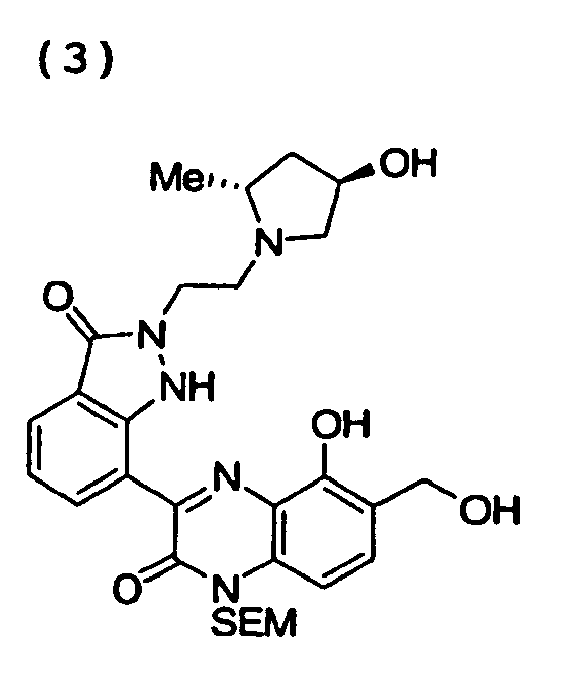
- According to the procedure described in Working Example 72-(2), the above hydroxymethyl derivative (210 mg) was obtained as a ocher solid from the phenol derivative (200 mg, 363 µmol) obtained in the above (2).


- To a stirred chloroform suspension (10 mL) of the hydroxymethyl derivative (210 mg, 363µmol) obtained in the above (3) were added triethylamine (202 µL, 725 µmol), 4-dimethylaminopyridine (8.9 mg, 72.5 µmol) and t-butyldiphenylsilyl chloride (141 µL, 544 µmol) at 0°C, and the mixture was stirred at room temperature for 30 minutes. After further addition of triethylamine (606 µL, 2.17 mmol), 4-dimethylaminopyridine (16.7 mg, 217 µmol) and t-butyldiphenylsilyl chloride (324 µL, 1.63 mmol) with stirring at 0°C, the reaction solution was stirred at room temperature for 1. 5 hours. After addition of water, the resulting reaction solution was extracted with chloroform. The organic layer was washed with saturated brine, dried over anhydrous sodium sulfate and filtered. The filtrate was concentrated, and the resulting residue was purified by a column chromatography on silica gel to obtain the protected derivative with TBDPS (257 mg) as a yellowish brown solid.


- According to a method similar to the procedures described in Working Examples 1-(5) and 15-(4), the above alcohol derivative (130 mg) was obtained as a yellowish brown solid from the derivative protected with TBDPS (257 mg, 313 µmol) obtained in the above (4).

- According to a method similar to the procedures described in Working Examples 11-(17) and 1-(6), the hydrochloride (4.6 mg) of the objective compound [131] was obtained as a yellow green solid from the alcohol derivative (11.3 mg, 20.1 µmol) obtained in the above (5) and piperidine.
- Spectral data of the compound of the above formula [131] are shown below.
1H-NMR(DMSO-d6)δ:0.60-0.68(3H,m),1.24-1.43(1H,m),1.63-1.85( 6H,m),2.00-2.26(1H,m),2.71-3.46(8H,m),3.54-3.77(1H,m),3.78-3.97(1H,m),4.30-4.52(3H,m),5.33-5.43(1H,m),7.18-7.24(1H,m), 7.21(1H,d,J=8.4Hz),7.75-7.90(1H,m),7.88(1H,d,J=7.5Hz),9.43-9.59(1H,m),9.98-10.0(1H,m),12.7-12.9(1H,m),12.9(1H,s).
mass:501(M+1)+. - Synthesis of the compound of the following formula [132]:

- According to a method similar to the procedures described in Working Examples 11-(17) and 1-(6), the hydrochloride (6.9 mg) of the objective compound [132] was obtained as a dark green solid from the alcohol derivative (18.4 mg, 32.7 µmol) obtained in Working Example 131-(5) and N-methylpiperazine.
- Spectral datum of the compound of the above formula [132] is shown below.
mass:516(M+1)+. - Synthesis of the compound of the following formula [133]:

- According to a method similar to the procedures described in Working Examples 11-(17) and 1-(6), the hydrochloride (11.7 mg) of the objective compound [133] was obtained as a dark green solid from the alcohol derivative (20.7 mg, 36.8 µmol) obtained in Working Example 131-(5) and N-acetylpiperazine.
- Spectral datum of the compound of the above formula [133] is shown below.
mass:544(M+1)+. - Synthesis of the compound of the following formula [134]:

- According to a method similar to the procedures described in Working Examples 83-(1), 11-(14) to 11-(16) and 11-(18), the hydrochloride (9.6 mg) of the objective compound [134] was obtained as a dark green solid from the alcohol derivative (140 mg, 351 µmol) obtained in Working Example 76-(2).
- Spectral data of the compound of the above formula [134] are shown below.
1H-NMR(DMSO-d6)δ:0.68(3H,m),1.34(1H,m),2.00-3.10(5H,m),3.40 -4.00(2H,m),4.46(1H,m),5.24(1H,brs),6.94(2H,m),7.14(1H, m), 7.48(1H,m),7.83(1H,d,J=8.4 Hz), 9.43(1H, m),12.2(1H,brs), 12.6(1H,brs).
mass:404(M+1)+. - Synthesis of the compound of the following formula [135]:


- According to a method similar to the procedure described in Working Example 11-(14), the above mesylated derivative (270 mg) was obtained as a yellow solid from the cyclic derivative (240 mg, 536 µmol) obtained in Working Example 83-(2).

- According to a method similar to the procedure described in Working Example 131-(1), the above methyl derivative (24 mg) was obtained as a yellow solid from the mesylated derivative (90 mg, 171 µmol) obtained in the above (1).

- According to a method similar to the procedure described in Working Example 1-(6), the hydrochloride (15 mg) of the objective compound [135] was obtained as a dark purple solid from the methyl derivative (24 mg, 55.6 µmol) obtained in the above (2).
- Spectral data of the compound of the above formula [135] are shown below.
1H-NMR(DMSO-d6)δ:0.60-0.75(3H,m),1.25-1.41(1H,m),2.20-2.61( 6H,m),2.63-2.82(1H,m),2.85-3.10(1H,m),3.55-3.90(2H,m),4.38-4.50(1H,m),5.18-5.25(1H,m),6.72-6.79(1H,m),6.82-6.90(1H,m), 7.02-7.22(1H,m),7.80-7.86(1H,m),9.35-9.45(1H,m),12.20-12.31 (1H,m),12.55-12.65(1H,m).
mass:418(M+1)+. - Synthesis of the compound of the following formula [136]:

- According to a method similar to the procedure described in Working Examples 11-(17) and 1-(6), the hydrochloride (49 mg) of the objective compound [136] was obtained as a yellow solid from the mesylated derivative (80 mg, 179 µmol) obtained in Working Example 135-(1) and morpholine.
- Spectral data of the compound of the above formula [136] are shown below.
1H-NMR(DMSO-d6)δ:0.62-0.78(3H,m),1.30-1.42(1H,m),2.22-3.40( 9H,m),3.60-4.00(6H,m),4.35-4.52(3H,m),5.12-5.23(1H,m),7.05( 1H,d,J=0.9Hz),7.17(1H,dd,J=7.9Hz,8.3Hz),7.37(1H,d,J=0.9Hz), 7.88(1H,d,J=7.9Hz),9.44(1H,d,J=8.3Hz),10.82-11.01(1H,m),12. 24 (1H,s),12.89(1H,s).
mass:503(M+1)+. - Synthesis of the compound of the following formula [137]:


- To tetrahydrofuran solution (5 mL) containing the mesylated derivative (80mg, 179µmol) obtained in Example 135-(1) was added 1M methanol solution containing sodium methoxide at room temperature. The mixture was stirred at 60°C for 3 hours. The reaction solution was cooled down to room temperature, diluted with chloroform, and washed successively with water and saturated brine. The organic layer was dried over anhydrous magnesium sulfate and filtered. The filtrate was concentrated in vacuo and the resulting residue was purified by a silica gel chromatography to produce the methoxymethyl derivative (56 mg) as a yellow solid.

- According to a method similar to the procedure described in Working Example 11-(18), the hydrochloride (40 mg) of the objective compound [137] was obtained as a purple solid from the methoxymethyl derivative (56 mg, 121 µmol) obtained in the above (1).
- Spectral data of the compound of the above formula [137] are shown below.
1H-NMR(DMSO-d6)δ:0.60-0.80(3H,m),1.20-1.50(1H,m),2.20-3.10( 5H,m),3.56(3H,s),3.72-4.60(5H,m),5.20-5.31(1H,m),6.89-7.00( 2H,m),7.10-7.22(1H,m),7.80-7.88(1H,m),9.38-9.48(1H,m),12.20 -12.38(1H,m),12.62-12.70(1H,m).
mass:448(M+1)+. - Synthesis of the compound of the following formula [138]:


- To tetrahydrofuran solution (5 mL) containing the mesylated derivative (50 mg, 95 µmol) obtained in Example 135-(1) was added 1M tetrahydrofuran solution (5 mL) containing sodium 2-methoxyethoxide at room temperature, and the mixture was stirred at 60°C for 3 hours. The reaction solution was cooled down to room temperature, diluted with chloroform, and washed successively with water and saturated brine. The organic layer was dried over anhydrous magnesium sulfate, and filtered. The filtrate was concentrated in vacuo, and the resulting residue was purified by a silica gel chromatography to obtain the methoxyethoxymethyl derivative (12 mg) as a yellow solid.

- According to a method similar to the procedure described in Working Example 11-(18), the hydrochloride (6.2 mg) of the objective compound [138] was obtained as a dark purple solid from the methoxyethoxymethyl derivative (12 mg, 23.7 µmol) obtained in the above (1).
- Spectral data of the compound of the above formula [138] are shown below.
1H-NMR(DMSO-d6)δ:0.60-0.78 (3H, m)1.20-1.50(1H,m)2.20-4.20 14H,m),4.38-4.52(1H,m),4.59(2H,s),5.19-5.27(1H,m),6.90-6.98 (2H,m),7.08-7.12(1H,m),7.81-7.87(1H,m),9.35-9.45(1H,m),12.1 8-12.32(1H,m),12.55-12.70(1H,m).
mass:492(M+1)+. - Synthesis of the compound of the following formula [139]:


- To tetrahydrofuran solution (100 mL) containing the aldehyde derivative (197 mg, 442 µmol) obtained in Working Example 83-(3) was dropwise added 1M diethyl ether solution (2.64 mL) containing allyl magnesium bromide at -78°C, and the mixture was stirred at the same temperature for 15 minutes. After acetic acid (500 µL) was added dropwise to the reaction solution, it was warmed up to room temperature. This reaction solution was concentrated in vacuo, and the resulting residue was purified by a silica gel chromatography to obtain the diol derivative (127 mg), which was a diastereomer mixture, as a yellow solid.


- The alcohol derivative (74 mg) which was a diastereomer mixture obtained in the above (1) was resolved by Chiralpack AD to produce the chiral alcohol derivative A (430 mg) with a shorter retention time as a yellow solid and the chiral alcohol derivative B (38 mg) with a longer retention time as a yellow solid.

- To N, N-dimethylformamide solution (15 mL) containing the chiral alcohol derivative A (30 mg, 61.5µmol) obtained in the above (2) was added sodium hydride (16 mg, 60% dispersion in oil) at 70°C, and the mixture was stirred at the same temperature for 10 minutes. The resulting reaction solution was kept at 0°C, and allyl bromide (34 µL) was added thereto, and then the mixture was further stirred for 30 minutes. After acetic acid (100 µL) was added dropwise, pyrrolidine (55pL) was added dropwise thereto. This reaction solution was diluted with ethyl acetate, and the organic layer was washed with saturated brine, dried over anhydrous magnesium sulfate and filtered. The filtrate was concentrated in vacuo, and the resulting residue was purified by a column chromatography on silica gel to obtain the allyl ether derivative (5.1 mg) as a yellow solid.

- To dichloromethane solution (3 mL) containing the allyl ether derivative (5.1 mg, 9.77 µmol) obtained in the above (3) was added benzylidene-bis(tricyclohexylphosphine)dichlorolutenium (795 µg) at room temperature under an argon atmosphere, and the mixture was stirred for 15 hours. The resulting reaction solution was purified by a column chromatography on silica gel to obtain the cyclic derivative (5.0 mg) as a yellow solid.

- According to a method similar to the procedure described in Working Example131-(1), the above tetrahydropyran derivative (5.0 mg) was obtained as a yellow solid from the cyclic derivative (5.0 mg, 10.0 µmol) obtained in the above (4).

- According to a method similar to the procedure described in Working Example 1-(6), the hydrochloride (2.0 mg) of the objective compound [139] was obtained as a dark purple solid from the tetrahydropyran derivative (2.0 mg, 3.98 µmol) obtained in the above (5).
- Spectral data of the compound of the above formula [139] are shown below.
1H-NMR(DMSO-d6)δ:0.52-0.78(3H,m),1.22-1.98(8H,m) 2.88-3.08( 1H,m),3.50-4.11(6H,m),4.35-4.53(3H,m),5.18-5.35(1H,m),6.90-7.00(2H,m),7.10-7.22(1H,m),7.81-7.88(1H,m),9.38-9.48(1H,m), 12.20-12.35(1H,m),12.61(1H,brs).
mass:488(M+1)+. - Synthesis of the compound of the following formula [140]:

- According to a method similar to the procedures described in Working Examples 139-(3) to 139-(4), 131-(1) and 1-(6), the hydrochloride (3.2 mg) of the objective compound [140] was obtained as a dark purple solid from the chiral alcohol derivative (38 mg, 77.9 µmol) obtained in Working Example 139-(2).
- Spectral datum of the compound of the above formula [140] is shown below.
mass:488(M+1)+. - Synthesis of the compound of the following formula [141]:

- According to a method similar to the procedures described in Working Examples 11 - (14), 131-(1) and 1-(6), the hydrochloride (1.8 mg) of the objective compound [141] was obtained as a dark purple solid from the cyclic derivative (8.5 mg) obtained in Working Example 11-(16).
- Spectral data of the compound of the above formula [141] are shown below.
1H-NMR(DMSO-d6)δ:2.00-2.70(7H,m),2.80-4.40(6H,m),5.32(1H,m) ,6.80-7.40(3H,m),7.80(1H,m),9,18(1H,m),11.8(1H,m),12.6(1H,m ).
mass:404(M+1)+. - Synthesis of the compound of the following formula [142]:


- According to a method similar to the procedures described in Working Examples 11-(10) to 11-(11), 90-(2) and 15-(4), the indazolinone derivative (250 mg) was obtained as a yellowish brown viscous liquid from the carboxylic acid (382 mg, 696 µmol) which is a starting material of Example 48-(1), and the hydrazine derivative [A-34] (304 mg, 1.05 mmol).


- According to a method similar to the procedure described in Working Example 83-(1), the above amine derivative (6.8 mg) was obtained as a yellowish brown viscous liquid from the indazolinone derivative (38.0 mg, 62.0 µmol) obtained in the above (1).

- According to a method similar to the procedures described in Working Examples 1-(4) to 1-(6), the hydrochloride (1.4 mg) of the objective compound [142] was obtained as a dark purple solid from the amine derivative (6.8 mg, 9.77 µmol) obtained in the above (2).
- Spectral data of the compound of the above formula [142] are shown below.
1H-NMR(DMSO-d6)δ:0.60-0.72(3H,m),1.25-1.49(1H,m),1.51(3H,d, J=6.9Hz),2.20-2.30(1H,m),2.68-3.23(4H,m),3.66-3.82(1H,m),4. 79-4.91(1H,m),5.21-5.25(1H,m),7.00(1H,d,J=8.1Hz),7.09-7-19( 2H,m),7.51(1H,d,J=8.1Hz),7.85(1H,d,J=7.2Hz),9.33-9.42(1H,m) ,12.15-12.24(1H,m),12.7(1H,s).
mass:418(M+1)+. - Synthesis of the compound of the following formula [143]:

- According to a method similar to the procedures described in Working Examples 11-(17) and 1-(6), the hydrochloride (6.4 mg) of the objective compound [143] was obtained as a yellowish green solid from the alcohol derivative (10.0 mg, 17.7 µmol) obtained in Working Example 131-(5) and cyclopentylamine.
- Spectral data of the compound of the above formula [143] are shown below.
1H-NMR(DMSO-d6)δ:0.52-0.74(3H,m),1.06-1.29(1H,m),1.46-1.59( 2H,m),1.59-1.80(4H,m),1.97-2.07(2H,m),2.09-2.27(1H,m),2.82-3.16(2H,m),3.46-3.59(2H,m),3.60-3.95(3H,m),4.09-4.39(2H,m), 4.39-4.46(1H,m),5.21-5.42(1H,m),7.15-7.22(1H,m),7.19(1H,d,J =8.4Hz),7.77-7.84(1H,m),7.87(1H,d,J=7.5Hz),9.05-9.15(1H,m), 9.23-9.34(1H,m),9.42-9.55(1H,m),12.66-12.70(1H,m),12.8(1H,s ).
mass:501(M+1)+. - Synthesis of the compound of the following formula [144]:

- According to a method similar to the procedures described in Working Examples 11-(17) and 1-(6), the hydrochloride (4.7 mg) of the objective compound [144] was obtained as a yellowish green solid from the alcohol derivative (10.0 mg, 17.7 µmol) obtained in Working Example 131-(5) and cyclopropylamine.
- Spectral data of the compound of the above formula [144] are shown below.
1H-NMR(DMSO-d6)δ:0.60-0.90(5H,m),0.90-0.96(2H,m),1.10-1.30( 1H,m),2.05-2.25(1H,m),2.61-2.80(2H,m),2.93-3.15(2H,m),3.55-3.80(1H,m),3.82-4.02(2H,m),4.27-4.51(3H,m),5.24-5.42(1H,m), 7.14-7.23(1H,m),7.17(1H,d,J=8.7Hz),7.73-7.80(1H,m),7.87(1H, d,J=7.8Hz),9.35-9.60(3H,m),12.7-12.8(1H,m),12.9(1H,s).
mass:473(M+1)+. - Synthesis of the compound of the following formula [145]:

- According to a method similar to the procedures described in Working Examples 11-(17) and 1-(6), the hydrochloride (4.7 mg) of the objective compound [145] was obtained as a yellowish green solid from the alcohol derivative (10.0 mg, 17.7 µmol) obtained in Working Example 131-(5) and t-butylamine.
- Spectral data of the compound of the above formula [145] are shown below.
1H-NMR(DMSO-d6)δ:0.55-0.77(3H,m),1.05-1.39(1H,m),1.40(9H,s) ,2.03-2.31(1H,m),2.80-3.05(2H,m),3.35-3.79(2H,m),3.80-4.03( 2H,m),4.09-4.38(2H,m),4.39-4.51(1H,m),5.27-5.38(1H,m),7.14-7.23(1H,m),7.19(1H,d,J=8.7Hz),7.81-7.89(1H,m),7.86(1H,d,J=7 .8Hz),8.60-8.85(1H,m),9.05-9.25(1H,m),9.35-9.65(1H,m),12.7-12.9(1H,m), 12.9(1H,s).
mass:489(M+1)+. - Synthesis of the compound of the following formula [146]:

- According to a method similar to the procedures described in Working Examples 11-(17) and 1-(6), the hydrochloride (5.0 mg) of the objective compound [146] was obtained as a yellowish green solid from the alcohol derivative (10.0 mg, 17.7 µmol) obtained in Working Example 131-(5) and trifluoroethylamine.
- Spectral data of the compound of the above formula [146] are shown below.
1H-NMR(DMSO-d6)δ:0.59-0.92(3H,m),1.05-1.54(1H,m),1.90-2.15( 1H,m),2.85-3.20(2H,m),3.45-4.10(6H,m),4.10-4.39(2H,m),4.40-4.46(1H,m),5.21-5.42(1H,m),7.13-7.23(1H,m),7.16(1H,d,J=8.7H z),7.70-7.85(1H,m),7.87(1H,d,J=7.5Hz),9.40-9.65(1H,m),12.6-12.8(1H,m),12.8(1H,s).
mass:515(M+1)+. - Synthesis of the compound of the following formula [A-1]:


- 2-Amino-3-nitrophenol (77 mg, 0.50 mmol) was dissolved in N,N-dimethylformamide (2 mL), and to this solution were added successively imidazole (68 mg, 1.00 mmol) and t-butyldimethylsilyl chloride (90 mg, 0.60 mmol) under ice-cooling. The mixture was stirred at room temperature overnight. The resulting reaction solution was diluted with ethyl acetate, and washed successively with water and saturated brine. The organic layer was dried over anhydrous magnesium sulfate, filtered, and concentrated in vacuo to obtain the above protected derivative with TBS (140 mg) as a deep orange oil.

- The protected derivative with TBS (140 mg, 0.50 mmol) obtained in the above (1) was dissolved in ethyl acetate (2 mL), and to the solution was added gradually N-bromosuccinimide (98 mg, 0.55 mmol) inawater-bath. The reaction solution was stirred at room temperature for 10 minutes. The resulting reaction solution was diluted with ethyl acetate, and washed successively with saturated aqueous sodium sulfite, aqueous sodium hydrogencarbonate and saturated brine. The organic layer was dried over anhydrous magnesium sulfate, filtered, and concentrated in vacuo to obtain the above brominated derivative (169 mg) as a deep yellow solid.
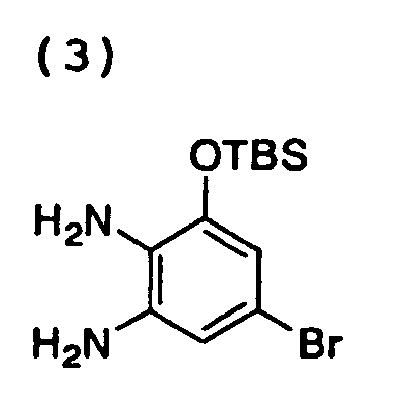
- The brominated derivative (165 mg, 0.48 mmol) obtained in the above (2) was dissolved in tetrahydrofuran (2 mL), and 5% platinum carbon catalyst (33 mg) was added thereto under a nitrogen atmosphere. After substitution of the atmosphere of the reaction system with hydrogen, the solution was stirred at room temperature for 8 hours. The resulting reaction solution was filtered through a Celite pad to remove the catalyst, and the filtrate was concentrated in vacuo to obtain the objective compound [A-1] (151 mg) as a deep brown oil.
- Synthesis of the compound of the following formula [A-2]:

- Ethyl (2-fluoro-3-iodophenyl)oxoacetate (10.0 g, 31.1 mmol) according to a method similar to the method of general formula (II-d) described in
WO 02/02550 - Synthesis of the compounds of the following formulae [A-3-1] to [A-3-5]:


- According to a method similar to the method described in Journal of Synthetic Organic Chemistry, Japan, 59(8) 779 (2001) and the procedure of Reference Example 1-(1), (R)-1-amino-2-propanol, (S)-1-amino-2-propanol, (R)-2-amino-1-propanol, (S)-2-amino-1-propanol, and 2-aminoethanol were respectively sulfonated and silylated to obtain the corresponding O-silyl-sulfonamide derivatives [A-3-1] to [A-3-5].
- Synthesis of the compound of the following formula [A-4]:


- According to a method similar to the method described in Bull. Chem. Soc. Jpn., 57(7) 2019 (1984), the above TBS derivative was obtained from (1R,3R)-3-(2'-hydroxyethyl)cyclopentanol synthesized by the method described in J. Am. Chem. Soc., 99(5) 1625 (1977).

- The TBS derivative (9.8 g, 40 mmol) obtained in the above (1) was dissolved in toluene (150 mL), and to the solution was added 40% toluene solution (35 mL, 80 mmol) containing benzoic acid (9.8 g, 80 mmol), triphenylphosphine (21 g,80 mmol) and diethyl azodicarboxylate under ice-cooling. The solution was stirred for 1 hour under ice-cooling, and water was added thereto. The solution was stirred at room temperature for 30 minutes, and the resulting solid was filtered off, and the filtrate was washed with saturated brine. The organic layer was dried over anhydrous magnesium sulfate, filtered, and concentrated. The resulting residue was purified by a column chromatography on silica gel to obtain the above benzoyl derivative (9.8 g) as a colorless oil.

- The benzoyl derivative (4.5 g, 12.9 mmol) obtained in the above (2) was dissolved in methanol (20 mL), and then 0.05M methanol solution (150 mL) containing sodium hydroxide was added thereto under ice-cooling. The solution was stirred at room temperature for 12 hours. The resulting reaction solution was diluted with t-butyl methyl ether, and the organic layer was washed successively with water and saturated brine, dried over anhydrous magnesium sulfate, filtered, and concentrated. The resulting residue was purified by a column chromatography on silica gel to obtain the above alcohol derivative (2.6 g) as a colorless oil.

- The alcohol derivative (566 mg, 2.31 mmol) obtained in the above (3) was dissolved in chloroform (10 mL), and to the solution were added triethylamine (414 µL, 2.97 mmol) and methanesulfonyl chloride (231 µL, 2.97 mmol) under ice-cooling. The mixture was stirred for 1 hour. After aqueous sodium hydrogencarbonate was added to the reaction solution, it was extracted with chloroform. The organic layer was washed with saturated brine, dried over anhydrous magnesium sulfate, filtered, and concentrated to obtain the objective derivative [A-4] (746 mg) as a pale yellow oil.
- Synthesis of the compound of the following formula [A-5]:
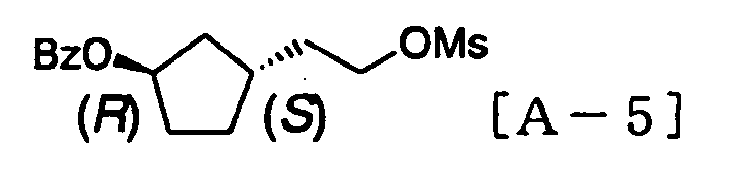

- The above diol derivative was obtained from norcamphor according to the method described in J. Am. Chem. Soc., 99(5) 1625 (1977).

- The above benzoyl compound was obtained from the diol derivative obtained in the above (1) according to a method similar to the procedures of Reference Examples 4-(1) to 4-(2).

- The benzoyl derivative (4.5 g, 12.9 mmol) obtained in the above (2) was dissolved in chloroform (80 mL), and hydrochloric acid/methanol (20 mL) was added thereto under ice-cooling. The resulting reaction solution was stirred for 15 minutes under ice-cooling, and chloroform was added thereto. The organic layer was washed successively with water, saturated aqueous sodium hydrogencarbonate and saturated brine. Then, the organic layer was dried over anhydrous magnesium sulfate, filtered, and concentrated. The resulting residue was purified by a column chromatography on silica gel to obtain the above alcohol derivative (2.7 g) as a colorless oil.
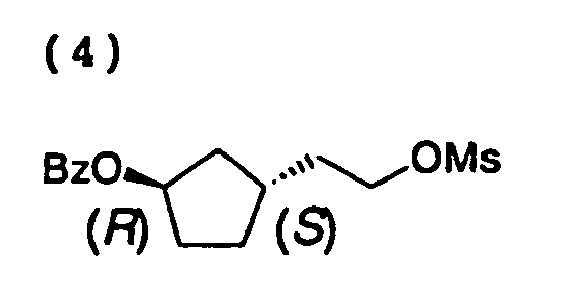
- The objective compound [A-5] (258 mg) was obtained as a pale yellow oil from the alcohol derivative (194 mg, 826 µmol) obtained according to the procedure of Reference Example 4-(4).
- Synthesis of the compound of the following formula [A-6]:

- According to a method similar to the procedures as Reference Examples 4-(3) to 4-(4), the objective compound [A-6] was obtained from the benzoyl derivative obtained in Reference Example 5-(2).
- Synthesis of the compound of the following formula [A-7]:

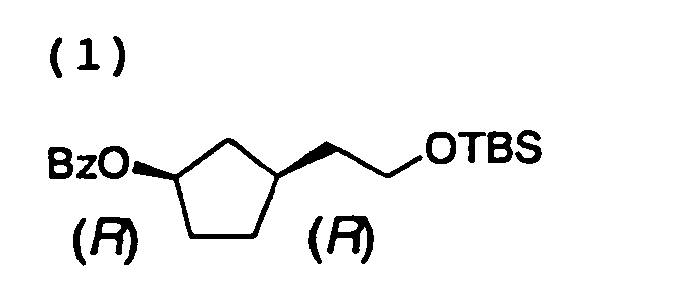
- The TBS-derivative (4 g, 16 mmol) obtained in Reference Example 4-(1) was dissolved in chloroform (80 mL), and to the solution were added triethylamine (3.4 mL, 21 mmol), 4-dimethylaminopyridine (600mg, 4.3mmol), and benzoyl chloride (2.2 mL, 17 mmol). The mixture was stirred at room temperature for 3 hours. Aqueous sodium hydrogencarbonate solution was added to the resulting reaction solution, and it was extracted with chloroform. The organic layer was washed with saturated brine, dried over anhydrous magnesium sulfate, filtered, and the filtrate was concentrated. The resulting residue was purified by a column chromatography on silica gel to obtain the above benzoyl derivative (5.6 g) as a colorless oil.

- According to a method similar to the procedures of Reference Examples 5-(3) to 5-(4), the objective compound [A-7] (670 mg) was obtained as a colorless oil from the benzoyl derivative (583 mg, 1.68 mmol) obtained in the above (1)
- Synthesis of the compound of the following formula [A-8]:


- According to a method similar to the procedure of Reference Example 1-(1), the above TBDPS-derivative (88.2 g) was obtained as a colorless oil from (S)-hexane-1,5-diol (29.9 g, 253 mmol) synthesized by referring to the method described in J. Chem. Soc. Perkin Trans. I, 20 2467 (1996) and t-butyldiphenylsilyl chloride.
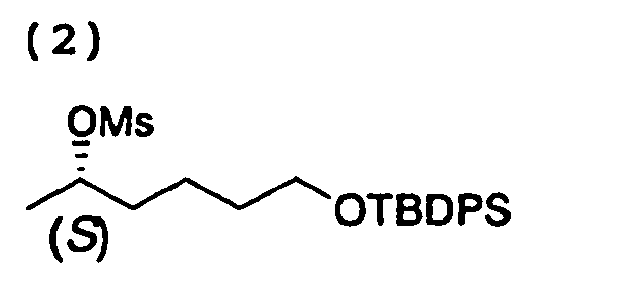
- According to a method similar to the procedure of Reference Example 4-(4), the objective compound [A-8] (652 mg) was obtained as a colorless oil from the TBDPS-derivative (535 mg, 1.5 mmol) prepared in the above (1)
- Synthesis of the compound of the following formula [A-9]:

- According to a method similar to the method as Reference Example 8, the objective compound [A-9] was obtained from (R)-hexane-1,5-diol.
- Synthesis of the compound of the following formula [A-10]:
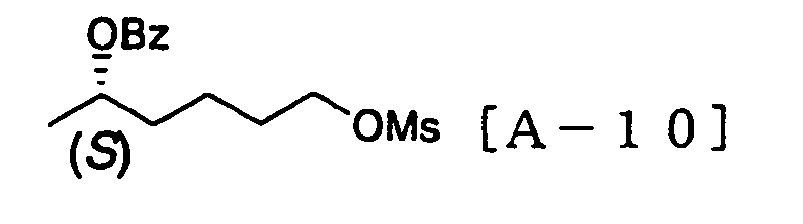

- According to a method similar to the procedure of Reference Example 7-(1), the above benzoyl compound (2.6 g) was obtained as a colorless oil from TBDPS-derivative (2 g, 5.6 mmol) obtained in Reference Example 8-(1)

- The benzoyl derivative (2.5 g, 5.4 mmol) obtained in the above (1) was dissolved in tetrahydrofuran (16 mL), and to this solution was added 1M tetrahydrofuran solution (16 mL) containing tetrabutylammonium fluoride. The solution was stirred at room temperature for 2 hours. The resulting reaction solution was diluted with diethyl ether (100 mL), and washed successively with 0.1M phosphate buffer (pH 6.8) and saturated brine. The organic layer was dried over anhydrous magnesium sulfate, filtered, and the filtrate was concentrated. The resulting residue was purified by a column chromatography on silica gel to obtain the above alcohol derivative (1.2 g) as a colorless oil.

- According to a method similar to the procedure of Reference Example 4-(4), the objective compound [A-10] was obtained as a colorless oil from the alcohol derivative (378 mg, 1.70 mmol) prepared in the above (2). The product was used without separation and purification.
- Synthesis of the compound of the following formula [A-11]:
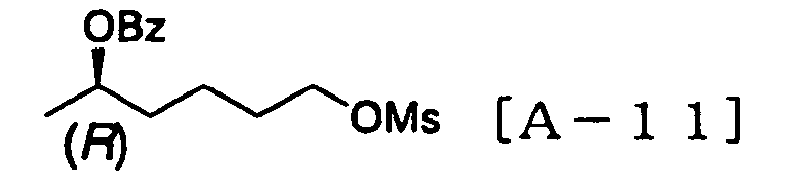
- According to a method similar to the procedures of Reference Examples 8-(1) and 10, the objective compound [A-11] was obtained from (R)-hexane-1,5-diol synthesized by referring to the method described in J. Chem. Soc. Perkin Trans. I, 20 2467 (1996).
- Synthesis of the compound of the following formula [A-12]:

- In the above formula, the stereo chemistry of the position with the asterisk * is of cis configuration.

- Cis-2,5-di(ethoxycarbonyl)pyrrolidine (10.5 g, 49.1 mmol) synthesized by referring to the method described in J. Org. Chem., 26(5) 1500 (1961) was dissolved in pyridine (30 mL), and to the solution was added allyl chloroformate (8.9 g, 73.6 mmol) under ice-cooling. The solution was stirred for 30 minutes, and aqueous sodium hydrogencarbonate was added to the resulting reaction solution. The reaction solution was extracted with diethyl ether. The organic layer was washed with saturated brine, dried over anhydrous magnesium sulfate, filtered, and concentrated. The resulting residue was purified by a column chromatography on silica gel to obtain the above protected derivative with Alloc (10.6 g) as a colorless oil.

- The above protected derivative with Alloc (10.6 g, 35.4 mmol) obtained in the above (1) was dissolved in tetrahydrofuran (170 mL), and then lithium tetrahydroborate (3.9 g, 177 mmol) was added thereto. The mixture was stirred at room temperature for 2 hours. Methanol was gradually added dropwise to the resulting reaction solution, and the reaction solution was diluted with aqueous sodium hydrogencarbonate solution. This solution was extracted with ethyl acetate, and the organic layer was washed with saturated brine, dried over anhydrous magnesium sulfate, and filtered. The filtrate was and concentrated, and the resulting residue was purified by a column chromatography on silica gel to obtain the above diol derivative (5.5 g) as a colorless oil.

- The diol derivative (5.5 g, 25.5 mmol) obtained in the above (2) was dissolved in chloroform (250 mL), and to the solution were added triethylamine (4.1mL, 30 mmol), t-butyldimethylsilyl chloride (4.0 g, 25.5 mmol), and 4-dimethylaminopyridine (940 mg, 7.7 mmol). The mixture was stirred at room temperature for 2 hours. After aqueous sodium hydrogencarbonate solution was added to the resulting reaction solution, it was extracted with chloroform. The organic layer was washed with saturated brine, dried over anhydrous magnesium sulfate, and filtered. The filtratewasconcentrated, and the resulting residue was purified by a column chromatography on silica gel to obtain the above racemic TBS-derivative (3.5 g) as a colorless oil.

- According to a method similar to the procedure of Reference Example 4-(4), the objective compound [A-12] (4.6 g) was obtained as a colorless oil from the compound (3.5 g, 11. 5 mmol) obtained in the above (3)
- Synthesis of the compound of the following formula [A-13]:

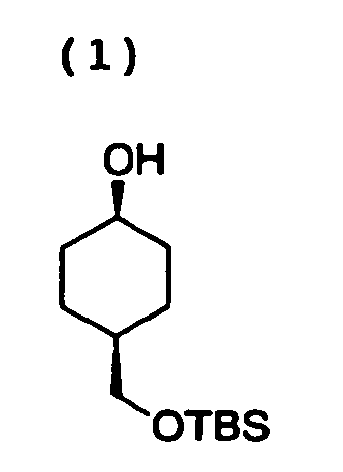
- According to a method similar to the procedure of Reference Example 12-(3), the above TBS-derivative (995 mg) was obtained as a colorless oil from cis-4-hydroxymethylcyclohexanol (601 mg, 4.62 mmol) prepared by reference to the method described in J. Org. Chem., 35(7) 2368 (1970)

- The TBS-derivative (489 mg, 2.00 mmol) obtained in the above (1) and triethylamine (1.11 mL, 8.00 mmol) were dissolved in dimethyl sulfoxide (5 mL), and then sulfur trioxide-pyridine complex (637 mg, 4.00 mmol) was added thereto in a water-bath. The resulting reaction solution was stirred at room temperature for 10 minutes, diluted with ethyl acetate, and washed successively with water (twice) and saturated brine. The organic layer was dried over anhydrous magnesium sulfate, filtered, and concentrated in vacuo to obtain the above ketone derivative (444 mg) as a colorless oil.

- The ketone derivative (121 mg, 160 µmol) obtained in the above (2) was dissolved in tetrahydrofuran (3 mL), and to the solution was added dropwise 1M tetrahydrofuran solution (750 µL, 750 µmol) containing lithium tri-t-buthoxy-aluminium hydride at -65°C. The resulting reaction solution was warmed up to 0°C, and saturated aqueous Rochelle salt and ethyl acetate were added thereto. The mixture was stirred at room temperature for 1 hour. This reaction solution was extracted with ethyl acetate, and the extract was washed successively with water and saturated brine, dried over anhydrous magnesium sulfate, filtered, and concentrated in vacuo to obtain the above trans-alcohol derivative (122 mg) as a pale yellow oil.

- According to a method similar to the procedure of Reference Example 4-(4), the objective compound [A-13] (659 mg) was obtained as a colorless oil from the trans-alcohol derivative (518 mg, 2.12 mmol) obtained in the above (3).
- Synthesis of the compound of the following formula [A-14]:


- To a stirred solution of (R)-(-)-ribose (5.00 g, 33.3 mmol) in N,N-dimethylformamide (10 mL) were added imidazole (4.50 g, 66.6 mmol) and t-butyldiphenylsilyl chloride (9.07 mL, 34.8 mmol) at 0°C. The reaction solution was stirred at room temperature overnight. 1N aqueous potassium hydrogensulfate was added to the resulting reaction solution, and the solution was stirred at room temperature for 30 minutes, and then extracted with ethyl acetate. The organic layer was washed with saturated brine, dried over anhydrous magnesium sulfate, filtered, and the filtrate was concentrated. Pyridine (30 mL) and acetic anhydide (10 mL) were added to the resulting residue, and the mixture was stirred at room temperature for 2 hours. To this reaction solution was added 1N aqueous potassium hydrogensulfate, and the reaction solution was extracted with ethyl acetate. The organic layer was washed with saturated brine, dried over anhydrous magnesium sulfate, filtered, and the filtrate was concentrated. The resulting residue was purified by a column chromatography on silica gel to obtain the above protected derivative with TBDPS (12.3 g) as a pale yellow solid.

- The protected derivative with TBDPS (11 g, 21.4 mmol) obtained in the above (1) was dissolved in methylene chloride (60 mL), and the reaction system was substituted with carbon monooxide. To this solution were added diethylmethylsilane (22 mL, 215 mmol) and dicobalt octacarbonyl (1.0 g, 2.92 mmol), and the mixture was stirred at room temperature overnight, after which time water was added thereto. The reaction solution was extracted with ethyl acetate, and the organic layer was washed with saturated brine, dried over anhydrous sodium sulfate, filtered, and concentrated in vacuo. The resulting residue was purified by a column chromatography on silica gel to obtain the above alcohol derivative (5.37 g) as a pale yellow solid.

- To a stirred solution of the alcohol derivative (1.00 g, 2.05 mmol) obtained in the above (2) in methylene chloride (10 mL) were added triethylamine (860 µL, 6.15 mmol), 4,4'-dimethoxytrityl (692 mg, 780 µmol) and 4-dimethylaminopyridine (251 mg, 2.05 mmol) at 0°C. The reaction solution was stirred at room temperature for 2 hours. Water was added to the resulting reaction solution, and the solution was stirred at room temperature for 30 minutes, and then extracted with ethyl acetate. The organic layer was washed with saturated brine, dried over anhydrous sodium sulfate, filtered, and the filtrate was concentrated. The resulting residue was purified by a column chromatography on silica gel to obtain the above tritylated derivative (765 mg) as a pale yellow solid.

- According to a method similar to the procedure of Reference Example 4-(3), the above diol derivative (511 mg) was obtained as a pale yellow solid from the tritylated derivative (711 mg, 2.05 mmol) obtained in the above (3)

- To a stirred tetrahydrofuran solution (10 mL) containing the diol derivative (511 mg, 720 µmol) obtained in the above (4) was added 60% sodium hydride dispersion in oil (116 mg, 2.90 mmol) at 0°C, and the mixture was stirred at room temperature for 30 minutes. After addition of carbon disulfide (230 µL, 3.02 mmol), the reaction solution was stirred at room temperature for 5 minutes, and methyl iodide (170 µL, 2.73 mmol) was added thereto. The mixture was stirred at room temperature for 1 hour, and 1N aqueous potassium hydrogensulfate was added. The reaction solution was extracted with ethyl acetate. The organic layer was washed with saturated brine, dried over anhydrous sodium sulfate, filtered, and the filtrate was concentrated. The resulting residue was purified by a column chromatography on silica gel to obtain the above dithiocarbonate derivative (585 mg) as a pale yellow solid.

- To a stirred toluene solution (10 mL) containing the dithiocarbonate derivative (585 mg, 660 µmol) obtained in the above (5) were added tributyltin hydride (360 µL, 1.23 mmol) and 2,2'-azobisisobutyronitrile (24 mg, 140 µmol) under a nitrogen atmosphere, and the mixture was stirred overnight under heating at reflux. Water was added to the reaction solution, and it was extracted with ethyl acetate. The organic layer was washed with saturated brine, dried over anhydrous sodium sulfate, filtered, and the filtrate was concentrated. The resulting residue was purified by a column chromatography on silica gel to obtain the above intra-olefin derivative (367 mg) as a pale yellow solid.

- To methylene chloride solution (30 mL) containing the above intra-olefin derivative (665 mg, 990 µmol) obtained in the above (6) was added gradually trichloroacetic acid (160 mg, 979 µmol). The reaction solution was stirred at room temperature for 2 hours. Aqueous sodium hydrogencarbonate solution was added to the resulting reaction solution, and the solution was extracted with chloroform. The organic layer was washed with saturated brine, dried over anhydrous sodium sulfate, filtered, and the filtrate was concentrated. The resulting residue was purified by a column chromatography on silica gel to obtain the above alcohol derivative (213 mg) as a pale yellow solid.

- The alcohol derivative (1.40 g, 3.77 mmol) obtained in the above (7) was dissolved in tetrahydrofuran (30 mL) and methanol (30 mL), and to the solution was added platinum oxide catalyst (700 mg) under a nitrogen atmosphere. After substitution of the reaction system with hydrogen gas, the mixture was stirred at room temperature for 15 hours. The resulting reaction solution was filtered through a Celite pad to remove the catalyst, and the filtrate was concentrated in vacuo. The resulting residue was purified by a column chromatography on silica gel to obtain the above tetrahydrofuran derivative (1.28 g) as a colorless oil.


- According to a method similar to the procedure of Reference Example 7-(1), the above benzoyl derivative (421 mg) was obtained as a colorless oil from the tetrahydrofuran derivative (402 mg, 1.08 mmol) obtained in the above (8).

- According to a method similar to the procedure of Reference Example 10-(2), the above alcohol derivative (402 mg) was obtained as a pale yellow oil from the benzoyl derivative (421 mg, 887 µmol) obtained in the above (9)

- The alcohol derivative (402 mg) obtained in the above (10) was dissolved in diethyl ether (5 mL), and then N,N-diisopropylethylamine (223 µL, 1.28 mmol) and methanesulfonyl chloride (82 µL, 1.06 mmol) were added thereto under ice-cooling. The mixture was stirred for 2 hours. After diethyl ether was added to the resulting reaction solution, the organic layer was washed successively with 1N hydrochloric acid, water, and saturated brine, dried over anhydrous magnesium sulfate, and filtered. The filtrate was concentrated, and the resulting residue was dissolved in N,N-dimethylformamide (5 mL), and then sodium azide (115 mg, 1.77 mmol) was added thereto. The reaction solution was stirred at 80°C for 12 hours, and cooled down to room temperature. After addition of ethyl acetate to this reaction solution, the organic layer was washed successively with water and saturated brine, dried over anhydrous magnesium sulfate, and filtered. The filtrate was concentrated, and the resulting residue was dissolved in tetrahydrofuran (5 mL) and methanol (5 mL), and 10% palladium carbon catalyst (700 mg) was added thereto under a nitrogen atmosphere. The atmosphere in the reaction system was substituted with hydrogen gas, and the solution was stirred at room temperature for 3 hours. The resulting solution was filtered through a Celite pad to remove the catalyst, and the filtrate was concentrated in vacuo. The resulting residue was purified by a silica gel chromatography to obtain the objective compound [A-14] (81 mg) as a colorless oil.
- Synthesis of the compound of the following formula [A-15]:


- Ethyl(3R,5S)-3-(t-butyldiphenylsilyloxy)tetrahydro-5-furanylacetate (11.9 g, 29 mmol) prepared according to a method similar to the method described in Tetrahedron Lett. , 26(9) 1185 (1985) was dissolved in ether (100 mL), and lithium aluminium hydride (660 mg, 1.7 mmol) was added thereto in an ice-bath.
- The reaction solution was stirred at room temperature for 1 hour. Anhydrous sodium sulfate decahydrate (3 g) was added thereto in an ice-bath, and the mixture was stirred at room temperature for 2 hours. The reaction solution was dried over anhydrous magnesium sulfate, and filtered through a Celite pad to remove the insolubles. The filtrate was concentrated in vacuo to obtain the above primary alcohol derivative (9.52 g) as a colorless oil.

- According to a method similar to the procedure of Reference Example 14-(11), the objective compound [A-15] (2.27 g) was obtained as a colorless oil from the primary alcohol derivative (2.50 g, 6.75 mmol) obtained in the above (1)
- Synthesis of the compound of the following formula [A-16]:


- 4-Acetoxypiperidine hydrochloride (1.5 g, 8.6 mmol) prepared by referring to
EP122855 
- 4N hydrogen chloride/1,4-dioxane solution (5 mL) was added to the N-alkylpiperidine derivative (850 mg, 3.0 mmol) obtained in the above (1) at room temperature, and the mixture was stirred at room temperature for 2 hours. The resulting reaction solution was concentrated in vacuo to obtain the objective compound [A-16] (666 mg) as a white solid.
- Synthesis of the compound of the following formula [A-17]:

- To a solution of (t-butyldimethylsilyloxy)acetaldehyde (5.00 g, 28.6 mmol) in chloroform (50 mL) was added the allyl carbazinate derivative (5.00 g, 43.1 mmol) prepared by referring to
JP 04117361 - Synthesis of the compound of the following formula [A-18]:


- According to a method similar to the procedure of Reference Example 13-(2), the above aldehyde derivative (1.51 g) was obtained as a colorless oil from the de-TBDPS derivative (1.56 g, 7.0 mmol) obtained in Reference Example 10-(2).


- According to a method similar to the procedure of Reference Example 17, the objective compound [A-18] (1.33 g) was obtained as a colorless oil from the aldehyde derivative (1.51 g, 6.9 mmol) obtained in the above (1).
- Synthesis of the compound of the following formula [A-19]:
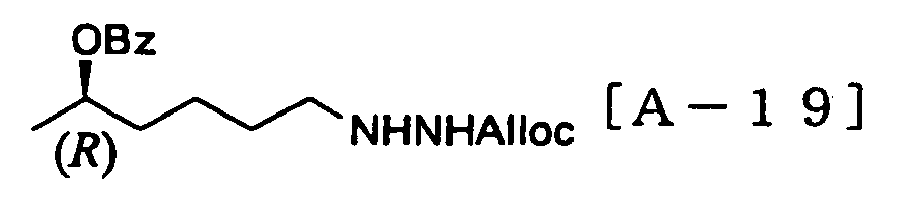

- According to a method similar to the method as Reference Examples 8-(1) and 10-(1) to 10-(2), the above primary alcohol derivative was obtained from (R)-hexane-1,5-diol which is a starting material of Reference Example 11

- According to a method similar to the procedure as Reference Example 18, the objective compound [A-19] was obtained from the primary alcohol derivative obtained in the above (1)
- Synthesis of the compound of the following formula [A-20]:

- According to a method similar to the procedure of Reference Example 17, the objective compound [A-20] (335 mg) was obtained as a colorless oil from 5-t-butyldiphenylsilyloxy-1-pentanal (500 mg, 1.47 mmol) synthesized by referring to the method described in J. Org. Chem., 59(2), 324 (1994) and t-butyl carbazinate (194 mg, 1.47 mmol)
- Synthesis of the compound of the following formula [A-21]:

- According to a method similar to the procedure of Reference Example 17, the objective compound [A-21] (7.40 g) was obtained as a colorless oil from the ketone derivative (10.8 g, 30.4 mmol) synthesized by referring to the method described in Tetrahedron Lett., 56(8) 1065 (2000).
- Synthesis of the compound of the following formula [A-22]:

- Racemic 3-hydroxypiperidine hydrochloride (662 mg, 4.81 mmol) was dissolved in a mixed solution of water (2 mL) and 1,4-dioxane (4 mL), and to this solution was added 4N aqueous sodium hydroxide (3 mL). To this solution was added di-t-butyl dicarbonate (1.11mL, 4.81 mmol). After the solution was stirred at room temperature for 7 hours, ethyl acetate was added to the resulting reaction solution for extraction. The organic layer was washed successively with water and saturated brine, dried over anhydrous magnesium sulfate, filtered, and concentrated in vacuo to obtain the above protected derivative with Boc (968 mg) as a colorless oil.
- The resulting protected derivative with Boc (968 mg, 4.81 mmol) was dissolved in N,N-dimethylformamide (5 mL), and then methyl iodide (449 µL, 7.22 mmol) was added thereto. After addition of sodium hydride (231 mg, 60% dispersion in oil, 5.77 mmol) under ice-cooling, the mixture was stirred for 5 minutes at the same temperature. The resulting reaction solution was warmed up to room temperature, and stirred for further 10 hours. After saturated aqueous ammonium chloride solution was added to this solution, it was extracted with a mixed solvent of hexane and ethyl acetate. The organic layer was washed with water and saturated brine, dried over anhydrous magnesium sulfate, and filtered. The filtrate was concentrated in vacuo, and azeotropic evaporation was carried out using toluene. The residue was purified by a column chromatography on silica gel to obtain the above methyl ether derivative (885 mg) as a colorless liquid.
- The resulting methyl ether derivative (885 mg) was dissolved in chloroform (5 mL), and to this solution was added 4N hydrogen chloride/1,4-dioxane solution (5 mL). The solution was stirred at room temperature for 2 hours, and the resulting reaction solution was concentrated in vacuo to obtain the racemic objective compound [A-22] (596 mg) as a white solid.
- Synthesis of the compound of the following formula [A-23]:

- According to a method similar to the procedure of Reference Example 22, the objective compound [A-23] was obtained from (R)-3-hydroxypiperidine hydrochloride.
- Synthesis of the compound of the following formula [A-24]:

- According to a method similar to the procedure as Reference Example 22, the objective compound [A-24] was obtained from (S)-3-hydroxypiperidine synthesized according to the method described in Tetrahedron Lett., 51(21) 5935 (1995).
- Synthesis of the compound of the following formula [A-25]:

- According to a method similar to the procedure of Reference Example 22, the racemic objective compound [A-25] (352 mg) was obtained as a white solid from racemic 3-hydroxymethylpiperidine (569 mg, 4.94 mmol).
- Synthesis of the compound of the following formula [A-26]:

- According to a method similar to the procedure of Reference Example 22, the racemic objective compound [A-26] (899 mg) was obtained as a white solid from racemic 2-hydroxymethylpiperidine (857 mg, 7.44 mmol).
- Synthesis of the compound of the following formula [A-27]:

- According to a method similar to the procedure as Reference Example 22, the objective compound [A-27] was obtained from (R)-2-hydroxymethylpiperidine synthesized according to the method described in Heterocycles, 41(9) 1931 (1995).
- Synthesis of the compound of the following formula [A-28]:

- According to a method similar to the procedure as Reference Example 22, the objective compound [A-28] was obtained from (S)-2-hydroxymethylpiperidine synthesized according to the method described in Heterocycles, 41(9) 1931 (1995),
- Synthesis of the compound of the following formula [A-29]:

- According to a method similar to the procedure of Reference Example 22, the objective compound [A-29] (222 mg) was obtained as a milky yellow solid from 4-hydroxypiperidine (251 mg, 2.48 mmol).
- Synthesis of the compound of the following formula [A-30]:


- To a solution of 5-hydroxypentanal oxime (300 mg, 2.56 mmol) in methanol (10 mL) was added sodium cyanotrihydroborate (193 mg, 3.07 mmol), and then a mixture of conc. hydrochloric acid and methanol was added dropwise so as to adjust the pH to 3. The mixture was stirred for 30 minutes. After this solution was neutralized using aqueous sodium hydroxide, it was concentrated. The resulting residue was purified by a column chromatography on silica gel to obtain the above hydroxylamine derivative (299 mg) as a colorless oil.


- According to a method similar to the procedure of Reference Example 1-(1), the objective compound [A-30] (481 mg) was obtained as a pale yellow oil from the hydroxylamine derivative (235 mg, 1.97 mmol) obtained in the above (1).
- Synthesis of the compound of the following formula [A-31]:


- To a solution of t-butyl carbazinate (350 mg, 2.65 mmol) in pyridine (5 mL) was added 4-nitrobenzenesulfonyl chloride (590 mg, 2.65 mmol) in an ice-bath, and the mixture was stirred at room temperature for 1 hour. After the resulting reaction solution was diluted with chloroform, it was washed successively with 1N hydrochloric acid and saturated brine. The organic layer was dried over anhydrous magnesium sulfate, filtered, and concentrated in vacuo to obtain the above sulfone hydrazide derivative (910 mg) as a white solid.

- According to a method similar to the procedure of Reference Example 17, the above amine derivative (599 mg) was obtained from (t-butyldimethylsilyloxy)acetaldehyde (500 pL) and N-methyl- 2-aminoethanol (200 pL)

- According to a method similar to the procedure of Reference Example 4-(2), the above N-alkylsulfone hydrazide derivative (1.35 g) was obtained as a pale yellow solid from the sulfone hydrazide derivative (815 mg, 2.57 mmol) obtained in the above (1) and the amine derivative (599 mg, 2.57 mmol) obtained in the above (2)

- According to a method similar to the method described in Journal of Synthetic Organic Chemistry, Japan 59(8) 779 (2001), deprotection of the 4-nitrobenzenesulfonyl group was carried out to obtain the objective compound [A-31] (576 mg) as a colorless oil from the N-alkylsulfone hydrazide derivative (1.35 g) obtained in the above (3)
- Synthesis of the compound of the following formula [A-32]:

- In the structure, the stereo chemistry of the position with the symbol * is of cis-configuration.

- To a solution of racemic 2-azabicyclo[2,2,1]hept-5-ene-3-one (1.12 g, 10.2 mmol) in ethanol (20 mL) was added 10% palladium carbon (250 mg), and atmosphere in the reaction system was substituted with hydrogen gas. The mixture was stirred at room temperature for 3 hours under normal pressure. The resulting reaction solution was filtered through a Celite pad, and the filtrate was concentrated to obtain the above racemic reduced derivative (1.14 g) as a colorless oil.

- The racemic reduced derivative (1.85 g, 16.6 mmol) obtained in the above (1) was dissolved in methylene chloride (30 mL), and then di-t-butyl dicarbonate (3.63 g, 16.6 mmol), triethylamine (6.00 mL, 43.1 mmol) and 4-dimethylaminopyridine (3.23 g, 26.4 mmol) were added to the solution at 0°C with stirring, and the mixture was stirred overnight at room temperature. 1N potassium hydrogensulfate solution was added to the resulting reaction solution, and it was extracted with ethyl acetate. The organic layer was washed with saturated brine, dried over anhydrous sodium sulfate, and filtered. The filtrate was concentrated in vacuo to obtain the above racemic protected derivative with Boc (2.24 g) as a colorless solid.

- The racemic protected derivative with Boc (1.00 g, 4.73 mmol) obtained in the above (2) was dissolved in methanol (20 mL), and to this solution was added potassium carbonate (654 mg, 4.73 mmol) at 0°C with stirring. The solution was stirred at room temperature for 1 hour. Water was added the resulting reaction solution, and it was extracted with ethyl acetate. The organic layer was washed with saturated brine, dried over anhydrous sodium sulfate, filtered, and the filtrate was concentrated in vacuo to obtain the above racemic ester derivative (1.00 g) as a colorless solid.

- According to a method similar to the procedure of Reference Example 12-(2), the racemic alcohol derivative (884 mg) was obtained as a colorless solid from the racemic ester derivative (1.00 g, 4.11 mmol) prepared in the above (3)

- According to a method similar to the procedure of Reference Example 16-(2), the racemic objective derivative [A-32] (151 mg) was obtained as a yellow oil from the racemic alcohol derivative (215 mg, 1.00 mmol) obtained in the above (4).
- Synthesis of the compound of the following formula [A-33]:

- (2R,4R)-1-(buthoxycarbonyl)-4-hydroxy-2-methylpyrrolidine (861 mg) prepared by referring to the method described in Tetrahedron Lett., 54,10029 (1988) was dissolved in 4N hydrogen chloride/1,4-dioxane solution (3 mL), and the solution was stirred at room temperature for 19 hours. The reaction solution was concentrated, filtered, washed with diethyl ether, and dried to obtain a white solid (338 mg). 0.5M methanol solution (5.4 mL) containing sodium methoxide was added to this white solid, and the mixture was stirred for 1 hour. The resulting reaction solution was filtered, and the mother liquor was concentrated to give a residue, to which was added chloroform (2 mL). The mixture was stirred for 30 minutes, and the resulting suspension was filtered. The mother liquor was concentrated, and distilled to obtain the objective compound [A-33] (205 mg) as a colorless clear oil.
- Synthesis of the compound of the following formula [A-34]:


- According to a method similar to the procedure of Reference Example 31-(1), the above sulfone hydrazide derivative (3.22 g) was obtained as a white solid from the allyl carbazinate derivative (2.00 g, 17.2 mmol) synthesized by referring to the method described in
JP 04117361 
- According to a method similar to the procedure of Reference Example 4-(1), the above N-alkylsulfone hydrazide derivative (1.08 g) was obtained as a colorless oil from (S)-1-(t-butyldimethylsiloxy)-2-propanol (678 mg, 3.56 mmol) synthesized by referring to the method described in J. Org. Chem. , 53(10) 2300 (1988).

- Deprotection of the 4-nitrobenzenesulfonyl group of the N-alkylsulfone hydrazide derivative (1.08 g) obtained in the above (2) was carried out according to a method similar to the method described in Journal of Synthetic Organic Chemistry, Japan 59(8) 779 (2001), to obtain the objective compound [A-34] (304 mg) as a colorless oil.
- As described above, the compounds of the present invention have strong Cdk inhibitory activity. Since the compounds of the present invention also show strong inhibitory activity of BrdU uptake, they have clearly inhibitory activity of cell growth. Therefore, the compounds of the present invention are useful as an anti-cancer agent (agent for the treatment of cancers). That is, it is considered that anti-cancer agents containing a new quinoxalinone derivative or a salt or ester thereof of the present invention are useful for the treatment of cancer patients.


Claims (16)
- A quinoxalinone derivative of the formula (I):

X is NH, S, 0 or CH2;
Y is O or NR', wherein R' is hydrogen or lower alkyl; the partial structure


B'1. B'2, ......, B'n-1 and B'n are each independently hydrogen, halogen, hydroxy, oxo, lower alkoxy, amino, lower alkylamino, di-lower alkylamino, lower alkyl or lower alkenyl (wherein
said lower alkyl and said lower alkenyl maybe substituted with one or more, same or different substituents selected from the group consisting of hydroxy, lower alkoxy, amino and lower alkylamino, and
among B'1, B'2, ......, B'n-1 and B'n, B'i and B'i+2 (in which i is 1, 2 or 3) taken together with Bi, Bi+1 and Bi+2, or B'i and B'i+3 (in which i is 1 or 2) taken together with Bi, Bi+1, Bi+2 and Bi+3, may form a C5-C6 cycloalkyl or an aliphatic heterocyclic group selected from <substituent group β1>, and said cycloalkyl and said aliphatic heterocyclic group may be substituted with one or more, same or different substituents selected from lower alkyl and <substituent group α>);
R is hydrogen, lower alkyl, lower alkenyl, amino in which the nitrogen atom is di-substituted with Ra and Rb, amino-lower alkyl in which the nitrogen atom is di-substituted with Ra and Rb, or L, wherein Ra and Rb are each independently hydrogen, lower alkyl, lower alkoxyalkyl or halogenated lower alkyl, and L is L1-L2-L3 (wherein L1 is a single bond, -(CH2)k1-, -(CH2)k1-O- or - (CH2)k1-NH- (in which k1 is an integer of 1 to 3); L2 is a single bond or -(CH2)k2- (in which k2 is an integer of 1 to 3); and L3 is lower alkyl, lower alkoxy, C3-C6 cycloalkyl, phenyl, pyridyl, pyrrolidinyl or piperidinyl, said lower alkyl, lower alkoxy, C3-C6 cycloalkyl, phenyl, pyridyl, pyrrolidinyl or piperidinyl being optionally substituted with one or more fluorine atoms);
or
a substituent selected from <substituent group α>, which may be substituted with one or more, same or different substituents selected from <substituent group γ>, or lower alkyl substituted with said substituent; or
a cyclic group selected from <substituent group β2>, which may be substituted with one or more, same or different substituents selected from a lower alkyl, <substituent group α> and <substituent group γ> and also may be substituted with J (wherein J is J1-J2-J3; J1 is a single bond, -C (=O)-, -O-, -NH-, -NHCO-, -(CH2)k3- or -(CH2)k3-O- (in which k3 is an integer of 1 to 3); J2 is a single bond or - (CH2)k4- (in which k4 is an integer of 1 to 3); and J3 is lower alkyl, lower alkoxy, -CONRaRb (wherein Ra and Rb each have the same meaning as defined above), phenyl, pyridyl, pyrrolidinyl or piperidinyl, said lower alkyl, lower alkoxy, phenyl, pyridyl, pyrrolidinyl or piperidinyl being optionally substituted with one or more fluorine atoms), or lower alkyl substituted with said cyclic group, and
in the above, <substituent group α>, <substituent group β1>, <substituent group β2> and <substituent group γ> each have the meanings shown below:<substituent group α>
hydroxy, hydroxy-lower alkyl, cyano, halogen, carboxyl, lower alkanoyl, lower alkoxycarbonyl, lower alkoxy, lower alkoxyalkyl, amino, lower alkylamino, lower alkylsulfonyl, halogenated lower alkyl, halogenated lower alkoxy, halogenated lower alkylamino, nitro and lower alkanoylamino,<substituent group β1> <substituent group β2>


 <substituent group γ>
C3-C6 cycloalkyl, lower alkyl substituted with C3-C6 cycloalkyl, phenyl, lower alkyl substituted with phenyl, pyridyl, pyrrolidinyl and piperidinyl, said C3-C6 cycloalkyl, phenyl, pyridyl, pyrrolidinyl and piperidinyl being optionally substituted with one or more fluorine atoms;
lower alkyl is a straight- or branched-chain alkyl group having one to six carbon atoms;
lower alkenyl is a straight- or branched-chain alkenyl group having two to six carbon atoms;
lower alkoxy is a group in which an oxygen atom is substituted by lower alkyl;
lower alkoxyalkyl is lower alkyl substituted with lower alkoxy;
lower alkoxycarbonyl is a carbonyl group substituted with lower alkoxy;
lower alkanoyl is a carbonyl group substituted with lower alkyl;
loweralkylamino is an amino group which is N-substituted with lower alkyl;
di-lower alkylamino is an amino group which is N,N-disubstituted with lower alkyl;
lower alkylsuflonyl is a sulfonyl group substituted with lower alkyl; and
lower alkanoylamino is an amino group substituted with lower alkanoyl. - The compound according to claim 1 or a pharmaceutically acceptable salt or ester thereof, wherein;
X is NH or S; and
Y is O. - The compound according to claim 2 or a pharmaceutically acceptable salt or ester thereof, wherein;
the partial structure

- The compound according to claim 3 or a pharmaceutically acceptable salt or ester thereof, wherein;
the <substituent group α> is selected from hydroxy, hydroxy-lower alkyl, halogen, lower alkoxycarbonyl, lower alkoxy, lower alkoxyalkyl, lower alkylamino, methyl substituted with one to three fluorine atoms, methoxy substituted with one to three fluorine atoms and lower alkylamino substituted with one to three fluorine atoms; and the <substituent group β1> is
- The compound according to claim 4 or a pharmaceutically acceptable salt or ester thereof, wherein;
B1, B2, B4 and B5 are each independently CH, B3 is N, and all of B'1, B'2, B'3, B'4 and B'5 are hydrogen; or
one of B'1, B'2, B'3, B'4 and B'5 is lower alkyl or lower alkenyl, and all the others are hydrogen; or
at least two of B'1, B'2, B'3, B'4 and B'5 are each independently lower alkyl or lower alkenyl, and all the others are hydrogen; or
among B'1, B'2, B'3, B'4 and B'5, B'1 and B'i+2 (in which i is 1, 2 or 3) taken together with Bi, Bi+1 and Bi+2 form an aliphatic heterocycle selected from <substituent group β1> (wherein said aliphatic heterocycle may be substituted with one or more, same or different substituents selected from lower alkyl and <substituent group α>), and the others are hydrogen, lower alkyl or lower alkenyl. - The compound according to claim 5 or a pharmaceutically acceptable salt or ester thereof, wherein;
X is NH;
B1, B2, B4 and B5 are each independently CiH, and B3 is N; among B'1, B'2, B'3, B'4 and B'5, B'i and B'i+2 (in which i is 1) taken together with Bi, Bi+1 and Bi+2 form an aliphatic heterocycle selected from <substituent group β1> (wherein said aliphatic heterocycle may be substituted with lower alkyl), and the others are hydrogen. - The compound according to claim 2 or a pharmaceutically acceptable salt or ester thereof, wherein;
the partial structure


- The compound according to any one of claims 5 to 7 or a pharmaceutically acceptable salt or ester thereof, wherein;
the R binds to quinoxalinone as described in the following formula:
- The compound according to claim 8 or a pharmaceutically acceptable salt or ester thereof, wherein;
R is hydrogen, amino-lower alkyl in which the nitrogen atom is di-substituted with Ra and Rb, or L, wherein Ra and Rb are each independently lower alkyl, and L is L1-L2-L3 (wherein L1 is a single bond, -(CH2)k1-, -(CH2)k1-O- or -(CH2)k1-NH- (in which k1 is an integer of 1 or 2); L2 is a single bond or - (CH2)k2-(in which k2 is an integer of 1 or 2); and L3 is lower alkoxy or C3-C6 cycloalkyl); or
a cyclic group selected from <substituent group β2>, which may be substituted with one or more, same or different substituents selected from lower alkyl and <substituent group α>, or lower alkyl substituted with said cyclic group, wherein the <substituent group β2> is selected from
- The compound according to claim 2 or a pharmaceutically acceptable salt or ester thereof, wherein;
the partial structure


R is selected from the group consisting of

- The compound according to claim 10 or a pharmaceutically acceptable salt or ester thereof, wherein;
X is NH; and the partial structure

- The compound according to claim 1 or a pharmaceutically acceptable salt or ester thereof, wherein;
the quinoxalinone derivative is


- A pharmaceutical composition comprising one or more kinds of the quinoxalinone derivative according to claim 1 as an active ingredient, together with a pharmaceutically acceptable carrier or diluent.
- A Cdk inhibitor comprising one or more kinds of the quinoxalinone derivative according to claim 1 as an active ingredient, together with a pharmaceutically acceptable carrier or diluent.
- An anti-cancer agent comprising one or more kinds of the quinoxalinone derivative according to claim 1 as an active ingredient, together with a pharmaceutically acceptable carrier or diluent.
- A compound according to any one of claims 1 to 12 or a pharmaceutically acceptable salt or ester thereof for use in the treatment of cancer.
Applications Claiming Priority (3)
| Application Number | Priority Date | Filing Date | Title |
|---|---|---|---|
| JP2002313588 | 2002-10-29 | ||
| JP2002313588 | 2002-10-29 | ||
| PCT/JP2003/013707 WO2004039809A1 (en) | 2002-10-29 | 2003-10-27 | Novel quinoxaline derivatives |
Publications (3)
| Publication Number | Publication Date |
|---|---|
| EP1557418A1 EP1557418A1 (en) | 2005-07-27 |
| EP1557418A4 EP1557418A4 (en) | 2008-04-16 |
| EP1557418B1 true EP1557418B1 (en) | 2012-04-04 |
Family
ID=32211587
Family Applications (1)
| Application Number | Title | Priority Date | Filing Date |
|---|---|---|---|
| EP03758937A Expired - Lifetime EP1557418B1 (en) | 2002-10-29 | 2003-10-27 | Quinoxaline derivatives |
Country Status (7)
| Country | Link |
|---|---|
| US (2) | US7388010B2 (en) |
| EP (1) | EP1557418B1 (en) |
| JP (1) | JP4492348B2 (en) |
| AT (1) | ATE552003T1 (en) |
| AU (1) | AU2003275681B8 (en) |
| CA (1) | CA2503663C (en) |
| WO (1) | WO2004039809A1 (en) |
Families Citing this family (4)
| Publication number | Priority date | Publication date | Assignee | Title |
|---|---|---|---|---|
| CN1956982A (en) * | 2004-05-21 | 2007-05-02 | 万有制药株式会社 | Selective inhibitors against Cdk4 and Cdk6 having aminothiazole skeleton |
| US10517876B2 (en) | 2005-11-16 | 2019-12-31 | Cti Biopharma Corp. | Oxygen linked pyrimidine derivatives |
| ES2506040T3 (en) * | 2005-11-16 | 2014-10-13 | Cti Biopharma Corp. | Oxygen-linked pyrimidine derivatives |
| US8884024B1 (en) * | 2013-09-25 | 2014-11-11 | Titan Chemicals Limited | Process for preparing benzisothiazolinones |
Family Cites Families (3)
| Publication number | Priority date | Publication date | Assignee | Title |
|---|---|---|---|---|
| KR20000070751A (en) * | 1997-02-05 | 2000-11-25 | 로즈 암스트롱, 크리스틴 에이. 트러트웨인 | Pyrido[2,3-D]pyrimidines and 4-Aminopyrimidines as Inhibitors of Cellular Proliferation |
| CA2413002A1 (en) | 2000-06-30 | 2002-12-19 | Banyu Pharmaceutical Co., Ltd. | Novel pyrazinone derivatives |
| JP2002220338A (en) | 2001-01-26 | 2002-08-09 | Banyu Pharmaceut Co Ltd | Cdk4 AND/OR Cdk6 INHIBITOR INCLUDING BIARYLUREA COMPOUND OR ITS SALT AS ACTIVE INGREDIENT |
-
2003
- 2003-10-27 EP EP03758937A patent/EP1557418B1/en not_active Expired - Lifetime
- 2003-10-27 US US10/532,677 patent/US7388010B2/en not_active Expired - Fee Related
- 2003-10-27 AU AU2003275681A patent/AU2003275681B8/en not_active Ceased
- 2003-10-27 WO PCT/JP2003/013707 patent/WO2004039809A1/en not_active Ceased
- 2003-10-27 CA CA2503663A patent/CA2503663C/en not_active Expired - Fee Related
- 2003-10-27 JP JP2004548041A patent/JP4492348B2/en not_active Expired - Fee Related
- 2003-10-27 AT AT03758937T patent/ATE552003T1/en active
-
2008
- 2008-04-21 US US12/081,773 patent/US20090137597A1/en not_active Abandoned
Also Published As
| Publication number | Publication date |
|---|---|
| AU2003275681A1 (en) | 2004-05-25 |
| JPWO2004039809A1 (en) | 2006-03-02 |
| WO2004039809A1 (en) | 2004-05-13 |
| US20060019959A1 (en) | 2006-01-26 |
| CA2503663A1 (en) | 2004-05-13 |
| US7388010B2 (en) | 2008-06-17 |
| AU2003275681B8 (en) | 2009-03-26 |
| US20090137597A1 (en) | 2009-05-28 |
| EP1557418A1 (en) | 2005-07-27 |
| CA2503663C (en) | 2010-05-11 |
| AU2003275681B2 (en) | 2009-03-12 |
| ATE552003T1 (en) | 2012-04-15 |
| JP4492348B2 (en) | 2010-06-30 |
| EP1557418A4 (en) | 2008-04-16 |
Similar Documents
| Publication | Publication Date | Title |
|---|---|---|
| AU2020203037B2 (en) | CDK Inhibitors | |
| EP3478683B1 (en) | Diazepinone derivatives and their use in the treatment of hepatitis b infections | |
| AU2017286890B2 (en) | Oxadiazepinone derivatives and their use in the treatment of hepatitis B infections | |
| CN113004269A (en) | Heterocyclic compounds as Kras-G12C inhibitors | |
| US7989438B2 (en) | Therapeutic compounds | |
| HK1254345A1 (en) | Cdk inhibitors | |
| KR101947289B1 (en) | Novel pyrrolopyrimidine compound or salt thereof, pharmaceutical composition containing same, especially agent for prevention and/or treatment of tumors etc based on nae inhibitory effect | |
| CN113939518A (en) | Fused tricyclic compounds as kinase inhibitors | |
| KR20190086017A (en) | Tricyclic heterocycle compounds useful as HIV integrase inhibitors | |
| US20090137597A1 (en) | Novel quinoxalinone derivatives | |
| CN105008369A (en) | Inhibitors of human immunodeficiency virus replication | |
| US20250214995A1 (en) | Condensed bicyclic heteroaromatic compounds and their use in the treatment of cancer | |
| EP4592286A1 (en) | Macrocyclic nitrogen-containing crown ether compound and use thereof as protein kinase inhibitor | |
| JP2025525290A (en) | WEE1 inhibitors and their production and use |
Legal Events
| Date | Code | Title | Description |
|---|---|---|---|
| PUAI | Public reference made under article 153(3) epc to a published international application that has entered the european phase |
Free format text: ORIGINAL CODE: 0009012 |
|
| 17P | Request for examination filed |
Effective date: 20050418 |
|
| AK | Designated contracting states |
Kind code of ref document: A1 Designated state(s): AT BE BG CH CY CZ DE DK EE ES FI FR GB GR HU IE IT LI LU MC NL PT RO SE SI SK TR |
|
| AX | Request for extension of the european patent |
Extension state: AL LT LV MK |
|
| A4 | Supplementary search report drawn up and despatched |
Effective date: 20080317 |
|
| RIC1 | Information provided on ipc code assigned before grant |
Ipc: A61K 31/5377 20060101ALI20080311BHEP Ipc: A61K 31/4995 20060101AFI20080311BHEP Ipc: C07D 487/18 20060101ALI20080311BHEP Ipc: C07D 515/22 20060101ALI20080311BHEP Ipc: C07D 498/22 20060101ALI20080311BHEP Ipc: A61P 35/00 20060101ALI20080311BHEP Ipc: C07D 498/18 20060101ALI20080311BHEP Ipc: C07D 519/00 20060101ALI20080311BHEP Ipc: A61K 31/506 20060101ALI20080311BHEP Ipc: A61K 31/55 20060101ALI20080311BHEP Ipc: C07D 515/18 20060101ALI20080311BHEP Ipc: A61K 31/517 20060101ALI20080311BHEP |
|
| 17Q | First examination report despatched |
Effective date: 20100202 |
|
| RAP1 | Party data changed (applicant data changed or rights of an application transferred) |
Owner name: MSD K.K. |
|
| REG | Reference to a national code |
Ref country code: DE Ref legal event code: R079 Ref document number: 60340500 Country of ref document: DE Free format text: PREVIOUS MAIN CLASS: C07D0487180000 Ipc: A61K0031499500 |
|
| GRAP | Despatch of communication of intention to grant a patent |
Free format text: ORIGINAL CODE: EPIDOSNIGR1 |
|
| RIC1 | Information provided on ipc code assigned before grant |
Ipc: A61K 31/517 20060101ALI20110914BHEP Ipc: A61P 35/00 20060101ALI20110914BHEP Ipc: C07D 515/22 20060101ALI20110914BHEP Ipc: A61K 31/4995 20060101AFI20110914BHEP Ipc: A61K 31/506 20060101ALI20110914BHEP Ipc: A61K 31/5377 20060101ALI20110914BHEP Ipc: C07D 515/18 20060101ALI20110914BHEP Ipc: C07D 487/18 20060101ALI20110914BHEP Ipc: C07D 498/18 20060101ALI20110914BHEP Ipc: A61K 31/55 20060101ALI20110914BHEP Ipc: C07D 498/22 20060101ALI20110914BHEP |
|
| RTI1 | Title (correction) |
Free format text: QUINOXALINE DERIVATIVES |
|
| GRAS | Grant fee paid |
Free format text: ORIGINAL CODE: EPIDOSNIGR3 |
|
| GRAA | (expected) grant |
Free format text: ORIGINAL CODE: 0009210 |
|
| AK | Designated contracting states |
Kind code of ref document: B1 Designated state(s): AT BE BG CH CY CZ DE DK EE ES FI FR GB GR HU IE IT LI LU MC NL PT RO SE SI SK TR |
|
| AX | Request for extension of the european patent |
Extension state: AL LT LV MK |
|
| REG | Reference to a national code |
Ref country code: GB Ref legal event code: FG4D |
|
| REG | Reference to a national code |
Ref country code: CH Ref legal event code: EP |
|
| REG | Reference to a national code |
Ref country code: AT Ref legal event code: REF Ref document number: 552003 Country of ref document: AT Kind code of ref document: T Effective date: 20120415 |
|
| REG | Reference to a national code |
Ref country code: IE Ref legal event code: FG4D |
|
| REG | Reference to a national code |
Ref country code: DE Ref legal event code: R096 Ref document number: 60340500 Country of ref document: DE Effective date: 20120531 |
|
| REG | Reference to a national code |
Ref country code: CH Ref legal event code: NV Representative=s name: MARKS & CLERK (LUXEMBOURG) LLP |
|
| REG | Reference to a national code |
Ref country code: NL Ref legal event code: T3 |
|
| REG | Reference to a national code |
Ref country code: AT Ref legal event code: MK05 Ref document number: 552003 Country of ref document: AT Kind code of ref document: T Effective date: 20120404 |
|
| LTLA | Lt: lapse of european patent or patent extension | ||
| PG25 | Lapsed in a contracting state [announced via postgrant information from national office to epo] |
Ref country code: SE Free format text: LAPSE BECAUSE OF FAILURE TO SUBMIT A TRANSLATION OF THE DESCRIPTION OR TO PAY THE FEE WITHIN THE PRESCRIBED TIME-LIMIT Effective date: 20120404 Ref country code: CY Free format text: LAPSE BECAUSE OF FAILURE TO SUBMIT A TRANSLATION OF THE DESCRIPTION OR TO PAY THE FEE WITHIN THE PRESCRIBED TIME-LIMIT Effective date: 20120404 Ref country code: SI Free format text: LAPSE BECAUSE OF FAILURE TO SUBMIT A TRANSLATION OF THE DESCRIPTION OR TO PAY THE FEE WITHIN THE PRESCRIBED TIME-LIMIT Effective date: 20120404 Ref country code: FI Free format text: LAPSE BECAUSE OF FAILURE TO SUBMIT A TRANSLATION OF THE DESCRIPTION OR TO PAY THE FEE WITHIN THE PRESCRIBED TIME-LIMIT Effective date: 20120404 |
|
| PGFP | Annual fee paid to national office [announced via postgrant information from national office to epo] |
Ref country code: GB Payment date: 20120925 Year of fee payment: 10 |
|
| PG25 | Lapsed in a contracting state [announced via postgrant information from national office to epo] |
Ref country code: PT Free format text: LAPSE BECAUSE OF FAILURE TO SUBMIT A TRANSLATION OF THE DESCRIPTION OR TO PAY THE FEE WITHIN THE PRESCRIBED TIME-LIMIT Effective date: 20120806 Ref country code: GR Free format text: LAPSE BECAUSE OF FAILURE TO SUBMIT A TRANSLATION OF THE DESCRIPTION OR TO PAY THE FEE WITHIN THE PRESCRIBED TIME-LIMIT Effective date: 20120705 |
|
| PG25 | Lapsed in a contracting state [announced via postgrant information from national office to epo] |
Ref country code: BE Free format text: LAPSE BECAUSE OF FAILURE TO SUBMIT A TRANSLATION OF THE DESCRIPTION OR TO PAY THE FEE WITHIN THE PRESCRIBED TIME-LIMIT Effective date: 20120404 |
|
| PGFP | Annual fee paid to national office [announced via postgrant information from national office to epo] |
Ref country code: FR Payment date: 20120904 Year of fee payment: 10 |
|
| PG25 | Lapsed in a contracting state [announced via postgrant information from national office to epo] |
Ref country code: RO Free format text: LAPSE BECAUSE OF FAILURE TO SUBMIT A TRANSLATION OF THE DESCRIPTION OR TO PAY THE FEE WITHIN THE PRESCRIBED TIME-LIMIT Effective date: 20120404 Ref country code: SK Free format text: LAPSE BECAUSE OF FAILURE TO SUBMIT A TRANSLATION OF THE DESCRIPTION OR TO PAY THE FEE WITHIN THE PRESCRIBED TIME-LIMIT Effective date: 20120404 Ref country code: EE Free format text: LAPSE BECAUSE OF FAILURE TO SUBMIT A TRANSLATION OF THE DESCRIPTION OR TO PAY THE FEE WITHIN THE PRESCRIBED TIME-LIMIT Effective date: 20120404 Ref country code: CZ Free format text: LAPSE BECAUSE OF FAILURE TO SUBMIT A TRANSLATION OF THE DESCRIPTION OR TO PAY THE FEE WITHIN THE PRESCRIBED TIME-LIMIT Effective date: 20120404 Ref country code: DK Free format text: LAPSE BECAUSE OF FAILURE TO SUBMIT A TRANSLATION OF THE DESCRIPTION OR TO PAY THE FEE WITHIN THE PRESCRIBED TIME-LIMIT Effective date: 20120404 Ref country code: AT Free format text: LAPSE BECAUSE OF FAILURE TO SUBMIT A TRANSLATION OF THE DESCRIPTION OR TO PAY THE FEE WITHIN THE PRESCRIBED TIME-LIMIT Effective date: 20120404 |
|
| PGFP | Annual fee paid to national office [announced via postgrant information from national office to epo] |
Ref country code: NL Payment date: 20120827 Year of fee payment: 10 Ref country code: DE Payment date: 20120412 Year of fee payment: 10 |
|
| PLBE | No opposition filed within time limit |
Free format text: ORIGINAL CODE: 0009261 |
|
| STAA | Information on the status of an ep patent application or granted ep patent |
Free format text: STATUS: NO OPPOSITION FILED WITHIN TIME LIMIT |
|
| PG25 | Lapsed in a contracting state [announced via postgrant information from national office to epo] |
Ref country code: IT Free format text: LAPSE BECAUSE OF FAILURE TO SUBMIT A TRANSLATION OF THE DESCRIPTION OR TO PAY THE FEE WITHIN THE PRESCRIBED TIME-LIMIT Effective date: 20120404 |
|
| 26N | No opposition filed |
Effective date: 20130107 |
|
| PG25 | Lapsed in a contracting state [announced via postgrant information from national office to epo] |
Ref country code: ES Free format text: LAPSE BECAUSE OF FAILURE TO SUBMIT A TRANSLATION OF THE DESCRIPTION OR TO PAY THE FEE WITHIN THE PRESCRIBED TIME-LIMIT Effective date: 20120715 |
|
| REG | Reference to a national code |
Ref country code: DE Ref legal event code: R097 Ref document number: 60340500 Country of ref document: DE Effective date: 20130107 |
|
| PG25 | Lapsed in a contracting state [announced via postgrant information from national office to epo] |
Ref country code: MC Free format text: LAPSE BECAUSE OF NON-PAYMENT OF DUE FEES Effective date: 20121031 |
|
| PG25 | Lapsed in a contracting state [announced via postgrant information from national office to epo] |
Ref country code: BG Free format text: LAPSE BECAUSE OF FAILURE TO SUBMIT A TRANSLATION OF THE DESCRIPTION OR TO PAY THE FEE WITHIN THE PRESCRIBED TIME-LIMIT Effective date: 20120704 |
|
| REG | Reference to a national code |
Ref country code: IE Ref legal event code: MM4A |
|
| PG25 | Lapsed in a contracting state [announced via postgrant information from national office to epo] |
Ref country code: IE Free format text: LAPSE BECAUSE OF NON-PAYMENT OF DUE FEES Effective date: 20121027 |
|
| PG25 | Lapsed in a contracting state [announced via postgrant information from national office to epo] |
Ref country code: TR Free format text: LAPSE BECAUSE OF FAILURE TO SUBMIT A TRANSLATION OF THE DESCRIPTION OR TO PAY THE FEE WITHIN THE PRESCRIBED TIME-LIMIT Effective date: 20120404 |
|
| REG | Reference to a national code |
Ref country code: NL Ref legal event code: V1 Effective date: 20140501 |
|
| PG25 | Lapsed in a contracting state [announced via postgrant information from national office to epo] |
Ref country code: LU Free format text: LAPSE BECAUSE OF NON-PAYMENT OF DUE FEES Effective date: 20121027 |
|
| REG | Reference to a national code |
Ref country code: CH Ref legal event code: PL |
|
| GBPC | Gb: european patent ceased through non-payment of renewal fee |
Effective date: 20131027 |
|
| PG25 | Lapsed in a contracting state [announced via postgrant information from national office to epo] |
Ref country code: LI Free format text: LAPSE BECAUSE OF NON-PAYMENT OF DUE FEES Effective date: 20131031 Ref country code: CH Free format text: LAPSE BECAUSE OF NON-PAYMENT OF DUE FEES Effective date: 20131031 Ref country code: HU Free format text: LAPSE BECAUSE OF FAILURE TO SUBMIT A TRANSLATION OF THE DESCRIPTION OR TO PAY THE FEE WITHIN THE PRESCRIBED TIME-LIMIT Effective date: 20031027 Ref country code: GB Free format text: LAPSE BECAUSE OF NON-PAYMENT OF DUE FEES Effective date: 20131027 |
|
| REG | Reference to a national code |
Ref country code: DE Ref legal event code: R119 Ref document number: 60340500 Country of ref document: DE Effective date: 20140501 |
|
| REG | Reference to a national code |
Ref country code: FR Ref legal event code: ST Effective date: 20140630 |
|
| PG25 | Lapsed in a contracting state [announced via postgrant information from national office to epo] |
Ref country code: DE Free format text: LAPSE BECAUSE OF NON-PAYMENT OF DUE FEES Effective date: 20140501 Ref country code: FR Free format text: LAPSE BECAUSE OF NON-PAYMENT OF DUE FEES Effective date: 20131031 Ref country code: NL Free format text: LAPSE BECAUSE OF NON-PAYMENT OF DUE FEES Effective date: 20140501 |