Field of the invention
-
The present invention relates to the field of food production, in particular to methods of
producing improved semi-solid food products and to the improved semi-solid food
products themselves and their use.
Background of the invention
-
A number of researchers have investigated the effect of saliva on selected attributes and
have found that saliva may exert diverse effects on food, resulting in changes in the way
it is perceived (Smith et al. 1996; Bonnas & Noble 1995; Rudney et al. 1995; Noble
1995; Guinard et al. 1998). The mixing of saliva with food can influence flavor (Guinard
et al. 1997; Haring 1990; Harrison 1998; Ruth & Rozen 2000; Ruth et al. 1996) and can
cause taste and flavor substances to become diluted (Ruth et al. 1996; Christensen & Role
1985). α-Amylase (EC 3.2.1.1.), an enzyme present in mammalian saliva, which initiates
the digestion of starch, plays a role in the initial breakdown of food and may cause a drop
in perceived thickness of the food. Furthermore, saliva also acts as a buffering system
(Shannon & Frome 1973; Larsen et al. 1999; Ericsson 1959), affecting the degree to
which we perceive sourness (Christensen et al. 1987). In addition to that, the large
salivary proteins, such as mucins, may influence the lubrication (Tabak et al. 1982; Van
Nieuw Amerongen 1994) and hence possibly the perception of attributes such as
smoothness and astringency (Noble 1995; Kallithraka et al. 2001).
-
No correlation has been found between a subject's individual flow of unstimulated and
stimulated saliva, and his/her sensory ratings of starch-containing semi-solid food
(Engelen et al. 2003a). The absence of prominent relationships between individual flow
rates or amylase activities with individual sensory ratings may be explained by the
hypothesis that all subjects have their own references and are apparently used to their
idiosyncratic salivary flow and chemistry. As a result, sensory ratings are relative rather
than absolute which results in the absence of between-subject differences (Engelen et al.
2003a). Another study, which investigated the effects of added saliva or saliva-related
fluid on sensory attributes of custard desserts, concluded that in general the sensory
attributes of semi-solids were relatively stable (Engelen et al. 2003b).
-
W003/001199 discloses an instrumental method for predicting in-mouth sensory
properties of water-continuous foodstuffs (custards) based on analysing the spatial
distribution of the dispersed lipid phase of a sample subjected to in-mouth mastication.
This technique shows that fat globules are redistributed during food processing in the
mouth, and this is expected to influence the sensory perception of the semi-solid food
product. Based on this disclosure it would thus be expected that fat distribution, fat
concentration and in-mouth starch breakdown are important in determining the sensory
rating of semi-solid food products. Intact starch entraps fat, thus making its availability
for sensory perception limited. In-mouth breakdown of starch will allow redistribution of
the fat globules, hence this may enhance the fat dependent sensory properties, such as
creaminess or fattiness. In contrast to what is expected based on W003/001199, the
present inventors surprisingly found that the sensory rating of semi-solid food products
comprising starch can be improved by reducing the starch structure breakdown in the
mouth, which is induced by salivary amylase.
EP0451436-A1 describes the oral administration of an α-amylase inhibitor to cure or
prevent obesity. The problem of high calorie absorption by the intestine is solved herein
through inhibition of both salivary and pancreatic α-amylase activity, thereby preventing
starch breakdown and calorie uptake. There is no indication in this disclosure that in-mouth
inhibition of starch breakdown has any influence on the sensory rating of certain
food products.
Definitions
-
"Semi-solid food products" as used herein refer to products suitable for human or animal
consumption, which are viscous, i.e. which are neither in a completely liquid nor in a
completely solid form. The term semi-solid includes thus viscous liquids. In general,
semi-solid food products are masticated without chewing. A "low-fat" semi-solid food
product refers to a semi-solid food product in which the total fat content has been reduced
compared to the standard normal-fat product, preferably so that the low-fat product has at
least 30%, 40% or 50%, 80%, 90%, 95%, 99% or 100% less fat than the normal-fat
product. For example, when referring to a product which normally has about 3 wt% fat
content (e.g. custard or cream dessert), a corresponding low-fat product has only 2.1 wt%
fat or less. When referring to a product which normally has about 35 wt% fat content (e.g.
mayonnaise), a corresponding low-fat product is a product with only 24.5 wt% fat or less
(e.g. low-fat mayonnaise), and so forth.
-
"Starch" is used herein to refer to any type of starch obtainable from higher plants
(natural or genetically modified), such as potato starch, maize/corn starch, pea starch, rice
starch, wheat starch, tapioca starch and the like. Starch is composed of a mixture of two
polymers, an essentially linear polysaccharide, amylose (a polymer of glucose units), and
a highly branched polysaccharide, amylopectin. Both contain α - D - (1→4) glucosidic
bonds, but amylopectine also contains α - (1→6) glucosidic bonds.
-
"Sensory rating" or "sensory perception" is used herein to refer to a subject's rating of
one or more sensory attributes of a food product. An "improved" sensory rating refers to
an increased rating of one or more desired (or positive) sensory attributes, such as for
example increased creamy mouthfeel, increased fatty mouthfeel, and the like. Improved
sensory rating may also refer to a decreased rating of one or more non-desired (or
negative) sensory attributes, such as for example a decrease in bitter taste (bitterness),
rough mouthfeel, heterogeneous mouthfeel, astringent afterfeel, or sliminess.
-
"Sensory attributes" or "sensory properties or characteristics" refers to (a) the mouthfeel
and/or (b) the odor and/or (c) the flavour (or taste) and/or (d) the afterfeel (or aftertaste)
of a food-product when processed in the mouth and/or after swallowing. These main
sensory attributes can be further subdivided into different sensory attributes, as defined
below. Generally, each attribute is scored on a scale from "very little" to "very much",
unless indicated otherwise.
-
The term "odor attributes" comprises one or more of the following sensory attributes:
total odor intensity, fatty odor, vanilla-, caramel-, almond-, synthetic/sickly-, milk- odor.
-
The term "flavor attributes" or "taste attributes" comprises one or more of the following:
total flavor intensity, sweet, bitter/chemical, almond, vanilla, caramel, milk, cream, fatty,
sickly, sour.
-
The term "mouth feel attributes" comprises one or more of the following:
- "temperature" sensation (warmer or colder sensation; foods may elicit different
temperature sensations although presented at the same physical temperature; the
sensation is acquired during first contact between food and tongue)
- "thick" or "thickness" (ranging from thick to thin; the thickness sensation of the food
in the mouth after it has been compressed through up- and down motions of the
tongue against the palate)
- "airy" (food is perceived by the tongue as airy/foamy and disintegrates easily if
compressed against the palate)
- "compact" (food feels heavy/consistent and does not move easily. The thick sensation
persists after food is compressed against palate.)
- "melting" or "thinning" (from slow to quick; food becomes thin in the mouth and
spreads throughout the mouth at different rates)
- "prickling" (a tingling feeling sensed by the tongue; typically associated with slightly
carbonated soft drinks)
- "smooth" (from smooth to grainy; degree to which food contains granules detected by
moving the tongue parallel to the palate)
- "heterogeneous" or "heterogeneity" (food is sensed simultaneously as thick and thin
(or "cloudy" or "flocky") in the mouth while it is being mixed with saliva; various
parts of the food seem to melt at different rates.)
- "dry" or "mealy" (food seems to absorb saliva, making it difficult to swallow while it
is compressed between tongue and palate; the surface of the mouth feels rough)
- "creamy" (a range of sensations typically associated with fat content, such as full and
sweet taste, compact, smooth, not rough, not dry, with a velvety (not oily) coating;
food disintegrates at a moderate rate)
- "fatty" (food leaves a fatty and oily layer on oral tissues, lubricating food transport in
the mouth and stimulating saliva production)
- "sticky" (food is pulled apart by downward movements of the tongue and the
resulting threads are sensed as sticky by tongue, palate and throat, making swallowing
difficult)
- "rough" (roughness sensed on teeth, palate and tongue, typically caused by products
such as walnut, spinach, and wine)
-
The term "afterfeel attributes" comprises one or more of the following:
- "creamy" (similar to soft/creamy mouthfeel sensations but less intense)
- "sticky" (food leaves a sticky feeling in the whole mouth, which is difficult to
remove/clear)
- "fatty" or "fat" (food leaves a fatty/oily feeling in the mouth after swallowing)
- "astringent" (food leaves an astringent taste and feeling in the mouth; typically caused
by products such as wine, nuts and spinach)
- "slime producing" (food leaves a feeling of thick mucus in the mouth that is difficult
to clear and swallow; typically caused by dairy products)
-
"Amylase inhibitor" is used to refer to a non-proteinaceous or proteinaceous inhibitor,
which is able to inhibit the activity of human salivary α-amylases (EC 3.2.1.1, α-1,4-glucan-4-glucanohydrolases),
produced by the parotid glands. "Inhibition" in this respect
refers, for example, to a reduction in the number of α - D - (1→4) glucan linkages
hydrolized and/or a delay in the rate of substrate (starch) hydrolysis of endohydrolysis of
α - D - (1→4) glucan linkages by the salivary α-amylase enzymes. A complete
inactivation of the salivary α-amylase activity is also encompassed by this definiton.
-
The term "reducing starch structure breakdown" as used herein refers to a reduction in
the number of α - D - (1→4) glucan linkages hydrolized and/or a delay in the rate of
endohydrolysis of α - D - (1→4) glucan linkages of starch in-mouth. A complete
prevention of starch structure breakdown in-mouth is also encompassed by this definiton.
Description of the invention
-
As soon as a food product is placed into the oral cavity (in-mouth) it comes into contact
with saliva, which comprises salivary α-amylase(s). These enzymes induce the structure
breakdown of starch, by endohydrolysis of α - D - (1→4) glucan linkages present in
starch molecules. The present invention is based on the surprising finding that the sensory
rating of starch comprising, semi-solid food products is improved by reducing or
inhibiting the starch structure breakdown.
-
In one embodiment of the invention a method for improving the sensory rating of a semi-solid,
starch comprising food-product is provided. The method comprises reducing the
starch structure breakdown, which is induced by salivary α-amylases as soon as contact
between the food product and the saliva (comprising the enzymes) is made, and in
particular as soon as the salivary α-amylases come into contact with the starch comprised
in the food-product.
-
The semi-solid food product may be any semi-solid food-product comprising starch, such
as but not limited to custard or cream desserts, other starch based desserts, mayonnaises,
dressings, sauces, salad-dressings, baby-food, soups, a condensed milk product or a
sweetened condensed milk product and the like. In one embodiment the starch
comprising, semi-solid food product is a low-fat product as defined elsewhere herein.
Without limiting the scope of the invention, it is thought that in normal fat product some
of the sensory attributes, such as for example creaminess, are less affected.
-
An improvement in sensory rating is understood to be an improvement in at least one
sensory attribute of the product. As improvement is a relative term, it is understood that
the improvement should be repeatable and statistically significant. Generally a statistical
confidence level of at least 95%, preferably at least 99% should be obtained. This means
for example that sensory ratings have to be carried out by at least eight highly trained
subjects and preferably repeated at least twice. In order to determine the sensory rating an
attribute of a (modified) food-product, trained subjects are provided with the modified
food-product (stimulus) and the corresponding unmodified product as a control
(optionally also a corresponding non-starch comprising product is included) and rate a
range of sensory attributes of the products, in particular odor, mouthfeel, flavour, taste
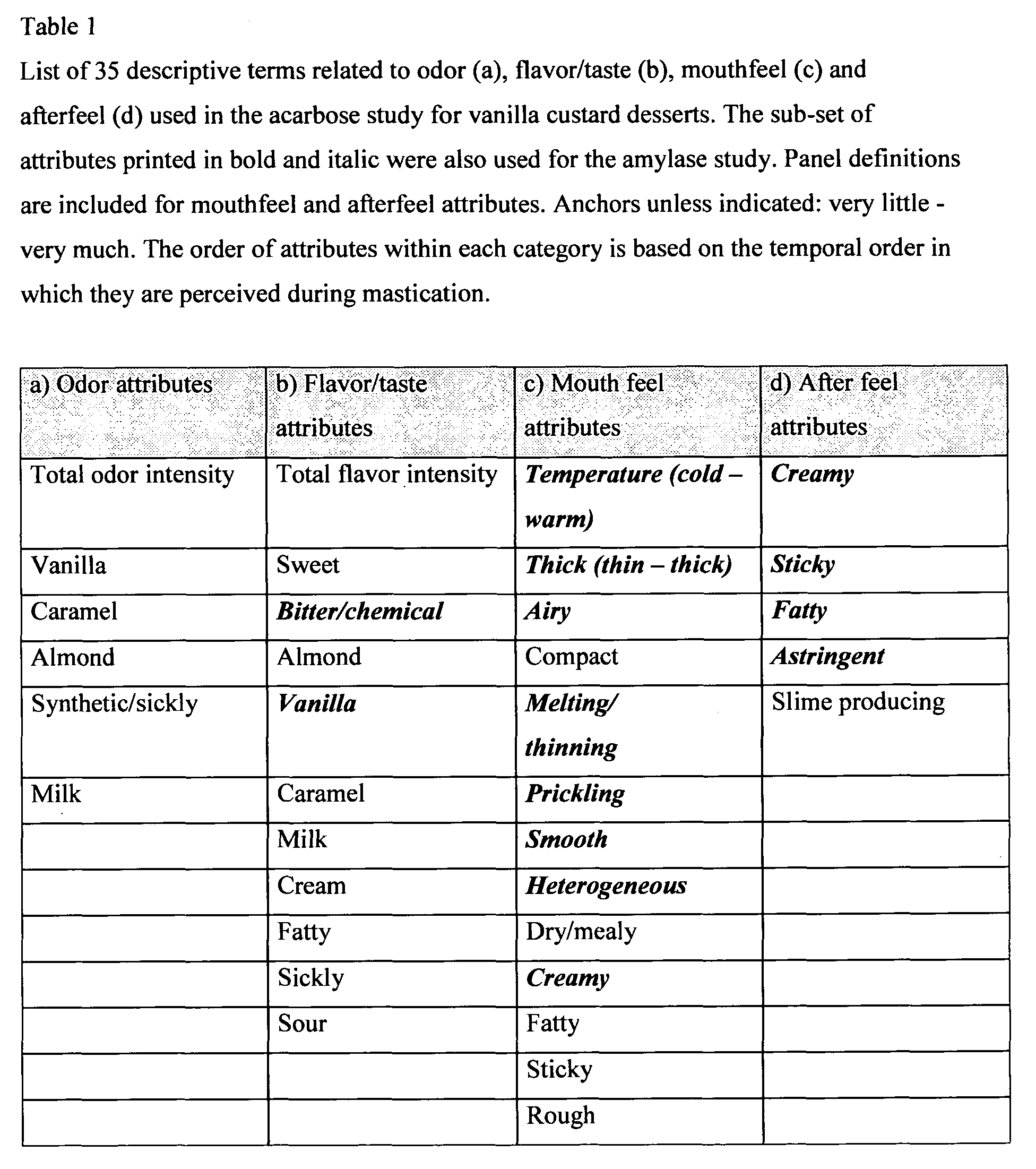
and/or afterfeel using a predetermined scale, as illustrated in the Examples. Generally 35
different sensory attributes can be distinguished and rated (de Wijk et al. 2003a). Mostly
in-mouth sensory attributes are rated. Some sensory attributes relate to in-mouth sensory
attributes following swallowing, such as afterfeel and aftertaste. A skilled person will be
able to use standard sensory rating methods to determine whether a starch-based product,
which has been modified to cause an in-mouth reduction in salivary amylase-induced
starch breakdown, has one or more improved sensory ratings compared to the analogous
unmodified product, in which no measures have been taken to reduce the in-mouth
salivary amylase induced starch break down.
-
In a specific embodiment of the invention the sensory rating of one or more attributes
selected from odor attributes (e.g. odor intensity, vanilla odor), mouthfeel attributes (e.g.
thickness, creaminess, fatty mouthfeel), flavor attributes (e.g. vanilla), afterfeel attributes
(e.g. creamy afterfeel) and aftertaste attributes (e.g. creamy aftertaste) are improved by
reducing the starch structure breakdown in-mouth. The rating of the improved attribute
assigned to the modified product is statistically significantly different (p<0.05) from the
rating of the corresponding attribute of the unmodified product using a statistical
repeated-measures design. Each attribute is rated on a scale, ranging from the least
desired to the most desired. For example 'creamy mouthfeel' can be rated from 'not at all
creamy' to 'very creamy'. Generally, it is known per se which range of the scale is the
"desired" range and which is the "undesired" end, although this will vary according to the
specific food product tested.
-
Preferably the sensory rating of more than one sensory attribute is improved in the
method of the invention. Most preferably at least creamy mouthfeel is improved.
-
The reduction of the in-mouth starch structure breakdown can be achieved by various
means. In one embodiment it is achieved by the addition of one or more α-amylase
inhibitors to the starch comprising, semi-solid food product. Preferably the α-amylase
inhibitor is added in an effective amount, i.e. in an amount sufficient to reduce in-mouth
starch structure breakdown and to cause an improved sensory rating. The amount
required will vary depending on the specificity and optimum activity of the inhibitor
used. The effective amount required can easily be determined by a skilled person without
undue experimentation. Further, the α-amylase inhibitor should be food-grade, and not
harmful when ingested by a human or animal subject.
-
Various suitable α-amylase inhibitors are available in the art. For example proteinaceous
α-amylase inhibitors (hereinafter referred to as "α-amylase inhibitor proteins") and genes
encoding these have been isolated and/or cloned from various plant seeds and vegetative
organs, such as from Triticum aestivum, Sorghum bicolor, Secale cereale, Phaseolus
vulgar and others (see Franco et al. 2002, incorporated herein by reference). Several α-amylase
inhibitor proteins have a high specific activity against mammalian salivary α-amylases.
Suitable inhibitor proteins would be for example the 0.19, 0.28 (see US
5,444,046 incorporated herein by reference) or the 0.53 inhibitor (see US 5,726,291
incorporated herein by reference) from T. aestivum, the 1,2,3 and BIII inhibitor from S.
cereale or the SIα1, Siα2, Siα3 inhibitors from S. bicolor. Nucleic acid and protein
sequences of these genes are generally available in sequence databases, such as
SWISSPROT, GenBank, EMBL, GeneSeq, and others. The α-amylase inhibitor protein
may be produced by recombinant DNA technology as known in the art (e.g. recombinant
proteins produced by transformed bacteria, plants, plant cells, fungi, cell cultures, etc.), or
may be purified from its natural source or synthesized chemically. If the semi-solid food
comprises plant based ingredients, the α-amylase inhibitor protein may also be over-expressed
in a transgenic plant, and the processed plant product may be used directly in
the preparation of the semi-solid food product. It is also envisaged, that the transgenic
plant is a starch comprising plant, so that both the starch and the α-amylase inhibitor
protein may be provided directly by the processed plant tissue. Methods for introducing
recombinant DNA into bacterial-, fungal-, plant- or animal cells are well known, such as
particle gun transformation, protoplast transformation, electroporation, Agrobacterium
mediated transformation and the like.
-
Also, non-proteinaceous inhibitors, such as acarbose and various sugars (mono-, di-,
polysaccharides), and analogues thereof, may be suitable, as long as they are non-toxic
when ingested by mammalian subjects, particularly humans. The most suitable
(protenaceous or non-protenaceous) inhibitor has a high specific activity against
mammalian, especially human, salivary α-amylase and is highly effective under in-mouth
conditions (pH, temperature), while it preferably does not inhibit (or has a low inhibitory
effect on) pancreatic α-amylases. Further, as mentioned above, it preferably has no
negative side effects when ingested at the concentration at which it is present in the food-product.
For example, side effects such as loss of body weight should not occur as a
result of ingestion.
It is understood, that the invention is not limited to the (protenaceous or non-protenaceous)
α-amylase inhibitors described herein. Other suitable inhibitors can be easily determined
by a skilled person, by for example testing the ability of various amounts of a potential
inhibitor to inhibit human salivary α-amylase. For this purpose in vitro enzyme assays as
known in the art are suitable. Likewise, assays as described in the Examples may be used.
In the same way synergistic activity between two, or more, different inhibitors can be
determined. Synergistic activity is seen if the inhibitory effect of two (or more) inhibitors
used together is higher than that of each inhibitor used by itself. For example, the use of
both maltose and a pH-reducing compound may have a higher inhibitory activity than
each alone. Potential further non-protenaceous inhibitors may, for example, be
polysaccharides, especially disaccharides (e.g. maltose, maltodextrin), or polysaccharide
analogs such as for example galactomannan or inuline.
-
An assay suitable for determining the activity of a potential salivary alpha-amylase
inhibitor is described in the Examples. In this assay a starch-comprising food product,
such as for example 30g vanilla custard (e.g. Friesche Vlag), is mixed with a certain
amount of the potential inhibitor(s) and with human saliva (diluted). The change in
viscosity of the mixture is then analysed for about 120 seconds using a Rapid
Viscoanalyser. As a control the custard to which water, instead of saliva and inhibitor,
has been added is used. In particular viscosity at about 48 seconds is used to determine
the percentage starch-structure breakdown inhibition, which is due to the inhibitor(s). The
effect on viscosity is an indirect measure of salivary α-amylase inhibition.
-
In one embodiment of the invention monoglycerides are used as inhibitor to inhibit in-mouth
starch structure breakdown induced by salivary amylase and semi-solid starch
comprising food products which further comprise at least 1 wt%, 5 wt% or 10 wt%
monoglycerides are provided. Such products have improved sensory ratings as described
above. It has been found by the inventors that addition of at least 1 wt% monoglyceride to
a starch-comprising semi-solid food product significantly reduced salivary-induced
starch-structure breakdown. Monoglycerides are partial esters of glycerol with higher
molecular fatty acids (monoacylglycerols). They are commonly used as emulsifiers in
food products. Monoglycerides can be obtained commercially (e.g. from Quest
International B.V., The Netherlands), purified from natural animal or plant sources, or
made synthetically. Suitable monoglycerides may be derived from any fatty acids and
may be straight chain or branched, saturated or unsaturated and having 8 to 22 carbon
atoms.
-
In another embodiment of the invention a pH-modifying (acidifying) compound or an
amide reagent is added to the semi-solid food products, as amide reagents and low pH
(below pH 7, such as for example about pH 6, pH 5, or less) are also known to reduce or
inhibit α-amylase activity. Under acidic conditions the enzymatic rate slows down, and
the enzyme cannot hydrolyse the glycosidic bonds as fast. At a pH of about 5 or less α-amylase
activity is essentially inhibited completely. The pH-modifying compound or
amide reagent may be added at different stages during the production of the food-product,
as long as the final product, when macerated in the mouth, causes the desired salivary α-amylase
inhibitory effect. The effective amount of acidifying compound or amide reagent
required will vary, depending on the activity of the compound or agent used. The
effective amount can be readily determined by a skilled person. Preferably, the pH of the
product is lowered to pH 6.3 or less. Examples of suitable edible acidifying compounds
are citric acid, ascorbic acid, hibiscus acid, oleanolic acid, etc.
-
In another embodiment the reduction of the in-mouth starch structure breakdown is
achieved by chemical and/or physical modification of the starch. Starch may be modified
directly in the food-product or pre-modified starch may be added to the semi-solid food
product. The starch is modified so that it becomes more resistant to salivary α-amylases
breakdown. "More resistant" refers in this respect to a slower rate of hydrolysis by the
salivary α-amylases, a lesser degree of hydrolysis or to complete prevention of
hydrolysis. Chemical modification of starch can be carried out by, for example, replacing
some hydroxyl groups by either ester or ether groups, or by chemically cross-linking
hydroxyl groups on neighboring starch molecules. Cross-linked starch has, therefore,
cross-links in and/or between starch molecules. Cross-links may be formed as known in
the art, for example by means of chemical reagents capable of reacting with the hydroxyl
groups in and/or between starch molecules. Examples of cross-linking agents are
phosphorus oxychloride, sodium trimetaphosphate, adipic acid, epichlorohydrin, etc. In
one embodiment high cross-linked starch is used according to the invention in order to
provide starch comprising semi-solid food products with improved sensory rating, in
particular improved creaminess, as further described in the Examples.
-
Very low levels of chemical modification can significantly change the rheological,
physical, and chemical properties of starch. Starch modification has been described in the
art, for example US 6,607,748 describes cross-linking and hydroxyprolation of high
amylose starch (for pharmaceutical applications), and US2001026827 describes
thermochemically modified starch.
-
Increased resistance of the chemically/physically modified starch to salivary α-amylases
breakdown can be initially tested by in vitro enzyme assays, using mammalian
(preferably human) α-amylase. If a significant increased resistance is found in vitro,
different amounts of the chemically modified starch can be added to a test food product
and a sensory rating carried out (comparing the sensory attributes of the food product
comprising the chemically and/or physically modified starch to the product comprising
normal commercially available starch).
-
Chemical modification of the starch may also be carried out in vivo, in for example a
transgenic organism, such as for example a bacterium or a plant. For this purpose the
enzyme(s) carrying out the chemical modification can be cloned and over-expressed in
the host organism using known methods. For example, a range of starch synthetic
enzymes of plants have been cloned (e.g. starch synthases, starch branching enzyme,
phosphoglucomutase, etc.) and used or modified in order to generate starch with novel
properties in vivo. Likewise, mutant plants, producing modified starch can be generated
using known mutagenesis methods (X-ray, chemical mutagenesis, etc.). It is also possible
to use RNAi technology to down-regulate or silence endogenous plant genes, in particular
genes of the starch biosynthetic pathway, to generate plants, which produce modified
starch. Examples of both mutant plants and genetically modified plants producing starch
with altered characteristics are well known, see e.g. US 2003110534 or US 6,376,749.
-
The chemically and/or physically modified starch may be added in addition to the normal
starch present in the product or may be used to replace the normal (unmodified) starch of
the product.
-
In yet another embodiment the reduction of the in-mouth starch structure breakdown is
achieved by coating of the starch so that it becomes inaccessible or less accessible or
accessible more slowly to salivary α-amylases when the food product is brought into the
mouth. The degree and timing of physical contact between the starch and the salivary α-amylases
is thus modified by coating the starch so that the in-mouth starch structure
breakdown is reduced. The coating applied to the starch is preferably edible. Edible
coatings can for example be made from plant proteins, such as but not limited to zein (the
most abundant corn protein), soy protein, wheat gluten, whey protein, gelatin, casein and
the like. The coating may also consist of chemically and/or physically modified starch.
The coating may comprise additional components, such as water, ethanol, or other edible
constituents and may for example be sprayed onto the starch granules. The starch which
is coated may be unmodified or chemically (and/or physically) modified starch. The use
of both chemically and/or physically modified starch, surrounded by an edible coating,
may be particularly effective in reducing in-mouth starch structure breakdown. As
salivary α-amylase is essentially inactive at a pH of 5 or less, the coating may consist of
or comprise a pH lowering (acidifying) compound or agent.
-
Also provided are starch comprising, semi-solid food products, which are made according
to the methods of the invention and which have an improved sensory rating of at least one
sensory attribute (selected from odor, mouthfeel, flavour, taste, afterfeel or aftertaste
attributes as described above) when processed naturally in the oral cavity during eating
(mastication - with or without chewing - and swallowing). A food-product according to
the invention preferably comprises at least 1-10 wt% of starch. Further, in one
embodiment the food-product according to the invention is a low-fat product, for example
a starch comprising custard comprising less than 3 wt% fat, preferably less than 2 wt%
fat, more preferably less than 1 wt% fat, such as for example 0.1 wt% fat. In one
embodiment the food-product comprises an effective amount of one or more α-amylases
inhibitors as defined above. In another embodiment it comprises chemically modified
starch, as described herein above. In yet a further embodiment it comprises coated starch,
as described herein above.
-
Food products comprising combinations of any of the embodiments described herein,
which result in inhibition of salivary induced in-mouth starch structure breakdown and an
improved sensory rating are also encompassed herein. For example, a food product with
both a non-protenaceous amylase inhibitor and a acidifying compound may yield a
product which has even better sensory attributes than if the non-protenaceous inhibitor or
acidifying compound were added alone. Thus, all combinations of protenaceous- and/or
non-protenaceous (including acidifying compounds, sugars, glyceraldehyde) inhibitors
with one another or with chemically modified and/or coated starch are encompassed.
-
Further, the use of an α-amylase inhibitor to improve the sensory rating of a semi-solid,
starch comprising food-product is provided, whereby the amylase inhibitor is added to the
food product in an effective amount, i.e. in an amount sufficient to reduce the starch
structure breakdown, which is induced upon contacting salivary α-amylases with the food
product.
-
Similarly, the use of chemically modified starch and/or coated starch as described above
is provided by the invention, whereby starch is added to the food-product or is used to
replace the normal starch comprised in the food-product.
-
Likewise the use of monoglycerides as described above to improve the sensory rating
sensory rating of a semi-solid, starch comprising food-product is provided, whereby the
monoglycerides are added to the food product in an effective amount, i.e. in an amount
sufficient to reduce the starch structure breakdown, which is induced upon contacting
salivary α-amylases with the food product.
-
It is understood that the following Examples do not limit the invention to any of the
particular embodiments described, such as for example to the particular test food used
(vanilla custards).
Description of figures
-
- Fig. 1(a) Predicted versus measured creamy mouthfeel ratings for the amylase study.
- Fig. 1(b) Predicted versus measured creamy mouthfeel ratings for acarbose study.
- Fig. 2 The effect of monoglyceride on viscosity (cP) of full-fat vanilla custard (Friesche
Vlag), as measured over 120 seconds (horizontal axis).
-
Examples
Example 1
-
The role of salivary amylase in modifying texture sensations was evaluated in the
following examples, in which the level of amylase activity was varied within subjects,
rather than between subjects. Alpha-amylase was added in varying concentrations to
starch and CMC (non-starch)-based vanilla custard desserts. Additionally, amylase
activity was inhibited to various degrees by adding the pharmaceutical amylase inhibitor
Acarbose (CAS nr. 56180-94-0) in various concentrations to the same test foods.
-
Vanilla custard/cream desserts were used as test foods. Custard/cream dessert is a popular
dairy product in The Netherlands, typically containing modified starch, milk, sugar,
hydrocolloids such as carrageenans, colorants and aromas. The sensory characteristics of
vanilla custard desserts have been reported elsewhere (Weenen et al. 2003; de Wijk et al.
2003b). As a comparison, non-starch CMC-based custard desserts were used. Given
sufficient time, a starch-based vanilla custard dessert will be virtually liquefied by the
addition of only a small amount of salivary amylase due to the enzymatic breakdown of
starch. Actively stirring the amylase into the custard will dramatically increase the speed
of liquefaction, but it is unclear whether such breakdown effects can occur in seconds
during in vivo oral processing.
1. Materials and Methods
Subjects
-
Eighteen subjects, 11 females and 7 males aged between 18 and 34 yrs, participated the
'amylase study' and 7 different subjects, all females aged between 39 and 56 yrs,
participated in the 'acarbose study'. The subjects participating in the latter study had been
informed about acarbose and its possibly side effects if swallowed. To avoid these side
effects, subjects expectorated rather than swallowed the acarbose samples. All subjects
signed consent forms expressing their willingness to participate in the studies, and all had
previously been screened for olfactory and taste disorders and had received extensive
training in the description of sensory mouthfeel and afterfeel attributes for semi-solid
foods. Testing took place at the sensory facilities of TNO-Nutrition and Food Research in
Zeist, The Netherlands.
Sensory Stimuli
-
For the 'amylase study', two commercially available full-fat vanilla custard desserts (3
wt% fat AH vanille vla or "AH", Albert Heijn Corp., Zaandam, The Netherlands; and 3
wt% fat Boerenland vla or "BL", Campina Corp., Woerden, The Netherlands) were used
as the two starch-based vanilla custard desserts. For the 'acarbose study', Boerenland vla
was used again but the Albert Heijn vla was replaced by a low-fat dairy custard (0.1 wt%
fat Creamex, Creamex Corp., Rijkervoort, The Netherlands).
-
In both studies, the effect of amylase and acarbose on starch-based custards was
compared with their effects on non-starch custards to verify amylase-starch interactions.
A non-starch custard was produced using full-fat (3 wt%) commercially available milk
(Campina Corp., Woerden, The Netherlands) and adding 0.85 wt% of sodium carboxy
methylcellulose (or "CMC") (Akuell AF 3295, Akzo Nobel Corp., Amersfoort, The
Netherlands), 6.25 wt% of sugar and 0.33 wt% of vanilla powder. Yellow colorant (Egg
yellow, Supercook, Leeds, United Kingdom) was added at 3.33 ml/l custard to match the
color of the starch-based custards.
-
For the amylase study, a bacterial α-amylase (from Bacillus licheniformis, with 15 wt%
NaCl and 25 wt% sucrose, Sigma Corp., Zwijndrecht, The Netherlands) was used to
prepare amylase solutions at concentrations of 40, 160, and 640 units in 100µl aliquots of
water. This concentration range is similar to the range of individual amylase levels found
across a group of young and healthy subjects (Engelen, unpublished results). The amylase
concentrations, including a control of 0 units, were added to 5 ml samples of the starch-based
custards. Only the highest concentration, 640 units, and the control were added to 5
ml samples of the CMC custard.
-
For the 'acarbose study', 50 mg acarbose tablets (Glucobay™, Bayer) were separated
into water soluble and water insoluble material by dissolving the tablets in water, mixing
thoroughly and centrifuging. The water extract was freeze-dried, resulting in 40mg of dry
material per 50 mg tablet. The resulting solid material was then dissolved in water at
concentrations of 0.25, 0.5, 1.0, and 2 mg of acarbose and these were added, together
with a 0 mg control, in 100µl aliquots to 5 ml samples of custard desserts. Again, only the
0 mg control and the highest (2 mg) acarbose concentrations was added to 5 ml samples
of the non-starch CMC custard.
Sensory Rating Procedure
-
Panelists were seated in sensory booths with appropriate ventilation and lighting. Testing
took place over either 3 ('amylase study') or 1.5 ('acarbose study') sessions of 2 hours.
Within each session, subjects were presented with 20 trials during which they received in
the amylase study each of the three custards once with the various amounts of amylase
and with two different processing instructions. Over the 3 sessions, each custard was
presented 3 times in each condition. In the 'acarbose study', each of the three custards
with various amounts of acarbose were presented twice in the first session, and once in
the second half session. The stimulus presentation order was randomized per subject and
per session. The trials were presented at an average rate of one trial per 5 minutes. A
break separated the first and the second half of each session.
-
In the 'amylase study', a 100 µl aliquot of each water/amylase solution was placed on a
spoon with a dispenser, the appropriate custard was added on top, and within
approximately five seconds the spoon was handed to the subject and placed in the mouth
with an instruction on the required type of oral processing. The reasons for using this
method rather than mixing solution and product prior to administration were two-fold.
Firstly, the method used mimics the situation in vivo, where ingested food is initially
surrounded by the thin layer of saliva covering the oral mucosa. Secondly, had the α-amylase
solutions been mixed with the custards prior to ingestion, the starch breakdown
would have commenced before the mixture could be presented to subjects, causing a
rapid decrease in viscosity. During unrestricted processing, subjects orally processed the
custards in their preferred manner for 5 seconds. During restricted processing, subjects
compressed the custards with the tongue against the palate, and kept it compressed for 5
seconds. In either case, after 5 seconds flavor and mouthfeel sensations were assessed
before the custard was swallowed. Afterfeel sensations were assessed immediately after
swallowing.
-
In the 'acarbose study', 100 µl aliquots of each water/acarbose solution were mixed into 5
ml custard samples and presented to the subjects. Assessments proceeded as in the
amylase study, except that the samples were expectorated after oral processing and
followed by a mouth rinse.
-
Panelists assessed sensory attributes in the chronological order in which they are
perceived (as established previously by a QDA panel, de Wijk et al. 2003a). The set of
attributes used for the amylase study was a representative subset of 35 odor, flavor,
mouthfeel, and afterfeel attributes that had been generated previously. The complete set
of 35 attributes was used for the acarbose study (see Table 1). The attributes appeared by
category on a monitor in front of each panelist, with the attributes on the left and a 100-point
response scale anchored at the extremes on the right (FIZZ Biosystemes, France,
1998). Panelists used a mouse to indicate the perceived strength of each attribute. Each
product was first smelled after which the odor attributes were rated. Next, the product
was taken into the mouth after which the taste/flavor and mouthfeel attributes were rated
in the order in which they were perceived. Finally, the product was swallowed (amylase
study) or expectorated (acarbose study), the afterfeel attributes were rated, and the
panelists rinsed before being presented with the next sample. Acquisition of each
subject's responses was done by computer using FIZZ software.
Statistical analysis
-
The effects of amylase and acarbose concentrations and modified behaviors on sensory
attributes were analyzed uni-variately using a repeated measures ANOVA (SPSS version
11.5, SPSS Inc., USA) with the Huynh-Feldt value as epsilon, carried out on the sensory
data averaged across replicates. The amylase results were based on a nested within-subject
design with type of starch-based custard (degrees of freedom or df: 1,16), type of
oral processing (df: 1,16), and amylase concentration (df: 3,48) as the main factors. The
acarbose results were based on the same statistical design with type of starch-based
custard (df: 1,7) and acarbose concentration (df: 4,28) as the main factors. The results for
the CMC-based custards were analyzed separately. All analyses also included tests for
higher order interactions. P-values for significant results will be reported in the result
section. Relationships between creamy mouthfeel and specific attributes were statistically
modeled using Partial Least Squares Regression or PLSR (Unscrambler Vs. 7.5, Camo
Inc., Corvallis, U.S.A).
2. Results
'Amylase study'
-
Ratings averaged across subjects for flavor and texture attributes are shown in Table 2.
The results indicated that added amylase failed to affect any of the odor, mouthfeel or
afterfeel attributes for the non-starch CMC-based custard, and that it affected the intensity
of bitter/chemical flavor which increased when amylase was added (p=0.01). In contrast,
a large number of attributes of the starch-based custards were affected by added amylase.
With increasing amylase concentration, sensations of thick mouthfeel (p=0.004), creamy
mouthfeel (p<0.0001), fatty afterfeel (p=0.05) and vanilla flavor (p=0.001) decreased,
while sensations of melting mouthfeel (p=0.001), heterogeneous mouthfeel (p=0.006),
and bitter/chemical flavor increased significantly. For CMC-based custards, the type of
oral processing affected only airy mouthfeel, which was most intense in the unrestricted
condition (p=0.01). For the starch-based custards, unrestricted compared to restricted
processing resulted in higher ratings of melting (p=0.02), roughness (p=0.03) and vanilla
flavor, and in lower ratings of prickling mouthfeel (p=0.02). Increasing the concentration
of amylase was equally (in-)effective for restricted and unrestricted oral processing, as
indicated by the lack of significant interactions between processing condition and
amylase concentration.
'Acarbose study'
-
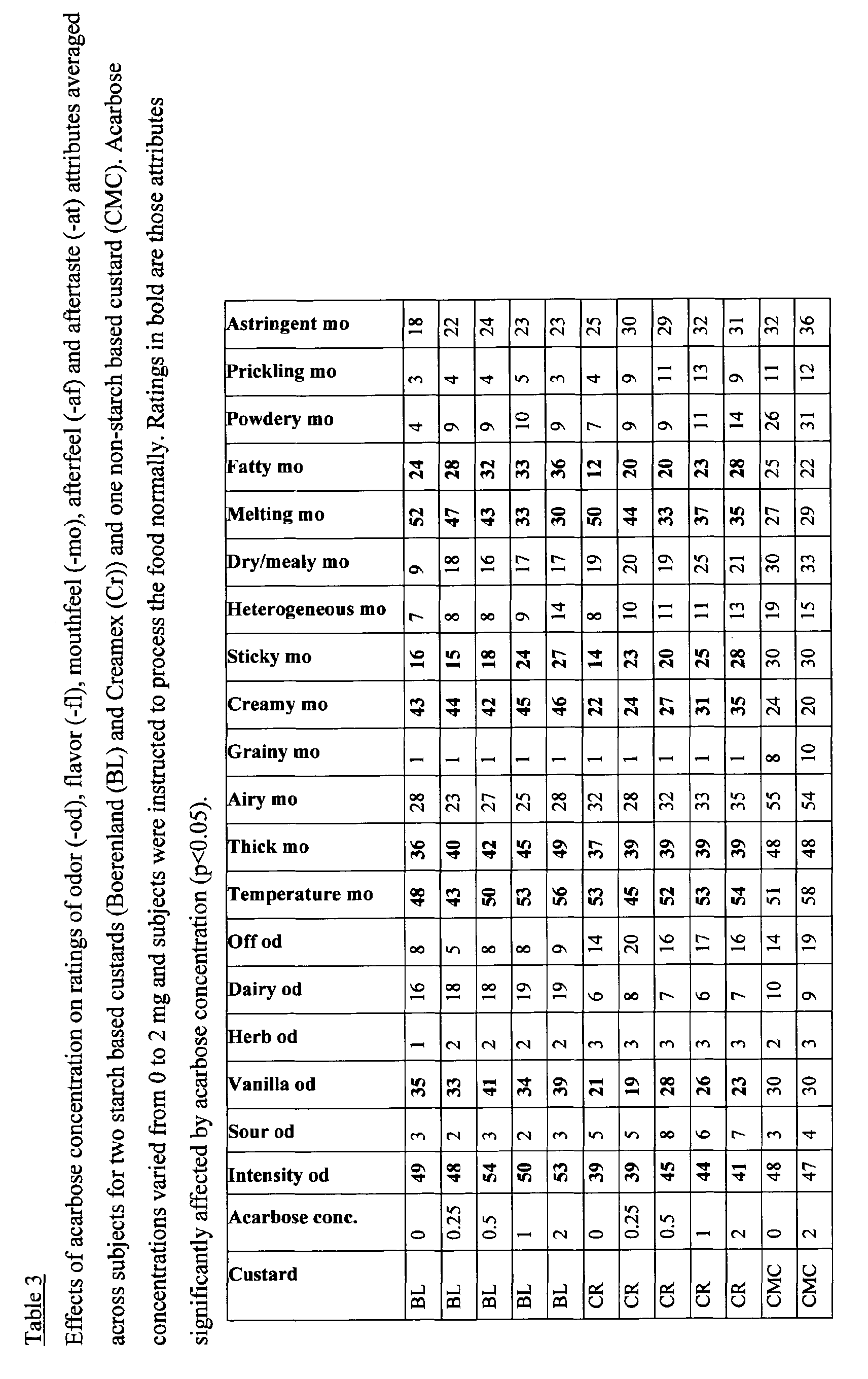
The presence of acarbose at the highest concentration failed to affect any of the attributes
for the CMC-based custard compared to the control without any acarbose. In contrast,
increasing acarbose concentrations in starch-based custard desserts resulted in a very
large decrease in melting mouthfeel (p=0.001), and in increased ratings of odor intensity
(p=0.05), vanilla odor (p=0.05), temperature mouthfeel (p=0.001), thick mouthfeel
(p=0.01), creamy mouthfeel (p=0.05), sticky mouthfeel (p=0.02), fatty mouthfeel
(p=0.02), off flavor (p=0.05), and creamy afterfeel (p=0.002). Marginally significantly
increased ratings were found for fatty afterfeel (p=0.06) and slimy afterfeel (p=0.06).
Results are shown in Table 3.
-
The results demonstrate the importance of starch breakdown, particularly for sensations
related to food viscosity. The fact that hardly any effects were found in a non-starch
CMC-based custard indicates that the effects of adding acarbose and amylase were
indeed related to starch breakdown. For starch-based custards, amylase addition resulted
in increased melting and decreased thickness sensations, whereas acarbose addition had
the opposite effect, i.e., decreased melting and increased thickness. Other attributes were
affected as well. Creamy mouthfeel decreased with amylase addition and increased with
acarbose addition. Similar results were found for creamy afterfeel (but only with
acarbose) and fatty afterfeel (both with amylase and acarbose). Creamy mouthfeel, which
is considered to be a highly desirable food quality, decreased by up to 25% when amylase
was added (AH custard) and increased by up to 59% when acarbose was added (Creamex
custard).
-
A Partial Least Square (PLS) multivariate analysis was carried out to verify whether
changes in creamy mouthfeel ratings were primarily related to changes in melting and
thickness ratings or whether changes in ratings of other attributes were important as well.
PLS results indicate that the effect on creamy mouthfeel was only partially related to the
effects on melting and thickness sensations. Changes in creamy mouthfeel caused by
amylase addition were well predicted by a combination of bitter/chemical flavor, fatty
afterfeel, and melting mouthfeel (r =0.98), and changes caused by acarbose addition were
well predicted by the intensities of salty flavor, all flavors combined in "flavor intensity",
vanilla flavors, and melting mouthfeel (r =0.98) (see Table 4 and Fig. 1a,b).
-
The importance of certain flavors, in combination with selected viscosity and fat related
attributes, for creamy mouthfeel is consistent with the results of previously studies on the
effects of carrageenan, fat and starch content on the perception of custards. In particular,
creamy mouthfeel ratings were highly positively correlated with ratings of vanilla flavor
(de Wijk et al. 2003b; Daget et al. 1988). Similarly, creamy mouthfeel and vanilla
flavour correlated positively in the present studies (r = 0.64 for amylase and r = 0.92 for
acarbose, p < 0.01). Previous studies have hypothesized that the flavor effect is related to
fat content. Increased fat content results in increased flavor release of the fat-soluble
flavors typically associated with creamy foods, such as vanilla flavors as well as
oily/fatty and creamy flavors. These fat-derived flavors seem to suppress certain
undesirable flavors, such as bitter/chemical flavors, that may stem from ingredients other
than fat, e.g. from starch. In addition, it has been suggested that lubricative properties also
affect creamy mouthfeel sensations. In the present studies, fat content was not varied
within each test custard, but it is possible that the release of vanilla flavor was varied in
other ways by the presence of acarbose and amylase. Odake et al. (1998) instrumentally
measured flavor release from cream-style dressings using a dynamic head space model
that mimics the raising and lowering of the tongue by moving a plunger up and down in a
sampling flask. Reduced viscosity of the foods, as a result of dilution with artificial
saliva, resulted in a reduction in the release of diacetyl. It could be that the less viscous
food stuck less easily to the surface of plunger and flask, resulting in reduced surface area
and consequently in reduced flavor release. In the present study, the reduced intensity of
vanilla flavor for custards broken down by amylase may also be related to reduced
surface area - and associated reduced flavor release- of the custard in the mouth.
-
One of the functions of oral movement is to mix the food bolus with saliva and its
enzymes to increase enzymatic breakdown (de Wijk
et al. 2003a). Hence, the more
complex unrestricted oral processing should result in increased mixing and therefore in
the highest effectiveness of the added amylase. However, the lack of significant
interactions between type of oral processing and amylase concentration indicate that the
type of oral processing has no effect on the effectiveness of added amylase. Possibly the
two types of processing used in this study, compression of the food against the palate
versus unrestricted processing, were not sufficiently different.
In conclusion, the Examples show that the sensory rating of semi-solid food products
comprising starch is improved by reducing the in-mouth starch breakdown, which is
induced by amylase activity. Improved sensory attributes include those related to
viscosity, such as perceived melting and thickness, but also attributes typically related to
the functionality of fat/oil, such as creaminess and fattiness.


| Partial Least Square regression coefficients plus standard errors (Se), for the acarbose (left) and amylase (right) studies, relating creamy mouthfeel ratings to ratings for other attributes. Coefficients in bold are significantly different from zero. Coefficients in italics indicate the attributes selected for the prediction of the creamy mouthfeel ratings shown in Figure 1. Amylase results are based solely on the unrestricted oral processing condition in order to ensure comparability. |
| Attribute | Average | Se | Attribute | Average | Se |
| Sour-od | -0.02 | 0.03 | Bitter/chem-fl | -0.21 | 0.1 |
| Vanilla-od | 0.18 | 0.11 | Vanilla-fl | 0.13 | 0.05 |
| Herb-od | -0.01 | 0.01 | Cold-mo | 0.05 | 0.06 |
| Dairy-od | 0.13 | 0.09 | Thick-mo | 0.16 | 0.07 |
| Off-od | -0.10 | 0.08 | Airy-mo | -0.02 | 0.06 |
| Temperature-mo | 0.03 | 0.16 | Melting-mo | -0.15 | 0.05 |
| Thick-mo | 0.08 | 0.04 | Prickling-mo | -0.06 | 0.03 |
| Airy-mo | -0.03 | -0.06 | Smooth-mo | -0.02 | 0.05 |
| Grainy-mo | 0.00 | 0.01 | Heterogeneous-mo | -0.08 | 0.13 |
| Sticky-mo | 0.13 | 0.14 | Sticky-af | 0.01 | 0.05 |
| Heterogeneous-mo | 0.05 | 0.05 | Fatty-af | 0.04 | 0.03 |
| Dry/mealy-mo | -0.01 | 0.04 | Rough-af | 0.02 | 0.06 |
| Melting-mo | -0.18 | 0.16 |
| Powdery-mo | 0.05 | 0.08 |
| Prickling-mo | -0.02 | 0.12 |
| Astringent-mo | -0.03 | 0.09 |
| Intensity-fl | 0.07 | 0.02 |
| Salt-fl | -0.03 | 0.02 |
| Sour-fl | -0.02 | 0.02 |
| Vanilla-fl | 0.15 | 0.08 |
| Herb-fl | 0.01 | 0.02 |
| Egg-fl | 0.01 | 0.03 |
| Dairy-fl | 0.16 | 0.10 |
| Sweet-fl | 0.04 | 0.08 |
| Off-fl | -0.22 | 0.10 |
| Sticky-af | 0.07 | 0.04 |
| Burning-af | -0.01 | 0.05 |
| Astringent-af | -0.08 | 0.05 |
| Slimy-af | 0.10 | 0.12 |
| Salt-at | -0.01 | 0.03 |
Example 2 - monoglycerides
-
The following experiment was carried out in order to determine whether
monoglycerides are effective inhibitors of saliva-induced starch-structure breakdown.
-
Full-fat (3 wt%) vanilla custard (Friesche Vlag) was used in the experiment.
Monoglyceride was obtained from Quest International B.V.. The monoglyceride used
was Myvatex Mighty Soft XL K (product code 5Z10581).
-
Monoglyceride and 2ml human saliva (saliva diluted with 10°DH-water; DH refers to
German degrees hardness) were added to vanilla custard (30g) to give a concentration
of 1 wt% or 10 wt% monoglyceride. As controls vanilla custard (30g) with 2ml 10°DH-water
only or vanilla custard with a 2ml mixture of 10°DH-water and human saliva
(1:1) were used.
-
Viscosity of the samples was measyred using a Rapid Viscoanalyser RVA-4SA.
The results are shown in Figure 2 and Table 5. One percent monoglyceride was very
effective in inhibiting starch structure breakdown, as seen by viscosity remaining high
between about 30 and 60 seconds. Ten- percent monoglyceride also showed a
significant effect compared to the constrol, although not as strong as for 1 wt%
monoglyceride.
| Sample | Visc48 (cP) | Bendpoint (s) | t150 (s) | Decline (%) | Inhibition (%) |
| 10°DH water (control) | 360.0 | - | - | 0 | 100.0 |
| 10°DH water (control) | 360.0 | - | - | 0 | 100.0 |
| 0% monoglyceride; saliva (control) | 86.3 | 26.6 | 25.7 | 100.0 | 0 |
| 0% monoglyceride; saliva (control) | 89.4 | 32.2 | 32.2 | 100.0 | 0 |
| 1 wt% monoglyceride; saliva | 181.4 | 61.4 | 58.2 | 66.0 | 34.0 |
| 1 wt% monoglyceride; saliva | 187.6 | 65.0 | 61.8 | 63.0 | 37.0 |
| 10% monoglyceride; saliva | 109.5 | 36.4 | 39.0 | 92.0 | 8.0 |
| 10 wt% monoglyceride; saliva | 117.0 | 36.9 | 40.0 | 89.0 | 11.0 |
| Visc48 = viscosity at 48 seconds; Bendpoint = timepoint when viscosity begins to decline rapidly; t150 = timepoint when a viscosity of 150cP is reached; Decline = relative decline of viscosity at 48 seconds; Inhibition = calculated as (100 - Decline) |
Example 3 - cross-linked starch
-
When comparing saliva induced starch structure breakdown of custard desserts with
similar amylase-induced structure breakdown properties of three starch types at iso-thickness,
intensities were measured rheologically.
-
Farinex VA50T (tapioca based, rather low cross-linked starch) broke down most
rapidly, followed by Farinex VA40 (an intermediate cross-linked potato starch) and
Farinex VA70 (a high cross-linked potato starch), which showed the slowest and only
moderate break down.
-
Sensory analysis showed that rapid break-down, associated with low cross-linked
starches, resulted in low perceived creaminess, whereas slow break-down, associated
with high cross-linked starches, resulted in high creaminess.
References
-
- Bonnans, S. R.; Noble, A. C. Interaction of salivary flow with temporal perception of
sweetness, sourness, and fruitiness. Physiol. Behav. 57, 569-574, 1995.
- Christensen, C. M. Role of saliva in human taste perception. In: Clinical measurements
of taste and smell. Meiselman, H. L.; Rivlin, R.S. (editors), MacMillan, New
York, 414-428, 1985.
- Christensen, C. M.; Brand, J. G.; Malamud, D. Salivary changes in solution pH: A
source of individual differences in sour taste perception. Physiol. Behav. 40, 221-227,
1987.
- Daget, N.; Joerg, M.; Bourne, M. Creamy perception. I. In model dessert creams. J.
Text. Stud. 18, 367-388, 1988.
- de Wijk, R. A.; Prinz, J. F.; Engelen, L. The role of intra-oral manipulation in the
perception of sensory attributes. Appetite, 40(1), 1-7, 2003a.
- de Wijk, R. A.; van Gemert, L. J.; Terpstra, M. E. J.; Wilkinson, C. L. Texture of semi-solids;
sensory and instrumental measurements on vanilla custard desserts. Food
Qual. Pref., 14(4), 305-317, 2003b.
- Engelen, L.; de Wijk, R. A.; Prinz, J. F; Bosman, F. The relation between saliva flow
after different stimulations and the perception of flavor and texture attributes in
custard desserts. Physiol. Behav., 78 (1), 165-169, 2003a.
- Engelen, L.; de Wijk, R. A.; Prinz, J. F.; Janssen, A. M.; van der Bilt, A.; Weenen, H.;
Bosman, F. A comparison of the effects of added saliva, α-amylase and water on
texture perception in semi-solids. Accepted for publication in Physiol. Behav.,
2003b.
- Ericsson, Y. Clinical investigations of the salivary buffering action. Acta Odontol.
Scand. 17, 131-165, 1959.
- Franco et al. 2002, European J. Biochem. 269: 397-412.
- Guinard, J.-X.; Zoumas-Morse, C.; Walchak, C. Relation between parotid saliva flow
and composition and perception of gustatory and trigeminal stimuli in foods.
Physiol. Behav. 63, 109-118, 1998.
- Guinard, J.-X.; Zoumas-Morse, C.; Walchak, C.; Simpson, H. Relation between saliva
flow and flavor release from chewing gum. Physiol. Behav. 61, 591-596, 1997.
- Haring, P. G. M. Flavour release: from product to perception. In: Flavour science and
technology. Bessiere, Y.; Thomas, A. F. (editors). Chichester: Wiley, 351-354,
1990.
- Harrison, M. Effect of saliva-flow on flavour release from liquid foods. COST Action.
2, 91-96,1998.
- Kallithraka, S.; Bakker, J.; Clifford, M. N.; Vallis, L. Correlations between saliva
protein composition and some T-I parameters of astringency. Food Qual. Pref.,
12, 145-152, 2001.
- Larsen, M. J.; Jensen, A. F.; Madsen, D. M.; Pearce, E. I. F. Individual variations of
pH, buffer capacity, and concentrations of calcium and phosphate in unstimulated
whole saliva. Arch. Oral Biol. 44, 111-117, 1999.
- Noble, A. C. Application of time-intensity procedures for the evaluation of taste and
mouthfeel. Am. J. Enol. Vitic., 46, 128-133, 1995.
- Odake, S.; Roozen, J. P.; Burger, J. J. (1998). Effects of saliva dilution on the release of
diacetyl and 2-heptanone from cream style dressings. Nahrung, 42, 385-391.
- Rudney, J. D.; Ji, Z.; Larson, C. J. The prediction of saliva swallowing frequency in
humans from estimates of salivary flow rate and the volume of saliva swallowed.
Arch. Oral. Biol. 40, 507-512, 1995.
- Ruth, S. M. v.; Roozen, J. P. Influence of mastication and saliva on aroma release in a
model mouth system. Food Chemistry 71, 339-345, 2000.
- Ruth, S. M. v.; Roozen, J. P.; Nahon, D. F.; Cozijnsen, J. L.; Posthumus, M. A. Flavour
release from rehydrated french beans (Phaseolus vulgaris) influenced by
composition and volume of artificial saliva. Z-Lebensm-Unters-Forsch 203, 1-6,
1996.
- Shannon, I. L.; Frome, W. J. Enhancement of salivary flow rate and buffering capacity.
J. Can. Dent. Assoc., 39, 177-181, 1973.
- Smith, A. K.; June, H.; Noble, A. C. Effects of viscosity and sweetness on temporal
perception of astringency of grape seed and tannin. Food Qual. Pref., 7(3-4), 161-166,
1996.
- Tabak, L. A.; Levine, M. J.; Mandel, I. D.; Ellison, S. A. Role of salivary mucins in the
protection of the oral cavity. J. Oral Pathology 11, 1-17, 1982.
- Van Nieuw Amerongen, A. Speeksel en mondgezondheid. Amsterdam: VU Uitgeverij,
1994.
- Weenen, H.; van Gemert, L. J.; van Doom, J. M.; Dijksterhuis, G. B.; de Wijk, R. A.
Texture and mouthfeel of semi-solid foods: Commercial mayonnaises, dressings,
custard desserts and warm sauces. J. Texture St., 34(2), 148-159, 2003.
-


