EP1555707A1 - Sheet silicate mineral and fuel cell including intercalation complex thereof as solid electrolyte membrane - Google Patents
Sheet silicate mineral and fuel cell including intercalation complex thereof as solid electrolyte membrane Download PDFInfo
- Publication number
- EP1555707A1 EP1555707A1 EP03758738A EP03758738A EP1555707A1 EP 1555707 A1 EP1555707 A1 EP 1555707A1 EP 03758738 A EP03758738 A EP 03758738A EP 03758738 A EP03758738 A EP 03758738A EP 1555707 A1 EP1555707 A1 EP 1555707A1
- Authority
- EP
- European Patent Office
- Prior art keywords
- fuel cell
- layered silicate
- fuel
- solid electrolyte
- membrane
- Prior art date
- Legal status (The legal status is an assumption and is not a legal conclusion. Google has not performed a legal analysis and makes no representation as to the accuracy of the status listed.)
- Withdrawn
Links
Images



Classifications
-
- H—ELECTRICITY
- H01—ELECTRIC ELEMENTS
- H01M—PROCESSES OR MEANS, e.g. BATTERIES, FOR THE DIRECT CONVERSION OF CHEMICAL ENERGY INTO ELECTRICAL ENERGY
- H01M8/00—Fuel cells; Manufacture thereof
- H01M8/10—Fuel cells with solid electrolytes
- H01M8/1016—Fuel cells with solid electrolytes characterised by the electrolyte material
-
- H—ELECTRICITY
- H01—ELECTRIC ELEMENTS
- H01M—PROCESSES OR MEANS, e.g. BATTERIES, FOR THE DIRECT CONVERSION OF CHEMICAL ENERGY INTO ELECTRICAL ENERGY
- H01M8/00—Fuel cells; Manufacture thereof
- H01M8/10—Fuel cells with solid electrolytes
-
- H—ELECTRICITY
- H01—ELECTRIC ELEMENTS
- H01B—CABLES; CONDUCTORS; INSULATORS; SELECTION OF MATERIALS FOR THEIR CONDUCTIVE, INSULATING OR DIELECTRIC PROPERTIES
- H01B1/00—Conductors or conductive bodies characterised by the conductive materials; Selection of materials as conductors
- H01B1/06—Conductors or conductive bodies characterised by the conductive materials; Selection of materials as conductors mainly consisting of other non-metallic substances
- H01B1/12—Conductors or conductive bodies characterised by the conductive materials; Selection of materials as conductors mainly consisting of other non-metallic substances organic substances
- H01B1/122—Ionic conductors
-
- H—ELECTRICITY
- H01—ELECTRIC ELEMENTS
- H01M—PROCESSES OR MEANS, e.g. BATTERIES, FOR THE DIRECT CONVERSION OF CHEMICAL ENERGY INTO ELECTRICAL ENERGY
- H01M8/00—Fuel cells; Manufacture thereof
- H01M8/10—Fuel cells with solid electrolytes
- H01M8/1009—Fuel cells with solid electrolytes with one of the reactants being liquid, solid or liquid-charged
-
- H—ELECTRICITY
- H01—ELECTRIC ELEMENTS
- H01M—PROCESSES OR MEANS, e.g. BATTERIES, FOR THE DIRECT CONVERSION OF CHEMICAL ENERGY INTO ELECTRICAL ENERGY
- H01M8/00—Fuel cells; Manufacture thereof
- H01M8/10—Fuel cells with solid electrolytes
- H01M8/1016—Fuel cells with solid electrolytes characterised by the electrolyte material
- H01M8/1018—Polymeric electrolyte materials
- H01M8/102—Polymeric electrolyte materials characterised by the chemical structure of the main chain of the ion-conducting polymer
- H01M8/1027—Polymeric electrolyte materials characterised by the chemical structure of the main chain of the ion-conducting polymer having carbon, oxygen and other atoms, e.g. sulfonated polyethersulfones [S-PES]
-
- H—ELECTRICITY
- H01—ELECTRIC ELEMENTS
- H01M—PROCESSES OR MEANS, e.g. BATTERIES, FOR THE DIRECT CONVERSION OF CHEMICAL ENERGY INTO ELECTRICAL ENERGY
- H01M8/00—Fuel cells; Manufacture thereof
- H01M8/10—Fuel cells with solid electrolytes
- H01M8/1016—Fuel cells with solid electrolytes characterised by the electrolyte material
- H01M8/1018—Polymeric electrolyte materials
- H01M8/102—Polymeric electrolyte materials characterised by the chemical structure of the main chain of the ion-conducting polymer
- H01M8/1037—Polymeric electrolyte materials characterised by the chemical structure of the main chain of the ion-conducting polymer having silicon, e.g. sulfonated crosslinked polydimethylsiloxanes
-
- H—ELECTRICITY
- H01—ELECTRIC ELEMENTS
- H01M—PROCESSES OR MEANS, e.g. BATTERIES, FOR THE DIRECT CONVERSION OF CHEMICAL ENERGY INTO ELECTRICAL ENERGY
- H01M8/00—Fuel cells; Manufacture thereof
- H01M8/10—Fuel cells with solid electrolytes
- H01M8/1016—Fuel cells with solid electrolytes characterised by the electrolyte material
- H01M8/1018—Polymeric electrolyte materials
- H01M8/1041—Polymer electrolyte composites, mixtures or blends
- H01M8/1046—Mixtures of at least one polymer and at least one additive
- H01M8/1048—Ion-conducting additives, e.g. ion-conducting particles, heteropolyacids, metal phosphate or polybenzimidazole with phosphoric acid
-
- H—ELECTRICITY
- H01—ELECTRIC ELEMENTS
- H01M—PROCESSES OR MEANS, e.g. BATTERIES, FOR THE DIRECT CONVERSION OF CHEMICAL ENERGY INTO ELECTRICAL ENERGY
- H01M8/00—Fuel cells; Manufacture thereof
- H01M8/10—Fuel cells with solid electrolytes
- H01M8/1004—Fuel cells with solid electrolytes characterised by membrane-electrode assemblies [MEA]
-
- H—ELECTRICITY
- H01—ELECTRIC ELEMENTS
- H01M—PROCESSES OR MEANS, e.g. BATTERIES, FOR THE DIRECT CONVERSION OF CHEMICAL ENERGY INTO ELECTRICAL ENERGY
- H01M8/00—Fuel cells; Manufacture thereof
- H01M8/10—Fuel cells with solid electrolytes
- H01M8/1016—Fuel cells with solid electrolytes characterised by the electrolyte material
- H01M8/1018—Polymeric electrolyte materials
-
- Y—GENERAL TAGGING OF NEW TECHNOLOGICAL DEVELOPMENTS; GENERAL TAGGING OF CROSS-SECTIONAL TECHNOLOGIES SPANNING OVER SEVERAL SECTIONS OF THE IPC; TECHNICAL SUBJECTS COVERED BY FORMER USPC CROSS-REFERENCE ART COLLECTIONS [XRACs] AND DIGESTS
- Y02—TECHNOLOGIES OR APPLICATIONS FOR MITIGATION OR ADAPTATION AGAINST CLIMATE CHANGE
- Y02E—REDUCTION OF GREENHOUSE GAS [GHG] EMISSIONS, RELATED TO ENERGY GENERATION, TRANSMISSION OR DISTRIBUTION
- Y02E60/00—Enabling technologies; Technologies with a potential or indirect contribution to GHG emissions mitigation
- Y02E60/30—Hydrogen technology
- Y02E60/50—Fuel cells
-
- Y—GENERAL TAGGING OF NEW TECHNOLOGICAL DEVELOPMENTS; GENERAL TAGGING OF CROSS-SECTIONAL TECHNOLOGIES SPANNING OVER SEVERAL SECTIONS OF THE IPC; TECHNICAL SUBJECTS COVERED BY FORMER USPC CROSS-REFERENCE ART COLLECTIONS [XRACs] AND DIGESTS
- Y02—TECHNOLOGIES OR APPLICATIONS FOR MITIGATION OR ADAPTATION AGAINST CLIMATE CHANGE
- Y02P—CLIMATE CHANGE MITIGATION TECHNOLOGIES IN THE PRODUCTION OR PROCESSING OF GOODS
- Y02P70/00—Climate change mitigation technologies in the production process for final industrial or consumer products
- Y02P70/50—Manufacturing or production processes characterised by the final manufactured product
Definitions
- the present invention relates to a solid cation-exchange membrane and a membrane-electrolyte assembly for use in the production of a solid electrolyte fuel cell in which an organic fuel can be directly supplied without the use of a reformer.
- Patent literature 1 Japanese Patent Publication No. Hei 10-507572
- Patent literature 2 Japanese Patent Publication No. 2000-516014
- Non-patent literature 1 "Technology of Fuel Cell”, edited by Special Committee of Examination of Next-Generation System for Electricity Generation in Fuel Cell (The Institute of Electrical Engineers of Japan), Ohm-sha, August 30, 2002, p.55-98 (in Japanese).
- Non-patent literature 2 "New Development of Electrode Catalyst Chemistry", edited by Yoshio Takasu, Akiko Aramata and Yoshio Hori, Book Publisher of Hokkaido University, February 25, 2001, p.207-230, Chapter 9 "New Development of Electrode Catalyst Science” by Masayuki Morita (in Japanese).
- Non-patent literature 3 "Journal of America Chemical Society", Vol. 105, No. 3, 1983, p.658-659, Katayama-Aramata, A., and Ohnishi, R.
- Non-patent literature 4 International Journal for Numerical Methods in Engineering, 2002, 54, p.1717-1749, "Molecular dynamics and multiscale homogenization analysis of seepage/diffusion problem in bentonite clay", Ichikawa, Y., Kawamura, K., Fujii, N., and Theramast, N.
- Non-patent literature 5 Journal of the Clay Science Society of Japan, Vol. 41, No. 2, 2001, p.43-47, "Microstructural modeling of compacted sodium-bentonite and application of unified molecular dynamics/homogenization analysis for diffusion process" Suzuki, Satoru et al. (in Japanese).
- Non-patent literature 6 Journal of Nuclear Science and Technology, 1992, 29, p873-882, "Effect of dry density on diffusion of some radionuclides in compacted sodium bentonite", Sato, H., Ashida, T., Kohara, Y., Yui, M., and Sasaki, N.
- Non-patent literature 7 Radioactive Waste Management and Environmental Remediation, American Society of Mechanical Engineers, 1999, "Activation energies of diffusion of tritium and electrical conduction in water-saturated compacted sodium montmorillonite", Nakazawa, T., Takano, M., Nobuhara, A., Torikai, Y., Sato, S., and Ohashi, H.
- a polymer electrolyte fuel cell or proton exchange fuel cell is expected as a power source for fuel cell automobiles and household systems.
- the PEFC involves a solid polymer membrane for an electrolyte and has the following characteristics.
- the PEFC will be put to a practical use in the near future. Its characteristics have been widely studied and are reported in many literatures (see non-patent literatures 1 and 2 as general reports).
- FIG. 1 shows the working principle of PEFC using a solid electrolyte membrane.
- Water-premixed methanol is illustrated as an example of its fuel.
- Electrodes with a dispersed catalyst are placed on both sides of the membrane to form a membrane-electrode assembly (MEA).
- MEA membrane-electrode assembly
- An anode separator for supplying the fuel and a water separator for cooling are attached at the anode side, and a cathode separator is attached for supplying air (oxygen) at the cathode side to form a single electrochemical cell.
- the structure of this electrochemical cell is shown in FIG. 2 (see non-patent literature 2).
- Multiply-connected electrochemical cells form a cell stack, and then a PEFC system is built up.
- the PEFC of the organic fuels is classified into a reformed gas supply model and a direct fuel supply model:
- the reformed gas supply model uses hydrogen through a reformer extracted from the fuel, such as natural gas, liquefied petroleum gas or methanol.
- the direct fuel supply model uses an organic fuel which is directly supplied to the fuel electrode.
- the direct fuel supply model using methanol is called the direct methanol fuel cell (DMFC) and seems to be put to practical use soon as a power source for automobiles and portable electronic devices.
- DMFC direct methanol fuel cell
- a perfluorosulfonic acid polymer an organic polymer material, is commonly used for a solid electrolyte membrane of PEFC.
- the polymer membrane is commercially supplied: Nafion (a trademark of DuPont Co.), Flemion (a trademark of Asahi Glass Co.) and Aciplex (a trademark of Asahi Kasei Co.).
- a carbon paper with a thickness of several tens meters is usually used for the electrode on which a dispersed catalyst of noble metal (mainly, platinum (Pt) and its alloy) is supported.
- a dispersed catalyst of noble metal mainly, platinum (Pt) and its alloy
- Composite membranes in which a catalyst is directly supported are also used currently and their catalytic activity is reported to be maintained for a long time (see non-patent literature 3).
- Oxidation reaction at the anode of DMFC is known as a migration process of six electrons, which is ideally represented by the following formula: CH 3 OH+H 2 O ⁇ CO 2 +6H + +6e - This may involve complex six elementary steps of reaction. In this reaction process, HCHO, HCOOH, CO and others are detected in addition to CO 2 , but details of the reaction mechanism are not yet clear (see non-patent literature 2). CO generated in this process is a catalyst poisoning species and results in a rapid reduction of the catalytic activity. DMFC is generally said to be excellent in energy efficiency since it has no heat loss caused by a reformer, however, currently it shows a low output density (that is, low cell voltage) due to a slow oxidation rate at the anode.
- the working temperature may be increased.
- the polymer membrane will tend to deteriorate and a methanol crossover phenomenon becomes serious, so that the output power may not be increased.
- the cost for electricity generation of PEFC is mostly determined by the price and lifetime of the membrane and catalyst.
- the polymer membrane costs about one hundred thousand Japanese Yen/m 2 . Since for an automobile of 60 kW output, a membrane of about 10 m 2 is needed, so the membrane costs about one million Yen for one car.
- a membrane material of high performance and low price is strongly expected.
- the present invention utilizes an inorganic porous electrolyte membrane made of one or plural kinds of layered silicate minerals (generally known as clay) which involve a nanometer scale of pores (that is, nanopores), and utilizes an electrolyte membrane made of an intercalation compound, which shows an improved performance by intercalating inorganic or organic ions into the interlayer space of the layered silicate mineral.
- layered silicate membranes both the original and intercalated electrolyte membranes will be referred to as "layered silicate membranes" and the PEMC with the layered silicate membrane as the "layered silicate PEFC”.
- Suitable candidates of the layered silicate minerals which are used in the present invention include montmorillonite (a clay mineral of the smectite group), beidellite (similarly a clay mineral of the smectite group), illite (a clay mineral of the illite group), and sericite (a mica group mineral).
- the layered silicate mineral is a proton conductive inorganic material under a suitable condition.
- the working temperature of the layered silicate PEFC can be increased, if a proper layered silicate mineral is chosen and the working conditions such as moisture contents are adequately controlled. Then the catalyst can be chosen from a wide range of candidate materials. If the density and impregnated liquid contents are properly controlled when producing the layered silicate membrane, the fuel crossover can be prevented. Because of a molecular sieve effect of the layered silicate membrane, two inconsistent properties of high proton conductivity and low fuel crossover can be satisfies simultaneously. Accordingly, fundamental difficulties involved in PEFC (that is, increasing the working temperature and preventing the fuel crossover) can be solved.
- the layered silicate minerals are widely distributed in nature and inexpensive.
- the layered silicate membrane can be easily produced by a molded compression method under control of the density and impregnated liquid contents. Moreover, a composite membrane in which a catalyst is directly supported may be produced easily.
- Japanese Patent Publication No. Hei 10-507572 shows a technique of impregnating montmorillonite into a polymer electrolyte membrane as a hydrophilic additive agent having proton conductivity.
- the role of the montmorillonite in said patent is an additive agent for conductivity.
- the publication contains no mention of the use of clay itself as an electrolyte membrane, although the use of the layered silicate mineral itself as an electrolyte membrane allows an above-described excellent performance.
- the layered silicate mineral which is generally known as clay is an inorganic porous material with nanopores.
- the ion conductive characteristics of clays, particularly smectite clays, are now understood clearly based on the physical and chemical facts covering from the molecular properties to macroscopic behaviors (non-patent literatures 4 and 5).
- the optimum material conditions to permeate only proton H + and to prevent fuel crossover were investigated and the molecular sieve property thereof was confirmed by an experiment. Since a proton is generally combined with one water molecule in an aqueous solution to form an oxonium ion (H 3 O + ), the diffusion of oxonium ions was examined in this experiment.
- a bentonite (including more than 99 wt% of montmorillonite) was provided to form thin circular specimens (20 mm in diameter and 1 mm in thickness) by a molded compression method.
- the test piece was subjected to a permeation/diffusion test so as to determine the effective diffusion coefficients (D e ) of methanol, ethanol and oxonium ions.
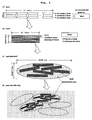
- montmorillonite mineral is a lamellar layer with the size of approximately 100x100x1 nm 3 , and several montmorillonite layers gathered in a group together with interlayer water form a stack, and a number of these stacks are congregated into an aggregate/ped (see FIGS. 3 to 5).
- a pure smectite clay there are interlayer spaces between layers and interparticle spaces between stacks and between aggregates.
- the space size of compacted bentonite depends on its dry density. If the dry density is sufficiently large, the size of the interparticle space becomes almost equal to that of the interlayer space.
- the interlayer spaces of dry densities of 1.4 and 1.8 Mg/m 3 are about 0.9 nm and 0.6 nm, respectively, and the interparticle spaces are of similar sizes.
- the water (an aqueous solution) in the interlayer space shows specific properties because of the surface charge of clay minerals (non-patent literature 4).
- the diffusion behavior of each chemical species is determined by the properties of the interlayer water and the size of the interlayer space. Since the size of a water molecule is about 0.3 nm which is smaller than that of methanol or ethanol, a molecular sieve effect is expected in the compacted bentonite to pass oxonium ions and to prevent methanol and ethanol.
- the permeation/diffusion experiment was performed at a dry density 1.0 Mg/m 3 which is lower than the above dry densities (1.4 and 1.8 Mg/m 3 ).
- sodium chloride of concentration 0.1 mol/dm 3 was added as a support electrolyte.
- diffusing sources methanol and ethanol of concentrations 7.5 wt% and 2.5 wt%, respectively were added.
- hydrochloric acid of concentration 10 -3 N was added.
- bentonite was saturated with 0.1 mol/dm 3 of NaCl aqueous solution.
- the concentrations of methanol and ethanol were determined by infrared absorption peak intensities of ATR-FTIR spectroscopy. Even though the mixture of methanol and ethanol was used, the peaks of the two organic materials could be clearly separated (see FIG. 6a). Under such test conditions, the calibration lines showed a sufficient linearity (see FIG. 6b). Meanwhile, in the case of oxonium ions, the proton activity was measured by a pH meter.
- the layered silicate membrane provides a competent solid electrolyte of PEFC, if the density and impregnated liquid contents are properly controlled when producing.
- electrolyte can be produced, it is possible to set up an electrochemical cell as shown in FIG. 1 on the basis of the existing technology and to build a fuel cell system by stacking the cells.
- the fuel crossover can be prevented. Because of a molecular sieve effect of the layered silicate membrane, two inconsistent properties of high proton conductivity and low fuel crossover can be satisfies simultaneously.
- ethanol is a preferable fuel of the direct organic fuel cell using the layered silicate membrane. Furthermore, if the density and impregnated liquid contents are strictly controlled when producing the layered silicate membrane, it is possible to produce a solid electrolyte of the layered silicate membrane which shows a molecular sieve effect for organic fuels such as methanol, natural gas (methane), liquefied petroleum gas (propane) and gasoline.
- organic fuels such as methanol, natural gas (methane), liquefied petroleum gas (propane) and gasoline.
- a composite membrane of the layered silicate mineral or the intercalation compound in which a catalyst is directly supported can also be easily fabricated.
- the layered silicate mineral or the intercalation compound is an inorganic material as described above, a catalyst can be selected from a wide range of candidate materials.
- MEA membrane-electrode assembly
- the layered silicate mineral is an inorganic material
- the layered silicate membrane is not deteriorated even when the working temperature of PEFC is set at high in order to increase the reaction rate, and it is possible to find the setting conditions for preventing the crossover of the fuel. This suggests a possibility to fabricate an efficient PEFC working at high temperature.
- the layered silicate minerals are widely distributed in nature and inexpensive. Thus, the unit cost processing the solid electrolyte membrane is reduced, leading to a reduction in the cost of PEFC
- the use of the layered silicate mineral or the intercalation compound thereof according to the embodiment of the present invention in the solid electrolyte membrane allows the fabrication of a PEFC which is inexpensive and energy-efficient. It will result in innovations in the following energy systems: (1) automobile engines; (2) industrial engines; and (3) household and industrial cogeneration systems.
Landscapes
- Chemical & Material Sciences (AREA)
- Chemical Kinetics & Catalysis (AREA)
- General Chemical & Material Sciences (AREA)
- Sustainable Development (AREA)
- Sustainable Energy (AREA)
- Engineering & Computer Science (AREA)
- Life Sciences & Earth Sciences (AREA)
- Electrochemistry (AREA)
- Manufacturing & Machinery (AREA)
- Crystallography & Structural Chemistry (AREA)
- Physics & Mathematics (AREA)
- Spectroscopy & Molecular Physics (AREA)
- Composite Materials (AREA)
- Fuel Cell (AREA)
- Silicates, Zeolites, And Molecular Sieves (AREA)
Abstract
The present invention aims to provide a solid
proton exchange membrane and a membrane-electrode
assembly (MEA) for use in fabricating an inexpensive and
efficient proton exchange fuel cell (PEFC) which enables
direct use of an organic fuel without a reformer and use
of hydrogen gas. In particular, the invention provides
an electrochemical cell including a solid electrolyte
membrane made of one or plural kinds of layered silicate
minerals or the intercalation compounds. The layered
silicate minerals can be easily fabricated into a solid
electrolyte membrane which shows a "molecular sieve
effect" on the target fuel if the density and
impregnated liquid contents are properly controlled. A
composite membrane in which a catalyst is directly
supported is also fabricated easily. Since the layered
silicate mineral is an inorganic material, the fuel cell
can be operated at high temperature. Thus, the catalyst
can be selected from a wide range of candidate
materials. The layered silicate minerals are abundant in
nature and inexpensive. The use of the layered silicate
mineral allows to fabricate an inexpensive direct
methanol fuel cell (DMFC) and a realistic direct ethanol
fuel cell (DEFC). Furthermore, an energy-efficient PEFC
using hydrogen gas can also be produced therefrom.
Description
The present invention relates to a solid cation-exchange
membrane and a membrane-electrolyte assembly
for use in the production of a solid electrolyte fuel
cell in which an organic fuel can be directly supplied
without the use of a reformer.
Patent literature 1: Japanese Patent Publication
No. Hei 10-507572
Patent literature 2: Japanese Patent Publication
No. 2000-516014
Non-patent literature 1: "Technology of Fuel
Cell", edited by Special Committee of Examination of
Next-Generation System for Electricity Generation in
Fuel Cell (The Institute of Electrical Engineers of
Japan), Ohm-sha, August 30, 2002, p.55-98 (in Japanese).
Non-patent literature 2: "New Development of
Electrode Catalyst Chemistry", edited by Yoshio Takasu,
Akiko Aramata and Yoshio Hori, Book Publisher of
Hokkaido University, February 25, 2001, p.207-230,
Chapter 9 "New Development of Electrode Catalyst
Science" by Masayuki Morita (in Japanese).
Non-patent literature 3: "Journal of America
Chemical Society", Vol. 105, No. 3, 1983, p.658-659,
Katayama-Aramata, A., and Ohnishi, R.
Non-patent literature 4: International Journal for
Numerical Methods in Engineering, 2002, 54, p.1717-1749,
"Molecular dynamics and multiscale homogenization
analysis of seepage/diffusion problem in bentonite
clay", Ichikawa, Y., Kawamura, K., Fujii, N., and
Theramast, N.
Non-patent literature 5: Journal of the Clay
Science Society of Japan, Vol. 41, No. 2, 2001, p.43-47,
"Microstructural modeling of compacted sodium-bentonite
and application of unified molecular dynamics/homogenization
analysis for diffusion process" Suzuki,
Satoru et al. (in Japanese).
Non-patent literature 6: Journal of Nuclear
Science and Technology, 1992, 29, p873-882, "Effect of
dry density on diffusion of some radionuclides in
compacted sodium bentonite", Sato, H., Ashida, T.,
Kohara, Y., Yui, M., and Sasaki, N.
Non-patent literature 7: Radioactive Waste
Management and Environmental Remediation, American
Society of Mechanical Engineers, 1999, "Activation
energies of diffusion of tritium and electrical
conduction in water-saturated compacted sodium
montmorillonite", Nakazawa, T., Takano, M., Nobuhara,
A., Torikai, Y., Sato, S., and Ohashi, H.
A polymer electrolyte fuel cell or proton exchange
fuel cell (PEFC) is expected as a power source for fuel
cell automobiles and household systems. The PEFC
involves a solid polymer membrane for an electrolyte and
has the following characteristics.
The working principle and manufacturing process of
an organic fuel cell with the solid electrolyte membrane
is disclosed in Japanese Patent Publication No. Hei 10-507572
(July, 1998). A further improvement of a proton
exchange membrane (PEM) filled with inorganic materials
is disclosed in Japanese Patent Publication No. 2000-516014
(November, 2000).
The PEFC will be put to a practical use in the
near future. Its characteristics have been widely
studied and are reported in many literatures (see non-patent
literatures 1 and 2 as general reports).
FIG. 1 shows the working principle of PEFC using a
solid electrolyte membrane. Water-premixed methanol is
illustrated as an example of its fuel. Electrodes with a
dispersed catalyst are placed on both sides of the
membrane to form a membrane-electrode assembly (MEA). An
anode separator for supplying the fuel and a water
separator for cooling are attached at the anode side,
and a cathode separator is attached for supplying air
(oxygen) at the cathode side to form a single
electrochemical cell. The structure of this
electrochemical cell is shown in FIG. 2 (see non-patent
literature 2). Multiply-connected electrochemical cells
form a cell stack, and then a PEFC system is built up.
The PEFC of the organic fuels is classified into a
reformed gas supply model and a direct fuel supply
model: The reformed gas supply model uses hydrogen
through a reformer extracted from the fuel, such as
natural gas, liquefied petroleum gas or methanol. The
direct fuel supply model uses an organic fuel which is
directly supplied to the fuel electrode. The direct fuel
supply model using methanol is called the direct
methanol fuel cell (DMFC) and seems to be put to
practical use soon as a power source for automobiles and
portable electronic devices.
A perfluorosulfonic acid polymer, an organic
polymer material, is commonly used for a solid
electrolyte membrane of PEFC. The polymer membrane is
commercially supplied: Nafion (a trademark of DuPont
Co.), Flemion (a trademark of Asahi Glass Co.) and
Aciplex (a trademark of Asahi Kasei Co.).
A carbon paper with a thickness of several tens
meters is usually used for the electrode on which a
dispersed catalyst of noble metal (mainly, platinum (Pt)
and its alloy) is supported. Composite membranes in
which a catalyst is directly supported are also used
currently and their catalytic activity is reported to be
maintained for a long time (see non-patent literature
3).
Oxidation reaction at the anode of DMFC is known
as a migration process of six electrons, which is
ideally represented by the following formula:
CH3OH+H2O → CO2+6H++6e-
This may involve complex six elementary steps of
reaction. In this reaction process, HCHO, HCOOH, CO and
others are detected in addition to CO2, but details of
the reaction mechanism are not yet clear (see non-patent
literature 2). CO generated in this process is a
catalyst poisoning species and results in a rapid
reduction of the catalytic activity. DMFC is generally
said to be excellent in energy efficiency since it has
no heat loss caused by a reformer, however, currently it
shows a low output density (that is, low cell voltage)
due to a slow oxidation rate at the anode.
In order to increase the reaction rate, the
working temperature may be increased. However, if
increased, the polymer membrane will tend to deteriorate
and a methanol crossover phenomenon becomes serious, so
that the output power may not be increased. Thus, it is
a major challenge of DMFC to develop a heat-resisting
and anti-crossover membrane.
The cost for electricity generation of PEFC is
mostly determined by the price and lifetime of the
membrane and catalyst. For example, the polymer membrane
costs about one hundred thousand Japanese Yen/m2. Since
for an automobile of 60 kW output, a membrane of about
10 m2 is needed, so the membrane costs about one million
Yen for one car. A membrane material of high performance
and low price is strongly expected.
Instead of the polymer membrane, the present
invention utilizes an inorganic porous electrolyte
membrane made of one or plural kinds of layered silicate
minerals (generally known as clay) which involve a
nanometer scale of pores (that is, nanopores), and
utilizes an electrolyte membrane made of an
intercalation compound, which shows an improved
performance by intercalating inorganic or organic ions
into the interlayer space of the layered silicate
mineral. Hereinafter, both the original and intercalated
electrolyte membranes will be referred to as "layered
silicate membranes" and the PEMC with the layered
silicate membrane as the "layered silicate PEFC".
Suitable candidates of the layered silicate minerals
which are used in the present invention include
montmorillonite (a clay mineral of the smectite group),
beidellite (similarly a clay mineral of the smectite
group), illite (a clay mineral of the illite group), and
sericite (a mica group mineral).
The layered silicate mineral is a proton
conductive inorganic material under a suitable
condition. The working temperature of the layered
silicate PEFC can be increased, if a proper layered
silicate mineral is chosen and the working conditions
such as moisture contents are adequately controlled.
Then the catalyst can be chosen from a wide range of
candidate materials. If the density and impregnated
liquid contents are properly controlled when producing
the layered silicate membrane, the fuel crossover can be
prevented. Because of a molecular sieve effect of the
layered silicate membrane, two inconsistent properties
of high proton conductivity and low fuel crossover can
be satisfies simultaneously. Accordingly, fundamental
difficulties involved in PEFC (that is, increasing the
working temperature and preventing the fuel crossover)
can be solved.
The layered silicate minerals are widely
distributed in nature and inexpensive. The layered
silicate membrane can be easily produced by a molded
compression method under control of the density and
impregnated liquid contents. Moreover, a composite
membrane in which a catalyst is directly supported may
be produced easily.
Japanese Patent Publication No. Hei 10-507572
shows a technique of impregnating montmorillonite into a
polymer electrolyte membrane as a hydrophilic additive
agent having proton conductivity. However, the role of
the montmorillonite in said patent is an additive agent
for conductivity. The publication contains no mention of
the use of clay itself as an electrolyte membrane,
although the use of the layered silicate mineral itself
as an electrolyte membrane allows an above-described
excellent performance.
The layered silicate mineral which is generally
known as clay is an inorganic porous material with
nanopores. The ion conductive characteristics of clays,
particularly smectite clays, are now understood clearly
based on the physical and chemical facts covering from
the molecular properties to macroscopic behaviors (non-patent
literatures 4 and 5). In the present invention,
after these knowledges, the optimum material conditions
to permeate only proton H+ and to prevent fuel crossover
were investigated and the molecular sieve property
thereof was confirmed by an experiment. Since a proton
is generally combined with one water molecule in an
aqueous solution to form an oxonium ion (H3O+), the
diffusion of oxonium ions was examined in this
experiment.
In the experiment, a bentonite (including more
than 99 wt% of montmorillonite) was provided to form
thin circular specimens (20 mm in diameter and 1 mm in
thickness) by a molded compression method. The test
piece was subjected to a permeation/diffusion test so as
to determine the effective diffusion coefficients (De) of
methanol, ethanol and oxonium ions.
One montmorillonite mineral is a lamellar layer
with the size of approximately 100x100x1 nm3, and several
montmorillonite layers gathered in a group together with
interlayer water form a stack, and a number of these
stacks are congregated into an aggregate/ped (see FIGS.
3 to 5). In a pure smectite clay, there are interlayer
spaces between layers and interparticle spaces between
stacks and between aggregates. The space size of
compacted bentonite depends on its dry density. If the
dry density is sufficiently large, the size of the
interparticle space becomes almost equal to that of the
interlayer space. Based on the results of X-ray
diffraction analysis and considering the geometrical
arrangement of clay particles, it is believed that the
interlayer spaces of dry densities of 1.4 and 1.8 Mg/m3
are about 0.9 nm and 0.6 nm, respectively, and the
interparticle spaces are of similar sizes.
It is proved by molecular-based analyses that the
water (an aqueous solution) in the interlayer space
shows specific properties because of the surface charge
of clay minerals (non-patent literature 4). In the
compacted bentonite saturated with aqueous solution, the
diffusion behavior of each chemical species is
determined by the properties of the interlayer water and
the size of the interlayer space. Since the size of a
water molecule is about 0.3 nm which is smaller than
that of methanol or ethanol, a molecular sieve effect is
expected in the compacted bentonite to pass oxonium ions
and to prevent methanol and ethanol.
The permeation/diffusion experiment was performed
at a dry density 1.0 Mg/m3 which is lower than the above
dry densities (1.4 and 1.8 Mg/m3). To a solution, sodium
chloride of concentration 0.1 mol/dm3 was added as a
support electrolyte. As diffusing sources, methanol and
ethanol of concentrations 7.5 wt% and 2.5 wt%,
respectively were added. Also, as a diffusing source of
oxonium ions, hydrochloric acid of concentration 10-3 N
was added. Before the experiment, bentonite was
saturated with 0.1 mol/dm3 of NaCl aqueous solution.
The concentrations of methanol and ethanol were
determined by infrared absorption peak intensities of
ATR-FTIR spectroscopy. Even though the mixture of
methanol and ethanol was used, the peaks of the two
organic materials could be clearly separated (see FIG.
6a). Under such test conditions, the calibration lines
showed a sufficient linearity (see FIG. 6b). Meanwhile,
in the case of oxonium ions, the proton activity was
measured by a pH meter.
Results after the elapse of two weeks are shown as
follows. Effective diffusion coefficients calculated
from diffusion fluxes are given in FIG. 7. For
comparison, the results of diffusion coefficients of
deuterium water (HDO) and tritium water (HTO) are also
shown (non-patent literatures 6 and 7). At the dry
density 1.0 Mg/m3, the diffusion coefficient is of the
greatest value in the case of oxonium ions and decreases
in the order of tritium water, methanol and ethanol. The
diffusion coefficient of oxonium ions is about two times
greater than that of methanol and one exponent greater
than that of ethanol. Also, the diffusion coefficients
of methanol and ethanol are smaller than that of the
tritium water which is a neutral molecule. For high-compacted
bentonite, no ethanol crossover was observed,
so the molecular sieve effect can be detected.
Based on the experimental results of FIG. 7, it is
understood that the layered silicate membrane provides a
competent solid electrolyte of PEFC, if the density and
impregnated liquid contents are properly controlled when
producing.
If the electrolyte can be produced, it is possible
to set up an electrochemical cell as shown in FIG. 1 on
the basis of the existing technology and to build a fuel
cell system by stacking the cells.
If the density and impregnated liquid contents are
properly controlled when producing the layered silicate
membrane or the intercalation compound membrane, the
fuel crossover can be prevented. Because of a molecular
sieve effect of the layered silicate membrane, two
inconsistent properties of high proton conductivity and
low fuel crossover can be satisfies simultaneously.
Based on the experimental results shown in FIG. 7,
ethanol is a preferable fuel of the direct organic fuel
cell using the layered silicate membrane. Furthermore,
if the density and impregnated liquid contents are
strictly controlled when producing the layered silicate
membrane, it is possible to produce a solid electrolyte
of the layered silicate membrane which shows a molecular
sieve effect for organic fuels such as methanol, natural
gas (methane), liquefied petroleum gas (propane) and
gasoline.
In the case of the hydrogen PEFC it is known that
a clay of layered silicate minerals saturated with water
does not permeate gaseous hydrogen under a relatively
low pressure condition. Thus, it is easy to fabricate a
solid electrolyte membrane which does not permeate the
hydrogen fuel.
Moreover, a composite membrane of the layered
silicate mineral or the intercalation compound in which
a catalyst is directly supported can also be easily
fabricated. In this case, since the layered silicate
mineral or the intercalation compound is an inorganic
material as described above, a catalyst can be selected
from a wide range of candidate materials. Furthermore,
it is also easy to fabricate a membrane-electrode
assembly (MEA) consisting of the solid electrolyte
membrane of the layered silicate mineral or the
intercalation compound, and electrodes in which electron
conductive particles showing a high catalytic activity
are dispersed.
Moreover, if diffusion layers of a porous material
which also works as a support member of MEA, an anode
separator, a cathode separator and a water separator are
arranged on the faces of MEA, an inexpensive and energy-efficient
electrochemical cell for PEFC can be
fabricated easily.
As can be seen from the foregoing, since the
layered silicate mineral is an inorganic material, the
layered silicate membrane is not deteriorated even when
the working temperature of PEFC is set at high in order
to increase the reaction rate, and it is possible to
find the setting conditions for preventing the crossover
of the fuel. This suggests a possibility to fabricate an
efficient PEFC working at high temperature.
The layered silicate minerals are widely
distributed in nature and inexpensive. Thus, the unit
cost processing the solid electrolyte membrane is
reduced, leading to a reduction in the cost of PEFC
As a result, according to the present invention,
problems which are involved in the polymer membrane fuel
cells can be improved. Then, a realistic direct ethanol
fuel cell (DEFC) having an energy-efficiency can be
fabricated.
As described above, the use of the layered
silicate mineral or the intercalation compound thereof
according to the embodiment of the present invention in
the solid electrolyte membrane allows the fabrication of
a PEFC which is inexpensive and energy-efficient. It
will result in innovations in the following energy
systems: (1) automobile engines; (2) industrial engines;
and (3) household and industrial cogeneration systems.
Claims (13)
- A fuel cell comprising an anode, a solid electrolyte membrane and a cathode, wherein the solid electrolyte membrane is made of one or plural kinds of layered silicate minerals.
- The fuel cell of Claim 1, wherein the solid electrolyte membrane is made of one or plural kinds of intercalation compounds which are produced by intercalating inorganic ions into the interlayer space of the layered silicate minerals.
- The fuel cell of Claim 1, wherein the solid electrolyte membrane is made of one or plural kinds of intercalation compounds which are produced by intercalating organic ions into the interlayer space of the layered silicate minerals.
- A method for fabricating a solid electrolyte membrane of one or plural kinds of layered silicate minerals and intercalation compounds of the layered silicate minerals for the fuel cells under a control of the density and impregnated liquid contents because a molecular sieve effect is brought into action.
- A membrane-electrode assembly (MEA) consisting of a solid electrolyte membrane made of one or plural kinds of layered silicate minerals or intercalation compounds of the layered silicate minerals, and electrodes in which electron conductive particles showing a high catalytic activity are dispersed.
- An electrochemical cell comprising: a membrane-electrode assembly (MEA) as set forth in Claim 5; and diffusion layers of porous material which also works as a support member of MEA, an anode separator, a cathode separator and a water separator, which are arranged on the faces of MEA.
- A fuel cell which operates with an organic fuel, comprising a combination of the electrochemical cells as set forth in Claim 6.
- The fuel cell of Claim 7, wherein the organic fuel is ethanol.
- The fuel cell of Claim 7, wherein the organic fuel is methanol.
- The fuel cell of Claim 7, wherein the organic fuel is natural gas (methane).
- The fuel cell of Claim 7, wherein the organic cell is liquefied petroleum gas (propane).
- The fuel cell of Claim 7, wherein the organic fuel is gasoline.
- A fuel cell which operates with hydrogen, comprising a combination of the electrochemical cells as set forth in Claim 6.
Applications Claiming Priority (5)
| Application Number | Priority Date | Filing Date | Title |
|---|---|---|---|
| JP2002307043 | 2002-10-22 | ||
| JP2002307043 | 2002-10-22 | ||
| JP2002343762 | 2002-11-27 | ||
| JP2002343762 | 2002-11-27 | ||
| PCT/JP2003/013350 WO2004038839A1 (en) | 2002-10-22 | 2003-10-20 | Sheet silicate mineral and fuel cell including intercalation complex thereof as solid electrolyte membrane |
Publications (2)
| Publication Number | Publication Date |
|---|---|
| EP1555707A1 true EP1555707A1 (en) | 2005-07-20 |
| EP1555707A4 EP1555707A4 (en) | 2008-07-02 |
Family
ID=32179073
Family Applications (1)
| Application Number | Title | Priority Date | Filing Date |
|---|---|---|---|
| EP03758738A Withdrawn EP1555707A4 (en) | 2002-10-22 | 2003-10-20 | MINERAL SILICATE SHEET AND ELECTROCHEMICAL CELL COMPRISING A SOLID ELECTROLYTE MEMBRANE INTERCALATION COMPLEX |
Country Status (7)
| Country | Link |
|---|---|
| US (1) | US20070059577A1 (en) |
| EP (1) | EP1555707A4 (en) |
| JP (1) | JPWO2004038839A1 (en) |
| KR (1) | KR100666820B1 (en) |
| AU (1) | AU2003275562A1 (en) |
| BR (1) | BR0314914A (en) |
| WO (1) | WO2004038839A1 (en) |
Cited By (3)
| Publication number | Priority date | Publication date | Assignee | Title |
|---|---|---|---|---|
| WO2007119349A1 (en) * | 2006-03-14 | 2007-10-25 | Toyota Jidosha Kabushiki Kaisha | Reinforced electrolyte membrane comprising catalyst for preventing reactant crossover and method for manufacturing the same |
| EP1793437A3 (en) * | 2005-09-09 | 2009-04-22 | Institut für Energie- und Umwelttechnik e.V. (IUTA) - Institut an der Universität Duisburg - Essen | Electrolyt, electrode and catalyst electrode for use in fuel cells |
| WO2019168480A1 (en) * | 2018-02-28 | 2019-09-06 | Kavcic Andrej | Electrochemical meter for measuring ethanol content in liquids with metal catalyst electrodes |
Families Citing this family (11)
| Publication number | Priority date | Publication date | Assignee | Title |
|---|---|---|---|---|
| JP4107116B2 (en) | 2003-03-14 | 2008-06-25 | トヨタ自動車株式会社 | Proton conducting material, proton conducting material membrane, and fuel cell |
| KR100528345B1 (en) | 2003-08-29 | 2005-11-15 | 삼성에스디아이 주식회사 | Polymer Nano-Composite membrane and fuel cell adopting the same |
| US8349521B2 (en) * | 2004-07-21 | 2013-01-08 | Kabushiki Kaisha Toshiba | Membrane electrode assembly |
| JP4625658B2 (en) * | 2004-07-21 | 2011-02-02 | 株式会社東芝 | Fuel cell electrode, membrane electrode composite, and fuel cell |
| CN1317783C (en) * | 2005-07-19 | 2007-05-23 | 武汉理工大学 | A kind of hydrogen-containing silicone oil grafted alkenyl sulfonic acid proton exchange membrane and preparation method thereof |
| US10113407B2 (en) * | 2007-08-09 | 2018-10-30 | Lawrence Livermore National Security, Llc | Electrochemical production of metal hydroxide using metal silicates |
| JP5693125B2 (en) * | 2010-10-05 | 2015-04-01 | 日本ゴア株式会社 | Polymer electrolyte fuel cell |
| CN104852065B (en) * | 2015-05-26 | 2017-06-30 | 宁波工程学院 | A kind of compound proton exchange membrane for DMFC and preparation method thereof |
| US10873106B2 (en) | 2016-03-16 | 2020-12-22 | University Of Utah Research Foundation | Composite solid electrolytes for lithium batteries |
| CN112864456B (en) * | 2021-01-08 | 2022-08-12 | 吉林大学 | Molecular sieve-based solid electrolyte and preparation method, integrated solid electrolyte-electrode material |
| WO2024157894A1 (en) * | 2023-01-26 | 2024-08-02 | パナソニックIpマネジメント株式会社 | Power generation element, power generation device, and power generation method |
Family Cites Families (16)
| Publication number | Priority date | Publication date | Assignee | Title |
|---|---|---|---|---|
| US3266940A (en) * | 1962-04-20 | 1966-08-16 | Socony Mobil Oil Co Inc | Fuel cell containing solid aluminosilicate electrolyte |
| NL7808875A (en) * | 1977-09-14 | 1979-03-16 | Dieterich Alfred Dr | ORTHOPEDIC SANDAL. |
| US4244359A (en) * | 1978-09-30 | 1981-01-13 | Alfred Dieterich | Orthopedic sandal |
| US4505992A (en) * | 1983-04-11 | 1985-03-19 | Engelhard Corporation | Integral gas seal for fuel cell gas distribution assemblies and method of fabrication |
| DE3430485A1 (en) * | 1984-08-18 | 1986-02-27 | Basf Ag, 6700 Ludwigshafen | FUEL CELL |
| US4967750A (en) * | 1987-10-28 | 1990-11-06 | Cherniak Jaime G | Modular orthopedic sandal |
| US5232794A (en) * | 1991-10-17 | 1993-08-03 | The United States Of America As Represented By The United States Department Of Energy | Ionic conductors for solid oxide fuel cells |
| JPH11312415A (en) * | 1998-04-28 | 1999-11-09 | Kyocera Corp | Solid electrolyte |
| US6620320B1 (en) * | 1998-06-03 | 2003-09-16 | Creavis Gesellschaft Fuer Technologie Und Innovation Mbh | Ion-conducting composite which is permeable to matter, method for producing said composite, and use of the same |
| US6468684B1 (en) * | 1999-01-22 | 2002-10-22 | California Institute Of Technology | Proton conducting membrane using a solid acid |
| DE19919881A1 (en) * | 1999-04-30 | 2000-11-02 | Univ Stuttgart | Thermally stable proton conductive composite, for use in e.g. fuel cells, membrane separation, catalysis, electrolysis or electrochemical processes, comprises acid and/or organic base and layered and/or framework silicate |
| DE10194077T1 (en) * | 2000-08-11 | 2003-07-17 | Honda Motor Co Ltd | Solid polymer fuel cell |
| KR100407793B1 (en) * | 2001-09-04 | 2003-12-01 | 한국과학기술연구원 | proton exchange composite membranes and composite solutions having selectivity, its preparation and fuel cell comprising the same |
| JP4154894B2 (en) * | 2002-01-23 | 2008-09-24 | トヨタ自動車株式会社 | Solid polymer type proton conducting membrane |
| JP2003272439A (en) * | 2002-03-20 | 2003-09-26 | Toyota Central Res & Dev Lab Inc | Composite polymer electrolyte, and electrochemical device and fuel cell using the same |
| US6630265B1 (en) * | 2002-08-13 | 2003-10-07 | Hoku Scientific, Inc. | Composite electrolyte for fuel cells |
-
2003
- 2003-10-20 US US10/529,877 patent/US20070059577A1/en not_active Abandoned
- 2003-10-20 AU AU2003275562A patent/AU2003275562A1/en not_active Abandoned
- 2003-10-20 WO PCT/JP2003/013350 patent/WO2004038839A1/en not_active Ceased
- 2003-10-20 KR KR1020057006826A patent/KR100666820B1/en not_active Expired - Fee Related
- 2003-10-20 BR BR0314914-5A patent/BR0314914A/en not_active Application Discontinuation
- 2003-10-20 EP EP03758738A patent/EP1555707A4/en not_active Withdrawn
- 2003-10-20 JP JP2004546422A patent/JPWO2004038839A1/en active Pending
Cited By (3)
| Publication number | Priority date | Publication date | Assignee | Title |
|---|---|---|---|---|
| EP1793437A3 (en) * | 2005-09-09 | 2009-04-22 | Institut für Energie- und Umwelttechnik e.V. (IUTA) - Institut an der Universität Duisburg - Essen | Electrolyt, electrode and catalyst electrode for use in fuel cells |
| WO2007119349A1 (en) * | 2006-03-14 | 2007-10-25 | Toyota Jidosha Kabushiki Kaisha | Reinforced electrolyte membrane comprising catalyst for preventing reactant crossover and method for manufacturing the same |
| WO2019168480A1 (en) * | 2018-02-28 | 2019-09-06 | Kavcic Andrej | Electrochemical meter for measuring ethanol content in liquids with metal catalyst electrodes |
Also Published As
| Publication number | Publication date |
|---|---|
| US20070059577A1 (en) | 2007-03-15 |
| KR20050055028A (en) | 2005-06-10 |
| EP1555707A4 (en) | 2008-07-02 |
| BR0314914A (en) | 2005-08-16 |
| WO2004038839A1 (en) | 2004-05-06 |
| JPWO2004038839A1 (en) | 2006-02-23 |
| AU2003275562A1 (en) | 2004-05-13 |
| KR100666820B1 (en) | 2007-01-09 |
Similar Documents
| Publication | Publication Date | Title |
|---|---|---|
| Vinothkannan et al. | Potential carbon nanomaterials as additives for state-of-the-art Nafion electrolyte in proton-exchange membrane fuel cells: A concise review | |
| Li et al. | Durability degradation mechanism and consistency analysis for proton exchange membrane fuel cell stack | |
| Gabbasa et al. | A review of unitized regenerative fuel cell stack: Material, design and research achievements | |
| Iqbal et al. | Recent developments in graphene based novel structures for efficient and durable fuel cells | |
| JP5693125B2 (en) | Polymer electrolyte fuel cell | |
| US20070059577A1 (en) | Proton exchange membrane fuel cell using solid electrolyte membrane of sheet silicate minerals and an intercalation compound | |
| US20030116443A1 (en) | Apparatus for producing hydrogen, electrochemical device, method for producing hydrogen and method for generating electrochemical enegy | |
| Kaur et al. | Hydroxyl-conductive 2D hexagonal boron nitrides for anion exchange membrane water electrolysis and sustainable hydrogen production | |
| Punyawudho et al. | Advancements and challenges in electrode and electrolyte materials for proton exchange membrane fuel cells: a comprehensive review | |
| Wang et al. | Degradation study of Membrane Electrode Assembly with PTFE/Nafion composite membrane utilizing accelerated stress technique | |
| Hammi et al. | Production of green hydrogen employing proton exchange membrane water electrolyzer: Characterization of electrolyte membrane. A critical review | |
| Moradi et al. | Proton Exchange Membrane Fuel Cells: Electrochemical Methods and Computational Fluid Dynamics | |
| CN100561784C (en) | Proton exchange membrane fuel cell using solid electrolyte membrane of layered silicate mineral and interlayer compound | |
| Tian et al. | Surface-modified Nafion membrane by trioctylphosphine-stabilized palladium nanoparticles for DMFC applications | |
| WO2002027829A1 (en) | Method of producing fuel cell | |
| CN1288785C (en) | Power supply system and operating method thereof | |
| Balakrishnan | Engineering the membrane electrode assembly of direct methanol fuel cells using novel graphene architecture | |
| Sun et al. | Boosting the Proton Conductivity and Overall Stabilities of Nafion via the Swelling-Filling Modification of MoO2 Nanosheets | |
| Fan et al. | Energy Reports | |
| Jamb et al. | Polymer electrolyte membrane fuel cells for sustainable energy production | |
| Afroze et al. | Role of Hydrogen in Direct Methanol Fuel Cells | |
| Ono et al. | Transport Mechanism of Hydroxide Ions Focused on the Vehicle Mechanism Near the Cation Sites in Anion Exchange Membranes | |
| Nondudule | Stratification of cathode catalyst layers for low-temperature proton exchange membrane fuel cells (PEMFC) | |
| Saeeda et al. | Recent developments in fuel cell technology-A detailed insight | |
| Samanta et al. | Performance Evaluation of Graphene-Supported Electro-Catalysts in Proton Exchange Membrane (PEM) Fuel Cells |
Legal Events
| Date | Code | Title | Description |
|---|---|---|---|
| PUAI | Public reference made under article 153(3) epc to a published international application that has entered the european phase |
Free format text: ORIGINAL CODE: 0009012 |
|
| 17P | Request for examination filed |
Effective date: 20050517 |
|
| AK | Designated contracting states |
Kind code of ref document: A1 Designated state(s): AT BE BG CH CY CZ DE DK EE ES FI FR GB GR HU IE IT LI LU MC NL PT RO SE SI SK TR |
|
| AX | Request for extension of the european patent |
Extension state: AL LT LV MK |
|
| DAX | Request for extension of the european patent (deleted) | ||
| A4 | Supplementary search report drawn up and despatched |
Effective date: 20080602 |
|
| STAA | Information on the status of an ep patent application or granted ep patent |
Free format text: STATUS: THE APPLICATION HAS BEEN WITHDRAWN |
|
| 18W | Application withdrawn |
Effective date: 20110620 |