EP1555619A1 - Communication control system, communication control method, and relay device - Google Patents
Communication control system, communication control method, and relay device Download PDFInfo
- Publication number
- EP1555619A1 EP1555619A1 EP03764218A EP03764218A EP1555619A1 EP 1555619 A1 EP1555619 A1 EP 1555619A1 EP 03764218 A EP03764218 A EP 03764218A EP 03764218 A EP03764218 A EP 03764218A EP 1555619 A1 EP1555619 A1 EP 1555619A1
- Authority
- EP
- European Patent Office
- Prior art keywords
- server
- client
- connection terminal
- side connection
- relay
- Prior art date
- Legal status (The legal status is an assumption and is not a legal conclusion. Google has not performed a legal analysis and makes no representation as to the accuracy of the status listed.)
- Withdrawn
Links
Images



Classifications
-
- H—ELECTRICITY
- H04—ELECTRIC COMMUNICATION TECHNIQUE
- H04L—TRANSMISSION OF DIGITAL INFORMATION, e.g. TELEGRAPHIC COMMUNICATION
- H04L69/00—Network arrangements, protocols or services independent of the application payload and not provided for in the other groups of this subclass
- H04L69/16—Implementation or adaptation of Internet protocol [IP], of transmission control protocol [TCP] or of user datagram protocol [UDP]
-
- H—ELECTRICITY
- H04—ELECTRIC COMMUNICATION TECHNIQUE
- H04L—TRANSMISSION OF DIGITAL INFORMATION, e.g. TELEGRAPHIC COMMUNICATION
- H04L67/00—Network arrangements or protocols for supporting network services or applications
- H04L67/14—Session management
-
- H—ELECTRICITY
- H04—ELECTRIC COMMUNICATION TECHNIQUE
- H04L—TRANSMISSION OF DIGITAL INFORMATION, e.g. TELEGRAPHIC COMMUNICATION
- H04L67/00—Network arrangements or protocols for supporting network services or applications
- H04L67/50—Network services
- H04L67/54—Presence management, e.g. monitoring or registration for receipt of user log-on information, or the connection status of the users
Definitions
- the present invention relates to a communication control system, a communication control method and a relay device, for controlling (digital) data communications performed between a server and a client through a communication network such as the Internet.
- a relay device which relays data between a client and a server, receives from the client a connection request signal (TCP connection establishment request signal) based on a communication protocol such as TCP
- TCP connection establishment request signal a connection request signal
- the relay device unconditionally establishes a TCP connection (a connection) between the client and the relay device, regardless of the state of the server, which is the destination of the connection.
- the relay device transmits a TCP connection establishment request to the server, which is the relay destination, thereby attempting the establishment of a TCP connection.
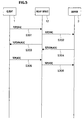
- Figs. 5 and 6 show a method of establishing a TCP connection by using a conventional relay device 12. As shown in Figs. 5 and 6, according to the conventional relay device, the establishment of a TCP connection between a client 1 and the relay device 12 is performed independently of the establishment of a TCP connection between a server 3 and the relay device 12.
- the server 3 the destination of the connection, exists and also a TCP connection can be established between the relay device 12 and the server 3, then the TCP connections are established between the client 1 and the relay device 12 and between the server 3 and the relay device 12, whereby the relay device 12 will be able to relay a relay request signal from the client 1 to the server 3.
- the server 3 the destination of the connection, does not exist or a TCP connection cannot be established between the relay device 12 and the server 3, then a TCP connection is established between the client 1 and the relay device 21, whereas a TCP connection is not established between the server 3 and the relay device 12.
- the relay device 12 transmits a TCP connection establishment request signal "TCP [SYN]" to the server 3 in Step 302.
- the relay device 12 transmits a TCP connection establishment request/acknowledgment signal "TCP [SYN, ACK]" to the client 1, thereby establishing a TCP connection between the client 1 and the relay device 12.
- the server 3 When the server 3 exists and also a TCP connection can be established between the relay device 12 and the server 3, then the server 3 transmits a TCP connection establishment request/acknowledgment signal "TCP [SYN, ACK]" to the relay device 12 in Step 304.
- the relay device 12 then relays a TCP connection establishment acknowledgment signal (ACK signal) from the client 1 to the server 3 (Steps 305 and 306).
- the relay device 12 when the server 3 does not exist or a TCP connection cannot be established between the relay device 12 and the server 3, then the relay device 12 does not receive from the server 3 the TCP connection establishment request/acknowledgment signal "TCP [SYN, ACK]" responding to the TCP connection establishment request signal "TCP [SYN]” transmitted in Step 302, although the TCP connection has been established between the client 1 and the relay device 12 (Step 305).
- the relay device accepts a TCP connection establishment request signal from the client, without deciding whether or not the server, which is the destination of the connection for the client, is in a state capable of communication. Therefore, if the server is incapable of communication, there arise problems of the occurrence of a load on the resource of the relay device and the occurrence of data-amount charges, which is primarily unnecessary.
- the relay device unconditionally establishes a TCP connection to the client, regardless of the state of the server, which is the destination of the connection for the client, the TCP connection between the relay device and the client is held in the relay device for a certain period of time, when the server does not exist or a TCP connection cannot be established between the relay device and the server. This is undesirable because the resource of the relay device is burdened.
- the communication network between the client and the relay device adopted a data-usage-based charging system
- data transferring will be started after the establishment of a TCP connection between the client and the relay device, and some amount of communication will be generated, resulting in the occurrence of unnecessary charging. Therefore, it is undesirable to establish a TCP connection between the client and the relay device even in such a case.
- the present invention has been accomplished in the light of the foregoing. It is an object of the present invention to provide a communication control system, a communication control method and a relay device which can reduce a load on the resource of the relay device and reduce the data-amount charging on a client, by the relay device deciding whether or not to accept a connection request signal from the client after determining the communication state of the server side.
- a first aspect of the present invention is summarized as a communication control system including: a server connected to a communication network; a client configured to make a connection request to the server through the communication network; a relay device configured to include a server-side connection terminal connected to the server and a client-side connection terminal connected to the client, and to relay communications between the server and the client; an establishment holder configured to hold a response signal from being transmitted from the client-side connection terminal to the client, when the client-side connection terminal receives a connection request signal from the client; a decider configured to detect a connection state of the server-side connection terminal in response to the connection request signal, and to decide whether or not a connection can be established between the server-side connection terminal and the server; and a relay processor configured to transmit the response signal held by the establishment holder, and to establish communications between the client and the server so as to perform relay processing, depending on a result of decision made by the decider.
- the communication control system may be configured to include a charging processor configured to execute charging processing on the client, when communications are established between the server and the server-side connection terminal, and when communications are established between the client and the client-side connection terminal
- the decider may be configured to forward the connection request signal from the client to the server, and to decide whether or not communications can be established between the server-side connection terminal and the server, based on a response signal transmitted from the server in response to the forwarding.
- the communication control system may be configured to include a discard processor configured to release the holding state of the establishment holder, and to transmit a discard notification to the client via the client-side connection terminal, when communications are not established between the server-side connection terminal and the server
- a second aspect of the present invention is a communication control method for controlling communications between a client and a server through a relay device.
- the method includes: holding a response signal to the client when receiving a connection request signal from the client, in the relay device; detecting a connection state of the server-side connection terminal in response to the connection request signal, and deciding whether or not a connection can be established between the relay device and the server, in the relay device; and transmitting the response signal held, and establishing communications between the client and the server so as to perform relay processing, when it is decided that communications are established between the relay device and the server, in the relay device.
- a third aspect of the present invention is a relay device which relays communications between a client and a server.
- the relay device includes: a client-side connection terminal connected to the client; a server-side connection terminal connected to the server; an establishment holder configured to hold a response signal from being transmitted from the client-side connection terminal to the client, when the client-side connection terminal receives a connection request signal from the client; a decider configured to detect a connection state of the server-side connection terminal in response to the connection request signal, and to decide whether or not a connection can be established between the server-side connection terminal and the server; and a relay processor configured to transmit the response signal held by the establishment holder, and to establish communications between the client and the server so as to perform relay processor, depending on a result of decision made by the decider.
- the relay device may be configured to include a charging processor configured to execute charging processing on the client, when communications are established between the server and the server-side connection terminal, and when communications are established between the client and the client-side connection terminal.
- a charging processor configured to execute charging processing on the client, when communications are established between the server and the server-side connection terminal, and when communications are established between the client and the client-side connection terminal.
- the decider may be configured to forward the connection request from the client to the server, and to decide whether or not communications can be established between the server-side connection terminal and the server, based on a response signal transmitted from the server in response to this forwarding
- the relay device may be configured to include a discard processor configured to release the holding state of the establishment holder, and to transmit a discard notification to the client via the client-side connection terminal, when communications are not established between the server-side connection terminal and the server.
- a discard processor configured to release the holding state of the establishment holder, and to transmit a discard notification to the client via the client-side connection terminal, when communications are not established between the server-side connection terminal and the server.
- the communication control system includes a client 1, a server 3 and a relay device 2.
- the client 1 and the server 3 are connected to each other through a communication network such as the Internet.
- the relay device 2 is placed between the client 1 and the server 3.
- the relay device 2 includes a client-side connection terminal 7, a server-side connection terminal 8, relay control circuits 4 and 5, and a connection managing unit 6.
- the client-side connection terminal 7 is configured to connect to the client 1
- the server-side connection terminal 8 is configured to connect to the server 3.
- the relay control circuits 4 and 5 are connected to the client-side connection terminal 7 and the client-side connection terminal 7, respectively.
- the connection managing unit 6 is connected to the relay control circuits 4 and 5.
- the client-side connection terminal 7 and the server-side connection terminal 8 are communication ports for transmitting/receiving data, based on a predetermined communication protocol.
- the client-side connection terminal 7 establishes a TCP connection to the client 1, and the server-side connection terminal 8 establishes a TCP connection to the server 3.
- the connection managing unit 6 manages the state of TCP connection establishment between the client-side connection terminal 7 and the client 1, and also manages the state of TCP connection establishment between the server-side connection terminal 8 and the server 3.
- connection managing unit 6 decides whether or not a TCP connection can be established between the relay control circuit 4 and the client 1, in accordance with the state of TCP connection establishment between the relay control circuit 5 and the server3.
- the connection managing unit 6 has data transmitting/receiving units 61 and 62, a relay processing unit 63, a deciding unit 64, a notification processing unit 65, an establishment holding unit 66, a discard processing unit 67, and a charging processing unit 68, as shown in Fig. 1B.
- the data transmitting/receiving units 61 and 62 are communication circuits which transmit control signals for controlling the relaying of data signals including a TCP connection establishment request signal (connection request signal) and a TCP connection establishment acknowledgment signal (response signal), to the relay control circuits 4 and 5, respectively.
- the data transmitting/receiving units 61 and 62 are communication circuits which acquire notifications of signals received by the relay control circuits 4 and 5 (a SYN reception notification, a SYN, ACK reception notification, etc.), from the relay control circuits 4 and 5, respectively.
- the relay processing unit 63 is a control circuit which analyzes the contents of a SYN reception notification acquired by the data transmitting/receiving unit 61 or 62, and sends a result of this analysis to the deciding unit 64. Moreover, the relay processing unit 63 is a control circuit which outputs instructions to the notification processing unit 65, the establishment holding unit 66 and the discard processing unit 67, depending on a result of decision made by the deciding unit 64.
- the deciding unit 64 is an arithmetic circuit which decides, based on the contents of a reception signal analyzed by the relay processing unit 63, whether or not a TCP connection has been established between the client 1 and the server 3, and returns a result of this decision to the relay processing unit 63.
- the deciding unit 64 when the deciding unit 64 has decided that a TCP connection has been established between the client 1 and the server 3, the deciding unit 64 notifies a fact to that effect to the charging processing unit 68.
- the notification processing unit 65 is a signal generating circuit which, in response to an instruction from the relay processing unit 63, transmits notification signals for discard notification, SYN reception notification and the like, to the relay control circuits 4 and 5 via the data transmitting/receiving units 61 and 62, respectively.
- the establishment holding unit 66 is a storage circuit which, in response to an instruction from the relay processing unit 63, stores a TCP connection establishment request signal "TCP [SYN]" acquired from the client 1 for a certain period of time, and holds a TCP connection establishment request/acknowledgment signal "TCP [SYN, ACK]" from being transmitted to the client 1.
- the establishment holding unit 66 is configured to transmit the TCP connection establishment request/acknowledgment signal, which has been held, to the client 1 via the data transmitting/receiving unit 62, when it is decided that a TCP connection can be established between the relay device 2 and the server 3.
- the establishment holding unit 66 is configured to delete the TCP connection establishment request signal "TCP [SYN]", which has been held, in response to an instruction from the discard processing unit 67, when, on the other hand, it is decided that a TCP connection cannot be established between the relay device 2 and the server 3.
- the discard processing unit 67 is a control circuit which controls the discarding of a TCP connection establishment request signal "TCP [SYN]" held by the establishment holding unit 66, in accordance with an instruction from the relay processing unit 63 based on a result of decision made by the deciding unit 64.
- the charging processing unit 68 performs charging of communication costs on the client 1, when it is decided that a TCP connection has been established between the client 1 and the server 3.
- the charging processing unit 68 also has a function of measuring the data amount exchanged between the relay control circuits 4 and 5, and of performing charging of the costs depending on a result of the measurement.
- the relay control circuit 4 is configured to relay a relay request signal (data signal) arriving at the client-side connection terminal 7, to the server-side connection terminal 8.
- the relay control circuit 5 is configured to relay a relay request signal (data signal) forwarded from the server 3 to the server-side connection terminal 8, to the client 1 via the client-side connection terminal 7.
- connection managing unit 6 which manages the state of TCP connection establishment between the client 1 and the relay control circuits 4 and 5.
- the relay device 2 can be realized by installing a communication control program in a digital arithmetic circuit with an operating system executed thereon.
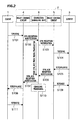
- Fig. 2 is a sequence diagram showing operation of the communication control system according to the present embodiment. In Fig. 2, shown is the establishment of a TCP connection among the client 1, the relay device 2 and the server 3.
- a TCP connection is established between the client 1 and the relay device 2, and thereafter, a TCP connection is established between the relay device 2 and the server 3.
- Step 101 the client 1 transmits a TCP connection establishment request signal "TCP [SYN]" to the relay control circuit 4 of the relay device 2.
- Step 102 when the TCP connection establishment request signal "TCP [SYN]" is inputted via the client-side connection terminal 7, the relay control circuit 4 transmits to the connection managing unit 6 a "SYN reception notification" for notifying the reception of the TCP connection establishment request signal "TCP [SYN]".
- Step 103 the connection managing unit 6 forwards the received SYN reception notification to the relay control circuit 5.
- the data transmitting/receiving unit 61 acquires the SYN reception notification from the relay control circuit 4, and sends this acquired SYN reception notification to the relay processing unit 63.
- the relay processing unit 63 analyzes the contents of the SYN reception notification, analyzes whether or not the TCP connection establishment request signal "TCP [SYN]" related to the acquired SYN reception notification is the first signal (not a retransmitted signal), and sends the result of this analysis to the deciding unit 64. At the same time, the relay processing unit 63 instructs the establishment holding unit 66 to hold the TCP connection establishment request signal "TCP [SYN]" in question.
- the relay control circuit 4 holds the TCP connection establishment request/acknowledgment signal "TCP [SYN, ACK]" from being transmitted to the client 1 during Steps 102 to 107, that is, until a TCP connection is established between the server-side connection terminal 8 and the server 3 and also a "SYN, ACK reception notification" arrives from the connection managing unit 6.
- the relay processing unit 63 instructs the notification processing unit 65 to transmit the SYN reception notification to the relay control circuit 5.
- the notification processing unit 65 forwards the SYN reception notification in question to the relay control circuit 5 (the server-side connection terminal 8) via the data transmitting/receiving unit 62.
- the relay control circuit 5 Upon receiving the SYN reception notification, the relay control circuit 5 transmits to the server 3 a TCP connection establishment request signal "TCP [SYN]" related to the SYN reception notification in question, in Step 104.
- the relay control circuit 5 receives a TCP connection establishment request/acknowledgment signal "TCP [SYN, ACK]", which is an acknowledgment of a TCP connection establishment, from the server 3 via the server-side connection terminal 8 in Step 105.
- the relay control circuit 5 that has received the TCP connection establishment request/acknowledgment signal "TCP [SYN, ACK]” transmits a TCP connection establishment acknowledgment signal "TCP [ACK]" to the server 3 via the server-side connection terminal 8 in Step 109.
- the relay control circuit 5 also transmits to the connection managing unit 6 a "SYN, ACK reception notification" which indicates that the TCP connection establishment request/acknowledgment signal "TCP [SYN, ACK]" has been received.
- Step 107 the connection managing unit 6 that has received the SYN, ACK reception notification forwards the SYN, ACK reception notification to the relay control circuit 4.
- the data transmitting/receiving unit 62 acquires from the relay control circuit 5 the "SYN, ACK reception notification" indicating that the TCP connection establishment request/acknowledgment signal "TCP [SYN, ACK]" has been received, and then sends this acquired "SYN, ACK reception notification" to the relay processing unit 63.
- the relay processing unit 63 analyzes the contents of the "SYN, ACK reception notification", analyzes whether or not the TCP connection establishment request/acknowledgment signal "TCP [SYN, ACK]" related to this acquired "SYN, ACK reception notification” is a response signal from the server 3, and sends the result of this analysis to the deciding unit 64.
- the deciding unit 64 decides whether or not a TCP connection has been established between the client 1 and the server 3, based on the earlier acquired result of the analysis based on the SYN reception notification from the relay control circuit 4, and on the this-time acquired result of the analysis based on the SYN, ACK reception notification from the relay control circuit 5.
- the deciding unit 64 outputs the result of this decision to the relay processing unit 63, and also, in Step 101, has the charging processing unit 68 execute charging processing on the client 1.
- the relay processing unit 63 instructs the notification processing unit 65 to transmit the "SYN, ACK reception notification" to the relay control circuit 4.
- the notification processing unit 65 transmits the SYN, ACK reception notification to the relay control circuit 4 via the data transmitting/receiving unit 61.
- Step 108 the relay control circuit 4 transmits a TCP connection establishment request/acknowledgment signal "TCP [SYN, ACK]" to the client 1 via the client-side connection terminal 7.
- Step 111 in response to the TCP connection establishment request/acknowledgment signal "TCP [SYN, ACK]", the client 1 transmits a TCP connection establishment acknowledgment signal "TCP [ACK]" to the relay control circuit 4 (the client-side connection terminal 7).
- Fig. 3 is a sequence diagram showing operation of the communication control method according to the present embodiment in the case where the server 3, the destination of the connection for the client 1, does not exist, or where a TCP connection cannot be established between the relay device 2 and the server 3.
- Step 101 the client 1 transmits a TCP connection establishment request signal "TCP [SYN]" to the relay device 2.
- Step 102 when the TCP connection establishment request signal "TCP [SYN]" is inputted via the client-side connection terminal 7, the relay control circuit 4 transmits to the connection managing unit 6 a "SYN reception notification" for notifying the reception of the TCP connection establishment request signal "TCP [SYN]".
- Step 103 the connection managing unit 6 forwards the received SYN reception notification to the relay control circuit 5.
- the data transmitting/receiving unit 61 acquires the SYN reception notification from the relay control circuit 4, and sends this acquired SYN reception notification to the relay processing unit 63.
- the relay processing unit 63 analyzes the contents of the SYN reception notification, analyzes whether or not the TCP connection establishment request signal "TCP [SYN]" related to the acquired SYN reception notification is the first signal (not a retransmitted signal), and sends the result of this analysis to the deciding unit 64. At the same time, the relay processing unit 63 instructs the establishment holding unit 66 to hold the TCP connection establishment request signal "TCP [SYN]" in question.
- TCP connection establishment request/acknowledgment signal "TCP [SYN, ACK]" is held from being transmitted to the client 1.
- a SYN, ACK reception notification is held from being transmitted to the relay control circuit 4.
- the relay processing unit 63 instructs the notification processing unit 65 to transmit the SYN reception notification to the relay control circuit 5.
- the notification processing unit 65 forwards the SYN reception notification to the relay control circuit 5 via the data transmitting/receiving unit 62.
- Step 104 the relay control circuit 5, in response to the received SYN reception notification, transmits a TCP connection establishment request signal "TCP [SYN]" to the server 3 via the server-side connection terminal 8.
- the server 3 Since the server 3 does not transmit the TCP connection establishment request/acknowledgment signal "TCP [SYN, ACK]" to the relay control circuit 5 via the server-side connection terminal 8, a SYN, ACK reception notification is not transmitted from the relay control circuit 5 to the connection managing unit 6 either, and communications are not performed thereafter.
- Step 201 as time-up processing, the client 1 retransmits a TCP connection establishment request signal "TCP [SYN]" to the relay control circuit 4 (the client-side connection terminal 7) after a predetermined period of time has elapsed.
- Step 202 when the relay control circuit 4 receives the TCP connection establishment request signal "TCP [SYN]" retransmitted, the relay control circuit 4 transmits to the connection managing unit 6 a SYN reception notification for notifying that the TCP connection establishment request signal "TCP [SYN]" has been received again.
- Step 203 the connection managing unit 6 instructs to discard the TCP connection establishment request signal "TCP [SYN]" held by the establishment holding unit 66.
- the data transmitting/receiving unit 61 acquires the SYN reception notification from the relay control circuit 4, and sends the acquired SYN reception notification to the relay processing unit 63.
- the relay processing unit 63 analyzes the contents of the acquired SYN reception notification, analyzes whether or not the TCP connection establishment request signal "TCP [SYN]" related to the acquired SYN reception notification is a retransmitted signal, and sends the result of this analysis to the deciding unit 64.
- the deciding unit 64 decides that a TCP connection has not been established between the client 1 and the server 3, based on the earlier acquired result of the analysis based on the SYN reception notification from the relay device 4, and on the this-time acquired result of the analysis based on the SYN reception notification from the relay device 4. The deciding unit 64 then outputs the result of this decision to the relay processing unit 63.
- the relay processing unit 63 instructs the discard processing unit 67 to discard the TCP connection establishment request signal "TCP [SYN] " held by the establishment holding unit 66. At the same time, the relay processing unit 63 instructs the notification processing unit 65 to transmit a discard notification to the relay control circuit 4.
- the notification processing unit 65 transmits the discard notification to the relay control circuit 4 via the data transmitting/receiving unit 61.
- the client 1 retransmits a TCP connection establishment request signal "TCP [SYN] " until a TCP connection is established between the client 1 and the server 3 (see Steps 204 and 205), in which case the connection managing unit 6 transmits discard notifications to the client 1, as shown in Step 206, as long as the server 3 does not exist or a TCP connection cannot be established between the relay device 2 and the server 3.
- processing of relaying a data signal can be executed only when both TCP connections between the client 1 and the relay device 2 and between the relay device 2 and the server 3 have been established. Therefore, it can be avoided that a resource is unnecessarily reserved even when the server 3 does not exist or a TCP connection to the server 3 cannot be established.
- the communication control system of the present embodiment it can be avoided to charge the client 1 even when a TCP connection is not established between the relay device 2 and the server 3, whereby it is possible to realize fair charging processing.
- the communication control system of the present embodiment it is possible to confirm the establishment of a TCP connection to the server 3, for example, based on a response signal from the server 3, such as the TCP connection establishment acknowledgment signal "TCP [ACK]". Therefore, it is possible to decide further reliably whether or not a TCP connection is established between the relay device 2 and the server 3.
- the communication control system and the communication control method described above can be realized by executing a communication control program written in a predetermined computer language on a general-purpose computer, such as a personal computer, installed in a base station or control station.
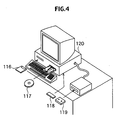
- a data management program is recorded on a recording medium (a flexible disk 116, an optical recording medium 117 such as a CD-ROM or DVD-ROM, a RAM 118, or a cassette tape 119) which can be read by a computer 120 as shown in Fig. 4, and is installed onto the computer 120 through such a recording medium as mentioned above, whereby it is possible to realize the devices described through the foregoing embodiment. Further, by means of the above-mentioned recording media, software can be easily stored, carried and transferred.
- a recording medium a flexible disk 116, an optical recording medium 117 such as a CD-ROM or DVD-ROM, a RAM 118, or a cassette tape 119
- Such a communication control program can be transferred, sold, and so on, by using means for transmitting the program through a communication network, and the like.
- the relay device decides whether or not to accept a connection request signal from the client 1 after determining the communication state on the server 3 side.
- the relay device decides whether or not to accept a connection request signal from the client 1 after determining the communication state on the server 3 side.
Landscapes
- Engineering & Computer Science (AREA)
- Computer Networks & Wireless Communication (AREA)
- Signal Processing (AREA)
- Computer Security & Cryptography (AREA)
- Data Exchanges In Wide-Area Networks (AREA)
- Communication Control (AREA)
- Computer And Data Communications (AREA)
Abstract
An object of the present invention is to reduce a load
on the resource of a relay device (2) and to reduce the
data-amount charging on a client, when communications are
performed between a client (1) and a server (3). A
communication control system according to the present invention
includes: an establishment holder (66) configured to hold a
response signal from being transmitted from the client-side
connection terminal (7) to the client (1), when a client-side
connection terminal (7) receives a connection request signal
from the client (1); a decider (64) configured to detect a
connection state of a server-side connection terminal (8) in
response to the connection request signal, and to decide whether
or not a connection can be established between the server-side
connection terminal (8) and the server (1); and a relay
processor (63) configured to transmit the response signal held
by the establishment holder (66) and to establish
communications between the client (1) and the server (3) so as
to perform relay processing, depending on a result of decision
made by the decider (64).
Description
The present invention relates to a communication control
system, a communication control method and a relay device, for
controlling (digital) data communications performed between a
server and a client through a communication network such as the
Internet.
Conventionally, in a communication network such as the
Internet, when a relay device, which relays data between a
client and a server, receives from the client a connection
request signal (TCP connection establishment request signal)
based on a communication protocol such as TCP, the following
procedure is carried out. The relay device unconditionally
establishes a TCP connection (a connection) between the client
and the relay device, regardless of the state of the server,
which is the destination of the connection. At the same time,
the relay device transmits a TCP connection establishment
request to the server, which is the relay destination, thereby
attempting the establishment of a TCP connection.
Figs. 5 and 6 show a method of establishing a TCP
connection by using a conventional relay device 12. As shown
in Figs. 5 and 6, according to the conventional relay device,
the establishment of a TCP connection between a client 1 and
the relay device 12 is performed independently of the
establishment of a TCP connection between a server 3 and the
relay device 12.
In this event, if the server 3, the destination of the
connection, exists and also a TCP connection can be established
between the relay device 12 and the server 3, then the TCP
connections are established between the client 1 and the relay
device 12 and between the server 3 and the relay device 12,
whereby the relay device 12 will be able to relay a relay request
signal from the client 1 to the server 3.
On the other hand, if the server 3, the destination of
the connection, does not exist or a TCP connection cannot be
established between the relay device 12 and the server 3, then
a TCP connection is established between the client 1 and the
relay device 21, whereas a TCP connection is not established
between the server 3 and the relay device 12.
More specifically, as shown in Fig. 5, when the client
1 transmits a TCP connection establishment request signal "TCP
[SYN]" in Step 301, the relay device 12 transmits a TCP
connection establishment request signal "TCP [SYN]" to the
server 3 in Step 302. At the same time, the relay device 12
transmits a TCP connection establishment
request/acknowledgment signal "TCP [SYN, ACK]" to the client
1, thereby establishing a TCP connection between the client 1
and the relay device 12.
When the server 3 exists and also a TCP connection can
be established between the relay device 12 and the server 3,
then the server 3 transmits a TCP connection establishment
request/acknowledgment signal "TCP [SYN, ACK]" to the relay
device 12 in Step 304. The relay device 12 then relays a TCP
connection establishment acknowledgment signal (ACK signal)
from the client 1 to the server 3 (Steps 305 and 306).
On the other hand, as shown in Fig. 6, when the server
3 does not exist or a TCP connection cannot be established
between the relay device 12 and the server 3, then the relay
device 12 does not receive from the server 3 the TCP connection
establishment request/acknowledgment signal "TCP [SYN, ACK]"
responding to the TCP connection establishment request signal
"TCP [SYN]" transmitted in Step 302, although the TCP connection
has been established between the client 1 and the relay device
12 (Step 305).
However, according to the connection method for a TCP
connection between a client and a server by using a relay device
through such a conventional procedure, the relay device accepts
a TCP connection establishment request signal from the client,
without deciding whether or not the server, which is the
destination of the connection for the client, is in a state
capable of communication. Therefore, if the server is
incapable of communication, there arise problems of the
occurrence of a load on the resource of the relay device and
the occurrence of data-amount charges, which is primarily
unnecessary.
That is, if the relay device unconditionally establishes
a TCP connection to the client, regardless of the state of the
server, which is the destination of the connection for the
client, the TCP connection between the relay device and the
client is held in the relay device for a certain period of time,
when the server does not exist or a TCP connection cannot be
established between the relay device and the server. This is
undesirable because the resource of the relay device is
burdened.
Moreover, if, in this case, the communication network
between the client and the relay device adopted a
data-usage-based charging system, data transferring will be
started after the establishment of a TCP connection between the
client and the relay device, and some amount of communication
will be generated, resulting in the occurrence of unnecessary
charging. Therefore, it is undesirable to establish a TCP
connection between the client and the relay device even in such
a case.
Accordingly, the present invention has been accomplished
in the light of the foregoing. It is an object of the present
invention to provide a communication control system, a
communication control method and a relay device which can reduce
a load on the resource of the relay device and reduce the
data-amount charging on a client, by the relay device deciding
whether or not to accept a connection request signal from the
client after determining the communication state of the server
side.
In order to achieve the above object, a first aspect of
the present invention is summarized as a communication control
system including: a server connected to a communication
network; a client configured to make a connection request to
the server through the communication network; a relay device
configured to include a server-side connection terminal
connected to the server and a client-side connection terminal
connected to the client, and to relay communications between
the server and the client; an establishment holder configured
to hold a response signal from being transmitted from the
client-side connection terminal to the client, when the
client-side connection terminal receives a connection request
signal from the client; a decider configured to detect a
connection state of the server-side connection terminal in
response to the connection request signal, and to decide whether
or not a connection can be established between the server-side
connection terminal and the server; and a relay processor
configured to transmit the response signal held by the
establishment holder, and to establish communications between
the client and the server so as to perform relay processing,
depending on a result of decision made by the decider.
In the first aspect of the present invention, the
communication control system may be configured to include a
charging processor configured to execute charging processing
on the client, when communications are established between the
server and the server-side connection terminal, and when
communications are established between the client and the
client-side connection terminal
Moreover, in the first aspect of the present invention,
the decider may be configured to forward the connection
request signal from the client to the server, and to
decide whether or not communications can be established
between the server-side connection terminal and the
server, based on a response signal transmitted from the
server in response to the forwarding.
Furthermore, in the first aspect of the present invention,
the communication control system may be configured to include
a discard processor configured to release the holding state of
the establishment holder, and to transmit a discard
notification to the client via the client-side connection
terminal, when communications are not established between the
server-side connection terminal and the server
A second aspect of the present invention is a
communication control method for controlling communications
between a client and a server through a relay device. The method
includes: holding a response signal to the client when receiving
a connection request signal from the client, in the relay
device; detecting a connection state of the server-side
connection terminal in response to the connection request
signal, and deciding whether or not a connection can be
established between the relay device and the server, in the
relay device; and transmitting the response signal held, and
establishing communications between the client and the server
so as to perform relay processing, when it is decided that
communications are established between the relay device and the
server, in the relay device.
A third aspect of the present invention is a relay device
which relays communications between a client and a server. The
relay device includes: a client-side connection terminal
connected to the client; a server-side connection terminal
connected to the server; an establishment holder configured to
hold a response signal from being transmitted from the
client-side connection terminal to the client, when the
client-side connection terminal receives a connection request
signal from the client; a decider configured to detect a
connection state of the server-side connection terminal in
response to the connection request signal, and to decide whether
or not a connection can be established between the server-side
connection terminal and the server; and a relay processor
configured to transmit the response signal held by the
establishment holder, and to establish communications between
the client and the server so as to perform relay processor,
depending on a result of decision made by the decider.
In the third aspect of the present invention, the relay
device may be configured to include a charging processor
configured to execute charging processing on the client, when
communications are established between the server and the
server-side connection terminal, and when communications are
established between the client and the client-side connection
terminal.
Moreover, in the third aspect of the present invention,
the decider may be configured to forward the connection
request from the client to the server, and to decide
whether or not communications can be established
between the server-side connection terminal and the
server, based on a response signal transmitted from the
server in response to this forwarding
Furthermore, in the third aspect of the present invention,
the relay device may be configured to include a discard
processor configured to release the holding state of the
establishment holder, and to transmit a discard notification
to the client via the client-side connection terminal, when
communications are not established between the server-side
connection terminal and the server.
(Configuration of a Communication Control System according to
One Embodiment of the Present Invention)
A communication control system according to one
embodiment of the present invention will be described with
reference to Figs. 1A and 1B.
As shown in Fig. 1A, the communication control system
according to the present embodiment includes a client 1, a
server 3 and a relay device 2. Here, the client 1 and the server
3 are connected to each other through a communication network
such as the Internet. In addition, the relay device 2 is placed
between the client 1 and the server 3.
The relay device 2 includes a client-side connection
terminal 7, a server-side connection terminal 8, relay control
circuits 4 and 5, and a connection managing unit 6.
The client-side connection terminal 7 is configured to
connect to the client 1, and the server-side connection terminal
8 is configured to connect to the server 3. The relay control
circuits 4 and 5 are connected to the client-side connection
terminal 7 and the client-side connection terminal 7,
respectively. The connection managing unit 6 is connected to
the relay control circuits 4 and 5.
The client-side connection terminal 7 and the server-side
connection terminal 8 are communication ports for
transmitting/receiving data, based on a predetermined
communication protocol. The client-side connection terminal
7 establishes a TCP connection to the client 1, and the
server-side connection terminal 8 establishes a TCP connection
to the server 3.
The connection managing unit 6 manages the state of TCP
connection establishment between the client-side connection
terminal 7 and the client 1, and also manages the state of TCP
connection establishment between the server-side connection
terminal 8 and the server 3.
Moreover, the connection managing unit 6 decides whether
or not a TCP connection can be established between the relay
control circuit 4 and the client 1, in accordance with the state
of TCP connection establishment between the relay control
circuit 5 and the server3.
Specifically, in the present embodiment, the connection
managing unit 6 has data transmitting/ receiving units 61 and
62, a relay processing unit 63, a deciding unit 64, a
notification processing unit 65, an establishment holding unit
66, a discard processing unit 67, and a charging processing unit
68, as shown in Fig. 1B.
The data transmitting/receiving units 61 and 62 are
communication circuits which transmit control signals for
controlling the relaying of data signals including a TCP
connection establishment request signal (connection request
signal) and a TCP connection establishment acknowledgment
signal (response signal), to the relay control circuits 4 and
5, respectively. Moreover, the data transmitting/receiving
units 61 and 62 are communication circuits which acquire
notifications of signals received by the relay control circuits
4 and 5 (a SYN reception notification, a SYN, ACK reception
notification, etc.), from the relay control circuits 4 and 5,
respectively.
The relay processing unit 63 is a control circuit which
analyzes the contents of a SYN reception notification acquired
by the data transmitting/receiving unit 61 or 62, and sends a
result of this analysis to the deciding unit 64. Moreover, the
relay processing unit 63 is a control circuit which outputs
instructions to the notification processing unit 65, the
establishment holding unit 66 and the discard processing unit
67, depending on a result of decision made by the deciding unit
64.
The deciding unit 64 is an arithmetic circuit which
decides, based on the contents of a reception signal analyzed
by the relay processing unit 63, whether or not a TCP connection
has been established between the client 1 and the server 3, and
returns a result of this decision to the relay processing unit
63.
Note that, when the deciding unit 64 has decided that a
TCP connection has been established between the client 1 and
the server 3, the deciding unit 64 notifies a fact to that effect
to the charging processing unit 68.
The notification processing unit 65 is a signal
generating circuit which, in response to an instruction from
the relay processing unit 63, transmits notification signals
for discard notification, SYN reception notification and the
like, to the relay control circuits 4 and 5 via the data
transmitting/receiving units 61 and 62, respectively.
The establishment holding unit 66 is a storage circuit
which, in response to an instruction from the relay processing
unit 63, stores a TCP connection establishment request signal
"TCP [SYN]" acquired from the client 1 for a certain period of
time, and holds a TCP connection establishment
request/acknowledgment signal "TCP [SYN, ACK]" from being
transmitted to the client 1.
The establishment holding unit 66 is configured to
transmit the TCP connection establishment
request/acknowledgment signal, which has been held, to the
client 1 via the data transmitting/receiving unit 62, when it
is decided that a TCP connection can be established between the
relay device 2 and the server 3.
The establishment holding unit 66 is configured to delete
the TCP connection establishment request signal "TCP [SYN]",
which has been held, in response to an instruction from the
discard processing unit 67, when, on the other hand, it is
decided that a TCP connection cannot be established between the
relay device 2 and the server 3.
The discard processing unit 67 is a control circuit which
controls the discarding of a TCP connection establishment
request signal "TCP [SYN]" held by the establishment holding
unit 66, in accordance with an instruction from the relay
processing unit 63 based on a result of decision made by the
deciding unit 64.
The charging processing unit 68 performs charging of
communication costs on the client 1, when it is decided that
a TCP connection has been established between the client 1 and
the server 3.
If a data-usage-based charging system is adopted, the
charging processing unit 68 also has a function of measuring
the data amount exchanged between the relay control circuits
4 and 5, and of performing charging of the costs depending on
a result of the measurement.
The relay control circuit 4 is configured to relay a relay
request signal (data signal) arriving at the client-side
connection terminal 7, to the server-side connection terminal
8. The relay control circuit 5 is configured to relay a relay
request signal (data signal) forwarded from the server 3 to the
server-side connection terminal 8, to the client 1 via the
client-side connection terminal 7.
Here, what characterizes the present invention is the
provision of the connection managing unit 6 which manages the
state of TCP connection establishment between the client 1 and
the relay control circuits 4 and 5.
The relay device 2 according to the present embodiment
can be realized by installing a communication control program
in a digital arithmetic circuit with an operating system
executed thereon.
A description will be given of a communication control
method using the communication control system according to the
present embodiment having the above-described configuration,
with reference to Figs. 2 and 3.
Fig. 2 is a sequence diagram showing operation of the
communication control system according to the present
embodiment. In Fig. 2, shown is the establishment of a TCP
connection among the client 1, the relay device 2 and the server
3.
In the communication control system according to the
present embodiment, before the client 1 transmits a relay
request signal (data signal) to the server 3 via the relay device
2, a TCP connection is established between the client 1 and the
relay device 2, and thereafter, a TCP connection is established
between the relay device 2 and the server 3.
Specifically, in Step 101, the client 1 transmits a TCP
connection establishment request signal "TCP [SYN]" to the
relay control circuit 4 of the relay device 2.
In Step 102, when the TCP connection establishment
request signal "TCP [SYN]" is inputted via the client-side
connection terminal 7, the relay control circuit 4 transmits
to the connection managing unit 6 a "SYN reception notification"
for notifying the reception of the TCP connection establishment
request signal "TCP [SYN]".
In Step 103, the connection managing unit 6 forwards the
received SYN reception notification to the relay control
circuit 5.
More specifically, first, the data
transmitting/receiving unit 61 acquires the SYN reception
notification from the relay control circuit 4, and sends this
acquired SYN reception notification to the relay processing
unit 63.
Second, the relay processing unit 63 analyzes the
contents of the SYN reception notification, analyzes whether
or not the TCP connection establishment request signal "TCP
[SYN]" related to the acquired SYN reception notification is
the first signal (not a retransmitted signal), and sends the
result of this analysis to the deciding unit 64. At the same
time, the relay processing unit 63 instructs the establishment
holding unit 66 to hold the TCP connection establishment request
signal "TCP [SYN]" in question.
As a result, the relay control circuit 4 holds the TCP
connection establishment request/acknowledgment signal "TCP
[SYN, ACK]" from being transmitted to the client 1 during Steps
102 to 107, that is, until a TCP connection is established
between the server-side connection terminal 8 and the server
3 and also a "SYN, ACK reception notification" arrives from the
connection managing unit 6.
Third, the relay processing unit 63 instructs the
notification processing unit 65 to transmit the SYN reception
notification to the relay control circuit 5. In response to
this instruction, the notification processing unit 65 forwards
the SYN reception notification in question to the relay control
circuit 5 (the server-side connection terminal 8) via the data
transmitting/receiving unit 62.
Upon receiving the SYN reception notification, the relay
control circuit 5 transmits to the server 3 a TCP connection
establishment request signal "TCP [SYN]" related to the SYN
reception notification in question, in Step 104.
At this time, if the server 3 exists and a condition is
such that a TCP connection can be established between the relay
device 2 and the server 3, then the relay control circuit 5
receives a TCP connection establishment
request/acknowledgment signal "TCP [SYN, ACK]", which is an
acknowledgment of a TCP connection establishment, from the
server 3 via the server-side connection terminal 8 in Step 105.
The relay control circuit 5 that has received the TCP
connection establishment request/acknowledgment signal "TCP
[SYN, ACK]" transmits a TCP connection establishment
acknowledgment signal "TCP [ACK]" to the server 3 via the
server-side connection terminal 8 in Step 109. In Step 106,
the relay control circuit 5 also transmits to the connection
managing unit 6 a "SYN, ACK reception notification" which
indicates that the TCP connection establishment
request/acknowledgment signal "TCP [SYN, ACK]" has been
received.
In Step 107, the connection managing unit 6 that has
received the SYN, ACK reception notification forwards the SYN,
ACK reception notification to the relay control circuit 4.
More specifically, first, the data
transmitting/receiving unit 62 acquires from the relay control
circuit 5 the "SYN, ACK reception notification" indicating that
the TCP connection establishment request/acknowledgment
signal "TCP [SYN, ACK]" has been received, and then sends this
acquired "SYN, ACK reception notification" to the relay
processing unit 63.
Second, the relay processing unit 63 analyzes the
contents of the "SYN, ACK reception notification", analyzes
whether or not the TCP connection establishment
request/acknowledgment signal "TCP [SYN, ACK]" related to this
acquired "SYN, ACK reception notification" is a response signal
from the server 3, and sends the result of this analysis to the
deciding unit 64.
The deciding unit 64 decides whether or not a TCP
connection has been established between the client 1 and the
server 3, based on the earlier acquired result of the analysis
based on the SYN reception notification from the relay control
circuit 4, and on the this-time acquired result of the analysis
based on the SYN, ACK reception notification from the relay
control circuit 5. The deciding unit 64 outputs the result of
this decision to the relay processing unit 63, and also, in Step
101, has the charging processing unit 68 execute charging
processing on the client 1.
The relay processing unit 63, based on the result of this
decision, instructs the notification processing unit 65 to
transmit the "SYN, ACK reception notification" to the relay
control circuit 4. In Step 107, in response to this instruction,
the notification processing unit 65 transmits the SYN, ACK
reception notification to the relay control circuit 4 via the
data transmitting/receiving unit 61.
In Step 108, the relay control circuit 4 transmits a TCP
connection establishment request/acknowledgment signal "TCP
[SYN, ACK]" to the client 1 via the client-side connection
terminal 7.
In Step 111, in response to the TCP connection
establishment request/acknowledgment signal "TCP [SYN, ACK]",
the client 1 transmits a TCP connection establishment
acknowledgment signal "TCP [ACK]" to the relay control circuit
4 (the client-side connection terminal 7).
Fig. 3 is a sequence diagram showing operation of the
communication control method according to the present
embodiment in the case where the server 3, the destination of
the connection for the client 1, does not exist, or where a TCP
connection cannot be established between the relay device 2 and
the server 3.
As shown in Fig. 3, in Step 101, the client 1 transmits
a TCP connection establishment request signal "TCP [SYN]" to
the relay device 2.
In Step 102, when the TCP connection establishment
request signal "TCP [SYN]" is inputted via the client-side
connection terminal 7, the relay control circuit 4 transmits
to the connection managing unit 6 a "SYN reception notification"
for notifying the reception of the TCP connection establishment
request signal "TCP [SYN]".
In Step 103, the connection managing unit 6 forwards the
received SYN reception notification to the relay control
circuit 5.
More specifically, first, the data
transmitting/receiving unit 61 acquires the SYN reception
notification from the relay control circuit 4, and sends this
acquired SYN reception notification to the relay processing
unit 63.
Second, the relay processing unit 63 analyzes the
contents of the SYN reception notification, analyzes whether
or not the TCP connection establishment request signal "TCP
[SYN]" related to the acquired SYN reception notification is
the first signal (not a retransmitted signal), and sends the
result of this analysis to the deciding unit 64. At the same
time, the relay processing unit 63 instructs the establishment
holding unit 66 to hold the TCP connection establishment request
signal "TCP [SYN]" in question.
As a result, a TCP connection establishment
request/acknowledgment signal "TCP [SYN, ACK]" is held from
being transmitted to the client 1. In other words, a SYN, ACK
reception notification is held from being transmitted to the
relay control circuit 4.
Moreover, the relay processing unit 63 instructs the
notification processing unit 65 to transmit the SYN reception
notification to the relay control circuit 5. In response to
this instruction, the notification processing unit 65 forwards
the SYN reception notification to the relay control circuit 5
via the data transmitting/receiving unit 62.
In Step 104, the relay control circuit 5, in response to
the received SYN reception notification, transmits a TCP
connection establishment request signal "TCP [SYN]" to the
server 3 via the server-side connection terminal 8.
Note that, since the server 3 does not exist or a TCP
connection cannot be established between the relay device 2 and
the server 2 here, a TCP connection establishment
request/acknowledgment signal "TCP [SYN, ACK]" will not be
transmitted from the server 3 in response to the TCP connection
establishment request signal "TCP [SYN]" transmitted in Step
104.
Since the server 3 does not transmit the TCP connection
establishment request/acknowledgment signal "TCP [SYN, ACK]"
to the relay control circuit 5 via the server-side connection
terminal 8, a SYN, ACK reception notification is not transmitted
from the relay control circuit 5 to the connection managing unit
6 either, and communications are not performed thereafter.
Accordingly, in Step 201, as time-up processing, the
client 1 retransmits a TCP connection establishment request
signal "TCP [SYN]" to the relay control circuit 4 (the
client-side connection terminal 7) after a predetermined period
of time has elapsed.
In Step 202, when the relay control circuit 4 receives
the TCP connection establishment request signal "TCP [SYN]"
retransmitted, the relay control circuit 4 transmits to the
connection managing unit 6 a SYN reception notification for
notifying that the TCP connection establishment request signal
"TCP [SYN]" has been received again.
In Step 203, the connection managing unit 6 instructs to
discard the TCP connection establishment request signal "TCP
[SYN]" held by the establishment holding unit 66.
More specifically, first, the data
transmitting/receiving unit 61 acquires the SYN reception
notification from the relay control circuit 4, and sends the
acquired SYN reception notification to the relay processing
unit 63.
Second, the relay processing unit 63 analyzes the
contents of the acquired SYN reception notification, analyzes
whether or not the TCP connection establishment request signal
"TCP [SYN]" related to the acquired SYN reception notification
is a retransmitted signal, and sends the result of this analysis
to the deciding unit 64.
Third, the deciding unit 64 decides that a TCP connection
has not been established between the client 1 and the server
3, based on the earlier acquired result of the analysis based
on the SYN reception notification from the relay device 4, and
on the this-time acquired result of the analysis based on the
SYN reception notification from the relay device 4. The
deciding unit 64 then outputs the result of this decision to
the relay processing unit 63.
Fourth, based on the result of this decision, the relay
processing unit 63 instructs the discard processing unit 67 to
discard the TCP connection establishment request signal "TCP
[SYN] " held by the establishment holding unit 66. At the same
time, the relay processing unit 63 instructs the notification
processing unit 65 to transmit a discard notification to the
relay control circuit 4.
Fifth, in response to this instruction, the notification
processing unit 65 transmits the discard notification to the
relay control circuit 4 via the data transmitting/receiving
unit 61.
Note that the client 1 retransmits a TCP connection
establishment request signal "TCP [SYN] " until a TCP connection
is established between the client 1 and the server 3 (see Steps
204 and 205), in which case the connection managing unit 6
transmits discard notifications to the client 1, as shown in
Step 206, as long as the server 3 does not exist or a TCP
connection cannot be established between the relay device 2 and
the server 3.
(Operation and Effect of the Communication Control System
according to the Present Embodiment)
According to the communication control system of the
present embodiment, processing of relaying a data signal can
be executed only when both TCP connections between the client
1 and the relay device 2 and between the relay device 2 and the
server 3 have been established. Therefore, it can be avoided
that a resource is unnecessarily reserved even when the server
3 does not exist or a TCP connection to the server 3 cannot be
established.
Moreover, according to the communication control system
of the present embodiment, it can be avoided to charge the client
1 even when a TCP connection is not established between the relay
device 2 and the server 3, whereby it is possible to realize
fair charging processing.
Further, according to the communication control system
of the present embodiment, it is possible to confirm the
establishment of a TCP connection to the server 3, for example,
based on a response signal from the server 3, such as the TCP
connection establishment acknowledgment signal "TCP [ACK]".
Therefore, it is possible to decide further reliably whether
or not a TCP connection is established between the relay device
2 and the server 3.
Furthermore, according to the communication control
system of the present embodiment, it is possible to release an
unnecessary queued state on the client 1 side by means of a
discard notification, whereby it is possible to proceed to
subsequent processing promptly.
The communication control system and the communication
control method described above can be realized by executing a
communication control program written in a predetermined
computer language on a general-purpose computer, such as a
personal computer, installed in a base station or control
station.
In addition, a data management program is recorded on a
recording medium (a flexible disk 116, an optical recording
medium 117 such as a CD-ROM or DVD-ROM, a RAM 118, or a cassette
tape 119) which can be read by a computer 120 as shown in Fig.
4, and is installed onto the computer 120 through such a
recording medium as mentioned above, whereby it is possible to
realize the devices described through the foregoing embodiment.
Further, by means of the above-mentioned recording media,
software can be easily stored, carried and transferred.
Additionally, such a communication control program can
be transferred, sold, and so on, by using means for transmitting
the program through a communication network, and the like.
As described hereinabove, according to the present
invention, the relay device decides whether or not to accept
a connection request signal from the client 1 after determining
the communication state on the server 3 side. Thus, it will
be possible to save the memory resource of the relay device and
to reduce the communication amount on the client side.
Claims (9)
- A communication control system, comprising:a server connected to a communication network;a client configured to make a connection request to the server through the communication network;a relay device configured to include a server-side connection terminal connected to the server and a client-side connection terminal connected to the client, and to relay communications between the server and the client;an establishment holder configured to hold a response signal from being transmitted from the client-side connection terminal to the client, when the client-side connection terminal receives a connection request signal from the client;a decider configured to detect a connection state of the server-side connection terminal in response to the connection request signal, and to decide whether or not a connection can be established between the server-side connection terminal and the server; anda relay processor configured to transmit the response signal held by the establishment holder, and to establish communications between the client and the server so as to perform relay processing, depending on a result of decision made by the decider.
- The communication control system according to claim 1, further comprising a charging processor configured to execute charging processing on the client, when communications are established between the server and the server-side connection terminal, and when communications are established between the client and the client-side connection terminal.
- The communication control system according to claim 1, wherein the decider is configured to forward the connection request signal from the client to the server, and to decide whether or not communications can be established between the server-side connection terminal and the server, based on a response signal transmitted from the server in response to the forwarding.
- The communication control system according to claim 1, further comprising a discard processor configured to release the holding state of the establishment holder, and to transmit a discard notification to the client via the client-side connection terminal, when communications are not established between the server-side connection terminal and the server.
- A communication control method for controlling communications between a client and a server through a relay device, the method comprising:holding a response signal to the client when receiving a connection request signal from the client, in the relay device;detecting a connection state of the server-side connection terminal in response to the connection request signal, and deciding whether or not a connection can be established between the relay device and the server, in the relay device; andtransmitting the response signal held, and establishing communications between the client and the server so as to perform relay processing, when it is decided that communications are established between the relay device and the server, in the relay device.
- A relay device which relays communications between a client and a server, comprising:a client-side connection terminal connected to the client;a server-side connection terminal connected to the server;an establishment holder configured to hold a response signal from being transmitted from the client-side connection terminal to the client, when the client-side connection terminal receives a connection request signal from the client;a decider configured to detect a connection state of the server-side connection terminal in response to the connection request signal, and to decide whether or not a connection can be established between the server-side connection terminal and the server; anda relay processor configured to transmit the response signal held by the establishment holder, and to establish communications between the client and the server so as to perform relay processor, depending on a result of decision made by the decider.
- The relay device according to claim 6, further comprising a charging processor configured to execute charging processing on the client, when communications are established between the server and the server-side connection terminal, and when communications are established between the client and the client-side connection terminal.
- The relay device according to claim 6, wherein the decider is configured to forward the connection request from the client to the server, and to decide whether or not communications can be established between the server-side connection terminal and the server, based on a response signal transmitted from the server in response to this forwarding.
- The relay device according to claim 6, further comprising a discard processor configured to release the holding state of the establishment holder, and to transmit a discard notification to the client via the client-side connection terminal, when communications are not established between the server-side connection terminal and the server.
Applications Claiming Priority (3)
| Application Number | Priority Date | Filing Date | Title |
|---|---|---|---|
| JP2002208729 | 2002-07-17 | ||
| JP2002208729A JP2004056306A (en) | 2002-07-17 | 2002-07-17 | Communication control system, communication control method, relay device, and communication control program |
| PCT/JP2003/009105 WO2004008325A1 (en) | 2002-07-17 | 2003-07-17 | Communication control system, communication control method, and relay device |
Publications (2)
| Publication Number | Publication Date |
|---|---|
| EP1555619A1 true EP1555619A1 (en) | 2005-07-20 |
| EP1555619A4 EP1555619A4 (en) | 2010-07-21 |
Family
ID=30112855
Family Applications (1)
| Application Number | Title | Priority Date | Filing Date |
|---|---|---|---|
| EP03764218A Withdrawn EP1555619A4 (en) | 2002-07-17 | 2003-07-17 | COMMUNICATION CONTROL SYSTEM, COMMUNICATION CONTROL METHOD, AND RELAY DEVICE |
Country Status (5)
| Country | Link |
|---|---|
| US (1) | US20060168235A1 (en) |
| EP (1) | EP1555619A4 (en) |
| JP (1) | JP2004056306A (en) |
| CN (1) | CN1669010A (en) |
| WO (1) | WO2004008325A1 (en) |
Families Citing this family (5)
| Publication number | Priority date | Publication date | Assignee | Title |
|---|---|---|---|---|
| JP3997995B2 (en) * | 2004-01-29 | 2007-10-24 | 日本電気株式会社 | Half-duplex wireless communication method, program, and system |
| JP4407556B2 (en) * | 2005-03-29 | 2010-02-03 | 日本電気株式会社 | Session relay apparatus, session relay method and program |
| JP5062321B2 (en) * | 2008-02-26 | 2012-10-31 | 富士電機株式会社 | Exposure management system, dosimeter, and repeater |
| JP2013025198A (en) * | 2011-07-22 | 2013-02-04 | Nikon Corp | Accessory and accessory control program |
| JP5874443B2 (en) * | 2012-03-01 | 2016-03-02 | ソニー株式会社 | COMMUNICATION DEVICE, COMMUNICATION SYSTEM, CONTROL METHOD THEREOF, AND PROGRAM FOR CAUSING COMPUTER TO EXECUTE THE METHOD |
Family Cites Families (8)
| Publication number | Priority date | Publication date | Assignee | Title |
|---|---|---|---|---|
| JPS6086948A (en) * | 1983-10-18 | 1985-05-16 | Fujitsu Ltd | Packet exchange method |
| JPH10271161A (en) * | 1997-03-21 | 1998-10-09 | Mitsubishi Electric Corp | Session control method for client-server system via relay device |
| JPH11313377A (en) * | 1998-04-30 | 1999-11-09 | Toshiba Corp | Mobile data communication system, mobile terminal apparatus and data communication apparatus |
| JPH11338802A (en) * | 1998-05-27 | 1999-12-10 | Nec Corp | Load balancer with automatic connection disconnection function |
| EP1059777A4 (en) * | 1998-12-28 | 2003-01-15 | Ntt Docomo Inc | COMMUNICATION SYSTEM, COMMUNICATION METHOD, SERVER DEVICE, TERMINAL, RELAY DEVICE, AND COMMUNICATION SYSTEM |
| JP2001339431A (en) * | 2000-05-26 | 2001-12-07 | Fujitsu Ltd | Communication system, relay device, end system, and communication method |
| US20020010765A1 (en) * | 2000-07-21 | 2002-01-24 | John Border | Method and system for prioritizing traffic in a network |
| JP2002171367A (en) * | 2000-11-29 | 2002-06-14 | Amenico:Kk | Data communication billing device |
-
2002
- 2002-07-17 JP JP2002208729A patent/JP2004056306A/en active Pending
-
2003
- 2003-07-17 CN CNA038170027A patent/CN1669010A/en active Pending
- 2003-07-17 WO PCT/JP2003/009105 patent/WO2004008325A1/en not_active Ceased
- 2003-07-17 EP EP03764218A patent/EP1555619A4/en not_active Withdrawn
- 2003-07-17 US US10/521,446 patent/US20060168235A1/en not_active Abandoned
Also Published As
| Publication number | Publication date |
|---|---|
| CN1669010A (en) | 2005-09-14 |
| WO2004008325A1 (en) | 2004-01-22 |
| JP2004056306A (en) | 2004-02-19 |
| EP1555619A4 (en) | 2010-07-21 |
| US20060168235A1 (en) | 2006-07-27 |
Similar Documents
| Publication | Publication Date | Title |
|---|---|---|
| US6590875B1 (en) | Radio data communication technique for maintaining a connection between a mobile radio transmission device and a server during a communication interruption | |
| EP1768296A2 (en) | Method and apparatus for transmitting signaling data messages in a wireless communications system | |
| CN111953454B (en) | Packet loss retransmission method, equipment and storage medium | |
| US8019372B2 (en) | Controller apparatus, mobile terminal, and communication control method | |
| CN113965482B (en) | Data transmission method and device based on gRPC and storage medium | |
| CN100531124C (en) | Controller apparatus, mobile terminal, and communication control method | |
| US11336647B2 (en) | Error handling for media access control security | |
| US20120314586A1 (en) | Data relaying apparatus and data relaying method | |
| US20100246400A1 (en) | Communication device and method | |
| JP2003047037A (en) | Communication system and handover control method | |
| EP2723025A1 (en) | File transfer method and device | |
| JP5012907B2 (en) | COMMUNICATION METHOD, COMMUNICATION SYSTEM, AND BASE STATION | |
| US20060168235A1 (en) | Communication control system, communication control method, and relay device | |
| RU2005102111A (en) | SYSTEM AND METHOD FOR MANAGING THE TRANSITION FROM STATE TO STATE IN THE SLEEP MODE AND THE ACTIVE MODE IN A COMMUNICATION SYSTEM WITH A WIDE-BAND WIRELESS ACCESS | |
| EP2378715A1 (en) | Data transfer device | |
| US7720788B2 (en) | System and method for implementing a wireless access protocol push by establishing connection-oriented signaling channel for transmitting session initiation request | |
| KR20120042745A (en) | System and method for establishing reliable communication in a connection-less environment | |
| US9385931B1 (en) | Determining a reordering timer | |
| US20080132234A1 (en) | Apparatus and method for utilizing the transport layer to provide measurement opportunities for the physical layer in a multi-mode network | |
| US7539503B2 (en) | Controller device, mobile terminal and mobile communication method | |
| JP2004241872A (en) | Information communication method and relay device | |
| CN119402146B (en) | Data packet transmission method, device, equipment and readable storage medium | |
| JP4769686B2 (en) | Mobile radio terminal device | |
| JP2002217909A (en) | Suspend packet sending device | |
| JP3689056B2 (en) | COMMUNICATION SYSTEM, COMMUNICATION APPARATUS, COMMUNICATION CONTROL APPARATUS, AND COMMUNICATION METHOD divided into connection setting stage and data communication stage |
Legal Events
| Date | Code | Title | Description |
|---|---|---|---|
| PUAI | Public reference made under article 153(3) epc to a published international application that has entered the european phase |
Free format text: ORIGINAL CODE: 0009012 |
|
| 17P | Request for examination filed |
Effective date: 20050209 |
|
| AK | Designated contracting states |
Kind code of ref document: A1 Designated state(s): DE GB |
|
| RIC1 | Information provided on ipc code assigned before grant |
Ipc: H04L 29/06 20060101AFI20100602BHEP |
|
| A4 | Supplementary search report drawn up and despatched |
Effective date: 20100621 |
|
| 17Q | First examination report despatched |
Effective date: 20100922 |
|
| R17C | First examination report despatched (corrected) |
Effective date: 20100922 |
|
| STAA | Information on the status of an ep patent application or granted ep patent |
Free format text: STATUS: THE APPLICATION IS DEEMED TO BE WITHDRAWN |
|
| 18D | Application deemed to be withdrawn |
Effective date: 20120201 |