EP1555404A1 - Système et procédé de commande d'un moteur thermique suralimenté par deux turbocompresseurs - Google Patents
Système et procédé de commande d'un moteur thermique suralimenté par deux turbocompresseurs Download PDFInfo
- Publication number
- EP1555404A1 EP1555404A1 EP05300020A EP05300020A EP1555404A1 EP 1555404 A1 EP1555404 A1 EP 1555404A1 EP 05300020 A EP05300020 A EP 05300020A EP 05300020 A EP05300020 A EP 05300020A EP 1555404 A1 EP1555404 A1 EP 1555404A1
- Authority
- EP
- European Patent Office
- Prior art keywords
- signal
- correction
- turbochargers
- control method
- turbocharger
- Prior art date
- Legal status (The legal status is an assumption and is not a legal conclusion. Google has not performed a legal analysis and makes no representation as to the accuracy of the status listed.)
- Granted
Links
Images

Classifications
-
- F—MECHANICAL ENGINEERING; LIGHTING; HEATING; WEAPONS; BLASTING
- F02—COMBUSTION ENGINES; HOT-GAS OR COMBUSTION-PRODUCT ENGINE PLANTS
- F02D—CONTROLLING COMBUSTION ENGINES
- F02D41/00—Electrical control of supply of combustible mixture or its constituents
- F02D41/0002—Controlling intake air
- F02D41/0007—Controlling intake air for control of turbo-charged or super-charged engines
-
- F—MECHANICAL ENGINEERING; LIGHTING; HEATING; WEAPONS; BLASTING
- F01—MACHINES OR ENGINES IN GENERAL; ENGINE PLANTS IN GENERAL; STEAM ENGINES
- F01N—GAS-FLOW SILENCERS OR EXHAUST APPARATUS FOR MACHINES OR ENGINES IN GENERAL; GAS-FLOW SILENCERS OR EXHAUST APPARATUS FOR INTERNAL-COMBUSTION ENGINES
- F01N13/00—Exhaust or silencing apparatus characterised by constructional features
- F01N13/08—Other arrangements or adaptations of exhaust conduits
- F01N13/10—Other arrangements or adaptations of exhaust conduits of exhaust manifolds
- F01N13/107—More than one exhaust manifold or exhaust collector
-
- F—MECHANICAL ENGINEERING; LIGHTING; HEATING; WEAPONS; BLASTING
- F02—COMBUSTION ENGINES; HOT-GAS OR COMBUSTION-PRODUCT ENGINE PLANTS
- F02B—INTERNAL-COMBUSTION PISTON ENGINES; COMBUSTION ENGINES IN GENERAL
- F02B37/00—Engines characterised by provision of pumps driven at least for part of the time by exhaust
- F02B37/007—Engines characterised by provision of pumps driven at least for part of the time by exhaust with exhaust-driven pumps arranged in parallel, e.g. at least one pump supplying alternatively
-
- F—MECHANICAL ENGINEERING; LIGHTING; HEATING; WEAPONS; BLASTING
- F02—COMBUSTION ENGINES; HOT-GAS OR COMBUSTION-PRODUCT ENGINE PLANTS
- F02B—INTERNAL-COMBUSTION PISTON ENGINES; COMBUSTION ENGINES IN GENERAL
- F02B37/00—Engines characterised by provision of pumps driven at least for part of the time by exhaust
- F02B37/12—Control of the pumps
-
- F—MECHANICAL ENGINEERING; LIGHTING; HEATING; WEAPONS; BLASTING
- F02—COMBUSTION ENGINES; HOT-GAS OR COMBUSTION-PRODUCT ENGINE PLANTS
- F02D—CONTROLLING COMBUSTION ENGINES
- F02D41/00—Electrical control of supply of combustible mixture or its constituents
- F02D41/02—Circuit arrangements for generating control signals
- F02D41/14—Introducing closed-loop corrections
- F02D41/1438—Introducing closed-loop corrections using means for determining characteristics of the combustion gases; Sensors therefor
- F02D41/1486—Introducing closed-loop corrections using means for determining characteristics of the combustion gases; Sensors therefor with correction for particular operating conditions
- F02D41/1487—Correcting the instantaneous control value
-
- F—MECHANICAL ENGINEERING; LIGHTING; HEATING; WEAPONS; BLASTING
- F02—COMBUSTION ENGINES; HOT-GAS OR COMBUSTION-PRODUCT ENGINE PLANTS
- F02B—INTERNAL-COMBUSTION PISTON ENGINES; COMBUSTION ENGINES IN GENERAL
- F02B37/00—Engines characterised by provision of pumps driven at least for part of the time by exhaust
- F02B37/12—Control of the pumps
- F02B37/18—Control of the pumps by bypassing exhaust from the inlet to the outlet of turbine or to the atmosphere
-
- F—MECHANICAL ENGINEERING; LIGHTING; HEATING; WEAPONS; BLASTING
- F02—COMBUSTION ENGINES; HOT-GAS OR COMBUSTION-PRODUCT ENGINE PLANTS
- F02B—INTERNAL-COMBUSTION PISTON ENGINES; COMBUSTION ENGINES IN GENERAL
- F02B37/00—Engines characterised by provision of pumps driven at least for part of the time by exhaust
- F02B37/12—Control of the pumps
- F02B37/24—Control of the pumps by using pumps or turbines with adjustable guide vanes
-
- F—MECHANICAL ENGINEERING; LIGHTING; HEATING; WEAPONS; BLASTING
- F02—COMBUSTION ENGINES; HOT-GAS OR COMBUSTION-PRODUCT ENGINE PLANTS
- F02D—CONTROLLING COMBUSTION ENGINES
- F02D41/00—Electrical control of supply of combustible mixture or its constituents
- F02D41/24—Electrical control of supply of combustible mixture or its constituents characterised by the use of digital means
- F02D41/2406—Electrical control of supply of combustible mixture or its constituents characterised by the use of digital means using essentially read only memories
- F02D41/2425—Particular ways of programming the data
- F02D41/2429—Methods of calibrating or learning
- F02D41/2451—Methods of calibrating or learning characterised by what is learned or calibrated
- F02D41/2464—Characteristics of actuators
-
- Y—GENERAL TAGGING OF NEW TECHNOLOGICAL DEVELOPMENTS; GENERAL TAGGING OF CROSS-SECTIONAL TECHNOLOGIES SPANNING OVER SEVERAL SECTIONS OF THE IPC; TECHNICAL SUBJECTS COVERED BY FORMER USPC CROSS-REFERENCE ART COLLECTIONS [XRACs] AND DIGESTS
- Y02—TECHNOLOGIES OR APPLICATIONS FOR MITIGATION OR ADAPTATION AGAINST CLIMATE CHANGE
- Y02T—CLIMATE CHANGE MITIGATION TECHNOLOGIES RELATED TO TRANSPORTATION
- Y02T10/00—Road transport of goods or passengers
- Y02T10/10—Internal combustion engine [ICE] based vehicles
- Y02T10/12—Improving ICE efficiencies
Definitions
- the invention relates to a system and a method of control of a supercharged engine by two turbochargers and feeding two benches of cylinders.
- each turbocharger receiving gas respectively exhaust cylinders of a bench.
- the air intake compressed by turbochargers feeds the cylinders via a intake manifold.
- each bench has a collector specific fueled by a turbocharger.
- the two turbochargers feed a common collector to feed the set of cylinders.
- turbochargers In the case of an engine with a collector common, the operation of turbochargers is not not necessarily balanced, and it is necessary to provide a method of regulating the operation turbochargers to deliver each substantially the same airflow. That's what proposes the method of document FR 2 837 526, in which is determined an air flow difference upstream compressors, then we determine a gap of rotational speeds of turbochargers. We then derives a correction signal through a regulator, then add or subtract this signal correction to an actuation signal of turbochargers, so that every turbocharger receive a corrected actuation signal.
- reaction time of the regulator were not always satisfactory, especially during transitional phases of regime change or engine power level.
- turbochargers substantially always required the same corrections for a given operating point.
- a correction signal with a stored value the operation of turbochargers is very quickly close to equilibrium conditions, particularly during phases of change of operating point.
- the value of memorized correction is learned during engine operation.
- the memorized value is perfectly adapted to the engine and its accessories, taking into account the dispersions of manufacture and their evolution during the life of the engine.
- the value of stored correction results from the signal of correction and stored when conditions learning are brought together.
- the signal of correction developed to reduce the debit difference, reflects the compensation that is necessary to bring in to reduce the debit gap. It is therefore possible to extract the correction value from to memorize.
- the learning conditions have stability criteria on at least one of the following variables: the speed of rotation of the engine, the fuel flow, the difference of boost pressure, the air flow gap. These variables make it possible to represent the point of engine operation. Stability criteria to overcome any problem of transient and dynamic phenomena and to be certain of the representativeness of the value stored.
- learning conditions include state conditions, among which activating the determination of the setpoint of boost pressure and the signal of correction.
- state conditions among which activating the determination of the setpoint of boost pressure and the signal of correction.
- the signal of correction is determined by the sum of the value stored correction and a regulation signal from a proportional-integral-derivative type of regulation (PID), the value learned being a integral term of regulation.
- PID proportional-integral-derivative type of regulation
- This kind of regulation very classically used, therefore receives input the flow difference and delivers a signal of regulation.
- the correction signal is the signal of regulation to which the correction value is added stored.
- Regulation determines three terms, including an integral term, the sum of the three terms forming the regulation signal. In conditions stable, only the integral term is not zero and it allows to compensate the flow difference, in combination with the stored correction value. By memorizing the integral term, we memorize the compensation to to get as quickly as possible the cancellation of the debit difference.
- the value of stored correction is stored in a mapping with variable inputs representing the operating point of the motor.
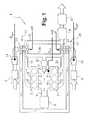
- the power train 1 represented on the FIG. 1 comprises a first 2 and a second bench 3 of cylinders of a six-cylinder engine arranged in V.
- the power train also has two turbochargers 10, 20 for supercharging the engine. It has a common intake manifold 4 supplying intake air the cylinders of each bench 2, 3.
- First and second intake circuits of air successively comprise an air intake 5, a air filter 6, a compressor 11, 21 of one of the turbochargers.
- the outputs of the compressors are together to feed a common heat exchanger 5, then the intake manifold 4.
- Each intake system comprises a flowmeter 14, 24, for example placed between the air filter 6 and the compressor 11, 21, to deliver respectively a first Qair1 and a second Qair2 air flow measurement.
- the flow meters are for example wire sensors hot.
- a pressure sensor 7 is placed in the intake manifold 4 to deliver a measurement of boost pressure Pcol.
- Each cylinder bank 2, 3 is connected to a turbine 12, 22 of one of the turbochargers 10, 20 by an exhaust manifold 15, 25 to evacuate the exhaust gases from the cylinders.
- the exits turbines are connected to an exhaust line common comprising for example a particulate filter 8 and a silencer 9.
- the turbines 12, 22 are type with variable geometry, so as to be able to set their operating point through a signal actuating turbochargers.
- a recycling circuit 30 is connected to each exhaust manifold 15, 25 and at intake manifold 4 via a recycling valve 31 to allow the recycling of exhaust gas on order.
- This powertrain 1 is controlled by a implemented by a computer, no represent. It implements in particular a method turbines, by delivering two signals actuated, these signals being corrected for balance the operation of turbochargers 10, 20.
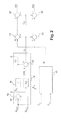
- the calculator determines a boost pressure setpoint CP and delivers it to a pressure regulator 40.
- the pressure set point of overeating is compared to the measurement of the Boost pressure Pcol to determine a Actuation signal At turbochargers.
- the pressure regulator 40 delivers a pressure difference Ep between the setpoint of pressure Cp and pressure measurement Pcol.
- the calculator also includes balancing means 42 which receive the measurements of airflow Qair1, Qair2, and deliver a signal of Cr regulation.
- the regulation signal Cr is received by an adder 54 which also receives the signal
- the output of the adder 54 is received by an adder 58 which also receives a stored correction value Cm to deliver a first corrected actuation signal At1.
- the sum of the regulation signal Cr and the value of memorized correction Cm form a signal of correction.
- the regulation signal Cr is received by a negative input of a subtractor 52 which also receives on a positive input the signal
- the output of the subtractor 52 is received on a positive input by a subtracter 56 which also receives on a negative input 1a stored correction value Cm, to deliver a second corrected actuation signal At2.
- the first At1 and the second actuation signal corrected At2 command respectively the first 12 and the second turbine 22.
- the balancing means comprise a subtractor 44 receiving, on a positive input, the first measurement of air flow and, on an inlet negative, the second Qair2 airflow measurement.
- the difference in air flow Eq from subtractor 44 is sent on the one hand to an integrator 46, which delivers an integral term CI, and to a module 48 calculating a product-derived CPD term.
- the term CI and the product-derived CPD are received by an adder 50 which delivers the signal of Cr regulation.
- Integrator 46, Module 48 and the adder 50 form a PID-type regulator (product-integral-derived) that generate a signal of Cr regulation to decrease the difference between Qair1 and Qair2.
- the regulation signal Cr and the value of memorized correction are added to the signal the actuators At by the adders 54 and 58 to generating the first corrected actuation signal At1.
- the regulation signal Cr and the value of memorized correction are subtracted from the signal of actuation At by the subtractors 52 and 56 for generate the second corrected actuation signal T2.
- FIG. 3 explains how the value of memorized correction Cm is elaborated.
- a module assessment 60 learning conditions receives in input the speed of rotation of the motor N, called also the engine speed, the fuel flow Qc, the pressure difference Ep and the flow difference of air Eq.
- the evaluation module receives also an Ap signal indicating the activation of the determination of the pressure setpoint of supercharging and an Ar signal indicating activation of the signal determination of correction.
- the evaluation module 60 delivers a learning signal Sa indicating that the learning conditions are met.
- the learning signal Sa is received by a storage module 70 containing a table 72, also called cartography.
- the module memorization 70 also receives the integral term CI input, the engine speed N and the flow rate of fuel Qc, and delivers the correction value memorized Cm.
- the memorized correction value Cm is read in table 72 according to engine speed N and fuel flow Qc, in a way classic.
- the storage module has a adder 76 receiving the correction value memorized Cm and the integral term CI. The sum of these two terms is delivered to a controlled flip-flop 78 by the learning signal Sa.
- the flip-flop 78 delivers the sum to the table 72.
- the evaluation module 60 calculates the value absolute of the derivative with respect to time, that it then compares to a predetermined threshold, respectively SdN, SdQc, SdEp, SdEq to establish a stability criterion.
- the stability criterion is not true only if the absolute value of the derivative is below the predetermined threshold SdN, SdQc, SdEp, SdEq.
- Stability criteria are inputs of a first logic gate 62 which gives an output true only if all his entries are true, that is, if all the stability criteria are together.
- the evaluation module 60 also includes a second logic gate that receives the input Ap and Ar signals, and delivers a signal of conditions state, true only if Ap and Ar signals indicate that determinations of the instruction of pressure and correction signal are active.
- the signals from the first gate 62 and the second door 64 are entries of a third gate 66 which outputs a signal of conditions of learning, true only if the two input signals are true.
- the output signal of the third gate is the input of a timing module 68.
- the module of timer 68 delivers a learning signal Sa during a learning period Da.
- the storage module 70 When the storage module 70 receives the learning signal Sa, it determines depending of the fuel flow Qc and the engine speed N a cell 74 of the table to be updated. The sum of the stored value and the integral term CI, delivered by the flip-flop 78, is then stored in the At the same time, the integral term CI is canceled in integrator 46.
- mapping 72 can be perfected by the use of input variables additional such as air temperature input, atmospheric pressure, temperature engine cooling water or the rate of exhaust gas recirculation.
- Another mapping improvement is to provide a correction value stored by interpolation between values stored in cells adjacent.
- Another improvement is also limit learning to cases where the point of functioning, represented by the values of retained variables, is close to a point of central operation corresponding to the cell.
- the invention can be applied to cases where turbochargers are not variable geometry, but where the exhaust system has valves dump (also called waste-gate) controllable, or any other means of controlling the effectiveness of turbochargers.
- valves dump also called waste-gate
Landscapes
- Engineering & Computer Science (AREA)
- Chemical & Material Sciences (AREA)
- Combustion & Propulsion (AREA)
- Mechanical Engineering (AREA)
- General Engineering & Computer Science (AREA)
- Supercharger (AREA)
- Output Control And Ontrol Of Special Type Engine (AREA)
Abstract
- on détermine une consigne de pression de suralimentation (Cp),
- on détermine un écart de débit d'air (Eq) traversant chaque turbocompresseur (10, 20),
- on détermine un signal d'actionnement des turbocompresseurs (At) pour obtenir la consigne de pression (Cp) de suralimentation dans le collecteur,
- on commande chaque turbocompresseur (10, 20) avec un signal d'actionnement corrigé (At1, At2) par un signal de correction (Cr, Cm) pour diminuer l'écart de débit d'air entre les turbocompresseurs, le signal de correction comprenant une valeur de correction mémorisée (Cm) et fonction du point de fonctionnement du moteur.
Description
- on détermine une consigne de pression de suralimentation,
- on détermine un écart de débit d'air traversant chaque turbocompresseur,
- on détermine un signal d'actionnement des turbocompresseurs pour obtenir la pression de suralimentation dans le collecteur,
- on commande chaque turbocompresseur avec le signal d'actionnement corrigé par des signaux de correction pour diminuer l'écart de débit d'air entre les turbocompresseurs,
- des moyens de commande pour déterminer une consigne de pression de suralimentation,
- des moyens de mesure d'un écart de débit d'air traversant chaque turbocompresseur,
- des moyens de commande pour délivrer un signal d'actionnement des turbocompresseurs et obtenir la pression de suralimentation dans le collecteur,
- des moyens d'équilibrage pour déterminer un signal de correction permettant de d'établir un signal d'actionnement corrigé pour chaque turbocompresseur, et obtenir un débit d'air équilibré entre les turbocompresseurs.
- la figure 1 est une vue schématique d'un groupe motopropulseur conforme à l'invention ;
- la figure 2 est un diagramme de la commande des turbocompresseurs du groupe motopropulseur ;
- la figure 3 est un diagramme de l'apprentissage de la valeur de correction.
Claims (11)
- Procédé de commande d'un moteur suralimenté en air par deux turbocompresseurs (10, 20) alimentant deux bancs de cylindres (2, 3) par un collecteur commun (4), dans lequel :caractérisé en ce que le signal de correction comprend une valeur de correction mémorisée (Cm) et fonction du point de fonctionnement du moteur.on détermine une consigne de pression de suralimentation (Cp),on détermine un écart de débit d'air (Eq) traversant chaque turbocompresseur (10, 20),on détermine un signal d'actionnement des turbocompresseurs (At) pour obtenir la consigne de pression (Cp) de suralimentation dans le collecteur,on commande chaque turbocompresseur (10, 20) avec un signal d'actionnement corrigé (At1, At2) par un signal de correction pour diminuer l'écart de débit d'air entre les turbocompresseurs,
- Procédé de commande selon la revendication 1, dans lequel la valeur de correction mémorisée (Cm) est apprise lors du fonctionnement du moteur.
- Procédé de commande selon la revendication 2, dans lequel la valeur de correction mémorisée (Cm) est issue du signal de correction (Cr) et mémorisée lorsque des conditions d'apprentissage sont réunies.
- Procédé de commande selon la revendication 3, dans lequel les conditions d'apprentissage comportent des critères de stabilité sur au moins l'une des variables suivantes : la vitesse de rotation du moteur (N), le débit de carburant (Qc), l'écart de pression de suralimentation (Ep), l'écart de débit d'air (Eq).
- Procédé de commande selon la revendication 3, dans lequel les conditions d'apprentissage comportent des conditions d'état, parmi lesquelles l'activation de la détermination de la consigne de pression de suralimentation (Ap) et du signal de correction (Ar).
- Procédé de commande selon les revendications 4 et 5 prises en combinaison, dans lequel les critères de stabilité et les conditions d'état doivent être satisfaits pendant au moins une durée prédéterminée (Dw) pour que les conditions d'apprentissage soient réunies.
- Procédé de commande selon la revendication 2, dans lequel le signal de correction est déterminé par la somme de la valeur de correction mémorisée (Cm) et d'un signal de régulation (Cr) issu d'une régulation de type proportionnel-intégrale-dérivée (PID), la valeur apprise étant un terme intégral (CI) de la régulation.
- Procédé de commande selon la revendication 2, dans lequel la valeur de correction mémorisée (Cm) est stockée dans une cartographie (72) ayant en entrée des variables (N, Qc) représentant le point de fonctionnement du moteur.
- Procédé de commande selon les revendications 7 et 8 prises en combinaison, dans lequel, avant de mémoriser une nouvelle valeur dans la cartographie (72), on vérifie que le point de fonctionnement du moteur a changé et qu'ainsi, on n'utilise plus la valeur à remplacer.
- Procédé de commande selon les revendications 7 et 8 prises en combinaison, dans lequel, au moment de mémoriser une nouvelle valeur dans la cartographie, on annule le terme intégral (CI) dans la régulation.
- Système de commande d'un moteur suralimenté en air par deux turbocompresseurs (10, 20) alimentant deux bancs de cylindres (2, 3) par un collecteur commun (4), le système comportant :caractérisé en ce qu'il comporte en outre des moyens de mémorisation (72) pour fournir, en fonction du point de fonctionnement du moteur (N, Qc), une valeur de correction mémorisée (Cm) pour composer le signal de correction.des moyens de commande pour déterminer une consigne de pression de suralimentation (Cp),des moyens de mesure (14, 24) d'un écart de débit d'air (Eq) traversant chaque turbocompresseur (10, 20),des moyens de commande (40) pour délivrer un signal d'actionnement (At) des turbocompresseurs et obtenir la consigne de pression de suralimentation dans le collecteur (4),des moyens d'équilibrage (42) pour déterminer un signal de correction permettant de d'établir un signal d'actionnement corrigé (At1, At2) pour chaque turbocompresseur (10, 20), et diminuer l'écart de débit d'air (Eq) entre les turbocompresseurs (10, 20),
Applications Claiming Priority (2)
| Application Number | Priority Date | Filing Date | Title |
|---|---|---|---|
| FR0400279A FR2864993B1 (fr) | 2004-01-14 | 2004-01-14 | Systeme et procede de commande d'un moteur thermique suralimente par deux turbocompresseurs |
| FR0400279 | 2004-01-14 |
Publications (2)
| Publication Number | Publication Date |
|---|---|
| EP1555404A1 true EP1555404A1 (fr) | 2005-07-20 |
| EP1555404B1 EP1555404B1 (fr) | 2007-06-20 |
Family
ID=34610764
Family Applications (1)
| Application Number | Title | Priority Date | Filing Date |
|---|---|---|---|
| EP05300020A Expired - Lifetime EP1555404B1 (fr) | 2004-01-14 | 2005-01-11 | Système et procédé de commande d'un moteur thermique suralimenté par deux turbocompresseurs |
Country Status (4)
| Country | Link |
|---|---|
| EP (1) | EP1555404B1 (fr) |
| AT (1) | ATE365269T1 (fr) |
| DE (1) | DE602005001405T2 (fr) |
| FR (1) | FR2864993B1 (fr) |
Citations (3)
| Publication number | Priority date | Publication date | Assignee | Title |
|---|---|---|---|---|
| DE19810174C1 (de) * | 1998-03-10 | 1999-04-15 | Bosch Gmbh Robert | Vorrichtung zum Regeln des Ladedrucks einer Brennkraftmaschine mit zwei Abgasturboladern |
| US6575148B1 (en) * | 2002-02-22 | 2003-06-10 | Cummins, Inc. | Humidity compensation system for an internal combustion engine |
| FR2837526A1 (fr) * | 2002-03-21 | 2003-09-26 | Renault | Systeme et procede de commande d'un moteur suralimente en air par deux turbocompresseurs |
-
2004
- 2004-01-14 FR FR0400279A patent/FR2864993B1/fr not_active Expired - Fee Related
-
2005
- 2005-01-11 DE DE602005001405T patent/DE602005001405T2/de not_active Expired - Lifetime
- 2005-01-11 EP EP05300020A patent/EP1555404B1/fr not_active Expired - Lifetime
- 2005-01-11 AT AT05300020T patent/ATE365269T1/de not_active IP Right Cessation
Patent Citations (3)
| Publication number | Priority date | Publication date | Assignee | Title |
|---|---|---|---|---|
| DE19810174C1 (de) * | 1998-03-10 | 1999-04-15 | Bosch Gmbh Robert | Vorrichtung zum Regeln des Ladedrucks einer Brennkraftmaschine mit zwei Abgasturboladern |
| US6575148B1 (en) * | 2002-02-22 | 2003-06-10 | Cummins, Inc. | Humidity compensation system for an internal combustion engine |
| FR2837526A1 (fr) * | 2002-03-21 | 2003-09-26 | Renault | Systeme et procede de commande d'un moteur suralimente en air par deux turbocompresseurs |
Also Published As
| Publication number | Publication date |
|---|---|
| DE602005001405D1 (de) | 2007-08-02 |
| EP1555404B1 (fr) | 2007-06-20 |
| FR2864993A1 (fr) | 2005-07-15 |
| ATE365269T1 (de) | 2007-07-15 |
| DE602005001405T2 (de) | 2008-02-21 |
| FR2864993B1 (fr) | 2006-04-28 |
Similar Documents
| Publication | Publication Date | Title |
|---|---|---|
| EP1989426B1 (fr) | Procede et dispositif de controle de la suralimentation en air d'un moteur a combustion interne | |
| EP2156036B1 (fr) | Systeme de regulation de la pression de suralimentation pour moteur a combustion interne a deux turbocompresseurs etages | |
| EP2279340B1 (fr) | Procede de commande d'un moteur | |
| FR2915239A1 (fr) | Procede d'estimation et systeme de controle du taux d'egr sur un moteur equipe de deux collecteurs d'admission, d'un volet de swirl en amont du collecteur sans egr et d'un volet d'admission en amont du collecteur avec egr. | |
| FR2915237A1 (fr) | Systeme et procede de commande d'un turbocompresseur de suralimentation pour moteur a combustion interne | |
| EP2834508B1 (fr) | Système de commande des ailettes d'une turbine à géométrie variable à apprentissage et linéarisation | |
| FR2963059A3 (fr) | Procede d'estimation de la pression des gaz brules debouchant dans une turbine d'un moteur a combustion interne | |
| EP1555404B1 (fr) | Système et procédé de commande d'un moteur thermique suralimenté par deux turbocompresseurs | |
| WO2014041296A1 (fr) | Procede de regulation d'une suralimentation pour turbocompresseur couple a une machine electrique, et dispositif turbocompresseur correspondant | |
| FR2955613A1 (fr) | Procede de regulation de la pression de suralimentation d'un moteur thermique | |
| EP2655838B1 (fr) | Systeme et procede de commande d'un moteur a combustion interne pour vehicule automobile en fonctionnement transitoire | |
| FR2932224A1 (fr) | Systeme de regulation de la pression de suralimentation pour moteur a combustion interne a deux turbocompresseurs etages | |
| FR3014145A1 (fr) | Procede de determination de la pression de gaz en amont d'une turbine de suralimentation d'un moteur a combustion interne et systeme d'asservissement mettant en oeuvre un tel procede | |
| EP1828578B1 (fr) | Procede de commande pour moteur suralimente | |
| EP4093956B1 (fr) | Estimateur et procédé d'estimation d'une température d'un flux de fluide traversant un moteur à combustion interne | |
| FR2931892A1 (fr) | Procede d'estimation du debit de recirculation des gaz d'echappement sur un moteur bi-plenum avec volet de turbulence | |
| FR2874968A1 (fr) | Procede de commande d'une pression de suralimentation dans un moteur de vehicule | |
| WO2007045781A1 (fr) | Système et procédé de commande d'un turbocompresseur de suralimentation pour moteur à combustion interne | |
| FR2910059A1 (fr) | Procede d'estimation de la pression des gaz d'echappement en amont d'une turbine de turbocompresseur | |
| FR2903147A1 (fr) | Procede de regulation de la pression de suralimentation dans un moteur de vehicule | |
| FR2917125A1 (fr) | Systeme et procede de commande d'un moteur a combustion suralimente par deux etages de turbocompresseurs dont l'un est a geometrie variable | |
| WO2006092527A1 (fr) | Procede de regulation optimise en phase transitoire dans un turbocompresseur | |
| FR3140908A1 (fr) | Procédé d’estimation de la pression de suralimention naturelle dans un moteur thermique essence équipé d’un turbocompresseur de type à géometrie variable | |
| EP1479896A1 (fr) | Procédé d'estimation de la pression des gaz dans un collecteur d'admission de moteur à combustion interne | |
| EP2264298A1 (fr) | Procédé d'estimation de la pression en aval d'un volet d'admission d'un système d'admission d'un moteur à combustion interne suralimenté |
Legal Events
| Date | Code | Title | Description |
|---|---|---|---|
| PUAI | Public reference made under article 153(3) epc to a published international application that has entered the european phase |
Free format text: ORIGINAL CODE: 0009012 |
|
| AK | Designated contracting states |
Kind code of ref document: A1 Designated state(s): AT BE BG CH CY CZ DE DK EE ES FI FR GB GR HU IE IS IT LI LT LU MC NL PL PT RO SE SI SK TR |
|
| AX | Request for extension of the european patent |
Extension state: AL BA HR LV MK YU |
|
| 17P | Request for examination filed |
Effective date: 20060120 |
|
| AKX | Designation fees paid |
Designated state(s): AT BE BG CH CY CZ DE DK EE ES FI FR GB GR HU IE IS IT LI LT LU MC NL PL PT RO SE SI SK TR |
|
| GRAP | Despatch of communication of intention to grant a patent |
Free format text: ORIGINAL CODE: EPIDOSNIGR1 |
|
| GRAS | Grant fee paid |
Free format text: ORIGINAL CODE: EPIDOSNIGR3 |
|
| GRAA | (expected) grant |
Free format text: ORIGINAL CODE: 0009210 |
|
| AK | Designated contracting states |
Kind code of ref document: B1 Designated state(s): AT BE BG CH CY CZ DE DK EE ES FI FR GB GR HU IE IS IT LI LT LU MC NL PL PT RO SE SI SK TR |
|
| REG | Reference to a national code |
Ref country code: GB Ref legal event code: FG4D Free format text: NOT ENGLISH |
|
| REG | Reference to a national code |
Ref country code: CH Ref legal event code: EP |
|
| REG | Reference to a national code |
Ref country code: IE Ref legal event code: FG4D Free format text: LANGUAGE OF EP DOCUMENT: FRENCH |
|
| REF | Corresponds to: |
Ref document number: 602005001405 Country of ref document: DE Date of ref document: 20070802 Kind code of ref document: P |
|
| PG25 | Lapsed in a contracting state [announced via postgrant information from national office to epo] |
Ref country code: SE Free format text: LAPSE BECAUSE OF FAILURE TO SUBMIT A TRANSLATION OF THE DESCRIPTION OR TO PAY THE FEE WITHIN THE PRESCRIBED TIME-LIMIT Effective date: 20070920 |
|
| GBT | Gb: translation of ep patent filed (gb section 77(6)(a)/1977) |
Effective date: 20070905 |
|
| PG25 | Lapsed in a contracting state [announced via postgrant information from national office to epo] |
Ref country code: PL Free format text: LAPSE BECAUSE OF FAILURE TO SUBMIT A TRANSLATION OF THE DESCRIPTION OR TO PAY THE FEE WITHIN THE PRESCRIBED TIME-LIMIT Effective date: 20070620 Ref country code: AT Free format text: LAPSE BECAUSE OF FAILURE TO SUBMIT A TRANSLATION OF THE DESCRIPTION OR TO PAY THE FEE WITHIN THE PRESCRIBED TIME-LIMIT Effective date: 20070620 |
|
| NLV1 | Nl: lapsed or annulled due to failure to fulfill the requirements of art. 29p and 29m of the patents act | ||
| REG | Reference to a national code |
Ref country code: IE Ref legal event code: FD4D |
|
| PG25 | Lapsed in a contracting state [announced via postgrant information from national office to epo] |
Ref country code: ES Free format text: LAPSE BECAUSE OF FAILURE TO SUBMIT A TRANSLATION OF THE DESCRIPTION OR TO PAY THE FEE WITHIN THE PRESCRIBED TIME-LIMIT Effective date: 20071001 Ref country code: CZ Free format text: LAPSE BECAUSE OF FAILURE TO SUBMIT A TRANSLATION OF THE DESCRIPTION OR TO PAY THE FEE WITHIN THE PRESCRIBED TIME-LIMIT Effective date: 20070620 Ref country code: NL Free format text: LAPSE BECAUSE OF FAILURE TO SUBMIT A TRANSLATION OF THE DESCRIPTION OR TO PAY THE FEE WITHIN THE PRESCRIBED TIME-LIMIT Effective date: 20070620 Ref country code: IS Free format text: LAPSE BECAUSE OF FAILURE TO SUBMIT A TRANSLATION OF THE DESCRIPTION OR TO PAY THE FEE WITHIN THE PRESCRIBED TIME-LIMIT Effective date: 20071020 Ref country code: BG Free format text: LAPSE BECAUSE OF FAILURE TO SUBMIT A TRANSLATION OF THE DESCRIPTION OR TO PAY THE FEE WITHIN THE PRESCRIBED TIME-LIMIT Effective date: 20070920 Ref country code: IE Free format text: LAPSE BECAUSE OF FAILURE TO SUBMIT A TRANSLATION OF THE DESCRIPTION OR TO PAY THE FEE WITHIN THE PRESCRIBED TIME-LIMIT Effective date: 20070620 Ref country code: PT Free format text: LAPSE BECAUSE OF FAILURE TO SUBMIT A TRANSLATION OF THE DESCRIPTION OR TO PAY THE FEE WITHIN THE PRESCRIBED TIME-LIMIT Effective date: 20071120 Ref country code: SI Free format text: LAPSE BECAUSE OF FAILURE TO SUBMIT A TRANSLATION OF THE DESCRIPTION OR TO PAY THE FEE WITHIN THE PRESCRIBED TIME-LIMIT Effective date: 20070620 |
|
| PG25 | Lapsed in a contracting state [announced via postgrant information from national office to epo] |
Ref country code: LT Free format text: LAPSE BECAUSE OF FAILURE TO SUBMIT A TRANSLATION OF THE DESCRIPTION OR TO PAY THE FEE WITHIN THE PRESCRIBED TIME-LIMIT Effective date: 20070620 Ref country code: SK Free format text: LAPSE BECAUSE OF FAILURE TO SUBMIT A TRANSLATION OF THE DESCRIPTION OR TO PAY THE FEE WITHIN THE PRESCRIBED TIME-LIMIT Effective date: 20070620 |
|
| PLBE | No opposition filed within time limit |
Free format text: ORIGINAL CODE: 0009261 |
|
| STAA | Information on the status of an ep patent application or granted ep patent |
Free format text: STATUS: NO OPPOSITION FILED WITHIN TIME LIMIT |
|
| PG25 | Lapsed in a contracting state [announced via postgrant information from national office to epo] |
Ref country code: GR Free format text: LAPSE BECAUSE OF FAILURE TO SUBMIT A TRANSLATION OF THE DESCRIPTION OR TO PAY THE FEE WITHIN THE PRESCRIBED TIME-LIMIT Effective date: 20070921 Ref country code: DK Free format text: LAPSE BECAUSE OF FAILURE TO SUBMIT A TRANSLATION OF THE DESCRIPTION OR TO PAY THE FEE WITHIN THE PRESCRIBED TIME-LIMIT Effective date: 20070620 |
|
| 26N | No opposition filed |
Effective date: 20080325 |
|
| PG25 | Lapsed in a contracting state [announced via postgrant information from national office to epo] |
Ref country code: RO Free format text: LAPSE BECAUSE OF FAILURE TO SUBMIT A TRANSLATION OF THE DESCRIPTION OR TO PAY THE FEE WITHIN THE PRESCRIBED TIME-LIMIT Effective date: 20070620 |
|
| BERE | Be: lapsed |
Owner name: RENAULT S.A.S. Effective date: 20080131 |
|
| PG25 | Lapsed in a contracting state [announced via postgrant information from national office to epo] |
Ref country code: MC Free format text: LAPSE BECAUSE OF NON-PAYMENT OF DUE FEES Effective date: 20080131 |
|
| REG | Reference to a national code |
Ref country code: FR Ref legal event code: ST Effective date: 20081029 |
|
| PG25 | Lapsed in a contracting state [announced via postgrant information from national office to epo] |
Ref country code: EE Free format text: LAPSE BECAUSE OF FAILURE TO SUBMIT A TRANSLATION OF THE DESCRIPTION OR TO PAY THE FEE WITHIN THE PRESCRIBED TIME-LIMIT Effective date: 20070620 |
|
| PG25 | Lapsed in a contracting state [announced via postgrant information from national office to epo] |
Ref country code: FI Free format text: LAPSE BECAUSE OF FAILURE TO SUBMIT A TRANSLATION OF THE DESCRIPTION OR TO PAY THE FEE WITHIN THE PRESCRIBED TIME-LIMIT Effective date: 20070620 Ref country code: BE Free format text: LAPSE BECAUSE OF NON-PAYMENT OF DUE FEES Effective date: 20080131 |
|
| PG25 | Lapsed in a contracting state [announced via postgrant information from national office to epo] |
Ref country code: FR Free format text: LAPSE BECAUSE OF NON-PAYMENT OF DUE FEES Effective date: 20080131 |
|
| PG25 | Lapsed in a contracting state [announced via postgrant information from national office to epo] |
Ref country code: CY Free format text: LAPSE BECAUSE OF FAILURE TO SUBMIT A TRANSLATION OF THE DESCRIPTION OR TO PAY THE FEE WITHIN THE PRESCRIBED TIME-LIMIT Effective date: 20070620 |
|
| REG | Reference to a national code |
Ref country code: CH Ref legal event code: PL |
|
| PG25 | Lapsed in a contracting state [announced via postgrant information from national office to epo] |
Ref country code: LI Free format text: LAPSE BECAUSE OF NON-PAYMENT OF DUE FEES Effective date: 20090131 Ref country code: CH Free format text: LAPSE BECAUSE OF NON-PAYMENT OF DUE FEES Effective date: 20090131 |
|
| PG25 | Lapsed in a contracting state [announced via postgrant information from national office to epo] |
Ref country code: LU Free format text: LAPSE BECAUSE OF NON-PAYMENT OF DUE FEES Effective date: 20080111 Ref country code: HU Free format text: LAPSE BECAUSE OF FAILURE TO SUBMIT A TRANSLATION OF THE DESCRIPTION OR TO PAY THE FEE WITHIN THE PRESCRIBED TIME-LIMIT Effective date: 20071221 |
|
| PG25 | Lapsed in a contracting state [announced via postgrant information from national office to epo] |
Ref country code: TR Free format text: LAPSE BECAUSE OF FAILURE TO SUBMIT A TRANSLATION OF THE DESCRIPTION OR TO PAY THE FEE WITHIN THE PRESCRIBED TIME-LIMIT Effective date: 20070620 |
|
| PGFP | Annual fee paid to national office [announced via postgrant information from national office to epo] |
Ref country code: DE Payment date: 20170120 Year of fee payment: 13 |
|
| PGFP | Annual fee paid to national office [announced via postgrant information from national office to epo] |
Ref country code: GB Payment date: 20170119 Year of fee payment: 13 |
|
| PGFP | Annual fee paid to national office [announced via postgrant information from national office to epo] |
Ref country code: IT Payment date: 20170124 Year of fee payment: 13 |
|
| REG | Reference to a national code |
Ref country code: DE Ref legal event code: R119 Ref document number: 602005001405 Country of ref document: DE |
|
| GBPC | Gb: european patent ceased through non-payment of renewal fee |
Effective date: 20180111 |
|
| PG25 | Lapsed in a contracting state [announced via postgrant information from national office to epo] |
Ref country code: DE Free format text: LAPSE BECAUSE OF NON-PAYMENT OF DUE FEES Effective date: 20180801 |
|
| PG25 | Lapsed in a contracting state [announced via postgrant information from national office to epo] |
Ref country code: GB Free format text: LAPSE BECAUSE OF NON-PAYMENT OF DUE FEES Effective date: 20180111 |
|
| PG25 | Lapsed in a contracting state [announced via postgrant information from national office to epo] |
Ref country code: IT Free format text: LAPSE BECAUSE OF NON-PAYMENT OF DUE FEES Effective date: 20180111 |