EP1554929A1 - Artificial nipple for experimental animals - Google Patents
Artificial nipple for experimental animals Download PDFInfo
- Publication number
- EP1554929A1 EP1554929A1 EP03751323A EP03751323A EP1554929A1 EP 1554929 A1 EP1554929 A1 EP 1554929A1 EP 03751323 A EP03751323 A EP 03751323A EP 03751323 A EP03751323 A EP 03751323A EP 1554929 A1 EP1554929 A1 EP 1554929A1
- Authority
- EP
- European Patent Office
- Prior art keywords
- nipple
- liquid
- feeding bottle
- experimental animal
- feeding
- Prior art date
- Legal status (The legal status is an assumption and is not a legal conclusion. Google has not performed a legal analysis and makes no representation as to the accuracy of the status listed.)
- Granted
Links
Images

Classifications
-
- A—HUMAN NECESSITIES
- A61—MEDICAL OR VETERINARY SCIENCE; HYGIENE
- A61D—VETERINARY INSTRUMENTS, IMPLEMENTS, TOOLS, OR METHODS
- A61D7/00—Devices or methods for introducing solid, liquid, or gaseous remedies or other materials into or onto the bodies of animals
-
- A—HUMAN NECESSITIES
- A01—AGRICULTURE; FORESTRY; ANIMAL HUSBANDRY; HUNTING; TRAPPING; FISHING
- A01K—ANIMAL HUSBANDRY; AVICULTURE; APICULTURE; PISCICULTURE; FISHING; REARING OR BREEDING ANIMALS, NOT OTHERWISE PROVIDED FOR; NEW BREEDS OF ANIMALS
- A01K9/00—Sucking apparatus for young stock ; Devices for mixing solid food with liquids
- A01K9/005—Teats or nipples
Definitions
- the present invention relates to an artificial nipple favorably used for giving a liquid feed or a test solution such as a drug solution to experimental animals voluntarily and orally, a feeding bottle designed to be favorably used in combination with the nipple, a liquid feeding device for experimental animals comprising the artificial nipple and the feeding bottle, and a method for using the same.
- mouse or rat infants correspond to human immature babies whose eyes and ears have not been opened, and have high sensitivity to drugs and the like because of their immature organs. Therefore, data of high accuracy is expected to be obtained from these animals.
- the feature of the automated artificial feeding device lies in a structure of the artificial nipple.
- the artificial nipple has a double structure so as to prevent milk from leaking when an infant is not drinking the milk.
- An outer part of the nipple is formed with a cross cutting at its tip end, and an inner part of the nipple is formed with slits at four positions on its lateral side.
- an injection needle having a gauge of 24 to 26G excluding a needle point is inserted into the nipple. The inventors attempted to prevent milk from leaking and to control the flow by combination of these structural features.
- this automated artificial feeding device is also designed for an experimental animal to voluntarily stick to the artificial nipple and orally take a liquid feed or the like.
- this device still has the following problems.
- the complicated structure of the previous artificial nipple was devised for preventing a liquid feed or the like from leaking from the nipple as described above.
- the inventors of the present application attempted to develop a liquid feeding device for experimental animals and a method of using the same, capable of feeding a liquid feed or a test solution regularly and quantitatively to experimental animals in a similar manner to breast feeding, by creating an artificial nipple capable of feeding a liquid feed or a test solution voluntarily and orally in a well-controlled manner even for the cases of very small experimental animals whose eyes and ears are still close, such as mouse infants, and a feeding bottle suited for use in combination with the artificial nipple.
- the technical problems to be solved by the artificial nipple, the liquid feeding device, and the liquid feeding method are summarized in the points A to D below.
- the present invention targets various sizes of experimental animals from very small individuals such as mouse infants to individuals as large as ferrets, rabbits, and the like. For this reason, it is necessary to control the outflow degree of the liquid feed or the like accurately in accordance with the size and the condition of the experimental animal. If an excess amount of the liquid feed or the like goes out, it will enter a lung to cause a pneumonia, whereas if the outflow degree is not sufficient, the animal will rapidly stop drinking. When it is necessary to change the ingredients of the liquid feed or the like depending on the purpose of the study, the viscosity or the like of the feed or the like may be changed. In such a case, it is necessary to follow the change in fluidity of the feed or the like.
- mice and rats When rodents such as mice and rats that are most commonly used as experimental animals are used as objects of the experiment, since mice and rats cannot produce a belch as a human being does because of its anatomical positional relationship of stomach, if a mouse or rat takes air at the time of suction-drinking the liquid feed or the like, the air accumulates in the stomach and intestines, to lead the death in most cases. Furthermore, since cutting teeth of rodents will grow permanently, when cutting teeth extend to some extent (about 10 days old), a space is easily created between the nipple and lips due to the extended cutting teeth as an obstacle, resulting that the animal easily suck air at the time of feeding or administration of a test solution. Therefore, an artificial nipple overcoming this problem is demanded.
- the structure of the artificial nipple should be simple but provide excellent performance in order to facilitate application to a very small nipple and reduce the variation in feature between individual nipples as small as possible from the view point of data comparison.
- an artificial nipple has a duct which is replaceably inserted therein, and by replacing the duct with a duct of different bore diameter depending on the required flow rate. This makes the flow rate of the liquid feed or the like controllable.
- a tube with calibrations is attached to the feeding bottle, thereby enabling fine adjustment of the flow rate by the height (drop difference) of the liquid feed or the like charged therein.
- the nipple may not be filled with an elastic member and the interior may be hollow.
- the inventors prepared a mechanism that controls the liquid discharge rate by controlling the internal pressure of the closed system interior of the feeding bottle used in combination with the artificial nipple.
- a liquid volume adjusting tube having a capacity smaller by 20-30% than an expected amount of liquid which an infant will drink at one time was attached to the feeding bottle.
- This liquid volume adjusting tube is designed to be crushed with almost no resistance in response to the suction-drinking action of the infant, and will not influence on the suction-drinking action of the infant. When the liquid volume adjusting tube is crushed, feeding of the liquid will be stopped.
- the liquid volume adjusting tube can be swollen by applying a pressure with hands, fingers, or the like on a pressurizing tube provided outside the feeding bottle.
- the infant is allowed to drink a liquid of the volume corresponding to the swollen volume.
- the liquid feed or the like is directly given from the artificial nipple into the mouth of the experimental animal from the feeding bottle via the duct in the condition that the flow rate is controlled.
- the flow rate of the liquid feed or the like is first controlled by an inner diameter of the duct. Addition of the structure which prevents accumulation of liquid in the nipple suppresses undesired leaking of the liquid accompanying the suction-drinking action of the experimental animal. Then, by adding the mechanism that makes the internal pressure of the feeding bottle which is a closed system negative in response to the suction-drinking, the feeding amount of the liquid is controlled more finely and the liquid is prevented from leaking more securely.
- a check valve attached in the feeding bottle when a check valve is attached in the feeding bottle, such a mechanism is not required in the artificial nipple so that the structure of the artificial nipple is simplified, and production, replacement, cleaning, or the like can be executed more easily.
- a check valve attached to the artificial nipple will not cause any problem in implementation of the present invention.
- the embodiment in which the check valve is provided in the feeding bottle is more preferably from the view point of production aspect and production cost of the artificial nipple regarding the problem of D.
- the nipple is made larger in accordance with the growth of the infant so that the cutting teeth will not be obstacles, thereby making it easy to produce a negative pressure with the tongue and the hard palate (lips) as if a human sucks liquid with a straw, and preventing the air from entering.
- rodents for example, ferret
- the shape of the nipple should be changed in accordance with the shape of the mouth of that animal.
- the tube has a movable mark.
- This movable mark can be used for comprehension of an intake amount by shifting the mark in accordance with the liquid level line when the liquid feed is continuously fed to a plurality of infants, or for indication of the maximum liquid level line when the liquid is injected into the feeding bottle.
- the tube itself is made replaceable. In addition to these structures, a spacer for replacement of tube is prepared separately.
- the structure that prevents liquid from accumulating in the nipple except in the nipple tip and the duct realized by filling the nipple with an elastic member or integrally forming the nipple with an elastic member is not only effective in simplification of the structure of the artificial nipple but also effective in preventing liquid from leaking when an experimental animal bites the nipple.
- the inventors of the present application made it possible to establish and provide an artificial nipple favorably used in giving a liquid feed or the like to infants of experimental animals, in particular, mice and rats, voluntarily and orally, and a feeding bottle designed to use the artificial nipple in a favorable manner, a liquid feeding method for experimental animals comprising the artificial nipple and the feeding bottle, and a method thereof.
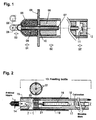
- Fig. 1 shows an artificial nipple of the present invention.
- the numeral 01 is an essential part of the artificial nipple including a silicone rubber outer wall, and a nipple and a nipple tip integrally formed with silicone sponge or its elastic member, and the numerals 02 and 02' represent a junction with a feeding bottle.
- a notch indicated by 06 or a hole indicated by 06' is provided so as to feed a liquid in response to the sucking action of the animal.
- the strength of the sucking action by the animal gives a similar effect to changing the bore diameter, so that it is more suitably used in the artificial nipple of the present invention.
- the inner diameter of the duct indicated by 07 to be attached may appropriately be changed in consideration of the objective experimental animal, its age, viscosity of the liquid feed and the like.
- the inner diameter may be, for example, 25G to 27G in gauge of injection needle, and this can control the degree of outflow of the liquid feed or the like.
- the length of the duct is for example 10 mm to 14 mm, although it differs depending on the size of the nipple.
- the duct can be formed of any material that can keep the inner diameter, and such material may be appropriately selected from the hard tubular members used in solution sending purpose.
- a stainless tube commonly used as an injection needle is preferably used.
- the present invention can be appropriately applied to a variety of liquid feed or the like including those having low viscosity such as water, various aqueous solutions, and transfusion compositions, as well as those having high viscosity such as milk for experimental animals and enteral nutrients.
- the outer wall When a silicone outer wall is used in the nipple 05, the outer wall is about 0.1 to 0.4 mm thick.
- the inside of the outer wall is filled with an elastic member such as silicone sponge except in the nipple tip as is denoted by 04.
- an elastic member such as silicone sponge except in the nipple tip as is denoted by 04.
- the outer wall and the filler are preferably made of materials that are resistive to heat sterilization.
- materials that are resistive to heat sterilization.
- isoprene, silicone, styrene-butadiene copolymer and the like rubbers, and sponges derived therefrom can be chosen.
- silicone foam is preferably used as a filler because its elasticity can be appropriately adjusted in a simple manner.
- latex rubber is also excellent as a material for the nipple from the view point of ease of sucking by experimental animals.
- check valve In order to prevent the liquid feed or the like from counterflowing, it is necessary to place a check valve.
- a check valve When the check valve is attached to the artificial nipple, it is placed together with a base 12 of, e.g., silicone rubber in the junction with the feeding bottle as indicated by 11 in Fig. 1.
- the check valve may be formed of materials having similar elasticity or moderate hardness compared to the elastic member used in the nipple, including elastomers such as silicone and polypropylene or hybrids thereof.
- the numeral 08 denotes a supporting part of the duct formed of silicone rubber or the like, and is adapted to the diameter of the duct 07.
- the numeral 09 denotes a flange-shaped base part of the nipple which fixes the artificial nipple when joined to the feeding bottle.
- the numeral 10 denotes an allowance provided so as to follow the variable diameter of the duct 07.
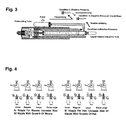
- nipples designed for each of mouse and rat shown in Fig. 4 are formed into four different sizes, i.e., small, regular, large, and extra large, respectively and they can be appropriately selected depending on the age and size of the experimental animal.
- an artificial nipple which is suited to the size of mouth of the experimental animal to the feeding bottle in any time, it is possible to prevent air from being sucked during the feeding.
- the values indicated in Fig. 4 are given just for reference, and are not limitative.
- the present invention is applicable to a variety of experimental animals including relatively large experimental animals such as rabbit and experimental animals having a different mouth shape from that of the rodent such as ferret, as well as mouse, guinea pig, and rat.
- the feeding bottle of the present invention has a check value 14 in Fig. 2.
- the structure of the artificial nipple is simplified, and production of the artificial nipple is facilitated.
- nipples of different sizes can be readily prepared, and the feeding condition can be changed so as to be suited for various purposes only by changing the artificial nipple that is suited for the condition, which is more suitable for the object of the present invention. Also an advantage is provided that recycling by cleaning of the artificial nipple is facilitated.
- the constitution providing a check value in the artificial nipple as indicated by 11 in Fig. 1 does not cause any problem in implementation of the present invention.
- the article of the present invention has the following excellent feature by having a replaceable tubular structure in the feeding bottle as indicted by 16 in Fig. 2.
- the same feeding bottle can be used both for rat and mouse by changing the tube via a spacer 21.
- spacers of different diameter tubes of different diameters can be joined to only one feeding bottle having an outer wall 19.
- the amount of the liquid feed that is actually given or administered to the experimental animal can be readily measured for individual animals.
- a movable mark formed of silicone rubber or various resins may be attached. By moving the movable mark in accordance with the feeding amount for each infant, it is possible to measure the intake amount of the liquid feed more accurately.
- This movable mark can be formed into a ring, for example, and a required number of movable marks can be fit around the tube.
- any materials having such transparency that allows checking of the content and having such hardness that allows measurement can be used for the tube, and for example, glass, polypropylene, polycarbonate, methylpentene resin, or silicone rubber that is commonly used for a tube for injection can be used.
- the spacer 21 is not necessary.
- the "d” is set from the view point of check of the liquid level and in accordance with the intake amount of the feed of the animal. For example, in the case of a mouse, a tube having "d" of about 3 mm may be used.
- An artificial nipple joint base 15 and a duct supporter 20 shown in Fig. 2 are formed of rubber or the like and have detachable structures. Therefore, not only cleaning and repair of the feeding bottle, but also changing of size and material of each part depending on the experimental animal can be readily conducted.
- the numeral 18 denotes a tube used for air vent and cleaning of feeding bottle, and the numeral 17 indicates a tube through which a liquid feed or the like is introduced. These tubes can be formed of similar materials as described above for the tube.
- the numeral 22 denotes a tube for junction which facilitates detachment of the tube or the like, and is implemented by a stainless tube or the like.
- each part of the feeding bottle shown by 13 in Fig. 2 can be appropriately changed depending on the use method and purpose.
- the length L in Fig. 2 is about 100 mm in the case of a mouse infant, however, it may be selected longer when the ability of drinking milk of the animal is higher.
- the feeding bottle of the present invention has a fine adjustment mechanism of flow rate as shown in Fig. 3.
- the fine adjustment mechanism of flow rate is implemented by attaching to the feeding bottle of Fig. 2, a liquid volume adjusting tube having a capacity smaller by 20-30% than an expected amount of liquid which an infant will drink at one time and a pressurizing tube and making the interior of the feeding bottle a closed system.
- the internal pressure was adjusted with these two tubes, whereby supply of liquid in accordance with the suction-drinking amount by the infant, prevention of leak of the liquid and urging to start suction-drinking are simultaneously realized.
- the pressurizing tube is pressed with hands or fingers to make the liquid volume adjusting tube into a condition C, thereby allowing suction-drinking again.
- the liquid volume adjusting tube turns to the condition B again to stop feeding of the liquid.
- the liquid volume adjusting tube has such a thickness that the tube will be crushed with no resistance for avoiding influence on suction-drinking of the infant.
- the thickness is approximately 0.05 mm, for example, and this thickness is the minimum for maintaining the shape.
- the pressurizing tube and the connecting tube may have such thicknesses that the tubes will not be crushed at a negative pressure generated when an infant drinks milk or the like.
- the thickness is about 0.5 mm, for example.
- the materials for the pressurizing and connecting tubes may be any materials insofar as they can realize the aforementioned functions and are resistant to heat sterilization, and isoprene rubber, polypropylene rubber and the like can be exemplified. However, it is to be noted that the required thickness differs depending on the material.
- These tubes can be joined via a stainless tube or the like which is heat-sterilizable in consideration of replacement or the like of the tubes. Likewise the case of the tube with calibrations, by using a spacer, it is possible to readily replace tubes of different diameters.
- a liquid feeding device for experimental animals having the excellent features as described above, enabling voluntary and oral feeding of a liquid feed or the like to an experimental animal such as mouse or rat in a suckling period which corresponds to an immature baby of human being, and enabling regular and quantitative feeding of a liquid with being held by a hand is not known up to now, and is first realized by the present invention.
- the artificial nipple, the feeding bottle suited for use in combination with the artificial nipple, a liquid feeding device for experimental animals comprising the artificial nipple and the feeding bottle, and a liquid feeding method for experimental animals in which the artificial nipple in the device is changed in accordance with the condition of the experimental animal have many excellent features.
- the artificial nipple, the feeding bottle suited for use with the artificial nipple, the liquid feeding device for experimental animals comprising the artificial nipple and the feeding bottle, and the liquid feeding method for experimental animals in which the artificial nipple in the above device is replaced in accordance with the condition of the experimental animal voluntary intake of liquid feed or the like by experimental animals is enabled, and artificial suckling of mouse infant or the like corresponding to a human immature baby whose eyes and ears are not open is enabled.
- Such artificial suckling was almost impossible up to now.
- the present invention made it possible to administer a variety of test solutions to mouse or rat infants voluntarily and orally, it is possible to evaluate the effect of orally administered various test solutions in a natural manner for animals in suckling period which have not been realized regardless of their high sensitivity to drugs and usability as experimental systems. This made it possible to develop new drugs and foods for immature babies and for infants that have not been developed yet.
Landscapes
- Life Sciences & Earth Sciences (AREA)
- Veterinary Medicine (AREA)
- Health & Medical Sciences (AREA)
- Environmental Sciences (AREA)
- Zoology (AREA)
- Engineering & Computer Science (AREA)
- Animal Husbandry (AREA)
- Wood Science & Technology (AREA)
- Biodiversity & Conservation Biology (AREA)
- Animal Behavior & Ethology (AREA)
- General Health & Medical Sciences (AREA)
- Public Health (AREA)
- Feeding And Watering For Cattle Raising And Animal Husbandry (AREA)
- Medical Preparation Storing Or Oral Administration Devices (AREA)
- Infusion, Injection, And Reservoir Apparatuses (AREA)
Abstract
Description
Test method: With respect to home-bred and naturally born BALB/C mice at one day old, artificial suckling using a nipple of small size for mouse and a feeding bottle of the present invention was started. A nursing cage for artificial suckling was kept warm on a commercially available hot carpet. In the warm cage laid with chips a bamboo bag was placed, and a mouse infant was accommodated therein. Chips outside the bamboo bag were occasionally poured with water so that moisture was always kept. Before starting the artificial suckling, mice were separated from their parent for 3 to 4 hours. Artificial milk was prepared by dissolving 3.8 g of dog milk in 10 mL of warm water. After introducing the milk into the feeding bottle equipped with the artificial nipple by means of a pump, heat was applied for about 3 to 5 minutes while the feeding bottle was inserted into a copper tube that is warmed under reflux by warm water. Heat application was conducted every time or optionally as necessary before suckling each infant. Milk was fed five or six times, or four or five times at 10 days old or later in the term between 8:00 a.m. and 10:00 p.m. The intake amount of the milk was determined by measuring a reduced amount of milk in the tube (length of tube: cm) in the feeding bottle between before and after suckling, and measuring body weight of infant before and after the suckling. In artificially suckled infants, sucking was not allowed from 10:00 p.m. to 8:00 a.m. next morning. The artificially suckled infants were kept in group, and were not returned to breast feeding. Micturition and bowel movement were urged by gently press the upper abdomen and back of the bladder several times per day as was necessary. Infants of breast-feeding group were fed together with the mother animal in usual conditions in a normal cage.
Results of experiments: The results are shown in Fig. 5
Although the artificially suckled infants were inferior in growth rate to the breast-fed infants, they continuously took the artificial milk voluntarily at the time of feeding and all of them grew without any dropout.
Test method: 3 BALB/C mice at 12 days of pregnancy purchased from JAPAN SLC were allowed to naturally bear in a stainless cage with a clean cap. In 24 hours after bearing, infants were divided into two groups for each parent, and combined so that each group equally contains infants from respective parents. Two parents each were made to feed a total of 8 infants. The test solution used in this experiment was as follows. 0.5% fructooligosaccharide-0.2 M-sucrose aqueous solution was uses as a test solution. The test solution was introduced into the feeding bottle for mouse of the present invention using a disposable injector with a sterilized tapered tip, and kept warm for 4 minutes in an incubator at 50°C. The mouse infants were separated from the parent at 1 day and 2 days, and kept warm for 2 hours in a plastic cage floating in a water bath at 43°C. When a mouse infant drank 0.7 mm by calibrations on the feeding bottle for mouse (about 50 µL) of test solution from an artificial nipple of small size for mouse of the present invention, the nipple was immediately removed from the mouth. Then the same amount of 0.2M-sucrose aqueous solution was made to drink. This allowed accurate determination of the drinking amount of the test solution. The control group was made to drink 0.2M-sucrose aqueous solution in the same manner. After administration of the test solution, the mouse infants were immediately returned to the cage of its mother (feeding mother).
Results of experiment: Growth curves of infants are shown in Fig. 6. The mouse infants orally administered with the test solution using the article of the present invention normally grew.
It was confirmed that in experimental systems for examining influences of orally administered drugs or the like, the article of the present invention can be effectively used even for the experimental animals such as mouse or rat infants for which use of a gastric probe and a catheter is difficult.
Claims (10)
- An artificial nipple for an experimental animal comprising:a replaceable duct in a nipple; anda structure that prevents a liquid from accumulating in the nipple except in a nipple tip and the duct.
- The artificial nipple for an experimental animal according to claim 1, wherein the structure that prevents the liquid from accumulating is achieved by filling the nipple with an elastic member or forming the nipple with an elastic member integrally with an outer wall of the nipple.
- The artificial nipple for an experimental animal according to claim 1 or 2, wherein a check valve is provided in a joint part with a feeding bottle.
- A feeding bottle for an experimental animal used in combination with the artificial nipple of any one of claims 1 to 3, the feeding bottle comprising therein a replaceable tube.
- The feeding bottle for an experimental animal according to claim 4, wherein the tube is marked with calibrations for measurement and/or a movable mark.
- The feeding bottle for an experimental animal according to claim 4 or 5, comprising a check valve.
- The feeding bottle for an experimental animal according to any one of claims 4 to 6, comprising a mechanism by which a liquid stops flowing when an experimental animal drinks a predetermined amount or a certain amount of the liquid and thereby the internal pressure of the feeding bottle becomes negative.
- The feeding bottle for an experimental animal according to claim 7, comprising a mechanism by which the experimental animal is allowed to voluntarily drink the liquid again upon application of a pressure from outside the feeding bottle after the liquid stops flowing when the experimental animal drinks the predetermined amount or the certain amount of the liquid and thereby the internal pressure of the feeding bottle becomes negative.
- A liquid feeding device for an experimental animal, wherein any one artificial nipple selected from the artificial nipples according to claims 1 to 3 is attached to any one feeding bottle selected from the feeding bottles according to claims 5 to 8.
- A liquid feeding method for an experimental animal, wherein size and/or shape of the artificial nipple is changed depending on the size and type of the experimental animal in the liquid feeding device for an experimental animal according to claim 9.
Applications Claiming Priority (3)
| Application Number | Priority Date | Filing Date | Title |
|---|---|---|---|
| JP2002293275 | 2002-10-07 | ||
| JP2002293275 | 2002-10-07 | ||
| PCT/JP2003/012709 WO2004030447A1 (en) | 2002-10-07 | 2003-10-03 | Artificial nipple for experimental animals |
Publications (3)
| Publication Number | Publication Date |
|---|---|
| EP1554929A1 true EP1554929A1 (en) | 2005-07-20 |
| EP1554929A4 EP1554929A4 (en) | 2007-08-22 |
| EP1554929B1 EP1554929B1 (en) | 2011-07-13 |
Family
ID=32064004
Family Applications (1)
| Application Number | Title | Priority Date | Filing Date |
|---|---|---|---|
| EP03751323A Expired - Lifetime EP1554929B1 (en) | 2002-10-07 | 2003-10-03 | Artificial nipple for experimental animals |
Country Status (5)
| Country | Link |
|---|---|
| US (1) | US7654226B2 (en) |
| EP (1) | EP1554929B1 (en) |
| AU (1) | AU2003271086A1 (en) |
| CA (1) | CA2508797C (en) |
| WO (1) | WO2004030447A1 (en) |
Cited By (2)
| Publication number | Priority date | Publication date | Assignee | Title |
|---|---|---|---|---|
| EP1779833A4 (en) * | 2004-07-29 | 2012-07-25 | Pigeon Corp | ARTIFICIAL TETINE, FEEDING DEVICE AND PROCESS FOR PRODUCING ARTIFICIAL TETINE |
| US9510562B2 (en) | 2013-07-10 | 2016-12-06 | Chris's Squirrels and More, LLC | Feeding nipple |
Families Citing this family (3)
| Publication number | Priority date | Publication date | Assignee | Title |
|---|---|---|---|---|
| NZ556142A (en) * | 2007-06-25 | 2009-11-27 | Novartis Ag | Animal remedy dispensing means |
| US8357117B2 (en) * | 2008-08-06 | 2013-01-22 | Family Health International | Device and method for delivering an agent into breast milk while breastfeeding |
| TR201905066T4 (en) * | 2015-09-14 | 2019-05-21 | Koninklijke Philips Nv | Feeding system for a baby and method of using such a system. |
Family Cites Families (23)
| Publication number | Priority date | Publication date | Assignee | Title |
|---|---|---|---|---|
| US1127797A (en) * | 1912-11-18 | 1915-02-09 | John Moore | Calf-feeder. |
| DE419228C (en) * | 1924-08-10 | 1925-10-02 | Margarethe Hort Geb Reiche | Milk feeding bottle |
| US1569693A (en) * | 1924-11-07 | 1926-01-12 | Llewellyn C Young | Nursing nipple |
| GB347368A (en) * | 1930-02-24 | 1931-04-30 | Leslie Reader | Improvements in or relating to teats for feeding bottles and the like |
| US2307220A (en) * | 1941-11-29 | 1943-01-05 | Willis B Hewitt | Drinking valve |
| US3529575A (en) * | 1968-03-22 | 1970-09-22 | Upjohn Co | Animal drinking bottle |
| DE1915212A1 (en) * | 1968-04-01 | 1970-08-20 | Mirella Fioretto | Nipple drinker for poultry, rabbits or the like. |
| GB1301865A (en) * | 1970-09-17 | 1973-01-04 | ||
| US3698685A (en) * | 1971-03-08 | 1972-10-17 | Waters Mfg Co Inc | Animal actuated drinking valve |
| JPS56104668A (en) | 1980-01-23 | 1981-08-20 | Sato Hiroshi | Nursing bottle |
| US4393813A (en) * | 1981-06-29 | 1983-07-19 | Teho Sou | Watering device for pet animals |
| JPS6324948A (en) | 1986-07-18 | 1988-02-02 | 株式会社アドバンス | Nipple for nursing bottle |
| US5010847A (en) * | 1989-11-21 | 1991-04-30 | Braden Industries | Calf feeder bottle for dry feed |
| JPH06225660A (en) * | 1993-02-01 | 1994-08-16 | Azuma Corp:Kk | Water-feeder for bird breeding |
| NZ247058A (en) * | 1993-03-03 | 1996-06-25 | Mcintyre Robert Dymock Substit | Animal feeding teat including at least one slit, which slit(s) do not extend to the nipple extremity |
| US5784999A (en) * | 1994-01-25 | 1998-07-28 | Merrick's, Inc. | Animal feeding nipple |
| JP3004319U (en) | 1994-05-17 | 1994-11-15 | 鋒輝 楊 | Straws for baby bottles and cups that are easy to absorb |
| US5427058A (en) * | 1994-07-06 | 1995-06-27 | Chung; Hwei-An | Watering valve for use in water feeders for small animals |
| JP2710027B2 (en) | 1995-08-25 | 1998-02-10 | 洋一 武内 | Livestock baby bottles |
| US6003468A (en) * | 1998-07-10 | 1999-12-21 | Edstrom Industries, Inc. | Animal watering valve with deflectable elastomeric boot |
| US6126679A (en) * | 1999-04-12 | 2000-10-03 | Botts; Lynne Marie | Nipple for use with liquid and medicine dispensing bottle |
| JP4233074B2 (en) | 2000-04-24 | 2009-03-04 | ピジョン株式会社 | Artificial nipple |
| US20030079692A1 (en) * | 2001-10-25 | 2003-05-01 | Val Products, Inc. | Liquid feeding nipple having two-stage trigger pin |
-
2003
- 2003-10-03 WO PCT/JP2003/012709 patent/WO2004030447A1/en not_active Ceased
- 2003-10-03 US US10/530,481 patent/US7654226B2/en not_active Expired - Lifetime
- 2003-10-03 CA CA2508797A patent/CA2508797C/en not_active Expired - Lifetime
- 2003-10-03 EP EP03751323A patent/EP1554929B1/en not_active Expired - Lifetime
- 2003-10-03 AU AU2003271086A patent/AU2003271086A1/en not_active Abandoned
Cited By (2)
| Publication number | Priority date | Publication date | Assignee | Title |
|---|---|---|---|---|
| EP1779833A4 (en) * | 2004-07-29 | 2012-07-25 | Pigeon Corp | ARTIFICIAL TETINE, FEEDING DEVICE AND PROCESS FOR PRODUCING ARTIFICIAL TETINE |
| US9510562B2 (en) | 2013-07-10 | 2016-12-06 | Chris's Squirrels and More, LLC | Feeding nipple |
Also Published As
| Publication number | Publication date |
|---|---|
| AU2003271086A1 (en) | 2004-04-23 |
| CA2508797A1 (en) | 2004-04-15 |
| EP1554929B1 (en) | 2011-07-13 |
| CA2508797C (en) | 2011-09-20 |
| US20060042550A1 (en) | 2006-03-02 |
| EP1554929A4 (en) | 2007-08-22 |
| WO2004030447A1 (en) | 2004-04-15 |
| US7654226B2 (en) | 2010-02-02 |
Similar Documents
| Publication | Publication Date | Title |
|---|---|---|
| Morton et al. | Refining procedures for the administration of substances | |
| Ørskov et al. | The effects of feeding procedure on closure of the oesophageal groove in young sheep | |
| US4856663A (en) | Nursing device for infant with cleft lip or cleft palate | |
| JP2013502298A (en) | Enteral nutrition safe storage tank and system | |
| US11357707B2 (en) | Method and product for a customized 3D printed nipple for breastfeeding mothers | |
| EP1554929B1 (en) | Artificial nipple for experimental animals | |
| Pepino et al. | Infant rats respond differently to alcohol after nursing from an alcohol-intoxicated dam | |
| JP4540324B2 (en) | Artificial nipple for laboratory animals | |
| US6071264A (en) | Animal feeding/medicating apparatus | |
| CA2548976A1 (en) | Medicine dispensing pacifier | |
| WO2009033202A1 (en) | Liquid medication dispensing device for a child | |
| US12521472B2 (en) | Breast shield with suckling motion one way valve | |
| US11759554B1 (en) | Breast shield with suckling motion one-way valve | |
| CN218009235U (en) | Anti-choking drinking cup | |
| Clifford et al. | Management of esophageal achalasia in miniature schnauzers | |
| Rodgers | Practical aspects of milk collection in the rat | |
| CN217339434U (en) | Self-propelled disposable jejunum tube | |
| US20120179138A1 (en) | Device and method for patient enteral hydration | |
| Phifer et al. | Effects of hydrational state on ingestion in infant rats: is dehydration the only ingestive stimulus? | |
| JP7768503B2 (en) | animal feeding device | |
| WO2011071729A1 (en) | Enteral feeding bottles | |
| CN210812627U (en) | A kind of infant feeding medicine dropper and kit | |
| KR20110132022A (en) | Medicine bottle for (cow) | |
| CN2633285Y (en) | Medicine feeding device for baby | |
| US20260027013A1 (en) | Adaptive pacifier assembly and method for liquid food and medication delivery to children |
Legal Events
| Date | Code | Title | Description |
|---|---|---|---|
| PUAI | Public reference made under article 153(3) epc to a published international application that has entered the european phase |
Free format text: ORIGINAL CODE: 0009012 |
|
| 17P | Request for examination filed |
Effective date: 20050406 |
|
| AK | Designated contracting states |
Kind code of ref document: A1 Designated state(s): AT BE BG CH CY CZ DE DK EE ES FI FR GB GR HU IE IT LI LU MC NL PT RO SE SI SK TR |
|
| AX | Request for extension of the european patent |
Extension state: AL LT LV MK |
|
| DAX | Request for extension of the european patent (deleted) | ||
| RBV | Designated contracting states (corrected) |
Designated state(s): DE FI FR |
|
| A4 | Supplementary search report drawn up and despatched |
Effective date: 20070719 |
|
| 17Q | First examination report despatched |
Effective date: 20091016 |
|
| GRAP | Despatch of communication of intention to grant a patent |
Free format text: ORIGINAL CODE: EPIDOSNIGR1 |
|
| RIN1 | Information on inventor provided before grant (corrected) |
Inventor name: HOSHIBA, JUNJI Inventor name: YAJIMA, MASAKO |
|
| GRAS | Grant fee paid |
Free format text: ORIGINAL CODE: EPIDOSNIGR3 |
|
| GRAA | (expected) grant |
Free format text: ORIGINAL CODE: 0009210 |
|
| AK | Designated contracting states |
Kind code of ref document: B1 Designated state(s): DE FI FR |
|
| REG | Reference to a national code |
Ref country code: DE Ref legal event code: R096 Ref document number: 60337678 Country of ref document: DE Effective date: 20110901 |
|
| PLBE | No opposition filed within time limit |
Free format text: ORIGINAL CODE: 0009261 |
|
| STAA | Information on the status of an ep patent application or granted ep patent |
Free format text: STATUS: NO OPPOSITION FILED WITHIN TIME LIMIT |
|
| 26N | No opposition filed |
Effective date: 20120416 |
|
| REG | Reference to a national code |
Ref country code: DE Ref legal event code: R097 Ref document number: 60337678 Country of ref document: DE Effective date: 20120416 |
|
| REG | Reference to a national code |
Ref country code: DE Ref legal event code: R082 Ref document number: 60337678 Country of ref document: DE Representative=s name: LEITNER, WALDEMAR, DIPL.-ING. DR.TECH., DE |
|
| REG | Reference to a national code |
Ref country code: DE Ref legal event code: R081 Ref document number: 60337678 Country of ref document: DE Owner name: MEIJI CO., LTD., JP Free format text: FORMER OWNER: JUNJI HOSHIBA, MEIJI CO., LTD., , JP Effective date: 20130129 Ref country code: DE Ref legal event code: R082 Ref document number: 60337678 Country of ref document: DE Representative=s name: LEITNER, WALDEMAR, DIPL.-ING. DR.TECH., DE Effective date: 20130129 Ref country code: DE Ref legal event code: R081 Ref document number: 60337678 Country of ref document: DE Owner name: MEIJI CO., LTD., JP Free format text: FORMER OWNER: MEIJI DAIRIES CORP.,JUNJI HOSHIBA, , JP Effective date: 20110714 Ref country code: DE Ref legal event code: R081 Ref document number: 60337678 Country of ref document: DE Owner name: MEIJI CO., LTD., JP Free format text: FORMER OWNERS: HOSHIBA, JUNJI, OKAYAMA, JP; MEIJI CO., LTD., TOKYO, JP Effective date: 20130129 Ref country code: DE Ref legal event code: R081 Ref document number: 60337678 Country of ref document: DE Owner name: MEIJI CO., LTD., JP Free format text: FORMER OWNERS: MEIJI DAIRIES CORP., TOKIO/TOKYO, JP; HOSHIBA, JUNJI, OKAYAMA, JP Effective date: 20110714 |
|
| REG | Reference to a national code |
Ref country code: FR Ref legal event code: PLFP Year of fee payment: 13 |
|
| REG | Reference to a national code |
Ref country code: FR Ref legal event code: PLFP Year of fee payment: 14 |
|
| REG | Reference to a national code |
Ref country code: FR Ref legal event code: PLFP Year of fee payment: 15 |
|
| REG | Reference to a national code |
Ref country code: FR Ref legal event code: PLFP Year of fee payment: 16 |
|
| PGFP | Annual fee paid to national office [announced via postgrant information from national office to epo] |
Ref country code: FR Payment date: 20220908 Year of fee payment: 20 |
|
| PGFP | Annual fee paid to national office [announced via postgrant information from national office to epo] |
Ref country code: FI Payment date: 20221011 Year of fee payment: 20 Ref country code: DE Payment date: 20220831 Year of fee payment: 20 |
|
| REG | Reference to a national code |
Ref country code: DE Ref legal event code: R071 Ref document number: 60337678 Country of ref document: DE |