EP1554279B1 - Process for the preparation of zaleplon - Google Patents
Process for the preparation of zaleplon Download PDFInfo
- Publication number
- EP1554279B1 EP1554279B1 EP03755542A EP03755542A EP1554279B1 EP 1554279 B1 EP1554279 B1 EP 1554279B1 EP 03755542 A EP03755542 A EP 03755542A EP 03755542 A EP03755542 A EP 03755542A EP 1554279 B1 EP1554279 B1 EP 1554279B1
- Authority
- EP
- European Patent Office
- Prior art keywords
- solvent
- water
- mixture
- product
- acid
- Prior art date
- Legal status (The legal status is an assumption and is not a legal conclusion. Google has not performed a legal analysis and makes no representation as to the accuracy of the status listed.)
- Expired - Lifetime
Links
- 0 CCN(C(C)=O)c1cccc(-c2ccnc3c(C*)cn[n]23)c1 Chemical compound CCN(C(C)=O)c1cccc(-c2ccnc3c(C*)cn[n]23)c1 0.000 description 1
Classifications
-
- C—CHEMISTRY; METALLURGY
- C07—ORGANIC CHEMISTRY
- C07D—HETEROCYCLIC COMPOUNDS
- C07D487/00—Heterocyclic compounds containing nitrogen atoms as the only ring hetero atoms in the condensed system, not provided for by groups C07D451/00 - C07D477/00
- C07D487/02—Heterocyclic compounds containing nitrogen atoms as the only ring hetero atoms in the condensed system, not provided for by groups C07D451/00 - C07D477/00 in which the condensed system contains two hetero rings
- C07D487/04—Ortho-condensed systems
Definitions
- the invention concerns a new method of production of N -(3-(3-cyanopyrazolo[1,5- a ]pyrimidin-7-yl)phenyl)- N -ethylacetamide, known under the INN (International Non-Proprietary Name) zaleplon, of formula I
- the aforesaid drug is an important representative of CNS chemotherapeutics, wherein it is used mainly as an anxiolytic, antiepileptic, or sedative/hypnotic drug.
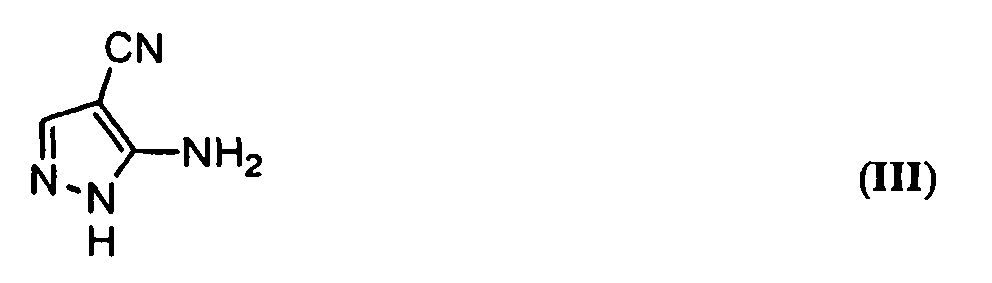
- Zaleplon is produced according to published US patents Nos. 4,626,538 and 5,714,607 via reaction of N -[3-(3-dimethylamino-acryloyl)-phenyl]- N -ethyl-acetamide of formula II with 5-amino-1 H -pyrazol-4-carbonitrile of formula III
- reaction of the compound (II) with (I) is carried out in water and a water miscible solvent free of carboxylic groups under acidic conditions.
- This invention describes a new, improved method of production of N -(3-(3-cyanopyrazolo[1,5- a ]pyrimidin-7-yl)phenyl)- N -ethylacetamide (zaleplon).
- the subject matter of the invention is a new, improved method of production of N -(3-(3-cyanopyrazolo[1,5- a ]pyrimidin-7-yl)phenyl)- N -ethylacetamide (zaleplon).
- the whole procedure is based on the surprising finding that it is advantageous to perform the reaction of N -[3-(3-dimethylamino-acryloyl)-phenyl]- N -ethyl-acetamide (II) with 5-amino-1 H -pyrazol-4-carbonitrile (III) in numerous organic solvents or alternatively in their mixtures with water with a number of organic and inorganic acids being used as catalysts.
- the essence of the invention consists in reacting N -[3-(3-dimethylamino-acryloyl)-phenyl]- N -ethyl-acetamide of formula II with 5-amino-1 H -pyrazol-4-carbonitrile of formula III in a medium comprising a solution of hydrochloric or hydrobromic acid in a C1-C5 alcohol, or in a C4-C6 aliphatic or cyclic ether, or in a C2-C5 alkoxyalcohol, or in a 5- to 6-membered aromatic heterocyclic solvent, containing 1-2 oxygen atoms, or in a mixture thereof with water, with the proviso that no water is added to the mixture of the substances of formulae II and III before the reaction is started by the acid.
- the two starting substances were mixed with a suitable solvent at laboratory temperature.
- the quantity of the used solvent can be selected from a wide range so that after the reaction is complete and cooled down, crystals of the product fall out in high yields.
- the reaction mixture was either a homogenous solution or a suspension.
- a suitable acidic catalyst was added to the mixture created in this way and the mixture was stirred at a temperature from 25 °C to the boiling point of the used solvent. After the reaction was completed, the mixture was cooled down; after crystals fell out, the mixture was left to sit for several hours at 5 up to 10°C and, subsequently, the crude product was sucked off.
- the reaction mixture was mixed with a suitable co-solvent after it cooled down and the product was filtered after cooling down.
- the use of methanol, ethanol, propanol or 2-propanol turned out to be especially advantageous as high yields of highly pure crude product were obtained.
- the crude product provided a product with high HPLC purity, usually higher than 99.5% (read from areas of individual peaks) after a single crystallization from a suitable solvent.
- the reaction is not limited only to the environment of hydroxylated solvents; it can be performed in a number of other solvents, for example tetrahydrofuran, dioxane, dimethoxyethane, etc.; these can be used either alone or in admixtures with the above-mentioned hydroxylated solvents, or in their mixtures with water. Presence of 20 to 80 % of water is preferable.
- aqueous acids solutions of acids in suitable solvents can be used, for example, solutions of hydrogen chloride or hydrogen bromide in various solvents, C1-C5 alcohols being preferable.
Landscapes
- Chemical & Material Sciences (AREA)
- Organic Chemistry (AREA)
- Nitrogen Condensed Heterocyclic Rings (AREA)
- Organic Low-Molecular-Weight Compounds And Preparation Thereof (AREA)
- Low-Molecular Organic Synthesis Reactions Using Catalysts (AREA)
- Pharmaceuticals Containing Other Organic And Inorganic Compounds (AREA)
Abstract
Description
- The invention concerns a new method of production of N-(3-(3-cyanopyrazolo[1,5-a]pyrimidin-7-yl)phenyl)-N-ethylacetamide, known under the INN (International Non-Proprietary Name) zaleplon, of formula I

- The aforesaid drug is an important representative of CNS chemotherapeutics, wherein it is used mainly as an anxiolytic, antiepileptic, or sedative/hypnotic drug.
- Zaleplon is produced according to published
US patents Nos. 4,626,538 and5,714,607 via reaction of N-[3-(3-dimethylamino-acryloyl)-phenyl]-N-ethyl-acetamide of formula II
- The reaction was performed in the original
US patent No. 4,626,538 in anhydrous acetic acid. Later, it was discovered that the reaction is faster and the resulting product is purer if the reaction is carried out in aqueous acetic acid. This procedure is described inUS patent No. 5,714,607 . - Other process of (I) preparation is disclosed in
US 2002/072605 , in which compound (II) is formed from the corresponding acetanilide using sodium hydride and ethyliodide in DMF and the reaction mixture is worked-up by dilution with water. The formed mixture is without isolation of (II) treated with a solution of (III) in aqueous DMF in the presence of hydrochloric acid to form (I). - According to the patent application
WO 02/100828 - This invention describes a new, improved method of production of N-(3-(3-cyanopyrazolo[1,5-a]pyrimidin-7-yl)phenyl)-N-ethylacetamide (zaleplon).
- The subject matter of the invention is a new, improved method of production of N-(3-(3-cyanopyrazolo[1,5-a]pyrimidin-7-yl)phenyl)-N-ethylacetamide (zaleplon). The whole procedure is based on the surprising finding that it is advantageous to perform the reaction of N-[3-(3-dimethylamino-acryloyl)-phenyl]-N-ethyl-acetamide (II) with 5-amino-1H-pyrazol-4-carbonitrile (III) in numerous organic solvents or alternatively in their mixtures with water with a number of organic and inorganic acids being used as catalysts.
- The essence of the invention consists in reacting N-[3-(3-dimethylamino-acryloyl)-phenyl]-N-ethyl-acetamide of formula II


It has been shown that likewise as when aqueous acetic acid or aqueous formic acid are used, the reaction time gets significantly shorter when the above solvents and the above acidic catalysts are used. Moreover, in some cases, better yields and/or higher purity of the crude product were achieved. - In a usual embodiment, the two starting substances were mixed with a suitable solvent at laboratory temperature. The quantity of the used solvent can be selected from a wide range so that after the reaction is complete and cooled down, crystals of the product fall out in high yields. The reaction mixture was either a homogenous solution or a suspension. A suitable acidic catalyst was added to the mixture created in this way and the mixture was stirred at a temperature from 25 °C to the boiling point of the used solvent. After the reaction was completed, the mixture was cooled down; after crystals fell out, the mixture was left to sit for several hours at 5 up to 10°C and, subsequently, the crude product was sucked off. In some cases, the reaction mixture was mixed with a suitable co-solvent after it cooled down and the product was filtered after cooling down.
- A number of solvents turned out to be suitable. The use of methanol, ethanol, propanol or 2-propanol turned out to be especially advantageous as high yields of highly pure crude product were obtained. The crude product provided a product with high HPLC purity, usually higher than 99.5% (read from areas of individual peaks) after a single crystallization from a suitable solvent. However, the reaction is not limited only to the environment of hydroxylated solvents; it can be performed in a number of other solvents, for example tetrahydrofuran, dioxane, dimethoxyethane, etc.; these can be used either alone or in admixtures with the above-mentioned hydroxylated solvents, or in their mixtures with water. Presence of 20 to 80 % of water is preferable.
- In order for the reaction to proceed successfully, presence of acidic catalysts is necessary. Instead of aqueous acids, solutions of acids in suitable solvents can be used, for example, solutions of hydrogen chloride or hydrogen bromide in various solvents, C1-C5 alcohols being preferable.
- The invention is explained in more detail in the following examples. The examples, which illustrate preferred alternatives of production of zaleplon according to the invention, have a purely illustrative character and do not limit the extent of the invention in any respect.
- A mixture of compound II (2.6 g, 10 mmol) and nitrile III (1.1 g, 10.2 mmol) in ethanol (30 ml) was dissolved at lab temperature and then, a saturated solution of hydrogen chloride in ethanol (1 ml) was added. The resulting mixture was boiled for 2 hours using a reflux condenser and, then, cooled down to 5 to 10 °C and the precipitated crystals were sucked off, washed with water and air dried. 2.6 g of crude product (85%), m.p. 184-188 °C were obtained. After crystallization, 2.4 g (79%) of crystals were obtained with m.p. 187-188 °C.
- Following the procedure described in Example 1 wherein the reaction mixture was stirred for 2 days at lab temperature, a similar amount of a product was obtained with m.p. 182-186 °C. After crystallization from methanol, 72% of crystals were obtained with m.p. 185-187 °C.
- A mixture of compound II (2.6 g, 10 mmol) and nitrile III (1.1 g, 10.2 mmol) in methanol (30 ml) is dissolved at lab temperature and, subsequently, concentrated hydrochloric acid was added (1 ml). The resulting mixture was boiled for 5 hours using a reflux condenser and, then, water was added (50 ml) and the mixture was cooled down to 5 to 10 °C. Crystals that fell out were sucked off, washed with water and air dried. 2.8 g of crude product were obtained (92%), m.p. 185-188 °C.
- Following the procedure described in Example 1 wherein propanol was used as the solvent instead of ethanol, 86% of the product was obtained with m.p. 185-188 °C.
- Following the procedure described in Example 1 wherein 2-propanol was used as the solvent instead of ethanol, 91% of the product was obtained with m.p. 184-187 °C.
- Following the procedure described in Example 1 wherein 2-methoxyethanol was used as the solvent instead of ethanol, 76% of the product was obtained with m.p. 184-187 °C.
- Following the procedure described in Example 1 wherein 2-ethoxyethanol was used as the solvent instead of ethanol, 79% of the product was obtained with m.p. 184-187 °C.
- Following the procedure described in Example 1 wherein 70% of aqueous ethanol was used as the solvent instead of ethanol, 87% of the product was obtained with m.p. 185-188 °C.
- Following the procedure described in Example 1 wherein 50% of aqueous ethanol was used as the solvent instead of ethanol, 69% of the product was obtained with m.p. 184-187°C.
- Following the procedure described in Example 1 wherein 30% of aqueous ethanol was used as the solvent instead of ethanol, 72% of the product was obtained with m.p. 184-188 °C.
- A mixture of compound II (0.26 g, 1 mmol) and nitrile III (0.11 g, 1.0 mmol) in tetrahydrofuran (3 ml) was dissolved at lab temperature and, subsequently, concentrated hydrochloric acid was added (1 ml). The resulting mixture was boiled for 2 hours using a reflux condenser and, then, water was added (5 ml) and the mixture was cooled down to 5 to 10 °C. Crystals that fell out were sucked off, washed with water and air dried. 0.25 g of crude product were obtained (82%), m.p. 184-187 °C.
- Following the procedure described in Example 11 wherein dioxane was used as the solvent instead of tetrahydrofuran and hexane was added instead of water after the reaction was completed, 86% of the product was obtained with m.p. 183-187 °C
- Following the procedure described in Example 1 wherein hydrobromic acid was used as the catalyst instead of hydrochloric acid, 81 % of the product was obtained with m.p. 184-188 °C.
- Following the procedure described in Example 1 wherein 10% of sulfuric acid was used as the catalyst instead of hydrochloric acid, 82% of the product was obtained after thorough washing with water and drying with m.p. 184-187 °C.
- Following the procedure described in Example 1 wherein 10% of orthophosphoric acid was used as the catalyst instead of hydrochloric acid and reaction time was increased to 8 hours, 65% of the product was obtained after thorough washing with water and drying with m.p. 182-186 °C.
- Following the procedure described in Example 1 wherein perchloric acid was used as the catalyst instead of hydrochloric acid, 69% of the product was obtained after thorough washing with water and drying with m.p. 184-187 °C.
- A mixture of compound II (0.26 g, 1 mmol) and nitrile III (0.11 g, 1.0 mmol) in ethanol (3 ml) was dissolved at lab temperature and, subsequently, acetic acid was added (1 ml). The resulting mixture was boiled for 3 hours using a reflux condenser and, then, it was cooled down to 5 to 10 °C. Crystals that fell out were sucked off, washed with water and air dried. 0.26 g of crude product were obtained (85%), m.p. 184-187 °C.
- A mixture of compound II (0.26 g, 1 mmol) and nitrile III (0.11 g, 1.0 mmol) in methanol (3 ml) was dissolved at lab temperature and, subsequently, trifluoroacetic acid was added (0.1 ml). The resulting mixture was boiled for 1 hours using a reflux condenser and, then, it was cooled down to 5 to 10 °C. Crystals that fell out were sucked off, washed with water and air dried. 0.24 g of crude product were obtained (79%), m.p. 184-187 °C.
- Following the procedure described in Example 1 wherein methanesulfonic acid was used as the catalyst instead of hydrochloric acid, 83% of the product was obtained after thorough washing with water and drying with m.p. 183-186 °C.
- Following the procedure described in Example 1 wherein benzenesulfonic acid was used as the catalyst instead of hydrochloric acid, 66% of the product was obtained after thorough washing with water and drying with m.p. 183-186 °C.
- Following the procedure described in Example 1 wherein 4-toluenesulfonic acid was used as the catalyst instead of hydrochloric acid, 59% of the product was obtained after thorough washing with water and drying with m.p. 184-187 °C.
Claims (10)
- A method of production of N-(3-(3-cyanopyrazolo[1,5-a]pyrimidin-7-yl)phenyl)-N-ethylacetamide, known under the INN name zaleplon, of formula I


- The method according to claim 1 characterized in that ethanol is used as the solvent.
- The method according to claim 1 characterized in that methanol is used as the solvent.
- The method according to claim 1 characterized in that propanol is used as the solvent.
- The method according to claim 1 characterized in that 2-propanol is used as the solvent.
- The method according to claim 1 characterized in that 2-methoxyethanol is used as the solvent.
- The method according to claim 1 characterized in that 2-ethoxyethanol is used as the solvent.
- The method according to claim 1 characterized in that tetrahydrofuran is used as the solvent.
- The method according to claim 1 characterized in that dioxane is used as the solvent.
- The method according to any of the preceding claims characterized in that water is used as the co-solvent, preferably final mixtures containing 20 to 80% of water being used.
Applications Claiming Priority (3)
| Application Number | Priority Date | Filing Date | Title |
|---|---|---|---|
| CZ20023575 | 2002-10-25 | ||
| CZ20023575A CZ20023575A3 (en) | 2002-10-25 | 2002-10-25 | Process for preparing N-ethyl-N-[3-(3-methyl-pyrazolo[1,5-a]pyrimidin-7-yl)-phenyl]-acetamide (zaleplon) |
| PCT/CZ2003/000057 WO2004037824A1 (en) | 2002-10-25 | 2003-10-21 | Process for the preparation of zaleplon |
Publications (2)
| Publication Number | Publication Date |
|---|---|
| EP1554279A1 EP1554279A1 (en) | 2005-07-20 |
| EP1554279B1 true EP1554279B1 (en) | 2007-11-28 |
Family
ID=29751097
Family Applications (1)
| Application Number | Title | Priority Date | Filing Date |
|---|---|---|---|
| EP03755542A Expired - Lifetime EP1554279B1 (en) | 2002-10-25 | 2003-10-21 | Process for the preparation of zaleplon |
Country Status (12)
| Country | Link |
|---|---|
| US (1) | US20050245742A1 (en) |
| EP (1) | EP1554279B1 (en) |
| JP (1) | JP2006507278A (en) |
| AU (1) | AU2003273390A1 (en) |
| CA (1) | CA2503152A1 (en) |
| CZ (1) | CZ20023575A3 (en) |
| DE (1) | DE60317817D1 (en) |
| EA (1) | EA007505B1 (en) |
| PL (1) | PL374911A1 (en) |
| SK (1) | SK50402005A3 (en) |
| UA (1) | UA81641C2 (en) |
| WO (1) | WO2004037824A1 (en) |
Families Citing this family (2)
| Publication number | Priority date | Publication date | Assignee | Title |
|---|---|---|---|---|
| US20050032818A1 (en) * | 2001-06-12 | 2005-02-10 | Entire Interest | N-[3-(3-cyanopyrazolo[1,5-a]pyrimidin-5-yl)phenyl]-N-ethylacetamide and crystalline forms of zaleplon |
| MXPA04001035A (en) * | 2001-08-01 | 2004-06-22 | Biogal Gyogyszergyar | Purification and crystalline forms of zaleplon. |
Family Cites Families (5)
| Publication number | Priority date | Publication date | Assignee | Title |
|---|---|---|---|---|
| US5356897A (en) * | 1991-09-09 | 1994-10-18 | Fujisawa Pharmaceutical Co., Ltd. | 3-(heteroaryl)-pyrazololi[1,5-a]pyrimidines |
| JP2002501532A (en) * | 1997-05-30 | 2002-01-15 | メルク エンド カンパニー インコーポレーテッド | Novel angiogenesis inhibitors |
| AR029780A1 (en) * | 2000-12-13 | 2003-07-16 | Gador Sa | IMPROVED PROCEDURE FOR OBTAINING N- [3 (3-CIANO-PIRAZOLO [1,5-A] PIRIMIDIN-7-IL) PHENYL] -N-ETIL-ACETAMIDE |
| HRP20040016A2 (en) * | 2001-06-12 | 2004-10-31 | Biogal Gyogyszergyar | Process for the production of n-[3-[3-cyanopyrazolo [1,5-a] pyrimidin-7-yl)phenyl]-n-ethylacetamide (zaleplon) |
| MXPA04001035A (en) * | 2001-08-01 | 2004-06-22 | Biogal Gyogyszergyar | Purification and crystalline forms of zaleplon. |
-
2002
- 2002-10-25 CZ CZ20023575A patent/CZ20023575A3/en not_active IP Right Cessation
-
2003
- 2003-10-21 CA CA002503152A patent/CA2503152A1/en not_active Abandoned
- 2003-10-21 WO PCT/CZ2003/000057 patent/WO2004037824A1/en not_active Ceased
- 2003-10-21 EA EA200500702A patent/EA007505B1/en not_active IP Right Cessation
- 2003-10-21 JP JP2004545691A patent/JP2006507278A/en active Pending
- 2003-10-21 EP EP03755542A patent/EP1554279B1/en not_active Expired - Lifetime
- 2003-10-21 DE DE60317817T patent/DE60317817D1/en not_active Expired - Lifetime
- 2003-10-21 PL PL03374911A patent/PL374911A1/en not_active Application Discontinuation
- 2003-10-21 AU AU2003273390A patent/AU2003273390A1/en not_active Abandoned
- 2003-10-21 SK SK5040-2005A patent/SK50402005A3/en not_active Application Discontinuation
- 2003-10-21 UA UAA200504945A patent/UA81641C2/en unknown
-
2005
- 2005-04-22 US US11/111,818 patent/US20050245742A1/en not_active Abandoned
Also Published As
| Publication number | Publication date |
|---|---|
| CZ293015B6 (en) | 2004-01-14 |
| UA81641C2 (en) | 2008-01-25 |
| SK50402005A3 (en) | 2005-08-04 |
| CA2503152A1 (en) | 2004-05-06 |
| WO2004037824A1 (en) | 2004-05-06 |
| US20050245742A1 (en) | 2005-11-03 |
| AU2003273390A1 (en) | 2004-05-13 |
| EP1554279A1 (en) | 2005-07-20 |
| DE60317817D1 (en) | 2008-01-10 |
| EA200500702A1 (en) | 2005-10-27 |
| EA007505B1 (en) | 2006-10-27 |
| CZ20023575A3 (en) | 2004-01-14 |
| PL374911A1 (en) | 2005-11-14 |
| JP2006507278A (en) | 2006-03-02 |
Similar Documents
| Publication | Publication Date | Title |
|---|---|---|
| CN111423452B (en) | Intermediates of Relugoli and their preparation methods and applications | |
| CN104193676B (en) | Prepare method and the synthetic intermediate thereof of compound | |
| CN102757431B (en) | A kind of novel method of synthesizing sitagliptin | |
| CN112851646A (en) | Preparation method of Tegolrazan | |
| KR102559870B1 (en) | Method for preparing carbamate compound | |
| EP4293026A1 (en) | High-purity thienopyrimidine compound and preparation method therefor | |
| WO2009143684A1 (en) | Processes for preparing pemetrexed disodium and its intermediate,4-(4-carbomethoxyphenyl)butanal | |
| CN116410138A (en) | A kind of synthetic method of pyrazoxazole intermediate | |
| JP7454498B2 (en) | Method for producing salicylamide acetate | |
| CN115785019A (en) | Synthesis method of ethyl-1-oxo-4-azaspiro [5.5] undecane-9-carboxylate | |
| CN107849003A (en) | Prepare the new method of chromanol derivative | |
| CN119735550A (en) | A method for synthesizing fluorine-containing indazole derivatives | |
| CN109232254B (en) | A kind of compound synthesis method and application | |
| WO2004037824A1 (en) | Process for the preparation of zaleplon | |
| CN114591187B (en) | Preparation method of 1,3-bis (tris (hydroxymethyl) methylamino) propane | |
| CN111848423A (en) | Preparation method of tert-butyl 3-oxocyclobutylcarbamate | |
| CN108727323A (en) | A kind of method that N-heterocyclic carbine catalyzes and synthesizes trifluoromethyl substitution homoisoflavone class compound | |
| CN117362243A (en) | A method for synthesizing quinoxalinone derivatives from o-phenylenediamine derivatives and α-carbonyl acid esters by acid catalysis | |
| CN114560862A (en) | Synthesis method of pyrrolo [1,2-A ] quinoxaline-4 (5H) -ketone and derivative thereof | |
| CN107382898B (en) | Energetic material based on ANPZ energetic parent structure and synthetic method thereof | |
| CN119735513B (en) | A method for synthesizing unprotected 1,2-amino esters and oxazoline derivatives | |
| CN119161348B (en) | Ibrutinib and its synthesis method | |
| RU2181719C2 (en) | N-nitrooxazolidines-1,3 and method of their synthesis | |
| CN115572262B (en) | Isoquinoline derivative and preparation method thereof | |
| CN113200902A (en) | Polysubstituted pyrrole derivative and preparation method thereof |
Legal Events
| Date | Code | Title | Description |
|---|---|---|---|
| PUAI | Public reference made under article 153(3) epc to a published international application that has entered the european phase |
Free format text: ORIGINAL CODE: 0009012 |
|
| 17P | Request for examination filed |
Effective date: 20050517 |
|
| AK | Designated contracting states |
Kind code of ref document: A1 Designated state(s): AT BE BG CH CY CZ DE DK EE ES FI FR GB GR HU IE IT LI LU MC NL PT RO SE SI SK TR |
|
| AX | Request for extension of the european patent |
Extension state: AL LT LV MK |
|
| 17Q | First examination report despatched |
Effective date: 20061117 |
|
| 17Q | First examination report despatched |
Effective date: 20061117 |
|
| GRAP | Despatch of communication of intention to grant a patent |
Free format text: ORIGINAL CODE: EPIDOSNIGR1 |
|
| RIC1 | Information provided on ipc code assigned before grant |
Ipc: C07D 487/04 20060101AFI20070606BHEP |
|
| GRAS | Grant fee paid |
Free format text: ORIGINAL CODE: EPIDOSNIGR3 |
|
| GRAA | (expected) grant |
Free format text: ORIGINAL CODE: 0009210 |
|
| AK | Designated contracting states |
Kind code of ref document: B1 Designated state(s): AT BE BG CH CY CZ DE DK EE ES FI FR GB GR HU IE IT LI LU MC NL PT RO SE SI SK TR |
|
| AX | Request for extension of the european patent |
Extension state: AL LT LV MK |
|
| REG | Reference to a national code |
Ref country code: GB Ref legal event code: FG4D |
|
| REG | Reference to a national code |
Ref country code: IE Ref legal event code: FG4D |
|
| REG | Reference to a national code |
Ref country code: CH Ref legal event code: EP |
|
| REF | Corresponds to: |
Ref document number: 60317817 Country of ref document: DE Date of ref document: 20080110 Kind code of ref document: P |
|
| REG | Reference to a national code |
Ref country code: RO Ref legal event code: EPE |
|
| PG25 | Lapsed in a contracting state [announced via postgrant information from national office to epo] |
Ref country code: SE Free format text: LAPSE BECAUSE OF FAILURE TO SUBMIT A TRANSLATION OF THE DESCRIPTION OR TO PAY THE FEE WITHIN THE PRESCRIBED TIME-LIMIT Effective date: 20080228 Ref country code: LI Free format text: LAPSE BECAUSE OF FAILURE TO SUBMIT A TRANSLATION OF THE DESCRIPTION OR TO PAY THE FEE WITHIN THE PRESCRIBED TIME-LIMIT Effective date: 20071128 Ref country code: ES Free format text: LAPSE BECAUSE OF FAILURE TO SUBMIT A TRANSLATION OF THE DESCRIPTION OR TO PAY THE FEE WITHIN THE PRESCRIBED TIME-LIMIT Effective date: 20080311 Ref country code: NL Free format text: LAPSE BECAUSE OF FAILURE TO SUBMIT A TRANSLATION OF THE DESCRIPTION OR TO PAY THE FEE WITHIN THE PRESCRIBED TIME-LIMIT Effective date: 20071128 Ref country code: CH Free format text: LAPSE BECAUSE OF FAILURE TO SUBMIT A TRANSLATION OF THE DESCRIPTION OR TO PAY THE FEE WITHIN THE PRESCRIBED TIME-LIMIT Effective date: 20071128 |
|
| NLV1 | Nl: lapsed or annulled due to failure to fulfill the requirements of art. 29p and 29m of the patents act | ||
| LTIE | Lt: invalidation of european patent or patent extension |
Effective date: 20071128 |
|
| PG25 | Lapsed in a contracting state [announced via postgrant information from national office to epo] |
Ref country code: FI Free format text: LAPSE BECAUSE OF FAILURE TO SUBMIT A TRANSLATION OF THE DESCRIPTION OR TO PAY THE FEE WITHIN THE PRESCRIBED TIME-LIMIT Effective date: 20071128 Ref country code: BG Free format text: LAPSE BECAUSE OF FAILURE TO SUBMIT A TRANSLATION OF THE DESCRIPTION OR TO PAY THE FEE WITHIN THE PRESCRIBED TIME-LIMIT Effective date: 20080228 Ref country code: SI Free format text: LAPSE BECAUSE OF FAILURE TO SUBMIT A TRANSLATION OF THE DESCRIPTION OR TO PAY THE FEE WITHIN THE PRESCRIBED TIME-LIMIT Effective date: 20071128 |
|
| REG | Reference to a national code |
Ref country code: CH Ref legal event code: PL |
|
| PG25 | Lapsed in a contracting state [announced via postgrant information from national office to epo] |
Ref country code: AT Free format text: LAPSE BECAUSE OF FAILURE TO SUBMIT A TRANSLATION OF THE DESCRIPTION OR TO PAY THE FEE WITHIN THE PRESCRIBED TIME-LIMIT Effective date: 20071128 |
|
| PGFP | Annual fee paid to national office [announced via postgrant information from national office to epo] |
Ref country code: RO Payment date: 20080212 Year of fee payment: 6 |
|
| PG25 | Lapsed in a contracting state [announced via postgrant information from national office to epo] |
Ref country code: DK Free format text: LAPSE BECAUSE OF FAILURE TO SUBMIT A TRANSLATION OF THE DESCRIPTION OR TO PAY THE FEE WITHIN THE PRESCRIBED TIME-LIMIT Effective date: 20071128 |
|
| PG25 | Lapsed in a contracting state [announced via postgrant information from national office to epo] |
Ref country code: BE Free format text: LAPSE BECAUSE OF FAILURE TO SUBMIT A TRANSLATION OF THE DESCRIPTION OR TO PAY THE FEE WITHIN THE PRESCRIBED TIME-LIMIT Effective date: 20071128 |
|
| EN | Fr: translation not filed | ||
| PG25 | Lapsed in a contracting state [announced via postgrant information from national office to epo] |
Ref country code: PT Free format text: LAPSE BECAUSE OF FAILURE TO SUBMIT A TRANSLATION OF THE DESCRIPTION OR TO PAY THE FEE WITHIN THE PRESCRIBED TIME-LIMIT Effective date: 20080428 |
|
| PLBE | No opposition filed within time limit |
Free format text: ORIGINAL CODE: 0009261 |
|
| STAA | Information on the status of an ep patent application or granted ep patent |
Free format text: STATUS: NO OPPOSITION FILED WITHIN TIME LIMIT |
|
| PG25 | Lapsed in a contracting state [announced via postgrant information from national office to epo] |
Ref country code: FR Free format text: LAPSE BECAUSE OF FAILURE TO SUBMIT A TRANSLATION OF THE DESCRIPTION OR TO PAY THE FEE WITHIN THE PRESCRIBED TIME-LIMIT Effective date: 20080912 Ref country code: DE Free format text: LAPSE BECAUSE OF FAILURE TO SUBMIT A TRANSLATION OF THE DESCRIPTION OR TO PAY THE FEE WITHIN THE PRESCRIBED TIME-LIMIT Effective date: 20080229 |
|
| 26N | No opposition filed |
Effective date: 20080829 |
|
| PGFP | Annual fee paid to national office [announced via postgrant information from national office to epo] |
Ref country code: CZ Payment date: 20080903 Year of fee payment: 6 Ref country code: SK Payment date: 20080910 Year of fee payment: 6 |
|
| PG25 | Lapsed in a contracting state [announced via postgrant information from national office to epo] |
Ref country code: GR Free format text: LAPSE BECAUSE OF FAILURE TO SUBMIT A TRANSLATION OF THE DESCRIPTION OR TO PAY THE FEE WITHIN THE PRESCRIBED TIME-LIMIT Effective date: 20080229 |
|
| PG25 | Lapsed in a contracting state [announced via postgrant information from national office to epo] |
Ref country code: EE Free format text: LAPSE BECAUSE OF FAILURE TO SUBMIT A TRANSLATION OF THE DESCRIPTION OR TO PAY THE FEE WITHIN THE PRESCRIBED TIME-LIMIT Effective date: 20071128 |
|
| PG25 | Lapsed in a contracting state [announced via postgrant information from national office to epo] |
Ref country code: MC Free format text: LAPSE BECAUSE OF NON-PAYMENT OF DUE FEES Effective date: 20081031 |
|
| GBPC | Gb: european patent ceased through non-payment of renewal fee |
Effective date: 20081021 |
|
| PG25 | Lapsed in a contracting state [announced via postgrant information from national office to epo] |
Ref country code: CY Free format text: LAPSE BECAUSE OF FAILURE TO SUBMIT A TRANSLATION OF THE DESCRIPTION OR TO PAY THE FEE WITHIN THE PRESCRIBED TIME-LIMIT Effective date: 20071128 |
|
| PG25 | Lapsed in a contracting state [announced via postgrant information from national office to epo] |
Ref country code: IE Free format text: LAPSE BECAUSE OF NON-PAYMENT OF DUE FEES Effective date: 20081021 |
|
| PG25 | Lapsed in a contracting state [announced via postgrant information from national office to epo] |
Ref country code: GB Free format text: LAPSE BECAUSE OF NON-PAYMENT OF DUE FEES Effective date: 20081021 |
|
| REG | Reference to a national code |
Ref country code: SK Ref legal event code: MM4A Ref document number: E 2999 Country of ref document: SK Effective date: 20091021 |
|
| PG25 | Lapsed in a contracting state [announced via postgrant information from national office to epo] |
Ref country code: LU Free format text: LAPSE BECAUSE OF NON-PAYMENT OF DUE FEES Effective date: 20081021 Ref country code: HU Free format text: LAPSE BECAUSE OF FAILURE TO SUBMIT A TRANSLATION OF THE DESCRIPTION OR TO PAY THE FEE WITHIN THE PRESCRIBED TIME-LIMIT Effective date: 20080529 |
|
| PG25 | Lapsed in a contracting state [announced via postgrant information from national office to epo] |
Ref country code: CZ Free format text: LAPSE BECAUSE OF NON-PAYMENT OF DUE FEES Effective date: 20091021 Ref country code: SK Free format text: LAPSE BECAUSE OF NON-PAYMENT OF DUE FEES Effective date: 20091021 Ref country code: TR Free format text: LAPSE BECAUSE OF FAILURE TO SUBMIT A TRANSLATION OF THE DESCRIPTION OR TO PAY THE FEE WITHIN THE PRESCRIBED TIME-LIMIT Effective date: 20071128 |
|
| PG25 | Lapsed in a contracting state [announced via postgrant information from national office to epo] |
Ref country code: IT Free format text: LAPSE BECAUSE OF NON-PAYMENT OF DUE FEES Effective date: 20081031 Ref country code: RO Free format text: LAPSE BECAUSE OF NON-PAYMENT OF DUE FEES Effective date: 20091021 |