EP1553723A1 - Method and system for modelling a communications network - Google Patents
Method and system for modelling a communications network Download PDFInfo
- Publication number
- EP1553723A1 EP1553723A1 EP05250014A EP05250014A EP1553723A1 EP 1553723 A1 EP1553723 A1 EP 1553723A1 EP 05250014 A EP05250014 A EP 05250014A EP 05250014 A EP05250014 A EP 05250014A EP 1553723 A1 EP1553723 A1 EP 1553723A1
- Authority
- EP
- European Patent Office
- Prior art keywords
- network
- representation
- objects
- computer
- network model
- Prior art date
- Legal status (The legal status is an assumption and is not a legal conclusion. Google has not performed a legal analysis and makes no representation as to the accuracy of the status listed.)
- Granted
Links
- 238000004891 communication Methods 0.000 title claims abstract description 40
- 238000000034 method Methods 0.000 title claims abstract description 29
- 230000015654 memory Effects 0.000 claims abstract description 17
- 238000012545 processing Methods 0.000 claims description 5
- 230000008569 process Effects 0.000 description 12
- 238000010586 diagram Methods 0.000 description 10
- 238000007726 management method Methods 0.000 description 7
- 238000004883 computer application Methods 0.000 description 3
- 238000004590 computer program Methods 0.000 description 3
- 238000013499 data model Methods 0.000 description 3
- 238000011161 development Methods 0.000 description 2
- 230000000694 effects Effects 0.000 description 2
- 238000012986 modification Methods 0.000 description 2
- 230000004048 modification Effects 0.000 description 2
- 230000009467 reduction Effects 0.000 description 2
- 101150012579 ADSL gene Proteins 0.000 description 1
- 102100020775 Adenylosuccinate lyase Human genes 0.000 description 1
- 108700040193 Adenylosuccinate lyases Proteins 0.000 description 1
- 230000005540 biological transmission Effects 0.000 description 1
- 239000003795 chemical substances by application Substances 0.000 description 1
- 238000013501 data transformation Methods 0.000 description 1
- 238000012217 deletion Methods 0.000 description 1
- 230000037430 deletion Effects 0.000 description 1
- 239000000835 fiber Substances 0.000 description 1
- 230000006870 function Effects 0.000 description 1
- 230000006872 improvement Effects 0.000 description 1
- 238000012423 maintenance Methods 0.000 description 1
- 230000007246 mechanism Effects 0.000 description 1
- 238000012546 transfer Methods 0.000 description 1
- 230000001960 triggered effect Effects 0.000 description 1
- 238000013024 troubleshooting Methods 0.000 description 1
- 230000005641 tunneling Effects 0.000 description 1
Images


Classifications
-
- H—ELECTRICITY
- H04—ELECTRIC COMMUNICATION TECHNIQUE
- H04L—TRANSMISSION OF DIGITAL INFORMATION, e.g. TELEGRAPHIC COMMUNICATION
- H04L41/00—Arrangements for maintenance, administration or management of data switching networks, e.g. of packet switching networks
- H04L41/14—Network analysis or design
- H04L41/145—Network analysis or design involving simulating, designing, planning or modelling of a network
-
- H—ELECTRICITY
- H04—ELECTRIC COMMUNICATION TECHNIQUE
- H04L—TRANSMISSION OF DIGITAL INFORMATION, e.g. TELEGRAPHIC COMMUNICATION
- H04L41/00—Arrangements for maintenance, administration or management of data switching networks, e.g. of packet switching networks
- H04L41/12—Discovery or management of network topologies
-
- H—ELECTRICITY
- H04—ELECTRIC COMMUNICATION TECHNIQUE
- H04L—TRANSMISSION OF DIGITAL INFORMATION, e.g. TELEGRAPHIC COMMUNICATION
- H04L41/00—Arrangements for maintenance, administration or management of data switching networks, e.g. of packet switching networks
- H04L41/22—Arrangements for maintenance, administration or management of data switching networks, e.g. of packet switching networks comprising specially adapted graphical user interfaces [GUI]
Definitions
- the present invention relates generally to computer systems, and more specifically, to modelling a communications network using a computer system.
- Computer networks have become integral to businesses in conducting transactions with both their customers and other businesses.
- a number of different network systems have been developed for specific applications and to meet the specific needs of users.
- Virtual private networks provide secure communications over shared or public networks, such as the Internet.
- the shared network is typically maintained by a service provider such as, for example, an application service provider (ASP), a network service provider (NSP) or an Internet service provider (ISP). Therefore, the users of the virtual private network are not required to commit resources to maintaining and servicing the network. Any number of products, applications, devices, and other objects may be coupled to the virtual private network.
- ASP application service provider
- NSP network service provider
- ISP Internet service provider
- Embodiments provide for a system and method of modelling a communications network.
- a representation of a communications network may be generated using computer-readable code, the computer-readable code representing structured information about the communications network.
- the network representation is parsed, generating a network model including a plurality of network objects and relationships between the plurality of network objects.
- the network model may be stored in memory for further use.
- the communications network modeled may be any type of network such as, for example, a local area network, wide area network, virtual private network, or any other suitable network configuration.
- the communications network may include a middleware bus or any other desired software.
- the communications network representation may include, but is not limited to, one or more of the following elements in any suitable combination: circuit level index, circuit type identification, order of operation indication, delete circuit identification, underlying circuit index, underlying link index, delete object identification, parent circuit identification, and child circuit identification.
- the network representation may be generated at startup or reconfiguration or at any other determined time.
- Network events may be executed using the communications network representation.
- the network event may be selected from the group consisting of provisioning, circuit provisioning, service provisioning, switch provisioning, rollback, and delete. However, any other desired network events or received data may be processed using the present invention.
- a graphical representation of the network model may be generated and displayed on a display monitor. Also, the graphical representation may include a graphical user interface used that is used to modify the network model and otherwise interact with the network model.
- the system may be used to provide end-to-end integrated management capability in the areas functionality, inventory, configuration, accounting, performance and supportability.
- a service provider may integrate all of the products associated with a particular service lifecycle over a common middleware bus.
- the system may also be used by the service provider to automate the service lifecycle and manage VPN service offerings.
- the system may include a network inventory adapter.
- the network inventory adapter may receive and process the network inventory or network representation.
- the network inventory adapter is a customizable software component that allows applications to be interfaced with the communications network. The applications may also be interfaced with the network using a middleware bus.
- the adapter Upon receiving events from the network, the adapter reads and parses the network representation to determine which network objects are to be operated on and the order of operation.
- Network models provide a representation of the various objects that are modeled in the network inventory and also the relationships that exist between these objects. This network model view may depend on the user's particular business or services being provided and also the platform being used, such as DSL, Leased Line, and the like.
- the network inventory adapter allows for customization of the network model to suit the user's particular needs while reducing customization time, reducing the dependency of the adapter on the network model, increasing the standards compliance for the network model representation, and increasing the ease of customization.
- the network inventory provides a mechanism to represent the network model using a standards compliant representation such as, for example, XML.
- a standards compliant representation such as, for example, XML.
- the XML representation also allows the customer to specify the entire data model, define their own tags, and therefore define the model in such a way that the data model can be tailored to their particular use, and define the operations that are specified in the XML document.
- the network inventory adaptor may read and parse the XML file upon startup or reconfiguration and store a representation of the network model in memory.
- the adapter may also refer to the XML document representation while performing operations on the objects in the network inventory, the operations including, but not limited to, provisioning, rollback, and delete.
- the network inventory adapter may refer to the XML representation to decide on what objects need to be deleted and/or rolled-back and also decide on the order of operation on the objects.
- the network inventory adapter may also receive events from the middleware bus to provision a specific scenario in the network inventory.
- the system may provide the following desirable outcomes: reduction in the customization time, reduction in the development/customization cost for the user, and improvement in the performance of the network inventory adapter as the adapter becomes a thin adapter. Furthermore, compliance to the XML standards helps the system become more widely usable.
- the network inventory is a collection of the different objects in the network and their interrelationships. These objects represent the various physical or logical entities that exist in the network. For example, these objects may represent entities including, but not limited to, computers, terminals, servers, storage devices, database, routers, switches, printers, communications lines, circuits, and other telecommunications media and devices.
- the network inventory may also depict the way the various relationships are created among the objects on the network.
- a representation of the network inventory may be created using extensible markup language (XML).
- An XML document representing the network inventory may be generated automatically by a computer application that queries objects on the network or manually by a user of the system.
- a network model may be a logical model or a representation of objects in the network inventory and their interrelationships.
- the network model may be created and/or stored in memory in any suitable format including, but not limited to, text, markup languages, programming languages, database languages, graphical representation, and any other computer-readable format.
- a network model of the network may be generated using the XML representation.
- a physical network 10 may be a public or shared network such as the Internet or other network.
- a middleware bus 12 or messaging bus is established as a virtual private network on the physical network 10.
- the virtual private network is established by way of the virtual private network solution centre application 14 and the virtual private office application 16.
- Virtual private networks are known to those skilled in the art and may be established using any suitable method or products.
- One suitable product is the Virtual Private Network Solutions Center (VPNSC) available from Cisco Systems, Inc.
- VPN Virtual Private Network Solutions Center
- embodiments may operate on any network configuration including, but not limited to, both private and public networks, bus architectures, and hub-and-spoke architectures. Communications over the network may be made using any suitable network communication protocol.
- a plurality of sample applications are coupled to the middleware bus 12, including a process management application 18, a data transformation application 20, a customer relationship management application 22, an Internet usage application 24, a customer manager and billing application 26, an open document architecture application 28, and a problem determination and resolution application 30.
- Exemplary applications are available from Hewlett Packard under the product names Internet Usage Manager (IUM), Order Details Agent (ODA), and Product Details Repository (PDR).
- One or more databases 32 may be provided as memory for applications on the data communications network. Also, the network may have one or more databases to serve as a central storage device for the network that may be accessible by any application on the network.
- the process management application 18 generally retains the control on the entire application or product set.
- An exemplary suitable process manager application is the HP Process Manager (HPPM) available from the Hewlett-Packard Company.
- HPPM HP Process Manager
- the process management application 18, the open document architecture application, the virtual private network solution centre application 14, and the virtual private office application 16 are each coupled to the middleware bus 12 using a network inventory adapter 34.
- the network inventory adapter 34 is a software component that allows the applications to be interfaced with the middleware bus 12.
- the network inventory adapter 34 may be used as the network interface for any application that is suited to the functionally provided by the adapter 34.
- the adapters 34 may provide the capability to convert the data and events from the middleware format to the application format and, conversely, from the application format to the middleware format.
- the adapters 34 may support specific operations and allow for various operations to be triggered by certain events and commands.
- the adapters 34 may also transmit and receive the network inventory over the data communications network.
- FIG. 2 is an object diagram of a network model for a local area network (LAN) dial-in access server in accordance with an embodiment.
- the network model is shown using an exemplary graphical illustration.
- the logical model would represent the various objects for this scenario, such as a remote access server (RAS) 40 and a customer edge router 36, and the way that circuits are created between these objects.
- RAS remote access server
- the customer edge router 36 connects with a PSTN (public switched telephone network) provider 38.
- PSTN public switched telephone network
- the customer edge router 36 may be connected using other suitable transmission mediums and communication protocols including, but not limited to, integrated services digital network (ISDN), fiber distributed data interface (FDDI), T-carrier systems, and E-carrier systems.
- ISDN integrated services digital network
- FDDI fiber distributed data interface
- T-carrier systems and E-carrier systems.
- the PSTN provider provides access to the RAS 40.
- access to the RAS 40 is provided using and E1 carrier lines 42, however other carrier systems may be used. Any number of carrier lines 42 may be used.
- the RAS 40 may validate the received request using a Remote Authentication Dial-In User Service (RADIUS) server 44 or other authentication service. If authentication is successful, the RAS creates an IP tunnel 46 between the customer edge router 36 and the provider edge router 48.
- a GRE tunnelling protocol developed by Cisco Systems, Inc., may be used to create the IP tunnel 46.
- GUI graphical user interface
- FIG. 3 is a circuit view diagram of the network model shown in FIG. 2. Circuit levels are measured relative to the top circuit level. For example, referring to FIG. 3, the GRE tunnelling protocol 50 is at level zero (0), the Internet protocol connection 52 is at level one (1), the point-to-point protocol (PPP) 54 is at level two (2), the ISDN connection 56, the RAS connection 58, and the Internet protocol connection 60 are at level three (3), and the ISDN connection 62 and the E1 carrier 64 are at level four (4).
- PPP point-to-point protocol
- the customer edge router 36 and the PSTN provider 38 may be coupled by a suitable physical link 66
- the PSTN provider 38 and RAS 40 may be coupled using a suitable physical link 68
- the RAS 40 and provider edge router 48 may be coupled using a fast Ethernet or asynchronous transfer mode protocol (ATM) 70.
- ATM asynchronous transfer mode protocol
- FIG. 4 is a block diagram of an exemplary architecture for a general purpose computer suitable for operating the presently described system, in accordance with an embodiment.
- the illustrated general purpose computer may also be suitable for running other network applications.
- a microprocessor 100 including of a central processing unit (CPU) 105, a memory cache 110, and a bus interface 115, is operatively coupled via a system bus 180 to a main memory 120 and an Input/Output (I/O) control unit 175.
- the I/O interface control unit 175 is operatively coupled via an I/O local bus 170 to a disk storage controller 145, video controller 150, a keyboard controller 155, a network controller 160, and I/O expansion slots 165.
- the disk storage controller 145 is operatively coupled to the disk storage device 125.
- the video controller is operatively coupled to the video monitor 130.
- the keyboard controller 155 is operatively coupled to the keyboard 135.
- the network controller 160 is operatively coupled to the communications device 140.
- the communications device 140 is adapted to allow the system and related applications operating on the general purpose computer to communicate with a communications network, such as the Internet, a Local Area Network (LAN), a Wide Area Network (WAN), a virtual private network, or a middleware bus, or with other software objects over the communications network.
- a communications network such as the Internet, a Local Area Network (LAN), a Wide Area Network (WAN), a virtual private network, or a middleware bus, or with other software objects over the communications network.
- Computer program instructions for implementing features of the presently described system may be stored on the disk storage device 125 until the processor 100 retrieves the computer program instructions, either in full or in part, and stores them in the main memory 120.
- the processor 100 then executes the computer program instructions stored in the main memory 120 to implement the features of the network inventory adapter and the present invention.
- the program instructions may be executed with a multiprocessor computer having more than one processor.
- the general purpose computer illustrated in FIG. 4 is an example of a one device suitable for use with the present invention.
- the described system, the network inventory adapter 34, and other associated applications may also run on a network server or other suitable computers and devices.
- FIG. 5 is a flow diagram of an example process for modelling a communications network, in accordance with an embodiment.
- the network representation is generated.
- the network representation is an XML document but may be created and/or stored in memory in any suitable format including, but not limited to, text, markup languages, programming languages, database languages, graphical representation, and any other computer-readable format.
- the network representation may be generated automatically by a computer application or manually by a user of the system.
- the network representation may include a representation of objects in the network and their relationships.
- the network representation is parsed. The parsed network representation is used to generated a network model, step 204.
- the system determines whether a graphical representation of the network is to be generated.
- step 208 determines whether an event is to be processed, step 210. If no, then the system exits the process, step 212. If yes, then the system identifies the needed objects in the network model, step 214. In step 216, the system determines the order of operations needed to process the network event. In step 218, the system then executes the event as required.
- a rollback is the restoring of the status of the network inventory whenever a network operation or provision operation fails.
- the rollback implementation may be automated to execute when an operation fails.
- the XML representation may be used to identify the various objects that need to be deleted and/or rolled-back. Use of the XML representation helps ensure that the pre-provisioned data is not removed from the ISP.
- This pre-provisioned data may be defined as part of the network model.
- the pre-provisioned data may include a third party cloud, which is used to offer dial-in access.
- this type of object should not be deleted/rolled-back, as it is not provisioned as part of the process flow. This type of data is identified in the XML data file given below.
- Exemplary XML code including specifications for the rollback activities is as follows: The above XML code captures the network model from the top most circuit level to link level. 'Circuit index' identifies the circuit level in terms of distance from the top level. In the model shown in FIG. 3, the GRE tunneling connection is the topmost level, therefore, having an index of zero (0).
- the Index field identifies the order in which the circuits are to be deleted.
- 'Type' is a reference field that may be used to identify the type of circuit.
- 'DeleteCircuit' identifies whether or not a particular circuit needs to be deleted. This field is used since certain circuits may not need to be deleted, such as circuits used in multiple models or circuits that may be part of a backbone.
- 'UnderlyingCircuitslndex' identifies the index of the underlying circuits. If multiple underlying circuits exist, commas may be used to separate them. In the model illustrated, there may be multiple ISDN bearer circuits, which are represented as parallel paths using "PP.”
- 'UnderlyingLinklndex' identifies whether or not the circuit has an underlying link. If an underlying link exists, the underlying link index has numerical value identifying the order in which it is to be deleted. Otherwise, the field has the value "NA" (Not Applicable).
- 'UseSame' identifies a common point for the child and parent circuit. The field may have values such as 'StartNodeName' or 'EndNodeName.' These values may be used to identify the correct child circuit or parent circuit.
- 'Delete' identifies the objects and attributes to be deleted when the particular circuit is deleted.
- the adapter When the adapter receives an event to rollback a line, the adapter gets a Service Instance ID (SIID) as input.
- SIID Service Instance ID
- the associated circuits are retrieved and the correct circuit is chosen.
- the XML file is parsed and the correct variant is identified using the input values.
- the first circuit node index is retrieved and this will be the circuit with index zero (0).
- All of the circuits or links found are stored in a Hashtable with index as the key and the circuit or link name as the value.
- underlying circuits are retrieved and, based on the 'UseSame' attributes value, they are stored with the appropriate index.
- the above XML document is an example of how any desired operation such as, for example, provisioning, assurance, usage, modify, delete, and rollback, may be performed.
- the XML tags are interpreted upon input into the system. Therefore, the XML document may create a different result depending on how the XML document is interpreted. For example, if the system is provisioning a network model, then system interprets the xml accordingly and builds the network model in the database. If the system is performing a delete or rollback, then the code may produce the reverse operation and delete or roll back the network model, or elements of the network model, in memory.
- the network environment illustrated in FIGS. 2 and 3, and any other desired network configuration can be modeled and/or manipulated using the present invention.
- the model is generated in a network database.
- the model can be used for any service function such as, for example, provisioning, assurance, usage, modify, delete, and rollback.
- provisioning is to use the network model to provision the various network elements, set-up logical connections between the various network elements, and activate the physical connections.
- assurance is to use the network model to indicate the location of a fault and monitor the network environment. The fault, for example, could be displayed on in a different color on the display monitor.
- the network model can also be used to provide billing details associated with each object or a group of segments, sub-networks, equipment, and/or circuits.
- the network model provides a system such as, for example, a single-window system for performing any of the various operations of the service provider.
- communications lines may include ISDN lines, ADSL lines, DSL lines, T-carrier lines, E-carrier lines, wireless communication, such as infrared or RF-based wireless communication, and the like.
- communications protocols may have been specified, those skilled in the art will recognize that other suitable communications protocols may be used with the present invention.
- the present invention may be incorporated into other computer applications that do not require a computer network.
- the present invention may be used to represent a database and perform operations on the database.
- XML is one exemplary language that may be used to create such the representation of objects on the network.
- This representation of objects on the network may be created in any other suitable languages, such as wireless markup language (WML), custom representations, and the like.
- WML wireless markup language
- the language or instructions used is computer-readable code that is capable of representing structured information.
Landscapes
- Engineering & Computer Science (AREA)
- Computer Networks & Wireless Communication (AREA)
- Signal Processing (AREA)
- Human Computer Interaction (AREA)
- Data Exchanges In Wide-Area Networks (AREA)
- Computer And Data Communications (AREA)
Abstract
Description
- The present invention relates generally to computer systems, and more specifically, to modelling a communications network using a computer system.
- Computer networks have become integral to businesses in conducting transactions with both their customers and other businesses. A number of different network systems have been developed for specific applications and to meet the specific needs of users.
- On example computer network is a virtual private network (VPN). Virtual private networks provide secure communications over shared or public networks, such as the Internet. The shared network is typically maintained by a service provider such as, for example, an application service provider (ASP), a network service provider (NSP) or an Internet service provider (ISP). Therefore, the users of the virtual private network are not required to commit resources to maintaining and servicing the network. Any number of products, applications, devices, and other objects may be coupled to the virtual private network.
- A variety of software products and applications currently exist to facilitate network development, management, and maintenance. Maintaining and troubleshooting a network can be costly and difficult. Often, it is desirable to simulate a communications network prior to actually establishing the network in order to reduce the cost and number of difficulties encountered. However, existing systems and methods have not fully addressed the issues relating modelling communications networks.
- Embodiments provide for a system and method of modelling a communications network. A representation of a communications network may be generated using computer-readable code, the computer-readable code representing structured information about the communications network. The network representation is parsed, generating a network model including a plurality of network objects and relationships between the plurality of network objects. The network model may be stored in memory for further use.
- It is to be understood that other aspects of the present invention will become readily apparent to those skilled in the art from the following detailed description where, simply by way of illustration, exemplary embodiments of the invention are shown and described. As will be realized, the invention is capable of other and different embodiments, and its several details are capable of modifications in various respects, all without departing from the invention. Accordingly, the drawings and description are to be regarded as illustrative in nature and not as restrictive.
- These and other features, aspects, and advantages of the present invention will become better understood with regard to the following description and accompanying drawings where:
- FIG. 1 is an architecture diagram of a data communications network in accordance with an embodiment of the present invention.
- FIG. 2 is an object diagram of a network model for a local area network dial-in access server in accordance with an embodiment of the present invention.
- FIG. 3 is a circuit view diagram of the network model shown in FIG. 2.
- FIG. 4 is a block diagram of an exemplary architecture for a general purpose computer suitable for operating the presently described system and related network applications, in accordance with an embodiment of the present invention.
- FIG. 5 is a flow diagram of an example process for modelling a communications network, in accordance with an embodiment of the present invention.
-
- The detailed description set forth below in connection with the appended drawings is intended as a description of exemplary embodiments of the present invention and is not intended to represent the only embodiments in which the present invention can be practiced. The term "exemplary" used throughout this description means "serving as an example, instance, or illustration," and should not necessarily be construed as preferred or advantageous over other embodiments. The detailed description includes specific details for the purpose of providing a thorough understanding of the present invention. However, it will be apparent to those skilled in the art that the present invention may be practiced without these specific details.
- In the following description, reference is made to the accompanying drawings, which form a part hereof, and through which is shown by way of illustration specific embodiments in which the invention may be practiced. It is to be understood that other embodiments may be used as structural and other changes may be made without departing from the scope of the present invention.
- The communications network modeled may be any type of network such as, for example, a local area network, wide area network, virtual private network, or any other suitable network configuration. The communications network may include a middleware bus or any other desired software.
- The communications network representation may include, but is not limited to, one or more of the following elements in any suitable combination: circuit level index, circuit type identification, order of operation indication, delete circuit identification, underlying circuit index, underlying link index, delete object identification, parent circuit identification, and child circuit identification. The network representation may be generated at startup or reconfiguration or at any other determined time.
- Network events may be executed using the communications network representation. The network event may be selected from the group consisting of provisioning, circuit provisioning, service provisioning, switch provisioning, rollback, and delete. However, any other desired network events or received data may be processed using the present invention. The network event may be received from the middleware bus. Processing of the network event may further include identifying one or more of the network objects using the network representation, and determining an order of operation on the one or more network objects using the network representation.
- A graphical representation of the network model may be generated and displayed on a display monitor. Also, the graphical representation may include a graphical user interface used that is used to modify the network model and otherwise interact with the network model.
- The system may be used to provide end-to-end integrated management capability in the areas functionality, inventory, configuration, accounting, performance and supportability. A service provider may integrate all of the products associated with a particular service lifecycle over a common middleware bus. The system may also be used by the service provider to automate the service lifecycle and manage VPN service offerings.
- The system may include a network inventory adapter. In an exemplary embodiment, the network inventory adapter may receive and process the network inventory or network representation. The network inventory adapter is a customizable software component that allows applications to be interfaced with the communications network. The applications may also be interfaced with the network using a middleware bus. Upon receiving events from the network, the adapter reads and parses the network representation to determine which network objects are to be operated on and the order of operation.
- One step in creating the network inventory adapter is to understand the network model being used. Network models provide a representation of the various objects that are modeled in the network inventory and also the relationships that exist between these objects. This network model view may depend on the user's particular business or services being provided and also the platform being used, such as DSL, Leased Line, and the like.
- The network inventory adapter, in accordance with one embodiment, allows for customization of the network model to suit the user's particular needs while reducing customization time, reducing the dependency of the adapter on the network model, increasing the standards compliance for the network model representation, and increasing the ease of customization.
- In one exemplary embodiment, the network inventory provides a mechanism to represent the network model using a standards compliant representation such as, for example, XML. The XML representation also allows the customer to specify the entire data model, define their own tags, and therefore define the model in such a way that the data model can be tailored to their particular use, and define the operations that are specified in the XML document.
- In another exemplary embodiment, the network inventory adaptor may read and parse the XML file upon startup or reconfiguration and store a representation of the network model in memory. The adapter may also refer to the XML document representation while performing operations on the objects in the network inventory, the operations including, but not limited to, provisioning, rollback, and delete. The network inventory adapter may refer to the XML representation to decide on what objects need to be deleted and/or rolled-back and also decide on the order of operation on the objects. The network inventory adapter may also receive events from the middleware bus to provision a specific scenario in the network inventory.
- Using the XML representation to arrive at a flexible and easily configurable data model, the system may provide the following desirable outcomes: reduction in the customization time, reduction in the development/customization cost for the user, and improvement in the performance of the network inventory adapter as the adapter becomes a thin adapter. Furthermore, compliance to the XML standards helps the system become more widely usable.
- One embodiment provides generally for a system and method of performing operations on a communications network using a network inventory. In an exemplary embodiment, the network inventory is a collection of the different objects in the network and their interrelationships. These objects represent the various physical or logical entities that exist in the network. For example, these objects may represent entities including, but not limited to, computers, terminals, servers, storage devices, database, routers, switches, printers, communications lines, circuits, and other telecommunications media and devices. The network inventory may also depict the way the various relationships are created among the objects on the network. A representation of the network inventory may be created using extensible markup language (XML). An XML document representing the network inventory may be generated automatically by a computer application that queries objects on the network or manually by a user of the system. A network model may be a logical model or a representation of objects in the network inventory and their interrelationships. The network model may be created and/or stored in memory in any suitable format including, but not limited to, text, markup languages, programming languages, database languages, graphical representation, and any other computer-readable format. In one embodiment, a network model of the network may be generated using the XML representation.
- Referring now to FIG. 1, an architecture diagram of a data communications network, in accordance with an embodiment, is shown. In the illustrated embodiment, a
physical network 10 may be a public or shared network such as the Internet or other network. Amiddleware bus 12 or messaging bus is established as a virtual private network on thephysical network 10. The virtual private network is established by way of the virtual private networksolution centre application 14 and the virtualprivate office application 16. Virtual private networks are known to those skilled in the art and may be established using any suitable method or products. One suitable product is the Virtual Private Network Solutions Center (VPNSC) available from Cisco Systems, Inc. While the illustrated embodiment includes a middleware bus and a virtual private network, embodiments may operate on any network configuration including, but not limited to, both private and public networks, bus architectures, and hub-and-spoke architectures. Communications over the network may be made using any suitable network communication protocol. - A plurality of sample applications are coupled to the
middleware bus 12, including aprocess management application 18, adata transformation application 20, a customerrelationship management application 22, anInternet usage application 24, a customer manager andbilling application 26, an opendocument architecture application 28, and a problem determination andresolution application 30. Exemplary applications are available from Hewlett Packard under the product names Internet Usage Manager (IUM), Order Details Agent (ODA), and Product Details Repository (PDR). One ormore databases 32 may be provided as memory for applications on the data communications network. Also, the network may have one or more databases to serve as a central storage device for the network that may be accessible by any application on the network. Theprocess management application 18 generally retains the control on the entire application or product set. An exemplary suitable process manager application is the HP Process Manager (HPPM) available from the Hewlett-Packard Company. Theprocess management application 18 sequences the various activities to be performed, ensures that the status is adequately checked, and performs retries if necessary. - The
process management application 18, the open document architecture application, the virtual private networksolution centre application 14, and the virtualprivate office application 16 are each coupled to themiddleware bus 12 using anetwork inventory adapter 34. In an exemplary embodiment, thenetwork inventory adapter 34 is a software component that allows the applications to be interfaced with themiddleware bus 12. Thenetwork inventory adapter 34 may be used as the network interface for any application that is suited to the functionally provided by theadapter 34. Theadapters 34 may provide the capability to convert the data and events from the middleware format to the application format and, conversely, from the application format to the middleware format. Theadapters 34 may support specific operations and allow for various operations to be triggered by certain events and commands. Theadapters 34 may also transmit and receive the network inventory over the data communications network. - FIG. 2 is an object diagram of a network model for a local area network (LAN) dial-in access server in accordance with an embodiment. The network model is shown using an exemplary graphical illustration. For example, in the case of an ISP providing dial-in access as a service, the logical model would represent the various objects for this scenario, such as a remote access server (RAS) 40 and a
customer edge router 36, and the way that circuits are created between these objects. Thecustomer edge router 36 connects with a PSTN (public switched telephone network)provider 38. Thecustomer edge router 36 may be connected using other suitable transmission mediums and communication protocols including, but not limited to, integrated services digital network (ISDN), fiber distributed data interface (FDDI), T-carrier systems, and E-carrier systems. The PSTN provider provides access to theRAS 40. In the illustrated embodiment, access to theRAS 40 is provided using and E1 carrier lines 42, however other carrier systems may be used. Any number of carrier lines 42 may be used. TheRAS 40 may validate the received request using a Remote Authentication Dial-In User Service (RADIUS)server 44 or other authentication service. If authentication is successful, the RAS creates anIP tunnel 46 between thecustomer edge router 36 and theprovider edge router 48. In an exemplary embodiment, a GRE tunnelling protocol, developed by Cisco Systems, Inc., may be used to create theIP tunnel 46. - A representation of the above example scenario would be available from the network inventory. Using a graphical user interface (GUI) with the network inventory, it is possible to view the network model as a whole, as well view and/or modify the various properties and attributes of the various objects.
- FIG. 3 is a circuit view diagram of the network model shown in FIG. 2. Circuit levels are measured relative to the top circuit level. For example, referring to FIG. 3, the
GRE tunnelling protocol 50 is at level zero (0), theInternet protocol connection 52 is at level one (1), the point-to-point protocol (PPP) 54 is at level two (2), theISDN connection 56, theRAS connection 58, and theInternet protocol connection 60 are at level three (3), and theISDN connection 62 and theE1 carrier 64 are at level four (4). At the link level, thecustomer edge router 36 and thePSTN provider 38 may be coupled by a suitablephysical link 66, thePSTN provider 38 andRAS 40 may be coupled using a suitablephysical link 68, and theRAS 40 andprovider edge router 48 may be coupled using a fast Ethernet or asynchronous transfer mode protocol (ATM) 70. - FIG. 4 is a block diagram of an exemplary architecture for a general purpose computer suitable for operating the presently described system, in accordance with an embodiment. The illustrated general purpose computer may also be suitable for running other network applications. A
microprocessor 100, including of a central processing unit (CPU) 105, amemory cache 110, and abus interface 115, is operatively coupled via asystem bus 180 to amain memory 120 and an Input/Output (I/O)control unit 175. The I/Ointerface control unit 175 is operatively coupled via an I/Olocal bus 170 to adisk storage controller 145,video controller 150, akeyboard controller 155, anetwork controller 160, and I/O expansion slots 165. Thedisk storage controller 145 is operatively coupled to thedisk storage device 125. The video controller is operatively coupled to thevideo monitor 130. Thekeyboard controller 155 is operatively coupled to thekeyboard 135. Thenetwork controller 160 is operatively coupled to thecommunications device 140. Thecommunications device 140 is adapted to allow the system and related applications operating on the general purpose computer to communicate with a communications network, such as the Internet, a Local Area Network (LAN), a Wide Area Network (WAN), a virtual private network, or a middleware bus, or with other software objects over the communications network. - Computer program instructions for implementing features of the presently described system may be stored on the
disk storage device 125 until theprocessor 100 retrieves the computer program instructions, either in full or in part, and stores them in themain memory 120. Theprocessor 100 then executes the computer program instructions stored in themain memory 120 to implement the features of the network inventory adapter and the present invention. The program instructions may be executed with a multiprocessor computer having more than one processor. - The general purpose computer illustrated in FIG. 4 is an example of a one device suitable for use with the present invention. The described system, the
network inventory adapter 34, and other associated applications may also run on a network server or other suitable computers and devices. - FIG. 5 is a flow diagram of an example process for modelling a communications network, in accordance with an embodiment. In
step 200, the network representation is generated. In one embodiment, the network representation is an XML document but may be created and/or stored in memory in any suitable format including, but not limited to, text, markup languages, programming languages, database languages, graphical representation, and any other computer-readable format. The network representation may be generated automatically by a computer application or manually by a user of the system. The network representation may include a representation of objects in the network and their relationships. Instep 202, the network representation is parsed. The parsed network representation is used to generated a network model,step 204. Instep 206, the system determines whether a graphical representation of the network is to be generated. If yes, then the graphical representation of the network is generated and displayed to a screen or other output,step 208. If no, then the system determines whether an event is to be processed,step 210. If no, then the system exits the process,step 212. If yes, then the system identifies the needed objects in the network model,step 214. Instep 216, the system determines the order of operations needed to process the network event. Instep 218, the system then executes the event as required. - An example of a rollback implementation is herein described. A rollback is the restoring of the status of the network inventory whenever a network operation or provision operation fails. The rollback implementation may be automated to execute when an operation fails. In an exemplary rollback execution, the XML representation may used to identify the various objects that need to be deleted and/or rolled-back. Use of the XML representation helps ensure that the pre-provisioned data is not removed from the ISP. This pre-provisioned data may be defined as part of the network model. For example, the pre-provisioned data may include a third party cloud, which is used to offer dial-in access. In an exemplary embodiment, this type of object should not be deleted/rolled-back, as it is not provisioned as part of the process flow. This type of data is identified in the XML data file given below.
- Exemplary XML code including specifications for the rollback activities is as follows:The above XML code captures the network model from the top most circuit level to link level. 'Circuit index' identifies the circuit level in terms of distance from the top level. In the model shown in FIG. 3, the GRE tunneling connection is the topmost level, therefore, having an index of zero (0). The Index field identifies the order in which the circuits are to be deleted. 'Type' is a reference field that may be used to identify the type of circuit. 'DeleteCircuit' identifies whether or not a particular circuit needs to be deleted. This field is used since certain circuits may not need to be deleted, such as circuits used in multiple models or circuits that may be part of a backbone. 'UnderlyingCircuitslndex' identifies the index of the underlying circuits. If multiple underlying circuits exist, commas may be used to separate them. In the model illustrated, there may be multiple ISDN bearer circuits, which are represented as parallel paths using "PP." 'UnderlyingLinklndex' identifies whether or not the circuit has an underlying link. If an underlying link exists, the underlying link index has numerical value identifying the order in which it is to be deleted. Otherwise, the field has the value "NA" (Not Applicable). 'UseSame' identifies a common point for the child and parent circuit. The field may have values such as 'StartNodeName' or 'EndNodeName.' These values may be used to identify the correct child circuit or parent circuit. 'Delete' identifies the objects and attributes to be deleted when the particular circuit is deleted.

- When the adapter receives an event to rollback a line, the adapter gets a Service Instance ID (SIID) as input. For this particular SIID, the associated circuits are retrieved and the correct circuit is chosen. The XML file is parsed and the correct variant is identified using the input values. For this particular illustrated variant, the first circuit node index is retrieved and this will be the circuit with index zero (0). All of the circuits or links found are stored in a Hashtable with index as the key and the circuit or link name as the value. Similarly, underlying circuits are retrieved and, based on the 'UseSame' attributes value, they are stored with the appropriate index.
- When the Underlying circuit has value 'PP,' the Circuit Node under <UpdateAndRoIIBack> whose value is equal to the number of parallel circuits, in this case:is duplicated and added in the memory. Note that these nodes may not exist in the actual XML document. These nodes may not exist in the XML document because the number of parallel paths varies and therefore it is easy to manage in memory rather than having to code it in the XML document. The index value is increased accordingly. Similarly, depending on the requirements, other attributes can also be modified.
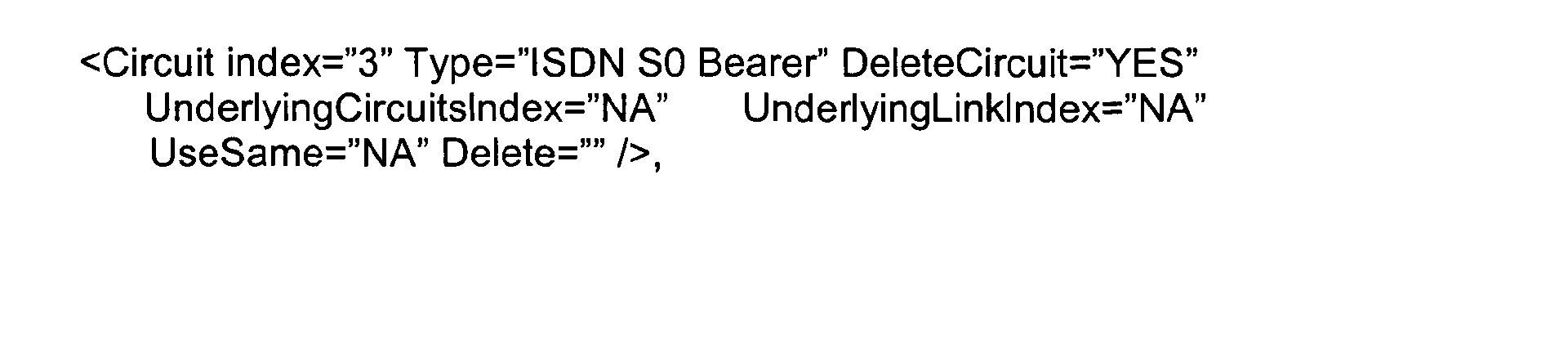
- After all the circuits and links have been stored, the tree is traversed again and deletion starts. If the DeleteCircuit or DeleteLink attribute is "YES," then the circuit object or link object corresponding to the index is retrieved. This index is the key for the Hashtable. If any objects associated with this circuit or link are to be deleted, they are then deleted. After the associated objects are deleted, the circuit or link is deleted. This is known by the attribute Delete="Loopback".
- The above XML document is an example of how any desired operation such as, for example, provisioning, assurance, usage, modify, delete, and rollback, may be performed. The XML tags are interpreted upon input into the system. Therefore, the XML document may create a different result depending on how the XML document is interpreted. For example, if the system is provisioning a network model, then system interprets the xml accordingly and builds the network model in the database. If the system is performing a delete or rollback, then the code may produce the reverse operation and delete or roll back the network model, or elements of the network model, in memory.
- In accordance with one embodiment of the invention, the network environment illustrated in FIGS. 2 and 3, and any other desired network configuration, can be modeled and/or manipulated using the present invention. In one embodiment, the model is generated in a network database. Furthermore, the model can be used for any service function such as, for example, provisioning, assurance, usage, modify, delete, and rollback. One example for provisioning is to use the network model to provision the various network elements, set-up logical connections between the various network elements, and activate the physical connections. One example of assurance is to use the network model to indicate the location of a fault and monitor the network environment. The fault, for example, could be displayed on in a different color on the display monitor. One example of usage is to use the network model to correlate the statistics from the mediation devices and/or mediation software, as well from third party providers. The network model can also be used to provide billing details associated with each object or a group of segments, sub-networks, equipment, and/or circuits. In summary, the network model provides a system such as, for example, a single-window system for performing any of the various operations of the service provider.
- Those skilled in the art will appreciate that the above-described system may be implemented in a variety of configurations. For example, while particular communications protocols are specified, any suitable communications protocols and communications media may be used. For example, communications lines may include ISDN lines, ADSL lines, DSL lines, T-carrier lines, E-carrier lines, wireless communication, such as infrared or RF-based wireless communication, and the like. Also, while certain communications protocols may have been specified, those skilled in the art will recognize that other suitable communications protocols may be used with the present invention.
- While some of the exemplary embodiments disclosed refer primarily to a plurality of objects on a communications network, the present invention may be incorporated into other computer applications that do not require a computer network. For example, the present invention may be used to represent a database and perform operations on the database. Additionally, XML is one exemplary language that may be used to create such the representation of objects on the network. This representation of objects on the network may be created in any other suitable languages, such as wireless markup language (WML), custom representations, and the like. In one embodiment, the language or instructions used is computer-readable code that is capable of representing structured information.
- The previous description of the exemplary embodiments is provided to enable any person skilled in the art to make or use the present invention. While the invention has been described with respect to particular illustrated embodiments, various modifications to these embodiments will readily be apparent to those skilled in the art, and the generic principles defined herein may be applied to other embodiments without departing from the spirit or scope of the invention. It is therefore desired that the present embodiments be considered in all respects as illustrative and not restrictive. Accordingly, the present invention is not intended to be limited to the embodiments described above but is to be accorded the widest scope consistent with the principles and novel features disclosed herein.
Claims (12)
- A method of modelling a communications network using a computer system, the method including the steps of generating computer-readable code (200) that represents structured information; and parsing the computer-readable code (202), characterised in that:the computer-readable code includes a network representation and parsing the computer-readable code includes parsing the network representation; the method further including the steps of:generating a network model (204) using the parsed network representation, the network model including a plurality of network objects and relationships between the plurality of network objects; andstoring the network model in memory.
- A method according to claim 1, further including the steps of processing a network event (210) using the network model, wherein processing the network event includes identifying one or more of the plurality of network objects (214), and determining an order of operation (216) on the one or more of the plurality of network objects.
- A method according to claim 1 or claim 2, wherein the network representation includes at least one of the following:circuit level index;circuit type identification;order of operation indication;delete circuit identification;underlying circuit index;underlying link index;delete object identification;parent circuit identification; andchild circuit identification.
- A method according to any one of the preceding claims, wherein the network event is selected from the group consisting of circuit provisioning, service provisioning, switch provisioning, rollback, and delete.
- A method according to any one of the preceding claims, wherein the computer-readable code is in extensible mark-up language (XML).
- A method according to any one of the preceding claims, wherein processing the network event (210) includes the steps of:identifying one or more of the network objects (214) in the network model; anddetermining an order of operation (216) on the one or more network objects.
- A method according to any one of the preceding claims, further including the steps of:generating a graphical representation (206) of the network model; anddisplaying the graphical representation (208) on a display monitor.
- A method according to claim 7, wherein the graphical representation is a graphical user interface, and wherein the graphical user interface is used to modify the network model.
- A system for modelling a communications network, the system including:one or more processors (100);one or more memories (120) coupled to the one or more processors (100); andprogram instructions stored in the one or more memories (120), the one or more processors (100) being operable to execute the program instructions, characterised in that:the program instructions include:generating a network representation (200) using computer-readable code that represents structured information;parsing the network representation (202);generating a network model (204) using the parsed network representation, the network model including a plurality of network objects and relationships between the plurality of network objects; andstoring the network model in the one or more memories.
- A system according to claim 9, wherein the computer-readable code is in extensible mark-up language (XML).
- A system according to claim 9 or claim 10 wherein the program instructions further include:generating a graphical representation of the network representation (206); anddisplaying the graphical representation on a display monitor (208).
- A system according to claim 11, wherein the graphical representation is a graphical user interface and wherein the graphical user interface is used to modify the network model.
Applications Claiming Priority (2)
| Application Number | Priority Date | Filing Date | Title |
|---|---|---|---|
| US10/753,841 US7392300B2 (en) | 2004-01-08 | 2004-01-08 | Method and system for modelling a communications network |
| US753841 | 2004-01-08 |
Publications (2)
| Publication Number | Publication Date |
|---|---|
| EP1553723A1 true EP1553723A1 (en) | 2005-07-13 |
| EP1553723B1 EP1553723B1 (en) | 2007-03-14 |
Family
ID=34592587
Family Applications (1)
| Application Number | Title | Priority Date | Filing Date |
|---|---|---|---|
| EP05250014A Expired - Lifetime EP1553723B1 (en) | 2004-01-08 | 2005-01-05 | Method and system for modelling a communications network |
Country Status (3)
| Country | Link |
|---|---|
| US (1) | US7392300B2 (en) |
| EP (1) | EP1553723B1 (en) |
| DE (1) | DE602005000679T2 (en) |
Cited By (1)
| Publication number | Priority date | Publication date | Assignee | Title |
|---|---|---|---|---|
| CN115514656A (en) * | 2022-09-30 | 2022-12-23 | 美的集团股份有限公司 | Object model adaptation method and device |
Families Citing this family (212)
| Publication number | Priority date | Publication date | Assignee | Title |
|---|---|---|---|---|
| DE602006010803D1 (en) * | 2006-02-06 | 2010-01-14 | Alcatel Lucent | Method for establishing a telephone conference using a telecommunications network using a SIP protocol |
| US8584131B2 (en) | 2007-03-30 | 2013-11-12 | International Business Machines Corporation | Method and system for modeling and analyzing computing resource requirements of software applications in a shared and distributed computing environment |
| US8086633B2 (en) | 2009-08-27 | 2011-12-27 | International Business Machines Corporation | Unified user identification with automatic mapping and database absence handling |
| US9215270B2 (en) | 2010-08-09 | 2015-12-15 | Servicenow, Inc. | System and method for determining a topology of at least one application in a computerized organization |
| US9288074B2 (en) | 2011-06-30 | 2016-03-15 | International Business Machines Corporation | Resource configuration change management |
| US10374898B2 (en) | 2014-04-24 | 2019-08-06 | The Boeing Company | Network revision evaluator |
| US9942342B2 (en) | 2014-06-09 | 2018-04-10 | Skygiraffe, Inc. | System and method for providing database content on a client device |
| US10210351B2 (en) | 2014-07-21 | 2019-02-19 | Servicenow, Inc. | Fingerprint-based configuration typing and classification |
| US9853863B1 (en) | 2014-10-08 | 2017-12-26 | Servicenow, Inc. | Collision detection using state management of configuration items |
| DE112015005728B4 (en) | 2014-12-22 | 2021-07-29 | Servicenow, Inc. | Automatic finding of configuration elements |
| US10210205B1 (en) | 2014-12-31 | 2019-02-19 | Servicenow, Inc. | System independent configuration management database identification system |
| EP3248101B1 (en) | 2015-01-23 | 2021-12-08 | ServiceNow, Inc. | Distributed computing system with resource managed database cloning |
| US10437824B2 (en) | 2015-01-23 | 2019-10-08 | Attivio, Inc. | Querying across a composite join of multiple database tables using a search engine index |
| US9935823B1 (en) | 2015-05-28 | 2018-04-03 | Servicenow, Inc. | Change to availability mapping |
| US9742625B2 (en) | 2015-08-12 | 2017-08-22 | Servicenow, Inc. | Automated electronic computing and communication system event analysis and management |
| US10819594B2 (en) | 2015-11-02 | 2020-10-27 | Servicenow, Inc. | System and method for generating a graphical display region indicative of conditions of a computing infrastructure |
| US10454752B2 (en) | 2015-11-02 | 2019-10-22 | Servicenow, Inc. | System and method for processing alerts indicative of conditions of a computing infrastructure |
| US10810228B2 (en) | 2015-11-02 | 2020-10-20 | Servicenow, Inc. | Universal automatic data update detection and publication |
| US20170163485A1 (en) * | 2015-12-07 | 2017-06-08 | Alcatel-Lucent Canada Inc. | Full configuration management of multi-domain multi-vendor network equipments using golden configurations and snapshots |
| US10015186B1 (en) | 2016-04-12 | 2018-07-03 | Servicenow, Inc. | Method and apparatus for reducing security risk in a networked computer system architecture |
| WO2017184864A1 (en) | 2016-04-20 | 2017-10-26 | Servicenow, Inc. | Multi-stage network discovery |
| US10397064B2 (en) | 2016-04-20 | 2019-08-27 | Servicenow, Inc. | System and method for custom graph generation |
| US10270885B2 (en) | 2016-05-13 | 2019-04-23 | Servicenow, Inc. | System and method for deploying resources within a computing infrastructure |
| US10387385B1 (en) | 2016-09-29 | 2019-08-20 | Servicenow, Inc. | System and method for batch database modification |
| US10354215B2 (en) | 2016-10-26 | 2019-07-16 | Servicenow, Inc. | System and method for service modeling |
| US10430170B2 (en) | 2016-10-31 | 2019-10-01 | Servicenow, Inc. | System and method for creating and deploying a release package |
| US10547519B2 (en) | 2016-11-02 | 2020-01-28 | Servicenow, Inc. | System and method of associating metadata with computing resources across multiple providers |
| US10492046B2 (en) | 2017-04-07 | 2019-11-26 | Servicenow, Inc. | System of actions for IoT devices |
| US10817524B2 (en) | 2017-04-10 | 2020-10-27 | Servicenow, Inc. | Systems and methods for querying time series data |
| US11044143B2 (en) | 2017-04-17 | 2021-06-22 | Servicenow, Inc. | System for processing events using event rules |
| US10516565B2 (en) | 2017-04-18 | 2019-12-24 | Servicenow, Inc. | Transformation and transmission of event messages |
| US10476959B2 (en) | 2017-05-02 | 2019-11-12 | Servicenow, Inc. | Cloud resource provisioning using blueprint chaining |
| US10333960B2 (en) | 2017-05-03 | 2019-06-25 | Servicenow, Inc. | Aggregating network security data for export |
| US10944771B2 (en) | 2017-05-03 | 2021-03-09 | Servicenow, Inc. | Computing resource identification |
| US10936613B2 (en) | 2017-05-03 | 2021-03-02 | Servicenow, Inc. | Table-per-partition |
| US10614064B2 (en) | 2017-05-03 | 2020-04-07 | Servicenow, Inc. | Class path based database operations |
| US10454774B2 (en) | 2017-05-04 | 2019-10-22 | Servicenow, Inc. | Automated inventory for IoT devices |
| US10355913B2 (en) | 2017-05-04 | 2019-07-16 | Servicenow, Inc. | Operational analytics in managed networks |
| US11100084B2 (en) | 2017-05-05 | 2021-08-24 | Servicenow, Inc. | Configuration management identification rule testing |
| US11620571B2 (en) | 2017-05-05 | 2023-04-04 | Servicenow, Inc. | Machine learning with distributed training |
| US10275241B2 (en) | 2017-05-05 | 2019-04-30 | Servicenow, Inc. | Hybrid development systems and methods |
| US10650056B2 (en) | 2017-05-05 | 2020-05-12 | Servicenow, Inc. | Template-based faceted search experience |
| US10802672B2 (en) | 2017-05-05 | 2020-10-13 | Servicenow, Inc. | Software application portfolio discovery and management |
| US10620930B2 (en) | 2017-05-05 | 2020-04-14 | Servicenow, Inc. | Software asset management |
| US10809989B2 (en) | 2017-05-05 | 2020-10-20 | Servicenow, Inc. | Service release tool |
| US10511486B2 (en) | 2017-05-05 | 2019-12-17 | Servicenow, Inc. | System and method for automating the discovery process |
| US10042618B1 (en) | 2017-05-05 | 2018-08-07 | Servicenow, Inc. | Integration application creator design |
| US10389589B2 (en) | 2017-05-05 | 2019-08-20 | Servicenow, Inc. | Unified device and service discovery across multiple network types |
| US11163747B2 (en) | 2017-05-05 | 2021-11-02 | Servicenow, Inc. | Time series data forecasting |
| US10917419B2 (en) | 2017-05-05 | 2021-02-09 | Servicenow, Inc. | Systems and methods for anomaly detection |
| US10915515B2 (en) | 2017-05-05 | 2021-02-09 | Servicenow, Inc. | Database performance tuning framework |
| US10541961B2 (en) | 2017-05-05 | 2020-01-21 | Servicenow, Inc. | System and method for automating actions in distributed computing |
| US10949903B2 (en) | 2017-05-05 | 2021-03-16 | Servicenow, Inc. | System, computer-readable medium, and method for blueprint-based cloud management |
| US10832189B2 (en) | 2017-05-05 | 2020-11-10 | Servicenow, Inc. | Systems and methods for dynamically scheduling tasks across an enterprise |
| US10826691B2 (en) | 2017-05-30 | 2020-11-03 | Servicenow, Inc. | Edge encryption |
| US10673715B2 (en) | 2017-07-20 | 2020-06-02 | Servicenow, Inc. | Splitting network discovery payloads based on degree of relationships between nodes |
| US10708139B2 (en) | 2017-08-01 | 2020-07-07 | Servicenow, Inc. | Automatic grouping of similar applications and devices on a network map |
| US10705875B2 (en) | 2017-08-09 | 2020-07-07 | Servicenow, Inc. | Systems and methods for recomputing services |
| US10824642B2 (en) | 2017-08-10 | 2020-11-03 | Servicenow, Inc. | Data synchronization architecture |
| US11132613B2 (en) | 2017-08-10 | 2021-09-28 | Servicenow, Inc. | Traffic based discovery noise reduction architecture |
| US10545755B2 (en) | 2017-09-07 | 2020-01-28 | Servicenow, Inc. | Identifying customization changes between instances |
| US10911314B2 (en) | 2017-10-02 | 2021-02-02 | Servicenow, Inc. | Systems and methods for determining entry points for mapping a network |
| US10558920B2 (en) | 2017-10-02 | 2020-02-11 | Servicenow, Inc. | Machine learning classification with confidence thresholds |
| US10341841B2 (en) | 2017-10-02 | 2019-07-02 | Servicenow, Inc. | Operation of device and application discovery for a managed network |
| US10402581B2 (en) | 2017-10-03 | 2019-09-03 | Servicenow, Inc. | Searching for encrypted data within cloud based platform |
| US20190102841A1 (en) | 2017-10-04 | 2019-04-04 | Servicenow, Inc. | Mapping engine configurations with task managed workflows and grid user interfaces |
| US11615358B2 (en) | 2017-10-04 | 2023-03-28 | Servicenow, Inc. | Data insights for performance analytics |
| US10547501B2 (en) | 2017-10-04 | 2020-01-28 | Servicenow, Inc. | Self-monitoring |
| US10635565B2 (en) | 2017-10-04 | 2020-04-28 | Servicenow, Inc. | Systems and methods for robust anomaly detection |
| US11093617B2 (en) | 2017-10-04 | 2021-08-17 | Servicenow, Inc. | Automated vulnerability grouping |
| EP3467642B1 (en) | 2017-10-04 | 2023-10-04 | ServiceNow, Inc. | Guided configuration item class creation in a remote network management platform |
| US11057276B2 (en) | 2017-10-04 | 2021-07-06 | Servicenow, Inc. | Bulk service mapping |
| US10621313B2 (en) | 2017-10-04 | 2020-04-14 | Servicenow, Inc. | Distribution and enforcement of per-feature-set software application licensing |
| US10585912B2 (en) | 2017-10-10 | 2020-03-10 | Servicenow, Inc. | Visualizing time metric database |
| US10795885B2 (en) | 2017-11-15 | 2020-10-06 | Servicenow, Inc. | Predictive query improvement |
| US10728345B2 (en) | 2017-11-16 | 2020-07-28 | Servicenow, Inc. | Field service management mobile offline synchronization |
| US11132378B2 (en) | 2017-11-16 | 2021-09-28 | Servicenow, Inc. | Systems and methods for interactive analysis |
| US10931630B2 (en) | 2017-11-16 | 2021-02-23 | Servicenow, Inc. | System and method for connecting using aliases |
| US11023461B2 (en) | 2018-01-19 | 2021-06-01 | Servicenow, Inc. | Query translation |
| US11880557B2 (en) | 2018-01-29 | 2024-01-23 | Servicenow, Inc. | Distributed editing and versioning for graphical service maps of a managed network |
| US10826776B2 (en) | 2018-02-26 | 2020-11-03 | Servicenow, Inc. | Integrated continual improvement management |
| US11128542B2 (en) | 2018-02-26 | 2021-09-21 | Servicenow, Inc. | Interactive user interface to visually display the impact of configuration changes on a managed network |
| US10505822B2 (en) | 2018-02-26 | 2019-12-10 | Servicenow, Inc. | Interactive software renormalization |
| US11074239B2 (en) | 2018-02-26 | 2021-07-27 | Servicenow, Inc. | De-duplication of configuration items related to a managed network |
| US10693745B2 (en) | 2018-02-27 | 2020-06-23 | Servicenow, Inc. | Defining and enforcing operational associations between configuration item classes in managed networks |
| US11232224B2 (en) | 2018-03-15 | 2022-01-25 | Servicenow, Inc. | Database encryption |
| US10497366B2 (en) | 2018-03-23 | 2019-12-03 | Servicenow, Inc. | Hybrid learning system for natural language understanding |
| US10740566B2 (en) | 2018-03-23 | 2020-08-11 | Servicenow, Inc. | Method and system for automated intent mining, classification and disposition |
| US10728340B2 (en) | 2018-03-29 | 2020-07-28 | Servicenow, Inc. | Internet of things (IOT) platform for device configuration management and support |
| US10761903B2 (en) | 2018-03-29 | 2020-09-01 | Servicenow, Inc. | Management instrumentation and discovery (MID) server support for executing automated flows within a cloud based system |
| US10819560B2 (en) | 2018-03-29 | 2020-10-27 | Servicenow, Inc. | Alert management system and method of using alert context-based alert rules |
| US10824616B2 (en) | 2018-04-02 | 2020-11-03 | Servicenow, Inc. | System and method for alert insight in configuration management databases (CMDBs) |
| US10708753B2 (en) | 2018-04-03 | 2020-07-07 | Servicenow, Inc. | Discovery and service mapping of serverless resources |
| US10708755B2 (en) | 2018-04-03 | 2020-07-07 | Servicenow, Inc. | Discovery and service mapping of serverless resources |
| US10558671B2 (en) | 2018-05-01 | 2020-02-11 | Servicenow, Inc. | Modified representational state transfer (REST) application programming interface (API) including a customized GraphQL framework |
| US10783060B2 (en) | 2018-05-02 | 2020-09-22 | Servicenow, Inc. | Post-upgrade debugging in a remote network management platform |
| US10719359B2 (en) | 2018-05-02 | 2020-07-21 | Servicenow, Inc. | Periodic task execution in an automated context |
| US11373124B2 (en) | 2018-05-04 | 2022-06-28 | Servicenow, Inc. | System and method for a control based project scheduling mode |
| US10771327B2 (en) | 2018-05-07 | 2020-09-08 | Servicenow, Inc. | Multi-instance architecture supporting out-of-band delivery of configuration data |
| US10938663B2 (en) | 2018-05-07 | 2021-03-02 | Servicenow, Inc. | Discovery and management of devices |
| US10936980B2 (en) | 2018-05-07 | 2021-03-02 | Servicenow, Inc. | Graphical user interface for enterprise project portfolio management utilizing normalized project attributes mapped to a common framework |
| US11036751B2 (en) | 2018-05-07 | 2021-06-15 | Servicenow, Inc. | Advanced insights explorer |
| US10944654B2 (en) | 2018-06-06 | 2021-03-09 | Servicenow, Inc. | Discovery and mapping of containerized software applications |
| US10747530B2 (en) | 2018-06-12 | 2020-08-18 | Servicenow, Inc. | Mission-based developer certification system and method |
| US10795669B2 (en) | 2018-06-15 | 2020-10-06 | Servicenow, Inc. | Systems and methods for integrating software source control, building, and testing applications |
| US10826682B2 (en) | 2018-07-03 | 2020-11-03 | Servicenow, Inc. | Multi-instance architecture supporting trusted blockchain-based network |
| US10664248B2 (en) | 2018-07-16 | 2020-05-26 | Servicenow, Inc. | Systems and methods for comparing computer scripts |
| US11288250B2 (en) | 2018-08-09 | 2022-03-29 | Servicenow, Inc. | Partial discovery of cloud-based resources |
| US10972435B2 (en) | 2018-09-05 | 2021-04-06 | Servicenow, Inc. | Dynamic discovery of executing applications |
| US10992544B2 (en) | 2018-09-07 | 2021-04-27 | Servicenow, Inc. | Identification and display of configuration item information |
| US10970048B2 (en) | 2018-09-17 | 2021-04-06 | Servicenow, Inc. | System and method for workflow application programming interfaces (APIS) |
| US11449579B2 (en) | 2018-09-19 | 2022-09-20 | Servicenow, Inc. | File-based software application discovery |
| US11061890B2 (en) | 2018-10-04 | 2021-07-13 | Servicenow, Inc. | Automated identification of hardware and software components relevant to incident reports |
| US10819586B2 (en) | 2018-10-17 | 2020-10-27 | Servicenow, Inc. | Functional discovery and mapping of serverless resources |
| US11641406B2 (en) | 2018-10-17 | 2023-05-02 | Servicenow, Inc. | Identifying applications with machine learning |
| US11070632B2 (en) | 2018-10-17 | 2021-07-20 | Servicenow, Inc. | Identifying computing devices in a managed network that are involved in blockchain-based mining |
| US11063946B2 (en) | 2018-10-24 | 2021-07-13 | Servicenow, Inc. | Feedback framework |
| US10613899B1 (en) | 2018-11-09 | 2020-04-07 | Servicenow, Inc. | Lock scheduling using machine learning |
| US10958532B2 (en) | 2018-11-09 | 2021-03-23 | Servicenow, Inc. | Machine learning based discovery of software as a service |
| US10942787B2 (en) | 2018-11-13 | 2021-03-09 | Servicenow, Inc. | Instance mapping engine and tools |
| US11157292B2 (en) | 2018-11-13 | 2021-10-26 | Servicenow, Inc. | Instance mapping engine and tools |
| US11120049B2 (en) | 2018-11-19 | 2021-09-14 | Servicenow, Inc. | Concurrent data imports |
| US11669599B2 (en) | 2018-11-26 | 2023-06-06 | Servicenow, Inc. | Systems and methods for software license management |
| US10715402B2 (en) | 2018-11-27 | 2020-07-14 | Servicenow, Inc. | Systems and methods for enhanced monitoring of a distributed computing system |
| US10929186B2 (en) * | 2018-12-12 | 2021-02-23 | Servicenow, Inc. | Control token and hierarchical dynamic control |
| US11431568B2 (en) | 2018-12-20 | 2022-08-30 | Servicenow, Inc. | Discovery of software bus architectures |
| US10949186B2 (en) | 2018-12-20 | 2021-03-16 | Servicenow, Inc. | Automatic generation of a software configuration for license reconciliation |
| US10824650B2 (en) | 2018-12-20 | 2020-11-03 | Servicenow, Inc. | Discovery of database and related services |
| US10970107B2 (en) | 2018-12-21 | 2021-04-06 | Servicenow, Inc. | Discovery of hyper-converged infrastructure |
| US10771344B2 (en) | 2018-12-21 | 2020-09-08 | Servicenow, Inc. | Discovery of hyper-converged infrastructure devices |
| US11068140B2 (en) | 2019-01-04 | 2021-07-20 | Servicenow, Inc. | Intelligent overflow menu |
| US11108647B2 (en) | 2019-01-14 | 2021-08-31 | Servicenow, Inc. | Service mapping based on discovered keywords |
| US11070435B2 (en) | 2019-01-16 | 2021-07-20 | Servicenow, Inc. | Service model re-computation based on configuration item change type |
| US10931774B2 (en) | 2019-01-17 | 2021-02-23 | Servicenow, Inc. | Discovery and service mapping of application programming interface proxies |
| US11126597B2 (en) | 2019-01-17 | 2021-09-21 | Servicenow, Inc. | Efficient database table rotation and upgrade |
| US10673963B1 (en) | 2019-01-18 | 2020-06-02 | Servicenow, Inc. | Discovery of remote storage services and associated applications |
| US11500874B2 (en) | 2019-01-23 | 2022-11-15 | Servicenow, Inc. | Systems and methods for linking metric data to resources |
| US11233747B2 (en) | 2019-01-23 | 2022-01-25 | Servicenow, Inc. | Systems and methods for acquiring server resources at schedule time |
| US11095540B2 (en) | 2019-01-23 | 2021-08-17 | Servicenow, Inc. | Hybrid anomaly detection for response-time-based events in a managed network |
| US11256699B2 (en) | 2019-01-23 | 2022-02-22 | Servicenow, Inc. | Grammar-based searching of a configuration management database |
| US11163791B2 (en) | 2019-01-23 | 2021-11-02 | Servicenow, Inc. | Transformation configuration in instance data replication with bi-directional replication support |
| US11150954B2 (en) | 2019-02-04 | 2021-10-19 | Servicenow, Inc. | Mitigating resource scheduling conflicts in a cloud platform |
| US11409844B2 (en) | 2019-02-11 | 2022-08-09 | Servicenow, Inc. | Systems and methods for license management in a domain-separated architecture |
| US11520863B2 (en) | 2019-02-27 | 2022-12-06 | Servicenow, Inc. | Systems and methods for importing software license metric data into a configuration management database (CMDB) |
| US10686667B1 (en) | 2019-03-04 | 2020-06-16 | Servicenow, Inc. | Agent-assisted discovery of network devices and services |
| US11593461B2 (en) | 2019-03-11 | 2023-02-28 | Servicenow, Inc. | Systems and methods for third-party library management |
| US10949070B2 (en) | 2019-03-13 | 2021-03-16 | Servicenow, Inc. | Customizable mobile application for event management |
| US11461288B2 (en) | 2019-03-14 | 2022-10-04 | Servicenow, Inc. | Systems and methods for database management system (DBMS) discovery |
| US11379560B2 (en) | 2019-03-18 | 2022-07-05 | ServiceNow Inc. | Systems and methods for license analysis |
| US10678418B1 (en) | 2019-03-19 | 2020-06-09 | Servicenow, Inc. | Graphical user interfaces for defining complex data objects |
| US10917312B2 (en) | 2019-03-21 | 2021-02-09 | Servicenow, Inc. | Graphical user interface for validation of credentials and scheduled discovery of remote networks |
| US11258865B2 (en) | 2019-03-28 | 2022-02-22 | Servicenow, Inc. | Automated integration with cloud-based services |
| US11115471B2 (en) | 2019-03-28 | 2021-09-07 | Servicenow, Inc. | Identifying and mitigating configuration item flapping |
| US10739983B1 (en) | 2019-04-10 | 2020-08-11 | Servicenow, Inc. | Configuration and management of swimlanes in a graphical user interface |
| US10924344B2 (en) * | 2019-04-11 | 2021-02-16 | Servicenow, Inc. | Discovery and mapping of cloud-based resource modifications |
| US10749943B1 (en) * | 2019-04-11 | 2020-08-18 | Servicenow, Inc. | Discovery and mapping of cloud-based resources |
| US11129159B2 (en) | 2019-04-11 | 2021-09-21 | Servicenow, Inc. | Programmatic orchestration of cloud-based services |
| US11263201B2 (en) | 2019-04-12 | 2022-03-01 | Servicenow, Inc. | Interface for supporting integration with cloud-based service providers |
| US10719503B1 (en) | 2019-05-02 | 2020-07-21 | Servicenow, Inc. | Interface for supporting integration with cloud-based service providers |
| US11226978B2 (en) | 2019-04-23 | 2022-01-18 | Servicenow, Inc. | Systems and methods for dynamic creation of schemas |
| US11157273B2 (en) | 2019-05-02 | 2021-10-26 | Servicenow, Inc. | Scaled agile framework program board |
| US10686647B1 (en) | 2019-05-02 | 2020-06-16 | Servicenow, Inc. | Descriptor architecture for a remote network management platform |
| US11210630B2 (en) | 2019-05-02 | 2021-12-28 | Servicenow, Inc. | Integrated receiving and classification of computer hardware |
| US11232086B2 (en) | 2019-05-02 | 2022-01-25 | Servicenow, Inc. | Preventing and recovering from duplication in a configuration management database |
| US10764124B1 (en) | 2019-05-02 | 2020-09-01 | Servicenow, Inc. | Intelligent export and import of service representations |
| US11232021B2 (en) | 2019-05-02 | 2022-01-25 | Servicenow, Inc. | Database record locking for test parallelization |
| US11204903B2 (en) | 2019-05-02 | 2021-12-21 | Servicenow, Inc. | Determination and reconciliation of software used by a managed network |
| US10747757B1 (en) | 2019-05-02 | 2020-08-18 | Servicenow, Inc. | Graphical query builder for multi-modal search |
| US11133992B2 (en) | 2019-05-03 | 2021-09-28 | Servicenow, Inc. | Detection and notification of anomalies in shared computer networks |
| US11431824B2 (en) | 2019-05-03 | 2022-08-30 | Servicenow, Inc. | Server-side control over navigation mode in web application |
| US10997002B2 (en) | 2019-05-03 | 2021-05-04 | Servicenow, Inc. | Quick actions |
| US10819557B1 (en) | 2019-05-03 | 2020-10-27 | Servicenow, Inc. | Systems and methods for selective discovery of services |
| US11481474B2 (en) | 2019-05-03 | 2022-10-25 | Servicenow, Inc. | Discovery and allocation of entitlements to virtualized applications |
| US11520622B2 (en) | 2019-05-03 | 2022-12-06 | Servicenow, Inc. | Active queue management in a multi-node computing environment |
| US11082289B2 (en) | 2019-05-03 | 2021-08-03 | Servicenow, Inc. | Alert intelligence integration |
| US11150894B2 (en) | 2019-05-28 | 2021-10-19 | Servicenow, Inc. | Systems and methods for software build file analytics |
| US11240241B2 (en) | 2019-06-19 | 2022-02-01 | Servicenow, Inc. | Discovery and mapping of a cloud-based authentication, authorization, and user management service |
| US11032381B2 (en) | 2019-06-19 | 2021-06-08 | Servicenow, Inc. | Discovery and storage of resource tags |
| US11381448B2 (en) | 2019-06-20 | 2022-07-05 | ServiceNow, Inc . | Systems and methods for cloud resource synchronization |
| US11487945B2 (en) | 2019-07-02 | 2022-11-01 | Servicenow, Inc. | Predictive similarity scoring subsystem in a natural language understanding (NLU) framework |
| US11115432B2 (en) | 2019-07-08 | 2021-09-07 | Servicenow, Inc. | Multi-application recommendation engine for a remote network management platform |
| US10963314B2 (en) | 2019-07-31 | 2021-03-30 | Servicenow, Inc. | Discovery and mapping of a platform-as-a-service environment |
| US11256391B2 (en) | 2019-08-12 | 2022-02-22 | Servicenow, Inc. | Mobile user interface for displaying heterogeneous items interleaved by common data type |
| US11520621B2 (en) | 2019-08-26 | 2022-12-06 | Servicenow, Inc. | Computational instance batching and automation orchestration based on resource usage and availability |
| US11423155B2 (en) | 2019-08-28 | 2022-08-23 | Servicenow, Inc. | Software vulnerability detection in managed networks |
| US11205047B2 (en) | 2019-09-05 | 2021-12-21 | Servicenow, Inc. | Hierarchical search for improved search relevance |
| US10938657B1 (en) | 2019-09-13 | 2021-03-02 | Servicenow, Inc. | Enhancing discovery patterns with shell command exit status |
| US11507442B2 (en) | 2019-09-17 | 2022-11-22 | Servicenow, Inc. | Method and system for determining maturity level of a cloud computing service |
| US11140042B2 (en) | 2019-09-18 | 2021-10-05 | Servicenow, Inc. | Dictionary-based service mapping |
| US11507644B2 (en) | 2019-10-02 | 2022-11-22 | Servicenow, Inc. | Discovery and classification of software application suites |
| US11461673B2 (en) | 2019-10-07 | 2022-10-04 | Servicenow, Inc. | Shared machine learning model for application discovery |
| US10917358B1 (en) | 2019-10-31 | 2021-02-09 | Servicenow, Inc. | Cloud service for cross-cloud operations |
| US11481417B2 (en) | 2019-11-06 | 2022-10-25 | Servicenow, Inc. | Generation and utilization of vector indexes for data processing systems and methods |
| US11455357B2 (en) | 2019-11-06 | 2022-09-27 | Servicenow, Inc. | Data processing systems and methods |
| US11468238B2 (en) | 2019-11-06 | 2022-10-11 | ServiceNow Inc. | Data processing systems and methods |
| US11514066B2 (en) | 2019-11-08 | 2022-11-29 | Servicenow, Inc. | System and methods for querying and updating databases |
| US11159557B2 (en) | 2019-11-13 | 2021-10-26 | Servicenow, Inc. | Network security through linking vulnerability management and change management |
| US11489861B2 (en) | 2019-11-14 | 2022-11-01 | Servicenow, Inc. | System and method for solution resolution for vulnerabilities identified by third-party vulnerability scanners |
| US11089115B2 (en) | 2019-12-30 | 2021-08-10 | Servicenow, Inc. | Discovery of cloud-based infrastructure and resources |
| US11347806B2 (en) | 2019-12-30 | 2022-05-31 | Servicenow, Inc. | Discovery of containerized platform and orchestration services |
| US11188553B2 (en) | 2019-12-31 | 2021-11-30 | Servicenow, Inc. | System and method for importation of configuration item (CI) data into a configuration management database (CMDB) |
| US11477029B2 (en) | 2020-01-02 | 2022-10-18 | Servicenow, Inc. | Hardware normalization for a managed network |
| US11418395B2 (en) | 2020-01-08 | 2022-08-16 | Servicenow, Inc. | Systems and methods for an enhanced framework for a distributed computing system |
| US11140223B2 (en) | 2020-01-14 | 2021-10-05 | Servicenow, Inc. | Systems and methods for synchronizing data between hub and spoke environments |
| US11805146B2 (en) | 2020-04-29 | 2023-10-31 | Servicenow, Inc. | System and method for detection promotion |
| US11301267B2 (en) | 2020-05-22 | 2022-04-12 | Servicenow, Inc. | Automated task management techniques |
| US11463323B2 (en) | 2020-07-14 | 2022-10-04 | Servicenow, Inc. | Discovery process identification and classification |
| US11636104B2 (en) | 2020-07-28 | 2023-04-25 | Servicenow, Inc. | Analytics center having a natural language query (NLQ) interface |
| US11474845B2 (en) | 2020-09-09 | 2022-10-18 | Servicenow, Inc. | System and method for versioned script management |
| US11838374B2 (en) | 2021-02-12 | 2023-12-05 | Servicenow, Inc. | Remote network management infrastructure for cloud-based deployments |
| US12530379B2 (en) | 2021-12-01 | 2026-01-20 | Servicenow, Inc. | Data navigation user interface |
| US12504995B2 (en) | 2022-05-31 | 2025-12-23 | Servicenow, Inc. | Techniques for cloud agnostic discovery of clusters of a containerized application orchestration infrastructure |
Citations (3)
| Publication number | Priority date | Publication date | Assignee | Title |
|---|---|---|---|---|
| US20010011215A1 (en) * | 1998-08-31 | 2001-08-02 | Scott A. Beeker | Network device simulation system and method |
| US20030055883A1 (en) * | 2001-03-30 | 2003-03-20 | Wiles Philip V. | Synthetic transaction monitor |
| US20030161266A1 (en) * | 2000-03-01 | 2003-08-28 | Francois Baccelli | Monitoring and stimulating of complex systems, in particular of flow and congestion mechanisms and control in communication networks |
Family Cites Families (7)
| Publication number | Priority date | Publication date | Assignee | Title |
|---|---|---|---|---|
| US5963943A (en) * | 1996-05-28 | 1999-10-05 | Mci Communication Corporation | System and method for storing and retrieving performance and topology information |
| US6560611B1 (en) * | 1998-10-13 | 2003-05-06 | Netarx, Inc. | Method, apparatus, and article of manufacture for a network monitoring system |
| US20020021675A1 (en) * | 1999-10-19 | 2002-02-21 | At&T Corp. | System and method for packet network configuration debugging and database |
| US7003562B2 (en) * | 2001-03-27 | 2006-02-21 | Redseal Systems, Inc. | Method and apparatus for network wide policy-based analysis of configurations of devices |
| US7200548B2 (en) * | 2001-08-29 | 2007-04-03 | Intelliden | System and method for modeling a network device's configuration |
| DE10204826A1 (en) * | 2002-02-06 | 2003-08-14 | Siemens Ag | System and method for analyzing a network and / or generating the topology of a network |
| AU2002953555A0 (en) * | 2002-12-23 | 2003-01-16 | Canon Kabushiki Kaisha | Method for presenting hierarchical data |
-
2004
- 2004-01-08 US US10/753,841 patent/US7392300B2/en not_active Expired - Lifetime
-
2005
- 2005-01-05 EP EP05250014A patent/EP1553723B1/en not_active Expired - Lifetime
- 2005-01-05 DE DE602005000679T patent/DE602005000679T2/en not_active Expired - Lifetime
Patent Citations (3)
| Publication number | Priority date | Publication date | Assignee | Title |
|---|---|---|---|---|
| US20010011215A1 (en) * | 1998-08-31 | 2001-08-02 | Scott A. Beeker | Network device simulation system and method |
| US20030161266A1 (en) * | 2000-03-01 | 2003-08-28 | Francois Baccelli | Monitoring and stimulating of complex systems, in particular of flow and congestion mechanisms and control in communication networks |
| US20030055883A1 (en) * | 2001-03-30 | 2003-03-20 | Wiles Philip V. | Synthetic transaction monitor |
Cited By (2)
| Publication number | Priority date | Publication date | Assignee | Title |
|---|---|---|---|---|
| CN115514656A (en) * | 2022-09-30 | 2022-12-23 | 美的集团股份有限公司 | Object model adaptation method and device |
| CN115514656B (en) * | 2022-09-30 | 2024-03-29 | 美的集团股份有限公司 | A method and device for object model adaptation |
Also Published As
| Publication number | Publication date |
|---|---|
| EP1553723B1 (en) | 2007-03-14 |
| US20050154571A1 (en) | 2005-07-14 |
| US7392300B2 (en) | 2008-06-24 |
| DE602005000679D1 (en) | 2007-04-26 |
| DE602005000679T2 (en) | 2007-12-06 |
Similar Documents
| Publication | Publication Date | Title |
|---|---|---|
| EP1553723B1 (en) | Method and system for modelling a communications network | |
| US6229540B1 (en) | Auditing networks | |
| US5764955A (en) | Gateway for using legacy telecommunications network element equipment with a common management information protocol | |
| EP0720329B1 (en) | Persistence specification system and method for high performance on-demand submaps | |
| US7583607B2 (en) | Method and apparatus for designating and implementing support level agreements | |
| CN100492319C (en) | Systems and methods for configuring a storage area network | |
| US7937462B2 (en) | Verification of correctness of networking aspects of an information technology system | |
| CN112217656B (en) | Method and device for synchronizing configuration information of network equipment in SD-WAN (secure digital-to-Wide area network) system | |
| US20020004828A1 (en) | Element management system for heterogeneous telecommunications network | |
| CN101617501B (en) | Methods, products and systems for operating a communication network | |
| US20080059613A1 (en) | System and Method for Enabling Directory-Enabled Networking | |
| US20090287808A1 (en) | Automated display of an information technology system configuration | |
| US8359390B2 (en) | Method and system for provisioning services on a communication network | |
| JP2000209201A (en) | Network management method and network management system | |
| US20030112275A1 (en) | Dynamically configurable human-machine interface | |
| CN107222530A (en) | Service asynchronous exchange method, equipment, system and computer-readable recording medium | |
| US6944657B1 (en) | Automatic network synchronization of the network configuration with the management information database | |
| US20050149881A1 (en) | Dynamically configurable human-machine interface | |
| CN114697885A (en) | LAN group charging method and related device | |
| US20060235968A1 (en) | Command line interface processor | |
| JP3196827B2 (en) | Network communication system | |
| KR100358156B1 (en) | Converting Method of Managing Operation from service management system to Switching Command in a Integrated Network | |
| Goldman | Network communication | |
| CN112003731B (en) | Configuration method and device | |
| CN101938367A (en) | Method and system for integrated network management in telecommunication network to realize performance access of lower-level network management |
Legal Events
| Date | Code | Title | Description |
|---|---|---|---|
| PUAI | Public reference made under article 153(3) epc to a published international application that has entered the european phase |
Free format text: ORIGINAL CODE: 0009012 |
|
| AK | Designated contracting states |
Kind code of ref document: A1 Designated state(s): AT BE BG CH CY CZ DE DK EE ES FI FR GB GR HU IE IS IT LI LT LU MC NL PL PT RO SE SI SK TR |
|
| AX | Request for extension of the european patent |
Extension state: AL BA HR LV MK YU |
|
| 17P | Request for examination filed |
Effective date: 20060112 |
|
| AKX | Designation fees paid |
Designated state(s): DE FR GB |
|
| GRAP | Despatch of communication of intention to grant a patent |
Free format text: ORIGINAL CODE: EPIDOSNIGR1 |
|
| GRAS | Grant fee paid |
Free format text: ORIGINAL CODE: EPIDOSNIGR3 |
|
| GRAA | (expected) grant |
Free format text: ORIGINAL CODE: 0009210 |
|
| AK | Designated contracting states |
Kind code of ref document: B1 Designated state(s): DE FR GB |
|
| REG | Reference to a national code |
Ref country code: GB Ref legal event code: FG4D |
|
| REF | Corresponds to: |
Ref document number: 602005000679 Country of ref document: DE Date of ref document: 20070426 Kind code of ref document: P |
|
| ET | Fr: translation filed | ||
| PLBE | No opposition filed within time limit |
Free format text: ORIGINAL CODE: 0009261 |
|
| STAA | Information on the status of an ep patent application or granted ep patent |
Free format text: STATUS: NO OPPOSITION FILED WITHIN TIME LIMIT |
|
| 26N | No opposition filed |
Effective date: 20071217 |
|
| REG | Reference to a national code |
Ref country code: FR Ref legal event code: PLFP Year of fee payment: 12 |
|
| REG | Reference to a national code |
Ref country code: DE Ref legal event code: R082 Ref document number: 602005000679 Country of ref document: DE Representative=s name: SCHOPPE, ZIMMERMANN, STOECKELER, ZINKLER, SCHE, DE Ref country code: DE Ref legal event code: R081 Ref document number: 602005000679 Country of ref document: DE Owner name: HEWLETT PACKARD ENTERPRISE DEVELOPMENT LP, HOU, US Free format text: FORMER OWNER: HEWLETT-PACKARD DEVELOPMENT COMPANY, L.P., HOUSTON, TEX., US |
|
| REG | Reference to a national code |
Ref country code: GB Ref legal event code: 732E Free format text: REGISTERED BETWEEN 20160616 AND 20160622 |
|
| REG | Reference to a national code |
Ref country code: FR Ref legal event code: TP Owner name: HEWLETT PACKARD ENTREPRISE DEVELOPMENT LP, US Effective date: 20160819 |
|
| REG | Reference to a national code |
Ref country code: FR Ref legal event code: PLFP Year of fee payment: 13 |
|
| REG | Reference to a national code |
Ref country code: FR Ref legal event code: PLFP Year of fee payment: 14 |
|
| REG | Reference to a national code |
Ref country code: DE Ref legal event code: R079 Ref document number: 602005000679 Country of ref document: DE Free format text: PREVIOUS MAIN CLASS: H04L0012240000 Ipc: H04L0041000000 |
|
| REG | Reference to a national code |
Ref country code: DE Ref legal event code: R081 Ref document number: 602005000679 Country of ref document: DE Owner name: HEWLETT PACKARD ENTERPRISE DEVELOPMENT LP, SPR, US Free format text: FORMER OWNER: HEWLETT PACKARD ENTERPRISE DEVELOPMENT LP, HOUSTON, TEX., US |
|
| PGFP | Annual fee paid to national office [announced via postgrant information from national office to epo] |
Ref country code: DE Payment date: 20240129 Year of fee payment: 20 Ref country code: GB Payment date: 20240123 Year of fee payment: 20 |
|
| PGFP | Annual fee paid to national office [announced via postgrant information from national office to epo] |
Ref country code: FR Payment date: 20240125 Year of fee payment: 20 |
|
| REG | Reference to a national code |
Ref country code: DE Ref legal event code: R071 Ref document number: 602005000679 Country of ref document: DE |
|
| REG | Reference to a national code |
Ref country code: GB Ref legal event code: PE20 Expiry date: 20250104 |
|
| PG25 | Lapsed in a contracting state [announced via postgrant information from national office to epo] |
Ref country code: GB Free format text: LAPSE BECAUSE OF EXPIRATION OF PROTECTION Effective date: 20250104 |