EP1553171A1 - Novel enzyme forming peptide, microorganism producing the same and process for producing dipeptide using them - Google Patents
Novel enzyme forming peptide, microorganism producing the same and process for producing dipeptide using them Download PDFInfo
- Publication number
- EP1553171A1 EP1553171A1 EP03794067A EP03794067A EP1553171A1 EP 1553171 A1 EP1553171 A1 EP 1553171A1 EP 03794067 A EP03794067 A EP 03794067A EP 03794067 A EP03794067 A EP 03794067A EP 1553171 A1 EP1553171 A1 EP 1553171A1
- Authority
- EP
- European Patent Office
- Prior art keywords
- enzyme
- peptide
- component
- amino acid
- carboxy
- Prior art date
- Legal status (The legal status is an assumption and is not a legal conclusion. Google has not performed a legal analysis and makes no representation as to the accuracy of the status listed.)
- Withdrawn
Links
Images

Classifications
-
- C—CHEMISTRY; METALLURGY
- C07—ORGANIC CHEMISTRY
- C07K—PEPTIDES
- C07K5/00—Peptides containing up to four amino acids in a fully defined sequence; Derivatives thereof
- C07K5/04—Peptides containing up to four amino acids in a fully defined sequence; Derivatives thereof containing only normal peptide links
- C07K5/06—Dipeptides
- C07K5/06008—Dipeptides with the first amino acid being neutral
- C07K5/06017—Dipeptides with the first amino acid being neutral and aliphatic
- C07K5/06026—Dipeptides with the first amino acid being neutral and aliphatic the side chain containing 0 or 1 carbon atom, i.e. Gly or Ala
-
- C—CHEMISTRY; METALLURGY
- C12—BIOCHEMISTRY; BEER; SPIRITS; WINE; VINEGAR; MICROBIOLOGY; ENZYMOLOGY; MUTATION OR GENETIC ENGINEERING
- C12N—MICROORGANISMS OR ENZYMES; COMPOSITIONS THEREOF; PROPAGATING, PRESERVING, OR MAINTAINING MICROORGANISMS; MUTATION OR GENETIC ENGINEERING; CULTURE MEDIA
- C12N9/00—Enzymes; Proenzymes; Compositions thereof; Processes for preparing, activating, inhibiting, separating or purifying enzymes
- C12N9/14—Hydrolases (3)
- C12N9/48—Hydrolases (3) acting on peptide bonds (3.4)
-
- C—CHEMISTRY; METALLURGY
- C07—ORGANIC CHEMISTRY
- C07K—PEPTIDES
- C07K5/00—Peptides containing up to four amino acids in a fully defined sequence; Derivatives thereof
- C07K5/04—Peptides containing up to four amino acids in a fully defined sequence; Derivatives thereof containing only normal peptide links
- C07K5/06—Dipeptides
- C07K5/06008—Dipeptides with the first amino acid being neutral
- C07K5/06017—Dipeptides with the first amino acid being neutral and aliphatic
- C07K5/06034—Dipeptides with the first amino acid being neutral and aliphatic the side chain containing 2 to 4 carbon atoms
-
- C—CHEMISTRY; METALLURGY
- C07—ORGANIC CHEMISTRY
- C07K—PEPTIDES
- C07K5/00—Peptides containing up to four amino acids in a fully defined sequence; Derivatives thereof
- C07K5/04—Peptides containing up to four amino acids in a fully defined sequence; Derivatives thereof containing only normal peptide links
- C07K5/06—Dipeptides
- C07K5/06008—Dipeptides with the first amino acid being neutral
- C07K5/06017—Dipeptides with the first amino acid being neutral and aliphatic
- C07K5/06034—Dipeptides with the first amino acid being neutral and aliphatic the side chain containing 2 to 4 carbon atoms
- C07K5/06043—Leu-amino acid
-
- C—CHEMISTRY; METALLURGY
- C07—ORGANIC CHEMISTRY
- C07K—PEPTIDES
- C07K5/00—Peptides containing up to four amino acids in a fully defined sequence; Derivatives thereof
- C07K5/04—Peptides containing up to four amino acids in a fully defined sequence; Derivatives thereof containing only normal peptide links
- C07K5/06—Dipeptides
- C07K5/06008—Dipeptides with the first amino acid being neutral
- C07K5/06017—Dipeptides with the first amino acid being neutral and aliphatic
- C07K5/06034—Dipeptides with the first amino acid being neutral and aliphatic the side chain containing 2 to 4 carbon atoms
- C07K5/06052—Val-amino acid
-
- C—CHEMISTRY; METALLURGY
- C07—ORGANIC CHEMISTRY
- C07K—PEPTIDES
- C07K5/00—Peptides containing up to four amino acids in a fully defined sequence; Derivatives thereof
- C07K5/04—Peptides containing up to four amino acids in a fully defined sequence; Derivatives thereof containing only normal peptide links
- C07K5/06—Dipeptides
- C07K5/06008—Dipeptides with the first amino acid being neutral
- C07K5/06017—Dipeptides with the first amino acid being neutral and aliphatic
- C07K5/0606—Dipeptides with the first amino acid being neutral and aliphatic the side chain containing heteroatoms not provided for by C07K5/06086 - C07K5/06139, e.g. Ser, Met, Cys, Thr
-
- C—CHEMISTRY; METALLURGY
- C07—ORGANIC CHEMISTRY
- C07K—PEPTIDES
- C07K5/00—Peptides containing up to four amino acids in a fully defined sequence; Derivatives thereof
- C07K5/04—Peptides containing up to four amino acids in a fully defined sequence; Derivatives thereof containing only normal peptide links
- C07K5/06—Dipeptides
- C07K5/06008—Dipeptides with the first amino acid being neutral
- C07K5/06017—Dipeptides with the first amino acid being neutral and aliphatic
- C07K5/0606—Dipeptides with the first amino acid being neutral and aliphatic the side chain containing heteroatoms not provided for by C07K5/06086 - C07K5/06139, e.g. Ser, Met, Cys, Thr
- C07K5/06069—Ser-amino acid
-
- C—CHEMISTRY; METALLURGY
- C07—ORGANIC CHEMISTRY
- C07K—PEPTIDES
- C07K5/00—Peptides containing up to four amino acids in a fully defined sequence; Derivatives thereof
- C07K5/04—Peptides containing up to four amino acids in a fully defined sequence; Derivatives thereof containing only normal peptide links
- C07K5/06—Dipeptides
- C07K5/06008—Dipeptides with the first amino acid being neutral
- C07K5/06078—Dipeptides with the first amino acid being neutral and aromatic or cycloaliphatic
-
- C—CHEMISTRY; METALLURGY
- C07—ORGANIC CHEMISTRY
- C07K—PEPTIDES
- C07K5/00—Peptides containing up to four amino acids in a fully defined sequence; Derivatives thereof
- C07K5/04—Peptides containing up to four amino acids in a fully defined sequence; Derivatives thereof containing only normal peptide links
- C07K5/06—Dipeptides
- C07K5/06086—Dipeptides with the first amino acid being basic
-
- C—CHEMISTRY; METALLURGY
- C07—ORGANIC CHEMISTRY
- C07K—PEPTIDES
- C07K5/00—Peptides containing up to four amino acids in a fully defined sequence; Derivatives thereof
- C07K5/04—Peptides containing up to four amino acids in a fully defined sequence; Derivatives thereof containing only normal peptide links
- C07K5/06—Dipeptides
- C07K5/06086—Dipeptides with the first amino acid being basic
- C07K5/06095—Arg-amino acid
-
- C—CHEMISTRY; METALLURGY
- C07—ORGANIC CHEMISTRY
- C07K—PEPTIDES
- C07K5/00—Peptides containing up to four amino acids in a fully defined sequence; Derivatives thereof
- C07K5/04—Peptides containing up to four amino acids in a fully defined sequence; Derivatives thereof containing only normal peptide links
- C07K5/06—Dipeptides
- C07K5/06104—Dipeptides with the first amino acid being acidic
-
- C—CHEMISTRY; METALLURGY
- C07—ORGANIC CHEMISTRY
- C07K—PEPTIDES
- C07K5/00—Peptides containing up to four amino acids in a fully defined sequence; Derivatives thereof
- C07K5/04—Peptides containing up to four amino acids in a fully defined sequence; Derivatives thereof containing only normal peptide links
- C07K5/06—Dipeptides
- C07K5/06104—Dipeptides with the first amino acid being acidic
- C07K5/06113—Asp- or Asn-amino acid
-
- C—CHEMISTRY; METALLURGY
- C07—ORGANIC CHEMISTRY
- C07K—PEPTIDES
- C07K5/00—Peptides containing up to four amino acids in a fully defined sequence; Derivatives thereof
- C07K5/04—Peptides containing up to four amino acids in a fully defined sequence; Derivatives thereof containing only normal peptide links
- C07K5/06—Dipeptides
- C07K5/06139—Dipeptides with the first amino acid being heterocyclic
- C07K5/06147—Dipeptides with the first amino acid being heterocyclic and His-amino acid; Derivatives thereof
-
- C—CHEMISTRY; METALLURGY
- C07—ORGANIC CHEMISTRY
- C07K—PEPTIDES
- C07K5/00—Peptides containing up to four amino acids in a fully defined sequence; Derivatives thereof
- C07K5/04—Peptides containing up to four amino acids in a fully defined sequence; Derivatives thereof containing only normal peptide links
- C07K5/06—Dipeptides
- C07K5/06139—Dipeptides with the first amino acid being heterocyclic
- C07K5/06156—Dipeptides with the first amino acid being heterocyclic and Trp-amino acid; Derivatives thereof
-
- C—CHEMISTRY; METALLURGY
- C07—ORGANIC CHEMISTRY
- C07K—PEPTIDES
- C07K5/00—Peptides containing up to four amino acids in a fully defined sequence; Derivatives thereof
- C07K5/04—Peptides containing up to four amino acids in a fully defined sequence; Derivatives thereof containing only normal peptide links
- C07K5/06—Dipeptides
- C07K5/06139—Dipeptides with the first amino acid being heterocyclic
- C07K5/06165—Dipeptides with the first amino acid being heterocyclic and Pro-amino acid; Derivatives thereof
-
- C—CHEMISTRY; METALLURGY
- C07—ORGANIC CHEMISTRY
- C07K—PEPTIDES
- C07K5/00—Peptides containing up to four amino acids in a fully defined sequence; Derivatives thereof
- C07K5/04—Peptides containing up to four amino acids in a fully defined sequence; Derivatives thereof containing only normal peptide links
- C07K5/06—Dipeptides
- C07K5/06191—Dipeptides containing heteroatoms different from O, S, or N
-
- C—CHEMISTRY; METALLURGY
- C07—ORGANIC CHEMISTRY
- C07K—PEPTIDES
- C07K5/00—Peptides containing up to four amino acids in a fully defined sequence; Derivatives thereof
- C07K5/04—Peptides containing up to four amino acids in a fully defined sequence; Derivatives thereof containing only normal peptide links
- C07K5/08—Tripeptides
- C07K5/0802—Tripeptides with the first amino acid being neutral
- C07K5/0804—Tripeptides with the first amino acid being neutral and aliphatic
- C07K5/0806—Tripeptides with the first amino acid being neutral and aliphatic the side chain containing 0 or 1 carbon atoms, i.e. Gly, Ala
-
- C—CHEMISTRY; METALLURGY
- C07—ORGANIC CHEMISTRY
- C07K—PEPTIDES
- C07K5/00—Peptides containing up to four amino acids in a fully defined sequence; Derivatives thereof
- C07K5/04—Peptides containing up to four amino acids in a fully defined sequence; Derivatives thereof containing only normal peptide links
- C07K5/08—Tripeptides
- C07K5/0802—Tripeptides with the first amino acid being neutral
- C07K5/0804—Tripeptides with the first amino acid being neutral and aliphatic
- C07K5/081—Tripeptides with the first amino acid being neutral and aliphatic the side chain containing O or S as heteroatoms, e.g. Cys, Ser
-
- C—CHEMISTRY; METALLURGY
- C07—ORGANIC CHEMISTRY
- C07K—PEPTIDES
- C07K5/00—Peptides containing up to four amino acids in a fully defined sequence; Derivatives thereof
- C07K5/04—Peptides containing up to four amino acids in a fully defined sequence; Derivatives thereof containing only normal peptide links
- C07K5/10—Tetrapeptides
- C07K5/1002—Tetrapeptides with the first amino acid being neutral
- C07K5/1005—Tetrapeptides with the first amino acid being neutral and aliphatic
- C07K5/1008—Tetrapeptides with the first amino acid being neutral and aliphatic the side chain containing 0 or 1 carbon atoms, i.e. Gly, Ala
-
- C—CHEMISTRY; METALLURGY
- C07—ORGANIC CHEMISTRY
- C07K—PEPTIDES
- C07K7/00—Peptides having 5 to 20 amino acids in a fully defined sequence; Derivatives thereof
- C07K7/04—Linear peptides containing only normal peptide links
- C07K7/06—Linear peptides containing only normal peptide links having 5 to 11 amino acids
-
- C—CHEMISTRY; METALLURGY
- C12—BIOCHEMISTRY; BEER; SPIRITS; WINE; VINEGAR; MICROBIOLOGY; ENZYMOLOGY; MUTATION OR GENETIC ENGINEERING
- C12N—MICROORGANISMS OR ENZYMES; COMPOSITIONS THEREOF; PROPAGATING, PRESERVING, OR MAINTAINING MICROORGANISMS; MUTATION OR GENETIC ENGINEERING; CULTURE MEDIA
- C12N1/00—Microorganisms; Compositions thereof; Processes of propagating, maintaining or preserving microorganisms or compositions thereof; Processes of preparing or isolating a composition containing a microorganism; Culture media therefor
- C12N1/20—Bacteria; Culture media therefor
- C12N1/205—Bacterial isolates
-
- C—CHEMISTRY; METALLURGY
- C12—BIOCHEMISTRY; BEER; SPIRITS; WINE; VINEGAR; MICROBIOLOGY; ENZYMOLOGY; MUTATION OR GENETIC ENGINEERING
- C12N—MICROORGANISMS OR ENZYMES; COMPOSITIONS THEREOF; PROPAGATING, PRESERVING, OR MAINTAINING MICROORGANISMS; MUTATION OR GENETIC ENGINEERING; CULTURE MEDIA
- C12N9/00—Enzymes; Proenzymes; Compositions thereof; Processes for preparing, activating, inhibiting, separating or purifying enzymes
- C12N9/14—Hydrolases (3)
- C12N9/16—Hydrolases (3) acting on ester bonds (3.1)
- C12N9/18—Carboxylic ester hydrolases (3.1.1)
-
- C—CHEMISTRY; METALLURGY
- C12—BIOCHEMISTRY; BEER; SPIRITS; WINE; VINEGAR; MICROBIOLOGY; ENZYMOLOGY; MUTATION OR GENETIC ENGINEERING
- C12N—MICROORGANISMS OR ENZYMES; COMPOSITIONS THEREOF; PROPAGATING, PRESERVING, OR MAINTAINING MICROORGANISMS; MUTATION OR GENETIC ENGINEERING; CULTURE MEDIA
- C12N9/00—Enzymes; Proenzymes; Compositions thereof; Processes for preparing, activating, inhibiting, separating or purifying enzymes
- C12N9/93—Ligases (6)
-
- C—CHEMISTRY; METALLURGY
- C12—BIOCHEMISTRY; BEER; SPIRITS; WINE; VINEGAR; MICROBIOLOGY; ENZYMOLOGY; MUTATION OR GENETIC ENGINEERING
- C12P—FERMENTATION OR ENZYME-USING PROCESSES TO SYNTHESISE A DESIRED CHEMICAL COMPOUND OR COMPOSITION OR TO SEPARATE OPTICAL ISOMERS FROM A RACEMIC MIXTURE
- C12P21/00—Preparation of peptides or proteins
- C12P21/02—Preparation of peptides or proteins having a known sequence of two or more amino acids, e.g. glutathione
-
- C—CHEMISTRY; METALLURGY
- C12—BIOCHEMISTRY; BEER; SPIRITS; WINE; VINEGAR; MICROBIOLOGY; ENZYMOLOGY; MUTATION OR GENETIC ENGINEERING
- C12R—INDEXING SCHEME ASSOCIATED WITH SUBCLASSES C12C - C12Q, RELATING TO MICROORGANISMS
- C12R2001/00—Microorganisms ; Processes using microorganisms
- C12R2001/01—Bacteria or Actinomycetales ; using bacteria or Actinomycetales
Definitions
- the present invention relates to a novel enzyme that can produce a peptide easily, inexpensively and at high yield without going through a complex synthesis method. More particularly, the present invention relates to a novel enzyme that catalyzes a peptide-producing reaction from a carboxy component and an amine component, to a microbe that produces the enzyme, and a method for producing a dipeptide using the enzyme or microbe.
- Peptides are used in the fields of pharmaceuticals, foods and various other fields.
- L-alanyl-L-glutamine has higher stability and water-solubility than L-glutamine, it is widely used as a component of fluid infusion and serum-free media.
- H1-96194 a method that involves synthesis of an N-(2-substituted)-propionyl glutamine derivative as an intermediate from a 2-substituted-propionyl halide as a raw material (see Patent Application Laid-open Publication No. H6-234715).
- Reaction 1 a condensation reaction that uses an N-protected and C-unprotected carboxy component and an N-unprotected, C-protected amine component
- Reaction 2 a substitution reaction that uses an N-protected, C-protected carboxy component and an N-unprotected, C-protected amine component
- Reaction 1 is a method for producing Z-aspartylphenylalanine methyl ester from Z-aspartic acid and phenylalanine methyl ester (see Japanese Patent Application Laid-open Publication No.
- Reaction 2 is a method for producing acetylphenylalanylleucine amide from acetylphenylalanine ethyl ester and leucine amide (see Biochemical J., 163, 531 (1977)).
- Reaction 3 An example of a substitution reaction that uses an N-unprotected, C-protected carboxy component and an N-unprotected, C-protected amine component (hereinafter, "Reaction 3") is described in International Patent Publication WO 90/01555.
- a method for producing arginylleucine amide from arginine ethyl ester and leucine amide may be mentioned of.
- substitution reactions that use an N-unprotected, C-protected carboxy component and an N-unprotected, C-unprotected amine component (hereinafter, "Reaction 4") are described in European Patent Publications EP 278787A1 and EP 359399B1.
- Reaction 4 European Patent Publications
- tyrosylalanine from tyrosine ethyl ester and alanine may be mentioned of.
- It is an object of the present invention is to provide a novel enzyme that can produce a peptide easily, inexpensively and at high yield without going through a complex synthesis method. More particularly, it is an object of the present invention to provide a novel enzyme that catalyzes a peptide-producing reaction from a carboxy component and an amine component, a microbe that produces the enzyme, and a method for inexpensively producing peptide using the enzyme or microbe.
- the inventors of the present invention have found a novel enzyme that efficiently produces peptide from newly discovered bacteria belonging to the genus Empedobacter and so forth, and have completed the present invention.
- the enzyme of the present invention may be any enzyme that has the ability to produce a peptide from a carboxy component and an amine component, and there are no particular restriction on organisms that produce such an enzyme.
- the carboxy component refers to the component that provides a carbonyl site (CO) in the peptide bond (-CONH-), while the amine component refers to the component that provides the amino site (NH) in the peptide bond.
- the term "peptide” used alone refers to a polymer having at least one or more peptide bonds unless otherwise indicated specifically.
- dipeptide in the present specification refers to a peptide having one peptide bond.
- microbes that produce the enzyme of the present invention include bacteria belonging to the genus Empedobacter and so forth, specific examples of which include Empedobacter brevis strain ATCC 14234 (strain FERM P-18545), and Sphingobacterium sp . strain FERM BP-8124. Empedobacter brevis strain ATCC 14234 (strain FERM P-18545, strain FERM BP-8113) and Sphingobacterium sp. strain FERM BP-8124 are microbes that were screened by the inventors of the present invention as a result of searching for microbes that produce a peptide from a carboxy component and an amine component at high yield.
- Microbes having similar bacteriological properties to those of Empedobacter brevis strain ATCC 14234 (strain FERM P-18545) or Sphingobacterium sp. strain FERM BP-8124 are also microbes that produce the enzyme of the present invention.
- Empedobacter brevis strain ATCC 14234 (strain FERM P-18545) was deposited at the International Patent Organism Depository of the National Institute for Advanced Industrial Science and Technology (Central 6, 1-1 Higashi, Tsukuba City, Ibaraki Prefecture, Japan) on October 1, 2001 and assigned the deposit number of FERM P-18545. Control of this organism was subsequently transferred to deposition under the provisions of the Budapest Treaty at the International Patent Organism Depositary of the National Institute for Advanced Industrial Science and Technology on July 8, 2002 and was assigned the deposit number of FERM BP-8113 (indication of microbe: Empedobacter brevis strain AJ 13933).
- strain AJ 110003 was deposited at the International Patent Organism Depositary of the National Institute for Advanced Industrial Science and Technology on July 22, 2002, and was assigned the deposit number of FERM BP-8124. It should be noted that strain AJ 110003 was identified to be the aforementioned Sphingobacterium sp. by the identification experimentation described below.
- Strain FERM BP-8124 (Depositary institution: National Institute for Advanced Industrial Science and Technology, International Patent Organism Depositary, Address of depositary institution: Chuo Dai-6, 1-1 Higashi 1-Chome, Tsukuba-shi, Ibaraki-ken,, Japan, International deposit date: July 22, 2002) is a Gram-negative rod (0.7 to 0.8 ⁇ 1.5 to 2.0 micrometers (hereinafter, " ⁇ m"))that does not form spores and is not motile. Its colonies are round with a completely smooth border, contain low protrusions and have a glossy, light yellow color.
- the organism grows at 30°C and is catalase positive, oxidase positive and negative for the OF test (glucose), and was identified as a bacterium belonging to the genus Sphingobacterium based on these properties. Moreover, from the properties of being negative for nitrate reduction, negative for indole production, negative for production from glucose, arginine dihydrolase negative, urease positive, esculin hydrolysis positive, gelatin hydrolysis negative, ⁇ -galactosidase positive, glucose assimilation positive, L-arabinose assimilation negative, D-mannose assimilation positive, D-mannitol assimilation negative, N-acetyl-D-glucosamine assimilation positive, maltose assimilation positive, potassium gluconate assimilation negative, n-capric acid negative, adipic acid assimilation negative, dl-malic acid assimilation negative, sodium citrate assimilation negative, phenyl
- the enzyme of the present invention can be obtained by isolating and purifying from the cells of the above-mentioned Empedobacter brevis or Sphingobacterium sp.
- the enzyme of the present invention as well as microbes that produce the enzyme can also be obtained by genetic engineering techniques based on the isolated enzyme. Namely, the enzyme and microbe of the present invention can be produced by isolating a DNA that encodes the enzyme of the present invention based on the isolated and purified enzyme followed by expressing the DNA by introducing the DNA into a suitable host.
- an enzyme having the ability to produce a peptide from a carboxy component and an amine component can also be obtained from other microbes by producing a probe based on a polynucleotide and so forth that encodes the enzyme of the present invention obtained from Empedobacter brevis.
- Various gene recombination techniques are described in Molecular Cloning, 2nd edition, Cold Spring Harbor Press (1989) and other publications.
- the microbes be cultured and grown in a suitable medium.
- This medium may be an ordinary medium containing ordinary carbon sources, nitrogen sources, phosphorus sources, sulfur sources, inorganic ions, and organic nutrient sources as necessary.
- any carbon source may be used provided that the microbes can utilize it.
- the carbon source that can be used include sugars such as glucose, fructose, maltose and amylose, alcohols such as sorbitol, ethanol and glycerol, organic acids such as fumaric acid, citric acid, acetic acid and propionic acid and their salts, hydrocarbons such as paraffin as well as mixtures thereof.
- nitrogen sources examples include ammonium salts of inorganic salts such as ammonium sulfate and ammonium chloride, ammonium salts of organic acids such as ammonium fumarate and ammonium citrate, nitrates such as sodium nitrate and potassium nitrate, organic nitrogen compounds such as peptones, yeast extract, meat extract and corn steep liquor as well as mixtures thereof.
- inorganic salts such as ammonium sulfate and ammonium chloride
- ammonium salts of organic acids such as ammonium fumarate and ammonium citrate
- nitrates such as sodium nitrate and potassium nitrate
- organic nitrogen compounds such as peptones, yeast extract, meat extract and corn steep liquor as well as mixtures thereof.
- ordinary nutrient sources used in media such as inorganic salts, trace metal salts and vitamins, can also be suitably mixed and used.
- culturing conditions There are no particular restrictions on culturing conditions, and culturing can be carried out, for example, for about 12 to about 48 hours while properly controlling the pH and temperature to a pH range of 5 to 8 and a temperature range of 15 to 40°C, respectively, under aerobic conditions.
- a method for isolating and purifying a peptide-producing enzyme from Empedobacter brevis is explained as an example of purifying the enzyme of the present invention.
- a microbial cell extract is prepared from the cells of, for example, Empedobacter brevis strain FERM BP-8113 (Depositary institution: National Institute for Advanced Industrial Science and Technology, International Patent Organism Depositary, Address of deposited institution: Central 6, 1-1-1 Higashi, Tsukuba City, Ibaraki Prefecture, Japan, International deposit transfer date: July 8, 2002) by disrupting the cells using a physical method such as ultrasonic crushing or an enzymatic method using a cell wall-dissolving enzyme and removing the insoluble fraction by centrifugal separation and so forth.
- a peptide-producing enzyme can then be purified from the cell extract obtained in the above manner by combining ordinary protein purification methods such as anion exchange chromatography, cation exchange chromatography or gel filtration chromatography.
- An example of a carrier for use in anion exchange chromatography is Q-Sepharose HP (manufactured by Amersham).
- the enzyme is recovered in the non-adsorbed fraction under conditions of pH 8.5 when the cell extract containing the enzyme is allowed to pass through a column packed with the carrier.
- An example of a carrier for use in cation exchange chromatography is MonoS HR (manufactured by Amersham). After adsorbing the enzyme onto the carrier (in the column) by allowing the cell extract containing the enzyme to pass through a column packed with the carrier and then washing the column, the enzyme is eluted with a buffer solution having a high salt concentration. At that time, the salt concentration may be sequentially increased or gradiently increased. For example, in the case of using MonoS HR, the enzyme adsorbed onto the carrier is eluted at an NaCl concentration of about 0.2 to about 0.5 M.
- the enzyme purified in the manner described above can then be further homogeneously purified by gel filtration chromatography and so forth.
- An example of the carrier for use in gel filtration chromatography is Sephadex 200pg (manufactured by Amersham).
- the fraction that contains the present enzyme in the aforementioned purification procedure can be confirmed by assaying the peptide production activity of each fraction according to the method described later.
- the enzyme of the present invention is an enzyme that has the ability to produce a peptide from a carboxy component and an amine component, a preferable mode of the enzyme of the present invention will be explained hereinbelow from the standpoint of its properties.
- a preferable mode of the enzyme of the present invention is an enzyme that has the ability to produce a peptide from a carboxy component and an amine component, and the ability to exhibit a production rate of L-alanyl-L-glutamine of preferably 0.03 mM/min or more, more preferably 0.3 mM/min or more, and particularly preferably 1.0 mM/min or more in the dipeptide-producing reaction under the conditions of (i) to (iv) below.
- the conditions of the dipeptide-producing reaction are as follows:
- the aforementioned amount of enzyme added indicates a final amount of added enzyme that is added to the reaction system, and addition of the enzyme of 0.01 mg/ml or more, and preferably 0.02 mg/ml or more, as protein amount is desirable.
- protein amount refers to the value indicated with the Coomassie brilliant blue colorimetric method using protein assay CBB solution (manufactured by Nakarai) and bovine serum albumin for the standard substance.
- the aforementioned production rate far exceeds the conventional production rate for peptide production using an enzyme, and the enzyme of the present invention has the ability to catalyze peptide production at an extremely high rate.
- enzyme activity can be assayed by allowing the enzyme to react in a borate buffer solution containing an amino acid ester and an amine as substrates followed by quantifying the resulting peptide.
- the enzyme is allowed to react for several minutes at 25°C using a 100 mM borate buffer solution (pH 9.0) containing 100 mM L-alanine methyl ester and 200 mM L-glutamine.
- the enzyme activity unit used in the present invention is defined such that 1 unit (U) is the amount of enzyme that produces 1 micromole of peptide in 1 minute under the condition of reacting at 25°C using 100 mM borate buffer solution (pH 9.0) containing 100 mM L-alanine methyl ester and 200 mM L-glutamine.
- an example of a preferable mode of the enzyme of the present invention is an enzyme having the property by which any of amino acid ester and amino acid amide can be used as a substrate for the carboxy component.
- the wordings "both an amino acid ester and an amino acid amide can be used as a substrate” mean that at least one type or more of amino acid ester and at least one type or more of amino acid amide can be used as a substrate.
- one preferable mode of the enzyme of the present invention is an enzyme that has the property by which any of an amino acid, a C-protected amino acid and an amine can be used as a substrate for the amine component.
- an amino acid, a C-protected amino acid, and an amine can be used as a substrate mean that at least one type or more of amino acid, at least one type or more of C-protected amino acid and at least one type or more of amine can be used as a substrate.
- the enzyme of the present invention is preferable in the sense that a wide range of raw materials can be selected, which in turn is favorable in terms of cost and production equipment in the case of industrial production.
- carboxy components include L-amino acid esters, D-amino acid esters, L-amino acid amides and D-amino acid amides.
- amino acid esters include not only amino acid esters corresponding to naturally-occurring amino acids, but also amino acid esters corresponding to non-naturally-occurring amino acids or their derivatives.
- examples of amino acid esters include ⁇ -amino acid esters as well as ⁇ -, ⁇ -, and ⁇ -amino acid esters and the like, which have different amino group bonding sites.
- amino acid esters include methyl esters, ethyl esters, n-propyl esters, iso-propyl esters, n-butyl esters, iso-butyl esters and tert-butyl esters of amino acids, etc.
- amine components include L-amino acids, C-protected L-amino acids, D-amino acids, C-protected D-amino acids and amines.
- examples of the amines include not only naturally-occurring amines, but also non-naturally-occurring amines or their derivatives.
- examples of the amino acids include not only naturally-occurring amino acids, but also non-naturally-occurring amino acids or their derivatives. These include ⁇ -amino acids as well as ⁇ -, ⁇ - or ⁇ -amino acids, which have different amino group bonding sites.
- one preferable mode of the enzyme of the present invention is an enzyme in which the pH range over which the peptide-producing reaction can be catalyzed is 6.5 to 10.5.
- the ability of the enzyme of the present invention to catalyze this reaction over a wide pH range is preferable in that it allows flexible accommodation of industrial production that could be subject to the occurrence of various restrictions.
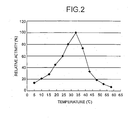
- an example of another different aspect of a preferable mode of the enzyme of the present invention is an enzyme for which the temperature range over which the enzyme is capable of catalyzing the peptide-producing reaction is within the range of 0 to 60°C. Since the enzyme of the present invention is able to catalyze the reaction over a wide temperature range, it is preferable in that it allows flexible accommodation of industrial production that could be subject to the occurrence of various restrictions. However, in the actual production of peptides, it is preferable to use the enzyme by further adjusting to an optimum temperature corresponding to the acquired enzyme so as to maximize the catalytic performance of the enzyme.
- the method for producing a dipeptide according to the present invention comprises synthesizing a dipeptide by allowing an enzyme having the ability to produce a peptide from a carboxy component and an amine component or a substance that contains that enzyme to act on the carboxy component and the amine component.
- the enzyme or enzyme-containing substance, carboxy component and amine component be mixed. More specifically, a method may be used in which an enzyme or enzyme-containing substance is added to a solution containing the carboxy component and the amine component and allowed to react, or in the case of using a microbe that produces the enzyme, a method may be used in which the microbe that produces the enzyme is cultured, the enzyme present in the microbe or microbial culture broth is purified and accumulated, and the carboxy component and amine component are then added to the culture broth. The synthesized dipeptide can then be collected by established methods and purified as necessary.
- enzyme-containing substance refers to that which contains the enzyme, and examples of specific forms thereof include a culture of microbes that produce the enzyme, microbial cells isolated from the culture, and a treated microbial cell product.
- a culture of microbes refers to that which is obtained by culturing microbes, and more specifically, to a mixture of microbial cells, medium used for culturing the microbes, and substances produced by the cultured microbes and the like.
- the microbial cells may be washed and used in the form of washed microbial cells.
- a treated microbial cell product includes the crushed, lysed or freeze-dried microbial cells, and also includes a crude enzyme recovered by processing microbial cells and so forth as well as a purified enzyme obtained by purification of the crude enzyme.
- a partially purified enzyme obtained by various types of purification methods may be used for the purified enzyme, or immobilized enzyme may be used that has been immobilized by covalent bonding, adsorption or entrapment methods.
- the culture supernatant may also be used as the enzyme-containing substance in such cases.
- microbes not only wild strains but also genetic recombinant strains may be used for the microbes that contain the enzyme.
- the microbes are not limited to intact cells, but rather acetone-treated microbial cells, freeze-dried microbial cells or other treated microbial cells may also be used.
- Immobilized microbial cells immobilized by covalent bonding, adsorption, entrapment or other methods, as well as treated immobilized microbial cells, may also be used.
- a metal protease inhibitor like ethylenediaminetetraacetic acid (EDTA) depending on the cases.
- the addition amount is within the range of 0.1 mM to 300 mM, and preferably 1 mM to 100 mM.
- the amount of enzyme or enzyme-containing substance used should be an amount at which the target effect is demonstrated (hereinafter, "effective amount"). Although this effective amount can be easily determined through simple, preliminary experimentation by a person with ordinary skill in the art, in the case of using an enzyme, for example, the use amount thereof is about 0.01 to 100 units (U), while in the case of using washed microbial cells, the use amount thereof is about 1 to 500 g/L.
- Any carboxy component may be used provided that it is capable of producing a peptide by condensation with the other substrate in the form of the amine component.
- the carboxy components include L-amino acid esters, D-amino acid esters, L-amino acid amides and D-amino acid amides.
- the amino acid esters include not only amino acid esters corresponding to naturally-occurring amino acids, but also amino acid esters corresponding to non-naturally-occurring amino acids or their derivatives.
- examples of the amino acid esters include ⁇ -amino acid esters as well as ⁇ -, ⁇ - and ⁇ -amino acid esters and the like, which having different amino group bonding sites.
- amino acid esters include methyl esters, ethyl esters, n-propyl esters, iso-propyl esters, n-butyl esters, iso-butyl esters and tert-butyl esters of amino acids.
- Any amine component may be used provided that it is capable of producing peptide by condensation with the other substrate in the form of the carboxy component.
- the amine components include L-amino acids, C-protected L-amino acids, D-amino acids, C-protected D-amino acids and amines.
- examples of the amines include not only naturally-occurring amines, but also non-naturally-occurring amines or their derivatives.
- the amino acids include not only naturally-occurring amino acids, but also non-naturally-occurring amino acids or their derivatives. These include ⁇ -amino acids as well as ⁇ -, ⁇ - or ⁇ -amino acids, which have different amino group bonding sites.
- the concentrations of the carboxy component and amine component serving as starting materials are 1 mM to 10 M, and preferably 0.05 mole (hereinafter, "M") to 2 M, respectively, there are cases in which it is preferable to add the amine component in an amount equal to or greater than that of the carboxy component.
- M 0.05 mole
- these can be adjusted to a concentration that does not result in inhibition and successively added during the reaction.
- the reaction temperature that allows production of a peptide is 0 to 60°C, and preferably 5 to 40°C.
- the reaction pH that allows production of a peptide is 6.5 to 10.5, and preferably 7.0 to 10.0.
- Example 1 Microbe Culturing ( Empedobacter brevis Strain FERM BP-8113)
- g glucose, 5 g of ammonium sulfate, 1 g of monopotassium phosphate, 3 g of dipotassium phosphate, 0.5 g of magnesium sulfate, 10 g of yeast extract and 10 g of peptone in 1 liter (hereinafter, "L”) was transferred to a 500 mL Sakaguchi flask and sterilized at 115°C for 15 minutes.
- This medium was then inoculated with one loopful of the culture broth of Empedobacter brevis strain FERM BP-8113 (Depositary institution: National Institute for Advanced Industrial Science and Technology, International Patent Organism Depositary, Address of depositary institution: Chuo Dai-6, 1-1 Higashi 1-Chome, Tsukuba-shi, lbaraki-ken, Japan, International deposit transfer date: July 8, 2002) that had been cultured at 30°C for 16 hours in the same medium, followed by shake culturing at 30°C for 16 hours and 120 strokes/min.
- Empedobacter brevis strain FERM BP-8113 Depositary institution: National Institute for Advanced Industrial Science and Technology, International Patent Organism Depositary, Address of depositary institution: Chuo Dai-6, 1-1 Higashi 1-Chome, Tsukuba-shi, lbaraki-ken, Japan, International deposit transfer date: July 8, 2002
- Microbial cells were collected by centrifuging (10,000 rounds per minute (hereinafter, "rpm"), 15 minutes) the culture broth obtained in Example 1 followed by suspending to a concentration of 100 g/L in 100 mM borate buffer (pH 9.0) containing 10 mM EDTA. After respectively adding 1 mL of this suspension to 1 mL of 100 mM borate buffer (pH 9.0) containing 10 mM EDTA, 200 mM of the following carboxy component and 400 mM of the following amino acids to bring to a final volume of 2 mL, the reaction was carried out at 18°C for 2 hours. The peptides that were produced as a result of this reaction are shown in Table 1.
- Empedobacter brevis strain FERM BP-8113 (Depositary institution: National Institute for Advanced Industrial Science and Technology, International Patent Organism Depositary, Address of depositary institution: Chuo Dai-6, 1-1 Higashi 1-Chome, Tsukuba-shi, Ibaraki-ken,, Japan, International deposit transfer date: July 8, 2002) was cultured in the same manner in as Example 1, and the microbial cells were collected by centrifugal separation (10,000 rpm, 15 minutes).
- the resulting soluble fraction was applied to a Q-Sepharose HP column (manufactured by Amersham) pre-equilibrated with Tris-HCl buffer (pH 8.0), and the active fraction was collected from the non-adsorbed fraction. This active fraction was dialyzed overnight against 50 mM acetate buffer (pH 4.5) followed by removal of the insoluble fraction by centrifugal separation (10,000 rpm, 30 minutes) to obtain a dialyzed fraction in the form of the supernatant liquid.
- This dialyzed fraction was then applied to a Mono S column (manufactured by Amersham) pre-equilibrated with 50 mM acetate buffer (pH 4.5) to elute enzyme at a linear concentration gradient of the same buffer containing 0 to 1 M NaCl.
- the fraction that had the lowest level of contaminating protein among the active fractions was applied to a Superdex 200pg column (manufactured by Amersham) pre-equilibrated with 50 mM acetate buffer (pH 4.5) containing 1 M NaCl, and gel filtration was performed by allowing the same buffer (pH 4.5) containing 1 M NaCl to flow through the column to obtain an active fraction solution.
- the peptide-producing enzyme used in the present invention was confirmed to have been uniformly purified based on the experimental results of electrophoresis.
- the enzyme recovery rate in the aforementioned purification process was 12.2% and the degree of purification was 707 times.
- a 0.3 microgram ( ⁇ g) of the purified enzyme fraction obtained by the method of Example 3 was applied to polyacrylamide electrophoresis.
- 0.3% (w/v) Tris, 1.44% (w/v) glycine and 0.1 % (w/v) sodium laurylsulfate were used for the electrophoresis buffer solution, a gel having a concentration gradient of a gel concentration of 10 to 20% (Multigel 10 to 20, manufactured by Daiichi Pure Chemicals) was used for the polyacrylamide gel, and Pharmacia molecular weight markers were used for the molecular weight markers.
- the gel was stained with Coomassie brilliant blue R-250, and a uniform band was detected at the location of a molecular weight of about 75 kilodalton (hereinafter, "kDa").
- the purified enzyme fraction obtained by the method of Example 3 was applied to a Superdex 200pg column (manufactured by Amersham) pre-equilibrated with 50 mM acetate buffer (pH 4.5) containing 1 M NaCl, and gel filtration was carried out by allowing the same buffer (pH 4.5) containing 1 M NaCl to flow through the column to measure the molecular weight.
- Pharmacia molecular weight markers were used as standard proteins having known molecular weights to prepare a calibration curve. As a result, the molecular weight of the enzyme was about 150 kDa.
- the enzyme was suggested to be a homodimer having a molecular weight of about 75 kDa.
- the enzyme activity under each condition was indicated as the relative activity in the case of assigning a value of 100 to the production of L-alanyl-L-glutamine in the absence of enzyme inhibitor. Those results are shown in Table 2. As a result, among the serine enzyme inhibitors tested, the enzyme was not inhibited by phenylmethylsulfonyl fluoride, but it was inhibited by p-nitrophenyl-p'-guanidinobenzoate.
- Enzyme inhibitor Relative activity of L-Ala-L-Gln production (%) None 100 Metal enzyme inhibitor EDTA 96 o-Phenanthroline 96 SH enzyme inhibitor N-Ethyl maleimide 110 Monoiodoacetate 101 Serine enzyme inhibitor Phenylmethylsulfonyl fluoride 115 4-(2-Aminoethyl)benzene sulfonyl fluoride 75 p-Nitrophenyl-p'-guanidino benzoate 0.1
- Carboxy component L-Ala-L-Gln produced (mM) L-Alanine methyl ester ⁇ HCl 84.3 L-Alanine ethyl ester ⁇ HCl 91.5 L-Alanine isopropyl ester ⁇ HCl 78.9 L-Alanine-t-butyl ester ⁇ HCl 7.5
- Tween-80 was added to the reaction system to a final concentration of 0.1% in the case of using L-Trp-OMe and L-Tyr-OMe.
- Tween-80 was added to the reaction system to a final concentration of 0.1 % in the case of using L-Trp-OMe. (The "+” mark indicates those peptides for which production was confirmed but which were unable to be quantified due to the absence of a standard.)
- Carboxy component Amine component Produced peptide (mM) L-Ala-OMe Gly-NH 2 L-Ala-Gly-NH 2 7.4 L-Ala-NH 2 L-Ala-L-Ala-NH 2 8.3 L-Phe-NH 2 L-Ala-L-Phe-NH 2 12.2
- Oligopeptide production was examined in the case of using L-amino acid ester for the carboxy component and peptide for the amine component.
- a 2 ⁇ l aliquot of the same enzyme fraction as used in Example 5 was added to 100 ⁇ l of 100 mM borate buffer (pH 9.0) containing the carboxy components shown in Table 13 at 100 mM, the amine components shown in Table 13 at 150 mM and 10 mM EDTA, and allowed to react at 25°C for 3 hours.
- the amounts of each of the peptides produced in this reaction are shown in Table 13.
- the present enzyme can produce not only dipeptide, but also long-chain peptides by using a peptide for the amine component.
- the present enzyme obtained from Empedobacter brevis strain FERM P BP-8113 (Depositary institution: National Institute for Advanced Industrial Science and Technology, International Patent Organism Depositary, Address of depositary institution: Chuo Dai-6, 1-1 Higashi 1-Chome, Tsukuba-shi, Ibaraki-ken, Japan, International deposit transfer date: July 8, 2002) was determined to have an extremely broad substrate specificity.
- the peptide formation ability of the present enzyme was compared with that of known enzymes.
- Carboxypeptidase Y described in EP 278787A1 and the thiol endopeptidases (ficin, papain, bromelain and chymopapain) described in EP 359399B1 were used for the known enzymes, and they were used in the form of purified enzymes manufactured by Sigma.
- the enzyme uniformly purified in Example 3 was used for the source of the enzyme of the present invention. These enzymes were added to a reaction system in the amounts shown in Table 14 as protein.
- the reaction was carried out by adding enzyme to 100 ⁇ l of borate buffer (pH 9.0) containing 100 mM L-alanine methyl ester and 200 mM L-glutamine and allowing to react at 25°C. Furthermore, enzyme dissolved in 10 mM acetate buffer (pH 5.0) containing 1 mM EDTA was used for the carboxypeptidase, while enzyme dissolved in 10 mM acetate buffer (pH 5.0) containing 2 mM EDTA, 0.1 M KCI and 5 mM dithiothreitol was used for the thiol endopeptidase. The ratios of the production rates of L-alanyl-L-glutamine by these enzymes are shown in Table 14.
- the enzyme of the present invention being a dimer having a molecular weight of about 75,000
- the molecular weight of carboxypeptidase Y has been reported to be about 61,000
- that of thiol endopeptidase has been reported to be about 23,000 to 36,000
- the L-alanyl-L-glutamine production rate per molecular weight is even greater for the enzyme of the present invention than that per unit weight indicated in the examples.
- Enzyme Amount of enzyme added protein mg/ml
- L-Ala-L-Gln production rate mM/min
- Ratio of L-Ala-L-Gln production rate per enzyme unit weight No enzyme 0 0.0006
- Ficin 2.60 0.0096 0.0017 Papain 2.30 0.0106 0.0021
- Chymopapain 3.60 0.0100 0.0013
- Enzyme of present invention 0.02 4.4000 100.0
- a 50 ml medium (pH 7.0) containing 5 g of glucose, 5 g of ammonium sulfate, 1 g of monopotassium phosphate, 3 g of dipotassium phosphate, 0.5 g of magnesium sulfate, 10 g of yeast extract and 10 g of peptone in 1 L was transferred to a 500 mL Sakaguchi flask and sterilized at 115°C for 15 minutes for culturing Sphingobacterium sp.
- strain FERM BP-8124 (Depositary institution: National Institute for Advanced Industrial Science and Technology, International Patent Organism Depositary, Address of depositary institution: Chuo Dai-6, 1-1 Higashi 1-Chome, Tsukuba-shi, Ibaraki-ken, Japan, International deposit date: July 22, 2002). This medium was then inoculated with one loopful of Sphingobacterium sp.
- strain FERM BP-8124 (Depositary institution: National Institute for Advanced Industrial Science and Technology, International Patent Organism Depositary, Address of depositary institution: Chuo Dai-6, 1-1 Higashi 1-Chome, Tsukuba-shi, Ibaraki-ken, Japan, International deposit date: July 22, 2002) cultured at 30°C for 24 hours in a slant agar medium (agar: 20 g/L, pH 7.0) containing 5 g of glucose, 10 g of yeast extract, 10 g of peptone and 5 g of NaCl in 1 L, followed by shake culturing at 30°C for 20 hours and 120 strokes/minute.
- a slant agar medium agar: 20 g/L, pH 7.0
- Sphingobacterium sp. strain FERM BP-8124 (Depositary institution: National Institute for Advanced Industrial Science and Technology, International Patent Organism Depositary, Address of depositary institution: Chuo Dai-6, 1-1 Higashi 1-Chome, Tsukuba-shi, Ibaraki-ken, Japan, International deposit date: July 22, 2002) was cultured in the same manner as Example 21, and the microbial cells were collected by centrifugal separation (10,000 rpm, 15 minutes).
- the resulting soluble fraction was applied to a Q-Sepharose HP column (manufactured by Amersham) pre-equilibrated with Tris-HCl buffer (pH 7.6), and the active fraction was collected from the non-adsorbed fraction.
- This active fraction was dialyzed overnight against 20 mM acetate buffer (pH 5.0) followed by removal of the insoluble fraction by centrifugal separation (10,000 rpm, 30 minutes) to obtain a dialyzed fraction in the form of the supernatant liquid.
- This dialyzed fraction was then applied to an SP-Sepharose HP column (manufactured by Amersham) pre-equilibrated with 20 mM acetate buffer (pH 5.0) to obtain the active fraction in which enzyme was eluted at a linear concentration gradient of the same buffer containing 0 to1 M NaCl.
- Substrate specificity was examined for enzyme derived from Sphingobacterium sp. strain FERM BP-8124 (Depositary institution: National Institute for Advanced Industrial Science and Technology, International Patent Organism Depositary, Address of depositary institution: Central. 6, 1-1-1 Higashi, Tsukuba City, Ibaraki Prefecture, Japan, International deposit date: July 22, 2002).
- Substrate specificity with respect to oligopeptide production was examined for enzyme derived from Sphingobacterium sp. strain FERM BP-8124 (Depositary institution: National Institute for Advanced Industrial Science and Technology, International Patent Organism Depositary, Address of depositary institution: Chuo Dai-6, 1-1 Higashi 1-Chome, Tsukuba-shi, Ibaraki-ken, Japan, International deposit date: July 22, 2002).
- Substrate specificity was additionally assessed using the same enzyme fraction as that used in Example 5.
- reaction solutions consisting of 100 mM borate buffer (pH 9.0) containing each of the carboxy components and amine components at the final concentrations shown in Table 17, enzyme (addition of 0.1 unit in reaction solution) and 10 mM EDTA were allowed to react at 25°C for the reaction times shown in Table 17.
- the amounts of each of the peptides produced in the reactions are shown in Table 17. (A "+” mark indicates those for which production was confirmed but which were unable to be quantified due to the absence of a standard, while "tr" indicates a trace amount).
- Substrate specificity with respect to oligopeptide production was assessed using the same enzyme fraction as Example 26.
- a 100 ⁇ l aliquot of reaction solutions consisting of 100 mM borate buffer (pH 9.0) containing each of the carboxy components and amine components at the final concentrations shown in Table 18, enzyme (the numbers of units added to the reaction solution are described in Table 18) and 10 mM EDTA were allowed to react at 25°C for 3 hours.
- the amounts of each of the oligopeptides produced in the reactions are shown in Table 18. (A "+" mark indicates those for which production was confirmed but which were unable to be quantified due to the absence of a standard, while "tr" indicates a trace amount). It should be noted that hydrochlorides were used for all of the carboxy components.
- the present invention provides a novel enzyme with which a peptide can be produced easily, inexpensively and at high yield by mitigating use of complex synthesis methods such as introduction and elimination of protecting groups.
- the use of the enzyme of the present invention enables efficient industrial production of peptides.
Landscapes
- Chemical & Material Sciences (AREA)
- Organic Chemistry (AREA)
- Life Sciences & Earth Sciences (AREA)
- Health & Medical Sciences (AREA)
- Genetics & Genomics (AREA)
- General Health & Medical Sciences (AREA)
- Biochemistry (AREA)
- Molecular Biology (AREA)
- Medicinal Chemistry (AREA)
- Proteomics, Peptides & Aminoacids (AREA)
- Biophysics (AREA)
- Engineering & Computer Science (AREA)
- Wood Science & Technology (AREA)
- Zoology (AREA)
- Bioinformatics & Cheminformatics (AREA)
- Biotechnology (AREA)
- General Engineering & Computer Science (AREA)
- Microbiology (AREA)
- Biomedical Technology (AREA)
- Chemical Kinetics & Catalysis (AREA)
- General Chemical & Material Sciences (AREA)
- Tropical Medicine & Parasitology (AREA)
- Virology (AREA)
- Preparation Of Compounds By Using Micro-Organisms (AREA)
- Enzymes And Modification Thereof (AREA)
- Micro-Organisms Or Cultivation Processes Thereof (AREA)
- Peptides Or Proteins (AREA)
Abstract
The present invention relates to a novel enzyme that allows
peptide to be produced easily, inexpensively and at high yield without
going through a complex synthesis method. More particularly, the
present invention provides a novel enzyme that catalyzes a
peptide-producing reaction from a carboxy component and an amine
component, a microbe that produces the enzyme, and a method for
inexpensive production of peptides using this enzyme or microbe. The
novel enzyme that efficiently produces peptide was discovered from a
newly discovered microbe belonging to the genus Empedobacter, and a
method was found that allows peptides to be produced inexpensively
and easily.
Description
The present invention relates to a novel enzyme that can
produce a peptide easily, inexpensively and at high yield without going
through a complex synthesis method. More particularly, the present
invention relates to a novel enzyme that catalyzes a peptide-producing
reaction from a carboxy component and an amine component, to a
microbe that produces the enzyme, and a method for producing a
dipeptide using the enzyme or microbe.
Peptides are used in the fields of pharmaceuticals, foods and
various other fields. For example, since L-alanyl-L-glutamine has
higher stability and water-solubility than L-glutamine, it is widely used
as a component of fluid infusion and serum-free media.
Chemical synthesis methods, which have been known as
methods for producing peptides, are not always easy. Known
examples of such methods include a method that uses
N-benzyloxycarbonylalanine (hereinafter, "Z-alanine") and protected
L-glutamine (see Bull. Chem. Soc. Jpn., 34, 739 (1961), Bull. Chem.
Soc. Jpn., 35, 1966 (1962)), a method that uses Z-alanine and
protected L-glutamic acid-γ-methyl ester (see Bull. Chem. Soc. Jpn., 37,
200 (1964)), a method that uses Z-alanine ester and unprotected
glutamic acid (see Japanese Patent Application Laid-open Publication
No. H1-96194), a method that involves synthesis of an
N-(2-substituted)-propionyl glutamine derivative as an intermediate from
a 2-substituted-propionyl halide as a raw material (see Patent
Application Laid-open Publication No. H6-234715).
However, since all of these methods require the introduction and
elimination of protecting groups or the use of an optically active
intermediate, they are not considered to be adequately satisfactory in
terms of their industrial advantages.
On the other hand, widely known examples of typical peptide
production methods using enzymes consist of a condensation reaction
that uses an N-protected and C-unprotected carboxy component and an
N-unprotected, C-protected amine component (hereinafter, "Reaction
1"), and a substitution reaction that uses an N-protected, C-protected
carboxy component and an N-unprotected, C-protected amine
component (hereinafter, "Reaction 2"). An example of Reaction 1 is a
method for producing Z-aspartylphenylalanine methyl ester from
Z-aspartic acid and phenylalanine methyl ester (see Japanese Patent
Application Laid-open Publication No. S53-92729), while an example of
Reaction 2 is a method for producing acetylphenylalanylleucine amide
from acetylphenylalanine ethyl ester and leucine amide (see
Biochemical J., 163, 531 (1977)). There have been reported very few
research examples of methods that use an N-unprotected, C-protected
carboxy component. An example of a substitution reaction that uses an
N-unprotected, C-protected carboxy component and an N-unprotected,
C-protected amine component (hereinafter, "Reaction 3") is described in
International Patent Publication WO 90/01555. For example, a method
for producing arginylleucine amide from arginine ethyl ester and leucine
amide may be mentioned of. Examples of substitution reactions that
use an N-unprotected, C-protected carboxy component and an
N-unprotected, C-unprotected amine component (hereinafter, "Reaction
4") are described in European Patent Publications EP 278787A1 and
EP 359399B1. For example, a method for producing tyrosylalanine
from tyrosine ethyl ester and alanine may be mentioned of.
The most inexpensive production method among the
aforementioned methods of Reactions 1 to 4 naturally falls within the
class of Reaction 4, which involves the fewest protecting groups.
However, the example of Reaction 4 of the prior art (European
Patent Publication EP 278787A1) had the following major problems:
It is an object of the present invention is to provide a novel
enzyme that can produce a peptide easily, inexpensively and at high
yield without going through a complex synthesis method. More
particularly, it is an object of the present invention to provide a novel
enzyme that catalyzes a peptide-producing reaction from a carboxy
component and an amine component, a microbe that produces the
enzyme, and a method for inexpensively producing peptide using the
enzyme or microbe.
As a result of conducting extensive research in consideration of
the above object, the inventors of the present invention have found a
novel enzyme that efficiently produces peptide from newly discovered
bacteria belonging to the genus Empedobacter and so forth, and have
completed the present invention.
Namely, the present invention is as described below.
Modes for carrying out the present invention are explained in
detail in the order of
The enzyme of the present invention may be any enzyme that
has the ability to produce a peptide from a carboxy component and an
amine component, and there are no particular restriction on organisms
that produce such an enzyme. In the present specification, the
carboxy component refers to the component that provides a carbonyl
site (CO) in the peptide bond (-CONH-), while the amine component
refers to the component that provides the amino site (NH) in the peptide
bond. In addition, in the present specification, the term "peptide"
used alone refers to a polymer having at least one or more peptide
bonds unless otherwise indicated specifically. In addition, the term
"dipeptide" in the present specification refers to a peptide having one
peptide bond.
Examples of microbes that produce the enzyme of the present
invention include bacteria belonging to the genus Empedobacter and so
forth, specific examples of which include Empedobacter brevis strain
ATCC 14234 (strain FERM P-18545), and Sphingobacterium sp. strain
FERM BP-8124. Empedobacter brevis strain ATCC 14234 (strain
FERM P-18545, strain FERM BP-8113) and Sphingobacterium sp. strain
FERM BP-8124 are microbes that were screened by the inventors of the
present invention as a result of searching for microbes that produce a
peptide from a carboxy component and an amine component at high
yield. Microbes having similar bacteriological properties to those of
Empedobacter brevis strain ATCC 14234 (strain FERM P-18545) or
Sphingobacterium sp. strain FERM BP-8124 are also microbes that
produce the enzyme of the present invention.
Empedobacter brevis strain ATCC 14234 (strain FERM P-18545)
was deposited at the International Patent Organism Depository of the
National Institute for Advanced Industrial Science and Technology
(Central 6, 1-1 Higashi, Tsukuba City, Ibaraki Prefecture, Japan) on
October 1, 2001 and assigned the deposit number of FERM P-18545.
Control of this organism was subsequently transferred to deposition
under the provisions of the Budapest Treaty at the International Patent
Organism Depositary of the National Institute for Advanced Industrial
Science and Technology on July 8, 2002 and was assigned the deposit
number of FERM BP-8113 (indication of microbe: Empedobacter brevis
strain AJ 13933).
Sphingobacterium sp. strain AJ 110003 was deposited at the
International Patent Organism Depositary of the National Institute for
Advanced Industrial Science and Technology on July 22, 2002, and was
assigned the deposit number of FERM BP-8124. It should be noted
that strain AJ 110003 was identified to be the aforementioned
Sphingobacterium sp. by the identification experimentation described
below. Strain FERM BP-8124 (Depositary institution: National Institute
for Advanced Industrial Science and Technology, International Patent
Organism Depositary, Address of depositary institution: Chuo Dai-6, 1-1
Higashi 1-Chome, Tsukuba-shi, Ibaraki-ken,, Japan, International
deposit date: July 22, 2002) is a Gram-negative rod (0.7 to 0.8 × 1.5 to
2.0 micrometers (hereinafter, "µm"))that does not form spores and is not
motile. Its colonies are round with a completely smooth border,
contain low protrusions and have a glossy, light yellow color. The
organism grows at 30°C and is catalase positive, oxidase positive and
negative for the OF test (glucose), and was identified as a bacterium
belonging to the genus Sphingobacterium based on these properties.
Moreover, from the properties of being negative for nitrate reduction,
negative for indole production, negative for production from glucose,
arginine dihydrolase negative, urease positive, esculin hydrolysis
positive, gelatin hydrolysis negative, β-galactosidase positive, glucose
assimilation positive, L-arabinose assimilation negative, D-mannose
assimilation positive, D-mannitol assimilation negative,
N-acetyl-D-glucosamine assimilation positive, maltose assimilation
positive, potassium gluconate assimilation negative, n-capric acid
negative, adipic acid assimilation negative, dl-malic acid assimilation
negative, sodium citrate assimilation negative, phenyl acetate
assimilation negative and cytochrome oxidase positive, the microbe was
determined to have properties that are similar to those of
Sphingobacterium multivorum or Sphingobacterium spiritivorum.
Moreover, as a result of analyzing homology of the base sequence of
16S rRNA gene, although the highest degree of homology was exhibited
with Sphingobacterium multivorum (98.8%), there was no strain with
which it matched completely. This bacterial strain was therefore
identified as Sphingobacterium sp.
The enzyme of the present invention can be obtained by
isolating and purifying from the cells of the above-mentioned
Empedobacter brevis or Sphingobacterium sp. In addition, the enzyme
of the present invention as well as microbes that produce the enzyme
can also be obtained by genetic engineering techniques based on the
isolated enzyme. Namely, the enzyme and microbe of the present
invention can be produced by isolating a DNA that encodes the enzyme
of the present invention based on the isolated and purified enzyme
followed by expressing the DNA by introducing the DNA into a suitable
host. In addition, an enzyme having the ability to produce a peptide
from a carboxy component and an amine component can also be
obtained from other microbes by producing a probe based on a
polynucleotide and so forth that encodes the enzyme of the present
invention obtained from Empedobacter brevis. Various gene
recombination techniques are described in Molecular Cloning, 2nd
edition, Cold Spring Harbor Press (1989) and other publications.
In order to obtain cultured cells of microbes having the enzyme
used in the present invention, it suffices that the microbes be cultured
and grown in a suitable medium. There are no particular restrictions
on the medium used for this purpose provided that it is allows the
microbes to grow. This medium may be an ordinary medium
containing ordinary carbon sources, nitrogen sources, phosphorus
sources, sulfur sources, inorganic ions, and organic nutrient sources as
necessary.
For example, any carbon source may be used provided that the
microbes can utilize it. Specific examples of the carbon source that can
be used include sugars such as glucose, fructose, maltose and amylose,
alcohols such as sorbitol, ethanol and glycerol, organic acids such as
fumaric acid, citric acid, acetic acid and propionic acid and their salts,
hydrocarbons such as paraffin as well as mixtures thereof.
Examples of nitrogen sources that can be used include
ammonium salts of inorganic salts such as ammonium sulfate and
ammonium chloride, ammonium salts of organic acids such as
ammonium fumarate and ammonium citrate, nitrates such as sodium
nitrate and potassium nitrate, organic nitrogen compounds such as
peptones, yeast extract, meat extract and corn steep liquor as well as
mixtures thereof.
In addition, ordinary nutrient sources used in media, such as
inorganic salts, trace metal salts and vitamins, can also be suitably
mixed and used.
There are no particular restrictions on culturing conditions, and
culturing can be carried out, for example, for about 12 to about 48
hours while properly controlling the pH and temperature to a pH range
of 5 to 8 and a temperature range of 15 to 40°C, respectively, under
aerobic conditions.
A method for isolating and purifying a peptide-producing enzyme
from Empedobacter brevis is explained as an example of purifying the
enzyme of the present invention. First, a microbial cell extract is
prepared from the cells of, for example, Empedobacter brevis strain
FERM BP-8113 (Depositary institution: National Institute for Advanced
Industrial Science and Technology, International Patent Organism
Depositary, Address of deposited institution: Central 6, 1-1-1 Higashi,
Tsukuba City, Ibaraki Prefecture, Japan, International deposit transfer
date: July 8, 2002) by disrupting the cells using a physical method such
as ultrasonic crushing or an enzymatic method using a cell
wall-dissolving enzyme and removing the insoluble fraction by
centrifugal separation and so forth.
A peptide-producing enzyme can then be purified from the cell
extract obtained in the above manner by combining ordinary protein
purification methods such as anion exchange chromatography, cation
exchange chromatography or gel filtration chromatography.
An example of a carrier for use in anion exchange
chromatography is Q-Sepharose HP (manufactured by Amersham).
The enzyme is recovered in the non-adsorbed fraction under conditions
of pH 8.5 when the cell extract containing the enzyme is allowed to
pass through a column packed with the carrier.
An example of a carrier for use in cation exchange
chromatography is MonoS HR (manufactured by Amersham). After
adsorbing the enzyme onto the carrier (in the column) by allowing the
cell extract containing the enzyme to pass through a column packed
with the carrier and then washing the column, the enzyme is eluted with
a buffer solution having a high salt concentration. At that time, the salt
concentration may be sequentially increased or gradiently increased.
For example, in the case of using MonoS HR, the enzyme adsorbed
onto the carrier is eluted at an NaCl concentration of about 0.2 to about
0.5 M.
The enzyme purified in the manner described above can then be
further homogeneously purified by gel filtration chromatography and so
forth. An example of the carrier for use in gel filtration chromatography
is Sephadex 200pg (manufactured by Amersham).
The fraction that contains the present enzyme in the
aforementioned purification procedure can be confirmed by assaying
the peptide production activity of each fraction according to the method
described later.
While the enzyme of the present invention is an enzyme that
has the ability to produce a peptide from a carboxy component and an
amine component, a preferable mode of the enzyme of the present
invention will be explained hereinbelow from the standpoint of its
properties.
An enzyme having the abilities described below, for which the
dipeptide production rate is used as an indicator, is one preferable
mode of the enzyme of the present invention. Namely, a preferable
mode of the enzyme of the present invention is an enzyme that has the
ability to produce a peptide from a carboxy component and an amine
component, and the ability to exhibit a production rate of
L-alanyl-L-glutamine of preferably 0.03 mM/min or more, more
preferably 0.3 mM/min or more, and particularly preferably 1.0 mM/min
or more in the dipeptide-producing reaction under the conditions of (i) to
(iv) below. The conditions of the dipeptide-producing reaction are as
follows:
The aforementioned amount of enzyme added indicates a final
amount of added enzyme that is added to the reaction system, and
addition of the enzyme of 0.01 mg/ml or more, and preferably 0.02
mg/ml or more, as protein amount is desirable. The term "protein
amount" refers to the value indicated with the Coomassie brilliant blue
colorimetric method using protein assay CBB solution (manufactured by
Nakarai) and bovine serum albumin for the standard substance.
The aforementioned production rate far exceeds the
conventional production rate for peptide production using an enzyme,
and the enzyme of the present invention has the ability to catalyze
peptide production at an extremely high rate.
As a specific example of a procedure for assaying enzyme
activity, enzyme activity can be assayed by allowing the enzyme to
react in a borate buffer solution containing an amino acid ester and an
amine as substrates followed by quantifying the resulting peptide. As
a more specific example, the enzyme is allowed to react for several
minutes at 25°C using a 100 mM borate buffer solution (pH 9.0)
containing 100 mM L-alanine methyl ester and 200 mM L-glutamine.
The enzyme activity unit used in the present invention is defined
such that 1 unit (U) is the amount of enzyme that produces 1 micromole
of peptide in 1 minute under the condition of reacting at 25°C using 100
mM borate buffer solution (pH 9.0) containing 100 mM L-alanine methyl
ester and 200 mM L-glutamine.
In addition, an example of a preferable mode of the enzyme of
the present invention is an enzyme having the property by which any of
amino acid ester and amino acid amide can be used as a substrate for
the carboxy component. The wordings "both an amino acid ester and
an amino acid amide can be used as a substrate" mean that at least
one type or more of amino acid ester and at least one type or more of
amino acid amide can be used as a substrate. In addition, one
preferable mode of the enzyme of the present invention is an enzyme
that has the property by which any of an amino acid, a C-protected
amino acid and an amine can be used as a substrate for the amine
component. The wordings "an amino acid, a C-protected amino acid,
and an amine can be used as a substrate" mean that at least one type
or more of amino acid, at least one type or more of C-protected amino
acid and at least one type or more of amine can be used as a substrate.
As a result of having a wide range of substrate specificity with respect
to the carboxy component or the amino component, the enzyme of the
present invention is preferable in the sense that a wide range of raw
materials can be selected, which in turn is favorable in terms of cost
and production equipment in the case of industrial production.
Specific examples of carboxy components include L-amino acid
esters, D-amino acid esters, L-amino acid amides and D-amino acid
amides. In addition, amino acid esters include not only amino acid
esters corresponding to naturally-occurring amino acids, but also amino
acid esters corresponding to non-naturally-occurring amino acids or
their derivatives. Further, examples of amino acid esters include
α-amino acid esters as well as β-, γ-, and ω-amino acid esters and the
like, which have different amino group bonding sites. Typical
examples of amino acid esters include methyl esters, ethyl esters,
n-propyl esters, iso-propyl esters, n-butyl esters, iso-butyl esters and
tert-butyl esters of amino acids, etc.
Specific examples of the amine components include L-amino
acids, C-protected L-amino acids, D-amino acids, C-protected D-amino
acids and amines. In addition, examples of the amines include not
only naturally-occurring amines, but also non-naturally-occurring
amines or their derivatives. In addition, examples of the amino acids
include not only naturally-occurring amino acids, but also
non-naturally-occurring amino acids or their derivatives. These include
α-amino acids as well as β-, γ- or ω-amino acids, which have different
amino group bonding sites.
In addition, in a different aspect, one preferable mode of the
enzyme of the present invention is an enzyme in which the pH range
over which the peptide-producing reaction can be catalyzed is 6.5 to
10.5. The ability of the enzyme of the present invention to catalyze
this reaction over a wide pH range is preferable in that it allows flexible
accommodation of industrial production that could be subject to the
occurrence of various restrictions. However, in the actual production
of peptide, it is preferable to use the enzyme by further adjusting to an
optimum pH corresponding to the acquired enzyme so as to maximize
the catalytic performance of the enzyme.
Moreover, an example of another different aspect of a preferable
mode of the enzyme of the present invention is an enzyme for which the
temperature range over which the enzyme is capable of catalyzing the
peptide-producing reaction is within the range of 0 to 60°C. Since the
enzyme of the present invention is able to catalyze the reaction over a
wide temperature range, it is preferable in that it allows flexible
accommodation of industrial production that could be subject to the
occurrence of various restrictions. However, in the actual production
of peptides, it is preferable to use the enzyme by further adjusting to an
optimum temperature corresponding to the acquired enzyme so as to
maximize the catalytic performance of the enzyme.
The method for producing a dipeptide according to the present
invention comprises synthesizing a dipeptide by allowing an enzyme
having the ability to produce a peptide from a carboxy component and
an amine component or a substance that contains that enzyme to act on
the carboxy component and the amine component.
For the method for allowing the enzyme used in the present
invention or enzyme-containing substance to act on the carboxy
component and the amine component, it suffices that the enzyme or
enzyme-containing substance, carboxy component and amine
component be mixed. More specifically, a method may be used in
which an enzyme or enzyme-containing substance is added to a
solution containing the carboxy component and the amine component
and allowed to react, or in the case of using a microbe that produces
the enzyme, a method may be used in which the microbe that produces
the enzyme is cultured, the enzyme present in the microbe or microbial
culture broth is purified and accumulated, and the carboxy component
and amine component are then added to the culture broth. The
synthesized dipeptide can then be collected by established methods
and purified as necessary.
The term "enzyme-containing substance" refers to that which
contains the enzyme, and examples of specific forms thereof include a
culture of microbes that produce the enzyme, microbial cells isolated
from the culture, and a treated microbial cell product. A culture of
microbes refers to that which is obtained by culturing microbes, and
more specifically, to a mixture of microbial cells, medium used for
culturing the microbes, and substances produced by the cultured
microbes and the like. In addition, the microbial cells may be washed
and used in the form of washed microbial cells. Further, a treated
microbial cell product includes the crushed, lysed or freeze-dried
microbial cells, and also includes a crude enzyme recovered by
processing microbial cells and so forth as well as a purified enzyme
obtained by purification of the crude enzyme. A partially purified
enzyme obtained by various types of purification methods may be used
for the purified enzyme, or immobilized enzyme may be used that has
been immobilized by covalent bonding, adsorption or entrapment
methods. In addition, since some microbes are partially lysed during
culturing depending on the microbes used, the culture supernatant may
also be used as the enzyme-containing substance in such cases.
In addition, not only wild strains but also genetic recombinant
strains may be used for the microbes that contain the enzyme. The
microbes are not limited to intact cells, but rather acetone-treated
microbial cells, freeze-dried microbial cells or other treated microbial
cells may also be used. Immobilized microbial cells immobilized by
covalent bonding, adsorption, entrapment or other methods, as well as
treated immobilized microbial cells, may also be used.
It should be noted that in the case of using cultures, cultured
microbial cells or a treated microbial cell product, there are many cases
in which an enzyme exists that does not participate in production of
peptides but decomposes the produced peptides, and in such cases, it
is rather preferable to add a metal protease inhibitor like
ethylenediaminetetraacetic acid (EDTA) depending on the cases. The
addition amount is within the range of 0.1 mM to 300 mM, and
preferably 1 mM to 100 mM.
The amount of enzyme or enzyme-containing substance used
should be an amount at which the target effect is demonstrated
(hereinafter, "effective amount"). Although this effective amount can be
easily determined through simple, preliminary experimentation by a
person with ordinary skill in the art, in the case of using an enzyme, for
example, the use amount thereof is about 0.01 to 100 units (U), while in
the case of using washed microbial cells, the use amount thereof is
about 1 to 500 g/L.
Any carboxy component may be used provided that it is capable
of producing a peptide by condensation with the other substrate in the
form of the amine component. Examples of the carboxy components
include L-amino acid esters, D-amino acid esters, L-amino acid amides
and D-amino acid amides. Examples of the amino acid esters include
not only amino acid esters corresponding to naturally-occurring amino
acids, but also amino acid esters corresponding to
non-naturally-occurring amino acids or their derivatives. In addition,
examples of the amino acid esters include α-amino acid esters as well
as β-, γ- and ω-amino acid esters and the like, which having different
amino group bonding sites. Typical examples of the amino acid esters
include methyl esters, ethyl esters, n-propyl esters, iso-propyl esters,
n-butyl esters, iso-butyl esters and tert-butyl esters of amino acids.
Any amine component may be used provided that it is capable
of producing peptide by condensation with the other substrate in the
form of the carboxy component. Examples of the amine components
include L-amino acids, C-protected L-amino acids, D-amino acids,
C-protected D-amino acids and amines. In addition, examples of the
amines include not only naturally-occurring amines, but also
non-naturally-occurring amines or their derivatives. Examples of the
amino acids include not only naturally-occurring amino acids, but also
non-naturally-occurring amino acids or their derivatives. These include
α-amino acids as well as β-, γ- or ω-amino acids, which have different
amino group bonding sites.
Although the concentrations of the carboxy component and
amine component serving as starting materials are 1 mM to 10 M, and
preferably 0.05 mole (hereinafter, "M") to 2 M, respectively, there are
cases in which it is preferable to add the amine component in an
amount equal to or greater than that of the carboxy component. In
addition, in the case of substrates that inhibit the reaction at high
concentrations, these can be adjusted to a concentration that does not
result in inhibition and successively added during the reaction.
The reaction temperature that allows production of a peptide is 0
to 60°C, and preferably 5 to 40°C. The reaction pH that allows
production of a peptide is 6.5 to 10.5, and preferably 7.0 to 10.0.
Although the following provides a more detailed explanation of
the present invention through its examples, the present invention is not
limited to these examples. In addition to confirmation by ninhydrin
coloring of thin-film chromatograms (qualitative), quantitative
determinations were made by the following high-performance liquid
chromatography in order to assay products. Column: InertsiL ODS-2
(manufactured by GL Science, Inc.), eluate: aqueous phosphate
solution containing 5.0 mM sodium 1-octanesulfonate (pH 2.1) :
methanol = 100 : 15 to 50, flow rate: 1.0 mL/min, detection: 210
nanometers (hereinafter, "nm").
A 50 mL medium (pH 6.2) containing 5 grams (hereinafter, "g")
of glucose, 5 g of ammonium sulfate, 1 g of monopotassium phosphate,
3 g of dipotassium phosphate, 0.5 g of magnesium sulfate, 10 g of
yeast extract and 10 g of peptone in 1 liter (hereinafter, "L") was
transferred to a 500 mL Sakaguchi flask and sterilized at 115°C for 15
minutes. This medium was then inoculated with one loopful of the
culture broth of Empedobacter brevis strain FERM BP-8113 (Depositary
institution: National Institute for Advanced Industrial Science and
Technology, International Patent Organism Depositary, Address of
depositary institution: Chuo Dai-6, 1-1 Higashi 1-Chome, Tsukuba-shi,
lbaraki-ken, Japan, International deposit transfer date: July 8, 2002)
that had been cultured at 30°C for 16 hours in the same medium,
followed by shake culturing at 30°C for 16 hours and 120 strokes/min.
Microbial cells were collected by centrifuging (10,000 rounds per
minute (hereinafter, "rpm"), 15 minutes) the culture broth obtained in
Example 1 followed by suspending to a concentration of 100 g/L in 100
mM borate buffer (pH 9.0) containing 10 mM EDTA. After respectively
adding 1 mL of this suspension to 1 mL of 100 mM borate buffer (pH
9.0) containing 10 mM EDTA, 200 mM of the following carboxy
component and 400 mM of the following amino acids to bring to a final
volume of 2 mL, the reaction was carried out at 18°C for 2 hours. The
peptides that were produced as a result of this reaction are shown in
Table 1.

The procedure after centrifugal separation was carried out either
on ice or at 4°C. Empedobacter brevis strain FERM BP-8113
(Depositary institution: National Institute for Advanced Industrial
Science and Technology, International Patent Organism Depositary,
Address of depositary institution: Chuo Dai-6, 1-1 Higashi 1-Chome,
Tsukuba-shi, Ibaraki-ken,, Japan, International deposit transfer date:
July 8, 2002) was cultured in the same manner in as Example 1, and
the microbial cells were collected by centrifugal separation (10,000 rpm,
15 minutes). After washing 16 g of microbial cells with 50 mM Tris-HCl
buffer (pH 8.0), they were suspended in 40 milliliters (hereinafter, "ml"
or "mL") of the same buffer and subjected to ultrasonic crushing
treatment for 45 minutes at 195 watts. This ultrasonic crushing liquid
was then centrifuged (10,000 rpm, 30 minutes) to remove the crushed
cell fragments and obtain an ultrasonic crushing liquid supernatant.
This ultrasonic crushing liquid supernatant was dialyzed overnight
against 50 mM Tris-HCl buffer (pH 8.0) followed by removal of the
insoluble fraction by ultracentrifugation (50,000 rpm, 30 minutes) to
obtain a soluble fraction in the form of the supernatant liquid. The
resulting soluble fraction was applied to a Q-Sepharose HP column
(manufactured by Amersham) pre-equilibrated with Tris-HCl buffer (pH
8.0), and the active fraction was collected from the non-adsorbed
fraction. This active fraction was dialyzed overnight against 50 mM
acetate buffer (pH 4.5) followed by removal of the insoluble fraction by
centrifugal separation (10,000 rpm, 30 minutes) to obtain a dialyzed
fraction in the form of the supernatant liquid. This dialyzed fraction
was then applied to a Mono S column (manufactured by Amersham)
pre-equilibrated with 50 mM acetate buffer (pH 4.5) to elute enzyme at
a linear concentration gradient of the same buffer containing 0 to 1 M
NaCl. The fraction that had the lowest level of contaminating protein
among the active fractions was applied to a Superdex 200pg column
(manufactured by Amersham) pre-equilibrated with 50 mM acetate
buffer (pH 4.5) containing 1 M NaCl, and gel filtration was performed by
allowing the same buffer (pH 4.5) containing 1 M NaCl to flow through
the column to obtain an active fraction solution. As a result of
performing these procedures, the peptide-producing enzyme used in
the present invention was confirmed to have been uniformly purified
based on the experimental results of electrophoresis. The enzyme
recovery rate in the aforementioned purification process was 12.2% and
the degree of purification was 707 times.
A 0.3 microgram (µg) of the purified enzyme fraction obtained by
the method of Example 3 was applied to polyacrylamide electrophoresis.
0.3% (w/v) Tris, 1.44% (w/v) glycine and 0.1 % (w/v) sodium
laurylsulfate were used for the electrophoresis buffer solution, a gel
having a concentration gradient of a gel concentration of 10 to 20%
(Multigel 10 to 20, manufactured by Daiichi Pure Chemicals) was used
for the polyacrylamide gel, and Pharmacia molecular weight markers
were used for the molecular weight markers. Following completion of
electrophoresis, the gel was stained with Coomassie brilliant blue
R-250, and a uniform band was detected at the location of a molecular
weight of about 75 kilodalton (hereinafter, "kDa").
The purified enzyme fraction obtained by the method of Example
3 was applied to a Superdex 200pg column (manufactured by
Amersham) pre-equilibrated with 50 mM acetate buffer (pH 4.5)
containing 1 M NaCl, and gel filtration was carried out by allowing the
same buffer (pH 4.5) containing 1 M NaCl to flow through the column to
measure the molecular weight. Pharmacia molecular weight markers
were used as standard proteins having known molecular weights to
prepare a calibration curve. As a result, the molecular weight of the
enzyme was about 150 kDa.
Based on the results of SDS-gel electrophoresis and gel
filtration, the enzyme was suggested to be a homodimer having a
molecular weight of about 75 kDa.
The effects of pH were examined in the reaction in which
L-alanyl-L-glutamine is produced from L-alanine methyl ester
hydrochloride and L-glutamine. Acetate buffer (pH 3.9 to 5.4), MES
buffer (pH 5.4 to 6.4), phosphate buffer (pH 6.0 to 7.9), borate buffer
(pH 7.8 to 9.3), CAPS buffer (pH 9.3 to 10.7) and K2HPO4-NaOH buffer
(pH 10.8 to 11.6) were used as buffers. 1 microliter (µl) of the Mono S
fraction enzyme obtained in Example 3 (about 180 U/ml) was added to
100 µl of each buffer (100 mM) containing 100 mM L-alanine methyl
ester, 200 mM L-glutamine and 10 mM EDTA and allowed to react at
18°C for 5 minutes to measure the effects of pH on the reaction. The
results based on assigning a value of 100% to the case of using borate
buffer (pH 9.3) are shown in Fig. 1. As a result, the optimum enzyme
pH was 8 to 9.5.
The effects of temperature were examined on the reaction in
which L-alanyl-L-glutamine is produced from L-alanine methyl ester
hydrochloride and L-glutamine. A 1 µl aliquot of the same enzyme
fraction used in Example 5 was added to 100 µl of 100 mM borate
buffer (pH 9.0) containing 100 mM L-alanine methyl ester, 200 mM
L-glutamine and 10 mM EDTA and allowed to react for 5 minutes at
each temperature to measure the effects of temperature on the reaction.
The results based on assigning a value of 100% to the activity at 34°C
are shown in Fig. 2. As a result, the optimum enzyme temperature
was 30 to 40°C.
The effects of inhibitors on the production of
L-alanyl-L-glutamine were examined using L-alanine methyl ester
hydrochloride and L-glutamine as substrates. A 2 µl aliquot of the
same enzyme fraction used in Example 5 was added to 50 µl of 100 mM
borate buffer (pH 9.0) containing each of the enzyme inhibitors shown
in Table 2 at 10 mM, and allowed to react at 25°C for 5 minutes. Note
that, o-phenanthroline, phenylmethylsulfonyl fluoride and
p-nitrophenyl-p'-guanidinobenzoate were dissolved in methanol to a
concentration of 50 mM before use. The enzyme activity under each
condition was indicated as the relative activity in the case of assigning
a value of 100 to the production of L-alanyl-L-glutamine in the absence
of enzyme inhibitor. Those results are shown in Table 2. As a result,
among the serine enzyme inhibitors tested, the enzyme was not
inhibited by phenylmethylsulfonyl fluoride, but it was inhibited by
p-nitrophenyl-p'-guanidinobenzoate.
| Enzyme inhibitor | Relative activity of L-Ala-L-Gln production (%) | |
| | 100 | |
| Metal enzyme inhibitor | EDTA | 96 |
| o-Phenanthroline | 96 | |
| SH enzyme inhibitor | N-Ethyl maleimide | 110 |
| Monoiodoacetate | 101 | |
| Serine enzyme inhibitor | Phenylmethylsulfonyl fluoride | 115 |
| 4-(2-Aminoethyl)benzene sulfonyl fluoride | 75 | |
| p-Nitrophenyl-p'-guanidino benzoate | 0.1 |
A 3 µl aliquot of the same enzyme fraction as used in Example 5
was added to 100 µl of 100 mM borate buffer (pH 9.0) containing 100
mM L-alanine methyl ester hydrochloride, 200 mM L-glutamine and 10
mM EDTA, and allowed to react at 18°C. As a result, as shown in Fig.
3, 83 mM L-alanyl-L-glutamine (L-Ala-L-Gln) was produced in the case
of an enzyme-added lot, and the concentration of by-product
L-Ala-L-Ala-L-Gln was 1.3 mM. On the other hand, there was hardly
any production of L-Ala-L-Gln observed in an enzyme-non-added lot,
and the enzyme concentration was only about 0.07 mM after reacting
for 120 minutes.
A 1 µl aliquot of the same enzyme fraction as used in Example 5
was added to 100 µl of 100 mM borate buffer (pH 9.0) containing 100
mM L-alanine methyl ester hydrochloride, L-glutamine at the
concentrations shown in Table 3 and 10 mM EDTA, and allowed to react
at 18°C for 2 hours. Those results are shown in Table 3.
| L-Alanine methyl ester hydrochloride (mM) | L-Glutamine (mM) | L-Ala-L-Gln (mM) |
| 100 | 100 | 68.2 |
| 110 | 72.1 | |
| 120 | 73.3 | |
| 130 | 75.1 | |
| 150 | 75.5 | |
| 200 | 82.0 |
Ester specificity was examined in the case of using L-amino acid
ester for the carboxy component. A 2 µl aliquot of the same enzyme
fraction as used in Example 5 was added to 100 µl of 100 mM borate
buffer (pH 9.0) containing the carboxy components indicated in Table 4
at 100 mM, 200 mM L-glutamine and 10 mM EDTA, and allowed to react
at 25°C for 2 hours. The amounts of L-Ala-L-Gln produced in this
reaction are shown in Table 4 (HCl represents hydrochloride in Table 4).
| Carboxy component | L-Ala-L-Gln produced (mM) |
| L-Alanine methyl ester·HCl | 84.3 |
| L-Alanine ethyl ester·HCl | 91.5 |
| L-Alanine isopropyl ester·HCl | 78.9 |
| L-Alanine-t-butyl ester·HCl | 7.5 |
Peptide production was examined in the case of using L-alanine
methyl ester for the carboxy component and using various L-amino
acids for the amine component. A 2 µl aliquot of the same enzyme
fraction as used in Example 5 was added to 100 µl of 100 mM borate
buffer (pH 9.0) containing 100 mM L-alanine methyl ester hydrochloride,
the L-amino acids shown in Table 5 at 150 mM and 10 mM EDTA, and
allowed to react at 25°C for 3 hours. The amounts of each of the
peptides produced in this reaction are shown in Table 5. (The "+" mark
indicates those peptides for which production was confirmed but which
were unable to be quantified due to the absence of a standard, while
"tr" indicates a trace amount.)
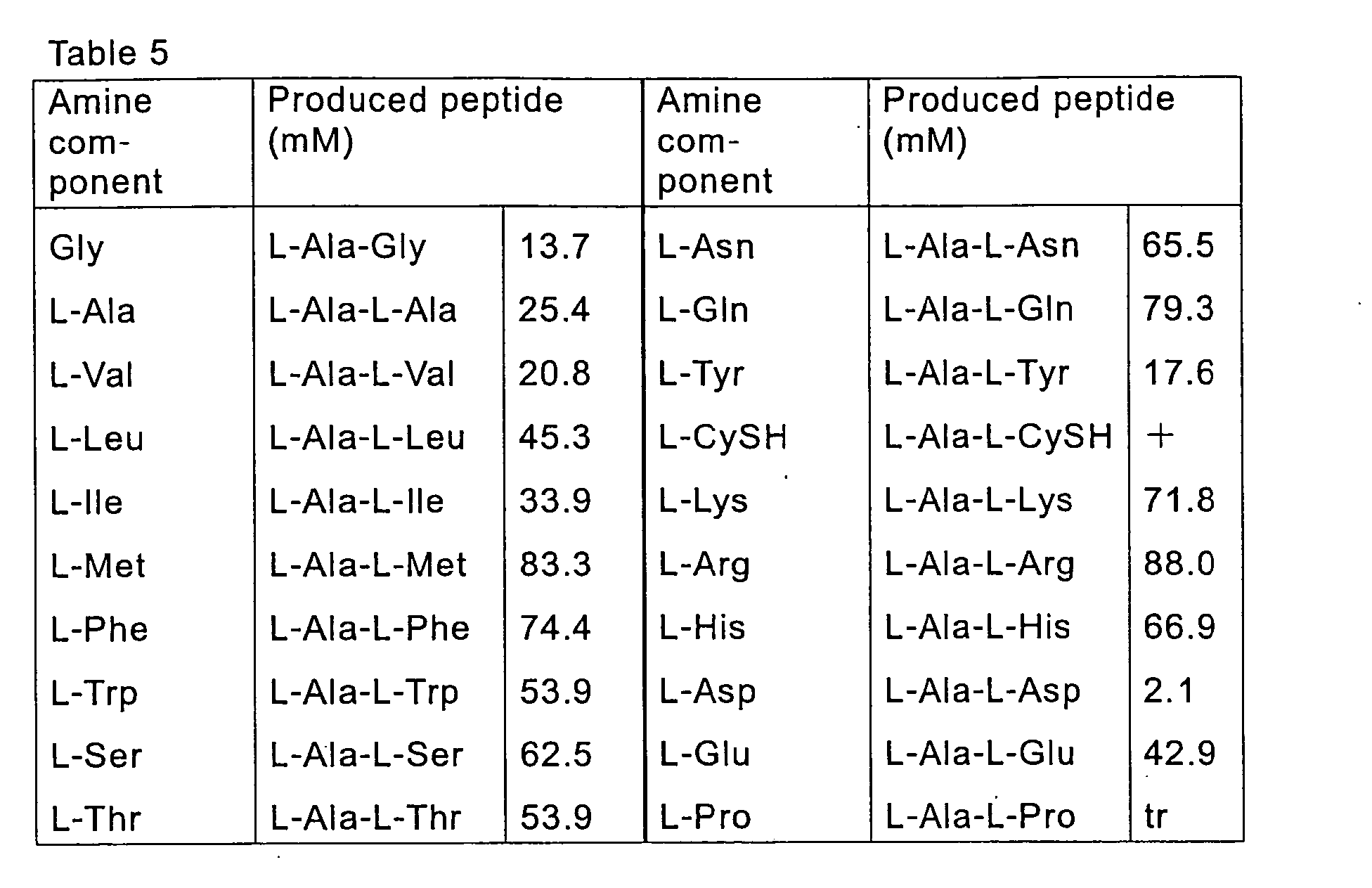
Peptide production was examined in the case of using various
types of L-amino acid methyl esters for the carboxy component and
using L-glutamine for the amine component. A 2 µl aliquot of the same
enzyme fraction as used in Example 5 was added to 100 µl of 100 mM
borate buffer (pH 9.0) containing the L-amino acid methyl ester
hydrochlorides (AA-OMe·HCl) shown in Table 6 at 100 mM, 150 mM
L-glutamine and 10 mM EDTA, and allowed to react at 25°C for 3 hours.
The amounts of each of the peptides produced in this reaction are
shown in Table 6. (The "+" mark indicates those peptides for which
production was confirmed but which were unable to be quantified due to
the absence of a standard, while "tr" indicates a trace amount.)
Furthermore, Tween-80 was added to the reaction system to a final
concentration of 0.1% in the case of using L-Trp-OMe and L-Tyr-OMe.

Peptide production was examined in the case of using various
L-amino acid methyl esters for the carboxy component and various
L-amino acids for the amine component. A 2 µl aliquot of the same
enzyme fraction as used in Example 5 was added to 100 µl of 100 mM
borate buffer (pH 9.0) containing the L-amino acid methyl ester
hydrochlorides (AA-OMe·HCl) shown in Table 7 at 100 mM, the L-amino
acids shown in Table 7 at 150 mM and 10 mM EDTA, and allowed to
react at 25°C for 3 hours. The amounts produced of each of the
peptides produced in this reaction are shown in Table 7. (The "tr"
indicates a trace amount.) Furthermore, Tween-80 was added to the
reaction system to a final concentration of 0.1 % in the case of using
L-Trp-OMe. (The "+" mark indicates those peptides for which
production was confirmed but which were unable to be quantified due to
the absence of a standard.)

Peptide production was examined in the case of using the L or D
forms of various amino acid methyl esters for the carboxy component,
and the L or D forms of various amino acids for the amine component.
2 µl of the same enzyme fraction as used in Example 5 was added to
100 µl of 100 mM borate buffer (pH 9.0) containing the various amino
acid methyl ester hydrochlorides (AA-OMe·HCl) shown in Table 8 at 100
mM, the various amino acids shown in Table 8 at 150 mM and 10 mM
EDTA, and allowed to react at 25°C for 3 hours. The amounts of each
of the peptides produced in this reaction are shown in Table 8. (The
"tr" indicates a trace amount.)

Peptide production was examined using various L-amino acid
amides for the carboxy component, and various L-amino acids for the
amine component. A 2 µl aliquot of the same enzyme fraction as that
used in Example 5 was added to 100 µl of 100 mM borate buffer (pH
9.0) containing the L-amino acid amide hydrochloride salts
(AA-NH2·HCl) shown in Table 9 at 100 mM, the L-amino acids shown in
Table 9 at 150 mM and 10 mM EDTA, and allowed to react at 25°C for 3
hours. The amounts of each of the peptides produced in this reaction
are shown in Table 9.
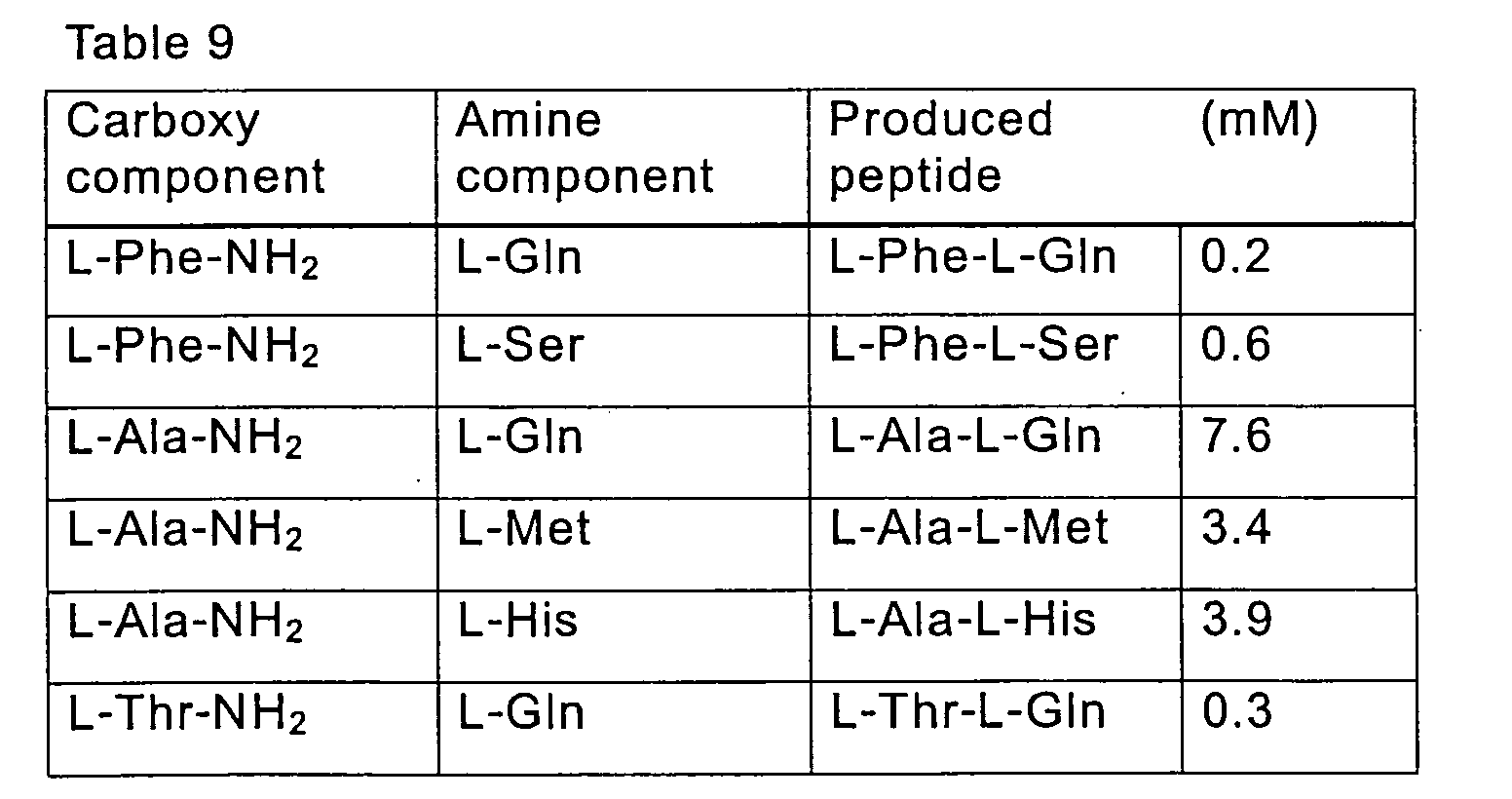
Peptide production was examined in the case of using various
L-alanine methyl esters for the carboxy component and C-protected
L-amino acids for the amine component. A 2 µl aliquot of the same
enzyme fraction as used in Example 5 was added to 100 µl of 100 mM
borate buffer (pH 9.0) containing the L-amino acid methyl ester
(AA-OMe·HCl) shown in Table 10 at 100 mM, the L-amino acid amides
shown in Table 10 at 150 mM and 10 mM EDTA, and allowed to react at
25°C for 3 hours. The amounts of each of the peptides produced in
this reaction are shown in Table 10.
| Carboxy component | Amine component | Produced peptide | (mM) |
| L-Ala-OMe | Gly-NH2 | L-Ala-Gly-NH2 | 7.4 |
| L-Ala-NH2 | L-Ala-L-Ala-NH2 | 8.3 | |
| L-Phe-NH2 | L-Ala-L-Phe-NH2 | 12.2 |
Peptide production was examined in the case of using various
amino acid methyl esters for the carboxy component and methylamine
for the amine component. A 2 µl aliquot of the same enzyme fraction
as used in Example 5 was added to 100 µl of 100 mM borate buffer (pH
9.0) containing the amino acid methyl ester (AA-OMe·HCl) shown in
Table 11 at 100 mM, the methylamine shown in Table 11 at 150 mM and
10 mM EDTA, and allowed to react at 25°C for 3 hours. The amounts
of each of the peptides produced in this reaction are shown in Table 11.
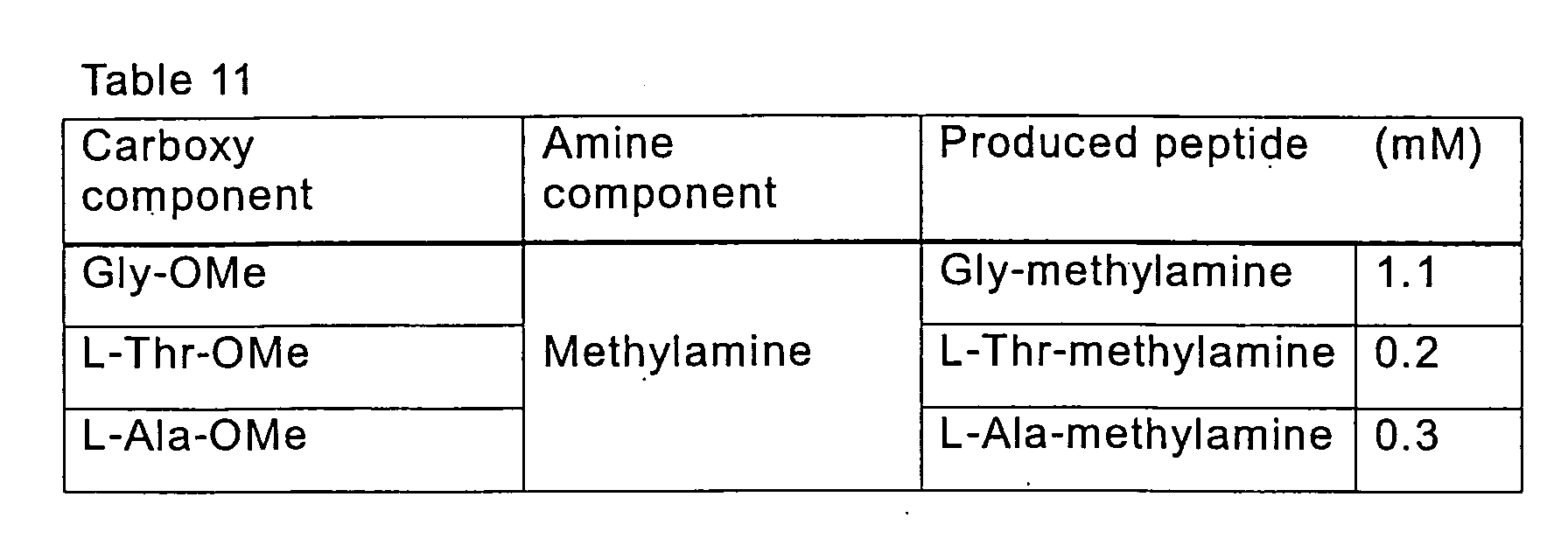
Peptide production was examined in the case of using β-amino
acid ester for the carboxy component or β-amino acid for the amine
component. A 2 µl aliquot of the same enzyme fraction as used in
Example 5 was added to 100 µl of 100 mM borate buffer (pH 9.0)
containing the carboxy components shown in Table 12 at 100 mM, the
amine components shown in Table 12 at 150 mM and 10 mM EDTA, and
allowed to react at 25°C for 3 hours. The amounts of each of the
peptides produced in this reaction are shown in Table 12. (The "tr"
indicates a trace amount.)

Oligopeptide production was examined in the case of using
L-amino acid ester for the carboxy component and peptide for the
amine component. A 2 µl aliquot of the same enzyme fraction as used
in Example 5 was added to 100 µl of 100 mM borate buffer (pH 9.0)
containing the carboxy components shown in Table 13 at 100 mM, the
amine components shown in Table 13 at 150 mM and 10 mM EDTA, and
allowed to react at 25°C for 3 hours. The amounts of each of the
peptides produced in this reaction are shown in Table 13. As a result,
it was clearly demonstrated that the present enzyme can produce not
only dipeptide, but also long-chain peptides by using a peptide for the
amine component.
As has been indicated in the aforementioned Examples 9 to 19,
the present enzyme obtained from Empedobacter brevis strain FERM P
BP-8113 (Depositary institution: National Institute for Advanced
Industrial Science and Technology, International Patent Organism
Depositary, Address of depositary institution: Chuo Dai-6, 1-1 Higashi
1-Chome, Tsukuba-shi, Ibaraki-ken, Japan, International deposit
transfer date: July 8, 2002) was determined to have an extremely broad
substrate specificity.
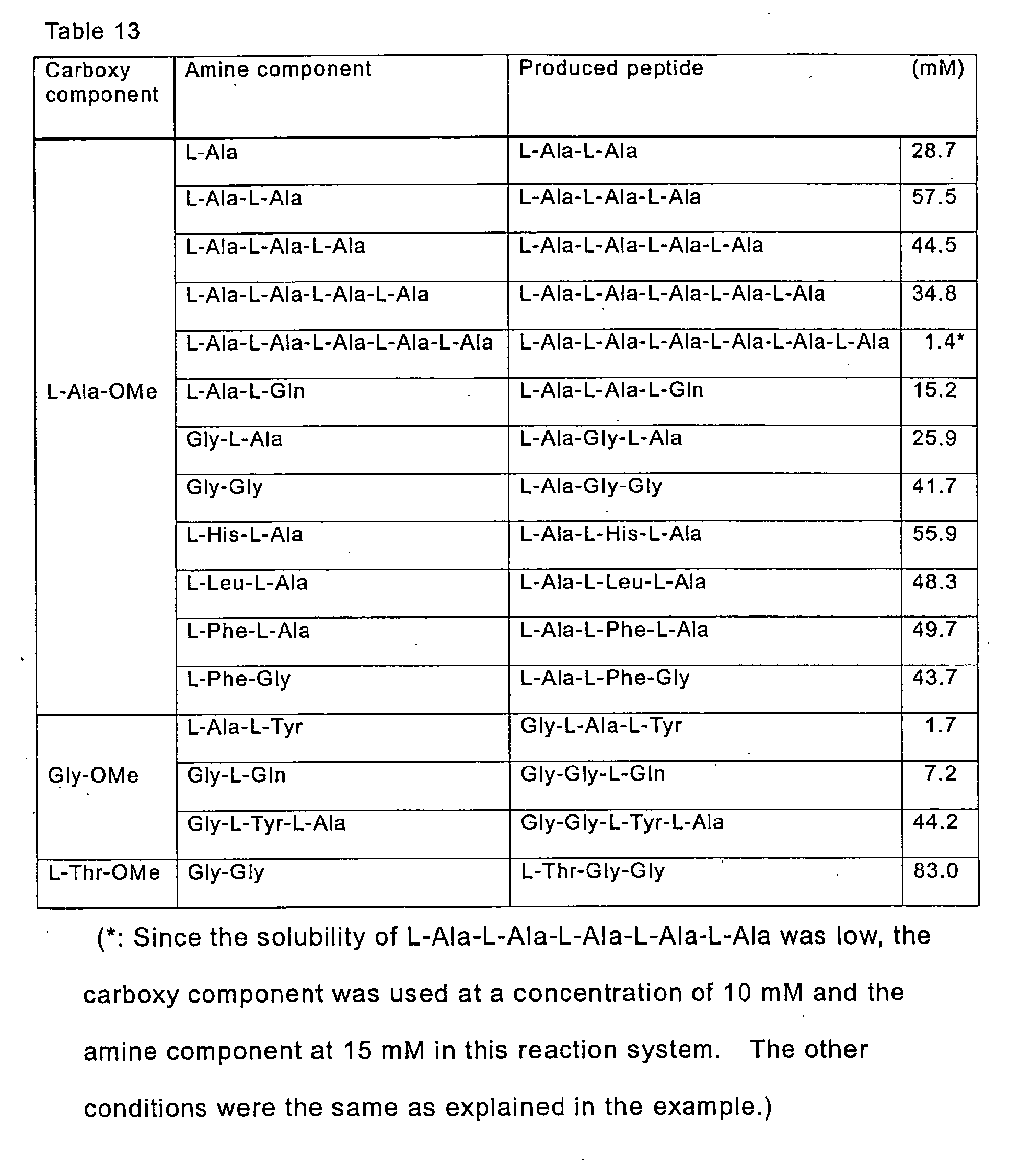
The peptide formation ability of the present enzyme was
compared with that of known enzymes. Carboxypeptidase Y described
in EP 278787A1 and the thiol endopeptidases (ficin, papain, bromelain
and chymopapain) described in EP 359399B1 were used for the known
enzymes, and they were used in the form of purified enzymes
manufactured by Sigma. The enzyme uniformly purified in Example 3
was used for the source of the enzyme of the present invention. These
enzymes were added to a reaction system in the amounts shown in
Table 14 as protein. The reaction was carried out by adding enzyme to
100 µl of borate buffer (pH 9.0) containing 100 mM L-alanine methyl
ester and 200 mM L-glutamine and allowing to react at 25°C.
Furthermore, enzyme dissolved in 10 mM acetate buffer (pH 5.0)
containing 1 mM EDTA was used for the carboxypeptidase, while
enzyme dissolved in 10 mM acetate buffer (pH 5.0) containing 2 mM
EDTA, 0.1 M KCI and 5 mM dithiothreitol was used for the thiol
endopeptidase. The ratios of the production rates of
L-alanyl-L-glutamine by these enzymes are shown in Table 14.
As a result, the production of an extremely trace amount of
L-alanyl-L-glutamine was observed even in the absence of enzyme,
while a slight increase in the production rate was observed in the lot
where carboxypeptidase or thiol endopeptidase was added as
compared with the lot where no enzyme was added. In contrast, an
overwhelmingly faster rate of production of L-alanyl-L-glutamine was
observed in the lot where the present enzyme was added, and that rate
of production was about 5,000 to 100,000 times faster than
carboxypeptidase Y and thiol endopeptidase. As has been described
above, the present enzyme was verified to have an extremely fast
peptide production rate unlike any enzyme in the prior art.
Furthermore, in contrast to the enzyme of the present invention being a
dimer having a molecular weight of about 75,000, since the molecular
weight of carboxypeptidase Y has been reported to be about 61,000,
while that of thiol endopeptidase has been reported to be about 23,000
to 36,000, the L-alanyl-L-glutamine production rate per molecular
weight is even greater for the enzyme of the present invention than that
per unit weight indicated in the examples.
| Enzyme | Amount of enzyme added (protein mg/ml) | L-Ala-L-Gln production rate (mM/min) | Ratio of L-Ala-L-Gln production rate per enzyme unit weight |
| No | 0 | 0.0006 | |
| Carboxypeptidase Y | 0.61 | 0.0257 | 0.0191 |
| Ficin | 2.60 | 0.0096 | 0.0017 |
| Papain | 2.30 | 0.0106 | 0.0021 |
| Bromelain | 2.80 | 0.0062 | 0.0010 |
| Chymopapain | 3.60 | 0.0100 | 0.0013 |
| Enzyme of present invention | 0.02 | 4.4000 | 100.0 |
A 50 ml medium (pH 7.0) containing 5 g of glucose, 5 g of
ammonium sulfate, 1 g of monopotassium phosphate, 3 g of
dipotassium phosphate, 0.5 g of magnesium sulfate, 10 g of yeast
extract and 10 g of peptone in 1 L was transferred to a 500 mL
Sakaguchi flask and sterilized at 115°C for 15 minutes for culturing
Sphingobacterium sp. strain FERM BP-8124 (Depositary institution:
National Institute for Advanced Industrial Science and Technology,
International Patent Organism Depositary, Address of depositary
institution: Chuo Dai-6, 1-1 Higashi 1-Chome, Tsukuba-shi, Ibaraki-ken,
Japan, International deposit date: July 22, 2002). This medium was
then inoculated with one loopful of Sphingobacterium sp. strain FERM
BP-8124 (Depositary institution: National Institute for Advanced
Industrial Science and Technology, International Patent Organism
Depositary, Address of depositary institution: Chuo Dai-6, 1-1 Higashi
1-Chome, Tsukuba-shi, Ibaraki-ken, Japan, International deposit date:
July 22, 2002) cultured at 30°C for 24 hours in a slant agar medium
(agar: 20 g/L, pH 7.0) containing 5 g of glucose, 10 g of yeast extract,
10 g of peptone and 5 g of NaCl in 1 L, followed by shake culturing at
30°C for 20 hours and 120 strokes/minute. A 1 ml aliquot of this
culture broth was then added to the aforementioned medium (50 ml/500
mL Sakaguchi flask) and cultured at 30°C for 18 hours. Following
completion of the culturing, the microbial cells were separated from the
culture broths by centrifugation and suspended in 0.1 M borate buffer
(pH 9.0) containing 10 mM EDTA to 100 g/L as wet microbial cells. A
0.1 mL aliquot of 100 mM borate buffer (pH 9.0) containing 10 mM
EDTA, 200 mM L-alanyl methyl ester hydrochloride and 400 mM
L-glutamine was then added to 0.1 mL of this microbial cell suspension,
and after bringing to a final volume of 0.2 mL, was allowed to react at
25°C for 120 minutes. The amount of L-alanyl-L-glutamine produced
at this time was 62 mM.
The following procedure after centrifugal separation was carried
out either on ice or at 4°C. Sphingobacterium sp. strain FERM
BP-8124 (Depositary institution: National Institute for Advanced
Industrial Science and Technology, International Patent Organism
Depositary, Address of depositary institution: Chuo Dai-6, 1-1 Higashi
1-Chome, Tsukuba-shi, Ibaraki-ken, Japan, International deposit date:
July 22, 2002) was cultured in the same manner as Example 21, and
the microbial cells were collected by centrifugal separation (10,000 rpm,
15 minutes). After washing 2 g of microbial cells with 20 mM Tris-HCl
buffer (pH 7.6), they were suspended in 8 ml of the same buffer and
subjected to ultrasonic crushing treatment for 45 minutes at 195 W.
This ultrasonic crushing liquid was then centrifuged (10,000 rpm, 30
minutes) to remove the crushed cell fragments and obtain an ultrasonic
crushing liquid supernatant. This ultrasonic crushing liquid
supernatant was dialyzed overnight against 20 mM Tris-HCl buffer (pH
7.6) followed by removal of the insoluble fraction by ultracentrifugation
(50,000 rpm, 30 minutes) to obtain a soluble fraction in the form of the
supernatant liquid. The resulting soluble fraction was applied to a
Q-Sepharose HP column (manufactured by Amersham) pre-equilibrated
with Tris-HCl buffer (pH 7.6), and the active fraction was collected from
the non-adsorbed fraction. This active fraction was dialyzed overnight
against 20 mM acetate buffer (pH 5.0) followed by removal of the
insoluble fraction by centrifugal separation (10,000 rpm, 30 minutes) to
obtain a dialyzed fraction in the form of the supernatant liquid. This
dialyzed fraction was then applied to an SP-Sepharose HP column
(manufactured by Amersham) pre-equilibrated with 20 mM acetate
buffer (pH 5.0) to obtain the active fraction in which enzyme was eluted
at a linear concentration gradient of the same buffer containing 0 to1 M
NaCl.
A 10 µl aliquot of the SP-Sepharose HP fraction (about 27 U/ml)
purified in Example 22 was added to 90 µl of 111 mM borate buffer (pH
9.0) containing 111 mM L-alanine methyl ester hydrochloride, 222 mM
L-glutamine and 11 mM EDTA, and allowed to react at 25°C for 120
minutes. As a result, 73 mM of L-alanyl-L-glutamine was produced in
the enzyme-added lot. On the other hand, there was hardly any
production of L-Ala-L-Glu observed in the enzyme-non-added lot, and
the production amount was only about 0.07 mM after reacting for 120
minutes.
Substrate specificity was examined for enzyme derived from
Sphingobacterium sp. strain FERM BP-8124 (Depositary institution:
National Institute for Advanced Industrial Science and Technology,
International Patent Organism Depositary, Address of depositary
institution: Central. 6, 1-1-1 Higashi, Tsukuba City, Ibaraki Prefecture,
Japan, International deposit date: July 22, 2002). 100 µl of 100 mM
borate buffer (pH 9.0) containing the various carboxy components at a
final concentration of 100 mM and the various amine components at a
final concentration of 150 mM shown in Tables 15-1 to 15-4, the
SP-Sepharose HP fraction enzyme purified in Example 22 (addition of
0.33 units in the reaction liquid) and 10 mM EDTA were allowed to react
at 25°C for 1.5 hours. The amounts of each of the peptides produced
in this reaction are shown in Table 15. (The "+" mark indicates those
peptides for which production was confirmed but which were unable to
be quantified due to the absence of a standard, while "tr" indicates a
trace amount.) Furthermore, Tween-80 was added to the reaction
system to a final concentration of 0.1% in the case of using L-Tyr-OMe.
In addition, hydrochlorides were used for all carboxy components.


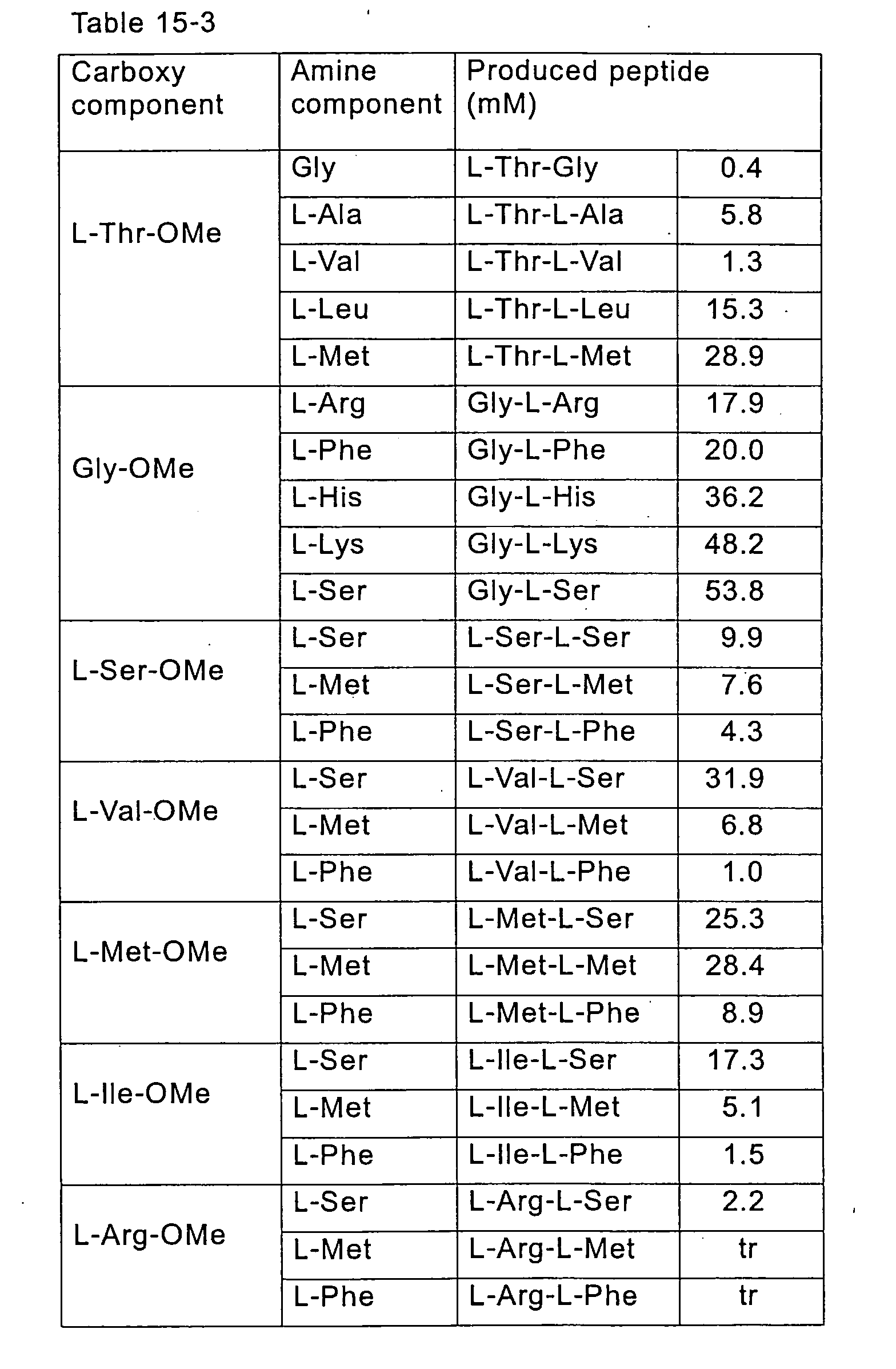

Substrate specificity with respect to oligopeptide production was
examined for enzyme derived from Sphingobacterium sp. strain FERM
BP-8124 (Depositary institution: National Institute for Advanced
Industrial Science and Technology, International Patent Organism
Depositary, Address of depositary institution: Chuo Dai-6, 1-1 Higashi
1-Chome, Tsukuba-shi, Ibaraki-ken, Japan, International deposit date:
July 22, 2002). A 100 µl aliquot of 100 mM borate buffer (pH 9.0)
containing the various carboxy components at a final concentration of
100 mM and the various amine components at a final concentration of
150 mM shown in Table 16, the SP-Sepharose HP fraction enzyme
purified in Example 22 (addition of 0.33 units in the reaction liquid) and
10 mM EDTA were allowed to react for 1.5 hours at 25°C. The
amounts of each oligopeptide produced in this reaction are shown in
Table 18. Furthermore, hydrochloride salts were used for all carboxy
components.

Substrate specificity was additionally assessed using the same
enzyme fraction as that used in Example 5.
| Carboxy component (mM) | Amine component (mM) | Produced peptide (mM) | Reaction time (hr) | |||
| H-Ala-OMe | 50mM | H-p-F-Phe-OH | 50mM | H-Ala-p-F-Phe-OH | 21.9mM | 3 |
| H-Ala-OMe | 40mM | H-Cl-F-Phe-OH | 40mM | H-Ala-Cl-F-Phe-OH | 20.8mM | 3 |
| H-Ala-OMe | 40mM | H-p-NO2-Phe-OH | 40mM | H-Ala-p-NO2-Phe-OH | 27.5mM | 3 |
| H-Ala-OMe | 100mM | H-t-Leu-OH | 150mM | H-Ala-t-Leu-OH | 0.4mM | 3 |
| H-Ala-OMe | 20mM | H-2-Nal-OH | 20mM | H-Ala-2-Nal-OH | + | 3 |
| H-p-F-Phe-OMe | 100mM | H-Gln-OH | 150mM | H-p-F-Phe-H-Gln-OH | tr | 3 |
| H-Cl-F-Phe-OMe | 25mM | H-Gln-OH | 50mM | H-Cl-F-Phe-H-Gin-OH | tr | 3 |
| H-p-NO2-Phe-OMe | 40mM | H-Gln-OH | 40mM | H-p-NO2-Phe-H-Gln-OH | 1.1 mM | 3 |
| H-t-Leu-OMe | 100mM | H-Gln-OH | 150mM | H-t-Leu-H-Gln-OH | tr | 3 |
| H-2-Nal-OMe | 40mM | H-Gln-OH | 40mM | H-2-Nal-H-Gln-OH | tr | 3 |
| H-Aib-OMe | 100mM | H-Gln-OH | 150mM | H-Aib-H-Gln-OH | 18.8mM | 3 |
| H-N-Me-Ala-OMe | 100mM | H-Gln-OH | 150mM | H-N-Me-Ala-H-Gln-OH | 0.5mM | 3 |
| H-Aib-OMe | 100mM | H-Phe-OH | 150mM | H-Aib-Phe-OH | 17.2mM | 3 |
| H-CHA-OMe | 40mM | H-Phe-OH | 40mM | H-CHA-Phe-OH | + | 3 |
| H-N-Me-Ala-OMe | 100mM | H-Phe-OH | 150mM | H-N-Me-Ala-Phe-OH | tr | 3 |
| H-Ala-OMe | 100mM | H-Ser(tBu)-OH | 150mM | H-Ala-Ser(tBu)-OH | 48.8mM | 2 |
| H-Ser(tBu)-OMe | 100mM | H-Gln-OH | 150mM | H-Ser(tBu)-Gln-OH | tr | 2 |
| H-Ala-OMe | 100mM | H-Asp(OtBu)-OH | 150mM | H-Ala-Asp(OtBu)-OH | 62.6mM | 2 |
| H-Asp(OtBu)-OMe | 100mM | H-Gln-OH | 150mM | H-Asp(OtBu)-Gln-OH | 0.9mM | 2 |
| H-Ala-OMe | 100mM | H-Lys(Boc)-OH | 150mM | H-Ala-Lys(Boc)-OH | 51.0mM | 2 |
| H-Lys(Boc)-OMe | 100mM | H-Gln-OH | 150mM | H-Lys(Boc)-Gln-OH | + | 2 |
100 µl of reaction solutions consisting of 100 mM borate buffer
(pH 9.0) containing each of the carboxy components and amine
components at the final concentrations shown in Table 17, enzyme
(addition of 0.1 unit in reaction solution) and 10 mM EDTA were allowed
to react at 25°C for the reaction times shown in Table 17. The
amounts of each of the peptides produced in the reactions are shown in
Table 17. (A "+" mark indicates those for which production was
confirmed but which were unable to be quantified due to the absence of
a standard, while "tr" indicates a trace amount).
Substrate specificity with respect to oligopeptide production was
assessed using the same enzyme fraction as Example 26. A 100 µl
aliquot of reaction solutions consisting of 100 mM borate buffer (pH 9.0)
containing each of the carboxy components and amine components at
the final concentrations shown in Table 18, enzyme (the numbers of
units added to the reaction solution are described in Table 18) and 10
mM EDTA were allowed to react at 25°C for 3 hours. The amounts of
each of the oligopeptides produced in the reactions are shown in Table
18. (A "+" mark indicates those for which production was confirmed
but which were unable to be quantified due to the absence of a
standard, while "tr" indicates a trace amount). It should be noted that
hydrochlorides were used for all of the carboxy components.

The present invention provides a novel enzyme with which a
peptide can be produced easily, inexpensively and at high yield by
mitigating use of complex synthesis methods such as introduction and
elimination of protecting groups. The use of the enzyme of the present
invention enables efficient industrial production of peptides.
Claims (11)
- An enzyme derived from the genus Empedobacter or the genus Sphingobacterium, and having the ability to produce a peptide from a carboxy component and an amine component.
- An enzyme having the ability to produce a peptide from a carboxy component and an amine component and the ability to produce L-alanyl-L-glutamine at a production rate of 0.03 mM/min or more in a dipeptide-producing reaction under conditions (i) to (iv):(i) the carboxy component is L-alanine methyl ester hydrochloride (100 mM);(ii) the amine component is L-glutamine (200 mM);(iii) the pH is 9.0; and(iv) the amount of enzyme added is less than 0.61 mg/ml as protein amount.
- The enzyme according to claim 1 or 2, wherein the carboxy component as a substrate includes both the amino acid ester and the amino acid amide.
- The enzyme according to any one of claims 1 to 3, wherein any of an amino acid, a C-protected amino acid and an amine can be used as a substrate for the amine component.
- The enzyme according to any one of claims 1 to 4, wherein the enzyme has the ability to produce a peptide within a pH range of 6.5 to 10.5.
- The enzyme according to any one of claims 1 to 5, wherein the enzyme has the ability to produce a peptide within a temperature range of 0 to 60°C.
- The enzyme according to any one of claims 1 to 6, wherein the enzyme is not inhibited by the serine enzyme inhibitor, phenylmethylsulfonyl fluoride, but is inhibited by p-nitrophenyl-p'-guanidinobenzoate.
- The enzyme according to any one of claims 1 to 7, wherein the enzyme has a molecular weight as determined by SDS-gel electrophoresis of about 75 kilodalton, and a molecular weight as determined by gel filtration chromatography of about 150 kilodalton.
- A microbe that produces an enzyme according to any one of claims 1 to 8.
- The microbe according to claim 9, wherein the microbe is selected from Empedobacter brevis strain FERM BP-8113 and Sphingobacterium sp. strain FERM BP-8124.
- A method for producing a dipeptide comprising producing a dipeptide from a carboxy component and an amine component using an enzyme according to any one of claims 1 to 8 or a substance containing the enzyme.
Applications Claiming Priority (3)
| Application Number | Priority Date | Filing Date | Title |
|---|---|---|---|
| JP2002218956 | 2002-07-26 | ||
| JP2002218956 | 2002-07-26 | ||
| PCT/JP2003/009467 WO2004022733A1 (en) | 2002-07-26 | 2003-07-25 | Novel enzyme forming peptide, microorganism producing the same and process for producing dipeptide using them |
Publications (2)
| Publication Number | Publication Date |
|---|---|
| EP1553171A1 true EP1553171A1 (en) | 2005-07-13 |
| EP1553171A4 EP1553171A4 (en) | 2005-09-21 |
Family
ID=31972369
Family Applications (1)
| Application Number | Title | Priority Date | Filing Date |
|---|---|---|---|
| EP03794067A Withdrawn EP1553171A4 (en) | 2002-07-26 | 2003-07-25 | Novel enzyme forming peptide, microorganism producing the same and process for producing dipeptide using them |
Country Status (11)
| Country | Link |
|---|---|
| US (1) | US20040253665A1 (en) |
| EP (1) | EP1553171A4 (en) |
| JP (1) | JP4501689B2 (en) |
| KR (1) | KR20050025677A (en) |
| CN (1) | CN1316016C (en) |
| AU (1) | AU2003248117A1 (en) |
| BR (1) | BR0305638A (en) |
| CA (1) | CA2509765C (en) |
| PL (2) | PL211754B1 (en) |
| RU (1) | RU2300565C2 (en) |
| WO (1) | WO2004022733A1 (en) |
Families Citing this family (12)
| Publication number | Priority date | Publication date | Assignee | Title |
|---|---|---|---|---|
| JP2005168405A (en) | 2003-12-11 | 2005-06-30 | Ajinomoto Co Inc | Method for producing dipeptide |
| RU2007127719A (en) * | 2004-12-20 | 2009-01-27 | Адзиномото Ко., Инк. (Jp) | MUTANT PROTEIN WITH PEPTID SYNTHESIS ACTIVITY |
| JP4931801B2 (en) | 2005-03-29 | 2012-05-16 | 協和発酵バイオ株式会社 | Dipeptide crystals and process for producing the same |
| WO2008001837A1 (en) | 2006-06-28 | 2008-01-03 | Kyowa Hakko Bio Co., Ltd. | Method for purification of oligopeptide |
| DE112009001080T5 (en) * | 2008-05-12 | 2011-03-03 | Ajinomoto Co., Inc. | A process for producing β-alanyl amino acid or a derivative thereof |
| DE102009002044A1 (en) * | 2009-03-31 | 2010-10-07 | Evonik Degussa Gmbh | Dipeptides as feed additives |
| CN104561202B (en) * | 2015-02-06 | 2018-02-09 | 江苏诚信药业有限公司 | A kind of preparation method and technology system of Enzyme catalyzed synthesis glutamine dipeptide |
| CN106754447B (en) * | 2016-12-30 | 2020-08-25 | 大连医诺生物股份有限公司 | Recombinant saccharomyces cerevisiae and application thereof in synthesis of glutamine dipeptide |
| CN106754985B (en) * | 2016-12-30 | 2019-08-13 | 大连医诺生物股份有限公司 | Encode gene and its application of glutamine dipeptide biosynthetic enzyme |
| KR102183558B1 (en) | 2016-12-30 | 2020-11-26 | 이노바이오 코오포레이션 리미티드 | Gene encoding L-alanyl-L-glutamine biosynthetic enzyme and use thereof |
| US10793594B2 (en) | 2017-04-19 | 2020-10-06 | Indiana University Research And Technology Corporation | Antimicrobial compounds and/or modulators of microbial infections and methods of using the same |
| KR102650468B1 (en) * | 2024-01-19 | 2024-03-25 | 큐티스바이오 주식회사 | Method for producing dipeptide by bioconversion process |
Family Cites Families (7)
| Publication number | Priority date | Publication date | Assignee | Title |
|---|---|---|---|---|
| US2953499A (en) * | 1956-04-19 | 1960-09-20 | Ajimomoto Co Inc | Process for producing l-glutamic acid from hardly soluble amino-acid |
| US3847744A (en) * | 1971-12-14 | 1974-11-12 | Ajinomoto Kk | Method of producing elastases by bacteria |
| DK72587D0 (en) * | 1987-02-13 | 1987-02-13 | Carlsberg Biotechnology Ltd | PROCEDURE FOR ENZYMATIC DIPEPTID PREPARATION |
| CA1337936C (en) * | 1987-08-07 | 1996-01-16 | Akiva Tuvia Gross | Vibriolysin coupling process |
| DK163435C (en) * | 1988-08-12 | 1992-07-20 | Carlsberg Biotechnology Ltd | PROCEDURE FOR ENZYMATIC PREPARATION OF DIPEPTIDES AND DERIVATIVES THEREOF |
| TW257792B (en) * | 1992-10-01 | 1995-09-21 | Lilly Co Eli | |
| AU3677100A (en) * | 1999-04-12 | 2000-11-14 | Arkray, Inc. | Alpha-glycated amino acid releasing enzyme |
-
2003
- 2003-07-25 PL PL374192A patent/PL211754B1/en unknown
- 2003-07-25 BR BR0305638-4A patent/BR0305638A/en not_active Application Discontinuation
- 2003-07-25 EP EP03794067A patent/EP1553171A4/en not_active Withdrawn
- 2003-07-25 WO PCT/JP2003/009467 patent/WO2004022733A1/en not_active Ceased
- 2003-07-25 CA CA2509765A patent/CA2509765C/en not_active Expired - Fee Related
- 2003-07-25 KR KR1020057001376A patent/KR20050025677A/en not_active Ceased
- 2003-07-25 JP JP2004534096A patent/JP4501689B2/en not_active Expired - Lifetime
- 2003-07-25 PL PL391108A patent/PL211730B1/en unknown
- 2003-07-25 CN CNB038179164A patent/CN1316016C/en not_active Expired - Lifetime
- 2003-07-25 RU RU2005105321/13A patent/RU2300565C2/en not_active IP Right Cessation
- 2003-07-25 AU AU2003248117A patent/AU2003248117A1/en not_active Abandoned
-
2004
- 2004-04-08 US US10/819,941 patent/US20040253665A1/en not_active Abandoned
Also Published As
| Publication number | Publication date |
|---|---|
| CN1316016C (en) | 2007-05-16 |
| JP4501689B2 (en) | 2010-07-14 |
| RU2300565C2 (en) | 2007-06-10 |
| PL211730B1 (en) | 2012-06-29 |
| CA2509765A1 (en) | 2004-03-18 |
| CN1671840A (en) | 2005-09-21 |
| WO2004022733A1 (en) | 2004-03-18 |
| US20040253665A1 (en) | 2004-12-16 |
| PL211754B1 (en) | 2012-06-29 |
| BR0305638A (en) | 2004-09-08 |
| PL374192A1 (en) | 2005-10-03 |
| KR20050025677A (en) | 2005-03-14 |
| EP1553171A4 (en) | 2005-09-21 |
| RU2005105321A (en) | 2005-08-10 |
| AU2003248117A1 (en) | 2004-03-29 |
| JPWO2004022733A1 (en) | 2005-12-22 |
| CA2509765C (en) | 2011-04-26 |
Similar Documents
| Publication | Publication Date | Title |
|---|---|---|
| US7736871B2 (en) | Peptide-forming enzyme gene | |
| KR100635803B1 (en) | Peptide Producing Enzyme Gene, Peptide Producing Enzyme and Dipeptide | |
| US7749742B2 (en) | Method for producing tripeptides and/or peptides longer than tripeptides | |
| CA2509765C (en) | Novel peptide-producing enzyme, microbe producing the enzyme and method for dipeptide synthesis using them | |
| US20050032187A1 (en) | Novel peptide-forming enzyme, microbe producing the enzyme and method for producing peptide using them | |
| US20040204577A1 (en) | Novel peptide-forming enzyme gene | |
| US7115389B2 (en) | Method for producing dipeptide | |
| US20050032154A1 (en) | Method for producing tripeptides and/or peptides longer than tripeptides |
Legal Events
| Date | Code | Title | Description |
|---|---|---|---|
| PUAI | Public reference made under article 153(3) epc to a published international application that has entered the european phase |
Free format text: ORIGINAL CODE: 0009012 |
|
| 17P | Request for examination filed |
Effective date: 20050217 |
|
| AK | Designated contracting states |
Kind code of ref document: A1 Designated state(s): AT BE BG CH CY CZ DE DK EE ES FI FR GB GR HU IE IT LI LU MC NL PT RO SE SI SK TR |
|
| AX | Request for extension of the european patent |
Extension state: AL LT LV MK |
|
| A4 | Supplementary search report drawn up and despatched |
Effective date: 20050805 |
|
| DAX | Request for extension of the european patent (deleted) | ||
| 17Q | First examination report despatched |
Effective date: 20080624 |
|
| STAA | Information on the status of an ep patent application or granted ep patent |
Free format text: STATUS: THE APPLICATION IS DEEMED TO BE WITHDRAWN |
|
| 18D | Application deemed to be withdrawn |
Effective date: 20101209 |