EP1553081B1 - Process for the production of water-soluble fluorine -containing vinyl ethers - Google Patents
Process for the production of water-soluble fluorine -containing vinyl ethers Download PDFInfo
- Publication number
- EP1553081B1 EP1553081B1 EP03736218A EP03736218A EP1553081B1 EP 1553081 B1 EP1553081 B1 EP 1553081B1 EP 03736218 A EP03736218 A EP 03736218A EP 03736218 A EP03736218 A EP 03736218A EP 1553081 B1 EP1553081 B1 EP 1553081B1
- Authority
- EP
- European Patent Office
- Prior art keywords
- fluorine
- water
- vinyl ether
- containing vinyl
- organic solvent
- Prior art date
- Legal status (The legal status is an assumption and is not a legal conclusion. Google has not performed a legal analysis and makes no representation as to the accuracy of the status listed.)
- Expired - Lifetime
Links
Classifications
-
- C—CHEMISTRY; METALLURGY
- C07—ORGANIC CHEMISTRY
- C07C—ACYCLIC OR CARBOCYCLIC COMPOUNDS
- C07C303/00—Preparation of esters or amides of sulfuric acids; Preparation of sulfonic acids or of their esters, halides, anhydrides or amides
- C07C303/02—Preparation of esters or amides of sulfuric acids; Preparation of sulfonic acids or of their esters, halides, anhydrides or amides of sulfonic acids or halides thereof
- C07C303/22—Preparation of esters or amides of sulfuric acids; Preparation of sulfonic acids or of their esters, halides, anhydrides or amides of sulfonic acids or halides thereof from sulfonic acids, by reactions not involving the formation of sulfo or halosulfonyl groups; from sulfonic halides by reactions not involving the formation of halosulfonyl groups
Definitions
- the present invention relates to a method for producing a water-soluble fluorine-containing vinyl ether from fluorine-containing 2-alkoxypropionic acid derivatives in good yields.
- Hydrophilic group-terminated fluorine-containing vinyl ethers can be used, either as such or after protection of the terminal hydrophilic group by fluorination or by esterification, amidation or imidation, for the production of copolymers by polymerization with another fluoroolefin and/or the like.
- copolymers obtained can have salt-forming hydrophilic groups and, therefore, the use thereof as ion exchange membranes in salt electrolysis, chemical sensors, separation membranes, fuel cells and so forth is under investigation. They can also be utilized as superstrong acid catalysts in the form of powders as such, or in lithium cells and so on.
- a thermal decomposition method which comprises heating, for decarboxylation, a fluorine-containing 2-alkoxypropionic acid derivative with carboxyl group being in the form of a metal salt.
- This thermal decomposition method known in the art has a problem in that a side reaction occurs, namely oligomers are formed from the fluorine-containing 2-alkoxypropionic acid derivative.
- WO 01/28989 pamphlet discloses that the reaction should preferably be carried out at 170 to 230°C using 1 to 5 parts by weight of a catalyst having a coordinating property with a metal ion per 100 parts by weight of the fluorine-containing 2-alkoxypropionic acid derivative.
- the water-soluble fluorine-containing vinyl ethers which are the target products to be obtained by this thermal decomposition reaction, occur as high-boiling salts and, therefore, the distillation method cannot be used as the method of purifying them.
- a promising method is recrystallization.
- the present invention relates to a method for producing a water-soluble fluorine-containing vinyl ether which comprises subjecting a fluorine-containing 2-alkoxypropionic acid derivative represented by the following general formula (I):
- A represents -OM 1 or -OM 2 1/2
- M 1 represents an alkali metal and M 2 represents an alkaline earth metal
- X represents a halogen atom
- Y 1 and Y 2 are the same or different and each represents a fluorine atom, a chlorine atom, a perfluoroalkyl group or a fluorochloroalkyl group
- n represents an integer of 0 to 3
- n of Y 1 s may be the same or different
- m represents an integer of 1 to 5, and m of Y 2 s are the same or different
- Z represents a hydrophilic group, being -COOM 3 , -OSO 3 M 3 , -SO 3 M 3 , -O 2 PM 3 , -OP(
- M 3 represents an alkali metal, a hydrogen atom or NR 1 R 2 R 3 R 4 in which R 1 , R 2 , R 3 and R 4 are the same or different and each represents a hydrogen atom or an alkyl group containing 1 to 4 carbon atoms, and M 4 represents an alkaline earth metal, to thermal decomposition at a temperature of not lower than 50°C but lower than 170°C in the presence of a coordinating organic solvent to give a water-soluble fluorine-containing vinyl ether represented by the following general formula (II): (wherein Y 1 , Y 2 , Z, n and m are as defined above), said coordinating organic solvent having a coordinating property with an ion of said M 1 or an ion of said M 2 and said coordinating organic solvent being used in an
- the method for producing a water-soluble fluorine-containing vinyl ether comprises subjecting a fluorine-containing 2-alkoxypropionic acid derivate represented by the above general formula (I) to thermal decomposition.
- the fluorine-containing 2-alkoxypropionic acid derivative represented by the above general formula (I) is such one that A in the above general formula (I) represents -OM 1 or -OM 2 1/2 , wherein M 1 represents an alkali metal and M 2 represents an alkaline earth metal.
- the alkali metal M 1 is not particularly restricted but includes, among others, Li, Na, K and Cs.
- the alkaline earth metal M 2 is not particularly restricted but includes, among others, Mg and Ca.
- A is -OM 1
- M 1 is Na, which is commercially inexpensive.
- X represents a halogen atom.
- the halogen atom is not particularly restricted but may be any of fluorine, chlorine, bromine and iodine atoms.
- Y 1 and Y 2 are the same or different and each represents a fluorine atom, a chlorine atom, a perfluoroalkyl group or a fluorochloroalkyl group.
- the perfluoroalkyl group is not particularly restricted but may be, for example, a trifluoromethyl group or a pentafluoroethyl group.
- the fluorochloroalkyl group is not particularly restricted but may be, for example, a difluorochloromethyl group.
- Y 1 is a trifluoromethyl group and Y 2 is a fluorine atom.
- n represents an integer of 0 to 3.
- the n of Y 1 s may be the same or different.
- the above-mentioned n is preferably 0 or 1, more preferably 0.
- m represents an integer of 1 to 5.
- the m of Y 2 s may be the same or different.
- the above-mentioned m increases, the acid strength increases but the number of the hydrophilic groups per unit weight of the fluorine-containing 2-alkoxypropionic acid derivative decreases. Therefore, the above-mentioned m is preferably 2.
- the above-mentioned M 3 represents an alkali metal or hydrogen atom or NR 1 R 2 R 3 R 4 , and R 1 , R 2 , R 3 and R 4 are the same or different and each represents a hydrogen atom or an alkyl group containing 1 to 4 carbon atoms.
- the alkali metal includes, among others, those given above by way of example referring to M 1 .
- the above-mentioned M 4 is an alkaline earth metal, and the alkaline earth metal includes, among others, those given above by way of example referring to M 2 .
- substituted ammonio group means a group constituted of a nitrogen atom and two or three alkyl groups, which are the same or different and are covalently bound to that nitrogen atom at sites other than the site represented by -(CFY 2 ) m - in the above general formula (I).
- the substituted ammonio group is not particularly restricted but may be -NR 5 R 6 H or -NR 5 R 6 R 7 (in which R 5 , R 6 and R 7 may be the same or different and each represents an alkyl group), for instance.
- the above substituted ammonio group forms a salt with a conjugated base of a monobasic or polybasic inorganic acid or fatty acid.
- the inorganic acid is not particularly restricted but includes, among others, hydrochloric acid, phosphoric acid, sulfuric acid and nitric acid.
- the fatty acid is not particularly restricted but includes, among others, formic acid, acetic acid and propionic acid.
- Z is preferably -SO 3 M 3 or -SO 3 M 4 1/2 , more preferably -SO 3 M 3 , still more preferably -SO 3 Na.
- the fluorine-containing 2-alkoxypropionic acid derivative represented by the above general formula (I) is preferably one in which, in the above general formula (I), Z is -SO 3 M 3 , A is -OM 1 or -OM 2 1/2 , Y 1 is a trifluoromethyl group, Y 2 is a fluorine atom and m is 2. More preferably, in the above general formula (I), Z is -SO 3 Na, A is -Ona, X is a fluorine atom, Y 2 is a fluorine atom, n is 0 and m is 2.
- the method for preparing the fluorine-containing 2-alkoxypropionic acid derivative represented by the above general formula (I) is not particularly restricted but, for example, any of the methods known in the art can be employed.
- those compounds represented by the following general formula: (wherein X, Y 1 , Y 2 , n, m, M 1 and M 2 are as defined above) can be obtained by neutralizing or saponifying the corresponding compounds represented by the following general formula: (wherein A 1 represents an alkoxyl group or a halogen atom, A 2 represents a halogen atom; X, Y 1 , Y 2 , n and m are as defined above) using a neutralizing reagent.
- the method for producing a water-soluble fluorine-containing vinyl ether comprises subjecting a fluorine-containing 2-alkoxypropionic acid derivative represented by the above general formula (I) to thermal decomposition in the presence of a coordinating organic solvent, said coordinating organic solvent being an aprotic polar organic solvent, which is ethyl acetate, tetrahydrofuran or a mixture of ethyl acetate and tetrahydrofuran, to give the corresponding water-soluble fluorine-containing vinyl ether represented by the general formula (II).
- the coordinating organic solvent has a coordinating property with the ion of the above-mentioned M 1 or the ion of the above-mentioned M 2 .
- the above coordinating organic solvent exhibits a decarboxylation reaction-promoting catalytic action by coordinating the ion of M 1 or the ion of M 2 which the fluorine-containing 2-alkoxypropionic acid derivative of the above general formula (I) has.
- the coordinating organic solvent is an aprotic polar organic solvent.
- the aprotic polar organic solvent has a water content not exceeding 250 ppm so that the yield of the water-soluble fluorine-containing vinyl ether may be increased.
- the aprotic polar organic solvent is required to have the water content within the above range only at least on the occasion of thermal decomposition.
- the coordinating organic solvent itself may be used also as a dispersion medium. It is also possible, however, to use an inert solvent together with the coordinating organic solvent.
- Preferred as the inert solvent are fluorocarbons, which can be readily dehydrated, so that the yield of the water-soluble fluorine-containing vinyl ether may be increased.
- the fluorocarbons are not particularly restricted but include, among others, fluorocarbons and fluorochlorocarbons, which may be etherified. Among them, perfluorocarbons and perfluorochlorocarbons are preferred.
- the inert solvent may comprise one single species or two or more species.
- the coordinating organic solvent is used in an amount of 10 to 1,000 parts by mass per 100 parts by mass of the fluorine-containing 2-alkoxypropionic acid derivative.
- the thermal decomposition initiation temperature becomes low, hence the byproduct formation can be suppressed.
- the thermal decomposition reaction may proceed slowly and/or the thermal decomposition may proceed only to an unsatisfactory extent.
- a preferred lower limit is 30 parts by mass, and a preferred upper limit is 300 parts by mass.
- the method for producing a water-soluble fluorine-containing vinyl ether according to the present invention is characterized in that the above-mentioned fluorine-containing 2-alkoxypropionic acid derivative is subjected to thermal decomposition at a temperature not lower than 50°C but lower than 170°C in the presence of the above-mentioned coordinating organic solvent to give the corresponding water-soluble fluorine-containing vinyl ether represented by the general formula (II).
- recrystallization may be a promising method. Since, however, the byproducts are not crystallizable, it is difficult to crystallize the water-soluble fluorine-containing vinyl ether in the presence of a large amount of such byproducts.
- the temperature is lower than 50°C
- time is required for the thermal decomposition or the thermal decomposition may fail to proceed, although the byproduct formation mentioned above can be suppressed.
- the thermal decomposition is preferably carried out at a temperature not lower than 50°C but lower than 150°C.
- the thermal decomposition is carried out after thoroughly drying, for dehydration, the fluorine-containing 2-alkoxypropionic acid derivative and catalyst, and the inert solvent to be used if desirable.
- the thermal decomposition reaction time in the practice of the present invention is preferably 10 to 600 minutes after arrival at the intended reaction temperature, although it depends on the temperature at which the thermal decomposition is carried out. If the reaction time is shorter than 10 minutes, the thermal decomposition may be incomplete. A more preferred lower limit is 30 minutes, and a more preferred upper limit is 300 minutes.
- the fluorine-containing 2-alkoxypropionic acid derivative preferably has a water content not exceeding 0.1% by mass.
- the fluorine-containing 2-alkoxypropionic acid derivative reacts with the water in certain cases to give, as a byproduct, a compound represented by the general formula: (wherein X, Y 1 , Y 2 , Z, n and m are as defined above) and, accordingly, the yield of the water-soluble fluorine-containing vinyl ether tends to decrease. It is only required that the fluorine-containing 2-alkoxypropionic acid derivative has a water content within the above range at least on the occasion of carrying out the thermal decomposition.
- the water-soluble fluorine-containing vinyl ether obtained by the method for producing a water-soluble fluorine-containing vinyl ether according to the present invention is represented by the above general formula (I I) given hereinabove.
- Y 1 , Y 2 , Z, n and m are as defined hereinabove referring to the above general formula (I).
- byproduct formation can be inhibited by subjecting the fluorine-containing 2-alkoxypropionic acid derivatives to thermal decomposition at a temperature not lower than 50°C but lower than 170°C using the above-mentioned coordinating organic solvent, therefore the water-soluble fluorine-containing vinyl ethers can be obtained in good yields from the fluorine-containing 2-alkoxypropionic acid derivatives.
- the water-soluble fluorine-containing vinyl ethers can be polymerized, either as such or after protection of the terminal hydrophilic group by fluorination or by esterification, amidation or imidation, together with another fluoroolefin, for instance, to give copolymers.
- the copolymers obtained which have salt-forming hydrophilic groups, can be adequately used as electrolyte membranes such as ion exchange membranes or diaphragms.
- electrolyte membranes such as ion exchange membranes or diaphragms.
- ion exchange membranes they can be utilized in salt electrolysis, chemical sensors, separation membranes, fuel cells and so forth.
- the copolymers obtained can also be used as macromolecular superstrong acid catalysts in the form of powders as such, or in lithium cells or the like, in the form of liquids.
- the reaction product was a colorless, transparent liquid, which, upon distillation, was found to be almost pure tetrafluoroethane ⁇ -sultone.
- a 6-liter glass-lined pressure-resistant autoclave was charged with 400 g of potassium fluoride thoroughly dried at 300°C and then tightly closed under nitrogen streams. Then, 1 liter of diethylene glycol dimethyl ether was charged into the autoclave, and the sultone (1 liter) obtained in the step 1.1) was added dropwise. A marked exothermic reaction took place, and it was confirmed by 19 F-NMR analysis that the isomerization reaction to FSO 2 CF 2 COF had been completed almost quantitatively although the formation of free FSO 2 CF 2 CF 2 OK was also observed.
- the aqueous solution obtained was removed of the insoluble NaF by filtration and then dried at 80°C for 36 hours and then further at 120°C for 12 hours.
- a 20-liter glass vessel equipped with a stirrer was charged with the fluorine-containing 2-alkoxypropionic acid derivative NaOC(O)CF(CF 3 )OCF 2 CF 2 SO 3 Na (6.4 kg) obtained in Production Example 1 and 5.3 kg of diethylene glycol dimethyl ether (83 parts by mass per 100 parts by mass of the fluorine-containing 2-alkoxypropionic acid derivative).
- the vessel was heated by means of a mantle heater. Upon arrival of the inside temperature at 100°C, the generation of CO 2 started. The inside temperature was then slowly raised to 140°C. After 180 minutes of heating, the CO 2 generation subsided and, therefore, the heating was discontinued. Pure water (6 liters) was added to the reaction mixture obtained for dissolving the same, the insoluble sodium fluoride was filtered off, and the remaining diethylene glycol dimethyl ether layer was extracted with 7 portions of chloroform to give an aqueous solution.
- a 20-liter glass vessel equipped with a stirrer and a reflux condenser was charged with 6.4 kg of the fluorine-containing 2-alkoxypropionic acid derivative NaOC(O)CF(CF 3 )OCF 2 CF 2 SO 3 Na obtained in Production Example 1 and, as inert solvents, 17.7 kg of Cl(CF 2 CFCl) 3 Cl and 240 g of diethylene glycol dimethyl ether (3 parts by mass per 100 parts by mass of the fluorine-containing 2-alkoxypropionic acid derivative) .
- the vessel was heated by means of a mantle heater. Upon arrival of the inside temperature at 180°C, the generation of CO 2 started.
- the aqueous solution obtained was evaporated to dryness; the product only became a thick syrup-like substance but could not be purified by recrystallization.
- a 500-ml SUS stainless steel autoclave equipped with a reflux condenser was charged with the fluorine-containing 2-alkoxypropionic acid derivative NaOC (O) CF (CF 3 ) OCF 2 CF 2 SO 3 Na (80 g) obtained in Production Example 1 and 130 g of ethyl acetate (163 parts by mass per 100 parts by mass of the fluorine-containing 2-alkoxypropionic acid derivative).
- the contents were heated to 145°C by means of a heater and stirred.
- the CO 2 generated was discharged through the reflux condenser so that the autoclave inside pressure might be maintained at a level not exceeding 0.1 MPa. After 5 hours, no increase in inside pressure was observed any longer, so that the autoclave was allowed to cool.
- a 300-ml SUS 316 stainless steel autoclave was charged with 81 g of the fluorine-containing 2-alkoxypropionic acid derivative NaOC(O)CF(CF 3 )OCF 2 CF 2 SO 3 Na obtained in Production Example 1 and 88 g of tetrahydrofuran (109 parts by mass per 100 parts by mass of the fluorine-containing 2-alkoxypropionic acid derivative) .
- the contents were heated to 140°C by means of a heater and stirred for 3 hours.
- the autoclave inside pressure arrived at a maximum of 1.4 MPa.
- the autoclave was allowed to cool, and all the internal gas was discharged at around room temperature.
- the reaction mixture was filtered, and the filtrate was concentrated under reduced pressure to give a white solid.
- the method for producing a water-soluble fluorine-containing vinyl ether according to the present invention which has the constitution described above, makes it possible to obtain water-soluble fluorine-containing vinyl ethers in good yields from the corresponding fluorine-containing 2-alkoxypropionic acid derivatives.
Landscapes
- Chemical & Material Sciences (AREA)
- Organic Chemistry (AREA)
- Chemical Kinetics & Catalysis (AREA)
- Organic Low-Molecular-Weight Compounds And Preparation Thereof (AREA)
Abstract
Description
- The present invention relates to a method for producing a water-soluble fluorine-containing vinyl ether from fluorine-containing 2-alkoxypropionic acid derivatives in good yields.
- Hydrophilic group-terminated fluorine-containing vinyl ethers can be used, either as such or after protection of the terminal hydrophilic group by fluorination or by esterification, amidation or imidation, for the production of copolymers by polymerization with another fluoroolefin and/or the like.
- The copolymers obtained can have salt-forming hydrophilic groups and, therefore, the use thereof as ion exchange membranes in salt electrolysis, chemical sensors, separation membranes, fuel cells and so forth is under investigation. They can also be utilized as superstrong acid catalysts in the form of powders as such, or in lithium cells and so on.
- As a method for obtaining water-soluble fluorine-containing vinyl ethers, there is disclosed, in
WO 98/43952 - As regards the reaction conditions for this thermal decomposition,
WO 01/28989 - Under such conditions, however, the byproduct oligomers are formed in large amounts and the yield of the desired product thus decreases. In carrying out the reaction on a large scale using a large-sized reactor, in particular, a long time is required for raising the temperature and for lowering the temperature, whereby the production of oligomers further increases. Thus, there is a problem that such conditions are difficult to apply on a commercial scale.
- The water-soluble fluorine-containing vinyl ethers, which are the target products to be obtained by this thermal decomposition reaction, occur as high-boiling salts and, therefore, the distillation method cannot be used as the method of purifying them. A promising method is recrystallization. However, it is not easy to crystallize the water-soluble fluorine-containing vinyl ethers in the presence of a large amount of oligomers, which are uncrystallizable and thus render the purification by recrystallization difficult to achieve.
- In view of the above-discussed state of the art, it is an object of the present invention to provide a method for producing a water-soluble fluorine-containing vinyl ether in good yields from fluorine-containing 2-alkoxypropionic acid derivatives.
- The present invention relates to a method for producing a water-soluble fluorine-containing vinyl ether which comprises subjecting a fluorine-containing 2-alkoxypropionic acid derivative represented by the following general formula (I):


said coordinating organic solvent having a coordinating property with an ion of said M1 or an ion of said M2 and
said coordinating organic solvent being used in an amount of 10 to 1,000 parts by mass per 100 parts by mass of the fluorine-containing 2-alkoxypropionic acid derivative, said coordinating organic solvent being an aprotic polar organic solvent,
said aprotic polar organic solvent being ethyl acetate, tetrahydrofuran or a mixture of ethyl acetate and tetrahydrofuran. - In the following, the present invention is described in detail.
- The method for producing a water-soluble fluorine-containing vinyl ether comprises subjecting a fluorine-containing 2-alkoxypropionic acid derivate represented by the above general formula (I) to thermal decomposition.
- The fluorine-containing 2-alkoxypropionic acid derivative represented by the above general formula (I) is such one that A in the above general formula (I) represents -OM1 or -OM2 1/2, wherein M1 represents an alkali metal and M2 represents an alkaline earth metal. The alkali metal M1 is not particularly restricted but includes, among others, Li, Na, K and Cs. The alkaline earth metal M2 is not particularly restricted but includes, among others, Mg and Ca. Preferably, A is -OM1, and M1 is Na, which is commercially inexpensive.
- In the above general formula (I), X represents a halogen atom. The halogen atom is not particularly restricted but may be any of fluorine, chlorine, bromine and iodine atoms.
- In the above general formula (I), Y1 and Y2 are the same or different and each represents a fluorine atom, a chlorine atom, a perfluoroalkyl group or a fluorochloroalkyl group. The perfluoroalkyl group is not particularly restricted but may be, for example, a trifluoromethyl group or a pentafluoroethyl group. The fluorochloroalkyl group is not particularly restricted but may be, for example, a difluorochloromethyl group. Preferably, Y1 is a trifluoromethyl group and Y2 is a fluorine atom.
- In the above general formula (I), n represents an integer of 0 to 3. The n of Y1s may be the same or different. For the fluorine-containing 2-alkoxypropionic acid derivative having a lot of hydrophilic groups per unit weight thereof, the above-mentioned n is preferably 0 or 1, more preferably 0.
- In the above general formula (I), m represents an integer of 1 to 5. The m of Y2s may be the same or different. As the above-mentioned m increases, the acid strength increases but the number of the hydrophilic groups per unit weight of the fluorine-containing 2-alkoxypropionic acid derivative decreases. Therefore, the above-mentioned m is preferably 2.
- The above-mentioned M3 represents an alkali metal or hydrogen atom or NR1R2R3R4, and R1, R2, R3 and R4 are the same or different and each represents a hydrogen atom or an alkyl group containing 1 to 4 carbon atoms. The alkali metal includes, among others, those given above by way of example referring to M1. The above-mentioned M4 is an alkaline earth metal, and the alkaline earth metal includes, among others, those given above by way of example referring to M2.
- The term "substituted ammonio group" as used herein means a group constituted of a nitrogen atom and two or three alkyl groups, which are the same or different and are covalently bound to that nitrogen atom at sites other than the site represented by -(CFY2)m- in the above general formula (I).
- The substituted ammonio group is not particularly restricted but may be -NR5R6H or -NR5R6R7 (in which R5, R6 and R7 may be the same or different and each represents an alkyl group), for instance. The above substituted ammonio group forms a salt with a conjugated base of a monobasic or polybasic inorganic acid or fatty acid. The inorganic acid is not particularly restricted but includes, among others, hydrochloric acid, phosphoric acid, sulfuric acid and nitric acid. The fatty acid is not particularly restricted but includes, among others, formic acid, acetic acid and propionic acid.
- In the above general formula (I), Z is preferably -SO3M3 or -SO3M4 1/2, more preferably -SO3M3, still more preferably -SO3Na.
- The fluorine-containing 2-alkoxypropionic acid derivative represented by the above general formula (I) is preferably one in which, in the above general formula (I), Z is -SO3M3, A is -OM1 or -OM2 1/2, Y1 is a trifluoromethyl group, Y2 is a fluorine atom and m is 2. More preferably, in the above general formula (I), Z is -SO3Na, A is -Ona, X is a fluorine atom, Y2 is a fluorine atom, n is 0 and m is 2.
- The method for preparing the fluorine-containing 2-alkoxypropionic acid derivative represented by the above general formula (I) is not particularly restricted but, for example, any of the methods known in the art can be employed. Among the fluorine-containing 2-alkoxypropionic acid derivatives represented by the above general formula (I), those compounds represented by the following general formula:


- The method for producing a water-soluble fluorine-containing vinyl ether according to the present invention comprises subjecting a fluorine-containing 2-alkoxypropionic acid derivative represented by the above general formula (I) to thermal decomposition in the presence of a coordinating organic solvent, said coordinating organic solvent being an aprotic polar organic solvent, which is ethyl acetate, tetrahydrofuran or a mixture of ethyl acetate and tetrahydrofuran, to give the corresponding water-soluble fluorine-containing vinyl ether represented by the general formula (II).
- The coordinating organic solvent has a coordinating property with the ion of the above-mentioned M1 or the ion of the above-mentioned M2. In the method for producing a water-soluble fluorine-containing vinyl ether according to the present invention, the above coordinating organic solvent exhibits a decarboxylation reaction-promoting catalytic action by coordinating the ion of M1 or the ion of M2 which the fluorine-containing 2-alkoxypropionic acid derivative of the above general formula (I) has.
- The coordinating organic solvent is an aprotic polar organic solvent.
- Preferably, the aprotic polar organic solvent has a water content not exceeding 250 ppm so that the yield of the water-soluble fluorine-containing vinyl ether may be increased. The aprotic polar organic solvent is required to have the water content within the above range only at least on the occasion of thermal decomposition.
- In cases where a low-boiling solvent such as ethyl acetate or tetrahydrofuran is used as the coordinating organic solvent, such equipment as a pressure reaction apparatus becomes necessary for carrying out the thermal decomposition reaction at a temperature not lower than the boiling point of such solvent; however, the purification of the water-soluble fluorine-containing vinyl ether is easier than in the case of using a glyme-based solvent.
- In carrying out the thermal decomposition in the practice of the present invention, the coordinating organic solvent itself may be used also as a dispersion medium. It is also possible, however, to use an inert solvent together with the coordinating organic solvent. Preferred as the inert solvent are fluorocarbons, which can be readily dehydrated, so that the yield of the water-soluble fluorine-containing vinyl ether may be increased. The fluorocarbons are not particularly restricted but include, among others, fluorocarbons and fluorochlorocarbons, which may be etherified. Among them, perfluorocarbons and perfluorochlorocarbons are preferred. The inert solvent may comprise one single species or two or more species.
- The coordinating organic solvent is used in an amount of 10 to 1,000 parts by mass per 100 parts by mass of the fluorine-containing 2-alkoxypropionic acid derivative. Within the above range, the thermal decomposition initiation temperature becomes low, hence the byproduct formation can be suppressed. When that amount is less than 10 parts by mass, the thermal decomposition reaction may proceed slowly and/or the thermal decomposition may proceed only to an unsatisfactory extent. When the amount exceeds 1,000 parts by mass, a large reaction vessel becomes necessary and this is disadvantageous from the industrial viewpoint. A preferred lower limit is 30 parts by mass, and a preferred upper limit is 300 parts by mass.
- The method for producing a water-soluble fluorine-containing vinyl ether according to the present invention is characterized in that the above-mentioned fluorine-containing 2-alkoxypropionic acid derivative is subjected to thermal decomposition at a temperature not lower than 50°C but lower than 170°C in the presence of the above-mentioned coordinating organic solvent to give the corresponding water-soluble fluorine-containing vinyl ether represented by the general formula (II).
- When the thermal decomposition according to the present invention is carried out at temperatures not lower than 170°C, byproducts are formed in large amounts. The byproducts have not yet been clearly identified but probably are, among others, oligomers represented by the formula:

- As for the method of purifying the water-soluble fluorine-containing vinyl ether, recrystallization may be a promising method. Since, however, the byproducts are not crystallizable, it is difficult to crystallize the water-soluble fluorine-containing vinyl ether in the presence of a large amount of such byproducts.
- When, in carrying out the thermal decomposition according to the present invention, the temperature is lower than 50°C, time is required for the thermal decomposition or the thermal decomposition may fail to proceed, although the byproduct formation mentioned above can be suppressed. The thermal decomposition is preferably carried out at a temperature not lower than 50°C but lower than 150°C. Preferably, the thermal decomposition is carried out after thoroughly drying, for dehydration, the fluorine-containing 2-alkoxypropionic acid derivative and catalyst, and the inert solvent to be used if desirable.
- The thermal decomposition reaction time in the practice of the present invention is preferably 10 to 600 minutes after arrival at the intended reaction temperature, although it depends on the temperature at which the thermal decomposition is carried out. If the reaction time is shorter than 10 minutes, the thermal decomposition may be incomplete. A more preferred lower limit is 30 minutes, and a more preferred upper limit is 300 minutes.
- In the practice of the present invention, the fluorine-containing 2-alkoxypropionic acid derivative preferably has a water content not exceeding 0.1% by mass. When the water content is higher than 0.1% by mass, the fluorine-containing 2-alkoxypropionic acid derivative reacts with the water in certain cases to give, as a byproduct, a compound represented by the general formula:
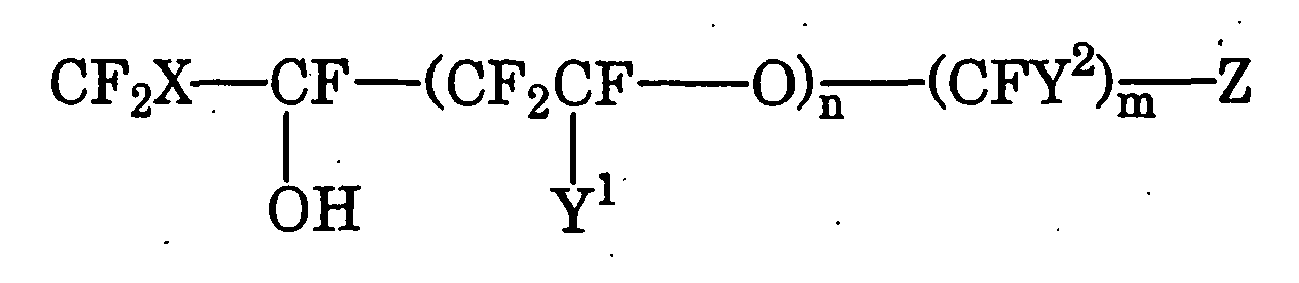
- The water-soluble fluorine-containing vinyl ether obtained by the method for producing a water-soluble fluorine-containing vinyl ether according to the present invention is represented by the above general formula (I I) given hereinabove. In the above general formula (II), Y1, Y2, Z, n and m are as defined hereinabove referring to the above general formula (I).
- According to the method of the present invention, byproduct formation can be inhibited by subjecting the fluorine-containing 2-alkoxypropionic acid derivatives to thermal decomposition at a temperature not lower than 50°C but lower than 170°C using the above-mentioned coordinating organic solvent, therefore the water-soluble fluorine-containing vinyl ethers can be obtained in good yields from the fluorine-containing 2-alkoxypropionic acid derivatives.
- The water-soluble fluorine-containing vinyl ethers can be polymerized, either as such or after protection of the terminal hydrophilic group by fluorination or by esterification, amidation or imidation, together with another fluoroolefin, for instance, to give copolymers.
- The copolymers obtained, which have salt-forming hydrophilic groups, can be adequately used as electrolyte membranes such as ion exchange membranes or diaphragms. As for the ion exchange membranes, they can be utilized in salt electrolysis, chemical sensors, separation membranes, fuel cells and so forth. The copolymers obtained can also be used as macromolecular superstrong acid catalysts in the form of powders as such, or in lithium cells or the like, in the form of liquids.
- The following examples illustrate the present invention in further detail. These examples are, however, by no means limitative of the scope of the present invention.
- 1.1) A 6-liter glass-lined pressure-resistant autoclave was charged with SO3 (2 liters) freshly prepared by distillation of Sulfan (stabilized sulfuric anhydride; product of Nisso Metallochemical Co.), the inside space atmosphere was purged with pure nitrogen gas for substitution therewith, and tetrafluoroethylene was then charged into the autoclave under pressure, upon which the exothermal reaction started immediately. The reaction was continued while maintaining the temperature at 40-60°C and the pressure at 0. 1 to 0.2 MPa. After 40 minutes, when the product amount increased to 5.2 liters and the absorption of tetrafluoroethylne was no longer observed, the reaction was terminated by cooling. The reaction product was a colorless, transparent liquid, which, upon distillation, was found to be almost pure tetrafluoroethane β-sultone. 1.2) A 6-liter glass-lined pressure-resistant autoclave was charged with 400 g of potassium fluoride thoroughly dried at 300°C and then tightly closed under nitrogen streams. Then, 1 liter of diethylene glycol dimethyl ether was charged into the autoclave, and the sultone (1 liter) obtained in the step 1.1) was added dropwise. A marked exothermic reaction took place, and it was confirmed by 19F-NMR analysis that the isomerization reaction to FSO2CF2COF had been completed almost quantitatively although the formation of free FSO2CF2CF2OK was also observed.
- 1.3) The product FSO2CF2COF obtained using the same reaction apparatus and conditions as used in the step 1.2) was added, under pressure at -10°C, and hexafluoropropylene oxide [HFPO] gas was added to a pressure of 0.2 MPa, whereupon the exothermal reaction started immediately. While the temperature was adjusted to -15 to -5°C, the reaction was continued at a pressure of 0. 1 to 0.2 MPa for 3 hours. Thereafter, the rate of pressure dropping decreased, so that the reaction was interrupted, and the residual gas was discharged. The volume of the product was 2.7 liters, and the product consisted of a yellow upper phase and a colorless lower phase. Upon distillation, 90% by volume of the product was found to be the HFPO (one mole) adduct, namely the compound:
FSO2CF2CF2OCF(CF3)COF.
- In addition, the formation of a slight amount of FSO2CF2COF and the HFPO (two moles) adducts was observed.
- 1.4) The compound obtained in the step 1.3) was neutralized with a 20% (by mass) aqueous solution of sodium hydroxide for quantitative conversion to the corresponding fluorine-containing 2-alkoxypropionic acid derivative. Thus was obtained a 36% (by mass) aqueous solution of a compound represented by the formula:
NaOC (O) CF(CF3) OCF2CF2SO3Na.
- The aqueous solution obtained was removed of the insoluble NaF by filtration and then dried at 80°C for 36 hours and then further at 120°C for 12 hours.
- A 20-liter glass vessel equipped with a stirrer was charged with the fluorine-containing 2-alkoxypropionic acid derivative NaOC(O)CF(CF3)OCF2CF2SO3Na (6.4 kg) obtained in Production Example 1 and 5.3 kg of diethylene glycol dimethyl ether (83 parts by mass per 100 parts by mass of the fluorine-containing 2-alkoxypropionic acid derivative). The vessel was heated by means of a mantle heater. Upon arrival of the inside temperature at 100°C, the generation of CO2 started. The inside temperature was then slowly raised to 140°C. After 180 minutes of heating, the CO2 generation subsided and, therefore, the heating was discontinued. Pure water (6 liters) was added to the reaction mixture obtained for dissolving the same, the insoluble sodium fluoride was filtered off, and the remaining diethylene glycol dimethyl ether layer was extracted with 7 portions of chloroform to give an aqueous solution.
- The thus-obtained aqueous solution was subjected to 19F-NMR spectrometry, and a comparison was made between the large peak at about -83.3 ppm (relative to CDCl3) due to the underlined fluorine atoms of -OCF 2CF2- in the water-soluble fluorine-containing vinyl ether CF2=CF-OCF 2CF2-SO3Na and a number of byproduct-due small peaks at -78 to -85 ppm. It was found that the ratio [water-soluble fluorine-containing vinyl ether]:[byproducts] was 100:9. The aqueous solution obtained was evaporated to dryness; the product was readily crystallized and could be purified by recrystallization.
- A 20-liter glass vessel equipped with a stirrer and a reflux condenser was charged with 6.4 kg of the fluorine-containing 2-alkoxypropionic acid derivative NaOC(O)CF(CF3)OCF2CF2SO3Na obtained in Production Example 1 and, as inert solvents, 17.7 kg of Cl(CF2CFCl)3Cl and 240 g of diethylene glycol dimethyl ether (3 parts by mass per 100 parts by mass of the fluorine-containing 2-alkoxypropionic acid derivative) . The vessel was heated by means of a mantle heater. Upon arrival of the inside temperature at 180°C, the generation of CO2 started. After 7 hours of heating under refluxing conditions (inside temperature 203°C), the CO2 generation suppressed and, therefore, the heating was discontinued. After cooling, the reaction mixture obtained was filtered, and the solid matter was washed with HCFC-225. The solid matter thus obtained was dissolved in water, and the insoluble sodium fluoride was filtered off to give an aqueous solution.
- The thus-obtained aqueous solution was subjected to 19F-NMR spectrometry, and a comparison was made between the large peak at about -83.3 ppm (relative to CDCl3) due to the underlined fluorine atoms of -OCF 2CF2- in the water-soluble fluorine-containing vinyl ether CF2=CF-OCF 2CF2-SO3Na and a number of byproduct-due small peaks at -78 to -85 ppm. It was found that the ratio [water-soluble fluorine-containing vinyl ether]:[byproducts] was 100:102. The aqueous solution obtained was evaporated to dryness; the product only became a thick syrup-like substance but could not be purified by recrystallization.
- A 500-ml SUS stainless steel autoclave equipped with a reflux condenser was charged with the fluorine-containing 2-alkoxypropionic acid derivative NaOC (O) CF (CF3) OCF2CF2SO3Na (80 g) obtained in Production Example 1 and 130 g of ethyl acetate (163 parts by mass per 100 parts by mass of the fluorine-containing 2-alkoxypropionic acid derivative). The contents were heated to 145°C by means of a heater and stirred. The CO2 generated was discharged through the reflux condenser so that the autoclave inside pressure might be maintained at a level not exceeding 0.1 MPa. After 5 hours, no increase in inside pressure was observed any longer, so that the autoclave was allowed to cool. All the internal gas was discharged at around room temperature. The reaction mixture was filtered, and the filtrate was concentrated under reduced pressure to give a white solid. The solid obtained was subjected to 19F-NMR spectrometry, whereby it was confirmed that the water-soluble fluorine-containing vinyl ether CF2=CF-OCF2CF2-SO3Na was the main product ([water-soluble fluorine-containing vinyl ether]:[byproducts] = 100:9).
- A 300-ml SUS 316 stainless steel autoclave was charged with 81 g of the fluorine-containing 2-alkoxypropionic acid derivative NaOC(O)CF(CF3)OCF2CF2SO3Na obtained in Production Example 1 and 88 g of tetrahydrofuran (109 parts by mass per 100 parts by mass of the fluorine-containing 2-alkoxypropionic acid derivative) . The contents were heated to 140°C by means of a heater and stirred for 3 hours. The autoclave inside pressure arrived at a maximum of 1.4 MPa. The autoclave was allowed to cool, and all the internal gas was discharged at around room temperature. The reaction mixture was filtered, and the filtrate was concentrated under reduced pressure to give a white solid. The solid obtained was subjected to 19F-NMR spectrometry, and it was confirmed that the water-soluble fluorine-containing vinyl ether CF2=CF-OCF2CF2-SO3Na was the main product ([water-soluble fluorine-containing vinyl ether]:[byproducts] = 100:11).
- The method for producing a water-soluble fluorine-containing vinyl ether according to the present invention, which has the constitution described above, makes it possible to obtain water-soluble fluorine-containing vinyl ethers in good yields from the corresponding fluorine-containing 2-alkoxypropionic acid derivatives.
Claims (9)
- A method for producing a water-soluble fluorine-containing vinyl ether which comprises
subjecting a fluorine-containing 2-alkoxypropionic acid derivative represented by the following general formula (I):
A represents -OM1 or -OM2 1/2, and M1 represents an alkali metal and M2 represents an alkaline earth metal;
X represents a halogen atom;
Y1 and Y2 are the same or different and each represents a fluorine atom, a chlorine atom, a perfluoroalkyl group or a fluorochloroalkyl group;
n represents an integer of 0 to 3, and
n of Y1s may be the same or different;
m represents an integer of 1 to 5, and
m of Y2s may be the same or different; and
Z represents a hydrophilic group being -COOM3, -OSO3M3, -SO3M3, -O2PM3, -OP(OM3)2, -O2P(OM3), -OPO(OM3)2, -PO2(OM3), -PO(OM3)2, -COOM4 1/2, -OSO3M4 1/2, -SO3M4 1/2, -O2PM4 1/2, -OP(OM4 1/2)2, -O2P(OM4 1/2), -OPO(OM4 1/2)2, -PO2(OM4 1/2), -PO(OM4 1/2)2, or a substituted ammonio group forming a salt with a conjugate base of an inorganic acid or fatty acid wherein its substituents being two or three alkyl groups which are the same or different, wherein M3 represents an alkali metal, a hydrogen atom or NR1R2R3R4 in which R1, R2, R3 and R4 are the same or different and each represents a hydrogen atom or an alkyl group containing 1 to 4 carbon atoms, and M4 represents an alkaline earth metal;
to thermal decomposition at a temperature of not lower than 50°C but lower than 170 °C
in the presence of a coordinating organic solvent to give a water-soluble fluorine-containing vinyl ether represented by the following general formula (II):
said coordinating organic solvent being an aprotic polar organic solvent,
said aprotic polar organic solvent being ethyl acetate, tetrahydrofuran or a mixture of ethyl acetate and tetrahydrofuran, and
said coordinating organic solvent being in an amount of 10 to 1,000 parts by mass per 100 parts by mass of said fluorine-containing 2-alkoxypropionic acid derivative. - The method for producing a water-soluble fluorine-containing vinyl ether according to Claim 1,
wherein the thermal decomposition is carried out at a temperature not lower than 50 °C but lower than 150°C. - The method for producing a water-soluble fluorine-containing vinyl ether according to Claim 1 or 2,
wherein the coordinating organic solvent is in an amount of 30 to 300 parts by mass per 100 parts by mass of the fluorine-containing 2-alkoxypropionic acid derivative. - The method for producing a water-soluble fluorine-containing vinyl ether according to any of Claim 1-3,
wherein the approtic polar organic solvent has a water content not exceeding 250 ppm. - The method for producing a water-soluble fluorine-containing vinyl ether according to any of Claims 1-4,
wherein the fluorine-containing 2-alkoxypropionic acid derivative represented by the general formula (I) has a water content not exceeding 0.1% by mass. - The method for producing a water-soluble fluorine-containing vinyl ether according to any of Claims 1-5,
wherein n is 0 or 1. - The method for producing a water-soluble fluorine-containing vinyl ether according to any of Claims 1-6,
wherein Z is -SO3M3 or -SO3M4 1/2. - The method for producing a water-soluble fluorine-containing vinyl ether according to any of Claims 1-7,
wherein Z is -SO3M3, A is -OM1 or -OM2 1/2, Y1 is a trifluoromethyl group, Y2 is a fluorine atom and m is 2. - The method for producing a water-soluble fluorine-containing vinyl ether according to Claim 8,
wherein n is 0.
Applications Claiming Priority (3)
| Application Number | Priority Date | Filing Date | Title |
|---|---|---|---|
| JP2002175130 | 2002-06-14 | ||
| JP2002175130 | 2002-06-14 | ||
| PCT/JP2003/007592 WO2003106409A1 (en) | 2002-06-14 | 2003-06-16 | Process for the production of water-soluble fluorine -containing vinyl ethers |
Publications (3)
| Publication Number | Publication Date |
|---|---|
| EP1553081A1 EP1553081A1 (en) | 2005-07-13 |
| EP1553081A4 EP1553081A4 (en) | 2006-07-05 |
| EP1553081B1 true EP1553081B1 (en) | 2009-11-18 |
Family
ID=29728013
Family Applications (1)
| Application Number | Title | Priority Date | Filing Date |
|---|---|---|---|
| EP03736218A Expired - Lifetime EP1553081B1 (en) | 2002-06-14 | 2003-06-16 | Process for the production of water-soluble fluorine -containing vinyl ethers |
Country Status (8)
| Country | Link |
|---|---|
| US (1) | US7321071B2 (en) |
| EP (1) | EP1553081B1 (en) |
| JP (1) | JP4013951B2 (en) |
| CN (1) | CN1332941C (en) |
| AT (1) | ATE449065T1 (en) |
| AU (1) | AU2003241666A1 (en) |
| DE (1) | DE60330171D1 (en) |
| WO (1) | WO2003106409A1 (en) |
Families Citing this family (6)
| Publication number | Priority date | Publication date | Assignee | Title |
|---|---|---|---|---|
| JP2009190970A (en) * | 2006-05-15 | 2009-08-27 | Asahi Glass Co Ltd | Method for producing acid fluoride having a fluorosulfonyl group |
| CN110387386B (en) * | 2019-08-13 | 2021-10-15 | 惠州市华泓新材料股份有限公司 | Cationic photo-curing fluorine-containing oligomer, anti-fingerprint UV (ultraviolet) ink and application of ink in touch screen display |
| JP7258694B2 (en) * | 2019-08-16 | 2023-04-17 | 旭化成株式会社 | Method for producing sulfonic acid group-containing monomer |
| CN111072627A (en) * | 2019-12-26 | 2020-04-28 | 浙江巨化技术中心有限公司 | Synthesis method of perfluoroalkyl sultone |
| JP2022073879A (en) * | 2020-10-30 | 2022-05-17 | 旭化成株式会社 | Method for purifying sulfonic acid group-containing monomer |
| CN116375609A (en) * | 2023-03-15 | 2023-07-04 | 北京科太亚洲生态科技股份有限公司 | A high-performance resin monomer synthesis process |
Family Cites Families (4)
| Publication number | Priority date | Publication date | Assignee | Title |
|---|---|---|---|---|
| DE2708677C3 (en) * | 1977-02-28 | 1982-04-22 | Asahi Glass Co. Ltd., Tokyo | Process for the preparation of alkoxycarbonyl perfluoroalkyl perfluorovinyl ethers |
| US4358412A (en) * | 1980-06-11 | 1982-11-09 | The Dow Chemical Company | Preparation of vinyl ethers |
| CN1154633C (en) | 1997-03-31 | 2004-06-23 | 大金工业株式会社 | Preparation method of halogenated vinyl ether sulfonic acid derivatives |
| JP2001114750A (en) * | 1999-10-19 | 2001-04-24 | Daikin Ind Ltd | Method for producing perfluorovinyl ether sulfonic acid derivative |
-
2003
- 2003-06-16 DE DE60330171T patent/DE60330171D1/en not_active Expired - Lifetime
- 2003-06-16 JP JP2004513242A patent/JP4013951B2/en not_active Expired - Fee Related
- 2003-06-16 US US10/517,667 patent/US7321071B2/en not_active Expired - Lifetime
- 2003-06-16 EP EP03736218A patent/EP1553081B1/en not_active Expired - Lifetime
- 2003-06-16 WO PCT/JP2003/007592 patent/WO2003106409A1/en not_active Ceased
- 2003-06-16 AT AT03736218T patent/ATE449065T1/en not_active IP Right Cessation
- 2003-06-16 CN CNB038133458A patent/CN1332941C/en not_active Expired - Fee Related
- 2003-06-16 AU AU2003241666A patent/AU2003241666A1/en not_active Abandoned
Also Published As
| Publication number | Publication date |
|---|---|
| EP1553081A4 (en) | 2006-07-05 |
| EP1553081A1 (en) | 2005-07-13 |
| WO2003106409A1 (en) | 2003-12-24 |
| CN1659138A (en) | 2005-08-24 |
| US20050245758A1 (en) | 2005-11-03 |
| CN1332941C (en) | 2007-08-22 |
| JPWO2003106409A1 (en) | 2005-10-13 |
| ATE449065T1 (en) | 2009-12-15 |
| AU2003241666A1 (en) | 2003-12-31 |
| DE60330171D1 (en) | 2009-12-31 |
| US7321071B2 (en) | 2008-01-22 |
| JP4013951B2 (en) | 2007-11-28 |
Similar Documents
| Publication | Publication Date | Title |
|---|---|---|
| CN103370345B (en) | The oligomer of highly fluorinated sulfinic acid and co-oligomer and salt thereof | |
| EP0041738B1 (en) | Preparation of vinyl ethers | |
| US4515989A (en) | Preparation decarboxylation and polymerization of novel acid flourides and resulting monomers | |
| EP2651863B1 (en) | Methods of making partially fluorinated sulfinic acid monomers and their salts | |
| KR20140097370A (en) | Method for preparing fluorine-containing vinyl ether | |
| US7321071B2 (en) | Process for the production of water-soluble fluorine-containing vinyl ethers | |
| EP0140482A2 (en) | Fluorination process for the production of nuclear fluorinated phthaloyl- and terephthaloyl fluorides | |
| EP2238123B1 (en) | Addition reaction to fluoroallylfluorosulfate | |
| WO2003002506A1 (en) | Process for producing fluorinated vinyl ether | |
| JP2004018454A (en) | Method for producing fluorine-containing fluorosulfonylalkyl vinyl ether | |
| EP0115085A1 (en) | A process for preparing a perfluorinated or polyfluorinated aliphatic carboxylic acid | |
| JPH0367059B2 (en) | ||
| EP2714655B1 (en) | Allyl ether-terminated fluoroalkanesulfinic acids, salts thereof, and a method of making the same | |
| JPH0261446B2 (en) | ||
| JP4260466B2 (en) | Fluorinated sulfonate monomer | |
| EP1325906B1 (en) | Alkyl esters of 2-(2-fluorosulphonyl)-perfluoroethylenoxy-3-halogen-propionic acid | |
| EP2193157B1 (en) | Fluorinated polyethers and polyether oils and methods of preparation | |
| US20100197963A1 (en) | Fluorinated oxy-carboxylic acids, derivatives, and methods of preparation | |
| JP4013953B2 (en) | Fluorine-containing 2-alkoxypropionic acid derivative drying method | |
| WO2007142266A1 (en) | Method for producing fluorinated fluorosulfonylalkyl vinyl ether | |
| JP3149537B2 (en) | Method for producing 1H-perfluoroalkane | |
| WO2005121060A1 (en) | Process for the synthesis of polyfluorocarboxylic acids | |
| KR850000110B1 (en) | Polymerization Method of Fluorocarbon Vinyl Ether | |
| JPH0334937A (en) | Method for producing m-fluoroaromatic compound | |
| JP2022070150A (en) | Method for Producing Fluorine-Containing Disalt Compound and Method for Producing Fluorine-Containing Vinyl Compound |
Legal Events
| Date | Code | Title | Description |
|---|---|---|---|
| PUAI | Public reference made under article 153(3) epc to a published international application that has entered the european phase |
Free format text: ORIGINAL CODE: 0009012 |
|
| 17P | Request for examination filed |
Effective date: 20050111 |
|
| AK | Designated contracting states |
Kind code of ref document: A1 Designated state(s): AT BE BG CH CY CZ DE DK EE ES FI FR GB GR HU IE IT LI LU MC NL PT RO SE SI SK TR |
|
| AX | Request for extension of the european patent |
Extension state: AL LT LV MK |
|
| DAX | Request for extension of the european patent (deleted) | ||
| A4 | Supplementary search report drawn up and despatched |
Effective date: 20060601 |
|
| 17Q | First examination report despatched |
Effective date: 20070320 |
|
| GRAP | Despatch of communication of intention to grant a patent |
Free format text: ORIGINAL CODE: EPIDOSNIGR1 |
|
| GRAS | Grant fee paid |
Free format text: ORIGINAL CODE: EPIDOSNIGR3 |
|
| GRAA | (expected) grant |
Free format text: ORIGINAL CODE: 0009210 |
|
| AK | Designated contracting states |
Kind code of ref document: B1 Designated state(s): AT BE BG CH CY CZ DE DK EE ES FI FR GB GR HU IE IT LI LU MC NL PT RO SE SI SK TR |
|
| REG | Reference to a national code |
Ref country code: GB Ref legal event code: FG4D |
|
| REG | Reference to a national code |
Ref country code: CH Ref legal event code: EP |
|
| REG | Reference to a national code |
Ref country code: IE Ref legal event code: FG4D |
|
| REF | Corresponds to: |
Ref document number: 60330171 Country of ref document: DE Date of ref document: 20091231 Kind code of ref document: P |
|
| REG | Reference to a national code |
Ref country code: DE Ref legal event code: R096 Ref document number: 60330171 Country of ref document: DE Effective date: 20091231 |
|
| REG | Reference to a national code |
Ref country code: NL Ref legal event code: VDEP Effective date: 20091118 |
|
| PG25 | Lapsed in a contracting state [announced via postgrant information from national office to epo] |
Ref country code: SE Free format text: LAPSE BECAUSE OF FAILURE TO SUBMIT A TRANSLATION OF THE DESCRIPTION OR TO PAY THE FEE WITHIN THE PRESCRIBED TIME-LIMIT Effective date: 20091118 Ref country code: ES Free format text: LAPSE BECAUSE OF FAILURE TO SUBMIT A TRANSLATION OF THE DESCRIPTION OR TO PAY THE FEE WITHIN THE PRESCRIBED TIME-LIMIT Effective date: 20100228 Ref country code: FI Free format text: LAPSE BECAUSE OF FAILURE TO SUBMIT A TRANSLATION OF THE DESCRIPTION OR TO PAY THE FEE WITHIN THE PRESCRIBED TIME-LIMIT Effective date: 20091118 Ref country code: PT Free format text: LAPSE BECAUSE OF FAILURE TO SUBMIT A TRANSLATION OF THE DESCRIPTION OR TO PAY THE FEE WITHIN THE PRESCRIBED TIME-LIMIT Effective date: 20100318 |
|
| PG25 | Lapsed in a contracting state [announced via postgrant information from national office to epo] |
Ref country code: SI Free format text: LAPSE BECAUSE OF FAILURE TO SUBMIT A TRANSLATION OF THE DESCRIPTION OR TO PAY THE FEE WITHIN THE PRESCRIBED TIME-LIMIT Effective date: 20091118 Ref country code: CY Free format text: LAPSE BECAUSE OF FAILURE TO SUBMIT A TRANSLATION OF THE DESCRIPTION OR TO PAY THE FEE WITHIN THE PRESCRIBED TIME-LIMIT Effective date: 20091118 |
|
| PG25 | Lapsed in a contracting state [announced via postgrant information from national office to epo] |
Ref country code: AT Free format text: LAPSE BECAUSE OF FAILURE TO SUBMIT A TRANSLATION OF THE DESCRIPTION OR TO PAY THE FEE WITHIN THE PRESCRIBED TIME-LIMIT Effective date: 20091118 Ref country code: BE Free format text: LAPSE BECAUSE OF FAILURE TO SUBMIT A TRANSLATION OF THE DESCRIPTION OR TO PAY THE FEE WITHIN THE PRESCRIBED TIME-LIMIT Effective date: 20091118 |
|
| PG25 | Lapsed in a contracting state [announced via postgrant information from national office to epo] |
Ref country code: NL Free format text: LAPSE BECAUSE OF FAILURE TO SUBMIT A TRANSLATION OF THE DESCRIPTION OR TO PAY THE FEE WITHIN THE PRESCRIBED TIME-LIMIT Effective date: 20091118 Ref country code: BG Free format text: LAPSE BECAUSE OF FAILURE TO SUBMIT A TRANSLATION OF THE DESCRIPTION OR TO PAY THE FEE WITHIN THE PRESCRIBED TIME-LIMIT Effective date: 20100218 Ref country code: RO Free format text: LAPSE BECAUSE OF FAILURE TO SUBMIT A TRANSLATION OF THE DESCRIPTION OR TO PAY THE FEE WITHIN THE PRESCRIBED TIME-LIMIT Effective date: 20091118 Ref country code: DK Free format text: LAPSE BECAUSE OF FAILURE TO SUBMIT A TRANSLATION OF THE DESCRIPTION OR TO PAY THE FEE WITHIN THE PRESCRIBED TIME-LIMIT Effective date: 20091118 Ref country code: EE Free format text: LAPSE BECAUSE OF FAILURE TO SUBMIT A TRANSLATION OF THE DESCRIPTION OR TO PAY THE FEE WITHIN THE PRESCRIBED TIME-LIMIT Effective date: 20091118 |
|
| PG25 | Lapsed in a contracting state [announced via postgrant information from national office to epo] |
Ref country code: SK Free format text: LAPSE BECAUSE OF FAILURE TO SUBMIT A TRANSLATION OF THE DESCRIPTION OR TO PAY THE FEE WITHIN THE PRESCRIBED TIME-LIMIT Effective date: 20091118 Ref country code: CZ Free format text: LAPSE BECAUSE OF FAILURE TO SUBMIT A TRANSLATION OF THE DESCRIPTION OR TO PAY THE FEE WITHIN THE PRESCRIBED TIME-LIMIT Effective date: 20091118 |
|
| PLBE | No opposition filed within time limit |
Free format text: ORIGINAL CODE: 0009261 |
|
| STAA | Information on the status of an ep patent application or granted ep patent |
Free format text: STATUS: NO OPPOSITION FILED WITHIN TIME LIMIT |
|
| 26N | No opposition filed |
Effective date: 20100819 |
|
| PG25 | Lapsed in a contracting state [announced via postgrant information from national office to epo] |
Ref country code: GR Free format text: LAPSE BECAUSE OF FAILURE TO SUBMIT A TRANSLATION OF THE DESCRIPTION OR TO PAY THE FEE WITHIN THE PRESCRIBED TIME-LIMIT Effective date: 20100219 |
|
| REG | Reference to a national code |
Ref country code: DE Ref legal event code: R097 Ref document number: 60330171 Country of ref document: DE Effective date: 20100819 |
|
| PG25 | Lapsed in a contracting state [announced via postgrant information from national office to epo] |
Ref country code: MC Free format text: LAPSE BECAUSE OF NON-PAYMENT OF DUE FEES Effective date: 20100630 |
|
| REG | Reference to a national code |
Ref country code: CH Ref legal event code: PL |
|
| GBPC | Gb: european patent ceased through non-payment of renewal fee |
Effective date: 20100616 |
|
| REG | Reference to a national code |
Ref country code: FR Ref legal event code: ST Effective date: 20110228 |
|
| PG25 | Lapsed in a contracting state [announced via postgrant information from national office to epo] |
Ref country code: CH Free format text: LAPSE BECAUSE OF NON-PAYMENT OF DUE FEES Effective date: 20100630 Ref country code: IE Free format text: LAPSE BECAUSE OF NON-PAYMENT OF DUE FEES Effective date: 20100616 Ref country code: LI Free format text: LAPSE BECAUSE OF NON-PAYMENT OF DUE FEES Effective date: 20100630 |
|
| PG25 | Lapsed in a contracting state [announced via postgrant information from national office to epo] |
Ref country code: FR Free format text: LAPSE BECAUSE OF NON-PAYMENT OF DUE FEES Effective date: 20100630 |
|
| PG25 | Lapsed in a contracting state [announced via postgrant information from national office to epo] |
Ref country code: GB Free format text: LAPSE BECAUSE OF NON-PAYMENT OF DUE FEES Effective date: 20100616 |
|
| PG25 | Lapsed in a contracting state [announced via postgrant information from national office to epo] |
Ref country code: HU Free format text: LAPSE BECAUSE OF FAILURE TO SUBMIT A TRANSLATION OF THE DESCRIPTION OR TO PAY THE FEE WITHIN THE PRESCRIBED TIME-LIMIT Effective date: 20100519 Ref country code: LU Free format text: LAPSE BECAUSE OF NON-PAYMENT OF DUE FEES Effective date: 20100616 |
|
| PG25 | Lapsed in a contracting state [announced via postgrant information from national office to epo] |
Ref country code: TR Free format text: LAPSE BECAUSE OF FAILURE TO SUBMIT A TRANSLATION OF THE DESCRIPTION OR TO PAY THE FEE WITHIN THE PRESCRIBED TIME-LIMIT Effective date: 20091118 |
|
| PGFP | Annual fee paid to national office [announced via postgrant information from national office to epo] |
Ref country code: IT Payment date: 20220510 Year of fee payment: 20 Ref country code: DE Payment date: 20220505 Year of fee payment: 20 |
|
| REG | Reference to a national code |
Ref country code: DE Ref legal event code: R071 Ref document number: 60330171 Country of ref document: DE |
|
| P01 | Opt-out of the competence of the unified patent court (upc) registered |
Effective date: 20230525 |