EP1552825A1 - Therapeutic agent for overactive bladder - Google Patents
Therapeutic agent for overactive bladder Download PDFInfo
- Publication number
- EP1552825A1 EP1552825A1 EP03730850A EP03730850A EP1552825A1 EP 1552825 A1 EP1552825 A1 EP 1552825A1 EP 03730850 A EP03730850 A EP 03730850A EP 03730850 A EP03730850 A EP 03730850A EP 1552825 A1 EP1552825 A1 EP 1552825A1
- Authority
- EP
- European Patent Office
- Prior art keywords
- tamsulosin
- overactive bladder
- urinary
- bladder
- affected
- Prior art date
- Legal status (The legal status is an assumption and is not a legal conclusion. Google has not performed a legal analysis and makes no representation as to the accuracy of the status listed.)
- Withdrawn
Links
Images

Classifications
-
- A—HUMAN NECESSITIES
- A61—MEDICAL OR VETERINARY SCIENCE; HYGIENE
- A61K—PREPARATIONS FOR MEDICAL, DENTAL OR TOILETRY PURPOSES
- A61K45/00—Medicinal preparations containing active ingredients not provided for in groups A61K31/00 - A61K41/00
- A61K45/06—Mixtures of active ingredients without chemical characterisation, e.g. antiphlogistics and cardiaca
-
- A—HUMAN NECESSITIES
- A61—MEDICAL OR VETERINARY SCIENCE; HYGIENE
- A61K—PREPARATIONS FOR MEDICAL, DENTAL OR TOILETRY PURPOSES
- A61K31/00—Medicinal preparations containing organic active ingredients
- A61K31/16—Amides, e.g. hydroxamic acids
- A61K31/18—Sulfonamides
-
- A—HUMAN NECESSITIES
- A61—MEDICAL OR VETERINARY SCIENCE; HYGIENE
- A61K—PREPARATIONS FOR MEDICAL, DENTAL OR TOILETRY PURPOSES
- A61K31/00—Medicinal preparations containing organic active ingredients
- A61K31/33—Heterocyclic compounds
- A61K31/395—Heterocyclic compounds having nitrogen as a ring hetero atom, e.g. guanethidine or rifamycins
- A61K31/435—Heterocyclic compounds having nitrogen as a ring hetero atom, e.g. guanethidine or rifamycins having six-membered rings with one nitrogen as the only ring hetero atom
- A61K31/47—Quinolines; Isoquinolines
- A61K31/472—Non-condensed isoquinolines, e.g. papaverine
- A61K31/4725—Non-condensed isoquinolines, e.g. papaverine containing further heterocyclic rings
-
- A—HUMAN NECESSITIES
- A61—MEDICAL OR VETERINARY SCIENCE; HYGIENE
- A61P—SPECIFIC THERAPEUTIC ACTIVITY OF CHEMICAL COMPOUNDS OR MEDICINAL PREPARATIONS
- A61P13/00—Drugs for disorders of the urinary system
-
- A—HUMAN NECESSITIES
- A61—MEDICAL OR VETERINARY SCIENCE; HYGIENE
- A61P—SPECIFIC THERAPEUTIC ACTIVITY OF CHEMICAL COMPOUNDS OR MEDICINAL PREPARATIONS
- A61P13/00—Drugs for disorders of the urinary system
- A61P13/02—Drugs for disorders of the urinary system of urine or of the urinary tract, e.g. urine acidifiers
-
- A—HUMAN NECESSITIES
- A61—MEDICAL OR VETERINARY SCIENCE; HYGIENE
- A61P—SPECIFIC THERAPEUTIC ACTIVITY OF CHEMICAL COMPOUNDS OR MEDICINAL PREPARATIONS
- A61P13/00—Drugs for disorders of the urinary system
- A61P13/10—Drugs for disorders of the urinary system of the bladder
-
- A—HUMAN NECESSITIES
- A61—MEDICAL OR VETERINARY SCIENCE; HYGIENE
- A61P—SPECIFIC THERAPEUTIC ACTIVITY OF CHEMICAL COMPOUNDS OR MEDICINAL PREPARATIONS
- A61P43/00—Drugs for specific purposes, not provided for in groups A61P1/00-A61P41/00
Definitions
- the present invention relates to a drug, particularly an overactive bladder treating drug.
- Urinary incontinence is a typical example of urinary collection disorder, and defined as urine leakage demonstrable subjectively, thereby giving difficulties both in leading a normal daily life and in view of hygiene.
- Increased urinary frequency is a state exceeding normal frequency of urination and defined as:approximately 2 times or more at night and 9 times or more during a 24 hour period.
- Urinary incontinence is classified into abdominal pressure urinary incontinence that takes place when abdominal pressure is given such as during coughing or sneezing, impending urinary incontinence that takes place suddenly, with urine leakage before a patient reaches a toilet and mixed-type urinary incontinence of abdominal pressure urinary incontinence with impending urinary incontinence (Current Therapy, 19 (12), 8-11, 2001).
- Overactive bladder is a medical condition referring to the symptoms of frequency and urgency, with or without urge incontinence, when appearing in the absence of local pathological, neurological or metabolic factors that would account for these symptoms [Urology, 55 (suppl. 5A)', p1-2, 2000] .
- the following 3 groups are included in over-active bladder :(1)increased urinary frequency and urinary urgency alone, (2) increased urinary frequency, urinary urgency and impending urinary incontinence and (3)mixed-type urinary incontinence.
- Drugs for treating an overactive bladder include the muscarinic receptor antagonists that can reduce the contraction of bladder detrusor muscle.
- the muscarinic receptor is abundantly present in the bladder detrusor muscle and triggers contraction by stimulating the bladder detrusor muscle.
- ⁇ 1 receptor is abundantly present in the bottom of the bladder, urinary tract, prostate, and epithelial membrane of the prostate, and stimulates the smooth muscles to cause contraction, thus increasing urethral resistance.
- ⁇ 1 receptor blockers that reduce the urethral resistance are considered effective in treating urinary disorder.
- ⁇ 1 receptor agonists that increase the urethral resistance are considered effective in treating urinary collection disorder.
- WO96/38143 has described that ⁇ 1A receptor selective agonists are effective in treating urinary incontinence on the basis of the fact that ⁇ 1A receptor is involved in the contraction of the urinary tract and bladder neck.
- WO99/57131 has described that ⁇ 1D receptor blockers are effective in treating the stimulus symptoms found in disorders of the bladder and lower urinary tract on the basis of the fact that ⁇ 1D receptor is locally present in the bladder.
- tamsulosin or its salt is effective in treating an overactive bladder.
- the present invention relates to a pharmaceutical composition for the therapy of overactive bladder where said composition contains tamsulosin or a pharmaceutically acceptable salt thereof as an effective ingredient.
- the present invention further relates to the use of tamsulosin or a pharmaceutically acceptable salt thereof for the manufacture of a therapeutic agent for overactive bladder.
- the present invention furthermore relates to a method for the therapy of overactive bladder where said method includes administration of therapeutic effective amount of tamsulosin or a pharmaceutically acceptable salt thereof to a patient.
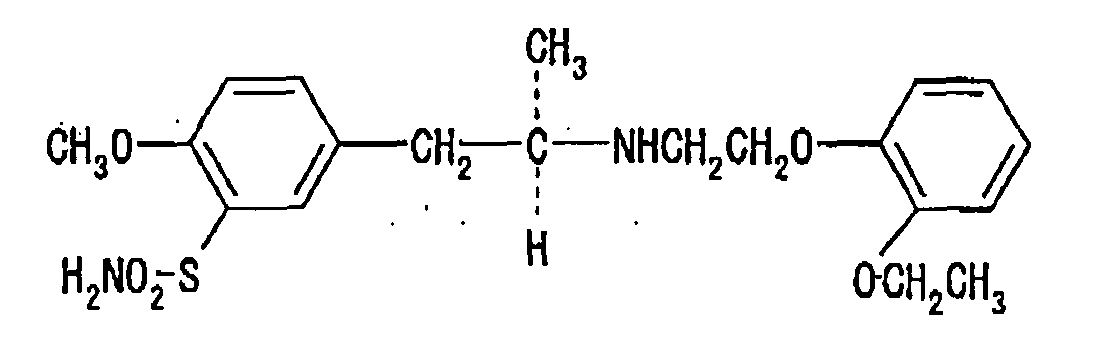
- tamsulosin is (R) (-)-5-[2-[[2-(o-ethoxyphenoxy)ethyl]amino]propyl]-2-met hoxybenzene-sulfonamide and is represented by the following structural formula. Tamsulosin has been firstly disclosed in the Japanese Patent Laid-Open No. Sho-56/110665 (corresponding European patent publication No.34432) together with its pharmaceutically acceptable salts.
- tamsulosin and its salt exhibit adrenaline ⁇ 1A receptor blocking actions, and its hydrochloride (tamsulosin hydrochloride), in particular, acts to block ⁇ 1 receptor in the urinary tract and prostate, thus finding a wide use as a drug for improving urinary disorder associated with prostate hypertrophy by reducing the prostate pressure part of urethral pressure profile.
- hydrochloride tamsulosin hydrochloride
- the present invention further relates to the use of tamsulosin or a pharmaceutically acceptable salt thereof for the manufacture of a medicament to be used in combination with muscarinic receptor antagonist in the treatment of overactive bladder.
- the present invention furthermore relates to a method for the therapy of overactive bladder where said method includes administration of therapeutically effective amount of tamsulosin or a pharmaceutically acceptable salt thereof to a patient in combination with therapeutically effective amount of muscarinic receptor antagonist.
- the invention relates to a pharmaceutical composition for the therapy of overactive bladder where said composition contains tamsulosin or a pharmaceutically acceptable salt thereof and muscarinic receptor antagonist or its pharmacologically permissible salt as active ingredients. Tamsulosin ( ⁇ 1 receptor blocker) and muscarinic receptor antagonist are confirmed to provide synergetic effects due to different action mechanisms.
- overactive bladder stands for a medical condition referring to the symptoms of frequency and urgency, with or without urge incontinence, when appearing in the absence of local pathological, neurological or metabolic factors that would account for these symptoms.
- the patients of overactive bladder include not only adults, but also children.
- a therapeutic agent for overactive bladder is a pharmaceutical agent which treats overactive bladder and/or a pharmaceutical agent which improves the symptom of overactive bladder.
- a pharmaceutical composition for the therapy of overactive bladder contains effective ingredients which treat overactive bladder and/or improve the symptom of overactive bladder and pharmaceutically acceptable carriers thereof.
- Tamsulosin and its pharmaceutically acceptable salt are easily available by means of the methods described in the Japanese Patent Laid-Open Nos. Sho-56/110665 (corresponding European patent publication No.34432) and Sho-62/114952 (corresponding Canadian patent No.1282077) or the methods similar thereto.
- Tamsulosin is able to form pharmaceutically acceptable acid- and base-addition salts with a wide range of inorganic and organic acids or bases.
- Such salts also constitute a part of the present invention.
- Their examples are salts with inorganic acids such as hydrochloric acid, sulfuric acid, phosphoric acid; salts with organic acids such as fumaric acid, malic acid, citric acid, succinic acid; salts with alkaline metals such as sodium, potassium; and salts with alkaline earth metals such as calcium, magnesium, etc.
- hydrochlorides are most preferred.
- the pharmaceutical agent of the present invention can be prepared as oral solid preparations, oral liquid preparations or injection preparations by a conventional method using organic or inorganic carrier, filler and other additives suitable for oral or parenteral administration.
- Preferred ones are oral solid preparations which can be easily administered by a patient himself/herself and are convenient for preservation and carrying and, to be more specific, they are tablets, diluted powder, granules, fine granules, capsules, pills, etc.
- the active substance is mixed with at least one inert diluent such as lactose, mannitol, glucose, microcrystalline cellulose, starch, and polyvinylpyrrolidone or magnesium metasilicate aluminate.
- inert diluent such as lactose, mannitol, glucose, microcrystalline cellulose, starch, and polyvinylpyrrolidone or magnesium metasilicate aluminate.
- the composition may contain additives other than the inert diluent according to a conventional method and their examples may be binders such as hydroxypropyl cellulose and hydroxypropylmethyl cellulose; lubricants such as magnesium stearate, calcium stearate, polyethylene glycol, starch and talc; disintegrants such as calcium cellulose glycolate; stabilizers such as lactose; solubilizing aids such as glutamic acid and aspartic acid; plasticizers such as Tween 80 and triacetin; and coloring agents such as titanium oxide and iron sesquioxide.
- binders such as hydroxypropyl cellulose and hydroxypropylmethyl cellulose
- lubricants such as magnesium stearate, calcium stearate, polyethylene glycol, starch and talc
- disintegrants such as calcium cellulose glycolate
- stabilizers such as lactose
- solubilizing aids such as glutamic acid and aspartic acid
- plasticizers such as Tween
- tablets or pills may be coated with a sugar coat or with a film of a gastric or an enteric substance such assucrose, gelatin, agar, pectin, hydroxypropyl cellulose and hydroxypropylmethyl cellulose Phthalate.
- a gastric or an enteric substance such assucrose, gelatin, agar, pectin, hydroxypropyl cellulose and hydroxypropylmethyl cellulose Phthalate.
- the most preferred preparation in the present invention is a sustained-release preparation of a sustained releasing type.
- the sustained-release preparation may be made into tablets, granules, fine granules or capsules by a known method.
- the sustained-release preparation is prepared by coating tablets, fine granules, fine granules or capsules with, for example, fat/oil, fatty acid ester of polyglycerol, hydroxypropyl cellulose, etc. by a known method.
- the sustained-release preparation disclosed in the Japanese Patent Laid-Open No. Sho-62/9 (corresponding European patent publication No. 194838) is particularly preferred.
- particles which are prepared by granulation after adding an elution suppressor to a mixture of an active compound and not less than 50% by weight of a unit-forming substance in a unit are filled in a capsule to prepare a capsule preparation or to prepare a tablet by a conventional method.
- Crystalline cellulose is preferable as the unit-forming substance.
- a water-insoluble high-molecular substance such as an acrylic polymer, copolymer or cellulose derivative is used and it is appropriate that the elution suppressor is used, for example, in a form of an aqueous suspension, an aqueous emulsion or a solution in a water-containing organic solvent.
- Eudragit L 30D55 methacrylic acid copolymer LD
- Eudragit E 30D emulsion of copolymer of ethyl acrylate with methyl methacrylate
- Aquacoat ECD-30 aqueous suspension of ethyl cellulose
- the most preferable is an orally sustained-release preparation with prolonged action that is able to release a certain active ingredient for a prolonged period of time of 12 - 24 hours after oral administration through favorable drug release not only in the upper digestive tract but also in the lower digestive tract.
- the orally sustained-release preparation with prolonged action disclosed in WO94/06414 is able to release an active ingredient even at a colon low in water content because the preparation can well absorb water contents inside the preparation while remaining in the upper digestive tracts and travel down the lower digestive tract in an almost completely gelatinized form.
- this is a hydrogel sustained-release preparation type tablet with a gelatinization rate of 70% or greater but less than 100%, which is obtained by mixing (1) drugs, (2) additves for causing water intrusion into the preparation at a range of 5 ⁇ 80 % by weight or greater with regard to the preparation as a whole in a solubility by which not more than 5mL of water is necessary for dissolving 1 gram of the preparation and (3) a high-molecular weight substance weighing 70mg or more per one tablet and forming hydrogel at 10 - 95 % by weight with regard to the preparation as a whole, with mean molecular weight of 2, 000, 000 or greater or the viscosity of 1000cps or greater in 1% aqueous solution at 25°C.
- the additive for causing water intrusion into the preparation includes polyethylene glycol, polyvinyl pyrrolidone , D-sorbitol, xylitol, refined sugar, anhydrous maltose, D-fructose, dextran, glucose, polyoxyethylene polyoxypropylene glycol, sodium chloride, magnesium chloride, citric acid, tartaric acid, glycine, ⁇ -alaine, lysine hydrochloride and meglumine.
- the hydrogel-forming high-molecular substance includes polyethylene oxide, hydroxyproply methylcellulose, carboxymethylcellulose sodium, hydroxyethy cellulose and carboxyvinyl polymer.
- yellow iron sesquioxide and/or red iron sesquioxide are mixed to prevent change in the sustained-release property of tamsulosin even in storage under irradiation, as disclosed in WO01/10466.
- tamsulosin or a pharmaceutically acceptable salt thereof is appropriately decided for each case taking administering route, symptom of the disease, age and sex of the object to be treated, etc. into consideration. Taking into consideration the effects of Test Examples described after, in the case of an oral administration, tamsulosin hydrochloride is administered to an adult usually in a dose of about 0.1 to 2.0 mg/day or, most preferably, in a dose of 0.25 to 1.5 mg/day and that is administered per os after meals once daily.
- a combination drug comprising tamsulosin or its salt, and a muscarinic receptor antagonist can be administered to patients.
- Muscarinic receptor antagonists include oxybutynin, tolterodine, darifenacin, nubenzepin, zamiphenacine, tiotropium, albamerin, trospium, phesoterozine, temiverine, qunuclidin-3'-yl-1-phenyl1,2,3, 4-tetrahydroisoquinoline-2-carboxylate(solifenacin), 4 (2-methyl-1H-imidazolyl-1-yl)-2,2-diphenylbutyl amide, N-[1-(6-aminopyridine-2-ylmethyl)piperidine-4-yl]-2(R)-[3, 3-difluoro-1(R)-cyclopentyl]-2-hydroxyl-2-phenyl acetoamide and their salts.
- M3 receptor-selective antagonists Preferable are M3 receptor-selective antagonists and particularly preferable are succinic acid of (+)-(1S, 3'R)-qunuclidin-3'-yl 1-phenyl-1, 2, 3, 4-tetrahydroisoquinoline-2-carboxylate (solifenacin).
- Solifenacin and its pharmaceutically acceptable salt are easily available by means of the methods described in WO96/20194 or the methods similar thereto.
- they are administered to an adult usually in a dose of about 1 to 100 mg/day or, most preferably, in a dose of 5 to 50 mg/day once or dividedly twice.
- capsule preparations containing 0.2 mg of tamsulosin hydrochloride in a capsule.
- Example Number Tamsulosin Hydrochloride (g) Crystalline Cellulose (g) Eudragit L30D-55 (Solid Content) (g) 2 5 445 166.6 (50) 3 5 395 333.3 (100) 4 5 482.5 41.7(12.5) 5 2.5 472.5 83.3 (25) 6 1.25 473.75 83.3 (25)
- capsule preparations containing 0.2 mg of tamsulosin hydrochloride in a capsule.
- the resulting particles were mixed with talc and magnesium stearate and filled in capsules to prepare capsule preparations.
- Tamsulosin hydrochloride, D-sorbitol and polyethylene oxide were subjected to ethanol wet type granulation, using ethanol, and then dried.
- a smoothing agent was added to the dried product, mixed and tabulated to obtain an orally sustained-release preparation with prolonged action (8mm across) weighing 200mg.
- capsule preparation 1mg capsule 10mg capsule 100mg capsule solifenacin succinate 1.0mg 10.0mg 100.0mg lactose 199.0mg 190.0mg 100.0mg total 200.0mg 200.0mg 200.0mg 200.0mg
- Test Example 1 Clinical Test to Patients Suffering from overactive bladder
- Test Example 2 improvement of the irritating symptoms in the urinary bladder of animal model for disease
- Wistar female rats (6 to 7 weeks old) were employed for the preparation.
- a catheter was inserted into the urinary bladder through the external urethral orifice under anesthesia with sodium pentobarbital in rats. After subjecting the abdominal region to the median section, the proximal urethra was ligated together with the catheter at 2 sites by a silk blade (5-0), and the catheter was removed.
- the silk blade used for ligation of the urethra was removed under anesthesia with sodium pentobarbital.
- a catheter for infusion of physiological saline and for the measurement of the intravesical pressure was inserted into the urinary bladder through the top part of the urinary bladder and fixed.
- a catheter for administration of a drug was inserted into the jugular vein, and the rat was returned to a housing cage after recovery.
- the catheter inserted into the urinary bladder was connected to a syringe pump for continuous infusion of physiological saline (7-20 mL/hr) to induce the micturition reflex and to a pressure transducer to measure the intravesical pressure with a three way stopcock. After the micturition reflex was stabilized, physiological saline or a drug was administered through the catheter for administration of a drug inserted into the jugular vein.
- the frequency of contraction before micturition (the number of contractions for 10 min before starting of micturition), contraction pressure (mean contraction pressure for 10 min before starting of micturition), micturition pressure and interval of micturition were employed for the present test.
- the effect of a drug was evaluated on the basis of the inhibition ratio against the pre-dosing values (prolongation ratio in the micturition interval).
- Tamsulosin hydrochloride was administered intravenously in increasing the doses at a common ratio of about 3 (1, 3 and 10 ⁇ g/kg) .
- the action of tamsulosin hydrochloride (3 ⁇ g/kg) in combination with Solifenacin succinate (3 mg/kg) on each parameter was also evaluated.
- the interval of micturition was prolonged only by 2.1% or 2.6% in administration of tamsulosin hydrochloride (3 ⁇ g/kg i.v.) or solifenacin succinate (3 mg/kg i.v.), respectively, but by 13.1% in the combination of tamsulosin hydrochloride and solifenacin succinate.
- the combination of tamsulosin hydrochloride and solifenacin succinate gave no effect on the micturition pressure similar to administration of tamsulosin hydrochloride alone.
- tamsulosin hydrochloride and solifenacin succinate improved more strongly the irritating symptoms in the urinary bladder compared with administration of tamsulosin hydrochloride alone. Therefore, the combination of tamsulosin hydrochloride and solifenacin succinate will be a useful treatment method for overactive urinary bladder.
- the present invention is able to provide an excellent drug for treating an overactive bladder.
Landscapes
- Health & Medical Sciences (AREA)
- Life Sciences & Earth Sciences (AREA)
- Chemical & Material Sciences (AREA)
- Veterinary Medicine (AREA)
- Public Health (AREA)
- Medicinal Chemistry (AREA)
- General Health & Medical Sciences (AREA)
- Animal Behavior & Ethology (AREA)
- Pharmacology & Pharmacy (AREA)
- Epidemiology (AREA)
- General Chemical & Material Sciences (AREA)
- Organic Chemistry (AREA)
- Nuclear Medicine, Radiotherapy & Molecular Imaging (AREA)
- Engineering & Computer Science (AREA)
- Chemical Kinetics & Catalysis (AREA)
- Bioinformatics & Cheminformatics (AREA)
- Urology & Nephrology (AREA)
- Pharmaceuticals Containing Other Organic And Inorganic Compounds (AREA)
- Acyclic And Carbocyclic Compounds In Medicinal Compositions (AREA)
- Nitrogen Condensed Heterocyclic Rings (AREA)
- Medicines That Contain Protein Lipid Enzymes And Other Medicines (AREA)
Abstract
Description
| Example Number | Tamsulosin Hydrochloride (g) | Crystalline Cellulose (g) | Eudragit L30D-55 (Solid Content) (g) |
| 2 | 5 | 445 | 166.6 (50) |
| 3 | 5 | 395 | 333.3 (100) |
| 4 | 5 | 482.5 | 41.7(12.5) |
| 5 | 2.5 | 472.5 | 83.3 (25) |
| 6 | 1.25 | 473.75 | 83.3 (25) |
| Example Number | Tamsulosin Hydrochloride | Crystalline Cellulose | Magnesium Stearate | Eudragit L30D-55 (Solid Content) |
| 8 | 5 | 460 | 10 | 83.3 (25) |
| 9 | 5 | 445 | 25 | 83.3 (25) |
| 10 | 2.5 | 462.5 | 10 | 83.3(25) |
| Tamsulosin hydrochloride | 0.2 (mg) |
| D-sorbitol | 17.8 |
| Polyethylene oxide (Polyox WSR N-60K) | 180 |
| Smoothing agent | 2 |
| Tamsulosin hydrochloride |
| Polyethylene glycol 8000 |
| Polyethylene oxide (Polyox WSR 303) |
| Magnesium stearate |
| 0.25mg tablet |
| 0.5mg tablet |
| 1.0mg tablet |
| 1mg capsule | 10mg capsule | 100mg capsule | |
| solifenacin succinate | 1.0mg | 10.0mg | 100.0mg |
| lactose | 199.0mg | 190.0mg | 100.0mg |
| total | 200.0mg | 200.0mg | 200.0mg |
- (1) Patient diary Patients kept a diary about the frequencies of urination, urinary urgency and impending urinary incontinence as well as the time of getting up in the morning and of going to bed at night for 3 days prior to each examination. They also recorded daily urinary output for 2 days before each examination.
- (2) Cystometry Some of the patients were measured for intravescial pressure with a cystometer before and after administration.
- (3) King health examination form
Patients were surveyed for the following matters during
each medical examination.
- 1 ○ "How is your condition of health?"
[Very good, good, fair, bad, very bad] - 2 ○ "How seriously does the urination problem affect your
health?"
[Not affected at all, slightly affected, fairly affected, very much affected] - 3 ○ To what degree do you detect the following symptoms ? [Slightly,
fairly, seriously]
- 1) increased urinary frequency:going to toilet frequently
- 2) night urination : awakening for the toilet at night
- 3) urinary urgency : inability to control a desire for urination
- 4) impending urinary incontinence : leakage associated with a strong desire for urination
- 5) abdominal pressure urinary incontinence : leakage due to activities of coughing, sneezing and running
- 6) nocturnal enuresis : wetting at night
- 7) urinary incontinence at sexual intercourse : leakage at sexual intercourse
- 8) urinary tract infection
- 9) cystalgia
- 10) difficulty in urination
- 11) others
"How seriously does the problem of urination affect domestic affairs such as cleaning and shopping ? "
[Not affected at all, slightly affected, fairly affected, very much affected]
"Does the problem of urination affect business and daily activities other than family chores?
[Not affected at all, slightly affected, fairly affected, very much affected]
"Does the problem of urination affect walking, running, sports, participation in physical exercise? "
[Not affected at all, slightly affected, fairly affected, very much affected]
"Does the problem of urination affect travel?"
[Not affected at all, slightly affected, fairly affected, very much affected]
"Does the problem of urination affect socializing activities ? "
[Not affected at all, slightly affected, fairly affected, very much affected]
"Does the problem of urination affect socializing with your friends ? "
[Not affected at all, slightly affected, fairly affected, very much affected]
"Does the problem of urination affect relationships with your partner ? "
[Not affected at all, slightly affected, fairly affected, very much affected]
"Does the problem of urination affect your sexual activity?"
[Not affected at all, slightly affected, fairly affected, very much affected]
"Does the problem of urination affect your family life ? "
[Not affected at all, slightly affected, fairly affected, very much affected]
"Are you depressed by the problem of urination?"
[Not at all, slightly, fairly, substantially]
"Are you easily angered or nervous by the problem of urination ? "
[Not at all, slightly, fairly, substantially]
"Are you obsessed with self-contempt by the problem of urination ? "
[Not at all, slightly, fairly, substantially]
"Does the problem of urination affect sleeping ?"
[Not at all, sometimes, often, always]
"Do you feel tired?"
[Not at all, sometimes, often, always]
Wearing of urinary pads [No, sometimes, often, always]
Being careful about intake of drinks [No, sometimes, often, always]
Changing wet underwear [No, sometimes, often, always]
Worried about the possibility of odors [No, sometimes, often, always]
Embarrassed by the problems of urination [No, sometimes, often, always]
Hemoglobin, hematocrit
Potassium, sodium, urea, creatinine, calcium, albumin, total protein, alkaline phosphatase, γ-GT, aspartate amino transferase, alanine aminotransferase, lactate dehydrogenase, bilirubin, creatinine kinase, total cholesterol and glucose
Plasma prolactin
Protein, blood, pH, glucose, white blood cell, urobilinogen, bilirubin, ketone, nitrogen
Blood concentration of tamsulosin
Claims (8)
- A pharmaceutical composition for the therapy of overactive bladder where said composition contains tamsulosin or a pharmaceutically acceptable salt thereof as an effective ingredient.
- A pharmaceutical composition for the therapy of overactivebladder according to claim 1 inwhich said composition contains tamsulosin hydrochloride.
- A pharmaceutical composition for the therapy of overactive' bladder according to claim 1 or Claim 2 in which said composition contains muscarinic receptor antagonist.
- A pharmaceutical composition for the therapy of overactive bladder according to claim 3 in which said composition contains qunuclidin-3'-yl 1-phenyl-1, 2, 3, 4-tetrahydroisoquinoline-2-carboxylate or its salt as an effective ingredient.
- The use of tamsulosin or a pharmaceutically acceptable salt thereof for the manufacture of a therapeutic agent for overactive bladder.
- The use of tamsulosin or a pharmaceutically acceptable salt thereof for the manufacture of a medicament to be used in combination with muscarinic receptor antagonist in the treatment of overactive bladder.
- A method for the therapy of overactive bladder where said method includes administration of therapeutically effective amount of tamsulosin or a pharmaceutically acceptable salt thereof to a patient.
- A method for the therapy of overactive bladder where said method includes administration of therapeutically effective amount of tamsulosin or a pharmaceutically acceptable salt thereof to a patient in combination with therapeutically effective amount of muscarinic receptor antagonist.
Applications Claiming Priority (3)
| Application Number | Priority Date | Filing Date | Title |
|---|---|---|---|
| JP2002166408 | 2002-06-07 | ||
| JP2002166408 | 2002-06-07 | ||
| PCT/JP2003/007149 WO2003103659A1 (en) | 2002-06-07 | 2003-06-05 | Therapeutic agent for overactive bladder |
Publications (2)
| Publication Number | Publication Date |
|---|---|
| EP1552825A1 true EP1552825A1 (en) | 2005-07-13 |
| EP1552825A4 EP1552825A4 (en) | 2009-11-25 |
Family
ID=29727628
Family Applications (1)
| Application Number | Title | Priority Date | Filing Date |
|---|---|---|---|
| EP03730850A Withdrawn EP1552825A4 (en) | 2002-06-07 | 2003-06-05 | THERAPEUTIC AGENT FOR THE TREATMENT OF VESIC HYPERACTIVITY |
Country Status (16)
| Country | Link |
|---|---|
| US (2) | US20060035923A1 (en) |
| EP (1) | EP1552825A4 (en) |
| JP (1) | JP4466370B2 (en) |
| KR (1) | KR20050008795A (en) |
| CN (1) | CN100355419C (en) |
| AR (1) | AR040248A1 (en) |
| AU (1) | AU2003242166A1 (en) |
| BR (1) | BR0311414A (en) |
| CA (1) | CA2487899A1 (en) |
| IL (1) | IL165370A0 (en) |
| MX (1) | MXPA04012070A (en) |
| NO (1) | NO20050060L (en) |
| PL (1) | PL372560A1 (en) |
| RU (1) | RU2004135563A (en) |
| TW (1) | TW200408387A (en) |
| WO (1) | WO2003103659A1 (en) |
Cited By (12)
| Publication number | Priority date | Publication date | Assignee | Title |
|---|---|---|---|---|
| EP1568361A3 (en) * | 2003-11-10 | 2006-02-22 | Astellas Pharma Inc. | Sustained-release pharmaceutical composition containing tamsulosin |
| EP2156824A1 (en) * | 2004-03-25 | 2010-02-24 | Astellas Pharma Inc. | Composition of solifenacin or salt thereof for use in solid formulation |
| EP1832288A4 (en) * | 2004-12-27 | 2010-02-24 | Astellas Pharma Inc | STABLE GRANULAR PHARMACEUTICAL PREPARATION OF SOLIFENACIN OR SALT THEREOF |
| RU2397767C2 (en) * | 2004-12-27 | 2010-08-27 | Астеллас Фарма Инк. | Stable, composed of particles pharmaceutical composition, containing solifenacin or its salt |
| US20100233260A1 (en) * | 2009-02-04 | 2010-09-16 | Astellas Pharma Inc. | Pharmaceutical composition for oral administration |
| US7815939B2 (en) | 2005-07-20 | 2010-10-19 | Astellas Pharma Inc. | Coated fine particles containing drug for intrabuccally fast disintegrating dosage forms |
| EP1523994A4 (en) * | 2003-03-06 | 2011-03-30 | Astellas Pharma Inc | MEDICINAL REGULATED RELEASE COMPOSITION AND METHOD OF PREPARING THE SAME |
| EP2172201A4 (en) * | 2007-07-20 | 2011-07-06 | Astellas Pharma Inc | PHARMACEUTICAL COMPOSITION FOR IMPROVING THE SYMPTOM OF LOWER URINARY TRACT ASSOCIATED WITH PROSTATOMEGALY |
| US20130267557A1 (en) * | 2008-11-04 | 2013-10-10 | Astellas Ireland Co., Ltd. | Combined Use of an Alpha-Adrenergic Receptor Antagonist and an Anti-Muscarinic Agent |
| EP2827851A4 (en) * | 2012-03-19 | 2015-10-14 | Wellesley Pharmaceuticals Llc | EXTENDED RELEASE FORMULATION FOR REDUCING THE FREQUENCY OF MICTION AND METHOD OF USING THE SAME |
| US9789124B2 (en) | 2010-07-08 | 2017-10-17 | Wellesley Pharmaceuticals, Llc | Extended-release formulation for reducing the frequency of urination and method of use thereof |
| US10596127B2 (en) | 2013-03-14 | 2020-03-24 | Wellesley Pharmaceuticals, Llc | Composition for reducing the frequency of urination, method of making and use thereof |
Families Citing this family (11)
| Publication number | Priority date | Publication date | Assignee | Title |
|---|---|---|---|---|
| US20050175689A1 (en) * | 2003-10-27 | 2005-08-11 | Yamanouchi Pharmaceutical Co., Ltd. | Coated fine particles containing drug for intrabuccally fast disintegrating tablet |
| ZA200608614B (en) * | 2004-03-25 | 2008-06-25 | Astellas Pharma Inc | Composition for solid pharmaceutical preparation of solifenacin or salt thereof |
| EP1852117A4 (en) * | 2005-02-25 | 2010-10-27 | Astellas Pharma Inc | PHARMACEUTICAL AGENT COMPRISING SOLIFENACIN |
| SI2216021T1 (en) | 2007-11-02 | 2013-01-31 | Astellas Pharma Inc. | Pharmaceutical composition for treating overactive bladder |
| EP2223690A4 (en) * | 2007-12-21 | 2011-02-23 | Astellas Pharma Inc | PHARMACEUTICAL COMPOSITION USED TO MITIGATE SYMPTOMS OF THE INFINITE URINARY TRACT |
| KR102027912B1 (en) * | 2011-02-15 | 2019-10-02 | 지엘팜텍주식회사 | An oral sustained-release triple layer tablet comprising tamsulosin or pharmaceutically acceptable salts thereof |
| CN102743757A (en) * | 2012-07-09 | 2012-10-24 | 张家华 | Medicament for treating overactive bladder caused by bladder outlet obstruction |
| CN106265667B (en) * | 2015-05-18 | 2019-01-25 | 中国科学院生物物理研究所 | A kind of use of chloroquine |
| CN106562968B (en) * | 2015-10-13 | 2019-08-13 | 南京华威医药科技集团有限公司 | Pharmaceutical composition comprising tamsulosin hydrochloride and succinic acid Solifenacin |
| KR101879133B1 (en) * | 2017-07-11 | 2018-07-17 | (주)동구바이오제약 | Agents for preventing or treating urinary disease and preparing the same |
| US20230248673A1 (en) * | 2020-04-27 | 2023-08-10 | Zim Laboratories Limited | Novel multiparticulate pharmaceutical composition of tamsulosin and solifenacin |
Family Cites Families (7)
| Publication number | Priority date | Publication date | Assignee | Title |
|---|---|---|---|---|
| US5391825A (en) * | 1980-02-08 | 1995-02-21 | Yamanouchi Pharmaceutical Co., Ltd. | Sulfamoyl substituted phenethylamine intermediates |
| NO2005012I1 (en) * | 1994-12-28 | 2005-06-06 | Debio Rech Pharma Sa | Triptorelin and pharmaceutically acceptable salts thereof |
| US6319920B1 (en) * | 1998-02-27 | 2001-11-20 | Syntex (U.S.A.) Llc | 2-arylethyl-(piperidin-4-ylmethyl)amine derivatives |
| TW536402B (en) * | 1998-06-26 | 2003-06-11 | Yamanouchi Pharma Co Ltd | Pharmaceutical composition for the therapy of voiding dysfunction |
| BR0009327A (en) * | 1999-08-09 | 2002-01-22 | Yamanouchi Pharma Co Ltd | Pharmaceutical composition for therapy of lower urinary tract symptoms |
| IL141235A (en) * | 2000-02-09 | 2012-04-30 | Novartis Int Pharm Ltd | Combined use of an alpha-adrenoceptor antagonist and a muscarinic antagonist in the manufacture of a medicament for the treatment of benign prostatic hyperplasia |
| CA2519379A1 (en) * | 2003-04-04 | 2004-10-21 | Dynogen Pharmaceuticals, Inc. | Method of treating lower urinary tract disorders |
-
2003
- 2003-06-05 CN CNB038131498A patent/CN100355419C/en not_active Expired - Fee Related
- 2003-06-05 CA CA002487899A patent/CA2487899A1/en not_active Abandoned
- 2003-06-05 WO PCT/JP2003/007149 patent/WO2003103659A1/en not_active Ceased
- 2003-06-05 IL IL16537003A patent/IL165370A0/en unknown
- 2003-06-05 KR KR10-2004-7019807A patent/KR20050008795A/en not_active Ceased
- 2003-06-05 MX MXPA04012070A patent/MXPA04012070A/en active IP Right Grant
- 2003-06-05 BR BR0311414-7A patent/BR0311414A/en not_active IP Right Cessation
- 2003-06-05 RU RU2004135563/15A patent/RU2004135563A/en not_active Application Discontinuation
- 2003-06-05 PL PL03372560A patent/PL372560A1/en unknown
- 2003-06-05 EP EP03730850A patent/EP1552825A4/en not_active Withdrawn
- 2003-06-05 US US10/517,137 patent/US20060035923A1/en not_active Abandoned
- 2003-06-05 JP JP2004510778A patent/JP4466370B2/en not_active Expired - Lifetime
- 2003-06-05 AU AU2003242166A patent/AU2003242166A1/en not_active Abandoned
- 2003-06-06 AR ARP030102019A patent/AR040248A1/en not_active Application Discontinuation
- 2003-06-06 TW TW092115435A patent/TW200408387A/en unknown
-
2005
- 2005-01-06 NO NO20050060A patent/NO20050060L/en not_active Application Discontinuation
-
2006
- 2006-12-22 US US11/643,762 patent/US20070270459A1/en not_active Abandoned
Cited By (22)
| Publication number | Priority date | Publication date | Assignee | Title |
|---|---|---|---|---|
| EP1523994A4 (en) * | 2003-03-06 | 2011-03-30 | Astellas Pharma Inc | MEDICINAL REGULATED RELEASE COMPOSITION AND METHOD OF PREPARING THE SAME |
| US8197846B2 (en) | 2003-11-10 | 2012-06-12 | Astellas Pharma Inc. | Sustained release pharmaceutical composition |
| EP1568361A3 (en) * | 2003-11-10 | 2006-02-22 | Astellas Pharma Inc. | Sustained-release pharmaceutical composition containing tamsulosin |
| EP2156824A1 (en) * | 2004-03-25 | 2010-02-24 | Astellas Pharma Inc. | Composition of solifenacin or salt thereof for use in solid formulation |
| NO340020B1 (en) * | 2004-03-25 | 2017-02-27 | Astellas Pharma Inc | A pharmaceutical tablet comprising a composition containing crystalline solifenacin or a salt thereof and a pharmaceutical excipient, wherein there is a low amorphous content of solifenacin, and a process for its preparation. |
| US8039482B2 (en) | 2004-03-25 | 2011-10-18 | Astellas Pharma Inc. | Composition of solifenacin or salt thereof for use in solid formulation |
| EP1832288A4 (en) * | 2004-12-27 | 2010-02-24 | Astellas Pharma Inc | STABLE GRANULAR PHARMACEUTICAL PREPARATION OF SOLIFENACIN OR SALT THEREOF |
| RU2397767C2 (en) * | 2004-12-27 | 2010-08-27 | Астеллас Фарма Инк. | Stable, composed of particles pharmaceutical composition, containing solifenacin or its salt |
| US7815939B2 (en) | 2005-07-20 | 2010-10-19 | Astellas Pharma Inc. | Coated fine particles containing drug for intrabuccally fast disintegrating dosage forms |
| EP2172201A4 (en) * | 2007-07-20 | 2011-07-06 | Astellas Pharma Inc | PHARMACEUTICAL COMPOSITION FOR IMPROVING THE SYMPTOM OF LOWER URINARY TRACT ASSOCIATED WITH PROSTATOMEGALY |
| US20130267557A1 (en) * | 2008-11-04 | 2013-10-10 | Astellas Ireland Co., Ltd. | Combined Use of an Alpha-Adrenergic Receptor Antagonist and an Anti-Muscarinic Agent |
| EP2394648A4 (en) * | 2009-02-04 | 2012-08-29 | Astellas Pharma Inc | PHARMACEUTICAL COMPOSITION FOR ORAL ADMINISTRATION |
| AU2010211725B2 (en) * | 2009-02-04 | 2014-04-10 | Astellas Pharma Inc. | Pharmaceutical composition for oral administration |
| AU2010211725C1 (en) * | 2009-02-04 | 2014-10-16 | Astellas Pharma Inc. | Pharmaceutical composition for oral administration |
| US9198904B2 (en) * | 2009-02-04 | 2015-12-01 | Astellas Pharma Inc. | Pharmaceutical composition for oral administration |
| RU2580652C2 (en) * | 2009-02-04 | 2016-04-10 | Астеллас Фарма Инк. | Pharmaceutical composition for oral administration |
| EP2394648B1 (en) | 2009-02-04 | 2016-08-31 | Astellas Pharma Inc. | Pharmaceutical composition for oral administration |
| US20100233260A1 (en) * | 2009-02-04 | 2010-09-16 | Astellas Pharma Inc. | Pharmaceutical composition for oral administration |
| US9789124B2 (en) | 2010-07-08 | 2017-10-17 | Wellesley Pharmaceuticals, Llc | Extended-release formulation for reducing the frequency of urination and method of use thereof |
| EP2827851A4 (en) * | 2012-03-19 | 2015-10-14 | Wellesley Pharmaceuticals Llc | EXTENDED RELEASE FORMULATION FOR REDUCING THE FREQUENCY OF MICTION AND METHOD OF USING THE SAME |
| AU2013235507B2 (en) * | 2012-03-19 | 2017-03-23 | Wellesley Pharmaceuticals, Llc | Extended-release formulation for reducing the frequency of urination and method of use thereof |
| US10596127B2 (en) | 2013-03-14 | 2020-03-24 | Wellesley Pharmaceuticals, Llc | Composition for reducing the frequency of urination, method of making and use thereof |
Also Published As
| Publication number | Publication date |
|---|---|
| RU2004135563A (en) | 2005-06-10 |
| US20070270459A1 (en) | 2007-11-22 |
| JPWO2003103659A1 (en) | 2005-10-06 |
| CN1658859A (en) | 2005-08-24 |
| TW200408387A (en) | 2004-06-01 |
| NO20050060L (en) | 2005-03-04 |
| CA2487899A1 (en) | 2003-12-18 |
| US20060035923A1 (en) | 2006-02-16 |
| PL372560A1 (en) | 2005-07-25 |
| CN100355419C (en) | 2007-12-19 |
| EP1552825A4 (en) | 2009-11-25 |
| WO2003103659A1 (en) | 2003-12-18 |
| JP4466370B2 (en) | 2010-05-26 |
| KR20050008795A (en) | 2005-01-21 |
| AU2003242166A1 (en) | 2003-12-22 |
| MXPA04012070A (en) | 2005-03-07 |
| IL165370A0 (en) | 2006-01-15 |
| BR0311414A (en) | 2005-03-15 |
| AR040248A1 (en) | 2005-03-23 |
Similar Documents
| Publication | Publication Date | Title |
|---|---|---|
| US20070270459A1 (en) | Overactive bladder treating drug | |
| US7084116B2 (en) | Methods for treating lower urinary tract disorders and the related disorders vulvodynia and vulvar vestibulitis using Cav2.2 subunit calcium channel modulators | |
| CN102939008A (en) | Methods of improving quality of sleep | |
| JP2017002074A (en) | COMBINATIONS OF β-3 ADRENERGIC RECEPTOR AGONISTS AND MUSCARINIC RECEPTOR ANTAGONISTS FOR TREATING OVERACTIVE BLADDER | |
| US20040072851A1 (en) | Medicinal compositions for treating lower uropathy | |
| WO2022182982A1 (en) | Methods for treating c-kit kinase mediated diseases and disorders using a selective c-kit kinase inhibitor | |
| KR20040030788A (en) | Derivatives of aryl(or heteroaryl) azolylcarbinols for the treatment of urinary incontinence | |
| RU2671575C2 (en) | Appliance of solifenacin and saliva flow stimulators for the treatment of overactive bladder | |
| CN101754760A (en) | Pharmaceutical composition for amelioration of lower urinary tract symptom associated with prostatomegaly | |
| JP2005516977A (en) | Use of 4- (2-fluorophenyl) -6-methyl-2- (1-piperazinyl) thieno (2,3-D-pyrimidine) in the treatment of urinary incontinence | |
| JP2001114679A (en) | Lower urinary tract disorder | |
| KR20250145673A (en) | Useful remedies and compositions for pain relief | |
| EP1203582A1 (en) | Medicinal compositions for treating lower uropathy | |
| HK1078012A (en) | Therapeutic agent for overactive bladder | |
| JP6031722B2 (en) | Treatment for dysuria in women | |
| EP4176873A1 (en) | Urinary symptom therapeutic agent | |
| KR20140045379A (en) | Combinations of trospium and salivary stimulants for the treatment of overactive bladder | |
| KR20250156119A (en) | urinary disorder improvement agent | |
| JP2000080032A (en) | Emission disorder treatment | |
| JPWO2001010436A1 (en) | Pharmaceutical composition for treating lower urinary tract symptoms | |
| JPWO2005007155A1 (en) | Pharmaceutical composition | |
| WO2013027806A1 (en) | Pharmaceutical composition for preventing or treating underactive bladder | |
| US20060063842A1 (en) | Hypogastric and/or perineal pain-relieving agent | |
| JPWO2000000187A1 (en) | Pharmaceutical composition for treating excretory disorders | |
| US20040116451A1 (en) | Method of treatment |
Legal Events
| Date | Code | Title | Description |
|---|---|---|---|
| PUAI | Public reference made under article 153(3) epc to a published international application that has entered the european phase |
Free format text: ORIGINAL CODE: 0009012 |
|
| 17P | Request for examination filed |
Effective date: 20041206 |
|
| AK | Designated contracting states |
Kind code of ref document: A1 Designated state(s): AT BE BG CH CY CZ DE DK EE ES FI FR GB GR HU IE IT LI LU MC NL PT RO SE SI SK TR |
|
| AX | Request for extension of the european patent |
Extension state: AL LT LV MK |
|
| DAX | Request for extension of the european patent (deleted) | ||
| RAP1 | Party data changed (applicant data changed or rights of an application transferred) |
Owner name: ASTELLAS PHARMA INC. |
|
| REG | Reference to a national code |
Ref country code: HK Ref legal event code: DE Ref document number: 1078012 Country of ref document: HK |
|
| RAP1 | Party data changed (applicant data changed or rights of an application transferred) |
Owner name: ASTELLAS PHARMA INC. |
|
| A4 | Supplementary search report drawn up and despatched |
Effective date: 20091022 |
|
| 17Q | First examination report despatched |
Effective date: 20100414 |
|
| STAA | Information on the status of an ep patent application or granted ep patent |
Free format text: STATUS: THE APPLICATION IS DEEMED TO BE WITHDRAWN |
|
| 18D | Application deemed to be withdrawn |
Effective date: 20100825 |
|
| REG | Reference to a national code |
Ref country code: HK Ref legal event code: WD Ref document number: 1078012 Country of ref document: HK |