EP1552808A1 - Compositions cosmétiques détergentes comprenant un tensioactif, un polymère de haut poids moleculaire et des particules et utilisation de ces dernières - Google Patents
Compositions cosmétiques détergentes comprenant un tensioactif, un polymère de haut poids moleculaire et des particules et utilisation de ces dernières Download PDFInfo
- Publication number
- EP1552808A1 EP1552808A1 EP04292985A EP04292985A EP1552808A1 EP 1552808 A1 EP1552808 A1 EP 1552808A1 EP 04292985 A EP04292985 A EP 04292985A EP 04292985 A EP04292985 A EP 04292985A EP 1552808 A1 EP1552808 A1 EP 1552808A1
- Authority
- EP
- European Patent Office
- Prior art keywords
- composition according
- weight
- water
- particles
- cationic
- Prior art date
- Legal status (The legal status is an assumption and is not a legal conclusion. Google has not performed a legal analysis and makes no representation as to the accuracy of the status listed.)
- Ceased
Links
- 0 CC(C)NC** Chemical compound CC(C)NC** 0.000 description 4
- JIWMOPMSDHJRKI-UHFFFAOYSA-N CC(C1CC(C)C1)N Chemical compound CC(C1CC(C)C1)N JIWMOPMSDHJRKI-UHFFFAOYSA-N 0.000 description 1
Classifications
-
- A—HUMAN NECESSITIES
- A61—MEDICAL OR VETERINARY SCIENCE; HYGIENE
- A61K—PREPARATIONS FOR MEDICAL, DENTAL OR TOILETRY PURPOSES
- A61K8/00—Cosmetics or similar toiletry preparations
- A61K8/18—Cosmetics or similar toiletry preparations characterised by the composition
- A61K8/72—Cosmetics or similar toiletry preparations characterised by the composition containing organic macromolecular compounds
- A61K8/81—Cosmetics or similar toiletry preparations characterised by the composition containing organic macromolecular compounds obtained by reactions involving only carbon-to-carbon unsaturated bonds
- A61K8/8141—Compositions of homopolymers or copolymers of compounds having one or more unsaturated aliphatic radicals, each having only one carbon-to-carbon double bond, and at least one being terminated by only one carboxyl radical, or of salts, anhydrides, esters, amides, imides or nitriles thereof; Compositions of derivatives of such polymers
- A61K8/8158—Homopolymers or copolymers of amides or imides, e.g. (meth) acrylamide; Compositions of derivatives of such polymers
-
- A—HUMAN NECESSITIES
- A61—MEDICAL OR VETERINARY SCIENCE; HYGIENE
- A61K—PREPARATIONS FOR MEDICAL, DENTAL OR TOILETRY PURPOSES
- A61K8/00—Cosmetics or similar toiletry preparations
- A61K8/02—Cosmetics or similar toiletry preparations characterised by special physical form
- A61K8/0241—Containing particulates characterized by their shape and/or structure
-
- A—HUMAN NECESSITIES
- A61—MEDICAL OR VETERINARY SCIENCE; HYGIENE
- A61K—PREPARATIONS FOR MEDICAL, DENTAL OR TOILETRY PURPOSES
- A61K8/00—Cosmetics or similar toiletry preparations
- A61K8/18—Cosmetics or similar toiletry preparations characterised by the composition
- A61K8/19—Cosmetics or similar toiletry preparations characterised by the composition containing inorganic ingredients
- A61K8/25—Silicon; Compounds thereof
-
- A—HUMAN NECESSITIES
- A61—MEDICAL OR VETERINARY SCIENCE; HYGIENE
- A61K—PREPARATIONS FOR MEDICAL, DENTAL OR TOILETRY PURPOSES
- A61K8/00—Cosmetics or similar toiletry preparations
- A61K8/18—Cosmetics or similar toiletry preparations characterised by the composition
- A61K8/92—Oils, fats or waxes; Derivatives thereof, e.g. hydrogenation products thereof
- A61K8/922—Oils, fats or waxes; Derivatives thereof, e.g. hydrogenation products thereof of vegetable origin
-
- A—HUMAN NECESSITIES
- A61—MEDICAL OR VETERINARY SCIENCE; HYGIENE
- A61Q—SPECIFIC USE OF COSMETICS OR SIMILAR TOILETRY PREPARATIONS
- A61Q5/00—Preparations for care of the hair
- A61Q5/02—Preparations for cleaning the hair
-
- A—HUMAN NECESSITIES
- A61—MEDICAL OR VETERINARY SCIENCE; HYGIENE
- A61Q—SPECIFIC USE OF COSMETICS OR SIMILAR TOILETRY PREPARATIONS
- A61Q5/00—Preparations for care of the hair
- A61Q5/06—Preparations for styling the hair, e.g. by temporary shaping or colouring
-
- A—HUMAN NECESSITIES
- A61—MEDICAL OR VETERINARY SCIENCE; HYGIENE
- A61Q—SPECIFIC USE OF COSMETICS OR SIMILAR TOILETRY PREPARATIONS
- A61Q5/00—Preparations for care of the hair
- A61Q5/12—Preparations containing hair conditioners
-
- A—HUMAN NECESSITIES
- A61—MEDICAL OR VETERINARY SCIENCE; HYGIENE
- A61K—PREPARATIONS FOR MEDICAL, DENTAL OR TOILETRY PURPOSES
- A61K2800/00—Properties of cosmetic compositions or active ingredients thereof or formulation aids used therein and process related aspects
- A61K2800/40—Chemical, physico-chemical or functional or structural properties of particular ingredients
- A61K2800/54—Polymers characterized by specific structures/properties
-
- A—HUMAN NECESSITIES
- A61—MEDICAL OR VETERINARY SCIENCE; HYGIENE
- A61K—PREPARATIONS FOR MEDICAL, DENTAL OR TOILETRY PURPOSES
- A61K2800/00—Properties of cosmetic compositions or active ingredients thereof or formulation aids used therein and process related aspects
- A61K2800/40—Chemical, physico-chemical or functional or structural properties of particular ingredients
- A61K2800/60—Particulates further characterized by their structure or composition
- A61K2800/65—Characterized by the composition of the particulate/core
- A61K2800/651—The particulate/core comprising inorganic material
Definitions
- the present invention relates to novel cosmetic compositions for improved properties intended simultaneously for cleaning, conditioning and styling of keratin materials, especially hair, and comprising, in a cosmetically acceptable medium, a base washing agent consisting of detergent surfactants in which are also present particles having a melting point greater than 70 ° C association with particular spinning polymers.
- a base washing agent consisting of detergent surfactants in which are also present particles having a melting point greater than 70 ° C association with particular spinning polymers.
- the invention also relates to the use of said compositions in the cosmetic application mentioned above.
- compositions detergent capillaries essentially based on surfactants conventional types including anionic, nonionic and / or amphorae, but more particularly anionic type is common.
- surfactants conventional types including anionic, nonionic and / or amphorae, but more particularly anionic type is common.
- the conditioners most commonly used to date in shampoos are cationic polymers, which actually confer on the hair washed, dry or wet, ease of skinning, softness and smoothness markedly increased compared to what can be achieved with the compositions corresponding cleaners that are exempt.
- the present invention aims to satisfy such a need.
- compositions make it possible to obtain a very good support and a certain volume of the hair, that is to say, a styling effect similar to that obtained with a fixing styling gel used after shampooing.
- keratin fibers are reinforced.
- compositions for washing keratin materials, in particular hair comprising, in a cosmetically acceptable aqueous medium, at least insoluble particles having a melting point above 70 ° C, at least one anionic, nonionic or amphoteric detergent surfactant and at least one polymer having a spinning power greater than 5 cm.
- the invention also relates to the use in cosmetics of the compositions above for cleaning, conditioning, care and styling of materials keratin including hair and eyelashes.
- Another subject of the invention consists of a cosmetic treatment process keratin materials, in particular keratinous fibers implementing the composition according to the invention and more particularly the hair and the eyelashes.
- the subject of the invention is also a use of the composition according to the invention as a shampoo.
- the spinning power of a polymer corresponds to the length of the wire of polymer obtained on breaking said yarn according to the procedure defined below.
- the spinning power of the polymers that can be used according to the invention is that which is measured for a composition containing (% by weight): Sodium lauryl ether sulphate oxyethylenated with 2.2 moles of ethylene oxide 12.5% cocoamidopropyl 2.5% Polymer to test 1% water ad 100%.
- the measurement of the spinning power is done using a TA-TX2 texture analyzer (Rhéo / stable Micro Systems)
- the polymers having a spinning power greater than 5 cm will also be called strand polymers.
- the polymers having a spinning power greater than 5 cm are in particular either (a1) a dispersion of particles of a water-soluble polymer having a weight average molecular weight greater than 10 6 in an aqueous salt solution, obtained by heterogeneous radical polymerization of water-soluble monomers with precipitation of the polymer formed, at least one of the monomers being cationic or (a2) an aqueous solution of a water-soluble polymer having a weight average molecular weight greater than 10 6 , obtained by heterogeneous radical polymerization of water-soluble monomers with precipitation of the polymer formed, at least one of the monomers being cationic.
- the water-soluble polymer of high molecular weight is a cationic or amphoteric polyelectrolyte, that is to say a polyelectrolyte polymerized from at least one cationic monomer of formula (I).
- the water-soluble polymers are preferably cationic.
- cationic polymer includes polymers comprising cationic monomers and optionally nonionic monomers.
- the synthesis of the high molecular weight water-soluble polymers used in the present invention is by heterogeneous radical polymerization of water-soluble monomers having at least one ethylenic unsaturation.
- the polymerization is carried out in an aqueous solution of a mineral electrolyte (salt) having an ionic strength sufficient to cause the precipitation of the formed polymer as soon as it reaches a certain molecular weight.
- This polymerization technique thus makes it possible, thanks to the well-known salt -salting-out phenomenon , to produce aqueous saline dispersions of water-soluble polymer particles.
- the polymers thus synthesized are distinguished by a high weight average molecular weight, generally greater than 10 6 .
- heterogeneous radical polymerization technique in an aqueous medium with precipitation of the formed polymer is described for example in the patent US Pat. No. 4,929,655, in the patent application EP 0 943 628 or in the International Application WO 02/34796.
- This agent dispersant is preferably a polyelectrolyte which, unlike the polymer of high molecular weight used in the invention, is soluble in the aqueous medium of high ionic strength polymerization.
- This dispersing polyelectrolyte preferably has the same charge as that of the synthesized polymer, in other words for the synthesis of polyelectrolytes cationic, a cationic dispersing polyelectrolyte is generally used.
- Preferred dispersing agents include polyelectrolytes cationic products obtained by polymerization of from 50 to 100 mol% of at least one cationic monomer chosen from salts, preferably hydrochlorides or sulphates, dimethylaminoethyl (meth) acrylate, N-dimethylaminopropyl (meth) acrylamide or di (meth) allylamine, the chloride of (meth) acryloyloxyethyltrimethylammonium, (meth) acrylamido-propyltrimethylammonium chloride and dimethyldiallylammonium chloride, and from 50 to 0 % by moles of acrylamide. It is also possible to use a polyamine such as polyalkyleneamine.
- the dispersing agent is preferably used in a proportion of 1 to 10% by weight. weight, based on the total weight of the monomers to be polymerized.
- the saline aqueous solution which serves as a synthesis and dispersion medium to the high molecular weight water-soluble polymer is a solution of one or several mineral salts preferably chosen from divalent anionic salts.
- anionic salts mention may be made, for example, of ammonium sulphate, ammonium hydrogen sulphate, sodium sulphate, hydrogen sulphate, sodium, magnesium sulphate, ammonium sulphate, hydrogen sulphate magnesium, aluminum sulphate and aluminum hydrogen sulphate. Sulphate ammonium and sodium sulfate are particularly preferred.
- the concentration of this salt (s) should preferably be sufficient to induce the precipitation of the water-soluble polymer formed in the medium of polymerization and can go up to the saturation concentration of each salt.
- the salt concentration is preferably at less than 10% by weight, preferably greater than 15% by weight and generally less than 50% by weight relative to the total weight of the solution or the polymer dispersion.
- the saline aqueous solution may contain in addition to monovalent salts such as sodium chloride and chloride ammonium.
- Heterogeneous radical polymerization in an aqueous medium such as described above is most often accompanied by a significant increase the viscosity of the reaction medium, which results in stirring difficulties, a lack of homogeneity of the reaction medium and an enlargement of the particle size of the formed polymer particles.
- adding to the polymerization medium at least one agent preventing the increase of the viscosity of the reaction medium during polymerization.
- the high molecular weight water soluble polymers used in the The present invention is preferably prepared in the presence of such an agent. preventing the increase of the viscosity.
- Agents preventing the increase in viscosity are preferably soluble in the medium aqueous reaction.
- compounds (A) mention may be made of oxalic acid, adipic acid, tartaric acid, malic acid, phthalic acid and their salts.
- Examples of compounds (B) include resorcinol and pyrogallol.
- Examples of compounds (C) include m-hydroxybenzoic acid, p-hydroxybenzoic acid, salicylic acid, acid gallic acid, tannic acid, and the salts of these acids.
- gluconate sodium, potassium gluconate, ammonium gluconate and various salts amino acids of gluconic acid mention may be made of gluconate sodium, potassium gluconate, ammonium gluconate and various salts amino acids of gluconic acid.
- Examples of compounds (E) are those obtained by reaction of a compound that generates radicals under a stream of gas oxygenated, in a solution containing methoxyhydroquinone and / or (meth) acrylic cationic monomer.
- the compound that generates radicals can be an initiator commonly used for radical polymerization.
- water-soluble azo initiators such as hydrochloride 2,2'-azo-bis (2-amidinopropane) sold for example under the name V-50 by Wako Chemical Industries, or 2,2'-azo-bis [2- (2-imidazolin-2-yl) propane hydrochloride] sold for example under the trade name VA-044 by Wako Chemical Industries, or an initiator of the group of water-soluble oxidoreductors such as the persulfate combination ammonium / sodium hydrogen sulfite.
- water-soluble azo initiators such as hydrochloride 2,2'-azo-bis (2-amidinopropane) sold for example under the name V-50 by Wako Chemical Industries, or 2,2'-azo-bis [2- (2-imidazolin-2-yl) propane hydrochloride] sold for example under the trade name VA-044 by Wako Chemical Industries
- an initiator of the group of water-soluble oxidoreductors such as the persulfate combination ammonium / sodium hydrogen s
- An agent preventing the increase in viscosity can be obtained (F) by reaction of a radical initiator, under oxygenated atmosphere, with a dispersing agent according to the invention.
- the polymerization initiator may be a a water-soluble azo initiator or a water-soluble redox such as described above.
- Compounds (G) can be obtained in the form of polymers oxidized low molecular weight by oxidation of a dispersing agent cationic composition according to the invention obtained by polymerization of a cationic monomer (meth) acrylic, using as oxidizing agent hydrogen peroxide or a halogen.
- (meth) acrylic cationic monomers used for preparation of the agents preventing the increase of the viscosity (E), (F) and (G) mention may be made, for example, of the hydrochloride or the (meth) acrylate sulfate of dimethylaminoethyl, (meth) acryloyloxyethyltrimethylammonium chloride, (meth) acryloyloxyethyldimethylbenzylammonium chloride, hydrochloride or sulfate derived from N-dimethylaminopropyl (meth) acrylamide, (meth) acrylamidopropyltrimethylammonium, chloride or dimethylaminohydroxypropyl (meth) acrylate, (meth) acryloyloxyhydroxypropyltrimethylammonium chloride, (Meth) acryloyloxyhydroxypropyldiméthylbenzylammonium.
- These agents preventing the increase of the viscosity (A) to (G) can be used alone or as a mixture, in an amount preferably between 10 ppm and 10,000 ppm based on the total weight of the reaction solution.
- Water-soluble monomers polymerized by radical polymerization heterogeneous in order to obtain water-soluble polymers of high weight are monomers having at least one double bond ethylene, for example a vinyl, acrylic or allyl double bond. They may be cationic, anionic or nonionic and used in a mixture, at least one being cationic.
- water-soluble anionic monomers may be mentioned acrylic acid, methacrylic acid, acrylamido-2-methylpropanesulfonic acid and itaconic acid. These anionic monomers are at least partially neutralized as an alkali metal salt (by sodium or potassium), an alkaline earth metal, ammonium an organic amine such as an alkanolamine including ethanolamine.
- water-soluble nonionic monomers mention may be made of acrylamide, methacrylamide, N-vinylformamide, N-vinylacetonamide, acrylate hydroxypropyl and hydroxypropyl methacrylate.
- the water-soluble cationic monomers are preferably chosen from di (C 1-4 alkyl) diallylammonium salts and compounds of formula (I) in which R 1 represents a hydrogen atom or a methyl group, R 2 and R 3 , which may be identical or different, each represent a hydrogen atom or a linear or branched C 1-4 alkyl group, R 4 represents a hydrogen atom, a linear or branched C 1-4 alkyl group or an aryl group, D is the next pattern wherein Y represents an amide function (-CO-NH-), ester (-O-CO- or -CO-O-), urethane (-O-CO-NH-) or urea (-NH-CO-NH- )
- A represents a linear, branched or cyclic C 1-10 alkyene group which may be substituted or interrupted by a divalent aromatic or heteroaromatic ring, or which may be interrupted by a heteroatom selected from ⁇ , N, S and P, and which may comprise a ketone, amide, ester, urethane or urea function, n is 0 or 1, and X - represents an anionic counterion such as a chloride or sulfate ion.
- water-soluble cationic monomers examples include the hydrochloride or sulphate of dimethylaminoethyl (meth) acrylate, the (meth) acryloyloxyethyltrimethylammonium chloride, (meth) acryloyloxyethyldimethylbenzylammonium, N-dimethylaminopropyl (meth) acrylamide hydrochloride or sulfate, (meth) acrylamidopropyltrimethylammonium chloride, (meth) acrylamidopropyldimethylbenzylammonium chloride, hydrochloride or (meth) acrylate sulfate dimethylaminohydroxypropyl, (meth) acryloyloxyhydroxypropyltrimethylammonium chloride, (meth) acryloyloxyhydroxypropyldimethylbenzylammonium chloride and dimethyldiallylammonium chloride.
- the water-soluble polymer of high molecular weight is obtained by polymerization heterogeneous radical of a monomer mixture comprising from 0 to 30% by weight moles of acrylic acid, from 0 to 95.5 mol% acrylamide and from 0.5 to 100% in moles of at least one cationic monomer of formula (I).
- the spinning polymer is obtained by heterogeneous radical polymerization a monomer mixture comprising from 0 to 95.5 mol% acrylamide and from 4.5 to 100 mol% of at least one cationic monomer of formula (I).
- the water-soluble polymers are obtained by polymerization of a mixture of monomers consisting of acrylic and of a cationic monomer of formula (I), wherein the number of moles of cationic monomer of formula (I) is greater than the number of moles of acid acrylic.
- the spinning polymers, especially the water-soluble polymers used in the present invention have a weight average molecular weight greater than 1,000,000, preferably ranging from 1,000,000 to 50,000,000.
- This weight average molecular weight is determined by the RSV method. (Reduced Specific Viscosity) as defined in "Principles of Polymer Chemistry", Georgia University Press, Ithaca, NY, 1953, Chapter VII entitled “Determination of Molecular Weight", pages 266-316.
- the concentration of the water-soluble polymer dispersion or solution of high molecular weight is preferably chosen so that the concentration of the water-soluble polymer is from 0.01 to 10% by weight, preferably from 0.05 to 5% by weight relative to the total weight of the composition final.
- the concentration of the spinning polymer is preferably from 0.01 to 10% by weight, preferably from 0.05 to 5% by weight relative to the total weight of the final composition.
- the detergent surfactant (s) are chosen, alone or as mixtures, within the anionic, amphoteric, nonionic and zwitterionic surfactants.
- the detergent surfactants can represent from 4% to 50% by weight, preferably from 6% to 30% by weight, and even more preferably from 8% to 25% by weight, of the total weight of the composition final.
- Surfactants suitable for the implementation of the present invention are including the following:
- anionic surfactants which may be used, alone or mixtures, in the context of the present invention, mention may be made in particular (non-limiting list) of the salts (in particular alkaline salts, in particular sodium salts, sodium salts, ammonium, amine salts, aminoalcohol salts or magnesium salts) of the following compounds: alkyl sulphates, alkyl ether sulphates, alkyl amido ether sulphates, alkyl aryl polyether sulphates, monoglyceride sulphates; alkylsulfonates, alkylphosphates, alkylamidesulfonates, alkylarylsulfonates, ⁇ -olefin-sulfonates, paraffin-sulfonates; alkylsulfosuccinates, alkylethersulfosuccinates, alkylamidesulfosuccinates; alkylsulfosuccinamates; alkylsulfo
- anionic surfactants that can still be used, mention may also be made of fatty acid salts such as the salts of oleic, ricinoleic, palmitic and stearic acids, coconut oil acid or hydrogenated coconut oil acid; acyl lactylates whose acyl radical has 8 to 20 carbon atoms. It is also possible to use weakly anionic surfactants, such as alkyl D galactoside uronic acids and their salts, as well as polyoxyalkylenated carboxylic ether acids and their salts, in particular those containing from 2 to 50 ethylene oxide groups, and mixtures thereof.
- weakly anionic surfactants such as alkyl D galactoside uronic acids and their salts, as well as polyoxyalkylenated carboxylic ether acids and their salts, in particular those containing from 2 to 50 ethylene oxide groups, and mixtures thereof.
- the anionic surfactants of the polyoxyalkylenated acid or polyoxyalkylene ether ether type are, in particular, those which correspond to the following formula (1): in which : R 1 denotes an alkylamido or alkaryl alkyl group, and n is an integer or decimal number (average value) ranging from 2 to 24 and preferably from 3 to 10, the alkyl radical having from 6 to 20 carbon atoms, and aryl preferably denoting phenyl,
- A denotes H, ammonium, Na, K, Li, Mg or a monoethanolamine or triethanolamine residue. It is also possible to use mixtures of compounds of formula (1), in particular mixtures in which the groups R 1 are different.
- Compounds of formula (1) are sold for example by CHEM Y under the names AKYPO (NP40, NP70, OP40, OP80, RLM25, RLM38, RLMQ 38 NV, RLM 45, RLM 45 NV, RLM 100, RLM 100 NV, RO 20, RO 90, RCS 60, RS 60, RS 100, RO 50) or by the company SANDOZ under the names SANDOPAN (DTC Acid, DTC).
- AKYPO NP40, NP70, OP40, OP80, RLM25, RLM38, RLMQ 38 NV, RLM 45, RLM 45 NV, RLM 100, RLM 100 NV, RO 20, RO 90, RCS 60, RS 60, RS 100, RO 50
- SANDOPAN DTC Acid, DTC
- Nonionic surfactants are also well-known compounds per se (see in particular in this regard "Handbook of Surfactants” by MR PORTER, Blackie & Son editions (Glasgow and London), 1991, pp 116-178) and their nature does not, in the context of the present invention, be of a critical nature.
- polyethoxylated, polypropoxylated or polyglycerolated fatty alcohols polyethoxylated, polypropoxylated or polyglycerolated fatty alpha-diols, polyethoxylated, polypropoxylated or polyglycerolated fatty alkylphenols and polyethoxylated, polypropoxylated or polyglycerolated fatty acids.
- the number of ethylene oxide groups or propylene oxide may range from 2 to 50 and the number of glycerol groups ranging in particular from 2 to 30.
- copolymers of ethylene oxide and propylene oxide condensates of ethylene oxide and of propylene oxide on fatty alcohols
- polyethoxylated fatty amides preferably having from 2 to 30 moles of ethylene oxide, polyglycerolated fatty amides comprising on average 1 to 5 glycerol groups and in particular 1.5 to 4
- oxyethylenated sorbitan fatty acid esters having from 2 to 30 moles of ethylene oxide
- sucrose fatty acid esters polyethylene glycol fatty acid esters, alkylpolyglycosides, N-alkyl glucamine derivatives, amine oxides such as (C 10 -C 14 ) alkylamines, or N-acylaminopropylmorpholine oxides.
- the alkylpolyglycosides constitute nonionic surfactants that fall particularly well within the scope of the present invention.
- amphoteric or zwitterionic surfactants may especially be (non-limiting list) aliphatic secondary or tertiary amine derivatives, in which the aliphatic radical is a chain.
- R 2 -CONHCH 2 CH 2 -N + (R 3 ) (R 4 ) (CH 2 COO - ) in which: R 2 denotes an alkyl radical of an R 2 -COOH acid present in the hydrolysed coconut oil, a heptyl, nonyl or undecyl radical, R 3 denotes a beta-hydroxyethyl group and R 4 a carboxymethyl group; and R 2 '-CONHCH 2 CH 2 -N (B) (C) in which : B represents -CH 2 CH 2 OX ', C represents - (CH 2 ) z -Y', with z 1 or 2, X
- cocoamphocarboxyglycinate sold under commercial name MIRANOL C2M concentrated by MIRANOL Company.
- compositions according to the invention it is possible to use mixtures surfactants and in particular mixtures of surfactants anionic surfactants, mixtures of anionic surfactants and amphoteric, cationic or nonionic surfactants, mixtures of agents cationic surfactants with nonionic surfactants or amphoteric.
- a particularly preferred mixture is a mixture comprising at least minus an anionic surfactant and at least one amphoteric surfactant.
- the amount of anionic surfactants ranges from 4% to 50% by weight, relative to the total weight of the cosmetic composition. It preferably goes from 5% to 35% by weight and more preferably 8% to 25% by weight.
- the amount of amphoteric and / or nonionic surfactants, when present, is preferably from 0.5 to 20%, and in particular from 1 to 15% relative to the total weight of the composition.
- the particles according to the invention can be mineral or organic.
- the particles are in particular chosen from glass particles, polyamides such as nylon, polymers or copolymers of acrylonitrile, vinylidene, vinyl chloride and / or acrylic or styrenic monomer, possibly expanded.
- the acrylic monomer is, for example, an acrylate or methyl methacrylate or ethyl methacrylate.
- the styrenic monomer is example, ⁇ -methylstyrene or styrene
- the mineral particles preferably comprise at least one element of the columns IIa, IIIa and IVa, IIIb and IVb of the periodic table of elements and preferably columns IIa and IVa. They are chosen in particular from particles containing at least 10% by weight of calcium carbonate or at least one silicate, the particles containing at least 90% of oxide of aluminum, silicas, magnesium oxide, zinc oxides, oxides of titanium, barium sulfate and mixtures thereof.
- the solid mineral particles preferably have a size number average primary layer ranging from 2 nm to 2 microns, more preferably from 5 nm to 500 nm, and still more preferably from 10 nm to 250 nm.
- the particles according to the invention may, for example, have a shape whatever, for example the shape of spheres, flakes, needles, platelets or forms totally random. Preferably, they are substantially spherical.
- primary particle size is understood to mean the maximum dimension that can be measured between two diametrically opposite points of an individual particle, the size can be determined, for example, by microscopy. electronic transmission or from the measurement of the specific surface by the BET method or by means of a laser granulometer.
- the particle may be a particle mass formed entirely of calcium carbonate.
- Calcium carbonate can also completely or partially constitute the heart of the particle, this the last being covered by another constituent, such as, for example, an oxide, a silicate or a metal.
- Calcium carbonate can still form only the coating of a substrate of different chemical constitution, as for example an oxide, a silicate or a metal.
- the calcium carbonate is in the free state and does not form chemical bonds with other charges. It is then an alloy between the calcium carbonate and other fillers, in particular with oxides of metals or metalloids, in particular obtained by thermal fusion of these different constituents.
- the particles containing at least 10% by weight of calcium further comprises a metal oxide or metalloid, this one is in particular, selected from silicon, boron or aluminum oxide.
- the particles contain at least 50% by weight of carbonate calcium, more preferably at least 70% by weight, and the particles made up more than 90% by weight of calcium carbonate are particularly preferred according to the present invention.
- the particles containing at least 10% by weight of calcium carbonate are particles of calcium carbonate substantially pure.
- Calcium carbonate suitable in the compositions of this The invention may be of natural origin or may be of synthetic origin. In this last case, it can be obtained from calcium oxide, peroxide calcium, acetate or calcium ethoxide.
- the aluminum oxide particles according to the invention are essentially constituted by any optionally hydrated alumina such that, for example example, the boehmite.
- silicates that may be used according to the invention may be chosen from silicates of sodium, magnesium and / or lithium. compounds marketed by LAPORTE under the name LAPONITE XLG and LAPONITE XLS.
- the particles containing at least 10% by weight of at least one silicate further include an oxide of metal or metalloid, this is in particular, selected from silicon, boron or aluminum oxide.
- Silicates suitable in the compositions of the present invention can be be of natural origin or of synthetic origin.
- glass particles that can be used in the invention, mention may be made of hollow glasses sold by 3M under the reference Scotchlite Glass Bubbles S 22. 95% of these beads have a diameter of less than 74 ⁇ m.
- nylon particles the sold "Orgasol” particles can be used by the company Atochem. These particles are solid, porous spheres of diameter ranging from 5 ⁇ m to 60 ⁇ m.
- the particles are deformable hollow particles of a copolymer, expanded with vinylidene chloride and acrylonitrile or vinylidene, acrylonitrile and methacrylate.
- a terpolymer containing: from 0% to 60% of units derived from vinylidene, from 20% to 90% of acrylonitrile derived units and from 0% to 50% of derived from an acrylic or styrenic monomer, the sum of the percentages (by weight) being equal to 100.
- These particles can be dry or hydrated and are for example those sold under the trademark EXPANCEL by the company Nobel Casco and in particular under the references 551 DE 12 (particle size about 12 ⁇ m and density about 40), 551 DE 20 (particle size about 30 ⁇ m and density about 65), 551 DE 50 (particle size of about 40 microns), 461 DE 50 and 642 WE 50 of 50 microns particle size approximately 551 DE 80 (particle size of about 80 microns).
- particles of this same terpolymer having a particle size of about 18 ⁇ m and a density of about 60 kg / m3 at 80 kg / m3 or about 34 ⁇ m particle size and density about 20.
- vinylidene chloride polymer particles and acrylonitrile or vinylidene chloride, acrylonitrile and non-methacrylate expanded like those sold under the brand EXPANCEL with the reference 551 of 10 (particle size of about 10 ⁇ m) or 461 of 15 (particle size distribution about 15).
- polymeric particles that can be used in the invention, it is possible to mention also polymers and copolymers obtained from esters or acids, itaconic, citraconic, maleic, fumaric, acetate or lactate vinyl. (See for this purpose JP-A-2-112304).
- the insoluble particles can represent from 0.001% to 20%. % by weight, preferably from 0.01% to 10% by weight and more particularly from 0.1 to 3% by weight relative to the total weight of the final composition.
- compositions may comprise in in addition to at least one cationic polymer different from the spinning polymer according to the invention.
- the cationic polymers that can be used in accordance with the present invention can be chosen from all those already known per se as improving the cosmetic properties of the hair, namely in particular those described in patent application EP-A-0 337 354 and in the French patent applications FR-A-2 270 846, 2 383 660, 2 598 611, 2 470 596 and 2 519 863 and having a suitable cationic charge density.
- cationic polymer means any polymer containing groups cationic groups and / or ionizable groups into cationic groups.
- the preferred cationic polymers are chosen from those containing units containing primary, secondary, tertiary amine groups and / or quaternaries that can either be part of the main polymer chain or be carried by a lateral substituent directly connected thereto.
- the cationic polymers used generally have an average molecular weight in number or in weight ranging from 500 to 5 ⁇ 10 6 approximately, and preferably from 10 3 to 3 ⁇ 10 6 approximately.
- cationic polymers mention may be made more particularly of polymers of the polyamine, polyaminoamide and quaternary polyammonium type. This are known products.
- the copolymers of the family (1) may also contain one or more patterns derived from comonomers that can be selected from the family of acrylamides, methacrylamides, acrylamide diacetones, acrylamides and methacrylamides substituted on the nitrogen by lower alkyls (C1-C4), acrylic or methacrylic acids or their esters, vinyllactams such as vinylpyrrolidone or vinylcaprolactam, vinyl esters.
- comonomers that can be selected from the family of acrylamides, methacrylamides, acrylamide diacetones, acrylamides and methacrylamides substituted on the nitrogen by lower alkyls (C1-C4), acrylic or methacrylic acids or their esters, vinyllactams such as vinylpyrrolidone or vinylcaprolactam, vinyl esters.
- cationic polysaccharides especially celluloses and gums cationic galactomannans.
- cationic polysaccharides it is possible mention more particularly the derivatives of cellulose ethers containing quaternary ammonium groups, cationic cellulose copolymers or cellulose derivatives grafted with a water-soluble ammonium monomer quaternary and cationic galactomannan gums.
- cellulose ether derivatives containing quaternary ammonium groups described in French Patent 1,492,597. These polymers are also defined in the CTFA dictionary as quaternary ammoniums of hydroxyethylcellulose having reacted with an epoxide substituted with a trimethylammonium group. Cationic cellulose copolymers or cellulose derivatives grafted with a water-soluble quaternary ammonium monomer, are described in particular in US Pat. No.
- hydroxyalkyl celluloses such as hydroxymethyl, hydroxyethyl or hydroxypropyl celluloses grafted in particular with a salt of methacryloylethyl trimethylammonium, methacrylmidopropyltrimethylammonium, dimethyl-diallylammonium.
- cationic galactomannan gums are described more particularly in US Pat. Nos. 3,589,578 and 4,031,307, in particular guar gums containing cationic trialkylammonium groups.
- guar gums modified with a salt (eg chloride) of 2,3-epoxypropyl trimethyl we use example of guar gums modified with a salt (eg chloride) of 2,3-epoxypropyl trimethyl.
- polymers consisting of piperazinyl units and divalent radicals alkylene or hydroxyalkylene with straight or branched chains, optionally interrupted by atoms of oxygen, sulfur, nitrogen or by cycles aromatic or heterocyclic substances, as well as oxidation products and / or quaternization of these polymers.
- Such polymers are in particular described in French Patents 2,162,025 and 2,280,361;
- polyaminoamides prepared in particular by polycondensation of an acidic compound with a polyamine; these Polyaminoamides can be crosslinked by an epihalohydrin, a diepoxide, a dianhydride, an unsaturated dianhydride, a bis-unsaturated derivative, a bis-halohydrin, a bis-azetidinium, a bis-haloacyldiamine, a bis-halide of alkyl or an oligomer resulting from the reaction of a compound bifunctional reactive towards a bis-halohydrin, a bis-azetidinium, a bis-haloacyldiamine, an alkyl bis-halide, an epilhalohydrin, a diepoxide or a bis-unsaturated derivative; the crosslinking agent being used in proportions ranging from 0.025 to 0.35 moles per amine group of polymaoamide ; these polyaminoamides can be alky
- polyamino amide derivatives resulting from the condensation of polyalkylene polyamines with polycarboxylic acids followed by a alkylation with bifunctional agents examples include adipic acid-diacoylaminohydroxyalkyldialoylene triamine polymers in which the alkyl radical contains from 1 to 4 carbon atoms and denotes preferably methyl, ethyl, propyl. Such polymers are described in particular in French Patent 1,583,363.
- the molar ratio between the polyalkylene polylamine and the dicarboxylic acid being between 0.8: 1 and 1.4: 1; the resulting polyaminoamide being brought to react with epichlorohydrin in a molar ratio of epichlorohydrin to to the secondary amine group of the polyaminoamide between 0.5: 1 and 1.8 : 1.
- Such polymers are in particular described in US patents 3,227,615 and 2,961,347.
- Polymers of this type are in particular marketed under the name "HERCOSETT 57” by the company Hercules Inc, by the company HERCULES in the case of the adipic acid / epoxypropyl / diethylenetriamine copolymer.
- cyclopolymers of alkyl diallyl amine or of dialkyl diallyl ammonium such as homopolymers or copolymers comprising as main constituent of the chain of the units corresponding to formulas (I) or (I '): formulas in which k and t are 0 or 1, the sum k + t being equal to 1;
- R 12 denotes a hydrogen atom or a methyl radical;
- R 10 and R 11 independently of each other, denote an alkyl group having 1 to 6 carbon atoms, a hydroxyalkyl group in which the alkyl group preferably has 1 to 5 carbon atoms, a lower amidoalkyl group.
- R 10 and R 11 may together with the nitrogen atom to which they are attached, designate heterocyclic groups, such as piperidinyl or morpholinyl;
- Y - is an anion such as bromide, chloride, acetate, borate, citrate, tartrate, bisulfate, bisulfite, sulfate, phosphate.
- R 10 and R 11 independently of one another, preferably denote an alkyl group having 1 to 4 carbon atoms.
- polymers defined above mention may be made more particularly the homopolymer dimethyldiallylammonium chloride sold under the denomination "MERQUAT 100" by the company NALCO (and its counterparts of low weight average molecular weight) and copolymers of diallyldimethylammonium and acrylamide.
- R 13 , R 14 , R 15 and R 16 which may be identical or different, represent aliphatic, alicyclic or arylaliphatic radicals containing from 1 to 20 carbon atoms or lower hydroxyalkylaliphatic radicals, or R 13 , R 14 , R 15 and R 16 , together or separately, together with the nitrogen atoms to which they are attached, form heterocycles optionally containing a second heteroatom other than nitrogen, or R 13 , R 14 , R 15 and R 16 represent a C 1 -C 6 alkyl radical; Linear or branched C6 substituted with a nitrile, ester, acyl, amide or -CO-OR 17 -D or -CO-NH-R 17 -D group where R 17 is alkylene and D is a quaternary ammonium group;
- A1 and B1 represent polymethylenic groups containing 2 to 20 carbon atoms which may be linear or branched, saturated or unsaturated, and which may contain, linked to or inserted in the main chain, one or more aromatic rings, or one or more oxygen atoms, sulfur atoms or sulfoxide, sulfone, disulfide, amino, alkylamino, hydroxyl groups, quaternary ammonium, ureido, amide or ester, and
- X - denotes an anion derived from a mineral or organic acid
- X- is an anion such as chloride or bromide.
- These polymers have a number average molecular weight generally ranging from 1000 to 100000.
- R 1 , R 2 , R 3 and R 4 which are identical or different, denote an alkyl or hydroxyalkyl radical having from 1 to 4 carbon atoms, n and p are integers ranging from 2 to approximately 20 and, X - is an anion derived from a mineral or organic acid.
- Crosslinked polymers of methacryloyloxyalkyl (C1-C4) trialkyl (C1-C4) ammonium salts such as polymers obtained by homopolymerization of dimethylaminoethyl methacrylate quaternized by methyl chloride, or by copolymerization of acrylamide with dimethylaminoethylmethacrylate quaternized by methyl chloride, homo or copolymerization being followed cross-linking with an olefinically unsaturated compound, in particular methylene bis acrylamide.
- cationic polymers which can be used in the context of the invention are cationic proteins or hydrolysates of cationic proteins, polyalkyleneimines, in particular polyethyleneimines, polymers containing vinylpyridine or vinylpyridinium units, condensates of polyamines and of epichlorohydrin, quaternary polyureylenes and chitin derivatives, especially chitosans or their salts; the salts that can be used are, in particular, chitosan acetate, lactate, glutamate, gluconate or pyrrolidonecarboxylate.
- chitosan having a deacetylation rate 90% by weight
- the pyrrolidone carboxylate of chitosan marketed under the name KYTAMER® PC by the company AMERCHOL.
- cationic polymers in particular homopolymers or copolymers of dimethyldiallylammonium chloride, sold under the names "Merquat 100", “Merquat 550 And “MERQUAT S” by NALCO, quaternary polymers of vinylpyrrolidone and vinylimidazole, crosslinked homopolymers or copolymers of methacryloyloxyalkyl (C 1 -C 4 ) trialkyl (C 1 -C 4 ) ammonium salts, pyrrolidone carboxylate chitosan sold under the name Kytamer® PC by the company Amerchol and their mixtures.
- Kytamer® PC by the company Amerchol and their mixtures.
- Amphoteric polymers that can be used according to the present invention may be chosen from polymers comprising K and M units distributed statistically in the polymer chain, where K designates a pattern derived from a monomer having at least one basic nitrogen atom and M denotes a unit derived from an acidic monomer having one or more groups carboxylic or sulphonic compounds, or K and M may designate groups derived from zwitterionic monomers of carboxybetaines or sulfobetaines; K and M may also designate a cationic polymer chain comprising primary, secondary, tertiary or quaternary amine groups in which at least one of the amine groups carries a carboxylic group or sulfonic linked through a hydrocarbon radical, or K and M are part of a chain of an ⁇ , ⁇ -dicarboxylic ethylene-based polymer whose one of the carboxylic groups has been reacted with a polyamine having one or more primary or secondary amine groups.
- amphoteric polymers that are particularly preferred according to the invention are those of the family (1).
- the cationic or amphoteric polymer or polymers may represent from 0.001% to 20% by weight, preferably from 0.01% to 10% by weight weight and more particularly from 0.02 to 5% by weight relative to the total weight of the final composition.
- compositions may comprise in in addition to at least one silicone.
- Cyclic silicone mixtures with compounds may also be mentioned organic derived silicon, such as the mixture of octamethylcyclotetrasiloxane and tetramethylsilylpentaerythritol (50/50) and mixture of octamethylcyclotetrasiloxane and oxy-1,1 '- (hexa-2,2,2', 2 ', 3,3'-trimethylsilyloxy) bis-neopentane;
- the silicone gums that can be used according to the invention are in particular polydiorganosiloxanes having number average molecular weights between 200 000 and 1 000 000 used alone or as a mixture in a solvent.
- This solvent can be chosen from volatile silicones, oils and polydimethylsiloxanes (PDMS), polyphenylmethylsiloxane oils (PPMS), isoparaffins, polyisobutylenes, methylene chloride, pentane, dodecane, tridecane or their mixtures.
- R represents a hydrocarbon group having 1 to 16 carbon atoms or a phenyl group.
- R denotes a C 1 -C 4 lower alkyl group, more particularly methyl, or a phenyl group.
- These resins include the product marketed under the name “Dow Corning 593” or those marketed under the names “SILICONE FLUID SS 4230 and SS 4267” by the company GENERAL ELECTRIC and which are silicones of dimethyl / trimethylsiloxane structure.
- organomodified silicones that can be used in accordance with the invention are silicones as defined above and comprising in their structure a or more organofunctional groups attached through a hydrocarbon group.
- the silicones as described above can be used alone or in mixture, in an amount ranging from 0.01 to 20% by weight, preferably from 0.1 to 5% by weight relative to the total weight of the composition.
- cosmetically acceptable aqueous medium is meant a compatible medium with keratin materials such as in particular the skin, the eyelashes, and the hair.
- the cosmetically acceptable aqueous medium may consist solely of water or a mixture of water and a cosmetically acceptable solvent such as a lower C 1 -C 4 alcohol, such as ethanol or isopropanol. tert-butanol, n-butanol; alkylene glycols such as propylene glycol, polyol ethers; and their mixtures.
- the composition comprises from 50 to 95% by weight of water relative to to the total weight of the composition.
- the washing compositions according to the invention have a final pH generally ranging from 3 to 10. Preferably, this pH is from 4.5 to 8.
- the pH adjustment to desired value can be done conventionally by adding a base (organic or mineral) in the composition, for example ammonia or a (poly) amine primary, secondary or tertiary, such as monoethanolamine, diethanolamine, triethanolamine, isopropanolamine or propanediamine-1,3, or by adding an acid, preferably a carboxylic acid such as, for example, the acid citric.
- a base organic or mineral
- a (poly) amine primary, secondary or tertiary such as monoethanolamine, diethanolamine, triethanolamine, isopropanolamine or propanediamine-1,3, or by adding an acid, preferably a carboxylic acid such as, for example, the acid citric.
- compositions in accordance with the invention may contain, in addition to the combination defined above, viscosity-regulating agents such as electrolytes, or thickeners (associative or non-associative). Mention may in particular be made of sodium chloride, sodium xylene sulphonate, scleroglucans, xanthan gums, fatty acid alkanolamides, and optionally oxyethylenated alkyl ether carboxylic acid alkanolamides with up to 5 moles of oxide. ethylene such as the product marketed under the name "AMINOL A15" by CHEM Y, crosslinked polyacrylic acids and copolymers of acrylic acid such as copolymers of acrylic acid and C 10 alkyl acrylates. -C 30 crosslinked. These viscosity control agents are used in the compositions according to the invention in proportions of up to 10% by weight relative to the total weight of the composition.
- viscosity-regulating agents such as electrolytes, or thickeners (associ
- compositions according to the invention may also contain preferably up to 5% of pearlescent or opacifying agents well known in the state of the art, such as, for example, fatty alcohols higher than C16, acylated fatty chain derivatives such as monostearates or distearates of ethylene glycol or polyethylene glycol, fatty chain ethers (C10-C30) such as, for example, distearyl ether or 1- (hexadecyloxy) -2-octadecanol.
- pearlescent or opacifying agents well known in the state of the art, such as, for example, fatty alcohols higher than C16, acylated fatty chain derivatives such as monostearates or distearates of ethylene glycol or polyethylene glycol, fatty chain ethers (C10-C30) such as, for example, distearyl ether or 1- (hexadecyloxy) -2-octadecanol.
- compositions in accordance with the invention may optionally also contain at least one additive chosen from foam synergists such as C 1 -C 18 1,2-alkanediols or fatty alkanolamides derived from mono or diethanolamine, and sunscreens.
- foam synergists such as C 1 -C 18 1,2-alkanediols or fatty alkanolamides derived from mono or diethanolamine, and sunscreens.
- foam synergists such as C 1 -C 18 1,2-alkanediols or fatty alkanolamides derived from mono or diethanolamine
- sunscreens silicone or non-silicone, anionic or nonionic polymers, cationic surfactants, proteins, protein hydrolysates, ceramides, pseudoceramides, linear or branched chain C 12 -C 40 fatty acids, such as methyl Eicosanoic, hydroxyacids, vitamins, provitamins such as panthenol, animal oils, mineral or
- washing compositions according to the invention can of course contain besides all the usual adjuvants encountered in the field of shampoos, such as perfumes, preservatives, sequestrants, softeners, dyes, moisturizers, anti-pinch agents or anti-seborrhoeic, and others.
- compositions may be in the form of liquids, possibly thickened, cream or gel and they are suitable mainly washing, possibly caring and / or styling the hair.
- the present invention also relates to a process for the cosmetic treatment of keratinous substances, which consists in applying an effective amount of a composition as described above to the keratin materials, to rinsing after a possible exposure time.
- the composition can be used as a shampoo.
- compositions in accordance with the invention are used as classic shampoos, they are simply applied on hair wet and the foam generated by massage or friction with the hands is then eliminated, after a possible pause time, by rinsing with water, the operation can be repeated one or more times.
- Shampoo compositions according to the invention have been produced: 1 2 3 4 Copolymer (90/10 mol) of acrylamide and dimethylaminoethyl quaternized with benzyl chloride (MW> 5.10 6 ) dispersed in concentrated aqueous salt solution (ULTIMER from ONDEO) - 1% MA - 0.75% MA Copolymer (10/90 mol) dimethyl Aminoethyl Acrylate quaternized with methyl chloride and acrylamide (MW> 5.10 6 ) dispersed in concentrated aqueous salt solution 1% MA - 1% MA - Sodium lauryl ether sulfate 2.2 EO 12.5% MA 12.5% MA 12.5% MA 12.5% MA 12.5% MA Coco Amido propyl betaine 2.5% MA 2.5% MA 2.5% MA 2.5% MA 2.5% MA Calcium carbonate (Omyapure 35 from OMYA) 0.8% 0.3% 0.8% - Chitosan PCA (Kytamer PC from AMERCHOL) 0.3% -
- Hair treated with these shampoos has good properties of styling and corporatization.
Landscapes
- Health & Medical Sciences (AREA)
- Life Sciences & Earth Sciences (AREA)
- Animal Behavior & Ethology (AREA)
- General Health & Medical Sciences (AREA)
- Public Health (AREA)
- Veterinary Medicine (AREA)
- Birds (AREA)
- Epidemiology (AREA)
- Chemical & Material Sciences (AREA)
- Oil, Petroleum & Natural Gas (AREA)
- Dermatology (AREA)
- Inorganic Chemistry (AREA)
- Cosmetics (AREA)
Abstract
Description
| Lauryléthersulfate de sodium oxyéthyléné à 2,2 moles d'oxyde d'éthylène | 12,5% |
| Cocoamidopropylbétaïne | 2,5 % |
| Polymère à tester | 1 % |
| Eau qsp | 100%. |
- Déplacement du disque (cylindre 35 mm en aluminium) à la vitesse de 2,5 mm/s et détection de la force de résistance à la compression
- Pénétration dans le produit à la même vitesse sur une profondeur de 10 mm
- Retrait de la sonde à la vitesse de 2.5 mm/s
- Mesure du déplacement de la sonde et détection de la rupture du fil de produit
Les polymères hydrosolubles sont de préférence cationiques. Par polymère cationique, on comprend les polymères comprenant des monomères cationiques et éventuellement des monomères non-ioniques.

R1 représente un atome d'hydrogène ou un groupe méthyle,
R2 et R3, identiques ou différents, représentent chacun un atome d'hydrogène ou un groupe alkyle en C1-4 linéaire ou ramifié,
R4 représente un atome d'hydrogène, un groupe alkyle en C1-4 linéaire ou ramifié ou un groupe aryle,
D représente le motif suivant

n vaut 0 ou 1, et
X- représente un contre-ion anionique tel qu'un ion chlorure ou sulfate.

R1 désigne un groupement alkyle alkylamido ou alkaryle, et n est un nombre entier ou décimal (valeur moyenne) pouvant varier de 2 à 24 et de préférence de 3 à 10, le radical alkyle ayant entre 6 et 20 atomes de carbone environ, et aryle désignant de préférence phényle,
et
B représente -CH2CH2OX', C représente -(CH2)z -Y', avec z = 1 ou 2,
X' désigne le groupement -CH2CH2-COOH ou un atome d'hydrogène
Y' désigne -COOH ou le radical -CH2 - CHOH - SO3H
R2' désigne un radical alkyle d'un acide R9 -COOH présent dans l'huile de coprah ou dans l'huile de lin hydrolysée, un radical alkyle, notamment en C7, C9, C11 ou C13, un radical alkyle en C17 et sa forme iso, un radical C17 insaturé.


- les copolymères d'acrylamide et de diméthylaminoéthyl méthacrylate quaternisé au sulfate de diméthyle ou avec un halogénure de diméthyle tels que celui vendu sous la dénomination HERCOFLOC par la société HERCULES,
- les copolymères d'acrylamide et de chlorure de méthacryloyloxyéthyltriméthylammonium décrit par exemple dans la demande de brevet EP-A-080976 et vendus sous la dénomination BINA QUAT P 100 par la société CIBA GEIGY,
- le copolymères d'acrylamide et de méthosulfate de méthacryloyloxyéthyltriméthylammonium vendus sous la dénomination RETEN par la société HERCULES,
- les copolymères vinylpyrrolidone / acrylate ou méthacrylate de dialkylaminoalkyle quaternisés ou non. Ces polymères sont décrits en détail dans les brevets français 2.077.143 et 2.393.573,
- les terpolymères méthacrylate de diméthyl amino éthyle/ vinylcaprolactame/vinylpyrrolidone,
- les copolymères vinylpyrrolidone / méthacrylamidopropyl dimethylamine.
- et les copolymères vinylpyrrolidone / méthacrylamide de diméthylaminopropyle quaternisé.
Les copolymères de cellulose cationiques ou les dérivés de cellulose greffés avec un monomère hydrosoluble d'ammonium quaternaire, sont décrits notamment dans le brevet US 4 131 576, tels que les hydroxyalkyl celluloses, comme les hydroxyméthyl-, hydroxyéthyl- ou hydroxypropyl celluloses greffées notamment avec un sel de méthacryloyléthyl triméthylammonium, de méthacrylmidopropyl triméthylammonium, de diméthyl-diallylammonium.


R13, R14, R15 et R16, identiques ou différents, représentent des radicaux aliphatiques, alicycliques, ou arylaliphatiques contenant de 1 à 20 atomes de carbone ou des radicaux hydroxyalkylaliphatiques inférieurs, ou bien R13, R14, R15 et R16, ensemble ou séparément, constituent avec les atomes d'azote auxquels ils sont rattachés des hétérocycles contenant éventuellement un second hétéroatome autre que l'azote ou bien R13, R14, R15 et R16 représentent un radical alkyle en C1-C6 linéaire ou ramifié substitué par un groupement nitrile, ester, acyle, amide ou -CO-O-R17-D ou -CO-NH-R17-D où R17 est un alkylène et D un groupement ammonium quaternaire ;
dans lequel D désigne :


les sels utilisables sont en particulier l'acétate, le lactate, le glutamate, le gluconate ou le pyrrolidone-carboxylate de chitosane.
Les acrylamides ou méthacrylamides N-substitués plus particulièrement préférés selon l'invention sont les groupements dont les radicaux alkyle contiennent de 2 à 12 atomes de carbone et plus particulièrement le N-éthylacrylamide, le N-tertiobutyl-acrylamide, le N-tertiooctyl-acrylamide, le N-octylacrylamide, le N-décylacrylamide, le N-dodécylacrylamide ainsi que les méthacrylamides correspondants.
Les comonomères acides sont choisis plus particulièrement parmi les acides acrylique, méthacrylique, crotonique, itaconique, maléique, fumarique ainsi que les monoesters d'alkyle ayant 1 à 4 atomes de carbone des acides ou des anhydrides maléique ou fumarique.
Les comonomères basiques préférés sont des méthacrylates d'aminoéthyle, de butyl aminoéthyle, de N,N'-diméthylaminoéthyle, de N-tertio-butylaminoéthyle. On utilise particulièrement les copolymères dont la dénomination CTFA (4ème Ed., 1991) est Octylacrylamide/acrylates/butylaminoethylmethacrylate copolymer.

ce radical dérivant de la diéthylène triamine, de la triéthylène tétraamine ou de la dipropylène triamine;

Les acides carboxyliques saturés sont choisis de préférence parmi les acides ayant 6 à 10 atomes de carbone tels que l'acide adipique, triméthyl-2,2,4-adipique et triméthyl-2,4,4-adipique, téréphtalique, les acides à double liaison éthylénique comme par exemple les acides acrylique, méthacrylique, itaconique.
Les alcanes sultones utilisées dans l'alcoylation sont de préférence la propane ou la butane sultone, les sels des agents d'alcoylation sont de préférence les sels de sodium ou de potassium.

Les polymères comprenant de telles unités peuvent également comporter des motifs dérivés de monomères non zwittérioniques tels que l'acrylate ou le méthacrylate de diméthyl ou diéthylaminoéthyle ou des alkyle acrylates ou méthacrylates, des acrylamides ou méthacrylamides ou l'acétate de vinyle. A titre d'exemple, on peut citer le copolymère de méthacrylate de butyle/méthacrylate de diméthyl-carboxyméthylammonio-éthyl.


si q=0, R11, R12 et R13, identiques ou différents, représentent chacun un atome d'hydrogène, un reste méthyle, hydroxyle, acétoxy ou amino, un reste monoalcoylamine ou un reste dialcoylamine éventuellement interrompus par un
ou plusieurs atomes d'azote et/ou éventuellement substitués par un ou plusieurs groupes amine, hydroxyle, carboxyle, alcoylthio, sulfonique, un reste alcoylthio dont le groupe alcoyle porte un reste amino, l'un au moins des radicaux R11, R12 et R13 étant dans ce cas un atome d'hydrogène ;
ou si q=1, R11, R12 et R13 représentent chacun un atome d'hydrogène, ainsi que les sels formés par ces composés avec des bases ou des acides.
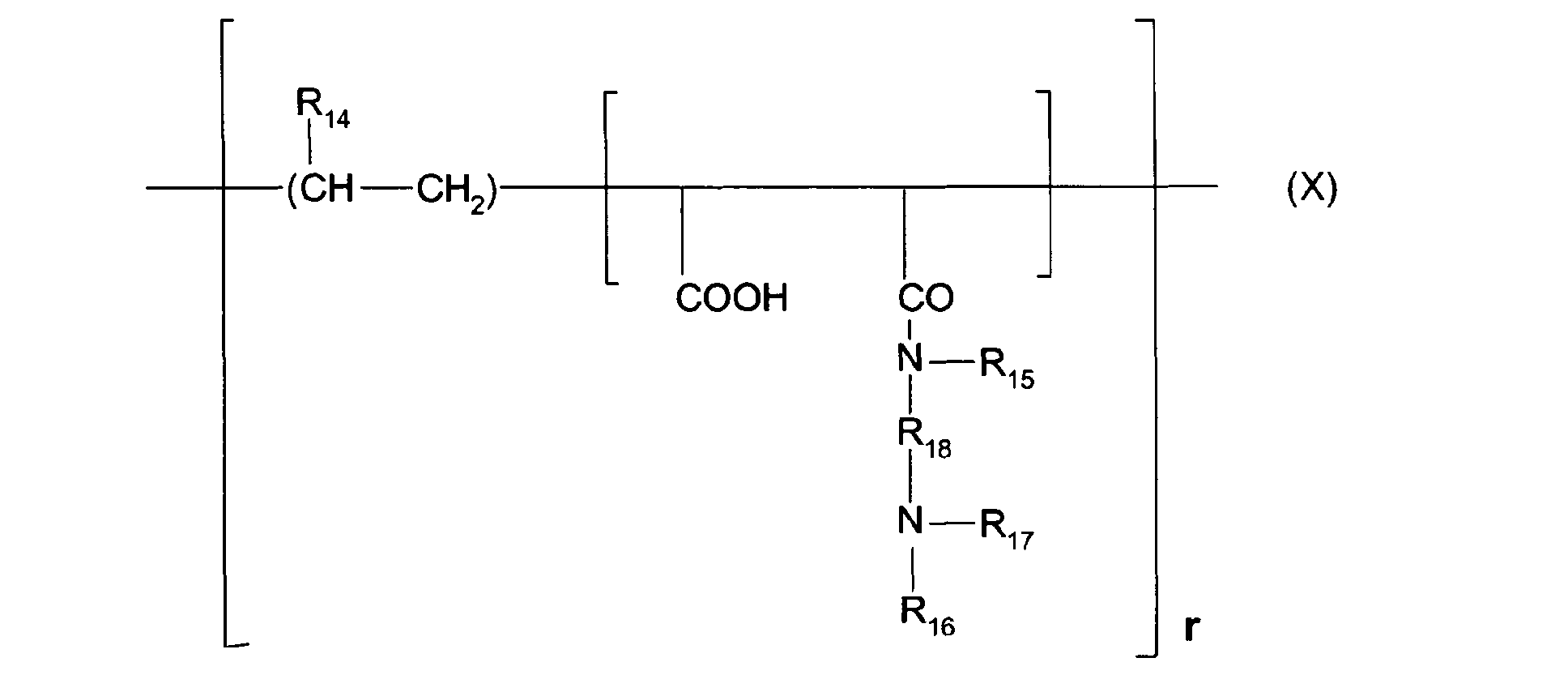
ainsi que les homologues supérieurs de ces radicaux et contenant jusqu'à 6 atomes de carbone.


Les silicones utilisables conformément à l'invention peuvent être solubles ou insolubles dans la composition et en particulier être des polyorganosiloxanes insolubles dans la composition de l'invention ; elles peuvent se présenter sous forme d'huiles, de cires, de résines ou de gommes.
Selon l'invention, toutes les silicones peuvent être utilisées telle quelle ou sous formede solutions, de dispersions, d'émulsions, de nanoémulsions ou de microémulsions.
Les organopolysiloxanes sont définis plus en détail dans l'ouvrage de Walter NOLL "Chemistry and Technology of Silicones" (1968) Académie Press. Elles peuvent être volatiles ou non volatiles.
Lorsqu'elles sont volatiles, les silicones sont plus particulièrement choisies parmi celles possédant un point d'ébullition compris entre 60° C et 260° C, et plus particulièrement encore parmi :
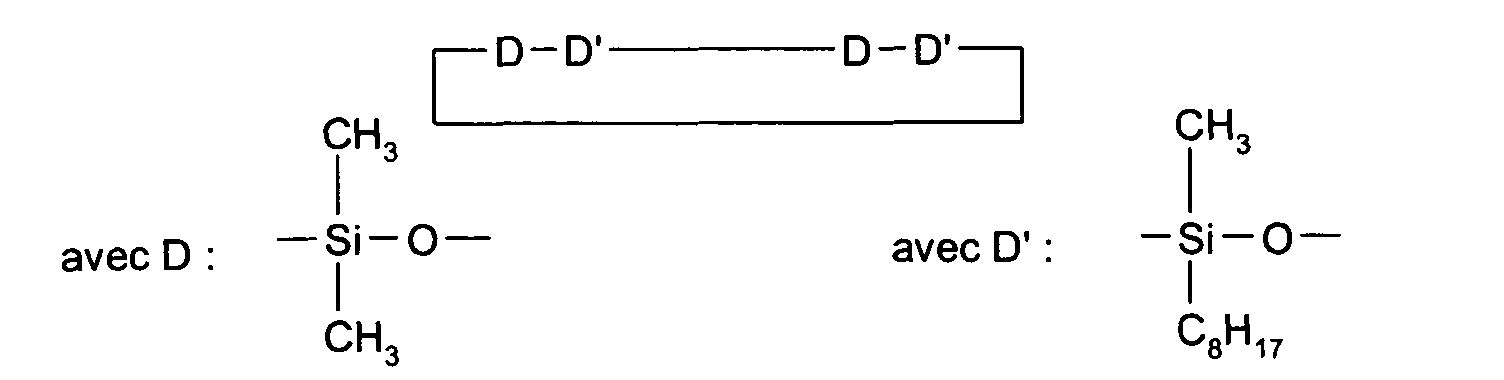
On utilise de préférence des silicones non volatiles et plus particulièrement des polyalkylsiloxanes, des polyarylsiloxanes, des polyalkylarylsiloxanes, des gommes et des résines de silicones, des polyorganosiloxanes modifiés par des groupements organofonctionnels ainsi que leurs mélanges.
Ces silicones sont plus particulièrement choisies parmi les polyalkylsiloxanes parmi lesquels on peut citer principalement les polydiméthylsiloxanes à groupements terminaux triméthylsilyle ayant une viscosité de 5.10-6 à 2,5 m2/s à 25°C et de préférence 1.10-5 à 1 m2/s. La viscosité des silicones est, par exemple, mesurée à 25°C selon la norme ASTM 445 Appendice C.
Parmi ces polyalkylsiloxanes, on peut citer à titre non limitatif les produits commerciaux suivants :
- les huiles SILBIONE® des séries 47 et 70 047 ou les huiles MIRASIL® commercialisées par RHODIA telles que, par exemple, l'huile 70 047 V 500 000 ;
- les huiles de la série MIRASIL® commercialisées par la société RHODIA ;
- les huiles de la série 200 de la société DOW CORNING telles que plus particulièrement la DC200 de viscosité 60 000 mm2/s ;
- les huiles VISCASIL® de GENERAL ELECTRIC et certaines huiles des séries SF (SF 96, SF 18) de GENERAL ELECTRIC.
Dans cette classe de polyalkylsiloxanes, on peut également citer les produits commercialisés sous les dénominations "ABIL WAX® 9800 et 9801" par la société GOLDSCHMIDT qui sont des polyalkyl(C1-C20)-Siloxanes.
Les polyalkylarylsiloxanes sont particulièrement choisis parmi les polydiméthyl/méthylphénylsiloxanes, les polydiméthyldiphényl-siloxanes linéaires et/ou ramifiés de viscosité de 1.10-5 à 5.10-2 m2/s à 25°C.
Parmi ces polyalkylarylsiloxanes on peut citer, à titre d'exemple, les produits commercialisés sous les dénominations suivantes :
- les huiles SILBIONE® de la série 70 641 de RHODIA ;
- les huiles des séries RHODORSIL® 70 633 et 763 de RHODIA ;
- l'huile DOW CORNING 556 COSMETIC GRAD FLUID de DOW CORNING ;
- les silicones de la série PK de BAYER comme le produit PK20 ;
- les silicones des séries PN, PH de BAYER comme les produits PN1000 et PH1000 ;
- certaines huiles des séries SF de GENERAL ELECTRIC telles que SF 1023, SF 1154, SF 1250, SF 1265.
- polydiméthylsiloxane
- les gommes polydiméthylsiloxane/méthylvinylsiloxane,
- polydiméthylsiloxane/diphénylsiloxane,
- polydiméthylsiloxane/phénylméthylsiloxane,
- polydiméthylsiloxane/diphénylsiloxane/méthylvinylsiloxane.
- les mélanges formés à partir d'un polydiméthylsiloxane hydroxylé en bout de chaíne ou diméthiconol (CTFA) et d'un poly-diméthylsiloxane cyclique également appelé cyclométhicone (CTFA) tel que le produit Q2 1401 commercialisé par la société DOW CORNING ;
- les mélanges formés à partir d'une gomme polydiméthyl-siloxane avec une silicone cyclique tel que le produit SF 1214 Silicone Fluid de la société GENERAL ELECTRIC, ce produit est une gomme SF 30 correspondant à une diméthicone, ayant un poids moléculaire moyen en nombre de 500 000 solubilisée dans l'huile SF 1202 Silicone Fluid correspondant au décaméthylcyclopentasiloxane ;
- les mélanges de deux PDMS de viscosités différentes, et plus particulièrement d'une gomme PDMS et d'une huile PDMS, tels que le produit SF 1236 de la société GENERAL ELECTRIC. Le produit SF 1236 est le mélange d'une gomme SE 30 définie ci-dessus ayant une viscosité de 20 m2/s et d'une huile SF 96 d'une viscosité de 5.10-6 m2/s. Ce produit comporte de préférence 15 % de gomme SE 30 et 85 % d'une huile SF 96.
- des groupements polyéthylèneoxy et/ou polypropylèneoxy comportant éventuellement des groupements alkyle en C6-C24 tels que les produits dénommés diméthicone-copolyol commercialisé par la société DOW CORNING sous la dénomination DC 1248 ou les huiles SILWET® L 722, L 7500, L 77, L 711 de la société UNION CARBIDE et l'alkyl(C12)-méthicone-copolyol commercialisée par la société DOW CORNING sous la dénomination Q2 5200 ;
- des groupements aminés substitués ou non, comme les produits commercialisés sous la dénomination GP 4 Silicone Fluid et GP 7100 par la société GENESEE ou les produits commercialisés sous les dénominations Q2 8220 et DOW CORNING 929 ou 939 par la société DOW CORNING. Les groupements aminés substitués sont en particulier des groupements aminoalkyle en C1-C4 ; On utilise particulièrement les triméthylsilylamodiméthicone et les amodiméthicones.
- des groupements thiols, comme les produits commercialisés sous les dénominations "GP 72 A" et "GP 71" de GENESEE ;
- des groupements alcoxylés, comme le produit commercialisé sous la dénomination "SILICONE COPOLYMER F-755" par SWS SILICONES et ABIL WAX® 2428, 2434 et 2440 par la société GOLDSCHMIDT ;
- des groupements hydroxylés, comme les polyorganosiloxanes à fonction hydroxyalkyle décrits dans la demande de brevet français FR-A-85 16334 .
- des groupements acyloxyalkyle tels que, par exemple, les polyorganosiloxanes décrits dans le brevet US-A-4957732.
- des groupements anioniques du type carboxylique comme, par exemple, dans les produits décrits dans le brevet EP 186 507 de la société CHISSO CORPORATION, ou de type alkyl-carboxyliques comme ceux présents dans le produit X-22-3701E de la société SHIN-ETSU ; 2-hydroxyalkylsulfonate ; 2-hydroxyalkylthiosulfate tels que les produits commercialisés par la société GOLDSCHMIDT sous les dénominations "ABIL® S201" et "ABIL® S255".
- des groupements hydroxyacylamino, comme les polyorganosiloxanes décrits dans la demande EP 342 834. On peut citer, par exemple, le produit Q2-8413 de la société DOW CORNING
Selon un mode de réalisation préféré de l'invention, la composition peut être utilisée comme shampoing.
| 1 | 2 | 3 | 4 | |
| Copolymère (90/10 en mole) d'acrylamide et de diméthylamino éthyl quaternisé par du chlorure de benzyle (PM>5.106) en dispersion dans une solution aqueuse saline concentrée (ULTIMER de ONDEO) | - | 1% MA | - | 0.75% MA |
| Copolymère (10/90 en moles) de diméthyl Aminoéthyl Acrylate quaternisé par du chlorure de méthyle et d'acrylamide (PM>5.106) en dispersion dans une solution aqueuse saline concentrée | 1%MA | - | 1%MA | - |
| Lauryl éther sulfate de sodium 2.2 OE | 12.5% MA | 12.5% MA | 12.5% MA | 12.5% MA |
| Coco Amido propyl bétaine | 2.5% MA | 2.5% MA | 2.5% MA | 2.5% MA |
| Carbonate de calcium (Omyapure 35 de OMYA) | 0.8% | 0.3% | 0.8% | - |
| Chitosan PCA (Kytamer PC de AMERCHOL) | 0.3% | - | 0.3% | 0.2% |
| Microbilles de cire de carnauba / cire synthétique (Microcare 325 de MICROPOWDERS) | - | - | - | 0.3% |
| Paillettes de verre enrobées d'argent (Metashine ME 2025 PS de NIPPON SHEET GLASS) | - | - | - | 0.5% |
| Eau qsp | 100 % | 100 % | 100 % | 100 % |
Claims (32)
- Composition de lavage des matières kératiniques caractérisée en ce qu'elle comprend, dans un milieu aqueux cosmétiquement acceptable, au moins des particules ayant un point de fusion supérieur à 70°C, au moins un tensioactif détergent anionique, non ionique ou amphotère et au moins un polymère présentant un pouvoir filant supérieur à 5 cm.
- Composition selon la revendication 1, caractérisée par le fait que le ou les tensioactifs détergents sont choisis parmi les tensioactifs anioniques.
- Composition selon la revendication 1 ou 2, caractérisée par le fait que ledit tensioactif est présent à une teneur pondérale allant de 4 % à 50 % par rapport au poids total de la compositions.
- Composition selon la revendication 3, caractérisée par le fait que ladite teneur va de 8 % à 25 %.
- Composition selon l'une quelconque des revendications 1 à 4, caractérisée en ce que le poylmère filant est choisi parmi:soit (a1) une dispersion de particules d'un polymère hydrosoluble ayant une masse moléculaire moyenne en poids supérieure à 106 dans une solution aqueuse saline, obtenu par polymérisation radicalaire hétérogène de monomères hydrosolubles avec précipitation du polymère formé, au moins un des monomères étant cationique ou soit (a2) une solution aqueuse d'un polymère hydrosoluble ayant une masse moléculaire moyenne en poids supérieure à 106, obtenu par polymérisation radicalaire hétérogène de monomères hydrosolubles avec précipitation du polymère formé, au moins un des monomères étant cationique.
- Composition selon la revendication précédente, caractérisé par le fait que le ou les monomères hydrosolubles sont choisis parmi les monomères cationiques, anioniques ou non-ioniques comportant au moins une double liaison éthylénique ou un mélange de ceux-ci.
- Composition selon la revendication 6, caractérisé par le fait que les monomères anioniques sont choisis parmi l'acide acrylique, l'acide méthacrylique, l'acide acrylamido-2-méthylpropanesulfonique et l'acide itaconique.
- Composition selon la revendication 6, caractérisé par le fait que les monomères non-ioniques sont choisis parmi l'acrylamide, le méthacrylamide, le N-vinylformamide, le N-vinylacétonamide, l'acrylate d'hydroxypropyle et le méthacrylate d'hydroxypropyle.
- Composition selon la revendication 6, caractérisé par le fait que les monomères cationiques sont choisis parmi les sels de di(alkyle en C1-4)-diallylammonium et les composés de formule (I)dans laquelle

R1 représente un atome d'hydrogène ou un groupe méthyle,
R2 et R3, identiques ou différents, représentent chacun un atome d'hydrogène ou un groupe alkyle en C1-4 linéaire ou ramifié,
R4 représente un atome d'hydrogène, un groupe alkyle en C1-4 linéaire ou ramifié ou un groupe aryle,
D représente le motif suivantdans lequel Y représente une fonction amide, ester, uréthane ou urée,
A représente un groupe alkyène en C1-10 linéaire, ramifié ou cyclique, pouvant être substitué ou interrompu par un cycle aromatique ou hétéroaromatique divalent, ou pouvant être interrompu par un hétéroatome choisi parmi O, N, S et P, et pouvant comporter une fonction cétone, amide, ester, uréthane ou urée,
n vaut 0 ou 1, et
X- représente un contre-ion anionique tel qu'un ion halogénure ou sulfate. - Composition selon l'une quelconque des revendications 5 à 9, caractérisé par le fait que le polymère hydrosoluble est polymérisé à partir d'au moins un monomère cationique de formule (I).
- Composition selon la revendication 10, caractérisé par le fait que le polymère hydrosoluble est polymérisé à partir d'un mélange de monomères constitué de 0 à 30 % en moles d'acide acrylique, de 0 à 95,5 % en moles d'acrylamide et de 0,5 à 100 % en moles d'au moins un monomère cationique de formule (I).
- Composition selon la revendication 11, caractérisé par le fait que le polymère hydrosoluble est polymérisé à partir d'un mélange de monomères constitué d'acide acrylique et d'un monomère cationique de formule (I), le nombre de moles du monomère cationique de formule (I) étant supérieur au nombre de moles d'acide acrylique.
- Composition selon la revendication 11, caractérisé par le fait que le polymère hydrosoluble est polymérisé à partir d'un mélange de monomères constitué de 10 % en moles de chlorure d'acryloyloxyéthyldiméthylbenzylammonium et de 90 % en moles d'acrylamide.
- Composition selon la revendication 11, caractérisé par le fait que le polymère hydrosoluble est polymérisé à partir d'un mélange de monomères constitué de 30 % en moles de chlorure d'acryloyloxytriméthylammonium, de 50 % en moles de chlorure d'acryloyloxyéthyldiméthybenzylammonium et de 20 % en moles d'acrylamide.
- Composition selon la revendication 11, caractérisé par le fait que le polymère hydrosoluble est polymérisé à partir de 10 % en moles de chlorure d'acryloyloxyéthyltriméthylammonium et de 90 % en moles d'acrylamide.
- Composition selon la revendication 11, caractérisé par le fait que le polymère hydrosoluble est polymérisé à partir de 30 % en moles de chlorure de diallyldiméthylammonium et de 70 % en moles d'acrylamide.
- Composition selon l'une quelconque des revendications précédentes, caractérisé par le fait que la concentration des particules de polymère hydrosoluble en dispersion dans une solution aqueuse saline dans (a1) va de 0,01 à 20 % en poids.
- Composition selon l'une quelconque des revendications 1 à 17, caractérisé par le fait que la concentration du polymère hydrosoluble en solution dans (a2) va de 0,01 à 20 % en poids.
- Composition selon l'une quelconque des revendications précédentes, caractérisé par le fait que la solution aqueuse saline dans (a1) ou (a2) contient au moins un sel anionique.
- Composition selon la revendication 17, caractérisé par le fait que le sel anionique est choisi parmi le sulfate d'ammonium, l'hydrogénosulfate d'ammonium, le sulfate de sodium, l'hydrogénosulfate de sodium, le sulfate de magnésium, le sulfate d'ammonium, l'hydrogénosulfate de magnésium, le sulfate d'aluminium, l'hydrogénosulfate d'aluminium.
- Composition selon l'une quelconque des revendications précédentes, caractérisée par le fait que les polymères filants sont présents dans les compositions de l'invention à une concentration allant de 0,01 à 10% en poids, de préférence de 0,05 à 5% par rapport au poids total de la composition.
- Composition selon l'une quelconque des revendications précédentes, caractérisée par le fait que les particules sont minérales ou organiques.
- Composition selon l'une quelconque des revendications précédentes, caractérisée par le fait que les particules sont notamment choisies parmi les particules de verre, de polyamides tels que le Nylon, de polymères ou copolymères d'acrylonitrile, de chlorure de vinylidène, de chlorure de vinyle et/ou de monomère acrylique ou styrénique, éventuellement expansés.
- Composition selon l'une quelconque des revendications 22 ou 23, caractérisée par le fait que les particules minérales comprennent un élément des colonnes IIa, IIIa et Iva, IIIb et IVb du tableau de classification périodique des éléments et de préférence des colonnes IIa et IVa.
- Composition selon la revendication précédente, caractérisée par le fait que les particules sont choisies parmi les particules contenant au moins 10 % en poids de carbonate de calcium ou d'au moins un silicate, les particules contenant au moins 90% d'oxyde d'aluminium, les silices, l'oxyde de magnésium, les oxydes de Zinc, les oxydes de titane, le sulfate de baryum et leurs mélanges.
- Composition selon l'une quelconque revendication précédentes, caractérisée en ce que les particules insolubles peuvent représenter de 0,001 % à 20 % en poids, de préférence de 0,01 % à 10% en poids et plus particulièrement de 0,1 à 3% en poids par rapport au poids total de la composition finale.
- Composition selon l'une quelconque des revendications précédentes, caractérisée par le fait que la composition comprend en outre un polymère cationique différent du polymère filant selon l'invention.
- Composition selon la revendication précédente, caractérisée par le fait que le polymère cationique est utilisé en une quantité allant de 0,001 % à 20 % en poids, de préférence de 0,01 % à 10% en poids et plus particulièrement de 0,02 à 5% en poids par rapport au poids total de la composition finale.
- Composition selon l'une quelconque des revendications précédentes, caractérisée par le fait que la composition comprend en outre une silicone.
- Composition selon la revendication précédente, caractérisée par le fait que la silicone est utilisée en une quantité allant de 0,01 à 20 % en poids, de préférence de 0,1 à 5 % en poids par rapport au poids total de la composition.
- Composition selon l'une quelconque des revendications précédentes, caractérisée par le fait qu'elle présente un pH allant de 3 à 10.
- Utilisation en cosmétique d'une composition telle définie à l'une quelconque des revendications précédentes pour le nettoyage et/ou le soin et/ou le conditionnement et/ou le coiffage des cheveux.
Applications Claiming Priority (4)
| Application Number | Priority Date | Filing Date | Title |
|---|---|---|---|
| FR0450027 | 2004-01-07 | ||
| FR0450027A FR2864768B1 (fr) | 2004-01-07 | 2004-01-07 | Compositions cosmetiques detergentes comprenant un tensioactif, un polymere de haut moleculaire et des particules et utilisation de ces dernieres |
| FR0450033A FR2864778B1 (fr) | 2004-01-07 | 2004-01-07 | Compositions cosmetiques detergentes comprenant un tensioactif, un polymere filant et des particules et utilisation de ces dernieres |
| FR0450033 | 2004-01-07 |
Publications (1)
| Publication Number | Publication Date |
|---|---|
| EP1552808A1 true EP1552808A1 (fr) | 2005-07-13 |
Family
ID=34593706
Family Applications (1)
| Application Number | Title | Priority Date | Filing Date |
|---|---|---|---|
| EP04292985A Ceased EP1552808A1 (fr) | 2004-01-07 | 2004-12-14 | Compositions cosmétiques détergentes comprenant un tensioactif, un polymère de haut poids moleculaire et des particules et utilisation de ces dernières |
Country Status (1)
| Country | Link |
|---|---|
| EP (1) | EP1552808A1 (fr) |
Cited By (2)
| Publication number | Priority date | Publication date | Assignee | Title |
|---|---|---|---|---|
| WO2013190079A1 (fr) * | 2012-06-21 | 2013-12-27 | L'oreal | Composition cosmétique comprenant des particules solides insolubles, une substance grasse non liquide et un tensioactif |
| CN115894792A (zh) * | 2022-10-26 | 2023-04-04 | 浙江海联新材料科技有限公司 | 一种高电荷密度akd用高分子乳化剂及其制备方法和应用 |
Citations (2)
| Publication number | Priority date | Publication date | Assignee | Title |
|---|---|---|---|---|
| FR2816833A1 (fr) * | 2000-11-21 | 2002-05-24 | Oreal | Utilisation en cosmetique d'un polymere hydrosoluble sous forme d'une dispersion et composition le contenant |
| US20030059382A1 (en) * | 2001-04-12 | 2003-03-27 | Brandt Loralei Marie | Cosmetic compositions containing dispersion polymers |
-
2004
- 2004-12-14 EP EP04292985A patent/EP1552808A1/fr not_active Ceased
Patent Citations (2)
| Publication number | Priority date | Publication date | Assignee | Title |
|---|---|---|---|---|
| FR2816833A1 (fr) * | 2000-11-21 | 2002-05-24 | Oreal | Utilisation en cosmetique d'un polymere hydrosoluble sous forme d'une dispersion et composition le contenant |
| US20030059382A1 (en) * | 2001-04-12 | 2003-03-27 | Brandt Loralei Marie | Cosmetic compositions containing dispersion polymers |
Cited By (4)
| Publication number | Priority date | Publication date | Assignee | Title |
|---|---|---|---|---|
| WO2013190079A1 (fr) * | 2012-06-21 | 2013-12-27 | L'oreal | Composition cosmétique comprenant des particules solides insolubles, une substance grasse non liquide et un tensioactif |
| FR2992208A1 (fr) * | 2012-06-21 | 2013-12-27 | Oreal | Composition cosmetique comprenant des particules solides insolubles, un corps gras non liquide, un tensioactif |
| CN115894792A (zh) * | 2022-10-26 | 2023-04-04 | 浙江海联新材料科技有限公司 | 一种高电荷密度akd用高分子乳化剂及其制备方法和应用 |
| CN115894792B (zh) * | 2022-10-26 | 2023-10-03 | 浙江海联新材料科技有限公司 | 一种高电荷密度akd用高分子乳化剂及其制备方法和应用 |
Similar Documents
| Publication | Publication Date | Title |
|---|---|---|
| EP1291001B1 (fr) | Compositions cosmétiques contenant un copolymère d'acide méthacrylique, une huile et leurs utilisations | |
| EP1291005B1 (fr) | Compositons cosmétiques contenant un copolymère d'acide méthacrylique, une diméthicone et un polymère cationique et leurs utilisations | |
| EP1291003B1 (fr) | Compositions cosmétiques contenant un copolymère d'acide méthacrylique, une silicone et un polymère cationique et leurs utilisations | |
| EP1312351B1 (fr) | Composition réductrice pour le traitement des fibres kératiniques comprenant une silicone aminée particulière | |
| EP1190698A1 (fr) | Composition de lavage comprenant des nanoparticules d'oxyde d'aluminium, au moins un agent conditionneur et au moins un tensioactif détergent | |
| EP1380284B1 (fr) | Compositions cosmétiques détergentes contenant un tensioactif anionique, un tensioactif amphotère ou non ionique et un polysaccharide et utilisation | |
| EP1457194B1 (fr) | Compositions cosmétiques comprenant un copolymère d' acide méthacrylique, des particules minérales insolubles et un polymère cationique ou amphotère et leurs utilisations | |
| EP1291002A2 (fr) | Compositions cosmétiques contenant un copolymère d'acide méthacrylique, une silicone et un polymère cationique et leurs utilisations | |
| EP1291000A2 (fr) | Compositions cosmétiques contenant un copolymère d'acide méthacrylique, une diméthicone, un agent nacrant et un polymère cationique et leurs utilisations | |
| FR2802085A1 (fr) | Compositions cosmetiques contenant une silicone quaternisee et une silicone non aminee et leurs utilisations | |
| FR2852237A1 (fr) | Compositions cosmetiques contenant un copolymere d'acide methacrylique, une cyclodextrine et un tensioactif et leurs utilisations | |
| EP1726294B1 (fr) | Compositions cosmétiques détergentes comprenant une silicone aminée pipéridine et un polymère cationique et utilisation de ces dernières | |
| EP1502585A1 (fr) | Compositions cosmétique contenant un mélange de tensioactifs, un mélange de polymères cationiques et une silicone | |
| EP1555011A1 (fr) | Compositions cosmétiques detergentes comprenant une silicone aminée et un polymère de haut poids moleculaire et utilisation de ces dernieres | |
| EP1552808A1 (fr) | Compositions cosmétiques détergentes comprenant un tensioactif, un polymère de haut poids moleculaire et des particules et utilisation de ces dernières | |
| FR2864767A1 (fr) | Compositions cosmetiques detergentes comprenant un tensioactif, un polymere de haut poids moleculaire et un agent conditionneur et utilisation de ces dernieres | |
| FR2822681A1 (fr) | Compositions cosmetiques detergentes contenant un tensioactif anionique derive d'acides amines et une silicone et leurs utilisations | |
| FR2848829A1 (fr) | Composition cosmetiques contenant un tensioactif amphotere et une silicone et leurs utilisations | |
| FR2864778A1 (fr) | Compositions cosmetiques detergentes comprenant un tensioactif, un polymere filant et des particules et utilisation de ces dernieres | |
| EP1561452A1 (fr) | Compositions cosmétiques détergentes comprenant un polymère cationique et un polymère de haut poids moléculaire et utilisation de ces dernières | |
| FR2864779A1 (fr) | Compositions cosmetiques detergentes comprenant une silicone aminee et un polymere filant et utilisation de ces dernieres | |
| FR2864768A1 (fr) | Compositions cosmetiques detergentes comprenant un tensioactif, un polymere de haut moleculaire et des particules et utilisation de ces dernieres | |
| FR2864773A1 (fr) | Composition cosmetique comprenant un cation, un polymere filant et un epaississant et procede de traitement cosmetique | |
| EP1552810A1 (fr) | Compositions cosmétiques détergentes comprenant une silicone et un polymère de haut poids moléculaire et utilisation de ces dernières | |
| EP1552811A1 (fr) | Compositions cosmétiques détergentes comprenant un tensioactif, un polymère filant de haut poids moléculaire et un agent conditionneur et utilisation de ces dernières |
Legal Events
| Date | Code | Title | Description |
|---|---|---|---|
| PUAI | Public reference made under article 153(3) epc to a published international application that has entered the european phase |
Free format text: ORIGINAL CODE: 0009012 |
|
| AK | Designated contracting states |
Kind code of ref document: A1 Designated state(s): AT BE BG CH CY CZ DE DK EE ES FI FR GB GR HU IE IS IT LI LT LU MC NL PL PT RO SE SI SK TR |
|
| AX | Request for extension of the european patent |
Extension state: AL BA HR LV MK YU |
|
| 17P | Request for examination filed |
Effective date: 20060113 |
|
| AKX | Designation fees paid |
Designated state(s): AT BE BG CH CY CZ DE DK EE ES FI FR GB GR HU IE IS IT LI LT LU MC NL PL PT RO SE SI SK TR |
|
| 17Q | First examination report despatched |
Effective date: 20060711 |
|
| STAA | Information on the status of an ep patent application or granted ep patent |
Free format text: STATUS: THE APPLICATION HAS BEEN REFUSED |
|
| 18R | Application refused |
Effective date: 20080719 |