EP1552756A1 - Beverage - Google Patents
Beverage Download PDFInfo
- Publication number
- EP1552756A1 EP1552756A1 EP03761827A EP03761827A EP1552756A1 EP 1552756 A1 EP1552756 A1 EP 1552756A1 EP 03761827 A EP03761827 A EP 03761827A EP 03761827 A EP03761827 A EP 03761827A EP 1552756 A1 EP1552756 A1 EP 1552756A1
- Authority
- EP
- European Patent Office
- Prior art keywords
- beverage
- acid
- ingredient
- acids
- weight
- Prior art date
- Legal status (The legal status is an assumption and is not a legal conclusion. Google has not performed a legal analysis and makes no representation as to the accuracy of the status listed.)
- Withdrawn
Links
Classifications
-
- A—HUMAN NECESSITIES
- A23—FOODS OR FOODSTUFFS; TREATMENT THEREOF, NOT COVERED BY OTHER CLASSES
- A23L—FOODS, FOODSTUFFS OR NON-ALCOHOLIC BEVERAGES, NOT OTHERWISE PROVIDED FOR; PREPARATION OR TREATMENT THEREOF
- A23L2/00—Non-alcoholic beverages; Dry compositions or concentrates therefor; Preparation or treatment thereof
-
- A—HUMAN NECESSITIES
- A23—FOODS OR FOODSTUFFS; TREATMENT THEREOF, NOT COVERED BY OTHER CLASSES
- A23L—FOODS, FOODSTUFFS OR NON-ALCOHOLIC BEVERAGES, NOT OTHERWISE PROVIDED FOR; PREPARATION OR TREATMENT THEREOF
- A23L2/00—Non-alcoholic beverages; Dry compositions or concentrates therefor; Preparation or treatment thereof
- A23L2/02—Non-alcoholic beverages; Dry compositions or concentrates therefor; Preparation or treatment thereof containing fruit or vegetable juices
-
- A—HUMAN NECESSITIES
- A23—FOODS OR FOODSTUFFS; TREATMENT THEREOF, NOT COVERED BY OTHER CLASSES
- A23L—FOODS, FOODSTUFFS OR NON-ALCOHOLIC BEVERAGES, NOT OTHERWISE PROVIDED FOR; PREPARATION OR TREATMENT THEREOF
- A23L2/00—Non-alcoholic beverages; Dry compositions or concentrates therefor; Preparation or treatment thereof
- A23L2/52—Adding ingredients
- A23L2/68—Acidifying substances
-
- A—HUMAN NECESSITIES
- A23—FOODS OR FOODSTUFFS; TREATMENT THEREOF, NOT COVERED BY OTHER CLASSES
- A23L—FOODS, FOODSTUFFS OR NON-ALCOHOLIC BEVERAGES, NOT OTHERWISE PROVIDED FOR; PREPARATION OR TREATMENT THEREOF
- A23L33/00—Modifying nutritive qualities of foods; Dietetic products; Preparation or treatment thereof
- A23L33/10—Modifying nutritive qualities of foods; Dietetic products; Preparation or treatment thereof using additives
- A23L33/105—Plant extracts, their artificial duplicates or their derivatives
-
- A—HUMAN NECESSITIES
- A23—FOODS OR FOODSTUFFS; TREATMENT THEREOF, NOT COVERED BY OTHER CLASSES
- A23V—INDEXING SCHEME RELATING TO FOODS, FOODSTUFFS OR NON-ALCOHOLIC BEVERAGES AND LACTIC OR PROPIONIC ACID BACTERIA USED IN FOODSTUFFS OR FOOD PREPARATION
- A23V2002/00—Food compositions, function of food ingredients or processes for food or foodstuffs
Definitions
- the present invention relates to a flavorful beverage having an antihypertensive and other physiological actions as well as long-term storage stability.
- Heart diseases including angina pectoris, myocardial infarction and cardiac failure, and cerebrovascular disease including cerebral infarction, cerebral hemorrhage and subarachnoid hemorrhage are closely related to hypertension, and ranked second and third as the causes of death of the Japanese, respectively. Further, according to National Livelihood Survey (for fiscal 1998) by the Ministry of Health, Labor and Welfare of Japan, those patients going to clinics or hospitals for treatment of high blood pressure amount to 64 per a population of 1,000, with topping the list of the causes of disease. In other countries, like Japan, these heart diseases and cerebrovascular diseases rank high in the causes of death and the number of sufferers of hypertension continues to increase.
- Typical medical means for hypertensives include administration of drugs such as diuretics, sympatholytics agents, vasodilators or angiotensin converting enzyme inhibitors, which are principally applied to severely suffering patients.
- drugs such as diuretics, sympatholytics agents, vasodilators or angiotensin converting enzyme inhibitors
- general treatments aimed at improving lifestyle habits such as dietary therapy, exercise therapy, drinking and smoking control, are applicable widely to mildly to severely hypertensive patients, significance of such general treatments is highly acknowledged now.
- the improvement in dietary habits is said to be of great importance, and there are many foods traditionally known as having an antihypertensive action.
- food-derived antihypertensive agents have long been pursued, with the result that a multitude of active substances having an antihypertensive action have so far been separated and identified.
- chlorogenic acids can show an excellent antihypertensive action (cf. Japanese published unexamined patent applications 2002-53464 and 2002-87977).
- chlorogenic acids have a problem of producing bitterness or astringency when added to foods and drinks, especially beverages. Such bitterness or astringency is so severe particularly in beverages that those beverages are difficult to take in continuously.
- the present invention provides a beverage comprising a high concentration of chlorogenic acid(s) which has an antihypertensive action and favorably high storage stability, making it possible to drink even everyday with good flavor.
- the inventor has found out that addition of a specific quantity of hydroxycarboxylic acid(s) and/or vegetable-derived or fruit-derived flavor substance(s) to a chlorogenic acids mixture, controlling of the quantity of the isochlorogenic acidscontained in chlorogenic acid(s) to a specific range are effective in producing a beverage improved in respect of bitterness and astringency which is easy to drink with its fresh flavor and stable over an extended period of time.
- the present invention provides a beverage comprising the following ingredients (a), (b) and (c):
- the chlorogenic acids family mixture (ingredient (a)) usable for the beverage of the present invention includes chlorogenic acids such as isochlorogenic acids, neochlorogenic acids and cryptochlorogenic acids and derivatives thereof.
- the chlorogenic acid is a 5-caffeoylquinic acid in which caffeic acid is ester-bonded to a hydroxyl group at position 5 of the quinic acid
- the cryptochlorogenic acid is a 4-caffeoylquinic acid in which caffeic acid is ester-bonded to a hydroxyl group at position 4 of the quinic acid
- the neochlorogenic acid is a 3-caffeoylquinic acid in which caffeic acid is ester-bonded to a hydroxyl group at position 3 of the quinic acid.
- the isochlorogenic acid is a dicaffeoylquinic acid in which two caffeic acid molecules are ester-bonded to any two hydroxyl groups out of three hydroxy groups positioned at 3, 4 and 5 of the quinic acid (e.g., 3,4-dicaffeoylquinic acid, 3,5-dicaffeoylquinic acid or 4,5-dicaffeoylquinc acid).
- the chlorogenic acids family includes ferulylquinic acids constituted of quinic acid and ferulic acid ester-bonded to a hydroxyl group at one position among positions 3, 4 and 5 of the quinic acid (e.g., 5-ferulylquinic acid), ferulylcaffeoylquinic acids in which caffeic acid and ferulic acid are each independently ester-bonded to any one of the hydroxyl groups positioned at 3, 4 and 5 of the quinic acid (e.g., 3-ferulyl-4-caffeoylquinic acid), and the like.
- the derivatives of the isochlorogenic acids and chlorogenic acids family include all their salts and sugar esters that are physiologically acceptable.
- typical salts of the isochlorogenic acids and chlorogenic acids family include their alkaline metal salts such as sodium salts, potassium salts, etc. and alkaline-earth metal salts such as calcium salts, magnesium salts, etc.
- the ingredient (a) above it is preferred to use plant extracts.
- the ingredient (a) may be extracted from either a single plant or a mixture of multiple plants.
- extracts of plants such as beefsteak plant (Perilla), sunflower (Helianthus), mugwort (Artemisia), sweet potato (batata), green coffee beans, nandina leaf and unripe apple fruit are preferably used and, above all, the extract of green coffee beans, especially extract of seeds of Coffea arabica LINNE as extracted in a warmed aqueous solution of ascorbic acid or citric acid or in hot water is preferred.
- ingredient (a) may also be used a blend of chemically modified products of such plant extracts.
- the content of the isochlorogenic acids in the ingredient (a), namely the weight content of the isochlorogenic acids family in ratio ranges from 1/20 to 1/3 of the total ingredient (a), preferably from 1/15 to 1/4 and more preferably from 1/10 to 1/5.
- a weight content ratio of the isochlorogenic acids lower than 1/20 of the total ingredient (a)
- the resultant beverage will have insufficient stability, while astringency and bitterness will not be sufficiently improved with an isochlorogenic acids content ratio higher than 1/3 of the total weight of the ingredient (a).
- the weight content ratio may be controlled by blending two or more plant extracts having different chlorogenic acid family contents; by otherwise preparing column-separated, extracted or chemically synthesized chlorogenic acid(s) and blending the same with plant extract(s) as described above; or by selectively eluting chlorogenic acid family by adsorption-desorption process on resin as taught in Japanese published unexamined patent application H09-9603 and blending the same with the plant extract(s) as described above.
- the beverage of the present invention contains the ingredient (a) in a quantity ranging from 0.05 to 10 wt%, preferably from 0.07 to 5.0 wt% and more preferably from 0.10 to 1.0 wt%. If the content of the ingredient (a) is lower than 0.05 wt%, the resultant beverage cannot have a sufficient antihypertensive action, while with its content higher than 10 wt% a stronger astringency and bitterness will result.
- the hydroxycarboxylic acid (ingredient (b)) usable for the beverage of the present invention includes hydroxycarboxylic acids having a molecular weight ranging from 60 to 300 such as lactic acid, citric acid, gluconic acid, glycolic acid, malic acid, tartaric acid, and ascorbic acid.
- hydroxycarboxylic acids include those intrinsically contained in natural products, especially in plants, products converted through a chemical processing applied in the course of extraction and/or fractionation, and chemically modified products, and chemically synthesized products.
- fermented vinegars subject to Japanese Agricultural Standards or extracts thereof may be used.
- vinegar(s) used herein refers to vinegars produced by an acetic fermentation process and more specifically to cereal vinegars made from rice or other cereals, such as a cereal vinegar called "kurozu” prepared from brown rice and koji through a one-step static fermentation process, fruit vinegars from apples, grapes or other fruits, other fermented vinegars than the cereal and fruit vinegars, and the like.
- juices or extracts thereof may also be used, specifically including juices of oranges, mandarin oranges, apples, grapes, pines, peaches, grapefruits, lemons, pears, Japanese pears, Japanese apricots, navel oranges, strawberries, passion fruits, melons, limes, guavas, apricots, Shekwashas, Citrus sphaerocarpa, ponkan (Citrus reticulate), iyokan (Citrus iyo), hassaku (Citrus hassaku), cranberries, bananas, Japanese plums, mangoes, kiwifruits, persimmons, acerolas, etc., mixtures and concentrates of such juices, and extracts thereof with water, ethanol, methanol, acetic acid, chloroform, dichloromethane, ethyl acetate, n-hexane, acetone,
- the latter flavor substances may be obtained from edible genital parts of seed plants, especially such parts associated with seeds that have sweet flesh of fruit.
- fruit flavors usable for the beverages of the present invention include, for example, those obtained from oranges, mandarin oranges, apples, grapes, pines, peaches, grapefruits, lemons, pears, Japanese pears, Japanese apricots, navel oranges, strawberries, passion fruits, melons, limes, guavas, apricots, Shekwashas, Citrus sphaerocarpa, ponkan (Citrus reticulate), iyokan (Citrus iyo), hassaku (Citrus hassaku), cranberries, bananas, Japanese plums, mangoes, kiwifruits, persimmons, and acerolas.
- citrus flavor(s) used herein covers any synthesized flavors used to form fruit flavors obtained from natural sources.
- citrus flavors are preferred, including orange, lemon, lime and grapefruit flavors.
- Fruit flavors of apples, grapes, cherries, pineapples, coconuts, etc. may also be used. These fruit flavors may be obtained from fruit juices, balms or like natural sources, or may be synthesized artificially.
- fruit juices including orange, lemon, lime, apple and grape juices may be used for the preparation of flavor substances.
- these flavor substances are provided as their concentrates for convenience of blending.
- the vegetable-derived flavor substances for the beverage of the present invention include flavors obtained from roots or leaves of vegetables. Like the fruit flavors described above, the vegetable-derived flavor substances include synthesized flavors. It is preferred to use flavors obtained from carrots, tomatoes, Jeyred (a kind of sweet potato), asparagus, Jew's mallow, parsley, spinach, komatsuna (Brassica chinensis komatsuna), celery, cabbages, green pepper (Capsicum annuum), broccoli, radish greens, lettuces, Chinese cabbages, radish roots, ginger, pumpkins, asparagus, eggplants, beets, cresson (watercress), etc. It is also preferred that these vegetable-derived flavor substances be provided as their concentrates for convenience of blending.
- hydroxycarboxylic acids and vegetable-derived or fruit-derived flavor substances may be used singly or in combination of two or more thereof.
- the beverage of the present invention contains the hydroxycarboxylic acid(s) in a quantity ranging preferably from 5 to 30 times the weight of the above-described ingredient (a), more preferably from 5 to 20 times and even more preferably from 5 to 15 times. Further, the present beverage contains the hydroxycarboxylic acid(s) in a quantity ranging preferably from 0.25 to 15 wt%, more preferably from 0.25 to 10 wt% and even more preferably from 0.35 to 5 wt%.
- hydroxycarboxylic acid(s) content lower than 5 times the weight of the ingredient (a) or lower than 0.25 wt% of the beverage, the improvement in astringency or in bitterness brought by hydroxycarboxylic acid(s) will not be sufficient, while a hydroxycarboxylic acid(s) content higher than 30 times the weight of the ingredient (a) or higher than 15 wt% of the beverage will result in an overly acid flavor, rendering the beverage unfit for long-lasting drinking.
- the beverage of the present invention contains the above-described flavor substance(s) in a quantity ranging from 0.1 to 30 times the weight content of the above described ingredient (a), preferably from 0.5 to 30 times and more preferably from 5 to 20 times. Further, the present beverage contains the flavor substance(s) in a quantity ranging from 0.25 to 15 wt%, preferably from 0.25 to 10 wt% and more preferably from 0.35 to 5 wt%.
- the beverage of the present invention contains the ingredient (a) in a quantity ranging from 30 to 99.7 wt%, preferably from 40 to 99.7 wt% and more preferably from 50 to 99.7 wt%.
- a water content lower than 30 wt% is undesirable because the resultant beverage becomes distasteful and other ingredients are hard to dissolve upon blending.
- the beverage of the present invention has a pH ranging preferably from 2 to 5, more preferably from 2.5 to 5 and even more preferably from 3.0 to 5.0 in view of long-term stability of the ingredient (a) having desirable physiological actions. Further, for carbonated drinks, the beverage of the present invention has a pH preferably in the range from 2.5 to 4.0 and more preferably from 3.0 to 4.0.
- the beverage of the present invention has its pH controlled through addition of edible acid(s) or edible organic acid(s).
- Edible organic acids usable for the beverage of the present invention include fumaric acid, adipic acid, acetic acid and mixtures thereof, in addition to the aforementioned hydroxycarboxylic acids. These acids may exist in the beverage either in their undissociated forms or as their salts.
- the salts of edible acids usable for the present invention include pharmaceutically acceptable salts such as sodium salts, potassium salts, lithium salts, calcium salts, and magnesium salts.
- a sweetener, flavor substance other than those described before, bulking agent, emulsifier, emulsion stabilizer or other agents may be added to the beverage of the present invention.
- the sweetener includes monosaccharide and disaccharide sweeteners, sugar alcohols, non-caloric sweeteners, and so forth.
- the monosaccharides and disaccharides here include sucrose, glucose, fructose, high fructose corn syrup, invert syrup, refined syrup, corn syrup, maltose, high maltose syrup, and mixtures thereof.
- saccharides sucrose and high fructose corn syrup are more preferable.
- the sugar alcohols here include sorbitol, mannitol and xylitol.
- non-caloric sweeteners examples include aspartame, saccharin, cyclamates, acetosulpham, L-aspartyl-L-phenylalanine lower alkyl ester sweeteners, L-aspartyl-D-alanine amides (cf. U.S. Patent No. 4,411,925), L-aspartyl-D-serine amides (cf. U.S. Patent No. 4,399,163), L-aspartylhydroxymethyl alkanamide sweeteners (cf. U.S. Patent No. 4,338,346), L-aspartyl-1-hydroxyethyl alkanamide sweeteners (cf. U.S. Patent No.
- sweeteners are added so that the resultant beverage have a sugar content (Brix) ranging preferably from 0.01 to 20, more preferably from 0.1 to 20 and even more preferably from 3 to 15. A sugar content higher than 20 in Brix will render the resultant beverage too sugary to drink.
- the emulsifiers and emulsion stabilizers herein include, for example, brominated vegetable oils, rosin esters, gums, pectins, cellulose, polysorbates, sorbitan esters, and propylene glycol alginates.
- the beverage of the present invention is provided preferably as packed in containers and, for example, it may be produced by mixing together the above-described ingredients (a), (b) and (c) with other ingredients as appropriate, packing the resultant mixture in a container and then sterilizing the beverage as packed.
- sterilization either retort sterilization or UHT (ultraheat treatment) method may be used as appropriate.
- the containers for packing include metal cans, PET bottles, carton boxes, tube packs, glass bottles, and so forth.
- the beverage of the present invention may take a number of forms, including for example juice drinks as mixed with one or more fruit or vegetable juices, carbonated soft drinks, soft drinks comprising no or a smaller quantity of fruit or other juice(s) added thereto, and jelly drinks packed in tube packs.
- hydroxycarboxylic acids and chlorogenic acids family were analyzed in the following manner.
- hydroxycarboxylic acids were quantitatively analyzed by a gas chromatography analysis pursuant to "Analysis of Food Additives in Foods" compiled by Food Chemistry Division, Environmental Health Bureau, Health and Welfare Ministry (now Health, Labour and Welfare Ministry) of Japan, issued by Kodansha Scientific Ltd., Tokyo.
- the chlorogenic acids were eluted by gradient with an eluant A (0.05 M of acetic acid in 3 vol% aqueous acetonitrile solution) and an eluant B (0.05 M of acetic acid in 100 vol% acetonitrile). Each sample was compared in RT (retention time) with a reference standard to identify the analyte.
- eluant A 0.05 M of acetic acid in 3 vol% aqueous acetonitrile solution
- eluant B 0.05 M of acetic acid in 100 vol% acetonitrile
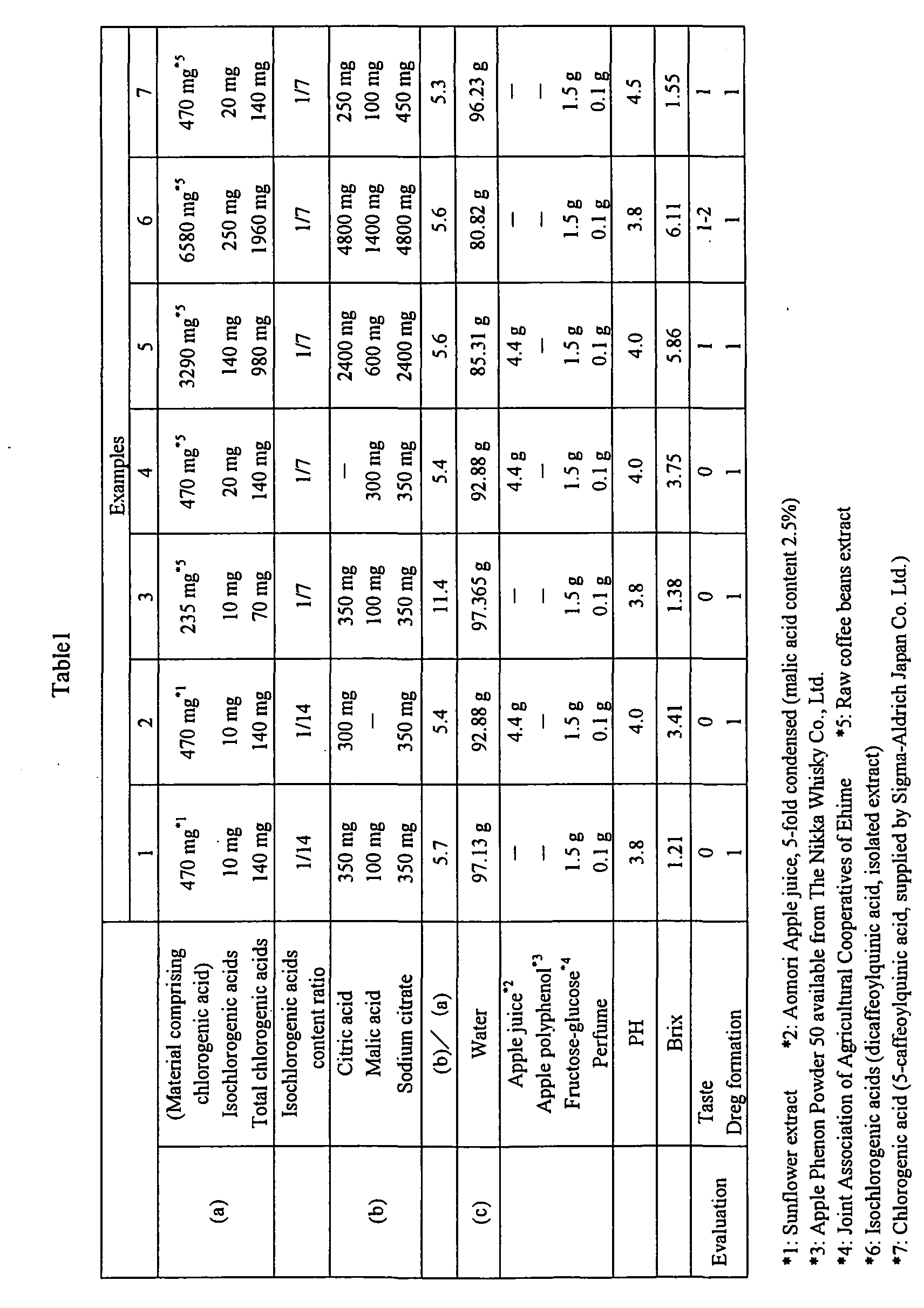
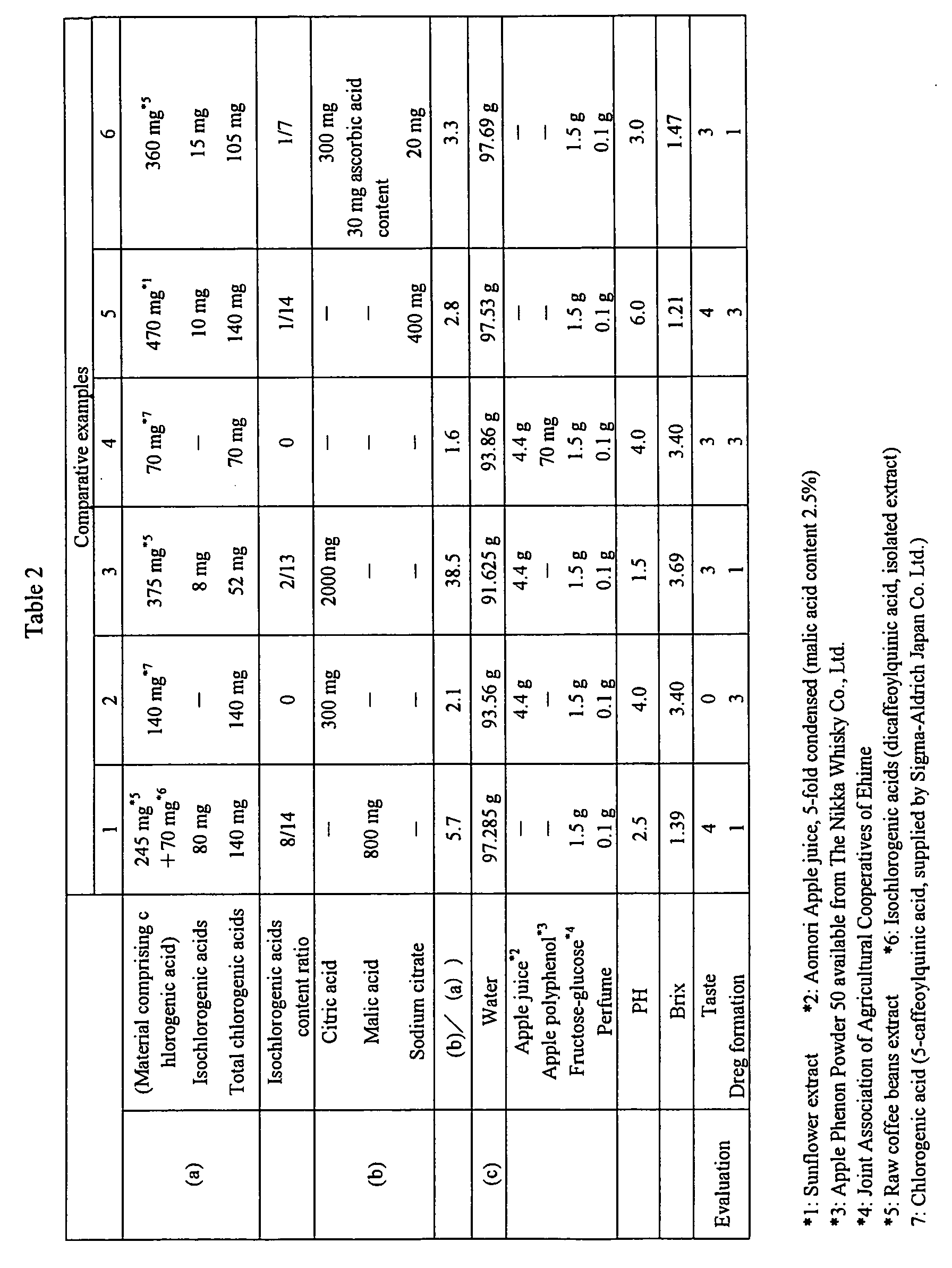
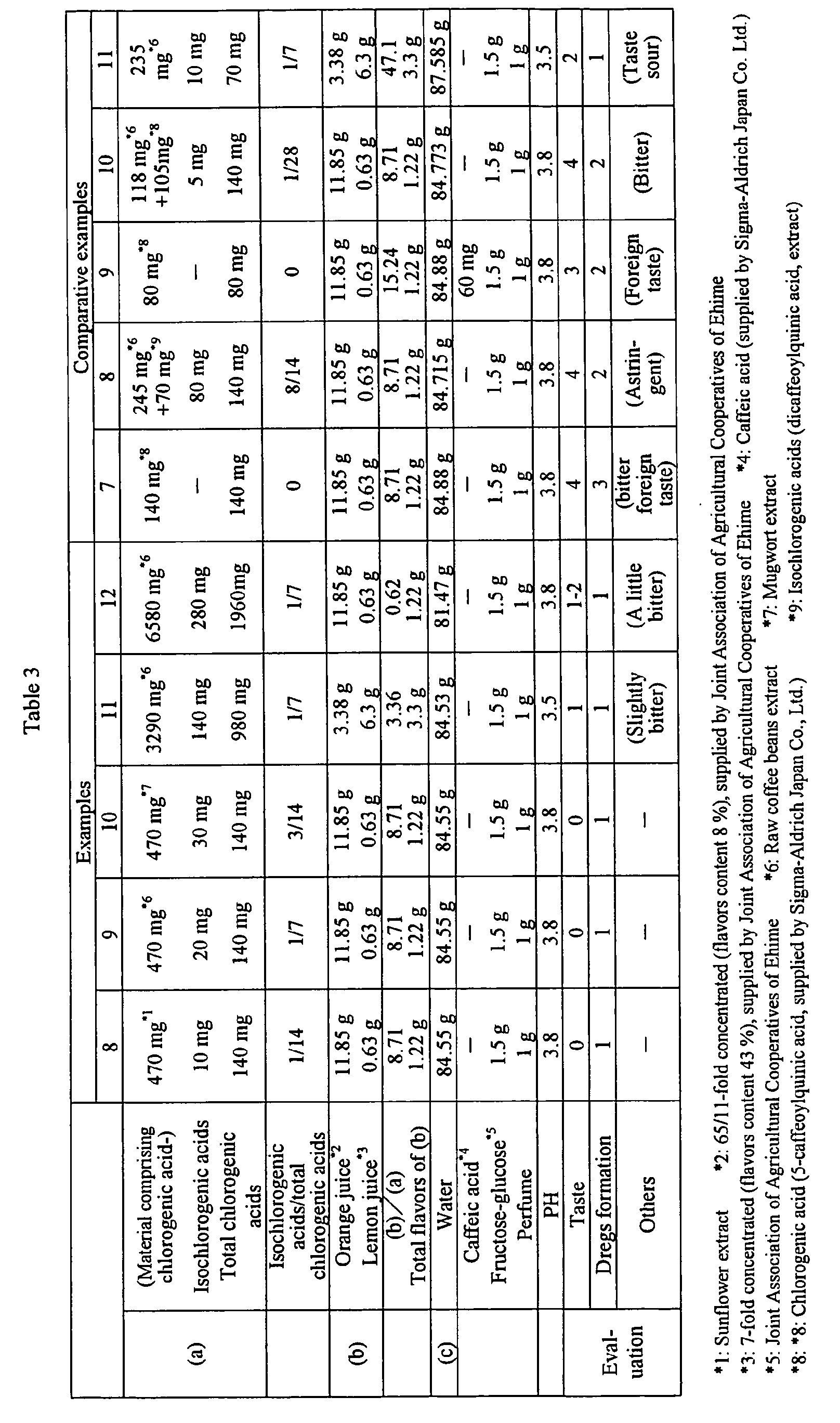
- Container-packed beverages having formulations shown in Tables 1 through 4 below were prepared and subjected to evaluation for the following criteria: 1.
- Taste bitterness, astringency, and foreign taste
- evaluation scores are presented as averages of scores (0 to 4) given by all panelists for the respective samples. Marking basis Astringency, bitterness or any foreign taste is felt very strongly: 4 Astringency, bitterness or any foreign taste is felt strongly: 3 Astringency, bitterness or any foreign taste is felt: 2 Astringency, bitterness or any foreign taste is slightly felt: 1 Astringency, bitterness or any foreign taste is not felt at all: 0 2. Inhibition of dreg formation
- each container-packed beverage under test was transferred to a 100 ml clear bottle and closing it securely, the bottled sample was heated to 80 °C and then let stand to cool slowly in a room at 25 °C. After 24 hours, each sample was shaken lightly to be observed for any dregs formation therein and ranked based on the following rating criteria.
- the beverages embodying the present invention all had a good taste and long-term stability without deposit formation.
- Example 19 Jelly drinks
- the resultant mixture was maintained at 85 °C for 5 minutes for sterilization and then dispensed into 100 ml receptacles. Thereafter, the mixture was left to stand for 8 hours and then slowly cooled down to 5 °C for its gelation, resulting in a jelly drink which melts well in mouth and having a fruity flavor with a good texture (with Brix 17.5).
- Example 20 Fruit juice beverage (with Brix 11)
- Total chlorogenic acids content 120 mg with isochlorogenic acids content of 20 mg (1/6 of total chlorogenic acids)
- the beverage of this preferred example having the formulation shown above had high storage stability and was delicious with a good flavor.
- the present invention is widely applicable in the industry in that it provides a flavorous beverage having a stable antihypertensive action and long-term storage stability.
Landscapes
- Life Sciences & Earth Sciences (AREA)
- Health & Medical Sciences (AREA)
- Nutrition Science (AREA)
- Chemical & Material Sciences (AREA)
- Engineering & Computer Science (AREA)
- Food Science & Technology (AREA)
- Polymers & Plastics (AREA)
- Botany (AREA)
- Mycology (AREA)
- Non-Alcoholic Beverages (AREA)
- Seasonings (AREA)
Abstract
Description
1. Taste (bitterness, astringency, and foreign taste)
| Marking basis | |
| Astringency, bitterness or any foreign taste is felt very strongly: | 4 |
| Astringency, bitterness or any foreign taste is felt strongly: | 3 |
| Astringency, bitterness or any foreign taste is felt: | 2 |
| Astringency, bitterness or any foreign taste is slightly felt: | 1 |
| Astringency, bitterness or any foreign taste is not felt at all: | 0 |
| 2. Inhibition of dreg formation |

| Formulation | |
| Orange juice | 70 wt% |
| Carrot juice | 25 wt% |
| Coffee bean extract ("Flavor Holder" produced by T. Hasegawa Co., Ltd., same as that used in the preferred example 5) | 0.4 wt% |
| Lemon juice | 1 wt% |
| Honey | 1.5 wt% |
| Flavor | 0.1 wt% |
| Water | 2.0 wt% |
Claims (6)
- A beverage comprising the following ingredients (a), (b) and (c):(a) 0.05 to 10 % by weightof a chlorogenic acids family mixture comprising isochlorogenic acids wherein the weight ratio of said isochlorogenic acids is from 1/20 to 1/3 of the chlorogenic acids mixture;(b) a hydroxycarboxylic acid in a quantity ranging (1) from 5 to 30 times the weight content of said ingredient (a) and (2)from 0.25 to 15 % by weight of the beverage, and/or vegetable-derived or fruit-derived flavor substance in a quantity ranging (1)from 0.1 to 30 times the weight of said ingredient (a) and(2) from 0.25 to 15 % by weight of the beverage; and(c) 30 to 99.7 % by weight of water.
- The beverage according to claim 1, wherein the beverage has a pH ranging from 2 to 5.
- The beverage according to claim 1 or 2, wherein the beverage has a sugar content ranging from 0.01 to 20 in Brix.
- The beverage according to any one of claims 1 through 3, wherein said ingredient (a) is a plant extract.
- The beverage according to any one of claims 1 through 4, wherein said ingredient (a) is a raw coffee been extract.
- The beverage according to any one of claims 1 through 5, wherein the beverage is packed in a container.
Applications Claiming Priority (5)
| Application Number | Priority Date | Filing Date | Title |
|---|---|---|---|
| JP2002190690 | 2002-06-28 | ||
| JP2002190689 | 2002-06-28 | ||
| JP2002190689A JP3662555B2 (en) | 2002-06-28 | 2002-06-28 | Beverage |
| JP2002190690 | 2002-06-28 | ||
| PCT/JP2003/008201 WO2004002242A1 (en) | 2002-06-28 | 2003-06-27 | Beverage |
Publications (2)
| Publication Number | Publication Date |
|---|---|
| EP1552756A1 true EP1552756A1 (en) | 2005-07-13 |
| EP1552756A4 EP1552756A4 (en) | 2005-11-16 |
Family
ID=30002317
Family Applications (1)
| Application Number | Title | Priority Date | Filing Date |
|---|---|---|---|
| EP03761827A Withdrawn EP1552756A4 (en) | 2002-06-28 | 2003-06-27 | Beverage |
Country Status (6)
| Country | Link |
|---|---|
| US (1) | US7651717B2 (en) |
| EP (1) | EP1552756A4 (en) |
| KR (1) | KR101057287B1 (en) |
| CN (1) | CN100446685C (en) |
| AU (1) | AU2003244134A1 (en) |
| WO (1) | WO2004002242A1 (en) |
Cited By (3)
| Publication number | Priority date | Publication date | Assignee | Title |
|---|---|---|---|---|
| WO2009007360A1 (en) * | 2007-07-10 | 2009-01-15 | Unilever Plc | Stable and consumable compositions |
| WO2019121551A1 (en) * | 2017-12-22 | 2019-06-27 | Firmenich Sa | Sourness enhancers comprising a cyclohexanecarboxylic acid |
| EP3706583A2 (en) * | 2018-03-22 | 2020-09-16 | Firmenich SA | Flavored articles having a reduced ph |
Families Citing this family (13)
| Publication number | Priority date | Publication date | Assignee | Title |
|---|---|---|---|---|
| US8088428B2 (en) * | 2005-03-16 | 2012-01-03 | Kao Corporation | Packaged coffee drink |
| WO2007013616A1 (en) | 2005-07-29 | 2007-02-01 | Kao Corporation | Container-packed milk coffee beverage |
| US20100209585A1 (en) * | 2007-08-30 | 2010-08-19 | Kao Corporation | Instant powder drink |
| US20110166086A1 (en) | 2008-09-02 | 2011-07-07 | Yoshikazu Toyohara | Flavor improving agent |
| MY172574A (en) * | 2012-12-28 | 2019-12-03 | Kao Corp | Dicaffeoylquinic acid-containing drink |
| EP3154362B1 (en) * | 2014-06-13 | 2025-08-13 | Goel, Pawan Kumar | Green coffee bean extract and production method thereof |
| WO2019071220A1 (en) | 2017-10-06 | 2019-04-11 | Cargill, Incorporated | Sensory modifier compounds |
| US20200375222A1 (en) * | 2017-10-25 | 2020-12-03 | Mitsubishi Gas Chemical Company, Inc. | Pyrroloquinoline quinone-containing acidic beverage and method for suppressing deposition of pyrroloquinoline quinone |
| BR112021019944A2 (en) | 2019-04-06 | 2021-12-07 | Cargill Inc | Methods for manufacturing a caffeoylquinic composition, for isolating a caffeoylquinic composition from herb biomass, and for isolating a steviol glycoside composition and a caffeoylquinic composition from stevia biomass, composition, ingestible composition, and, beverage or food product |
| CN113727614B (en) | 2019-04-06 | 2024-06-04 | 嘉吉公司 | Sensory modifier |
| AU2020337082A1 (en) * | 2019-08-27 | 2022-03-31 | Non Australia Pty Ltd | Natural non-alcoholic beverage products with enhanced natural flavour and taste profiles |
| EP4680038A1 (en) * | 2023-03-15 | 2026-01-21 | North American Coffee Partnership | Ready-to-drink high acid, coconut-based composition |
| WO2025079617A1 (en) * | 2023-10-11 | 2025-04-17 | 株式会社Mizkan Holdings | Food composition and method for producing same |
Family Cites Families (8)
| Publication number | Priority date | Publication date | Assignee | Title |
|---|---|---|---|---|
| JP3420339B2 (en) | 1994-07-14 | 2003-06-23 | 三栄源エフ・エフ・アイ株式会社 | Agent for preventing flavor deterioration of beverage and method for preventing flavor deterioration of beverage |
| JPH09266767A (en) * | 1996-03-29 | 1997-10-14 | Meiji Seika Kaisha Ltd | Endurance-enhancing food and drink containing hawthorn extract |
| JP2000063827A (en) | 1998-08-26 | 2000-02-29 | Dainippon Ink & Chem Inc | Method for producing antioxidant |
| JP4013018B2 (en) * | 1999-06-02 | 2007-11-28 | 三栄源エフ・エフ・アイ株式会社 | Dye discoloration inhibitor and food containing the same |
| US20030091690A1 (en) * | 2000-06-20 | 2003-05-15 | Akishige Somoto | Acidic milky drink |
| US6458392B1 (en) * | 2000-07-12 | 2002-10-01 | Kao Corporation | Preventive, alleviative or remedy for hypertension |
| JP3548102B2 (en) | 2000-08-07 | 2004-07-28 | 花王株式会社 | Antihypertensive agent |
| US6991812B2 (en) * | 2000-09-05 | 2006-01-31 | Kao Corporation | Agent for preventing, improving or treating hypertension |
-
2003
- 2003-06-27 AU AU2003244134A patent/AU2003244134A1/en not_active Abandoned
- 2003-06-27 EP EP03761827A patent/EP1552756A4/en not_active Withdrawn
- 2003-06-27 US US10/518,372 patent/US7651717B2/en not_active Expired - Lifetime
- 2003-06-27 CN CNB038153246A patent/CN100446685C/en not_active Expired - Fee Related
- 2003-06-27 WO PCT/JP2003/008201 patent/WO2004002242A1/en not_active Ceased
- 2003-06-27 KR KR1020047021110A patent/KR101057287B1/en not_active Expired - Fee Related
Cited By (5)
| Publication number | Priority date | Publication date | Assignee | Title |
|---|---|---|---|---|
| WO2009007360A1 (en) * | 2007-07-10 | 2009-01-15 | Unilever Plc | Stable and consumable compositions |
| EA018366B1 (en) * | 2007-07-10 | 2013-07-30 | Унилевер Н.В. | Consumable green tea beverage and method for making same |
| US8945655B2 (en) | 2007-07-10 | 2015-02-03 | Conopco, Inc. | Stable and consumable compositions |
| WO2019121551A1 (en) * | 2017-12-22 | 2019-06-27 | Firmenich Sa | Sourness enhancers comprising a cyclohexanecarboxylic acid |
| EP3706583A2 (en) * | 2018-03-22 | 2020-09-16 | Firmenich SA | Flavored articles having a reduced ph |
Also Published As
| Publication number | Publication date |
|---|---|
| CN100446685C (en) | 2008-12-31 |
| WO2004002242A1 (en) | 2004-01-08 |
| EP1552756A4 (en) | 2005-11-16 |
| US7651717B2 (en) | 2010-01-26 |
| AU2003244134A1 (en) | 2004-01-19 |
| KR101057287B1 (en) | 2011-08-16 |
| KR20050012834A (en) | 2005-02-02 |
| CN1665405A (en) | 2005-09-07 |
| US20050147728A1 (en) | 2005-07-07 |
Similar Documents
| Publication | Publication Date | Title |
|---|---|---|
| US7651717B2 (en) | Beverage | |
| DE69434354T2 (en) | sweeteners | |
| US20010002269A1 (en) | Multi-phase food & beverage | |
| US20030008057A1 (en) | Food products | |
| JP6291317B2 (en) | Flavor improver, perfume composition and food and drink containing these | |
| JP2021516535A (en) | Flavored articles with low pH | |
| JP3662555B2 (en) | Beverage | |
| JP2008061511A (en) | Flavor improving agent, flavor improving method using the same, and food and drink | |
| JP6931289B2 (en) | Sweetness enhancer and sweetness enhancer flavor composition | |
| JP3769268B2 (en) | Beverage | |
| JP7486814B2 (en) | Acid irritation suppressant | |
| JP6839629B2 (en) | Food and drink containing spinach juice | |
| Cohen | The chemical composition and sensory flavour quality of ‘Mineola’tangerines. I. Effects of fruit size and within-tree position | |
| WO2020144873A1 (en) | Off-flavor inhibitor | |
| JP6962718B2 (en) | Rich taste enhancer for food and drink and method for enhancing rich taste of food and drink | |
| JP7854295B2 (en) | Beverage, method for manufacturing a beverage, and method for improving the flavor of a beverage | |
| CN117281190B (en) | Methods for manufacturing plant and animal extracts | |
| US20230013964A1 (en) | Rare Sugars in Food and Beverage Products | |
| JP7017663B1 (en) | Acetic acid-containing beverage | |
| KR20100047951A (en) | Preparation method of beverage comprising extracts of c. tora and the beverage composition | |
| Sherzad et al. | Valorization of strawberry (Fragaria ananassa) based blended ready to serve beverage with muskmelon, grape, ginger and lime during storage | |
| KR20250070600A (en) | Method for producing a beverage containing steviol glycosides and the beverage | |
| KR0150741B1 (en) | Method for producing cherry extract and beverage composition containing the cherry extract | |
| JP2026047051A (en) | Flavor enhancer or taste enhancer | |
| Sherzad et al. | Product Protocol Standardization of Strawberry (Fragaria ananassa) Based Blended Squash Concoction and Its Storage |
Legal Events
| Date | Code | Title | Description |
|---|---|---|---|
| PUAI | Public reference made under article 153(3) epc to a published international application that has entered the european phase |
Free format text: ORIGINAL CODE: 0009012 |
|
| 17P | Request for examination filed |
Effective date: 20041228 |
|
| AK | Designated contracting states |
Kind code of ref document: A1 Designated state(s): AT BE BG CH CY CZ DE DK EE ES FI FR GB GR HU IE IT LI LU MC NL PT RO SE SI SK TR |
|
| RBV | Designated contracting states (corrected) |
Designated state(s): DE FR GB |
|
| A4 | Supplementary search report drawn up and despatched |
Effective date: 20051004 |
|
| RIC1 | Information provided on ipc code assigned before grant |
Ipc: 7A 23L 1/221 B Ipc: 7A 23C 9/152 B Ipc: 7A 23L 2/00 A Ipc: 7A 23F 3/40 B Ipc: 7A 23L 2/42 B Ipc: 7A 23L 1/226 B Ipc: 7A 23L 1/222 B Ipc: 7A 23F 5/46 B Ipc: 7A 23L 2/44 B |
|
| 17Q | First examination report despatched |
Effective date: 20070125 |
|
| STAA | Information on the status of an ep patent application or granted ep patent |
Free format text: STATUS: THE APPLICATION IS DEEMED TO BE WITHDRAWN |
|
| 18D | Application deemed to be withdrawn |
Effective date: 20161018 |