EP1552289B1 - A method to quantitatively analyze conjugated dienes in hydrocarbon feeds and products as an indicator of fouling potential - Google Patents
A method to quantitatively analyze conjugated dienes in hydrocarbon feeds and products as an indicator of fouling potential Download PDFInfo
- Publication number
- EP1552289B1 EP1552289B1 EP03766848.0A EP03766848A EP1552289B1 EP 1552289 B1 EP1552289 B1 EP 1552289B1 EP 03766848 A EP03766848 A EP 03766848A EP 1552289 B1 EP1552289 B1 EP 1552289B1
- Authority
- EP
- European Patent Office
- Prior art keywords
- mtad
- conjugated dienes
- conjugated
- methyl
- triazoline
- Prior art date
- Legal status (The legal status is an assumption and is not a legal conclusion. Google has not performed a legal analysis and makes no representation as to the accuracy of the status listed.)
- Expired - Lifetime
Links
Images


Classifications
-
- G—PHYSICS
- G01—MEASURING; TESTING
- G01N—INVESTIGATING OR ANALYSING MATERIALS BY DETERMINING THEIR CHEMICAL OR PHYSICAL PROPERTIES
- G01N33/00—Investigating or analysing materials by specific methods not covered by groups G01N1/00 - G01N31/00
- G01N33/26—Oils; Viscous liquids; Paints; Inks
- G01N33/28—Oils, i.e. hydrocarbon liquids
- G01N33/2835—Specific substances contained in the oils or fuels
-
- Y—GENERAL TAGGING OF NEW TECHNOLOGICAL DEVELOPMENTS; GENERAL TAGGING OF CROSS-SECTIONAL TECHNOLOGIES SPANNING OVER SEVERAL SECTIONS OF THE IPC; TECHNICAL SUBJECTS COVERED BY FORMER USPC CROSS-REFERENCE ART COLLECTIONS [XRACs] AND DIGESTS
- Y10—TECHNICAL SUBJECTS COVERED BY FORMER USPC
- Y10T—TECHNICAL SUBJECTS COVERED BY FORMER US CLASSIFICATION
- Y10T436/00—Chemistry: analytical and immunological testing
- Y10T436/21—Hydrocarbon
-
- Y—GENERAL TAGGING OF NEW TECHNOLOGICAL DEVELOPMENTS; GENERAL TAGGING OF CROSS-SECTIONAL TECHNOLOGIES SPANNING OVER SEVERAL SECTIONS OF THE IPC; TECHNICAL SUBJECTS COVERED BY FORMER USPC CROSS-REFERENCE ART COLLECTIONS [XRACs] AND DIGESTS
- Y10—TECHNICAL SUBJECTS COVERED BY FORMER USPC
- Y10T—TECHNICAL SUBJECTS COVERED BY FORMER US CLASSIFICATION
- Y10T436/00—Chemistry: analytical and immunological testing
- Y10T436/21—Hydrocarbon
- Y10T436/214—Acyclic [e.g., methane, octane, isoparaffin, etc.]
- Y10T436/216—Unsaturated [e.g., ethylene, diene, etc.]
-
- Y—GENERAL TAGGING OF NEW TECHNOLOGICAL DEVELOPMENTS; GENERAL TAGGING OF CROSS-SECTIONAL TECHNOLOGIES SPANNING OVER SEVERAL SECTIONS OF THE IPC; TECHNICAL SUBJECTS COVERED BY FORMER USPC CROSS-REFERENCE ART COLLECTIONS [XRACs] AND DIGESTS
- Y10—TECHNICAL SUBJECTS COVERED BY FORMER USPC
- Y10T—TECHNICAL SUBJECTS COVERED BY FORMER US CLASSIFICATION
- Y10T436/00—Chemistry: analytical and immunological testing
- Y10T436/24—Nuclear magnetic resonance, electron spin resonance or other spin effects or mass spectrometry
-
- Y—GENERAL TAGGING OF NEW TECHNOLOGICAL DEVELOPMENTS; GENERAL TAGGING OF CROSS-SECTIONAL TECHNOLOGIES SPANNING OVER SEVERAL SECTIONS OF THE IPC; TECHNICAL SUBJECTS COVERED BY FORMER USPC CROSS-REFERENCE ART COLLECTIONS [XRACs] AND DIGESTS
- Y10—TECHNICAL SUBJECTS COVERED BY FORMER USPC
- Y10T—TECHNICAL SUBJECTS COVERED BY FORMER US CLASSIFICATION
- Y10T436/00—Chemistry: analytical and immunological testing
- Y10T436/25—Chemistry: analytical and immunological testing including sample preparation
Definitions
- the present invention is related to a method to quantify conjugated dienes in hydrocarbon feedstream and product.
- the method determines the molar concentration and/or the carbon number distribution of the conjugated dienes.
- Conjugated dienes are a major class of compounds in hydrocarbon systems that are responsible for deposit formation in refinery conversion units such as hydrocracking and hydroconversion conversion units and fractionators and heat exchangers. They are also responsible for deposit formation in automobile engines.
- the information is critical for assessing the potential of forming deposits in a hydrocarbon system.
- Knowledge of the concentration and types of conjugated dienes provides guidance to the refinery on the necessity of pretreating the refinery feed, such as installing a diolefin saturator prior to processing in order to prevent fouling during processing.
- the information may be used to determine, e.g. if and how much a naphtha can be blended into fuel or if the naphtha needs to be hydrotreated, etc.
- Bromination has been widely used to determine olefin content (including conjugated dienes) in hydrocarbons. It can not differentiate conjugated dienes from other olefins. Aromatics, especially phenols, can interfere with the analysis.
- the MAV test is a semiquantitative method developed by UOP and uses maleic anhydride as a derivatization agent.
- the reaction is not selective and cannot proceed quantitatively. Therefore, only a relative number can be obtained. In addition, it cannot provide molecular identifications of different conjugated diene types required for refinery guidance.
- the present invention is a method that detects, identifies and quantifies conjugated dienes in various hydrocarbon matrices, such as steam cracked naphtha, catalytic cracked naphtha, coker naphthas, and other petroleum distillates. Conjugated dienes are largely responsible for molecular weight growth reactions (fouling) in various refinery processes.
- the invention described herein is based on selective and rapid room temperature derivatization of conjugated dienes by 4-methyl-1, 2, 4-triazoline-3, 5-dione (MTAD) followed by NO 3 Chemical ionization GC/MS and GC/NCD analyses.
- the method is highly selective and sensitive to linear, branched and cyclic conjugated dienes with no interference from other hydrocarbon components.
- the invention has been successfully applied to the determination of the types and concentrations of conjugated dienes in steam cracked and catalytic cracked naphthas.
- the present invention is a method that can detect, identify and quantify trace levels of conjugated dienes in fuel, petroleum feeds and products. These conjugated structures are largely responsible for the molecular weight growth reactions (fouling) in refinery units and deposit formation in automobile engines. Complete identification/quantification of the conjugated dienes types are needed for fouling prevention and management.
- the method includes the following: (1) Selective and quantitative chemical derivatization of conjugated dienes by 4-methyl-1, 2, 4-triazoline-3, 5-dione (MTAD); (2) selective and quantitative determination of MTAD-diene adducts as a function of carbon number by NO 3 Chemical Ionization (Gas Chromatagraph/Mass Spectrometry (CI GC/MS); and (3) the determination of total conjugated dienes by GC with a nitrogen selective detector, such as Gas Chromatagraph/Nitrogen Chemiluminescence Detector (GC/NCD).
- MTAD selective and quantitative chemical derivatization of conjugated dienes by 4-methyl-1, 2, 4-triazoline-3, 5-dione
- CI GC/MS Chemical Ionization
- GC/NCD Gas Chromatagraph/Nitrogen Chemiluminescence Detector
- MTAD stock solution was prepared by dissolving 250 mg of MTAD in 5 ml of methylene chloride. The stock solution was directly mixed with hydrocarbon samples at room temperature to derivatize the conjugated structures. MTAD selectively and rapidly (usually ⁇ 5 seconds) reacts with linear and cyclic conjugated dienes as illustrated in Figure 5 .
- Cycloheptadiene was chosen as an internal standard for quantification purposes.
- the derivatized samples were analyzed by GC/NCD to determine the total molar concentration of conjugated dienes.
- the derivatized samples were also analyzed in parallel by GC/MS to determine carbon number distribution of conjugated dienes.
- Molecules were ionized by Chemical ionization (CI) using deuterated ammonia (ND 3 ). Selected ion display of deuterated molecular ion [M+D + ] and ND 4 adduct [M + ND 4 + ] was used to differentiate various conjugated dienes.
- MTAD forms a 1:1 adduct with linear and cyclic conjugated dienes.
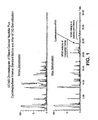
- Figure 1 shows a GC/MS chromatogram of steam cracked naphtha before and after the derivatization. A series of peaks showing up at retention times after 20 minutes are due to the formation of MTAD reaction products. The chromatography peaks before 20 minutes were significantly simplified; also an indication of derivatization. Styrenes, indenes and dimers of CPD and MCPD partially react with MTAD. They form MTAD-adducts at retention times greater than 26 minutes. Non-conjugated hydrocarbons do not react with MTAD under said experimental conditions.
- the retention time of the diene adducts is mainly influenced by the polarity of the compounds rather than by their molecular weight. This has complicated the analysis because conjugated dienes with different carbon numbers can overlap in chromatography. GC/MS becomes necessary to differentiate the conjugated dienes.
- the method provides structural information on conjugated dienes that cannot be obtained by any existing techniques.
- the mass spectra of the conjugated diene adducts are characteristic of the double bond positions and their chemical environment.
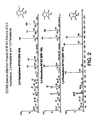
- Figure 2 illustrates the mass spectra of MTAD adducts of 1, 3-pentadiene, 2, 4-hexadiene and 2, 4-hepdiene.
- the MTAD method can detect up to C 10 conjugated dienes.
- Figure 3 shows the conjugated diene distributions in two Steam Cracked Naphthas (SCN); raw and hydrotreated samples.
- SCN Steam Cracked Naphthas
- Figure 4 shows a similar set of distributions for conjugated dienes in three heavy catalytic naphthas (HCN). Most conjugated dienes both acyclic and cyclic, are C 7 + in these samples.
- HCN heavy catalytic naphthas
Landscapes
- Chemical & Material Sciences (AREA)
- Health & Medical Sciences (AREA)
- Engineering & Computer Science (AREA)
- Life Sciences & Earth Sciences (AREA)
- Analytical Chemistry (AREA)
- Biochemistry (AREA)
- General Chemical & Material Sciences (AREA)
- Food Science & Technology (AREA)
- Medicinal Chemistry (AREA)
- Physics & Mathematics (AREA)
- Chemical Kinetics & Catalysis (AREA)
- Oil, Petroleum & Natural Gas (AREA)
- General Health & Medical Sciences (AREA)
- General Physics & Mathematics (AREA)
- Immunology (AREA)
- Pathology (AREA)
- Other Investigation Or Analysis Of Materials By Electrical Means (AREA)
- Production Of Liquid Hydrocarbon Mixture For Refining Petroleum (AREA)
- Testing Resistance To Weather, Investigating Materials By Mechanical Methods (AREA)
- Investigating Or Analyzing Non-Biological Materials By The Use Of Chemical Means (AREA)
Description
- The present invention is related to a method to quantify conjugated dienes in hydrocarbon feedstream and product. In particular, the method determines the molar concentration and/or the carbon number distribution of the conjugated dienes.
- Conjugated dienes are a major class of compounds in hydrocarbon systems that are responsible for deposit formation in refinery conversion units such as hydrocracking and hydroconversion conversion units and fractionators and heat exchangers. They are also responsible for deposit formation in automobile engines. The information is critical for assessing the potential of forming deposits in a hydrocarbon system. Knowledge of the concentration and types of conjugated dienes provides guidance to the refinery on the necessity of pretreating the refinery feed, such as installing a diolefin saturator prior to processing in order to prevent fouling during processing. In fuel applications, the information may be used to determine, e.g. if and how much a naphtha can be blended into fuel or if the naphtha needs to be hydrotreated, etc.
- There are no reliable established methods to identify and quantify conjugated dienes, acyclic and cyclic, in hydrocarbon systems. GC/FID can be used to quantify small conjugated dienes (Less than C6) in low boiling hydrocarbon systems. The identifications were made based on retention times and mass spectral library matches. The method cannot identify/quantify large conjugated dienes (Greater than C6) due to the low concentrations of the analytes, severe overlaps with other hydrocarbon components and very similar mass spectra between conjugated and non-conjugated dienes.
- Bromination has been widely used to determine olefin content (including conjugated dienes) in hydrocarbons. It can not differentiate conjugated dienes from other olefins. Aromatics, especially phenols, can interfere with the analysis.
- The MAV test is a semiquantitative method developed by UOP and uses maleic anhydride as a derivatization agent. The reaction is not selective and cannot proceed quantitatively. Therefore, only a relative number can be obtained. In addition, it cannot provide molecular identifications of different conjugated diene types required for refinery guidance.
- G. Dobson "Identification of Conjugated Fatty Acids by Gas Chromatography-Mass Spectrometry of 4-Methyl-1,2,4-triazoline-3,5-dione Adducts" Journal of the American Oil Chemist's Society, Vol 75(2), 1998, 137-142 and W.W.Christie, "Mass spectra of methyl esters of fatty acids - further derivatization", www.lipid.co.uk/infores/ms/ms04/file.pdf, , each relate to the analysis of conjugated fatty acids by derivatization with 4-methyl-1,2,4-triazoline-3,5-dione (MTAD). D.C. Young, P. Vouros and M.F. Holick, "Gas chromatography-mass spectrometry of conjugated dienes by derivatization with 4-methyl-1,2,4-triazoline-3,5-dione" J. of Chromatography Vol 522, 1990, 295-302 discloses the derivatization with MTAD and GC-MS analysis of conjugated dienes, which are described as important in certain insects as pheromones.
- The present invention is a method that detects, identifies and quantifies conjugated dienes in various hydrocarbon matrices, such as steam cracked naphtha, catalytic cracked naphtha, coker naphthas, and other petroleum distillates. Conjugated dienes are largely responsible for molecular weight growth reactions (fouling) in various refinery processes.
- The invention described herein is based on selective and rapid room temperature derivatization of conjugated dienes by 4-methyl-1, 2, 4-triazoline-3, 5-dione (MTAD) followed by NO3 Chemical ionization GC/MS and GC/NCD analyses. The method is highly selective and sensitive to linear, branched and cyclic conjugated dienes with no interference from other hydrocarbon components. The invention has been successfully applied to the determination of the types and concentrations of conjugated dienes in steam cracked and catalytic cracked naphthas.
-
-
Figure 1 shows a GC/MS chromatogram of steam cracked naphtha (SCN) plus cycloheptadiene internal standard before and after MTAD derivatization. -
Figure 2 shows a GC/MS spectra (electron impact) of MTAD adducts of 2, 4-heptadiene, 2, 4-hexadiene and 1, 3-pentadiene. -
Figure 3 shows the conjugated diene distributions in two steam cracked naphthas (SCN). -
Figure 4 shows the conjugated diene distributions in three heavy catalytic naphthas (HCN). -
Figure 5 shows a schematic of the reaction of MTAD with a linear and cyclic conjugated diene. - The present invention is a method that can detect, identify and quantify trace levels of conjugated dienes in fuel, petroleum feeds and products. These conjugated structures are largely responsible for the molecular weight growth reactions (fouling) in refinery units and deposit formation in automobile engines. Complete identification/quantification of the conjugated dienes types are needed for fouling prevention and management. The method includes the following: (1) Selective and quantitative chemical derivatization of conjugated dienes by 4-methyl-1, 2, 4-triazoline-3, 5-dione (MTAD); (2) selective and quantitative determination of MTAD-diene adducts as a function of carbon number by NO3 Chemical Ionization (Gas Chromatagraph/Mass Spectrometry (CI GC/MS); and (3) the determination of total conjugated dienes by GC with a nitrogen selective detector, such as Gas Chromatagraph/Nitrogen Chemiluminescence Detector (GC/NCD).
- MTAD stock solution was prepared by dissolving 250 mg of MTAD in 5 ml of methylene chloride. The stock solution was directly mixed with hydrocarbon samples at room temperature to derivatize the conjugated structures. MTAD selectively and rapidly (usually <5 seconds) reacts with linear and cyclic conjugated dienes as illustrated in
Figure 5 . - Cycloheptadiene was chosen as an internal standard for quantification purposes. The derivatized samples were analyzed by GC/NCD to determine the total molar concentration of conjugated dienes. The derivatized samples were also analyzed in parallel by GC/MS to determine carbon number distribution of conjugated dienes. Molecules were ionized by Chemical ionization (CI) using deuterated ammonia (ND3). Selected ion display of deuterated molecular ion [M+D+] and ND4 adduct [M + ND4 +] was used to differentiate various conjugated dienes.
- MTAD forms a 1:1 adduct with linear and cyclic conjugated dienes.
Figure 1 shows a GC/MS chromatogram of steam cracked naphtha before and after the derivatization. A series of peaks showing up at retention times after 20 minutes are due to the formation of MTAD reaction products. The chromatography peaks before 20 minutes were significantly simplified; also an indication of derivatization. Styrenes, indenes and dimers of CPD and MCPD partially react with MTAD. They form MTAD-adducts at retention times greater than 26 minutes. Non-conjugated hydrocarbons do not react with MTAD under said experimental conditions. - It was noted that the retention time of the diene adducts is mainly influenced by the polarity of the compounds rather than by their molecular weight. This has complicated the analysis because conjugated dienes with different carbon numbers can overlap in chromatography. GC/MS becomes necessary to differentiate the conjugated dienes.
- The effect of MTAD loading on the MTAD derivatization was evaluated by both GC/NCD and GC/MS. For the
model compound - The excess MTAD loading becomes a greater problem for real sample analyses. It causes formation of MTAD derivatives that are not due to conjugated dienes. It is concluded that the optimum MTAD: conjugated diene ratio is between 2 and 3.5 for quantitative analyses.
- We initially evaluated the relative sensitivity of 12 model compounds of conjugated dienes by GC/NCD, GC/FID and EI-GC/MS. GC/NCD gives quite uniform responses. The molecular ion intensities of EI-GC/MS, however, vary significantly. Since CI is a soft ionization method, which does not fragment molecules as much as EI, we evaluated CI-GC/MS using CH4 and ND3 as reagent gases for five-selected model compounds. Variation in response factor is indeed reduced and becomes more predictable. Both reagent gases yield similar relative response factors. In CH4 CI, molecules tend to form protonated molecular ions [M+H+] and ethyl cation adducts [M+C2H9 +], which can cause mass overlaps for dienes with different carbon numbers, e.g., C5 + C2H9 + overlap with C7 + H+. ND3 CI does not have the problem and was chosen for the analyses.
- The method provides structural information on conjugated dienes that cannot be obtained by any existing techniques. The mass spectra of the conjugated diene adducts are characteristic of the double bond positions and their chemical environment.
Figure 2 illustrates the mass spectra of MTAD adducts of 1, 3-pentadiene, 2, 4-hexadiene and 2, 4-hepdiene. - The MTAD method can detect up to C10 conjugated dienes. We have applied the method to various naphtha samples.
Figure 3 shows the conjugated diene distributions in two Steam Cracked Naphthas (SCN); raw and hydrotreated samples. Most conjugated dienes, both acyclic and cyclic, are C5-C7 in these SCN samples, which are invisible to GC/FID. -
Figure 4 shows a similar set of distributions for conjugated dienes in three heavy catalytic naphthas (HCN). Most conjugated dienes both acyclic and cyclic, are C7 + in these samples.
Claims (7)
- A method to quantify the conjugated dienes in a hydrocarbon feed or product stream comprising:(a) dissolving 4-methyl-1, 2, 4-triazoline-3, 5-dione (MTAD) in said hydrocarbon feed or product stream,(b) determining the molar concentration of said conjugated dienes and the carbon number distribution of said conjugated dienes, including- determination of MTAD-diene adducts as a function of carbon number by deuterated ammonia (ND3) Chemical Ionization Gas Chromatography/Mass Spectrometry (CI GC/MS) and- determination of total conjugated dienes by Gas Chromatography with a nitrogen sensitive detector;the method further comprising the step of introducing a reference compound to a feed or product stream as a quantification standard.
- The method of claim 1 wherein determination of total conjugated dienes by Gas Chromatography of step (b) is performed with Nitrogen Chemiluminescence Detection (GC-NCD).
- The process of claim 1 wherein the 4-methyl-1, 2, 4-triazoline-3, 5-dione (MTAD): conjugated diene ratio is between 2 to 10.
- The process of claim 1 wherein the 4-methyl-1, 2, 4-triazoline-3, 5-dione (MTAD): conjugated diene ratio is between 2 and 3.5.
- The process of claim 1 wherein an on-line gas chromatograph is used to separate isomeric components of 4-methyl-1, 2, 4-triazoline-3, 5-dione (MTAD)-conjugated diene adducts.
- The process of claim 1 wherein all 4-methyl-1, 2, 4-triazoline-3, 5-dione (MTAD)-conjugated diene molecules, cyclic and acyclic form M+D+ and M+ND4 + ions in ND3 Chemical ionization.
- The process of claim 1 wherein the carbon number distribution is determined up to 10.
Applications Claiming Priority (5)
| Application Number | Priority Date | Filing Date | Title |
|---|---|---|---|
| US40137702P | 2002-08-06 | 2002-08-06 | |
| US401377P | 2002-08-06 | ||
| US458456 | 2003-06-10 | ||
| US10/458,456 US6869803B2 (en) | 2002-08-06 | 2003-06-10 | Method to quantitatively analyze conjugated dienes in hydrocarbon feeds and products as an indicator of fouling potential |
| PCT/US2003/021458 WO2004013601A2 (en) | 2002-08-06 | 2003-07-08 | A method to quantitatively analyze conjugated dienes in hydrocarbon feeds and products as an indicator of fouling potential |
Publications (3)
| Publication Number | Publication Date |
|---|---|
| EP1552289A2 EP1552289A2 (en) | 2005-07-13 |
| EP1552289A4 EP1552289A4 (en) | 2011-03-02 |
| EP1552289B1 true EP1552289B1 (en) | 2015-10-28 |
Family
ID=31498678
Family Applications (1)
| Application Number | Title | Priority Date | Filing Date |
|---|---|---|---|
| EP03766848.0A Expired - Lifetime EP1552289B1 (en) | 2002-08-06 | 2003-07-08 | A method to quantitatively analyze conjugated dienes in hydrocarbon feeds and products as an indicator of fouling potential |
Country Status (6)
| Country | Link |
|---|---|
| US (1) | US6869803B2 (en) |
| EP (1) | EP1552289B1 (en) |
| JP (1) | JP4583173B2 (en) |
| AU (1) | AU2003251818B2 (en) |
| CA (1) | CA2493743C (en) |
| WO (1) | WO2004013601A2 (en) |
Families Citing this family (1)
| Publication number | Priority date | Publication date | Assignee | Title |
|---|---|---|---|---|
| EP3182120B1 (en) | 2015-12-14 | 2023-02-22 | INDIAN OIL CORPORATION Ltd. | A gc/gc-ms based method for the estimation of trace level conjugated dienes in gasoline range products |
-
2003
- 2003-06-10 US US10/458,456 patent/US6869803B2/en not_active Expired - Lifetime
- 2003-07-08 CA CA2493743A patent/CA2493743C/en not_active Expired - Fee Related
- 2003-07-08 JP JP2004526035A patent/JP4583173B2/en not_active Expired - Fee Related
- 2003-07-08 WO PCT/US2003/021458 patent/WO2004013601A2/en not_active Ceased
- 2003-07-08 AU AU2003251818A patent/AU2003251818B2/en not_active Ceased
- 2003-07-08 EP EP03766848.0A patent/EP1552289B1/en not_active Expired - Lifetime
Also Published As
| Publication number | Publication date |
|---|---|
| EP1552289A2 (en) | 2005-07-13 |
| AU2003251818A1 (en) | 2004-02-23 |
| WO2004013601A3 (en) | 2004-07-01 |
| JP4583173B2 (en) | 2010-11-17 |
| CA2493743A1 (en) | 2004-02-12 |
| US20040029287A1 (en) | 2004-02-12 |
| JP2005534917A (en) | 2005-11-17 |
| US6869803B2 (en) | 2005-03-22 |
| WO2004013601A2 (en) | 2004-02-12 |
| CA2493743C (en) | 2011-06-07 |
| AU2003251818B2 (en) | 2008-05-08 |
| EP1552289A4 (en) | 2011-03-02 |
Similar Documents
| Publication | Publication Date | Title |
|---|---|---|
| Hawks | Analytical methodology | |
| Chou et al. | Gas chromatography-isotope dilution mass spectrometry preceded by liquid–liquid extraction and chemical derivatization for the determination of ketamine and norketamine in urine | |
| Lachenmeier et al. | Determination of opiates and cocaine in hair using automated enzyme immunoassay screening methodologies followed by gas chromatographic–mass spectrometric (GC–MS) confirmation | |
| Stumpf et al. | Detailed analysis of sulfur compounds in gasoline range petroleum products with high-resolution gas chromatography–atomic emission detection using group-selective chemical treatment | |
| Thirukumaran et al. | Solid-phase microextraction-probe electrospray ionization devices for screening and quantitating drugs of abuse in small amounts of biofluids | |
| Bernabei et al. | Determination of total and polycyclic aromatic hydrocarbons in aviation jet fuel | |
| Ferreiro-González et al. | Application of an HS–MS for the detection of ignitable liquids from fire debris | |
| Krajewski et al. | Application of the fentanyl analog screening kit toward the identification of emerging synthetic opioids in human plasma and urine by LC-QTOF | |
| Amendola et al. | Detection of beta-blockers in human urine by GC-MS-MS-EI: perspectives for the antidoping control | |
| Galimberti et al. | Acidic polar compounds in petroleum: a new analytical methodology and applications as molecular migration indices | |
| Briker et al. | Miniaturized method for separation and quantification of nitrogen species in petroleum distillates☆ | |
| Dowling et al. | A new mixed mode solid phase extraction strategy for opioids, cocaines, amphetamines and adulterants in human blood with hybrid liquid chromatography tandem mass spectrometry detection | |
| Abarca et al. | Development and validation of an LC-MS/MS assay for the quantitative analysis of alprazolam, α-hydroxyalprazolam and hydrocodone in dried blood spots | |
| da Silva et al. | A flow-batch internal standard procedure for iron determination in hydrated ethanol fuel by flame atomic absorption spectrometry | |
| Barceló-Barrachina et al. | Comparison of dimethylformamide dialkylacetal derivatization reagents for the analysis of heterocyclic amines in meat extracts by gas chromatography–mass spectrometry | |
| Ferreiro-González et al. | Characterization of petroleum-based products in water samples by HS-MS | |
| US6869803B2 (en) | Method to quantitatively analyze conjugated dienes in hydrocarbon feeds and products as an indicator of fouling potential | |
| Fafet et al. | New Developments in Mass Spectrometry for Group-Type Analysis of Petroleum Cuts (Second Part) | |
| US5644129A (en) | Direct analysis of paraffin and naphthene types in hydrocarbon | |
| Kidwell et al. | Comparing two analytical methods: minimal standards in forensic toxicology derived from information theory | |
| de Andrade et al. | Methods for the determination of conjugated dienes in petroleum products: A review | |
| US20030180963A1 (en) | Quantitative method for hydrocarbon analysis | |
| Ieda et al. | Application of inert gas-mediated ionization for qualitative screening of chlorinated aromatics in house dust by comprehensive two-dimensional gas chromatography–high-resolution time-of-flight mass spectrometry | |
| Bianchi et al. | Innovative method for ultratrace determination of formaldehyde in frozen fish: SPME extraction and GC-ITMS/MS analysis | |
| Hwang | Biomarker analysis using GC-MSD |
Legal Events
| Date | Code | Title | Description |
|---|---|---|---|
| PUAI | Public reference made under article 153(3) epc to a published international application that has entered the european phase |
Free format text: ORIGINAL CODE: 0009012 |
|
| 17P | Request for examination filed |
Effective date: 20050214 |
|
| AK | Designated contracting states |
Kind code of ref document: A2 Designated state(s): AT BE BG CH CY CZ DE DK EE ES FI FR GB GR HU IE IT LI LU MC NL PT RO SE SI SK TR |
|
| AX | Request for extension of the european patent |
Extension state: AL LT LV MK |
|
| DAX | Request for extension of the european patent (deleted) | ||
| RBV | Designated contracting states (corrected) |
Designated state(s): BE FR GB IT NL |
|
| REG | Reference to a national code |
Ref country code: DE Ref legal event code: 8566 |
|
| A4 | Supplementary search report drawn up and despatched |
Effective date: 20110202 |
|
| 17Q | First examination report despatched |
Effective date: 20110315 |
|
| GRAP | Despatch of communication of intention to grant a patent |
Free format text: ORIGINAL CODE: EPIDOSNIGR1 |
|
| RIC1 | Information provided on ipc code assigned before grant |
Ipc: G01N 33/28 20060101AFI20150526BHEP |
|
| INTG | Intention to grant announced |
Effective date: 20150616 |
|
| GRAS | Grant fee paid |
Free format text: ORIGINAL CODE: EPIDOSNIGR3 |
|
| GRAA | (expected) grant |
Free format text: ORIGINAL CODE: 0009210 |
|
| AK | Designated contracting states |
Kind code of ref document: B1 Designated state(s): BE FR GB IT NL |
|
| REG | Reference to a national code |
Ref country code: GB Ref legal event code: FG4D |
|
| REG | Reference to a national code |
Ref country code: NL Ref legal event code: MP Effective date: 20151028 |
|
| PG25 | Lapsed in a contracting state [announced via postgrant information from national office to epo] |
Ref country code: IT Free format text: LAPSE BECAUSE OF FAILURE TO SUBMIT A TRANSLATION OF THE DESCRIPTION OR TO PAY THE FEE WITHIN THE PRESCRIBED TIME-LIMIT Effective date: 20151028 Ref country code: NL Free format text: LAPSE BECAUSE OF FAILURE TO SUBMIT A TRANSLATION OF THE DESCRIPTION OR TO PAY THE FEE WITHIN THE PRESCRIBED TIME-LIMIT Effective date: 20151028 |
|
| PLBE | No opposition filed within time limit |
Free format text: ORIGINAL CODE: 0009261 |
|
| STAA | Information on the status of an ep patent application or granted ep patent |
Free format text: STATUS: NO OPPOSITION FILED WITHIN TIME LIMIT |
|
| 26N | No opposition filed |
Effective date: 20160729 |
|
| PG25 | Lapsed in a contracting state [announced via postgrant information from national office to epo] |
Ref country code: BE Free format text: LAPSE BECAUSE OF FAILURE TO SUBMIT A TRANSLATION OF THE DESCRIPTION OR TO PAY THE FEE WITHIN THE PRESCRIBED TIME-LIMIT Effective date: 20151028 |
|
| GBPC | Gb: european patent ceased through non-payment of renewal fee |
Effective date: 20160708 |
|
| PG25 | Lapsed in a contracting state [announced via postgrant information from national office to epo] |
Ref country code: FR Free format text: LAPSE BECAUSE OF NON-PAYMENT OF DUE FEES Effective date: 20160801 |
|
| REG | Reference to a national code |
Ref country code: FR Ref legal event code: ST Effective date: 20170331 |
|
| PG25 | Lapsed in a contracting state [announced via postgrant information from national office to epo] |
Ref country code: GB Free format text: LAPSE BECAUSE OF NON-PAYMENT OF DUE FEES Effective date: 20160708 |