EP1551072A2 - Thermal batteries using cathode-precursor pyrotechnic pellets - Google Patents
Thermal batteries using cathode-precursor pyrotechnic pellets Download PDFInfo
- Publication number
- EP1551072A2 EP1551072A2 EP20040256992 EP04256992A EP1551072A2 EP 1551072 A2 EP1551072 A2 EP 1551072A2 EP 20040256992 EP20040256992 EP 20040256992 EP 04256992 A EP04256992 A EP 04256992A EP 1551072 A2 EP1551072 A2 EP 1551072A2
- Authority
- EP
- European Patent Office
- Prior art keywords
- lithium
- heat source
- cathode
- pyrotechnic
- thermal battery
- Prior art date
- Legal status (The legal status is an assumption and is not a legal conclusion. Google has not performed a legal analysis and makes no representation as to the accuracy of the status listed.)
- Withdrawn
Links
Images


Classifications
-
- H—ELECTRICITY
- H01—ELECTRIC ELEMENTS
- H01M—PROCESSES OR MEANS, e.g. BATTERIES, FOR THE DIRECT CONVERSION OF CHEMICAL ENERGY INTO ELECTRICAL ENERGY
- H01M10/00—Secondary cells; Manufacture thereof
- H01M10/36—Accumulators not provided for in groups H01M10/05-H01M10/34
- H01M10/39—Accumulators not provided for in groups H01M10/05-H01M10/34 working at high temperature
-
- H—ELECTRICITY
- H01—ELECTRIC ELEMENTS
- H01M—PROCESSES OR MEANS, e.g. BATTERIES, FOR THE DIRECT CONVERSION OF CHEMICAL ENERGY INTO ELECTRICAL ENERGY
- H01M10/00—Secondary cells; Manufacture thereof
- H01M10/60—Heating or cooling; Temperature control
- H01M10/61—Types of temperature control
- H01M10/615—Heating or keeping warm
-
- H—ELECTRICITY
- H01—ELECTRIC ELEMENTS
- H01M—PROCESSES OR MEANS, e.g. BATTERIES, FOR THE DIRECT CONVERSION OF CHEMICAL ENERGY INTO ELECTRICAL ENERGY
- H01M10/00—Secondary cells; Manufacture thereof
- H01M10/60—Heating or cooling; Temperature control
- H01M10/65—Means for temperature control structurally associated with the cells
- H01M10/654—Means for temperature control structurally associated with the cells located inside the innermost case of the cells, e.g. mandrels, electrodes or electrolytes
-
- H—ELECTRICITY
- H01—ELECTRIC ELEMENTS
- H01M—PROCESSES OR MEANS, e.g. BATTERIES, FOR THE DIRECT CONVERSION OF CHEMICAL ENERGY INTO ELECTRICAL ENERGY
- H01M10/00—Secondary cells; Manufacture thereof
- H01M10/60—Heating or cooling; Temperature control
- H01M10/65—Means for temperature control structurally associated with the cells
- H01M10/6595—Means for temperature control structurally associated with the cells by chemical reactions other than electrochemical reactions of the cells, e.g. catalytic heaters or burners
-
- H—ELECTRICITY
- H01—ELECTRIC ELEMENTS
- H01M—PROCESSES OR MEANS, e.g. BATTERIES, FOR THE DIRECT CONVERSION OF CHEMICAL ENERGY INTO ELECTRICAL ENERGY
- H01M6/00—Primary cells; Manufacture thereof
- H01M6/30—Deferred-action cells
- H01M6/36—Deferred-action cells containing electrolyte and made operational by physical means, e.g. thermal cells
-
- Y—GENERAL TAGGING OF NEW TECHNOLOGICAL DEVELOPMENTS; GENERAL TAGGING OF CROSS-SECTIONAL TECHNOLOGIES SPANNING OVER SEVERAL SECTIONS OF THE IPC; TECHNICAL SUBJECTS COVERED BY FORMER USPC CROSS-REFERENCE ART COLLECTIONS [XRACs] AND DIGESTS
- Y02—TECHNOLOGIES OR APPLICATIONS FOR MITIGATION OR ADAPTATION AGAINST CLIMATE CHANGE
- Y02E—REDUCTION OF GREENHOUSE GAS [GHG] EMISSIONS, RELATED TO ENERGY GENERATION, TRANSMISSION OR DISTRIBUTION
- Y02E60/00—Enabling technologies; Technologies with a potential or indirect contribution to GHG emissions mitigation
- Y02E60/10—Energy storage using batteries
Definitions
- This invention relates to the improvement of thermal batteries, more particularly to the increasing of power and operational longevity of "cathode-less" thermal batteries.
- Thermal batteries are thermally activated, primary reserve, hermetically sealed power sources generally consisting of series or series-parallel arrays of cells.
- Each cell comprises of an anode, an electrolyte-separator, a cathode and a pyrotechnic heat source.
- the electrolyte is a mixture of alkali metal halides, for example an eutectic mixture of KCl-LiCl which melt at about 350°C.
- alkali metal halides for example an eutectic mixture of KCl-LiCl which melt at about 350°C.
- Common cathode materials among others are iron disulfide and cobalt sulfide. Transition metal oxides such as iron oxide can be used as cathode material as well.
- Lithium-iron or lithium alloys such as lithium-aluminum and lithium-silicon are generally used as anode materials.
- the pyrotechnic material is a mixture of high surface area iron powder and potassium perchlorate. The main role of this pyrotechnic material is to provide when being ignited the thermal cell with the exact heat needed to melt the electrolyte.
- the exothermic mixture used in the pyrotechnic material bums at a controlled rate, it must not melt, should not produce gas, it must have a caloric output that can be closely controlled. It has to be insensitive enough to be pelleted without igniting, then be able to be lit reliably over a wide temperature range and after ignition it must be electrically conductive, because the burnt pyrotechnic pellets form the inter-cell electrical connectors.
- the batteries according to the invention of the "329" patent are applicable only at small current densities and have a short life-time.
- Embodiments of the present invention seek to alleviate these drawbacks and to provide other related advantages.
- Embodiments of the present invention preferably provide a "cathode-less" thermal battery, which is based on a conventional iron KClO 4 pyrotechnic component and on an all-lithium electrolyte separator.
- a thermal battery of the type heated to an operating temperature having a plurality of stacked cells, each cell consisting essentially of: (a) an anode which includes a lithium compound; (b) a substantially lithium free pyrotechnic heat source, the pyrotechnic heat source includes a cathode precursor, and (c) a separator separating between said anode and said pyrotechnic heat source, said separator includes an LiCl-LiBr-LiF mixture having the lowest melting point for a mixture with such constituents.
- a method for improving power and operational life-time of a thermal battery comprises the steps of: (a) providing a thermal battery, said thermal battery having a pyrotechnic heat source wherein a metal in said pyrotechnic heat source performs as a cathode precursor (b) igniting said pyrotechnic heat source obtaining an oxide of said metal, and (c) using an all-lithium electrolyte as a lithium ion source for a lithization of said oxide of said metal.
- Preferred embodiments of the present invention seek to provide a thermal battery capable of sustaining current densities up to about 1000 mA/cm 2 .
- thermal battery with an extended life-time and/or to provide a more reliable thermal battery and/or to provide a thermal battery having reduced dimensions at a reduced production cost.
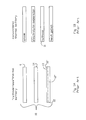
- FIG. 1A depicts a typical cell 10 of what is being referred hereinafter as a "cathode-less" thermal battery, in which a cathode 11 of a cell of a conventional thermal battery, shown in FIG. 1B to which reference is now made, becomes redundant.
- Embodiments of the present invention make use of the fact that it is only a narrow layer 12' of pyrotechnic pellet 12 beneath the pyrotechnic pellet surface 13 which contacts electrolyte layer 14, which takes place in the Li + intercalation process.
- the rest 12" of the thickness of pyrotechnic pellet 12 is substantially intact with respect to any electrochemical change and merely conduct electrons.
- a separator which is composed of a mixture of LiF, LiCl and LiBr in an appropriate weight ratio which corresponds to a composition having the lowest melting point of any mixtures of these constituents was used.
- One problem associated with the all-lithium electrolyte is its relative high melting point (445°C, as compared to the melting point of 350°C for the LiCl-KCl eutectic). This causes the discharge voltage of a conventional battery employing the all-lithium electrolyte to drop as soon as the temperature of the battery cools below 460°C.
- the KCl added reacts with the lithium ions which enters the cathode layer during the battery discharge to produce a LiCl-KCl eutectic which has a relatively lower melting point then the all-Li electrolyte, thus the performance at low temperatures is improved and the battery gains a longer life-time.
- the oxidizing agent in the pyrotechnic pellet is substantially KClO 4 , which upon oxidation converts into KCl, thus a situation similar to that described in Japanese Patent No. 02 021568 A is reproduced in-situ.
- an all-lithium electrolyte is the favourable electrolyte for a "cathode-less" battery, which needs an extensive lithization.
- the initially lithium free pyrotechnic heat source which contains KClO 4 is a favourable candidate to be effected by the all-lithium electrolyte.
- the cells of the improved batteries according to the present invention include an anode 9, a substantially lithium free pyrotechnic heat source 12, which includes a cathode precursor and an all-lithium electrolyte separator 14, which is disposed between anode 9 and pyrotechnic heat source 12.
- Pyrotechnic cathode-precursor comprises a physical mixture of high surface area iron powder and potassium perchlorate and can also include additives.
- the additives in this invention may comprise other oxides, lithium ionic compounds such as lithium perchlorate, lithium chloride, or a mixture of them.
- the over all weight ratio of iron-potassium perchlorate-additives is 60% to 90% iron, 2% to 20% potassium perchlorate, and up to 10% additives. It should be noted that other transition metals such as Co, Ni, Mn, Cu, V, Cr and combinations thereof could be used as pyrotechnic cathode precursor besides iron as well, In such cases the weight percentage of the potassium perchlorate can be some times higher whenever the heat of formation of the oxides is smaller.
- the pyrotechnic cathode-precursor pellets were prepared by blending vacuum dried -200 mesh iron powder with potassium perchlorate having grain size of 4 to 7 ⁇ m together with eventually added additives powders in a Turbula mixer for about one hour.
- the weight ratio of the mix is about 60-90% Fe powder, 2-20% KClO 4 , and up to 10% additives.
- the additives are lithium perchlorate fine powder (Fluka-Germany), lithium chloride fine powder (Merck-Germany) or a mixture of them.
- the homogeneous blend is then pressed at 0.5 to 3 ton/cm 2 to obtain 14 or 30 mm diameter pyrotechnic pellets.
- Electrolyte-separator pellets are formed according to well-known procedures.
- the pellets comprise about 40wt % to 60wt % MgO binder with an LiCl-LiF-LiBr mixture at the lowest melting point composition, (weight proportions of 22%-9.6%-68.4% respectively).
- the separator wafers were prepared by pressing a fused all-lithium electrolyte-MgO mixture at 0.5 to 3 ton/cm 2 into 14 or 30 mm diameter pellets.
- Anodes were prepared by blending lithium-aluminium alloy powder, eutectic LiCl-KCl electrolyte, and iron powder at about 64:16:20 weight ratio, following by pressing the mix at 1.5-2.5 ton/cm 2 into 14 or 30 mm diameter anode pellets.
- All anode and separator pellets were prepared in a dry room environment having a relative humidity of less than 1%.
- the batteries consist of two sections; a 24V section and a 7V section, made of 30mm diameter cells. Each cell comprises 0.28gr anode, 0.67gr KCl-LiCl electrolyte-separator (having 55:45 weight percent ratio respectively) and 0.97gr cathode-precursor pyrotechnic (CPP) pellet.
- the CPP pellet composition was Fe-KClO 4 at a weight percent ratio of 83:17 respectively. This composition provided about 314 cal/pellet at a burning rate of about 100 mm/sec without any significant gas formation.
- the batteries were conditioned at -40°C and -60°C and then discharged at a constant load of 0.3A with several pulses of 5A up to 13A.
- the discharge data are summarised in Table 1 and the discharge curves of the -40°C battery are shown in FIG. 2.
- the battery consists of two strings of 20, 30 mm diameter cells, connected in parallel to give an 28V section. Each cell comprises 0.28gr anode, 0.67gr LiF-LiCl-LiBr electrolyte-separator and 0.85gr cathode-precursor pyrotechnic (CPP) pellet.
- the CPP pellet composition was Fe-KClO 4 at a weight ratio of 83:17 respectively. This composition provided about 270 cal/pellet at a burning rate of about 100 mm/sec without any significant gas formation.
- the battery was discharged at room temperature at a constant load of 15A with pulses of 20A every second (not shown).
- the battery rise time was 65 msec while the life-time to 28V was larger than 5 sec.
- a same "cathode-less" LiCl-KCl reference battery collapses at these operation conditions from the first moment of its activation and no life-time time can be defined.
- the battery consists of 10, 30 mm diameter cells. Each cell mainly comprises 0.28gr anode, 0.75gr LiCl-KCl (45:55 weight ratio respectively) electrolyte-separator and 1.54gr CPP pellet.
- the CPP pellet composition was Fe-KClO 4 at a ratio of 86:14 by weight respectively. This composition provided about 400 cal/pellet at a burning rate of about 90 mm/sec without any significant gas formation.
- the battery was discharge at room temperature at a constant load of 300 mA with pulses of 0.5A every 40 sec.
- the battery life-time to 14V was 25 sec as is shown in FIG. 4 to which reference is now made.
- the same battery as in example 4 was built with the only exception of having the LiF-LiCl-LiBr eutectic electrolyte instead of the LiCl-KC electrolyte.
- the battery life-time to 14V extends to 200 sec. as is shown in FIG. 5 to which reference is now made.
- the batteries consist of three sections (+12V, -12V and +2.8V) made of cells of 14 mm in diameter. Each cell comprises 0.06gr anode, 0.12gr KCl-LiCl electrolyte-separator (35:65 weight ratio respectively) and 0.2gr CPP pellet.
- the pellet composition was Fe:KClO 4 at a ratio of 83:17 by weight respectively. This composition provided about 65 cal/pellet at a burning rate of about 100 mm/sec without any significant gas formation.
- the batteries were cold conditioned at -40°C and +25°C and then discharge through a constant resistance of 150 ⁇ (+12V and -12V sections) and 1.87 ⁇ (+2.8V section).
- the discharge data are summarised in Table 3 and the discharge curve of the -40°C battery is shown in Fig. 6 to which reference is now made.
Landscapes
- Engineering & Computer Science (AREA)
- Manufacturing & Machinery (AREA)
- Chemical & Material Sciences (AREA)
- Chemical Kinetics & Catalysis (AREA)
- Electrochemistry (AREA)
- General Chemical & Material Sciences (AREA)
- Primary Cells (AREA)
Abstract
Description
- This invention relates to the improvement of thermal batteries, more particularly to the increasing of power and operational longevity of "cathode-less" thermal batteries.
- Thermal batteries are thermally activated, primary reserve, hermetically sealed power sources generally consisting of series or series-parallel arrays of cells. Each cell comprises of an anode, an electrolyte-separator, a cathode and a pyrotechnic heat source.
- Typically, the electrolyte is a mixture of alkali metal halides, for example an eutectic mixture of KCl-LiCl which melt at about 350°C. Common cathode materials among others are iron disulfide and cobalt sulfide. Transition metal oxides such as iron oxide can be used as cathode material as well.
- Lithium-iron or lithium alloys such as lithium-aluminum and lithium-silicon are generally used as anode materials. The pyrotechnic material is a mixture of high surface area iron powder and potassium perchlorate. The main role of this pyrotechnic material is to provide when being ignited the thermal cell with the exact heat needed to melt the electrolyte.
- The exothermic mixture used in the pyrotechnic material bums at a controlled rate, it must not melt, should not produce gas, it must have a caloric output that can be closely controlled. It has to be insensitive enough to be pelleted without igniting, then be able to be lit reliably over a wide temperature range and after ignition it must be electrically conductive, because the burnt pyrotechnic pellets form the inter-cell electrical connectors.
- Near stochiometric ratios of the components of the exothermic mixture (i.e. 63wt% Fe and 37wt% KClO4) produce temperatures high enough to melt iron, so to moderate the reaction, to control the rate of burning and to produce a conductive ash, mixtures containing no more than 17% of perchlorate can be used with iron, which upon burning form a thermodynamically stable oxide Fe0.947O, which is dispersed within the particles of the excessive iron.
- Recently, U.S. Patent No. 5,770,329 to Harney, incorporated by reference for all purposes as if fully set forth herein, describes a thermal battery in which the pyrotechnic pellets serve also as cathode precursor wafers which after the generation of heat supply the cathode material of the battery cells, thus eliminating the need for distinct cathode layers.
- Thermal batteries, which are produced according to "329" patent suffer from two major inherent drawbacks which limit their power delivery capability as well as their operation life time:
- Firstly the concentration of the cathode material (i.e. the iron oxide) formed by the burning of the exothermic mixture in the cathode-precursor pyrotechnic pellet is low.
- This is so because, as was said before, it is practically impossible to increase the amount of the oxidizing compound (e.g. KClO4) relative to the amount of the iron powder over a weight ratio of 17:83 respectively. Thus the maximum weight concentration of the FeO formed in the matrix of the pyrotechnic pellet can reach only to about 30%.
-
- Secondly, the utilization of the formed cathode material by Li+ ions during battery operation (the intercalation process) is low; This is so because the "329" patent does not teach an appropriate way to "flood" the formed FeO particles with surrounding Li+ ions.
- An attempt according to the "329" patent to replace some or all of the KClO4 in the pyrotechnic pellet with LiClO4 results with an Li+ ion concentration of at most of about 8%. Other trials to increase the Li+ concentration by stuffing the pyrotechnic pellet with non oxidizing lithium salts (as LiCl-KCl eutectic mixture) have the following drawbacks:
- They lower too much the specific caloric value of the pellet and by this increase the battery rise time, they decrease the pellets electronic conduction and besides, the embedded lithium salts in the pyrotechnic pellet absorbs humidity extensively.
- Thus, the batteries according to the invention of the "329" patent are applicable only at small current densities and have a short life-time.
- Embodiments of the present invention seek to alleviate these drawbacks and to provide other related advantages.
- Embodiments of the present invention preferably provide a "cathode-less" thermal battery, which is based on a conventional iron KClO4 pyrotechnic component and on an all-lithium electrolyte separator.
- According to a first aspect of the present invention there is provided a thermal battery of the type heated to an operating temperature having a plurality of stacked cells, each cell consisting essentially of: (a) an anode which includes a lithium compound; (b) a substantially lithium free pyrotechnic heat source, the pyrotechnic heat source includes a cathode precursor, and (c) a separator separating between said anode and said pyrotechnic heat source, said separator includes an LiCl-LiBr-LiF mixture having the lowest melting point for a mixture with such constituents.
- According to a second aspect of the present invention there is provided a method for improving power and operational life-time of a thermal battery, the method comprises the steps of: (a) providing a thermal battery, said thermal battery having a pyrotechnic heat source wherein a metal in said pyrotechnic heat source performs as a cathode precursor (b) igniting said pyrotechnic heat source obtaining an oxide of said metal, and (c) using an all-lithium electrolyte as a lithium ion source for a lithization of said oxide of said metal.
- Preferred embodiments of the present invention seek to provide a thermal battery capable of sustaining current densities up to about 1000 mA/cm2.
- It is also advantageous for embodiments of the present invention to provide a thermal battery with an extended life-time and/or to provide a more reliable thermal battery and/or to provide a thermal battery having reduced dimensions at a reduced production cost.
- Other preferred features of the present invention will become apparent upon reading the following description in conjunction with the following figures.
- For a better understanding of the present invention, and to show how the same may be carried into effect, reference will now be made, by way of example to the accompanying drawings in which:
- FIGS. 1A and 1B show a traverse section of a thermal cell of a "cathode-less" thermal battery and of a conventional battery respectively;
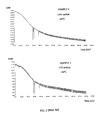
- FIG. 2 shows a discharge curve of a prior art "cathode-less" battery of example 1;
- FIG. 3 shows a discharge curve of a "cathode-less" battery embodying the present invention, which is described in example 2;
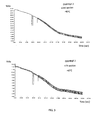
- FIG. 4 shows a discharge curve of a prior art "cathode-less" battery of example 4;
- FIG. 5 shows a discharge curve of a "cathode-less" battery embodying the present invention, which is described in example 5;
- FIG. 6 shows a discharge curve of a prior art "cathode-less" battery of example 6; and
- FIG. 7 shows a discharge curve of a "cathode-less" battery embodying the present invention, which is described in example 7.
-
- The present embodiments herein are not intended to be exhaustive and to limit in any way the scope of the invention, rather they are used as examples for the clarification of the invention and for enabling of other skilled in the art to utilize its teaching.
- FIG. 1A depicts a
typical cell 10 of what is being referred hereinafter as a "cathode-less" thermal battery, in which acathode 11 of a cell of a conventional thermal battery, shown in FIG. 1B to which reference is now made, becomes redundant. - As explained above, a prerequisite for satisfactorily operation of a "cathode-less"
thermal battery 10, in which an oxidized pyrotechnic precursor (not shown) inpyrotechnic pellet 12 is used as the cathode material, is a high rate of lithization of the formed oxidized pyrotechnic precursor particles by surrounding Li+ ions (not shown). This demands high concentration of Li+ ions inpyrotechnic pellet 12. - It was also explained why it is unlikely that a major contribution to the needed Li+ ion concentration can originate form lithium salts, which were dispersed in advance in
pyrotechnic pellet 12. - Embodiments of the present invention make use of the fact that it is only a narrow layer 12' of
pyrotechnic pellet 12 beneath thepyrotechnic pellet surface 13 which contactselectrolyte layer 14, which takes place in the Li+ intercalation process. Therest 12" of the thickness ofpyrotechnic pellet 12 is substantially intact with respect to any electrochemical change and merely conduct electrons. - Thus it is needed to supply Li+ ions to layer 12' only, rather then to
entire pellet 12. - Because the limited volume of layer 12' and the intimate contact of
interface 13 withelectrolyte wafer 14, it is possible to build up the concentration of Li+ ions which is needed in region 12', by Li+ ion transfer fromelectrolytic layer 14, provided that the Li+ ion flux toward layer 12' will be sufficiently high. - To accomplish such high flux, a separator, which is composed of a mixture of LiF, LiCl and LiBr in an appropriate weight ratio which corresponds to a composition having the lowest melting point of any mixtures of these constituents was used.
- The preparation, properties and use of such a mixture of lithium salts which will be defined hereinafter as "all-lithium electrolyte" or "all-lithium eutectic" is prior art which is described e.g. in the proceedings of the 33 rd international power sources symposium, 13-16 June 1988, published and distributed by the Electrochemical society Inc, pages 369-392.
- There, the applicability of the all-lithium electrolyte to (conventional) thermal batteries with extreme current density is demonstrated.
- It was also reported that lithiating of the cathode layer by the all-lithium electrolyte is so extensive that it proceeds at an appreciable rate even at room temperature, see e.g. U.S. Patent No. 5,900,331 to Krieger.
- We disclosed in the present invention that the beneficial effect of the all-lithium electrolyte in extending "cathode-less" batteries life-time as compared to an electrolyte having the conventional LiCl-KCl eutectic composition (45% wt: 55% wt respectively) is far more pronounced then is anticipated in accordance to the enrichment (by about 55%) in the Li+ ion content of the all-lithium electrolyte, as compared to the LiCl-KCl eutectic.
- The way in which such non-obvious improvement in batteries performance occurs will now be explained:
- One problem associated with the all-lithium electrolyte is its relative high melting point (445°C, as compared to the melting point of 350°C for the LiCl-KCl eutectic). This causes the discharge voltage of a conventional battery employing the all-lithium electrolyte to drop as soon as the temperature of the battery cools below 460°C.
- In Japanese Patent No. 02 021568 A to Tsukamoto Hisashi, a method is disclosed to extend the life-time of an all-Li electrolyte conventional thermal battery (in which the electrolyte in the cathode is the first to freeze) which comprises of adding KCl to the cathode material.
- The KCl added reacts with the lithium ions which enters the cathode layer during the battery discharge to produce a LiCl-KCl eutectic which has a relatively lower melting point then the all-Li electrolyte, thus the performance at low temperatures is improved and the battery gains a longer life-time.
- The point to emphasise here is that in accordance with the present invention, the oxidizing agent in the pyrotechnic pellet is substantially KClO4, which upon oxidation converts into KCl, thus a situation similar to that described in Japanese Patent No. 02 021568 A is reproduced in-situ.
- Consequently, from one hand an all-lithium electrolyte is the favourable electrolyte for a "cathode-less" battery, which needs an extensive lithization. From the other hand the initially lithium free pyrotechnic heat source which contains KClO4 is a favourable candidate to be effected by the all-lithium electrolyte.
- This cooperative effect which results from a combination of a pyrotechnic pellet having KClO4 as the oxidizing agent together with an all-lithium electrolyte, to provide the highest performing "cathode-less" electrochemical cell, is neither rendered obvious nor can it be anticipated by a skilled person in the art of thermal batteries.
- Generally, the cells of the improved batteries according to the present invention include an
anode 9, a substantially lithium freepyrotechnic heat source 12, which includes a cathode precursor and an all-lithium electrolyte separator 14, which is disposed betweenanode 9 andpyrotechnic heat source 12. - Pyrotechnic cathode-precursor according to embodiments of the present invention comprises a physical mixture of high surface area iron powder and potassium perchlorate and can also include additives. The additives in this invention may comprise other oxides, lithium ionic compounds such as lithium perchlorate, lithium chloride, or a mixture of them.
- The over all weight ratio of iron-potassium perchlorate-additives is 60% to 90% iron, 2% to 20% potassium perchlorate, and up to 10% additives. It should be noted that other transition metals such as Co, Ni, Mn, Cu, V, Cr and combinations thereof could be used as pyrotechnic cathode precursor besides iron as well, In such cases the weight percentage of the potassium perchlorate can be some times higher whenever the heat of formation of the oxides is smaller.
- When using iron, the pyrotechnic cathode-precursor pellets were prepared by blending vacuum dried -200 mesh iron powder with potassium perchlorate having grain size of 4 to 7 µm together with eventually added additives powders in a Turbula mixer for about one hour.
- The weight ratio of the mix is about 60-90% Fe powder, 2-20% KClO4, and up to 10% additives. The additives are lithium perchlorate fine powder (Fluka-Germany), lithium chloride fine powder (Merck-Germany) or a mixture of them.
- The homogeneous blend is then pressed at 0.5 to 3 ton/cm2 to obtain 14 or 30 mm diameter pyrotechnic pellets.
- Electrolyte-separator pellets are formed according to well-known procedures. The pellets comprise about 40wt % to 60wt % MgO binder with an LiCl-LiF-LiBr mixture at the lowest melting point composition, (weight proportions of 22%-9.6%-68.4% respectively).
- The separator wafers were prepared by pressing a fused all-lithium electrolyte-MgO mixture at 0.5 to 3 ton/cm2 into 14 or 30 mm diameter pellets.
- Anodes were prepared by blending lithium-aluminium alloy powder, eutectic LiCl-KCl electrolyte, and iron powder at about 64:16:20 weight ratio, following by pressing the mix at 1.5-2.5 ton/cm2 into 14 or 30 mm diameter anode pellets.
- All anode and separator pellets were prepared in a dry room environment having a relative humidity of less than 1%.
- The following examples, which are illustrative only and do not limit the invention, demonstrate the performance of "cathode-less" batteries according to the present invention and compares their properties with "cathode-less" batteries according to prior art.
- Two "cathode-less" thermal batteries were assembled. The batteries consist of two sections; a 24V section and a 7V section, made of 30mm diameter cells. Each cell comprises 0.28gr anode, 0.67gr KCl-LiCl electrolyte-separator (having 55:45 weight percent ratio respectively) and 0.97gr cathode-precursor pyrotechnic (CPP) pellet. The CPP pellet composition was Fe-KClO4 at a weight percent ratio of 83:17 respectively. This composition provided about 314 cal/pellet at a burning rate of about 100 mm/sec without any significant gas formation.
- The batteries were conditioned at -40°C and -60°C and then discharged at a constant load of 0.3A with several pulses of 5A up to 13A. The discharge data are summarised in Table 1 and the discharge curves of the -40°C battery are shown in FIG. 2.
- In Table 1 and the forthcoming Tables; Rise- time and Life-time are defined as the two periods which passed since the activation of the battery until the section's voltage crosses a predetermined fraction of its nominal value.
discharge data of "cathode-less" thermal batteries of example 1. discharge temperature +24V section +7V section Rise-time, msec Life time, sec Rise-time, msec Life time, sec -40°C 78 53 61 170 -60 °C 81 52 64 150 - The same batteries as in example 1 were built with the only exception of having the LiF-LiCl-LiBr electrolyte-separator instead of the KCl-LiCl electrolyte-separator. The discharge data are summarised in Table 2 and the discharge curve of the -40°C battery is shown in FIG. 3.
discharge data of "cathode-less" thermal batteries of example 2. discharge temperature +24V section +7V section Rise time, msec Life time, sec Rise time, msec Life time, sec -40 °C 81 102 54 185 -60 °C 79 102 53 175 - One "cathode-less" thermal battery was assembled. The battery consists of two strings of 20, 30 mm diameter cells, connected in parallel to give an 28V section. Each cell comprises 0.28gr anode, 0.67gr LiF-LiCl-LiBr electrolyte-separator and 0.85gr cathode-precursor pyrotechnic (CPP) pellet. The CPP pellet composition was Fe-KClO4 at a weight ratio of 83:17 respectively. This composition provided about 270 cal/pellet at a burning rate of about 100 mm/sec without any significant gas formation.
- The battery was discharged at room temperature at a constant load of 15A with pulses of 20A every second (not shown). The battery rise time was 65 msec while the life-time to 28V was larger than 5 sec. A same "cathode-less" LiCl-KCl reference battery collapses at these operation conditions from the first moment of its activation and no life-time time can be defined.
- One "cathode-less" thermal battery was assembled. The battery consists of 10, 30 mm diameter cells. Each cell mainly comprises 0.28gr anode, 0.75gr LiCl-KCl (45:55 weight ratio respectively) electrolyte-separator and 1.54gr CPP pellet. The CPP pellet composition was Fe-KClO4 at a ratio of 86:14 by weight respectively. This composition provided about 400 cal/pellet at a burning rate of about 90 mm/sec without any significant gas formation.
- The battery was discharge at room temperature at a constant load of 300 mA with pulses of 0.5A every 40 sec. The battery life-time to 14V was 25 sec as is shown in FIG. 4 to which reference is now made.
- The same battery as in example 4 was built with the only exception of having the LiF-LiCl-LiBr eutectic electrolyte instead of the LiCl-KC electrolyte. The battery life-time to 14V extends to 200 sec. as is shown in FIG. 5 to which reference is now made.
- Two "cathode-less" thermal batteries were assembled. The batteries consist of three sections (+12V, -12V and +2.8V) made of cells of 14 mm in diameter. Each cell comprises 0.06gr anode, 0.12gr KCl-LiCl electrolyte-separator (35:65 weight ratio respectively) and 0.2gr CPP pellet. The pellet composition was Fe:KClO4 at a ratio of 83:17 by weight respectively. This composition provided about 65 cal/pellet at a burning rate of about 100 mm/sec without any significant gas formation.
- The batteries were cold conditioned at -40°C and +25°C and then discharge through a constant resistance of 150Ω (+12V and -12V sections) and 1.87Ω (+2.8V section). The discharge data are summarised in Table 3 and the discharge curve of the -40°C battery is shown in Fig. 6 to which reference is now made.
discharge data of "cathode-less" thermal batteries of example 6. discharge temperature +12V section -12V section +2.8V section Rise time, msec Life time, sec Rise time, msec Life time, sec Rise time, msec Life time, sec -40°C 96 19 68 21 50 15 +25°C 112 28 82 28 60 15 - The same batteries as in example 7 were built with the only exception of having the LiF-LiCl-LiBr eutectic electrolyte instead of the LiCl-KCl eutectic. The discharge data are summarized in Table 4 and the discharge curves of the -40°C battery are shown in Fig. 7 to which reference is now made.
discharge data of "cathode-less" thermal batteries of example 7. discharge temperature +12V section -12V section +2.8V section Rise time, msec Life time, sec Rise time, msec Life time, sec Rise time, msec Life time, sec -40°C 96 >40 82 >40 52 19 +25°C 98 21 68 32 48 19 - While the invention has been described with respect to a limited number of embodiments, it will be appreciated that many variations, modifications and other applications of the invention may be made without departing from the spirit and scope of the invention.
Claims (10)
- A thermal battery of the type heated to an operating temperature having a plurality of stacked cells, each cell consisting essentially of:(a) an anode which includes a lithium compound;(b) a substantially lithium free pyrotechnic heat source which includes a cathode precursor, and(c) an all lithium separator separating between said anode and said pyrotechnic heat source.
- The thermal battery as in claim 1 wherein said pyrotechnic heat source includes potassium perchlorate (KClO4).
- The thermal battery as in claim 2 wherein a concentration of said potassium perchlorate in said heat source is between about 10wt% to about 30wt%.
- The thermal battery as in claim 1, 2 or 3, wherein said cathode precursor is selected from the group comprising of iron, cobalt, nickel, copper, manganese, vanadium, chromium and combinations thereof.
- The thermal battery as in any preceding claim, wherein said all-lithium separator includes a LiCl-LiBr-LiF eutectic.
- A method for improving power and operational life-time of a thermal battery, the method comprises the steps of:(a) providing a thermal battery, said thermal battery having a pyrotechnic heat source wherein a metal in said pyrotechnic heat source consists a cathode precursor;(b) igniting said pyrotechnic heat source to obtain an oxide of said metal, and(c) using an all-lithium electrolyte as a lithium ion source for a lithization of said oxide of said metal.
- The method as in claim 6 wherein said pyrotechnic heat source includes potassium perchlorate (KClO4).
- The method as in claim 7 wherein a concentration of said potassium perchlorate in said heat source is between about 10wt% to about 30wt%.
- The method as in claim 6, 7 or 8 wherein said cathode precursor is selected from the group comprising of iron, cobalt, nickel, copper, manganese, vanadium, chromium and combinations thereof.
- The method as in claim 6, 7, 8 or 9 wherein said all-lithium electrolyte includes an LiCl-LiBr-LiF eutectic.
Applications Claiming Priority (2)
| Application Number | Priority Date | Filing Date | Title |
|---|---|---|---|
| US704612 | 2003-11-12 | ||
| US10/704,612 US20040137318A1 (en) | 2001-05-06 | 2003-11-12 | Thermal batteries using cathode-precursor pyrotechnic pellets |
Publications (2)
| Publication Number | Publication Date |
|---|---|
| EP1551072A2 true EP1551072A2 (en) | 2005-07-06 |
| EP1551072A3 EP1551072A3 (en) | 2006-01-25 |
Family
ID=34573346
Family Applications (1)
| Application Number | Title | Priority Date | Filing Date |
|---|---|---|---|
| EP20040256992 Withdrawn EP1551072A3 (en) | 2003-11-12 | 2004-11-11 | Thermal batteries using cathode-precursor pyrotechnic pellets |
Country Status (2)
| Country | Link |
|---|---|
| US (1) | US20040137318A1 (en) |
| EP (1) | EP1551072A3 (en) |
Cited By (3)
| Publication number | Priority date | Publication date | Assignee | Title |
|---|---|---|---|---|
| CN104681776A (en) * | 2015-02-03 | 2015-06-03 | 中国工程物理研究院电子工程研究所 | Method for preparing thin thermal battery heating powder piece based on slurry coating method |
| CN107978766A (en) * | 2017-11-23 | 2018-05-01 | 上海空间电源研究所 | A kind of three-decker formula single cell of thermo battery |
| CN111916779A (en) * | 2020-07-07 | 2020-11-10 | 贵州梅岭电源有限公司 | High-conductivity heating powder and preparation method and application thereof |
Families Citing this family (9)
| Publication number | Priority date | Publication date | Assignee | Title |
|---|---|---|---|---|
| EP1829142A1 (en) * | 2004-10-28 | 2007-09-05 | Rafael-Armament Development Authority Ltd. | Heat sources for thermal batteries |
| IL178314A0 (en) * | 2006-09-26 | 2007-05-15 | Rafael Advanced Defense Sys | Thermal battery with long life time and long shelf life |
| KR100986299B1 (en) * | 2008-03-25 | 2010-10-08 | 국방과학연구소 | Battery with heating element, thermal switch, battery module and fin structure |
| KR100986298B1 (en) * | 2008-03-25 | 2010-10-08 | 국방과학연구소 | Battery with heating element, thermal switch and battery module |
| US10468668B1 (en) | 2015-08-27 | 2019-11-05 | Binergy Scientific, Inc. | Methods and compositions for anode and cathode nanocomposite materials for thermal batteries |
| CN109546173B (en) * | 2018-11-01 | 2020-07-14 | 贵州梅岭电源有限公司 | Preparation method and application of heating material with uniform heat generation for thermal battery |
| CN109742417B (en) * | 2018-11-15 | 2021-08-10 | 上海空间电源研究所 | Preparation method of thermal battery monomer |
| CN110120495B (en) * | 2019-04-12 | 2022-02-11 | 贵州梅岭电源有限公司 | A composite cathode material with reduced self-discharge degree, preparation method and application |
| CN111613797A (en) * | 2020-05-27 | 2020-09-01 | 贵州梅岭电源有限公司 | Self-exothermic high-potential cathode material for thermal battery and preparation method thereof |
Citations (1)
| Publication number | Priority date | Publication date | Assignee | Title |
|---|---|---|---|---|
| US20030017382A1 (en) * | 2001-05-06 | 2003-01-23 | Rafael-Armamament Development Authority Ltd. | Thermal batteries using cathode-precursor pyrotechnic pellets |
Family Cites Families (6)
| Publication number | Priority date | Publication date | Assignee | Title |
|---|---|---|---|---|
| DE3222675A1 (en) * | 1981-06-26 | 1983-01-13 | Mine Safety Appliances Co., Ltd., Glasgow, Schottland | Thermocell and electric battery of thermocells |
| GB8329701D0 (en) * | 1983-11-07 | 1983-12-07 | Secr Defence | Electrochemical cell structures |
| US5770329A (en) * | 1997-01-21 | 1998-06-23 | Northrop Grumman Corporation | Thermal battery and improved cell therefor |
| US5900331A (en) * | 1997-08-27 | 1999-05-04 | The United States Of America As Represented By The Secretary Of The Army | Thermal battery with reduced self-discharge |
| US6794086B2 (en) * | 2000-02-28 | 2004-09-21 | Sandia Corporation | Thermally protective salt material for thermal spraying of electrode materials |
| US6475662B1 (en) * | 2000-06-05 | 2002-11-05 | Eagle-Picher Technologies, Llc | Thermal battery |
-
2003
- 2003-11-12 US US10/704,612 patent/US20040137318A1/en not_active Abandoned
-
2004
- 2004-11-11 EP EP20040256992 patent/EP1551072A3/en not_active Withdrawn
Patent Citations (1)
| Publication number | Priority date | Publication date | Assignee | Title |
|---|---|---|---|---|
| US20030017382A1 (en) * | 2001-05-06 | 2003-01-23 | Rafael-Armamament Development Authority Ltd. | Thermal batteries using cathode-precursor pyrotechnic pellets |
Cited By (4)
| Publication number | Priority date | Publication date | Assignee | Title |
|---|---|---|---|---|
| CN104681776A (en) * | 2015-02-03 | 2015-06-03 | 中国工程物理研究院电子工程研究所 | Method for preparing thin thermal battery heating powder piece based on slurry coating method |
| CN104681776B (en) * | 2015-02-03 | 2017-02-22 | 中国工程物理研究院电子工程研究所 | Method for preparing thin thermal battery heating powder piece based on slurry coating method |
| CN107978766A (en) * | 2017-11-23 | 2018-05-01 | 上海空间电源研究所 | A kind of three-decker formula single cell of thermo battery |
| CN111916779A (en) * | 2020-07-07 | 2020-11-10 | 贵州梅岭电源有限公司 | High-conductivity heating powder and preparation method and application thereof |
Also Published As
| Publication number | Publication date |
|---|---|
| EP1551072A3 (en) | 2006-01-25 |
| US20040137318A1 (en) | 2004-07-15 |
Similar Documents
| Publication | Publication Date | Title |
|---|---|---|
| US20070292748A1 (en) | Thermal batteries using cathode-precursor pyrotechnic pellets | |
| CA1058284A (en) | Metallic sulfide additives for positive electrode material within a secondary electrochemical cell | |
| US3898096A (en) | Lithium-molten salt cell with transition metal chalcogenide positive electrode | |
| US6544691B1 (en) | Batteries using molten salt electrolyte | |
| US4119769A (en) | Thermal battery having iron pyrite depolarizer | |
| US4446212A (en) | Electrochemical cell | |
| EP0704920B1 (en) | Solid-state lithium secondary battery | |
| KR101016255B1 (en) | Non-aqueous electrochemical cell with improved energy density | |
| US11094945B2 (en) | Thermal battery electrolyte materials | |
| EP2417656B1 (en) | Thermal battery cathode materials and batteries including same | |
| EP2417658B1 (en) | Thermal battery electrolyte compositions, electrode-electrolyte composites, and batteries including the same | |
| US3941612A (en) | Cathode composition for electrochemical cell | |
| US10446853B2 (en) | Fluorine-based cathode materials for thermal batteries | |
| EP1551072A2 (en) | Thermal batteries using cathode-precursor pyrotechnic pellets | |
| JPH1083817A (en) | Negative electrode material and non-aqueous electrolyte secondary battery using the same | |
| EP0145261B1 (en) | Electrochemical cell structures | |
| US5770329A (en) | Thermal battery and improved cell therefor | |
| US4117207A (en) | Molybdenum chloride-tetrachloroaluminate thermal battery | |
| US20030017382A1 (en) | Thermal batteries using cathode-precursor pyrotechnic pellets | |
| KR102038578B1 (en) | Cathode for thermal battery, thermanl battery and manufacturing methode therefor | |
| Guidotti | Thermal batteries: A technology review and future directions | |
| US4358513A (en) | Electrochemical cell and negative electrode therefor | |
| HK1073928A (en) | Thermal batteries using cathode-precursor pyrotechnic pellets | |
| US4508796A (en) | Chromium (V) compounds as cathode material in electrochemical power sources | |
| JP2002042811A (en) | Positive electrode active material for non-aqueous electrolyte secondary battery and non-aqueous electrolyte secondary battery using the positive electrode active material |
Legal Events
| Date | Code | Title | Description |
|---|---|---|---|
| PUAI | Public reference made under article 153(3) epc to a published international application that has entered the european phase |
Free format text: ORIGINAL CODE: 0009012 |
|
| AK | Designated contracting states |
Kind code of ref document: A2 Designated state(s): AT BE BG CH CY CZ DE DK EE ES FI FR GB GR HU IE IS IT LI LU MC NL PL PT RO SE SI SK TR |
|
| AX | Request for extension of the european patent |
Extension state: AL HR LT LV MK YU |
|
| REG | Reference to a national code |
Ref country code: HK Ref legal event code: DE Ref document number: 1073928 Country of ref document: HK |
|
| PUAL | Search report despatched |
Free format text: ORIGINAL CODE: 0009013 |
|
| AK | Designated contracting states |
Kind code of ref document: A3 Designated state(s): AT BE BG CH CY CZ DE DK EE ES FI FR GB GR HU IE IS IT LI LU MC NL PL PT RO SE SI SK TR |
|
| AX | Request for extension of the european patent |
Extension state: AL HR LT LV MK YU |
|
| 17P | Request for examination filed |
Effective date: 20060719 |
|
| AKX | Designation fees paid |
Designated state(s): AT BE BG CH CY CZ DE DK EE ES FI FR GB GR HU IE IS IT LI LU MC NL PL PT RO SE SI SK TR |
|
| 17Q | First examination report despatched |
Effective date: 20080602 |
|
| STAA | Information on the status of an ep patent application or granted ep patent |
Free format text: STATUS: THE APPLICATION IS DEEMED TO BE WITHDRAWN |
|
| 18D | Application deemed to be withdrawn |
Effective date: 20081014 |
|
| REG | Reference to a national code |
Ref country code: HK Ref legal event code: WD Ref document number: 1073928 Country of ref document: HK |