EP1550685A1 - Process for the production of polyarylene sulfide resins - Google Patents
Process for the production of polyarylene sulfide resins Download PDFInfo
- Publication number
- EP1550685A1 EP1550685A1 EP03748681A EP03748681A EP1550685A1 EP 1550685 A1 EP1550685 A1 EP 1550685A1 EP 03748681 A EP03748681 A EP 03748681A EP 03748681 A EP03748681 A EP 03748681A EP 1550685 A1 EP1550685 A1 EP 1550685A1
- Authority
- EP
- European Patent Office
- Prior art keywords
- based resin
- polyarylene sulfide
- washing
- resin
- sulfide based
- Prior art date
- Legal status (The legal status is an assumption and is not a legal conclusion. Google has not performed a legal analysis and makes no representation as to the accuracy of the status listed.)
- Withdrawn
Links
Images
Classifications
-
- C—CHEMISTRY; METALLURGY
- C08—ORGANIC MACROMOLECULAR COMPOUNDS; THEIR PREPARATION OR CHEMICAL WORKING-UP; COMPOSITIONS BASED THEREON
- C08F—MACROMOLECULAR COMPOUNDS OBTAINED BY REACTIONS ONLY INVOLVING CARBON-TO-CARBON UNSATURATED BONDS
- C08F228/00—Copolymers of compounds having one or more unsaturated aliphatic radicals, each having only one carbon-to-carbon double bond, and at least one being terminated by a bond to sulfur or by a heterocyclic ring containing sulfur
- C08F228/02—Copolymers of compounds having one or more unsaturated aliphatic radicals, each having only one carbon-to-carbon double bond, and at least one being terminated by a bond to sulfur or by a heterocyclic ring containing sulfur by a bond to sulfur
- C08F228/04—Thioethers
-
- C—CHEMISTRY; METALLURGY
- C08—ORGANIC MACROMOLECULAR COMPOUNDS; THEIR PREPARATION OR CHEMICAL WORKING-UP; COMPOSITIONS BASED THEREON
- C08G—MACROMOLECULAR COMPOUNDS OBTAINED OTHERWISE THAN BY REACTIONS ONLY INVOLVING UNSATURATED CARBON-TO-CARBON BONDS
- C08G75/00—Macromolecular compounds obtained by reactions forming a linkage containing sulfur with or without nitrogen, oxygen, or carbon in the main chain of the macromolecule
- C08G75/02—Polythioethers
- C08G75/0204—Polyarylenethioethers
- C08G75/0209—Polyarylenethioethers derived from monomers containing one aromatic ring
- C08G75/0213—Polyarylenethioethers derived from monomers containing one aromatic ring containing elements other than carbon, hydrogen or sulfur
-
- C—CHEMISTRY; METALLURGY
- C08—ORGANIC MACROMOLECULAR COMPOUNDS; THEIR PREPARATION OR CHEMICAL WORKING-UP; COMPOSITIONS BASED THEREON
- C08G—MACROMOLECULAR COMPOUNDS OBTAINED OTHERWISE THAN BY REACTIONS ONLY INVOLVING UNSATURATED CARBON-TO-CARBON BONDS
- C08G75/00—Macromolecular compounds obtained by reactions forming a linkage containing sulfur with or without nitrogen, oxygen, or carbon in the main chain of the macromolecule
- C08G75/02—Polythioethers
- C08G75/0204—Polyarylenethioethers
- C08G75/025—Preparatory processes
- C08G75/0254—Preparatory processes using metal sulfides
-
- C—CHEMISTRY; METALLURGY
- C08—ORGANIC MACROMOLECULAR COMPOUNDS; THEIR PREPARATION OR CHEMICAL WORKING-UP; COMPOSITIONS BASED THEREON
- C08G—MACROMOLECULAR COMPOUNDS OBTAINED OTHERWISE THAN BY REACTIONS ONLY INVOLVING UNSATURATED CARBON-TO-CARBON BONDS
- C08G75/00—Macromolecular compounds obtained by reactions forming a linkage containing sulfur with or without nitrogen, oxygen, or carbon in the main chain of the macromolecule
- C08G75/02—Polythioethers
- C08G75/0204—Polyarylenethioethers
- C08G75/0277—Post-polymerisation treatment
- C08G75/0281—Recovery or purification
Definitions
- the present invention relates to a process for the production of polyarylene sulfide resins. More specifically the present invention relates to a process for the production of polyarylene sulfide based resin in which in washing the polyarylene sulfide based resin formed by polymerization with a solvent, the resin partially dissolved in the solvent is recovered and reused to thereby raise a yield of the resin.
- Polyarylene sulfide based resins (hereinafter referred as a "PAS based resin”), particularly polyphenylene sulfide based resins (hereinafter referred as a "PPS based resin”) out of them are known as engineering plastics which are excellent in a mechanical strength, a heat resistance, a flame retardancy and a solvent resistance and which have good electrical characteristics and a high rigidity, and they are widely used as various materials such as materials for electronic and electric equipment parts and the like.
- PAS based resin polyarylene sulfide based resins
- PPS based resin polyphenylene sulfide based resins
- a process in which a dihalogenated aromatic compound such as p-dichlorobenzene is reacted with a sodium salt such as sodium sulfide in an aprotic organic solvent such as N-methyl-2-pyrrolidone (hereinafter referred as the "NMP") has so far usually been used for producing the above resins.
- NMP N-methyl-2-pyrrolidone
- sodium halide is by-produced, and this sodium halide is introduced into the resin since it is insoluble in the solvent such as NMP and the like. Accordingly, it has been impossible to sufficiently remove sodium halide contained in a PAS based resin even when the resin is washed with a large amount of water after polymerization.
- Lithium halide by-produced during polymerization is soluble in a lot of aprotic organic solvents (solvents for polymerization) such as NMP, and therefore it becomes possible to relatively readily reduce a concentration of lithium contained in the resin.
- aprotic organic solvents solvents for polymerization
- by-produced lithium halide remains in a PAS based resin as an impurity, and it has been impossible to sufficiently remove it even when washed with a large amount of water after polymerization.
- a method in which a polyarylene sulfide based resin staying in a softened or molten state is washed with a solvent such as an organic amide-water mixed solvent and the like is proposed as a method for effectively removing alkali metal halides by-produced in producing a polyarylene sulfide resin (refer to, for example, Japanese Unexamined Patent Application Laid-Open No. 228023/1986 and Japanese Unexamined Patent Application Laid-Open No. 207027/1995).
- the present inventors have proposed a method in which a solvent saturated with a PAS based resin is used as a washing liquid for the purpose of overcoming the above problem (refer to Japanese Unexamined Patent Application Laid-Open No. 273174/2000).
- a loss in a PAS based resin is reduced, but there has been the problem that a part of the PAS based resin is dissolved in the washing liquid and lost together with the washing liquid, so that the satisfactory yield is not necessarily obtained.
- the present invention has been made in light of the problems described above, and an object thereof is to provide a process for the production of polyarylene sulfide based resin in which the polyarylene sulfide based resin is scarcely lost in washing the above resin with a solvent.
- a polyarylene sulfide based resin (PAS based resin) has to be washed in a softened or molten state, and when the PAS based resin staying in a solidified state is washed, there is the inconvenience that impurities such as alkali metal halides and the like are not sufficiently removed.
- the PAS based resin to which the production process of the present invention can be applied shall not specifically be restricted and includes, for example, polyarylene sulfide based resins obtained by subjecting p-dichlorobenzene and a sulfur source to polycondensation reaction in an organic polar solvent by a publicly known method.
- known as the PAS based resin are resins having a molecular structure which is substantially linear and does not have branched or cross-linked structures and resins having branched and cross-linked structures depending on the production processes thereof, and either of the above types is effective in the present invention.
- the PAS based resin includes the homopolymers or the copolymers containing 70 mole % or more, preferably 80 mole % or more of a para-arylene sulfide unit as a repetitive unit.
- the copolymer structural unit includes, for example, a meta-phenylene sulfide unit, an ortho-phenylene sulfide unit, a p,p'-diphenyleneketone sulfide unit, a p,p'-diphenylenesulfone sulfide unit, a p,p'-biphenylene sulfide unit, a p,p'-diphenyleneether sulfide unit, a p,p'-diphenylenemethylne sulfide unit, a p,p'-diphenylenecumenyl sulfide unit and a naphthyl sulfide unit.
- branched or cross-linked polyarylene sulfides obtained by polymerizing with a small amount of a monomer having three or more functional groups as a part of the monomer or blended polymers obtained by blending the above polymers with the linear polymers described above can also be objects for applying the production process of the present invention.
- the PAS based resin to which the production process of the present invention is applicable can be obtained by reacting a dihalogenated aromatic compound and metal sulfide in a polar organic solvent.
- the dihalogenated aromatic compound used for producing the above PAS bases resin includes, for example, dihalogenated benzenes such as m-dihalobenzene and p-dihalobenzene; dihalogenated alkyl-substituted benzenes or dihalogenated cycloalkyl-substituted benzenes such as 2,3-dihalotoluene, 2,5-dihalotoluene, 2,6-dihalotoluene, 3,4-dihalotoluene, 2,5-dihaloxylene, 1-ethyl-2,5-dihalobenzene, 1,2,4,5-tetramethyl-3,6-dihalobenzene, 1-n-hexyl-2,5-dihalobenzene and 1-cyclohexyl-2,5-dihalobenzene; dihalogenated aryl-substituted benzenes such as 1-phen
- Metal sulfides represented by alkali metal compounds such as sodium sulfide, lithium sulfide and potassium sulfide can mainly be used as the metal sulfide used for producing the above PAS based resin. They may be used alone or in a mixture of two or more kinds thereof. Also, they can be used in combination with alkali earth metal sulfides and other sulfur sources.
- aprotic polar organic compounds for example, amide compounds, lactam compounds, urea compounds, organic sulfur compounds and cyclic organic phosphorus compounds
- aprotic organic solvent used for the present invention in the form of a single solvent or a mixed solvent.
- examples of the amide compounds described above include N,N-dimethylformamide, N,N-diethylformamide, N,N-dimethylacetamide, N,N-diethylacetamide, N,N-dipropylacetamide and N,N-dimethylbenzoamide.
- lactam compounds include caprolactam, N-alkylcaprolactams such as N-methylcaprolactam, N-ethylcaprolactam, N-isopropylcaprolactam, N-isobutylcaprolactam, N-n-propylcaprolactam, N-n-butycaprolactam and N-cyclohexylcaprolactam, N-methyl-2-pyrrolidone (NMP), N-ethyl-2-pyrrolidone, N-isopropyl-2-pyrrolidone, N-isobutyl-2-pyrrolidone, N-n-propyl-2-pyrrolidone, N-n-butyl-2-pyrrolidone, N-cyclohexyl-2-pyrrolidone, N-methyl-3-methyl-2-pyrrolidone, N-ethyl-3-methyl-2-pyrrolidone, N-methyl-3,4,5-trimethyl-2-pyrrolidone, N
- urea compounds examples include tetramethylurea, N,N'-dimethylethyleneurea and N,N'-dimethylpropyleneurea.
- examples of the above organic sulfur compounds include dimethyl sulfoxide, diethyl sulfoxide, diphenylsulfolane, 1-methyl-1-oxosulfolane, 1-ethyl-1-oxosulfolane and 1-phenyl-1-oxosulfolane.
- examples of the above cyclic organic phosphorus compounds include 1-methyl-1-oxophosphorane, 1-n-propyl-1-oxophosphorane and 1-phenyl-1-oxophosphorane.
- aprotic polar organic compounds each can be used as the aprotic organic solvent described above alone or in a mixture of two or more kinds thereof and further in a mixture with other solvent components which do not hinder the object of the present invention.
- N-alkylcaprolactams and N-alkylpyrrolidones are preferred, and N-methyl-2-pyrrolidone is particularly preferred.
- a fixed proportion of water has to be added as a washing solvent together with the aprotic organic solvent in order to control a solubility of the PAS based resin, and the mixed solvent of the aprotic organic solvent described above and water is used for washing the PAS based resin.
- Water used by mixing with the aprotic organic solvent shall not be specifically restricted, and distilled water is preferred.
- a mixing ratio of the aprotic organic solvent to water is preferably 55/45 to 95/5, particularly preferably 65/35 to 90/10 and further preferably 70/30 to 85/15 in terms of a mass ratio (aprotic organic solvent/water).
- the PAS based resin to be washed is preferably 10 to 400 g, particularly preferably 50 to 300 g and further preferably 100 to 250 g per liter of the aprotic organic solvent.
- an amount of the PAS based resin in washing exceeds 400 g, the washing efficiency tends to be reduced, and when it is less than 10 g, the economical efficiency is inferior.
- the washing temperature is preferably 220 to 300°C, particularly preferably 230 to 270°C and further preferably 240 to 260°C.
- the washing temperature exceeds 300°C, the PAS based resin is decomposed, and when the washing temperature is lower than 220°C, the PAS based resin is not softened or molten.
- the PAS based resin is washed in the manner described above, and then this washing liquid is cooled and/or water is added thereto, whereby the PAS based resin dissolved therein is precipitated from the washing liquid and recovered.
- the cooling temperature shall not specifically be restricted as long as it is a temperature at which the PAS based resin forms precipitates, and in general, the cooling temperature is preferably 200°C or lower, more preferably 150°C or lower and particularly preferably 100°C or lower.
- an addition amount of water may be an amount in which the PAS based resin dissolved forms precipitates.
- the washing liquid in which the PAS based resin is dissolved is preferably concentrated in advance by subjecting to operation such as distillation.
- Means which have so far been used for solid-liquid separation such as centrifugal separation, filtration and still standing separation can be used as a method for separating and recovering the PAS based resin precipitated in the above manner.
- the PAS based resin separated may be added as it stays in a wet state to the PAS based resin to be subjected to next washing or it is dried after washed and recovered in the form of the powder-like PAS based resin, and it can be mixed with the PAS based resin of the product.
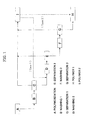
- a process shown in Fig. 1 in which polymerization and washing of the PAS based resin are repeated several times can be illustrated as the application of the present invention.
- a continuous process in which the PAS based resin is obtained by polymerization and then washed with a mixed solvent (washing solvent) of an aprotic organic solvent and water (B: washing 1) and in which the PAS based resin partially dissolved in the above washing liquid is precipitated, recovered (I: polymer 2) and recycled directly to a melting washing system (Case 1).
- a process in which the polymer 2 is refined, dried and then mixed with a polymer 1 obtained passing through washing treatment can be arranged in a certain case (Case 2).
- An autoclave having a capacity of 1 liter was charged with 25.0 g (0.544 mole) of lithium sulfide, 80.0 g (0.544 mole) of p-dichlorobenzene, 1.14 g (0.0272 mole) of lithium hydroxide monohydrate, 4.41 g (0.245 mole) of water and 235 milliliter of N-methyl-2-pyrrolidone (NMP) to carry out polymerization reaction at the temperature of 260°C for 3 hours.
- NMP N-methyl-2-pyrrolidone
- an ammonium chloride aqueous solution (ammonium chloride: 2.33 g and water: 28.7 g) and 28.7 g of N-methyl-2-pyrrolidone (NMP) were added thereto, and the solution was stirred at the temperature of 260°C for 10 minutes. After ten minutes passed since stopping to stirr, the liquid phase was drawn out from an inner pipe. Subsequently, an NMP-water mixed solvent (NMP: 236 milliliter; water: 33.6 g) was added to the autoclave, and the autoclave was heated again.
- NMP NMP-water mixed solvent
- a yield of the polyphenylene sulfide resin thus obtained was 38.3 g, and it was 65 % of the theoretical yield (58.8 g).
- a residual lithium amount in the polyphenylene sulfide resin was 10 ppm or less.
- the whole amount of the washing liquid drawn out from the inner pipe by the washing operations of four times was recovered to result in summing to 1380 g.
- the above washing liquid was cooled down to the temperature of 50°C in order to precipitate the polyphenylene sulfide resin.
- the above precipitate was centrifugally separated by subjecting to a centrifugal separator to obtain 57.5 g of the polyphenylene sulfide resin staying in a wet state.
- the liquid content thereof was 80 %, and therefore the polyphenylene sulfide resin recovered was 11.76 g in terms of a dry mass.
- the polymerization of p-dichlorobenzene and the subsequent washing operation were carried out in the same manner as in Comparative Example to recover the whole amount of 1380 g of the washing liquid drawn out from the inner pipe by the washing operations of four times.
- This recovered washing liquid was distilled under reduced pressure to remove 920 g of a fraction comprising water and NMP as principal components.
- the distillation residue was cooled to the temperature of 100°C or lower, and 1840 g of water was added to precipitate a polyphenylene sulfide resin. In this case, an amount of water added was an amount corresponding to 82 % based on NMP.
- the above precipitate was centrifugally separated by subjecting to a centrifugal separator to obtain 96.5 g of the polyphenylene sulfide resin staying in a wet state.
- the liquid content thereof was 80 %, and therefore the polyphenylene sulfide resin recovered was 19.3 g in terms of a dry mass.
- the polymerization of p-dichlorobenzene and the washing operation were carried out in the same manner as in Example 2, and 1380 g of the washing liquid recovered was distilled under reduced pressure to remove 920 g of a fraction comprising water and NMP as principal components.
- the distillation residue was cooled to the temperature of 100°C or lower, and 1840 g of water was added to precipitate a polyphenylene sulfide resin.
- an amount of water added was an amount corresponding to 82 % based on NMP.
- the above precipitate was centrifugally separated by subjecting to a centrifugal separator to obtain 96.5 g of the polyphenylene sulfide resin staying in a wet state.
- the liquid content thereof was 80 %, and therefore the polyphenylene sulfide resin recovered was 19.3 g in terms of a dry mass. This was washed twice with 1840 g of hot water and then dried at the temperature of 120°C to obtain 17.8 g of the polyphenylene sulfide resin. A residual lithium amount in the above polyphenylene sulfide resin was 10 ppm or less.
- alkali metal halides can effectively be removed from the polyphenylene sulfide resin without nearly losing the above resin, and the refined polyphenylene sulfide resin can be obtained at a high yield.
Landscapes
- Chemical & Material Sciences (AREA)
- Health & Medical Sciences (AREA)
- Chemical Kinetics & Catalysis (AREA)
- Medicinal Chemistry (AREA)
- Polymers & Plastics (AREA)
- Organic Chemistry (AREA)
- General Chemical & Material Sciences (AREA)
- Polymers With Sulfur, Phosphorus Or Metals In The Main Chain (AREA)
Abstract
The present invention is a process for the
production of polyarylene sulfide based resin,
wherein in washing a polyarylene sulfide based resin
with a mixed solvent of an aprotic organic solvent
and water in a softened or molten state, the
polyarylene sulfide based resin partially dissolved
in the washing liquid is recovered, to be specific,
the polyarylene sulfide based resin dissolved in the
washing liquid is precipitated, separated and
recovered by cooling the washing liquid after washing
and/or adding water to the washing liquid, and it is
reused. According to the present invention, capable
of being provided is a process for the production of
polyarylene sulfide based resin in which the
polyarylene sulfide based resin formed by
polymerization is scarcely lost in washing the above
resin with a solvent.
Description
The present invention relates to a process for
the production of polyarylene sulfide resins. More
specifically the present invention relates to a
process for the production of polyarylene sulfide
based resin in which in washing the polyarylene
sulfide based resin formed by polymerization with a
solvent, the resin partially dissolved in the solvent
is recovered and reused to thereby raise a yield of
the resin.
Polyarylene sulfide based resins (hereinafter
referred as a "PAS based resin"), particularly
polyphenylene sulfide based resins (hereinafter
referred as a "PPS based resin") out of them are
known as engineering plastics which are excellent in
a mechanical strength, a heat resistance, a flame
retardancy and a solvent resistance and which have
good electrical characteristics and a high rigidity,
and they are widely used as various materials such as
materials for electronic and electric equipment parts
and the like.
A process in which a dihalogenated aromatic
compound such as p-dichlorobenzene is reacted with a
sodium salt such as sodium sulfide in an aprotic
organic solvent such as N-methyl-2-pyrrolidone
(hereinafter referred as the "NMP") has so far
usually been used for producing the above resins. In
the above process, however, sodium halide is by-produced,
and this sodium halide is introduced into
the resin since it is insoluble in the solvent such
as NMP and the like. Accordingly, it has been
impossible to sufficiently remove sodium halide
contained in a PAS based resin even when the resin is
washed with a large amount of water after
polymerization.
Accordingly, attentions have been paid to
polymerization carried out using a lithium salt in
place of a sodium salt. Lithium halide by-produced
during polymerization is soluble in a lot of aprotic
organic solvents (solvents for polymerization) such
as NMP, and therefore it becomes possible to
relatively readily reduce a concentration of lithium
contained in the resin. However, by-produced lithium
halide remains in a PAS based resin as an impurity,
and it has been impossible to sufficiently remove it
even when washed with a large amount of water after
polymerization.
A method in which a polyarylene sulfide based
resin staying in a softened or molten state is washed
with a solvent such as an organic amide-water mixed
solvent and the like is proposed as a method for
effectively removing alkali metal halides by-produced
in producing a polyarylene sulfide resin (refer to,
for example, Japanese Unexamined Patent Application
Laid-Open No. 228023/1986 and Japanese Unexamined
Patent Application Laid-Open No. 207027/1995). In
the above washing methods, however, although alkali
metal halides can effectively be removed, a part of
the polyarylene sulfide resin is dissolved in the
liquid phase together with the alkali metal halides,
and therefore the problem that the polyarylene
sulfide resin obtained is reduced in a yield has been
involved therein.
The present inventors have proposed a method in
which a solvent saturated with a PAS based resin is
used as a washing liquid for the purpose of
overcoming the above problem (refer to Japanese
Unexamined Patent Application Laid-Open No.
273174/2000). However, when the above method is
applied to an actual production process, involved
therein are the problems that it is difficult to
control a flow amount of a washing liquid in a
washing step and that pipelines in a production
apparatus are complicated. Further, according to the
above method, a loss in a PAS based resin is reduced,
but there has been the problem that a part of the PAS
based resin is dissolved in the washing liquid and
lost together with the washing liquid, so that the
satisfactory yield is not necessarily obtained.
The present invention has been made in light of
the problems described above, and an object thereof
is to provide a process for the production of
polyarylene sulfide based resin in which the
polyarylene sulfide based resin is scarcely lost in
washing the above resin with a solvent.
Intensive researches repeated by the present
inventors in order to solve the problems described
above have resulted in finding that the dissolved
polyarylene sulfide based resin can be separated and
recovered by cooling a washing liquid used for
washing the polyarylene sulfide based resin and/or
adding water to the washing liquid, and thus the
present invention has been completed based on such
knowledge.
That is, the summary of the present invention
comprises the following contents.
In the production process of the present
invention, a polyarylene sulfide based resin (PAS
based resin) has to be washed in a softened or molten
state, and when the PAS based resin staying in a
solidified state is washed, there is the
inconvenience that impurities such as alkali metal
halides and the like are not sufficiently removed.
The PAS based resin to which the production
process of the present invention can be applied shall
not specifically be restricted and includes, for
example, polyarylene sulfide based resins obtained by
subjecting p-dichlorobenzene and a sulfur source to
polycondensation reaction in an organic polar solvent
by a publicly known method. In general, known as the
PAS based resin are resins having a molecular
structure which is substantially linear and does not
have branched or cross-linked structures and resins
having branched and cross-linked structures depending
on the production processes thereof, and either of
the above types is effective in the present invention.
The PAS based resin includes the homopolymers or the
copolymers containing 70 mole % or more, preferably
80 mole % or more of a para-arylene sulfide unit as a
repetitive unit. The copolymer structural unit
includes, for example, a meta-phenylene sulfide unit,
an ortho-phenylene sulfide unit, a p,p'-diphenyleneketone
sulfide unit, a p,p'-diphenylenesulfone
sulfide unit, a p,p'-biphenylene
sulfide unit, a p,p'-diphenyleneether sulfide unit, a
p,p'-diphenylenemethylne sulfide unit, a p,p'-diphenylenecumenyl
sulfide unit and a naphthyl
sulfide unit. In addition to the substantially
linear polymers described above, branched or cross-linked
polyarylene sulfides obtained by polymerizing
with a small amount of a monomer having three or more
functional groups as a part of the monomer or blended
polymers obtained by blending the above polymers with
the linear polymers described above can also be
objects for applying the production process of the
present invention.
The PAS based resin to which the production
process of the present invention is applicable can be
obtained by reacting a dihalogenated aromatic
compound and metal sulfide in a polar organic solvent.
The dihalogenated aromatic compound used for
producing the above PAS bases resin includes, for
example, dihalogenated benzenes such as m-dihalobenzene
and p-dihalobenzene; dihalogenated
alkyl-substituted benzenes or dihalogenated
cycloalkyl-substituted benzenes such as 2,3-dihalotoluene,
2,5-dihalotoluene, 2,6-dihalotoluene,
3,4-dihalotoluene, 2,5-dihaloxylene, 1-ethyl-2,5-dihalobenzene,
1,2,4,5-tetramethyl-3,6-dihalobenzene,
1-n-hexyl-2,5-dihalobenzene and 1-cyclohexyl-2,5-dihalobenzene;
dihalogenated aryl-substituted
benzenes such as 1-phenyl-2,5-dihalobenzene, 1-benzyl-2,5-dihalobenzene
and 1-p-toluyl-2,5-dihalobenzene;
dihalogenated biphenyls such as 4,4'-dihalobiphenyl;
and dihalogenated naphthalenes such
as 1,4-dihalonaphthalene, 1,6-dihalonaphthalene and
2,6-dihalonaphthalene.
Metal sulfides represented by alkali metal
compounds such as sodium sulfide, lithium sulfide and
potassium sulfide can mainly be used as the metal
sulfide used for producing the above PAS based resin.
They may be used alone or in a mixture of two or more
kinds thereof. Also, they can be used in combination
with alkali earth metal sulfides and other sulfur
sources.
In general, aprotic polar organic compounds
(for example, amide compounds, lactam compounds, urea
compounds, organic sulfur compounds and cyclic
organic phosphorus compounds) can be used as the
aprotic organic solvent used for the present
invention in the form of a single solvent or a mixed
solvent.
Among the above aprotic organic solvent,
examples of the amide compounds described above
include N,N-dimethylformamide, N,N-diethylformamide,
N,N-dimethylacetamide, N,N-diethylacetamide, N,N-dipropylacetamide
and N,N-dimethylbenzoamide.
Examples of the above lactam compounds include
caprolactam, N-alkylcaprolactams such as N-methylcaprolactam,
N-ethylcaprolactam, N-isopropylcaprolactam,
N-isobutylcaprolactam, N-n-propylcaprolactam,
N-n-butycaprolactam and N-cyclohexylcaprolactam,
N-methyl-2-pyrrolidone (NMP),
N-ethyl-2-pyrrolidone, N-isopropyl-2-pyrrolidone, N-isobutyl-2-pyrrolidone,
N-n-propyl-2-pyrrolidone, N-n-butyl-2-pyrrolidone,
N-cyclohexyl-2-pyrrolidone, N-methyl-3-methyl-2-pyrrolidone,
N-ethyl-3-methyl-2-pyrrolidone,
N-methyl-3,4,5-trimethyl-2-pyrrolidone,
N-methyl-2-piperidone, N-ethyl-2-piperidone, N-isopropyl-2-piperidone,
N-methyl-6-methyl-2-piperidone
and N-methyl-3-ethyl-2-piperidone.
Examples of the above urea compounds include
tetramethylurea, N,N'-dimethylethyleneurea and N,N'-dimethylpropyleneurea.
Further, examples of the above organic sulfur
compounds include dimethyl sulfoxide, diethyl
sulfoxide, diphenylsulfolane, 1-methyl-1-oxosulfolane,
1-ethyl-1-oxosulfolane and 1-phenyl-1-oxosulfolane.
Also, examples of the above cyclic organic phosphorus
compounds include 1-methyl-1-oxophosphorane, 1-n-propyl-1-oxophosphorane
and 1-phenyl-1-oxophosphorane.
The above various aprotic polar organic
compounds each can be used as the aprotic organic
solvent described above alone or in a mixture of two
or more kinds thereof and further in a mixture with
other solvent components which do not hinder the
object of the present invention.
Among the various aprotic organic solvents
described above, N-alkylcaprolactams and N-alkylpyrrolidones
are preferred, and N-methyl-2-pyrrolidone
is particularly preferred.
In the present invention, a fixed proportion of
water has to be added as a washing solvent together
with the aprotic organic solvent in order to control
a solubility of the PAS based resin, and the mixed
solvent of the aprotic organic solvent described
above and water is used for washing the PAS based
resin. Water used by mixing with the aprotic organic
solvent shall not be specifically restricted, and
distilled water is preferred. A mixing ratio of the
aprotic organic solvent to water is preferably 55/45
to 95/5, particularly preferably 65/35 to 90/10 and
further preferably 70/30 to 85/15 in terms of a mass
ratio (aprotic organic solvent/water).
When a mixing ratio of water exceeds 45 mass %,
the PAS based resin is less liable to become a
softened or molten state, and there is the anxiety
that the PAS based resin is solidified. On the other
hand, when a mixing ratio of water is less than 5
mass %, all part of the PAS based resin is dissolved
and turned into a homogeneous solution, so that it
can not be washed.
In respect to a concentration of the PAS based
resin in washing, the PAS based resin to be washed is
preferably 10 to 400 g, particularly preferably 50 to
300 g and further preferably 100 to 250 g per liter
of the aprotic organic solvent. When an amount of
the PAS based resin in washing exceeds 400 g, the
washing efficiency tends to be reduced, and when it
is less than 10 g, the economical efficiency is
inferior.
The washing temperature is preferably 220 to
300°C, particularly preferably 230 to 270°C and
further preferably 240 to 260°C. When the washing
temperature exceeds 300°C, the PAS based resin is
decomposed, and when the washing temperature is lower
than 220°C, the PAS based resin is not softened or
molten.
In the production process of the present
invention, the PAS based resin is washed in the
manner described above, and then this washing liquid
is cooled and/or water is added thereto, whereby the
PAS based resin dissolved therein is precipitated
from the washing liquid and recovered. In this case,
the cooling temperature shall not specifically be
restricted as long as it is a temperature at which
the PAS based resin forms precipitates, and in
general, the cooling temperature is preferably 200°C
or lower, more preferably 150°C or lower and
particularly preferably 100°C or lower.
When adding water, an addition amount of water
may be an amount in which the PAS based resin
dissolved forms precipitates. An amount in which a
composition of water after adding water is more than
50 mass % based on the solvent such as N-methyl-2-pyrrolidone
(NMP) is preferably added, and an amount
in which it is more than 80 mass % is more preferably
added. The washing liquid in which the PAS based
resin is dissolved is preferably concentrated in
advance by subjecting to operation such as
distillation.
Means which have so far been used for solid-liquid
separation such as centrifugal separation,
filtration and still standing separation can be used
as a method for separating and recovering the PAS
based resin precipitated in the above manner. The
PAS based resin separated may be added as it stays in
a wet state to the PAS based resin to be subjected to
next washing or it is dried after washed and
recovered in the form of the powder-like PAS based
resin, and it can be mixed with the PAS based resin
of the product.
A process shown in Fig. 1 in which
polymerization and washing of the PAS based resin are
repeated several times can be illustrated as the
application of the present invention. For example, a
continuous process in which the PAS based resin is
obtained by polymerization and then washed with a
mixed solvent (washing solvent) of an aprotic organic
solvent and water (B: washing 1) and in which the PAS
based resin partially dissolved in the above washing
liquid is precipitated, recovered (I: polymer 2) and
recycled directly to a melting washing system (Case
1). Further, a process in which the polymer 2 is
refined, dried and then mixed with a polymer 1
obtained passing through washing treatment can be
arranged in a certain case (Case 2).
Next, the present invention shall be explained
in further details with reference to examples, but
the present invention shall by no means be restricted
by these examples. In this case, "%" is based on
mass unless otherwise described.
An autoclave having a capacity of 1 liter was
charged with 25.0 g (0.544 mole) of lithium sulfide,
80.0 g (0.544 mole) of p-dichlorobenzene, 1.14 g
(0.0272 mole) of lithium hydroxide monohydrate, 4.41
g (0.245 mole) of water and 235 milliliter of N-methyl-2-pyrrolidone
(NMP) to carry out
polymerization reaction at the temperature of 260°C
for 3 hours.
After finishing the reaction, an ammonium
chloride aqueous solution (ammonium chloride: 2.33 g
and water: 28.7 g) and 28.7 g of N-methyl-2-pyrrolidone
(NMP) were added thereto, and the
solution was stirred at the temperature of 260°C for
10 minutes. After ten minutes passed since stopping
to stirr, the liquid phase was drawn out from an
inner pipe. Subsequently, an NMP-water mixed solvent
(NMP: 236 milliliter; water: 33.6 g) was added to the
autoclave, and the autoclave was heated again. When
reaching to the temperature of 260°C, the solution
was stirred to wash for 10 minutes, and after ten
minutes passed since stopping to stir, the liquid
phase was drawn out from the inner pipe. This
washing operation was repeated four times in the same
manner. Then, the cover of the autoclave was opened
to obtain a cake-shaped refined polyphenylene sulfide
resin. This polyphenylene sulfide resin was crushed,
and remaining NMP was removed by vacuum drying.
A yield of the polyphenylene sulfide resin thus
obtained was 38.3 g, and it was 65 % of the
theoretical yield (58.8 g). A residual lithium
amount in the polyphenylene sulfide resin was 10 ppm
or less.
In the Comparative Example described above, the
whole amount of the washing liquid drawn out from the
inner pipe by the washing operations of four times
was recovered to result in summing to 1380 g. The
above washing liquid was cooled down to the
temperature of 50°C in order to precipitate the
polyphenylene sulfide resin. Then, the above
precipitate was centrifugally separated by subjecting
to a centrifugal separator to obtain 57.5 g of the
polyphenylene sulfide resin staying in a wet state.
The liquid content thereof was 80 %, and therefore
the polyphenylene sulfide resin recovered was 11.76 g
in terms of a dry mass.
Next, the polymerization reaction of p-dichlorobenzene
was carried out on the same
conditions by the same method, and when adding the
ammonium chloride aqueous solution (ammonium
chloride: 2.33 g; water: 28.7 g) and 28.7 g of NMP,
added was 57.5 g of the polyphenylene sulfide resin
staying in a wet state which was recovered previously.
The subsequent washing operation was carried out on
the same conditions by the same method to obtain the
cake-shaped refined polyphenylene sulfide resin. A
yield of the polyphenylene sulfide resin thus
obtained was 47.8 g, and it was 81 % of the
theoretical yield (58.8 g). A residual lithium
amount in the above polyphenylene sulfide resin was
10 ppm or less.
The polymerization of p-dichlorobenzene and the
subsequent washing operation were carried out in the
same manner as in Comparative Example to recover the
whole amount of 1380 g of the washing liquid drawn
out from the inner pipe by the washing operations of
four times. This recovered washing liquid was
distilled under reduced pressure to remove 920 g of a
fraction comprising water and NMP as principal
components. The distillation residue was cooled to
the temperature of 100°C or lower, and 1840 g of
water was added to precipitate a polyphenylene
sulfide resin. In this case, an amount of water
added was an amount corresponding to 82 % based on
NMP. Then, the above precipitate was centrifugally
separated by subjecting to a centrifugal separator to
obtain 96.5 g of the polyphenylene sulfide resin
staying in a wet state. The liquid content thereof
was 80 %, and therefore the polyphenylene sulfide
resin recovered was 19.3 g in terms of a dry mass.
Next, the polymerization reaction of p-dichlorobenzene
was carried out on the same
conditions by the same method as in Comparative
Example, and 96.5 g of the polyphenylene sulfide
resin recovered above staying in a wet state and 300
milliliter of NMP were added to the autoclave for the
first washing in place of adding the NMP-water mixed
solvent (NMP: 236 ml and water: 33.6 g) to carry out
the first washing operation. Thereafter, obtained
was the polyphenylene sulfide resin refined on the
same conditions by the same method as in Comparative
Example. A yield of the polyphenylene sulfide resin
thus obtained was 53.3 g, and it was 91 % of the
theoretical yield (58.8 g). The residual lithium
amount was 10 ppm or less.
The polymerization of p-dichlorobenzene and the
washing operation were carried out in the same manner
as in Example 2, and 1380 g of the washing liquid
recovered was distilled under reduced pressure to
remove 920 g of a fraction comprising water and NMP
as principal components. The distillation residue
was cooled to the temperature of 100°C or lower, and
1840 g of water was added to precipitate a
polyphenylene sulfide resin. In this case, an amount
of water added was an amount corresponding to 82 %
based on NMP. Then, the above precipitate was
centrifugally separated by subjecting to a
centrifugal separator to obtain 96.5 g of the
polyphenylene sulfide resin staying in a wet state.
The liquid content thereof was 80 %, and therefore
the polyphenylene sulfide resin recovered was 19.3 g
in terms of a dry mass. This was washed twice with
1840 g of hot water and then dried at the temperature
of 120°C to obtain 17.8 g of the polyphenylene
sulfide resin. A residual lithium amount in the
above polyphenylene sulfide resin was 10 ppm or less.
On the other hand, obtained was 38.3 g of the
polyphenylene sulfide resin which was refined passing
through the washing operations of four times
described above. This resin and the polyphenylene
sulfide resin obtained above by recovering amounted
to 56.1 g, and it means that the resin could be
recovered at a yield of 95 % based on the theoretical
yield (58.8 g).
According to the production process of the
present invention, alkali metal halides can
effectively be removed from the polyphenylene sulfide
resin without nearly losing the above resin, and the
refined polyphenylene sulfide resin can be obtained
at a high yield.
Claims (4)
- A process for the production of polyarylene sulfide based resin comprising a step of washing a polyarylene sulfide based resin in a softened or molten state with a mixed solvent of an aprotic organic solvent and water, wherein the polyarylene sulfide based resin partially dissolved in the washing liquid is recovered and reused.
- The process for the production of polyarylene sulfide based resin as described in claim 1, wherein a recovery of the polyarylene sulfide based resin dissolved in the washing liquid is carried out after precipitating and separating by at least one selected from cooling the washing liquid after washing or adding water to the washing liquid.
- The process for the production of polyarylene sulfide based resin as described in claim 2, which further comprises the steps of adding another polyarylene sulfide based resin; and washing with a mixed solvent of an aprotic organic solvent and water in a softened or molten state.
- The process for the production of polyarylene sulfide based resin as described in claim 2, which further comprises the steps of crushing the recovered polyarylene sulfide based resin;
drying them; and
reusing in the form of powder.
Applications Claiming Priority (3)
| Application Number | Priority Date | Filing Date | Title |
|---|---|---|---|
| JP2002297656 | 2002-10-10 | ||
| JP2002297656A JP2004131602A (en) | 2002-10-10 | 2002-10-10 | Method for producing polyarylene sulfide resin |
| PCT/JP2003/012667 WO2004033535A1 (en) | 2002-10-10 | 2003-10-02 | Process for the production of polyarylene sulfide resins |
Publications (2)
| Publication Number | Publication Date |
|---|---|
| EP1550685A1 true EP1550685A1 (en) | 2005-07-06 |
| EP1550685A4 EP1550685A4 (en) | 2006-01-18 |
Family
ID=32089279
Family Applications (1)
| Application Number | Title | Priority Date | Filing Date |
|---|---|---|---|
| EP03748681A Withdrawn EP1550685A4 (en) | 2002-10-10 | 2003-10-02 | PROCESS FOR PRODUCING POLYARYLENE SULFIDE RESINS |
Country Status (6)
| Country | Link |
|---|---|
| US (1) | US7317072B2 (en) |
| EP (1) | EP1550685A4 (en) |
| JP (1) | JP2004131602A (en) |
| CN (1) | CN1300220C (en) |
| TW (1) | TW200413443A (en) |
| WO (1) | WO2004033535A1 (en) |
Cited By (1)
| Publication number | Priority date | Publication date | Assignee | Title |
|---|---|---|---|---|
| EP1702943A4 (en) * | 2003-12-26 | 2007-02-21 | Kureha Corp | Polyarylene sulfide and process for producing the same |
Families Citing this family (20)
| Publication number | Priority date | Publication date | Assignee | Title |
|---|---|---|---|---|
| CN103289093A (en) * | 2013-07-01 | 2013-09-11 | 四川宝利丰科技有限公司 | Method for preparing linear high molecular weight polyphenylene sulfide |
| US9562139B2 (en) | 2013-09-25 | 2017-02-07 | Ticona Llc | Process for forming low halogen content polyarylene sulfides |
| WO2015047717A1 (en) | 2013-09-25 | 2015-04-02 | Ticona Llc | Method and system for separation of a polymer from multiple compounds |
| US9617387B2 (en) | 2013-09-25 | 2017-04-11 | Ticona Llc | Scrubbing process for polyarylene sulfide formation |
| WO2015047719A1 (en) | 2013-09-25 | 2015-04-02 | Ticona Llc | Method of polyarylene sulfide crystallization |
| JP6684206B2 (en) | 2013-09-25 | 2020-04-22 | ティコナ・エルエルシー | Separation of salt by-products during polyarylene sulfide formation |
| WO2015047718A1 (en) | 2013-09-25 | 2015-04-02 | Ticona Llc | Multi-stage process for forming polyarylene sulfides |
| WO2016133738A1 (en) | 2015-02-19 | 2016-08-25 | Ticona Llc | Method for forming a low viscosity polyarylene sulfide |
| WO2016133740A1 (en) | 2015-02-19 | 2016-08-25 | Ticona Llc | Method of polyarylene sulfide precipitation |
| WO2016133739A1 (en) | 2015-02-19 | 2016-08-25 | Ticona Llc | Method for forming a high molecular weight polyarylene sulfide |
| JP6783242B2 (en) | 2015-03-25 | 2020-11-11 | ティコナ・エルエルシー | How to form polyarylene sulfide with high melt viscosity |
| CN106699688A (en) * | 2016-12-08 | 2017-05-24 | 斯芬克司药物研发(天津)股份有限公司 | Phenyl piperazidine thioether and preparation method thereof |
| US11407861B2 (en) | 2019-06-28 | 2022-08-09 | Ticona Llc | Method for forming a polyarylene sulfide |
| KR102711910B1 (en) * | 2019-10-22 | 2024-10-02 | 주식회사 엘지화학 | Manufacturing Method For Polyarylene Sulfide |
| KR102704860B1 (en) * | 2019-10-22 | 2024-09-09 | 주식회사 엘지화학 | Manufacturing Method for Cross-linked Polyarylene Sulfide |
| US11319441B2 (en) | 2019-12-20 | 2022-05-03 | Ticona Llc | Method for forming a polyarylene sulfide |
| US20250011563A1 (en) * | 2021-07-19 | 2025-01-09 | Toray Industries, Inc. | Method of separating polyarylene sulfide and method of producing polyarylene sulfide resin composition |
| CN117916001A (en) | 2021-09-08 | 2024-04-19 | 提克纳有限责任公司 | Anti-solvent technology for recovering organic solvents from polyarylene sulfide waste sludge |
| KR20240060812A (en) | 2021-09-08 | 2024-05-08 | 티코나 엘엘씨 | Extraction technology for recovering organic solvents from polyarylene sulfide waste sludge |
| CN118620206B (en) * | 2024-08-12 | 2024-11-15 | 苏州港睿通纳米材料科技有限公司 | High-purity polyphenylene sulfide and preparation method thereof |
Family Cites Families (11)
| Publication number | Priority date | Publication date | Assignee | Title |
|---|---|---|---|---|
| US3707528A (en) * | 1971-01-12 | 1972-12-26 | Phillips Petroleum Co | Recovery of poly(arylene sulfide) reaction slurry constituents |
| JPS61228023A (en) | 1985-04-01 | 1986-10-11 | Kureha Chem Ind Co Ltd | Purification of polyarylene sulfide |
| US4748231A (en) * | 1986-11-21 | 1988-05-31 | Phillips Petroleum Company | Reprecipitation of poly(arylene sulfide) to increase molecular weight thereof |
| US5247063A (en) * | 1987-04-24 | 1993-09-21 | Bayer Aktiengesellschaft | Process for the purification of polyarylene sulphides |
| CA2072165C (en) | 1991-06-24 | 2000-09-19 | Carlton E. Ash | Process for preparing poly(arylene sulfide) polymers using waste material |
| JP3143977B2 (en) | 1991-08-14 | 2001-03-07 | 東ソー株式会社 | Purification method of polyarylene sulfide |
| US5374709A (en) | 1992-10-23 | 1994-12-20 | Phillips Petroleum Company | Production of granular poly(arylene sulfide) polymers containing reduced amounts of oligomers |
| CA2101409A1 (en) | 1992-10-23 | 1994-04-24 | Earl Clark Jr. | Production of poly(arylene sulfide) polymers containing reduced amounts of oligomers |
| KR970706336A (en) | 1994-10-13 | 1997-11-03 | 아울미히, 루츠 위르겐 | Polyarylene sulfide recycling process (polyarylene sulfide recycling process) |
| US5898061A (en) * | 1996-03-11 | 1999-04-27 | Idemitsu Petrochemical Co., Ltd. | Continuous process for producing polyarylene sulfide |
| US6201097B1 (en) | 1998-12-31 | 2001-03-13 | Phillips Petroleum Company | Process for producing poly (arylene sulfide) |
-
2002
- 2002-10-10 JP JP2002297656A patent/JP2004131602A/en active Pending
-
2003
- 2003-10-02 CN CNB2003801012896A patent/CN1300220C/en not_active Expired - Fee Related
- 2003-10-02 US US10/530,027 patent/US7317072B2/en not_active Expired - Fee Related
- 2003-10-02 WO PCT/JP2003/012667 patent/WO2004033535A1/en not_active Ceased
- 2003-10-02 EP EP03748681A patent/EP1550685A4/en not_active Withdrawn
- 2003-10-08 TW TW092127979A patent/TW200413443A/en unknown
Cited By (3)
| Publication number | Priority date | Publication date | Assignee | Title |
|---|---|---|---|---|
| EP1702943A4 (en) * | 2003-12-26 | 2007-02-21 | Kureha Corp | Polyarylene sulfide and process for producing the same |
| US7754848B2 (en) | 2003-12-26 | 2010-07-13 | Kureha Corporation | Poly (arylene sulfide) and production process thereof |
| US8183336B2 (en) | 2003-12-26 | 2012-05-22 | Kureha Corporation | Poly (arylene sulfide) |
Also Published As
| Publication number | Publication date |
|---|---|
| TW200413443A (en) | 2004-08-01 |
| US7317072B2 (en) | 2008-01-08 |
| CN1703446A (en) | 2005-11-30 |
| JP2004131602A (en) | 2004-04-30 |
| WO2004033535A1 (en) | 2004-04-22 |
| CN1300220C (en) | 2007-02-14 |
| US20060128819A1 (en) | 2006-06-15 |
| EP1550685A4 (en) | 2006-01-18 |
Similar Documents
| Publication | Publication Date | Title |
|---|---|---|
| US7317072B2 (en) | Process for the production of polyarylene sulfide resins | |
| US5635587A (en) | Process for manufacturing polyarylene sulfide | |
| EP0280274B1 (en) | Arylene sulfide polymers | |
| EP0321881B1 (en) | Method of recovering a lithium chloride | |
| US6982312B2 (en) | Process for producing polyarylene sulfide | |
| JP2997725B2 (en) | Recovery method of lithium chloride | |
| US5756654A (en) | Process for manufacturing polyarylene sulfide | |
| US6939942B2 (en) | Method of treating by-product salt yielded with polyarylene sulfide | |
| US20060122363A1 (en) | Process for the production of polyarylene sulfide | |
| JPH10130005A (en) | Method for producing lithium sulfide and method for producing polyarylene sulfide | |
| JP3699777B2 (en) | Process for producing polyarylene sulfide | |
| JP3042640B2 (en) | Method for separating polyarylene sulfide oligomer | |
| JP3189926B2 (en) | Method for producing polyarylene sulfide | |
| JP5888142B2 (en) | Method for producing solution containing carboxyalkylamino group-containing compound and aprotic polar solvent, and method for producing composition containing alkali metal-containing inorganic salt and aprotic polar solvent | |
| JP3490137B2 (en) | Method for producing polyarylene sulfide | |
| JP3235033B2 (en) | Method for producing high molecular weight polyarylene sulfide | |
| JP3625569B2 (en) | Process for producing polyarylene sulfide | |
| KR102847795B1 (en) | Process for preparing polyarylene sulfide | |
| JP3446969B2 (en) | Method for producing lithium N-methylaminobutyrate | |
| JPH10265575A (en) | Purification method of polyarylene sulfide |
Legal Events
| Date | Code | Title | Description |
|---|---|---|---|
| PUAI | Public reference made under article 153(3) epc to a published international application that has entered the european phase |
Free format text: ORIGINAL CODE: 0009012 |
|
| 17P | Request for examination filed |
Effective date: 20050404 |
|
| AK | Designated contracting states |
Kind code of ref document: A1 Designated state(s): AT BE BG CH CY CZ DE DK EE ES FI FR GB GR HU IE IT LI LU MC NL PT RO SE SI SK TR |
|
| A4 | Supplementary search report drawn up and despatched |
Effective date: 20051201 |
|
| RBV | Designated contracting states (corrected) |
Designated state(s): BE DE |
|
| 17Q | First examination report despatched |
Effective date: 20080513 |
|
| STAA | Information on the status of an ep patent application or granted ep patent |
Free format text: STATUS: THE APPLICATION IS DEEMED TO BE WITHDRAWN |
|
| 18D | Application deemed to be withdrawn |
Effective date: 20080924 |