EP1550670A1 - Fine spherical particles with satisfactory molecular orientation, spherical microcapsules comprising the same, and processes for producing these - Google Patents
Fine spherical particles with satisfactory molecular orientation, spherical microcapsules comprising the same, and processes for producing these Download PDFInfo
- Publication number
- EP1550670A1 EP1550670A1 EP03753983A EP03753983A EP1550670A1 EP 1550670 A1 EP1550670 A1 EP 1550670A1 EP 03753983 A EP03753983 A EP 03753983A EP 03753983 A EP03753983 A EP 03753983A EP 1550670 A1 EP1550670 A1 EP 1550670A1
- Authority
- EP
- European Patent Office
- Prior art keywords
- fine
- spherical
- particle
- producing
- substrate
- Prior art date
- Legal status (The legal status is an assumption and is not a legal conclusion. Google has not performed a legal analysis and makes no representation as to the accuracy of the status listed.)
- Withdrawn
Links
- 0 CCC(C(*)NC(C(C)(C)*(C)C*C(C)C(NC(*)C(C)C(O)=O)=O)=O)C(O)=O Chemical compound CCC(C(*)NC(C(C)(C)*(C)C*C(C)C(NC(*)C(C)C(O)=O)=O)=O)C(O)=O 0.000 description 4
Images


Classifications
-
- A—HUMAN NECESSITIES
- A61—MEDICAL OR VETERINARY SCIENCE; HYGIENE
- A61K—PREPARATIONS FOR MEDICAL, DENTAL OR TOILETRY PURPOSES
- A61K8/00—Cosmetics or similar toiletry preparations
- A61K8/02—Cosmetics or similar toiletry preparations characterised by special physical form
- A61K8/11—Encapsulated compositions
-
- A—HUMAN NECESSITIES
- A61—MEDICAL OR VETERINARY SCIENCE; HYGIENE
- A61K—PREPARATIONS FOR MEDICAL, DENTAL OR TOILETRY PURPOSES
- A61K47/00—Medicinal preparations characterised by the non-active ingredients used, e.g. carriers or inert additives; Targeting or modifying agents chemically bound to the active ingredient
- A61K47/50—Medicinal preparations characterised by the non-active ingredients used, e.g. carriers or inert additives; Targeting or modifying agents chemically bound to the active ingredient the non-active ingredient being chemically bound to the active ingredient, e.g. polymer-drug conjugates
- A61K47/69—Medicinal preparations characterised by the non-active ingredients used, e.g. carriers or inert additives; Targeting or modifying agents chemically bound to the active ingredient the non-active ingredient being chemically bound to the active ingredient, e.g. polymer-drug conjugates the conjugate being characterised by physical or galenical forms, e.g. emulsion, particle, inclusion complex, stent or kit
- A61K47/6921—Medicinal preparations characterised by the non-active ingredients used, e.g. carriers or inert additives; Targeting or modifying agents chemically bound to the active ingredient the non-active ingredient being chemically bound to the active ingredient, e.g. polymer-drug conjugates the conjugate being characterised by physical or galenical forms, e.g. emulsion, particle, inclusion complex, stent or kit the form being a particulate, a powder, an adsorbate, a bead or a sphere
- A61K47/6925—Medicinal preparations characterised by the non-active ingredients used, e.g. carriers or inert additives; Targeting or modifying agents chemically bound to the active ingredient the non-active ingredient being chemically bound to the active ingredient, e.g. polymer-drug conjugates the conjugate being characterised by physical or galenical forms, e.g. emulsion, particle, inclusion complex, stent or kit the form being a particulate, a powder, an adsorbate, a bead or a sphere the form being a microcapsule, nanocapsule, microbubble or nanobubble
-
- A—HUMAN NECESSITIES
- A61—MEDICAL OR VETERINARY SCIENCE; HYGIENE
- A61K—PREPARATIONS FOR MEDICAL, DENTAL OR TOILETRY PURPOSES
- A61K8/00—Cosmetics or similar toiletry preparations
- A61K8/18—Cosmetics or similar toiletry preparations characterised by the composition
- A61K8/30—Cosmetics or similar toiletry preparations characterised by the composition containing organic compounds
- A61K8/64—Proteins; Peptides; Derivatives or degradation products thereof
-
- A—HUMAN NECESSITIES
- A61—MEDICAL OR VETERINARY SCIENCE; HYGIENE
- A61Q—SPECIFIC USE OF COSMETICS OR SIMILAR TOILETRY PREPARATIONS
- A61Q19/00—Preparations for care of the skin
-
- B—PERFORMING OPERATIONS; TRANSPORTING
- B01—PHYSICAL OR CHEMICAL PROCESSES OR APPARATUS IN GENERAL
- B01J—CHEMICAL OR PHYSICAL PROCESSES, e.g. CATALYSIS OR COLLOID CHEMISTRY; THEIR RELEVANT APPARATUS
- B01J13/00—Colloid chemistry, e.g. the production of colloidal materials or their solutions, not otherwise provided for; Making microcapsules or microballoons
- B01J13/02—Making microcapsules or microballoons
-
- A—HUMAN NECESSITIES
- A61—MEDICAL OR VETERINARY SCIENCE; HYGIENE
- A61K—PREPARATIONS FOR MEDICAL, DENTAL OR TOILETRY PURPOSES
- A61K2800/00—Properties of cosmetic compositions or active ingredients thereof or formulation aids used therein and process related aspects
- A61K2800/40—Chemical, physico-chemical or functional or structural properties of particular ingredients
- A61K2800/41—Particular ingredients further characterized by their size
- A61K2800/412—Microsized, i.e. having sizes between 0.1 and 100 microns
Definitions
- the present invention relates to a fine spherical particle having uniform molecular orientation, comprising a low-molecular-weight organic compound, which is useful in fine chemical fields and electronic and information fields, such as a functional material and a medical material; a microcapsule stably encapsulating a hydrophilic core substance inside the fine particle; and a process for producing the same.
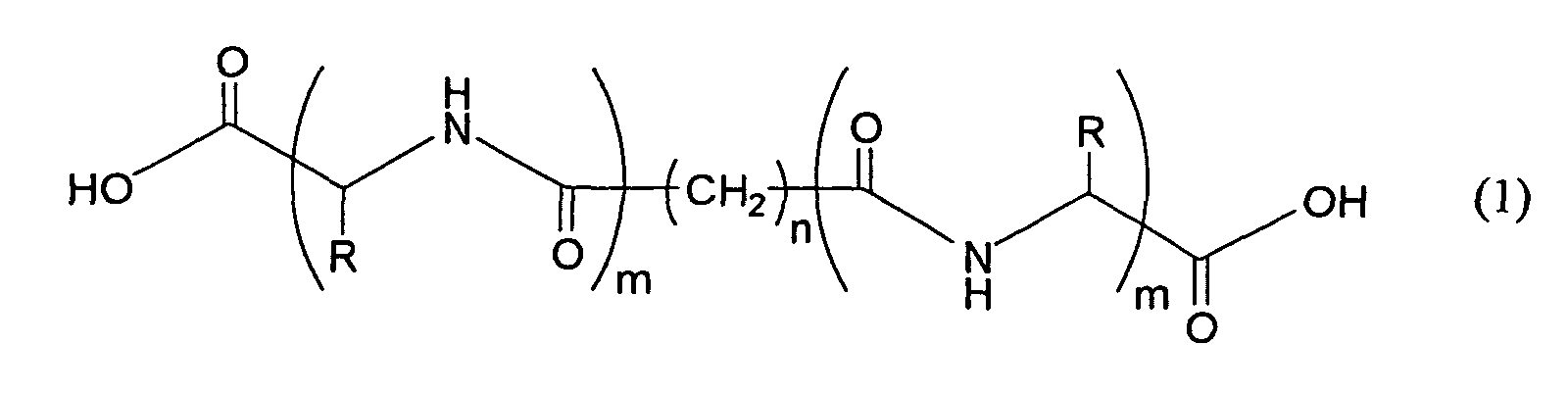
- the compound represented by the following formula (1) shows a remarkable properties as a bicephalic lipid having amphiphilicity and is expected to be utilized for various applications in fine chemical fields and electronic and information fields, such as a functional material and a medical material.
- R represents a hydrogen atom or an alkyl group having 1 to 5 carbon atoms; n is an integer of 8 to 20; and m is an integer of 1 to 3.
- microcapsules have been actively researched and developed on their applicability in wide fields of electronic and information materials such as recording materials and displaying materials, pharmaceuticals, functional materials, industrial materials, agricultural materials, fragrant materials, cosmetics and foods, and have already been in practical use or in practical stage in several fields.
- membranes are formed by mainly using polymerization reactions and, in the methods of (2), membranes are formed by using phase-separation methods.
- an object of the present invention is to provide a fine spherical particle having uniform molecular orientation, comprising the compound represented by the above formula (1), which is useful in fine chemical fields and electronic and information fields; and a process for producing the same.
- Another object of the present invention is to provide a process for producing a spherical microcapsule encapsulating a hydrophilic core substance utilizing membrane formation with the compound represented by formula (1).
- a specific bicephalic amphiphilic compound self-assembles under specific conditions and forms a spherical membrane to give a fine spherical particle having uniform molecular orientation and, when a metal salt of the compound and a hydrophilic core substance are used, the compound self-assembled under specific conditions to give a spherical microcapsule encapsulating a fine particle of the hydrophilic core substance.
- a metal salt of the compound and a hydrophilic core substance are used, the compound self-assembled under specific conditions to give a spherical microcapsule encapsulating a fine particle of the hydrophilic core substance.
- the present invention relates to the followings:
- the present invention provides a fine spherical particle having uniform molecular orientation or a spherical microcapsule utilizing membrane formation by self-assembly of a bicephalic amphiphilic compound represented by the above formula (1).
- Fine spherical particle Fine spherical particle:
- a fine spherical particle having uniform molecular orientation means that the fine particle has a nearly spherical shape and is evenly oriented in a radial pattern from the center, i.e., it has concentric molecular orientation having point disclination.
- Fig. 2 shows one example of the schematic drawing of a fine spherical particle having such molecular orientation. When observed on a polarizing microscope, such a fine particle shows a crisscross on the spherical body under cross-Nicol and the even orientation can be confirmed from the fact that the direction of the crisscross does not change even when the object is rotated.
- the fine spherical particle having uniform molecular orientation can be obtained as a fine particle having a particle diameter of about 0.01 to 1000 ⁇ m but a desired particle diameter can be obtained by adjusting production conditions.
- the particle diameter is about from 0.01 to 100 ⁇ m, particularly about from 0.05 to 50 ⁇ m.
- the fine spherical particle of the present invention can be produced by immersing a substrate having hydrophilicity in an aqueous solution of a salt of the compound represented by the following formula (1) and precipitating the fine particle under an acidic atmosphere: wherein R represents a hydrogen atom or a linear or branched alkyl group having 1 to 5 carbon atoms, such as methyl, ethyl, n-propyl, i-propyl, and butyl; n is an integer of 8 to 20; and m is an integer of 1 to 3.
- R is a hydrogen atom, a methyl group, or an isopropyl group; m is 2; and n is 8, 10, or 12. Of these, more preferred is a compound wherein R is an isopropyl group; n is 10; and m is 2.
- the metal salts of these compounds are not particularly limited, so long as they are water-soluble metal salts, and various metal salts such as alkali metal salts and alkaline earth metal salts can be used, but it is preferred to use a sodium or potassium salt.
- the concentration of the salt of the compound represented by formula (1) in the aqueous solution is preferably about from 0.1 to 100 mM/L, particularly about from 0.5 to 20 mM/L.
- the substrate to be immersed in the aqueous solutions of these salts is not particularly limited, so long as it has hydrophilicity, and examples include glass, metal, silica, mica, ceramic, earthenware, porcelain, plastic, and a composite material thereof.
- the substrate has no hydrophilicity, it is suitable to impart hydrophilicity by subjecting the surface to a hydrophilicity treatment.
- the hydrophilicity treatment can be suitably selected according to the properties of the substrate, but when the substrate is glass, for example, the treatment can be carried out by washing the surface of the glass substrate and subsequently immersing it in a solution wherein an alkali such as potassium hydroxide is dissolved in an alcohol such as ethanol.
- the shape of the substrate is not particularly limited, and the substrate having any shape such as plate-like one or tubular one can be used. Moreover, the substrate having not only a smooth surface but also a surface which is not smooth can be also used.
- the fine spherical particle of the present invention can be precipitated and grown by maintaining the aqueous solution of the compound (1), in which the substrate having hydrophilicity is immersed, in an acidic atmosphere, preferably a weakly acidic atmosphere of about pH 4 to 6.
- the maintenance of the aqueous solution of the compound (1), in which the substrate having hydrophilicity is immersed, in an acidic atmosphere is carried out by placing a vessel 3 containing an aqueous solution 2 of the compound (1), in which the substrate 1 is immersed, in a vessel 5 containing an aqueous acidic solution 4 of acetic acid or the like and sealing the whole system by capping the vessel 5 with a lid 6, as shown in Fig. 1.
- the fine particles precipitated on the surface of the substrate can be exfoliated and recovered from the substrate by ultrasonic or mechanical means.
- the present invention includes a method for producing a microcapsule encapsulating a core substance inside the microcapsule utilizing membrane formation by self-assembly of the above bicephalic amphiphilic compound represented by formula (1).
- the process for producing the spherical microcapsule according to the present invention comprises forming a spherical membrane having uniform molecular orientation to obtain a spherical microcapsule having a nearly even particle diameter by chemical and physicochemical methods without using conventional techniques such as polymerization, curing, and lamination.
- the carboxylate metal salt of the above compound gradually changes into the corresponding carboxylic acid and the compound becomes insoluble, whereby spherical microcapsules encapsulating fine particles of the hydrophilic core substance precipitate on the surface of the substrate.
- concentration of the metal salt in the aqueous solution is in the range of 0.1 to 100 mM/L, preferably 0.5 to 20 mM/L
- the particle diameter of each of the spherical microcapsules thus formed is preferably from 0.01 to 100 ⁇ m, more preferably from 0.05 to 50 ⁇ m.
- the hydrophilic core substance to be encapsulated in the microcapsule is not particularly limited, so long as it is a water-soluble chemical substance and examples thereof include dyes, pharmaceutical compounds, fragrant materials, pesticide compounds, foods, and the like.
- a substrate board or the like selected from glass, metal, silica, mica, ceramic, earthenware, porcelain, plastic, and a composite material thereof and subjected to a hydrophilicity treatment to make the surface hydrophilic is immersed in the above aqueous solution beforehand and then used.
- the above aqueous solution is allowed to stand under an acidic atmosphere. At that time, the solution is preferably allowed to stand for several days under a weakly acidic atmosphere of pH 5 to 6 using an aqueous solution of a weak acid such as acetic acid as the acidic atmosphere.
- the metal salt of the compound X is water-soluble and dissolves in water to form rod-like micelles already in the metal salt state (state: a). Then, protonation of the metal salt of the compound X gradually proceeds under a weakly acidic atmosphere. Thereby, solubility of the compound X in water decreases and the compound becomes insoluble. With the progress of insolubilization of the compound X (conversion into carboxylic acid), the compound X aggregates to form a fibrous structure (state: c) via a spherical multiplayer vehicle intermediate (state: b). The change of the structural form from the state (a) to the state (c) can be confirmed by the analysis in accordance with a light scattering method using a laser light.
- the state (b) is an intermediate to the state (c) and is a state dispersed in water.
- the protonation is not completed and only some carboxylic acids are protonated in most cases. Therefore, it is suggested that the terminals in the metal salt state cover the uppermost surface of the vehicle (state: b).
- the state (b) can be first obtained by immersing the hydrophilic substrate in the system.
- the intermediate vehicle is trapped on the surface of the substrate by the interaction with the substrate and protonation proceeds as it stands on the surface, whereby the vehicle precipitates as a hollow spherical body (d) without the conversion into the state (c).
- the thus precipitating spherical body can be easily confirmed using an optical microscope, an electron microscope, or the like.
- a fine spherical particle having uniform molecular orientation or a stable spherical microcapsule encapsulating a water-soluble core substance can be inexpensively and easily obtained by membrane formation through self-assembly of a specific bicephalic compound without requiring complicated production steps, such as conventional polymerization, and special apparatus.
- the fine spherical particle and spherical microcapsule obtained in the present invention can be used in medical and pharmaceutical fields as biocompatible materials and in fine chemical fields such as pharmaceuticals, cosmetics, and dyes as supports for supporting active ingredients or the like. Furthermore, they are usable as various optical materials, functional materials, and the like utilizing the polarizing properties.
- a glass substrate board as a substrate was immersed in a detergent for 3 hours, followed by ultrasonic cleaning (20 minutes ⁇ 4 times) using ultrapure water (Milli-Q). Then, ultrasonic cleaning was carried out by using an aqueous solution of 2% Extran MA-02 (blue label, neutral) for 20 minutes, followed by ultrasonic cleaning (20 minutes ⁇ 4 times) using ultrapure water (Milli-Q).
- the substrate was immersed for 4 hours in a solution obtained by dissolving 60 g of potassium hydroxide in 700 ml of ethanol, followed by ultrasonic cleaning (20 minutes ⁇ 4 times) using ultrapure water to prepare a hydrophilicity-treated substrate.
- a vessel wherein the hydrophilicity-treated substrate was immersed in the above aqueous solution of the compound A was placed in a vessel containing a weakly acidic solution which was an aqueous solution of 5% acetic acid (v/v) and the vessel was capped, whereby the whole system was allowed to stand under an acidic atmosphere.
- the vessel When the vessel was allowed to stand at room temperature or in a cold place for 2 to 3 days, it was visually confirmed that fine spherical particles precipitated on the surface of the substrate and the substrate became clouded.
- the fine spherical particles were recovered by treating the substrate with an ultrasonic wave.
- the resulting fine particles were spherical bodies having uniform particle diameter of 5 to 15 ⁇ m.
- a crisscross was confirmed on each of the spherical bodies under cross-Nicol. Also, it was confirmed that the direction of the crisscross was not changed even when the object was rotated and it was evenly oriented, i.e., it has concentric molecular orientation having point disclination.
- a glass substrate board subjected to the following hydrophilicity treatment was used as a substrate.
- the board was immersed in a detergent overnight and then ultrasonic cleaning was carried out for 1 hour. Then, ultrasonic cleaning (20 minutes x 4 times) was carried out using ultrapure water (Milli-Q). Furthermore, ultrasonic cleaning was carried out by using an aqueous solution of 2% Extran MA-02 (blue label, neutral) for 20 minutes, followed by ultrasonic cleaning (20 minutes x 4 times) using ultrapure water (Milli-Q).
- the substrate was immersed for 4 hours in a solution obtained by dissolving 60 g of potassium hydroxide in 700 ml of ethanol, followed by ultrasonic cleaning (20 minutes ⁇ 4 times) using ultrapure water to prepare a hydrophilicity-treated substrate.
- 8-hydroxypyren-1,3,6-trisulfonic acid sodium salt represented by the following structural formula as an substance B to be encapsulated was dissolved to give a concentration of 10 mM in the aqueous solution in which the compound A was dissolved.
- a vessel wherein the glass hydrophilicity-treated substrate was immersed in the above aqueous solution containing the compounds A and B was placed in a vessel containing a weakly aqueous acidic solution which was an aqueous solution of 5% acetic acid (v/v) and the vessel was capped, whereby the whole system was allowed to stand under an acidic atmosphere, as shown in Fig. 1. Thereafter, when the vessel was allowed to stand at room temperature or in a cold place for 2 to 3 days, spherical microcapsules incorporating the inclusion substance B precipitated on the surface of the substrate.
- the resulting fine particles were spherical microcapsules having uniform particle diameter of 5 to 15 ⁇ m.
- the microcapsules were observed on a fluorescent microscope, it was confirmed that the microcapsule was a microcapsule emitting fluorescence owing to pyranine as the inclusion compound (cf. Fig. 4).
Landscapes
- Health & Medical Sciences (AREA)
- Life Sciences & Earth Sciences (AREA)
- Chemical & Material Sciences (AREA)
- Animal Behavior & Ethology (AREA)
- General Health & Medical Sciences (AREA)
- Public Health (AREA)
- Veterinary Medicine (AREA)
- Epidemiology (AREA)
- Birds (AREA)
- Organic Chemistry (AREA)
- Engineering & Computer Science (AREA)
- Bioinformatics & Cheminformatics (AREA)
- Medicinal Chemistry (AREA)
- Pharmacology & Pharmacy (AREA)
- Dermatology (AREA)
- Dispersion Chemistry (AREA)
- Nanotechnology (AREA)
- Chemical Kinetics & Catalysis (AREA)
- Manufacturing Of Micro-Capsules (AREA)
Abstract
Description

- 1:
- hydrophilicity-treated substrate
- 2:
- aqueous solution containing compound (1) or aqueous solution containing compound (1) and hydrophilic core substance
- 3:
- vessel containing aqueous solution
- 4:
- aqueous acidic solution
- 5:
- vessel containing aqueous acidic solution
- 6:
- lid


Claims (13)
- A fine spherical particle having uniform molecular orientation, which comprises a compound represented by the following formula (1):wherein R represents a hydrogen atom or an alkyl group having 1 to 5 carbon atoms; n is an integer of 8 to 20; and m is an integer of 1 to 3.

- The fine spherical particle according to claim 1, wherein the fine particle is evenly oriented in a radial pattern from the center.
- The fine spherical particle according to claim 1 or 2, wherein the particle diameter of the fine particle is from 0.01 to 100 µm.
- A process for producing the fine spherical particle according to any one of claims 1 to 3, which comprises immersing a substrate having hydrophilicity in an aqueous solution of a salt of the compound represented by formula (1) to precipitate the fine particle under an acidic atmosphere.
- The process for producing the fine spherical particle according to claim 4, wherein the salt of the compound represented by formula (1) is an alkali metal salt.
- The process for producing the fine spherical particle according to claim 4 or 5, wherein the substrate comprises glass, metal, silica, mica, ceramic, earthenware, porcelain, plastic, or a composite material thereof.
- The process for producing the fine spherical particle according to any one of claims 4 to 6, wherein the fine particle is precipitated under an acidic atmosphere of pH 5 to 6.
- A spherical microcapsule in which a fine particle of a hydrophilic core substance are encapsulated inside the spherical body of the compound represented by formula (1) having uniform molecular orientation.
- The spherical microcapsule according to claim 8, wherein the spherical microcapsule has a particle diameter of from 0.01 to 100 µm.
- A process for producing the spherical microcapsule encapsulating a fine particle of a hydrophilic core substance according to claim 8 or 9, which comprises immersing a hydrophilicity-treated substrate in an aqueous solution in which a metal salt of the compound represented by formula (1) and the hydrophilic core substance are dissolved; and allowing the aqueous solution to stand under an acidic atmosphere for precipitation.
- The process for producing the spherical microcapsule according to claim 10, wherein the metal salt of the compound represented by formula (1) is an alkali metal salt.
- The process for producing the spherical microcapsule according to claim 10 or 11, wherein the acidic atmosphere is a weakly acidic atmosphere of pH 5 to 6.
- The process for producing the spherical microcapsule according to any one of claims 10 to 12, wherein the substrate is selected from glass, metal, silica, mica, a ceramic, earthenware, porcelain, plastic, and a composite material thereof.
Applications Claiming Priority (5)
| Application Number | Priority Date | Filing Date | Title |
|---|---|---|---|
| JP2002293533A JP3837521B2 (en) | 2002-10-07 | 2002-10-07 | Spherical fine particles with uniform molecular orientation and method for producing the same |
| JP2002293533 | 2002-10-07 | ||
| JP2003160291A JP4235730B2 (en) | 2003-06-05 | 2003-06-05 | Method for producing spherical microcapsules |
| JP2003160291 | 2003-06-05 | ||
| PCT/JP2003/012636 WO2004031214A1 (en) | 2002-10-07 | 2003-10-02 | Fine spherical particles with satisfactory molecular orientation, spherical microcapsules comprising the same, and processes for producing these |
Publications (2)
| Publication Number | Publication Date |
|---|---|
| EP1550670A1 true EP1550670A1 (en) | 2005-07-06 |
| EP1550670A4 EP1550670A4 (en) | 2007-06-13 |
Family
ID=32072502
Family Applications (1)
| Application Number | Title | Priority Date | Filing Date |
|---|---|---|---|
| EP03753983A Withdrawn EP1550670A4 (en) | 2002-10-07 | 2003-10-02 | FINE SPHERICAL PARTICLES HAVING SATISFACTORY MOLECULAR ORIENTATION, SPHERIC MICROCAPSULES CONTAINING SAME AND METHODS OF PRODUCTION |
Country Status (4)
| Country | Link |
|---|---|
| US (1) | US20060057220A1 (en) |
| EP (1) | EP1550670A4 (en) |
| AU (1) | AU2003272914A1 (en) |
| WO (1) | WO2004031214A1 (en) |
Families Citing this family (3)
| Publication number | Priority date | Publication date | Assignee | Title |
|---|---|---|---|---|
| US20090211907A1 (en) * | 2005-02-25 | 2009-08-27 | Japan Science And Technology Agency | Separation Medium for Biochemical Analysis |
| CN104492341B (en) * | 2014-12-30 | 2016-04-06 | 九江学院 | A kind of preparation method of Bola ion liquid type organic silicon surfactant |
| CN116272703B (en) * | 2023-02-01 | 2025-10-10 | 绍兴惠群新材料科技有限公司 | Preparation of nanospheres and aqueous dispersions of nanospheres based on non-polar molecules |
Family Cites Families (6)
| Publication number | Priority date | Publication date | Assignee | Title |
|---|---|---|---|---|
| IL101708A (en) * | 1992-04-28 | 1996-08-04 | Senyorina Ltd | Anti-fattening drugs comprising amino acid derivatives |
| US5820881A (en) * | 1995-04-28 | 1998-10-13 | Emisphere Technologies, Inc. | Microspheres of diamide-dicarboxylic acids |
| JPH10230158A (en) * | 1997-02-21 | 1998-09-02 | Lion Corp | Manufacturing method of microcapsules |
| US6174836B1 (en) * | 1997-07-18 | 2001-01-16 | Ricoh Company Ltd. | Reversible thermosensitive recording medium, method of producing the medium, information recording devices using the medium, and image formation and erasing method using the medium |
| US6136956A (en) * | 1998-03-13 | 2000-10-24 | Japan As Represented By Director General Of Agency Of Industrial Science And Technology | Fibrous assembly of peptide lipid and method for the preparation thereof |
| ATE318591T1 (en) * | 2001-11-26 | 2006-03-15 | Lean Ex Ltd | PHARMACEUTICAL COMPOSITION FOR TREATING OBESITY |
-
2003
- 2003-10-02 AU AU2003272914A patent/AU2003272914A1/en not_active Abandoned
- 2003-10-02 US US10/530,198 patent/US20060057220A1/en not_active Abandoned
- 2003-10-02 WO PCT/JP2003/012636 patent/WO2004031214A1/en not_active Ceased
- 2003-10-02 EP EP03753983A patent/EP1550670A4/en not_active Withdrawn
Also Published As
| Publication number | Publication date |
|---|---|
| WO2004031214A1 (en) | 2004-04-15 |
| AU2003272914A1 (en) | 2004-04-23 |
| US20060057220A1 (en) | 2006-03-16 |
| EP1550670A4 (en) | 2007-06-13 |
Similar Documents
| Publication | Publication Date | Title |
|---|---|---|
| EP1867325B1 (en) | Capsules comprising lipids in the coating | |
| Kameta et al. | Retracted Article: Supramolecular organic nanotubes: how to utilize the inner nanospace and the outer space | |
| US8007829B2 (en) | Method to fabricate inhomogeneous particles | |
| DE60000622T2 (en) | ENCLOSURE OF CRYSTALS WITH A MULTILAYER COATING | |
| US7803405B2 (en) | Encapsulation of aqueous phase systems within microscopic volumes | |
| CA2417792C (en) | Production of polyelectrolyte capsules by surface precipitation | |
| DE10164309A1 (en) | Improved structured-functional binding matrices for biomolecules | |
| JP3448277B2 (en) | Preparation of cross-linked two-dimensional polymer having surface from α, β-lactone | |
| Sleytr et al. | Crystalline bacterial cell surface layers (S-layers): a versatile self-assembly system | |
| US20060057220A1 (en) | Fine spherical particles with satisfactory molecular orientation, spherical microcapsules comprising the same and processes for producing these | |
| Zhao et al. | Recent advances in spiky pollen-inspired functional microparticles | |
| CN101007634A (en) | Hollow silicon gel nano powder material and its preparation method | |
| Erdoğan | Cation-based approach to morphological diversity of diphenylalanine dipeptide structures | |
| CA2633696A1 (en) | Polyelectrolyte multilayer films at liquid-liquid interfaces and methods for providing and using same | |
| Dai et al. | Novel encapsulated functional dye particles based on alternately adsorbed multilayers of active oppositely charged macromolecular species | |
| JP4235730B2 (en) | Method for producing spherical microcapsules | |
| CN115216034A (en) | Silk protein/lysozyme transferable protein nano film or coating and preparation thereof | |
| CN100548466C (en) | A method for preparing microcapsules by surface controllable deposition and crosslinking | |
| JP3837521B2 (en) | Spherical fine particles with uniform molecular orientation and method for producing the same | |
| BOURGEAT-LAMI | Hollow Particles | |
| Ahmad et al. | Advanced Molecular Self-Assemblies: An Introduction | |
| CN102430377A (en) | Method for preparing hollow microcapsules with micron sized walls by inducing templates | |
| Nayak et al. | Encapsulation of Peroxidase by Polymerizing Acrylic Acid Monomers in | |
| Thipe et al. | Self-Assembled Membranes and their Applications | |
| JP2009538237A (en) | Method for producing aligned nanostructured layers |
Legal Events
| Date | Code | Title | Description |
|---|---|---|---|
| PUAI | Public reference made under article 153(3) epc to a published international application that has entered the european phase |
Free format text: ORIGINAL CODE: 0009012 |
|
| 17P | Request for examination filed |
Effective date: 20050407 |
|
| AK | Designated contracting states |
Kind code of ref document: A1 Designated state(s): AT BE BG CH CY CZ DE DK EE ES FI FR GB GR HU IE IT LI LU MC NL PT RO SE SI SK TR |
|
| AX | Request for extension of the european patent |
Extension state: AL LT LV MK |
|
| DAX | Request for extension of the european patent (deleted) | ||
| RBV | Designated contracting states (corrected) |
Designated state(s): DE FR |
|
| A4 | Supplementary search report drawn up and despatched |
Effective date: 20070510 |
|
| 17Q | First examination report despatched |
Effective date: 20071029 |
|
| STAA | Information on the status of an ep patent application or granted ep patent |
Free format text: STATUS: THE APPLICATION IS DEEMED TO BE WITHDRAWN |
|
| 18D | Application deemed to be withdrawn |
Effective date: 20140501 |