EP1550370A1 - Plant growth regulation - Google Patents
Plant growth regulation Download PDFInfo
- Publication number
- EP1550370A1 EP1550370A1 EP03029847A EP03029847A EP1550370A1 EP 1550370 A1 EP1550370 A1 EP 1550370A1 EP 03029847 A EP03029847 A EP 03029847A EP 03029847 A EP03029847 A EP 03029847A EP 1550370 A1 EP1550370 A1 EP 1550370A1
- Authority
- EP
- European Patent Office
- Prior art keywords
- alkyl
- haloalkyl
- alkoxy
- ring
- halogen
- Prior art date
- Legal status (The legal status is an assumption and is not a legal conclusion. Google has not performed a legal analysis and makes no representation as to the accuracy of the status listed.)
- Withdrawn
Links
- 230000008635 plant growth Effects 0.000 title claims description 43
- 230000033228 biological regulation Effects 0.000 title claims description 23
- 150000001875 compounds Chemical class 0.000 claims abstract description 134
- 238000000034 method Methods 0.000 claims abstract description 50
- 230000001105 regulatory effect Effects 0.000 claims abstract description 17
- 241000196324 Embryophyta Species 0.000 claims description 87
- 125000004169 (C1-C6) alkyl group Chemical group 0.000 claims description 49
- 239000000203 mixture Substances 0.000 claims description 47
- 229910052736 halogen Inorganic materials 0.000 claims description 44
- 125000006273 (C1-C3) alkyl group Chemical group 0.000 claims description 42
- 150000002367 halogens Chemical class 0.000 claims description 42
- -1 (C2-C3)-haloalkenyl Chemical group 0.000 claims description 37
- 125000006583 (C1-C3) haloalkyl group Chemical group 0.000 claims description 30
- 125000000171 (C1-C6) haloalkyl group Chemical group 0.000 claims description 29
- 229910052717 sulfur Inorganic materials 0.000 claims description 26
- 125000005842 heteroatom Chemical group 0.000 claims description 22
- 229910052757 nitrogen Inorganic materials 0.000 claims description 21
- 229910052760 oxygen Inorganic materials 0.000 claims description 21
- 125000006274 (C1-C3)alkoxy group Chemical group 0.000 claims description 20
- 240000008042 Zea mays Species 0.000 claims description 19
- 235000016383 Zea mays subsp huehuetenangensis Nutrition 0.000 claims description 18
- 235000002017 Zea mays subsp mays Nutrition 0.000 claims description 18
- 238000009472 formulation Methods 0.000 claims description 18
- 235000009973 maize Nutrition 0.000 claims description 18
- 125000004178 (C1-C4) alkyl group Chemical group 0.000 claims description 16
- 125000005913 (C3-C6) cycloalkyl group Chemical group 0.000 claims description 16
- 125000000623 heterocyclic group Chemical group 0.000 claims description 16
- 125000002496 methyl group Chemical group [H]C([H])([H])* 0.000 claims description 16
- 150000003839 salts Chemical class 0.000 claims description 16
- 241000209140 Triticum Species 0.000 claims description 14
- 235000021307 Triticum Nutrition 0.000 claims description 14
- 125000001495 ethyl group Chemical group [H]C([H])([H])C([H])([H])* 0.000 claims description 14
- 229920006395 saturated elastomer Polymers 0.000 claims description 14
- 125000002023 trifluoromethyl group Chemical group FC(F)(F)* 0.000 claims description 14
- 125000004191 (C1-C6) alkoxy group Chemical group 0.000 claims description 13
- 125000000882 C2-C6 alkenyl group Chemical group 0.000 claims description 13
- 125000003601 C2-C6 alkynyl group Chemical group 0.000 claims description 13
- 125000004433 nitrogen atom Chemical group N* 0.000 claims description 13
- 229910052739 hydrogen Inorganic materials 0.000 claims description 12
- 239000000126 substance Substances 0.000 claims description 12
- JCXJVPUVTGWSNB-UHFFFAOYSA-N Nitrogen dioxide Chemical compound O=[N]=O JCXJVPUVTGWSNB-UHFFFAOYSA-N 0.000 claims description 11
- 239000004009 herbicide Substances 0.000 claims description 10
- 125000006643 (C2-C6) haloalkenyl group Chemical group 0.000 claims description 9
- 244000068988 Glycine max Species 0.000 claims description 9
- 235000010469 Glycine max Nutrition 0.000 claims description 9
- 229910052801 chlorine Inorganic materials 0.000 claims description 9
- 244000038559 crop plants Species 0.000 claims description 9
- 125000006413 ring segment Chemical group 0.000 claims description 9
- 125000006677 (C1-C3) haloalkoxy group Chemical group 0.000 claims description 8
- 229910052794 bromium Inorganic materials 0.000 claims description 8
- 231100001184 nonphytotoxic Toxicity 0.000 claims description 8
- 239000004094 surface-active agent Substances 0.000 claims description 8
- 125000004455 (C1-C3) alkylthio group Chemical group 0.000 claims description 7
- 125000004765 (C1-C4) haloalkyl group Chemical group 0.000 claims description 7
- 125000006414 CCl Chemical group ClC* 0.000 claims description 7
- 239000000969 carrier Substances 0.000 claims description 7
- 125000001997 phenyl group Chemical group [H]C1=C([H])C([H])=C(*)C([H])=C1[H] 0.000 claims description 7
- 125000006700 (C1-C6) alkylthio group Chemical group 0.000 claims description 6
- 125000006272 (C3-C7) cycloalkyl group Chemical group 0.000 claims description 6
- 229920000742 Cotton Polymers 0.000 claims description 6
- 125000006644 (C2-C6) haloalkynyl group Chemical group 0.000 claims description 5
- 241000219310 Beta vulgaris subsp. vulgaris Species 0.000 claims description 5
- 241000219146 Gossypium Species 0.000 claims description 5
- 240000005979 Hordeum vulgare Species 0.000 claims description 5
- 235000007340 Hordeum vulgare Nutrition 0.000 claims description 5
- 240000007594 Oryza sativa Species 0.000 claims description 5
- 235000007164 Oryza sativa Nutrition 0.000 claims description 5
- 241000209056 Secale Species 0.000 claims description 5
- 235000007238 Secale cereale Nutrition 0.000 claims description 5
- 235000021536 Sugar beet Nutrition 0.000 claims description 5
- 235000019714 Triticale Nutrition 0.000 claims description 5
- 244000037666 field crops Species 0.000 claims description 5
- 239000002917 insecticide Substances 0.000 claims description 5
- 235000009566 rice Nutrition 0.000 claims description 5
- 125000000876 trifluoromethoxy group Chemical group FC(F)(F)O* 0.000 claims description 5
- 241000228158 x Triticosecale Species 0.000 claims description 5
- 125000004767 (C1-C4) haloalkoxy group Chemical group 0.000 claims description 4
- 125000006766 (C2-C6) alkynyloxy group Chemical group 0.000 claims description 4
- 230000000895 acaricidal effect Effects 0.000 claims description 4
- 239000000642 acaricide Substances 0.000 claims description 4
- 230000009471 action Effects 0.000 claims description 4
- 239000000417 fungicide Substances 0.000 claims description 4
- 230000026267 regulation of growth Effects 0.000 claims description 4
- 125000006592 (C2-C3) alkenyl group Chemical group 0.000 claims description 3
- 125000006593 (C2-C3) alkynyl group Chemical group 0.000 claims description 3
- 125000006528 (C2-C6) alkyl group Chemical group 0.000 claims description 3
- 125000006416 CBr Chemical group BrC* 0.000 claims description 3
- 230000007717 exclusion Effects 0.000 claims description 3
- 239000005645 nematicide Substances 0.000 claims description 3
- 125000006526 (C1-C2) alkyl group Chemical group 0.000 claims description 2
- 125000000229 (C1-C4)alkoxy group Chemical group 0.000 claims description 2
- 125000004737 (C1-C6) haloalkoxy group Chemical group 0.000 claims description 2
- 239000005648 plant growth regulator Substances 0.000 abstract description 22
- 230000012010 growth Effects 0.000 abstract description 12
- 230000004044 response Effects 0.000 abstract description 8
- 150000003254 radicals Chemical class 0.000 description 36
- YMWUJEATGCHHMB-UHFFFAOYSA-N Dichloromethane Chemical compound ClCCl YMWUJEATGCHHMB-UHFFFAOYSA-N 0.000 description 18
- XEKOWRVHYACXOJ-UHFFFAOYSA-N Ethyl acetate Chemical compound CCOC(C)=O XEKOWRVHYACXOJ-UHFFFAOYSA-N 0.000 description 18
- 210000004027 cell Anatomy 0.000 description 16
- QAOWNCQODCNURD-UHFFFAOYSA-N Sulfuric acid Chemical compound OS(O)(=O)=O QAOWNCQODCNURD-UHFFFAOYSA-N 0.000 description 15
- 239000000460 chlorine Substances 0.000 description 15
- 230000000694 effects Effects 0.000 description 15
- 210000001938 protoplast Anatomy 0.000 description 15
- 108090000623 proteins and genes Proteins 0.000 description 12
- VYPSYNLAJGMNEJ-UHFFFAOYSA-N Silicium dioxide Chemical compound O=[Si]=O VYPSYNLAJGMNEJ-UHFFFAOYSA-N 0.000 description 11
- 239000008187 granular material Substances 0.000 description 11
- CSNNHWWHGAXBCP-UHFFFAOYSA-L Magnesium sulfate Chemical compound [Mg+2].[O-][S+2]([O-])([O-])[O-] CSNNHWWHGAXBCP-UHFFFAOYSA-L 0.000 description 10
- 238000006243 chemical reaction Methods 0.000 description 9
- 238000002360 preparation method Methods 0.000 description 9
- 230000008569 process Effects 0.000 description 9
- 230000009261 transgenic effect Effects 0.000 description 9
- XLYOFNOQVPJJNP-UHFFFAOYSA-N water Substances O XLYOFNOQVPJJNP-UHFFFAOYSA-N 0.000 description 9
- 239000000047 product Substances 0.000 description 8
- 238000005160 1H NMR spectroscopy Methods 0.000 description 7
- 239000013543 active substance Substances 0.000 description 7
- 239000013078 crystal Substances 0.000 description 7
- 230000014509 gene expression Effects 0.000 description 7
- 239000000543 intermediate Substances 0.000 description 7
- AICOOMRHRUFYCM-ZRRPKQBOSA-N oxazine, 1 Chemical compound C([C@@H]1[C@H](C(C[C@]2(C)[C@@H]([C@H](C)N(C)C)[C@H](O)C[C@]21C)=O)CC1=CC2)C[C@H]1[C@@]1(C)[C@H]2N=C(C(C)C)OC1 AICOOMRHRUFYCM-ZRRPKQBOSA-N 0.000 description 7
- 230000002786 root growth Effects 0.000 description 7
- 239000002689 soil Substances 0.000 description 7
- 239000000243 solution Substances 0.000 description 7
- 239000002904 solvent Substances 0.000 description 7
- 235000013311 vegetables Nutrition 0.000 description 7
- RYHBNJHYFVUHQT-UHFFFAOYSA-N 1,4-Dioxane Chemical compound C1COCCO1 RYHBNJHYFVUHQT-UHFFFAOYSA-N 0.000 description 6
- IAZDPXIOMUYVGZ-WFGJKAKNSA-N Dimethyl sulfoxide Chemical compound [2H]C([2H])([2H])S(=O)C([2H])([2H])[2H] IAZDPXIOMUYVGZ-WFGJKAKNSA-N 0.000 description 6
- ZMXDDKWLCZADIW-UHFFFAOYSA-N N,N-Dimethylformamide Chemical compound CN(C)C=O ZMXDDKWLCZADIW-UHFFFAOYSA-N 0.000 description 6
- IMNFDUFMRHMDMM-UHFFFAOYSA-N N-Heptane Chemical compound CCCCCCC IMNFDUFMRHMDMM-UHFFFAOYSA-N 0.000 description 6
- 239000002585 base Substances 0.000 description 6
- 230000015572 biosynthetic process Effects 0.000 description 6
- 238000005516 engineering process Methods 0.000 description 6
- 239000000843 powder Substances 0.000 description 6
- 238000003556 assay Methods 0.000 description 5
- 125000004432 carbon atom Chemical group C* 0.000 description 5
- 235000013399 edible fruits Nutrition 0.000 description 5
- 239000004495 emulsifiable concentrate Substances 0.000 description 5
- 239000003995 emulsifying agent Substances 0.000 description 5
- 239000003337 fertilizer Substances 0.000 description 5
- 229910052943 magnesium sulfate Inorganic materials 0.000 description 5
- 235000019341 magnesium sulphate Nutrition 0.000 description 5
- 239000000463 material Substances 0.000 description 5
- 238000003786 synthesis reaction Methods 0.000 description 5
- 239000004562 water dispersible granule Substances 0.000 description 5
- JLIDBLDQVAYHNE-YKALOCIXSA-N (+)-Abscisic acid Chemical compound OC(=O)/C=C(/C)\C=C\[C@@]1(O)C(C)=CC(=O)CC1(C)C JLIDBLDQVAYHNE-YKALOCIXSA-N 0.000 description 4
- ZAMOUSCENKQFHK-UHFFFAOYSA-N Chlorine atom Chemical compound [Cl] ZAMOUSCENKQFHK-UHFFFAOYSA-N 0.000 description 4
- HEDRZPFGACZZDS-UHFFFAOYSA-N Chloroform Chemical compound ClC(Cl)Cl HEDRZPFGACZZDS-UHFFFAOYSA-N 0.000 description 4
- RTZKZFJDLAIYFH-UHFFFAOYSA-N Diethyl ether Chemical compound CCOCC RTZKZFJDLAIYFH-UHFFFAOYSA-N 0.000 description 4
- WYURNTSHIVDZCO-UHFFFAOYSA-N Tetrahydrofuran Chemical compound C1CCOC1 WYURNTSHIVDZCO-UHFFFAOYSA-N 0.000 description 4
- HEDRZPFGACZZDS-MICDWDOJSA-N Trichloro(2H)methane Chemical compound [2H]C(Cl)(Cl)Cl HEDRZPFGACZZDS-MICDWDOJSA-N 0.000 description 4
- 230000029936 alkylation Effects 0.000 description 4
- 238000005804 alkylation reaction Methods 0.000 description 4
- 150000003863 ammonium salts Chemical class 0.000 description 4
- 125000003917 carbamoyl group Chemical group [H]N([H])C(*)=O 0.000 description 4
- 125000003178 carboxy group Chemical group [H]OC(*)=O 0.000 description 4
- 125000001559 cyclopropyl group Chemical group [H]C1([H])C([H])([H])C1([H])* 0.000 description 4
- 235000014113 dietary fatty acids Nutrition 0.000 description 4
- 239000003085 diluting agent Substances 0.000 description 4
- 239000000839 emulsion Substances 0.000 description 4
- 239000000194 fatty acid Substances 0.000 description 4
- 229930195729 fatty acid Natural products 0.000 description 4
- 238000010353 genetic engineering Methods 0.000 description 4
- 239000005457 ice water Substances 0.000 description 4
- 230000004048 modification Effects 0.000 description 4
- 238000012986 modification Methods 0.000 description 4
- 239000003921 oil Substances 0.000 description 4
- 239000003375 plant hormone Substances 0.000 description 4
- 239000007790 solid phase Substances 0.000 description 4
- 239000012258 stirred mixture Substances 0.000 description 4
- 238000003756 stirring Methods 0.000 description 4
- 239000000725 suspension Substances 0.000 description 4
- GQHTUMJGOHRCHB-UHFFFAOYSA-N 2,3,4,6,7,8,9,10-octahydropyrimido[1,2-a]azepine Chemical compound C1CCCCN2CCCN=C21 GQHTUMJGOHRCHB-UHFFFAOYSA-N 0.000 description 3
- 125000001494 2-propynyl group Chemical group [H]C#CC([H])([H])* 0.000 description 3
- QTBSBXVTEAMEQO-UHFFFAOYSA-N Acetic acid Chemical compound CC(O)=O QTBSBXVTEAMEQO-UHFFFAOYSA-N 0.000 description 3
- WEVYAHXRMPXWCK-UHFFFAOYSA-N Acetonitrile Chemical compound CC#N WEVYAHXRMPXWCK-UHFFFAOYSA-N 0.000 description 3
- 229930192334 Auxin Natural products 0.000 description 3
- WKBOTKDWSSQWDR-UHFFFAOYSA-N Bromine atom Chemical compound [Br] WKBOTKDWSSQWDR-UHFFFAOYSA-N 0.000 description 3
- 108091026890 Coding region Proteins 0.000 description 3
- 108020004414 DNA Proteins 0.000 description 3
- LFQSCWFLJHTTHZ-UHFFFAOYSA-N Ethanol Chemical compound CCO LFQSCWFLJHTTHZ-UHFFFAOYSA-N 0.000 description 3
- DGAQECJNVWCQMB-PUAWFVPOSA-M Ilexoside XXIX Chemical compound C[C@@H]1CC[C@@]2(CC[C@@]3(C(=CC[C@H]4[C@]3(CC[C@@H]5[C@@]4(CC[C@@H](C5(C)C)OS(=O)(=O)[O-])C)C)[C@@H]2[C@]1(C)O)C)C(=O)O[C@H]6[C@@H]([C@H]([C@@H]([C@H](O6)CO)O)O)O.[Na+] DGAQECJNVWCQMB-PUAWFVPOSA-M 0.000 description 3
- 108091028043 Nucleic acid sequence Proteins 0.000 description 3
- KWYUFKZDYYNOTN-UHFFFAOYSA-M Potassium hydroxide Chemical compound [OH-].[K+] KWYUFKZDYYNOTN-UHFFFAOYSA-M 0.000 description 3
- HEMHJVSKTPXQMS-UHFFFAOYSA-M Sodium hydroxide Chemical compound [OH-].[Na+] HEMHJVSKTPXQMS-UHFFFAOYSA-M 0.000 description 3
- YXFVVABEGXRONW-UHFFFAOYSA-N Toluene Chemical compound CC1=CC=CC=C1 YXFVVABEGXRONW-UHFFFAOYSA-N 0.000 description 3
- ZMANZCXQSJIPKH-UHFFFAOYSA-N Triethylamine Chemical compound CCN(CC)CC ZMANZCXQSJIPKH-UHFFFAOYSA-N 0.000 description 3
- 239000002253 acid Substances 0.000 description 3
- 238000005917 acylation reaction Methods 0.000 description 3
- 125000000217 alkyl group Chemical group 0.000 description 3
- 150000001412 amines Chemical class 0.000 description 3
- 239000002363 auxin Substances 0.000 description 3
- GDTBXPJZTBHREO-UHFFFAOYSA-N bromine Substances BrBr GDTBXPJZTBHREO-UHFFFAOYSA-N 0.000 description 3
- 230000010261 cell growth Effects 0.000 description 3
- 150000002191 fatty alcohols Chemical class 0.000 description 3
- 238000005469 granulation Methods 0.000 description 3
- 230000003179 granulation Effects 0.000 description 3
- 230000002363 herbicidal effect Effects 0.000 description 3
- 239000007788 liquid Substances 0.000 description 3
- 239000012074 organic phase Substances 0.000 description 3
- 229920000151 polyglycol Polymers 0.000 description 3
- 239000010695 polyglycol Substances 0.000 description 3
- CHKVPAROMQMJNQ-UHFFFAOYSA-M potassium bisulfate Chemical compound [K+].OS([O-])(=O)=O CHKVPAROMQMJNQ-UHFFFAOYSA-M 0.000 description 3
- 229910000343 potassium bisulfate Inorganic materials 0.000 description 3
- 239000002244 precipitate Substances 0.000 description 3
- 238000000746 purification Methods 0.000 description 3
- 238000010992 reflux Methods 0.000 description 3
- 239000004576 sand Substances 0.000 description 3
- 238000012216 screening Methods 0.000 description 3
- 239000000377 silicon dioxide Substances 0.000 description 3
- 239000011734 sodium Substances 0.000 description 3
- 229910052708 sodium Inorganic materials 0.000 description 3
- 239000007787 solid Substances 0.000 description 3
- 238000001694 spray drying Methods 0.000 description 3
- 239000004546 suspension concentrate Substances 0.000 description 3
- 230000017260 vegetative to reproductive phase transition of meristem Effects 0.000 description 3
- NKFSKQPDLQDKSI-UHFFFAOYSA-N 1-[2,6-dichloro-4-(trifluoromethyl)phenyl]-5-ethoxy-4-(trifluoromethylsulfanyl)pyrazole-3-carbonitrile Chemical compound CCOC1=C(SC(F)(F)F)C(C#N)=NN1C1=C(Cl)C=C(C(F)(F)F)C=C1Cl NKFSKQPDLQDKSI-UHFFFAOYSA-N 0.000 description 2
- NHQDETIJWKXCTC-UHFFFAOYSA-N 3-chloroperbenzoic acid Chemical compound OOC(=O)C1=CC=CC(Cl)=C1 NHQDETIJWKXCTC-UHFFFAOYSA-N 0.000 description 2
- QZHUJRQSPKJJBG-UHFFFAOYSA-N 5-amino-1-[2,6-dichloro-4-(trifluoromethyl)phenyl]-4-(trifluoromethylsulfanyl)pyrazole-3-carboxylic acid Chemical compound NC1=C(SC(F)(F)F)C(C(O)=O)=NN1C1=C(Cl)C=C(C(F)(F)F)C=C1Cl QZHUJRQSPKJJBG-UHFFFAOYSA-N 0.000 description 2
- QGZKDVFQNNGYKY-UHFFFAOYSA-N Ammonia Chemical compound N QGZKDVFQNNGYKY-UHFFFAOYSA-N 0.000 description 2
- VTYYLEPIZMXCLO-UHFFFAOYSA-L Calcium carbonate Chemical compound [Ca+2].[O-]C([O-])=O VTYYLEPIZMXCLO-UHFFFAOYSA-L 0.000 description 2
- IAZDPXIOMUYVGZ-UHFFFAOYSA-N Dimethylsulphoxide Chemical compound CS(C)=O IAZDPXIOMUYVGZ-UHFFFAOYSA-N 0.000 description 2
- 108090000790 Enzymes Proteins 0.000 description 2
- 102000004190 Enzymes Human genes 0.000 description 2
- IAYPIBMASNFSPL-UHFFFAOYSA-N Ethylene oxide Chemical class C1CO1 IAYPIBMASNFSPL-UHFFFAOYSA-N 0.000 description 2
- YNAVUWVOSKDBBP-UHFFFAOYSA-N Morpholine Chemical compound C1COCCN1 YNAVUWVOSKDBBP-UHFFFAOYSA-N 0.000 description 2
- LRHPLDYGYMQRHN-UHFFFAOYSA-N N-Butanol Chemical compound CCCCO LRHPLDYGYMQRHN-UHFFFAOYSA-N 0.000 description 2
- OFBQJSOFQDEBGM-UHFFFAOYSA-N Pentane Chemical compound CCCCC OFBQJSOFQDEBGM-UHFFFAOYSA-N 0.000 description 2
- 108091000080 Phosphotransferase Proteins 0.000 description 2
- JUJWROOIHBZHMG-UHFFFAOYSA-N Pyridine Chemical compound C1=CC=NC=C1 JUJWROOIHBZHMG-UHFFFAOYSA-N 0.000 description 2
- KEAYESYHFKHZAL-UHFFFAOYSA-N Sodium Chemical compound [Na] KEAYESYHFKHZAL-UHFFFAOYSA-N 0.000 description 2
- CDBYLPFSWZWCQE-UHFFFAOYSA-L Sodium Carbonate Chemical compound [Na+].[Na+].[O-]C([O-])=O CDBYLPFSWZWCQE-UHFFFAOYSA-L 0.000 description 2
- UIIMBOGNXHQVGW-UHFFFAOYSA-M Sodium bicarbonate Chemical compound [Na+].OC([O-])=O UIIMBOGNXHQVGW-UHFFFAOYSA-M 0.000 description 2
- WQDUMFSSJAZKTM-UHFFFAOYSA-N Sodium methoxide Chemical compound [Na+].[O-]C WQDUMFSSJAZKTM-UHFFFAOYSA-N 0.000 description 2
- 229940100389 Sulfonylurea Drugs 0.000 description 2
- 241001428384 Zamora Species 0.000 description 2
- 239000004480 active ingredient Substances 0.000 description 2
- 230000010933 acylation Effects 0.000 description 2
- 230000006978 adaptation Effects 0.000 description 2
- 239000003905 agrochemical Substances 0.000 description 2
- 229910052783 alkali metal Inorganic materials 0.000 description 2
- 229910052784 alkaline earth metal Inorganic materials 0.000 description 2
- 239000007864 aqueous solution Substances 0.000 description 2
- 229950005499 carbon tetrachloride Drugs 0.000 description 2
- PFKFTWBEEFSNDU-UHFFFAOYSA-N carbonyldiimidazole Chemical compound C1=CN=CN1C(=O)N1C=CN=C1 PFKFTWBEEFSNDU-UHFFFAOYSA-N 0.000 description 2
- 235000013339 cereals Nutrition 0.000 description 2
- 239000000084 colloidal system Substances 0.000 description 2
- 239000002131 composite material Substances 0.000 description 2
- 239000012141 concentrate Substances 0.000 description 2
- JHIVVAPYMSGYDF-UHFFFAOYSA-N cyclohexanone Chemical compound O=C1CCCCC1 JHIVVAPYMSGYDF-UHFFFAOYSA-N 0.000 description 2
- FCRACOPGPMPSHN-UHFFFAOYSA-N desoxyabscisic acid Natural products OC(=O)C=C(C)C=CC1C(C)=CC(=O)CC1(C)C FCRACOPGPMPSHN-UHFFFAOYSA-N 0.000 description 2
- 239000002270 dispersing agent Substances 0.000 description 2
- 150000002170 ethers Chemical class 0.000 description 2
- 150000004665 fatty acids Chemical class 0.000 description 2
- DMYHGDXADUDKCQ-UHFFFAOYSA-N fenazaquin Chemical compound C1=CC(C(C)(C)C)=CC=C1CCOC1=NC=NC2=CC=CC=C12 DMYHGDXADUDKCQ-UHFFFAOYSA-N 0.000 description 2
- 239000000945 filler Substances 0.000 description 2
- 229910052731 fluorine Inorganic materials 0.000 description 2
- 239000012634 fragment Substances 0.000 description 2
- 230000035784 germination Effects 0.000 description 2
- 239000000122 growth hormone Substances 0.000 description 2
- 239000003630 growth substance Substances 0.000 description 2
- 125000005843 halogen group Chemical group 0.000 description 2
- 125000001072 heteroaryl group Chemical group 0.000 description 2
- 239000005556 hormone Substances 0.000 description 2
- 229940088597 hormone Drugs 0.000 description 2
- 239000012442 inert solvent Substances 0.000 description 2
- 229910052740 iodine Inorganic materials 0.000 description 2
- 239000002563 ionic surfactant Substances 0.000 description 2
- 230000004807 localization Effects 0.000 description 2
- 239000002736 nonionic surfactant Substances 0.000 description 2
- 108020004707 nucleic acids Proteins 0.000 description 2
- 102000039446 nucleic acids Human genes 0.000 description 2
- 150000007523 nucleic acids Chemical class 0.000 description 2
- 210000000056 organ Anatomy 0.000 description 2
- 239000003960 organic solvent Substances 0.000 description 2
- 230000000361 pesticidal effect Effects 0.000 description 2
- 102000020233 phosphotransferase Human genes 0.000 description 2
- 238000004161 plant tissue culture Methods 0.000 description 2
- 229920003023 plastic Polymers 0.000 description 2
- 239000004033 plastic Substances 0.000 description 2
- BWHMMNNQKKPAPP-UHFFFAOYSA-L potassium carbonate Chemical compound [K+].[K+].[O-]C([O-])=O BWHMMNNQKKPAPP-UHFFFAOYSA-L 0.000 description 2
- 239000002243 precursor Substances 0.000 description 2
- 125000006239 protecting group Chemical group 0.000 description 2
- 238000007423 screening assay Methods 0.000 description 2
- 239000012312 sodium hydride Substances 0.000 description 2
- 229910000104 sodium hydride Inorganic materials 0.000 description 2
- JQWHASGSAFIOCM-UHFFFAOYSA-M sodium periodate Chemical compound [Na+].[O-]I(=O)(=O)=O JQWHASGSAFIOCM-UHFFFAOYSA-M 0.000 description 2
- GEHJYWRUCIMESM-UHFFFAOYSA-L sodium sulfite Chemical compound [Na+].[Na+].[O-]S([O-])=O GEHJYWRUCIMESM-UHFFFAOYSA-L 0.000 description 2
- 239000007921 spray Substances 0.000 description 2
- 230000000638 stimulation Effects 0.000 description 2
- VZGDMQKNWNREIO-UHFFFAOYSA-N tetrachloromethane Chemical compound ClC(Cl)(Cl)Cl VZGDMQKNWNREIO-UHFFFAOYSA-N 0.000 description 2
- YLQBMQCUIZJEEH-UHFFFAOYSA-N tetrahydrofuran Natural products C=1C=COC=1 YLQBMQCUIZJEEH-UHFFFAOYSA-N 0.000 description 2
- 239000003053 toxin Substances 0.000 description 2
- 231100000765 toxin Toxicity 0.000 description 2
- 108700012359 toxins Proteins 0.000 description 2
- 238000001665 trituration Methods 0.000 description 2
- 238000010626 work up procedure Methods 0.000 description 2
- UDPGUMQDCGORJQ-UHFFFAOYSA-N (2-chloroethyl)phosphonic acid Chemical compound OP(O)(=O)CCCl UDPGUMQDCGORJQ-UHFFFAOYSA-N 0.000 description 1
- JNYAEWCLZODPBN-JGWLITMVSA-N (2r,3r,4s)-2-[(1r)-1,2-dihydroxyethyl]oxolane-3,4-diol Chemical class OC[C@@H](O)[C@H]1OC[C@H](O)[C@H]1O JNYAEWCLZODPBN-JGWLITMVSA-N 0.000 description 1
- 108091032973 (ribonucleotides)n+m Proteins 0.000 description 1
- 0 *C(*(*=C1*)c2c(*)cc(*)cs2)=C1N=O Chemical compound *C(*(*=C1*)c2c(*)cc(*)cs2)=C1N=O 0.000 description 1
- COLOHWPRNRVWPI-UHFFFAOYSA-N 1,1,1-trifluoroethane Chemical compound [CH2]C(F)(F)F COLOHWPRNRVWPI-UHFFFAOYSA-N 0.000 description 1
- CSXDFAXOWUNNTE-UHFFFAOYSA-N 1-[2,6-dichloro-4-(trifluoromethyl)phenyl]-5-ethoxy-4-(trifluoromethylsulfanyl)pyrazole-3-carboxamide Chemical compound CCOC1=C(SC(F)(F)F)C(C(N)=O)=NN1C1=C(Cl)C=C(C(F)(F)F)C=C1Cl CSXDFAXOWUNNTE-UHFFFAOYSA-N 0.000 description 1
- 125000004961 1-arylpyrazolyl group Chemical group 0.000 description 1
- 125000004793 2,2,2-trifluoroethoxy group Chemical group FC(CO*)(F)F 0.000 description 1
- 239000005631 2,4-Dichlorophenoxyacetic acid Substances 0.000 description 1
- IAJOBQBIJHVGMQ-UHFFFAOYSA-N 2-amino-4-[hydroxy(methyl)phosphoryl]butanoic acid Chemical compound CP(O)(=O)CCC(N)C(O)=O IAJOBQBIJHVGMQ-UHFFFAOYSA-N 0.000 description 1
- ZBMRKNMTMPPMMK-UHFFFAOYSA-N 2-amino-4-[hydroxy(methyl)phosphoryl]butanoic acid;azane Chemical compound [NH4+].CP(O)(=O)CCC(N)C([O-])=O ZBMRKNMTMPPMMK-UHFFFAOYSA-N 0.000 description 1
- 125000004974 2-butenyl group Chemical group C(C=CC)* 0.000 description 1
- 125000000069 2-butynyl group Chemical group [H]C([H])([H])C#CC([H])([H])* 0.000 description 1
- 125000001731 2-cyanoethyl group Chemical group [H]C([H])(*)C([H])([H])C#N 0.000 description 1
- 125000006022 2-methyl-2-propenyl group Chemical group 0.000 description 1
- IIVWHGMLFGNMOW-UHFFFAOYSA-N 2-methylpropane Chemical compound C[C](C)C IIVWHGMLFGNMOW-UHFFFAOYSA-N 0.000 description 1
- 125000003903 2-propenyl group Chemical group [H]C([*])([H])C([H])=C([H])[H] 0.000 description 1
- 125000000474 3-butynyl group Chemical group [H]C#CC([H])([H])C([H])([H])* 0.000 description 1
- QXHCEOVBKDEMKO-UHFFFAOYSA-N 5-amino-1-[2,6-dichloro-4-(trifluoromethyl)phenyl]-4-(trifluoromethylsulfanyl)pyrazole-3-carboxamide Chemical compound NC1=C(SC(F)(F)F)C(C(=O)N)=NN1C1=C(Cl)C=C(C(F)(F)F)C=C1Cl QXHCEOVBKDEMKO-UHFFFAOYSA-N 0.000 description 1
- OIEKYLPGXCBKQQ-UHFFFAOYSA-N 5-amino-1-[2,6-dichloro-4-(trifluoromethyl)phenyl]-4-(trifluoromethylsulfanyl)pyrazole-3-carboxylic acid;prop-2-ynamide Chemical compound NC(=O)C#C.NC1=C(SC(F)(F)F)C(C(O)=O)=NN1C1=C(Cl)C=C(C(F)(F)F)C=C1Cl OIEKYLPGXCBKQQ-UHFFFAOYSA-N 0.000 description 1
- HMMACCUSPPAPPQ-UHFFFAOYSA-N 5-amino-1-[2,6-dichloro-4-(trifluoromethyl)phenyl]-4-(trifluoromethylsulfinyl)pyrazole-3-carboxylic acid;prop-2-ynamide Chemical compound NC(=O)C#C.NC1=C(S(=O)C(F)(F)F)C(C(O)=O)=NN1C1=C(Cl)C=C(C(F)(F)F)C=C1Cl HMMACCUSPPAPPQ-UHFFFAOYSA-N 0.000 description 1
- WFYDBXJSQSXVDE-UHFFFAOYSA-N 5-amino-1-[2,6-dichloro-4-(trifluoromethyl)phenyl]-4-(trifluoromethylsulfonyl)pyrazole-3-carboxamide Chemical compound NC1=C(S(=O)(=O)C(F)(F)F)C(C(=O)N)=NN1C1=C(Cl)C=C(C(F)(F)F)C=C1Cl WFYDBXJSQSXVDE-UHFFFAOYSA-N 0.000 description 1
- ZOCSXAVNDGMNBV-UHFFFAOYSA-N 5-amino-1-[2,6-dichloro-4-(trifluoromethyl)phenyl]-4-[(trifluoromethyl)sulfinyl]-1H-pyrazole-3-carbonitrile Chemical compound NC1=C(S(=O)C(F)(F)F)C(C#N)=NN1C1=C(Cl)C=C(C(F)(F)F)C=C1Cl ZOCSXAVNDGMNBV-UHFFFAOYSA-N 0.000 description 1
- OTLJXDCBDITZHP-UHFFFAOYSA-N 5-amino-1-[2,6-dichloro-4-(trifluoromethyl)phenyl]pyrazole-3-carboxylic acid Chemical compound NC1=CC(C(O)=O)=NN1C1=C(Cl)C=C(C(F)(F)F)C=C1Cl OTLJXDCBDITZHP-UHFFFAOYSA-N 0.000 description 1
- WTKAPIWBEHBJMH-UHFFFAOYSA-N 5-amino-n-cyclopropyl-1-[2,6-dichloro-4-(trifluoromethyl)phenyl]-4-(trifluoromethylsulfanyl)pyrazole-3-carboxamide Chemical compound NC1=C(SC(F)(F)F)C(C(=O)NC2CC2)=NN1C1=C(Cl)C=C(C(F)(F)F)C=C1Cl WTKAPIWBEHBJMH-UHFFFAOYSA-N 0.000 description 1
- ZCYVEMRRCGMTRW-UHFFFAOYSA-N 7553-56-2 Chemical compound [I] ZCYVEMRRCGMTRW-UHFFFAOYSA-N 0.000 description 1
- 239000005995 Aluminium silicate Substances 0.000 description 1
- QGZKDVFQNNGYKY-UHFFFAOYSA-O Ammonium Chemical compound [NH4+] QGZKDVFQNNGYKY-UHFFFAOYSA-O 0.000 description 1
- 108020005544 Antisense RNA Proteins 0.000 description 1
- 241000239223 Arachnida Species 0.000 description 1
- 241000193388 Bacillus thuringiensis Species 0.000 description 1
- OYPRJOBELJOOCE-UHFFFAOYSA-N Calcium Chemical compound [Ca] OYPRJOBELJOOCE-UHFFFAOYSA-N 0.000 description 1
- OKTJSMMVPCPJKN-UHFFFAOYSA-N Carbon Chemical group [C] OKTJSMMVPCPJKN-UHFFFAOYSA-N 0.000 description 1
- 108090000994 Catalytic RNA Proteins 0.000 description 1
- 102000053642 Catalytic RNA Human genes 0.000 description 1
- HTJDQJBWANPRPF-UHFFFAOYSA-N Cyclopropylamine Chemical compound NC1CC1 HTJDQJBWANPRPF-UHFFFAOYSA-N 0.000 description 1
- 238000005361 D2 NMR spectroscopy Methods 0.000 description 1
- VGGSQFUCUMXWEO-UHFFFAOYSA-N Ethene Chemical compound C=C VGGSQFUCUMXWEO-UHFFFAOYSA-N 0.000 description 1
- 239000005976 Ethephon Substances 0.000 description 1
- 239000005977 Ethylene Substances 0.000 description 1
- JNCMHMUGTWEVOZ-UHFFFAOYSA-N F[CH]F Chemical compound F[CH]F JNCMHMUGTWEVOZ-UHFFFAOYSA-N 0.000 description 1
- PXGOKWXKJXAPGV-UHFFFAOYSA-N Fluorine Chemical compound FF PXGOKWXKJXAPGV-UHFFFAOYSA-N 0.000 description 1
- 239000005561 Glufosinate Substances 0.000 description 1
- 239000005562 Glyphosate Substances 0.000 description 1
- 241000238631 Hexapoda Species 0.000 description 1
- 206010020649 Hyperkeratosis Diseases 0.000 description 1
- 239000005909 Kieselgur Substances 0.000 description 1
- FYYHWMGAXLPEAU-UHFFFAOYSA-N Magnesium Chemical compound [Mg] FYYHWMGAXLPEAU-UHFFFAOYSA-N 0.000 description 1
- 241001465754 Metazoa Species 0.000 description 1
- JGFZNNIVVJXRND-UHFFFAOYSA-N N,N-Diisopropylethylamine (DIPEA) Chemical compound CCN(C(C)C)C(C)C JGFZNNIVVJXRND-UHFFFAOYSA-N 0.000 description 1
- CTQNGGLPUBDAKN-UHFFFAOYSA-N O-Xylene Chemical compound CC1=CC=CC=C1C CTQNGGLPUBDAKN-UHFFFAOYSA-N 0.000 description 1
- MOTUUCXKXATGKU-UHFFFAOYSA-N OC1=C(SC(F)(F)F)C(C#N)=NN1C1=C(Cl)C=C(C(F)(F)F)C=C1Cl Chemical compound OC1=C(SC(F)(F)F)C(C#N)=NN1C1=C(Cl)C=C(C(F)(F)F)C=C1Cl MOTUUCXKXATGKU-UHFFFAOYSA-N 0.000 description 1
- 229910019142 PO4 Inorganic materials 0.000 description 1
- 231100000674 Phytotoxicity Toxicity 0.000 description 1
- 229920001214 Polysorbate 60 Polymers 0.000 description 1
- 239000004372 Polyvinyl alcohol Substances 0.000 description 1
- ZLMJMSJWJFRBEC-UHFFFAOYSA-N Potassium Chemical compound [K] ZLMJMSJWJFRBEC-UHFFFAOYSA-N 0.000 description 1
- GOOHAUXETOMSMM-UHFFFAOYSA-N Propylene oxide Chemical compound CC1CO1 GOOHAUXETOMSMM-UHFFFAOYSA-N 0.000 description 1
- 102000001253 Protein Kinase Human genes 0.000 description 1
- 229920002472 Starch Polymers 0.000 description 1
- GSEJCLTVZPLZKY-UHFFFAOYSA-N Triethanolamine Chemical compound OCCN(CCO)CCO GSEJCLTVZPLZKY-UHFFFAOYSA-N 0.000 description 1
- 241000013033 Triso Species 0.000 description 1
- 244000098338 Triticum aestivum Species 0.000 description 1
- 241000607479 Yersinia pestis Species 0.000 description 1
- 235000007244 Zea mays Nutrition 0.000 description 1
- YUDRVAHLXDBKSR-UHFFFAOYSA-N [CH]1CCCCC1 Chemical compound [CH]1CCCCC1 YUDRVAHLXDBKSR-UHFFFAOYSA-N 0.000 description 1
- 150000007513 acids Chemical class 0.000 description 1
- 239000000654 additive Substances 0.000 description 1
- 239000000853 adhesive Substances 0.000 description 1
- 230000001070 adhesive effect Effects 0.000 description 1
- 230000000274 adsorptive effect Effects 0.000 description 1
- 238000005054 agglomeration Methods 0.000 description 1
- 230000002776 aggregation Effects 0.000 description 1
- 229910000288 alkali metal carbonate Inorganic materials 0.000 description 1
- 150000008041 alkali metal carbonates Chemical class 0.000 description 1
- 229910000102 alkali metal hydride Inorganic materials 0.000 description 1
- 150000008046 alkali metal hydrides Chemical class 0.000 description 1
- 150000008044 alkali metal hydroxides Chemical class 0.000 description 1
- 150000001340 alkali metals Chemical class 0.000 description 1
- 150000001342 alkaline earth metals Chemical class 0.000 description 1
- 125000004183 alkoxy alkyl group Chemical group 0.000 description 1
- 125000003545 alkoxy group Chemical group 0.000 description 1
- 125000002877 alkyl aryl group Chemical group 0.000 description 1
- 125000005278 alkyl sulfonyloxy group Chemical group 0.000 description 1
- 230000002152 alkylating effect Effects 0.000 description 1
- 235000012211 aluminium silicate Nutrition 0.000 description 1
- 125000003277 amino group Chemical group 0.000 description 1
- 229910021529 ammonia Inorganic materials 0.000 description 1
- 150000001450 anions Chemical class 0.000 description 1
- 230000000692 anti-sense effect Effects 0.000 description 1
- 229940053200 antiepileptics fatty acid derivative Drugs 0.000 description 1
- 239000007798 antifreeze agent Substances 0.000 description 1
- 239000008346 aqueous phase Substances 0.000 description 1
- 125000005279 aryl sulfonyloxy group Chemical group 0.000 description 1
- 229940097012 bacillus thuringiensis Drugs 0.000 description 1
- 239000011324 bead Substances 0.000 description 1
- 230000009286 beneficial effect Effects 0.000 description 1
- 230000008901 benefit Effects 0.000 description 1
- 239000000440 bentonite Substances 0.000 description 1
- 229910000278 bentonite Inorganic materials 0.000 description 1
- SVPXDRXYRYOSEX-UHFFFAOYSA-N bentoquatam Chemical compound O.O=[Si]=O.O=[Al]O[Al]=O SVPXDRXYRYOSEX-UHFFFAOYSA-N 0.000 description 1
- 239000011230 binding agent Substances 0.000 description 1
- 238000009835 boiling Methods 0.000 description 1
- 150000001647 brassinosteroids Chemical class 0.000 description 1
- 238000009395 breeding Methods 0.000 description 1
- 239000011575 calcium Substances 0.000 description 1
- 229910052791 calcium Inorganic materials 0.000 description 1
- 229910000019 calcium carbonate Inorganic materials 0.000 description 1
- 159000000007 calcium salts Chemical class 0.000 description 1
- OOCMUZJPDXYRFD-UHFFFAOYSA-L calcium;2-dodecylbenzenesulfonate Chemical compound [Ca+2].CCCCCCCCCCCCC1=CC=CC=C1S([O-])(=O)=O.CCCCCCCCCCCCC1=CC=CC=C1S([O-])(=O)=O OOCMUZJPDXYRFD-UHFFFAOYSA-L 0.000 description 1
- 239000002775 capsule Substances 0.000 description 1
- 125000002843 carboxylic acid group Chemical group 0.000 description 1
- 150000001768 cations Chemical class 0.000 description 1
- 230000022131 cell cycle Effects 0.000 description 1
- 230000011712 cell development Effects 0.000 description 1
- 230000032823 cell division Effects 0.000 description 1
- 239000006285 cell suspension Substances 0.000 description 1
- 230000001413 cellular effect Effects 0.000 description 1
- 238000005119 centrifugation Methods 0.000 description 1
- 230000008859 change Effects 0.000 description 1
- 239000003795 chemical substances by application Substances 0.000 description 1
- WBLIXGSTEMXDSM-UHFFFAOYSA-N chloromethane Chemical compound Cl[CH2] WBLIXGSTEMXDSM-UHFFFAOYSA-N 0.000 description 1
- 239000004927 clay Substances 0.000 description 1
- 239000007931 coated granule Substances 0.000 description 1
- 239000011248 coating agent Substances 0.000 description 1
- 238000000576 coating method Methods 0.000 description 1
- 239000003086 colorant Substances 0.000 description 1
- 238000007398 colorimetric assay Methods 0.000 description 1
- 239000003184 complementary RNA Substances 0.000 description 1
- 239000002361 compost Substances 0.000 description 1
- 238000010276 construction Methods 0.000 description 1
- 230000001276 controlling effect Effects 0.000 description 1
- 239000012043 crude product Substances 0.000 description 1
- 125000004122 cyclic group Chemical group 0.000 description 1
- 125000001995 cyclobutyl group Chemical group [H]C1([H])C([H])([H])C([H])(*)C1([H])[H] 0.000 description 1
- 125000001511 cyclopentyl group Chemical group [H]C1([H])C([H])([H])C([H])([H])C([H])(*)C1([H])[H] 0.000 description 1
- 125000004186 cyclopropylmethyl group Chemical group [H]C([H])(*)C1([H])C([H])([H])C1([H])[H] 0.000 description 1
- 239000004062 cytokinin Substances 0.000 description 1
- UQHKFADEQIVWID-UHFFFAOYSA-N cytokinin Natural products C1=NC=2C(NCC=C(CO)C)=NC=NC=2N1C1CC(O)C(CO)O1 UQHKFADEQIVWID-UHFFFAOYSA-N 0.000 description 1
- 230000035613 defoliation Effects 0.000 description 1
- 238000013461 design Methods 0.000 description 1
- 239000003599 detergent Substances 0.000 description 1
- 238000011161 development Methods 0.000 description 1
- ZJULYDCRWUEPTK-UHFFFAOYSA-N dichloromethyl Chemical compound Cl[CH]Cl ZJULYDCRWUEPTK-UHFFFAOYSA-N 0.000 description 1
- ZBCBWPMODOFKDW-UHFFFAOYSA-N diethanolamine Chemical compound OCCNCCO ZBCBWPMODOFKDW-UHFFFAOYSA-N 0.000 description 1
- DENRZWYUOJLTMF-UHFFFAOYSA-N diethyl sulfate Chemical compound CCOS(=O)(=O)OCC DENRZWYUOJLTMF-UHFFFAOYSA-N 0.000 description 1
- 229940008406 diethyl sulfate Drugs 0.000 description 1
- 230000004069 differentiation Effects 0.000 description 1
- 125000004786 difluoromethoxy group Chemical group [H]C(F)(F)O* 0.000 description 1
- 230000029087 digestion Effects 0.000 description 1
- 125000005879 dioxolanyl group Chemical group 0.000 description 1
- 238000007598 dipping method Methods 0.000 description 1
- 239000006185 dispersion Substances 0.000 description 1
- 230000003828 downregulation Effects 0.000 description 1
- 230000008641 drought stress Effects 0.000 description 1
- 239000000428 dust Substances 0.000 description 1
- 239000003480 eluent Substances 0.000 description 1
- 239000003623 enhancer Substances 0.000 description 1
- 230000007613 environmental effect Effects 0.000 description 1
- 230000006862 enzymatic digestion Effects 0.000 description 1
- 238000001704 evaporation Methods 0.000 description 1
- 230000008020 evaporation Effects 0.000 description 1
- 238000001125 extrusion Methods 0.000 description 1
- 239000000706 filtrate Substances 0.000 description 1
- FQXWEKADCSXYOC-UHFFFAOYSA-N fipronil-sulfide Chemical compound NC1=C(SC(F)(F)F)C(C#N)=NN1C1=C(Cl)C=C(C(F)(F)F)C=C1Cl FQXWEKADCSXYOC-UHFFFAOYSA-N 0.000 description 1
- LGHZJDKSVUTELU-UHFFFAOYSA-N fipronil-sulfone Chemical compound NC1=C(S(=O)(=O)C(F)(F)F)C(C#N)=NN1C1=C(Cl)C=C(C(F)(F)F)C=C1Cl LGHZJDKSVUTELU-UHFFFAOYSA-N 0.000 description 1
- 239000011737 fluorine Substances 0.000 description 1
- VUWZPRWSIVNGKG-UHFFFAOYSA-N fluoromethane Chemical compound F[CH2] VUWZPRWSIVNGKG-UHFFFAOYSA-N 0.000 description 1
- 125000004785 fluoromethoxy group Chemical group [H]C([H])(F)O* 0.000 description 1
- 239000006260 foam Substances 0.000 description 1
- 125000002541 furyl group Chemical group 0.000 description 1
- 239000007789 gas Substances 0.000 description 1
- 238000007429 general method Methods 0.000 description 1
- XDDAORKBJWWYJS-UHFFFAOYSA-N glyphosate Chemical compound OC(=O)CNCP(O)(O)=O XDDAORKBJWWYJS-UHFFFAOYSA-N 0.000 description 1
- 229940097068 glyphosate Drugs 0.000 description 1
- ZEKANFGSDXODPD-UHFFFAOYSA-N glyphosate-isopropylammonium Chemical compound CC(C)N.OC(=O)CNCP(O)(O)=O ZEKANFGSDXODPD-UHFFFAOYSA-N 0.000 description 1
- 238000000227 grinding Methods 0.000 description 1
- 239000001963 growth medium Substances 0.000 description 1
- 125000004438 haloalkoxy group Chemical group 0.000 description 1
- 244000000013 helminth Species 0.000 description 1
- 125000006038 hexenyl group Chemical group 0.000 description 1
- 238000012203 high throughput assay Methods 0.000 description 1
- 229930195733 hydrocarbon Natural products 0.000 description 1
- 150000002430 hydrocarbons Chemical class 0.000 description 1
- 150000003840 hydrochlorides Chemical class 0.000 description 1
- 125000004435 hydrogen atom Chemical group [H]* 0.000 description 1
- JBFYUZGYRGXSFL-UHFFFAOYSA-N imidazolide Chemical compound C1=C[N-]C=N1 JBFYUZGYRGXSFL-UHFFFAOYSA-N 0.000 description 1
- 125000002883 imidazolyl group Chemical group 0.000 description 1
- 238000005470 impregnation Methods 0.000 description 1
- 238000011065 in-situ storage Methods 0.000 description 1
- 238000011534 incubation Methods 0.000 description 1
- SEOVTRFCIGRIMH-UHFFFAOYSA-N indole-3-acetic acid Chemical compound C1=CC=C2C(CC(=O)O)=CNC2=C1 SEOVTRFCIGRIMH-UHFFFAOYSA-N 0.000 description 1
- 239000004615 ingredient Substances 0.000 description 1
- 239000003112 inhibitor Substances 0.000 description 1
- 230000005764 inhibitory process Effects 0.000 description 1
- 230000003993 interaction Effects 0.000 description 1
- 239000011630 iodine Substances 0.000 description 1
- 125000000959 isobutyl group Chemical group [H]C([H])([H])C([H])(C([H])([H])[H])C([H])([H])* 0.000 description 1
- 125000001449 isopropyl group Chemical group [H]C([H])([H])C([H])(*)C([H])([H])[H] 0.000 description 1
- 125000003965 isoxazolidinyl group Chemical group 0.000 description 1
- 125000003971 isoxazolinyl group Chemical group 0.000 description 1
- 125000000842 isoxazolyl group Chemical group 0.000 description 1
- NLYAJNPCOHFWQQ-UHFFFAOYSA-N kaolin Chemical compound O.O.O=[Al]O[Si](=O)O[Si](=O)O[Al]=O NLYAJNPCOHFWQQ-UHFFFAOYSA-N 0.000 description 1
- 239000011777 magnesium Substances 0.000 description 1
- 229910052749 magnesium Inorganic materials 0.000 description 1
- 230000014759 maintenance of location Effects 0.000 description 1
- 238000004519 manufacturing process Methods 0.000 description 1
- 238000005259 measurement Methods 0.000 description 1
- 239000002609 medium Substances 0.000 description 1
- 239000012528 membrane Substances 0.000 description 1
- 125000004092 methylthiomethyl group Chemical group [H]C([H])([H])SC([H])([H])* 0.000 description 1
- 239000003094 microcapsule Substances 0.000 description 1
- 239000002480 mineral oil Substances 0.000 description 1
- 150000007522 mineralic acids Chemical class 0.000 description 1
- 238000002156 mixing Methods 0.000 description 1
- 238000010369 molecular cloning Methods 0.000 description 1
- 125000006682 monohaloalkyl group Chemical group 0.000 description 1
- 125000002757 morpholinyl group Chemical group 0.000 description 1
- 238000002703 mutagenesis Methods 0.000 description 1
- 231100000350 mutagenesis Toxicity 0.000 description 1
- 125000004108 n-butyl group Chemical group [H]C([H])([H])C([H])([H])C([H])([H])C([H])([H])* 0.000 description 1
- 150000002823 nitrates Chemical class 0.000 description 1
- 239000003284 nod factor Substances 0.000 description 1
- IOQPZZOEVPZRBK-UHFFFAOYSA-N octan-1-amine Chemical compound CCCCCCCCN IOQPZZOEVPZRBK-UHFFFAOYSA-N 0.000 description 1
- 150000007524 organic acids Chemical class 0.000 description 1
- 235000005985 organic acids Nutrition 0.000 description 1
- 150000007530 organic bases Chemical class 0.000 description 1
- 230000002018 overexpression Effects 0.000 description 1
- 125000000160 oxazolidinyl group Chemical group 0.000 description 1
- 125000005968 oxazolinyl group Chemical group 0.000 description 1
- 125000002971 oxazolyl group Chemical group 0.000 description 1
- 125000003566 oxetanyl group Chemical group 0.000 description 1
- 239000007800 oxidant agent Substances 0.000 description 1
- 230000003647 oxidation Effects 0.000 description 1
- 238000007254 oxidation reaction Methods 0.000 description 1
- 125000000466 oxiranyl group Chemical group 0.000 description 1
- 125000005475 oxolanyl group Chemical group 0.000 description 1
- 125000002255 pentenyl group Chemical group C(=CCCC)* 0.000 description 1
- 239000000813 peptide hormone Substances 0.000 description 1
- 235000020030 perry Nutrition 0.000 description 1
- 239000000575 pesticide Substances 0.000 description 1
- 239000003090 pesticide formulation Substances 0.000 description 1
- 235000021317 phosphate Nutrition 0.000 description 1
- 150000003013 phosphoric acid derivatives Chemical class 0.000 description 1
- 125000004193 piperazinyl group Chemical group 0.000 description 1
- 125000005936 piperidyl group Chemical group 0.000 description 1
- 239000013612 plasmid Substances 0.000 description 1
- 229920001495 poly(sodium acrylate) polymer Polymers 0.000 description 1
- 229920000570 polyether Polymers 0.000 description 1
- 229920001522 polyglycol ester Polymers 0.000 description 1
- 229920000136 polysorbate Polymers 0.000 description 1
- 229920002451 polyvinyl alcohol Polymers 0.000 description 1
- 239000011591 potassium Substances 0.000 description 1
- 229910052700 potassium Inorganic materials 0.000 description 1
- 229910000027 potassium carbonate Inorganic materials 0.000 description 1
- 230000003389 potentiating effect Effects 0.000 description 1
- 239000003755 preservative agent Substances 0.000 description 1
- 108090000765 processed proteins & peptides Proteins 0.000 description 1
- 102000004196 processed proteins & peptides Human genes 0.000 description 1
- 229940002612 prodrug Drugs 0.000 description 1
- 239000000651 prodrug Substances 0.000 description 1
- 230000002062 proliferating effect Effects 0.000 description 1
- 125000001436 propyl group Chemical group [H]C([*])([H])C([H])([H])C([H])([H])[H] 0.000 description 1
- 108060006633 protein kinase Proteins 0.000 description 1
- 102000004169 proteins and genes Human genes 0.000 description 1
- 125000003373 pyrazinyl group Chemical group 0.000 description 1
- 125000003226 pyrazolyl group Chemical group 0.000 description 1
- 125000002098 pyridazinyl group Chemical group 0.000 description 1
- UMJSCPRVCHMLSP-UHFFFAOYSA-N pyridine Natural products COC1=CC=CN=C1 UMJSCPRVCHMLSP-UHFFFAOYSA-N 0.000 description 1
- 125000004076 pyridyl group Chemical group 0.000 description 1
- 125000000714 pyrimidinyl group Chemical group 0.000 description 1
- 229910052903 pyrophyllite Inorganic materials 0.000 description 1
- 125000000168 pyrrolyl group Chemical group 0.000 description 1
- 150000003242 quaternary ammonium salts Chemical class 0.000 description 1
- 230000006798 recombination Effects 0.000 description 1
- 238000005215 recombination Methods 0.000 description 1
- 230000009467 reduction Effects 0.000 description 1
- 230000022983 regulation of cell cycle Effects 0.000 description 1
- 239000011347 resin Substances 0.000 description 1
- 229920005989 resin Polymers 0.000 description 1
- 238000012552 review Methods 0.000 description 1
- 108091092562 ribozyme Proteins 0.000 description 1
- 229930195734 saturated hydrocarbon Natural products 0.000 description 1
- 125000002914 sec-butyl group Chemical group [H]C([H])([H])C([H])([H])C([H])(*)C([H])([H])[H] 0.000 description 1
- 230000011664 signaling Effects 0.000 description 1
- 239000000741 silica gel Substances 0.000 description 1
- 229910002027 silica gel Inorganic materials 0.000 description 1
- 238000002791 soaking Methods 0.000 description 1
- 229910000030 sodium bicarbonate Inorganic materials 0.000 description 1
- 235000017557 sodium bicarbonate Nutrition 0.000 description 1
- 229910000029 sodium carbonate Inorganic materials 0.000 description 1
- 229920005552 sodium lignosulfonate Polymers 0.000 description 1
- NNMHYFLPFNGQFZ-UHFFFAOYSA-M sodium polyacrylate Chemical compound [Na+].[O-]C(=O)C=C NNMHYFLPFNGQFZ-UHFFFAOYSA-M 0.000 description 1
- 235000010265 sodium sulphite Nutrition 0.000 description 1
- KZOJQMWTKJDSQJ-UHFFFAOYSA-M sodium;2,3-dibutylnaphthalene-1-sulfonate Chemical compound [Na+].C1=CC=C2C(S([O-])(=O)=O)=C(CCCC)C(CCCC)=CC2=C1 KZOJQMWTKJDSQJ-UHFFFAOYSA-M 0.000 description 1
- 239000004550 soluble concentrate Substances 0.000 description 1
- 238000001179 sorption measurement Methods 0.000 description 1
- 238000001228 spectrum Methods 0.000 description 1
- 238000005507 spraying Methods 0.000 description 1
- 238000010561 standard procedure Methods 0.000 description 1
- 239000008107 starch Substances 0.000 description 1
- 235000019698 starch Nutrition 0.000 description 1
- 230000003068 static effect Effects 0.000 description 1
- 239000000021 stimulant Substances 0.000 description 1
- 125000001424 substituent group Chemical group 0.000 description 1
- YROXIXLRRCOBKF-UHFFFAOYSA-N sulfonylurea Chemical class OC(=N)N=S(=O)=O YROXIXLRRCOBKF-UHFFFAOYSA-N 0.000 description 1
- 150000003467 sulfuric acid derivatives Chemical class 0.000 description 1
- 230000001629 suppression Effects 0.000 description 1
- 208000024891 symptom Diseases 0.000 description 1
- 238000001308 synthesis method Methods 0.000 description 1
- 238000010189 synthetic method Methods 0.000 description 1
- 108010050014 systemin Proteins 0.000 description 1
- HOWHQWFXSLOJEF-MGZLOUMQSA-N systemin Chemical compound NCCCC[C@H](N)C(=O)N[C@@H](CCSC)C(=O)N[C@@H](CCC(N)=O)C(=O)N[C@@H]([C@@H](C)O)C(=O)N[C@@H](CC(O)=O)C(=O)OC(=O)[C@@H]1CCCN1C(=O)[C@H]1N(C(=O)[C@H](CC(O)=O)NC(=O)[C@H](CCCN=C(N)N)NC(=O)[C@H](CCCCN)NC(=O)[C@H](CO)NC(=O)[C@H]2N(CCC2)C(=O)[C@H]2N(CCC2)C(=O)[C@H](CCCCN)NC(=O)[C@H](CO)NC(=O)[C@H](CCC(N)=O)NC(=O)[C@@H](NC(=O)[C@H](C)N)C(C)C)CCC1 HOWHQWFXSLOJEF-MGZLOUMQSA-N 0.000 description 1
- 239000000454 talc Substances 0.000 description 1
- 229910052623 talc Inorganic materials 0.000 description 1
- 150000003512 tertiary amines Chemical class 0.000 description 1
- 238000012360 testing method Methods 0.000 description 1
- 125000003718 tetrahydrofuranyl group Chemical group 0.000 description 1
- 125000001412 tetrahydropyranyl group Chemical group 0.000 description 1
- QEMXHQIAXOOASZ-UHFFFAOYSA-N tetramethylammonium Chemical compound C[N+](C)(C)C QEMXHQIAXOOASZ-UHFFFAOYSA-N 0.000 description 1
- 125000001113 thiadiazolyl group Chemical group 0.000 description 1
- 125000000335 thiazolyl group Chemical group 0.000 description 1
- 125000001544 thienyl group Chemical group 0.000 description 1
- 238000004809 thin layer chromatography Methods 0.000 description 1
- 125000004306 triazinyl group Chemical group 0.000 description 1
- 125000001425 triazolyl group Chemical group 0.000 description 1
- ZBZJXHCVGLJWFG-UHFFFAOYSA-N trichloromethyl(.) Chemical compound Cl[C](Cl)Cl ZBZJXHCVGLJWFG-UHFFFAOYSA-N 0.000 description 1
- 230000003827 upregulation Effects 0.000 description 1
- 125000000391 vinyl group Chemical group [H]C([*])=C([H])[H] 0.000 description 1
- 229920002554 vinyl polymer Polymers 0.000 description 1
- 239000001993 wax Substances 0.000 description 1
- 238000001238 wet grinding Methods 0.000 description 1
- 239000002023 wood Substances 0.000 description 1
- 239000008096 xylene Substances 0.000 description 1
Classifications
-
- A—HUMAN NECESSITIES
- A01—AGRICULTURE; FORESTRY; ANIMAL HUSBANDRY; HUNTING; TRAPPING; FISHING
- A01N—PRESERVATION OF BODIES OF HUMANS OR ANIMALS OR PLANTS OR PARTS THEREOF; BIOCIDES, e.g. AS DISINFECTANTS, AS PESTICIDES OR AS HERBICIDES; PEST REPELLANTS OR ATTRACTANTS; PLANT GROWTH REGULATORS
- A01N43/00—Biocides, pest repellants or attractants, or plant growth regulators containing heterocyclic compounds
- A01N43/48—Biocides, pest repellants or attractants, or plant growth regulators containing heterocyclic compounds having rings with two nitrogen atoms as the only ring hetero atoms
- A01N43/56—1,2-Diazoles; Hydrogenated 1,2-diazoles
-
- C—CHEMISTRY; METALLURGY
- C07—ORGANIC CHEMISTRY
- C07D—HETEROCYCLIC COMPOUNDS
- C07D231/00—Heterocyclic compounds containing 1,2-diazole or hydrogenated 1,2-diazole rings
- C07D231/02—Heterocyclic compounds containing 1,2-diazole or hydrogenated 1,2-diazole rings not condensed with other rings
- C07D231/10—Heterocyclic compounds containing 1,2-diazole or hydrogenated 1,2-diazole rings not condensed with other rings having two or three double bonds between ring members or between ring members and non-ring members
- C07D231/14—Heterocyclic compounds containing 1,2-diazole or hydrogenated 1,2-diazole rings not condensed with other rings having two or three double bonds between ring members or between ring members and non-ring members with hetero atoms or with carbon atoms having three bonds to hetero atoms with at the most one bond to halogen, e.g. ester or nitrile radicals, directly attached to ring carbon atoms
- C07D231/18—One oxygen or sulfur atom
-
- C—CHEMISTRY; METALLURGY
- C07—ORGANIC CHEMISTRY
- C07D—HETEROCYCLIC COMPOUNDS
- C07D231/00—Heterocyclic compounds containing 1,2-diazole or hydrogenated 1,2-diazole rings
- C07D231/02—Heterocyclic compounds containing 1,2-diazole or hydrogenated 1,2-diazole rings not condensed with other rings
- C07D231/10—Heterocyclic compounds containing 1,2-diazole or hydrogenated 1,2-diazole rings not condensed with other rings having two or three double bonds between ring members or between ring members and non-ring members
- C07D231/14—Heterocyclic compounds containing 1,2-diazole or hydrogenated 1,2-diazole rings not condensed with other rings having two or three double bonds between ring members or between ring members and non-ring members with hetero atoms or with carbon atoms having three bonds to hetero atoms with at the most one bond to halogen, e.g. ester or nitrile radicals, directly attached to ring carbon atoms
- C07D231/28—Two oxygen or sulfur atoms
-
- C—CHEMISTRY; METALLURGY
- C07—ORGANIC CHEMISTRY
- C07D—HETEROCYCLIC COMPOUNDS
- C07D231/00—Heterocyclic compounds containing 1,2-diazole or hydrogenated 1,2-diazole rings
- C07D231/02—Heterocyclic compounds containing 1,2-diazole or hydrogenated 1,2-diazole rings not condensed with other rings
- C07D231/10—Heterocyclic compounds containing 1,2-diazole or hydrogenated 1,2-diazole rings not condensed with other rings having two or three double bonds between ring members or between ring members and non-ring members
- C07D231/14—Heterocyclic compounds containing 1,2-diazole or hydrogenated 1,2-diazole rings not condensed with other rings having two or three double bonds between ring members or between ring members and non-ring members with hetero atoms or with carbon atoms having three bonds to hetero atoms with at the most one bond to halogen, e.g. ester or nitrile radicals, directly attached to ring carbon atoms
- C07D231/44—Oxygen and nitrogen or sulfur and nitrogen atoms
Definitions
- Present invention relates to the technical field of agrochemicals and methods used in agriculture for plant growth regulation.
- the present invention relates to a new class of plant growth regulators for the treatment of plants in order to induce growth regulating responses which result in superior growth of treated plants, certain parts of the plants or, more generally, crop yield.
- Plant growth regulators are compounds which possess activity in one or more growth regulation process(es) of a plant. This type of plant growth regulation is distinguished from pesticidal action or growth reduction, sometimes also defined as a plant growth regulation, the intention of which, however, is to destroy or stunt the growth of a plant. For this reason, the compounds used in the practice of this invention are used in amounts which are non-phytotoxic with respect to the plant being treated but which stimulate the growth of the plant or certain parts thereof. Therefore, such compounds may also be called “plant stimulants”, their action may be called as “plant growth stimulation”.
- Plant growth regulation is a desirable way to improve plants and their cropping so as to obtain improved plant growth and better conditions of agriculture practice compared to non-treated plants.
- This kind of molecules can either inhibit or promote cellular activities, often with a lower specificity compared to animal hormones.
- plant growth regulators identified in plants most often regulate division, elongation and differentiation of plant cells in a way that, most often, they have multiple effects in plants.
- plant growth regulators may work by affecting membrane properties, controlling gene expression or affecting enzyme activity or being active in a combination of at least two of the before mentioned types of interaction.
- Plant growth regulators are chemicals either of natural origin, also called plant hormones (like non-peptide hormones e.g. auxins, giberrellins, cytokinins, ethylene, brassinosteroids or abscisic acid, and salicilic acid), lipooligosaccharides (e.g. Nod factors), peptides (e.g. systemin), fatty acid derivatives (e.g. jasmonates), and oligosaccharins (for review see: Biochemistry & Molecular Biology of the Plant (2000); eds.
- plant hormones like non-peptide hormones e.g. auxins, giberrellins, cytokinins, ethylene, brassinosteroids or abscisic acid, and salicilic acid
- lipooligosaccharides e.g. No
- Plant growth regulators which work at very small concentrations can be found in many cells and tissues, but they seem to be concentrated in meristems and buds. Beside the selection of the right compound it is also relevant to look for the optimal environmental conditions because there are several factors known that may affect the action of growth hormones, like (a) the concentration of the plant growth regulator itself, (b) the quantity applied to the plant, (c) the time of application in relation to flowering date, (d) temperature and humidity prior to and after treatment, (e) plant moisture content, and several others. Plant growth regulators can be either beneficial to the plant but sometimes can be used for weed control or to induce defoliation (like synthetic auxins 2,4-D and 2,4,5-T do).
- the mode of action of existing plant growth regulators often is not known.
- Various targets are discussed and among those, most of the affected molecules are involved in cell division regulation, like arresting the cell cycle in stage G1 or G2, respectively, others for signaling drought stress responses (Biochemistry & Molecular Biology of the Plant (2000); eds. Buchanan, Gruissem, Jones, pp. 558-560).
- the hormone control can be identified as an extremely complex cascade of up and down regulations which, for example, can lead to a growth stimulation of one organ or cell typus of a plant but also can lead to a repression in other organs or cell typus of the same plant.
- kinases are involved either directly or indirectly in plant hormone control and among the kinases, protein kinases are central and highly specific control molecules in respect to cell cycle control. Such kinases are discussed as targets for several plant hormones, like it is the case for auxin and abscisic acid (Biochemistry & Molecular Biology of the Plant (2000); eds. Buchanan, Gruissem, Jones, pp. 542-565 and pp. 980-985; Morgan (1997), Annu. Rev. Cell. Dev. Biol., 13 , 261-291; Amon et al. (1993), Cell, 74 , pp. 993-1007; Dynlacht et al. (1997), Nature, 389 , pp.
- Patent publication WO 96/33614 already describes the use of a N-arylpyrazole or N-heteroarylpyrazole compound to regulate plant growth. Furthermore, Patent publication number US 4,810,283 describes the use of N-arylpyrazoles as herbicides. Patent publication numbers WO 87/03781, EP 0295117, US 5556873, US 4771066 and WO 02/066423 describe the control of insects, arachnids and helminths with 1-arylpyrazole compounds.
- the present invention relates to the use of a compound for plant growth regulation, preferably by application of the compound to plants, to the seeds from which they grow or to the locus in which they grow, in an effective plant growth regulating, preferably non-phytotoxic amount, which compound is a 5-substituted-1-arylpyrazole-3-carboxylic acid derivative of formula (I) or an agriculturally acceptable salt thereof: wherein:
- the invention also encompasses any stereoisomer, enantiomer, geometric isomer or tautomer, and mixtures of the compounds of formula (I) and the respective agricultirally acceptable salts thereof.
- Suitable salts with bases include alkali metal (e.g. sodium and potassium), alkaline earth metal (e.g. calcium and magnesium) and ammonium salts.
- alkali metal e.g. sodium and potassium
- alkaline earth metal e.g. calcium and magnesium
- ammonium salts include ammonium (NH 4 + ) and ammonium salts of organic amines, (e.g.
- Suitable acid addition salts e.g. formed by compounds of formula (I) containing an amino group, include salts with inorganic acids, for example hydrochlorides, sulphates, phosphates and nitrates and salts with organic acids for example acetic acid.
- radicals selected from the group consisting of in the definition is to be understood as meaning in each case one or more identical or different radicals selected from the stated group of radicals, unless specific limitations are defined expressly.
- radicals R 1 , R 2 , R 3 , R 4 , R 5 and W are preferably defined' as set forth below, wherein the definition of the radical is independent from the definitions of the other radicals of said group.
- Preferred compounds of formula (I) contain a combination of radicals of said group which comprise two or more preferred meanings set forth below.
- a preferred class of compounds of formula (I) for the use as plant growth regulators in the invention are those in which:
- a further preferred class of compounds of formula (I) for the use as plant growth regulators in the invention are those in which:
- a further preferred class of compounds for the use as plant growth regulators in the invention are of formula (Ia), as depicted hereinafter, in which:
- a further preferred class of compounds for the use as plant growth regulators in the invention are of formula (Ib), as depicted hereinafter, in which:
- a further preferred class of compounds for the use as plant growth regulators in the invention are of formula (Ic), as depicted hereinafter, in which:
- the above compound is specifically excluded because it is known, however, its use as a plant growth regulator has not yet been reported.
- compounds of formula (I) wherein R 1 is CO 2 H, R 2 is H or S(O) m R 9 , R 9 is (C 2 -C 6 )-alkyl or (C 1 -C 6 )-haloalkyl, and the other values are as defined above, may be prepared by the reaction of a corresponding compound of formula (II): wherein R 2 , R 3 , R 4 , R 5 and W are as defined above, using aqueous sulfuric acid, generally 40% to 60% sulfuric acid at a temperature of from 80°C to 170°C, preferably from 120°C to 150°C.
- compounds of formula (I) wherein R 1 is CO 2 H, R 2 is H, R 3 is NHR 11 , and the other values are as defined above may be prepared by the reaction of a corresponding compound of formula (II) above wherein R 2 is R 9 SO or R 9 SO 2 (preferably CF 3 SO or CF 3 SO 2 ), using aqueous sulfuric acid, generally 40% to 60% sulfuric acid at a temperature of from 80°C to 170°C, preferably from 120°C to 150°C.
- R 1 is CONR 6 R 7 ;
- R 6 is (C 1 -C 6 )-alkyl, (C 1 -C 6 )-haloalkyl, (C 1 -C 6 )-alkoxy-(C 1 -C 6 )-alkyl, (C 2 -C 6 )-alkenyl, (C 2 -C 6 )-haloalkenyl, (C 2 -C 6 )-alkynyl, (C 2 -C 6 )-haloalkynyl, (C 3 -C 7 )-cycloalkyl, (C 3 -C 7 )-cycloalkyl-(C 1 -C 6 )-alkyl, (C 1 -C 6 )-alkoxy, (CH 2 ) n R 12 , (CH 2 ) p R 13 , (C 1 -C 6 )-alkyl-CN, (C 1 -C 6 )-alkyl-CN, (
- compounds of formula (I) wherein R 3 is NR 10 R 11 in which at least one of R 10 and R 11 is not H, and the other values are as defined above may be prepared by the alkylation or acylation of the corresponding compound of formula (I) wherein R 3 is NH 2 , using an alkylating or acylating agent of formula (V) or (VI): R 10 -L R 11 -L 1 wherein R 10 and R 11 are as defined above with the exclusion of H, and L and L 1 are each a leaving group.
- R 10 and/or R 11 are each (C 1 -C 6 )-alkyl, (C 1 -C 6 )-haloalkyl, (C 3 -C 6 )-alkenyl, (C 3 -C 6 )-haloalkenyl, (C 3 -C 6 )-alkynyl, (C 3 -C 6 )-cycloalkyl or (C 3 -C 6 )-cycloalkyl-(C 1 -C 6 )-alkyl, and L and L 1 are each preferably halogen, alkylsulfonyloxy or arylsulfonyloxy (more preferably chlorine, bromine, iodine, methylsulfonyloxy or p-toluenesulfonyloxy), are generally carried out in the presence of a base, in an inert solvent such as tetrahydrofuran, dioxan, acetonitrile,
- the base is generally an alkali metal hydroxide such as potassium hydroxide, an alkali metal hydride such as sodium hydride, an alkali metal carbonate such as potassium carbonate or sodium carbonate, an alkali metal alkoxide such as sodium methoxide, an alkaline earth metal carbonate such as calcium carbonate, or an organic base such as a tertiary amine, for example triethylamine or ethyldiisopropylamine, or pyridine, or 1,8-diazabicyclo[5.4.0]undec-7-en (DBU).
- alkali metal hydroxide such as potassium hydroxide
- an alkali metal hydride such as sodium hydride
- an alkali metal carbonate such as potassium carbonate or sodium carbonate
- an alkali metal alkoxide such as sodium methoxide
- an alkaline earth metal carbonate such as calcium carbonate
- organic base such as a tertiary amine, for example triethy
- R 10 and/or R 11 are each COR 14 or CO 2 R 15 , and L and L 1 are each preferably chlorine or bromine (more preferably chlorine), are performed optionally in the presence of a base.
- the bases, solvents and temperatures which may be used are similar to those employed for the alkylations.
- compounds of formula (I) wherein R 1 is CONR 6 R 7 , R 2 is S(O) m R 9 , R 3 is (C 1 -C 6 )-alkoxy, R 6 is (C 1 -C 6 )-alkylthio, and the other values are as defined above, may be prepared by the reaction of a corresponding compound of formula (I) wherein R 1 is CONHR 7 , with a compound of formula (VII): R 6 -L 2 wherein R 6 is (C 1 -C 6 )-alkylthio, and L 2 is a leaving group, generally halogen and preferably Cl.
- compounds wherein m is 1 or 2, and the other values are as defined above may be prepared by oxidising a corresponding compound in which m is 0 or 1.
- the oxidation is generally performed using an oxidising agent such as m-chloroperbenzoic acid or sodium periodate in an inert solvent for example methylene chloride at a temperature from -40°C to the reflux temperature of the solvent.
- Intermediate compounds of formula (II) wherein R 3 is NR 10 R 11 or halogen may be prepared according to methods described in Patent Publication numbers WO 87/03781, EP 295117 and US 5232940.
- Intermediate compounds of formula (II) wherein R 3 is (C 1 -C 6 )-alkoxy may be prepared according to methods described in Patent Publication numbers EP 035809 and US 5047550.
- Intermediate compounds of formula (II) wherein R 3 is OH may be prepared according to methods described in Patent Publication number WO 01/40195.
- a collection of compounds of formula (I) which can be synthesized by the above-mentioned processes can additionally be prepared in parallel fashion, which can be effected manually, partly automated or fully automated.
- this is to be understood as meaning a procedure which is described, for example, by S. H. DeWitt in "Annual Reports in Combinatorial Chemistry and Molecular Diversity: Automated Synthesis", Volume 1, published by Escom, 1997, pages 69 to 77.
- compounds of formula (I) can be prepared in full or partly by solid-phase supported methods.
- individual intermediates or all intermediates of the synthesis or of a synthesis adapted to the procedure in question are bound to a synthesis resin.
- Solid-phase supported synthetic methods are described extensively in the specialist literature, for example: Barry A. Bunin in "The Combinatorial Index", published by Academic Press, 1998.
- the use of solid-phase supported synthesis methods permits a series of protocols known from the literature which, in turn, can be carried out manually or in an automated fashion. For example, the "teabag method” (Houghten, US 4,631,211; Houghten et al., Proc. Natl. Acad.
- Cpd means Compound Number. Compound numbers are given for reference purposes only.
- RF means retention time determined from thin layer chromatography on silica gel, using ethyl acetate as eluent.
- Another aspect of the invention is a method for plant growth regulation which plants are monocotyledoneous or dicotyledoneous crop plants, preferably selected from the group of economically important field crops such as, for example wheat, barley, rye, triticale, rice, maize, sugar beet, cotton, or soybeans, particularly maize, wheat, and soybean, as well as vegetables and ornamentals, said method comprising applying to said plants, to the seeds from which they grow or to the locus in which they grow, a non-phytotoxic, effective plant growth regulating amount of one or more compounds of formula (I).
- plants are monocotyledoneous or dicotyledoneous crop plants, preferably selected from the group of economically important field crops such as, for example wheat, barley, rye, triticale, rice, maize, sugar beet, cotton, or soybeans, particularly maize, wheat, and soybean, as well as vegetables and ornamentals, said method comprising applying to said plants, to the seeds from which they grow or to the locus in which they grow, a
- a further aspect of the invention is a method for plant growth regulation, which plants are monocotyledoneous or dicotyledoneous crop plants, preferably selected from the group of economically important field crops such as, for example wheat, barley, rye, triticale, rice, maize, sugar beet, cotton, or soybeans, particularly maize, wheat, and soybean, as well as vegetables and ornamentals, said method comprising applying to said plants, to the seeds from which they grow or to the locus in which they grow, a non-phytotoxic, effective plant growth regulating amount of a compound having the formula (I) in a mixture with carriers and/or surfactants.
- plants are monocotyledoneous or dicotyledoneous crop plants, preferably selected from the group of economically important field crops such as, for example wheat, barley, rye, triticale, rice, maize, sugar beet, cotton, or soybeans, particularly maize, wheat, and soybean, as well as vegetables and ornamentals, said method comprising applying to said plants, to the seeds from
- a further aspect of the invention is a method for plant growth regulation, which plants are monocotyledoneous or dicotyledoneous crop plants, preferably selected from the group of economically important field crops such as, for example wheat, barley, rye, triticale, rice, maize, sugar beet, cotton, or soybeans, particularly maize, wheat, and soybean, as well as vegetables and ornamentals ,said method comprising applying to said plants, to the seeds from which they grow or to the locus in which they grow, a non-phytotoxic, effective plant growth regulating amount of a compound having the formula (I) together with a further active compound selected from the group consisting of acaricides, fungicides, herbicides, insecticides, nematicides or plant growth regulating substances not identical to compounds defined by formula (I).
- Another aspect of the invention is a method for growth regulation in plant tissue cultures of monocotyledoneous or dicotyledoneous plants said method comprising applying to plant tissue cultures an appropiate amount of a compound having the formula (I) either alone or together with at least one further active compound selected from the group of plant growth regulators or plant hormones.
- the compounds of formula (I) can preferably be employed as plant growth regulators in crops of useful monocotyledoneous or dicotyledoneous crop plants, preferably selected from the group of economically important field crops such as, for example wheat, barley, rye, triticale, rice, maize, sugar beet, cotton, or soybeans, particularly maize, wheat, and soybean, as well as vegetables and ornamentals that have been rendered thus by means of genetic engineering.
- crops of useful monocotyledoneous or dicotyledoneous crop plants preferably selected from the group of economically important field crops such as, for example wheat, barley, rye, triticale, rice, maize, sugar beet, cotton, or soybeans, particularly maize, wheat, and soybean, as well as vegetables and ornamentals that have been rendered thus by means of genetic engineering.
- nucleic acid molecules may be introduced into plasmids which allow mutagenesis or a sequence change by means of recombination of DNA sequences. It is possible, for example, with the aid of the abovementioned standard methods to perform base exchanges, to remove subsequences or to add natural or synthetic sequences.
- adaptors or linkers may be attached to the fragments.
- plant cells with a reduced activity of a gene product can be generated by expressing at least one corresponding antisense RNA, a sense RNA to achieve a cosuppressory effect or by expressing at least one ribozyme of suitable construction which specifically cleaves transcripts of the abovementioned gene product.
- DNA molecules which encompass the entire coding sequence of a gene product inclusive of any flanking sequences which may be present on the other hand DNA molecules which only encompass parts of the coding sequence, but these parts must be long enough in order to effect, in the cells, an antisense effect.
- Use may also be made of DNA sequences which show a high degree of homology to the coding sequences of a gene product, but which are not completely identical.
- the protein which has been synthesized may be located in any desired compartment of the plant cell.
- sequences are known to the skilled worker (see, for example, Braun et al., EMBO J. 11 (1992), 3219-3227; Wolter et al., Proc. Natl. Acad. Sci. USA 85 (1988), 846-850; Sonnewald et al., Plant J. 1 (1991), 95-106).
- the transgenic plant cells may be regenerated by known techniques to give complete plants.
- the transgenic plants can be plants of any desired plant species, that is to say monocotyledonous and also dicotyledonous plants.
- the compounds of formula (I) can preferably be employed in transgenic crops which are resistant to herbicides from the group of the sulfonylureas, glufosinate-ammonium or glyphosate-isopropylammonium and analogous active substances or in analogous showing altered phenotypes, like but not limited to features as for content modification, altered flowering time, male or female sterile plants, environmentally resistant plants due to expression or repression of endogenous or exogeneous genes in the transgenic crop.
- the use according to the invention for plant growth regulation also includes the case where the compounds of formula (I) are only formed in the plant or the soil from a precursor ("prodrug") after its application to the plant.
- the compounds of formula (I) can be employed in the conventional preparations as wettable powders, emulsifiable concentrates, sprayable solutions, dusts or granules.
- the invention therefore also relates to plant growth regulating compositions which comprise compounds of formula (I).
- a plant growth regulating composition comprising an effective amount of a compound of formula (I) as defined above or an agriculturally acceptable salt thereof, in association with, and preferably homogeneously dispersed in, one or more compatible agriculturally- acceptable diluents or carriers and/or surface active agents [i.e. diluents or carriers and/or surface active agents of the type generally accepted in the art as being suitable for use in herbicidal compositions and which are compatible with compounds of the invention].
- the term “homogeneously dispersed” is used to include compositions in which the compounds of formula (I) are dissolved in other components.
- growth regulating composition is used in a broad sense to include not only compositions which are ready for use as herbicides but also concentrates which must be diluted before use (including tank mixtures).
- the compounds of formula (I) can be formulated in various ways, depending on the prevailing biological and/or chemico-physical parameters.
- examples of possible formulations which are suitable are: wettable powders (WP), water-soluble powders (SP), water-soluble concentrates, emulsifiable concentrates (EC), emulsions (EW) such as oil-in-water and water-in-oil emulsions, sprayable solutions, suspension concentrates (SC), dispersions on an oil or water basis, solutions which are miscible with oil, capsule suspensions (CS), dusts (DP), seed-dressing products, granules for broadcasting and soil application, granules (GR) in the form of microgranules, spray granules, coated granules and adsorption granules, water-dispersible granules (WG), water-soluble granules (SG), ULV formulations, microcapsules and waxes.
- WP wettable powders
- pesticidally active substances such as, for example, insecticides, acaricides, herbicides, fungicides, and with safeners, fertilizers and/or growth regulators, for example in the form of a readymix or a tank mix.
- Wettable powders are preparations which are uniformly dispersible in water and which, besides the compounds of formula (I), also comprise ionic and/or nonionic surfactants (wetters, dispersants), for example, polyoxyethylated alkylphenols, polyoxyethylated fatty alcohols, polyoxyethylated fatty amines, fatty alcohol polyglycol ether sulfates, alkanesulfonates or alkylbenzenesulfonates, sodium lignosulfonate, sodium 2,2'-dinaphthylmethane-6,6'-disulfonate, sodium dibutylnaphthalenesulfonate or else sodium oleoylmethyltaurinate, in addition to a diluent or inert substance.
- ionic and/or nonionic surfactants for example, polyoxyethylated alkylphenols, polyoxyethylated fatty alcohols, polyoxye
- the compounds of formula (I) are, for example, ground finely in conventional apparatuses such as hammer mills, blower mills and air-jet mills and mixed with the formulation auxiliaries, either concomitantly or thereafter.
- Emulsifiable concentrates are prepared, for example, by dissolving the compounds of formula (I) in an organic solvent, for example butanol, cyclohexanone, dimethylformamide, xylene or else higher-boiling aromatics or hydrocarbons or mixtures of these, with addition of one or more ionic and/or nonionic surfactants (emulsifiers).
- organic solvent for example butanol, cyclohexanone, dimethylformamide, xylene or else higher-boiling aromatics or hydrocarbons or mixtures of these.
- Emulsifiers which can be used are, for example: calcium salts of alkylarylsulfonic acids, such as calcium dodecylbenzenesulfonate or nonionic emulsifiers, such as fatty acid polyglycol esters, alkylaryl polyglycol ethers, fatty alcohol polyglycol ethers, propylene oxide/ethylene oxide condensates, alkyl polyethers, sorbitan esters such as sorbitan fatty acid esters or polyoxyethylene sorbitan esters such as polyoxyethylene sorbitan fatty acid esters.
- alkylarylsulfonic acids such as calcium dodecylbenzenesulfonate or nonionic emulsifiers
- fatty acid polyglycol esters alkylaryl polyglycol ethers, fatty alcohol polyglycol ethers, propylene oxide/ethylene oxide condensates
- alkyl polyethers sorbitan esters such as sorbitan
- Dusts are obtained by grinding the active substance with finely divided solid substances, for example talc or natural clays, such as kaolin, bentonite or pyrophyllite, or diatomaceous earth.
- finely divided solid substances for example talc or natural clays, such as kaolin, bentonite or pyrophyllite, or diatomaceous earth.
- Suspension concentrates may be water- or oil-based. They can be prepared, for example, by wet grinding by means of commercially available bead mills, if appropriate with addition of surfactants, as they have already been mentioned above for example in the case of the other formulation types.
- Emulsions for example oil-in-water emulsions (EW)
- EW oil-in-water emulsions
- Granules can be prepared either by spraying the compounds of formula (I) onto adsorptive, granulated inert material or by applying active substance concentrates onto the surface of carriers such as sand, kaolinites or of granulated inert material, by means of binders, for example polyvinyl alcohol, sodium polyacrylate or alternatively mineral oils. Suitable active substances can also be granulated in the manner which is conventional for the production of fertilizer granules, if desired in a mixture with fertilizers.
- Water-dispersible granules are prepared, as a rule, by the customary processes such as spray-drying, fluidized-bed granulation, disk granulation, mixing in highspeed mixers and extrusion without solid inert material.
- To prepare disk, fluidized-bed, extruder and spray granules see, for example, processes in "Spray-Drying Handbook” 3rd ed. 1979, G. Goodwin Ltd., London; J.E. Browning, "Agglomeration”, Chemical and Engineering 1967, pages 147 et seq.; "Perry's Chemical Engineer's Handbook", 5th Ed., McGraw-Hill, New York 1973, p. 8-57.
- the agrochemical preparations comprise 0.1 to 99% by weight, in particular 0.1 to 95% by weight, of compounds of formula (I).
- the concentration of compounds of formula (I) in wettable powders is, for example, approximately 10 to 90% by weight, the remainder to 100% by weight being composed of customary formulation components.
- the concentration of compounds of formula (I) can amount to approximately 1 to 90, preferably 5 to 80% by weight.
- Formulations in the form of dusts usually comprise 1 to 30% by weight of compounds of formula (I), preferably in most cases 5 to 20% by weight of compounds of formula (I), while sprayable solutions comprise approximately 0.05 to 80, preferably 2 to 50% by weight of compounds of formula (I).
- the content of compounds of formula (I) depends partly on whether the compounds of formula (I) are in liquid or solid form and on which granulation auxiliaries, fillers and the like are being used.
- the water-dispersible granules for example, comprise between 1 and 95% by weight of active substance, preferably between 10 and 80% by weight.
- formulations of compounds of formula (I) mentioned comprise, if appropriate, the adhesives, wetters, dispersants, emulsifiers, penetrants, preservatives, antifreeze agents, solvents, fillers, carriers, colorants, antifoams, evaporation inhibitors, pH regulators and viscosity regulators which are conventional in each case.
- Suitable formulations for plant growth regulating compositions are known. A description of suitable formulations which may be used in the method of the invention can be found in international patent publications WO 87/3781, WO 93/6089, and WO 94/21606 as well as in European patent application EP 295117, and US Patent 5,232,940. Formulations or compositions for plant growth regulating uses can be made in a similar way, adapting the ingredients, if necessary, to make them more suitable to the plant or soil to which the application is to be made.
- the compounds of the formula (I) or their salts can be employed as such or in the form of their preparations (formulations) as combinations with other pesticidally active substances, such as, for example, insecticides, acaricides, nematicides, herbicides, fungicides, safeners, fertilizers and/or further growth regulators, for example as a premix or as tank mixes.
- pesticidally active substances such as, for example, insecticides, acaricides, nematicides, herbicides, fungicides, safeners, fertilizers and/or further growth regulators, for example as a premix or as tank mixes.
- method for plant growth regulation or “method for plant growth regulation” means the achievement of any of the aforementioned nineteen categories of response or any other modification of plant, seed, fruit or vegetable (whether the fruit or vegetable is nor harvested or harvested) so long as the net result is to increase growth or benefit any property of the plant, seed, fruit or vegetable as distinguished from any pesticidal action (unless the present invention is practised in conjunction with or in the presence of a pesticide, for example a herbicide).
- fruit as used in the instant specification is to be understood as meaning anything of economic value that is produced by the plant.Preferably, at least an increase of 10% of one or more of the respective plant growth response is obtained.
- the 5-substituted-1-arylpyrazole-3-carboxylic acid derivative of formula (I) may be applied for plant growth regulating purposes to the foliage of plants and/or to the soil in which said plants are growing. Applications to the soil are often in the form of granules which are usually applied in sufficient amount to provide a rate of from about 0.001 kg/ha to about 0.5 kg/ha of active ingredient, preferably between 0.01 and 0.1 kg/ha.
- a preferred embodiment of the invention is a method for plant growth regulation comprising applying to the seeds from which said plants grow, prior to said seeds, a non-phytotoxic, effective plant growth regulating amount of a compound having the formula (I).
- the seed may be treated, especially by coating or embedding or impregnation or soaking or dipping in liquid or paste formulations which are known per se and are subsequently dried.
- Seed comprising 1 to 1000 gram per 100 kg of a compound of formula (I), preferably 1 to 800 g per 100 kg, most preferably 1 to 250 g per 100 kg are particularly appropriate for this purpose.
- the precise amount of 5-substituted-1-arylpyrazole-3-carboxylic acid derivative of formula (I) to be used will depend, inter alia, upon the particular plant species being treated. A suitable dose may be determined by the man skilled in the art by routine experimentation. The plant response will depend upon the total amount of compound used, as well as the particular plant species which is being treated. Of course, the amount of 5-substituted-1-arylpyrazole-3-carboxylic acid derivative of formula (I) should be non-phytotoxic with respect to the plant being treated.
- the preferred method of application of the compounds used in the process of this invention is directly to the foliage and stems of plants, the compounds can be applied to the soil in which the plants are growing.
- the present invention features a so called high throughput assay for a rapid screening of chemical compounds that modulate cell growth.
- the assay in general involves: a) plant protoplasts grown in liquid medium, b) a library of chemical compounds, and c) screening the protoplasts to identify the compounds which affect significantly the cell growth and development.
- the protoplasts were prepared from cell suspensions derived from maize callus.
- the protoplasts were obtained by enzymatic digestion of the cell aggregates in the suspension.
- the cells were digested for 3-6 hours at room temperature in a cellulase-pectolyase mix, Protoplasts were released by gentle shaking, filtered through a 45 ⁇ m mesh and collected by centrifugation. After digestion, the protoplasts were washed several times to remove cell debris and enzyme residues and then re-suspended in culture medium.
- the protoplasts were plated in 50 - 100 ⁇ l aliquots in microtiter wells at a density ranging from 100.000 - 2,000.000 protoplasts per ml, preferably at a concentration of 800.000 protoplasts/ml.
- maize protoplasts were incubated with a library of chemical compounds in 96-well microtiter plates. Following the incubation at 25°C for 1-14 days, preferably 7-10 days, the protein content was measured by Coomassie dye based colorimetric assays. The growth of the cells treated with the chemical compounds involved in the test was detected by comparison with untreated protoplasts. Treatment with a section of compounds derived from formula (I) show an increase of more than 50% over the untreated control.
- Plant roots are a highly proliferative tissue that allows an easy accessible, cheap and short term screening method for plant growth regulators. The results obtained can easily be transferred to the overall effects on a plant of plant growth regulators identified by such a system.
- this root assay one is enabled to determine the effect of a seed treatment to root growth and/ or germination and/ or changes in habitat of germinated plants in order to identify the possible use as a yield enhancer.
- Two seeds of wheat Triticum aestivum, variety "TRISO”
- 1 seed of maize Zea mays, variety "LORENZO"
- the trays were stored in climate chambers with 14 hours lighting at a temperature of 24° C ( ⁇ 2) at daytime and 16° C ( ⁇ 2) at night and relative humidity (rH) of 60% and daily watered. Assessments were done 16 ( ⁇ 2) days post treatment by counting the germinated plants and assessing the phytotoxicity symptoms and percentage. In addition, the roots were washed out and the shoots were cut directly above the seed and the wet roots were placed on dry paper towels for approximately 30 minutes and weighted afterwards. This procedure provides a similar grade of moisture to the roots so that a comparison of the weights is possible.
- Table 4 shows the results of some of the compounds (Cpd) claimed to be effective in plant growth regulation concerning maize.
- the effects observed concerning Root Growth given in column 2 are directed to concentrations that are equivalent to 100, 10, 1 g a.i./ha, each.
- Cpd Maize (concentration g a.i./ha) 100 10 1 1.136 74 131 107 1.141 95 102 111 1.228 186 111 72
- Table 5 shows the results of some of the compounds (Cpd) claimed to be effective in plant growth regulation concerning wheat.
- the effects observed concerning Root Growth given in column 2 are directed to concentrations that are equivalent to 100, 10, 1 g a.i./ha, each.
- Cpd Wheat (concentration g a.i./ha) 100 10 1 1.136 58 75 124 1.144 110 115 170 1.141 256 160 257 2.10 134 118 158
- Maize seeds of maize hybrid Magister and Zamora were seed treated with compound 1.136 at 1g/100kg seeds (0.0003kg/ha).
- Field trials were set up in a split plot design representing the plants treated with compounds of formula (I) as well as the non-treated control plants. Results showed an increase in grain yield of up to 119% in case of the hybrid Magister and of up to 131% in case of the hybrid Zamora compared to the yield obtained with non-treated control plants in each case.
Landscapes
- Chemical & Material Sciences (AREA)
- Organic Chemistry (AREA)
- Life Sciences & Earth Sciences (AREA)
- Agronomy & Crop Science (AREA)
- Pest Control & Pesticides (AREA)
- Plant Pathology (AREA)
- Health & Medical Sciences (AREA)
- Engineering & Computer Science (AREA)
- Dentistry (AREA)
- General Health & Medical Sciences (AREA)
- Wood Science & Technology (AREA)
- Zoology (AREA)
- Environmental Sciences (AREA)
- Agricultural Chemicals And Associated Chemicals (AREA)
- Plural Heterocyclic Compounds (AREA)
Abstract
The present invention relates to a new class of plant growth regulators. In particular,
the invention relates to 5-substituted-1-arylpyrazole-3-carboxylic acid derivative of
general formula (I)
Description
- Present invention relates to the technical field of agrochemicals and methods used in agriculture for plant growth regulation. In particular, the present invention relates to a new class of plant growth regulators for the treatment of plants in order to induce growth regulating responses which result in superior growth of treated plants, certain parts of the plants or, more generally, crop yield.
- The term "method for plant growth regulation" or the term "growth regulation process" or the use of the words "plant growth regulation" or other terms using the word "regulate" as used in instant specification relate to a variety of plant responses which improve some characteristic of the plant. "Plant growth regulators" are compounds which possess activity in one or more growth regulation process(es) of a plant.
This type of plant growth regulation is distinguished from pesticidal action or growth reduction, sometimes also defined as a plant growth regulation, the intention of which, however, is to destroy or stunt the growth of a plant. For this reason, the compounds used in the practice of this invention are used in amounts which are non-phytotoxic with respect to the plant being treated but which stimulate the growth of the plant or certain parts thereof. Therefore, such compounds may also be called "plant stimulants", their action may be called as "plant growth stimulation". - Plant growth regulation is a desirable way to improve plants and their cropping so as to obtain improved plant growth and better conditions of agriculture practice compared to non-treated plants. This kind of molecules can either inhibit or promote cellular activities, often with a lower specificity compared to animal hormones. This means that plant growth regulators identified in plants most often regulate division, elongation and differentiation of plant cells in a way that, most often, they have multiple effects in plants.
- On the molecular basis, plant growth regulators may work by affecting membrane properties, controlling gene expression or affecting enzyme activity or being active in a combination of at least two of the before mentioned types of interaction.
Plant growth regulators are chemicals either of natural origin, also called plant hormones (like non-peptide hormones e.g. auxins, giberrellins, cytokinins, ethylene, brassinosteroids or abscisic acid, and salicilic acid), lipooligosaccharides (e.g. Nod factors), peptides (e.g. systemin), fatty acid derivatives (e.g. jasmonates), and oligosaccharins (for review see: Biochemistry & Molecular Biology of the Plant (2000); eds. Buchanan, Gruissem, Jones, pp. 558-562; and 850-929) , or they can be synthetically produced compounds (like derivatives of naturally occurring plant growth hormones, ethephon).
Plant growth regulators which work at very small concentrations can be found in many cells and tissues, but they seem to be concentrated in meristems and buds. Beside the selection of the right compound it is also relevant to look for the optimal environmental conditions because there are several factors known that may affect the action of growth hormones, like (a) the concentration of the plant growth regulator itself, (b) the quantity applied to the plant, (c) the time of application in relation to flowering date, (d) temperature and humidity prior to and after treatment, (e) plant moisture content, and several others.
Plant growth regulators can be either beneficial to the plant but sometimes can be used for weed control or to induce defoliation (like synthetic auxins 2,4-D and 2,4,5-T do). - The mode of action of existing plant growth regulators often is not known. Various targets are discussed and among those, most of the affected molecules are involved in cell division regulation, like arresting the cell cycle in stage G1 or G2, respectively, others for signaling drought stress responses (Biochemistry & Molecular Biology of the Plant (2000); eds. Buchanan, Gruissem, Jones, pp. 558-560). In any case, the hormone control can be identified as an extremely complex cascade of up and down regulations which, for example, can lead to a growth stimulation of one organ or cell typus of a plant but also can lead to a repression in other organs or cell typus of the same plant.
- In many cases, kinases are involved either directly or indirectly in plant hormone control and among the kinases, protein kinases are central and highly specific control molecules in respect to cell cycle control. Such kinases are discussed as targets for several plant hormones, like it is the case for auxin and abscisic acid (Biochemistry & Molecular Biology of the Plant (2000); eds. Buchanan, Gruissem, Jones, pp. 542-565 and pp. 980-985; Morgan (1997), Annu. Rev. Cell. Dev. Biol., 13, 261-291; Amon et al. (1993), Cell,74, pp. 993-1007; Dynlacht et al. (1997), Nature, 389, pp. 949-152; Hunt and Nasmyth (1997), Curr. Opin. Cell. Biol., 9, pp. 765-767; Thomas and Hall (1997), Curr. Opin. Cell Biol., 9, pp. 782-787).
- Patent publication WO 96/33614 already describes the use of a N-arylpyrazole or N-heteroarylpyrazole compound to regulate plant growth. Furthermore, Patent publication number US 4,810,283 describes the use of N-arylpyrazoles as herbicides.
Patent publication numbers WO 87/03781, EP 0295117, US 5556873, US 4771066 and WO 02/066423 describe the control of insects, arachnids and helminths with 1-arylpyrazole compounds. - In view of the above, it now, surprisingly, turned out that certain 5-substituted-1-arylpyrazole-3-carboxylic acid derivatives, and especially certain 5-amino-1-arylpyrazole-3-carboxylic acid derivatives do not primarily act as herbicides but show a superior behaviour in respect to be used for plant growth regulation.
- The present invention relates to the use of a compound for plant growth regulation, preferably by application of the compound to plants, to the seeds from which they grow or to the locus in which they grow, in an effective plant growth regulating, preferably non-phytotoxic amount, which compound is a 5-substituted-1-arylpyrazole-3-carboxylic acid derivative of formula (I) or an agriculturally acceptable salt thereof:wherein:

- R1 is CONR6R7 or CO2R8;
- W is C-halogen or N;
- R2 is H or S(O)mR9;
- R3 is NR10R11, halogen, OH, (C1-C6)-alkoxy, (C2-C6)-alkenyloxy or
- (C2-C6)-alkynyloxy;
- R4 is H or halogen, preferably H, Cl or Br;
- R5 is (C1-C4)-haloalkyl or (C1-C4)-haloalkoxy, preferably CF3 or OCF3;
- R6 is H, (C1-C6)-alkyl, (C1-C6)-haloalkyl, (C1-C6)-alkoxy-(C1-C6)-alkyl, (C2-C6)-alkenyl, (C2-C6)-haloalkenyl, (C2-C6)-alkynyl, (C2-C6)-haloalkynyl, (C3-C7)-cycloalkyl, (C3-C7)-cycloalkyl-(C1-C6)-alkyl, (C1-C6)-alkoxy, (C1-C6)-alkylthio, (CH2)nR12, (CH2)pR13, (C1-C6)-alkyl-CN, (C1-C6)-alkyl-NR10R11 or (C1-C6)-alkyl- S(O)rR9;
- R7 is H, (C1-C6)-alkyl, (C3-C6)-alkenyl or (C3-C6)-alkynyl; or
- R6 and R7 together with the attached N atom form a five- or six-membered saturated ring which optionally contains an additional hetero atom in the ring which is selected from O, S and N, the ring being unsubstituted or substituted by one or more radicals selected from the group consisting of halogen, (C1-C6)-alkyl and (C1-C6)-haloalkyl; R8 is H, (C1-C6)-alkyl, (C1-C6)-haloalkyl, (C2-C6)-alkenyl, (C2-C6)-alkynyl or (CH2)nR12 preferably H or (C1-C4)-alkyl or C1-C4)-haloalkyl, particularly methyl or ethyl;
- R9 is (C1-C6)-alkyl or (C1-C6)-haloalkyl;
- R10 and R11 are each independently H, (C1-C6)-alkyl, (C1-C6)-haloalkyl, (C2-C6)-alkenyl, (C2-C6)-haloalkenyl, (C2-C6)-alkynyl, (C3-C6)-cycloalkyl, (C3-C6)-cycloalkyl-(C1-C6)-alkyl, COR14 or CO2R15; or
- R10 and R11 together with the attached N atom form a five- or six-membered saturated ring which optionally contains an additional hetero atom in the ring which is selected from O, S and N, the ring being unsubstituted or substituted by one or more radicals selected from the group consisting of halogen, (C1-C6)-alkyl and (C1-C6)-haloalkyl;
- R12 is phenyl unsubstituted or substituted by one or more radicals selected from the group consisting of halogen, (C1-C6)-alkyl, (C1-C6)-haloalkyl, (C1-C6)-alkoxy, (C1-C6)-haloalkoxy, CO2R16, CN, NO2, S(O)qR9, COR16, CONR16R17, NR16R17 and OH;
- R13 is heterocyclyl unsubstituted or substituted by one or more radicals selected from the group consisting of halogen, (C1-C4)-alkyl, (C1-C4)-haloalkyl, (C1-C4)-alkoxy, (C1-C4)-haloalkoxy, NO2, CN, CO2R16, S(O)qR9, OH and oxo;
- R14 and R15 are each independently H, (C1-C6)-alkyl, (C1-C6)-haloalkyl, (C2-C6)-alkenyl, (C2-C6)-haloalkenyl, (C2-C6)-alkynyl or (C1-C6)-alkoxy-(C1-C4)-alkyl;
- R16 and R17 are each independently H, (C1-C6)-alkyl or (C1-C6)-haloalkyl;
- m, q and r are each independently 0, 1 or 2;
- n and p are each independently 0, 1, 2, 3 or 4; and
- each heterocyclyl in the above-mentioned radicals is independently a heterocyclic radical having 3 to 7 ring atoms and 1, 2 or 3 hetero atoms in the ring selected from the group consisting of N, O and S.
-
- The invention also encompasses any stereoisomer, enantiomer, geometric isomer or tautomer, and mixtures of the compounds of formula (I) and the respective agricultirally acceptable salts thereof.
- By the term " agriculturally acceptable salts" is meant salts the anions or cations of which are known and accepted in the art for the formation of salts for agricultural use.
Suitable salts with bases, e.g. formed by compounds of formula (I) containing a carboxylic acid group, include alkali metal (e.g. sodium and potassium), alkaline earth metal (e.g. calcium and magnesium) and ammonium salts. The ammonium salts include ammonium (NH4 +) and ammonium salts of organic amines, (e.g. the diethanolamine, triethanolamine, octylamine, morpholine and dioctylmethylamine salts), and quaternary ammonium salts (NR4 +) for example tetramethylammonium. ammonium salts. Suitable acid addition salts, e.g. formed by compounds of formula (I) containing an amino group, include salts with inorganic acids, for example hydrochlorides, sulphates, phosphates and nitrates and salts with organic acids for example acetic acid. - In the present patent specification, including the accompanying claims, the aforementioned substituents have the following meanings:
- Halogen means fluorine, chlorine, bromine or iodine.
- The term "halo" before the name of a radical means that this radical is partially or completely halogenated, that is to say, substituted by F, Cl, Br, or I, in any combination.
- The expression "(C1-C6)-alkyl" means an unbranched or branched non-cyclic saturated hydrocarbon radical having 1, 2, 3, 4, 5 or 6 carbon atoms (indicated by a range of C-atoms in the parenthesis), such as, for example a methyl, ethyl, propyl, isopropyl, 1-butyl, 2-butyl, 2-methylpropyl or tert-butyl radical. The same applies to alkyl groups in composite radicals such as "alkoxy-alkyl".
- Alkyl radicals and also in composite groups, unless otherwise defined, preferably have 1 to 4 carbon atoms.
- "(C1-C6)-Haloalkyl" means an alkyl group mentioned under the expression "(C1-C6)-alkyl" in which one or more hydrogen atoms are replaced by the same number of identical or different halogen atoms, such as monohaloalkyl, perhaloalkyl, CF3, CHF2, CH2F, CHFCH3, CF3CH2, CF3CF2, CHF2CF2, CH2FCHCI, CH2Cl, CCl3, CHCl2 or CH2CH2CI.
- "(C1-C6)-Alkoxy-(C1-C6)-alkyl" means (C1-C6)-alkyl which is substituted by (C1-C6)-alkoxy.
- "(C1-C6)-Alkoxy" means an alkoxy group whose carbon chain has the meaning given under the expression "(C1-C6)-alkyl". "Haloalkoxy" is, for example, OCF3, OCHF2, OCH2F, CF3CF2O, OCH2CF3 or OCH2CH2Cl.
- "(C2-C6)-Alkenyl" means an unbranched or branched non-cyclic carbon chain having a number of carbon atoms which corresponds to this stated range and which contains at least one double bond which can be located in any position of the respective unsaturated radical. "(C2-C6)-Alkenyl" accordingly denotes, for example, the vinyl, allyl, 2-methyl-2-propenyl, 2-butenyl, pentenyl, 2-methylpentenyl or the hexenyl group.
- "(C2-C6)-Alkynyl" means an unbranched or branched non-cyclic carbon chain having a number of carbon atoms which corresponds to this stated range and which contains one triple bond which can be located in any position of the respective unsaturated radical. "(C2-C6)-Alkynyl" accordingly denotes, for example, the propargyl, 1-methyl-2-propynyl, 2-butynyl or 3-butynyl group.
- "(C3-C6)-Cycloalkyl" denotes monocyclic alkyl radicals, such as the cyclopropyl, cyclobutyl, cyclopentyl or cyclohexyl radical.
- "(C3-C7)-Cycloalkyl-(C1-C6)-alkyl "means a (C1-C6)-alkyl group which is substituted by a (C3-C7)-cycloalkyl group, for example cyclopropylmethyl.
- "(C1-C6)-Alkyl-CN" means a (C1-C6)-alkyl group which is substituted by a CN group, for example cyanoethyl.
- "(C1-C6)-Alkyl-S(O)rR9" means a (C1-C6)-alkyl group which is substituted by a S(O)rR9 group, for example methylthiomethyl.
- A "heterocyclyl" group can be saturated, unsaturated or heteroaromatic; it preferably contains one or more, in particular 1, 2 or 3, hetero atoms in the heterocyclic ring, preferably selected from the group consisting of N, O and S; it is preferably an aliphatic heterocyclyl radical having 3 to 7 ring atoms or a heteroaromatic radical having 5 to 7 ring atoms. The heterocyclic radical can be, for example, a heteroaromatic radical or ring (heteroaryl) such as, for example, a mono-, bi- or polycyclic aromatic system in which at least 1 ring contains one or more hetero atoms, for example pyridyl, pyrimidinyl, pyridazinyl, pyrazinyl, triazinyl, thienyl, thiazolyl, thiadiazolyl, oxazolyl, isoxazolyl, furyl, pyrrolyl, pyrazolyl, imidazolyl and triazolyl, or it is a partially or fully hydrogenated radical such as oxiranyl, oxetanyl, oxolanyl (= tetrahydrofuryl), oxanyl, pyrrolidyl, piperidyl, piperazinyl, dioxolanyl, oxazolinyl, isoxazolinyl, oxazolidinyl, isoxazolidinyl and morpholinyl.
-
- The expression "one or more radicals selected from the group consisting of" in the definition is to be understood as meaning in each case one or more identical or different radicals selected from the stated group of radicals, unless specific limitations are defined expressly.
- Compounds of the stated formula (I) according to the invention or their salts in which individual radicals have one of the preferred meanings which have already been stated or are stated hereinbelow and particularly those shown in the Table examples, or in particular those in which two or more of the preferred meanings which have already been stated or which are stated hereinbelow are combined, are of particular interest, mainly because of the more potent herbicidal action, better selectivity and/or greater ease of preparation
- Of particular interest are compounds of formula (I) where a radical selected from the group of radicals R1, R2, R3, R4, R5 and W is preferably defined' as set forth below, wherein the definition of the radical is independent from the definitions of the other radicals of said group. Preferred compounds of formula (I) contain a combination of radicals of said group which comprise two or more preferred meanings set forth below.
- In the following preferred definitions it is generally to be understood that where symbols are not specifically defined they are to be as previously defined in the description.
- Preferably R1 is CONR6R7.
- Preferably W is C-Cl or C-Br (more preferably W is C-Cl).
- Preferably R2 is S(O)mR9, wherein R9 is (C1-C3)-alkyl or (C1-C3)-haloalkyl (more preferably R9 is CF3).
- Preferably R3 is NR10R11, halogen, OH or (C1-C3)-alkoxy.
- Preferably R4 is Cl or Br (more preferably R4 is Cl).
- Preferably R5 is CF3 or OCF3.
- Preferably R6 is H, (C1-C4)-alkyl, (C1-C4)-haloalkyl, (C1-C3)-alkoxy-(C1-C3)-alkyl-, (C3-C4)-alkenyl, (C3-C4)-haloalkenyl, (C3-C4)-alkynyl, (C3-C4)-haloalkynyl, (C3-C6)-cycloalkyl, (C3-C6)-cycloalkyl-(C1-C3)-alkyl, (C1-C3)-alkoxy, (C1-C3)-alkylthio, (CH2)nR12, (CH2)pR13, (C1-C6)-alkyl-CN, (C1-C6)-alkyl-NR10R11 or (C1-C6)-alkyl-S(O)rR9.
- Preferably R7 is H, (C1-C4)-alkyl, (C3-C4)-alkenyl or (C3-C4)-alkynyl; or
- preferably R6 and R7 together with the attached N atom form a five- or six-membered saturated ring which optionally contains an additional hetero atom in the ring which is selected from O, S and N, the ring being unsubstituted or substituted by one or more radicals selected from the group consisting of halogen, (C1-C3)-alkyl and (C1-C3)-haloalkyl.
- Preferably R10 and R11 are each independently H, (C1-C3)-alkyl, (C1-C3)-haloalkyl, (C3-C4)-alkenyl, (C3-C4)-haloalkenyl, (C3-C4)-alkynyl, (C3-C6)-cycloalkyl, (C3-C6)-cycloalkyl-(C1-C3)-alkyl, COR14 or CO2R15; or
- preferably R10 and R11 together with the attached N atom form a five- or six-membered saturated ring which optionally contains an additional hetero atom in the ring which is selected from O, S and N, the ring being unsubstituted or substituted by one or more radicals selected from the group consisting of halogen, (C1-C3)-alkyl and (C1-C3)-haloalkyl.
- Preferably R12 is phenyl unsubstituted or substituted by one or more radicals selected from the group consisting of halogen, (C1-C3)-alkyl, (C1-C3)-haloalkyl, (C1-C3)-alkoxy, (C1-C3)-haloalkoxy, CO2R16, CN, NO2, S(O)qR9, COR16, CONR16R17, NR16R17 and OH.
- Preferably R13 is heterocyclyl unsubstituted or substituted by one or more radicals selected from the group consisting of halogen, (C1-C3)-alkyl, (C1-C3)-haloalkyl, (C1-C3)-alkoxy, (C1-C3)-haloalkoxy, NO2, CN, CO2R16, S(O)qR9, OH and oxo.
- Preferably R14 and R15 are each independently H, (C1-C3)-alkyl, (C1-C3)-haloalkyl, (C2-C3)-alkenyl, (C2-C3)-haloalkenyl or (C2-C3)-alkynyl, particularly (C1-C4)-alkyl. Preferably R16 and R17 are each independently H, (C1-C3)-alkyl or (C1-C3)-haloalkyl. Preferably each heterocyclyl in the above-mentioned radicals is independently a heterocyclic radical having 3 to 6 ring atoms and 1, 2 or 3 hetero atoms in the ring selected from the group consisting of N, O and S.
-
- A preferred class of compounds of formula (I) for the use as plant growth regulators in the invention are those in which:
- R1 is CONR6R7;
- W is C-CI or C-Br (more preferably W is C-CI);
- R2 is S(O)mR9;
- R3 is NR10R11, halogen, OH, (C1-C3)-alkoxy, (C2-C6)-alkenyloxy or
- (C2-C6)-alkynyloxy;
- R4 is Cl or Br (more preferably R4 is Cl);
- R5 is CF3 or OCF3;
- R6 is H, (C1-C4)-alkyl, (C1-C4)-haloalkyl, (C1-C3)-alkoxy-(C1-C3)-alkyl, (C3-C4)-alkenyl, (C3-C4)-haloalkenyl, (C3-C4)-alkynyl, (C3-C4)-haloalkynyl, (C3-C6)-cycloalkyl, (C3-C6)-cycloalkyl-(C1-C3)-alkyl, (C1-C3)-alkoxy, (C1-C3)-alkylthio, (CH2)nR12 or (CH2)pR13;
- R7 is H, (C1-C4)-alkyl, (C3-C4)-alkenyl or (C3-C4)-alkynyl; or
- preferably R6 and R7 together with the attached N atom form a five- or six-membered saturated ring which optionally contains an additional hetero atom in the ring which is selected from O, S and N, the ring being unsubstituted or substituted by one or more radicals selected from the group consisting of halogen, (C1-C3)-alkyl and (C1-C3)-haloalkyl;
- R9 is (C1-C3)-alkyl or (C1-C3)-haloalkyl (more preferably R9 is CF3);
- R10 and R11 are each independently H, (C1-C3)-alkyl, (C1-C3)-haloalkyl, (C3-C4)-alkenyl, (C3-C4)-haloalkenyl, (C3-C4)-alkynyl, (C3-C6)-cycloalkyl,
- (C3-C6)-cycloalkyl-(C1-C3)-alkyl, COR14 or CO2R15; or
- R10 and R11 together with the attached N atom form a five- or six-membered saturated ring which optionally contains an additional hetero atom in the ring which is selected from O, S and N, the ring being unsubstituted or substituted by one or more radicals selected from the group consisting of halogen, (C1-C3)-alkyl and (C1-C3)-haloalkyl;
- R12 is phenyl unsubstituted or substituted by one or more radicals selected from the group consisting of halogen, (C1-C3)-alkyl, (C1-C3)-haloalkyl, (C1-C3)-alkoxy, (C1-C3)-haloalkoxy, CO2R16, CN, NO2, S(O)qR9, COR16, CONR16R17, NR16R17 and OH;
- R13 is heterocyclyl unsubstituted or substituted by one or more radicals selected from the group consisting of halogen, (C1-C3)-alkyl, (C1-C3)-haloalkyl, (C1-C3)-alkoxy, (C1-C3)-haloalkoxy, NO2, CN, CO2R16, S(O)qR9, OH and oxo;
- R14 and R15 are each independently H, (C1-C3)-alkyl, (C1-C3)-haloalkyl, (C2-C3)-alkenyl, (C2-C3)-haloalkenyl, (C2-C3)-alkynyl or (C1-C6)-alkoxy-(C1-C4)-alkyl;
- R16 and R17 are each independently H, (C1-C3)-alkyl or (C1-C3)-haloalkyl; and each heterocyclyl in the above-mentioned radicals is independently a heterocyclic radical having 3 to 6 ring atoms and 1, 2 or 3 hetero atoms in the ring selected from the group consisting of N, O and S.
-
- A further preferred class of compounds of formula (I) for the use as plant growth regulators in the invention are those in which:
- R1 is CONR6R7;
- W is C-Cl;
- R2 is H, or S(O)mR9;
- R3 is NR10R11, halogen, OH or (C1-C3)-alkoxy;
- R4 is Cl;
- R5 is CF3;
- R6 is H, (C1-C4)-alkyl, (C1-C3)-alkoxy-(C1-C2)-alkyl, (C3-C4)-alkenyl, (C3-C4)-alkynyl, (C3-C6)-cycloalkyl, (C3-C6)-cycloalkyl-(C1-C2)-alkyl, (C1-C3)-alkoxy, (C1-C3)-alkylthio, (CH2)nR12 or (CH2)pR13;
- R7 is H, (C1-C3)-alkyl, (C3-C4)-alkenyl or (C3-C4)-alkynyl;
- R9 is methyl, ethyl or CF3;
- R10 and R11 are each independently H, (C1-C3)-alkyl, (C1-C3)-haloalkyl, (C3-C4)-alkenyl, (C3-C4)-haloalkenyl, (C3-C4)-alkynyl, (C3-C6)-cycloalkyl,
- (C3-C6)-cycloalkyl-(C1-C3)-alkyl, COR14 or CO2R15; or
- R12 is phenyl unsubstituted or substituted by one or more radicals selected from the group consisting of halogen, (C1-C3)-alkyl, (C1-C3)-haloalkyl, (C1-C3)-alkoxy, CO2R16, CN and NO2;
- R13 is heterocyclyl unsubstituted or substituted by one or more radicals selected from the group consisting of halogen, (C1-C3)-alkyl, (C1-C3)-haloalkyl, (C1-C3)-alkoxy, (C1-C3)-haloalkoxy, NO2, CN, CO2R16, S(O)qR9, OH and oxo;
- R14 and R15 are each independently (C1-C3)-alkyl;
- R16 and R17 are each independently H or (C1-C3)-alkyl; and
- each heterocyclyl in the above-mentioned radicals is independently a heterocyclic radical having 3 to 6 ring atoms and 1, 2 or 3 hetero atoms in the ring selected from the group consisting of N, O and S.
-
- A further preferred class of compounds for the use as plant growth regulators in the invention are of formula (Ia), as depicted hereinafter, in which:
- R1 is CONR6R7;
- W is C-CI;
- R2 is H, or S(O)mR9;
- R3 is NHR10;
- R4 is CI;
- R5 is CF3;
- R6 is H, (C1-C5)-alkyl, (C1-C2)-alkoxy-(C1-C2)-alkyl, (C3-C4)-alkenyl, (C3-C4)-alkynyl, (C3-C6)-cycloalkyl, (C3-C6)-cycloalkyl-(C1-C2)-alkyl, furfuryl or tetrahydrofurfuryl;
- R7 is H or (C1-C3)-alkyl;
- R9 is methyl, ethyl or CF3; and
- R10 is H, methyl or ethyl.
-
- A further preferred class of compounds for the use as plant growth regulators in the invention are of formula (Ib), as depicted hereinafter, in which:
- R1 is CO2R8;
- W is C-CI;
- R2 is H, or S(O)mR9;
- R3 is NR10R11;
- R4 is Cl;
- R5 is CF3;
- R8 is H, methyl or ethyl;
- R9 is methyl, ethyl or CF3;
- R10 is H, methyl or ethyl; and
- R11 is H.
-
- A further preferred class of compounds for the use as plant growth regulators in the invention are of formula (Ic), as depicted hereinafter, in which:
- R1 is CONR6R7;
- W is C-CI;
- R2 is S(O)mCF3;
- R3 is NR10R11, halogen, OH or (C1-C2)-alkyl;
- R4 is CI;
- R5 is CF3;
- R6 is H or (C1-C3)-alkylthio;
- R7 is H;
- R10 is (C1-C3)-alkyl, COR14 or CO2R15;
- R11, R14 and R15 are each independently (C1-C3)-alkyl.
-
- Some of the compounds of formula (I) are not known in the prior art. Therefore, a further feature of the invention relates to these novel compounds of formula (I).
- Thus, according to a further feature of the invention there is provided a 5-substituted-1-arylpyrazole-3-carboxylic acid derivative of formula (I), or a salt thereof as defined in formula (I),wherein:
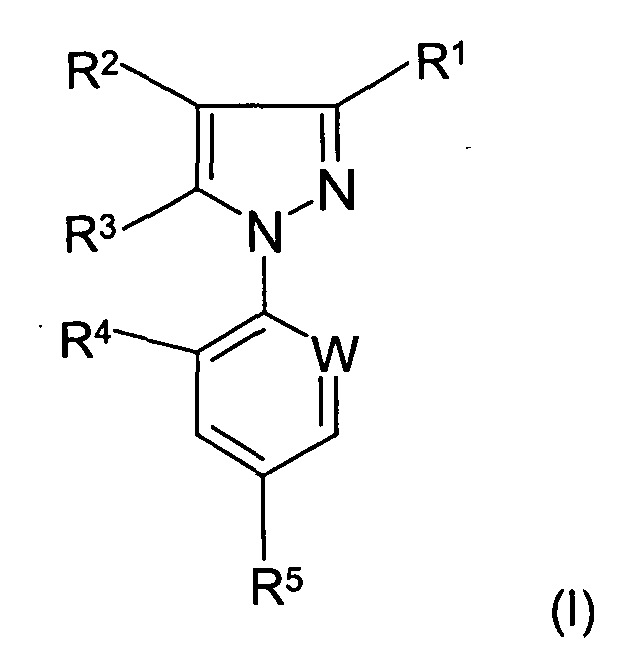
- i) R1 is CO2R8;
R2 is H or S(O)mR9;
R3, R4, R5, W and m are as defined above;
R8 is H; and
R9 is (C2-C6)-alkyl or (C1-C6)-haloalkyl;
or - ii) R1 is CONR6R7;
R6 is (C1-C6)-alkyl, (C1-C6)-haloalkyl, (C1-C6)-alkoxy-(C1-C6)-alkyl, (C2-C6)-alkenyl, (C2-C6)-haloalkenyl, (C2-C6)-alkynyl, (C2-C6)-haloalkynyl, (C3-C7)-cycloalkyl, (C3-C7)-cycloalkyl-(C1-C6)-alkyl, (C1-C6)-alkoxy, (C1-C6)-alkylthio, (CH2)nR12, (CH2)pR13, (C1-C6)-alkyl-CN, (C1-C6)-alkyl-NR10R11 or
(C1-C6)-alkyl- S(O)rR9; or
R6 and R7 together with the attached N atom form a five- or six-membered saturated ring which optionally contains an additional hetero atom in the ring which is selected from O, S and N, the ring being unsubstituted or substituted by one or more radicals selected from the group consisting of halogen, (C1-C6)-alkyl and (C1-C6)-haloalkyl; and
R2, R3, R4, R5, R7, R9, R10, R11, R12, R13, W, n, p and r are as defined in formula (I);
with the exclusion of the compound wherein:
R1 is CON(CH3)2; R2 is CF3S; R3 is OH; R4 is Cl; R5 is CF3; and W is C-Cl. -
- The above compound is specifically excluded because it is known, however, its use as a plant growth regulator has not yet been reported.
- Compounds of formula (I) above may be prepared by the application or adaptation of known methods (i.e. methods heretofore used or described in the literature).
In the following description where symbols appearing in formulae are not specifically defined, it is to be understood that they are "as hereinbefore defined" in accordance with the first definition of each symbol in the specification.
It is to be understood that in the descriptions of the following processes the sequences may be performed in different orders, and that suitable protecting groups may be required to achieve the compounds sought. - Compounds of formula (I) above may be prepared by the application or adaptation of known methods (i.e. methods heretofore used or described in the literature).
- In the following description where symbols appearing in formulae are not specifically defined, it is to be understood that they are "as hereinbefore defined" in accordance with the first definition of each symbol in the specification.
It is to be understood that in the descriptions of the following processes the sequences may be performed in different orders, and that suitable protecting groups may be required to achieve the compounds sought. - According to a feature of the invention compounds of formula (I) wherein R1 is CO2H, R2 is H or S(O)mR9, R9 is (C2-C6)-alkyl or (C1-C6)-haloalkyl, and the other values are as defined above, may be prepared by the reaction of a corresponding compound of formula (II):wherein R2, R3, R4, R5 and W are as defined above, using aqueous sulfuric acid, generally 40% to 60% sulfuric acid at a temperature of from 80°C to 170°C, preferably from 120°C to 150°C.

- According to a further feature of the invention compounds of formula (I) wherein R1 is CO2H, R2 is H, R3 is NHR11, and the other values are as defined above, may be prepared by the reaction of a corresponding compound of formula (II) above wherein R2 is R9SO or R9SO2 (preferably CF3SO or CF3SO2), using aqueous sulfuric acid, generally 40% to 60% sulfuric acid at a temperature of from 80°C to 170°C, preferably from 120°C to 150°C.
- According to a further feature of the invention compounds of formula (I) wherein R1 is CONR6R7; R6 is (C1-C6)-alkyl, (C1-C6)-haloalkyl, (C1-C6)-alkoxy-(C1-C6)-alkyl, (C2-C6)-alkenyl, (C2-C6)-haloalkenyl, (C2-C6)-alkynyl, (C2-C6)-haloalkynyl, (C3-C7)-cycloalkyl, (C3-C7)-cycloalkyl-(C1-C6)-alkyl, (C1-C6)-alkoxy, (CH2)nR12, (CH2)pR13, (C1-C6)-alkyl-CN, (C1-C6)-alkyl-NR10R11 or (C1-C6)-alkyl- S(O)rR9; R7 is as defined above; or
R6 and R7 together with the attached N atom form a five- or six-membered saturated ring which optionally contains an additional hetero atom in the ring which is selected from O, S and N, the ring being unsubstituted or substituted by one or more radicals selected from the group consisting of halogen, (C1-C6)-alkyl and (C1-C6)-haloalkyl; and the other values are as defined above, may be prepared by the reaction of a corresponding compound of formula (I) wherein R1 is CO2H, with N,N'-carbonyldiimidazole to give the corresponding imidazolide of formula (III):followed by the reaction, preferably in situ, with an amine of formula (IV):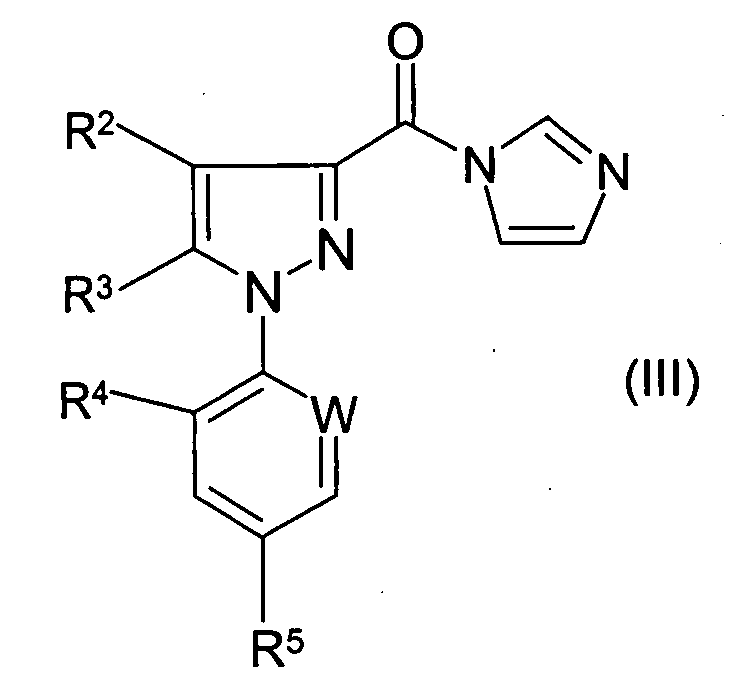
- According to a further feature of the invention compounds of formula (I) wherein R3 is NR10R11 in which at least one of R10 and R11 is not H, and the other values are as defined above, may be prepared by the alkylation or acylation of the corresponding compound of formula (I) wherein R3 is NH2, using an alkylating or acylating agent of formula (V) or (VI):
Alkylations, where R10 and/or R11 are each (C1-C6)-alkyl, (C1-C6)-haloalkyl, (C3-C6)-alkenyl, (C3-C6)-haloalkenyl, (C3-C6)-alkynyl, (C3-C6)-cycloalkyl or
(C3-C6)-cycloalkyl-(C1-C6)-alkyl, and L and L1 are each preferably halogen, alkylsulfonyloxy or arylsulfonyloxy (more preferably chlorine, bromine, iodine, methylsulfonyloxy or p-toluenesulfonyloxy), are generally carried out in the presence of a base, in an inert solvent such as tetrahydrofuran, dioxan, acetonitrile, toluene, diethyl ether, dichloromethane, dimethylsulfoxide or N,N-dimethylformamide, at a temperature of from -30°C to 200°C, preferably at 20°C to 100°C. The base is generally an alkali metal hydroxide such as potassium hydroxide, an alkali metal hydride such as sodium hydride, an alkali metal carbonate such as potassium carbonate or sodium carbonate, an alkali metal alkoxide such as sodium methoxide, an alkaline earth metal carbonate such as calcium carbonate, or an organic base such as a tertiary amine, for example triethylamine or ethyldiisopropylamine, or pyridine, or 1,8-diazabicyclo[5.4.0]undec-7-en (DBU).
Acylations, where R10 and/or R11 are each COR14 or CO2R15, and L and L1 are each preferably chlorine or bromine (more preferably chlorine), are performed optionally in the presence of a base. The bases, solvents and temperatures which may be used are similar to those employed for the alkylations.
By performing sequential alkylation or acylation reactions, compounds of formula (I) wherein R3 is NR10R11 in which R10 and R11 have different values may be prepared. - According to a further feature of the invention compounds of formula (I) wherein R1 is CONR6R7, R2 is S(O)mR9, R3 is (C1-C6)-alkoxy, R6 is (C1-C6)-alkylthio, and the other values are as defined above, may be prepared by the reaction of a corresponding compound of formula (I) wherein R1 is CONHR7, with a compound of formula (VII):
- According to a further feature of the present invention compounds wherein m is 1 or 2, and the other values are as defined above, may be prepared by oxidising a corresponding compound in which m is 0 or 1. The oxidation is generally performed using an oxidising agent such as m-chloroperbenzoic acid or sodium periodate in an inert solvent for example methylene chloride at a temperature from -40°C to the reflux temperature of the solvent.
- Compounds of formula (I) wherein R1 is CONH2 may be prepared from the corresponding compounds in which R1 is CN according to known methods, for example by the reaction with concentrated sulfuric acid at a temperature of from 50°C to 150°C.
- Intermediate compounds of formula (II) wherein R3 is NR10R11 or halogen may be prepared according to methods described in Patent Publication numbers WO 87/03781, EP 295117 and US 5232940.
Intermediate compounds of formula (II) wherein R3 is (C1-C6)-alkoxy may be prepared according to methods described in Patent Publication numbers EP 035809 and US 5047550.
Intermediate compounds of formula (II) wherein R3 is OH may be prepared according to methods described in Patent Publication number WO 01/40195. - Compounds of formula (III) are novel and as such form a further feature of the invention, and may be prepared as described above.
- Compounds of formula (II), (IV), (V), (VI) and (VII) are known or may be prepared according to known methods.
- A collection of compounds of formula (I) which can be synthesized by the above-mentioned processes can additionally be prepared in parallel fashion, which can be effected manually, partly automated or fully automated. In this context, it is possible to automate the procedure of the reaction, work-up or purification of the products or intermediates. In total, this is to be understood as meaning a procedure which is described, for example, by S. H. DeWitt in "Annual Reports in Combinatorial Chemistry and Molecular Diversity: Automated Synthesis", Volume 1, published by Escom, 1997, pages 69 to 77.
- For carrying out the reaction and work-up in parallel fashion, a series of commercially available apparatuses can be used as they are available from, for example, Stem Corporation, Woodrolfe Road, Tollesbury, Essex, CM9 8SE, England or Radleys Discovery Technologies, Saffron Walden, Essex, CB11 3AZ, ENGLAND. To carry out the parallel purification of compounds (I) or of intermediates obtained during the preparation, there are available, inter alia, chromatographic equipment, for example from ISCO, Inc., 4700 Superior Street, Lincoln, NE 68504, USA. The equipment mentioned makes possible a modular procedure, where the individual steps are automated, but manual operation has to be carried out between the steps. This can be circumvented by employing partly or fully integrated automation systems, in which the automation modules in question are operated by, for example, robots. Such automation systems can be obtained from, for example, Zymark Corporation, Zymark Center, Hopkinton, MA 01748, USA.
- In addition to the above-described methods, compounds of formula (I) can be prepared in full or partly by solid-phase supported methods. To this end, individual intermediates or all intermediates of the synthesis or of a synthesis adapted to the procedure in question are bound to a synthesis resin. Solid-phase supported synthetic methods are described extensively in the specialist literature, for example: Barry A. Bunin in "The Combinatorial Index", published by Academic Press, 1998. The use of solid-phase supported synthesis methods permits a series of protocols known from the literature which, in turn, can be carried out manually or in an automated fashion. For example, the "teabag method" (Houghten, US 4,631,211; Houghten et al., Proc. Natl. Acad. Sci., 1985, 82, 5131 - 5135) can be partly automated with products of IRORI, 11149 North Torrey Pines Road, La Jolla, CA 92037, USA. Solid-phase supported parallel synthesis can be automated successfully for example using equipment by Argonaut Technologies, Inc., 887 Industrial Road, San Carlos, CA 94070, USA or MultiSynTech GmbH, Wullener Feld 4, 58454 Witten, Germany.
- The preparation in accordance with the processes described herein yields compounds of formula (I) in the form of substance collections or substance libraries. Subject matter of the present invention are therefore also libraries of the compounds of formula (I) which contain at least two compounds of formula (I), and of their precursors.
- The following non-limiting Examples illustrate the preparation of the compounds of formula (I).
- In the Examples which follow, quantities (also percentages) are weight based unless stated otherwise. Ratios of solvents are volume based.
- 5-Amino-1-(2,6-dichloro-4-trifluoromethylpheny))-4-trifluoromethylthio-1H-pyrazole-3-carboxylic acid (Compound 2.10)
- A stirred mixture of 5-amino-1-(2,6-dichloro-4-trifluoromethylphenyl)-4-trifluoromethylthio-1H-pyrazole-3-carbonitrile (35.5 g, 84.3 mmol) and sulfuric acid (50%, 600 ml) was heated to 135°C for 7 hours. The cooled mixture was added to ice water and the precipitate filtered off, washed with water and air-dried. Trituration with tetrachloromethane gave the title compound as off-white crystals (30.6 g, yield 82%), mp 199°C, 1H NMR(DMSO-d6): 6.66 (bs, 2H, NH2), 8.23 (s, 2H, Ar-H), and 13.03 (bs, 1H, COOH).
- 5-Amino-1-(2,6-dichloro-4-trifluoromethylphenyl)-4-trifluoromethylthio-1H-pyrazole-3-carboxylic acid amide (Compound 1.4)
- A mixture of 5-amino-1-(2,6-dichloro-4-trifluoromethylphenyl)-4-trifluoromethylthio-1H-pyrazole-3-carboxylic acid (1.00 g, 2.27 mmol) and 1,1-dicarbonylimidazole (0.45 g, 2.72 mmol) in dioxane was heated to 50°C for 2 hours. An aqueous solution of ammonia (33%, 80 ml) was then added and stirring continued at 50°C for 4 hours. The cooled mixture was diluted with water and extracted with ethyl acetate/heptane (1:1). The combined organic phase was washed with aqueous potassium hydrogensulfate (5%), dried over magnesium sulfate and evaporated to give the title compound (0.980 g, yield 98%) as a white foam, 1H NMR(CDCl3): 4.36 (bs, 2H, NH2), 5.60 and 6.69 (bs, 2H, C(O)NH2), and 7.82 (s, 2H, Ar-H).
- 5-Amino-1-(2,6-dichloro-4-trifluoromethylphenyl)-4-trifluoromethylthio-1H-pyrazole-3-carboxylic acid cyclopropylamide (Compound 1.1)
- A mixture of 5-amino-1-(2,6-dichloro-4-trifluoromethylphenyl)-4-trifluoromethylthio-1 H-pyrazole-3-carboxylic acid (0.85 g, 1.83 mmol) and 1,1-dicarbonylimidazole (0.36 g, 2.20 mmol) in dioxane was heated to 55°C for 2 hours. Cyclopropylamine (0.20 ml, 2.83 mmol) was then added and stirring continued at 55°C for 6 hours. The cooled mixture was diluted with water, extracted with ethyl acetate, washed with aqueous potassium hydrogensulfate (5%), dried over magnesium sulfate and evaporated to give the title compound (0.762 g, yield 87%) as off-white crystals, mp 193°C, 1H NMR(CDCI3): 0.64 (m, 2H, cyclopropyl), 0.83 (m, 2H, cyclopropyl), 2,87 (m, 1H, cyclopropyl), 4.31 (bs, 2H, NH2), 6.82 (bs, 1H, C(O)NH), and 7.80 (s, 2H, Ar-H).
- 5-Amino-1-(2,6-dichloro-4-trifluoromethylphenyl)-4-trifluoromethylsulfinyl-1H-pyrazole-3-carboxylic acid propargylamide (Compound 1.134)
- To a suspension of 5-amino-1-(2,6-dichloro-4-trifluoromethylphenyl)-4-trifluoromethylthio-1H-pyrazole-3-carboxylic acid propargylamide (0.71 g, 1.43 mmol) in dichloromethane was slowly added a solution of m-chloroperbenzoic acid (70%, 0.41 g, 1.68 mmol) in dichloromethane. After stirring for 17 hours at 20°C, an aqueous solution of sodium sulfite/sodium hydrogen carbonate (5%:5%, 25 ml) was added and stirring continued for 15 minutes. The aqueous phase was extracted with dichloromethane, dried over magnesium sulfate, evaporated and purified by flash chomatography (silica, heptane/ethyl acetate) to give the title compound (0.604 g, yield 86%) as white crystals, mp 207°C, 1H NMR(CDCI3): 2.28 (t, 1 H, propargyl), 4.20 (m, 2H, propargyl), 5.17 (bs, 2H, NH2), 6.88 (bt, 1H, C(O)NH), and 7.83 (s, 2H, Ar-H).
- 5-Amino-1-(2,6-dichloro-4-trifluoromethylphenyl)-4-trifluoromethylsulfonyl-1H-pyrazole-3-carboxylic acid amide (Compound 1.268)
- A stirred mixture of 5-amino-1-(2,6-dichloro-4-trifluoromethylphenyl)-4-trifluoromethylsulfonyl-1H-pyrazole-3-carbonitrile (1.06 g, 2.21 mmol) and concentrated sulfuric acid (1 ml) was heated to 100°C for 3 hours. The cooled mixture was added to ice water and the precipitate filtered off, washed with water and air-dried. Purification by flash chomatography (silica, chloroform) gave the title compound (0.869 g, yield 83%) as off-white crystals, mp 217°C, 1H NMR(DMSO-d6): 7.39 (bs, 2H, NH2), 7.57 and 7.78 (bs, 2H, C(O)NH2), and 8.25 (s, 2H, Ar-H).
- A stirred mixture of 5-amino-1-(2,6-dichloro-4-trifluoromethylphenyl)-4-trifluoromethylsulfinyl-1H-pyrazole-3-carbonitrile (5.00 g, 11.4 mmol) and sulfuric acid (50%, 100 ml) was heated to 135°C for 3 hours. The cooled mixture was added to ice water and the pH adjusted to 4 by the addition of aqueous sodium hydroxide (6 N, approx. 230 ml), and then extracted with ethyl acetate. The organic phase was dried over magnesium sulfate, evaporated to dryness and purified by flash chomatography (silica, chloroform/ethanol) with subsequently trituration with tetrachloromethane to give the title compound (3.00 g, yield 77%) as off-white crystals, mp 213°C, 1H NMR(DMSO-d6): 5.69 (bs, 2H, NH2), 5.76 (s, 1H, pyrazole-H), and 8.20 (s, 2H, Ar-H).
- 1-(2,6-Dichloro-4-trifluoromethylphenyl)-5-ethoxy-4-trifluoromethylthio-1H-pyrazole-3-carboxylic acid amide (Compound 3.3)
- a) To a stirred suspension of sodium hydride (0.41 g, 60%, 10.3 mmol) in dioxane (150 ml) was added a solution of 1-(2,6-dichloro-4-trifluoromethylphenyl)-5-hydroxy-4-trifluoromethylthio-1H-pyrazole-3-carbonitrile (4.00g, 8.53 mmol) in dioxane (50 ml). After gas evolution had ceased the mixture was heated to reflux and diethyl sulfate (1.25 ml, 9.47 mmol) added, and then heated under reflux for 6 hours. The cooled mixture was acidified with aqueous potassium hydrogensulfate (5%), extracted with dichloromethane, and the organic phase dried over magnesium sulfate and evaporated. The resulting gum was triturated with pentane to give 1-(2,6-dichloro-4-trifluoromethylphenyl)-5-ethoxy-4-trifluoromethylthio-1 H-pyrazole-3-carbonitrile (2.68 g, yield 70 %) as off-white crystals, mp 106°C, 12H NMR(CDCl3): 1.36 (t, 3H, CH3), 4.71 (q, 2H, OCH2), and 7.76 (s, 2H, Ar-H).
- b) A stirred mixture of 1-(2,6-dichloro-4-trifluoromethylphenyl)-5-ethoxy-4-trifluoromethylthio-1 H-pyrazole-3-carbonitrile (0.55g, 1.22 mmol) and concentrated sulfuric acid (0.55 ml) was heated at 100°C for 3 hours. The cooled mixture was added to ice water and the precipitate filtered off, washed with water and air-dried. The crude product was dissolved in heptanes/ethyl acetate (1:1) and filtered. The filtrate was evaporated to give the title compound (0.42 g, yield 73%) as yellowish crystals, mp 161°C, 1H NMR(CDCI3): 1.32 (t, 3H, CH3), 4.68 (q, 2H, OCH2), 5.54 and 6.69 (bs, 2H, C(O)NH2), and 7.77 (s, 2H, Ar-H).
-
- The following preferred compounds of formula (Ia), (Ib) and (Ic) shown in Tables 1 to 3 also form part of the present invention, and are obtained by, or analogously to, the above Examples 1 to 7 or the above-described general methods. The following abbreviations are used in the Tables 1 to 3:
- "Cpd" means Compound Number. Compound numbers are given for reference purposes only. RF means retention time determined from thin layer chromatography on silica gel, using ethyl acetate as eluent.


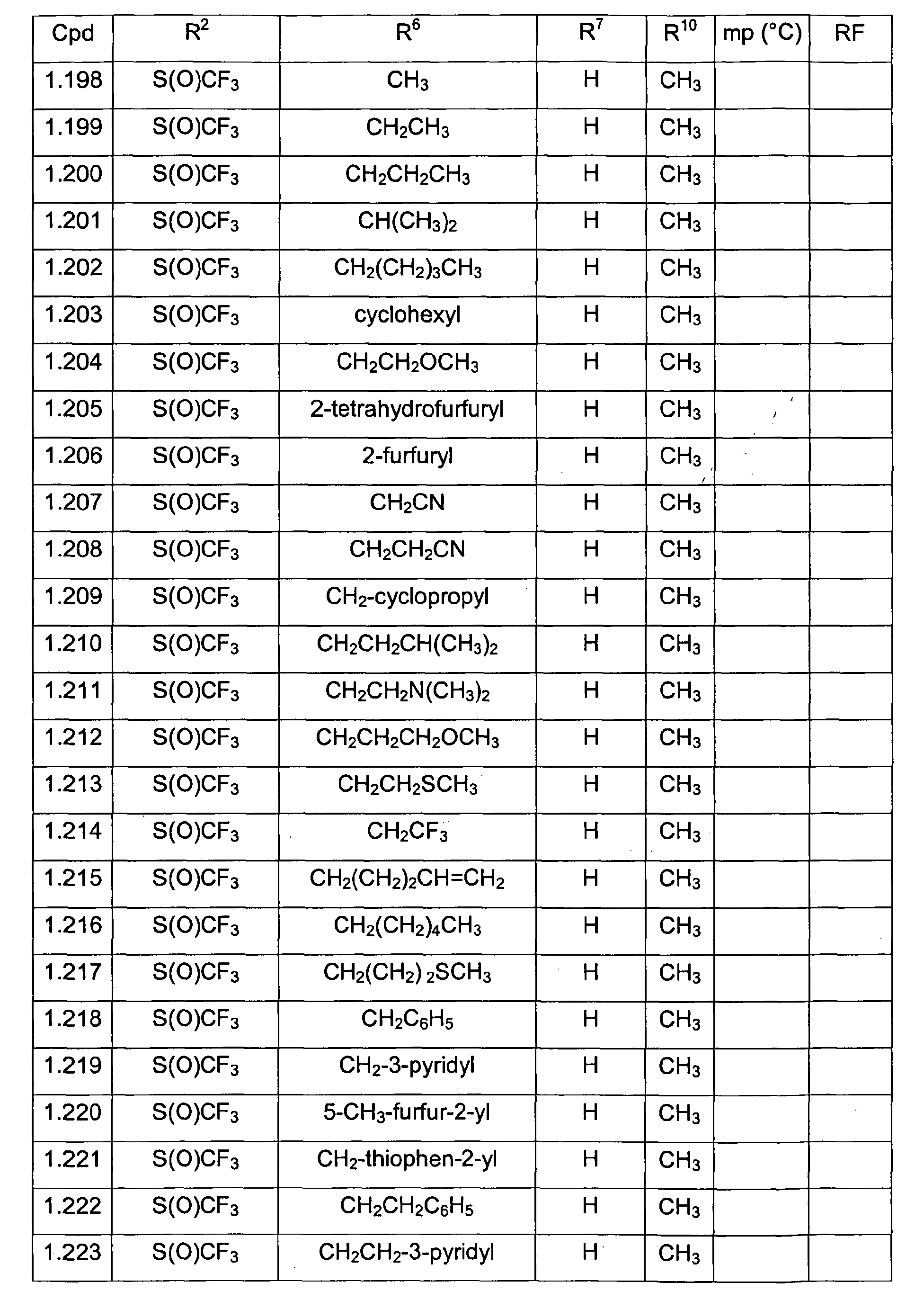
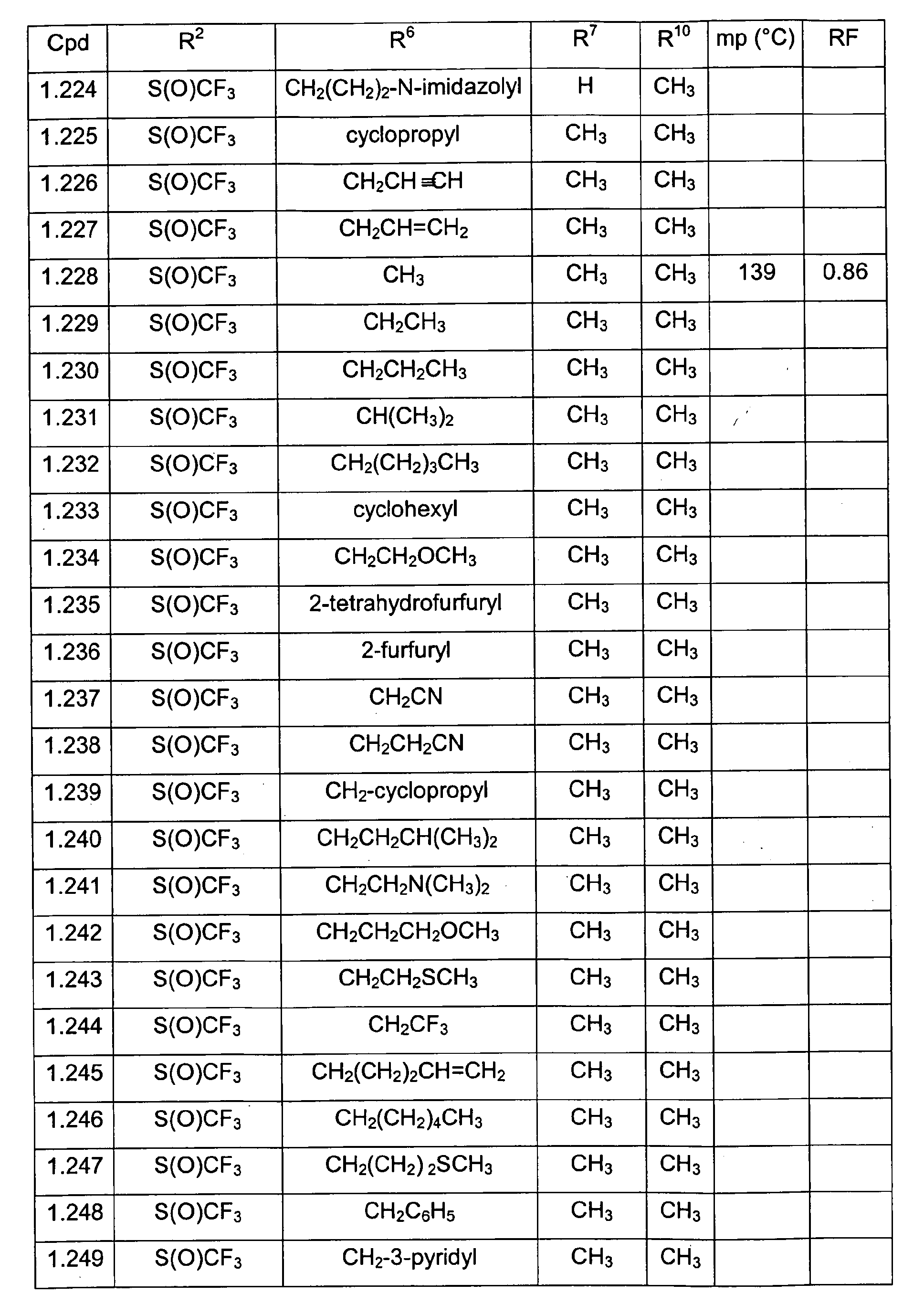

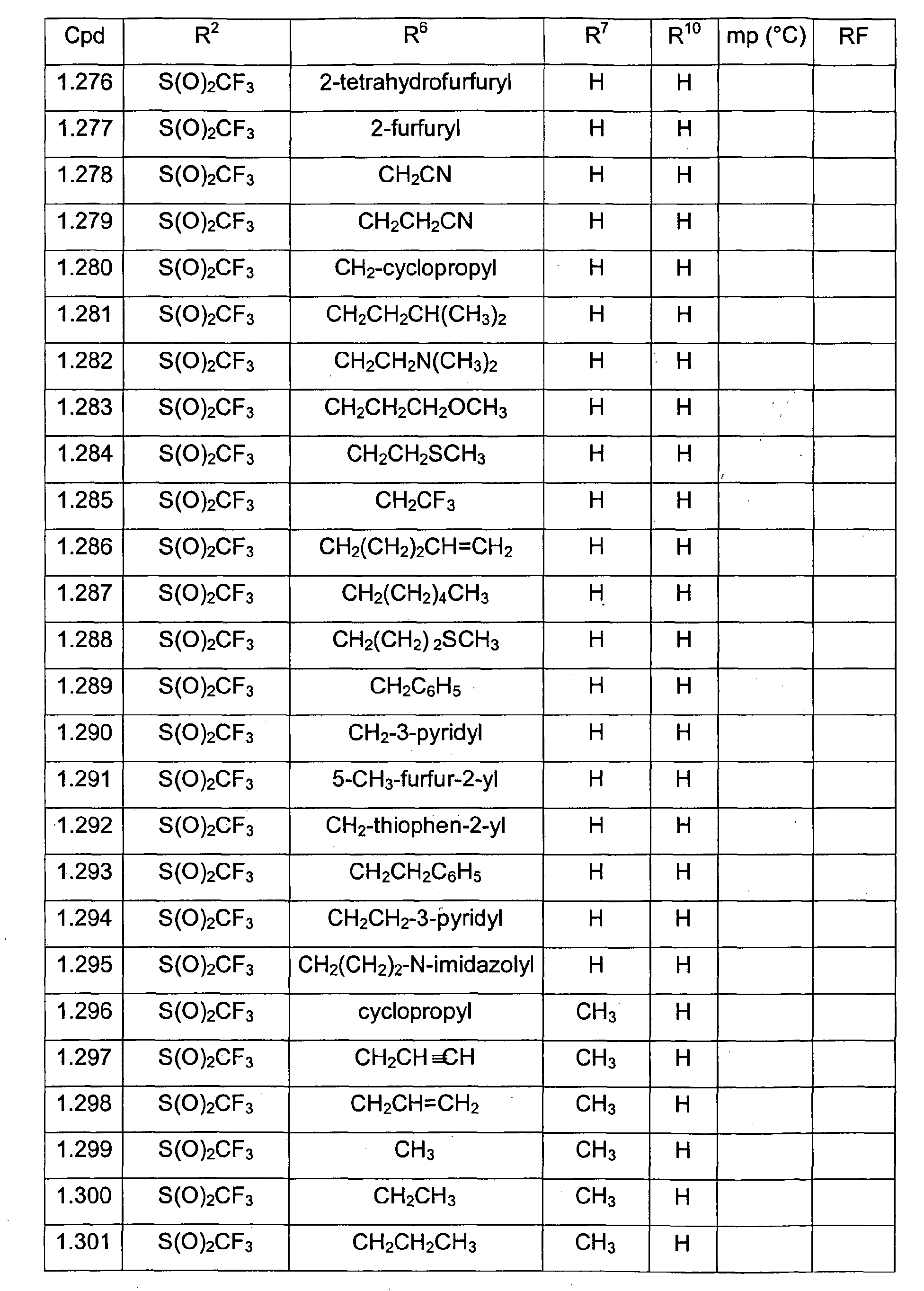


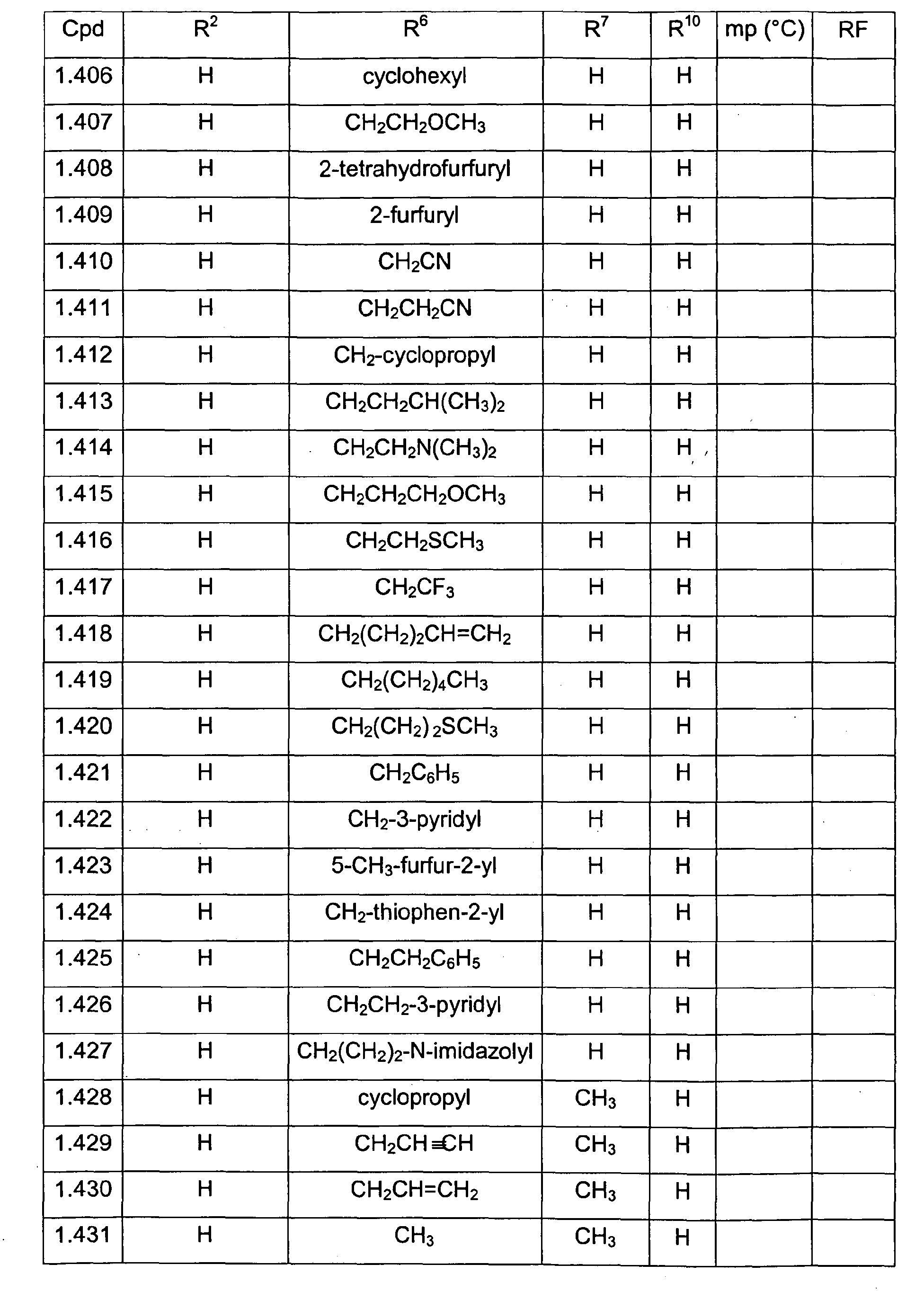

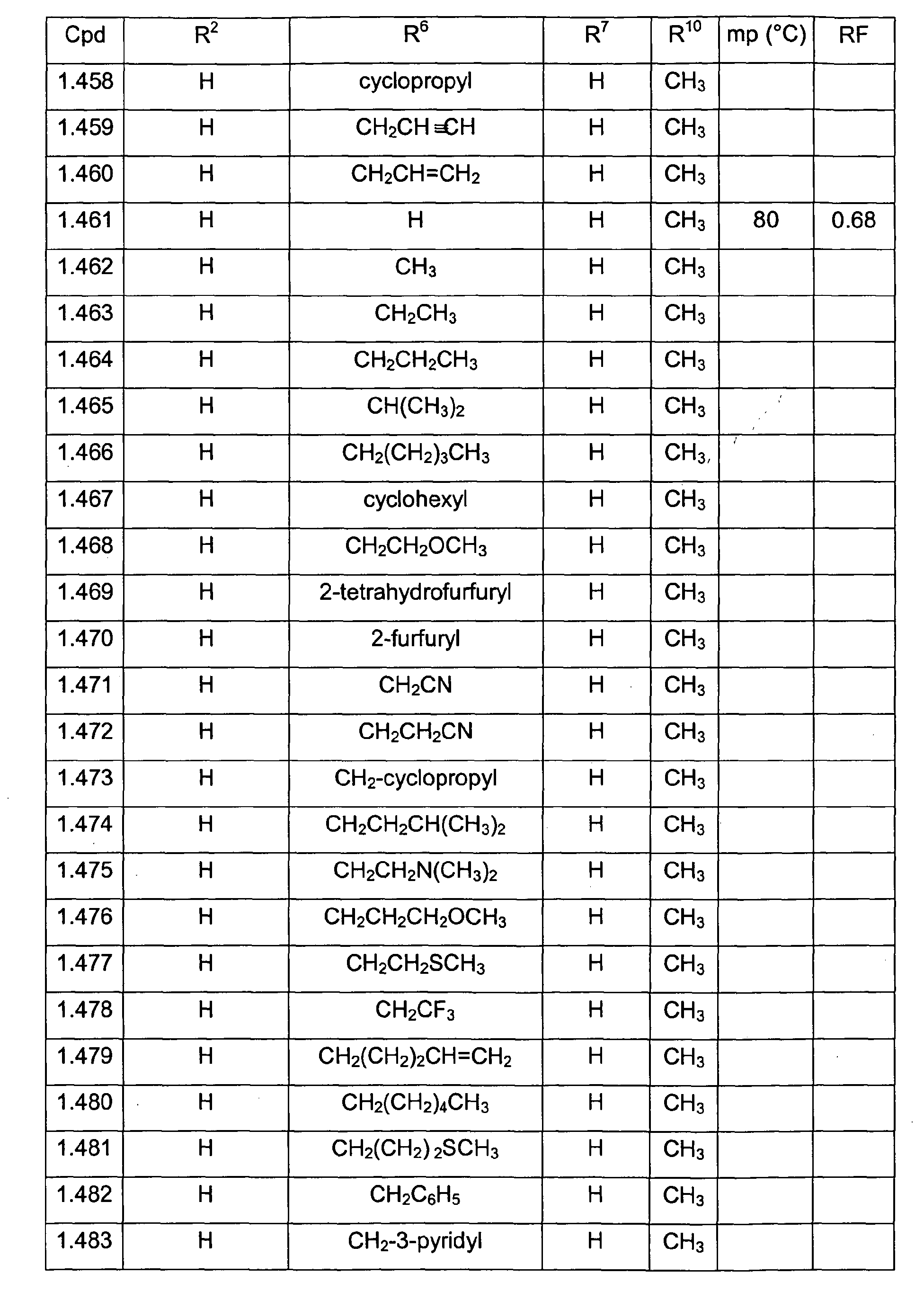
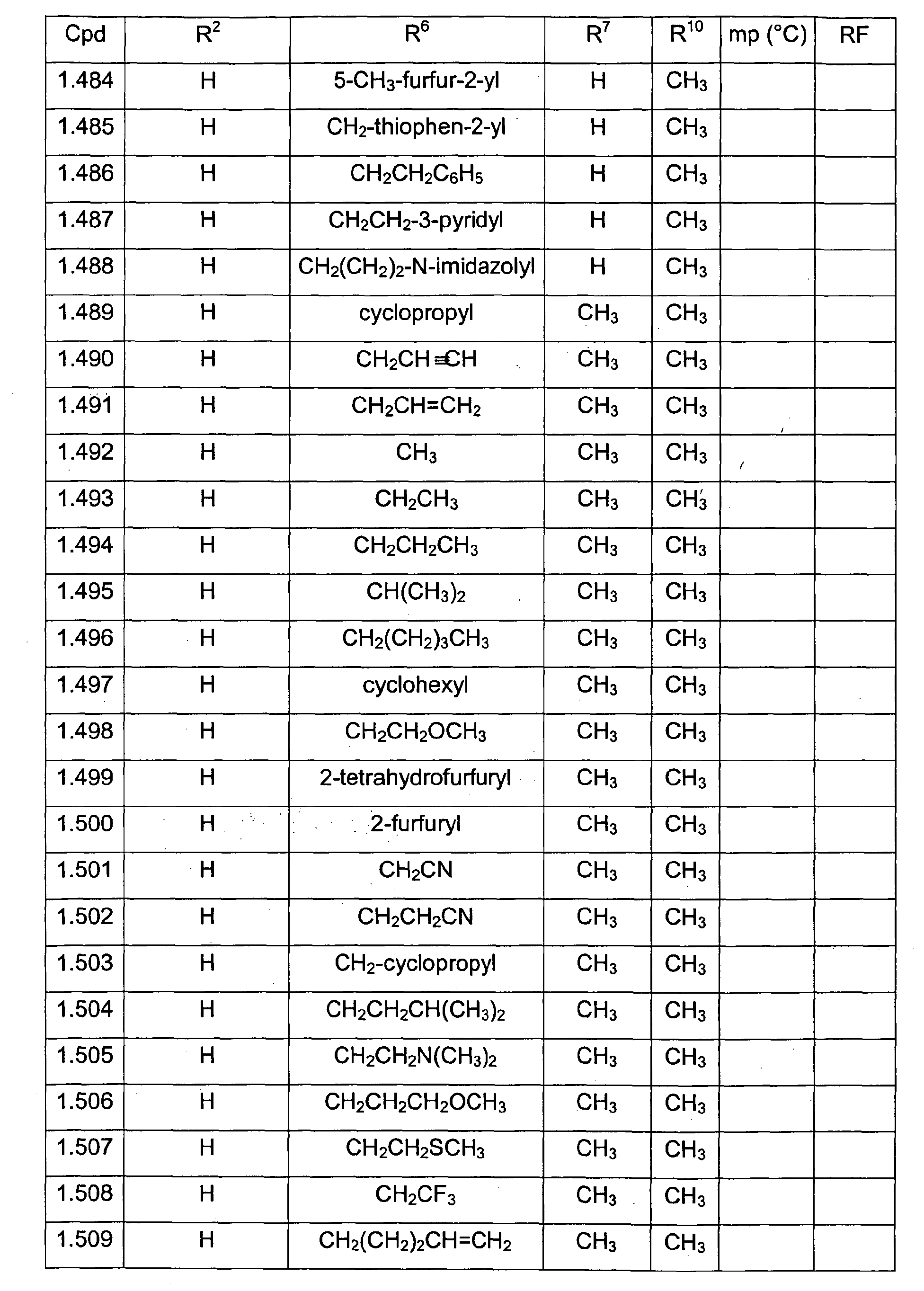
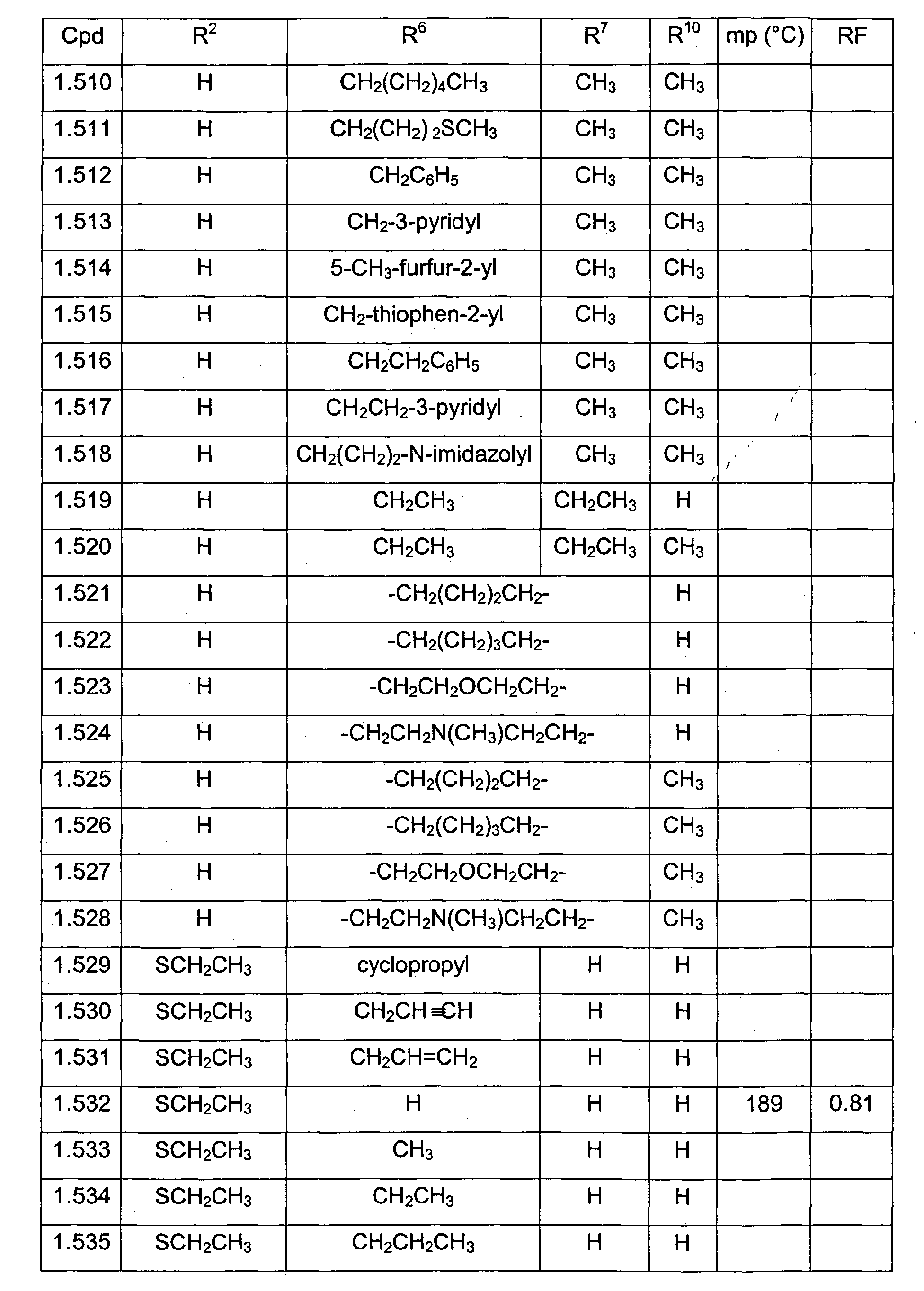


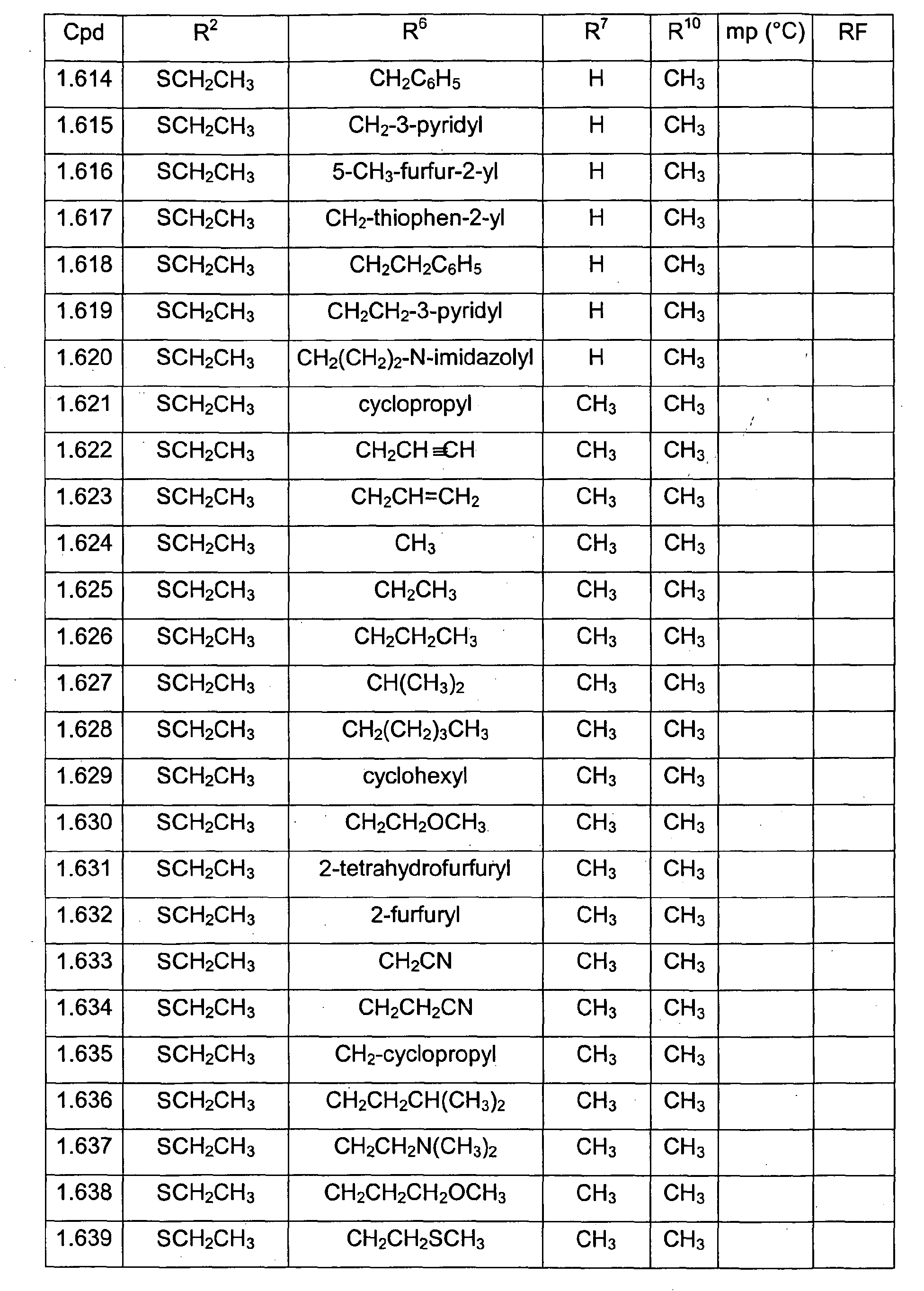
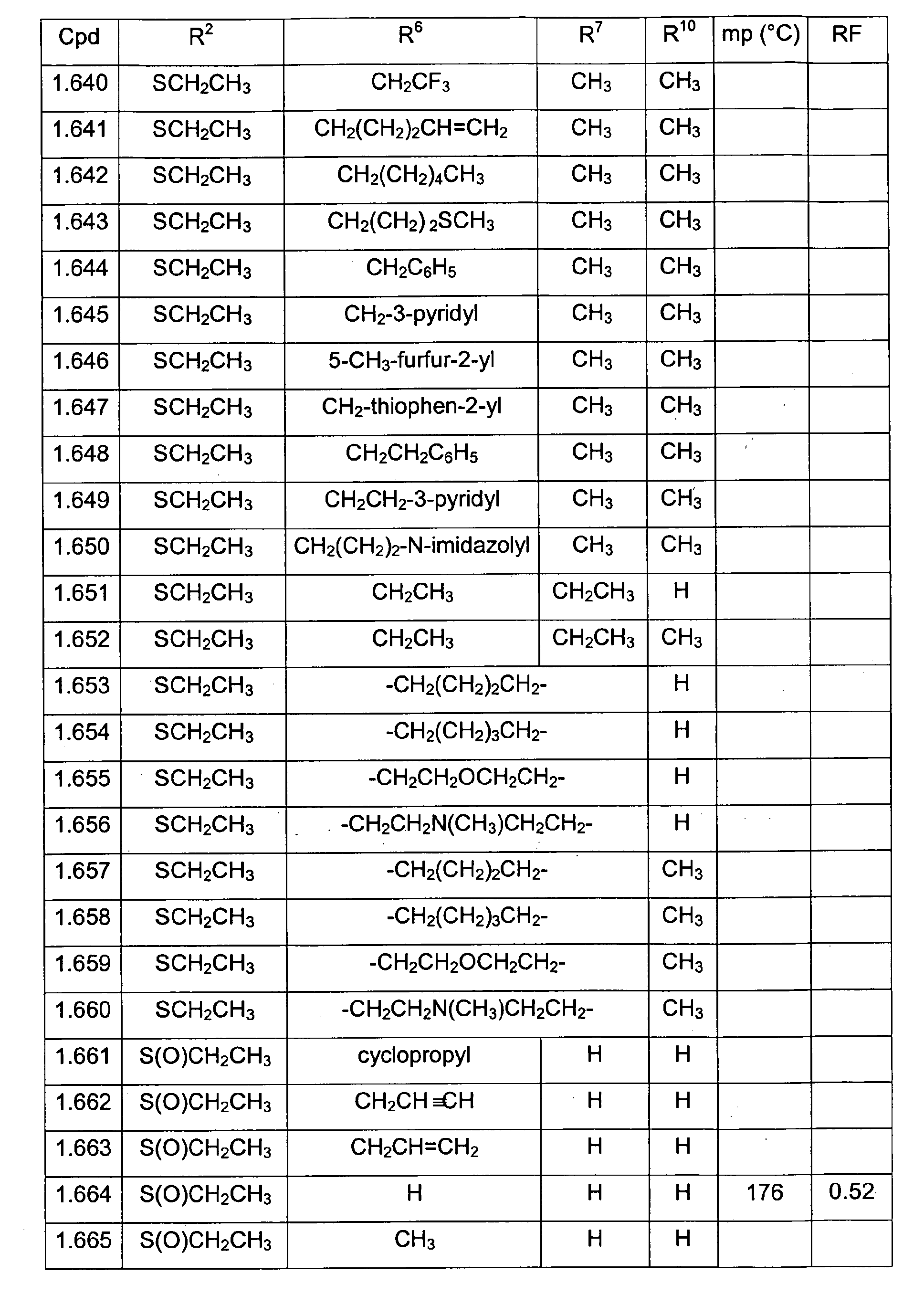
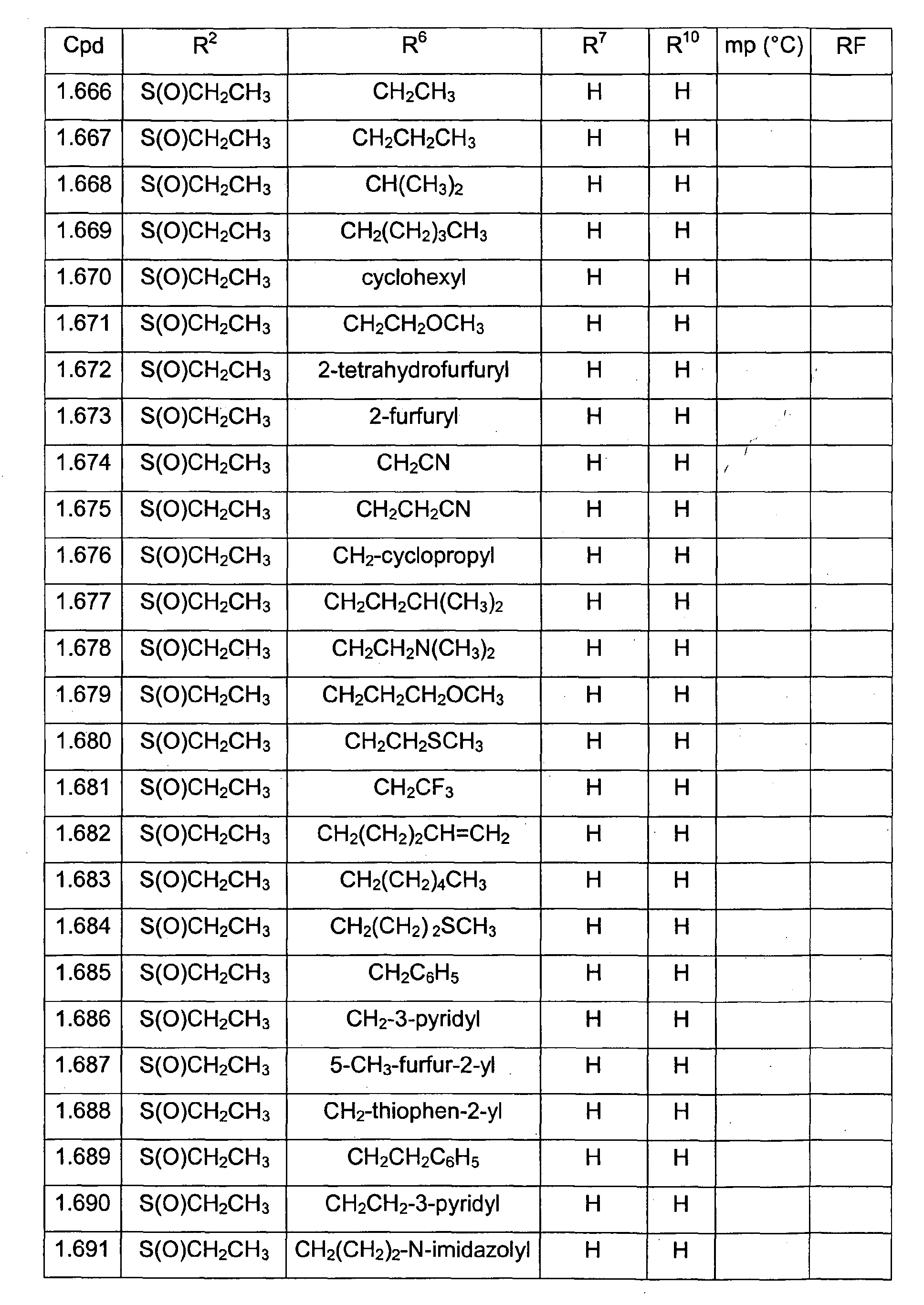
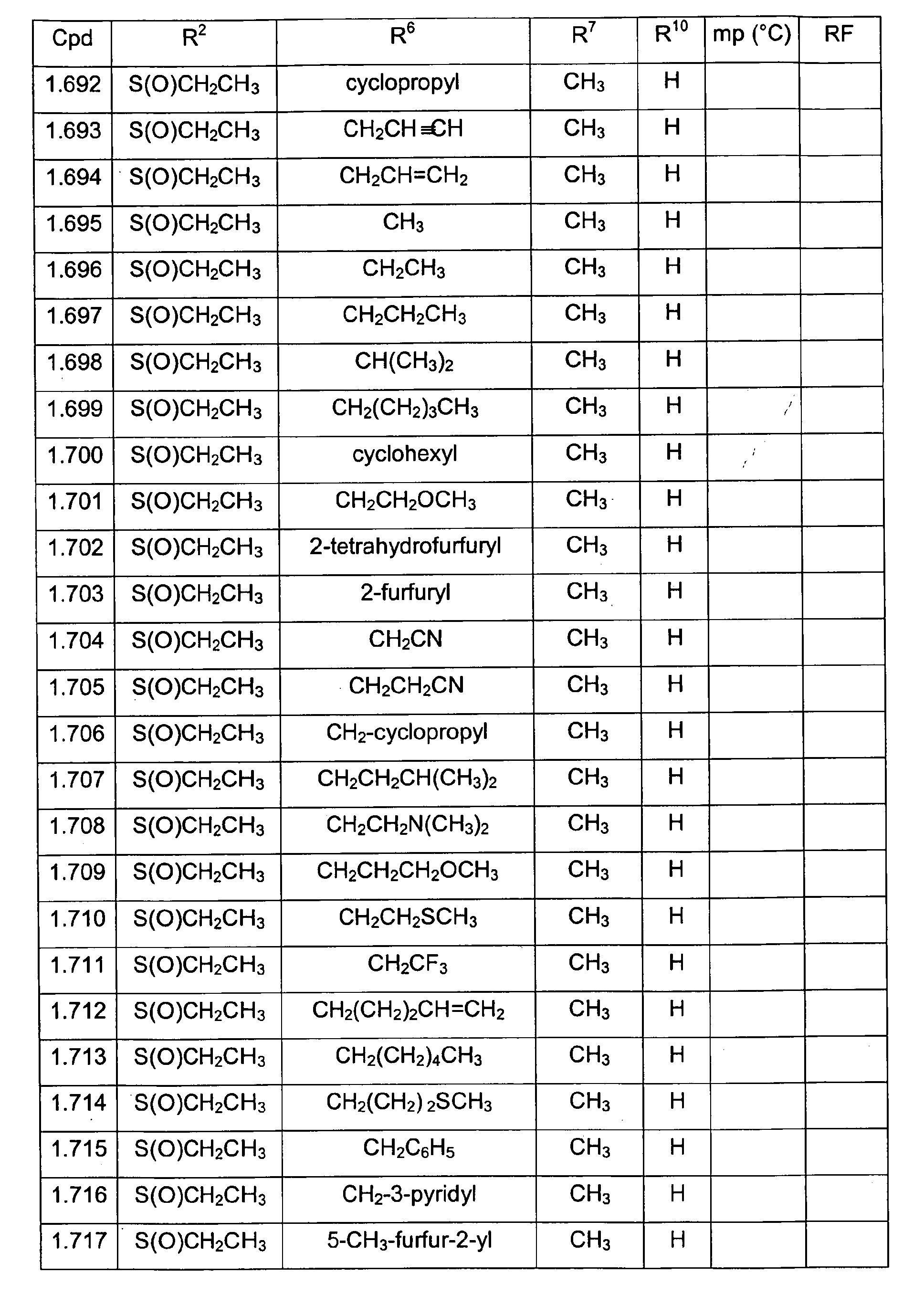
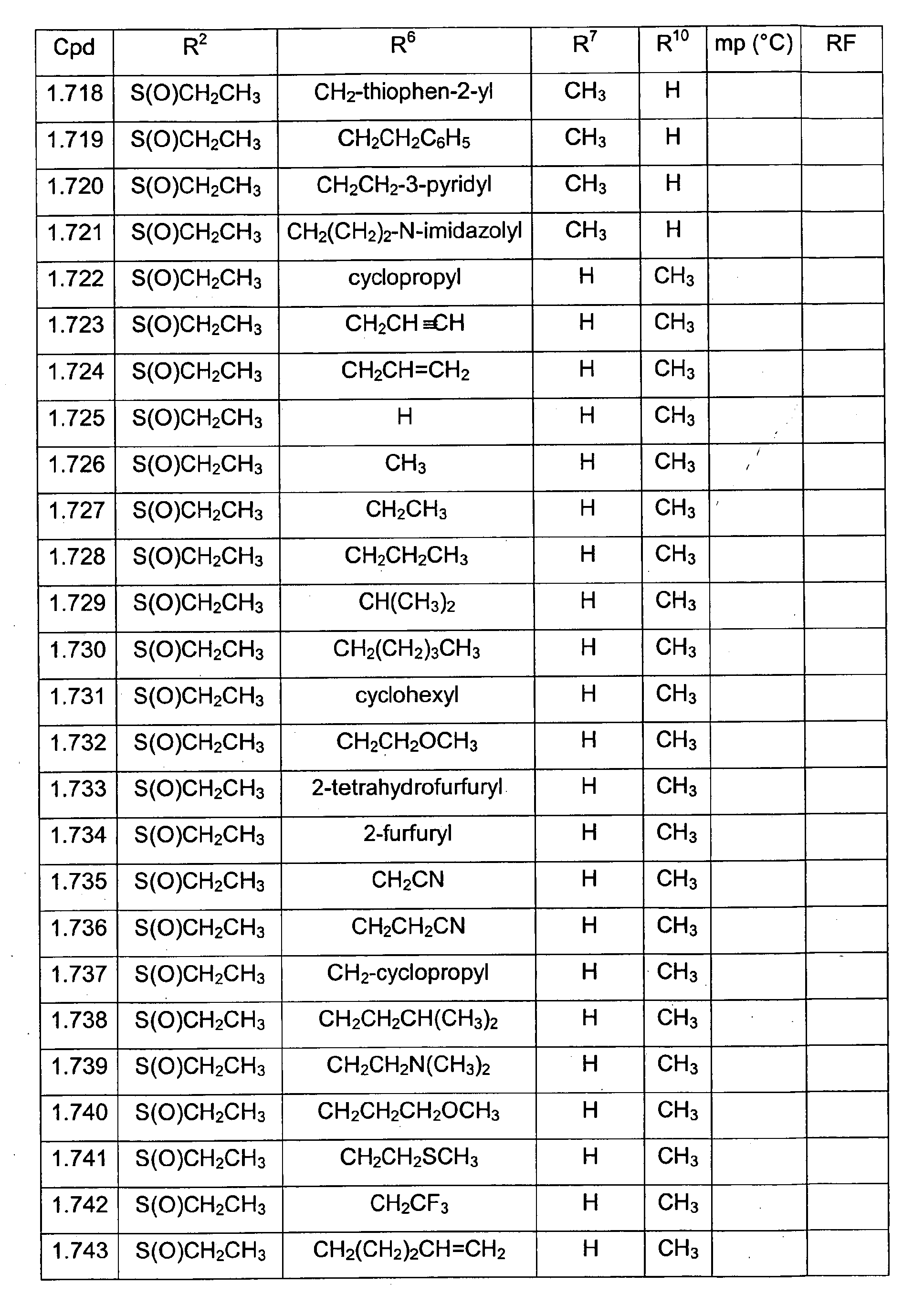


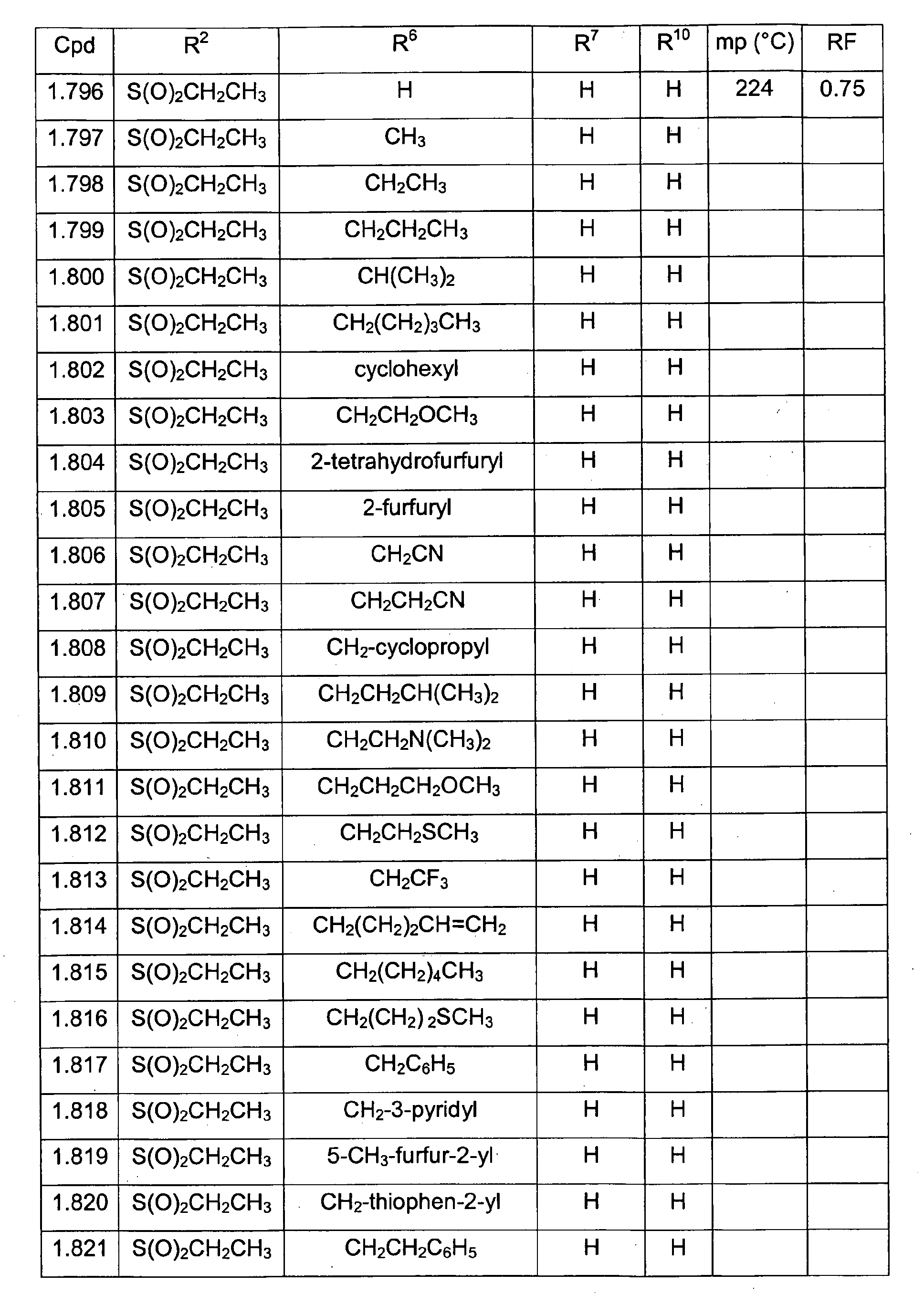


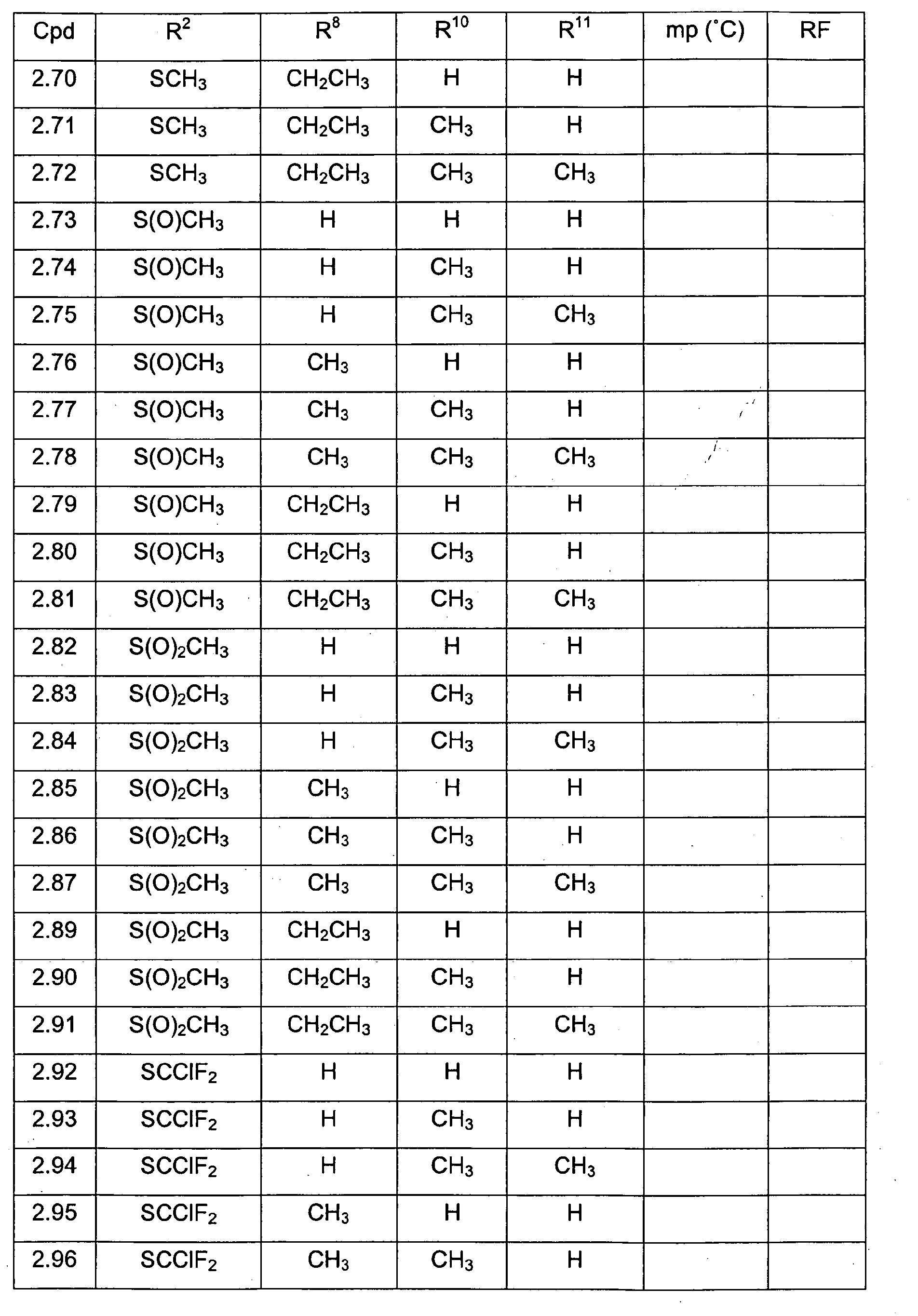
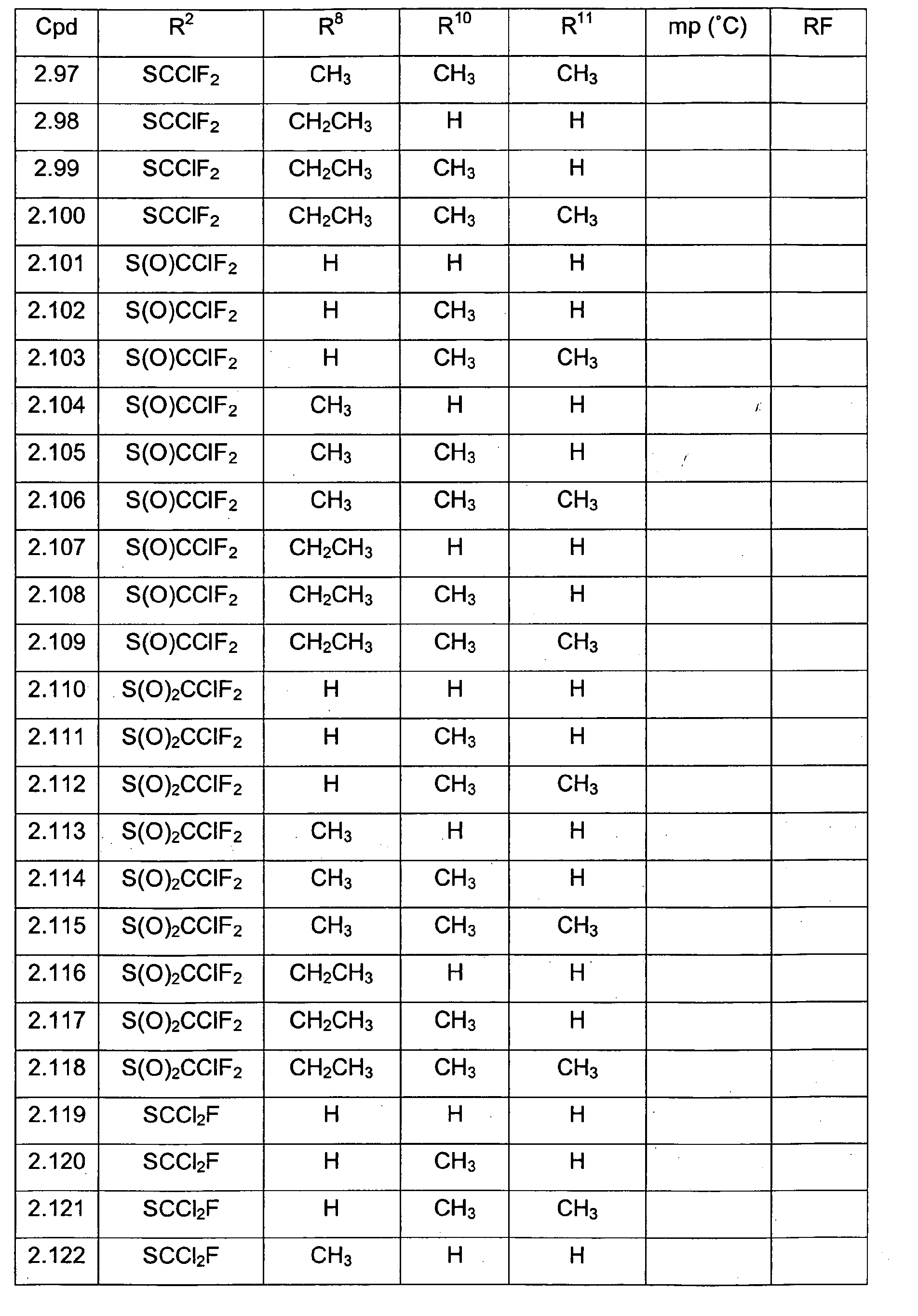
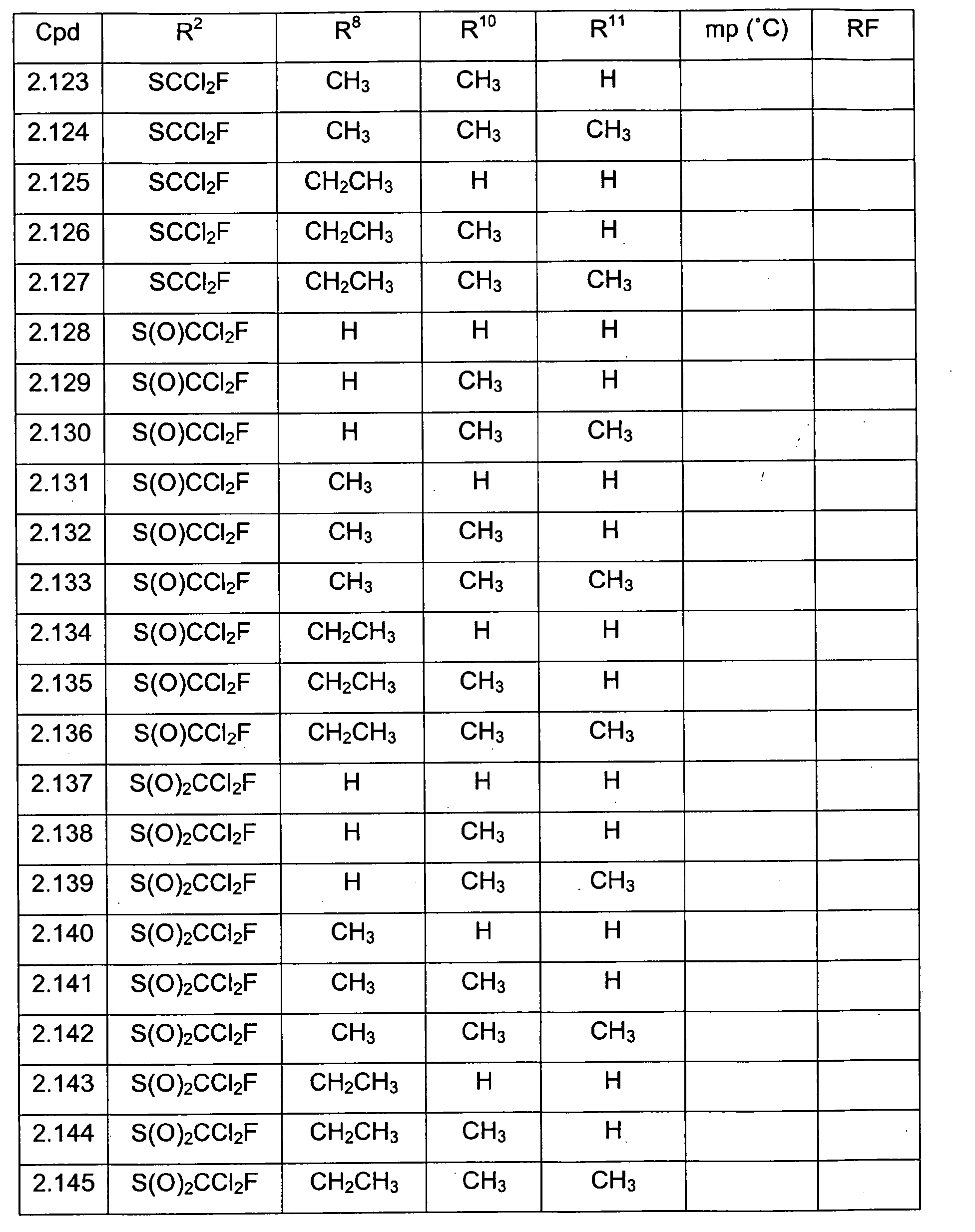
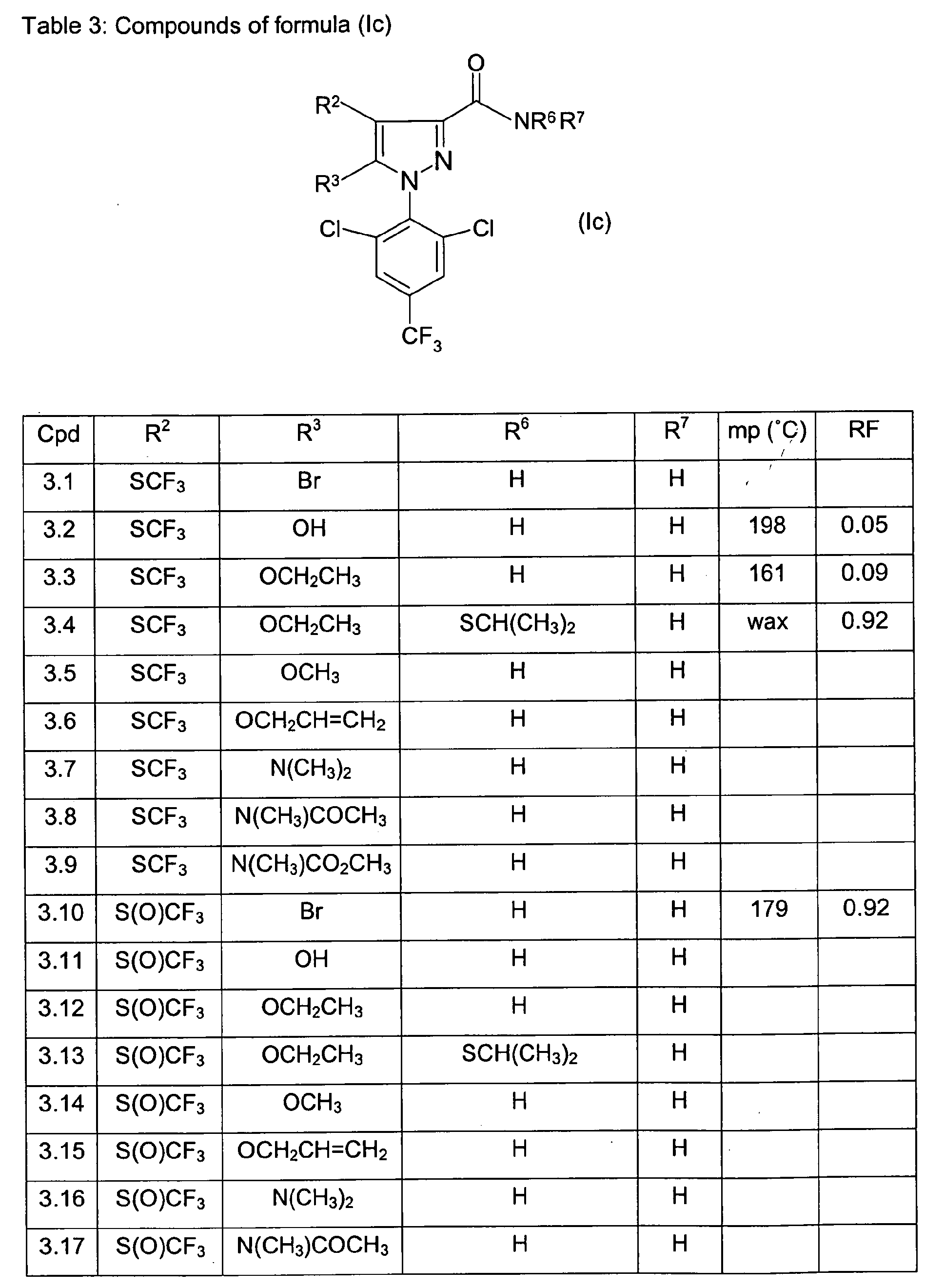
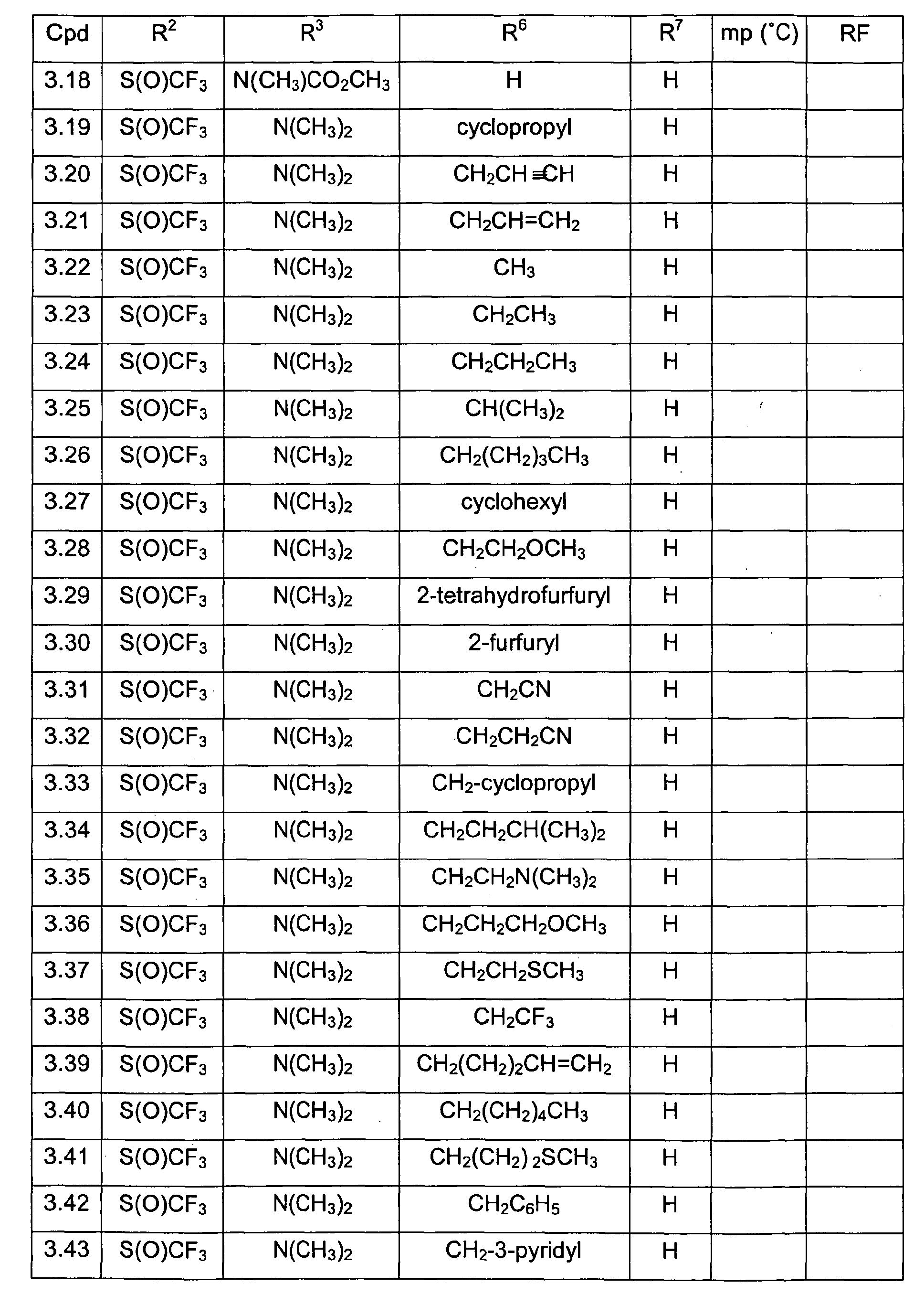
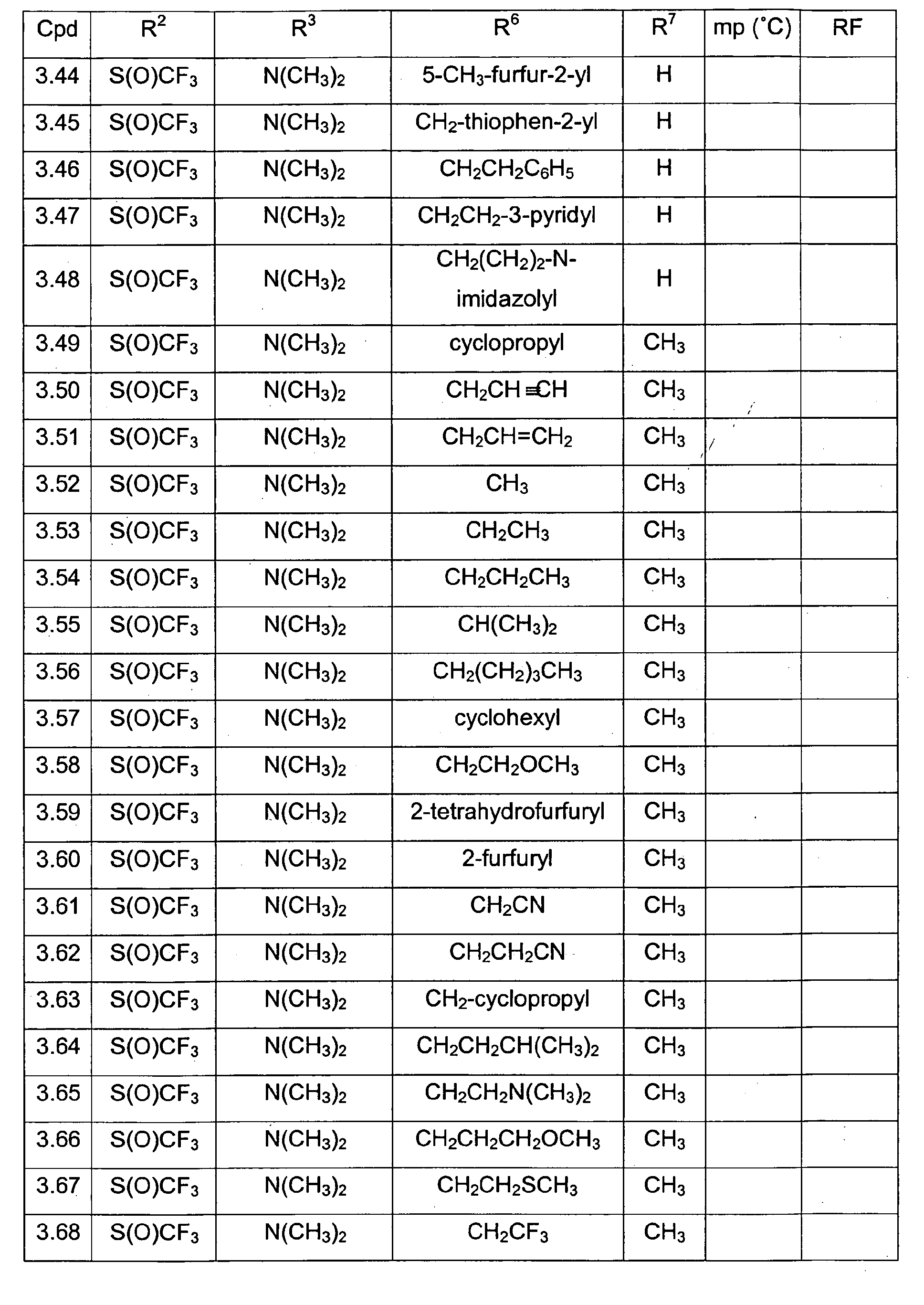

- Another aspect of the invention is a method for plant growth regulation which plants are monocotyledoneous or dicotyledoneous crop plants, preferably selected from the group of economically important field crops such as, for example wheat, barley, rye, triticale, rice, maize, sugar beet, cotton, or soybeans, particularly maize, wheat, and soybean, as well as vegetables and ornamentals, said method comprising applying to said plants, to the seeds from which they grow or to the locus in which they grow, a non-phytotoxic, effective plant growth regulating amount of one or more compounds of formula (I).
- A further aspect of the invention is a method for plant growth regulation, which plants are monocotyledoneous or dicotyledoneous crop plants, preferably selected from the group of economically important field crops such as, for example wheat, barley, rye, triticale, rice, maize, sugar beet, cotton, or soybeans, particularly maize, wheat, and soybean, as well as vegetables and ornamentals, said method comprising applying to said plants, to the seeds from which they grow or to the locus in which they grow, a non-phytotoxic, effective plant growth regulating amount of a compound having the formula (I) in a mixture with carriers and/or surfactants.
- A further aspect of the invention is a method for plant growth regulation, which plants are monocotyledoneous or dicotyledoneous crop plants, preferably selected from the group of economically important field crops such as, for example wheat, barley, rye, triticale, rice, maize, sugar beet, cotton, or soybeans, particularly maize, wheat, and soybean, as well as vegetables and ornamentals ,said method comprising applying to said plants, to the seeds from which they grow or to the locus in which they grow, a non-phytotoxic, effective plant growth regulating amount of a compound having the formula (I) together with a further active compound selected from the group consisting of acaricides, fungicides, herbicides, insecticides, nematicides or plant growth regulating substances not identical to compounds defined by formula (I).
- Another aspect of the invention is a method for growth regulation in plant tissue cultures of monocotyledoneous or dicotyledoneous plants said method comprising applying to plant tissue cultures an appropiate amount of a compound having the formula (I) either alone or together with at least one further active compound selected from the group of plant growth regulators or plant hormones.
- The compounds of formula (I) can preferably be employed as plant growth regulators in crops of useful monocotyledoneous or dicotyledoneous crop plants, preferably selected from the group of economically important field crops such as, for example wheat, barley, rye, triticale, rice, maize, sugar beet, cotton, or soybeans, particularly maize, wheat, and soybean, as well as vegetables and ornamentals that have been rendered thus by means of genetic engineering.
- Traditional ways of generating novel plants which have modified characteristics in comparison with existing plants consist, for example, in traditional breeding methods and the generation of mutants. However, it is also possible to generate novel plants with altered characteristics with the aid of genetic engineering methods (see, for example, EP-A-0221044, EP-A-0131624). For example, several cases have been described of
- genetic engineering modifications of crop plants with the purpose of modifying the starch synthesized in the plants (for example WO 92/11376, WO 92/14827, WO 91/19806),
- transgenic crop plants which are resistant to certain herbicides of the glufosinate type (cf., for example, EP-A-0242236, EP-A-242246) or the glyphosate type (WO 92/00377) or the sulfonylurea type (EP-A-0257993, US-A-5013659),
- transgenic crop plants, for example cotton, which are capable of producing Bacillus thuringiensis toxins (Bt toxins) which make the plants resistant to specific pests (EP-A-0142924, EP-A-0193259),
- transgenic crop plants whose fatty acid spectrum is modified (WO 91/13972).
- A large number of techniques in molecular biology by means of which novel transgenic plants with altered characteristics can be generated are known in principle; see, for example, Sambrook et al., 1989, Molecular Cloning, A Laboratory Manual, 2nd Ed., Cold Spring Harbor Laboratory Press, Cold Spring Harbor, NY; or Winnacker "Gene und Klone" [Genes and Clones], VCH Weinheim 2nd Edition 1996, or Christou, "Trends in Plant Science" 1 (1996) 423-431 ).
- In order to perform such genetic engineering manipulations, nucleic acid molecules may be introduced into plasmids which allow mutagenesis or a sequence change by means of recombination of DNA sequences. It is possible, for example, with the aid of the abovementioned standard methods to perform base exchanges, to remove subsequences or to add natural or synthetic sequences. To connect the DNA fragments to each other, adaptors or linkers may be attached to the fragments.
- For example, plant cells with a reduced activity of a gene product can be generated by expressing at least one corresponding antisense RNA, a sense RNA to achieve a cosuppressory effect or by expressing at least one ribozyme of suitable construction which specifically cleaves transcripts of the abovementioned gene product.
- To this end it is possible to make use of, on the one hand, DNA molecules which encompass the entire coding sequence of a gene product inclusive of any flanking sequences which may be present, on the other hand DNA molecules which only encompass parts of the coding sequence, but these parts must be long enough in order to effect, in the cells, an antisense effect. Use may also be made of DNA sequences which show a high degree of homology to the coding sequences of a gene product, but which are not completely identical.
- When nucleic acid molecules are expressed in plants, the protein which has been synthesized may be located in any desired compartment of the plant cell. However, to achieve localization in a particular compartment, it is possible, for example, to link the coding region with DNA sequences which guarantee localization in a particular compartment. Such sequences are known to the skilled worker (see, for example, Braun et al., EMBO J. 11 (1992), 3219-3227; Wolter et al., Proc. Natl. Acad. Sci. USA 85 (1988), 846-850; Sonnewald et al., Plant J. 1 (1991), 95-106).
- The transgenic plant cells may be regenerated by known techniques to give complete plants. In principle, the transgenic plants can be plants of any desired plant species, that is to say monocotyledonous and also dicotyledonous plants.
- This allows transgenic plants to be obtained which exhibit altered characteristics by means of overexpression, suppression or inhibition of homologous (= natural) genes or gene sequences or by means of expression of heterologous (= foreign) genes or gene sequences.
- The compounds of formula (I) can preferably be employed in transgenic crops which are resistant to herbicides from the group of the sulfonylureas, glufosinate-ammonium or glyphosate-isopropylammonium and analogous active substances or in analogous showing altered phenotypes, like but not limited to features as for content modification, altered flowering time, male or female sterile plants, environmentally resistant plants due to expression or repression of endogenous or exogeneous genes in the transgenic crop.
- The use according to the invention for plant growth regulation also includes the case where the compounds of formula (I) are only formed in the plant or the soil from a precursor ("prodrug") after its application to the plant.
- The compounds of formula (I) can be employed in the conventional preparations as wettable powders, emulsifiable concentrates, sprayable solutions, dusts or granules. The invention therefore also relates to plant growth regulating compositions which comprise compounds of formula (I).
- According to a further feature of the present invention, there is provided a plant growth regulating composition comprising an effective amount of a compound of formula (I) as defined above or an agriculturally acceptable salt thereof, in association with, and preferably homogeneously dispersed in, one or more compatible agriculturally- acceptable diluents or carriers and/or surface active agents [i.e. diluents or carriers and/or surface active agents of the type generally accepted in the art as being suitable for use in herbicidal compositions and which are compatible with compounds of the invention]. The term "homogeneously dispersed" is used to include compositions in which the compounds of formula (I) are dissolved in other components. The term "growth regulating composition" is used in a broad sense to include not only compositions which are ready for use as herbicides but also concentrates which must be diluted before use (including tank mixtures).
- The compounds of formula (I) can be formulated in various ways, depending on the prevailing biological and/or chemico-physical parameters. Examples of possible formulations which are suitable are: wettable powders (WP), water-soluble powders (SP), water-soluble concentrates, emulsifiable concentrates (EC), emulsions (EW) such as oil-in-water and water-in-oil emulsions, sprayable solutions, suspension concentrates (SC), dispersions on an oil or water basis, solutions which are miscible with oil, capsule suspensions (CS), dusts (DP), seed-dressing products, granules for broadcasting and soil application, granules (GR) in the form of microgranules, spray granules, coated granules and adsorption granules, water-dispersible granules (WG), water-soluble granules (SG), ULV formulations, microcapsules and waxes.
- These individual formulation types are known in principle and described, for example, in: Winnacker-Küchler, "Chemische Technologie" [Chemical Technology], Volume 7, C. Hauser Verlag, Munich, 4th Edition 1986; Wade van Valkenburg, "Pesticide Formulations", Marcel Dekker, N.Y., 1973; K. Martens, "Spray Drying Handbook", 3rd Ed. 1979, G. Goodwin Ltd. London.
- The necessary formulation auxiliaries such as inert materials, surfactants, solvents and other additives are also known and described, for example, in: Watkins, "Handbook of Insecticide Dust Diluents and Carriers", 2nd Ed., Darland Books, Caldwell N.J.; H.v. Olphen, "Introduction to Clay Colloid Chemistry", 2nd Ed., J. Wiley & Sons, N.Y.; C. Marsden, "Solvents Guide", 2nd Ed., Interscience, N.Y. 1963; McCutcheon's "Detergents and Emulsifiers Annual", MC Publ. Corp., Ridgewood N.J.; Sisley and Wood, "Encyclopedia of Surface Active Agents", Chem. Publ. Co. Inc., N.Y. 1964; Schönfeldt, "Grenzflächenaktive Äthylenoxidaddukte" [Surface-active ethylene oxide adducts], Wiss. Verlagsgesell., Stuttgart 1976; Winnacker-Küchler, "Chemische Technologie" [Chemical Technology], Volume 7, C. Hauser Verlag, Munich, 4th Ed. 1986.
- Based on these formulations, it is also possible to prepare combinations with pesticidally active substances such as, for example, insecticides, acaricides, herbicides, fungicides, and with safeners, fertilizers and/or growth regulators, for example in the form of a readymix or a tank mix.
- Wettable powders are preparations which are uniformly dispersible in water and which, besides the compounds of formula (I), also comprise ionic and/or nonionic surfactants (wetters, dispersants), for example, polyoxyethylated alkylphenols, polyoxyethylated fatty alcohols, polyoxyethylated fatty amines, fatty alcohol polyglycol ether sulfates, alkanesulfonates or alkylbenzenesulfonates, sodium lignosulfonate, sodium 2,2'-dinaphthylmethane-6,6'-disulfonate, sodium dibutylnaphthalenesulfonate or else sodium oleoylmethyltaurinate, in addition to a diluent or inert substance. To prepare the wettable powders, the compounds of formula (I) are, for example, ground finely in conventional apparatuses such as hammer mills, blower mills and air-jet mills and mixed with the formulation auxiliaries, either concomitantly or thereafter.
- Emulsifiable concentrates are prepared, for example, by dissolving the compounds of formula (I) in an organic solvent, for example butanol, cyclohexanone, dimethylformamide, xylene or else higher-boiling aromatics or hydrocarbons or mixtures of these, with addition of one or more ionic and/or nonionic surfactants (emulsifiers). Emulsifiers which can be used are, for example: calcium salts of alkylarylsulfonic acids, such as calcium dodecylbenzenesulfonate or nonionic emulsifiers, such as fatty acid polyglycol esters, alkylaryl polyglycol ethers, fatty alcohol polyglycol ethers, propylene oxide/ethylene oxide condensates, alkyl polyethers, sorbitan esters such as sorbitan fatty acid esters or polyoxyethylene sorbitan esters such as polyoxyethylene sorbitan fatty acid esters.
- Dusts are obtained by grinding the active substance with finely divided solid substances, for example talc or natural clays, such as kaolin, bentonite or pyrophyllite, or diatomaceous earth.
- Suspension concentrates may be water- or oil-based. They can be prepared, for example, by wet grinding by means of commercially available bead mills, if appropriate with addition of surfactants, as they have already been mentioned above for example in the case of the other formulation types.
- Emulsions, for example oil-in-water emulsions (EW), can be prepared for example by means of stirrers, colloid mills and/or static mixtures using aqueous organic solvents and, if appropriate, surfactants as they have already been mentioned above for example in the case of the other formulation types.
- Granules can be prepared either by spraying the compounds of formula (I) onto adsorptive, granulated inert material or by applying active substance concentrates onto the surface of carriers such as sand, kaolinites or of granulated inert material, by means of binders, for example polyvinyl alcohol, sodium polyacrylate or alternatively mineral oils. Suitable active substances can also be granulated in the manner which is conventional for the production of fertilizer granules, if desired in a mixture with fertilizers.
- Water-dispersible granules are prepared, as a rule, by the customary processes such as spray-drying, fluidized-bed granulation, disk granulation, mixing in highspeed mixers and extrusion without solid inert material. To prepare disk, fluidized-bed, extruder and spray granules, see, for example, processes in "Spray-Drying Handbook" 3rd ed. 1979, G. Goodwin Ltd., London; J.E. Browning, "Agglomeration", Chemical and Engineering 1967, pages 147 et seq.; "Perry's Chemical Engineer's Handbook", 5th Ed., McGraw-Hill, New York 1973, p. 8-57.
- For further details on the formulation of crop protection products, see, for example, G.C. Klingman, "Weed Control as a Science", John Wiley and Sons, Inc., New York, 1961, pages 81-96 and J.D. Freyer, S.A. Evans, "Weed Control Handbook", 5th Ed., Blackwell Scientific Publications, Oxford, 1968, pages 101-103.
- As a rule, the agrochemical preparations comprise 0.1 to 99% by weight, in particular 0.1 to 95% by weight, of compounds of formula (I).
The concentration of compounds of formula (I) in wettable powders is, for example, approximately 10 to 90% by weight, the remainder to 100% by weight being composed of customary formulation components. In the case of emulsifiable concentrates, the concentration of compounds of formula (I) can amount to approximately 1 to 90, preferably 5 to 80% by weight. Formulations in the form of dusts usually comprise 1 to 30% by weight of compounds of formula (I), preferably in most cases 5 to 20% by weight of compounds of formula (I), while sprayable solutions comprise approximately 0.05 to 80, preferably 2 to 50% by weight of compounds of formula (I). In the case of water-dispersible granules, the content of compounds of formula (I) depends partly on whether the compounds of formula (I) are in liquid or solid form and on which granulation auxiliaries, fillers and the like are being used. The water-dispersible granules, for example, comprise between 1 and 95% by weight of active substance, preferably between 10 and 80% by weight. - In addition, the formulations of compounds of formula (I) mentioned comprise, if appropriate, the adhesives, wetters, dispersants, emulsifiers, penetrants, preservatives, antifreeze agents, solvents, fillers, carriers, colorants, antifoams, evaporation inhibitors, pH regulators and viscosity regulators which are conventional in each case.
- Suitable formulations for plant growth regulating compositions are known. A description of suitable formulations which may be used in the method of the invention can be found in international patent publications WO 87/3781, WO 93/6089, and WO 94/21606 as well as in European patent application EP 295117, and US Patent 5,232,940. Formulations or compositions for plant growth regulating uses can be made in a similar way, adapting the ingredients, if necessary, to make them more suitable to the plant or soil to which the application is to be made.
- The compounds of the formula (I) or their salts can be employed as such or in the form of their preparations (formulations) as combinations with other pesticidally active substances, such as, for example, insecticides, acaricides, nematicides, herbicides, fungicides, safeners, fertilizers and/or further growth regulators, for example as a premix or as tank mixes.
- It has been found that, surprisingly, the compounds of formula (I) and most especially compounds 1.1; 1.2; 1.3; 1.4; 1.5; 1.6; 1.7; 1.8; 1.9; 1.10; 1.11; 1.12; 1.13; 1.34; 1.35; 1.36; 1.37; 1.65; 1.96; 1.123; 1.133; 1.134; 1.135; 1.136; 1.137; 1.138; 1.139; 1.140; 1.141; 1.142; 1.143; 1.144; 1.145; 1.166; 1.167; 1.168; 1.169; 1.197; 1.228; 1.255; 1.268; 1.3291.399; 1.400; 1.461; 1.532; 1.664; 1.796; 2.1; 2.10; 2.11; 3.2; 3.3; 3.4; and 3.10 display a significant role concerning plant growth properties, which can be different due to an application at various crops. For example example, compound 1.136 show significant effects of approximately the same size by being used as plant growth regulator in maize and wheat but at different concentration. Compound 1.141 shows a remarkable effect as plant growth regulator in maize and a superior effect in wheat.
- By virtue of the practice of the present invention a wide variety of plant growth responses, including the following (non-ranked listing), may be induced:
- a) more developed root system
- b) tillering increase
- c) increase in plant height
- d) bigger leaf blade
- e) less dead basal leaves
- f) stronger tillers
- g) greener leaf color
- h) less fertilizers needed
- i) less seeds needed
- j) more productive tillers
- k) less third non-productive tillers
- l) earlier flowering
- m) early grain maturity
- n) less plant verse (lodging)
- o) longer panicles
- p) increased shoot growth
- q) improved plant vigour
- r) early germination
- s) more fruit and better yield
-
- It is intended that as used in the instant specification the term "method for plant growth regulation" or "method for plant growth regulation" means the achievement of any of the aforementioned nineteen categories of response or any other modification of plant, seed, fruit or vegetable (whether the fruit or vegetable is nor harvested or harvested) so long as the net result is to increase growth or benefit any property of the plant, seed, fruit or vegetable as distinguished from any pesticidal action (unless the present invention is practised in conjunction with or in the presence of a pesticide, for example a herbicide). The term "fruit" as used in the instant specification is to be understood as meaning anything of economic value that is produced by the plant.Preferably, at least an increase of 10% of one or more of the respective plant growth response is obtained.
- The 5-substituted-1-arylpyrazole-3-carboxylic acid derivative of formula (I) may be applied for plant growth regulating purposes to the foliage of plants and/or to the soil in which said plants are growing. Applications to the soil are often in the form of granules which are usually applied in sufficient amount to provide a rate of from about 0.001 kg/ha to about 0.5 kg/ha of active ingredient, preferably between 0.01 and 0.1 kg/ha.
- A preferred embodiment of the invention is a method for plant growth regulation comprising applying to the seeds from which said plants grow, prior to said seeds, a non-phytotoxic, effective plant growth regulating amount of a compound having the formula (I). The seed may be treated, especially by coating or embedding or impregnation or soaking or dipping in liquid or paste formulations which are known per se and are subsequently dried. Seed comprising 1 to 1000 gram per 100 kg of a compound of formula (I), preferably 1 to 800 g per 100 kg, most preferably 1 to 250 g per 100 kg are particularly appropriate for this purpose.
- The precise amount of 5-substituted-1-arylpyrazole-3-carboxylic acid derivative of formula (I) to be used will depend, inter alia, upon the particular plant species being treated. A suitable dose may be determined by the man skilled in the art by routine experimentation. The plant response will depend upon the total amount of compound used, as well as the particular plant species which is being treated. Of course, the amount of 5-substituted-1-arylpyrazole-3-carboxylic acid derivative of formula (I) should be non-phytotoxic with respect to the plant being treated.
- Although the preferred method of application of the compounds used in the process of this invention is directly to the foliage and stems of plants, the compounds can be applied to the soil in which the plants are growing.
- The following examples are illustrative of methods of plant growth regulation according to the invention, but should not be understood as limiting the invention as modifications in materials and methods will be apparent to the skilled worker. All measurements of plant growth regulating effects were determined either by using a protoplast screening assay and/or by using a root growth assay and/or by applying the compounds pre-selected the before defined assay system under natural growth conditions in field trials. In all cases, untreated protoplasts, plants or plants parts , or seeds were taken as a control.
- The present invention features a so called high throughput assay for a rapid screening of chemical compounds that modulate cell growth. The assay in general involves: a) plant protoplasts grown in liquid medium, b) a library of chemical compounds, and c) screening the protoplasts to identify the compounds which affect significantly the cell growth and development.
- Preferably the protoplasts were prepared from cell suspensions derived from maize callus. The protoplasts were obtained by enzymatic digestion of the cell aggregates in the suspension. The cells were digested for 3-6 hours at room temperature in a cellulase-pectolyase mix, Protoplasts were released by gentle shaking, filtered through a 45 µm mesh and collected by centrifugation. After digestion, the protoplasts were washed several times to remove cell debris and enzyme residues and then re-suspended in culture medium. The protoplasts were plated in 50 - 100 µl aliquots in microtiter wells at a density ranging from 100.000 - 2,000.000 protoplasts per ml, preferably at a concentration of 800.000 protoplasts/ml.
- To identify chemical compounds that modulate the cell growth, maize protoplasts were incubated with a library of chemical compounds in 96-well microtiter plates. Following the incubation at 25°C for 1-14 days, preferably 7-10 days, the protein content was measured by Coomassie dye based colorimetric assays. The growth of the cells treated with the chemical compounds involved in the test was detected by comparison with untreated protoplasts.
Treatment with a section of compounds derived from formula (I) show an increase of more than 50% over the untreated control. - Plant roots are a highly proliferative tissue that allows an easy accessible, cheap and short term screening method for plant growth regulators. The results obtained can easily be transferred to the overall effects on a plant of plant growth regulators identified by such a system. By using this root assay one is enabled to determine the effect of a seed treatment to root growth and/ or germination and/ or changes in habitat of germinated plants in order to identify the possible use as a yield enhancer. Two seeds of wheat (Triticum aestivum, variety "TRISO") or 1 seed of maize (Zea mays, variety "LORENZO") per hole in a plastic tray which contains an architecture of 8 x 13 holes were placed on compost soil covered with sand. These seeds were treated with 100 µl/ hole, which creates an application volume of approx. 1200 l/ ha, of a compound solution at active ingredient rates equivalent to 100, 10 and 1 g a.i./ ha of each compound using an robotic application system (Lizzy Spray Robotics). Six replicates in a row of each compound and concentration were done. The outer rim of the above defined plastic tray was untreated to avoid false negative effects and the middle row (No. 7) was used as untreated control. The treated seeds were allowed to dry for approx. 4 hours and subsequently covered with sand and watered. The trays were stored in climate chambers with 14 hours lighting at a temperature of 24° C (± 2) at daytime and 16° C (± 2) at night and relative humidity (rH) of 60% and daily watered. Assessments were done 16 (± 2) days post treatment by counting the germinated plants and assessing the phytotoxicity symptoms and percentage. In addition, the roots were washed out and the shoots were cut directly above the seed and the wet roots were placed on dry paper towels for approximately 30 minutes and weighted afterwards. This procedure provides a similar grade of moisture to the roots so that a comparison of the weights is possible.
- Table 4 shows the results of some of the compounds (Cpd) claimed to be effective in plant growth regulation concerning maize. The effects observed concerning Root Growth given in column 2 (Root Growth of "100" is set as the standard) are directed to concentrations that are equivalent to 100, 10, 1 g a.i./ha, each.
Cpd Maize (concentration g a.i./ha) 100 10 1 1.136 74 131 107 1.141 95 102 111 1.228 186 111 72 - Table 5 shows the results of some of the compounds (Cpd) claimed to be effective in plant growth regulation concerning wheat. The effects observed concerning Root Growth given in column 2 (Root Growth of "100" is set as the standard) are directed to concentrations that are equivalent to 100, 10, 1 g a.i./ha, each.
Cpd Wheat (concentration g a.i./ha) 100 10 1 1.136 58 75 124 1.144 110 115 170 1.141 256 160 257 2.10 134 118 158 - Maize seeds of maize hybrid Magister and Zamora were seed treated with compound 1.136 at 1g/100kg seeds (0.0003kg/ha).
Field trials were set up in a split plot design representing the plants treated with compounds of formula (I) as well as the non-treated control plants. Results showed an increase in grain yield of up to 119% in case of the hybrid Magister and of up to 131% in case of the hybrid Zamora compared to the yield obtained with non-treated control plants in each case.
Claims (13)
- Use of a compound of formula (I) or an agriculturally acceptable salt thereof for plant growth regulationwherein:
 R1 is CONR6R7 or CO2R8;W is C-halogen or N;R2 is H or S(O)mR9;R3 is NR10R11, halogen, OH, (C1-C6)-alkoxy, (C2-C6)-alkenyloxy or (C2-C6)-alkynyloxy;R4 is H, or halogen;R5 is (C1-C4)-haloalkyl or (C1-C4)-haloalkoxy;R6 is H, (C1-C6)-alkyl, (C1-C6)-haloalkyl, (C1-C6)-alkoxy-(C1-C6)-alkyl, (C2-C6)-alkenyl, (C2-C6)-haloalkenyl, (C2-C6)-alkynyl, (C2-C6)-haloalkynyl, (C3-C7)-cycloalkyl, (C3-C7)-cycloalkyl-(C1-C6)-alkyl, (C1-C6)-alkoxy, (C1-C6)-alkylthio, (CH2)nR12, (CH2)pR13, (C1-C6)-alkyl-CN, (C1-C6)-alkyl-NR10R11 or (C1-C6)-alkyl- S(O)rR9;R7 is H, (C1-C6)-alkyl, (C3-C6)-alkenyl or (C3-C6)-alkynyl; orR6 and R7 together with the attached N atom form a five- or six-membered saturated ring which optionally contains an additional hetero atom in the ring which is selected from O, S and N, the ring being unsubstituted or substituted by one or more radicals selected from the group consisting of halogen, (C1-C6)-alkyl and (C1-C6)-haloalkyl;R8 is H, (C1-C6)-alkyl, (C1-C6)-haloalkyl, (C2-C6)-alkenyl, (C2-C6)-alkynyl or (CH2)nR12;R9 is (C1-C6)-alkyl or (C1-C6)-haloalkyl;R10 and R11 are each independently H, (C1-C6)-alkyl, (C1-C6)-haloalkyl, (C2-C6)-alkenyl, (C2-C6)-haloalkenyl, (C2-C6)-alkynyl, (C3-C6)-cycloalkyl,(C3-C6)-cycloalkyl-(C1-C6)-alkyl, COR14 or CO2R15; orR10 and R11 together with the attached N atom form a five- or six-membered saturated ring which optionally contains an additional hetero atom in the ring which is selected from O, S and N, the ring being unsubstituted or substituted by one or more radicals selected from the group consisting of halogen, (C1-C6)-alkyl and (C1-C6)-haloalkyl;R12 is phenyl unsubstituted or substituted by one or more radicals selected from the group consisting of halogen, (C1-C6)-alkyl, (C1-C6)-haloalkyl, (C1-C6)-alkoxy, (C1-C6)-haloalkoxy, CO2R16, CN, NO2, S(O)qR9, COR16, CONR16R17, NR16R17 and OH;R13 is heterocyclyl unsubstituted or substituted by one or more radicals selected from the group consisting of halogen, (C1-C4)-alkyl, (C1-C4)-haloalkyl, (C1-C4)-alkoxy, (C1-C4)-haloalkoxy, NO2, CN, CO2R16, S(O)qR9, OH and oxo; R14 and R15 are each independently H, (C1-C6)-alkyl, (C1-C6)-haloalkyl, (C2-C6)-alkenyl, (C2-C6)-haloalkenyl, (C2-C6)-alkynyl or (C1-C6)-alkoxy-(C1-C4)-alkyl;R16 and R17 are each independently H, (C1-C6)-alkyl or (C1-C6)-haloalkyl;m, q and r are each independently 0, 1 or 2;n and p are each independently 0, 1, 2, 3 or 4; andeach heterocyclyl in the above-mentioned radicals is independently a heterocyclic radical having 3 to 7 ring atoms and 1, 2 or 3 heteroatoms in the ring selected from the group consisting of N, O and S.
 - The use of a compound as defined in claim 1, in which in whichR1 is CONR6R7;W is C-Cl or C-BrR2 is S(O)mR9;R3 is NR10R11, halogen, OH, (C1-C3)-alkoxy, (C2-C6)-alkenyloxy or (C2-C6)-alkynyloxy;R4 is Cl or Br;R5 is CF3 or OCF3;R6 is H, (C1-C4)-alkyl, (C1-C4)-haloalkyl, (C1-C3)-alkoxy-(C1-C3)-alkyl, (C3-C4)-alkenyl, (C3-C4)-haloalkenyl, (C3-C4)-alkynyl, (C3-C4)-haloalkynyl, (C3-C6)-cycloalkyl, (C3-C6)-cycloalkyl-(C1-C3)-alkyl, (C1-C3)-alkoxy, (C1-C3)-alkylthio, (CH2)nR12 or (CH2)pR13;R7 is H, (C1-C4)-alkyl, (C3-C4)-alkenyl or (C3-C4)-alkynyl; orpreferably R6 and R7 together with the attached N atom form a five- or six-membered saturated ring which optionally contains an additional hetero atom in the ring which is selected from O, S and N, the ring being unsubstituted or substituted by one or more radicals selected from the group consisting of halogen, (C1-C3)-alkyl and (C1-C3)-haloalkyl;R9 is (C1-C3)-alkyl or (C1-C3)-haloalkyl (more preferably R9 is CF3);R10 and R11 are each independently H, (C1-C3)-alkyl, (C1-C3)-haloalkyl, (C3-C4)-alkenyl, (C3-C4)-haloalkenyl, (C3-C4)-alkynyl, (C3-C6)-cycloalkyl, (C3-C6)-cycloalkyl-(C1-C3)-alkyl, COR14 or CO2R15; orR10 and R11 together with the attached N atom form a five- or six-membered saturated ring which optionally contains an additional hetero atom in the ring which is selected from O, S and N, the ring being unsubstituted or substituted by one or more radicals selected from the group consisting of halogen, (C1-C3)-alkyl and (C1-C3)-haloalkyl;R12 is phenyl unsubstituted or substituted by one or more radicals selected from the group consisting of halogen, (C1-C3)-alkyl, (C1-C3)-haloalkyl, (C1-C3)-alkoxy, (C1-C3)-haloalkoxy, CO2R16, CN, NO2, S(O)qR9, COR16, CONR16R17, NR16R17 and OH;R13 is heterocyclyl unsubstituted or substituted by one or more radicals selected from the group consisting of halogen, (C1-C3)-alkyl, (C1-C3)-haloalkyl, (C1-C3)-alkoxy, (C1-C3)-haloalkoxy, NO2, CN, CO2R16, S(O)qR9, OH and oxo;R14 and R15 are each independently H, (C1-C3)-alkyl, (C1-C3)-haloalkyl, (C2-C3)-alkenyl, (C2-C3)-haloalkenyl, (C2-C3)-alkynyl or (C1-C6)-alkoxy-(C1-C4)-alkyl;R16 and R17 are each independently H, (C1-C3)-alkyl or (C1-C3)-haloalkyl; and each heterocyclyl in the above-mentioned radicals is independently a heterocyclic radical having 3 to 6 ring atoms and 1, 2 or 3 hetero atoms in the ring selected from the group consisting of N, O and S.
- The use of a compound as defined in claim1, in whichR1 is CONR6R7;W is C-Cl;R2 is H, or S(O)mR9;R3 is NR10R11, halogen, OH or (C1-C3)-alkoxy;R4 is Cl;R5 is CF3;R6 is H, (C1-C4)-alkyl, (C1-C3)-alkoxy-(C1-C2)-alkyl, (C3-C4)-alkenyl, (C3-C4)-alkynyl, (C3-C6)-cycloalkyl, (C3-C6)-cycloalkyl-(C1-C2)-alkyl, (C1-C3)-alkoxy, (C1-C3)-alkylthio, (CH2)nR12 or (CH2)pR13;R7 is H, (C1-C3)-alkyl, (C3-C4)-alkenyl or (C3-C4)-alkynyl;R9 is methyl, ethyl or CF3;R10 and R11 are each independently H, (C1-C3)-alkyl, (C1-C3)-haloalkyl, (C3-C4)-alkenyl, (C3-C4)-haloalkenyl, (C3-C4)-alkynyl, (C3-C6)-cycloalkyl, (C3-C6)-cycloalkyl-(C1-C3)-alkyl, COR14 or CO2R15; orR12 is phenyl unsubstituted or substituted by one or more radicals selected from the group consisting of halogen, (C1-C3)-alkyl, (C1-C3)-haloalkyl, (C1-C3)-alkoxy, CO2R16, CN and NO2;R13 is heterocyclyl unsubstituted or substituted by one or more radicals selected from the group consisting of halogen, (C1-C3)-alkyl, (C1-C3)-haloalkyl, (C1-C3)-alkoxy, (C1-C3)-haloalkoxy, NO2, CN, CO2R16, S(O)qR9, OH and oxo; R14 and R15 are each independently (C1-C3)-alkyl;R16 and R17 are each independently H or (C1-C3)-alkyl; andeach heterocyclyl in the above-mentioned radicals is independently a heterocyclic radical having 3 to 6 ring atoms and 1, 2 or 3 hetero atoms in the ring selected from the group consisting of N, O and S.
- The use of a compound as defined in claim 1, in whichR1 is CONR6R7;W is C-CI;R2 is H, or S(O)mR9;R3 is NHR10;R4 is Cl;R5 is CF3;R6 is H, (C1-C5)-alkyl, (C1-C2)-alkoxy-(C1-C2)-alkyl, (C3-C4)-alkenyl, (C3-C4)-alkynyl, (C3-C6)-cycloalkyl, (C3-C6)-cycloalkyl-(C1-C2)-alkyl, furfuryl or tetrahydrofurfuryl;R7 is H or (C1-C3)-alkyl;R9 is methyl, ethyl or CF3; andR10 is H, methyl or ethyl.
- The use of a compound as defined in claim 1, in whichR1 is CO2R8;W is C-Cl;R2 is H, or S(O)mR9;R3 is NR10R11;R4 is CI;R5 is CF3;R8 is H, methyl or ethyl;R9 is methyl, ethyl or CF3;R10 is H, methyl or ethyl; andR11 is H.
- The use of a compound as defined in claim 1, in whichR1 is CONR6R7;W is C-CI;R2 is S(O)mCF3;R3 is NR10R11, halogen, OH or (C1-C2)-alkyl;R4 is Cl;R5 is CF3;R6 is H or (C1-C3)-alkylthio;R7 is H;R10 is (C1-C3)-alkyl, COR14 or CO2R15;R11, R14 and R15 are each independently (C1-C3)-alkyl.
- A composition for plant growth regulation, which comprises on or more compounds of formula (I) as defined in anyone of claims 1 to 6 or an agriculturally acceptable salt thereof, carriers and/or surfactants useful for plant protection formulations.
- The composition as claimed in claim 7 , which comprises a further active compound selected from the group consisting of acaricides, fungicides, herbicides, insecticides, nematicides or plant growth regulating substances not identical to compounds defined by formula (I) of claim 1.
- The use of a composition as claimed in anyone of claims 7 to 8 for plant growth regulation, in which the plant is a monocotyledoneous or dicotyledoneous crop plant.
- The use as claimed in claim 9, wherein the plant is selected from the group consisting of wheat, barley, rye, triticale, rice, maize, sugar beet, cotton, or soybeans.
- A method for growth regulation in field crop plants, which comprises applying an effective amount of a compound of formula (I) as defined in claims 1 to 6 to the site where the action is desired said method comprising applying to plants, to seeds from which they grow or to the locus in which they grow, a non-phytotoxic, effective plant growth regulating amount of one or more compounds of formula (I).
- A method as claimed in claim 11 that results into a yield increase of at least 10% concerning the plants to which it is applied.
- A compound as defined by formula (I), or a salt thereof,wherein:
 with the exclusion of the compound wherein:i. R1 is CO2R8;
R2 is H or S(O)mR9;
R3, R4, R5, W and m are as defined in claim 1;
R8 is H; and
R9 is (C2-C6)-alkyl or (C1-C6)-haloalkyl;
orii. R1 is CONR6R7;
R6 is (C1-C6)-alkyl, (C1-C6)-haloalkyl, (C1-C6)-alkoxy-(C1-C6)-alkyl, (C2-C6)-alkenyl, (C2-C6)-haloalkenyl, (C2-C6)-alkynyl, (C2-C6)-haloalkynyl, (C3-C7)-cycloalkyl, (c3-C7)-cycloalkyl-(C1-C6)-alkyl, (C1-C6)-alkoxy, (C1-C6)-alkylthio, (CH2)nR12, (CH2)pR13, (C1-C6)-alkyl-CN, (C1-C6)-alkyl-NR10R11 or (C1-C6)-alkyl- S(O)rR9; or
R6 and R7 together with the attached N atom form a five- or six-membered saturated ring which optionally contains an additional hetero atom in the ring which is selected from O, S and N, the ring being unsubstituted or substituted by one or more radicals selected from the group consisting of halogen, (C1-C6)-alkyl and (C1-C6)-haloalkyl; and
R2, R3, R4, R5, R7, R9, R10, R11, R12, R13, W, n, p and r are as defined in formula (I);R1 is CON(CH3)2; R2 is CF3S; R3 is OH; R4 is CI; R5 is CF3; and W is C-CI.
Priority Applications (19)
| Application Number | Priority Date | Filing Date | Title |
|---|---|---|---|
| EP03029847A EP1550370A1 (en) | 2003-12-24 | 2003-12-24 | Plant growth regulation |
| US10/584,489 US7569516B2 (en) | 2003-12-24 | 2004-12-15 | Plant growth regulation |
| JP2006545993A JP2007516990A (en) | 2003-12-24 | 2004-12-15 | Plant growth regulation |
| UAA200608331A UA84730C2 (en) | 2003-12-24 | 2004-12-15 | Using 5-substituted-1-arylpyrazole-3-carboxylic acid derivative as plant growth regulators, composition based thereon and method to regulate growth of farm plants |
| DE602004022985T DE602004022985D1 (en) | 2003-12-24 | 2004-12-15 | REGULATION OF PLANT GROWTH |
| BRPI0418192-1A BRPI0418192A (en) | 2003-12-24 | 2004-12-15 | plant growth regulation |
| PCT/EP2004/014272 WO2005063020A1 (en) | 2003-12-24 | 2004-12-15 | Plant growth regulation |
| KR1020067012633A KR20060115904A (en) | 2003-12-24 | 2004-12-15 | Plant growth regulation |
| CNA2004800387269A CN1897813A (en) | 2003-12-24 | 2004-12-15 | Plant growth regulation |
| AU2004308080A AU2004308080B2 (en) | 2003-12-24 | 2004-12-15 | Plant growth regulation |
| AT04803892T ATE441326T1 (en) | 2003-12-24 | 2004-12-15 | REGULATION OF PLANT GROWTH |
| CA002550894A CA2550894A1 (en) | 2003-12-24 | 2004-12-15 | Plant growth regulation |
| EA200601165A EA012629B1 (en) | 2003-12-24 | 2004-12-15 | Plant growth regulation |
| EP04803892A EP1699291B1 (en) | 2003-12-24 | 2004-12-15 | Plant growth regulation |
| PL04803892T PL1699291T3 (en) | 2003-12-24 | 2004-12-15 | Plant growth regulation |
| ES04803892T ES2329906T3 (en) | 2003-12-24 | 2004-12-15 | REGULATION OF GROWTH OF PLANTS. |
| ARP040104863A AR047344A1 (en) | 2003-12-24 | 2004-12-22 | PLANT GROWTH REGULATION |
| IL176104A IL176104A0 (en) | 2003-12-24 | 2006-06-04 | Plant growth regulation |
| CR8477A CR8477A (en) | 2003-12-24 | 2006-06-22 | PLANT GROWTH REGULATION |
Applications Claiming Priority (1)
| Application Number | Priority Date | Filing Date | Title |
|---|---|---|---|
| EP03029847A EP1550370A1 (en) | 2003-12-24 | 2003-12-24 | Plant growth regulation |
Publications (1)
| Publication Number | Publication Date |
|---|---|
| EP1550370A1 true EP1550370A1 (en) | 2005-07-06 |
Family
ID=34560169
Family Applications (1)
| Application Number | Title | Priority Date | Filing Date |
|---|---|---|---|
| EP03029847A Withdrawn EP1550370A1 (en) | 2003-12-24 | 2003-12-24 | Plant growth regulation |
Country Status (3)
| Country | Link |
|---|---|
| EP (1) | EP1550370A1 (en) |
| CN (1) | CN1897813A (en) |
| UA (1) | UA84730C2 (en) |
Cited By (1)
| Publication number | Priority date | Publication date | Assignee | Title |
|---|---|---|---|---|
| WO2008059054A3 (en) * | 2006-11-17 | 2008-10-09 | Basf Se | Method for increasing the dry biomass of plants |
Families Citing this family (1)
| Publication number | Priority date | Publication date | Assignee | Title |
|---|---|---|---|---|
| CN119264054B (en) * | 2024-09-10 | 2025-04-01 | 安徽中医药大学 | A pyrazole carboxylic acid bornyl ester compound and its preparation method and application |
Citations (5)
| Publication number | Priority date | Publication date | Assignee | Title |
|---|---|---|---|---|
| GB1444678A (en) * | 1973-04-17 | 1976-08-04 | Maruko Pharmaceutical Co | Pyrazoles and process for their preparation |
| US4787930A (en) * | 1986-02-04 | 1988-11-29 | Bayer Aktiengesellschaft | 5-amino-1-phenyl-pyrazole herbicides and plant growth regulators |
| US5707934A (en) * | 1995-04-28 | 1998-01-13 | Rhone-Poulenc Inc. | Plant growth regulation using 3-cyano-1-phenylpyrazoles such as fipronil |
| JP2000103784A (en) * | 1998-09-30 | 2000-04-11 | Mitsubishi Chemicals Corp | 5-Alkoxypyrazole-3-carboxamide derivatives and pesticides containing the same as an active ingredient |
| JP2002265452A (en) * | 2001-03-06 | 2002-09-18 | Mitsubishi Chemicals Corp | 5-halogeno or 5-aminopyrazole-3-carboxamide derivatives, intermediates thereof and pesticides containing the same as an active ingredient |
-
2003
- 2003-12-24 EP EP03029847A patent/EP1550370A1/en not_active Withdrawn
-
2004
- 2004-12-15 CN CNA2004800387269A patent/CN1897813A/en active Pending
- 2004-12-15 UA UAA200608331A patent/UA84730C2/en unknown
Patent Citations (5)
| Publication number | Priority date | Publication date | Assignee | Title |
|---|---|---|---|---|
| GB1444678A (en) * | 1973-04-17 | 1976-08-04 | Maruko Pharmaceutical Co | Pyrazoles and process for their preparation |
| US4787930A (en) * | 1986-02-04 | 1988-11-29 | Bayer Aktiengesellschaft | 5-amino-1-phenyl-pyrazole herbicides and plant growth regulators |
| US5707934A (en) * | 1995-04-28 | 1998-01-13 | Rhone-Poulenc Inc. | Plant growth regulation using 3-cyano-1-phenylpyrazoles such as fipronil |
| JP2000103784A (en) * | 1998-09-30 | 2000-04-11 | Mitsubishi Chemicals Corp | 5-Alkoxypyrazole-3-carboxamide derivatives and pesticides containing the same as an active ingredient |
| JP2002265452A (en) * | 2001-03-06 | 2002-09-18 | Mitsubishi Chemicals Corp | 5-halogeno or 5-aminopyrazole-3-carboxamide derivatives, intermediates thereof and pesticides containing the same as an active ingredient |
Non-Patent Citations (2)
| Title |
|---|
| PATENT ABSTRACTS OF JAPAN vol. 2000, no. 07 29 September 2000 (2000-09-29) * |
| PATENT ABSTRACTS OF JAPAN vol. 2003, no. 01 14 January 2003 (2003-01-14) * |
Cited By (1)
| Publication number | Priority date | Publication date | Assignee | Title |
|---|---|---|---|---|
| WO2008059054A3 (en) * | 2006-11-17 | 2008-10-09 | Basf Se | Method for increasing the dry biomass of plants |
Also Published As
| Publication number | Publication date |
|---|---|
| CN1897813A (en) | 2007-01-17 |
| UA84730C2 (en) | 2008-11-25 |
Similar Documents
| Publication | Publication Date | Title |
|---|---|---|
| JP6932125B2 (en) | Acylated N- (1,2,5-oxadiazole-3-yl)-, N- (1,3,4-oxadiazole-2-yl)-, N- (tetrazole-5-yl)- And N- (triazole-5-yl) -arylcarboxamide, and their use as a herbicide | |
| UA127418C2 (en) | HERBICIDELY ACTIVE 3-PHENYLISOXAZOLINE-5-CARBOXAMIDE DERIVATIVES OF CYCLOPENTYLCARBONIC ACID | |
| CN104487426B (en) | N-(tetrazol-5-yl) and N-(triazole-5-yl)aryl carboxylic acid thioamides and their use as herbicides | |
| KR20230156760A (en) | Chiral N-(1,3,4-oxadiazol-2-yl)phenyl carboxylic acid amide and its use as herbicide | |
| HUE024562T2 (en) | N-(1,2,5-oxadiazol-3-yl)-, n-(tetrazol-5-yl)- and n-(triazol-5-yl)bicycloarylcarboxamides and their use as herbicides | |
| AU2005239811B2 (en) | Plant growth regulation | |
| CN104271563A (en) | N-(tetrazol-5-yl)- and n-(triazol-5-yl)arylcarboxamide salts and use thereof as herbicides | |
| CN107249329A (en) | New isothiazole acid amides, its preparation method and its purposes as herbicide and/or plant growth regulator | |
| CN106470979A (en) | The aryl carboxylic acid amides of activity of weeding | |
| CN106536487A (en) | 5-(hetero)aryl-pyridazinones and their use as herbicides | |
| CN107922395B (en) | Herbicidal N- (tetrazol-5-yl) -and N- (triazol-5-yl) arylcarboxamide derivatives | |
| EP1746889A1 (en) | Plant growth regulation | |
| CN105745199A (en) | Pyridazinone derivatives and their use as herbicides | |
| US20160326135A1 (en) | 2-hetaryl-pyridazinone derivatives and their use as herbicides | |
| ES2329906T3 (en) | REGULATION OF GROWTH OF PLANTS. | |
| KR20060123386A (en) | Plant growth regulation | |
| CN110903279A (en) | Pyrazole compound and salt and application thereof | |
| CN110845478B (en) | Preparation and use of pyrazole formyloxime derivatives containing 1-substituted pyridyl-3-trifluoromethylpyrazole units | |
| EP1550372A1 (en) | Plant growth regulation | |
| US10806142B2 (en) | 2-amino-5-ketoxime-pyrimidine derivatives and their use for controlling undesired plant growth | |
| JP6839174B2 (en) | Substituted ketooxime benzoylamides | |
| TW444009B (en) | 1-Methyl-5-alkylsulfonyl-, 1-methyl-5-alkylsulfinyl- and 1-methyl-5-alkylthio-substituted pyrazolylpyrazoles, processes for their preparation and their use as herbicides | |
| EP3475273B1 (en) | 3-amino pyrimidine derivatives and use thereof for combating undesired plant growth | |
| CN109195974A (en) | Isothiazolopyridone, process for its preparation and use as herbicide and/or plant growth regulator | |
| MXPA06007384A (en) | Plant growth regulation |
Legal Events
| Date | Code | Title | Description |
|---|---|---|---|
| PUAI | Public reference made under article 153(3) epc to a published international application that has entered the european phase |
Free format text: ORIGINAL CODE: 0009012 |
|
| AK | Designated contracting states |
Kind code of ref document: A1 Designated state(s): AT BE BG CH CY CZ DE DK EE ES FI FR GB GR HU IE IT LI LU MC NL PT RO SE SI SK TR |
|
| AX | Request for extension of the european patent |
Extension state: AL LT LV MK |
|
| STAA | Information on the status of an ep patent application or granted ep patent |
Free format text: STATUS: THE APPLICATION HAS BEEN WITHDRAWN |
|
| 18W | Application withdrawn |
Effective date: 20051213 |