EP1548959A2 - Method for controlling data transmission rate in interactive satellite communication system - Google Patents
Method for controlling data transmission rate in interactive satellite communication system Download PDFInfo
- Publication number
- EP1548959A2 EP1548959A2 EP04254767A EP04254767A EP1548959A2 EP 1548959 A2 EP1548959 A2 EP 1548959A2 EP 04254767 A EP04254767 A EP 04254767A EP 04254767 A EP04254767 A EP 04254767A EP 1548959 A2 EP1548959 A2 EP 1548959A2
- Authority
- EP
- European Patent Office
- Prior art keywords
- mobile terminal
- nlos
- region
- resources
- nlos region
- Prior art date
- Legal status (The legal status is an assumption and is not a legal conclusion. Google has not performed a legal analysis and makes no representation as to the accuracy of the status listed.)
- Granted
Links
- 238000000034 method Methods 0.000 title claims abstract description 29
- 238000004891 communication Methods 0.000 title claims abstract description 28
- 230000005540 biological transmission Effects 0.000 title claims abstract description 26
- 230000002452 interceptive effect Effects 0.000 title claims abstract description 21
- 239000002699 waste material Substances 0.000 abstract description 6
- 230000007423 decrease Effects 0.000 description 3
- 230000003247 decreasing effect Effects 0.000 description 3
- 238000013468 resource allocation Methods 0.000 description 3
- 230000003044 adaptive effect Effects 0.000 description 2
- 238000010586 diagram Methods 0.000 description 2
- 230000000694 effects Effects 0.000 description 2
- 230000001360 synchronised effect Effects 0.000 description 2
- 230000003111 delayed effect Effects 0.000 description 1
- 238000005562 fading Methods 0.000 description 1
- 238000010295 mobile communication Methods 0.000 description 1
- 238000012986 modification Methods 0.000 description 1
- 230000004048 modification Effects 0.000 description 1
- 238000013488 ordinary least square regression Methods 0.000 description 1
- 230000002265 prevention Effects 0.000 description 1
Images


Classifications
-
- H—ELECTRICITY
- H04—ELECTRIC COMMUNICATION TECHNIQUE
- H04W—WIRELESS COMMUNICATION NETWORKS
- H04W28/00—Network traffic management; Network resource management
- H04W28/16—Central resource management; Negotiation of resources or communication parameters, e.g. negotiating bandwidth or QoS [Quality of Service]
- H04W28/18—Negotiating wireless communication parameters
- H04W28/22—Negotiating communication rate
-
- H—ELECTRICITY
- H04—ELECTRIC COMMUNICATION TECHNIQUE
- H04B—TRANSMISSION
- H04B7/00—Radio transmission systems, i.e. using radiation field
- H04B7/14—Relay systems
- H04B7/15—Active relay systems
- H04B7/185—Space-based or airborne stations; Stations for satellite systems
- H04B7/1853—Satellite systems for providing telephony service to a mobile station, i.e. mobile satellite service
- H04B7/18532—Arrangements for managing transmission, i.e. for transporting data or a signalling message
-
- H—ELECTRICITY
- H04—ELECTRIC COMMUNICATION TECHNIQUE
- H04W—WIRELESS COMMUNICATION NETWORKS
- H04W84/00—Network topologies
- H04W84/02—Hierarchically pre-organised networks, e.g. paging networks, cellular networks, WLAN [Wireless Local Area Network] or WLL [Wireless Local Loop]
- H04W84/04—Large scale networks; Deep hierarchical networks
- H04W84/06—Airborne or Satellite Networks
Definitions
- the present invention relates to an interactive satellite communication system; and more particularly, to a method for controlling data transmission rate in order to save waste of resources due to Non-Line Of Sight (NLOS) region in an interactive satellite communication system.
- NLOS Non-Line Of Sight
- NCC Network Control Center
- the interactive satellite communication system provides a multimedia service to mobile terminals on the move.
- temporary fading of signal is usually occurred when a mobile terminal passes through the NLOS region.
- mobile terminals pass through the NLOS region generally in the mobile interactive satellite network, at that time, data transmission is usually failed.
- Such a signal cut-off decreases a Quality of Service (QoS) of the mobile interactive satellite communication system and wastes precious radio resources.
- QoS Quality of Service
- CRA Continuous Rate Assignment
- the scheduler continuously allocates resources to mobile terminals as long as the scheduler doesn't receive a request of resource release, the resources allocated to the mobile terminals are wasted when the mobile terminals have the instant signal cut-off in the NLOS region.
- the NCC collects all resources allocated to the mobile terminals having instant signal cut-off for saving resources, set-up time for a new session is needed when the mobile terminals return from the NLOS region. Therefore, the communication cut-off time takes longer, and QoS is decreased.
- an object of the present invention to provide a data transmission rate control method for saving waste of radio resources due to the NLOS region when a mobile terminal passes through the NLOS region in the interactive satellite communication system.
- a method for controlling a data transmission rate in an interactive satellite communication system including the steps of: setting at least one threshold, which is a statistical time duration maintaining a fine sync state while a mobile terminal enters and departs from a Non-Line Of Sight (NLOS) region; at a Network Control Center (NCC) adjusting allocated resources based on the Constant Resources Allocation (CRA) after detecting whether Satellite Access Control (SAC) is lost or not; compensating transmission delay by reallocating if the mobile terminal returns from the NLOS region within a first threshold duration, wherein the mobile terminal maintains the fine sync state during the first threshold duration; and deallocating all resources allocated based on the CRA if the mobile terminal does not return from the NLOS region within the first threshold duration.
- NLOS Non-Line Of Sight
- NCC Network Control Center
- CRA Constant Resources Allocation
- SAC Satellite Access Control
- a method for controlling a data transmission rate in an interactive satellite communication system further including the steps of: converting the fine sync state of the mobile terminal into a coarse sync, if the mobile terminal returns from the NLOS region within a second threshold duration; and converting the coarse sync state of the mobile terminal into a log-on initial state, if the mobile terminal does not return from the NLOS region within the second threshold duration.
- a method for controlling a data transmission rate in an interactive satellite communication system further including the steps of: converting the coarse sync state of the mobile terminal into the log-on initial state, if the mobile terminal returns from the NLOS region within third threshold duration; and logging off by terminating the log-on state, if the mobile terminal does not return from the NLOS region within the third threshold duration.
- Fig. 1 is a diagram showing an interactive satellite communication system to which the present invention is applied.
- the interactive satellite communication system is a satellite network, wherein, plural mobile terminals 11 request a service to Network Control Center (NCC) 13 through a satellite 12, in response to the request from the mobile terminal 11, the NCC 13 provides the service to the mobile terminal 11 through the satellite 12.
- NCC Network Control Center
- the interactive satellite communication system in this embodiment includes a satellite 12, a NCC 13 and plural mobile terminals 11. It is apparent that an interactive satellite communication system including plural satellites 12, plural NCCs 13 and plural mobile terminals 11, could be implemented by combining or modifying the system in accordance with the present invention including the present system.
- Each of plural mobile terminals 11 requests the required resources and uses the allowed resources, i.e., time slot, by the NCC 13 in response to the request from the mobile terminal 11.
- the NCC 13 collects resource requests from the mobile terminals 11, and selects the time slot for allocating to each of mobile terminals 11, and reports to the related mobile terminals through the satellite 12.
- the NCC 13 includes a data transmission rate control algorithm for minimizing damage of the communication cut-off generated when the mobile terminal 11 instantly enters into and/or departs from the NLOS region, the NCC 13 receives requests of frequency resources from plural mobile terminals 11, and preserves the average transmission rate by compensating transmission rate due to instant communication cut-off generated when the mobile terminal passes through the NLOS region.
- Fig. 2 is a flowchart illustrating a method for controlling a data transmission rate in accordance with the present invention, and showing the method for determining state of the mobile terminal 11 by the NCC 13 while the mobile terminal 11 passes through the NLOS region.
- the transmission rate control algorithm in accordance with the present invention determines the state of the mobile terminal 11 based on the multi-stage of the return time from the NLOS region, and collects partially the allocated resources according to the stage because the related resources are wasted when the mobile terminal 11 passes the NLOS region and have communication cut-off in the NLOS region.
- the NCC 13 determines the state of the mobile terminal 11 based on the return time, which is time duration between the instants of entering and departing from the NLOS region.
- fine sync means as a state, which the time is accurately synchronized means for normal data transmission.
- coarse sync means a state before the fine sync, which the time is roughly synchronized.
- RspT denotes response time, which is detecting time after the occurrence of the event.
- rt-session denotes a real-time session.
- TBTP Terminal Burst Time Plan
- t a is a statistical time duration for maintaining the fine sync state after returning from the NLOS region.
- t a , t b and t c could be assumed based on the method of the ordinary least square technique.
- c j , x j and y j denote resources allocated to the mobile terminal 11 by the NCC 13 when the mobile terminal 11 enters and/or departs from the NLOS region.
- c, c j , x j , y j and p are design parameters, and could be determined based on a statistical assumption or a strategy of the service provider.
- step S2a when the mobile terminal 11 logs on and gets ready to be the coarse sync, at step S201, the mobile terminal 11 acquires coarse sync and at step S2b, gets ready to be the fine sync.
- step S202 when the mobile terminal 11 gets ready to be the fine sync, the mobile terminal 11 acquires the fine sync.
- step S2c the mobile terminal 11 communicates with the NCC 13 in the fine sync.
- step S203 if the NCC 13 didn't receive a Satellite Access Control (SAC) field, which is a field indicating control information from the mobile terminal 11 for connecting with the satellite 12, at step S204, the NCC 13 assumes that the mobile terminal 11 exists in the NLOS region, and reallocates resources allocated by the CRA, that is, optimizes the CRA capacity.
- SAC Satellite Access Control
- step S205 if the mobile terminal 11 does not return from the NLOS region in t a , at step S206, the NCC 13 collects resources allocated by the CRA.
- step S2c if the mobile terminal 11 returns from the NLOS region in t a , the mobile terminal 11 maintains the fine sync.
- the NCC 13 does not start collecting resources until t a so that the mobile terminal 11 could immediately restart receiving data at the speed of x j in Fig. 3 in the fine sync when the mobile terminal 11 returns in the fine sync.
- step S207 if the mobile terminal 11 didn't return in t b from the NLOS region, at step S208, the NCC 13 converts state of the mobile terminal 11 into former state, i.e., the logon state, that is, the all allocated resources will be returned and the rt-session will be terminated.
- step S2b if the mobile terminal 11 returns from the NLOS region in t b , the mobile terminal 11 maintains the coarse sync, i.e., ready to be the fine sync.
- step S209 if the mobile terminal 11 does not return from the NLOS region in t c , at step S2d, the NCC 13 logs off, i.e., terminates the logon by force.
- step S2a if the mobile terminal 11 returns from the NLOS region, the mobile terminal 11 maintains the logon state.
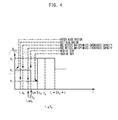
- Figs. 3 and 4 are graphs showing the method for controlling data transmission rate, i.e., controlling the resource allocation in accordance with the present invention.
- the reason of having duration of t a after entering the NLOS region by the mobile terminal 11 is to restart transmitting data at the rate of x j immediately when the mobile terminal in the "fine sync" state returns from the NLOS region.
- the mobile terminal 11 enter the NLOS region at time 0, the NCC 13 detects the entrance of the mobile terminal 11 in the NLOS region at ⁇ d and transmits the TBTP in order to reallocate the allocated resources from c x to x j , and the mobile terminal receives the TBTP at time 2 ⁇ d .
- the mobile terminal 11 has resources as x j at time 2 ⁇ d .
- the mobile terminal 11 could depart from the NLOS region after receiving the TBTP, referred in Fig. 3, and departs from the NLOS region before receiving the TBTP referred in Fig. 4.
- the allocated resources are reallocated as x j , that is, the capacity of c j -x j will be released, referred at the step S204 in Fig. 2. If the mobile terminal 11 doesn't return within t a , referred at the step S205 in Fig. 2, the all allocated resources are released, referred at the step S206 in Fig. 2. If the mobile terminal 11 returns from the NLOS region, referred at the step S205 in Fig. 2, the NCC 13 allocates resources as y j according to probability of p, i.e., y j -c j . The NCC 13 reallocates resources after the mobile terminal 11 returns in order to decrease the risk that the mobile terminal 11 enters the NLOS region at point of the resource reallocation.
- Fig. 3 illustrates the effect in the case of t r ⁇ t a wherein t r denotes a time between the mobile terminal 11 enter the NLOS region and returns from the NLOS region.
- an amount of the allocated the frequencies is obtained by an equation 1 according to the conventional allocation method.
- an amount of the allocated frequencies from 0 to t r +2 ⁇ d +c is calculated by equation 2.
- the adaptive released resources could be provided to other mobile terminals in accordance with the present invention.
- the NCC 13 allocates resources as y j- c j based on probability of P for transmitting data delayed by passing through the NLOS region.
- the allocation of the frequency by probability is for decrease the risk that the mobile terminal enters the NLOS region.
- the NCC could minimize the capacity of the allocated but unused resources.
- the data transmission rate control method in accordance with the present invention can be embodied as a program and stored in recording media readable by a computer, e.g., CD-ROM, RAM, floppy disk, hard disk, magneto-optical disk, etc.
- the data transmission rate control method prevents a waste of radio resources by minimizing resources which are allocated to the terminal but unused, and guarantees the QoS in the interactive satellite communication system having a signal cut-off when the mobile terminal passes through the NLOS region.
Landscapes
- Engineering & Computer Science (AREA)
- Computer Networks & Wireless Communication (AREA)
- Signal Processing (AREA)
- Physics & Mathematics (AREA)
- Astronomy & Astrophysics (AREA)
- General Physics & Mathematics (AREA)
- Aviation & Aerospace Engineering (AREA)
- Quality & Reliability (AREA)
- Mobile Radio Communication Systems (AREA)
- Radio Relay Systems (AREA)
- Communication Control (AREA)
Abstract
Description
- The present invention relates to an interactive satellite communication system; and more particularly, to a method for controlling data transmission rate in order to save waste of resources due to Non-Line Of Sight (NLOS) region in an interactive satellite communication system.
- In a mobile interactive satellite communication system, plural mobile terminals request a service to a Network Control Center (NCC) through a satellite, and, in response to the request, the NCC provides the service through the satellite to the mobile terminals. Because value of frequency in the mobile satellite communication system is much higher than the value of frequency in a terrestrial mobile communication system, it is very important to minimize shadowing outages occurred when the mobile terminal instantly passes through the NLOS region.
- The interactive satellite communication system provides a multimedia service to mobile terminals on the move. However, temporary fading of signal is usually occurred when a mobile terminal passes through the NLOS region. In other words, mobile terminals pass through the NLOS region generally in the mobile interactive satellite network, at that time, data transmission is usually failed. Such a signal cut-off decreases a Quality of Service (QoS) of the mobile interactive satellite communication system and wastes precious radio resources.
- In detail, to the mobile interactive satellite communication network, Continuous Rate Assignment (CRA), which allocates resources to maintain a certain transmission rate for the certain period of time and a resource allocation method based on requests from mobile terminals are applied in order to increase the utilization of radio resources and to make target value of the QoS according to service kinds. In CRA, because the scheduler continuously allocates resources to mobile terminals as long as the scheduler doesn't receive a request of resource release, the resources allocated to the mobile terminals are wasted when the mobile terminals have the instant signal cut-off in the NLOS region. Also, if the NCC collects all resources allocated to the mobile terminals having instant signal cut-off for saving resources, set-up time for a new session is needed when the mobile terminals return from the NLOS region. Therefore, the communication cut-off time takes longer, and QoS is decreased.
- It is, therefore, an object of the present invention to provide a data transmission rate control method for saving waste of radio resources due to the NLOS region when a mobile terminal passes through the NLOS region in the interactive satellite communication system.
- It is another object of the present invention to guarantee the quality of service by controlling the data transmission rate in the satellite communication system having communication blockage for minimizing the damage of the instant signal cut-off occurred when the mobile terminal instantly enter and/or depart from the NLOS region.
- In accordance with an aspect of the present invention, there is provided a method for controlling a data transmission rate in an interactive satellite communication system, the method including the steps of: setting at least one threshold, which is a statistical time duration maintaining a fine sync state while a mobile terminal enters and departs from a Non-Line Of Sight (NLOS) region; at a Network Control Center (NCC) adjusting allocated resources based on the Constant Resources Allocation (CRA) after detecting whether Satellite Access Control (SAC) is lost or not; compensating transmission delay by reallocating if the mobile terminal returns from the NLOS region within a first threshold duration, wherein the mobile terminal maintains the fine sync state during the first threshold duration; and deallocating all resources allocated based on the CRA if the mobile terminal does not return from the NLOS region within the first threshold duration.
- In accordance with an aspect of the present invention, there is provided a method for controlling a data transmission rate in an interactive satellite communication system, the method further including the steps of: converting the fine sync state of the mobile terminal into a coarse sync, if the mobile terminal returns from the NLOS region within a second threshold duration; and converting the coarse sync state of the mobile terminal into a log-on initial state, if the mobile terminal does not return from the NLOS region within the second threshold duration.
- In accordance with an aspect of the present invention, there is provided a method for controlling a data transmission rate in an interactive satellite communication system, the method further including the steps of: converting the coarse sync state of the mobile terminal into the log-on initial state, if the mobile terminal returns from the NLOS region within third threshold duration; and logging off by terminating the log-on state, if the mobile terminal does not return from the NLOS region within the third threshold duration.
- The above and other objects and features of the present invention will become apparent from the following description of the preferred embodiments given in conjunction with the accompanying drawings, in which:
- Fig. 1 is a diagram showing an interactive satellite communication system to which the present invention is applied;
- Fig. 2 is a flowchart illustrating a method for controlling data transmission rate in accordance with an embodiment of the present invention; and
- Figs. 3 and 4 are graphs describing an adaptive resources collection quantity as frequency occupancy state by controlling data transmission rate in accordance with an embodiment of the present invention.
-
- Other objects and aspects of the invention will become apparent from the following description of the embodiments with reference to the accompanying drawings, which is set forth hereinafter.
- Fig. 1 is a diagram showing an interactive satellite communication system to which the present invention is applied.
- The interactive satellite communication system is a satellite network, wherein, plural
mobile terminals 11 request a service to Network Control Center (NCC) 13 through asatellite 12, in response to the request from themobile terminal 11, the NCC 13 provides the service to themobile terminal 11 through thesatellite 12. In this network, it is very important to adjust the allocated resources to the mobile terminal having trouble of the communication cut-off in the NLOS region. - As shown, the interactive satellite communication system in this embodiment includes a
satellite 12, a NCC 13 and pluralmobile terminals 11. It is apparent that an interactive satellite communication system includingplural satellites 12, plural NCCs 13 and pluralmobile terminals 11, could be implemented by combining or modifying the system in accordance with the present invention including the present system. - Each of plural
mobile terminals 11 requests the required resources and uses the allowed resources, i.e., time slot, by the NCC 13 in response to the request from themobile terminal 11. - The NCC 13 collects resource requests from the
mobile terminals 11, and selects the time slot for allocating to each ofmobile terminals 11, and reports to the related mobile terminals through thesatellite 12. - Particularly, because the NCC 13 includes a data transmission rate control algorithm for minimizing damage of the communication cut-off generated when the
mobile terminal 11 instantly enters into and/or departs from the NLOS region, the NCC 13 receives requests of frequency resources from pluralmobile terminals 11, and preserves the average transmission rate by compensating transmission rate due to instant communication cut-off generated when the mobile terminal passes through the NLOS region. - Fig. 2 is a flowchart illustrating a method for controlling a data transmission rate in accordance with the present invention, and showing the method for determining state of the
mobile terminal 11 by the NCC 13 while themobile terminal 11 passes through the NLOS region. - The transmission rate control algorithm in accordance with the present invention, for the prevention of the resource waste, determines the state of the
mobile terminal 11 based on the multi-stage of the return time from the NLOS region, and collects partially the allocated resources according to the stage because the related resources are wasted when themobile terminal 11 passes the NLOS region and have communication cut-off in the NLOS region. - Herein, the NCC 13 determines the state of the
mobile terminal 11 based on the return time, which is time duration between the instants of entering and departing from the NLOS region. - Hereinafter, "fine sync" means as a state, which the time is accurately synchronized means for normal data transmission. "Coarse sync" means a state before the fine sync, which the time is roughly synchronized. "RspT" denotes response time, which is detecting time after the occurrence of the event. "rt-session" denotes a real-time session.
- "Terminal Burst Time Plan (TBTP)" is referred to an allocation plan of time slots. ta is a statistical time duration for maintaining the fine sync state after returning from the NLOS region. For the embodiment of the present invention, ta, tb and tc could be assumed based on the method of the ordinary least square technique.
- cj, xj and yj denote resources allocated to the
mobile terminal 11 by the NCC 13 when themobile terminal 11 enters and/or departs from the NLOS region. - c, cj, xj, yj and p are design parameters, and could be determined based on a statistical assumption or a strategy of the service provider.
- A process for decreasing and compensating the resources allocated to the
mobile terminal 11 by the CRA method will be described hereafter. - In the interactive satellite communication network, at step S2a, when the
mobile terminal 11 logs on and gets ready to be the coarse sync, at step S201, themobile terminal 11 acquires coarse sync and at step S2b, gets ready to be the fine sync. At step S202, when themobile terminal 11 gets ready to be the fine sync, themobile terminal 11 acquires the fine sync. At step S2c, themobile terminal 11 communicates with theNCC 13 in the fine sync. - At step S203, if the NCC 13 couldn't receive a Satellite Access Control (SAC) field, which is a field indicating control information from the
mobile terminal 11 for connecting with thesatellite 12, at step S204, the NCC 13 assumes that themobile terminal 11 exists in the NLOS region, and reallocates resources allocated by the CRA, that is, optimizes the CRA capacity. - Thereafter, at step S205, if the
mobile terminal 11 does not return from the NLOS region in ta, at step S206, the NCC 13 collects resources allocated by the CRA. At step S2c, if themobile terminal 11 returns from the NLOS region in ta, themobile terminal 11 maintains the fine sync. - Herein, though the
mobile terminal 11 returned from the NLOS region, the NCC 13 does not start collecting resources until ta so that themobile terminal 11 could immediately restart receiving data at the speed of xj in Fig. 3 in the fine sync when themobile terminal 11 returns in the fine sync. - At step S207, if the
mobile terminal 11 didn't return in tb from the NLOS region, at step S208, the NCC 13 converts state of themobile terminal 11 into former state, i.e., the logon state, that is, the all allocated resources will be returned and the rt-session will be terminated. At step S2b, if themobile terminal 11 returns from the NLOS region in tb, themobile terminal 11 maintains the coarse sync, i.e., ready to be the fine sync. - Then, at step S209, if the
mobile terminal 11 does not return from the NLOS region in tc, at step S2d, the NCC 13 logs off, i.e., terminates the logon by force. At step S2a, if themobile terminal 11 returns from the NLOS region, themobile terminal 11 maintains the logon state. - When the
mobile terminal 11 maintains the fine sync, traffic can be transmitted received and themobile terminal 11 responses to theNCC 13 in ta. There are some cases could be occurred. One is the case that themobile terminal 11 departs from the NLOS region after the NCC 13 detecting the mobile terminal's 11 being in the NLOS region generates the TBTP, referred in Fig. 3. Another is the case that themobile terminal 11 departs from the NLOS region before receiving the TBTP generated by the NCC 13, referred in Fig. 4. - Figs. 3 and 4 are graphs showing the method for controlling data transmission rate, i.e., controlling the resource allocation in accordance with the present invention.
- The reason of having duration of ta after entering the NLOS region by the
mobile terminal 11 is to restart transmitting data at the rate of xj immediately when the mobile terminal in the "fine sync" state returns from the NLOS region. - Based on the a scenario for controlling the resource allocation according to the present invention, the
mobile terminal 11 enter the NLOS region at time 0, the NCC 13 detects the entrance of themobile terminal 11 in the NLOS region at τd and transmits the TBTP in order to reallocate the allocated resources from cx to xj, and the mobile terminal receives the TBTP at time 2τd. Themobile terminal 11 has resources as xj at time 2τd. Herein, themobile terminal 11 could depart from the NLOS region after receiving the TBTP, referred in Fig. 3, and departs from the NLOS region before receiving the TBTP referred in Fig. 4. - When the
mobile terminal 11 enters the NLOS region, the allocated resources are reallocated as xj, that is, the capacity of cj-xj will be released, referred at the step S204 in Fig. 2. If themobile terminal 11 doesn't return within ta, referred at the step S205 in Fig. 2, the all allocated resources are released, referred at the step S206 in Fig. 2. If themobile terminal 11 returns from the NLOS region, referred at the step S205 in Fig. 2, theNCC 13 allocates resources as yj according to probability of p, i.e., yj-cj. TheNCC 13 reallocates resources after themobile terminal 11 returns in order to decrease the risk that themobile terminal 11 enters the NLOS region at point of the resource reallocation. - The effect of the present invention will be shown as the state of the frequency allocation in Figs. 3 and 4.
- Fig. 3 illustrates the effect in the case of tr < ta wherein tr denotes a time between the
mobile terminal 11 enter the NLOS region and returns from the NLOS region. - From time 0 to time tr+2τd+c, an amount of the allocated the frequencies is obtained by an
equation 1 according to the conventional allocation method. In the present invention, an amount of the allocated frequencies from 0 to tr+2τd+c is calculated byequation 2. - It is obvious that the allocated but unused resources are decreased based on equation 3 in accordance with the present invention.


- The adaptive released resources could be provided to other mobile terminals in accordance with the present invention. The
NCC 13 allocates resources as yj-cj based on probability of P for transmitting data delayed by passing through the NLOS region. - Herein, the allocation of the frequency by probability is for decrease the risk that the mobile terminal enters the NLOS region. The NCC could minimize the capacity of the allocated but unused resources.
- As above-mentioned, the data transmission rate control method in accordance with the present invention can be embodied as a program and stored in recording media readable by a computer, e.g., CD-ROM, RAM, floppy disk, hard disk, magneto-optical disk, etc.
- The data transmission rate control method prevents a waste of radio resources by minimizing resources which are allocated to the terminal but unused, and guarantees the QoS in the interactive satellite communication system having a signal cut-off when the mobile terminal passes through the NLOS region.
- The present application contains subject matter related to Korean patent application no. 2003-96830, filed in the Korean intellectual Property Office on December 24, 2003, the entire contents of which being incorporated herein by reference.
- While the present invention has been described with respect to certain preferred embodiments, it will be apparent to those skilled in the art that various changes and modifications may be made without departing from the scope of the invention as defined in the following claims.
Claims (5)
- A method for controlling a data transmission rate in an interactive satellite communication system, the method comprising the steps of:a) setting at least one threshold, which is a statistical time duration maintaining a fine sync state while a mobile terminal enters and departs from a Non-Line Of Sight (NLOS) region;b) at a Network Control Center (NCC) adjusting allocated resources based on the Constant Resources Allocation (CRA) after detecting whether Satellite Access Control (SAC) is lost or not;c) compensating transmission delay by reallocating if the mobile terminal returns from the NLOS region within a first threshold duration, wherein the mobile terminal maintains the fine sync state during the first threshold duration; andd) deallocating all resources allocated based on the CRA if the mobile terminal does not return from the NLOS region within the first threshold duration.
- The method as recited in claim 1, further comprising the steps of:e) converting the fine sync state of the mobile terminal into a coarse sync, if the mobile terminal returns from the NLOS region within a second threshold duration; andf) converting the coarse sync state of the mobile terminal into a log-on initial state, if the mobile terminal does not return from the NLOS region within the second threshold duration.
- The method as recited in claim 2, further comprising the steps of:g) converting the coarse sync state of the mobile terminal into the log-on initial state, if the mobile terminal returns from the NLOS region within third threshold duration; andh) logging off by terminating the log-on state, if the mobile terminal does not return from the NLOS region within the third threshold duration.
- The method as recited in claim 1, wherein the NCC determines a state of the mobile terminal based on the return time of the mobile terminal from the NLOS region, and deallocates the allocated resources partially, and compensates data transmission delay by reallocating resources after deallocating the resources based on the multi-stage state of the mobile terminal.
- The method as recited in claim 4, wherein the resource reallocation is operated statistically in order to minimize the risk that the mobile terminal enters the NLOS region.
Applications Claiming Priority (2)
| Application Number | Priority Date | Filing Date | Title |
|---|---|---|---|
| KR10-2003-0096830A KR100532588B1 (en) | 2003-12-24 | 2003-12-24 | Method of controlling data transmission rate in interactive satellite telecommunication system |
| KR2003096830 | 2003-12-24 |
Publications (3)
| Publication Number | Publication Date |
|---|---|
| EP1548959A2 true EP1548959A2 (en) | 2005-06-29 |
| EP1548959A3 EP1548959A3 (en) | 2008-01-23 |
| EP1548959B1 EP1548959B1 (en) | 2010-03-03 |
Family
ID=34545907
Family Applications (1)
| Application Number | Title | Priority Date | Filing Date |
|---|---|---|---|
| EP04254767A Expired - Lifetime EP1548959B1 (en) | 2003-12-24 | 2004-08-06 | Method for controlling data transmission rate in interactive satellite communication system |
Country Status (5)
| Country | Link |
|---|---|
| US (1) | US7286824B2 (en) |
| EP (1) | EP1548959B1 (en) |
| KR (1) | KR100532588B1 (en) |
| AT (1) | ATE460015T1 (en) |
| DE (1) | DE602004025786D1 (en) |
Families Citing this family (3)
| Publication number | Priority date | Publication date | Assignee | Title |
|---|---|---|---|---|
| US7656813B2 (en) * | 2001-12-14 | 2010-02-02 | Hughes Network Systems, Inc. | Inroute training in a two-way satellite system |
| CN103475403B (en) * | 2013-08-29 | 2016-09-21 | 清华大学 | Satellite mobile communication method based on LTE and system |
| US10524159B2 (en) | 2017-09-07 | 2019-12-31 | Iridium Satellite Llc | Managing congestion in a satellite communications network |
Citations (1)
| Publication number | Priority date | Publication date | Assignee | Title |
|---|---|---|---|---|
| EP1050978A2 (en) | 1999-05-06 | 2000-11-08 | Nec Corporation | Satellite communications system and handover processing method |
Family Cites Families (7)
| Publication number | Priority date | Publication date | Assignee | Title |
|---|---|---|---|---|
| US5561838A (en) * | 1994-07-01 | 1996-10-01 | Motorola, Inc. | Method and apparatus for satellite handoff parameters prediction in an orbiting communications system |
| US5802445A (en) * | 1995-07-13 | 1998-09-01 | Globalstar L.P. | Methods and apparatus for providing user RF exposure monitoring and control in a satellite communications system |
| US6215442B1 (en) * | 1997-02-03 | 2001-04-10 | Snaptrack, Inc. | Method and apparatus for determining time in a satellite positioning system |
| EP0902552A1 (en) * | 1997-09-09 | 1999-03-17 | ICO Services Ltd. | Satellite mobile telephone cell departure prediction |
| US6418147B1 (en) * | 1998-01-21 | 2002-07-09 | Globalstar Lp | Multiple vocoder mobile satellite telephone system |
| US6169881B1 (en) * | 1998-05-04 | 2001-01-02 | Motorola, Inc. | Method and apparatus for predicting impending service outages for ground-to-satellite terminal in a satellite communication system |
| US6859652B2 (en) * | 2000-08-02 | 2005-02-22 | Mobile Satellite Ventures, Lp | Integrated or autonomous system and method of satellite-terrestrial frequency reuse using signal attenuation and/or blockage, dynamic assignment of frequencies and/or hysteresis |
-
2003
- 2003-12-24 KR KR10-2003-0096830A patent/KR100532588B1/en not_active Expired - Fee Related
-
2004
- 2004-08-06 EP EP04254767A patent/EP1548959B1/en not_active Expired - Lifetime
- 2004-08-06 DE DE602004025786T patent/DE602004025786D1/en not_active Expired - Lifetime
- 2004-08-06 AT AT04254767T patent/ATE460015T1/en not_active IP Right Cessation
- 2004-08-11 US US10/916,965 patent/US7286824B2/en not_active Expired - Fee Related
Patent Citations (1)
| Publication number | Priority date | Publication date | Assignee | Title |
|---|---|---|---|---|
| EP1050978A2 (en) | 1999-05-06 | 2000-11-08 | Nec Corporation | Satellite communications system and handover processing method |
Also Published As
| Publication number | Publication date |
|---|---|
| US7286824B2 (en) | 2007-10-23 |
| DE602004025786D1 (en) | 2010-04-15 |
| KR100532588B1 (en) | 2005-12-01 |
| EP1548959B1 (en) | 2010-03-03 |
| KR20050065069A (en) | 2005-06-29 |
| ATE460015T1 (en) | 2010-03-15 |
| US20050143003A1 (en) | 2005-06-30 |
| EP1548959A3 (en) | 2008-01-23 |
Similar Documents
| Publication | Publication Date | Title |
|---|---|---|
| US6603747B2 (en) | Communication control method and communication control apparatus | |
| US7366134B2 (en) | Dynamic allocation of network resources in a multiple-user communication system | |
| US7130638B2 (en) | Radio resource allocation method and base station using the same | |
| US7075943B2 (en) | Channel access scheme for use in network communications | |
| US7499421B2 (en) | Apparatus and method for resource allocation in MF-TDMA broadband satellite system | |
| US7106713B2 (en) | Method of rate allocation in a data communications network | |
| EP1816793A1 (en) | Method for uplink bandwidth request and allocation in wireless communication system | |
| US7373151B1 (en) | Distributed dynamic channel allocation technique for multi-carrier CDMA cellular systems with mobile base stations | |
| AU3338401A (en) | A method of assigning resources in a shared channel, a corresponding mobile terminal and a corresponding base station | |
| CN1151639A (en) | Satellite communication system with variable number of satellite communication channels | |
| EP1548959B1 (en) | Method for controlling data transmission rate in interactive satellite communication system | |
| EP1335624B1 (en) | Base station and radio resource allocation method | |
| US8649392B2 (en) | Implicit reservation of resources in a point-to-multipoint or multi-point-to-multipoint network | |
| US6788659B1 (en) | Transmission control without limitation of the number of users | |
| US8218474B2 (en) | Bandwidth allocation in satellite communication networks | |
| US6731616B1 (en) | Reservation requesting and allocating method on a transmission medium | |
| WO2002017107A1 (en) | Dynamic allocation of network resources in a multiple-user communication system | |
| JPH07288497A (en) | Satellite communication method and satellite communication system |
Legal Events
| Date | Code | Title | Description |
|---|---|---|---|
| PUAI | Public reference made under article 153(3) epc to a published international application that has entered the european phase |
Free format text: ORIGINAL CODE: 0009012 |
|
| AK | Designated contracting states |
Kind code of ref document: A2 Designated state(s): AT BE BG CH CY CZ DE DK EE ES FI FR GB GR HU IE IT LI LU MC NL PL PT RO SE SI SK TR |
|
| AX | Request for extension of the european patent |
Extension state: AL HR LT LV MK |
|
| PUAL | Search report despatched |
Free format text: ORIGINAL CODE: 0009013 |
|
| AK | Designated contracting states |
Kind code of ref document: A3 Designated state(s): AT BE BG CH CY CZ DE DK EE ES FI FR GB GR HU IE IT LI LU MC NL PL PT RO SE SI SK TR |
|
| AX | Request for extension of the european patent |
Extension state: AL HR LT LV MK |
|
| 17P | Request for examination filed |
Effective date: 20080723 |
|
| AKX | Designation fees paid |
Designated state(s): AT BE BG CH CY CZ DE DK EE ES FI FR GB GR HU IE IT LI LU MC NL PL PT RO SE SI SK TR |
|
| 17Q | First examination report despatched |
Effective date: 20080919 |
|
| GRAP | Despatch of communication of intention to grant a patent |
Free format text: ORIGINAL CODE: EPIDOSNIGR1 |
|
| GRAS | Grant fee paid |
Free format text: ORIGINAL CODE: EPIDOSNIGR3 |
|
| GRAA | (expected) grant |
Free format text: ORIGINAL CODE: 0009210 |
|
| AK | Designated contracting states |
Kind code of ref document: B1 Designated state(s): AT BE BG CH CY CZ DE DK EE ES FI FR GB GR HU IE IT LI LU MC NL PL PT RO SE SI SK TR |
|
| REG | Reference to a national code |
Ref country code: GB Ref legal event code: FG4D |
|
| REG | Reference to a national code |
Ref country code: CH Ref legal event code: EP |
|
| REG | Reference to a national code |
Ref country code: IE Ref legal event code: FG4D |
|
| REF | Corresponds to: |
Ref document number: 602004025786 Country of ref document: DE Date of ref document: 20100415 Kind code of ref document: P |
|
| REG | Reference to a national code |
Ref country code: NL Ref legal event code: VDEP Effective date: 20100303 |
|
| PG25 | Lapsed in a contracting state [announced via postgrant information from national office to epo] |
Ref country code: AT Free format text: LAPSE BECAUSE OF FAILURE TO SUBMIT A TRANSLATION OF THE DESCRIPTION OR TO PAY THE FEE WITHIN THE PRESCRIBED TIME-LIMIT Effective date: 20100303 Ref country code: SI Free format text: LAPSE BECAUSE OF FAILURE TO SUBMIT A TRANSLATION OF THE DESCRIPTION OR TO PAY THE FEE WITHIN THE PRESCRIBED TIME-LIMIT Effective date: 20100303 Ref country code: PL Free format text: LAPSE BECAUSE OF FAILURE TO SUBMIT A TRANSLATION OF THE DESCRIPTION OR TO PAY THE FEE WITHIN THE PRESCRIBED TIME-LIMIT Effective date: 20100303 Ref country code: FI Free format text: LAPSE BECAUSE OF FAILURE TO SUBMIT A TRANSLATION OF THE DESCRIPTION OR TO PAY THE FEE WITHIN THE PRESCRIBED TIME-LIMIT Effective date: 20100303 |
|
| PG25 | Lapsed in a contracting state [announced via postgrant information from national office to epo] |
Ref country code: EE Free format text: LAPSE BECAUSE OF FAILURE TO SUBMIT A TRANSLATION OF THE DESCRIPTION OR TO PAY THE FEE WITHIN THE PRESCRIBED TIME-LIMIT Effective date: 20100303 Ref country code: CY Free format text: LAPSE BECAUSE OF FAILURE TO SUBMIT A TRANSLATION OF THE DESCRIPTION OR TO PAY THE FEE WITHIN THE PRESCRIBED TIME-LIMIT Effective date: 20100303 Ref country code: BE Free format text: LAPSE BECAUSE OF FAILURE TO SUBMIT A TRANSLATION OF THE DESCRIPTION OR TO PAY THE FEE WITHIN THE PRESCRIBED TIME-LIMIT Effective date: 20100303 Ref country code: NL Free format text: LAPSE BECAUSE OF FAILURE TO SUBMIT A TRANSLATION OF THE DESCRIPTION OR TO PAY THE FEE WITHIN THE PRESCRIBED TIME-LIMIT Effective date: 20100303 Ref country code: SE Free format text: LAPSE BECAUSE OF FAILURE TO SUBMIT A TRANSLATION OF THE DESCRIPTION OR TO PAY THE FEE WITHIN THE PRESCRIBED TIME-LIMIT Effective date: 20100303 Ref country code: ES Free format text: LAPSE BECAUSE OF FAILURE TO SUBMIT A TRANSLATION OF THE DESCRIPTION OR TO PAY THE FEE WITHIN THE PRESCRIBED TIME-LIMIT Effective date: 20100614 Ref country code: RO Free format text: LAPSE BECAUSE OF FAILURE TO SUBMIT A TRANSLATION OF THE DESCRIPTION OR TO PAY THE FEE WITHIN THE PRESCRIBED TIME-LIMIT Effective date: 20100303 Ref country code: GR Free format text: LAPSE BECAUSE OF FAILURE TO SUBMIT A TRANSLATION OF THE DESCRIPTION OR TO PAY THE FEE WITHIN THE PRESCRIBED TIME-LIMIT Effective date: 20100604 |
|
| PG25 | Lapsed in a contracting state [announced via postgrant information from national office to epo] |
Ref country code: BG Free format text: LAPSE BECAUSE OF FAILURE TO SUBMIT A TRANSLATION OF THE DESCRIPTION OR TO PAY THE FEE WITHIN THE PRESCRIBED TIME-LIMIT Effective date: 20100603 Ref country code: CZ Free format text: LAPSE BECAUSE OF FAILURE TO SUBMIT A TRANSLATION OF THE DESCRIPTION OR TO PAY THE FEE WITHIN THE PRESCRIBED TIME-LIMIT Effective date: 20100303 Ref country code: SK Free format text: LAPSE BECAUSE OF FAILURE TO SUBMIT A TRANSLATION OF THE DESCRIPTION OR TO PAY THE FEE WITHIN THE PRESCRIBED TIME-LIMIT Effective date: 20100303 |
|
| PGFP | Annual fee paid to national office [announced via postgrant information from national office to epo] |
Ref country code: DE Payment date: 20100812 Year of fee payment: 7 Ref country code: FR Payment date: 20100824 Year of fee payment: 7 |
|
| PGFP | Annual fee paid to national office [announced via postgrant information from national office to epo] |
Ref country code: GB Payment date: 20100811 Year of fee payment: 7 |
|
| PLBE | No opposition filed within time limit |
Free format text: ORIGINAL CODE: 0009261 |
|
| STAA | Information on the status of an ep patent application or granted ep patent |
Free format text: STATUS: NO OPPOSITION FILED WITHIN TIME LIMIT |
|
| PG25 | Lapsed in a contracting state [announced via postgrant information from national office to epo] |
Ref country code: PT Free format text: LAPSE BECAUSE OF FAILURE TO SUBMIT A TRANSLATION OF THE DESCRIPTION OR TO PAY THE FEE WITHIN THE PRESCRIBED TIME-LIMIT Effective date: 20100705 Ref country code: DK Free format text: LAPSE BECAUSE OF FAILURE TO SUBMIT A TRANSLATION OF THE DESCRIPTION OR TO PAY THE FEE WITHIN THE PRESCRIBED TIME-LIMIT Effective date: 20100303 |
|
| 26N | No opposition filed |
Effective date: 20101206 |
|
| PG25 | Lapsed in a contracting state [announced via postgrant information from national office to epo] |
Ref country code: MC Free format text: LAPSE BECAUSE OF NON-PAYMENT OF DUE FEES Effective date: 20100831 Ref country code: IT Free format text: LAPSE BECAUSE OF FAILURE TO SUBMIT A TRANSLATION OF THE DESCRIPTION OR TO PAY THE FEE WITHIN THE PRESCRIBED TIME-LIMIT Effective date: 20100303 |
|
| REG | Reference to a national code |
Ref country code: CH Ref legal event code: PL |
|
| PG25 | Lapsed in a contracting state [announced via postgrant information from national office to epo] |
Ref country code: LI Free format text: LAPSE BECAUSE OF NON-PAYMENT OF DUE FEES Effective date: 20100831 Ref country code: CH Free format text: LAPSE BECAUSE OF NON-PAYMENT OF DUE FEES Effective date: 20100831 |
|
| PG25 | Lapsed in a contracting state [announced via postgrant information from national office to epo] |
Ref country code: IE Free format text: LAPSE BECAUSE OF NON-PAYMENT OF DUE FEES Effective date: 20100806 |
|
| GBPC | Gb: european patent ceased through non-payment of renewal fee |
Effective date: 20110806 |
|
| REG | Reference to a national code |
Ref country code: FR Ref legal event code: ST Effective date: 20120430 |
|
| REG | Reference to a national code |
Ref country code: DE Ref legal event code: R119 Ref document number: 602004025786 Country of ref document: DE Effective date: 20120301 |
|
| PG25 | Lapsed in a contracting state [announced via postgrant information from national office to epo] |
Ref country code: GB Free format text: LAPSE BECAUSE OF NON-PAYMENT OF DUE FEES Effective date: 20110806 Ref country code: FR Free format text: LAPSE BECAUSE OF NON-PAYMENT OF DUE FEES Effective date: 20110831 |
|
| PG25 | Lapsed in a contracting state [announced via postgrant information from national office to epo] |
Ref country code: HU Free format text: LAPSE BECAUSE OF FAILURE TO SUBMIT A TRANSLATION OF THE DESCRIPTION OR TO PAY THE FEE WITHIN THE PRESCRIBED TIME-LIMIT Effective date: 20100904 Ref country code: LU Free format text: LAPSE BECAUSE OF NON-PAYMENT OF DUE FEES Effective date: 20100806 |
|
| PG25 | Lapsed in a contracting state [announced via postgrant information from national office to epo] |
Ref country code: TR Free format text: LAPSE BECAUSE OF FAILURE TO SUBMIT A TRANSLATION OF THE DESCRIPTION OR TO PAY THE FEE WITHIN THE PRESCRIBED TIME-LIMIT Effective date: 20100303 |
|
| PG25 | Lapsed in a contracting state [announced via postgrant information from national office to epo] |
Ref country code: DE Free format text: LAPSE BECAUSE OF NON-PAYMENT OF DUE FEES Effective date: 20120301 |