EP1548955A1 - A method for improving the performances of a mobile radiocommunication system using a power control algorithm - Google Patents
A method for improving the performances of a mobile radiocommunication system using a power control algorithm Download PDFInfo
- Publication number
- EP1548955A1 EP1548955A1 EP03293285A EP03293285A EP1548955A1 EP 1548955 A1 EP1548955 A1 EP 1548955A1 EP 03293285 A EP03293285 A EP 03293285A EP 03293285 A EP03293285 A EP 03293285A EP 1548955 A1 EP1548955 A1 EP 1548955A1
- Authority
- EP
- European Patent Office
- Prior art keywords
- power
- tpc
- limit
- corresponds
- maximum
- Prior art date
- Legal status (The legal status is an assumption and is not a legal conclusion. Google has not performed a legal analysis and makes no representation as to the accuracy of the status listed.)
- Granted
Links
Images
Classifications
-
- H—ELECTRICITY
- H04—ELECTRIC COMMUNICATION TECHNIQUE
- H04W—WIRELESS COMMUNICATION NETWORKS
- H04W52/00—Power management, e.g. Transmission Power Control [TPC] or power classes
- H04W52/04—Transmission power control [TPC]
- H04W52/18—TPC being performed according to specific parameters
- H04W52/22—TPC being performed according to specific parameters taking into account previous information or commands
- H04W52/221—TPC being performed according to specific parameters taking into account previous information or commands using past power control commands
-
- H—ELECTRICITY
- H04—ELECTRIC COMMUNICATION TECHNIQUE
- H04W—WIRELESS COMMUNICATION NETWORKS
- H04W52/00—Power management, e.g. Transmission Power Control [TPC] or power classes
- H04W52/04—Transmission power control [TPC]
- H04W52/06—TPC algorithms
- H04W52/08—Closed loop power control
-
- H—ELECTRICITY
- H04—ELECTRIC COMMUNICATION TECHNIQUE
- H04W—WIRELESS COMMUNICATION NETWORKS
- H04W52/00—Power management, e.g. Transmission Power Control [TPC] or power classes
- H04W52/04—Transmission power control [TPC]
- H04W52/06—TPC algorithms
- H04W52/12—Outer and inner loops
-
- H—ELECTRICITY
- H04—ELECTRIC COMMUNICATION TECHNIQUE
- H04W—WIRELESS COMMUNICATION NETWORKS
- H04W52/00—Power management, e.g. Transmission Power Control [TPC] or power classes
- H04W52/04—Transmission power control [TPC]
- H04W52/30—Transmission power control [TPC] using constraints in the total amount of available transmission power
- H04W52/36—Transmission power control [TPC] using constraints in the total amount of available transmission power with a discrete range or set of values, e.g. step size, ramping or offsets
Definitions
- the present invention is generally concerned with mobile radiocommunication systems.
- the present invention is in particular applicable to third generation mobile radiocommunication systems, such as in particular UMTS (Universal Mobile Telecommunication System).
- UMTS Universal Mobile Telecommunication System
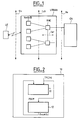
- the general architecture of a mobile radiocommunication system such as in particular a system of UMTS type is recalled in figure 1.
- the system comprises a mobile radiocomunication network communicating wih mobile terminals or UE ( « User Equipement ») and with external networks (not specifically illustrated).
- the mobile radiocommunication network comprises:
- Third generation systems in particular of UMTS type, use a radio access technology of W-CDMA type (where W-CDMA stands for « Wideband - Code Division Multiple Access »).
- the UTRAN comprises base stations called « Node B » and base station controllers called RNC ( « Radio Network Controller »).
- the UTRAN is in relation, on the one hand with mobile terminals UE, via an interface called « Uu interface » (or radio interface), and on the other hand with the CN via an interface called « lu interface ranch
- the Nodes B communicate with the RNCs via an interface called « lub interface » and an interface called « lur interface » may also be provided between RNCs.
- Power control techniques are generally used in such systems, in particular in systems using a radio access technology of CDMA or W-CDMA type, to improve performances (in terms of quality of service, of capacity,...etc.).
- Such power control techniques in particular include closed-loop power control algorithms, which in turn include inner-loop algorithms and outer-loop algorithms.
- the UE In the inner-loop algorithm, the UE periodically estimates the SIR of the signal received from the Node B, and compares this estimated SIR to a target SIR (SIR target ). If the estimated SIR is lower than the target SIR, the UE sends a command to the Node B for the Node B to increase its transmit power. Otherwise, the UE sends a command to the Node B for the Node B to decrease its transmit power.
- the target SIR is chosen by the UE as a function of the required quality of service, according to the outer-loop algorithm.
- the aim of this algorithm is to avoid increasing too rapidly the Node B transmit power. Indeed, in case of deep fading hole, it is preferable to not increase the power too much, since in any case, the power increase will not be fast enough to avoid loosing some data, and since this power increase would cost a significant power resources (that could not be used by other UEs).
- the limited power raise algorithm as currently specified in the standard is the following:
- a power control command requiring a power increase, or UP power control command , or UP TPC is not applied if the transmit power would be increased by more than Power_Raise_Limit dB over the last DL_Power_Averaging_Window_Size TPC commands.
- Power_Raise_Limit and DL_Power_Averaging_Window_Size are parameters of the algorithm and are configured in the Node B by the RNC, using the NBAP (Node B Application Part) protocol at the cell setup (message 'cell setup request' sent by the RNC to the Node B).
- NBAP Node B Application Part
- the limited power raise algorithm is implemented in the Node B.
- the downlink power control algorithm as currently specified in the 3GPP standard is more particularly as follows.
- UTRAN Upon receiving a TPC command, UTRAN shall adjust its downlink DPCCH/DPDCH (Dedicated Physical Control Channel/ Dedicated Physical Data Channel) power accordingly. UTRAN shall estimate the transmitted TPC command TPC est to be 0 or 1, and shall update the power.
- DPCCH/DPDCH Dedicated Physical Control Channel/ Dedicated Physical Data Channel
- P TPC ( k ) is calculated according to the following:
- the power control step size ⁇ TPC can take four values: 0.5, 1, 1.5 or 2 dB. It is mandatory for UTRAN to support ⁇ TPC of 1 dB, while support of other step sizes is optional.
- the average power of transmitted DPDCH (Dedicated Physical Data Channel) symbols over one timeslot shall not exceed Maximum_DL_Power (dB), nor shall it be below Minimum_DL_Power (dB).
- Transmitted DPDCH symbol means here a complex QPSK symbol before spreading which does not contain DTX (Discontinuous Transmission).
- Maximum_DL_Power (dB) and Minimum_DL_Power (dB) are power limits for one channelisation code, relative to the primary CPICH (Common Pilot Channel) power, as further specified in the 3GPP standard.
- P(k) P(k - 1) + P TPC (k) + P bal (k) + P sir (k)
- the present invention in particular recognizes the following problems with such an algorithm as the one currently specified in 3GPP TS 25.214.
- a received TPC is noted DOWN (-1) for a power control command requiring a power decrease, and UP (+1) for a power control command requiring a power increase.
- the parameter Power_Raise_Limit is set to 4dB and considering the previous example: with the current implementation in the standard, the last TPC_UP command will be accepted (and the Node B power will be increased by 1 dB). However, it would be better to reject it since the real power increase was equal to 6 dB.
- the same problem occurs when the Node B power is close to the maximum power (in this case, there may be some TPC_UP commands not taken into account by the Node B because it already reaches the maximum power, which will cause similar problem as the one described previously). For example, it may happen that, starting from the maximum power, and after a short power decrease, a new power increase is required but not accepted, as the current algorithm makes as if the Node B had previously increased its power too much, whereas it is in fact not the case as the Node B had reached the maximum transmit power. The problem is even more critical in the case where the Node B is close to its maximum power, since the Node B consumes a larger power.
- an algorithm such as the one currently specified in the 3GPP standard does not behave correctly when the Node B power is close to the minimum or maximum transmit power, i.e. in some case we will accept or reject a TPC_UP command whereas we should have rather done the contrary.
- the present invention recognizes that there is a need to optimise a limited power raise algorithm such as the one currently specified in the 3GPP standard, at least for the reason that power limitations are not taken into account in this algorithm, which may result in a degradation of the performances of the system (in terms of quality of service, of capacity, ). More generally, the present invention recognizes that there is a need to optimise such an algorithm, as the decision which is made in this algorithm is based on power adjustments due to the inner-loop power control, whereas other factor(s) could also be taken into account so that this decision could be based on a quantity closer to a real power variation, and the performances of the system could therefore be improved.
- the present invention in particular enables to solve part or all of the above-mentioned problems, or to avoid part or all of the above-mentioned drawbacks. More generally the aim of the present invention is to improve the performances of power control algorithms in such systems.
- a method for improving the performances of a mobile radiocommunication system using a power control algorithm said power control algorithm including an inner-loop power control algorithm for adjusting a transmit power according to received power control commands, said method including:
- the present invention also has for its object an equipment for a mobile radiocommunication system, such as a network equipment, such as in particular base station (or Node B), for performing such a method in particular for downlink power control, or a mobile terminal (or UE) for performing such a method in particular for uplink power control, as well as a mobile radiocommunication system, comprising at least one such equipment.
- a network equipment such as in particular base station (or Node B)
- UE mobile terminal
- the invention suggests to take the decision of the limited power raise algorithm, based on a quantity closer to the real power variation, and not based on the sum of the last power adjustments due to the inner-loop algorithm. Indeed, some of these power adjustments may be not taken into account by the Node B, when reaching the minimum and the maximum DL power. More generally, other factor(s) could be taken into account in order that this quantity be as close as possible to a real power variation.
- the invention enables to have a better behavior of the limited power raise algorithm and therefore to have better performance with this algorithm (i.e. reach the QoS (Quality of Service) of the UE, while consuming as low power as possible):
- the invention proposes an algorithm or method comprising:
- the present invention proposes the following expression for the quantity ⁇ sum (k) which is used in the 3GPP standard to decide if the transmit power should be increased according to a power control command requiring a power increase: with:
- min_max_limit function corresponds to:
- min_max_limit_cm function corresponds to:
- the present invention proposes the following expression for the quantity ⁇ sum (k) which is used in the 3GPP standard to decide if the transmit power should be increased according to a power control command requiring a power increase: : with:
- the present invention proposes the following expression for the quantity ⁇ sum (k) which is used in the 3GPP standard to decide if the transmit power should be increased according to a power control command requiring a power increase: with:
- the power limits Maximum_DL_Power and Minimum_DL_Power are taken into account by means of the limiting function ("min_max_limit(.)" in normal mode or "min_max_limit_cm(.)” in compressed mode).
- the power limits Maximum_DL_Power and Minimum_DL_Power are taken into account by means of checking if the inequalities P(k) > Maximum_DL_Power + ⁇ P curr or P(k) ⁇ Minimum_DL_Power are fulfilled.
- the first example enables to determine a quantity ⁇ sum (k) which is closer to the real power variation.
- the term P bal (k) is included in the term P(k) on which the determination of the power variation is based.
- P sir (k) is substracted from P(k) before calculating the power variation, as this term corresponds to a power offset in compressed mode, which is not representative of the power variation which is needed for the limited power raise algorithm.
- the second and third example enable a simplification of the algorithm, while still providing good performance.
- the third example requires less modification of the current state of the standard.
- the present invention also has for its object an equipment for a mobile radiocommunication system, such as a network equipment, such as in particular base station (or Node B) for carrying out such a method in particular for downlink power control, or a mobile terminal (or UE) for carrying out such a method in particular for uplink power control.
- a network equipment such as in particular base station (or Node B) for carrying out such a method in particular for downlink power control, or a mobile terminal (or UE) for carrying out such a method in particular for uplink power control.
- an equipment for a mobile radiocommunication system such as illustrated at 10, comprises, further to other classical means (not mentioned here and which may be classical):
- Said means 12 may for example include means for performing a method according to any one one of the above-mentioned first, second or third examples.
- the present invention also has for its object a mobile radiocommunication system, comprising at least one such equipment according to the present invention.
Landscapes
- Engineering & Computer Science (AREA)
- Computer Networks & Wireless Communication (AREA)
- Signal Processing (AREA)
- Mobile Radio Communication Systems (AREA)
- Reduction Or Emphasis Of Bandwidth Of Signals (AREA)
- Transmitters (AREA)
- Transceivers (AREA)
Abstract
- a step of deciding if the transmit power should be increased according to a received power control command (TPC(k)) requiring a power increase, having regard to a cumulative power variation (Δsum (k)) already obtained for last received power control commands,
- a step of determining a cumulative power variation (Δsum (k)) to be used by said step of deciding, said step of determining including taking into account, further to power adjustments due to said inner-loop power control algorithm, at least one other factor that may affect said cumulative power variation.
Description
- The present invention is generally concerned with mobile radiocommunication systems.
- The present invention is in particular applicable to third generation mobile radiocommunication systems, such as in particular UMTS (Universal Mobile Telecommunication System).
- In a general way, mobile radiocommunication systems are subject to standardisation; therefore, for more information on such systems, it is possible to refer to the corresponding standards, published by the corresponding standardisation bodies, such as for example 3GPP (« 3rd Generation Partnership Project »).
- The general architecture of a mobile radiocommunication system such as in particular a system of UMTS type is recalled in figure 1. The system comprises a mobile radiocomunication network communicating wih mobile terminals or UE (« User Equipement ») and with external networks (not specifically illustrated).
- The mobile radiocommunication network comprises:
- a Radio Access Network, or UTRAN (« UMTS Terrestrial Radio Access Network »),
- a Core Network, or CN.
- Third generation systems, in particular of UMTS type, use a radio access technology of W-CDMA type (where W-CDMA stands for « Wideband - Code Division Multiple Access »).
- The UTRAN comprises base stations called « Node B », and base station controllers called RNC (« Radio Network Controller »). The UTRAN is in relation, on the one hand with mobile terminals UE, via an interface called « Uu interface » (or radio interface), and on the other hand with the CN via an interface called « lu interface ». Within the UTRAN, the Nodes B communicate with the RNCs via an interface called « lub interface » and an interface called « lur interface » may also be provided between RNCs.
- Power control techniques are generally used in such systems, in particular in systems using a radio access technology of CDMA or W-CDMA type, to improve performances (in terms of quality of service, of capacity,...etc.). Such power control techniques in particular include closed-loop power control algorithms, which in turn include inner-loop algorithms and outer-loop algorithms.
- The principle of the closed-loop power control algorithm is now recalled, for the downlink for example. In the inner-loop algorithm, the UE periodically estimates the SIR of the signal received from the Node B, and compares this estimated SIR to a target SIR (SIRtarget). If the estimated SIR is lower than the target SIR, the UE sends a command to the Node B for the Node B to increase its transmit power. Otherwise, the UE sends a command to the Node B for the Node B to decrease its transmit power. The target SIR is chosen by the UE as a function of the required quality of service, according to the outer-loop algorithm.
- For example, for systems such as UMTS, such a closed-loop power control algorithm is specified in Technical Specification 3GPP TS 25.214.
- Further, in the 3GPP standard (release R99 and later releases), an algorithm, known as limited power raise algorithm' has been specified, see in particular section 5.2.1.2.2 of TS 25. 214 V5.6.0 (2003-09).
- The aim of this algorithm is to avoid increasing too rapidly the Node B transmit power. Indeed, in case of deep fading hole, it is preferable to not increase the power too much, since in any case, the power increase will not be fast enough to avoid loosing some data, and since this power increase would cost a significant power resources (that could not be used by other UEs).
- In summary, the limited power raise algorithm as currently specified in the standard is the following:
- A power control command requiring a power increase, or UP power control command , or UP TPC (where TPC stands for Transmit Power Control), is not applied if the transmit power would be increased by more than Power_Raise_Limit dB over the last DL_Power_Averaging_Window_Size TPC commands.
- Power_Raise_Limit and DL_Power_Averaging_Window_Size are parameters of the algorithm and are configured in the Node B by the RNC, using the NBAP (Node B Application Part) protocol at the cell setup (message 'cell setup request' sent by the RNC to the Node B).
- The limited power raise algorithm is implemented in the Node B.
- The downlink power control algorithm as currently specified in the 3GPP standard is more particularly as follows.
- Upon receiving a TPC command, UTRAN shall adjust its downlink DPCCH/DPDCH (Dedicated Physical Control Channel/ Dedicated Physical Data Channel) power accordingly. UTRAN shall estimate the transmitted TPC command TPCest to be 0 or 1, and shall update the power.
- After estimating the k:th TPC command, UTRAN shall adjust the current downlink power P(k-1) [dB] to a new power P(k) [dB] according to the following formula:
- PTPC (k) is calculated according to the following:
- If the value of Limited Power Increase Used parameter is 'Not used', then

- If the value of Limited Power Increase Used parameter is 'Used', then the k:th
inner loop power adiustment shall be calculated as:
 where
where
-
- For the first (DL_Power_Averaging_Window_Size - 1) adjustments after the activation of the limited power increase method, formula (1) shall be used instead of formula (2). Power_Raise_Limit and DL_Power_Averaging_Window_Size are parameters configured in the UTRAN.
- The power control step size ΔTPC can take four values: 0.5, 1, 1.5 or 2 dB. It is mandatory for UTRAN to support ΔTPC of 1 dB, while support of other step sizes is optional.
- The average power of transmitted DPDCH (Dedicated Physical Data Channel) symbols over one timeslot shall not exceed Maximum_DL_Power (dB), nor shall it be below Minimum_DL_Power (dB). Transmitted DPDCH symbol means here a complex QPSK symbol before spreading which does not contain DTX (Discontinuous Transmission). Maximum_DL_Power (dB) and Minimum_DL_Power (dB) are power limits for one channelisation code, relative to the primary CPICH (Common Pilot Channel) power, as further specified in the 3GPP standard.
- Further, in compressed mode, the same algorithm as in normal mode applies but replacing the definition of P(k) by:
with Psir(k) = δPcurr- δPprev, where δPcurr and δPcurr are respectively the value of δP in the current slot and in the most recently transmitted slot, and the expression of δP is given in TS 25.214. - The present invention in particular recognizes the following problems with such an algorithm as the one currently specified in 3GPP TS 25.214.
- These problems are related to the way this algorithm behaves when the Node B is close to its minimum or maximum transmit power (which will happen for all UEs close to the Node B or close to the cell edge).
- Such problems may be explained with an example with following setting:
- DL_Power_Averaging_Window_Size = 10 slots.
- Minimum power = 0 dBm
- Power control step = 1 dB.
-
- In this example, for simplicity, power adjustments other than the ones due to the inner-loop power control have not been taken into account, e.g. the power balancing adjustments.
- For instance, we consider the following sequence of received TPC (or received power control commands) and DL power (or downlink power) after adjustment according to the received power control commands.
- For instance, a received TPC is noted DOWN (-1) for a power control command requiring a power decrease, and UP (+1) for a power control command requiring a power increase.
- For instance, we consider a sequence starting with a DL power equal to 2 dBm.
- DL power = 2 dBm - Receive TPC = DOWN (-1) => DL power = 1 dBm (delta = -1 dB) - Receive TPC= DOWN (-1) = > DL power = 0 dBm (delta = -1 dB) - Receive TPC= DOWN (-1) = > DL power = 0 dBm (delta = 0 dB) - Receive TPC=DOWN (-1) => DL power = 0 dBm (delta = 0 dB) - Receive TPC=DOWN (-1) = > DL power = 0 dBm (delta = 0 dB) - Receive TPC= DOWN (-1) = > DL power = 0 dBm (delta = 0 dB) - Receive TPC=UP (+ 1) => DL power = 1 dBm (delta = + 1 dB) - Receive TPC=UP (+1) = > DL power = 2 dBm (delta = + dB) - Receive TPC= UP (+1) => DL power = 3 dBm (delta = +1 dB) - Receive TPC= UP (+1) => DL power = 4 dBm (delta = +1 dB) - Receive TPC= UP (+1) = > DL power = 5 dBm (delta = + 1 dB) - Receive TPC=UP (+1) => DL power = 6 dBm (delta = +1 dB) - Receive TPC=UP (+1) - At this moment, i.e. at the moment where this last TPC command is received, the sum of the last DL_Power_Averaging_Window_Size= 10 power adjustments due to the inner-loop power control is equal to -1-1-1-1+1+1+1+1+1+1 = +2 dB, according to the algorithm as currently defined in TS 25.214 and previously recalled.
- This sum is what will be taken into account in the limited power raise algorithm to decide whether it is a too fast increase, in which case the last TPC_UP command will not be taken into account.
- The problem is that this sum is quite small (2 dB), which gives the feeling that the power increase over the last 10 TPC commands is quite small, in which case we will probably accept the last TPC_UP command.
- However, the real power increase during the last slots is equal to 0+0+0+0+ 1 + 1 + 1 + 1 + 1 + 1 = +6 dB, i.e. is much larger. It is not equal to the sum of power adjustments corresponding to TPC commands, since some TPC commands were not taken into account because of the minimum power that was already reached. And maybe in this case, it would be preferable to not accept this last TPC command.
- For example, if the parameter Power_Raise_Limit is set to 4dB and considering the previous example: with the current implementation in the standard, the last TPC_UP command will be accepted (and the Node B power will be increased by 1 dB). However, it would be better to reject it since the real power increase was equal to 6 dB.
- The same problem occurs when the Node B power is close to the maximum power (in this case, there may be some TPC_UP commands not taken into account by the Node B because it already reaches the maximum power, which will cause similar problem as the one described previously). For example, it may happen that, starting from the maximum power, and after a short power decrease, a new power increase is required but not accepted, as the current algorithm makes as if the Node B had previously increased its power too much, whereas it is in fact not the case as the Node B had reached the maximum transmit power. The problem is even more critical in the case where the Node B is close to its maximum power, since the Node B consumes a larger power.
- In other words, an algorithm such as the one currently specified in the 3GPP standard does not behave correctly when the Node B power is close to the minimum or maximum transmit power, i.e. in some case we will accept or reject a TPC_UP command whereas we should have rather done the contrary.
- Still in other words, the present invention recognizes that there is a need to optimise a limited power raise algorithm such as the one currently specified in the 3GPP standard, at least for the reason that power limitations are not taken into account in this algorithm, which may result in a degradation of the performances of the system (in terms of quality of service, of capacity, ...). More generally, the present invention recognizes that there is a need to optimise such an algorithm, as the decision which is made in this algorithm is based on power adjustments due to the inner-loop power control, whereas other factor(s) could also be taken into account so that this decision could be based on a quantity closer to a real power variation, and the performances of the system could therefore be improved.
- The present invention in particular enables to solve part or all of the above-mentioned problems, or to avoid part or all of the above-mentioned drawbacks. More generally the aim of the present invention is to improve the performances of power control algorithms in such systems.
- These and other objects are achieved, in one aspect of the present invention, by a method for improving the performances of a mobile radiocommunication system using a power control algorithm, said power control algorithm including an inner-loop power control algorithm for adjusting a transmit power according to received power control commands, said method including:
- a step of deciding if the transmit power should be increased according to a received power control command requiring a power increase, having regard to a cumulative power variation already obtained for last received power control commands,
- a step of determining a cumulative power variation to be used by said step of deciding, said step of determining including taking into account, further to power adjustments due to said inner-loop power control algorithm, at least one other factor that may affect said cumulative power variation.
- Though the present invention is of particular interest for the case of downlink power control, it is not limited to this case and could also be used for the case of uplink power control.
- The present invention also has for its object an equipment for a mobile radiocommunication system, such as a network equipment, such as in particular base station (or Node B), for performing such a method in particular for downlink power control, or a mobile terminal (or UE) for performing such a method in particular for uplink power control, as well as a mobile radiocommunication system, comprising at least one such equipment.
- Other aspects and/or objects of the present invention will be defined in the appended claims.
- These and other aspects and/or objects of the present invention will become more apparent from the following description taken in conjunction with the accompanying drawings, wherein:
- figure 1 is intended to recall the general architecture of a mobile radiocommunication system, such as in particular UMTS,
- figure 2 is intended to illustrate an example of means which can be provided in an equipment such as a network equipment such as in particular Node B, to carry out a method according to the invention.
- The present invention may also be explained in the following way.
- The invention suggests to take the decision of the limited power raise algorithm, based on a quantity closer to the real power variation, and not based on the sum of the last power adjustments due to the inner-loop algorithm. Indeed, some of these power adjustments may be not taken into account by the Node B, when reaching the minimum and the maximum DL power. More generally, other factor(s) could be taken into account in order that this quantity be as close as possible to a real power variation.
- The invention enables to have a better behavior of the limited power raise algorithm and therefore to have better performance with this algorithm (i.e. reach the QoS (Quality of Service) of the UE, while consuming as low power as possible):
- it will avoid to increase the Node B power when it is not necessary, thus avoiding to consume too much Node B power (this case may currently occur when the DL power is close to the minimum power)
- it will avoid to prevent increasing the Node B power when it is necessary, thus enabling to reach the QoS of the UE (this case may currently occur when the DL power is close to the maximum power).
- The invention proposes an algorithm or method comprising:
- a step of deciding if the transmit power should be increased according to a received power control command (TPC(k)) requiring a power increase, having regard to a cumulative power variation (Δsum (k)) already obtained for last received power control commands,
- a step of determining a cumulative power variation (Δsum (k)) to be used by said step of deciding, said step of determining including taking into account, further to power adjustments due to said inner-loop power control algorithm, at least one other factor that may affect said cumulative power variation.
- Examples of optimisation of an algorithm such as the one currently specified in the 3GPP standard and recalled above will be disclosed in the following. However, as understood by the skilled person, the present invention is not limited to power control as specified in the 3GPP standard.
- In a first example, the present invention proposes the following expression for the quantity Δsum (k) which is used in the 3GPP standard to decide if the transmit power should be increased according to a power control command requiring a power increase:with:

- In normal mode:
- In compressed mode:
- In normal mode:
- More precisely, the min_max_limit function corresponds to:
- min_max_limit(x) = Maximum_DL_Power if x > Maximum_DL_Power
- min_max_limit(x) = Minimum_DL_Power if x < Minimum_DL_Power
- min_max_limit(x) = x otherwise
- In compressed mode:
- In compressed mode:
- More precisely, the min_max_limit_cm function corresponds to:
- min_max_limit_cm(x) = Maximum_DL_Power + δPcurr if x > Maximum_DL_Power + δPcurr
- min_max_limit_cm(x) = Minimum_DL_Power if x < Minimum_DL_Power
- min_max_limit_cm(x) = x otherwise.
- In a second example, the present invention proposes the following expression for the quantity Δsum (k) which is used in the 3GPP standard to decide if the transmit power should be increased according to a power control command requiring a power increase: :with:

- If P(k) = Maximum_DL_Power + δPcurr [with δPcurr = 0 if the k:th slot is a normal
slot or δPcurr > 0 if the k:th slot is a compressed slot, according to TS 25.214 ]:
- If P(k) = Minimum_DL_Power:
- Otherwise: QTPC(K) = PTPC(k)
- In a third example, the present invention proposes the following expression for the quantity Δsum (k) which is used in the 3GPP standard to decide if the transmit power should be increased according to a power control command requiring a power increase:with:

- If P(k) > Maximum_DL_Power + δPcurr [with δPcurr = 0 if the k:th slot is a normal slot or δPcurr > 0 if the k:th slot is a compressed slot, according to TS 25.214 ]: QTPC(k) = 0
- If P(k) < Minimum_DL_Power:
- Otherwise: QTPC(k) = PTPC(k)
- In the first example, the power limits Maximum_DL_Power and Minimum_DL_Power are taken into account by means of the limiting function ("min_max_limit(.)" in normal mode or "min_max_limit_cm(.)" in compressed mode).
- In the second example, the power limits Maximum_DL_Power and Minimum_DL_Power are taken into account by means of the limiting function ("min_max_limit(.)" in normal mode or "min_max_limit_cm(.)" in compressed mode), and by means of checking if the equalities P(k) = Maximum_DL_Power + δPcurr or P(k) = Minimum_DL_Power are fulfilled.
- In the third example, the power limits Maximum_DL_Power and Minimum_DL_Power are taken into account by means of checking if the inequalities P(k) > Maximum_DL_Power + δPcurr or P(k) < Minimum_DL_Power are fulfilled.
- Compared to the second and third example, the first example enables to determine a quantity Δsum (k) which is closer to the real power variation. In particular, the term Pbal (k) is included in the term P(k) on which the determination of the power variation is based. Further, the term Psir (k) is substracted from P(k) before calculating the power variation, as this term corresponds to a power offset in compressed mode, which is not representative of the power variation which is needed for the limited power raise algorithm.
- Compared to the first example, the second and third example enable a simplification of the algorithm, while still providing good performance.
- Compared to the second example, the third example requires less modification of the current state of the standard.
- Of course, as understood by the skilled person, other examples could be possible.
- Besides, though the invention has been more particularly illustrated for the case of downlink power control, it could also be applied to uplink power control.
- The present invention also has for its object an equipment for a mobile radiocommunication system, such as a network equipment, such as in particular base station (or Node B) for carrying out such a method in particular for downlink power control, or a mobile terminal (or UE) for carrying out such a method in particular for uplink power control.
- According to the embodiment illustrated in figure 2, an equipment for a mobile radiocommunication system, such as illustrated at 10, comprises, further to other classical means (not mentioned here and which may be classical):
- means 11 for deciding if a received power control command (TPC(k)) requiring a power increase should be applied, having regard to a cumulative power variation (Δsum (k)) already obtained for last applied power control commands,
- means 12 for determining a cumulative power variation (Δsum (k)) to be used by said means for deciding, said means 12 for determining a cumulative power variation including means for taking into account, further to power adjustments due to said inner-loop power control algorithm, at least one other factor that may affect said cumulative power variation.
- Said means 12 may for example include means for performing a method according to any one one of the above-mentioned first, second or third examples.
- Because the specific implementation of the above means will represent no particular difficulty for the person skilled in the art, they do not need to be described in more detail here than as above, by stating their function.
- The present invention also has for its object a mobile radiocommunication system, comprising at least one such equipment according to the present invention.

Claims (18)
- A method for improving the performances of a mobile radiocommunication system using a power control algorithm, said power control algorithm including an inner-loop power control algorithm for adjusting a transmit power according to received power control commands, said method including:a step of deciding if the transmit power should be increased according to a received power control command (TPC(k)) requiring a power increase, having regard to a cumulative power variation (Δsum (k)) already obtained for last received power control commands,a step of determining a cumulative power variation (Δsum (k)) to be used by said step of deciding, said step of determining including taking into account, further to power adjustments (PTPC(k)) due to said inner-loop power control algorithm, at least one other factor that may affect said cumulative power variation.
- A method according to claim 1, wherein said at least one other factor corresponds to at least one power limitation, said step of determining including taking into account that a power adjustment does not result in any power variation beyond the reaching of a power limit (Maximum_DL_Power, Minimum_DL_Power).
- A method according to any of claims 1 to 2, wherein said cumulative power variation is determined based on an adjusted power (P(k)) including different types of power adjustments and said at least one other factor corresponds to at least one other type of power adjustment, other than a power adjustment (PTPC(k)) due to said inner-loop power control algorithm.
- A method according to claim 3, wherein said at least one other type of power adjustment corresponds to a correction (Pbal(k)) according to a downlink power control procedure for balancing radio link powers towards a common reference power.
- A method according to any of claims 3 or 4, wherein one other type of power adjustment corresponds to a power adjustment (Psir(k)) due to a target SIR variation in compressed mode, and is substracted from said adjusted power (P(k)), for determining said cumulative power variation.
- A method according to any of claims 1 to 2, wherein said cumulative power variation is determined based on power adjustments (PTPC(k)) due to said inner-loop power control algorithm.
- A method according to any of claims 1 to 6, wherein said step of determining a cumulative power variation includes determining a value Δsum (k) which is such that:with:
 where:In normal mode:In compressed mode:and where:DL_Power_Averaging_Window_Size corresponds to the number of said last received power control commandsMaximum_DL_Power and Minimum_DL_Power correspond respectively to a maximum and a minimum power limitP(k), respectively P(k-1) corresponds to the adjusted power after a k:th, respectively a (k- 1):th power adjustment, with:In normal mode:In compressed mode:PTPC (k) corresponds to a k:th power adjustment due to said inner-loop power control algorithmPbal(k) corresponds to a correction according to a downlink power control procedure for balancing radio link powers towards a common reference powerPsir(k) corresponds to a power adjustment (Psir(k)) due to a target SIR variation in compressed mode.
 - A method according to any of claims 1to 6, wherein said step of determining a cumulative power variation includes determining a value Δsum (k) which is such that:with:
 where:If P(k) = Maximum_DL_Power + δPcurr [with δPcurr = 0 if the k:th slot is a normal slot or δPcurr > 0 if the k:th slot is a compressed slot]:If P(k) = Minimum_DL_Power:Otherwise: QTPC(k) = PTPC(k)and where:DL_Power_Averaging_Window_Size corresponds to the number of said last received power control commandsMaximum_DL_Power and Minimum_DL_Power correspond respectively to a maximum and a minimum power limit,PTPC (k) corresponds to a k:th power adjustment due to said inner-loop power control algorithmP(k), respectively P(k-1) corresponds to the adjusted power after a k:th, respectively a (k-1):th power adjustment, with:In normal mode:In compressed mode:Pbal(k) corresponds to a correction according to a downlink power control procedure for balancing radio link powers towards a common reference powerPsir(k) corresponds to a power adjustment (Psir(k)) due to a target SIR variation in compressed mode.
 - A method according to any of claims 1 to 6, wherein said step of determining a cumulative power variation includes determining a value Δsum (k) which is such that:with:
 where:If P(k) > Maximum_DL_Power + δPcurr [with δPcurr = 0 if the k:th slot is a normal slot or δPcurr > 0 if the k:th slot is a compressed slot]If P(k) < Minimum_DL_PowerOtherwise QTPC(k) = PTPC(K)DL_Power_Averaging_Window_Size corresponds to the number of said last received power control commandsMaximum_DL_Power and Minimum_DL_Power correspond respectively to a maximum and a minimum power limit,PTPC (k) corresponds to a k:th power adjustment due to said inner-loop power control algorithmP(k) corresponds to the adjusted power after a k:th power adjustment.
 - An equipment for a mobile radiocommunication system, comprising means for performing a method according to any of claims 1 to 9:
- An equipement (10) according to claim 10, comprising:means (11) for deciding if a received power control command (TPC(k)) requiring a power increase should be applied, having regard to a cumulative power variation (Δsum (k)) already obtained for last applied power control commands,means (12) for determining a cumulative power variation (Δsum (k)) to be used by said means for deciding, said means (12) for determining a cumulative power variation including means for taking into account, further to power adjustments due to said inner-loop power control algorithm, at least one other factor that may affect said cumulative power variation.
- An equipement according to claim 11, wherein said means (12) for determining a cumulative power variation comprise means for determining a value Δsum (k) which is such that:with:
 where:In normal mode:In compressed mode:and where:DL_Power_Averaging_Window_Size corresponds to the number of said last received power control commandsMaximum_DL_Power and Minimum_DL_Power correspond respectively to a maximum and a minimum power limitP(k), respectively P(k-1 ) corresponds to the adjusted power after a k:th, respectively a (k-1):th power adjustment, with:In normal mode:In compressed mode:PTPC (k) corresponds to a k:th power adjustment due to said inner-loop power control algorithmPbal(k) corresponds to a correction according to a downlink power control procedure for balancing radio link powers towards a common reference powerPsir(k) corresponds to a power adjustment (Psir(k)) due to a target SIR variation in compressed mode.
 - An equipement according to claim 11, wherein said means (12) for determining a cumulative power variation comprise means for determininq a value Δsum (k) which is such that:with:
 where:If P(k) = Maximum_DL_Power + δPcurr [with δPcurr = 0 if the k:th slot is a normal slot or δPcurr > 0 if the k:th slot is a compressed slot]:If P(k) = Minimum_DL_Power:Otherwise: QTPC(k) = PTPC(k)where the function "min_max_limit_cm(.)" represents the limiting function to keep P(k) within a maximum and a minimum power limitDL_Power_Averaging_Window_Size corresponds to the number of said last received power control commandsMaximum_DL_Power and Minimum_DL_Power correspond respectively to a maximum and a minimum power limitPTPC (k) corresponds to a k:th power adjustment due to due to said inner-loop power control algorithmP(k), respectively P(k-1) corresponds to the adjusted power after a k:th, respectively a (k-1):th power adjustment, with:In normal mode:In compressed mode:
and where:Pbal(k) corresponds to a correction according to a downlink power control procedure for balancing radio link powers towards a common reference powerPsir(k) corresponds to a power adjustment (Psir(k)) due to a target SIR variation in compressed mode. - An equipement according to claim 11, wherein said means (12) for determining a cumulative power variation comprise means for determining a value Δsum (k) which is such that:with:
 where:If P(k) > Maximum_DL_Power + δPcurr [with δPcurr = 0 if the k:th slot is a normal slot or δPcurr > 0 if the k:th slot is a compressed slot]If P(k) < Minimum_DL_PowerOtherwise QTPC(k) = PTPC(k)DL_Power_Averaging_Window_Size corresponds to the number of said last received power control commandsMaximum_DL_Power and Minimum_DL_Power correspond respectively to a maximum and a minimum power limit,PTPC (k) corresponds to a k:th power adjustment due to said inner-loop power control algorithmP(k) corresponds to the adjusted power after a k:th power adjustment.
 - An equipment according to any of claims 10 to 13, corresponding to a network equipment.
- An equipment according to claim 14, corresponding to a base station.
- An equipment according to any of claims 10 to 13, corresponding to a mobile terminal.
- A mobile radiocommunication system, comprising at least one equipment according to any of claims 10 to 17.
Priority Applications (7)
| Application Number | Priority Date | Filing Date | Title |
|---|---|---|---|
| EP03293285A EP1548955B1 (en) | 2003-12-22 | 2003-12-22 | A method for improving the performances of a mobile radiocommunication system using a power control algorithm |
| DE60317807T DE60317807T2 (en) | 2003-12-22 | 2003-12-22 | A method for improving the performance of a mobile radio communication system using a power control algorithm |
| AT03293285T ATE379883T1 (en) | 2003-12-22 | 2003-12-22 | A METHOD FOR IMPROVING THE PERFORMANCE OF A MOBILE RADIO COMMUNICATIONS SYSTEM USING A POWER CONTROL ALGORITHM |
| JP2004367113A JP2005192214A (en) | 2003-12-22 | 2004-12-20 | Method for improving the performance of mobile radio communication systems using power control algorithms |
| US11/016,864 US7454224B2 (en) | 2003-12-22 | 2004-12-21 | Method for improving the performances of a mobile radiocommunication system using a power control algorithm |
| CN2004100822750A CN1638305B (en) | 2003-12-22 | 2004-12-22 | Method of Improving Performance of Mobile Wireless Communication System Using Power Control Algorithm |
| JP2011272183A JP5358657B2 (en) | 2003-12-22 | 2011-12-13 | Method for improving the performance of mobile radio communication systems using power control algorithms |
Applications Claiming Priority (1)
| Application Number | Priority Date | Filing Date | Title |
|---|---|---|---|
| EP03293285A EP1548955B1 (en) | 2003-12-22 | 2003-12-22 | A method for improving the performances of a mobile radiocommunication system using a power control algorithm |
Publications (2)
| Publication Number | Publication Date |
|---|---|
| EP1548955A1 true EP1548955A1 (en) | 2005-06-29 |
| EP1548955B1 EP1548955B1 (en) | 2007-11-28 |
Family
ID=34530827
Family Applications (1)
| Application Number | Title | Priority Date | Filing Date |
|---|---|---|---|
| EP03293285A Expired - Lifetime EP1548955B1 (en) | 2003-12-22 | 2003-12-22 | A method for improving the performances of a mobile radiocommunication system using a power control algorithm |
Country Status (6)
| Country | Link |
|---|---|
| US (1) | US7454224B2 (en) |
| EP (1) | EP1548955B1 (en) |
| JP (2) | JP2005192214A (en) |
| CN (1) | CN1638305B (en) |
| AT (1) | ATE379883T1 (en) |
| DE (1) | DE60317807T2 (en) |
Cited By (1)
| Publication number | Priority date | Publication date | Assignee | Title |
|---|---|---|---|---|
| WO2011079858A1 (en) * | 2009-12-29 | 2011-07-07 | Telefonaktiebolaget Lm Ericsson (Publ) | Power control of a radio system |
Families Citing this family (5)
| Publication number | Priority date | Publication date | Assignee | Title |
|---|---|---|---|---|
| EP1734665B1 (en) * | 2005-06-17 | 2011-08-10 | Fujitsu Limited | Multi-hop communication system |
| CN1859030B (en) * | 2006-03-15 | 2010-05-12 | 华为技术有限公司 | WCDMA Inner Loop Power Control System and Power Control Adjustment Calculation Device |
| JP5422567B2 (en) | 2008-01-07 | 2014-02-19 | テレフオンアクチーボラゲット エル エム エリクソン(パブル) | Uplink power control in power limited terminals |
| US8532691B2 (en) * | 2011-08-03 | 2013-09-10 | Intel Mobile Communications GmbH | Method and device for controlling a transmit power in a radio communications system |
| CN103945448B (en) * | 2013-01-17 | 2019-02-26 | 深圳富泰宏精密工业有限公司 | Improve the method and system of call performance |
Citations (5)
| Publication number | Priority date | Publication date | Assignee | Title |
|---|---|---|---|---|
| EP0940933A2 (en) * | 1998-03-06 | 1999-09-08 | Lucent Technologies Inc. | A method and apparatus for controlling the power radiated by a wireless terminal in a telecommunications system |
| EP1139580A2 (en) * | 2000-03-30 | 2001-10-04 | Matsushita Electric Industrial Co., Ltd. | Inner-loop power control |
| US20010036813A1 (en) * | 2000-03-31 | 2001-11-01 | U.S. Philips Corporation | Radio communication system |
| EP1213850A1 (en) * | 2000-12-05 | 2002-06-12 | Nec Corporation | Transmission power control method and apparatus |
| US6512931B1 (en) * | 1998-07-13 | 2003-01-28 | Samsung Electronics, Co., Ltd. | Power control device and method for reverse link common channel in mobile communication system |
Family Cites Families (8)
| Publication number | Priority date | Publication date | Assignee | Title |
|---|---|---|---|---|
| US6295285B1 (en) * | 1997-04-17 | 2001-09-25 | Lucent Technologies Inc. | Global packet dynamic resource allocation for wireless networks |
| GB9724046D0 (en) * | 1997-11-14 | 1998-01-14 | Northern Telecom Ltd | Up link power for fixed wireless access |
| US6308050B1 (en) * | 1998-03-23 | 2001-10-23 | Motorola, Inc. | Dual band mobile phone using the same intermediate frequency for both bands |
| US6519236B1 (en) * | 1998-09-18 | 2003-02-11 | Telefonaktiebolaget Lm Ericsson (Publ) | Automatic power control in uncoordinated frequency-hopping radio systems |
| DE69935715T2 (en) * | 1999-01-16 | 2007-12-27 | Koninklijke Philips Electronics N.V. | RADIO COMMUNICATION SYSTEM |
| US6519705B1 (en) * | 1999-12-15 | 2003-02-11 | At&T Corp. | Method and system for power control in wireless networks using interference prediction with an error margin |
| DE10001367A1 (en) * | 2000-01-14 | 2001-08-02 | Siemens Ag | Power control in mobile radio systems when transmission is interrupted |
| US7295855B1 (en) * | 2000-03-10 | 2007-11-13 | Denso Corporation | Transmit power reduction mode for CDMA mobile stations |
-
2003
- 2003-12-22 EP EP03293285A patent/EP1548955B1/en not_active Expired - Lifetime
- 2003-12-22 DE DE60317807T patent/DE60317807T2/en not_active Expired - Lifetime
- 2003-12-22 AT AT03293285T patent/ATE379883T1/en not_active IP Right Cessation
-
2004
- 2004-12-20 JP JP2004367113A patent/JP2005192214A/en not_active Withdrawn
- 2004-12-21 US US11/016,864 patent/US7454224B2/en active Active
- 2004-12-22 CN CN2004100822750A patent/CN1638305B/en not_active Expired - Lifetime
-
2011
- 2011-12-13 JP JP2011272183A patent/JP5358657B2/en not_active Expired - Lifetime
Patent Citations (5)
| Publication number | Priority date | Publication date | Assignee | Title |
|---|---|---|---|---|
| EP0940933A2 (en) * | 1998-03-06 | 1999-09-08 | Lucent Technologies Inc. | A method and apparatus for controlling the power radiated by a wireless terminal in a telecommunications system |
| US6512931B1 (en) * | 1998-07-13 | 2003-01-28 | Samsung Electronics, Co., Ltd. | Power control device and method for reverse link common channel in mobile communication system |
| EP1139580A2 (en) * | 2000-03-30 | 2001-10-04 | Matsushita Electric Industrial Co., Ltd. | Inner-loop power control |
| US20010036813A1 (en) * | 2000-03-31 | 2001-11-01 | U.S. Philips Corporation | Radio communication system |
| EP1213850A1 (en) * | 2000-12-05 | 2002-06-12 | Nec Corporation | Transmission power control method and apparatus |
Non-Patent Citations (1)
| Title |
|---|
| 3RD GENERATION PARTNERSHIP PROJECT: "3GPP TS 25.214 V5.0.0: Physical Layer Procedures (FDD)", 3GPP TS 25.214 V5.0.0, XX, XX, March 2002 (2002-03-01), pages 1 - 56, XP002214164 * |
Cited By (4)
| Publication number | Priority date | Publication date | Assignee | Title |
|---|---|---|---|---|
| WO2011079858A1 (en) * | 2009-12-29 | 2011-07-07 | Telefonaktiebolaget Lm Ericsson (Publ) | Power control of a radio system |
| US9113420B2 (en) | 2009-12-29 | 2015-08-18 | Telefonaktiebolaget L M Ericsson (Publ) | Radio system |
| USRE46530E1 (en) | 2009-12-29 | 2017-08-29 | Telefonaktiebolaget Lm Ericsson (Publ) | Radio system |
| USRE47346E1 (en) | 2009-12-29 | 2019-04-09 | Telefonaktiebolaget Lm Ericsson (Publ) | Radio system |
Also Published As
| Publication number | Publication date |
|---|---|
| ATE379883T1 (en) | 2007-12-15 |
| EP1548955B1 (en) | 2007-11-28 |
| DE60317807D1 (en) | 2008-01-10 |
| US20050159178A1 (en) | 2005-07-21 |
| DE60317807T2 (en) | 2008-10-30 |
| JP2005192214A (en) | 2005-07-14 |
| CN1638305B (en) | 2010-05-26 |
| JP2012109986A (en) | 2012-06-07 |
| US7454224B2 (en) | 2008-11-18 |
| JP5358657B2 (en) | 2013-12-04 |
| CN1638305A (en) | 2005-07-13 |
Similar Documents
| Publication | Publication Date | Title |
|---|---|---|
| EP1067706B1 (en) | Method for improving performances of a mobile radiocommunication system using convergence assessment of power control loop | |
| US20070173280A1 (en) | Transmission power control apparatus and control method thereof | |
| JP4440784B2 (en) | Power control for mobile station in CDMA-TDD system | |
| US7657275B2 (en) | Mitigation of transmit power spikes for a power-controlled data transmission in a wireless communication system | |
| EP2030340B1 (en) | Method and apparatus for path imbalance reduction in networks using high speed data packet access (hsdpa) | |
| US7363010B2 (en) | Power control for intermittently active data channels in a wireless communication system | |
| JP5358657B2 (en) | Method for improving the performance of mobile radio communication systems using power control algorithms | |
| US20030156554A1 (en) | Method for regulating transmission power in a radiocommunications system | |
| US7664519B2 (en) | Power control for multiple transport channels in a wireless communication system | |
| EP1526652A1 (en) | A method for setting a power offset for power control of a downlink shared channel in a mobile radiocommunication system | |
| EP2056642A2 (en) | Power control algorithm for a femtocell device | |
| EP1926224B1 (en) | Outer-loop power control method and device for wireless communication systems | |
| KR20050031550A (en) | Method for power controlling of backward outer-loop in wcdma mobile communication system | |
| US7558593B2 (en) | Outer loop power control method and apparatus for wireless communication systems | |
| CN100401649C (en) | A Power Control Method in CDMA System Base Station | |
| US20060221878A1 (en) | Radio communication apparatus performing TFC selection processing in W-CDMA, and TFC selection method | |
| KR100917300B1 (en) | Transmission power control method and mobile terminal device | |
| Nasreddine et al. | Downlink adaptive power control algorithm for 3G cellular CDMA networks | |
| KR20060115584A (en) | Transmission power control device and method | |
| HK1119852B (en) | Outer-loop power control method and device for wireless communication systems | |
| KR20040059145A (en) | The method for adjusting power in channel of utran |
Legal Events
| Date | Code | Title | Description |
|---|---|---|---|
| PUAI | Public reference made under article 153(3) epc to a published international application that has entered the european phase |
Free format text: ORIGINAL CODE: 0009012 |
|
| AK | Designated contracting states |
Kind code of ref document: A1 Designated state(s): AT BE BG CH CY CZ DE DK EE ES FI FR GB GR HU IE IT LI LU MC NL PT RO SE SI SK TR |
|
| AX | Request for extension of the european patent |
Extension state: AL LT LV MK |
|
| 17P | Request for examination filed |
Effective date: 20051214 |
|
| AKX | Designation fees paid |
Designated state(s): AT BE BG CH CY CZ DE DK EE ES FI FR GB GR HU IE IT LI LU MC NL PT RO SE SI SK TR |
|
| GRAP | Despatch of communication of intention to grant a patent |
Free format text: ORIGINAL CODE: EPIDOSNIGR1 |
|
| GRAS | Grant fee paid |
Free format text: ORIGINAL CODE: EPIDOSNIGR3 |
|
| GRAA | (expected) grant |
Free format text: ORIGINAL CODE: 0009210 |
|
| RAP1 | Party data changed (applicant data changed or rights of an application transferred) |
Owner name: ALCATEL LUCENT |
|
| AK | Designated contracting states |
Kind code of ref document: B1 Designated state(s): AT BE BG CH CY CZ DE DK EE ES FI FR GB GR HU IE IT LI LU MC NL PT RO SE SI SK TR |
|
| REG | Reference to a national code |
Ref country code: GB Ref legal event code: FG4D |
|
| REG | Reference to a national code |
Ref country code: IE Ref legal event code: FG4D |
|
| REG | Reference to a national code |
Ref country code: CH Ref legal event code: EP |
|
| REF | Corresponds to: |
Ref document number: 60317807 Country of ref document: DE Date of ref document: 20080110 Kind code of ref document: P |
|
| PG25 | Lapsed in a contracting state [announced via postgrant information from national office to epo] |
Ref country code: LI Free format text: LAPSE BECAUSE OF FAILURE TO SUBMIT A TRANSLATION OF THE DESCRIPTION OR TO PAY THE FEE WITHIN THE PRESCRIBED TIME-LIMIT Effective date: 20071128 Ref country code: CH Free format text: LAPSE BECAUSE OF FAILURE TO SUBMIT A TRANSLATION OF THE DESCRIPTION OR TO PAY THE FEE WITHIN THE PRESCRIBED TIME-LIMIT Effective date: 20071128 Ref country code: SE Free format text: LAPSE BECAUSE OF FAILURE TO SUBMIT A TRANSLATION OF THE DESCRIPTION OR TO PAY THE FEE WITHIN THE PRESCRIBED TIME-LIMIT Effective date: 20080228 Ref country code: NL Free format text: LAPSE BECAUSE OF FAILURE TO SUBMIT A TRANSLATION OF THE DESCRIPTION OR TO PAY THE FEE WITHIN THE PRESCRIBED TIME-LIMIT Effective date: 20071128 Ref country code: ES Free format text: LAPSE BECAUSE OF FAILURE TO SUBMIT A TRANSLATION OF THE DESCRIPTION OR TO PAY THE FEE WITHIN THE PRESCRIBED TIME-LIMIT Effective date: 20080311 |
|
| NLV1 | Nl: lapsed or annulled due to failure to fulfill the requirements of art. 29p and 29m of the patents act | ||
| PG25 | Lapsed in a contracting state [announced via postgrant information from national office to epo] |
Ref country code: SI Free format text: LAPSE BECAUSE OF FAILURE TO SUBMIT A TRANSLATION OF THE DESCRIPTION OR TO PAY THE FEE WITHIN THE PRESCRIBED TIME-LIMIT Effective date: 20071128 Ref country code: FI Free format text: LAPSE BECAUSE OF FAILURE TO SUBMIT A TRANSLATION OF THE DESCRIPTION OR TO PAY THE FEE WITHIN THE PRESCRIBED TIME-LIMIT Effective date: 20071128 Ref country code: BG Free format text: LAPSE BECAUSE OF FAILURE TO SUBMIT A TRANSLATION OF THE DESCRIPTION OR TO PAY THE FEE WITHIN THE PRESCRIBED TIME-LIMIT Effective date: 20080228 |
|
| REG | Reference to a national code |
Ref country code: CH Ref legal event code: PL |
|
| PG25 | Lapsed in a contracting state [announced via postgrant information from national office to epo] |
Ref country code: AT Free format text: LAPSE BECAUSE OF FAILURE TO SUBMIT A TRANSLATION OF THE DESCRIPTION OR TO PAY THE FEE WITHIN THE PRESCRIBED TIME-LIMIT Effective date: 20071128 |
|
| ET | Fr: translation filed | ||
| PG25 | Lapsed in a contracting state [announced via postgrant information from national office to epo] |
Ref country code: MC Free format text: LAPSE BECAUSE OF NON-PAYMENT OF DUE FEES Effective date: 20071231 Ref country code: CZ Free format text: LAPSE BECAUSE OF FAILURE TO SUBMIT A TRANSLATION OF THE DESCRIPTION OR TO PAY THE FEE WITHIN THE PRESCRIBED TIME-LIMIT Effective date: 20071128 Ref country code: DK Free format text: LAPSE BECAUSE OF FAILURE TO SUBMIT A TRANSLATION OF THE DESCRIPTION OR TO PAY THE FEE WITHIN THE PRESCRIBED TIME-LIMIT Effective date: 20071128 |
|
| PG25 | Lapsed in a contracting state [announced via postgrant information from national office to epo] |
Ref country code: SK Free format text: LAPSE BECAUSE OF FAILURE TO SUBMIT A TRANSLATION OF THE DESCRIPTION OR TO PAY THE FEE WITHIN THE PRESCRIBED TIME-LIMIT Effective date: 20071128 Ref country code: BE Free format text: LAPSE BECAUSE OF FAILURE TO SUBMIT A TRANSLATION OF THE DESCRIPTION OR TO PAY THE FEE WITHIN THE PRESCRIBED TIME-LIMIT Effective date: 20071128 Ref country code: RO Free format text: LAPSE BECAUSE OF FAILURE TO SUBMIT A TRANSLATION OF THE DESCRIPTION OR TO PAY THE FEE WITHIN THE PRESCRIBED TIME-LIMIT Effective date: 20071128 |
|
| PG25 | Lapsed in a contracting state [announced via postgrant information from national office to epo] |
Ref country code: PT Free format text: LAPSE BECAUSE OF FAILURE TO SUBMIT A TRANSLATION OF THE DESCRIPTION OR TO PAY THE FEE WITHIN THE PRESCRIBED TIME-LIMIT Effective date: 20080428 |
|
| PLBE | No opposition filed within time limit |
Free format text: ORIGINAL CODE: 0009261 |
|
| STAA | Information on the status of an ep patent application or granted ep patent |
Free format text: STATUS: NO OPPOSITION FILED WITHIN TIME LIMIT |
|
| PG25 | Lapsed in a contracting state [announced via postgrant information from national office to epo] |
Ref country code: IE Free format text: LAPSE BECAUSE OF NON-PAYMENT OF DUE FEES Effective date: 20071224 |
|
| 26N | No opposition filed |
Effective date: 20080829 |
|
| PG25 | Lapsed in a contracting state [announced via postgrant information from national office to epo] |
Ref country code: EE Free format text: LAPSE BECAUSE OF FAILURE TO SUBMIT A TRANSLATION OF THE DESCRIPTION OR TO PAY THE FEE WITHIN THE PRESCRIBED TIME-LIMIT Effective date: 20071128 Ref country code: GR Free format text: LAPSE BECAUSE OF FAILURE TO SUBMIT A TRANSLATION OF THE DESCRIPTION OR TO PAY THE FEE WITHIN THE PRESCRIBED TIME-LIMIT Effective date: 20080229 |
|
| PG25 | Lapsed in a contracting state [announced via postgrant information from national office to epo] |
Ref country code: CY Free format text: LAPSE BECAUSE OF FAILURE TO SUBMIT A TRANSLATION OF THE DESCRIPTION OR TO PAY THE FEE WITHIN THE PRESCRIBED TIME-LIMIT Effective date: 20071128 |
|
| PG25 | Lapsed in a contracting state [announced via postgrant information from national office to epo] |
Ref country code: LU Free format text: LAPSE BECAUSE OF NON-PAYMENT OF DUE FEES Effective date: 20071222 |
|
| PG25 | Lapsed in a contracting state [announced via postgrant information from national office to epo] |
Ref country code: TR Free format text: LAPSE BECAUSE OF FAILURE TO SUBMIT A TRANSLATION OF THE DESCRIPTION OR TO PAY THE FEE WITHIN THE PRESCRIBED TIME-LIMIT Effective date: 20071128 Ref country code: HU Free format text: LAPSE BECAUSE OF FAILURE TO SUBMIT A TRANSLATION OF THE DESCRIPTION OR TO PAY THE FEE WITHIN THE PRESCRIBED TIME-LIMIT Effective date: 20080529 |
|
| PG25 | Lapsed in a contracting state [announced via postgrant information from national office to epo] |
Ref country code: IT Free format text: LAPSE BECAUSE OF NON-PAYMENT OF DUE FEES Effective date: 20071231 |
|
| REG | Reference to a national code |
Ref country code: GB Ref legal event code: 732E Free format text: REGISTERED BETWEEN 20130926 AND 20131002 |
|
| REG | Reference to a national code |
Ref country code: FR Ref legal event code: GC Effective date: 20131018 |
|
| REG | Reference to a national code |
Ref country code: FR Ref legal event code: CA Effective date: 20150521 |
|
| REG | Reference to a national code |
Ref country code: FR Ref legal event code: CA Effective date: 20150521 |
|
| REG | Reference to a national code |
Ref country code: FR Ref legal event code: PLFP Year of fee payment: 13 |
|
| REG | Reference to a national code |
Ref country code: FR Ref legal event code: PLFP Year of fee payment: 14 |
|
| REG | Reference to a national code |
Ref country code: FR Ref legal event code: PLFP Year of fee payment: 15 |
|
| REG | Reference to a national code |
Ref country code: DE Ref legal event code: R082 Ref document number: 60317807 Country of ref document: DE Representative=s name: LOUIS POEHLAU LOHRENTZ PATENTANWAELTE PARTNERS, DE Ref country code: DE Ref legal event code: R082 Ref document number: 60317807 Country of ref document: DE Representative=s name: LOUIS, POEHLAU, LOHRENTZ, DE Ref country code: DE Ref legal event code: R081 Ref document number: 60317807 Country of ref document: DE Owner name: NOKIA TECHNOLOGIES OY, FI Free format text: FORMER OWNER: ALCATEL LUCENT, PARIS, FR |
|
| REG | Reference to a national code |
Ref country code: GB Ref legal event code: 732E Free format text: REGISTERED BETWEEN 20200402 AND 20200408 |
|
| PGFP | Annual fee paid to national office [announced via postgrant information from national office to epo] |
Ref country code: GB Payment date: 20211104 Year of fee payment: 19 Ref country code: FR Payment date: 20211115 Year of fee payment: 19 |
|
| PGFP | Annual fee paid to national office [announced via postgrant information from national office to epo] |
Ref country code: DE Payment date: 20221102 Year of fee payment: 20 |
|
| GBPC | Gb: european patent ceased through non-payment of renewal fee |
Effective date: 20221222 |
|
| PG25 | Lapsed in a contracting state [announced via postgrant information from national office to epo] |
Ref country code: GB Free format text: LAPSE BECAUSE OF NON-PAYMENT OF DUE FEES Effective date: 20221222 |
|
| PG25 | Lapsed in a contracting state [announced via postgrant information from national office to epo] |
Ref country code: FR Free format text: LAPSE BECAUSE OF NON-PAYMENT OF DUE FEES Effective date: 20221231 |
|
| REG | Reference to a national code |
Ref country code: DE Ref legal event code: R071 Ref document number: 60317807 Country of ref document: DE |