EP1548618A1 - Cad system and cad program - Google Patents
Cad system and cad program Download PDFInfo
- Publication number
- EP1548618A1 EP1548618A1 EP03748703A EP03748703A EP1548618A1 EP 1548618 A1 EP1548618 A1 EP 1548618A1 EP 03748703 A EP03748703 A EP 03748703A EP 03748703 A EP03748703 A EP 03748703A EP 1548618 A1 EP1548618 A1 EP 1548618A1
- Authority
- EP
- European Patent Office
- Prior art keywords
- coefficients
- fundamental form
- curvature
- curved surface
- computing
- Prior art date
- Legal status (The legal status is an assumption and is not a legal conclusion. Google has not performed a legal analysis and makes no representation as to the accuracy of the status listed.)
- Withdrawn
Links
Images




Classifications
-
- G—PHYSICS
- G06—COMPUTING OR CALCULATING; COUNTING
- G06T—IMAGE DATA PROCESSING OR GENERATION, IN GENERAL
- G06T17/00—Three-dimensional [3D] modelling for computer graphics
- G06T17/20—Finite element generation, e.g. wire-frame surface description, tesselation
-
- G—PHYSICS
- G06—COMPUTING OR CALCULATING; COUNTING
- G06T—IMAGE DATA PROCESSING OR GENERATION, IN GENERAL
- G06T17/00—Three-dimensional [3D] modelling for computer graphics
- G06T17/30—Polynomial surface description
Definitions
- the present invention relates to a computer aided design system and a computer aided design program which transform the shape of a member into an objective curved surface shape.
- the first is solid modeling, where simple shapes called primitives, are held in a computer, and operations to combine the shapes with each other are repeated in order to express complex shapes.
- a primitive is for example a column, a cube, a hexahedron, a torus, a ball, or the like, and in the solid modeling, shapes are represented by set operations on these primitives. Therefore, in order to produce a complex shape many steps are required and precise calculations are required.
- the second is surface modeling, which utilizes an algorithm such as a bezier, b-spline, rational bezier, NURBS (Non-Uniform Rational b-spline), or the like in order to perform operations such as cutting or connecting lines or surfaces, and by repeating these operations complex free curved lines or curved surfaces are represented.
- an algorithm such as a bezier, b-spline, rational bezier, NURBS (Non-Uniform Rational b-spline), or the like in order to perform operations such as cutting or connecting lines or surfaces, and by repeating these operations complex free curved lines or curved surfaces are represented.
- problems may occur in the case where it is used by a downstream application such as CAM, CAE, or the like. This is caused by differences between the support element to be supported by the produced computer graphics, and the support element to be supported by the other computer graphics, computer aided design, and downstream applications, and differences in shape definition, or the like.
- the model is corrected via an application such as a translator which modifies these differences (Japanese Unexamined Patent Publication Nos. 2001-250130, Hei 11-65628, Hei 10-69506, Hei 4-134571, Hei 4-117572, and Hei 1-65628).
- the present invention has been devised to solve such problems, with an object of providing a computer aided design system and a computer aided design program which can greatly utilize a computer graphics model or a computer aided design model, and can improve the efficiency of design and production processes.
- a computer aided design system of the present invention comprises: a point sequence information extraction device which extracts a plurality of point sequences on a curved surface; a dividing device which generates a curved surface from the point sequences using another computer aided design system, and divides the curved surface into a predetermined number of meshes; a first fundamental form computing device for computing coefficients of the first fundamental form defined by a tangent vector which forms a tangent plane of the mesh; a second fundamental form computing device for computing coefficients of the second fundamental form defined by the tangent vector and a normal vector of the mesh; and a memory device which stores the point sequence information, the coefficients of the first fundamental form and the coefficients of the second fundamental form.
- the computer aided design system of the present invention further comprises: a principal curvature computing device which computes a principal curvature of the mesh based on the coefficients of the first fundamental form and coefficients of the second fundamental form; a line of curvature computing device which computes a line of curvature showing a principal direction of the mesh based on the principal curvature; a feature point/feature line analyzing device which extracts a point or a line which become a reference point or a reference line of transformation defined by changing patterns of one or more feature quantities among five feature quantities showing features of the curved surface comprising a Gaussian curvature and a mean curvature computed based on the principal curvature, the principal direction, the line of curvature, and the coefficients of the first fundamental form and coefficients of the second fundamental form; and a girth length computing device which computes a girth length based on a curvature computed from the coefficients of the first fundamental form and coefficients of the second fundamental form.
- the computer aided design system of the present invention further comprises: a reproducing device which transforms the line of curvature for the girth length in the line of curvature direction, with the feature point or feature line as a transformation reference, and reproduces the mesh or the curved surface.
- the computer aided design system of the present invention further comprises: a converting device which extracts a plurality of point sequences on a curved surface from the reproduced mesh or curved surface, and converts the point sequences according to a graphical representation algorithm in another computer aided design system.
- a computer aided design program of the present invention executes on a computer: a point sequence information extraction process for extracting a plurality of point sequences on a curved surface; a dividing process for generating a curved surface from the point sequences using another computer aided design system, and dividing the curved surface into a predetermined number of meshes; a first fundamental form computing process for computing coefficients of the first fundamental form defined by a tangent vector which forms a tangent plane of the mesh; a second fundamental form computing process for computing coefficients of the second fundamental form defined by the tangent vector and a normal vector of the mesh; and a storage process for storing the point sequence information, the coefficients of the first fundamental form and the coefficients of the second fundamental form.
- the computer aided design program of the present invention is a computer aided design program for further executing on a computer: a principal curvature computing process for computing a principal curvature of the mesh based on the coefficients of the first fundamental form and coefficients of the second fundamental form; a line of curvature computing process for computing a line of curvature showing a principal direction of the mesh based on the principal curvature; a feature point/feature line analyzing process for extracting a point or a line which become a reference point or a reference line of transformation defined by changing patterns of one or more feature quantities among five feature quantities showing features of the curved surface comprising a Gaussian curvature and a mean curvature computed based on the principal curvature, the principal direction, the line of curvature, and the coefficients of the first fundamental form and coefficients of the second fundamental form; and a girth length computing process for computing a girth length based on a curvature computed from the coefficients of the first fundamental form and coefficient
- the computer aided design program of the present invention is a computer aided design program for further executing on a computer: a reproducing process for transforming the line of curvature for the girth length in the line of curvature direction, with the feature point or feature line as a transformation reference, and reproducing the mesh or the curved surface.
- the computer aided design program of the present invention is a computer aided design program for further executing on a computer: a converting process for extracting a plurality of point sequences on a curved surface from the reproduced mesh or curved surface, and converting the point sequences according to a graphical representation algorithm in another computer aided design system.
- a computer graphics system of the present invention comprises: a point sequence information extraction device which extracts a plurality of point sequences on a curved surface; a dividing device which generates a curved surface from the point sequences using another computer graphics system, and divides the curved surface into a predetermined number of meshes; a first fundamental form computing device for computing coefficients of the first fundamental form defined by a tangent vector which forms a tangent plane of the mesh; a second fundamental form computing device for computing coefficients of the second fundamental form defined by the tangent vector and a normal vector of the mesh; and a memory device which stores the point sequence information, the coefficients of the first fundamental form and the coefficients of the second fundamental form.
- the computer graphics program of the present invention is a computer graphics program for executing on a computer: a point sequence information extraction process for extracting a plurality of point sequences on a curved surface; a dividing process for generating a curved surface from the point sequences using another computer graphics system, and dividing the curved surface into a predetermined number of meshes; a first fundamental form computing process for computing coefficients of the first fundamental form defined by a tangent vector which forms a tangent plane of the mesh; a second fundamental form computing process for computing coefficients of the second fundamental form defined by the tangent vector and a normal vector of the mesh; and a storage process for storing the point sequence information, the coefficients of the first fundamental form and the coefficients of the second fundamental form.
- the present invention demonstrates the following effects.
- the point sequence information extraction device which extracts a plurality of point sequences on a curved surface; the dividing device which generates a curved surface from the point sequences using another computer graphics system or computer aided design system, and divides the curved surface into a predetermined number of meshes; the first fundamental form computing device for computing coefficients of the first fundamental form defined by a tangent vector which forms a tangent plane of the mesh; the second fundamental form computing device for computing coefficients of the second fundamental form defined by the tangent vector and a normal vector of the mesh; and the memory device which stores the point sequence information, the coefficients of the first fundamental form and the coefficients of the second fundamental form, then by adopting a curved surface theory which ensures the continuity of a free-form line/free-form surface, a computer graphics model or a computer aided design model can be widely utilized, and the efficiency of design and production processes can be improved.
- the principal curvature computing device which computes a principal curvature of the mesh based on the coefficients of the first fundamental form and the coefficients of the second fundamental form
- the line of curvature computing device which computes a line of curvature showing a principal direction of the mesh based on the principal curvature
- the feature point/feature line analyzing device which extracts a point or a line which become a reference point or a reference line of transformation defined by changing patterns of one or more feature quantities among five feature quantities showing features of the curved surface comprising a Gaussian curvature and a mean curvature computed based on the principal curvature, the principal direction, the line of curvature, and the coefficients of the first fundamental form and the coefficients of the second fundamental form
- the girth length computing device which computes a girth length based on a curvature computed from the coefficients of the first fundamental form and the coefficients of the second fundamental form
- the reproducing device which transforms the line of curvature for the girth length in the line of curvature direction, with the feature point or the feature line as the transformation reference, and reproduces the mesh or the curved surface, then a computer graphics or computer aided design model analyzed by the curved surface theory can be reproduced.
- the converting device which extracts a plurality of point sequences on a curved surface from the reproduced mesh or curved surface, and converts the point sequences according to a graphic expression algorithm in another computer graphics or computer aided design system, then a computer graphics or computer aided design model analyzed by the curved surface theory can be converted into another computer graphics or computer aided design model.
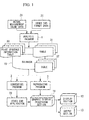
- FIG. 1 is a block diagram showing a configuration of the computer aided design system of the present embodiment.
- the computer aided design system of the present embodiment comprises; a central processor such as central processing unit (CPU) or the like (not shown), a storage memory such as a ROM, RAM, or the like (not shown), a database 10, a graphic display processing section 11, a display section 12, an output section 13, and a communication section (not shown).
- the CPU reads out an analysis program 1, a converting program 2, and a reproducing program 3 stored in a ROM and executes a series of processes related to free-form surface analysis, conversion, and reproduction.
- the RAM is a semiconductor memory in which the CPU primarily stores data.
- the analysis program 1 is a program which executes in the CPU, a process for reading in actual measurement value data 20 of a three-dimensional shaped body by CAT (computer aided testing) or the like, or other computer aided design format data 21 (graphics data represented for example by a surface model such as a solid model, a bezier, a b-spline, a rational bezier, or a NURBS), creating a point sequence information table 30, a table 31 of coefficients of the first fundamental form, and a table 32 of coefficients of the second fundamental form, and then storing this in the database 10.
- CAT computer aided testing
- other computer aided design format data 21 graphics data represented for example by a surface model such as a solid model, a bezier, a b-spline, a rational bezier, or a NURBS
- s(u, v) ⁇ x(u, v), y (u, v), z (u, v) ⁇ 0 ⁇ u, v ⁇ 1 as shown in FIG. 2.
- s(u, v) ⁇ x(u, v), y (u, v), z (u, v) ⁇ 0 ⁇ u, v ⁇ 1 as shown in FIG. 2.
- the table 31 of coefficients of the first fundamental form comprises coefficients of the first fundamental form E, F, and G derived from the following equations.
- s (u, v) denotes a curved line on the curved surface
- the fundamental vectors Su and Sv form a tangent plane of the curved surface.
- the coefficients of the first fundamental form E, F, and G described above are uniquely determined for the respective meshes in this way.
- the table 31 of coefficients of the first fundamental form stores the values for the respective meshes ID1 to IDmn.
- n (s u ⁇ s v ) H
- the plane determined by t and n as shown in FIG. 3 is called a normal plane.
- the curvature ⁇ at the point P on this normal section plane is called a normal curvature.
- Differentiating t for the arc length s on the normal section plane gives:
- the coefficients of the second fundamental form L, M, and N described above are uniquely determined for the respective meshes in this way.
- the table 32 of coefficients of the second fundamental form stores the values for the respective meshes ID1 to IDmn.
- the normal curvature is computed from the coefficients of the first fundamental form and the coefficients of the second fundamental form.
- the converting program 2 is a program which executes on a computer a process for; reading out the necessary information for a free-form surface from the point sequence information table 30, the table 31 of coefficients of the first fundamental form, and the table 32 of coefficients of the second fundamental form, then creating free-form surface data, and transforming this into a form which an other computer aided design application can interpret.
- the reproducing program 3 similarly to the converting program 2, is a program which executes on a computer a process for; reading out the necessary information for a free-form surface from the point sequence information table 30, the table 31 of coefficients of the first fundamental form, and the table 32 of coefficients of the second fundamental form, then creating free-form surface data, and outputting to the graphic display processing section 11.
- the database 10 stores the above described point sequence information table 30, the table 31 of coefficients of the first fundamental form, and the table 32 of coefficients of the second fundamental form, and writes in the output result of the analysis program 1 in association with a mesh ID described later.
- the graphic display processing section 11 performs graphic display processing on the output results from the reproducing program, and other computer aided design applications.
- the display section 12 displays the output results of the graphic display processing section 11.
- the output section 13 outputs the output results of the graphic display processing section 11 to the communication section, other recording media, or the like.
- the communication section transfers data such as the point sequence information, the coefficients of the first fundamental form, and the coefficients of the second fundamental form stored in the database 1 to other severs or clients via a network such as a LAN, the Internet, or the like.
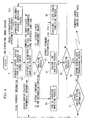
- FIG. 4 is a flowchart showing a processing flow from free-form surface analysis to data transfer, by the analysis program 1.
- the CPU receives an analyze command for the actual measurement value data 20 or other computer aided design format data 21, reads out the analysis program 1 from ROM, and executes the free-form surface analyzing process. Firstly, the CPU performs a process for extracting a plurality of point sequences on a curved surface such as a two-dimensional NURBS surface, bicubic surface, or the like, held by the actual measurement value data 20 or the other computer aided design format data 21. Then, a curved surface is generated from this point sequence using the other computer aided design system (step S1 in FIG. 4), and the curved surface is divided into a predetermined mn mesh number as shown in FIG. 2, after which the respective mesh parts are standardized by fundamental vectors Su and Sv. The point sequence information (u, v) generated during the standardization is written in the point sequence information table 30 held by the database 10, in association with the mesh ID.
- a curved surface such as a two-dimensional NURBS surface, bicubic surface, or the like
- the CPU executes differential geometric analysis processing. That is, it performs processing for computing the coefficients of the first fundamental form E, F, and G defined by the fundamental vectors Su and Sv which form the tangent plane of the mesh.
- the computed coefficients of the first fundamental form E, F and G similarly to the point sequence information, are written in the table 31 of coefficients of the first fundamental form held by the database 10, in association with the mesh ID.
- the CPU performs a process for computing the coefficients of the second fundamental form L, M, and N defined by the fundamental vectors Su and Sv and an unit normal vector n of the mesh.
- the computed coefficients of the second fundamental form L, M, and N similarly to the coefficients of the first fundamental form E, F and G, are written in the table 32 of coefficients of the second fundamental form held by the database 10, in association with the mesh ID.
- the CPU performs processing for computing an integrable condition which is a condition where the differential equation representing the above described mesh is continuous at the respective boundaries of the mesh, in other words, a condition where this differential equation has a unique solution.
- n e 1 ⁇ e 2 ⁇ e 1 ⁇ e 2 ⁇
- E ⁇ e 1 ⁇ 2
- F (e 1 , e 2 )
- G ⁇ e 2 ⁇ 2
- g 11 G EG - F 2
- g 22 E EG - F 2
- h 11 L
- h 22 N
- the CPU performs these arithmetic processes and calculates the integrable condition described above (step S2).
- the CPU executes a line of curvature analyzing process, a feature line analyzing process, and a curvature/girth length converting process (step S3).
- the principal curvatures ⁇ 1 and ⁇ 2 in the mesh are calculated based on the coefficients of the first fundamental form E, F and G, and the coefficients of the second fundamental form L, M and N by the line of curvature analyzing process (step S4). That is to say, firstly the extremum of the curvature ⁇ 1 described above is calculated.
- the shape of the normal section plane which is the line of intersection of the normal plane and the curved surface, changes together with the tangential direction, and accompanied by this, the normal curvature also changes.
- equation 18 is modified, is obtained.
- the coefficient of is positive from equation 7. Assuming that the roots are ⁇ 1 and ⁇ 2 , the value becomes the principal curvature as shown in FIG. 5.
- K m is the mean curvature
- K g is the Gaussian curvature.
- the point where this Gaussian curvature becomes zero is assumed to be the reference point of transformation described later.
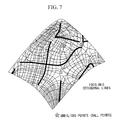
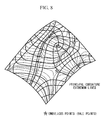
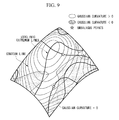
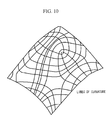
- lines of curvature, borderlines (ridgelines), isoclinic orthogonal lines shown in FIG. 7, principal curvature extremum lines shown in FIG. 8, isoclinic extremum lines shown in FIG. 9, or umbilicus points may be selected.
- These are points or lines which become a reference point or a reference line of transformation defined by changing patterns of one or more feature quantities among the principal curvature, the principal direction, the Gaussian curvature, the mean curvature and the line of curvature, which are feature quantities showing the feature of the curved surface. It is possible to calculate these based on the coefficients of the first fundamental form and the coefficients of the second fundamental form.
- the curvature/girth length converting process is performed (step S6). That is, the CPU calculates the girth length based on the curvature which is calculated based on the coefficients of the first fundamental form E, F, and G and the coefficients of the second fundamental form L, M, and N.
- the radius of curvature is calculated from the curvature (1/r), and the girth length of the line of curvature is expanded and contracted in each calculation interval.
- step S7 After the point sequence information, the coefficients of the first fundamental form, and the coefficients of the second fundamental form, which were generated and extracted at step S1 and step S2, have been collected (Yes in step S7), the CPU performs the curved surface data transferring process (step S9). On the other hand, in the case where such information has not been completed, the database evaluating process is performed (No in step S7).
- step S8 the shape reproduced based on the principal direction, the reference position (point, line, or the like), the transformed amount, that were calculated at steps S4 to S6, and the shape reproduced based on the point sequence information, the coefficients of the first fundamental form, and the coefficients of the second fundamental form are compared, and in the case where they match (Yes in step S8), the curved surface data transferring process is performed (step S9). Moreover, in the case where they do not match (No in step S8), an accuracy improving process by approximation and interpolation is performed. That is, the initial curved surface is approximated and interpolated so that it becomes doubly differentiable, and the processes described above are repeatedly performed again from step SI. Then, at the stage where the comparative evaluation in step S8 is matched, the flow shifts to the curved surface data transferring process.
- the curved surface data is transferred to the converting program 2 or the reproducing program 3 shown in FIG. 1.
- the CPU receives a convert command, it executes the converting program 2. That is, firstly assuming that a point selected as a feature point or a feature line, where the Gaussian curvature becomes zero, is the transformation reference, the line of curvature is expansion and contraction transformed by the girth length in the line of curvature direction so that the mesh or the curved surface is reproduced. Then, a plurality of point sequences on the curved surface are extracted from the reproduced mesh or curved surface, and the point sequences are converted according to a graphical representation algorithm in an other computer aided design system.
- the converted graphics data is reproduced by the other computer aided design application 22 and then output to the graphic display processing section 11.
- the graphic display processing section 11 performs graphic display processing of the data output from the computer aided design application 22 and outputs this to the display section 12.
- the display section 12 receives the input of the display data and displays this.
- the CPU receives a reproduction command, it executes the reproducing program 3.
- the reproducing program makes the CPU to execute the processes in the converting program except for the converting process. That is, assuming that a point where the Gaussian curvature becomes zero, is the transformation reference, the line of curvature is expansion and contraction transformed by the girth length in the line of curvature direction so that the mesh or the curved surface is reproduced. Then, the reproduced graphics data is output to the graphic display processing section 11, and after display processing, it is displayed in the display section 12.
- an effect can be obtained where a free-form surface can be analyzed, converted and reproduced while retaining the continuity of the C2 continuous. Therefore, an effect can be obtained where the utility value of a computer aided design model can be greatly increased, and the efficiency of the design and production processes can be improved.
- the description is for a series of processes related to free-form surface analysis, conversion, and reproduction in a computer aided design model.
- the computer aided design system of the present invention is not limited to this, and is applicable to a computer graphics system, or a system and a program which performs graphical representation using a computer.
- a curved surface is divided into meshes, and then standardized by the fundamental vectors Su and Sv, so that the free-form surface analysis, conversion, and reproduction are performed by a u, v parameter form which uses point sequence information (u, v).
- the computer aided design system of the present invention is not limited to this, and coordinate values for (x, y, z) coordinate parameters may be used.
- the computer aided design system described above contains a computer system inside. Moreover steps of a series of processes related to the aforementioned free-form surface analysis, conversion, and reproduction are stored in a computer readable recording media in program format. A computer reads out and executes this program, to thereby perform the above processes.
- the computer readable recording media is for example a magnetic disk, magnetooptical disk, CD-ROM, DVD-ROM, semiconductor memory or the like.
- the arrangement may be such that this computer program is delivered to a computer by a communication line, and the computer which receives this delivery, executes the program.
Landscapes
- Physics & Mathematics (AREA)
- Engineering & Computer Science (AREA)
- General Physics & Mathematics (AREA)
- Theoretical Computer Science (AREA)
- Software Systems (AREA)
- Geometry (AREA)
- Computer Graphics (AREA)
- Mathematical Analysis (AREA)
- Pure & Applied Mathematics (AREA)
- Mathematical Physics (AREA)
- Mathematical Optimization (AREA)
- Algebra (AREA)
- Processing Or Creating Images (AREA)
- Image Generation (AREA)
Abstract
Description
















Claims (10)
- A computer aided design system comprising:a point sequence information extraction device which extracts a plurality of point sequences on a curved surface;a dividing device which generates a curved surface from said point sequences using another computer aided design system, and divides said curved surface into a predetermined number of meshes;a first fundamental form computing device for computing coefficients of the first fundamental form defined by a tangent vector which forms a tangent plane of said mesh;a second fundamental form computing device for computing coefficients of the second fundamental form defined by said tangent vector and a normal vector of said mesh; anda memory device which stores said point sequence information, said coefficients of the first fundamental form and said coefficients of the second fundamental form.
- A computer aided design system according to claim 1 further comprising:a principal curvature computing device which computes a principal curvature of said mesh based on said coefficients of the first fundamental form and coefficients of the second fundamental form;a line of curvature computing device which computes a line of curvature showing a principal direction of said mesh based on said principal curvature;a feature point/feature line analyzing device which extracts a point or a line which become a reference point or a reference line of transformation defined by changing patterns of one or more feature quantities among five feature quantities showing features of said curved surface comprising a Gaussian curvature and a mean curvature computed based on said principal curvature, said principal direction, said line of curvature, and said coefficients of the first fundamental form and coefficients of the second fundamental form; anda girth length computing device which computes a girth length based on a curvature computed from said coefficients of the first fundamental form and coefficients of the second fundamental form.
- A computer aided design system according to claim 2 further comprising:a reproducing device which transforms said line of curvature for said girth length in said line of curvature direction, with said feature point or feature line as a transformation reference, and reproduces said mesh or said curved surface.
- A computer aided design system according to claim 3 further comprising:a converting device which extracts a plurality of point sequences on a curved surface from said reproduced mesh or curved surface, and converts said point sequences according to a graphical representation algorithm in another computer aided design system.
- A computer aided design program for executing on a computer:a point sequence information extraction process for extracting a plurality of point sequences on a curved surface;a dividing process for generating a curved surface from said point sequences using another computer aided design system, and dividing said curved surface into a predetermined number of meshes;a first fundamental form computing process for computing coefficients of the first fundamental form defined by a tangent vector which forms a tangent plane of said mesh;a second fundamental form computing process for computing coefficients of the second fundamental form defined by said tangent vector and a normal vector of said mesh; anda storage process for storing said point sequence information, said coefficients of the first fundamental form and said coefficients of the second fundamental form.
- A computer aided design program according to claim 5 for further executing on a computer:a principal curvature computing process for computing a principal curvature of said mesh based on said coefficients of the first fundamental form and coefficients of the second fundamental form;a line of curvature computing process for computing a line of curvature showing a principal direction of said mesh based on said principal curvature;a feature point/feature line analyzing process for extracting a point or a line which become a reference point or a reference line of transformation defined by changing patterns of one or more feature quantities among five feature quantities showing features of said curved surface comprising a Gaussian curvature and a mean curvature computed based on said principal curvature, said principal direction, said line of curvature, and said coefficients of the first fundamental form and coefficients of the second fundamental form; anda girth length computing process for computing a girth length based on a curvature computed from said coefficients of the first fundamental form and coefficients of the second fundamental form.
- A computer aided design program according to claim 6 for further executing on a computer,
a reproducing process for transforming said line of curvature for said girth length in said line of curvature direction, with said feature point or feature line as a transformation reference, and reproducing said mesh or said curved surface. - A computer aided design program according to claim 7 for further executing on a computer:a converting process for extracting a plurality of point sequences on a curved surface from said reproduced mesh or curved surface, and converting said point sequences according to a graphical representation algorithm in another computer aided design system.
- A computer graphics system comprising:a point sequence information extraction device which extracts a plurality of point sequences on a curved surface;a dividing device which generates a curved surface from said point sequences using another computer graphics system, and divides said curved surface into a predetermined number of meshes;a first fundamental form computing device for computing coefficients of the first fundamental form defined by a tangent vector which forms a tangent plane of said mesh;a second fundamental form computing device for computing coefficients of the second fundamental form defined by said tangent vector and a normal vector of said mesh; anda memory device which stores said point sequence information, said coefficients of the first fundamental form and said coefficients of the second fundamental form.
- A computer graphics program for executing on a computer:a point sequence information extraction process for extracting a plurality of point sequences on a curved surface;a dividing process for generating a curved surface from said point sequences using another computer graphics system, and dividing said curved surface into a predetermined number of meshes;a first fundamental form computing process for computing coefficients of the first fundamental form defined by a tangent vector which forms a tangent plane of said mesh;a second fundamental form computing process for computing coefficients of the second fundamental form defined by said tangent vector and a normal vector of said mesh; anda storage process for storing said point sequence information, said coefficients of the first fundamental form and said coefficients of the second fundamental form.
Applications Claiming Priority (3)
| Application Number | Priority Date | Filing Date | Title |
|---|---|---|---|
| JP2002292585 | 2002-10-04 | ||
| JP2002292585A JP4301791B2 (en) | 2002-10-04 | 2002-10-04 | CAD system and CAD program |
| PCT/JP2003/012748 WO2004031998A1 (en) | 2002-10-04 | 2003-10-06 | Cad system and cad program |
Publications (2)
| Publication Number | Publication Date |
|---|---|
| EP1548618A1 true EP1548618A1 (en) | 2005-06-29 |
| EP1548618A4 EP1548618A4 (en) | 2008-12-17 |
Family
ID=32063921
Family Applications (1)
| Application Number | Title | Priority Date | Filing Date |
|---|---|---|---|
| EP03748703A Withdrawn EP1548618A4 (en) | 2002-10-04 | 2003-10-06 | Cad system and cad program |
Country Status (9)
| Country | Link |
|---|---|
| US (1) | US7917342B2 (en) |
| EP (1) | EP1548618A4 (en) |
| JP (1) | JP4301791B2 (en) |
| KR (1) | KR100717676B1 (en) |
| CN (1) | CN100371937C (en) |
| AU (1) | AU2003268757A1 (en) |
| IL (1) | IL167509A (en) |
| RU (1) | RU2294560C2 (en) |
| WO (1) | WO2004031998A1 (en) |
Cited By (2)
| Publication number | Priority date | Publication date | Assignee | Title |
|---|---|---|---|---|
| CN1916966B (en) * | 2005-08-04 | 2012-09-05 | 达索系统公司 | Process for creating from a mesh an isotopologic set of parameterized surfaces |
| CN104731997A (en) * | 2013-12-21 | 2015-06-24 | 王开明 | Computer aided design method of egg-type curve in road route design |
Families Citing this family (21)
| Publication number | Priority date | Publication date | Assignee | Title |
|---|---|---|---|---|
| JP4773713B2 (en) * | 2004-11-17 | 2011-09-14 | 三菱重工業株式会社 | Shape determination method of mold model |
| JP4418390B2 (en) | 2005-03-22 | 2010-02-17 | 三菱重工業株式会社 | Three-dimensional shape processing apparatus, curved surface generation program and method |
| DE602005015288D1 (en) * | 2005-04-08 | 2009-08-20 | Dassault Systemes | A method for computer-assisted design of a multi-surface model object |
| KR100863075B1 (en) * | 2007-03-30 | 2008-10-10 | 쎄딕(주) | Web-based CAE automatic analysis method and system |
| FR2945136A1 (en) * | 2009-05-04 | 2010-11-05 | Turbomeca | DATA STRUCTURE OF A NOMENCLATURE |
| US8639728B2 (en) * | 2009-08-31 | 2014-01-28 | Siemens Aktiengesellschaft | Method for computer assisted planning of a technical system |
| JP5686975B2 (en) * | 2010-02-26 | 2015-03-18 | 三菱重工業株式会社 | Point sequence generation method, point sequence generation program, point sequence generation device, and machine tool provided with the same |
| EP2400410B1 (en) * | 2010-05-25 | 2014-01-08 | Dassault Systèmes | Computing of a resulting closed triangulated polyhedral surface from a first and a second modeled object |
| RU2423286C1 (en) * | 2010-05-26 | 2011-07-10 | Учреждение Российской академии наук Институт проблем управления им. В.А. Трапезникова РАН | Method of computer-aided design of ship motion control system structure |
| US9224240B2 (en) * | 2010-11-23 | 2015-12-29 | Siemens Medical Solutions Usa, Inc. | Depth-based information layering in medical diagnostic ultrasound |
| US20130021470A1 (en) * | 2011-07-24 | 2013-01-24 | David Holmes | Method and apparatus for collection of data useful for geometric modeling |
| RU2483822C2 (en) * | 2011-07-29 | 2013-06-10 | Открытое акционерное общество Судостроительный завод "СЕВЕРНАЯ ВЕРФЬ" | Method of making curved parts from section rolled stock |
| US8803885B1 (en) * | 2011-09-07 | 2014-08-12 | Infragistics, Inc. | Method for evaluating spline parameters for smooth curve sampling |
| CN103999443B (en) * | 2011-12-07 | 2017-08-15 | 英特尔公司 | Sample based on linearisation 5D edges equation is rejected |
| US9378582B2 (en) * | 2012-07-31 | 2016-06-28 | Siemens Product Lifecycle Management Software Inc. | Rendering of design data |
| US9235659B2 (en) * | 2014-03-17 | 2016-01-12 | Siemens Product Lifecycle Management Software Inc. | Local behavior in a variational system |
| CN106772978A (en) * | 2016-12-30 | 2017-05-31 | 宁波永新光学股份有限公司 | A kind of illuminated light microscope of LED reflection |
| EP3764818B1 (en) | 2018-03-14 | 2023-09-06 | Atlas Pacific Engineering Company | Produce orientor |
| CN111994168B (en) * | 2020-08-13 | 2023-09-01 | 北京新能源汽车股份有限公司 | Steering knuckle after 3D printing, manufacturing method, suspension system and automobile |
| CN111976831B (en) * | 2020-08-13 | 2023-08-22 | 北京新能源汽车股份有限公司 | Steering knuckle after 3D printing, manufacturing method, suspension system and automobile |
| CN114355841B (en) * | 2022-01-07 | 2024-01-16 | 宁波大学 | A method for planning measuring points in complex curved surfaces by region |
Family Cites Families (22)
| Publication number | Priority date | Publication date | Assignee | Title |
|---|---|---|---|---|
| JPS62135965A (en) * | 1985-12-09 | 1987-06-18 | Sony Corp | Free curved surface preparing method |
| JPS6465628A (en) | 1987-09-07 | 1989-03-10 | Toshiba Corp | Digital operation deciding circuit |
| JPH04117572A (en) | 1990-09-07 | 1992-04-17 | Ricoh Co Ltd | Three-dimensional solid form generating device |
| JP2949206B2 (en) | 1990-09-26 | 1999-09-13 | 洋 牧野 | How to record free-form figures |
| DE69232403T2 (en) * | 1991-08-06 | 2002-08-22 | Canon K.K., Tokio/Tokyo | Three-dimensional model processing method and device |
| US5497451A (en) * | 1992-01-22 | 1996-03-05 | Holmes; David | Computerized method for decomposing a geometric model of surface or volume into finite elements |
| US5636338A (en) * | 1993-01-29 | 1997-06-03 | Silicon Graphics, Inc. | Method for designing curved shapes for use by a computer |
| US5479593A (en) * | 1993-06-21 | 1995-12-26 | Electronic Data Systems Corporation | System and method for improved solving of equations employed during parametric geometric modeling |
| JPH0785314A (en) | 1993-09-20 | 1995-03-31 | Nippon Telegr & Teleph Corp <Ntt> | Curved deformation device |
| RU2118837C1 (en) * | 1995-05-17 | 1998-09-10 | Кашик Алексей Сергеевич | Method of study of structure of spaces with dimensionality up to 4 presented by multiparameter digital data array with dimensionality up to 4 |
| JP3078733B2 (en) | 1995-10-04 | 2000-08-21 | 科学技術振興事業団 | How to measure three-dimensional curvature |
| JP3408114B2 (en) | 1996-06-17 | 2003-05-19 | シャープ株式会社 | Solid data correction device, solid data correction method, and recording medium |
| JP3054108B2 (en) * | 1997-08-15 | 2000-06-19 | 理化学研究所 | Free-form surface measurement data synthesis method |
| JP3597360B2 (en) * | 1997-11-17 | 2004-12-08 | 株式会社リコー | Modeling method and recording medium |
| JPH11195139A (en) | 1997-12-26 | 1999-07-21 | Sony Corp | Free-form surface generation apparatus and method, and provided medium |
| JP3344649B2 (en) * | 1998-08-19 | 2002-11-11 | 理化学研究所 | Evaluation method for shape error of free-form surface |
| US6256038B1 (en) * | 1998-12-10 | 2001-07-03 | The Board Of Trustees Of The Leland Stanford Junior University | Parameterized surface fitting technique having independent control of fitting and parameterization |
| US6201549B1 (en) * | 1998-12-30 | 2001-03-13 | Microsoft Corporation | System and method for drawing and painting with bitmap brushes |
| JP3630582B2 (en) | 1999-03-11 | 2005-03-16 | 株式会社東芝 | Image processing apparatus and method |
| JP3829972B2 (en) | 2000-03-06 | 2006-10-04 | サイテック株式会社 | 3D CAD system |
| JP4134571B2 (en) | 2002-02-08 | 2008-08-20 | 日本電気株式会社 | Micro object fixing device and micro object fixing method |
| JP4117572B2 (en) | 2005-02-03 | 2008-07-16 | 東洋紡績株式会社 | Optical laminated polyester film, hard coat film using the same, and plasma display panel filter using the same |
-
2002
- 2002-10-04 JP JP2002292585A patent/JP4301791B2/en not_active Expired - Fee Related
-
2003
- 2003-10-06 EP EP03748703A patent/EP1548618A4/en not_active Withdrawn
- 2003-10-06 AU AU2003268757A patent/AU2003268757A1/en not_active Abandoned
- 2003-10-06 RU RU2005109166/09A patent/RU2294560C2/en not_active IP Right Cessation
- 2003-10-06 US US10/529,645 patent/US7917342B2/en not_active Expired - Fee Related
- 2003-10-06 WO PCT/JP2003/012748 patent/WO2004031998A1/en not_active Ceased
- 2003-10-06 KR KR1020057005540A patent/KR100717676B1/en not_active Expired - Fee Related
- 2003-10-06 CN CNB2003801007652A patent/CN100371937C/en not_active Expired - Fee Related
-
2005
- 2005-03-17 IL IL167509A patent/IL167509A/en not_active IP Right Cessation
Cited By (3)
| Publication number | Priority date | Publication date | Assignee | Title |
|---|---|---|---|---|
| CN1916966B (en) * | 2005-08-04 | 2012-09-05 | 达索系统公司 | Process for creating from a mesh an isotopologic set of parameterized surfaces |
| CN104731997A (en) * | 2013-12-21 | 2015-06-24 | 王开明 | Computer aided design method of egg-type curve in road route design |
| CN104731997B (en) * | 2013-12-21 | 2018-01-09 | 王开明 | The computer-implemented method of egg curve in a kind of road route design |
Also Published As
| Publication number | Publication date |
|---|---|
| KR100717676B1 (en) | 2007-05-11 |
| JP2004127099A (en) | 2004-04-22 |
| RU2005109166A (en) | 2005-09-20 |
| KR20060034202A (en) | 2006-04-21 |
| AU2003268757A1 (en) | 2004-04-23 |
| CN100371937C (en) | 2008-02-27 |
| CN1695151A (en) | 2005-11-09 |
| EP1548618A4 (en) | 2008-12-17 |
| AU2003268757A8 (en) | 2004-04-23 |
| US7917342B2 (en) | 2011-03-29 |
| JP4301791B2 (en) | 2009-07-22 |
| WO2004031998A1 (en) | 2004-04-15 |
| US20060129361A1 (en) | 2006-06-15 |
| IL167509A (en) | 2012-08-30 |
| RU2294560C2 (en) | 2007-02-27 |
Similar Documents
| Publication | Publication Date | Title |
|---|---|---|
| US7917342B2 (en) | Computer aided design system and computer aided design program using a geometric surface model | |
| Marussig et al. | A review of trimming in isogeometric analysis: challenges, data exchange and simulation aspects | |
| US7643026B2 (en) | NURBS surface deformation apparatus and the method using 3D target curve | |
| Louhichi et al. | CAD/CAE integration: updating the CAD model after a FEM analysis | |
| JP3597360B2 (en) | Modeling method and recording medium | |
| JP4934789B2 (en) | Interpolation processing method and interpolation processing apparatus | |
| Huang et al. | The pre-processing of data points for curve fitting in reverse engineering | |
| US7643030B2 (en) | Method and system for efficiently evaluating and drawing NURBS surfaces for 3D graphics | |
| JP4083949B2 (en) | Method for generating curved surface model by reversible rounding operation, method for generating lattice polygon model from curved surface model, recording medium for executing these methods, and method for transmitting / displaying curved surface model | |
| Ruprecht et al. | Spatial free-form deformation with scattered data interpolation methods | |
| EP1705589A1 (en) | Method for approximating and displaying three-dimensional cad data, and system for executing that method | |
| Azariadis et al. | Drawing curves onto a cloud of points for point-based modelling | |
| JP4564506B2 (en) | Evolutionary Design Optimization by Extended Direct Manipulation Method of Free Form Deformation (FreeForm Deformation) | |
| Quadros et al. | Finite Element Mesh Sizing for Surfaces Using Skeleton. | |
| JP4175470B2 (en) | CAD system, curved surface analyzing apparatus, curved surface reproducing apparatus, method and program thereof | |
| EP1675068B1 (en) | Evolutionary optimisation and free form deformation | |
| Qiao et al. | An accurate and fast method for computing offsets of high degree rational Bézier/NURBS curves with user-definable tolerance | |
| JP7716695B2 (en) | 3D CAD system | |
| Hube et al. | Seamless integration of analysis and design: Automatic CAD reconstruction of post-analysis geometries | |
| JP2016189117A (en) | Shape deformation apparatus and shape deformation program | |
| JP2016207055A (en) | Shape deformation apparatus and shape deformation program | |
| Muraki et al. | Curve Mesh Modeling Method of Trimmed Surfaces for Direct Modeling | |
| Su et al. | Simplified outer-envelope triangular mesh generation for STEP-format CAD models | |
| Brakhage et al. | CAGD tools for high quality grid generation and sparse representation | |
| Chen | An application of singularity theory to robust geometric calculation of interactions among dynamically deforming geometric objects |
Legal Events
| Date | Code | Title | Description |
|---|---|---|---|
| PUAI | Public reference made under article 153(3) epc to a published international application that has entered the european phase |
Free format text: ORIGINAL CODE: 0009012 |
|
| 17P | Request for examination filed |
Effective date: 20050331 |
|
| AK | Designated contracting states |
Kind code of ref document: A1 Designated state(s): AT BE BG CH CY CZ DE DK EE ES FI FR GB GR HU IE IT LI LU MC NL PT RO SE SI SK TR |
|
| AX | Request for extension of the european patent |
Extension state: AL LT LV MK |
|
| DAX | Request for extension of the european patent (deleted) | ||
| RBV | Designated contracting states (corrected) |
Designated state(s): DE FI FR GB IT SE |
|
| A4 | Supplementary search report drawn up and despatched |
Effective date: 20081118 |
|
| RIC1 | Information provided on ipc code assigned before grant |
Ipc: G06T 17/20 20060101AFI20081111BHEP |
|
| 17Q | First examination report despatched |
Effective date: 20090807 |
|
| STAA | Information on the status of an ep patent application or granted ep patent |
Free format text: STATUS: THE APPLICATION IS DEEMED TO BE WITHDRAWN |
|
| 18D | Application deemed to be withdrawn |
Effective date: 20180501 |