EP1548219A1 - Improved window regulator assembly which is designed to be mounted in the lock of a motor vehicle - Google Patents
Improved window regulator assembly which is designed to be mounted in the lock of a motor vehicle Download PDFInfo
- Publication number
- EP1548219A1 EP1548219A1 EP03798939A EP03798939A EP1548219A1 EP 1548219 A1 EP1548219 A1 EP 1548219A1 EP 03798939 A EP03798939 A EP 03798939A EP 03798939 A EP03798939 A EP 03798939A EP 1548219 A1 EP1548219 A1 EP 1548219A1
- Authority
- EP
- European Patent Office
- Prior art keywords
- distance
- lock
- slider
- door
- fitted
- Prior art date
- Legal status (The legal status is an assumption and is not a legal conclusion. Google has not performed a legal analysis and makes no representation as to the accuracy of the status listed.)
- Granted
Links
Images
Classifications
-
- E—FIXED CONSTRUCTIONS
- E05—LOCKS; KEYS; WINDOW OR DOOR FITTINGS; SAFES
- E05F—DEVICES FOR MOVING WINGS INTO OPEN OR CLOSED POSITION; CHECKS FOR WINGS; WING FITTINGS NOT OTHERWISE PROVIDED FOR, CONCERNED WITH THE FUNCTIONING OF THE WING
- E05F15/00—Power-operated mechanisms for wings
- E05F15/60—Power-operated mechanisms for wings using electrical actuators
- E05F15/603—Power-operated mechanisms for wings using electrical actuators using rotary electromotors
- E05F15/665—Power-operated mechanisms for wings using electrical actuators using rotary electromotors for vertically-sliding wings
- E05F15/689—Power-operated mechanisms for wings using electrical actuators using rotary electromotors for vertically-sliding wings specially adapted for vehicle windows
- E05F15/6907—Power-operated mechanisms for wings using electrical actuators using rotary electromotors for vertically-sliding wings specially adapted for vehicle windows operated by cords or chains or other flexible elongated pulling elements, e.g. tapes
- E05F15/6909—Power-operated mechanisms for wings using electrical actuators using rotary electromotors for vertically-sliding wings specially adapted for vehicle windows operated by cords or chains or other flexible elongated pulling elements, e.g. tapes by cables
-
- B—PERFORMING OPERATIONS; TRANSPORTING
- B60—VEHICLES IN GENERAL
- B60J—WINDOWS, WINDSCREENS, NON-FIXED ROOFS, DOORS, OR SIMILAR DEVICES FOR VEHICLES; REMOVABLE EXTERNAL PROTECTIVE COVERINGS SPECIALLY ADAPTED FOR VEHICLES
- B60J1/00—Windows; Windscreens; Accessories therefor
- B60J1/08—Windows; Windscreens; Accessories therefor arranged at vehicle sides
- B60J1/12—Windows; Windscreens; Accessories therefor arranged at vehicle sides adjustable
- B60J1/16—Windows; Windscreens; Accessories therefor arranged at vehicle sides adjustable slidable
- B60J1/17—Windows; Windscreens; Accessories therefor arranged at vehicle sides adjustable slidable vertically
-
- E—FIXED CONSTRUCTIONS
- E05—LOCKS; KEYS; WINDOW OR DOOR FITTINGS; SAFES
- E05F—DEVICES FOR MOVING WINGS INTO OPEN OR CLOSED POSITION; CHECKS FOR WINGS; WING FITTINGS NOT OTHERWISE PROVIDED FOR, CONCERNED WITH THE FUNCTIONING OF THE WING
- E05F11/00—Man-operated mechanisms for operating wings, including those which also operate the fastening
- E05F11/38—Man-operated mechanisms for operating wings, including those which also operate the fastening for sliding windows, e.g. vehicle windows, to be opened or closed by vertical movement
-
- E—FIXED CONSTRUCTIONS
- E05—LOCKS; KEYS; WINDOW OR DOOR FITTINGS; SAFES
- E05F—DEVICES FOR MOVING WINGS INTO OPEN OR CLOSED POSITION; CHECKS FOR WINGS; WING FITTINGS NOT OTHERWISE PROVIDED FOR, CONCERNED WITH THE FUNCTIONING OF THE WING
- E05F11/00—Man-operated mechanisms for operating wings, including those which also operate the fastening
- E05F11/38—Man-operated mechanisms for operating wings, including those which also operate the fastening for sliding windows, e.g. vehicle windows, to be opened or closed by vertical movement
- E05F11/382—Man-operated mechanisms for operating wings, including those which also operate the fastening for sliding windows, e.g. vehicle windows, to be opened or closed by vertical movement for vehicle windows
-
- E—FIXED CONSTRUCTIONS
- E05—LOCKS; KEYS; WINDOW OR DOOR FITTINGS; SAFES
- E05F—DEVICES FOR MOVING WINGS INTO OPEN OR CLOSED POSITION; CHECKS FOR WINGS; WING FITTINGS NOT OTHERWISE PROVIDED FOR, CONCERNED WITH THE FUNCTIONING OF THE WING
- E05F11/00—Man-operated mechanisms for operating wings, including those which also operate the fastening
- E05F11/38—Man-operated mechanisms for operating wings, including those which also operate the fastening for sliding windows, e.g. vehicle windows, to be opened or closed by vertical movement
- E05F11/382—Man-operated mechanisms for operating wings, including those which also operate the fastening for sliding windows, e.g. vehicle windows, to be opened or closed by vertical movement for vehicle windows
- E05F11/385—Fixing of window glass to the carrier of the operating mechanism
-
- E—FIXED CONSTRUCTIONS
- E05—LOCKS; KEYS; WINDOW OR DOOR FITTINGS; SAFES
- E05F—DEVICES FOR MOVING WINGS INTO OPEN OR CLOSED POSITION; CHECKS FOR WINGS; WING FITTINGS NOT OTHERWISE PROVIDED FOR, CONCERNED WITH THE FUNCTIONING OF THE WING
- E05F11/00—Man-operated mechanisms for operating wings, including those which also operate the fastening
- E05F11/38—Man-operated mechanisms for operating wings, including those which also operate the fastening for sliding windows, e.g. vehicle windows, to be opened or closed by vertical movement
- E05F11/48—Man-operated mechanisms for operating wings, including those which also operate the fastening for sliding windows, e.g. vehicle windows, to be opened or closed by vertical movement operated by cords or chains or other flexible elongated pulling elements, e.g. tapes
- E05F11/481—Man-operated mechanisms for operating wings, including those which also operate the fastening for sliding windows, e.g. vehicle windows, to be opened or closed by vertical movement operated by cords or chains or other flexible elongated pulling elements, e.g. tapes for vehicle windows
- E05F11/483—Man-operated mechanisms for operating wings, including those which also operate the fastening for sliding windows, e.g. vehicle windows, to be opened or closed by vertical movement operated by cords or chains or other flexible elongated pulling elements, e.g. tapes for vehicle windows by cables
- E05F11/486—Man-operated mechanisms for operating wings, including those which also operate the fastening for sliding windows, e.g. vehicle windows, to be opened or closed by vertical movement operated by cords or chains or other flexible elongated pulling elements, e.g. tapes for vehicle windows by cables with one cable connection to the window glass
-
- E—FIXED CONSTRUCTIONS
- E05—LOCKS; KEYS; WINDOW OR DOOR FITTINGS; SAFES
- E05Y—INDEXING SCHEME ASSOCIATED WITH SUBCLASSES E05D AND E05F, RELATING TO CONSTRUCTION ELEMENTS, ELECTRIC CONTROL, POWER SUPPLY, POWER SIGNAL OR TRANSMISSION, USER INTERFACES, MOUNTING OR COUPLING, DETAILS, ACCESSORIES, AUXILIARY OPERATIONS NOT OTHERWISE PROVIDED FOR, APPLICATION THEREOF
- E05Y2900/00—Application of doors, windows, wings or fittings thereof
- E05Y2900/50—Application of doors, windows, wings or fittings thereof for vehicles
- E05Y2900/53—Type of wing
- E05Y2900/55—Windows
Definitions
- the present invention refers to an improved window lift assembly adapted for being fitted in the lock of a motor vehicle, which novel manufacturing, conformation and design features fulfil the purpose to which it has been specifically conceived, with a maximum safety and effectiveness, and providing many advantages as it will be herein disclosed.
- the present invention refers to the design of the window lifting device for motor vehicles of the type of those being fixed in the lock device of the motor vehicle, that is, in which the track where the window pane driving slider is fixed to the lock device of the motor vehicle.
- the window lifting device for motor vehicles of the type of those being fixed in the lock device of the motor vehicle, that is, in which the track where the window pane driving slider is fixed to the lock device of the motor vehicle.
- this particular type of window lift there is provided an additional slider within the frame of the door of the motor vehicle.
- the invention provides a new design of said type of window lifting devices which calculation variables are defined in such a way that the stability of the assembly, which is the main problem to be overcome in these window lifting devices, as it will be herein disclosed, is completely guaranteed, further allowing to know the feasibility of a project for a window lift assembly to be fitted in a lock device.
- the improved window lift assembly adapted for being fitted in the lock of a motor vehicle of the present invention has been developed, which will be herein fully described.
- This window lift is, as noted above, of the type of which essentially comprises two guide and slider assemblies, one of which is fitted in the frame of the door and the other of which is fitted in the track of the window lift. It further comprises slider driving means that include an electric motor having a gearmotor. The sliders are fixed to the window pane and the assembly is mounted attached to the lock of the motor vehicle with the track secured thereto.
- the invention ascertains the necessary conditions which the design variables should meet for the feasibility of a stable assembly. Said variables present in this calculation are those herein set forth:
- (X 1 ) is of the order of 100-150 mm, depending on the space available for assembly.
- guiding inside the door frame may be carried out in three ways:
- the sliders used in the window lift described according to the present invention are made preferably, but not exclusively, of carbon fiber and combinations thereof with POM, PP66 or other similar plastic materials suitable for this purpose with the addition of materials for promoting slippage and reducing the abrasive nature of the carbon fiber. With the choice of these materials it is possible to obtain sliders which are up to ten times more resistant than the conventional sliders made of POM and the like. Also, the carbon fiber allows reducing noise in use with regard to other materials typically employed for the same purpose.
- a further important feature of the present invention is the mechanical link between the window lift driving means and the lock device of the motor vehicle where it is mounted. Operation of locks in motor vehicles currently involves the use of several electric motors for driving the central locking system and other related devices.
- the invention proposes the mechanical connection of the window lift driving means with at least some of said devices associated with the lock assembly with the purpose of suppressing at least one of the motors used. In this sense, it should be especially stressed the fact that the feasibility of the mechanical transmission of, for example, the central locking system of a vehicle through the motor of the window lift fixed to the lock thereof is possible thanks to the high gear ration existing between the electric motor output shaft and a screw shaft meshed therewith which would act on the lock mechanism, which may be of the order of 1/70.
- the electric motor rotates approximately 80°, so that there is an available energy for a mechanism like the lock device (and related mechanisms thereof) that requires a low amount of energy and this does not involve any discernable movements in the window lift.
- a displacement of 0,5 mm in the drum around which the window lift driving cable is wound is hardly appreciated since there are other factors as the compression of springs, cable, rubbers, etc. before the pane is moved.
- FIG. 1 A preferred embodiment of a window lift assembly according to the present invention is now described in detail and by way of a non limitative example, from which the features and the advantages of the invention will be clearly understood.
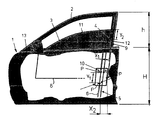
- the description that follows is given with reference to the drawing that is herein accompanied which corresponds to a diagrammatic elevational view of a vehicle door having a window lifting device according to the invention, said door being part-way shown cut so that the assembly of guides and sliders as well as the window pane are clearly seen.
- a door (1) of a vehicle is shown with the frame (2) where the pane (3) slides.
- the window lift includes a first guide and slider assembly (4) in the frame (2) of the door (1) and a second guide and slider assembly (5) in the track (6) of the window lift.
- the window lift is driven through an electric motor and a gearmotor (not shown).
- the slider (7) is fixed to the lower edge (8) of the pane (3) at the fastening points (10), the assembly being mounted fixed to the door lock (1) with the track (6) secured thereto.
- the slider (7) is made of carbon fiber and combinations thereof with POM, PP66 or other similar plastic materials suitable for this purpose with the addition of materials for promoting slippage and reducing the abrasive nature of the carbon fiber. Carbon fiber is preferred due to its low noise in use regarding other conventional materials.
- Variable (Y 1 ) corresponds to the distance between two points of contact (P) of the slider (7) in the track (6) measured on a line parallel to said track (6).
- Variable (Y 2 ) is the distance from the upper edge (11) of the pane (3) to the fastening point (12) of the slider (4) running through the length (9) of the frame (2) of the door (1).
- the third design variable (X 1 ) is the distance from an end of the track (6) -which is secured to the frame (2) of the door (1)- to the points of contact (P) of the slider (7) in the track (6).
- a fourth additional variable called (X 2 ) may be defined corresponding to the horizontal distance between two points of contact (P) of the slider (7) in the track (6).
- the condition that (Y 1 ) is the maximum value possible for generating the maximum resistive torque to withstand the weight of the pane (3) should be met and, at the same time, the condition that (Y 1 ) ⁇ (H-h) should be also met to facilitate the assembly of the slider (7) in the door. It should be also met that (Y 2 ) is less than the value (h-Y 2 ) since the descent load is less than the ascent torque due to gravity. As the pane (3) carries out an upward movement, the window lift should overcome friction as well as the weight of the pane (3), while as the pane (3) carries out a downward movement, loads are friction minus the weight of the pane(3). Finally, distance (X 1 ) should be as greater as possible according to the geometry of the door (1).
- distance (Y 1 ) is very low, due to space reasons, and to the geometry of the door (1), an additional condition that distance (X 2 ) is less than or equal to (X 1 ) should be additionally met, the latter being of the order of 100-150 mm, depending on the space available for assembly.
- distance (Y 1 ) involves a greater limitation of rotation of the slider (7) of the window lift on the track (6), so that the window lift becomes stronger.
- distances (Y 2 , X 2 ) depend on friction loads.
- guiding inside the frame (2) of the door (1) may be carried out only providing a single point of contact inside the guide so that rotation is allowed.
- distance (Y 1 ) should be as high as possible, (X 1 ) should be as low as possible, (Y2) being load dependant.
- Guiding inside the frame (2) of the door (1) may be alternatively carried out without possibility of rotation, in which case, distance (Y 1 ) then should be as low as possible to avoid hyperstability and to prevent the system from being blocked, distance (X 1 ) then being as low as possible to avoid any possible blocking torques.
- guiding inside the frame (2) of the door (1) may be also carried out according to the invention by providing a single point of contact as in the first case, but with the pane (3) completely resting on the frame (2) of the door (1).
- (Y 1 , Y 2 , X 1 ) should be calculated according to the geometry and the loads, without considering maximum and minimum values.
- (Y 1 ) should be an average value to avoid possible plays in the system, while (Y 2 , X 2 ) should be proportional to ascent and descent loads.
Landscapes
- Engineering & Computer Science (AREA)
- Mechanical Engineering (AREA)
- Window Of Vehicle (AREA)
- Power-Operated Mechanisms For Wings (AREA)
Abstract
Description
- The present invention refers to an improved window lift assembly adapted for being fitted in the lock of a motor vehicle, which novel manufacturing, conformation and design features fulfil the purpose to which it has been specifically conceived, with a maximum safety and effectiveness, and providing many advantages as it will be herein disclosed.
- More particularly, the present invention refers to the design of the window lifting device for motor vehicles of the type of those being fixed in the lock device of the motor vehicle, that is, in which the track where the window pane driving slider is fixed to the lock device of the motor vehicle. In this particular type of window lift there is provided an additional slider within the frame of the door of the motor vehicle.
- The invention provides a new design of said type of window lifting devices which calculation variables are defined in such a way that the stability of the assembly, which is the main problem to be overcome in these window lifting devices, as it will be herein disclosed, is completely guaranteed, further allowing to know the feasibility of a project for a window lift assembly to be fitted in a lock device.
- The above mentioned disadvantage of the window lifting devices fixed to the lock of the motor vehicle lies basically in the uncertainty of the assembly in use, which is mainly due to the fact that both fixing of the window in the slider and the guiding thereof result in backlash and interferences which negatively influences the system operation. Backlash and interferences are indeed amplified to a large extent by the action of the cantilevered pane due to the fact that the window lifting device is mounted in the lock, that is, on a side end of the door.
- Practice has clearly shown that the main problem in this type of window lifting devices resides in the difficulty of maintaining the system stable since, as outlined above, the pane may have a great length which consequently results in a high torque that makes the system unstable. In this sense, it should be especially stressed the fact that the load center, that is to say, the weight of the pane plus frictions, is located quite far from the center of thrust of the window lift driving cable.
- With the aim of seeking an effective solution that allows to maintain the static and dynamic stability condition required for a window lifting device of the type of those being mounted in the lock of the door of a motor vehicle, the improved window lift assembly adapted for being fitted in the lock of a motor vehicle of the present invention has been developed, which will be herein fully described.
- This window lift is, as noted above, of the type of which essentially comprises two guide and slider assemblies, one of which is fitted in the frame of the door and the other of which is fitted in the track of the window lift. It further comprises slider driving means that include an electric motor having a gearmotor. The sliders are fixed to the window pane and the assembly is mounted attached to the lock of the motor vehicle with the track secured thereto.
- The invention ascertains the necessary conditions which the design variables should meet for the feasibility of a stable assembly. Said variables present in this calculation are those herein set forth:
- (Y1): distance between two points of contact of the slider in the track measured on a line parallel to said track;
- (Y2): distance from the upper edge of the pane to the fastening point of the slider of the door;
- (X1): distance from an end of the track (which is secured to the door frame) to the points of contact of the slider in the track;
- (X2): horizontal distance between two points of contact of the slider in the track;
- (H): height of the lower edge of the door of the vehicle to the belt line; and
- (h): height of the window of the vehicle.
-
- The conditions which have to be met by said variables so that the design of this window lifting device is feasible are the following:
- i) (Y1) should be the maximum value possible for generating the maximum resistive torque to withstand the weight of the pane and, at the same time, the condition that (Y1) < (H-h) should be also met in order to facilitate the assembly of the slider in the door;
- ii) (Y2) < (h-Y) since the descent load is less than the ascent torque due to gravity. As the pane carries out an upward movement, the window lift should overcome friction and the weight of the pane, while as the pane carries out a downward movement, loads are friction minus the weight of the pane; and
- iii) (X1) should be as high as possible according to the geometry of the door.
-
- In the event the value (Y1) is very low, due to space reasons, and to the geometry of the door, a condition that (X2) ≤ ((X1) should be additionally met.
- Preferably, (X1) is of the order of 100-150 mm, depending on the space available for assembly.
- Therefore, according to the invention, it is necessary to keep in mind at least three variables (Y1, Y2, X1) in order for the assembly to be stable depending on the geometry and the loads on each door.
- An increased (Y1) involves a higher limitation of rotation of the window lift slider on the track, so that the window lift becomes stronger. On the other hand, (Y2, X2) depend on friction loads.
- Regarding the design of the slider of the guide of the vehicle door, guiding inside the door frame may be carried out in three ways:
- 1- By only providing a single point of contact inside said guide, which allows rotation. In this case, in order to provide stability to the system, (Y1) should be as high as possible, (X1) should be as low as possible and (Y2) depends on the load.
- 2- Completely guided without possibility of rotation. In this case (Y1) should be as low as possible to avoid hyperstability and to prevent the system from being blocked, and (X1) should be also as low as possible to avoid any possible blocking torques.
- 3- The slider will have a single point of contact as in the first case, but the pane completely rests on the door frame. In this case (Y1, Y2, X1) should be calculated according to geometry and loads, without considering maximum and minimum values. (Y1) should be an average value to avoid possible plays in the system, while (Y2, X2) should be proportional to ascent and descent loads.
-
- The sliders used in the window lift described according to the present invention are made preferably, but not exclusively, of carbon fiber and combinations thereof with POM, PP66 or other similar plastic materials suitable for this purpose with the addition of materials for promoting slippage and reducing the abrasive nature of the carbon fiber. With the choice of these materials it is possible to obtain sliders which are up to ten times more resistant than the conventional sliders made of POM and the like. Also, the carbon fiber allows reducing noise in use with regard to other materials typically employed for the same purpose.
- A further important feature of the present invention is the mechanical link between the window lift driving means and the lock device of the motor vehicle where it is mounted. Operation of locks in motor vehicles currently involves the use of several electric motors for driving the central locking system and other related devices. The invention proposes the mechanical connection of the window lift driving means with at least some of said devices associated with the lock assembly with the purpose of suppressing at least one of the motors used. In this sense, it should be especially stressed the fact that the feasibility of the mechanical transmission of, for example, the central locking system of a vehicle through the motor of the window lift fixed to the lock thereof is possible thanks to the high gear ration existing between the electric motor output shaft and a screw shaft meshed therewith which would act on the lock mechanism, which may be of the order of 1/70.
- More particularly, if the following design variables are taken into consideration in calculation of the window lift driving means:
- α1 = arch rotated by the drum. It equals the travel of the driving cable and the length of the pane that is moved;
- r = radius of the drum around which the driving cable is wound;
- β1 = angle rotated by the cable drum (in radians);
- α2 = arch rotated by the electric motor before reduction;
- β2 = angle rotated by the electric motor before the reduction (in radians);
- Re = gear ration of the gearmotor between the drum axis and the electric motor output shaft; it is provided that
-
- Therefore, as
- Then:
- Replacing the variables with typical values in a window lift as in the present invention:
- That is to say, if the travel length of the pane driving cable is 0,5 m, the electric motor rotates approximately 80°, so that there is an available energy for a mechanism like the lock device (and related mechanisms thereof) that requires a low amount of energy and this does not involve any discernable movements in the window lift. A displacement of 0,5 mm in the drum around which the window lift driving cable is wound is hardly appreciated since there are other factors as the compression of springs, cable, rubbers, etc. before the pane is moved.
- The design proposed in the present invention provides many advantages:
- an accurate feasibility study of the window lift for determining stability in use according to the defined variables is thus made possible;
- the use of a window lifting device directly fitted to the lock of the door allows the free room inside the door to be increased;
- the configuration of the window lift driving means according to the present invention allows at least one of the motors associated with the activation of the vehicle lock to be suppressed;
- a window lifting device designed according to the parameters of the present invention allows large sized and high weighted panes to be driven without problems.
- A preferred embodiment of a window lift assembly according to the present invention is now described in detail and by way of a non limitative example, from which the features and the advantages of the invention will be clearly understood. The description that follows is given with reference to the drawing that is herein accompanied which corresponds to a diagrammatic elevational view of a vehicle door having a window lifting device according to the invention, said door being part-way shown cut so that the assembly of guides and sliders as well as the window pane are clearly seen.
- The embodiment that is herein described according to the enclosed drawing is an effective solution that makes possible the condition of static and dynamic stability required for a window lift fitted in the lock of the motor vehicle door is met.
- In the drawing, a door (1) of a vehicle is shown with the frame (2) where the pane (3) slides. The window lift includes a first guide and slider assembly (4) in the frame (2) of the door (1) and a second guide and slider assembly (5) in the track (6) of the window lift.
- The window lift is driven through an electric motor and a gearmotor (not shown).
- The slider (7) is fixed to the lower edge (8) of the pane (3) at the fastening points (10), the assembly being mounted fixed to the door lock (1) with the track (6) secured thereto.
- The slider (7) is made of carbon fiber and combinations thereof with POM, PP66 or other similar plastic materials suitable for this purpose with the addition of materials for promoting slippage and reducing the abrasive nature of the carbon fiber. Carbon fiber is preferred due to its low noise in use regarding other conventional materials.
- The feasibility of this window lift assembly depends on at least three variables (Y1, Y2, X1) which are a function of the geometry and the loads on each door.
- Variable (Y1) corresponds to the distance between two points of contact (P) of the slider (7) in the track (6) measured on a line parallel to said track (6). Variable (Y2) is the distance from the upper edge (11) of the pane (3) to the fastening point (12) of the slider (4) running through the length (9) of the frame (2) of the door (1). The third design variable (X1) is the distance from an end of the track (6) -which is secured to the frame (2) of the door (1)- to the points of contact (P) of the slider (7) in the track (6).
- A fourth additional variable called (X2) may be defined corresponding to the horizontal distance between two points of contact (P) of the slider (7) in the track (6).
- Other values to be taken into consideration are the height (H) from the lower portion (14) of the door (1) of the vehicle to the belt line (13); and the height (h) of the window of the vehicle.
- According to the invention, in order the design of said window lift is made feasible, the condition that (Y1) is the maximum value possible for generating the maximum resistive torque to withstand the weight of the pane (3) should be met and, at the same time, the condition that (Y1) < (H-h) should be also met to facilitate the assembly of the slider (7) in the door. It should be also met that (Y2) is less than the value (h-Y2) since the descent load is less than the ascent torque due to gravity. As the pane (3) carries out an upward movement, the window lift should overcome friction as well as the weight of the pane (3), while as the pane (3) carries out a downward movement, loads are friction minus the weight of the pane(3). Finally, distance (X1) should be as greater as possible according to the geometry of the door (1).
- If distance (Y1) is very low, due to space reasons, and to the geometry of the door (1), an additional condition that distance (X2) is less than or equal to (X1) should be additionally met, the latter being of the order of 100-150 mm, depending on the space available for assembly.
- The increase of distance (Y1) involves a greater limitation of rotation of the slider (7) of the window lift on the track (6), so that the window lift becomes stronger. On the other hand, distances (Y2, X2) depend on friction loads.
- Regarding the design of the slider (4) of the door guide (1) of the vehicle, guiding inside the frame (2) of the door (1) may be carried out only providing a single point of contact inside the guide so that rotation is allowed. In this case, to provide stability to the system, distance (Y1) should be as high as possible, (X1) should be as low as possible, (Y2) being load dependant.
- Guiding inside the frame (2) of the door (1) may be alternatively carried out without possibility of rotation, in which case, distance (Y1) then should be as low as possible to avoid hyperstability and to prevent the system from being blocked, distance (X1) then being as low as possible to avoid any possible blocking torques.
- Finally, guiding inside the frame (2) of the door (1) may be also carried out according to the invention by providing a single point of contact as in the first case, but with the pane (3) completely resting on the frame (2) of the door (1). In this case (Y1, Y2, X1) should be calculated according to the geometry and the loads, without considering maximum and minimum values. (Y1) should be an average value to avoid possible plays in the system, while (Y2, X2) should be proportional to ascent and descent loads.
- Once having been sufficiently described what the present invention consists according to the enclosed drawing, it is understood that any detail modification can be introduced as appropriate, provided that variations may alter the essence of the invention as summarised in the appended claims.
Claims (7)
- Improved window lift assembly adapted for being fitted in the lock of a motor vehicle comprising a first guide and slider assembly (4) provided in the frame (2) of the door (1) of the vehicle and a second guide and slider assembly (5) provided in the track (6) of the window lift, both having sliders (7) fixed to the window pane (3), means for driving said slider assemblies (4, 5), the window lift assembly being fitted in the lock of the motor vehicle with the track (6) secure thereto, the design of said window lift assembly depending on the distance (Y1) between two points of contact (P) of the slider in said track (6) measured on a line parallel to said track (6); on the distance (Y2) from the upper edge (11) of the pane (3) to the fastening point (12) of the slider (7) of said first assembly (4) in the pane (3); the distance (X1) from an end of the track (6) to the points of contact (P); the horizontal distance (X2) between two points of contact (P); the height (H) from the lower portion (14) of the door of the vehicle to the belt line (13); and the height (h) of the window of the vehicle, characterized in that said distance (Y1) has its maximum value possible for generating the maximum resistive torque to withstand the weight of the pane (3), at the same time the condition that said value (Y1) is less than (H-h) is met to facilitate assembly of the slider (7) in the door, said distance (Y2) being less than the value (h-Y2) as the descent load is less than the ascent torque due to the weight of the pane (3); and the value of the distance (X1) being as high as possible according to the geometry of the door.
- Improved window lift assembly adapted for being fitted in the lock of a motor vehicle as claimed in claim 1, characterised in that the distance (X2) is less than or equal to the distance (X1) in case the value of (Y1) is very low due to space, and to the geometry of the door.
- Improved window lift assembly adapted for being fitted in the lock of a motor vehicle as claimed in claim 1, characterised in that the distance (X1) has a value ranging from 100 to 150 mm, depending on the space available for assembly.
- Improved window lift assembly adapted for being fitted in the lock of a motor vehicle as claimed in claim 1, characterised in that said window lift driving means are mechanically linked to a lock assembly of the vehicle allowing any mechanical driving means of said lock assembly, or any mechanisms associated therewith, to be suppressed.
- Improved window lift assembly adapted for being fitted in the lock of a motor vehicle as claimed in claim 1, characterised in that the slider fitted in the guide of the frame (2) of the door provides only a single point of contact inside of said guide allowing rotation of the slider, so that the value of distance (Y1) is as high as possible, the value of (X1) being as low as possible, and (Y2) depending of the load.
- Improved window lift assembly adapted for being fitted in the lock of a motor vehicle as claimed in claim 1, characterised in that the slider fitted in the guide of the frame (2) of the door of the vehicle is completely guided without possibility of rotation, distance (Y1) being as low as possible to avoid hyperstability and to prevent the system from being blocked, and the value (X1) being as low as possible to avoid any possible blocking torques.
- Improved window lift assembly adapted for being fitted in the lock of a motor vehicle as claimed in claim 1, characterised in that the slider fitted in the guide of the frame (2) of the door of the vehicle has a single point of contact, the pane (3) completely resting on the frame (2), so that the value taken by the design variables (Y1, Y2, X1) depends on the geometry and on the loads of the assembly, value (Y1) having to be an average value to avoid any possible plays in the assembly, and distances (Y2, X2) being proportional to the ascent and descent loads of the pane (3).
Applications Claiming Priority (3)
| Application Number | Priority Date | Filing Date | Title |
|---|---|---|---|
| ES200202217 | 2002-10-01 | ||
| ES200202217A ES2223240B1 (en) | 2002-10-01 | 2002-10-01 | PERFECTED ELEVALUNAS ASSEMBLY ADAPTED FOR ASSEMBLY IN THE LOCK OF A CAR. |
| PCT/ES2003/000442 WO2004031519A1 (en) | 2002-10-01 | 2003-09-01 | Improved window regulator assembly which is designed to be mounted in the lock of a motor vehicle |
Publications (2)
| Publication Number | Publication Date |
|---|---|
| EP1548219A1 true EP1548219A1 (en) | 2005-06-29 |
| EP1548219B1 EP1548219B1 (en) | 2008-12-10 |
Family
ID=32050268
Family Applications (1)
| Application Number | Title | Priority Date | Filing Date |
|---|---|---|---|
| EP03798939A Expired - Lifetime EP1548219B1 (en) | 2002-10-01 | 2003-09-01 | Improved window regulator assembly which is designed to be mounted in the lock of a motor vehicle |
Country Status (9)
| Country | Link |
|---|---|
| US (1) | US20060117664A1 (en) |
| EP (1) | EP1548219B1 (en) |
| JP (1) | JP2006501386A (en) |
| KR (1) | KR101074268B1 (en) |
| AT (1) | ATE417176T1 (en) |
| AU (1) | AU2003262581B2 (en) |
| DE (1) | DE60325249D1 (en) |
| ES (1) | ES2223240B1 (en) |
| WO (1) | WO2004031519A1 (en) |
Family Cites Families (22)
| Publication number | Priority date | Publication date | Assignee | Title |
|---|---|---|---|---|
| US1803675A (en) * | 1928-06-02 | 1931-05-05 | Ottinger Leon | Operating means for automobile door latches and window regulators |
| US2418031A (en) * | 1942-11-28 | 1947-03-25 | Trico Products Corp | Window control for motor vehicles |
| US2658790A (en) * | 1951-02-19 | 1953-11-10 | Ferro Stamping Co | Vehicle door construction |
| US2791464A (en) * | 1954-01-04 | 1957-05-07 | Motor Products Corp | Vehicle body door structure |
| US2820628A (en) * | 1955-03-10 | 1958-01-21 | Trico Products Corp | Window operator |
| US3591983A (en) * | 1970-04-30 | 1971-07-13 | Gen Motors Corp | Vehicle window panel installation |
| US3703053A (en) * | 1971-09-17 | 1972-11-21 | Gen Motors Corp | Vehicle window installation |
| FR2537928A3 (en) * | 1982-12-16 | 1984-06-22 | Roltra Spa | Door of a motor vehicle. |
| US4608779A (en) * | 1984-01-11 | 1986-09-02 | Mazda Motor Corporation | Automobile door assembly |
| IT1195125B (en) * | 1986-08-07 | 1988-10-12 | Fiat Auto Spa | DOOR WITH SLIDING CRYSTAL FOR VEHICLES |
| US4788795A (en) * | 1987-08-10 | 1988-12-06 | American Motors Corporation | Vehicle window operating system |
| FR2636366B1 (en) * | 1988-09-09 | 1990-11-30 | Renault | SLIDING WINDOW GUIDE DEVICE FOR A MOTOR VEHICLE DOOR |
| US5159781A (en) * | 1990-10-04 | 1992-11-03 | Ford Motor Company | Window panel position regulating assembly |
| US5308129A (en) * | 1990-10-24 | 1994-05-03 | General Motors Corporation | Door hardware module with latch |
| IT1259389B (en) * | 1992-03-24 | 1996-03-13 | Roltra Morse Spa | PRE-ASSEMBLED FUNCTIONAL PANEL FOR CAR DOOR |
| DE4401413C2 (en) * | 1994-01-19 | 2003-06-18 | Brose Fahrzeugteile | vehicle door |
| US5924245A (en) * | 1997-03-18 | 1999-07-20 | General Motors Corporation | Vehicle door hardware |
| DE19747710A1 (en) * | 1997-10-29 | 1999-05-06 | Brose Fahrzeugteile | Motor vehicle door |
| ZA9810347B (en) * | 1997-11-13 | 2000-06-27 | Antolin Grupo Ing Sa | Door module. |
| DE19802478B4 (en) * | 1998-01-23 | 2005-11-03 | Brose Fahrzeugteile Gmbh & Co. Kommanditgesellschaft, Coburg | Motor vehicle door |
| FR2790783B1 (en) * | 1999-03-11 | 2001-06-29 | Allibert Ind | INTERIOR DOOR LINING WITH INTEGRATED WINDOW GUIDE AND DOOR THUS EQUIPPED |
| DE10057352C2 (en) * | 2000-11-18 | 2002-10-17 | Kiekert Ag | Window lifting and door locking device |
-
2002
- 2002-10-01 ES ES200202217A patent/ES2223240B1/en not_active Expired - Fee Related
-
2003
- 2003-09-01 JP JP2004540822A patent/JP2006501386A/en active Pending
- 2003-09-01 AT AT03798939T patent/ATE417176T1/en not_active IP Right Cessation
- 2003-09-01 WO PCT/ES2003/000442 patent/WO2004031519A1/en not_active Ceased
- 2003-09-01 EP EP03798939A patent/EP1548219B1/en not_active Expired - Lifetime
- 2003-09-01 US US10/526,311 patent/US20060117664A1/en not_active Abandoned
- 2003-09-01 DE DE60325249T patent/DE60325249D1/en not_active Expired - Lifetime
- 2003-09-01 AU AU2003262581A patent/AU2003262581B2/en not_active Ceased
- 2003-09-01 KR KR1020047010484A patent/KR101074268B1/en not_active Expired - Fee Related
Non-Patent Citations (1)
| Title |
|---|
| See references of WO2004031519A1 * |
Also Published As
| Publication number | Publication date |
|---|---|
| AU2003262581A1 (en) | 2004-04-23 |
| ES2223240B1 (en) | 2006-01-16 |
| EP1548219B1 (en) | 2008-12-10 |
| ATE417176T1 (en) | 2008-12-15 |
| AU2003262581B2 (en) | 2009-11-19 |
| KR101074268B1 (en) | 2011-10-17 |
| WO2004031519A1 (en) | 2004-04-15 |
| KR20050055623A (en) | 2005-06-13 |
| JP2006501386A (en) | 2006-01-12 |
| ES2223240A1 (en) | 2005-02-16 |
| US20060117664A1 (en) | 2006-06-08 |
| DE60325249D1 (en) | 2009-01-22 |
Similar Documents
| Publication | Publication Date | Title |
|---|---|---|
| US5950365A (en) | Motor-driven window lifter with electronic entrapment protection for a motor vehicle | |
| EP0358346B1 (en) | Vehicle door latch and like actuators | |
| KR930010047B1 (en) | Motion translating mechanism for use as a window regulator or the like | |
| EP1424302B1 (en) | Elevator device | |
| JPH02168832A (en) | Reduction gear motor | |
| US5511443A (en) | Cable window lifter with a driving unit | |
| US12139955B2 (en) | Door drive for vehicle sliding door system | |
| EP0775242A1 (en) | Motor-driven window lifter | |
| US6502352B1 (en) | Electric window regulator having a spring for increasing the time in which an anti-pinching system can operate | |
| EP1548219A1 (en) | Improved window regulator assembly which is designed to be mounted in the lock of a motor vehicle | |
| KR20030008974A (en) | Power window regulator for vehicle | |
| CN110114546A (en) | Window glass for vehicle elevating mechanism | |
| EP2828459B1 (en) | Lifting mechanism for sectional overhead door | |
| EP0980459B1 (en) | Window regulator having improved crank assembly | |
| US10322909B2 (en) | Car door | |
| JPH0711219B2 (en) | Automotive wind regulator | |
| US12497817B2 (en) | Door operator device and sectional overhead door system with anti-pressure and anti-theft functions | |
| JPH0419025Y2 (en) | ||
| JP2570048Y2 (en) | Automotive window wire regulator | |
| JPH0631106Y2 (en) | Drive device of wire type window regulator mechanism | |
| JP2556335Y2 (en) | Automotive window regulator | |
| JPS5815583Y2 (en) | Electric opening/closing door | |
| KR20230172213A (en) | Automatic opening and closing device for preventing backlash of vehicle door | |
| DE19854993A1 (en) | Drive unit for vehicle window opener has two gear elements, pre-tensioned spring element, stop and support elements | |
| EP1419914A1 (en) | Power window device fitted on the lock of the motor vehicle door |
Legal Events
| Date | Code | Title | Description |
|---|---|---|---|
| PUAI | Public reference made under article 153(3) epc to a published international application that has entered the european phase |
Free format text: ORIGINAL CODE: 0009012 |
|
| 17P | Request for examination filed |
Effective date: 20040519 |
|
| AK | Designated contracting states |
Kind code of ref document: A1 Designated state(s): AT BE BG CH CY CZ DE DK EE ES FI FR GB GR HU IE IT LI LU MC NL PT RO SE SI SK TR |
|
| AX | Request for extension of the european patent |
Extension state: AL LT LV MK |
|
| DAX | Request for extension of the european patent (deleted) | ||
| GRAP | Despatch of communication of intention to grant a patent |
Free format text: ORIGINAL CODE: EPIDOSNIGR1 |
|
| GRAS | Grant fee paid |
Free format text: ORIGINAL CODE: EPIDOSNIGR3 |
|
| GRAA | (expected) grant |
Free format text: ORIGINAL CODE: 0009210 |
|
| AK | Designated contracting states |
Kind code of ref document: B1 Designated state(s): AT BE BG CH CY CZ DE DK EE ES FI FR GB GR HU IE IT LI LU MC NL PT RO SE SI SK TR |
|
| REG | Reference to a national code |
Ref country code: GB Ref legal event code: FG4D |
|
| REG | Reference to a national code |
Ref country code: CH Ref legal event code: EP |
|
| REG | Reference to a national code |
Ref country code: IE Ref legal event code: FG4D |
|
| REF | Corresponds to: |
Ref document number: 60325249 Country of ref document: DE Date of ref document: 20090122 Kind code of ref document: P |
|
| PG25 | Lapsed in a contracting state [announced via postgrant information from national office to epo] |
Ref country code: NL Free format text: LAPSE BECAUSE OF FAILURE TO SUBMIT A TRANSLATION OF THE DESCRIPTION OR TO PAY THE FEE WITHIN THE PRESCRIBED TIME-LIMIT Effective date: 20081210 Ref country code: FI Free format text: LAPSE BECAUSE OF FAILURE TO SUBMIT A TRANSLATION OF THE DESCRIPTION OR TO PAY THE FEE WITHIN THE PRESCRIBED TIME-LIMIT Effective date: 20081210 Ref country code: SI Free format text: LAPSE BECAUSE OF FAILURE TO SUBMIT A TRANSLATION OF THE DESCRIPTION OR TO PAY THE FEE WITHIN THE PRESCRIBED TIME-LIMIT Effective date: 20081210 |
|
| NLV1 | Nl: lapsed or annulled due to failure to fulfill the requirements of art. 29p and 29m of the patents act | ||
| PG25 | Lapsed in a contracting state [announced via postgrant information from national office to epo] |
Ref country code: EE Free format text: LAPSE BECAUSE OF FAILURE TO SUBMIT A TRANSLATION OF THE DESCRIPTION OR TO PAY THE FEE WITHIN THE PRESCRIBED TIME-LIMIT Effective date: 20081210 Ref country code: RO Free format text: LAPSE BECAUSE OF FAILURE TO SUBMIT A TRANSLATION OF THE DESCRIPTION OR TO PAY THE FEE WITHIN THE PRESCRIBED TIME-LIMIT Effective date: 20081210 Ref country code: BG Free format text: LAPSE BECAUSE OF FAILURE TO SUBMIT A TRANSLATION OF THE DESCRIPTION OR TO PAY THE FEE WITHIN THE PRESCRIBED TIME-LIMIT Effective date: 20090310 Ref country code: BE Free format text: LAPSE BECAUSE OF FAILURE TO SUBMIT A TRANSLATION OF THE DESCRIPTION OR TO PAY THE FEE WITHIN THE PRESCRIBED TIME-LIMIT Effective date: 20081210 |
|
| PG25 | Lapsed in a contracting state [announced via postgrant information from national office to epo] |
Ref country code: SE Free format text: LAPSE BECAUSE OF FAILURE TO SUBMIT A TRANSLATION OF THE DESCRIPTION OR TO PAY THE FEE WITHIN THE PRESCRIBED TIME-LIMIT Effective date: 20090310 Ref country code: PT Free format text: LAPSE BECAUSE OF FAILURE TO SUBMIT A TRANSLATION OF THE DESCRIPTION OR TO PAY THE FEE WITHIN THE PRESCRIBED TIME-LIMIT Effective date: 20090511 Ref country code: CZ Free format text: LAPSE BECAUSE OF FAILURE TO SUBMIT A TRANSLATION OF THE DESCRIPTION OR TO PAY THE FEE WITHIN THE PRESCRIBED TIME-LIMIT Effective date: 20081210 Ref country code: AT Free format text: LAPSE BECAUSE OF FAILURE TO SUBMIT A TRANSLATION OF THE DESCRIPTION OR TO PAY THE FEE WITHIN THE PRESCRIBED TIME-LIMIT Effective date: 20081210 |
|
| PG25 | Lapsed in a contracting state [announced via postgrant information from national office to epo] |
Ref country code: SK Free format text: LAPSE BECAUSE OF FAILURE TO SUBMIT A TRANSLATION OF THE DESCRIPTION OR TO PAY THE FEE WITHIN THE PRESCRIBED TIME-LIMIT Effective date: 20081210 |
|
| PLBE | No opposition filed within time limit |
Free format text: ORIGINAL CODE: 0009261 |
|
| STAA | Information on the status of an ep patent application or granted ep patent |
Free format text: STATUS: NO OPPOSITION FILED WITHIN TIME LIMIT |
|
| PG25 | Lapsed in a contracting state [announced via postgrant information from national office to epo] |
Ref country code: DK Free format text: LAPSE BECAUSE OF FAILURE TO SUBMIT A TRANSLATION OF THE DESCRIPTION OR TO PAY THE FEE WITHIN THE PRESCRIBED TIME-LIMIT Effective date: 20081210 |
|
| 26N | No opposition filed |
Effective date: 20090911 |
|
| PGFP | Annual fee paid to national office [announced via postgrant information from national office to epo] |
Ref country code: DE Payment date: 20090925 Year of fee payment: 7 |
|
| PG25 | Lapsed in a contracting state [announced via postgrant information from national office to epo] |
Ref country code: MC Free format text: LAPSE BECAUSE OF NON-PAYMENT OF DUE FEES Effective date: 20090930 |
|
| PGFP | Annual fee paid to national office [announced via postgrant information from national office to epo] |
Ref country code: IT Payment date: 20090929 Year of fee payment: 7 |
|
| REG | Reference to a national code |
Ref country code: CH Ref legal event code: PL |
|
| PGFP | Annual fee paid to national office [announced via postgrant information from national office to epo] |
Ref country code: GB Payment date: 20100202 Year of fee payment: 7 |
|
| PG25 | Lapsed in a contracting state [announced via postgrant information from national office to epo] |
Ref country code: IE Free format text: LAPSE BECAUSE OF NON-PAYMENT OF DUE FEES Effective date: 20090901 |
|
| PG25 | Lapsed in a contracting state [announced via postgrant information from national office to epo] |
Ref country code: LI Free format text: LAPSE BECAUSE OF NON-PAYMENT OF DUE FEES Effective date: 20090930 Ref country code: CH Free format text: LAPSE BECAUSE OF NON-PAYMENT OF DUE FEES Effective date: 20090930 Ref country code: GR Free format text: LAPSE BECAUSE OF FAILURE TO SUBMIT A TRANSLATION OF THE DESCRIPTION OR TO PAY THE FEE WITHIN THE PRESCRIBED TIME-LIMIT Effective date: 20090311 |
|
| PG25 | Lapsed in a contracting state [announced via postgrant information from national office to epo] |
Ref country code: LU Free format text: LAPSE BECAUSE OF NON-PAYMENT OF DUE FEES Effective date: 20090901 |
|
| GBPC | Gb: european patent ceased through non-payment of renewal fee |
Effective date: 20100901 |
|
| PG25 | Lapsed in a contracting state [announced via postgrant information from national office to epo] |
Ref country code: IT Free format text: LAPSE BECAUSE OF NON-PAYMENT OF DUE FEES Effective date: 20100901 |
|
| REG | Reference to a national code |
Ref country code: FR Ref legal event code: ST Effective date: 20110531 |
|
| PG25 | Lapsed in a contracting state [announced via postgrant information from national office to epo] |
Ref country code: HU Free format text: LAPSE BECAUSE OF FAILURE TO SUBMIT A TRANSLATION OF THE DESCRIPTION OR TO PAY THE FEE WITHIN THE PRESCRIBED TIME-LIMIT Effective date: 20090611 |
|
| REG | Reference to a national code |
Ref country code: DE Ref legal event code: R119 Ref document number: 60325249 Country of ref document: DE Effective date: 20110401 |
|
| PG25 | Lapsed in a contracting state [announced via postgrant information from national office to epo] |
Ref country code: FR Free format text: LAPSE BECAUSE OF NON-PAYMENT OF DUE FEES Effective date: 20100930 Ref country code: DE Free format text: LAPSE BECAUSE OF NON-PAYMENT OF DUE FEES Effective date: 20110401 |
|
| PG25 | Lapsed in a contracting state [announced via postgrant information from national office to epo] |
Ref country code: TR Free format text: LAPSE BECAUSE OF FAILURE TO SUBMIT A TRANSLATION OF THE DESCRIPTION OR TO PAY THE FEE WITHIN THE PRESCRIBED TIME-LIMIT Effective date: 20081210 Ref country code: GB Free format text: LAPSE BECAUSE OF NON-PAYMENT OF DUE FEES Effective date: 20100901 |
|
| PG25 | Lapsed in a contracting state [announced via postgrant information from national office to epo] |
Ref country code: CY Free format text: LAPSE BECAUSE OF FAILURE TO SUBMIT A TRANSLATION OF THE DESCRIPTION OR TO PAY THE FEE WITHIN THE PRESCRIBED TIME-LIMIT Effective date: 20081210 Ref country code: ES Free format text: LAPSE BECAUSE OF FAILURE TO SUBMIT A TRANSLATION OF THE DESCRIPTION OR TO PAY THE FEE WITHIN THE PRESCRIBED TIME-LIMIT Effective date: 20090321 |
|
| PGFP | Annual fee paid to national office [announced via postgrant information from national office to epo] |
Ref country code: FR Payment date: 20090915 Year of fee payment: 7 |