EP1548102A1 - Solid support having electrostatic layer and use thereof - Google Patents
Solid support having electrostatic layer and use thereof Download PDFInfo
- Publication number
- EP1548102A1 EP1548102A1 EP03738671A EP03738671A EP1548102A1 EP 1548102 A1 EP1548102 A1 EP 1548102A1 EP 03738671 A EP03738671 A EP 03738671A EP 03738671 A EP03738671 A EP 03738671A EP 1548102 A1 EP1548102 A1 EP 1548102A1
- Authority
- EP
- European Patent Office
- Prior art keywords
- nucleic acid
- solid support
- acid molecule
- substrate
- primer
- Prior art date
- Legal status (The legal status is an assumption and is not a legal conclusion. Google has not performed a legal analysis and makes no representation as to the accuracy of the status listed.)
- Granted
Links
Classifications
-
- C—CHEMISTRY; METALLURGY
- C07—ORGANIC CHEMISTRY
- C07H—SUGARS; DERIVATIVES THEREOF; NUCLEOSIDES; NUCLEOTIDES; NUCLEIC ACIDS
- C07H21/00—Compounds containing two or more mononucleotide units having separate phosphate or polyphosphate groups linked by saccharide radicals of nucleoside groups, e.g. nucleic acids
- C07H21/04—Compounds containing two or more mononucleotide units having separate phosphate or polyphosphate groups linked by saccharide radicals of nucleoside groups, e.g. nucleic acids with deoxyribosyl as saccharide radical
-
- C—CHEMISTRY; METALLURGY
- C12—BIOCHEMISTRY; BEER; SPIRITS; WINE; VINEGAR; MICROBIOLOGY; ENZYMOLOGY; MUTATION OR GENETIC ENGINEERING
- C12N—MICROORGANISMS OR ENZYMES; COMPOSITIONS THEREOF; PROPAGATING, PRESERVING, OR MAINTAINING MICROORGANISMS; MUTATION OR GENETIC ENGINEERING; CULTURE MEDIA
- C12N15/00—Mutation or genetic engineering; DNA or RNA concerning genetic engineering, vectors, e.g. plasmids, or their isolation, preparation or purification; Use of hosts therefor
- C12N15/09—Recombinant DNA-technology
- C12N15/10—Processes for the isolation, preparation or purification of DNA or RNA
- C12N15/1096—Processes for the isolation, preparation or purification of DNA or RNA cDNA Synthesis; Subtracted cDNA library construction, e.g. RT, RT-PCR
-
- B—PERFORMING OPERATIONS; TRANSPORTING
- B01—PHYSICAL OR CHEMICAL PROCESSES OR APPARATUS IN GENERAL
- B01J—CHEMICAL OR PHYSICAL PROCESSES, e.g. CATALYSIS OR COLLOID CHEMISTRY; THEIR RELEVANT APPARATUS
- B01J2219/00—Chemical, physical or physico-chemical processes in general; Their relevant apparatus
- B01J2219/00274—Sequential or parallel reactions; Apparatus and devices for combinatorial chemistry or for making arrays; Chemical library technology
- B01J2219/00277—Apparatus
- B01J2219/00497—Features relating to the solid phase supports
- B01J2219/00527—Sheets
- B01J2219/00529—DNA chips
-
- B—PERFORMING OPERATIONS; TRANSPORTING
- B01—PHYSICAL OR CHEMICAL PROCESSES OR APPARATUS IN GENERAL
- B01J—CHEMICAL OR PHYSICAL PROCESSES, e.g. CATALYSIS OR COLLOID CHEMISTRY; THEIR RELEVANT APPARATUS
- B01J2219/00—Chemical, physical or physico-chemical processes in general; Their relevant apparatus
- B01J2219/00274—Sequential or parallel reactions; Apparatus and devices for combinatorial chemistry or for making arrays; Chemical library technology
- B01J2219/00583—Features relative to the processes being carried out
- B01J2219/00603—Making arrays on substantially continuous surfaces
- B01J2219/00605—Making arrays on substantially continuous surfaces the compounds being directly bound or immobilised to solid supports
- B01J2219/00608—DNA chips
-
- B—PERFORMING OPERATIONS; TRANSPORTING
- B01—PHYSICAL OR CHEMICAL PROCESSES OR APPARATUS IN GENERAL
- B01J—CHEMICAL OR PHYSICAL PROCESSES, e.g. CATALYSIS OR COLLOID CHEMISTRY; THEIR RELEVANT APPARATUS
- B01J2219/00—Chemical, physical or physico-chemical processes in general; Their relevant apparatus
- B01J2219/00274—Sequential or parallel reactions; Apparatus and devices for combinatorial chemistry or for making arrays; Chemical library technology
- B01J2219/00583—Features relative to the processes being carried out
- B01J2219/00603—Making arrays on substantially continuous surfaces
- B01J2219/00605—Making arrays on substantially continuous surfaces the compounds being directly bound or immobilised to solid supports
- B01J2219/0061—The surface being organic
-
- B—PERFORMING OPERATIONS; TRANSPORTING
- B01—PHYSICAL OR CHEMICAL PROCESSES OR APPARATUS IN GENERAL
- B01J—CHEMICAL OR PHYSICAL PROCESSES, e.g. CATALYSIS OR COLLOID CHEMISTRY; THEIR RELEVANT APPARATUS
- B01J2219/00—Chemical, physical or physico-chemical processes in general; Their relevant apparatus
- B01J2219/00274—Sequential or parallel reactions; Apparatus and devices for combinatorial chemistry or for making arrays; Chemical library technology
- B01J2219/00583—Features relative to the processes being carried out
- B01J2219/00603—Making arrays on substantially continuous surfaces
- B01J2219/00605—Making arrays on substantially continuous surfaces the compounds being directly bound or immobilised to solid supports
- B01J2219/00612—Making arrays on substantially continuous surfaces the compounds being directly bound or immobilised to solid supports the surface being inorganic
-
- B—PERFORMING OPERATIONS; TRANSPORTING
- B01—PHYSICAL OR CHEMICAL PROCESSES OR APPARATUS IN GENERAL
- B01J—CHEMICAL OR PHYSICAL PROCESSES, e.g. CATALYSIS OR COLLOID CHEMISTRY; THEIR RELEVANT APPARATUS
- B01J2219/00—Chemical, physical or physico-chemical processes in general; Their relevant apparatus
- B01J2219/00274—Sequential or parallel reactions; Apparatus and devices for combinatorial chemistry or for making arrays; Chemical library technology
- B01J2219/00583—Features relative to the processes being carried out
- B01J2219/00603—Making arrays on substantially continuous surfaces
- B01J2219/00605—Making arrays on substantially continuous surfaces the compounds being directly bound or immobilised to solid supports
- B01J2219/00623—Immobilisation or binding
- B01J2219/00626—Covalent
-
- B—PERFORMING OPERATIONS; TRANSPORTING
- B01—PHYSICAL OR CHEMICAL PROCESSES OR APPARATUS IN GENERAL
- B01J—CHEMICAL OR PHYSICAL PROCESSES, e.g. CATALYSIS OR COLLOID CHEMISTRY; THEIR RELEVANT APPARATUS
- B01J2219/00—Chemical, physical or physico-chemical processes in general; Their relevant apparatus
- B01J2219/00274—Sequential or parallel reactions; Apparatus and devices for combinatorial chemistry or for making arrays; Chemical library technology
- B01J2219/00583—Features relative to the processes being carried out
- B01J2219/00603—Making arrays on substantially continuous surfaces
- B01J2219/00605—Making arrays on substantially continuous surfaces the compounds being directly bound or immobilised to solid supports
- B01J2219/00623—Immobilisation or binding
- B01J2219/0063—Other, e.g. van der Waals forces, hydrogen bonding
-
- B—PERFORMING OPERATIONS; TRANSPORTING
- B01—PHYSICAL OR CHEMICAL PROCESSES OR APPARATUS IN GENERAL
- B01J—CHEMICAL OR PHYSICAL PROCESSES, e.g. CATALYSIS OR COLLOID CHEMISTRY; THEIR RELEVANT APPARATUS
- B01J2219/00—Chemical, physical or physico-chemical processes in general; Their relevant apparatus
- B01J2219/00274—Sequential or parallel reactions; Apparatus and devices for combinatorial chemistry or for making arrays; Chemical library technology
- B01J2219/00583—Features relative to the processes being carried out
- B01J2219/00603—Making arrays on substantially continuous surfaces
- B01J2219/00605—Making arrays on substantially continuous surfaces the compounds being directly bound or immobilised to solid supports
- B01J2219/00632—Introduction of reactive groups to the surface
- B01J2219/00635—Introduction of reactive groups to the surface by reactive plasma treatment
-
- B—PERFORMING OPERATIONS; TRANSPORTING
- B01—PHYSICAL OR CHEMICAL PROCESSES OR APPARATUS IN GENERAL
- B01J—CHEMICAL OR PHYSICAL PROCESSES, e.g. CATALYSIS OR COLLOID CHEMISTRY; THEIR RELEVANT APPARATUS
- B01J2219/00—Chemical, physical or physico-chemical processes in general; Their relevant apparatus
- B01J2219/00274—Sequential or parallel reactions; Apparatus and devices for combinatorial chemistry or for making arrays; Chemical library technology
- B01J2219/00583—Features relative to the processes being carried out
- B01J2219/00603—Making arrays on substantially continuous surfaces
- B01J2219/00605—Making arrays on substantially continuous surfaces the compounds being directly bound or immobilised to solid supports
- B01J2219/00632—Introduction of reactive groups to the surface
- B01J2219/00637—Introduction of reactive groups to the surface by coating it with another layer
-
- B—PERFORMING OPERATIONS; TRANSPORTING
- B01—PHYSICAL OR CHEMICAL PROCESSES OR APPARATUS IN GENERAL
- B01J—CHEMICAL OR PHYSICAL PROCESSES, e.g. CATALYSIS OR COLLOID CHEMISTRY; THEIR RELEVANT APPARATUS
- B01J2219/00—Chemical, physical or physico-chemical processes in general; Their relevant apparatus
- B01J2219/00274—Sequential or parallel reactions; Apparatus and devices for combinatorial chemistry or for making arrays; Chemical library technology
- B01J2219/00718—Type of compounds synthesised
- B01J2219/0072—Organic compounds
- B01J2219/00722—Nucleotides
-
- C—CHEMISTRY; METALLURGY
- C12—BIOCHEMISTRY; BEER; SPIRITS; WINE; VINEGAR; MICROBIOLOGY; ENZYMOLOGY; MUTATION OR GENETIC ENGINEERING
- C12Q—MEASURING OR TESTING PROCESSES INVOLVING ENZYMES, NUCLEIC ACIDS OR MICROORGANISMS; COMPOSITIONS OR TEST PAPERS THEREFOR; PROCESSES OF PREPARING SUCH COMPOSITIONS; CONDITION-RESPONSIVE CONTROL IN MICROBIOLOGICAL OR ENZYMOLOGICAL PROCESSES
- C12Q1/00—Measuring or testing processes involving enzymes, nucleic acids or microorganisms; Compositions therefor; Processes of preparing such compositions
- C12Q1/68—Measuring or testing processes involving enzymes, nucleic acids or microorganisms; Compositions therefor; Processes of preparing such compositions involving nucleic acids
- C12Q1/6813—Hybridisation assays
- C12Q1/6834—Enzymatic or biochemical coupling of nucleic acids to a solid phase
-
- C—CHEMISTRY; METALLURGY
- C12—BIOCHEMISTRY; BEER; SPIRITS; WINE; VINEGAR; MICROBIOLOGY; ENZYMOLOGY; MUTATION OR GENETIC ENGINEERING
- C12Q—MEASURING OR TESTING PROCESSES INVOLVING ENZYMES, NUCLEIC ACIDS OR MICROORGANISMS; COMPOSITIONS OR TEST PAPERS THEREFOR; PROCESSES OF PREPARING SUCH COMPOSITIONS; CONDITION-RESPONSIVE CONTROL IN MICROBIOLOGICAL OR ENZYMOLOGICAL PROCESSES
- C12Q1/00—Measuring or testing processes involving enzymes, nucleic acids or microorganisms; Compositions therefor; Processes of preparing such compositions
- C12Q1/68—Measuring or testing processes involving enzymes, nucleic acids or microorganisms; Compositions therefor; Processes of preparing such compositions involving nucleic acids
- C12Q1/6844—Nucleic acid amplification reactions
- C12Q1/686—Polymerase chain reaction [PCR]
-
- C—CHEMISTRY; METALLURGY
- C40—COMBINATORIAL TECHNOLOGY
- C40B—COMBINATORIAL CHEMISTRY; LIBRARIES, e.g. CHEMICAL LIBRARIES
- C40B40/00—Libraries per se, e.g. arrays, mixtures
- C40B40/04—Libraries containing only organic compounds
- C40B40/06—Libraries containing nucleotides or polynucleotides, or derivatives thereof
Definitions
- the present invention relates to a support for immobilizing DNA or the like and an immobilized nucleic acid molecule.
- PCR polymerase chain reaction
- PCR polymerase chain reaction
- PCR By PCR, only the target sequence can be substantially correctly amplified to produce a large number of copies, further an efficient amplification is possible in a short time, therefore, PCR is widely used for a variety of studies, assays, tests and the like in biochemical, medical fields, etc., at present.
- thermo cycle the principle of PCR is to control temperature, and the reaction is performed by repeating heating and cooling procedures (thermal cycle). More specifically, for example, by denaturing a double-stranded DNA molecule, which is the target for amplification, into complementary single strands at a high temperature, annealing a primer, which has been selected to be complementary to a part of the DNA, to the strand by cooling, and extending the DNA to the downstream of the primer with a DNA polymerase by heating again, and so on, one cycle consisting of the steps of denaturing, annealing and extending is repeated multiple times, whereby a large amount of double-stranded DNA can be amplified.
- the thermal cycle which consists of 1) raising the temperature of a sample to 95°C in order to disrupt the hydrogen bond of the double-stranded DNA, 2) subsequently, lowering the temperature of the sample to 45°C in order to recombine the DNA to a primer for replication, 3) further, raising the temperature of the sample to 74°C in order to replicate the DNA by extending the primer with a heat-resistant polymerase, a number of times.
- the foregoing thermal cycle was carried out by putting a sample into a container made of synthetic resin or the like, and accommodating this container into an aluminum block.
- a solid support which comprises, on the surface of a substrate, a surface-treated layer and chemically modified layer having a functional group capable of covalently binding to a nucleic acid molecule sequentially has been developed.
- the object of the present invention is to provide a solid support capable of immobilizing nucleic acid molecules in a higher proportion, and with a higher bond strength to nucleic acid molecules.
- the present inventors carried out intensive studies in order to solve the foregoing problems, and as a result, found out that the immobilized amount of nucleic acid molecules and the bond strength to nucleic acid molecules are significantly improved by further providing an electrostatic layer for electrostatically attracting nucleic acid molecules on a solid support having a functional group capable of covalently binding to a nucleic acid molecule on a substrate, thereby accomplishing the present invention.
- the present invention includes the following inventions.
- Examples of a material of the substrate to be used in the present invention include, for example, silicone, glass, fiber, wood, paper, ceramics, and plastic (e.g., polyester resin, polyethylene resin, polypropylene resin, ABS resin (acrylonitrile butadiene styrene resin), nylon, acrylic resin, fluorocarbon resin, polycarbonate resin, polyurethane resin, methylpentene resin, phenolic resin, melamine resin, epoxy resin, polyvinyl chloride resin).
- plastic e.g., polyester resin, polyethylene resin, polypropylene resin, ABS resin (acrylonitrile butadiene styrene resin), nylon, acrylic resin, fluorocarbon resin, polycarbonate resin, polyurethane resin, methylpentene resin, phenolic resin, melamine resin, epoxy resin, polyvinyl chloride resin).
- a surface-treated layer may not be provided, however, it is more preferred that surface treatment be carried out in order to firmly immobilize a compound for introducing a functional group capable of covalently binding to a nucleic acid molecule on the substrate.
- carbide such as hafnium carbide, niobium carbide, silicon carbide, tantalum carbide, thorium carbide, titanium carbide, uranium carbide, tungsten carbide, zirconium carbide, molybdenum carbide, chromium carbide or vanadium carbide may be used.
- the term of soft diamond here is used as a collective term of a partial diamond structure, which is a mixture of diamond and carbon, such as, so-called a diamond-like carbon (DLC), and the mixing ratio thereof is not particularly limited.
- a substrate in which a film has been formed with a soft diamond on a slide glass is exemplified. It is preferred that such a substrate be produced by the ionization deposition method in a mixed gas containing 0 to 99% by volume of hydrogen gas and the balance of methane gas (100 to 1% by volume) with a diamond-like carbon.
- the thickness of the surface-treated layer be 1 nm to 100 ⁇ m.
- the formation of the surface-treated layer on the substrate can be carried out by a known method such as the microwave plasma CVD (chemical vapor deposition) method, ECRCVD (electric cyclotron resonance chemical vapor deposition) method, IPC (inductive coupled plasma) method, DC sputtering method, ECR (electric cyclotron resonance) sputtering method, ion plating method, arc ion plating method, EB (electron beam) deposition method, resistance heating vapor deposition method, ionization deposition method, arc deposition method, laser deposition method.
- a known method such as the microwave plasma CVD (chemical vapor deposition) method, ECRCVD (electric cyclotron resonance chemical vapor deposition) method, IPC (inductive coupled plasma) method, DC sputtering method, ECR (electric cyclotron resonance) sputtering method, ion plating method, arc ion plating method, EB (electron beam) deposition method, resistance heating vapor de
- the substrate to be used in the present invention examples include, not only the structure in which the surface-treated layer has been formed as described above, but also synthetic diamond, high-pressure synthetic diamond, natural diamond, a soft diamond (e.g., a diamond-like carbon), amorphous carbon; metals such as gold, silver, copper, aluminum, tungsten and molybdenum; plastic (such as polyester resin, polyethylene resin, polypropylene resin, ABS resin, nylon, acrylic resin, fluorocarbon resin, polycarbonate resin, polyurethane resin, methylpentene resin, phenolic resin, melamine resin, epoxy resin, polyvinyl chloride resin); the one formed by mixing and combining powder of the foregoing metal, powder of ceramic or the like with the foregoing resin as a binder; the one obtained by sintering at a high temperature a material such as powder of the foregoing metal or powder of ceramic, which has been powder-pressed with press-molding machine.
- the substrate may be a laminated product or a composite of
- the shape and the size of the substrate are not particularly limited. However, with regard to the shape, it may be in the form of plate, thread, sphere, polygon, powder and the like, and with regard to the size, in the case of using the one in the form of plate, it is generally about 0.1 to 100 mm of width, 0.1 to 100 mm of length and 0.01 to 10 mm of thickness.
- a monolayer of Ti, Au, Pt, Nb, Cr, TiC, TiN or the like, or a composite layer thereof may be formed as a reflective layer.
- the thickness of the reflective layer is preferably 10 nm or more, more preferably 100 nm or more, because it is necessary to be uniform throughout the surface.
- the surface be intentionally roughened within the range of 1 nm to 1000 nm expressed in Ra (JIS B 0601). Such roughened surface is advantageous in that the surface area of the substrate is increased, whereby a large amount of DNAprobes or the like can be immobilized at a high density.
- the solid support of the present invention is provided with an electrostatic layer for electrostatically attracting a nucleic acid molecule.
- the electrostatic layer is not particularly limited as long as it attracts a nucleic acid molecule electrostatically and improves the immobilized amount of nucleic acid molecules, however, it can be formed by, for example using a positively charged compound such as an amino group-containing compound.
- Examples of the foregoing amino group-containing compound include a compound having an unsubstituted amino group (-NH 2 ) or an amino group, which has been monosubstituted with an alkyl group having 1 to 6 carbon atoms or the like (-NHR; R is a substituent), and for example, ethylenediamine, hexamethylenediamine, n-propylamine, monomethylamine, dimethylamine, monoethylamine, diethylamine, arylamine, aminoazobenzene, aminoalcohol, (e.g., ethanolamine), acrinol, aminobenzoic acid, aminoanthraquinone, amino acids (glycine, alanine, valine, leucine, serine, threonine, cysteine, methionine, phenylalanine, tryptophan, tyrosine, proline, cystine, glutamic acid, aspartic acid, glutamine, asparagine, lysine,
- the electrostatic layer may be formed without covalently binding to the substrate or the surface-treated layer, or may be formed by covalently binding to the substrate or the surface-treated layer.
- a carbonaceous film containing an amino group is formed by, for example, introducing the foregoing amino group-containing compound into a film-forming apparatus when the surface-treated layer is formed.
- ammonia gas may be used as the compound to be introduced into a film-forming apparatus.
- the surface-treated layer may be a multiple layer in which a layer containing an amino group is formed after forming an adherent layer. In this case, film forming may be carried out also in an atmosphere containing ammonia gas.
- the electrostatic layer without covalently binding to the substrate or the surface-treated layer, it is preferred to introduce a functional group capable of covalently binding to a nucleic acid molecule after depositing the forgoing compound having an unsubstituted or monosubstituted amino group and a carbon compound on the substrate in order to enhance the affinity, namely adhesiveness between the electrostatic layer and the substrate or the surface-treated layer.
- the carbon compound to be used here is not particularly limited as long as it can be supplied as a gas, however, preferred are, for example, methane, ethane and propane that are gas at a normal temperature.
- the ionization deposition method is preferred.
- the working pressure be in the range of 0.1 to 50 Pa and the accelerating voltage be in the range of 200 to 1000 V.
- the electrostatic layer can be formed by, for example, irradiating the substrate or the substrate provided with the surface-treated layer with ultraviolet rays in chlorine gas to chlorinate the surface, and reacting, among the foregoing amino group-containing compounds, for example, a polyvalent amine such as polyarylamine, polylysine 4,4',4''-triaminotriphenyl- methane or triamterene to introduce an amino group into the terminus to which the substrate does not bind.
- a polyvalent amine such as polyarylamine, polylysine 4,4',4''-triaminotriphenyl- methane or triamterene
- a functional group capable of covalently binding to a nucleic acid molecule into the substrate provided with the electrostatic layer e.g., introduction of a carboxyl group by using a dicarboxylic acid or polyvalent carboxylic acid
- the solvent for the foregoing solution include, for example, water N-methylpyrrolidone and ethanol.
- the adhesiveness to the substrate will be excellent and the immobilized amount of the nucleic acid molecule will be more improved.
- the thickness of the electrostatic layer be 1 nm to 500 ⁇ m.
- the surface of the substrate provided with the electrostatic layer is chemically modified in order to introduce a functional group capable of covalently binding to a nucleic acid molecule.
- Examples of the foregoing functional group include, for example, a carboxyl group, active ester group, haloformyl group, hydroxyl group, sulfate group, cyano group, nitro group, thiol group and amino group.
- Examples of the compound to be used for introducing a carboxyl group as the functional group include, for example, a halocarboxylic acid represented by the formula: X-R 1 -COOH (wherein X represents a halogen atom, and R 1 represents a divalent hydrocarbon group having 1 to 12 carbon atoms) such as chloroacetic acid, fluoroacetic acid, bromoacetic acid, iodoacetic acid, 2-chloropropionic acid, 3-chloropropionic acid, 3-chloroacrylic acid or 4-chlorobenzoic acid; a dicarboxylic acid represented by the formula: HOOC-R 2 -COOH (wherein R 2 represents a single bond or a divalent hydrocarbon group having 1 to 12 carbon atoms) such as oxalic acid, malonic acid, succinic acid, maleic acid, fumaric acid or phthalic acid; a polyvalent carboxylic acid such as polyacrylic acid, polymethacrylic acid, trim
- active esterification thereof can be carried out with a dehydration condensing agent such as cyanamide or carbodiimide (e.g. 1-[3-(dimethylamino) propyl]-3-ethylcarbodiimide) and a compound such as N-hydroxysuccinimide.
- a dehydration condensing agent such as cyanamide or carbodiimide (e.g. 1-[3-(dimethylamino) propyl]-3-ethylcarbodiimide) and a compound such as N-hydroxysuccinimide.
- Examples of the compound to be used for introducing a haloformyl group as the functional group include, for example, a dihalide of dicarboxylic acid represented by the formula: X-OC-R 6 -CO-X (wherein X represents a halogen atom, and R 6 represents a single bond or a divalent hydrocarbon group having 1 to 12 carbon atoms) such as chloride succinate or chloride malonate.
- a dihalide of dicarboxylic acid represented by the formula: X-OC-R 6 -CO-X (wherein X represents a halogen atom, and R 6 represents a single bond or a divalent hydrocarbon group having 1 to 12 carbon atoms) such as chloride succinate or chloride malonate.
- Examples of the compound to be used for introducing a hydroxyl group as the functional group include, for example, a hydroxy acid or phenol acid represented by the formula: HO-R 7 -COOH (wherein R 7 represents a divalent hydrocarbon group having 1 to 12 carbon atoms).
- Examples of the compound to be used for introducing an amino group as the functional group include, for example, an amino acid.
- the foregoing compound forms an amide bond by condensing the carboxyl group with the amino group in the electrostatic layer.
- the polyvalent carboxylic acid such as polyacrylic acid, polymethacrylic acid, trimellitic acid or butanetetracarboxylic acid can be also used for improving hydrophilicity.
- either of the nucleic acid molecules DNA and RNA
- the number of bases in DNA or RNA is generally 1 to 200, preferably 5 to 150.
- either a single-stranded or double-stranded chain can be immobilized.
- the solid support of the present invention can be used for an extension reaction of a nucleic acid molecule such as DNA.
- a primer is immobilized on the solid support, and then a single-stranded or double-stranded DNA is hybridized. Thereafter, DNA complementary to the DNA hybridized to the primer is extended by a DNA extension reaction.
- a single-stranded or double-stranded nucleic acid molecule whose length and sequence are known is used.
- the length is not particularly limited, however, it is preferably 5 to 200 bases, more preferably 10 to 100 bases.
- the method of immobilizing the primer is not particularly limited, however, for example, a primer solution is prepared by dissolving a nucleic acid molecule in a buffer and the solid support of the present invention is dipped in the solution, whereby the primer can be immobilized on the surface of the solid support.
- the primer can be immobilized by performing dipping at generally 0 to 98°C, preferably 4 to 50°C for generally 1 minute to 24 hours, preferably 10 minutes to 1 hour.
- the primer that is not immobilized can be removed.
- spotter a wide variety of primer solutions can be immobilized on the surface of the solid support.
- the spotter for example, after primer solutions are spotted on the solid support with a spotter, baking is performed in a heated oven for a predetermined period of time, thereafter the washinging is performed, whereby the primer that is not immobilized is removed.
- the primer is detached by a heat treatment in an extension reaction in some cases.
- the primer is not detached even if heat is applied, and an extension reaction can be carried out in the state in which the primer has been immobilized on the solid support.
- a labeled nucleic acid is allowed to be incorporated, and after the extension reaction, by reading a signal derived from the label, it can be detected whether or not a specific DNA has been hybridized to the primer and the extension reaction has progressed. Therefore, it can be determined whether DNA, which can be hybridized to the primer immobilized on the support, is contained in the tested sample. Therefore, it can be a useful detection means in research and medical practices.
- the label is not particularly limited as long as it can be incorporated into a nucleic acidmolecule, however, examples include a fluorescent label (CyDye such as Cy3 and Cy5, FITC, RITC, Rhodamine, TexasRed, TET, TAMRA, FAM, HEX, ROX and the like), a radiolabel ( ⁇ - 32 P, ⁇ - 32 P, 35 S and the like) etc.
- a fluorescent label such as Cy3 and Cy5
- a radiolabel ⁇ - 32 P, ⁇ - 32 P, 35 S and the like
- the solid support of the present invention can be used in DNA amplification reaction.
- PCR reaction for example, first a forward primer is immobilized on the solid support, a single-stranded or double-stranded DNA is hybridized, and then a complementary strand DNA is extended by an enzymatic reaction. Further, by carrying out the steps of (1) annealing, (2) hybridization and (3) extension reaction continuously, so-called PCR reaction progresses.
- the primer is detached by a heat treatment in PCR reaction or the control of thermal cycle could not be carried out well.
- the primer is not detached even if heat is applied.
- the reaction is carried out not in a container, but in the state in which DNA has been immobilized on the solid support, the temperature in PCR reaction can be accurately controlled, and there is little possibility to affect the accuracy of the nucleotide sequence to be amplified, or to replicate DNA other than the target, therefore, DNA can be amplified efficiently.
- the thermal conductivity of the solid support be 0.1 W/cm • K or higher, more preferably 0.5 W/cm • K or higher, most preferably 1 W/cm • K or higher. It is based on the fact that if the thermal conductivity of the solid support is high, the following property for heating and cooling is superior in the case of carrying out PCR reaction or the like.
- the substrate for producing the solid support in terms of the thermal conductivity, diamond or the one coated with diamond or the like as the surface-treated layer on a variety of substrates be used.
- a strand-displacing DNA polymerase is selected and a reverse primer is added, whereby DNA can be amplified on the solid support at a constant temperature without undergoing the thermal cycle.
- the strand- displacing DNA polymerase is a DNA synthase that can synthesize the complementary strand continuously by dissociating the double-stranded region if the double- stranded region is present in the extending direction during the process of synthesizing a DNA strand complementary to a template DNA.
- the strand-displacing DNA polymerase is not particularly limited, however, examples include, for example, BCA BEST DNA polymerase (Takara Bio), Phi29 DNA polymerase (Amersham Bioscience) and the like.
- RNA in another embodiment of the present invention, by using cDNA synthesized from mRNA as a target, RNA, though it is indirect, can also become a target.
- cDNA is obtained from mRNA by utilizing a reverse transcription reaction, however, cDNA can be immobilized on the solid support at the same time when it is obtained.
- a reverse transcription primer is bound to the chemically modified region of the solid support.
- an oligo dT primer a primer complementary to a specific nucleotide sequence or a random 6-mer primer is generally used, however, in particular, it is desired to use an oligo dT primer comprising a sequence, in which there are about 10 to 20 Ts (thymines) in a row, corresponding to the poly(A)+ sequence at the 5'-terminus of RNA.
- the poly(A) region at the 5'-terminus of RNA to be used as the template is annealed.
- a reverse transcriptase is allowed to act on this, and dNTP complementary to the template RNA is polymerized at the 3'-terminus of the primer one after another, whereby cDNA is synthesized in the direction from the 5' to the 3'.
- the binding of primer, annealing, and polymerization of a complementary strand by a reverse transcriptase in this reverse transcription reaction can be carried out by controlling the temperature (thermal cycle) according to the usual methods.
- RT-PCR reverse transcript-PCR
- the resultant product can be used as a DNA library chip.
- immobilizing a nucleotide, oligonucleotide, DNA fragment or the like instead of DNA the resultant product can be used as a library.
- diagnosis of a disease can be also performed.
- DLC layer was formed at a thickness of 10 nm on a slide glass of 25 mm (width) x 75 mm (length) x 1 mm (thickness) by the ionization deposition method, at an accelerating voltage of 0.5 kV, using a mixed gas of 95% by volume of methane gas and 5% by volume of hydrogen gas as material. Then, using methane gas as a carrier gas, at the rate of 5 cm 3 /minute, it was introduced into a chamber through the ethylenediamine incubated at 15°C. At a working pressure of 2 Pa and an accelerating voltage of 0.5 kV, using methane and ethylenediamine as material, a layer consisting of C, N and H was formed at a thickness of 10 nm.
- butanetetracarboxylic acid anhydride as a polyvalent carboxylic acid
- the amino group in the surface-treated layer consisting of C, N and H formed with methane and ethylenediamine as material it was activated by being dipped in an activation solution, in which 0.1 M 1-[3-(dimethylamino)propyl]-3- ethylcarbodiimide and 20 mM N-hydroxysuccineimide had been dissolved in 300 mL of 0.1 M phosphate buffer (pH 6), for 30 minutes.
- the intensity of fluorescence was 36,050. Further, when the intensity of fluorescence was measured after performing washing with 2 x SSC/0.2% SDS at 95°C, it was 35, 540, which was hardly decreased at all.
- the intensity of fluorescence was 34,050. Further, when the intensity of fluorescence was measured after performing washing with 2 x SSC/0.2% SDS at 95°C, it was 33, 500, which was hardly decreased at all.
- DLC layer was formed at a thickness of 10 nm on a slide glass of 25 mm (width) x 75 mm (length) x 1 mm (thickness) by the ionization deposition method, at an accelerating voltage of 0.5 kV, using a mixed gas of 95% by volume of methane gas and 5% by volume of hydrogen gas as material.
- the intensity of fluorescence was 35,000. Further, when the intensity of fluorescence was measured after performing washing with 2 x SSC/0.2% SDS at 95°C, it was 34, 500, which was hardly decreased at all.
- DLC layer was formed at a thickness of 100 nm on an Si substrate cut into 3 mm square by the ionization deposition method, at an accelerating voltage of 0.5 kV, using a mixed gas of 95% by volume of methane gas and 5% by volume of hydrogen gas as material. Then, methane gas and hydrogen gas were replaced with ammonia gas atmosphere and aminization was carried out for 10 minutes by the plasma method.
- a polyvalent carboxylic acid (polyacrylic acid) was condensed with the amino group introduced in the surface-treated layer, it was activated by being dipped in an activation solution, in which 0.1 M 1-[3-(dimethylamino)propyl]-3-ethylcarbodiimide and 20 mM N-hydroxysuccineimide had been dissolved in 0.1 M phosphate buffer (pH 6), for 30 minutes.
- the immobilization reaction was carried out by dipping the solid support at room temperature for 1 hour in a solution of a forward primer (22 bases) of the 500 bp lambda DNAprepared at a concentration of 0.1 ⁇ g/ ⁇ L using sterile water. After the reaction, the solid support was washed with a washing solution (2 x SSC/0.2% SDS) twice and rinsed with sterile water.
- the solid support, on which the forward primer had been immobilized was dipped in a solution of the 500 bp lambda DNA that is complementary to the immobilized primer (0.025 ⁇ g/ ⁇ L, buffer: 5 x SSC/0.5% SDS/20% formamide). After it was incubated at 98°C for 5 minutes, it was incubated at 42°C for 12 hours. After the reaction, the solid support was washed with a washing solution (2 x SSC/0.2% SDS) twice and rinsed with sterile water.
- the solid support after hybridization was dipped in a reaction solution (1 x Exbuffer/0.025 mM Cy3-dCTP/1.25 mM dNTP/0.25 U ExTaq) and incubated at 42°C for 6 hours. After the reaction, the solid support was washed with a washing solution (2 x SSC/0.2% SDS) twice and rinsed with sterile water.
- DLC layer was formed at a thickness of 100 nm on an Si substrate cut into 3 mm square by the ionization deposition method, at an accelerating voltage of 0.5 kV, using a mixed gas of 95% by volume of methane gas and 5% by volume of hydrogen gas as material. Then, methane gas and hydrogen gas were replaced with ammonia gas atmosphere and aminization was carried out for 10 minutes by the plasma method.
- a polyvalent carboxylic acid (polyacrylic acid) was condensed with the amino group introduced in the surface-treated layer, it was activated by being dipped in an activation solution, in which 0.1 M 1-[3-(dimethylamino)propyl]-3-ethylcarbodiimide and 20 mM N-hydroxysuccineimide had been dissolved in 0.1 M phosphate buffer (pH 6), for 30 minutes.
- the solid support, on which the primers had been immobilized was dipped in a solution of the single-stranded 500 bp lambda DNA that is complementary to the immobilized primers (0.025 ⁇ g/ ⁇ L, buffer: 5 x SSC/0.5% SDS/20% formamide). After it was incubated at 98°C for 5 minutes, it was incubated at 42°C for 12 hours. After the reaction, the solid support was washed with a washing solution (2 x SSC/0.2% SDS) twice and rinsed with sterile water.
- the solid support after hybridization was dipped in a reaction solution (1 x Exbuffer/0.025 mM Cy3-dCTP/1.25 mM dNTP/0.25 U ExTaq) and incubated at 42°C for 6 hours. After the reaction, the solid support was washed with a washing solution (2 x SSC/0.2% SDS) twice and rinsed with sterile water.
- DLC layer was formed at a thickness of 10 nm on a slide glass of 25 mm (width) x 75 mm (length) x 1 mm (thickness) by the ionization deposition method, at an accelerating voltage of 0.5 kV, using a mixed gas of 95% by volume of methane gas and 5% by volume of hydrogen gas as material. Then, methane gas and hydrogen gas were replaced with ammonia gas atmosphere and aminization was carried out for 10 minutes by the plasma method.
- a polyvalent carboxylic acid (polyacrylic acid) was condensed with the amino group introduced in the surface-treated layer, it was activated by being dipped in an activation solution, in which 0.1 M 1-[3-(dimethylamino)propyl]-3-ethylcarbodiimide and 20 mM N-hydroxysuccineimide had been dissolved in 0.1 M phosphate buffer (pH 6), for 30 minutes.
- DLC layer was formed at a thickness of 100 nm on an Si substrate cut into 3 mm square by the ionization deposition method, at an accelerating voltage of 0.5 kV, using a mixed gas of 95% by volume of methane gas and 5% by volume of hydrogen gas as material. Then, methane gas and hydrogen gas were replaced with ammonia gas atmosphere and aminization was carried out for 10 minutes by the plasma method.
- a polyvalent carboxylic acid (polyacrylic acid) was condensed with the amino group introduced in the surface-treated layer, it was activated by being dipped in an activation solution, in which 0.1 M 1-[3-(dimethylamino)propyl]-3-ethylcarbodiimide and 20 mM N-hydroxysuccineimide had been dissolved in 0.1 M phosphate buffer (pH 6), for 30 minutes.
- the 500 bp lambda DNA which was complementary to one of the immobilized primers, was added to a reaction solution (1 x Exbuffer/0.025 mM Cy3-dCTP/1.25 mM dNTP/0.25 U ExTaq) to give a final concentration of 0.025 ⁇ g/ ⁇ L.
- the reaction solution was placed in a PCR tube and further a reverse primer was added.
- the solid support, on which the primers had been immobilized was dipped in the reaction solution and a cycle consisting of annealing (94°C, 1 minute), hybridization (60°C, 1 minute) and extension reaction (72°C, 1 minute) was repeated 30 times. After the reaction, the solid support was washed with a washing solution (2 x SSC/0.2% SDS) twice and rinsed with sterile water.
- DLC layer was formed at a thickness of 100 nm on an Si substrate cut into 3 mm square by the ionization deposition method, at an accelerating voltage of 0.5 kV, using a mixed gas of 95% by volume of methane gas and 5% by volume of hydrogen gas as material. Then, methane gas and hydrogen gas were replaced with ammonia gas atmosphere and aminization was carried out for 10 minutes by the plasma method.
- a polyvalent carboxylic acid (polyacrylic acid) was condensed with the amino group introduced in the surface-treated layer, it was activated by being dipped in an activation solution, in which 0.1 M 1-[3-(dimethylamino)propyl]-3-ethylcarbodiimide and 20 mM N-hydroxysuccineimide had been dissolved in 0.1 M phosphate buffer (pH 6), for 30 minutes.
- the solid support, on which the primers had been immobilized was dipped in a solution of the 500 bp lambda DNA that is complementary to the immobilized primers (0. 025 ⁇ g/ ⁇ L, buffer: 5 x SSC/0.5% SDS/20% formamide). After it was incubated at 98°C for 5 minutes, it was incubated at 42°C for 12 hours. After the reaction, the solid support was washed with a washing solution (2 x SSC/0.2% SDS) twice and rinsed with sterile water.
- the solid support after hybridization was dipped in a reaction solution (BcaBEST DNA polymerase/20 mM Tris/10 mM MgCl 2 ), to which a reverse primer had been added, and was incubated at 60°C for 6 hours. After the reaction, the solid support was washed with a washing solution (2 x SSC/0.2% SDS) twice and rinsed with sterile water.
- the enzyme used is a strand-displacing DNA polymerase (manufactured by TAKARA).
- DLC layer was formed at a thickness of 100 nm on an Si substrate cut into 3 mm square by the ionization deposition method, at an accelerating voltage of 0.5 kV, using a mixed gas of 95% by volume of methane gas and 5% by volume of hydrogen gas as material. Then, methane gas and hydrogen gas were replaced with ammonia gas atmosphere and aminization was carried out for 10 minutes by the plasma method.
- a polyvalent carboxylic acid (polyacrylic acid) was condensed with the amino group introduced in the surface-treated layer, it was activated by being dipped in an activation solution, in which 0.1 M 1-[3-(dimethylamino)propyl]-3-ethylcarbodiimide and 20 mM N-hydroxysuccineimide had been dissolved in 0.1 M phosphate buffer (pH 6), for 30 minutes.
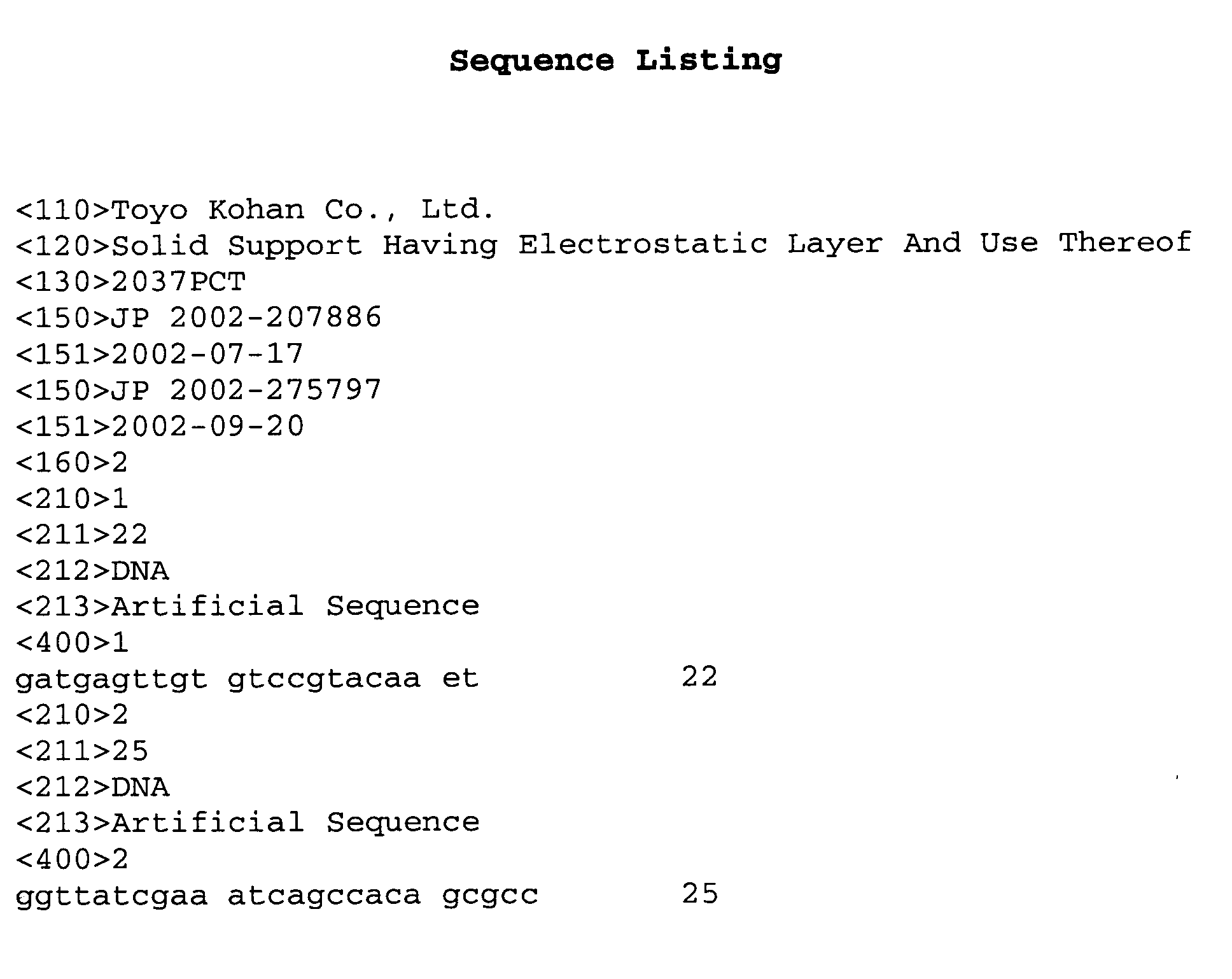
- a 0.1 ⁇ g/ ⁇ L forward primer solution (5' - GATGAGTTGTGTCCGTACAACT- 3' (see the sequence number 1 in the sequence table), 22 bases, 20% DMSO), a 0.1 ⁇ g/ ⁇ L reverse primer solution (5' -GGTTATCGAAATCAGCCACAGCGCC- 3' (see the sequence number 2 in the sequence table), 20% DMSO) and a 0.05 ⁇ g/ ⁇ L forward + reverse primer solution (20% DMSO) were spotted on the solid support by using a spotter. Then, after being placed in an oven heated at 80°C for 1 hour, it was washed with a washing solution (2 x SSC/0.2% SDS) twice and rinsed with sterile water.
- a washing solution (2 x SSC/0.2% SDS
- Reaction solution 1 (0.025 ⁇ g/ ⁇ L lambda DNA/1 pmol/ ⁇ L reverse primer/1 x Exbuffer/0.025 mM Cy3-dCTP/1.25 mM dNTP/0.25 U ExTaq) was placed in a PCR tube and the solid support, on which the primers had been immobilized, was dipped in the reaction solution and a cycle consisting of annealing (94°C, 30 seconds), hybridization and extension reaction (68°C, 30 seconds) was repeated 30 times. After the reaction, the solid support was washed with a washing solution (2 x SSC/0.2% SDS) twice and rinsed with sterile water.
- a washing solution (2 x SSC/0.2% SDS
- reaction solution 2 (1 pmol/ ⁇ L forward primer/1 pmol/ ⁇ L reverse primer/1 x Exbuffer/1.25 mM dNTP/0.25 U ExTaq) and a cycle consisting of annealing (94°C, 30 seconds), hybridization and extension reaction (68°C, 30 seconds) was repeated 30 times, the amplification of DNA fragment in the 500 bp region was confirmed by electrophoresis.
- a glass substrate cut into 3 mm square was dipped in a polyacrylic amine aqueous solution adjusted to 0.1% and a polyvalent carboxylic acid (polyacrylic acid) was condensed with the amino group introduced in the substrate surface, it was activated by being dipped in an activation solution, in which 0.1 M 1- [3- (dimethylamino) propyl] -3-ethylcarbodiimide and 20 mM N-hydroxysuccineimide had been dissolved in 0.1 M phosphate buffer (pH 6), for 30 minutes.
- an activation solution in which 0.1 M 1- [3- (dimethylamino) propyl] -3-ethylcarbodiimide and 20 mM N-hydroxysuccineimide had been dissolved in 0.1 M phosphate buffer (pH 6), for 30 minutes.
- the immobilization reaction was carried out by dipping the solid support at room temperature for 1 hour in a solution of a forward primer (22 bases) of the 500 bp lambda DNAprepared at a concentration of 0.1 ⁇ g/ ⁇ L using sterile water. After the reaction, the solid support was washed with a washing solution (2 x SSC/0.2% SDS) twice and rinsed with sterile water.
- the solid support, on which the forward primer had been immobilized was dipped in a solution of the 500 bp lambda DNA that is complementary to the immobilized primer (0.025 ⁇ g/ ⁇ L, buffer: 5 x SSC/0.5% SDS/20% formamide). After it was incubated at 98°C for 5 minutes, it was incubated at 42°C for 12 hours. After the reaction, the solid support was washed with a washing solution (2 x SSC/0.2% SDS) twice and rinsed with sterile water.
- the solid support after hybridization was dipped in a reaction solution (1 x Exbuffer/0.025 mM Cy3-dCTP/1.25 mM dNTP/0.25 U ExTaq) and incubated at 42°C for 6 hours. After the reaction, the solid support was washed with a washing solution (2 x SSC/0.2% SDS) twice and rinsed with sterile water.
- the immobilization reaction by electrostatic binding was carried out. After the reaction, the substrate was washed with a washing solution (2 x SSC/0.2% SDS) twice and rinsed with sterile water.
- a substrate that had been dipped in a solution of a fluorescence-labeled forward primer (22 bases) of the 500 bp lambda DNA was also prepared.
- the substrate, on which the forward primer had been immobilized was dipped in a solution of the 500 bp lambda DNA that is complementary to the immobilized primer (0.025 ⁇ g/ ⁇ L, buffer: 5 x SSC/0.5% SDS/20% formamide). After it was incubated at 98°C for 5 minutes, it was incubated at 42°C for 12 hours. After the reaction, the substrate was washed with a washing solution (2 x SSC/0.2% SDS) twice and rinsed with sterile water.
- the substrate after hybridization was dipped in a reaction solution (1 x Exbuffer/0.025 mM Cy3-dCTP/1.25 mM dNTP/0.25 U ExTaq) and incubated at 42°C for 6 hours. After the reaction, the substrate was washed with a washing solution (2 x SSC/0.2% SDS) twice and rinsed with sterile water.
- a reaction solution (1 x Exbuffer/0.025 mM Cy3-dCTP/1.25 mM dNTP/0.25 U ExTaq
- nucleic acid molecules On the solid support of the present invention, a larger amount of nucleic acid molecules can be immobilized than on the conventional solid support, and it can be immobilized firmly through a covalent bond. Therefore, the detection sensitivity and reliability that were the problems of the conventional DNA array can be improved. Further, since an extension reaction can be performed in the state in which a nucleic acid molecule has been immobilized, or a nucleic acid molecule can be amplified by performing PCR reaction, it is possible to aim at generalizing a DNA array.
Landscapes
- Chemical & Material Sciences (AREA)
- Life Sciences & Earth Sciences (AREA)
- Health & Medical Sciences (AREA)
- Genetics & Genomics (AREA)
- Engineering & Computer Science (AREA)
- Organic Chemistry (AREA)
- Biochemistry (AREA)
- Biotechnology (AREA)
- Molecular Biology (AREA)
- General Health & Medical Sciences (AREA)
- Wood Science & Technology (AREA)
- General Engineering & Computer Science (AREA)
- Biomedical Technology (AREA)
- Zoology (AREA)
- Bioinformatics & Cheminformatics (AREA)
- Plant Pathology (AREA)
- Microbiology (AREA)
- Biophysics (AREA)
- Crystallography & Structural Chemistry (AREA)
- Physics & Mathematics (AREA)
- Bioinformatics & Computational Biology (AREA)
- Apparatus Associated With Microorganisms And Enzymes (AREA)
- Measuring Or Testing Involving Enzymes Or Micro-Organisms (AREA)
- Investigating Or Analysing Biological Materials (AREA)
Abstract
Description
| Intensities of Fluorescence Signal in Examples 4 to 10 | |||
| Example | Intensity of Fluorescence Signal | ||
| Before reaction | Spot A | Spot B | |
| 4 | 4500 | 9000 | - |
| 5 | 4500 | 9500 | 11000 |
| 6 | 2500 | 6000 | 7500 |
| 7 | 4500 | 21000 | 22500 |
| 8 | 4500 | 15500 | 16000 |
| 9 | 4500 | 20000 | 22000 |
| 10 | 2000 | 7000 | - |
Claims (16)
- A solid support having an electrostatic layer for electrostatically attracting a nucleic acid molecule and a functional group capable of covalently binding to a nucleic acid molecule on a substrate.
- The solid support according to claim 1, wherein the surface of the substrate is surface-treated with at least one kind selected from diamond, a soft diamond, a carbonaceous matter and carbide.
- The solid support according to claim 1 or 2, wherein the electrostatic layer comprises an amino group- containing compound which does not covalently bind to the substrate.
- The solid support according to claim 1 or 2, wherein the electrostatic layer is composed of an amino group- containing compound which covalently binds to the substrate and the amino group-containing compound has an amino group at the terminus to which the substrate does not bind.
- The solid support according to any one of claims 1 to 3, which is obtained by depositing a compound having an unsubstituted or monosubstituted amino group and a carbon compound on the substrate and then introducing a functional group capable of covalently binding to a nucleic acid molecule.
- The solid support according to any one of claims 1 to 4, which is obtained by dipping the substrate in a solution containing a compound having an unsubstituted or monosubstituted amino group and then introducing a functional group capable of covalently binding to a nucleic acid molecule.
- The solid support according to claim 6, wherein the compound having an unsubstituted or monosubstituted amino group is polyarylamine.
- The solid support according to any one of claims 1 to 7, wherein the nucleic acid molecule is DNA.
- An immobilized nucleic acid molecule, which comprises a nucleic acid molecule immobilized on a solid support according to any one of claims 1 to 8.
- A method of producing a solid support characterized by depositing a compound having an unsubstituted or monosubstituted amino group and a carbon compound on the substrate and then introducing a functional group capable of covalently binding to a nucleic acid molecule.
- A method of producing a solid support characterized by dipping the substrate in a solution containing a compound having an unsubstituted or monosubstituted amino group and then introducing a functional group capable of covalently binding to a nucleic acid molecule.
- A method of immobilizing a primer on a solid support according to any one of claims 1 to 8, hybridizing a nucleic acid molecule to the primer, thereby extending a nucleic acid molecule complementary to the nucleic acid molecule.
- A method of detecting a nucleic acid molecule, which comprises immobilizing a primer on a solid support according to any one of claims 1 to 8, hybridizing a nucleic acid molecule to the primer, extending a nucleic acid molecule complementary to the nucleic acid molecule in the presence of a labeled nucleic acid and reading a signal derived from the labeled nucleic acid incorporated into the complementary nucleic acid molecule.
- A method of amplifying a nucleic acid molecule by immobilizing a primer on a solid support according to any one of claims 1 to 8, hybridizing a nucleic acid molecule to the primer and subjecting it to PCR reaction.
- A method of amplifying DNA by immobilizing a primer on a solid support according to any one of claims 1 to 8, hybridizing DNA to the primer and performing reaction with a strand-displacing DNA polymerase.
- The method according to claim 13, which further comprises the step of amplifying the nucleic acid molecule after hybridizing a nucleic acid molecule to the primer.
Applications Claiming Priority (5)
| Application Number | Priority Date | Filing Date | Title |
|---|---|---|---|
| JP2002207886 | 2002-07-17 | ||
| JP2002207886 | 2002-07-17 | ||
| JP2002275797A JP2004097173A (en) | 2002-07-17 | 2002-09-20 | Solid support having electrostatic layer and its use |
| JP2002275797 | 2002-09-20 | ||
| PCT/JP2003/008488 WO2004007710A1 (en) | 2002-07-17 | 2003-07-03 | Solid support having electrostatic layer and use thereof |
Publications (3)
| Publication Number | Publication Date |
|---|---|
| EP1548102A1 true EP1548102A1 (en) | 2005-06-29 |
| EP1548102A4 EP1548102A4 (en) | 2010-09-22 |
| EP1548102B1 EP1548102B1 (en) | 2013-05-29 |
Family
ID=30117476
Family Applications (1)
| Application Number | Title | Priority Date | Filing Date |
|---|---|---|---|
| EP03738671.1A Expired - Lifetime EP1548102B1 (en) | 2002-07-17 | 2003-07-03 | Solid support having electrostatic layer and use thereof |
Country Status (7)
| Country | Link |
|---|---|
| US (3) | US8551765B2 (en) |
| EP (1) | EP1548102B1 (en) |
| JP (2) | JP2004097173A (en) |
| KR (1) | KR100684098B1 (en) |
| CN (1) | CN100558890C (en) |
| AU (1) | AU2003246264A1 (en) |
| WO (1) | WO2004007710A1 (en) |
Cited By (2)
| Publication number | Priority date | Publication date | Assignee | Title |
|---|---|---|---|---|
| EP2476759A4 (en) * | 2009-09-10 | 2015-06-24 | Toyo Kohan Co Ltd | SUPPORT FOR THE RETENTION OF NUCLEIC ACIDS |
| DE102018132120A1 (en) * | 2018-12-13 | 2020-06-18 | Fraunhofer-Gesellschaft zur Förderung der angewandten Forschung e.V. | Sample receiving device for biological samples with a sample holder made of carbon-based material |
Families Citing this family (12)
| Publication number | Priority date | Publication date | Assignee | Title |
|---|---|---|---|---|
| JP3927580B2 (en) * | 2004-12-09 | 2007-06-13 | 住友ベークライト株式会社 | DNA chain extension method, DNA chain amplification method, and DNA array extension microarray |
| JP4817798B2 (en) * | 2005-10-19 | 2011-11-16 | 東洋鋼鈑株式会社 | Carrier and method for producing carrier |
| US20090218276A1 (en) * | 2008-02-29 | 2009-09-03 | Brigham Young University | Functionalized diamond particles and methods for preparing the same |
| US9192915B2 (en) | 2008-05-10 | 2015-11-24 | Brigham Young University | Porous composite particulate materials, methods of making and using same, and related apparatuses |
| JP5459990B2 (en) | 2008-06-30 | 2014-04-02 | 株式会社ハイペップ研究所 | Biochip substrate and method for manufacturing the same |
| JP5456355B2 (en) * | 2009-04-02 | 2014-03-26 | 東洋鋼鈑株式会社 | Biological substance immobilization carrier having ITO layer |
| KR101343891B1 (en) * | 2010-08-17 | 2013-12-20 | (주)바이오니아 | Low heat capacity composites for thermal cycler |
| US8658039B2 (en) | 2010-11-17 | 2014-02-25 | Brigham Young University | Sonication for improved particle size distribution of core-shell particles |
| JP2015040729A (en) * | 2013-08-21 | 2015-03-02 | 日本軽金属株式会社 | Biochip substrate and manufacturing method therefor |
| EP3543338B1 (en) * | 2016-11-18 | 2025-10-22 | Toyo Seikan Group Holdings, Ltd. | Carrier for biologically relevant molecule immobilization |
| JP6789510B2 (en) * | 2017-02-08 | 2020-11-25 | 東洋製罐グループホールディングス株式会社 | Bio-related molecule immobilization carrier |
| JP7333928B2 (en) * | 2018-10-05 | 2023-08-28 | 国立大学法人山形大学 | Measurement method for electrochemical unlabeled nucleic acid detection |
Family Cites Families (23)
| Publication number | Priority date | Publication date | Assignee | Title |
|---|---|---|---|---|
| ES2116977T3 (en) * | 1990-05-11 | 1998-08-01 | Microprobe Corp | SOLID SUPPORTS FOR NUCLEIC ACID HYBRIDIZATION TESTS AND METHODS TO IMMOBILIZE OLIGONUCLEOTIDES IN A COVALENT WAY. |
| US5888723A (en) * | 1992-02-18 | 1999-03-30 | Johnson & Johnson Clinical Diagnostics, Inc. | Method for nucleic acid amplification and detection using adhered probes |
| US5688642A (en) * | 1994-12-01 | 1997-11-18 | The United States Of America As Represented By The Secretary Of The Navy | Selective attachment of nucleic acid molecules to patterned self-assembled surfaces |
| US5929194A (en) * | 1996-02-23 | 1999-07-27 | The Dow Chemical Company | Crosslinkable or chain extendable polyarylpolyamines and films thereof |
| CA2320462A1 (en) * | 1998-02-09 | 1999-08-12 | Toyo Kohan Co., Ltd. | Substrates for immobilizing and amplifying dna, dna-immobilized chips having dna immobilized on the substrates, and method for amplifying dna |
| AU6123899A (en) | 1998-10-15 | 2000-05-01 | Toyo Kohan Co. Ltd. | Supports for immobilizing dna or the like |
| US6066461A (en) | 1999-04-12 | 2000-05-23 | Becton Dickinson And Company | Amplification and detection of Campylobacter jejuni and Campylobacter coli |
| US6531302B1 (en) | 1999-04-12 | 2003-03-11 | Nanogen/Becton Dickinson Partnership | Anchored strand displacement amplification on an electronically addressable microchip |
| US6162605A (en) | 1999-04-12 | 2000-12-19 | Becton Dickinson And Company | Amplification and detection of shiga-like toxin I producing organisms |
| CN1176212C (en) * | 1999-05-10 | 2004-11-17 | 东洋钢板株式会社 | Methods for Constructing DNA Libraries |
| KR100608152B1 (en) * | 1999-07-07 | 2006-08-04 | 미러스 코포레이션 | Substrates for Fixing Nucleic Acids on Solid Supports |
| JP2001204463A (en) * | 2000-01-27 | 2001-07-31 | Toyo Kohan Co Ltd | Carrier for nucleotide immobilization |
| US6881538B1 (en) * | 2000-03-05 | 2005-04-19 | 3M Innovative Properties Company | Array comprising diamond-like glass film |
| US6911535B2 (en) | 2000-03-22 | 2005-06-28 | Solvlink Biosciences | Biomolecule/polymer conjugates |
| US7078172B1 (en) | 2000-08-08 | 2006-07-18 | Toyo Kohan Co., Ltd. | Substrate activation kit and method for detecting DNA and the like using the same |
| JP2002082116A (en) | 2000-09-06 | 2002-03-22 | Toyo Kohan Co Ltd | Slide glass formed with surface-treated layer |
| JP2003014747A (en) | 2001-06-27 | 2003-01-15 | Toyo Kohan Co Ltd | Solid substrate having formed surface treatment layer |
| JP3523188B2 (en) * | 2000-12-13 | 2004-04-26 | 富士写真フイルム株式会社 | Aqueous treatment solution for detector with immobilized probe molecules |
| JP4772211B2 (en) * | 2001-05-29 | 2011-09-14 | Kisco株式会社 | DNA chip manufacturing method |
| US6989267B2 (en) * | 2001-07-02 | 2006-01-24 | Agilent Technologies, Inc. | Methods of making microarrays with substrate surfaces having covalently bound polyelectrolyte films |
| US7456025B2 (en) * | 2001-08-28 | 2008-11-25 | Porex Corporation | Sintered polymer membrane for analyte detection device |
| US6916541B2 (en) * | 2001-09-07 | 2005-07-12 | Penn State Research Foundation | Modified substrates for the attachment of biomolecules |
| FR2841908B1 (en) * | 2002-07-04 | 2004-09-24 | Commissariat Energie Atomique | SOLID SUPPORT COMPRISING A CONDUCTIVE OR SEMICONDUCTOR SURFACE OF THE FUNCTIONALIZED ELECTRICITY, ITS PREPARATION PROCESS AND USES THEREOF |
-
2002
- 2002-09-20 JP JP2002275797A patent/JP2004097173A/en active Pending
-
2003
- 2003-07-03 KR KR1020057000883A patent/KR100684098B1/en not_active Expired - Lifetime
- 2003-07-03 CN CNB038169525A patent/CN100558890C/en not_active Expired - Lifetime
- 2003-07-03 WO PCT/JP2003/008488 patent/WO2004007710A1/en not_active Ceased
- 2003-07-03 EP EP03738671.1A patent/EP1548102B1/en not_active Expired - Lifetime
- 2003-07-03 US US10/521,176 patent/US8551765B2/en not_active Expired - Fee Related
- 2003-07-03 AU AU2003246264A patent/AU2003246264A1/en not_active Abandoned
-
2008
- 2008-05-19 JP JP2008130334A patent/JP4764901B2/en not_active Expired - Fee Related
- 2008-10-06 US US12/246,082 patent/US20090111113A1/en not_active Abandoned
- 2008-10-06 US US12/246,152 patent/US8563239B2/en not_active Expired - Fee Related
Cited By (4)
| Publication number | Priority date | Publication date | Assignee | Title |
|---|---|---|---|---|
| EP2476759A4 (en) * | 2009-09-10 | 2015-06-24 | Toyo Kohan Co Ltd | SUPPORT FOR THE RETENTION OF NUCLEIC ACIDS |
| DE102018132120A1 (en) * | 2018-12-13 | 2020-06-18 | Fraunhofer-Gesellschaft zur Förderung der angewandten Forschung e.V. | Sample receiving device for biological samples with a sample holder made of carbon-based material |
| DE102018132120B4 (en) * | 2018-12-13 | 2024-04-18 | Fraunhofer-Gesellschaft zur Förderung der angewandten Forschung e.V. | Sample collection device for biological samples with a sample holder made of carbon-based material |
| US12515226B2 (en) | 2018-12-13 | 2026-01-06 | Fraunhofer-Gesellschaft Zur Foerderung Der Angewandten Forschung E. V. | Sample holder device for biological samples, comprising a sample holder made of a carbon-based material |
Also Published As
| Publication number | Publication date |
|---|---|
| US20060204959A1 (en) | 2006-09-14 |
| JP2004097173A (en) | 2004-04-02 |
| US8551765B2 (en) | 2013-10-08 |
| KR20050021504A (en) | 2005-03-07 |
| EP1548102B1 (en) | 2013-05-29 |
| WO2004007710A1 (en) | 2004-01-22 |
| US20090111113A1 (en) | 2009-04-30 |
| AU2003246264A1 (en) | 2004-02-02 |
| EP1548102A4 (en) | 2010-09-22 |
| CN100558890C (en) | 2009-11-11 |
| CN1668742A (en) | 2005-09-14 |
| US20090098301A1 (en) | 2009-04-16 |
| JP4764901B2 (en) | 2011-09-07 |
| US8563239B2 (en) | 2013-10-22 |
| JP2008292482A (en) | 2008-12-04 |
| KR100684098B1 (en) | 2007-02-16 |
Similar Documents
| Publication | Publication Date | Title |
|---|---|---|
| US8563239B2 (en) | Solid support having electrostatic layer and use thereof | |
| JP2009112317A (en) | New composition and process for analyte detection, quantification and amplification | |
| WO2007084886A2 (en) | Multiplexed analyses of test samples | |
| EP2476759B1 (en) | Carrier for holding nucleic acids | |
| NZ501775A (en) | Hybridization analysis using low density nucleic acid arrays | |
| US20020197417A1 (en) | Method for producing DNA chip, and DNA chip obtained thereby | |
| WO2005010525A1 (en) | Vacuum-packed solid support array and process for producing the same | |
| JP4256789B2 (en) | Solid support having electrostatic layer and use thereof | |
| JP4817798B2 (en) | Carrier and method for producing carrier | |
| KR20050084082A (en) | Method of immobilizing polynucleotide on solid support, solid immobilization support thus obtained, method of detecting target polynucleotide from the solid support and solution for immobilizing polynucleotide | |
| JP4521556B2 (en) | Method for improving sensitivity in analysis of polynucleotide samples | |
| JP2002082116A (en) | Slide glass formed with surface-treated layer | |
| JP6032721B2 (en) | Immobilized polynucleotide | |
| WO2005078082A1 (en) | Method of constructing probe dna for nucleic acid encoding membrane protein, method of detecting the expression of gene encoding membrane protein and probe dna immobilization support | |
| US20040132031A1 (en) | Supports for hybridization and method of immobilizing hybrid | |
| JP2006020591A (en) | Method for detecting dna and/or rna, and kit for detecting mediator oligonucleotide and dna and/or rna | |
| JP2003061656A (en) | Method and kit for detecting target nucleic acid | |
| JP2002330767A (en) | Array holding immobilized nucleic acid | |
| JP2007029032A (en) | Probe carrier, method for producing the same and method for detecting target nucleic acid using the same | |
| JP2002202304A (en) | Method for manufacturing dna immobilizing substrate |
Legal Events
| Date | Code | Title | Description |
|---|---|---|---|
| PUAI | Public reference made under article 153(3) epc to a published international application that has entered the european phase |
Free format text: ORIGINAL CODE: 0009012 |
|
| 17P | Request for examination filed |
Effective date: 20050217 |
|
| AK | Designated contracting states |
Kind code of ref document: A1 Designated state(s): AT BE BG CH CY CZ DE DK EE ES FI FR GB GR HU IE IT LI LU MC NL PT RO SE SI SK TR |
|
| AX | Request for extension of the european patent |
Extension state: AL LT LV MK |
|
| RIN1 | Information on inventor provided before grant (corrected) |
Inventor name: OHBA, MITSUYOSHI,TOYO KOHAN CO., LTD. Inventor name: OKAMURA, HIROSHI,TOYO KOHAN CO., LTD. Inventor name: TANGA, MICHIFUMI,TOYO KOHAN CO., LTD. Inventor name: YAMANO, HIROFUMI,TOYO KOHAN CO., LTD. Inventor name: KAMEI, SHYUICHI,TOYO KOHAN CO., LTD. Inventor name: ICIHARA, TERUHISA,TOYO KOHAN CO., LTD. |
|
| DAX | Request for extension of the european patent (deleted) | ||
| A4 | Supplementary search report drawn up and despatched |
Effective date: 20100825 |
|
| RIC1 | Information provided on ipc code assigned before grant |
Ipc: C12Q 1/68 20060101ALI20100819BHEP Ipc: C12N 15/10 20060101ALI20100819BHEP Ipc: C12N 15/00 20060101AFI20040204BHEP Ipc: C12M 1/00 20060101ALI20100819BHEP |
|
| 17Q | First examination report despatched |
Effective date: 20110124 |
|
| GRAP | Despatch of communication of intention to grant a patent |
Free format text: ORIGINAL CODE: EPIDOSNIGR1 |
|
| RIN1 | Information on inventor provided before grant (corrected) |
Inventor name: YAMANO, HIROFUMI Inventor name: TANGA, MICHIFUMI Inventor name: OHBA, MITSUYOSHI Inventor name: ICIHARA, TERUHISA Inventor name: OKAMURA, HIROSHI Inventor name: KAMEI, SHYUICHI |
|
| GRAS | Grant fee paid |
Free format text: ORIGINAL CODE: EPIDOSNIGR3 |
|
| GRAA | (expected) grant |
Free format text: ORIGINAL CODE: 0009210 |
|
| AK | Designated contracting states |
Kind code of ref document: B1 Designated state(s): AT BE BG CH CY CZ DE DK EE ES FI FR GB GR HU IE IT LI LU MC NL PT RO SE SI SK TR |
|
| REG | Reference to a national code |
Ref country code: GB Ref legal event code: FG4D |
|
| RIN1 | Information on inventor provided before grant (corrected) |
Inventor name: ICIHARA, TERUHISA Inventor name: OKAMURA, HIROSHI Inventor name: KAMEI, SHYUICHI Inventor name: YAMANO, HIROFUMI Inventor name: TANGA, MICHIFUMI Inventor name: OHBA, MITSUYOSHI |
|
| REG | Reference to a national code |
Ref country code: CH Ref legal event code: EP |
|
| REG | Reference to a national code |
Ref country code: AT Ref legal event code: REF Ref document number: 614428 Country of ref document: AT Kind code of ref document: T Effective date: 20130615 |
|
| REG | Reference to a national code |
Ref country code: IE Ref legal event code: FG4D |
|
| REG | Reference to a national code |
Ref country code: DE Ref legal event code: R096 Ref document number: 60344171 Country of ref document: DE Effective date: 20130725 |
|
| REG | Reference to a national code |
Ref country code: AT Ref legal event code: MK05 Ref document number: 614428 Country of ref document: AT Kind code of ref document: T Effective date: 20130529 |
|
| PG25 | Lapsed in a contracting state [announced via postgrant information from national office to epo] |
Ref country code: FI Free format text: LAPSE BECAUSE OF FAILURE TO SUBMIT A TRANSLATION OF THE DESCRIPTION OR TO PAY THE FEE WITHIN THE PRESCRIBED TIME-LIMIT Effective date: 20130529 Ref country code: GR Free format text: LAPSE BECAUSE OF FAILURE TO SUBMIT A TRANSLATION OF THE DESCRIPTION OR TO PAY THE FEE WITHIN THE PRESCRIBED TIME-LIMIT Effective date: 20130830 Ref country code: PT Free format text: LAPSE BECAUSE OF FAILURE TO SUBMIT A TRANSLATION OF THE DESCRIPTION OR TO PAY THE FEE WITHIN THE PRESCRIBED TIME-LIMIT Effective date: 20130930 Ref country code: SI Free format text: LAPSE BECAUSE OF FAILURE TO SUBMIT A TRANSLATION OF THE DESCRIPTION OR TO PAY THE FEE WITHIN THE PRESCRIBED TIME-LIMIT Effective date: 20130529 Ref country code: AT Free format text: LAPSE BECAUSE OF FAILURE TO SUBMIT A TRANSLATION OF THE DESCRIPTION OR TO PAY THE FEE WITHIN THE PRESCRIBED TIME-LIMIT Effective date: 20130529 Ref country code: ES Free format text: LAPSE BECAUSE OF FAILURE TO SUBMIT A TRANSLATION OF THE DESCRIPTION OR TO PAY THE FEE WITHIN THE PRESCRIBED TIME-LIMIT Effective date: 20130909 Ref country code: SE Free format text: LAPSE BECAUSE OF FAILURE TO SUBMIT A TRANSLATION OF THE DESCRIPTION OR TO PAY THE FEE WITHIN THE PRESCRIBED TIME-LIMIT Effective date: 20130529 |
|
| REG | Reference to a national code |
Ref country code: NL Ref legal event code: VDEP Effective date: 20130529 |
|
| PG25 | Lapsed in a contracting state [announced via postgrant information from national office to epo] |
Ref country code: BG Free format text: LAPSE BECAUSE OF FAILURE TO SUBMIT A TRANSLATION OF THE DESCRIPTION OR TO PAY THE FEE WITHIN THE PRESCRIBED TIME-LIMIT Effective date: 20130829 |
|
| PG25 | Lapsed in a contracting state [announced via postgrant information from national office to epo] |
Ref country code: EE Free format text: LAPSE BECAUSE OF FAILURE TO SUBMIT A TRANSLATION OF THE DESCRIPTION OR TO PAY THE FEE WITHIN THE PRESCRIBED TIME-LIMIT Effective date: 20130529 Ref country code: DK Free format text: LAPSE BECAUSE OF FAILURE TO SUBMIT A TRANSLATION OF THE DESCRIPTION OR TO PAY THE FEE WITHIN THE PRESCRIBED TIME-LIMIT Effective date: 20130529 Ref country code: CZ Free format text: LAPSE BECAUSE OF FAILURE TO SUBMIT A TRANSLATION OF THE DESCRIPTION OR TO PAY THE FEE WITHIN THE PRESCRIBED TIME-LIMIT Effective date: 20130529 Ref country code: BE Free format text: LAPSE BECAUSE OF FAILURE TO SUBMIT A TRANSLATION OF THE DESCRIPTION OR TO PAY THE FEE WITHIN THE PRESCRIBED TIME-LIMIT Effective date: 20130529 Ref country code: SK Free format text: LAPSE BECAUSE OF FAILURE TO SUBMIT A TRANSLATION OF THE DESCRIPTION OR TO PAY THE FEE WITHIN THE PRESCRIBED TIME-LIMIT Effective date: 20130529 |
|
| PG25 | Lapsed in a contracting state [announced via postgrant information from national office to epo] |
Ref country code: RO Free format text: LAPSE BECAUSE OF FAILURE TO SUBMIT A TRANSLATION OF THE DESCRIPTION OR TO PAY THE FEE WITHIN THE PRESCRIBED TIME-LIMIT Effective date: 20130529 Ref country code: MC Free format text: LAPSE BECAUSE OF FAILURE TO SUBMIT A TRANSLATION OF THE DESCRIPTION OR TO PAY THE FEE WITHIN THE PRESCRIBED TIME-LIMIT Effective date: 20130529 Ref country code: IT Free format text: LAPSE BECAUSE OF FAILURE TO SUBMIT A TRANSLATION OF THE DESCRIPTION OR TO PAY THE FEE WITHIN THE PRESCRIBED TIME-LIMIT Effective date: 20130529 Ref country code: NL Free format text: LAPSE BECAUSE OF FAILURE TO SUBMIT A TRANSLATION OF THE DESCRIPTION OR TO PAY THE FEE WITHIN THE PRESCRIBED TIME-LIMIT Effective date: 20130529 |
|
| REG | Reference to a national code |
Ref country code: CH Ref legal event code: PL |
|
| PLBE | No opposition filed within time limit |
Free format text: ORIGINAL CODE: 0009261 |
|
| STAA | Information on the status of an ep patent application or granted ep patent |
Free format text: STATUS: NO OPPOSITION FILED WITHIN TIME LIMIT |
|
| REG | Reference to a national code |
Ref country code: IE Ref legal event code: MM4A |
|
| PG25 | Lapsed in a contracting state [announced via postgrant information from national office to epo] |
Ref country code: LI Free format text: LAPSE BECAUSE OF NON-PAYMENT OF DUE FEES Effective date: 20130731 Ref country code: CH Free format text: LAPSE BECAUSE OF NON-PAYMENT OF DUE FEES Effective date: 20130731 |
|
| 26N | No opposition filed |
Effective date: 20140303 |
|
| REG | Reference to a national code |
Ref country code: DE Ref legal event code: R097 Ref document number: 60344171 Country of ref document: DE Effective date: 20140303 |
|
| PG25 | Lapsed in a contracting state [announced via postgrant information from national office to epo] |
Ref country code: IE Free format text: LAPSE BECAUSE OF NON-PAYMENT OF DUE FEES Effective date: 20130703 |
|
| PG25 | Lapsed in a contracting state [announced via postgrant information from national office to epo] |
Ref country code: CY Free format text: LAPSE BECAUSE OF FAILURE TO SUBMIT A TRANSLATION OF THE DESCRIPTION OR TO PAY THE FEE WITHIN THE PRESCRIBED TIME-LIMIT Effective date: 20130529 Ref country code: TR Free format text: LAPSE BECAUSE OF FAILURE TO SUBMIT A TRANSLATION OF THE DESCRIPTION OR TO PAY THE FEE WITHIN THE PRESCRIBED TIME-LIMIT Effective date: 20130529 |
|
| PG25 | Lapsed in a contracting state [announced via postgrant information from national office to epo] |
Ref country code: HU Free format text: LAPSE BECAUSE OF FAILURE TO SUBMIT A TRANSLATION OF THE DESCRIPTION OR TO PAY THE FEE WITHIN THE PRESCRIBED TIME-LIMIT; INVALID AB INITIO Effective date: 20030703 Ref country code: LU Free format text: LAPSE BECAUSE OF NON-PAYMENT OF DUE FEES Effective date: 20130703 |
|
| REG | Reference to a national code |
Ref country code: FR Ref legal event code: PLFP Year of fee payment: 14 |
|
| REG | Reference to a national code |
Ref country code: FR Ref legal event code: PLFP Year of fee payment: 15 |
|
| REG | Reference to a national code |
Ref country code: FR Ref legal event code: PLFP Year of fee payment: 16 |
|
| PGFP | Annual fee paid to national office [announced via postgrant information from national office to epo] |
Ref country code: GB Payment date: 20220720 Year of fee payment: 20 Ref country code: DE Payment date: 20220620 Year of fee payment: 20 |
|
| PGFP | Annual fee paid to national office [announced via postgrant information from national office to epo] |
Ref country code: FR Payment date: 20220720 Year of fee payment: 20 |
|
| REG | Reference to a national code |
Ref country code: DE Ref legal event code: R071 Ref document number: 60344171 Country of ref document: DE |
|
| REG | Reference to a national code |
Ref country code: GB Ref legal event code: PE20 Expiry date: 20230702 |
|
| PG25 | Lapsed in a contracting state [announced via postgrant information from national office to epo] |
Ref country code: GB Free format text: LAPSE BECAUSE OF EXPIRATION OF PROTECTION Effective date: 20230702 |