EP1548085A1 - Sealing material - Google Patents
Sealing material Download PDFInfo
- Publication number
- EP1548085A1 EP1548085A1 EP03754003A EP03754003A EP1548085A1 EP 1548085 A1 EP1548085 A1 EP 1548085A1 EP 03754003 A EP03754003 A EP 03754003A EP 03754003 A EP03754003 A EP 03754003A EP 1548085 A1 EP1548085 A1 EP 1548085A1
- Authority
- EP
- European Patent Office
- Prior art keywords
- sealing material
- composition
- less
- hdd
- hardness
- Prior art date
- Legal status (The legal status is an assumption and is not a legal conclusion. Google has not performed a legal analysis and makes no representation as to the accuracy of the status listed.)
- Withdrawn
Links
Images

Classifications
-
- F—MECHANICAL ENGINEERING; LIGHTING; HEATING; WEAPONS; BLASTING
- F16—ENGINEERING ELEMENTS AND UNITS; GENERAL MEASURES FOR PRODUCING AND MAINTAINING EFFECTIVE FUNCTIONING OF MACHINES OR INSTALLATIONS; THERMAL INSULATION IN GENERAL
- F16J—PISTONS; CYLINDERS; SEALINGS
- F16J15/00—Sealings
- F16J15/02—Sealings between relatively-stationary surfaces
- F16J15/06—Sealings between relatively-stationary surfaces with solid packing compressed between sealing surfaces
- F16J15/10—Sealings between relatively-stationary surfaces with solid packing compressed between sealing surfaces with non-metallic packing
- F16J15/102—Sealings between relatively-stationary surfaces with solid packing compressed between sealing surfaces with non-metallic packing characterised by material
-
- C—CHEMISTRY; METALLURGY
- C08—ORGANIC MACROMOLECULAR COMPOUNDS; THEIR PREPARATION OR CHEMICAL WORKING-UP; COMPOSITIONS BASED THEREON
- C08L—COMPOSITIONS OF MACROMOLECULAR COMPOUNDS
- C08L57/00—Compositions of unspecified polymers obtained by reactions only involving carbon-to-carbon unsaturated bonds
- C08L57/04—Copolymers in which only the monomer in minority is defined
-
- C—CHEMISTRY; METALLURGY
- C08—ORGANIC MACROMOLECULAR COMPOUNDS; THEIR PREPARATION OR CHEMICAL WORKING-UP; COMPOSITIONS BASED THEREON
- C08L—COMPOSITIONS OF MACROMOLECULAR COMPOUNDS
- C08L83/00—Compositions of macromolecular compounds obtained by reactions forming in the main chain of the macromolecule a linkage containing silicon with or without sulfur, nitrogen, oxygen or carbon only; Compositions of derivatives of such polymers
- C08L83/04—Polysiloxanes
-
- C—CHEMISTRY; METALLURGY
- C09—DYES; PAINTS; POLISHES; NATURAL RESINS; ADHESIVES; COMPOSITIONS NOT OTHERWISE PROVIDED FOR; APPLICATIONS OF MATERIALS NOT OTHERWISE PROVIDED FOR
- C09J—ADHESIVES; NON-MECHANICAL ASPECTS OF ADHESIVE PROCESSES IN GENERAL; ADHESIVE PROCESSES NOT PROVIDED FOR ELSEWHERE; USE OF MATERIALS AS ADHESIVES
- C09J133/00—Adhesives based on homopolymers or copolymers of compounds having one or more unsaturated aliphatic radicals, each having only one carbon-to-carbon double bond, and at least one being terminated by only one carboxyl radical, or of salts, anhydrides, esters, amides, imides, or nitriles thereof; Adhesives based on derivatives of such polymers
- C09J133/04—Homopolymers or copolymers of esters
- C09J133/06—Homopolymers or copolymers of esters of esters containing only carbon, hydrogen and oxygen, the oxygen atom being present only as part of the carboxyl radical
- C09J133/08—Homopolymers or copolymers of acrylic acid esters
-
- C—CHEMISTRY; METALLURGY
- C09—DYES; PAINTS; POLISHES; NATURAL RESINS; ADHESIVES; COMPOSITIONS NOT OTHERWISE PROVIDED FOR; APPLICATIONS OF MATERIALS NOT OTHERWISE PROVIDED FOR
- C09K—MATERIALS FOR MISCELLANEOUS APPLICATIONS, NOT PROVIDED FOR ELSEWHERE
- C09K3/00—Materials not provided for elsewhere
- C09K3/10—Materials in mouldable or extrudable form for sealing or packing joints or covers
-
- F—MECHANICAL ENGINEERING; LIGHTING; HEATING; WEAPONS; BLASTING
- F16—ENGINEERING ELEMENTS AND UNITS; GENERAL MEASURES FOR PRODUCING AND MAINTAINING EFFECTIVE FUNCTIONING OF MACHINES OR INSTALLATIONS; THERMAL INSULATION IN GENERAL
- F16J—PISTONS; CYLINDERS; SEALINGS
- F16J15/00—Sealings
- F16J15/02—Sealings between relatively-stationary surfaces
- F16J15/14—Sealings between relatively-stationary surfaces by means of granular or plastic material, or fluid
-
- C—CHEMISTRY; METALLURGY
- C08—ORGANIC MACROMOLECULAR COMPOUNDS; THEIR PREPARATION OR CHEMICAL WORKING-UP; COMPOSITIONS BASED THEREON
- C08F—MACROMOLECULAR COMPOUNDS OBTAINED BY REACTIONS ONLY INVOLVING CARBON-TO-CARBON UNSATURATED BONDS
- C08F220/00—Copolymers of compounds having one or more unsaturated aliphatic radicals, each having only one carbon-to-carbon double bond, and only one being terminated by only one carboxyl radical or a salt, anhydride ester, amide, imide or nitrile thereof
- C08F220/02—Monocarboxylic acids having less than ten carbon atoms; Derivatives thereof
- C08F220/10—Esters
- C08F220/12—Esters of monohydric alcohols or phenols
- C08F220/16—Esters of monohydric alcohols or phenols of phenols or of alcohols containing two or more carbon atoms
- C08F220/18—Esters of monohydric alcohols or phenols of phenols or of alcohols containing two or more carbon atoms with acrylic or methacrylic acids
- C08F220/1802—C2-(meth)acrylate, e.g. ethyl (meth)acrylate
-
- C—CHEMISTRY; METALLURGY
- C08—ORGANIC MACROMOLECULAR COMPOUNDS; THEIR PREPARATION OR CHEMICAL WORKING-UP; COMPOSITIONS BASED THEREON
- C08F—MACROMOLECULAR COMPOUNDS OBTAINED BY REACTIONS ONLY INVOLVING CARBON-TO-CARBON UNSATURATED BONDS
- C08F220/00—Copolymers of compounds having one or more unsaturated aliphatic radicals, each having only one carbon-to-carbon double bond, and only one being terminated by only one carboxyl radical or a salt, anhydride ester, amide, imide or nitrile thereof
- C08F220/02—Monocarboxylic acids having less than ten carbon atoms; Derivatives thereof
- C08F220/10—Esters
- C08F220/12—Esters of monohydric alcohols or phenols
- C08F220/16—Esters of monohydric alcohols or phenols of phenols or of alcohols containing two or more carbon atoms
- C08F220/18—Esters of monohydric alcohols or phenols of phenols or of alcohols containing two or more carbon atoms with acrylic or methacrylic acids
- C08F220/1804—C4-(meth)acrylate, e.g. butyl (meth)acrylate, isobutyl (meth)acrylate or tert-butyl (meth)acrylate
-
- C—CHEMISTRY; METALLURGY
- C08—ORGANIC MACROMOLECULAR COMPOUNDS; THEIR PREPARATION OR CHEMICAL WORKING-UP; COMPOSITIONS BASED THEREON
- C08G—MACROMOLECULAR COMPOUNDS OBTAINED OTHERWISE THAN BY REACTIONS ONLY INVOLVING UNSATURATED CARBON-TO-CARBON BONDS
- C08G77/00—Macromolecular compounds obtained by reactions forming a linkage containing silicon with or without sulfur, nitrogen, oxygen or carbon in the main chain of the macromolecule
- C08G77/04—Polysiloxanes
- C08G77/12—Polysiloxanes containing silicon bound to hydrogen
-
- C—CHEMISTRY; METALLURGY
- C08—ORGANIC MACROMOLECULAR COMPOUNDS; THEIR PREPARATION OR CHEMICAL WORKING-UP; COMPOSITIONS BASED THEREON
- C08L—COMPOSITIONS OF MACROMOLECULAR COMPOUNDS
- C08L33/00—Compositions of homopolymers or copolymers of compounds having one or more unsaturated aliphatic radicals, each having only one carbon-to-carbon double bond, and only one being terminated by only one carboxyl radical, or of salts, anhydrides, esters, amides, imides or nitriles thereof; Compositions of derivatives of such polymers
- C08L33/04—Homopolymers or copolymers of esters
- C08L33/14—Homopolymers or copolymers of esters of esters containing halogen, nitrogen, sulfur, or oxygen atoms in addition to the carboxy oxygen
-
- C—CHEMISTRY; METALLURGY
- C09—DYES; PAINTS; POLISHES; NATURAL RESINS; ADHESIVES; COMPOSITIONS NOT OTHERWISE PROVIDED FOR; APPLICATIONS OF MATERIALS NOT OTHERWISE PROVIDED FOR
- C09K—MATERIALS FOR MISCELLANEOUS APPLICATIONS, NOT PROVIDED FOR ELSEWHERE
- C09K2200/00—Chemical nature of materials in mouldable or extrudable form for sealing or packing joints or covers
- C09K2200/02—Inorganic compounds
- C09K2200/0204—Elements
- C09K2200/0208—Carbon
-
- C—CHEMISTRY; METALLURGY
- C09—DYES; PAINTS; POLISHES; NATURAL RESINS; ADHESIVES; COMPOSITIONS NOT OTHERWISE PROVIDED FOR; APPLICATIONS OF MATERIALS NOT OTHERWISE PROVIDED FOR
- C09K—MATERIALS FOR MISCELLANEOUS APPLICATIONS, NOT PROVIDED FOR ELSEWHERE
- C09K2200/00—Chemical nature of materials in mouldable or extrudable form for sealing or packing joints or covers
- C09K2200/06—Macromolecular organic compounds, e.g. prepolymers
- C09K2200/0615—Macromolecular organic compounds, e.g. prepolymers obtained by reactions only involving carbon-to-carbon unsaturated bonds
- C09K2200/0625—Polyacrylic esters or derivatives thereof
-
- F—MECHANICAL ENGINEERING; LIGHTING; HEATING; WEAPONS; BLASTING
- F01—MACHINES OR ENGINES IN GENERAL; ENGINE PLANTS IN GENERAL; STEAM ENGINES
- F01M—LUBRICATING OF MACHINES OR ENGINES IN GENERAL; LUBRICATING INTERNAL COMBUSTION ENGINES; CRANKCASE VENTILATING
- F01M11/00—Component parts, details or accessories, not provided for in, or of interest apart from, groups F01M1/00 - F01M9/00
- F01M11/0004—Oilsumps
- F01M2011/0091—Oilsumps characterised by used materials
Definitions
- the present invention relates to a sealing material and more particularly a sealing material for use as cam cover seals and oil pan seals for automobile engines, fuel cell cooling medium seals, automobile wire harnesses seals, HDD cover gasket or vibration-insulating HDD cover gasket seals etc.
- vibrations generated from the disc inside are in an increasing tendency and it is the important task to reduce such vibrations.
- HDD is used as a server
- several tens of HDDs are used in series, and troubles due to vibrations generated from the individual HDDs are sometimes observable.
- HDD as electronic memory devices has been recently used in video cameras, car navigators, etc. besides personal computers, and particularly HDD used under the circumstances generating so many vibrations, such as mounting in automobiles, etc. must be prevented from vibrations from the HDD outside. Furthermore, heat resistance to internal heat generation due to high speed revolution and exposure to the high temperature circumstances in automobiles in the summer season is also desired.
- the main object of the present invention is to provide a sealing material for use as cam cover seals and oil pan seals for automobile engines, fuel cell cooling medium seals, automobiles wire harnesses seals, HDD cover gasket or vibration-insulating HDD cover gasket seal, etc.
- the first object of the present invention is to provide a sealing material for cam cover, which can maintain a sufficient sealability even if used as a resin-made cam cover, where the composition for forming curing products has a good flowability and a distinguished injection moldability, because an acrylic sealing material of low hardness is used as a cam cover sealing material.
- the second object of the present invention is to provide an oil pan sealing material, which can give an oil pan gasket, etc. capable of sealing under surface pressure as low as that of a silicone potting material and capable of easy exchange, because an acrylic sealing material of low hardness is used as an oil pan sealing material.
- the third object of the present invention is to provide a clean sealing material for a fuel cell cooling medium which has a gas shieldability, a resistance to cooling medium oil, etc. and is capable of giving molding products with a lighter weight and a smaller thickness by using a curable composition having a low pre-curing viscosity, and a low post-curing hardness and a camber force.
- the fourth object of the present invention is to provide a wire harnesses sealing material for automobiles with distinguished heat and oil resistances, and tight adhesiveness to electric wires.
- the fifth object of the present invention is to provide an HDD cover gasket comprising a thermosetting elastomer having a low hardness to improve the sealability and capable of maintaining the sealability even under high temperature conditions, and is also capable of forming an injection molding-integrated gasket with an easy, efficient moldability.
- the sixth object of the present invention is to provide a sealing material for vibration-insulating HDD cover gaskets, which comprises a thermosetting elastomer having a low hardness to improve the sealability and capable of maintaining the sealability even under high temperature conditions, and is capable of forming an injection molding-integrated gasket with an easy, efficient moldability, giving a distinguished vibration iusulation property to HDD even if mounted on automobiles.
- the main object of the present invention can be attained by a sealing material, which comprises a curing product of a composition comprising (A) an acrylic polymer having at least one alkenyl group capable of undergoing hydrosilylation reaction, (B) a hydrosilyl group-containing compound and (C) a hydrosilylation catalyst as essential components.
- An acrylic acid ester monomer which constitutes the main chain of acrylic polymer having at least one alkenyl group capable of undergoing hydrosilylation reaction, preferably at least one alkenyl group at a terminal position of the polymer, as component (A), is not particularly limited, and can be used upon selection of desired one.
- acrylic acid ester monomers can be used as acrylic acid esters such as methyl acrylate, ethyl acrylate, propyl acrylate, isopropyl acrylate, n-butyl acrylate, isobutyl acrylate, t-butyl acrylate, n-pentyl acrylate, n-hexyl acrylate, cyclohexyl acrylate, n-heptyl acrylate, n-octyl acrylate, 2-ethylhexyl acrylate, nonyl acrylate, decyl acrylate, dodecyl acrylate, phenyl acrylate, tolyl acrylate, benzyl acrylate, 2-methoxyethyl acrylate, 3-methoxybutyl acrylate, 2-hydroxyethyl acrylate, 2-hydroxypropyl acrylate, stearyl acrylate, glycidyl acrylate
- acrylic acid esters or methacrylic acid esters can be preferably used from the viewpoint of product physical properties, etc. It is particularly preferable to use one or a combination of at least two of acrylic acid esters, for example, butyl acrylate, ethyl acrylate, 2-methoxyethyl acrylate, 2-ethoxyethyl acrylate, etc.
- these preferable monomers can be subjected to random copolymerization or block copolymerization with other monomers, where it is preferable that acrylic acid esters or methacrylic acid esters as the preferable monomers are copolymerized in a proportion of 60% by weight or more.
- Such monomers include, for example, styrene-based monomers such as styrene, vinyltoluene, ⁇ -methylstyrene, chlorostyrene, styrenesulfonic acid or its salts, etc.; fluorine-containing vinyl monomers such as perfluoroethylene, perfluoropropylene, vinylidene fluoride, etc.; silicon-containing vinyl-based monomers such as vinyltrimethoxysilane, vinyltriethoxysilane, etc.; maleic acid anhydride, maleic acid and monoalkyl esters or dialkyl esters of maleic acid; fumaric acid and monoalkyl esters or dialkyl esters of fumaric acid; maleimide-based monomers such as maleimide, methylmaleimide, ethylmale
- At least one alkenyl group capable of undergoing hydrosilylation reaction is introduced into the acrylic polymer, preferably at a terminal position of the polymer, resulting from the copolymerization of these monomers.
- the organic group includes, for example, alkyl groups having 1-20 carbon atoms, aryl groups having 6-20 carbon atoms, aralkyl groups having 7-20 carbon atoms, etc.
- an alkenyl group whose R is a hydrogen atom or a methyl group, preferably a hydrogen atom is introduced.
- alkenyl group can be carried out by the following methods:
- Number of alkenyl groups to be introduced into the acrylic polymers by these methods is 1-10, preferably 2-8 per polymer molecule.
- Acrylic polymers having the alkenyl group for use in the present invention are generally in a liquid state at the ordinary temperature with a number average molecular weight Mn of 500 or more, preferably 1,000-100,000. The lower the molecular weight, the less appear the proper characteristics of the acrylic polymers, whereas the higher the molecular weight, the harder is the handling.
- Molecular weight distribution of the acrylic polymers for use in the present invention that is, a ratio of weight average molecular weight to number average molecular weight (Mw/Mn), determined by gel permeation chromatography (GPC), is generally 1.8 or less, preferably 1.5 or less, more preferably 1.3 or less. A ratio of more than 1.8 is not preferable because of lowering of physical properties, etc.
- Mw/Mn weight average molecular weight to number average molecular weight
- the alkenyl-containing acrylic polymers can be produced by various polymerization processes. Though the processes are not particularly limited, radical polymerization processes are preferable from the viewpoint of monomer versatility and easy control. Among the radical polymerization processes, a living polymerization process is more preferable, and an atom transfer radical polymerization process is particularly preferable.
- reaction control of the radical polymerization reaction is hard to conduct, because of higher polymerization rate and easy occurrence of termination reaction due to coupling of radicals themselves, whereas the living radical reaction process has such characteristics that it can hardly suffer from side reactions such as termination reactions at growing chain ends in the polymer, etc. owing to use of a special polymerization system, and also can produce polymers of narrow molecular weight distribution (Mw/Mn : about 1.1- about 1.5) and furthermore can freely control the molecular weight by a charging ratio of an initiator to monomers.
- the living polymerization process can not only produce polymers of narrow molecular weight distribution and, furthermore, low viscosity, when the resulting polymers are in a liquid state, but can also introduce monomers having a specific functional group into the polymers at substantially desired positions, and thus can be regarded as a preferable process for producing alkenyl-containing acrylic polymers.
- the living polymerization process refers to polymerization capable of keeping molecular chains to grow, while always maintaining the terminals in an active state, but generally also covers a pseudo-living polymerization capable of keeping the molecular chain to grow under an equilibrium state of both inactivated terminals and activated terminals as well.
- the term "living polymerization process" used in the present invention refers to the latter one.
- Hydrosilyl group-containing compound as component (B) is not particularly limited, so long as it is a curable compound by cross-linking with an acrylic polymers having at least one alkenyl group at the terminals as component (A), and includes, for example, compounds represented by the following general fomulae: R 5 3 SiO[SiR 5 2 O]a[SiHR 6 O]b[SiR 6 R 7 O]c SiR 6 3 R 5 2 HSiO[SiR 5 2 O]a[SiHR 6 O]b[SiR 6 R 7 O]c SiHR 5 2
- compounds such as linear polysiloxanes, cyclic siloxanes, etc. having at least 1.1 hydrosilyl groups in the molecule on average can be preferably used.
- Siloxane compounds having an alkyl group, a phenyl group, an alkylphenyl group, etc. besides the hydrosilyl groups are more preferable from the viewpoint of compatibility with acrylic polymers.
- One or also a combination of at least two of the hydrosilyl group-containing compounds can be used in the present invention.
- the alkenyl-containing acrylic polymer and the hydrosilyl group-containing compound can be used by mixing in a desired proportion, but in view of curability they are used in a molar ratio of the alkenyl group of acrylic polymer to the hydrosilyl group of hydrosilyl group-containing compound of 5-0.2, preferably 2.5-0.4.
- a molar ratio of more than 5 only tacky cured products of low strength will be obtained due to incomplete curing, whereas in a molar ratio of less than 0.2, a large amount of active hydrosilyl groups will remain in the cured products even after the curing, and uniformly cured products of sufficient strength will be no more obtained due to generation of cracks or voids.
- Hydrosilylation catalyst as component (C) is also not particularly limited, and any desired catalyst can be used. It includes, for example, chloroplatinic acid, simple platinum, solid platinum supported on carriers such as alumina, silica, carbon black, etc., furthermore the following complexes such as:
- the amount of the catalyst is also not particularly limited, and is used in a range of 10 -1 -10 -8 moles, preferably 10 -2 -10 -6 moles per mole of alkenyl group in the component (A) polymer.
- the hydrosilylation catalyst is expensive and corrosive, and sometimes can generate a large amount of hydrogen to produce foamed cured products.
- composition comprising the afore-mentioned essential components can be admixed, if necessary, with various rubber compounding ingredients usually used in the rubber industries such as a reinforcing agent, e.g. carbon black, white carbon, etc.; a filler, e.g. diatomaceous earth, talc, clay, graphite, calcium silicate, barium sulfate, calcium carbonate, magnesium carbonate, aluminium hydroxide, mica, etc.; a powdery solid filler, e.g.
- a reinforcing agent e.g. carbon black, white carbon, etc.
- a filler e.g. diatomaceous earth, talc, clay, graphite, calcium silicate, barium sulfate, calcium carbonate, magnesium carbonate, aluminium hydroxide, mica, etc.
- a powdery solid filler e.g.
- thermoplastic resin or rubber for improving the abrasion resistance, moldability, etc., short-length fibers for improving the strength or rigidity
- a processing aid e.g. stearic acid, palmitic acid, paraffin wax, etc.
- an acid acceptor e.g. zinc oxide, magnesium oxide, etc.
- antioxidants of amine series, phenol series, imidazole series, etc a stabilizer, a plasticizer, a tackifier, a mold release agent, a flame retardant, pigments, etc. It is preferable from the operational viewpoint to use liquid compounding ingredients.
- the composition can be admixed with a curing-adjusting agent such as 3,5-dimethyl-1-hexyne-3-ol, 3,5-dimethyl-1-hexyne-5-ol, etc. in a proportion of not more than about 5 parts by weight, preferably about 0.01-about 1 part by weight, to 100 parts by weight of sum total of components (A), (B) and (C).
- a curing-adjusting agent such as 3,5-dimethyl-1-hexyne-3-ol, 3,5-dimethyl-1-hexyne-5-ol, etc. in a proportion of not more than about 5 parts by weight, preferably about 0.01-about 1 part by weight, to 100 parts by weight of sum total of components (A), (B) and (C).
- the curing-adjusting agent has a function of adjusting the curing rate and preventing scorch.
- the surface hardness of the curing product layer obtained by curing the composition is not more than 45.
- the curing product can be made to have a low hardness of not more than 45 in terms of Duro A hardness (according to JIS K6253 corresponding to ISO48 and ISO7619) by adjusting proportions of various additives to the composition such as a reinforcing agent, a filler, a plasticizer, etc. in desired proportions, but even compositions without such various additives can give the surface hardness of desired low hardness.
- reinforcing agent or the filler containing sulfur, halogen, etc. acting as a catalyst poison is not preferable.
- the sealing material For use as a sealing material for fuel cell cooling medium, the sealing material has a cross-sectional shape such as mountain-shaped, convex, semicircular or other shape to be fitted to the separator outer edges and is used in a pressed state between stacked separator-separator in contact with the cooling medium.
- the gasket for the cooling medium can be obtained by curing (vulcanization molding) of the composition comprising the component (A), component (B) and component (C) as essential components.
- the curing product obtained by curing these components has a hardness of not more than 60 in view of use as a sealing material for the fuel cell cooling medium.
- the curing product can be made to have a low hardness of not more than 60 in terms of Duro A hardness in the manner as mentioned above.
- the surface hardness of curing product obtained by curing the composition is not more than 50.
- the curing product can be made to have a low hardness of not more than 50 in terms of Duro A hardness in the manner as mentioned above.
- a proportion of a reinforcing agent or a filler to be added is not more than about 100 parts by weight, generally 1 to 100 parts by weight and preferably about 5 to about 80 parts by weight, on the basis of 100 parts by weight of the components (A), (B) and (C) in sum total.
- a proportion of less than 1 parts by weight or a zero proportion of the reinforcing agent or the filler is not preferable, because the appearance of the product will be spoiled, though the hardness of not more than 50 can be attained, whereas a proportion of more than 100 parts by weight makes the hardness too high.
- the hardness can be controlled by simultaneous use of a plasticizer, etc. together with the reinforcing agent or the filler.
- the wire hardness sealing material is mainly used as a connector packing, a gasket, an O-ring, etc., and after vulcanization molding, the packing, etc. in desired shapes are fitted to resin-made housings, and electric wires coated with vinyl chloride resin, polypropylene resin, etc. are inserted therethrough. Penetration of water, dusts, oil, etc. to electric contacts from the connector outside while using the wire hardness can be effectively prevented thereby.
- the surface hardness of a curing product layer obtained by curing the composition is not more than 60.
- the curing product can be made to have a low hardness of not more than 60 in terms of Duro A hardness in the manner as mentioned above.
- Vulcanization molding of the composition into a gasket is carried out by applying an adhesive of an epoxy resin series, etc. onto a metallic sheet, preferably electroless nickel-plated metallic sheet, as formed into a cover shape in advance, inserting the HDD cover into a mold and then injection molding the composition using a liquid injection molding machine to produce the HDD cover-integrated gasket.
- the hardness of the curing product is not more than 50.
- the curing product can be made to have a low hardness of not more than 50 in terms of Duro A hardness in the manner as mentioned above.
- Vulcanization molding of the composition is carried out by applying an adhesive of an epoxy resin series, phenol resin series, etc. or a coupling agent of silane series, isocyanate series, etc. onto a metallic sheet, preferably electroless nickel-plated metallic sheet, as formed into a cover shape in advance, by a dipping method, a spray coating method, a screen printing method, a brushing method, a stamping method, etc., inserting the HDD cover into a mold, and then injection molding the composition using an injection molding machine, a compression molding machine, an extrusion molding machine, preferably a liquid injection molding machine to produce the HDD cover-integrated gasket.
- compositions for the above-mentioned uses can be prepared by kneading through a Banbury mixer, a planetary mixer, Brabender, a kneader, a high shearing type mixer, rolls, a three-roll mill, etc., and curing (vulcanization molding) of the compositions into the various sealing materials or gaskets is carried out by heating generally at about 100° ⁇ about 200°C for about 3 ⁇ about 120 minutes using an injection molding machine, a compression molding machine, a vulcanization press, etc. If required, a heat treatment by heating at about 120°C ⁇ about 200°C for about 1 ⁇ about 24 hours is also carried out. Curing is also possible by leaving the composition to stand at room temperature for 24 hours or more without any heating.
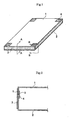
- the gasket is used as integrated with the cover of an HDD casing.
- metallic cover 12 is fitted simply to base 11, whereas the gasket molded from the present sealing material is fitted in such a state as to cover the entirety of side surfaces 3 consisting of side surfaces of top metallic cover 1 and side surfaces of bottom base 2.
- Fitting of the gasket 3 is conducted by bonding a gasket in such a shape as to be extended over the back sides of the respective side surfaces through clearances 4 between the top cover side surfaces and the base side surfaces by an adhesive 5.
- the gasket on the back sides of to the top cover side surfaces may be extended even to the back side of the top cover and passed through perforation 4' provided in the top cover, thereby integrating the passed-through gasket with vibration-insulating mat 6 on the top cover surface.
- the foregoing components were kneaded by a planetary mixer and a three-roll mill, and then subjected to press vulcanization (primary vulcanization) at 170°C for 20 minutes and oven vulcanization (secondary vulcanization) at 150°C for 10 hours to obtain a vulcanization sheet (150 ⁇ 150 ⁇ 2mm).
- the acrylic polymer used herein was a copolymer comprising butyl acrylate, ethyl acrylate and 2-methoxyethyl acrylate, further copolymerized with 1,7-octadiene to introduce alkenyl groups therein, and having a number average molecular weight Mn of 18,000, a molecular weight distribution (Mw/Mn) of 1.1 and average number of alkenyl groups introduced into one molecule of the copolymer being 1.9.
- the hydrosilyl group-containing compound used herein was a linear siloxane having 5 hydrosilyl groups on average and 5 ⁇ -methylstyrene groups on average in one molecule (amount of Si-H groups : 3.70 m moles/g).
- the hydrosilylation catalyst used herein was a xylene solution containing 3 wt.% of 1,1,3,3-tetramethyl-1,3-divinylsiloxane complex of zero-valent platinum.
- Example 1 the amount of white carbon was changed from 25 parts by weight to 10 parts by weight.
- Example 1 the amount of white carbon was changed from 25 parts by weight to 40 parts by weight.
- Acrylic rubber (PA402, a product of Unimatec Co.) 100 Carbon black (N550) 30 Stearic acid 1 Sulfur 0.3 Sodium stearate 3 Potassium stearate 0.25 Autioxidant (Nocrack CD, a product of Ouchi-Shinko Kagaku K.K.) 2
- Comparative Example 2 15 parts by weight of plasticizer (RS700, a product of Adeka Argus Co.) was additionally used.
- the resulting vulcanization sheets were subjected to determination of the following items:
- the product materials of Examples have the same level heat resistance, compression set characteristics and oil resistance as those of acrylic rubber typically of Comparative Example 2, and enable low surface pressure sealing due to the lowered hardness and thus can be used as suitable sealing materials for automobile engine cam covers and oil pans, whereas in Comparative Examples 1 ⁇ 2, higher surface pressure is required for sealing because of the higher hardness and thus the product materials are a lower sealability than that of the Examples, and the product material of Comparative Example 3 has equivalent physical properties to those of the Examples, but has a lower kneadability due to the addition of the plasticizer.
- a 6,6-nylon square case cover with the open bottom (20cm long, 20cm wide, 5cm high and 5mm thick) was placed on a steel base plate, and 4 corners at the outer flange of the case cover bottom were fixed to the base plate by bolts.
- a vulcanized O-ring of sealing material of Example 1 or 2, or Comparative Example 1 or 2 (ring wire diameter : 5.7mm, 10% compression) was inserted into square groove formed on the base plate surface at the contact surface between the outer flange of the case cover and the base plate to attain sealing.
- Lubricating oil was filled into the case cover from an opening hole at the top of the case cover to about one-half of the case cover height, and the case inside was compressed up to pressure of 0.5MPa from the top opening hole and kept in the compressed state for about one hour. No lubricating oil leakage from the flange region (outer flange region of the case cover) was observed in case of sealing materials of Examples 1 ⁇ 2, whereas in case of Comparative Examples 1 ⁇ 2 clearances were formed in the flange region due to the camber force of the sealing materials and lubricating oil leakage was observed.
- Example 1 The components as used in Example 1 was mixed together through a planetary mixer and a three-roll mill, left to stand at room temperature for 24 hours, and then subjected to press vulcanization at 180°C and 100MPa for 20 minutes to obtain test pieces.
- Example 3 no white carbon was used.
- Example 3 the amount of white carbon was changed from 25 parts by weight to 30 parts by weight.
- Example 3 the amount of white carbon was changed from 25 parts by weight to 50 parts by weight.
- Acrylic rubber (PA 402L, a product of Unimatec Co.) 100 White carbon (Aerosil R974) 25 Precipitated sulfur 0.2 Potassium stearate 1.2 Antioxidant (Irganox) 2
- Pre-vulcanization mixtures and test pieces obtained in the foregoing Examples 3 ⁇ 5 and Comparative Examples 5 ⁇ 6 were subjected to determination of the following items to evaluate performance of sealing materials for fuel cell cooling medium.
- Pre-vulcanization mixtures obtained in Examples 3 ⁇ 5 and Comparative Examples 5 ⁇ 6 were molded on the surface of a stainless steel (SUS303) plate fabricated to a thickness of 2mm and also on the surface of resin-impregnated type carbon material (IKC-33, a product of Toyo Carbon K.K.) under molding pressure of 200 Kgf/cm 2 , using such a mold as to make the molding to have a shape of 1mm-high semi-circular cross-section to evaluate the moldability.
- IKC-33 resin-impregnated type carbon material
- Composition components Comp. (parts by weight) Ex. 6 Ex. 7 Ex. 7 Ex. 8 Ex. 9 Acrylic polymer 93.9 93.9 93.9 93.9 93.9 Hydrosilyl group-containing compound 5.6 5.6 5.6 5.6 Hydrosilylation catalyst 0.05 0.05 0.05 0.05 0.05 Carbon black (N990) 5 25 120 White carbon (Aerosil R974) 5 18 Antioxidant (Nocrack CD, a product of Ouchi-Shinko Kagaku K.K.) 1 1 1 1 1 1 Polyetherester-based plasticizer (RS700, a product of Asahi Denka Kogyo K.K.) 5 5 3,5-dimethyl-1-hexine-3-ol (Hardness-adjusting agent) 0.1 0.1 0.1 0.1 0.1 0.1 0.1 0.1 0.1 0.1 0.1 0.1 0.1 0.1 0.1 0.1 0.1 0.1 0.1 0.1 0.1 0.1 0.1 0.1 0.1 0.1 0.1 0.1 0.1 0.1 0.1 0.1 0.1 0.1 0.1 0.1 0.1
- the foregoing components were thoroughly mixed together through a three-roll mill and then subjected to vulcanization molding at 180°C for 10 minutes by a compression molding machine.
- the resulting vulcanization molding products were subjected to determination of the following items.
- Tight adhesiveness test A perforation, 2mm in diameter, is made through a cylinder (10mm in diameter and 10mm in height) at the center thereof as assumed as a connector packing, and an electric wire (3mm in outer diameter) is passed through the perforation, and subjected to stretching, bending or heat load (at 120°C for 168 hours) and then, the electric wire is manually drawn out of the perforation. Cases that the electric wire fails to be drawn therefrom are evaluated as satisfactory ( ⁇ ), and cases that the electric wire is drawn therefrom are evaluated as unsatisfactory ( ⁇ )
- the vulcanization molding products obtained from the compositions of Examples 6 ⁇ 9 have a low hardness, good heat resistance and oil resistance, a good tight adhesiveness to the electric wires and a low out gassing property, and can be used as suitable wire harnesses sealing materials for automobiles, whereas that of Comparative Example 7 has a high hardness and a poor tight adhesiveness to the electric wire, that of Comparative Example 8 using acrylic rubber has low practical strengths and a poor compression set characteristic and furthermore a poor tight adhesiveness to the electric wire, and that of Comparative Example 9 using silicone rubber has a good heat resistance, but a poor oil resistance and furthermore a poor tight adhesiveness to the electric wire.
- Example 1 white carbon was added to the acrylic polymer, followed by thorough mixing through a three-roll mill. Then, a hydrosilyl group-containing compound (linear siloxane) was added to the acrylic polymer in such an amount as to make 1.8 equivalent amount of SiH groups in the linear siloxane to the alkenyl group of acrylic polymer, and furthermore a hardness-adjusting agent (sulfinol 61) was added thereto in an amount of 30 ⁇ 10 -4 molar equivalent to the alkenyl group of acrylic polymer, and still furthermore a solution of hydrosilylation catalyst in xylene (1.32 ⁇ 10 -5 milli moles/ ⁇ l) was added thereto in an amount of 5 ⁇ 10 -4 molar equivalent in terms of platinum to the alkenyl group of acrylic polymer, followed by further uniform mixing.
- a hydrosilyl group-containing compound linear siloxane
- a hardness-adjusting agent sulfinol 61
- Example 10 no white carbon was used.
- Example 10 the amount of white carbon was changed from 25 parts by weight to 60 parts by weight.
- Example 10 the amount of white carbon was changed from 25 parts by weight to 80 parts by weight.
- Example 10 80 parts by weight of MT carbon black (Thermax N990, a product of CANCARB Co.) was used in place of the white carbon.
- Example 10 ⁇ 12 and Comparative Examples 10 ⁇ 11 were each left to stand at room temperature for 24 hours to conduct deforming, and then poured into test sheet molds (150 ⁇ 150 ⁇ 2mm) and subjected to compression molding at 180°C and 100MPa for 10 minutes. The resulting sheets were subjected to determination of hardness, compression set and out gassing property.
- An aluminum sheet (treated by electroless nickel plating to a thickness of 2 ⁇ 5 ⁇ m), as formed into a cover shape in advance, was coated with an epoxy resin-based adhesive (Three-Bond 2202, a product of Three-bond Co.) and inserted into a mold, and then a gasket was injection-molded using injection molding machine onto the aluminum cover as an HDD cover placed in the mold at a set temperature of 210° ⁇ 180°C, injection pressure of 100MPa and an injection speed of 0.5 seconds with a cycle time of 30 seconds to produce a cover-integrated gasket.
- the resulting gasket products were subjected to determination or evaluation of sealability, adhesiveness and moldability.
- Example 13 no white carbon was used.
- Example 13 the amount of white carbon was changed from 25 parts by weight to 30 parts by weight.
- Example 13 the amount of white carbon was changed from 25 parts by weight to 50 parts by weight.
- Example 13 80 parts by weight of MT carbon black (Thermax N990, a product of CANCARB Co.) was used in place of the white carbon.
- Initial tan ⁇ Determination is carried out in a visco-elasticity meter at frequencies of 10Hz and 100Hz, an initial strain of 10% at 25°C in a compression measurement mode, and tan ⁇ values of 0.5 or more at frequencies 10Hz and 100Hz are evaluated as satisfactory ( ⁇ ) and those of less than 0.5 were evaluated as unsatisfactory (X)
- Tan ⁇ after heat aging test Test sheets were heated at 120°C for 168 hours, then left to stand at room temperature, and determination and evaluation of tan ⁇ were carried out in the same manner as in the case of initial tan ⁇ .
- An aluminum sheet (treated by electroless nickel plating to a thickness of 2 ⁇ 5 ⁇ m), as formed into a cover shaps in advance, was coated with an epoxy resin-based adhesive (Three-Bond 2202, a product of Three-Bond Co.) and inserted into a mold, and then a gasket was injection-molded using injection molding machine onto the aluminum cover as an HDD cover placed in the mold at a set temperature of 210° ⁇ 180°C, injection pressure of 100MPa and an injection speed of 0.5 seconds with a cycle time of 30 seconds to produce a cover-integrated gasket.
- the resulting gaskets products were subjected to determination and evaluation of sealability and moldability in the same manner as in Examples 10 ⁇ 12.
- such a vibration-insulating HDD cover gasket can attain simplification of production steps (easy fabrication) and improvements in heat resistance, vibration insulation, heat resistance, sealability, out gassing property, quality, etc. at the same time as a gasket to be fitted to the HDD cover in the precision device field requiring a lower camber force and better cleanliness, preferably as a HDD casing cover-integrated gasket for the sealing purpose of electronic devices, particularly for preventing penetration of moisture, dust, etc.
Landscapes
- Chemical & Material Sciences (AREA)
- Engineering & Computer Science (AREA)
- General Engineering & Computer Science (AREA)
- Organic Chemistry (AREA)
- Health & Medical Sciences (AREA)
- Mechanical Engineering (AREA)
- Chemical Kinetics & Catalysis (AREA)
- Medicinal Chemistry (AREA)
- Polymers & Plastics (AREA)
- Materials Engineering (AREA)
- Sealing Material Composition (AREA)
- Compositions Of Macromolecular Compounds (AREA)
- Gasket Seals (AREA)
Abstract
Description
- R1 :
- a hydrogen atom or a methyl group
- R2 :
- an ester group or an o-, m- or p-phenylene group where in case of an ester group, the compound is a (meth)acrylate-based compound and in case of a phenylene group, the compound is a styrene-based compound
- R3 :
- an organic group of C1-C20, which may be directly bonded or may have at least one ether bond,
- R1 :
- a hydrogen atom or a methyl group
- R4 :
- an organic group of C1-C20, which may have at least one ether bond,
- R5,
- R6 : alkyl groups of C1-C6 or phenyl group
- R7 :
- alkyl groups of C1-C10 or aralkyl groups
0≦a≦100
2≦b≦100
0≦c≦100
- R8, R9 :
- alkyl groups of C1-C6 or phenyl group
- R10 :
- alkyl groups of C1-C10 or aralkyl groups
0≦d≦8
2≦e≦10
0≦f≦8
3≦d+e+f≦10
- Platinum-vinylsiloxane complexes:
- Ptn(CH2=CHMe2SiOSiMe2CH=CH2)n
Pt[(MeCH=CHSiO)4]m - Platinum-phosphine complexes:
- Pt(PPh3)4
Pt(PBu3)4 - Platinum-phosphite complexes:
- Pt[P(OPh)3]4
Pt[P(OBu)3]4
Me : methyl
Bu : butyl
Ph : phenyl
n, m : positive integers
| Parts by weight | |
| Acrylic polymer | 100 |
| White carbon (Aerosil R974, product of Nihon Aerosil Co.; average particle size of primary Particles : 12nm) | 25 |
| Hydrosilyl group-containing |
6 |
| Hydrosilylation catalyst | 0.05 |
| Hardness-adjusting agent (3,5-dimethyl-1-hexine-3-ol; Surfinol 61, a product of Nisshin Kagaku K.K.) | 0.1 |
| Antioxidant (Irganox 1010, a product of Ciba Specialty Chemical Co.) | 2 |
| Parts by weight | |
| Acrylic rubber (PA402, a product of Unimatec Co.) | 100 |
| Carbon black (N550) | 30 |
| |
1 |
| Sulfur | 0.3 |
| |
3 |
| Potassium stearate | 0.25 |
| Autioxidant (Nocrack CD, a product of Ouchi-Shinko Kagaku K.K.) | 2 |
- Normal state physical properties :
- according to JIS K6253 and JIS K 6251
- Heat resistance :
- according to JIS K6257 (changes in physical properties by heating at 150°C for 70 hours)
- Compression set:
- according to JIS K6262 corresponding to ISO815 (by heating at 150°C for 70 hours)
- Oil resistance :
- according to JIS K6258 (changes in physical properties by heating at 150°C for 70 hours in lubricating oil No. 3)
| Deterimination items | Ex. 1 | Ex. 2 | Comp. Ex. 1 | Comp. Ex. 2 | Comp. Ex. 3 |
| [Normal state physical properties] | |||||
| Hardness (Durometer A) | 40 | 20 | 58 | 50 | 40 |
| Tensile strength (MPa) | 3.2 | 3.0 | 4.5 | 8.3 | 7.1 |
| Elongation (%) [Heat resistance] | 200 | 210 | 100 | 210 | 260 |
| Hardness change (points) Percent tensile strength | +1 | +3 | +7 | +5 | +1 |
| change (%) Percent elongation | +25 | +21 | +11 | +19 | +2 |
| change (%) [Compression set] | +8 | +6 | -35 | -33 | +5 |
| 150°C for 70 hours (%) [Oil resistance] | 29 | 30 | 32 | 28 | 35 |
| Hardness change (points) Percent tensile strength | -5 | -3 | -7 | -7 | -3 |
| change (%) Percent elongation | -6 | -9 | -8 | -15 | -13 |
| change (%) | -12 | -15 | -19 | -11 | -8 |
| Percent volume change (%) | +22.5 | +23.9 | +20.5 | +19.7 | +10.2 |
| Parts by weight | |
| Acrylic rubber (PA 402L, a product of Unimatec Co.) | 100 |
| White carbon (Aerosil R974) | 25 |
| Precipitated sulfur | 0.2 |
| Potassium stearate | 1.2 |
| Antioxidant (Irganox) | 2 |
- Viscosity :
- The mixtures left to stand at room temperature for 24 hours are subjected to determination of viscosity in the unvulcanized state according to JIS K6300, and Mooney scorch (125°C) Vm value of less than 20 is evaluated as satisfactory (○) and the value of 20 or more is evaluated as unsatisfactory (×) (at 20 or more flaws will be formed on the gasket body, many burrs will be generated and molding of product will be hard to attain)
- Hardness :
- 3 test sheets (each 2mm in thickness) are placed one upon another and subjected to determination according to JIS K6253 (ISO48 and ISO7619) (at a hardness of 60 or more, the gasket camber force will be higher when fitted to the fuel cell body, resulting in damages on the separator and consequent failure of complete tight sealing, and the gasket sealability will be poor)
- Compression camber force :
- Camber force of a small test piece (13mm in diametor) according to JIS K 6262 at the time of compression is determined, and camber force of less than 0.4N at 50% compression is evaluated as satisfactory (○) and that of 0.4N or more is evaluated as unsatisfactory (×)
- Compression set:
- Values after heating at 120°C for 168 hours according to JIS K6262 (ISO815) are determined, and values of less than 50% are evaluated as satisfactory (○) and those of 50% or more are evaluated as unsatisfactory (×)
- Gas permeability :
- Gas permeation coefficient (unit : cm3·cm/cm2· sec·cmHg) of hydrogen at the ordinary temperature is determined according to JIS K 7126, and values of less than 1.0 ×10⁻⁸ are evaluated as satisfactory (○) and those of 1 ×10⁻⁸ or more are evaluated as unsatisfactory (×)
- Dipping test:
- Test pieces are dipped into cooling medium silicone oil (KF-96-100cs, a product of Shin-Etsu Chemical Co.) at 120°C for 70 hours according to JIS K6258, and then percent volume changes of the dipped test pieces are measured, and values of less than 30% are evaluated as satisfactory (○) and those of 30% or more are evaluated as unsatisfactory (×)
- Moldability :
- Cases without in conveniences of failure in molding into desired product shapes such as occurrence of deformation, sinks, flaws, welds, short shots and burrs or appearance of phenomena incapable of cover-integrated molding are evaluated as satisfactory (○), and cases with such inconveniences are evaluated as unsatisfactory (×)
| Example | Comp. Ex. | ||||
| | 3 | 4 | 5 | 5 | 6 |
| [Test piece evaluation] | |||||
| Viscosity Vm | 9 | 9 | 10 | 11 | 28 |
| ○ | ○ | ○ | ○ | × | |
| Hardness (JIS Durometer A) | 31 | 12 | 48 | 65 | 48 |
| Compression camber force (kN) | 0.20 | 0.13 | 0.28 | 0.45 | 0.30 |
| ○ | ○ | ○ | ○ | × | |
| Compression set (%) | 32 | 28 | 30 | 32 | 26 |
| ○ | ○ | ○ | ○ | ○ | |
| Gas permeability (×10-9) | 6.0 | 5.2 | 5.1 | 5.1 | 4.6 |
| ○ | ○ | ○ | ○ | ○ | |
| Dipping test ΔV (%) | 16 | 16 | 15 | 15 | 13 |
| [Product evaluation] | ○ | ○ | ○ | ○ | ○ |
| Moldability | ○ | ○ | ○ | ○ | × |
| Composition components | Comp. | ||||
| (parts by weight) | Ex. 6 | Ex. 7 | Ex. 7 | Ex. 8 | Ex. 9 |
| Acrylic polymer | 93.9 | 93.9 | 93.9 | 93.9 | 93.9 |
| Hydrosilyl group-containing compound | 5.6 | 5.6 | 5.6 | 5.6 | 5.6 |
| Hydrosilylation catalyst | 0.05 | 0.05 | 0.05 | 0.05 | 0.05 |
| Carbon black (N990) | 5 | 25 | 120 | ||
| White carbon (Aerosil R974) | 5 | 18 | |||
| Antioxidant (Nocrack CD, a product of Ouchi-Shinko Kagaku K.K.) | 1 | 1 | 1 | 1 | 1 |
| Polyetherester-based plasticizer (RS700, a product of Asahi Denka Kogyo K.K.) | 5 | 5 | |||
| 3,5-dimethyl-1-hexine-3-ol (Hardness-adjusting agent) | 0.1 | 0.1 | 0.1 | 0.1 | 0.1 |
| Parts by weight | |
| Acrylic rubber (Nipol AR 72HF, a product of Nippon Zeon Co.) | 100 |
| Sulfur | 0.5 |
| |
1 |
| |
2 |
| |
1 |
| Parts by weight | |
| Silicone rubber (VMQ:SE8311CVU; a product of Toray Silicone Co.) | 100 |
| Red pigment (CP21 RED, a product of Toray Silicone Co.) | 2 |
| Organic peroxide (RC4, a product of Toray Silicone Co., 50% SiO2 dilution in 2,5-dimethyl-2,5-di-tert. butyl peroxyhexane) | 1 |
| Comp. | Comp. | Comp. | |||||
| Determination item | Ex.6 | Ex.7 | Ex.7 | Ex.8 | Ex.9 | Ex.8 | Ex.9 |
| [Normal state value] | |||||||
| Hardness | 10 | 40 | 72 | 12 | 32 | 42 | 30 |
| Duro A (Points) | |||||||
| Breaking strength (MPa) | 4.2 | 7.0 | 9.6 | 3.9 | 4.8 | 1.6 | 6.2 |
| Breaking elongation (%) | 280 | 200 | 105 | 300 | 210 | 120 | 460 |
| [Compression set] | |||||||
| 150°C for 70 hours (%) | 12 | 19 | 42 | 14 | 22 | 64 | 28 |
| [Heat resistance test] | |||||||
| Change in hardness | |||||||
| (Points) | +3 | +2 | +2 | +4 | +2 | +5 | +2 |
| Percent breaking | |||||||
| strength change (%) | +10 | +5 | +16 | +12 | +4 | -19 | +8 |
| Percent breaking | |||||||
| elongation change (%) | +6 | +9 | -18 | -7 | -12 | -20 | -6 |
| [Oil resistance test] | |||||||
| Change in hardness | |||||||
| (Points) | -5 | -3 | -2 | -5 | -4 | -6 | -14 |
| Percent breaking | |||||||
| strength change (%) | -16 | -12 | -23 | -18 | -15 | -30 | -36 |
| Percent breaking | |||||||
| elongation change (%) | -18 | -19 | -26 | -13 | -12 | -39 | -47 |
| Percent volume | |||||||
| change (%) | +18.0 | +15.2 | +14.8 | +19.1 | +17.3 | +19.6 | +62.0 |
| [Tight adhesiveness test] | |||||||
| After stretching | ○ | ○ | ○ | ○ | ○ | × | ○ |
| After bending | O | ○ | × | ○ | ○ | × | × |
| After heat load | ○ | ○ | ○ | ○ | ○ | × | × |
| [Out gassing property] | |||||||
| Amount of generated gas (µg/g) | 40 | 24 | 18 | 38 | 26 | 80 | 62 |
| [Metal corrosiveness] | |||||||
| Occurrence of corrosion | none | none | none | none | none | occurred | none |
- Hardness :
- Two test sheets are placed one upon another and
determination is made according to JIS K6253 (ISO48
and ISO7619)
(When the hardness is 70 or more, a camber force exerted on a cover-integrated gasket fitting to the body becomes larger, resulting in deformation of the cover, etc., leading to failure of complete sealing and poor sealability as a gasket, whereas when the hardness is not more than 10, the gasket will be torn off easily or become sticky easily, so attention must be paid to the handling. Thus, the hardness of curing products is set to not more than 60, preferably 10-60, more preferably 20-45) - Compression set:
- After heating at 120°C for 168 hours,
determination is made according to JIS K6262 (ISO815), and values of less than 50% are evaluated as satisfactory (○) and those of 50% or more are evaluated as unsatisfactory (×) - Out gassing property :
- A strip-shaped test piece (50 ×3 ×2mm) is subjected to heated extraction at 120°C for one hour to determine an out gassing amount, and amounts of less than 50 µg/g are evaluated as satisfactory (○) and those of 50 µg/g or more are evaluated as unsatisfactory (×) (those evaluated as unsatisfactory (×) are not preferable for use as HDD gaskets)
- Sealability test:
- The cover-integrated gasket is set to an actual leak tester, subjected to heat treatment at 80°C for 168 hours and then returned to room temperature, while applying a positive pressure of 5kPa thereto continuously for 30 seconds from the tester inside, occurrence of leakage is investigated after 15 seconds from the initiation of positive pressure application, and absence of leakage is given as ○, whereas occurrence of leakage as × (in case that a gasket material has a poor compression set characteristic or in case that the gasket shape is defected, leakage occurs)
- Adhesiveness test:
- A penetration peel (about 1mm in width) is formed on the gasket bond surface of a cover-integrated gasket, and a vertically stretching load is applied thereto via a stainless steel (SUS) wire engaged with the penetration peel. The load when the peel length is elongated to about 10mm is measured as a peel load. Peel load of 100kPa or more is evaluated as satisfactory (○) and that of less than 100kPa is evaluated as unsatisfactory (×) (those with a peel load of 100kPa or more have a satisfactory adhesive force in the actual use circumstances)
- Moldability test:
- Cases without inconveniences of failure in molding into desired product shapes such as occurrence of deformation, sinks, flaws, welds, short shots and burrs or appearance of phenomena incapable of cover-integrated molding are evaluated as satisfactory (○), and cases with such inconveniences are evaluated as unsatisfactory (×) (in case of using no adhesive, peeling occurred at the time of molding, resulting in failure of integrated molding)
| Determination evaluation item | Ex.10 | Ex.11 | Ex.12 | Comp.Ex.10 | Comp.Ex.11 |
| [Test piece] | |||||
| Hardness | 31 | 12 | 48 | 70 | 65 |
| (Durometer A) | |||||
| Compression set | ○ | ○ | ○ | ○ | ○ |
| Out gassing property | ○ | ○ | ○ | ○ | ○ |
| [Product] | |||||
| Sealability test | ○ | ○ | ○ | × | × |
| Adhesiveness test | ○ | ○ | ○ | ○ | ○ |
| Moldability evaluation | ○ | ○ | ○ | ○ | ○ |
| Determination* evaluation item | Ex.13 | Ex.14 | Ex.15 | Comp.Ex.12 | Comp.Ex.13 |
| [Test piece] Hardness | 31 | 12 | 48 | 70 | 68 |
| (Durometer A) | |||||
| Compression set | ○ | ○ | ○ | ○ | ○ |
| Out gassing property | ○ | ○ | ○ | ○ | ○ |
| Vibration insulation | |||||
| Initial | ○ | ○ | ○ | ○ | ○ |
| After heat aging test | ○ | ○ | ○ | ○ | ○ |
| [Product] | |||||
| Sealability test | ○ | ○ | ○ | × | × |
| Moldability evaluation | ○ | ○ | ○ | ○ | ○ |
Claims (31)
- A sealing material, which comprises a curing product of a composition comprising (A) an acrylic polymer having at least one alkenyl group capable of undergoing hydrosilylation reaction, (B) a hydrosilyl group-containing compound and (C) a hydrosilylation catalyst as essential components.
- A sealing material according to Claim 1, for use in sealing automobile engine cam covers.
- A sealing material for cam covers according to Claim 2, where a liquid acrylic polymer having a number average molecular weight Mn of 500 or more and a molecular weight distribution (Mw/Mn) of 1.8 or less is used as component (A) of the composition.
- A sealing material for cam covers according to Claim 2, where the curing product of the composition has a Duro A hardness of 45 or less.
- A sealing material for cam covers according to Claim 2, for use in resin-made cam covers.
- An automobile engine cam cover sealed by a sealing material for cam cover according to Claim 2.
- A sealing material according to Claim 1, for use as a sealing material for automobile engine oil pans.
- A sealing material for oil pans according to Claim 7, wherein a liquid acrylic polymer having a number average molecular weight Mn of 500 or more and a molecular weight distribution (Mw/Mn) of 1.8 or less is used as component (A) of the composition.
- A sealing material for oil pans according to Claim 7, wherein the curing product of the composition has a Duro A hardness of 45 or less (according to JIS K6253).
- Automobile engine oil pans sealed by a sealing material for oil pans according to Claim 7.
- A sealing material according to Claim 1, for use in sealing a fuel cell cooling medium.
- A sealing material for sealing a fuel cell cooling medium according to Claim 11, wherein an acrylic polymer having a number average molecular weight Mn of 500 or more and a molecular weight distribution (Mw/Mn) of 1.8 or less is used as component (A) of the composition.
- A sealing material for a fuel cell cooling medium according to Claim 11, wherein the curing product of the composition has a Duro A hardness of 60 or less (according to JIS K6253).
- A sealing material for a fuel cell cooling medium according to Claim 11, as molded to total seal height of 3mm or less.
- A sealing material according to Claim 1, for use in automobile wire harnesses.
- A sealing material for automobile wire harnesses according to Claim 15, wherein a liquid acrylic polymer having a number average molecular weight Mn or 500 or more and a molecular weight distribution (Mw/Mn) of 1.8 or less is used as component (A) of the composition.
- A sealing material for automobile wire harnesses according to Claim 15, wherein the curing product of the composition has a Duro A hardness of 50 or less (according to JIS K6253).
- A sealing material for automobile wire harnesses according to Claim 15 or 17, wherein not more than 100 parts by weight of a reinforcing agent or a filler is added to the composition on the basis of 100 parts by weight of sum total of components (A), (B) and (C).
- Automobile wire harnesses sealed by a sealing material for wire harnesses according to Claim 15.
- An HDD cover gasket, which comprises a curing product of a composition comprising (A) an acrylic polymer having at least one alkenyl group capable of undergoing hydrosilylation reaction, (B) a hydrosilyl group-containing compound and (C) a hydrosilylation catalyst as essential components.
- An HDD cover gasket according to Claim 20, wherein a liquid acrylic polymer having a number average molecular weight Mn of 500 or more and a molecular weight distribution (Mw/Mn) of 1.8 or less is used as component (A) of the composition.
- An HDD cover gasket according to Claim 20, wherein the curing product of the composition has a Duro A hardness of 60 or less (according to JIS K6253).
- An HDD cover gasket according to Claim 20, wherein the curing product of the composition has a compression set of 50% or less (120°C for 168 hours according to JIS K6262).
- An HDD cover gasket according to Claim 20, for use in HDD for mounting on automobiles.
- A sealing material according to Claim 1, for use as a vibration-insulating seal of HDD cover gasket.
- A sealing material for vibration-insulating HDD cover gasket according to Claim 25, wherein a liquid acrylic polymer having a number average molecular weight Mn of 500 or more and a molecular weight distribution (Mw/Mn) of 1.8 or less is used as component (A) of the composition.
- A sealing material for vibration-insulating HDD cover gasket according to Claim 25, wherein the curing product of the composition has a Duro A hardness of 50 or less (according to JIS K6253).
- A sealing material for vibration-insulating HDD cover gasket according to Claim 25, wherein the curing product of the composition has a compression set of 50% or less (120°C for 168 hours according to JIS K 6262).
- A sealing material for vibration-insulating HDD cover gasket according to Claim 25, wherein the curing product of the composition has a loss tangent tan δ of 0.5 or more at room temperature.
- A sealing material for vibration-insulating HDD cover gasket according to Claim 25, wherein the gasket molded from the composition is integrated with an HDD casing cover.
- A sealing material for vibration-insulating HDD cover gasket according to Claim 25 or 30, for use in HDD for mounting on automobiles.
Applications Claiming Priority (13)
| Application Number | Priority Date | Filing Date | Title |
|---|---|---|---|
| JP2002291912 | 2002-10-04 | ||
| JP2002291910 | 2002-10-04 | ||
| JP2002291906 | 2002-10-04 | ||
| JP2002291914 | 2002-10-04 | ||
| JP2002291909 | 2002-10-04 | ||
| JP2002291910 | 2002-10-04 | ||
| JP2002291909 | 2002-10-04 | ||
| JP2002291907 | 2002-10-04 | ||
| JP2002291914 | 2002-10-04 | ||
| JP2002291907 | 2002-10-04 | ||
| JP2002291912 | 2002-10-04 | ||
| JP2002291906 | 2002-10-04 | ||
| PCT/JP2003/012716 WO2004031315A1 (en) | 2002-10-04 | 2003-10-03 | Sealing material |
Publications (2)
| Publication Number | Publication Date |
|---|---|
| EP1548085A1 true EP1548085A1 (en) | 2005-06-29 |
| EP1548085A4 EP1548085A4 (en) | 2010-05-19 |
Family
ID=32074820
Family Applications (1)
| Application Number | Title | Priority Date | Filing Date |
|---|---|---|---|
| EP03754003A Withdrawn EP1548085A4 (en) | 2002-10-04 | 2003-10-03 | Sealing material |
Country Status (5)
| Country | Link |
|---|---|
| US (4) | US20060155074A1 (en) |
| EP (1) | EP1548085A4 (en) |
| JP (1) | JPWO2004031315A1 (en) |
| AU (1) | AU2003272926A1 (en) |
| WO (1) | WO2004031315A1 (en) |
Cited By (2)
| Publication number | Priority date | Publication date | Assignee | Title |
|---|---|---|---|---|
| EP2749619A1 (en) * | 2012-12-26 | 2014-07-02 | Nitto Denko Corporation | Sealing sheet |
| CN108699310A (en) * | 2016-03-09 | 2018-10-23 | 三键有限公司 | Hardening resin composition, fuel cell and encapsulating method |
Families Citing this family (22)
| Publication number | Priority date | Publication date | Assignee | Title |
|---|---|---|---|---|
| JP2006040966A (en) * | 2004-07-22 | 2006-02-09 | Fujitsu Ltd | Electronic equipment |
| JP4355652B2 (en) * | 2004-12-27 | 2009-11-04 | 埼玉日本電気株式会社 | Electronic equipment and dustproof structure |
| WO2006090843A1 (en) * | 2005-02-25 | 2006-08-31 | Kaneka Corporation | Curable composition and cured object thereof |
| JP4849931B2 (en) * | 2006-03-29 | 2012-01-11 | Nok株式会社 | Seal structure |
| JP5011886B2 (en) * | 2006-08-22 | 2012-08-29 | Nok株式会社 | Bonded piston seal |
| US7965495B2 (en) * | 2008-10-13 | 2011-06-21 | Apple Inc. | Battery connector structures for electronic devices |
| JP5239781B2 (en) * | 2008-11-25 | 2013-07-17 | Nok株式会社 | Liquid rubber composition |
| JP4995316B2 (en) * | 2009-12-28 | 2012-08-08 | 日東電工株式会社 | gasket |
| US10352447B2 (en) | 2009-12-29 | 2019-07-16 | Nitto Denko Corporation | Gasket |
| US20120141912A1 (en) * | 2010-12-03 | 2012-06-07 | GM Global Technology Operations LLC | Fuel cell stack comprising an impermeable coating |
| US8830662B2 (en) * | 2011-03-01 | 2014-09-09 | Apple Inc. | Electronic devices with moisture resistant openings |
| TWI506030B (en) * | 2011-09-06 | 2015-11-01 | Nat Univ Tsing Hua | Transition metal carbene complexes and the electroluminescent application thereof |
| JP6393582B2 (en) * | 2014-10-30 | 2018-09-19 | 株式会社オートネットワーク技術研究所 | Wire Harness |
| WO2017199865A1 (en) * | 2016-05-17 | 2017-11-23 | Nok株式会社 | Corrosion prevention method for surface of aluminium-based member |
| JP6658295B2 (en) | 2016-05-19 | 2020-03-04 | 株式会社オートネットワーク技術研究所 | Water stopping silicone rubber composition, water stopping silicone rubber molded article, and wire harness |
| RU2753172C2 (en) * | 2016-12-22 | 2021-08-12 | Иллюмина, Инк. | Device for pressing out relief |
| US10563552B2 (en) * | 2017-06-14 | 2020-02-18 | GM Global Technology Operations LLC | Oil pan assembly |
| US10923160B2 (en) * | 2019-07-05 | 2021-02-16 | Seagate Technology Llc | Testing assembly for sealed hard disk drives |
| US11375629B2 (en) * | 2019-09-26 | 2022-06-28 | Apple Inc. | Rotating frame lock for front crystal retention and sealing |
| EP4105294B1 (en) * | 2020-02-12 | 2025-07-30 | NOK Corporation | Gasket |
| JP7576507B2 (en) | 2021-04-22 | 2024-10-31 | 住友理工株式会社 | Sealing material |
| US20230345095A1 (en) * | 2022-04-21 | 2023-10-26 | Gopro, Inc. | Isla thermal transfer to sub-system base |
Family Cites Families (21)
| Publication number | Priority date | Publication date | Assignee | Title |
|---|---|---|---|---|
| US3159601A (en) * | 1962-07-02 | 1964-12-01 | Gen Electric | Platinum-olefin complex catalyzed addition of hydrogen- and alkenyl-substituted siloxanes |
| US3159662A (en) * | 1962-07-02 | 1964-12-01 | Gen Electric | Addition reaction |
| US3220972A (en) * | 1962-07-02 | 1965-11-30 | Gen Electric | Organosilicon process using a chloroplatinic acid reaction product as the catalyst |
| US4394853A (en) * | 1981-06-22 | 1983-07-26 | General Motors Corporation | Engine oil pan isolation mounting |
| WO1995019392A1 (en) * | 1994-01-12 | 1995-07-20 | E.I. Du Pont De Nemours And Company | Sealing composite for gage and drain holes |
| JP3436991B2 (en) * | 1994-11-04 | 2003-08-18 | 鐘淵化学工業株式会社 | Curable composition |
| JP3806475B2 (en) * | 1996-02-08 | 2006-08-09 | 株式会社カネカ | Method for producing (meth) acrylic polymer having functional group at terminal |
| US5922911A (en) * | 1998-04-24 | 1999-07-13 | Eastman Chemical Company | Process for the manufacture of acetic anhydride |
| KR20000009758A (en) * | 1998-07-28 | 2000-02-15 | 윤종용 | Noise and vibration attenuation device of rotation actuator |
| JP4002038B2 (en) * | 1998-09-18 | 2007-10-31 | 株式会社カネカ | Curable composition for molding and molded product obtained by curing the same |
| JP4050422B2 (en) * | 1998-09-18 | 2008-02-20 | 株式会社カネカ | On-site molded gasket |
| JP2000154347A (en) * | 1998-09-18 | 2000-06-06 | Kanegafuchi Chem Ind Co Ltd | Adhesive curable composition |
| WO2001059011A1 (en) * | 2000-02-08 | 2001-08-16 | Kaneka Corporation | Curable compositions |
| JP4543267B2 (en) * | 2000-05-17 | 2010-09-15 | 株式会社スリーボンド | Curable composition for fuel cell |
| WO2001090248A2 (en) * | 2000-05-19 | 2001-11-29 | Henkel Loctite Corporation | Impregnation sealants utilizing hydrosilation chemistry |
| US6794461B2 (en) * | 2000-08-25 | 2004-09-21 | Kaneka Corporation | Method for purification of vinyl polymers |
| US7186780B2 (en) * | 2001-02-28 | 2007-03-06 | Kaneka Corporation | Polymer and liquid gasket for in-place forming |
| JP2003113288A (en) * | 2001-07-30 | 2003-04-18 | Kanegafuchi Chem Ind Co Ltd | Curable composition |
| US6994354B2 (en) * | 2002-01-15 | 2006-02-07 | Freudenberg-Nok General Partnership | Vibrationally decoupling gasket |
| AU2003271088A1 (en) * | 2002-10-04 | 2004-04-23 | Kaneka Corporation | Vibration absorption mount material |
| WO2004031316A1 (en) * | 2002-10-04 | 2004-04-15 | Nok Corporation | Metal- or resin-united gasket |
-
2003
- 2003-10-03 JP JP2004541285A patent/JPWO2004031315A1/en active Pending
- 2003-10-03 AU AU2003272926A patent/AU2003272926A1/en not_active Abandoned
- 2003-10-03 US US10/530,096 patent/US20060155074A1/en not_active Abandoned
- 2003-10-03 WO PCT/JP2003/012716 patent/WO2004031315A1/en not_active Ceased
- 2003-10-03 EP EP03754003A patent/EP1548085A4/en not_active Withdrawn
-
2007
- 2007-05-18 US US11/804,521 patent/US20070225448A1/en not_active Abandoned
- 2007-05-18 US US11/804,513 patent/US20070221448A1/en not_active Abandoned
-
2008
- 2008-09-08 US US12/231,978 patent/US20090014965A1/en not_active Abandoned
Cited By (3)
| Publication number | Priority date | Publication date | Assignee | Title |
|---|---|---|---|---|
| EP2749619A1 (en) * | 2012-12-26 | 2014-07-02 | Nitto Denko Corporation | Sealing sheet |
| CN108699310A (en) * | 2016-03-09 | 2018-10-23 | 三键有限公司 | Hardening resin composition, fuel cell and encapsulating method |
| CN108699310B (en) * | 2016-03-09 | 2024-02-20 | 三键有限公司 | Curable resin composition, fuel cell and sealing method |
Also Published As
| Publication number | Publication date |
|---|---|
| US20090014965A1 (en) | 2009-01-15 |
| US20060155074A1 (en) | 2006-07-13 |
| WO2004031315A1 (en) | 2004-04-15 |
| AU2003272926A1 (en) | 2004-04-23 |
| US20070221448A1 (en) | 2007-09-27 |
| AU2003272926A8 (en) | 2004-04-23 |
| JPWO2004031315A1 (en) | 2006-02-02 |
| EP1548085A4 (en) | 2010-05-19 |
| US20070225448A1 (en) | 2007-09-27 |
Similar Documents
| Publication | Publication Date | Title |
|---|---|---|
| US20070225448A1 (en) | Sealing material | |
| JP4591994B2 (en) | Curable composition | |
| EP1897896B1 (en) | Curable composition and sealing method | |
| EP1277804B1 (en) | Curable compositions | |
| JP5112690B2 (en) | Curable composition and cured product thereof | |
| US20070221815A1 (en) | Material for vibration-absorbable mounts | |
| JP5236941B2 (en) | Curable composition and cured product thereof | |
| US20080249246A1 (en) | Composition For On-Site Forming Gasket, Gasket, (Meth) Acrylic Polymer and Curing Composition Thereof | |
| EP1731572B1 (en) | Curable composition and sealing method | |
| JP4455900B2 (en) | Curable composition with improved compatibility with curing agent | |
| JP2001240756A (en) | Curable composition | |
| US20050153095A1 (en) | Metal-or resin-united gasket | |
| EP2586804B1 (en) | Photoradically and thermally radically curable composition | |
| JP2005255916A (en) | Curable composition | |
| JP2005350526A (en) | Magnetic material comprising acrylic rubber | |
| JP2007112917A (en) | Acrylic rubber material for shielding electromagnetic waves | |
| JP2010126544A (en) | Liquid rubber composition | |
| US20060128893A1 (en) | Curable compositions | |
| JPWO2008146759A1 (en) | Curable composition and cured product thereof | |
| JP2011012768A (en) | Adhesive waterproof packing for electronic equipment and method for manufacturing the same | |
| JP2009084353A (en) | Manufacturing method of curable composition, curable composition, and its cured product | |
| JPWO2001059011A1 (en) | curable composition | |
| JP2011052191A (en) | Composite rubber molding and method for producing the same |
Legal Events
| Date | Code | Title | Description |
|---|---|---|---|
| PUAI | Public reference made under article 153(3) epc to a published international application that has entered the european phase |
Free format text: ORIGINAL CODE: 0009012 |
|
| 17P | Request for examination filed |
Effective date: 20050303 |
|
| AK | Designated contracting states |
Kind code of ref document: A1 Designated state(s): AT BE BG CH CY CZ DE DK EE ES FI FR GB GR HU IE IT LI LU MC NL PT RO SE SI SK TR |
|
| AX | Request for extension of the european patent |
Extension state: AL LT LV MK |
|
| DAX | Request for extension of the european patent (deleted) | ||
| RBV | Designated contracting states (corrected) |
Designated state(s): DE FR GB |
|
| A4 | Supplementary search report drawn up and despatched |
Effective date: 20100420 |
|
| RIC1 | Information provided on ipc code assigned before grant |
Ipc: C08L 83/04 20060101ALI20100414BHEP Ipc: C08F 8/42 20060101ALI20100414BHEP Ipc: F02F 11/00 20060101ALI20100414BHEP Ipc: F02F 7/00 20060101ALI20100414BHEP Ipc: F16J 15/10 20060101ALI20100414BHEP Ipc: C09K 3/10 20060101AFI20040420BHEP |
|
| STAA | Information on the status of an ep patent application or granted ep patent |
Free format text: STATUS: THE APPLICATION IS DEEMED TO BE WITHDRAWN |
|
| 18D | Application deemed to be withdrawn |
Effective date: 20100820 |