EP1547697A1 - Organic ultrathin film, cumulate thereof and process for producing the same - Google Patents
Organic ultrathin film, cumulate thereof and process for producing the same Download PDFInfo
- Publication number
- EP1547697A1 EP1547697A1 EP03797567A EP03797567A EP1547697A1 EP 1547697 A1 EP1547697 A1 EP 1547697A1 EP 03797567 A EP03797567 A EP 03797567A EP 03797567 A EP03797567 A EP 03797567A EP 1547697 A1 EP1547697 A1 EP 1547697A1
- Authority
- EP
- European Patent Office
- Prior art keywords
- monolayer
- organic ultrathin
- ultrathin membrane
- membrane
- nucleic acid
- Prior art date
- Legal status (The legal status is an assumption and is not a legal conclusion. Google has not performed a legal analysis and makes no representation as to the accuracy of the status listed.)
- Withdrawn
Links
Images




Classifications
-
- G—PHYSICS
- G03—PHOTOGRAPHY; CINEMATOGRAPHY; ANALOGOUS TECHNIQUES USING WAVES OTHER THAN OPTICAL WAVES; ELECTROGRAPHY; HOLOGRAPHY
- G03C—PHOTOSENSITIVE MATERIALS FOR PHOTOGRAPHIC PURPOSES; PHOTOGRAPHIC PROCESSES, e.g. CINE, X-RAY, COLOUR, STEREO-PHOTOGRAPHIC PROCESSES; AUXILIARY PROCESSES IN PHOTOGRAPHY
- G03C1/00—Photosensitive materials
- G03C1/72—Photosensitive compositions not covered by the groups G03C1/005 - G03C1/705
- G03C1/73—Photosensitive compositions not covered by the groups G03C1/005 - G03C1/705 containing organic compounds
- G03C1/731—Biological compounds
-
- B—PERFORMING OPERATIONS; TRANSPORTING
- B05—SPRAYING OR ATOMISING IN GENERAL; APPLYING FLUENT MATERIALS TO SURFACES, IN GENERAL
- B05D—PROCESSES FOR APPLYING FLUENT MATERIALS TO SURFACES, IN GENERAL
- B05D1/00—Processes for applying liquids or other fluent materials
- B05D1/18—Processes for applying liquids or other fluent materials performed by dipping
- B05D1/20—Processes for applying liquids or other fluent materials performed by dipping substances to be applied floating on a fluid
- B05D1/202—Langmuir Blodgett films (LB films)
-
- B—PERFORMING OPERATIONS; TRANSPORTING
- B82—NANOTECHNOLOGY
- B82Y—SPECIFIC USES OR APPLICATIONS OF NANOSTRUCTURES; MEASUREMENT OR ANALYSIS OF NANOSTRUCTURES; MANUFACTURE OR TREATMENT OF NANOSTRUCTURES
- B82Y30/00—Nanotechnology for materials or surface science, e.g. nanocomposites
-
- B—PERFORMING OPERATIONS; TRANSPORTING
- B82—NANOTECHNOLOGY
- B82Y—SPECIFIC USES OR APPLICATIONS OF NANOSTRUCTURES; MEASUREMENT OR ANALYSIS OF NANOSTRUCTURES; MANUFACTURE OR TREATMENT OF NANOSTRUCTURES
- B82Y40/00—Manufacture or treatment of nanostructures
-
- G—PHYSICS
- G11—INFORMATION STORAGE
- G11B—INFORMATION STORAGE BASED ON RELATIVE MOVEMENT BETWEEN RECORD CARRIER AND TRANSDUCER
- G11B7/00—Recording or reproducing by optical means, e.g. recording using a thermal beam of optical radiation by modifying optical properties or the physical structure, reproducing using an optical beam at lower power by sensing optical properties; Record carriers therefor
- G11B7/24—Record carriers characterised by shape, structure or physical properties, or by the selection of the material
- G11B7/241—Record carriers characterised by shape, structure or physical properties, or by the selection of the material characterised by the selection of the material
- G11B7/242—Record carriers characterised by shape, structure or physical properties, or by the selection of the material characterised by the selection of the material of recording layers
- G11B7/244—Record carriers characterised by shape, structure or physical properties, or by the selection of the material characterised by the selection of the material of recording layers comprising organic materials only
Definitions
- the invention of this application relates to an organic ultrathin membrane, a cumulative product thereof and a process for producing the same.
- Photoisomerization is to reversibly convert 2 or more structures of a pigment molecule by irradiating the pigment molecule with light.
- a pigment molecule has A structure
- B structure is defined as "1”
- a structure is defined as "0”
- B structure is defined as "1”
- a thin membrane of a monomolecular layer is formed by dispersing an amphiphilic compound on the water surface, a monolayer with a high density is formed by compressing the formed thin membrane in the surface, and the formed membrane is laminated on a solid substrate such as glass, whereby a high-density solid thin membrane on which a monolayer has been laminated is formed. It is formed into, so-called a Langmuir-Blodgett membrane, namely an LB membrane.
- SAM self-assembled monolayer
- an object of the invention of this application is to solve the foregoing problems in the conventional techniques and to provide a novel organic ultrathin membrane which enables photoisomerization of a pigment molecule in a high-density solid state by providing free space around the pigment molecule and is useful as an optical memory or the like, and a process for producing the organic ultrathin membrane.
- the invention of this application solves the foregoing problems and provides, firstly, an organic ultrathin membrane characterized in that an amphiphilic compound having a pigment group and a nucleic acid base is aligned due to base-pairing with an oligonucleotide which is capable of forming a base pair with the nucleic acid base to thereby constitute a monolayer.
- the invention of this application provides, secondly, the organic ultrathin membrane characterized in that the amphiphilic compound has a chromophore in the hydrophobic chain as a pigment group, thirdly, the organic ultrathin membrane characterized in that the chromophore is a photoisomerization group, and fourthly, the organic ultrathin membrane characterized in that the chromophore is an azobenzene group.
- the invention of this application provides, fifthly, a cumulative product of an organic ultrathin membrane characterized in that a condensed membrane obtained by compressing a monolayer is laminated on a solid substrate.
- the invention of this application provides, sixthly, a process for producing an organic ultrathin membrane, which is a process for producing the foregoing organic ultrathin membrane, characterized in that an amphiphilic compound having a nucleic acid base is spread on an aqueous solution containing an oligonucleotide to form a base pair of the nucleic acid base of the amphiphilic compound and the oligonucleotide to thereby constitute a monolayer, and seventhly, a process for producing a cumulative product of an organic ultrathin membrane characterized by compressing the obtained monolayer of the organic ultrathin membrane to form a condensed membrane and laminating the condensed membrane on a solid substrate.
- an amphiphilic nucleic acid base derivative (DNA mimetic) formed a similar base pair to DNA on the steam-water interface, they further found that by organizing a DNA mimetic having a pigment group with the use of a single-strand DNA as a template, accurate alignment could be achieved.
- an organic ultrathin membrane composed of a monolayer in which, by using an oligonucleotide as a template, an amphiphilic compound having a pigment group and a nucleic acid base is aligned due to base-pairing of the nucleic acid base with the oligonucleotide is provided.
- the amphiphilic compound the one having a chromophore in the hydrophobic chain as a pigment group is taken into consideration.
- a monolayer of an amphiphilic thymine derivative having azobenzene in the hydrophobic chain is provided by using an oligonucleotide as a template.
- Fig. 1A it was difficult to induce photoisomerization when there is no free space even in an LB membrane in which a pigment molecule such as azobenzene ( ⁇ ) is present.
- a pigment molecule such as azobenzene ( ⁇ ) is present.
- Fig. 1B free space can be provided, thereby achieving photoisomerization.
- free space can be provided, and further by minimizing the free space, a high-density membrane can be achieved.
- amphiphilic compound in the invention of this application may be the one having a hydrophilic group (chain) and a hydrophobic group (chain), and its nucleic acid base or pigment group may be any kind.
- the nucleic acid base should be the one capable of forming a base pair with an oligonucleotide as a template. A combination of both will be selected in response to the use and given function of the organic ultrathin membrane, and its cumulative product.
- a representative example of the combination is a thymine-adenine base pair.
- the amphiphilic compound of azobenzene in order to control its density in a monolayer, base-pairing of deoxyribonucleic acid (DNA) is utilized.
- DNA deoxyribonucleic acid
- an amphiphilic compound, in which azobenzene and a nucleic acid base (thymine in this example) have been bound through a covalent bond is spread (dispersed) on an aqueous solution containing an oligonucleotide (DNA fragment).
- a base pair is formed between the amphiphilic compound and the oligonucleotide on the steam-water interface.
- the azobenzene-thymine compound forms a base pair only with the adenine of the oligonucleotide (A-T pair).
- A-T pair adenine of the oligonucleotide
- ⁇ -A surface pressure-area isotherms
- reflection spectra of the monolayer on the water surface were measured "in situ" with a spectrophotometer provided with a Y-type optical fiber. The obtained spectra were standardized according to the density of the azobenzene chromophore. The measurement method and the results are shown in Fig.
- dA 30 25 nM oligonucleotide: dA 30 , d(GA) 15 or d(GAA) 10 was added.
- A represents adenine
- G represents guanine.
- dA 30 represents an oligonucleotide, which is a sequence of 30 adenines.
- dA 30 in which dA capable of forming a base pair with Thy has been arranged in series, or d(GA) 15 or d(GGA) 10 , in which dA has been arranged every other nucleic acid base or every third nucleic acid base was added to the lower aqueous phase.
- ⁇ -A isotherms of C 12 AzoC 5 -Thy were measured on the TE buffer at 20°C. The results are shown in Fig. 4.
- dA 30 to the lower aqueous phase, a monolayer was swollen and phase transition pressure was increased.
- d(GGA) 10 in which dA has been arranged every third nucleic acid base, phase transition did not occur, and swollenness of the monolayer was maintained even at a high surface pressure.
- the monolayer was transferred to a quartz substrate with a high surface pressure of 25 mN/m, and photoisomerization was carried out.
- the results are shown in Fig. 8 and Fig. 9.
- the problems in the conventional techniques are solved and a novel organic ultrathin membrane which enables photoisomerization of a pigment molecule in a high-density solid state by providing free space around the pigment molecule and is useful as an optical memory or the like, and a process for producing the organic ultrathin membrane can be provided.
Landscapes
- Engineering & Computer Science (AREA)
- Chemical & Material Sciences (AREA)
- Nanotechnology (AREA)
- General Physics & Mathematics (AREA)
- Physics & Mathematics (AREA)
- Materials Engineering (AREA)
- Crystallography & Structural Chemistry (AREA)
- Condensed Matter Physics & Semiconductors (AREA)
- Biomedical Technology (AREA)
- Molecular Biology (AREA)
- General Health & Medical Sciences (AREA)
- Health & Medical Sciences (AREA)
- Manufacturing & Machinery (AREA)
- Biodiversity & Conservation Biology (AREA)
- Life Sciences & Earth Sciences (AREA)
- Composite Materials (AREA)
- Application Of Or Painting With Fluid Materials (AREA)
- Saccharide Compounds (AREA)
- Liquid Deposition Of Substances Of Which Semiconductor Devices Are Composed (AREA)
Abstract
A novel organic ultrathin membrane characterized in that an
amphiphilic compound having a pigment group and a nucleic acid base is aligned
due to base-pairing with an oligonucleotide which is capable of forming a base
pair with the nucleic acid base to thereby constitute a monolayer is provided.
In this organic ultrathin membrane, free space is provided around a pigment
molecule so as to enable photoisomerization of the pigment molecule in a
high-density solid state. Thus, it is useful as an optical memory, etc. Further,
a process for producing the organic ultrathin membrane is provided.
Description
- The invention of this application relates to an organic ultrathin membrane, a cumulative product thereof and a process for producing the same.
- Conventionally, it is known that photoisomerization of an organic pigment is used as one of the principles of operation of an optical memory. Photoisomerization here is to reversibly convert 2 or more structures of a pigment molecule by irradiating the pigment molecule with light. For example, when UV light is irradiated, a pigment molecule has A structure, and when visible light is irradiated, it has B structure. Here, if A structure is defined as "0", and B structure is defined as "1", it becomes the same memory material as a conventional electronic device. However, generally in the process of converting A structure into B structure or in the inverse process, a packing ratio of pigment molecules in the space is changed, therefore, in a solid in which pigment molecules have been packed in a high density, photoisomerization does not proceed.
- Thus, it is considered that providing free space around a pigment molecule is effective for allowing photoisomerization in a high-density solid. As a measure for achieving this, it attracts attention that a thin membrane of a monomolecular layer is formed by dispersing an amphiphilic compound on the water surface, a monolayer with a high density is formed by compressing the formed thin membrane in the surface, and the formed membrane is laminated on a solid substrate such as glass, whereby a high-density solid thin membrane on which a monolayer has been laminated is formed. It is formed into, so-called a Langmuir-Blodgett membrane, namely an LB membrane. For example, an attempt using azobenzene, which is a pigment, has been made (
Documents - In this attempt, a polymer having azobenzene as a side chain is synthesized, a monolayer is formed on the steam-water interface, whereby an LB membrane is produced. In addition, synthesis of a cyclic amphiphilic compound of azobenzene, and production of an LB membrane using the compound have been carried out.
- By this method, designing of a polymer molecule is difficult, therefore, it has been pointed out that it is difficult to secure free space for azobenzene (the polymer synthesis is a radical reaction, therefore, it is difficult to control the distance between azobenzenes).
- In addition, an attempt has been made to form an LB membrane by synthesizing a disulfide compound composed of azobenzene and producing a self-assembled layer (self-assembled monolayer: SAM) on a gold substrate, or by synthesizing an anionic (negative ion) amphiphilic azobenzene compound and dispersing it on an aqueous solution of a cationic (positive ion) polymer to produce a polyion complex monolayer, in which the amphiphilic compound and the polymer have been bound to each other through an ionic bond on the steam-water interface (Document 4).
- However, in the former case of the self-assembled layer with the azobenzene disulfide compound, there is a big problem in that the solid substrate is limited to gold, and in the latter case, there is a problem in that synthesis of the cationic polymer is difficult, and further the control of the distance between the cationic groups is difficult.
- Document 1: K. Ichimura, Chem. Rev., 100, pp. 1847-1873 (2000)
- Document 2: Nikkei Advanced Technology, 2002, 6, 10 (vol. 15), pp. 10-14
- Document 3: Seki, T. Fukuchi, K. Ichimura, Langmuir, 16, pp. 3564-3567 (2000)
- Document 4: M. Matsumoto, S. Terrettaz, H. Tachibana, Advanced in Colloid and Interface Science, 87, pp. 147-164 (2000)
-
- Accordingly, an object of the invention of this application is to solve the foregoing problems in the conventional techniques and to provide a novel organic ultrathin membrane which enables photoisomerization of a pigment molecule in a high-density solid state by providing free space around the pigment molecule and is useful as an optical memory or the like, and a process for producing the organic ultrathin membrane.
- The invention of this application solves the foregoing problems and provides, firstly, an organic ultrathin membrane characterized in that an amphiphilic compound having a pigment group and a nucleic acid base is aligned due to base-pairing with an oligonucleotide which is capable of forming a base pair with the nucleic acid base to thereby constitute a monolayer.
- With regard to this organic ultrathin membrane, the invention of this application provides, secondly, the organic ultrathin membrane characterized in that the amphiphilic compound has a chromophore in the hydrophobic chain as a pigment group, thirdly, the organic ultrathin membrane characterized in that the chromophore is a photoisomerization group, and fourthly, the organic ultrathin membrane characterized in that the chromophore is an azobenzene group.
- In addition, the invention of this application provides, fifthly, a cumulative product of an organic ultrathin membrane characterized in that a condensed membrane obtained by compressing a monolayer is laminated on a solid substrate.
- Further, the invention of this application provides, sixthly, a process for producing an organic ultrathin membrane, which is a process for producing the foregoing organic ultrathin membrane, characterized in that an amphiphilic compound having a nucleic acid base is spread on an aqueous solution containing an oligonucleotide to form a base pair of the nucleic acid base of the amphiphilic compound and the oligonucleotide to thereby constitute a monolayer, and seventhly, a process for producing a cumulative product of an organic ultrathin membrane characterized by compressing the obtained monolayer of the organic ultrathin membrane to form a condensed membrane and laminating the condensed membrane on a solid substrate.
-
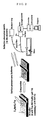
- Figs. 1A and 1B are views schematically showing the difference of photoisomerization due to the presence of or lack of free space.
- Fig. 2 is a schematic view showing methods of surface pressure-area isotherms and reflection absorption spectroscopy (measured in situ).
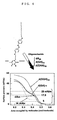
- Fig. 3 shows graphs illustrating surface pressure-area isotherms of a monolayer in a TE buffer and reflection absorption spectra.
- Fig. 4 shows a graph illustrating surface pressure-area isotherms when an oligonucleotide was added.
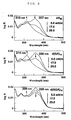
- Fig. 5 shows graphs illustrating reflection absorption spectra associated with Fig. 4.
- Fig. 6 is a view schematically showing an alignment state of a monolayer in the case of d(GGA)10.
- Fig. 7 is a view schematically showing a measurement method of UV-visible absorption spectra by the ATR method for a cumulative product.
- Fig. 8 shows graphs illustrating absorption spectra in each of the cases of UV light irradiation and visible light irradiation measured by the method in Fig. 7
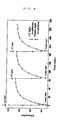
- Fig. 9 shows graphs illustrating absorption spectra change with time upon alternate irradiation with UV and visible light.
-
- The invention of this application has the foregoing characteristics, however, hereunder, an embodiment of the invention will be explained.
- What is particularly characteristic is that, though the inventors found that an amphiphilic nucleic acid base derivative (DNA mimetic) formed a similar base pair to DNA on the steam-water interface, they further found that by organizing a DNA mimetic having a pigment group with the use of a single-strand DNA as a template, accurate alignment could be achieved. In other words, in the invention of this application, an organic ultrathin membrane composed of a monolayer in which, by using an oligonucleotide as a template, an amphiphilic compound having a pigment group and a nucleic acid base is aligned due to base-pairing of the nucleic acid base with the oligonucleotide is provided.
- More specifically, for example, as the amphiphilic compound, the one having a chromophore in the hydrophobic chain as a pigment group is taken into consideration. In addition, specifically, according to the invention of this application, a monolayer of an amphiphilic thymine derivative having azobenzene in the hydrophobic chain is provided by using an oligonucleotide as a template.
- Conventionally, for example, as shown in Fig. 1A, it was difficult to induce photoisomerization when there is no free space even in an LB membrane in which a pigment molecule such as azobenzene (α) is present. However, according to the invention of this application, as shown in Fig. 1B, free space can be provided, thereby achieving photoisomerization.
- According to the invention of this application, free space can be provided, and further by minimizing the free space, a high-density membrane can be achieved.
- Of course, the foregoing amphiphilic compound in the invention of this application may be the one having a hydrophilic group (chain) and a hydrophobic group (chain), and its nucleic acid base or pigment group may be any kind. However, the nucleic acid base should be the one capable of forming a base pair with an oligonucleotide as a template. A combination of both will be selected in response to the use and given function of the organic ultrathin membrane, and its cumulative product.
- A representative example of the combination is a thymine-adenine base pair. With regard to the amphiphilic compound of azobenzene, in order to control its density in a monolayer, base-pairing of deoxyribonucleic acid (DNA) is utilized. In other words, for example, first, an amphiphilic compound, in which azobenzene and a nucleic acid base (thymine in this example) have been bound through a covalent bond is spread (dispersed) on an aqueous solution containing an oligonucleotide (DNA fragment). If an oligonucleotide with a repeat structure of adenine-guanine-guanine is used here, a base pair is formed between the amphiphilic compound and the oligonucleotide on the steam-water interface. In other words, the azobenzene-thymine compound forms a base pair only with the adenine of the oligonucleotide (A-T pair). At this time, to the guanine, nothing is bound, whereby space is generated only in this area. Accordingly, free space for photoisomerization of azobenzene is acquired. In a complex monolayer of an azobenzene-thymine amphiphilic compound and an oligonucleotide formed on the steam-water interface in this way, even if it is compressed, small space (free space) around azobenzene is maintained. Therefore, in an LB membrane obtained from the monolayer, trans-cis photoisomerization can be easily induced.
- Hereunder, an organic ultrathin membrane composed of the monolayer in the case of this specific example and a cumulative product thereof will be explained in detail.
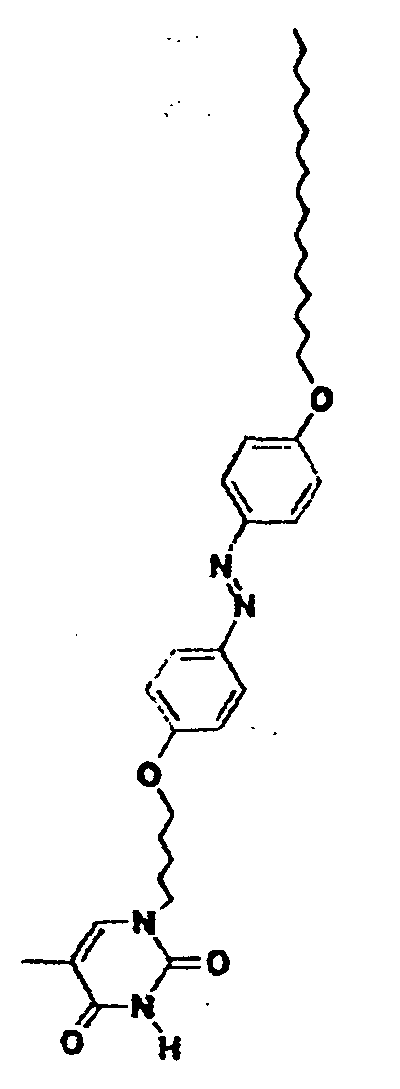
- A mixed solution of chloroform and ethanol (9/1 v/v) containing C12AzoC5-Thy having azobenzene and thymine in the partial structure represented by the following formula:was spread on 10 mM Tris-HCl buffer containing 1 mM EDTA (pH 7.8, TE buffer), and surface pressure-area isotherms (π-A) were measured. In addition, at the same time as π-A isotherms were measured, reflection spectra of the monolayer on the water surface were measured "in situ" with a spectrophotometer provided with a Y-type optical fiber. The obtained spectra were standardized according to the density of the azobenzene chromophore. The measurement method and the results are shown in Fig. 2 and Fig. 3, respectively. With regard to the monolayer on the TE buffer, it was found that when the surface pressure was 5.0 mN/m, the membrane was in a liquid state, and azobenzene was in a monomer state as seen from the absorption spectrum. On the other hand, it was confirmed that when the surface pressure was 15 mN/m or higher by compression, the membrane was in a solid state, and a hydrogen-bonded aggregate was formed, and photoisomerization hardly occurred in this aggregate.
- Subsequently, to the TE buffer, 25 nM oligonucleotide: dA30, d(GA)15 or d(GAA)10 was added. Here, A represents adenine, and G represents guanine. For example, dA30 represents an oligonucleotide, which is a sequence of 30 adenines.
- In other words, as a template oligonucleotide for organizing C12AzoC5-Thy molecule, dA30, in which dA capable of forming a base pair with Thy has been arranged in series, or d(GA)15 or d(GGA)10, in which dA has been arranged every other nucleic acid base or every third nucleic acid base was added to the lower aqueous phase. In order to confirm that C12AzoC5-Thy molecule recognizes the template, π-A isotherms of C12AzoC5-Thy were measured on the TE buffer at 20°C. The results are shown in Fig. 4. In the case where the foregoing oligonucleotide was not added, phase transition occurred when the surface pressure was about 10 mN/m, and a solid membrane was formed when the surface pressure was higher than the value. However, by adding dA30 to the lower aqueous phase, a monolayer was swollen and phase transition pressure was increased. In the case where d(GA)15, in which dA has been arranged every other nucleic acid base was added to the lower aqueous phase, comparing with the case of dA30, swollenness of the monolayer in a liquid state was observed, however, in a solid state, the isotherms accorded to each other. However, by adding d(GGA)10, in which dA has been arranged every third nucleic acid base, phase transition did not occur, and swollenness of the monolayer was maintained even at a high surface pressure.
- In order to evaluate the effect of the sequence of the template oligonucleotide added to the lower phase on the packing state of the azobenzene groups, reflection spectra of monolayer on the water surface were measured. The results are shown in Fig. 5. On dA30, the maximum absorption wavelength was 357 nm at 5 mN/m where the monolayer was in a liquid state; therefore, it was found that most of the azobenzene chromophores in the monolayer were in a monomer state. However, absorption was also observed at around 320 nm; therefore, it is considered that a hydrogen-bonded aggregate was formed by part of azobenzenes. At 25 mN/m where a solid membrane was formed, the spectrum was shifted to 314 nm, and a hydrogen-bonded aggregate was formed. In the case where d(GA)15 was added to the lower aqueous phase as a template, the absorption derived from a hydrogen-bonded aggregate was weaker comparing with the case of dA30 at 5 mN/m which is lower than the phase transition pressure; therefore, it is considered that azobenzene groups were dispersed better. However, at 25 mN/m where a solid membrane was formed by a monolayer, the absorption was shifted to a shorter wavelength (314 nm); therefore, it was found that a hydrogen-bonded aggregate was formed with azobenzene. On the other hand, when a monolayer was formed on d(GGA)10, the reflection spectrum with a maximum wavelength of 358 nm was obtained; therefore, it was found that even at a high surface pressure, monomer state was maintained. It was found that azobenzene groups in a monolayer can be completely dispersed by separating dA on the template oligonucleotide by 2 or more nucleic acid bases when a C12AzoC5-Thy molecule is organized.
- Accordingly, it is considered that formation of an aggregate of azobenzenes was inhibited by forming a base pair of C12AzoC5-Thy with dA on d(GGA)10 added to the lower aqueous phase as a template to provide sufficient space between azobenzenes as schematically shown in Fig. 6.
- Subsequently, a monolayer formed by the foregoing process was transferred to a quartz substrate, and as shown in Fig. 7, by alternate irradiation with UV light and visible light, UV-visible absorption spectra were measured by the ATR method. By doing this, occurrence of photoisomerization as the following formula was evaluated.

- Specifically, on d(GGA)10, the monolayer was transferred to a quartz substrate with a high surface pressure of 25 mN/m, and photoisomerization was carried out. The results are shown in Fig. 8 and Fig. 9.
- By UV light irradiation, the trans-form that has a maximum absorption of 360 nm was decreased, and the cis-form was produced. Then, when visible light was irradiated, it was confirmed that it returned to the trans-form. This response was stable.
- As described in detail above, according to the invention of this application, the problems in the conventional techniques are solved and a novel organic ultrathin membrane which enables photoisomerization of a pigment molecule in a high-density solid state by providing free space around the pigment molecule and is useful as an optical memory or the like, and a process for producing the organic ultrathin membrane can be provided.
Claims (7)
- An organic ultrathin membrane characterized in that an amphiphilic compound having a pigment group and a nucleic acid base is aligned due to base-pairing with an oligonucleotide which is capable of forming a base pair with the nucleic acid base to thereby constitutea monolayer.
- The organic ultrathin membrane according to claim 1, characterized in that the amphiphilic compound has a chromophore in the hydrophobic chain as a pigment group.
- The organic ultrathin membrane according to claim 2, characterized in that the chromophore is a photoisomerization group.
- The organic ultrathin membrane according to claim 3, characterized in that the chromophore is an azobenzene group.
- A cumulative product of an organic ultrathin membrane characterized in that a condensed membrane obtained by compressing a monolayer of an organic ultrathin membrane according to any one of claims 1 to 4 is à minated on a solid substrate.
- A process for producing an organic ultrathin membrane, which is a process for producing an organic ultrathin membrane according to any one of claims 1 to 4 composed of a monolayer, characterized in that an amphiphilic compound having a nucleic acid base is spread on an aqueous solution containing an oligonucleotide to form a base pair of the nucleic acid base of the amphiphilic compound and the oligonucleotide to thereby constitute a monolayer.
- A process for producing a cumulative product of an organic ultrathin membrane characterized by compressing a monolayer constituting an organic ultrathin membrane obtained by the process according to claim 6 to forma condensed membrane and laminating the condensed membrane on a solid substrate.
Applications Claiming Priority (3)
| Application Number | Priority Date | Filing Date | Title |
|---|---|---|---|
| JP2002263434 | 2002-09-09 | ||
| JP2002263434A JP2004099741A (en) | 2002-09-09 | 2002-09-09 | Organic ultra-thin film, its accumulator, and its production method |
| PCT/JP2003/011514 WO2004026491A1 (en) | 2002-09-09 | 2003-09-09 | Organic ultrathin film, cumulate thereof and process for producing the same |
Publications (2)
| Publication Number | Publication Date |
|---|---|
| EP1547697A1 true EP1547697A1 (en) | 2005-06-29 |
| EP1547697A4 EP1547697A4 (en) | 2008-04-16 |
Family
ID=32024681
Family Applications (1)
| Application Number | Title | Priority Date | Filing Date |
|---|---|---|---|
| EP03797567A Withdrawn EP1547697A4 (en) | 2002-09-09 | 2003-09-09 | ORGANIC ULTRAFIN FILM, ACCUMULATION THEREOF AND PROCESS FOR PRODUCING THE SAME |
Country Status (4)
| Country | Link |
|---|---|
| US (1) | US20060051761A1 (en) |
| EP (1) | EP1547697A4 (en) |
| JP (1) | JP2004099741A (en) |
| WO (1) | WO2004026491A1 (en) |
Families Citing this family (2)
| Publication number | Priority date | Publication date | Assignee | Title |
|---|---|---|---|---|
| US7679107B2 (en) * | 2005-04-28 | 2010-03-16 | Semiconductor Energy Laboratory Co., Ltd. | Memory device that utilizes organic layer with a compound that can photoisomerize between conductive layers; at least one of which is light transmitting |
| FR3001642B1 (en) * | 2013-02-01 | 2016-05-13 | Natvi Sas | METHOD FOR SURFACING SURFACES |
Family Cites Families (9)
| Publication number | Priority date | Publication date | Assignee | Title |
|---|---|---|---|---|
| US4659624A (en) * | 1983-11-25 | 1987-04-21 | Ltv Aerospace & Defense Company | Hybrid and unidirectional carbon-carbon fiber reinforced laminate composites |
| JPH02102253A (en) * | 1988-10-11 | 1990-04-13 | Masamichi Fujihira | Langmuir-Blodgett membrane and its manufacturing method |
| JPH02102254A (en) * | 1988-10-11 | 1990-04-13 | Masamichi Fujihira | Langmuir-Blodgett membrane and its manufacturing method |
| JP2918608B2 (en) * | 1990-03-09 | 1999-07-12 | 科学技術振興事業団 | Triazine derivatives and compositions for thin films |
| JP3437256B2 (en) * | 1994-06-17 | 2003-08-18 | キヤノン株式会社 | Optical recording medium, optical recording method and information reproducing method |
| JP2002285138A (en) * | 2001-03-23 | 2002-10-03 | Fuji Photo Film Co Ltd | Functional molecules and functional films |
| JP2002273219A (en) * | 2001-03-23 | 2002-09-24 | Fuji Photo Film Co Ltd | Capture body and inspection device using the same |
| JP2002287184A (en) * | 2001-03-23 | 2002-10-03 | Fuji Photo Film Co Ltd | Image forming element and image forming apparatus |
| ES2319634T3 (en) * | 2002-03-11 | 2009-05-11 | Caprotec Bioanalytics Gmbh | COMPOUNDS AND METHODS TO ANALYZE THE PROTEOM. |
-
2002
- 2002-09-09 JP JP2002263434A patent/JP2004099741A/en active Pending
-
2003
- 2003-09-09 US US10/527,218 patent/US20060051761A1/en not_active Abandoned
- 2003-09-09 EP EP03797567A patent/EP1547697A4/en not_active Withdrawn
- 2003-09-09 WO PCT/JP2003/011514 patent/WO2004026491A1/en not_active Ceased
Non-Patent Citations (2)
| Title |
|---|
| No further relevant documents disclosed * |
| See also references of WO2004026491A1 * |
Also Published As
| Publication number | Publication date |
|---|---|
| WO2004026491A1 (en) | 2004-04-01 |
| US20060051761A1 (en) | 2006-03-09 |
| EP1547697A4 (en) | 2008-04-16 |
| JP2004099741A (en) | 2004-04-02 |
Similar Documents
| Publication | Publication Date | Title |
|---|---|---|
| Wu et al. | Liquid crystal assembly for ultra-dissymmetric circularly polarized luminescence and beyond | |
| Radebner et al. | Tetraacylgermanes: highly efficient photoinitiators for visible‐light‐induced free‐radical polymerization | |
| Gerwien et al. | An eight-state molecular sequential switch featuring a dual single-bond rotation photoreaction | |
| Zhao et al. | Macromolecular engineered multifunctional room-temperature phosphorescent polymers through reversible deactivation radical polymerization | |
| Zhou et al. | Dynamic interpenetrating polymer network (IPN) strategy for multiresponsive hierarchical pattern of reversible wrinkle | |
| Yano et al. | Photoluminescence on/off switching of a single colloidal quantum dot using photochromic diarylethene | |
| JP2001323387A (en) | Preparation method of organic ammonium and inorganic layered perovskite compound thin film | |
| Lesser et al. | Highly luminescent thin films from alternating deposition of CdTe nanoparticles and polycations | |
| US20090029137A1 (en) | Method for producing polymer thin film, and polymer thin film | |
| Wu et al. | Photochromic barbiturate pendant-containing benzo [b] phosphole oxides with co-assembly property and photoinduced morphological changes | |
| Shan et al. | Harnessing polymer matrices for tuning the luminescence and photochromism properties of organic photoresponsive materials | |
| Watanabe et al. | Molecular dynamics approach for predicting helical twisting powers of metal complex dopants in nematic solvents | |
| Bokare et al. | Strategies for incorporating graphene oxides and quantum dots into photoresponsive azobenzenes for photonics and thermal applications | |
| Liang et al. | Photoresponsive polymer nanocomposites: dynamic materials with photocontrolled functions | |
| Kojima et al. | Stimuli-responsive biomimetic metallic luster films using dye absorption and specular reflection from layered microcrystals | |
| Barman et al. | Bioinspired carbonized polymer microspheres for full-color whispering gallery mode emission for white light emission, unclonable anticounterfeiting, and chemical sensing applications | |
| JP2506973B2 (en) | Method of manufacturing optical recording medium | |
| US20060051761A1 (en) | Organic ultrathin film, cumulate thereof and process for producing the same | |
| Xia et al. | Formation of nitrogen-doped positively curved molecules by π-extension | |
| Xiao et al. | Combined in situ spectroscopies reveal the ligand ordering-modulated photoluminescence of upconverting nanoparticles | |
| Barbara et al. | Structure and dynamics of conjugated polymers in liquid crystalline solvents | |
| Miyata et al. | Aggregates in Langmuir-Blodgett Films of Spiropyrans Having Hydroxyl or Hydroxymethyl Group. | |
| Eickelmann et al. | Assessing polymer-surface adhesion with a polymer collection | |
| Kim et al. | Unique monolayer assembly of squarylium dye with short alkyl chains | |
| JPS63139324A (en) | Control of associated state of organic dye using magnetic field |
Legal Events
| Date | Code | Title | Description |
|---|---|---|---|
| PUAI | Public reference made under article 153(3) epc to a published international application that has entered the european phase |
Free format text: ORIGINAL CODE: 0009012 |
|
| 17P | Request for examination filed |
Effective date: 20050321 |
|
| AK | Designated contracting states |
Kind code of ref document: A1 Designated state(s): AT BE BG CH CY CZ DE DK EE ES FI FR GB GR HU IE IT LI LU MC NL PT RO SE SI SK TR |
|
| RBV | Designated contracting states (corrected) |
Designated state(s): DE FR GB |
|
| A4 | Supplementary search report drawn up and despatched |
Effective date: 20080317 |
|
| STAA | Information on the status of an ep patent application or granted ep patent |
Free format text: STATUS: THE APPLICATION HAS BEEN WITHDRAWN |
|
| 18W | Application withdrawn |
Effective date: 20080610 |