EP1547604A1 - Medicinal composition for periodontal pocket administration containing bisphosphonic acid derivative or its salt as the active ingredient - Google Patents
Medicinal composition for periodontal pocket administration containing bisphosphonic acid derivative or its salt as the active ingredient Download PDFInfo
- Publication number
- EP1547604A1 EP1547604A1 EP03791378A EP03791378A EP1547604A1 EP 1547604 A1 EP1547604 A1 EP 1547604A1 EP 03791378 A EP03791378 A EP 03791378A EP 03791378 A EP03791378 A EP 03791378A EP 1547604 A1 EP1547604 A1 EP 1547604A1
- Authority
- EP
- European Patent Office
- Prior art keywords
- cycloalkyl
- bisphosphonic acid
- periodontal
- linear
- administered
- Prior art date
- Legal status (The legal status is an assumption and is not a legal conclusion. Google has not performed a legal analysis and makes no representation as to the accuracy of the status listed.)
- Withdrawn
Links
- 239000002253 acid Substances 0.000 title claims abstract description 79
- 208000005888 Periodontal Pocket Diseases 0.000 title claims abstract description 57
- 150000003839 salts Chemical class 0.000 title claims abstract description 28
- 239000000203 mixture Substances 0.000 title claims description 88
- 239000004480 active ingredient Substances 0.000 title 1
- 239000008194 pharmaceutical composition Substances 0.000 claims abstract description 26
- 230000007704 transition Effects 0.000 claims abstract description 15
- 210000001124 body fluid Anatomy 0.000 claims abstract description 10
- 239000010839 body fluid Substances 0.000 claims abstract description 10
- 125000000753 cycloalkyl group Chemical group 0.000 claims description 36
- 125000000217 alkyl group Chemical group 0.000 claims description 33
- 208000028169 periodontal disease Diseases 0.000 claims description 21
- 229910052739 hydrogen Inorganic materials 0.000 claims description 17
- 239000001257 hydrogen Substances 0.000 claims description 17
- 125000004432 carbon atom Chemical group C* 0.000 claims description 15
- 125000001424 substituent group Chemical group 0.000 claims description 13
- 229920001525 carrageenan Polymers 0.000 claims description 11
- 229920002148 Gellan gum Polymers 0.000 claims description 10
- 150000001768 cations Chemical class 0.000 claims description 10
- 238000000034 method Methods 0.000 claims description 10
- 125000001997 phenyl group Chemical group [H]C1=C([H])C([H])=C(*)C([H])=C1[H] 0.000 claims description 10
- 238000002560 therapeutic procedure Methods 0.000 claims description 10
- 235000010492 gellan gum Nutrition 0.000 claims description 8
- 239000000216 gellan gum Substances 0.000 claims description 8
- 229910052760 oxygen Inorganic materials 0.000 claims description 8
- 125000003545 alkoxy group Chemical group 0.000 claims description 7
- 229910052736 halogen Inorganic materials 0.000 claims description 7
- 150000002367 halogens Chemical class 0.000 claims description 7
- 150000002431 hydrogen Chemical group 0.000 claims description 7
- 125000001624 naphthyl group Chemical group 0.000 claims description 7
- 239000001301 oxygen Substances 0.000 claims description 7
- IJGRMHOSHXDMSA-UHFFFAOYSA-N Atomic nitrogen Chemical compound N#N IJGRMHOSHXDMSA-UHFFFAOYSA-N 0.000 claims description 6
- UFHFLCQGNIYNRP-UHFFFAOYSA-N Hydrogen Chemical compound [H][H] UFHFLCQGNIYNRP-UHFFFAOYSA-N 0.000 claims description 6
- 239000000460 chlorine Substances 0.000 claims description 6
- 229910052801 chlorine Inorganic materials 0.000 claims description 6
- WVYCUPGXDCILQL-UHFFFAOYSA-N P(O)(O)=O.P(O)(O)=O.C Chemical class P(O)(O)=O.P(O)(O)=O.C WVYCUPGXDCILQL-UHFFFAOYSA-N 0.000 claims description 5
- 125000002887 hydroxy group Chemical group [H]O* 0.000 claims description 5
- 229910052717 sulfur Inorganic materials 0.000 claims description 5
- 125000006552 (C3-C8) cycloalkyl group Chemical group 0.000 claims description 4
- BGCPLWWYPZAURQ-UHFFFAOYSA-N 5-[[5-chloro-2-(2,2,6,6-tetramethylmorpholin-4-yl)pyrimidin-4-yl]amino]-3-(3-hydroxy-3-methylbutyl)-1-methylbenzimidazol-2-one Chemical compound ClC=1C(=NC(=NC=1)N1CC(OC(C1)(C)C)(C)C)NC1=CC2=C(N(C(N2CCC(C)(C)O)=O)C)C=C1 BGCPLWWYPZAURQ-UHFFFAOYSA-N 0.000 claims description 4
- NINIDFKCEFEMDL-UHFFFAOYSA-N Sulfur Chemical compound [S] NINIDFKCEFEMDL-UHFFFAOYSA-N 0.000 claims description 4
- 125000003342 alkenyl group Chemical group 0.000 claims description 4
- QVGXLLKOCUKJST-UHFFFAOYSA-N atomic oxygen Chemical compound [O] QVGXLLKOCUKJST-UHFFFAOYSA-N 0.000 claims description 4
- 125000001309 chloro group Chemical group Cl* 0.000 claims description 4
- 150000004676 glycans Chemical class 0.000 claims description 4
- 125000004435 hydrogen atom Chemical group [H]* 0.000 claims description 4
- 229920001282 polysaccharide Polymers 0.000 claims description 4
- 239000005017 polysaccharide Substances 0.000 claims description 4
- 239000011593 sulfur Substances 0.000 claims description 4
- 125000005389 trialkylsiloxy group Chemical group 0.000 claims description 4
- MYMOFIZGZYHOMD-UHFFFAOYSA-N Dioxygen Chemical compound O=O MYMOFIZGZYHOMD-UHFFFAOYSA-N 0.000 claims description 3
- XUIMIQQOPSSXEZ-UHFFFAOYSA-N Silicon Chemical group [Si] XUIMIQQOPSSXEZ-UHFFFAOYSA-N 0.000 claims description 3
- 238000004519 manufacturing process Methods 0.000 claims description 3
- MBKDYNNUVRNNRF-UHFFFAOYSA-N medronic acid Chemical compound OP(O)(=O)CP(O)(O)=O MBKDYNNUVRNNRF-UHFFFAOYSA-N 0.000 claims description 3
- 229910052757 nitrogen Inorganic materials 0.000 claims description 3
- 229910052710 silicon Inorganic materials 0.000 claims description 3
- 125000002023 trifluoromethyl group Chemical group FC(F)(F)* 0.000 claims description 3
- 238000013268 sustained release Methods 0.000 abstract description 11
- 239000012730 sustained-release form Substances 0.000 abstract description 11
- 239000004615 ingredient Substances 0.000 abstract description 2
- 150000001875 compounds Chemical class 0.000 description 26
- 238000009472 formulation Methods 0.000 description 24
- 229940079593 drug Drugs 0.000 description 21
- 239000003814 drug Substances 0.000 description 21
- 239000000499 gel Substances 0.000 description 20
- 210000000988 bone and bone Anatomy 0.000 description 19
- 239000012530 fluid Substances 0.000 description 17
- 210000003296 saliva Anatomy 0.000 description 13
- 239000012153 distilled water Substances 0.000 description 12
- XLYOFNOQVPJJNP-UHFFFAOYSA-N water Chemical compound O XLYOFNOQVPJJNP-UHFFFAOYSA-N 0.000 description 12
- 230000002401 inhibitory effect Effects 0.000 description 11
- 229920002521 macromolecule Polymers 0.000 description 10
- -1 2-aminopropyl Chemical group 0.000 description 9
- 210000004195 gingiva Anatomy 0.000 description 9
- 208000006386 Bone Resorption Diseases 0.000 description 8
- BHPQYMZQTOCNFJ-UHFFFAOYSA-N Calcium cation Chemical compound [Ca+2] BHPQYMZQTOCNFJ-UHFFFAOYSA-N 0.000 description 8
- 229910001424 calcium ion Inorganic materials 0.000 description 8
- 230000024279 bone resorption Effects 0.000 description 7
- 150000002500 ions Chemical class 0.000 description 7
- 239000002674 ointment Substances 0.000 description 7
- 230000003239 periodontal effect Effects 0.000 description 7
- QGZKDVFQNNGYKY-UHFFFAOYSA-N Ammonia Chemical compound N QGZKDVFQNNGYKY-UHFFFAOYSA-N 0.000 description 6
- 239000007864 aqueous solution Substances 0.000 description 6
- 238000002347 injection Methods 0.000 description 6
- 239000007924 injection Substances 0.000 description 6
- 239000007788 liquid Substances 0.000 description 6
- 210000001519 tissue Anatomy 0.000 description 6
- QGZKDVFQNNGYKY-UHFFFAOYSA-O Ammonium Chemical compound [NH4+] QGZKDVFQNNGYKY-UHFFFAOYSA-O 0.000 description 5
- 239000000120 Artificial Saliva Substances 0.000 description 5
- 230000009471 action Effects 0.000 description 5
- 239000007787 solid Substances 0.000 description 5
- OGSPWJRAVKPPFI-UHFFFAOYSA-N Alendronic Acid Chemical compound NCCCC(O)(P(O)(O)=O)P(O)(O)=O OGSPWJRAVKPPFI-UHFFFAOYSA-N 0.000 description 4
- DGAQECJNVWCQMB-PUAWFVPOSA-M Ilexoside XXIX Chemical compound C[C@@H]1CC[C@@]2(CC[C@@]3(C(=CC[C@H]4[C@]3(CC[C@@H]5[C@@]4(CC[C@@H](C5(C)C)OS(=O)(=O)[O-])C)C)[C@@H]2[C@]1(C)O)C)C(=O)O[C@H]6[C@@H]([C@H]([C@@H]([C@H](O6)CO)O)O)O.[Na+] DGAQECJNVWCQMB-PUAWFVPOSA-M 0.000 description 4
- 229940062527 alendronate Drugs 0.000 description 4
- 125000000484 butyl group Chemical group [H]C([*])([H])C([H])([H])C([H])([H])C([H])([H])[H] 0.000 description 4
- 239000000969 carrier Substances 0.000 description 4
- 125000004210 cyclohexylmethyl group Chemical group [H]C([H])(*)C1([H])C([H])([H])C([H])([H])C([H])([H])C([H])([H])C1([H])[H] 0.000 description 4
- 230000006378 damage Effects 0.000 description 4
- 230000000694 effects Effects 0.000 description 4
- 125000001495 ethyl group Chemical group [H]C([H])([H])C([H])([H])* 0.000 description 4
- 238000002474 experimental method Methods 0.000 description 4
- 125000004051 hexyl group Chemical group [H]C([H])([H])C([H])([H])C([H])([H])C([H])([H])C([H])([H])C([H])([H])* 0.000 description 4
- LWRDQHOZTAOILO-UHFFFAOYSA-N incadronic acid Chemical compound OP(O)(=O)C(P(O)(O)=O)NC1CCCCCC1 LWRDQHOZTAOILO-UHFFFAOYSA-N 0.000 description 4
- 229950006971 incadronic acid Drugs 0.000 description 4
- 125000000959 isobutyl group Chemical group [H]C([H])([H])C([H])(C([H])([H])[H])C([H])([H])* 0.000 description 4
- 125000001449 isopropyl group Chemical group [H]C([H])([H])C([H])(*)C([H])([H])[H] 0.000 description 4
- 125000002496 methyl group Chemical group [H]C([H])([H])* 0.000 description 4
- 210000000214 mouth Anatomy 0.000 description 4
- 210000004877 mucosa Anatomy 0.000 description 4
- 125000001147 pentyl group Chemical group C(CCCC)* 0.000 description 4
- 125000001436 propyl group Chemical group [H]C([*])([H])C([H])([H])C([H])([H])[H] 0.000 description 4
- 239000011734 sodium Substances 0.000 description 4
- 239000000243 solution Substances 0.000 description 4
- 239000000126 substance Substances 0.000 description 4
- 125000000999 tert-butyl group Chemical group [H]C([H])([H])C(*)(C([H])([H])[H])C([H])([H])[H] 0.000 description 4
- 108010010803 Gelatin Proteins 0.000 description 3
- HEMHJVSKTPXQMS-UHFFFAOYSA-M Sodium hydroxide Chemical compound [OH-].[Na+] HEMHJVSKTPXQMS-UHFFFAOYSA-M 0.000 description 3
- ZMANZCXQSJIPKH-UHFFFAOYSA-N Triethylamine Chemical compound CCN(CC)CC ZMANZCXQSJIPKH-UHFFFAOYSA-N 0.000 description 3
- 229910021529 ammonia Inorganic materials 0.000 description 3
- 239000003795 chemical substances by application Substances 0.000 description 3
- KRKNYBCHXYNGOX-UHFFFAOYSA-N citric acid Chemical compound OC(=O)CC(O)(C(O)=O)CC(O)=O KRKNYBCHXYNGOX-UHFFFAOYSA-N 0.000 description 3
- 229920001577 copolymer Polymers 0.000 description 3
- 125000004851 cyclopentylmethyl group Chemical group C1(CCCC1)C* 0.000 description 3
- UAOMVDZJSHZZME-UHFFFAOYSA-N diisopropylamine Chemical compound CC(C)NC(C)C UAOMVDZJSHZZME-UHFFFAOYSA-N 0.000 description 3
- 210000000416 exudates and transudate Anatomy 0.000 description 3
- 229920000159 gelatin Polymers 0.000 description 3
- 239000008273 gelatin Substances 0.000 description 3
- 235000019322 gelatine Nutrition 0.000 description 3
- 235000011852 gelatine desserts Nutrition 0.000 description 3
- 238000011065 in-situ storage Methods 0.000 description 3
- 239000012669 liquid formulation Substances 0.000 description 3
- 229910052751 metal Inorganic materials 0.000 description 3
- 239000002184 metal Substances 0.000 description 3
- WGYKZJWCGVVSQN-UHFFFAOYSA-N propylamine Chemical group CCCN WGYKZJWCGVVSQN-UHFFFAOYSA-N 0.000 description 3
- 229910052708 sodium Inorganic materials 0.000 description 3
- 238000003756 stirring Methods 0.000 description 3
- 238000001356 surgical procedure Methods 0.000 description 3
- 230000001225 therapeutic effect Effects 0.000 description 3
- FFTVPQUHLQBXQZ-KVUCHLLUSA-N (4s,4as,5ar,12ar)-4,7-bis(dimethylamino)-1,10,11,12a-tetrahydroxy-3,12-dioxo-4a,5,5a,6-tetrahydro-4h-tetracene-2-carboxamide Chemical compound C1C2=C(N(C)C)C=CC(O)=C2C(O)=C2[C@@H]1C[C@H]1[C@H](N(C)C)C(=O)C(C(N)=O)=C(O)[C@@]1(O)C2=O FFTVPQUHLQBXQZ-KVUCHLLUSA-N 0.000 description 2
- IXPNQXFRVYWDDI-UHFFFAOYSA-N 1-methyl-2,4-dioxo-1,3-diazinane-5-carboximidamide Chemical compound CN1CC(C(N)=N)C(=O)NC1=O IXPNQXFRVYWDDI-UHFFFAOYSA-N 0.000 description 2
- KDSNLYIMUZNERS-UHFFFAOYSA-N 2-methylpropanamine Chemical compound CC(C)CN KDSNLYIMUZNERS-UHFFFAOYSA-N 0.000 description 2
- ZCYVEMRRCGMTRW-UHFFFAOYSA-N 7553-56-2 Chemical compound [I] ZCYVEMRRCGMTRW-UHFFFAOYSA-N 0.000 description 2
- 229920000178 Acrylic resin Polymers 0.000 description 2
- 239000004925 Acrylic resin Substances 0.000 description 2
- WKBOTKDWSSQWDR-UHFFFAOYSA-N Bromine atom Chemical compound [Br] WKBOTKDWSSQWDR-UHFFFAOYSA-N 0.000 description 2
- 241000282465 Canis Species 0.000 description 2
- ZAMOUSCENKQFHK-UHFFFAOYSA-N Chlorine atom Chemical compound [Cl] ZAMOUSCENKQFHK-UHFFFAOYSA-N 0.000 description 2
- 229920002558 Curdlan Polymers 0.000 description 2
- 239000001879 Curdlan Substances 0.000 description 2
- QUSNBJAOOMFDIB-UHFFFAOYSA-N Ethylamine Chemical compound CCN QUSNBJAOOMFDIB-UHFFFAOYSA-N 0.000 description 2
- VMBCEJXTYHMTMM-UHFFFAOYSA-N F.F.I Chemical compound F.F.I VMBCEJXTYHMTMM-UHFFFAOYSA-N 0.000 description 2
- PXGOKWXKJXAPGV-UHFFFAOYSA-N Fluorine Chemical compound FF PXGOKWXKJXAPGV-UHFFFAOYSA-N 0.000 description 2
- 229920002907 Guar gum Polymers 0.000 description 2
- VEXZGXHMUGYJMC-UHFFFAOYSA-N Hydrochloric acid Chemical compound Cl VEXZGXHMUGYJMC-UHFFFAOYSA-N 0.000 description 2
- TWRXJAOTZQYOKJ-UHFFFAOYSA-L Magnesium chloride Chemical compound [Mg+2].[Cl-].[Cl-] TWRXJAOTZQYOKJ-UHFFFAOYSA-L 0.000 description 2
- BAVYZALUXZFZLV-UHFFFAOYSA-N Methylamine Chemical compound NC BAVYZALUXZFZLV-UHFFFAOYSA-N 0.000 description 2
- IIDJRNMFWXDHID-UHFFFAOYSA-N Risedronic acid Chemical compound OP(=O)(O)C(P(O)(O)=O)(O)CC1=CC=CN=C1 IIDJRNMFWXDHID-UHFFFAOYSA-N 0.000 description 2
- FAPWRFPIFSIZLT-UHFFFAOYSA-M Sodium chloride Chemical compound [Na+].[Cl-] FAPWRFPIFSIZLT-UHFFFAOYSA-M 0.000 description 2
- 239000003242 anti bacterial agent Substances 0.000 description 2
- WQZGKKKJIJFFOK-VFUOTHLCSA-N beta-D-glucose Chemical compound OC[C@H]1O[C@@H](O)[C@H](O)[C@@H](O)[C@@H]1O WQZGKKKJIJFFOK-VFUOTHLCSA-N 0.000 description 2
- GDTBXPJZTBHREO-UHFFFAOYSA-N bromine Substances BrBr GDTBXPJZTBHREO-UHFFFAOYSA-N 0.000 description 2
- 229910052794 bromium Inorganic materials 0.000 description 2
- HQABUPZFAYXKJW-UHFFFAOYSA-N butan-1-amine Chemical compound CCCCN HQABUPZFAYXKJW-UHFFFAOYSA-N 0.000 description 2
- 235000019316 curdlan Nutrition 0.000 description 2
- 229940078035 curdlan Drugs 0.000 description 2
- 125000001995 cyclobutyl group Chemical group [H]C1([H])C([H])([H])C([H])(*)C1([H])[H] 0.000 description 2
- JQVDAXLFBXTEQA-UHFFFAOYSA-N dibutylamine Chemical compound CCCCNCCCC JQVDAXLFBXTEQA-UHFFFAOYSA-N 0.000 description 2
- XPPKVPWEQAFLFU-UHFFFAOYSA-N diphosphoric acid Chemical class OP(O)(=O)OP(O)(O)=O XPPKVPWEQAFLFU-UHFFFAOYSA-N 0.000 description 2
- 229910052731 fluorine Inorganic materials 0.000 description 2
- 239000011737 fluorine Substances 0.000 description 2
- 239000000665 guar gum Substances 0.000 description 2
- 235000010417 guar gum Nutrition 0.000 description 2
- 229960002154 guar gum Drugs 0.000 description 2
- 238000002513 implantation Methods 0.000 description 2
- 230000002757 inflammatory effect Effects 0.000 description 2
- 238000010253 intravenous injection Methods 0.000 description 2
- 239000011630 iodine Substances 0.000 description 2
- 229910052740 iodine Inorganic materials 0.000 description 2
- 229960004023 minocycline Drugs 0.000 description 2
- 210000002200 mouth mucosa Anatomy 0.000 description 2
- 239000001814 pectin Substances 0.000 description 2
- 235000010987 pectin Nutrition 0.000 description 2
- 229920001277 pectin Polymers 0.000 description 2
- 229920001983 poloxamer Polymers 0.000 description 2
- 229920000747 poly(lactic acid) Polymers 0.000 description 2
- 229920001495 poly(sodium acrylate) polymer Polymers 0.000 description 2
- 239000004626 polylactic acid Substances 0.000 description 2
- 229940089617 risedronate Drugs 0.000 description 2
- 235000010413 sodium alginate Nutrition 0.000 description 2
- 239000000661 sodium alginate Substances 0.000 description 2
- 229940005550 sodium alginate Drugs 0.000 description 2
- NNMHYFLPFNGQFZ-UHFFFAOYSA-M sodium polyacrylate Chemical compound [Na+].[O-]C(=O)C=C NNMHYFLPFNGQFZ-UHFFFAOYSA-M 0.000 description 2
- 238000007910 systemic administration Methods 0.000 description 2
- 229940126585 therapeutic drug Drugs 0.000 description 2
- GETQZCLCWQTVFV-UHFFFAOYSA-N trimethylamine Chemical compound CN(C)C GETQZCLCWQTVFV-UHFFFAOYSA-N 0.000 description 2
- 230000002792 vascular Effects 0.000 description 2
- 238000005406 washing Methods 0.000 description 2
- RKDVKSZUMVYZHH-UHFFFAOYSA-N 1,4-dioxane-2,5-dione Chemical compound O=C1COC(=O)CO1 RKDVKSZUMVYZHH-UHFFFAOYSA-N 0.000 description 1
- 125000006017 1-propenyl group Chemical group 0.000 description 1
- HZAXFHJVJLSVMW-UHFFFAOYSA-N 2-Aminoethan-1-ol Chemical compound NCCO HZAXFHJVJLSVMW-UHFFFAOYSA-N 0.000 description 1
- 125000000022 2-aminoethyl group Chemical group [H]C([*])([H])C([H])([H])N([H])[H] 0.000 description 1
- 125000000954 2-hydroxyethyl group Chemical group [H]C([*])([H])C([H])([H])O[H] 0.000 description 1
- 125000003903 2-propenyl group Chemical group [H]C([*])([H])C([H])=C([H])[H] 0.000 description 1
- 102000009027 Albumins Human genes 0.000 description 1
- 108010088751 Albumins Proteins 0.000 description 1
- NBEPEFWJXDDCPD-UHFFFAOYSA-N CSC1=CC=C(C=C1)C(P(O)(=S)O)P(O)(=O)O Chemical compound CSC1=CC=C(C=C1)C(P(O)(=S)O)P(O)(=O)O NBEPEFWJXDDCPD-UHFFFAOYSA-N 0.000 description 1
- UXVMQQNJUSDDNG-UHFFFAOYSA-L Calcium chloride Chemical compound [Cl-].[Cl-].[Ca+2] UXVMQQNJUSDDNG-UHFFFAOYSA-L 0.000 description 1
- 241000699800 Cricetinae Species 0.000 description 1
- 239000001856 Ethyl cellulose Substances 0.000 description 1
- ZZSNKZQZMQGXPY-UHFFFAOYSA-N Ethyl cellulose Chemical compound CCOCC1OC(OC)C(OCC)C(OCC)C1OC1C(O)C(O)C(OC)C(CO)O1 ZZSNKZQZMQGXPY-UHFFFAOYSA-N 0.000 description 1
- DBVJJBKOTRCVKF-UHFFFAOYSA-N Etidronic acid Chemical compound OP(=O)(O)C(O)(C)P(O)(O)=O DBVJJBKOTRCVKF-UHFFFAOYSA-N 0.000 description 1
- 208000037147 Hypercalcaemia Diseases 0.000 description 1
- MPBVHIBUJCELCL-UHFFFAOYSA-N Ibandronate Chemical compound CCCCCN(C)CCC(O)(P(O)(O)=O)P(O)(O)=O MPBVHIBUJCELCL-UHFFFAOYSA-N 0.000 description 1
- 206010061218 Inflammation Diseases 0.000 description 1
- 239000000232 Lipid Bilayer Substances 0.000 description 1
- WHXSMMKQMYFTQS-UHFFFAOYSA-N Lithium Chemical compound [Li] WHXSMMKQMYFTQS-UHFFFAOYSA-N 0.000 description 1
- FYYHWMGAXLPEAU-UHFFFAOYSA-N Magnesium Chemical compound [Mg] FYYHWMGAXLPEAU-UHFFFAOYSA-N 0.000 description 1
- 206010028980 Neoplasm Diseases 0.000 description 1
- 241000566512 Orthodes Species 0.000 description 1
- 208000010191 Osteitis Deformans Diseases 0.000 description 1
- 208000001132 Osteoporosis Diseases 0.000 description 1
- 208000027067 Paget disease of bone Diseases 0.000 description 1
- RVGRUAULSDPKGF-UHFFFAOYSA-N Poloxamer Chemical compound C1CO1.CC1CO1 RVGRUAULSDPKGF-UHFFFAOYSA-N 0.000 description 1
- 229920000954 Polyglycolide Polymers 0.000 description 1
- ZLMJMSJWJFRBEC-UHFFFAOYSA-N Potassium Chemical compound [K] ZLMJMSJWJFRBEC-UHFFFAOYSA-N 0.000 description 1
- 241000700159 Rattus Species 0.000 description 1
- 229920002472 Starch Polymers 0.000 description 1
- GSEJCLTVZPLZKY-UHFFFAOYSA-N Triethanolamine Chemical compound OCCN(CCO)CCO GSEJCLTVZPLZKY-UHFFFAOYSA-N 0.000 description 1
- HCHKCACWOHOZIP-UHFFFAOYSA-N Zinc Chemical compound [Zn] HCHKCACWOHOZIP-UHFFFAOYSA-N 0.000 description 1
- UGEPSJNLORCRBO-UHFFFAOYSA-N [3-(dimethylamino)-1-hydroxy-1-phosphonopropyl]phosphonic acid Chemical compound CN(C)CCC(O)(P(O)(O)=O)P(O)(O)=O UGEPSJNLORCRBO-UHFFFAOYSA-N 0.000 description 1
- PNRZKRXMNPNNAE-UHFFFAOYSA-N [Na].[Na].CSC1=CC=C(C=C1)C(P(O)(=S)O)P(O)(=O)O Chemical compound [Na].[Na].CSC1=CC=C(C=C1)C(P(O)(=S)O)P(O)(=O)O PNRZKRXMNPNNAE-UHFFFAOYSA-N 0.000 description 1
- 239000000853 adhesive Substances 0.000 description 1
- 230000001070 adhesive effect Effects 0.000 description 1
- 229910001420 alkaline earth metal ion Inorganic materials 0.000 description 1
- 150000003973 alkyl amines Chemical class 0.000 description 1
- 229910052782 aluminium Inorganic materials 0.000 description 1
- XAGFODPZIPBFFR-UHFFFAOYSA-N aluminium Chemical compound [Al] XAGFODPZIPBFFR-UHFFFAOYSA-N 0.000 description 1
- 230000002421 anti-septic effect Effects 0.000 description 1
- 229940088710 antibiotic agent Drugs 0.000 description 1
- 229940064004 antiseptic throat preparations Drugs 0.000 description 1
- 239000011230 binding agent Substances 0.000 description 1
- 229920002988 biodegradable polymer Polymers 0.000 description 1
- 239000004621 biodegradable polymer Substances 0.000 description 1
- 239000012620 biological material Substances 0.000 description 1
- 230000031018 biological processes and functions Effects 0.000 description 1
- 230000015572 biosynthetic process Effects 0.000 description 1
- 230000000740 bleeding effect Effects 0.000 description 1
- 230000017531 blood circulation Effects 0.000 description 1
- 230000036760 body temperature Effects 0.000 description 1
- 208000016738 bone Paget disease Diseases 0.000 description 1
- 125000004369 butenyl group Chemical group C(=CCC)* 0.000 description 1
- 230000002308 calcification Effects 0.000 description 1
- 239000001110 calcium chloride Substances 0.000 description 1
- 229910001628 calcium chloride Inorganic materials 0.000 description 1
- 229910052799 carbon Inorganic materials 0.000 description 1
- 150000001721 carbon Chemical group 0.000 description 1
- 230000008859 change Effects 0.000 description 1
- 238000002512 chemotherapy Methods 0.000 description 1
- 208000019884 chronic gingivitis Diseases 0.000 description 1
- 208000037976 chronic inflammation Diseases 0.000 description 1
- 230000006020 chronic inflammation Effects 0.000 description 1
- 239000003086 colorant Substances 0.000 description 1
- 125000000113 cyclohexyl group Chemical group [H]C1([H])C([H])([H])C([H])([H])C([H])(*)C([H])([H])C1([H])[H] 0.000 description 1
- 125000001511 cyclopentyl group Chemical group [H]C1([H])C([H])([H])C([H])([H])C([H])(*)C1([H])[H] 0.000 description 1
- 125000001559 cyclopropyl group Chemical group [H]C1([H])C([H])([H])C1([H])* 0.000 description 1
- ZBCBWPMODOFKDW-UHFFFAOYSA-N diethanolamine Chemical compound OCCNCCO ZBCBWPMODOFKDW-UHFFFAOYSA-N 0.000 description 1
- HPNMFZURTQLUMO-UHFFFAOYSA-N diethylamine Chemical compound CCNCC HPNMFZURTQLUMO-UHFFFAOYSA-N 0.000 description 1
- 229940043279 diisopropylamine Drugs 0.000 description 1
- WEHWNAOGRSTTBQ-UHFFFAOYSA-N dipropylamine Chemical compound CCCNCCC WEHWNAOGRSTTBQ-UHFFFAOYSA-N 0.000 description 1
- BNIILDVGGAEEIG-UHFFFAOYSA-L disodium hydrogen phosphate Chemical compound [Na+].[Na+].OP([O-])([O-])=O BNIILDVGGAEEIG-UHFFFAOYSA-L 0.000 description 1
- 238000007922 dissolution test Methods 0.000 description 1
- 239000002552 dosage form Substances 0.000 description 1
- 238000010828 elution Methods 0.000 description 1
- 239000000839 emulsion Substances 0.000 description 1
- 210000000981 epithelium Anatomy 0.000 description 1
- 230000003628 erosive effect Effects 0.000 description 1
- SUPCQIBBMFXVTL-UHFFFAOYSA-N ethyl 2-methylprop-2-enoate Chemical compound CCOC(=O)C(C)=C SUPCQIBBMFXVTL-UHFFFAOYSA-N 0.000 description 1
- 235000019325 ethyl cellulose Nutrition 0.000 description 1
- 229920001249 ethyl cellulose Polymers 0.000 description 1
- 125000000816 ethylene group Chemical group [H]C([H])([*:1])C([H])([H])[*:2] 0.000 description 1
- 229960004585 etidronic acid Drugs 0.000 description 1
- 239000000796 flavoring agent Substances 0.000 description 1
- 235000019634 flavors Nutrition 0.000 description 1
- 235000013305 food Nutrition 0.000 description 1
- 235000003599 food sweetener Nutrition 0.000 description 1
- 238000001879 gelation Methods 0.000 description 1
- 208000007565 gingivitis Diseases 0.000 description 1
- 150000002334 glycols Chemical class 0.000 description 1
- 230000000148 hypercalcaemia Effects 0.000 description 1
- 208000030915 hypercalcemia disease Diseases 0.000 description 1
- 229940015872 ibandronate Drugs 0.000 description 1
- 238000007654 immersion Methods 0.000 description 1
- 230000006872 improvement Effects 0.000 description 1
- 230000004054 inflammatory process Effects 0.000 description 1
- 238000003780 insertion Methods 0.000 description 1
- 230000037431 insertion Effects 0.000 description 1
- 238000005342 ion exchange Methods 0.000 description 1
- 239000003456 ion exchange resin Substances 0.000 description 1
- 229920003303 ion-exchange polymer Polymers 0.000 description 1
- XEEYBQQBJWHFJM-UHFFFAOYSA-N iron Substances [Fe] XEEYBQQBJWHFJM-UHFFFAOYSA-N 0.000 description 1
- 229910052742 iron Inorganic materials 0.000 description 1
- 125000000555 isopropenyl group Chemical group [H]\C([H])=C(\*)C([H])([H])[H] 0.000 description 1
- JJWLVOIRVHMVIS-UHFFFAOYSA-N isopropylamine Chemical compound CC(C)N JJWLVOIRVHMVIS-UHFFFAOYSA-N 0.000 description 1
- JJTUDXZGHPGLLC-UHFFFAOYSA-N lactide Chemical compound CC1OC(=O)C(C)OC1=O JJTUDXZGHPGLLC-UHFFFAOYSA-N 0.000 description 1
- 150000002632 lipids Chemical class 0.000 description 1
- 239000002502 liposome Substances 0.000 description 1
- 229910001416 lithium ion Inorganic materials 0.000 description 1
- 239000011777 magnesium Substances 0.000 description 1
- 229910001629 magnesium chloride Inorganic materials 0.000 description 1
- 150000002681 magnesium compounds Chemical class 0.000 description 1
- 229910001425 magnesium ion Inorganic materials 0.000 description 1
- 239000000463 material Substances 0.000 description 1
- 229910021645 metal ion Inorganic materials 0.000 description 1
- 229920000609 methyl cellulose Polymers 0.000 description 1
- 239000001923 methylcellulose Substances 0.000 description 1
- 239000003094 microcapsule Substances 0.000 description 1
- 239000004005 microsphere Substances 0.000 description 1
- VMMKGHQPQIEGSQ-UHFFFAOYSA-N minodronic acid Chemical compound C1=CC=CN2C(CC(O)(P(O)(O)=O)P(O)(O)=O)=CN=C21 VMMKGHQPQIEGSQ-UHFFFAOYSA-N 0.000 description 1
- 229950011129 minodronic acid Drugs 0.000 description 1
- 238000002156 mixing Methods 0.000 description 1
- 229910000402 monopotassium phosphate Inorganic materials 0.000 description 1
- 235000019796 monopotassium phosphate Nutrition 0.000 description 1
- 230000003232 mucoadhesive effect Effects 0.000 description 1
- 239000002088 nanocapsule Substances 0.000 description 1
- 239000002539 nanocarrier Substances 0.000 description 1
- 239000002077 nanosphere Substances 0.000 description 1
- PUUSSSIBPPTKTP-UHFFFAOYSA-N neridronic acid Chemical compound NCCCCCC(O)(P(O)(O)=O)P(O)(O)=O PUUSSSIBPPTKTP-UHFFFAOYSA-N 0.000 description 1
- 229950010733 neridronic acid Drugs 0.000 description 1
- 210000003254 palate Anatomy 0.000 description 1
- WRUUGTRCQOWXEG-UHFFFAOYSA-N pamidronate Chemical compound NCCC(O)(P(O)(O)=O)P(O)(O)=O WRUUGTRCQOWXEG-UHFFFAOYSA-N 0.000 description 1
- 229940046231 pamidronate Drugs 0.000 description 1
- 125000002255 pentenyl group Chemical group C(=CCCC)* 0.000 description 1
- 230000004526 pharmaceutical effect Effects 0.000 description 1
- ABLZXFCXXLZCGV-UHFFFAOYSA-N phosphonic acid group Chemical group P(O)(O)=O ABLZXFCXXLZCGV-UHFFFAOYSA-N 0.000 description 1
- PJNZPQUBCPKICU-UHFFFAOYSA-N phosphoric acid;potassium Chemical compound [K].OP(O)(O)=O PJNZPQUBCPKICU-UHFFFAOYSA-N 0.000 description 1
- 239000004014 plasticizer Substances 0.000 description 1
- 229960000502 poloxamer Drugs 0.000 description 1
- 229920002401 polyacrylamide Polymers 0.000 description 1
- 239000004633 polyglycolic acid Substances 0.000 description 1
- 229940117828 polylactic acid-polyglycolic acid copolymer Drugs 0.000 description 1
- 229920005862 polyol Polymers 0.000 description 1
- 150000003077 polyols Chemical class 0.000 description 1
- 229920002503 polyoxyethylene-polyoxypropylene Polymers 0.000 description 1
- 239000011591 potassium Substances 0.000 description 1
- 229910052700 potassium Inorganic materials 0.000 description 1
- 229960003975 potassium Drugs 0.000 description 1
- 235000015497 potassium bicarbonate Nutrition 0.000 description 1
- 229910000028 potassium bicarbonate Inorganic materials 0.000 description 1
- 239000011736 potassium bicarbonate Substances 0.000 description 1
- TYJJADVDDVDEDZ-UHFFFAOYSA-M potassium hydrogencarbonate Chemical compound [K+].OC([O-])=O TYJJADVDDVDEDZ-UHFFFAOYSA-M 0.000 description 1
- 229940086066 potassium hydrogencarbonate Drugs 0.000 description 1
- 229910001414 potassium ion Inorganic materials 0.000 description 1
- 150000003141 primary amines Chemical class 0.000 description 1
- 230000008569 process Effects 0.000 description 1
- 230000000750 progressive effect Effects 0.000 description 1
- 230000001737 promoting effect Effects 0.000 description 1
- 125000001453 quaternary ammonium group Chemical group 0.000 description 1
- 238000011552 rat model Methods 0.000 description 1
- 230000002829 reductive effect Effects 0.000 description 1
- 230000000717 retained effect Effects 0.000 description 1
- 206010039073 rheumatoid arthritis Diseases 0.000 description 1
- 150000003335 secondary amines Chemical class 0.000 description 1
- 239000011780 sodium chloride Substances 0.000 description 1
- 229910001415 sodium ion Inorganic materials 0.000 description 1
- 239000002904 solvent Substances 0.000 description 1
- 229910001220 stainless steel Inorganic materials 0.000 description 1
- 235000019698 starch Nutrition 0.000 description 1
- 239000008107 starch Substances 0.000 description 1
- 238000007920 subcutaneous administration Methods 0.000 description 1
- 238000010254 subcutaneous injection Methods 0.000 description 1
- 239000007929 subcutaneous injection Substances 0.000 description 1
- 239000004094 surface-active agent Substances 0.000 description 1
- 230000002459 sustained effect Effects 0.000 description 1
- 239000003765 sweetening agent Substances 0.000 description 1
- YBRBMKDOPFTVDT-UHFFFAOYSA-N tert-butylamine Chemical compound CC(C)(C)N YBRBMKDOPFTVDT-UHFFFAOYSA-N 0.000 description 1
- 150000003512 tertiary amines Chemical class 0.000 description 1
- 229940072172 tetracycline antibiotic Drugs 0.000 description 1
- CBXCPBUEXACCNR-UHFFFAOYSA-N tetraethylammonium Chemical compound CC[N+](CC)(CC)CC CBXCPBUEXACCNR-UHFFFAOYSA-N 0.000 description 1
- QEMXHQIAXOOASZ-UHFFFAOYSA-N tetramethylammonium Chemical compound C[N+](C)(C)C QEMXHQIAXOOASZ-UHFFFAOYSA-N 0.000 description 1
- 239000003981 vehicle Substances 0.000 description 1
- 125000000391 vinyl group Chemical group [H]C([*])=C([H])[H] 0.000 description 1
- 229920002554 vinyl polymer Polymers 0.000 description 1
- 229910052725 zinc Inorganic materials 0.000 description 1
- 239000011701 zinc Substances 0.000 description 1
- 229960004276 zoledronic acid Drugs 0.000 description 1
- XRASPMIURGNCCH-UHFFFAOYSA-N zoledronic acid Chemical compound OP(=O)(O)C(P(O)(O)=O)(O)CN1C=CN=C1 XRASPMIURGNCCH-UHFFFAOYSA-N 0.000 description 1
Images

Classifications
-
- A—HUMAN NECESSITIES
- A61—MEDICAL OR VETERINARY SCIENCE; HYGIENE
- A61K—PREPARATIONS FOR MEDICAL, DENTAL OR TOILETRY PURPOSES
- A61K31/00—Medicinal preparations containing organic active ingredients
- A61K31/66—Phosphorus compounds
- A61K31/662—Phosphorus acids or esters thereof having P—C bonds, e.g. foscarnet, trichlorfon
- A61K31/663—Compounds having two or more phosphorus acid groups or esters thereof, e.g. clodronic acid, pamidronic acid
-
- A—HUMAN NECESSITIES
- A61—MEDICAL OR VETERINARY SCIENCE; HYGIENE
- A61K—PREPARATIONS FOR MEDICAL, DENTAL OR TOILETRY PURPOSES
- A61K47/00—Medicinal preparations characterised by the non-active ingredients used, e.g. carriers or inert additives; Targeting or modifying agents chemically bound to the active ingredient
- A61K47/30—Macromolecular organic or inorganic compounds, e.g. inorganic polyphosphates
- A61K47/36—Polysaccharides; Derivatives thereof, e.g. gums, starch, alginate, dextrin, hyaluronic acid, chitosan, inulin, agar or pectin
-
- A—HUMAN NECESSITIES
- A61—MEDICAL OR VETERINARY SCIENCE; HYGIENE
- A61K—PREPARATIONS FOR MEDICAL, DENTAL OR TOILETRY PURPOSES
- A61K9/00—Medicinal preparations characterised by special physical form
- A61K9/0012—Galenical forms characterised by the site of application
- A61K9/0053—Mouth and digestive tract, i.e. intraoral and peroral administration
- A61K9/0063—Periodont
-
- A—HUMAN NECESSITIES
- A61—MEDICAL OR VETERINARY SCIENCE; HYGIENE
- A61P—SPECIFIC THERAPEUTIC ACTIVITY OF CHEMICAL COMPOUNDS OR MEDICINAL PREPARATIONS
- A61P1/00—Drugs for disorders of the alimentary tract or the digestive system
- A61P1/02—Stomatological preparations, e.g. drugs for caries, aphtae, periodontitis
-
- A—HUMAN NECESSITIES
- A61—MEDICAL OR VETERINARY SCIENCE; HYGIENE
- A61P—SPECIFIC THERAPEUTIC ACTIVITY OF CHEMICAL COMPOUNDS OR MEDICINAL PREPARATIONS
- A61P19/00—Drugs for skeletal disorders
- A61P19/08—Drugs for skeletal disorders for bone diseases, e.g. rachitism, Paget's disease
-
- A—HUMAN NECESSITIES
- A61—MEDICAL OR VETERINARY SCIENCE; HYGIENE
- A61P—SPECIFIC THERAPEUTIC ACTIVITY OF CHEMICAL COMPOUNDS OR MEDICINAL PREPARATIONS
- A61P43/00—Drugs for specific purposes, not provided for in groups A61P1/00-A61P41/00
Definitions
- the present invention relates to a pharmaceutical composition containing a bisphosphonic acid or a derivative thereof, which is excellent for local administration.
- the pharmaceutical composition for being administered to periodontal pockets according to the present invention is suitably applied to therapies of periodontal diseases.
- Periodontal diseases are caused by progress of chronic gingivitis to the state wherein inflammation extends to periodontal tissues other than gingiva, and accompanies progressive destruction of periodontal tissues.
- Clinically chronic inflammation of gingiva, bleeding from periodontal pockets and involution of alveolar bone are observed, and it is known that teeth are loosen or moved due to the progress of the destruction, and eventually, the teeth naturally drop or are necessitated to be extracted.
- Therapies of periodontal diseases currently conducted include removal of the causative plaques and dental calculi, root plaining aiming at reattachment of gingiva and removal of necrosed tissues by periodontal surgery (Periodontology (second edition), pp.215-226 (1992) published by Ishiyaku Publishers, Inc).
- tetracycline antibiotics are mainly used.
- a drug having such an action is expected to be useful as a new therapeutic drug against periodontal diseases.
- Bisphosphonic acid is a structural analogue of pyrophosphoric acid, which is stable in the body, and has biological actions such as ectopic calcification-inhibiting action and bone resorption-inhibiting action.
- Bisphosphonic acid has already been clinically used as a therapeutic drug for tumor-induced hypercalcemia, Paget's disease of bone, osteoporosis, rheumatoid arthritis and the like, and action against resorption of alveolar bone by periodontal diseases is also expected. Inhibiting action against destruction of periodontal tissues by bisphosphonic acid in rats has been reported (J. Dent. Res. 11, 1430-1433 (1988)).
- alendronate which is a second generation bisphosphonic acid inhibited destruction of alveolar bone in simian and canine periodontal disease models by oral administration (J. Periodontol 63, 825-830 (1992);J. Periodontol 66 (3), 211-217 (1995)).
- Incadronate disodium is a third generation bisphosphonic acid having a strong bone resorption-inhibiting action (Japanese Patent Publication (Kokoku) No. 7-629). It has been reported that incadronate disodium exhibits inhibiting action against involution of alveolar bone in hamster periodontal disease models (Journal of Oral Biosciences 36 (5), 510-519 (1994)), and exhibits action against involution of alveolar bone and action of improvement in attachment level in canine periodontal disease models by subcutaneous or oral administration (J. Periodont. Res. 33, 196-204 (1998)).
- Japanese Laid-open PCT Application (Kohyo) No. 7-502506 discloses a therapeutic composition against periodontal diseases, which contains alendronate which is a second generation bisphosphonic acid.
- the main administration route thereof is systemic administration such as oral administration or intravenous injection.
- the composition although it is described that the composition may be directly applied to the teeth and inflammatory site of gingiva, the dose and the site of administration are not concretely disclosed, so that it discloses nothing more than a mere possibility.
- Japanese Laid-open Patent Application (Kokai) Nos. 2001-213779 and 2001-213780 disclose pharmaceutical compositions for injection by which bisphosphonic acid is locally administered by implantation into alveolar mucosa. Since this composition is directly injected into alvcolar mucosa, a high level of drug may be delivered to the alveolar bone. However, this method requires technical burden for physicians and physical burden of patients accompanied by the implantation.
- Japanese Laid-open PCT Application (Kohyo) No. 2000-504718 discloses a formulation for local administration comprising bisphosphonic acid in gelatin as a sustained-release base. Since this formulation is administered by embedding a solid formulation in the vicinity of the alveolar bone after periodontal surgery, this formulation requires more technical burden for physicians and more physical burden of patients than the above-mentioned method for implanting bisphosphonic acid into alveolar mucosa.
- liquid formulations and ointments have already been used.
- liquid formulations can deliver the drugs to all parts in the oral cavity, since they are readily flown away together with saliva, it is difficult to deliver the drugs to alveolar bone.
- ointments although the degree of washing away by saliva is smaller when compared with liquid formulations, the effect is not sufficient, and it cannot be expected to deliver a high level of drug to the alveolar bone by such a formulation.
- Various types of formulations by which the degree of washing away by saliva is reduced, and by which the drug is sustainedly released in the oral cavity have been proposed.
- sustained-release formulations of oral cavity muco-adhering type which are attached to the oral mucosa and sustainedly release the drugs
- tablets, film formulations and the like have been proposed.
- these formulations are administered by being attached to the oral mucosa or the outer side of gingiva (gingival epithelium opposite to the root of teeth)
- the vascular system in the gingiva since the vascular system in the gingiva is well developed, the drugs ride on the blood flow in the vessels and moves to the whole body, so that it is difficult to selectively deliver the drugs to alveolar bone.
- the formulation is attached to the outer side of the gingiva, since the contact with saliva is frequent, erosion of the formulation is unavoidable, so that the sustained-release of the drugs is limited.
- Japanese Patent No. 3051154 discloses a solid formulation for being inserted into periodontal pockets, comprising a biodegradable polymer (a copolymer of lactide and glycolide) containing a drug.
- a biodegradable polymer a copolymer of lactide and glycolide
- Japanese Laid-open Patent Application (Kokai) No. 2001-163768 and Japanese Laid-open PCT Application (Kohyo) No. 2001-504439 disclose sustained-release solid formulations using the muco-adhesive base (in the forms of stick, film and strip) for being inserted into interdentium or periodontal pockets. With these formulations, movement of the drug into the vascular system, which is problematic when the formulation is administered to the outer side of the gingiva, can be avoided.
- the characteristics of the pharmaceutical composition for therapies of periodontal diseases which are required for the selective delivery of the drug to the alveolar bone, are that the composition may be administered to periodontal pockets, the composition may be easily administered, the composition has a fluidity or viscosity that enables the composition to be administered into the deep portion of periodontal pockets, and that the composition gives sustained-release of the drug for a long time in situ after being administered into the periodontal pockets.
- Japanese Patent Publication (Kokoku) No. 2-34325 discloses a therapeutic composition against periodontal diseases, comprising minocycline, a magnesium compound, a water-soluble macromolecular compound, a polyol, ethyl methacrylate/trimethylammonium ethyl chloride methacrylate copolymer and a solubilizer.
- Japanese Patent Publication (Kokoku) No. 6-67853 discloses an ophthalmic composition containing a polysaccharide which gels upon contact with lacrimal fluid. This ophthalmic composition is administered to eyes in the form of liquid, and gels in situ by the effect of the lacrimal fluid to increase the ion strength, thereby promoting the sustainment of the drug release.
- this publication is totally silent about bisphosphonic acid and therapies of periodontal diseases, and is also silent about the administration to periodontal pockets.
- An object of the present invention is to provide a pharmaceutical composition for being administered to periodontal pockets, comprising a bisphosphonic acid derivative, which has excellent sustainment of drug release when locally administered.
- the present inventors intensively studied to discover that by using a base which undergoes liquid-gel phase transition upon contact with physiological body fluid in the periodontal pocket as the base for the administration of the bisphosphonic acid derivative, sustained-release of the bisphosphonic acid derivative in the periodontal pocket may be attained, which bisphosphonic acid derivative was hitherto thought difficult to be administered to periodontal pockets, and the bisphosphonic acid derivative may be selectively delivered to the alveolar bone, thereby completing the present invention.
- the present invention provides a pharmaceutical composition for being administered to periodontal pockets, comprising a bisphosphonic acid derivative or a salt thereof, and a base which undergoes liquid-gel phase transition upon contact with physiological body fluid in the periodontal pocket.
- the pharmaceutical composition for being administered to periodontal pockets comprising a bisphosphonic acid derivative or a salt thereof, is administered in the ungelled form, and the composition gels at the administered site.
- the sustained-release of the bisphosphonic acid compounds in the periodontal pockets may be attained, which bisphosphonic acid compounds were hitherto thought difficult to be administered to periodontal pockets, and the bisphosphonic compounds may be selectively delivered to the alveolar bone, so that the composition shows an excellent effect as a alveolar bone resorption-inhibiting agent and as a therapeutic composition against periodontal diseases.
- compounds and salts thereof which arc structural analogues of pyrophosphoric acid, which are stable in the body, which have two phosphonic acid residues, and which have bone resorption-inhibiting actions may preferably be used.
- Preferred examples thereof include 4-amino-1-hydroxybutylidene-1,1-bisphosphoinc acid: alendronate, N,N-dimethyl-3-amino-1-hydroxypropylidene-1,1-bisphosphonic acid: mildronatc, olpadronate, 1-hydroxy-3-(N-methyl-N-pentylamino)propylidene-1,1-bisphosphonic acid: ibandronate, 1-hydroxy-2-(3-pyridyl)ethylidene-1,1-bisphosphonic acid: risedronate, 1-hydroxyethylidene-1,1-bisphosphonic acid: ethidronate, 1-hydroxy-3-(1-pyrrolidinyl)propylidene-1,1-bisphosphonic acid, 1-hydroxy-2-(1-imidazolyl)ethylidene-1,1-bisphosphonic acid: zoledronate, 1-hydroxy-2-(imidazo[1,2-a]pyridine-3-yl)ethyliden
- Preferred examples of the C 1 -C 8 linear or branched alkyl or cycloalkyl (in case of cycloalkyl, the number of carbon atoms is 3 to 8) which is not substituted or which has (a) substituent(s) having nitrogen, oxygen and/or silicon atom(s) as the substituent X include methyl, ethyl, propyl, isopropyl, butyl, isobutyl, t-butyl, pentyl, hexyl, cyclobutyl, cyclopcntyl, cyclohcxyl, cyclopentylmethyl, cyclohexylmethyl, 2-aminoethyl, 2-N-methylaminoethyl, 2-N,N-dimethylaminoethyl, 2-hydroxyethyl, 2-alkoxyethyl
- the cycloalkyl group may be branched.
- Other Xs are phenyl, substituted phenyl, naphthyl and substituted naphthyl.
- Examples of the C 1 -C 8 linear or branched alkyl or cycloalkyl (in case of cycloalkyl, the number of carbon atoms is 3 to 8) which is the substituent of the phenyl or naphthyl group include methyl, ethyl, propyl, isopropyl, butyl, isobutyl, t-butyl, pentyl, hexyl, cyclopentylmethyl, cyclohexylmethyl and the like.
- the cycloalkyl group may be branched.
- Examples of the C 1 -C 8 linear or branched alkoxy include methoxy, ethoxy, n-propoxy, isopropoxy, n-butoxy, pentoxy, hexoxy and the like.
- the halogen may be fluorine, chlorine, bromine or iodine.
- the position(s) of the substituent(s) XS is(are) ortho-, meta- and/or para- with respect to A.
- Examples of the C 1 -C 8 linear or branched alkyl as the substituent Y include methyl, ethyl, propyl, isopropyl, butyl, isobutyl, t-butyl, pentyl, hexyl and the like.
- Examples of the C 2 -C 8 linear or branched alkenyl include vinyl, allyl, 1-propenyl, isopropenyl, butenyl, pentenyl and the like.
- Examples of the C 3 -C 8 cycloalkyl include cyclopropyl, cyclobutyl, cyclopentyl, cyclohexyl, cylopentylmcthyl, cyclohexylmethyl and the like. As is apparent from these examples, the cycloalkyl group may be branched.
- Examples of the C 1 -C 8 alkoxy include methoxy, ethoxy, n-propoxy, isopropoxy, n-butoxy, pentoxy, hexoxy and the like.
- the halogen may be fluorine, chlorine (excluding the chlorine substituting at the para- position with respect to A), bromine or iodine.
- the position(s) of the substituent(s) Y is(are) not restricted.
- B is hydroxy or trialkylsiloxy (each of the alkyl groups therein is C 1 -C 8 linear or branched alkyl)
- Especially preferred examples of A include S, NH, O, CH 2 , CH 2 CH 2 , SCH 2 , SCH 2 CH 2 , SCH 2 CH 2 CH 2 , NHCH 2 , OCH 2 and the like.
- Examples of the C 1 -C 8 linear or branched alkyl or cycloalkyl represented by B, R 1 , R 2 , R 3 , R 4 or R 5 include methyl, ethyl, propyl, isopropyl, butyl, isobutyl, t-butyl, pentyl, hexyl, cyclopentylmethyl, cyclohexylmethyl and the like.
- the cycloalkyl group may be branched.
- each of the alkyl groups therein is C 1 -C 8 linear or branched alkyl or cycloalkyl (in case of cycloalkyl, the number of carbon atoms is 3 to 8)
- preferred examples of the C 1 -C 8 linear or branched alkyl or cycloalkyl arc also the same as those just mentioned above.
- the pharmaceutically acceptable cation represented by R 1 , R 2 , R 3 or R 4 include metal cations, ammonium NR 6 (wherein R 6 represents hydrogen or C 1 -C 8 linear or branched alkyl) and the like.
- metal cations are alkaline metal ions such as lithium, sodium and potassium ions; and alkaline earth metal ions such as magnesium and calcium ions.
- alkaline metal ions such as lithium, sodium and potassium ions
- alkaline earth metal ions such as magnesium and calcium ions.
- other metal cations such as aluminum, zinc and iron cations arc also within the scope of the present invention.
- the ammonium include ammonia, primary amines, secondary amines, tertiary amines and quaternary ammonium.
- ammonium such as ammonia, methylamine, dimethylaminc, trimethylamine, ethylamine, diethylamine, triethylamine, propylamine, dipropylamine, isopropylamine, diisopropylamine, butylamine, dibutylamine, isobutylamine, t-butylamine, monoethanolamine, diethanolamine, triethanolamine, and tetramethylammonium, tetraethylammonium and the like.
- cations of sodium, potassium, ammonia and alkylamines are preferred.
- the cations represented by R 1 to R 4 may be the same or different.
- Preferred methane bisphosphonic acid derivatives represented by Formula (I) are those wherein all of R 1 to R 4 are hydrogen, three of R 1 to R 4 are hydrogen and the remaining one is sodium, three of R 1 to R 4 are hydrogen and the remaining one is ammonium, two of R 1 to R 4 are hydrogen and the remaining two arc sodium, and two of R 1 to R 4 are hydrogen and the remaining two are ammonium.
- X represents C 1 -C 8 linear or branched alkyl
- Y represents C 1 -C 8 linear or branched alkyl, trifluoromethyl, C 2 -C 8 linear or branched alkenyl or C 3 -C 8 cycloalkyl, C 1 -C 8 alkoxy or halogen (excluding chlorine substituting atp-position)
- m and n represent 0 or 1
- ⁇ ⁇ ⁇ represents single bond
- A represents -S-(CH 2 ) c -(wherein c represents an integer of 0, 1, 2 or 3)
- B represents hydrogen or C 1 -C 8 linear or branched alkyl
- R 1 , R 2 , R 3 and R 4 represent hydrogen, C 1 -C 8 linear or branched alkyl, or pharmaceutically acceptable cation.
- the compound is (4-methylthiophenyl)thiomethane-1,1-bis
- the methane bisphosphonic acid derivatives represented by Formula (I) per se are well-known in the art, and may be produced by well-known production processes. For example, they may be produced by the processes disclosed in Japanese Patent Publication (Kokoku) No. 8-26048 and U.S. Patent No. 5,527,940.
- the bisphosphonic acid derivatives and the salts thereof may be used individually or two or more of these may be used in combination.
- the content thereof is preferably about 0.0001 to 1% by weight (1 ⁇ g/g to 10 mg/g) based on the entire composition.
- the base used in the present invention is one which undergoes liquid-gel phase transition upon contact with physiological body fluid.
- physiological body fluid is the generic term of all the fluids which fill vessels or spaces between tissues or cells, and is a fluid which causes the base or the composition containing the base to gel, which base undergoes liquid-gel phase transition in the periodontal pocket, upon contact with the base or the composition.
- An example of the physiological body fluid in periodontal pocket is saliva.
- macromolecular substances which undergo the phase transition upon contact with the physiological body fluid are preferred. Examples thereof include gellan gum, sodium alginate, carageenan, guar gum, pectin, sodium polyacrylate, curdlan and the like. More preferred macromolecular substances are polysaccharides, especially gellan gum and carageenan.
- the base are macromolecular substances which is made to gel by 1. the heat in the periodontal pocket, 2. the ion strength and/or 3. pH.
- the macromolecular substances which is made to undergo liquid-gel phase transition by 1. heat include polyoxyethylene-polyoxypropylene glycols which gel at the body temperature or the vicinity thereof such as Pluronic (registered trademark) and Poloxamer (registered trademark), and methylcellulose, hydraxycellulose and the like.
- the macromolecular substances which is made to undergo liquid-gel phase transition by ion strength include gellan gum, sodium alginate, carageenan, guar gum, pectin, sodium polyacrylate, curdlan and the like.
- the average molecular weight of the above-described macromolecular substances used as the base in the composition of the present invention is not restricted, and is usually about 10,000 to 10,000,000, preferably about 100,000 to 1,000,000.
- composition is administered to periodontal pockets in the ungelled liquid form, and the composition gels at the administered site.
- the administration of the composition to the periodontal pocket is simple, and the composition is in the ungelled liquid form having a fluidity or viscosity which enables administration of the composition to a deep portion of the periodontal pocket.
- the composition gels upon contact with saliva and/or exudate from the periodontal diseased site, and the bisphosphonic acid derivative or the salt thereof contained therein is sustainedly released.
- the base contained in the composition is gellan gum and/or carageenan
- the composition in the form of a fluid aqueous solution containing the bisphosphonic acid derivative or the salt thereof to the periodontal pocket, the aqueous solution can reach the deep portion of the periodontal pocket, and gels in situ due to the calcium ion in the saliva and/or exudate from the periodontal diseased site.
- the bisphosphonic acid derivative or the salt thereof is sustainedly released without forming an insoluble salt.
- the term "fluid" herein does not define a concrete viscosity, but means that the composition is mobile without fixing its shape, that is, that the composition is not solid.
- the gelling of the base which undergoes liquid-gel phase transition by ion strength may be enhanced.
- the fluidity of the composition may be degraded. Therefore, it is necessary not to add the compound at all, or to add the compound in a small amount with which gelation before the administration does not proceed.
- the above-described bases which undergo liquid-gel phase transition may be used individually, or two or more of the bases may be used in combination.
- the bases which undergo liquid-gel phase transition by heat may be combined, the bases which undergo liquid-gel phase transition by ion strength may be combined, and the bases of these two types may also be combined.
- the total amount of the bases is preferably about 0.1 to 20% by weight based on the entire composition.
- the bisphosphonic acid derivative or the salt thereof may exist in the pharmaceutical composition in dissolved state, suspended state, and/or in the state immobilized on particulate carriers.
- the particulate carriers include (1) microcapsules and nanocapsules wherein the bisphosphonic acid derivative or its salt is encapsulated in naturally occurring or synthetic macromolecules such as ethylcellulose, polylactic acid, polyglycolic acid, polylactic acid-polyglycolic acid copolymer, gelatin, polyacrylamide and the like; (2) small spheres (microspheres and nanospheres) made of albumin, starch, gelatin or polylactic acid; (3) emulsion and lipid microsphcres; (4) liposomes made of lipid bilayers; (5) microcarriers and nanocarriers made of substances having ion-exchange capacity, such as ion-exchange resins.
- the base of these bisphosphonic acid derivatives known pharmaceutically acceptable bases may be employed without restriction, and the particulate carriers may be prepared by the conventional formulation techniques.
- the bisphosphonic acid derivative or its salt in the pharmaceutical composition in the immobilized form on particulate carriers, higher degree of sustainment of the release of the bisphosphonic acid derivative or its salt from the pharmaceutical composition may be attained.
- the method for administering the composition to the above-described site is not restricted as long as the composition may be administered to the site where the bone resorption-inhibiting action of the bisphosphonic acid derivative or its salt is effectively exhibited, and a preferred administration method is the local administration by injection.
- a preferred administration method is the local administration by injection.
- the dose of the pharmaceutical composition according to the present invention is not restricted as long as the bone resorption-inhibiting action of the bisphosphonic acid derivative or its salt is effectively exhibited, and the dose of the composition may be administered to the above-described administration site.
- the composition having a volume of about 5% to 100% of the inner volume of the periodontal pocket is administered. Therefore, the dose in terms of the amount of the bisphosphonic acid derivative or its salt depends on the size of the periodontal pocket, and in many cases, about 0.1 ng to 1 mg/pocket.
- compositions according to the present invention may be prepared by the usual formulation techniques. Preferred formulation examples are described in the Examples below.
- the present invention will now be described by way of examples and experiments. All the values indicating the added amount are “% by weight” unless otherwise specified.
- the "bisphosphonic acid compound” means (4-methylthiophenyl)thiomethane-1,1-bisphosphonic acid disodium (described in Japanese Patent Publication (Kokoku) No. 8-26048 and U.S. Patent No. 5,527,940) unless otherwise specified.
- the artificial saliva used as the test fluid was the aqueous solution having the following composition, which was prepared based on the teaching by Biomaterials 20, 55-60 (1999).
- the pH was adjusted to 6.7 by sodium hydroxide or hydrochloric acid.
- Bisphosphonic acid compound was dissolved in distilled water, and this aqueous solution was heated to a temperature not lower than 90°C. Gellan gum was added thereto, well dispersed and dissolved by continuously stirring the solution to obtain the composition in ungelled liquid form shown in Table 1.
- Bisphosphonic acid compound was dissolved in distilled water, and this aqueous solution was heated to a temperature not lower than 80°C. Carageenan was added thereto, well dispersed and dissolved by continuously stirring the solution to obtain the composition in ungelled liquid form shown in Table 2.
- Bisphosphonic acid compound was dissolved in distilled water, and this aqueous solution was heated to a temperature not lower than 80°C. Carageenan was added thereto, well dispersed and dissolved by continuously stirring the solution. Then the resulting solution was heated to a temperature not lower than 90°C, and gellan gum was added thereto and well dispersed to obtain the composition in ungelled liquid form shown in Table 3.
- the release property of the bisphosphonic compound from the test substance was tested by the following experiment
- the experiment apparatus and conditions were in accordance with the Japanese Pharmacopoeia, Dissolution Test, Second Method (amount of test fluid: 500 mL, test fluid temperature: 37°C, paddle revolution: 50 rpm).
- ointment cell On the bottom of an ointment cell (cylinder having bottom, made of acrylic resin, inner diameter 31 mm, height 5 mm), 3.8 g of the test substance is placed. A screen (stainless steel wire gauze, outer diameter 35 mm, mesh 500 ⁇ m) was placed thereon, and ointment cell cover (cylinder with diameter of 31 mm, made of acrylic resin, having an opened top plate) is put thereon so as to prevent the screen from being displaced, thereby fixing the screen gauze.
- Distilled water as the test fluid was placed in a beaker, and the above-described ointment cell containing the sampled compositions prepared in Example 1 was immersed therein, followed by measuring the percentage of the bisphosphonic acid compound released into the test fluid with time.
- the artificial saliva as the test fluid was placed in beakers, and the above-described ointment cells containing the sampled composition prepared in Example 1, Example 2 and Example 3, respectively, were separately immersed in the beakers, followed by measuring the percentage of the bisphosphonic acid compound eluted into the test fluid with time. The results are shown in Fig. 1.
- the bisphosphonic acid compound contained in the composition according to the present invention was quickly released into distilled water, the bisphosphonic acid compound was sustainedly released into the artificial saliva without forming an insoluble salt with calcium ion.
- composition according to the present invention enables sustained-release of bisphosphonic acid compounds which were hitherto thought difficult to be administered to periodontal pockets, and enables to selectively deliver the bisphosphonic compounds to alveolar bone
- the composition is useful as a alveolar bone resorption-inhibiting agent and as a pharmaceutical composition for therapies of periodontal diseases.
Landscapes
- Health & Medical Sciences (AREA)
- Chemical & Material Sciences (AREA)
- General Health & Medical Sciences (AREA)
- Life Sciences & Earth Sciences (AREA)
- Animal Behavior & Ethology (AREA)
- Medicinal Chemistry (AREA)
- Public Health (AREA)
- Veterinary Medicine (AREA)
- Pharmacology & Pharmacy (AREA)
- Epidemiology (AREA)
- Organic Chemistry (AREA)
- Chemical Kinetics & Catalysis (AREA)
- Bioinformatics & Cheminformatics (AREA)
- Nuclear Medicine, Radiotherapy & Molecular Imaging (AREA)
- General Chemical & Material Sciences (AREA)
- Inorganic Chemistry (AREA)
- Engineering & Computer Science (AREA)
- Nutrition Science (AREA)
- Physiology (AREA)
- Physical Education & Sports Medicine (AREA)
- Rheumatology (AREA)
- Orthopedic Medicine & Surgery (AREA)
- Pharmaceuticals Containing Other Organic And Inorganic Compounds (AREA)
- Medicinal Preparation (AREA)
Abstract
A pharmaceutical composition for being administered to periodontal pockets,
comprising as an effective ingredient a bisphosphonic acid derivative, which has an
excellent sustained-release property when locally administered, is disclosed. The
pharmaceutical composition for being administered to periodontal pockets according
to the present invention comprises a bisphosphonic acid derivative or a salt thereof,
and a base which undergoes liquid-gel phase transition upon contacting with
physiological body fluid in the periodontal pocket.
Description
The present invention relates to a pharmaceutical composition containing a
bisphosphonic acid or a derivative thereof, which is excellent for local administration.
The pharmaceutical composition for being administered to periodontal pockets
according to the present invention is suitably applied to therapies of periodontal
diseases.
Periodontal diseases are caused by progress of chronic gingivitis to the state
wherein inflammation extends to periodontal tissues other than gingiva, and
accompanies progressive destruction of periodontal tissues. Clinically, chronic
inflammation of gingiva, bleeding from periodontal pockets and involution of
alveolar bone are observed, and it is known that teeth are loosen or moved due to the
progress of the destruction, and eventually, the teeth naturally drop or are
necessitated to be extracted. Therapies of periodontal diseases currently conducted
include removal of the causative plaques and dental calculi, root plaining aiming at
reattachment of gingiva and removal of necrosed tissues by periodontal surgery
(Periodontology (second edition), pp.215-226 (1992) published by Ishiyaku
Publishers, Inc). For chemotherapies against periodontal diseases, tetracycline
antibiotics are mainly used. However, at present, no drugs exist which directly act
on the involution of alveolar bone, which is a critical picture. A drug having such
an action is expected to be useful as a new therapeutic drug against periodontal
diseases.
Bisphosphonic acid is a structural analogue of pyrophosphoric acid, which is
stable in the body, and has biological actions such as ectopic calcification-inhibiting
action and bone resorption-inhibiting action. Bisphosphonic acid has already been
clinically used as a therapeutic drug for tumor-induced hypercalcemia, Paget's
disease of bone, osteoporosis, rheumatoid arthritis and the like, and action against
resorption of alveolar bone by periodontal diseases is also expected. Inhibiting
action against destruction of periodontal tissues by bisphosphonic acid in rats has
been reported (J. Dent. Res. 11, 1430-1433 (1988)). It was also reported recently
that alendronate which is a second generation bisphosphonic acid inhibited
destruction of alveolar bone in simian and canine periodontal disease models by oral
administration (J. Periodontol 63, 825-830 (1992);J. Periodontol 66 (3), 211-217
(1995)).
Incadronate disodium is a third generation bisphosphonic acid having a strong
bone resorption-inhibiting action (Japanese Patent Publication (Kokoku) No. 7-629).
It has been reported that incadronate disodium exhibits inhibiting action against
involution of alveolar bone in hamster periodontal disease models (Journal of Oral
Biosciences 36 (5), 510-519 (1994)), and exhibits action against involution of
alveolar bone and action of improvement in attachment level in canine periodontal
disease models by subcutaneous or oral administration (J. Periodont. Res. 33, 196-204
(1998)).
It is thought that in case of systemic administration such as oral
administration, subcutaneous injection or intravenous injection, bisphosphonic acid
at a concentration by which the pharmaceutical effect is expressed reaches the
affected area at the alveolar bone. However, since the bisphosphonic acid at that
concentration also reaches to other tissues so that it may exhibit bone resorption-inhibition
action similarly in the bone tissues of the whole body, which may bring
about an undesirable effect. In view of this, it has been tried to locally administer
bisphosphonic acid. For example, it has been reported that local administration of
risedronate to the vicinity of first molar, and local submucosal administration of
pamidronate to the palate are effective in rat models of experimental movement of
molars (J. Dent. Res. 73 (8), 1478-1484 (1994) ; Orthod. Waves 57 (5), 307-317
(1998)).
However, to date, an agent for inhibiting involution of alveolar bone by local
administration of bisphosphonic acid, which may be clinically applied to human, has
not been reported at all. Japanese Laid-open PCT Application (Kohyo) No. 7-502506
discloses a therapeutic composition against periodontal diseases, which
contains alendronate which is a second generation bisphosphonic acid. However,
the main administration route thereof is systemic administration such as oral
administration or intravenous injection. As for the local administration the
composition, although it is described that the composition may be directly applied to
the teeth and inflammatory site of gingiva, the dose and the site of administration are
not concretely disclosed, so that it discloses nothing more than a mere possibility.
Further, since the teeth and the inflammatory site in gingiva arc always washed by
saliva and exudate from gingival sulcus, with the method of directly applying the
composition, the drug is readily washed away, so that reaching a high level of
alendronate to the alveolar bone is not expected at all.
Under these circumstances, Japanese Laid-open Patent Application (Kokai)
Nos. 2001-213779 and 2001-213780 disclose pharmaceutical compositions for
injection by which bisphosphonic acid is locally administered by implantation into
alveolar mucosa. Since this composition is directly injected into alvcolar mucosa, a
high level of drug may be delivered to the alveolar bone. However, this method
requires technical burden for physicians and physical burden of patients accompanied
by the implantation.
Japanese Laid-open PCT Application (Kohyo) No. 2000-504718 discloses a
formulation for local administration comprising bisphosphonic acid in gelatin as a
sustained-release base. Since this formulation is administered by embedding a solid
formulation in the vicinity of the alveolar bone after periodontal surgery, this
formulation requires more technical burden for physicians and more physical burden
of patients than the above-mentioned method for implanting bisphosphonic acid into
alveolar mucosa.
On the other hand, as the formulations for therapies of local diseased areas in
oral cavity, liquid formulations and ointments have already been used. Although
liquid formulations can deliver the drugs to all parts in the oral cavity, since they are
readily flown away together with saliva, it is difficult to deliver the drugs to alveolar
bone. With ointments, although the degree of washing away by saliva is smaller
when compared with liquid formulations, the effect is not sufficient, and it cannot be
expected to deliver a high level of drug to the alveolar bone by such a formulation.
Various types of formulations by which the degree of washing away by saliva is
reduced, and by which the drug is sustainedly released in the oral cavity have been
proposed. As the sustained-release formulations of oral cavity muco-adhering type,
which are attached to the oral mucosa and sustainedly release the drugs, tablets, film
formulations and the like have been proposed. However, although these
formulations are administered by being attached to the oral mucosa or the outer side
of gingiva (gingival epithelium opposite to the root of teeth), since the vascular
system in the gingiva is well developed, the drugs ride on the blood flow in the
vessels and moves to the whole body, so that it is difficult to selectively deliver the
drugs to alveolar bone. In addition, when the formulation is attached to the outer
side of the gingiva, since the contact with saliva is frequent, erosion of the
formulation is unavoidable, so that the sustained-release of the drugs is limited.
Japanese Patent No. 3051154 discloses a solid formulation for being inserted
into periodontal pockets, comprising a biodegradable polymer (a copolymer of
lactide and glycolide) containing a drug. Japanese Laid-open Patent Application
(Kokai) No. 2001-163768 and Japanese Laid-open PCT Application (Kohyo) No.
2001-504439 disclose sustained-release solid formulations using the muco-adhesive
base (in the forms of stick, film and strip) for being inserted into interdentium or
periodontal pockets. With these formulations, movement of the drug into the
vascular system, which is problematic when the formulation is administered to the
outer side of the gingiva, can be avoided. Further, since the formulations are slowly
dissolved or hydrolyzed in the periodontal pockets, sustained-release of the drug for a
long time may be attained. However, there is a problem in that since these
formulations are highly adhesive to the mucosa, they may be attached to other
portions before being inserted into periodontal pockets, and at that time, they may be
softened by saliva so that the insertion into the periodontal pockets may become
difficult. Further, the depth of periodontal pockets in the patients suffering from
severe periodontal diseases may be as long as 10 mm or more, and it has been
pointed out that administration of these solid formulations into the deep area of such
periodontal pockets is very troublesome to the physicians and technically very
difficult. Still further, although these publications enumerate a number of drugs
such as antibacterial agents and antibiotics, they are totally silent about
bisphosphonic acid.
From these view points, the characteristics of the pharmaceutical composition
for therapies of periodontal diseases, which are required for the selective delivery of
the drug to the alveolar bone, are that the composition may be administered to
periodontal pockets, the composition may be easily administered, the composition
has a fluidity or viscosity that enables the composition to be administered into the
deep portion of periodontal pockets, and that the composition gives sustained-release
of the drug for a long time in situ after being administered into the periodontal
pockets.
As a formulation which has a fluidity before being administered to
periodontal pockets, and which gives sustained-release of the drug at the site of
administration, Japanese Patent Publication (Kokoku) No. 2-34325 discloses a
therapeutic composition against periodontal diseases, comprising minocycline, a
magnesium compound, a water-soluble macromolecular compound, a polyol, ethyl
methacrylate/trimethylammonium ethyl chloride methacrylate copolymer and a
solubilizer. It is disclosed that since this composition is in the form of ointment and
has adhesiveness, when the composition is administered to periodontal pockets, the
composition is retained therein, and that the plasticizer in the composition is replaced
with saliva so that a film of the copolymer is formed, and minocycline is sustainedly
released through the film. On the other hand, as another dosage form, Japanese
Patent Publication (Kokoku) No. 6-67853 discloses an ophthalmic composition
containing a polysaccharide which gels upon contact with lacrimal fluid. This
ophthalmic composition is administered to eyes in the form of liquid, and gels in situ
by the effect of the lacrimal fluid to increase the ion strength, thereby promoting the
sustainment of the drug release. However, this publication is totally silent about
bisphosphonic acid and therapies of periodontal diseases, and is also silent about the
administration to periodontal pockets.
One reason why the administration of bisphosphonic acid into periodontal
pockets has not been studied at all is that bisphosphonic acid forms a hardly
absorbable insoluble salt in the presence of calcium ion. This is well-known by
those skilled in the art, and the fact that calcium ion abundantly exist in saliva is also
well-known. Thus, since administration of bisphosphonic acid to periodontal
pockets, inter alia, administration of bisphosphonic acid contained in a formulation
which exhibits sustained-releasing function upon contact with saliva, has a concern
about formation of the insoluble salt due to the contact of the bisphosphonic acid and
the calcium ion in the saliva for a long time, such administration has not been studied
by those skilled in the art.
As described above, nobody has studied a pharmaceutical composition for
therapy of periodontal diseases comprising bisphosphonic acid as an effective
ingredient, which does not impose burdens to physicians and patients by the necessity
of injection or surgery, which may be administered to periodontal pockets, which
may be administered simply, which has a fluidity or viscosity that enables the
composition to be administered into the deep portion of periodontal pockets, which
does not form the insoluble salt of bisphosphonic acid by calcium ion, and which
sustainedly release bisphosphonic acid in the periodontal pockets.
An object of the present invention is to provide a pharmaceutical composition
for being administered to periodontal pockets, comprising a bisphosphonic acid
derivative, which has excellent sustainment of drug release when locally
administered.
The present inventors intensively studied to discover that by using a base
which undergoes liquid-gel phase transition upon contact with physiological body
fluid in the periodontal pocket as the base for the administration of the bisphosphonic
acid derivative, sustained-release of the bisphosphonic acid derivative in the
periodontal pocket may be attained, which bisphosphonic acid derivative was
hitherto thought difficult to be administered to periodontal pockets, and the
bisphosphonic acid derivative may be selectively delivered to the alveolar bone,
thereby completing the present invention.
That is, the present invention provides a pharmaceutical composition for
being administered to periodontal pockets, comprising a bisphosphonic acid
derivative or a salt thereof, and a base which undergoes liquid-gel phase transition
upon contact with physiological body fluid in the periodontal pocket.
The pharmaceutical composition for being administered to periodontal
pockets, comprising a bisphosphonic acid derivative or a salt thereof, is administered
in the ungelled form, and the composition gels at the administered site. By this, the
sustained-release of the bisphosphonic acid compounds in the periodontal pockets
may be attained, which bisphosphonic acid compounds were hitherto thought
difficult to be administered to periodontal pockets, and the bisphosphonic
compounds may be selectively delivered to the alveolar bone, so that the composition
shows an excellent effect as a alveolar bone resorption-inhibiting agent and as a
therapeutic composition against periodontal diseases.
As the bisphosphonic acid derivative or salt thereof used in the present
invention, compounds and salts thereof, which arc structural analogues of
pyrophosphoric acid, which are stable in the body, which have two phosphonic acid
residues, and which have bone resorption-inhibiting actions may preferably be used.
Preferred examples thereof include 4-amino-1-hydroxybutylidene-1,1-bisphosphoinc
acid: alendronate, N,N-dimethyl-3-amino-1-hydroxypropylidene-1,1-bisphosphonic
acid: mildronatc, olpadronate, 1-hydroxy-3-(N-methyl-N-pentylamino)propylidene-1,1-bisphosphonic
acid: ibandronate, 1-hydroxy-2-(3-pyridyl)ethylidene-1,1-bisphosphonic
acid: risedronate, 1-hydroxyethylidene-1,1-bisphosphonic acid:
ethidronate, 1-hydroxy-3-(1-pyrrolidinyl)propylidene-1,1-bisphosphonic acid, 1-hydroxy-2-(1-imidazolyl)ethylidene-1,1-bisphosphonic
acid: zoledronate, 1-hydroxy-2-(imidazo[1,2-a]pyridine-3-yl)ethylidene-1,1-bisphosphonic
acid: minodronate, 1-(4-chlorophenylthio)methylidene-1,1-bisphosphonic
acid: tildronate, 1-(cycloheptylamino)methylidene-1,1-bisphosphonic
acid: cimadronate, incadronate, 6-amino-1-hydroxyhexylidene-1,1-bisphosphonic
acid: neridronate, I-hydroxy-2-(imidazo[1,2-a]pyridine-3-yl)ethane-1,1-bisphosphonic
acid, and methane
bisphosphonic acid derivatives represented by Formula (I):
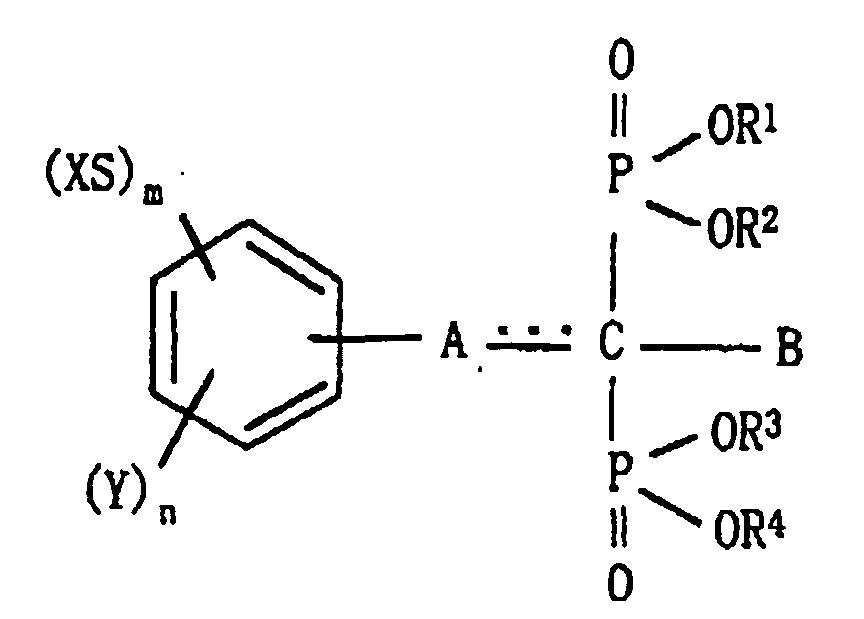 [wherein X represents C1-C8 linear or branched alkyl or cycloalkyl (in case of
cycloalkyl, the number of carbon atoms is 3 to 8) which is not substituted or which
has (a) substituent(s) having nitrogen, oxygen and/or silicon atom(s), phenyl or
naphthyl (the phenyl or naphthyl may be substituted by C1-C8 linear or branched
alkyl or cycloalkyl (in case of cycloalkyl, the number of carbon atoms is 3 to 8), C1-C8
linear or branched alkoxy, halogen and/or hydroxy); Y represents C1-C8 linear or
branched alkyl, trifluoromethyl, C2-C8 linear or branched alkenyl, C3-C8 cycloalkyl,
C1-C8 alkoxy or halogen (excluding chlorine substituting atp-position); m and n
independently represent 0, 1, 2 or 3; · · · represents double bond or single bond;
A represents -(D)b-(CH2)c- (wherein D represents sulfur, oxygen, NR5 (wherein R5
represents hydrogen or C1-C8 linear or branched alkyl or cycloalkyl (in case of
cycloalkyl, the number of carbon atoms is 3 to 8), D binding directly to the methane
bisphosphonic acid, c represents an integer of 0 to 3, b represents 0 or 1), or
-(CH=CH)d-CH= (wherein d represents 0 or 1, and when A is -(CH=CH)d-CH=, B
does not exist); B represents hydrogen, C1-C8 linear or branched alkyl or cycloalkyl
(in case of cycloalkyl, the number of carbon atoms is 3 to 8), hydroxy or
trialkylsiloxy (each of the alkyl groups therein is C1-C8 linear or branched alkyl or
cycloalkyl (in case of cycloalkyl, the number of carbon atoms is 3 to 8); R1, R2, R3
and R4 represent, the same or different, hydrogen, C1-C8 linear or branched alkyl or
cycloalkyl (in case of cycloalkyl, the number of carbon atoms is 3 to 8), or a
pharmaceutically acceptable cation].
[wherein X represents C1-C8 linear or branched alkyl or cycloalkyl (in case of
cycloalkyl, the number of carbon atoms is 3 to 8) which is not substituted or which
has (a) substituent(s) having nitrogen, oxygen and/or silicon atom(s), phenyl or
naphthyl (the phenyl or naphthyl may be substituted by C1-C8 linear or branched
alkyl or cycloalkyl (in case of cycloalkyl, the number of carbon atoms is 3 to 8), C1-C8
linear or branched alkoxy, halogen and/or hydroxy); Y represents C1-C8 linear or
branched alkyl, trifluoromethyl, C2-C8 linear or branched alkenyl, C3-C8 cycloalkyl,
C1-C8 alkoxy or halogen (excluding chlorine substituting atp-position); m and n
independently represent 0, 1, 2 or 3; · · · represents double bond or single bond;
A represents -(D)b-(CH2)c- (wherein D represents sulfur, oxygen, NR5 (wherein R5
represents hydrogen or C1-C8 linear or branched alkyl or cycloalkyl (in case of
cycloalkyl, the number of carbon atoms is 3 to 8), D binding directly to the methane
bisphosphonic acid, c represents an integer of 0 to 3, b represents 0 or 1), or
-(CH=CH)d-CH= (wherein d represents 0 or 1, and when A is -(CH=CH)d-CH=, B
does not exist); B represents hydrogen, C1-C8 linear or branched alkyl or cycloalkyl
(in case of cycloalkyl, the number of carbon atoms is 3 to 8), hydroxy or
trialkylsiloxy (each of the alkyl groups therein is C1-C8 linear or branched alkyl or
cycloalkyl (in case of cycloalkyl, the number of carbon atoms is 3 to 8); R1, R2, R3
and R4 represent, the same or different, hydrogen, C1-C8 linear or branched alkyl or
cycloalkyl (in case of cycloalkyl, the number of carbon atoms is 3 to 8), or a
pharmaceutically acceptable cation].
In the above-described Formula (I), "(XS)m-" means that the substituent
represented by XS in the number of m is(are) bound to the benzene ring. In cases
where m is 2 or 3, the substituents represented by XS may be the same or different.
Similarly, in Formula (I), "(Y)n-" means that the substituent represented by Y in the
number of n is(are) bound to the benzene ring. In cases where n is 2 or 3, the
substituents represented by Y may be the same or different. As described above, n
and m independently represent 0, 1, 2 or 3. However, as evident from the chemical
structure of Formula (I), the maximum of m + n is necessarily 5.
Among the bisphosphonic acid derivatives described above, those represented
by Formula (I) are preferably employed.
Among the methane bisphosphonic acid derivatives represented by Formula
(I), those having the following substituents are preferred: Preferred examples of the
C1-C8 linear or branched alkyl or cycloalkyl (in case of cycloalkyl, the number of
carbon atoms is 3 to 8) which is not substituted or which has (a) substituent(s) having
nitrogen, oxygen and/or silicon atom(s) as the substituent X include methyl, ethyl,
propyl, isopropyl, butyl, isobutyl, t-butyl, pentyl, hexyl, cyclobutyl, cyclopcntyl,
cyclohcxyl, cyclopentylmethyl, cyclohexylmethyl, 2-aminoethyl, 2-N-methylaminoethyl,
2-N,N-dimethylaminoethyl, 2-hydroxyethyl, 2-alkoxyethyl, 2-trialkylsiloxyethyl,
2-aminopropyl, 2-N-methylaminopropyl, 2-N,N-dimethylaminopropyl,
3-aminopropyl, 3-N-methylaminopropyl, 3-N,N-dimethylaminopropyl,
2-hydroxypropyl, 2-alkoxypropyl, 2-trialkylsiloxypropyl and
the like. As is apparent from these examples, the cycloalkyl group may be branched.
Other Xs are phenyl, substituted phenyl, naphthyl and substituted naphthyl.
Examples of the C1-C8 linear or branched alkyl or cycloalkyl (in case of cycloalkyl,
the number of carbon atoms is 3 to 8) which is the substituent of the phenyl or
naphthyl group include methyl, ethyl, propyl, isopropyl, butyl, isobutyl, t-butyl,
pentyl, hexyl, cyclopentylmethyl, cyclohexylmethyl and the like. As is apparent
from these examples, the cycloalkyl group may be branched. Examples of the C1-C8
linear or branched alkoxy include methoxy, ethoxy, n-propoxy, isopropoxy, n-butoxy,
pentoxy, hexoxy and the like. The halogen may be fluorine, chlorine,
bromine or iodine. The position(s) of the substituent(s) XS is(are) ortho-, meta-
and/or para- with respect to A.
Examples of the C1-C8 linear or branched alkyl as the substituent Y include
methyl, ethyl, propyl, isopropyl, butyl, isobutyl, t-butyl, pentyl, hexyl and the like.
Examples of the C2-C8 linear or branched alkenyl include vinyl, allyl, 1-propenyl,
isopropenyl, butenyl, pentenyl and the like. Examples of the C3-C8 cycloalkyl
include cyclopropyl, cyclobutyl, cyclopentyl, cyclohexyl, cylopentylmcthyl,
cyclohexylmethyl and the like. As is apparent from these examples, the cycloalkyl
group may be branched. Examples of the C1-C8 alkoxy include methoxy, ethoxy, n-propoxy,
isopropoxy, n-butoxy, pentoxy, hexoxy and the like. The halogen may be
fluorine, chlorine (excluding the chlorine substituting at the para- position with
respect to A), bromine or iodine. The position(s) of the substituent(s) Y is(are) not
restricted.
In cases where A represents -(D)b-(CH2)c- and · · · represents single
bond, D is sulfur, oxygen, NR5 (wherein R5 represents hydrogen or C1-C8 linear or
branched alkyl) or CH2, c is 0, 1, 2 or 3, and b is 0 or 1 (with the proviso that when
b=0, c=0). More preferably, b and c independently are 0 or 1. In cases where B is
hydroxy or trialkylsiloxy (each of the alkyl groups therein is C1-C8 linear or branched
alkyl), D is sulfur, oxygen or NR5 (R5 represents the same meanings as described
above), and b=1, those wherein c=0 are chemically unstable and so not preferred.
Even in these cases, however, those wherein c is 1, 2 or 3 are stable and preferred.
Especially preferred examples of A include S, NH, O, CH2, CH2CH2, SCH2,
SCH2CH2, SCH2CH2CH2, NHCH2, OCH2 and the like. The compounds in which
the phenyl group is directly bound to the carbon atom of the methane bisphosphonic
acid and not through A (that is, the cases where b=c=0) are also included. The cases
where A represents -(CH=CH)d-CH= means the cases where · · · represents
double bond and B docs not exist, wherein d is 0 or 1. Examples of the C1-C8 linear
or branched alkyl or cycloalkyl represented by B, R1, R2, R3, R4 or R5 include methyl,
ethyl, propyl, isopropyl, butyl, isobutyl, t-butyl, pentyl, hexyl, cyclopentylmethyl,
cyclohexylmethyl and the like. As is apparent from these examples, the cycloalkyl
group may be branched. In cases where B is trialkylsiloxy (each of the alkyl groups
therein is C1-C8 linear or branched alkyl or cycloalkyl (in case of cycloalkyl, the
number of carbon atoms is 3 to 8)), preferred examples of the C1-C8 linear or
branched alkyl or cycloalkyl arc also the same as those just mentioned above.
Examples of the pharmaceutically acceptable cation represented by R1, R2, R3 or R4
include metal cations, ammonium NR6 (wherein R6 represents hydrogen or C1-C8
linear or branched alkyl) and the like. Especially preferred metal cations are
alkaline metal ions such as lithium, sodium and potassium ions; and alkaline earth
metal ions such as magnesium and calcium ions. However, other metal cations such
as aluminum, zinc and iron cations arc also within the scope of the present invention.
The ammonium include ammonia, primary amines, secondary amines, tertiary amines
and quaternary ammonium. Examples of these include ammonium such as
ammonia, methylamine, dimethylaminc, trimethylamine, ethylamine, diethylamine,
triethylamine, propylamine, dipropylamine, isopropylamine, diisopropylamine,
butylamine, dibutylamine, isobutylamine, t-butylamine, monoethanolamine,
diethanolamine, triethanolamine, and tetramethylammonium, tetraethylammonium
and the like. Among these, cations of sodium, potassium, ammonia and
alkylamines are preferred. The cations represented by R1 to R4 may be the same or
different. Further, those wherein a part thereof is(are) cations and other part thereof
is(are) hydrogen, e.g., monocationic salt, dicationic salt and tricationic salt are also
within the scope of the present invention. Preferred methane bisphosphonic acid
derivatives represented by Formula (I) are those wherein all of R1 to R4 are hydrogen,
three of R1 to R4 are hydrogen and the remaining one is sodium, three of R1 to R4 are
hydrogen and the remaining one is ammonium, two of R1 to R4 are hydrogen and the
remaining two arc sodium, and two of R1 to R4 are hydrogen and the remaining two
are ammonium.
Among the bisphosphonic acid represented by Formula (I), more preferred are
those wherein X represents C1-C8 linear or branched alkyl; Y represents C1-C8 linear
or branched alkyl, trifluoromethyl, C2-C8 linear or branched alkenyl or C3-C8
cycloalkyl, C1-C8 alkoxy or halogen (excluding chlorine substituting atp-position);
m and n represent 0 or 1; · · · represents single bond; A represents -S-(CH2)c-(wherein
c represents an integer of 0, 1, 2 or 3); B represents hydrogen or C1-C8
linear or branched alkyl; and R1, R2, R3 and R4, the same or different, represent
hydrogen, C1-C8 linear or branched alkyl, or pharmaceutically acceptable cation.
More preferably, the compound is (4-methylthiophenyl)thiomethane-1,1-bisphosphonic
acid or a salt thereof.
The methane bisphosphonic acid derivatives represented by Formula (I) per
se are well-known in the art, and may be produced by well-known production
processes. For example, they may be produced by the processes disclosed in
Japanese Patent Publication (Kokoku) No. 8-26048 and U.S. Patent No. 5,527,940.
In the present invention, the bisphosphonic acid derivatives and the salts
thereof may be used individually or two or more of these may be used in combination.
The content thereof is preferably about 0.0001 to 1% by weight (1 µg/g to 10 mg/g)
based on the entire composition.
The base used in the present invention is one which undergoes liquid-gel
phase transition upon contact with physiological body fluid. The term
"physiological body fluid" is the generic term of all the fluids which fill vessels or
spaces between tissues or cells, and is a fluid which causes the base or the
composition containing the base to gel, which base undergoes liquid-gel phase
transition in the periodontal pocket, upon contact with the base or the composition.
An example of the physiological body fluid in periodontal pocket is saliva. As the
base which undergoes the phase transition upon contact with such a physiological
body fluid, macromolecular substances which undergo the phase transition upon
contact with the physiological body fluid are preferred. Examples thereof include
gellan gum, sodium alginate, carageenan, guar gum, pectin, sodium polyacrylate,
curdlan and the like. More preferred macromolecular substances are
polysaccharides, especially gellan gum and carageenan.
Other preferred examples of the base are macromolecular substances which is
made to gel by 1. the heat in the periodontal pocket, 2. the ion strength and/or 3. pH.
Examples of the macromolecular substances which is made to undergo liquid-gel
phase transition by 1. heat include polyoxyethylene-polyoxypropylene glycols which
gel at the body temperature or the vicinity thereof such as Pluronic (registered
trademark) and Poloxamer (registered trademark), and methylcellulose,
hydraxycellulose and the like. As the macromolecular substances which is made to
undergo liquid-gel phase transition by ion strength, the macromolecular substances
which undergo liquid-gel phase transition upon contact with the physiological body
fluid as mentioned above arc preferred, and examples thereof include gellan gum,
sodium alginate, carageenan, guar gum, pectin, sodium polyacrylate, curdlan and the
like.
The average molecular weight of the above-described macromolecular
substances used as the base in the composition of the present invention is not
restricted, and is usually about 10,000 to 10,000,000, preferably about 100,000 to
1,000,000.
Since the various macromolecular substances mentioned above used as the
base in the composition of the present invention are commercially available as food
materials, commercial products may be used.
The above-described composition is administered to periodontal pockets in
the ungelled liquid form, and the composition gels at the administered site. In
particular, when the composition is locally administered to a periodontal pocket for
treating a periodontal disease, the administration of the composition to the
periodontal pocket is simple, and the composition is in the ungelled liquid form
having a fluidity or viscosity which enables administration of the composition to a
deep portion of the periodontal pocket. After the administration, the composition
gels upon contact with saliva and/or exudate from the periodontal diseased site, and
the bisphosphonic acid derivative or the salt thereof contained therein is sustainedly
released. More particularly, in cases where the base contained in the composition is
gellan gum and/or carageenan, which are particularly preferred examples, by
administering the composition in the form of a fluid aqueous solution containing the
bisphosphonic acid derivative or the salt thereof to the periodontal pocket, the
aqueous solution can reach the deep portion of the periodontal pocket, and gels in
situ due to the calcium ion in the saliva and/or exudate from the periodontal diseased
site. As a result, the bisphosphonic acid derivative or the salt thereof is sustainedly
released without forming an insoluble salt. The term "fluid" herein does not define
a concrete viscosity, but means that the composition is mobile without fixing its
shape, that is, that the composition is not solid.
By preliminarily blending a compound which releases an ion such as calcium
ion as an ion source in the composition, the gelling of the base which undergoes
liquid-gel phase transition by ion strength may be enhanced. However, if an excess
amount of such a compound is added, the fluidity of the composition may be
degraded. Therefore, it is necessary not to add the compound at all, or to add the
compound in a small amount with which gelation before the administration does not
proceed.
The above-described bases which undergo liquid-gel phase transition may be
used individually, or two or more of the bases may be used in combination. The
bases which undergo liquid-gel phase transition by heat may be combined, the bases
which undergo liquid-gel phase transition by ion strength may be combined, and the
bases of these two types may also be combined. The total amount of the bases is
preferably about 0.1 to 20% by weight based on the entire composition.
The bisphosphonic acid derivative or the salt thereof may exist in the
pharmaceutical composition in dissolved state, suspended state, and/or in the state
immobilized on particulate carriers. Examples of the particulate carriers include (1)
microcapsules and nanocapsules wherein the bisphosphonic acid derivative or its salt
is encapsulated in naturally occurring or synthetic macromolecules such as
ethylcellulose, polylactic acid, polyglycolic acid, polylactic acid-polyglycolic acid
copolymer, gelatin, polyacrylamide and the like; (2) small spheres (microspheres and
nanospheres) made of albumin, starch, gelatin or polylactic acid; (3) emulsion and
lipid microsphcres; (4) liposomes made of lipid bilayers; (5) microcarriers and
nanocarriers made of substances having ion-exchange capacity, such as ion-exchange
resins. As the base of these bisphosphonic acid derivatives, known
pharmaceutically acceptable bases may be employed without restriction, and the
particulate carriers may be prepared by the conventional formulation techniques.
By incorporating the bisphosphonic acid derivative or its salt in the pharmaceutical
composition in the immobilized form on particulate carriers, higher degree of
sustainment of the release of the bisphosphonic acid derivative or its salt from the
pharmaceutical composition may be attained.
The method for administering the composition to the above-described site is
not restricted as long as the composition may be administered to the site where the
bone resorption-inhibiting action of the bisphosphonic acid derivative or its salt is
effectively exhibited, and a preferred administration method is the local
administration by injection. Particularly, in cases where the pharmaceutical
composition according to the present invention is administered to a periodontal
pocket, it is preferred to administer the composition with the well-known injector
having a hooked convergent nozzle as described in Japanese Laid-open Utility Model
Application (Kokai) No. 1-62845, Japanese Laid-open Patent Application (Kokai)
No. 4-117959, Japanese Utility Model No. 3035448 and Japanese Laid-open Patent
Application (Kokai) No. 2000-107298.
The dose of the pharmaceutical composition according to the present
invention is not restricted as long as the bone resorption-inhibiting action of the
bisphosphonic acid derivative or its salt is effectively exhibited, and the dose of the
composition may be administered to the above-described administration site.
Usually, the composition having a volume of about 5% to 100% of the inner volume
of the periodontal pocket is administered. Therefore, the dose in terms of the
amount of the bisphosphonic acid derivative or its salt depends on the size of the
periodontal pocket, and in many cases, about 0.1 ng to 1 mg/pocket.
To the pharmaceutical composition according to the present invention, other
components such as known vehicles, binders, coloring agents, correctives, flavors,
surfactants, sweeteners, antiseptics and the like may appropriately be added
depending on the purpose and the type of the composition. The pharmaceutical
composition according to the present invention may be prepared by the usual
formulation techniques. Preferred formulation examples are described in the
Examples below.
The present invention will now be described by way of examples and
experiments. All the values indicating the added amount are "% by weight" unless
otherwise specified. The "bisphosphonic acid compound" means (4-methylthiophenyl)thiomethane-1,1-bisphosphonic
acid disodium (described in
Japanese Patent Publication (Kokoku) No. 8-26048 and U.S. Patent No. 5,527,940)
unless otherwise specified. The artificial saliva used as the test fluid was the
aqueous solution having the following composition, which was prepared based on the
teaching by Biomaterials 20, 55-60 (1999).
| Potassium dihydrogen phosphate: | 2.5 mM/L |
| Disodium hydrogen phosphate: | 2.4 mM/L |
| Potassium hydrogen carbonate: | 15.0 mM/L |
| Sodium chloride: | 10.0 mM/L |
| Magnesium chloride: | 1.5 mM/L |
| Calcium chloride: | 1.5 mM/L |
| Citric Acid | 0.15 mM/L |
The pH was adjusted to 6.7 by sodium hydroxide or hydrochloric acid.
| Component | (Manufacturer, Trademark) | Added Amount (%) |
| Bisphosphonic acid compound | (Toray) | 0.20 |
| Gellan gum | (San-Ei Gen F.F.I, GELRITE) | 1.00 |
| Distilled Water | (Otsuka Pharmaceutical, Distilled water for injection) | 98.80 |
| Total | 100.00 |
Bisphosphonic acid compound was dissolved in distilled water, and this
aqueous solution was heated to a temperature not lower than 90°C. Gellan gum was
added thereto, well dispersed and dissolved by continuously stirring the solution to
obtain the composition in ungelled liquid form shown in Table 1.
| Component | (Manufacturer, Trademark) | Added Amount (%) |
| Bisphosphonic acid compound | (Toray) | 0.20 |
| Carageenan | (Ina Shokuhin Kogyo, Carageenan PA-5) | 1.75 |
| Distilled Water | (Otsuka Pharmaceutical, Distilled water for injection) | 98.05 |
| Total | 100.00 |
Bisphosphonic acid compound was dissolved in distilled water, and this
aqueous solution was heated to a temperature not lower than 80°C. Carageenan was
added thereto, well dispersed and dissolved by continuously stirring the solution to
obtain the composition in ungelled liquid form shown in Table 2.
| Component | (Manufacturer, Trademark) | Added Amount (%) |
| Bisphosphonic acid compound | (Toray) | 0.20 |
| Carageenan | (Ina Shokuhin Kogyo, Carageenan PA-5) | 0.75 |
| Gcllan gum | (San-Ei Gen F.F.I, GELRITE) | 0.75 |
| Distilled Water | (Otsuka Pharmaceutical, Distilled water for injection) | 98.30 |
| Total | 100.00 |
Bisphosphonic acid compound was dissolved in distilled water, and this
aqueous solution was heated to a temperature not lower than 80°C. Carageenan was
added thereto, well dispersed and dissolved by continuously stirring the solution.
Then the resulting solution was heated to a temperature not lower than 90°C, and
gellan gum was added thereto and well dispersed to obtain the composition in
ungelled liquid form shown in Table 3.
The release property of the bisphosphonic compound from the test substance
was tested by the following experiment The experiment apparatus and conditions
were in accordance with the Japanese Pharmacopoeia, Dissolution Test, Second
Method (amount of test fluid: 500 mL, test fluid temperature: 37°C, paddle
revolution: 50 rpm).
On the bottom of an ointment cell (cylinder having bottom, made of acrylic
resin, inner diameter 31 mm, height 5 mm), 3.8 g of the test substance is placed. A
screen (stainless steel wire gauze, outer diameter 35 mm, mesh 500 µm) was placed
thereon, and ointment cell cover (cylinder with diameter of 31 mm, made of acrylic
resin, having an opened top plate) is put thereon so as to prevent the screen from
being displaced, thereby fixing the screen gauze.
Distilled water as the test fluid was placed in a beaker, and the above-described
ointment cell containing the sampled compositions prepared in Example 1
was immersed therein, followed by measuring the percentage of the bisphosphonic
acid compound released into the test fluid with time.
Similarly, the artificial saliva as the test fluid was placed in beakers, and the
above-described ointment cells containing the sampled composition prepared in
Example 1, Example 2 and Example 3, respectively, were separately immersed in the
beakers, followed by measuring the percentage of the bisphosphonic acid compound
eluted into the test fluid with time. The results are shown in Fig. 1.
As can be seen from the results, although the bisphosphonic acid compound
contained in the composition according to the present invention was quickly released
into distilled water, the bisphosphonic acid compound was sustainedly released into
the artificial saliva without forming an insoluble salt with calcium ion.
Since the composition according to the present invention enables sustained-release
of bisphosphonic acid compounds which were hitherto thought difficult to be
administered to periodontal pockets, and enables to selectively deliver the
bisphosphonic compounds to alveolar bone, the composition is useful as a alveolar
bone resorption-inhibiting agent and as a pharmaceutical composition for therapies of
periodontal diseases.
Claims (10)
- A pharmaceutical composition for being administered to periodontal pockets, comprising a bisphosphonic acid derivative or a salt thereof, and a base which undergoes liquid-gel phase transition upon contact with physiological body fluid in the periodontal pocket.
- The pharmaceutical composition for being administered to periodontal pockets according to claim 1, wherein said bisphosphonic acid derivative or the salt thereof is a methane bisphosphonic acid derivative represented by Formula (I):[wherein X represents C1-C8 linear or branched alkyl or cycloalkyl (in case of cycloalkyl, the number of carbon atoms is 3 to 8) which is not substituted or which has (a) substituent(s) having nitrogen, oxygen and/or silicon atom(s), phenyl or naphthyl (the phenyl or naphthyl may be substituted by C1-C8 linear or branched alkyl or cycloalkyl (in case of cycloalkyl, the number of carbon atoms is 3 to 8), C1-C8 linear or branched alkoxy, halogen and/or hydroxy); Y represents C1-C8 linear or branched alkyl, trifluoromethyl, C2-C8 linear or branched alkenyl, C3-C8 cycloalkyl, C1-C8 alkoxy or halogen (excluding chlorine substituting at p- position); m and n independently represent 0, 1, 2 or 3; · · · represents double bond or single bond; A represents -(D)b-(CH2)c- (wherein D represents sulfur, oxygen, NR5 (wherein R5 represents hydrogen or C1-C8 linear or branched alkyl or cycloalkyl (in case of cycloalkyl, the number of carbon atoms is 3 to 8), D binding directly to the methane bisphosphonic acid, c represents an integer of 0 to 3, b represents 0 or 1), or -(CH=CH)d-CH= (wherein d represents 0 or 1, and when A is -(CH=CH)d-CH=, B does not exist); B represents hydrogen, C1-C8 linear or branched alkyl or cycloalkyl (in case of cycloalkyl, the number of carbon atoms is 3 to 8), hydroxy or trialkylsiloxy (each of the alkyl groups therein is C1-C8 linear or branched alkyl or cycloalkyl (in case of cycloalkyl, the number of carbon atoms is 3 to 8); R1, R2, R3 and R4, the same or different, represent hydrogen, C1-C8 linear or branched alkyl or cycloalkyl (in case of cycloalkyl, the number of carbon atoms is 3 to 8), or a pharmaceutically acceptable cation]

or a hydrate thereof. - The pharmaceutical composition for being administered to periodontal pockets according to claim 1 or 2, wherein X in said Formula (I) represents C1-C8 linear or branched alkyl; Y represents the same meanings as described above; m and n independently represent 0 or 1; · · · represents single bond; A represents -S-(CH2)c- (wherein c represents an integer of 0 to 3); B represents hydrogen or C1-C8 linear or branched alkyl; and R1, R2, R3 and R4 represent the same meanings as in claim 2.
- The pharmaceutical composition for being administered to periodontal pockets according to any one of claims 1 to 3, wherein said base is at least one polysaccharide.
- The pharmaceutical composition for being administered to periodontal pockets according to claim 4, wherein said polysaccharide is gellan gum and/or carageenan.
- The pharmaceutical composition for being administered to periodontal pockets according to any one of claims 1 to 5, which is for therapy of a periodontal disease.
- A method for treating periodontal pockets, comprising administering an effective amount of said composition according to any one of claims 1 to 5 to a periodontal pocket
- A therapeutic method for a periodontal disease, comprising administering an effective amount of said composition according to any one of claims 1 to 5 to a periodontal pocket.
- Use of said composition according to any one of claims 1 to 5, for the production of a pharmaceutical composition for being administered to periodontal pockets.
- Use of said composition according to any one of claims 1 to 5, for the production of a pharmaceutical composition for therapy of a periodontal disease.
Applications Claiming Priority (3)
| Application Number | Priority Date | Filing Date | Title |
|---|---|---|---|
| JP2002249838 | 2002-08-29 | ||
| JP2002249838 | 2002-08-29 | ||
| PCT/JP2003/010940 WO2004019957A1 (en) | 2002-08-29 | 2003-08-28 | Medicinal composition for periodontal pocket administration containing bisphosphonic acid derivative or its salt as the active ingredient |
Publications (1)
| Publication Number | Publication Date |
|---|---|
| EP1547604A1 true EP1547604A1 (en) | 2005-06-29 |
Family
ID=31972601
Family Applications (1)
| Application Number | Title | Priority Date | Filing Date |
|---|---|---|---|
| EP03791378A Withdrawn EP1547604A1 (en) | 2002-08-29 | 2003-08-28 | Medicinal composition for periodontal pocket administration containing bisphosphonic acid derivative or its salt as the active ingredient |
Country Status (8)
| Country | Link |
|---|---|
| US (1) | US20060233724A1 (en) |
| EP (1) | EP1547604A1 (en) |
| JP (1) | JPWO2004019957A1 (en) |
| KR (1) | KR20050059095A (en) |
| CN (1) | CN1671396A (en) |
| AU (1) | AU2003261793A1 (en) |
| CA (1) | CA2502734A1 (en) |
| WO (1) | WO2004019957A1 (en) |
Families Citing this family (2)
| Publication number | Priority date | Publication date | Assignee | Title |
|---|---|---|---|---|
| JP4771044B2 (en) * | 2004-09-15 | 2011-09-14 | 大正製薬株式会社 | Mucosal fluid |
| IL279966A (en) * | 2021-01-05 | 2022-08-01 | O Y M Innovation Ltd | Phosphonates and n-halamines compositions for tartar removal |
Family Cites Families (5)
| Publication number | Priority date | Publication date | Assignee | Title |
|---|---|---|---|---|
| DD160538A1 (en) * | 1980-11-26 | 1983-09-07 | Adw Ddr | PROCESS FOR INTRODUCING HYDROPHOBIC PHOTOGRAPHIC ADDITIVES |
| US5143934A (en) * | 1990-11-21 | 1992-09-01 | A/S Dumex (Dumex Ltd.) | Method and composition for controlled delivery of biologically active agents |
| US5242910A (en) * | 1992-10-13 | 1993-09-07 | The Procter & Gamble Company | Sustained release compositions for treating periodontal disease |
| JP4317606B2 (en) * | 1998-09-18 | 2009-08-19 | サンスター株式会社 | Solid particle forming composition |
| EP1114642B1 (en) * | 1999-07-19 | 2010-01-06 | Toray Industries, Inc. | Drugs for periodontal diseases |
-
2003
- 2003-08-28 KR KR1020057003216A patent/KR20050059095A/en not_active Ceased
- 2003-08-28 AU AU2003261793A patent/AU2003261793A1/en not_active Abandoned
- 2003-08-28 CA CA002502734A patent/CA2502734A1/en not_active Abandoned
- 2003-08-28 JP JP2004532754A patent/JPWO2004019957A1/en active Pending
- 2003-08-28 WO PCT/JP2003/010940 patent/WO2004019957A1/en not_active Ceased
- 2003-08-28 US US10/526,014 patent/US20060233724A1/en not_active Abandoned
- 2003-08-28 EP EP03791378A patent/EP1547604A1/en not_active Withdrawn
- 2003-08-28 CN CNA038185008A patent/CN1671396A/en active Pending
Non-Patent Citations (1)
| Title |
|---|
| See references of WO2004019957A1 * |
Also Published As
| Publication number | Publication date |
|---|---|
| WO2004019957A1 (en) | 2004-03-11 |
| KR20050059095A (en) | 2005-06-17 |
| CA2502734A1 (en) | 2004-03-11 |
| US20060233724A1 (en) | 2006-10-19 |
| AU2003261793A1 (en) | 2004-03-19 |
| CN1671396A (en) | 2005-09-21 |
| JPWO2004019957A1 (en) | 2005-12-15 |
Similar Documents
| Publication | Publication Date | Title |
|---|---|---|
| JP6067466B2 (en) | Bisphosphonic acid for treatment and prevention of osteoporosis | |
| CA2351617C (en) | Method for inhibiting dental resorptive lesions | |
| RU2238736C2 (en) | Bisphosphonate-containing pharmaceutical parenteral composition | |
| CA2407747C (en) | Gel-like pharmaceutical composition for subcutaneous administration comprising bisphosphonic acids or their salts | |
| RU2002121643A (en) | PHARMACEUTICAL PARENTERAL COMPOSITION CONTAINING BIPHOSPHONATE | |
| JPH09512816A (en) | Use of specific methanebisphosphonic acid derivatives to prevent prosthesis loosening and prosthesis migration | |
| JP3479780B2 (en) | How to control bone resorption | |
| CA2370769A1 (en) | Controlled delivery of bisphosphonates | |
| US20060233724A1 (en) | Medicinal composition for peridontal pocket administration containing bisphosphonic acid derivative or its salt as the active ingredient | |
| JP2000504718A (en) | Topical bisphosphonates to prevent bone resorption | |
| WO2001005403A1 (en) | Drugs for periodontal diseases | |
| Moon et al. | The Effects of Alendronate on healing of the extraction sockets in rats | |
| UA67748C2 (en) | Active ingredient for pharmaceutical compositions intended for inhibiting bone resorption (variants) |
Legal Events
| Date | Code | Title | Description |
|---|---|---|---|
| PUAI | Public reference made under article 153(3) epc to a published international application that has entered the european phase |
Free format text: ORIGINAL CODE: 0009012 |
|
| 17P | Request for examination filed |
Effective date: 20050329 |
|
| AK | Designated contracting states |
Kind code of ref document: A1 Designated state(s): AT BE BG CH CY CZ DE DK EE ES FI FR GB GR HU IE IT LI LU MC NL PT RO SE SI SK TR |
|
| AX | Request for extension of the european patent |
Extension state: AL LT LV MK |
|
| DAX | Request for extension of the european patent (deleted) | ||
| STAA | Information on the status of an ep patent application or granted ep patent |
Free format text: STATUS: THE APPLICATION IS DEEMED TO BE WITHDRAWN |
|
| 18D | Application deemed to be withdrawn |
Effective date: 20070301 |