EP1547595A1 - Patch for transdermal administration - Google Patents
Patch for transdermal administration Download PDFInfo
- Publication number
- EP1547595A1 EP1547595A1 EP03766710A EP03766710A EP1547595A1 EP 1547595 A1 EP1547595 A1 EP 1547595A1 EP 03766710 A EP03766710 A EP 03766710A EP 03766710 A EP03766710 A EP 03766710A EP 1547595 A1 EP1547595 A1 EP 1547595A1
- Authority
- EP
- European Patent Office
- Prior art keywords
- patch
- transdermal administration
- adhesive layer
- acid
- drug
- Prior art date
- Legal status (The legal status is an assumption and is not a legal conclusion. Google has not performed a legal analysis and makes no representation as to the accuracy of the status listed.)
- Granted
Links
Images



Classifications
-
- A—HUMAN NECESSITIES
- A61—MEDICAL OR VETERINARY SCIENCE; HYGIENE
- A61K—PREPARATIONS FOR MEDICAL, DENTAL OR TOILETRY PURPOSES
- A61K9/00—Medicinal preparations characterised by special physical form
- A61K9/70—Web, sheet or filament bases ; Films; Fibres of the matrix type containing drug
- A61K9/7023—Transdermal patches and similar drug-containing composite devices, e.g. cataplasms
- A61K9/703—Transdermal patches and similar drug-containing composite devices, e.g. cataplasms characterised by shape or structure; Details concerning release liner or backing; Refillable patches; User-activated patches
- A61K9/7038—Transdermal patches of the drug-in-adhesive type, i.e. comprising drug in the skin-adhesive layer
- A61K9/7046—Transdermal patches of the drug-in-adhesive type, i.e. comprising drug in the skin-adhesive layer the adhesive comprising macromolecular compounds
- A61K9/7053—Transdermal patches of the drug-in-adhesive type, i.e. comprising drug in the skin-adhesive layer the adhesive comprising macromolecular compounds obtained by reactions only involving carbon to carbon unsaturated bonds, e.g. polyvinyl, polyisobutylene, polystyrene
- A61K9/7061—Polyacrylates
-
- A—HUMAN NECESSITIES
- A61—MEDICAL OR VETERINARY SCIENCE; HYGIENE
- A61K—PREPARATIONS FOR MEDICAL, DENTAL OR TOILETRY PURPOSES
- A61K31/00—Medicinal preparations containing organic active ingredients
- A61K31/33—Heterocyclic compounds
- A61K31/395—Heterocyclic compounds having nitrogen as a ring hetero atom, e.g. guanethidine or rifamycins
- A61K31/41—Heterocyclic compounds having nitrogen as a ring hetero atom, e.g. guanethidine or rifamycins having five-membered rings with two or more ring hetero atoms, at least one of which being nitrogen, e.g. tetrazole
- A61K31/42—Oxazoles
-
- A—HUMAN NECESSITIES
- A61—MEDICAL OR VETERINARY SCIENCE; HYGIENE
- A61P—SPECIFIC THERAPEUTIC ACTIVITY OF CHEMICAL COMPOUNDS OR MEDICINAL PREPARATIONS
- A61P29/00—Non-central analgesic, antipyretic or antiinflammatory agents, e.g. antirheumatic agents; Non-steroidal antiinflammatory drugs [NSAID]
-
- A—HUMAN NECESSITIES
- A61—MEDICAL OR VETERINARY SCIENCE; HYGIENE
- A61P—SPECIFIC THERAPEUTIC ACTIVITY OF CHEMICAL COMPOUNDS OR MEDICINAL PREPARATIONS
- A61P43/00—Drugs for specific purposes, not provided for in groups A61P1/00-A61P41/00
Definitions
- the present invention relates to a patch for transdermal administration comprising a backing and an adhesive layer comprising an adhesive base agent and a drug.
- a stratum corneum of normal skin has a barrier function of inhibiting exogenous materials from invading the body, a base agent used in ordinary patches often does not give sufficient transdermal permeation of compounded pharmaceutical ingredients.
- a stratum corneum has high lipid solubility, generally permeability of a drug is extremely low. Accordingly, upon administrating a drug through skin by using a patch, it is necessary to enhance a transdermal permeation property of a drug through a stratum corneum of skin.
- cyclooxygenase-2 (COX-2) inhibitors have been recently developed as a medicinal group that blocks selectively COX-2, thereby reducing risk of digestive adverse effect
- WO 02/02111 discloses a skin treatment system comprising 3-phenyl-4-(4-methylsulfonylphenyl)-2(5H)-furanone (generic name: rofecoxib) or 4-[5-(4-methylphenyl)-3-(trifluoromethyl)pyrazole-1-yl]benzolsulfonamide (generic name: celecoxib).
- the present invention was achieved in consideration of the problems included in the aforementioned conventional technique, and the object of the present invention is to provide a patch for transdermal administration having a sufficiently high transdermal permeation property of a COX-2 inhibitor to exert a superior antiinflammatory effect.
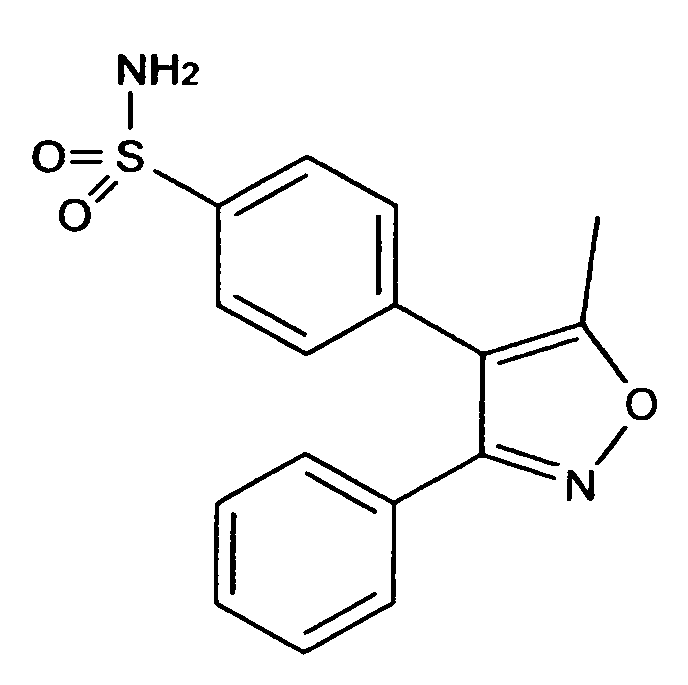
- valdecoxib 4-(5-methyl-3-phenylisoxazole-4-yl)benzenesulfonamide
- valdecoxib is a compound functioning as a COX-2 inhibitor with a sufficiently high transdermal permeation property
- use of such valdecoxib or a pharmaceutically acceptable salt thereof enables us to obtain a patch for transdermal administration that exerts a superior antiinflammatory effect, thereby accomplishing the present invention.
- the patch for transdermal administration of the present invention is characterized in comprising a backing and an adhesive layer being placed on at least one side of the backing and comprising an adhesive base agent and a drug, wherein the drug is valdecoxib or a pharmaceutically acceptable salt thereof.
- the adhesive base agent preferably comprises at least one selected from the group consisting of styrene-isoprene-styrene copolymer, acrylic polymer and polyisobutylene, the adhesive base agent more preferably comprises styrene-isoprene-styrene copolymer and polyisobutylene.
- the adhesive layer further comprises, in addition to the adhesive base agent and the drug, at least one kind selected from the group consisting of 1) polyhydric alcohol (polyethylene glycol is especially preferably), 2) cyclodextrin and derivatives thereof, and 3) pirotiodecane.
- Fig. 1 is a graph showing the analgesic action of valdecoxib as a COX-2 inhibitor on yeast-induced paw inflammation and nociception in rats.
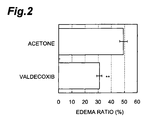
- Fig. 2 is a graph showing the antiinflammatory effect of valdecoxib as a COX-2 inhibitor on carrageenin-induced paw edema in rats.
- Fig. 3 is a graph showing the antiinflammatory effect of an acrylate patch comprising valdecoxib on carrageenin-induced paw edema in rats.
- Fig. 4 is a graph showing the antiinflammatory effect of an SIS-based patch comprising valdecoxib on carrageenin-induced paw edema in rats.
- the patch for transdermal administration of the present invention is characterized in comprising a backing and an adhesive layer being placed on at least one side of the backing and comprising an adhesive base agent and a drug, wherein the drug is valdecoxib or a pharmaceutically acceptable salt thereof.
- any one may be used without particular limitation insofar as it can support the adhesive layer, and a stretchable or an unstretchable backing may be used.
- Specific examples of the backing include cloth, nonwoven cloth, polyurethane, polyester, polyvinyl acetate, polyvinylidene chloride, polyethylene, polyethylene terephthalate and aluminum sheet, one made of complex material thereof, and the like.
- Thickness of the backing according to the present invention is preferably, but not particularly limited, in a range of from 5 to 1000 ⁇ m.
- a thickness of the backing lower than the lowest limit described above tends to decrease operation easiness upon sticking the patch and, on the other hand, that higher than the highest limit described above tends to decrease production easiness due to difficulty of cutting the backing or the patch, or the like in the production process of the patch.
- an adhesive layer comprising an adhesive base agent and a drug is placed on the backing described above.
- the adhesive layer according to the present invention is an adhesive layer that comprises valdecoxib or a pharmaceutically acceptable salt thereof, which is a cyclooxygenase-2 inhibitor, as the drug described above.
- Valdecoxib used as a drug in the present invention is a compound 4-(5-methyl-3-phenylisoxazole-4-yl)benzenesulfonamide represented by the following structural formula (1) and the fact that it functions as a COX-2 inhibitor is described in the following document: (J. J. Talley et a1, 4-[5-Methyl-3-phenylisoxazol-4-yl]-benzenesulfonamide, Valdecoxib: A Potent and Selective Inhibitor of COX-2, J. Med. Chem., 43, 775-777, 2000).
- Valdecoxib for use in the present invention may be a free form or a pharmaceutically acceptable salt.
- Such pharmaceutically acceptable salts are preferably, but not limited specifically, sodium salt, potassium salt and ammonium salt, among them, ammonium salt is more preferable.
- Compounding amount of the drug according to the present invention is not particularly limited, but preferably it is 0.1-50 weight % on the basis of the total amount of compounds contained in the adhesive layer.
- a compounding amount of the drug lower than the lowest limit described above tends to give an insufficient antiinflammatory effect provided by the drug and, on the other hand, that higher than the highest limit described above tends to decrease physical properties of the formulation.
- the adhesive layer comprises an adhesive base agent in addition to the drug.
- the adhesive base agent rubber polymer and acrylic polymer can be mentioned, and the rubber polymer and acrylic polymer may be contained at the same time.
- Examples of such rubber polymer include styrene-isoprene-styrene copolymer, polyisobutylene, isoprene rubber, styrene-butadiene-styrene copolymer, styrene-butadiene rubber and silicone rubber.
- styrene-isoprene-styrene block copolymer and/or polyisobutylene is more preferable because it tends to enhance both of skin permeability of the drug and physical properties of the formulation.
- These rubber polymers may be used individually by one kind or in combination of two or more kinds. Among them, use of styrene-isoprene-styrene block copolymer and polyisobutylene in combination is especially preferable because it tends to more enhance skin permeability of the drug and physical properties of the formulation.
- alkyl (meth)acrylate esters in which carbon number in the alkyl group is 4 or more and, preferably, 15 or less, are preferable.
- alkyl (meth)acrylate ester include alkyl (meth)acrylate esters having a linear alkyl group, a branched alkyl group such as butyl, pentyl, hexyl, heptyl, octyl, nonyl, decyl, undecyl, dodecyl and tridecyl. One kind or two or more kinds of these may be used.
- a copolymerizable monomer may be copolymerized in the aforementioned alkyl (meth)acrylate ester, if necessary.
- the monomer include carboxyl group containing monomers such as (meth)acrylic acid, itaconic acid, maleic acid or maleic anhydride; sulfoxyl group containing monomers such as styrenesulfonate, allylsulfonate, sulfopropyl(meth)acrylate, (meth)acryloyloxynaphthalenesulfonic acid or acrylamide methylpropanesulfonic acid; hydroxyl group containing monomers such as hydroxyethyl (meth)acrylate ester or hydroxypropyl (meth)acrylate ester; amide group containing monomers such as (meth)acrylamide, dimethyl(meth)acrylamide, N-butylacrylamide, N-methylol(meth)acrylamide or N-methylolpropane(me
- copolymerized One kind of or two kinds or more in combination of these may be copolymerized. These copolymerizable monomers can be used for the purpose of adjusting cohesion force of the adhesive layer or enhancing solubility of the drug.
- the copolymerization amount may be arbitrarily set within a range of 2-40 % by weight in accordance with purposes.
- acrylic polymer although there is no particular limitation only when it is a polymer copolymerized while incorporating at least one kind of (meth)acrylic acid derivatives represented by 2-ethylhexyl acrylate, methyl acrylate, butyl acrylate, hydroxyethyl acrylate, 2-ethylhexyl methacrylate and the like, for example, adhesives listed and described as an adhesive in Iyakuhin Tenkabutsu Jiten (Encyclopedia of Pharmaceutical Excipients) 2000 (edited by Japan Pharmaceutical Excipients Council) such as acrylic acid - octyl acrylate ester copolymer, 2-ethylhexyl acrylate - vinyl pyrrolidone copolymer solution, acrylic ester - vinyl acetate copolymer, 2-ethylhexyl acrylate - 2-ethylhexyl methacrylate - dodecyl methacrylate terpolymer,
- Compounding amount of the adhesive base agent according to the present invention is not particularly limited, but preferably it is 10-90 % by weight on the basis of the total amount of compounds contained in the adhesive layer.
- a compounding amount of the adhesive base agent lower than the lowest limit described above tends to give an insufficient adhesiveness of the adhesive layer and, on the other hand, that higher than the highest limit described above tends to give an insufficient permeability of the drug.
- compounding amount of the former of 7-63 % by weight and compounding amount of the latter of 3-27 % by weight on the basis of the total amount of compounds contained in the adhesive layer tend to enhance both of skin permeability of the drug and physical properties of the formulation, and so the instance is especially preferable.
- the adhesive layer may further comprise a permeation enhancer in addition to the drug and the adhesive base agent described above.
- a permeation enhancer in addition to the drug and the adhesive base agent described above.
- compounds that are conventionally recognized to have an permeation enhancing effect on the skin may be used, including specifically fatty acids having 6 to 20 carbon atoms, aliphatic alcohols, fatty acid esters, fatty acid amides, and fatty acid ethers, aromatic organic acids, aromatic alcohols, aromatic organic acid esters and ethers, which may be saturated or unsaturated, and also may be linear, branched or cyclic.
- lactic acid esters acetic acid esters, monoterpenes, sesquiterpenes, Azone, Azone derivatives, glycerin fatty acid esters, propylene glycol fatty acid esters, sorbitan fatty acid esters (Span), polysorbates (Tween), polyethylene glycol fatty acid esters, polyoxyethylene hydrogenated castor oils (HCO), polyoxyethylene alkyl ethers, sucrose fatty acid esters or vegetable oils may be used as an permeation enhancer.
- glycerin fatty acid esters propylene glycol fatty acid esters
- Span sorbitan fatty acid esters
- Tween polysorbates
- polyethylene glycol fatty acid esters polyoxyethylene hydrogenated castor oils (HCO)
- HCO polyoxyethylene alkyl ethers
- sucrose fatty acid esters or vegetable oils may be used as an permeation enhancer.
- preferable examples include caprylic acid, capric acid, caproic acid, lauric acid, myristic acid, palmitic acid, stearic acid, isostearic acid, oleic acid, linoleic acid, linolenic acid, lauryl alcohol, myristyl alcohol, oleyl alcohol, isostearyl alcohol, cetyl alcohol, methyl laurate, hexyl laurate, lauric acid diethanol amide, isopropyl myristate, myristyl myristate, octyldodecyl myristate, cetyl palmitate, salicylic acid, methyl salicylate, ethylene glycol salicylate, cinnamic acid, methyl cinnamate, cresol, cetyl lactate, lauryl lactate, ethyl acetate, propyl acetate, geraniol, thymol, eu
- pirotiodecane, isopropyl myristate, lauryl alcohol, myristyl alcohol, isostearyl alcohol, lauric acid diethanol amide, glycerin monocaprirate, glycerin monocaprate, glycerin monooleate, sorbitan monolaurate, propylene glycol monolaurate and polyoxyethylene lauryl ether are more preferable, and pirotiodecane, and/or isopropyl myristate are particularly preferable.
- Such permeation enhancers may be used alone, or may be used in combination of two or more kinds.
- Compounding amount of the permeation enhancer according to the present invention is not particularly limited, but it is preferably 0.1-20 % by weight, more preferably 0.1-10 % by weight on the basis of the total amount of the compounds contained in the adhesive layer.
- a compounding amount of the permeation enhancer lower than the lowest limit described above tends to give an insufficient effect on enhancing skin permeability of the drug provided by compounding the permeation enhancer and, on the other hand, that higher than the highest limit described above tends to increase skin irritating property.
- the adhesive layer may comprise additionally cyclodextrin and/or a derivative thereof as a permeation enhancing auxiliary agent.
- cyclodextrin or the derivative thereof according to the present invention include ⁇ , ⁇ or ⁇ -cyclodextrin, dimethyl-( ⁇ , ⁇ or ⁇ )-cyclodextrin, diethyl-( ⁇ , ⁇ or ⁇ )-cyclodextrin, triethyl-( ⁇ , ⁇ or ⁇ )-cyclodextrin, carboxymethylethyl-( ⁇ , ⁇ or ⁇ )-cyclodextrin, carboxymethyl-( ⁇ , ⁇ or ⁇ )-cyclodextrin, 2,6-dimethyl-O-methyl-( ⁇ , ⁇ or ⁇ )-cyclodextrin, 2,3,6-trimethyl-O-methyl-( ⁇ , ⁇ or ⁇ )-cyclodextrin, 2-hydroxyethyl-(
- cyclodextrin or derivatives thereof those with high water solubility are preferable and, among them, hydrophilic cyclodextrin such as 2,6-dimethyl-O-methyl-( ⁇ , ⁇ or ⁇ )-cyclodextrin, 2,3,6-rimethyl-O-methyl-( ⁇ , ⁇ or ⁇ )-cyclodextrin, 2-hydroxyethyl-( ⁇ , ⁇ or ⁇ )-cyclodextrin, 2-hydroxypropyl-( ⁇ , ⁇ or ⁇ )-cyclodextrin, 3-hydroxypropyl-( ⁇ , ⁇ or ⁇ )-cyclodextrin and 2,3-dihydroxypropyl-( ⁇ , ⁇ or ⁇ )-cyclodextrin are more preferable, and 2-hydroxyethyl-( ⁇ , ⁇ or ⁇ )-cyclodextrin is especially preferable.
- hydrophilic cyclodextrin such as 2,6-dimethyl-O-methyl-( ⁇ ,
- Compounding amount of the cyclodextrin or the derivative thereof according to the present invention is not particularly limited, but a compounding ratio to the drug [drug:(cyclodextrin or derivative thereof)] is preferably from 1:0.05 to 1:20 (mol ratio), more preferably from 1:0.1 to 1:10 (mol ratio).
- a compounding amount of the cyclodextrin lower than the lowest limit described above tends to give an insufficient effect on enhancing skin permeability of the medical agent and, on the other hand, that higher than the highest limit described above tends to decrease the cohesion force.
- the adhesive layer may further comprise a plasticizer.
- plasticizer include petroleum oil (paraffin process oil, naphthene process oil, aromatic process oil and the like), squalane, squalene, vegetable oil (olive oil, camellia oil, castor oil, tall oil, peanut oil and the like), silicone oil, dibasic acid ester (dibutyl phthalate, dioctyl phthalate and the like), liquid rubber (polybutene, liquid isoprene rubber and the like), liquid fatty acid ester (isopropyl myristate, hexyl laurate, diethyl sebacate, diisopropyl sebacate and the like), polyhydric alcohol (diethylene glycol, polyethylene glycol, glycol salicylate, propylene glycol, dipropylene glycol and the like), triacetin, triethyl citrate, crotamiton and the like.
- plasticizers polyhydric alcohols, liquid paraffin, liquid polybutene, crotamiton, diethyl sebacate and hexyl laurate are more preferable, and polyethylene glycol is especially preferable.
- plasticizers may be used alone or in combination of two or more kinds.
- Compounding amount of the plasticizer according to the present invention is not particularly limited, but it is preferably 5-70 % by weight, more preferably 10-60 % by weight on the basis of the total amount of the compounds contained in the adhesive layer.
- a compounding amount of the plasticizer lower than the lower limit described above tends to give an insufficient effect on enhancing a cohesion force of the patch provided by compounding a plasticizer and, on the other hand, that higher than the highest limit described above tends to give an insufficient skin permeability of the drug.
- the adhesive layer may further comprise a tackifying resin.
- the tackifying resin according to the present invention include rosin derivatives (rosin, rosin glycerine ester, hydrogenated rosin, hydrogenated rosin glycerine ester, rosin pentaerythritol ester and the like), alicyclic saturated hydrocarbon resin (Arkon P100 (manufactured by Arakawa Chemical Industries) and the like), aliphatic hydrocarbon resin (Quintone B-170 (manufactured by ZEON CORPORATION) and the like), terpene resin (Clearon P-125 (manufactured by Yasuhara Chemical) and the like), maleic acid resin and the like.
- hydrogenated rosin glycerine ester, alicyclic saturated hydrocarbon resin, aliphatic hydrocarbon resin and terpene resin are more preferable, and alicyclic saturated hydrocarbon resin is more preferable, and alicyclic saturated hydrocarbon resin is
- Compounding amount of the tackifying resin according to the present invention is not particularly limited, but it is preferably 5-70 % by weight, more preferably 5-60 % by weight on the basis of the total amount of the compounds contained in the adhesive layer.
- a compounding amount of the tackifying resin lower than the lowest limit described above tends to give an insufficient effect on enhancing adhesibility of the patch provided by compounding the tackifying resin and, on the other hand, that higher than the highest limit described above tends to increase skin irritating property upon peeling the patch.
- the adhesive layer may further comprise organic acids.
- organic acids include aliphatic (mono-, di-, tri-) carboxylic acids (acetic acid, propionic acid, citric acid, isobutyric acid, caproic acid, caprylic acid, lactic acid, maleic acid, pyruvic acid, oxalic acid, succinic acid, tartaric acid and the like), aromatic carboxylic acids (phthalic acid, salicylic acid, benzoic acid, acetyl salicylic acid and the like), alkyl sulfonic acids (methanesulfonic acid, ethanesulfonic acid, propylsulfonic acid, butanesulfonic acid, polyoxyethylenealkyl ether sulfonic acid and the like), alkyl sulfonic acid derivatives (N-2-hydroxyethylpiperidine-N'-2-ethanesulfonic acid), cholic acid derivatives (dehydr
- Compounding amount of the organic acid according to the present invention is not particularly limited, but it is preferably 0.01-20 % by weight, more preferably 0.1-15 % by weight on the basis of the total amount of the compounds contained in the adhesive layer.
- a compounding amount of the organic acid lower than the lowest limit described above tends to give an insufficient effect on enhancing skin permeability of the drug provided by compounding the organic acid and, on the other hand, that higher than the highest limit described above tends to increase skin irritating property.
- the adhesive layer may be compounded with an antioxidant, a filler, a crosslinker, a preservative, an ultraviolet absorbent or the like if necessary.
- an antioxidant include tocopherols and ester derivatives thereof, ascorbic acid, ascorbyl stearate, nordihydroguaiaretic acid, dibutylhydroxytoluene (BHT) and butylhydroxyanisol.
- the filler include calcium carbonate, magnesium carbonate, silicate (such as aluminum silicate and magnesium silicate), silicic acid, barium sulfate, calcium sulfate, calcium zincate, zinc oxide and titanium oxide.
- silicate such as aluminum silicate and magnesium silicate
- crosslinker examples include a thermosetting resin such as amino resin, phenol resin, epoxy resin, alkyd resin and unsaturated polyester, an isocyanate compound, a block isocyanate compound, an organic crosslinker, and an inorganic crosslinker such as metal and metal compounds.
- Preferable examples of the preservative include ethyl parahydroxybenzoate, propyl parahydroxybenzoate and butyl parahydroxybenzoate.
- the ultraviolet absorbent include p-aminobenzoic acid derivatives, anthranilic acid derivatives, salicylic acid derivatives, coumarin derivatives, amino acid-series compounds, imidazoline derivatives, pyrimidine derivatives and dioxane derivatives.
- Respective compounding amounts of the antioxidant, the filler, the crosslinker, the preservative and the ultraviolet absorbent are not particularly limited, but the total amount of the antioxidant, the filler, the crosslinker, the preservative and the ultraviolet absorbent is preferably 0-10 % by weight, more preferably 0-5 % by weight on the basis of the total amount of the compounds contained in the adhesive layer.
- the patch for transdermal administration of the present invention is a patch in which the adhesive layer described above is placed on at least one side of the backing described above, and the method of placing the adhesive layer on the backing is not particularly limited.
- a mixture of the adhesive base agent, the drug, and other ingredients described above that are added according to need is thermally molten and coated on the backing to provide the patch of the present invention.
- the patch of the present invention further comprises release liner on the adhesive layer, the thermally molten mixture described above is coated on the release liner followed by laying the backing on the coated side, or the thermally molten mixture described above is coated on the backing followed by laying the release liner on the coated side to provide the patch of the present invention.
- the patch of the present invention may be a patch provided with one adhesive layer, or a patch provided with two or more adhesive layers insofar as they do not degrade skin permeability of the drug.
- film thickness of the adhesive layer according to the present invention is not particularly limited, but it is preferably 20-200 ⁇ m.
- a film thickness of the adhesive layer lower than the lowest limit described above tends to give an insufficient skin permeability of the drug and, on the other hand, that higher than the highest limit described above tends to generate a phenomenon in which the adhesive agent remains adhering to the skin after application (adhesive agent remaining).
- the patch of the present invention comprises release liner
- release liner examples include film made of polyester such as polyethylene terephthalate, polyvinyl chloride, polyvinylidene chloride or the like, and laminate film of fine paper and polyolefin.
- polyester such as polyethylene terephthalate, polyvinyl chloride, polyvinylidene chloride or the like
- laminate film of fine paper and polyolefin it is preferable to provide silicone treatment to the side contacting the adhesive layer, because operation easiness upon peeling the release liner off the patch is enhanced.
- a permeability test through hairless mouse skin was conducted for the following 1-12 test solutions:
- dorsal skin of a hairless mouse was extirpated, which was set to a flow-through cell (effective area: 1 cm 2 ) with facing the dermis side to the receptor side, where a water of 37 °C was circulating the periphery of the cell.
- 1 mL of Test solution 1 was charged in a cell on the stratum corneum side of the skin as a donor solution.
- sampling of the receptor solution was carried out at a speed of 5 mL/hour every 2 hours up to 24 hours.
- the flow volume was measured precisely and the drug concentration was measured by using high-performance liquid chromatography. From the obtained measurement values of the flow volume and drug concentration, the permeability rate per 1 hour was calculated to obtain the maximum value of the permeability rate of the drug per unit area of the skin. The obtained results are listed in Table 1.
- valdecoxib has a very high skin permeability compared with celecoxib and rofecoxib.
- each 100 ⁇ L of a 3 % (w/v) solution of valdecoxib in acetone was applied to the right hind footpad.
- acetone was applied to the control group.
- the rats were housed in separate cages without covering treatment.
- a collar was attached to all the rats including the control group.
- valdecoxib remaining at the applied site was wiped off with absorbent cotton having been dipped in slightly warm water and, immediately after the wipe, each 100 ⁇ L of a yeast suspension (20 % Baker's Yeast) was injected subcutaneously to all the rats including the control group to induce inflammation.
- valdecoxib exerts a significant analgesic action as a specific cyclooxygenase-2 inhibitor (COX-2 inhibitor).
- the rats were housed in separate cages without covering treatment. At this time, for the purpose of preventing oral drug intake, a collar was attached to all the rats including the control group. After 3 hours from the application described above, valdecoxib remaining at the applied site was wiped with absorbent cotton having been dipped in slightly warm water and, immediately after the wipe, each 100 ⁇ L of carrageenin (1 % ⁇ carrageenin) was injected subcutaneously to all the rats including the control group to induce inflammation.
- Edema ratio (%) [(paw volume after 3 hours from inflammation (mL) - paw volume at ordinary time (mL))/paw volume at ordinary time (mL))] ⁇ 100 to evaluate the antiinflammatory effect of valdecoxib.
- the obtained results are illustrated in Fig. 2.
- data in Fig. 2 show an average value ⁇ standard error, and ** means "significantly different (Student's t-test)" with p ⁇ 0.01.
- Valdecoxib, pirotiodecane and isopropyl myristate were charged in a mortar and mixed sufficiently, then the obtained mixture was added to a mixed solution consisting of an acrylic polymer (DURO-TAK87-4098, manufactured by National Starch & Chemical) and ethyl acetate to prepare a coating liquid (Vx-007 formulation) having the following composition (excluding solvent).
- a mixed solution consisting of an acrylic polymer (DURO-TAK87-4098, manufactured by National Starch & Chemical) and ethyl acetate to prepare a coating liquid (Vx-007 formulation) having the following composition (excluding solvent).
- Acrylic polymer (Duro Tak87-4098) 64.3% Isopropyl myristate (IPM) 25.7% Pirotiodecane 5.0% Valdecoxib 5.0% Total 100.0%
- the obtained coating liquid was applied to a release liner made of polyethylene terephthalate and dried to remove the solvent to form an adhesive layer (thickness: 100 ⁇ m). Then, on the adhesive layer, a backing made of polyethylene terephthalate was laminated to provide a targeted patch for transdermal administration (acrylic tape agent).
- Valdecoxib, pirotiodecane, ⁇ -cyclodextrin, polyethylene glycol 400 (Macrogol 400, manufactured by NOF CORPORATION) and liquid paraffin were charged in a mortar and mixed sufficiently.
- the obtained mixture was added to a mixed solution consisting of styreneisoprene-styrene block copolymer, polyisobutylene, alicyclic saturated hydrocarbon resin (Arkon P100, manufactured by Arakawa Chemical Industries), ethyl acetate and toluene to prepare a coating liquid (Vx-009 formulation) having the following composition (excluding the solvent).
- the obtained coating liquid was applied to a release liner made of polyethylene terephthalate and dried to remove the solvent to form an adhesive layer (thickness: 100 ⁇ m). Then, on the adhesive layer, a backing made of polyethylene terephthalate was laminated to provide a targeted patch for transdermal administration (SIS-based tape agent).
- the edema ratio (%) was calculated in the same way as Example 1 except for using SD male rats with weight of around 145 g, using the SIS-based patch (3 cm ⁇ 3 cm) containing 5 % of valdecoxib obtained as described above, and peeling the patch and cellophane tape after 5 hours from the sticking, to evaluate the antiinflammatory effect of the patch containing valdecoxib.
- the obtained results are illustrated in Fig. 4.
- data in Fig. 4 show an average value ⁇ standard error, and ** means "significantly different (Student's t-test)" with p ⁇ 0.01.
- valdecoxib has a sufficiently high transdermal permeation property and that, by using such valdecoxib or a pharmaceutically acceptable salt thereof, it is possible to obtain a patch for transdermal administration having a sufficiently high transdermal permeation property of a COX-2 inhibitor and exerting a superior antiinflammatory effect.
Landscapes
- Health & Medical Sciences (AREA)
- General Health & Medical Sciences (AREA)
- Public Health (AREA)
- Chemical & Material Sciences (AREA)
- Animal Behavior & Ethology (AREA)
- Veterinary Medicine (AREA)
- Medicinal Chemistry (AREA)
- Engineering & Computer Science (AREA)
- Bioinformatics & Cheminformatics (AREA)
- Pharmacology & Pharmacy (AREA)
- Life Sciences & Earth Sciences (AREA)
- Chemical Kinetics & Catalysis (AREA)
- Epidemiology (AREA)
- Dermatology (AREA)
- General Chemical & Material Sciences (AREA)
- Organic Chemistry (AREA)
- Nuclear Medicine, Radiotherapy & Molecular Imaging (AREA)
- Pain & Pain Management (AREA)
- Rheumatology (AREA)
- Medicinal Preparation (AREA)
- Pharmaceuticals Containing Other Organic And Inorganic Compounds (AREA)
- Medical Preparation Storing Or Oral Administration Devices (AREA)
- Media Introduction/Drainage Providing Device (AREA)
- Acyclic And Carbocyclic Compounds In Medicinal Compositions (AREA)
- Medicines That Contain Protein Lipid Enzymes And Other Medicines (AREA)
Abstract
Description
| Base agent | Acetone | Liquid paraffin | PG | IPM |
| Medical agent | (µg/cm2/hr) | (µg/cm2/hr) | (µg/cm2/hr) | (µg/cm2/hr) |
| valde coxib | 0.59 | 0.41 | 4.10 | 2.97 |
| cale coxib | 0.3 | 0.00 | 0.90 | 2.04 |
| rofe coxib | 0.09 | 0.00 | 0.00 | 0.00 |
| Acrylic polymer (Duro Tak87-4098) | 64.3% |
| Isopropyl myristate (IPM) | 25.7% |
| Pirotiodecane | 5.0% |
| Valdecoxib | 5.0% |
| Total | 100.0% |
| SIS | 15.2% |
| PIB | 6.5% |
| Alicyclic saturated hydrocarbon | resin (Arkon P100) 39.1% |
| Liquid paraffin | 21.7% |
| β-cyclodextrin | 4.5% |
| Polyethylene glycol 400 | 5.0% |
| Pirotiodecane | 3.0% |
| Valdecoxib | 5.0% |
| Total | 100.0% |
Claims (11)
- A patch for transdermal administration comprising a backing and an adhesive layer which is placed on at least one side of the backing and comprises an adhesive base agent and a drug, wherein the drug is valdecoxib or a pharmaceutically acceptable salt thereof.
- The patch for transdermal administration according to claim 1, wherein the adhesive base agent comprises at least one kind selected from the group consisting of styrene-isoprene-styrene copolymer, acrylic polymer and polyisobutylene.
- The patch for transdermal administration according to claim 2, wherein the adhesive base agent comprises styrene-isoprene-styrene copolymer and polyisobutylene.
- The patch for transdermal administration according to any one of claims 1 to 3, wherein the adhesive layer further comprises a polyhydric alcohol.
- The patch for transdermal administration according to claim 4, wherein the polyhydric alcohol is polyethylene glycol.
- The patch for transdermal administration according to claim 4, wherein the adhesive layer further comprises cyclodextrin and/or a derivative thereof.
- The patch for transdermal administration according to claim 5, wherein the adhesive layer further comprises cyclodextrin and/or a derivative thereof.
- The patch for transdermal administration according to claim 4, wherein the adhesive layer further comprises pirotiodecane.
- The patch for transdermal administration according to claim 5, wherein the adhesive layer further comprises pirotiodecane.
- The patch for transdermal administration according to claim 6, wherein the adhesive layer further comprises pirotiodecane.
- The patch for transdermal administration according to claim 7, wherein the adhesive layer further comprises pirotiodecane.
Applications Claiming Priority (3)
| Application Number | Priority Date | Filing Date | Title |
|---|---|---|---|
| JP2002226309A JP4283507B2 (en) | 2002-08-02 | 2002-08-02 | Patch for transdermal administration |
| JP2002226309 | 2002-08-02 | ||
| PCT/JP2003/009830 WO2004012734A1 (en) | 2002-08-02 | 2003-08-01 | Patch for transdermal administration |
Publications (3)
| Publication Number | Publication Date |
|---|---|
| EP1547595A1 true EP1547595A1 (en) | 2005-06-29 |
| EP1547595A4 EP1547595A4 (en) | 2011-03-02 |
| EP1547595B1 EP1547595B1 (en) | 2014-10-08 |
Family
ID=31492184
Family Applications (1)
| Application Number | Title | Priority Date | Filing Date |
|---|---|---|---|
| EP03766710.2A Expired - Lifetime EP1547595B1 (en) | 2002-08-02 | 2003-08-01 | Patch for transdermal administration |
Country Status (5)
| Country | Link |
|---|---|
| EP (1) | EP1547595B1 (en) |
| JP (1) | JP4283507B2 (en) |
| AU (1) | AU2003252337A1 (en) |
| ES (1) | ES2523428T3 (en) |
| WO (1) | WO2004012734A1 (en) |
Families Citing this family (7)
| Publication number | Priority date | Publication date | Assignee | Title |
|---|---|---|---|---|
| US20040127531A1 (en) * | 2002-11-21 | 2004-07-01 | Lu Guang Wei | Adhesive coated sheet for dermal delivery of a selective cyclooxygenase-2 inhibitor |
| US20040126415A1 (en) * | 2002-11-21 | 2004-07-01 | Lu Guang Wei | Dermal delivery of a water-soluble selective cyclooxygenase-2 inhibitor |
| US20050020658A1 (en) * | 2002-11-21 | 2005-01-27 | Katsuyuki Inoo | Selective cyclooxygenase-2 inhibitor patch |
| JP5091472B2 (en) * | 2006-12-12 | 2012-12-05 | 久光製薬株式会社 | Adhesives and patches |
| KR102042456B1 (en) * | 2018-03-22 | 2019-11-08 | 크리스탈지노믹스(주) | Preparation for percutaneous absorption |
| WO2020161771A1 (en) * | 2019-02-04 | 2020-08-13 | マルホ株式会社 | Skin composition |
| TW202139978A (en) * | 2020-02-19 | 2021-11-01 | 日商日東電工股份有限公司 | Adhesive preparation |
Family Cites Families (7)
| Publication number | Priority date | Publication date | Assignee | Title |
|---|---|---|---|---|
| JPH10231248A (en) * | 1997-02-19 | 1998-09-02 | T T S Gijutsu Kenkyusho:Kk | Percutaneous absorption type preparation containing dihydroetorphine |
| ATE485815T1 (en) * | 1999-04-13 | 2010-11-15 | Hisamitsu Pharmaceutical Co | PREPARATIONS FOR PERCUTANE ABSORPTION |
| DE10032132A1 (en) * | 2000-07-01 | 2002-01-17 | Lohmann Therapie Syst Lts | Dermal therapeutic system containing non-steroidal anti-inflammatory drugs with selective COX-2 inhibition |
| IN191090B (en) * | 2000-08-29 | 2003-09-20 | Ranbanx Lab Ltd | |
| HUP0600294A2 (en) * | 2001-05-31 | 2007-02-28 | Pharmacia Corp | Skin-permeable selective cyclooxygenase-2 inhibitor composition |
| US20040127531A1 (en) * | 2002-11-21 | 2004-07-01 | Lu Guang Wei | Adhesive coated sheet for dermal delivery of a selective cyclooxygenase-2 inhibitor |
| US20050020658A1 (en) * | 2002-11-21 | 2005-01-27 | Katsuyuki Inoo | Selective cyclooxygenase-2 inhibitor patch |
-
2002
- 2002-08-02 JP JP2002226309A patent/JP4283507B2/en not_active Expired - Fee Related
-
2003
- 2003-08-01 EP EP03766710.2A patent/EP1547595B1/en not_active Expired - Lifetime
- 2003-08-01 AU AU2003252337A patent/AU2003252337A1/en not_active Abandoned
- 2003-08-01 ES ES03766710.2T patent/ES2523428T3/en not_active Expired - Lifetime
- 2003-08-01 WO PCT/JP2003/009830 patent/WO2004012734A1/en not_active Ceased
Also Published As
| Publication number | Publication date |
|---|---|
| AU2003252337A1 (en) | 2004-02-23 |
| EP1547595B1 (en) | 2014-10-08 |
| EP1547595A4 (en) | 2011-03-02 |
| JP2004067539A (en) | 2004-03-04 |
| ES2523428T3 (en) | 2014-11-25 |
| WO2004012734A1 (en) | 2004-02-12 |
| JP4283507B2 (en) | 2009-06-24 |
Similar Documents
| Publication | Publication Date | Title |
|---|---|---|
| RU2545696C2 (en) | Transdermally absorbable formulation containing donepezil | |
| KR101725832B1 (en) | Transdermal preparation | |
| US20080138388A1 (en) | Transdermal Absorption Patch | |
| US20060110433A1 (en) | Adhesive patch | |
| JP4694967B2 (en) | Patch | |
| EP1170004B1 (en) | Preparations for percutaneous absorption | |
| WO2002038139A1 (en) | Pharmaceutical preparation of percutaneous absorption type | |
| JP2009013171A (en) | Memantine-containing transdermally absorbable preparation | |
| KR101121890B1 (en) | Nonaqueous preparation for percutaneous absorption containing nonsteroidal antiflammatory analgesic | |
| EP1547589B1 (en) | Pasting agent | |
| WO2008026381A1 (en) | Nail patch | |
| EP1547595B1 (en) | Patch for transdermal administration | |
| JP5632577B2 (en) | Patch | |
| US20100239639A1 (en) | Medicated patch | |
| US20050163831A1 (en) | Patch for transdermal administration | |
| US20120052112A1 (en) | Risperidone-containing transdermal preparation and adhesive patch using same | |
| JP4986411B2 (en) | Patch | |
| TWI491690B (en) | Transdermal absorption preparation containing biphenylacetic acid | |
| JP5091472B2 (en) | Adhesives and patches | |
| WO2005041967A1 (en) | Transdermal preparations and method for relieving side effects in pergolide therapy | |
| US8173155B2 (en) | Adhesive patch | |
| JP6512905B2 (en) | Fentanyl-containing patch | |
| EP4656206A1 (en) | Non-aqueous percutaneously absorptive formulation |
Legal Events
| Date | Code | Title | Description |
|---|---|---|---|
| PUAI | Public reference made under article 153(3) epc to a published international application that has entered the european phase |
Free format text: ORIGINAL CODE: 0009012 |
|
| 17P | Request for examination filed |
Effective date: 20050301 |
|
| AK | Designated contracting states |
Kind code of ref document: A1 Designated state(s): AT BE BG CH CY CZ DE DK EE ES FI FR GB GR HU IE IT LI LU MC NL PT RO SE SI SK TR |
|
| AX | Request for extension of the european patent |
Extension state: AL LT LV MK |
|
| DAX | Request for extension of the european patent (deleted) | ||
| A4 | Supplementary search report drawn up and despatched |
Effective date: 20110127 |
|
| 17Q | First examination report despatched |
Effective date: 20110426 |
|
| GRAP | Despatch of communication of intention to grant a patent |
Free format text: ORIGINAL CODE: EPIDOSNIGR1 |
|
| INTG | Intention to grant announced |
Effective date: 20140424 |
|
| GRAS | Grant fee paid |
Free format text: ORIGINAL CODE: EPIDOSNIGR3 |
|
| GRAA | (expected) grant |
Free format text: ORIGINAL CODE: 0009210 |
|
| AK | Designated contracting states |
Kind code of ref document: B1 Designated state(s): AT BE BG CH CY CZ DE DK EE ES FI FR GB GR HU IE IT LI LU MC NL PT RO SE SI SK TR |
|
| REG | Reference to a national code |
Ref country code: GB Ref legal event code: FG4D |
|
| REG | Reference to a national code |
Ref country code: AT Ref legal event code: REF Ref document number: 690219 Country of ref document: AT Kind code of ref document: T Effective date: 20141015 Ref country code: CH Ref legal event code: EP |
|
| REG | Reference to a national code |
Ref country code: IE Ref legal event code: FG4D |
|
| REG | Reference to a national code |
Ref country code: DE Ref legal event code: R096 Ref document number: 60346855 Country of ref document: DE Effective date: 20141113 |
|
| REG | Reference to a national code |
Ref country code: ES Ref legal event code: FG2A Ref document number: 2523428 Country of ref document: ES Kind code of ref document: T3 Effective date: 20141125 |
|
| REG | Reference to a national code |
Ref country code: NL Ref legal event code: VDEP Effective date: 20141008 |
|
| REG | Reference to a national code |
Ref country code: AT Ref legal event code: MK05 Ref document number: 690219 Country of ref document: AT Kind code of ref document: T Effective date: 20141008 |
|
| PG25 | Lapsed in a contracting state [announced via postgrant information from national office to epo] |
Ref country code: NL Free format text: LAPSE BECAUSE OF FAILURE TO SUBMIT A TRANSLATION OF THE DESCRIPTION OR TO PAY THE FEE WITHIN THE PRESCRIBED TIME-LIMIT Effective date: 20141008 |
|
| PG25 | Lapsed in a contracting state [announced via postgrant information from national office to epo] |
Ref country code: FI Free format text: LAPSE BECAUSE OF FAILURE TO SUBMIT A TRANSLATION OF THE DESCRIPTION OR TO PAY THE FEE WITHIN THE PRESCRIBED TIME-LIMIT Effective date: 20141008 Ref country code: PT Free format text: LAPSE BECAUSE OF FAILURE TO SUBMIT A TRANSLATION OF THE DESCRIPTION OR TO PAY THE FEE WITHIN THE PRESCRIBED TIME-LIMIT Effective date: 20150209 |
|
| PG25 | Lapsed in a contracting state [announced via postgrant information from national office to epo] |
Ref country code: GR Free format text: LAPSE BECAUSE OF FAILURE TO SUBMIT A TRANSLATION OF THE DESCRIPTION OR TO PAY THE FEE WITHIN THE PRESCRIBED TIME-LIMIT Effective date: 20150109 Ref country code: SE Free format text: LAPSE BECAUSE OF FAILURE TO SUBMIT A TRANSLATION OF THE DESCRIPTION OR TO PAY THE FEE WITHIN THE PRESCRIBED TIME-LIMIT Effective date: 20141008 Ref country code: CY Free format text: LAPSE BECAUSE OF FAILURE TO SUBMIT A TRANSLATION OF THE DESCRIPTION OR TO PAY THE FEE WITHIN THE PRESCRIBED TIME-LIMIT Effective date: 20141008 Ref country code: AT Free format text: LAPSE BECAUSE OF FAILURE TO SUBMIT A TRANSLATION OF THE DESCRIPTION OR TO PAY THE FEE WITHIN THE PRESCRIBED TIME-LIMIT Effective date: 20141008 |
|
| REG | Reference to a national code |
Ref country code: DE Ref legal event code: R097 Ref document number: 60346855 Country of ref document: DE |
|
| PG25 | Lapsed in a contracting state [announced via postgrant information from national office to epo] |
Ref country code: SK Free format text: LAPSE BECAUSE OF FAILURE TO SUBMIT A TRANSLATION OF THE DESCRIPTION OR TO PAY THE FEE WITHIN THE PRESCRIBED TIME-LIMIT Effective date: 20141008 Ref country code: EE Free format text: LAPSE BECAUSE OF FAILURE TO SUBMIT A TRANSLATION OF THE DESCRIPTION OR TO PAY THE FEE WITHIN THE PRESCRIBED TIME-LIMIT Effective date: 20141008 Ref country code: CZ Free format text: LAPSE BECAUSE OF FAILURE TO SUBMIT A TRANSLATION OF THE DESCRIPTION OR TO PAY THE FEE WITHIN THE PRESCRIBED TIME-LIMIT Effective date: 20141008 Ref country code: DK Free format text: LAPSE BECAUSE OF FAILURE TO SUBMIT A TRANSLATION OF THE DESCRIPTION OR TO PAY THE FEE WITHIN THE PRESCRIBED TIME-LIMIT Effective date: 20141008 Ref country code: RO Free format text: LAPSE BECAUSE OF FAILURE TO SUBMIT A TRANSLATION OF THE DESCRIPTION OR TO PAY THE FEE WITHIN THE PRESCRIBED TIME-LIMIT Effective date: 20141008 |
|
| PLBE | No opposition filed within time limit |
Free format text: ORIGINAL CODE: 0009261 |
|
| STAA | Information on the status of an ep patent application or granted ep patent |
Free format text: STATUS: NO OPPOSITION FILED WITHIN TIME LIMIT |
|
| 26N | No opposition filed |
Effective date: 20150709 |
|
| PG25 | Lapsed in a contracting state [announced via postgrant information from national office to epo] |
Ref country code: SI Free format text: LAPSE BECAUSE OF FAILURE TO SUBMIT A TRANSLATION OF THE DESCRIPTION OR TO PAY THE FEE WITHIN THE PRESCRIBED TIME-LIMIT Effective date: 20141008 |
|
| PG25 | Lapsed in a contracting state [announced via postgrant information from national office to epo] |
Ref country code: LU Free format text: LAPSE BECAUSE OF FAILURE TO SUBMIT A TRANSLATION OF THE DESCRIPTION OR TO PAY THE FEE WITHIN THE PRESCRIBED TIME-LIMIT Effective date: 20150801 Ref country code: MC Free format text: LAPSE BECAUSE OF FAILURE TO SUBMIT A TRANSLATION OF THE DESCRIPTION OR TO PAY THE FEE WITHIN THE PRESCRIBED TIME-LIMIT Effective date: 20141008 |
|
| REG | Reference to a national code |
Ref country code: CH Ref legal event code: PL |
|
| PG25 | Lapsed in a contracting state [announced via postgrant information from national office to epo] |
Ref country code: CH Free format text: LAPSE BECAUSE OF NON-PAYMENT OF DUE FEES Effective date: 20150831 Ref country code: LI Free format text: LAPSE BECAUSE OF NON-PAYMENT OF DUE FEES Effective date: 20150831 |
|
| REG | Reference to a national code |
Ref country code: IE Ref legal event code: MM4A |
|
| REG | Reference to a national code |
Ref country code: FR Ref legal event code: PLFP Year of fee payment: 14 |
|
| PG25 | Lapsed in a contracting state [announced via postgrant information from national office to epo] |
Ref country code: IE Free format text: LAPSE BECAUSE OF NON-PAYMENT OF DUE FEES Effective date: 20150801 |
|
| PG25 | Lapsed in a contracting state [announced via postgrant information from national office to epo] |
Ref country code: HU Free format text: LAPSE BECAUSE OF FAILURE TO SUBMIT A TRANSLATION OF THE DESCRIPTION OR TO PAY THE FEE WITHIN THE PRESCRIBED TIME-LIMIT; INVALID AB INITIO Effective date: 20030801 Ref country code: BG Free format text: LAPSE BECAUSE OF FAILURE TO SUBMIT A TRANSLATION OF THE DESCRIPTION OR TO PAY THE FEE WITHIN THE PRESCRIBED TIME-LIMIT Effective date: 20141008 |
|
| REG | Reference to a national code |
Ref country code: FR Ref legal event code: PLFP Year of fee payment: 15 |
|
| PG25 | Lapsed in a contracting state [announced via postgrant information from national office to epo] |
Ref country code: TR Free format text: LAPSE BECAUSE OF FAILURE TO SUBMIT A TRANSLATION OF THE DESCRIPTION OR TO PAY THE FEE WITHIN THE PRESCRIBED TIME-LIMIT Effective date: 20141008 |
|
| PG25 | Lapsed in a contracting state [announced via postgrant information from national office to epo] |
Ref country code: BE Free format text: LAPSE BECAUSE OF FAILURE TO SUBMIT A TRANSLATION OF THE DESCRIPTION OR TO PAY THE FEE WITHIN THE PRESCRIBED TIME-LIMIT Effective date: 20141008 |
|
| PGFP | Annual fee paid to national office [announced via postgrant information from national office to epo] |
Ref country code: FR Payment date: 20170714 Year of fee payment: 15 Ref country code: ES Payment date: 20170906 Year of fee payment: 15 Ref country code: IT Payment date: 20170824 Year of fee payment: 15 Ref country code: GB Payment date: 20170726 Year of fee payment: 15 Ref country code: DE Payment date: 20170725 Year of fee payment: 15 |
|
| REG | Reference to a national code |
Ref country code: DE Ref legal event code: R119 Ref document number: 60346855 Country of ref document: DE |
|
| GBPC | Gb: european patent ceased through non-payment of renewal fee |
Effective date: 20180801 |
|
| PG25 | Lapsed in a contracting state [announced via postgrant information from national office to epo] |
Ref country code: IT Free format text: LAPSE BECAUSE OF NON-PAYMENT OF DUE FEES Effective date: 20180801 Ref country code: DE Free format text: LAPSE BECAUSE OF NON-PAYMENT OF DUE FEES Effective date: 20190301 |
|
| PG25 | Lapsed in a contracting state [announced via postgrant information from national office to epo] |
Ref country code: FR Free format text: LAPSE BECAUSE OF NON-PAYMENT OF DUE FEES Effective date: 20180831 |
|
| REG | Reference to a national code |
Ref country code: ES Ref legal event code: FD2A Effective date: 20190917 |
|
| PG25 | Lapsed in a contracting state [announced via postgrant information from national office to epo] |
Ref country code: ES Free format text: LAPSE BECAUSE OF NON-PAYMENT OF DUE FEES Effective date: 20180802 Ref country code: GB Free format text: LAPSE BECAUSE OF NON-PAYMENT OF DUE FEES Effective date: 20180801 |