EP1546993B1 - Method and system for three-dimensional handwriting recognition - Google Patents
Method and system for three-dimensional handwriting recognition Download PDFInfo
- Publication number
- EP1546993B1 EP1546993B1 EP03798309.5A EP03798309A EP1546993B1 EP 1546993 B1 EP1546993 B1 EP 1546993B1 EP 03798309 A EP03798309 A EP 03798309A EP 1546993 B1 EP1546993 B1 EP 1546993B1
- Authority
- EP
- European Patent Office
- Prior art keywords
- motion
- handwriting recognition
- recognition
- plane
- coordinates
- Prior art date
- Legal status (The legal status is an assumption and is not a legal conclusion. Google has not performed a legal analysis and makes no representation as to the accuracy of the status listed.)
- Expired - Lifetime
Links
Images


Classifications
-
- G—PHYSICS
- G06—COMPUTING OR CALCULATING; COUNTING
- G06V—IMAGE OR VIDEO RECOGNITION OR UNDERSTANDING
- G06V30/00—Character recognition; Recognising digital ink; Document-oriented image-based pattern recognition
- G06V30/10—Character recognition
- G06V30/22—Character recognition characterised by the type of writing
- G06V30/228—Character recognition characterised by the type of writing of three-dimensional [3D] handwriting, e.g. writing in the air
-
- G—PHYSICS
- G06—COMPUTING OR CALCULATING; COUNTING
- G06V—IMAGE OR VIDEO RECOGNITION OR UNDERSTANDING
- G06V30/00—Character recognition; Recognising digital ink; Document-oriented image-based pattern recognition
- G06V30/10—Character recognition
- G06V30/14—Image acquisition
- G06V30/142—Image acquisition using hand-held instruments; Constructional details of the instruments
- G06V30/1423—Image acquisition using hand-held instruments; Constructional details of the instruments the instrument generating sequences of position coordinates corresponding to handwriting
Definitions
- the invention relates generally to handwriting recognition technologies, and more particularly to three-dimensional (3D) handwriting recognition methods and systems.
- Handwriting recognition is a technique by which an intelligence system can recognize characters and other symbols written by hand. This technique has been very popular since it frees users from the keyboard, allowing users to write and draw in a more natural way. With the increasing demands from users, more and more devices now have incorporated handwriting recognition system to give users natural input experience. Handwriting recognition is particularly popular in various handheld devices that provides handwriting recognition of words with complex structures, e.g., Chinese characters, input of which using a conventional keyboard is very time consuming.
- a handwriting input device provides a user with a friendly way of inputting information.
- the minimum requirement for an inputting device is a mouse.
- the user needs to press and hold down the primary mouse button, and then move the mouse pointer to form strokes of a word or character for generating the final word or character.
- Popular handwriting input devices such as a pen stylus and tablet, are used on conventional handheld devices such as PDAs, or are connected to a computer through a serial or USB port. Handheld devices often use a pen stylus and a touch screen as a pad to allow users to perform recognition functions. Most handheld devices, such as PDAs, are equipped with this kind of input device.
- Another kind of handwriting input device includes a pen that allows users to transfer data into a receiving unit, such as a cellular phone, a PDA or a PC by simply writing or drawing in their own natural handwriting on the comfort and space of a regular piece of paper.
- a receiving unit such as a cellular phone, a PDA or a PC
- the present invention gives users more flexibility and enjoyable writing experience by allowing users to freely write words or characters in a 3D space in a touchless way, without requiring any physical medium such as a pad or a tablet.
- a handwriting recognition system that comprises an input device and a recognition device in communication with the input device.
- the input device includes a three-dimensional (3D) motion detection sensor configured to generate 3D motion data in response to a 3D motion.
- the motion detection sensor measures acceleration of the 3D motion in X, Y and Z axial directions to generate the 3D motion data.
- the recognition device is configured to receive (e.g., by wireless means) the 3D motion data from the input device and derive corresponding two-dimensional (2D) images for handwriting recognition, based on the 3D motion data.
- the recognition device calculates corresponding 3D coordinates based on the 3D motion data, constructs corresponding 3D tracks based the 3D coordinates, and derives the corresponding 2D images from the 3D tracks by mapping the 3D tracks onto a 2D plane for handwriting recognition.
- FIG. 1 shows a three-dimensional handwriting recognition system 10 according to one embodiment of the invention.
- system 10 comprises a handwriting input device 20, a recognition device 30 and an output device 40.
- Input device 20 includes a 3D motion detection sensor 22, a control circuit 26 and a communication interface 28.
- Recognition device 30 includes a processor 32, a memory 34, a storage device 36, and a communication interface 38.
- FIG. 1 shows a three-dimensional handwriting recognition system 10 according to one embodiment of the invention.
- system 10 comprises a handwriting input device 20, a recognition device 30 and an output device 40.
- Input device 20 includes a 3D motion detection sensor 22, a control circuit 26 and a communication interface 28.
- Recognition device 30 includes a processor 32, a memory 34, a storage device 36, and a communication interface 38.
- FIG. 1 shows a three-dimensional handwriting recognition system 10 according to one embodiment of the invention.
- system 10 comprises a handwriting input device 20, a recognition device 30 and an output device 40.
- a user moves input device 20 to freely write words or characters in a 3D space, e.g., in the air.
- Motion detection sensor 22 detects the 3D motion and communicates the 3D motion data and a sampling rate to recognition device 30 for handwriting recognition via a communication interface 28, such as Bluetooth, Zigbee, IEEE 802.11, infrared, or a USB port.
- the sampling rate may be a predetermined value set by an end user or a manufacturer based on factors such as the processing capability of the system.
- the sampling rate may be dynamically determined and adjusted based on, for example, the speed of the motion. This can be done, for example, by first determining the speed of the initial motion associated with the handwriting.
- the recognition device can dynamically adjust the sampling rate based on the speed of the motion at the last sampling point. The higher the speed is, the higher the sampling rate will be, and vice versa.
- the accuracy of the handwriting recognition can be improved since only the optimal number of sampling points will be used for constructing the word or character. Further, lower power consumption is needed.
- processor 32 Based on the motion data and the sampling rate received from input device 20, processor 32 calculates the corresponding 3D coordinates on the X, Y and Z axes and stores these coordinates in storage device 36. Using the calculated coordinates, processor 32 constructs the corresponding 3D tracks. The 3D tracks will then be projected onto a 2D plane to form 2D images which will be recognized using conventional handwriting recognition software. The final result is displayed on output device 40.
- control circuit 26 of input device 20 provides a control signal to recognition device 30 via interface 28 to indicate separation of individual words or characters upon receiving a user provided external input. For example, the user may press a control button to cause control circuit 26 to generate the control signal after completion of writing a word or a character.
- motion detection sensor 22 detects the 3D motion by measuring the acceleration of the movement along the X, Y and Z axes.
- the piezoresistive-type tri-axial accelerating sensor commercially available from Hitachi Metals, Ltd., Tokyo, Japan, may be used as motion detection sensor 22.
- This accelerating sensor in the form of an IC chip has the ability to simultaneously detect acceleration in the three axial directions (X, Y and Z).
- the sensor is highly sensitive and shock resistant and is a very small and thin semiconductor type 3 axial accelerating sensor. More information about this accelerating sensor is available on the following website http://www.hitachi-metals.co.jp/e/prod/prod06/p06_10.html.
- FIG. 2 is a flow chart diagram illustrating a recognition process 100 performed by recognition device 30, according to one embodiment of the invention.
- recognition device 30 receives the 3D motion data (e.g., the acceleration data of the movement in the X, Y and Z directions) and the sampling rate from input device 20 (step 102).
- processor 32 calculates the corresponding 3D coordinates on the X, Y and Z axes for each sampling point using the starting point of the movement as the origin (step 106). Each sampling point is also used as a reference point for calculating the coordinates of the following sampling point.
- Calculation of the 3D coordinates is continuously performed based on the incoming 3D motion data until processor 32 detects receipt of a control signal (step 112).
- the control signal indicates completion of writing a word or a character.
- the corresponding 3D tracks are constructed using the 3D coordinates (step 116) and are then mapped onto a 2D plane (step 122). Thereafter, conventional 2D handwriting recognition is performed (step 126).
- a proper 2D projection plane is separately derived for each word or character.
- a proper 2D projection plane is a plane, to which the sum of the distance square of each sampling point is minimal.
- A,B,C,D can be determined using the Lagrange multiplication method as follows, which is described in Mathematics Analysis by Ouyang Guangzhong, published by Fudan University Press in 1999 in China , which is hereby incorporated by reference.
- the following corresponding 2D coordinates are obtained:
- the corresponding 2D image is projected onto the 2D projection plane.
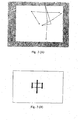
- the result of this Chinese character is shown in FIG. 3A .
- the final result is generated by performing a conventional 2D handwriting recognition process, as shown in FIG. 3B .
- the Lagrange multiplication method is used to obtain the values of A, B, C and D.
- Other methods such as linear regression method may also be used.
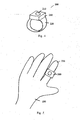
- FIG. 4 shows an external design of a 3D handwriting input device 200 according to one embodiment of the invention.
- input device 200 includes a housing 210 that contains the electronics parts of the device (such as a 3D motion detection sensor IC chip), a control button 212 for allowing a user to input a control signal to indicate completion of writing a word or character, and a band 220 for mounting input device 200 on the user's finger.
- the electronics parts of the device such as a 3D motion detection sensor IC chip
- control button 212 for allowing a user to input a control signal to indicate completion of writing a word or character
- a band 220 for mounting input device 200 on the user's finger.
- FIG. 5 illustrates how input device 200 may be mounted.
- device 200 is mounted on a finger 232 of a user's hand 230. By mounting it on the finger, the user can simply move the finger to write any word or character in a 3D space.
- the 3D motion data will be wirelessly transmitted to a recognition device for handwriting recognition.
- the input device and the recognition device can be integrated together as a single unit (e.g., a pen) that operates in the same manner as described above.
- the final recognition results will be transmitted to an intelligent apparatus such as a PDA, a laptop computer, a PC, etc.
- the invention can also be used on a 2D plane if the user so chooses. In suck a case, the coordinates calculated will be for 2D plane and the step of mapping the 3D tracks onto a 2D plane is omitted.
Landscapes
- Engineering & Computer Science (AREA)
- Computer Vision & Pattern Recognition (AREA)
- Physics & Mathematics (AREA)
- General Physics & Mathematics (AREA)
- Multimedia (AREA)
- Theoretical Computer Science (AREA)
- Character Discrimination (AREA)
- Position Input By Displaying (AREA)
- Storage Device Security (AREA)
Description
- The invention relates generally to handwriting recognition technologies, and more particularly to three-dimensional (3D) handwriting recognition methods and systems.
- Handwriting recognition is a technique by which an intelligence system can recognize characters and other symbols written by hand. This technique has been very popular since it frees users from the keyboard, allowing users to write and draw in a more natural way. With the increasing demands from users, more and more devices now have incorporated handwriting recognition system to give users natural input experience. Handwriting recognition is particularly popular in various handheld devices that provides handwriting recognition of words with complex structures, e.g., Chinese characters, input of which using a conventional keyboard is very time consuming.
- A handwriting input device provides a user with a friendly way of inputting information. At present, the minimum requirement for an inputting device is a mouse. To write with the mouse, the user needs to press and hold down the primary mouse button, and then move the mouse pointer to form strokes of a word or character for generating the final word or character. Popular handwriting input devices, such as a pen stylus and tablet, are used on conventional handheld devices such as PDAs, or are connected to a computer through a serial or USB port. Handheld devices often use a pen stylus and a touch screen as a pad to allow users to perform recognition functions. Most handheld devices, such as PDAs, are equipped with this kind of input device.
- Another kind of handwriting input device includes a pen that allows users to transfer data into a receiving unit, such as a cellular phone, a PDA or a PC by simply writing or drawing in their own natural handwriting on the comfort and space of a regular piece of paper.
- At present, all conventional handwriting input devices adopt a two-dimensional input method. Users have to write on a physical medium, such as a tablet, a touch screen, or a paper pad. This limits the choices available for users. For example, if a user wants to write some comments during a presentation or a lecture, he or she would have to first find a physical medium, e.g., a table, a paper pad, etc. This can cause much inconvenience for the user while standing in the room, giving the presentation or lecture. Also, in a mobile environment, such as in a car, a bus or a subway, it would be very inconvenient to "write" on a physical medium using a stylus.
- Therefore, there is a need to provide an improved handwriting recognition system that gives users more flexibility and convenience and frees the users from the physical medium required for two-dimensional handwriting recognition.
- The present invention gives users more flexibility and enjoyable writing experience by allowing users to freely write words or characters in a 3D space in a touchless way, without requiring any physical medium such as a pad or a tablet.
- According to the invention, there is provided a handwriting recognition system that comprises an input device and a recognition device in communication with the input device. The input device includes a three-dimensional (3D) motion detection sensor configured to generate 3D motion data in response to a 3D motion. In one embodiment, the motion detection sensor measures acceleration of the 3D motion in X, Y and Z axial directions to generate the 3D motion data. The recognition device is configured to receive (e.g., by wireless means) the 3D motion data from the input device and derive corresponding two-dimensional (2D) images for handwriting recognition, based on the 3D motion data.
- According to one embodiment of the invention, the recognition device calculates corresponding 3D coordinates based on the 3D motion data, constructs corresponding 3D tracks based the 3D coordinates, and derives the corresponding 2D images from the 3D tracks by mapping the 3D tracks onto a 2D plane for handwriting recognition.
- Other objects and attainments together with a fuller understanding of the invention will become apparent and appreciated by referring to the following description and claims taken in conjunction with the accompanying drawings.
- Reference is made to Japanese patent application
H06-28096 - The invention is explained in further detail, and by way of example, with reference to the accompanying drawings wherein:
-
FIG. 1 shows a three-dimensional handwriting recognition system according to one embodiment of the invention; -
FIG. 2 is a flow chart diagram illustrating a recognition process according to one embodiment of the invention; -
FIG. 3A shows a 2D image of a Chinese character derived by mapping 3D tracks onto a 2D projection plane; -
FIG. 3B shows a final result of handwriting recognition process based on the 2D image inFIG. 3A ; -
FIG. 4 shows an external design of a 3D handwriting input device according to one embodiment of the invention; and -
FIG. 5 illustrates how the input device may be mounted. - Throughout the drawings, the same reference numerals indicate similar or corresponding features or functions.
-
FIG. 1 shows a three-dimensionalhandwriting recognition system 10 according to one embodiment of the invention. As illustrated,system 10 comprises ahandwriting input device 20, arecognition device 30 and anoutput device 40.Input device 20 includes a 3D motion detection sensor 22, acontrol circuit 26 and acommunication interface 28.Recognition device 30 includes aprocessor 32, amemory 34, astorage device 36, and acommunication interface 38. For simplicity, other conventional elements are not shown inFIG. 1 . - In operation, a user moves
input device 20 to freely write words or characters in a 3D space, e.g., in the air. Motion detection sensor 22 detects the 3D motion and communicates the 3D motion data and a sampling rate torecognition device 30 for handwriting recognition via acommunication interface 28, such as Bluetooth, Zigbee, IEEE 802.11, infrared, or a USB port. The sampling rate may be a predetermined value set by an end user or a manufacturer based on factors such as the processing capability of the system. Alternatively, the sampling rate may be dynamically determined and adjusted based on, for example, the speed of the motion. This can be done, for example, by first determining the speed of the initial motion associated with the handwriting. Then the recognition device can dynamically adjust the sampling rate based on the speed of the motion at the last sampling point. The higher the speed is, the higher the sampling rate will be, and vice versa. By dynamically adjusting the sampling rate, the accuracy of the handwriting recognition can be improved since only the optimal number of sampling points will be used for constructing the word or character. Further, lower power consumption is needed. - Based on the motion data and the sampling rate received from
input device 20,processor 32 calculates the corresponding 3D coordinates on the X, Y and Z axes and stores these coordinates instorage device 36. Using the calculated coordinates,processor 32 constructs the corresponding 3D tracks. The 3D tracks will then be projected onto a 2D plane to form 2D images which will be recognized using conventional handwriting recognition software. The final result is displayed onoutput device 40. - Since 3D writing is a continuous process,
control circuit 26 ofinput device 20 provides a control signal torecognition device 30 viainterface 28 to indicate separation of individual words or characters upon receiving a user provided external input. For example, the user may press a control button to causecontrol circuit 26 to generate the control signal after completion of writing a word or a character. - According to a specific embodiment of the invention, motion detection sensor 22 detects the 3D motion by measuring the acceleration of the movement along the X, Y and Z axes. As an example, the piezoresistive-type tri-axial accelerating sensor commercially available from Hitachi Metals, Ltd., Tokyo, Japan, may be used as motion detection sensor 22. This accelerating sensor in the form of an IC chip has the ability to simultaneously detect acceleration in the three axial directions (X, Y and Z). The sensor is highly sensitive and shock resistant and is a very small and thin semiconductor type 3 axial accelerating sensor. More information about this accelerating sensor is available on the following website http://www.hitachi-metals.co.jp/e/prod/prod06/p06_10.html.
-
FIG. 2 is a flow chart diagram illustrating arecognition process 100 performed byrecognition device 30, according to one embodiment of the invention. InFIG. 2 ,recognition device 30 receives the 3D motion data (e.g., the acceleration data of the movement in the X, Y and Z directions) and the sampling rate from input device 20 (step 102). Based on the information received,processor 32 calculates the corresponding 3D coordinates on the X, Y and Z axes for each sampling point using the starting point of the movement as the origin (step 106). Each sampling point is also used as a reference point for calculating the coordinates of the following sampling point. - Calculation of the 3D coordinates is continuously performed based on the incoming 3D motion data until
processor 32 detects receipt of a control signal (step 112). The control signal indicates completion of writing a word or a character. The corresponding 3D tracks are constructed using the 3D coordinates (step 116) and are then mapped onto a 2D plane (step 122). Thereafter, conventional 2D handwriting recognition is performed (step 126). - In the
above recognition process 100, to map the 3D tracks onto a 2D plane atstep 122, it is necessary to first find a proper 2D projection plane. In a preferred embodiment of the invention, a proper 2D projection plane is separately derived for each word or character. - According to the geometry principles, a proper 2D projection plane is a plane, to which the sum of the distance square of each sampling point is minimal. Assume the coordinates of n sampling points are known as follows: (x 1,y 1,z 1),(x 2,y 2,z 2)...(xn,yn,zn ), and the equation of the plane is Ax+By+Cz+D = 0, where (A 2+B 2+C 2 ≠ 0). Now it is necessary to determine the values of A,B,C,D. The distance from one point (x 1 ,y 1 ,z 1) to the plane is given asand the sum
 represented by F(A,B,C,D) is expressed as:

- The values of A,B,C,D can be determined using the Lagrange multiplication method as follows, which is described in Mathematics Analysis by Ouyang Guangzhong, published by Fudan University Press in 1999 in China, which is hereby incorporated by reference. Thus,

under the constraint A 2 + B 2 + C 2 = 1. From this equation, the following equation is derived:
where λ is a Lagrange multiplier, which is a constant. The partial differential functions are now performed on G(A,B,C,D) with respect to A, B, C and D as follows:


- From the above four equations, the following equations are obtained:


where equation (4) can be rewritten as:
- By incorporating equation (6) into equations (1), (2), and (3), the following is obtained:

Thus, from the above equations, the values of A, B, C and D can be obtained. - As an example, the following 3D coordinates for a total of 13 sampling points are obtained for a Chinese character:
- {(0,0,0),(0.49,-1,0.02),(1,0,0.03)-1(0,0,0.02),(2,-0.13,0.01),(3.5,-0.14,0),(3.76,-0.31,-0.01),(2.74,-1.26,0.01),(1.38,-2.24,0),(2.5,-2,0.01),(1.746,1,0.02,),(2,-1.5.0.03),(1.876,-4.5,0:02),}.
- By using the Lagrange multiplication method described above, the following are obtained:


- From the above equations, the values of A, B, C and D are determined as follows:
- A = 0.0045, B = 0.0023, C = 0:9999, D = -0.01777.
- Thus, the equation of the 2D projection plane is 0.0045x + 0.0023y + 0.9999z - 0.01777 = 0. From the equation of the projection plane, Ax+By+Cz+D = 0, and the equation of a line that is vertical to the projection plane,


which can be used to obtain the corresponding 2D coordinates for each 3D sampling point. In this example, the following corresponding 2D coordinates are obtained: - {(0.0001,0),(0.49,-1),(1,-2.0001),(0,0),(2,-0.13),(3.5001,-0.14),(3.7601,-0.31),(2.7401,-1.26),(1.3801,2.24),(2.5001,-2),(1.746,1),(2.-1.5001),(1.876,-4.5001)}.
- Based on these 2D coordinates, the corresponding 2D image is projected onto the 2D projection plane. The result of this Chinese character is shown in
FIG. 3A . The final result is generated by performing a conventional 2D handwriting recognition process, as shown inFIG. 3B . - In the above, the Lagrange multiplication method is used to obtain the values of A, B, C and D. Other methods such as linear regression method may also be used.
-
FIG. 4 shows an external design of a 3Dhandwriting input device 200 according to one embodiment of the invention. As shown inFIG. 4 ,input device 200 includes ahousing 210 that contains the electronics parts of the device (such as a 3D motion detection sensor IC chip), acontrol button 212 for allowing a user to input a control signal to indicate completion of writing a word or character, and aband 220 for mountinginput device 200 on the user's finger. -
FIG. 5 illustrates howinput device 200 may be mounted. InFIG. 5 ,device 200 is mounted on afinger 232 of a user'shand 230. By mounting it on the finger, the user can simply move the finger to write any word or character in a 3D space. The 3D motion data will be wirelessly transmitted to a recognition device for handwriting recognition. - According to the invention, the input device and the recognition device can be integrated together as a single unit (e.g., a pen) that operates in the same manner as described above. The final recognition results will be transmitted to an intelligent apparatus such as a PDA, a laptop computer, a PC, etc.
- The invention can also be used on a 2D plane if the user so chooses. In suck a case, the coordinates calculated will be for 2D plane and the step of mapping the 3D tracks onto a 2D plane is omitted.
- While the invention has been described in conjunction with specific embodiments, it is evident that many alternatives, modifications and variations will be apparent to those skilled in the art in light of the foregoing description.
Claims (15)
- A handwriting recognition system, comprising:- an input device including a three-dimensional (3D) motion detection sensor that is configured to measure acceleration of the 3D motion of the three-dimensional motion detection sensor in X, Y and Z axial directions to generate 3D motion data in response to a 3D motion of the three-dimensional motion detection sensor; and- a recognition device, in communication with the input device, wherein the recognition device is configured to receive the 3D motion data and derive corresponding two-dimensional (2D) images for handwriting recognition, based on the 3D motion data, wherein the recognition device comprises- means for calculating sampling points in 3D coordinates relative to an origin corresponding to the acceleration data of the movement in the X, Y and Z directions in the 3D motion data and a selected sampling rate, each sampling point being used as a reference point for calculating the coordinates of a following sampling point on a 3D track, and- means for constructing corresponding 3D tracks based on the 3D coordinates; and- means for deriving the corresponding 2D images from the 3D tracks, the deriving means including- means for deriving a 2D plane as the plane to which the sum of the distance square of each sampling point is minimal, and
means for mapping the 3D tracks onto the 2D plane for deriving the 2D images for handwriting recognition. - The system of claim 1, wherein the recognition device includes means for performing 2D handwriting recognition based on the 2D images.
- The system of claim 1, wherein the 2D plane is separately derived for each word or character.
- The system of claim 1, wherein the recognition device further includes means for dynamically adjusting the sampling rate based on the speed of the motion.
- The system of claim 1 or 3, wherein the input device further includes a control circuit, responsive to a user's command, that is configured to generate a control signal for transmitting to the recognition device to indicate completion of writing a word or a character.
- The system of claim 2, further comprising an output device for displaying final results of the handwriting recognition.
- The system of claim 1, wherein the input device wirelessly transmits the 3D motion data to the recognition device.
- The system of claim 1, comprising a memory.
- A handwriting recognition method, comprising the steps of:- generating 3D motion data in response to a 3D motion of a three-dimensional motion detection sensor by measuring acceleration of the 3D motion of the three-dimensional motion detection sensor in X, Y and Z axial directions; and- deriving corresponding two-dimensional (2D) images for handwriting recognition based on the 3D motion data, comprising- calculating sampling points, in 3D coordinates, relative to an origin corresponding to the acceleration data of the movement in the X, Y and Z directions in the 3D motion data and a selected sampling rate, each sampling point being used as a reference point for calculating the coordinates of a following sampling point on a 3D track, and constructing corresponding 3D tracks based on the 3D coordinates; and- deriving the corresponding 2D images from the 3D tracks, including deriving a 2D plane as the plane to which the sum of the distance square of each sampling point is minimal- mapping the 3D tracks onto the 2D plane for deriving the 2D images for handwriting recognition.
- The method of claim 9, further comprising the step of performing 2D handwriting recognition based on the 2D images.
- The method of claim 9, wherein the 2D plane is separately derived for each word or character.
- The method of claim 9, further comprising a step of dynamically adjusting the sampling rate based on the speed of the motion.
- The method of claim 9 or 11, further comprising the step of generating an indication, based on a user's command, to indicate completion of writing a word or a character.
- The method of claim 10, further comprising a step of displaying final results of the handwriting recognition.
- The method of claim 9, further comprising the steps of wirelessly transmitting the 3D motion data and wirelessly receiving the 3D motion data for calculating the 3D coordinates.
Applications Claiming Priority (3)
| Application Number | Priority Date | Filing Date | Title |
|---|---|---|---|
| CNB021442487A CN100377043C (en) | 2002-09-28 | 2002-09-28 | Method and system for three-dimensional handwriting recognition |
| CN02144248 | 2002-09-28 | ||
| PCT/IB2003/004102 WO2004029866A1 (en) | 2002-09-28 | 2003-09-18 | Method and system for three-dimensional handwriting recognition |
Publications (2)
| Publication Number | Publication Date |
|---|---|
| EP1546993A1 EP1546993A1 (en) | 2005-06-29 |
| EP1546993B1 true EP1546993B1 (en) | 2015-07-15 |
Family
ID=32034737
Family Applications (1)
| Application Number | Title | Priority Date | Filing Date |
|---|---|---|---|
| EP03798309.5A Expired - Lifetime EP1546993B1 (en) | 2002-09-28 | 2003-09-18 | Method and system for three-dimensional handwriting recognition |
Country Status (6)
| Country | Link |
|---|---|
| US (1) | US8150162B2 (en) |
| EP (1) | EP1546993B1 (en) |
| JP (1) | JP2006500680A (en) |
| CN (1) | CN100377043C (en) |
| AU (1) | AU2003260877A1 (en) |
| WO (1) | WO2004029866A1 (en) |
Families Citing this family (53)
| Publication number | Priority date | Publication date | Assignee | Title |
|---|---|---|---|---|
| CN1512298A (en) * | 2002-12-26 | 2004-07-14 | �ʼҷ����ֵ��ӹɷ�����˾ | Method and system for three-dimensional handwriting recognition |
| KR100465241B1 (en) | 2003-03-17 | 2005-01-13 | 삼성전자주식회사 | Motion recognition system using a imaginary writing plane and method thereof |
| US7317450B2 (en) | 2003-09-26 | 2008-01-08 | Khomo Malome T | Spatial chirographic sign reader |
| US20050069203A1 (en) * | 2003-09-26 | 2005-03-31 | Khomo Malome T. | Spatial character recognition technique and chirographic text character reader |
| US8036465B2 (en) | 2003-09-26 | 2011-10-11 | Khomo Malome T | Method of text interaction using chirographic techniques |
| DE102004008253A1 (en) * | 2004-02-19 | 2005-09-15 | Siemens Ag | Method for estimating a virtual writing level |
| JP4274997B2 (en) * | 2004-05-06 | 2009-06-10 | アルパイン株式会社 | Operation input device and operation input method |
| US7583819B2 (en) | 2004-11-05 | 2009-09-01 | Kyprianos Papademetriou | Digital signal processing methods, systems and computer program products that identify threshold positions and values |
| KR100631616B1 (en) * | 2005-01-08 | 2006-10-11 | 엘지전자 주식회사 | 3D location information input device |
| JP2007079943A (en) * | 2005-09-14 | 2007-03-29 | Toshiba Corp | Character reading program, character reading method, and character reading device |
| US20090115744A1 (en) * | 2007-11-06 | 2009-05-07 | Innovative Material Solutions, Inc. | Electronic freeboard writing system |
| US8933876B2 (en) | 2010-12-13 | 2015-01-13 | Apple Inc. | Three dimensional user interface session control |
| US8166421B2 (en) * | 2008-01-14 | 2012-04-24 | Primesense Ltd. | Three-dimensional user interface |
| US9035876B2 (en) | 2008-01-14 | 2015-05-19 | Apple Inc. | Three-dimensional user interface session control |
| US8634645B2 (en) * | 2008-03-28 | 2014-01-21 | Smart Technologies Ulc | Method and tool for recognizing a hand-drawn table |
| US20090300671A1 (en) * | 2008-05-30 | 2009-12-03 | At&T Knowledge Ventures, L.P. | Controlling Access to Multimedia Content |
| CN101751200B (en) * | 2008-12-09 | 2012-01-11 | 北京三星通信技术研究有限公司 | Space input method for mobile terminal and implementation device thereof |
| US8378967B2 (en) * | 2009-02-27 | 2013-02-19 | Denso Corporation | Wearable electrical apparatus |
| JP4683148B2 (en) * | 2009-02-27 | 2011-05-11 | 株式会社デンソー | Electrical equipment |
| CN102163119A (en) * | 2010-02-23 | 2011-08-24 | 中兴通讯股份有限公司 | Single-hand inputting method and device |
| US8787663B2 (en) * | 2010-03-01 | 2014-07-22 | Primesense Ltd. | Tracking body parts by combined color image and depth processing |
| US9201501B2 (en) | 2010-07-20 | 2015-12-01 | Apple Inc. | Adaptive projector |
| JP5791131B2 (en) | 2010-07-20 | 2015-10-07 | アップル インコーポレイテッド | Interactive reality extension for natural interactions |
| CN102346859B (en) * | 2010-07-26 | 2013-10-09 | 卡西欧计算机株式会社 | character recognition device |
| JP4877621B1 (en) * | 2010-07-30 | 2012-02-15 | カシオ計算機株式会社 | Character recognition device and program |
| US8959013B2 (en) | 2010-09-27 | 2015-02-17 | Apple Inc. | Virtual keyboard for a non-tactile three dimensional user interface |
| CN102004623B (en) * | 2010-11-29 | 2013-02-27 | 深圳市九洲电器有限公司 | Three-dimensional image display device and method |
| US8872762B2 (en) | 2010-12-08 | 2014-10-28 | Primesense Ltd. | Three dimensional user interface cursor control |
| WO2012107892A2 (en) | 2011-02-09 | 2012-08-16 | Primesense Ltd. | Gaze detection in a 3d mapping environment |
| CN102650905A (en) * | 2011-02-23 | 2012-08-29 | 西安龙飞软件有限公司 | Method utilizing gesture operation in three-dimensional space to realize word input of mobile phone |
| CN102135821B (en) * | 2011-03-08 | 2013-03-06 | 中国科学技术大学 | Handwriting pen and graphic restoration system |
| JP2012208602A (en) * | 2011-03-29 | 2012-10-25 | Kyocera Corp | Information recognition device |
| US8881051B2 (en) | 2011-07-05 | 2014-11-04 | Primesense Ltd | Zoom-based gesture user interface |
| US9459758B2 (en) | 2011-07-05 | 2016-10-04 | Apple Inc. | Gesture-based interface with enhanced features |
| US9377865B2 (en) | 2011-07-05 | 2016-06-28 | Apple Inc. | Zoom-based gesture user interface |
| CN102915130B (en) * | 2011-08-04 | 2016-03-23 | 王振兴 | Moving trajectory correction method and moving trajectory generating method |
| US9030498B2 (en) | 2011-08-15 | 2015-05-12 | Apple Inc. | Combining explicit select gestures and timeclick in a non-tactile three dimensional user interface |
| US9122311B2 (en) | 2011-08-24 | 2015-09-01 | Apple Inc. | Visual feedback for tactile and non-tactile user interfaces |
| US9218063B2 (en) | 2011-08-24 | 2015-12-22 | Apple Inc. | Sessionless pointing user interface |
| CN102262732A (en) * | 2011-08-26 | 2011-11-30 | 信源通科技(深圳)有限公司 | Character recognition method and system |
| CN102306060B (en) * | 2011-08-26 | 2014-07-09 | 深圳市优利麦克科技开发有限公司 | Input method and system of mobile equipment |
| CN102253718B (en) * | 2011-08-31 | 2016-07-06 | 由田信息技术(上海)有限公司 | Three-dimensional hand-written inputting method |
| CN103076896B (en) * | 2011-10-26 | 2016-08-17 | 联想(北京)有限公司 | A kind of input equipment and terminal and method thereof and a kind of system |
| US9229534B2 (en) | 2012-02-28 | 2016-01-05 | Apple Inc. | Asymmetric mapping for tactile and non-tactile user interfaces |
| US9377863B2 (en) | 2012-03-26 | 2016-06-28 | Apple Inc. | Gaze-enhanced virtual touchscreen |
| CN102662465A (en) * | 2012-03-26 | 2012-09-12 | 北京国铁华晨通信信息技术有限公司 | Method and system for inputting visual character based on dynamic track |
| CN102810008B (en) * | 2012-05-16 | 2016-01-13 | 北京捷通华声语音技术有限公司 | A kind of air input, method and input collecting device in the air |
| US9898186B2 (en) * | 2012-07-13 | 2018-02-20 | Samsung Electronics Co., Ltd. | Portable terminal using touch pen and handwriting input method using the same |
| CN104571603B (en) * | 2013-10-10 | 2018-02-27 | 北京壹人壹本信息科技有限公司 | A kind of aerial hand writing system and writing pencil |
| CN104714650B (en) * | 2015-04-02 | 2017-11-24 | 三星电子(中国)研发中心 | A kind of data inputting method and device |
| CN107179839A (en) * | 2017-05-23 | 2017-09-19 | 三星电子(中国)研发中心 | Information output method, device and equipment for terminal |
| CN107992792A (en) * | 2017-10-16 | 2018-05-04 | 华南理工大学 | A kind of aerial handwritten Chinese character recognition system and method based on acceleration transducer |
| US10878563B2 (en) * | 2018-03-05 | 2020-12-29 | Rion Co., Ltd. | Three-dimensional shape data production method and three-dimensional shape data production system |
Citations (1)
| Publication number | Priority date | Publication date | Assignee | Title |
|---|---|---|---|---|
| JPH0628096A (en) * | 1992-07-07 | 1994-02-04 | Toshiba Corp | Spatial handwritten character figure input device |
Family Cites Families (14)
| Publication number | Priority date | Publication date | Assignee | Title |
|---|---|---|---|---|
| JPH0628096B2 (en) | 1984-07-02 | 1994-04-13 | 東レ株式会社 | Polyester film for magnetic recording media |
| JP2691101B2 (en) * | 1992-03-05 | 1997-12-17 | インターナショナル・ビジネス・マシーンズ・コーポレイション | Handwriting input method and input device |
| IL108565A0 (en) * | 1994-02-04 | 1994-05-30 | Baron Research & Dev Company L | Improved information input apparatus |
| JP3456735B2 (en) * | 1994-02-21 | 2003-10-14 | 沖電気工業株式会社 | Information input device and presentation system using the same |
| EP0697679A3 (en) * | 1994-08-12 | 1998-07-01 | Dassault Systemes of America | Computerized drawing method |
| JPH08320756A (en) * | 1995-05-24 | 1996-12-03 | Sharp Corp | Electronic device with data input means |
| US6081261A (en) * | 1995-11-01 | 2000-06-27 | Ricoh Corporation | Manual entry interactive paper and electronic document handling and processing system |
| JP3006545B2 (en) * | 1997-06-09 | 2000-02-07 | 日本電気株式会社 | Online character recognition device |
| US6212296B1 (en) * | 1997-12-23 | 2001-04-03 | Ricoh Company, Ltd. | Method and apparatus for transforming sensor signals into graphical images |
| US6456749B1 (en) * | 1998-02-27 | 2002-09-24 | Carnegie Mellon University | Handheld apparatus for recognition of writing, for remote communication, and for user defined input templates |
| JP3627791B2 (en) * | 1998-08-10 | 2005-03-09 | 富士通株式会社 | Other terminal operation device |
| US7707082B1 (en) * | 1999-05-25 | 2010-04-27 | Silverbrook Research Pty Ltd | Method and system for bill management |
| US7158675B2 (en) * | 2002-05-14 | 2007-01-02 | Microsoft Corporation | Interfacing with ink |
| US7302488B2 (en) * | 2002-06-28 | 2007-11-27 | Microsoft Corporation | Parental controls customization and notification |
-
2002
- 2002-09-28 CN CNB021442487A patent/CN100377043C/en not_active Expired - Fee Related
-
2003
- 2003-09-18 JP JP2004539329A patent/JP2006500680A/en active Pending
- 2003-09-18 US US10/528,938 patent/US8150162B2/en not_active Expired - Fee Related
- 2003-09-18 EP EP03798309.5A patent/EP1546993B1/en not_active Expired - Lifetime
- 2003-09-18 AU AU2003260877A patent/AU2003260877A1/en not_active Abandoned
- 2003-09-18 WO PCT/IB2003/004102 patent/WO2004029866A1/en not_active Ceased
Patent Citations (1)
| Publication number | Priority date | Publication date | Assignee | Title |
|---|---|---|---|---|
| JPH0628096A (en) * | 1992-07-07 | 1994-02-04 | Toshiba Corp | Spatial handwritten character figure input device |
Also Published As
| Publication number | Publication date |
|---|---|
| AU2003260877A1 (en) | 2004-04-19 |
| EP1546993A1 (en) | 2005-06-29 |
| CN100377043C (en) | 2008-03-26 |
| JP2006500680A (en) | 2006-01-05 |
| US8150162B2 (en) | 2012-04-03 |
| WO2004029866A1 (en) | 2004-04-08 |
| US20060149737A1 (en) | 2006-07-06 |
| CN1485711A (en) | 2004-03-31 |
Similar Documents
| Publication | Publication Date | Title |
|---|---|---|
| US8150162B2 (en) | Method and system for three-dimensional handwriting recognition | |
| KR100465241B1 (en) | Motion recognition system using a imaginary writing plane and method thereof | |
| US20060159344A1 (en) | Method and system for three-dimensional handwriting recognition | |
| KR100518824B1 (en) | Motion recognition system capable of distinguishment a stroke for writing motion and method thereof | |
| US20060125789A1 (en) | Contactless input device | |
| CN101398720B (en) | pen interactive device | |
| US10082885B2 (en) | Information input and output apparatus and information input and output method | |
| KR102051585B1 (en) | An electronic device and method having a function of hand writing using multi-touch | |
| JP2001236174A (en) | Handwritten character input device and handwritten character recognition method | |
| EP2728448A2 (en) | Input apparatus and input controlling method thereof | |
| US12265668B2 (en) | Pen state detection circuit and method, and input system | |
| US20140125636A1 (en) | Electronic pen data input system and electronic pen data input method using the same | |
| EP2703978B1 (en) | Apparatus for measuring coordinates and control method thereof | |
| CN112241491A (en) | Recommended word display method and terminal equipment | |
| KR20150005386A (en) | A mobile terminal comprising a touch screen supporting a multi touch and method for controlling the mobile terminal | |
| KR101019255B1 (en) | Depth sensor type spatial touch wireless terminal, its data processing method and screen device | |
| CN108463788B (en) | Active pen and gesture detection method based on same | |
| CN101308434B (en) | How to operate the user interface | |
| CN104216560B (en) | Mobile device and realize the system of the aerial touch-control of mobile device, control device | |
| JPH11296290A (en) | Pen-type input device and character recognition method | |
| KR20070042858A (en) | Pen-type digital input device | |
| US20140125635A1 (en) | Electronic pen, and electronic pen data input system and method using the same | |
| JPH1153095A (en) | Data input device | |
| CN112074799A (en) | Writing tool side device | |
| KR20060119116A (en) | Terminal device and user interface method with vector user interface structure |
Legal Events
| Date | Code | Title | Description |
|---|---|---|---|
| PUAI | Public reference made under article 153(3) epc to a published international application that has entered the european phase |
Free format text: ORIGINAL CODE: 0009012 |
|
| 17P | Request for examination filed |
Effective date: 20050428 |
|
| AK | Designated contracting states |
Kind code of ref document: A1 Designated state(s): AT BE BG CH CY CZ DE DK EE ES FI FR GB GR HU IE IT LI LU MC NL PT RO SE SI SK TR |
|
| AX | Request for extension of the european patent |
Extension state: AL LT LV MK |
|
| DAX | Request for extension of the european patent (deleted) | ||
| 17Q | First examination report despatched |
Effective date: 20120327 |
|
| RAP1 | Party data changed (applicant data changed or rights of an application transferred) |
Owner name: KONINKLIJKE PHILIPS N.V. |
|
| GRAP | Despatch of communication of intention to grant a patent |
Free format text: ORIGINAL CODE: EPIDOSNIGR1 |
|
| INTG | Intention to grant announced |
Effective date: 20150203 |
|
| GRAS | Grant fee paid |
Free format text: ORIGINAL CODE: EPIDOSNIGR3 |
|
| GRAA | (expected) grant |
Free format text: ORIGINAL CODE: 0009210 |
|
| AK | Designated contracting states |
Kind code of ref document: B1 Designated state(s): AT BE BG CH CY CZ DE DK EE ES FI FR GB GR HU IE IT LI LU MC NL PT RO SE SI SK TR |
|
| REG | Reference to a national code |
Ref country code: CH Ref legal event code: EP Ref country code: GB Ref legal event code: FG4D |
|
| REG | Reference to a national code |
Ref country code: IE Ref legal event code: FG4D |
|
| REG | Reference to a national code |
Ref country code: AT Ref legal event code: REF Ref document number: 737133 Country of ref document: AT Kind code of ref document: T Effective date: 20150815 |
|
| REG | Reference to a national code |
Ref country code: DE Ref legal event code: R096 Ref document number: 60347829 Country of ref document: DE |
|
| REG | Reference to a national code |
Ref country code: FR Ref legal event code: PLFP Year of fee payment: 13 |
|
| REG | Reference to a national code |
Ref country code: AT Ref legal event code: MK05 Ref document number: 737133 Country of ref document: AT Kind code of ref document: T Effective date: 20150715 |
|
| REG | Reference to a national code |
Ref country code: NL Ref legal event code: MP Effective date: 20150715 |
|
| PG25 | Lapsed in a contracting state [announced via postgrant information from national office to epo] |
Ref country code: GR Free format text: LAPSE BECAUSE OF FAILURE TO SUBMIT A TRANSLATION OF THE DESCRIPTION OR TO PAY THE FEE WITHIN THE PRESCRIBED TIME-LIMIT Effective date: 20151016 Ref country code: FI Free format text: LAPSE BECAUSE OF FAILURE TO SUBMIT A TRANSLATION OF THE DESCRIPTION OR TO PAY THE FEE WITHIN THE PRESCRIBED TIME-LIMIT Effective date: 20150715 |
|
| PG25 | Lapsed in a contracting state [announced via postgrant information from national office to epo] |
Ref country code: AT Free format text: LAPSE BECAUSE OF FAILURE TO SUBMIT A TRANSLATION OF THE DESCRIPTION OR TO PAY THE FEE WITHIN THE PRESCRIBED TIME-LIMIT Effective date: 20150715 Ref country code: SE Free format text: LAPSE BECAUSE OF FAILURE TO SUBMIT A TRANSLATION OF THE DESCRIPTION OR TO PAY THE FEE WITHIN THE PRESCRIBED TIME-LIMIT Effective date: 20150715 Ref country code: ES Free format text: LAPSE BECAUSE OF FAILURE TO SUBMIT A TRANSLATION OF THE DESCRIPTION OR TO PAY THE FEE WITHIN THE PRESCRIBED TIME-LIMIT Effective date: 20150715 Ref country code: PT Free format text: LAPSE BECAUSE OF FAILURE TO SUBMIT A TRANSLATION OF THE DESCRIPTION OR TO PAY THE FEE WITHIN THE PRESCRIBED TIME-LIMIT Effective date: 20151116 |
|
| REG | Reference to a national code |
Ref country code: DE Ref legal event code: R097 Ref document number: 60347829 Country of ref document: DE |
|
| PG25 | Lapsed in a contracting state [announced via postgrant information from national office to epo] |
Ref country code: SK Free format text: LAPSE BECAUSE OF FAILURE TO SUBMIT A TRANSLATION OF THE DESCRIPTION OR TO PAY THE FEE WITHIN THE PRESCRIBED TIME-LIMIT Effective date: 20150715 Ref country code: EE Free format text: LAPSE BECAUSE OF FAILURE TO SUBMIT A TRANSLATION OF THE DESCRIPTION OR TO PAY THE FEE WITHIN THE PRESCRIBED TIME-LIMIT Effective date: 20150715 Ref country code: IT Free format text: LAPSE BECAUSE OF FAILURE TO SUBMIT A TRANSLATION OF THE DESCRIPTION OR TO PAY THE FEE WITHIN THE PRESCRIBED TIME-LIMIT Effective date: 20150715 Ref country code: MC Free format text: LAPSE BECAUSE OF FAILURE TO SUBMIT A TRANSLATION OF THE DESCRIPTION OR TO PAY THE FEE WITHIN THE PRESCRIBED TIME-LIMIT Effective date: 20150715 Ref country code: LU Free format text: LAPSE BECAUSE OF FAILURE TO SUBMIT A TRANSLATION OF THE DESCRIPTION OR TO PAY THE FEE WITHIN THE PRESCRIBED TIME-LIMIT Effective date: 20150918 Ref country code: CZ Free format text: LAPSE BECAUSE OF FAILURE TO SUBMIT A TRANSLATION OF THE DESCRIPTION OR TO PAY THE FEE WITHIN THE PRESCRIBED TIME-LIMIT Effective date: 20150715 Ref country code: DK Free format text: LAPSE BECAUSE OF FAILURE TO SUBMIT A TRANSLATION OF THE DESCRIPTION OR TO PAY THE FEE WITHIN THE PRESCRIBED TIME-LIMIT Effective date: 20150715 |
|
| REG | Reference to a national code |
Ref country code: CH Ref legal event code: PL |
|
| PLBE | No opposition filed within time limit |
Free format text: ORIGINAL CODE: 0009261 |
|
| STAA | Information on the status of an ep patent application or granted ep patent |
Free format text: STATUS: NO OPPOSITION FILED WITHIN TIME LIMIT |
|
| PG25 | Lapsed in a contracting state [announced via postgrant information from national office to epo] |
Ref country code: RO Free format text: LAPSE BECAUSE OF FAILURE TO SUBMIT A TRANSLATION OF THE DESCRIPTION OR TO PAY THE FEE WITHIN THE PRESCRIBED TIME-LIMIT Effective date: 20150715 |
|
| 26N | No opposition filed |
Effective date: 20160418 |
|
| REG | Reference to a national code |
Ref country code: IE Ref legal event code: MM4A |
|
| PG25 | Lapsed in a contracting state [announced via postgrant information from national office to epo] |
Ref country code: CH Free format text: LAPSE BECAUSE OF NON-PAYMENT OF DUE FEES Effective date: 20150930 Ref country code: IE Free format text: LAPSE BECAUSE OF NON-PAYMENT OF DUE FEES Effective date: 20150918 Ref country code: LI Free format text: LAPSE BECAUSE OF NON-PAYMENT OF DUE FEES Effective date: 20150930 |
|
| PG25 | Lapsed in a contracting state [announced via postgrant information from national office to epo] |
Ref country code: SI Free format text: LAPSE BECAUSE OF FAILURE TO SUBMIT A TRANSLATION OF THE DESCRIPTION OR TO PAY THE FEE WITHIN THE PRESCRIBED TIME-LIMIT Effective date: 20150715 |
|
| REG | Reference to a national code |
Ref country code: FR Ref legal event code: PLFP Year of fee payment: 14 |
|
| PG25 | Lapsed in a contracting state [announced via postgrant information from national office to epo] |
Ref country code: BE Free format text: LAPSE BECAUSE OF FAILURE TO SUBMIT A TRANSLATION OF THE DESCRIPTION OR TO PAY THE FEE WITHIN THE PRESCRIBED TIME-LIMIT Effective date: 20150715 |
|
| PG25 | Lapsed in a contracting state [announced via postgrant information from national office to epo] |
Ref country code: BG Free format text: LAPSE BECAUSE OF FAILURE TO SUBMIT A TRANSLATION OF THE DESCRIPTION OR TO PAY THE FEE WITHIN THE PRESCRIBED TIME-LIMIT Effective date: 20150715 Ref country code: HU Free format text: LAPSE BECAUSE OF FAILURE TO SUBMIT A TRANSLATION OF THE DESCRIPTION OR TO PAY THE FEE WITHIN THE PRESCRIBED TIME-LIMIT; INVALID AB INITIO Effective date: 20030918 |
|
| PG25 | Lapsed in a contracting state [announced via postgrant information from national office to epo] |
Ref country code: NL Free format text: LAPSE BECAUSE OF FAILURE TO SUBMIT A TRANSLATION OF THE DESCRIPTION OR TO PAY THE FEE WITHIN THE PRESCRIBED TIME-LIMIT Effective date: 20150715 Ref country code: CY Free format text: LAPSE BECAUSE OF FAILURE TO SUBMIT A TRANSLATION OF THE DESCRIPTION OR TO PAY THE FEE WITHIN THE PRESCRIBED TIME-LIMIT Effective date: 20150715 |
|
| REG | Reference to a national code |
Ref country code: FR Ref legal event code: PLFP Year of fee payment: 15 |
|
| REG | Reference to a national code |
Ref country code: FR Ref legal event code: PLFP Year of fee payment: 16 |
|
| PGFP | Annual fee paid to national office [announced via postgrant information from national office to epo] |
Ref country code: FR Payment date: 20180927 Year of fee payment: 16 |
|
| PGFP | Annual fee paid to national office [announced via postgrant information from national office to epo] |
Ref country code: GB Payment date: 20180928 Year of fee payment: 16 Ref country code: TR Payment date: 20180913 Year of fee payment: 16 |
|
| PGFP | Annual fee paid to national office [announced via postgrant information from national office to epo] |
Ref country code: DE Payment date: 20181130 Year of fee payment: 16 |
|
| REG | Reference to a national code |
Ref country code: DE Ref legal event code: R119 Ref document number: 60347829 Country of ref document: DE |
|
| PG25 | Lapsed in a contracting state [announced via postgrant information from national office to epo] |
Ref country code: DE Free format text: LAPSE BECAUSE OF NON-PAYMENT OF DUE FEES Effective date: 20200401 |
|
| GBPC | Gb: european patent ceased through non-payment of renewal fee |
Effective date: 20190918 |
|
| PG25 | Lapsed in a contracting state [announced via postgrant information from national office to epo] |
Ref country code: FR Free format text: LAPSE BECAUSE OF NON-PAYMENT OF DUE FEES Effective date: 20190930 Ref country code: GB Free format text: LAPSE BECAUSE OF NON-PAYMENT OF DUE FEES Effective date: 20190918 |
|
| PG25 | Lapsed in a contracting state [announced via postgrant information from national office to epo] |
Ref country code: TR Free format text: LAPSE BECAUSE OF NON-PAYMENT OF DUE FEES Effective date: 20190918 |