EP1545038A1 - Method for interpreting transmitted symbols allowing an iterative adaptation of a basic list of symbols - Google Patents
Method for interpreting transmitted symbols allowing an iterative adaptation of a basic list of symbols Download PDFInfo
- Publication number
- EP1545038A1 EP1545038A1 EP03293222A EP03293222A EP1545038A1 EP 1545038 A1 EP1545038 A1 EP 1545038A1 EP 03293222 A EP03293222 A EP 03293222A EP 03293222 A EP03293222 A EP 03293222A EP 1545038 A1 EP1545038 A1 EP 1545038A1
- Authority
- EP
- European Patent Office
- Prior art keywords
- symbol
- list
- symbols
- probability value
- produced
- Prior art date
- Legal status (The legal status is an assumption and is not a legal conclusion. Google has not performed a legal analysis and makes no representation as to the accuracy of the status listed.)
- Granted
Links
Images


Classifications
-
- H—ELECTRICITY
- H04—ELECTRIC COMMUNICATION TECHNIQUE
- H04L—TRANSMISSION OF DIGITAL INFORMATION, e.g. TELEGRAPHIC COMMUNICATION
- H04L1/00—Arrangements for detecting or preventing errors in the information received
- H04L1/004—Arrangements for detecting or preventing errors in the information received by using forward error control
- H04L1/0045—Arrangements at the receiver end
- H04L1/0047—Decoding adapted to other signal detection operation
- H04L1/005—Iterative decoding, including iteration between signal detection and decoding operation
-
- H—ELECTRICITY
- H03—ELECTRONIC CIRCUITRY
- H03M—CODING; DECODING; CODE CONVERSION IN GENERAL
- H03M13/00—Coding, decoding or code conversion, for error detection or error correction; Coding theory basic assumptions; Coding bounds; Error probability evaluation methods; Channel models; Simulation or testing of codes
- H03M13/25—Error detection or forward error correction by signal space coding, i.e. adding redundancy in the signal constellation, e.g. Trellis Coded Modulation [TCM]
- H03M13/258—Error detection or forward error correction by signal space coding, i.e. adding redundancy in the signal constellation, e.g. Trellis Coded Modulation [TCM] with turbo codes, e.g. Turbo Trellis Coded Modulation [TTCM]
-
- H—ELECTRICITY
- H03—ELECTRONIC CIRCUITRY
- H03M—CODING; DECODING; CODE CONVERSION IN GENERAL
- H03M13/00—Coding, decoding or code conversion, for error detection or error correction; Coding theory basic assumptions; Coding bounds; Error probability evaluation methods; Channel models; Simulation or testing of codes
- H03M13/29—Coding, decoding or code conversion, for error detection or error correction; Coding theory basic assumptions; Coding bounds; Error probability evaluation methods; Channel models; Simulation or testing of codes combining two or more codes or code structures, e.g. product codes, generalised product codes, concatenated codes, inner and outer codes
- H03M13/2957—Turbo codes and decoding
-
- H—ELECTRICITY
- H04—ELECTRIC COMMUNICATION TECHNIQUE
- H04L—TRANSMISSION OF DIGITAL INFORMATION, e.g. TELEGRAPHIC COMMUNICATION
- H04L1/00—Arrangements for detecting or preventing errors in the information received
- H04L1/004—Arrangements for detecting or preventing errors in the information received by using forward error control
- H04L1/0056—Systems characterized by the type of code used
- H04L1/0064—Concatenated codes
- H04L1/0066—Parallel concatenated codes
-
- H—ELECTRICITY
- H04—ELECTRIC COMMUNICATION TECHNIQUE
- H04L—TRANSMISSION OF DIGITAL INFORMATION, e.g. TELEGRAPHIC COMMUNICATION
- H04L1/00—Arrangements for detecting or preventing errors in the information received
- H04L1/02—Arrangements for detecting or preventing errors in the information received by diversity reception
- H04L1/06—Arrangements for detecting or preventing errors in the information received by diversity reception using space diversity
- H04L1/0618—Space-time coding
Definitions
- the present invention relates to a method for interpreting at least one signal transmitted by means of at least one transmitting antenna and received by means of at least one receiving antenna, which method includes:
- Such an interpreting method may be used in telecommunication systems in which multiple antennas are used at a receiver end and/or at a transmitter end of a wireless link, which systems are called Multiple Input Multiple Output systems (further referred to as MIMO systems).
- MIMO systems have been shown to offer large transmission capacities compared to those offered by single antenna systems. In particular, MIMO capacity increases linearly with the number of transmitting or receiving antennas, whichever the smallest, for a given Signal-to-Noise Ratio and under favourable uncorrelated channel conditions. MIMO techniques are thus likely to be used in future wireless systems intended to provide large spectral efficiencies or, alternatively, reduce the transmitting power required for obtaining a spectral efficiency equivalent to that which is obtained in current telecommunication systems.
- Such MIMO techniques will very likely be combined with multi-carrier modulation techniques like OFDM (standing for Orthogonal Frequency Division Multiplex) and MC-CDMA (standing for MultiCarrier-Code Division Multiple Access) techniques, whose use in future wireless systems is also considered.
- OFDM standing for Orthogonal Frequency Division Multiplex
- MC-CDMA standing for MultiCarrier-Code Division Multiple Access
- a particular type of MIMO systems makes use of a Bit Interleaved Coded Modulation technique, further referred to as BICM, according to which the transmitter includes a channel encoder intended to apply an encoding, e.g. by means of a convolutional code or of a turbo code, to uncoded data bits, and to provide a binary stream to an interleaver.
- This interleaver will then deliver permutated bits, which are to be divided into word sequences intended to be transformed into a series of coded symbols featuring each a plurality of components, the components of a same symbol being intended to be transmitted during a same time chip by respective transmitting antennas.
- Transmitted symbols are to be interpreted on the receiver end, which is usually performed in MIMO systems of the BICM type by means of an iterative space-time interpreting process, which iterative process is intended to produce estimates of the original uncoded data bits on the basis of which the transmitted symbols have been generated.
- the spatial diversity induced by the use of multiple transmitting and receiving antennas eases such a decoding, since this diversity provides a larger amount of information than that which would be provided by a single signal transmitted through a single communication channel.
- Commonly used iterative interpreting methods require an initial creation, during a symbol listing step, of a limited list of symbols to which initial probability values are to be associated during a subsequent marginalization step.
- the initial probability value associated with a given listed symbol may for example consist in a metric representing the distance between the given listed symbol and the received symbol.
- the probability values thus obtained may be refined by making use, in a subsequent decoding step, of additional knowledge pertaining to the encoding scheme which has been used originally for encoding the received signal.
- the refined probability value produced for each bit belonging to a same set of bits representative of all listed symbols by such a decoding step may then be used, in an a posteriori or, preferably, in an extrinsic form from which a priori information related to each bit under consideration has been individually removed, for constituting a priori information to be taken into account in addition to the above-described metrics during execution of another marginalization step in a subsequent iteration of the iterative interpreting method.
- the inventors have observed occurences of situations in which a refined probability value associated with a given bit conflicts with the original probability value formerly associated with said given bit in the course of the marginalization step.
- the probability for this bit to have a given value may for example appear higher than 0.5 at the end of the marginalization step, whereas the refined probability for this bit to have this same given value will appear lower than 0.5 at the end of the decoding step.
- conflicting situations may prevent the iterative interpreting process from converging towards a stable final interpretation of a transmitted symbol, and will for sure lengthen the iterative process since multiple iterations will be required for smoothing out all contradictions.
- conflicting situations as described above thus produce significant adverse effects on the performance of the system.
- conflicting situations as described above may be caused by adverse conditions affecting the wireless link through which the received signal has been transmitted, particularly by noise having a significant level
- other conflicting situations further referred to as artificial discrepancies, are due to the fact that the list of symbols is generated automatically and may thus contain an insufficient number of symbols for the population constituted by the listed symbols to offer the diversity required for said population to be statistically significant.
- the invention aims at solving this problem, by providing an interpreting method in which artificial discrepancies between original and refined probability values are to be suppressed thanks to corrective interventions in the iterative process described above.
- a method according to the opening paragraph is characterized according to the invention in that it further includes:
- the invention allows to correct artificial discrepancies, and thus to prevent them from producing significant adverse effects on an iterative interpreting process, by means of a discrepancy detection and of a subsequent increase of the size of the population on the basis of which the original probability values are computed, which population increase aims at eliminating the statistical cause which may have led to the appearance of the detected discrepancy.
- said at least one additional symbol is obtained by identifying at least one original symbol for which a discrepancy has been detected in relation with a given bit and complementing, within said original symbol, at least said given bit.
- the original symbol will usually be obtained by taking a hard decision on the basis of the probability values produced in the course of the marginalization step.
- Such an embodiment of the invention aims at adding to the listed symbols at least one non-listed symbol featuring, for the given bit to which conflicting probability values have been associated, a value corresponding to the refined probability produced in the course of the decoding step, which will cause the next probability value produced in the course of the marginalization step to converge towards said refined probability value, if the detected discrepancy is artificial, i.e. if it is linked to purely statistical causes, the above corrective process being iterative according to the general principle of the invention.
- this embodiment of the invention will allow to create, in the case of an artificial discrepancy, a harmonization process aiming at a convergence between the probability values produced in the course of the marginalization step and the refined probability values produced in the course of the decoding step.
- the choice of the additional symbol or symbols to be added to the list of symbols produced by the listing step may, however, have an impact on the speed of convergence, and thus on the performance of the iterative interpreting process according to the invention.
- a symbol often referred to as maximal a priori symbol, obtained by taking a hard decision on the basis of the refined probability values produced in the course of the decoding step may be systematically added to the list of symbols if said maximal a priori symbol isn't already included in said list, with advantages that will be described later in further detail.
- a prior knowledge of all other symbols of the lattice constellation may advantageously be used for selecting the additional symbol to be added to the list of symbols, in order to enhance the performance of the interpreting method according to this embodiment of the invention.
- the additional symbol to be added to the list of symbols will be constituted by a particular symbol of the lattice constellation belonging to a population for which said given bit features the suitable complemented value, while being the member of said population which is the closest to the original symbol.
- the distance separating the original symbol and the additional symbol may be construed as an Euclidian distance or as a distance in the Hamming sense.
- the list enlarging step may be executed automatically as soon as a discrepancy is detected, but should advantageously be triggered selectively only in a situation in which the detected discrepancy is substantial, e.g. only if a difference between a probability value produced in the course of the marginalization step and a corresponding refined probability value produced in the course of the decoding step exceeds a predetermined threshold.
- a selective triggering of the list enlarging step will enable to discount small differences in interpretation between the marginalization step and the decoding step, which should be smoothed out in subsequent iterations without requiring any intervention, and will thus save computing time and power.
- decoding means intended to carry out the decoding step may output integer refined probability values, even if all probability values provided to said decoding means are of a non-integer nature. Such situations may occur due to approximations which will be made during the computational process leading to the refined probability values. Such non-integer refined probability values are indicative of irrevocable decisions and may have an adverse impact on the performance of the iterative interpreting process and lead to errors in the interpretation of the transmitted symbol.
- a method as described above may thus advantageously also include :
- Such a variant of the invention guarantees that no integer probability values will be left free to damage the soft-decision iterative interpreting process described above, since they will automatically be replaced by non-integer values.
- the threshold value may for example be chosen equal to 1- ⁇ if the integer refined probability value is 1 and equal to ⁇ if the integer refined probability value is 0, where ⁇ is a predetermined non-integer value chosen lower than 0.5.
- the invention also relates to a telecommunication system including at least one transmitter provided with at least one transmitting antenna and at least one receiver provided with at least one receiving antenna, which receiver includes:
- the invention also relates to a communication device provided with at least one receiving antenna and including:
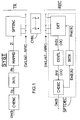
- Fig.1 diagrammatically shows a telecommunication system including at least one transmitter TR and one receiver REC, intended to exchange signals through multiple communication channels CHNL established between Nt transmitting and Nr receiving antennas (ta1,ta2...taNt) and (ra1,ra2...raNr), respectively.
- the transmitter TR shown in the example depicted here includes a channel encoder CHENC intended to apply an encoding, e.g. by means of a convolutional code or of a turbo code, to uncoded data bits Uncb, and to provide a binary stream Tb to be transmitted.
- the transmitter TR includes an interleaver INTL intended to generate permutated bits Pb, such an interleaving being useful for a later processing on the receiver side, since it will allow to obtain uncorrelated data.
- the permutated bits Pb are then divided into sequences of Nt words of at least one bit each, which word sequences are then mapped, i.e. transformed into a series of coded symbols Zi by a mapping and modulation module MAPMD, each symbol Zi then featuring Nt components. Successive symbols Zi are then fed to symbol encoding means essentially formed by a space-time encoder SPTENC, which performs a processing of said symbols Zi before their transmission.
- each symbol Zi is intended to be transmitted during a same time chip by respective transmitting antennas (ta1,ta2...taNt).
- the receiver REC shown in the example depicted here includes a space-time decoder SPTDEC intended to produce decoded data bits Decb which should ultimately correspond to the originally uncoded data bits Uncb.
- This space-time decoder SPTDEC includes a space-time detector DET intended to process data carried by signals received by means of the receiving antennas (ra1,ra2...raNr), and to produce probability values PrIV(ck) related to estimates of the transmitted permutated bits Pb, which probability values are intended to be de-interleaved by a de-interleaver DINTL which is to output soft probability values PrV(ck) related to estimates of bits included in the binary stream Tb.
- a bit decoder included in the receiver REC is intended to generate the decoded data bits Decb on the basis of said probability values PrV(ck).
- this channel decoder CHDEC will make use of prior knowledge pertaining to the encoding scheme used by the channel encoder CHENC included in the transmitter TR for encoding the data bits Uncb, which prior knowledge will enable said channel decoder CHDEC to refine the probability values PrV(ck) delivered by the space-time detector DET via the de-interleaver DINTL.
- the space-time detector DET will make use of a priori information Pra(ck) generated in the course of previous decoding steps, and delivered by the channel decoder CHDEC in the form of extrinsic information Exd(ck) representative of said refined probability values through an interleaver INTR, which interleaver is identical to the interleaver INTL included in the transmitter TR.
- Fig.2 shows in two dimensions an original lattice constellation LATO constituted by symbols which may be transmitted by a transmitter as described above, and a second lattice constellation LATR constituted by symbols which may potentially be received by means of a receiver as described above.
- the original lattice constellation LATO is defined by a first basic vector system (A1, A2), the second lattice constellation LATR being defined by a second basic vector system (A1r, A2r), which is usually different from the first one because of channel communication conditions affecting signals exchanged between the transmitter and the receiver.
- Y is a vector representative of the received symbol y
- B a vector representative of a symbol originally transmitted
- C a matrix representative of the channel or channels through which said symbol has been transmitted
- N a vector representative of the noise affecting said communication channel or channels
- Symbol decoding means at the receiver end are intended to provide a list of estimated symbols belonging to the second lattice constellation LATR, which estimated symbols may represent the transmitted symbol Tx.
- a metric representing the distance between the received symbol y and a given estimated symbol of the lattice constellation may be computed in order to provide a probability value associated with said estimated symbol.
- only the most likely symbols of the second lattice constellation LATR are to be examined, i.e. those symbols who are the closest to the received symbol y.
- the sphere SPH may either be centered on the received symbol y, as is the case in the embodiment of the invention shown here, or may also be centered on a particular symbol MLP of the lattice constellation LATR, which symbol MLP will previously have been identified as being the most likely representative of the received symbol y.
- the listed symbols thus constitute a statistical population within which the value "0" for bit c0 is underrepresented, which may lead to artificial discrepancies between original and refined probability values related to the listed symbols and produced by successive steps of an interpreting process on the basis of this statistical population, which may in turn disturb the interpreting process and cause decoding errors.
- Fig.4 diagrammatically depicts an interpreting method according to an advantageous embodiment of the invention, thanks to which discrepancies between original and refined probability values will be detected and may be suppressed, if said discrepancies stem from artificial causes, by means of corrective interventions, and hence be prevented from disturbing an iterative interpreting process like the one described above.
- the method according to the present invention includes:
- an a posteriori probability value APP(ck 1) for the kth bit ck to be equal to 1
- x) represents a likelihood for receiving y if it is supposed that x has been transmitted, and ⁇ (cl cl(x)) represents an a priori probability that the value of the lth bit cl actually equals that of the lth bit cl of a given symbol x belonging to the list of symbols LoS.
- an interleaved refined probability value Pra(ck) produced by the decoding means DECM in association with a given bit ck may conflict with the de-interleaved probability value PrIV(ck) associated with said given bit ck by the marginalization means MGM.
- the probability for this bit ck to have a given value may for example appear higher than 0.5 at the end of the marginalization step, whereas the refined probability for this bit to have this same given value will appear lower than 0.5 at the end of the decoding step.
- conflicting situations may prevent the iterative interpreting process from converging towards a stable final interpretation of a transmitted symbol, and will for sure lengthen the iterative process since multiple iterations will be required for smoothing out all contradictions.
- conflicting situations as described above thus produce significant adverse effects on the performance of the system.
- the method according to the invention thus further includes:
- the invention thus enables to correct discrepancies by virtue of an increase of the size of the list of symbols LoS constituting the statistical population on the basis of which the probability values PrIV(ck) are computed.
- a variant of the invention may embody a limitation measure according to which only the Nmr most relevant discrepancies shall be corrected, i.e. those featuring the Nmr greatest values for the difference
- the number of symbols p0 to be added to the list of symbols LoS may be limited to Nmr for each corrective iteration by only selecting, for each detected discrepancy, one additional symbol in which only the bit affected by said detected discrepancy will have been complemented.
- the maximal a priori symbol obtained by taking a hard decision on the basis of the refined probability values produced in the course of the decoding step may advantageously be systematically added to the list of symbols if said maximal a priori symbol isn't already included in said list, as explained hereinafter.
- the symbols which could be added to the list of symbols LoS in order to correct the discrepancy detected in relation with bit c0 are thus 0100 and 0101.
- the invention enables to add to the list of symbol LoS at least one non-listed symbol featuring, for the given bit c0, a value corresponding to the refined probability value Pra(ck) produced by the decoding means DECM, which will cause the next probability value PrIV(ck) produced by the marginalization means MGM to converge towards said refined probability value Pra(ck), since the discrepancy detected for bit c0 in this case appears to be caused by an underrepresentation of the value "0" for bit c0 in the listed symbols and thus to have essentially artificial causes, the above corrective process being iterative according to the general principle of the invention depicted here.
- the discrepancy detection means DDM will observe that
- 0.2 ⁇ 0.4 and will thus send a "0" towards the enabling input EN of the list enlarging means LENM, so that no list enlarging step will be carried out with the specific purpose to correct the probability values associated with bit c3, though corrective interventions related to other bits like bit c0 may favour the correction of the small discrepancy affecting bit c3.
- Such selective triggering of the list enlarging step thus enables to save computing time and power.
- a prior knowledge of all other symbols of the lattice constellation may also be used for electing the additional symbol to be added to the list of symbols LoS, in order to enhance the performance of the interpreting method according to the invention.
- an additional symbol p0 to be added to the list [pj] would then be constituted by a particular symbol belonging to a population for which the bit c0 is equal to 0, while being the closest, in the Euclidian or in the Hamming sense, to the original symbol 1100 for which a discrepancy has been detected in relation with a given bit c0.
- the point p5 represents an original symbol 1100 obtained by taking a hard decision on the basis of the probability values PrIV(ck) delivered by the marginalization means MGM, original symbol for which a discrepancy has been detected in relation with a given bit c0.
- Fig.3 depicts an example in which the lattice constellation LATR is two-dimensional, situation in which a non-already listed symbol for which c0 is equal to 0 and which is closest, in the Euclidian sense, to the symbol p5 can be identified at a relatively low cost in terms of computing power as the symbol 0000.
- the lattice constellation LATR involves a high number of dimensions, e.g.
- the label of the first symbol of the original lattice LATO encountered in this direction, for which the invariant bit c0 has a different value, is represented by a set of bits having a value 0000, which will identify, in the second lattice constellation LATR, the additional symbol p0 to be added to the list [pj].
- the symbol obtained by using the original lattice constellation LATO is identical to the symbol obtained directly from the two-dimensional lattice constellation LATR, it must be understood that in other situations, the symbols obtained by means of these two different processes may be different from each other.
- the symbol of the second lattice constellation LATR for which c0 is equal to 0 and which is, in the Hamming sense, closest to the symbol p5 labeled 1100 will be the symbol 0100, since only the bit c0 has to be changed for passing from one to the other.
- This symbol 0100 would thus represent the additional symbol p0 to be added to the list [pj], if only the Hamming criterion were considered.
- an additional symbol generated as described above will preferably not be actually added to an existing list of symbols which happens to already include said additional symbol.
- the above-described interpreting method further includes :
- the decoding means DM intended to carry out the decoding step may sometimes output an integer refined probability value, even if all probability values provided to said decoding means are of a non-integer nature. Such situations may occur due to approximations which will be made during the computational process leading to the refined probability values.
- a refined probability value Exd(ck) equal to 0 or to 1 would have an adverse impact on the performance of the iterative interpreting process and lead to errors in the interpretation, which is prevented in this embodiment of the invention thanks to the integer refined probability detection means IPDM and to the thresholding means IRRM.
Landscapes
- Engineering & Computer Science (AREA)
- Computer Networks & Wireless Communication (AREA)
- Signal Processing (AREA)
- Physics & Mathematics (AREA)
- Probability & Statistics with Applications (AREA)
- Theoretical Computer Science (AREA)
- Error Detection And Correction (AREA)
- Mobile Radio Communication Systems (AREA)
- Two-Way Televisions, Distribution Of Moving Picture Or The Like (AREA)
- Detection And Prevention Of Errors In Transmission (AREA)
Abstract
- symbol listing means SLM for producing a list LoS of symbols pj which may potentially be received,
- marginalization means MGM for associating probability values PrIV(ck) to bits representing said listed symbols pj, and
- decoding means DM for refining said probability values.
- discrepancy detection means DDM for detecting conflicting probability values produced by the marginalization means MGM and by the decoding means DM, and
- list enlarging means for correcting detected discrepancies by adding symbols to the list LoS produced by the symbol listing means SLM.
Description
- The present invention relates to a method for interpreting at least one signal transmitted by means of at least one transmitting antenna and received by means of at least one receiving antenna, which method includes:
- a symbol listing step for producing a list of symbols selected among predetermined symbols which may potentially be received by means of said at least one receiving antenna, each listed symbol being represented by at least one bit,
- a marginalization step for processing said listed symbols in order to produce at least one probability value to be associated to said at least one bit, and
- a decoding step for refining said at least one probability value by taking into account knowledge pertaining to an encoding scheme used for encoding the received signal, a refined probability value produced in the course of the decoding step being intended to be used as an a priori probability value during a subsequent marginalization step.
- Such an interpreting method may be used in telecommunication systems in which multiple antennas are used at a receiver end and/or at a transmitter end of a wireless link, which systems are called Multiple Input Multiple Output systems (further referred to as MIMO systems). MIMO systems have been shown to offer large transmission capacities compared to those offered by single antenna systems. In particular, MIMO capacity increases linearly with the number of transmitting or receiving antennas, whichever the smallest, for a given Signal-to-Noise Ratio and under favourable uncorrelated channel conditions. MIMO techniques are thus likely to be used in future wireless systems intended to provide large spectral efficiencies or, alternatively, reduce the transmitting power required for obtaining a spectral efficiency equivalent to that which is obtained in current telecommunication systems. Such MIMO techniques will very likely be combined with multi-carrier modulation techniques like OFDM (standing for Orthogonal Frequency Division Multiplex) and MC-CDMA (standing for MultiCarrier-Code Division Multiple Access) techniques, whose use in future wireless systems is also considered.
- A particular type of MIMO systems makes use of a Bit Interleaved Coded Modulation technique, further referred to as BICM, according to which the transmitter includes a channel encoder intended to apply an encoding, e.g. by means of a convolutional code or of a turbo code, to uncoded data bits, and to provide a binary stream to an interleaver. This interleaver will then deliver permutated bits, which are to be divided into word sequences intended to be transformed into a series of coded symbols featuring each a plurality of components, the components of a same symbol being intended to be transmitted during a same time chip by respective transmitting antennas.
- Transmitted symbols are to be interpreted on the receiver end, which is usually performed in MIMO systems of the BICM type by means of an iterative space-time interpreting process, which iterative process is intended to produce estimates of the original uncoded data bits on the basis of which the transmitted symbols have been generated. The spatial diversity induced by the use of multiple transmitting and receiving antennas eases such a decoding, since this diversity provides a larger amount of information than that which would be provided by a single signal transmitted through a single communication channel.
- Commonly used iterative interpreting methods require an initial creation, during a symbol listing step, of a limited list of symbols to which initial probability values are to be associated during a subsequent marginalization step. The initial probability value associated with a given listed symbol may for example consist in a metric representing the distance between the given listed symbol and the received symbol. The probability values thus obtained may be refined by making use, in a subsequent decoding step, of additional knowledge pertaining to the encoding scheme which has been used originally for encoding the received signal. The refined probability value produced for each bit belonging to a same set of bits representative of all listed symbols by such a decoding step may then be used, in an a posteriori or, preferably, in an extrinsic form from which a priori information related to each bit under consideration has been individually removed, for constituting a priori information to be taken into account in addition to the above-described metrics during execution of another marginalization step in a subsequent iteration of the iterative interpreting method.
- The inventors have observed occurences of situations in which a refined probability value associated with a given bit conflicts with the original probability value formerly associated with said given bit in the course of the marginalization step. In other terms, the probability for this bit to have a given value may for example appear higher than 0.5 at the end of the marginalization step, whereas the refined probability for this bit to have this same given value will appear lower than 0.5 at the end of the decoding step.
- Such conflicting situations may prevent the iterative interpreting process from converging towards a stable final interpretation of a transmitted symbol, and will for sure lengthen the iterative process since multiple iterations will be required for smoothing out all contradictions. Conflicting situations as described above thus produce significant adverse effects on the performance of the system.
- The inventors have observed that, though conflicting situations as described above may be caused by adverse conditions affecting the wireless link through which the received signal has been transmitted, particularly by noise having a significant level, other conflicting situations, further referred to as artificial discrepancies, are due to the fact that the list of symbols is generated automatically and may thus contain an insufficient number of symbols for the population constituted by the listed symbols to offer the diversity required for said population to be statistically significant.
- Such artificial discrepancies do not reflect any kind of physical phenomenon and carry no informational content, whereas their smoothing out will require processing power and moreover involves an inefficient expenditure of energy, which is in limited supply in a battery-powered receiving device.
- The invention aims at solving this problem, by providing an interpreting method in which artificial discrepancies between original and refined probability values are to be suppressed thanks to corrective interventions in the iterative process described above.
- Indeed, a method according to the opening paragraph is characterized according to the invention in that it further includes:
- a discrepancy detection step for detecting situations in which probability values associated with a same given bit and produced in the course of the marginalization step, on the one hand, and in the course of the decoding step, on the other hand, are respectively smaller than and greater than 0.5 or vice-versa, and
- a list enlarging step for correcting a detected discrepancy by adding at least one additional symbol to the list produced by the symbol listing step.
- The invention allows to correct artificial discrepancies, and thus to prevent them from producing significant adverse effects on an iterative interpreting process, by means of a discrepancy detection and of a subsequent increase of the size of the population on the basis of which the original probability values are computed, which population increase aims at eliminating the statistical cause which may have led to the appearance of the detected discrepancy.
- According to a specific embodiment of the invention, said at least one additional symbol is obtained by identifying at least one original symbol for which a discrepancy has been detected in relation with a given bit and complementing, within said original symbol, at least said given bit.
- The original symbol will usually be obtained by taking a hard decision on the basis of the probability values produced in the course of the marginalization step.
- Such an embodiment of the invention aims at adding to the listed symbols at least one non-listed symbol featuring, for the given bit to which conflicting probability values have been associated, a value corresponding to the refined probability produced in the course of the decoding step, which will cause the next probability value produced in the course of the marginalization step to converge towards said refined probability value, if the detected discrepancy is artificial, i.e. if it is linked to purely statistical causes, the above corrective process being iterative according to the general principle of the invention.
- As explained above, this embodiment of the invention will allow to create, in the case of an artificial discrepancy, a harmonization process aiming at a convergence between the probability values produced in the course of the marginalization step and the refined probability values produced in the course of the decoding step. The choice of the additional symbol or symbols to be added to the list of symbols produced by the listing step may, however, have an impact on the speed of convergence, and thus on the performance of the iterative interpreting process according to the invention.
- A symbol often referred to as maximal a priori symbol, obtained by taking a hard decision on the basis of the refined probability values produced in the course of the decoding step may be systematically added to the list of symbols if said maximal a priori symbol isn't already included in said list, with advantages that will be described later in further detail.
- A prior knowledge of all other symbols of the lattice constellation may advantageously be used for selecting the additional symbol to be added to the list of symbols, in order to enhance the performance of the interpreting method according to this embodiment of the invention.
- According to a variant of the specific embodiment of the invention described above, the additional symbol to be added to the list of symbols will be constituted by a particular symbol of the lattice constellation belonging to a population for which said given bit features the suitable complemented value, while being the member of said population which is the closest to the original symbol.
- The distance separating the original symbol and the additional symbol may be construed as an Euclidian distance or as a distance in the Hamming sense.
- The list enlarging step may be executed automatically as soon as a discrepancy is detected, but should advantageously be triggered selectively only in a situation in which the detected discrepancy is substantial, e.g. only if a difference between a probability value produced in the course of the marginalization step and a corresponding refined probability value produced in the course of the decoding step exceeds a predetermined threshold.
- A selective triggering of the list enlarging step will enable to discount small differences in interpretation between the marginalization step and the decoding step, which should be smoothed out in subsequent iterations without requiring any intervention, and will thus save computing time and power.
- The inventors have observed that decoding means intended to carry out the decoding step may output integer refined probability values, even if all probability values provided to said decoding means are of a non-integer nature. Such situations may occur due to approximations which will be made during the computational process leading to the refined probability values. Such non-integer refined probability values are indicative of irrevocable decisions and may have an adverse impact on the performance of the iterative interpreting process and lead to errors in the interpretation of the transmitted symbol.
- According to another aspect of the invention, a method as described above may thus advantageously also include :
- an integer refined probability detection step for detecting situations in which at least one refined probability value produced by the decoding step is an integer value, and
- a thresholding step for replacing such an integer refined probability value by a predetermined non-integer threshold value.
- Such a variant of the invention guarantees that no integer probability values will be left free to damage the soft-decision iterative interpreting process described above, since they will automatically be replaced by non-integer values. The threshold value may for example be chosen equal to 1-δ if the integer refined probability value is 1 and equal to δ if the integer refined probability value is 0, where δ is a predetermined non-integer value chosen lower than 0.5.
- According to one of its harware-related aspects, the invention also relates to a telecommunication system including at least one transmitter provided with at least one transmitting antenna and at least one receiver provided with at least one receiving antenna, which receiver includes:
- symbol listing means for producing a list of symbols selected among predetermined symbols which may potentially be received by means of said at least one receiving antenna, each listed symbol being represented by at least one bit,
- marginalization means for processing said listed symbols in order to produce at least one probability value to be associated to said at least one bit, and
- decoding means for refining said at least one probability value by taking into account knowledge pertaining to an encoding scheme used for encoding the received signal, a refined probability value produced in the course of the decoding step being intended to be used as an a priori probability value during a subsequent marginalization step,
- discrepancy detection means for detecting situations in which probability values associated with a same given bit and produced by the marginalization means, on the one hand, and by the decoding means, on the other hand, are respectively smaller than and greater than 0.5 or vice-versa, and
- list enlarging means for correcting a detected discrepancy by adding at least one additional symbol to the list produced by the symbol listing means.
- According to another of its hardware-related aspects, the invention also relates to a communication device provided with at least one receiving antenna and including:
- symbol listing means for producing a list of symbols selected among predetermined symbols which may potentially be received by means of said at least one receiving antenna, each listed symbol being represented by at least one bit,
- marginalization means for processing said listed symbols in order to produce at least one probability value to be associated to said at least one bit, and
- decoding means for refining said at least one probability value by taking into account knowledge pertaining to an encoding scheme used for encoding the received signal, a refined probability value produced in the course of the decoding step being intended to be used as an a priori probability value during a subsequent marginalization step,
- discrepancy detection means for detecting situations in which probability values associated with a same given bit and produced by the marginalization means, on the one hand, and by the decoding means, on the other hand, are respectively smaller than and greater than 0.5 or vice-versa, and
- list enlarging means for correcting a detected discrepancy by adding at least one additional symbol to the list produced by the symbol listing means.
- The characteristics of the invention mentioned above, as well as others, will emerge more clearly from a reading of the following description given in relation to the accompanying figures, amongst which:
- Fig.1 is a block diagram showing a highly simplified MIMO telecommunication system in which an interpreting method according to the invention may advantageously be used;
- Fig.2 is a diagram showing an original lattice constellation formed by transmitted symbols at a transmitting end and a transformed lattice constellation formed by symbols which may represent the transmitted symbols at a receiving end;
- Fig.3 is a diagram depicting a symbol listing step carried out in an interpreting method according to the invention; and
- Fig 4 is a diagram depicting an iterative interpreting method according to an advantageous embodiment of the invention.
-
- Fig.1 diagrammatically shows a telecommunication system including at least one transmitter TR and one receiver REC, intended to exchange signals through multiple communication channels CHNL established between Nt transmitting and Nr receiving antennas (ta1,ta2...taNt) and (ra1,ra2...raNr), respectively.
- The transmitter TR shown in the example depicted here includes a channel encoder CHENC intended to apply an encoding, e.g. by means of a convolutional code or of a turbo code, to uncoded data bits Uncb, and to provide a binary stream Tb to be transmitted. The transmitter TR includes an interleaver INTL intended to generate permutated bits Pb, such an interleaving being useful for a later processing on the receiver side, since it will allow to obtain uncorrelated data. The permutated bits Pb are then divided into sequences of Nt words of at least one bit each, which word sequences are then mapped, i.e. transformed into a series of coded symbols Zi by a mapping and modulation module MAPMD, each symbol Zi then featuring Nt components. Successive symbols Zi are then fed to symbol encoding means essentially formed by a space-time encoder SPTENC, which performs a processing of said symbols Zi before their transmission.
- In the known state of the art, the Nt components of each symbol Zi are intended to be transmitted during a same time chip by respective transmitting antennas (ta1,ta2...taNt).
- The receiver REC shown in the example depicted here includes a space-time decoder SPTDEC intended to produce decoded data bits Decb which should ultimately correspond to the originally uncoded data bits Uncb. This space-time decoder SPTDEC includes a space-time detector DET intended to process data carried by signals received by means of the receiving antennas (ra1,ra2...raNr), and to produce probability values PrIV(ck) related to estimates of the transmitted permutated bits Pb, which probability values are intended to be de-interleaved by a de-interleaver DINTL which is to output soft probability values PrV(ck) related to estimates of bits included in the binary stream Tb. A bit decoder included in the receiver REC, further referred to as channel decoder CHDEC, is intended to generate the decoded data bits Decb on the basis of said probability values PrV(ck). Indeed, this channel decoder CHDEC will make use of prior knowledge pertaining to the encoding scheme used by the channel encoder CHENC included in the transmitter TR for encoding the data bits Uncb, which prior knowledge will enable said channel decoder CHDEC to refine the probability values PrV(ck) delivered by the space-time detector DET via the de-interleaver DINTL.
- According to a looped structure commonly used in the art, the space-time detector DET will make use of a priori information Pra(ck) generated in the course of previous decoding steps, and delivered by the channel decoder CHDEC in the form of extrinsic information Exd(ck) representative of said refined probability values through an interleaver INTR, which interleaver is identical to the interleaver INTL included in the transmitter TR.
- Fig.2 shows in two dimensions an original lattice constellation LATO constituted by symbols which may be transmitted by a transmitter as described above, and a second lattice constellation LATR constituted by symbols which may potentially be received by means of a receiver as described above. The original lattice constellation LATO is defined by a first basic vector system (A1, A2), the second lattice constellation LATR being defined by a second basic vector system (A1r, A2r), which is usually different from the first one because of channel communication conditions affecting signals exchanged between the transmitter and the receiver. Moreover, it appears that though a transmitted symbol Tx is by nature located on a point of the original lattice constellation LATO, a corresponding received symbol y is usually not located on a point of the second lattice constellation LATR because of noise affecting the communication channels established between the transmitter and the receiver.
- If Y is a vector representative of the received symbol y, B a vector representative of a symbol originally transmitted, C a matrix representative of the channel or channels through which said symbol has been transmitted and N a vector representative of the noise affecting said communication channel or channels, the above explanations may be mathematically expressed by the equation: Y=C.B+N
- Symbol decoding means at the receiver end are intended to provide a list of estimated symbols belonging to the second lattice constellation LATR, which estimated symbols may represent the transmitted symbol Tx. A metric representing the distance between the received symbol y and a given estimated symbol of the lattice constellation may be computed in order to provide a probability value associated with said estimated symbol. In order to limit the extent of the search for such estimated symbols, only the most likely symbols of the second lattice constellation LATR are to be examined, i.e. those symbols who are the closest to the received symbol y.
- Fig.3 shows how such a limitation of the search for estimated symbols may be performed advantageously thanks to a particular listing scheme, according to which only those symbols pj (for j=1 to 7) which are included in a sphere SPH having a predetermined radius R will be included in the list produced in the course of the symbol listing step.
- In such a symbol listing step, the sphere SPH may either be centered on the received symbol y, as is the case in the embodiment of the invention shown here, or may also be centered on a particular symbol MLP of the lattice constellation LATR, which symbol MLP will previously have been identified as being the most likely representative of the received symbol y.
- The inventors have observed that situations may occur, in which the listed symbols produced by the symbol listing step are such that at least one of the bits representing the listed symbols is almost invariant among said listed symbols.
- Such will be the case, in the example depicted here, if p1 is represented by 1000, p2 by 1010, p3 by 1011, p4 by 1101, p5 by 1100, p6 by 1110, and p7 by 0010, in which situation a first bit c0 of a set {c0, c1, c2, c3} of four bits ck (for k=0 to 3) representing all seven listed symbols corresponding to the points pj (for j=1 to 6) is invariant and equal to "1" among the symbols p1, p2, p3, p4, p5 and p6 and is only equal to "0" for symbol p7. The listed symbols thus constitute a statistical population within which the value "0" for bit c0 is underrepresented, which may lead to artificial discrepancies between original and refined probability values related to the listed symbols and produced by successive steps of an interpreting process on the basis of this statistical population, which may in turn disturb the interpreting process and cause decoding errors.
- Fig.4 diagrammatically depicts an interpreting method according to an advantageous embodiment of the invention, thanks to which discrepancies between original and refined probability values will be detected and may be suppressed, if said discrepancies stem from artificial causes, by means of corrective interventions, and hence be prevented from disturbing an iterative interpreting process like the one described above.
- The method according to the present invention includes:
- symbol listing means SLM for producing, during a symbol listing step, a list LoS of symbols pj,
- marginalization means MGM for processing, during a marginalization step, the symbols included in said list LoS in order to produce an interleaved probability value PrIV(ck) to be associated to each of the bits ck belonging to a same set of bits used for representing all symbols pj,
- de-interleaving means DINTM for transforming, during a de-interleaving step, said interleaved probability values PrIV(ck) into de-interleaved probability values PrV(ck), and
- decoding means DECM for refining, during a decoding step, the de-interleaved probability values PrV(ck) associated to the de-interleaved bits of the symbols included in the list LoS by taking into account knowledge pertaining to an encoding scheme used for encoding the received signal, a refined probability value Exd(ck) related to a given bit ck and produced by the decoding means DECM being intended to be used as an a priori probability value Pra(ck) during a subsequent marginalization step after said refined probability value Exd(ck) will have been re-interleaved in the course of an interleaving step carried out by interleaving means INTM.
- As known from those skilled in the art, an a posteriori probability value APP(ck=1) for the kth bit ck to be equal to 1, and an a posteriori probability value APP(ck=0) for the kth bit ck to be equal to 0 may respectively be expressed as follows:and

- It should further be observed that π(cl=1)=Pra(cl) and π(cl=0)=1-Pra(cl), Pra(cl) representing an a priori probability value for the value of the lth bit cl to be equal to 1.
- An extrinsic probability value for said kth bit ck to be equal to 1, noted XPV(ck=1) and produced by the marginalization means MGM may thus be expressed as follows:the use of such extrinsic values for feedback purposes being usually preferred to that of a posteriori probability values because an extrinsic value related to a given bit is freed from a priori information related to said given bit, which has been used for generating an a posteriori value associated with said given bit. In such a case, PrIV(ck)=XPV(ck=1).

- The inventors have observed that an interleaved refined probability value Pra(ck) produced by the decoding means DECM in association with a given bit ck may conflict with the de-interleaved probability value PrIV(ck) associated with said given bit ck by the marginalization means MGM. In other terms, the probability for this bit ck to have a given value may for example appear higher than 0.5 at the end of the marginalization step, whereas the refined probability for this bit to have this same given value will appear lower than 0.5 at the end of the decoding step.
- In a situation where the four probability values PrIV(c0), PrIV(c1), PrIV(c2) and PrIV(c3) associated with bits c0, c1, c2 and c3 at the end of the marginalization step are respectively equal to 0.8, 0.7, 0.1 and 0.4, whereas the refined probability values Pra(c0), Pra(c1), Pra(c2) and Pra(c3) are respectively equal to 0.1, 0.6, 0.2 and 0.6, two such discrepancies will have occurred, since Pra(c0)=0.1<0.5<PrIV(c0)=0.8 and PrIV(c3)=0.4<0.5<Pra(c3)=0.6.
- Each of these conflicting situations may prevent the iterative interpreting process from converging towards a stable final interpretation of a transmitted symbol, and will for sure lengthen the iterative process since multiple iterations will be required for smoothing out all contradictions. Conflicting situations as described above thus produce significant adverse effects on the performance of the system.
- The method according to the invention thus further includes:
- discrepancy detection means DDM for detecting, during a discrepancy detection step, situations in which probability values PrIV(ck) and Pra(ck) associated with a same given bit ck and produced by the marginalization means MGM, on the one hand, and by the decoding means DECM, on the other hand, are respectively smaller than and greater than 0.5 or vice-versa, and
- list enlarging means LENM for correcting, during a list enlarging step, a detected discrepancy by adding at least one additional symbol p0 to the list LoS produced by the symbol listing means.
- As explained above, discrepancies between original and refined probability values PrIV(ck) and Pra(ck) often originate in an insufficient representation of certain categories of symbols among the listed symbols. The invention thus enables to correct discrepancies by virtue of an increase of the size of the list of symbols LoS constituting the statistical population on the basis of which the probability values PrIV(ck) are computed.
- Generally speaking, ifNd bits differ between symbols obtained by taking a hard decision on the basis of the probability values PrIV(ck), on the one hand, and of the refined probability values Pra(ck), a maximum number of 2Nd symbols could be added to the list of symbols LoS by the list enlarging means LENM. Since the number 2Nd may be too high for a practical and cost-effective implementation, a variant of the invention may embody a limitation measure according to which only the Nmr most relevant discrepancies shall be corrected, i.e. those featuring the Nmr greatest values for the difference |PrIV(ck)-Pra(ck)|. In such an embodiment, the number of symbols p0 to be added to the list of symbols LoS may be limited to Nmr for each corrective iteration by only selecting, for each detected discrepancy, one additional symbol in which only the bit affected by said detected discrepancy will have been complemented.
- The maximal a priori symbol, obtained by taking a hard decision on the basis of the refined probability values produced in the course of the decoding step may advantageously be systematically added to the list of symbols if said maximal a priori symbol isn't already included in said list, as explained hereinafter.
- The additional symbol p0 will preferably be obtained by identifying an original symbol for which at least one discrepancy has been detected, in the example described above the original symbol 1100 for which a discrepancy has been detected in relation with a given bit c0, and complementing, within said original symbol 1100, at least said given bit c0, which would give p0=0100, or 0000, 0001, 0010, 0011, 0101, 0110 or 0111, though it is preferable to leave untouched the bits for which no discrepancy has been detected. The symbols which could be added to the list of symbols LoS in order to correct the discrepancy detected in relation with bit c0 are thus 0100 and 0101.
- The invention enables to add to the list of symbol LoS at least one non-listed symbol featuring, for the given bit c0, a value corresponding to the refined probability value Pra(ck) produced by the decoding means DECM, which will cause the next probability value PrIV(ck) produced by the marginalization means MGM to converge towards said refined probability value Pra(ck), since the discrepancy detected for bit c0 in this case appears to be caused by an underrepresentation of the value "0" for bit c0 in the listed symbols and thus to have essentially artificial causes, the above corrective process being iterative according to the general principle of the invention depicted here.
- It should be noted here that the choice of p0=0101 would simultaneously help to correct the second discrepancy detected in relation with bit c3, since the symbol 0101 also constitutes the maximal a priori symbol. This second detected discrepancy was, however, not very significant since the difference between PrIV(c3)=0.4 and Pra(c3)=0.6 is 0.2, and could be smoothed out in subsequent iterations without requiring any corrective intervention.
- In the embodiment of the invention depicted here, the list enlarging means LENM may be enabled or disabled by means of a signal received on an enabling input EN, so that the list enlarging step will only be triggered in a situation in which the detected discrepancy appears substantial, e.g. only if a difference between a probability value PrIV(ck) produced by the marginalization means MGM and a corresponding refined probability value Pra(ck) produced by the decoding means DECM exceeds a predetermined threshold Th, for example Th=0.4. In the above example, the discrepancy detection means DDM will observe that |PrIV(c3)-Pra(c3)|=0.2<0.4 and will thus send a "0" towards the enabling input EN of the list enlarging means LENM, so that no list enlarging step will be carried out with the specific purpose to correct the probability values associated with bit c3, though corrective interventions related to other bits like bit c0 may favour the correction of the small discrepancy affecting bit c3. Such selective triggering of the list enlarging step thus enables to save computing time and power.
- A prior knowledge of all other symbols of the lattice constellation may also be used for electing the additional symbol to be added to the list of symbols LoS, in order to enhance the performance of the interpreting method according to the invention.
- According to a particular embodiment of the invention, an additional symbol p0 to be added to the list [pj] would then be constituted by a particular symbol belonging to a population for which the bit c0 is equal to 0, while being the closest, in the Euclidian or in the Hamming sense, to the original symbol 1100 for which a discrepancy has been detected in relation with a given bit c0.
- In the example depicted in Fig.3, the point p5 represents an original symbol 1100 obtained by taking a hard decision on the basis of the probability values PrIV(ck) delivered by the marginalization means MGM, original symbol for which a discrepancy has been detected in relation with a given bit c0. Fig.3 depicts an example in which the lattice constellation LATR is two-dimensional, situation in which a non-already listed symbol for which c0 is equal to 0 and which is closest, in the Euclidian sense, to the symbol p5 can be identified at a relatively low cost in terms of computing power as the symbol 0000. In situations where the lattice constellation LATR involves a high number of dimensions, e.g. several tenths of dimensions, such an identification process will require a huge computing power and is thus unrealistic if it is to be performed by a receiver whose operating energy is produced by a finite battery power source. In such a situation, the search for an additional symbol will first be made in the original lattice constellation LATO as shown in Fig.2, which is known to the receiver. This search will start from the symbol defined by the coordinates (11) and (00), and be performed in a direction of variation of the bit to be complemented, in this example the reverse direction of that indicated by vector A 1 in Fig.2. The label of the first symbol of the original lattice LATO encountered in this direction, for which the invariant bit c0 has a different value, is represented by a set of bits having a value 0000, which will identify, in the second lattice constellation LATR, the additional symbol p0 to be added to the list [pj].
- Though in this particular example, the symbol obtained by using the original lattice constellation LATO is identical to the symbol obtained directly from the two-dimensional lattice constellation LATR, it must be understood that in other situations, the symbols obtained by means of these two different processes may be different from each other.
- In the same configuration of the list of symbols depicted in Fig.3, the symbol of the second lattice constellation LATR for which c0 is equal to 0 and which is, in the Hamming sense, closest to the symbol p5 labeled 1100 will be the symbol 0100, since only the bit c0 has to be changed for passing from one to the other. This symbol 0100 would thus represent the additional symbol p0 to be added to the list [pj], if only the Hamming criterion were considered.
- It should also be noted that an additional symbol generated as described above will preferably not be actually added to an existing list of symbols which happens to already include said additional symbol.
- In the embodiment of the invention shown here, the above-described interpreting method further includes :
- integer refined probability detection means IPDM for detecting, during an integer refined probability detection step, situations in which at least one refined probability value Exd(ck) produced by the decoding step DS is an integer value, and
- thresholding means IRRM for replacing, during a thresholding step, such an integer refined probability value Exd(ck) by a predetermined non-integer threshold value Sxd(ck).
- The threshold value Sxd(ck) may for example be chosen equal to 1-δ if the refined probability value Exd(ck) is equal to 1 and equal to δ if the refined probability value Exd(ck) is equal to 0, where δ is a predetermined non-integer value chosen lower than 0.5, for example δ=10-5 or 10-6.
- This is represented by means of a multiplexer MX intended to output either the refined probability value Exd(ck) if it has been recognized as a non-integer value by the detection means IPDM (N=1), or the threshold value Sxd(ck) if the refined probability value Exd(ck) has been recognized as an integer value by the detection means IPDM (N=0).
- The inventors have observed that the decoding means DM intended to carry out the decoding step may sometimes output an integer refined probability value, even if all probability values provided to said decoding means are of a non-integer nature. Such situations may occur due to approximations which will be made during the computational process leading to the refined probability values. As already explained above, a refined probability value Exd(ck) equal to 0 or to 1 would have an adverse impact on the performance of the iterative interpreting process and lead to errors in the interpretation, which is prevented in this embodiment of the invention thanks to the integer refined probability detection means IPDM and to the thresholding means IRRM.
- Though the above description relates to the operation of a receiver in a MIMO telecommunication system, it should be understood that the present invention may be advantageously employed in any kind of telecommunication system in which the identification of a transmitted symbol involves an iterative interpreting process intended to solve an equation of the type: Y=C.B+N, where Y is a vector representative of the received symbol y, B a vector representative of a symbol originally transmitted, C a matrix representative of the channel or channels through which said symbol has been transmitted and N a vector representative of the noise affecting said communication channel or channels.
Claims (9)
- A method for interpreting at least one signal transmitted by means of at least one transmitting antenna and received by means of at least one receiving antenna, which method includes:method characterised in that it further includes:a symbol listing step for producing a list of symbols selected among predetermined symbols which may potentially be received by means of said at least one receiving antenna, each listed symbol being represented by at least one bit,a marginalization step for processing said listed symbols in order to produce at least one probability value to be associated to said at least one bit, anda decoding step for refining said at least one probability value by taking into account knowledge pertaining to an encoding scheme used for encoding the received signal, a refined probability value produced in the course of the decoding step being intended to be used as an a priori probability value during a subsequent marginalization step,a discrepancy detection step for detecting situations in which probability values associated with a same given bit and produced in the course of the marginalization step, on the one hand, and in the course of the decoding step, on the other hand, are respectively smaller than and greater than 0.5 or vice-versa, anda list enlarging step for correcting a detected discrepancy by adding at least one additional symbol to the list produced by the symbol listing step.
- A method as claimed in claim 1, characterized in that a maximal a priori symbol, obtained by taking a hard decision on the basis of the refined probability values produced in the course of the decoding step, constitutes an additional symbol to be added to the list produced by the symbol listing step.
- A method as claimed in claim 1, in which said at least one additional symbol is obtained by identifying at least one original symbol for which a discrepancy has been detected in relation with a given bit and complementing, within said original symbol, at least said given bit.
- A method as claimed in claim 3, in which the symbol to be added to the list is constituted by a particular symbol of the lattice constellation belonging to a population for which said given bit features the suitable complemented value, while being the member of said population which is the closest to the original symbol.
- A method as claimed in any one of claims 1 to claim 4, characterized in that the list enlarging step is to be executed only if a difference between a probability value produced in the course of the marginalization step and a corresponding refined probability value produced in the course of the decoding step exceeds a predetermined threshold.
- A method as claimed in any one of claims 1 to claim 5, characterized in that it further includes :an integer refined probability detection step for detecting situations in which at least one refined probability value produced by the decoding step is an integer value, anda thresholding step for replacing such an integer refined probability value by a predetermined non-integer threshold value.
- A method as claimed in claim 6, characterized in that the threshold value is equal to 1-δ if the integer refined probability value is 1 and equal to δ if the integer refined probability value is 0, where δ is a predetermined non-integer value chosen lower than 0.5.
- A telecommunication system including at least one transmitter provided with at least one transmitting antenna and at least one receiver provided with at least one receiving antenna, which receiver includes:symbol listing means for producing a list of symbols selected among predetermined symbols which may potentially be received by means of said at least one receiving antenna, each listed symbol being represented by at least one bit,marginalization means for processing said listed symbols in order to produce at least one probability value to be associated to said at least one bit, anddecoding means for refining said at least one probability value by taking into account knowledge pertaining to an encoding scheme used for encoding the received signal, a refined probability value produced in the course of the decoding step being intended to be used as an a priori probability value during a subsequent marginalization step,
telecommunication system characterized in that the receiver further includes:discrepancy detection means for detecting situations in which probability values associated with a same given bit and produced by the marginalization means, on the one hand, and by the decoding means, on the other hand, are respectively smaller than and greater than 0.5 or vice-versa, andlist enlarging means for correcting a detected discrepancy by adding at least one additional symbol to the list produced by the symbol listing means. - A communication device provided with at least one receiving antenna and including:symbol listing means for producing a list of symbols selected among predetermined symbols which may potentially be received by means of said at least one receiving antenna, each listed symbol being represented by at least one bit,marginalization means for processing said listed symbols in order to produce at least one probability value to be associated to said at least one bit, anddecoding means for refining said at least one probability value by taking into account knowledge pertaining to an encoding scheme used for encoding the received signal, a refined probability value produced in the course of the decoding step being intended to be used as an a priori probability value during a subsequent marginalization step,
which communication device further includes:discrepancy detection means for detecting situations in which probability values associated with a same given bit and produced by the marginalization means, on the one hand, and by the decoding means, on the other hand, are respectively smaller than and greater than 0.5 or vice-versa, andlist enlarging means for correcting a detected discrepancy by adding at least one additional symbol to the list produced by the symbol listing means.
Priority Applications (4)
| Application Number | Priority Date | Filing Date | Title |
|---|---|---|---|
| DE60311839T DE60311839T2 (en) | 2003-12-18 | 2003-12-18 | A method of interpreting signals transmitted by a transmitting antenna and received by a receiving antenna |
| AT03293222T ATE354219T1 (en) | 2003-12-18 | 2003-12-18 | METHOD FOR INTERPRETING TRANSMITTED SYMBOLS ALLOWING REPEATED ADJUSTMENT OF A BASIC LIST OF SYMBOLS |
| EP03293222A EP1545038B1 (en) | 2003-12-18 | 2003-12-18 | Method for interpreting transmitted symbols allowing an iterative adaptation of a basic list of symbols |
| JP2004368539A JP4429155B2 (en) | 2003-12-18 | 2004-12-20 | Method for determining at least one signal, communication system and communication device comprising at least one transmitter |
Applications Claiming Priority (1)
| Application Number | Priority Date | Filing Date | Title |
|---|---|---|---|
| EP03293222A EP1545038B1 (en) | 2003-12-18 | 2003-12-18 | Method for interpreting transmitted symbols allowing an iterative adaptation of a basic list of symbols |
Publications (2)
| Publication Number | Publication Date |
|---|---|
| EP1545038A1 true EP1545038A1 (en) | 2005-06-22 |
| EP1545038B1 EP1545038B1 (en) | 2007-02-14 |
Family
ID=34486492
Family Applications (1)
| Application Number | Title | Priority Date | Filing Date |
|---|---|---|---|
| EP03293222A Expired - Lifetime EP1545038B1 (en) | 2003-12-18 | 2003-12-18 | Method for interpreting transmitted symbols allowing an iterative adaptation of a basic list of symbols |
Country Status (4)
| Country | Link |
|---|---|
| EP (1) | EP1545038B1 (en) |
| JP (1) | JP4429155B2 (en) |
| AT (1) | ATE354219T1 (en) |
| DE (1) | DE60311839T2 (en) |
Citations (1)
| Publication number | Priority date | Publication date | Assignee | Title |
|---|---|---|---|---|
| US20030076890A1 (en) * | 2001-07-26 | 2003-04-24 | Lucent Technologies, Inc. | Method and apparatus for detection and decoding of signals received from a linear propagation channel |
-
2003
- 2003-12-18 EP EP03293222A patent/EP1545038B1/en not_active Expired - Lifetime
- 2003-12-18 DE DE60311839T patent/DE60311839T2/en not_active Expired - Lifetime
- 2003-12-18 AT AT03293222T patent/ATE354219T1/en not_active IP Right Cessation
-
2004
- 2004-12-20 JP JP2004368539A patent/JP4429155B2/en not_active Expired - Fee Related
Patent Citations (1)
| Publication number | Priority date | Publication date | Assignee | Title |
|---|---|---|---|---|
| US20030076890A1 (en) * | 2001-07-26 | 2003-04-24 | Lucent Technologies, Inc. | Method and apparatus for detection and decoding of signals received from a linear propagation channel |
Non-Patent Citations (4)
| Title |
|---|
| BOUTROS J J ET AL: "Bit-interleaved coded modulations for multiple-input multiple-output channels", IEEE 6TH SYMP. ON SPREAD-SPECTRUM TECH. APPLI., NJIT, vol. 1, 6 September 2000 (2000-09-06) - 8 September 2000 (2000-09-08), NEW JERSEY, USA, pages 123 - 126, XP010517534 * |
| GUEGUEN A: "Comparison of suboptimal iterative space-time receivers", 57TH IEEE SEMIANNUAL VEHICULAR TECHNOLOGY CONFERENCE, 22 April 2003 (2003-04-22) - 25 April 2003 (2003-04-25), PISCATAWAY, NJ, USA, pages 842 - 846 vol.2, XP002287833, ISBN: 0-7803-7757-5 * |
| HOCHWALD B M ET AL: "ACHIEVING NEAR-CAPACITY ON A MULTIPLE-ANTENNA CHANNEL", IEEE TRANSACTIONS ON COMMUNICATIONS, IEEE INC. NEW YORK, US, vol. 51, no. 3, March 2003 (2003-03-01), pages 389 - 399, XP001163616, ISSN: 0090-6778 * |
| REID A B ET AL: "List detection for multi-access channels", GLOBECOM'02. 2002 - IEEE GLOBAL TELECOMMUNICATIONS CONFERENCE. CONFERENCE PROCEEDINGS. TAIPEI, TAIWAN, NOV. 17 - 21, 2002, IEEE GLOBAL TELECOMMUNICATIONS CONFERENCE, NEW YORK, NY : IEEE, US, vol. VOL. 1 OF 3, 17 November 2002 (2002-11-17), pages 1083 - 1087, XP010636313, ISBN: 0-7803-7632-3 * |
Also Published As
| Publication number | Publication date |
|---|---|
| DE60311839T2 (en) | 2007-11-22 |
| ATE354219T1 (en) | 2007-03-15 |
| EP1545038B1 (en) | 2007-02-14 |
| JP4429155B2 (en) | 2010-03-10 |
| JP2005204302A (en) | 2005-07-28 |
| DE60311839D1 (en) | 2007-03-29 |
Similar Documents
| Publication | Publication Date | Title |
|---|---|---|
| EP3119021B1 (en) | Multi-antenna apparatus using different interleaving patterns | |
| JP4188814B2 (en) | Transmitting apparatus and receiving apparatus for wireless communication system having three transmitting antennas | |
| CN101917257B (en) | Incremental redundancy transmission in a MIMO communication system | |
| JP5395099B2 (en) | Adaptive forward-backward soft output M-algorithm receiver structure | |
| EP1004181B1 (en) | Communications systems and methods employing selective recursive decoding | |
| CN106357373B (en) | Space modulation physical layer safe transmission method based on artificial noise | |
| EP2405590A1 (en) | Coder, receiver, wireless communication system, puncture pattern selection method, and program therefor | |
| WO2003058905A1 (en) | Data transmission and reception method and apparatus | |
| JP2009527174A (en) | Apparatus, method and computer program for providing MIMO receiver | |
| CN101507119A (en) | Method and apparatus for generating a punctured symbol vector for a given information vector | |
| US7366249B2 (en) | Method for transmitting optimally interleaved data in a MIMO telecommunication system | |
| US11050590B2 (en) | Decoder-supported iterative channel estimation | |
| KR20070063115A (en) | Apparatus and Method for Iterative Detection and Decoding in Multi-antenna Communication System | |
| EP1670168B1 (en) | Method, system and device for transmitting uniformly distributed data in MIMO telecommunication systems | |
| EP1545038B1 (en) | Method for interpreting transmitted symbols allowing an iterative adaptation of a basic list of symbols | |
| EP1545081B1 (en) | Method for soft decoding with propability value correction | |
| EP1545039B1 (en) | Method for interpreting transmitted symbols involving a list sphere radius tuning step | |
| CN119363153B (en) | A shared codebook multiple access transmission method without user identification approaching the theoretical capacity in finite fields | |
| EP2228935A1 (en) | MIMO communication method and devices | |
| US11700040B2 (en) | Method for enhancing the performance of downlink multi-user MIMO systems | |
| WO2001043289A1 (en) | Method and apparatus providing bit-to-symbol mapping for space-time codes | |
| Krishnasamy et al. | A Novel Stochastic Model For Grouped Weighted Multilevel Space-Time Trellis Codes For Rayleigh Fading Channels | |
| Ramirez et al. | Soft output detection using path detector for multiple antennas | |
| Wang et al. | Coded MIMO using interblock memory | |
| HK1112339B (en) | Method and apparatus for incremental redundancy transmission in a mimo communication system |
Legal Events
| Date | Code | Title | Description |
|---|---|---|---|
| PUAI | Public reference made under article 153(3) epc to a published international application that has entered the european phase |
Free format text: ORIGINAL CODE: 0009012 |
|
| AK | Designated contracting states |
Kind code of ref document: A1 Designated state(s): AT BE BG CH CY CZ DE DK EE ES FI FR GB GR HU IE IT LI LU MC NL PT RO SE SI SK TR |
|
| AX | Request for extension of the european patent |
Extension state: AL LT LV MK |
|
| 17P | Request for examination filed |
Effective date: 20050823 |
|
| AKX | Designation fees paid |
Designated state(s): AT BE BG CH CY CZ DE DK EE ES FI FR GB GR HU IE IT LI LU MC NL PT RO SE SI SK TR |
|
| RAP1 | Party data changed (applicant data changed or rights of an application transferred) |
Owner name: MITSUBISHI ELECTRIC INFORMATION TECHNOLOGY CENTRE Owner name: MITSUBISHI DENKI KABUSHIKI KAISHA |
|
| GRAP | Despatch of communication of intention to grant a patent |
Free format text: ORIGINAL CODE: EPIDOSNIGR1 |
|
| GRAS | Grant fee paid |
Free format text: ORIGINAL CODE: EPIDOSNIGR3 |
|
| GRAA | (expected) grant |
Free format text: ORIGINAL CODE: 0009210 |
|
| AK | Designated contracting states |
Kind code of ref document: B1 Designated state(s): AT BE BG CH CY CZ DE DK EE ES FI FR GB GR HU IE IT LI LU MC NL PT RO SE SI SK TR |
|
| PG25 | Lapsed in a contracting state [announced via postgrant information from national office to epo] |
Ref country code: FI Free format text: LAPSE BECAUSE OF FAILURE TO SUBMIT A TRANSLATION OF THE DESCRIPTION OR TO PAY THE FEE WITHIN THE PRESCRIBED TIME-LIMIT Effective date: 20070214 Ref country code: BE Free format text: LAPSE BECAUSE OF FAILURE TO SUBMIT A TRANSLATION OF THE DESCRIPTION OR TO PAY THE FEE WITHIN THE PRESCRIBED TIME-LIMIT Effective date: 20070214 Ref country code: AT Free format text: LAPSE BECAUSE OF FAILURE TO SUBMIT A TRANSLATION OF THE DESCRIPTION OR TO PAY THE FEE WITHIN THE PRESCRIBED TIME-LIMIT Effective date: 20070214 Ref country code: SI Free format text: LAPSE BECAUSE OF FAILURE TO SUBMIT A TRANSLATION OF THE DESCRIPTION OR TO PAY THE FEE WITHIN THE PRESCRIBED TIME-LIMIT Effective date: 20070214 Ref country code: DK Free format text: LAPSE BECAUSE OF FAILURE TO SUBMIT A TRANSLATION OF THE DESCRIPTION OR TO PAY THE FEE WITHIN THE PRESCRIBED TIME-LIMIT Effective date: 20070214 Ref country code: LI Free format text: LAPSE BECAUSE OF FAILURE TO SUBMIT A TRANSLATION OF THE DESCRIPTION OR TO PAY THE FEE WITHIN THE PRESCRIBED TIME-LIMIT Effective date: 20070214 Ref country code: NL Free format text: LAPSE BECAUSE OF FAILURE TO SUBMIT A TRANSLATION OF THE DESCRIPTION OR TO PAY THE FEE WITHIN THE PRESCRIBED TIME-LIMIT Effective date: 20070214 Ref country code: CH Free format text: LAPSE BECAUSE OF FAILURE TO SUBMIT A TRANSLATION OF THE DESCRIPTION OR TO PAY THE FEE WITHIN THE PRESCRIBED TIME-LIMIT Effective date: 20070214 |
|
| REG | Reference to a national code |
Ref country code: GB Ref legal event code: FG4D |
|
| REG | Reference to a national code |
Ref country code: CH Ref legal event code: EP |
|
| REF | Corresponds to: |
Ref document number: 60311839 Country of ref document: DE Date of ref document: 20070329 Kind code of ref document: P |
|
| REG | Reference to a national code |
Ref country code: IE Ref legal event code: FG4D |
|
| PG25 | Lapsed in a contracting state [announced via postgrant information from national office to epo] |
Ref country code: SE Free format text: LAPSE BECAUSE OF FAILURE TO SUBMIT A TRANSLATION OF THE DESCRIPTION OR TO PAY THE FEE WITHIN THE PRESCRIBED TIME-LIMIT Effective date: 20070514 |
|
| PG25 | Lapsed in a contracting state [announced via postgrant information from national office to epo] |
Ref country code: BG Free format text: LAPSE BECAUSE OF EXPIRATION OF PROTECTION Effective date: 20070515 |
|
| PG25 | Lapsed in a contracting state [announced via postgrant information from national office to epo] |
Ref country code: ES Free format text: LAPSE BECAUSE OF FAILURE TO SUBMIT A TRANSLATION OF THE DESCRIPTION OR TO PAY THE FEE WITHIN THE PRESCRIBED TIME-LIMIT Effective date: 20070525 |
|
| PG25 | Lapsed in a contracting state [announced via postgrant information from national office to epo] |
Ref country code: PT Free format text: LAPSE BECAUSE OF FAILURE TO SUBMIT A TRANSLATION OF THE DESCRIPTION OR TO PAY THE FEE WITHIN THE PRESCRIBED TIME-LIMIT Effective date: 20070716 |
|
| REG | Reference to a national code |
Ref country code: FR Ref legal event code: RN |
|
| NLV1 | Nl: lapsed or annulled due to failure to fulfill the requirements of art. 29p and 29m of the patents act | ||
| REG | Reference to a national code |
Ref country code: FR Ref legal event code: FC |
|
| REG | Reference to a national code |
Ref country code: CH Ref legal event code: PL |
|
| EN | Fr: translation not filed | ||
| ET | Fr: translation filed | ||
| PG25 | Lapsed in a contracting state [announced via postgrant information from national office to epo] |
Ref country code: SK Free format text: LAPSE BECAUSE OF FAILURE TO SUBMIT A TRANSLATION OF THE DESCRIPTION OR TO PAY THE FEE WITHIN THE PRESCRIBED TIME-LIMIT Effective date: 20070214 |
|
| PLBE | No opposition filed within time limit |
Free format text: ORIGINAL CODE: 0009261 |
|
| STAA | Information on the status of an ep patent application or granted ep patent |
Free format text: STATUS: NO OPPOSITION FILED WITHIN TIME LIMIT |
|
| PG25 | Lapsed in a contracting state [announced via postgrant information from national office to epo] |
Ref country code: CZ Free format text: LAPSE BECAUSE OF FAILURE TO SUBMIT A TRANSLATION OF THE DESCRIPTION OR TO PAY THE FEE WITHIN THE PRESCRIBED TIME-LIMIT Effective date: 20070214 Ref country code: RO Free format text: LAPSE BECAUSE OF FAILURE TO SUBMIT A TRANSLATION OF THE DESCRIPTION OR TO PAY THE FEE WITHIN THE PRESCRIBED TIME-LIMIT Effective date: 20070214 |
|
| 26N | No opposition filed |
Effective date: 20071115 |
|
| PG25 | Lapsed in a contracting state [announced via postgrant information from national office to epo] |
Ref country code: GR Free format text: LAPSE BECAUSE OF FAILURE TO SUBMIT A TRANSLATION OF THE DESCRIPTION OR TO PAY THE FEE WITHIN THE PRESCRIBED TIME-LIMIT Effective date: 20070515 |
|
| PG25 | Lapsed in a contracting state [announced via postgrant information from national office to epo] |
Ref country code: MC Free format text: LAPSE BECAUSE OF NON-PAYMENT OF DUE FEES Effective date: 20071231 |
|
| PG25 | Lapsed in a contracting state [announced via postgrant information from national office to epo] |
Ref country code: IE Free format text: LAPSE BECAUSE OF NON-PAYMENT OF DUE FEES Effective date: 20071218 |
|
| PG25 | Lapsed in a contracting state [announced via postgrant information from national office to epo] |
Ref country code: EE Free format text: LAPSE BECAUSE OF FAILURE TO SUBMIT A TRANSLATION OF THE DESCRIPTION OR TO PAY THE FEE WITHIN THE PRESCRIBED TIME-LIMIT Effective date: 20070214 |
|
| PG25 | Lapsed in a contracting state [announced via postgrant information from national office to epo] |
Ref country code: CY Free format text: LAPSE BECAUSE OF FAILURE TO SUBMIT A TRANSLATION OF THE DESCRIPTION OR TO PAY THE FEE WITHIN THE PRESCRIBED TIME-LIMIT Effective date: 20070214 |
|
| PG25 | Lapsed in a contracting state [announced via postgrant information from national office to epo] |
Ref country code: LU Free format text: LAPSE BECAUSE OF NON-PAYMENT OF DUE FEES Effective date: 20071218 |
|
| PG25 | Lapsed in a contracting state [announced via postgrant information from national office to epo] |
Ref country code: TR Free format text: LAPSE BECAUSE OF FAILURE TO SUBMIT A TRANSLATION OF THE DESCRIPTION OR TO PAY THE FEE WITHIN THE PRESCRIBED TIME-LIMIT Effective date: 20070214 Ref country code: HU Free format text: LAPSE BECAUSE OF FAILURE TO SUBMIT A TRANSLATION OF THE DESCRIPTION OR TO PAY THE FEE WITHIN THE PRESCRIBED TIME-LIMIT Effective date: 20070815 |
|
| PGFP | Annual fee paid to national office [announced via postgrant information from national office to epo] |
Ref country code: GB Payment date: 20131219 Year of fee payment: 11 Ref country code: DE Payment date: 20131220 Year of fee payment: 11 |
|
| PGFP | Annual fee paid to national office [announced via postgrant information from national office to epo] |
Ref country code: IT Payment date: 20131216 Year of fee payment: 11 |
|
| PGFP | Annual fee paid to national office [announced via postgrant information from national office to epo] |
Ref country code: FR Payment date: 20131230 Year of fee payment: 11 |
|
| REG | Reference to a national code |
Ref country code: DE Ref legal event code: R119 Ref document number: 60311839 Country of ref document: DE |
|
| GBPC | Gb: european patent ceased through non-payment of renewal fee |
Effective date: 20141218 |
|
| REG | Reference to a national code |
Ref country code: FR Ref legal event code: ST Effective date: 20150831 |
|
| PG25 | Lapsed in a contracting state [announced via postgrant information from national office to epo] |
Ref country code: DE Free format text: LAPSE BECAUSE OF NON-PAYMENT OF DUE FEES Effective date: 20150701 Ref country code: GB Free format text: LAPSE BECAUSE OF NON-PAYMENT OF DUE FEES Effective date: 20141218 |
|
| PG25 | Lapsed in a contracting state [announced via postgrant information from national office to epo] |
Ref country code: FR Free format text: LAPSE BECAUSE OF NON-PAYMENT OF DUE FEES Effective date: 20141231 |
|
| PG25 | Lapsed in a contracting state [announced via postgrant information from national office to epo] |
Ref country code: IT Free format text: LAPSE BECAUSE OF NON-PAYMENT OF DUE FEES Effective date: 20141218 |