-
The present invention relates to human anti-idiotypic antibody fragments that
mimic the HER-2/neu tumor-associated antigen.
-
For active cancer immunotherapy, the tumor-associated antigen (TAA) HER-2/neu
is a promising cancer vaccine candidate since it is overexpressed on the surface
of a number of human cancers, but its expression in normal tissue is restricted. It has
been shown to be immunogenic in animals and in humans, and it is targetable by
monoclonal antibodies. This 185-kDa transmembrane phosphoglycoprotein consists of
a cysteine-rich extracellular domain (ECD) that functions in ligand binding and an
intracellular cytoplasmic domain with kinase activity. Moreover, HER-2/neu is a
member of the epidermal growth factor receptor family. Cancers in which HER-2/neu
protein overexpression occurs include human adenocarcinomas such as breast (in 20%
to 40% of intraductal carcinomas) or ovary (in 30%). Although overexpression has
been linked to more aggressive disease and a poorer prognosis in node-positive breast
cancer, it has also been established that it is related to a favorable prognosis in some
patients with stage I breast tumors that contain inflammatory infiltrates which may
represent an immune response directed against autologous cancer cells (Rilke et al.
1991). One hypothesis is that the better outcome in these patients may be related to the
generation of an HER-2/neu-specific immune response which could directly or
indirectly limit further growth and metastasis. Different investigations defining HER-2/neu-specific
immunity in patients with cancer indicate that high levels of both T-cell
and antibody immunity exists in some patients, even if it is low or lacking in the
majority of them (Disis et al. 1994 - Fisk et al. 1995 - Peoples et al. 1995). This
strongly suggests that immunological tolerance exists, probably related to the oncofetal
origin of HER-2/neu, and that it represents a barrier to effective vaccination against this
antigen (Nanda et al. 1995 - Disis et al. 1998). Futhermore, different studies have
proven that anti-HER-2/neu monoclonal antibodies (mAbs) can be effective in
eradicating tumors (Baselga et al. 2001).
These findings have stimulated further studies to test vaccine strategies to
induce and increase immunity to HER-2/neu for the treatment of breast cancer or for
the prevention of recurrent disease. Effective vaccine strategies must circumvent
tolerance. For this reason, methods to break this tolerance, such as presenting the
critical epitope in a different molecular environment to the tolerized host, have been
developed. Several studies have evaluated whether tolerance to HER-2/neu could be
circumvented by immunization with either peptide-based vaccines (Disis et al. 1996 -
Dakappagari et al., 2000 - Disis et al. 2002) or DNA (Concetti et al. 1996 - Di Carlo et
al. 2001 - Pilon et al. 2001). Some encouraging results were obtained but with
persistence of problems such as the weak immunogenicity of the peptides or the
potential adverse effect of administering plasmid DNA encoding a functional
oncogene.
-
Among the vaccine strategies developed to overcome immune tolerance to
self-proteins, vaccination with anti-idiotypic antibodies has been described as a
promising approach for treatment of several malignant diseases.
-
Anti-idiotypic antibodies are antibodies directed against the antigen-combining
region or variable region (called the idiotype or Id) of another antibody molecule. In
theory, based on Jerne's network model of idiotypic relationships (Jerne 1974 - Jerne et
al., 1982), immunization with an antibody molecule expressing a paratope (antigen-combining
site) for a given antigen should produce a group of anti-antibodies, some of
which share with the antigen a complementary structure to the paratope. Immunization
with a subpopulation of the anti-idiotypic antibodies should in turn produce a
subpopulation of antibodies or immune cell subsets that are reactive to the initial
antigen.
-
Active immunization with tumor-specific Id vaccines has very early been
shown to inhibit tumor growth in animals (Kennedy et al. 1985).
-
US. Patent 5,766,588 proposes methods which utilize anti-idiotypic antibodies
for tumor immunotherapy or immunoprophylaxis. However, the anti-idiotypic
antibodies described in this U.S. patent are murine antibodies that are secreted by
hybridomas.
-
Anti-Id antibodies that functionnally mimic an antigen have been used for the
treatment of colorectal carcinoma [CEA, (Foon et al. 1999)], B and T-cell lymphoma
[gp72, (Kwak et al. 1992) and gp37 (Bhattacharya-Chatterjee et al. 1988),
respectively], and for the treatment of melanoma by triggering an active immune
response against the disialoganglioside GD2 (Foon et al. 2000). Anti-diotypic mAbs
mimicking the human high molecular weight melanoma-associated antigen have also
been tested in a clinical trial to implement active specific immunotherapy (Mitttelman
et al. 1990).
In 1998, carcinoembryonic antigen (CEA) mimicry by an anti-idiotypic single
chain variable fragment (scFv) constructed from a murine mAb was published with
convincing results regarding the level of the humoral response raised in mice (Tripathi
et al. 1998). More recently, a study from the same group described the use of a murine
monoclonal anti-Id antibody as a surrogate antigen for human HER-2/neu (Baral et al.
2001).
However, most of the antibodies tested in these prior studies are murine
antibodies, which are likely to provoke undesirable side effects in humans. Repeated
injections in humans of a "foreign" antibody, such as a mouse antibody, may indeed
lead to harmful hypersensitivity reactions, i. e., anti-mouse antibody (HAMA) or an
anti-idiotypic response. The HAMA response makes repeated administrations less
effective due to an increased rate of clearance from the patient's serum and/or allergic
reactions by the patient. This problem can, in principle, be avoided by making
antibodies that are not recognized as foreign by the human immune system.
Yet little is known about human anti-idiotypic antibodies, as mentioned in
Leung et al., 2000.
-
The present invention thus fulfils a need by providing human anti-idiotypic
antibody fragments that mimic the Her-2/neu tumor-associated antigen, particularly
useful in an active immunotherapy for cancer patients positive for Her-2/neu.
The inventors more specifically selected by phage display and characterized
anti-idiotypic scFv directed against the F(ab')2 fragments of a known anti-Her-2/neu
antibody. Data obtained from an in vivo study using different immunization schedules
indicate that these human anti-Id scFv can induce an effective anti-HER-2/neu humoral
response.
-
On this basis, a subject of the present invention is a human anti-idiotypic
fragment characterized by the ability to mimic Her-2/neu tumor associated antigen.
Another subject of the invention is a pharmaceutical composition comprising
such antibody fragment, in association with a pharmaceutically acceptable carrier.
A further subject of the invention is the use of such antibody fragment for the
prevention or treatment of a tumor wherein Her-2/neu is overexpressed.
Another subject of the invention is an ex vivo method for preparing antigen-presenting
cells (APCs), such as dendritic cells, useful for inducing Her-2/neu specific
protective antitumor immunity, which method comprises contacting an APC with such
antibody fragment. The APC is then useful for the prevention or treatment of a tumor
wherein Her-2/neu is overexpressed.
General definitions :
-
According to the present invention, "antibody" or "immunoglobulin" have the
same meaning, and will be used equally in the present invention. In natural antibodies,
the two heavy chains are linked to each other by disulfide bonds and each heavy chain
is linked to a light chain by a disulfide bond. There are two types of light chain, lambda
(λ) and kappa (κ). There are five main heavy chain classes (or isotypes) which
determine the functional activity of an antibody molecule: IgM, IgD, IgG, IgA and
IgE. Preferably, the antibody is an IgG such as IgG1, IgG2, IgG3 or IgG4. Each chain
contains distinct sequence domains. The light chain includes two domains, a variable
domain (VL) and a constant domain (CL). The heavy chain includes four domains, a
variable domain (VH) and three constant domains (CH1, CH2 and CH3, collectively
referred to as CH). The variable regions of both light (VL) and heavy (VH) chains
determine binding recognition and specificity to the antigen. The constant region
domains of the light (CL) and heavy (CH) chains confer important biological properties
such as antibody chain association, secretion, transplacental mobility, complement
binding, and binding to Fc receptors. The Fv fragment is the N-terminal part of the Fab
fragment of an immunoglobulin consisting of the variable portions of one light chain
and one heavy chain. The specificity of the antibody resides in the structural
complementarity between the antibody combining site and the antigenic determinant.
Antibody combining sites are made up of residues that are primarily from the
hypervariable or complementarity determining regions (CDRs). Occasionally, residues
from nonhypervariable or framework regions (FR) influence the overall domain
structure and hence the combining site. The CDR refers to amino acid sequences which
together define the binding affinity and specificity of the natural Fv region of a native
immunoglobulin binding site. The light and heavy chains of an immunoglobulin each
have three CDRs, designated L-CDR1, L-CDR2, L-CDR3 and H-CDR1, H-CDR2, H-CDR3,
respectively. An antigen-binding site, therefore, includes six CDRs, comprising
the CDR set from each of a heavy and a light chain V region. FR refers to amino acid
sequences interposed between CDRs.
-
The invention provides an isolated functional antibody Fab or scFv fragment
that mimics HER-2/neu. Preferably, the antibody fragment of the invention is a scFv
fragment.
A single chain Fv ("scFv") polypeptide is a covalently linked VH::VL
heterodimer which is usually expressed from a gene fusion including VH and VL
encoding genes linked by a peptide-encoding linker. The human scFv fragment of the
invention includes CDRs that are held in appropriate conformation, preferably by using
gene recombination techniques.
-
By "purified" and "isolated" it is meant, when referring to a polypeptide (i.e.
the antibody fragment of the invention) or a nucleotide sequence, that the indicated
molecule is present in the substantial absence of other biological macromolecules of the
same type. The term "purified" as used herein preferably means at least 75% by weight,
more preferably at least 85% by weight, more preferably still at least 95% by weight,
and most preferably at least 98% by weight, of biological macromolecules of the same
type are present. An "isolated" nucleic acid molecule which encodes a particular
polypeptide refers to a nucleic acid molecule which is substantially free of other nucleic
acid molecules that do not encode the subject polypeptide; however, the molecule may
include some additional bases or moieties which do not deleteriously affect the basic
characteristics of the composition.
"Function-conservative variants" are those in which a given amino acid
residue in a protein has been changed without altering the overall conformation and
function of the polypeptide, including, but not limited to, replacement of an amino acid
with one having similar properties (such as, for example, polarity, hydrogen bonding
potential, acidic, basic, hydrophobic, aromatic, and the like). Amino acids with similar
properties are well known in the art. For example, arginine, histidine and lysine are
hydrophilic-basic amino acids and may be interchangeable. Similarly, isoleucine, a
hydrophobic amino acid, may be replaced with leucine, methionine or valine. Such
changes are expected to have little or no effect on the apparent molecular weight or
isoelectric point of the protein or polypeptide. Amino acids other than those indicated
as conserved may differ in a protein so that the percent protein or amino acid sequence
similarity between any two proteins of similar function may vary and may be, for
example, from 70 % to 99 % as determined according to an alignment scheme such as
by the Cluster Method, wherein similarity is based on the MEGALIGN algorithm. A
"function-conservative variant" also includes a polypeptide which has at least 60 %
amino acid identity as determined by BLAST or FASTA algorithms, preferably at least
75 %, most preferably at least 85%, and even more preferably at least 90 %, and which
has the same or substantially similar properties or functions as the native or parent
protein to which it is compared.
-
Two amino acid sequences are "substantially homologous" or "substantially
similar" when greater than 80 %, preferably greater than 85 %, preferably greater than
90 % of the amino acids are identical, or greater than about 90 %, preferably grater than
95 %, are similar (functionally identical). Preferably, the similar or homologous
sequences are identified by alignment using, for example, the GCG (Genetics
Computer Group, Program Manual for the GCG Package, Version 7, Madison,
Wisconsin) pileup program, or any of sequence comparison algorithms such as
BLAST, FASTA, etc.
"Pharmaceutically" or "pharmaceutically acceptable" refer to molecular
entities and compositions that do not produce an adverse, allergic or other untoward
reaction when administered to a mammal, especially human, as appropriate.
As used herein, "pharmaceutically acceptable carrier" includes any and all
solvents, dispersion media, coatings, antibacterial and antifungal agents, isotonic and
absorption delaying agents and the like. The use of such media and agents for
pharmaceutical active substances is well known in the art. Except insofar as any
conventional media or agent is incompatible with the active ingredient, its use in the
therapeutic compositions is contemplated. Supplementary active ingredients can also be
incorporated into the compositions.
Production of anti-idiotypic antibody fragments of the invention :
-
The present invention provides human anti-idiotype antibody fragments
characterized by the ability to mimic Her-2/neu tumor associated antigen.
-
Human antibody fragments can be isolated from phage display libraries, bypassing
hybridoma technology (Winter et al. 1994, U.S. 5,223,409). The fragments of
the invention, that are able to mimic Her-2/neu antigen, are thus preferably produced by
phage display , according to a technique as described in Goletz et al., 2002 for instance.
-
According to the phage display technique, gene segments encoding the
antigen-binding variable or V domains of antibodies are fused to genes encoding the
coat protein of a bacteriophage. Bacteriophage containing such gene fusions are used to
infect bacteria, and the resulting phage particles have coats that express the antibody-like
fusion protein, with the antigen-binding domain displayed on the outside of the
bacteriophage. A collection of recombinant phage, each displaying a different antigen-binding
domain on its surface, is known as a phage display library. In much the same
way that antibodies specific for a particular antigen can be isolated from a complex
mixture by affinity chromatography, phage expressing antigen-binding domains
specific for a particular antigen can be isolated by selecting the phage in the library for
binding to that antigen. The phage particles that bind are recovered and used to infect
fresh bacteria. Each phage isolated in this way produces a monoclonal antigen-binding
particle analogous to a monoclonal antibody. The genes encoding the antigen-binding
site, which are unique to each phage, can then be recovered from the phage DNA.
When the genes encoding antibody fragment are introduced into a suitable host cell
line, such as bacteria, the transfected cells can secrete antibody fragments.
-
The ETH-2 synthetic human antibody phage library, as described below
(Example section), has proved very useful in that respect.
-
In a preferred embodiment, the Fab or scFv antibody fragments according to
the invention are thus obtainable by phage display. In this way, antibody fragments that
are entirely human in origin can be obtained. Fragments of interest may advantageously
be produced and directed against the F(ab')2 of the known anti-Her-2/neu antibody
called trastuzumab (marketed as Herceptin® by Roche).
-
A preferred fragment of the invention comprises a sequence SEQ ID No: 3
(NYQIHP) in the CDR3 region of the VH domain and a sequence SEQ ID No: 4
(DPDQLL) in the CDR3 region of the VL domain.
-
Another preferred fragment of the invention comprises a sequence SEQ ID
No: 5 (NYHIQP) in the CDR3 region of the VH domain and a sequence SEQ ID No: 6
(EPTPPR) in the CDR3 region of the VL domain.
-
Function-conservative variants or antibody fragments with homologous
sequences are also encompassed.
-
Preferably, it is provided an scFv fragment.
-
Such scFv fragment preferably comprises a sequence SEQ ID No: 3 in the
CDR3 region of the VH domain and a sequence SEQ ID No: 4 in the CDR3 region of
the VL domain.
-
Another preferred scFv fragment comprises a sequence SEQ ID No: 5 in the
CDR3 region of the VH domain and a sequence SEQ ID No: 6 in the CDR3 region of
the VL domain.
-
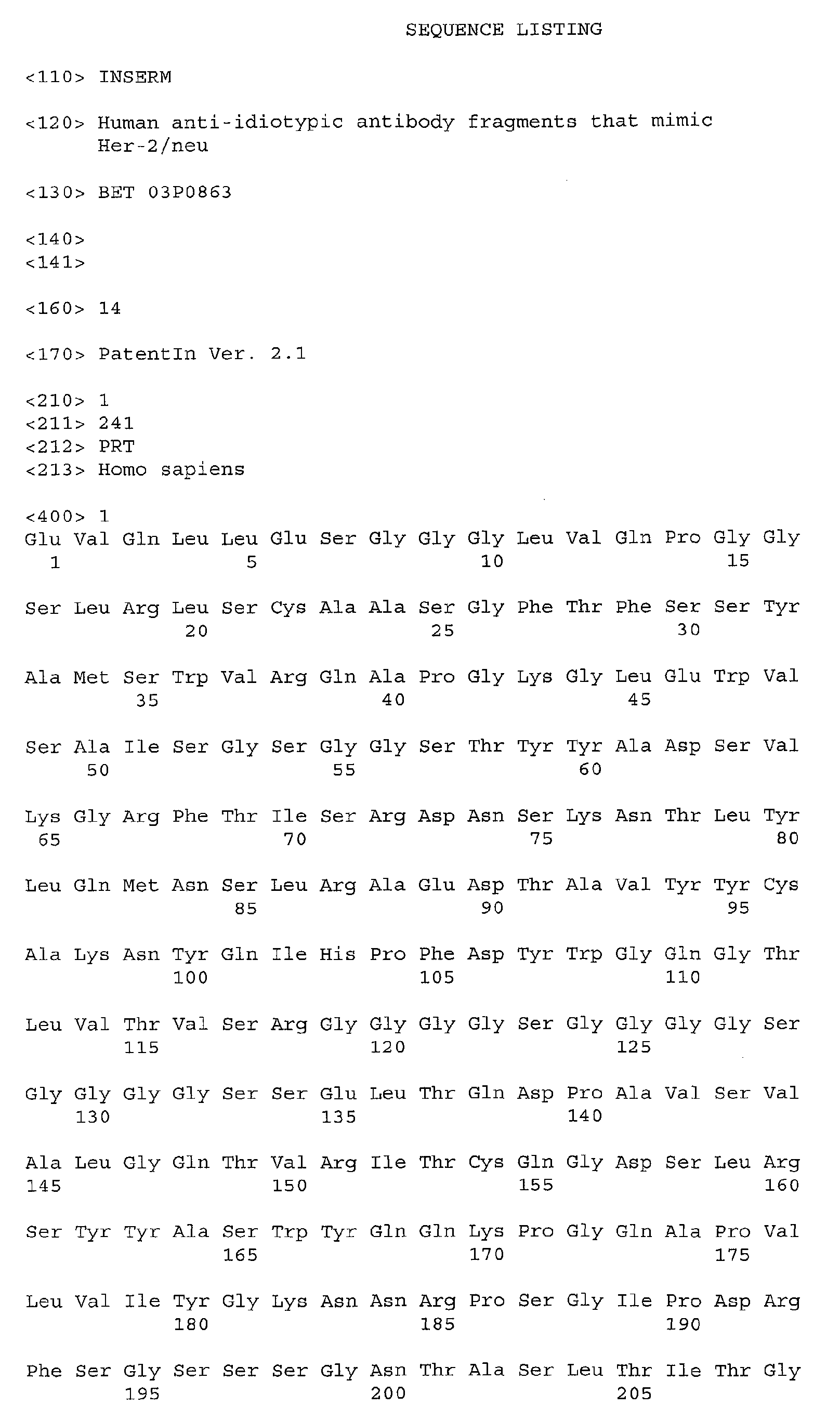
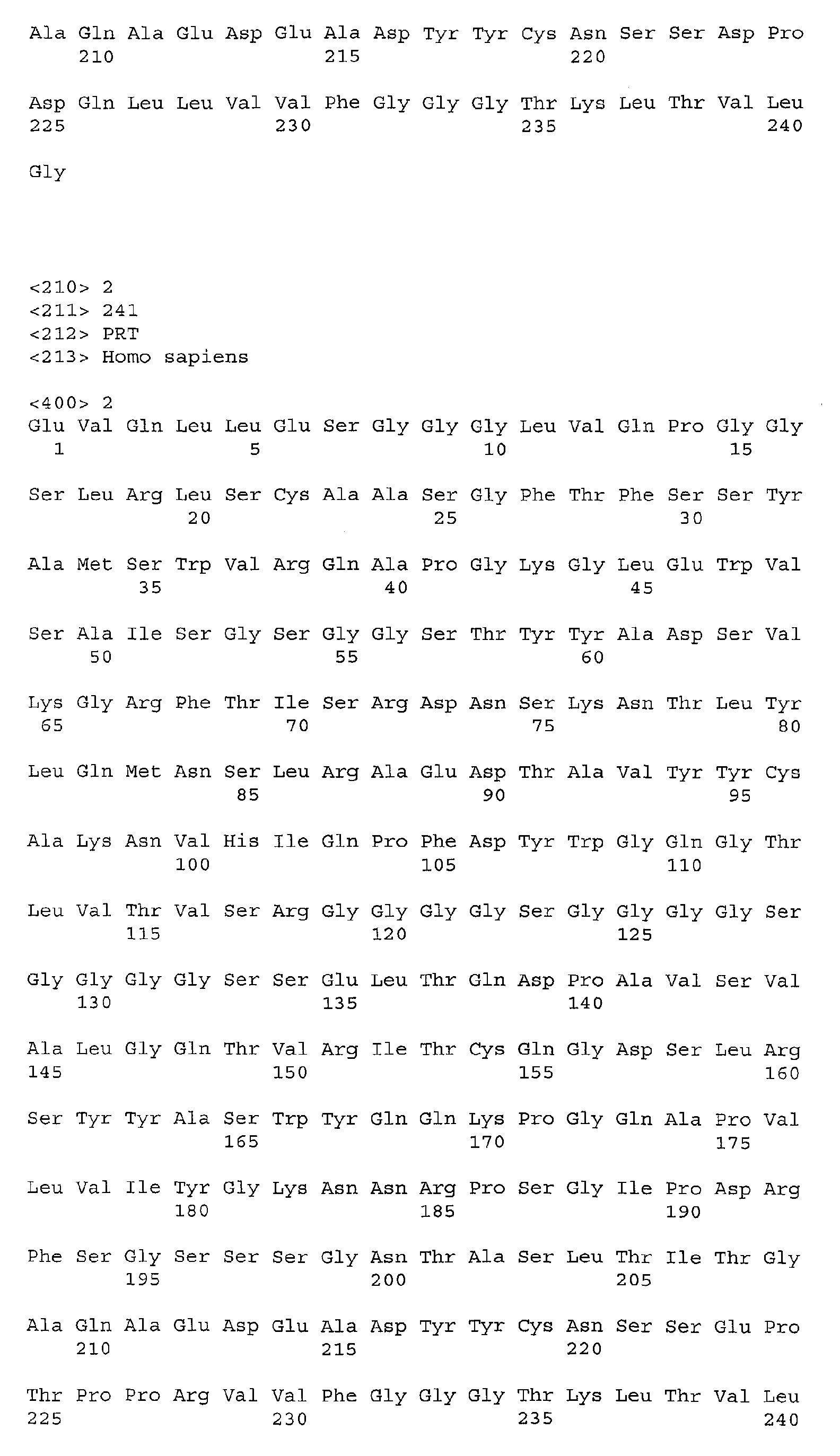
Fragments designated scFv 40 and svFv 69, that comprise the amino acid
sequence SEQ ID No: 1 and SEQ ID No: 2 respectively, are most preferred, as shown
on Figure 9.
-
Function-conservative variants or antibody fragments having homologous
sequences are also encompassed.
-
Knowing the aminoacid sequence of the desired fragment, one skilled in the
art can readily produce scFv 40 or scFv 69 fragments, by standard techniques for
production of polypeptides. For instance, they can be synthesized using well-known
solid phase method (Merrifield et al., 1962 and 1963 ; Tam et al. 1983), preferably
using a commercially available peptide synthesis apparatus (such as that made by
Applied Biosystems, Foster City, California) and following the manufacturer's
instructions.
-
Alternatively, the antibody scFv fragments can be synthesized by recombinant
DNA techniques as is now well-known in the art (Maniatis et al., 1982). For example,
these fragments can be obtained as DNA expression products after incorporation of
DNA sequences encoding the desired (poly)peptide into expression vectors and
introduction of such vectors into suitable eukaryotic or prokaryotic hosts that will
express the desired polypeptide, from which they can be later isolated using well-known
techniques.
Multimerization of the fragments :
-
In another embodiment of the invention, it is provided multimers, especially
dimers or trimers, of the anti-idiotypic antibody fragments described above.
-
Multimers can be obtained by genetic engineering, using linker sequences
between the Fab or scFv sequences defined above.
-
The linker sequences may include a leucine zipper, e.g. as described in de
Kruif and Logtenberg, 1996 or Pack et al., 1993.
-
Other cross-linked multimers of the antibody fragments can be designed, as
well as linear multimer, in particular in a linear head-to-tail manner (Miller et al.,
2003).
-
Multimers are particularly advantageous to diminish elimination through
kidneys and to increase stability and half-life of the fragments of interest.
-
It should thus be understood that, in the whole description of the present
invention, all formulations (i.e. pharmaceutical compositions), uses, or processes that
are described in reference with Fab or scFv fragments also apply to multimers of these
fragments.
Pharmaceutical compositions :
-
The present invention further encompasses preparing pharmaceutical
compositions useful for preventing or treating a tumor that overexpresses Her-2/neu..
Examples of pharmaceutical formulations are provided hereafter.
-
The form of the pharmaceutical compositions, the route of administration, the
dosage and the regimen naturally depend upon the condition to be treated, the severity
of the illness, the age, weight, and sex of the patient, etc.
-
The pharmaceutical compositions of the invention can be formulated for a
topical, oral, parenteral, intranasal, intravenous, intramuscular, subcutaneous or
intraocular administration and the like.
-
Preferably, the pharmaceutical compositions contain vehicles which are
pharmaceutically acceptable for a formulation capable of being injected. These may be
in particular isotonic, sterile, saline solutions (monosodium or disodium phosphate,
sodium, potassium, calcium or magnesium chloride and the like or mixtures of such
salts), or dry, especially freeze-dried compositions which upon addition, depending on
the case, of sterilized water or physiological saline, permit the constitution of injectable
solutions.
-
The doses used for the administration can be adapted as a function of various
parameters, and in particular as a function of the mode of administration used, of the
relevant pathology, or alternatively of the desired duration of treatment.
-
To prepare pharmaceutical compositions, an effective amount of the anti-idiotype
antibody fragment or multimer thereof may be dissolved or dispersed in a
pharmaceutically acceptable carrier or aqueous medium.
-
The pharmaceutical forms suitable for injectable use include sterile aqueous
solutions or dispersions; formulations including sesame oil, peanut oil or aqueous
propylene glycol ; and sterile powders for the extemporaneous preparation of sterile
injectable solutions or dispersions. In all cases, the form must be sterile and must be
fluid to the extent that easy syringability exists. It must be stable under the conditions
of manufacture and storage and must be preserved against the contaminating action of
microorganisms, such as bacteria and fungi.
-
Solutions of the active compounds as free base or pharmacologically
acceptable salts can be prepared in water suitably mixed with a surfactant, such as
hydroxypropylcellulose. Dispersions can also be prepared in glycerol, liquid
polyethylene glycols, and mixtures thereof and in oils. Under ordinary conditions of
storage and use, these preparations contain a preservative to prevent the growth of
microorganisms.
-
An anti-idiotype antibody fragment or multimer thereof can be formulated
into a composition in a neutral or salt form. Pharmaceutically acceptable salts include
the acid addition salts (formed with the free amino groups of the protein) and which are
formed with inorganic acids such as, for example, hydrochloric or phosphoric acids, or
such organic acids as acetic, oxalic, tartaric, mandelic, and the like. Salts formed with
the free carboxyl groups can also be derived from inorganic bases such as, for example,
sodium, potassium, ammonium, calcium, or ferric hydroxides, and such organic bases
as isopropylamine, trimethylamine, histidine, procaine and the like.
-
The carrier can also be a solvent or dispersion medium containing, for
example, water, ethanol, polyol (for example, glycerol, propylene glycol, and liquid
polyethylene glycol, and the like), suitable mixtures thereof, and vegetables oils. The
proper fluidity can be maintained, for example, by the use of a coating, such as lecithin,
by the maintenance of the required particle size in the case of dispersion and by the use
of surfactants. The prevention of the action of microorganisms can be brought about by
various antibacterial and antifungal agents, for example, parabens, chlorobutanol,
phenol, sorbic acid, thimerosal, and the like. In many cases, it will be preferable to
include isotonic agents, for example, sugars or sodium chloride. Prolonged absorption
of the injectable compositions can be brought about by the use in the compositions of
agents delaying absorption, for example, aluminium monostearate and gelatin.
-
Sterile injectable solutions are prepared by incorporating the active
compounds in the required amount in the appropriate solvent with various of the other
ingredients enumerated above, as required, followed by filtered sterilization. Generally,
dispersions are prepared by incorporating the various sterilized active ingredients into a
sterile vehicle which contains the basic dispersion medium and the required other
ingredients from those enumerated above. In the case of sterile powders for the
preparation of sterile injectable solutions, the preferred methods of preparation are
vacuum-drying and freeze-drying techniques which yield a powder of the active
ingredient plus any additional desired ingredient from a previously sterile-filtered
solution thereof.
-
The preparation of more, or highly concentrated solutions for direct injection
is also contemplated, where the use of DMSO as solvent is envisioned to result in
extremely rapid penetration, delivering high concentrations of the active agents to a
small tumor area.
-
Upon formulation, solutions are administered in a manner compatible with the
dosage formulation and in such amount as is therapeutically effective. The formulations
are easily administered in a variety of dosage forms, such as the type of injectable
solutions described above, but drug release capsules and the like can also be employed.
-
For parenteral administration in an aqueous solution, for example, the solution
should be suitably buffered if necessary and the liquid diluent first rendered isotonic
with sufficient saline or glucose. These particular aqueous solutions are especially
suitable for intravenous, intramuscular, subcutaneous and intraperitoneal
administration. In this connection, sterile aqueous media which can be employed will
be known to those of skill in the art in light of the present disclosure. For example, one
dosage could be dissolved in 1 ml of isotonic NaCl solution and either added to 1000
ml of hypodermoclysis fluid or injected at the proposed site of infusion, (see for
example, "Remington's Pharmaceutical Sciences" 15th Edition, pages 1035-1038 and
1570-1580). Some variation in dosage will necessarily occur depending on the
condition of the subject being treated. The person responsible for administration will, in
any event, determine the appropriate dose for the individual subject.
-
The anti-idioype antibody fragment may be formulated within a therapeutic
mixture to comprise about 0.0001 to 1.0 milligrams, or about 0.001 to 0.1 milligrams,
or about 0.1 to 1.0 or even about 10 milligrams per dose or so. Multiple doses can also
be administered.
-
In addition to the compounds formulated for parenteral administration, such
as intravenous or intramuscular injection, other pharmaceutically acceptable forms
include, e.g. tablets or other solids for oral administration ; time release capsules ; and
any other form currently used.
-
In certain embodiments, the use of liposomes and/or nanoparticles is
contemplated for the introduction of the antibody fragments into host cells. The
formation and use of liposomes and/or nanoparticles are known to those of skill in the
art.
-
Nanocapsules can generally entrap compounds in a stable and reproducible
way. To avoid side effects due to intracellular polymeric overloading, such ultrafine
particles (sized around 0.1 µm) are generally designed using polymers able to be
degraded in vivo. Biodegradable polyalkyl-cyanoacrylate nanoparticles that meet these
requirements are contemplated for use in the present invention, and such particles may
be are easily made.
-
Liposomes are formed from phospholipids that are dispersed in an aqueous
medium and spontaneously form multilamellar concentric bilayer vesicles (also termed
multilamellar vesicles (MLVs)). MLVs generally have diameters of from 25 nm to 4
µm. Sonication of MLVs results in the formation of small unilamellar vesicles (SUVs)
with diameters in the range of 200 to 500 A, containing an aqueous solution in the core.
The physical characteristics of liposomes depend on pH, ionic strength and the
presence of divalent cations.
Immunotherapy :
-
Patients having tumors may be treated therapeutically by immunization with
the anti-idiotype antibody fragments of the present invention whereas patients with a
disposition for the tumor may be treated immunoprophylactically by such
immunization. The anti-idiotypic antibody fragments may be formulated with a suitable
adjuvant in order to enhance the immunological response. These adjuvants may
include, but are not limited to, mineral gels, e.g. aluminium hydroxide ; surface active
substances such as lysolecithin, pluroic polyols ; polyanions ; peptides ; oil emulsions ;
and potentially useful human adjuvants such as BCG (bacilli Calmette-Guerin) and
corynebacterium. Other improved adjuvant systems may be used, such as those
reviewed in Mc Cluskie and Weeratan, 2001.
-
A subject of the present invention is thus the use of an anti-idiotype antibody
fragment as defined above, or a multimer thereof, for the preparation of a medicament
for the prevention or treatment of a tumor wherein Her-2/neu is overexpressed.
-
Another subject of the invention is a method for the preparation of a
medicament for the prevention or treatment of a tumor wherein Her-2/neu is
overexpressed, in a patient, in need thereof, which method comprises administering to
said patient a therapeutically effective amount of an anti-idiotype antibody fragment
thereof, or a multimer thereof.
-
A therapeutically effective amount is an amount sufficient for the tumor to
show a significant reduction, of at least 10 %, preferably at least 30 %, preferably at
least 50 %, preferably at least 80 %, or it is an amount sufficient for significantly
reducing the risk of developing such tumor.
-
Tumors wherein an overexpression of Her2/neu is observed include
adenocarcinomas, such as breast cancer, ovary cancer, uterus cancer, stomach cancer
and lung cancer.
-
The pharmaceutical compositions containing human anti-idiotype antibody
fragments, that mimic Her-2/neu, are thus promising candidates as vaccines to generate
or enhance a protective immune response in patients that are affected with tumors
overexpressing Her-2/neu.
Antigen-presenting cell therapy :
-
In another embodiment of the invention, it is provided a method for inducing
Her-2/neu-specific protective antitumor immunity, which method comprises :
- a) ex vivo contacting an antigen-presenting cell (APC) with an anti-idiotype
antibody fragment as defined above ;
- b) administering the APC so treated to a patient in need of such treatment.
-
-
Step a) is also called "pulsing" of the cells with the antibody fragment (Saha
et al., 2003).
-
Another subject of the invention is an ex vivo method for preparing APCs
useful for inducing HER-2/neu-specific protective antitumor immunity, which method
comprises contacting or pulsing an antigen-presenting cell with an anti-idiotype
antibody fragment as defined above.
-
Preferably the APC is a dendritic cell, in particular a bone-marrow derived
dentritic cell. Advantageously, the APC is from the patient to whom it is intended to be
readministered.
-
The isolated APCs so treated are also part of the present invention.
-
The invention further provides the use of such APCs for the preparation of a
medicament for the prevention or treatment of a tumor wherein Her-2/neu is
overexpressed.
-
The formulation (pharmaceutical compositions), uses or processes that are
described above in reference to the Fab or scFv fragments also apply to such APCs.
-
The below figures and examples illustrate the present invention without
restricting its scope.
LEGENDS OF FIGURES :
-
- Figure 1 represents an immunoblot analysis of several periplasmic fractions
containing antibodies after induction with 1 mM IPTG of single ampicillin-resistant
infected E. coli HB2151 colonies. Lane 1: clone 39; lane 2: clone 40; lane 3: clone 92;
lane 4: clone 69. After size fractionation on 12.5 % SDS-PAGE, protein extracts were
blotted onto nitrocellulose. The immunoblot was developed with HRP-conjugated M2
anti-FLAG mAb (1:2000) followed by addition of the 4-chloro-1-naphtol substrate.
- Figure 2 shows a SDS-PAGE gel. The purity of anti-Id scFv 69 at each step
of purification was controlled on 12.5% SDS-PAGE gel followed by silver staining.
Lane 1: non-purified periplasmic fraction. Lane 2: purified periplasmic fraction on
Hitrap Ni-activated chelating column. Lane 3: purified periplasmic fraction on Hitrap
Ni-activated chelating column followed by a gel-filtration purification on a Superdex
75 column. Lane 4: standard molecular mass markers.
- Figures 3A and 3B are graphs that show inhibition of purified soluble scFv
39, 40 and 69 binding on trastuzumab F(ab')2 fragments by (A) HER-2/neu ECD-Fc
fusion protein and (B) rhCEA, using a competitive ELISA. Increasing amounts of
inhibitor were mixed with either anti-Id scFv 39, 40, or 69 used at a dilution giving an
A490 ranging from 1 to 1.5 in ELISA. The incubation on trastuzumab F(ab')2 fragments
for 1.5 h was followed by the detection of scFv binding with HRP-conjugated M2 anti-FLAG
mAb (1:2000). The results obtained are expressed as percent inhibition at each
concentration of inhibitor.
- Figure 4 is a graph that shows inhibition of HER-2/neu ECD-Fc fusion
protein binding on trastuzumab F(ab')2 fragments by purified scFv 69 by competitive
ELISA. Increasing amounts of inhibitor were mixed with HER-2/neu ECD-Fc fusion
protein at 2.5 or 5 µg/ml and incubated with trastuzumab F(ab')2 fragments for 1.5 h.
HER-2/neu ECD-Fc fusion protein binding was then detected with peroxidase-conjugated
anti-HER-2/neu FRP5 mAb (1:3000). The results obtained are expressed as
percent inhibition at each concentration of inhibitor.
- Figures 5A and 5B are analysis of BIACORE experiments: (A) Binding
kinetics of anti-Id scFv 40, 69, and irrelevant scFv on trastuzumab F(ab')2 fragments
immobilized on a CM5 sensor chip and equilibrium affinity constants (inserted Table),
(B) Inhibition of HER-2/neu ECD-Fc fusion protein binding on trastuzumab F(ab')2
fragments immobilized on a CM5 sensorchip by anti-Id scFv 69.
- Figure 6 is a graph that shows analysis of the Ab3 anti-anti-Id scFv 69
response in sera of BALB/c mice (immunization protocol 1) by inhibition of the
binding of anti-Id scFv 69 (Ab2) on immobilized trastuzumab F(ab')2 fragments (Ab1)
by inhibition ELISA. Serial dilutions of preimmune sera or sera from mice each of the
three groups: primed with HER-2/neu ECD-Fc fusion protein or with PBS or with anti-Id
scFv 69 were preincubated with soluble anti-Id scFv 69. This solution was
subsequently incubated for 2 h on trastuzumab F(ab')2 fragments followed by the
detection of bound scFv by HRP-conjugated M2 anti-FLAG mAb. The results obtained
are expressed as percent inhibition at each serum dilution.
- Figures 7A, 7B and 7C are graphs showing the analysis of the Ab1' response
in sera of mice. Determination of anti-HER-2/neu IgG or IgM or total Ig levels in sera
collected at various times after immunization with (A) soluble purified anti-Id scFv,
protocol 1; (B) phage-displayed scFv, protocol 2; (C) HER-2/neu ECD-Fc fusion
protein. Mice were immunized with these antigens at the indicated times (arrows).
Bound antibodies in sera diluted 1:100 were detected with HRP-conjugated anti-total Ig
or µ- or γ- chain specific anti-mouse Ig. Data are presented as mean ± SD A490 values
of five determinations, corresponding to the five mice in each group. Curves indicate
sera from mice immunized with PBS (), sera from mice immunized with anti-Id scFv
40 (□), sera from mice immunized with anti-Id scFv 69 (Δ), and sera from mice
immunized with HER-2/neu ECD-Fc (○).
- Figures 8A and 8B are graphs that show analysis of the binding of mouse
sera to cells after the two immunization schedules: protocol 1 with soluble anti-Id scFv
40 and 69 and protocol 2 with phage-displayed scFv. The binding experiments were
performed either on (A) CHO cells which do not express the HER2/neu receptor or (B)
SK-OV-3-cells overexpressing HER2/neu receptor. The binding of antibodies was
detected by FACS analysis using an FITC-labeled goat anti-mouse antibody. All
antibody binding experiments were performed in comparison with trastuzumab
detected using a FITC-labeled anti-human antibody and with the background
fluorescence determined by binding on cells of the FITC-labeled secondary antibody
alone. Curves indicate background fluorescence (solid line), control mAb trastuzumab
(▪), sera from mice immunized with PBS (▴), sera from mice immunized with anti-Id
scFv 40 (), sera from mice immunized with anti-Id scFv 69 (•), and sera from mice
immunized with HER-2/neu ECD-Fc ().
- Figure 9 shows scFv40 and scFv69 full sequences.
-
EXAMPLE : Isolation and characterization of human anti-idiotypic scFv
fragment used as a surrogate tumor antigen.
MATERIALS AND METHODS :
Materials
-
The human ovarian SK-OV-3 cell line, which overexpresses HER-2/neu, and
the hamster ovarian CHO cell line were obtained from American Type Culture
Collection (Manassas, VA). All the in vivo experiments were performed in compliance
with the French guidelines for experimental animal studies (Agreement No. A34220).
Seven-week old female BALB/c mice were obtained from Iffa Credo (L'arbresle,
France). The ETH-2 synthetic human antibody phage library in the scFv format was
obtained from ETH Zurich, Switzerland. This library contains more than 5 × 10⁸
different clones. The ETH-2 library is a modified version of the synthetic antibody
library of Pini et al. (Pini et al. 1998). Anti-HER-2/neu monoclonal antibody FRP5 was
provided by FMI, Basel, Switzerland. Trastuzumab was purchased from Roche (F.
Hoffmann-La Roche Ltd, Bazel, Switzerland). The human IgG1, used as a control, was
provided by Mabgène (Alès, France). HER-2/neu ECD-Fc fusion protein, composed of
two extracellular domains of the receptor linked by a human Fc fragment, was provided
by Biochemistry Institute, University of Lausanne, Switzerland. Human IgG1 control
and trastuzumab F(ab')2 fragments were obtained by pepsin digestion (Sigma, St.Louis,
MO) at a 3% (wt/wt) ratio of pepsin/IgG in a 0.2 M sodium acetate buffer (pH 4.0), at
37°C for 4 h. The antibody fragments were purified by gel filtration chromatography on
a Sephacryl 100 column (Amersham Biosciences, Buckinghamshire, UK). Sodium
dodecyl sulfate polyacrylamide gel electrophoresis (SDS-PAGE) (8.5%), revealed
more than 95% purity of the deposited proteins.
Phage Display selection of anti-trastuzumab F(ab')2 fragments anti-Id scFv
antibodies (Ab2)
-
Protocols for phage display panning, and analysis were as previously
described (Pini et al. 1998). The phage-displayed library was panned with trastuzumab
F(ab')2 fragments in three sequential rounds of panning on immunotubes. Tubes were
coated with trastuzumab F(ab')2 fragments at a concentration of respectively 100, 50,
and 10 µg/ml in PBS for all three rounds. Briefly, 5 × 10¹² phages were added to
trastuzumab F(ab')2 fragments, incubated under continuous rotation for 30 min
followed by standing upright for an additional 1.5 h at room temperature. Tubes were
extensively washed, and bound phages were eluted by addition of 1 ml 100 mM
triethylamine, and then used to reinfect E. coli TG1 strain. After overnight growth,
phages were isolated by polyethylene glycol precipitation and the cycle was repeated.
Phage pools were assessed by ELISA. Ninety-six-well microtiter plates were coated
overnight at 4°C with 0.5 µg protein/well with either trastuzumab or human IgG1
F(ab')2 fragments or anti-fd phage Ig (Sigma) in PBS. Plates were then blocked for 2 h
at 37°C with PBS/2% (w/v) non-fat dried milk. One hundred µl of serial dilutions of
polyclonal phage solutions in PBS was added to each well. Plates were incubated at
room temperature for 1.5 h. Bound phage-scFv were detected by reaction for 1 h 30 at
37°C with a horseradish peroxidase (HRP)-conjugated anti-M13 mAb (Amersham
Biosciences). The plates were developed using o-phenylenediamine substrate (OPD)
according to the supplier's instructions (Sigma).
Production and purification of anti-trastuzumab F(ab')2 fragments soluble
anti-Id scFv
-
After the third round of selection, E coli HB2151 cells were infected with the
phages to produce soluble antibodies rather than phage-bound antibodies. Single
ampicillin-resistant infected E.coli HB2151 colonies were picked in 96-well tissue
culture plates and grown in 2× TY/100 µg/ml ampicillin/0.1% (w/v) glucose for 3 h at
37°C. ScFv expression was induced with isopropyl β-D-thiogalactopyranoside (IPTG)
to a final concentration of 1 mM for 16 h at 30°C. The bacterial supernatants were
evaluated for reactivity with trastuzumab or human IgG1 F(ab')2 fragments by ELISA.
The ELISA was performed as described above except that after incubation of E.coli
HB2151 supernatants, bound soluble scFv was detected using HRP-conjugated anti-FLAG-tag
M2 Ab (Sigma) for 1.5 h.
-
For Western Blot analysis, protein extracts were size fractionated by SDS-PAGE
(12.5%) and electroblotted onto nitrocellulose. The blot was blocked in TBS/1%
(w/v) non-fat dried milk at room temperature with shaking for 1 h, and probed with the
detecting Ab (HRP-conjugated anti-FLAG-tag M2) in TBS/5% (w/v) skimmed milk at
room temperature for 2 h. The blot was washed three times and developed using 4-chloro-1-naphthol
as substrate (Sigma).
-
For each positive clone, 15 µg of plasmid DNA was purified using the
NucleoSpin® Plasmid kit (Macherey-Nagel, Düren, Germany). Sequencing reactions
were carried out using the Dye Terminator Sequencing kit for automatic determination
of sequences with ABI PRISM 377 (Applied Biosystems, Foster City, CA). The
primers 5'-TACTACGCAGACTCCGTGAAG-3' (SEQ ID No: 13) and 5'-GAATTTTCTGTATGAGG-3'
(SEQ ID No: 14) were used for annealing.
-
For high scale bacterial expression and purification of scFv 39, 40, and 69,
overnight cultures of E. coli HB2151 single colonies were used to inoculate 11 of 2×
YT/100 µg/ml ampicillin/0.1% (w/v) glucose and grown at 37°C until it reached an
OD600 of 0.6. Expression of the scFvs was induced by adding 1 mM IPTG and
incubating for 16 h at 30°C. Bacterial pellets were resuspended in lysis buffer (30 mM
Tris-HCl (pH 7.0), 20% (w/v) sucrose, 1mM EDTA) with 1% PMSF and cooled on ice
for 30 min. After centrifugation, the supernatant (periplasmic fraction) was filtered
through a 0.45 µm filter. Clear supernatant from each culture was purified using metal
chelate affinity chromatography (IMAC) (30). ScFv bound on 5-ml HiTrap Ni-activated
Chelating HP column (Amersham Biosciences) were eluted with 25 ml [0.02
M sodium phosphate, 0.5 M NaCl (pH 7.4)] using a linear gradient from 0 to 0.5 M
imidazole, and 500-µl fractions were collected. Protein-containing fractions, monitored
by A280 densitometry, were pooled and concentrated to a volume < 1 ml on Amicon
Ultra 30,000 MWCO (Millipore, Bedford, Massachusetts). Additional purification was
achieved by fast protein liquid chromatography on a gel filtration Superdex 75 column
(Amersham Biosciences). The purity of the final preparation was evaluated on SDS-PAGE
(12.5%). Proteins bands were detected by silver staining.
In vitro characterization of anti-Id scFv by ELISA and Biacore
-
To characterize the anti-Id scFv, competitive ELISA experiments were carried
out using either HER-2/neu ECD-Fc fusion protein to inhibit the binding of soluble
scFv to trastuzumab F(ab')2 fragments (Ab1) or purified scFv to block the binding of
HER-2/neu ECD-Fc fusion protein to Ab1. Each soluble scFv was used at a dilution
giving an A490 of 1-1.5 in ELISA. An irrelevant soluble scFv, named T1, isolated from
the ETH-2 library and which does not bind to trastuzumab F(ab')2 fragments, was used
as a control (data not shown). In the first format, serial dilutions of HER-2/neu ECD-Fc
fusion protein, ranging in concentration from 50 to 0 µg/ml, were used as inhibitor
solutions; bound soluble scFv was detected as previously described. Recombinant
human carcinoembryonic antigen (rhCEA) was used as an irrelevant inhibitor. This
format of inhibition was also used immediately after the third round of selection to
check the inhibition of the binding of individual periplasmic fractions on trastuzumab
F(ab')2 fragments by HER-2/neu ECD-Fc fusion protein. In the second format,
competition was performed using various concentrations of purified soluble scFv
ranging from 250 to 0 µg/ml solutions and HER-2/neu ECD-Fc fusion protein at a
dilution giving an A490 of 1-1.5 in ELISA. Bound HER-2/neu ECD-Fc fusion protein
was subsequently detected with HRP-conjugated anti-HER-2/neu FRP5 mAb.
-
Binding experiments of anti-trastuzumab F(ab')2 fragments scFv and HER-2/neu
ECD-Fc fusion protein on trastuzumab F(ab')2 fragments were performed at
25°C by surface plasmon resonance analysis (SPR) using a BIACORE 2000 instrument
(Biacore AB, Uppsala, Sweden). Trastuzumab F(ab')2 fragments were covalently
immobilized on a CM5 sensor chip surface using the amine coupling method according
to the manufacturer's instructions (Biacore AB). A control reference surface was
prepared using the same chemical treatment of the flow cell surface without injection of
trastuzumab F(ab')2 fragments. HER-2/neu ECD-Fc fusion protein (15 µg/ml) and
soluble scFv (50 µg/ml) in HBS-EP buffer [10 mM HEPES (pH 7.4), 3 mM EDTA,
150 mM NaCl, 0.005% (w/v) P20] were injected over the flow cell and the dissociation
phase was followed by a regeneration step (10 µl 100 mM HCl). The flow rate was 50
µl/min. All the sensorgrams were corrected by subtracting the low signal of the control
reference surface. The BIAevaluation 3.2 software was used to fit the data using a 1:1
Langmuir global model. For the inhibition experiments, a first injection of anti-Id scFv
69 (50 µl at 2 µM) was followed by a second injection of HER-2/neu ECD-Fc fusion
protein (50 µl at 0.06 µM). After a regeneration step with 10 µl of 100 mM HCl, a
similar experiment was performed with a first injection of buffer instead of the scFv.
The flow rate was 10 µl/min. To evaluate the percent inhibition, we injected the anti-Id
scFv 69 followed by a long dissociation step. This dissociation curve was then
substracted from the HER-2/neu association curve.
Analysis of the Ab3 response in mouse sera
-
Two immunization schedules were carried out. In the first one, five 6 to 8-week
old female BALB/c mice per group were immunized i.p. monthly for three
months with 50 µg of either purified soluble anti-Id scFv 40 or 69, 20 µg of HER-2/neu
ECD-Fc fusion protein in 100 µl PBS or elution buffer (negative control group) after
emulsion with complete Freund's adjuvant (CFA). Subsequent immunizations were
performed i.p. with incomplete Freund's adjuvant (IFA) (protocol 1). Sera were drawn
from the tail vein before each immunization and stored at -20°C for assay. In the
second one, inspired by the work of Magliani et al., 1998, 6 to 8-week old female
BALB/c mice were immunized four times. A first s.c. injection of either 50 µl of
freshly prepared phage- scFv 40 or 69 at a titer of 1014 TU/ml, 20 µg of HER-2/neu
ECD-Fc fusion protein, or PBS was performed after emulsion with CFA. This injection
was followed two weeks later by a second s.c. administration of the same dose with
IFA. Two additional injections were given i.p. at 21 and 35 days after the initial
immunization (protocol 2). For serum antibody measurement, mice were bled 21 and
42 days after the initial immunization and sera stored at -20°C. The sera were checked
for anti-anti-Id (Ab3) responses by flow cytometry and ELISA on the HER-2/neu
ECD-Fc fusion antigen as described below. Analysis of the results obtained was also
performed according to the method described by Magliani et al., 1998. A positive
control consisting of pooled sera from mice immunized with HER-2/neu ECD-Fc
fusion protein was included in each determination. Results were expressed in arbitrary
units as the ratio between absorbance of the test serum to 70% of the absorbance of the
positive control serum multiplied by 1000. The 30%, subtracted from the positive
control serum absorbance, was due to the anti-Fc response (see Results section).
-
To detect anti-anti-Id scFv in mouse sera, an ELISA was performed by coating
96-well plates with soluble anti-Id scFv at 5 µg/ml and then washing and blocking with
PBS/1% (w/v) BSA for 2 h at 37°C. Serial dilutions of sera from immunized mice [1 to
1:3200 in PBS/0.5% (w/v) BSA] were incubated for 1.5 h at room temperature. Bound
IgG was detected after incubation for 1.5 h of a HRP-conjugated goat anti-mouse IgG
(Sigma).
-
To further confirm the presence of anti-anti-Id scFv, an inhibition ELISA was
performed by preincubating serial dilutions of sera from immunized mice [1 to 1:640 in
PBS/0.5% (w/v) BSA] with soluble scFv for 2 h at 37°C. Next, 100 µl of each mixture
was added to the wells, coated with soluble anti-Id scFv. The plates were incubated at
room temperature for 1.5 h. Bound scFv were detected as previously described.
ELISA and FACS analysis of anti-HER-2/neu antibodies (Ab1') in mouse sera
-
Indirect ELISA was performed by coating 96-well plates overnight at 4°C
with HER-2/neu ECD-Fc fusion protein at 2 µg/ml and then blocking with PBS/1%
(w/v) BSA. One hundred µl of diluted sera from mice [1:100 in PBS/0.5% (w/v) BSA]
were added in each well and incubated for 1.5 h at room temperature. Then, 100 µl of
either goat anti-mouse IgG (whole molecule)-HRP conjugate, goat anti-mouse IgG (γ-chain
specific)-HRP conjugate, or goat anti-mouse IgM (µ-chain specific)-HRP
conjugate was added, incubated for 1.5 h, and detected as described above.
-
For FACS analysis, HER-2/neu-positive SK-OV-3 and HER-2/neu-negative
CHO cell lines were incubated for 1 h with either 100 µl of each mouse serum diluted
1:100 in PBS/1% (w/v) BSA, 1mg/ml azide or with 100 µl trastuzumab at 20 µg/ml for
1.5 h at 4°C. After washing, the cells were incubated for another 45 min at 4°C with
either 100 µl of diluted sheep anti-mouse IgG-FITC-labeled antibody for sera or anti-human-FITC-labeled
antibody (Sigma) for trastuzumab. The stained cells were
suspended in 500 µl PBS, and stored at 4°C before FACScan analysis by flow
cytometry (Becton Dickinson, Franklin Lakes, MD).
RESULTS:
-
The main problem when using the HER-2/neu oncoprotein as a target antigen
for active immunotherapy is immune tolerance to the self-antigen. Ab1 therapy as well
as peptide or protein-based vaccines have been reported (Disis et al. 2002 - Pegram et
al. 1998). All the studies have pointed out the necessity to pursue the search for
effective therapeutic approaches.
-
The present study was conducted to explore the efficacy of the anti-idiotypic
(Ab2) strategy to generate an anti-HER-2/neu immune response. Trastuzumab, a
humanized mAb specific for HER-2/neu, whose efficiency has been proven both alone
and in combination with various chemotherapeutic agents in women with HER-2-positive
metastatic breast cancer (Cobleigh et al. 1999 - Slamon et al. 2001), was
chosen as Ab1.
-
The affinity selection was performed using proteolytically cleaved F(ab')2
fragments of trastuzumab to avoid the selection of scFv specific for the Fc portion of
the human IgG1.
Isolation of an anti-idiotypic scFv
-
The selection of the anti-Id scFv, performed by three rounds of panning of the
synthetic ETH-2 scFv library on immobilized trastuzumab F(ab')
2 fragments (Ab1),
resulted in a substantial affinity enrichment of the library on either trastuzumab or
human IgG1 F(ab')
2 fragments (used as a control) as checked by ELISA using the
recombinant polyclonal phage supernatants. A 2 × 10
4-fold increase of phage titer
between the first and the third round of selection was also observed. After cloning,
antibody supernatants derived from 96 induced individual clones of the third round
were then used to infect
E. coli HB2151 to produce soluble scFv antibodies. Ninety-six
periplasmic fractions were tested for their reactivity with human IgG1 or trastuzumab
F(ab')
2 fragments by ELISA. Western blot analysis of the positive periplasmic fractions
led us to select scFv antibodies consisting of single monomers with the approximate
molecular mass of about 30 kDa and to exclude those who presented a lower molecular
mass (Fig. 1). The selected periplasmic fractions were checked by ELISA for
inhibition of their binding on trastuzumab F(ab')
2 fragments by either HER-2/neu
ECD-Fc fusion protein or rhCEA (recombinant human CEA used as an irrelevant
inhibitor). Only clones showing marked inhibition (>50%) were further analyzed. After
DNA sequence determination of the V
H and V
L regions of the antibodies, the inventors
selected three unique scFv fragments termed
scFv 39, 40, and 69, which recognized the
binding site of Ab1 but exhibited different random loops of five or six amino acids in
the CDR3 of the V
H and V
L domains (position 95, see Table 1).
-
The analysis of these sequences showed that random loops appended in H-CDR3
(the largest and most diverse loop of the antigen recognition site of the antibody)
for anti-Id scFv 40 and 69 presented 5/6 identical amino acids, whereas the H-CDR3 of
anti-Id scFv 39 was quite different in sequence and appeared to be more positively
charged. Concerning the L-CDR3, the three scFv used the DPL-16 germline gene
segment, L-CDR3 of anti-Id scFv 39 differed from the others, especially from scFv 40,
by a global positive charge. The L-CDR3 of scFv 69 seemed to be very highly
constrained by the three proline residues in the loop.
-
Anti-Id scFv 39, 40, and 69 were purified to 90% homogeneity using metal
chelate affinity chromatography (IMAC) followed by gel-filtration on a Superdex 75 as
shown in Fig. 2 for anti-Id scFv 69. Anti-Id scFv 39 and 40 were obtained with the
same level of purity. These three scFv were also expressed, displayed on phage after
infection of E. coli TG1, and the immunoreactivity of each phage solution controlled by
ELISA on trastuzumab F(ab')2 fragments.
In vitro characterization of the Ab2 anti-idioptypic scFv
-
To characterize the binding properties of the anti-Id scFv, the inventors first
checked whether or not these scFv exhibited competitive binding with trastuzumab
F(ab')2 fragments (Ab1) for HER-2/neu epitopes. When the HER-2/neu ECD-Fc fusion
protein was used as an inhibitor, the binding of both anti-Id scFv 40 and 69 on
trastuzumab F(ab')2 fragments was inhibited by approximately 90% (Fig. 3A). The
binding of anti-Id scFv 39 was only inhibited by 23%; thus, anti-Id scFv 39 was not
used for subsequent experiments. The same competition experiment was performed
using rhCEA (185 kDa) (Fig. 3B). Inhibition curves showed that even at high
concentrations of rhCEA, this antigen (whose molecular mass is nearly the same as the
HER-2/neu ECD-Fc fusion protein) was unable to compete with anti-Id scFv for the
binding on trastuzumab F(ab')2 fragments. Anti-Id scFv 40 and 69 were subsequently
used to inhibit the binding of HER-2/neu ECD-Fc fusion protein at two different
concentrations on trastuzumab F(ab')2 fragments. In this format, the maximum
inhibition observed was nearly 40% for anti-Id scFv 69 at 250 µg/ml (Fig. 4). The same
result was obtained for anti-Id scFv 40.
-
Binding kinetic parameters of anti-Id scFv 40 and 69 on immobilized
trastuzumab F(ab')2 fragments were measured using SPR technology (Fig. 5A).
Whereas the affinity constants of both scFv were in the same order of magnitude (5 ×
10-6 M), anti-Id scFv 40 showed higher association and dissociation rates than those of
scFv 69 (Fig. 5A). Under the same conditions, the affinity constant of HER-2/neu ECD-Fc
fusion protein was in the nanomolar range [K D = (2.9 ± 0.1) × 10-9 M]. The
inhibition of the binding of HER-2/neu ECD-Fc fusion protein on immobilized
trastuzumab F(ab')2 fragments by anti-Id scFv 69 was also evaluated using this
technology. The prior injection of anti-Id scFv 69 inhibited by 83% the binding of
HER-2/neu ECD-Fc fusion protein on trastuzumab F(ab')2 fragments (Fig. 5B.). These
results confirmed the data obtained by competitive ELISA and gave an even higher
percent inhibition, suggesting that anti-Id scFv 40 and 69 could be true Ab2β. If
so, these scFv should be able to induce a polyclonal anti-anti-Id response (Ab1') when
injected into mice, which was further tested.
Immunizing properties of anti-Id scFv 40 and anti-Id scFv 69
-
Six to eight-week old female BALB/c mice were immunized either i.p. with
soluble purified anti-Id scFv 40 and 69 (protocol 1) or s.c. with scFv displayed on
phages (protocol 2). Sera of the five mice in each group were individually tested by
ELISA for their reactivity against Ab2 immunogens (anti-Id scFv 40 or 69) after three
or four injections. All the mice developed significant immunity against anti-Id, and the
titers were further increased with further immunizations in both protocols. Preimmune
sera or control sera of mice immunized with dilution buffer (PBS or elution buffer)
were tested negative against anti-Id scFv 40 and ant-Id scFv 69. No specific response
was observed either in sera of mice injected with wild-type phages. To demonstrate the
specificity of the Ab3 response against anti-Id scFv, an inhibition ELISA was carried
out by inhibiting the binding of each anti-Id scFv on trastuzumab F(ab')2 fragments by
serial dilutions of sera from immunized mice. A 1:20 dilution of immune serum from a
mouse immunized with anti-Id scFv 69 displayed on phage particles inhibited by nearly
100% Ab2 (anti-Id scFv 69) binding to Ab1 [trastuzumab F(ab')2 fragments],
suggesting that antibodies contained in the sera were true anti-anti-Id in nature (Fig. 6).
Anti-Id scFv 40 gave similar results. In contrast, no inhibition was observed with
immune sera from mice immunized with HER-2/neu ECD-Fc fusion protein or PBS.
Idiotype analysis ofAb3 (Ab1') induced by immunization with anti-Id scFv
-
To detect the subset of antibodies called Ab1' able to bind to the target
antigen, ELISA were performed on HER-2/neu ECD-Fc fusion protein using mouse
sera diluted 1:100. The use of different HRP-conjugated Ig allowed us to determine the
IgG, IgM, and total Ig levels induced in mouse sera by immunization with anti-Id scFv
and control immunogens (Fig. 7). The absorbance values plotted at each time
correspond to the mean value for each group of five mice ± standard deviations (SD).
These results demonstrated that (i) patterns of induction of IgG or IgM anti-HER-2/neu
antibodies were similar for the two immunization protocols (Fig. 7A and B); (ii) a
significant portion of the polyclonal Ab3 reacted with the antigen (Fig. 7A and B), the
level of Ab1' reaching a plateau after 3-4 injections of immunogen; and (iii) as shown
in Fig. 7C, the titers of IgM as well as IgG anti-HER-2/neu ECD-Fc fusion protein
response were, as expected, very high in the sera of mice immunized with HER-2/neu
ECD-Fc fusion protein, whereas there was no reactivity in the negative control. In the
sera of mice immunized with HER-2/neu ECD-Fc fusion protein, part of the very high
titer against the adsorbed protein was due to an anti-human Fc response as shown when
the reactivity of the positive anti-HER-2/neu ECD-Fc fusion protein sera against
another recombinant Fc fusion protein, the so-called MICA-Fc, provided by LICR,
Lausanne Branch) was checked by ELISA. The data obtained led the inventors to
conclude that the anti-Fc response was about 30% of the total response observed by
ELISA on HER-2/neu ECD-Fc fusion protein.
Flow cytometric analysis of Ab1'
-
To further confirm the nature of the Ab1' induced by injections with anti-Id
scFv 40 and 69, flow cytometric analyses of HER-2/neu-positive SK-OV-3 cells and
HER-2/neu-negative CHO cells were performed with sera (1:100) from immunized
BALB/c mice. Using trastuzumab mAb, both HER-2/neu overexpression at the surface
of SK-OV-3 cells and the lack of expression of the receptor on the CHO cells surface
were first confirmed (Fig. 8A and B). Then, the inventors demonstrated that antibodies
not only in sera from mice immunized with HER-2/neu ECD-Fc fusion protein but also
in sera from mice immunized either with anti-Id scFv 40 or anti-Id scFv 69, specifically
stained the SK-OV-3 cells. Only a weak reactivity was observed on CHO cell line.
Representative results obtained at the end of the two immunization schedules are
presented also in Fig. 8A and B. The fluorescence intensity increase on SK-OV-3 cells,
as compared with CHO cells, were about 100, 25, and 2 for sera from mice immunized
with HER-2/neu ECD-Fc fusion protein, anti-Id scFv 40 or 69, and PBS, respectively.
The staining of cells obtained by using sera from mice injected with dilution buffer was
equivalent to that of preimmune sera, thus corresponding to the background signal. On
the basis of these experiments, the inventors concluded that true Ab1' antibodies,
which are specifically directed against the HER-2/neu receptor, were present in the sera
of mice immunized with anti-Id scFv 40 and 69.
REFERENCES
-
- Baral, R., A. Sherrat, R. Das, K. A. Foon, and M. Bhattacharya-Chatterjee.
2001. Murine monoclonal anti-idiotypic antibody as a surrogate antigen for human
Her-2/neu. Int J Cancer 92:88.
- Baselga, J., and J. Albanell. 2001. Mechanism of action of anti-HER2
monoclonal antibodies. Ann Oncol 12:S35.
- Bhattacharya-Chatterjee, M., S. K. Chatterjee, S. Vasile, B. K. Seon, and H.
Kohler. 1988. Idiotype vaccines against human T cell leukemia. II. Generation and
characterization of a monoclonal idiotype cascade (Ab1, Ab2, and Ab3). J Immunol
141:1398.
- Cobleigh, M. A., C. L. Vogel, D. Tripathy, N. J. Robert, S. Scholl, L.
Fehrenbacher, J. M. Wolter, V. Paton, S. Shak, G. Lieberman, and D. J. Slamon. 1999.
Multinational study of the efficacy and safety of humanized anti-HER2 monoclonal
antibody in women who have HER2-overexpressing metastatic breast cancer that has
progressed after chemotherapy for metastatic disease. J Clin Oncol 17:2639.
- Concetti, A., A. Amici, C. Petrelli, A. Tibaldi, M. Provinciali, and F. M.
Venanzi. 1996. Autoantibody to p185erbB2/neu oncoprotein by vaccination with
xenogenic DNA. Cancer Immunology, Immunotherapy 43:307.
- Dakappagari, N. K., D. B. Douglas, P. L. Triozzi, V. C. Stevens, and P. T.
Kaumaya. 2000. Prevention of mammary tumors with a chimeric HER-2 B-cell epitope
peptide vaccine. Cancer Res 60:3782.
- Di Carlo, E., S. Rovero, K. Boggio, E. Quaglino, A. Amici, A. Smorlesi, G.
Forni, and P. Musiani. 2001. Inhibition of mammary carcinogenesis by systemic
interleukin 12 or p185neu DNA vaccination in Her-2/neu transgenic BALB/c mice.
Clin Cancer Res 7:830s.
- Disis, M. L., E. Calenoff, G. McLaughlin, A. E. Murphy, W. Chen, B.
Groner, M. Jeschke, N. Lydon, E. McGlynn, R. B. Livingston, and et al. 1994. Existent
T-cell and antibody immunity to HER-2/neu protein in patients with breast cancer.
Cancer Res 54:16.
- Disis, M. L., F. M. Shiota, and M. A. Cheever. 1998. Human HER-2/neu
protein immunization circumvents tolerance to rat neu: a vaccine strategy for 'self
tumour antigens. Immunology 93:192.
- Disis, M. L., J. R. Gralow, H. Bernhard, S. L. Hand, W. D. Rubin, and M. A.
Cheever. 1996. Peptide-based, but not whole protein, vaccines elicit immunity to HER-2/neu,
oncogenic self-protein. J Immunol 156:3151.
- Disis, M. L., T. A. Gooley, K. Rinn, D. Davis, M. Piepkorn, M. A. Cheever,
K. L. Knutson, and K. Schiffman. 2002. Generation of T-cell immunity to the HER-2/neu
protein after active immunization with HER-2/neu peptide-based vaccines. J Clin
Oncol 20: 2624.
- Fisk, B., T. L. Blevins, J. T. Wharton, and C. G. Ioannides. 1995.
Identification of an immunodominant peptide of HER-2/neu protooncogene recognized
by ovarian tumor-specific cytotoxic T lymphocyte lines. JExp Med 181:2109.
- Foon, K. A., J. Lutzky, R. N. Baral, J. R. Yannelli, L. Hutchins, A.
Teitelbaum, O. L. Kashala, R. Das, J. Garrison, R. A. Reisfeld, and M. Bhattacharya-Chatterjee.
2000. Clinical and immune responses in advanced melanoma patients
immunized with an anti-idiotype antibody mimicking disialoganglioside GD2. J Clin
Oncol 18: 376.
- Foon, K. A., W. J. John, M. Chakraborty, R. Das, A. Teitelbaum, J.
Garrison, O. Kashala, S. K. Chatterjee, and M. Bhattacharya-Chatterjee. 1999. Clinical
and Immune Responses in Resected Colon Cancer Patients Treated With Anti-Idiotype
Monoclonal Antibody Vaccine That Mimics the Carcinoembryonic Antigen. J Clin
Oncol 17: 2889.
- Goletz et al. (2002), J. Mol. Biol. 315:1087
- Jerne, N. K. 1974. Towards a network theory of the immune system. Ann
Immunol (Paris) 125C:373.
- Jerne et al.; (1982) EMBO, 1:1234
- Kennedy, R. C., G. R. Dreesman, J. S. Butel, and R. E. Lanford. 1985.
Suppression of in vivo tumor formation induced by simian virus 40- transformed cells
in mice receiving antiidiotypic antibodies. JExp Med 161:1432.
- de Kruif and Logtenberg (1996) Journal of biological chemistry vol. 271, n°
13, 7630-7634
- Kwak, L. W., M. J. Campbell, D. K. Czerwinski, S. Hart, R. A. Miller, and
R. Levy. 1992. Induction of immune responses in patients with B-cell lymphoma
against the surface-immunoglobulin idiotype expressed by their tumors. N Engl J Med
327:1209.
- Leung et al. (2000) Gene 373-380
- Mac Cluskie and Weeratna, (2001) Curr Drug Targets Infect Disord.
1(3):263-71
- Magliani, W., L. Polonelli, S. Conti, A. Salati, P. F. Rocca, V. Cusumano,
G. Mancuso, and G. Teti. 1998. Neonatal mouse immunity against group B
streptococcal infection by maternal vaccination with recombinant anti-idiotypes [see
comments]. Nat Med 4: 705.
- Maniatis et al. (1982) Molecular cloning : a laboratory manual, Cold Spring
Harbor Laboratories, NY, 51-54 and 412-30
- Merrifield, (1962) Proc. Soc. Ex. Boil. 21:412
- Merrifield, (1963) J. Am. Chem. Soc. 85:2149
- Miller et al., (2003) Journal of immunology 170:4854-4861
- Mittelman, A., Z. J. Chen, T. Kageshita, H. Yang, M. Yamada, P. Baskind,
N. Goldberg, C. Puccio, T. Ahmed, Z. Arlin, and et al. 1990. Active specific
immunotherapy in patients with melanoma. A clinical trial with mouse antiidiotypic
monoclonal antibodies elicited with syngeneic anti-high-molecular-weight-melanoma-associated
antigen monoclonal antibodies [published erratum appears in J Clin Invest
1991 Feb;87(2):757]. Journal of Clinical Investigation 86:2136.
- Nanda, N. K., and E. E. Sercarz. 1995. Induction of anti-self-immunity to
cure cancer. Cell 82:13.
- Pack et al., (1993) Biotechnology 11:1271-7
- Pegram, M. D., A. Lipton, D. F. Hayes, B. L. Weber, J. M. Baselga, D.
Tripathy, D. Baly, S. A. Baughman, T. Twaddell, J. A. Glaspy, and D. J. Slamon. 1998.
Phase II study of receptor-enhanced chemosensitivity using recombinant humanized
anti-p185HER2/neu monoclonal antibody plus cisplatin in patients with HER2/neu-overexpressing
metastatic breast cancer refractory to chemotherapy treatment. J Clin
Oncol 16:2659.
- Peoples, G. E., P. S. Goedegebuure, R. Smith, D. C. Linehan, I. Yoshino,
and T. J. Eberlein. 1995. Breast and ovarian cancer-specific cytotoxic T lymphocytes
recognize the same HER2/neu-derived peptide. Proc Natl Acad Sci USA 92:432.
- Pilon, S. A., M. P. Piechocki, and W. Z. Wei. 2001. Vaccination with
cytoplasmic ErbB-2 DNA protects mice from mammary tumor growth without anti-ErbB-2
antibody. J Immunol 167:3201.
- Pini, A., F. Viti, A. Santucci, B. Carnemolla, L. Zardi, P. Neri, and D. Neri.
1998. Design and use of a phage display library. Human antibodies with subnanomolar
affinity against a marker of angiogenesis eluted from a two-dimensional gel. J Biol
Chem 273:21769.
- Reeck et al, 1987, Cell, 50 : 667.
- Rilke, F., M. I. Colnaghi, N. Cascinelli, S. Andreola, M. T. Baldini, R.
Bufalino, G. Della Porta, S. Menard, M. A. Pierotti, and A. Testori. 1991. Prognostic
significance of HER-2/neu expression in breast cancer and its relationship to other
prognostic factors. Int J Cancer 49:44.
- Saha et al., (2003) Cancer Res 63:2844-54
- Sambrook et al, 1989, Molecular Cloning : A laboratory manual, second
edition Cold Spring Harbor Laboratory press, Cold Spring Harbor, New-York.
- Slamon, D. J., B. Leyland-Jones, S. Shak, H. Fuchs, V. Paton, A.
Bajamonde, T. Fleming, W. Eiermann, J. Wolter, M. Pegram, J. Baselga, and L.
Norton. 2001. Use of chemotherapy plus a monoclonal antibody against HER2 for
metastatic breast cancer that overexpresses HER2. N Engl J Med 344:783.
- Tam et al., (1983) J. Am. Chem. Soc. 105:6442
- Tripathi, P. K., H. Qin, S. Deng, C. Xu, M. Bhattacharya-Chatterjee, K. A.
Foon, and S. K. Chatterjee. 1998. Antigen mimicry by an anti-idiotypic antibody single
chain variable fragment. Mol Immunol 35:853.
- Winter et al., 1994, Annu. Rev. Immunol., 12, 433