EP1544208A1 - Pyrazole derivative, medicinal composition containing the same, medicinal use thereof, and intermediate for production thereof - Google Patents
Pyrazole derivative, medicinal composition containing the same, medicinal use thereof, and intermediate for production thereof Download PDFInfo
- Publication number
- EP1544208A1 EP1544208A1 EP03784564A EP03784564A EP1544208A1 EP 1544208 A1 EP1544208 A1 EP 1544208A1 EP 03784564 A EP03784564 A EP 03784564A EP 03784564 A EP03784564 A EP 03784564A EP 1544208 A1 EP1544208 A1 EP 1544208A1
- Authority
- EP
- European Patent Office
- Prior art keywords
- group
- inhibitor
- methyl
- alkyl
- pyrazole
- Prior art date
- Legal status (The legal status is an assumption and is not a legal conclusion. Google has not performed a legal analysis and makes no representation as to the accuracy of the status listed.)
- Granted
Links
- 0 *c1c(Cc2c(*)c(*)c(***N(*)*)c(*)c2*2)c2n[n]1I Chemical compound *c1c(Cc2c(*)c(*)c(***N(*)*)c(*)c2*2)c2n[n]1I 0.000 description 5
- HOVAGTYPODGVJG-VOQCIKJUSA-N CO[C@@H]([C@@H]([C@H]1O)O)O[C@H](CO)[C@@H]1O Chemical compound CO[C@@H]([C@@H]([C@H]1O)O)O[C@H](CO)[C@@H]1O HOVAGTYPODGVJG-VOQCIKJUSA-N 0.000 description 1
- HOVAGTYPODGVJG-XUUWZHRGSA-N CO[C@@H]([C@@H]([C@H]1O)O)O[C@H](CO)[C@H]1O Chemical compound CO[C@@H]([C@@H]([C@H]1O)O)O[C@H](CO)[C@H]1O HOVAGTYPODGVJG-XUUWZHRGSA-N 0.000 description 1
Classifications
-
- C—CHEMISTRY; METALLURGY
- C07—ORGANIC CHEMISTRY
- C07H—SUGARS; DERIVATIVES THEREOF; NUCLEOSIDES; NUCLEOTIDES; NUCLEIC ACIDS
- C07H17/00—Compounds containing heterocyclic radicals directly attached to hetero atoms of saccharide radicals
- C07H17/02—Heterocyclic radicals containing only nitrogen as ring hetero atoms
-
- A—HUMAN NECESSITIES
- A61—MEDICAL OR VETERINARY SCIENCE; HYGIENE
- A61P—SPECIFIC THERAPEUTIC ACTIVITY OF CHEMICAL COMPOUNDS OR MEDICINAL PREPARATIONS
- A61P13/00—Drugs for disorders of the urinary system
- A61P13/02—Drugs for disorders of the urinary system of urine or of the urinary tract, e.g. urine acidifiers
-
- A—HUMAN NECESSITIES
- A61—MEDICAL OR VETERINARY SCIENCE; HYGIENE
- A61P—SPECIFIC THERAPEUTIC ACTIVITY OF CHEMICAL COMPOUNDS OR MEDICINAL PREPARATIONS
- A61P19/00—Drugs for skeletal disorders
- A61P19/06—Antigout agents, e.g. antihyperuricemic or uricosuric agents
-
- A—HUMAN NECESSITIES
- A61—MEDICAL OR VETERINARY SCIENCE; HYGIENE
- A61P—SPECIFIC THERAPEUTIC ACTIVITY OF CHEMICAL COMPOUNDS OR MEDICINAL PREPARATIONS
- A61P25/00—Drugs for disorders of the nervous system
-
- A—HUMAN NECESSITIES
- A61—MEDICAL OR VETERINARY SCIENCE; HYGIENE
- A61P—SPECIFIC THERAPEUTIC ACTIVITY OF CHEMICAL COMPOUNDS OR MEDICINAL PREPARATIONS
- A61P3/00—Drugs for disorders of the metabolism
-
- A—HUMAN NECESSITIES
- A61—MEDICAL OR VETERINARY SCIENCE; HYGIENE
- A61P—SPECIFIC THERAPEUTIC ACTIVITY OF CHEMICAL COMPOUNDS OR MEDICINAL PREPARATIONS
- A61P3/00—Drugs for disorders of the metabolism
- A61P3/04—Anorexiants; Antiobesity agents
-
- A—HUMAN NECESSITIES
- A61—MEDICAL OR VETERINARY SCIENCE; HYGIENE
- A61P—SPECIFIC THERAPEUTIC ACTIVITY OF CHEMICAL COMPOUNDS OR MEDICINAL PREPARATIONS
- A61P3/00—Drugs for disorders of the metabolism
- A61P3/06—Antihyperlipidemics
-
- A—HUMAN NECESSITIES
- A61—MEDICAL OR VETERINARY SCIENCE; HYGIENE
- A61P—SPECIFIC THERAPEUTIC ACTIVITY OF CHEMICAL COMPOUNDS OR MEDICINAL PREPARATIONS
- A61P3/00—Drugs for disorders of the metabolism
- A61P3/08—Drugs for disorders of the metabolism for glucose homeostasis
- A61P3/10—Drugs for disorders of the metabolism for glucose homeostasis for hyperglycaemia, e.g. antidiabetics
-
- A—HUMAN NECESSITIES
- A61—MEDICAL OR VETERINARY SCIENCE; HYGIENE
- A61P—SPECIFIC THERAPEUTIC ACTIVITY OF CHEMICAL COMPOUNDS OR MEDICINAL PREPARATIONS
- A61P43/00—Drugs for specific purposes, not provided for in groups A61P1/00-A61P41/00
-
- A—HUMAN NECESSITIES
- A61—MEDICAL OR VETERINARY SCIENCE; HYGIENE
- A61P—SPECIFIC THERAPEUTIC ACTIVITY OF CHEMICAL COMPOUNDS OR MEDICINAL PREPARATIONS
- A61P9/00—Drugs for disorders of the cardiovascular system
- A61P9/04—Inotropic agents, i.e. stimulants of cardiac contraction; Drugs for heart failure
-
- A—HUMAN NECESSITIES
- A61—MEDICAL OR VETERINARY SCIENCE; HYGIENE
- A61P—SPECIFIC THERAPEUTIC ACTIVITY OF CHEMICAL COMPOUNDS OR MEDICINAL PREPARATIONS
- A61P9/00—Drugs for disorders of the cardiovascular system
- A61P9/10—Drugs for disorders of the cardiovascular system for treating ischaemic or atherosclerotic diseases, e.g. antianginal drugs, coronary vasodilators, drugs for myocardial infarction, retinopathy, cerebrovascula insufficiency, renal arteriosclerosis
-
- A—HUMAN NECESSITIES
- A61—MEDICAL OR VETERINARY SCIENCE; HYGIENE
- A61P—SPECIFIC THERAPEUTIC ACTIVITY OF CHEMICAL COMPOUNDS OR MEDICINAL PREPARATIONS
- A61P9/00—Drugs for disorders of the cardiovascular system
- A61P9/12—Antihypertensives
Definitions
- the present invention relates to pyrazole derivatives, pharmaceutically acceptable salts thereof or prodrugs thereof which are useful as medicaments, pharmaceutical compositions comprising the same, pharmaceutical uses thereof and intermediates for production thereof.
- the present invention relates to pyrazole derivatives having an inhibitory activity in human SGLT1, pharmaceutically acceptable salts thereof or prodrugs thereof which are useful as agents for the prevention or treatment of a disease associated with hyperglycemia such as diabetes, impaired glucose tolerance, impaired fasting glycemia, diabetic complications or obesity, pharmaceutical compositions comprising the same, pharmaceutical uses thereof and intermediates for production thereof.
- a disease associated with hyperglycemia such as diabetes, impaired glucose tolerance, impaired fasting glycemia, diabetic complications or obesity
- pharmaceutical compositions comprising the same, pharmaceutical uses thereof and intermediates for production thereof.
- Diabetes is one of lifestyle-related diseases with the background of change of eating habit and lack of exercise. Hence, diet and exercise therapies are performed in patients with diabetes. Furthermore, when its sufficient control and continuous performance are difficult, drug treatment is simultaneously performed. In addition, it has been confirmed by large-scale clinical trial that it is necessary to practice a long-term control of blood sugar level strictly so as to prevent patients with diabetes from occuring and advancing diabetic complications by recieving treatment (see the following References 1 and 2). Furthermore, many epidemiologic studies on impaired glucose tolerance and macroangiopathy show that impaired glucose tolerance as the boundary type is also a risk factor in macroangiopathy as well as diabetes. Thus, needs to improve postprandial hyperglycemia have been focused (see the following Reference 3).
- a-glucosidase inhibitors which delay carbohydrate digestion and absorption at the small intestine, are used to improve postprandial hyperglycemia. It has been also reported that acarbose, one of a-glucosidase inhibitors, has an effect of preventing or delaying the incidence of diabetes by applying to patients with impaired glucose tolerance (see the following Reference 4).
- mRNA and protein of SGLT1 increase and absorption of glucoses are accelerated in OLETF rats and rats with streptozotocin-induced diabetic symptoms (see the following References 11 and 12). Generally in patients with diabetes, carbohydrate digestion and absorption are increased. For example, it is confirmed that mRNA and protein of SGLT1 are highly increased in the human small intestine (see the following Reference 13).
- the present inventors have studied earnestly to find compounds having an inhibitory activity in human SGLT1. As a result, it was found that certain pyrazole derivatives represented by the following general formula (I) show an inhibitory activity in human SGLT1 at the small intestine and exert an excellent inhibitory activity in increase of blood glucose level as shown below, thereby forming the basis of the present invention.
- the present invention is to provide novel pyrazole derivatives which exert an excellent inhibitory activity of blood glucose level increase by showing an inhibitory activity in human SGLT1 and inhibiting absorption of carbohydrate such as glucose at the small intestine, pharmaceutically acceptable salts thereof or prodrugs thereof, and to provide pharmaceutical compositions comprising the same, pharmaceutical uses thereof and intermediates for production thereof.
- C 1-6 alkyl group means a straight-chained or branched alkyl group having 1 to 6 carbon atoms such as a methyl group, an ethyl group, a propyl group, an isopropyl group, a butyl group, an isobutyl group, a sec-butyl group, a tert -butyl group, a pentyl group, an isopentyl group, a neopentyl group, a tert -pentyl group, a hexyl group or the like;
- C 1-6 alkylene group means a straight-chained or branched alkylene group having 1 to 6 carbon atoms such as a methylene group, an ethylene group, a trimethylene group, a tetramethylene group, apropylene group, a 1,1-dimethylethylene group or the like;
- hydroxy(C 1-6 alkyl group means a straight-chained
- R 1 is preferably a hydrogen atom or a hydroxy(C 2-6 alkyl) group, and is more preferably a hydrogen atom
- T is preferably a group of the formula: or a group of the formula:
- Q is preferably a C 1-6 alkyl group or a halo(C 1-6 alkyl) group, and is more preferably a C 1-6 alkyl group
- the C 1-6 alkyl group in Q is preferably an ethyl group or an isopropyl group, and is more preferably an isopropyl group
- X is preferably a single bond or an oxygen atom.
- Y is preferably a C 1-6 alkylene group or a C 2-6 alkenylene group, and is more preferably a trimethylene group or a 1-propenylene group; and when X is an oxygen atom, Y is preferably a C 1-6 alkylene group, and is more preferably an ethylene group or a trimethylene group.
- Z is preferably a carbonyl group
- R 2 is preferably a hydrogen atom, a halogen atom, a C 1-6 alkyl group, a C 1-6 alkoxy group, a C 1-6 alkoxy-substituted (C 2-6 alkoxy) group, a C 3-7 cycloalkyl- substituted (C 2-6 alkoxy) group or a group of the general formula: -A-R 8 in which A and R 8 have the same meanings as defined above, and is more preferably a hydrogen atom, a chlorine atom, a fluorine atom or a methyl group; one of R 4 and R 5 is preferably a C 1-6 alkyl group which has 1 to 3 hydroxy groups or a group of the general formula: -CON(R 9 )R 10 in which R 9 and R 10 are the same or different , and each represents a hydrogen atom or a C 1-6 alkyl group which may have the same or different 1 to 3 substituents selected from the group
- the compounds represented by the above general formula (I) of the present invention can be prepared according to the following procedure: wherein L 1 represents a leaving group such as a halogen atom, a mesyloxy group, a tosyloxy group or the like; L 2 represents MgBr, MgCl, MgI, ZnI, ZnBr, ZnCl or a lithium atom; R represents a C 1-6 alkyl group, a halo(C 1-6 alkyl) group, a C 1-6 alkoxy-substituted (C 1-6 alkyl) group or a C 3-7 cycloalkyl group; R 0 represents a C 1-6 alkyl group; one of Q 3 and T 3 represents a hydroxy group, the other represents a C 1-6 alkyl group, a halo(C 1-6 alkyl) group, a C 1-6 alkoxy-substituted (C 1-6 alkyl) group or a C 3-7 cycl
- a compound represented by the above general formula (VI) can be prepared by condensing a benzyl derivative represented by the above general formula (IV) with a ketoacetate represented by the above general formula (V) in the presence of a base such as sodium hydride or potassium tert -butoxide in an inert solvent.
- a base such as sodium hydride or potassium tert -butoxide
- the inert solvent used in the reaction for example, 1,2-dimethoxyethane, tetrahydrofuran, N , N -dimethylformamide, a mixed solvent thereof and the like can be illustrated.
- the reaction temperature is usually from room temperature to reflux temperature, and the reaction time is usually from 1 hour to 1 day, varying based on a used starting material, solvent and reaction temperature.
- a benzylpyrazole derivative represented by the above general formula (III) can be prepared by condensing a compound represented by the above general formula (VI) with a hydrazine compound represented by the above general formula (VII) or a monohydrate thereof, or a salt thereof in the presence or absence of a base in an inert solvent, and introducing a hydrogen-protective in usual way as occasion demands.
- the inert solvent used in the condensing reaction for example, toluene, tetrahydrofuran, chloroform, methanol, ethanol, a mixed solvent thereof and the like can be illustrated, and as tha base, for example, triethylamine, N,N -diisopropylethylamine, pyridine, sodium methoxide, sodium ethoxide and the like can be illustrated.
- the reaction temperature is usually from room temperature to reflux temperature, and the reaction time is usually from 1 hour to 1 day, varying based on a used starting material, solvent and reaction temperature.
- the obtained benzylpyrazole derivative represented by the above general formula (III) can be also used in the subsequent process after suitably converting into a salt thereof in usual way.
- a compound represented by the above general formula (X) can be prepared by condensing dithiocarbonate ester compound represented by the above general formula (VIII) with a ketone compound represented by the above general formula (IX) in the presence of a base such as sodium amide in an inert solvent.
- a base such as sodium amide
- an inert solvent for example, toluene and the like can be illustrated.
- the reaction temperature is usually from -20°C to room temperature, and the reaction time is usually from 30 minutes to 1 day, varying based on a used starting material, solvent and reaction temperature.
- a benzyloxypyrazole derivative represented by the above general formula (XI) can be prepared by condensing a compound represented by the above general formula (X) with a hydrazine compound represented by the above general formula (VII) or a monohydrate thereof, or a salt thereof in the presence of a base such as triethylamine or N,N -diisopropylethylamine in an inert solvent, and introducing a hydrogen-protective in usual way as occasion demands.
- a base such as triethylamine or N,N -diisopropylethylamine
- the inert solvent used in the condensing reaction for example, acetonitrile and the like can be illustrated.
- the reaction temperature is usually from 0°C to reflux temperature
- the reaction time is usually from 1 hour to 1 day, varying based on a used starting material, solvent and reaction temperature.
- a pyrazole aldehyde derivative represented by the above general formula (XII) can be prepared by subjecting a compound represented by the above general formula (XI) to Vilsmeier reaction using phosphorus oxychloride and N , N -dimethylformamide in a various solvent.
- a solvent used in the reacion for example, N,N -dimethylformamide and the like can be illustrated.
- the reaction temperature is usually from 0°C to reflux temperature
- the reaction time is usually from 30 minutes to 1 day, varying based on a used starting material, solvent and reaction temperature.
- a compound represented by the above general formula (XIV) can be prepared by condensing a compound represented by the above general formula (XII) with a Grignard reagent, a Reformatsky reagent or a lithium reagent represented by the above general formula (XIII) in an inert solvent.
- a solvent used in the reaction for example, tetrahydrofuran, diethyl ether, a mixed solvent thereof and the like can be illustrated.
- the reaction temperature is usually from -78°C to room temperature, and the reaction time is usually from 30 minutes to 1 day, varying based on a used starting material, solvent and reaction temperature.
- a benzylpyrazole derivative represented by the above general formula (III) can be prepared by subjecting a compound represented by the above general formula (XIV) to catalytic hydrogenation using a palladium catalyst such as palladium-carbon powder in the presence or absence of an acid such as hydrochloric acid in an inert solvent, and in a case of a compound having any sulfur atom represented by the above general formula (XIV), subjecting the resulting compound to acid treatment in an aqueous solution of trifluoroacetic acid and dimethyl sulfide usually at 0°C to reflux temperature for 30 minutes to 1 day as occasion demands.
- a palladium catalyst such as palladium-carbon powder
- an acid such as hydrochloric acid in an inert solvent
- a compound having any sulfur atom represented by the above general formula (XIV) subjecting the resulting compound to acid treatment in an aqueous solution of trifluoroacetic acid and dimethyl sulfide usually at 0°C to reflux temperature for 30 minutes to 1
- the solvent used in the catalytic hydrogenation for example, methanol, ethanol, tetrahydrofuran, ethyl acetate, acetic acid, isopropanol, a mixed solvent thereof and the like can be illustrated.
- the reaction temperature is usually from room temperature to reflux temperature, and the reaction time is usually from 30 minutes to 1 day, varying based on a used starting material, solvent and reaction temperature.
- the obtained benzylpyrazole derivative represented by the above general formula (III) can be also used in the subsequent process after suitably converting into a salt thereof in the usual way.
- glycosidated benzylpyrazole derivative represented by the above general formula (II) can be also used in the subsequent process after suitably converting into a salt thereof and separating in the usual way.
- a pyrazole derivative represented by the above general formula (I) of the present invention can be prepared by subjecting a compound represented by the above general formula (II) to alkaline hydrolysis, and removing a protective group or subjecting a nitro group of the resulting compound to reduction as occasion demands.
- a solvent used in the hydrolysis reaction for example, methanol, ethanol, tetrahydrofuran, water, a mixed solvent thereof and the like can be illustrated.
- As the base for example, sodium hydroxide, sodium methoxide, sodium ethoxide and the like can be illustrated.
- the reaction temperature is usually from 0°C to reflux temperature, and the reaction time is usually from 30 minutes to 1 day, varying based on a used starting material, solvent and reaction temperature.
- a pyrazole derivative represented by the above general formula (Ia) of the present invention can be prepared by subjecting a compound represented by the above general formula (IIa) to hydrolysis according to a similar method to that described in the above process 1-9 and N -alkylation using an N -alkylating agent represented by the above general formula (XV) in the presence of a base such as cesium carbonate or potassium carbonate in an inert solvent, and in case of compounds having a protective group, suitably removing the protective group in the usual way as occasion demands.
- a base such as cesium carbonate or potassium carbonate
- the inert solvent used in the N -alkylation for example, acetonitrile, ethanol, 1,2-dimethoxyethane, tetrahydrofuran, N,N -dimethylformamide, dimethyl sulfoxide, a mixed solvent thereof and the like can be illustrated.
- the reaction temperature is usually from room temperature to reflux temperature, and the reaction time is usually from 10 minutes to 1 day, varying based on a used starting material, solvent and reaction temperature.
- a compound wherein R 1 represents a hydrogen atom for example, can be also prepared according to the following procedure: wherein R 2 , R 3 , R 4 , R 5 , R 6 , R 7 , R 12 , R 14 , R 15 , Q, Q 2 , T, T 2 , X, Y and Z have the same meanings as defined above.
- a compound represented by the above general formula (XVII) can be prepared by subjecting a compound represented by the above general formula (XVI) to catalytic hydrogenation using a palladium catalyst such as palladium-carbon powder in an inert solvent to remove the benzyl group.
- a palladium catalyst such as palladium-carbon powder
- an inert solvent for example, methanol, ethanol, tetrahydrofuran, ethyl acetate, a mixed solvent thereof and the like can be illustrated.
- the reaction temperature is usually from 0°C to reflux temperature
- the reaction time is usually from 1 hour to 2 days, varying based on a used starting material, solvent and reaction temperature.
- a compound represented by the above general formula (IIa) of the present invention can be prepared by condensing a compound represented by the above general formula (XVII) with an amine derivative represented by the above general formula (XVIII) in the presence of a condensing agent such as 1-ethyl-3-(3-dimethylaminopropyl)carbodiimide hydrochloride or dicyclohexylcarbodiimide and in the presence or absence of a base such as triethylamine or N , N -diisopropylethylamine in an inert solvent after suitably adding 1-hydroxybenzotriazole as occasion demands.
- a condensing agent such as 1-ethyl-3-(3-dimethylaminopropyl)carbodiimide hydrochloride or dicyclohexylcarbodiimide
- a base such as triethylamine or N , N -diisopropylethylamine in an in
- the solvent used in the condensing reaction for example, N,N -dimethylformamide, dichloromethane, tetrahydrofuran, a mixed solvent thereof and the like can be illustrated.
- the reaction temperature is usually from 0°C to reflux temperature
- the reaction time is usually from 1 hour to 2 days, varying based on a used starting material, solvent and reaction temperature.
- a pyrazole derivative represented by the above general formula (Ib) of the present invention can be prepared by subjecting a compound represented by the above general formula (IIa) to alkaline hydrolysis, and removing the protective group in the usual way as occasion demands.
- a solvent used in the hydrolysis reaction for example, methanol, ethanol, tetrahydrofuran, water, a mixed solvent thereof and the like can be illustrated.
- the base for example, sodium hydroxide, sodiummethoxide, sodium ethoxide and the like can be illustrated.
- the reaction temperature is usually from 0°C to reflux temperature, and the reaction time is usually from 30 minutes to 1 day, varying based on a used starting material, solvent and reaction temperature.
- the protective group can be suitably removed in the usual way as the process 1-9.
- a compound wherein R 1 represents a hydrogen atom; X represents a single bond; and Y represents a C 2-6 alkylene group or a C 2-6 alkenylene group, for example, can be prepared according to the following procedures: wherein L 4 represents a leaving group such as a chlorine atom, a bromine atom, an iodine atom, a trifluoromethanesulfonyloxy group or the like; Y 1 represents a single bond or a C 1-4 alkylene group; and R 2 , R 3 , R 4 , R 5 , R 6 , R 7 , R 12 , R 14 , R 15 , Q, Q 2 , T, T 2 and Z have the same meanings as defined above.
- a pyrazole derivative represented by the above general formula (XXI) can be prepared by subjecting a pyrazole derivative represented by the above general formula (XIX) to Heck reaction with an olefine derivative represented by the above general formula (XX) using a palladium catalyst such as palladium-carbon powder, palladium acetate, tetrakis(triphenylphosphine)palladium, dibenzylideneacetonepalladium or bis(triphenylphosphine)palladium dichloride in the presence or absence of a phosphine ligand such as tris(2-methylphenyl)phosphine or triphenylphosphine and in the presence of a base such as triethylamine, sodium tert-butoxide, potassium tert-butoxide or cesium fluoride in an inert solvent.
- a palladium catalyst such as palladium-carbon powder, palladium acetate, tetrakis(tripheny
- reaction temperature is usually from 0°C to reflux temperature
- reaction time is usually from 1 hour to 2 days, varying based on a used starting material, solvent and reaction temperature.
- a compound represented by the above general formula (XXII) can be prepared by subjecting a compound represented by the above general formula (XXI) to catalytic hydrogenation using a palladium catalyst such as palladium-carbon powder in an inert solvent.
- a palladium catalyst such as palladium-carbon powder
- an inert solvent for example, methanol, ethanol, tetrahydrofuran, ethyl acetate, a mixed solvent thereof and the like can be illustrated.
- the reaction temperature is usually from 0°C to reflux temperature
- the reaction time is usually from 1 hour to 2 days, varying based on a used starting material, solvent and reaction temperature.
- a compound represented by the above general formula (IIb) of the present invention can be prepared by condensing a compound represented by the above general formula (XXII) with an amine derivative represented by the above general formula (XVIII) in the presence of a condensing agent such as 1-ethyl-3-(3-dimethylaminopropyl)carbodiimide hydrochloride or dicyclohexylcarbodiimide and a base such as triethylamine or N,N -diisopropylethylamine in an inert solvent after suitably adding 1-hydroxybenzotriazole as occasion demands, and suitably removing the protective group in the usual way as occasion demands.
- a condensing agent such as 1-ethyl-3-(3-dimethylaminopropyl)carbodiimide hydrochloride or dicyclohexylcarbodiimide
- a base such as triethylamine or N,N -diisoprop
- the solvent used in the condensing reaction for example, N,N -dimethylformamide, dichloromethane, tetrahydrofuran, a mixed solvent thereof and the like can be illustrated.
- the reaction temperature is usually from 0°C to reflux temperature
- the reaction time is usually from 1 hour to 2 days, varying based on a used starting material, solvent and reaction temperature.
- a pyrazole derivative represented by the above general formula (Ic) of the present invention can be prepared by subjecting a compound represented by the above general formula (IIb) to alkaline hydrolysis, and suitably removing the protective group in the usual way as occasion demands.
- a compound represented by the above general formula (IIb) for example, methanol, ethanol, tetrahydrofuran, water, a mixed solvent thereof and the like can be illustrated.
- As the base for example, sodium hydroxide, sodium methoxide, sodium ethoxide and the like can be illustrated.
- the reaction temperature is usually from 0°C to reflux temperature, and the reaction time is usually from 30 minutes to 1 day, varying based on a used starting material, solvent and reaction temperature.
- a compound represented by the above general formula (IIc) of the present invention can be prepared by condensing a compound represented by the above general formula (XXI) with an amine derivative represented by the above general formula (XVIII) in the presence of a condensing agent such as 1-ethyl-3-(3-dimethylaminopropyl)carbodiimide hydrochloride or dicyclohexylcarbodiimide and a base such as triethylamine or N , N -diisopropylethylamine in an inert solvent after suitably adding 1-hydroxybenzotriazole as occasion demands, and suitably removing the protective group in the usual way as occasion demands.
- a condensing agent such as 1-ethyl-3-(3-dimethylaminopropyl)carbodiimide hydrochloride or dicyclohexylcarbodiimide
- a base such as triethylamine or N , N -diiso
- the solvent used in the condensing reaction for example, N,N -dimethylformamide, dichloromethane, tetrahydrofuran, a mixed solvent thereof and the like can be illustrated.
- the reaction temperature is usually from 0°C to reflux temperature
- the reaction time is usually from 1 hour to 2 days, varying based on a used starting material, solvent and reaction temperature.
- a pyrazole derivative represented by the above general formula (IIc) of the present invention can be prepared by subjecting a pyrazole derivative represented by the above general formula (XIX) to Heck reaction with an olefine derivative represented by the above general formula (XXIII) using a palladium catalyst such as palladium-carbon powder, palladium acetate, tetrakis(triphenylphosphine)palladium, dibenzylideneacetonepalladium or bis(triphenylphosphine)palladium dichloride in the presence or absence of a phosphine ligand such as tris(2-methylphenyl)phosphine or triphenylphosphine and in the presence of a base such as triethylamine, sodium tert-butoxide, potassium tert-butoxide or cesium fluoride in an inert solvent.
- a palladium catalyst such as palladium-carbon powder, palladium acetate, tetraki
- reaction temperature is usually from 0°C to reflux temperature
- reaction time is usually from 1 hour to 2 days, varying based on a used starting material, solvent and reaction temperature.
- a pyrazole derivative represented by the above general formula (Id) of the present invention can be prepared by subjecting a compound represented by the above general formula (IIc) to alkaline hydrolysis, and suitably removing the protective group in the usual way as occasion demands.
- a compound represented by the above general formula (IIc) for example, methanol, ethanol, tetrahydrofuran, water, a mixed solvent thereof and the like can be illustrated.
- As the base for example, sodium hydroxide, sodium methoxide, sodium ethoxide and the like can be illustrated.
- the reaction temperature is usually from 0°C to reflux temperature, and the reaction time is usually from 30 minutes to 1 day, varying based on a used starting material, solvent and reaction temperature.
- the protective group can be suitably removed in the usual way as the process 1-9.
- a compound represented by the above general formula (IIb) can be prepared by subjecting a compound represented by the above general formula (IIc) to catalytic hydrogenation using a palladium catalyst such as palladium-carbon powder in an inert solvent.
- a palladium catalyst such as palladium-carbon powder
- an inert solvent for example, methanol, ethanol, tetrahydrofuran, ethyl acetate, a mixed solvent thereof and the like can be illustrated.
- the reaction temperature is usually from 0°C to reflux temperature
- the reaction time is usually from 1 hour to 2 days, varying based on a used starting material, solvent and reaction temperature.
- a compound represented by the above general formula (Ic) of the present invention can be prepared by subjecting a compound represented by the above general formula (Id) to catalytic hydrogenation using a palladium catalyst such as palladium-carbon powder in an inert solvent.
- a palladium catalyst such as palladium-carbon powder
- an inert solvent for example, methanol, ethanol, tetrahydrofuran, ethyl acetate, a mixed solvent thereof and the like can be illustrated.
- the reaction temperature is usually from 0°C to reflux temperature
- the reaction time is usually from 1 hour to 2 days, varying based on a used starting material, solvent and reaction temperature.
- a pyrazole derivative represented by the above general formula (Ic) of the present invention can be prepared by subjecting a compound represented by the above general formula (IIb) to alkaline hydrolysis, and suitably removing the protective group in the usual way as occasion demands.
- a compound represented by the above general formula (IIb) for example, methanol, ethanol, tetrahydrofuran, water, a mixed solvent thereof and the like can be illustrated.
- As the base for example, sodium hydroxide, sodium methoxide, sodium ethoxide and the like can be illustrated.
- the reaction temperature is usually from 0°C to reflux temperature, and the reaction time is usually from 30 minutes to 1 day, varying based on a used starting material, solvent and reaction temperature.
- the protective group can be suitably removed in the usual way as the process 1-9.
- the compounds represented by the above general formula (I) of the present invention obtained by the above production processes can be isolated andpurifiedby conventional separation means such as fractional recrystallization, purification using chromatography, solvent extraction and solid phase extraction.
- the pyrazole derivatives represented by the above general formula (I) of the present invention can be converted into their pharmaceutically acceptable salts in the usual way.
- Such salts include acid addition salts with mineral acids such as hydrochloric acid, hydrobromic acid, hydroiodic acid, sulfuric acid, nitric acid, phosphoric acid and the like, acid addition salts with organic acids such as formic acid, acetic acid, methanesulfonic acid, benzenesulfonic acid, p -toluenesulfonic acid, propionic acid, citric acid, succinic acid, tartaric acid, fumaric acid, butyric acid, oxalic acid, malonic acid, maleic acid, lactic acid, malic acid, carbonic acid, glutamic acid, aspartic acid and the like, salts with inorganic bases such as a sodium salt, a potassium salt and the like, and salts with organic bases such as N -methyl-D-glucamine, N , N '-
- the compounds represented by the above general formula (I) of the present invention include their solvates with pharmaceutically acceptable solvents such as ethanol and water.
- pyrazole derivatives represented by the above general formula (I) of the present invention there are two optical isomers, R -isomer and S -isomer, in each compound having an asymmetric carbon atom excluding the glucopyranosyloxy moiety or the galactopyranosyloxy moiety.
- R -isomer and S -isomer in each compound having an asymmetric carbon atom excluding the glucopyranosyloxy moiety or the galactopyranosyloxy moiety.
- either of the isomers can be employed, and a mixture of both isomers can be also employed.
- a prodrug of a compound represented by the above general formula (I) of the present invention can be prepared by introducing an appropriate group forming a prodrug into any one or more groups selected from a hydroxy group in the glucopyranosyl moiety or the galactopyranosyl moiety, or optionally in R 1 , R 2 , R 4 or R 5 , a cyclic amino group in case that R 1 is a hydrogen atom, and an amino group in case that R 1 , R 2 , R 4 or R 5 is a substituent having an amino group of the compound represented by the above general formula (I) using a corresponding reagent to produce a prodrug such as a halide compound or the like in the usual way, and then by suitably isolating and purificating in the usual way as occasion demands.
- C 2-7 acyl group means a straight-chained or branched acyl group having 2 to 7 carbon atoms such as an acetyl group, a propionyl group, a butyryl group, an isobutyryl group, a valeryl group, a pivaloyl group, a hexanoyl group or the like; and the term “C 1-6 alkoxy-substituted (C 2-7 acyl) group” means the above C 2-7 acyl group substituted by the above C 1-6 alkoxy group; the term “C 2-7 alkoxycarbonyl-substituted (C 2-7 acyl) group” means the above C 2-7 acyl group substituted by the above C 2-7 alkoxycarbonyl group; the term “aryl-substituted (C 2-7 alkoxycarbonyl) group” means the above C 2-7 alkoxycarbonyl group substituted by the above aryl group, such as a benzy
- (C 3-7 cycloalkyl)oxycarbonyl group means a cyclic alkoxycarbonyl group having the above C 3-7 cycloalkyl group;
- (C 3-7 cycloalkyl)oxycarbonyloxymethyl group means a hydroxymethyl group O -substituted by the above (C 3-7 cycloalkyl)oxycarbonyl group;
- the term "1-[(C 3-7 cycloalkyl)oxycarbonyloxy]ethyl group” means a 1-hydroxyethyl group O -substituted by the above (C 3-7 cycloalkyl)oxycarbonyl group.
- a glucopyranosyl group or a galactopyranosyl group can be illustrated.
- these groups are preferably introduced into the hydroxy group at the 4 or 6 position of the glucopyranosyl group or the galactopyranosyl group, and are more preferably introduced into the hydroxy group at the 4 or 6 position of the glucopyranosyl group.
- the pyrazole derivatives represented by the above general formula (I) of the present invention showed a potent inhibitory activity in human SGLT1 in a human SGLT1 inhibitory activity confirmatory test as described below, and exerted an excellent inhibitory activity of blood glucose level increase in a confirmatory test of the inhibitory activity of blood glucose level increase in rat.
- the pyrazole derivatives represented by the above general formula (I) of the present invention exhibit an excellent SGLT1 inhibitory activity at the small intestine, and can remarkably inhibit blood glucose level increase and/or decrease blood galactose level by inhibiting or delaying glucose and galactose absorption.
- a pharmaceutical composition comprising as an active ingredient a pyrazole derivative represented by the above general formula (I) of the present invention, a pharmaceutically acceptable salt and a prodrug thereof is extremely useful as an agent for inhibiting postprandial hypreglycemia, an agent for the inhibition of advancing impaired glucose tolerance (IGT) or impaired fasting glycemia (IFG) into diabetes in a subject, and an agent for the prevention or treatment of a disease associated with hyperglycemia such as diabetes, impaired glucose tolerance, impaired fasting glycemia, diabetic complications (e.g., retinopathy, neuropathy, nephropathy, ulcer, macroangiopathy), obesity, hyperinsulinemia, hyperlipidemia, hypercholesterolemia, hypertriglyceridemia, lipid metabolism disorder, atherosclerosis, hypertension, congestive heart failure, edema, hyperuricemia, gout or the like, which relates to SGLT1 activity at the small intestine, and an agent for the prevention or treatment of SG
- the compounds of the present invention can be suitably used in combination with at least one member selected from drugs other than SGLT2 inhibitors.
- the drugs which can be used in combination with the compounds of the present invention include an insulin sensitivity enhancer, a glucose absorption inhibitor, abiguanide, an insulin secretion enhancer, a SGLT2 inhibitor, an insulin or insulin analogue, a glucagon receptor antagonist, an insulin receptor kinase stimulant, a tripeptidyl peptidase II inhibitor, a dipeptidyl peptidase IV inhibitor, a protein tyrosine phosphatase-1B inhibitor, a glycogen phosphorylase inhibitor, a glucose-6-phosphatase inhibitor, a fructose-bisphosphatase inhibitor, a pyruvate dehydrogenase inhibitor, a hepatic gluconeogenesis inhibitor, D-chiroinsitol, a glycogen synthase kinase-3 inhibitor, glucagon-like
- the present invention includes either dosage forms of simultaneous administration as a single preparation or separated praparations in way of the same or different administration route, and administration at different dosage intervals as separated praparations in way of the same or different administration route.
- a pharmaceutical combination comprising the compound of the present invention and the above drug(s) includes both dosage forms as a single preparation and separated preparations for combination as mentioned above.
- the compounds of the present invention can obtain more advantageous effects than additive effects in the prevention or treatment of the above diseases when using suitably in combination with the above one or more drugs. Also, the administration dose can be decreased in comparison with administration of either drug alone, or adverse effects of coadministrated drugs other than SGLT1 inhibitors can be avoided or declined.
- Concrete compounds as the drugs used for combination and preferable diseases to be treated are exemplified as follows.
- the present invention is not limited thereto, and the concrete compounds include their free compounds, and their or other pharmaceutically acceptable salts.
- peroxisome proliferator-activated receptor- ⁇ agonists such as troglitazone, pioglitazone hydrochloride, rosiglitazone maleate, sodium darglitazone, GI-262570, isaglitazone, LG-100641, NC-2100, T-174, DRF-2189, CLX-0921, CS-011, GW-1929, ciglitazone, sodium englitazone and NIP-221, peroxisome proliferator-activated receptor- ⁇ agonists such as GW-9578 and BM-170744, peroxisome proliferator-activated receptor- ⁇ / ⁇ agonists such as GW-409544, KRP-297, NN-622, CLX-0940, LR-90, SB-219994, DRF-4158 and DRF-MDX8, retinoid X receptor agonists such as ALRT-268, AGN-4204, MX-6054, AGN-194204, LG-100754 and be
- Insulin sensitivity enhancers are used preferably for diabetes, impaired glucose tolerance, diabetic complications, obesity, hyperinsulinemia, hyperlipidemia, hypercholesterolemia, hypertriglyceridemia, lipid metabolism disorder or atherosclerosis, and more preferably for diabetes, impaired glucose tolerance or hyperinsulinemia bacause of improving the disturbance of insulin signal transduction in peripheral tissues and enhancing glucose uptake into the tissues from the blood, leading to lowering of blood glucose level.
- glucose absorption inhibitors compounds other othan SGLT1 inhibitors, for example, ⁇ -glucosidase inhibitors such as acarbose, voglibose, miglitol, CKD-711, emiglitate, MDL-25,637, camiglibose and MDL-73,945, and ⁇ -amylase inhibitors such as AZM-127 are illustrated.
- Glucose absorption inhibitors are used preferably for diabetes, impaired glucose tolerance, diabetic complications, obesity or hyperinsulinemia, and more preferably for impaired glucose tolerance because of inhibiting the gastrointestinal enzymatic digestion of carbohydrates contained in foods, and inhibiting or delaying the absorption of glucose into the body.
- Biguanides are used preferably for diabetes, impaired glucose tolerance, diabetic complications or hyperinsulinemia, and more preferably for diabetes, impaired glucose tolerance or hyperinsulinemia because of lowering blood glucose level by inhibitory effects on hepatic gluconeogenesis, accelerating effects on anaerobic glycolysis in tissues or improving effects on insulin resistance in peripheral tissues.
- tolbutamide chlorpropamide, tolazamide, acetohexamide, glyclopyramide, glyburide (glibenclamide), gliclazide, 1-butyl-3-metanilyl-urea, carbutamide, glibornuride, glipizide, gliquidone, glisoxapide, glybuthiazol, glybuzole, glyhexamide, sodium glymidine, glypinamide, phenbutamide, tolcyclamide, glimepiride, nateglinide, mitiglinide calcium hydrate, repaglinide or the like are illustrated.
- insulin secretion enhancers include glucokinase activators such as RO-28-1675.
- Insulin secretion enhancers are used preferably for diabetes, impaired glucose tolerance or diabetic complications, and more preferably for diabetes or impaired glucose tolerance because of lowering blood glucose level by acting on pancreatic ⁇ -cells and enhancing the insulin secretion.
- SGLT2 inhibitors T-1095 and compounds described in Japanese patent publications Nos. Hei10-237089 and 2001-288178, and International Publications Nos. WO01/16147, WO01/27128, WO01/68660, WO01/74834, WO01/74835, WO02/28872, WO02/36602, WO02/44192, WO02/53573 etc. are illustrated.
- SGLT2 inhibitors are used preferably for diabetes, impaired glucose tolerance, diabetic complications, obesity or hyperinsulinemia, and more preferably for diabetes, impaired glucose tolerance, obesity or hyperinsulinemia because of lowering blood glucose level by inhibiting the reabsorption of glucose at the kidney's proximal tubule.
- insulin or insulin analogues human insulin, animal-derived insulin, human or animal-derived insulin analogues or the like are illustrated. These preparations are used preferably for diabetes, impaired glucose tolerance or diabetic complications, and more preferably for diabetes or impaired glucose tolerance.
- glucagon receptor antagonists BAY-27-9955, NNC-92-1687 or the like are illustrated; as insulin receptor kinase stimulants, TER-17411, L-783281, KRX-613 or the like are illustrated; as tripeptidyl peptidase II inhibitors, UCL-1397 or the like are illustrated; as dipeptidyl peptidase IV inhibitors, NVP-DPP728A, TSL-225, P-32/98 or the like are illustrated; as protein tyrosine phosphatase 1B inhibitors, PTP-112, OC-86839, PNU-177496 or the like are illustrated; as glycogen phosphorylase inhibitors, NN-4201, CP-368296 or the like are illustrated; as fructose-bisphosphatase inhibitors, R-132917 or the like are illustrated; as pyruvate dehydrogenase inhibitors, AZD-7545 or the like are illustrated; as hepatic gluconeogenesis inhibitors,
- glucose-6-phosphatase inhibitors D-chiroinsitol, glycogen synthase kinase-3 inhibitors and glucagon-like peptide-1 are used preferably for diabetes, impaired glucose tolerance, diabetic complications or hyperinsulinemia, and more preferably for diabetes or impaired glucose tolerance.
- aldose reductase inhibitors Ascorbyl gamolenate, tolrestat, epalrestat, ADN-138, BAL-ARI8, ZD-5522, ADN-311, GP-1447, IDD-598, fidarestat, sorbinil, ponalrestat, risarestat, zenarestat, minalrestat, methosorbinil, AL-1567, imirestat, M-16209, TAT, AD-5467, zopolrestat, AS-3201, NZ-314, SG-210, JTT-811, lindolrestat or the like are illustrated.
- Aldose reductase inhibitors are preferably used for diabetic complications because of inhibiting aldose reductase and lowering excessive intracellular accumulation of sorbitol in accelated polyol pathway which are in continuous hyperglycemic condition in the tissues in diabetic complications.
- Advanced glycation endproducts formation inhibitors pyridoxamine, OPB-9195, ALT-946, ALT-711, pimagedine hydrochloride or the like are illustrated.
- Advanced glycation endproducts formation inhibitors are preferably used for diabetic complications because of inhibiting formation of advanced glycation endproducts which are accelated in continuous hyperglycemic condition in diabetes and declining of cellular damage.
- Protein kinase C inhibitors As protein kinase C inhibitors, LY-333531, midostaurin or the like are illustrated. Protein kinase C inhibitors are preferably used for diabetic complications because of inhibiting of protein kinase C activity which is accelated in continuous hyperglycemic condition in diabetes.
- ⁇ -aminobutyric acid receptor antagonists topiramate or the like are illustrated; as sodium channel antagonists, mexiletine hydrochloride, oxcarbazepine or the like are illustrated; as transcrit factor NF- ⁇ B inhibitors, dexlipotam or the like are illustrated; as lipid peroxidase inhibitors, tirilazad mesylate or the like are illustrated; as N -acetylated- ⁇ -linked-acid-dipeptidase inhibitors, GPI-5693 or the like are illustrated; and as carnitine derivatives, carnitine, levacecarnine hydrochloride, levocarnitine chloride, levocarnitine, ST-261 or the like are illustrated.
- insulin-like growth factor-I platelet-derived growth factor
- platelet derived growth factor analogues epidermal growth factor
- nerve growth factor uridine
- 5-hydroxy-1-methyl-hidantoin EGB-761
- bimoclomol sulodexide and Y-128 are preferably used for diabetic complications.
- polycarbophil calcium, albumin tannate, bismuth subnitrate or the like are illustrated. These drugs are preferably used for diarrhea, constipation or the like accompanying diabetes or the like.
- hydroxymethylglutaryl coenzyme A reductase inhibitors sodium cerivastatin, sodium pravastatin, lovastatin, simvastatin, sodium fluvastatin, atorvastatin calcium hydrate, SC-45355, SQ-33600, CP-83101, BB-476, L-669262, S-2468, DMP-565, U-20685, BAY-x-2678, BAY-10-2987, calcium pitavastatin, calcium rosuvastatin, colestolone, dalvastatin, acitemate, mevastatin, crilvastatin, BMS-180431, BMY-21950, glenvastatin, carvastatin, BMY-22089, bervastatin or the like are illustrated.
- Hydroxymethylglutaryl coenzyme A reductase inhibitors are used preferably for hyperlipidemia, hypercholesterolemia, hypertriglyceridemia, lipid metabolism disorder or atherosclerosis, and more preferably for hyperlipidemia, hypercholesterolemia or atherosclerosis because of lowering blood cholesterol level by inhibiting hydroxymethylglutaryl coenzyme A reductase.
- fibric acid derivatives bezafibrate, beclobrate, binifibrate, ciprofibrate, clinofibrate, clofibrate, aluminum clofibrate, clofibric acid, etofibrate, fenofibrate, gemfibrozil, nicofibrate, pirifibrate, ronifibrate, simfibrate, theofibrate, AHL-157 or the like are illustrated.
- Fibric acid derivatives are used preferably for hyperinsulinemia, hyperlipidemia, hypercholesterolemia, hypertriglyceridemia, lipid metabolism disorder or atherosclerosis, and more preferably for hyperlipidemia, hypertriglyceridemia or atherosclerosis because of activating hepatic lipoprotein lipase and enhancing fatty acid oxidation, leading to lowering of blood triglyceride level.
- BRL-28410 As ⁇ 3 -adrenoceptor agonists, BRL-28410, SR-58611A, ICI-198157, ZD-2079, BMS-194449, BRL-37344, CP-331679, CP-114271, L-750355, BMS-187413, SR-59062A, BMS-210285, LY-377604, SWR-0342SA, AZ-40140, SB-226552, D-7114, BRL-35135, FR-149175, BRL-26830A, CL-316243, AJ-9677, GW-427353, N-5984, GW-2696, YM178 or the like are illustrated.
- ⁇ 3 -Adrenoceptor agonists are used preferably for obesity, hyperinsulinemia, hyperlipidemia, hypercholesterolemia, hypertriglyceridemia or lipid metabolism disorder, and more preferably for obesity or hyperinsulinemia because of stimulating ⁇ 3 -adrenoceptor in adipose tissue and enhancing the fatty acid oxidation, leading to induction of energy expenditure.
- acyl-coenzyme A cholesterol acyltransferase inhibitors NTE-122, MCC-147, PD-132301-2, DUP-129, U-73482, U-76807, RP-70676, P-06139, CP-113818, RP-73163, FR-129169, FY-038, EAB-309, KY-455, LS-3115, FR-145237, T-2591, J-104127, R-755, FCE-28654, YIC-C8-434, avasimibe, CI-976, RP-64477, F-1394, eldacimibe, CS-505, CL-283546, YM-17E, lecimibide, 447C88, YM-750, E-5324, KW-3033, HL-004, eflucimibe or the like are illustrated.
- Acyl-coenzyme A cholesterol acyltransferase inhibitors are used preferably for hyperlipidemia, hypercholesterolemia, hypertriglyceridemia or lipid metabolism disorder, and more preferably for hyperlipidemia or hypercholesterolemia because of lowering blood cholesterol level by inhibiting acyl-coenzyme A cholesterol acyltransferase.
- thyroid hormone recptor agonists sodium liothyronine, sodium levothyroxine, KB-2611 or the like are illustrated; as cholesterol absorption inhibitors, ezetimibe, SCH-48461 or the like are illustrated; as lipase inhibitors, orlistat, ATL-962, AZM-131, RED-103004 or the like are illustrated; as carnitine palmitoyltransferase inhibitors, etomoxir or the like are illustrated; as squalene synthase inhibitors, SDZ-268-198, BMS-188494, A-87049, RPR-101821, ZD-9720, RPR-107393, ER-27856 or the like are illustrated; as nicotinic acid derivatives, nicotinic acid, nicotinamide, nicomol, niceritrol, acipimox, nicorandil or the like are illustrated; as bile acid sequestrants, colesty
- These drugs, probcol, microsomal trigylceride transfer protein inhibitors, lipoxygenase inhibitors and low-density lipoprotein receptor enhancers are preferably used for hyperlipidemia, hypercholesterolemia, hypertriglyceridemia or lipid metabolism disorder.
- monoamine reuptake inhibitors As appetite suppressants, monoamine reuptake inhibitors, serotonin reuptake inhibitors, serotonin releasing stimulants, serotonin agonists (especially 5HT 2C -agonists), noradrenaline reuptake inhibitors, noradrenaline releasing stimulants, ⁇ 1 -adrenoceptor agonists, ⁇ 2 -adrenoceptor agonists, dopamine agonists, cannabinoid receptor antagonists, ⁇ -aminobutyric acid receptor antagonists, H 3 -histamine antagonists, L-histidine, leptin, leptin analogues, leptin receptor agonists, melanocortin receptor agonists (especially, MC3-R agonists, MC4-R agonists), ⁇ -melanocyte stimulating hormone, cocaine-and amphetamine-regulated transcript, mahogany protein, enterostatin agonists, calcitonin, calcit
- ⁇ 2 -adrenoceptor agonists amphetamine, dextroamphetamine, phentermine, benzphetamine, methamphetamine, phendimetrazine, phenmetrazine, diethylpropion, phenylpropanolamine, clobenz
- Appetite suppressants are used preferably for diabetes, impaired glucose tolerance, diabetic complications, obesity, hyperlipidemia, hypercholesterolemia, hypertriglyceridemia, lipid metabolism disorder, atherosclerosis, hypertension, congestive heart failure, edema, hyperuricemia or gout, and more preferably for obesity because of stimulating or inhibiting the activities of intracerebral monoamines or bioactive peptides in central appetite regulatory system and suppressing the appetite, leading to reduction of energy intake.
- angiotensin-converting enzyme inhibitors captopril, enalapri maleate, alacepril, delapril hydrochloride, ramipril, lisinopril, imidapril hydrochloride, benazepril hydrochloride, ceronapril monohydrate, cilazapril, sodium fosinopril, perindopril erbumine, calcium moveltipril, quinapril hydrochloride, spirapril hydrochloride, temocapril hydrochloride, trandolapril, calcium zofenopril, moexipril hydrochloride, rentiapril or the like are illustrated.
- Angiotensin-converting enzyme inhibitors are preferably used for diabetic complications or hypertension.
- Neutral endopeptidase inhibitors omapatrilat, MDL-100240, fasidotril, sampatrilat, GW-660511X, mixanpril, SA-7060, E-4030, SLV-306, ecadotril or the like are illustrated.
- Neutral endopeptidase inhibitors are preferably used for diabetic complications or hypertension.
- angiotensin II receptor antagonists candesartan cilexetil, candesartan cilexetil/hydrochlorothiazide, potassium losartan, eprosartan mesylate, valsartan, telmisartan, irbesartan, EXP-3174, L-158809, EXP-3312, olmesartan, tasosartan, KT-3-671, GA-0113, RU-64276, EMD-90423, BR-9701 or the like are illustrated.
- Angiotensin II receptor antagonists are preferably used for diabetic complications or hypertension.
- endothelin-converting enzyme inhibitors CGS-31447, CGS-35066, SM-19712 or the like are illustrated; as endothelin receptor antagonists, L-749805, TBC-3214, BMS-182874, BQ-610, TA-0201, SB-215355, PD-180988, sodium sitaxsentan, BMS-193884, darusentan, TBC-3711, bosentan, sodium tezosentan, J-104132, YM-598, S-0139, SB-234551, RPR-118031A, ATZ-1993, RO-61-1790, ABT-546, enlasentan, BMS-207940 or the like are illustrated. These drugs are preferably used for diabetic complications or hypertension, and more preferably for hypertension.
- chlorthalidone metolazone, cyclopenthiazide, trichloromethiazide, hydrochlorothiazide, hydroflumethiazide, benzylhydrochlorothiazide, penflutizide, methyclothiazide, indapamide, tripamide, mefruside, azosemide, etacrynic acid, torasemide, piretanide, furosemide, bumetanide, meticrane, potassium canrenoate, spironolactone, triamterene, aminophylline, cicletanine hydrochloride, LLU- ⁇ , PNU-80873A, isosorbide, D-mannitol, D-sorbitol, fructose, glycerin, acetazolamide, methazolamide, FR-179544, OPC-31260, lixivaptan, conivaptan hydrochloride
- Diuretic drugs are preferably used for diabetic complications, hypertension, congestive heart failure or edema, and more preferably for hypertension, congestive heart failure or edema because of reducing blood pressure or improving edema by increasing urinary excretion.
- aranidipine, efonidipine hydrochloride, nicardipine hydrochloride, barnidipine hydrochloride, benidipine hydrochloride, manidipine hydrochloride, cilnidipine, nisoldipine, nitrendipine, nifedipine, nilvadipine, felodipine, amlodipine besilate, pranidipine, lercanidipine hydrochloride, isradipine, elgodipine, azelnidipine, lacidipine, vatanidipine hydrochloride, lemildipine, diltiazem hydrochloride, clentiazem maleate, verapamil hydrochloride, S-verapamil, fasudil hydrochloride, bepridil hydrochloride, gallopamil hydrochloride or the like are illustrated; as vasodilating antihyperten
- antiplatelets agents ticlopidine hydrochloride, dipyridamole, cilostazol, ethyl icosapentate, sarpogrelate hydrochloride, dilazep dihydrochloride, trapidil, beraprost sodium, aspirin or the like are illustrated.
- Antiplatelets agents are preferably used for atherosclerosis or congestive heart failure.
- uric acid synthesis inhibitors As uric acid synthesis inhibitors, allopurinol, oxypurinol or the like are illustrated; as uricosuric agents, benzbromarone, probenecid or the like are illustrated; and as urinary alkalinizers, sodium hydrogen carbonate, potassium citrate, sodium citrate or the like are illustrated. These drugs are preferably used for hyperuricemia or gout.
- compositions of the present invention When the pharmaceutical compositions of the present invention are employed in the practical treatment, various dosage forms are used depending on their uses. As examples of the dosage forms, powders, granules, fine granules, dry sirups, tablets, capsules, injections, solutions, ointments, suppositories, poultices and the like are illustrated, which are orally or parenterally administered.
- the pharmaceutical compositions of the present invention also include sustained release formulation including gastrointestinal mucoadhesive formulation (e.g., International publications Nos. WO99/10010, WO99/26606, and Japanese patent publication No. 2001-2567).
- compositions can be prepared by admixing with or by diluting and dissolving with an appropriate pharmaceutical additive such as excipients, disintegrators, binders, lubricants, diluents, buffers, isotonicities, antiseptics, moistening agents, emulsifiers, dispersing agents, stabilizing agents, dissolving aids and the like, and formulating the mixture in accordance with conventional methods.
- an appropriate pharmaceutical additive such as excipients, disintegrators, binders, lubricants, diluents, buffers, isotonicities, antiseptics, moistening agents, emulsifiers, dispersing agents, stabilizing agents, dissolving aids and the like, and formulating the mixture in accordance with conventional methods.
- an appropriate pharmaceutical additive such as excipients, disintegrators, binders, lubricants, diluents, buffers, isotonicities, antiseptics, moistening agents, emulsifier
- the dosage of a compound represented by the above general formula (I), a pharmaceutically acceptable salt thereof or a prodrug thereof as the active ingredient is appropriately decided depending on the age, sex, body weight and degree of symptoms and treatment of each patient, which is approximately within the range of from 0.1 to 1,000mg per day per adult human in the case of oral administration and approximately within the range of from 0.01 to 300mg per day per adult human in the case of parenteral administration, and the daily dose can be divided into one to several doses per day and administered suitably.
- the dosage of the compound of the present invention can be decreased, depending on the dosage of the drug(s) other than SGLT1 inhibitors.
- the title compound was prepared in a similar manner to that described in Example 26 using 2-amino-2-methyl-1,3-propanediol and 3-(2,3,4,6-tetra- O -acetyl- ⁇ -D-glucopyranosyloxy)-4-( ⁇ 4-[(1 E )-2-carboxyvinyl]phenyl ⁇ methyl)-5-isopropyl-1 H -pyrazole instead of ammonium chloride and 3-(2,3,4,6-tetra- O -acetyl- ⁇ -D-glucopyranosyloxy)-4-( ⁇ 4-[(1 E )-3-carboxyprop-1-enyl]phenyl ⁇ methyl)-5-isopropyl-1 H -pyrazole, respectively.
- the title compound was prepared in a similar manner to that described in Example 26 using tris(hydroxymethyl)aminomethane and 3-(2,3,4,6-tetra- O -acetyl- ⁇ -D-glucopyranosyloxy)-4-( ⁇ 4-[(1 E )-2-carboxyvinyl]phenyl ⁇ methyl)-5-isopropyl-1 H -pyrazole instead of ammonium chloride and 3-(2,3,4,6-tetra- O -acetyl- ⁇ -D-glucopyranosyloxy)-4-( ⁇ 4-[(1 E )-3-carboxyprop-1-enyl]phenyl ⁇ methyl)-5-isopropyl-1 H -pyrazole, respectively.
- the title compound was prepared in a similar manner to that described in Example 26 using 2-amino-2-methylpropionamide and 3-(2,3,4,6-tetra- O -acetyl- ⁇ -D-glucopyranosyloxy)-4-( ⁇ 4-[(1 E )-2-carboxyvinyl]phenyl ⁇ methyl)-5-isopropyl-1 H -pyrazole instead of ammonium chloride and 3-(2,3,4,6-tetra- O -acetyl- ⁇ -D-glucopyranosyloxy)-4-( ⁇ 4-[(1 E )-3-carboxyprop-1-enyl]phenyl ⁇ methyl)-5-isopropyl-1 H -pyrazole, respectively.
- the title compound was prepared in a similar manner to that described in Reference Example 4 using 3-(2,3,4,6-tetra- O -acetyl- ⁇ -D-galactopyranosyloxy)-4-[(4-bromophenyl)methyl]-5-isopropyl-1 H -pyrazole instead of 3-(2,3,4,6-tetra- O -acetyl- ⁇ -D-glucopyranosyloxy)-4-[(4-bromophenyl)methyl]-5-isopropyl-1 H -pyrazole.
- the title compound was prepared in a similar manner to that described in Example 1 using 3- (2,3,4,6-tetra- O -acetyl- ⁇ -D-galactopyranosyloxy)-4-( ⁇ 4-[(1 E )-3-carboxyprop-1-enyl]phenyl ⁇ methyl)-5-isopropyl-1 H -pyrazole and 2-amino-2-methyl-1,3-propanediol instead of 3-(2,3,4,6-tetra- O -acetyl- ⁇ -D-glucopyranosyloxy)-4-( ⁇ 4-[(1 E )-3-carboxyprop-1-enyl]phenyl ⁇ methyl)-5-isopropyl-1 H -pyrazole and glycinamide hydrochloride, respectively.
- the title compound was prepared in a similar manner to that described in Example 1 using 3-(2,3,4,6-tetra- O -acetyl- ⁇ -D-galactopyranosyloxy)-4-( ⁇ 4-[(1 E )-3-carboxyprop-1-enyl]phenyl ⁇ methyl)-5-isopropyl-1 H -pyrazole and 2-amino-2-methylpropionamide instead of 3-(2,3,4,6-tetra- O -acetyl- ⁇ -D-glucopyranosyloxy)-4-( ⁇ 4-[(1 E )-3-carboxyprop-1-enyl]phenyl ⁇ methyl)-5-isopropyl-1 H -pyrazole and glycinamide hydrochloride, respectively.
- N -(2-benzyloxycarbonylaminoethyl)allylsulfonamide (82 mg).
- This material was dissolved in acetonitrile (0.25 mL).
- To the solution were added 3-(2,3,4,6-tetra- O -acetyl- ⁇ -D-glucopyranosyloxy)-4-[(4-bromophenyl)methyl]-5-isopropyl-1 H -pyrazole (70 mg), triethylamine (57 mg), palladium acetate (II) (3 mg) and tris(2-methylphenyl)phosphine (7 mg), and the mixture was refluxed overnight under shading the light.
- N -[1-benzyloxycarbonyl-1-(methyl)ethyl] allylsulfonamide (0.48 g).
- N -[1-benzyloxycarbonyl-1-(methyl)ethyl] allylsulfonamide (0.48 g) in acetonitrile (1 mL) were added triethylamine (0.32 g), palladium acetate (II) (14 mg) and tris(2-methylphenyl)phosphine (39 mg), and the mixture was refluxed overnight under shading the light.
- the title compound was prepared in a similar manner to that described in Example 39 using 3-(2,3,4,6-tetra- O -acetyl- ⁇ -D-glucopyranosyloxy)-4-[(4- ⁇ 2-[2-hydroxy-1,1-(dimethyl)ethylcarbamoyl]-2-methylpropoxy ⁇ phenyl)methyl]-5-isopropyl-1 H -pyrazole instead of 3-(2,3,4,6-tetra- O -acetyl- ⁇ -D-glucopyranosyloxy)-4-[(4- ⁇ 2-[( S )-1-(carbamoyl)ethylcarbamoyl]-2-methylpropoxy ⁇ phenyl)methyl]-5-isopropyl-1 H -pyrazole.
- the title compound was prepared in a similar manner to that described in Example 39 using 3-(2,3,4,6-tetra- O -acetyl ⁇ -D-glucopyranosyloxy)-4-[(4- ⁇ 2-[1-carbamoyl-1-(methyl)ethylcarbamoyl]-2-methylpropoxy ⁇ phenyl)methyl]-5-isopropyl-1 H -pyrazole instead of 3-(2,3,4,6-tetra- O -acetyl- ⁇ -D-glucopyranosyloxy)-4-[(4- ⁇ 2-[( S )-1-(carbamoyl)ethylcarbamoyl]-2-methylpropoxy ⁇ phenyl)methyl]-5-isopropyl-1 H -pyrazole.
- the title compound was prepared in a similar manner to that described in Reference Example 3 using 4-[(4-bromo-2-methylphenyl)methyl]-1,2-dihydro-5-isopropyl-3H-pyrazol-3-one instead of 4-[(4-bromophenyl)methyl]-1,2-dihydro-5-isopropyl-3 H -pyrazol-3-one.
- the title compound was prepared in a similar manner to that described in Reference Example 4 using 3-(2,3,4,6-tetra- O -acetyl- ⁇ -D-glucopyranosyloxy)-4-[(4-bromo-2-methylphenyl)methyl]-5-isopropyl-1 H -pyrazole instead of 3-(2,3,4,6-tetra- O -acetyl- ⁇ -D-glucopyranosyloxy)-4-[(4-bromophenyl)methyl]-5-isopropyl-1 H -pyrazole.
- the title compound was prepared in a similar manner to that described in Reference Example 4 using 3-(2,3,4,6-tetra- O -acetyl- ⁇ -D-glucopyranosyloxy)-4-[(4-bromo-2-methylphenyl)methyl]-5-isopropyl-1 H -pyrazole and acrylic acid instead of 3-(2,3,4,6-tetra- O -acetyl- ⁇ -D-glucopyranosyloxy)-4-[(4-bromophenyl)methyl]-5-isopropyl-1 H -pyrazole and 3-butenoic acid, respectively.
- the title compound was prepared in a similar manner to that described in Example 1 using 3-(2,3,4,6-tetra- O -acetyl- ⁇ -D-glucopyranosyloxy)-4-( ⁇ 4-[(1 E )-3-carboxyprop-1-enyl]-2-methylphenyl ⁇ methyl)-5-isopropyl-1 H -pyrazole and 2-amino-2-methylpropionamide instead of 3-(2,3,4,6-tetra- O -acetyl- ⁇ -D-glucopyranosyloxy)-4-( ⁇ 4-[(1 E )-3-carboxyprop-1-enyl]phenyl ⁇ methyl)-5-isopropyl-1 H -pyrazole and glycinamide hydrochloride, respectively.
- the title compound was prepared in a similar manner to that described in Example 26 using 3-(2,3,4,6-tetra- O -acetyl- ⁇ -D-glucopyranosyloxy)-4-( ⁇ 4-[(1 E )-2-carboxyvinyl]-2-methylphenyl ⁇ methyl)-5-isopropyl-1 H -pyrazole and 2-amino-2-methylpropionamide instead of 3-(2,3,4,6-tetra- O -acetyl- ⁇ -D-glucopyranosyloxy)-4-( ⁇ 4-[(1 E )-3-carboxyprop-1-enyl]phenyl ⁇ methyl)-5-isopropyl-1 H -pyrazole and ammonium chloride, respectively.
- the title compound was prepared in a similar manner to that described in Example 26 using 3-(2,3,4,6-tetra- O -acetyl- ⁇ -D-glucopyranosyloxy)-4-( ⁇ 4-[(1 E )-2-carboxyvinyl]-2-methylphenyl ⁇ methyl)-5-isopropyl-1 H -pyrazole and 2-amino-2-methyl-1,3-propanediol instead of 3-(2,3,4,6-tetra- O -acetyl- ⁇ -D-glucopyranosyloxy)-4-( ⁇ 4-[(1 E )-3-carboxyprop-1-enyl]phenyl ⁇ methyl)-5-isopropyl-1 H -pyrazole and ammonium chloride, respectively.
- the title compound was prepared in a similar manner to that described in Example 26 using 3-(2,3,4,6-tetra-O-acetyl- ⁇ -D-glucopyranosyloxy)-4-( ⁇ 4-[(1 E )-2-carboxyvinyl]-2-methylphenyl ⁇ methyl)-5-isopropyl-1 H -pyrazole and N -sulfamoylethylenediamine instead of 3-(2,3,4,6-tetra- O -acetyl- ⁇ -D-glucopyranosyloxy)-4-( ⁇ 4-[(1 E )-3-carboxyprop-1-enyl]phenyl ⁇ methyl)-5-isopropyl-1 H -pyrazole and ammonium chloride, respectively.
- the title compound was prepared in a similar manner to that described in Reference Example 19 using 3-(2,3,4,6-tetra- O -acetyl- ⁇ -D-glucopyranosyloxy)-4-( ⁇ 4-[(1 E )-3-carboxyprop-1-enyl]phenyl ⁇ methyl)-5-isopropyl-1 H -pyrazole instead of 3-(2,3,4,6-tetra- O -acetyl- ⁇ -D-galactopyranosyloxy)-4-( ⁇ 4-[(1 E )-3-carboxyprop-1-enyl]phenyl ⁇ methyl)-5-isopropyl-1 H -pyrazole.
- the title compound was prepared in a similar manner to that described in Reference Example 19 using 3-(2,3,4,6-tetra- O -acetyl- ⁇ -D-glucopyranosyloxy)-4-( ⁇ 4-[(1 E )-3-carboxyprop-1-enyl]-2-methylphenyl ⁇ methyl)-5-isopropyl-1 H -pyrazole instead of 3-(2,3,4,6-tetra- O -acetyl- ⁇ -D-galactopyranosyloxy)-4-( ⁇ 4-[(1 E )-3-carboxyprop-1-enyl]phenyl ⁇ methyl)-5-isopropyl-1 H -pyrazole.
- the title compound was prepared in a similar manner to that described in Example 48 using 3-(2,3,4,6-tetra- O -acetyl- ⁇ -D-glucopyranosyloxy)-4-[(4- ⁇ 3-[1-carboxy-1-(methyl)ethylcarbamoyl]propyl ⁇ phenyl)methyl]-5-isopropyl-1 H -pyrazole and 2-amino-1,3-propanediol instead of 3-(2,3,4,6-tetra- O -acetyl- ⁇ -D-galactopyranosyloxy)-4-[(4- ⁇ 3-[1-carboxy-1-(methyl)ethylcarbamoyl]propyl ⁇ phenyl)methyl]-5-isopropyl-1 H -pyrazole and 1-(2-hydroxyethyl)piperazine, respectively.
- the title compound was prepared in a similar manner to that described in Example 48 using 3-(2,3,4,6-tetra- O -acetyl- ⁇ -D-glucopyranosyloxy)-4-[(4- ⁇ 3-[1-carboxy-1-(methyl)ethylcarbamoyl]propyl ⁇ phenyl)methyl]-5-isopropyl-1 H -pyrazole and tris(hydroxymethyl)aminomethane instead of 3-(2,3,4,6-tetra- O -acetyl- ⁇ -D-galactopyranosyloxy)-4-[(4- ⁇ 3-[1-carboxy-1-(methyl)ethylcarbamoyl]propyl ⁇ phenyl)methyl]-5-isopropyl-1 H -pyrazole and 1-(2-hydroxyethyl)piperazine, respectively.
- the title compound was prepared in a similar manner to that described in Example 48 using 3-(2,3,4,6-tetra-O-acetyl- ⁇ -D-glucopyranosyloxy)-4-[(4- ⁇ 3-[1-carboxy-1-(methyl)ethylcarbamoyl]propyl ⁇ phenyl)methyl]-5-isopropyl-1 H -pyrazole and N , N -dimethylethylenediamine instead of 3-(2,3,4,6-tetra- O acetyl- ⁇ -D-galactopyranosyloxy)-4-[(4- ⁇ 3-[1-carboxy-1-(methyl)ethylcarbamoyl]propyl ⁇ phenyl)methyl]-5-isopropyl-1 H -pyrazole and 1-(2-hydroxyethyl)piperazine, respectively.
- the title compound was prepared in a similar manner to that described in Example 48 using 3-(2,3,4,6-tetra-O-acetyl- ⁇ -D-glucopyranosyloxy)-4-[(4- ⁇ 3-[1-carboxy-1-(methyl)ethylcarbamoyl]propyl ⁇ phenyl)methyl]-5-isopropyl-1 H -pyrazole and N , N -dimethyl-1,3-propanediamine instead of 3-(2,3,4,6-tetra- O -acetyl- ⁇ -D-galactopyranosyloxy)-4-[(4- ⁇ 3-[1-carboxy-1-(methyl)ethylcarbamoyl]propyl ⁇ phenyl)methyl]-5-isopropyl-1 H -pyrazole and 1-(2-hydroxyethyl)piperazine, respectively.
- the title compound was prepared in a similar manner to that described in Example 48 using 3-(2,3,4,6-tetra- O -acetyl- ⁇ -D-glucopyranosyloxy)-4-[(4- ⁇ 3-[1-carboxy-1-(methyl)ethylcarbamoyl]propyl ⁇ phenyl)methyl]-5-isopropyl-1 H -pyrazole instead of 3-(2,3,4,6-tetra- O -acetyl- ⁇ -D-galactopyranosyloxy)-4-[(4- ⁇ 3-[1-carboxy-1-(methyl)ethylcarbamoyl]propyl ⁇ phenyl)methyl]-5-isopropyl-1 H -pyrazole.
- the title compound was prepared in a similar manner to that described in Example 48 using 3-(2,3,4,6-tetra- O -acetyl- ⁇ -D-glucopyranosyloxy)-4-[(4- ⁇ 3-[1-carboxy-1-(methyl)ethylcarbamoyl]propyl ⁇ phenyl)methyl]-5-isopropyl-1 H -pyrazole and piperazine instead of 3-(2,3,4,6-tetra- O -acetyl- ⁇ -Dgalactopyranosyloxy)-4-[(4- ⁇ 3-[1-carboxy-1-(methyl)ethylcarbamoyl]propyl ⁇ phenyl)methyl]-5-isopropyl-1 H -pyrazole and 1-(2-hydroxyethyl)piperazine, respectively.
- the title compound was prepared in a similar manner to that described in Example 48 using 3-(2,3,4,6-tetra- O -acetyl- ⁇ -D-glucopyranosyloxy)-4-[(4- ⁇ 3-[1-carboxy-1-(methyl)ethylcarbamoyl]propyl ⁇ -2-methylphenyl)methyl]-5-isopropyl-1 H -pyrazole instead of 3-(2,3,4,6-tetra- O -acetyl- ⁇ -D-galactopyranosyloxy)-4-[(4- ⁇ 3-[1-carboxy-1-(methyl)ethylcarbamoyl]propyl ⁇ phenyl)methyl]-5-isopropyl-1 H -pyrazole.
- the title compound was prepared in a similar manner to that described in Example 1 using 3-(2,3,4,6-tetra- O -acetyl- ⁇ -D-galactopyranosyloxy)-4-( ⁇ 4-[(1 E )-3-carboxyprop-1-enyl]-phenyl ⁇ methyl)-5-isopropyl-1 H -pyrazole and ( S )-2-amino-1-propanol instead of 3-(2,3,4,6-tetra- O -acetyl- ⁇ -D-glucopyranosyloxy)-4-( ⁇ 4-[(1 E )-3-carboxyprop-1-enyl]phenyl ⁇ methyl)-5-isopropyl-1 H -pyrazole and glycinamide hydrochloride, respectively.
- the title compound was prepared in a similar manner to that described in Example 1 using 3-(2,3,4,6-tetra- O -acetyl- ⁇ -D-galactopyranosyloxy)-4-( ⁇ 4-[(1 E )-3-carboxyprop-1-enyl]phenyl ⁇ methyl)-5-isopropyl-1 H -pyrazole and 2-amino-2-methyl-1-propanol instead of 3-(2,3,4,6-tetra-O-acetyl- ⁇ -D-glucopyranosyloxy)-4-( ⁇ 4-[(1 E )-3-carboxyprop-1-enyl]phenyl ⁇ methyl)-5-isopropyl-1 H -pyrazole and glycinamide hydrochloride, respectively.
- the title compound was prepared in a similar manner to that described in Example 1 using 3-(2,3,4,6-tetra- O -acetyl- ⁇ -D-galactopyranosyloxy)-4-( ⁇ 4-[(1 E )-3-carboxyprop-1-enyl]phenyl ⁇ methyl)-5-isopropyl-1 H -pyrazole and ( S )-2-benzyloxycarbonylamino-6-aminohexanamide hydrochloride instead of 3-(2,3,4,6-tetra- O -acetyl- ⁇ -D-glucopyranosyloxy)-4-( ⁇ 4-[(1 E )-3-carboxyprop-1-enyl]phenyl ⁇ methyl)-5-isopropyl-1 H -pyrazole and glycinamide hydrochloride, respectively.
- the title compound was prepared in a similar manner to that described in Example 1 using 3-(2,3,4,6-tetra- O -acetyl- ⁇ -D-galactopyranosyloxy)-4-( ⁇ 4-[(1 E )-3-carboxyprop-1-enyl]phenyl ⁇ methyl)-5-isopropyl-1 H -pyrazole and 2-amino-1-benzyloxycarbonylamino-2-(methyl)propane instead of 3-(2,3,4,6-tetra- O -acetyl- ⁇ -D-glucopyranosyloxy)-4-( ⁇ 4-[(1 E )-3-carboxyprop-1-enyl]phenyl ⁇ methyl)-5-isopropyl-1 H -pyrazole and glycinamide hydrochloride, respectively.
- the title compound was prepared in a similar manner to that described in Example 1 using 3-(2,3,4,6-tetra- O -acetyl- ⁇ -D-galactopyranosyloxy)-4-( ⁇ 4-[(1 E )-3-carboxyprop-1-enyl]phenyl ⁇ methyl)-5-isopropyl-1 H -pyrazole and ( R )-2-amino-6-benzyloxycarbonylamino-1-hexanol instead of 3-(2,3,4,6-tetra- O -acetyl- ⁇ -D-glucopyranosyloxy)-4-( ⁇ 4-[(1 E )-3-carboxyprop-1-enyl]phenyl ⁇ methyl)-5-isopropyl-1 H -pyrazole and glycinamide hydrochloride, respectively.
- the title compound was prepared in a similar manner to that described in Reference Example 12 using 1,2-dihydro-4-[(4-iodophenyl)methyl]-5-isopropyl-3H-pyrazol-3-one and acetobromo- ⁇ -D-galactose instead of 4- ⁇ [4-(2-benzyloxycarbonyl-2-methylpropoxy)phenyl]methyl ⁇ -1,2-dihydro-5-isopropyl-3 H -pyrazol-3-one and acetobromo- ⁇ -D-glucose, respectively.
- the title compound was prepared in a similar manner to that described in Reference Example 12 using 4-( ⁇ 4-[2-(benzyloxycarbonyl)ethoxy]phenyl ⁇ methyl)-1,2-dihydro-5-isopropyl-3H-pyrazol-3-one instead of 4- ⁇ [4-(2-benzyloxycarbonyl-2-methylpropoxy)phenyl]methyl ⁇ -1,2-dihydro-5-isopropyl-3 H -pyrazol-3-one.
- the title compound was prepared in a similar manner to that described in Reference Example 12 using 4-( ⁇ 4-[2-(benzyloxycarbonyl)ethoxy]phenyl ⁇ methyl)-1,2-dihydro-5-isopropyl-3H-pyrazol-3-one and acetobromo- ⁇ -D-galactose instead of 4- ⁇ [4-(2-benzyloxycarbonyl-2-methylpropoxy)phenyl]methyl ⁇ -1,2-dihydro-5-isopropyl-3 H -pyrazol-3-one and acetobromo- ⁇ -D-glucose, respectively.
- the title compound was prepared in a similar manner to that described in Reference Example 12 using 4-( ⁇ 4-[2-(benzyloxycarbonyl)ethoxy]-2-methylphenyl ⁇ methyl)- 5-isopropyl-3H-pyrazol-3-one instead of 4- ⁇ [4-(2-benzyloxycarbonyl-2-methylpropoxy)phenyl]methyl ⁇ -1,2-dihydro-5-isopropyl-3 H -pyrazol-3-one.
- the title compound was prepared in a similar manner to that described in Reference Example 13 using 3-(2,3,4,6-tetra- O -acetyl- ⁇ -D-glucopyranosyloxy)-4-( ⁇ 4-[2-(benzyloxycarbonyl)ethoxy]phenyl ⁇ methyl)-5-isopropyl-1 H -pyrazole instead of 3-(2,3,4,6-tetra- O -acetyl- ⁇ -D-glucopyranosyloxy)-4- ⁇ [4-(2-benzyloxycarbonyl-2-methylpropoxy)phenyl]methyl ⁇ -5-isopropyl-1 H -pyrazole.
- the title compound was prepared in a similar manner to that described in Reference Example 13 using 3-(2,3,4,6-tetra- O -acetyl- ⁇ -D-galactopyranosyloxy)-4-( ⁇ 4-[2-(benzyloxycarbonyl)ethoxy]phenyl ⁇ methyl)-5-isopropyl-1 H -pyrazole instead of 3-(2,3,4,6-tetra- O -acetyl- ⁇ -D-glucopyranosyloxy)-4- ⁇ [4-(2-benzyloxycarbonyl-2-methylpropoxy)phenyl]methyl ⁇ -5-isopropyl-1 H -pyrazole.
- the title compound was prepared in a similar manner to that described in Reference Example 13 using 3-(2,3,4,6-tetra- O -acetyl- ⁇ -D-glucopyranosyloxy)-4-( ⁇ 4-[2-(benzyloxycarbonyl)ethoxy]-2-methylphenyl ⁇ methyl)-5-isopropyl-1 H -pyrazole instead of 3-(2,3,4,6-tetra- O -acetyl- ⁇ -D-glucopyranosyloxy)-4- ⁇ [4-(2-benzyloxycarbonyl-2-methylpropoxy)phenyl]methyl ⁇ -5-isopropyl-1 H -pyrazole.
- the title compound was prepared in a similar manner to that described in Reference Example 25 using 4-( ⁇ 4-[3-(benzyloxycarbonyl)propoxy]-2-methylphenyl ⁇ methyl)-5-isopropyl-3-(2,3,4,6-tetra- O -pivaloyl- ⁇ -D-glucopyranosyloxy)-1 H -pyrazole instead of 4-[(4-benzyloxy-2-methylphenyl)methyl]-5-isopropyl-3-(2,3,4,6-tetra- O -pivaloyl- ⁇ -D-glucopyranosyloxy)-1 H -pyrazole.
- the title compound was prepared in a similar manner to that described in Reference Example 45 using benzyl (S) -2-aminopropionate p-toluenesulfonic acid salt instead of benzyl 2-amino-2-methylpropionate hydrochloride.
- the title compound was prepared in a similar manner to that described in Reference Example 45 using 4- ⁇ [4-(3-carboxypropoxy)-2-methylphenyl]methyl ⁇ -5-isopropyl-3-(2,3,4,6-tetra- O -pivaloyl- ⁇ -D-glucopyranosyloxy)-1 H -pyrazole instead of 3-(2,3,4,6-tetra- O -acetyl- ⁇ -D-glucopyranosyloxy)-4- ⁇ [4-(2-carboxyethoxy)-2-methylphenyl]methyl ⁇ -5-isopropyl-1 H -pyrazole.
- the title compound was prepared in a similar manner to that described in Reference Example 48 using 3-(2,3,4,6-tetra- O -acetyl- ⁇ -D-glucopyranosyloxy)-4-[(4- ⁇ 2-[( S )-1-(benzyloxycarbonyl)ethylcarbamoyl]ethoxy ⁇ -2-methylphenyl)methyl-]-5-isopropyl-1 H -pyrazole instead of 3-(2,3,4,6-tetra-O-acetyl- ⁇ -D-glucopyranosyloxy)-4-[(4- ⁇ 2-[1-benzyloxycarbonyl-1-(methyl)ethylcarbamoyl]ethoxy ⁇ -2-methylphenyl)methyl]-5-isopropyl-1 H -pyrazole.
- the title compound was prepared in a similar manner to that described in Reference Example 48 using 4-[(4- ⁇ 3-[1-benzyloxycarbonyl-1-(methyl)ethylcarbamoyl]propoxy ⁇ -2-methylpheny 1)methyl]-5-isopropyl-3-(2,3,4,6-tetra- O -pivaloyl- ⁇ -D-glucopyranosyloxy)-1 H -pyrazole instead of 3-(2,3,4,6-tetra- O -acetyl- ⁇ -D-glucopyranosyloxy)-4-[(4- ⁇ 2-[1-benzyloxycarbonyl-1-(methyl)ethylcarbamoyl]ethoxy ⁇ -2-methylphenyl)methyl]-5-isopropyl-1 H -pyrazole.
- the title compound was prepared in a similar manner to that described in Example 78 using 3-(2,3,4,6-tetra-O-acetyl- ⁇ -D-glucopyranosyloxy)-4- ⁇ [4-(2-carboxyethoxy)phenyl]methyl ⁇ -5-isopropyl-1 H -pyrazole instead of 3-(2,3,4,6-tetra- O -acetyl- ⁇ -D-glucopyranosyloxy)-4- ⁇ [4-(2-carboxyethoxy)-2-methylphenyl]methyl ⁇ -5-isopropyl-1 H -pyrazole.
- the title compound was prepared in a similar manner to that described in Example 78 using 3-(2,3,4,6-tetra-O-acetyl- ⁇ -D-glucopyranosyloxy)-4- ⁇ [4-(2-carboxyethoxy)phenyl]methyl ⁇ -5-isopropyl-1 H -pyrazole and 2-amino-2-methyl-1-propanol instead of 3-(2,3,4,6-tetra- O -acetyl- ⁇ -D-glucopyranosyloxy)-4- ⁇ [4-(2-carboxyethoxy)-2-methylphenyl]methyl ⁇ -5-isopropyl-1 H -pyrazole and 2-amino-2-methylpropionamide, respectively.
- the title compound was prepared in a similar manner to that described in Example 78 using 3-(2,3,4,6-tetra- O -acetyl- ⁇ -D-glucopyranosyloxy)-4- ⁇ [4-(2-carboxyethoxy)phenyl]methyl ⁇ -5-isopropyl-1 H -pyrazole and 1-(2-amino-2-methylpropionyl)-4-methylpiperazine instead of 3-(2,3-,4,6-tetra- O -acetyl- ⁇ -D-glucopyranosyloxy)-4- ⁇ [4-(2-carboxyethoxy)-2-methylphenyl]methyl ⁇ -5-isopropyl-1 H -pyrazole and 2-amino-2-methylpropionamide, respectively.
- the title compound was prepared in a similar manner to that described in Example 78 using 3-(2,3,4,6-tetra- O -acetyl- ⁇ -D-galactopyranosyloxy)-4- ⁇ [4-(2-carboxyethoxy)phenyl]methyl ⁇ -5-isopropyl-1 H -pyrazole and 1-(2-amino-2-methylpropionyl)-4-methylpiperazine instead of 3-(2,3,4,6-tetra- O -acetyl- ⁇ -D-glucopyranosyloxy)-4- ⁇ [4-(2-carboxyethoxy)-2-methylphenyl]methyl ⁇ -5-isopropyl-1 H -pyrazole and 2-amino-2-methylpropionamide, respectively.
- the title compound was prepared in a similar manner to that described in Example 78 using 3-(2,3,4,6-tetra- O -acetyl- ⁇ -D-glucopyranosyloxy)-4- ⁇ [4-(2-carboxyethoxy)phenyl]methyl ⁇ -5-isopropyl-1 H -pyrazole and 2-(2-amino-2-methylpropionylamino)ethanol instead of 3-(2,3,4,6-tetra- O -acetyl- ⁇ -D-glucopyranosyloxy)-4- ⁇ [4-(2-carboxyethoxy)-2-methylphenyl]-methyl ⁇ -5-isopropyl-1 H -pyrazole and 2-amino-2-methylpropionamide, respectively.
- the title compound was prepared in a similar manner to that described in Example 78 using 3-(2,3,4,6-tetra-O-acetyl- ⁇ -D-glucopyranosyloxy)-4- ⁇ [4-(2-carboxyethoxy)phenyl]-methyl ⁇ -5-isopropyl-1 H -pyrazole and ( S )-2-amino-1-propanol instead of 3-(2,3,4,6-tetra- O -acetyl- ⁇ -D-glucopyranosyloxy)-4- ⁇ [4-(2-carboxyethoxy)-2-methylphenyl]methyl ⁇ -5-isopropyl-1 H -pyrazole and 2-amino-2-methylpropionamide, respectively.
- the title compound was prepared in a similar manner to that described in Example 78 using 3-(2,3,4,6-tetra- O -acetyl- ⁇ -D-glucopyranosyloxy)-4-[(4- ⁇ 2-[1-carboxy-1-(methyl)ethylcarbamoyl]ethoxy ⁇ -2-methylphenyl)methyl]-5-isopropyl-1 H -pyrazole and 1-methylpiperazine instead of 3-(2,3,4,6-tetra- O -acetyl- ⁇ -D-glucopyranosyloxy)-4- ⁇ [4-(2-carboxyethoxy)-2-methylphenyl]methyl ⁇ -5-isopropyl-1 H -pyrazole and 2-amino-2-methylpropionamide, respectively.
- the title compound was prepared in a similar manner to that described in Example 78 using 3-(2,3,4,6-tetra- O -acetyl- ⁇ -D-glucopyranosyloxy)-4-[(4- ⁇ 2-[1-carboxy-1-(methyl)ethylcarbamoyl]ethoxy ⁇ -2-methylphenyl)methyl]-5-isopropyl-1 H -pyrazole and 1-(2-hydroxyethyl)piperazine instead of 3-(2,3,4,6-tetra- O -acetyl- ⁇ -D-glucopyranosyloxy)-4- ⁇ [4-(2-carboxyethoxy)-2-methylphenyl]methyl ⁇ -5-isopropyl-1 H -pyrazole and 2-amino-2-methylpropionamide, respectively.
- the title compound was prepared in a similar manner to that described in Example 78 using 3-(2,3,4,6-tetra- O -acetyl- ⁇ -D-glucopyranosyloxy)-4-[(4- ⁇ 2-[1-carboxy-1-(methyl)ethylcarbamoyl]ethoxy ⁇ -2-methylphenyl)methyl]-5-isopropyl-1 H -pyrazole and 2-aminoethanol instead of 3-(2,3,4,6-tetra- O -acetyl- ⁇ -D-glucopyranosyloxy)-4- ⁇ [4-(2-carboxyethoxy)-2-methylphenyl]methyl ⁇ -5-isopropyl-1 H -pyrazole and 2-amino-2-methylpropionamide, respectively.
- the title compound was prepared in a similar manner to that described in Example 78 using 3-(2,3,4,6-tetra- O -acetyl- ⁇ -D-glucopyranosyloxy)-4-[(4- ⁇ 2-[1-carboxy-1-(methyl)ethylcarbamoyl]ethoxy ⁇ -2-methylphenyl)methyl]-5-isopropyl-1 H -pyrazole and 3-amino-1-propanol instead of 3-(2,3,4,6-tetra- O -acetyl- ⁇ -D-glucopyranosyloxy)-4- ⁇ [4-(2-carboxyethoxy)-2-methylphenyl]methyl ⁇ -5-isopropyl-1 H -pyrazole and 2-amino-2-methylpropionamide, respectively.
- the title compound was prepared in a similar manner to that described in Example 78 using 3-(2,3,4,6-tetra- O -acetyl- ⁇ -D-glucopyranosyloxy)-4-[(4- ⁇ 2-[( S )-1-(carboxy)ethylcarbamoyl]ethoxy ⁇ -2-methylphenyl)methyl]-5-isopropyl-1 H -pyrazole and 2-aminoethanol instead of 3-(2,3,4,6-tetra- O -acetyl- ⁇ -D-glucopyranosyloxy)-4- ⁇ [4-(2-carboxyethoxy)-2-methylphenyl]methyl ⁇ -5-isopropyl-1 H -pyrazole and 2-amino-2-methylpropionamide, respectively.
- the title compound was prepared in a similar manner to that described in Example 78 using 3-(2,3,4,6-tetra- O -acetyl- ⁇ -D-glucopyranosyloxy)-4-[(4- ⁇ 2-[( S )-1-(carboxy)ethylcarbamoyl]ethoxy ⁇ -2-methylphenyl)methyl]-5-isopropyl-1 H -pyrazole and 3-amino-1-propanol instead of 3-(2,3,4,6-tetra- O -acetyl- ⁇ -D-glucopyranosyloxy)-4- ⁇ [4-(2-carboxyethoxy)-2-methylphenyl]methyl ⁇ -5-isopropyl-1 H -pyrazole and 2-amino-2-methylpropionamide, respectively.
- the title compound was prepared in a similar manner to that described in Example 78 using 3-(2,3,4,6-tetra- O -acetyl- ⁇ -D-galactopyranosyloxy)-4-[(4- ⁇ 4-[1-carboxy-1-(methyl)ethylcarbamoyl]butyl ⁇ phenyl)methyl]-5-isopropyl-1 H -pyrazole and 1-(2-hydroxyethyl)piperazine instead of 3-(2,3,4,6-tetra- O -acetyl- ⁇ -D-glucopyranosyloxy)-4- ⁇ [4-(2-carboxyethoxy)-2-methylphenyl]methyl ⁇ -5-isopropyl-1 H -pyrazole and 2-amino-2-methylpropionamide, respectively.
- the title compound was prepared in a similar manner to that described in Example 78 using 3-(2,3,4,6-tetra- O -acetyl- ⁇ -D-galactopyranosyloxy)-4-[(4- ⁇ 4-[1-carboxy-1-(methyl)ethylcarbamoyl]butyl ⁇ phenyl)methyl]-5-isopropyl-1 H -pyrazole and 1-methylpiperazine instead of 3-(2,3,4,6-tetra- O -acetyl- ⁇ -D-glucopyranosyloxy)-4- ⁇ [4-(2-carboxyethoxy)-2-methylphenyl]methyl ⁇ -5-isopropyl-1 H -pyrazole and 2-amino-2-methylpropionamide, respectively.
- the title compound was prepared in a similar manner to that described in Example 99 using 3-(2,3,4,6-tetra- O -acetyl- ⁇ -D-galactopyranosyloxy)-4-[(4- ⁇ 4-[1-carboxy-1-(methyl)ethylcarbamoyl]butyl ⁇ phenyl)methyl]-5-isopropyl-1 H -pyrazole instead of 3-(2,3,4,6-tetra- O -acetyl- ⁇ -D-glucopyranosyloxy)-4.-[(4- ⁇ 2-[1-carboxy-1-(methyl)ethylcarbamoyl]ethoxy ⁇ -2-methylphenyl)methyl]-5-isopropyl-1 H -pyrazole.
- the title compound was prepared in a similar manner to that described in Example 99 using 3-(2,3,4,6-tetra- O -acetyl- ⁇ -D-glucopyranosyloxy)-4- ⁇ [4-(2-carboxyethoxy)-2-methylphenyl]methyl ⁇ -5-isopropyl-1 H -pyrazole and ( S )-2-amino-6-(benzyloxycarbonylamino)hexanamide hydrochloride instead of 3-(2,3,4,6-tetra- O -acetyl- ⁇ -D-glucopyranosyloxy)-4-[(4- ⁇ 2-[1-carboxy-1-(methyl)ethylcarbamoyl]ethoxy ⁇ -2-methylphenyl)methyl]-5-isopropyl-1 H -pyrazole and 1-benzylpiperazine, respectively.
- the title compound was prepared in a similar manner to that described in Example 99 using 3-(2,3,4,6-tetra- O -acetyl- ⁇ -D-glucopyranosyloxy)-4- ⁇ [4-(2-carboxyethoxy)-2-methylphenyl]methyl ⁇ -5-isopropyl-1 H -pyrazole and ( S )-6-amino-2-(benzyloxycarbonylamino)hexanamide hydrochloride instead of 3-(2,3,4,6-tetra- O -acetyl- ⁇ -D-glucopyranosyloxy)-4-[(4- ⁇ 2-[1-carboxy-1-(methyl)ethylcarbamoyl]ethoxy ⁇ -2-methylphenyl)methyl]-5-isopropyl-1 H -pyrazole and 1-benzylpiperazine, respectively.
- the title compound was prepared in a similar manner to that described in Example 99 using 3-(2,3,4,6-tetra- O -acetyl- ⁇ -D-glucopyranosyloxy)-4-[(4- ⁇ 3-[1-carboxy-1-(methyl)ethylcarbamoyl]propyl ⁇ -2-methylphenyl)methyl]-5-isopropyl-1 H -pyrazole and 1-(benzyloxycarbonyl)piperazine instead of 3-(2,3,4,6-tetra- O -acetyl- ⁇ -D-glucopyranosyloxy)-4-[(4- ⁇ 2-[1-carboxy-1-(methyl)ethylcarbamoyl]ethoxy ⁇ -2-methylphenyl)methyl]-5-isopropyl-1 H -pyrazole and 1-benzylpiperazine, respectively.
- the reaction mixture was diluted with ethyl acetate, and the resulting mixture was poured into water. The organic layer was separated, and the organic layer was washed with brine, and dried over anhydrous sodium sulfate. The solvent was removed under reduced pressure. To the residue was added a mixed solvent of n -hexane and ethyl acetate (20/1) (10 mL), and the mixture was stirred at room temperature for 1 hour. The precipitated crystals were collected by filtration, and washed with a mixed solvent of n -hexane and ethyl acetate (20/1) and dried under reduced pressure to give the title compound (0.85 g).
- the title compound was prepared in a similar manner to that described in Example 99 using 3-(2,3,4,6-tetra- O -acetyl- ⁇ -D-galactopyranosyloxy)-1-(3-benzoyloxypropyl)-4-[(4- ⁇ 3-[1-carboxy-1-(methyl)ethylcarbamoyl]propyl ⁇ phenyl)methyl]-5-isopropyl-1 H -pyrazole and 1-(benzyloxycarbonyl)piperazine instead of 3-(2,3,4,6-tetra- O -acetyl- ⁇ -D-glucopyranosyloxy)-4-[(4- ⁇ 2-[1-carboxy-1-(methyl)ethylcarbamoyl]ethoxy ⁇ -2-methylphenyl)methyl]-5-isopropyl-1 H -pyrazole and 1-benzylpiperazine, respectively.
- the title compound was prepared in a similar manner to that described in Reference Example 12 using 4-[(4-benzyloxy-2-methylphenyl)methyl]-1,2-dihydro-5-isopropyl-3 H -pyrazol-3-one and acetobromo- ⁇ -D-galactose instead of 4- ⁇ [4-(2-benzyloxycarbonyl-2-methylpropoxy)phenyl]methyl ⁇ -1,2-dihydro-5-isopropyl-3 H -pyrazol-3-one and acetobromo- ⁇ -D-glucose, respectively.
- the title compound was prepared in a similar manner to that described in Reference Example 12 using 4- ⁇ [4-benzyloxy-2-(tetrahydro-4 H -pyran-4-yloxy)phenyl]methyl ⁇ -1,2-dihydro-5-isopropyl-3H-pyrazol-3-one and 2,3,4,6-tetra- O -pivaloyl- ⁇ -D-glucopyranosyl bromide instead of 4- ⁇ [4-(2-benzyloxycarbonyl-2-methylpropoxy)phenyl]methyl ⁇ -1,2-dihydro-5-isopropyl-3 H -pyrazol-3-one and acetobromo- ⁇ -D-glucose, respectively.
- the title compound was prepared in a similar manner to that described in Reference Example 25 using 3-(2,3,4,6-tetra- O -acetyl- ⁇ -D-galactopyranosyloxy)-4-[(4-benzyloxy-2-methylphenyl)methyl]-5-isopropyl-1 H -pyrazole instead of 4-[(4-benzyloxy-2-methylphenyl)methyl]-5-isopropyl-3-(2,3,4,6-tetra- O -pivaloyl- ⁇ -D-glucopyranosyloxy)-1 H -pyrazole.
- the title compound was prepared in a similar manner to that described in Reference Example 25 using 4- ⁇ [4-benzyloxy-2-(tetrahydro-4 H -pyran-4-yloxy)phenyl]methyl ⁇ -5-isopropyl-3-(2,3,4,6-tetra- O -pivaloyl- ⁇ -D-glucopyranosyloxy)-1 H -pyrazole instead of 4-[(4-benzyloxy-2-methylphenyl)methyl]-5-isopropyl-3-(2,3,4,6-tetra- O -pivaloyl- ⁇ -D-glucopyranosyloxy)-1 H -pyrazole.
- the title compound was prepared in a similar manner to that described in Reference Example 27 using 3-(2,3,4,6-tetra- O -acetyl- ⁇ -D-galactopyranosyloxy)-4-[(4-hydroxy-2-methylphenyl)methyl]-5-isopropyl-1 H -pyrazole instead of 4-[(4-hydroxy-2-methylphenyl)methyl]-5-isopropyl-3-(2,3,4,6-tetra- O -pivaloyl- ⁇ -D-glucopyranosyloxy)-1 H -pyrazole.
- the title compound was prepared in a similar manner to that described in Reference Example 27 using 4- ⁇ [4-hydroxy-2-(tetrahydro-4 H -pyran-4-yloxy)phenyl]methyl ⁇ -5-isopropyl-3-(2,3,4,6-tetra- O -pivaloyl- ⁇ -D-glucopyranosyloxy)-1 H -pyrazole instead of 4-[(4-hydroxy-2-methylphenyl)methyl]-5-isopropyl-3-(2,3,4,6-tetra- O -pivaloyl- ⁇ -D-glucopyranosyloxy)-1 H -pyrazole.
- the title compound was prepared in a similar manner to that described in Reference Example 25 using 3-(2,3,4,6-tetra- O -acetyl- ⁇ -D-galactopyranosyloxy)-4-( ⁇ 4-[3-(benzyloxycarbonyl)propoxy]-2-methylphenyl ⁇ methyl)-5-isopropyl-1 H -pyrazole instead of 4-[(4-benzyloxy-2-methylphenyl)methyl]-5-isopropyl-3-(2,3,4,6-tetra- O -pivaloyl- ⁇ -D-glucopyranosyloxy)-1 H -pyrazole.
- the title compound was prepared in a similar manner to that described in Reference Example 25 using 4-( ⁇ 4-[3-(benzyloxycarbonyl)propoxy]-2-(tetrahydro-4H-pyran-4-yloxy)phenyl ⁇ methyl)-5-isopropyl-3-(2,3,4,6-tetra- O -pivaloyl- ⁇ -D-glucopyranosyloxy)-1 H -pyrazole instead of 4-[(4-benzyloxy-2-methylphenyl)methyl]-5-isopropyl-3-(2,3,4,6-tetra- O -pivaloyl- ⁇ -D-glucopyranosyloxy)-1 H -pyrazole.
- the title compound was prepared in a similar manner to that described in Reference Example 45 using 3- (2,3,4,6-tetra- O -acetyl- ⁇ -D-galactopyranosyloxy)-4- ⁇ [4-(3-carboxypropoxy)-2-methylphenyl]methyl ⁇ -5-isopropyl-1 H -pyrazole instead of 3-(2,3,4,6-tetra- O -acetyl- ⁇ -D-glucopyranosyloxy)-4- ⁇ [4-(2-carboxyethoxy)-2-methylphenyl]methyl ⁇ -5-isopropyl-1 H -pyrazole.
- the title compound was prepared in a similar manner to that described in Reference Example 45 using 4- ⁇ [4-(3-carboxypropoxy)-2-(tetrahydro-4 H -pyran-4-yloxy)phenyl]methyl ⁇ -5-isopropyl-3-(2,3,4,6-tetra- O -pivaloyl- ⁇ -D-glucopyranosyloxy)-1 H -pyrazole instead of 3-(2,3,4,6-tetra- O -acetyl- ⁇ -D-glucopyranosyloxy)-4- ⁇ [4-(2-carboxyethoxy)-2-methylphenyl]methyl ⁇ -5-isopropyl-1 H -pyrazole.
- the title compound was prepared in a similar manner to that described in Reference Example 48 using 3-(2,3,4,6-tetra- O -acetyl- ⁇ -D-galactopyranosyloxy)-4-[(4- ⁇ 3-[1-benzyloxycarbonyl-1-(methyl)ethylcarbamoyl]propoxy ⁇ -2-methylphenyl)methyl]-5-isopropyl-1 H -pyrazole instead of 3-(2,3,4,6-tetra- O -acetyl- ⁇ -D-glucopyranosyloxy)-4-[(4- ⁇ 2-[1-benzyloxycarbonyl-1-(methyl)ethylcarbamoyl]ethoxy ⁇ -2-methylphenyl)methyl]-5-isopropyl-1 H -pyrazole.
- the title compound was prepared in a similar manner to that described in Reference Example 48 using 4- ⁇ [4- ⁇ 3-[1-benzyloxycarbonyl-1-(methyl)ethylcarbamoyl]propoxy ⁇ -2-(tetrahydro-4 H -pyran-4-yloxy)phenyl]methyl ⁇ -5-isopropyl-3-(2,3,4,6-tetra- O -pivaloyl- ⁇ -D-glucopyranosyloxy)-1 H -pyrazole instead of 3-(2,3,4,6-tetra- O -acetyl- ⁇ -D-glucopyranosyloxy)-4-[(4- ⁇ 2-[1-benzyloxycarbonyl-1-(methyl)ethylcarbamoyl]ethoxy ⁇ -2-methylphenyl)methyl]-5-isopropyl-1 H -pyrazole.
- the title compound was prepared in a similar manner to that described in Example 99 using 3-(2,3,4,6-tetra-O-acetyl- ⁇ -D-galactopyranosyloxy)-4-[(4- ⁇ 3-[1-carboxy-1-(methyl)ethylcarbamoyl]propoxy ⁇ -2-methylphenyl)methyl]-5-isopropyl-1 H -pyrazole and 1-(benzyloxycarbonyl)piperazine instead of 3-(2,3,4,6-tetra- O -acetyl- ⁇ -D-glucopyranosyloxy)-4-[(4- ⁇ 2-[1-carboxy-1-(methyl)ethylcarbamoyl]ethoxy ⁇ -2-methylphenyl)methyl]-5-isopropyl-1 H -pyrazole and 1-benzylpiperazine, respectively.
- the title compound was prepared in a similar manner to that described in Example 78 using 3-(2,3,4,6-tetra- O -acetyl- ⁇ -D-galactopyranosyloxy)-4-[(4- ⁇ 3-[1-carboxy-1-(methyl)ethylcarbamoyl]propoxy ⁇ -2-methylphenyl)methyl]-5-isopropyl-1 H -pyrazole and 1-(2-hydroxyethyl)piperazine instead of 3-(2,3,4,6-tetra- O -acetyl- ⁇ -D-glucopyranosyloxy)-4- ⁇ [4-(2-carboxyethoxy)-2-methylphenyl]methyl ⁇ -5-isopropyl-1 H -pyrazole and 2-amino-2-methylpropionamide, respectively.
- the title compound was prepared in a similar manner to that described in Example 105 using 4- ⁇ [4- ⁇ 3-[1-carboxy-1-(methyl)ethylcarbamoyl]propoxy ⁇ -2-(tetrahydro-4 H -pyran-4-yloxy)phenyl]methyl ⁇ -5-isopropyl-3-(2,3,4,6-tetra- O -pivaloyl- ⁇ -D-glucopyranosyloxy)-1 H -pyrazole instead of 4-[(4- ⁇ 3-[1-carboxy-1-(methyl)ethylcarbamoyl]propoxy ⁇ -2-methylphenyl)methyl]-5-isopropyl-3-(2,3,4,6-tetra- O -pivaloyl- ⁇ -D-glucopyranosyloxy)-1 H -pyrazole.
- the title compound was prepared in a similar manner to that described in Reference Example 12 using 4-[(4-bromo-2-fluorophenyl)methyl]-1,2-dihydro-5-isopropyl-3H-pyrazol-3-one and acetobromo- ⁇ -D-galactose instead of 4- ⁇ [4-(2-benzyloxycarbonyl-2-methylpropoxy)phenyl]methyl ⁇ -1,2-dihydro-5-isopropyl-3H-pyrazol-3-one and acetobromo- ⁇ -D-glucose, respectively.
- the title compound was prepared in a similar manner to that described in Reference Example 4 using 3-(2,3,4,6-tetra- O -acetyl- ⁇ -D-galactopyranosyloxy)-4-[(4-bromo-2-fluorophenyl)methyl]-5-isopropyl-1H-pyrazole instead of 3-(2,3,4,6-tetra- O -acetyl- ⁇ -D-glucopyranosyloxy)-4-[(4-bromophenyl)methyl]-5-isopropyl-1 H -pyrazole.
- the title compound was prepared in a similar manner to that described in Example 99 using 3-(2,3,4,6-tetra- O -acetyl- ⁇ -D-galactopyranosyloxy)-4-( ⁇ 4-[(1 E )-3-carboxyprop-1-enyl]-2-fluorophenyl ⁇ methyl)-5-isopropyl-1 H -pyrazole and 1-(2-amino-2-methylpropionyl)-4-(benzyloxycarbonyl)piperazine instead of 3-(2,3,4,6-tetra- O -acetyl- ⁇ -D-glucopyranosyloxy)-4-[(4- ⁇ 2-[1-carboxy-1-(methyl)ethylcarbamoyl]ethoxy ⁇ -2-methylphenyl)methyl]-5-isopropyl-1 H -pyrazole and 1-benzylpiperazine, respectively.
- the title compound was prepared in a similar manner to that described in Reference Example 12 using 4-[(4-bromo-2-chlorophenyl)methyl]-1,2-dihydro-5-isopropyl-3 H -pyrazol-3-one instead of 4- ⁇ [4-(2-benzyloxycarbonyl-2-methylpropoxy)phenyl]methyl ⁇ -1,2-dihydro-5-isopropyl-3 H -pyrazol-3-one.
- the title compound was prepared in a similar manner to that described in Reference Example 4 using 3-(2,3,4,6-tetra- O -acetyl- ⁇ -D-glucopyranosyloxy)-4-[(4-bromo-2-chlorophenyl)methyl]-5-isopropyl-1 H -pyrazole instead of 3-(2,3,4,6-tetra- O -acetyl- ⁇ -D-glucopyranosyloxy)-4-[(4-bromophenyl)methyl]-5-isopropyl-1 H -pyrazole.
- the title compound was prepared in a similar manner to that described in Example 99 using 3-(2,3,4,6-tetra- O -acetyl- ⁇ -D-glucopyranosyloxy)-4-( ⁇ 4-[(1 E )-3-carboxyprop-1-enyl]-2-chlorophenyl ⁇ methyl)-5-isopropyl-1 H -pyrazole and 1-(2-amino-2-methylpropionyl)-4-(benzyloxycarbonyl)piperazine instead of 3-(2,3,4,6-tetra- O -acetyl- ⁇ -D-glucopyranosyloxy)-4-[(4- ⁇ 2-[1-carboxy-1-(methyl)ethylcarbamoyl]ethoxy ⁇ -2-methylphenyl)methyl]-5-isopropyl-1 H -pyrazole and 1-benzylpiperazine, respectively.
- the cDNA library was prepared for PCR amplification by reverse transcription from total RNA deprived from human small intestine (Ori gene) using oligo-dT as a primer.
- oligo-dT oligo-dT
- the DNA fragment coding 1 to 2005 bp of human SGLT1 (ACCESSION: M24847), which was reported by Hediger et al., was amplified by PCR method and inserted into the multi-cloning site of pcDNA3.1(-) (Invitrogen).
- the DNA sequence inserted was perfectly matched to the previously reported sequence.
- the expression vector of human SGLT1 was digested by Sca I into a linear DNA.
- the linear DNA was transfected into CHO-K1 cells by means of lipofection (Effectene Transfection Reagent: QIAGEN).
- Neomycin resistant cell lines were selected by culture in the medium containing G418 (1 mg/mL, LIFE TECHNOLOGIES), and then the activity against the uptake of methyl- ⁇ -D-glucopyranoside was measured by the method described below.
- the cell line, which showed the greatest uptake activity, was selected and designated as CS1-5-11D.
- CS1-5-11D cells were cultured in the presence of G418 at 200 ⁇ g/mL.
- CS1-5-11D cells were seeded into a 96-well culture plate at a density of 3 ⁇ 10 4 cells/well and cultured for 2 days, and were used in the uptake assay.
- a mixture of non-labeled (Sigma) and 14 C-labeled ⁇ -MG (Amersham Pharmcia Biotec) was added to the uptake buffer (pH 7.4; containing 140 mM sodium chloride, 2 mM potassium chloride, 1 mM calcium chloride, 1 mM magnesium chloride, 10 mM 2-[4-(2-hydroxyethyl)-1-piperazinyl]ethane sulfonic acid, and 5 mM tris(hydroxymethyl)aminomethane) at the final concentration of 1 mM.
- test compound was dissolved in dimethyl sulfoxide, and then appropriately diluted with distilled water.
- the test compound solution was added to the uptake buffer containing 1 mM ⁇ -MG, and designated as a measurement buffer.
- the measurement buffer without any test compound was prepared.
- a basal uptake measurement buffer which contains 140 mM chorine chloride instead of sodium chloride was prepared.
- 180 ⁇ L of the pre-treatment buffer was added to each well and incubated at 37° C for 10 minutes. After repeating the same treatment, the pre-treatment buffer was removed.
- the basal uptake buffer containing 10 mM non-labeled ⁇ -MG.
- the cells were solubilized by 75 ⁇ L per well of 0.2 mol/L sodium hydroxide.
- the cell lysates were transferred into PicoPlates (Packard), and then added 150 ⁇ L of MicroScint-40 (Packard) and mixed. Radioactivity was measured by means of micro-scintillation counter TopCount (Packard).
- mice Male wistar rats (Japan Charles River), aged 8 weeks old, were injected nicotinamide (230 mg/kg) intraperitoneally. Fifteen minutes after injection, they were injected streptozotocin (85 mg/kg) intravenously from tail vain under anesthesia with ether. After a week, rats were fasted overnight and then glucose tolerance test (2 g/kg) was done. The rats which showed plasma glucose concentration at 1 hour after glucose load was over 300 mg/dL were selected to use liquid meal tolerance test.
- the diabetic rats were orally administered a test compound (1 mg/kg), which was dissolved in distilled water, in the drug-treating group, or distilled water alone in a control group.
- a test compound (1 mg/kg)
- 17.25 kcal/kg of liquid meal (No. 038, Control diet, assorted with dextrin and maltose; Oriental Yeast Co. , Ltd.) was loaded orally.
- the blood was collected from tail artery immediately before and after administration with the time course , and treated with heparin immediately. The blood was centrifuged, and the plasma was collected to quantify the plasma glucose concentration by glucose oxidase method. Plasma glucose concentrations at pretreatment (0h), 0.5 and 1 hour after the drug administration are shown in Table 2.
- the pyrazole derivatives represented by the above general formula (I) of the present invention, pharmaceutically acceptable salts thereof and prodrugs thereof exert an inhibitory activity in human SGLT1 and can suppress increase of blood glucose level by inhibiting absorption of carbohydrate such as glucose at the small intestine, and particularly, can normalize postprandial hyperglycemia by delaying carbohydrate absorption based on the mechanism. Therefore, the present invention can provide excellent agents for the prevention or treatment of a disease associated with hyperglycemia such as diabetes, impaired glucose tolerance, diabetic complications, obesity or the like.
Landscapes
- Health & Medical Sciences (AREA)
- Chemical & Material Sciences (AREA)
- Organic Chemistry (AREA)
- Engineering & Computer Science (AREA)
- General Health & Medical Sciences (AREA)
- Life Sciences & Earth Sciences (AREA)
- Bioinformatics & Cheminformatics (AREA)
- General Chemical & Material Sciences (AREA)
- Medicinal Chemistry (AREA)
- Nuclear Medicine, Radiotherapy & Molecular Imaging (AREA)
- Chemical Kinetics & Catalysis (AREA)
- Pharmacology & Pharmacy (AREA)
- Animal Behavior & Ethology (AREA)
- Public Health (AREA)
- Veterinary Medicine (AREA)
- Diabetes (AREA)
- Obesity (AREA)
- Cardiology (AREA)
- Hematology (AREA)
- Molecular Biology (AREA)
- Biochemistry (AREA)
- Heart & Thoracic Surgery (AREA)
- Genetics & Genomics (AREA)
- Biotechnology (AREA)
- Urology & Nephrology (AREA)
- Endocrinology (AREA)
- Child & Adolescent Psychology (AREA)
- Emergency Medicine (AREA)
- Vascular Medicine (AREA)
- Neurology (AREA)
- Biomedical Technology (AREA)
- Hospice & Palliative Care (AREA)
- Neurosurgery (AREA)
- Pain & Pain Management (AREA)
- Rheumatology (AREA)
- Physical Education & Sports Medicine (AREA)
- Pharmaceuticals Containing Other Organic And Inorganic Compounds (AREA)
- Nitrogen Condensed Heterocyclic Rings (AREA)
- Plural Heterocyclic Compounds (AREA)
Abstract
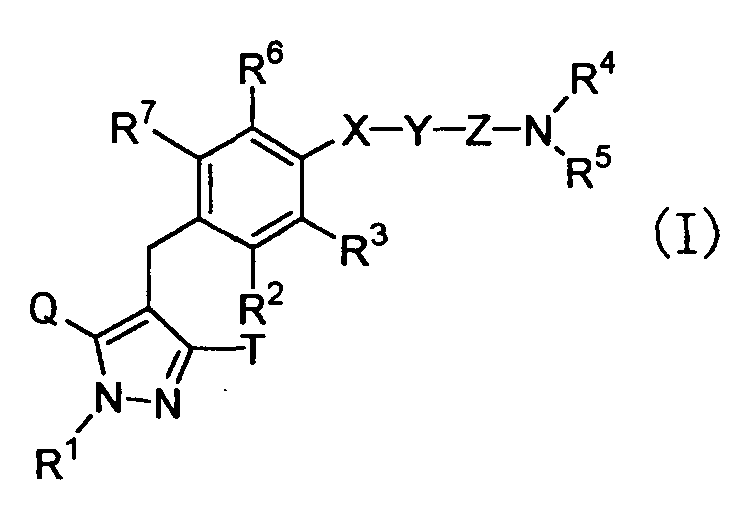
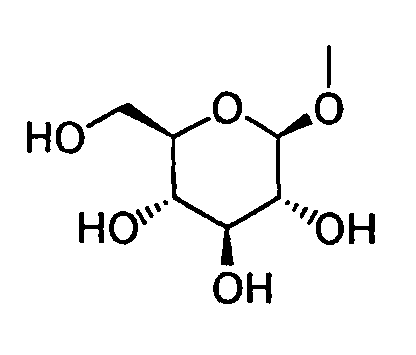
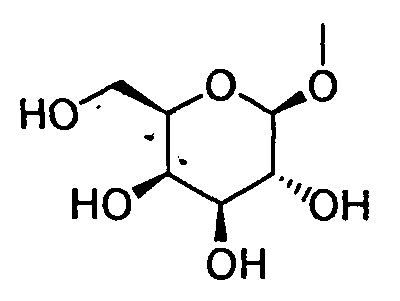
Description
Reference 1: The Diabetes Control and Complications Trial Research Group, N. Engl. J. Med., 1993.9, Vol.329, No.14, pp.977-986;
Reference 2: UK Prospective Diabetes Study Group, Lancet, 1998.9, Vol.352, No.9131, pp.837-853;
Reference 3: Makoto, TOMINAGA, Endocrinology & Diabetology, 2001.11, Vol.13, No.5, pp.534-542;
Reference 4: Jean-Louis Chiasson and 5 persons, Lancet, 2002.6, Vol.359, No.9323, pp.2072-2077;
Reference 5: Hiroyuki, ODAKA and 3 persons, Journal of Japanese Society of Nutrition and Food Science, 1992, Vol.45, No.1, pp.27-31;
Reference 6: Tadao, BABA and 1 person, Supplementary volume of Nippon Rinsho, Ryoikibetsu Shokogun, 1998, No. 19, pp.552-554;
Reference 7: Michihiro, KASAHARA and 2 persons, Saishin Igaku, 1996.1, Vol.51, No.1, pp.84-90;
Reference 8: Tomofusa, TSUCHIYA and 1 person, Nippon Rinsho, 1997.8, Vol.5.5, No.8, pp.2131-2139;
Reference 9: Yoshikatsu, KANAI, Kidney and Dialysis, 1998.12, Vol.45, extra edition, pp.232-237;
Reference 10: E. Turk and 4 persons, Nature, 1991.3, Vol.350, pp.354-356;
Reference 11: Y. Fujita and 5 persons, Diabetologia, 1998, Vol. 41, pp.1459-1466;
Reference 12: J. Dyer and 5 persons, Biochemical Society Transactions, 1997, Vol.25, p.479S;
Reference 13: J. Dyer and 4 persons, American Journal of Physiology, 2002.2, Vo1.282, No.2, pp.G241-G248
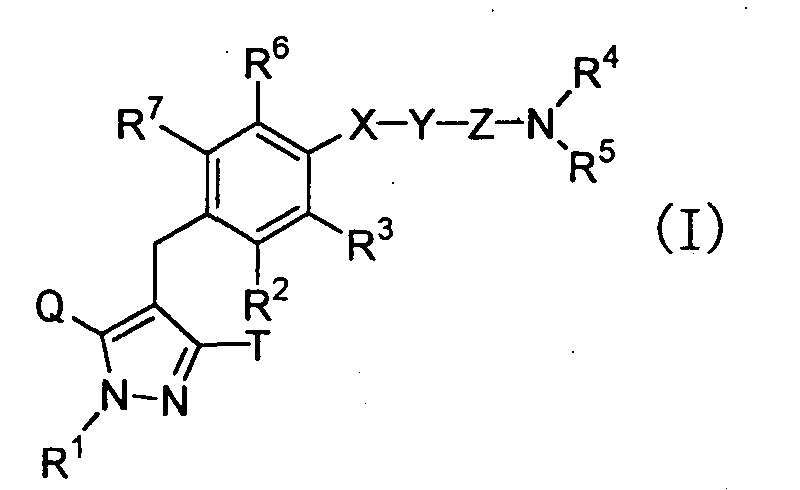
R1 represents a hydrogen atom, a C1-6 alkyl group, a C2-6 alkenyl group, a hydroxy(C2-6 alkyl) group, a C3-7 cycloalkyl group, a C3-7 cycloalkyl-substituted (C1-6 alkyl) group, an aryl group which may have the same or different 1 to 3 substituents selected from the group consisting of a halogen atom, a hydroxy group, an amino group, a C1-6 alkyl group and a C1-6 alkoxy group, or an aryl(C1-6 alkyl) group which may have the same or different 1 to 3 substituents selected from the group consisting of a halogen atom, a hydroxy group, an amino group, a C1-6 alkyl group and a C1-6 alkoxy group on the ring;
one of Q and T represents a group represented by the formula:
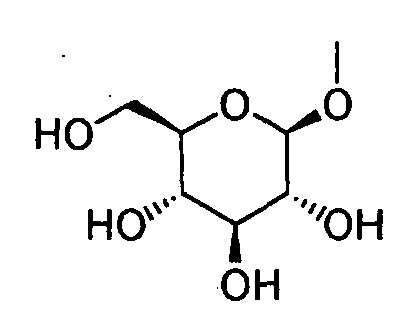

R2 represents a hydrogen atom, a halogen atom, a hydroxy group, a C1-6 alkyl group, a C1-6 alkoxy group, a C1-6 alkylthio group, a halo(C1-6 alkyl) group, a halo(C1-6 alkoxy) group, a C1-6 alkoxy-substituted (C1-6 alkoxy) group, a C3-7 cycloalkyl-substituted (C2-6 alkoxy) group or a group of the general formula: -A-R8 in which A represents a single bond, an oxygen atom, a methylene group, an ethylene group, -OCH2- or -CH2O-; and R8 represents a C3-7 cycloalkyl group, a C2-6 heterocycloalkyl group, an aryl group which may have the same or different 1 to 3 substituents selected from the group consisting of a halogen atom, a hydroxy group, an amino group, a C1-6 alkyl group, a C1-6 alkoxy group, a C2-6 alkenyloxy group, a halo(C1-6 alkyl) group, a hydroxy(C1-6 alkyl) group, a carboxy group, a C2-7 alkoxycarbonyl group, a cyano group and a nitro group, or a heteroaryl group which may have a substituent selected from the group consisting of a halogen atom and a C1-6 alkyl group;
X represents a single bond, an oxygen atom or a sulfur atom;
Y represents a single bond, a C1-6 alkylene group or a C2-6 alkenylene group with the proviso that X is a single bond when Y is a single bond;
Z represents a carbonyl group or a sulfonyl group;
R4 and R5 are the same or different, and each represents a hydrogen atom or a C1-6 alkyl group which may have the same or different 1 to 3 groups selected from the following substituent group (i), or they bind together with the neighboring nitrogen atom to form a C2-6 cyclic amino group which may have a substituent selected from the group consisting of a C1-6 alkyl group and a hydroxy(C1-6 alkyl) group;
R3, R6 and R7 are the same or different, and each represents a hydrogen atom, a halogen atom, a C1-6 alkyl group or a C1-6 alkoxy group; and
substituent group (i) consists of a hydroxy group, an amino group, a mono or di(C1-6 alkyl)amino group, a mono or di[hydroxy(C1-6 alkyl)]amino group, an ureido group, a sulf amide group, a mono or di(C1-6 alkyl)ureido group, a mono or di(C1-6 alkyl)sulfamide group, a C2-7 acylamino group, a C1-6 alkylsulfonylamino group, a group of the general formula: -CON(R9)R10 in which R9 and R10 are the same or different, and each represents a hydrogen atom or a C1-6 alkyl group which may have the same or different 1 to 3 substituents selected from the group consisting of a hydroxy group, an amino group, a mono or di(C1-6 alkyl)amino group, a mono or di[hydroxy(C1-6 alkyl)]amino group, an ureido group, a mono or di(C1-6 alkyl)ureido group, a C2-7 acylamino group, a C1-6 alkylsulfonylamino group and a carbamoyl group, or they bind together with the neighboring nitrogen atom to form a C2-6 cyclic amino group which may have a substituent selected from the group consisting of a C1-6 alkyl group and a hydroxy(C1-6 alkyl) group, a C3-7 cycloalkyl group, a C2-6 heterocycloalkyl group, an aryl group which may have the same or different 1 to 3 substituents selected from the group consisting of a halogen atom, a hydroxy group, an amino group, a C1-6 alkyl group and a C1-6 alkoxy group, a heteroaryl group which may have a substituent selected from the group consisting of a halogen atom and a C1-6 alkyl group, a C2-6 cyclic amino group which may have a substituent selected from the group consisting of a C1-6 alkyl group and a hydroxy(C1-6 alkyl) group, and a C1-4 aromatic cyclic amino group which may have a C1-6 alkyl group as a substituent,
or a pharmaceutically acceptable salt thereof;
-CON(R9)R10 in which R9 and R10 are the same or different, and each represents a hydrogen atom or a C1-6 alkyl group which may have the same or different 1 to 3 substituents selected from the group consisting of a hydroxy group, an amino group, a mono or di(C1-6 alkyl)amino group, a mono or di[hydroxy(C1-6 alkyl)]amino group, an ureido group, a mono or di(C1-6 alkyl)-ureido group, a C2-7 acylamino group, a C1-6 alkylsulfonylamino group and a carbamoyl group, or they bind together with the neighboring nitrogen atom to form a C2-6 cyclic amino group which may have a substituent selected from the group consisting of a C1-6 alkyl group and a hydroxy(C1-6 alkyl) group, a C3-7 cycloalkyl group, a C2-6 heterocycloalkyl group, an aryl group which may have the same or different 1 to 3 substituents selected from the group consisting of a halogen atom, a hydroxy group, an amino group, a C1-6 alkyl group and a C1-6 alkoxy group, a heteroaryl group which may have a substituent selected from the group consisting of a halogen atom and a C1-6 alkyl group, a C2-6 cyclic amino group which may have a substituent selected from the group consisting of a C1-6 alkyl group and a hydroxy(C1-6 alkyl) group, and a C1-4 aromatic cyclic amino group which may have a C1-6 alkyl group as a substituent, or a pharmaceutically acceptable salt thereof;


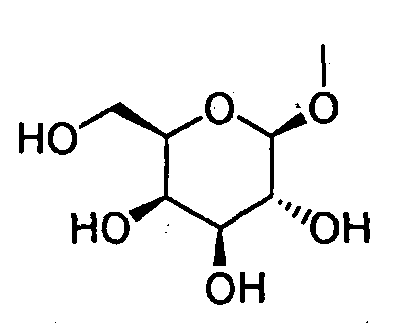
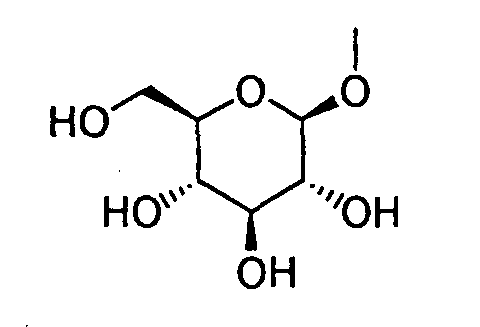

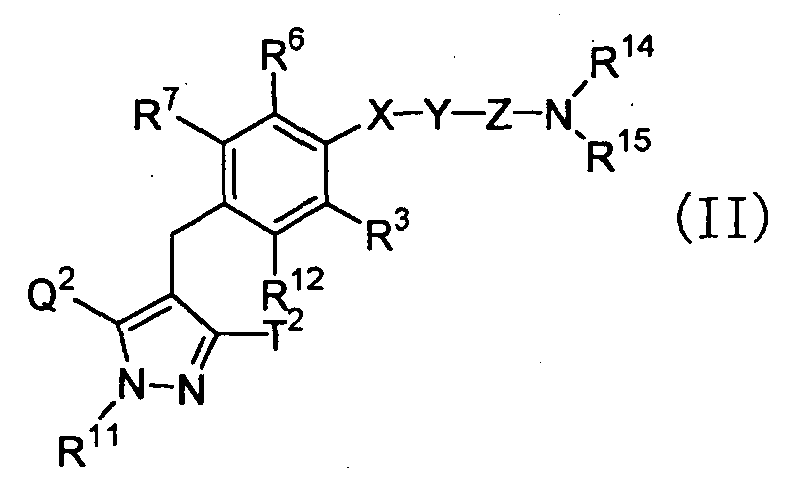
R11 represents a hydrogen atom, a C1-6 alkyl group, a C2-6 alkenyl group, a hydroxy(C2-6 alkyl) group which may have a protective group, a C3-7 cycloalkyl group, a C3-7 cycloalkyl-substituted (C1-6 alkyl) group, an aryl group which may have the same or different 1 to 3 substituents selected from the group consisting of a halogen atom, a hydroxy group which may have a protective group, an amino group which may have a protective group, a C1-6 alkyl group and a C1-6 alkoxy group, or an aryl(C1-6 alkyl) group which may have the same or different 1 to 3 substituents selected from the group consisting of a halogen atom, a hydroxy group which may have a protective group, an amino group which may have a protective group, a C1-6 alkyl group and a C1-6 alkoxy group on the ring;
one of Q2 and T2 represents a 2,3,4,6-tetra-O-acetyl-β-D-glucopyranosyloxy group or a 2,3,4,6-tetra-O-acetyl-β-D-galactopyranosyloxy group, while the other represents a C1-6 alkyl group, a halo(C1-6 alkyl) group, a C1-6 alkoxy-substituted (C1-6 alkyl) group or a C3-7 cycloalkyl group;
R12 represents a hydrogen atom, a halogen atom, a hydroxy group which may have a protective group, a C1-6 alkyl group, a C1-6 alkoxy group, a C1-6 alkylthio group, a halo(C1-6 alkyl) group, ahalo(C1-6 alkoxy) group, a C1-6 alkoxy-substituted (C1-6 alkoxy) group, a C3-7 cycloalkyl- substituted (C2-6 alkoxy) group or a group of the general formula: -A-R18 in which A represents a single bond, an oxygen atom, a methylene group, an ethylene group, -OCH2- or -CH2O-; and R18 represents a C3-7 cycloalkyl group, a C2-6 heterocycloalkyl group, an aryl group which may have the same or different 1 to 3 substituents selected from the group consisting of a halogen atom, a hydroxy group which may have a protective group, an amino group which may have a protective group, a C1-6 alkyl group, a C1-6 alkoxy group, a C2-6 alkenyloxy group, a halo(C1-6 alkyl) group, a hydroxy(C1-6 alkyl) group which may have a protective group, a carboxy group which may have a protective group, a C2-7 alkoxycarbonyl group, a cyano group and a nitro group, or a heteroaryl group which may have a substituent selected from the group consisting of a halogen atom and a C1-6 alkyl group;
X represents a single bond, an oxygen atom or a sulfur
atom;
Y represents a single bond, a C1-6 alkylene group or a C2-6 alkenylene group with the proviso that X is a single bond when Y is a single bond;
Z represents a carbonyl group or a sulfonyl group;
R14 and R15 are the same or different, and each represents a hydrogen atom or a C1-6 alkyl group which may have the same or different 1 to 3 groups selected from the following substituent group (ii), or they bind together with the neighboring nitrogen atom to form a C2-6 cyclic amino group which may have a substituent selected from the group consisting of a C1-6 alkyl group and a hydroxy(C1-6 alkyl) group which may have a protective group;
R3 , R6 and R7 are the same or different, and each represents a hydrogen atom, a halogen atom, a C1-6 alkyl group or a C1-6 alkoxy group; and
substituent group (ii) consists of a hydroxy group which may have a protective group, an amino group which may have a protective group, a mono or di(C1-6 alkyl)amino group which may have a protective group, a mono or di[hydroxy(C1-6 alkyl)]amino group which may have a protective group, an ureido group, a sulfamide group, a mono or di(C1-6 alkyl)ureido group, a mono or di(C1-6 alkyl)sulfamide group, a C2-7 acylamino group, a C1-6 alkylsulfonylamino group, a group of the general formula: -CON(R19)R20 in which R19 and R20 are the same or different, and each represents a hydrogen atom or a C1-6 alkyl group which may have the same or different 1 to 3 substituents selected from the group consisting of a hydroxy group which may have a protective group, an amino group which may have a protective group, a mono or di(C1-6 alkyl)amino group which may have a protective group, a mono or di[hydroxy(C1-6 alkyl)]amino group which may have a protective group, an ureido group, a mono or di(C1-6 alkyl)ureido group, a C2-7 acylamino group, a C1-6 alkylsulfonylamino group and a carbamoyl group, or they bind together with the neighboring nitrogen atom to form a C2-6 cyclic amino group which may have a substituent selected from the group consisting of a C1-6 alkyl group and a hydroxy(C1-6 alkyl) group which may have a protective group, a C3-7 cycloalkyl group, a C2-6 heterocycloalkyl group, an aryl group which may have the same or different 1 to 3 substituents selected from the group consisting of a halogen atom, a hydroxy group which may have a protective group, an amino group which may have a protective group, a C1-6 alkyl group and a C1-6 alkoxy group, a heteroaryl group which may have a substituent selected from the group consisting of a halogen atom and a C1-6 alkyl group, a C2-6 cyclic amino group which may have a substituent selected from the group consisting of a C1-6 alkyl group and a hydroxy(C1-6 alkyl) group which may have a protective group, and a C1-4 aromatic cyclic amino group which may have a C1-6 alkyl group as a substituent, or a salt thereof; and the like.


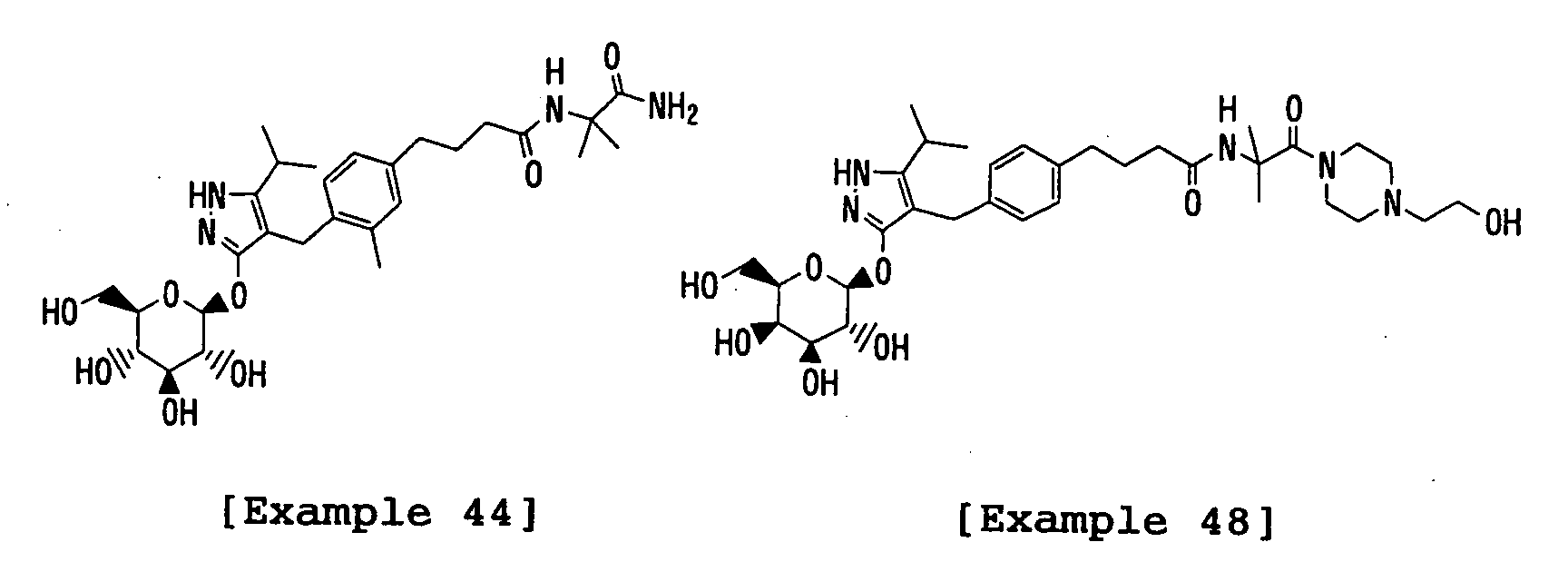
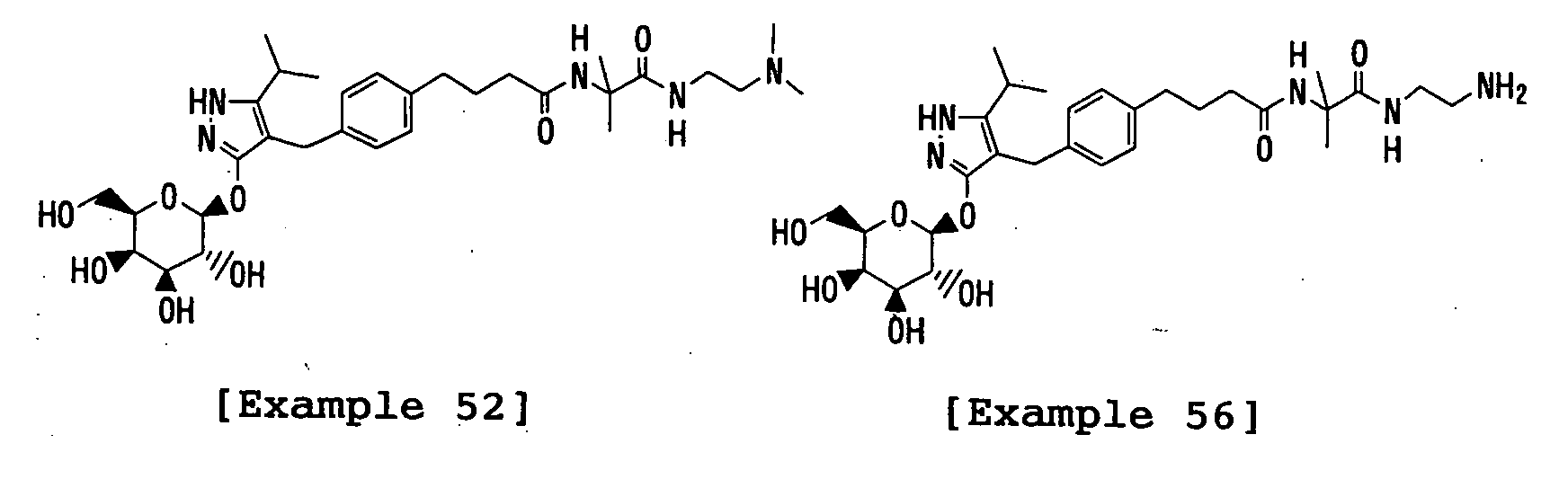
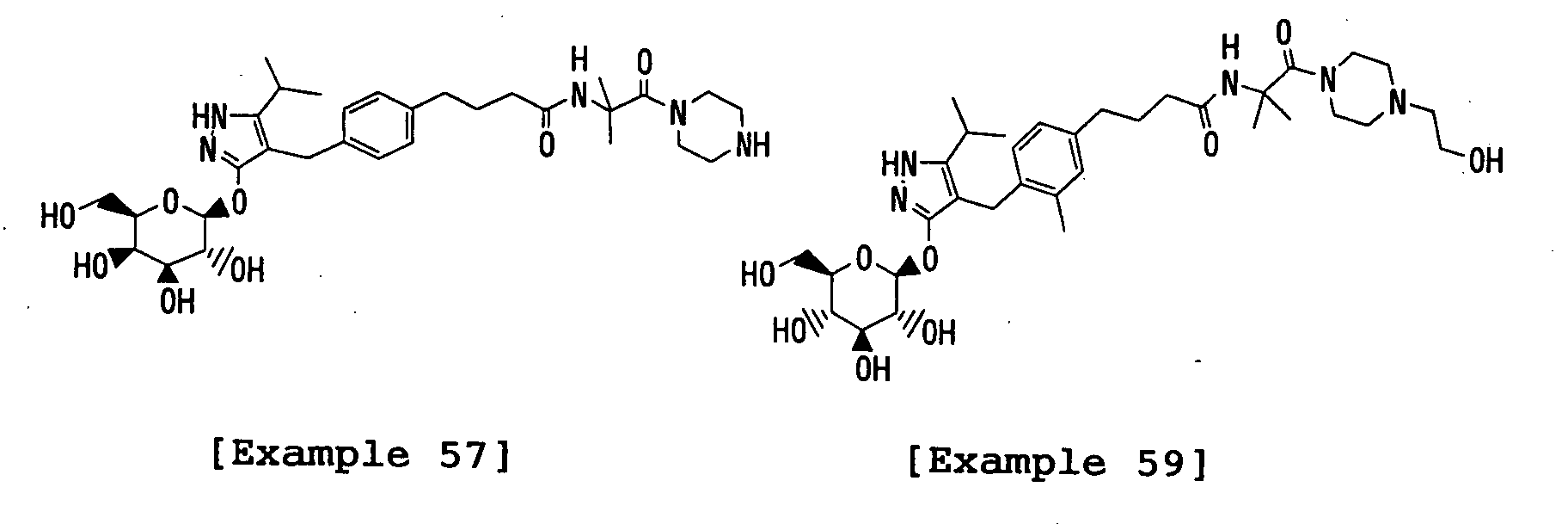


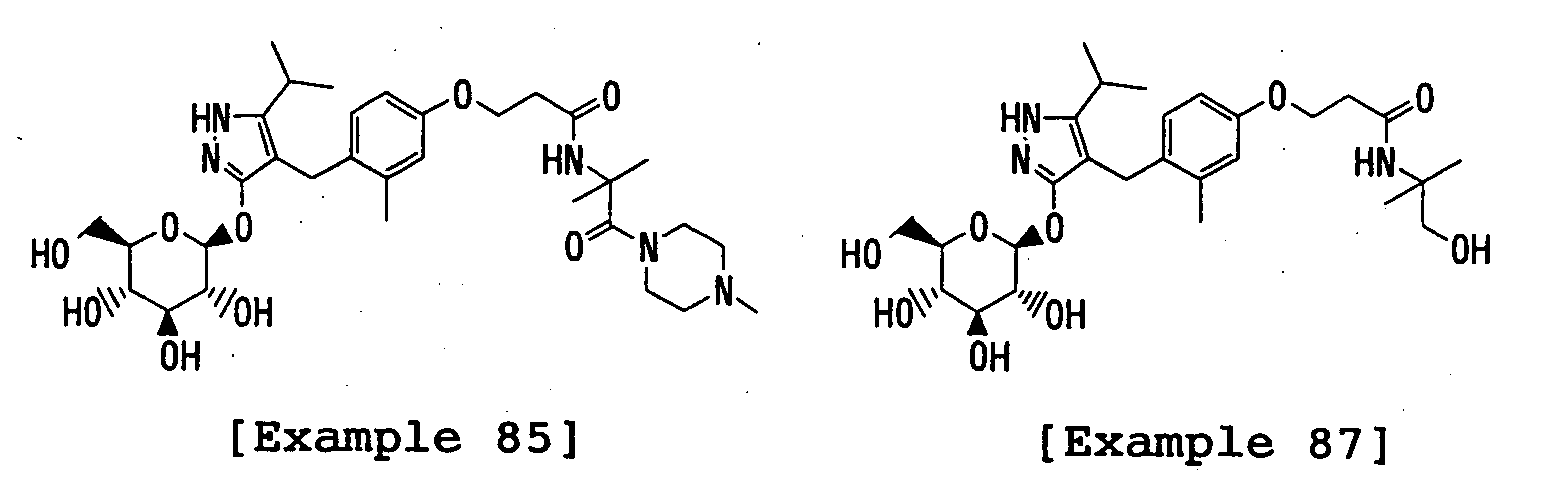
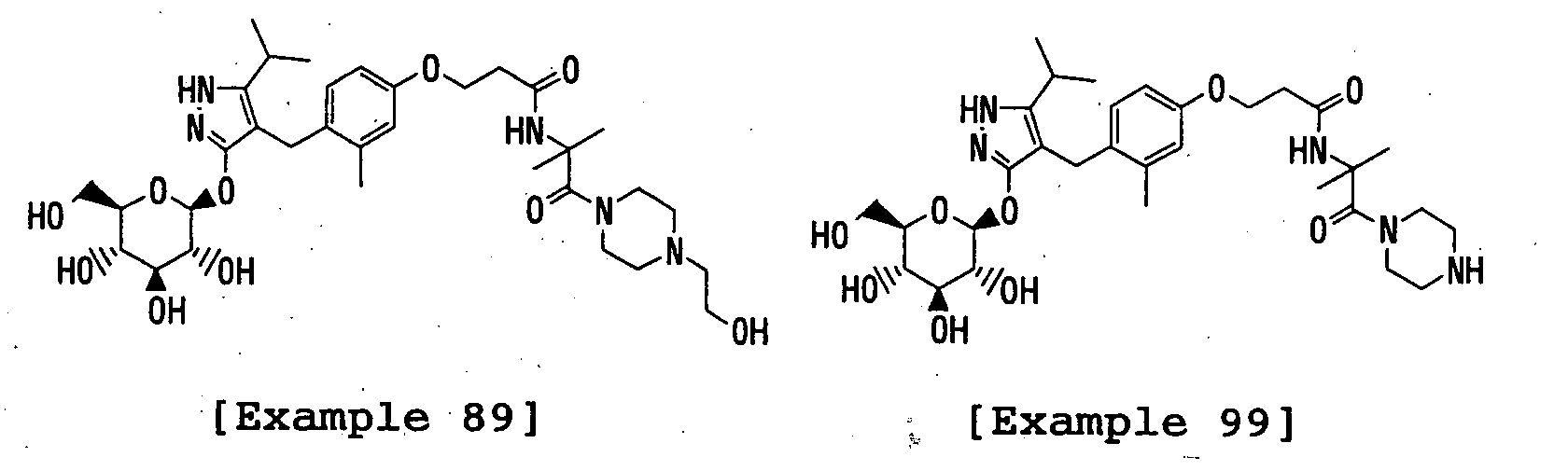
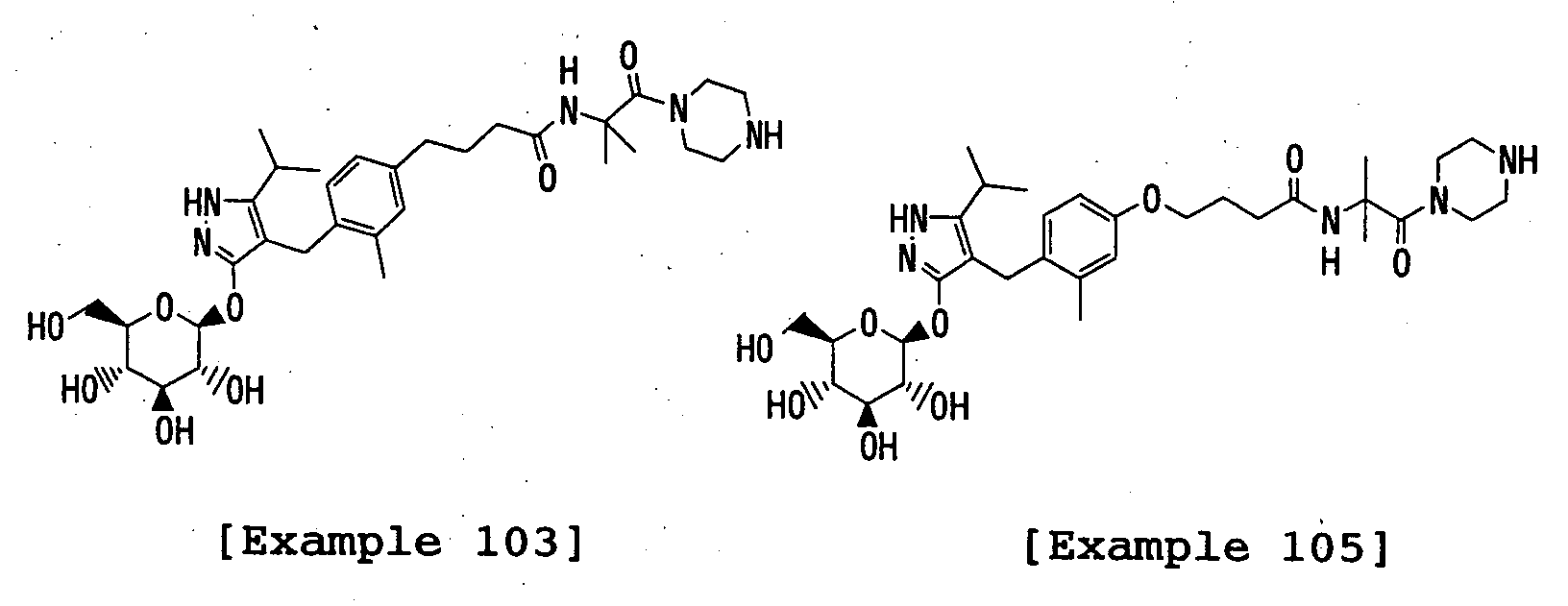
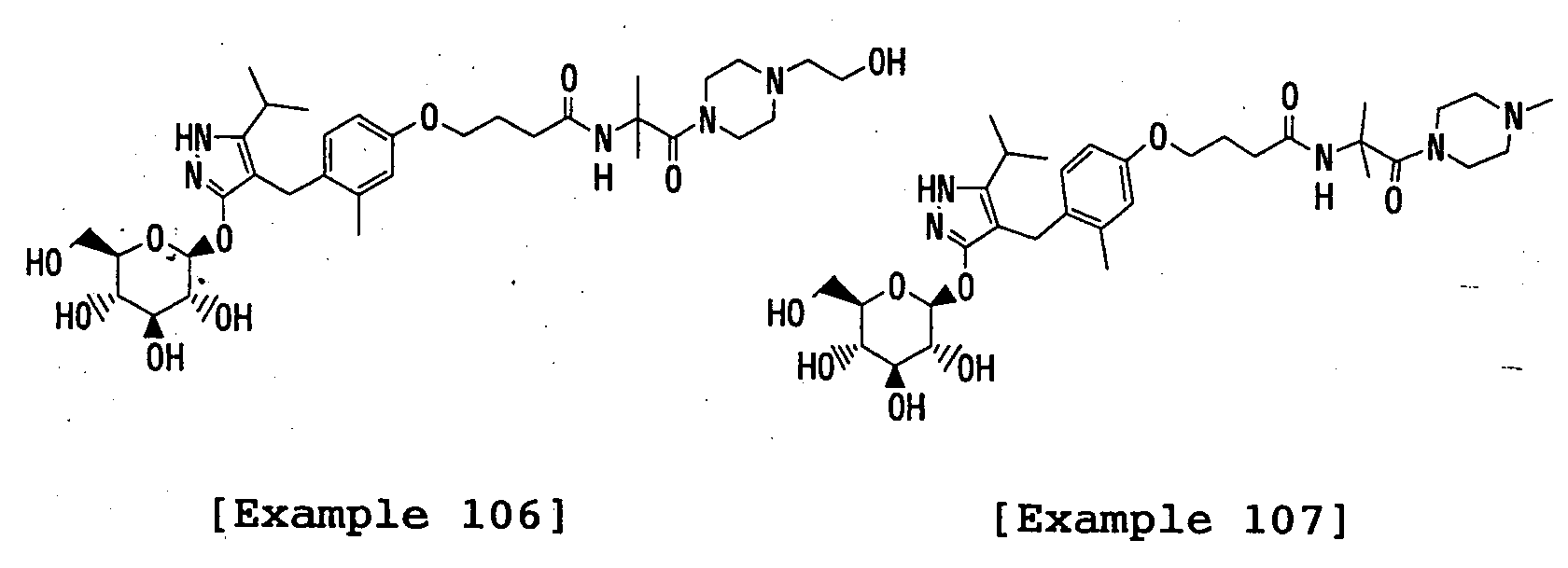
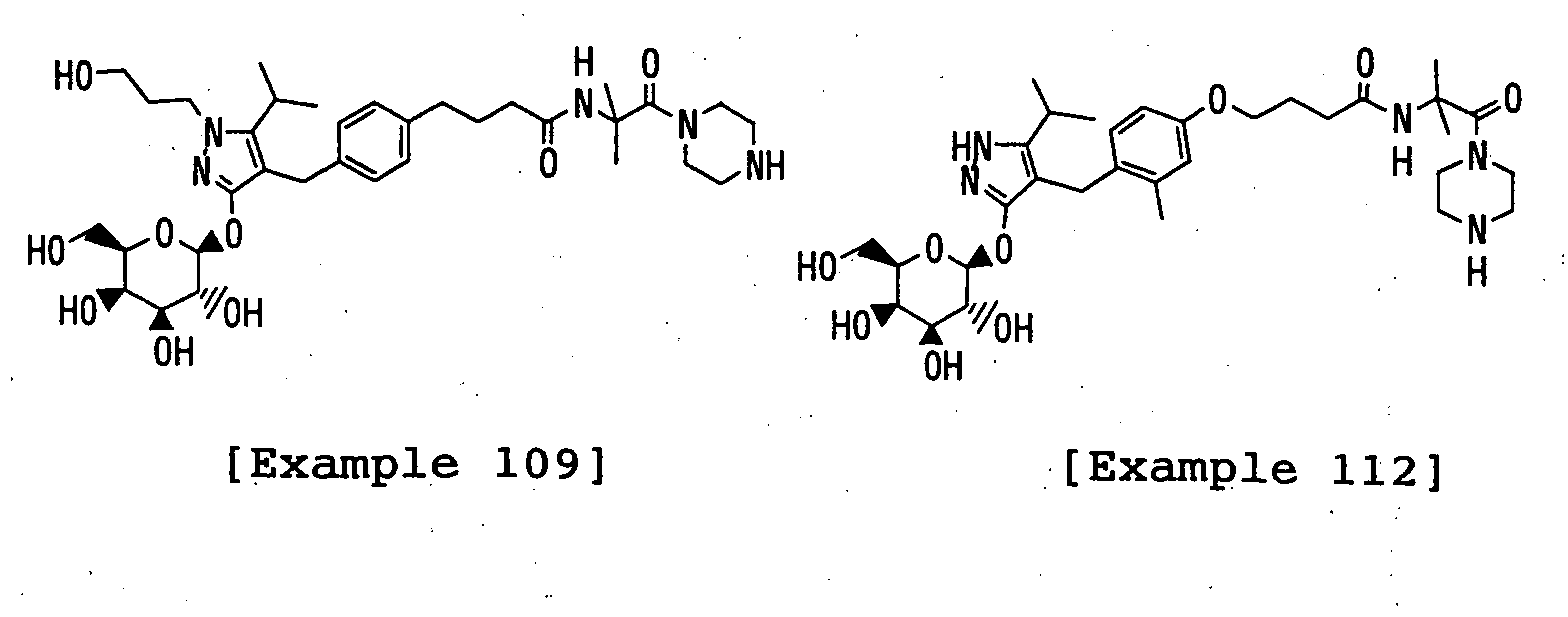
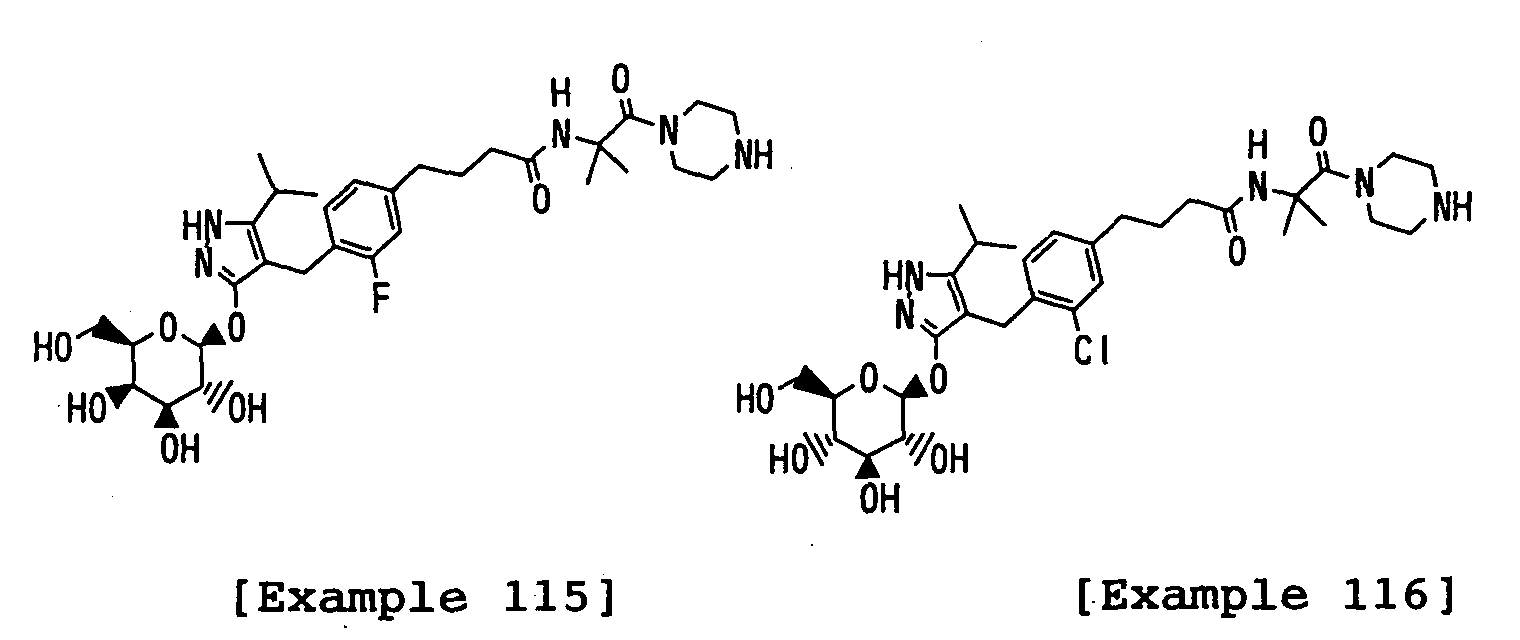

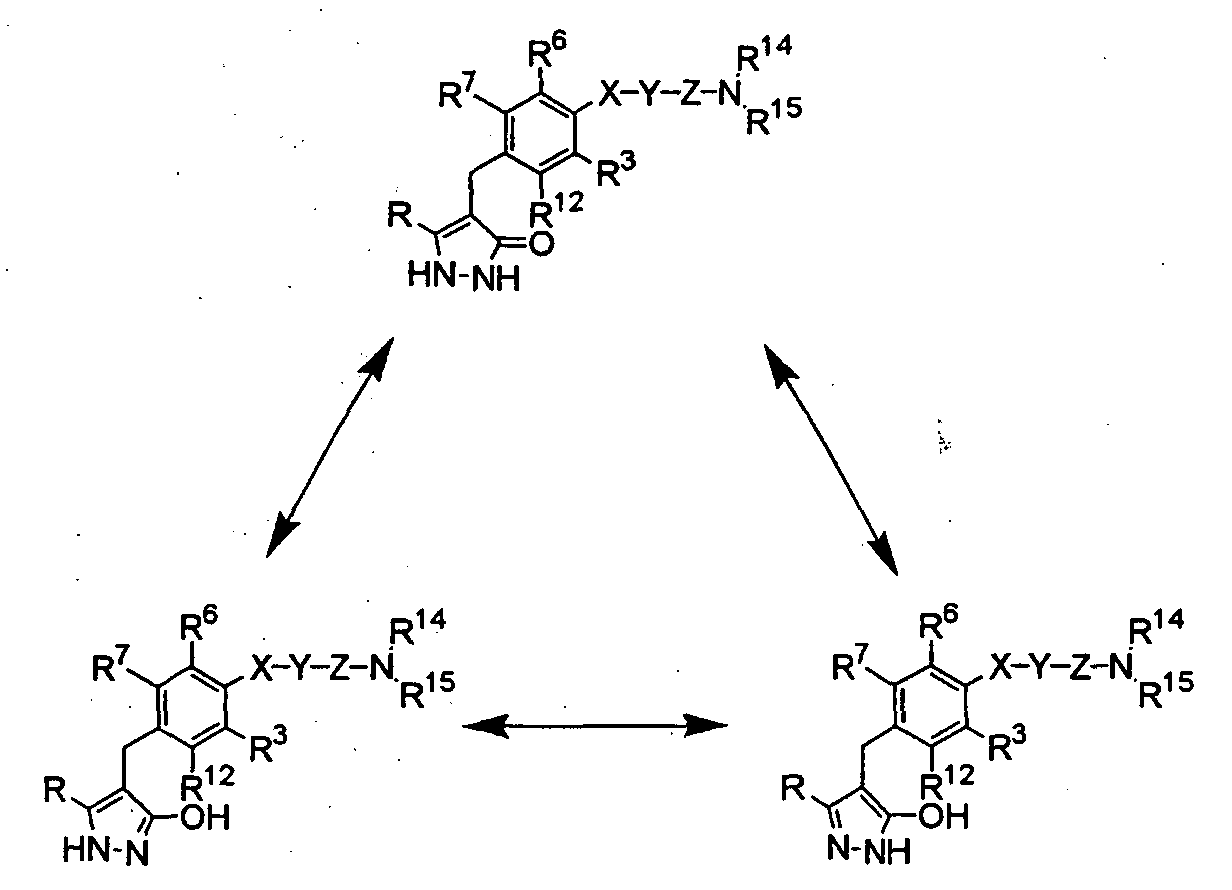
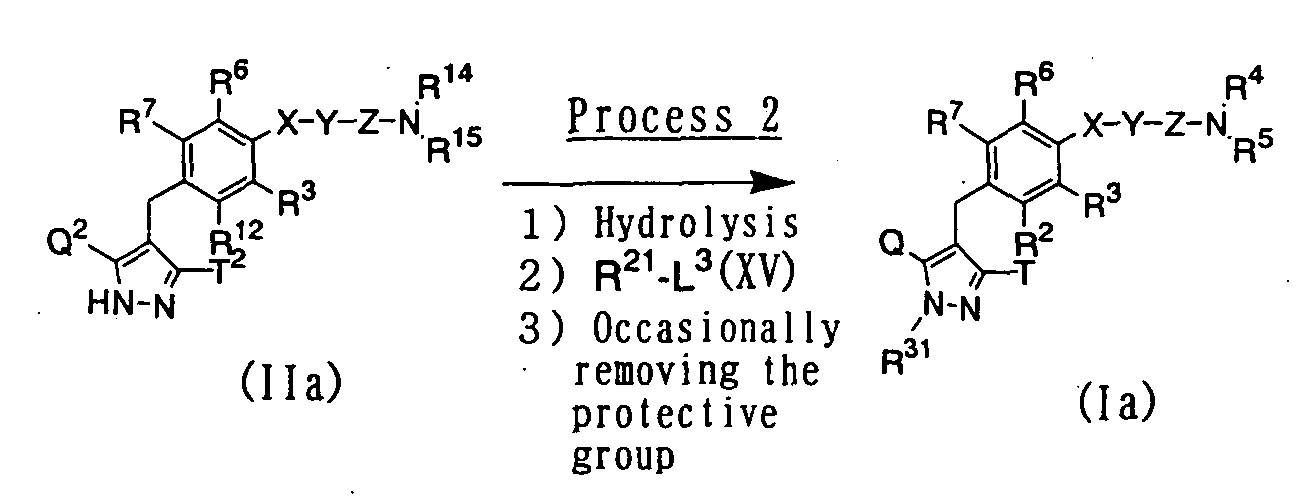
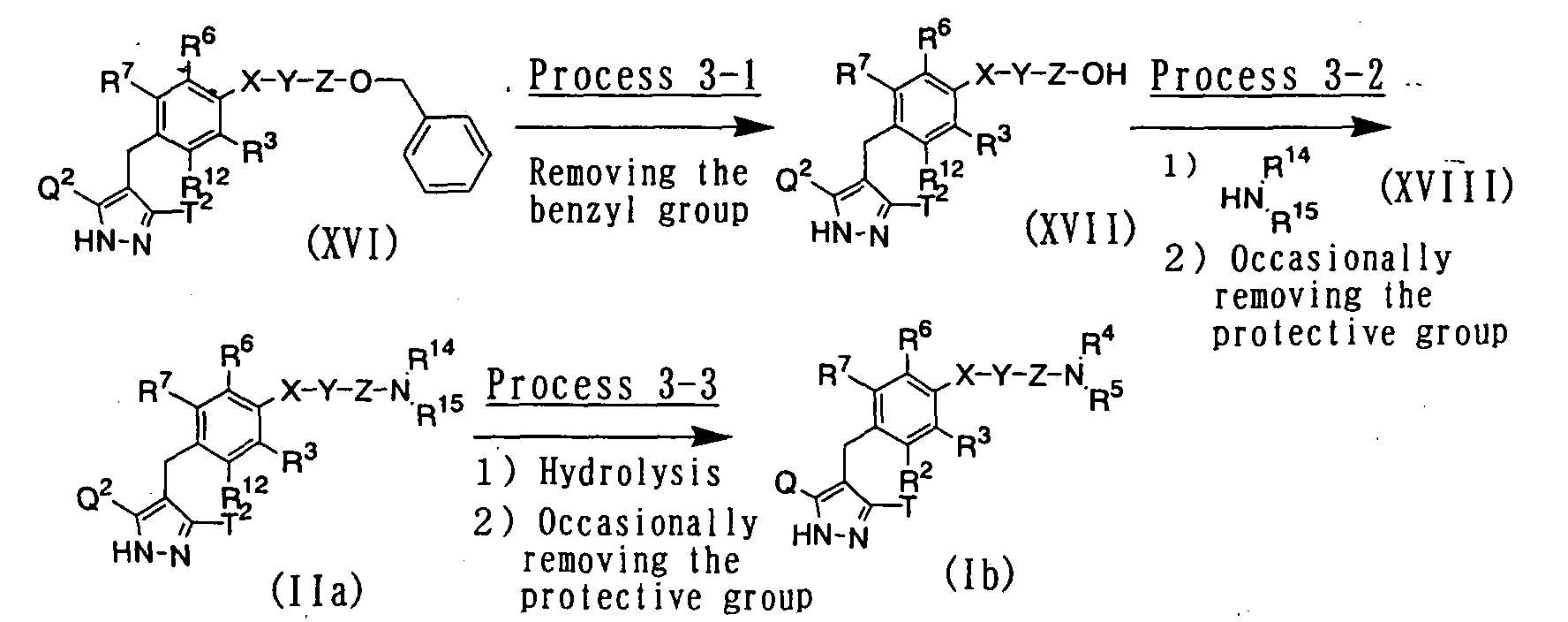
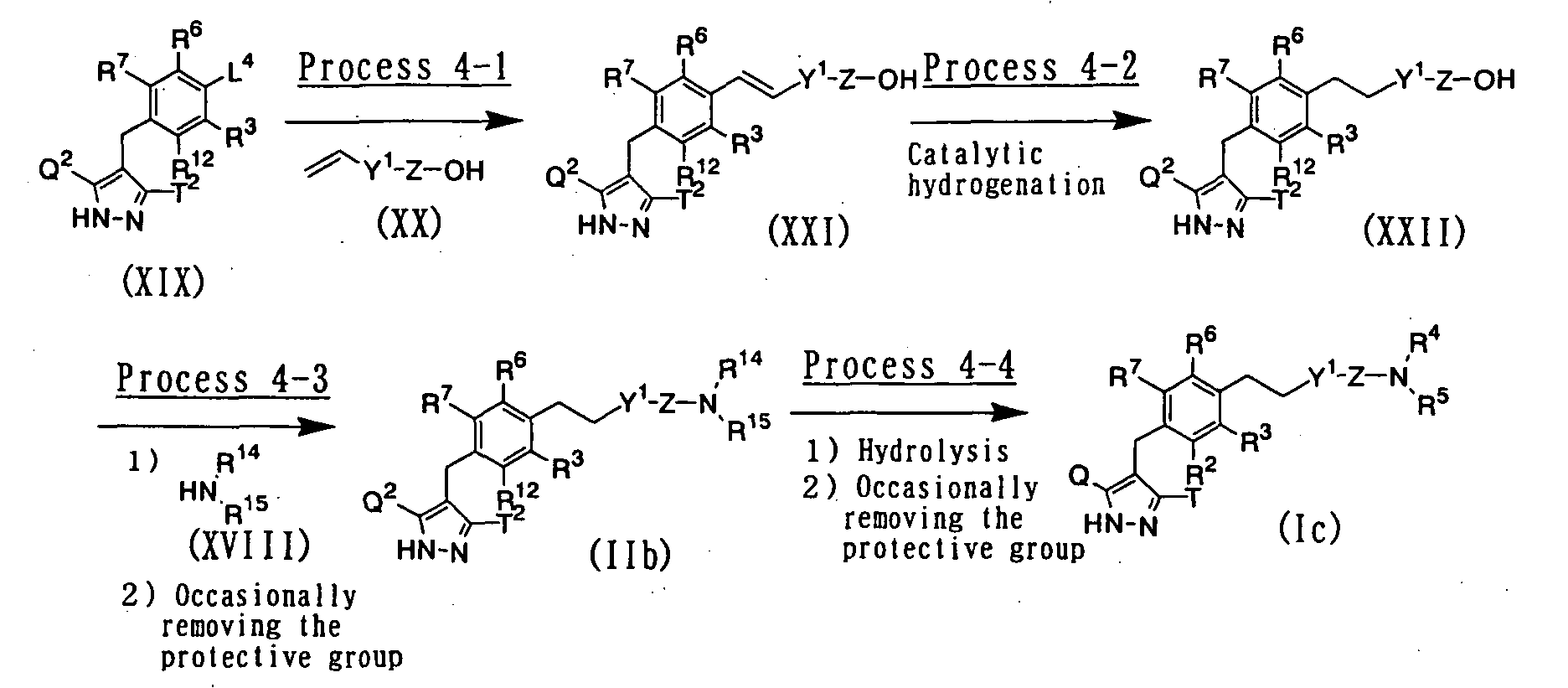

1H-NMR (DMSO-d6) δ ppm:
1.15 (6H, s), 1.9 (2H, brs), 6.83 (1H, brs), 7.26 (1H, brs)
1H-NMR (DMSO-d6) δ ppm:
1.07 (6H, d, J=7.1Hz), 2.75-2.9 (1H, m), 3.55 (2H, s), 7.05-7.15 (2H, m), 7.35-7.45 (2H, m)
1H-NMR (CDCl3) δ ppm:
1.1-1.25 (6H, m), 1. 86 (3H, s), 2.01 (3H, s), 2.03 (3H, s), 2.06 (3H, s), 2.85-2.95 (1H, m), 3.58 (1H, d, J=16.2Hz), 3.64 (1H, d, J=16.2Hz), 3.8-3.95 (1H, m), 4.15 (1H, dd, J=12.4Hz, 2.2Hz), 4.32 (1H, dd, J=12.4Hz, 3.9Hz), 5.15-5.35 (3H, m), 5.53 (1H, d, J=7.5Hz), 6.95-7.05 (2H, m), 7.3-7.4 (2H, m)
1H-NMR (CDCl3) δ ppm:
1.1-1.2 (6H, m), 1.84 (3H, s), 2.01 (3H, s), 2.02 (3H, s), 2.05 (3H, s), 2.8-2.95 (1H, m), 3.2-3.3 (2H, m), 3.59 (1H, d, J=16.0Hz), 3.66 (1H, d, J=16.0Hz), 3.8-3.9 (1H, m), 4.18 (1H, dd, J=12.3Hz, 1.8Hz), 4.33 (1H, dd, J=12.3Hz, 3.8Hz), 5.15-5.35 (3H, m), 5.4-5.5 (1H, m), 6.2-6.3 (1H, m), 6.4-6.5 (1H, m), 7.0-7.1 (2H, m), 7.2-7.3 (2H, m)
1H-NMR (CDCl3) δ ppm:
1.19 (6H, d, J=7.3Hz), 1.84 (3H, s), 2.01 (3H, s), 2.04 (3H, s), 2.05 (3H, s), 2.85-3.0 (1H, m), 3.66 (1H, d, J=16.2Hz), 3.73 (1H, d, J=16.2Hz), 3.85-3.95 (1H, m), 4.2 (1H, dd, J=12.6Hz, 2.2Hz), 4.34 (1H, dd, J=12.6Hz, 4.1Hz), 5.15-5.35 (3H, m), 5. 5 (1H, d, J=7.7Hz), 6.4(1H, d, J=15.7Hz), 7.15-7.2(2H, m), 7.4-7.5 (2H, m), 7.71 (1H, d, J=15.7Hz)
1H-NMR (CD3OD) δ ppm:
1.1-1.2 (6H, m), 1.85-1.95 (2H, m), 2.25 (2H, t, J=7.6Hz), 2.6 (2H, t, J=7.5Hz), 2.85-2.95 (1H, m), 3.25-3.4 (4H, m), 3.6-3.9 (6H, m), 5.0-5.1 (1H, m), 7.0-7.15 (4H, m)
1H-NMR (CD3OD) δ ppm:
1.05-1.2 (6H, m), 1.8-1.95 (2H, m), 2.19 (2H, t, J=7.6Hz), 2.58 (2H, t, J=7.5Hz), 2.85-2.95 (1H, m), 3.3-3.45 (4H, m), 3.6-3.8 (3H, m), 3.8-3.9 (1H, m), 5.0-5.1 (1H, m), 7.0-7.15 (4H, m)
1H-NMR (CD3OD) δ ppm:
1.05-1.2 (6H, m), 1.8-1.95 (2H, m), 2.15 (2H, t, J=7.3Hz), 2.4 (2H, t, J=6.7Hz), 2.56 (2H, t, J=7.5Hz), 2.85-2.95 (1H, m), 3.25-3.45 (6H, m), 3.6-3.9 (4H, m), 5.0-5.1 (1H, m), 7.0-7.15 (4H, m)
1H-NMR (CD3OD) δ ppm:
1.1-1.2 (6H, m), 1.85-1.95 (2H, m), 2.19 (2H, t, J=7.6Hz), 2.58 (2H, t, J=7.5Hz), 2.8 (2H, t, J=6.1Hz), 2.85-2.95 (1H, m), 3.2-3.4 (6H, m), 3.6-3.9 (4H, m), 5.0-5.1 (1H, m), 7.0-7.15 (4H, m)
1H-NMR (CD3OD) δ ppm:
1.1-1.2 (6H, m), 1.6-1.7 (2H, m), 1.8-1.95 (2H, m), 2.17 (2H, t, J=7.7Hz), 2.57 (2H, t, J=7.5Hz), 2.68 (2H, t, J=7.1Hz), 2.85-2.95 (1H, m), 3.22 (2H, t, J=6.7Hz), 3.25-3.45 (4H, m), 3.6-3.9 (4H, m), 5.0-5.1 (1H, m), 7.0-7.15 (4H, m)
1H-NMR (CD3OD) δ ppm:
1.1-1.2 (6H, m), 1.45-1.65 (4H, m), 1.8-1.95 (2H, m), 2.16 (2H, t, J=7.5Hz), 2.57 (2H, t, J=7.7Hz), 2.83 (2H, t, J=7.0Hz), 2.85-3.0 (1H, m), 3.17 (2H, t, J=6.6Hz), 3.25-3.45 (4H, m), 3.6-3.9 (4H, m), 5.0-5.1 (1H, m), 7.0-7.15 (4H, m)
1H-NMR (CD3OD) δ ppm:
1.1-1.2 (6H, m), 1.7-1.8 (2H, m), 2.1-2.2 (2H, m), 2.44 (2H, t, J=7.5Hz), 2.76 (1H, dd, J=13.9Hz, 9.3Hz), 2.85-2.95 (1H, m), 3.04 (1H, dd, J=13.9Hz, 5.5Hz), 3.25-3.45 (4H, m), 3.6-3.9 (4H, m), 4.57 (1H, dd, J=9.3Hz, 5.5Hz), 5.0-5.1 (1H, m), 6.65-6.75 (2H, m), 6.95-7.15 (6H, m)
1H-NMR (CD3OD) δ ppm:
1.05-1.2 (6H, m), 1.85-1.95 (2H, m), 2.22 (2H, t, J=7.5Hz), 2.57 (2H, t, J=7.5Hz), 2.8-2.95 (1H, m), 3.25-3.45 (4H, m), 3.6-3.9 (4H, m), 4.33 (2H, s), 5.0-5.1 (1H, m), 7.0-7.15 (4H, m), 7.15-7.45 (5H, m)
1H-NMR (CD3OD) δ ppm:
1.05-1.15 (6H, m), 1.75-1.9 (2H, m), 2.12 (2H, t, J=7.5Hz), 2.51 (2H, t, J=7.7Hz), 2.77 (2H, t, J=7.5Hz), 2.8-2.95 (1H, m), 3.25-3.45 (6H, m), 3.6-3.9 (4H, m), 5.0-5.15 (1H, m), 6.95-7.05 (2H, m), 7.05-7.3 (7H, m)
1H-NMR (CD3OD) δ ppm:
1.1-1.15 (6H, m), 1.85-1.95 (2H, m), 2.22 (2H, t, J=7.6Hz), 2.56 (2H, t, J=7.6Hz), 2.85-2.95 (1H, m), 3.25-3.45 (4H, m), 3.6-3.9 (4H, m), 4.37 (2H, s), 5.0-5.1 (1H, m), 7.0-7.15 (4H, m), 7.35-7.45 (1H, m), 7.7-7.8 (1H, m), 8.4-8.45 (1H, m), 8.45-8.5 (1H, m)
1H-NMR (CD3OD) δ ppm:
1.1-1.15 (6H, m), 1.75-1.9 (2H, m), 2.11 (2H, t, J=7.5Hz), 2.51 (2H, t, J=7.6Hz), 2.85-3.0 (3H, m), 3.25-3.45 (4H, m), 3.52 (2H, t, J=6.9Hz), 3.6-3.9 (4H, m), 5.0-5.1 (1H, m), 6.95-7.15 (4H, m), 7.2-7.35 (2H, m), 7.7-7.8 (1H, m), 8.4-8.5 (1H, m)
1H-NMR (CD3OD) δ ppm:
1.05-1.2 (6H, m), 1.8-1.95 (2H, m), 2.17 (2H, t, J=7.6Hz), 2.25 (6H, s), 2.42 (2H, t, J=6.9Hz), 2.57 (2H, t, J=7.5Hz), 2.85-2.95 (1H, m), 3.25-3.4 (6H, m), 3.6-3.9 (4H, m), 5.0-5.1 (1H, m), 7.0-7.15 (4H, m)
1H―NMR (CD3OD) δ ppm:
1.05-1.2 (6H, m), 1.8-1.95 (2H, m), 2.17 (2H, t, J=7.6Hz), 2.4-2.55 (6H, m), 2.58 (2H, t, J=7.6Hz), 2.85-2.95 (1H, m), 3.25-3.45 (6H, m), 3.6-3.9 (8H, m), 5.0-5.1 (1H, m), 7.0-7.15 (4H, m)
1H-NMR (CD3OD) δ ppm:
1.1-1.15 (6H, m), 1.8-1.95 (2H, m), 2.18 (2H, t, J=7.5Hz), 2.5-2.7 (8H, m), 2.85-2.95 (1H, m), 3.25 (2H, t, J=6.4Hz), 3.3-3.4 (4H, m), 3.5-3.9. (8H, m), 5.0-5.1 (1H, m), 7.0-7.15 (4H, m)
1H-NMR (CD3OD) δ ppm:
1.05-1.2 (6H, m), 1.6-1.75 (2H, m), 1.8-1.95 (2H, m), 2.17 (2H, t, J=7.5Hz), 2.5-2.75 (8H, m), 2.8-2.95 (1H, m), 3.21 (2H, t, J=6.7Hz), 3.25-3.45 (4H, m), 3.5-3.9 (8H, m), 5.0-5.15 (1H, m), 7.0-7.2 (4H, m)
1H-NMR (CD3OD) δ ppm:
1.1-1.15 (6H, m), 1.6-1.75 (2H, m), 1.8-1.95 (2H, m), 2.16 (2H, t, J=7.5Hz), 2.22 (6H, s), 2.3-2.35 (2H,m), 2.57 (2H, t, J=7.6Hz), 2.85-2.95 (1H, m), 3.17 (2H, t, J=6.9Hz), 3.25-3.45 (4H, m), 3.6-3.9 (4H, m), 5.0-5.1 (1H, m), 7.0-7.15 (4H, m)
1H-NMR (CD3OD) δ ppm:
1.1-1.15 (6H, m), 1.8-2.0 (4H, m), 2.17 (2H, t, J=7.6Hz), 2.57 (2H, t, J=7.7Hz), 2.85-2.95 (1H, m), 3.14 (2H, t, J=6.8Hz), 3.3-3.45 (4H, m), 3.6-3.9 (4H, m), 4.03 (2H, t, J=7.0Hz), 5.0-5.1 (1H, m), 6.9-7.0 (1H, m), 7.0-7.15 (5H, m), 7.6-7.7 (1H, m)
1H-NMR (CD3OD) δ ppm:
1.05-1.15 (6H, m), 1.8-1.95 (2H, m), 2.18 (2H, t, J=7.5Hz), 2.57 (2H, t, J=7.5Hz), 2.85-2.95 (1H, m), 3.27 (2H, t, J=5.8Hz), 3.3-3.5 (4H, m), 3.57 (2H, t, J=5.9Hz), 3.6-3.9 (4H, m), 5.0-5.1 (1H, m), 7.0-7.15 (4H, m)
1H-NMR (CD3OD) δ ppm:
1.05-1.2 (6H, m), 1.8-1.95 (2H, m), 2.21 (2H, t, J=7.6Hz), 2.58 (2H, t, J=7.6Hz), 2.85-2.95 (1H, m), 3.3-3.45 (4H, m), 3.55-3.95 (9H, m), 5.0-5.1 (1H, m), 7.0-7.15 (4H, m)
1H-NMR (CD3OD) δ ppm:
1.1-1.15 (6H, m), 1.22 (3H, s), 1.8-1.95 (2H, m), 2.19 (2H, t, J=7.7Hz), 2.58 (2H, t, J=7.5Hz), 2.85-2.95 (1H, m), 3.25-3.45 (4H, m), 3.55-3.9 (8H, m), 5.0-5.1 (1H, m), 7.0-7.15 (4H, m)
1H-NMR (CD3OD) δ ppm:
1.1-1.2 (6H, m), 1.8-1.95 (2H, m), 2.23 (2H, t, J=7.5Hz), 2.59 (2H, t, J=7.6Hz), 2.85-2.95 (1H, m), 3.25-3.45 (4H, m), 3.6-3.9 (10H, m), 5.0-5.1 (1H, m), 7.0-7.15 (4H, m)
1H-NMR (CD3OD) δ ppm:
1.05-1.2 (6H, m), 1.32 (3H, d, J=7.2Hz), 1.8-1.95 (2H, m), 2.15-2.25 (2H, m), 2.58 (2H, t, J=7.5Hz), 2.85-2.95 (1H, m), 3.25-3.45 (4H, m), 3.6-3.9(4H, m), 4.32(1H, q, J=7.2Hz), 5.0-5.1 (1H, m), 7.0-7.15 (4H, m)
1H―NMR (CD3OD) δ ppm:
1.05-1.2 (6H, m), 1.85-1.95 (2H, m), 2.2-2.3 (2H, m), 2.59 (2H, t, J=7.4Hz), 2.85-2.95 (1H, m), 3.25-3.45 (4H, m), 3.6-3.9 (6H, m), 4.4 (1H, t, J=5.2Hz), 5.0-5.1 (1H, m), 7.05-7.15 (4H, m)
1H-NMR (CD3OD) δ ppm:
1.05-1.2 (6H, m), 1.44 (6H, s), 1.8-1.95 (2H, m), 2.18 (2H, t, J=7.5Hz), 2.58 (2H, t, J=7.4Hz), 2.85-2.95 (1H, m), 3.25-3.45 (4H, m), 3.6-3.9 (4H, m), 5.0-5.1 (1H, m), 7.0-7.15 (4H, m)
1H-NMR (CD3OD) δ ppm:
1.05-1.2 (6H, m), 1.8-1.95 (5H, m), 2.16 (2H, t, J=7.6Hz), 2.57 (2H, t, J=7.6Hz), 2.85-2.95 (1H, m), 3.2-3.45 (8H, m), 3.6-3.9 (4H, m), 5.0-5.15 (1H, m), 7.0-7.15 (4H, m)
1.05-1.2 (6H, m), 2.8-2.95 (1H, m), 3.05-3.15 (2H, m), 3.25-3.45 (4H, m), 3.6-3.9 (4H, m), 5.0-5.15 (1H, m), 6.15-6.35 (1H, m), 6.48 (1H, d, J=15.6Hz), 7.1-7.2 (2H, m), 7.2-7.3 (2H, m)
1H-NMR (CD3OD) δ ppm:
1.05-1.2 (6H, m), 1.3 (3H, s), 2.85-2.95 (1H, m), 3.25-3.45 (4H, m), 3.6-3.9 (8H, m), 5.05-5.15 (1H, m), 6.64 (1H, d, J=15.9Hz), 7.2-7.3 (2H, m), 7.4-7.5 (3H, m)
1H-NMR (CD3OD) δ ppm:
1.05-1.2 (6H, m), 2.85-2.95 (1H, m), 3.25-3.45 (4H, m), 3.67 (1H, dd, J=12.1Hz, 5.3Hz), 3.7-3.9 (9H, m), 5.05-5.15 (1H, m), 6.69 (1H, d, J=15.7Hz), 7.24 (2H, d, J=8.3Hz), 7.45 (2H, d, J=8.3Hz), 7.48 (1H, d, J=15.7Hz)
1H―NMR (CD3OD) δ ppm:
1.05-1.15 (6H, m), 1.52 (6H, s), 2.85-2.95 (1H, m), 3.25-3.45 (4H, m), 3.67 (1H, dd, J=11.9Hz, 5.1Hz), 3.7-3.9 (3H, m), 5.0-5.15 (1H, m), 6.6 (1H, d, J=15.8Hz), 7.24 (2H, d, J=8.4Hz), 7.4-7.5 (3H, m)
1H-NMR (CD3OD) δ ppm:
1.05-1.2 (6H, m), 1.42 (6H, s), 1.8-1.95 (2H, m), 2.19 (2H, t, J=7.6Hz), 2.58 (2H, t, J=7.6Hz), 2.85-2.95 (1H, m), 3.25-3.45 (6H, m), 3.56 (2H, t, J=5.8Hz), 3.6-3.9 (4H, m), 5.0-5.1 (1H, m), 7.0-7.15 (4H, m)
1H-NMR (CD3OD) δ ppm:
1.1-1.2 (6H, m), 1.42 (6H, s), 1.8-1.95 (2H, m), 2.22 (2H, t, J.=7.5Hz), 2.58 (2H, t, J=7.7Hz), 2.85-2.95 (1H, m), 3.25-3.45 (4H, m), 3.6-3.9 (6H, m), 5.0-5.1 (1H, m), 7.0-7.15 (4H, m)
1H-NMR (CDCl3) δ ppm:
1.17 (6H, d, J=7.3Hz), 1.88 (3H, s), 1.99 (3H, s), 2.02 (3H, s), 2.17 (3H, s), 2.8-2.95 (1H, m), 3.59 (1H, d, J=16.0Hz), 3.66 (1H, d, J=16.0Hz), 4.05-4.25 (3H, m), 5.1 (1H, dd, J=10.4Hz, 3.5Hz), 5.35-5.45 (2H, m), 5.57 (1H, d, J=8.2Hz), 6.95-7.05 (2H, m), 7.3-7.4 (2H, m)
1H-NMR (CDCl3) δ ppm:
1.1-1.2 (6H, m), 1.83 (3H, s), 1.99 (3H, s), 2.00 (3H, s), 2.17 (3H, s), 2.8-2.95 (1H, m), 3.26 (2H, d, J=6.9Hz), 3.6 (1H, d, J=16.2Hz), 3.69 (1H, d, J=16.2Hz), 4.05-4.3 (3H, m), 5.1 (1H, dd, J=10.1Hz, 3.5Hz), 5.3-5.5 (3H, m), 6.2-6.3 (1H, m), 6.45 (1H, d, J=15.9Hz), 7.0-7.1 (2H, m), 7.2-7.3 (2H, m), 10.0-12.0 (1H, br)
1H-NMR (CD3OD) δ ppm:
1.1-1.15 (6H, m), 1.22 (3H, s), 1.8-1.95 (2H, m), 2.19 (2H, t, J=7.4Hz), 2.58 (2H, t, J=7.5Hz), 2.85-2.95 (1H, m), 3.52 (1H, dd, J=9.8Hz, 3.6Hz), 3.55-3.8 (10H, m), 3.85-3.9 (1H, m), 5.05-5.1 (1H, m), 7.0-7.15 (4H, m)
1H-NMR (CD3OD) δ ppm:
1.1-1.15 (6H, m), 1.44 (6H, s), 1.8-1.95 (2H, m), 2.19 (2H, t, J=7.6Hz), 2.57 (2H, t, J=7.6Hz), 2.85-2.95 (1H, m), 3.52 (1H, dd, J=9.7Hz, 3.4Hz), 3.55-3.65 (1H, m), 3.65-3.8 (5H, m), 3.85-3.9 (1H, m), 5.0-5.1 (1H, m), 7.0-7.15 (4H, m)
1H-NMR (CD3OD) δ ppm:
1.1-1.2 (6H, m), 2.0-2.1 (2H, m), 2.65-2.75 (4H, m), 2.85-2.95 (1H, m), 2.95-3.05 (4H, m), 3.25-3.45 (4H, m), 3.6-3.9 (4H, m), 5.0-5:1 (1H, m), 7.05-7.2 (4H, m)
1H-NMR (CD3OD) δ ppm:
1.05-1.2 (6H, m), 1.43 (6H, s), 2.0-2.15 (2H, m), 2.7 (2H, t, J=7.4Hz), 2.8-2.95 (1H, m), 2.95-3.1 (2H, m), 3.25-3.45 (4H, m), 3.6-3.9 (4H, m), 5.0-5.15 (1H, m), 7.05-7.2 (4H, m)
1H-NMR (CDCl3) δ ppm:
1.22 (6H, s), 2.33 (1H, t, J=6.7Hz), 3.58 (2H, d, J=6.7Hz), 5.15 (2H, s), 7.3-7.4 (5H, m)
1H-NMR (CDCl3) δ ppm:
1.36 (6H, s), 4.07 (2H, s), 5.15 (2H, s), 6.9-7.0 (2H, m), 7 . 2-7 . 35 (5H, m), 7.75-7.85 (2H, m), 9.89 (1H, s)
1H-NMR (CDCl3) δ ppm:
1.34 (6H, s), 1.51 (1H, t, J=5.9Hz), 3.99 (2H, s), 4.62 (2H, d, J=5.9Hz), 5.15 (2H, s), 6.8-6.9 (2H, m), 7.25-7.35 (7H, m)
1H-NMR (CDCl3) δ ppm:
1.15 (6H, d, J=6.9Hz), 1.32 (6H, s), 2.85-2.95 (1H, m), 3.66 (2H, s), 3.94 (2H, s), 5.13 (2H, s), 6.7-6.8 (2H, m), 7.05-7.15 (2H, m), 7.2-7.35 (5H, m)
1H-NMR (CDCl3) δ ppm:
1.16 (6H, d, J=7.1Hz), 1.32 (6H, s), 1.86 (3H, s), 2.01 (3H, s), 2.03 (3H, s), 2.06 (3H, s), 2.85-2.95 (1H, m), 3.56 (1H, d, J=I6.0Hz), 3.62 (1H, d, J=16.0Hz), 3.8-3.9 (1H, m), 3.92 (1H, d, J=8.7Hz), 3.94 (1H, d, J=8.7Hz), 4.15 (1H, dd, J=12.5Hz, 2.4Hz), 4.31 (1H, dd, J=12.5Hz, 4.2Hz), 5.13 (2H, s), 5.15-5.3 (3H, m), 5. 55-5. 65 (1H, m), 6.7-6.75 (2H, m), 6.95-7.05 (2H, m), 7.25-7.35 (5H, m)
1H-NMR (CDCl3) δ ppm:
1.16 (6H, d, J=6.7Hz), 1.33 (6H, s), 1.88 (3H, s), 2.01 (3H, s), 2.03 (3H, s), 2.05 (3H, s), 2.85-3.0 (1H, m), 3.54 (1H, d, J=15.8Hz), 3.6 (1H, d, J=15.8Hz), 3.8-3.9 (1H, m), 3.91 (1H, d, J=8.8Hz), 3.93 (1H, d, J=8.8Hz), 4.15 (1H, dd, J=12.5Hz, 2.0Hz), 4.32 (1H, dd, J=12.5H, 4.0Hz), 5.15-5.3 (3H, m), 5.4-5.45 (1H, m), 6.7-6.8 (2H, m), 6.95-7.05 (2H, m)
1H-NMR (CDCl3) δ ppm:
1.1-1. 2 (6H, m), 1. 29 (3H, s), 1. 32 (3H, s), 1. 38 (3H, d, J=7.5Hz), 1.89 (3H, s), 2.01 (3H, s), 2.03 (3H, s), 2.06 (3H, s), 2.85-2.95 (1H, m), 3.57 (1H, d, J=16.0Hz), 3.62 (1H, d, J=16.0Hz), 3.8-3.9 (2H, m), 3.94 (1H, d, J=9.1Hz), 4.14 (1H, dd, J=12.5Hz, 2.4Hz), 4.3 (1H, dd, J=12.5Hz, 4.1Hz), 4.4-4.55 (1H, m), 5.15-5.4 (4H, m), 5.58 (1H, d, J=8.0Hz), 6.2-6.35 (1H, br), 6.67 (1H, d, J=7.3Hz), 6.7-6.8 (2H, m), 7.0-7.1 (2H, m)
1H-NMR (CD3OD) δ ppm:
1.1-1.2 (6H, m), 1.25 (6H, s), 1.27 (6H, s), 1.89 (3H, s), 1.97 (3H, s), 2.01 (3H, s), 2.02 (3H, s), 2.85-3.0 (1H, m), 3.5 (2H, s), 3.6 (2H, s), 3.89 (2H, s), 3.9-4.0 (1H, m), 4.11 (1H, dd, J=12.3Hz, 2.2Hz), 4.3 (1H, dd, J=12.3Hz, 4.0Hz), 5.05-5.15 (2H, m), 5.25-5.35 (1H, m), 5.48 (1H, d, J=7.9Hz), 6.75-6.9 (3H, m), 7.0-7.1 (2H, m)
1H―NMR (CD3OD) δ ppm:
1.1-1.2 (6H, m), 1.27 (6H, s), 1.49 (6H, s), 1.89 (3H, s), 1.97 (3H, s), 2.01 (3H, s), 2.02 (3H, s), 2.85-3.0 (1H, m), 3.6 (2H, s), 3.9-4.0 (3H, m), 4.11 (1H, dd, J=12.3Hz, 2.4Hz), 4.3 (1H, dd, J=12.3Hz, 4.0Hz), 5.05-5.15 (2H, m), 5.25-5.35 (1H, m), 5.48 (1H, d, J=8.4Hz), 6.75-6.85 (2H, m), 7.0-7.1 (2H, m)
1H-NMR (CD3OD) δ ppm:
1.05-1.15 (6H, m), 1.29 (3H, s), 1.3 (3H, s), 1.35 (3H, d, J=7.5Hz), 2.8-2.95 (1H, m), 3.25-3.45 (4H, m), 3.6-3.8 (3H, m), 3.8-3.9 (1H, m), 3.94 (2H, s), 4.3-4.45 (1H, m), 5.0-5.1 (1H, m), 6.75-6.85 (2H, m), 7.05-7.15 (2H, m)
1H-NMR (CD3OD) δ ppm:
1.05-1.15 (6H, m), 1.25 (6H, s), 1.27 (6H, s), 2.8-2.95 (1H, m), 3.25-3.45 (4H, m), 3.5 (2H, s), 3.6-3.7 (2H, m), 3.74 (1H, d, J=16.0Hz), 3.8-3.95 (3H, m), 5.0-5.15 (1H, m), 6.75-6.9 (2H, m), 7.05-7.15 (2H, m)
1H-NMR (CD3OD) δ ppm:
1.05-1.15 (6H, m), 1.27 (6H, s), 1.49 (6H, s), 2.8-2.95 (1H, m), 3.25-3.45 (4H, m), 3.6-3.8 (3H, m), 3.8-3.9 (1H, m), 3.93 (2H, s), 5.0-5.1 (1H, m), 6.75-6.85 (2H, m), 7.05-7.15 (2H, m)
1H-NMR (CD3OD) δ ppm:
1.05-1.2 (6H, m), 1.43 (6H, s), 1.8-1.95 (2H, m), 2.19 (2H, t, J=7.5Hz), 2.58 (2H, t, J=7.5Hz), 2.85-2.95 (1H, m), 3.25-3.45 (4H, m), 3.5-3.95 (9H, m), 5.0-5.15 (1H, m), 7.0-7.2 (4H, m)
1H-NMR (CD3OD) δ ppm:
1.05-1.2 (6H, m), 1.42 (6H, s), 1.8-1.95 (2H, m), 2.18 (2H, t, J=7.5Hz), 2.58 (2H, t, J=7.5Hz), 2.85-3.0 (1H, m), 3.25-3.45 (4H, m), 3.6-3.9 (10H, m), 5.0-5.15 (1H, m), 7.0-7.2 (4H, m)
1H-NMR (CDCl3) δ ppm:
1.55-1.65 (1H, m), 2.36 (3H, s), 4.64 (2H, d, J=5.4Hz), 7.2-7.25 (1H, m), 7.3-7.35 (2H, m)
1H-NMR (DMSO-d6) δ ppm:
1.05 (6H, d, J=6.8Hz), 2.28 (3H, s), 2.65-2.8 (1H, m), 3.45 (2H, s), 6.82 (1H, d, J=8.2Hz), 7.24 (1H, dd, J=8.2Hz, 1.8Hz), 7.33 (1H, d, J=1.8Hz), 8.5-12.0 (2H, br)
1H-NMR (CDCl3) δ ppm:
1.1-1.2 (6H, m), 1.81 (3H, s), 1.99 (3H, s), 2.02 (3H, s), 2.06 (3H, s), 2.28 (3H, s), 2.75-2.9 (1H, m), 3.49 (1H, d, J=16.7Hz), 3.59 (1H, d, J=16.7Hz), 3.8-3.9 (1H, m), 4.05-4.2 (1H, m), 4.3 (1H, dd, J=12.4Hz, 4.0Hz), 5.1-5.3 (3H, m), 5.5-5.6 (1H, m), 6.76 (1H, d, J=8.2Hz), 7.1-7.2 (1H, m), 7.25-7.3 (1H, m)
1H-NMR (CDCl3) δ ppm:
1.1-1.2 (6H, m), 1.78 (3H, s), 1.99 (3H, s), 2.02 (3H, s), 2.06 (3H, s), 2.29 (3H, s), 2.75-2.9 (1H, m), 3.13 (2H, d, J=7.3Hz), 3.54 (1H, d, J=16.8Hz), 3.64 (1H, d, J=16.8Hz), 3.8-3.9 (1H, m), 4.05-4.15 (1H, m), 4.25-4.35 (1H, m), 5.1-5.3 (3H, m), 5.5-5.6 (1H, m), 6.15-6.25 (1H, m), 6.46 (1H, d, J=16.1Hz), 6.85 (1H, d, J=7.9Hz), 7.05 (1H, d, J=7.9Hz), 7.15 (1H, s)
1H-NMR (CDCl3) δ ppm:
1.1-1.2 (6H, m), 1.73 (3H, s), 1.99 (3H, s), 2.04 (3H, s), 2.06 (3H, s), 2.35 (3H, s), 2.8-2.9 (1H, m), 3.58 (1H, d, J=17.2Hz), 3.69 (1H, d, J=17.2Hz), 3.85-3.95 (1H, m), 4.21 (1H, dd, J=12.4Hz, 2.2Hz), 4.35 (1H, dd, J=12.4Hz, 3.9Hz), 5.15-5.3 (3H, m), 5.45 (1H, d, J=7.8Hz), 6.4 (1H, d, J=15.8Hz), 6.93 (1H, d, J=7.8Hz), 7.2-7.3 (1H, m), 7.3-7.4 (1H, m), 7.69 (1H, d, J=15.8Hz)
1H-NMR (CD3OD) δ ppm:
1.1-1.2(6H, m), 1.44(6H, s), 1.8-1.9(2H, m), 2.2(2H, t, J=7.6Hz), 2.3 (3H, S), 2.55 (2H, t, J=7.6Hz), 2.75-2.9 (1H, m), 3.2-3.4 (4H, m), 3.6-3.9 (4H, m), 4.95-5.1 (1H, m), 6.8-6.9 (2H, m), 6.9-7.0 (1H, m)
1H-NMR (CD3OD) δ ppm:
1.05-1.15 (6H, m), 1.52 (6H, s), 2.36 (3H, s), 2.75-2.9 (1H, m), 3.2-3.4 (4H, m), 3.6-3.85 (4H, m), 5.0-5.1 (1H, m), 6.58 (1H, d, J=15.8Hz), 7.0 (1H, d, J=7.9Hz), 7.2-7.3 (1H, m), 7.33 (1H, s), 7.43 (1H, d, J=15.8Hz)
1H-NMR (CD3OD) δ ppm:
1.05 -1.15 (6H, m), 1.3 (3H, s), 2.36 (3H, s), 2.75-2.9 (1H, m), 3.25-3.45 (4H, m), 3.6-3.85 (8H, m), 5.04 (1H, d, J=6.1Hz), 6.62 (1H, d, J=15.5Hz), 6.99 (1H, d, J=7.6Hz), 7.26 (1H, d, J=7.6Hz), 7.32 (1H, s), 7.42 (1H, d, J=15.5Hz)
1H-NMR (CD3OD) δ ppm:
1.05 -1.2 (6H, m), 2.36 (3H, s), 2.75-2.9 (1H, m), 3.19 (2H, t, J=6.3Hz), 3.25-3.4 (4H, m), 3.47 (2H, t, J=6.3Hz), 3.6-3.7 (1H, m), 3.7-3.9 (3H, m), 5.04 (1H, d, J=7.3Hz), 6.54 (1H, d, J=15.7Hz), 7.0 (1H, d, J=7.9Hz), 7.27 (1H, d, J=7.9Hz), 7.33 (1H, s), 7.47 (1H, d, J=15.7Hz)
1H-NMR (CDCl3) δ ppm:
1.05-1.2 (6H, m), 1.57 (3H, s), 1.59 (3H, s), 1.85 (3H, s), 1.85-1.95 (2H, m), 1.99 (3H, s), 2.02 (3H, s), 2.1-2.2 (5H, m), 2.6 (2H, t, J=7.4Hz), 2.8-2.95 (1H, m), 3.59 (1H, d, J=16.1Hz), 3.68 (1H, d, J=16.1Hz), 4.0-4.1 (1H, m), 4.14 (1H, dd, J=11.0Hz, 8.2Hz), 4.27 (1H, dd, J=11.0Hz, 5.6Hz), 5.08 (1H, dd, J=10.3Hz, 3.5Hz), 5.37 (1H, d, J=8.1Hz), 5.4-5.5 (2H, m), 6.19 (1H, s), 6.95-7.1 (4H, m)
1H-NMR (CDCl3) δ ppm:
1.05-1.2 (6H, m), 1.57 (3H, s), 1.58 (3H, s), 1.85 (3H, s), 1.85-1.95 (2H, m), 2.0 (3H, s), 2.03 (3H, s), 2.05 (3H, s), 2.15 (2H, t, J=7.6Hz), 2.6 (2H, t, J=7.5Hz), 2.8-2.95 (1H, m), 3.58 (1H, d, J=15.7Hz), 3.66 (1H, d, J=15.7Hz), 3.8-3.9 (1H, m), 4,17 (1H, dd, J=11.9Hz, 2.2Hz), 4.34 (1H, dd, J=11.9Hz, 3.4Hz), 5.15-5.3 (3H, m), 5.35-5.45 (1H, m), 6.18 (1H, s), 6.95-7.1 (4H, m)
1H-NMR (CDCl3) δ ppm:
1.05-1.15 (6H, m), 1.57 (3H, s), 1.58 (3H, s), 1.76 (3H, s), 1.85-1.95 (2H, m), 1.99 (3H, s), 2.02 (3H, s), 2.05 (3H, s), 2.1-2.2 (2H, m), 2.25 (3H, s), 2.5-2.6 (2H, m), 2.7-2.85 (1H, m), 3.51 (1H, d, J=16.8Hz), 3.61 (1H, d, J=16.8Hz), 3.8-3.9 (1H, m), 4.1-4.2 (1H, m), 4.32 (1H, dd, J=12.2Hz, 3.4Hz), 5.15-5.3 (3H, m). 5.38 (1H, d, J=8.1Hz), 6.23 (1H, s), 6.77 (1H, d, J=7.8Hz), 6.85 (1H, d, J=7.8Hz), 6.93 (1H, s) -
1H-NMR (CD3OD) δ ppm:
1.05-1.15 (6H, m), 1.42 (6H, s), 1.8-1.95 (2H, m), 2.17 (2H, t, J=7.7Hz), 2.35-2.55 (6H, m), 2.58 (2H, t, J=7.6Hz), 2.8-2.95 (1H, m), 3.52 (1H, dd, J=9.7Hz, 3.4Hz), 3.55-3.8 (12H, m), 3.87 (1H, d, J=3.4Hz), 5.08 (1H, d, J=8.0Hz), 7.0-7.15 (4H, m)
1H―NMR (CD3OD) δ ppm:
1.05-1.2 (6H, m), 1.43 (6H, s), 1.8-1.95 (2H, m), 2.19 (2H, t, J=7.5Hz), 2.58 (2H, t, J=7.5Hz), 2.85-2.95 (1H, m), 3.25-3.45 (4H, m), 3.5-3.95 (9H, m), 5.0-5.15 (1H, m), 7.0-7.2 (4H, m)
1H-NMR (CD3OD) δ ppm:
1.05-1.2 (6H, m), 1.42 (6H, s), 1.8-1.95 (2H, m), 2.18 (2H, t, J=7.5Hz), 2.58 (2H, t, J=7.5Hz), 2.85-3.0 (1H, m), 3.25-3.45 (4H, m), 3.6-3.9 (10H, m), 5.0-5.15 (1H, m), 7.0-7.2 (4H, m)
1H―NMR (CD3OD) δ ppm:
1.1-1.15 (6H, m), 1.42 (6H, s), 1.8-1.9 (2H, m), 2.19 (2H, t, J=7.6Hz), 2.57 (2H, t, J=7.6Hz), 2.8-2.95 (1H, m), 3.28 (2H, t, J=5.8Hz), 3.45-3.65 (4H, m), 3.65-3.8 (5H, m), 3.86 (1H, d, J=2.7Hz), 5.08 (1H, d, J=7.9Hz), 7.0-7.15 (4H, m)
1H―NMR (CD3OD) δ ppm:
1.1-1.15 (6H, m), 1.41 (6H, s), 1.8-1.9 (2H, m), 2.19 (2H, t, J=7.7Hz), 2.24 (6H, s), 2.42 (2H, t, J=6.8Hz), 2.58 (2H, t, J=7.6Hz), 2.8-2.95 (1H, m), 3.28 (2H, t, J=6.8Hz), 3.52 (1H, dd, J=9.7Hz, 3.3Hz), 3.55-3.65 (1H, m), 3.65-3.8 (5H, m), 3.8-3.9 (1H, m), 5.08 (1H, d, J=7.4Hz), 7.0-7.15 (4H, m)
1H―NMR (CD3OD) δ ppm:
1.05-1.15 (6H, m), 1.41 (6H, s), 1.8-1.9 (2H, m), 2.18 (2H, t, J=7.5Hz), 2.23 (6H, s), 2.41 (2H, t, J=6.8Hz), 2.57 (2H, t, J=7.6Hz), 2.8-2.95 (1H, m), 3.2-3.45 (6H, m), 3.6-3.9 (4H, m), 5.0-5.1 (1H, m), 7.0-7.15 (4H, m)
1H―NMR (CD3OD) δ ppm:
1.1-1.15 (6H, m), 1.41 (6H, s), 1.6-1.7 (2H, m), 1.8-1.9 (2H, m), 2.19 (2H, t, J=7.7Hz), 2.22 (6H, s), 2.35 (2H, t, J=7.6Hz), 2.57 (2H, t, J=7.6Hz), 2.85-2.95 (1H, m), 3.18 (2H, t, J=6.6Hz), 3.3-3.45 (4H, m), 3.6-3.8 (3H, m), 3.8-3.9 (1H, m), 5.0-5.1 (1H, m), 7.0-7.15 (4H, m)
1H-NMR (CD3OD) δ ppm:
1.1-1.2 (6H, m), 1.42 (6H, s), 1.8-1.95 (2H, m), 2.16 (2H, t, J=7.5Hz), 2.35-2.55 (6H, m), 2.58 (2H, t, J=7.3Hz), 2.85-3.0 (1H, m), 3.25-3.45 (4H, m), 3.55-3.9 (10H, m), 5.0-5.15 (1H, m), 7.0-7.15 (4H, m)
1H-NMR (CD3OD) δ ppm:
1.1-1.2 (6H, m), 1.41 (6H, s), 1.8-1.9 (2H, m), 2.19 (2H, t, J=7.5Hz), 2.58 (2H, t, J=7.6Hz), 2.7 (2H, t, J=5.9Hz), 2.85-2.95 (1H, m), 3.24 (2H, t, J=5.9Hz), 3.51 (1H, dd, J=9.8Hz, 3.2Hz), 3.55-3.65 (1H, m), 3.65-3.8 (5H, m), 3.86 (1H, d, J=3.2Hz), 5.07 (1H, d, J=7.9Hz), 7.0-7.15 (4H, m)
1H-NMR (CD3OD) δ ppm:
1.05-1.2 (6H, m), 1.42 (6H, s), 1.8-1.95 (2H, m), 2.1-2.2 (2H, m), 2.58 (2H, t, J=7.4Hz), 2.65-2.8 (4H, m), 2.85-2.95 (1H, m), 3.45-3.8 (11H, m), 3.8-3.9 (1H, m), 5.08 (1H, d, J=8.0Hz), 7.0-7.15 (4H, m)
1H-NMR (CD3OD) δ ppm:
1.1-1.2 (6H, m), 1.42 (6H, s), 1.8-1.95 (2H, m), 2.17 (2H, t, J=7.6Hz), 2.5-2.85 (6H, m), 2.85-3.0 (1H, m), 3.25-3.45 (4H, m), 3.5-3.9 (8H, m), 5.0-5.15 (1H, m), 7.0-7.15 (4H, m)
1H―NMR (CD3OD) δ ppm:
1.05-1.15 (6H, m), 1.42 (6H, s), 1.8-1.9 (2H, m), 2.1-2.2 (2H, m), 2.3 (3H, s), 2.35-2.6 (8H, m), 2.75-2.9 (1H, m), 3.25-3.4 (4H, m), 3.45-3.75 (9H, m), 3.8 (1H, d, J=11.1Hz), 4.95-5.05 (1H, m), 6.8-7.0 (3H, m)
1H-MMR (CD3OD) δ ppm:
1.05-1.2 (6H, m), 1.42 (6H, s), 1.8-1.95 (2H, m), 2.18 (2H, t, J=7.5Hz), 2.58 (2H, t, J=7.6Hz), 2.8-2.95 (1H, m), 3.52 (1H, dd, J=9.7Hz, 3.4Hz), 3.55-3.9 (13H, m), 5.07 (1H, d, J=7.5Hz), 7.0-7.15 (4H, m)
1H―NMR (CD3OD) δ ppm:
1.1-1.15 (6H, m), 1.42 (6H, s), 1.8-1.9 (2H, m), 2.1-2.2 (2H, m), 2.25 (3H, s), 2.3-2.45 (4H, m), 2.58 (2H, t, J=7.4Hz), 2.85-2.95 (1H, m), 3.52 (1H, dd, J=9.6Hz, 3.2Hz), 3.55-3.8 (10H, m), 3.8-3.9 (1H, m), 5.08 (1H, d, J=7.4Hz), 7.0-7.15 (4H, m)
1H―NMR (CD3OD) δ ppm:
1.03 (6H, d, J=6.6Hz), 1.05-1.15 (6H, m), 1.42 (6H, s), 1.8-1.95 (2H, m), 2.1-2.2 (2H, m), 2.35-2.7 (7H, m), 2.8-2.95 (1H, m), 3.52 (1H, dd, J=9.8Hz, 3.4Hz), 3.55-3.8 (10H, m), 3.8-3.9 (1H, m), 5.08 (1H, d, J=7.8Hz), 7.0-7.15 (4H, m)
1H-NMR (CD3OD) δ ppm:
1.05-1.15 (6H, m), 1. 49 (6H, s), 2.27 (6H, s), 2.46 (2H, t, J=6.7Hz), 2.8-2.95 (1H, m), 3.25-3.45 (6H, m), 3.6-3.9 (4H, m), 5.05-5.15 (1H, m), 6.61 (1H, d, J=15.7Hz), 7.2-7.3 (2H, m), 7.35-7.5 (3H, m)
1H-NMR (CD3OD) δ ppm:
1.05-1.15 (6H, m), 1.51 (6H, s), 2.65-2.8 (4H, m), 2.85-2.95 (1H, m), 3.25-3.45 (4H, m), 3.5-3.9 (8H, m), 5.05-5.15 (1H, m), 6.55 (1H, d, J=15.8Hz), 7.2-7.3 (2H, m), 7.4-7.55 (3H, m)
1H-NMR (CD3OD) δ ppm:
1.1-1.2 (6H, m), 1.51 (6H, s), 2.35-2.65 (6H, m), 2.85-2.95 (1H, m), 3.25-3.45 (4H, m), 3.55-3.9 (10H, m), 5.05-5.15 (1H, m), 6.55 (1H, d, J=15.8Hz), 7.2-7.3 (2H, m), 7.4-7.5 (3H, m)
1H-NMR (CD3OD) δ ppm:
1.05-1.2 (9H, m), 1.8-1.95 (2H, m), 2.17 (2H, t, J=7.7Hz), 2.57 (2H, t, J=7.6Hz), 2.8-2.95 (1H, m), 3.25-3.5 (6H, m), 3.6-3.8 (3H, m), 3.83 (1H, d, J=11.9Hz), 3.85-4.0 (1H, m), 5.0-5.1 (1H, m), 7.0-7.15 (4H, m)
1H-NMR (CD3OD) δ ppm:
1.05-1.2 (9H, m), 1.8-1.95 (2H, m), 2.17 (2H, t, J=7.6Hz), 2.57 (2H, t, J=7.6Hz), 2.85-2.95 (1H, m), 3.35-3.55 (3H, m), 3.55-3.65 (1H, m), 3.65-4.0 (7H, m), 5.0-5.15 (1H, m), 7.0-7.15 (4H, m)
1H-NMR (CD3OD) δ ppm:
1.05-1.15 (6H, m), 1.25 (6H, s), 1.8-1.9 (2H, m), 2.15 (2H, t, J=7.6Hz), 2.56 (2H, t, J=7.5Hz), 2.8-2.95 (1H, m), 3.45-3.65 (4H, m), 3.65-3.8 (5H, m), 3.8-3.9 (1H, m), 5.0-5.1 (1H, m), 7.0-7.15 (4H, m)
1H-NMR (CD3OD) δ ppm:
1.05-1.15 (6H, m), 1.3-1.6 (5H, m), 1.6-1.75 (1H, m), 1.8-1.9 (2H, m), 2.15 (2H, t, J=7.7Hz), 2.56 (2H, t, J=7.3Hz), 2.8-2.95 (1H, m), 3.15 (2H, t, J=7.0Hz), 3.28 (1H, t, J=6.4Hz), 3.52 (1H, dd, J=9.8Hz, 3.1Hz), 3.55-3.65 (1H, m), 3.65-3.8 (5H, m), 3.8-3.9 (1H, m), 5.08 (1H, d, J=7.9Hz), 7.0-7.15 (4H, m)
1H-NMR (CD3OD) δ ppm:
1.05-1.2 (9H, m), 1.8-1.95 (2H, m), 2.1-2.25 (2H, m), 2.5-2.65 (4H, m), 2.8-2.95 (1H, m), 3.25-3.45 (4H, m), 3.6-3.9 (5H, m), 5.0-5.1 (1H, m), 7.0-7.15 (4H, m)
1H-NMR (CD3OD) δ ppm:
1.05-1.15 (6H, m), 1.27 (6H, s), 1.8-1.9 (2H, m), 2.16 (2H, t, J=7.7Hz), 2.57 (2H, t, J=7.6Hz), 2.8-2.95 (3H, m), 3.51 (1H, dd, J=9.8Hz, 3.7Hz), 3.55-3.65 (1H, m), 3.65-3.8 (5H, m), 3.8-3.9 (1H, m), 5.08 (1H, d, J=7.7Hz), 7.0-7.15 (4H, m)
1H-NMR (CD3OD) δ ppm:
1.05-1.2 (6H, m), 1.2-1.7 (6H, m), 1.8-1.95 (2H, m), 2.2 (2H, t, J=7.5Hz), 2.57 (2H, t, J=7.6Hz), 2.65 (2H, t, J=7.3z), 2.8-3.0 (1H, m), 3.4-3.65 (4H, m), 3.65-3.95 (7H, m), 5.0-5.15 (1H, m), 7.0-7.15 (4H, m)
1H-NMR (CD3OD) δ ppm:
1.05-1.2 (9H, m), 2.8-2.95 (1H, m), 3.09 (2H, d, J=7.4Hz), 3.25-3.55 (6H, m), 3.6-3.9 (4H, m), 3.9-4.0 (1H, m), 5.05-5.15 (1H, m), 6.2-6.3 (1H, m), 6.47 (1H, d, J=15.9Hz), 7.1-7.2 (2H, m), 7.2-7.3 (2H, m)
1H-NMR (CD3OD) δ ppm:
1.1-1.2 (6H, m), 1.32 (3H, d, J=6.8Hz), 1.8-1.95 (2H, m), 2.15-2.3 (2H, m), 2.58 (2H, t, J=7.5Hz), 2.85-2.95 (1H, m), 3.25-3.45 (4H, m), 3.5-3.95 (9H, m), 4.25-4.35 (1H, m), 5.0-5.1 (1H, m), 7.0-7.15 (4H, m)
1H-NMR (CD3OD) δ ppm:
1.1-1.15 (6H, m), 1.31 (3H, d, J=7.0Hz), 1.8-1.95 (2H, m), 2.15-2.25 (2H, m), 2.58 (2H, t, J=7.6Hz), 2.85-2.95 (1H, m), 3.25-3.45 (6H, m), 3.58 (2H, t, J=5.7Hz), 3.6-3.8 (3H, m), 3.83 (1H, d, J=11.9Hz), 4.25-4.35 (1H, m), 5.0-5.1 (1H, m), 7.0-7.15 (4H, m)
1H-NMR (CD3OD) δ ppm:
1.05-1.2 (6H, m), 1.26 (3H, d, J=7.0Hz), 1.8-1.95 (2H, m), 2.2 (2H, t, J=7.4Hz), 2.25-2.55 (7H, m), 2.57 (2H, t, J=7.6Hz), 2.8-2.95 (1H, m), 3.25-3.45 (4H, m), 3.45-3.75 (6H, m), 3.77 (1H, d, J=16.0Hz), 3.83 (1H, d, J=11.7Hz), 4.75-4.9 (1H, m), 5.0-5.1 (1H, m), 7.0-7.15 (4H, m)
1H-NMR (CD3OD) δ ppm:
1.1-1.15 (6H, m), 1.26 (3H, d, J=6.9Hz), 1.8-1.95 (2H, m), 2.2 (2H, t, J=7.4Hz), 2.4-2.65 (8H, m), 2.85-2.95 (1H, m), 3.2-3.45 (4H, m), 3.45-3.75 (8H, m), 3.77 (1H, d, J=16.4Hz), 3.83 (1H, d, J=11.9Hz), 4.75-4.9 (1H, m), 5.0-5.1 (1H, m), 7.0-7.15 (4H, m)
1H-NMR (CDCl3) δ ppm:
1.37 (1H, t, J=5.8Hz), 2.36 (3H, s), 4.64 (2H, d, J=5.8Hz), 5.06 (2H, s), 6.79 (1H, dd, J=8.4Hz, 2.4Hz), 6.84 (1H, d, J=2.4Hz), 7.23 (1H, d, J=8.4Hz), 7.25-7.45 (5H, m)
1H-NMR (DMSO-d6) δ ppm:
1.04 (6H, d, J=6.8Hz), 2.24 (3H, s), 2.65-2.8 (1H, m), 3.44 (2H, s), 5.02 (2H, s), 6.69 (1H, dd, J=8.7Hz, 2.4Hz), 6.75-6.85 (2H, m), 7.25-7.45 (5H, m)
1H-NMR (CDCl3) δ ppm:
1.04 (9H, s), 1.05-1.2 (33H, m), 2.27 (3H, s), 2.7-2.85 (1H, m), 3.45-3.6 (2H, m), 3.8-3.9 (1H, m), 4.11 (1H, dd, J=12.6Hz, 4.8Hz), 4.17 (1H, dd, J=12.6Hz, 1.8Hz), 5.0 (2H, s), 5.15-5.3 (2H, m), 5.37 (1H, t, J=9.5Hz), 5.65 (1H, d, J=7.8Hz), 6.64 (1H, dd, J=8.4Hz, 2.8Hz), 6.77 (1H, d, J=2.8Hz), 6.83 (1H, d, J=8.4Hz), 7.25-7.45 (5H, m)
1H-NMR (CDCl3) δ ppm:
1.0-1.2 (42H, m), 2.24 (3H, s), 2.7-2.85 (1H, m), 3.52 (2H, s), 3.8-3.9 (1H, m), 4.09 (1H, dd, J=12.4Hz, 4.7Hz), 4.15 (1H, dd, J=12.4Hz, 1.9Hz), 4.6 (1H, s), 5.15-5.25 (2H, m), 5.36 (1H, t, J=9.2Hz), 5.65 (1H, d, J=8.0Hz), 6.5 (1H, dd, J=8.3Hz, 2.9Hz), 6.61 (1H, d, J=2.9Hz), 6.78 (1H, d, J=8.3Hz)
1H-NMR (CDCl3) δ ppm:
2.15-2.25 (2H, m), 2.56 (2H, t, J=7.1Hz), 3.46 (2H, t, J=6.5Hz), 5.13 (2H, s), 7.25-7.4 (5H, m)
1H-NMR (CDCl3) δ ppm:
1.04 (9H, s), 1.05-1.2 (33H, m), 2.05-2.15 (2H, m), 2.25 (3H, s), 2.56 (2H, t, J=7.3Hz), 2.7-2.85 (1H, m), 3.53 (2H, s), 3.8-3.9 (1H, m), 3.94 (2H, t, J=6.2Hz), 4.1 (1H, dd, J=12.5Hz, 4.1Hz), 4.16 (1H, dd, J=12.5Hz, 2.0Hz), 5.13 (2H, s), 5.15-5.25 (2H, m), 5.36 (1H, t, J=9.6Hz), 5.65 (1H, d, J=8.1Hz), 6.54 (1H, dd, J=8.5Hz, 2.7Hz), 6.64 (1H, d, J=2.7Hz), 6.81 (1H, d, J=8.5Hz), 7.25-7.4 (5H, m)
1H-NMR (CD3OD) δ ppm:
1.12 (6H, d, J=7.3Hz), 2.8-2.95 (1H, m), 3.63 (2H, s), 6.9-7.0 (2H, m), 7.5-7.6 (2H, m)
1H-NMR (CDCl3) δ ppm:
1.15-1.2 (6H, m), 1.88 (3H, s), 1.99 (3H, s), 2.03 (3H, s), 2.18 (3H, s), 2.8-2.95 (1H, m), 3.58 (1H, d, J=16.0Hz), 3.65 (1H, d, J=16.0Hz), 4.0-4.1 (1H, m), 4.15-4.25 (2H, m), 5.09 (1H, dd, J=10.7Hz, 3.5Hz), 5.35-5.45 (2H, m), 5.56 (1H, d, J=8.3Hz), 6.85-6.95 (2H, m), 7.5-7.6 (2H, m)
1H-NMR (CDCl3) δ ppm:
1.5-1.55 (1H, m), 2.85 (2H, t, J=6.4Hz), 4.28 (2H, t, J=6.4Hz), 4.62 (2H, d, J=5.9Hz), 5.18 (2H, s), 6.85-6.9 (2H, m), 7.25-7.4 (7H, m)
1H-NMR (CDCl3) δ ppm:
2.63 (3H, s), 5.47 (1H, s), 6.7 (1H, d, J=2.3Hz), 6.79 (1H, dd, J=8.4Hz, 2.3Hz)., 7.73 (1H, d, J=8.4Hz), 10.11 (1H, s)
1H-NMR (CDCl3) δ ppm:
2.65 (3H, s), 2.89 (2H, t, J=6.4Hz), 4.32 (2H, t, J=6.4Hz), 6.76 (1H, d, J=2.5Hz), 6.85 (1H, dd, J=8.7Hz, 2.5Hz), 7.76 (1H, d, J=8.7Hz), 10.12 (1H, s)
1H-NMR (CDCl3) δ ppm:
2.64 (3H, s), 2.88 (2H, t, J=6.3Hz), 4.34 (2H, t, J=6.3Hz), 5.19 (2H, s), 6.73 (1H, d, J=2.4Hz), 6.83 (1H, dd, J=8.5Hz, 2.4Hz), 7.3-7.4 (5H, m), 7.75 (1H, d, J=8.5Hz), 10.12 (1H, s)
1H-NMR (CDCl3) δ ppm:
1.38 (1H, t, J=5.7Hz), 2.35 (3H, s), 2.84 (2H, t, J=6.4Hz), 4.26 (2H, t, J=6.4Hz), 4.63 (2H, d, J=5.7Hz), 5.18 (2H, s), 6.7-6.75 (2H, m), 7.22 (1H, d, J=8.2Hz), 7.3-7.4 (5H, m)
1H-NMR (DMSO-d6) δ ppm:
1.05-1.1 (6H, m), 2.75-2.85 (3H, m), 3.5 (2H, s), 4.16 (2H, t, J=5.9Hz), 5.14 (2H, s), 6.75-6.8 (2H, m), 7.0-7.05 (2H, m), 7.3-7.4 (5H, m)
1H-NMR (CDCl3) δ ppm:
1.12 (6H, d, J=6.8Hz), 2.3 (3H, s), 2.75-2.9 (3H, m), 3.6 (2H, s), 4.23 (2H, t, J=6.2Hz), 5.17 (2H, s), 6.62 (1H, dd, J=8.5Hz, 2.7Hz), 6.7 (1H, d, J=2.7Hz), 6.94 (1H, d, J=8.5Hz), 7.25-7.4 (5H, m)
1H-NMR (CDCl3) δ ppm:
1.1-1.2 (6H, m), 1.87 (3H, s), 2.01 (3H, s), 2.03 (3H, s), 2.06 (3H, s), 2.82 (2H, t, J=6.4Hz), 2.85-2.95 (1H, m), 3.57 (1H, d, J=15.9Hz), 3.63 (1H, d, J=15.9Hz), 3.8-3.9 (1H, m), 4.1-4.15 (1H, m), 4.22 (2H, t, J=6.4Hz), 4.31 (1H, dd, J=12.4Hz, 4.0Hz), 5.16 (2H, s), 5.2-5.3 (3H, m), 5.58 (1H, d, J=7.6Hz), 6.7-6.8 (2H, m), 7.0-7.05 (2H, m), 7.3-7.4 (5H, m)
1H-NMR (CDCl3) δ ppm:
1.1-1.2 (6H, m), 1.88 (3H, s), 1.99 (3H, s), 2.02 (3H, s), 2.17 (3H, s), 2.8-2.9 (3H, m), 3.58 (1H, d, J=16.1Hz), 3.65 (1H, d, J=16.1Hz), 4.0-4.25 (5H, m), 5.09 (1H, dd, J=10.4Hz, 3.5Hz), 5.17 (2H, s), 5.4-5.45 (2H, m), 5.55 (1H, d, J=8.2Hz), 6.7-6.8 (2H, m), 7.0-7.05 (2H, m), 7.25-7.35 (5H, m)
1H-NMR (CDCl3) δ ppm:
1.05-1.15 (6H, m), 1.8 (3H, s), 1.99 (3H, s), 2.02 (3H, s), 2.06 (3H, s), 2.25 (3H, s), 2.7-2.85 (3H, m), 3.49 (1H, d, J=16.2Hz), 3.59 (1H, d, J=16.2Hz), 3.8-3.9 (1H, m), 4.12 (1H, dd, J=12.4Hz, 2.3Hz), 4.21 (2H, t, J=6.6Hz), 4.3 (1H, dd, J=12.4Hz, 4.0Hz), 5.15-5.3 (5H, m), 5.56 (1H, d, J=8.0Hz), 6.57 (1H, dd, J=8.5Hz, 2.4Hz), 6.67 (1H, d, J=2.4Hz), 6.8 (1H, d, J=8.5Hz), 7.25-7.4 (5H, m)
1H―NMR (CD3OD) δ ppm:
1.1-1.15 (6H, m), 1.89 (3H, s), 1.97 (3H, s), 2.0 (3H, s), 2.02 (3H, s), 2.71 (2H, t, J=6.2Hz), 2.85-2.95 (1H, m), 3.6 (2H, s), 3.9-3.95 (1H, m), 4.1-4.15 (1H, m), 4.18 (2H, t, J=6.2Hz), 4.3 (1H, dd, J=12.4Hz, 4.0Hz), 5.05-5.15 (2H, m), 5.25-5.35 (1H, m), 5.48 (1H, d, J=8.0Hz), 6.75-6.8 (2H, m), 7.0-7.05 (2H, m)
1H―NMR (CD3OD) δ ppm:
1.1-1.2 (6H, m), 1.9 (3H, s), 1.95 (3H, s), 1.99 (3H, s), 2.16 (3H, s), 2.71 (2H, t, J=6.1Hz), 2.85-2.95 (1H, m), 3.61 (2H, s), 4.05-4.2 (5H, m), 5.19 (1H, dd, J=10.4Hz, 3.5Hz), 5.25-5.35 (1H, m), 5.4-5.45 (1H, m), 5.46 (1H, d, J=8.1Hz), 6.75-6.8 (2H, m), 7.0-7.05 (2H, m)
1H-NMR (CD3OD) δ ppm:
1.1-1.15 (6H, m), 1.82 (3H, s), 1.96 (3H, s), 2.0 (3H, s), 2.02 (3H, s), 2.26 (3H, s), 2.7 (2H, t, J=6.2Hz), 2.75-2.9 (1H, m), 3.53 (1H, d, J=16.4Hz), 3.58 (1H, d, J=16.4Hz), 3.85-3.95 (1H, m), 4.08 (1H, dd, J=12.4Hz, 2.4Hz), 4.17 (2H, t, J=6.2Hz), 4.28 (1H, dd, J=12.4Hz, 4.1Hz), 5.0-5.15 (2H, m), 5.27 (1H, t, J=9.6Hz), 5.43 (1H, d, J=7.9Hz), 6.61 (1H, dd, J=8.5Hz, 2.5Hz), 6.71 (1H, d, J=2.5Hz), 6.77 (1H, d, J=8.5Hz)
1H―NMR (CDCl3) δ ppm:
1.04 (9H, s), 1.05-1.2 (33H, m), 2.05-2.15 (2H, m), 2.25 (3H, s), 2.5-2.6 (2H, m), 2.7-2.8 (1H, m), 3.52 (2H, s), 3.8-3.9 (1H, m), 3.95-4.0 (2H, m), 4.05-4.15 (1H, m), 4.17 (1H, dd, J=12.4Hz, 1.9Hz), 5.15-5.3 (2H, m), 5.36 (1H, t, J=9.4Hz), 5.53 (1H, d, J=8.3Hz), 6.57 (1H, dd, J=8.4Hz, 2.7Hz), 6.67 (1H, d, J=2.7Hz), 6.81 (1H, d, J=8.4Hz)
1H-NMR (DMSO-d6) δ ppm:
1.49 (6H, s), 5.25 (2H, s), 7.3-7.45 (5H, m), 8.54 (3H, brs)
1H-NMR (CDCl3) δ ppm:
1.1-1.15 (6H, m), 1.56 (6H, s), 1.81 (3H, s), 1.99 (3H, s), 2.02 (3H, s), 2.05 (3H, s), 2.25 (3H, s), 2.6 (2H, t, J=6.1Hz), 2.75-2.85 (1H, m), 3.5 (1H, d, J=16.7Hz), 3. 59 (1H, d, J=16.7Hz), 3.8-3.9 (1H, m), 4.05-4.2 (3H, m), 4.29 (1H, dd, J=12.5Hz, 4.0Hz), 5.1-5.3 (5H, m), 5.56 (1H, d, J=8.1Hz), 6.53 (1H, brs), 6.57 (1H, dd, J=8.5Hz, 2.5Hz), 6.67 (1H, d, J=2.5Hz), 6.8 (1H, d, J=8.5Hz), 7.25-7.4 (5H, m)
1H-NMR (CD3OD) δ ppm:
1.05-1.15 (6H, m), 1.38 (3H, d, J=7.3Hz), 1.82 (3H, s), 1.95 (3H, s), 2.0 (3H, s), 2.01 (3H, s), 2.25 (3H, s), 2.6-2.7 (2H, m), 2.75-2.9 (1H, m), 3.52 (1H, d, J=16.5Hz), 3.58 (1H, d, J=16.5Hz), 3.85-3.95 (1H, m), 4.07 (1H, dd, J=12.2Hz, 2.5Hz), 4.1-4.2 (2H, m), 4.27 (1H, dd, J=12.2Hz, 4.2Hz), 4.4-4.5 (1H, m), 5.0-5.2 (4H, m), 5.28 (1H, t, J=9.5Hz), 5.43 (1H, d, J=7.9Hz), 6.58 (1H, dd, J=8.5Hz, 2.2Hz), 6.69 (1H, d, J=2.2Hz), 6.76 (1H, d, J=8.5Hz), 7.25-7.4 (5H, m)
1H―NMR (CDCl3) δ ppm:
1.0-1.2 (42H, m), 1.52 (6H, s), 1.95-2.1 (2H, m), 2.25 (3H, s), 2.34 (2H, t, J=7.3Hz), 2.7-2.85 (1H, m), 3.52 (2H, s), 3.8-3.95 (3H, m), 4.05-4.2 (2H, m), 5.1-5.25 (4H, m), 5.36 (1H, t, J=9.1Hz), 5.65 (1H, d, J=8.3Hz), 6.05 (1H, brs), 6.53 (1H, dd, J=8.2Hz, 2.5Hz), 6.65 (1H, d, J=2.5Hz), 6.81 (1H, d, J=8.2Hz), 7.25-7.4 (5H, m)
1H-NMR (CD3OD) δ ppm:
1.05-1.15 (6H, m), 1.47 (6H, s), 1.82 (3H, s), 1.96 (3H, s), 2.0 (3H, s), 2.02 (3H, s), 2.26 (3H, s), 2.6 (2H, t, J=6.3Hz), 2.75-2.9 (1H, m), 3.52 (1H, d, J=16.4Hz), 3.58 (1H, d, J=16.4Hz), 3.85-3.95 (1H, m), 4.07 (1H, dd, J=12.4Hz, 2.2Hz), 4.16 (2H, t, J=6.3Hz), 4.27 (1H, dd, J=12.4Hz, 4.0Hz), 5.0-5.15 (2H, m), 5.28 (1H, t, J=9.5Hz), 5.43 (1H, d, J=8.2Hz), 6.61 (1H, dd, J=8.5Hz, 2.6Hz), 6.71 (1H, d, J=2.6Hz), 6.77 (1H, d, J=8.5Hz)
1H-NMR (CD3OD) δ ppm:
1.05-1.15 (6H, m), 1.39 (3H, d, J=7.3Hz), 1.82 (3H, s), 1.96 (3H, s), 2.0 (3H, s), 2.02 (3H, s), 2.26 (3H, s), 2.6-2.7 (2H, m), 2.75-2.9 (1H, m), 3.52 (1H, d, J=16.6Hz), 3.58 (1H, d, J=16.6Hz), 3.85-3.95 (1H, m), 4.07 (1H, dd, J=12.4Hz, 2.5Hz), 4.1-4.25 (2H, m), 4.27 (1H, dd, J=12.4Hz, 4.0Hz), 4.4 (1H, q, J=7.3Hz), 5.0-5.15 (2H, m), 5.28 (1H, t, J=9.4Hz), 5.43 (1H, d, J=8.0Hz), 6.62 (1H, dd, J=8.3Hz, 2.7Hz), 6.72(1H, d, J=2.7Hz), 6.77 (1H, d, J=8.3Hz)
1H-NMR (CD3OD) δ ppm:
1.05-1.2 (42H, m), 1.44 (6H, s), 1.95-2.05 (2H, m), 2.26 (3H, s), 2.35 (2H, t, J=7.4Hz), 2.75-2.85 (1H, m), 3.5-3.6 (2H, m), 3.9-4.0 (3H, m), 4.09 (1H, dd, J=12.4Hz, 1.8Hz), 4.17 (1H, dd, J=12.4Hz, 4.2Hz), 5.05-5.2 (2H, m), 5.39 (1H, t, J=9.5Hz), 5.58 (1H, d, J=7.9Hz), 6.58 (1H, dd, J=8.4Hz, 2.6Hz), 6.7 (1H, d, J=2.6Hz), 6.8 (1H, d, J=8.4Hz)
1H-NMR (CD3OD) δ ppm:
1.1-1.2 (6H, m), 1.44 (6H, s), 1.55-1.65 (4H, m), 1.88 (3H, s), 1.95 (3H, s), 1.99 (3H, s), 2.1-2.2 (5H, m), 2.5-2.6 (2H, m), 2.85-3.0 (1H, m), 3.55-3.7 (2H, m), 4.05-4.2 (3H, m), 5.19 (1H, dd, J=10.4Hz, 3.5Hz), 5.25-5.35 (1H, m), 5.4-5.45 (1H, m), 5.46 (1H, d. J=8.1Hz), 7.0-7.1 (4H, m)
1H-NMR (CD3OD) δ ppm:
1.05-1.15 (6H,m), 1.47 (6H, s), 2.29 (3H, s), 2.62 (2H, t, J=6.1Hz), 2.75-2.85 (1H, m), 3.25-3.4 (4H, m), 3.6-3.75 (3H, m), 3.81 (1H, d, J=11.9Hz), 4.18 (2H, t, J=6.1Hz), 4.95-5.05 (1H, m), 6.63 (1H, dd, J=8.4Hz, 2.4Hz), 6.72 (1H, d, J=2.4Hz), 6.86 (1H, d, J=8.4Hz)
1H-NMR (CD3OD) δ ppm:
1.5-1.15 (6H, m), 1.47 (6H, s), 2.63 (2H, t, J=6.2Hz), 2.85-2.95 (1H, m), 3.3-3.4 (4H, m), 3.6-3.75 (3H, m), 3.8-3.85 (1H, m), 4.19 (2H, t, J=6.2Hz), 5.05-5.1 (1H, m), 6.8-6.85 (2H, m), 7.1-7.15 (2H, m)
1H-NMR (CD3OD) δ ppm:
1.1-1.15 (6H, m), 1. 27 (6H, s), 2.59 (2H, t, J=6.2Hz), 2.85-2.95 (1H, m), 3.3-3.4 (4H, m), 3.57 (2H, s), 3.6-3.85 (4H, m), 4.16 (2H, t, J=6.2Hz), 5.05-5.1 (1H, m), 6.75-6.85 (2H, m), 7.05-7.15 (2H, m)
1H-NMR (CD3OD) δ ppm:
1.39 (6H, s), 2.3 (3H, s), 2.44 (4H, t, J=5.1Hz), 3.77 (4H, brs)
1H-NMR (CD3OD) δ ppm:
1.31 (6H, s), 3.25-3.35 (2H, m), 3.6 (2H, t, J=5.8Hz)
1H-NMR (CD3OD) δ ppm:
1.05-1.2 (6H, m), 1.45 (6H, s), 2.2 (3H, s), 2.3-2.5 (4H, m), 2.6(2H, t, J=5.7Hz), 2.85-2.95(1H, m), 3.3-3.4(4H, m), 3.6-3.9 (8H, m), 4.18 (2H, t, J=5.7Hz), 5.05-5.1 (1H, m), 6.75-6.85 (2H, m), 7.1-7.15 (2H, m)
1H-NMR (CD3OD) δ ppm:
1.05-1.2 (6H, m), 1.45 (6H, s), 2.17 (3H, s), 2.35 (4H, brs), 2.6 (2H, t, J=5.6Hz), 2.85-2.95 (1H, m), 3.52 (1H, dd, J=9.7Hz, 3.2Hz), 3.55-3.9 (11H, m), 4.18 (2H, t, J=5.6Hz), 5.08 (1H, d, J=7.6Hz), 6.75-6.85 (2H, m), 7.05-7.2 (2H, m)
1H-NMR (CD3OD) δ ppm:
1.1-1.15 (6H, m), 1.45 (6H, s), 2.63 (2H, t, J=6.2Hz), 2.85-2.95 (1H, m), 3.24 (2H, t, J=5.9Hz), 3.3-3.4 (4H, m), 3.51 (2H, t, J=5.9Hz), 3.6-3.85 (4H, m), 4.19 (2H, t, J=6.2Hz), 5.05-5.1 (1H, m), 6.8-6.85 (2H, m), 7.1-7.15 (2H, m)
1H-NMR (CD3OD) δ ppm:
1.1-1.15 (9H, m), 2.55-2.65 (2H, m), 2.85-2.95 (1H, m), 3.3-3.4 (4H, m), 3.44 (1H, dd, J=10.9Hz, 5.7Hz), 3.49 (1H, dd, J=10.9Hz, 5.6Hz), 3.6-3.75 (3H, m), 3.8-3.85 (1H, m), 3.9-4.0 (1H, m), 4.15-4.25 (2H, m), 5.0-5.1 (1H, m), 6.75-6.85 (2H, m), 7.05-7.15 (2H, m)
1H-NMR (CD3OD) δ ppm:
1.1-1.15 (6H, m), 1.45 (6H, s), 2.18 (3H, s), 2.29 (3H, s), 2.36 (4H, brs), 2.6 (2H, t, J=5.7Hz), 2.75-2.85 (1H, m), 3.25-3.4 (4H, m), 3.55-3.75 (7H, m), 3.82 (1H, d, J=11.8Hz), 4.17 (2H, t, J=5.7Hz), 5.0-5.15 (1H, m), 6.63 (1H, dd, J=8.4Hz, 2.5Hz), 6.71 (1H, d, J=2.5Hz), 6.87 (1H, d, J=8.4Hz)
1H-NMR (CD3OD) δ ppm:
1.05-1.15 (6H, m), 2.29 (3H, s), 2.68 (2H, t, J=6.1Hz), 2.75-2.85 (1H, m), 3.25-3.4 (4H, m), 3.6-3.75 (9H, m), 3.81 (1H, d, J=12.0Hz), 4.18 (2H, t, J=6.1Hz), 5.0-5.05 (1H, m), 6.65 (1H, dd, J=8.4Hz, 2.3Hz), 6.74 (1H, d, J=2.3Hz), 6.86 (1H, d, J=8.4Hz)
1H-NMR (CD3OD) δ ppm:
1. 05-1. 2 (6H, m), 1. 27 (6H, s), 2.29 (3H, s), 2.58 (2H, t, J=6.2Hz), 2.75-2.85 (1H, m), 3.2-3.4 (4H, m), 3.57 (2H, s), 3.6-3.75 (3H, m), 3.82 (1H, d, J=11.9Hz), 4.16 (2H, t, J=6.2Hz), 4.95-5.05 (1H, m), 6.62 (1H, dd, J=8.4Hz, 2.0Hz), 6.72 (1H, d, J=2.0Hz), 6.86 (1H, d, J=8.4Hz)
1H-NMR (CD3OD) δ ppm:
1.1-1.15 (6H, m), 1.25 (3H, s), 2.29 (3H, s), 2.63 (2H, t, J=6.2Hz), 2.75-2.85 (1H, m), 3.25-3.4 (4H, m), 3.6-3.7 (7H, m), 3.81 (1H, d, J=11.8Hz), 4.17 (2H, t, J=6.2Hz), 5.0-5.05 (1H, m), 6.63 (1H, dd, J=8.4Hz, 2.4Hz), 6.73 (1H, d, J=2.4Hz), 6.86 (1H, d, J=8.4Hz)
1H―NMR (CD3OD) δ ppm:
1.05-1.2 (6H, m), 1.45 (6H, s), 2.3 (3H, s), 2.35-2.55 (6H, m), 2.6 (2H, t, J=5.7Hz), 2.75-2.9 (1H, m), 3.25-3.4 (4H, m), 3.57 (2H, t, J=5.8Hz), 3.6-3.8 (7H, m), 3.82 (1H, d, J=11.9Hz), 4.17 (2H, t, J=5.7Hz), 5.0-5.05 (1H, m), 6.63 (1H, dd, J=8.4Hz, 2.4Hz), 6.71 (1H, d, J=2.4Hz), 6.87 (1H, d, J=8.4Hz)
1H-NMR (CD3OD) δ ppm:
1.05-1.15 (6H,m), 1.45 (6H, s), 2.29 (3H,s), 2.63 (2H, t, J=6.2Hz), 2.75-2.85 (1H, m), 3.24 (2H, t, J=5.9Hz), 3.3-3.4 (4H, m), 3.51 (2H, t, J=5.9Hz), 3.6-3.7 (3H, m), 3.82 (1H, d, J=12.0Hz), 4.18 (2H, t, J=6.2Hz), 5.0-5.05 (1H, m), 6.64 (1H, dd, J=8.4Hz, 2.4Hz), 6.74 (1H, d, J=2.4Hz), 6.86 (1H, d, J=8.4Hz)
1H-NMR (CD3OD) δ ppm:
1.05-1.15 (6H, m), 1.45 (6H, s), 1.55-1.65 (2H, m), 2.29 (3H, s), 2.62(2H, t, J=6.1Hz), 2.75-2.85(1H, m), 3.2(2H, t, J=6.6Hz), 3.25-3.4 (4H, m), 3.51 (2H, t, J=6.2Hz), 3.6-3.7 (3H, m), 3.82 (1H, d, J=12.0Hz), 4.18 (2H, t, J=6.1Hz), 5.0-5.15 (1H, m), 6.64 (1H, dd, J=8.4Hz, 2.3Hz), 6.73 (1H, d, J=2.3Hz), 6.87 (1H, d, J=8.4Hz)
1H-NMR (CD3OD) δ ppm: 1.1-1.15 (6H, m), 1.36 (3H, d, J=7.2Hz), 2.29 (3H, s), 2.6-2.85 (3H, m), 3.3-3.4 (4H, m), 3.6-3.7 (3H, m), 3.81 (1H, d, J=12.1Hz), 4.15-4.25 (2H,m), 4.36 (1H, q, J=7.2Hz), 5.0-5.05 (1H, m), 6.62 (1H, dd, J=8.4Hz, 2.5Hz), 6.72 (1H, d, J=2.5Hz), 6.86 (1H, d, J=8.4Hz)
1H-NMR (CD3OD) δ ppm:
1.05-1.15 (6H, m), 1.34 (3H, d, J=7.2Hz), 2.29 (3H, s), 2.67 (2H, t, J=6.1Hz), 2.75-2.85 (1H, m), 3.2-3.4 (6H, m), 3.55 (2H, t, J=5.8Hz), 3.6-3.7 (3H, m), 3.82 (1H, d, J=12.0Hz), 4.19 (2H, t, J=6.1Hz), 4.35 (1H, q, J=7.2Hz), 4.95-5.05 (1H, m), 6.63 (1H, dd, J=8.4Hz, 2.3Hz), 6.73 (1H, d, J=2.3Hz), 6.86 (1H, d, J=8.4Hz)
1H-NMR (CD3OD) δ ppm:
1.05-1.2 (6H, m), 2.29 (3H, s), 2.65-2.9 (3H, m), 3.25-3.4 (4H, m), 3.55-3.9 (6H, m), 4.21 (2H, t, J=6.0Hz), 4.4-4.5 (1H, m), 4.95-5.05 (1H, m), 6.64 (1H, dd, J=8.3Hz, 2.2Hz), 6.73 (1H, d, J=2.2Hz), 6.86 (1H, d, J=8.3Hz)
1H-NMR (CD3OD) δ ppm:
1.05-1.15 (6H, m), 2.29 (3H, s), 2.65 (2H, t, J=6.2Hz), 2.75-2.85 (1H, m), 3.3-3.4 (4H, m), 3.55-3.7 (7H, m), 3.86 (1H, d, J=11.6Hz), 3.9-4.0 (1H, m), 4.19 (2H, t, J=6.2Hz), 4.95-5.05 (1H, m), 6.63 (1H, dd, J=8.4Hz, 2.4Hz), 6.72 (1H, d, J=2.4Hz), 6.86 (1H, d, J=8.4Hz)
1H-NMR (CD3OD) δ ppm:
1.05-1.15 (6H, m), 1.34 (3H, d, J=7.2Hz), 1.6-1.7 (2H, m), 2.29 (3H, s), 2.66 (2H, t, J=6.2Hz), 2.75-2.85 (1H, m), 3.2-3.4 (6H, m), 3.54(2H, t, J=6.2Hz), 3.6-3.7 (3H, m), 3.82 (1H, d, J=11.6Hz), 4.19 (2H, t, J=6.2Hz), 4.32 (1H, q, J=7.2Hz), 5.0-5.05 (1H, m), 6.63 (1H, dd, J=8.4Hz, 2.5Hz), 6.72 (1H, d, J=2.5Hz), 6.86 (1H, d, J=8.4Hz)
1H-NMR (CD3OD) δ ppm:
1.05-1.2 (6H, m), 1.42 (6H, s), 1.55-1.65 (4H, m), 2.18 (2H, t, J=6.8Hz), 2.4-2.65 (8H, m), 2.85-2.95 (1H, m), 3.5-3.8 (13H, m), 3.85-3.9 (1H, m), 5.08 (1H, d, J=7.8Hz), 7.04 (2H, d, J=8.0Hz), 7.1 (2H, d, J=8.0Hz)
1H-NMR (CD3OD) δ ppm:
1.05-1.15 (6H, m), 1.41 (6H, s), 1.55-1.65 (4H, m), 2.18 (2H, t, J=6.9Hz), 2.24 (3H, s), 2.35 (4H, brs), 2.57 (2H, t, J=6.6Hz), 2.85-2.95 (1H, m), 3.45-3.8 (11H, m), 3.85-3.95 (1H, m), 5.08 (1H, d, J=7.7Hz), 7.04 (2H, d, J=7.9Hz), 7.1 (2H, d, J=7.9Hz)
1H-NMR (CD3OD) δ ppm:
1.05-1.15 (6H, m), 1.45 (6H, s), 2.3 (3H, s), 2.5-2.9 (7H, m), 3.25-3.4 (4H, m), 3.45-3.75 (7H, m), 3.81 (1H, d, J=11.5Hz), 4.17 (2H, t, J=5.7Hz), 4.95-5.05 (1H, m), 6.62 (1H, dd, J=8.4Hz, 2.5Hz), 6.71 (1H, d, J=2.5Hz), 6.86 (1H, d, J=8.4Hz)
1H-NMR (CD3OD) δ ppm:
1.05-1.15 (6H, m), 1.41 (6H, s), 1.5-1.65 (4H, m), 2.17 (2H, t, J=7.1Hz), 2.58 (2H, t, J=6.8Hz), 2.72 (4H, brs), 2.85-2.95 (1H, m), 3.45-3.8 (11H, m), 3.8-3.9 (1H, m), 5.08 (1H, d, J=7.7Hz), 7.04 (2H, d, J=8.0Hz), 7.1 (2H, d, J=8.0Hz)
1H-NMR (CD3OD) δ ppm:
1.1-1.2 (6H, m), 1.3-1.95 (6H, m), 2.3 (3H, s), 2.6-2.9 (5H, m), 3.3-3.4 (4H, m), 3.6-3.7 (3H, m), 3.82 (1H, d, J=11.8Hz), 4.15-4.25 (2H, m), 4.38 (1H, dd, J=9.3Hz, 4.8Hz), 5.0-5.05 (1H, m), 6.62 (1H, dd, J=8.4Hz, 2.5Hz), 6.72 (1H, d, J=2.5Hz), 6.86 (1H, d, J=8.4Hz)
1H-NMR (CD3OD) δ ppm:
1.05-1.15 (6H, m), 1.3-1.8 (6H, m), 2.29 (3H, s), 2.59 (2H, t, J=6.1Hz), 2.75-2.85 (1H, m), 3.21 (2H, t, J=6.9Hz), 3.3-3.4 (5H, m), 3.6-3.7 (3H, m), 3.81 (1H, d, J=11.5Hz), 4.18 (2H, t, J=6.1Hz), 5.0-5.05 (1H, m), 6.62 (1H, dd, J=8.4Hz, 2.4Hz), 6.71 (1H, d, J=2.4Hz), 6.86 (1H, d, J=8.4Hz)
1H-NMR (CD3OD) δ ppm:
1.05-1.2 (6H, m), 1.42 (6H, s), 1.8-1.95 (2H, m), 2.16 (2H, t, J=7.2Hz), 2.3 (3H, s), 2.55 (2H, t, J=7.5Hz), 2.65-2.9 (5H, m), 3.2-3.45 (4H, m), 3.5-3.9 (8H, m), 4.95-5.05 (1H, m), 6.8-6.9 (2H, m), 6.9-7.0 (1H, m)
1H-NMR (CD3OD) δ ppm:
1.1-1.2 (6H, m), 1.2-1.6 (11H, m), 1.6-1.75 (1H, m), 1.8-1.9 (2H, m), 2.19 (2H, t, J=7.8Hz), 2.58 (2H, t, J=7.7Hz), 2.85-2.95 (1H, m), 3.1-3.25 (2H, m), 3.25-3.35 (1H, m), 3.52 (1H, dd, J=9.7Hz, 3.4Hz), 3.55-3.65 (1H, m), 3.65-3.8 (5H, m), 3.86 (1H, d, J=3.1Hz), 5.08 (1H, d, J=8.0Hz), 7.0-7.15 (4H, m)
1H-NMR (CD3OD) δ ppm:
1.05-1.15 (6H, m), 1.42 (6H, s), 1.95-2.05 (2H, m), 2.29 (3H, s), 2.39 (2H, t, J=7.3Hz), 2.55-2.9 (5H, m), 3.25-3.4 (4H, m), 3.5-3.7 (7H, m), 3.75-3.85 (1H, m), 3.95 (2H, t, J=6.0Hz), 5.0-5.05 (1H, m), 6.61 (1H, dd, J=8.4Hz, 2.3Hz), 6.71 (1H, d, J=2.3Hz), 6.84 (1H, d, J=8.4Hz)
1H-NMR (CD3OD) δ ppm:
1.05-1.15 (6H, m), 1.42 (6H, s), 1.95-2.05 (2H, m), 2.29 (3H, s), 2.35-2.5 (8H, m), 2.75-2.85 (1H, m), 3.25-3.4 (4H, m), 3.55-3.75 (9H, m), 3.75-3.85 (1H, m), 3.94 (2H, t, J=6.1Hz), 5.0-5.05 (1H; m), 6.61 (1H, dd, J=8.4Hz, 2.4Hz), 6.7 (1H, d, J=2.4Hz), 6.85 (1H, d, J=8.4Hz)
1H-NMR (CD3OD) δ ppm:
1.05-1.15 (6H, m), 1.42 (6H, s), 1.95-2.05 (2H, m), 2.22 (3H, s), 2.25-2.45 (9H, m), 2.75-2.85 (1H, m), 3.25-3.4 (4H, m), 3.55-3.75 (7H, m), 3.75-3.85 (1H, m), 3.95 (2H, t, J=6.0Hz), 5.03 (1H, d, J=7.5Hz), 6.61 (1H, dd, J=8.3Hz, 2.6Hz), 6.7 (1H, d, J=2.6Hz), 6.85 (1H, d, J=8.3Hz)
1H-NMR (CD3OD) δ ppm:
1.05-1.15 (6H, m), 1.42 (6H, s), 1.95-2.05 (2H, m), 2.28 (3H, s), 2.39 (2H, t, J=7.4Hz), 2.75-2.85 (1H, m), 3.2-3.4 (6H, m), 3.56 (2H, t, J=5.9Hz), 3.6-3.7 (3H, m), 3.75-3.85 (1H, m), 3.94 (2H, t, J=6.1Hz), 4.95-5.05 (1H, m), 6.61 (1H, dd, J=8.4Hz, 2.3Hz), 6.71 (1H, d, J=2.3Hz), 6.85 (1H, d, J=8.4Hz)
1H-NMR (DMSO-d6) δ ppm:
1.06 (6H, d, J=7.3Hz), 2.1-2.2 (2H, m), 2.95-3.1 (1H, m), 3.6 (2H, s), 4.02 (2H, t, J=6.9Hz), 4.27 (2H, t, J=6.1Hz), 6.94 (2H, d, J=8.3Hz), 7.5-7.7 (5H, m), 7.9-8.0 (2H, m), 9.51 (1H, s)
1H-NMR (CDCl3) δ ppm:
1.37 (6H, s), 5.14 (2H, s), 7.3-7.45 (5H, m)
1H-NMR (CDCl3) δ ppm:
1.1-1.2 (6H, m), 1.53 (3H, s), 1.54 (3H, s), 1.85-2.2 (16H, m), 2.25-2.35 (2H, m), 2.61 (2H, t, J=7.1Hz), 2.95-3.05 (1H, m), 3.67 (1H, d, J=16.7Hz), 3.71 (1H, d, J=16.7Hz), 3.95-4.05 (1H, m), 4.05-4.2 (4H, m), 4.36 (2H, t, J=5.7Hz), 5.0-5.1 (1H, m), 5.3-5-.45 (2H, m), 5.51 (1H, d, J=8.2Hz), 6.19 (1H, s), 6.95-7.05 (4H, m), 7.4-7.5 (2H, m), 7.5-7.6 (1H, m), 8.0-8.1 (2H, m)
1H-NMR (CD3OD) δ ppm:
1.1-1.2 (6H, m), 1.42 (6H, s), 1.8-2.0 (4H, m), 2.17 (2H, t, J=7.7Hz), 2.58 (2H, t, J=7.4Hz), 2.65-2.8 (49, m), 3.05-3.2 (1H, m), 3.45-3.9 (14H, m), 4.08 (2H, t, J=7.0Hz), 5.11 (1H, d, J=7.8Hz), 7.0-7.15 (4H, m)
1H-NMR (CDCl3) δ ppm:
1.1-1.2 (6H, m), 1.56 (6H, s), 1.85-1.95 (5H, m), 1.98 (3H, s), 2.02 (3H, s), 2.12 (2H, t, J=7.5Hz), 2.16 (3H, s), 2.58 (2H, t, J=7.5Hz), 2.85-2.95 (1H, m), 3.4-3.55 (4H, m), 3.55-3.75 (6H, m), 4.0-4.1 (1H, m), 4.1-4.2 (2H, m), 5.09 (1H, dd, J=10.6Hz, 3.3Hz), 5.14 (2H, s), 5.35-5.45 (2H, m), 5.56 (1H, d, J=7.8Hz), 6.39 (1H, s), 6.95-7.1 (4H, m), 7.3-7.4 (5H, m)
1H-NMR (CD3OD) δ ppm:
1.05-1.15 (6H, m), 1.42 (6H, s), 1.8-1.9 (2H, m), 2.16 (2H, t, J=7.8Hz), 2.57 (2H, t, J=7.6Hz), 2.8-2.95 (1H, m), 3.35-3.8 (15H, m), 3.85-3.9 (1H, m), 5.07 (1H, d, J=7.9Hz), 5.12 (2H, s), 7.04 (2H, d, J=8.2Hz), 7.11 (2H, d, J=8.2Hz), 7.25-7.4 (5H, m)
1H-NMR (CDCl3) δ ppm:
1.75-1.85 (2H, m), 1.95-2.05 (2H, m), 2.11 (1H, t, J=6.3Hz), 3.5-3.65 (2H, m), 3.9-4.0 (2H, m), 4.45-4.55 (1H, m), 4.63 (2H, d, J=6.3Hz), 5.05 (2H, s), 6.5-6.6 (2H, m), 7.19 (1H, d, J=7.7Hz), 7.3-7.45 (5H, m)
1H-NMR (CDCl3) δ ppm:
1.16 (6H, d, J=7.1Hz), 1.75-1.9 (2H, m), 1.95-2.1 (2H, m), 2.9-3.05 (1H, m), 3.5-3.6 (2H, m), 3.64 (2H, s), 3.9-4.05 (2H, m), 4.4-4.5 (1H, m), 5.0 (2H, s), 6.45-6.55 (2H, m), 7.0 (1H, d, J=8.4Hz), 7.25-7.45 (5H, m)
1H-NMR (CDCl3) δ ppm:
1.05-1.2 (6H, m), 1.78 (3H, s), 1.98 (3H, s), 2.03 (3H, s), 2.16 (3H, s), 2.28 (3H, s), 2.75-2.85 (1H, m), 3.51 (1H, d, J=16.4Hz), 3.62 (1H, d, J=16.4Hz), 4.0-4.1 (1H, m), 4.1-4.2 (2H, m), 5.02 (2H, s), 5.07 (1H, dd, J=10.4Hz, 3.5Hz), 5.35-5.45 (2H, m), 5. 51 (1H, d, J=7.9Hz), 6.66 (1H, dd, J=8.3Hz, 2.8Hz), 6.75-6.85 (2H, m), 7.2-7.45 (5H, m)
1H-NMR (CDCl3) δ ppm:
1.0-1.2 (42H, m), 1.7-1.85 (2H, m), 1.95-2.05 (2H, m), 2.85-2.95 (1H, m), 3.5-3.65 (4H, m), 3.8-3.9 (1H, m), 3.9-4.0 (2H, m), 4.12 (1H, dd, J=12.4Hz, 5.1Hz), 4.19 (1H, dd, J=12.4Hz, 1.8Hz), 4.4-4.5 (1H, m), 4.99 (2H, s), 5.15-5.3 (2H, m), 5.36 (1H, t, J=9.4Hz), 5.66 (1H, d, J=8.0Hz), 6.42 (1H, dd, J=8.3Hz, 2.3Hz), 6.47 (1H, d, J=2.3Hz), 6.86 (1H, d, J=8.3Hz), 7.25-7.45 (5H, m)
1H―NMR (CDCl3) δ ppm:
1.1-1.2 (6H, m), 1.83 (3H, s), 1.98 (3H, s), 2.03 (3H, s), 2.16 (3H, s), 2.25 (3H, s), 2.75-2.9 (1H, m), 3.5 (1H, d, J=16.6Hz), 3.6 (1H, d, J=16.6Hz), 4.0-4.05 (1H, m), 4.1-4.2 (2H, m), 4.78 (1H, brs), 5.06 (1H, dd, J=10.4Hz, 3.5Hz), 5.35-5.45 (2H, m), 5.5 (1H, d, J=8.2Hz), 6.52 (1H, dd, J=8.1Hz, 2.6Hz), 6.62 (1H, d, J=2.6Hz), 6.76 (1H, d, J=8.1Hz)
1H-NMR (CDCl3) δ ppm:
1.0-1.2 (42H, m), 1.75-1.9 (2H, m), 1.95-2.1 (2H, m), 2.8-2.95 (1H, m), 3.52 (1H, d, J=16.5Hz), 3.55-3.65 (3H, m), 3.8-3.9 (1H, m), 3.9-4.05 (2H, m), 4.05-4.2 (2H, m), 4.4-4.5 (1H, m), 5.14 (1H, brs), 5.15-5.3 (2H, m), 5.3-5.4 (1H, m), 5.65 (1H, d, J=8.1Hz), 6.22 (1H, dd, J=8.2Hz, 2.3Hz), 6.37 (1H, d, J=2.3Hz), 6.78 (1H, d, J=8.2Hz)
1H-NMR (CDCl3) δ ppm:
1.05-1.15 (6H, m), 1.81 (3H, s), 1.98 (3H, s), 2.02 (3H, s), 2.05-2.15 (2H, m), 2.16 (3H, s), 2.26 (3H, s), 2.56 (2H, t, J=7.1Hz), 2.7-2.85 (1H, m), 3.5 (1H, d, J=16.5Hz), 3.6 (1H, d, J=16.5Hz), 3.9-4.0 (2H, m), 4.0-4.1 (1H, m), 4.1-4.2 (2H, m), 5.07 (1H, dd, J=10.6Hz, 3.6Hz), 5.13(2H, s), 5.35-5.45 (2H, m), 5.52 (1H, d, J=8.2Hz), 6.55(1H, dd, J=8.6Hz, 2.5Hz), 6.66(1H, d, J=2.5Hz), 6.79 (1H, d, J=8.6Hz), 7.25-7.4 (5H, m)
1H-NMR (CDCl3) δ ppm:
1.0-1.2 (42H, m), 1.75-1.85 (2H, m), 1.95-2.15 (4H, m), 2.56 (2H, t, J=7.3Hz), 2.8-2.95 (1H, m), 3.5-3.65 (4H, m), 3.8-3.9 (1H, m), 3.9-4.05 (4H, m), 4.05-4.25 (2H, m), 4.4-4.5 (1H, m), 5.13 (2H, s), 5.15-5.3 (2H, m), 5.36 (1H, t, J=9.5Hz), 5.66 (1H, d, J=8.1Hz), 6.3 (1H, dd, J=8.4Hz, 2.5Hz), 6.38 (1H, d, J=2.5Hz), 6.84 (1H, d, J=8.4Hz), 7.25-7.4 (5H, m)
1H-NMR (CDCl3) δ ppm:
1.05-1.15 (6H, m), 1.78 (3H, s), 1.98 (3H, s), 2.02 (3H, s), 2.05-2.15 (2H, m), 2.16 (3H, s), 2,27 (3H, s), 2.45-2.6 (2H, m), 2.75-2.85 (1H, m), 3.49 (1H, d, J=16.8Hz), 3.6 (1H, d, J=16.8Hz), 3.98 (2H, t, J=6.3Hz), 4.0-4.1 (1H, m), 4.1-4.25 (2H, m), 5.06 (1H, dd, J=10.3Hz, 3.4Hz), 5.3-5.45 (3H, m), 6.58 (1H, dd, J=8.6Hz, 2.4Hz), 6.68 (1H, d, J=2.4Hz), 6.78 (1H, d, J=8.6Hz)
1H-NMR (CDCl3) δ ppm:
1.0-1.2 (42H, m), 1.75-1.9 (2H, m), 1.95-2.15 (4H, m), 2.5-2.6 (2H, m), 2.8-2.95 (1H, m), 3.45-3.65 (4H, m), 3.8-3.9 (1H, m), 3.9-4.05 (4H, m), 4.1-4.25 (2H, m), 4.4-4.55 (1H, m), 5.2-5.3 (2H, m), 5.36 (1H, t, J=9.2Hz), 5.52 (1H, d, J=7.7Hz), 6.33 (1H, dd, J=8.1Hz, 2.1Hz), 6.41 (1H, d, J=2.1Hz), 6.84 (1H, d, J=8.1Hz)
1H―NMR (CDCl3) δ ppm:
1.05-1.15 (6H, m), 1.53 (6H, s), 1.83 (3H, s), 1.95-2.1 (8H, m), 2.15 (3H, s), 2.26 (3H, s), 2.34 (2H, t, J=7.2Hz), 2.7-2.85 (1H, m), 3.5 (1H, d, J=16.6Hz), 3.6 (1H, d, J=16.6Hz), 3.85-3.95 (2H, m), 4.0-4.1 (1H, m), 4.1-4.2 (2H, m), 5.07 (1H, dd, J=10.4Hz, 3.5Hz), 5.15 (2H, s), 5.35-5.45 (2H, m), 5.52 (1H, d, J=8.1Hz), 6.06 (1H, s), 6.55 (1H, dd, J=8.5Hz, 2.6Hz), 6.66 (1H, d, J=2.6Hz), 6.79 (1H, d, J=8.5Hz), 7.25-7.4 (5H, m)
1H-NMR (CDCl3) δ ppm:
1.0-1.2 (42H, m), 1.54 (6H, s), 1.75-1.85 (2H, m), 2.0-2.1 (4H, m), 2.34 (2H, t, J=7.2Hz), 2.8-2.95 (1H, m), 3.5-3.65 (4H, m), 3.8-4.05 (5H, m), 4.05-4.25 (2H, m), 4.4-4.5 (1H, m), 5.1-5.3 (4H, m), 5.36 (1H, t, J=9.5Hz), 5.65 (1H, d, J=7.5Hz), 6.09 (1H, brs), 6.29 (1H, dd, J=8.3Hz, 2.2Hz), 6.4 (1H, d, J=2.2Hz), 6.83 (1H, d, J=8.3Hz), 7.25-7.4 (5H, m)
1H―NMR (CDCl3) δ ppm:
1.05-1.15 (6H, m), 1.55 (3H, s), 1.56 (3H, s), 1.79 (3H, s), 1.98 (3H, s), 2.0-2.2 (8H, m), 2.26 (3H, s), 2.4 (2H, t, J=6.9Hz), 2.7-2.85 (1H, m), 3.49 (1H, d, J=16.6Hz), 3.59 (1H, d, J=16.6Hz), 3.98 (2H, t, J=6.1Hz), 4.0-4.2 (2H, m), 4.22 (1H, dd, J=10.9Hz, 5.7Hz), 5.0-5.1 (1H, m), 5.3-5.45 (3H, m), 6.24 (1H, s), 6.59 (1H, dd, J=8.2Hz, 2.7Hz), 6.69 (1H, d, J=2.7Hz), 6.75 (1H, d, J=8.2Hz)
1H-NMR (CDCl3) δ ppm:
1. 0-1. 2 (42H, m), 1. 54 (6H, s), 1.7-1.9 (2H, m), 1.95-2.15 (4H, m), 2.35-2.45 (2H, m), 2.8-2.95 (1H, m), 3.45-3.65 (4H, m), 3.8-3.9 (1H, m), 3.9-4.05 (4H, m), 4.05-4.25 (2H, m), 4.4-4.55 (1H, m), 5.15-5.3 (2H, m), 5.36 (1H, t, J=9.4Hz), 5.56 (1H, d, J=8.4Hz), 6.17 (1H, brs), 6.32 (1H, d, J=8.1Hz), 6.41 (1H, s), 6.82 (1H, d, J=8.1Hz)
1H-NMR (CD3OD) δ ppm:
1.05-1.2 (6H, m), 1.42 (6H, s), 1.95-2.05 (2H, m), 2.29 (3H, s), 2.39 (2H, t, J=7.4Hz), 2.55-2.9 (5H, m), 3.45-3.8 (11H, m), 3.85 (1H, d, J=3.2Hz), 3.95 (2H, t, J=6.1Hz), 5.04 (1H, d, J=7.5Hz), 6.61 (1H, dd, J=8.2Hz, 2.4Hz), 6.71 (1H, d, J=2.4Hz), 6.84 (1H, d, J=8.2Hz)
1H-NMR (CD3OD) δ ppm:
1.05-1.15 (6H, m), 1.42 (6H, s), 1.95-2.05 (2H, m), 2.28 (3H, s), 2.3-2.55 (8H, m), 2.7-2.85 (1H, m), 3.45-3.8 (13H, m), 3.85 (1H, d, J=2.9Hz), 3.94 (2H, t, J=6.0Hz), 5.04 (1H, d, J=7.6Hz), 6.6 (1H, d, J=8.5Hz), 6.7 (1H, s), 6.85 (1H, d, J=8.5Hz)
1H-NMR (CD3OD) δ ppm:
1.05-1.2 (6H, m), 1.42 (6H, s), 1.7-1.85 (2H, m), 1.95-2.1 (4H, m), 2.38 (2H, t, J=7.4Hz), 2.6-2.8 (4H, m), 2.8-2.95 (1H, m), 3.25-3.45 (4H, m), 3.5-3.75 (9H, m), 3.83 (1H, d, J=12.1Hz), 3.9-4.0 (4H, m), 4.5-4.65 (1H, m), 5.07 (1H, d, J=7.1Hz), 6.4 (1H, dd, J=8.3Hz, 2.5Hz), 6.54 (1H, d, J=2.5Hz), 6.89 (1H, d, J=8.3Hz)
1H-NMR (CDCl3) δ ppm:
1.17 (6H, d, J=7.1Hz), 2.85-3.05 (1H, m), 3.67 (2H, s), 7.0-7.3 (3H, m)
1H-NMR (CDCl3) δ ppm:
1.15-1.25 (6H, m), 1.92 (3H, s), 1.99 (3H, s), 2.02 (3H, s), 2.18 (3H, s), 2.9-3.0 (1H, m), 3.59 (1H, d, J=16.1Hz), 3.67 (1H, d, J=16.1Hz), 4.05-4.25 (3H, m), 5.1 (1H, dd, J=10.4Hz, 3.4Hz), 5.35-5.45 (2H, m), 5.58 (1H, d, J=8.1Hz), 6.95-7.05 (1H, m), 7.1-7.2 (2H, m)
1H-NMR (CDCl3) δ ppm:
1.1-1.2 (6H, m), 1.89 (3H, s), 1.99 (3H, s), 2.01 (3H, s), 2.17 (3H, s), 2.85-3.0 (1H, m), 3.27 (2H, d, J=6.9Hz), 3.59 (1H, d, J=16.2Hz), 3.7 (1H, d, J=16.2Hz), 4.05-4.3 (3H, m), 5.1 (1H, dd, J=10.2Hz, 3.5Hz), 5.3-5.5 (3H, m), 6.2-6.35 (1H, m), 6.43 (1H, d, J=16.2Hz), 6.9-7.15 (3H, m)
1H-NMR (CDCl3) δ ppm:
1.41 (6H, s), 3.45-3.55 (4H, m), 3.7-3.95 (4H, br), 5.15 (2H, s), 7.25-7.4 (5H, m)
1H-NMR (CD3OD) δ ppm:
1.1-1.2 (6H, m), 1.42 (6H, s), 1.8-1.95 (2H, m), 2.17 (2H, t, J=7.6Hz), 2.6 (2H, t, J=7.6Hz), 2.7-2.85 (4H, m), 2.85-3.0 (1H, m), 3.45-3.85 (11H, m), 3.85-3.9 (1H, m), 5.09 (1H, d, J=7.8Hz), 6.8-6.9 (2H, m), 7.0-7.15 (1H, m)
1H―NMR (CDCl3) δ ppm:
1.9-2.0 (1H, m), 4.73 (2H, d, J=5.5Hz), 7.3-7.45 (2H, m), 7.45-7.55 (1H, m)
1H-NMR (DMSO-d6) δ ppm:
1.07 (6H, d, J=6.9Hz), 2.7-2.85 (1H, m), 3.61 (2H, s), 6.97 (1H, d, J=8.5Hz), 7.46 (1H, dd, J=8.5Hz, 2.0Hz), 7.66 (1H, d, J=2.0Hz)
1H-NMR (CDCl3) δ ppm:
1.17 (6H, d, J=7.0Hz), 1.9 (3H,s), 2.01 (3H, s), 2.03 (3H, s), 2.07 (3H, s), 2.85-3.0 (1H, m), 3.65 (1H, d, J=16.7Hz), 3.74 (1H, d, J=16.7Hz), 3.8-3.9 (1H, m), 4.05-4.2 (1H, m), 4.31 (1H, dd, J=12.8Hz, 4.3Hz), 5.1-5.35 (3H, m), 5.6 (1H, d, J=8.1Hz), 6.93 (1H, d, J=8.2Hz), 7.24 (1H, dd, J=8.2Hz, 1.8Hz), 7.49 (1H, d, J=1.8Hz)
1H-NMR (CDCl3) δ ppm:
1.1-1.2 (6H, m), 1.85 (3H, s), 2.0 (3H, s), 2.02 (3H, s), 2.05 (3H, s), 2.85-3.0 (1H, m), 3.27 (2H, d, J=6.4Hz), 3.68 (1H, d, J=16.7Hz), 3.78 (1H, d, J=16.7Hz), 3.8-3.9 (1H, m), 4.1-4.2 (1H, m), 4.32 (1H, dd, J=12.6Hz, 3.8Hz), 5.15-5.3 (3H, m), 5.43 (1H, d, J=7.8Hz), 6.2-6.35 (1H, m), 6.42 (1H, d, J=16.1Hz), 6.96 (1H, d, J=1.6Hz), 7.13 (1H, dd, J=8.2Hz, 1.6Hz), 7.36 (1H, d, J=1.6Hz)
1H-NMR (CD3OD) δ ppm:
1.1-1.2 (6H, m), 1.43 (6H, s), 1.8-1.95 (2H, m), 2.17 (2H, t, J=7.7Hz), 2.59 (2H, t, J=7.6Hz), 2.65-2.95 (5H, m), 3.25-3.45 (4H, m), 3.5-3.9 (8H, m), 5.09 (1H, d, J=7.1Hz), 6.95-7.1 (2H, m), 7.2 (1H, d, J=1.3Hz)
| Test compound | IC50 value (nM) |
| Example 15 | 113 |
| Example 18 | 181 |
| Example 21 | 12 |
| Example 24 | 24 |
| Example 27 | 237 |
| Example 28 | 267 |
| Example 29 | 431 |
| Example 30 | 52 |
| Example 31 | 96 |
| Example 32 | 220 |
| Example 33 | 174 |
| Example 34 | 245 |
| Example 35 | 115 |
| Example 48 | 31 |
| Example 57 | 39 |
| Example 61 | 18 |
| Test compound | Plasma glucose concentration (mg/dL) | ||
| 0h | 0.5h | 1h | |
| Control | 117 ± 8 | 326 ± 46 | 297 ± 35 |
| Example 21 | 118 ± 9 | 156 ± 15 | 178 ± 19 |
| Control | 121 ± 7 | 313 ± 33 | 303 ± 63 |
| Example 30 | 121 ± 6 | 163 ± 8 | 187 ± 9 |
| Control | 140 ± 11 | 280 ± 22 | 287 ± 23 |
| Example 32 | 125 ± 8 | 223 ± 20 | 278 ± 32 |
| Example 33 | 127 ± 11 | 207 ± 8 | 251 ± 21 |
| Control | 116 ± 11 | 241 ± 15 | 237 ± 10 |
| Example 48 | 112 ± 5 | 139 ± 4 | 132 ± 4 |
| Control | 133 ± 9 | 236 ± 9 | 210 ± 11 |
| Example 57 | 126 ± 6 | 149 ± 7 | 158 ± 10 |
| Control | 122 ± 6 | 277 ± 16 | 272 ± 21 |
| Example 61 | 116 ± 6 | 136 ± 6 | 172 ± 37 |
| Test compound | Number of death |
| Example 57 | 0/5 |
Claims (34)
- A pyrazole derivative represented by the general formula:wherein
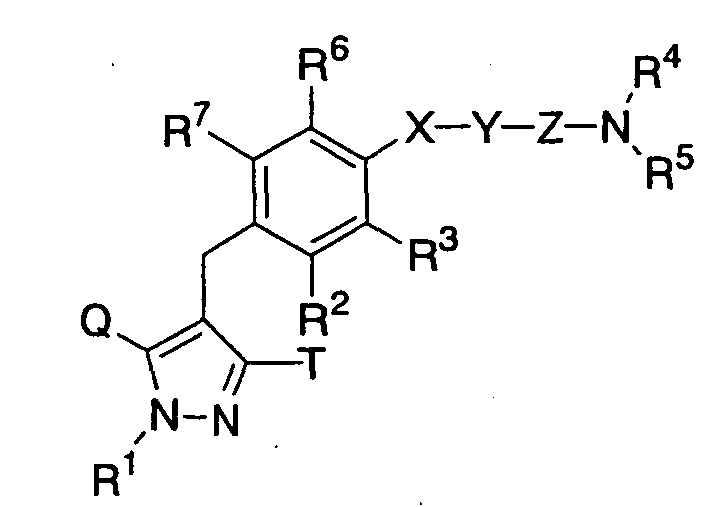
R1 represents a hydrogen atom, a C1-6 alkyl group, a C2-6 alkenyl group, a hydroxy(C2-6 alkyl) group, a C3-7 cycloalkyl group, a C3-7 cycloalkyl-substituted (C1-6 alkyl) group, an aryl group which may have the same or different 1 to 3 substituents selected from the group consisting of a halogen atom, a hydroxy group, an amino group, a C1-6 alkyl group and a C1-6 alkoxy group, or an aryl(C1-6 alkyl) group which may have the same or different 1 to 3 substituents selected from the group consisting of a halogen atom, a hydroxy group, an amino group, a C1-6 alkyl group and a C1-6 alkoxy group on the ring;
one of Q and T represents a group represented by the formula:or a group represented by the formula: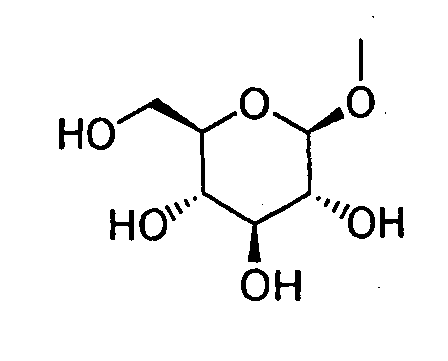 while the other represents a C1-6 alkyl group, a halo(C1-6 alkyl) group, a C1-6 alkoxy-substituted (C1-6 alkyl) group or a C3-7 cycloalkyl group;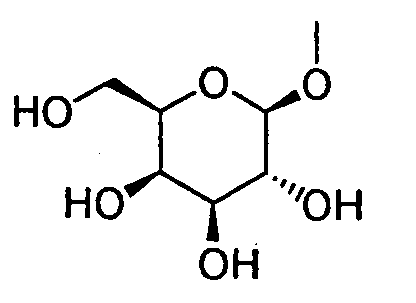
R2 represents a hydrogen atom, a halogen atom, a hydroxy group, a C1-6 alkyl group, a C1-6 alkoxy group, a C1-6 alkylthio group, a halo(C1-6 alkyl) group, a halo(C1-6 alkoxy) group, a C1-6 alkoxy-substituted (C1-6 alkoxy) group, a C3-7 cycloalkyl-substituted (C2-6 alkoxy) group or a group of the general formula: -A-R8 in which A represents a single bond, an oxygen atom, a methylene group, an ethylene group, -OCH2- or -CH2O-; and R8 represents a C3-7 cycloalkyl group, a C2-6 heterocycloalkyl group, an aryl group which may have the same or different 1 to 3 substituents selected from the group consisting of a halogen atom, a hydroxy group, an amino group, a C1-6 alkyl group, a C1-6 alkoxy group, a C2-6 alkenyloxy group, a halo(C1-6 alkyl) group, a hydroxy(C1-6 alkyl) group, a carboxy group, a C2-7 alkoxycarbonyl group, a cyano group and a nitro group, or a heteroaryl group which may have a substituent selected from the group consisting of a halogen atom and a C1-6 alkyl group;
X represents a single bond, an oxygen atom or a sulfur atom;
Y represents a single bond, a C1-6 alkylene group or a C2-6 alkenylene group with the proviso that X is a single bond when Y is a single bond;
Z represents a carbonyl group or a sulfonyl group;
R4 and R5 are the same or different, and each represents a hydrogen atom or a C1-6 alkyl group which may have the same or different 1 to 3 groups selected from the following substituent group (i), or they bind together with the neighboring nitrogen atom to form a C2-6 cyclic amino group which may have a substituent selected from the group consisting of a C1-6 alkyl group and a hydroxy(C1-6 alkyl) group;
R3, R6 and R7 are the same or different, and each represents a hydrogen atom, a halogen atom, a C1-6 alkyl group or a C1-6 alkoxy group; and
substituent group (i) consists of a hydroxy group, an amino group, a mono or di(C1-6 alkyl)amino group, a mono or di[hydroxy(C1-6 alkyl)]amino group, an ureido group, a sulfamide group, a mono or di(C1-6 alkyl)ureido group, a mono or di(C1-6 alkyl)sulfamide group, a C2-7 acylamino group, a C1-6 alkylsulfonylamino group, a group of the general formula: -CON(R9)R10 in which R9 and R10 are the same or different, and each represents a hydrogen atom or a C1-6 alkyl group which may have the same or different 1 to 3 substituents selected from the group consisting of a hydroxy group, an amino group, a mono or di(C1-6 alkyl)amino group, a mono or di[hydroxy(C1-6 alkyl)]amino group, an ureido group, a mono or di(C1-6 alkyl)ureido group, a C2-7 acylamino group, a C1-6 alkylsulfonylamino group and a carbamoyl group, or they bind together with the neighboring nitrogen atom to form a C2-6 cyclic amino group which may have a substituent selected from the group consisting of a C1-6 alkyl group and a hydroxy(C1-6 alkyl) group, a C3-7 cycloalkyl group, a C2-6 heterocycloalkyl group, an aryl group which may have the same or different 1 to 3 substituents selected from the group consisting of a halogen atom, a hydroxy group, an amino group, a C1-6 alkyl group and a C1-6 alkoxy group, a heteroaryl group which may have a substituent selected from the group consisting of a halogen atom and a C1-6 alkyl group, a C2-6 cyclic amino group which may have a substituent selected from the group consisting of a C1-6 alkyl group and a hydroxy(C1-6 alkyl) group, and a C1-4 aromatic cyclic amino group which may have a C1-6 alkyl group as a substituent,
or a pharmaceutically acceptable salt thereof. - A pyrazole derivative as claimed in claim 1, wherein Y represents a C1-6 alkylene group or a C2-6 alkenylene group; one of R4 and R5 represents a C1-6 alkyl group which has the same or different 1 to 3 groups selected from the following substituent group (i), the other represents a hydrogen atom or a C1-6 alkyl group which may have the same or different 1 to 3 groups selected from the following substituent group (i); and substituent group (i) consists of a hydroxy group, an amino group, a mono or di(C1-6 alkyl)amino group, a mono or di[hydroxy(C1-6 alkyl)]amino group, an ureido group, a sulf amide group, a mono or di(C1-6 alkyl)ureido group, a mono or di(C1-6 alkyl)sulfamide group, a C2-7 acylamino group, a C1-6 alkylsulfonylamino group, a group of the general formula: -CON(R9)R10 in which R9 and R10 are the same or different, and each represents a hydrogen atom or a C1-6 alkyl group which may have the same or different 1 to 3 substituents selected from the group consisting of a hydroxy group, an amino group, a mono or di(C1-6 alkyl)amino group, a mono or di[hydroxy(C1-6 alkyl)]amino group, an ureido group, a mono or di(C1-6 alkyl)ureido group, a C2-7 acylamino group, a C1-6 alkylsulfonylamino group and a carbamoyl group, or they bind together with the neighboring nitrogen atom to form a C2-6 cyclic amino group which may have a substituent selected from the group consisting of a C1-6 alkyl group and a hydroxy(C1-6 alkyl) group, a C3-7 cycloalkyl group, a C2-6 heterocycloalkyl group, an aryl group which may have the same or different 1 to 3 substituents selected from the group consisting of a halogen atom, a hydroxy group, an amino group, a C1-6 alkyl group and a C1-6 alkoxy group, a heteroaryl group which may have a substituent selected from the group consisting of a halogen atom and a C1-6 alkyl group, a C2-6 cyclic amino group which may have a substituent selected from the group consisting of a C1-6 alkyl group and a hydroxy(C1-6 alkyl) group, and a C1-4 aromatic cyclic amino group which may have a C1-6 alkyl group as a substituent, or a pharmaceutically acceptable salt thereof.
- A pyrazole derivative as claimed in claim 2, wherein one of R4 and R5 represents a C1-6 alkyl group which has a group selected from the following substituent group (iA), the other represents a hydrogen atom; and substituent group (iA) is a group of the general formula: -CON(R9A)R10A in which R9A and R10A bind together with the neighboring nitrogen atom to form a C2-6 cyclic amino group which may have a substituent selected from the group consisting of a C1-6 alkyl group and a hydroxy(C1-6 alkyl) group, or a pharmaceutically acceptable salt thereof.
- A pyrazole derivative as claimed in any one of claims 1-3, wherein X represents a single bond; and Y represents a trimethylene group or a 1-propenylene group, or a pharmaceutically acceptable salt thereof.
- A pyrazole derivative as claimed in any one of claims 1-3, wherein X represents an oxygen atom; and Y represents an ethylene group or a trimethylene group, or a pharmaceutically acceptable salt thereof.
- A pyrazole derivative as claimed in claim 1, wherein X represents a single bond; Y represents a single bond; one of R4 and R5 represents a C1-6 alkyl group which has the same or different 1 to 3 groups selected from the following substituent group (iB), the other represents a hydrogen atom or a C1-6 alkyl group which may have the same or different 1 to 3 groups selected from the following substituent group (iB); and substituent group (iB) consists of an ureido group, a sulfamide group, a mono or di(C1-6 alkyl)ureido group, a mono or di(C1-6 alkyl)sulfamide group, a C1-6 alkylsulfonylamino group, a group of the general formula: -CON(R9B)R10B in which one of R9B and R10B represents a C1-6 alkyl group which has the same or different 1 to 3 substituents selected from the group consisting of a hydroxy group, an amino group, a mono or di(C1-6 alkyl)amino group, a mono or di[hydroxy(C1-6 alkyl)]amino group, an ureido group, a mono or di(C1-6 alkyl)ureido group, a C2-7 acylamino group, a C1-6 alkylsulfonylamino group and a carbamoyl group, the other represents a hydrogen atom, a C1-6 alkyl group which may have the same or different 1 to 3 substituents selected from the group consisting of a hydroxy group, an amino group, a mono or di(C1-6 alkyl) amino group, a mono or di[hydroxy(C1-6 alkyl)] amino group, an ureido group, a mono or di(C1-6 alkyl)ureido group, a C2-7 acylamino group, a C1-6 alkylsulfonylamino group and a carbamoyl group, or they bind together with the neighboring nitrogen atom to form a C2-6 cyclic amino group which may have a substituent selected from the group consisting of a C1-6 alkyl group and a hydroxy(C1-6 alkyl) group, a C3-7 cycloalkyl group, a C2-6 heterocycloalkyl group, an aryl group which may have the same or different 1 to 3 substituents selected from the group consisting of a halogen atom, a hydroxy group, an amino group, a C1-6 alkyl group and a C1-6 alkoxy group, a heteroaryl group which may have a substituent selected from the group consisting of a halogen atom and a C1-6 alkyl group, a C2-6 cyclic amino group which may have a substituent selected from the group consisting of a C1-6 alkyl group and a hydroxy(C1-6 alkyl) group, and a C1-4 aromatic cyclic amino group which may have a C1-6 alkyl group as a substituent, or a pharmaceutically acceptable salt thereof.
- A pyrazole derivative as claimed in any one of claims 1-6, wherein R1 represents a hydrogen atom or a hydroxy(C2-6 alkyl) group; T represents a group represented by the formula:or a group represented by the formula:
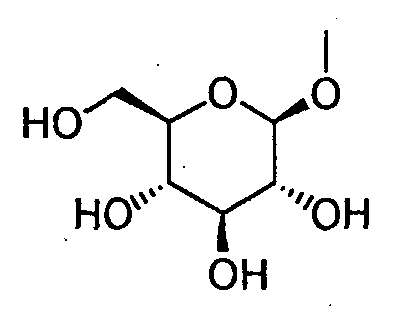 Q represents a C1-6 alkyl group or a halo(C1-6 alkyl) group; and R3, R6 and R7 represent a hydrogen atom, or a pharmaceutically acceptable salt thereof.
- A pyrazole derivative as claimed in any one of claims 1-6, wherein one of Q and T represents a group represented by the formula:the other represents a C1-6 alkyl group, a halo(C1-6 alkyl) group, a C1-6 alkoxy-substituted (C1-6 alkyl) group or a C3-7 cycloalkyl group, or a pharmaceutically acceptable salt thereof.
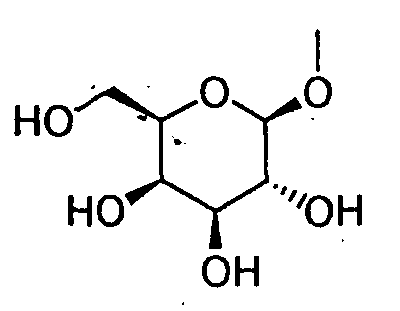
- A pyrazole derivative as claimed in claim 7 or 8, wherein T represents a group represented by the formula:or a pharmaceutically acceptable salt thereof.
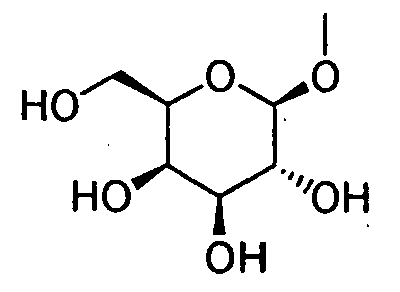
- A pyrazole derivative as claimed in claim 7 or 9, wherein Q represents an isopropyl group, or a pharmaceutically acceptable salt thereof.
- A prodrug of a pyrazole derivative as claimed in any one of claims 1-10 or a pharmaceutically acceptable salt thereof.
- A prodrug as claimed in claim 11, wherein T represents a group represented by the formula:or a group represented by the formula:
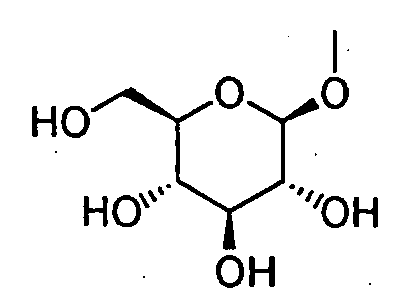 in which the hydroxy group at the 4-position is substituted by a glucopyranosyl group or a galactopyranosyl group, or the hydroxy group at the 6-position is substituted by a glucopyranosyl group, a galactopyranosyl group, a C2-7 acyl group, a C1-6 alkoxy-substituted (C2-7 acyl) group, a C2-7 alkoxycarbonyl-substituted (C2-7 acyl) group, a C2-7 alkoxycarbonyl group, an aryl(C2-7 alkoxycarbonyl) group or a C1-6 alkoxy-substituted (C2-7 alkoxycarbonyl) group.
- A pyrazole derivative as claimed in claim 1, which is a compound selected from the following group:pharmaceutically acceptable salts thereof.4-[(4-{3-[1-carbamoyl-1-(methyl)ethylcarbamoyl]propyl}-2-methylphenyl)methyl]-3-(β-D-glucopyranosyloxy)-5-isopropyl-1H-pyrazole;3-(β-D-galactopyranosyloxy)-4-[(4-{3-[1-{[4-(2-hydroxyethyl)piperazin-1-yl]carbonyl}-1-(methyl)ethylcarbamoyl]propyl}phenyl)methyl]-5-isopropyl-1H-pyrazole;3-(β-D-galactopyranosyloxy)-5-isopropyl-4-{[4-(3-{1-[2-(dimethylamino)ethylcarbamoyl]-1-(methyl)ethylcarbamoyl}propyl)phenyl]methyl}-1H-pyrazole;4-[(4-{3-[1-(2-aminoethylcarbamoyl)-1-(methyl)ethylcarbamoyl]propyl}phenyl)methyl]-3-(β-D-galactopyranosyloxy)-5-isopropyl-1H-pyrazole;3-(β-D-galactopyranosyloxy)-5-isopropyl-4-{[4-(3-{1-[(piperazin-1-yl)carbonyl]-1-(methyl)ethylcarbamoyl}propyl)phenyl]methyl}-1H-pyrazole;3-(β-D-glucopyranosyloxy)-4-[(4-{3-[1-{[4-(2-hydroxyethyl)piperazin-1-yl]carbonyl}-1-(methyl)ethylcarbamoyl]propyl}-2-methylphenyl)methyl]-5-isopropyl-1H-pyrazole;3-(β-D-galactopyranosyloxy)-5-isopropyl-4-{[4-(3-{1-[(4-methylpiperazin-1-yl)carbonyl]-1-(methyl)ethylcarbamoyl}propyl)phenyl]methyl}-1H-pyrazole;3-(β-D-galactopyranosyloxy)-5-isopropyl-4-{[4-(3-{1-[(4-isopropylpiperazin-1-yl)carbonyl]-1-(methyl)ethylcarbamoyl}propyl)phenyl]methyl}-1H-pyrazole;3-(β-D-glucopyranosyloxy)-4-[(4-{3-[(S)-2-hydroxy-1-(methyl)ethylcarbamoyl]propyl}phenyl)methyl]-5-isopropyl-1H-pyrazole;3-(β-D-glucopyranosyloxy)-4-[(4-{(1E)-3-[(S)-2-hydroxy-1-(methyl)ethylcarbamoyl]prop-1-enyl}phenyl)methyl]-5-isopropyl-1H-pyrazole;3-(β-D-glucopyranosyloxy)-5-isopropyl-4-{[4-(2-{1-[(4-methylpiperazin-1-yl)carbonyl]-1-(methyl)ethylcarbamoyl}ethoxy)-2-methylphenyl]methyl}-1H-pyrazole;3-(β-D-glucopyranosyloxy)-4-[(4-{2-[2-hydroxy-1,1-di(methyl)ethylcarbamoyl]ethoxy}-2-methylphenyl)methyl]-5-isopropyl-1H-pyrazole;3-(β-D-glucopyranosyloxy)-4-[(4-{2-[1-{[4-(2-hydroxyethyl)piperazin-1-yl]carbonyl}-1-(methyl)ethylcarbamoyl]ethoxy}-2-methylphenyl)methyl]-5-isopropyl-1H-pyrazole;3-(β-D-glucopyranosyloxy)-5-isopropyl-4-{[4-(2-{1-[(piperazin-1-yl)carbonyl]-1-(methyl)ethylcarbamoyl}ethoxy)-2-methylphenyl]methyl}-1H-pyrazole;3-(β-D-glucopyranosyloxy)-5-isopropyl-4-{[4-(3-{1-[(piperazin-1-yl)carbonyl]-1-(methyl)ethylcarbamoyl}propyl)-2-methylphenyl]methyl}-1H-pyrazole;3-(β-D-glucopyranosyloxy)-5-isopropyl-4-{[4-(3-{1-[(piperazin-1-yl)carbonyl]-1-(methyl)ethylcarbamoyl}propoxy)-2-methylphenyl]methyl}-1H-pyrazole;3-(β-D-glucopyranosyloxy)-4-[(4-{3-[1-{[4-(2-hydroxyethyl)piperazin-1-yl]carbonyl}-1-(methyl)ethylcarbamoyl]propoxy}-2-methylphenyl)methyl]-5-isopropyl-1H-pyrazole;3-(β-D-glucopyranosyloxy)-5-isopropyl-4-{[4-(3-{1-[(4-methylpiperazin-1-yl)carbonyl]-1-(methyl)ethylcarbamoyl}propoxy)-2-methylphenyl]methyl}-1H-pyrazole;3-(β-D-galactopyranosyloxy)-1-(3-hydroxypropyl)-5-isopropyl-4-{[4-,(3-{1-[(piperazin-1-yl)carbonyl]-1-(methyl)ethylcarbamoyl}propyl)phenyl]methyl}-1H-pyrazole;3-(β-D-galactopyranosyloxy)-5-isopropyl-4-{[4-(3-{1-[(piperazin-1-yl)carbonyl]-1-(methyl)ethylcarbamoyl}propoxy)-2-methylphenyl]methyl}-1H-pyrazole;4-{[2-fluoro-4-(3-{1-[(piperazin-1-yl)carbonyl]-1-(methyl)ethylcarbamoyl}propyl)phenyl]methyl}-3-(β-D-galactopyranosyloxy)-5-isopropyl-1H-pyrazole;4-{[2-chloro-4-(3-{1-[(piperazin-1-yl)carbonyl]-1-(methyl)ethylcarbamoyl}propyl)phenyl]methyl}-3-(β-D-glucopyranosyloxy)-5-isopropyl-1H-pyrazole, and
- A pyrazole derivative as claimed in claim 13, which is a compound selected from the following group:pharmaceutically acceptable salts thereof.3-(β-D-galactopyranosyloxy)-4-[(4-{3-[1-{[4-(2-hydroxyethyl)piperazin-1-yl]carbonyl}-1-(methyl)ethylcarbamoyl]propyl}phenyl)methyl]-5-isopropyl-1H-pyrazole;3-(β-D-galactopyranosyloxy)-5-isopropyl-4-{[4-(3-{1-[(piperazin-1-yl)carbonyl]-1-(methyl)ethylcarbamoyl}propyl)phenyl]methyl}-1H-pyrazole;3-(β-D-glucopyranosyloxy)-4-[(4-{3-[1-{[4-(2-hydroxyethyl)-piperazin-1-yl]carbonyl}-1-(methyl)ethylcarbamoyl]propyl}-2-methylphenyl)methyl]-5-isopropyl-1H-pyrazole;3-(β-D-galactopyranosyloxy)-5-isopropyl-4-{[4-(3-{1-[(4-methylpiperazin-1-yl)carbonyl]-1-(methyl)ethylcarbamoyl}propyl)phenyl]methyl}-1H-pyrazole;3-(β-D-glucopyranosyloxy)-5-isopropyl-4-{[4-(2-{1-[(4-methylpiperazin-1-yl)carbonyl]-1-(methyl)ethylcarbamoyl}ethoxy)-2-methylphenyl]methyl}-1H-pyrazole;3-(β-D-glucopyranosyloxy)-4-[(4-{2-[1-{[4-(2-hydroxyethyl)piperazin-1-yl]carbonyl}-1-(methyl)ethylcarbamoyl]ethoxy}-2-methylphenyl)methyl]-5-isopropyl-1H-pyrazole;3-(β-D-glucopyranosyloxy)-5-isopropyl-4-{[4-(2-{1-[(piperazin-1-yl)carbonyl]-1-(methyl)ethylcarbamoyl}ethoxy)-2-methylphenyl]methyl}-1H-pyrazole;3-(β-D-glucopyranosyloxy)-5-isopropyl-4-{[4-(3-{1-[(piperazin-1-yl)carbonyl]-1-(methyl)ethylcarbamoyl}propyl)-2-methylphenyl]methyl}-1H-pyrazole;3-(β-D-glucopyranosyloxy)-5-isopropyl-4-{[4-(3-{1-[(piperazin-1-yl)carbonyl]-1-(methyl)ethylcarbamoyl}propoxy)-2-methylphenyl]methyl}-1H-pyrazole;3-(β-D-galactopyranosyloxy)-5-isopropyl-4-{[4-(3-{1-[(piperazin-1-yl)carbonyl]-1-(methyl)ethylcarbamoyl}propoxy)-2-methylphenyl]methyl}-1H-pyrazole;4-{[2-fluoro-4-(3-{1-[(piperazin-1-yl)carbonyl]-1-(methyl)ethylcarbamoyl}propyl)phenyl]methyl}-3-(β-D-galactopyranosyloxy)-5-isopropyl-1H-pyrazole, and
- A pharmaceutical composition comprising as an active ingredient a pyrazole derivative as claimed in any one of claims 1-14, a pharmaceutically acceptable salt thereof or a prodrug thereof.
- A human SGLT1 inhibitor comprising as an active ingredient a pyrazole derivative as claimed in any one of claims 1-14, a pharmaceutically acceptable salt thereof or a prodrug thereof.
- An agent for inhibiting postprandial hyperglycemia comprising as an active ingredient a pyrazole derivative as claimed in any one of claims 1-14, a pharmaceutically acceptable salt thereof or a prodrug thereof.
- An agent for the prevention or treatment of a disease associated with hyperglycemia, which comprises as an active ingredient a pyrazole derivative as claimed in any one of claims 1-14, a pharmaceutically acceptable salt thereof or a prodrug thereof.
- An agent for the prevention or treatment as claimed in claim 18, wherein the disease associated with hyperglycemia is a disease selected from the group consisting of diabetes, impaired glucose tolerance, diabetic complications, obesity, hyperinsulinemia, hyperlipidemia, hypercholesterolemia, hypertriglyceridemia, lipid metabolism disorder, atherosclerosis, hypertension, congestive heart failure, edema, hyperuricemia and gout.
- An agent for the inhibition of advancing impaired glucose tolerance or impaired fasting glycemia into diabetes in a subject, which comprises as an active ingredient a pyrazole derivative as claimed in any one of claims 1-14, a pharmaceutically acceptable salt thereof or a prodrug thereof.
- An agent for the prevention or treatment of a disease associated with the increase of blood galactose level, which comprises as an active ingredient a pyrazole derivative as claimed in any one of claims 1-14, a pharmaceutically acceptable salt thereof or a prodrug thereof.
- An agent for the prevention or treatment as claimed in claim 21, wherein the disease associated with the increase of blood galactose level is galactosemia.
- A pharmaceutical composition as claimed in claim 15, wherein the dosage form is sustained release formuation.
- An agent as claimed in any one of claims 16-22, wherein the dosage form is sustained release formuation.
- A method for the prevention or treatment of a disease associated with hyperglycemia, which comprises administering an effective amount of a pyrazole derivative as claimed in any one of claims 1-14, a pharmaceutically acceptable salt thereof or a prodrug thereof.
- A method for the inhibition of advancing impaired glucose tolerance into diabetes in a subject, which comprises administering an effective amount of a pyrazole derivative as claimed in any one of claims 1-14, a pharmaceutically acceptable salt thereof or a prodrug thereof.
- A use of a pyrazole derivative as claimed in any one of claims 1-14, a pharmaceutically acceptable salt thereof or a prodrug thereof for the manufacture of a pharmaceutical composition for the prevention or treatment of a disease associated with hyperglycemia.
- A use of a pyrazole derivative as claimed in any one of claims 1-14, a pharmaceutically acceptable salt thereof or a prodrug thereof for the manufacture of a pharmaceutical composition for the inhibition of advancing impaired glucose tolerance into diabetes in a subject.
- A pharmaceutical combination which comprises (A) a pyrazole derivative as claimed in any one of claims 1-14, a pharmaceutically acceptable salt thereof or a prodrug thereof, and (B) at least one member selected from the group consisting of an insulin sensitivity enhancer, a glucose absorption inhibitor, a biguanide, an insulin secretion enhancer, a SGLT2 inhibitor, an insulin or insulin analogue, a glucagon receptor antagonist, an insulin receptor kinase stimulant, a tripeptidyl peptidase II inhibitor, a dipeptidyl peptidase IV inhibitor, a protein tyrosine phosphatase-1B inhibitor, a glycogen phosphorylase inhibitor, a glucose-6-phosphatase inhibitor, a fructose-bisphosphatase inhibitor, a pyruvate dehydrogenase inhibitor, a hepatic gluconeogenesis inhibitor, D-chiroinsitol, a glycogen synthase kinase-3 inhibitor, glucagon-like peptide-1, a glucagon-like peptide-1 analogue, a glucagon-like peptide-1 agonist, amylin, an amylin analogue, an amylin agonist, an aldose reductase inhibitor, an advanced glycation endproducts formation inhibitor, a protein kinase C inhibitor, a γ-aminobutyric acid receptor antagonist, a sodium channel antagonist, a transcript factor NF-κB inhibitor, a lipid peroxidase inhibitor, an N-acetylated-α-linked-acid-dipeptidase inhibitor, insulin-like growth factor-I, platelet-derived growth factor, a platelet-derived growth factor analogue, epidermal growth factor, nerve growth factor, a carnitine derivative, uridine, 5-hydroxy-1-methylhidantoin, EGB-761, bimoclomol, sulodexide, Y-128, antidiarrhoics, cathartics, a hydroxymethylglutaryl coenzyme A reductase inhibitor, a fibric acid derivative, a β3-adrenoceptor agonist, an acyl-coenzyme A cholesterol acyltransferase inhibitor, probcol, a thyroid hormone receptor agonist, a cholesterol absorption inhibitor, a lipase inhibitor, a microsomal triglyceride transfer protein inhibitor, a lipoxygenase inhibitor, a carnitine palmitoyl-transferase inhibitor, a squalene synthase inhibitor, a low-density lipoprotein receptor enhancer, a nicotinic acid derivative, a bile acid sequestrant, a sodium/bile acid cotransporter inhibitor, a cholesterol ester transfer protein inhibitor, an appetite suppressant, an angiotensin-converting enzyme inhibitor, a neutral endopeptidase inhibitor, an angiotensin II receptor antagonist, an endothelin-converting enzyme inhibitor, an endothelin receptor antagonist, a diuretic agent, a calcium antagonist, a vasodilating antihypertensive agent, a sympathetic blocking agent, a centrally acting antihypertensive agent, an α2-adrenoceptor agonist, an antiplatelets agent, a uric acid synthesis inhibitor, a uricosuric agent and a urinary alkalinizer.
- A method for the prevention or treatment of a disease associated with hyperglycemia, which comprises administering an effective amount of (A) a pyrazole derivative as claimed in any one of claims 1-14, a pharmaceutically acceptable salt thereof or a prodrug thereof, and (B) at least one member selected from the group consisting of an insulin sensitivity enhancer, a glucose absorption inhibitor, abiguanide, an insulin secretion enhancer, a SGLT2 inhibitor, an insulin or insulin analogue, a glucagon receptor antagonist, an insulin receptor kinase stimulant, a tripeptidyl peptidase II inhibitor, a dipeptidyl peptidase IV inhibitor, a protein tyrosine phosphatase-1B inhibitor, a glycogen phosphorylase inhibitor, a glucose-6-phosphatase inhibitor, a fructose-bisphosphatase inhibitor, a pyruvate dehydrogenase inhibitor, a hepatic gluconeogenesis inhibitor, D-chiroinsitol, a glycogen synthase kinase-3 inhibitor, glucagon-like peptide-1, a glucagon-like peptide-1 analogue, a glucagon-like peptide-1 agonist, amylin, an amylin analogue, an amylin agonist, an aldose reductase inhibitor, an advanced glycation endproducts formation inhibitor, a protein kinase C inhibitor, a γ-aminobutyric acid receptor antagonist, a sodium channel antagonist, a transcript factor NF-κB inhibitor, a lipid peroxidase inhibitor, an N-acetylated-α-linked-acid-dipeptidase inhibitor, insulin-like growth factor-I, platelet-derived growth factor, a platelet-derived growth factor analogue, epidermal growth factor, nerve growth factor, a carnitine derivative, uridine, 5-hydroxy-1-methylhidantoin, EGB-761, bimoclomol, sulodexide, Y-128, antidiarrhoics, cathartics, a hydroxymethylglutaryl coenzyme A reductase inhibitor, a fibric acid derivative, a β3-adrenoceptor agonist, an acyl-coenzyme A cholesterol acyltransf erase inhibitor, probcol, a thyroid hormone receptor agonist, a cholesterol absorption inhibitor, a lipase inhibitor, a microsomal triglyceride transfer protein inhibitor, a lipoxygenase inhibitor, a carnitine palmitoyl-transferase inhibitor, a squalene synthase inhibitor, a low-density lipoprotein receptor enhancer, a nicotinic acid derivative, a bile acid sequestrant, a sodium/bile acid cotransporter inhibitor, a cholesterol ester transfer protein inhibitor, an appetite suppressant, an angiotensin-converting enzyme inhibitor, a neutral endopeptidase inhibitor, an angiotensin II receptor antagonist, an endothelin-converting enzyme inhibitor, an endothelin receptor antagonist, a diuretic agent, a calcium antagonist, a vasodilating antihypertensive agent, a sympathetic blocking agent, a centrally acting antihypertensive agent, an α2-adrenoceptor agonist, an antiplatelets agent, a uric acid synthesis inhibitor, a uricosuric agent and a urinary alkalinizer.
- A method for the inhibition of advancing impaired glucose tolerance into diabetes in a subject, which comprises administering an effective amount of (A) a pyrazole derivative as claimed in any one of claims 1-14, a pharmaceutically acceptable salt thereof or a prodrug thereof, and (B) at least one member selected from the group consisting of an insulin sensitivity enhancer, a glucose absorption inhibitor, a biguanide, an insulin secretion enhancer, a SGLT2 inhibitor, an insulin or insulin analogue, a glucagon receptor antagonist, an insulin receptor kinase stimulant, a tripeptidyl peptidase II inhibitor, a dipeptidyl peptidase IV inhibitor, a protein tyrosine phosphatase-1B inhibitor, a glycogen phosphorylase inhibitor, a glucose-6-phosphatase inhibitor, a fructose-bisphosphatase inhibitor, a pyruvate dehydrogenase inhibitor, a hepatic gluconeogenesis inhibitor, D-chiroinsitol, a glycogen synthase kinase-3 inhibitor, glucagon-like peptide-1, a glucagon-like peptide-1 analogue, a glucagon-like peptide-1 agonist, amylin, an amylin analogue, an amylin agonist, an aldose reductase inhibitor, an advanced glycation endproducts formation inhibitor, a protein kinase C inhibitor, a γ-aminobutyric acid receptor antagonist, a sodium channel antagonist, a transcript factor NF-κB inhibitor, a lipid peroxidase inhibitor, an N-acetylated-α-linked-acid-dipeptidase inhibitor, insulin-like growth factor-I, platelet-derived growth factor, a platelet-derived growth factor analogue, epidermal growth factor, nerve growth factor, a carnitine derivative, uridine, 5-hydroxy-1-methylhidantoin, EGB-761, bimoclomol, sulodexide, Y-128, antidiarrhoics, cathartics, a hydroxymethylglutaryl coenzyme A reductase inhibitor, a fibric acid derivative, a β3-adrenoceptor agonist, an acyl-coenzyme A cholesterol acyltransferase inhibitor, probcol, a thyroid hormone receptor agonist, a cholesterol absorption inhibitor, a lipase inhibitor, a microsomal triglyceride transfer protein inhibitor, a lipoxygenase inhibitor, a carnitine palmitoyl-transferase inhibitor, a squalene synthase inhibitor, a low-density lipoprotein receptor enhancer, a nicotinic acid derivative, a bile acid sequestrant, a sodium/bile acid cotransporter inhibitor, a cholesterol ester transfer protein inhibitor, an appetite suppressant, an angiotensin-converting enzyme inhibitor, a neutral endopeptidase inhibitor, an angiotensin II receptor antagonist, an endothelin-converting enzyme inhibitor, an endothelin receptor antagonist, a diuretic agent, a calcium antagonist, a vasodilating antihypertensive agent, a sympathetic blocking agent, a centrally acting antihypertensive agent, an α2-adrenoceptor agonist, an antiplatelets agent, a uric acid synthesis inhibitor, a uricosuric agent and a urinary alkalinizer.
- A use of (A) a pyrazole derivative as claimed in any one of claims 1-14, a pharmaceutically acceptable salt thereof or a prodrug thereof, and (B) at least one member selected from the group consisting of an insulin sensitivity enhancer, a glucose absorption inhibitor, a biguanide, an insulin secretion enhancer, a SGLT2 inhibitor, an insulin or insulin analogue, a glucagon receptor antagonist, an insulin receptor kinase stimulant, a tripeptidyl peptidase II inhibitor, a dipeptidyl peptidase IV inhibitor, a protein tyrosine phosphatase-1B inhibitor, a glycogen phosphorylase inhibitor, a glucose-6-phosphatase inhibitor, a fructose-bisphosphatase inhibitor, a pyruvate dehydrogenase inhibitor, a hepatic gluconeogenesis inhibitor, D-chiroinsitol, a glycogen synthase kinase-3 inhibitor, glucagon-like peptide-1, a glucagon-like peptide-1 analogue, a glucagon-like peptide-1 agonist, amylin, an amylin analogue, an amylin agonist, an aldose reductase inhibitor, an advanced glycation endproducts formation inhibitor, a protein kinase C inhibitor, a γ-aminobutyric acid receptor antagonist, a sodium channel antagonist, a transcript factor NF-κB inhibitor, a lipid peroxidase inhibitor, an N-acetylated-α-linked-acid-dipeptidase inhibitor, insulin-like growth factor-I, platelet-derived growth factor, a platelet-derived growth factor analogue, epidermal growth factor, nerve growth factor, a carnitine derivative, uridine, 5-hydroxy-1-methylhidantoin, EGB-761, bimoclomol, sulodexide, Y-128, antidiarrhoics, cathartics, a hydroxymethylglutaryl coenzyme A reductase inhibitor, a fibric acid derivative, a β3-adrenoceptor agonist, an acyl-coenzyme A cholesterol acyltransferase inhibitor, probcol, a thyroid hormone receptor agonist, a cholesterol absorption inhibitor, a lipase inhibitor, a microsomal triglyceride transfer protein inhibitor, a lipoxygenase inhibitor, a carnitine palmitoyl-transferase inhibitor, a squalene synthase inhibitor, a low-density lipoprotein receptor enhancer, a nicotinic acid derivative, a bile acid sequestrant, a sodium/bile acid cotransporter inhibitor, a cholesterol ester transfer protein inhibitor, an appetite suppressant, an angiotensin-converting enzyme inhibitor, a neutral endopeptidase inhibitor, an angiotensin II receptor antagonist, an endothelin-converting enzyme inhibitor, an endothelin receptor antagonist, a diuretic agent, a calcium antagonist, a vasodilating antihypertensive agent, a sympathetic blocking agent, a centrally acting antihypertensive agent, an α2-adrenoceptor agonist, an antiplatelets agent, a uric acid synthesis inhibitor, a uricosuric agent and a urinary alkalinizer for the manufacture of a pharmaceutical composition for the prevention or treatment of a disease associated with hyperglycemia.
- A use of (A) a pyrazole derivative as claimed in any one of claims 1-14, a pharmaceutically acceptable salt thereof or a prodrug thereof, and (B) at least one member selected from the group consisting of an insulin sensitivity enhancer, a glucose absorption inhibitor,a biguanide,an insulin secretion enhancer, a SGLT2 inhibitor, an insulin or insulin analogue, a glucagon receptor antagonist, an insulin receptor kinase stimulant, a tripeptidyl peptidase II inhibitor, a dipeptidyl peptidase IV inhibitor, a protein tyrosine phosphatase-1B inhibitor, a glycogen phosphorylase inhibitor, a glucose-6-phosphatase inhibitor, a fructose-bisphosphatase inhibitor, a pyruvate dehydrogenase inhibitor, a hepatic gluconeogenesis inhibitor, D-chiroinsitol, a glycogen synthase kinase-3 inhibitor, glucagon-like peptide-1, a glucagon-like peptide-1 analogue, a glucagon-like peptide-1 agonist, amylin, an amylin analogue, an amylin agonist, an aldose reductase inhibitor, an advanced glycation endproducts formation inhibitor, a protein kinase.C inhibitor, a γ-aminobutyric acid receptor antagonist, a sodium channel antagonist, a transcript factor NF-κB inhibitor, a lipid peroxidase inhibitor, an N-acetylated-α-linked-acid-dipeptidase inhibitor, insulin-like growth factor-I, platelet-derived growth factor, a platelet-derived growth factor analogue, epidermal growth factor, nerve growth factor, a carnitine derivative, uridine, 5-hydroxy-1-methylhidantoin, EGB-761, bimoclomol, sulodexide, Y-128, antidiarrhoics, cathartics, a hydroxymethylglutaryl coenzyme A reductase inhibitor, a fibric acid derivative, a β3-adrenoceptor agonist, an acyl-coenzyme A cholesterol acyltransferase inhibitor, probcol, a thyroid hormone receptor agonist, a cholesterol absorption inhibitor, a lipase inhibitor, a microsomal triglyceride transfer protein inhibitor, a lipoxygenase inhibitor, a carnitine palmitoyl-transferase inhibitor, a squalene synthase inhibitor, a low-density lipoprotein receptor enhancer, a nicotinic acid derivative, a bile acid sequestrant, a sodium/bile acid cotransporter inhibitor, a cholesterol ester transfer protein inhibitor, an appetite suppressant, an angiotensin-converting enzyme inhibitor, a neutral endopeptidase inhibitor, an angiotensin II receptor antagonist, an endothelin-converting enzyme inhibitor, an endothelin receptor antagonist, a diuretic agent, a calcium antagonist, a vasodilating antihypertensive agent, a sympathetic blocking agent, a centrally acting antihypertensive agent, an α2-adrenoceptor agonist, an antiplatelets agent, a uric acid synthesis inhibitor, a uricosuric agent and a urinary alkalinizer, for the manufacture of a pharmaceutical composition for the inhibition of advancing impaired glucose tolerance into diabetes in a subject.
- A pyrazole derivative represented by the general formula:wherein
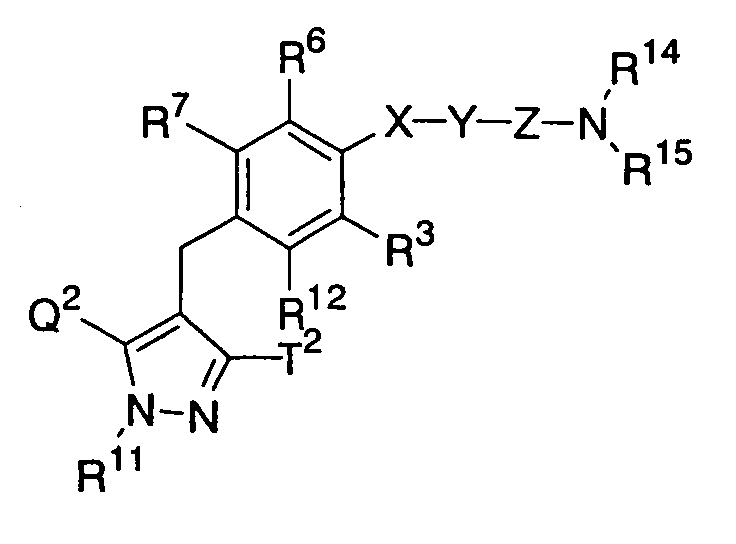
R11 represents a hydrogen atom, a C1-6 alkyl group, a C2-6 alkenyl group, a hydroxy(C2-6 alkyl) group which may have a protective group, a C3-7 cycloalkyl group, a C3-7 cycloalkyl-substituted (C1-6 alkyl) group, an aryl group which may have the same or different 1 to 3 substituents selected from the group consisting of a halogen atom, a hydroxy group which may have a protective group, an amino group which may have a protective group, a C1-6 alkyl group and a C1-6 alkoxy group, or an aryl(C1-6 alkyl) group which may have the same or different 1 to 3 substituents selected from the group consisting of a halogen atom, a hydroxy group which may have a protective group, an amino group which may have a protective group, a C1-6 alkyl group and a C1-6 alkoxy group on the ring;
one of Q2 and T2 represents a 2,3,4,6-tetra-O-acetyl-β-D-glucopyranosyloxy group or a 2,3,4,6-tetra-O-acetyl-β-D-galactopyranosyloxy group, while the other represents a C1-6 alkyl group, a halo(C1-6 alkyl) group, a C1-6 alkoxy-substituted (C1-6 alkyl) group or a C3-7 cycloalkyl group;
R12 represents a hydrogen atom, a halogen atom, a hydroxy group which may have a protective group, a C1-6 alkyl group, a C1-6 alkoxy group, a C1-6 alkylthio group, a halo(C1-6 alkyl) group, ahalo(C1-6 alkoxy) group, a C1-6 alkoxy-substituted (C1-6 alkoxy) group, a C3-7 cycloalkyl- substituted (C2-6 alkoxy) group or a group of the general formula: -A-R18 in which A represents a single bond, an oxygen atom, a methylene group, an ethylene group, -OCH2- or -CH2O-; and R18 represents a C3-7 cycloalkyl group, a C2-6 heterocycloalkyl group, an aryl group which may have the same or different 1 to 3 substituents selected from the group consisting of a halogen atom, a hydroxy group which may have a protective group, an amino group which may have a protective group, a C1-6 alkyl group, a C1-6 alkoxy group, a C2-6 alkenyloxy group, a halo(C1-6 alkyl) group, a hydroxy(C1-6 alkyl) group which may have a protective group, a carboxy group which may have a protective group, a C2-7 alkoxycarbonyl group, a cyano group and a nitro group, or a heteroaryl group which may have a substituent selected from the group consisting of a halogen atom and a C1-6 alkyl group;
X represents a single bond, an oxygen atom or a sulfur atom;
Y represents a single bond, a C1-6 alkylene group or a C2-6 alkenylene group with the proviso that X is a single bond when Y is a single bond;
Z represents a carbonyl group or a sulfonyl group;
R14 and R15 are the same or different, and each represents a hydrogen atom or a C1-6 alkyl group which may have the same or different 1 to 3 groups selected from the following substituent group (ii), or they bind together with the neighboring nitrogen atom to form a C2-6 cyclic amino group which may have a substituent selected from the group consisting of a C1-6 alkyl group and a hydroxy(C1-6 alkyl) group which may have a protective group;
R3, R6 and R7 are the same or different, and each represents a hydrogen atom, a halogen atom, a C1-6 alkyl group or a C1-6 alkoxy group; and
substituent group (ii) consists of a hydroxy group which may have a protective group, an amino group which may have a protective group, a mono or di(C1-6 alkyl)amino group which may have a protective group, a mono or di[hydroxy(C1-6 alkyl)]amino group which may have a protective group, an ureido group, a sulfamide group, a mono or di(C1-6 alkyl)ureido group, a mono or di(C1-6 alkyl)sulfamide group, a C2-7 acylamino group, a C1-6 alkylsulfonylamino group, a group of the general formula: -CON(R19)R20 in which R19 and R20 are the same or different, and each represents a hydrogen atom or a C1-6 alkyl group which may have the same or different 1 to 3 substituents selected from the group consisting of a hydroxy group which may have a protective group, an amino group which may have a protective group, a mono or di(C1-6 alkyl) amino group which may have a protective group, a mono or di[hydroxy(C1-6 alkyl)]amino group which may have a protective group, an ureido group, a mono or di(C1-6 alkyl)ureido group, a C2-7 acylamino group, a C1-6 alkylsulfonylamino group and a carbamoyl group, or they bind together with the neighboring nitrogen atom to form a C2-6 cyclic amino group which may have a substituent selected from the group consisting of a C1-6 alkyl group and a hydroxy(C1-6 alkyl) group which may have a protective group, a C3-7 cycloalkyl group, a C2-6 heterocycloalkyl group, an aryl group which may have the same or different 1 to 3 substituents selected from the group consisting of a halogen atom, a hydroxy group which may have a protective group, an amino group which may have a protective group, a C1-6 alkyl group and a C1-6 alkoxy group, a heteroaryl group which may have a substituent selected from the group consisting of a halogen atom and a C1-6 alkyl group, a C2-6 cyclic amino group which may have a substituent selected from the group consisting of a C1-6 alkyl group and a hydroxy(C1-6 alkyl) group which may have a protective group, and a C1-4 aromatic cyclic amino group which may have a C1-6 alkyl group as a substituent, or a salt thereof.
Applications Claiming Priority (5)
| Application Number | Priority Date | Filing Date | Title |
|---|---|---|---|
| JP2002232074 | 2002-08-08 | ||
| JP2002232074 | 2002-08-08 | ||
| JP2002321729 | 2002-11-05 | ||
| JP2002321729 | 2002-11-05 | ||
| PCT/JP2003/010048 WO2004014932A1 (en) | 2002-08-08 | 2003-08-07 | Pyrazole derivative, medicinal composition containing the same, medicinal use thereof, and intermediate for production thereof |
Publications (3)
| Publication Number | Publication Date |
|---|---|
| EP1544208A1 true EP1544208A1 (en) | 2005-06-22 |
| EP1544208A4 EP1544208A4 (en) | 2007-05-02 |
| EP1544208B1 EP1544208B1 (en) | 2010-05-26 |
Family
ID=31719857
Family Applications (1)
| Application Number | Title | Priority Date | Filing Date |
|---|---|---|---|
| EP03784564A Expired - Lifetime EP1544208B1 (en) | 2002-08-08 | 2003-08-07 | Pyrazole derivative, medicinal composition containing the same, medicinal use thereof, and intermediate for production thereof |
Country Status (18)
| Country | Link |
|---|---|
| US (2) | US7375087B2 (en) |
| EP (1) | EP1544208B1 (en) |
| JP (1) | JP4540475B2 (en) |
| KR (1) | KR100985502B1 (en) |
| AT (1) | ATE469161T1 (en) |
| AU (1) | AU2003254847B2 (en) |
| BR (1) | BRPI0313290B1 (en) |
| CA (1) | CA2494179C (en) |
| DE (1) | DE60332743D1 (en) |
| ES (1) | ES2345250T3 (en) |
| IL (1) | IL166748A0 (en) |
| MX (1) | MXPA05001549A (en) |
| NO (1) | NO330456B1 (en) |
| NZ (1) | NZ538117A (en) |
| PL (1) | PL213095B1 (en) |
| RU (1) | RU2356906C2 (en) |
| TW (1) | TW200413401A (en) |
| WO (1) | WO2004014932A1 (en) |
Cited By (15)
| Publication number | Priority date | Publication date | Assignee | Title |
|---|---|---|---|---|
| FR2878523A1 (en) * | 2004-11-30 | 2006-06-02 | Oreal | Use of a sulfamide derivative as a moisturizing agent in the preparation of cosmetic composition useful in non-therapeutic skin care |
| US7750145B2 (en) | 2004-11-18 | 2010-07-06 | Kissei Pharmaceutical Co., Ltd. | 1-substituted-3-β-D-glucopyranosylated nitrogenous hetero-cyclic compounds and medicines containing the same |
| US7887824B2 (en) | 2004-11-30 | 2011-02-15 | L'oreal | Sulfamide derivatives and cosmetic use thereof |
| WO2011023755A1 (en) * | 2009-08-26 | 2011-03-03 | Sanofi-Aventis | Method for producing pyrazole glycoside derivatives |
| WO2011034846A1 (en) * | 2009-09-15 | 2011-03-24 | Janssen Pharmaceutica, N.V. | Use of alpha-methylglucoside (amg) as an indicator for glucose absorption and excretion |
| US7973012B2 (en) | 2006-05-19 | 2011-07-05 | Taisho Pharmaceutical Co., Ltd | C-phenyl glycitol compound |
| WO2011039338A3 (en) * | 2009-10-02 | 2011-08-25 | Sanofi | Use of compounds with sglt-1/sglt-2 inhibitor activity for producing medicaments for treatment of bone diseases |
| US8115017B2 (en) | 2006-06-29 | 2012-02-14 | Taisho Pharmaceutical Co., Ltd | C-phenyl 1-thioglucitol compound |
| WO2013004551A1 (en) | 2011-07-01 | 2013-01-10 | Bayer Intellectual Property Gmbh | Hydroxymethylaryl-substituted pyrrolotriazines as alk1 inhibitors |
| RU2482122C2 (en) * | 2007-12-27 | 2013-05-20 | Киссеи Фармасьютикал Ко., Лтд. | Monosebacate of pyrazole derivative |
| US8466113B2 (en) | 2009-02-23 | 2013-06-18 | Taisho Pharmaceutical Co., Ltd. | 4-isopropylphenyl glucitol compounds as SGLT1 inhibitors |
| WO2013169546A1 (en) * | 2012-05-10 | 2013-11-14 | Eli Lilly And Company | Pyrazole compounds as sglt1 inhibitors |
| WO2014055297A1 (en) * | 2012-10-05 | 2014-04-10 | Eli Lilly And Company | Novel urea compounds |
| US8822674B2 (en) | 2010-08-20 | 2014-09-02 | Taisho Pharmaceutical Co., Ltd | Crystal form of 4-isopropylphenyl glucitol compound and process for production thereof |
| WO2015069541A1 (en) * | 2013-11-08 | 2015-05-14 | Eli Lilly And Company | 4-{4-[(1 e)-4-(2,9-diazaspiro[5.5]undec-2-yl)but-1 -en-1 -yl]-2-methylbenzyl}-5-(propan-2-yl)-1 h-pyrazol-3-yl beta-d- glucopyranoside acetate |
Families Citing this family (55)
| Publication number | Priority date | Publication date | Assignee | Title |
|---|---|---|---|---|
| AU1031500A (en) | 1998-11-03 | 2000-05-22 | Dandy A/S | Sucrose fatty acid esters for use as increased release of active ingredients |
| US7375087B2 (en) * | 2002-08-08 | 2008-05-20 | Kissei Pharmaceutical Co., Ltd. | Pyrazole derivative, medicinal composition containing the same, medicinal use thereof, and intermediate for production thereof |
| JP2004137245A (en) * | 2002-08-23 | 2004-05-13 | Kissei Pharmaceut Co Ltd | Pyrazole derivative, pharmaceutical composition containing the same, its pharmaceutical use and production intermediate |
| JP4606876B2 (en) * | 2002-08-27 | 2011-01-05 | キッセイ薬品工業株式会社 | Pyrazole derivative, pharmaceutical composition containing the same, and pharmaceutical use thereof |
| US20060035844A1 (en) * | 2002-12-04 | 2006-02-16 | Fumiaki Ito | Preventive or remedy for diseases caused by hyperglycemia |
| JP4679155B2 (en) * | 2002-12-25 | 2011-04-27 | キッセイ薬品工業株式会社 | Nitrogen-containing heterocyclic derivative, pharmaceutical composition containing the same, and pharmaceutical use thereof |
| US7803838B2 (en) | 2004-06-04 | 2010-09-28 | Forest Laboratories Holdings Limited | Compositions comprising nebivolol |
| US7838552B2 (en) | 2004-06-04 | 2010-11-23 | Forest Laboratories Holdings Limited | Compositions comprising nebivolol |
| DE102004028241B4 (en) * | 2004-06-11 | 2007-09-13 | Sanofi-Aventis Deutschland Gmbh | New fluoroglycoside derivatives of pyrazoles, medicines containing these compounds and manufacture of these medicines |
| US7772191B2 (en) * | 2005-05-10 | 2010-08-10 | Boehringer Ingelheim International Gmbh | Processes for preparing of glucopyranosyl-substituted benzyl-benzene derivatives and intermediates therein |
| WO2007010015A1 (en) * | 2005-07-22 | 2007-01-25 | Boehringer Ingelheim International Gmbh | Processes for preparing pyrazole-o-glycoside derivatives and novel intermediates of said processes |
| BRPI0615039A2 (en) * | 2005-08-31 | 2011-04-26 | Hoffmann La Roche | compounds, process for their preparation, pharmaceutical composition comprising them, use of these compounds and method for the treatment and prophylaxis of diabetes, obesity, eating disorders, dyslipidemia and hypertension |
| UY30082A1 (en) | 2006-01-11 | 2007-08-31 | Boehringer Ingelheim Int | CRYSTAL FORM OF 1- (1-METHYLETHYL) -4` - ((2-FLUORO-4-METOXIFENIL) METHYL) -5`- METHYL-1H-PIRAZOL-3`-OBD-GLUCOPYRANOSIDE, A METHOD FOR PREPARATION AND USE OF THE SAME TO PREPARE MEDICATIONS |
| JP2009167103A (en) * | 2006-05-02 | 2009-07-30 | Taisho Pharmaceutical Co Ltd | Pyrazolyl 5-thioglycoside compound |
| PE20080697A1 (en) * | 2006-05-03 | 2008-08-05 | Boehringer Ingelheim Int | BENZONITRILE DERIVATIVES SUBSTITUTED WITH GLUCOPYRANOSIL, PHARMACEUTICAL COMPOSITIONS CONTAINING COMPOUNDS OF THIS TYPE, THEIR USE AND PROCEDURE FOR THEIR MANUFACTURE |
| PE20080251A1 (en) | 2006-05-04 | 2008-04-25 | Boehringer Ingelheim Int | USES OF DPP IV INHIBITORS |
| US7803778B2 (en) | 2006-05-23 | 2010-09-28 | Theracos, Inc. | Glucose transport inhibitors and methods of use |
| WO2008072726A1 (en) | 2006-12-14 | 2008-06-19 | Taisho Pharmaceutical Co., Ltd. | 1-phenyl 1-thio-d-glucitol derivative |
| CN104803957A (en) * | 2007-04-02 | 2015-07-29 | 泰拉科斯有限公司 | Benzylic glycoside derivatives and methods of use |
| RU2355396C2 (en) * | 2007-07-09 | 2009-05-20 | Государственное учреждение Научно-исследовательский институт акушерства, гинекологии и перинатологии Томского научного центра Сибирского отделения Российской академии медицинских наук (ГУ НИИ АГиП ТНЦ СО РАМН) | Medication and method for prevention of hemoreological disorders in pregnant women with obliterated forms of hyperandrogenia and fetoplacental insuffuciency |
| PE20090938A1 (en) * | 2007-08-16 | 2009-08-08 | Boehringer Ingelheim Int | PHARMACEUTICAL COMPOSITION INCLUDING A BENZENE DERIVATIVE SUBSTITUTED WITH GLUCOPYRANOSIL |
| WO2009026537A1 (en) | 2007-08-23 | 2009-02-26 | Theracos, Inc. | Benzylbenzene derivatives and methods of use |
| UA101004C2 (en) | 2007-12-13 | 2013-02-25 | Теракос, Инк. | Derivatives of benzylphenylcyclohexane and use thereof |
| PT2324002T (en) * | 2008-08-22 | 2016-11-09 | Theracos Sub Llc | Processes for the preparation of sglt2 inhibitors |
| MX2011002166A (en) * | 2008-08-28 | 2011-04-07 | Pfizer | Dioxa-bicyclo[3.2.1.]octane-2,3,4-triol derivatives. |
| MY161472A (en) | 2009-02-13 | 2017-04-14 | Boehringer Ingelheim Int | Sglt-2 inhibitor for treating type 1 diabetes mellitus, type 2 diabetes mellitus, impaired glucose tolerance or hyperglycemia |
| PL2395983T3 (en) | 2009-02-13 | 2020-09-07 | Boehringer Ingelheim International Gmbh | Pharmaceutical composition comprisng a sglt2 inhibitor, a dpp-iv inhibitor and optionally a further antidiabetic agent and uses thereof |
| HUE029381T2 (en) * | 2009-09-30 | 2017-02-28 | Boehringer Ingelheim Int | A method for preparing a crystalline form of 1-chloro-4- (beta-D-glucopyranos-1-yl) -2- [4 - ((S) -tetrahydrofuran-3-yloxy) benzyl] benzene. |
| BR112012007085B8 (en) | 2009-09-30 | 2021-05-25 | Boehringer Ingelheim Int | processes for the preparation of glycopyranosyl substituted benzyl-benzene derivatives |
| US10610489B2 (en) * | 2009-10-02 | 2020-04-07 | Boehringer Ingelheim International Gmbh | Pharmaceutical composition, pharmaceutical dosage form, process for their preparation, methods for treating and uses thereof |
| NZ599945A (en) | 2009-11-02 | 2014-05-30 | Pfizer | Dioxa-bicyclo[3.2.1]octane-2,3,4-triol derivatives |
| WO2011107494A1 (en) | 2010-03-03 | 2011-09-09 | Sanofi | Novel aromatic glycoside derivatives, medicaments containing said compounds, and the use thereof |
| WO2011153712A1 (en) | 2010-06-12 | 2011-12-15 | Theracos, Inc. | Crystalline form of benzylbenzene sglt2 inhibitor |
| CN107080846A (en) | 2010-07-09 | 2017-08-22 | 詹姆斯.特林卡.格林 | Combination immediate/delayed release delivery system for short half-life drugs including repagliflozin |
| JP2013224263A (en) * | 2010-08-19 | 2013-10-31 | Taisho Pharmaceutical Co Ltd | 4-isopropylphenyl glucitol compound |
| US9161945B2 (en) | 2010-08-20 | 2015-10-20 | Taisho Pharmaceutical Co., Ltd. | 4-isopropyl-6-methoxyphenyl glucitol compound |
| UY33937A (en) | 2011-03-07 | 2012-09-28 | Boehringer Ingelheim Int | PHARMACEUTICAL COMPOSITIONS CONTAINING DPP-4 AND / OR SGLT-2 AND METFORMIN INHIBITORS |
| WO2012176804A1 (en) * | 2011-06-20 | 2012-12-27 | キッセイ薬品工業株式会社 | Glucopyranosyloxypyrazole derivative |
| AR087701A1 (en) * | 2011-08-31 | 2014-04-09 | Japan Tobacco Inc | PIRAZOL DERIVATIVES WITH SGLT1 INHIBITING ACTIVITY |
| US9555001B2 (en) | 2012-03-07 | 2017-01-31 | Boehringer Ingelheim International Gmbh | Pharmaceutical composition and uses thereof |
| US9192617B2 (en) | 2012-03-20 | 2015-11-24 | Boehringer Ingelheim International Gmbh | Pharmaceutical composition, methods for treating and uses thereof |
| WO2013152476A1 (en) | 2012-04-10 | 2013-10-17 | Theracos, Inc. | Process for the preparation of benzylbenzene sglt2 inhibitors |
| WO2014119787A1 (en) | 2013-02-04 | 2014-08-07 | 大正製薬株式会社 | Prophylactic or therapeutic drug for constipation |
| EP2774619B1 (en) | 2013-03-04 | 2016-05-18 | BioActive Food GmbH | Composition for the treatment of hyperglycaemic diseases |
| US8652527B1 (en) | 2013-03-13 | 2014-02-18 | Upsher-Smith Laboratories, Inc | Extended-release topiramate capsules |
| US9101545B2 (en) | 2013-03-15 | 2015-08-11 | Upsher-Smith Laboratories, Inc. | Extended-release topiramate capsules |
| US20140303097A1 (en) | 2013-04-05 | 2014-10-09 | Boehringer Ingelheim International Gmbh | Pharmaceutical composition, methods for treating and uses thereof |
| CA2812519A1 (en) | 2013-04-05 | 2014-10-05 | Boehringer Ingelheim International Gmbh | Pharmaceutical composition, methods for treating and uses thereof |
| US11813275B2 (en) | 2013-04-05 | 2023-11-14 | Boehringer Ingelheim International Gmbh | Pharmaceutical composition, methods for treating and uses thereof |
| HRP20190101T1 (en) | 2013-04-05 | 2019-03-08 | Boehringer Ingelheim International Gmbh | THERAPEUTIC USES OF EMPAGLIFLOZINE |
| KR102309654B1 (en) | 2013-04-18 | 2021-10-08 | 베링거 인겔하임 인터내셔날 게엠베하 | Pharmaceutical composition, methods for treating and uses thereof |
| CN105611920B (en) | 2013-10-12 | 2021-07-16 | 泰拉科斯萨普有限责任公司 | Preparation of hydroxy-diphenylmethane derivatives |
| EP2944311A1 (en) | 2014-05-16 | 2015-11-18 | BioActive Food GmbH | Combination of biologically active substances for treating hyperglycemic diseases |
| CA3039745A1 (en) | 2016-11-10 | 2018-05-17 | Boehringer Ingelheim International Gmbh | Pharmaceutical composition, methods for treating and uses thereof |
| CN110054657B (en) * | 2018-01-18 | 2021-06-29 | 亚宝药业集团股份有限公司 | Gluconopyranose-substituted pyrazole compound and preparation method thereof |
Family Cites Families (15)
| Publication number | Priority date | Publication date | Assignee | Title |
|---|---|---|---|---|
| DE2319280A1 (en) * | 1973-04-17 | 1974-11-07 | Bayer Ag | 1-Substd-pyrazol-5-ones - with diuretic, saluretic, antihypertensive and antithrombotic activity |
| CA1083335A (en) * | 1976-05-10 | 1980-08-12 | Chemed Corporation | Composition and method of inhibiting corrosion |
| US5274111A (en) * | 1992-04-07 | 1993-12-28 | American Home Products Corporation | Trifluoromethyl substituted 1H-pyrazoles and derivatives thereof |
| EP1022028A1 (en) | 1997-08-27 | 2000-07-26 | Takeda Chemical Industries, Ltd. | Sustained-release oral preparation |
| WO1999026606A2 (en) | 1997-11-25 | 1999-06-03 | Bayer Aktiengesellschaft | SUSTAINED RELEASE FORMULATIONS COMPRISING α-GLUCOSIDASE-INHIBITORS |
| CZ20013593A3 (en) * | 1999-04-06 | 2002-03-13 | Sankyo Company, Limited | Alpha-substituted derivatives of carboxylic acids |
| JP2001002567A (en) | 1999-04-20 | 2001-01-09 | Takeda Chem Ind Ltd | Sustained release preparation containing water-soluble medicine |
| UA71994C2 (en) * | 1999-08-31 | 2005-01-17 | Kissei Pharmaceutical | Glucopyranosyloxypyrazole derivatives, a pharmaceutical composition containing these derivatives and intermediate compounds for the preparation thereof |
| US6683056B2 (en) * | 2000-03-30 | 2004-01-27 | Bristol-Myers Squibb Company | O-aryl glucoside SGLT2 inhibitors and method |
| WO2002036602A1 (en) * | 2000-11-02 | 2002-05-10 | Ajinomoto Co., Inc. | Novel pyrazole derivatives and diabetes remedies containing the same |
| SI1354888T1 (en) * | 2000-12-28 | 2009-10-31 | Kissei Pharmaceutical | Glucopyranosyloxypyrazole derivatives and use thereof in medicines |
| US7375087B2 (en) * | 2002-08-08 | 2008-05-20 | Kissei Pharmaceutical Co., Ltd. | Pyrazole derivative, medicinal composition containing the same, medicinal use thereof, and intermediate for production thereof |
| JP2004137245A (en) * | 2002-08-23 | 2004-05-13 | Kissei Pharmaceut Co Ltd | Pyrazole derivative, pharmaceutical composition containing the same, its pharmaceutical use and production intermediate |
| CA2500873C (en) * | 2002-10-04 | 2012-01-17 | Kissei Pharmaceutical Co., Ltd. | Pyrazole derivative, medicinal composition containing the same, medicinal use thereof and intermediate in producing the same |
| JP4285338B2 (en) * | 2004-06-14 | 2009-06-24 | トヨタ自動車株式会社 | Stirling engine |
-
2003
- 2003-08-07 US US10/523,820 patent/US7375087B2/en not_active Expired - Fee Related
- 2003-08-07 NZ NZ538117A patent/NZ538117A/en not_active IP Right Cessation
- 2003-08-07 CA CA2494179A patent/CA2494179C/en not_active Expired - Fee Related
- 2003-08-07 BR BRPI0313290A patent/BRPI0313290B1/en not_active IP Right Cessation
- 2003-08-07 KR KR1020057002286A patent/KR100985502B1/en not_active Expired - Fee Related
- 2003-08-07 ES ES03784564T patent/ES2345250T3/en not_active Expired - Lifetime
- 2003-08-07 PL PL375473A patent/PL213095B1/en unknown
- 2003-08-07 AU AU2003254847A patent/AU2003254847B2/en not_active Ceased
- 2003-08-07 DE DE60332743T patent/DE60332743D1/en not_active Expired - Lifetime
- 2003-08-07 WO PCT/JP2003/010048 patent/WO2004014932A1/en not_active Ceased
- 2003-08-07 AT AT03784564T patent/ATE469161T1/en not_active IP Right Cessation
- 2003-08-07 RU RU2005106259/04A patent/RU2356906C2/en not_active IP Right Cessation
- 2003-08-07 EP EP03784564A patent/EP1544208B1/en not_active Expired - Lifetime
- 2003-08-07 JP JP2004527355A patent/JP4540475B2/en not_active Expired - Fee Related
- 2003-08-07 MX MXPA05001549A patent/MXPA05001549A/en active IP Right Grant
- 2003-08-08 TW TW092121803A patent/TW200413401A/en not_active IP Right Cessation
-
2005
- 2005-02-08 IL IL16674805A patent/IL166748A0/en active IP Right Grant
- 2005-03-08 NO NO20051209A patent/NO330456B1/en not_active IP Right Cessation
-
2008
- 2008-04-17 US US12/104,890 patent/US7655632B2/en not_active Expired - Fee Related
Cited By (31)
| Publication number | Priority date | Publication date | Assignee | Title |
|---|---|---|---|---|
| US7750145B2 (en) | 2004-11-18 | 2010-07-06 | Kissei Pharmaceutical Co., Ltd. | 1-substituted-3-β-D-glucopyranosylated nitrogenous hetero-cyclic compounds and medicines containing the same |
| EP1813611A4 (en) * | 2004-11-18 | 2012-05-02 | Kissei Pharmaceutical | 1-substituted-3- beta-d-glucopyranosylated nitrogenous hetero- cyclic compounds and medicines containing the same |
| EP1669060A1 (en) * | 2004-11-30 | 2006-06-14 | L'oreal | New sulfamide derivatives and their cosmetic use |
| US7887824B2 (en) | 2004-11-30 | 2011-02-15 | L'oreal | Sulfamide derivatives and cosmetic use thereof |
| FR2878523A1 (en) * | 2004-11-30 | 2006-06-02 | Oreal | Use of a sulfamide derivative as a moisturizing agent in the preparation of cosmetic composition useful in non-therapeutic skin care |
| US8293256B2 (en) | 2004-11-30 | 2012-10-23 | L'oreal | Sulfamide derivatives and cosmetic use thereof |
| US7973012B2 (en) | 2006-05-19 | 2011-07-05 | Taisho Pharmaceutical Co., Ltd | C-phenyl glycitol compound |
| US8115017B2 (en) | 2006-06-29 | 2012-02-14 | Taisho Pharmaceutical Co., Ltd | C-phenyl 1-thioglucitol compound |
| RU2482122C2 (en) * | 2007-12-27 | 2013-05-20 | Киссеи Фармасьютикал Ко., Лтд. | Monosebacate of pyrazole derivative |
| US8466113B2 (en) | 2009-02-23 | 2013-06-18 | Taisho Pharmaceutical Co., Ltd. | 4-isopropylphenyl glucitol compounds as SGLT1 inhibitors |
| EP2298782A1 (en) * | 2009-08-26 | 2011-03-23 | Sanofi-Aventis | Method for producing pyrazole glycoside derivatives |
| WO2011023755A1 (en) * | 2009-08-26 | 2011-03-03 | Sanofi-Aventis | Method for producing pyrazole glycoside derivatives |
| US8147801B2 (en) | 2009-09-15 | 2012-04-03 | Janssen Pharmaceutica, N.V. | Methods of using alpha-methylglucoside (AMG) as an indicator for glucose absorption and excretion |
| WO2011034846A1 (en) * | 2009-09-15 | 2011-03-24 | Janssen Pharmaceutica, N.V. | Use of alpha-methylglucoside (amg) as an indicator for glucose absorption and excretion |
| WO2011039338A3 (en) * | 2009-10-02 | 2011-08-25 | Sanofi | Use of compounds with sglt-1/sglt-2 inhibitor activity for producing medicaments for treatment of bone diseases |
| US8822674B2 (en) | 2010-08-20 | 2014-09-02 | Taisho Pharmaceutical Co., Ltd | Crystal form of 4-isopropylphenyl glucitol compound and process for production thereof |
| WO2013004551A1 (en) | 2011-07-01 | 2013-01-10 | Bayer Intellectual Property Gmbh | Hydroxymethylaryl-substituted pyrrolotriazines as alk1 inhibitors |
| AU2013259946B2 (en) * | 2012-05-10 | 2015-09-10 | Eli Lilly And Company | Pyrazole compounds as SGLT1 inhibitors |
| EA024207B1 (en) * | 2012-05-10 | 2016-08-31 | Эли Лилли Энд Компани | Pyrazole compounds |
| TWI579295B (en) * | 2012-05-10 | 2017-04-21 | 美國禮來大藥廠 | Novel pyrazole compounds |
| US8697849B2 (en) | 2012-05-10 | 2014-04-15 | Eli Lilly And Company | Pyrazole compounds |
| US9296775B2 (en) | 2012-05-10 | 2016-03-29 | Eli Lilly And Company | Pyrazole compounds |
| KR20150001798A (en) * | 2012-05-10 | 2015-01-06 | 일라이 릴리 앤드 캄파니 | Pyrazole compounds as sglt1 inhibitors |
| AP3593A (en) * | 2012-05-10 | 2016-02-15 | Lilly Co Eli | Pyrazole compounds as sglt1 inhibitors. |
| WO2013169546A1 (en) * | 2012-05-10 | 2013-11-14 | Eli Lilly And Company | Pyrazole compounds as sglt1 inhibitors |
| US20140296171A1 (en) * | 2012-10-05 | 2014-10-02 | Eli Lilly And Company | Novel urea compounds |
| WO2014055297A1 (en) * | 2012-10-05 | 2014-04-10 | Eli Lilly And Company | Novel urea compounds |
| US8785404B2 (en) | 2012-10-05 | 2014-07-22 | Eli Lilly And Company | Urea compounds |
| WO2015069541A1 (en) * | 2013-11-08 | 2015-05-14 | Eli Lilly And Company | 4-{4-[(1 e)-4-(2,9-diazaspiro[5.5]undec-2-yl)but-1 -en-1 -yl]-2-methylbenzyl}-5-(propan-2-yl)-1 h-pyrazol-3-yl beta-d- glucopyranoside acetate |
| US9573970B2 (en) | 2013-11-08 | 2017-02-21 | Eli Lilly And Company | 4-{4-[(1E)-4-(2,9-diazaspiro[5.5]undec-2-yl)but-1-en-1-yl]-2-methylbenzyl}-5-(propan-2-yl)-1H-pyrazol-3-yl beta-D glucopyranoside acetate |
| EA028801B1 (en) * | 2013-11-08 | 2017-12-29 | Эли Лилли Энд Компани | Novel sglt1 inhibitors |
Also Published As
| Publication number | Publication date |
|---|---|
| CA2494179A1 (en) | 2004-02-19 |
| WO2004014932A1 (en) | 2004-02-19 |
| BRPI0313290B1 (en) | 2016-12-06 |
| KR20050059067A (en) | 2005-06-17 |
| HK1082743A1 (en) | 2006-06-16 |
| EP1544208B1 (en) | 2010-05-26 |
| RU2005106259A (en) | 2005-08-27 |
| JP4540475B2 (en) | 2010-09-08 |
| TWI341843B (en) | 2011-05-11 |
| EP1544208A4 (en) | 2007-05-02 |
| ES2345250T3 (en) | 2010-09-20 |
| NO20051209L (en) | 2005-04-15 |
| US7375087B2 (en) | 2008-05-20 |
| NO330456B1 (en) | 2011-04-18 |
| US7655632B2 (en) | 2010-02-02 |
| MXPA05001549A (en) | 2005-05-05 |
| BR0313290A (en) | 2005-07-05 |
| PL375473A1 (en) | 2005-11-28 |
| RU2356906C2 (en) | 2009-05-27 |
| KR100985502B1 (en) | 2010-10-05 |
| PL213095B1 (en) | 2013-01-31 |
| JPWO2004014932A1 (en) | 2005-12-02 |
| DE60332743D1 (en) | 2010-07-08 |
| CA2494179C (en) | 2012-04-24 |
| TW200413401A (en) | 2004-08-01 |
| NZ538117A (en) | 2007-01-26 |
| ATE469161T1 (en) | 2010-06-15 |
| US20060166899A1 (en) | 2006-07-27 |
| AU2003254847B2 (en) | 2009-06-04 |
| AU2003254847A1 (en) | 2004-02-25 |
| US20080312153A1 (en) | 2008-12-18 |
| IL166748A0 (en) | 2006-01-15 |
Similar Documents
| Publication | Publication Date | Title |
|---|---|---|
| US7375087B2 (en) | Pyrazole derivative, medicinal composition containing the same, medicinal use thereof, and intermediate for production thereof | |
| US7635684B2 (en) | Pyrazole derivatives, medicinal composition containing the same, medicinal use thereof, and intermediate for production thereof | |
| US7998975B2 (en) | Nitrogenous fused-ring derivatives, medicinal compositions containing the derivatives, and use thereof as drugs | |
| EP1609798B1 (en) | Fused heterocyclic derivative, medicinal composition containing the same, and medicinal use thereof | |
| US7393838B2 (en) | Glucopyranosyloxypyrazole derivatives and use thereof in medicines | |
| JP4606876B2 (en) | Pyrazole derivative, pharmaceutical composition containing the same, and pharmaceutical use thereof | |
| US7655633B2 (en) | Nitrogen-containing heterocyclic derivatives, medicinal compositions containing the same and medicinal use thereof | |
| EP1400529A1 (en) | Glucopyranosyloxypyrazole derivative, medicinal composition containing the same, medicinal use thereof, and intermediate therefor | |
| US20070185197A1 (en) | Phenol derivative, medicinal composition containing the same, and medicinal use thereof |
Legal Events
| Date | Code | Title | Description |
|---|---|---|---|
| PUAI | Public reference made under article 153(3) epc to a published international application that has entered the european phase |
Free format text: ORIGINAL CODE: 0009012 |
|
| 17P | Request for examination filed |
Effective date: 20050209 |
|
| AK | Designated contracting states |
Kind code of ref document: A1 Designated state(s): AT BE BG CH CY CZ DE DK EE ES FI FR GB GR HU IE IT LI LU MC NL PT RO SE SI SK TR |
|
| AX | Request for extension of the european patent |
Extension state: AL LT LV MK |
|
| DAX | Request for extension of the european patent (deleted) | ||
| A4 | Supplementary search report drawn up and despatched |
Effective date: 20070403 |
|
| 17Q | First examination report despatched |
Effective date: 20080903 |
|
| GRAP | Despatch of communication of intention to grant a patent |
Free format text: ORIGINAL CODE: EPIDOSNIGR1 |
|
| GRAS | Grant fee paid |
Free format text: ORIGINAL CODE: EPIDOSNIGR3 |
|
| GRAA | (expected) grant |
Free format text: ORIGINAL CODE: 0009210 |
|
| AK | Designated contracting states |
Kind code of ref document: B1 Designated state(s): AT BE BG CH CY CZ DE DK EE ES FI FR GB GR HU IE IT LI LU MC NL PT RO SE SI SK TR |
|
| REG | Reference to a national code |
Ref country code: GB Ref legal event code: FG4D |
|
| REG | Reference to a national code |
Ref country code: CH Ref legal event code: EP |
|
| REG | Reference to a national code |
Ref country code: CH Ref legal event code: NV Representative=s name: KIRKER & CIE S.A. |
|
| REG | Reference to a national code |
Ref country code: IE Ref legal event code: FG4D |
|
| REF | Corresponds to: |
Ref document number: 60332743 Country of ref document: DE Date of ref document: 20100708 Kind code of ref document: P |
|
| REG | Reference to a national code |
Ref country code: NL Ref legal event code: VDEP Effective date: 20100526 |
|
| REG | Reference to a national code |
Ref country code: ES Ref legal event code: FG2A Ref document number: 2345250 Country of ref document: ES Kind code of ref document: T3 |
|
| PG25 | Lapsed in a contracting state [announced via postgrant information from national office to epo] |
Ref country code: SE Free format text: LAPSE BECAUSE OF FAILURE TO SUBMIT A TRANSLATION OF THE DESCRIPTION OR TO PAY THE FEE WITHIN THE PRESCRIBED TIME-LIMIT Effective date: 20100526 |
|
| PG25 | Lapsed in a contracting state [announced via postgrant information from national office to epo] |
Ref country code: AT Free format text: LAPSE BECAUSE OF FAILURE TO SUBMIT A TRANSLATION OF THE DESCRIPTION OR TO PAY THE FEE WITHIN THE PRESCRIBED TIME-LIMIT Effective date: 20100526 Ref country code: FI Free format text: LAPSE BECAUSE OF FAILURE TO SUBMIT A TRANSLATION OF THE DESCRIPTION OR TO PAY THE FEE WITHIN THE PRESCRIBED TIME-LIMIT Effective date: 20100526 Ref country code: SI Free format text: LAPSE BECAUSE OF FAILURE TO SUBMIT A TRANSLATION OF THE DESCRIPTION OR TO PAY THE FEE WITHIN THE PRESCRIBED TIME-LIMIT Effective date: 20100526 |
|
| PG25 | Lapsed in a contracting state [announced via postgrant information from national office to epo] |
Ref country code: GR Free format text: LAPSE BECAUSE OF FAILURE TO SUBMIT A TRANSLATION OF THE DESCRIPTION OR TO PAY THE FEE WITHIN THE PRESCRIBED TIME-LIMIT Effective date: 20100827 Ref country code: CY Free format text: LAPSE BECAUSE OF FAILURE TO SUBMIT A TRANSLATION OF THE DESCRIPTION OR TO PAY THE FEE WITHIN THE PRESCRIBED TIME-LIMIT Effective date: 20100526 |
|
| PG25 | Lapsed in a contracting state [announced via postgrant information from national office to epo] |
Ref country code: PT Free format text: LAPSE BECAUSE OF FAILURE TO SUBMIT A TRANSLATION OF THE DESCRIPTION OR TO PAY THE FEE WITHIN THE PRESCRIBED TIME-LIMIT Effective date: 20100927 Ref country code: NL Free format text: LAPSE BECAUSE OF FAILURE TO SUBMIT A TRANSLATION OF THE DESCRIPTION OR TO PAY THE FEE WITHIN THE PRESCRIBED TIME-LIMIT Effective date: 20100526 Ref country code: EE Free format text: LAPSE BECAUSE OF FAILURE TO SUBMIT A TRANSLATION OF THE DESCRIPTION OR TO PAY THE FEE WITHIN THE PRESCRIBED TIME-LIMIT Effective date: 20100526 Ref country code: DK Free format text: LAPSE BECAUSE OF FAILURE TO SUBMIT A TRANSLATION OF THE DESCRIPTION OR TO PAY THE FEE WITHIN THE PRESCRIBED TIME-LIMIT Effective date: 20100526 |
|
| PG25 | Lapsed in a contracting state [announced via postgrant information from national office to epo] |
Ref country code: RO Free format text: LAPSE BECAUSE OF FAILURE TO SUBMIT A TRANSLATION OF THE DESCRIPTION OR TO PAY THE FEE WITHIN THE PRESCRIBED TIME-LIMIT Effective date: 20100526 Ref country code: BE Free format text: LAPSE BECAUSE OF FAILURE TO SUBMIT A TRANSLATION OF THE DESCRIPTION OR TO PAY THE FEE WITHIN THE PRESCRIBED TIME-LIMIT Effective date: 20100526 Ref country code: CZ Free format text: LAPSE BECAUSE OF FAILURE TO SUBMIT A TRANSLATION OF THE DESCRIPTION OR TO PAY THE FEE WITHIN THE PRESCRIBED TIME-LIMIT Effective date: 20100526 Ref country code: SK Free format text: LAPSE BECAUSE OF FAILURE TO SUBMIT A TRANSLATION OF THE DESCRIPTION OR TO PAY THE FEE WITHIN THE PRESCRIBED TIME-LIMIT Effective date: 20100526 |
|
| PG25 | Lapsed in a contracting state [announced via postgrant information from national office to epo] |
Ref country code: MC Free format text: LAPSE BECAUSE OF NON-PAYMENT OF DUE FEES Effective date: 20100831 |
|
| PLBE | No opposition filed within time limit |
Free format text: ORIGINAL CODE: 0009261 |
|
| STAA | Information on the status of an ep patent application or granted ep patent |
Free format text: STATUS: NO OPPOSITION FILED WITHIN TIME LIMIT |
|
| 26N | No opposition filed |
Effective date: 20110301 |
|
| REG | Reference to a national code |
Ref country code: DE Ref legal event code: R097 Ref document number: 60332743 Country of ref document: DE Effective date: 20110228 |
|
| PG25 | Lapsed in a contracting state [announced via postgrant information from national office to epo] |
Ref country code: IE Free format text: LAPSE BECAUSE OF NON-PAYMENT OF DUE FEES Effective date: 20100807 |
|
| PG25 | Lapsed in a contracting state [announced via postgrant information from national office to epo] |
Ref country code: LU Free format text: LAPSE BECAUSE OF NON-PAYMENT OF DUE FEES Effective date: 20100807 Ref country code: HU Free format text: LAPSE BECAUSE OF FAILURE TO SUBMIT A TRANSLATION OF THE DESCRIPTION OR TO PAY THE FEE WITHIN THE PRESCRIBED TIME-LIMIT Effective date: 20101127 Ref country code: BG Free format text: LAPSE BECAUSE OF FAILURE TO SUBMIT A TRANSLATION OF THE DESCRIPTION OR TO PAY THE FEE WITHIN THE PRESCRIBED TIME-LIMIT Effective date: 20100526 |
|
| PG25 | Lapsed in a contracting state [announced via postgrant information from national office to epo] |
Ref country code: BG Free format text: LAPSE BECAUSE OF FAILURE TO SUBMIT A TRANSLATION OF THE DESCRIPTION OR TO PAY THE FEE WITHIN THE PRESCRIBED TIME-LIMIT Effective date: 20100826 |
|
| REG | Reference to a national code |
Ref country code: FR Ref legal event code: PLFP Year of fee payment: 14 |
|
| PGFP | Annual fee paid to national office [announced via postgrant information from national office to epo] |
Ref country code: CH Payment date: 20160822 Year of fee payment: 14 Ref country code: GB Payment date: 20160825 Year of fee payment: 14 Ref country code: IT Payment date: 20160818 Year of fee payment: 14 Ref country code: DE Payment date: 20160823 Year of fee payment: 14 |
|
| PGFP | Annual fee paid to national office [announced via postgrant information from national office to epo] |
Ref country code: FR Payment date: 20160831 Year of fee payment: 14 |
|
| PGFP | Annual fee paid to national office [announced via postgrant information from national office to epo] |
Ref country code: ES Payment date: 20160823 Year of fee payment: 14 Ref country code: TR Payment date: 20160719 Year of fee payment: 14 |
|
| REG | Reference to a national code |
Ref country code: DE Ref legal event code: R119 Ref document number: 60332743 Country of ref document: DE |
|
| REG | Reference to a national code |
Ref country code: CH Ref legal event code: PL |
|
| GBPC | Gb: european patent ceased through non-payment of renewal fee |
Effective date: 20170807 |
|
| PG25 | Lapsed in a contracting state [announced via postgrant information from national office to epo] |
Ref country code: CH Free format text: LAPSE BECAUSE OF NON-PAYMENT OF DUE FEES Effective date: 20170831 Ref country code: LI Free format text: LAPSE BECAUSE OF NON-PAYMENT OF DUE FEES Effective date: 20170831 |
|
| REG | Reference to a national code |
Ref country code: FR Ref legal event code: ST Effective date: 20180430 |
|
| PG25 | Lapsed in a contracting state [announced via postgrant information from national office to epo] |
Ref country code: DE Free format text: LAPSE BECAUSE OF NON-PAYMENT OF DUE FEES Effective date: 20180301 Ref country code: GB Free format text: LAPSE BECAUSE OF NON-PAYMENT OF DUE FEES Effective date: 20170807 |
|
| PG25 | Lapsed in a contracting state [announced via postgrant information from national office to epo] |
Ref country code: FR Free format text: LAPSE BECAUSE OF NON-PAYMENT OF DUE FEES Effective date: 20170831 Ref country code: IT Free format text: LAPSE BECAUSE OF NON-PAYMENT OF DUE FEES Effective date: 20170807 |
|
| REG | Reference to a national code |
Ref country code: ES Ref legal event code: FD2A Effective date: 20181029 |
|
| PG25 | Lapsed in a contracting state [announced via postgrant information from national office to epo] |
Ref country code: ES Free format text: LAPSE BECAUSE OF NON-PAYMENT OF DUE FEES Effective date: 20170808 |
|
| PG25 | Lapsed in a contracting state [announced via postgrant information from national office to epo] |
Ref country code: TR Free format text: LAPSE BECAUSE OF NON-PAYMENT OF DUE FEES Effective date: 20170807 |