EP1543875A1 - Novel metathesis ruthenium catalyst - Google Patents
Novel metathesis ruthenium catalyst Download PDFInfo
- Publication number
- EP1543875A1 EP1543875A1 EP03027828A EP03027828A EP1543875A1 EP 1543875 A1 EP1543875 A1 EP 1543875A1 EP 03027828 A EP03027828 A EP 03027828A EP 03027828 A EP03027828 A EP 03027828A EP 1543875 A1 EP1543875 A1 EP 1543875A1
- Authority
- EP
- European Patent Office
- Prior art keywords
- alkyl
- aryl
- independently
- alkoxy
- optionally substituted
- Prior art date
- Legal status (The legal status is an assumption and is not a legal conclusion. Google has not performed a legal analysis and makes no representation as to the accuracy of the status listed.)
- Withdrawn
Links
- 239000003054 catalyst Substances 0.000 title claims abstract description 25
- 238000005649 metathesis reaction Methods 0.000 title claims abstract description 10
- 229910052707 ruthenium Inorganic materials 0.000 title description 5
- KJTLSVCANCCWHF-UHFFFAOYSA-N Ruthenium Chemical compound [Ru] KJTLSVCANCCWHF-UHFFFAOYSA-N 0.000 title description 3
- 238000005686 cross metathesis reaction Methods 0.000 claims abstract description 3
- 125000004169 (C1-C6) alkyl group Chemical group 0.000 claims description 46
- 125000003118 aryl group Chemical group 0.000 claims description 45
- 150000001875 compounds Chemical class 0.000 claims description 42
- -1 -C1-6-alkoxy Chemical group 0.000 claims description 24
- 125000001072 heteroaryl group Chemical group 0.000 claims description 23
- 239000003446 ligand Substances 0.000 claims description 23
- 125000001997 phenyl group Chemical group [H]C1=C([H])C([H])=C(*)C([H])=C1[H] 0.000 claims description 22
- 125000004432 carbon atom Chemical group C* 0.000 claims description 21
- 229910052801 chlorine Inorganic materials 0.000 claims description 21
- 229910052731 fluorine Inorganic materials 0.000 claims description 19
- 150000002367 halogens Chemical class 0.000 claims description 17
- 229910052794 bromium Inorganic materials 0.000 claims description 16
- 229910052736 halogen Inorganic materials 0.000 claims description 16
- 229910052740 iodine Inorganic materials 0.000 claims description 16
- 125000002023 trifluoromethyl group Chemical group FC(F)(F)* 0.000 claims description 16
- 125000000449 nitro group Chemical group [O-][N+](*)=O 0.000 claims description 15
- 125000004093 cyano group Chemical group *C#N 0.000 claims description 12
- 125000000876 trifluoromethoxy group Chemical group FC(F)(F)O* 0.000 claims description 12
- 238000000034 method Methods 0.000 claims description 11
- 125000003854 p-chlorophenyl group Chemical group [H]C1=C([H])C(*)=C([H])C([H])=C1Cl 0.000 claims description 11
- 239000012327 Ruthenium complex Substances 0.000 claims description 10
- 230000007935 neutral effect Effects 0.000 claims description 7
- UQRONKZLYKUEMO-UHFFFAOYSA-N 4-methyl-1-(2,4,6-trimethylphenyl)pent-4-en-2-one Chemical group CC(=C)CC(=O)Cc1c(C)cc(C)cc1C UQRONKZLYKUEMO-UHFFFAOYSA-N 0.000 claims description 4
- 125000005282 allenyl group Chemical group 0.000 claims description 4
- 125000000129 anionic group Chemical group 0.000 claims description 4
- 125000002837 carbocyclic group Chemical group 0.000 claims description 4
- 125000000391 vinyl group Chemical group [H]C([*])=C([H])[H] 0.000 claims description 4
- 229920002554 vinyl polymer Chemical group 0.000 claims description 4
- 238000004519 manufacturing process Methods 0.000 claims description 3
- 125000002496 methyl group Chemical group [H]C([H])([H])* 0.000 claims description 3
- 125000004178 (C1-C4) alkyl group Chemical group 0.000 claims description 2
- 125000000113 cyclohexyl group Chemical group [H]C1([H])C([H])([H])C([H])([H])C([H])(*)C([H])([H])C1([H])[H] 0.000 claims description 2
- 238000007363 ring formation reaction Methods 0.000 claims 1
- 125000003944 tolyl group Chemical group 0.000 claims 1
- 150000003303 ruthenium Chemical class 0.000 abstract description 6
- 239000000543 intermediate Substances 0.000 abstract description 5
- 238000006798 ring closing metathesis reaction Methods 0.000 abstract description 4
- XEKOWRVHYACXOJ-UHFFFAOYSA-N Ethyl acetate Chemical compound CCOC(C)=O XEKOWRVHYACXOJ-UHFFFAOYSA-N 0.000 description 48
- YMWUJEATGCHHMB-UHFFFAOYSA-N Dichloromethane Chemical compound ClCCl YMWUJEATGCHHMB-UHFFFAOYSA-N 0.000 description 29
- 239000000203 mixture Substances 0.000 description 23
- WYURNTSHIVDZCO-UHFFFAOYSA-N Tetrahydrofuran Chemical compound C1CCOC1 WYURNTSHIVDZCO-UHFFFAOYSA-N 0.000 description 20
- VLKZOEOYAKHREP-UHFFFAOYSA-N n-Hexane Chemical compound CCCCCC VLKZOEOYAKHREP-UHFFFAOYSA-N 0.000 description 18
- 235000019439 ethyl acetate Nutrition 0.000 description 17
- XKRFYHLGVUSROY-UHFFFAOYSA-N Argon Chemical compound [Ar] XKRFYHLGVUSROY-UHFFFAOYSA-N 0.000 description 16
- YXFVVABEGXRONW-UHFFFAOYSA-N Toluene Chemical compound CC1=CC=CC=C1 YXFVVABEGXRONW-UHFFFAOYSA-N 0.000 description 16
- 125000001424 substituent group Chemical group 0.000 description 14
- 229910001868 water Inorganic materials 0.000 description 13
- OKKJLVBELUTLKV-UHFFFAOYSA-N Methanol Chemical compound OC OKKJLVBELUTLKV-UHFFFAOYSA-N 0.000 description 12
- HEDRZPFGACZZDS-MICDWDOJSA-N Trichloro(2H)methane Chemical compound [2H]C(Cl)(Cl)Cl HEDRZPFGACZZDS-MICDWDOJSA-N 0.000 description 12
- XLYOFNOQVPJJNP-UHFFFAOYSA-N water Chemical compound O XLYOFNOQVPJJNP-UHFFFAOYSA-N 0.000 description 12
- 239000000047 product Substances 0.000 description 11
- 238000003786 synthesis reaction Methods 0.000 description 11
- IJGRMHOSHXDMSA-UHFFFAOYSA-N Atomic nitrogen Chemical compound N#N IJGRMHOSHXDMSA-UHFFFAOYSA-N 0.000 description 10
- LFQSCWFLJHTTHZ-UHFFFAOYSA-N Ethanol Chemical compound CCO LFQSCWFLJHTTHZ-UHFFFAOYSA-N 0.000 description 10
- PBKONEOXTCPAFI-UHFFFAOYSA-N 1,2,4-trichlorobenzene Chemical compound ClC1=CC=C(Cl)C(Cl)=C1 PBKONEOXTCPAFI-UHFFFAOYSA-N 0.000 description 9
- 230000015572 biosynthetic process Effects 0.000 description 9
- 239000000460 chlorine Substances 0.000 description 9
- 239000007787 solid Substances 0.000 description 9
- 229910052786 argon Inorganic materials 0.000 description 8
- FJDQFPXHSGXQBY-UHFFFAOYSA-L caesium carbonate Chemical compound [Cs+].[Cs+].[O-]C([O-])=O FJDQFPXHSGXQBY-UHFFFAOYSA-L 0.000 description 8
- 125000004435 hydrogen atom Chemical group [H]* 0.000 description 8
- 239000002904 solvent Substances 0.000 description 8
- ZMXDDKWLCZADIW-UHFFFAOYSA-N N,N-Dimethylformamide Chemical compound CN(C)C=O ZMXDDKWLCZADIW-UHFFFAOYSA-N 0.000 description 7
- 238000006243 chemical reaction Methods 0.000 description 7
- 238000003756 stirring Methods 0.000 description 7
- XDTMQSROBMDMFD-UHFFFAOYSA-N Cyclohexane Chemical compound C1CCCCC1 XDTMQSROBMDMFD-UHFFFAOYSA-N 0.000 description 6
- 125000004429 atom Chemical group 0.000 description 6
- BWHMMNNQKKPAPP-UHFFFAOYSA-L potassium carbonate Chemical compound [K+].[K+].[O-]C([O-])=O BWHMMNNQKKPAPP-UHFFFAOYSA-L 0.000 description 6
- JOXIMZWYDAKGHI-UHFFFAOYSA-N toluene-4-sulfonic acid Chemical compound CC1=CC=C(S(O)(=O)=O)C=C1 JOXIMZWYDAKGHI-UHFFFAOYSA-N 0.000 description 6
- KWYUFKZDYYNOTN-UHFFFAOYSA-M Potassium hydroxide Chemical compound [OH-].[K+] KWYUFKZDYYNOTN-UHFFFAOYSA-M 0.000 description 5
- 125000002015 acyclic group Chemical group 0.000 description 5
- PNPBGYBHLCEVMK-UHFFFAOYSA-N benzylidene(dichloro)ruthenium;tricyclohexylphosphanium Chemical compound Cl[Ru](Cl)=CC1=CC=CC=C1.C1CCCCC1[PH+](C1CCCCC1)C1CCCCC1.C1CCCCC1[PH+](C1CCCCC1)C1CCCCC1 PNPBGYBHLCEVMK-UHFFFAOYSA-N 0.000 description 5
- 239000003153 chemical reaction reagent Substances 0.000 description 5
- 238000004440 column chromatography Methods 0.000 description 5
- 239000000706 filtrate Substances 0.000 description 5
- 125000000623 heterocyclic group Chemical group 0.000 description 5
- 125000001449 isopropyl group Chemical group [H]C([H])([H])C([H])(*)C([H])([H])[H] 0.000 description 5
- 229910052757 nitrogen Inorganic materials 0.000 description 5
- 238000006772 olefination reaction Methods 0.000 description 5
- 238000001644 13C nuclear magnetic resonance spectroscopy Methods 0.000 description 4
- 229910021591 Copper(I) chloride Inorganic materials 0.000 description 4
- SIKJAQJRHWYJAI-UHFFFAOYSA-N Indole Chemical compound C1=CC=C2NC=CC2=C1 SIKJAQJRHWYJAI-UHFFFAOYSA-N 0.000 description 4
- CSNNHWWHGAXBCP-UHFFFAOYSA-L Magnesium sulfate Chemical compound [Mg+2].[O-][S+2]([O-])([O-])[O-] CSNNHWWHGAXBCP-UHFFFAOYSA-L 0.000 description 4
- 150000001336 alkenes Chemical class 0.000 description 4
- 229910000024 caesium carbonate Inorganic materials 0.000 description 4
- 238000001816 cooling Methods 0.000 description 4
- OXBLHERUFWYNTN-UHFFFAOYSA-M copper(I) chloride Chemical compound [Cu]Cl OXBLHERUFWYNTN-UHFFFAOYSA-M 0.000 description 4
- UAEPNZWRGJTJPN-UHFFFAOYSA-N methylcyclohexane Chemical compound CC1CCCCC1 UAEPNZWRGJTJPN-UHFFFAOYSA-N 0.000 description 4
- FYSNRJHAOHDILO-UHFFFAOYSA-N thionyl chloride Chemical compound ClS(Cl)=O FYSNRJHAOHDILO-UHFFFAOYSA-N 0.000 description 4
- 0 *c(cc1)ccc1OCC=C Chemical compound *c(cc1)ccc1OCC=C 0.000 description 3
- AUHZEENZYGFFBQ-UHFFFAOYSA-N 1,3,5-trimethylbenzene Chemical compound CC1=CC(C)=CC(C)=C1 AUHZEENZYGFFBQ-UHFFFAOYSA-N 0.000 description 3
- 238000005160 1H NMR spectroscopy Methods 0.000 description 3
- CSCPPACGZOOCGX-UHFFFAOYSA-N Acetone Chemical compound CC(C)=O CSCPPACGZOOCGX-UHFFFAOYSA-N 0.000 description 3
- WEVYAHXRMPXWCK-UHFFFAOYSA-N Acetonitrile Chemical compound CC#N WEVYAHXRMPXWCK-UHFFFAOYSA-N 0.000 description 3
- NLXLAEXVIDQMFP-UHFFFAOYSA-N Ammonia chloride Chemical class [NH4+].[Cl-] NLXLAEXVIDQMFP-UHFFFAOYSA-N 0.000 description 3
- UHOVQNZJYSORNB-UHFFFAOYSA-N Benzene Chemical compound C1=CC=CC=C1 UHOVQNZJYSORNB-UHFFFAOYSA-N 0.000 description 3
- IAZDPXIOMUYVGZ-UHFFFAOYSA-N Dimethylsulphoxide Chemical compound CS(C)=O IAZDPXIOMUYVGZ-UHFFFAOYSA-N 0.000 description 3
- 229910021604 Rhodium(III) chloride Inorganic materials 0.000 description 3
- VYPSYNLAJGMNEJ-UHFFFAOYSA-N Silicium dioxide Chemical compound O=[Si]=O VYPSYNLAJGMNEJ-UHFFFAOYSA-N 0.000 description 3
- HEMHJVSKTPXQMS-UHFFFAOYSA-M Sodium hydroxide Chemical compound [OH-].[Na+] HEMHJVSKTPXQMS-UHFFFAOYSA-M 0.000 description 3
- 125000000217 alkyl group Chemical group 0.000 description 3
- 230000003197 catalytic effect Effects 0.000 description 3
- 239000000284 extract Substances 0.000 description 3
- 238000003818 flash chromatography Methods 0.000 description 3
- 238000004128 high performance liquid chromatography Methods 0.000 description 3
- 229910000027 potassium carbonate Inorganic materials 0.000 description 3
- 239000011541 reaction mixture Substances 0.000 description 3
- SONJTKJMTWTJCT-UHFFFAOYSA-K rhodium(iii) chloride Chemical compound [Cl-].[Cl-].[Cl-].[Rh+3] SONJTKJMTWTJCT-UHFFFAOYSA-K 0.000 description 3
- 239000000741 silica gel Substances 0.000 description 3
- 229910002027 silica gel Inorganic materials 0.000 description 3
- HECBJTXFBFZRAN-UHFFFAOYSA-N 1-bis(4-chlorophenyl)phosphoryl-4-methoxybenzene Chemical compound C1=CC(OC)=CC=C1P(=O)(C=1C=CC(Cl)=CC=1)C1=CC=C(Cl)C=C1 HECBJTXFBFZRAN-UHFFFAOYSA-N 0.000 description 2
- LOFIFCKKPQFWSH-UHFFFAOYSA-N 1-dichlorophosphoryl-4-methoxybenzene Chemical compound COC1=CC=C(P(Cl)(Cl)=O)C=C1 LOFIFCKKPQFWSH-UHFFFAOYSA-N 0.000 description 2
- OTUVLLBGFFIEJO-UHFFFAOYSA-N 1-diethoxyphosphoryl-4-methoxybenzene Chemical compound CCOP(=O)(OCC)C1=CC=C(OC)C=C1 OTUVLLBGFFIEJO-UHFFFAOYSA-N 0.000 description 2
- ZAMOUSCENKQFHK-UHFFFAOYSA-N Chlorine atom Chemical compound [Cl] ZAMOUSCENKQFHK-UHFFFAOYSA-N 0.000 description 2
- HEDRZPFGACZZDS-UHFFFAOYSA-N Chloroform Chemical compound ClC(Cl)Cl HEDRZPFGACZZDS-UHFFFAOYSA-N 0.000 description 2
- OKKJLVBELUTLKV-MZCSYVLQSA-N Deuterated methanol Chemical compound [2H]OC([2H])([2H])[2H] OKKJLVBELUTLKV-MZCSYVLQSA-N 0.000 description 2
- RTZKZFJDLAIYFH-UHFFFAOYSA-N Diethyl ether Chemical compound CCOCC RTZKZFJDLAIYFH-UHFFFAOYSA-N 0.000 description 2
- 238000006546 Horner-Wadsworth-Emmons reaction Methods 0.000 description 2
- WMFOQBRAJBCJND-UHFFFAOYSA-M Lithium hydroxide Chemical compound [Li+].[OH-] WMFOQBRAJBCJND-UHFFFAOYSA-M 0.000 description 2
- YNAVUWVOSKDBBP-UHFFFAOYSA-N Morpholine Chemical compound C1COCCN1 YNAVUWVOSKDBBP-UHFFFAOYSA-N 0.000 description 2
- OFBQJSOFQDEBGM-UHFFFAOYSA-N Pentane Chemical compound CCCCC OFBQJSOFQDEBGM-UHFFFAOYSA-N 0.000 description 2
- NQRYJNQNLNOLGT-UHFFFAOYSA-N Piperidine Chemical compound C1CCNCC1 NQRYJNQNLNOLGT-UHFFFAOYSA-N 0.000 description 2
- JUJWROOIHBZHMG-UHFFFAOYSA-N Pyridine Chemical compound C1=CC=NC=C1 JUJWROOIHBZHMG-UHFFFAOYSA-N 0.000 description 2
- SMWDFEZZVXVKRB-UHFFFAOYSA-N Quinoline Chemical compound N1=CC=CC2=CC=CC=C21 SMWDFEZZVXVKRB-UHFFFAOYSA-N 0.000 description 2
- 229910006124 SOCl2 Inorganic materials 0.000 description 2
- CDBYLPFSWZWCQE-UHFFFAOYSA-L Sodium Carbonate Chemical compound [Na+].[Na+].[O-]C([O-])=O CDBYLPFSWZWCQE-UHFFFAOYSA-L 0.000 description 2
- UIIMBOGNXHQVGW-UHFFFAOYSA-M Sodium bicarbonate Chemical compound [Na+].OC([O-])=O UIIMBOGNXHQVGW-UHFFFAOYSA-M 0.000 description 2
- YTPLMLYBLZKORZ-UHFFFAOYSA-N Thiophene Chemical compound C=1C=CSC=1 YTPLMLYBLZKORZ-UHFFFAOYSA-N 0.000 description 2
- 125000002947 alkylene group Chemical group 0.000 description 2
- ILAHWRKJUDSMFH-UHFFFAOYSA-N boron tribromide Chemical compound BrB(Br)Br ILAHWRKJUDSMFH-UHFFFAOYSA-N 0.000 description 2
- 125000001246 bromo group Chemical group Br* 0.000 description 2
- HUCVOHYBFXVBRW-UHFFFAOYSA-M caesium hydroxide Chemical compound [OH-].[Cs+] HUCVOHYBFXVBRW-UHFFFAOYSA-M 0.000 description 2
- 229910052799 carbon Inorganic materials 0.000 description 2
- 125000001309 chloro group Chemical group Cl* 0.000 description 2
- 238000004587 chromatography analysis Methods 0.000 description 2
- 229940125782 compound 2 Drugs 0.000 description 2
- 230000000694 effects Effects 0.000 description 2
- IIEWJVIFRVWJOD-UHFFFAOYSA-N ethyl cyclohexane Natural products CCC1CCCCC1 IIEWJVIFRVWJOD-UHFFFAOYSA-N 0.000 description 2
- 125000001495 ethyl group Chemical group [H]C([H])([H])C([H])([H])* 0.000 description 2
- 125000001153 fluoro group Chemical group F* 0.000 description 2
- 239000001257 hydrogen Substances 0.000 description 2
- 229910052739 hydrogen Inorganic materials 0.000 description 2
- PZOUSPYUWWUPPK-UHFFFAOYSA-N indole Natural products CC1=CC=CC2=C1C=CN2 PZOUSPYUWWUPPK-UHFFFAOYSA-N 0.000 description 2
- RKJUIXBNRJVNHR-UHFFFAOYSA-N indolenine Natural products C1=CC=C2CC=NC2=C1 RKJUIXBNRJVNHR-UHFFFAOYSA-N 0.000 description 2
- 125000002346 iodo group Chemical group I* 0.000 description 2
- 125000003253 isopropoxy group Chemical group [H]C([H])([H])C([H])(O*)C([H])([H])[H] 0.000 description 2
- UBJFKNSINUCEAL-UHFFFAOYSA-N lithium;2-methylpropane Chemical compound [Li+].C[C-](C)C UBJFKNSINUCEAL-UHFFFAOYSA-N 0.000 description 2
- 229910052943 magnesium sulfate Inorganic materials 0.000 description 2
- GYNNXHKOJHMOHS-UHFFFAOYSA-N methyl-cycloheptane Natural products CC1CCCCCC1 GYNNXHKOJHMOHS-UHFFFAOYSA-N 0.000 description 2
- 239000012299 nitrogen atmosphere Substances 0.000 description 2
- JRZJOMJEPLMPRA-UHFFFAOYSA-N olefin Natural products CCCCCCCC=C JRZJOMJEPLMPRA-UHFFFAOYSA-N 0.000 description 2
- 239000012044 organic layer Substances 0.000 description 2
- IZCXEXNXJRMUKJ-UHFFFAOYSA-N phosphanylmethanetriol Chemical compound OC(O)(O)P IZCXEXNXJRMUKJ-UHFFFAOYSA-N 0.000 description 2
- 150000003003 phosphines Chemical class 0.000 description 2
- ZRLVQFQTCMUIRM-UHFFFAOYSA-N potassium;2-methylbutan-2-olate Chemical compound [K+].CCC(C)(C)[O-] ZRLVQFQTCMUIRM-UHFFFAOYSA-N 0.000 description 2
- 238000002360 preparation method Methods 0.000 description 2
- 150000003254 radicals Chemical class 0.000 description 2
- 238000007152 ring opening metathesis polymerisation reaction Methods 0.000 description 2
- 150000003839 salts Chemical class 0.000 description 2
- 239000012265 solid product Substances 0.000 description 2
- 239000000725 suspension Substances 0.000 description 2
- RIOQSEWOXXDEQQ-UHFFFAOYSA-N triphenylphosphine Chemical compound C1=CC=CC=C1P(C=1C=CC=CC=1)C1=CC=CC=C1 RIOQSEWOXXDEQQ-UHFFFAOYSA-N 0.000 description 2
- GLGNXYJARSMNGJ-VKTIVEEGSA-N (1s,2s,3r,4r)-3-[[5-chloro-2-[(1-ethyl-6-methoxy-2-oxo-4,5-dihydro-3h-1-benzazepin-7-yl)amino]pyrimidin-4-yl]amino]bicyclo[2.2.1]hept-5-ene-2-carboxamide Chemical compound CCN1C(=O)CCCC2=C(OC)C(NC=3N=C(C(=CN=3)Cl)N[C@H]3[C@H]([C@@]4([H])C[C@@]3(C=C4)[H])C(N)=O)=CC=C21 GLGNXYJARSMNGJ-VKTIVEEGSA-N 0.000 description 1
- GHYOCDFICYLMRF-UTIIJYGPSA-N (2S,3R)-N-[(2S)-3-(cyclopenten-1-yl)-1-[(2R)-2-methyloxiran-2-yl]-1-oxopropan-2-yl]-3-hydroxy-3-(4-methoxyphenyl)-2-[[(2S)-2-[(2-morpholin-4-ylacetyl)amino]propanoyl]amino]propanamide Chemical compound C1(=CCCC1)C[C@@H](C(=O)[C@@]1(OC1)C)NC([C@H]([C@@H](C1=CC=C(C=C1)OC)O)NC([C@H](C)NC(CN1CCOCC1)=O)=O)=O GHYOCDFICYLMRF-UTIIJYGPSA-N 0.000 description 1
- LRANPJDWHYRCER-UHFFFAOYSA-N 1,2-diazepine Chemical compound N1C=CC=CC=N1 LRANPJDWHYRCER-UHFFFAOYSA-N 0.000 description 1
- RYHBNJHYFVUHQT-UHFFFAOYSA-N 1,4-Dioxane Chemical compound C1COCCO1 RYHBNJHYFVUHQT-UHFFFAOYSA-N 0.000 description 1
- NHDODQWIKUYWMW-UHFFFAOYSA-N 1-bromo-4-chlorobenzene Chemical compound ClC1=CC=C(Br)C=C1 NHDODQWIKUYWMW-UHFFFAOYSA-N 0.000 description 1
- UHMKAYJAKOZZTO-UHFFFAOYSA-N 4-bis(4-chlorophenyl)phosphorylphenol Chemical compound C1=CC(O)=CC=C1P(=O)(C=1C=CC(Cl)=CC=1)C1=CC=C(Cl)C=C1 UHMKAYJAKOZZTO-UHFFFAOYSA-N 0.000 description 1
- QTBSBXVTEAMEQO-UHFFFAOYSA-M Acetate Chemical compound CC([O-])=O QTBSBXVTEAMEQO-UHFFFAOYSA-M 0.000 description 1
- 229910015845 BBr3 Inorganic materials 0.000 description 1
- GSNUFIFRDBKVIE-UHFFFAOYSA-N DMF Natural products CC1=CC=C(C)O1 GSNUFIFRDBKVIE-UHFFFAOYSA-N 0.000 description 1
- BDAGIHXWWSANSR-UHFFFAOYSA-M Formate Chemical compound [O-]C=O BDAGIHXWWSANSR-UHFFFAOYSA-M 0.000 description 1
- 239000007818 Grignard reagent Substances 0.000 description 1
- FYYHWMGAXLPEAU-UHFFFAOYSA-N Magnesium Chemical compound [Mg] FYYHWMGAXLPEAU-UHFFFAOYSA-N 0.000 description 1
- CTQNGGLPUBDAKN-UHFFFAOYSA-N O-Xylene Chemical compound CC1=CC=CC=C1C CTQNGGLPUBDAKN-UHFFFAOYSA-N 0.000 description 1
- CZPWVGJYEJSRLH-UHFFFAOYSA-N Pyrimidine Chemical compound C1=CN=CN=C1 CZPWVGJYEJSRLH-UHFFFAOYSA-N 0.000 description 1
- NINIDFKCEFEMDL-UHFFFAOYSA-N Sulfur Chemical compound [S] NINIDFKCEFEMDL-UHFFFAOYSA-N 0.000 description 1
- 239000005864 Sulphur Substances 0.000 description 1
- RTAQQCXQSZGOHL-UHFFFAOYSA-N Titanium Chemical compound [Ti] RTAQQCXQSZGOHL-UHFFFAOYSA-N 0.000 description 1
- DTQVDTLACAAQTR-UHFFFAOYSA-M Trifluoroacetate Chemical compound [O-]C(=O)C(F)(F)F DTQVDTLACAAQTR-UHFFFAOYSA-M 0.000 description 1
- BBAWTPDTGRXPDG-UHFFFAOYSA-N [1,3]thiazolo[4,5-b]pyridine Chemical compound C1=CC=C2SC=NC2=N1 BBAWTPDTGRXPDG-UHFFFAOYSA-N 0.000 description 1
- 239000002253 acid Substances 0.000 description 1
- 150000001298 alcohols Chemical class 0.000 description 1
- 150000001338 aliphatic hydrocarbons Chemical class 0.000 description 1
- 229910001854 alkali hydroxide Inorganic materials 0.000 description 1
- 229910000288 alkali metal carbonate Inorganic materials 0.000 description 1
- 150000008041 alkali metal carbonates Chemical class 0.000 description 1
- 229910000102 alkali metal hydride Inorganic materials 0.000 description 1
- 150000008046 alkali metal hydrides Chemical class 0.000 description 1
- 150000008044 alkali metal hydroxides Chemical class 0.000 description 1
- 229910052784 alkaline earth metal Inorganic materials 0.000 description 1
- 150000001342 alkaline earth metals Chemical class 0.000 description 1
- 238000005865 alkene metathesis reaction Methods 0.000 description 1
- 125000003545 alkoxy group Chemical group 0.000 description 1
- 230000002152 alkylating effect Effects 0.000 description 1
- BHELZAPQIKSEDF-UHFFFAOYSA-N allyl bromide Chemical compound BrCC=C BHELZAPQIKSEDF-UHFFFAOYSA-N 0.000 description 1
- 150000001450 anions Chemical class 0.000 description 1
- 239000000010 aprotic solvent Substances 0.000 description 1
- 150000004945 aromatic hydrocarbons Chemical class 0.000 description 1
- 239000003849 aromatic solvent Substances 0.000 description 1
- 125000003710 aryl alkyl group Chemical group 0.000 description 1
- 239000012298 atmosphere Substances 0.000 description 1
- QVGXLLKOCUKJST-UHFFFAOYSA-N atomic oxygen Chemical compound [O] QVGXLLKOCUKJST-UHFFFAOYSA-N 0.000 description 1
- 239000002585 base Substances 0.000 description 1
- 125000001797 benzyl group Chemical group [H]C1=C([H])C([H])=C(C([H])=C1[H])C([H])([H])* 0.000 description 1
- 230000002051 biphasic effect Effects 0.000 description 1
- 230000005587 bubbling Effects 0.000 description 1
- 125000000484 butyl group Chemical group [H]C([*])([H])C([H])([H])C([H])([H])C([H])([H])[H] 0.000 description 1
- 239000003610 charcoal Substances 0.000 description 1
- 229940125797 compound 12 Drugs 0.000 description 1
- 229940125758 compound 15 Drugs 0.000 description 1
- 150000001879 copper Chemical class 0.000 description 1
- 150000003983 crown ethers Chemical class 0.000 description 1
- 239000002739 cryptand Substances 0.000 description 1
- 150000004292 cyclic ethers Chemical class 0.000 description 1
- 125000001511 cyclopentyl group Chemical group [H]C1([H])C([H])([H])C([H])([H])C([H])(*)C1([H])[H] 0.000 description 1
- MTHSVFCYNBDYFN-UHFFFAOYSA-N diethylene glycol Chemical compound OCCOCCO MTHSVFCYNBDYFN-UHFFFAOYSA-N 0.000 description 1
- WHFKIZXBVFEJGA-UHFFFAOYSA-L dihydroxy(dioxo)chromium;pyridine Chemical compound O[Cr](O)(=O)=O.C1=CC=NC=C1.C1=CC=NC=C1 WHFKIZXBVFEJGA-UHFFFAOYSA-L 0.000 description 1
- LYCAIKOWRPUZTN-UHFFFAOYSA-N ethylene glycol Natural products OCCO LYCAIKOWRPUZTN-UHFFFAOYSA-N 0.000 description 1
- 235000013312 flour Nutrition 0.000 description 1
- 125000000524 functional group Chemical group 0.000 description 1
- 239000007789 gas Substances 0.000 description 1
- 150000004795 grignard reagents Chemical class 0.000 description 1
- 125000005843 halogen group Chemical group 0.000 description 1
- CATSNJVOTSVZJV-UHFFFAOYSA-N heptan-2-one Chemical compound CCCCCC(C)=O CATSNJVOTSVZJV-UHFFFAOYSA-N 0.000 description 1
- 125000005842 heteroatom Chemical group 0.000 description 1
- 125000004051 hexyl group Chemical group [H]C([H])([H])C([H])([H])C([H])([H])C([H])([H])C([H])([H])C([H])([H])* 0.000 description 1
- PLRZRBGXVIBTIM-UHFFFAOYSA-N hydroxy(methyl)phosphanium;chloride Chemical compound [Cl-].C[PH2+]O PLRZRBGXVIBTIM-UHFFFAOYSA-N 0.000 description 1
- WGCNASOHLSPBMP-UHFFFAOYSA-N hydroxyacetaldehyde Natural products OCC=O WGCNASOHLSPBMP-UHFFFAOYSA-N 0.000 description 1
- 238000011065 in-situ storage Methods 0.000 description 1
- 125000000959 isobutyl group Chemical group [H]C([H])([H])C([H])(C([H])([H])[H])C([H])([H])* 0.000 description 1
- FMKOJHQHASLBPH-UHFFFAOYSA-N isopropyl iodide Chemical compound CC(C)I FMKOJHQHASLBPH-UHFFFAOYSA-N 0.000 description 1
- CTAPFRYPJLPFDF-UHFFFAOYSA-N isoxazole Chemical compound C=1C=NOC=1 CTAPFRYPJLPFDF-UHFFFAOYSA-N 0.000 description 1
- 239000007788 liquid Substances 0.000 description 1
- 229910052808 lithium carbonate Inorganic materials 0.000 description 1
- XGZVUEUWXADBQD-UHFFFAOYSA-L lithium carbonate Chemical compound [Li+].[Li+].[O-]C([O-])=O XGZVUEUWXADBQD-UHFFFAOYSA-L 0.000 description 1
- IVSZLXZYQVIEFR-UHFFFAOYSA-N m-xylene Chemical compound CC1=CC=CC(C)=C1 IVSZLXZYQVIEFR-UHFFFAOYSA-N 0.000 description 1
- 229910052749 magnesium Inorganic materials 0.000 description 1
- 239000011777 magnesium Substances 0.000 description 1
- 125000001827 mesitylenyl group Chemical group [H]C1=C(C(*)=C(C([H])=C1C([H])([H])[H])C([H])([H])[H])C([H])([H])[H] 0.000 description 1
- 229910052751 metal Inorganic materials 0.000 description 1
- 239000002184 metal Substances 0.000 description 1
- 125000001570 methylene group Chemical group [H]C([H])([*:1])[*:2] 0.000 description 1
- 238000002156 mixing Methods 0.000 description 1
- SYSQUGFVNFXIIT-UHFFFAOYSA-N n-[4-(1,3-benzoxazol-2-yl)phenyl]-4-nitrobenzenesulfonamide Chemical class C1=CC([N+](=O)[O-])=CC=C1S(=O)(=O)NC1=CC=C(C=2OC3=CC=CC=C3N=2)C=C1 SYSQUGFVNFXIIT-UHFFFAOYSA-N 0.000 description 1
- 239000001301 oxygen Substances 0.000 description 1
- 229910052760 oxygen Inorganic materials 0.000 description 1
- NFHFRUOZVGFOOS-UHFFFAOYSA-N palladium;triphenylphosphane Chemical compound [Pd].C1=CC=CC=C1P(C=1C=CC=CC=1)C1=CC=CC=C1.C1=CC=CC=C1P(C=1C=CC=CC=1)C1=CC=CC=C1.C1=CC=CC=C1P(C=1C=CC=CC=1)C1=CC=CC=C1.C1=CC=CC=C1P(C=1C=CC=CC=1)C1=CC=CC=C1 NFHFRUOZVGFOOS-UHFFFAOYSA-N 0.000 description 1
- 125000006340 pentafluoro ethyl group Chemical group FC(F)(F)C(F)(F)* 0.000 description 1
- 239000003444 phase transfer catalyst Substances 0.000 description 1
- 125000000286 phenylethyl group Chemical group [H]C1=C([H])C([H])=C(C([H])=C1[H])C([H])([H])C([H])([H])* 0.000 description 1
- 125000004344 phenylpropyl group Chemical group 0.000 description 1
- XYFCBTPGUUZFHI-UHFFFAOYSA-O phosphonium Chemical compound [PH4+] XYFCBTPGUUZFHI-UHFFFAOYSA-O 0.000 description 1
- 229920000642 polymer Polymers 0.000 description 1
- LPNYRYFBWFDTMA-UHFFFAOYSA-N potassium tert-butoxide Chemical compound [K+].CC(C)(C)[O-] LPNYRYFBWFDTMA-UHFFFAOYSA-N 0.000 description 1
- 239000000843 powder Substances 0.000 description 1
- 239000012041 precatalyst Substances 0.000 description 1
- 239000002244 precipitate Substances 0.000 description 1
- 125000001436 propyl group Chemical group [H]C([*])([H])C([H])([H])C([H])([H])[H] 0.000 description 1
- 230000001681 protective effect Effects 0.000 description 1
- UMJSCPRVCHMLSP-UHFFFAOYSA-N pyridine Natural products COC1=CC=CN=C1 UMJSCPRVCHMLSP-UHFFFAOYSA-N 0.000 description 1
- 150000003242 quaternary ammonium salts Chemical class 0.000 description 1
- 238000010992 reflux Methods 0.000 description 1
- 229920006395 saturated elastomer Polymers 0.000 description 1
- 125000002914 sec-butyl group Chemical group [H]C([H])([H])C([H])([H])C([H])(*)C([H])([H])[H] 0.000 description 1
- 229910000030 sodium bicarbonate Inorganic materials 0.000 description 1
- 229910000029 sodium carbonate Inorganic materials 0.000 description 1
- 239000007858 starting material Substances 0.000 description 1
- 238000006467 substitution reaction Methods 0.000 description 1
- 229920006250 telechelic polymer Polymers 0.000 description 1
- 125000000999 tert-butyl group Chemical group [H]C([H])([H])C(*)(C([H])([H])[H])C([H])([H])[H] 0.000 description 1
- YLQBMQCUIZJEEH-UHFFFAOYSA-N tetrahydrofuran Natural products C=1C=COC=1 YLQBMQCUIZJEEH-UHFFFAOYSA-N 0.000 description 1
- 229930192474 thiophene Natural products 0.000 description 1
- 239000010936 titanium Substances 0.000 description 1
- 229910052719 titanium Inorganic materials 0.000 description 1
- 239000008096 xylene Substances 0.000 description 1
Images
Classifications
-
- C—CHEMISTRY; METALLURGY
- C07—ORGANIC CHEMISTRY
- C07F—ACYCLIC, CARBOCYCLIC OR HETEROCYCLIC COMPOUNDS CONTAINING ELEMENTS OTHER THAN CARBON, HYDROGEN, HALOGEN, OXYGEN, NITROGEN, SULFUR, SELENIUM OR TELLURIUM
- C07F15/00—Compounds containing elements of Groups 8, 9, 10 or 18 of the Periodic Table
- C07F15/0006—Compounds containing elements of Groups 8, 9, 10 or 18 of the Periodic Table compounds of the platinum group
- C07F15/0046—Ruthenium compounds
-
- B—PERFORMING OPERATIONS; TRANSPORTING
- B01—PHYSICAL OR CHEMICAL PROCESSES OR APPARATUS IN GENERAL
- B01J—CHEMICAL OR PHYSICAL PROCESSES, e.g. CATALYSIS OR COLLOID CHEMISTRY; THEIR RELEVANT APPARATUS
- B01J31/00—Catalysts comprising hydrides, coordination complexes or organic compounds
- B01J31/16—Catalysts comprising hydrides, coordination complexes or organic compounds containing coordination complexes
- B01J31/22—Organic complexes
- B01J31/2204—Organic complexes the ligands containing oxygen or sulfur as complexing atoms
- B01J31/2208—Oxygen, e.g. acetylacetonates
-
- B—PERFORMING OPERATIONS; TRANSPORTING
- B01—PHYSICAL OR CHEMICAL PROCESSES OR APPARATUS IN GENERAL
- B01J—CHEMICAL OR PHYSICAL PROCESSES, e.g. CATALYSIS OR COLLOID CHEMISTRY; THEIR RELEVANT APPARATUS
- B01J31/00—Catalysts comprising hydrides, coordination complexes or organic compounds
- B01J31/16—Catalysts comprising hydrides, coordination complexes or organic compounds containing coordination complexes
- B01J31/22—Organic complexes
- B01J31/2265—Carbenes or carbynes, i.e.(image)
- B01J31/2269—Heterocyclic carbenes
- B01J31/2273—Heterocyclic carbenes with only nitrogen as heteroatomic ring members, e.g. 1,3-diarylimidazoline-2-ylidenes
-
- B—PERFORMING OPERATIONS; TRANSPORTING
- B01—PHYSICAL OR CHEMICAL PROCESSES OR APPARATUS IN GENERAL
- B01J—CHEMICAL OR PHYSICAL PROCESSES, e.g. CATALYSIS OR COLLOID CHEMISTRY; THEIR RELEVANT APPARATUS
- B01J31/00—Catalysts comprising hydrides, coordination complexes or organic compounds
- B01J31/16—Catalysts comprising hydrides, coordination complexes or organic compounds containing coordination complexes
- B01J31/22—Organic complexes
- B01J31/2265—Carbenes or carbynes, i.e.(image)
- B01J31/2278—Complexes comprising two carbene ligands differing from each other, e.g. Grubbs second generation catalysts
-
- B—PERFORMING OPERATIONS; TRANSPORTING
- B01—PHYSICAL OR CHEMICAL PROCESSES OR APPARATUS IN GENERAL
- B01J—CHEMICAL OR PHYSICAL PROCESSES, e.g. CATALYSIS OR COLLOID CHEMISTRY; THEIR RELEVANT APPARATUS
- B01J31/00—Catalysts comprising hydrides, coordination complexes or organic compounds
- B01J31/16—Catalysts comprising hydrides, coordination complexes or organic compounds containing coordination complexes
- B01J31/24—Phosphines, i.e. phosphorus bonded to only carbon atoms, or to both carbon and hydrogen atoms, including e.g. sp2-hybridised phosphorus compounds such as phosphabenzene, phosphole or anionic phospholide ligands
-
- B—PERFORMING OPERATIONS; TRANSPORTING
- B01—PHYSICAL OR CHEMICAL PROCESSES OR APPARATUS IN GENERAL
- B01J—CHEMICAL OR PHYSICAL PROCESSES, e.g. CATALYSIS OR COLLOID CHEMISTRY; THEIR RELEVANT APPARATUS
- B01J31/00—Catalysts comprising hydrides, coordination complexes or organic compounds
- B01J31/16—Catalysts comprising hydrides, coordination complexes or organic compounds containing coordination complexes
- B01J31/24—Phosphines, i.e. phosphorus bonded to only carbon atoms, or to both carbon and hydrogen atoms, including e.g. sp2-hybridised phosphorus compounds such as phosphabenzene, phosphole or anionic phospholide ligands
- B01J31/2404—Cyclic ligands, including e.g. non-condensed polycyclic ligands, the phosphine-P atom being a ring member or a substituent on the ring
-
- B—PERFORMING OPERATIONS; TRANSPORTING
- B01—PHYSICAL OR CHEMICAL PROCESSES OR APPARATUS IN GENERAL
- B01J—CHEMICAL OR PHYSICAL PROCESSES, e.g. CATALYSIS OR COLLOID CHEMISTRY; THEIR RELEVANT APPARATUS
- B01J2231/00—Catalytic reactions performed with catalysts classified in B01J31/00
- B01J2231/50—Redistribution or isomerisation reactions of C-C, C=C or C-C triple bonds
- B01J2231/54—Metathesis reactions, e.g. olefin metathesis
- B01J2231/543—Metathesis reactions, e.g. olefin metathesis alkene metathesis
-
- B—PERFORMING OPERATIONS; TRANSPORTING
- B01—PHYSICAL OR CHEMICAL PROCESSES OR APPARATUS IN GENERAL
- B01J—CHEMICAL OR PHYSICAL PROCESSES, e.g. CATALYSIS OR COLLOID CHEMISTRY; THEIR RELEVANT APPARATUS
- B01J2531/00—Additional information regarding catalytic systems classified in B01J31/00
- B01J2531/02—Compositional aspects of complexes used, e.g. polynuclearity
- B01J2531/0202—Polynuclearity
- B01J2531/0205—Bi- or polynuclear complexes, i.e. comprising two or more metal coordination centres, without metal-metal bonds, e.g. Cp(Lx)Zr-imidazole-Zr(Lx)Cp
-
- B—PERFORMING OPERATIONS; TRANSPORTING
- B01—PHYSICAL OR CHEMICAL PROCESSES OR APPARATUS IN GENERAL
- B01J—CHEMICAL OR PHYSICAL PROCESSES, e.g. CATALYSIS OR COLLOID CHEMISTRY; THEIR RELEVANT APPARATUS
- B01J2531/00—Additional information regarding catalytic systems classified in B01J31/00
- B01J2531/02—Compositional aspects of complexes used, e.g. polynuclearity
- B01J2531/0261—Complexes comprising ligands with non-tetrahedral chirality
- B01J2531/0266—Axially chiral or atropisomeric ligands, e.g. bulky biaryls such as donor-substituted binaphthalenes, e.g. "BINAP" or "BINOL"
-
- B—PERFORMING OPERATIONS; TRANSPORTING
- B01—PHYSICAL OR CHEMICAL PROCESSES OR APPARATUS IN GENERAL
- B01J—CHEMICAL OR PHYSICAL PROCESSES, e.g. CATALYSIS OR COLLOID CHEMISTRY; THEIR RELEVANT APPARATUS
- B01J2531/00—Additional information regarding catalytic systems classified in B01J31/00
- B01J2531/80—Complexes comprising metals of Group VIII as the central metal
- B01J2531/82—Metals of the platinum group
- B01J2531/821—Ruthenium
-
- B—PERFORMING OPERATIONS; TRANSPORTING
- B01—PHYSICAL OR CHEMICAL PROCESSES OR APPARATUS IN GENERAL
- B01J—CHEMICAL OR PHYSICAL PROCESSES, e.g. CATALYSIS OR COLLOID CHEMISTRY; THEIR RELEVANT APPARATUS
- B01J2540/00—Compositional aspects of coordination complexes or ligands in catalyst systems
- B01J2540/30—Non-coordinating groups comprising sulfur
- B01J2540/34—Sulfonyl groups
Definitions
- This invention relates to ruthenium carbene complexes of formula 1 , their synthesis and their practical use as catalysts for different types of metathesis reactions.
- these ruthenium complexes are stable for a longer period of time in the conditions of thermal load and that they can be stored, purified and applied without the atmosphere of protective gases.
- (pre)catalysts of the formula B and C were described, which demonstrate a higher catalytic activity in comparison with the (pre)catalyst of the formula A .
- the catalysts A , B and C contain an iso -propoxy group chelating the metal atom.
- the reason for a higher activity of the systems B and C is a steric hindrance caused by the presence of a phenyl or a (substituted) naphthyl group in ortho -position to the iso -propoxy group ( Angew. Chemie Int. Ed . 2002 , 114 , 832; Angew. Chemie Int. Ed . 2002 , 114 , 2509).
- ruthenium complex (pre)catalysts of general formula 1 demonstrate much higher catalytic activity in comparison to known highly active ruthenium complexes and that these complexes are at the same time thermal and air stable.
- the present invention relates to novel ruthenium complexes of formula 1 , their synthesis, the synthesis of all intermediates and the use of complexes of formula 1 as catalysts or as precatalysts, wherein:
- the compounds of formula 1 of the present invention may be used to catalyse olefin metathesis reactions including, but not limited to, ring opening metathesis polymerisation (ROMP), ring closing metathesis (RCM), depolymerisation of unsaturated polymers, synthesis of telechelic polymers, ene-ine metathesis and olefin synthesis.
- ROMP ring opening metathesis polymerisation
- RCM ring closing metathesis
- depolymerisation of unsaturated polymers synthesis of telechelic polymers
- ene-ine metathesis ene-ine metathesis and olefin synthesis.
- Another embodiment of the present invention relates to novel 2-alkoxy-5-styrene derivatives of formula 2 , which are intermediates for the preparation of complexes 1, wherein: wherein X 1 , X 2 , L 1 , R 1 , R 2 , R 3 , n and Z are defined as above and
- the partial formula represents an alkylene group in which one or both hydrogen atoms of the methylene group may be replaced by the group R 12 . Accordingly it covers the following alkylene groups:
- a further aspect of the invention is the preparation of novel 2-alkoxy-5-styrene derivatives of formula 2 , wherein:
- the substituted 2-alkoxy-5-benzaldehyde of formula 4 is then treated with an olefination reagent of formula wherein R 4 and m has the meaning given for formula 2 and W is a leaving group suitable for olefination reactions; to yield formula 2 , Compound 2 can then be reacted with a ruthenium complex of formula 5 to result in the ruthenium complex of the formula 1 in which L 1 and L 2 are neutral ligands; R 13 is H, -C 1-20 -alkyl, -C 2-20 -alkenyl, -C 2-20 -alkynyl or aryl; R 14 is aryl, vinyl or allenyl and X and X' are anionic ligands.
- the obtained compound of formula 1 can then be reacted with a different neutral ligand L 1 to replace the neutral ligand L 1 that is present in the compound of formula 1 and thereby obtain a different compound of formula 1 .
- the compounds herein described may have asymmetric centres.
- Compounds of the present invention containing an asymmetrically substituted atom may be isolated in optically active or racemic forms. It is well known in the art how to prepare optically active forms, such as by resolution of racemic forms or by synthesis from optically active starting materials. Many geometric isomers of olefins can also be present in the compounds described herein, and all such stable isomers are contemplated in the present invention. Cis and Trans geometric isomers of the compounds of the present invention are described and may be isolated as a mixture of isomers or as separated isomeric forms. All chiral, diastereomeric, racemic forms and all geometric isomeric forms of a structure are intended, unless the specific stereochemistry or isomeric form is specifically indicated.
- aryl as used herein, either alone or in combination with another substituent, means either an aromatic monocarbocyclic system or aromatic multicarbocyclic systems.
- aryl includes a phenyl or a naphthyl ring system.
- heteroaryl as used herein, either alone or in combination with another substituent, means a monovalent substituent derived by removal of a hydrogen, especially if a the annelated connection noted, then it means a divalent substituent derived by removal of two hydrogen, from a five-, six-, or seven-membered saturated or unsaturated (including aromatic) heterocycle containing carbon atoms and from one to four ring heteroatoms selected from nitrogen, oxygen and sulphur.
- suitable heterocycles include: tetrahydrofuran, thiophene, diazepine, isoxazole, piperidine, dioxane, morpholine, pyrimidine or
- heteroaryl also includes a heterocycle as defined above fused to one or more other cycle be it a heterocycle or any other cycle.
- One such examples includes indole or thiazolo[4,5-b]-pyridine.
- Heteroaromatic ring the term “heteroaryl” as used herein precisely defines an unsaturated heterocycle for which the double bonds form an aromatic system. Suitable example ofheteroaromatic system include: quinoline, indole, pyridine,
- halogen as used herein means a halogen substituent selected from fluoro, chloro, bromo or iodo.
- -C 1-20 -alkyl as used herein, either alone or in combination with another substituent, means acyclic, straight or branched chain alkyl substituents containing from one to twenty carbon atoms.
- the term "-C 1-6 -alkyl” as used herein has the same meaning as the above mentioned term but contains less carbon atoms, precisely a maximum of six carbon atoms and is therefore preferred.
- the terms -C 1-20 -alkyl or -C 1-6 -alkyl can include i.e. methyl, ethyl, propyl, butyl, hexyl, 1-methylethyl, 1-methylpropyl, 2-methylpropyl or 1, 1-dimethylethyl.
- -C 2-20 -alkenyl as used herein, either alone or in combination with another substituent, means acyclic, straight or branched chain alkenyl substituents containing from two to twenty carbon atoms and at least one double bond.
- -C 2-6 -alkenyl as used herein has the same meaning as the above mentioned term but contains less carbon atoms, precisely a maximum of six carbon atoms and is therefore preferred.
- the terms -C 1-20 -alkenyl or -C 1-6 -alkenyl can include i.e. vinyl or allenyl.
- -C 2-20 -alkynyl as used herein, either alone or in combination with another substituent, means acyclic, straight or branched chain alkynyl substituents containing from two to twenty carbon atoms and at least one triple bond.
- -C 2-6 -alkynyl as used herein has the same meaning then the above mentioned term but contains less carbon atoms, precisely a maximum of six carbon atoms and is therefore preferred.
- -C 3-8 -cycloalkyl as used herein, either alone or in combination with another substituent, means a cycloalkyl substituent containing five or six carbon atoms and includes i.e. cyclopentyl or cyclohexyl.
- -C 1-6 -alkoxy as used herein, either alone or in combination with another substituent, means the substituent -C 1-6 -alkyl-O- wherein alkyl is as defined above containing up to six carbon atoms.
- Alkoxy includes methoxy, ethoxy, propoxy, 1-methyl-ethoxy, butoxy or 1, 1-dimethylethoxy.
- -C 7-13 -aralkyl as used herein, either alone or in combination with another substituent, means the substituent -Aryl-C 1-6 -alkyl- wherein alkyl is as defined above containing up to six carbon atoms.
- Aralkyl includes benzyl, phenylethyl, phenylpropyl, 1-phenyl-1-methylethyl or phenylbutyl.
- -C 1-20 -haloalkyl as used herein, either alone or in combination with another substituent, means acyclic, straight or branched chain alkyl substituents containing up to twenty carbon atoms having one or more hydrogens substituted for a halogen selected from bromo, chloro, fluoro or iodo.
- a halogen selected from bromo, chloro, fluoro or iodo.
- -C 1-20 -haloalkyl represents -C 1-8 -fluoroalkyl.
- -C 1-8 -fluoroalkyl as used herein, either alone or in combination with another substituent, means acyclic, straight or branched chain alkyl substituents containing up to six carbon atoms having one or more hydrogens substituted by a flour atom such as 2-fluorethyl or 2,2,2-trifluorethyl.
- a flour atom such as 2-fluorethyl or 2,2,2-trifluorethyl.
- -C 1-20 -haloalkyl and -C 1-8 -fluoroalkyl represent -C 1-6 -perflouroalkyl such as trifluoromethyl or pentafluoroethyl.
- Additional embodiments are compounds of formula 2 or 2a wherein:
- One preferred variation of the above mentioned synthesis of a ruthenium complex is the generation of the ligands of general formula 6a , 6b , 6c or 6d in situ from the stable salts of the formulae 7a , 7b , 7c or 7d , wherein the anion is selected from formiate, acetate, trifluoro-acetate or another acid group, a halogen or [BF 4 ] - .
- the salt is preferably in form of a suspension in solvents such as aliphatic or aromatic hydrocarbons, preferably hexane, reacted with a strong base, selected from alkali metal hydrides, alkaline earth metal hydrides or alcoholates, particularly potassium tert -pentanolate, potassium tert -amylate or potassium tert -butanolate. Thereafter reaction is continued by adding a solid complex of formula 5 , wherein both ligands L 1 and L 2 are phosphines of formula P(R 11 ) 3 and thereafter adding a ligand of formula 2 or 2a , to yield a compound of general formula 1 or 1a .
- solvents such as aliphatic or aromatic hydrocarbons, preferably hexane
- a strong base selected from alkali metal hydrides, alkaline earth metal hydrides or alcoholates, particularly potassium tert -pentanolate, potassium tert -amylate or potassium tert -but
- a process for manufacturing intermediates which comprises the steps of a) alkylating a compound of general formula 3 , with a reagent of formula R'V (9) to form a intermediate of formula 4 , and b) reacting 4 with an olefination reagent of formula 10 to yield a compound of the general formula 2 , wherein R 1 , R 2 , R 3 , R 12 , Z, m and n of formula 2a , 3 , 4 , 9 and 10 are defined as above and
- step a) More preferred is a process, wherein the above mentioned step a) is carried out:
- step b) is carried out:
- Another preferred embodiment of the invention is a process for metathesis reactions of all types, comprising contacting an olefin with a catalyst of general formula 1 ; in particular wherein the metathesis reaction is a ring closing or cross metathesis reaction.
- Tetrakis hydroxy methyl phosphonium chloride 80%, 98.7 mmole
- isopropanole 35 ml
- 12.1 g (98.7 mmole) of a 45% KOH solution is added within 5 min while the solution is cooled (temperature 20 - 25°C).
- the mixture is filtered and the inorganic residue is washed with 20 ml of degassed isopropanole.
- the combined isopropanole solution is stored under a nitrogen atmosphere until use.
Landscapes
- Chemical & Material Sciences (AREA)
- Organic Chemistry (AREA)
- Inorganic Chemistry (AREA)
- Engineering & Computer Science (AREA)
- Materials Engineering (AREA)
- Chemical Kinetics & Catalysis (AREA)
- Organic Low-Molecular-Weight Compounds And Preparation Thereof (AREA)
- Low-Molecular Organic Synthesis Reactions Using Catalysts (AREA)
- Nitrogen Condensed Heterocyclic Rings (AREA)
- Catalysts (AREA)
Abstract
The invention relates to new (pre)catalysts of ruthenium complexes of formula 1,
 wherein L1, X, X', R1, R2, R3, Z and n are as defined in claim 1. The novel ruthenium
complexes of formula 1 are convenient (pre)catalysts for metathesis reactions and can be
applied i.e. for ring-closing metathesis, cross metathesis or ene-ine metathesis reactions.
Another aspect of the invention is the novel intermediates of formula 2.
wherein L1, X, X', R1, R2, R3, Z and n are as defined in claim 1. The novel ruthenium
complexes of formula 1 are convenient (pre)catalysts for metathesis reactions and can be
applied i.e. for ring-closing metathesis, cross metathesis or ene-ine metathesis reactions.
Another aspect of the invention is the novel intermediates of formula 2.
Description
- This invention relates to ruthenium carbene complexes of formula 1, their synthesis and their practical use as catalysts for different types of metathesis reactions.

- Great progress has been made in the last few years in the application of olefins metathesis in organic synthesis. Some ruthenium carbene complexes acting as (pre)catalysts have been developed, which possess a high activity in various metathesis reactions as well as a broad tolerance for a number of functional groups. This combination of characteristics is a basis for the usability of such (pre)catalysts in organic synthesis.
- Moreover, for the practical application, especially in industrial scale, it is very desirable that these ruthenium complexes are stable for a longer period of time in the conditions of thermal load and that they can be stored, purified and applied without the atmosphere of protective gases.
- Ruthenium complexes with the above mentioned characteristics are known in literature. See J. Am. Chem. Soc. 2000, 122, 8168-8179 or Tetrahedron Lett. 2000, 41, 9973-9976. However, it has been discovered that a better stability is connected with a lower catalytic activity. Such a limitation was found for example for the (pre)catalyst of the formula A (see Angew. Chemie Int. Ed. 2002, 114, 832).

- Next, (pre)catalysts of the formula B and C were described, which demonstrate a higher catalytic activity in comparison with the (pre)catalyst of the formula A. The catalysts A, B and C contain an iso-propoxy group chelating the metal atom. The reason for a higher activity of the systems B and C is a steric hindrance caused by the presence of a phenyl or a (substituted) naphthyl group in ortho-position to the iso-propoxy group (Angew. Chemie Int. Ed. 2002, 114, 832; Angew. Chemie Int. Ed. 2002, 114, 2509).
- It has been found surprisingly that ruthenium complex (pre)catalysts of general formula 1, demonstrate much higher catalytic activity in comparison to known highly active ruthenium complexes and that these complexes are at the same time thermal and air stable.
- The present invention relates to novel ruthenium complexes of formula 1, their synthesis, the synthesis of all intermediates and the use of complexes of formula 1 as catalysts or as precatalysts,wherein:
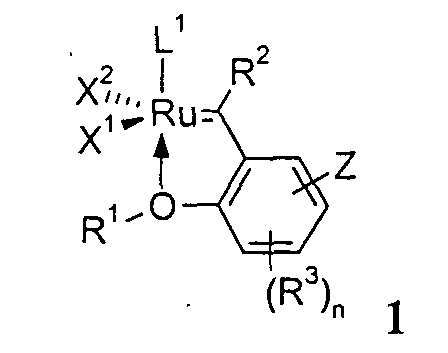
- X1 and X2 are anionic ligands;
- L1 is a neutral ligand;
- R1 is -C1-20-alkyl, -C1-20-haloalkyl, -C3-8-cycloalkyl or -C7-13-aralkyl;
- R2 is H, -C1-20-alkyl, -C2-20-alkenyl, -C2-20-alkynyl or aryl;
- R3 is -C1-6-alkyl, -C1-6-alkoxy, aryl, F or Cl;
- n is 0, 1, 2 or 3;
- Z is -CO-R4, -SO2-R5 or -PO(R6)2;
- R4 is -C1-20-alkyl or -C3-8-cycloalkyl, both optionally substituted by one or more group selected from each independently F, Cl, Br, I or -C1-6-alkoxycarbonyl, or aryl or heteroaryl both optionally substituted by one or more group selected from each independently F, Cl, Br, I, -C1-6-alkyl, -C1-6-alkoxy, -NO2, -CN, -CF3, -OCF3 or -C1-6-alkoxycarbonyl
- R5 is -C1-8-fluoroalkyl, aryl or heteroaryl, wherein aryl or heteroaryl are both optionally substituted by one or more groups selected from each independently F, Cl, Br, I,
- -C1-6-alkyl, -C1-6-alkenyl, -C1-6-alkoxy, -NO2, -CN, -CF3, -OCF3,
- -C1-6-alkoxycarbonyl, -SO2-C1-6-alkyl or -SO2-aryl, or
- R6 are each independently -C1-20-alkyl, -C3-8-cycloalkyl, aryl or heteroaryl, wherein aryl or heteroaryl are both optionally substituted by one or more group selected from each independently F, Cl, Br, I, -C1-6-alkyl, -C1-6-alkoxy, -NO2, -CN, -CF3,
- -OCF3, or -C1-6-alkoxycarbonyl; or
- R4, R5 and R6 are a group of formula 1'
wherein R1', R2' and R3' are independently selected from the meaning defined for R1, R2 and R3.

-
- The compounds of formula 1 of the present invention may be used to catalyse olefin metathesis reactions including, but not limited to, ring opening metathesis polymerisation (ROMP), ring closing metathesis (RCM), depolymerisation of unsaturated polymers, synthesis of telechelic polymers, ene-ine metathesis and olefin synthesis.
- Another embodiment of the present invention relates to novel 2-alkoxy-5-styrene derivatives of formula 2, which are intermediates for the preparation of complexes 1,wherein:

wherein X1, X2, L1, R1, R2, R3, n and Z are defined as above and - R12 is -C1-4-alkyl;
- m is 0, 1 or 2.
-
- The partial formularepresents an alkylene group in which one or both hydrogen atoms of the methylene group may be replaced by the group R12. Accordingly it covers the following alkylene groups:


- A further aspect of the invention is the preparation of novel 2-alkoxy-5-styrene derivatives of formula 2, wherein:
- A substituted 2-hydroxy-5-benzaldehyde 3 is alkylated by a R1V, wherein R1 has the
meaning given for formula 1 and V is a leaving group selected from halogen atoms,
C1-6-alkyl-S(O)-O-, C1-6-fluoroalkyl-S(O)-O-, aryl-S(O)-O- or aryl-S(O)2-O-.

- The substituted 2-alkoxy-5-benzaldehyde of formula 4 is then treated with an olefination reagent of formulawherein R4 and m has the meaning given for formula 2 and W is a leaving group suitable for olefination reactions; to yield formula 2,
 Compound 2 can then be reacted with a ruthenium complex of formula 5 to result in the ruthenium complex of the formula 1 in which L1 and L2 are neutral ligands; R13 is H, -C1-20-alkyl, -C2-20-alkenyl, -C2-20-alkynyl or aryl; R14 is aryl, vinyl or allenyl and X and X' are anionic ligands.
 Optionally, the obtained compound of formula 1 can then be reacted with a different neutral ligand L1 to replace the neutral ligand L1 that is present in the compound of formula 1 and thereby obtain a different compound of formula 1.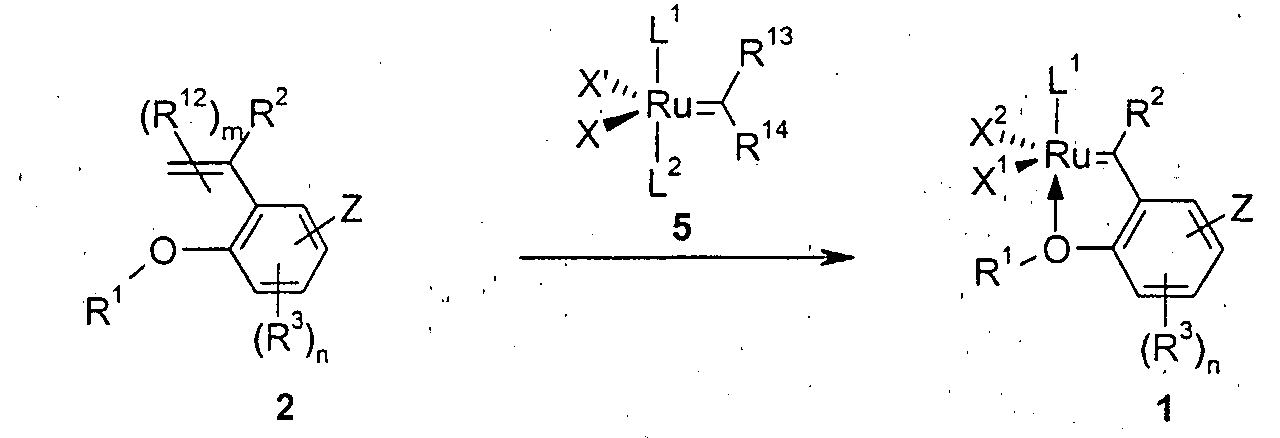
- The compounds herein described may have asymmetric centres. Compounds of the present invention containing an asymmetrically substituted atom may be isolated in optically active or racemic forms. It is well known in the art how to prepare optically active forms, such as by resolution of racemic forms or by synthesis from optically active starting materials. Many geometric isomers of olefins can also be present in the compounds described herein, and all such stable isomers are contemplated in the present invention. Cis and Trans geometric isomers of the compounds of the present invention are described and may be isolated as a mixture of isomers or as separated isomeric forms. All chiral, diastereomeric, racemic forms and all geometric isomeric forms of a structure are intended, unless the specific stereochemistry or isomeric form is specifically indicated.
-
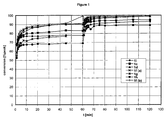
- Figure 1 is a graph comparing the cyclisation speed of 22 when using a ruthenium catalyst
according to the present invention versus using a known
ruthenium catalyst 1i (see Example 9). -
- Terms not specifically defined herein should be given the meanings that would be given to them by one of skill in the art in light of the disclosure and the context. As used in the specification, however, unless specified to the contrary, the following terms have the meaning indicated and the following conventions are adhered to.
- In the groups, radicals, or moieties defined below, the number of carbon atoms is often specified preceding the group, for example, -C1-6 alkyl means an alkyl group or radical having 1 to 6 carbon atoms. Unless otherwise specified below, conventional definitions of terms control and conventional stable atom valences are presumed and achieved in all formulas and groups.
- The term "optionally substituted" as used herein, means that any one or more hydrogens on the designated atom is replaced with a selection from the indicated group, provided that the designated atom's normal valence is not exceeded, and that the substitution results in a stable compound.
- The term "aryl" as used herein, either alone or in combination with another substituent, means either an aromatic monocarbocyclic system or aromatic multicarbocyclic systems. For example, aryl includes a phenyl or a naphthyl ring system.
- The term "heteroaryl" as used herein, either alone or in combination with another substituent, means a monovalent substituent derived by removal of a hydrogen, especially if a the annelated connection noted, then it means a divalent substituent derived by removal of two hydrogen, from a five-, six-, or seven-membered saturated or unsaturated (including aromatic) heterocycle containing carbon atoms and from one to four ring heteroatoms selected from nitrogen, oxygen and sulphur. Examples of suitable heterocycles include: tetrahydrofuran, thiophene, diazepine, isoxazole, piperidine, dioxane, morpholine, pyrimidine or
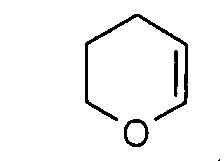
- The term "heteroaryl" also includes a heterocycle as defined above fused to one or more other cycle be it a heterocycle or any other cycle. One such examples includes indole or thiazolo[4,5-b]-pyridine. Although generally covered under the term "Heteroaromatic ring", the term "heteroaryl" as used herein precisely defines an unsaturated heterocycle for which the double bonds form an aromatic system. Suitable example ofheteroaromatic system include: quinoline, indole, pyridine,

- The term "halogen" as used herein means a halogen substituent selected from fluoro, chloro, bromo or iodo.
- The term "-C1-20-alkyl" as used herein, either alone or in combination with another substituent, means acyclic, straight or branched chain alkyl substituents containing from one to twenty carbon atoms. The term "-C1-6-alkyl" as used herein has the same meaning as the above mentioned term but contains less carbon atoms, precisely a maximum of six carbon atoms and is therefore preferred. The terms -C1-20-alkyl or -C1-6-alkyl can include i.e. methyl, ethyl, propyl, butyl, hexyl, 1-methylethyl, 1-methylpropyl, 2-methylpropyl or 1, 1-dimethylethyl.
- The term "-C2-20-alkenyl" as used herein, either alone or in combination with another substituent, means acyclic, straight or branched chain alkenyl substituents containing from two to twenty carbon atoms and at least one double bond. The term "-C2-6-alkenyl" as used herein has the same meaning as the above mentioned term but contains less carbon atoms, precisely a maximum of six carbon atoms and is therefore preferred.. The terms -C1-20-alkenyl or -C1-6-alkenyl can include i.e. vinyl or allenyl.
- The term "-C2-20-alkynyl" as used herein, either alone or in combination with another substituent, means acyclic, straight or branched chain alkynyl substituents containing from two to twenty carbon atoms and at least one triple bond. The term "-C2-6-alkynyl" as used herein has the same meaning then the above mentioned term but contains less carbon atoms, precisely a maximum of six carbon atoms and is therefore preferred.
- The term "-C3-8-cycloalkyl" as used herein, either alone or in combination with another substituent, means a cycloalkyl substituent containing five or six carbon atoms and includes i.e. cyclopentyl or cyclohexyl.
- The term "-C1-6-alkoxy" as used herein, either alone or in combination with another substituent, means the substituent -C1-6-alkyl-O- wherein alkyl is as defined above containing up to six carbon atoms. Alkoxy includes methoxy, ethoxy, propoxy, 1-methyl-ethoxy, butoxy or 1, 1-dimethylethoxy.
- The term "-C7-13-aralkyl" as used herein, either alone or in combination with another substituent, means the substituent -Aryl-C1-6-alkyl- wherein alkyl is as defined above containing up to six carbon atoms. Aralkyl includes benzyl, phenylethyl, phenylpropyl, 1-phenyl-1-methylethyl or phenylbutyl.
- The term "-C1-20-haloalkyl" as used herein, either alone or in combination with another substituent, means acyclic, straight or branched chain alkyl substituents containing up to twenty carbon atoms having one or more hydrogens substituted for a halogen selected from bromo, chloro, fluoro or iodo. Preferably the term -C1-20-haloalkyl represents -C1-8-fluoroalkyl. The term "-C1-8-fluoroalkyl" as used herein, either alone or in combination with another substituent, means acyclic, straight or branched chain alkyl substituents containing up to six carbon atoms having one or more hydrogens substituted by a flour atom such as 2-fluorethyl or 2,2,2-trifluorethyl. Preferably the terms -C1-20-haloalkyl and -C1-8-fluoroalkyl represent -C1-6-perflouroalkyl such as trifluoromethyl or pentafluoroethyl.
- Preferred are compounds of formula 1a, wherein L1, X, X', R1, R2, R3 and n are defined as above.
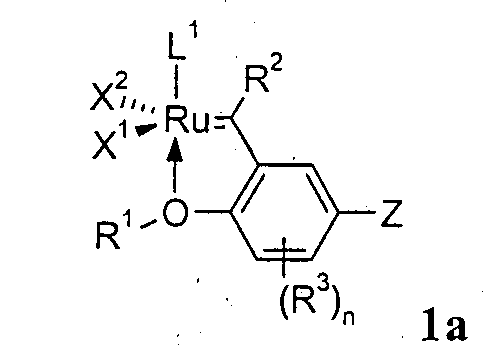
- More preferred are compounds of general formula 1 or 1a wherein
- L1 is P(R11)3 and R11 are each independently -C1-6-alkyl, -C3-8-cycloalkyl or aryl; or
- L1 is a ligand of formula 6a, 6b, 6c or 6d,
 wherein
- R7 and R8 are each independently H, -C1-20-alkyl, -C2-20-alkenyl or phenyl, wherein the phenyl is optionally substituted with up to three groups independently selected from -C1-6-alkyl, -C1-6-alkoxy or halogen; particularly
- R9 and R10 are each independently H, -C1-20-alkyl, -C2-20-alkenyl or phenyl, wherein the phenyl is optionally substituted with up to three groups independently selected from -C1-6-alkyl, -C1-6-alkoxy or halogen or
- R9 and R10 together with the carbon atoms to which they are attached are combined to form a carbocyclic 3 to 8 membered ring.
- Y and Y' are halogen.
-
- Particularly preferred are compounds wherein
- R7 and R8 are each independently H, -C1-6-alkyl, -C2-6-alkenyl or phenyl, wherein the phenyl is optionally substituted with up to three groups independently selected from -C1-6-alkyl, -C1-6-alkoxy or halogen;
- R9 and R10 are each independently H, -C1-6-alkyl, -C2-6-alkenyl or phenyl, wherein the phenyl is optionally substituted with up to three groups independently selected from -C1-6-alkyl, -C1-6-alkoxy or halogen or
- R9 and R10 together with the carbon atoms to which they are attached are combined to form a carbocyclic 5 to 7 membered ring.
-
- Most preferred are compounds of general formula 1 or 1a, wherein
- R1 is a iso-propyl group; and / or
- R2 is H, -C1-6-alkyl or aryl, in particular R2 has the meaning of a hydrogen atom; and / or
- X and X' are halogen, particularly chlorine; and / or
- L1 is P(cyclohexyl)3; or
- L1 is a group of formula 6a, 6b, 6c or 6d; and / or
- R7 and R8 are 2-methylbenzene, 2, 6-dimethylbenzene or 2, 4, 6-trimethylbenzene; and / or
- n is 0.
- Additional embodiments are compounds of formula 1 or 1a wherein:
- R1 is iso-propyl;
- R2 is H;
- n is 0;
- X and X' are each chlorine; and
- L1 is a ligand of formula 6a:
wherein R7 and R8 are each 2,4,6-trimethylphenyl; and

- R9 and R10 are each H.
Preferred are compounds of formula 2a, wherein R1, R2, R3, R4, m and n are defined as
above.
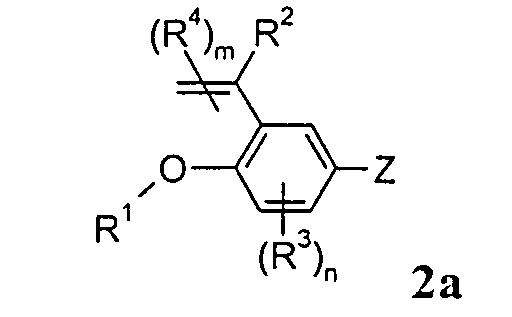
- More preferred are compounds of general formula 2 or 2a, wherein
- R1 is a iso-propyl group; and / or
- R2 is H, -C1-6-alkyl or aryl, in particular R2 has the meaning of a hydrogen atom; and / or
- R4 is -C1-6-alkyl, in particular methyl or ethyl; and / or
- n is 0 and / or
- in is 0.
- Additional embodiments are compounds of formula 2 or 2a wherein:
- R1 is iso-propyl;
- R2 is H;
- m is 0; and
- n is 0.
- Furthermore preferred is a process for manufacturing complexes of formula 1 or 1a, wherein a compound of general formula 2 or 2a, is reacted with a ruthenium complex of formula 5wherein

- L1 and L2 are neutral ligands
- R13 is H, -C1-20-alkyl, -C2-20-alkenyl, -C2-20-alkynyl or aryl; and
- R14 is aryl, vinyl or allenyl; and
- X and X' are anionic ligands;
- optionally in the presence of a different neutral ligand L1.
-
- More preferred is the above mentioned synthesis of a ruthenium complex of formula 1, when the process is carried out:
- in the presence of a copper salt, in particular CuCl; and / or
- in a halogenated or an aromatic solvent, particularly selected from methylene chloride, chloroform, benzene, toluene, xylene, mesitylene or mixtures thereof; and / or
- at a temperature from 0 to 100°C, in particular at a temperature from 10 to 80°C, more particular at a temperature from 20 to 60°C; and / or
- in a time period from 1 to 24h, in particular 1 to10h, more particular 1 to 4h.
- Most preferred is the above mentioned synthesis of a ruthenium complex, wherein the reaction is carried out in one vessel by mixing the ligand of formula 6a, 6b, 6c or 6d with a solid complex of formula 5, wherein both ligands L1 and L2 are phosphines of formula P(R11)3, wherein R11 has the meaning as above and thereafter adding a ligand of formula 2 or 2a.
- One preferred variation of the above mentioned synthesis of a ruthenium complex is the generation of the ligands of general formula 6a, 6b, 6c or 6d in situ from the stable salts of the formulae 7a, 7b, 7c or 7d,wherein the anion is selected from formiate, acetate, trifluoro-acetate or another acid group, a halogen or [BF4]-. Therefore, the salt is preferably in form of a suspension in solvents such as aliphatic or aromatic hydrocarbons, preferably hexane, reacted with a strong base, selected from alkali metal hydrides, alkaline earth metal hydrides or alcoholates, particularly potassium tert-pentanolate, potassium tert-amylate or potassium tert-butanolate. Thereafter reaction is continued by adding a solid complex of formula 5, wherein both ligands L1 and L2 are phosphines of formula P(R11)3 and thereafter adding a ligand of formula 2 or 2a, to yield a compound of general formula 1 or 1a.

- Moreover preferred is a process for manufacturing intermediates, which comprises the steps of a) alkylating a compound of general formula 3, with a reagent of formula R'V (9) to form a intermediate of formula 4, and b) reacting 4 with an olefination reagent of
formula 10 to yield a compound of the general formula 2,wherein R1, R2, R3, R12, Z, m and n of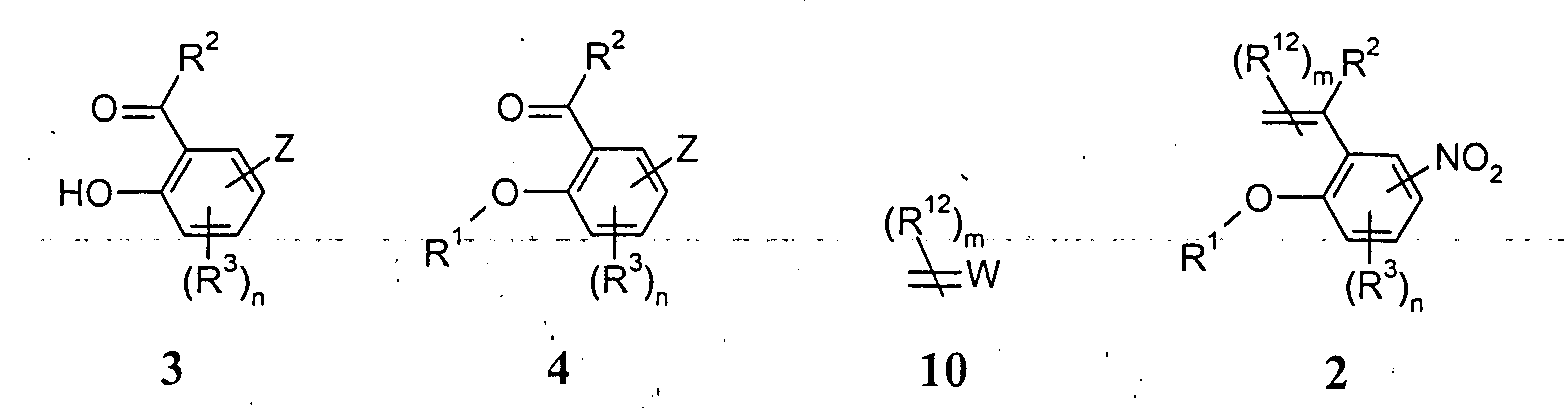
formula 2a, 3, 4, 9 and 10 are defined as above and - W is a leaving group suitable for olefination reactions; and.
- V is halogen, -C1-6-alkyl-S(O)-O-, -C1-6-fluoroalkyl-S(O)-O-, aryl-S(O)-O- or aryl-S(O)2-O-.
-
- More preferred is a process, wherein the above mentioned step a) is carried out:
- in an aprotic solvent, in particular selected from DMF, DMSO, acetone, acetonitrile, ethyl acetate, glycol ether, methanol, ethanol or mixtures thereof, more particular the solvent is DMF; or
- in a biphasic solvent system fitted with a phase transfer catalyst; or
- in presence of a catalyst, in particular the catalyst is selected from Cs2CO2, CsF, quaternary ammonium salts, crown ethers or cryptands, more particular Cs2CO3; or
- in the presence of an alkali metal carbonate or an alkali hydroxide, in particular selected from Na2CO3, K2CO3, Li2CO3, Cs2CO3, NaOH, KOH, LiOH, CsOH; or
- in a time period from 1 to 24h, in particular 8 to24h, more particular 16 to 24h.
- at a temperature from 0 to 150°C, in particular at a temperature from 10 to 100°C, more particular at a temperature from 20 to 80°C; or
- Starting from compound 4, compound 2 is available under Tebbe, Wittig, Wittig-Horner, Wittig-Horner-Emmons or Peterson conditions, but preferred is a process, wherein the above mentioned step b) is carried out:
- in a solvent selected from alcohols, glycol ethers or cyclic ethers, preferred is THF; or
- W is a leaving group suitable for olefination reactions according to Tebbe, with Tebbe's titanium reagent, or according to Wittig, with Wittig's phosphonium ylide reagent, more particular a leaving group selected from PPh3 or TiCp2; wherein Ph is substituted or unsubstituted phenyl and Cp is a substituted or unsubstituted cyclopentadienyl-anion, which can be found after reaction in its oxidised form.
- Another preferred embodiment of the invention is a process for metathesis reactions of all types, comprising contacting an olefin with a catalyst of general formula 1; in particular wherein the metathesis reaction is a ring closing or cross metathesis reaction.
- The following examples are to illustrate various embodiments of the present invention and are not to be understood as limiting the present invention in a way.
-
- a) 4-Methoxy-benzene-phosphonic-acid-diethylester is prepared in analogy to Chem. Ber. (1970) 103, 2428-2436.
- b) 4-Methoxy-benzene-phosphonic-acid-diethylester (1.3 g, 12.3 mmole), SOCl2 (14.6 g, 123 mmole), and DMF (0,9 ml) are heated to reflux under argon for 4 hours. After removal of remaining SOCl2 under vacuum, 2,4 g crude 4-Methoxy-benzenephosphonic-acid-dichloride is obtained.
- c) 10.8 g 4-Brom-chlorbenzene is reacted with 1.38 g magnesium in 100 ml THF to Grignard reagent. The resulting mixture is added under argon over 40 minutes to a cooled solution (-78°C) of 4-Methoxy-benzenephosphonic-acid-dichloride (2.42 g) and THF (60 ml). Thereafter the mixture is stirred for 10 h at room temperature. A saturated NH4Cl solution is added and the solvent removed under vacuum. The residue is threatened with 100 ml CH2Cl2, filtered through silica gel and dried again. Product is purified by column chromatography (hexane / ethyl acetate, 4 : 2). 2.15 g of pure 4-Methoxyphenyl-bis(4-chlorophenyl)-phosphinoxid is obtained. mp: 106-107°C.
- d) 4-Methoxyphenyl-bis(4-chlorophenyl)-phosphinoxid (1.84 g, 4.88 mmole) and CH2Cl2 (30 ml) are cooled to -78°C. BBr3 (1,84g, 7,32 mmole) is added and the resulting mixture is stirred for 26 h at r.t.. H2O (30 ml) is added and CH2Cl2 removed under stirring at 80°C. After 6 h the mixture is cooled down and the product precipices. Solid residue is purified by column chromatography (methanol / ethyl acetate / H2O, 5 : 50 : 0,5). 1.26 g of pure 4-Hydroxyphenyl-bis(4-chlorophenyl)-phosphinoxid is obtained. mp: 116-119°C
-
-
- a)
K2CO3 (298 mg, 2.2 mmole), Cs2CO3 (104 mg, 0.32 mmole) and 8 (R6'=p-Cl-phenyl, 400 mg, 1.1 mmole) are placed in a flask. DMF (5.5 ml) is added and the mixture is stirred about 5 minutes. After the time, allyl bromide (190 µl, 2.2 mmole) is added and the mixture is stirred for another 24 h at 35°C. DMF is evaporated under vacuum, water (10 ml) is added and the mixture is extracted with ethyl acetate (3 x 25 ml). Combined extracts are dried and evaporated to dryness. 440 mg (99 %) of crude 9 (R6'=p-Cl-phenyl) is obtained.1H NMR (400 MHz, CDCl3): δ = 4.59 (dt, J = 5.4, J =1.5 Hz, 2H), 5.30 - 5.34 (m, 1H), 5.39 - 5.45 (m, 1H); 6.00 - 6.09 (m, 1H), 6.98 -7.01 (m, 2H), 7.43 - 7.47 (m, 4H), 7.50-7.62 (m, 6H).

- b)
A solution of 9 (R6'=p-Cl-phenyl, 400 mg, 1.0 mmole) in 1,2,4-trichlorobenzene (5 ml) is heated under Argon at 200-210 C for 8 h. After cooling, n-pentane (ca. 40 ml) is added and a light-brown solid is formed, which is filtered-off and dried. 337 mg of crude 10 (R6'=p-Cl-phenyl) is obtained.1H NMR (400 MHz, CD3OD): δ = 3.30 - 3.32 (m, 2H), 4.96 - 4.98 (m, 1H), 4.99 - 5.02 (m, 1H), 5.87 -5.97 (m, 1H) 6.90 - 6.93 (m, 1H), 7.23 - 7.29 (m, 1H), 7.31 - 7.36 (m, 1H), 7.54 -7.62 (m, 8H)

- c)
10 (R6'=p-Cl-phenyl, 300 mg; 0.75 mmole), RhCl3·3H2O (19 mg, 0.075 mmole, 10 % mol) and p-toluene sulfonic acid (14 mg, 0.075 mmole, 10 % mol) are placed in a flask. EtOH (5 ml) and H20 (0.5 ml) are added and the mixture is refluxed under Argon for 5h. A dark red solution is formed. H2O (10 ml) is added and ethanol was evaporated. The mixture is extracted with CH2Cl2 (5 x 15 ml), the combined extracts are washed with water, dried and filtered. The filtrate is evaporated. 294 mg (99 %) of 11 (R6'=p-Cl-phenyl) is obtained. 1H NMR (400 MHz, CDCl3): 1.80 (dd, J = 6.6, J =1.6 Hz, 3H), 6.01 - 6.11 (m, 1H), 6.57 (d, J =16.0 Hz, 1H), 6.92 - 6.96 (m, 1H), 7.14 - 7.20 (m, 1H), 7.36 - 7.46 (m, 4H), 7.53-7.59 (m, 5H)

- d)
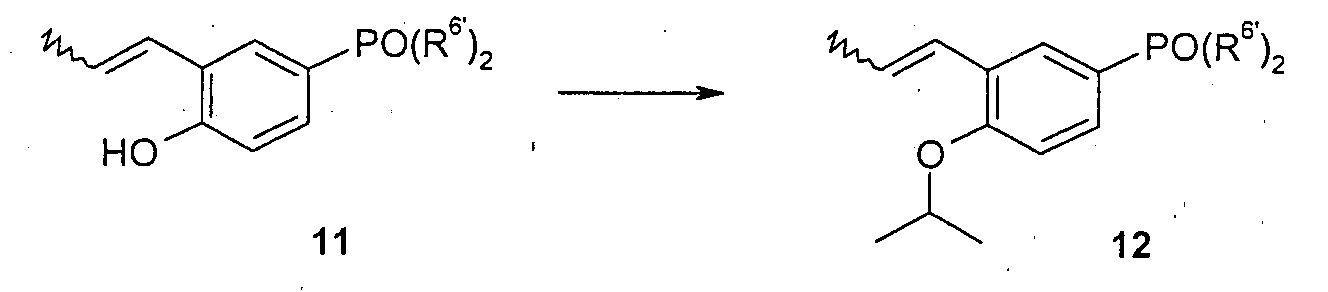
K2CO3 (182 mg, 1.3 mmole), Cs2CO3 (83 mg, 0.26 mmole), and 11 (R6'=p-Cl-phenyl, 270 mg, 0.67 mmole) are placed in flask. DMF (3.0 ml) is added and the mixture is stirred about 5 min.. Thereafter, isopropyl iodide (150 µl, 1.5 mmole) is added and the mixture is stirred for 22 h at 35 °C. H2O (6 ml) is added and the mixture is extracted with ethyl acetate (3 x 15 ml). Combined extracts are dried and evaporated to dryness. Product is purified by column chromatography (ethyl acetate / cyclohexane, 1 : 1). 155 mg (52 %) of pure 12 (R6'=p-Cl-phenyl) is obtained.13C NMR (100 MHz, CDCl3): δ = 19.0, 21.9, 70.6, 112.8 (d, J = 13 Hz), 121.2, 122.3, 124.8, 128.0, 128.8 (d, J = 13 Hz), 130.3, 130.7, 131.7, 133.3 (d, J = 11 Hz), 138.6, 157.7
-
-

- A solution of t-Butyl lithium (0.8 mmole) in 5 ml of Et2O is dropped slowly to a solution of 11' (0.4 mmole, 96.5 mg) in 2 ml THF, at -78°C. 15 min later PO(R6')2 (R6'= phenyl, 0.8 mmole, 189.3 mg) in 10 ml of THF is added slowly. The reaction mixture is stirred for 30 min at -78°C an then allowed under stirring to warm up to room temperature within 3 h. Aqueous, saturated NH4Cl (6ml) is added, the THF removed and the residue extracted with CH2Cl2 (3 x 10ml). The combined organic layers are washed with water, dried with anhydrous MgSO4, filtered and concentrated. The residue is purified by flash chromatography (50% EtOAc in cyclohexane).
- 13C-NMR (125 MHz, CDCl3) δ= 22.0, 70.7, 112.8 (d, J = 13.4Hz), 115.6, 127.5 (d,. J = 11.8 Hz). 127.7 (d, J = 18.9Hz), 128.4 (d, J =19 Hz), 131.1.
-
- a)
A solution of t-Butyl lithium (0.8 mmole) in 5 ml of Et2O is dropped slowly to a solution of 11' (0.4 mmole, 96.5 mg) in 2 ml THF, at -78°C. 15 min later 13 (0.8 mmole, 84.9 mg) in 10 ml of THF is added slowly. The reaction mixture is stirred for 30 min at -78°C an then allowed under stirring to warm up to room temperature overnight. Aqueous, saturated NH4Cl (6ml) is added, the THF removed and the residue extracted with CH2Cl2 (3 x 10ml). The combined organic layers are washed with water, dried with anhydrous MgSO4, filtered and concentrated. The residue is purified by flash chromatography (5% EtOAc in cyclohexane).13C-NMR (125 MHz, CDCl3) δ= 22.2, 71.0, 76.0, 114.1, 114.3, 125.0, 126.5, 127.0, 127.4, 127.8, 128.4, 131.9, 135.9, 143.9, 154.7.

- b)
14 (0.4 mmole, 0,1 g) was dissolved in 15 ml CH2Cl2, Pyridinium chromate (0.48 mmole, 103.4 mg) was added slowly and the resulting mixture was stirred at room temperature for 1 h. The solvent was removed and the residue purified by flash chromatography (5% EtOAc in cyclohexane).13C-NMR (125 MHz, CDCl3) δ = 22.1, 70.8, 112.2, 115.4, 127.3. 128.2. 129.3. 129.6, 129.7, 131.2, 131.6, 131.8. 138.3, 158.7, 195.6.

-
-

- Second generation Grubb's catalyst 16 (Mes = mesityl, 153 mg, 0.18 mmole) and CuCl (31mg, 0.31 mmole) are placed in Schlock's flask. CH2Cl2 (3 ml) is added under Argon and a solution of 12 (R6'=p-Cl-phenyl, 86 mg, 0.19 mmole;) in CH2Cl2 (6 ml) is added. The solution is stirred at 40 °C for 40 min under Argon. CuCl (10 mg) is added and the mixture is stirred for 1h. Thereafter solvent is evaporated, ethyl acetate (ca. 20 ml) is added, solid residues are filtered off and the filtrate is concentrated under vacuum. The product is purified by column chromatography (ethyl acetate / cyclohexane, 1 : 1). The product 1b (R6'=p-Cl-phenyl, 131 mg, 81 %) is obtained as a green solid.
- LRMS (ESI, MeOH and CH2Cl2): 896.1 (M+). HRMS (ESI, MeOH and CH2Cl2): calcd. for C43H45O2N2 35Cl3 102Ru (M+ - Cl): 859.1322; found 859.1358.
-
- a)
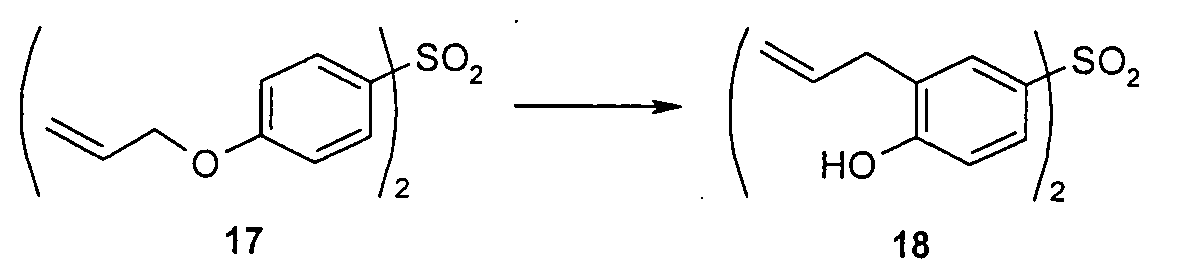
- A solution of 17 (500 mg) in 1,2,4-trichlorobenzene (8 ml) is heated at 210 C for 6 h. After cooling, hexane (ca.80 ml) is added and 12 hours later a solid product is formed, which is filtered-off and dried. After chromatography (hexane / ethyl acetate, 3 : 2) 383 mg of the product 18 is obtained.
- b)
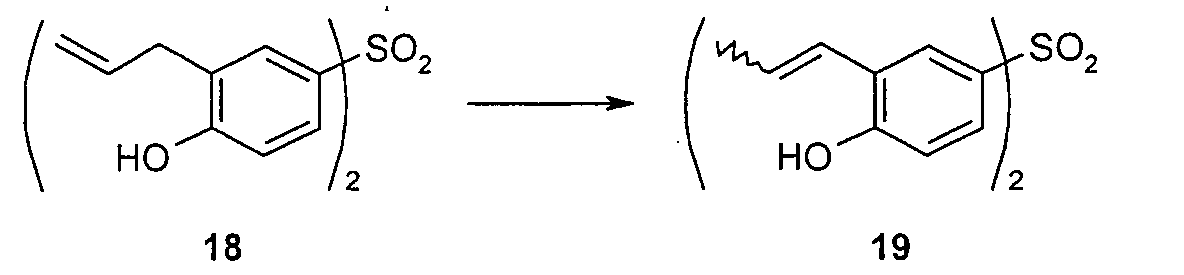
18 (165 mg; 0.5 mmole), RhCl3·3H2O (13.1 mg, 0.05 mmole, 10 % mol) and p-toluene sulfonic acid (6.8 mg, 0.05 mmole, 10 % mol) are placed in flask. EtOH (4.5 ml) and H2O (0.5 ml) are added and the mixture is refluxed for 3h. The mixture is evaporated to dryness, ethyl acetate is added and then filtered over 5 g of silica gel. The filtrate is evaporated. 157 mg of the product 19 is obtained.
- c)
A solution of 19 (440 mg) in 1,2,4-trichlorobenzene (7 ml) is heated at 210 C for 6 h. After cooling, hexane (ca.80 ml) is added and 12 hours later a solid product is formed, which is filtered-off and dried. After chromatography (hexane / ethyl acetate, 3 : 2) 258 g of the

product 20 is obtained.mp: 147-148°C - d)
20 (258 mg; 0.75 mmole), RhCl3·3H2O (19 mg, 0.075 mmole, 10 % mol) and p-toluene sulfonic acid (0.014 g, 0.075 mmole, 10 % mol) are placed in flask. EtOH (4.5 ml) and H2O (0.5 ml) are added and the mixture is refluxed for 3h. The mixture is evaporated to dryness, ethyl acetate added and then filtered over 5g of silica gel. The filtrate is evaporated. 235 mg of the product 21 is obtained.

-
-
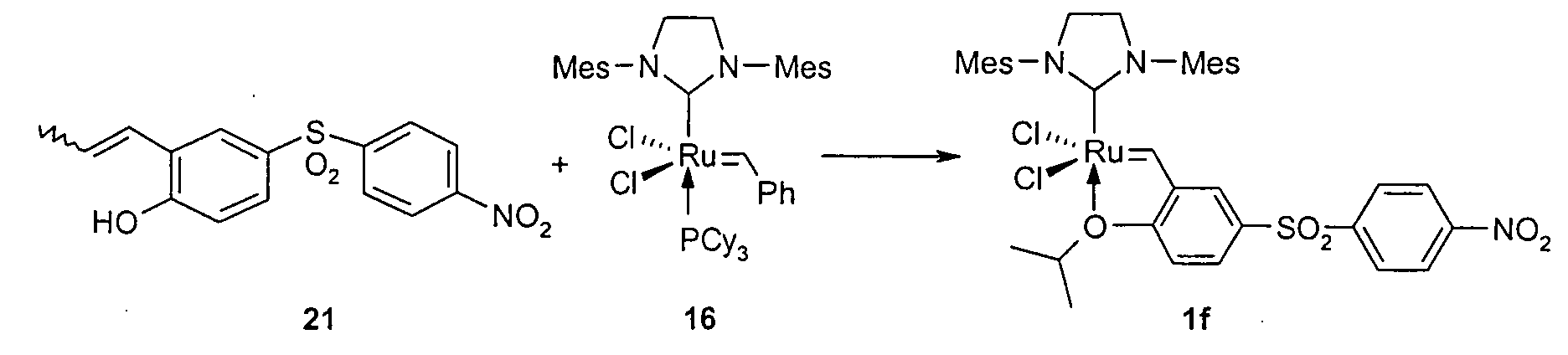
- Second generation Grubb's catalyst 16 (Mes = mesityl, 140 mg, 0.166 mmole) and CuCl (20mg, 0.20 mmole) are placed in Schlock's flask. CH2Cl2 (4 ml) is added under Argon and then a solution of 21 (56 mg, 0.165 mmole) in CH2Cl2 (5 ml) is added. The solution is stirred at 40 °C for 50 min under Argon. Thereafter, solvent is evaporated, ethyl acetate (ca. 10 ml) is added, white solid is filtered off and the filtrate is concentrated under vacuum. The product is purified by column chromatography (15 % - 30% ethyl acetate in cyclohexane). The product 1f (80 mg, 60 %) is obtained as a green solid.
- Analogously to the processes described in the examples 1 to 7, the following compounds of formula 1c, 1d, 1e, 1g and 1h are obtained. For instance, according to example 5 compound 12' is a ligand for complex 1c, compound 15 for complex 1d or according to example 4 and 5 heptanone can be reacted with 11', oxidised and reacted with 16 to obtain complex 1e.


-

- Toluene is degassed by bubbling through nitrogen, 22 is dissolved in 10 ml of degassed toluene and added into the reaction flask. The solution is heated up to 80°C and freshly prepared catalysts 1c-h is added (1st) under nitrogen. After stirring for 60 min at the same temperature the conversion is checked by HPLC. A second amount of catalysts 1c-h (2nd) is added under nitrogen and the conversion is checked 60 min later a second time by HPLC. Figure 1 is a graph comparing the cyclisation speed of 22. Table 1 shows the results of the HPLC analysis, wherein the catalyst 1c-h are compared with a known catalyst of
formula 1i (Angew. Chem. Int. Ed. 2002, 41, 4038).
catalyst 1st [mol%] 2nd [mol%] 22 [mol] toluene [ml] conversion 23 [60 min] 23 [120 min] [%Peak at 200nm] 22 [60 min] 22 [120 min] 1c 0,4 0,0075 554 66,4 33,6 0,2 96,2 3,8 1d 0,4 0,0075 554 80,1 19,9 0,2 96,9 3,1 1e 0,4 0,0075 554 89,9 10,1 0,2 98,9 1,1 1f (a) 0,4 0,0075 554 99,3 0,7 0,2 99,1 0,9 1f (b) 0,4 0,0025 185 91,3 8,7 0,2 99,5 0,5 1g 0,2 0,0075 554 - - 0,1 98,8 1,2 1h 0,4 0,0075 554 68,7 31,3 0,2 88,7 11,3 1i 0,4 0,0075 554 - - 0,2 96,5 3,5 1i 0,4 0,015 1008 77,4 22,6 0,2 92,8 7,2 - 23.5 g Tetrakis hydroxy methyl phosphonium chloride (80%, 98.7 mmole) is dissolved in isopropanole (35 ml) under a nitrogen atmosphere. Then 12.1 g (98.7 mmole) of a 45% KOH solution is added within 5 min while the solution is cooled (temperature 20 - 25°C). After stirring the suspension for another 30 min under nitrogen, the mixture is filtered and the inorganic residue is washed with 20 ml of degassed isopropanole. The combined isopropanole solution is stored under a nitrogen atmosphere until use.
- After cooling to 60°C 2.3 g (2.8 mmole) of the trihydroxy methyl phosphine (THP) solution is added to the reaction mixture of example 13. After stirring for 5 h at 60°C the mixture is cooled to room temperature and extracted twice with 40 ml of degassed water, 40 ml of 0.5 M HCl, 40 ml of 0.5 M NaHCO3 solution, and 40 ml of water. Approx. 695 ml of toluene are distilled of at 50°C in vacuum (150 mbar) and the residue is treated at 50°C with 1.4 g of charcoal. The remaining liquid is added to 210 ml of pre-cooled methyl cyclohexane (5°C). After stirring for further 60 min at 5°C the precipitate is filtered and washed with 100 ml of methyl cyclohexane (twice). The white solid is dried in vacuum at 30°C to yield 23 as an almost white powder.
catalyst total yield % of 23 % of 22 1c 96,2 86,02 1,20 1d 94,3 85,44 1,95
Claims (18)
- A compound of general formula 1,wherein:
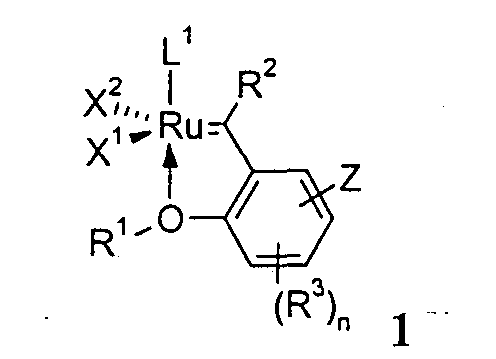 X1 and X2 are anionic ligands;L1 is a neutral ligand;R1 is -C1-20-alkyl, -C1-20-haloalkyl, -C3-8-cycloalkyl or -C7-13-aralkyl;R2 is H, -C1-20-alkyl, -C2-20-alkenyl, -C2-20-alkynyl or aryl;R3 is -C1-6-alkyl, -C1-6-alkoxy, aryl, F or Cl;n is 0, 1, 2 or 3;Z is -CO-R4, -SO2-R5 or -PO(R6)2;R4 is -C1-20-alkyl or -C3-8-cycloalkyl, both optionally substituted by one or more group selected from each independently F, Cl, Br, I or -C1-6-alkoxycarbonyl, or aryl or heteroaryl both optionally substituted by one or more group selected from each independently F, Cl, Br, I, -C1-6-alkyl, -C1-6-alkoxy, -NO2, -CN, -CF3, -OCF3 or -C1-6-alkoxycarbonylR5 is -C1-8-fluoroalkyl, aryl or heteroaryl, wherein aryl or heteroaryl are both optionally substituted by one or more groups selected from each independently F, Cl, Br, I, -C1-6-alkyl, -C1-6-alkenyl, -C1-6-alkoxy, -NO2, -CN, -CF3, -OCF3, -C1-6-alkoxycarbonyl, -SO2-C1-6-alkyl or -SO2-aryl, orR6 are each independently -C1-20-alkyl, -C3-8-cycloalkyl, aryl or heteroaryl, wherein aryl or heteroaryl are both optionally substituted by one or more group selected from each independently F, Cl, Br, I, -C1-6-alkyl, -C1-6-alkoxy, -NO2, -CN, -CF3, -OCF3, or -C1-6-alkoxycarbonyl; orR4, R5 and R6 are a group of formula 1'wherein R1', R2' and R3' are independently selected from the meaning defined for R1, R2 and R3.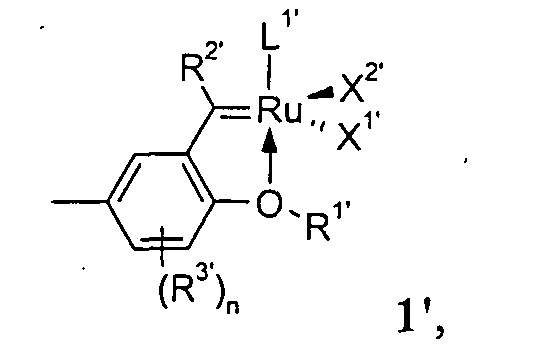
- A compound of general formula 1, wherein X', X2, L1 and n are as defined in claim 1 andR1 is -C1-20-alkyl, -C1-20-haloalkyl, -C3-8-cycloalkyl or -C7-13-aralkyl;R2 is H, -C1-6-alkyl, -C2-6-alkenyl, -C2-6-alkynyl or aryl;R3 is -C1-6-alkyl, -C1-6-alkoxy, aryl, F or Cl;Z is -CO-R4, -SO2-R5 or -PO(R6)2;R4 is -C1-6-alkyl or -C3-8-cycloalkyl, both optionally substituted by one or more group selected from each independently F, Cl, Br, I or -C1-6-alkoxycarbonyl, or aryl or heteroaryl both optionally substituted by one or more group selected from each independently F, Cl, Br, I, -C1-6-alkyl, -C1-6-alkoxy, -NO2, -CN, -CF3, -OCF3 or -C1-6-alkoxycarbonylR5 is -C1-8-fluoroalkyl, aryl or heteroaryl, wherein aryl or heteroaryl are both optionally substituted by one or more group selected from each independently F, Cl, Br, I, -C1-6-alkyl, -C1-6-alkenyl, -C1-6-alkoxy, -NO2, -CN, -CF3, -OCF3, -C1-6-alkoxycarbonyl, -SO2-C1-6-alkyl or -SO2-aryl,R6 are each independently -C1-6-alkyl, -C3-8-cycloalkyl, aryl or heteroaryl, wherein aryl or heteroaryl are both optionally substituted by one or more group selected from each independently F, Cl, Br, I, -C1-6-alkyl, -C1-6-alkoxy, -NO2, -CN, -CF3, -OCF3, or -C1-6-alkoxycarbonyl; orR4, R5 and R6 are a group of formula 1'wherein R1', R2' and R3' are independently selected from the meaning defined for R1, R2 and R3.
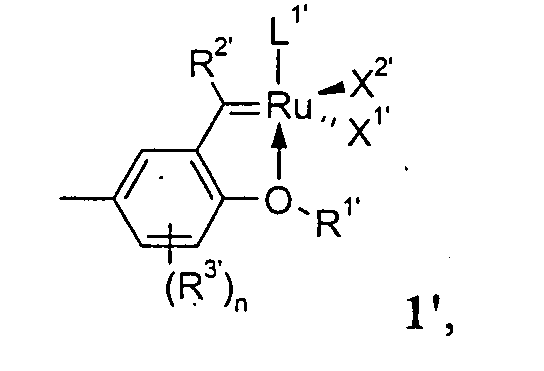
- A compound of general formula 1a,wherein X1, X2, L1, R1, R2, R3, n and Z are defined as in claim 1 or 2.
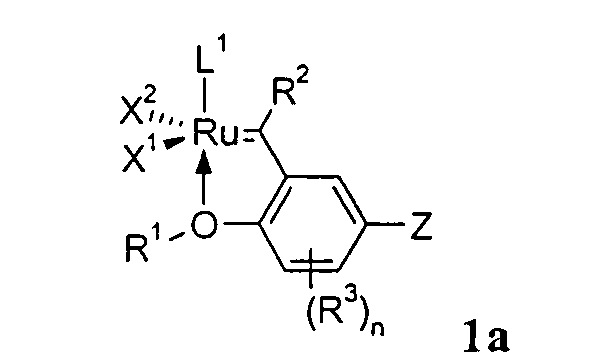
- A compound according to claims 1-3, whereinX1 and X2 each independently are F, Cl, Br or I;Z is -CO-R4, -SO2-R5 or -PO(R6)2;R4 is aryl or heteroaryl both optionally substituted by one or more group selected from each independently F, Cl, Br, I, -C1-6-alkyl, -C1-6-alkoxy, -NO2, -CN, -CF3, -OCF3 or -C1-6-alkoxycarbonylR5 is aryl or heteroaryl are both optionally substituted by one or more group selected from each independently F, Cl, Br, I, -C1-6-alkyl, -C1-6-alkenyl, -C1-6-alkoxy, -NO2, -CN, -CF3, -OCF3, -C1-6-alkoxycarbonyl,-SO2-C1-6-alkyl or -SO2-aryl,R6 are each independently -C1-6-alkyl, -C3-8-cycloalkyl, aryl or heteroaryl, wherein aryl or heteroaryl are both optionally substituted by one or more group selected from each independently F, Cl, Br, I, -C1-6-alkyl, -C1-6-alkoxy, -NO2, -CN, -CF3, -OCF3, or -C1-6-alkoxycarbonyl; orR4, R5 and R6 are a group of formula 1'wherein R1', R2' and R3' are independently selected from the meaning defined for R1, R2 and R3.

- A compound according to claims 1-4, whereinX1 and X2 are Cl;Z is -CO-R4, -SO2-R5 or -PO(R6)2;R4 is aryl optionally substituted by one or more group selected from each independently F, -C1-6-alkoxy, -NO2 or -CF3R5 is aryl optionally substituted by one or more group selected from each independently F, -C1-6-alkoxy, -NO2, -CF3, -SO2-C1-6-alkyl or -SO2-aryl,R6 are aryl, both optionally substituted by one or more group selected from each independently F, -C1-6-alkoxy, -NO2 or -CF3.
- A compound according to claims 1-5, whereinn is 0.
- A compound according to claims 1-6, whereinR1 is iPr.
- A compound according to claims 1-7, whereinR2 is H or -CH3.
- A compound according to one of the claims 1-8, wherein:L1 is P(R11)3 or a ligand of formula 6a, 6b, 6c or 6d,
 R11 is -C1-6-alkyl, -C3-8-cycloalkyl or aryl;R7 and R8 are each independently H, -C1-20-alkyl, -C2-20-alkenyl or phenyl, wherein the phenyl is optionally substituted with up to three groups independently selected from -C1-6-alkyl, -C1-6-alkoxy or halogen; particularlyR9 and R10 are each independently H, -C1-20-alkyl, -C2-20-alkenyl or phenyl, wherein the phenyl is optionally substituted with up to three groups independently selected from -C1-6-alkyl, -C1-6-alkoxy or halogen orR9 and R10 together with the carbon atoms to which they are attached are combined to form a carbocyclic 3 to 8 membered ring;Y and Y' are halogen.
 - A compound according to claims 1-9, wherein:L1 is P(R11)3 or a ligand of formula 6a, 6b, 6c or 6d,
 R11 is -C1-6-alkyl, -C3-8-cycloalkyl or aryl;R7 and R8 are each independently H, -C1-6-alkyl, -C2-6-alkenyl or phenyl, wherein the phenyl is optionally substituted with up to three groups independently selected from -C1-6-alkyl, -C1-6-alkoxy or halogen; particularlyR9 and R10 are each independently H, -C1-6-alkyl, -C2-6-alkenyl or phenyl, wherein the phenyl is optionally substituted with up to three groups independently selected from -C1-6-alkyl, -C1-6-alkoxy or halogen orR9 and R10 together with the carbon atoms to which they are attached are combined to form a carbocyclic 3 to 8 membered ring;Y and Y' are halogen.
 - A compound according to claims 1-10, whereinL1 is a ligand of formula 6a, 6b, 6c or 6d,R7 and R8 are each independently tolyl, m-xylyl or mesityl;R9 and R10 are each independently H or -C1-6-alkyl.
- A compound according to one of the claims 1-11, wherein:L1 is P(R11)3;R11 is phenyl or cyclohexyl;
- A compound selected from the formula 1b-1h,


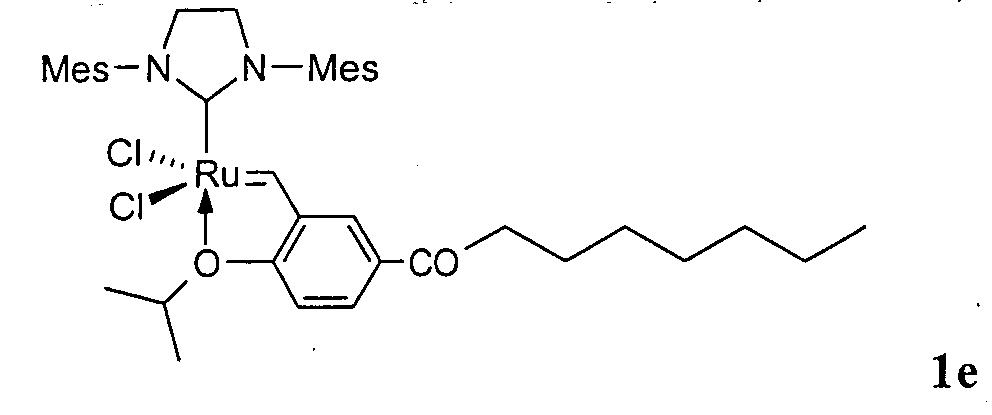
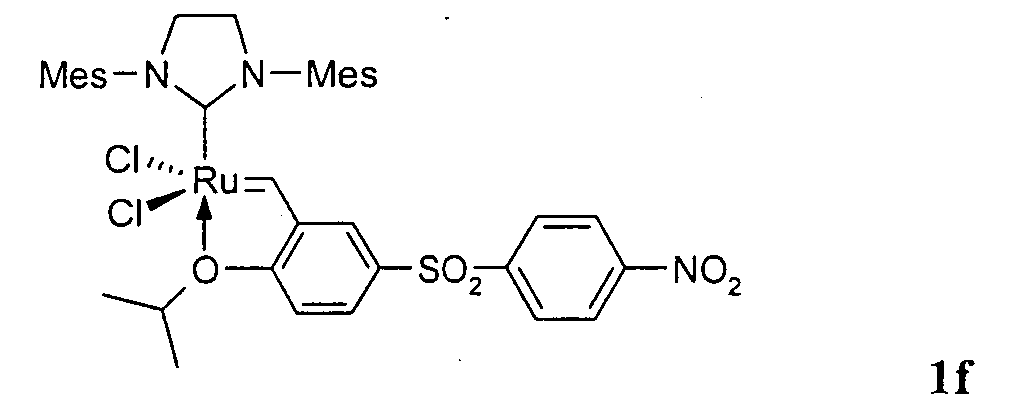
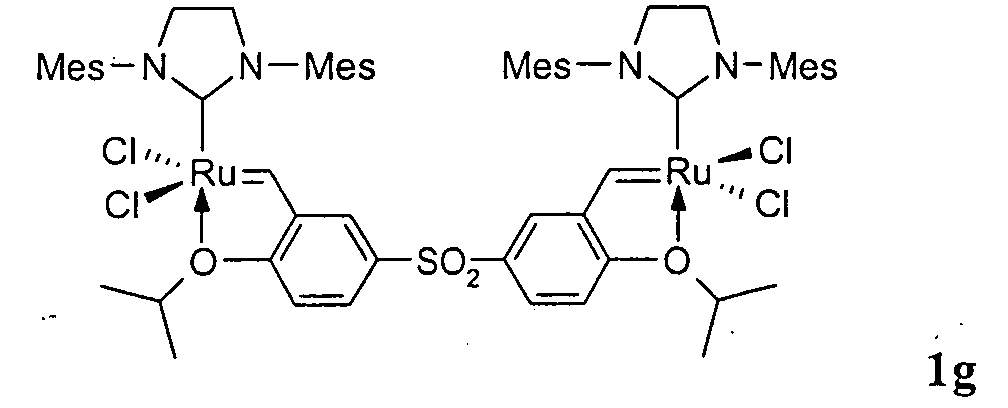 wherein Mes is mesityl, Ph is phenyl and p-Cl-Ph is para-chlorphenyl.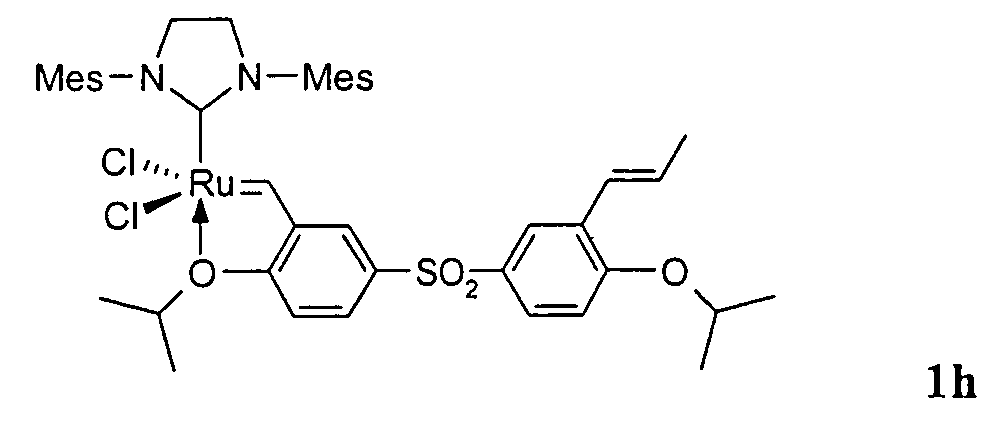
- A compound of general formula 2,wherein:
 wherein X1, X2, L1, R1, R2, R3, n and Z are defined as in claims 1-8 andR12 is -C1-4-alkyl;m is 0, 1 or 2.
 - A compound of general formula 2a,wherein:
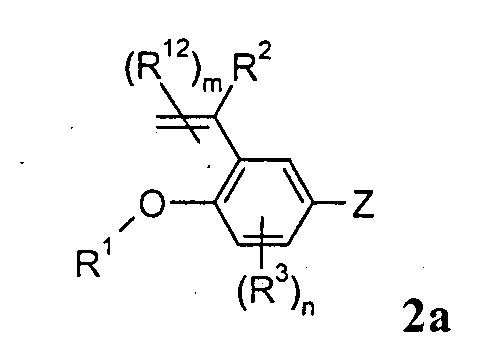 wherein X1, X2, L1, R1, R2, R3, n and Z are defined as in claims 1-8 andR12 and m are defined as in claim 14.
 - A process for manufacturing complexes according to any one of the claims 1-12 wherein a compound of formula 2 or 2a, according to claims 14 or 15, is reacted with a ruthenium complex of general formula 5wherein
 X1 and X2 are as defined in claims 1-8;.L1 is as defined in claims 1-12,L2 is selected from L1 as defined in claims 1-12, wherein L2 must not be the same group then L1 at the same time;R5 is H, -C1-20-alkyl, -C2-20-alkenyl, -C2-20-alkynyl or aryl;R6 is aryl, vinyl or allenyl;
 - A process for metathesis reactions, comprising contacting two compounds having a C=C double bond or one compound having at least two C=C double bonds with a catalyst, wherein the catalyst comprises a ruthenium complex according to claims 1-13.
- A process for carrying out a ring closure or cross metathesis reaction which process comprises contacting a dialkenyl compound with a ruthenium complex according to claims 1-13.
Priority Applications (6)
| Application Number | Priority Date | Filing Date | Title |
|---|---|---|---|
| EP03027828A EP1543875A1 (en) | 2003-12-04 | 2003-12-04 | Novel metathesis ruthenium catalyst |
| CA2541514A CA2541514C (en) | 2003-12-04 | 2004-12-01 | Novel metathesis ruthenium catalyst |
| PCT/EP2004/013621 WO2005053843A1 (en) | 2003-12-04 | 2004-12-01 | Novel metathesis ruthenium catalyst |
| EP04803392.2A EP1827688B1 (en) | 2003-12-04 | 2004-12-01 | Novel metathesis ruthenium catalyst |
| JP2006541877A JP4785748B2 (en) | 2003-12-04 | 2004-12-01 | Novel metathesis ruthenium catalyst |
| US11/004,113 US7109344B2 (en) | 2003-12-04 | 2004-12-03 | Ruthenium catalyst |
Applications Claiming Priority (1)
| Application Number | Priority Date | Filing Date | Title |
|---|---|---|---|
| EP03027828A EP1543875A1 (en) | 2003-12-04 | 2003-12-04 | Novel metathesis ruthenium catalyst |
Publications (1)
| Publication Number | Publication Date |
|---|---|
| EP1543875A1 true EP1543875A1 (en) | 2005-06-22 |
Family
ID=34486115
Family Applications (2)
| Application Number | Title | Priority Date | Filing Date |
|---|---|---|---|
| EP03027828A Withdrawn EP1543875A1 (en) | 2003-12-04 | 2003-12-04 | Novel metathesis ruthenium catalyst |
| EP04803392.2A Expired - Lifetime EP1827688B1 (en) | 2003-12-04 | 2004-12-01 | Novel metathesis ruthenium catalyst |
Family Applications After (1)
| Application Number | Title | Priority Date | Filing Date |
|---|---|---|---|
| EP04803392.2A Expired - Lifetime EP1827688B1 (en) | 2003-12-04 | 2004-12-01 | Novel metathesis ruthenium catalyst |
Country Status (4)
| Country | Link |
|---|---|
| EP (2) | EP1543875A1 (en) |
| JP (1) | JP4785748B2 (en) |
| CA (1) | CA2541514C (en) |
| WO (1) | WO2005053843A1 (en) |
Cited By (4)
| Publication number | Priority date | Publication date | Assignee | Title |
|---|---|---|---|---|
| WO2006005479A3 (en) * | 2004-07-08 | 2006-08-03 | Boehringer Ingelheim Int | Continuous metathesis method with ruthenium catalysts |
| WO2007003135A1 (en) * | 2005-07-04 | 2007-01-11 | Zheng-Yun Zhan | Ruthenium complex ligand, ruthenium complex, carried ruthenium complex catalyst and the preparing methods and the use thereof |
| US7368452B2 (en) | 2003-04-18 | 2008-05-06 | Enanta Pharmaceuticals, Inc. | Quinoxalinyl macrocyclic hepatitis C serine protease inhibitors |
| WO2019110658A1 (en) * | 2017-12-08 | 2019-06-13 | Arlanxeo Deutschland Gmbh | Process for producing nitrile rubbers using ruthenium complex catalysts |
Families Citing this family (12)
| Publication number | Priority date | Publication date | Assignee | Title |
|---|---|---|---|---|
| WO2003044060A2 (en) | 2001-11-15 | 2003-05-30 | Materia, Inc. | Chelating carbene ligand precursors and their use in the synthesis of metathesis catalysts |
| ATE480216T1 (en) | 2006-02-02 | 2010-09-15 | 3M Innovative Properties Co | SOLIDS OBTAINED THROUGH ROMP |
| EP1942125A1 (en) | 2006-12-20 | 2008-07-09 | 3M Innovative Properties Company | Compositions curable by ring opening metathesis polymerarization at low temperatures and their application in the dental field |
| DE102007020694A1 (en) * | 2007-05-03 | 2008-11-06 | Evonik Degussa Gmbh | Sulfur-containing metathesis catalysts |
| WO2010090976A1 (en) * | 2009-02-03 | 2010-08-12 | Idenix Pharmaceuticals, Inc. | Phosphinate ruthenium complexes |
| US8377962B2 (en) | 2009-04-08 | 2013-02-19 | Idenix Pharmaceuticals, Inc. | Macrocyclic serine protease inhibitors |
| SG175334A1 (en) * | 2009-05-07 | 2011-11-28 | Hoffmann La Roche | Process for the preparation of ruthenium metathesis complex catalysts |
| US9284307B2 (en) | 2009-08-05 | 2016-03-15 | Idenix Pharmaceuticals Llc | Macrocyclic serine protease inhibitors |
| WO2011079439A1 (en) * | 2009-12-30 | 2011-07-07 | Zannan Scitech Co., Ltd. | Highly active metathesis catalysts selective for romp and rcm reactions |
| US9353100B2 (en) | 2011-02-10 | 2016-05-31 | Idenix Pharmaceuticals Llc | Macrocyclic serine protease inhibitors, pharmaceutical compositions thereof, and their use for treating HCV infections |
| CN104169322B (en) * | 2012-03-16 | 2016-08-31 | 日本瑞翁株式会社 | The manufacture method of Romp polymer hydride and resin combination |
| AU2013283680B2 (en) | 2012-06-29 | 2016-06-16 | Apeiron Synthesis S.A. | Metal complexes, their application and methods of carrying out of metathesis reaction |
Citations (2)
| Publication number | Priority date | Publication date | Assignee | Title |
|---|---|---|---|---|
| US5334716A (en) * | 1991-06-17 | 1994-08-02 | Fujisawa Pharmaceutical Co., Ltd. | Heterocyclic derivatives |
| US20030092928A1 (en) * | 2000-05-04 | 2003-05-15 | Kenneth Wagener | Reaction mixtures for metathesis |
Family Cites Families (3)
| Publication number | Priority date | Publication date | Assignee | Title |
|---|---|---|---|---|
| AU2001284773B2 (en) * | 2000-08-10 | 2004-08-05 | Trustees Of Boston College | Recyclable metathesis catalysts |
| DE10137051A1 (en) * | 2001-07-31 | 2003-02-20 | Bayer Ag | New transition metal complexes with 2-alkoxybenzylidene ligands and hydrogenated imidazole ligands, useful as catalysts in metathesis reactions |
| PL199412B1 (en) * | 2002-10-15 | 2008-09-30 | Boehringer Ingelheim Int | Ruthenium new complexes as (pre) catalytic agents of permutation reaction, new derivatives of 2-alkoxy-5-nitrostyrene as intermediate compounds and method of their receiving |
-
2003
- 2003-12-04 EP EP03027828A patent/EP1543875A1/en not_active Withdrawn
-
2004
- 2004-12-01 CA CA2541514A patent/CA2541514C/en not_active Expired - Fee Related
- 2004-12-01 JP JP2006541877A patent/JP4785748B2/en not_active Expired - Fee Related
- 2004-12-01 EP EP04803392.2A patent/EP1827688B1/en not_active Expired - Lifetime
- 2004-12-01 WO PCT/EP2004/013621 patent/WO2005053843A1/en not_active Ceased
Patent Citations (2)
| Publication number | Priority date | Publication date | Assignee | Title |
|---|---|---|---|---|
| US5334716A (en) * | 1991-06-17 | 1994-08-02 | Fujisawa Pharmaceutical Co., Ltd. | Heterocyclic derivatives |
| US20030092928A1 (en) * | 2000-05-04 | 2003-05-15 | Kenneth Wagener | Reaction mixtures for metathesis |
Non-Patent Citations (12)
| Title |
|---|
| DATABASE CAPLUS [online] CHEMICAL ABSTRACTS SERVICE, COLUMBUS, OHIO, US; DEAN, F. M. ET AL: "Derivatives of hydroxyquinol. I. Compounds related to 3,4,6-trimethoxy-2- propenylacetophenone", XP002278707, retrieved from STN Database accession no. 53:99642 * |
| DATABASE CAPLUS [online] CHEMICAL ABSTRACTS SERVICE, COLUMBUS, OHIO, US; KIM, HAKWON: "A study on the syntheses of simple analogs of tetracycline and flavonoid", XP002278576, retrieved from STN Database accession no. 125:275477 * |
| DATABASE CHEMABS [online] CHEMICAL ABSTRACTS SERVICE, COLUMBUS, OHIO, US; DE KONING, CHARLES B. ET AL: "Towards the synthesis of chiral isochromanquinones. The use of Corey-Bakshi-Shibata reductions", XP002287795, retrieved from STN Database accession no. 137:294845 * |
| DATABASE CHEMABS [online] CHEMICAL ABSTRACTS SERVICE, COLUMBUS, OHIO, US; GREEN, IVAN R. ET AL: "Convenient synthetic route to antimicrobial benzo[c]pyranquinones", XP002287796, retrieved from STN Database accession no. 124:260773 * |
| DATABASE CHEMABS [online] CHEMICAL ABSTRACTS SERVICE, COLUMBUS, OHIO, US; JAIN, A. C. ET AL: "Synthetic studies in cinnamylated derivatives of resacetophenone and related compounds", XP002287797, retrieved from STN Database accession no. 89:215175 * |
| GRELA, K. ET AL.: "A highly efficient ruthenium catalyst for metathesis reactions", ANGEW. CHEM. INT. ED., vol. 41, no. 21, 2002, pages 4038 - 4040, XP002278573 * |
| JOURNAL OF THE CHEMICAL SOCIETY, ABSTRACTS 1071-7, 1959 * |
| JOURNAL OF THE KOREAN CHEMICAL SOCIETY 40(8), 549-556, 1996 * |
| PROCEEDINGS - INDIAN ACADEMY OF SCIENCES, SECTION A , 87A(6), 189-9 CODEN: PISAA7; ISSN: 0370-0089, 1978 * |
| SOUTH AFRICAN JOURNAL OF CHEMISTRY , 48(1/2), 15-22 CODEN: SAJCDG; ISSN: 0379-4350, 1995 * |
| TETRAHEDRON LETTERS , 43(23), 4199-4201 CODEN: TELEAY; ISSN: 0040-4039, 2002 * |
| WAKAMATSU, H. ET AL.: "A new highly efficient ruthenium metathesis catalyst", ANGEW. CHEM., vol. 114, no. 13, 2002, pages 2509 - 2511, XP002278574 * |
Cited By (10)
| Publication number | Priority date | Publication date | Assignee | Title |
|---|---|---|---|---|
| US7368452B2 (en) | 2003-04-18 | 2008-05-06 | Enanta Pharmaceuticals, Inc. | Quinoxalinyl macrocyclic hepatitis C serine protease inhibitors |
| WO2006005479A3 (en) * | 2004-07-08 | 2006-08-03 | Boehringer Ingelheim Int | Continuous metathesis method with ruthenium catalysts |
| WO2007003135A1 (en) * | 2005-07-04 | 2007-01-11 | Zheng-Yun Zhan | Ruthenium complex ligand, ruthenium complex, carried ruthenium complex catalyst and the preparing methods and the use thereof |
| JP2008546846A (en) * | 2005-07-04 | 2008-12-25 | チャン、チョンユン | Ruthenium compound ligands, ruthenium compounds, solid ruthenium compound catalysts and methods for their preparation and uses |
| RU2435778C2 (en) * | 2005-07-04 | 2011-12-10 | Заннан Сайтех Ко., Лтд. | Ruthenium complex ligand, ruthenium complex, ruthenium complex catalyst and synthesis methods and use thereof |
| JP2013035840A (en) * | 2005-07-04 | 2013-02-21 | Zannan Scitech Co Ltd | Ruthenium complex ligand, ruthenium complex, supported ruthenium complex catalyst, and preparing method and use therefor |
| WO2019110658A1 (en) * | 2017-12-08 | 2019-06-13 | Arlanxeo Deutschland Gmbh | Process for producing nitrile rubbers using ruthenium complex catalysts |
| CN111655740A (en) * | 2017-12-08 | 2020-09-11 | 阿朗新科德国有限责任公司 | Method for preparing nitrile rubber with ruthenium complex catalyst |
| US11407843B2 (en) | 2017-12-08 | 2022-08-09 | Arlanxeo Deutschland Gmbh | Process for producing nitrile rubbers using ruthenium complex catalysts |
| CN111655740B (en) * | 2017-12-08 | 2022-10-18 | 阿朗新科德国有限责任公司 | Method for preparing nitrile rubber by using ruthenium complex catalyst |
Also Published As
| Publication number | Publication date |
|---|---|
| WO2005053843A1 (en) | 2005-06-16 |
| JP4785748B2 (en) | 2011-10-05 |
| EP1827688A1 (en) | 2007-09-05 |
| EP1827688B1 (en) | 2014-09-03 |
| JP2007534640A (en) | 2007-11-29 |
| CA2541514A1 (en) | 2005-06-16 |
| CA2541514C (en) | 2013-07-09 |
Similar Documents
| Publication | Publication Date | Title |
|---|---|---|
| EP1554294B1 (en) | Ruthenium complexes as (pre)catalysts for metathesis reactions | |
| EP1827688B1 (en) | Novel metathesis ruthenium catalyst | |
| US7109344B2 (en) | Ruthenium catalyst | |
| JP5066656B2 (en) | Catalytic complexes with carbene ligands | |
| RU2553993C2 (en) | Catalyst complex for metathesis of olefins, method for preparation thereof and use thereof | |
| JP5787751B2 (en) | Method for producing a ruthenium carbene complex | |
| JP6395714B2 (en) | Ruthenium-based metathesis catalysts, precursors for their production and their use | |
| JP5547631B2 (en) | N-heterocyclic carbene metallacycle catalyst and method thereof | |
| KR20030093287A (en) | Method for producing diphosphines and the use thereof | |
| Gladiali et al. | Synthesis, Crystal Structure, Dynamic Behavior and Reactivity of Dinaphtho [2, 1-b: 1', 2'-d] phospholes and Related Atropisomeric Phosphacyclic Derivatives | |
| MX2013000583A (en) | Phosphine ligands for catalytic reactions. | |
| JP4629040B2 (en) | Novel metathesis catalyst | |
| JP2004536153A (en) | Novel transition metal complexes and their use in transition metal-catalyzed reactions | |
| JP2019535817A (en) | Cyclic supported catalyst | |
| CN110997608B (en) | Dihydroxybiphenyl compound, bisphosphite compound, catalyst, method for producing aldehydes, and method for producing alcohol | |
| US5936109A (en) | Ligands for asymmetric catalysis | |
| WO2016100101A1 (en) | Ruthenium-based metathesis pre-catalyst compounds | |
| CN117659086B (en) | Axis chiral biaryl diphosphine ligand, preparation method and application thereof | |
| US5858905A (en) | Pyrophosphite ligands and their use in transition metal catalyzed processes | |
| CN1300157C (en) | Process to prepare multidentate phosphine compound | |
| 藤本 et al. | Phosphole Synthesis via Carbon‒Phosphorus Bond |
Legal Events
| Date | Code | Title | Description |
|---|---|---|---|
| PUAI | Public reference made under article 153(3) epc to a published international application that has entered the european phase |
Free format text: ORIGINAL CODE: 0009012 |
|
| AK | Designated contracting states |
Kind code of ref document: A1 Designated state(s): AT BE BG CH CY CZ DE DK EE ES FI FR GB GR HU IE IT LI LU MC NL PT RO SE SI SK TR |
|
| AX | Request for extension of the european patent |
Extension state: AL LT LV MK |
|
| STAA | Information on the status of an ep patent application or granted ep patent |
Free format text: STATUS: THE APPLICATION IS DEEMED TO BE WITHDRAWN |
|
| 18D | Application deemed to be withdrawn |
Effective date: 20050405 |