EP1543805A1 - Pull-on disposable diaper - Google Patents
Pull-on disposable diaper Download PDFInfo
- Publication number
- EP1543805A1 EP1543805A1 EP03791258A EP03791258A EP1543805A1 EP 1543805 A1 EP1543805 A1 EP 1543805A1 EP 03791258 A EP03791258 A EP 03791258A EP 03791258 A EP03791258 A EP 03791258A EP 1543805 A1 EP1543805 A1 EP 1543805A1
- Authority
- EP
- European Patent Office
- Prior art keywords
- absorbing component
- diaper
- zone
- core
- wearer
- Prior art date
- Legal status (The legal status is an assumption and is not a legal conclusion. Google has not performed a legal analysis and makes no representation as to the accuracy of the status listed.)
- Withdrawn
Links
Images




Classifications
-
- A—HUMAN NECESSITIES
- A61—MEDICAL OR VETERINARY SCIENCE; HYGIENE
- A61F—FILTERS IMPLANTABLE INTO BLOOD VESSELS; PROSTHESES; DEVICES PROVIDING PATENCY TO, OR PREVENTING COLLAPSING OF, TUBULAR STRUCTURES OF THE BODY, e.g. STENTS; ORTHOPAEDIC, NURSING OR CONTRACEPTIVE DEVICES; FOMENTATION; TREATMENT OR PROTECTION OF EYES OR EARS; BANDAGES, DRESSINGS OR ABSORBENT PADS; FIRST-AID KITS
- A61F13/00—Bandages or dressings; Absorbent pads
- A61F13/15—Absorbent pads, e.g. sanitary towels, swabs or tampons for external or internal application to the body; Supporting or fastening means therefor; Tampon applicators
- A61F13/45—Absorbent pads, e.g. sanitary towels, swabs or tampons for external or internal application to the body; Supporting or fastening means therefor; Tampon applicators characterised by the shape
- A61F13/49—Absorbent pads, e.g. sanitary towels, swabs or tampons for external or internal application to the body; Supporting or fastening means therefor; Tampon applicators characterised by the shape specially adapted to be worn around the waist, e.g. diapers or nappies
- A61F13/494—Absorbent pads, e.g. sanitary towels, swabs or tampons for external or internal application to the body; Supporting or fastening means therefor; Tampon applicators characterised by the shape specially adapted to be worn around the waist, e.g. diapers or nappies characterised by edge leakage prevention means
- A61F13/49406—Absorbent pads, e.g. sanitary towels, swabs or tampons for external or internal application to the body; Supporting or fastening means therefor; Tampon applicators characterised by the shape specially adapted to be worn around the waist, e.g. diapers or nappies characterised by edge leakage prevention means the edge leakage prevention means being at the crotch region
- A61F13/49413—Absorbent pads, e.g. sanitary towels, swabs or tampons for external or internal application to the body; Supporting or fastening means therefor; Tampon applicators characterised by the shape specially adapted to be worn around the waist, e.g. diapers or nappies characterised by edge leakage prevention means the edge leakage prevention means being at the crotch region the edge leakage prevention means being an upstanding barrier
- A61F13/4942—Absorbent pads, e.g. sanitary towels, swabs or tampons for external or internal application to the body; Supporting or fastening means therefor; Tampon applicators characterised by the shape specially adapted to be worn around the waist, e.g. diapers or nappies characterised by edge leakage prevention means the edge leakage prevention means being at the crotch region the edge leakage prevention means being an upstanding barrier the barrier not being integral with the top- or back-sheet
-
- A—HUMAN NECESSITIES
- A61—MEDICAL OR VETERINARY SCIENCE; HYGIENE
- A61F—FILTERS IMPLANTABLE INTO BLOOD VESSELS; PROSTHESES; DEVICES PROVIDING PATENCY TO, OR PREVENTING COLLAPSING OF, TUBULAR STRUCTURES OF THE BODY, e.g. STENTS; ORTHOPAEDIC, NURSING OR CONTRACEPTIVE DEVICES; FOMENTATION; TREATMENT OR PROTECTION OF EYES OR EARS; BANDAGES, DRESSINGS OR ABSORBENT PADS; FIRST-AID KITS
- A61F13/00—Bandages or dressings; Absorbent pads
- A61F13/15—Absorbent pads, e.g. sanitary towels, swabs or tampons for external or internal application to the body; Supporting or fastening means therefor; Tampon applicators
- A61F13/45—Absorbent pads, e.g. sanitary towels, swabs or tampons for external or internal application to the body; Supporting or fastening means therefor; Tampon applicators characterised by the shape
- A61F13/49—Absorbent pads, e.g. sanitary towels, swabs or tampons for external or internal application to the body; Supporting or fastening means therefor; Tampon applicators characterised by the shape specially adapted to be worn around the waist, e.g. diapers or nappies
- A61F13/496—Absorbent pads, e.g. sanitary towels, swabs or tampons for external or internal application to the body; Supporting or fastening means therefor; Tampon applicators characterised by the shape specially adapted to be worn around the waist, e.g. diapers or nappies in the form of pants or briefs
Definitions
- This invention relates to a pull-on disposable diaper.
- Japanese Patent Application Publication No. 1975-33044A discloses a foldup-type disposable diaper 201 as shown in Fig. 8 of the accompanying drawings.
- This diaper 201 is composed of a liquid-absorbent pad, a liquid-pervious inner sheet 222 and a liquid-impervious outer sheet 223 so as to present a rectangle and this rectangle is then folded along a transversal 210a orthogonal to long sides of the rectangle in two halves in a longitudinal direction. Simultaneously, the rectangle is tucked from its transversely opposite side edges inwardly of the diaper, more specifically, toward a middle point of the transversal 210a so as to form pockets 218.
- the diaper arranged in such manner is effective to avoid leakage of body fluids regardless of its rectangular shape because a region of the diaper destined to cover the wearer's crotch region is sufficiently narrow to be placed closely against the wearer's crotch.
- Japanese Utility Model Application Publication No. 1972-36734A discloses a foldup-type diaper made from a rectangular strip. The diaper is tucked inward from its transversely opposite edges in a longitudinally middle zone of the diaper. The crotch region of the diaper obtained in this manner has its width sufficiently reduced to be placed closely against the wearer's crotch and thereby to alleviate an anxiety of sideways urine leakage.
- the diaper disclosed by Japanese Patent Application Publication No. 1975-33044A intends to prevent the diaper from getting out of its initial shape by partially bonding together the surface sections opposed to each other as the diaper is folded and tucked.
- bonding may obstruct the diaper to be flatly developed and retard operation of putting the diaper on the wearer's body.
- this conventional diaper has advantageous effects that the crotch region is folded and tucked inward so as to reduce a width of the crotch region and thereby an anxiety that the crotch region might uncomfortably compress the wearer's crotch, there is no guarantee that discharged body fluids correctly flow in an area within the crotch region folded and tucked inward. Consequently, body fluids are apt to leak sideways from the diaper.
- the diaper disclosed in the above-cited Japanese Utility Model Application Publication No. 1972-36734A is accompanied with an inconvenience that the crotch region folded and tucked in this manner is apt to get out of its folded and tucked state as the diaper is put on the wearer's body.
- a pull-on disposable diaper having a height direction, a transverse direction and a longitudinal direction crossing one another, the diaper being substantially symmetric about a center line bisecting a dimension of the diaper in the transverse direction, the diaper comprising a covering component having an inner surface facing a wearer's body, an outer surface facing wearer's clothes, being composed of a front waist covering region destined to cover a wearer's front waist region, a rear waist covering region destined to cover a wearer's rear waist region and a crotch covering region destined to cover a wearer's crotch region so as to define a pants-like configuration having a waist-hole and a pair of leg-holes and being provided with a body fluid absorbing component extending over the crotch covering region and further extending into the front and rear waist covering regions.
- the diaper according to this invention further comprises the body fluid absorbing component comprising a liquid-absorbent core and a liquid-pervious cover sheet and having an inner surface facing the wearer's body, an outer surface which is a reverse side of the inner surface and lateral edge zones connecting the inner and outer surfaces to each other and extending beyond the crotch covering region into the front and rear waist covering regions, the cover sheet covering the inner surface of the core, the lateral edge zone of the core and at least a part of the outer surface of the core, the body fluid absorbing component being formed in the crotch covering region with a first folding guide extending from a middle zone between the lateral edge zones of the absorbing component to respective the lateral edge zones in the front waist covering region so as to describe a substantially V-shape, a second folding guide extending to respective the lateral edge zones in the rear waist covering region so as to describe a substantially V-shape and a third folding guide extending in the transverse direction between the first and second folding guides, and the absorbing component being folded on
- This invention includes the following embodiments.
- Fig. 1 is a perspective view showing a pull-on disposable diaper 1
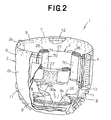
- Fig. 2 is a partially cutaway perspective view showing this diaper 1
- Fig. 3 is a sectional view taken along a line III-III in Fig. 1.
- the diaper 1 has height and width directions orthogonal to each other and a back-and-forth direction.
- the height direction corresponds to a vertical direction in Fig. 1
- the back-and-forth direction corresponds to a direction indicated by a double-headed arrow P-Q in Fig. 1
- the width direction corresponds to a right-and-left direction as viewed in Fig. 3.
- the diaper 1 basically comprises a pants-like covering component 2 and a body fluid absorbing component 3 serving also to contain body fluids absorbed therein.
- the covering component 2 is formed by sheet material such as a nonwoven fabric or a plastic film.
- the covering component 2 has an inner surface 2a facing a diaper wearer's body and an outer surface 2b facing wearer's clothes.
- This covering component 2 is composed of a front waist covering region 6, a rear waist covering region 7 and a crotch covering region 8 adapted to cover a front waist, a rear waist and a crotch of a wearer, respectively.
- the front and rear waist covering regions 6, 7 are overlaid and joined together at a plurality of joining zones 4 arranged intermittently in the vertical direction along transversely opposite lateral marginal edges so that the front waist covering region 6, the rear waist covering region 7 and the crotch covering region 8 cooperate one with another to define a waist-hole 9 and a pair of leg-holes 11.
- the waist-hole 9 and the leg-holes 11 are provided along peripheral marginal edges thereof with a plurality of waist-surrounding elastic member 12 and a plurality of thigh-surrounding elastic members 13 attached thereto in a stretched state, respectively.
- the body fluid absorbing component 3 transversely opposite side edges 26 lying on the inner surface 2a of the covering component 2 so as to extend in the crotch covering region 8 further into the front and rear waist covering regions 6, 7 and longitudinally opposite ends 27 lying on the inner surface 2a of the covering component 2 so as to extend in the waist-circumferential direction in the front and rear waist covering regions 6, 7.
- the body fluid absorbing component 3 is folded toward a longitudinal center line A-A (See Fig. 4 also) bisecting a width of the diaper 1, i.e., folded inward in a transverse direction of the diaper 1 so that the body fluid component 3 may have its width reduced in the crotch covering region 8.
- the body fluid absorbing component 3 further includes barrier walls 70 lying outside the transversely opposite side edges 26 so as to extend toward the longitudinally opposite ends 27.
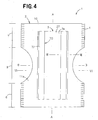
- Fig. 4 is a plan view of the diaper 1 of Fig. 1 with the front and rear waist covering regions 6, 7 disconnected each other along respective arrays of the joining zones 4 and developed for- and backward, respectively, as indicated by arrows P, Q
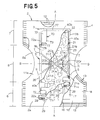
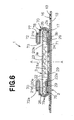
- Fig. 5 is a partially cutaway view similar to Fig. 4, showing the diaper 1 and Fig. 6 is a sectional view taken along a line V-V in Fig. 4.
- a transverse center line B-B extends in a direction orthogonal to the longitudinal center line A-A so as to bisect a length of the developed diaper 1.
- the diaper 1 is substantially symmetric about the longitudinal center line A-A and may be folded back along the transverse center line B-B to obtain the diaper 1 in the state as shown in Fig. 1.
- the covering component 2 comprises a laminate of an inner sheet 16, an intermediate sheet 17 and an outer sheet 18 which are overlaid and joined to one another intermittently.
- the inner sheet 16 has an hourglass-shape and is formed by breathable nonwoven fabric, more preferably, formed by hydrophobic but breathable nonwoven fabric.
- the intermediate sheet 17 has a size substantially same as or larger than a size of the planer absorbing component 3 and is formed by liquid-impervious plastic film, more preferably, formed by breathable but liquid-impervious plastic film.
- the outer sheet 18 has the same size as the inner sheet and is formed by breathable nonwoven fabric.
- the waist- and thigh-surrounding elastic members 12, 13 interposed between the inner and outer sheets 16, 18 are secured to at least one of these sheets 16, 18 by means of an adhesive agent (not shown).
- the absorbing component 3 comprises a core 21 and a cover sheet 22 and is formed on both sides with barrier walls 70, respectively.
- the absorbing component 3 has a rectangular shape which is relatively long in the vertical direction as viewed in Figs. 4 and 5.
- This rectangular absorbent component 3 is contoured by the transversely opposite side edges 26 extending parallel to the longitudinal center line A-A and the longitudinally opposite ends 27 extending in the waist-circumferential direction so as to cross the transversely opposite side edges 26.
- the core 21 has a rectangular shape as a whole and has an inner surface 23 facing the wearer's body, an outer surface 24 facing the wearer's clothes, opposite side edges 40a extending in the longitudinal direction and opposite ends 40b extending in the waist-circumferential direction.
- the core 21 additionally has grooves 20r, 20s, 20t extending along a chain line R (third folding guide) which is coincidence with the transverse center line B-B, a chain line S (first folding guide) extending from a central zone of the core 21 defined by the intersection of the longitudinal center line A-A and the transverse center line B-B to the opposite side edges 40a so as to describe a V-shape in the front waist covering region 6 and a chain line T (second folding guide) extending from the central zone of the core 21 so as to describe a V-shape to the opposite side edges 40b in the rear waist covering region 7.
- These grooves 20r, 20s, 20t divide the core 21 into core elements 21a, 21b, 21C, 21d, 21e, 21f.
- the absorbing component 3 is narrower than the covering component 2.
- lateral marginal portions 8a of the covering component 2 in the crotch covering region 8 defining leg-holes 11 lie on the side of the outer surface 3b of the absorbing component 3 and extend outward beyond the side edges 26 of the absorbing component 3 to form thigh-surrounding flaps 11a defining the respective leg-holes 11.
- Each core element 21a through 21f is formed by compressing water-absorbent materials such as fluff pulp and super-absorbent polymer particles under an appropriate pressure and, if desired, covering such compressed materials with a tissue paper or a nonwoven fabric of thermoplastic synthetic fibers modified to be hydrophilic.
- the inner surface 23 of the core element 21a through 21f or the tissue paper or the like (not shown) covering this inner surface 23 may be secured to the cover sheet 22.
- the outer surface 24 of the core element 21a through 21f or the tissue paper or the like covering this outer surface 24 may be secured to the inner sheet 16.
- the cover sheet 22 extends in the transverse direction of the core 21 so as to cover the inner surface 23 of the core element 21a through 21f, and further extends beyond the side edges 40a so as to cover the outer surface 24 in the vicinity of the respective side edges 40a.
- lateral edge zones 22a of the cover sheet 22 are folded outward in the transverse direction of the core 21 and secured to the barrier walls 70 by means of a hot melt adhesive agent 29.
- the opposite end portions 27 of the absorbing component 3 extending beyond the longitudinally opposite ends 40b of the core 21 are secured to the inner sheet 16 by means of a hot melt adhesive agent (not shown).
- cover sheet 22 is folded in a Z-shape or in an inverted Z-shape in the vicinity of the side edges 40a of the core 21 (See Figs. 5 and 6).
- a stock material for the cover sheet 22 may be selected from the group consisting of a liquid-pervious nonwoven fabric, a perforated plastic film and a laminated sheet of these nonwoven fabric and film.
- Fig. 7 is a sectional view taken along a line VII-VII in Fig. 4, illustrating one of the barrier walls 70 in the crotch covering region 8.
- the barrier wall 70 indicated by imaginary lines corresponds to the barrier wall 70 as shown in Fig. 3.
- the barrier wall 70 is formed by a sheet 79 made of nonwoven fabric or plastic film, preferably a liquid-impervious sheet, more preferably a breathable but liquid-impervious sheet. In the case of the illustrated embodiment, such sheet 79 is folded in two layers to form the barrier wall 70 having an inner edge zone 71 and an outer edge zone 72 both extending parallel to the longitudinal center line A-A.
- the inner edge zone 71 is laid on the outer surface 24 of the absorbing component 3 and secured to the folded lateral edge zone 22a of the cover sheet 22 and to the inner sheet 16 by means of an adhesive 29 or a heat-sealing technique while the barrier wall 70 is let free from the outer surface 24 of the absorbing component 3 in the vicinity of the side edges 26 (See Fig. 3).
- the barrier wall 70 is folded back along the side edge 26 of the absorbing component 3 from the side of its outer surface 24 to the side of its inner surface 23 so as to be directed toward the longitudinal center line A-A and then, folded back again along its transversely intermediate zone 73 so that the outer edge zone 72 lies outside in the transverse direction of the absorbing component 3 so as to have a Z-shaped or an inverted Z-shaped cross-section.
- the barrier wall 70 folded in this manner is secured to the cover sheet 22 defining the inner surface of the absorbing component 3 and to the layers of the barrier wall 70 itself placed upon each other.
- the inner edge zone 71 of the barrier wall 70 is secured merely to the lateral edge zone 22a of the cover sheet 22 and to the inner sheet 16 but neither to an inner surface 3a of the absorbing component 3 nor to the layers of the barrier wall 70 itself placed upon each other, as will be apparent from Fig. 7.
- the barrier wall 70 is provided along an area 71a of the inner edge zone 71 spaced apart from the outer surface 24 of the absorbing component 3, a distal edge 72a of the outer edge zone 72 and in the vicinity of the intermediate zone 73 along which the outer edge zone 72 is folded back outward with first, second and third elastic members 76, 77, 78, respectively, each comprising at least a single elastic element, as will be seen in Figs. 3 and 4.
- These elastic members 76, 77, 78 are in a stretched state between the longitudinally opposite ends 27, 27 of the absorbent component 3 and secured to the inner surface of at least one of the sheets 79, 79 placed upon each other.
- the diaper 1 having the absorbing component 3 as shown in Fig. 4 is folded along the transverse center line B-B as well as the longitudinal center line A-A as shown in Figs. 2 and 3 to obtain the diaper 1 in which the front and rear waist covering regions 6, 7 are joined to each other at the joining zones 4 as shown in Fig. 1.
- the absorbing component 3 is folded along the groove 20r so that the outer surface 24 of the core element 21c is opposed to the outer surface 24 of the core element 21e (See Figs. 3 and 6) while the outer surface 24 of the core element 21d is opposed to the outer surface 24 of the core element 21f.
- the absorbing component 3 is folded along the grooves 20s, 20t so that the inner surface 23 of the core element 21a is opposed to the inner surfaces 23 of the respective core elements 21c, 21d while the inner surface 23 of the core element 21b is opposed to the inner surfaces 23 of the respective core elements 21e, 21f. More specifically, in the portions of placed aside toward its front and rear ends, respectively, the absorbing component 3 is folded along the respective folding guides each extending from the transversely middle zone to each of the side edges 26 of the absorbing component 3 so as to describe a substantially V-shape.
- the absorbing component 3 In the grooves 20r, 20s, 20t of the absorbing component 3, there is no or less core 21 so the absorbing component 3 has its stiffness lower in these grooves 20r, 20s, 20t than in other regions. This unique arrangement facilitates the absorbing component 3 to be folded along the grooves 20r, 20s, 20t as shown in Fig. 2.
- the first, second and third elastic members 76, 77, 78 contract as the absorbent component 3 is folded back along the transverse center line B-B and tucked toward the longitudinal center line A-A and thereby each of the barrier walls 70 rises in the front and rear waist covering regions 6, 7 and the crotch covering region 8, at least in the crotch covering region 8.
- the first and third elastic members 76, 78 lie on the lateral side of the absorbing component 3 rising above the inner surface of the covering component 2 in the crotch covering region 8 and bias the portions of the absorbing component 3 which have been folded toward the longitudinal center line A-A to draw near to each other in the direction opposite to the direction indicated by the arrows P, Q, i.e., inwardly as viewed in the back-and-forth direction.
- the first and third elastic members 76, 78 prevent the portions having been folded toward the center line A-A from being unfolded in the direction indicated by the arrows P, Q.
- the first elastic member 76 lying on the side of the outer surface 24 of the absorbing component 3 extends across the grooves 20r, 20s, 20t and has its effectively stretched length is limited to almost the crotch covering region 8.
- the portions of the absorbing component 3 which have been folded are easily kept in a folded state even when the diaper 1 is put on the wearer's body.
- the barrier walls 70 are kept flat without following the absorbing component 3 while the barrier wall 70 is formed with fine gathers.
- the second elastic members 77 lie in the vicinity of the respective side edges 26 of the absorbing component 3 and thereby function to ensure that the barrier walls 70 can be spaced apart from each other by a dimension larger than the dimension between the side edges 26 of the absorbing component 3 folded toward each other and at the same time the outer edge zones 26 can closely contact with the wearer's thighs.
- the third elastic member 78 effectively biases the intermediate zone 73 of the barrier wall 70 defined between the first elastic member 76 and the second elastic member 77 to rise above the inner surface of the crotch covering region 8.
- the opposite side edges 26, 26 of the absorbing component 3 is folded so that the width of the absorbing component 3 may be reduced in the crotch covering region 8, as will be apparent from Fig. 3, and those opposite side edges 26, 26 extending upward may advantageously closely contact with the wearer's crotch in the vicinity of the wearer's genital organs. Consequently, discharged urine is immediately absorbed by the diaper 1 without spreading in the transverse direction.
- a space defined between these opposite side edges 26, 26 forms a pocket 30a depressed downward serving to prevent a possibility that the inner surface 3a of the absorbent component 3 wetted with absorbed urine might closely contact with the wearer's body over a large area and provide the wearer with an discomfortable feeling. Even if the body fluids flow beyond the side edges 26, the barrier walls 70 lying outside the opposite side edges 26 and adapted to tightened around the wearer's thighs bank up further flowing of body fluids. Such arrangement reliably eliminates an anxiety that body fluids might leak out from the diaper 1.
- the outer surface 24 of the absorbent component 3 is covered with the liquid-pervious cover sheet 22 at least in the vicinity of the side edges 26, so if any amount of body fluids flow beyond the side edges 26, such amount of body fluids will be introduced into outer pockets 30b (See Fig. 3) formed between the absorbing component 3 and the barrier walls 70 and absorbed by the core 21 through its outer surface 24.
- the outer surface 24 of the core 21 may be at least partially, for example, in its transversely middle zone, covered with a liquid-impervious intermediate sheet, as shown in Fig. 3.
- the lateral edge zones 22a of the cover sheet 22 is folded outward in the transverse direction of the absorbing component 3 and secured to the sheets 79 of the barrier walls 70, as will be apparent from Figs. 3 and 5 and therefore movement of the core elements 21c, 21e; 21d, 21f having been folded along the groove 20r tending to restore the state of these core elements before folded, in other words, move outward with respect to the diaper 1 is restrained.
- the first and third elastic members 76, 78 cooperate with the lateral edge zones 22a to restrain such movement and thereby to facilitate the absorbing component 3 to be kept in the folded configuration even after the diaper 1 has been put on the wearer's body.
- the absorbing component 3 As shown in Fig. 2, it is possible to eliminate the groove 20r and to use only the grooves 20s, 20t in order to fold the absorbing component 3 as shown in Fig. 2. It is also possible to fold the absorbing component 3 using a zone having a stiffness higher than that in the other zone.
- the zone is formed by pressing the absorbing component 3 locally along the chain lines R, S, T or the chain lines S, T using embossing rolls or the like with or without heating the zone.
- the pull-on disposable diaper according to this invention has advantageous effects that the shape of the absorbing component after having been folded can be reliably kept and any amount of body fluids having flown outward beyond the side edges of the absorbing component can be banked up by the barrier walls so as to avoid sideways leakage of body fluids reliably because the transversely opposite side edges of the body fluid absorbing component are folded inward in the transverse direction of the absorbing component in the crotch covering region so as to reduce the width thereof, and outside the respective side edges there are provided the barrier walls, respectively, adapted to be elastically contractible in the longitudinal direction of the absorbing component.
Landscapes
- Health & Medical Sciences (AREA)
- Life Sciences & Earth Sciences (AREA)
- Engineering & Computer Science (AREA)
- Biomedical Technology (AREA)
- Heart & Thoracic Surgery (AREA)
- Vascular Medicine (AREA)
- Epidemiology (AREA)
- Animal Behavior & Ethology (AREA)
- General Health & Medical Sciences (AREA)
- Public Health (AREA)
- Veterinary Medicine (AREA)
- Absorbent Articles And Supports Therefor (AREA)
- Orthopedics, Nursing, And Contraception (AREA)
Abstract
A body fluid absorbing component 3 of a pull-on disposable
diaper 1 is folded inward in a crotch covering region 8. Outside
opposite side edges 26 of the absorbing component 3, there are
provided a pair of barrier walls 70 extending in a longitudinal
direction of the absorbing component 3. The barrier wall 70
is provided along its zone opposed to an outer surface 24 of
the absorbing component 3, a distal edge 72a of the barrier wall
70 and an intermediate zone 73 defined between the zone and the
distal edge with first, second and third elastic members76, 77,
78, respectively, each extending in a stretched state in the
longitudinal direction of the absorbing component 3.
Description
This invention relates to a pull-on disposable diaper.
Japanese Patent Application Publication No. 1975-33044A
discloses a foldup-type disposable diaper 201 as shown in Fig.
8 of the accompanying drawings. This diaper 201 is composed
of a liquid-absorbent pad, a liquid-pervious inner sheet 222
and a liquid-impervious outer sheet 223 so as to present a
rectangle and this rectangle is then folded along a transversal
210a orthogonal to long sides of the rectangle in two halves
in a longitudinal direction. Simultaneously, the rectangle is
tucked from its transversely opposite side edges inwardly of
the diaper, more specifically, toward a middle point of the
transversal 210a so as to form pockets 218. Surface sections
of the sheet 223 facing each other as the rectangle is tucked
inward in this manner are partially bonded to each other in order
to prevent the respective pockets 218 might get out of initial
shapes thereof even after the diaper has been developed to put
the diaper on a wearer's body. The diaper arranged in such
manner is effective to avoid leakage of body fluids regardless
of its rectangular shape because a region of the diaper destined
to cover the wearer's crotch region is sufficiently narrow to
be placed closely against the wearer's crotch.
Japanese Utility Model Application Publication No.
1972-36734A discloses a foldup-type diaper made from a
rectangular strip. The diaper is tucked inward from its
transversely opposite edges in a longitudinally middle zone of
the diaper. The crotch region of the diaper obtained in this
manner has its width sufficiently reduced to be placed closely
against the wearer's crotch and thereby to alleviate an anxiety
of sideways urine leakage.
The diaper disclosed by Japanese Patent Application
Publication No. 1975-33044A intends to prevent the diaper from
getting out of its initial shape by partially bonding together
the surface sections opposed to each other as the diaper is
folded and tucked. However, such bonding may obstruct the
diaper to be flatly developed and retard operation of putting
the diaper on the wearer's body. While this conventional diaper
has advantageous effects that the crotch region is folded and
tucked inward so as to reduce a width of the crotch region and
thereby an anxiety that the crotch region might uncomfortably
compress the wearer's crotch, there is no guarantee that
discharged body fluids correctly flow in an area within the
crotch region folded and tucked inward. Consequently, body
fluids are apt to leak sideways from the diaper.
The diaper disclosed in the above-cited Japanese Utility
Model Application Publication No. 1972-36734A is accompanied
with an inconvenience that the crotch region folded and tucked
in this manner is apt to get out of its folded and tucked state
as the diaper is put on the wearer's body.
It is an object of this invention to provide a pull-on
disposable diaper improved so that, whether or not the opposite
side edges of the body fluid absorbing component folded and
tucked inward are bonded as in the above-cited conventional
disposable diaper, the shape of the absorbing component is
reliably maintained even after the diaper has been put on the
wearer's body and the anxiety that folding and tucking of the
crotch region might induce a leakage of body fluids.
In accordance with this invention, there is provided a
pull-on disposable diaper having a height direction, a
transverse direction and a longitudinal direction crossing one
another, the diaper being substantially symmetric about a
center line bisecting a dimension of the diaper in the
transverse direction, the diaper comprising a covering
component having an inner surface facing a wearer's body, an
outer surface facing wearer's clothes, being composed of a front
waist covering region destined to cover a wearer's front waist
region, a rear waist covering region destined to cover a
wearer's rear waist region and a crotch covering region destined
to cover a wearer's crotch region so as to define a pants-like
configuration having a waist-hole and a pair of leg-holes and
being provided with a body fluid absorbing component extending
over the crotch covering region and further extending into the
front and rear waist covering regions.
The diaper according to this invention further comprises
the body fluid absorbing component comprising a
liquid-absorbent core and a liquid-pervious cover sheet and
having an inner surface facing the wearer's body, an outer
surface which is a reverse side of the inner surface and lateral
edge zones connecting the inner and outer surfaces to each other
and extending beyond the crotch covering region into the front
and rear waist covering regions, the cover sheet covering the
inner surface of the core, the lateral edge zone of the core
and at least a part of the outer surface of the core, the body
fluid absorbing component being formed in the crotch covering
region with a first folding guide extending from a middle zone
between the lateral edge zones of the absorbing component to
respective the lateral edge zones in the front waist covering
region so as to describe a substantially V-shape, a second
folding guide extending to respective the lateral edge zones
in the rear waist covering region so as to describe a
substantially V-shape and a third folding guide extending in
the transverse direction between the first and second folding
guides, and the absorbing component being folded on both sides
of the center line along the third folding guide so that the
core has its outer surface sections facing to each other and
along the first and second folding guides so that the core has
its inner surface sections facing to each other; a pair of
barrier walls provided outside the side edges of the absorbing
component, respectively, and extending along the lateral edge
zones of the absorbing component in the longitudinal direction,
each of the barrier walls having an inner edge zone lying inside
in the width direction and an outer edge zone lying outside in
the width direction, the inner edge zone being secured to one
of a sheet defining the crotch covering region of the absorbing
component and the cover sheet in the vicinity of the center line
so as to be substantially fixed to the absorbing component, the
outer edge zone being let free from the absorbing component so
as to be deformable independent of the absorbing component, the
barrier wall having longitudinally opposite ends secured to one
of a sheet defining the front and rear waist covering regions
on the outer surface of the absorbing component and the cover
sheet, the barrier wall having an intermediate zone defined
between the inner edge zone and the outer edge zone as viewed
in the transverse direction and folded toward the center line
and thereafter having been secured to the inner surface of
absorbing component so that the outer edge zone lies outside
in the transverse direction, layers of the barrier wall placed
upon each other being secured to each other; and elastic members
being attached to the outer edge zone, a vicinity of a zone along
which the barrier wall is folded outward in the transverse
direction and an area of the inner edge zone in which the barrier
wall is let free from the absorbing component in a stretched
state so as to extend between the longitudinally opposite ends
of the barrier wall, the barrier wall being elastically
contractible in the longitudinal direction in the crotch
covering region.
This invention includes the following embodiments.
Details of the pull-on disposable diaper according to
this invention will be more fully understood from the
description given hereunder with reference to the accompanying
drawings.
Fig. 1 is a perspective view showing a pull-on disposable
diaper 1, Fig. 2 is a partially cutaway perspective view showing
this diaper 1 and Fig. 3 is a sectional view taken along a line
III-III in Fig. 1. The diaper 1 has height and width directions
orthogonal to each other and a back-and-forth direction. The
height direction corresponds to a vertical direction in Fig.
1, the back-and-forth direction corresponds to a direction
indicated by a double-headed arrow P-Q in Fig. 1 and the width
direction corresponds to a right-and-left direction as viewed
in Fig. 3. The diaper 1 basically comprises a pants-like
covering component 2 and a body fluid absorbing component 3
serving also to contain body fluids absorbed therein. The
covering component 2 is formed by sheet material such as a
nonwoven fabric or a plastic film. The covering component 2
has an inner surface 2a facing a diaper wearer's body and an
outer surface 2b facing wearer's clothes. This covering
component 2 is composed of a front waist covering region 6, a
rear waist covering region 7 and a crotch covering region 8
adapted to cover a front waist, a rear waist and a crotch of
a wearer, respectively. The front and rear waist covering
regions 6, 7 are overlaid and joined together at a plurality
of joining zones 4 arranged intermittently in the vertical
direction along transversely opposite lateral marginal edges
so that the front waist covering region 6, the rear waist
covering region 7 and the crotch covering region 8 cooperate
one with another to define a waist-hole 9 and a pair of leg-holes
11. The waist-hole 9 and the leg-holes 11 are provided along
peripheral marginal edges thereof with a plurality of
waist-surrounding elastic member 12 and a plurality of
thigh-surrounding elastic members 13 attached thereto in a
stretched state, respectively. The body fluid absorbing
component 3 transversely opposite side edges 26 lying on the
inner surface 2a of the covering component 2 so as to extend
in the crotch covering region 8 further into the front and rear
waist covering regions 6, 7 and longitudinally opposite ends
27 lying on the inner surface 2a of the covering component 2
so as to extend in the waist-circumferential direction in the
front and rear waist covering regions 6, 7. The body fluid
absorbing component 3 is folded toward a longitudinal center
line A-A (See Fig. 4 also) bisecting a width of the diaper 1,
i.e., folded inward in a transverse direction of the diaper 1
so that the body fluid component 3 may have its width reduced
in the crotch covering region 8. The body fluid absorbing
component 3 further includes barrier walls 70 lying outside the
transversely opposite side edges 26 so as to extend toward the
longitudinally opposite ends 27.
Fig. 4 is a plan view of the diaper 1 of Fig. 1 with the
front and rear waist covering regions 6, 7 disconnected each
other along respective arrays of the joining zones 4 and
developed for- and backward, respectively, as indicated by
arrows P, Q, Fig. 5 is a partially cutaway view similar to Fig.
4, showing the diaper 1 and Fig. 6 is a sectional view taken
along a line V-V in Fig. 4. In Figs. 4 - 6, a transverse center
line B-B extends in a direction orthogonal to the longitudinal
center line A-A so as to bisect a length of the developed diaper
1. In the developed state as shown in Fig. 4, the diaper 1 is
substantially symmetric about the longitudinal center line A-A
and may be folded back along the transverse center line B-B to
obtain the diaper 1 in the state as shown in Fig. 1.
The covering component 2 comprises a laminate of an inner
sheet 16, an intermediate sheet 17 and an outer sheet 18 which
are overlaid and joined to one another intermittently. The
inner sheet 16 has an hourglass-shape and is formed by
breathable nonwoven fabric, more preferably, formed by
hydrophobic but breathable nonwoven fabric. The intermediate
sheet 17 has a size substantially same as or larger than a size
of the planer absorbing component 3 and is formed by
liquid-impervious plastic film, more preferably, formed by
breathable but liquid-impervious plastic film. The outer
sheet 18 has the same size as the inner sheet and is formed by
breathable nonwoven fabric. The waist- and thigh-surrounding
elastic members 12, 13 interposed between the inner and outer
sheets 16, 18 are secured to at least one of these sheets 16,
18 by means of an adhesive agent (not shown).
The absorbing component 3 comprises a core 21 and a cover
sheet 22 and is formed on both sides with barrier walls 70,
respectively. The absorbing component 3 has a rectangular
shape which is relatively long in the vertical direction as
viewed in Figs. 4 and 5. This rectangular absorbent component
3 is contoured by the transversely opposite side edges 26
extending parallel to the longitudinal center line A-A and the
longitudinally opposite ends 27 extending in the
waist-circumferential direction so as to cross the transversely
opposite side edges 26. The core 21 has a rectangular shape
as a whole and has an inner surface 23 facing the wearer's body,
an outer surface 24 facing the wearer's clothes, opposite side
edges 40a extending in the longitudinal direction and opposite
ends 40b extending in the waist-circumferential direction.
The core 21 additionally has grooves 20r, 20s, 20t extending
along a chain line R (third folding guide) which is coincidence
with the transverse center line B-B, a chain line S (first
folding guide) extending from a central zone of the core 21
defined by the intersection of the longitudinal center line A-A
and the transverse center line B-B to the opposite side edges
40a so as to describe a V-shape in the front waist covering region
6 and a chain line T (second folding guide) extending from the
central zone of the core 21 so as to describe a V-shape to the
opposite side edges 40b in the rear waist covering region 7.
These grooves 20r, 20s, 20t divide the core 21 into core elements
21a, 21b, 21C, 21d, 21e, 21f. The groove 20r and the groove
20s intersect with each other at an angle α while the groove
20r and the groove 20t intersect with each other at an angle
β. The angles α and β are illustrated to be equal to each other.
In the crotch covering region 8, the absorbing component 3 is
narrower than the covering component 2. As will be apparent
from Figs. 1, 2 and 3, lateral marginal portions 8a of the
covering component 2 in the crotch covering region 8 defining
leg-holes 11 lie on the side of the outer surface 3b of the
absorbing component 3 and extend outward beyond the side edges
26 of the absorbing component 3 to form thigh-surrounding flaps
11a defining the respective leg-holes 11.
Each core element 21a through 21f is formed by compressing
water-absorbent materials such as fluff pulp and
super-absorbent polymer particles under an appropriate
pressure and, if desired, covering such compressed materials
with a tissue paper or a nonwoven fabric of thermoplastic
synthetic fibers modified to be hydrophilic. The inner surface
23 of the core element 21a through 21f or the tissue paper or
the like (not shown) covering this inner surface 23 may be
secured to the cover sheet 22. The outer surface 24 of the core
element 21a through 21f or the tissue paper or the like covering
this outer surface 24 may be secured to the inner sheet 16.
The cover sheet 22 extends in the transverse direction
of the core 21 so as to cover the inner surface 23 of the core
element 21a through 21f, and further extends beyond the side
edges 40a so as to cover the outer surface 24 in the vicinity
of the respective side edges 40a. On the outer surface 24,
lateral edge zones 22a of the cover sheet 22 are folded outward
in the transverse direction of the core 21 and secured to the
barrier walls 70 by means of a hot melt adhesive agent 29. The
opposite end portions 27 of the absorbing component 3 extending
beyond the longitudinally opposite ends 40b of the core 21 are
secured to the inner sheet 16 by means of a hot melt adhesive
agent (not shown). Such cover sheet 22 is folded in a Z-shape
or in an inverted Z-shape in the vicinity of the side edges 40a
of the core 21 (See Figs. 5 and 6). A stock material for the
cover sheet 22 may be selected from the group consisting of a
liquid-pervious nonwoven fabric, a perforated plastic film and
a laminated sheet of these nonwoven fabric and film.
Fig. 7 is a sectional view taken along a line VII-VII in
Fig. 4, illustrating one of the barrier walls 70 in the crotch
covering region 8. The barrier wall 70 indicated by imaginary
lines corresponds to the barrier wall 70 as shown in Fig. 3.
The barrier wall 70 is formed by a sheet 79 made of nonwoven
fabric or plastic film, preferably a liquid-impervious sheet,
more preferably a breathable but liquid-impervious sheet. In
the case of the illustrated embodiment, such sheet 79 is folded
in two layers to form the barrier wall 70 having an inner edge
zone 71 and an outer edge zone 72 both extending parallel to
the longitudinal center line A-A. The inner edge zone 71 is
laid on the outer surface 24 of the absorbing component 3 and
secured to the folded lateral edge zone 22a of the cover sheet
22 and to the inner sheet 16 by means of an adhesive 29 or a
heat-sealing technique while the barrier wall 70 is let free
from the outer surface 24 of the absorbing component 3 in the
vicinity of the side edges 26 (See Fig. 3). In the transverse
direction of the absorbing component 3, the barrier wall 70 is
folded back along the side edge 26 of the absorbing component
3 from the side of its outer surface 24 to the side of its inner
surface 23 so as to be directed toward the longitudinal center
line A-A and then, folded back again along its transversely
intermediate zone 73 so that the outer edge zone 72 lies outside
in the transverse direction of the absorbing component 3 so as
to have a Z-shaped or an inverted Z-shaped cross-section. In
the vicinity of the opposite ends 27 of the absorbing component
3, the barrier wall 70 folded in this manner is secured to the
cover sheet 22 defining the inner surface of the absorbing
component 3 and to the layers of the barrier wall 70 itself placed
upon each other. In the crotch covering region 8, on the other
hand, the inner edge zone 71 of the barrier wall 70 is secured
merely to the lateral edge zone 22a of the cover sheet 22 and
to the inner sheet 16 but neither to an inner surface 3a of the
absorbing component 3 nor to the layers of the barrier wall 70
itself placed upon each other, as will be apparent from Fig.
7. The barrier wall 70 is provided along an area 71a of the
inner edge zone 71 spaced apart from the outer surface 24 of
the absorbing component 3, a distal edge 72a of the outer edge
zone 72 and in the vicinity of the intermediate zone 73 along
which the outer edge zone 72 is folded back outward with first,
second and third elastic members 76, 77, 78, respectively, each
comprising at least a single elastic element, as will be seen
in Figs. 3 and 4. These elastic members 76, 77, 78 are in a
stretched state between the longitudinally opposite ends 27,
27 of the absorbent component 3 and secured to the inner surface
of at least one of the sheets 79, 79 placed upon each other.
The diaper 1 having the absorbing component 3 as shown
in Fig. 4 is folded along the transverse center line B-B as well
as the longitudinal center line A-A as shown in Figs. 2 and 3
to obtain the diaper 1 in which the front and rear waist covering
regions 6, 7 are joined to each other at the joining zones 4
as shown in Fig. 1. Specifically, the absorbing component 3
is folded along the groove 20r so that the outer surface 24 of
the core element 21c is opposed to the outer surface 24 of the
core element 21e (See Figs. 3 and 6) while the outer surface
24 of the core element 21d is opposed to the outer surface 24
of the core element 21f. At the same time, the absorbing
component 3 is folded along the grooves 20s, 20t so that the
inner surface 23 of the core element 21a is opposed to the inner
surfaces 23 of the respective core elements 21c, 21d while the
inner surface 23 of the core element 21b is opposed to the inner
surfaces 23 of the respective core elements 21e, 21f. More
specifically, in the portions of placed aside toward its front
and rear ends, respectively, the absorbing component 3 is folded
along the respective folding guides each extending from the
transversely middle zone to each of the side edges 26 of the
absorbing component 3 so as to describe a substantially V-shape.
In the grooves 20r, 20s, 20t of the absorbing component 3, there
is no or less core 21 so the absorbing component 3 has its
stiffness lower in these grooves 20r, 20s, 20t than in other
regions. This unique arrangement facilitates the absorbing
component 3 to be folded along the grooves 20r, 20s, 20t as shown
in Fig. 2.
The first, second and third elastic members 76, 77, 78
contract as the absorbent component 3 is folded back along the
transverse center line B-B and tucked toward the longitudinal
center line A-A and thereby each of the barrier walls 70 rises
in the front and rear waist covering regions 6, 7 and the crotch
covering region 8, at least in the crotch covering region 8.
Referring to Figs. 2 and 3, the first and third elastic members
76, 78 lie on the lateral side of the absorbing component 3 rising
above the inner surface of the covering component 2 in the crotch
covering region 8 and bias the portions of the absorbing
component 3 which have been folded toward the longitudinal
center line A-A to draw near to each other in the direction
opposite to the direction indicated by the arrows P, Q, i.e.,
inwardly as viewed in the back-and-forth direction. In this
way, the first and third elastic members 76, 78 prevent the
portions having been folded toward the center line A-A from
being unfolded in the direction indicated by the arrows P, Q.
Particularly, the first elastic member 76 lying on the side of
the outer surface 24 of the absorbing component 3 extends across
the grooves 20r, 20s, 20t and has its effectively stretched
length is limited to almost the crotch covering region 8. In
an advantageous consequence, the portions of the absorbing
component 3 which have been folded are easily kept in a folded
state even when the diaper 1 is put on the wearer's body. In
addition, the barrier walls 70 are kept flat without following
the absorbing component 3 while the barrier wall 70 is formed
with fine gathers. The second elastic members 77 lie in the
vicinity of the respective side edges 26 of the absorbing
component 3 and thereby function to ensure that the barrier
walls 70 can be spaced apart from each other by a dimension larger
than the dimension between the side edges 26 of the absorbing
component 3 folded toward each other and at the same time the
outer edge zones 26 can closely contact with the wearer's thighs.
Thus the second elastic member 77 reliably prevents body fluids
from leaking sideways from the diaper 1 even if body fluids do
not flow into the region defined between the opposite side edges
26, 26. The third elastic member 78 effectively biases the
intermediate zone 73 of the barrier wall 70 defined between the
first elastic member 76 and the second elastic member 77 to rise
above the inner surface of the crotch covering region 8.
In the pull-on disposable diaper 1 arranged as has been
described, the opposite side edges 26, 26 of the absorbing
component 3 is folded so that the width of the absorbing
component 3 may be reduced in the crotch covering region 8, as
will be apparent from Fig. 3, and those opposite side edges 26,
26 extending upward may advantageously closely contact with the
wearer's crotch in the vicinity of the wearer's genital organs.
Consequently, discharged urine is immediately absorbed by the
diaper 1 without spreading in the transverse direction. In
addition, a space defined between these opposite side edges 26,
26 forms a pocket 30a depressed downward serving to prevent a
possibility that the inner surface 3a of the absorbent component
3 wetted with absorbed urine might closely contact with the
wearer's body over a large area and provide the wearer with an
discomfortable feeling. Even if the body fluids flow beyond
the side edges 26, the barrier walls 70 lying outside the
opposite side edges 26 and adapted to tightened around the
wearer's thighs bank up further flowing of body fluids. Such
arrangement reliably eliminates an anxiety that body fluids
might leak out from the diaper 1. Furthermore, the outer
surface 24 of the absorbent component 3 is covered with the
liquid-pervious cover sheet 22 at least in the vicinity of the
side edges 26, so if any amount of body fluids flow beyond the
side edges 26, such amount of body fluids will be introduced
into outer pockets 30b (See Fig. 3) formed between the absorbing
component 3 and the barrier walls 70 and absorbed by the core
21 through its outer surface 24. It should be noted here that
the outer surface 24 of the core 21 may be at least partially,
for example, in its transversely middle zone, covered with a
liquid-impervious intermediate sheet, as shown in Fig. 3.
In this diaper 1, in addition to the function of the first
and third elastic members 76, 78, the lateral edge zones 22a
of the cover sheet 22 is folded outward in the transverse
direction of the absorbing component 3 and secured to the sheets
79 of the barrier walls 70, as will be apparent from Figs. 3
and 5 and therefore movement of the core elements 21c, 21e; 21d,
21f having been folded along the groove 20r tending to restore
the state of these core elements before folded, in other words,
move outward with respect to the diaper 1 is restrained. The
first and third elastic members 76, 78 cooperate with the
lateral edge zones 22a to restrain such movement and thereby
to facilitate the absorbing component 3 to be kept in the folded
configuration even after the diaper 1 has been put on the
wearer's body.
Depending on a thickness of the core 21, it is possible
to eliminate the groove 20r and to use only the grooves 20s,
20t in order to fold the absorbing component 3 as shown in Fig.
2. It is also possible to fold the absorbing component 3 using
a zone having a stiffness higher than that in the other zone.
The zone is formed by pressing the absorbing component 3 locally
along the chain lines R, S, T or the chain lines S, T using
embossing rolls or the like with or without heating the zone.
The pull-on disposable diaper according to this invention
has advantageous effects that the shape of the absorbing
component after having been folded can be reliably kept and any
amount of body fluids having flown outward beyond the side edges
of the absorbing component can be banked up by the barrier walls
so as to avoid sideways leakage of body fluids reliably because
the transversely opposite side edges of the body fluid absorbing
component are folded inward in the transverse direction of the
absorbing component in the crotch covering region so as to
reduce the width thereof, and outside the respective side edges
there are provided the barrier walls, respectively, adapted to
be elastically contractible in the longitudinal direction of
the absorbing component.
Claims (3)
- A pull-on disposable diaper having a height direction, a transverse direction and a longitudinal direction crossing one another, said diaper being substantially symmetric about a center line bisecting a dimension of the diaper in said transverse direction, said diaper comprising a covering component having an inner surface facing a wearer's body, an outer surface facing wearer's clothes, being composed of a front waist covering region destined to cover a wearer's front waist region, a rear waist covering region destined to cover a wearer's rear waist region and a crotch covering region destined to cover a wearer's crotch region so as to define a pants-like configuration having a waist-hole and a pair of leg-holes and being provided with a body fluid absorbing component extending over said crotch covering region and further extending into said front and rear waist covering regions, said pull-on disposable diaper further comprising:said body fluid absorbing component comprising a liquid-absorbent core and a liquid-pervious cover sheet and having an inner surface facing said wearer's body, an outer surface which is a reverse side of said inner surface and lateral edge zones connecting said inner and outer surfaces to each other and extending beyond said crotch covering region into said front and rear waist covering regions, said cover sheet covering said inner surface of said core, said lateral edge zone of said core and at least a part of said outer surface of said core, said body fluid absorbing component being formed in said crotch covering region with a first folding guide extending from a middle zone between said lateral edge zones of said absorbing component to respective said lateral edge zones in said front waist covering region so as to describe a substantially V-shape, a second folding guide extending to respective said lateral edge zones in said rear waist covering region so as to describe a substantially V-shape and a third folding guide extending in said transverse direction between said first and second folding guides, and said absorbing component being folded on both sides of said center line along said third folding guide so that said core has its outer surface sections facing to each other and along said first and second folding guides so that said core has its inner surface sections facing to each other;a pair of barrier walls provided outside said side edges of said absorbing component, respectively, and extending along said lateral edge zones of said absorbing component in said longitudinal direction, each of said barrier walls having an inner edge zone lying inside in said width direction and an outer edge zone lying outside in said width direction, said inner edge zone being secured to one of a sheet defining said crotch covering region of said absorbing component and said cover sheet in said vicinity of said center line so as to be substantially fixed to said absorbing component, said outer edge zone being let free from said absorbing component so as to be deformable independent of said absorbing component, said barrier wall having longitudinally opposite ends secured to one of a sheet defining said front and rear waist covering regions on said outer surface of said absorbing component and said cover sheet, said barrier wall having an intermediate zone defined between said inner edge zone and said outer edge zone as viewed in said transverse direction and folded toward said center line and thereafter having been secured to said inner surface of absorbing component so that said outer edge zone lies outside in said transverse direction, layers of said barrier wall placed upon each other being secured to each other; andelastic members being attached to said outer edge zone, a vicinity of a zone along which said barrier wall is folded outward in said transverse direction and an area of said inner edge zone in which said barrier wall is let free from said absorbing component in a stretched state so as to extend between said longitudinally opposite ends of said barrier wall, said barrier wall being elastically contractible in said longitudinal direction in said crotch covering region.
- The disposable diaper according to Claim 1, wherein said outer surface of said core has a transversely middle zone formed by a liquid-impervious sheet.
- The disposable diaper according to Claim 2, wherein, said diaper further comprises a nonwoven fabric lying outside said outer surface of said absorbing component and said liquid-impervious sheet formed by plastic film lying outside said nonwoven fabric.
Applications Claiming Priority (3)
| Application Number | Priority Date | Filing Date | Title |
|---|---|---|---|
| JP2002255987A JP4113397B2 (en) | 2002-08-30 | 2002-08-30 | Pants-type disposable diapers |
| JP2002255987 | 2002-08-30 | ||
| PCT/JP2003/010669 WO2004019847A1 (en) | 2002-08-30 | 2003-08-22 | Underpants type disposable diaper |
Publications (2)
| Publication Number | Publication Date |
|---|---|
| EP1543805A1 true EP1543805A1 (en) | 2005-06-22 |
| EP1543805A4 EP1543805A4 (en) | 2011-01-05 |
Family
ID=31972931
Family Applications (1)
| Application Number | Title | Priority Date | Filing Date |
|---|---|---|---|
| EP03791258A Withdrawn EP1543805A4 (en) | 2002-08-30 | 2003-08-22 | Pull-on disposable diaper |
Country Status (11)
| Country | Link |
|---|---|
| US (1) | US7226437B2 (en) |
| EP (1) | EP1543805A4 (en) |
| JP (1) | JP4113397B2 (en) |
| KR (1) | KR100641016B1 (en) |
| CN (1) | CN1315450C (en) |
| AU (1) | AU2003257672B2 (en) |
| BR (1) | BR0313768B1 (en) |
| CA (1) | CA2496022C (en) |
| MY (1) | MY139298A (en) |
| TW (1) | TWI262787B (en) |
| WO (1) | WO2004019847A1 (en) |
Cited By (1)
| Publication number | Priority date | Publication date | Assignee | Title |
|---|---|---|---|---|
| EP1584311A4 (en) * | 2003-01-10 | 2011-01-12 | Uni Charm Corp | Disposable underpants-type wearing article |
Families Citing this family (37)
| Publication number | Priority date | Publication date | Assignee | Title |
|---|---|---|---|---|
| JP3953848B2 (en) * | 2002-03-13 | 2007-08-08 | ユニ・チャーム株式会社 | Pants-type disposable diapers |
| JP4113397B2 (en) | 2002-08-30 | 2008-07-09 | ユニ・チャーム株式会社 | Pants-type disposable diapers |
| JP3975176B2 (en) * | 2003-04-18 | 2007-09-12 | ユニ・チャーム株式会社 | Disposable pants-type wearing articles |
| JP4883924B2 (en) * | 2004-04-28 | 2012-02-22 | 花王株式会社 | Disposable diapers |
| JP4519022B2 (en) * | 2004-07-30 | 2010-08-04 | 花王株式会社 | Pants-type disposable diapers |
| JP4557914B2 (en) * | 2005-03-23 | 2010-10-06 | 花王株式会社 | Disposable diapers |
| CN101947164A (en) * | 2005-05-09 | 2011-01-19 | 花王株式会社 | Disposable diaper |
| JP2009082438A (en) * | 2007-09-28 | 2009-04-23 | Uni Charm Corp | Absorptive article |
| MY160587A (en) * | 2007-12-07 | 2017-03-15 | Unicharm Corp | Disposable pants-type wearing article |
| EP2285331B1 (en) * | 2008-06-13 | 2012-09-05 | The Procter & Gamble Company | Disposable absorbent article with elastically contractible cuffs for better containment of liquid exudates |
| US9700465B2 (en) * | 2009-06-02 | 2017-07-11 | The Procter & Gamble Company | Disposable absorbent article with elastically contractible cuffs for better containment of liquid exudates |
| MX2013011917A (en) | 2011-04-29 | 2013-11-01 | Procter & Gamble | Absorbent article with leg gasketing cuff. |
| JP2014516758A (en) | 2011-06-21 | 2014-07-17 | ザ プロクター アンド ギャンブル カンパニー | Absorbent article with gathered waistband and leg cuff |
| JP2014516756A (en) | 2011-06-21 | 2014-07-17 | ザ プロクター アンド ギャンブル カンパニー | Absorbent article with waistband having shrinkage |
| JP2015515921A (en) | 2012-05-15 | 2015-06-04 | ザ プロクター アンド ギャンブルカンパニー | Disposable absorbent pants having advantageous elongation and manufacturability characteristics and methods for their production |
| US8932273B2 (en) | 2012-06-29 | 2015-01-13 | The Procter & Gamble Company | Disposable absorbent insert for two-piece wearable absorbent article |
| MX2015013471A (en) | 2013-03-22 | 2016-01-12 | Procter & Gamble | Disposable absorbent articles. |
| JP5960791B2 (en) * | 2014-12-24 | 2016-08-02 | 花王株式会社 | Pants-type absorbent article |
| EP3058915B1 (en) * | 2015-02-17 | 2018-11-07 | The Procter and Gamble Company | Absorbent cores for absorbent articles |
| BR112017019864A2 (en) | 2015-03-18 | 2018-05-29 | The Procter & Gamble Company | absorbent article with waist sealing element and leg clamps |
| US10716716B2 (en) | 2015-03-18 | 2020-07-21 | The Procter & Gamble Company | Absorbent article with leg cuffs |
| CN107405227B (en) | 2015-03-18 | 2020-09-11 | 宝洁公司 | Absorbent article with waist gasketing elements and leg cuffs |
| CA2980146A1 (en) | 2015-03-18 | 2016-09-22 | The Procter & Gamble Company | Absorbent article with waist gasketing element and leg cuffs |
| US10588790B2 (en) | 2015-03-18 | 2020-03-17 | The Procter & Gamble Company | Absorbent article with leg cuffs |
| CN107405230B (en) | 2015-03-18 | 2020-10-20 | 宝洁公司 | Absorbent article with leg cuffs |
| WO2016149591A1 (en) | 2015-03-18 | 2016-09-22 | The Procter & Gamble Company | Absorbent article with waist gasketing element and leg cuffs |
| JP2018512211A (en) | 2015-03-18 | 2018-05-17 | ザ プロクター アンド ギャンブル カンパニー | Absorbent article comprising waist gasket element and leg cuff |
| CN107427397A (en) | 2015-03-18 | 2017-12-01 | 宝洁公司 | Absorbent articles with leg cuffs |
| CN107427396A (en) | 2015-03-18 | 2017-12-01 | 宝洁公司 | Absorbent articles with leg cuffs |
| CN105167919B (en) * | 2015-09-29 | 2019-09-03 | 黄山富田精工制造有限公司 | A kind of disposable wearing article and its manufacturing equipment and manufacturing method |
| JP6412899B2 (en) * | 2016-06-06 | 2018-10-24 | ユニ・チャーム株式会社 | Absorbent articles |
| WO2018042875A1 (en) * | 2016-08-29 | 2018-03-08 | ユニ・チャーム株式会社 | Absorbent article, and method for producing pull-up type absorbent article |
| US12036103B2 (en) * | 2017-12-22 | 2024-07-16 | Kao Corporation | Disposable diaper |
| US12390376B2 (en) | 2018-02-28 | 2025-08-19 | Kimberly-Clark Worldwide, Inc. | Multi-layer absorbent cores and methods of manufacture |
| CN116963705A (en) | 2021-03-30 | 2023-10-27 | 金伯利-克拉克环球有限公司 | Multilayer absorbent core and method of making same |
| JP7569755B2 (en) * | 2021-06-18 | 2024-10-18 | 花王株式会社 | Absorbent articles |
| JP2026115971A (en) * | 2024-12-27 | 2026-07-09 | ユニ・チャーム株式会社 | Disposable absorbent articles |
Family Cites Families (50)
| Publication number | Priority date | Publication date | Assignee | Title |
|---|---|---|---|---|
| US3196874A (en) | 1962-07-25 | 1965-07-27 | Kimberly Clark Co | Disposable prefolded diaper |
| US3744494A (en) | 1970-07-10 | 1973-07-10 | Procter & Gamble | Disposable diaper with improved containment characteristics |
| US3724464A (en) * | 1971-01-11 | 1973-04-03 | Kimberly Clark Co | Prefolded disposable diaper |
| US3710797A (en) * | 1971-02-26 | 1973-01-16 | Procter & Gamble | Disposable diaper |
| JPS4736734U (en) * | 1971-05-07 | 1972-12-23 | ||
| JPS4820638U (en) * | 1971-07-19 | 1973-03-08 | ||
| US3774610A (en) * | 1972-01-03 | 1973-11-27 | Kimberly Clark Co | Prefolded disposable diaper |
| US3860004A (en) | 1972-10-16 | 1975-01-14 | Paper Converting Machine Co | Disposable diaper |
| US3848595A (en) | 1973-04-26 | 1974-11-19 | Kimberly Clark Co | Prefolded diaper with improved leg fit |
| US3924627A (en) | 1973-06-25 | 1975-12-09 | Paper Converting Machine Co | Disposable diaper |
| JPS5021845A (en) * | 1973-06-29 | 1975-03-08 | ||
| JPS5033044A (en) * | 1973-07-23 | 1975-03-31 | ||
| US3968799A (en) * | 1975-04-04 | 1976-07-13 | Kimberly-Clark Corporation | Prefolded disposable diaper |
| US4182334A (en) | 1976-09-27 | 1980-01-08 | Kimberly-Clark Corporation | Perineal shield and discharge containment device |
| US4067336A (en) | 1976-09-27 | 1978-01-10 | Kimberly-Clark Corporation | Perineal shield and discharge containment device |
| JPS5634345A (en) | 1979-08-28 | 1981-04-06 | Kimberly Clark Co | Appliance which protect perineal region and enclose excrement |
| US4636207A (en) * | 1982-11-15 | 1987-01-13 | The Procter & Gamble Company | Disposable garment with breathable leg cuffs |
| JPS60163911A (en) | 1984-02-02 | 1985-08-26 | Suriibondo:Kk | Photocurable rubbery elastic composition |
| US4675012A (en) | 1984-12-24 | 1987-06-23 | Kimberly-Clark Corporation | Method of forming an absorbent genitalia pouch for incontinent males |
| US4772280A (en) | 1984-12-24 | 1988-09-20 | Kimberly-Clark Corporation | Absorbent genitalia pouch for incontinent males |
| JPS6332516U (en) * | 1986-08-20 | 1988-03-02 | ||
| US4946454A (en) | 1987-04-29 | 1990-08-07 | Kimberly-Clark Corporation | Perineal shield and discharge containment flap |
| US5021051A (en) * | 1989-04-06 | 1991-06-04 | The Procter & Gamble Company | Disposable absorbent article having improved barrier leg cuffs |
| JP3907696B2 (en) * | 1993-06-03 | 2007-04-18 | ザ プロクター アンド ギャンブル カンパニー | Absorbent article having a barrier cuff folded into a Z shape for improved fit and containment |
| US5746730A (en) | 1993-06-03 | 1998-05-05 | Paragon Trade Brands, Inc. | Absorbent article and method of manufacturing article |
| US5601544A (en) * | 1993-12-23 | 1997-02-11 | Kimberly-Clark Corporation | Child's training pant with elasticized shaped absorbent and method of making the same |
| US5476458A (en) * | 1993-12-22 | 1995-12-19 | Kimberly-Clark Corporation | Liquid-retaining absorbent garment and method of manufacture |
| SE502549C2 (en) * | 1994-03-18 | 1995-11-13 | Moelnlycke Ab | Absorbent article, such as a diaper, comprising an apertured top layer |
| US6120486A (en) * | 1995-10-05 | 2000-09-19 | Kao Corporation | Disposable diaper with three dimensional gathers |
| US6102892A (en) * | 1996-12-23 | 2000-08-15 | Kimberly-Clark Worldwide, Inc. | Diaper with pleats for containment of liquid and solid waste |
| JP3926015B2 (en) | 1997-12-26 | 2007-06-06 | 花王株式会社 | Pants-type disposable diapers |
| US6440117B1 (en) | 1998-04-02 | 2002-08-27 | Kao Corporation | Disposable diaper having upstanding walls for improving leakage prevention |
| JP3330076B2 (en) * | 1998-04-20 | 2002-09-30 | ユニ・チャーム株式会社 | Disposable diapers |
| JP3411224B2 (en) | 1998-09-14 | 2003-05-26 | ユニ・チャーム株式会社 | Disposable diapers |
| US6613955B1 (en) * | 1999-10-01 | 2003-09-02 | Kimberly-Clark Worldwide, Inc. | Absorbent articles with wicking barrier cuffs |
| JP3957035B2 (en) * | 2000-07-31 | 2007-08-08 | ユニ・チャーム株式会社 | Disposable wearing items |
| JP3734694B2 (en) * | 2000-09-01 | 2006-01-11 | ユニ・チャーム株式会社 | Pants-type disposable diapers |
| JP3820100B2 (en) | 2000-11-24 | 2006-09-13 | ユニ・チャーム株式会社 | Disposable wearing items |
| TW595464U (en) | 2000-12-28 | 2004-06-21 | Kao Corp | Disposable diaper |
| JP3978363B2 (en) | 2001-04-23 | 2007-09-19 | ユニ・チャーム株式会社 | Pants-type disposable wearing articles |
| JP4051208B2 (en) | 2002-01-31 | 2008-02-20 | ユニ・チャーム株式会社 | Pants-type disposable wearing articles |
| JP4057307B2 (en) * | 2002-02-08 | 2008-03-05 | ユニ・チャーム株式会社 | Pants-type disposable wearing articles |
| US6921393B2 (en) * | 2002-02-22 | 2005-07-26 | Kimberly-Clark Worldwide, Inc. | Absorbent article for absorbing body fluids |
| JP3953848B2 (en) * | 2002-03-13 | 2007-08-08 | ユニ・チャーム株式会社 | Pants-type disposable diapers |
| JP4057321B2 (en) * | 2002-03-25 | 2008-03-05 | ユニ・チャーム株式会社 | Pants-type disposable diapers |
| JP4113397B2 (en) | 2002-08-30 | 2008-07-09 | ユニ・チャーム株式会社 | Pants-type disposable diapers |
| US7458960B2 (en) | 2002-08-30 | 2008-12-02 | Uni-Charm Co., Ltd | Pull-on disposable diaper |
| JP4119718B2 (en) | 2002-08-31 | 2008-07-16 | ユニ・チャーム株式会社 | Pants-type disposable diapers |
| JP3691499B2 (en) | 2003-07-02 | 2005-09-07 | ユニ・チャーム株式会社 | Disposable pants-type wearing articles |
| US8684988B2 (en) * | 2004-06-29 | 2014-04-01 | The Procter & Gamble Company | Disposable absorbent article having barrier cuff strips |
-
2002
- 2002-08-30 JP JP2002255987A patent/JP4113397B2/en not_active Expired - Fee Related
-
2003
- 2003-08-22 EP EP03791258A patent/EP1543805A4/en not_active Withdrawn
- 2003-08-22 BR BRPI0313768-6A patent/BR0313768B1/en not_active IP Right Cessation
- 2003-08-22 WO PCT/JP2003/010669 patent/WO2004019847A1/en not_active Ceased
- 2003-08-22 KR KR1020057003336A patent/KR100641016B1/en not_active Expired - Fee Related
- 2003-08-22 CN CNB038206811A patent/CN1315450C/en not_active Expired - Fee Related
- 2003-08-22 AU AU2003257672A patent/AU2003257672B2/en not_active Ceased
- 2003-08-22 CA CA002496022A patent/CA2496022C/en not_active Expired - Fee Related
- 2003-08-28 TW TW092123794A patent/TWI262787B/en active
- 2003-08-28 MY MYPI20033247A patent/MY139298A/en unknown
-
2005
- 2005-02-03 US US11/048,882 patent/US7226437B2/en not_active Expired - Fee Related
Cited By (1)
| Publication number | Priority date | Publication date | Assignee | Title |
|---|---|---|---|---|
| EP1584311A4 (en) * | 2003-01-10 | 2011-01-12 | Uni Charm Corp | Disposable underpants-type wearing article |
Also Published As
| Publication number | Publication date |
|---|---|
| BR0313768A (en) | 2005-06-21 |
| MY139298A (en) | 2009-09-30 |
| CA2496022C (en) | 2007-10-16 |
| TW200403044A (en) | 2004-03-01 |
| KR20050053630A (en) | 2005-06-08 |
| AU2003257672A1 (en) | 2004-03-19 |
| WO2004019847A1 (en) | 2004-03-11 |
| KR100641016B1 (en) | 2006-11-03 |
| US7226437B2 (en) | 2007-06-05 |
| US20050131375A1 (en) | 2005-06-16 |
| AU2003257672B2 (en) | 2008-01-10 |
| CN1315450C (en) | 2007-05-16 |
| JP2004089491A (en) | 2004-03-25 |
| EP1543805A4 (en) | 2011-01-05 |
| BR0313768B1 (en) | 2013-03-19 |
| JP4113397B2 (en) | 2008-07-09 |
| TWI262787B (en) | 2006-10-01 |
| CA2496022A1 (en) | 2004-03-11 |
| CN1678267A (en) | 2005-10-05 |
Similar Documents
| Publication | Publication Date | Title |
|---|---|---|
| CA2496022C (en) | Pull-on disposable diaper | |
| KR100596089B1 (en) | Pants type disposable diaper | |
| JP4057321B2 (en) | Pants-type disposable diapers | |
| US7329244B2 (en) | Pull-on disposable diaper | |
| JP7150021B2 (en) | Absorbent article and its manufacturing method | |
| US7458960B2 (en) | Pull-on disposable diaper | |
| JP3130447B2 (en) | Disposable body fluid absorbing wear article | |
| US6419666B1 (en) | Article for dealing with body wastes | |
| CA2496021C (en) | Pull-on disposable diaper | |
| JP7712857B2 (en) | Disposable diapers | |
| JP7712856B2 (en) | Disposable diapers |
Legal Events
| Date | Code | Title | Description |
|---|---|---|---|
| PUAI | Public reference made under article 153(3) epc to a published international application that has entered the european phase |
Free format text: ORIGINAL CODE: 0009012 |
|
| 17P | Request for examination filed |
Effective date: 20050324 |
|
| AK | Designated contracting states |
Kind code of ref document: A1 Designated state(s): AT BE BG CH CY CZ DE DK EE ES FI FR GB GR HU IE IT LI LU MC NL PT RO SE SI SK TR |
|
| AX | Request for extension of the european patent |
Extension state: AL LT LV MK |
|
| DAX | Request for extension of the european patent (deleted) | ||
| A4 | Supplementary search report drawn up and despatched |
Effective date: 20101206 |
|
| 17Q | First examination report despatched |
Effective date: 20110415 |
|
| STAA | Information on the status of an ep patent application or granted ep patent |
Free format text: STATUS: THE APPLICATION IS DEEMED TO BE WITHDRAWN |
|
| 18D | Application deemed to be withdrawn |
Effective date: 20150303 |