EP1542448A2 - Reduction of differential gloss - Google Patents
Reduction of differential gloss Download PDFInfo
- Publication number
- EP1542448A2 EP1542448A2 EP04027928A EP04027928A EP1542448A2 EP 1542448 A2 EP1542448 A2 EP 1542448A2 EP 04027928 A EP04027928 A EP 04027928A EP 04027928 A EP04027928 A EP 04027928A EP 1542448 A2 EP1542448 A2 EP 1542448A2
- Authority
- EP
- European Patent Office
- Prior art keywords
- halftone
- gloss
- image
- characteristic
- regions
- Prior art date
- Legal status (The legal status is an assumption and is not a legal conclusion. Google has not performed a legal analysis and makes no representation as to the accuracy of the status listed.)
- Granted
Links
Images

Classifications
-
- H—ELECTRICITY
- H04—ELECTRIC COMMUNICATION TECHNIQUE
- H04N—PICTORIAL COMMUNICATION, e.g. TELEVISION
- H04N1/00—Scanning, transmission or reproduction of documents or the like, e.g. facsimile transmission; Details thereof
- H04N1/40—Picture signal circuits
- H04N1/405—Halftoning, i.e. converting the picture signal of a continuous-tone original into a corresponding signal showing only two levels
- H04N1/4055—Halftoning, i.e. converting the picture signal of a continuous-tone original into a corresponding signal showing only two levels producing a clustered dots or a size modulated halftone pattern
-
- H—ELECTRICITY
- H04—ELECTRIC COMMUNICATION TECHNIQUE
- H04N—PICTORIAL COMMUNICATION, e.g. TELEVISION
- H04N1/00—Scanning, transmission or reproduction of documents or the like, e.g. facsimile transmission; Details thereof
- H04N1/40—Picture signal circuits
- H04N1/405—Halftoning, i.e. converting the picture signal of a continuous-tone original into a corresponding signal showing only two levels
- H04N1/4051—Halftoning, i.e. converting the picture signal of a continuous-tone original into a corresponding signal showing only two levels producing a dispersed dots halftone pattern, the dots having substantially the same size
Definitions
- the present disclosure relates generally to the gloss inherent in the hardcopy of image data be it pictorial or text. More particularly, this disclosure relates to digital image data and the control of differential gloss when that digital image data is printed into hardcopy.
- a method for the manipulation of the differential gloss in a halftone image comprises selecting a first halftone having a high apparent gloss characteristic and a second halftone having a low apparent gloss characteristic while retaining an identical matching density characteristic to the first selected halftone.
- the first halftone is applied to at least some portion of the halftone image, and the second halftone is applied to the remaining portion of the halftone image.
- Also disclosed in embodiments herein is a method for the manipulation of the differential gloss in a halftone image.
- the method comprises selecting a first halftone having a high apparent gloss characteristic and a second halftone having a low apparent gloss characteristic while retaining an identical matching density characteristic to the first selected halftone. Then a determination is made of which areas of the halftone image correspond to potentially high gloss regions under normal printing conditions. The second halftone is applied to those portions of the halftone image determined as corresponding to potentially high gloss regions, and the first halftone is applied to the remaining portions of the halftone image.
- Also disclosed in embodiments herein is a method for the manipulation of the differential gloss in a halftone image.
- the method comprises selecting a first halftone having a high apparent gloss characteristic and a second halftone having a low apparent gloss characteristic while retaining an identical matching density characteristic to the first selected halftone. Then a determination is made of which areas of the halftone image correspond to potentially low gloss regions under normal printing conditions. The first halftone is applied to those portions of the halftone image determined as corresponding to potentially low gloss regions, and the second halftone is applied to the remaining portions of the halftone image. Further disclosed in embodiments herein is a method for the manipulation of the differential gloss in a halftone image. The method comprises selecting a first halftone having a high apparent gloss characteristic and a second halftone having a low apparent gloss characteristic while retaining an identical matching density characteristic to the first selected halftone.
- the first halftone is a stochastic halftone type.
- the second halftone may be a cluster dot halftone type.
- the second halftone is a 100 ⁇ 250 lines-per-inch cluster dot screen halftone type.
- the second halftone is a line screen halftone type.
- the determining step is based upon density. In a further variation the determining step is based upon segmentation.
- the disclosure provided herein is motivated by the recent discovery that image gloss is strongly affected by halftone structures. We have also determined that image density and regular perception can remain intact while image gloss is varied through the changing of halftone structures. With this new understanding, there is described herein how to use different halftone structures to enhance the gloss of low gloss regions and/or to reduce the gloss of high gloss regions to decrease the differential gloss that is objectionable some users. By proper utilization of the perceived different gloss levels inherent between various halftone structures, the desired manipulation of perceived gloss and the reduction of differential gloss may be achieved without the need for overall image gloss reduction or employment of special toners or fusing optimization. The determination of which image areas receive which halftone structures may be selected as based upon local density alone as an automatic image enhancement feature or by way of various segmentation techniques alone or in combination.
- Figure 1 shows how the human eye at position 1 can read gloss upon the page and a scanner cannot.
- Three glossy toner areas 14 are shown.
- One ray of light 10 from the light source 2 hits the paper at a point where there is no gloss toner 14, and the reflected light 13 is diffused so that there is only a small amount of light in all directions, including the direction toward the human eye at position 1.
- Another ray of light 11 of equal intensity touches the paper at a point where there is gloss toner 14.
- the human eye is positioned as shown at position 1, a large difference between glossy and non-glossy areas is readily observable by the human eye.
- the incident light is at right angles to the paper. In this case, there is only a small amount of diffused light coming from both the glossy and non-glossy areas, and the eye can not detect much difference.
- Printed images typically display gloss which is different from the that of the substrate they are printed upon. This is due to the physical nature of the marking materials (toner or ink) employed. These toner or ink materials will scatter light and thus in turn affect the image gloss as dependent upon their material properties and the manner in which they are directed in application.
- marking materials toner or ink
- the average mass per unit area of different image areas is completely determined by the density of a single separation.
- the gloss enhancing/reduction functionality of the halftone scheme is tied to the image density/color. In the high mass/density regions, halftone structures that will yield low gloss are employed. In the mid-tone regions, the digital imaging system is directed to apply gloss enhancing halftone structures to render those image regions. In this way the differential in gloss between the two density regions is reduced or even eliminated.
- the avoidance of halftone structures that provide a strong anisotropic gloss characteristic (and taught as desirable in U.S. Patent Application No. 10/159,423 "HALFTONE IMAGE GLOSS CONTROL FOR GLOSSMARKS”) is also exemplary in the selection of suitable halftones.
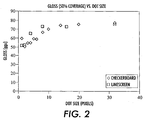
- Figure 2 depicts how the gloss of halftone structures may vary at various cluster sizes.
- the cluster size is measured in the unit of pixel at 600dpi.
- the comparison provided in the chart of Figure 2 shows how the gloss may vary when cluster size is changed at a constant density of 50% and with a fixed halftone pattern.
- the cluster size is inversely proportional to the halftone frequency.
- Stochastic screen will have the gloss characteristics similar to that of the pattern with cluster size of 1 pixel, while 100 ⁇ 200lpi cluster dot screen will exhibit glossy appearance close to that of the pattern with greater cluster sizes ( ⁇ 3pixels).
- a stochastic screen exhibits significantly more gloss than the low frequency (100 ⁇ 200lpi) cluster dot halftone type around the mid tone range.
- a simplistic characterization is that by using a coarser screen or halftone type in the high area coverage regions and a finer screen in low area coverage regions, differential gloss can be reduced significantly.
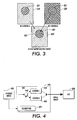
- Figure 3 depicts a gloss manipulated image 300 achievable using halftone cells types which vary in gloss as described above.
- Screen-A 310 uses one halftone cell type and screen-B 320 uses the other.
- the circle 301 is provided as a visual aid across the image screens 300, 310 and 320.
- the desired intent here is for a sphere 302 to be perceived in the midst of image 300 as having the same level of gloss as the remainder of image 300.
- Screen-A 310 provides the field of mid-density oriented halftones and screen 320 provides the spherical area of high-density halftone cells. In this manner, a selection of the two screen types are patch-worked together to create the image 300 with reduced differential gloss.
- one typical process to reduce the differential gloss of a printed image consists of the following two steps:
- FIG. 4 One approach for the assembly of a reduced differential gloss image is diagramed in Figure 4.
- the primary image 400 is received as input data to the digital front-end (DFE) 410 as is normal.
- a segmenter 420 also receives as input data primary image 400 as well.
- the processed image as sent to the image output terminal (IOT) 430 is gray-scaled, the halftone density being driven by the primary image 400 data as is normal.
- the halftone type selection is driven by the output of segmenter 420 as input to multiplexer switch 440.
- the output of segmenter 420 will serve to direct a portion of the primary image 400 to use a first halftone type while directing an alternative halftone to be used for the remainder of primary image 400.
- Multiplexer 440 therefore toggles between either screen 1 type halftone 450 or screen 2 halftone type 460, as dictated by the segmenter 420, to produce the composite result of raster input processed (RIP) image data as passed to the IOT 430.
- RIP raster input processed
Landscapes
- Engineering & Computer Science (AREA)
- Multimedia (AREA)
- Signal Processing (AREA)
- Facsimile Image Signal Circuits (AREA)
- Image Processing (AREA)
- Editing Of Facsimile Originals (AREA)
- Printing Methods (AREA)
- Color Image Communication Systems (AREA)
Abstract
Description
Disclosed in embodiments herein is a method for the manipulation of the differential gloss in a halftone image. The method comprises selecting a first halftone having a high apparent gloss characteristic and a second halftone having a low apparent gloss characteristic while retaining an identical matching density characteristic to the first selected halftone. The first halftone is applied to at least some portion of the halftone image, and the second halftone is applied to the remaining portion of the halftone image.
Also disclosed in embodiments herein is a method for the manipulation of the differential gloss in a halftone image. The method comprises selecting a first halftone having a high apparent gloss characteristic and a second halftone having a low apparent gloss characteristic while retaining an identical matching density characteristic to the first selected halftone. Then a determination is made of which areas of the halftone image correspond to potentially high gloss regions under normal printing conditions. The second halftone is applied to those portions of the halftone image determined as corresponding to potentially high gloss regions, and the first halftone is applied to the remaining portions of the halftone image.
Also disclosed in embodiments herein is a method for the manipulation of the differential gloss in a halftone image. The method comprises selecting a first halftone having a high apparent gloss characteristic and a second halftone having a low apparent gloss characteristic while retaining an identical matching density characteristic to the first selected halftone. Then a determination is made of which areas of the halftone image correspond to potentially low gloss regions under normal printing conditions. The first halftone is applied to those portions of the halftone image determined as corresponding to potentially low gloss regions, and the second halftone is applied to the remaining portions of the halftone image.
Further disclosed in embodiments herein is a method for the manipulation of the differential gloss in a halftone image. The method comprises selecting a first halftone having a high apparent gloss characteristic and a second halftone having a low apparent gloss characteristic while retaining an identical matching density characteristic to the first selected halftone. Then a determination is made of which areas of the halftone image correspond to potentially high gloss and low gloss regions under normal printing conditions. The first halftone is applied to those portions of the halftone image determined as corresponding to potentially low gloss regions, and the second halftone is applied to those portions of the halftone image determined as corresponding to potentially high gloss regions of the halftone image. In variations of the above embodiments the first halftone is a stochastic halftone type. The second halftone may be a cluster dot halftone type.
In a further variation the second halftone is a 100~250 lines-per-inch cluster dot screen halftone type.
In a further variation the second halftone is a line screen halftone type.
In a further variation the determining step is based upon density.
In a further variation the determining step is based upon segmentation.
Claims (10)
- A method for the manipulation of the differential gloss in a halftone image comprising the steps of:selecting a first halftone having a high apparent gloss characteristic;selecting a second halftone having a low apparent gloss characteristic while retaining an identical matching density characteristic to the first selected halftone;applying the first halftone to at least some portion of the halftone image; and,applying the second halftone to the remaining portion of the halftone image.
- The method of claim 1 wherein the first halftone is a stochastic halftone type.
- The method of claim 1 wherein the second halftone is a cluster dot halftone type.
- The method of claim 1 wherein the second halftone is a 100-250 lines-per-inch cluster dot screen halftone type.
- The method of claim 1 wherein the second halftone is a line screen halftone type.
- A method for the manipulation of the differential gloss in a halftone image comprising the steps of:selecting a first halftone having a high apparent gloss characteristic;selecting a second halftone having a low apparent gloss characteristic while retaining an identical matching density characteristic to the first selected halftone;determining which areas of the halftone image correspond to potentially high gloss regions under normal printing conditions;applying the second halftone to those portions of the halftone image determined as corresponding to potentially high gloss regions; and,applying the first halftone to the remaining portions of the halftone image.
- The method of claim 6 wherein the first halftone is a stochastic halftone type.
- The method of claim 6 wherein the second halftone is a cluster dot halftone type.
- A method for the manipulation of the differential gloss in a halftone image comprising the steps of:selecting a first halftone having a high apparent gloss characteristic;selecting a second halftone having a low apparent gloss characteristic while retaining an identical matching density characteristic to the first selected halftone;determining which areas of the halftone image correspond to potentially low gloss regions under normal printing conditions;applying the first halftone to those portions of the halftone image determined as corresponding to potentially low gloss regions; and,applying the second halftone to the remaining portions of the halftone image.
- A method for the manipulation of the differential gloss in a halftone image comprising the steps of:selecting a first halftone having a high apparent gloss characteristic;selecting a second halftone having a low apparent gloss characteristic while retaining an identical matching density characteristic to the first selected halftone;determining which areas of the halftone image correspond to potentially high gloss regions under normal printing conditions;determining which areas of the halftone image correspond to potentially low gloss regions under normal printing conditions;applying the first halftone to those portions of the halftone image determined as corresponding to potentially low gloss regions; and,applying the second halftone to those portions of the halftone image determined as corresponding to potentially high gloss regions of the halftone image.
Applications Claiming Priority (4)
| Application Number | Priority Date | Filing Date | Title |
|---|---|---|---|
| US52918603P | 2003-12-12 | 2003-12-12 | |
| US529186P | 2003-12-12 | ||
| US10/876,000 US7382495B2 (en) | 2003-12-12 | 2004-06-24 | Reduction of differential gloss |
| US876000 | 2004-06-24 |
Publications (3)
| Publication Number | Publication Date |
|---|---|
| EP1542448A2 true EP1542448A2 (en) | 2005-06-15 |
| EP1542448A3 EP1542448A3 (en) | 2006-07-12 |
| EP1542448B1 EP1542448B1 (en) | 2012-08-29 |
Family
ID=34527136
Family Applications (1)
| Application Number | Title | Priority Date | Filing Date |
|---|---|---|---|
| EP04027928A Expired - Lifetime EP1542448B1 (en) | 2003-12-12 | 2004-11-24 | Reduction of differential gloss |
Country Status (3)
| Country | Link |
|---|---|
| US (1) | US7382495B2 (en) |
| EP (1) | EP1542448B1 (en) |
| JP (1) | JP4638210B2 (en) |
Cited By (3)
| Publication number | Priority date | Publication date | Assignee | Title |
|---|---|---|---|---|
| CN104392233A (en) * | 2014-11-21 | 2015-03-04 | 宁波大学 | Image saliency map extracting method based on region |
| CN103971365B (en) * | 2014-04-16 | 2016-08-10 | 宁波大学 | A method for image saliency map extraction |
| EP3229455A1 (en) * | 2016-03-31 | 2017-10-11 | Canon Kabushiki Kaisha | Image processing apparatus, image processing method and program |
Families Citing this family (23)
| Publication number | Priority date | Publication date | Assignee | Title |
|---|---|---|---|---|
| US7352493B2 (en) * | 2003-12-12 | 2008-04-01 | Xerox Corporation | Enhancement of glossmark images at low and high densities |
| US7301675B2 (en) * | 2004-06-29 | 2007-11-27 | Xerox Corporation | Glossmark images with clear toner |
| US7304770B2 (en) * | 2004-08-30 | 2007-12-04 | Xerox Corporation | Reduction of differential gloss with halftoned clear toner |
| US7391537B2 (en) * | 2004-09-28 | 2008-06-24 | Xerox Corporation | User interface for differential gloss images |
| US7324241B2 (en) * | 2004-09-29 | 2008-01-29 | Xerox Corporation | Variable data differential gloss images |
| US8090141B2 (en) | 2006-01-31 | 2012-01-03 | Xerox Corporation | System and method to automatically establish preferred area for image-wise watermark |
| US8248661B2 (en) * | 2007-02-12 | 2012-08-21 | Xerox Corporation | Color-consistent three level differential gloss images |
| US7639400B2 (en) | 2007-02-13 | 2009-12-29 | Xerox Corporation | Glossmark image simulation with application of background modified gloss effect image |
| US7656556B2 (en) | 2007-02-28 | 2010-02-02 | Xerox Corporation | Detection of a differential gloss region in a cluster-screen halftone image using filters each having a different polarization |
| US8269987B2 (en) * | 2007-10-30 | 2012-09-18 | Xerox Corporation | Using application side truetype or other outline fonts to create specialty imaging fonts on digital front-end |
| US7894103B2 (en) * | 2008-02-20 | 2011-02-22 | Xerox Corporation | Variable data digital pantographs |
| US7934785B2 (en) * | 2008-03-18 | 2011-05-03 | Xerox Corporation | Selectable gloss coating system |
| US8383189B2 (en) * | 2008-04-21 | 2013-02-26 | Xerox Corporation | Selectable gloss coating system |
| US8345314B2 (en) * | 2008-11-24 | 2013-01-01 | Xerox Corporation | Methods and systems to embed glossmark digital watermarks into continuous-tone images |
| US7869090B2 (en) * | 2008-12-17 | 2011-01-11 | Xerox Corporation | Variable data digital pantographs |
| US8310718B2 (en) | 2009-03-16 | 2012-11-13 | Xerox Corporation | High resolution scalable gloss effect |
| JP5409187B2 (en) * | 2009-08-17 | 2014-02-05 | キヤノン株式会社 | Image forming apparatus and image forming method |
| US8608272B2 (en) | 2010-12-03 | 2013-12-17 | Xerox Corporation | System and method for inkjet printing with a differential halftoned protective overcoat with gloss compensation |
| JP2012159743A (en) * | 2011-02-01 | 2012-08-23 | Fuji Xerox Co Ltd | Image-forming device and recording medium |
| US8941899B2 (en) | 2011-02-22 | 2015-01-27 | Xerox Corporation | Simulated paper texture using glossmark on texture-less stock |
| US8619331B2 (en) | 2011-07-19 | 2013-12-31 | Xerox Corporation | Simulated paper texture using clear toner and glossmark on texture-less stock |
| US8864257B2 (en) | 2011-11-02 | 2014-10-21 | Hewlett-Packard Industrial Printing Ltd. | Printing using a backwards motion |
| JP6516717B2 (en) * | 2016-03-31 | 2019-05-22 | キヤノン株式会社 | Image processing apparatus and image processing method |
Family Cites Families (44)
| Publication number | Priority date | Publication date | Assignee | Title |
|---|---|---|---|---|
| US3675948A (en) * | 1969-09-10 | 1972-07-11 | American Bank Note Co | Printing method and article for hiding halftone images |
| US4310180A (en) | 1977-05-18 | 1982-01-12 | Burroughs Corporation | Protected document and method of making same |
| US4210346A (en) | 1977-06-23 | 1980-07-01 | Burroughs Corporation | Protected document bearing watermark and method of making |
| US4149194A (en) * | 1977-07-07 | 1979-04-10 | Xerox Corporation | Variable angle electronic halftone screening |
| CH672687A5 (en) | 1987-11-20 | 1989-12-15 | Lipatec Ets | |
| FI80405C (en) | 1988-03-24 | 1990-06-11 | Suomen Pankin Setelipaino | TRYCKALSTER SAEKERSTAELLT MED VARNINGSFIGUR OCH FOERFARANDE FOER DESS UTARBETNING. |
| US5583660A (en) | 1990-09-14 | 1996-12-10 | Minnesota Mining And Manufacturing Company | Non-perpendicular, equal frequency non-conventional screen patterns for electronic halftone generation |
| GB2249910B (en) | 1990-11-19 | 1994-11-30 | Le Proizv Ob Poligraficheskogo | Method of and apparatus for making a half-tone reproduction of an image |
| US5234783A (en) * | 1991-12-16 | 1993-08-10 | Eastman Kodak Company | Method of selectively glossing toner images |
| US5487567A (en) | 1992-04-24 | 1996-01-30 | Francois-Charles Oberthur Group | Printing method and copy-evident secure document |
| US5344192A (en) | 1993-04-01 | 1994-09-06 | Phillips George K | Visual validation mark for bank checks and other security documents |
| JP3241157B2 (en) | 1993-04-19 | 2001-12-25 | 富士写真フイルム株式会社 | Dot image data correction method and image processing apparatus having correction function |
| US5710636A (en) * | 1995-06-05 | 1998-01-20 | Xerox Corporation | Method and apparatus for generating halftone images having human readable patterns formed therein |
| US5853197A (en) | 1996-03-05 | 1998-12-29 | The Standard Register Company | Security document |
| US5751432A (en) * | 1996-05-31 | 1998-05-12 | Xerox Corporation | Highlight gloss for xerographic engine |
| US5788285A (en) | 1996-06-13 | 1998-08-04 | Wicker; Thomas M. | Document protection methods and products |
| JPH1016288A (en) * | 1996-06-28 | 1998-01-20 | Canon Inc | Image processing apparatus and method |
| US5678133A (en) | 1996-07-01 | 1997-10-14 | Xerox Corporation | Auto-gloss selection feature for color image output terminals (IOTs) |
| US5734752A (en) | 1996-09-24 | 1998-03-31 | Xerox Corporation | Digital watermarking using stochastic screen patterns |
| US6606168B1 (en) * | 1999-03-31 | 2003-08-12 | 3M Innovative Properties Company | Narrow band, anisotropic stochastic halftone patterns and methods of creating and using the same |
| US6714320B1 (en) * | 1999-06-14 | 2004-03-30 | Toshiba Tec Kabushiki Kaisha | Image processor and color image processor |
| US6906825B1 (en) * | 1999-06-14 | 2005-06-14 | Toshiba Tec Kabushiki Kaisha | Image processor and color image processor |
| US6108512A (en) | 1999-11-29 | 2000-08-22 | Xerox Corporation | Copy prevention method |
| US6763121B1 (en) * | 2000-06-14 | 2004-07-13 | Hewlett-Packard Development Company, L.P. | Halftone watermarking method and system |
| US7660429B2 (en) * | 2000-06-14 | 2010-02-09 | Hewlett-Packard Development Company, L.P. | Error diffusion halftone watermarking |
| US6694041B1 (en) * | 2000-10-11 | 2004-02-17 | Digimarc Corporation | Halftone watermarking and related applications |
| JP2002341619A (en) * | 2001-05-11 | 2002-11-29 | Fuji Xerox Co Ltd | Glossing device and color image forming device using the same |
| US7180635B2 (en) | 2002-05-30 | 2007-02-20 | Xerox Corporation | Halftone image gloss control for glossmarks |
| US7092128B2 (en) | 2002-05-30 | 2006-08-15 | Xerox Corporation | Application of glossmarks for graphics enhancement |
| US7126721B2 (en) * | 2002-06-27 | 2006-10-24 | Xerox Corporation | Protecting printed items intended for public exchange with glossmarks |
| US7148999B2 (en) * | 2002-06-27 | 2006-12-12 | Xerox Corporation | Variable glossmark |
| US7139101B2 (en) * | 2002-10-31 | 2006-11-21 | Xerox Corporation | Anisotropic stochastic screen |
| US7193751B2 (en) * | 2002-12-12 | 2007-03-20 | Xerox Corporation | Tag control for runtime glossmarks |
| JP4193665B2 (en) * | 2003-03-05 | 2008-12-10 | 株式会社日立製作所 | Digital watermarking method for binary images |
| US7352493B2 (en) * | 2003-12-12 | 2008-04-01 | Xerox Corporation | Enhancement of glossmark images at low and high densities |
| US7877053B2 (en) * | 2003-12-23 | 2011-01-25 | Eastman Kodak Company | Adjustable gloss control method with different substrates and 3-D image effect with adjustable gloss |
| US7139521B2 (en) * | 2003-12-23 | 2006-11-21 | Eastman Kodak Company | Gloss and differential gloss control methodology |
| US7301675B2 (en) * | 2004-06-29 | 2007-11-27 | Xerox Corporation | Glossmark images with clear toner |
| US7304770B2 (en) * | 2004-08-30 | 2007-12-04 | Xerox Corporation | Reduction of differential gloss with halftoned clear toner |
| US7391537B2 (en) * | 2004-09-28 | 2008-06-24 | Xerox Corporation | User interface for differential gloss images |
| US7324241B2 (en) * | 2004-09-29 | 2008-01-29 | Xerox Corporation | Variable data differential gloss images |
| EP1705531A1 (en) * | 2005-03-22 | 2006-09-27 | Eastman Kodak Company | Method and device for controlling differential gloss of high-density areas and print item produced thereby |
| EP1705529A1 (en) * | 2005-03-22 | 2006-09-27 | Eastman Kodak Company | Method and device for controlling differential gloss and print item produced thereby |
| US7580155B2 (en) * | 2005-12-19 | 2009-08-25 | Xerox Corporation | Tools to embed information into digital visual works |
-
2004
- 2004-06-24 US US10/876,000 patent/US7382495B2/en active Active
- 2004-11-24 EP EP04027928A patent/EP1542448B1/en not_active Expired - Lifetime
- 2004-12-09 JP JP2004356482A patent/JP4638210B2/en not_active Expired - Fee Related
Cited By (5)
| Publication number | Priority date | Publication date | Assignee | Title |
|---|---|---|---|---|
| CN103971365B (en) * | 2014-04-16 | 2016-08-10 | 宁波大学 | A method for image saliency map extraction |
| CN104392233A (en) * | 2014-11-21 | 2015-03-04 | 宁波大学 | Image saliency map extracting method based on region |
| CN104392233B (en) * | 2014-11-21 | 2017-06-06 | 宁波大学 | A kind of image saliency map extracting method based on region |
| EP3229455A1 (en) * | 2016-03-31 | 2017-10-11 | Canon Kabushiki Kaisha | Image processing apparatus, image processing method and program |
| US10131156B2 (en) | 2016-03-31 | 2018-11-20 | Canon Kabushiki Kaisha | Image processing apparatus, image processing method and storage medium |
Also Published As
| Publication number | Publication date |
|---|---|
| US20050128523A1 (en) | 2005-06-16 |
| JP4638210B2 (en) | 2011-02-23 |
| EP1542448A3 (en) | 2006-07-12 |
| US7382495B2 (en) | 2008-06-03 |
| JP2005176378A (en) | 2005-06-30 |
| EP1542448B1 (en) | 2012-08-29 |
Similar Documents
| Publication | Publication Date | Title |
|---|---|---|
| EP1542448B1 (en) | Reduction of differential gloss | |
| US7304770B2 (en) | Reduction of differential gloss with halftoned clear toner | |
| EP1541368B1 (en) | Ehancement of gloss in images at low and high optical densities | |
| US7180635B2 (en) | Halftone image gloss control for glossmarks | |
| EP1612622B1 (en) | Glossmark images with clear toner | |
| US7463389B2 (en) | Image processing method, image processing device and program | |
| EP1642741B1 (en) | Method for producing differential gloss images having variable data | |
| EP1370062B1 (en) | Application of glossmarks for printing on ordinary image reproducers | |
| JP4988019B2 (en) | Tag control for run-time gross marks | |
| US8345314B2 (en) | Methods and systems to embed glossmark digital watermarks into continuous-tone images | |
| US8049933B2 (en) | Copy-forgery-inhibited pattern image generation method and image processing apparatus | |
| US5946450A (en) | Printer pixel size and toner/ink consumption reduction system | |
| US7385731B2 (en) | Method and system for processing a multi-colour image | |
| EP1014207A1 (en) | Toner sequence to minimise noise |
Legal Events
| Date | Code | Title | Description |
|---|---|---|---|
| PUAI | Public reference made under article 153(3) epc to a published international application that has entered the european phase |
Free format text: ORIGINAL CODE: 0009012 |
|
| AK | Designated contracting states |
Kind code of ref document: A2 Designated state(s): AT BE BG CH CY CZ DE DK EE ES FI FR GB GR HU IE IS IT LI LU MC NL PL PT RO SE SI SK TR |
|
| AX | Request for extension of the european patent |
Extension state: AL HR LT LV MK YU |
|
| PUAL | Search report despatched |
Free format text: ORIGINAL CODE: 0009013 |
|
| AK | Designated contracting states |
Kind code of ref document: A3 Designated state(s): AT BE BG CH CY CZ DE DK EE ES FI FR GB GR HU IE IS IT LI LU MC NL PL PT RO SE SI SK TR |
|
| AX | Request for extension of the european patent |
Extension state: AL HR LT LV MK YU |
|
| 17P | Request for examination filed |
Effective date: 20070112 |
|
| 17Q | First examination report despatched |
Effective date: 20070215 |
|
| AKX | Designation fees paid |
Designated state(s): DE FR GB |
|
| GRAP | Despatch of communication of intention to grant a patent |
Free format text: ORIGINAL CODE: EPIDOSNIGR1 |
|
| GRAS | Grant fee paid |
Free format text: ORIGINAL CODE: EPIDOSNIGR3 |
|
| GRAA | (expected) grant |
Free format text: ORIGINAL CODE: 0009210 |
|
| AK | Designated contracting states |
Kind code of ref document: B1 Designated state(s): DE FR GB |
|
| REG | Reference to a national code |
Ref country code: GB Ref legal event code: FG4D |
|
| REG | Reference to a national code |
Ref country code: DE Ref legal event code: R096 Ref document number: 602004039111 Country of ref document: DE Effective date: 20121025 |
|
| PLBE | No opposition filed within time limit |
Free format text: ORIGINAL CODE: 0009261 |
|
| STAA | Information on the status of an ep patent application or granted ep patent |
Free format text: STATUS: NO OPPOSITION FILED WITHIN TIME LIMIT |
|
| 26N | No opposition filed |
Effective date: 20130530 |
|
| REG | Reference to a national code |
Ref country code: DE Ref legal event code: R097 Ref document number: 602004039111 Country of ref document: DE Effective date: 20130530 |
|
| PGFP | Annual fee paid to national office [announced via postgrant information from national office to epo] |
Ref country code: DE Payment date: 20131022 Year of fee payment: 10 Ref country code: FR Payment date: 20131121 Year of fee payment: 10 Ref country code: GB Payment date: 20131025 Year of fee payment: 10 |
|
| REG | Reference to a national code |
Ref country code: DE Ref legal event code: R119 Ref document number: 602004039111 Country of ref document: DE |
|
| GBPC | Gb: european patent ceased through non-payment of renewal fee |
Effective date: 20141124 |
|
| REG | Reference to a national code |
Ref country code: FR Ref legal event code: ST Effective date: 20150731 |
|
| PG25 | Lapsed in a contracting state [announced via postgrant information from national office to epo] |
Ref country code: DE Free format text: LAPSE BECAUSE OF NON-PAYMENT OF DUE FEES Effective date: 20150602 Ref country code: GB Free format text: LAPSE BECAUSE OF NON-PAYMENT OF DUE FEES Effective date: 20141124 |
|
| PG25 | Lapsed in a contracting state [announced via postgrant information from national office to epo] |
Ref country code: FR Free format text: LAPSE BECAUSE OF NON-PAYMENT OF DUE FEES Effective date: 20141201 |