EP1542405B1 - Access point selection using channel correlation in a wireless communication system - Google Patents
Access point selection using channel correlation in a wireless communication system Download PDFInfo
- Publication number
- EP1542405B1 EP1542405B1 EP04257640A EP04257640A EP1542405B1 EP 1542405 B1 EP1542405 B1 EP 1542405B1 EP 04257640 A EP04257640 A EP 04257640A EP 04257640 A EP04257640 A EP 04257640A EP 1542405 B1 EP1542405 B1 EP 1542405B1
- Authority
- EP
- European Patent Office
- Prior art keywords
- access point
- channel
- correlation
- station
- wireless communication
- Prior art date
- Legal status (The legal status is an assumption and is not a legal conclusion. Google has not performed a legal analysis and makes no representation as to the accuracy of the status listed.)
- Ceased
Links
- 238000004891 communication Methods 0.000 title claims description 20
- 238000000034 method Methods 0.000 claims description 37
- 230000008569 process Effects 0.000 claims description 26
- 239000011159 matrix material Substances 0.000 claims description 6
- 239000000523 sample Substances 0.000 description 10
- 230000005540 biological transmission Effects 0.000 description 9
- 238000012549 training Methods 0.000 description 7
- 230000004044 response Effects 0.000 description 6
- 230000002596 correlated effect Effects 0.000 description 3
- 238000010586 diagram Methods 0.000 description 3
- 238000007726 management method Methods 0.000 description 3
- 230000008901 benefit Effects 0.000 description 2
- 230000000875 corresponding effect Effects 0.000 description 2
- 230000007423 decrease Effects 0.000 description 2
- 238000000060 site-specific infrared dichroism spectroscopy Methods 0.000 description 2
- 108700026140 MAC combination Proteins 0.000 description 1
- 230000001413 cellular effect Effects 0.000 description 1
- 230000001427 coherent effect Effects 0.000 description 1
- 230000006835 compression Effects 0.000 description 1
- 238000007906 compression Methods 0.000 description 1
- 125000004122 cyclic group Chemical group 0.000 description 1
- 238000000354 decomposition reaction Methods 0.000 description 1
- 238000001514 detection method Methods 0.000 description 1
- BJRNKVDFDLYUGJ-RMPHRYRLSA-N hydroquinone O-beta-D-glucopyranoside Chemical compound O[C@@H]1[C@@H](O)[C@H](O)[C@@H](CO)O[C@H]1OC1=CC=C(O)C=C1 BJRNKVDFDLYUGJ-RMPHRYRLSA-N 0.000 description 1
- 230000007246 mechanism Effects 0.000 description 1
- 238000012986 modification Methods 0.000 description 1
- 230000004048 modification Effects 0.000 description 1
- 238000011084 recovery Methods 0.000 description 1
- 238000013468 resource allocation Methods 0.000 description 1
- 238000001228 spectrum Methods 0.000 description 1
- 239000013589 supplement Substances 0.000 description 1
- 238000012360 testing method Methods 0.000 description 1
- 230000001960 triggered effect Effects 0.000 description 1
Images



Classifications
-
- H—ELECTRICITY
- H04—ELECTRIC COMMUNICATION TECHNIQUE
- H04W—WIRELESS COMMUNICATION NETWORKS
- H04W48/00—Access restriction; Network selection; Access point selection
- H04W48/20—Selecting an access point
-
- H—ELECTRICITY
- H04—ELECTRIC COMMUNICATION TECHNIQUE
- H04L—TRANSMISSION OF DIGITAL INFORMATION, e.g. TELEGRAPHIC COMMUNICATION
- H04L12/00—Data switching networks
- H04L12/28—Data switching networks characterised by path configuration, e.g. LAN [Local Area Networks] or WAN [Wide Area Networks]
-
- H—ELECTRICITY
- H04—ELECTRIC COMMUNICATION TECHNIQUE
- H04W—WIRELESS COMMUNICATION NETWORKS
- H04W84/00—Network topologies
- H04W84/02—Hierarchically pre-organised networks, e.g. paging networks, cellular networks, WLAN [Wireless Local Area Network] or WLL [Wireless Local Loop]
- H04W84/10—Small scale networks; Flat hierarchical networks
- H04W84/12—WLAN [Wireless Local Area Networks]
Definitions
- the present invention relates generally to wireless communication systems, such as wireless local area networks (LANs), and more particularly, to data rate control techniques in such wireless communication systems.
- LANs wireless local area networks
- An access point In a typical wireless network environment, such as a wireless local area network (LAN), a number of wireless stations communicate over one or more wireless channels, An access point typically provides control and management functions. The access point acts as a central node through which all traffic is relayed. Many wireless networks are implemented in accordance with the IEEE 802.11 standard or the various extensions to the 802.11 standard, such as 802.11 a, b and g, or the HIPERLAN/2 standard. The IEEE 802.11 protocol specifies that all communications are relayed via the access point, so each transmission that is of interest (other access points may be active on the same radio channel) is from the access point the station is associated with.
- WO 03/034642 discloses a method and apparatus for performing acquisition, synchronisation and cell selection within an MIMO-OFDM communication system.
- a coarse synchronisation is performed to determine a searching window.
- a fine synchronisation is then performed by measuring correlations between subsets of signal samples, whose first signal sample lies within the searching window, and known values. The correlations are performed in the frequency domain of the received signal.
- each antenna of the OFDM transmitter has a unique known value.
- the known value is transmitted as pairs of consecutive pilot symbols, each pair of pilot symbols being transmitted at the same subset of sub-carrier frequencies within the OFDM frame.
- US Patent No. 6,473,467 discloses that channel state information (CSI) can be used by a communications system to precondition transmissions between transmitter units and receiver units.
- CSI channel state information
- disjoint sub-channel sets are assigned to transmit antennas located at a transmitter unit. Pilot symbols are generated and transmitted on a subset of the disjoint sub-channels. Upon receipt of the transmitted pilot symbols, the receiver units determine the CSI for the disjoint sub-channels that carried pilot symbols. These CSI values are reported to the transmitter unit, which will use these CSI values to generate CSI estimates for the disjoint sub-channels that did not carry pilot symbols. The amount of information necessary to report CSI on the reverse link can be further minimised through compression techniques and resource allocation techniques.
- every station including those that are already associated with an access point, scans the surroundings from time to time in order to find the number of surrounding access points and the quality of the radio link to those access points.
- the station uses this information to select the access point with the best quality link. If the station is not already connected to the access point with the best link, the station tries to associate with the new access point.
- the quality of the link is currently based only on the SNR value of the link.
- a method and apparatus are provided for access point selection in wireless communication systems, such as wireless LANs.
- the invention provides a wireless communication device according to claim 1.
- the roaming process selects an access point having the lowest correlation value.
- the roaming process may also consider the signal quality, channel delay spread or both in selecting an access point.
- the invention provides a method according to claim 4.
- FIG. 1 illustrates a wireless network environment 100 in which the present invention can operate.
- the wireless network environment 100 may be, for example, a wireless LAN or a portion thereof.
- stations 200 communicate over one or more wireless channels in the wireless digital communication system 100.
- An access point 120 is typically connected to a wired distribution network 105 with other access points (not shown).
- the access point 120 typically provides control and management functions, in a known manner.
- the access point 120 acts as a central node through which all traffic is relayed so that the stations 200 can rely on the fact that transmissions will originate from the access point 120.
- the wireless network environment 100 may be implemented, for example, in accordance with the IEEE 802.11 standard or the various extensions to the 802.11 standard, such as 802.11a, b and g, or the HIPERLAN/2 standard.
- the IEEE 802.11 protocol specifies that all communications are relayed via the access point 120, so each transmission that is of interest (other access points 120 may be active on the same radio channel) is from the access point 120 the stations 200 is associated with.
- An example of such a communications protocol is the Enhanced Service Set (ESS) mode of the IEEE 802.11 protocol, in which stations 200 are associated with an access point 120 that relays all communication.
- ESS Enhanced Service Set
- the access point 120 and wireless stations 200 exchange frames containing information on the transmit power level limits.
- the country information is available once the network administrator has configured the access point 120 for country selection.
- a station 200 receives the information from its access point 120.
- the frame format for exchanging transmit power level limits is described, for example, in IEEE, "Supplement to Standard for Telecommunications and Information Exchange Between Systems-LAN/MAN Specific Requirements- Part 11: Wireless MAC and PHY Specifications: Spectrum and Transmit Power Management Extensions in the 5 GHz band in Europe," P802.11h/D2.0 (March 2002).
- FIG. 2 illustrates an exemplary conventional MIMO environment in which the present invention can operate.
- an exemplary conventional MIMO system 200 comprises source signals S 1 to S Nt , transmitters TX 1 to TX N t , transmit antennas 210-1 through 210-N t , receive antennas 215-1 through 215-N r , and receivers RX 1 to RX N r .
- the MIMO system 200 transmits separate data streams on the multiple transmit antennas 210, and each receiver RX receives a combination of these data streams.
- MIMO shall mean a system in which there are multiple transmission layers, i.e., several distinguishable streams are transmitted from different antennas into the same frequency channel. It is noted that there could be one or more receive antennas in various configurations to receive such a MIMO transmission. In typical implementations for rate enhancement, there will be as many receive antennas as transmit antennas, or more receive antennas than transmit antennas.
- the performance of MIMO systems relies on the provided scattering in the wireless channel.
- the correlation i.e., spatial channel correlation
- the system is not able to increase the data rate using the multiple antennas.
- the scattering depends on the surrounding environment of both the transmitter and the receiver (or access point (AP) and station (STA)).
- FIG. 3 illustrates a network environment for a wireless LAN system 300.
- a station STA
- AP Access Points
- the number of available access points will only increase as network deployment becomes more dense in the future.
- the channel elements (H) between one access point and one station might be highly correlated, the channel elements between that same station and another access point might show better correlation properties.
- the station can select a connection with the second access point, the possibility of a successful (high rate) transmission will be higher.
- the station 310 can have a connection with access points AP1, AP2 or AP3.
- a roaming process 700 selects an access point for a given station using correlation information.
- the roaming process 700 selects an access point based on the correlation between the station and an access point.
- One measure for the correlation is the set of eigenvalues corresponding to the MIMO channel, which can be estimated from the channel response.
- the performance of a MIMO link also relies heavily on the signal-to-noise-ratio (SNR) or channel delay spread.
- SNR can be estimated from the preamble of the packet or from previously received packets. This estimation of the MIMO channel is in all cases necessary to do successful recovery of transmitted data.
- Another measure for the quality of a link is the percentage of packets that are transmitted and received by their destinations with or without errors, which can, for example, be determined from the number of missed or received acknowledgements, respectively.
- the present invention allows a roaming station to select a new access point using correlation information.
- FIG. 4 is a schematic block diagram of an exemplary transmitter/receiver station 400 incorporating features of the present invention.
- the stations 400 may each be embodied, for example, as personal computer devices, or any device having a wireless communication capability, such as a cellular telephone, personal digital assistant or pager, as modified herein to provide the features and functions of the present invention.
- an exemplary station 400 includes a roaming process 700, discussed further below in conjunction with FIG. 7 .
- a transmitter/receiver 400 includes a Medium Access Controller (MAC) 405 that controls the transmission of data.
- the MAC 405 includes the roaming process 700.
- the roaming process 700 can be implemented by a separate device that interacts with the MAC 405.
- the roaming process 700 selects an access point to be used by the station 400.
- the baseband processor 420 provides the signal to the RF circuitry 430, which in turn, provides the signal to one or more antennas 440-1 through 440-N, in a known manner.
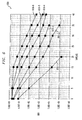
- FIG. 5 illustrates the influence of the SNR and channel correlation on the performance of a MIMO based OFDM wireless device.
- FIG. 5 illustrates the bit-error-rate (BER) performance 500 of a two transmitter and two receiver (2x2) extension of an IEEE 802.11a system.
- the exemplary system uses 64 QAM modulation, a coding rate of 0.75, yielding a data rate of 108 (2 x 54) Mbps.
- the correlation in the MIMO channel is modeled as described in A. van Zelst and J.S. Hammerschmidt, "A Single Coefficient Spatial Correlation Model for Multiple-Input Multiple-Output (MIMO) Radio Channels," Proc. URSI XXVII General Assembly, 17-24 August 2002, 1-4 (2002).
- ⁇ is the parameter modeling the correlation, varying from 0 to 1.
- ⁇ equal to 0 corresponds to fully uncorrelated while ⁇ equal to 1 corresponds to fully correlated.
- a Rayleigh faded exponentional decaying power-delay-profile is applied.
- the performance increases i.e., the BER decreases
- the performance decreases when the correlation factor increases.
- FIG. 6 illustrates the BER performance 600 as function of the SNR for a two transmitter and two receiver (2x2) configuration with a correlation, ⁇ , equal to 0.
- the different data rates 610-1 through 610-6 correspond to rates of 12, 24, 48, 72, 108 Mbps, respectively.
- the different rates 610-1 through 610-6 are achieved by varying the coding rate and modulation (as also done in 802.11a/g).
- the BER performance is a function of the SNR and data rate. If the receiver is operating at a certain SNR, the data rate can be chosen which achieves the required BER performance.
- FIG. 6 demonstrates the influence of the modulation and coding rate on the BER performance and SNR requirements.
- the SNR of the wireless channels with the other terminals can be estimated by using the preamble of received packets. This can be done using the Long Training (LT) symbols in the preamble of any received packet.
- the long training symbols for example, as proposed in IEEE Std 802.11 a, High-speed Physical Layer in the 5 GHz Band (1999), are a repetition of a symbol and a cyclic prefix. After synchronization, the only difference between the two versions of the training symbols is the noise. Thus, subtracting the two symbols gives an estimate of the noise.
- Another, more accurate way, to measure the SNR is using the detected data in the packet(s). From constellation points estimates, using, for example, a Least Squares estimation, the detected constellation points after slicing are subtracted. The result is the error in the estimation, of which the statistics relate to the ratio between the signal and noise level.
- Another technique for measuring the SNR is to measure the received energy level during packet reception (signal level) and during idle periods on the channel (noise level). A number for the SNR is achieved by subtracting the two values.
- the channel correlation can be estimated from the MIMO channel matrix H .
- Estimates of the channel are in all cases necessary for systems using coherent detection.
- EEOF effective degrees of freedom
- ED effective dimensions
- the present invention proposes to calculate the eigenvalues (EVs) or Singular Values (SV) of the channel matrix. This can be calculated using a singular value decomposition (SVD). In a fully uncorrelated MIMO channel, these EVs all will have the same value and will be high. In a correlated channel, some EVs will be lower. A good measure for the correlation is thus the maximum value of EVs and the ratio between them.
- EVs eigenvalues
- SV singular value decomposition
- the balance between the number of received and missed ACKs can also be calculated. This measure stores the number of received and missed acknowledgements.
- the number of packets that are used to compute this statistic can be based on all ACKs related to packets transmitted at a given data rate, or the last X packets at a given data rate.
- every station including those that are associated to an access point, scans the surroundings from time to time in order to find the number of surrounding access points and the quality of the radio link to those access points.
- the station uses this information to select the access point with the best quality link, in a known manner. Then, if the station is not already connected to the access point with the best link, the station tries to associate with the new access point.
- the quality of the link is currently based only on the SNR value of the link.
- the present invention recognizes that for MIMO systems, the roaming and connection control algorithms can be improved, so that they not only use the SNR but also the channel correlation of the links to select the access point with the best link. In other words, the station tries to associate with the access point with the best combination of SNR and channel correlation. As discussed below in conjunction with FIG. 7 , the active scanning protocol is enhanced to determine the correlation of the link to other access points than the access point a station is currently associated with.
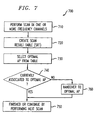
- FIG. 7 is a flow chart describing an exemplary implementation of a roaming process 700 incorporating features of the present invention.
- the roaming process 700 of FIG. 7 may run continuously or may be triggered by one or more events, such as a lost connection, a poor SNR to the current access point or a high correlation to the current access point.
- a scan is performed during step 710 in one or more frequency channels, as discussed further below in conjunction with FIG. 8 .
- the station collects information about the various access points that it detects.
- a scan result table (SRT) is created during step 720 to store the information obtained during the scan.
- SRT scan result table
- the scan result table may contain, for example, for each access point, the operating channel, BSSID, AP capabilities, SNR value and network load in the cell.
- the station also stores the value of the correlation factor in an additional column in the scan result table.
- the station should also store the number of antennas the AP supports.
- the roaming process will then select an access point from the scan result table during step 730 that allows the best possible performance.
- the selection criteria may be based, for example, on the experienced SNR, the network load of the various APs and certain capabilities of the AP (e.g., whether legacy stations are allowed to associate).
- the present invention adds the correlation factor and the maximum number of antennas to the selection process. As such, the station will try to connect to the AP with the highest possibility of good-quality MIMO communication.
- a test is performed during step 740 to determine if the station is already connected to the optimal access point. If the station is not already connected to the optional access point, the roaming process 700 will hand over the station to the optimal access point during step 760. If it is already connected to the optimal AP, the roaming process (or the current iteration of the process) is terminated during step 750.
- FIG. 8 illustrates an exemplary frame format 800 employed by the roaming process 700 to transmit probe requests to the access points. Since MIMO stations and access points will work in an environment that also contains legacy stations (for example, based on either IEEE 802.11a or IEEE 802.11g), it is important that the access point and station (in BSS mode) communicate whether they are MIMO enabled.
- the short training (ST) symbol contains 160 samples and is repeated ten times; the long training (LT) symbol contains 160 samples and is repeated 2.5 times; and the signal field (SIG ) contains 80 samples.
- ST short training
- LT long training
- SIG signal field
- the station periodically broadcasts a probe request frame 800 on a specific channel, as shown in FIG. 8 .
- the station reports the Service Set IDentifier (SSID, the network identifier) it wants to connect to and the set of supported data rates, i.e., the rates at which the station can transmit and receive.
- SSID Service Set IDentifier
- access points that receive the request and that serve the specified SSID, reply with a probe response (shown in FIG. 9 ) in which the access point reports the supported data rates.
- the probe request frame 810 should include a field that identifies the MIMO modes that the station supports, e.g., the number of transmit and receive antennas with an independent receive path.
- the frame can either be sent on a MIMO data rate with high range (robustness) or on a legacy non-MIMO data rate.
- the prior option may have an improved range-performance compared to the legacy rate, but the latter has the benefit that legacy APs will respond as well.
- the MIMO mode and/or data rate should be mandatory for the applicable standard, to assure that all APs that support the standard can receive and decode the frame.
- FIG. 9 illustrates an exemplary frame format 900 employed by the access points to transmit probe responses.
- the probe response frames are directed at the transmitter of the request frame.
- the first part of the preamble consists of the 802.11a/g preamble, which enables legacy terminals to back off for the length of the transmission.
- an extra signal field and the maximum number of training symbols (corresponding to the maximum number of transmitter antennas of the access point) is transmitted, followed by the information about the access point, e.g., fields of the response frame, transmitted in either a legacy or MIMO mode that is optimized for range and not for throughput.
- the access point should send training symbols on all of its antennas, so that the receiver can calculate the correlation.
Landscapes
- Engineering & Computer Science (AREA)
- Computer Networks & Wireless Communication (AREA)
- Signal Processing (AREA)
- Computer Security & Cryptography (AREA)
- Mobile Radio Communication Systems (AREA)
- Small-Scale Networks (AREA)
Description
- The present invention relates generally to wireless communication systems, such as wireless local area networks (LANs), and more particularly, to data rate control techniques in such wireless communication systems.
- In a typical wireless network environment, such as a wireless local area network (LAN), a number of wireless stations communicate over one or more wireless channels, An access point typically provides control and management functions. The access point acts as a central node through which all traffic is relayed. Many wireless networks are implemented in accordance with the IEEE 802.11 standard or the various extensions to the 802.11 standard, such as 802.11 a, b and g, or the HIPERLAN/2 standard. The IEEE 802.11 protocol specifies that all communications are relayed via the access point, so each transmission that is of interest (other access points may be active on the same radio channel) is from the access point the station is associated with.
-
WO 03/034642 -
US Patent No. 6,473,467 discloses that channel state information (CSI) can be used by a communications system to precondition transmissions between transmitter units and receiver units. In one aspect of the invention, disjoint sub-channel sets are assigned to transmit antennas located at a transmitter unit. Pilot symbols are generated and transmitted on a subset of the disjoint sub-channels. Upon receipt of the transmitted pilot symbols, the receiver units determine the CSI for the disjoint sub-channels that carried pilot symbols. These CSI values are reported to the transmitter unit, which will use these CSI values to generate CSI estimates for the disjoint sub-channels that did not carry pilot symbols. The amount of information necessary to report CSI on the reverse link can be further minimised through compression techniques and resource allocation techniques. - Typically, every station, including those that are already associated with an access point, scans the surroundings from time to time in order to find the number of surrounding access points and the quality of the radio link to those access points. The station uses this information to select the access point with the best quality link. If the station is not already connected to the access point with the best link, the station tries to associate with the new access point. In existing systems, the quality of the link is currently based only on the SNR value of the link. A need exists for an improved method and apparatus for selecting an access point in wireless communication systems, such as wireless LANs.
- Generally, a method and apparatus are provided for access point selection in wireless communication systems, such as wireless LANs. In one aspect the invention provides a wireless communication device according to
claim 1. In one embodiment, the roaming process selects an access point having the lowest correlation value. The roaming process may also consider the signal quality, channel delay spread or both in selecting an access point. In another aspect the invention provides a method according to claim 4. - A more complete understanding of the present invention, as well as further features and advantages of the present invention, will be obtained by reference to the following detailed description and drawings.
-
-
FIG. 1 illustrates a wireless network environment in which the present invention can operate; -
FIG. 2 is a schematic block diagram of an exemplary station ofFIG. 1 incorporating features of the present invention; -
FIG. 3 illustrates a network environment for a wireless LAN system; -
FIG. 4 is a schematic block diagram of an exemplary transmitter/receiver station incorporating features of the present invention; -
FIG. 5 illustrates the influence of signal-to-noise ratio (SNR) and channel correlation on the performance of a MIMO based OFDM wireless device; -
FIG. 6 illustrates bit error rate performance as function of SNR for an exemplary two transmitter and two receiver (2x2) configuration with a correlation, p, equal to 0; -
FIG. 7 is a flow chart describing an exemplary roaming process ofFIG. 4 incorporating features of the present invention; -
FIG. 8 illustrates a frame format employed by the roaming process ofFIG. 7 to transmit probe requests; and -
FIG. 9 illustrates a frame format employed by the access points to transmit probe responses. -
FIG. 1 illustrates awireless network environment 100 in which the present invention can operate. Thewireless network environment 100 may be, for example, a wireless LAN or a portion thereof. As shown inFIG. 1 , a number of stations 200-1 through 200-N, collectively referred to asstations 200 and discussed below in conjunction withFIG. 2 , communicate over one or more wireless channels in the wirelessdigital communication system 100. Anaccess point 120 is typically connected to awired distribution network 105 with other access points (not shown). Theaccess point 120 typically provides control and management functions, in a known manner. In addition, theaccess point 120 acts as a central node through which all traffic is relayed so that thestations 200 can rely on the fact that transmissions will originate from theaccess point 120. Thewireless network environment 100 may be implemented, for example, in accordance with the IEEE 802.11 standard or the various extensions to the 802.11 standard, such as 802.11a, b and g, or the HIPERLAN/2 standard. - The IEEE 802.11 protocol specifies that all communications are relayed via the
access point 120, so each transmission that is of interest (other access points 120 may be active on the same radio channel) is from theaccess point 120 thestations 200 is associated with. An example of such a communications protocol is the Enhanced Service Set (ESS) mode of the IEEE 802.11 protocol, in whichstations 200 are associated with anaccess point 120 that relays all communication. - The
access point 120 andwireless stations 200 exchange frames containing information on the transmit power level limits. At theaccess point 120, the country information is available once the network administrator has configured theaccess point 120 for country selection. Astation 200 receives the information from itsaccess point 120. The frame format for exchanging transmit power level limits is described, for example, in IEEE, "Supplement to Standard for Telecommunications and Information Exchange Between Systems-LAN/MAN Specific Requirements- Part 11: Wireless MAC and PHY Specifications: Spectrum and Transmit Power Management Extensions in the 5 GHz band in Europe," P802.11h/D2.0 (March 2002). -
FIG. 2 illustrates an exemplary conventional MIMO environment in which the present invention can operate. As shown inFIG. 2 , an exemplaryconventional MIMO system 200 comprises source signals S1 to SNt, transmitters TX1 to TXNt , transmit antennas 210-1 through 210-Nt, receive antennas 215-1 through 215-Nr, and receivers RX1 to RXNr . TheMIMO system 200 transmits separate data streams on themultiple transmit antennas 210, and each receiver RX receives a combination of these data streams. - As used herein, the term "MIMO" shall mean a system in which there are multiple transmission layers, i.e., several distinguishable streams are transmitted from different antennas into the same frequency channel. It is noted that there could be one or more receive antennas in various configurations to receive such a MIMO transmission. In typical implementations for rate enhancement, there will be as many receive antennas as transmit antennas, or more receive antennas than transmit antennas.
- The performance of MIMO systems relies on the provided scattering in the wireless channel. When this scattering is poor and the correlation (i.e., spatial channel correlation) between the various channel elements exceeds a predefined threshold, the system is not able to increase the data rate using the multiple antennas. The scattering depends on the surrounding environment of both the transmitter and the receiver (or access point (AP) and station (STA)).
-
FIG. 3 illustrates a network environment for awireless LAN system 300. As shown inFIG. 3 , in a wireless network environment, a station (STA) will generally be able to connect to one or more Access Points (APs). The number of available access points will only increase as network deployment becomes more dense in the future. While the channel elements (H) between one access point and one station might be highly correlated, the channel elements between that same station and another access point might show better correlation properties. When the station can select a connection with the second access point, the possibility of a successful (high rate) transmission will be higher. For example, as shown inFIG. 3 , thestation 310 can have a connection with access points AP1, AP2 or AP3. - According to one aspect of the invention, a
roaming process 700, discussed below in conjunction withFIG. 7 , selects an access point for a given station using correlation information. - As previously indicated, the
roaming process 700 selects an access point based on the correlation between the station and an access point. One measure for the correlation is the set of eigenvalues corresponding to the MIMO channel, which can be estimated from the channel response. In addition, the performance of a MIMO link also relies heavily on the signal-to-noise-ratio (SNR) or channel delay spread. The SNR can be estimated from the preamble of the packet or from previously received packets. This estimation of the MIMO channel is in all cases necessary to do successful recovery of transmitted data. Another measure for the quality of a link is the percentage of packets that are transmitted and received by their destinations with or without errors, which can, for example, be determined from the number of missed or received acknowledgements, respectively. The present invention allows a roaming station to select a new access point using correlation information. -
FIG. 4 is a schematic block diagram of an exemplary transmitter/receiver station 400 incorporating features of the present invention. Thestations 400 may each be embodied, for example, as personal computer devices, or any device having a wireless communication capability, such as a cellular telephone, personal digital assistant or pager, as modified herein to provide the features and functions of the present invention. - As shown in
FIG. 4 , anexemplary station 400 includes aroaming process 700, discussed further below in conjunction withFIG. 7 . In addition, a transmitter/receiver 400 includes a Medium Access Controller (MAC) 405 that controls the transmission of data. In the exemplary embodiment, theMAC 405 includes theroaming process 700. In an alternate implementation, theroaming process 700 can be implemented by a separate device that interacts with theMAC 405. Generally, theroaming process 700 selects an access point to be used by thestation 400. Thebaseband processor 420 provides the signal to theRF circuitry 430, which in turn, provides the signal to one or more antennas 440-1 through 440-N, in a known manner. -
FIG. 5 illustrates the influence of the SNR and channel correlation on the performance of a MIMO based OFDM wireless device.FIG. 5 illustrates the bit-error-rate (BER) performance 500 of a two transmitter and two receiver (2x2) extension of an IEEE 802.11a system. The exemplary system uses 64 QAM modulation, a coding rate of 0.75, yielding a data rate of 108 (2 x 54) Mbps. The correlation in the MIMO channel is modeled as described in A. van Zelst and J.S. Hammerschmidt, "A Single Coefficient Spatial Correlation Model for Multiple-Input Multiple-Output (MIMO) Radio Channels," Proc. URSI XXVII General Assembly, 17-24 August 2002, 1-4 (2002). - Here, ρ is the parameter modeling the correlation, varying from 0 to 1. In particular, ρ equal to 0 corresponds to fully uncorrelated while ρ equal to 1 corresponds to fully correlated. A Rayleigh faded exponentional decaying power-delay-profile is applied. Generally, as shown in
FIG. 5 , the performance increases (i.e., the BER decreases) when the SNR increases and the performance decreases when the correlation factor increases. -
FIG. 6 illustrates theBER performance 600 as function of the SNR for a two transmitter and two receiver (2x2) configuration with a correlation, ρ, equal to 0. The different data rates 610-1 through 610-6 correspond to rates of 12, 24, 48, 72, 108 Mbps, respectively. The different rates 610-1 through 610-6 are achieved by varying the coding rate and modulation (as also done in 802.11a/g). As shown inFIG. 6 , the BER performance is a function of the SNR and data rate. If the receiver is operating at a certain SNR, the data rate can be chosen which achieves the required BER performance.FIG. 6 demonstrates the influence of the modulation and coding rate on the BER performance and SNR requirements. - The SNR of the wireless channels with the other terminals can be estimated by using the preamble of received packets. This can be done using the Long Training (LT) symbols in the preamble of any received packet. The long training symbols, for example, as proposed in IEEE Std 802.11 a, High-speed Physical Layer in the 5 GHz Band (1999), are a repetition of a symbol and a cyclic prefix. After synchronization, the only difference between the two versions of the training symbols is the noise. Thus, subtracting the two symbols gives an estimate of the noise.
- Another, more accurate way, to measure the SNR is using the detected data in the packet(s). From constellation points estimates, using, for example, a Least Squares estimation, the detected constellation points after slicing are subtracted. The result is the error in the estimation, of which the statistics relate to the ratio between the signal and noise level. Another technique for measuring the SNR is to measure the received energy level during packet reception (signal level) and during idle periods on the channel (noise level). A number for the SNR is achieved by subtracting the two values.
- These parameters or a running average over several packets can be stored in a table, to be used in the enhanced roaming and connection control algorithms, as discussed further below.
- The channel correlation, or MIMO correlation, can be estimated from the MIMO channel matrix H. Estimates of the channel are in all cases necessary for systems using coherent detection. There are several proposed measures for this correlation, such as effective degrees of freedom (EDOF) and effective dimensions (ED). These measures are all used to determine how many independent streams of data can be transmitted over the channel.
- The present invention proposes to calculate the eigenvalues (EVs) or Singular Values (SV) of the channel matrix. This can be calculated using a singular value decomposition (SVD). In a fully uncorrelated MIMO channel, these EVs all will have the same value and will be high. In a correlated channel, some EVs will be lower. A good measure for the correlation is thus the maximum value of EVs and the ratio between them.
- The balance between the number of received and missed ACKs can also be calculated. This measure stores the number of received and missed acknowledgements. The number of packets that are used to compute this statistic can be based on all ACKs related to packets transmitted at a given data rate, or the last X packets at a given data rate.
- In current non-MIMO systems, every station, including those that are associated to an access point, scans the surroundings from time to time in order to find the number of surrounding access points and the quality of the radio link to those access points. The station uses this information to select the access point with the best quality link, in a known manner. Then, if the station is not already connected to the access point with the best link, the station tries to associate with the new access point. In existing systems, the quality of the link is currently based only on the SNR value of the link.
- The present invention recognizes that for MIMO systems, the roaming and connection control algorithms can be improved, so that they not only use the SNR but also the channel correlation of the links to select the access point with the best link. In other words, the station tries to associate with the access point with the best combination of SNR and channel correlation. As discussed below in conjunction with
FIG. 7 , the active scanning protocol is enhanced to determine the correlation of the link to other access points than the access point a station is currently associated with. -
FIG. 7 is a flow chart describing an exemplary implementation of aroaming process 700 incorporating features of the present invention. Theroaming process 700 ofFIG. 7 may run continuously or may be triggered by one or more events, such as a lost connection, a poor SNR to the current access point or a high correlation to the current access point. Once theroaming process 700 is initiated, a scan is performed duringstep 710 in one or more frequency channels, as discussed further below in conjunction withFIG. 8 . During the scanning process, the station collects information about the various access points that it detects. Thereafter, a scan result table (SRT) is created duringstep 720 to store the information obtained during the scan. The scan result table may contain, for example, for each access point, the operating channel, BSSID, AP capabilities, SNR value and network load in the cell. According to one aspect of the invention, the station also stores the value of the correlation factor in an additional column in the scan result table. The station should also store the number of antennas the AP supports. - The roaming process will then select an access point from the scan result table during
step 730 that allows the best possible performance. The selection criteria may be based, for example, on the experienced SNR, the network load of the various APs and certain capabilities of the AP (e.g., whether legacy stations are allowed to associate). The present invention adds the correlation factor and the maximum number of antennas to the selection process. As such, the station will try to connect to the AP with the highest possibility of good-quality MIMO communication. - A test is performed during
step 740 to determine if the station is already connected to the optimal access point. If the station is not already connected to the optional access point, theroaming process 700 will hand over the station to the optimal access point duringstep 760. If it is already connected to the optimal AP, the roaming process (or the current iteration of the process) is terminated duringstep 750. -
FIG. 8 illustrates anexemplary frame format 800 employed by theroaming process 700 to transmit probe requests to the access points. Since MIMO stations and access points will work in an environment that also contains legacy stations (for example, based on either IEEE 802.11a or IEEE 802.11g), it is important that the access point and station (in BSS mode) communicate whether they are MIMO enabled. In an exemplary IEEE 802.11 implementation, the short training (ST) symbol contains 160 samples and is repeated ten times; the long training (LT) symbol contains 160 samples and is repeated 2.5 times; and the signal field (SIG ) contains 80 samples. In current networks, access points and stations already communicate the supported data rates during the active scanning process. The present invention proposes to extend this part of the MAC protocol so that it enables MIMO-capable terminals to estimate a measure for spatial channel correlation. - In current systems, the station periodically broadcasts a
probe request frame 800 on a specific channel, as shown inFIG. 8 . In this probe request, the station reports the Service Set IDentifier (SSID, the network identifier) it wants to connect to and the set of supported data rates, i.e., the rates at which the station can transmit and receive. Subsequently, access points that receive the request and that serve the specified SSID, reply with a probe response (shown inFIG. 9 ) in which the access point reports the supported data rates. - In the proposed MIMO network, the probing mechanism needs to be enhanced. The
probe request frame 810 should include a field that identifies the MIMO modes that the station supports, e.g., the number of transmit and receive antennas with an independent receive path. The frame can either be sent on a MIMO data rate with high range (robustness) or on a legacy non-MIMO data rate. The prior option may have an improved range-performance compared to the legacy rate, but the latter has the benefit that legacy APs will respond as well. It is noted that the MIMO mode and/or data rate should be mandatory for the applicable standard, to assure that all APs that support the standard can receive and decode the frame. -
FIG. 9 illustrates anexemplary frame format 900 employed by the access points to transmit probe responses. The probe response frames are directed at the transmitter of the request frame. The first part of the preamble consists of the 802.11a/g preamble, which enables legacy terminals to back off for the length of the transmission. Thereafter, an extra signal field and the maximum number of training symbols (corresponding to the maximum number of transmitter antennas of the access point) is transmitted, followed by the information about the access point, e.g., fields of the response frame, transmitted in either a legacy or MIMO mode that is optimized for range and not for throughput. In either case, the access point should send training symbols on all of its antennas, so that the receiver can calculate the correlation. - It is to be understood that the embodiments and variations shown and described herein are merely illustrative of the principles of this invention and that various modifications may be implemented by those skilled in the art without departing from the scope of the invention.
Claims (6)
- A wireless communication device (200) for selecting an access point in a wireless communication network characterised by:means for identifying one or more surrounding access points; means for evaluating a channel to each of said one or more surrounding access points; anda roaming process (700) having means to select an access point (120) based on a measure of correlation on a channel to one or more surrounding access points, wherein said roaming process selects an access point having a lowest correlation value and wherein said channel correlation is measured using eigenvalues of a channel matrix or singular values of a channel matrix.
- The wireless communication device of claim 1, wherein said roaming process further selects said access point based on current link information.
- The wireless communication device of claim 1, wherein said roaming process is initiated based on a high correlation to a current access point.
- A method for selecting an access point in a wireless communication network, characterised by the steps of:identifying one or more surrounding access points;evaluating a channel to each of said one or more surrounding access points; andselecting an access point based on a measure of correlation on each of said channels to each of said one or more surrounding access points, wherein said selecting step selects an access point having a lowest correlation value, and wherein said channel correlation is measured using eigenvalues of a channel matrix or singular values of a channel matrix.
- The method of claim 4, wherein said selecting step further selects said access point based on current link information.
- The method of claim 4, wherein said selecting step is initiated based on a high correlation to a current access point.
Applications Claiming Priority (4)
| Application Number | Priority Date | Filing Date | Title |
|---|---|---|---|
| US52817103P | 2003-12-09 | 2003-12-09 | |
| US528171P | 2003-12-09 | ||
| US10/949,443 US8983467B2 (en) | 2003-12-09 | 2004-09-24 | Method and apparatus for access point selection using channel correlation in a wireless communication system |
| US949443 | 2004-09-24 |
Publications (3)
| Publication Number | Publication Date |
|---|---|
| EP1542405A2 EP1542405A2 (en) | 2005-06-15 |
| EP1542405A3 EP1542405A3 (en) | 2006-03-08 |
| EP1542405B1 true EP1542405B1 (en) | 2010-07-28 |
Family
ID=34527127
Family Applications (1)
| Application Number | Title | Priority Date | Filing Date |
|---|---|---|---|
| EP04257640A Ceased EP1542405B1 (en) | 2003-12-09 | 2004-12-08 | Access point selection using channel correlation in a wireless communication system |
Country Status (5)
| Country | Link |
|---|---|
| US (1) | US8983467B2 (en) |
| EP (1) | EP1542405B1 (en) |
| JP (1) | JP4597652B2 (en) |
| KR (1) | KR101103907B1 (en) |
| DE (1) | DE602004028333D1 (en) |
Cited By (1)
| Publication number | Priority date | Publication date | Assignee | Title |
|---|---|---|---|---|
| US9603153B2 (en) | 2013-10-24 | 2017-03-21 | Netgear, Inc. | Wireless access point management system and method |
Families Citing this family (21)
| Publication number | Priority date | Publication date | Assignee | Title |
|---|---|---|---|---|
| JP4212548B2 (en) | 2003-12-26 | 2009-01-21 | 株式会社東芝 | Wireless transmission device, wireless reception device, wireless transmission method, and wireless reception method |
| US7742533B2 (en) | 2004-03-12 | 2010-06-22 | Kabushiki Kaisha Toshiba | OFDM signal transmission method and apparatus |
| WO2006049177A1 (en) * | 2004-11-02 | 2006-05-11 | Matsushita Electric Industrial Co., Ltd. | Mobile station device and communication partner selection method |
| JP4589711B2 (en) | 2004-12-14 | 2010-12-01 | 富士通株式会社 | Wireless communication system and wireless communication device |
| US8068550B2 (en) * | 2005-01-28 | 2011-11-29 | Broadcom Corporation | Initiation of a MIMO communication |
| KR100679028B1 (en) * | 2005-01-31 | 2007-02-05 | 삼성전자주식회사 | Channel scanning method of a multiple input multiple output communication device and a multiple input multiple output communication device |
| US20060198330A1 (en) * | 2005-03-07 | 2006-09-07 | Microsoft Corporation | Detection of supported network frequency to enable successful connection to wireless networks |
| US7554962B2 (en) * | 2006-03-20 | 2009-06-30 | Nokia Corporation | Method, mobile station, and software product for access point selection |
| US20070223402A1 (en) * | 2006-03-21 | 2007-09-27 | Shai Waxman | Device, system and method of extended-range wireless communication |
| KR100768753B1 (en) * | 2006-07-10 | 2007-10-19 | 삼성전자주식회사 | Method for scanning an access point on a mobile terminal |
| CN101123802B (en) * | 2006-08-08 | 2012-01-11 | 株式会社Ntt都科摩 | Method and device for selecting access point in wireless LAN |
| US7907562B2 (en) * | 2007-06-20 | 2011-03-15 | Microsoft Corporation | Managing dense wireless access point infrastructures in wireless local area networks |
| US20080320108A1 (en) * | 2007-06-20 | 2008-12-25 | Microsoft Corporation | Management Policies For Dense Wireless Access Point Infrastructures in Wireless Local Area Networks |
| US8588844B2 (en) * | 2010-11-04 | 2013-11-19 | Extricom Ltd. | MIMO search over multiple access points |
| JP6024318B2 (en) * | 2012-09-10 | 2016-11-16 | 富士通株式会社 | Wireless LAN base station, wireless LAN terminal, and packet transfer method |
| CN103237355B (en) * | 2013-04-25 | 2016-02-03 | 京信通信系统(中国)有限公司 | The auto-allocation method of radio communication channel and system |
| FR3030989A1 (en) * | 2014-12-18 | 2016-06-24 | Orange | SYSTEM FOR EVALUATING COMMUNICATION QUALITY IN A WIRELESS NETWORK |
| CN105554815A (en) * | 2015-12-08 | 2016-05-04 | 中国联合网络通信集团有限公司 | Channel distribution method and device |
| EP3410768B1 (en) * | 2016-03-31 | 2022-07-27 | Huawei Technologies Co., Ltd. | Signal transmitting method for terminal apparatus, and terminal apparatus |
| US10715233B2 (en) * | 2017-08-31 | 2020-07-14 | Qualcomm Incorporated | Sounding reference signal (SRS) transmit antenna selection |
| CN122002456A (en) * | 2024-11-04 | 2026-05-08 | 华为技术有限公司 | Communication method, device and storage medium |
Citations (1)
| Publication number | Priority date | Publication date | Assignee | Title |
|---|---|---|---|---|
| WO1998030047A1 (en) * | 1996-12-31 | 1998-07-09 | Arraycomm, Inc. | Channel assignment and call admission control for spatial division multiple access communication systems |
Family Cites Families (18)
| Publication number | Priority date | Publication date | Assignee | Title |
|---|---|---|---|---|
| US6006090A (en) * | 1993-04-28 | 1999-12-21 | Proxim, Inc. | Providing roaming capability for mobile computers in a standard network |
| JP3080204B2 (en) * | 1993-05-12 | 2000-08-21 | 株式会社エヌ・ティ・ティ・ドコモ | Channel switching method during communication of spread spectrum mobile communication |
| JP2001061176A (en) * | 1999-08-20 | 2001-03-06 | Pioneer Electronic Corp | Communication system |
| US6473467B1 (en) * | 2000-03-22 | 2002-10-29 | Qualcomm Incorporated | Method and apparatus for measuring reporting channel state information in a high efficiency, high performance communications system |
| US7088695B1 (en) * | 2000-09-25 | 2006-08-08 | Cisco Technology, Inc. | Packet voting in wireless mobile devices |
| JP2002198861A (en) * | 2000-12-25 | 2002-07-12 | Matsushita Electric Ind Co Ltd | Spread spectrum receiver and spread spectrum receiving method |
| US7222166B2 (en) | 2001-01-25 | 2007-05-22 | Bandspeed, Inc. | Approach for managing communications channels based on performance and transferring functions between participants in a communications arrangement |
| US6771706B2 (en) | 2001-03-23 | 2004-08-03 | Qualcomm Incorporated | Method and apparatus for utilizing channel state information in a wireless communication system |
| US7548506B2 (en) | 2001-10-17 | 2009-06-16 | Nortel Networks Limited | System access and synchronization methods for MIMO OFDM communications systems and physical layer packet and preamble design |
| WO2003069800A1 (en) * | 2002-01-29 | 2003-08-21 | Nokia Corporation | Data transfer method in radio system |
| US20030157934A1 (en) * | 2002-02-01 | 2003-08-21 | Qilian Liang | Method, system, device and computer program product for bandwidth utilization and signal strength-based handover initiation in a wireless communications network |
| JP3920658B2 (en) | 2002-02-25 | 2007-05-30 | 株式会社エヌ・ティ・ティ・ドコモ | Channel assignment method of multi-input multi-output communication system, program and recording medium thereof, and multi-input multi-output receiver |
| US20030162519A1 (en) * | 2002-02-26 | 2003-08-28 | Martin Smith | Radio communications device |
| US6847805B2 (en) * | 2002-03-29 | 2005-01-25 | Lucent Technologies Inc. | Method for closed-loop subspace transmission and reception in a two transmit N-receive antenna system |
| MXPA04010848A (en) | 2002-05-02 | 2005-09-08 | Ipr Licensing Inc | Adaptive pointing for directional antennas. |
| US7133677B2 (en) * | 2003-01-22 | 2006-11-07 | Lucent Technologies Inc. | System and method for establishing and/or maintaining a data session across packet data networks |
| US7218665B2 (en) * | 2003-04-25 | 2007-05-15 | Bae Systems Information And Electronic Systems Integration Inc. | Deferred decorrelating decision-feedback detector for supersaturated communications |
| US7082301B2 (en) * | 2003-09-12 | 2006-07-25 | Cisco Technology, Inc. | Method and system for triggering handoff of a call between networks |
-
2004
- 2004-09-24 US US10/949,443 patent/US8983467B2/en not_active Expired - Fee Related
- 2004-12-08 EP EP04257640A patent/EP1542405B1/en not_active Ceased
- 2004-12-08 KR KR1020040102824A patent/KR101103907B1/en not_active Expired - Fee Related
- 2004-12-08 DE DE602004028333T patent/DE602004028333D1/en not_active Expired - Lifetime
- 2004-12-09 JP JP2004356518A patent/JP4597652B2/en not_active Expired - Fee Related
Patent Citations (1)
| Publication number | Priority date | Publication date | Assignee | Title |
|---|---|---|---|---|
| WO1998030047A1 (en) * | 1996-12-31 | 1998-07-09 | Arraycomm, Inc. | Channel assignment and call admission control for spatial division multiple access communication systems |
Cited By (1)
| Publication number | Priority date | Publication date | Assignee | Title |
|---|---|---|---|---|
| US9603153B2 (en) | 2013-10-24 | 2017-03-21 | Netgear, Inc. | Wireless access point management system and method |
Also Published As
| Publication number | Publication date |
|---|---|
| JP4597652B2 (en) | 2010-12-15 |
| US20050124340A1 (en) | 2005-06-09 |
| JP2005176379A (en) | 2005-06-30 |
| KR20050056143A (en) | 2005-06-14 |
| EP1542405A2 (en) | 2005-06-15 |
| US8983467B2 (en) | 2015-03-17 |
| KR101103907B1 (en) | 2012-01-12 |
| DE602004028333D1 (en) | 2010-09-09 |
| EP1542405A3 (en) | 2006-03-08 |
Similar Documents
| Publication | Publication Date | Title |
|---|---|---|
| US8983467B2 (en) | Method and apparatus for access point selection using channel correlation in a wireless communication system | |
| KR101433967B1 (en) | Method of providing information for ap selection | |
| EP2015467B1 (en) | Method for selecting antennas in OFDMA wireless network | |
| AU2005285278B2 (en) | Measurement support for a smart antenna in a wireless communication system | |
| CN102946265B (en) | For the method and system of switched antenna and channel allocation in broadband wireless network | |
| US7489652B2 (en) | Method of communications between MIMO stations | |
| CA2583075C (en) | Apparatus and method for receiving packet data on a subset of carrier frequencies in a wireless communication system | |
| US8279744B2 (en) | Method of selecting antennas and transmitting data in multi-input multi-output wireless local area network environments | |
| EP1542385A2 (en) | Method and apparatus for automatic data rate control using channel correlation in a wireless communication system | |
| JP2004222260A (en) | Link adaptation method, wireless communication system and receiver | |
| HK1238413B (en) | Measurement support for a smart antenna in a wireless communication system | |
| AU2013216660A1 (en) | Measurement Support for a Smart Antenna in a Wireless Communication System | |
| HK1181200A (en) | Method and system for switching antenna and channel assignments in broadband wireless networks | |
| HK1167048A (en) | Measurement support for a smart antenna in a wireless communication system | |
| HK1108225A (en) | Measurement support for a smart antenna in a wireless communication system |
Legal Events
| Date | Code | Title | Description |
|---|---|---|---|
| PUAI | Public reference made under article 153(3) epc to a published international application that has entered the european phase |
Free format text: ORIGINAL CODE: 0009012 |
|
| AK | Designated contracting states |
Kind code of ref document: A2 Designated state(s): AT BE BG CH CY CZ DE DK EE ES FI FR GB GR HU IE IS IT LI LT LU MC NL PL PT RO SE SI SK TR |
|
| AX | Request for extension of the european patent |
Extension state: AL BA HR LV MK YU |
|
| RIC1 | Information provided on ipc code assigned before grant |
Ipc: 7H 04L 12/28 A Ipc: 7H 04Q 7/38 B Ipc: 7H 04B 7/02 B |
|
| PUAL | Search report despatched |
Free format text: ORIGINAL CODE: 0009013 |
|
| AK | Designated contracting states |
Kind code of ref document: A3 Designated state(s): AT BE BG CH CY CZ DE DK EE ES FI FR GB GR HU IE IS IT LI LT LU MC NL PL PT RO SE SI SK TR |
|
| AX | Request for extension of the european patent |
Extension state: AL BA HR LV MK YU |
|
| 17P | Request for examination filed |
Effective date: 20060823 |
|
| 17Q | First examination report despatched |
Effective date: 20061010 |
|
| AKX | Designation fees paid |
Designated state(s): DE GB |
|
| GRAP | Despatch of communication of intention to grant a patent |
Free format text: ORIGINAL CODE: EPIDOSNIGR1 |
|
| RIC1 | Information provided on ipc code assigned before grant |
Ipc: H04W 48/18 20090101AFI20100107BHEP |
|
| GRAS | Grant fee paid |
Free format text: ORIGINAL CODE: EPIDOSNIGR3 |
|
| GRAA | (expected) grant |
Free format text: ORIGINAL CODE: 0009210 |
|
| AK | Designated contracting states |
Kind code of ref document: B1 Designated state(s): DE GB |
|
| REG | Reference to a national code |
Ref country code: GB Ref legal event code: FG4D |
|
| REF | Corresponds to: |
Ref document number: 602004028333 Country of ref document: DE Date of ref document: 20100909 Kind code of ref document: P |
|
| PLBE | No opposition filed within time limit |
Free format text: ORIGINAL CODE: 0009261 |
|
| STAA | Information on the status of an ep patent application or granted ep patent |
Free format text: STATUS: NO OPPOSITION FILED WITHIN TIME LIMIT |
|
| 26N | No opposition filed |
Effective date: 20110429 |
|
| REG | Reference to a national code |
Ref country code: DE Ref legal event code: R097 Ref document number: 602004028333 Country of ref document: DE Effective date: 20110429 |
|
| PGFP | Annual fee paid to national office [announced via postgrant information from national office to epo] |
Ref country code: DE Payment date: 20151119 Year of fee payment: 12 Ref country code: GB Payment date: 20151125 Year of fee payment: 12 |
|
| REG | Reference to a national code |
Ref country code: DE Ref legal event code: R082 Ref document number: 602004028333 Country of ref document: DE Representative=s name: DILG HAEUSLER SCHINDELMANN PATENTANWALTSGESELL, DE Ref country code: DE Ref legal event code: R081 Ref document number: 602004028333 Country of ref document: DE Owner name: AVAGO TECHNOLOGIES GENERAL IP (SINGAPORE) PTE., SG Free format text: FORMER OWNER: AGERE SYSTEMS, INC., ALLENTOWN, PA., US |
|
| REG | Reference to a national code |
Ref country code: DE Ref legal event code: R082 Ref document number: 602004028333 Country of ref document: DE Representative=s name: DILG HAEUSLER SCHINDELMANN PATENTANWALTSGESELL, DE Ref country code: DE Ref legal event code: R081 Ref document number: 602004028333 Country of ref document: DE Owner name: AVAGO TECHNOLOGIES GENERAL IP (SINGAPORE) PTE., SG Free format text: FORMER OWNER: AGERE SYSTEMS LLC (N.D.GES.D. STAATES DELAWARE), ALLENTOWN, PA., US |
|
| REG | Reference to a national code |
Ref country code: DE Ref legal event code: R119 Ref document number: 602004028333 Country of ref document: DE |
|
| GBPC | Gb: european patent ceased through non-payment of renewal fee |
Effective date: 20161208 |
|
| PG25 | Lapsed in a contracting state [announced via postgrant information from national office to epo] |
Ref country code: GB Free format text: LAPSE BECAUSE OF NON-PAYMENT OF DUE FEES Effective date: 20161208 Ref country code: DE Free format text: LAPSE BECAUSE OF NON-PAYMENT OF DUE FEES Effective date: 20170701 |