EP1542075A1 - Composition for antireflection film formation - Google Patents
Composition for antireflection film formation Download PDFInfo
- Publication number
- EP1542075A1 EP1542075A1 EP03741346A EP03741346A EP1542075A1 EP 1542075 A1 EP1542075 A1 EP 1542075A1 EP 03741346 A EP03741346 A EP 03741346A EP 03741346 A EP03741346 A EP 03741346A EP 1542075 A1 EP1542075 A1 EP 1542075A1
- Authority
- EP
- European Patent Office
- Prior art keywords
- reflective coating
- composition
- compound
- forming
- group
- Prior art date
- Legal status (The legal status is an assumption and is not a legal conclusion. Google has not performed a legal analysis and makes no representation as to the accuracy of the status listed.)
- Withdrawn
Links
Classifications
-
- G—PHYSICS
- G03—PHOTOGRAPHY; CINEMATOGRAPHY; ANALOGOUS TECHNIQUES USING WAVES OTHER THAN OPTICAL WAVES; ELECTROGRAPHY; HOLOGRAPHY
- G03F—PHOTOMECHANICAL PRODUCTION OF TEXTURED OR PATTERNED SURFACES, e.g. FOR PRINTING, FOR PROCESSING OF SEMICONDUCTOR DEVICES; MATERIALS THEREFOR; ORIGINALS THEREFOR; APPARATUS SPECIALLY ADAPTED THEREFOR
- G03F7/00—Photomechanical, e.g. photolithographic, production of textured or patterned surfaces, e.g. printing surfaces; Materials therefor, e.g. comprising photoresists; Apparatus specially adapted therefor
- G03F7/004—Photosensitive materials
- G03F7/09—Photosensitive materials characterised by structural details, e.g. supports, auxiliary layers
- G03F7/091—Photosensitive materials characterised by structural details, e.g. supports, auxiliary layers characterised by antireflection means or light filtering or absorbing means, e.g. anti-halation, contrast enhancement
-
- G—PHYSICS
- G03—PHOTOGRAPHY; CINEMATOGRAPHY; ANALOGOUS TECHNIQUES USING WAVES OTHER THAN OPTICAL WAVES; ELECTROGRAPHY; HOLOGRAPHY
- G03F—PHOTOMECHANICAL PRODUCTION OF TEXTURED OR PATTERNED SURFACES, e.g. FOR PRINTING, FOR PROCESSING OF SEMICONDUCTOR DEVICES; MATERIALS THEREFOR; ORIGINALS THEREFOR; APPARATUS SPECIALLY ADAPTED THEREFOR
- G03F7/00—Photomechanical, e.g. photolithographic, production of textured or patterned surfaces, e.g. printing surfaces; Materials therefor, e.g. comprising photoresists; Apparatus specially adapted therefor
- G03F7/004—Photosensitive materials
- G03F7/09—Photosensitive materials characterised by structural details, e.g. supports, auxiliary layers
- G03F7/11—Photosensitive materials characterised by structural details, e.g. supports, auxiliary layers having cover layers or intermediate layers, e.g. subbing layers
-
- H—ELECTRICITY
- H10—SEMICONDUCTOR DEVICES; ELECTRIC SOLID-STATE DEVICES NOT OTHERWISE PROVIDED FOR
- H10P—GENERIC PROCESSES OR APPARATUS FOR THE MANUFACTURE OR TREATMENT OF DEVICES COVERED BY CLASS H10
- H10P76/00—Manufacture or treatment of masks on semiconductor bodies, e.g. by lithography or photolithography
- H10P76/20—Manufacture or treatment of masks on semiconductor bodies, e.g. by lithography or photolithography of masks comprising organic materials
- H10P76/204—Manufacture or treatment of masks on semiconductor bodies, e.g. by lithography or photolithography of masks comprising organic materials of organic photoresist masks
- H10P76/2041—Photolithographic processes
- H10P76/2043—Photolithographic processes using an anti-reflective coating
-
- Y—GENERAL TAGGING OF NEW TECHNOLOGICAL DEVELOPMENTS; GENERAL TAGGING OF CROSS-SECTIONAL TECHNOLOGIES SPANNING OVER SEVERAL SECTIONS OF THE IPC; TECHNICAL SUBJECTS COVERED BY FORMER USPC CROSS-REFERENCE ART COLLECTIONS [XRACs] AND DIGESTS
- Y10—TECHNICAL SUBJECTS COVERED BY FORMER USPC
- Y10S—TECHNICAL SUBJECTS COVERED BY FORMER USPC CROSS-REFERENCE ART COLLECTIONS [XRACs] AND DIGESTS
- Y10S430/00—Radiation imagery chemistry: process, composition, or product thereof
- Y10S430/151—Matting or other surface reflectivity altering material
Definitions
- the present invention relates to a composition for forming anti-reflective coating available for reducing an adverse effect due to a reflection of irradiation light for exposing a photoresist applied on a substrate from the substrate, a method of forming an anti-reflective coating by use of the composition, and a process for manufacturing a semiconductor device by use of the composition.
- the micro-processing is a processing method including forming a thin film of a photoresist composition on a substrate to be processed, such as silicon wafer, irradiating actinic rays such as ultraviolet rays through a mask pattern on which a pattern for a semiconductor device is depicted, developing it to obtain a resist pattern, and etching the substrate to be processed, such as silicon wafer using the resist pattern as a protective film.
- inorganic anti-reflective coatings made of titanium, titanium dioxide, titanium nitride, chromium oxide, carbon or ⁇ -silicon, etc. and organic anti-reflective coatings made of a light-absorbing substance and a polymer compound are known.
- the former requires an installation such as a vacuum deposition apparatus, a CVD (chemical vapor deposition) apparatus or a sputtering apparatus.
- CVD chemical vapor deposition
- the physical properties desired for organic anti-reflective coating materials include high absorbance to light and radioactive rays, no intermixing with the photoresist layer (being insoluble in photoresist solvents), no diffusion of low molecular substances from the anti-reflective coating material into the topcoat resist upon coating or heat-drying, and a higher dry etching rate than the photoresist (see, for example, Tom Lynch et al., "Properties and Performance of Near UV Reflectivity Control Layers", US, in Advances in Resist Technology and Processing XI, Omkaram Nalamasu ed., Proceedings of SPIE, 1994, Vol. 2195, p. 225-229; G.
- the present invention was made so as to solve the above-mentioned problems in the prior art.
- a first object of the present invention is to provide a composition for forming anti-reflective coating used for lithography process for manufacturing a semiconductor device.
- a second object of the present invention is to provide a method of forming an anti-reflective coating for lithography which effectively absorbs reflection light from a substrate in case where irradiation light with a wavelength of 248 nm, 193 nm, 157 nm or the like is used for micro-processing, which causes no intermixing with photoresist layers, which affords an excellent photoresist pattern, and which has a high dry etching rate compared with photoresist layers.
- a third object of the present invention is to provide a method for manufacturing a semiconductor device, by which a photoresist pattern is formed by use of the above-mentioned composition for forming anti-reflective coating.
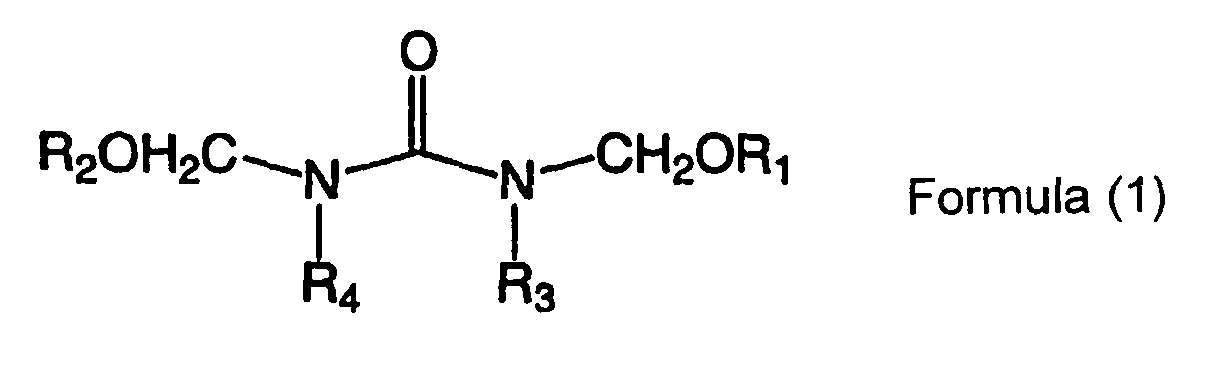
- the invention according to the present claim 1 is a composition for forming anti-reflective coating characterized by containing a compound of formula (1) wherein R 1 and R 2 are independently of each other hydrogen atom or an alkyl group, R 3 and R 4 are independently of each other hydrogen atom, methyl group, ethyl group, hydroxymethyl group or an alkoxymethyl group.
- the invention according to the present claim 2 is a composition for forming anti-reflective coating characterized by containing a resin produced from the compound of formula (1) according to the present claim 1.
- the invention according to the present claim 3 is the composition for forming anti-reflective coating according claim 2, wherein the resin is a condensation product produced from the compound of formula (1).
- the invention according to the present claim 4 is the composition for forming anti-reflective coating according to any one of claims 1 to 3, further containing a light absorbing compound and/or a light absorbing resin.
- the invention according to the present claim 5 is the composition for forming anti-reflective coating according to claim 4, wherein the light absorbing compound is at least one compound selected from naphthalene compounds and anthracene compounds.
- the invention according to the present claim 6 is the composition for forming anti-reflective coating according to claim 4, wherein the light absorbing compound is at least one compound selected from triazine compounds and triazine trione compounds.
- the invention according to the present claim 7 is the composition for forming anti-reflective coating according to claim 4, wherein the light absorbing resin is a resin having in the structure at least one aromatic ring structure selected from benzene ring, naphthalene ring and anthracene ring.
- the invention according to the present claim 8 is the composition for forming anti-reflective coating according to any one of claims 1 to 3, further containing a resin having at lease one crosslink-forming substituent selected from hydroxy group, carboxy group, amino group and thiol group.
- the invention according to the present claim 9 is the composition for forming anti-reflective coating according to any one of claims 1 to 3, further containing an acid and/or acid generator.
- the invention according to the present claim 10 is a method of forming an anti-reflective coating for use in a manufacture of a semiconductor device, characterized by comprising the steps of: coating the composition for forming anti-reflective coating according to any one of claims 1 to 3 on a substrate, and baking it.
- the invention according to the present claim 11 is a process for manufacturing a semiconductor device, characterized by comprising the steps of: coating the composition for forming anti-reflective coating according to any one of claims 1 to 3 on a substrate and baking it to form an anti-reflective coating; forming a photoresist on the anti-reflective coating; exposing the substrate covered with the anti-reflective coating and the photoresist with a light; developing it; transferring an image on the substrate by etching to form an integrated circuit device.
- the composition for forming anti-reflective coating according to the present invention is basically a composition comprising a compound of formula (1) and a solvent, or a composition comprising a resin produced from a compound of formula (1) and a solvent, the composition can contain as arbitrary component a surfactant and the like.
- the composition for forming anti-reflective coating according to the present invention contains preferably 0.1 to 50 mass%, more preferably 0.5 to 30 mass% of solid content.
- the solid content means components other than solvent components in the composition for forming anti-reflective coating.
- the compounds of formula (1) are used as an active ingredient.
- R 1 and R 2 are independently of each other hydrogen atom or an alkyl group
- R 3 and R 4 are independently of each other hydrogen atom, methyl group, ethyl group, hydroxymethyl group or an alkoxymethyl group.
- the alkyl group includes for example methyl group, ethyl group, isopropyl group, n-butyl group, n-hexyl group or the like.
- the alkoxymethyl group includes for example methoxymethyl group, ethoxymethyl group, butoxymethyl group or the like.
- the compound of formula (1) may be used alone or a mixture of two or more the compounds of formula (1).
- the composition for forming anti-reflective coating contains the compound of formula (1) in an amount of preferably 10 mass% or more, more preferably 50 to 99 mass%, and most preferably 60 to 95 mass% based on 100 mass% of the total solid content.
- the compound of formula (1) can be obtained by subjecting urea or methylurea, etc. to methylolation by reaction of it with formalin in boiling water.
- a basic catalyst such as sodium hydroxide, potassium hydroxide, tetramethylammonium hydroxide or the like can be used.
- the compound of formula (1) can be also obtained by subjecting the compound obtained by methylolation of urea or methylurea, etc. to alkoxyalkylation by reaction of it with alcohol such as methanol, ethanol, isopropanol, n-hexanol or the like.
- an acid catalyst such as hydrochloric acid, sulfuric acid, methanesulfonic acid or the like can be used.
- resins produced from the compounds of formula (1) can be also used.
- the resins include resins produced by a condensation reaction of the compound of formula (1) with a compound that can be condensed with the compound of formula (1), and resins being condensation products produced by condensation reaction between the compounds of formula (1). These resins have preferably a weight average molecular weight of 100 to 1,000,000, more preferably 200 to 500,000.
- the resin produced from the compound of formula (1) can be used alone or in a mixture of two or more.
- the composition for forming anti-reflective coating according to the present invention contains the resin produced from the compound of formula (1) in an amount of preferably 10 mass% or more, more preferably 50 to 99 mass%, and most preferably 60 to 95 mass% based on 100 mass% of the total solid content.
- These resins can be obtained by subjecting to condensation reaction between the compounds of formula (1) or by mixing the compound of formula (1) with a compound that can be condensed with the compound of formula (1), and subjecting the mixture to condensation reaction by heating.
- the condensation reaction is preferably carried out in the state of solution obtained by dissolving the compounds of formula (1) or the compound of formula (1) and a compound that can be condensed with the compound of formula (1) in an organic solvent such as benzene, toluene, xylene, ethyl lactate, butyl lactate, propylene glycol monomethyl ether, propylene glycol monomethyl ether acetate, N-methyl pyrrolidone or the like.
- an inorganic acid such as hydrochloric acid, sulfuric acid, phosphoric acid or the like
- an organic acid such as formic acid, acetic acid, methane sulfonic acid, toluene sulfonic acid or the like
- the reaction temperature or reaction time of the condensation reaction depends on compounds to be used, the degree of polymerization or the molecular weight of the aimed resin, or the like, and the reaction time may be selected from the region from 0.1 hour to 100 hours, and the reaction temperature may be selected from the region from 20°C to 200°C.
- an acid catalyst it can be used in an amount of 0.001 to 50 mass% based on the total mass of the used compounds.
- the proportion of the compound of formula (1) and a compound that can be condensed with the compound of formula (1) is not specifically limited, and the compound of formula (1) is contained in an amount of preferably 30 mass% or more, more preferably 50 mass%, most preferably 70 mass% based on the total mass of the compound of formula (1) and a compound that can be condensed with the compound of formula (1) in consideration of a protection effect against light reflection, attenuation coefficient, etching rate, or the like of the anti-reflective coating prepared by using the resins.
- a compound having a substituent that can be condensed with the compound of formula (1) such as hydroxy group, carboxyl group, amino group, alkoxymethyl group or the like can be used.
- the compound includes for example a compound having hydroxy group, such as ethylene glycol, propylene glycol, arabitol, cyclohexane diol, poly(2-hydroxyethyl) methacrylate, phenol novolak, tris(2-hydroxyethyl) triazine trione, naphthol, benzyl alcohol, 9-hydroxymethylanthracene or the like; a compound having carboxyl group, such as maleic acid, phthalic acid, malonic acid, benzoic acid, naphthalene carboxylic acid, 9-anthracene carboxylic acid or the like; a compound having amino group, such as ethylenediamine, amino anthracene, aniline, hexamethylenediamine or
- the compound of formula (1) and the resin produced therefrom include also commercially available products such as methylated urea resin manufactured by Mitsui Cytec Co., Ltd. (trade name: UFR65), butylated urea resin (trade name: UFR300, U-VAN10S60, U-VAN10R, U-VAN11HV), butylated urea melamine resin (U-VAN132, U-VAN135, U-VAN136, U-VAN55); urea/formaldehyde resin manufactured by Dainippon Ink and Chemicals Inc. (high condensed type, trade name: Bekkamin J-300S, Bekkamin P-955, Bekkamin N) or the like.
- UFR65 methylated urea resin manufactured by Mitsui Cytec Co., Ltd.
- butylated urea resin trade name: UFR300, U-VAN10S60, U-VAN10R, U-VAN11HV
- the resin produced from the compound of formula (1) and a compound that can be condensed with the compound of formula (1) for example the resin produced by condensation of tetrabutoxy methyl urea being a compound of formula (1) with hexamethoxymethylmelamine being a compound that can be condensed with the compound of formula (1), it is assumed that the condensation occurs at the butoxymethyl moiety or methoxymethyl moiety and that the resulting resin has the structure of formula (3) in which the urea moiety and the melamine moiety are linked through -CH 2 - or -CH 2 OCH 2 -.
- composition for forming anti-reflective coating according to the present invention may contain a combination of the compound of formula (1) with the resin that can be produced from the compound of formula (1).
- the composition for forming anti-reflective coating may contain such a combination in an amount of preferably 10 mass% or more, more preferably 50 to 99 mass%, most preferably 60 to 95 mass% based on 100 mass% of the total solid content.
- Light absorbing compounds or light absorbing resins can be added to the composition for forming anti-reflective coating according to the present invention.
- the addition of the light absorbing compounds or light absorbing resins enables the adjustment of characteristics such as refractive index, attenuation coefficient, etching rate or the like of the anti-reflective coating formed from the composition for forming anti-reflective coating according to the present invention.
- These light absorbing compounds or light absorbing resins include ones having a high absorptivity to a light in photosensitive characteristics wavelength region of the photosensitive component in the photoresist layer formed on the anti-reflective coating and preventing standing wave due to reflection from the substrate or random reflection due to unevenness on the surface of substrate.
- the light absorbing resin used has a weight average molecular weight of preferably 500 to 1,000,000, more preferably 500 to 500,000.
- the light absorbing compound or light absorbing resin can be used alone or in a mixture of two or more.
- the amount of the light absorbing compound or light absorbing resin in the composition for forming anti-reflective coating according to the present invention is preferably 0.01 mass% or more, more preferably 1 to 90 mass%, further preferably 1 to 50 mass%, most preferably 5 to 40 mass% based on 100 mass% of the total solid content.
- the light absorbing compound for example the following compounds can be used: benzophenone compounds, benzotriazole compounds, azo compounds, naphthalene compounds, anthracene compounds, anthraquinone compounds, triazine compounds, triazine trione compounds, quinoline compounds or the like. Naphthalene compounds, anthracene compounds, triazine compounds and triazine trione compounds are preferably used.
- naphthalene compound having at least one hydroxy group, amino group or carboxy group in the molecule, and anthracene compound having at least one hydroxy group, amino group or carboxy group in the molecule are preferably used.
- the naphthalene compound having at least one hydroxy group, amino group or carboxy group in the molecule includes 1-naphthalene carboxylic acid, 2-naphthalene carboxylic acid, 1-naphthol, 2-naphthol, 1-aminonaphthalene, naphthyl acetic acid, 1-hydroxy-2-naphthalene carboxylic acid, 3-hydroxy-2-naphthalene carboxylic acid, 3,7-dihydroxy-2-naphthalene carboxylic acid, 6-bromo-2-hydroxynaphthalene, 2,6-naphthalene dicarboxylic acid or the like.
- the anthracene compound having at least one hydroxy group, amino group or carboxy group in the molecule includes 9-anthracene carboxylic acid, 9-hydroxymethylanthracene, 1-aminoanthracene or the like.
- triazine compound or triazine trione compound can be used as the light absorbing compound.
- the triazine compound includes for example melamine containing at least one methoxymethyl group or benzoguanamine compounds, concretely for example hexamethoxy methyl melamine and tetramethoxy methyl benzoguanamine.
- the triazine trione compound includes compounds of formula (5) wherein X is a group of (a) to (g).
- the resins having in the structure an aromatic ring structure such as benzene ring, naphthalene ring or anthracene ring, or a hetero aromatic ring structure such as pyridine ring, quinoline ring, thiophene ring, thiazole ring, triazine ring or oxazole ring can be used.
- aromatic ring structure such as benzene ring, naphthalene ring or anthracene ring
- a hetero aromatic ring structure such as pyridine ring, quinoline ring, thiophene ring, thiazole ring, triazine ring or oxazole ring
- the resins having at least one aromatic ring structure selected from benzene ring, naphthalene ring and anthracene ring in the repeated structural unit can be used.
- the resins having a benzene ring include novolak resins, halogenated novolak resins, polystyrene, polyhydroxy styrene or the like.
- resins containing benzyl acrylate, benzyl methacrylate, styrene, hydroxystyrene or the like as a structural unit may be mentioned.
- Such a resin includes a copolymer of benzyl methacrylate with 2-hydroxypropyl methacrylate, a copolymer of styrene with 2-hydroxyethyl methacrylate, a copolymer of hydroxystyrene with ethyl methacrylate, a terpolymer of benzyl methacrylate, 2-hydroxypropyl methacrylate and ethyl methacrylate, a terpolymer of styrene, 2-hydroxyethyl methacrylate and methyl methacrylate, or the like.
- the resin having a benzene ring includes a resin produced from a melamine compound (trade name: Cymel 303) and benzoguanamine compound (trade name: Cymel 1123), which is described in US Patent No. 6323310.
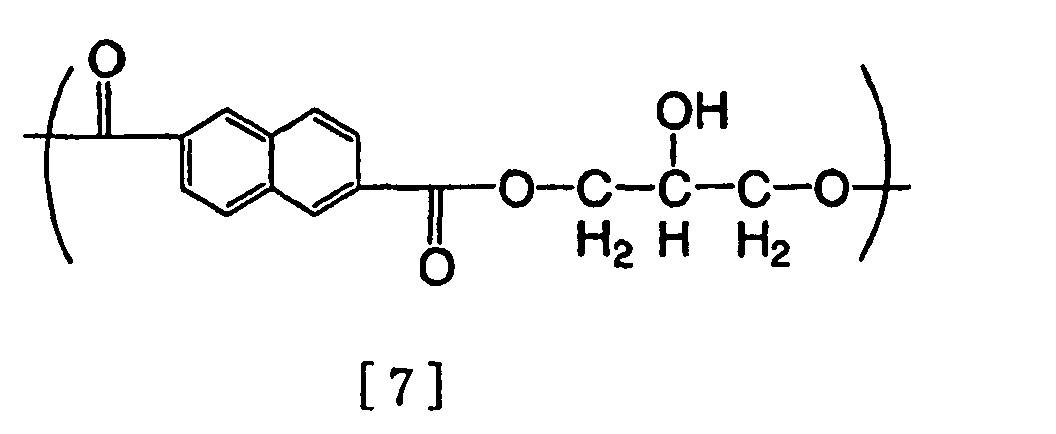
- the resin having a naphthalene ring or an anthracene ring includes for example resins having the following structural units ([1] to [7]):
- the composition for forming anti-reflective coating according to the present invention can further contain a resin having at lease one crosslink-forming substituent selected from hydroxy group, carboxy group, amino group and thiol group.
- a resin having at lease one crosslink-forming substituent selected from hydroxy group, carboxy group, amino group and thiol group enables the adjustment of characteristics such as refractive index, attenuation coefficient, etching rate or the like of the anti-reflective coating formed from the composition for forming anti-reflective coating according to the present invention.
- the resin can include one containing as a structural unit 2-hydroxyethylacrylate, 2-hydroxypropylacrylate, 2-hydroxyethylmethacrylate, 2-hydroxypropylmethacrylate, vinyl alcohol, 2-hydroxyethyl vinyl ether, acrylic acid, methacrylic acid or the like.
- the resin has a weight average molecular weight of preferably 500 to 1,000,000, more preferably 500 to 500,000.
- the amount of the resin in the composition for forming anti-reflective coating is preferably 20 mass% or less, more preferably 15 mass% or less based on 100 mass% of the total solid content.
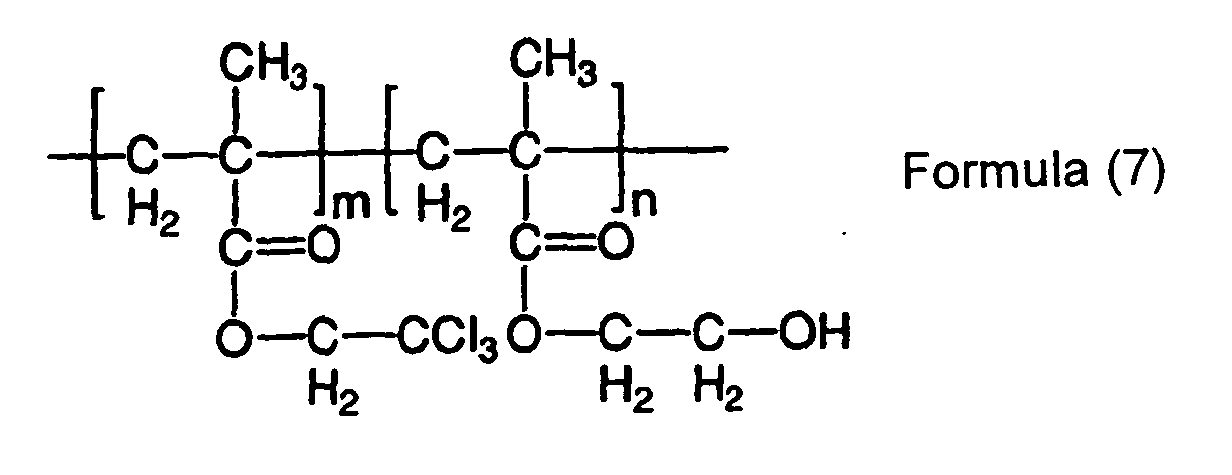
- the resin includes for example poly 2-hydroxyethyl methacrylate, polyvinyl alcohol, polyacrylic acid, a copolymer of 2-hydroxypropyl acrylate with methyl methacrylate, a copolymer of 2-hydroxypropyl acrylate with isopropyl methacrylate, a copolymer of 2-hydroxypropyl methacrylate with 2,2,2-trichloroethyl methacrylate, a copolymer of 2-hydroxypropyl methacrylate with 2,2,2-trifluoroethyl methacrylate, a copolymer of 2-hydroxypropyl methacrylate with 2-chloroethyl methacrylate, a copolymer of 2-hydroxypropyl methacrylate with cyclohexyl methacrylate, a copolymer of 2-hydroxypropyl methacrylate with n-octyl methacrylate, a copolymer of 2-hydroxypropyl methacrylate with vinyl alcohol, a
- the composition for forming anti-reflective coating according to the present invention may contain an acid and/or acid generator.
- the acid or acid generator includes an acid compound such as acetic acid, methane sulfonic acid, trifluoroacetic acid, trifluoromethane sulfonic acid, benzoic acid, toluene sulfonic acid, pyridinium-p-toluene sulfonate, or the like; a thermal acid generator such as 2,4,4,6-tetrabromocyclohexadienone, benzointosylate, 2-nitrobenzyltosylate, other organic alkyl sulfonate, or the like; a photoacid generator such as bis(4-t-butylpheny)iodonium trifluoromethanesulfonate, triphenylsulfonium trifluoromethanesulfonate, phenyl-bis(trichloromethyl)-s-triazine
- the above-mentioned acid or acid generator may be used alone or in a mixture of two or more.
- the acid or acid generator is may be used alone or in a mixture of two or more.
- the acid or acid generator is added in an amount of preferably 0.001 to 20 mass%, more preferably 0.01 to 10 mass% based on 100 mass% of the total solid content.
- the anti-reflective coating forming composition according to the present invention may contain further other additives, for example rheology controlling agents, adhesion auxiliaries, surfactants, etc. in addition to the above described components, if necessary.
- the rheology controlling agents are added mainly aiming at increasing the flowability of the anti-reflective coating forming composition and in particular in the heating (baking) step, increasing filling property of the anti-reflective coating forming composition into the inside of holes.
- Specific examples thereof include phthalic acid derivatives such as dimethyl phthalate, diethyl phthalate, diisobutyl phthalate, dihexyl phthalate or butyl isodecyl phthalate; adipic acid derivatives such as di-n-butyl adipate, diisobutyl adipate, diisooctyl adipate or octyldecyl adipate; maleic acid derivatives such as di-n-butyl maleate, diethyl maleate or dinonyl maleate; oleic acid derivatives such as methyl oleate, butyl oleate or tetrahydrofurfuryl oleate; or
- the adhesion auxiliaries are added mainly for the purpose of increasing the adhesion between the substrate or photoresist and the anti-reflective coating prepared from the anti-reflective coating forming composition, in particular preventing the detachment of the photoresist in development.
- chlorosilanes such as trimethylchlorosilane, dimethylvinylchlorosilane, methyldiphenylchlorosilane or chloromethyldimethyl-chlorosilane
- alkoxysilanes such as trimethylmethoxysilane, dimethyldiethoxysilane, methyldimethoxysilane, dimethylvinylethoxysilane, diphenyldimethoxysilane or phenyltriethoxysilane
- silazanes such as hexamethyldisilazane, N,N'-bis(trimethylsilyl)urea, dimethyltrimethylsilylamine or trimethylsilylimidazole
- silanes such as vinyltrichlorosilane, ⁇ -chloropropyltrimethoxysilane, ⁇ -aminopropyltriethoxy-silane or ⁇ -glycidoxypropyltrimethoxysilane
- the anti-reflective coating forming composition according to the present invention may contain surfactants with view to preventing the occurrence of pinholes or striations and further increasing coatability not to cause surface unevenness.
- surfactants such as polyoxyethylene alkyl ethers, e.g., polyoxyethylene lauryl ether, polyoxyethylene stearyl ether, polyoxyethylene cetyl ether, polyoxyethylene oleyl ether, etc., polyoxyethylene alkyl allyl ethers, e.g., polyoxyethylene octyl phenol ether, polyoxyethylene nonyl phenol ether; polyoxyethylene/polyoxypropylene block copolymers, sorbitan fatty acid esters, e.g., sorbitan monolaurate, sorbitan monopalmitate, sorbitan monostearate, sorbitan monooleate, sorbitan trioleate, sorbitan tristea
- the blending amount of the surfactants is usually 0.2 mass% or less, preferably 0.1 mass% or less, based on 100 mass% of the total composition of the anti-reflective coating for lithography according to the present invention.
- the surfactants may be added singly or two or more of them may be added in combination.
- the composition for forming anti-reflective coating according to the present invention is used by dissolving each component thereof in a suitable solvent.
- a suitable solvent includes ethylene glycol monomethyl ether, ethylene glycol monoethyl ether, methyl cellosolve acetate, ethyl cellosolve acetate, diethylene glycol monomethyl ether, diethylene glycol monoethyl ether, propylene glycol, propylene glycol monomethyl ether, propylene glycol monomethyl ether acetate, propylene glycol propyl ether acetate, toluene, xylene, methyl ethyl ketone, cyclopentanone, cyclohexanone, ethyl 2-hydroxypropionate, ethyl 2-hydroxy-2-methylpropionate, ethyl ethoxyacetate, ethyl hydroxyacetate, methyl 2-hydroxy-3-methylbutanoate, methyl 3-methoxypropionate,
- high boiling solvents such as propylene glycol monobutyl ether or propylene glycol monobutyl ether acetate may be mixed.
- solvents propylene glycol monomethyl ether, propylene glycol monomethyl ether acetate, ethyl lactate, butyl lactate and cyclohexanone are preferred for increasing the leveling property.
- any of negative type and positive type photoresists may be used.
- the photoresist are for example a positive type photoresist consisting of a novolak resin and 1,2-naphtoquinone diazido sulfonate, a chemically-amplified type photoresist which consists of a photoacid generator and a binder having a group which is decomposed with an acid and increases alkali dissolution rate, a chemically-amplified type photoresist consisting of an alkali-soluble binder, a photoacid generator, and a low molecular compound which is decomposed with an acid and increases the alkali dissolution rate of the resist, a chemically-amplified photoresist consisting of a photoacid generator, a binder having a group which is decomposed with an acid and increases the alkali dissolution rate, and a low mo
- aqueous solutions of alkalis e.g., inorganic alkalis such as sodium hydroxide, potassium hydroxide, sodium carbonate, sodium silicate, sodium metasilicate or aqueous ammonia, primary amines such as ethylamine or n-propylamine, secondary amines such as diethylamine or di-n-butylamine, tertiary amines such as triethylamine or methyldiethylamine, alcohol amines such as dimethylethanolamine or triethanolamine, quaternary ammonium salts such as tetramethylammonium hydroxide, tetraethylammonium hydroxide or choline, cyclic amines such as pyrrole or piperidine, etc.
- alkalis e.g., inorganic alkalis such as sodium hydroxide, potassium hydroxide, sodium carbonate, sodium silicate, sodium metasilicate or aqueous ammonia
- primary amines
- a suitable amount of alcohols such as isopropyl alcohol or surfactants such as nonionic surfactant can be added to the aqueous solution of above-described alkalis.
- a preferred developer includes quaternary ammonium salts, more preferably tetramethylammonium hydroxide and choline.
- an anti-reflective coating forming composition is coated by a suitable coating method, for example, with a spinner, a coater or the like, and thereafter the substrate is baked to cure the composition to fabricate an anti-reflective coating.
- the film thickness of the anti-reflective coating is preferably 0.01 to 3.0 ⁇ m.
- the conditions of baking after the coating are 80 to 250°C for 1 to 120 minutes.
- a photoresist is coated, it is exposed to light through a predetermined mask, developed, rinsed and dried to obtain a good photoresist pattern.
- PEB post exposure bake
- the anti-reflective coating produced from the composition for forming anti-reflective coating according to the present invention can be used in a thinner film than the prior ones, and time required for etching process of the anti-reflective coating can be greatly reduced. Further, the anti-reflective coating has a characteristic that it has a high dry etching rate compared with the photoresist.
- the anti-reflective coating formed from the composition for forming anti-reflective coating according to the present invention can be used by selecting process condition as a coating having the following functions: a function of preventing reflection light, a function of preventing a mutual interaction between a substrate and a photoresist, or a function of preventing an adverse effect to a substrate by a material used in the photoresist or a substance generated on exposure to the photoresist.
- cresol novolak resin (trade name: ECN1299 manufactured by Asahi Chiba Co., Ltd., weight average molecular weight: 3,900) was added and dissolved therein. After 9.7 g of 9-anthracene carboxylic acid and 0.26 g of benzyl triethyl ammonium chloride were added to the resulting solution, the reaction solution was subjected to reaction at 105°C for 24 hours to obtain a resin compound of formula (8). The resulting resin compound was subjected to GPC analysis and had a weight average molecular weight of 5,600 in terms of standard polystyrene.
- the resulting solution was filtered through a micro filter made of polyethylene having a pore diameter of 0.10 ⁇ m, and then filtered through a micro filter made of polyethylene having a pore diameter of 0.05 ⁇ m, to prepare a composition solution for forming anti-reflective coating.
- the resulting solution was filtered through a micro filter made of polyethylene having a pore diameter of 0.10 ⁇ m, and then filtered through a micro filter made of polyethylene having a pore diameter of 0.05 ⁇ m, to prepare a composition solution for forming anti-reflective coating.
- the solution was filtered through a micro filter made of polyethylene having a pore diameter of 0.10 ⁇ m, and then, the solution was filtered through a micro filter made of polyethylene having a pore diameter of 0.05 ⁇ m, to prepare a composition solution for forming anti-reflective coating.
- composition solutions for forming anti-reflective coating obtained in Examples 1 to 9 and Comparative Examples 1 and 2 were coated on silicon wafers by means of a spinner.
- the coated silicon wafers were baked at 205°C for 1 minute on a hot plate to form anti-reflective coatings (film thickness 0.23 ⁇ m in Examples 1 to 6 and Comparative Example 1, film thickness 0.10 ⁇ m in Examples 7 and 8 and Comparative Example 2).
- the anti-reflective coatings were dipped in a solvent used for photoresists, such as ethyl lactate and propylene glycol monomethyl ether and as a result it was confirmed that the resulting coatings were insoluble in these solvents.
- composition solutions for forming anti-reflective coating obtained in Examples 1 to 6 and Comparative Example 1 were coated on silicon wafers by means of a spinner.
- the coated silicon wafers were baked at 205°C for 1 minute on a hot plate to form anti-reflective coatings (film thickness 0.23 ⁇ m).
- a commercially available photoresist solution manufactured by Sumitomo Chemical Co., Ltd.; trade name: PAR710
- the coated wafers were heated at 90°C for 1 minute on a hot plate. After exposure of the resists to light, post exposure bake was performed at 90°C for 1.5 minute.
- the film thickness of the anti-reflective coatings was measured and no change was confirmed in the film thickness. Thus it was confirmed that no intermixing occurred between the anti-reflective coatings obtained from anti-reflective coating solutions prepared in Examples 1 to 6 and Comparative Example 1 and the photoresist layers.
- composition solutions for forming anti-reflective coating obtained in Examples 7 and 8 and Comparative Example 2 were coated on silicon wafers by means of a spinner.
- the coated silicon wafers were baked at 205°C for 1 minute on a hot plate to form anti-reflective coatings (film thickness 0.10 ⁇ m).
- a commercially available photoresist solution manufactured by Shipley Company; trade name: UV113
- the coated wafers were heated at 120°C for 1 minute on a hot plate. After exposure of the resists to light, post exposure bake was performed at 115°C for 1 minute. After developing the photoresists, the film thickness of the anti-reflective coatings was measured and no change was confirmed in the film thickness. Thus it was confirmed that no intermixing occurred between the anti-reflective coatings obtained from anti-reflective coating solutions prepared in Examples 7 and 8 and Comparative Example 2 and the photoresist layers.
- composition solutions for forming anti-reflective coating obtained in Examples 1 to 6 and Comparative Example 1 were coated on silicon wafers by means of a spinner.
- the coated silicon wafers were baked at 205°C for 1 minute on a hot plate to form anti-reflective coatings (film thickness 0.08 ⁇ m).
- refractive index (n) and attenuation coefficient (k) at a wavelength of 193 nm were measured with a spectroscopic ellipsometer. The results of the measurement are shown in Table 1 below.
- composition solutions for forming anti-reflective coating obtained in Examples 7 and 8 and Comparative Example 2 were coated on silicon wafers by means of a spinner.
- the coated silicon wafers were baked at 225°C for 1 minute on a hot plate to form anti-reflective coatings (film thickness 0.06 ⁇ m).
- refractive index (n) and attenuation coefficient (k) at a wavelength of 248 nm were measured with a spectroscopic ellipsometer. The results of the measurement are shown in Table 2 below.
- the composition solution for forming anti-reflective coating obtained in Example 9 was coated on silicon wafers by means of a spinner.
- the coated silicon wafer was baked at 205°C for 1 minute on a hot plate to form an anti-reflective coating (film thickness 0.06 ⁇ m).
- refractive index (n) and attenuation coefficient (k) at a wavelength of 157 nm were measured with a spectroscopic ellipsometer (manufactured by J. A. Woollam Co., VUV-VASE VU-302). The results of the measurement are shown in Table 3 below.
- composition solutions for forming anti-reflective coating obtained in Examples 1 to 9 and Comparative Examples 1 and 2 were coated on silicon wafers by means of a spinner.
- the coated silicon wafers were baked at 205°C for 1 minute on a hot plate to form anti-reflective coatings.
- dry etching rate on each anti-reflective coating was measured with RIE system ES401 manufactured by Nippon Scientific Co., Ltd. under the condition in which CF 4 was used as dry etching gas.
- a photoresist solution (trade name: PAR710 manufactured by Sumitomo Chemical Co., Ltd. and trade name: UV113 manufactured by Shipley Company) was coated on silicon wafers by means of a spinner.
- dry etching rate on each photoresist was measured with RIE system ES401 manufactured by Nippon Scientific Co., Ltd. under the condition in which CF 4 was used as dry etching gas.
- the first minimum film thickness and the reflection rate in case where an anti-reflective coating was used in the first minimum film thickness were determined by simulation calculation with the refractive index (n) and the attenuation coefficient (k) at a wavelength of 248 nm of the anti-reflective coatings for lithography prepared from the composition solutions for forming anti-reflective coating obtained in Examples 7 and 8 and Comparative Example 2.
- the simulation PROLITH/2 manufactured by FINLE Technologies Inc. was used. The results are shown in Table 2 below.
- the anti-reflective coatings for lithography prepared from the composition for forming anti-reflective coating according to the present invention have a satisfactorily effective refractive index and attenuation coefficient for a light of a wavelength of 193 nm (Examples 1 to 6), a wavelength of 248 nm (Examples 7 and 8) and a wavelength of 157 nm (Example 9).
- they have a high selection ratio of dry etching rate to photoresist being used in condition of a wavelength of 248 nm or 193 nm (Examples 1 to 9).
- composition for forming anti-reflective coating according to the present invention can provide an excellent bottom organic anti-reflective coating.
- the present invention can provide a composition for forming anti-reflective coating for affording an excellent anti-reflective coating that has a good absorption of light at a wavelength utilized for manufacturing a semiconductor device, that exerts a high protection effect against light reflection, that has a high dry etching rate compared with the photoresist layer, that causes no intermixing with the photoresist layer, and that occurs no diffusion to the photoresist upon heating and drying.
Landscapes
- Engineering & Computer Science (AREA)
- Architecture (AREA)
- Structural Engineering (AREA)
- Physics & Mathematics (AREA)
- General Physics & Mathematics (AREA)
- Exposure Of Semiconductors, Excluding Electron Or Ion Beam Exposure (AREA)
- Materials For Photolithography (AREA)
- Compositions Of Macromolecular Compounds (AREA)
- Paints Or Removers (AREA)
Abstract
Description

forming a photoresist on the anti-reflective coating;
exposing the substrate covered with the anti-reflective coating and the photoresist with a light;
developing it;
transferring an image on the substrate by etching to form an integrated circuit device.





| Refractive Index (n) | Attenuation coefficient (k) | Dry etching rate selection ratio to photoresist | |
| Example 1 | 1.83 | 0.34 | 2.74 |
| Example 2 | 1.86 | 0.40 | 2.46 |
| Example 3 | 1.86 | 0.29 | - |
| Example 4 | 1.89 | 0.30 | - |
| Example 5 | 1.78 | 0.58 | 1.52 |
| Example 6 | 1.75 | 0.54 | 1.54 |
| Comparative Example 1 | 1.60 | 0.47 | 0.88 |
| Refractive index (n) | Attenuation coefficient (k) | First minimum film thickness (nm) | Reflection rate (%) | Selection ratio | |
| Example 7 | 1.54 | 0.43 | 57 | < 0.01 | 1.4 |
| Example 8 | 1.83 | 0.56 | 39 | < 0.01 | 1.5 |
| Comparative | |||||
| Example 2 | 1.48 | 0.47 | 59 | 0.20 | 1.3 |
| Refractive index | Attenuation (n) coefficient (k) | Dry etching rate selection ratio to photoresist | |
| Example 9 | 1.52 | 0.32 | 2.46 |
Claims (11)
- A composition for forming anti-reflective coating characterized by containing a compound of formula (1)wherein R1 and R2 are independently of each other hydrogen atom or an alkyl group, R3 and R4 are independently of each other hydrogen atom, methyl group, ethyl group, hydroxymethyl group or an alkoxymethyl group.
- A composition for forming anti-reflective coating characterized by containing a resin produced from the compound of formula (1) according to claim 1.
- The composition for forming anti-reflective coating according claim 2, wherein the resin is a condensation product produced from the compound of formula (1).
- The composition for forming anti-reflective coating according to any one of claims 1 to 3, further containing a light absorbing compound and/or a light absorbing resin.
- The composition for forming anti-reflective coating according to claim 4, wherein the light absorbing compound is at least one compound selected from naphthalene compounds and anthracene compounds.
- The composition for forming anti-reflective coating according to claim 4, wherein the light absorbing compound is at least one compound selected from triazine compounds and triazine trione compounds.
- The composition for forming anti-reflective coating according to claim 4, wherein the light absorbing resin is a resin having in the structure at least one aromatic ring structure selected from benzene ring, naphthalene ring and anthracene ring.
- The composition for forming anti-reflective coating according to any one of claims 1 to 3, further containing a resin having at lease one crosslink-forming substituent selected from hydroxy group, carboxy group, amino group and thiol group.
- The composition for forming anti-reflective coating according to any one of claims 1 to 3, further containing an acid and/or acid generator.
- A method of forming an anti-reflective coating for use in a manufacture of a semiconductor device, characterized by comprising the steps of: coating the composition for forming anti-reflective coating according to any one of claims 1 to 3 on a substrate, and baking it.
- A process for manufacturing a semiconductor device, characterized by comprising the steps of:coating the composition for forming anti-reflective coating according to any one of claims 1 to 3 on a substrate and baking it to form an anti-reflective coating;forming a photoresist on the anti-reflective coating;exposing the substrate covered with the anti-reflective coating and the photoresist with a light;developing it;transferring an image on the substrate by etching to form an integrated circuit device.
Applications Claiming Priority (5)
| Application Number | Priority Date | Filing Date | Title |
|---|---|---|---|
| JP2002208045 | 2002-07-17 | ||
| JP2002208045 | 2002-07-17 | ||
| JP2002302535 | 2002-10-17 | ||
| JP2002302535A JP3852593B2 (en) | 2002-07-17 | 2002-10-17 | Anti-reflective film forming composition |
| PCT/JP2003/008832 WO2004008253A1 (en) | 2002-07-17 | 2003-07-11 | Composition for antireflection film formation |
Publications (2)
| Publication Number | Publication Date |
|---|---|
| EP1542075A1 true EP1542075A1 (en) | 2005-06-15 |
| EP1542075A4 EP1542075A4 (en) | 2007-07-04 |
Family
ID=30117478
Family Applications (1)
| Application Number | Title | Priority Date | Filing Date |
|---|---|---|---|
| EP03741346A Withdrawn EP1542075A4 (en) | 2002-07-17 | 2003-07-11 | COMPOSITION FOR FORMING ANTIREFLECTION FILM |
Country Status (8)
| Country | Link |
|---|---|
| US (1) | US7947424B2 (en) |
| EP (1) | EP1542075A4 (en) |
| JP (1) | JP3852593B2 (en) |
| KR (1) | KR101045308B1 (en) |
| CN (1) | CN100514188C (en) |
| AU (1) | AU2003281013A1 (en) |
| TW (1) | TWI272455B (en) |
| WO (1) | WO2004008253A1 (en) |
Cited By (3)
| Publication number | Priority date | Publication date | Assignee | Title |
|---|---|---|---|---|
| EP1560070A4 (en) * | 2002-10-09 | 2006-02-08 | Nissan Chemical Ind Ltd | COMPOSITION FOR FORMING ANTIREFLECTION FILM FOR LITHOGRAPHY |
| EP1691238A3 (en) * | 2005-02-05 | 2009-01-21 | Rohm and Haas Electronic Materials, L.L.C. | Coating compositions for use with an overcoated photoresist |
| EP2105949A4 (en) * | 2006-12-27 | 2010-12-29 | Az Electronic Materials Usa | COMPOSITION FOR FORMING ANTI-REFLECTION FILM AND MODEL FORMING METHOD USING THE SAME |
Families Citing this family (21)
| Publication number | Priority date | Publication date | Assignee | Title |
|---|---|---|---|---|
| JP2004101794A (en) * | 2002-09-09 | 2004-04-02 | Toray Ind Inc | Flattening composition for semiconductor device |
| KR100586165B1 (en) * | 2003-12-30 | 2006-06-07 | 동부일렉트로닉스 주식회사 | Floor anti-reflective coating method |
| EP1757985A4 (en) * | 2004-03-16 | 2010-10-27 | Nissan Chemical Ind Ltd | ANTIREFLECTION FILM CONTAINING SULFUR ATOM |
| US7595144B2 (en) * | 2004-11-01 | 2009-09-29 | Nissan Chemical Industries, Ltd. | Sulfonate-containing anti-reflective coating forming composition for lithography |
| US20060154485A1 (en) * | 2005-01-12 | 2006-07-13 | Bo Li | Sacrificial layers comprising water-soluble compounds, uses and methods of production thereof |
| JP4676325B2 (en) * | 2005-02-18 | 2011-04-27 | 富士通株式会社 | Resist pattern thickening material, resist pattern forming method, semiconductor device and manufacturing method thereof |
| US20060188805A1 (en) * | 2005-02-18 | 2006-08-24 | Fujitsu Limited | Resist pattern thickening material and process for forming resist pattern, and semiconductor device and process for manufacturing the same |
| JP4662052B2 (en) * | 2005-03-11 | 2011-03-30 | 信越化学工業株式会社 | Photoresist underlayer film forming material and pattern forming method |
| JP2007133344A (en) * | 2005-03-28 | 2007-05-31 | Fuji Xerox Co Ltd | Charge-transporting compound, electrophotographic photoreceptor, image-forming apparatus, and process cartridge |
| US7550040B2 (en) * | 2005-06-17 | 2009-06-23 | Nissan Chemical Industries, Ltd. | Coating fluid for forming film, and film thereof and film-forming process |
| JP2007003838A (en) * | 2005-06-23 | 2007-01-11 | Fuji Xerox Co Ltd | Curable resin composition, electrophotographic photoreceptor, process cartridge and image forming apparatus |
| JP4566862B2 (en) * | 2005-08-25 | 2010-10-20 | 富士通株式会社 | Resist pattern thickening material, resist pattern forming method, semiconductor device and manufacturing method thereof |
| CN103838086B (en) * | 2005-09-27 | 2017-10-20 | 日产化学工业株式会社 | The composition of the formation antireflection film of reaction product containing isocyanuric acid compound and benzoic acid compounds |
| KR100843890B1 (en) * | 2005-11-07 | 2008-07-03 | 주식회사 하이닉스반도체 | Simulation method of lithography process |
| KR101316192B1 (en) * | 2006-08-04 | 2013-10-08 | 동우 화인켐 주식회사 | Photoresist composition |
| CN101910949B (en) * | 2008-01-11 | 2013-07-24 | 日产化学工业株式会社 | Resist underlayer film-forming composition having urea group and containing silicon |
| WO2010122948A1 (en) * | 2009-04-21 | 2010-10-28 | 日産化学工業株式会社 | Composition for forming resist underlayer film for euv lithography |
| JP5947028B2 (en) * | 2010-12-02 | 2016-07-06 | ローム アンド ハース エレクトロニック マテリアルズ エルエルシーRohm and Haas Electronic Materials LLC | Polymer, photoresist composition, and method for forming a photolithography pattern |
| US8697336B2 (en) | 2011-12-15 | 2014-04-15 | Az Electronic Materials Usa Corp. | Composition for forming a developable bottom antireflective coating |
| CN107966879B (en) * | 2012-04-23 | 2021-06-01 | 日产化学工业株式会社 | Silicon-containing EUV resist underlayer film-forming composition containing additives |
| JP2020011463A (en) * | 2018-07-19 | 2020-01-23 | 京セラドキュメントソリューションズ株式会社 | Pretreatment liquid for inkjet recording, inkjet recording device and image formation method |
Family Cites Families (30)
| Publication number | Priority date | Publication date | Assignee | Title |
|---|---|---|---|---|
| US2414211A (en) * | 1945-04-12 | 1947-01-14 | Rosin Jacob | Method of preparing dimethylurea |
| US4731273A (en) * | 1985-07-08 | 1988-03-15 | Minnesota Mining And Manufacturing Company | Heat-recoverable closure with crosslinked pressure-sensitive adhesive |
| US4751269A (en) * | 1985-07-08 | 1988-06-14 | Minnesota Mining And Manufacturing Company | Crosslinked pressure-sensitive adhesive |
| JPH01184673A (en) | 1988-01-11 | 1989-07-24 | Asaka:Kk | Optical head guiding mechanism |
| US6165697A (en) * | 1991-11-15 | 2000-12-26 | Shipley Company, L.L.C. | Antihalation compositions |
| CA2093191A1 (en) * | 1992-04-15 | 1993-10-16 | Richard J. Webb | Psa containing thermally conductive, electrically insulative particles and a transfer tape from this psa |
| US5576405A (en) * | 1993-06-11 | 1996-11-19 | Toyo Ink Manufacturing Co., Ltd. | Liquid-resin, process for the production thereof and its use |
| JP3317576B2 (en) * | 1994-05-12 | 2002-08-26 | 富士写真フイルム株式会社 | Positive photosensitive resin composition |
| US5693691A (en) | 1995-08-21 | 1997-12-02 | Brewer Science, Inc. | Thermosetting anti-reflective coatings compositions |
| TW406215B (en) * | 1996-08-07 | 2000-09-21 | Fuji Photo Film Co Ltd | Composition for anti-reflective coating material in lithographic process, and process for forming resist pattern |
| JP3638058B2 (en) * | 1996-08-07 | 2005-04-13 | 富士写真フイルム株式会社 | Composition for antireflection film material |
| JP3053072B2 (en) * | 1996-09-10 | 2000-06-19 | 東京応化工業株式会社 | Resist laminate and pattern forming method using the same |
| JP3851414B2 (en) * | 1997-06-04 | 2006-11-29 | 富士写真フイルム株式会社 | Antireflection film material composition and resist pattern forming method using the same |
| US6468718B1 (en) * | 1999-02-04 | 2002-10-22 | Clariant Finance (Bvi) Limited | Radiation absorbing polymer, composition for radiation absorbing coating, radiation absorbing coating and application thereof as anti-reflective coating |
| JP3816640B2 (en) * | 1997-09-03 | 2006-08-30 | 東京応化工業株式会社 | Pattern forming resist laminated body and pattern forming method using the same |
| US5919599A (en) | 1997-09-30 | 1999-07-06 | Brewer Science, Inc. | Thermosetting anti-reflective coatings at deep ultraviolet |
| ZA9810605B (en) | 1997-11-21 | 1999-05-25 | Cytec Techonoly Corp | Trisaryl-1,3,5-triazine ultraviolet light absorbers |
| JP2000010293A (en) * | 1998-06-17 | 2000-01-14 | Jsr Corp | Composition for forming antireflection film and antireflection film |
| JP3456937B2 (en) | 1999-01-28 | 2003-10-14 | 東京応化工業株式会社 | Base material composition for lithography |
| TW476865B (en) | 1999-01-28 | 2002-02-21 | Tokyo Ohka Kogyo Co Ltd | Undercoating composition for photolithographic resist |
| JP3715453B2 (en) | 1999-01-28 | 2005-11-09 | 東京応化工業株式会社 | Lithographic substrate |
| JP3715454B2 (en) * | 1999-01-28 | 2005-11-09 | 東京応化工業株式会社 | Lithographic substrate |
| US6544717B2 (en) | 1999-01-28 | 2003-04-08 | Tokyo Ohka Kogyo Co., Ltd. | Undercoating composition for photolithographic resist |
| US6316165B1 (en) * | 1999-03-08 | 2001-11-13 | Shipley Company, L.L.C. | Planarizing antireflective coating compositions |
| JP3677413B2 (en) * | 1999-06-22 | 2005-08-03 | 東京応化工業株式会社 | Method for suppressing reflectance fluctuation based on difference in substrate thickness during micropattern formation |
| JP2001031889A (en) * | 1999-07-19 | 2001-02-06 | Matsui Kagaku Kk | Composition for baking |
| DE60124154T2 (en) * | 2000-04-28 | 2007-09-06 | Mitsui Chemicals, Inc. | Lithographic printing plate |
| JP4117871B2 (en) * | 2000-11-09 | 2008-07-16 | 東京応化工業株式会社 | Anti-reflection film forming composition |
| JP2002251015A (en) * | 2001-02-26 | 2002-09-06 | Clariant (Japan) Kk | Adhesion enhancing film and pattern forming method using the same |
| US7521168B2 (en) * | 2002-02-13 | 2009-04-21 | Fujifilm Corporation | Resist composition for electron beam, EUV or X-ray |
-
2002
- 2002-10-17 JP JP2002302535A patent/JP3852593B2/en not_active Expired - Lifetime
-
2003
- 2003-07-11 AU AU2003281013A patent/AU2003281013A1/en not_active Abandoned
- 2003-07-11 WO PCT/JP2003/008832 patent/WO2004008253A1/en not_active Ceased
- 2003-07-11 US US10/520,461 patent/US7947424B2/en not_active Expired - Lifetime
- 2003-07-11 EP EP03741346A patent/EP1542075A4/en not_active Withdrawn
- 2003-07-11 CN CN03816991.6A patent/CN100514188C/en not_active Expired - Fee Related
- 2003-07-11 KR KR1020057000830A patent/KR101045308B1/en not_active Expired - Lifetime
- 2003-07-16 TW TW092119441A patent/TWI272455B/en not_active IP Right Cessation
Cited By (6)
| Publication number | Priority date | Publication date | Assignee | Title |
|---|---|---|---|---|
| EP1560070A4 (en) * | 2002-10-09 | 2006-02-08 | Nissan Chemical Ind Ltd | COMPOSITION FOR FORMING ANTIREFLECTION FILM FOR LITHOGRAPHY |
| US7425399B2 (en) | 2002-10-09 | 2008-09-16 | Nissan Chemical Industries, Ltd. | Composition for forming anti-reflective coating for use in lithography |
| US7846638B2 (en) | 2002-10-09 | 2010-12-07 | Nissan Chemical Industries, Ltd. | Composition for forming anti-reflective coating for use in lithography |
| EP1691238A3 (en) * | 2005-02-05 | 2009-01-21 | Rohm and Haas Electronic Materials, L.L.C. | Coating compositions for use with an overcoated photoresist |
| EP2105949A4 (en) * | 2006-12-27 | 2010-12-29 | Az Electronic Materials Usa | COMPOSITION FOR FORMING ANTI-REFLECTION FILM AND MODEL FORMING METHOD USING THE SAME |
| TWI421641B (en) * | 2006-12-27 | 2014-01-01 | Az電子材料Ip股份有限公司 | Antireflective film forming composition and pattern forming method using same |
Also Published As
| Publication number | Publication date |
|---|---|
| CN100514188C (en) | 2009-07-15 |
| KR20050027243A (en) | 2005-03-18 |
| TW200403536A (en) | 2004-03-01 |
| AU2003281013A1 (en) | 2004-02-02 |
| US7947424B2 (en) | 2011-05-24 |
| US20050175927A1 (en) | 2005-08-11 |
| KR101045308B1 (en) | 2011-06-29 |
| JP3852593B2 (en) | 2006-11-29 |
| TWI272455B (en) | 2007-02-01 |
| CN1668982A (en) | 2005-09-14 |
| EP1542075A4 (en) | 2007-07-04 |
| JP2004102203A (en) | 2004-04-02 |
| WO2004008253A1 (en) | 2004-01-22 |
Similar Documents
| Publication | Publication Date | Title |
|---|---|---|
| US7947424B2 (en) | Composition for forming anti-reflective coat | |
| EP1560070B1 (en) | Composition for forming antireflection film for lithography | |
| US7309560B2 (en) | Composition for forming anti-reflective coating | |
| KR101011841B1 (en) | Antireflective Composition Including Triazine Compound | |
| US7332266B2 (en) | Composition for forming anti-reflective coating for use in lithography | |
| EP1703328B1 (en) | Composition for forming nitride coating film for hard mask | |
| EP2343597B1 (en) | Use of an underlayer coating forming composition for lithography | |
| US7816067B2 (en) | Coating-type underlayer coating forming composition for lithography containing naphthalene resin derivative | |
| US7365023B2 (en) | Porous underlayer coating and underlayer coating forming composition for forming porous underlayer coating | |
| US8257908B2 (en) | Coating-type underlayer coating forming composition for lithography containing vinylnaphthalene resin derivative | |
| US8007979B2 (en) | Acrylic polymer-containing gap fill material forming composition for lithography | |
| JP4250939B2 (en) | Anti-reflective film forming composition | |
| US11372330B2 (en) | Anti-reflective coating forming composition containing reaction product of isocyanuric acid compound with benzoic acid compound | |
| EP1811342B1 (en) | Use of a sulfur-atom-containing composition for forming of lithographic antireflection film |
Legal Events
| Date | Code | Title | Description |
|---|---|---|---|
| PUAI | Public reference made under article 153(3) epc to a published international application that has entered the european phase |
Free format text: ORIGINAL CODE: 0009012 |
|
| 17P | Request for examination filed |
Effective date: 20050202 |
|
| AK | Designated contracting states |
Kind code of ref document: A1 Designated state(s): AT BE BG CH CY CZ DE DK EE ES FI FR GB GR HU IE IT LI LU MC NL PT RO SE SI SK TR |
|
| AX | Request for extension of the european patent |
Extension state: AL LT LV MK |
|
| DAX | Request for extension of the european patent (deleted) | ||
| RBV | Designated contracting states (corrected) |
Designated state(s): DE FR GB IT |
|
| A4 | Supplementary search report drawn up and despatched |
Effective date: 20070606 |
|
| 17Q | First examination report despatched |
Effective date: 20140805 |
|
| GRAP | Despatch of communication of intention to grant a patent |
Free format text: ORIGINAL CODE: EPIDOSNIGR1 |
|
| INTG | Intention to grant announced |
Effective date: 20150727 |
|
| RIN1 | Information on inventor provided before grant (corrected) |
Inventor name: KISHIOKA, TAKAHIRO Inventor name: MIZUSAWA, KEN-ICHI Inventor name: ARASE, SHINYA Inventor name: NAKAYAMA, KEISUKE |
|
| STAA | Information on the status of an ep patent application or granted ep patent |
Free format text: STATUS: THE APPLICATION IS DEEMED TO BE WITHDRAWN |
|
| 18D | Application deemed to be withdrawn |
Effective date: 20151208 |