EP1541907A1 - Gasket material - Google Patents
Gasket material Download PDFInfo
- Publication number
- EP1541907A1 EP1541907A1 EP03725720A EP03725720A EP1541907A1 EP 1541907 A1 EP1541907 A1 EP 1541907A1 EP 03725720 A EP03725720 A EP 03725720A EP 03725720 A EP03725720 A EP 03725720A EP 1541907 A1 EP1541907 A1 EP 1541907A1
- Authority
- EP
- European Patent Office
- Prior art keywords
- gasket
- joint seat
- fiber
- ingredient
- gasket material
- Prior art date
- Legal status (The legal status is an assumption and is not a legal conclusion. Google has not performed a legal analysis and makes no representation as to the accuracy of the status listed.)
- Granted
Links
- 239000000463 material Substances 0.000 title claims abstract description 122
- 239000000835 fiber Substances 0.000 claims abstract description 65
- 239000004615 ingredient Substances 0.000 claims abstract description 61
- 239000000203 mixture Substances 0.000 claims abstract description 50
- 229920001971 elastomer Polymers 0.000 claims abstract description 32
- 239000005060 rubber Substances 0.000 claims abstract description 32
- 239000000945 filler Substances 0.000 claims abstract description 27
- 239000010425 asbestos Substances 0.000 claims abstract description 25
- 238000002156 mixing Methods 0.000 claims abstract description 25
- 229910052895 riebeckite Inorganic materials 0.000 claims abstract description 25
- 239000012784 inorganic fiber Substances 0.000 claims abstract description 21
- 238000010030 laminating Methods 0.000 claims abstract description 13
- 238000004898 kneading Methods 0.000 claims abstract description 10
- TZCXTZWJZNENPQ-UHFFFAOYSA-L barium sulfate Chemical compound [Ba+2].[O-]S([O-])(=O)=O TZCXTZWJZNENPQ-UHFFFAOYSA-L 0.000 claims description 52
- 229920006231 aramid fiber Polymers 0.000 claims description 46
- 229920001343 polytetrafluoroethylene Polymers 0.000 claims description 23
- 239000004810 polytetrafluoroethylene Substances 0.000 claims description 23
- VTYYLEPIZMXCLO-UHFFFAOYSA-L Calcium carbonate Chemical compound [Ca+2].[O-]C([O-])=O VTYYLEPIZMXCLO-UHFFFAOYSA-L 0.000 claims description 20
- 239000011248 coating agent Substances 0.000 claims description 18
- 238000000576 coating method Methods 0.000 claims description 18
- 239000007788 liquid Substances 0.000 claims description 17
- 239000011256 inorganic filler Substances 0.000 claims description 16
- 229910003475 inorganic filler Inorganic materials 0.000 claims description 16
- 239000002245 particle Substances 0.000 claims description 15
- 239000005011 phenolic resin Substances 0.000 claims description 15
- 239000011347 resin Substances 0.000 claims description 13
- 229920005989 resin Polymers 0.000 claims description 13
- 239000002530 phenolic antioxidant Substances 0.000 claims description 11
- -1 polytetrafluoroethylene Polymers 0.000 claims description 11
- KPAPHODVWOVUJL-UHFFFAOYSA-N 1-benzofuran;1h-indene Chemical compound C1=CC=C2CC=CC2=C1.C1=CC=C2OC=CC2=C1 KPAPHODVWOVUJL-UHFFFAOYSA-N 0.000 claims description 10
- 229910000019 calcium carbonate Inorganic materials 0.000 claims description 10
- FYYHWMGAXLPEAU-UHFFFAOYSA-N Magnesium Chemical compound [Mg] FYYHWMGAXLPEAU-UHFFFAOYSA-N 0.000 claims description 5
- LRCFXGAMWKDGLA-UHFFFAOYSA-N dioxosilane;hydrate Chemical compound O.O=[Si]=O LRCFXGAMWKDGLA-UHFFFAOYSA-N 0.000 claims description 5
- 229910052749 magnesium Inorganic materials 0.000 claims description 5
- 239000011777 magnesium Substances 0.000 claims description 5
- 239000000839 emulsion Substances 0.000 claims description 4
- 229920003987 resole Polymers 0.000 claims description 4
- 239000010410 layer Substances 0.000 abstract description 74
- 239000002344 surface layer Substances 0.000 abstract description 57
- 229920000459 Nitrile rubber Polymers 0.000 description 35
- 230000007423 decrease Effects 0.000 description 34
- 230000000052 comparative effect Effects 0.000 description 27
- 238000007789 sealing Methods 0.000 description 24
- 238000000034 method Methods 0.000 description 20
- 239000000843 powder Substances 0.000 description 20
- 238000010586 diagram Methods 0.000 description 19
- 230000001965 increasing effect Effects 0.000 description 17
- 238000012360 testing method Methods 0.000 description 14
- 238000006073 displacement reaction Methods 0.000 description 13
- 239000000243 solution Substances 0.000 description 12
- 230000005540 biological transmission Effects 0.000 description 11
- 239000007787 solid Substances 0.000 description 11
- 230000000694 effects Effects 0.000 description 10
- 239000000314 lubricant Substances 0.000 description 9
- 239000004927 clay Substances 0.000 description 8
- 230000006835 compression Effects 0.000 description 8
- 238000007906 compression Methods 0.000 description 8
- 238000010276 construction Methods 0.000 description 7
- 239000003365 glass fiber Substances 0.000 description 7
- CWQXQMHSOZUFJS-UHFFFAOYSA-N molybdenum disulfide Chemical compound S=[Mo]=S CWQXQMHSOZUFJS-UHFFFAOYSA-N 0.000 description 7
- 229910052982 molybdenum disulfide Inorganic materials 0.000 description 7
- OKTJSMMVPCPJKN-UHFFFAOYSA-N Carbon Chemical compound [C] OKTJSMMVPCPJKN-UHFFFAOYSA-N 0.000 description 6
- 238000011161 development Methods 0.000 description 5
- 238000009661 fatigue test Methods 0.000 description 5
- VYPSYNLAJGMNEJ-UHFFFAOYSA-N Silicium dioxide Chemical compound O=[Si]=O VYPSYNLAJGMNEJ-UHFFFAOYSA-N 0.000 description 4
- 238000013329 compounding Methods 0.000 description 4
- 238000005260 corrosion Methods 0.000 description 4
- 230000007797 corrosion Effects 0.000 description 4
- 230000013011 mating Effects 0.000 description 4
- 238000005259 measurement Methods 0.000 description 4
- 239000010445 mica Substances 0.000 description 4
- 229910052618 mica group Inorganic materials 0.000 description 4
- 238000003825 pressing Methods 0.000 description 4
- 238000009864 tensile test Methods 0.000 description 4
- 238000010521 absorption reaction Methods 0.000 description 3
- 238000012423 maintenance Methods 0.000 description 3
- 238000004513 sizing Methods 0.000 description 3
- XLYOFNOQVPJJNP-UHFFFAOYSA-N water Chemical compound O XLYOFNOQVPJJNP-UHFFFAOYSA-N 0.000 description 3
- IJGRMHOSHXDMSA-UHFFFAOYSA-N Atomic nitrogen Chemical compound N#N IJGRMHOSHXDMSA-UHFFFAOYSA-N 0.000 description 2
- 239000004760 aramid Substances 0.000 description 2
- 229920003235 aromatic polyamide Polymers 0.000 description 2
- 206010061592 cardiac fibrillation Diseases 0.000 description 2
- 230000003247 decreasing effect Effects 0.000 description 2
- 229910001873 dinitrogen Inorganic materials 0.000 description 2
- 230000002349 favourable effect Effects 0.000 description 2
- 230000002600 fibrillogenic effect Effects 0.000 description 2
- NBVXSUQYWXRMNV-UHFFFAOYSA-N fluoromethane Chemical compound FC NBVXSUQYWXRMNV-UHFFFAOYSA-N 0.000 description 2
- 239000010439 graphite Substances 0.000 description 2
- 229910002804 graphite Inorganic materials 0.000 description 2
- 230000007774 longterm Effects 0.000 description 2
- 239000002994 raw material Substances 0.000 description 2
- 239000000377 silicon dioxide Substances 0.000 description 2
- 239000002356 single layer Substances 0.000 description 2
- 239000004809 Teflon Substances 0.000 description 1
- 229920006362 Teflon® Polymers 0.000 description 1
- 230000002411 adverse Effects 0.000 description 1
- XAGFODPZIPBFFR-UHFFFAOYSA-N aluminium Chemical compound [Al] XAGFODPZIPBFFR-UHFFFAOYSA-N 0.000 description 1
- 229910052782 aluminium Inorganic materials 0.000 description 1
- 239000011668 ascorbic acid Substances 0.000 description 1
- 239000011230 binding agent Substances 0.000 description 1
- 238000013461 design Methods 0.000 description 1
- 239000006185 dispersion Substances 0.000 description 1
- 239000012153 distilled water Substances 0.000 description 1
- 230000002708 enhancing effect Effects 0.000 description 1
- 238000011156 evaluation Methods 0.000 description 1
- 239000002657 fibrous material Substances 0.000 description 1
- 239000007789 gas Substances 0.000 description 1
- 238000004519 manufacturing process Methods 0.000 description 1
- 230000002093 peripheral effect Effects 0.000 description 1
- 239000008149 soap solution Substances 0.000 description 1
- 238000005728 strengthening Methods 0.000 description 1
- 239000000454 talc Substances 0.000 description 1
- 229910052623 talc Inorganic materials 0.000 description 1
Images





Classifications
-
- B—PERFORMING OPERATIONS; TRANSPORTING
- B32—LAYERED PRODUCTS
- B32B—LAYERED PRODUCTS, i.e. PRODUCTS BUILT-UP OF STRATA OF FLAT OR NON-FLAT, e.g. CELLULAR OR HONEYCOMB, FORM
- B32B25/00—Layered products comprising a layer of natural or synthetic rubber
- B32B25/02—Layered products comprising a layer of natural or synthetic rubber with fibres or particles being present as additives in the layer
-
- B—PERFORMING OPERATIONS; TRANSPORTING
- B32—LAYERED PRODUCTS
- B32B—LAYERED PRODUCTS, i.e. PRODUCTS BUILT-UP OF STRATA OF FLAT OR NON-FLAT, e.g. CELLULAR OR HONEYCOMB, FORM
- B32B25/00—Layered products comprising a layer of natural or synthetic rubber
- B32B25/04—Layered products comprising a layer of natural or synthetic rubber comprising rubber as the main or only constituent of a layer, which is next to another layer of the same or of a different material
-
- C—CHEMISTRY; METALLURGY
- C08—ORGANIC MACROMOLECULAR COMPOUNDS; THEIR PREPARATION OR CHEMICAL WORKING-UP; COMPOSITIONS BASED THEREON
- C08K—Use of inorganic or non-macromolecular organic substances as compounding ingredients
- C08K7/00—Use of ingredients characterised by shape
- C08K7/02—Fibres or whiskers
- C08K7/04—Fibres or whiskers inorganic
-
- C—CHEMISTRY; METALLURGY
- C09—DYES; PAINTS; POLISHES; NATURAL RESINS; ADHESIVES; COMPOSITIONS NOT OTHERWISE PROVIDED FOR; APPLICATIONS OF MATERIALS NOT OTHERWISE PROVIDED FOR
- C09K—MATERIALS FOR MISCELLANEOUS APPLICATIONS, NOT PROVIDED FOR ELSEWHERE
- C09K3/00—Materials not provided for elsewhere
- C09K3/10—Materials in mouldable or extrudable form for sealing or packing joints or covers
- C09K3/1025—Materials in mouldable or extrudable form for sealing or packing joints or covers characterised by non-chemical features of one or more of its constituents
- C09K3/1028—Fibres
-
- F—MECHANICAL ENGINEERING; LIGHTING; HEATING; WEAPONS; BLASTING
- F16—ENGINEERING ELEMENTS AND UNITS; GENERAL MEASURES FOR PRODUCING AND MAINTAINING EFFECTIVE FUNCTIONING OF MACHINES OR INSTALLATIONS; THERMAL INSULATION IN GENERAL
- F16J—PISTONS; CYLINDERS; SEALINGS
- F16J15/00—Sealings
- F16J15/02—Sealings between relatively-stationary surfaces
- F16J15/06—Sealings between relatively-stationary surfaces with solid packing compressed between sealing surfaces
- F16J15/10—Sealings between relatively-stationary surfaces with solid packing compressed between sealing surfaces with non-metallic packing
- F16J15/102—Sealings between relatively-stationary surfaces with solid packing compressed between sealing surfaces with non-metallic packing characterised by material
-
- F—MECHANICAL ENGINEERING; LIGHTING; HEATING; WEAPONS; BLASTING
- F16—ENGINEERING ELEMENTS AND UNITS; GENERAL MEASURES FOR PRODUCING AND MAINTAINING EFFECTIVE FUNCTIONING OF MACHINES OR INSTALLATIONS; THERMAL INSULATION IN GENERAL
- F16J—PISTONS; CYLINDERS; SEALINGS
- F16J15/00—Sealings
- F16J15/02—Sealings between relatively-stationary surfaces
- F16J15/06—Sealings between relatively-stationary surfaces with solid packing compressed between sealing surfaces
- F16J15/10—Sealings between relatively-stationary surfaces with solid packing compressed between sealing surfaces with non-metallic packing
- F16J15/104—Sealings between relatively-stationary surfaces with solid packing compressed between sealing surfaces with non-metallic packing characterised by structure
-
- B—PERFORMING OPERATIONS; TRANSPORTING
- B32—LAYERED PRODUCTS
- B32B—LAYERED PRODUCTS, i.e. PRODUCTS BUILT-UP OF STRATA OF FLAT OR NON-FLAT, e.g. CELLULAR OR HONEYCOMB, FORM
- B32B2305/00—Condition, form or state of the layers or laminate
- B32B2305/08—Reinforcements
-
- B—PERFORMING OPERATIONS; TRANSPORTING
- B32—LAYERED PRODUCTS
- B32B—LAYERED PRODUCTS, i.e. PRODUCTS BUILT-UP OF STRATA OF FLAT OR NON-FLAT, e.g. CELLULAR OR HONEYCOMB, FORM
- B32B2305/00—Condition, form or state of the layers or laminate
- B32B2305/30—Fillers, e.g. particles, powders, beads, flakes, spheres, chips
-
- B—PERFORMING OPERATIONS; TRANSPORTING
- B32—LAYERED PRODUCTS
- B32B—LAYERED PRODUCTS, i.e. PRODUCTS BUILT-UP OF STRATA OF FLAT OR NON-FLAT, e.g. CELLULAR OR HONEYCOMB, FORM
- B32B2605/00—Vehicles
- B32B2605/08—Cars
Definitions
- the present invention is related to a gasket material which is used for an engine and a transmission for automotive and the like, especially, this gasket material is manufactured from a joint seat which is made from an ingredient made by mixing and kneading rubber, reinforced fiber and filler, and pressurized laminating and vulcanizing the ingredient. And this invention is also related to a gasket that is made by using such gasket material.
- asbestos joint seat was used as the material of the gasket for the circumference of the engine carried on the vehicles and so on, such joint seat is manufactured by binding asbestos by nitrile rubber and phenol resin, and formed to laminating material.
- the present joint seat that includes the seat with asbestos as an reinforced fiber has a low anti-tensile force, especially, in the generally used joint seat with 0.5mm thickness, there is still not developed the joint seat that has the high anti-tensile force over 40MPa. Therefore, if a gasket that is manufactured from such present joint seat as the material is used at the periphery of engine and the like, the gasket G is misaligned from its original position by the above-mentioned fretting shown by the arrow F in Fig. 5, and in the worst case, there is a problem that the crack and the breakage of the gasket happens and the leakage of the sealing media is generated.
- the difference of the sticking force between the front surface and the back surface is small.
- a gasket that is manufactured from such present joint seat as the material is used at the periphery of engine and the like, as shown in Fig. 15, there is a problem that a slip S happens at the both surface of the gasket G relative to the structural body such as the housing H and the cover C due to the above-mentioned fretting F, the gasket G is misaligned from its original position by means of the friction force which is generated when the slip S happens, and the portion P which protrudes from the gasket insert portion is generated, thus, the seal efficiency becomes decrease as shown in Fig. 16 and Fig. 17.
- the solution that providing the mating structure at the attaching surface at the gasket insert portion of the structural body by the knock pins has a problem that incurs the cost increase of the structural body due to the complicating of the fastening structure, and the weight increase of the structural body due to the increasing the number of the parts and large sizing of the parts
- the solution that applying a solid lubricant such as a graphite or molybdenum disulfide to the surface of the gasket has a problem that increases the fretting quantity and accelerating the occurrence of deformation of the gasket with low strength due to the slip between the gasket and the cover or the like becomes large by the solid lubricant.
- the present joint seat that includes the seat with the reinforce fiber of asbestos has low tensile strength (anti-tensile force), so that if a gasket that is manufactured from such present joint seat as the material is used at the periphery of engine and the like, the gasket is misaligned from its original position by the fretting and the leakage of the sealing media occurs due to decrease of the surface pressure.
- a gasket when a gasket is used to a structural body such as a gasket insert portion between a transmission housing H joined with a engine and a cover C connected to the housing H by means of bolt B which the body has a large temperature change by means of a repeating drive and stop of engine and the like, a relative displacement is generated between the attaching surfaces of the housing H and the gasket G caused from the repeated temperature change as shown by an arrow D.
- the gasket that is made from the joint seat as the raw material has a high friction resistance because the rubber composition exists in the surface, this gasket is hard to slip.
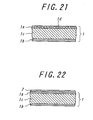
- a solid lubricant such as fluorocarbon resin, molybdenum disulfide, mica is added into the ingredient of the front surface layer 1a and is dispersed in the ingredient as shown in Fig.
- a solid lubricant such as graphite powder or molybdenum disulfide powder is applied by the splay method or the like as shown in Fig. 22.
- the object of this invention is to provide the gasket material to be solved the above-mentioned problems advantageously.
- the gasket material in the first point of view of this invention that is manufactured from a joint seat which is made from an ingredient made by mixing and kneading rubber, reinforced fiber and filler, then pressurized laminating and vulcanizing the ingredient, is characterized in that said reinforced fiber is as a sort of fibril which is composed from one or both of organic fiber and non-asbestos type inorganic fiber, and at least a part of said filler is spicular inorganic fiber and its composition is 10wt% - 45wt %.
- the reinforced fiber is as a sort of fibril (miniaturized fiber) which is composed from one or both of organic fiber and non-asbestos type inorganic fiber (inorganic fiber instead of asbestos), and at least a part of said filler is spicular inorganic fiber and its composition is 10wt% - 45wt %, thereby the anti-tensile force of the joint seat is increased by mutual involve of the miniaturized fiber which is composed from said organic fiber and inorganic fiber and additional involve of said miniaturized fiber and said spicular inorganic fiber, so that, if the fretting occurs on the structural body such as housing and cover, the occurrence of the crack breakage of the gasket due to the misalignment of the gasket from its original position is prevented.
- miniaturized fiber which is composed from one or both of organic fiber and non-asbestos type inorganic fiber (inorganic fiber instead of asbestos)
- a phenolic antioxidant adds to the ingredient at 2wt% - 26wt%. Since the phenolic antioxidant with 2wt% - 26wt% gives the ingredient of the joint seat adequate sticking efficient, as forming the joint seat by feeding the ingredient on a hot roll of a calender roll which comprises a pair of the roll of a hot roll and a cold roll and compressing and laminating the ingredient, the laminating of the ingredient can be achieved stably without the capture of the ingredient by the cold roll.
- the fundamental component of the ingredient with said phenolic antioxidant is preferably composed from that aramid fiber as the reinforce fiber is over 15wt%, NBR as the rubber material is 10wt% - 30wt%, phenolic antioxidant is 2wt% - 26wt%, magnesium silica hydrate as the spicular inorganic fiber, and the remainder is inorganic filler as the filler material.
- the joint seat will have the over 45MPa anti-tensile force with 0.5mm thickness which generally used as gasket.
- said spicular inorganic fiber preferably has 40 ⁇ m - 200 ⁇ m of major axis of the particle.
- the particle with such major axis value provides a favorable formability and can achieve sufficient anti-tensile force of the joint seat.
- the gasket material in the second point of view of this invention that is manufactured from a joint seat which is made from an ingredient made by mixing and kneading rubber, reinforced fiber and filler, then pressurized laminating and vulcanizing the ingredient, is characterized in that one of the both outermost layers is formed as non-adhering layer with weak adherence and another one is formed as adhering layer with strong adherence.
- one of the both outermost layers that consists the gasket material is formed as non-adhering layer with weak adherence and another one is formed as adhering layer with strong adherence, so that although the fretting occurs at the structural body such as housing and cover, the adhering layer of the gasket that is formed from the gasket material adheres the gasket to the structural body and maintain it at the original position, furthermore, the non-adhering layer gives the gasket a slip S against the structural body by a small friction force, therefore, decrease of the seal efficiency which due to the displacement of the gasket from its original position is prevented.
- the adherence of said adhering layer is preferably over 5 times of the adherence of said non-adhering layer, and the adherence of said adhering layer is preferably over 2.5MPa. If the adherence of said adhering layer is over 5 times of the adherence of said non-adhering layer and the adherence of said adhering layer is over 2.5MPa, as describes later, sufficient seal durability of the gaskets against the fretting will be obtained.
- the component of said adhering layer is preferably composed from that coumarone-indene resin is 2wt% - 15 wt%, calcium carbonate is 5wt% - 60wt%, NBR is 10wt% - 25wt%, and the layer includes these components that total composition of these components is under or equal to 100wt%.
- the adherence of said adhering layer is over 5 times of the adherence of said non-adhering layer and the adherence of said adhering layer is over 2.5MPa, so sufficient seal durability of the gaskets against the fretting will be obtained.
- the gasket material in the third point of view of this invention that is manufactured from a joint seat which is made from an ingredient made by mixing and kneading rubber, reinforced fiber and filler, and pressurized laminating and vulcanizing the ingredient, is characterized in that the fundamental component of the ingredient is composed from that aramid fiber as the reinforce fiber is over 20wt%, the rubber material is 23wt% - 30wt%, barium sulfate as the filler is 7wt% - 30wt%, and the remainder is inorganic filler as the filler material.
- aramid fiber that its composition is over 20 wt% and barium sulfate that its composition is 7wt% - 30wt% enhances the strength of the joint seat with maintaining its high flexibility, so that, if the fretting occurs on the structural body such as housing and cover, the occurrence of the crack breakage of the gasket due to the misalignment of the gasket from its original position is prevented.
- this gasket material is intended to enhance the strength by neither increase the compounding ratio of the reinforce fiber nor increase the fiber length of the reinforce fiber, so that it can maintain the ingredient cost of the gasket in low cost and can make the surface of the gasket smooth and make the sealing efficiency increase sufficiently.
- this joint seat also intend to enhance the strength by neither increase the roll pressure at the layer-forming of the joint seat nor increase the temperature of the hot roll, so that it can keep the low hardness of the joint seat and acquire the endurance of the gasket against the repeated compression stress, therefore, the decline of the sealing effect of the gasket due to its buckling fatigue can be prevented.
- this gasket material is intended to enhance the strength by neither decrease of the compounding ratio of the rubber material at composition of the joint seat nor increase the rate of the acrylic nitrile component in NBR, so that it can maintain the flexibility of the joint seat in high level and therefore, the decline of the sealing effect of the gasket due to large wear-out of the gasket can be prevented with resist the stress of thrust direction by the fretting under the influence of the surface pressure.
- the specific surface area of said aramid fiber is preferably over 6m 2 /g. If the specific surface area of aramid fiber which indicates the degree of fibril is 6m 2 /g, the tensile strength and the buckling fatigue surface pressure of the joint seat and thus that of the gasket can be increased sufficiently.
- the mean particle diameter of said barium sulfate is preferably under 3 ⁇ m. If the barium sulfate powder which its mean particle diameter is 3 ⁇ m is used, the buckling fatigue surface pressure of the joint seat and thus that of the gasket increases especially.
- the gasket material in the fourth point of view of this invention that is manufactured from a joint seat which is made from an ingredient made by mixing and kneading rubber, reinforced fiber and filler, and pressurized laminating and vulcanizing the ingredient, is characterized in that the low friction coating is formed on the single side or the both side of said joint seat by applying the low friction treatment liquid that includes polytetrafluoroethylene (PTFE).
- PTFE polytetrafluoroethylene
- the low friction coating that is formed on the single side or the both side of said joint seat by applying the low friction treatment liquid that includes polytetrafluoroethylene can acquire sufficient low friction coefficient of the surface of the gasket, so that, if the relative displacement between the attaching surfaces of the housing H or cover C or the like and gasket G that is made from the gasket material of this invention, the fretting wear-out of the surface of the gasket G that is made from the gasket material of this invention can be prevented, and its sealing efficiency can increase drastically rather than the gasket that is made from the present joint seat.
- said treatment liquid is preferably made by mixing the emulsion of polytetrafluoroethylene with 30wt% - 85 wt% and the resol of phenol resin with 15wt% - 70wt% with keeping the total weight percentage 100wt%.
- this composition of the liquid low friction coefficient of the gasket can maintain instead of the increase of the number of the cycle of sliding, and since the surface of the joint seat is covered by PTFE that is bound by phenol resin, the absorption of moisture of the joint seat and thus the corrosion of housing H and cover C and the like is prevented.
- the thickness of said coating is preferably over 3 ⁇ m. If the thickness of said coating is over 3 ⁇ m, the low friction coefficient of the gasket can be maintained in a long term although the coating wears gradually.
- Fig. 1 shows a cross sectional view of the embodiment 1 of the gasket material of this invention in above-mentioned the first point of view
- the numeral 1 indicates a joint seat as the gasket material of this embodiment
- this joint seat 1 has three-layer construction, that is, a front surface layer 1a and a back surface layer 1b and a middle layer 1c that exists between the front surface and back surface layer.
- This joint seat 1 of the embodiment 1 is formed by following process; at first, a ingredient material is made by mixing rubber such as NBR, miniaturized reinforced fiber that is fibrillated fiber such as aramid fiber as an organic fiber and glass fiber as an inorganic fiber instead of asbestos, spicular inorganic filler and the other filler such as barium sulfate, then this ingredient material feeds on a hot roll of a calender roll which comprises a pair of rolls, namely, hot roll and cold roll, forming a laminated ingredient on the hot roll by mixing and pressing with the use of these rolls, furthermore forming a joint seat by vulcanizing and curing the ingredient with the use of the heat of the hot roll, hereinafter the joint seat 1 forms by detaching the seat from the hot roll.
- a ingredient material is made by mixing rubber such as NBR, miniaturized reinforced fiber that is fibrillated fiber such as aramid fiber as an organic fiber and glass fiber as an inorganic fiber instead of asbestos, spicular inorganic filler and the other
- the above-mentioned the front surface layer 1a, the back surface layer 1b and the middle layer 1c of the three layers of the joint seat 1 are formed by mainly varying the composing quantity of the reinforced fiber (As for the more detail of this process, please refer the aforementioned paper "Development of non-asbestos gasket material").
- the fundamental component of the ingredient with said phenolic antioxidant is preferably composed from that fibrillated aramid fiber as the reinforce fiber is over 15wt%, NBR (Nitrile-Butadiene-Rubber) as the rubber material is 10wt% - 30wt%, phenolic antioxidant is 2wt% - 26wt%, magnesium silica hydrate as the spicular inorganic fiber, and the remainder is inorganic filler.
- a spicular crystallized material which a major axis of the particle is 40 ⁇ m - 200 ⁇ m is used.
- the spicular particle with the range of this major axis provides a favorable formability and can achieve sufficient anti-tensile force of the joint seat.
- the reinforced fiber is fibrillated type and the filler includes a spicular inorganic filler material, so the anti-tensile force of the joint seat is increased by mutual involve of the miniaturized fiber which is composed from said organic fiber and inorganic fiber and additional involve of said miniaturized fiber and said spicular inorganic fiber, so that, if the fretting occurs on the structural body such as housing and cover, the occurrence of the crack breakage of the gasket due to the misalignment of the gasket from the original position is prevented.
- Fig. 2 shows the anti-tensile force of the joint seat 1 of this embodiment 1 in contradistinction to that of the present non-asbestos type gasket and the present gasket including asbestos.
- the joint seat 1 of this embodiment 1 has an extremely higher anti-tensile force than that of the present non-asbestos type gasket and the present gasket including asbestos.
- Table 1 shows the result of the test of the anti-tensile force of the joint seat samples that Sample 1-1 to 1-3 are joint seat 1 with the same thickness 0.5 mm and different blending composition respectively, and Comparative sample 1-1 and 1-2 are joint seat which is similar to the joint seat 1 with the same thickness 0.5 mm and each of the composition of the spicular fiber are 0wt% and 50wt% respectively.
- composition Composition wt%) Anti-tensile force (Mpa) aramid fiber rubber Spicular inorganic filler Phenolic antioxidant inorganic filler Sample 1-1 25 26 38 8 remainder 45 Sample 1-2 25 25 30 12 remainder 47 Sample 1-3 23 23 17 16 remainder 49 Comparative sample 1-1 25 25 0 10 remainder 37 Comparative sample 1-2 25 25 50 0 remainder 30
- the aramid fiber is fibrillated aromatic polyamide fiber (pulp type)
- the rubber is NBR
- the spicular inorganic filler is spicular crystallized material of magnesium silica hydrate
- the phenolic antioxidant is bis- or tri- polyphenolic resin or resolic phenol resin
- the inorganic filler is barium sulfate, clay or the like.
- the joint seat may be multi-layer construction that has two layers, that is, either of a front surface layer or a back surface layer so-called dish component that corresponds to the front surface layer 1a or the back surface layer, and a main layer so-called a middle component that corresponds to the middle layer 1c.
- the joint seat may be monolayer structure that has only a middle component that corresponds to the middle layer 1c.
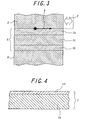
- Fig. 3 shows a cross sectional view of the action of the gasket that is made from the gasket material of the embodiment 2 against fretting.
- the joint seat 1 as the gasket material of this embodiment 2 is multi-layer structure that comprises three layers, that is, a front surface layer 1a, a back surface layer 1b, and a middle surface layer 1c.
- This joint seat 1 of the embodiment 2 is formed by following process; at first, a ingredient material is made by mixing rubber such as NBR , reinforced fiber that is the fiber instead of asbestos such as aramid fiber or glass fiber, and filler such as barium sulfate, then this ingredient material feeds on a hot roll of a calender roll which comprises a pair of rolls, namely, hot roll and cold roll, forming a laminated ingredient on the hot roll by mixing and pressing with the use of these rolls, furthermore forming a joint seat by vulcanizing and curing the ingredient with the use of the heat of the hot roll, hereinafter the joint seat 1 forms by detaching the seat from the hot roll.
- a ingredient material is made by mixing rubber such as NBR , reinforced fiber that is the fiber instead of asbestos such as aramid fiber or glass fiber, and filler such as barium sulfate, then this ingredient material feeds on a hot roll of a calender roll which comprises a pair of rolls, namely, hot roll and cold roll,
- Fig. 5 shows an examples of the composition of aramid fiber, glass fiber and NBR of the middle layer, especially, in the percentage of composition that is indicated by point 5, aramid fiber is about 24wt%, glass fiber is about 33wt% and NBR is about 43wt%.
- the front surface layer which is one of the both outermost surface layer, that is, the front surface layer 1a or the back surface layer 1b is configured as a non-adhering layer with low adherence
- the back surface layer 1b another outermost surface layer is configured as a adhering layer with high adherence.
- the adherence of the back surface layer 1b is over five times of that of the front surface layer 1a, and the adherence of the back surface layer 1b is over 2.5MPa.
- the component of the back surface layer of the joint seat 1 of this embodiment 2 is composed from that coumarone-indene resin is 2wt% - 15wt%, calcium carbonate is 5wt% - 60wt%, NBR is 10wt% - 25wt %, and the layer includes these components that total composition of these components is under or equal to 100wt%.
- one of the both outermost layers is formed as non-adhering layer with weak adherence and another one is formed as adhering layer with strong adherence, so that, as shown in Fig. 2, although the fretting F occurs at the structural body such as housing H and cover C, the back surface layer 1b of the gasket G that is formed from the joint seat 1 adheres the gasket G to the structural body such as housing H and maintain it at the original position, furthermore, the front surface layer 1a gives the gasket G a slip S against the structural body such as cover C by a small friction force, therefore, decrease of the seal efficiency which due to the displacement of the gasket G from its original position is prevented.
- the component of the back surface layer 1b is composed from that coumarone-indene resin is 2wt% - 15 wt%, calcium carbonate is 5wt% - 60wt%, NBR is 10wt% - 25wt %, and the layer includes these components that total composition of these components is under or equal to 100wt%, and the adherence of the back surface layer 1b is over 5 times of the adherence of the front surface layer 1a and the adherence of said layer 1b is over 2.5MPa, so sufficient seal durability of the gasket G against the fretting can be obtained.
- Samples 2-1 to 2-6 of the joint seat 1 that have 0.5mm thickness are made by differing the composition of the front surface layer 1a and the back surface layer 1b respectively, the gasket samples are formed from each samples of the joint seat 1, insert these samples between the housing H and the cover C of the actual transmission, and the fretting durability test of these gasket samples at their insert portion under the condition that each samples are fastened between the housing H and the cover C by bolts at the axial force of a bolt is 1 ton, the temperature of the transmission is 80°C, and twist load at the direction of the reciprocating rotation acted between the input shaft and the output shaft of the transmission of 100N ⁇ m at 3000 cycles.
- the joint seat may be multi-layer construction, that has two layers, that is, either of a front surface layer or a back surface layer as the adhering layer and main layer that is composed from the so-called middle component that corresponds to the middle layer 1c as a non-adhering layer.
- Fig. 4 shows a cross sectional view of the embodiment 3 of the gasket material of this invention in above-mentioned the third point of view
- the numeral 1 indicates a joint seat as the gasket material of this embodiment
- this joint seat 1 has multi-layer construction which comprises two layers, that is, a main layer 1e that is so-called middle component and a surface layer 1f that is dish component.
- This joint seat 1 of the embodiment 3 is formed by following process; at first, a ingredient material is made by mixing rubber such as NBR, reinforced fiber that is composed from a fibrillated (miniaturized) fiber such as aramid fiber, barium sulfate as filler and the other inorganic filler such as clay, then this ingredient material feeds on a hot roll of a calender roll which comprises a pair of rolls, namely, hot roll and cold roll, forming a laminated ingredient on the hot roll by mixing and pressing with the use of these rolls, furthermore forming a joint seat by vulcanizing and curing the ingredient with the use of the heat of the hot roll, hereinafter the joint seat 1 forms by detaching the seat from the hot roll.
- a ingredient material is made by mixing rubber such as NBR, reinforced fiber that is composed from a fibrillated (miniaturized) fiber such as aramid fiber, barium sulfate as filler and the other inorganic filler such as clay, then this ingredient material feeds on a hot
- the above-mentioned the main layer 1e, and the surface layer 1f of the two layers of the joint seat 1 are formed by mainly varying the composing quantity of the reinforced fiber (As for the more detail of this process, please refer the aforementioned paper "Development of non-asbestos gasket material").
- the fundamental component of the ingredient is composed from that aramid fiber as the reinforced fiber is over 20wt%, NBR (Nitrile-Butadiene-Rubber) as the rubber material is 23wt% - 30wt%, barium sulfate as the filler is 7wt% - 30wt%, and the other inorganic filler is remainder.
- aramid fiber as the reinforced fiber is over 20wt%
- NBR Nirile-Butadiene-Rubber
- barium sulfate as the filler is 7wt% - 30wt%
- the other inorganic filler is remainder.
- aromatic polyamide fiber (pulp type) is used as said aramid fiber that the specific surface area of this fiber that indicates the degree of fibril is over 6m 2 /g. If this specific surface area of this aramid fiber is over 6m 2 /g, as describes hereinafter, the tensile strength and the buckling fatigue surface pressure of the joint seat and thus that of the gasket can be increased sufficiently.
- barium sulfate that has the mean particle diameter under 3 ⁇ m is used. If the barium sulfate powder which its mean particle diameter is 3 ⁇ m is used, the buckling fatigue surface pressure of the joint seat and thus that of the gasket increases especially.
- aramid fiber with over 20 wt% and barium sulfate with 7wt% - 30wt% are enhance the strength of the joint seat with maintaining its high flexibility, so that if the fretting occurs on the structural body such as housing and cover, the clack breakage of the gasket which is caused by the displacement of the gasket from its original position can be prevented.
- this gasket material is intended to enhance the strength by neither increase the compounding ratio of the reinforce fiber nor increase the fiber length of the reinforce fiber, so that it can maintain the ingredient cost of the gasket in low cost and can make the surface of the gasket smooth and make the sealing efficiency increase sufficiently.
- this joint seat also intend to enhance the strength by neither increase the roll pressure at the layer-forming of the joint seat nor increase the temperature of the hot roll, so that it can keep the low hardness of the joint seat and acquire the endurance of the gasket against the repeated compression stress, therefore, the decline of the sealing effect of the gasket due to its buckling fatigue can be prevented.
- this gasket material is intended to enhance the strength by neither decrease of the compounding ratio of the rubber material at composition of the joint seat nor increase the rate of the acrylic nitrile component in NBR, so that it can maintain the flexibility of the joint seat in high level and therefore, the decline of the sealing effect of the gasket due to large wear-out of the gasket can be prevented with resist the stress of thrust direction by the fretting under the influence of the surface pressure.
- this joint seat 1 of the embodiment 3 when the rigidity of the structural body such as transmission is low and a high bolt fastening force acted on the gasket insert potion between this structural body such as the housing and the cover, if some force acted on the structural body such as the cover and its deformation occurs, the gasket can achieve an excellent sealing durability. That is, when the rigidity of the structural body is low, the surface pressure that is generated at the gasket insert portion at the beneath of the fastening bolt or the vicinity of such bolt is high, but the pressure is low in the span between the bolts. Thus, it is required that the gasket should have a high endurance against buckling and a sealing efficiency due to its excellent flexibility, the joint seat 1 of this embodiment 3 can achieve these effects.
- the characteristics of this joint seat 1 can enhance the degree of freedom of the pitch and the size of the fastening bolt and the thickness of the cover, thus the weight saving of the structural body can be achieved.
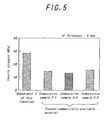
- Fig. 5 shows the result of tensile test about the joint seat 1 of the embodiment 3 and the three kind of comparative samples 3-1 to 3-3, the present commercially available joint seats under the condition which is defined in JIS K 6251, and this diagram shows the tensile strength of these joint seats comparing the sample of this embodiment and the comparative samples.
- the tensile strength of the joint seat 1 of this embodiment 3 (more specifically, approximate mean value of the samples 3-1 to 3-7 describes hereinafter) is considerably higher than that of the present commercially available joint seats.
- Fig. 6 shows the result of buckling fatigue test about the joint seat 1 of the embodiment 3 and the three kind of comparative samples 3-1 to 3-3, the present commercially available joint seats under the condition that each ringshaped samples are set between a pair of plates and one of the plate was reciprocating slid at the distance of movement 300 ⁇ m and frequency 1Hz by an actuator with loading a predetermined surface pressure by the hydropress whether the fluff of the fiber generates or not at reciprocating cycle 3000cycle, and the buckling fatigue surface pressure is determined as the surface pressure when the fluff of the sample is generated, and this diagram shows the buckling fatigue surface pressure of these joint seats comparing the sample of this embodiment and the comparative samples.
- the buckling fatigue surface pressure of the joint seat 1 of this embodiment 3 (more specifically, approximate mean value of the samples 3-1 to 3-7 describes hereinafter) is considerably higher than that of the present commercially available joint seats.
- Fig. 7 shows a result of the limit seal pressure test about the joint seat 1 of the embodiment 3 and the three kind of comparative samples 3-1 to 3-3, the present commercially available joint seats under the condition that the nitrogen gas was supplied to inside the sample which the fluff generated via the plates and the soap solution was applied to the periphery of the sample to check the leakage of the nitrogen gas, and the limit seal pressure is measured as the gas pressure when the leakage is generated.
- the limit seal pressure of the joint seat 1 of this embodiment 3 (more specifically, approximate mean value of the samples 3-1 to 3-7 describes hereinafter) is approximately equivalent to the highest value of the limit seal pressure of the present commercially available joint seats.
- Table 8 shows the result of tensile test, buckling fatigue test and limit seal pressure test about the joint seat samples
- the Samples 3-1 to 3-7 are the joint seat 1 of said embodiment 3, the thickness of all of these samples is 0.5mm, but each of these samples have different composition
- the Comparative samples 3-1 to 3-6 are the joint seats that the thickness of all of these comparative samples is 0.5 mm
- the composition of these comparative samples are according to the joint seat 1 but the composition of aramid fiber or barium sulfate is outside the scope of the embodiment 3.
- Comparative samples 3-1 to 3-6 has low value of any of tensile strength, buckling fatigue surface pressure and limit seal pressure, but all of the Samples 3-1 to 3-7 has high tensile strength over 5MPa, and holds high buckling fatigue surface pressure over 80MPa, and has high limit seal pressure over 2.0kgf/cm 2 . It is understood that these samples of the embodiment 3 is gasket material with excellent characteristics.
- composition Composition wt% Performance of joint seat aramid fiber barium sulfate rubber inorganic filler tensile strength (MPa) buckling fatigue surface pressure (MPa) limit seal pressure (kgf/cm 2 ) Sample 3-1 20 7 23 remainder 26.7 69 2.2 Sample 3-2 20 20 23 remainder 25.3 89 2.6 Sample 3-3 20 30 23 remainder 25.1 90 2.2 Sample 3-4 30 20 23 remainder 28.8 86 2.2 Sample 3-5 40 20 23 remainder 30.7 87 2.0 Sample 3-6 20 7 27 remainder 26.1 86 2.4 Sample 3-7 20 7 30 remainder 25.8 84 2.6 Comparative sample 3-1 20 5 23 remainder 26.2 69 2.2 Comparative sample 3-2 20 40 23 remainder 18.6 78 2.0 Comparative sample 3-3 15 20 23 remainder 17.9 73 2.8 Comparative sample 3-4 20 7 18 remainder 27.1 67 1.5 Comparative sample 3-5 20 7 20 remainder 26.8 69 1.5 Comparative sample 3-6 20 7 33 remainder 18.7 61 2.6
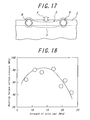
- Fig. 8 shows the result of the study of contribution of the particle shape of barium sulfate according to the characteristic of buckling fatigue and of limit seal pressure by the buckling fatigue test and the limit seal pressure test under the similar condition of above-mentioned test
- the fundamental composition of the joint seat 1 of the embodiment 1 is that aramid fiber is 20wt%, NBR is 23wt%, barium sulfate is 20wt% and the remainder is inorganic filler, and the particle diameter of barium sulfate differs in each samples.
- the barium sulfate is preferably microscopic powder with its diameter is under 3 ⁇ m.
- the above-mentioned the result that is shown in Fig. 18 and Fig. 19 is obtained from the buckling fatigue test and the limit seal pressure test under the same condition.
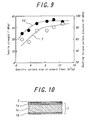
- Fig. 9 shows the result of the study of contribution of the degree of fibrillation of aramid fiber according to the tensile strength and the characteristic of buckling fatigue by the tensile test and the buckling fatigue test under the similar condition of above-mentioned test
- the fundamental composition of the joint seat 1 of the embodiment 1 is that aramid fiber is 20wt%, NBR is 23wt%, barium sulfate is 7wt% and the remainder is inorganic filler, and the specific surface area of aramid fiber differs in each samples.
- the specific surface area of the aramid fiber that indicates the degree of fibrillation becomes below 6m 2 /g, the decrease of the tensile stress occurs, and the characteristic of buckling fatigue tends to decrease in sync with the decrease of the tensile stress. Therefore, the specific surface area of aramid fiber is preferably over 6m 2 /g.
- the joint seat may be multi-layer construction that has three layers, that is, either of a front surface layer and a back surface layer so-called dish component that corresponds to the surface layer 1f and a main middle layer so-called a middle component that corresponds to the main layer 1e.
- the joint seat may be monolayer structure that has only a middle component that corresponds to the middle layer 1e.
- Fig. 10 shows a cross sectional view of the embodiment 4 of the gasket material of this invention in said the fourth point of view
- the numeral 1 indicates a joint seat 1 that has three-layer construction which comprises a front surface layer 1a, a back surface layer 1b and a middle layer 1c that exists between the front surface and back surface layer.
- the numeral 3 indicates a low friction coating.
- a ingredient material is made by mixing rubber such as NBR , reinforced fiber that is the fiber instead of asbestos such as aramid fiber or glass fiber, and filler such as barium sulfate, then this ingredient material feeds on a hot roll of a calender roll which comprises a pair of rolls, namely, hot roll and cold roll, forming a laminated ingredient on the hot roll by mixing and pressing with the use of these rolls, furthermore forming a joint seat by vulcanizing and curing the ingredient with the use of the heat of the hot roll, hereinafter the joint seat 1 forms by detaching the seat from the hot roll.
- rubber such as NBR
- filler such as barium sulfate
- Fig. 5 shows an examples of the composition of aramid fiber, glass fiber and NBR of the middle layer, especially, in the percentage of composition that is indicated by point 5, aramid fiber is about 24wt%, glass fiber is about 33wt% and NBR is about 43wt%.
- a low friction treatment liquid which includes polytetrafluoroethylene (PTFE) applies the surface of the front surface layer 1a of the joint seat 1 by a roll coater, for example, to make the quantity of the application is 300mg/m 2 - 1500mg/m 2 , and this low friction treatment liquid is heated and dried, thereby, a low friction coating 3 forms on the front surface layer 1a which its thickness is over 3 ⁇ m as shown in Fig. 10.
- PTFE polytetrafluoroethylene
- said low friction treatment liquid which includes PTFE is preferably made from mixing PTFE of an emulsion type (for example, product name D-1 of DAIKIN Industries Ltd., and its solid content is 60wt%) at 30wt% - 85wt% and phenol resin of a resol type (for example, product name CT-E300 of Nihon Parkerizing Co. Ltd., and its solid content is 10wt%) to make the total percentage of weight become 100wt%.
- an emulsion type for example, product name D-1 of DAIKIN Industries Ltd., and its solid content is 60wt%
- phenol resin of a resol type for example, product name CT-E300 of Nihon Parkerizing Co. Ltd., and its solid content is 10wt%
- a low friction coating 3 that is formed by applying a low friction treatment liquid which includes PTFE can acquire low friction coefficient ⁇ , so that, if the relative displacement between the attaching surfaces of the housing H or cover C or the like and gasket G that is made from the gasket material of this embodiment 4, the fretting wear-out of the surface of the gasket G can be prevented, and its sealing efficiency can increase drastically rather than the gasket G that is made from the present joint seat.
- the low friction treatment liquid is made by mixing the polytetrafluoroethylene of emulsion type with 30wt% - 85wt% and the phenol resin of resol type with 15wt% - 70wt% and keeping the total weight percentage 100wt%, as describes hereinafter, low friction coefficient of the gasket can maintain instead of the increase of the number of the cycle of sliding, and since the surface of the joint seat is covered by PTFE that is bound by phenol resin, the absorption of moisture of the joint seat and thus the corrosion of housing H and cover C and the like is prevented.
- the low friction coefficient of the gasket can be maintained in a long term although the coating wears gradually.
- sample 4-1 and sample 4-2 have a low friction coating by applying the treatment liquid that the composition rate of PTFE and phenol resin is 85:15 and 30:70, respectively; sample 4-3 has a low friction coating by applying the treatment liquid with PTFE 100wt%; comparative sample 4 of untreated material that was not applied the treatment liquid differ from above samples 4-1 to 4-3.
- the slide test carried out under the condition that a surface pressure 4.9MPa acted on each samples by a measuring pin that is made from aluminum with 3mm diameter, and each samples slide 25mm distance with the sliding speed 24mm/min. As seen from Fig.
- the friction coefficient become decrease depends on the increase of the composition rate of PTFE, but as shown by sample 4-3, if the composition rate of phenol resin which is binder becomes less than 15wt%, the friction coefficient rises drastically at the point where the number of sliding cycle reached some value.
- the cover adhering strength that indicates the ease of maintenance at the products was measured about the samples and the additional sample 4-4 that is made by applying the treatment liquid that the composition rate of PTFE and phenol resin is 20:80.
- the four samples of the embodiment 4 has non-adherence, thus the cover C is able to detach easily from the gasket by hand, but in case of the comparative sample, it was necessary to use a tool.
- the weight increase rate (%) by absorbing moisture was measured about the above-mentioned samples and the comparative samples under the condition that these samples are dipped in the distilled water in 5 hours.
- Fig. 13 it was revealed that the samples 4-1, 4-2 and 4-4 that have the coating which includes phenol resin in the treatment liquid have the excellent water resistance because each surface of these gasket samples is covered with PTFE that is bound by phenol resin, thus, the absorption of moisture was limited.
- Table 9 presents the evaluation of the above-mentioned result of the test and measurement by collecting these results. It is seen from this table 9 that the samples 4-1 to 4-4 of this embodiment 4 has low friction coefficient (as for sample 4-4 has no data, but it will be able to estimated from Fig. 11 based on the quantity of PTFE), excellent performance of maintenance caused from its non-adherence, and water resistance that can prevent its corrosion compared to the comparative sample. Especially, it is known that the samples 4-1 and 4-2 have high performance across a board of the result of the test.
- the low friction coating 3 may be formed on both of the surface of joint seat 1, and the construction of joint seat 1 may be changed.
- gasket material of this invention of course can be used as the gasket to the periphery of engine instead of the gasket that is inserted between the housing H and the cover C of the transmission in the above-mentioned embodiments 1 - 4.
- the anti-tensile force of the joint seat is increased by mutual involve of the miniaturized fiber which is composed from organic fiber and inorganic fiber and additional involve of miniaturized fiber and spicular inorganic fiber, so that, if the fretting occurs on the structural body such as housing and cover, the occurrence of the crack breakage of the gasket due to the misalignment of the gasket from its original position is prevented.
- one of the both outermost layers is formed as non-adhering layer with weak adherence and another one is formed as adhering layer with strong adherence, so that although the fretting occurs at the structural body such as housing and cover, the adhering layer of the gasket that is formed from the gasket material adheres the gasket to the structural body and maintain it at the original position, furthermore, the non-adhering layer gives the gasket a slip S against the structural body by a small friction force, therefore, decrease of the seal efficiency which due to the displacement of the gasket from its original position is prevented.
- aramid fiber that its composition is over 20 wt% and barium sulfate that its composition is 7wt% - 30wt% enhances the strength of the joint seat with maintaining its high flexibility, so that, if the fretting occurs on the structural body such as housing and cover, the occurrence of the leakage of the sealing media due to the misalignment of the gasket from its original position and decrease of the surface pressure is prevented.
- this gasket material can maintain the ingredient cost of the gasket in low cost and can make the surface of the gasket smooth and make the sealing efficiency increase sufficiently.
- this joint seat can keep the low hardness of the joint seat and acquire the endurance of the gasket against the repeated compression stress, therefore, the decline of the sealing effect of the gasket due to its buckling fatigue can be prevented.
- this gasket material can maintain the flexibility of the joint seat in high level and therefore, the decline of the sealing effect of the gasket due to large wear-out of the gasket can be prevented with resist the stress of thrust direction by the fretting under the influence of the surface pressure.
- the low friction coating that is formed on the single side or the both side of said joint seat by applying the low friction treatment liquid that includes polytetrafluoroethylene can acquire sufficient low friction coefficient of the surface of the gasket, so that, if the relative displacement between the attaching surfaces of the housing H or cover C or the like and gasket G that is made from the gasket material of this invention, the fretting wear-out of the surface of the gasket G that is made from the gasket material of this invention can be prevented, and its sealing efficiency can increase drastically rather than the gasket that is made from the present joint seat.
Landscapes
- Engineering & Computer Science (AREA)
- Chemical & Material Sciences (AREA)
- General Engineering & Computer Science (AREA)
- Organic Chemistry (AREA)
- Mechanical Engineering (AREA)
- Medicinal Chemistry (AREA)
- Polymers & Plastics (AREA)
- Health & Medical Sciences (AREA)
- Chemical Kinetics & Catalysis (AREA)
- Materials Engineering (AREA)
- Sealing Material Composition (AREA)
- Gasket Seals (AREA)
- Compositions Of Macromolecular Compounds (AREA)
- Laminated Bodies (AREA)
Abstract
Description
| Examples of composition | Composition (wt%) | Anti-tensile force (Mpa) | ||||
| aramid fiber | rubber | Spicular inorganic filler | Phenolic antioxidant | inorganic filler | ||
| Sample 1-1 | 25 | 26 | 38 | 8 | remainder | 45 |
| Sample 1-2 | 25 | 25 | 30 | 12 | remainder | 47 |
| Sample 1-3 | 23 | 23 | 17 | 16 | remainder | 49 |
| Comparative sample 1-1 | 25 | 25 | 0 | 10 | remainder | 37 |
| Comparative sample 1-2 | 25 | 25 | 50 | 0 | | 30 |
| Difference of adhering force | 6.46 (front surface / back surface) | |||
| Gasket surface | front surface | back surface | ||
| Adhering force(MPa) | 0.85 | 5.49 | ||
| Composition of gasket (wt%) | NBR | 25 | NBR | 25 |
| aramid fiber | 15 | calcium carbonate powder | 30 | |
| clay powder | 50 | coumarone-indene resin | 10 | |
| aramid fiber | remainder |
| Difference of adhering force | 7,97 (front surface / back surface) | |||
| Gasket surface | front surface | back surface | ||
| Adhering force(MPa) | 0.35 | 2.79 | ||
| Composition of gasket (wt%) | NBR | 12 | NBR | 25 |
| aramid fiber | 13 | calcium carbonate powder | 10 | |
| clay powder | 50 | silica powder | 4.5 | |
| graphite powder | 25 | coumarone-indene resin | 6 | |
| aramid fiber | remainder |
| Difference of adhering force | 8.18 (front surface / back surface) | |||
| Gasket surface | front surface | back surface | ||
| Adhering force(MPa) | 0.71 | 5.81 | ||
| Composition of gasket (wt%) | NBR | 15 | NBR | 25 |
| aramid fiber | 15 | calcium carbonate powder | 50 | |
| clay powder | 40 | coumarone-indene resin | 10 | |
| silica powder | 30 | aramid fiber | remainder |
| Difference of adhering force | 12.10 (front surface / back surface) | |||
| Gasket surface | front surface | back surface | ||
| Adhering force(MPa) | 0.41 | 4.96 | ||
| Composition of gasket (wt%) | NBR | 15 | NBR | 15 |
| aramid fiber | 10 | calcium carbonate powder | 15 | |
| clay powder | 25 | talc | 35 | |
| mica powder | 50 | coumarone-indene resin | 15 | |
| aramid fiber | remainder |
| Difference of adhering force | 7.14 (front surface / back surface) | |||
| Gasket surface | front surface | back surface | ||
| Adhering force(MPa) | 0.81 | 5.78 | ||
| Composition of gasket (wt%) | NBR | 12 | NBR | 20 |
| NR | 3 | calcium carbonate powder | 45 | |
| aramid fiber | 20 | coumarone-indene resin | 9 | |
| clay powder | 55 | aramid fiber | remainder |
| Difference of adhering force | 17.86 (front surface / back surface) | |||
| Gasket surface | front surface | back surface | ||
| Adhering force(MPa) | 0.14 | 2.50 | ||
| Composition of gasket (wt%) | NBR | 15 | NBR | 15 |
| aramid fiber | 20 | calcium carbonate powder | 35 | |
| mica powder | 12 | coumarone-indene resin | 5 | |
| clay powder | 18 | barium sulfate | 15 | |
| molybdenum disulfide powder | 25 | aramid fiber aramid fiber | remainder remainder | |
| teflon dispersion | 10 |
| Examples of composition | Composition (wt%) | Performance of joint seat | |||||
| aramid fiber | barium sulfate | rubber | inorganic filler | tensile strength (MPa) | buckling fatigue surface pressure (MPa) | limit seal pressure (kgf/cm2) | |
| Sample 3-1 | 20 | 7 | 23 | remainder | 26.7 | 69 | 2.2 |
| Sample 3-2 | 20 | 20 | 23 | remainder | 25.3 | 89 | 2.6 |
| Sample 3-3 | 20 | 30 | 23 | remainder | 25.1 | 90 | 2.2 |
| Sample 3-4 | 30 | 20 | 23 | remainder | 28.8 | 86 | 2.2 |
| Sample 3-5 | 40 | 20 | 23 | remainder | 30.7 | 87 | 2.0 |
| Sample 3-6 | 20 | 7 | 27 | remainder | 26.1 | 86 | 2.4 |
| Sample 3-7 | 20 | 7 | 30 | remainder | 25.8 | 84 | 2.6 |
| Comparative sample 3-1 | 20 | 5 | 23 | remainder | 26.2 | 69 | 2.2 |
| Comparative sample 3-2 | 20 | 40 | 23 | remainder | 18.6 | 78 | 2.0 |
| Comparative sample 3-3 | 15 | 20 | 23 | remainder | 17.9 | 73 | 2.8 |
| Comparative sample 3-4 | 20 | 7 | 18 | remainder | 27.1 | 67 | 1.5 |
| Comparative sample 3-5 | 20 | 7 | 20 | remainder | 26.8 | 69 | 1.5 |
| Comparative sample 3-6 | 20 | 7 | 33 | remainder | 18.7 | 61 | 2.6 |
| PTFE | Phenol resin | low friction stability | performance of maintenance | durability | |
| Sample 4-1 | 85 | 15 | o ○ | o ○ | o ○ |
| Sample 4-2 | 30 | 70 | o ○ | o ○ | o ○ |
| Sample 4-3 | 100 | 0 | Δ | o ○ | Δ |
| Sample 4-4 | 20 | 80 | ― | ○ | ○ |
| | ― | ― | × | × | × |
Claims (13)
- A gasket material that is manufactured from a joint seat that is made from an ingredient made by mixing and kneading rubber, reinforced fiber and filler, then pressurized laminating and vulcanizing said ingredient,
characterized in that said reinforced fiber is as a sort of fibril which is composed from one or both of organic fiber and non-asbestos type inorganic fiber, and at least a part of said filler is spicular inorganic fiber and its composition is 10wt% - 45wt %. - The gasket material according to claim 1,
characterized in that a phenolic antioxidant adds to said ingredient at 2wt% - 26wt%. - The gasket material according to claim 2,
characterized in that the fundamental component of the ingredient with said phenolic antioxidant is composed from the following materials;
Aramid fiber as the reinforce fiber is over 15wt%,
NBR as the rubber material is 10wt% - 30wt%,
Phenolic antioxidant is 2wt% - 26wt%,
Magnesium silica hydrate as the spicular inorganic fiber and,
The remainder is inorganic filler as the filler material. - The gasket material according to any one of claims 1 - 3,
characterized in that said spicular inorganic fiber has 40µm - 200µm of major axis of the particle. - A gasket material that is manufactured from a joint seat with multi-layer structure which is made from an ingredient made by mixing and kneading rubber, reinforced fiber and filler, then pressurized laminating and vulcanizing said ingredient,
characterized in that one of the both outermost layers is formed as non-adhering layer with weak adherence and another one is formed as adhering layer with strong adherence. - The gasket material according to claim 5,
characterized in that the adherence of said adhering layer is over 5 times of the adherence of said non-adhering layer, and the adherence of said adhering layer is over 2.5MPa. - The gasket material according to claim 5 or 6,
characterized in that the component of said adhering layer is composed from the following materials;
Coumarone-indene resin is 2wt% - 15wt%
Calcium carbonate is 5wt% - 60wt%,
NBR is 10wt% - 25wt% and,
Total composition of these components is under or equal to 100wt%. - A gasket material that is manufactured from a joint seat that is made from an ingredient made by mixing and kneading rubber, reinforced fiber and filler, then pressurized laminating and vulcanizing said ingredient,
characterized in that the fundamental component of the ingredient is composed from the following materials;
Aramid fiber as the reinforce fiber is over 20wt%,
Rubber material is 23wt% - 30wt%,
Barium sulfate as the filler is 7wt% - 30wt% and,
The remainder is inorganic filler as the filler material. - The gasket material according to claim 8,
characterized in that the mean particle diameter of said barium sulfate is under 3µm. - The gasket material according to claim 8 or 9,
characterized in that the specific surface area of said aramid fiber is over 6m2/g - A gasket material that is manufactured from a joint seat that is made from an ingredient made by mixing and kneading rubber, reinforced fiber and filler, then pressurized laminating and vulcanizing said ingredient,
characterized in that the low friction coating is formed on the single side or the both side of said joint seat by applying the low friction treatment liquid that includes polytetrafluoroethylene. - The gasket material according to claim 11,
characterized in that said treatment liquid is made by mixing the emulsion of polytetrafluoroethylene with 30wt% - 85wt% and the resol of phenol resin with 15wt% - 70wt% with keeping the total weight percentage 100wt%. - The gasket material according to claim 11 or 12,
characterized in that the thickness of said coating is over 3µm.
Applications Claiming Priority (9)
| Application Number | Priority Date | Filing Date | Title |
|---|---|---|---|
| JP2002196714 | 2002-07-05 | ||
| JP2002196980 | 2002-07-05 | ||
| JP2002196714A JP2004035789A (en) | 2002-07-05 | 2002-07-05 | Gasket material |
| JP2002196972 | 2002-07-05 | ||
| JP2002196972A JP2004035804A (en) | 2002-07-05 | 2002-07-05 | Gasket material |
| JP2002196980A JP4176401B2 (en) | 2002-07-05 | 2002-07-05 | Gasket material |
| JP2002196827 | 2002-07-05 | ||
| JP2002196827A JP2004036808A (en) | 2002-07-05 | 2002-07-05 | Gasket material |
| PCT/JP2003/005547 WO2004005773A1 (en) | 2002-07-05 | 2003-04-30 | Gasket material |
Publications (3)
| Publication Number | Publication Date |
|---|---|
| EP1541907A1 true EP1541907A1 (en) | 2005-06-15 |
| EP1541907A4 EP1541907A4 (en) | 2008-03-26 |
| EP1541907B1 EP1541907B1 (en) | 2013-01-30 |
Family
ID=30119233
Family Applications (1)
| Application Number | Title | Priority Date | Filing Date |
|---|---|---|---|
| EP03725720A Expired - Lifetime EP1541907B1 (en) | 2002-07-05 | 2003-04-30 | Gasket material |
Country Status (5)
| Country | Link |
|---|---|
| US (1) | US20060100374A1 (en) |
| EP (1) | EP1541907B1 (en) |
| CN (1) | CN100453857C (en) |
| TW (1) | TW591181B (en) |
| WO (1) | WO2004005773A1 (en) |
Cited By (1)
| Publication number | Priority date | Publication date | Assignee | Title |
|---|---|---|---|---|
| CN101493144A (en) * | 2009-02-27 | 2009-07-29 | 中国第一汽车集团公司 | High compression and high rebound degree plane sulfidization calendered automobile sealing gasket |
Families Citing this family (18)
| Publication number | Priority date | Publication date | Assignee | Title |
|---|---|---|---|---|
| JP5065154B2 (en) * | 2008-05-23 | 2012-10-31 | 日本リークレス工業株式会社 | Gasket material |
| US20110287677A1 (en) | 2010-05-19 | 2011-11-24 | Garlock Sealing Technologies, Llc | Flexible reinforced gasket |
| WO2012054230A2 (en) | 2010-10-20 | 2012-04-26 | Garlock Sealing Technologies, Llc | Extreme temperature gasket and method of making the same |
| EP2692788B1 (en) * | 2011-03-31 | 2015-12-30 | Zeon Corporation | Highly saturated nitrile rubber composition and crosslinked rubber |
| CN102737920B (en) * | 2011-04-01 | 2014-12-17 | 三菱电机株式会社 | Insulating material molding body for arc extinction and circuit breaker using same |
| US20130082447A1 (en) | 2011-10-04 | 2013-04-04 | Garlock Sealing Technologies, Llc | Spiral wound gasket |
| CN103185139A (en) * | 2011-12-31 | 2013-07-03 | 上海金由氟材料有限公司 | Double-surface sealing type teflon gasket |
| JP6059664B2 (en) | 2012-01-17 | 2017-01-11 | ニチアス株式会社 | Gasket material |
| US10052250B2 (en) * | 2013-05-07 | 2018-08-21 | Intersurgical S.P.A. | Openable helmet of non-invasive ventilation of patients |
| CN103496229B (en) * | 2013-08-13 | 2015-06-03 | 常州大学 | High-temperature resistant oil well rubber sealing ring material and preparation method thereof |
| US9989252B2 (en) * | 2013-08-22 | 2018-06-05 | Noritz Corporation | Exhaust adapter, exhaust structure for water heater, and method for installing exhaust adapter |
| CN103925364B (en) * | 2014-05-12 | 2016-03-30 | 武汉大学 | Seal ring of a kind of hydraulic turbine main shaft and preparation method thereof |
| RU2644909C2 (en) * | 2015-09-22 | 2018-02-14 | Закрытое акционерное общество "ВАТИ-Пром" | Multi-layer sealing material |
| CN110323015A (en) * | 2018-03-30 | 2019-10-11 | 上海网讯新材料科技股份有限公司 | A kind of novel aluminum-plastic composite band |
| CN109397801A (en) * | 2018-10-31 | 2019-03-01 | 江苏伊顿航天材料股份有限公司 | A kind of abrasive rubber sealing element and preparation method |
| CN110039857B (en) * | 2019-04-02 | 2020-12-15 | 宁国市顺达密封件制造有限公司 | An environmentally friendly and anti-aging filter gasket and preparation method thereof |
| CN111421903A (en) * | 2020-04-08 | 2020-07-17 | 马鞍山市麦克英孚机械科技有限公司 | Three-layer sealing gasket and assembly method thereof |
| CN117167484B (en) * | 2023-08-31 | 2024-03-19 | 广东东方管业有限公司 | A dynamic sealing rubber ring and its preparation method and application |
Family Cites Families (19)
| Publication number | Priority date | Publication date | Assignee | Title |
|---|---|---|---|---|
| AU464814B2 (en) * | 1973-01-26 | 1975-09-04 | Bridgestone Tire Company Limited | A method for improving the adhering ability of vulcanized rubber surfaces |
| JPS5938999B2 (en) | 1980-03-14 | 1984-09-20 | ニチアス株式会社 | joint seat |
| US4330442A (en) | 1980-05-07 | 1982-05-18 | Armstrong World Industries, Inc. | Asbestos free gasket forming compositions |
| GB2093474B (en) * | 1981-02-10 | 1984-10-24 | Texon Inc | High temperature resistant gasketing material incorporating organic fibers |
| US4423109A (en) * | 1981-10-02 | 1983-12-27 | Rogers Corporation | Fiber reinforced rubber gasket material |
| JPS6194654U (en) * | 1984-11-27 | 1986-06-18 | ||
| US4849295A (en) * | 1987-12-11 | 1989-07-18 | Eagle-Picher Industries, Inc. | High temperature metal rubber gasket |
| JP2905899B2 (en) * | 1990-04-10 | 1999-06-14 | 日清紡績株式会社 | Sheet material and manufacturing method thereof |
| DE4109681C1 (en) | 1991-03-23 | 1992-11-05 | Goetze Ag, 5093 Burscheid, De | |
| EP0527275B1 (en) * | 1991-08-26 | 1997-04-23 | Nippon Pillar Packing Co. Ltd. | Spiral gasket |
| US5240766A (en) * | 1992-04-01 | 1993-08-31 | Hollingsworth & Vose Company | Gasket material |
| US5437767A (en) * | 1992-07-22 | 1995-08-01 | Armstrong World Industries, Inc. | Wet-laying process for making liquid sealing gasket sheet materials |
| CN2213890Y (en) * | 1992-09-10 | 1995-11-29 | 孙宝伟 | Novel composite sealing material and sealing gasket |
| JPH06323438A (en) * | 1993-05-07 | 1994-11-25 | Kubota Corp | gasket |
| CN1051832C (en) * | 1995-07-31 | 2000-04-26 | 舟山市海山密封材料有限公司 | Sealing washer special for engine of motorcycle and production technology of same |
| JPH09111048A (en) * | 1995-10-16 | 1997-04-28 | Sumitomo Chem Co Ltd | Rubber composition and joint sheet |
| JPH10265765A (en) * | 1997-03-24 | 1998-10-06 | Nichias Corp | Joint sheet and manufacturing method thereof |
| JPH1150027A (en) * | 1997-07-31 | 1999-02-23 | Achilles Corp | Fixed form sealing material of sol foamed vinyl chloride-based resin |
| JPH1171575A (en) * | 1997-08-28 | 1999-03-16 | Nichias Corp | Joint sheet and manufacturing method thereof |
-
2003
- 2003-04-30 WO PCT/JP2003/005547 patent/WO2004005773A1/en not_active Ceased
- 2003-04-30 EP EP03725720A patent/EP1541907B1/en not_active Expired - Lifetime
- 2003-04-30 CN CNB038159740A patent/CN100453857C/en not_active Expired - Fee Related
- 2003-04-30 US US10/520,177 patent/US20060100374A1/en not_active Abandoned
- 2003-07-03 TW TW092118174A patent/TW591181B/en not_active IP Right Cessation
Cited By (1)
| Publication number | Priority date | Publication date | Assignee | Title |
|---|---|---|---|---|
| CN101493144A (en) * | 2009-02-27 | 2009-07-29 | 中国第一汽车集团公司 | High compression and high rebound degree plane sulfidization calendered automobile sealing gasket |
Also Published As
| Publication number | Publication date |
|---|---|
| CN1666050A (en) | 2005-09-07 |
| US20060100374A1 (en) | 2006-05-11 |
| CN100453857C (en) | 2009-01-21 |
| TW591181B (en) | 2004-06-11 |
| TW200403405A (en) | 2004-03-01 |
| EP1541907B1 (en) | 2013-01-30 |
| WO2004005773A1 (en) | 2004-01-15 |
| EP1541907A4 (en) | 2008-03-26 |
Similar Documents
| Publication | Publication Date | Title |
|---|---|---|
| EP1541907A1 (en) | Gasket material | |
| EP0523339B1 (en) | Asbestos-free composition for gaskets | |
| DE102006053600B4 (en) | Asbestos-free friction member | |
| US20050043486A1 (en) | Rubber composition for high-load transmission belt and high-load transmission belt from the rubber composition | |
| CN1185097C (en) | Composite multilayer material | |
| CN115368654B (en) | Chloroprene rubber material with low compression set and preparation method and application thereof | |
| US5127949A (en) | Wet friction material | |
| RU2363710C1 (en) | Metallic-elastomeric content | |
| JP5065154B2 (en) | Gasket material | |
| CN101260940A (en) | Gasket material | |
| EP1557595A1 (en) | Gasket material | |
| JP4176401B2 (en) | Gasket material | |
| RU2227150C1 (en) | The laminar sealing material for a gasket | |
| CN101265975B (en) | Gasket material | |
| JP2004035804A (en) | Gasket material | |
| CN107880563A (en) | Automobile crane oil sealing material | |
| CN119144191A (en) | PTFE-based self-lubricating composite coating material and preparation method thereof | |
| JP2004036808A (en) | Gasket material | |
| CN111073183A (en) | Manufacturing process of high-fluorine-content rubber sealing plate | |
| JPH111678A (en) | Gasket material | |
| Kunieda et al. | Development of low friction radial lip seals | |
| JP2004035800A (en) | Gasket material | |
| JPH03212480A (en) | joint sheet |
Legal Events
| Date | Code | Title | Description |
|---|---|---|---|
| PUAI | Public reference made under article 153(3) epc to a published international application that has entered the european phase |
Free format text: ORIGINAL CODE: 0009012 |
|
| 17P | Request for examination filed |
Effective date: 20050203 |
|
| AK | Designated contracting states |
Kind code of ref document: A1 Designated state(s): AT BE BG CH CY CZ DE DK EE ES FI FR GB GR HU IE IT LI LU MC NL PT RO SE SI SK TR |
|
| RAP1 | Party data changed (applicant data changed or rights of an application transferred) |
Owner name: NIPPON LEAKLESS INDUSTRY CO., LTD. Owner name: HONDA GIKEN KOGYO KABUSHIKI KAISHA |
|
| RBV | Designated contracting states (corrected) |
Designated state(s): DE GB |
|
| A4 | Supplementary search report drawn up and despatched |
Effective date: 20080221 |
|
| 17Q | First examination report despatched |
Effective date: 20081006 |
|
| GRAP | Despatch of communication of intention to grant a patent |
Free format text: ORIGINAL CODE: EPIDOSNIGR1 |
|
| GRAS | Grant fee paid |
Free format text: ORIGINAL CODE: EPIDOSNIGR3 |
|
| GRAA | (expected) grant |
Free format text: ORIGINAL CODE: 0009210 |
|
| AK | Designated contracting states |
Kind code of ref document: B1 Designated state(s): DE GB |
|
| REG | Reference to a national code |
Ref country code: GB Ref legal event code: FG4D |
|
| REG | Reference to a national code |
Ref country code: DE Ref legal event code: R096 Ref document number: 60343218 Country of ref document: DE Effective date: 20130328 |
|
| PLBE | No opposition filed within time limit |
Free format text: ORIGINAL CODE: 0009261 |
|
| STAA | Information on the status of an ep patent application or granted ep patent |
Free format text: STATUS: NO OPPOSITION FILED WITHIN TIME LIMIT |
|
| GBPC | Gb: european patent ceased through non-payment of renewal fee |
Effective date: 20130430 |
|
| 26N | No opposition filed |
Effective date: 20131031 |
|
| PG25 | Lapsed in a contracting state [announced via postgrant information from national office to epo] |
Ref country code: GB Free format text: LAPSE BECAUSE OF NON-PAYMENT OF DUE FEES Effective date: 20130430 |
|
| REG | Reference to a national code |
Ref country code: DE Ref legal event code: R097 Ref document number: 60343218 Country of ref document: DE Effective date: 20131031 |
|
| PGFP | Annual fee paid to national office [announced via postgrant information from national office to epo] |
Ref country code: DE Payment date: 20140326 Year of fee payment: 12 |
|
| REG | Reference to a national code |
Ref country code: DE Ref legal event code: R119 Ref document number: 60343218 Country of ref document: DE |
|
| PG25 | Lapsed in a contracting state [announced via postgrant information from national office to epo] |
Ref country code: DE Free format text: LAPSE BECAUSE OF NON-PAYMENT OF DUE FEES Effective date: 20151103 |