CROSS-REFERENCE TO RELATED APPLICATIONS
This application claims the benefit of Korean Patent Application No.
2003-87345, filed December 05, 2004, in the Korean Intellectual Property
Office, the disclosure of which is incorporated herein by reference.
BACKGROUND
1. Field of the Invention
The present invention relates to high corrosion-resistive
martensitic stainless steel used in manufacturing a dinner knife, a knife, a pair
of scissors, a spinning and weaving holder for textile industry and method for
manufacturing it, and more particularly to martensitic stainless steel in which
carbon and nitrogen are properly added in 13%Cr-stainless steel, thereby
preventing a lamination defect due to the center segregation of a carbide and a
pin hole defect due to a nitrogen pore without decreasing in its product and
manufacturing method thereof.
2. Discussion of Related Art
Generally, as hard stainless steel, martensitic stainless steel is
used as a raw material for manufacturing a tool having blade. Such a
martensitic stainless steel is manufactured by the processes of producing a
continuous casting slab containing predetermined elements; producing a hot
rolled coil by hot-rolling the slab after reheating it; batch-annealing the hot
rolled coil; pickling the hot coil; cold-rolling the pickled coil to cold rolled
coil; annealing the cold rolled coil; and quenching the annealed coil.
In the hot-rolling process, the structure of the hot rolled coil was
a dual phase of a martensite phase and a ferrite phase. Then, in the batch-annealing
process, the dual phase of the hot rolled coil is transformed into a
ferrite phase and carbide to be soft. And, in the quenching process, the ferrite
phase and carbide are transformed into the martensite phase; thereby the
stainless steel has high hardness.
Further, to enhance ductility, the martensitic stainless steel may
be tempered as necessary after the quenching process.
As a representative matensite stainless steel, there are type 420J1
steel and type 420J2 steel, wherein the type 420J1 steel has a basic chemical
composition of 13%Cr - 0.21%C and the type 420J2 steel has a basic
chemical composition of 13%Cr - 0.32%C. Since these steels have relatively
high carbon content, coarse carbide center segregation is formed while the
continuous casting slab is manufactured. Referring to Fig. 1 showing the
macrostructure of the continuous casting of the type 420J1 steel, it is noted
that there is the center segregation in the slab. Further, as shown in Fig. 3, the
center segregation formed in the slab is not easily removed in the reheating
process or the annealing process and remains in the type of carbide band at the
center of the hot rolled sintered plate. Therefore, as shown in Fig. 2, a
lamination defect is formed due to the carbide center segregation during the
process of cutting the hot rolled strip.
On the other hand, there has been disclosed technology of
lowering a casting speed in the continuous casting process in order to
minimize the center segregation, thereby the production capability of the
continuous casting process is decreased.
Further, there has been disclosed other technology of controlling
an annealing temperature and an annealing period in the annealing process,
i.e., a batch annealing furnace (BAF) after the hot rolling process in order to
completely melt the coarse carbide formed at the center of the slab in the
casting process and the carbide formed when the hot rolled coil is cooled.
However, this technology lowers the productivity in the hot rolling process.
Furthermore, there has been disclosed technology of substituting
nitrogen for carbon in order to minimize the amount of the center segregation.
However, this technology causes the continuous casting slab to have a pin hole
defect, thereby producing the martensitic stainless steel with a surface defect
due to the pin hole defect.
SUMMARY OF THE INVENTION
It is an object of this invention to provide high corrosion-resistive
martensitic stainless steel in which the pin hole defect and the center
segregation are minimized, and the corrosion resistivity and the quenching
strength are improved without decreasing the product capability in order to
resolve the above problems.
It is an other object of this invention to provide method for
manufacturing high corrosion-resistive martensitic stainless steel in which the
pin hole defect and the center segregation are minimized, and the corrosion
resistivity and the quenching strength are improved without decreasing the
product capability.
Accordingly, it is an aspect of the present invention to provide
high corrosion-resistive martensitic stainless steel having no pin hole defect,
of which chemical composition in % by weight is as follows: C: 0.12% ~
0.17%, Mn: 2.0% or less, P: 0.045% or less, S: 0.01% or less, Si: 1.0% or less,
Cr: 12.5% ~ 14.5%, N 0.06% ~ 0.10%, C+N: 0.210% ~ 0.265%, O: 0.01% or
less, and the balance Fe and inevitable impurities.
It is other aspect of this invention to provide method for
manufacturing high corrosion-resistive martensitic stainless steel comprising
the process of making a slab by continuous casting hot melt having the
chemical composition in % by weight is as follows: C: 0.12% ~ 0.17%, Mn:
2.0% or less, P: 0.045% or less, S: 0.01% or less, Si: 1.0% or less, Cr: 12.5% ~
14.5%, N 0.06% ~ 0.10%, C+N: 0.210% ~ 0.265%, O: 0.01% or less, and the
balance Fe and inevitable impurities; making hot rolled strip by hot rolling the
slab; making cold rolled strip by annealing and cold rolling the hot rolled strip;
and making stainless steel strip by quenching the cold rolled strip; in which
the stainless steel strip having quenching hardness of 50 HRc or more.
BRIEF DESCRIPTION OF THE DRAWINGS
These and/or other aspects and advantages of the invention will
become apparent and more readily appreciated from the following description
of the preferred embodiments, taken in conjunction with the accompanying
drawings of which:
FIG. 1 is a photograph showing a macrostructure of center
segregation formed in a continuous casing slab of type 420J1 steel;
FIG. 2 is a photograph showing a lamination defect and a crack
in the microstructure due to the center segregation of a carbide during the
working process of the type 420J1 steel;
FIG. 3 is a photograph showing a microstructure of the center of
a hot-rolled annealed slab of the type 420J1 steel;
FIG. 4 is a photograph showing a sectional macrostructure of a
continuous casting slab of type 420N7 steel in which a large pin hole defect is
viewed on the surface of the slab side;
FIG. 5 is a photograph showing a pin hole defect existing on a
plan section at a position 5mm below the surface of the type 420N7 cast steel;
FIG. 6 is a photograph showing a surface defect due to the pin
hole defect in a hot rolled plate;
FIG. 7 is a graph showing a solubility of nitrogen with respect to
temperature in 13.2Cr - 0.5Mn - 0.5Si - 0.1C - 0.12N steel as a comparative
example;
FIG. 8 is a photograph showing a sectional structure of a
continuous casting slab of type 420N3 steel;
FIG. 9 is a graph showing a solid-solution ratio of nitrogen with
respect to temperature in 13.7Cr - 0.5Mn - 0.5 Si - 0.13C - 0.09N steel as an
inventive example;
FIG. 10 is a graph showing nitrogen pore creation behavior in
13.2Cr - 0.5Mn - 0.5Si - 0.1C - 0.12N steel and 13.7Cr - 0.5Mn - 0.5Si -
0.13C - 0.09N steel;
FIG. 11 is a photograph showing a microstructure of the center
of a hot-rolled annealed slab of the type 420N3 steel;
FIG. 12 is photographs showing a quenched structure of the type
420J1 steel and the type 420N3 steel, respectively;
FIG. 13 is photographs showing a microstructure of a knife
made of the type 420J1 steel and a knife made of the type 420N4 steel,
respectively; and
FIG. 14 is photograph showing corrosion surface state of the
knife made of the type 420J1 steel and a knife made of the type 420N1 steel,
respectively.
DETAILED DESCRIPTION OF PREFERRED EMBODIMENTS
Hereinafter, preferable embodiments according to the present
invention will be described in detail with reference to the accompanying
drawings.
Martensitic stainless steel according to an embodiment of the
present invention has chemical composition in % by weight of C: 0.12 ~
0.17%, Mn: 2.0% or less, P: 0.045% or less, S: 0.01% or less, Si: 1.0% or less,
Cr: 12.5% ~ 14.5%, N: 0.06% ~ 0.10%, C+N: 0.210% ~ 0.265%, O: 0.01% or
less, and the balance Fe and inevitable impurities, wherein the weight
percentage is limited by the following reasons.
In the steel, an additional amount of chrome (Cr) content is
limited to 12.5% ~ 14.5% to enhance corrosion resistance and a nitrogen solid-solution
ratio. In the case where the amount of Cr content is less than 12.5%,
the corrosion resistance and the nitrogen solid-solution ratio (solubility) are
immaterially enhanced and increased, respectively. Oppositely, in the case
where the amount of Cr content is more than 14.5%, the ferrite phase is likely
to precipitate in the microstructure and it is expensive relative to the Cr
addition effect. Thus, the weight percentage of the Cr content to be added is
limited to 12.5% ~ 14.5%.
Carbon (C) is an effective element in enhancing the hardness of
the stainless steel, but excess amount of carbons form center segregation of
coarse chrome carbide in the center of a slab during a continuous casting
process, which acts as a primary source resulting in lamination defect and low
corrosion resistance. Meanwhile, in the case where less amount of carbon is
added, it is difficult to manufacture the stainless steel with preferable
hardness. Thus, the additional amount of the C content is limited to 0.12% ~
0.17% in weight percentage.
Nitrogen (N) is preferable to enhance the hardness and the
corrosion resistance of the stainless steel, so that the more, the better.
However, too much nitrogen causes the slab to have a pin hole defect resulting
from a pore formed by nitrogen. Contrarily, when a small quantity of nitrogen
is ineffective in enhancing the corrosion resistance and the corrosion
resistance to the desirable level. Thus, the weight percentage of the N content
is limited to 0.06% ~ 0.10%.
As described above, the respective weight percentages of the N
and C contents are important to enhance the mechanical properties of the
stainless steel. Besides, the total weight percentage of the C+N contents is also
important to prevent the slab from having the pin hole defect. The reason why
the total weight percentage of the C+N contents is important is because both
nitrogen and carbon are complementarily related to determine the hardness of
the stainless steel. In the case where the total weight percentage of the C+N
contents is less than 0.210%, it is difficult to have the desirable hardness of the
stainless steel. In the case where the total weight percentage of the C+N
contents is more than 0.265%, a pin hole may be created. Thus, the total
weight percentage of the C+N contents is limited to 0.210% ~ 0.265%,
thereby not only preventing the hardness of the stainless steel from being
deteriorated but also preventing the pin hole from being created.
Manganese (Mn) is added to increase the solid solution ratio of
nitrogen. However, much manganese deteriorates the quality of a strip surface
and deteriorates the corrosion resistance of the stainless steel due to the
formation of manganese sulfides MnS. Thus, the addition range of the Mn
content is limited to 2.0% or less.
Sulfur (S) forms the sulfides in the structure of the slab and
therefore deteriorates the corrosion resistance of the stainless steel. Thus, the
addition range of the S content is strictly limited to 0.01% or less so as to
prevent the formation of the sulfides.
Silicon (Si) does not exert large effect on the mechanical
properties of the stainless steel, but when lots of silicon is added, the hot
working characteristic of the stainless steel is deteriorated. Thus, the addition
range of the Si content is limited to 1.0% or less in consideration of
deoxidation process, through which the cleanliness of hot melt of stainless
steel is improved.
Phosphor (P) may be added within the range of a well-known
addition range of 0.045% or less in consideration of an economical refining
process.
Oxygen (O) deteriorates the surface quality and the corrosion
resistance of the stainless steel, therefore its weight percentage is limited to
0.01 % or less.
[Embodiment]
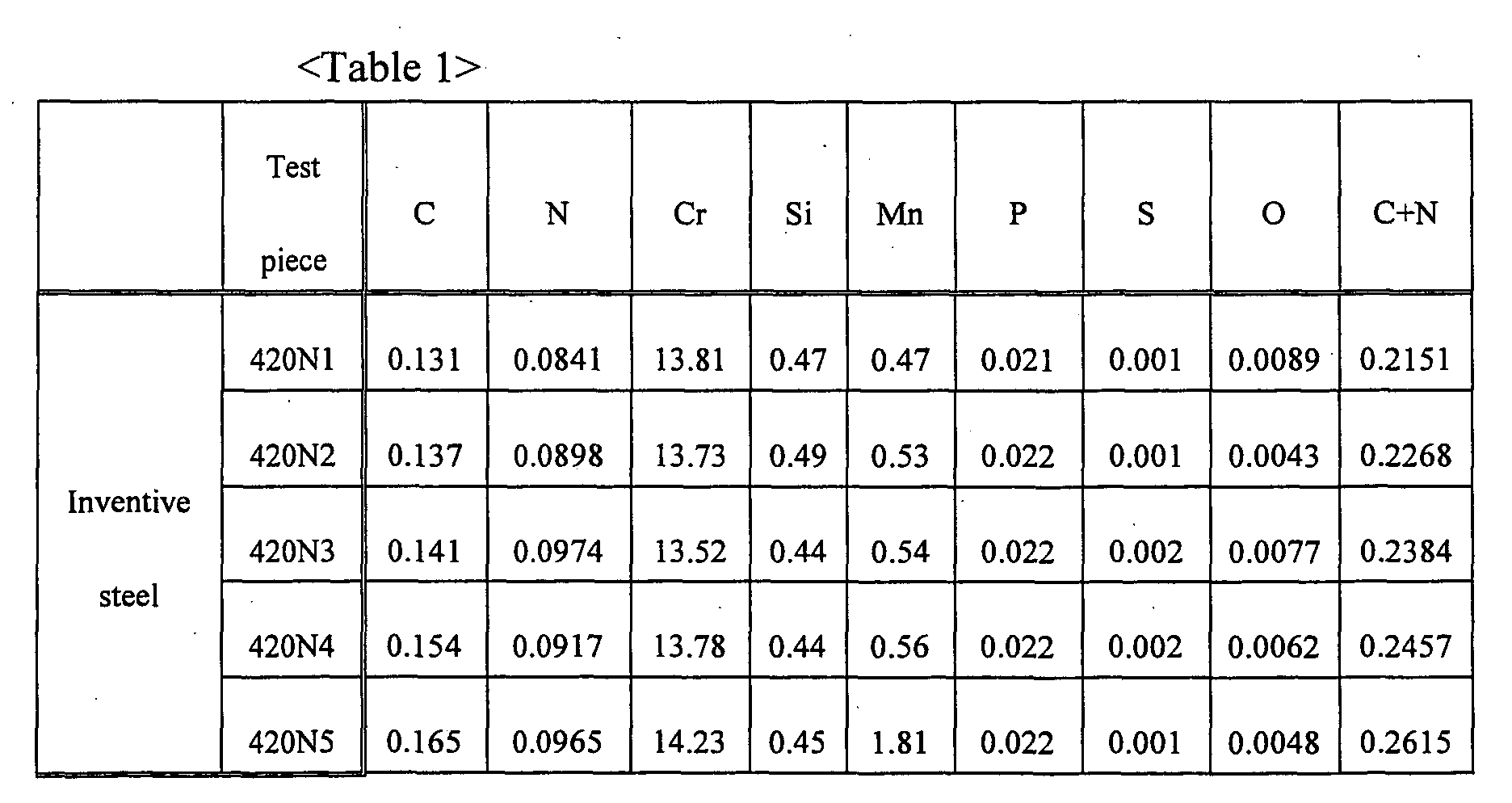
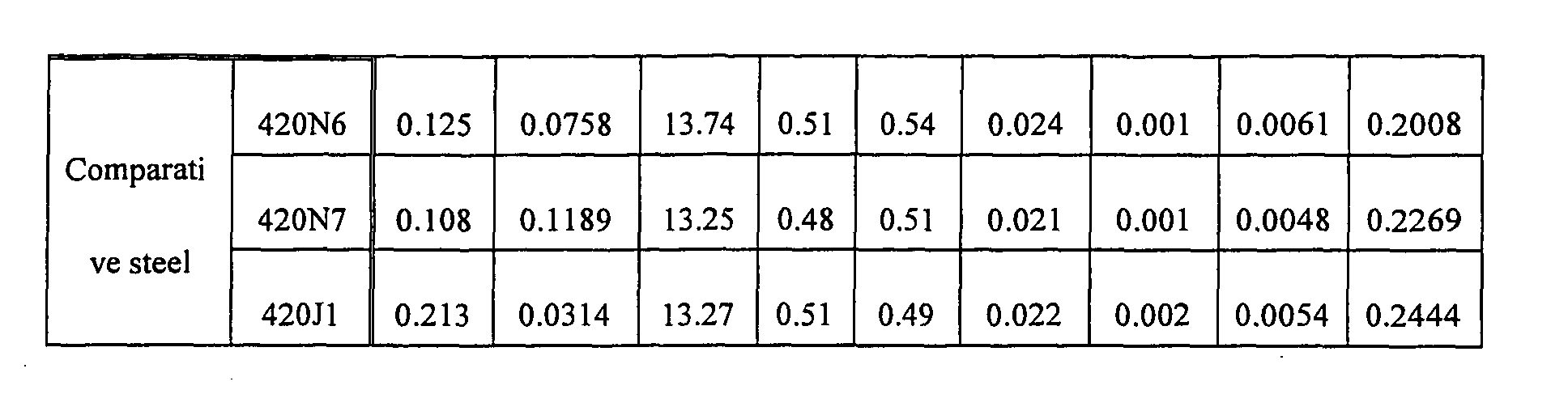
Test pieces are made of steel having the following composition,
which is melted in a vacuum induction furnace, cast into an ingot, and hot-rolled
under general conditions.
Referring to Table 1, in the type 420J1 steel as one of the
comparative steels, the total weight percentage of carbon and nitrogen is
beyond the addition range according to the present invention. Particularly,
since the C content of the type 420J1 steel is too much, as shown in Fig. 1 the
center segregation due to carbide is formed in the slab; and as shown in Fig. 2
the lamination defect may be caused by the center segregation of the carbide
during the working process of the hot rolled strip. Also, band-shaped carbide
as shown in Fig. 3 may remain in the center of a hot-rolled annealed slab.
On the other hand, the N content of the type 420J1 steel is
relatively small to the addition range according to the present invention, so
that there is no pin hole defect.
As for the type 420N7 steel as one of the comparative steels, the
amount of C content is small relative to the addition range according to the
present invention, so that there is no center segregation due to the carbide.
However, since the quantity of N content of the type 420N7 steel is larger than
the addition range according to the present invention, a large pin hole defect
remains on the edge surfaces of the continuous casting slab as shown in Figs.
4 and 5. Fig. 5 is a photograph of a plan section when the surface of the type
420N7 cast steel is grinded to 5mm, in which lots of pin hole defects are
shown.
As described above, the pin hole defect existing on the slab
results in a large surface defect in a hot rolled plate as shown in Fig. 6. The
large surface defect is hardly removed by surface grinding, thereby
deteriorating the surface quality of the martensitic stainless steel.
On the basis of the foregoing description, it is noted that the pin
hole defect is formed in proportion to the solid-solution ratio of the nitrogen in
the steel resulting in the deterioration of the quality of the stainless steel
product.
That is, referring to Fig. 7 showing a theoretical solid-solution
ratio of nitrogen with respect to temperature in 13.2Cr - 0.5Mn - 0.5 Si - 0.1C
- 0.12N steel on the basis of Thermo-Calc, the maximum solid-solution ratio
of the nitrogen is about 1,600ppm in a liquid state, but it is decreased into
about 558ppm with precipitating a _-phase while it is cooled. Here, the critical
concentration of the nitrogen creating the pin hole is slightly higher than the
minimum solid-solution ratio thereof because of atmospheric pressure, iron
pressure, and surface tension of the pin hole. However, in the case where the
nitrogen content in the steel is relatively high, the supersaturated nitrogen
makes a pore, and then creates the pin hole.
According to the present invention, the nitrogen content in the
steel is adjusted to minimize the formation amount of the pin hole, and the
carbon content in the steel is adjusted to optimize the hardness of the steel in
order to remove the prior problems.
Fig. 8 is a photograph showing a sectional structure of a
continuous casting slab of type 420N3 steel having compositions of the weight
percentage within the addition range according to the present invention. As
shown in Fig. 8, in this case, the slab's center segregation due to the carbide is
substantially decreased and there is no pin hole defect due to the nitrogen pore,
as compared with the steel of Figs. 2 and 4.
Further, referring to Fig. 9 theoretically showing on the basis of
Thermo-Calc the solid-solution ratio of nitrogen with respect to temperature in
13.7Cr - 0.5Mn - 0.5Si - 0.13C - 0.09N steel having compositions of the
weight percentage within the addition range according to the present
invention, the maximum solid-solution ratio of the nitrogen is about 1,680ppm
in a liquid state, but it is decreased into about 621ppm while being solidified.
In this case, the solid-solution ratio of the nitrogen is increased as compared
with the steel shown in Fig. 7. Here, the weight percentage of the alloy
composition is optimized to decrease a _-phase precipitation section at a high
temperature, thereby increasing the solid-solution ratio of the nitrogen as
compared with the steel of Fig. 7.
Fig. 10 is a graph showing the nitrogen pore creation behavior in
the 13.2Cr - 0.5Mn - 0.5Si - 0.1C - 0.12N steel departing from the addition
range of this invention and the 13.7Cr - 0.5Mn - 0.5Si - 0.13C - 0.09N steel
within the addition range of this invention. In the 13.2Cr - 0.5Mn - 0.5Si -
0.1C - 0.12N steel, the nitrogen pore is formed within the temperature range
between about 1310°C and about 1480°C. In this case the temperature
difference for creating the nitrogen pore is 170°C. However, in the 13.7Cr -
0.5Mn - 0.5Si - 0.13C - 0.09N steel, the nitrogen pore is created within a
temperature range from about 1350°C to about 1450°C, in which the
temperature difference for creating the nitrogen pore is 100°C. Thus, the
difference of the temperature for creating the nitrogen pore is decreased from
170°C to 100°C; thereby the pore creation ratio of the nitrogen is also
decreased by 50% or more.
With respect to the 13.2Cr - 0.5Mn - 0.5 Si - 0.1C - 0.12N steel
as one of the comparative steels and the 13.7Cr - 0.5Mn - 0.5Si - 0.13C -
0.09N steel as one of the inventive steels, the solid-solution ratio and pore
formation behavior of the nitrogen are herein below illustrated in Table 2.
| Items for Nitrogen | Comparative steel | Inventive steel |
| Maximum solid-solution ratio (ppm) | 1600 | 1680 |
| Minimum solid-solution ratio (ppm) | 558 | 621 |
| Pore formation starting temperature (°C) | 1480 | 1460 |
| Pore formation finishing temperature (°C) | 1310 | 1360 |
| Maximum amount of pore formation (moles) | 0.00251 | 0.00115 |
Further, since the driving force for the pore formation is
decreased and the cooling pattern of the continuous casting process is
optimized in the pore formation range due to nitrogen according to the iron
pressure and atmospheric pressure, the pin hole is not formed while the
stainless steel having compositions within the addition range according to the
present invention is commercially produced.
FIG. 11 is a photograph showing a microstructure of the center
in the hot-rolled annealed slab of the type 420N3 steel as one of the inventive
steels. As depicted therein, the band-shaped coarse carbide center segregation
section is shown in the comparative type 420J1 steel (refer to Fig. 3), but the
segregation section is substantially decreased and the size of the precipitation
become also minute in the inventive steel, the type 420N3 steel. This is
because the precipitation of the fine nitride is prior to that of the coarse carbide
due to the increase of the nitrogen content.
Below tables 3 to 8 shows quenching stress of the inventive
steels and the comparative steel, respectively according to the condition of
quenching process.
| HRc for 420N1 |
| | 5 min. | 10 min. | 15 min. | 30 min. |
| 950°C | 42.9 | 45.8 | 47.2 | 49.0 |
| 1000°C | 49.2 | 50.7 | 51.3 | 51.9 |
| 1050°C | 51.2 | 52.0 | 51.9 | 51.3 |
| 1100°C | 52.4 | 51.6 | 51.4 | 51.5 |
| 1150°C | 52.3 | 52.4 | 51.6 | 51.5 |
| HRc for 420N2 |
| | 5 min. | 10 min. | 15 min. | 30 min. |
| 950°C | 44.1 | 47.0 | 47.4 | 48.8 |
| 1000°C | 49.6 | 51.1 | 51.6 | 51.3 |
| 1050°C | 52.1 | 52.1 | 52.0 | 52.1 |
| 1100°C | 51.5 | 51.8 | 51.4 | 51.6 |
| 1150°C | 51.4 | 51.2 | 51.3 | 52.1 |
| HRc for 420N3 |
| | 5 min. | 10 min. | 15 min. | 30 min. |
| 950°C | 43.2 | 44.4 | 45.8 | 48.4 |
| 1000°C | 48.4 | 51.3 | 51.4 | 52.3 |
| 1050°C | 51.8 | 52.0 | 52.1 | 51.5 |
| 1100°C | 51.4 | 51.6 | 51.3 | 51.7 |
| 1150°C | 51.1 | 50.4 | 51.7 | 51.0 |
| HRc for 420N4 |
| | 5 min. | 10 min. | 15 min. | 30 min. I |
| 950°C | 33.4 | 42.2 | 41.9 | 44.0 |
| 1000°C | 41.5 | 45.7 | 48.0 | 50.9 |
| 1050°C | 50.5 | 52.4 | 52.4 | 53.2 |
| 1100°C | 51.5 | 53.1 | 54.0 | 53.1 |
| 1150°C | 53.4 | 53.7 | 52.6 | 53.6 |
| HRc for 420N5 |
| | 5 min. | 10 min. | 15 min. | 30 min. |
| 950°C | 45.1 | 48.5 | 49.1 | 50.6 |
| 1000°C | 50.7 | 51.7 | 51.5 | 53.1 |
| 1050°C | 52.8 | 52.8 | 52.8 | 54.4 |
| 1100°C | 54.1 | 54.0 | 54.5 | 54.0 |
| 1150°C | 53.5 | 53.0 | 52.8 | 53.5 |
| HRc for 420N6 |
| | 5 min. | 10 min. | 15 min. | 30 min. |
| 950°C | 43.2 | 45.4 | 45.9 | 45.7 |
| 1000°C | 46.6 | 49.2 | 48.9 | 49.2 |
| 1050°C | 49.9 | 49.8 | 49.7 | 50.0 |
| 1100°C | 48.9 | 49.2 | 48.6 | 49.6 |
| 1150°C | 49.0 | 48.7 | 47.6 | 48.3 |
We may note that the type 420N6 comparative steel in which the
total amount of C and N is 2008 ppm (0.2008 wt%) in the steel does not have
the desirable quenching hardness. However, the inventive steels have the
desirable quenching hardness of 50 HRc or more under the several of
quenching conditions relative to the comparative steel. This result from the
increase of carbon contents in place of the decrease of nitrogen contents
according to the invention.
FIG. 12 is a photograph showing microstructures of the type
420J1 steel as one of the comparative steels and the type 420N3 steel as one of
the inventive steels which are quenched at a temperature of 1050°C for ten
minutes, and FIG. 13 is a photograph showing microstructures of a knife made
of the comparative type 420J1 steel and a knife made of the inventive type
420N4 steel. As shown therein, the precipitation exists in the comparative type
420J1 steel, but it is not viewed in the inventive 420N3 and 420N4 steels
because it is fully solved as a solid solution. When the carbon component is
increased a lot, the center segregation region is formed to cause the nonuniformity
of the hardness like the case of the type 420J1 steel.
Further, after merging the knife made of the inventive type
420N1 steel and the knife made of the comparative type 420J1 steel into 3.5%
NaCl solution for a predetermined period of time, their surface corrosion
resistances were estimated. As shown in FIG. 14, the knife made of the steel
according to the present invention has a clean surface, but the knife made of
the comparative steel has a rusted surface. Thus, the precipitation has an
adverse effect on the hardness and corrosion resistance of the stainless steel
product.
On the basis of the foregoing description, the characteristic of
the steel according to the present invention and the comparative steel which
respectively have the compositions based on Table 1 are shown in Table. 9.
| | Test piece | Pin hole | Lamination | Hardness | Corrosion resistance |
| Inventive steel | 420N1 | Nonexistent | Nonexistent | Good | Good |
| 420N2 | Nonexistent | Nonexistent | Good | Good |
| 420N3 | Nonexistent | Nonexistent | Good | Good |
| 420N4 | Nonexistent | Nonexistent | Good | Good |
| 420N5 | Nonexistent | Nonexistent | Good | Good |
| Comparative steel | 420N6 | Existent | Nonexistent | Unsatisfactory | Good |
| 420N7 | Existent | Nonexistent | Good | Good |
| 420J1 | Nonexistent | Existent | Non-uniform | Unsatisfactory |
Referring to Table 9, the pin hole appears in the comparative
type 420N7 steel that has a relatively high weight percentage of the nitrogen
content as compared with the weight percentage according to the present
invention, wherein the pin hole is caused by the nitrogen pore. Oppositely, the
comparative type 420N7 steel has a relatively low weight percentage of the
carbon content as compared with the weight percentage according to the
present invention, so that the center segregation due to the carbide is not
formed and thus the lamination is not formed.
Further, the comparative type 420J1 steel has a relatively high
weight percentage of the carbon content and a relatively low weight
percentage of the nitrogen content as compared with the weight percentage
according to the present invention, thereby the pin hole due to the nitrogen
pore is not created but the lamination due to the center segregation of the
carbide is formed.
Besides, as for the comparative type 420N6 steel, each weight
percentage of the carbon content and the nitrogen content falls within the
addition range according to the present invention, but the total weight
percentage of carbon and nitrogen contents is off the addition range according
to the present invention, so that the comparative type 420N6 steel has the
unsatisfactory hardness.
On the other hand, the inventive steels of which the weight
percentage falls within the addition range according to the present invention
have no pin hole due to the nitrogen pore, no lamination due to the center
segregation of the carbide, and good mechanical characteristic in both the
hardness and the corrosion resistance.
As described above, the nitrogen content and the carbon content
are strictly limited, so that both the lamination due to the center segregation of
the carbide and the pin hole due to the nitrogen pore are prevented from being
created, thereby improving the quality of the corrosion-resistive martensitic
stainless steel without the deterioration of its productivity.
Although a few embodiments of the present invention have been
shown and described, it would be appreciated by those skilled in the art that
changes may be made in this embodiment without departing from the
principles and spirit of the invention, the scope of which is defined in the
claims and their equivalents.