EP1541591A1 - Process for production of fluoropolymer - Google Patents
Process for production of fluoropolymer Download PDFInfo
- Publication number
- EP1541591A1 EP1541591A1 EP03791360A EP03791360A EP1541591A1 EP 1541591 A1 EP1541591 A1 EP 1541591A1 EP 03791360 A EP03791360 A EP 03791360A EP 03791360 A EP03791360 A EP 03791360A EP 1541591 A1 EP1541591 A1 EP 1541591A1
- Authority
- EP
- European Patent Office
- Prior art keywords
- fluoropolymer
- molecular weight
- producing method
- reaction
- radical polymerizable
- Prior art date
- Legal status (The legal status is an assumption and is not a legal conclusion. Google has not performed a legal analysis and makes no representation as to the accuracy of the status listed.)
- Withdrawn
Links
- 229920002313 fluoropolymer Polymers 0.000 title claims abstract description 153
- 239000004811 fluoropolymer Substances 0.000 title claims abstract description 153
- 238000000034 method Methods 0.000 title claims abstract description 67
- 238000004519 manufacturing process Methods 0.000 title description 11
- 239000000178 monomer Substances 0.000 claims abstract description 116
- 238000006116 polymerization reaction Methods 0.000 claims abstract description 69
- 239000004793 Polystyrene Substances 0.000 claims abstract description 25
- 229920002223 polystyrene Polymers 0.000 claims abstract description 25
- 229910052731 fluorine Inorganic materials 0.000 claims abstract description 24
- YCKRFDGAMUMZLT-UHFFFAOYSA-N Fluorine atom Chemical compound [F] YCKRFDGAMUMZLT-UHFFFAOYSA-N 0.000 claims abstract description 23
- 239000011737 fluorine Substances 0.000 claims abstract description 23
- 230000000379 polymerizing effect Effects 0.000 claims abstract description 7
- 238000006243 chemical reaction Methods 0.000 claims description 103
- BQCIDUSAKPWEOX-UHFFFAOYSA-N 1,1-Difluoroethene Chemical compound FC(F)=C BQCIDUSAKPWEOX-UHFFFAOYSA-N 0.000 claims description 49
- CURLTUGMZLYLDI-UHFFFAOYSA-N Carbon dioxide Chemical compound O=C=O CURLTUGMZLYLDI-UHFFFAOYSA-N 0.000 claims description 42
- HCDGVLDPFQMKDK-UHFFFAOYSA-N hexafluoropropylene Chemical group FC(F)=C(F)C(F)(F)F HCDGVLDPFQMKDK-UHFFFAOYSA-N 0.000 claims description 28
- BFKJFAAPBSQJPD-UHFFFAOYSA-N tetrafluoroethene Chemical group FC(F)=C(F)F BFKJFAAPBSQJPD-UHFFFAOYSA-N 0.000 claims description 26
- 239000007870 radical polymerization initiator Substances 0.000 claims description 24
- 239000001569 carbon dioxide Substances 0.000 claims description 21
- 229910002092 carbon dioxide Inorganic materials 0.000 claims description 21
- 239000012986 chain transfer agent Substances 0.000 claims description 17
- NBVXSUQYWXRMNV-UHFFFAOYSA-N fluoromethane Chemical compound FC NBVXSUQYWXRMNV-UHFFFAOYSA-N 0.000 claims description 10
- 150000001451 organic peroxides Chemical group 0.000 claims description 10
- UUAGAQFQZIEFAH-UHFFFAOYSA-N chlorotrifluoroethylene Chemical group FC(F)=C(F)Cl UUAGAQFQZIEFAH-UHFFFAOYSA-N 0.000 claims description 9
- 239000012933 diacyl peroxide Substances 0.000 claims description 7
- BEQKKZICTDFVMG-UHFFFAOYSA-N 1,2,3,4,6-pentaoxepane-5,7-dione Chemical compound O=C1OOOOC(=O)O1 BEQKKZICTDFVMG-UHFFFAOYSA-N 0.000 claims description 5
- 150000003254 radicals Chemical class 0.000 description 62
- 238000009826 distribution Methods 0.000 description 38
- 229920000642 polymer Polymers 0.000 description 29
- 238000007334 copolymerization reaction Methods 0.000 description 18
- 239000000203 mixture Substances 0.000 description 17
- -1 hydrocarbyl alcohols Chemical class 0.000 description 16
- 229920001577 copolymer Polymers 0.000 description 15
- 239000012530 fluid Substances 0.000 description 15
- VGGSQFUCUMXWEO-UHFFFAOYSA-N Ethene Chemical compound C=C VGGSQFUCUMXWEO-UHFFFAOYSA-N 0.000 description 12
- 239000005977 Ethylene Substances 0.000 description 12
- CSCPPACGZOOCGX-UHFFFAOYSA-N Acetone Chemical compound CC(C)=O CSCPPACGZOOCGX-UHFFFAOYSA-N 0.000 description 11
- OIFBSDVPJOWBCH-UHFFFAOYSA-N Diethyl carbonate Chemical compound CCOC(=O)OCC OIFBSDVPJOWBCH-UHFFFAOYSA-N 0.000 description 10
- 230000002902 bimodal effect Effects 0.000 description 9
- 230000000694 effects Effects 0.000 description 9
- 239000002245 particle Substances 0.000 description 9
- 238000012546 transfer Methods 0.000 description 9
- 238000000465 moulding Methods 0.000 description 8
- 238000001542 size-exclusion chromatography Methods 0.000 description 8
- 239000000126 substance Substances 0.000 description 8
- 150000002978 peroxides Chemical class 0.000 description 7
- 239000000047 product Substances 0.000 description 7
- 241000894007 species Species 0.000 description 7
- OFBQJSOFQDEBGM-UHFFFAOYSA-N Pentane Chemical compound CCCCC OFBQJSOFQDEBGM-UHFFFAOYSA-N 0.000 description 6
- 238000004458 analytical method Methods 0.000 description 6
- 125000004432 carbon atom Chemical group C* 0.000 description 6
- QQONPFPTGQHPMA-UHFFFAOYSA-N propylene Natural products CC=C QQONPFPTGQHPMA-UHFFFAOYSA-N 0.000 description 6
- LTMRRSWNXVJMBA-UHFFFAOYSA-L 2,2-diethylpropanedioate Chemical compound CCC(CC)(C([O-])=O)C([O-])=O LTMRRSWNXVJMBA-UHFFFAOYSA-L 0.000 description 5
- 239000002033 PVDF binder Substances 0.000 description 5
- 230000000052 comparative effect Effects 0.000 description 5
- CWINGZLCRSDKCL-UHFFFAOYSA-N ethoxycarbonyloxy ethyl carbonate Chemical compound CCOC(=O)OOC(=O)OCC CWINGZLCRSDKCL-UHFFFAOYSA-N 0.000 description 5
- 239000003999 initiator Substances 0.000 description 5
- 229920002493 poly(chlorotrifluoroethylene) Polymers 0.000 description 5
- 239000005023 polychlorotrifluoroethylene (PCTFE) polymer Substances 0.000 description 5
- 229920002981 polyvinylidene fluoride Polymers 0.000 description 5
- 229910001220 stainless steel Inorganic materials 0.000 description 5
- 239000010935 stainless steel Substances 0.000 description 5
- LFQSCWFLJHTTHZ-UHFFFAOYSA-N Ethanol Chemical compound CCO LFQSCWFLJHTTHZ-UHFFFAOYSA-N 0.000 description 4
- XPDWGBQVDMORPB-UHFFFAOYSA-N Fluoroform Chemical compound FC(F)F XPDWGBQVDMORPB-UHFFFAOYSA-N 0.000 description 4
- KFZMGEQAYNKOFK-UHFFFAOYSA-N Isopropanol Chemical compound CC(C)O KFZMGEQAYNKOFK-UHFFFAOYSA-N 0.000 description 4
- 230000015572 biosynthetic process Effects 0.000 description 4
- 150000001875 compounds Chemical class 0.000 description 4
- 230000007423 decrease Effects 0.000 description 4
- RWRIWBAIICGTTQ-UHFFFAOYSA-N difluoromethane Chemical compound FCF RWRIWBAIICGTTQ-UHFFFAOYSA-N 0.000 description 4
- FJKIXWOMBXYWOQ-UHFFFAOYSA-N ethenoxyethane Chemical compound CCOC=C FJKIXWOMBXYWOQ-UHFFFAOYSA-N 0.000 description 4
- WMIYKQLTONQJES-UHFFFAOYSA-N hexafluoroethane Chemical compound FC(F)(F)C(F)(F)F WMIYKQLTONQJES-UHFFFAOYSA-N 0.000 description 4
- IJGRMHOSHXDMSA-UHFFFAOYSA-N nitrogen Substances N#N IJGRMHOSHXDMSA-UHFFFAOYSA-N 0.000 description 4
- 229910052757 nitrogen Inorganic materials 0.000 description 4
- QJGQUHMNIGDVPM-UHFFFAOYSA-N nitrogen group Chemical group [N] QJGQUHMNIGDVPM-UHFFFAOYSA-N 0.000 description 4
- 125000004805 propylene group Chemical group [H]C([H])([H])C([H])([*:1])C([H])([H])[*:2] 0.000 description 4
- 239000012265 solid product Substances 0.000 description 4
- 239000000243 solution Substances 0.000 description 4
- 238000003756 stirring Methods 0.000 description 4
- 238000006467 substitution reaction Methods 0.000 description 4
- TXEYQDLBPFQVAA-UHFFFAOYSA-N tetrafluoromethane Chemical compound FC(F)(F)F TXEYQDLBPFQVAA-UHFFFAOYSA-N 0.000 description 4
- KHXKESCWFMPTFT-UHFFFAOYSA-N 1,1,1,2,2,3,3-heptafluoro-3-(1,2,2-trifluoroethenoxy)propane Chemical compound FC(F)=C(F)OC(F)(F)C(F)(F)C(F)(F)F KHXKESCWFMPTFT-UHFFFAOYSA-N 0.000 description 3
- BLTXWCKMNMYXEA-UHFFFAOYSA-N 1,1,2-trifluoro-2-(trifluoromethoxy)ethene Chemical compound FC(F)=C(F)OC(F)(F)F BLTXWCKMNMYXEA-UHFFFAOYSA-N 0.000 description 3
- YMWUJEATGCHHMB-UHFFFAOYSA-N Dichloromethane Chemical compound ClCCl YMWUJEATGCHHMB-UHFFFAOYSA-N 0.000 description 3
- XEKOWRVHYACXOJ-UHFFFAOYSA-N Ethyl acetate Chemical compound CCOC(C)=O XEKOWRVHYACXOJ-UHFFFAOYSA-N 0.000 description 3
- OKKJLVBELUTLKV-UHFFFAOYSA-N Methanol Chemical compound OC OKKJLVBELUTLKV-UHFFFAOYSA-N 0.000 description 3
- 125000003178 carboxy group Chemical group [H]OC(*)=O 0.000 description 3
- 238000000576 coating method Methods 0.000 description 3
- 239000000470 constituent Substances 0.000 description 3
- 230000003247 decreasing effect Effects 0.000 description 3
- 239000003085 diluting agent Substances 0.000 description 3
- 238000007720 emulsion polymerization reaction Methods 0.000 description 3
- 238000001125 extrusion Methods 0.000 description 3
- 239000010408 film Substances 0.000 description 3
- 239000007789 gas Substances 0.000 description 3
- 150000008282 halocarbons Chemical class 0.000 description 3
- 229930195733 hydrocarbon Natural products 0.000 description 3
- 150000002430 hydrocarbons Chemical class 0.000 description 3
- 239000013627 low molecular weight specie Substances 0.000 description 3
- 238000005259 measurement Methods 0.000 description 3
- VLKZOEOYAKHREP-UHFFFAOYSA-N n-Hexane Chemical compound CCCCCC VLKZOEOYAKHREP-UHFFFAOYSA-N 0.000 description 3
- 239000000843 powder Substances 0.000 description 3
- 239000002904 solvent Substances 0.000 description 3
- 238000010557 suspension polymerization reaction Methods 0.000 description 3
- 230000008961 swelling Effects 0.000 description 3
- LVGUZGTVOIAKKC-UHFFFAOYSA-N 1,1,1,2-tetrafluoroethane Chemical compound FCC(F)(F)F LVGUZGTVOIAKKC-UHFFFAOYSA-N 0.000 description 2
- UJPMYEOUBPIPHQ-UHFFFAOYSA-N 1,1,1-trifluoroethane Chemical compound CC(F)(F)F UJPMYEOUBPIPHQ-UHFFFAOYSA-N 0.000 description 2
- UZKWTJUDCOPSNM-UHFFFAOYSA-N 1-ethenoxybutane Chemical compound CCCCOC=C UZKWTJUDCOPSNM-UHFFFAOYSA-N 0.000 description 2
- OZAIFHULBGXAKX-UHFFFAOYSA-N 2-(2-cyanopropan-2-yldiazenyl)-2-methylpropanenitrile Chemical compound N#CC(C)(C)N=NC(C)(C)C#N OZAIFHULBGXAKX-UHFFFAOYSA-N 0.000 description 2
- HEDRZPFGACZZDS-UHFFFAOYSA-N Chloroform Chemical compound ClC(Cl)Cl HEDRZPFGACZZDS-UHFFFAOYSA-N 0.000 description 2
- RWSOTUBLDIXVET-UHFFFAOYSA-N Dihydrogen sulfide Chemical class S RWSOTUBLDIXVET-UHFFFAOYSA-N 0.000 description 2
- UFHFLCQGNIYNRP-UHFFFAOYSA-N Hydrogen Chemical compound [H][H] UFHFLCQGNIYNRP-UHFFFAOYSA-N 0.000 description 2
- MHAJPDPJQMAIIY-UHFFFAOYSA-N Hydrogen peroxide Chemical compound OO MHAJPDPJQMAIIY-UHFFFAOYSA-N 0.000 description 2
- YRKCREAYFQTBPV-UHFFFAOYSA-N acetylacetone Chemical compound CC(=O)CC(C)=O YRKCREAYFQTBPV-UHFFFAOYSA-N 0.000 description 2
- 239000000654 additive Substances 0.000 description 2
- 230000000996 additive effect Effects 0.000 description 2
- 125000002947 alkylene group Chemical group 0.000 description 2
- 239000012736 aqueous medium Substances 0.000 description 2
- 125000000751 azo group Chemical group [*]N=N[*] 0.000 description 2
- LWMFAFLIWMPZSX-UHFFFAOYSA-N bis[2-(4,5-dihydro-1h-imidazol-2-yl)propan-2-yl]diazene Chemical compound N=1CCNC=1C(C)(C)N=NC(C)(C)C1=NCCN1 LWMFAFLIWMPZSX-UHFFFAOYSA-N 0.000 description 2
- 239000001273 butane Substances 0.000 description 2
- 229950005499 carbon tetrachloride Drugs 0.000 description 2
- 239000003795 chemical substances by application Substances 0.000 description 2
- JHIVVAPYMSGYDF-UHFFFAOYSA-N cyclohexanone Chemical compound O=C1CCCCC1 JHIVVAPYMSGYDF-UHFFFAOYSA-N 0.000 description 2
- WNAHIZMDSQCWRP-UHFFFAOYSA-N dodecane-1-thiol Chemical compound CCCCCCCCCCCCS WNAHIZMDSQCWRP-UHFFFAOYSA-N 0.000 description 2
- 229920001971 elastomer Polymers 0.000 description 2
- 239000000806 elastomer Substances 0.000 description 2
- 238000005401 electroluminescence Methods 0.000 description 2
- 238000005516 engineering process Methods 0.000 description 2
- FKRCODPIKNYEAC-UHFFFAOYSA-N ethyl propionate Chemical compound CCOC(=O)CC FKRCODPIKNYEAC-UHFFFAOYSA-N 0.000 description 2
- 125000000524 functional group Chemical group 0.000 description 2
- 125000001183 hydrocarbyl group Chemical group 0.000 description 2
- 239000001257 hydrogen Substances 0.000 description 2
- 229910052739 hydrogen Inorganic materials 0.000 description 2
- 125000004435 hydrogen atom Chemical group [H]* 0.000 description 2
- 239000007788 liquid Substances 0.000 description 2
- 239000000463 material Substances 0.000 description 2
- IJDNQMDRQITEOD-UHFFFAOYSA-N n-butane Chemical compound CCCC IJDNQMDRQITEOD-UHFFFAOYSA-N 0.000 description 2
- BCCOBQSFUDVTJQ-UHFFFAOYSA-N octafluorocyclobutane Chemical compound FC1(F)C(F)(F)C(F)(F)C1(F)F BCCOBQSFUDVTJQ-UHFFFAOYSA-N 0.000 description 2
- 235000019407 octafluorocyclobutane Nutrition 0.000 description 2
- 239000005008 organosol coating Substances 0.000 description 2
- 125000005634 peroxydicarbonate group Chemical group 0.000 description 2
- JRKICGRDRMAZLK-UHFFFAOYSA-L peroxydisulfate Chemical class [O-]S(=O)(=O)OOS([O-])(=O)=O JRKICGRDRMAZLK-UHFFFAOYSA-L 0.000 description 2
- 229920001343 polytetrafluoroethylene Polymers 0.000 description 2
- 239000004810 polytetrafluoroethylene Substances 0.000 description 2
- 239000002244 precipitate Substances 0.000 description 2
- 238000002360 preparation method Methods 0.000 description 2
- 239000002994 raw material Substances 0.000 description 2
- 239000003507 refrigerant Substances 0.000 description 2
- 239000011347 resin Substances 0.000 description 2
- 229920005989 resin Polymers 0.000 description 2
- 239000004065 semiconductor Substances 0.000 description 2
- VZGDMQKNWNREIO-UHFFFAOYSA-N tetrachloromethane Chemical compound ClC(Cl)(Cl)Cl VZGDMQKNWNREIO-UHFFFAOYSA-N 0.000 description 2
- HGXJDMCMYLEZMJ-UHFFFAOYSA-N (2-methylpropan-2-yl)oxy 2,2-dimethylpropaneperoxoate Chemical compound CC(C)(C)OOOC(=O)C(C)(C)C HGXJDMCMYLEZMJ-UHFFFAOYSA-N 0.000 description 1
- NOBYOEQUFMGXBP-UHFFFAOYSA-N (4-tert-butylcyclohexyl) (4-tert-butylcyclohexyl)oxycarbonyloxy carbonate Chemical compound C1CC(C(C)(C)C)CCC1OC(=O)OOC(=O)OC1CCC(C(C)(C)C)CC1 NOBYOEQUFMGXBP-UHFFFAOYSA-N 0.000 description 1
- OURRZLCUWZZPKV-UHFFFAOYSA-N 1,1,2,2-tetrafluoro-1-iodo-2-(1,2,2-trifluoroethenoxy)ethane Chemical compound FC(F)=C(F)OC(F)(F)C(F)(F)I OURRZLCUWZZPKV-UHFFFAOYSA-N 0.000 description 1
- VQUGQIYAVYQSAB-UHFFFAOYSA-N 1,1,2,2-tetrafluoro-2-(1,2,2-trifluoroethenoxy)ethanesulfonyl fluoride Chemical compound FC(F)=C(F)OC(F)(F)C(F)(F)S(F)(=O)=O VQUGQIYAVYQSAB-UHFFFAOYSA-N 0.000 description 1
- MIZLGWKEZAPEFJ-UHFFFAOYSA-N 1,1,2-trifluoroethene Chemical group FC=C(F)F MIZLGWKEZAPEFJ-UHFFFAOYSA-N 0.000 description 1
- NPNPZTNLOVBDOC-UHFFFAOYSA-N 1,1-difluoroethane Chemical compound CC(F)F NPNPZTNLOVBDOC-UHFFFAOYSA-N 0.000 description 1
- SKYXLDSRLNRAPS-UHFFFAOYSA-N 1,2,4-trifluoro-5-methoxybenzene Chemical compound COC1=CC(F)=C(F)C=C1F SKYXLDSRLNRAPS-UHFFFAOYSA-N 0.000 description 1
- VXNZUUAINFGPBY-UHFFFAOYSA-N 1-Butene Chemical compound CCC=C VXNZUUAINFGPBY-UHFFFAOYSA-N 0.000 description 1
- OVGRCEFMXPHEBL-UHFFFAOYSA-N 1-ethenoxypropane Chemical compound CCCOC=C OVGRCEFMXPHEBL-UHFFFAOYSA-N 0.000 description 1
- NHJFHUKLZMQIHN-UHFFFAOYSA-N 2,2,3,3,3-pentafluoropropanoyl 2,2,3,3,3-pentafluoropropaneperoxoate Chemical compound FC(F)(F)C(F)(F)C(=O)OOC(=O)C(F)(F)C(F)(F)F NHJFHUKLZMQIHN-UHFFFAOYSA-N 0.000 description 1
- JUTIIYKOQPDNEV-UHFFFAOYSA-N 2,2,3,3,4,4,4-heptafluorobutanoyl 2,2,3,3,4,4,4-heptafluorobutaneperoxoate Chemical compound FC(F)(F)C(F)(F)C(F)(F)C(=O)OOC(=O)C(F)(F)C(F)(F)C(F)(F)F JUTIIYKOQPDNEV-UHFFFAOYSA-N 0.000 description 1
- CRJIYMRJTJWVLU-UHFFFAOYSA-N 2,4,4-trimethylpentan-2-yl 3-(5,5-dimethylhexyl)dioxirane-3-carboxylate Chemical compound CC(C)(C)CCCCC1(C(=O)OC(C)(C)CC(C)(C)C)OO1 CRJIYMRJTJWVLU-UHFFFAOYSA-N 0.000 description 1
- DPGYCJUCJYUHTM-UHFFFAOYSA-N 2,4,4-trimethylpentan-2-yloxy 2-ethylhexaneperoxoate Chemical compound CCCCC(CC)C(=O)OOOC(C)(C)CC(C)(C)C DPGYCJUCJYUHTM-UHFFFAOYSA-N 0.000 description 1
- LCPVQAHEFVXVKT-UHFFFAOYSA-N 2-(2,4-difluorophenoxy)pyridin-3-amine Chemical compound NC1=CC=CN=C1OC1=CC=C(F)C=C1F LCPVQAHEFVXVKT-UHFFFAOYSA-N 0.000 description 1
- AVTLBBWTUPQRAY-UHFFFAOYSA-N 2-(2-cyanobutan-2-yldiazenyl)-2-methylbutanenitrile Chemical compound CCC(C)(C#N)N=NC(C)(CC)C#N AVTLBBWTUPQRAY-UHFFFAOYSA-N 0.000 description 1
- LDQYWNUWKVADJV-UHFFFAOYSA-N 2-[(1-amino-2-methyl-1-oxopropan-2-yl)diazenyl]-2-methylpropanamide;dihydrate Chemical compound O.O.NC(=O)C(C)(C)N=NC(C)(C)C(N)=O LDQYWNUWKVADJV-UHFFFAOYSA-N 0.000 description 1
- VUDVPVOIALASLB-UHFFFAOYSA-N 2-[(2-cyano-1-hydroxypropan-2-yl)diazenyl]-3-hydroxy-2-methylpropanenitrile Chemical compound OCC(C)(C#N)N=NC(C)(CO)C#N VUDVPVOIALASLB-UHFFFAOYSA-N 0.000 description 1
- PFHOSZAOXCYAGJ-UHFFFAOYSA-N 2-[(2-cyano-4-methoxy-4-methylpentan-2-yl)diazenyl]-4-methoxy-2,4-dimethylpentanenitrile Chemical compound COC(C)(C)CC(C)(C#N)N=NC(C)(C#N)CC(C)(C)OC PFHOSZAOXCYAGJ-UHFFFAOYSA-N 0.000 description 1
- WYGWHHGCAGTUCH-UHFFFAOYSA-N 2-[(2-cyano-4-methylpentan-2-yl)diazenyl]-2,4-dimethylpentanenitrile Chemical compound CC(C)CC(C)(C#N)N=NC(C)(C#N)CC(C)C WYGWHHGCAGTUCH-UHFFFAOYSA-N 0.000 description 1
- VSXHKKXYCVWKFG-UHFFFAOYSA-N 2-cyclohexylpropan-2-yl 7,7-dimethyloctaneperoxoate Chemical compound CC(C)(C)CCCCCC(=O)OOC(C)(C)C1CCCCC1 VSXHKKXYCVWKFG-UHFFFAOYSA-N 0.000 description 1
- VGZZAZYCLRYTNQ-UHFFFAOYSA-N 2-ethoxyethoxycarbonyloxy 2-ethoxyethyl carbonate Chemical compound CCOCCOC(=O)OOC(=O)OCCOCC VGZZAZYCLRYTNQ-UHFFFAOYSA-N 0.000 description 1
- BRQMAAFGEXNUOL-UHFFFAOYSA-N 2-ethylhexyl (2-methylpropan-2-yl)oxy carbonate Chemical compound CCCCC(CC)COC(=O)OOC(C)(C)C BRQMAAFGEXNUOL-UHFFFAOYSA-N 0.000 description 1
- LYPGJGCIPQYQBW-UHFFFAOYSA-N 2-methyl-2-[[2-methyl-1-oxo-1-(prop-2-enylamino)propan-2-yl]diazenyl]-n-prop-2-enylpropanamide Chemical compound C=CCNC(=O)C(C)(C)N=NC(C)(C)C(=O)NCC=C LYPGJGCIPQYQBW-UHFFFAOYSA-N 0.000 description 1
- RTEZVHMDMFEURJ-UHFFFAOYSA-N 2-methylpentan-2-yl 2,2-dimethylpropaneperoxoate Chemical compound CCCC(C)(C)OOC(=O)C(C)(C)C RTEZVHMDMFEURJ-UHFFFAOYSA-N 0.000 description 1
- YMMLZUQDXYPNOG-UHFFFAOYSA-N 2-methylpentan-2-yl 7,7-dimethyloctaneperoxoate Chemical compound CCCC(C)(C)OOC(=O)CCCCCC(C)(C)C YMMLZUQDXYPNOG-UHFFFAOYSA-N 0.000 description 1
- RPBWMJBZQXCSFW-UHFFFAOYSA-N 2-methylpropanoyl 2-methylpropaneperoxoate Chemical compound CC(C)C(=O)OOC(=O)C(C)C RPBWMJBZQXCSFW-UHFFFAOYSA-N 0.000 description 1
- QMIWYOZFFSLIAK-UHFFFAOYSA-N 3,3,3-trifluoro-2-(trifluoromethyl)prop-1-ene Chemical compound FC(F)(F)C(=C)C(F)(F)F QMIWYOZFFSLIAK-UHFFFAOYSA-N 0.000 description 1
- FDMFUZHCIRHGRG-UHFFFAOYSA-N 3,3,3-trifluoroprop-1-ene Chemical compound FC(F)(F)C=C FDMFUZHCIRHGRG-UHFFFAOYSA-N 0.000 description 1
- KFGFVPMRLOQXNB-UHFFFAOYSA-N 3,5,5-trimethylhexanoyl 3,5,5-trimethylhexaneperoxoate Chemical compound CC(C)(C)CC(C)CC(=O)OOC(=O)CC(C)CC(C)(C)C KFGFVPMRLOQXNB-UHFFFAOYSA-N 0.000 description 1
- XYFRHHAYSXIKGH-UHFFFAOYSA-N 3-(5-methoxy-2-methoxycarbonyl-1h-indol-3-yl)prop-2-enoic acid Chemical compound C1=C(OC)C=C2C(C=CC(O)=O)=C(C(=O)OC)NC2=C1 XYFRHHAYSXIKGH-UHFFFAOYSA-N 0.000 description 1
- CARSMBZECAABMO-UHFFFAOYSA-N 3-chloro-2,6-dimethylbenzoic acid Chemical compound CC1=CC=C(Cl)C(C)=C1C(O)=O CARSMBZECAABMO-UHFFFAOYSA-N 0.000 description 1
- VFXXTYGQYWRHJP-UHFFFAOYSA-N 4,4'-azobis(4-cyanopentanoic acid) Chemical compound OC(=O)CCC(C)(C#N)N=NC(C)(CCC(O)=O)C#N VFXXTYGQYWRHJP-UHFFFAOYSA-N 0.000 description 1
- MKTOIPPVFPJEQO-UHFFFAOYSA-N 4-(3-carboxypropanoylperoxy)-4-oxobutanoic acid Chemical compound OC(=O)CCC(=O)OOC(=O)CCC(O)=O MKTOIPPVFPJEQO-UHFFFAOYSA-N 0.000 description 1
- HMBNQNDUEFFFNZ-UHFFFAOYSA-N 4-ethenoxybutan-1-ol Chemical compound OCCCCOC=C HMBNQNDUEFFFNZ-UHFFFAOYSA-N 0.000 description 1
- 241000251468 Actinopterygii Species 0.000 description 1
- DKPFZGUDAPQIHT-UHFFFAOYSA-N Butyl acetate Natural products CCCCOC(C)=O DKPFZGUDAPQIHT-UHFFFAOYSA-N 0.000 description 1
- MLIRZMFDTOASCT-UHFFFAOYSA-N C(#N)NC(=O)N=NC(C)C Chemical compound C(#N)NC(=O)N=NC(C)C MLIRZMFDTOASCT-UHFFFAOYSA-N 0.000 description 1
- ZAMOUSCENKQFHK-UHFFFAOYSA-N Chlorine atom Chemical compound [Cl] ZAMOUSCENKQFHK-UHFFFAOYSA-N 0.000 description 1
- VYZAMTAEIAYCRO-UHFFFAOYSA-N Chromium Chemical compound [Cr] VYZAMTAEIAYCRO-UHFFFAOYSA-N 0.000 description 1
- 229910020587 CmF2m+1 Inorganic materials 0.000 description 1
- DKMROQRQHGEIOW-UHFFFAOYSA-N Diethyl succinate Chemical compound CCOC(=O)CCC(=O)OCC DKMROQRQHGEIOW-UHFFFAOYSA-N 0.000 description 1
- MUXOBHXGJLMRAB-UHFFFAOYSA-N Dimethyl succinate Chemical compound COC(=O)CCC(=O)OC MUXOBHXGJLMRAB-UHFFFAOYSA-N 0.000 description 1
- YIVJZNGAASQVEM-UHFFFAOYSA-N Lauroyl peroxide Chemical compound CCCCCCCCCCCC(=O)OOC(=O)CCCCCCCCCCC YIVJZNGAASQVEM-UHFFFAOYSA-N 0.000 description 1
- XBDQKXXYIPTUBI-UHFFFAOYSA-M Propionate Chemical compound CCC([O-])=O XBDQKXXYIPTUBI-UHFFFAOYSA-M 0.000 description 1
- 229910006095 SO2F Inorganic materials 0.000 description 1
- UHASMEVRHWRZKF-UHFFFAOYSA-N [2,3,3,3-tetrafluoro-2-(1,1,2,2,3,3,3-heptafluoropropoxy)propanoyl] 2,3,3,3-tetrafluoro-2-(1,1,2,2,3,3,3-heptafluoropropoxy)propaneperoxoate Chemical compound FC(F)(F)C(F)(F)C(F)(F)OC(F)(C(F)(F)F)C(=O)OOC(=O)C(F)(C(F)(F)F)OC(F)(F)C(F)(F)C(F)(F)F UHASMEVRHWRZKF-UHFFFAOYSA-N 0.000 description 1
- LXEKPEMOWBOYRF-UHFFFAOYSA-N [2-[(1-azaniumyl-1-imino-2-methylpropan-2-yl)diazenyl]-2-methylpropanimidoyl]azanium;dichloride Chemical compound Cl.Cl.NC(=N)C(C)(C)N=NC(C)(C)C(N)=N LXEKPEMOWBOYRF-UHFFFAOYSA-N 0.000 description 1
- JUIBLDFFVYKUAC-UHFFFAOYSA-N [5-(2-ethylhexanoylperoxy)-2,5-dimethylhexan-2-yl] 2-ethylhexaneperoxoate Chemical compound CCCCC(CC)C(=O)OOC(C)(C)CCC(C)(C)OOC(=O)C(CC)CCCC JUIBLDFFVYKUAC-UHFFFAOYSA-N 0.000 description 1
- KYIKRXIYLAGAKQ-UHFFFAOYSA-N abcn Chemical compound C1CCCCC1(C#N)N=NC1(C#N)CCCCC1 KYIKRXIYLAGAKQ-UHFFFAOYSA-N 0.000 description 1
- KXKVLQRXCPHEJC-UHFFFAOYSA-N acetic acid trimethyl ester Natural products COC(C)=O KXKVLQRXCPHEJC-UHFFFAOYSA-N 0.000 description 1
- 239000002253 acid Substances 0.000 description 1
- 150000001338 aliphatic hydrocarbons Chemical class 0.000 description 1
- 229910052783 alkali metal Inorganic materials 0.000 description 1
- 150000001340 alkali metals Chemical class 0.000 description 1
- 125000004453 alkoxycarbonyl group Chemical group 0.000 description 1
- 125000000217 alkyl group Chemical group 0.000 description 1
- ROOXNKNUYICQNP-UHFFFAOYSA-N ammonium peroxydisulfate Substances [NH4+].[NH4+].[O-]S(=O)(=O)OOS([O-])(=O)=O ROOXNKNUYICQNP-UHFFFAOYSA-N 0.000 description 1
- VAZSKTXWXKYQJF-UHFFFAOYSA-N ammonium persulfate Chemical compound [NH4+].[NH4+].[O-]S(=O)OOS([O-])=O VAZSKTXWXKYQJF-UHFFFAOYSA-N 0.000 description 1
- 229910001870 ammonium persulfate Inorganic materials 0.000 description 1
- WPKWPKDNOPEODE-UHFFFAOYSA-N bis(2,4,4-trimethylpentan-2-yl)diazene Chemical compound CC(C)(C)CC(C)(C)N=NC(C)(C)CC(C)(C)C WPKWPKDNOPEODE-UHFFFAOYSA-N 0.000 description 1
- SFBXYJXNDOJHLL-UHFFFAOYSA-N bis[2-(4,5-dihydro-1h-imidazol-2-yl)propan-2-yl]diazene;sulfo hydrogen sulfate Chemical compound OS(=O)(=O)OS(O)(=O)=O.N=1CCNC=1C(C)(C)N=NC(C)(C)C1=NCCN1 SFBXYJXNDOJHLL-UHFFFAOYSA-N 0.000 description 1
- 239000004566 building material Substances 0.000 description 1
- IAQRGUVFOMOMEM-UHFFFAOYSA-N butene Natural products CC=CC IAQRGUVFOMOMEM-UHFFFAOYSA-N 0.000 description 1
- 125000002915 carbonyl group Chemical group [*:2]C([*:1])=O 0.000 description 1
- 239000003638 chemical reducing agent Substances 0.000 description 1
- 239000000460 chlorine Substances 0.000 description 1
- 229910052801 chlorine Inorganic materials 0.000 description 1
- 229910052804 chromium Inorganic materials 0.000 description 1
- 239000011651 chromium Substances 0.000 description 1
- 238000004140 cleaning Methods 0.000 description 1
- 239000000701 coagulant Substances 0.000 description 1
- 239000011248 coating agent Substances 0.000 description 1
- 230000007797 corrosion Effects 0.000 description 1
- 238000005260 corrosion Methods 0.000 description 1
- 125000004122 cyclic group Chemical group 0.000 description 1
- 230000002950 deficient Effects 0.000 description 1
- BEPAFCGSDWSTEL-UHFFFAOYSA-N dimethyl malonate Chemical compound COC(=O)CC(=O)OC BEPAFCGSDWSTEL-UHFFFAOYSA-N 0.000 description 1
- 239000004205 dimethyl polysiloxane Substances 0.000 description 1
- 239000006185 dispersion Substances 0.000 description 1
- 239000003814 drug Substances 0.000 description 1
- 229940079593 drug Drugs 0.000 description 1
- 238000001035 drying Methods 0.000 description 1
- 125000003700 epoxy group Chemical group 0.000 description 1
- RTZKZFJDLAIYFH-UHFFFAOYSA-N ether Substances CCOCC RTZKZFJDLAIYFH-UHFFFAOYSA-N 0.000 description 1
- XYIBRDXRRQCHLP-UHFFFAOYSA-N ethyl acetoacetate Chemical compound CCOC(=O)CC(C)=O XYIBRDXRRQCHLP-UHFFFAOYSA-N 0.000 description 1
- 125000001153 fluoro group Chemical group F* 0.000 description 1
- XUCNUKMRBVNAPB-UHFFFAOYSA-N fluoroethene Chemical compound FC=C XUCNUKMRBVNAPB-UHFFFAOYSA-N 0.000 description 1
- 238000005187 foaming Methods 0.000 description 1
- 239000000383 hazardous chemical Substances 0.000 description 1
- FUZZWVXGSFPDMH-UHFFFAOYSA-N hexanoic acid Chemical compound CCCCCC(O)=O FUZZWVXGSFPDMH-UHFFFAOYSA-N 0.000 description 1
- 239000012442 inert solvent Substances 0.000 description 1
- 238000001746 injection moulding Methods 0.000 description 1
- ZQMHJBXHRFJKOT-UHFFFAOYSA-N methyl 2-[(1-methoxy-2-methyl-1-oxopropan-2-yl)diazenyl]-2-methylpropanoate Chemical compound COC(=O)C(C)(C)N=NC(C)(C)C(=O)OC ZQMHJBXHRFJKOT-UHFFFAOYSA-N 0.000 description 1
- XJRBAMWJDBPFIM-UHFFFAOYSA-N methyl vinyl ether Chemical compound COC=C XJRBAMWJDBPFIM-UHFFFAOYSA-N 0.000 description 1
- 239000012778 molding material Substances 0.000 description 1
- VXRNYQMFDGOGSI-UHFFFAOYSA-N n-(1,3-dihydroxy-2-methylpropan-2-yl)-2-[[1-[(1,3-dihydroxy-2-methylpropan-2-yl)amino]-2-methyl-1-oxopropan-2-yl]diazenyl]-2-methylpropanamide Chemical compound OCC(C)(CO)NC(=O)C(C)(C)N=NC(C)(C)C(=O)NC(C)(CO)CO VXRNYQMFDGOGSI-UHFFFAOYSA-N 0.000 description 1
- WVFLGSMUPMVNTQ-UHFFFAOYSA-N n-(2-hydroxyethyl)-2-[[1-(2-hydroxyethylamino)-2-methyl-1-oxopropan-2-yl]diazenyl]-2-methylpropanamide Chemical compound OCCNC(=O)C(C)(C)N=NC(C)(C)C(=O)NCCO WVFLGSMUPMVNTQ-UHFFFAOYSA-N 0.000 description 1
- BUGISVZCMXHOHO-UHFFFAOYSA-N n-[1,3-dihydroxy-2-(hydroxymethyl)propan-2-yl]-2-[[1-[[1,3-dihydroxy-2-(hydroxymethyl)propan-2-yl]amino]-2-methyl-1-oxopropan-2-yl]diazenyl]-2-methylpropanamide Chemical compound OCC(CO)(CO)NC(=O)C(C)(C)N=NC(C)(C)C(=O)NC(CO)(CO)CO BUGISVZCMXHOHO-UHFFFAOYSA-N 0.000 description 1
- 125000002560 nitrile group Chemical group 0.000 description 1
- XNTUJOTWIMFEQS-UHFFFAOYSA-N octadecanoyl octadecaneperoxoate Chemical compound CCCCCCCCCCCCCCCCCC(=O)OOC(=O)CCCCCCCCCCCCCCCCC XNTUJOTWIMFEQS-UHFFFAOYSA-N 0.000 description 1
- SRSFOMHQIATOFV-UHFFFAOYSA-N octanoyl octaneperoxoate Chemical compound CCCCCCCC(=O)OOC(=O)CCCCCCC SRSFOMHQIATOFV-UHFFFAOYSA-N 0.000 description 1
- 239000003960 organic solvent Substances 0.000 description 1
- 239000005022 packaging material Substances 0.000 description 1
- GTLACDSXYULKMZ-UHFFFAOYSA-N pentafluoroethane Chemical compound FC(F)C(F)(F)F GTLACDSXYULKMZ-UHFFFAOYSA-N 0.000 description 1
- YWAKXRMUMFPDSH-UHFFFAOYSA-N pentene Chemical compound CCCC=C YWAKXRMUMFPDSH-UHFFFAOYSA-N 0.000 description 1
- 229960004624 perflexane Drugs 0.000 description 1
- ZJIJAJXFLBMLCK-UHFFFAOYSA-N perfluorohexane Chemical compound FC(F)(F)C(F)(F)C(F)(F)C(F)(F)C(F)(F)C(F)(F)F ZJIJAJXFLBMLCK-UHFFFAOYSA-N 0.000 description 1
- 230000035699 permeability Effects 0.000 description 1
- 125000000864 peroxy group Chemical group O(O*)* 0.000 description 1
- 230000000704 physical effect Effects 0.000 description 1
- 238000007747 plating Methods 0.000 description 1
- 229920000435 poly(dimethylsiloxane) Polymers 0.000 description 1
- USHAGKDGDHPEEY-UHFFFAOYSA-L potassium persulfate Chemical compound [K+].[K+].[O-]S(=O)(=O)OOS([O-])(=O)=O USHAGKDGDHPEEY-UHFFFAOYSA-L 0.000 description 1
- 238000012545 processing Methods 0.000 description 1
- BWJUFXUULUEGMA-UHFFFAOYSA-N propan-2-yl propan-2-yloxycarbonyloxy carbonate Chemical compound CC(C)OC(=O)OOC(=O)OC(C)C BWJUFXUULUEGMA-UHFFFAOYSA-N 0.000 description 1
- YPVDWEHVCUBACK-UHFFFAOYSA-N propoxycarbonyloxy propyl carbonate Chemical compound CCCOC(=O)OOC(=O)OCCC YPVDWEHVCUBACK-UHFFFAOYSA-N 0.000 description 1
- 238000000746 purification Methods 0.000 description 1
- 238000010526 radical polymerization reaction Methods 0.000 description 1
- 239000012429 reaction media Substances 0.000 description 1
- 238000005057 refrigeration Methods 0.000 description 1
- 150000003839 salts Chemical group 0.000 description 1
- 229920006395 saturated elastomer Polymers 0.000 description 1
- 238000007789 sealing Methods 0.000 description 1
- 230000035939 shock Effects 0.000 description 1
- CHQMHPLRPQMAMX-UHFFFAOYSA-L sodium persulfate Substances [Na+].[Na+].[O-]S(=O)(=O)OOS([O-])(=O)=O CHQMHPLRPQMAMX-UHFFFAOYSA-L 0.000 description 1
- 239000007787 solid Substances 0.000 description 1
- 239000003381 stabilizer Substances 0.000 description 1
- 230000003068 static effect Effects 0.000 description 1
- 239000000725 suspension Substances 0.000 description 1
- WYKYCHHWIJXDAO-UHFFFAOYSA-N tert-butyl 2-ethylhexaneperoxoate Chemical compound CCCCC(CC)C(=O)OOC(C)(C)C WYKYCHHWIJXDAO-UHFFFAOYSA-N 0.000 description 1
- PFBLRDXPNUJYJM-UHFFFAOYSA-N tert-butyl 2-methylpropaneperoxoate Chemical compound CC(C)C(=O)OOC(C)(C)C PFBLRDXPNUJYJM-UHFFFAOYSA-N 0.000 description 1
- NMOALOSNPWTWRH-UHFFFAOYSA-N tert-butyl 7,7-dimethyloctaneperoxoate Chemical compound CC(C)(C)CCCCCC(=O)OOC(C)(C)C NMOALOSNPWTWRH-UHFFFAOYSA-N 0.000 description 1
- JZFHXRUVMKEOFG-UHFFFAOYSA-N tert-butyl dodecaneperoxoate Chemical compound CCCCCCCCCCCC(=O)OOC(C)(C)C JZFHXRUVMKEOFG-UHFFFAOYSA-N 0.000 description 1
- 239000010409 thin film Substances 0.000 description 1
- 230000001052 transient effect Effects 0.000 description 1
- 238000005406 washing Methods 0.000 description 1
- 239000004711 α-olefin Substances 0.000 description 1
Images


Classifications
-
- C—CHEMISTRY; METALLURGY
- C08—ORGANIC MACROMOLECULAR COMPOUNDS; THEIR PREPARATION OR CHEMICAL WORKING-UP; COMPOSITIONS BASED THEREON
- C08F—MACROMOLECULAR COMPOUNDS OBTAINED BY REACTIONS ONLY INVOLVING CARBON-TO-CARBON UNSATURATED BONDS
- C08F14/00—Homopolymers and copolymers of compounds having one or more unsaturated aliphatic radicals, each having only one carbon-to-carbon double bond, and at least one being terminated by a halogen
- C08F14/18—Monomers containing fluorine
-
- B—PERFORMING OPERATIONS; TRANSPORTING
- B01—PHYSICAL OR CHEMICAL PROCESSES OR APPARATUS IN GENERAL
- B01J—CHEMICAL OR PHYSICAL PROCESSES, e.g. CATALYSIS OR COLLOID CHEMISTRY; THEIR RELEVANT APPARATUS
- B01J3/00—Processes of utilising sub-atmospheric or super-atmospheric pressure to effect chemical or physical change of matter; Apparatus therefor
- B01J3/008—Processes carried out under supercritical conditions
-
- Y—GENERAL TAGGING OF NEW TECHNOLOGICAL DEVELOPMENTS; GENERAL TAGGING OF CROSS-SECTIONAL TECHNOLOGIES SPANNING OVER SEVERAL SECTIONS OF THE IPC; TECHNICAL SUBJECTS COVERED BY FORMER USPC CROSS-REFERENCE ART COLLECTIONS [XRACs] AND DIGESTS
- Y02—TECHNOLOGIES OR APPLICATIONS FOR MITIGATION OR ADAPTATION AGAINST CLIMATE CHANGE
- Y02P—CLIMATE CHANGE MITIGATION TECHNOLOGIES IN THE PRODUCTION OR PROCESSING OF GOODS
- Y02P20/00—Technologies relating to chemical industry
- Y02P20/50—Improvements relating to the production of bulk chemicals
- Y02P20/54—Improvements relating to the production of bulk chemicals using solvents, e.g. supercritical solvents or ionic liquids
Definitions
- the present invention relates to a method of producing fluoropolymers.
- fluoropolymers are used as raw materials for sealing compounds and like materials to be used under severe conditions in a wide range of industrial fields, for example in the auto, semiconductor and chemical industries.
- fluoropolymers are produced mainly by subjecting fluorolefins to emulsion polymerization in an aqueous medium using a water-soluble initiator or to suspension polymerization using an oil-soluble radical initiator.
- the reaction field is substantially in the inside of the polymer particles formed and/or in the inert solvent hardly affecting the polymerization reaction.
- the conventional emulsion polymerization techniques using an aqueous medium generally use a water-soluble initiator.
- the water-soluble initiator used makes the forming polymer termini ionic and therefore thermally unstable, so that there arises the problem of foaming in the step of molding processing, for instance.
- the aqueous dispersion obtained after reaction is coagulated using a coagulant, followed by dewatering and drying to give a solid polymer.
- this process is long and complicated and the production cannot be made efficiently. This is a problem.
- the residue of the ionic initiator if contained in the product, may produce problems when moldings manufactured from such product are used as parts of the equipment for semiconductor production.
- supercritical fluids typically carbon dioxide
- a supercritical fluid is a fluid in a region over its critical pressure and temperature.
- the polymerization reaction of a fluorolefin using the monomer itself as the reaction field in a supercritical fluid state there may be mentioned the copolymerization reaction of tetrafluoroethylene and hexafluoropropylene as described in U.S. Patent No. 3, 062,793, and the copolymerization reaction of tetrafluoroethylene and hexafluoropropylene and the copolymerization reaction of vinylidene fluoride and hexafluoropropylene as described in International Publication WO 96/24624, among others.
- reaction conditions described in the former specification are severe such that the pressure is not lower than about 200 MPa
- reaction conditions described in the latter specification are also very severe high-temperature, high-pressure ones such that the pressure is 41-690 MPa and the temperature is 200 to 400°C.
- both the processes have a problem in that the equipment cost required for commercial scale production becomes increased.
- the present invention provides a fluoropolymer producing method (I) which comprises polymerizing a radical polymerizable monomer in a manner of continuous polymerization in a defined reaction-field to give the fluoropolymer, wherein said defined reaction-field is in a supercriticality-expression state and under a pressure of not higher than 40 MPa and a temperature of not higher than that higher by 100°C than the supercriticality-expression temperature of the defined reaction-field, said radical polymerizable monomer comprises a fluorine-containing ethylenic monomer, and said fluoropolymer has a weight average molecular weight [Mw] of not lower than 150,000 as determined on the polystyrene equivalent basis and a ratio [Mw/Mn] of the weight average molecular weight [Mw] as determined on the polystyrene equivalent basis to a number average molecular weight [Mn] of the fluoropolymer as determined on the polystyrene equivalent basis is higher than 1 but not
- the present invention also provides a fluoropolymer producing method (II) which comprises polymerizing a radical polymerizable monomer in a manner of continuous polymerization in a defined reaction-field in the presence of carbon dioxide to give the fluoropolymer, wherein the defined reaction-field is in a supercriticality-expression state, said radical polymerizable monomer comprises a fluorine-containing ethylenic monomer, said carbon dioxide amounts to at most equimolar to the radical polymerizable monomer, and said fluoropolymer has a weight average molecular weight [Mw] of not lower than 150, 000 as determined on the polystyrene equivalent basis and a ratio [Mw/Mn] of the weight average molecular weight [Mw] as determined on the polystyrene equivalent basis to a number average molecular weight [Mn] as determined on the polystyrene equivalent basis is higher than 1 but not higher than 3.
- the fluoropolymer producing method of the present invention comprises polymerizing a radical polymerizable monomer in a continuous polymerization in a defined reaction-field to give fluoropolymers.
- the fluoropolymer producing method of the present invention includes the fluoropolymer producing method (I) and fluoropolymer producing method (II) . These production methods are common in that the polymerization of a radical polymerizable monomer(s) is carried out in a manner of continuous polymerization in a defined reaction-field to give fluoropolymers.
- fluoropolymer producing method of the present invention as used herein without attaching (I) or (II) thereto means those two fluoropolymer producing methods collectively, without making any distinction between the fluoropolymer producing method (I) and fluoropolymer producing method (II).
- the polymerization of a radical polymerizable monomer is carried out in a defined reaction-field.
- the defined reaction-field is in a supercriticality-expression state.
- multicomponent system means a reaction field in which at least one radical polymerizable monomer exists and at least one component belonging to the main components exists in addition to the at least one radical polymerizable monomer. In such a multicomponent system, there may exist two or more radical polymerizable monomer species.
- the above-mentioned main components comprise the above-mentioned radical polymerizable monomer(s), and a nonethylenic fluorocarbon, which is to be used where desired, as mentioned later herein, and carbon dioxide.
- a nonethylenic fluorocarbon which is to be used where desired, as mentioned later herein, and carbon dioxide.
- the main components are counted as 2 species.
- the state (1) and the state ((2)-1) as defined herein each is a supercritical state.
- the state ((2)-2) as defined herein is a pseudo-supercritical state for the whole multicomponent system.
- any state that does not corresponds to the state (1) or state (2) does not correspond to a supercriticality-expression state.
- VdF vinylidene fluoride
- Pc mono 4.430 MPa
- HFP hexafluoropropylene
- Pc mono 2.900 MPa
- the term "supercriticality-expression pressure” is used for referring to the above-mentioned critical pressure Pc mono , the above-mentioned critical pressure Pc mlt-mix and the above-mentioned critical pressure Pc mlt-a , without making any particular distinction among them
- the term "supercriticality-expression temperature” is used for referring to the above-mentioned critical temperature TC mono , the above-mentioned critical temperature Tc mlt-mix and the above-mentioned critical temperature Tc mlt-a , without making any particular distinction among them.
- the above-mentioned supercriticality-expression state may also be said to be a state in which the pressure and temperature are above-mentioned the supercriticality-expression pressure and supercriticality-expression temperature, respectively.
- reaction-field there may be one or more substances other than the main components.
- the substances other than the main components are not particularly restricted but include, among others, radical polymerization initiators, diluents for the radical polymerization initiators, and chain transfer agents.
- the substances other than the main components are minor constituents. The minor constituents occur in minute amounts, so that their effects on the supercriticality-expression pressure or supercriticality-expression temperature in the reaction field can be neglected; they are regarded as exerting any influences on the supercriticality-expression pressure or supercriticality-expression temperature in the fluoropolymer producing method of the present invention.
- the product fluoropolymers are generally not dissolved but precipitate out, so that they will not influence the supercriticality-expression pressure or supercriticality-expression temperature.
- the reaction field in which the fluoropolymer producing method of the present invention is not particularly restricted but depends on the supercriticality-expression forming conditions. From the viewpoint of improved energy efficiency and reduced equipment cost, it is desirable to employ a state close to the supercriticality-expression pressure and close to the supercriticality-expression temperature among states over the supercriticality-expression pressure and supercriticality-expression temperature.
- the lower limit to the pressure in the defined reaction-field in carrying out the fluoropolymer producing method of the present invention is a pressure over the supercriticality-expression pressure, as is clear from the above description about the supercriticality-expression state. So long as it exceeds the supercriticality-expression pressure, the pressure in the defined reaction-field is not particularly restricted but may be selected considering the critical pressure of one of the typical radical polymerizable monomers to be mentioned later herein.
- the lower limit to the temperature in the defined reaction-field in carrying out the fluoropolymer producing method of the present invention is a temperature exceeding the supercriticality-expression temperature. So long as it is over the supercriticality-expression temperature, the temperature in the defined reaction-field is not particularly restricted but may be selected considering the critical temperature of one of the typical radical polymerizable monomers mentioned later herein and other factors. As the temperature increases, however, the polymerization in the supercritical solvent becomes predominant as compared with the polymerization within the forming fluoropolymer particles, with the result that the yield of lower-molecular-weight fluoropolymer molecules increases and the molecular weight distribution may become bimodal in certain instances.
- the reaction temperature is more preferably 31°C, since the lower limit to the temperature in the defined reaction-field is 30.15°C, which is the critical temperature of VdF, and the reaction field can then be maintained in a supercriticality-expression state stably.
- the defined reaction-field is in the above-mentioned supercriticality-expression state and, further, in a state in which the pressure is not higher than 40 MPa and the temperature is not higher than the temperature higher by 100°C than the supercriticality-expression temperature of the defined reaction-field.
- the pressure is preferably not higher than 10 MPa
- the temperature is preferably not higher than the temperature higher by 50°C than the supercriticality-expression temperature of the defined reaction-field, more preferably not higher than the temperature higher by 30°C than the supercriticality-expression temperature of the defined reaction-field, and still more preferably not higher than the temperature higher by 15°C than the supercriticality-expression temperature of the defined reaction-field in view of the fact that the radical polymerizable monomer used is hardly liquefied and from the operability viewpoint.
- the critical pressure Pc mlt-mix and critical temperature Tc mlt-mix may fluctuate up above or down below the critical pressure Pc mlt-a and critical temperature Tc mlt-a , respectively.
- the actual reaction field it is only necessary that the actual reaction field be at above the supercriticality-expression pressure and above supercriticality-expression temperature.
- reaction field is in a supercriticality-expression state or not according to the definition made herein referring to the fluoropolymer producing method of the present invention can be judged by measuring the state of saturation and the relations among pressure, density and temperature (PTV measurement) of the system which is the target of measurements. If the actually measured values are difficult to obtain, estimated values ["Kagaku Binran Kiso-hen (Handbook of Chemistry; Fundamentals Section), 5th revised edition", edited by the Chemical Society of Japan, page 6, published by Maruzen Co. (March 15, 1997)] can be used as alternatives.
- the method which comprises continuously introducing the above-mentioned radical polymerizable monomer, if necessary together with a nonethyenic fluorocarbon and/or carbon dioxide, into a reaction vessel the inside of which is adjusted to a pressure above the supercriticality-expression pressure and a temperature above the supercriticality-expression temperature.
- the fluoropolymer obtained by the fluoropolymer producing method of the present invention has a weight average molecular weight [Mw] of not lower than 150,000 on the polystyrene equivalent basis, and has a ratio [Mw/Mn] between the weight average molecular weight [Mw] on the polystyrene equivalent basis and the number average molecular weight [Mn] on the polystyrene equivalent basis of higher than 1 but not higher than 3.
- Mw weight average molecular weight
- Mn number average molecular weight
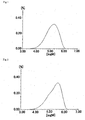
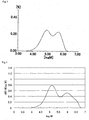
- the above fluoropolymer When its Mw and Mw/Mn are within the above respective ranges, the above fluoropolymer generally gives a unimodal molecular weight distribution having one peak in a high molecular weight region such as the distributions shown in Fig 1 or Fig. 5, for instance.
- the fluoropolymers obtained by polymerizing a radical polymerizable monomer(s) in a supercriticality-expression state in the conventional manner give bimodal molecular weight distribution patterns each having two peaks.
- the polymerization of radical polymerizable monomers presumably proceeds in two fields of polymerization, namely within the fluoropolymer particles formed (hereinafter referred to as "polymerization field (P)") and in the above-mentioned defined reaction-field (hereinafter referred to as “polymerization field (Q) ”) free of the above-mentioned polymerization field (P) .
- the polymer molecules formed in the polymerization field (P) in the product fluoropolymers tend to become relatively high in molecular weight, and the polymer molecules formed in the polymerization field (Q) tend to become relatively low in molecular weight.
- the bimodal molecular weight distribution patterns found in the conventional art are considered to be representing a higher molecular weight side peak (P') due to the polymer molecules formed in the polymerization field (P) and a lower molecular weight side peak (Q') due to the polymer molecules formed in the polymerization field (Q).
- P' molecular weight side peak
- Q' molecular weight side peak
- the fluoropolymer producing method of the present invention according to which the polymerization of a radical polymerizable monomer(s) is carried out in a supercriticality-expression state, can give fluoropolymers showing a molecular weight distribution which is unimodal and, moreover, in a high molecular weight region.
- the polymerization of a radical polymerizable monomer(s) is carried out while monomer gas is introduced.
- the ratio of monomer density (hereinafter, ⁇ m ) to monomer critical density (hereinafter, ⁇ 0 ), namely the ratio (hereinafter, ⁇ m / ⁇ 0 ), is preferably not lower than 1.1.
- ⁇ r is lower than 1.1, the rate of polymerization is low and the productivity thus becomes markedly decreased and, in certain instances, the Mw and Mw/Mn of the product fluoropolymer may not fall within the respective ranges given hereinabove but a bimodal molecular weight distribution may readily result.
- a preferred upper limit to ⁇ r is 1.8, a more preferred upper limit is 1.7, and a still more preferred upper limit is 1.6.
- the monomer critical density ⁇ 0 in the fluoropolymer producing method of the present invention means the monomer density at the supercriticality-expression temperature and supercriticality-expression pressure.
- the monomer density is the density of the radical polymerizable monomer, and the radical polymerizable monomer, before introduction thereof into the reactor, generally occurs as a gas at ordinary temperature of about 25 to 30°C.
- the monomer density is the sum of the densities of the individual radical polymerizable monomers.
- the lower limit to po is preferably set at 0.3 g/ml.
- the above-mentioned monomer density is determined by dividing the mass of the radical polymerizable monomer introduced into the reactor by the volume of the reactor.
- the polymerization of a radical polymerizable monomer(s) is preferably carried out in the presence of a chain transfer agent.
- a chain transfer agent By adding a chain transfer agent, it becomes possible to obtain fluoropolymers having an Mw and Mw/Mn within the above-given respective ranges with a unimodal molecular weight distribution in a high molecular weight region, although other polymerization conditions may also be influential.
- the chain transfer agent can contribute to shifting of the high molecular weight side peak (P') alone to the lower molecular weight side without substantially influencing the position of the low molecular weight side peak (Q').
- the chain transfer agent there may be mentioned, among others, hydrocarbons, halogenated hydrocarbons and, further, hydrocarbyl alcohols, hydrocarbyl esters, hydrocarbyl ketones, and mercaptans.
- hydrocarbons there may be mentioned hydrocarbons containing 4 to 6 carbon atoms, such as pentane, butane and hexane.
- halogenated hydrocarbons there may be mentioned tetrachloromethane, chloroform, and methylene chloride. Those halogenated hydrocarbons are to be distinguished from the above-mentioned nonethylenic fluorocarbons which have no substantial chain transfer agent activity.
- hydrocarbyl alcohols there may be mentioned, among others, methanol, ethanol, and isopropanol.
- hydrocarbyl esters there may be mentioned, among others, methyl acetate, ethyl acetate, butyl acetate, ethyl propionate, ethyl acetoacetate, dimethyl malonate, diethyl malonate, dimethyl succinate, diethyl succinate, and diethyl carbonate.
- hydrocarbyl ketones there may be mentioned acetone, acetylacetone, and cyclohexanone.
- mercaptans there may be mentioned, for example, dodecylmercaptan and the like.
- pentane, butane, isopropanol, diethyl malonate, tetrachloromethane, acetone, dodecylmercaptan and diethyl carbonate are preferred since they can cause marked decreases in molecular weight at low addition levels.
- Carbonyl group-containing ones, such as acetone, diethyl malonate and diethyl carbonate, are more preferred since they are particularly excellent in affinity for fluids in a supercriticality-expression state and can efficiently cause the high molecular weight side peak (P') to shift to the low molecular weight side.
- Acetone and diethyl carbonate are still more preferred since they cause the high molecular weight side peak (P') to the low molecular weight side but hardly cause shifting of the low molecular weight side peak (Q') to the lower molecular weight side.
- the level of addition of the chain transfer agent can be adequately selected according to the molecular weight desired of the fluoropolymer. Generally, however, that level is preferably 0.001 to 5% by mass relative to the total amount of the radical polymerizable monomer (s) . A more preferred upper limit is 2% by mass.
- the fluoropolymer producing method of the present invention is characterized in that the polymerization of the radical polymerizable monomer (s) is carried out in the manner of continuous polymerization.
- the continuous polymerization is the mode of polymerization in which the radical polymerizable monomer is fed to the reaction field continuously and the fluoropolymer formed is discharged therefrom continuously.
- the above continuous polymerization is preferably carried out in a steady state in a manner such that the fluoropolymer in the reaction vessel may amount to at least 8 g per liter of the capacity of the reaction vessel, although the amount of the fluoropolymer may be varied according to other reaction conditions.
- the fluoropolymer in the reaction vessel may amount to at least 8 g per liter of the capacity of the reaction vessel, although the amount of the fluoropolymer may be varied according to other reaction conditions.
- the amount of the fluoropolymer in the reaction vessel it becomes possible to promote the reaction in the polymerization field (P) and enlarge the high molecular weight side peak (P') favorably for the production of high-molecular-weight fluoropolymers.
- the upper limit may be set at 100 g per liter of the capacity of the reaction vessel in a steady state, for instance, from the productivity viewpoint.
- the steady state mentioned above is a state in which the fluoropolymer amount in the reaction vessel remains constant.
- the fluoropolymer amount in the reaction vessel is equal to the amount of the fluoropolymer discharged from the reaction vessel per residence time.
- the above-mentioned amount of the fluoropolymer in the reaction vessel is the value calculated by converting the amount of the fluoropolymer discharged from the reaction vessel per residence time at the above-mentioned steady state to the amount per liter of the capacity of the reaction vessel.
- the residence time is the time required for the whole amount (W g) of the radical polymerizable monomer fed in the manner of continuous polymerization as found in the reaction vessel at an arbitrary time, on the assumption that it is not consumed at all for the polymerization, to be replaced by W g of the radical polymerizable monomer newly fed to this reaction vessel.
- the residence time can be calculated from the capacity of the reaction vessel and the density of the radical polymerizable monomer fed to the reaction vessel and the rate of feeding (rate of flow) of the monomer.
- the residence time is preferably 0.01 to 5 hours. A more preferred lower limit is 0.1 hour, and a more preferred upper limit is 2 hours.
- the radical polymerizable monomer mentioned above comprises a fluorine-containing ethylenic monomer.
- Employable as the radical polymerizable monomer are:
- perfluoroethylenic monomers such as tetrafluoroethylene [TFE], hexafluoropropylene [HFP], perfluoro(alkylvinylether) [PAVE] species, ; hydrogen-containing fluoroethylenic monomers such as vinylidene fluoride [VdF], trifluoroethylene, vinyl fluoride, trifluoropropene, pentafluoropropylene, tetrafluoropropylene, and hexafluoroisobutene; and chlorine-containing fluoroethylenic monomers such as chlorotrifluoroethylene [CTFE], among others.
- PAVE species there may be mentioned perfluoro(methyl vinyl ether) [PMVE], perfluoro(ethylvinylether) [PEVE], and perfluoro(propylvinylether) [PPVE], among others.
- the fluorine-containing ethylenic monomer preferably comprises at least one species selected from the group consisting of VdF, TFE, CTFE and HFP.
- the fluorine-containing ethylenic monomer preferably comprises VdF, since this monomer can readily attain a supercriticality-expression state at a relatively low temperature and a relatively low pressure and has no autopolymerizing properties. From the viewpoint of improved extrudability of the product fluoropolymer on the occasion of extrusion molding, it is desirable that the fluorine-containing ethylenic monomer comprise VdF and at least one species selected from among TFE, HFP and CTFE.
- fluorine-containing ethylenic monomer those fluorolefin monomers which are disclosed in Japanese Kokoku Publication Hei-05-63482 and Japanese Kokai Publication Sho-62-12734, for example perfluoro(6,6-dihydro-6-iodo-3-oxa-1-hexene) and perfluoro(5-iodo-3-oxa-1-pentene).
- the fluorine-free ethylenic monomer is not particularly restricted but includes, among others, ⁇ -olefin monomers containing 2 to 10 carbon atoms, for example ethylene [ET], propylene, butene and pentene; and alkyl vinyl ethers whose alkyl moiety contains 1 to 20 carbon atoms, for example methyl vinyl ether, ethyl vinyl ether, propyl vinyl ether, cyclohexyl vinyl ether, hydroxybutyl vinyl ether and butyl vinyl ether.
- ⁇ -olefin monomers containing 2 to 10 carbon atoms for example ethylene [ET], propylene, butene and pentene
- alkyl vinyl ethers whose alkyl moiety contains 1 to 20 carbon atoms, for example methyl vinyl ether, ethyl vinyl ether, propyl vinyl ether, cyclohexyl vinyl ether, hydroxybutyl vinyl ether and butyl vinyl ether.
- radical polymerizable monomers are particularly suited for the polymerization in a reaction field in a supercriticality-expression state:
- the polymerization of the above radical polymerizable monomer is preferably carried out in the presence of a nonethylenic fluorocarbon.
- a nonethylenic fluorocarbon are chain or cyclic saturated fluorocarbons containing 1 to 5 carbon atoms.
- the above nonethylenic fluorocarbons each acts as a diluent for the radical polymerizable monomer(s) and serves to absorb and remove the heat of reaction in the reaction field. Further, they can increase the solubility of the radical polymerization initiator and the stability of the forming fluoropolymer particles in the reaction field and can prevent the particles from adhesion to one another as a result of swelling.
- the nonethylenic fluorocarbon is preferably one whose critical temperature Tc mlt-a for its single occurrence is lower than the critical temperature of one or more radical polymerizable monomers, since such one lowers the supercriticality-expression temperature and thus increases the energy efficiency in the above-mentioned defined reaction-field.
- Tc mlt-a critical temperature of one or more radical polymerizable monomers
- those nonethylenic fluorocarbons enumerated above are preferred, and tetrafluoromethane and perfluoroethane are more preferred and, for lowering the supercriticality-expression temperature, the use of carbon dioxide, which is to be described later herein, is preferably avoided.
- a nonethylenic fluorocarbon When a nonethylenic fluorocarbon is used, it is preferably used in an amount of 1 to 500% by mass based on the whole amount of the radical polymerizable monomer(s). Excessive levels are unfavorable since the amount of the nonethylenic fluorocarbon to be recovered increases, the amount of the radical polymerization initiator in the nonethylenic fluorocarbon increases and/or the yield of fluoropolymer molecules low in molecular weight increases. A more preferred upper limit is 300% by mass, and a still more preferred upper limit is 200% by mass.
- the fluoropolymer producing method (II) of the present invention is characterized in that the polymerization of the above-mentioned radical polymerizable monomer(s) in the defined reaction-field is carried out in the presence of carbon dioxide.
- carbon dioxide acts as a diluent for the radical polymerizable monomer (s) in the reaction field and serves to remove the heat of reaction and, further, can increase the solubility of the radical polymerization initiator in the reaction field and the stability of fluoropolymer particles formed and can prevent the particles from adhesion to one another as a result of swelling.
- the defined reaction-field in the fluoropolymer producing method (II) of the present invention is a supercriticality-expression state, as mentioned hereinabove referring to the fluoropolymer producing method of the present invention.
- the amount of carbon dioxide to be present is not greater than the level equimolar to the above-mentioned radical polymerizable monomer (s). Levels exceeding the equimolar one are undesirable since they cause increases in the yield of fluoropolymer molecules low in molecular weight.
- a preferred upper limit to the amount of carbon dioxide is 50% of the total number of moles of carbon dioxide and the above-mentioned radical polymerizable monomer (s), a more preferred upper limit is 30%, and a still more preferred upper limit is 10%.
- the amount of carbon dioxide is within the above range, it is generally possible to increase the solubility of the radical polymerization initiator and the stability of fluoropolymer particles formed and prevent the particles from adhering to one another as a result of swelling, even when the amount is 1% or higher relative to the total number of moles of carbon dioxide and the radical polymerizable monomer(s).
- the solubility of the radical polymerization initiator in the reaction field can be improved and, further, fluoropolymers having an Mw and an Mw/Mn within the above-mentioned respective ranges can be obtained by selecting a relatively high temperature in the defined reaction-field. That temperature may be higher, for example, by 100°C than the supercriticality-expression temperature.
- the temperature range is preferably not higher than the temperature higher by 100°C than the supercriticality-expression temperature.
- the molecular weight distribution of the fluoropolymer obtained may become bimodal in some cases.
- the above temperature is more preferably not higher than the temperature higher by 50°C than the supercriticality-expression temperature of the above-mentioned defined reaction-field, still more preferably not higher than the temperature higher by 30°C than the supercriticality-expression temperature of the above-mentioned defined reaction-field.
- that temperature is not higher than the temperature higher by 15°C than the supercriticality-expression temperature of the above-mentioned defined reaction-field in view of the fact that, at such temperature, the liquefaction of the radical polymerizable monomer (s) hardly occurs and from the operational procedure viewpoint.
- the pressure in the defined reaction-field is preferably not higher than 40 MPa although it tends to become higher as compared with the case where the radical polymerizable monomer polymerization is carried out in the absence of carbon dioxide due to the contribution of the carbon dioxide partial pressure.
- the fluoropolymer producing method (I) of the present invention can give fluoropolymers having an Mw and an Mw/Mn within the above-mentioned respective ranges while suppressing the pressure in the defined reaction-field to a level not higher than 40 MPa and the temperature to a level not higher than the temperature higher by 100°C than the supercriticality-expression temperature.
- the polymerization of the above-mentioned radical polymerizable monomer(s) is preferably carried out in the presence of a radical polymerization initiator.
- a radical polymerization initiator are peroxides, such as organic peroxides and inorganic peroxides, and azo compounds, among others.
- the radical polymerization initiator may have chain transfer activity or have no chain transfer activity.
- the molecular weight distribution of the fluoropolymer obtained without using any chain transfer agent tends to become bimodal with a enlarged high molecular weight side peak (P') but with the low molecular weight side peak (Q') not being much changed.
- a chain transfer agent By causing a chain transfer agent to be present, it is possible to reduce the high molecular weight side peak (P') to thereby render the distribution unimodal.
- fluoropolymers having an Mw and an Mw/Mn within the respective ranges given above and having a unimodal molecular weight distribution can be obtained with ease by increasing the amount of the fluoropolymer in the reaction vessel in a steady state to a level within the range mentioned above.
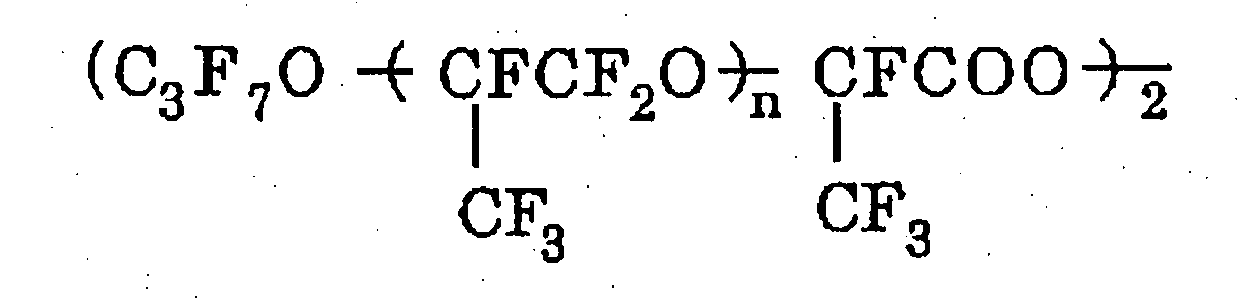
- the organic peroxide having no chain transfer activity is not particularly restricted but includes, among others, linear perfluoro diacyl peroxide represented by the general formula (C m F 2m+1 COO-) 2 (m representing an integer of 1 to 5), for example perfluoropropionyl peroxide and perfluorobutyryl peroxide; bis[2,2'-(perfluoropropoxyoxyalkylenepropionyl)] peroxides represented by the following general formula: (n representing an integer of 0 to 2), for example perfluoro(2-normalpropoxypropionyl) peroxide; and fluorine-based diacyl peroxides such as bis( ⁇ -hydrododecafluoroheptanoyl) peroxide [DHP].
- linear perfluoro diacyl peroxide represented by the general formula (C m F 2m+1 COO-) 2 (m representing an integer of 1 to 5
- the organic peroxide having chain transfer activity is not particularly restricted but includes, among others, fluorine-free diacyl peroxides, such as isobutyryl peroxide, 3,5,5-trimethylhexanoyl peroxide, octanoyl peroxide, lauroyl peroxide, stearoyl peroxide and succinic acid peroxide; peroxydicarbonates, such as dinormalpropyl peroxydicarbonate, diisopropyl peroxydicarbonate, bis(4-tert-butylcyclohexyl) peroxydicarbonate, di-2-ethoxyethyl peroxydicarbonate, di-2-ethylhexyl peroxydicarbonate, di-2-methoxybutyl peroxydicarbonate, and diethyl peroxydicarbonate; and peroxy esters, such as 1,1,3,3-tetramethylbutyl peroxyneodecanoate, 1-cyclohexyl
- the inorganic peroxide is not particularly restricted but may be, for example, hydrogen peroxide or a persulfate salt.
- the persulfate salt is not particularly restricted but includes, among others, ammonium persulfate, sodium persulfate and potassium persulfate.
- the azo compound is not particularly restricted but includes, among others, cyano-2-propylazoformamide, 1,1'-azobis(cyclohexane-1-carbonitrile), 2,2'-azobis(2-amidinopropane) dihydrochloride, 2,2'-azobis(2-methylbutyronitrile), 2,2'-azobisisobutyronitrile, 2,2'-azobis(2,4-dimethylvaleronitrile), 2,2'-azobis[N-(2-propenyl)-2-methylpropionamide], polydimethylsiloxane segment-containing macro azo compounds, 2,2'-azobis(2,4,4-trimethylpentane), 2,2'-azobis(4-methoxy-2,4-dimethylvaleronitrile), 4,4'-azobis(4-cyanovaleric acid), dimethyl 2,2'-azobisisobutyrate, 2,2'-azobis[2-(2-imidazolin-2-yl)propane] dihydrochlor
- radical polymerization initiator among those mentioned above are organic peroxides which are low in vapor pressure and will not cause the formation of unstable fluoropolymer termini.
- peroxydicarbonates, fluorine-based diacyl peroxides and/or fluorine-free diacyl peroxides are preferred since they are readily dissolved in the main component(s) mentioned above in a supercriticality-expression state.
- the radical polymerization initiator is preferably used in an amount of 0.001 to 10% by mass relative to the total amount of the radical polymerizable monomer(s).
- the radical polymerization initiator is used in an amount smaller than 0.001% by mass, no polymerization will occur, or marked decreases in productivity will result or there will arise a tendency toward the formation of a fluoropolymer having a very high molecular weight, which leads to the formation of defective moldings.
- levels exceeding 10% by mass will cause marked decreases in molecular weight, with the result that the moldings obtained tend to become unsatisfactory in mechanical strength and wear resistance, among others. They also mean an increase in the cost of the radical polymerization initiator and the strength of moldings tends to decrease.
- a more preferred lower limit is 0.005% by mass, and a more preferred upper limit is 2% by mass.
- another additive may be added so long as it is inert to the reaction.
- the other additive is not particularly restricted but may be, for example, a solvent for the radical polymerization initiator (e.g. diethyl carbonate, perfluorohexane, 2,2,3,3-tetrafluoropropylene alcohol).
- the fluoropolymer producing method of the present invention can produce fluoropolymers composed of the above-mentioned radical polymerizable monomer(s) as a constituent unit (s) .
- the fluoropolymers may be in a resin form or in an elastomer form.
- the fluoropolymers that can be produced by the fluoropolymer producing method of the present invention are not particularly restricted.
- the above-mentioned resin there may be mentioned, for example, polytetrafluoroethylene [PTFE], polyvinylidene fluoride [PVdF], polychlorotrifluoroethylene [PCTFE], VdF/TFE copolymers, VdF/TFE/CTFE copolymers, TFE/HFP copolymers [FEP; HFP content not more than 30 mole percent], and TFE/PAVE copolymers [PFA; PAVE content not more than 20 mole percent].
- PTFE polytetrafluoroethylene
- PVdF polyvinylidene fluoride
- PCTFE polychlorotrifluoroethylene
- VdF/TFE copolymers VdF/TFE copolymers
- VdF/TFE/CTFE copolymers VdF/TFE/CTFE copolymers
- VdF/HFP copolymers As the above-mentioned elastomer, there may be mentioned VdF/HFP copolymers, VdF/HFP/TFE copolymers, HFP/ET copolymers, HFP/ET/TFE copolymers, HFP/ET/VdF copolymers, HFP/ET/VdF/TFE copolymers, TFE/PAVE copolymers (PAVE content 21 to 50 mole percent), TFE/HFP copolymers (HFP content 31 to 50 mole percent), TFE/propylene copolymers, VdF/CTFE copolymers, and TFE/VdF/propylene copolymers.
- the fluoropolymer producing method of the present invention can give fluoropolymers having a high molecular weight with a narrow molecular weight distribution, as described hereinabove, and the polymers obtained have a wide range of applications, for example as molding materials for use in injection molding or extrusion molding, among others, or as materials for the preparation of powder coatings for various lining purposes.
- they are suitably used as raw material powders for the preparation of organosol coatings which can form uniform and pinhole-free thin films.
- organosol coatings are mainly used as top coatings for metal-made exterior building materials.
- the fluoropolymer producing method of the present invention is particularly suited for use in the production of polyvinylidene fluoride [PVdF] and polychlorotrifluoroethylene [PCTFE].
- the PVdF obtained by the fluoropolymer producing method of the present invention can be used, for example, in lining of chemical apparatus by powder coating; sheet lining of SUS stainless steel acid cleaning vessels, chromium plating vessels and the like by extrusion molding; lining, for corrosion resistance, of lined pipes likewise by extruding molding; and manufacture of valves, such as diaphragm valves, and pumps by injecting molding and, further, as or in manufacturing electric wire coverings, condenser films, piezoelectric/pyroelectric films, fishing lines and so forth.
- the PCTFE obtained by the fluoropolymer producing method of the present invention is suited for use, for example, in those fields of application where low moisture permeability is required, such as packaging materials for drugs and moistureproof films for electroluminescence [EL] devices.
- the continuous polymerization was carried out using a polymerization vessel having a known capacity, and the amount of the fluoropolymer obtained in a unit residence time was determined. The fluoropolymer amount was divided by the polymerization vessel volume and the polymerization time, and the quotient was reported as the mean polymerization rate.
- the solid product collected in a polymer collector during the steady state period from 120 minutes to 150 minutes after starting the reaction was dried under vacuum at 60°C for 15 hours to give 10.8 g of a white fluoropolymer A. Therefore, the polymer weight per liter of the reaction vessel volume in a steady state was 9.97 g.
- the mean polymerization rate on that occasion was 20.0 g/(liter ⁇ hour), and the residence time was 29.9 minutes.
- the white fluoropolymer A was analyzed by size exclusion chromatography [SEC] .
- SEC size exclusion chromatography
- the solid product collected in a polymer collector during the steady state period from 90 minutes to 120 minutes after starting the reaction was dried under vacuum at 60°C for 15 hours to give 20.7 g of a white fluoropolymer B. Therefore, the polymer weight per liter of the reaction vessel volume in a steady state was 19.1 g. The mean polymerization rate on that occasion was 38.2 g/(liter ⁇ hour), and the residence time was 30.0 minutes.
- the solid product collected in a polymer collector during the steady state period from 105 minutes to 120 minutes after starting the reaction was dried under vacuum at 60°C for 15 hours to give 1.2 g of a white fluoropolymer C. Therefore, the polymer weight per liter of the reaction vessel volume in a steady state was 5.48 g.
- the mean polymerization rate on that occasion was 22.0 g/(liter ⁇ hour), and the residence time was 14.9 minutes.
- the solid product collected in a polymer collector during the steady state period from 100 minutes to 120 minutes after starting the reaction was dried under vacuum at 60°C for 15 hours to give 0.298 g of a white fluoropolymer D. Therefore, the polymer weight per liter of the reaction vessel volume in a steady state was 1.36 g. The mean polymerization rate on that occasion was 4.08 g/(liter ⁇ hour), and the residence time was 20.0 minutes.
- fluoropolymer E (0.538 g) was obtained in the same manner as in Comparative Example 2 except that diethyl carbonate was fed, as a chain transfer agent, to the reaction field at a rate of 0. 0921 g/minute by means of a syringe pump. Therefore, the polymer weight per liter of the reaction vessel volume in a steady state was 2.46 g. The mean polymerization rate on that occasion was 7.4 g/(liter ⁇ hour), and the residence time was 19.9 minutes.
- a white fluoropolymer F (0.933 g) was obtained in the same manner as in Example 3 except that acetone was fed, as a chain transfer agent, to the reaction field at a rate of 0.0224 g/minute by means of a syringe pump. Therefore, the polymer weight per liter of the reaction vessel volume in a steady state was 4.26 g. The mean polymerization rate on that occasion was 12.8 g/(liter ⁇ hour), and the residence time was 20.0 minutes.
- a white fluoropolymer G (0.178 g) was obtained in the same manner as in Example 3 except that diethyl malonate [DEM] was fed, as a chain transfer agent, to the reaction field at a rate of 0.0159 g/minute by means of a syringe pump. Therefore, the polymer weight per liter of the reaction vessel volume in a steady state was 0.812 g. The mean polymerization rate on that occasion was 2.4 g/ (liter ⁇ hour), and the residence time was 20. 3 minutes.
- DEM diethyl malonate
- the fluoropolymer producing method of the present invention which has the constitution described hereinabove, can give fluoropolymers with a high molecular weight and a narrow molecular weight distribution, when carried out in a continuous polymerization in a supercriticality-expression state while maintaining the fluoropolymer concentration at a certain level or higher.
Landscapes
- Chemical & Material Sciences (AREA)
- Organic Chemistry (AREA)
- Chemical Kinetics & Catalysis (AREA)
- Health & Medical Sciences (AREA)
- Medicinal Chemistry (AREA)
- Polymers & Plastics (AREA)
- Addition Polymer Or Copolymer, Post-Treatments, Or Chemical Modifications (AREA)
- Polymerisation Methods In General (AREA)
Abstract
Description







| Name of monomer or other substance | Pc (MPa) | Tc (K) | Reference |
| VdF | 4.430 | 303.30 | 1 |
| HFP | 2.900 | 367.10 | 2 |
| TFE | 3.940 | 306.00 | 3 |
| CTFE | 3.960 | 379.00 | 4 |
| PMVE | 2.803 | 362.33 | 5 |
| PEVE | 2.266 | 394.67 | 5 |
| PPVE | 1.901 | 423.51 | 5 |
| Ethylene | 5.041 | 282.34 | 6 |
| Propylene | 4.600 | 364.90 | 6 |
| Perfluoromethane | 3.745 | 227.51 | 7 |
| Trifluoromethane | 4.836 | 298.97 | 7 |
| Difluoromethane | 5.830 | 351.55 | 8 |
| Perfluoroethane | 3.043 | 293.03 | 9 |
| 1,1,1,2-Tetrafluoroethane | 4.056 | 374.18 | 10 |
| 1,1,1-Trifluoroethane | 3.765 | 345.75 | 11 |
| 1,1-Difluoroethane | 4.516 | 386.41 | 7 |
| Perfluorocyclobutane | 2.773 | 388.37 | 12 |
Claims (12)
- A fluoropolymer producing method
which comprises polymerizing a radical polymerizable monomer in a manner of continuous polymerization in a defined reaction-field to give the fluoropolymer,
wherein said defined reaction-field is in a supercriticality-expression state and under a pressure of not higher than 40 MPa and a temperature of not higher than that higher by 100°C than the supercriticality-expression temperature of the defined reaction-field,
said radical polymerizable monomer comprises a fluorine-containing ethylenic monomer, and
said fluoropolymer has a weight average molecular weight [Mw] of not lower than 150,000 as determined on the polystyrene equivalent basis and
a ratio [Mw/Mn] of the weight average molecular weight [Mw] on the polystyrene equivalent basis to a number average molecular weight [Mn] of the fluoropolymer on the polystyrene equivalent basis is higher than 1 but not higher than 3. - A fluoropolymer producing method
which comprises polymerizing a radical polymerizable monomer in a manner of continuous polymerization in a defined reaction-field in the presence of carbon dioxide to give the fluoropolymer,
wherein said defined reaction-field is in a supercriticality-expression state,
said radical polymerizable monomer comprises a fluorine-containing ethylenic monomer,
said carbon dioxide amounts to at most equimolar to said radical polymerizable monomer, and
said fluoropolymer has a weight average molecular weight [Mw] of not lower than 150, 000 as determined on the polystyrene equivalent basis and
a ratio [Mw/Mn] of the weight average molecular weight [Mw] on the polystyrene equivalent basis to a number average molecular weight [Mn] of the fluoropolymer on the polystyrene equivalent basis is higher than 1 but not higher than 3. - The fluoropolymer producing method according to claim 2,
wherein said defined reaction-field further is under a pressure of not higher than 40 MPa and a temperature of not higher than that higher by 100°C than the supercriticality-expression temperature of said defined reaction-field. - The fluoropolymer producing method according to claim 1, 2 or 3,
wherein said defined reaction-field has a ratio [ρm/ρ0] of not lower than 1.1, the ratio [ρm/ρ0] is of a monomer density [ρm] of a monomer critical density [ρ0]. - The fluoropolymer producing method according to claim 1, 2, 3 or 4,
wherein the polymerization of the radical polymerizable monomer is carried out in the presence of a chain transfer agent. - The fluoropolymer producing method according to claim 5,
wherein the continuous polymerization is carried in a condition that an amount of the fluoropolymer in a reaction vessel amounts to at least 8 g per liter of the capacity of said reaction vessel in a steady state. - The fluoropolymer producing method according to claim 1, 2, 3, 4, 5 or 6,
wherein the fluorine-containing ethylenic monomer comprises at least one species selected from the group consisting of vinylidene fluoride, tetrafluoroethylene, chlorotrifluoroethylene and hexafluoropropylene. - The fluoropolymer producing method according to claim 1, 2, 3, 4, 5 or 6,
wherein the fluorine-containing ethylenic monomer comprises vinylidene fluoride. - The fluoropolymer producing method according to claim 1, 2, 3, 4, 5, 6, 7 or 8,
wherein the polymerization of the radical polymerizable monomer is carried out in the presence of a radical polymerization initiator. - The fluoropolymer producing method according to claim 9,
wherein the radical polymerization initiator is an organic peroxide. - The fluoropolymer producing method according to claim 10,
wherein the organic peroxide comprises a peroxydicarbonate, a fluorine-based diacyl peroxide and/or a fluorine-free diacyl peroxide. - The fluoropolymer producing method according to claim 1, 2, 3, 4, 5, 6, 7, 8, 9, 10 or 11,
wherein the polymerization of the radical polymerizable monomer is carried out in the presence of a nonethylenic fluorocarbon.
Applications Claiming Priority (3)
| Application Number | Priority Date | Filing Date | Title |
|---|---|---|---|
| JP2002248560 | 2002-08-28 | ||
| JP2002248560 | 2002-08-28 | ||
| PCT/JP2003/010899 WO2004020476A1 (en) | 2002-08-28 | 2003-08-28 | Process for production of fluoropolymer |
Publications (2)
| Publication Number | Publication Date |
|---|---|
| EP1541591A1 true EP1541591A1 (en) | 2005-06-15 |
| EP1541591A4 EP1541591A4 (en) | 2008-10-15 |
Family
ID=31972525
Family Applications (1)
| Application Number | Title | Priority Date | Filing Date |
|---|---|---|---|
| EP03791360A Withdrawn EP1541591A4 (en) | 2002-08-28 | 2003-08-28 | PROCESS FOR PRODUCING FLUORINE POLYMER |
Country Status (5)
| Country | Link |
|---|---|
| US (1) | US20060122347A1 (en) |
| EP (1) | EP1541591A4 (en) |
| JP (1) | JP4003775B2 (en) |
| CN (1) | CN1678637A (en) |
| WO (1) | WO2004020476A1 (en) |
Families Citing this family (1)
| Publication number | Priority date | Publication date | Assignee | Title |
|---|---|---|---|---|
| CN103755858B (en) * | 2013-12-30 | 2016-04-27 | 山东华夏神舟新材料有限公司 | A kind of solution polymerization process of polyvinylidene fluoride copolymer |
Family Cites Families (17)
| Publication number | Priority date | Publication date | Assignee | Title |
|---|---|---|---|---|
| US3062793A (en) * | 1958-12-29 | 1962-11-06 | Du Pont | Amorphous copolymers of hexafluoropropylene and tetrafluoroethylene and their preparation |
| US3780007A (en) * | 1969-12-23 | 1973-12-18 | Diamond Shamrock Corp | Polymerization of vinylidene fluoride in aqueous suspension |
| US5863612A (en) * | 1992-03-27 | 1999-01-26 | University North Carolina--Chapel Hill | Method of making fluoropolymers |
| US5559198A (en) * | 1994-07-08 | 1996-09-24 | Minnesota Mining And Manufacturing Company | Process for preparing poly(vinyl trifluoroacetate) and poly(vinyltrifluoroacetate/vinyl ester) copolymers in supercritical Co.sub. |
| US5478905A (en) * | 1995-02-06 | 1995-12-26 | E. I. Du Pont De Nemours And Company | Amorphous tetrafluoroethylene/hexafluoropropylene copolymers |
| CN1290879C (en) * | 1995-02-06 | 2006-12-20 | 纳幕尔杜邦公司 | Amorphous tetrafluoroethylene-hexafluoropropylene copolymer, its preparation method and use |
| US5527865A (en) * | 1995-03-24 | 1996-06-18 | The University Of North Carolina At Chapel Hill | Multi-phase polymerization process |
| US6051682A (en) * | 1996-12-23 | 2000-04-18 | E. I. Du Pont De Nemours And Company | Polymerization of fluoropolymers in carbon dioxide |
| US6103844A (en) * | 1998-06-08 | 2000-08-15 | E. I. Du Pont De Nemours And Company | Polymerization of fluoromonomers in carbon dioxide |
| JP5092184B2 (en) * | 1999-02-15 | 2012-12-05 | ダイキン工業株式会社 | Method for producing fluoropolymer |
| WO2001034667A1 (en) * | 1999-11-12 | 2001-05-17 | North Carolina State University | Continuous process for making polymers in carbon dioxide |
| AU2001229921A1 (en) * | 2000-02-02 | 2001-08-14 | Robert D. Lousenberg | Linear copolymers of fluorocarbon-hydrocarbon monomers synthesized in carbon dioxide |
| EP1297032A2 (en) * | 2000-05-19 | 2003-04-02 | University Of North Carolina At Chapel Hill | Multimodal fluoropolymers and methods of making the same |
| EP1191042A1 (en) * | 2000-09-26 | 2002-03-27 | Atofina | Process for polymerisation of 1,1difluoroethylen at high pressure |
| JP2003165813A (en) * | 2001-09-20 | 2003-06-10 | Univ Nihon | Methyl methacrylate-trifluoromethyl acrylic acid copolymer and method for producing the same |
| JP2003096107A (en) * | 2001-09-27 | 2003-04-03 | Shigeo Okahata | Method for producing fluorine-containing polymer |
| JP2003206317A (en) * | 2001-11-12 | 2003-07-22 | Daikin Ind Ltd | Polyvinylidene fluoride |
-
2003
- 2003-08-28 US US10/525,847 patent/US20060122347A1/en not_active Abandoned
- 2003-08-28 EP EP03791360A patent/EP1541591A4/en not_active Withdrawn
- 2003-08-28 WO PCT/JP2003/010899 patent/WO2004020476A1/en not_active Ceased
- 2003-08-28 CN CNA038202352A patent/CN1678637A/en active Pending
- 2003-08-28 JP JP2004532747A patent/JP4003775B2/en not_active Expired - Fee Related
Also Published As
| Publication number | Publication date |
|---|---|
| WO2004020476A1 (en) | 2004-03-11 |
| JPWO2004020476A1 (en) | 2005-12-15 |
| US20060122347A1 (en) | 2006-06-08 |
| JP4003775B2 (en) | 2007-11-07 |
| CN1678637A (en) | 2005-10-05 |
| EP1541591A4 (en) | 2008-10-15 |
Similar Documents
| Publication | Publication Date | Title |
|---|---|---|
| JP5092184B2 (en) | Method for producing fluoropolymer | |
| RU2441883C2 (en) | Process for producing melt-moldable tetrafluoroethylene copolymer | |
| EP1556426B1 (en) | Emulsifier free aqueous emulsion polymerization to produce copolymers of a fluorinated olefin and hydrocarbon olefin | |
| JPWO2000047641A1 (en) | Fluoropolymer manufacturing method | |
| JP4357638B2 (en) | Process for producing fluoropolymers in carbon dioxide | |
| JP2002317003A (en) | Method for producing fluoropolymer latex | |
| WO2005037880A1 (en) | Aqueous tetrafluoroethylene polymer dispersion, process for producing the same, tetrafluoroethylene polymer powder, and molded tetrafluoroethylene polymer | |
| EP2918613A1 (en) | Production method for polytetrafluoroethylene aqueous dispersion | |
| AU2004232640A1 (en) | Melt-processible thermoplastic fluoropolymers having improved processing characteristics and method of producing same | |
| EP0638596A1 (en) | Process for producing fluoropolymer | |
| JP4013977B2 (en) | Method for producing vulcanizable fluorine-containing elastomer | |
| EP4253432A1 (en) | Fluoropolymer, aqueous liquid dispersion, composition, and crosslinked product | |
| WO2006068923A2 (en) | Fluoroelastomers having low glass transition temperature | |
| WO2023126952A1 (en) | Process for formation of a fluoropolymer using fluorinated and non-fluorinated surfactants | |
| US20060122347A1 (en) | Process for production of fluoropolymer | |
| JP3960309B2 (en) | Method for producing fluoropolymer | |
| WO2003042259A1 (en) | Polyvinylidene fluoride | |
| JP2005075853A (en) | Fluoropolymer production method | |
| JP4333514B2 (en) | Method for producing vulcanizable fluorine-containing elastomer | |
| JP7844632B2 (en) | Polyether diacitates or their salt-based surfactants and their use | |
| WO2024161322A1 (en) | A process for the preparation of fluoropolymers | |
| JP2005042046A (en) | Method for producing fluoropolymer | |
| JP2007231298A (en) | Method for producing vulcanizable fluorine-containing elastomer |
Legal Events
| Date | Code | Title | Description |
|---|---|---|---|
| PUAI | Public reference made under article 153(3) epc to a published international application that has entered the european phase |
Free format text: ORIGINAL CODE: 0009012 |
|
| 17P | Request for examination filed |
Effective date: 20050315 |
|
| AK | Designated contracting states |
Kind code of ref document: A1 Designated state(s): AT BE BG CH CY CZ DE DK EE ES FI FR GB GR HU IE IT LI LU MC NL PT RO SE SI SK TR |
|
| A4 | Supplementary search report drawn up and despatched |
Effective date: 20080724 |
|
| RIC1 | Information provided on ipc code assigned before grant |
Ipc: C08F 14/18 20060101ALI20080718BHEP Ipc: C08F 2/00 20060101AFI20040317BHEP Ipc: B01J 3/00 20060101ALI20080718BHEP |
|
| RA4 | Supplementary search report drawn up and despatched (corrected) |
Effective date: 20080915 |
|
| 17Q | First examination report despatched |
Effective date: 20090325 |
|
| STAA | Information on the status of an ep patent application or granted ep patent |
Free format text: STATUS: THE APPLICATION IS DEEMED TO BE WITHDRAWN |
|
| 18D | Application deemed to be withdrawn |
Effective date: 20090805 |