EP1541589B1 - Fused protein with the function of both thrombolysis and anticoagulation and the use of it - Google Patents
Fused protein with the function of both thrombolysis and anticoagulation and the use of it Download PDFInfo
- Publication number
- EP1541589B1 EP1541589B1 EP03793572A EP03793572A EP1541589B1 EP 1541589 B1 EP1541589 B1 EP 1541589B1 EP 03793572 A EP03793572 A EP 03793572A EP 03793572 A EP03793572 A EP 03793572A EP 1541589 B1 EP1541589 B1 EP 1541589B1
- Authority
- EP
- European Patent Office
- Prior art keywords
- protein
- fusion protein
- thrombolytic
- anticoagulant
- hirudin
- Prior art date
- Legal status (The legal status is an assumption and is not a legal conclusion. Google has not performed a legal analysis and makes no representation as to the accuracy of the status listed.)
- Expired - Lifetime
Links
Images

Classifications
-
- C—CHEMISTRY; METALLURGY
- C07—ORGANIC CHEMISTRY
- C07K—PEPTIDES
- C07K14/00—Peptides having more than 20 amino acids; Gastrins; Somatostatins; Melanotropins; Derivatives thereof
- C07K14/435—Peptides having more than 20 amino acids; Gastrins; Somatostatins; Melanotropins; Derivatives thereof from animals; from humans
- C07K14/46—Peptides having more than 20 amino acids; Gastrins; Somatostatins; Melanotropins; Derivatives thereof from animals; from humans from vertebrates
- C07K14/47—Peptides having more than 20 amino acids; Gastrins; Somatostatins; Melanotropins; Derivatives thereof from animals; from humans from vertebrates from mammals
-
- A—HUMAN NECESSITIES
- A61—MEDICAL OR VETERINARY SCIENCE; HYGIENE
- A61P—SPECIFIC THERAPEUTIC ACTIVITY OF CHEMICAL COMPOUNDS OR MEDICINAL PREPARATIONS
- A61P43/00—Drugs for specific purposes, not provided for in groups A61P1/00-A61P41/00
-
- A—HUMAN NECESSITIES
- A61—MEDICAL OR VETERINARY SCIENCE; HYGIENE
- A61P—SPECIFIC THERAPEUTIC ACTIVITY OF CHEMICAL COMPOUNDS OR MEDICINAL PREPARATIONS
- A61P7/00—Drugs for disorders of the blood or the extracellular fluid
- A61P7/02—Antithrombotic agents; Anticoagulants; Platelet aggregation inhibitors
-
- A—HUMAN NECESSITIES
- A61—MEDICAL OR VETERINARY SCIENCE; HYGIENE
- A61P—SPECIFIC THERAPEUTIC ACTIVITY OF CHEMICAL COMPOUNDS OR MEDICINAL PREPARATIONS
- A61P9/00—Drugs for disorders of the cardiovascular system
- A61P9/10—Drugs for disorders of the cardiovascular system for treating ischaemic or atherosclerotic diseases, e.g. antianginal drugs, coronary vasodilators, drugs for myocardial infarction, retinopathy, cerebrovascula insufficiency, renal arteriosclerosis
-
- C—CHEMISTRY; METALLURGY
- C07—ORGANIC CHEMISTRY
- C07K—PEPTIDES
- C07K14/00—Peptides having more than 20 amino acids; Gastrins; Somatostatins; Melanotropins; Derivatives thereof
- C07K14/195—Peptides having more than 20 amino acids; Gastrins; Somatostatins; Melanotropins; Derivatives thereof from bacteria
- C07K14/305—Peptides having more than 20 amino acids; Gastrins; Somatostatins; Melanotropins; Derivatives thereof from bacteria from Micrococcaceae (F)
- C07K14/31—Peptides having more than 20 amino acids; Gastrins; Somatostatins; Melanotropins; Derivatives thereof from bacteria from Micrococcaceae (F) from Staphylococcus (G)
-
- C—CHEMISTRY; METALLURGY
- C07—ORGANIC CHEMISTRY
- C07K—PEPTIDES
- C07K14/00—Peptides having more than 20 amino acids; Gastrins; Somatostatins; Melanotropins; Derivatives thereof
- C07K14/81—Protease inhibitors
- C07K14/815—Protease inhibitors from leeches, e.g. hirudin, eglin
-
- C—CHEMISTRY; METALLURGY
- C07—ORGANIC CHEMISTRY
- C07K—PEPTIDES
- C07K19/00—Hybrid peptides, i.e. peptides covalently bound to nucleic acids, or non-covalently bound protein-protein complexes
-
- C—CHEMISTRY; METALLURGY
- C12—BIOCHEMISTRY; BEER; SPIRITS; WINE; VINEGAR; MICROBIOLOGY; ENZYMOLOGY; MUTATION OR GENETIC ENGINEERING
- C12N—MICROORGANISMS OR ENZYMES; COMPOSITIONS THEREOF; PROPAGATING, PRESERVING, OR MAINTAINING MICROORGANISMS; MUTATION OR GENETIC ENGINEERING; CULTURE MEDIA
- C12N15/00—Mutation or genetic engineering; DNA or RNA concerning genetic engineering, vectors, e.g. plasmids, or their isolation, preparation or purification; Use of hosts therefor
- C12N15/09—Recombinant DNA-technology
- C12N15/11—DNA or RNA fragments; Modified forms thereof; Non-coding nucleic acids having a biological activity
- C12N15/62—DNA sequences coding for fusion proteins
-
- C—CHEMISTRY; METALLURGY
- C12—BIOCHEMISTRY; BEER; SPIRITS; WINE; VINEGAR; MICROBIOLOGY; ENZYMOLOGY; MUTATION OR GENETIC ENGINEERING
- C12N—MICROORGANISMS OR ENZYMES; COMPOSITIONS THEREOF; PROPAGATING, PRESERVING, OR MAINTAINING MICROORGANISMS; MUTATION OR GENETIC ENGINEERING; CULTURE MEDIA
- C12N9/00—Enzymes; Proenzymes; Compositions thereof; Processes for preparing, activating, inhibiting, separating or purifying enzymes
- C12N9/14—Hydrolases (3)
- C12N9/48—Hydrolases (3) acting on peptide bonds (3.4)
- C12N9/50—Proteinases, e.g. Endopeptidases (3.4.21-3.4.25)
- C12N9/64—Proteinases, e.g. Endopeptidases (3.4.21-3.4.25) derived from animal tissue
- C12N9/6421—Proteinases, e.g. Endopeptidases (3.4.21-3.4.25) derived from animal tissue from mammals
- C12N9/6424—Serine endopeptidases (3.4.21)
- C12N9/6456—Plasminogen activators
- C12N9/6459—Plasminogen activators t-plasminogen activator (3.4.21.68), i.e. tPA
-
- C—CHEMISTRY; METALLURGY
- C12—BIOCHEMISTRY; BEER; SPIRITS; WINE; VINEGAR; MICROBIOLOGY; ENZYMOLOGY; MUTATION OR GENETIC ENGINEERING
- C12Y—ENZYMES
- C12Y304/00—Hydrolases acting on peptide bonds, i.e. peptidases (3.4)
- C12Y304/21—Serine endopeptidases (3.4.21)
- C12Y304/21069—Protein C activated (3.4.21.69)
-
- A—HUMAN NECESSITIES
- A61—MEDICAL OR VETERINARY SCIENCE; HYGIENE
- A61K—PREPARATIONS FOR MEDICAL, DENTAL OR TOILETRY PURPOSES
- A61K38/00—Medicinal preparations containing peptides
-
- C—CHEMISTRY; METALLURGY
- C07—ORGANIC CHEMISTRY
- C07K—PEPTIDES
- C07K2319/00—Fusion polypeptide
-
- C—CHEMISTRY; METALLURGY
- C07—ORGANIC CHEMISTRY
- C07K—PEPTIDES
- C07K2319/00—Fusion polypeptide
- C07K2319/50—Fusion polypeptide containing protease site
Definitions
- This application relates to a fusion protein, which is composed of a thrombolytic protein, an anticoagulant protein, and a linker peptide.
- the fusion protein is composed of an anticoagulant protein and a protein molecule having plasminogen-activating activity, wherein said two proteins are linked together via a linker peptide, which can be recognized and cleaved by blood coagulation factors.
- the application also relates to the medical use of said fusion protein, and to the use of the linker peptide which can be recognized by blood coagulation factor in linking a thrombolytic protein and an anticoagulation protein.
- Cardiovascular diseases are the leading causes of deaths of human being.
- urokinase and tissue-type plasminogen activator are used in clinic as major thrombolytic drugs, while heparin and hirudin are used as major anticoagulant drugs.
- thrombolytic therapy is successful in decreasing the death rate of patients suffering from thrombus, re- thrombus will often occur due to the entering of small gore into blood circulation. Therefore, heparin or hirudin is now used as anticoagulant agents in combination with thrombolytic agents for thrombolytic therapy.
- thrombolytic agents and anticoagulant agents usually cause systematic haemolysis and anticoagulation due to their poor specificity, thereby leading to systematic haemorrhage.
- tissue-type plasminogen activator(t-PA), streptokinase(SK), urokinase(UK) and urokinase-like plasminogen activator(u-PA) can activate the plasminogen, which in turn lyses clots at the site of thrombus.
- the activated plasminogen will also cause bleeding in non-thrombus locus.
- Staphylokinase (SAK) is a new plasminogen activator of native origin, and has certain specificity to the thrombus.
- Hirudin which is a small protein, is regarded as the new anticoagulant agent due to its high affinity and selective inhibition to thrombin.
- hirudin is inclined to cause systematic haemorrhage in clinic.
- thrombolytic drugs it is important to increase their selectivity, targeting property and local concentration at thrombus clots, and to decrease drug concentration or activity at thrombus-free sites and the side effect of bleeding.
- the fusion protein in the prior art cannot reduce the side effect of bleeding.
- Van Zyl et al., Thrombosis Research 88 (1997), 419-426 discloses the fusion protein PLATSAK, cleavable by factor Xa, comprising SAK and a portion of hirudin, both linked via a linker comprising the sequence IEGR.
- the fusion protein shows reduced thrombin activity.
- anti-thrombus drug is focused on bifunctional medicament having both thrombolytic and anticoagulant activities.
- thrombolytic activity To combine thrombolytic activity with anticoagulant activity, the fusion of hirudin with SAK or SK have been studied. It showed that, if the N-terminal of hirudin was linked to C-terminal of SAK or SK, the hirudin will loss its anti-thrombin activity, while the plasminogen-activating activity of the thrombolytic protein is retained or partially retained; if the C-terminal of hirudin is linked to N-terminal of SAK, then due to the rapid degradation of N-terminal of SAK in vivo , the fusion protein will undergo degradation before functioning. Thus it is attracting in thrombolytic therapy to develop fusion protein having both thrombolytic and anticoagulant activities.
- the purpose of this invention is to provide a fusion protein having both thrombolytic and anticoagulant activities.
- a fusion protein can be constructed by linking a thrombolytic protein and an anticoagulant protein via a peptide containing blood coagulation factor-recognizable sequence.
- the fusion protein retains plasminogen-activating activity and thus the thrombolytic activity;
- the N-terminal of the anticoagulant protein such as hirudin is linked to C-terminal of the thrombolytic protein, and thus the whole fusion protein doesn't show anticoagulant activity at thrombus-free sites and in vitro , thereby eliminating or reducing the side effect of bleeding caused by the anticoagulant protein such as hirudin;
- the fusion protein has the ability of targeting to clots due to the high affinity of hirudin to thrombin at thrombus locus, and thus it increases drug concentration at thrombus locus and decreases the therapeutical amount of the drug;
- the invention relates to a fusion protein composed of a thrombolytic protein, anticoagulant protein and a linker peptide, wherein the thrombolytic protein is SAK, the anticoagulant protein is hirudin, both being linked by the linker peptide GSIEGR.
- the invention relates to a pharmaceutical composition
- a pharmaceutical composition comprising said fusion protein and a pharmaceutical acceptable carrier or excipient.
- thrombolytic protein refers to the proteins having thrombolytic activity, for example staphylokinase(SAK), tissue-type plasminogen activator(t-PA), streptokinase(SK), urokinase(UK), urokinase-like plasminogen activator(u-PA), venom and mutants thereof which activate other hemolytic factors or have thrombolytic activity per se .
- Staphylokinase(SAK) or mutant thereof is preferred.
- anticoagulant protein refers to the proteins having anticoagulant activity, such as hirudin, antithrombin III, venom and mutants thereof. Hirudin or mutant thereof is preferred.
- linker peptide recognized by blood coagulation factor refers to the tetrapeptide of IEGR (IleGluGlyArg), peptide containing IEGR sequence, tripeptide of GPR (GlyProArg) or peptide containing GPR sequence.
- thrombosis refers to any disease or condition caused by thrombus, such as cerebral thrombus, arterial thrombus, stroke and atherosclerosis.
- patient refers to mammals, particularly human being.
- the fusion protein of the invention is a SFH fusion protein(SAK-GSIEGR-HV2) composed of staphylokinase and hirudin linked by GSIEGR.
- the fusion protein may be expressed in E. coli, Pichia pastoris, Saccharomyces cerevisiae or animal cells. Preferably, it is expressed in E.coli or yeast cells.
- EcoR I and BamH I restriction sites are added to the two ends of SAK gene, respectively.
- the SAK gene without the stop codon is introduced in the vector pBV220, resulting in pBVSAK.
- the BamH I restriction site and the sequence coding FXa recognition sequence GSIEGR are incorporated upstream of hirudin gene via a primer (5'-CG GGA TCC ATC GAA GGT CGT ATT ACT TAC ACT GAT TGT ACA GAA TCG-3').
- the primer matched with downstream of the hirudin gene contains a Pst I restriction site.
- the hirudin gene with a FXa recognition sequence GSIEGR is digested by two enzymes of BamH I and Pst I, and the above vector pBVSAK is also digested by BamH I and Pst I.
- the digested hirudin fragment is inserted into the digested vector pBVSAK to form plasmid pBVSFH (see Figure 1). Said two gene fragments can also been linked by overlapping PCR method.
- the plasmid pBVSFH is transformed into E.coli, and induced to express at 42°C.
- the desired fusion protein (SFH) is obtained by ion exchange and gel filtration method in a purity of more than 96%.
- the SFH fusion protein comprises three domains, a SAK sequence, FXa recognition sequence GSIEGR and hirudin.
- the amino acid sequence of SFH fusion protein is as follows: 1 sssfdkgkyk kgddasyfep tgpylmvnvt gvdgkgnell sphyvefpik 61 pgttltkeki eyyvewalda taykefrvve ldpsakievt yydknkkkee 101 sfpitekg fvvpdlsehi knpgfnlitk viiekk gsie gr itytdcte sgqdlclceg 161 snvcgkgnkc ilgsngeenq cvtgegtpkp qshndgdfee ipeeylq
- the thrombolytic activity of the purified fusion protein was determined using chromogenic substrate S-2251.
- mouse-tail thrombosis RTT
- the results show that the anticoagulant activity of the SFH fusion protein is significantly higher than that of SAK.
- SAK is i.p. injected at a dose of 1.2mg/kg body weight every eight hours, and the inhibition of the tail thrombus is 36.6%.
- Table 1 shows that the fusion protein SFH exhibits the same level of thrombolytic activity as free staphylokinase.
- Table 2 shows that the intact fusion protein SFH does not exhibit anticoagulant activity, but shows entire anticoagulant activity once cleaved by the blood coagulant factor FXa.
- Table 3 demonstrates that SFH has the significant anticoagulant effect.
- the fusion protein of the invention indeed has both the thrombolytic and anticoagulant activities.
- Xho I and Avr II restriction sites are added to the upstream and downstream of tPA gene, respectively.
- the tPA gene without the stop codon is introduced in the vector pPIC9.
- the Avr II restriction site and the sequence coding FXa recognition sequence are incorporated upstream of hirudin gene via a primer using PCR method.
- the primer matched with downstream of the hirudin gene contains a Not I restriction site.
- the hirudin gene with a FXa recognition sequence is digested by two enzymes of Avr II and Not I, and the resulting fragment is linked into the above constructed vector pPIC9, wherein the introduced fragment is located downstream of tPA gene and forms together with tPA into the fusion gene PATH.
- plasmid is designed as pPAFH.
- the plasmids pPAFH and pPIC9K are digested by BamH I and Sal I.
- the PAFH gene is then inserted into pPIC9K to form pPAFH-K gene.
- the plasmid pPAFH-K is linearized, and incorporated into yeast genome by electrotransformation. Methanol is used to induce the expression.
- the desired fusion protein comprises three domains, a tPA sequence, FXa recognition sequence and hirudin..
- EcoR I and BamH I restriction sites are added to the two ends of SAK gene, respectively.
- the SAK gene without the stop codon is introduced in the vector pBV220, resulting in pBVSAK.
- the BamH I restriction site and the sequence coding FXIIa recognition sequence GSLGPR are incorporated upstream of hirudin gene via a primer using PCR method.
- the primer matched with downstream of the hirudin gene contains a Pst I restriction site.
- the hirudin gene with a FXIIa recognition sequence GSLGPR is digested by two enzymes of BamH I and Pst I, and the above vector pBVSAK is also digested by BamH I and Pst I.
- the digested hirudin fragment is inserted into the digested vector pBVSAK to form plasmid pBVSTH.
- the sequence is confirmed by enzymatic digestion. Alternatively, said two gene fragments may be linked by overlapping PCR method.
- the plasmid pBVSTH is transformed into E.coli , and induced to express at 42°C.
- the desired fusion protein (STH) is obtained by ion exchange and gel filtration method in a purity of more than 96%.
- the STH fusion protein comprises three domains, a SAK sequence, FXIIa recognition sequence GSLGPR and hirudin.
Landscapes
- Health & Medical Sciences (AREA)
- Chemical & Material Sciences (AREA)
- Organic Chemistry (AREA)
- Life Sciences & Earth Sciences (AREA)
- Genetics & Genomics (AREA)
- Engineering & Computer Science (AREA)
- General Health & Medical Sciences (AREA)
- Biochemistry (AREA)
- Bioinformatics & Cheminformatics (AREA)
- Molecular Biology (AREA)
- Medicinal Chemistry (AREA)
- Zoology (AREA)
- Biomedical Technology (AREA)
- Wood Science & Technology (AREA)
- Biophysics (AREA)
- Proteomics, Peptides & Aminoacids (AREA)
- General Engineering & Computer Science (AREA)
- Biotechnology (AREA)
- Gastroenterology & Hepatology (AREA)
- Microbiology (AREA)
- Chemical Kinetics & Catalysis (AREA)
- Public Health (AREA)
- Animal Behavior & Ethology (AREA)
- General Chemical & Material Sciences (AREA)
- Pharmacology & Pharmacy (AREA)
- Nuclear Medicine, Radiotherapy & Molecular Imaging (AREA)
- Veterinary Medicine (AREA)
- Plant Pathology (AREA)
- Physics & Mathematics (AREA)
- Tropical Medicine & Parasitology (AREA)
- Toxicology (AREA)
- Cardiology (AREA)
- Diabetes (AREA)
- Heart & Thoracic Surgery (AREA)
- Hematology (AREA)
- Vascular Medicine (AREA)
- Urology & Nephrology (AREA)
- Medicines That Contain Protein Lipid Enzymes And Other Medicines (AREA)
- Peptides Or Proteins (AREA)
- Preparation Of Compounds By Using Micro-Organisms (AREA)
Abstract
Description
- This application relates to a fusion protein, which is composed of a thrombolytic protein, an anticoagulant protein, and a linker peptide. In particular, the fusion protein is composed of an anticoagulant protein and a protein molecule having plasminogen-activating activity, wherein said two proteins are linked together via a linker peptide, which can be recognized and cleaved by blood coagulation factors. The application also relates to the medical use of said fusion protein, and to the use of the linker peptide which can be recognized by blood coagulation factor in linking a thrombolytic protein and an anticoagulation protein.
- Cardiovascular diseases are the leading causes of deaths of human being. Presently, urokinase and tissue-type plasminogen activator are used in clinic as major thrombolytic drugs, while heparin and hirudin are used as major anticoagulant drugs. Although thrombolytic therapy is successful in decreasing the death rate of patients suffering from thrombus, re- thrombus will often occur due to the entering of small gore into blood circulation. Therefore, heparin or hirudin is now used as anticoagulant agents in combination with thrombolytic agents for thrombolytic therapy.
- However, thrombolytic agents and anticoagulant agents usually cause systematic haemolysis and anticoagulation due to their poor specificity, thereby leading to systematic haemorrhage.
- In particular, tissue-type plasminogen activator(t-PA), streptokinase(SK), urokinase(UK) and urokinase-like plasminogen activator(u-PA) can activate the plasminogen, which in turn lyses clots at the site of thrombus. However, the activated plasminogen will also cause bleeding in non-thrombus locus. Staphylokinase (SAK) is a new plasminogen activator of native origin, and has certain specificity to the thrombus.
- Hirudin (HV), which is a small protein, is regarded as the new anticoagulant agent due to its high affinity and selective inhibition to thrombin. However, hirudin is inclined to cause systematic haemorrhage in clinic. Moreover, there is no antagonist against hirudin hitherto.
- Thus, to decrease side effects and increase therapeutic effects of thrombolytic drugs, it is important to increase their selectivity, targeting property and local concentration at thrombus clots, and to decrease drug concentration or activity at thrombus-free sites and the side effect of bleeding. The fusion protein in the prior art cannot reduce the side effect of bleeding. Van Zyl et al., Thrombosis Research 88 (1997), 419-426, discloses the fusion protein PLATSAK, cleavable by factor Xa, comprising SAK and a portion of hirudin, both linked via a linker comprising the sequence IEGR. The fusion protein shows reduced thrombin activity. Therefore, the development of anti-thrombus drug is focused on bifunctional medicament having both thrombolytic and anticoagulant activities. To combine thrombolytic activity with anticoagulant activity, the fusion of hirudin with SAK or SK have been studied. It showed that, if the N-terminal of hirudin was linked to C-terminal of SAK or SK, the hirudin will loss its anti-thrombin activity, while the plasminogen-activating activity of the thrombolytic protein is retained or partially retained; if the C-terminal of hirudin is linked to N-terminal of SAK, then due to the rapid degradation of N-terminal of SAK in vivo, the fusion protein will undergo degradation before functioning. Thus it is attracting in thrombolytic therapy to develop fusion protein having both thrombolytic and anticoagulant activities.
- The purpose of this invention is to provide a fusion protein having both thrombolytic and anticoagulant activities.
- This invention is based on the following recognition: a fusion protein can be constructed by linking a thrombolytic protein and an anticoagulant protein via a peptide containing blood coagulation factor-recognizable sequence. Thus constructed fusion protein provides several advantages as follows: Firstly, the fusion protein retains plasminogen-activating activity and thus the thrombolytic activity; Secondly, the N-terminal of the anticoagulant protein such as hirudin is linked to C-terminal of the thrombolytic protein, and thus the whole fusion protein doesn't show anticoagulant activity at thrombus-free sites and in vitro, thereby eliminating or reducing the side effect of bleeding caused by the anticoagulant protein such as hirudin; Thirdly, the fusion protein has the ability of targeting to clots due to the high affinity of hirudin to thrombin at thrombus locus, and thus it increases drug concentration at thrombus locus and decreases the therapeutical amount of the drug; Fourthly, when the fusion protein circulates to the locus of thrombus, the blood coagulation factor, which is involved in thrombosis and is characteristic of the thrombus, rapidly cleaves the fusion protein at the designed recognition site, and relieves the free thrombolytic protein and anticoagulant protein, thereby functioning both thrombolytic and thrombolytic activities. The invention has been established in terms of the above advantages.
- In one aspect, the invention relates to a fusion protein composed of a thrombolytic protein, anticoagulant protein and a linker peptide, wherein the thrombolytic protein is SAK, the anticoagulant protein is hirudin, both being linked by the linker peptide GSIEGR.
- In a further aspect, the invention relates to a pharmaceutical composition comprising said fusion protein and a pharmaceutical acceptable carrier or excipient.
- The following drawings are presented to illustrate this invention, but they are not intended to limit the invention.
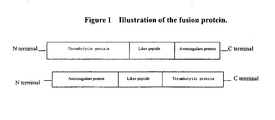
- Figure 1 is an illustration of the fusion protein.
- Figure 2 shows the electrophoresis of the fusion protein gene, staphylokinase(SAK) gene and hirudin(HV2) gene.
- As used herein, the term "thrombolytic protein" refers to the proteins having thrombolytic activity, for example staphylokinase(SAK), tissue-type plasminogen activator(t-PA), streptokinase(SK), urokinase(UK), urokinase-like plasminogen activator(u-PA), venom and mutants thereof which activate other hemolytic factors or have thrombolytic activity per se. Staphylokinase(SAK) or mutant thereof is preferred.
- As used herein, the term "anticoagulant protein" refers to the proteins having anticoagulant activity, such as hirudin, antithrombin III, venom and mutants thereof. Hirudin or mutant thereof is preferred.
- As used herein, the term "linker peptide recognized by blood coagulation factor" refers to the tetrapeptide of IEGR (IleGluGlyArg), peptide containing IEGR sequence, tripeptide of GPR (GlyProArg) or peptide containing GPR sequence.
- As used herein, the term "diseases or conditions associated with thrombosis" refers to any disease or condition caused by thrombus, such as cerebral thrombus, arterial thrombus, stroke and atherosclerosis.
- As used herein, the term "patient" refers to mammals, particularly human being.
- According to this invention, the fusion protein of the invention is a SFH fusion protein(SAK-GSIEGR-HV2) composed of staphylokinase and hirudin linked by GSIEGR.
- The fusion protein may be expressed in E. coli, Pichia pastoris, Saccharomyces cerevisiae or animal cells. Preferably, it is expressed in E.coli or yeast cells.
- The following Examples are intended to illustrate the invention, but not mean to limit the invention.
- EcoR I and BamH I restriction sites are added to the two ends of SAK gene, respectively. The SAK gene without the stop codon is introduced in the vector pBV220, resulting in pBVSAK. By PCR method, the BamH I restriction site and the sequence coding FXa recognition sequence GSIEGR are incorporated upstream of hirudin gene via a primer (5'-CG GGA TCC ATC GAA GGT CGT ATT ACT TAC ACT GAT TGT ACA GAA TCG-3'). The primer matched with downstream of the hirudin gene contains a Pst I restriction site. The hirudin gene with a FXa recognition sequence GSIEGR is digested by two enzymes of BamH I and Pst I, and the above vector pBVSAK is also digested by BamH I and Pst I. The digested hirudin fragment is inserted into the digested vector pBVSAK to form plasmid pBVSFH (see Figure 1). Said two gene fragments can also been linked by overlapping PCR method. The plasmid pBVSFH is transformed into E.coli, and induced to express at 42°C. The desired fusion protein (SFH) is obtained by ion exchange and gel filtration method in a purity of more than 96%. The SFH fusion protein comprises three domains, a SAK sequence, FXa recognition sequence GSIEGR and hirudin. The amino acid sequence of SFH fusion protein is as follows:
1 sssfdkgkyk kgddasyfep tgpylmvnvt gvdgkgnell sphyvefpik 61 pgttltkeki eyyvewalda taykefrvve ldpsakievt yydknkkkee 101 sfpitekg fvvpdlsehi knpgfnlitk viiekkgsie gritytdcte sgqdlclceg 161 snvcgkgnkc ilgsngeenq cvtgegtpkp qshndgdfee ipeeylq - The thrombolytic activity of the purified fusion protein was determined using chromogenic substrate S-2251. To test thrombolytic and anticoagulant activity of the fusion protein in vivo, mouse-tail thrombosis (RTT) was induced by kappa-carrageenin. The results show that the anticoagulant activity of the SFH fusion protein is significantly higher than that of SAK. In particular, after induction by kappa-carrageenin for 24 hrs, SAK is i.p. injected at a dose of 1.2mg/kg body weight every eight hours, and the inhibition of the tail thrombus is 36.6%. However, when equimolar SFH is administrated at a dose of 1.8mg/kg body weight, the inhibition of the tail thrombus is 100%. After induction by kappa-carrageenin for 36 hrs, the inhibition of the tail thrombus reaches 18.2% and 90% respectively by SAK and SFH administrated as above. The detailed results are shown in Tables 1-3.
Table 1 Thrombolytic activity of fusion protein(SFH) and staphylokinase(SAK) determined by using chromogenic substrates (S-2251)( Reaction time is 5min. n = 3, △ OD405) Samples SAK SFH △ OD405 0.357±0.22 0.394±0.01 Note: 2nM fusion protein and 2nM staphylokinase were used for determination. Table 2 Anticoagulant activity of fusion protein(SFH) activated by FXa Samples Anticoagulant activities Fusion protein not cleaved by FXa 0 Fusion protein cleaved with 0.2U of FXa for 10min 2560ATU Note:5.8µg of the fusion protein SFH and 0.2 U of FXa were co-incubated for 10min at 37°C. Clot method was used for determination of the anticoagulant activity. Table 3 In vivo anticoagulation activities of the fusion protein SFH and staphylokinase (SAK) (n = 10) kappa-carrageenin-inducing time (hr) No. animals of each group SAK SFH 24 10 36.6% 100% 36 10 18.2% 90% Note: SAK is i.p. administrated at a dose of 1.2mg/kg body weight every eight hours, and equimolar SFH is administrated at a dose of 1.8mg/kg. The animals used are Kunming mice(KM mice). The anticoagulant activity is expressed as the inhibition of mouse-tail thrombosis. - Table 1 shows that the fusion protein SFH exhibits the same level of thrombolytic activity as free staphylokinase. Table 2 shows that the intact fusion protein SFH does not exhibit anticoagulant activity, but shows entire anticoagulant activity once cleaved by the blood coagulant factor FXa. Table 3 demonstrates that SFH has the significant anticoagulant effect. Thus the fusion protein of the invention indeed has both the thrombolytic and anticoagulant activities.
- Xho I and Avr II restriction sites are added to the upstream and downstream of tPA gene, respectively. The tPA gene without the stop codon is introduced in the vector pPIC9. The Avr II restriction site and the sequence coding FXa recognition sequence are incorporated upstream of hirudin gene via a primer using PCR method. The primer matched with downstream of the hirudin gene contains a Not I restriction site. The hirudin gene with a FXa recognition sequence is digested by two enzymes of Avr II and Not I, and the resulting fragment is linked into the above constructed vector pPIC9, wherein the introduced fragment is located downstream of tPA gene and forms together with tPA into the fusion gene PATH. Thus constructed plasmid is designed as pPAFH. The plasmids pPAFH and pPIC9K are digested by BamH I and Sal I. The PAFH gene is then inserted into pPIC9K to form pPAFH-K gene. The plasmid pPAFH-K is linearized, and incorporated into yeast genome by electrotransformation. Methanol is used to induce the expression. The desired fusion protein comprises three domains, a tPA sequence, FXa recognition sequence and hirudin..
- EcoR I and BamH I restriction sites are added to the two ends of SAK gene, respectively. The SAK gene without the stop codon is introduced in the vector pBV220, resulting in pBVSAK. The BamH I restriction site and the sequence coding FXIIa recognition sequence GSLGPR are incorporated upstream of hirudin gene via a primer using PCR method. The primer matched with downstream of the hirudin gene contains a Pst I restriction site. The hirudin gene with a FXIIa recognition sequence GSLGPR is digested by two enzymes of BamH I and Pst I, and the above vector pBVSAK is also digested by BamH I and Pst I. The digested hirudin fragment is inserted into the digested vector pBVSAK to form plasmid pBVSTH. The sequence is confirmed by enzymatic digestion. Alternatively, said two gene fragments may be linked by overlapping PCR method. The plasmid pBVSTH is transformed into E.coli, and induced to express at 42°C. The desired fusion protein (STH) is obtained by ion exchange and gel filtration method in a purity of more than 96%. The STH fusion protein comprises three domains, a SAK sequence, FXIIa recognition sequence GSLGPR and hirudin.
Claims (2)
- A fusion protein, comprising a thrombolytic protein, an anticoagulant protein, and a cleavable linker peptide, wherein said fusion protein is a fusion protein (SAK-GSIEGR-HV2) of staphylokinase and hirudin linked by linker peptide GSIEGR.
- A pharmaceutical composition comprising the fusion protein according to claim 1 and a pharmaceutically acceptable carrier or excipient.
Applications Claiming Priority (3)
| Application Number | Priority Date | Filing Date | Title |
|---|---|---|---|
| CN02129086 | 2002-09-03 | ||
| CNA021290865A CN1480466A (en) | 2002-09-03 | 2002-09-03 | Interfusion protein possessing dual functions of thrombolysis and anticoagulation as well as its application |
| PCT/CN2003/000743 WO2004022598A1 (en) | 2002-09-03 | 2003-09-03 | Fused protein with the function of both hemolysis and anticoagulation and the use of it |
Publications (3)
| Publication Number | Publication Date |
|---|---|
| EP1541589A1 EP1541589A1 (en) | 2005-06-15 |
| EP1541589A4 EP1541589A4 (en) | 2005-11-16 |
| EP1541589B1 true EP1541589B1 (en) | 2007-10-17 |
Family
ID=31954566
Family Applications (1)
| Application Number | Title | Priority Date | Filing Date |
|---|---|---|---|
| EP03793572A Expired - Lifetime EP1541589B1 (en) | 2002-09-03 | 2003-09-03 | Fused protein with the function of both thrombolysis and anticoagulation and the use of it |
Country Status (8)
| Country | Link |
|---|---|
| US (1) | US8212003B2 (en) |
| EP (1) | EP1541589B1 (en) |
| JP (2) | JP2006516113A (en) |
| CN (2) | CN1480466A (en) |
| AT (1) | ATE376001T1 (en) |
| AU (1) | AU2003261606A1 (en) |
| DE (1) | DE60316967T2 (en) |
| WO (1) | WO2004022598A1 (en) |
Families Citing this family (16)
| Publication number | Priority date | Publication date | Assignee | Title |
|---|---|---|---|---|
| CN1896108B (en) * | 2005-06-01 | 2012-01-04 | 中国人民解放军军事医学科学院放射与辐射医学研究所 | Preparation and Application of Specific Anticoagulant Substance |
| CN102443065A (en) * | 2005-06-01 | 2012-05-09 | 中国人民解放军军事医学科学院放射与辐射医学研究所 | Preparation for specificity anticoagulant substance and application thereof |
| EP1816201A1 (en) * | 2006-02-06 | 2007-08-08 | CSL Behring GmbH | Modified coagulation factor VIIa with extended half-life |
| WO2007132481A2 (en) * | 2006-05-12 | 2007-11-22 | Bharat Biotech International Limited | Novel thrombolytic molecules and a process therefor |
| CN101668778B (en) * | 2006-12-15 | 2012-10-03 | 中国人民解放军军事医学科学院放射与辐射医学研究所 | Preparation of low bleeding anticoagulant fusion protein and its use |
| CN100519585C (en) * | 2007-02-06 | 2009-07-29 | 中国人民解放军军事医学科学院基础医学研究所 | Fusion protein of P11 and SAK and its preparation method and use |
| EP2109457B1 (en) * | 2007-02-12 | 2016-01-06 | CSL Behring GmbH | Therapeutic application of kazal-type serine protease inhibitors |
| EP2193196B1 (en) * | 2007-09-28 | 2016-07-13 | Portola Pharmaceuticals, Inc. | Antidotes for factor xa inhibitors and methods of using the same |
| DE102009010611A1 (en) * | 2009-02-25 | 2010-08-26 | Siemens Aktiengesellschaft | Apparatus and method for controlling a multi-burner turbine for liquid or gaseous fuels |
| EP2600891B1 (en) * | 2010-08-05 | 2018-01-17 | Council of Scientific & Industrial Research | Protein fusion constructs possessing thrombolytic and anticoagulant properties |
| CN102180973B (en) * | 2011-03-18 | 2012-08-29 | 重庆大学 | Target multifunctional anti-embolism fusion protein as well as preparation method and application thereof |
| CA2880929A1 (en) * | 2012-09-07 | 2014-03-13 | Sanofi | Fusion proteins for treating a metabolic syndrome |
| CN106366200B (en) * | 2015-07-23 | 2020-04-10 | 武汉光谷人福生物医药有限公司 | Process for preparing recombinant glucokinase-hirudin fusion protein |
| JP7028904B2 (en) * | 2019-03-21 | 2022-03-02 | アカデミア シニカ | Synthetic peptides, pharmaceutical compositions comprising them and their use in the treatment of thromboembolism-related diseases |
| CN113150168B (en) * | 2021-01-29 | 2022-11-11 | 武汉真福医药股份有限公司 | Preparation method and application of QK plasmin gene-hirudin fusion protein |
| KR102789819B1 (en) * | 2021-10-21 | 2025-03-31 | 중앙대학교 산학협력단 | Novel peptide for specific detection of thrombin and Uses Thereof |
Family Cites Families (7)
| Publication number | Priority date | Publication date | Assignee | Title |
|---|---|---|---|---|
| US5298599A (en) * | 1988-12-30 | 1994-03-29 | Oklahoma Medical Research Foundation | Expression and purification of recombinant soluble tissue factor |
| GB8927722D0 (en) * | 1989-12-07 | 1990-02-07 | British Bio Technology | Proteins and nucleic acids |
| US5759542A (en) * | 1994-08-05 | 1998-06-02 | New England Deaconess Hospital Corporation | Compositions and methods for the delivery of drugs by platelets for the treatment of cardiovascular and other diseases |
| US6015787A (en) * | 1997-11-04 | 2000-01-18 | New England Medical Center Hospitals, Inc. | Cell-permeable protein inhibitors of calpain |
| US6423680B1 (en) * | 1998-10-30 | 2002-07-23 | Hsc Research And Development Limited Partnership | Inhibitor of platelet activating factor |
| CN1188522C (en) * | 2001-07-20 | 2005-02-09 | 健力福生化技术(上海)有限公司 | Target thrombolytic protein expressing plasmid and its construction |
| CN1181099C (en) * | 2002-07-23 | 2004-12-22 | 中国人民解放军第二军医大学 | Thrombosis targeting fusion protein mA5UKB with dual functions of anticoagulation and thrombolysis |
-
2002
- 2002-09-03 CN CNA021290865A patent/CN1480466A/en active Pending
-
2003
- 2003-09-03 EP EP03793572A patent/EP1541589B1/en not_active Expired - Lifetime
- 2003-09-03 JP JP2004533177A patent/JP2006516113A/en active Pending
- 2003-09-03 AT AT03793572T patent/ATE376001T1/en not_active IP Right Cessation
- 2003-09-03 AU AU2003261606A patent/AU2003261606A1/en not_active Abandoned
- 2003-09-03 CN CNB038207729A patent/CN1301268C/en not_active Expired - Fee Related
- 2003-09-03 US US10/526,682 patent/US8212003B2/en not_active Expired - Fee Related
- 2003-09-03 WO PCT/CN2003/000743 patent/WO2004022598A1/en not_active Ceased
- 2003-09-03 DE DE60316967T patent/DE60316967T2/en not_active Expired - Lifetime
-
2010
- 2010-05-06 JP JP2010106629A patent/JP2010184930A/en active Pending
Non-Patent Citations (1)
| Title |
|---|
| None * |
Also Published As
| Publication number | Publication date |
|---|---|
| EP1541589A4 (en) | 2005-11-16 |
| US8212003B2 (en) | 2012-07-03 |
| JP2010184930A (en) | 2010-08-26 |
| CN1678636A (en) | 2005-10-05 |
| CN1480466A (en) | 2004-03-10 |
| DE60316967D1 (en) | 2007-11-29 |
| JP2006516113A (en) | 2006-06-22 |
| ATE376001T1 (en) | 2007-11-15 |
| WO2004022598A1 (en) | 2004-03-18 |
| US20060127389A1 (en) | 2006-06-15 |
| EP1541589A1 (en) | 2005-06-15 |
| CN1301268C (en) | 2007-02-21 |
| AU2003261606A1 (en) | 2004-03-29 |
| DE60316967T2 (en) | 2008-05-08 |
Similar Documents
| Publication | Publication Date | Title |
|---|---|---|
| US8212003B2 (en) | Bifunctional fusion protein with thrombolytic and anticoagulant activities and uses thereof | |
| JP3189052B2 (en) | Polypeptide having anticoagulant activity | |
| AU643247B2 (en) | Activatable fibrinolytic and anti-thrombotic proteins | |
| JP2631645B2 (en) | Novel compound, production method thereof and pharmaceutical composition containing the same | |
| EP2760887B1 (en) | Compositions and methods for modulating hemostasis | |
| JPH05507420A (en) | Recombinant human factor VIII derivative | |
| JPH02121934A (en) | Composition of combination drug | |
| JPH03500724A (en) | Derivatives of tissue plasminogen activator | |
| JPS62282582A (en) | Human tissue type plasminogen activating factor polypeptide | |
| JPWO1992000325A1 (en) | Polypeptides with anticoagulant activity | |
| CN103159860B (en) | Recombinant tissue-type plasminogen activator and its preparation method and application | |
| EP0494929B1 (en) | Mutants of the human plasminogen activator inhibitor 1 (pai-1), their preparation and use | |
| US5023078A (en) | Plasminogen activator-heparin conjugates | |
| JP2006516113A5 (en) | ||
| CN108676090B (en) | A kind of plasmin inhibitor and its application | |
| EP0666920B1 (en) | Thrombin activatable plasminogen derivatives | |
| WO1995012407A1 (en) | A pharmaceutical composition for the treatment of coronary thrombosis | |
| US5688664A (en) | Thrombin activatable plasminogen analogues | |
| WO1989012677A1 (en) | Superoxide dismutase analogs having novel binding properties | |
| EP0710285B1 (en) | Analogues of an anti-thrombin polypeptide and process for their preparation | |
| EP4592322A1 (en) | Fusion protein targeting intergrin alpha(iib)beta3 and containing tissue plasminogen activator or variant thereof and use thereof | |
| JPH084501B2 (en) | Mutant tPA related to sugar chain | |
| JPH0327286A (en) | Derivative of tissue plasminogen activator | |
| JPH084502B2 (en) | Compound mutation tPA | |
| JPH03130231A (en) | Pharmaceutical preparation |
Legal Events
| Date | Code | Title | Description |
|---|---|---|---|
| PUAI | Public reference made under article 153(3) epc to a published international application that has entered the european phase |
Free format text: ORIGINAL CODE: 0009012 |
|
| 17P | Request for examination filed |
Effective date: 20050317 |
|
| AK | Designated contracting states |
Kind code of ref document: A1 Designated state(s): AT BE BG CH CY CZ DE DK EE ES FI FR GB GR HU IE IT LI LU MC NL PT RO SE SI SK TR |
|
| AX | Request for extension of the european patent |
Extension state: AL LT LV MK |
|
| A4 | Supplementary search report drawn up and despatched |
Effective date: 20051006 |
|
| DAX | Request for extension of the european patent (deleted) | ||
| GRAP | Despatch of communication of intention to grant a patent |
Free format text: ORIGINAL CODE: EPIDOSNIGR1 |
|
| DAX | Request for extension of the european patent (deleted) | ||
| GRAS | Grant fee paid |
Free format text: ORIGINAL CODE: EPIDOSNIGR3 |
|
| GRAA | (expected) grant |
Free format text: ORIGINAL CODE: 0009210 |
|
| AK | Designated contracting states |
Kind code of ref document: B1 Designated state(s): AT BE BG CH CY CZ DE DK EE ES FI FR GB GR HU IE IT LI LU MC NL PT RO SE SI SK TR |
|
| DAX | Request for extension of the european patent (deleted) | ||
| REG | Reference to a national code |
Ref country code: GB Ref legal event code: FG4D |
|
| RTI1 | Title (correction) |
Free format text: FUSED PROTEIN WITH THE FUNCTION OF BOTH THROMBOLYSIS AND ANTICOAGULATION AND THE USE OF IT |
|
| REG | Reference to a national code |
Ref country code: CH Ref legal event code: EP |
|
| REG | Reference to a national code |
Ref country code: IE Ref legal event code: FG4D |
|
| REF | Corresponds to: |
Ref document number: 60316967 Country of ref document: DE Date of ref document: 20071129 Kind code of ref document: P |
|
| NLV1 | Nl: lapsed or annulled due to failure to fulfill the requirements of art. 29p and 29m of the patents act | ||
| PG25 | Lapsed in a contracting state [announced via postgrant information from national office to epo] |
Ref country code: ES Free format text: LAPSE BECAUSE OF FAILURE TO SUBMIT A TRANSLATION OF THE DESCRIPTION OR TO PAY THE FEE WITHIN THE PRESCRIBED TIME-LIMIT Effective date: 20080128 Ref country code: SE Free format text: LAPSE BECAUSE OF FAILURE TO SUBMIT A TRANSLATION OF THE DESCRIPTION OR TO PAY THE FEE WITHIN THE PRESCRIBED TIME-LIMIT Effective date: 20080117 Ref country code: NL Free format text: LAPSE BECAUSE OF FAILURE TO SUBMIT A TRANSLATION OF THE DESCRIPTION OR TO PAY THE FEE WITHIN THE PRESCRIBED TIME-LIMIT Effective date: 20071017 Ref country code: LI Free format text: LAPSE BECAUSE OF FAILURE TO SUBMIT A TRANSLATION OF THE DESCRIPTION OR TO PAY THE FEE WITHIN THE PRESCRIBED TIME-LIMIT Effective date: 20071017 Ref country code: CH Free format text: LAPSE BECAUSE OF FAILURE TO SUBMIT A TRANSLATION OF THE DESCRIPTION OR TO PAY THE FEE WITHIN THE PRESCRIBED TIME-LIMIT Effective date: 20071017 |
|
| REG | Reference to a national code |
Ref country code: CH Ref legal event code: PL |
|
| PG25 | Lapsed in a contracting state [announced via postgrant information from national office to epo] |
Ref country code: PT Free format text: LAPSE BECAUSE OF FAILURE TO SUBMIT A TRANSLATION OF THE DESCRIPTION OR TO PAY THE FEE WITHIN THE PRESCRIBED TIME-LIMIT Effective date: 20080317 Ref country code: SI Free format text: LAPSE BECAUSE OF FAILURE TO SUBMIT A TRANSLATION OF THE DESCRIPTION OR TO PAY THE FEE WITHIN THE PRESCRIBED TIME-LIMIT Effective date: 20071017 Ref country code: BG Free format text: LAPSE BECAUSE OF FAILURE TO SUBMIT A TRANSLATION OF THE DESCRIPTION OR TO PAY THE FEE WITHIN THE PRESCRIBED TIME-LIMIT Effective date: 20080117 |
|
| REG | Reference to a national code |
Ref country code: IE Ref legal event code: FD4D |
|
| PG25 | Lapsed in a contracting state [announced via postgrant information from national office to epo] |
Ref country code: AT Free format text: LAPSE BECAUSE OF FAILURE TO SUBMIT A TRANSLATION OF THE DESCRIPTION OR TO PAY THE FEE WITHIN THE PRESCRIBED TIME-LIMIT Effective date: 20071017 |
|
| ET | Fr: translation filed | ||
| PG25 | Lapsed in a contracting state [announced via postgrant information from national office to epo] |
Ref country code: CZ Free format text: LAPSE BECAUSE OF FAILURE TO SUBMIT A TRANSLATION OF THE DESCRIPTION OR TO PAY THE FEE WITHIN THE PRESCRIBED TIME-LIMIT Effective date: 20071017 Ref country code: DK Free format text: LAPSE BECAUSE OF FAILURE TO SUBMIT A TRANSLATION OF THE DESCRIPTION OR TO PAY THE FEE WITHIN THE PRESCRIBED TIME-LIMIT Effective date: 20071017 |
|
| PLBE | No opposition filed within time limit |
Free format text: ORIGINAL CODE: 0009261 |
|
| STAA | Information on the status of an ep patent application or granted ep patent |
Free format text: STATUS: NO OPPOSITION FILED WITHIN TIME LIMIT |
|
| PG25 | Lapsed in a contracting state [announced via postgrant information from national office to epo] |
Ref country code: RO Free format text: LAPSE BECAUSE OF FAILURE TO SUBMIT A TRANSLATION OF THE DESCRIPTION OR TO PAY THE FEE WITHIN THE PRESCRIBED TIME-LIMIT Effective date: 20071017 Ref country code: SK Free format text: LAPSE BECAUSE OF FAILURE TO SUBMIT A TRANSLATION OF THE DESCRIPTION OR TO PAY THE FEE WITHIN THE PRESCRIBED TIME-LIMIT Effective date: 20071017 Ref country code: BE Free format text: LAPSE BECAUSE OF FAILURE TO SUBMIT A TRANSLATION OF THE DESCRIPTION OR TO PAY THE FEE WITHIN THE PRESCRIBED TIME-LIMIT Effective date: 20071017 |
|
| 26N | No opposition filed |
Effective date: 20080718 |
|
| PG25 | Lapsed in a contracting state [announced via postgrant information from national office to epo] |
Ref country code: IE Free format text: LAPSE BECAUSE OF FAILURE TO SUBMIT A TRANSLATION OF THE DESCRIPTION OR TO PAY THE FEE WITHIN THE PRESCRIBED TIME-LIMIT Effective date: 20071017 |
|
| REG | Reference to a national code |
Ref country code: IE Ref legal event code: ERR Free format text: IN JOURNAL NUMBER 2100, UNDER THE HEADING EUROPEAN PATENTS DESIGNATING IRELAND TREATED AS ALWAYS HAVING BEEN VOID IN ACCORDANCE WITH SECTION 119(7), EUROPEAN PATENT NUMBER 1541589 WAS ADVERTISED IN ERROR AS ALWAYS HAVING BEEN VOID. |
|
| PG25 | Lapsed in a contracting state [announced via postgrant information from national office to epo] |
Ref country code: GR Free format text: LAPSE BECAUSE OF FAILURE TO SUBMIT A TRANSLATION OF THE DESCRIPTION OR TO PAY THE FEE WITHIN THE PRESCRIBED TIME-LIMIT Effective date: 20080118 |
|
| PG25 | Lapsed in a contracting state [announced via postgrant information from national office to epo] |
Ref country code: FI Free format text: LAPSE BECAUSE OF FAILURE TO SUBMIT A TRANSLATION OF THE DESCRIPTION OR TO PAY THE FEE WITHIN THE PRESCRIBED TIME-LIMIT Effective date: 20071017 |
|
| PG25 | Lapsed in a contracting state [announced via postgrant information from national office to epo] |
Ref country code: MC Free format text: LAPSE BECAUSE OF NON-PAYMENT OF DUE FEES Effective date: 20080930 Ref country code: EE Free format text: LAPSE BECAUSE OF FAILURE TO SUBMIT A TRANSLATION OF THE DESCRIPTION OR TO PAY THE FEE WITHIN THE PRESCRIBED TIME-LIMIT Effective date: 20071017 |
|
| GBPC | Gb: european patent ceased through non-payment of renewal fee |
Effective date: 20080903 |
|
| PG25 | Lapsed in a contracting state [announced via postgrant information from national office to epo] |
Ref country code: CY Free format text: LAPSE BECAUSE OF FAILURE TO SUBMIT A TRANSLATION OF THE DESCRIPTION OR TO PAY THE FEE WITHIN THE PRESCRIBED TIME-LIMIT Effective date: 20071017 |
|
| PG25 | Lapsed in a contracting state [announced via postgrant information from national office to epo] |
Ref country code: GB Free format text: LAPSE BECAUSE OF NON-PAYMENT OF DUE FEES Effective date: 20080903 |
|
| PG25 | Lapsed in a contracting state [announced via postgrant information from national office to epo] |
Ref country code: HU Free format text: LAPSE BECAUSE OF FAILURE TO SUBMIT A TRANSLATION OF THE DESCRIPTION OR TO PAY THE FEE WITHIN THE PRESCRIBED TIME-LIMIT Effective date: 20080418 Ref country code: LU Free format text: LAPSE BECAUSE OF NON-PAYMENT OF DUE FEES Effective date: 20080903 |
|
| PG25 | Lapsed in a contracting state [announced via postgrant information from national office to epo] |
Ref country code: TR Free format text: LAPSE BECAUSE OF FAILURE TO SUBMIT A TRANSLATION OF THE DESCRIPTION OR TO PAY THE FEE WITHIN THE PRESCRIBED TIME-LIMIT Effective date: 20071017 |
|
| PG25 | Lapsed in a contracting state [announced via postgrant information from national office to epo] |
Ref country code: IT Free format text: LAPSE BECAUSE OF NON-PAYMENT OF DUE FEES Effective date: 20080930 |
|
| REG | Reference to a national code |
Ref country code: FR Ref legal event code: RM Effective date: 20131009 |
|
| REG | Reference to a national code |
Ref country code: FR Ref legal event code: PLFP Year of fee payment: 14 |
|
| PGFP | Annual fee paid to national office [announced via postgrant information from national office to epo] |
Ref country code: DE Payment date: 20160920 Year of fee payment: 14 |
|
| PGFP | Annual fee paid to national office [announced via postgrant information from national office to epo] |
Ref country code: FR Payment date: 20160928 Year of fee payment: 14 |
|
| REG | Reference to a national code |
Ref country code: DE Ref legal event code: R119 Ref document number: 60316967 Country of ref document: DE |
|
| REG | Reference to a national code |
Ref country code: FR Ref legal event code: ST Effective date: 20180531 |
|
| PG25 | Lapsed in a contracting state [announced via postgrant information from national office to epo] |
Ref country code: DE Free format text: LAPSE BECAUSE OF NON-PAYMENT OF DUE FEES Effective date: 20180404 |
|
| PG25 | Lapsed in a contracting state [announced via postgrant information from national office to epo] |
Ref country code: FR Free format text: LAPSE BECAUSE OF NON-PAYMENT OF DUE FEES Effective date: 20171002 |