EP1541556A1 - Indolenine compound, near infrared absorber, and toner containing the same - Google Patents
Indolenine compound, near infrared absorber, and toner containing the same Download PDFInfo
- Publication number
- EP1541556A1 EP1541556A1 EP03784524A EP03784524A EP1541556A1 EP 1541556 A1 EP1541556 A1 EP 1541556A1 EP 03784524 A EP03784524 A EP 03784524A EP 03784524 A EP03784524 A EP 03784524A EP 1541556 A1 EP1541556 A1 EP 1541556A1
- Authority
- EP
- European Patent Office
- Prior art keywords
- ion
- compound
- toner
- extinction coefficient
- parts
- Prior art date
- Legal status (The legal status is an assumption and is not a legal conclusion. Google has not performed a legal analysis and makes no representation as to the accuracy of the status listed.)
- Withdrawn
Links
- 0 CC(C)(C(C=CC(CCCC1=CC=C2N(*)c3ccc(C=CCC=C4)c4c3*2(C)C)=C1Cl)=*)c1c(cccc2)c2ccc1* Chemical compound CC(C)(C(C=CC(CCCC1=CC=C2N(*)c3ccc(C=CCC=C4)c4c3*2(C)C)=C1Cl)=*)c1c(cccc2)c2ccc1* 0.000 description 4
Classifications
-
- C—CHEMISTRY; METALLURGY
- C09—DYES; PAINTS; POLISHES; NATURAL RESINS; ADHESIVES; COMPOSITIONS NOT OTHERWISE PROVIDED FOR; APPLICATIONS OF MATERIALS NOT OTHERWISE PROVIDED FOR
- C09B—ORGANIC DYES OR CLOSELY-RELATED COMPOUNDS FOR PRODUCING DYES, e.g. PIGMENTS; MORDANTS; LAKES
- C09B23/00—Methine or polymethine dyes, e.g. cyanine dyes
- C09B23/0066—Methine or polymethine dyes, e.g. cyanine dyes the polymethine chain being part of a carbocyclic ring,(e.g. benzene, naphtalene, cyclohexene, cyclobutenene-quadratic acid)
-
- C—CHEMISTRY; METALLURGY
- C07—ORGANIC CHEMISTRY
- C07D—HETEROCYCLIC COMPOUNDS
- C07D403/00—Heterocyclic compounds containing two or more hetero rings, having nitrogen atoms as the only ring hetero atoms, not provided for by group C07D401/00
- C07D403/02—Heterocyclic compounds containing two or more hetero rings, having nitrogen atoms as the only ring hetero atoms, not provided for by group C07D401/00 containing two hetero rings
- C07D403/10—Heterocyclic compounds containing two or more hetero rings, having nitrogen atoms as the only ring hetero atoms, not provided for by group C07D401/00 containing two hetero rings linked by a carbon chain containing aromatic rings
-
- C—CHEMISTRY; METALLURGY
- C07—ORGANIC CHEMISTRY
- C07D—HETEROCYCLIC COMPOUNDS
- C07D209/00—Heterocyclic compounds containing five-membered rings, condensed with other rings, with one nitrogen atom as the only ring hetero atom
- C07D209/56—Ring systems containing three or more rings
- C07D209/58—[b]- or [c]-condensed
- C07D209/60—Naphtho [b] pyrroles; Hydrogenated naphtho [b] pyrroles
-
- C—CHEMISTRY; METALLURGY
- C09—DYES; PAINTS; POLISHES; NATURAL RESINS; ADHESIVES; COMPOSITIONS NOT OTHERWISE PROVIDED FOR; APPLICATIONS OF MATERIALS NOT OTHERWISE PROVIDED FOR
- C09K—MATERIALS FOR MISCELLANEOUS APPLICATIONS, NOT PROVIDED FOR ELSEWHERE
- C09K11/00—Luminescent materials, e.g. electroluminescent or chemiluminescent
- C09K11/06—Luminescent materials, e.g. electroluminescent or chemiluminescent containing organic luminescent materials
-
- G—PHYSICS
- G03—PHOTOGRAPHY; CINEMATOGRAPHY; ANALOGOUS TECHNIQUES USING WAVES OTHER THAN OPTICAL WAVES; ELECTROGRAPHY; HOLOGRAPHY
- G03G—ELECTROGRAPHY; ELECTROPHOTOGRAPHY; MAGNETOGRAPHY
- G03G5/00—Recording-members for original recording by exposure, e.g. to light, to heat or to electrons; Manufacture thereof; Selection of materials therefor
- G03G5/02—Charge-receiving layers
- G03G5/04—Photoconductive layers; Charge-generation layers or charge-transporting layers; Additives therefor; Binders therefor
- G03G5/06—Photoconductive layers; Charge-generation layers or charge-transporting layers; Additives therefor; Binders therefor characterised by the photoconductive material being organic
- G03G5/0664—Dyes
- G03G5/0666—Dyes containing a methine or polymethine group
- G03G5/0672—Dyes containing a methine or polymethine group containing two or more methine or polymethine groups
- G03G5/0674—Dyes containing a methine or polymethine group containing two or more methine or polymethine groups containing hetero rings
-
- G—PHYSICS
- G03—PHOTOGRAPHY; CINEMATOGRAPHY; ANALOGOUS TECHNIQUES USING WAVES OTHER THAN OPTICAL WAVES; ELECTROGRAPHY; HOLOGRAPHY
- G03G—ELECTROGRAPHY; ELECTROPHOTOGRAPHY; MAGNETOGRAPHY
- G03G9/00—Developers
- G03G9/08—Developers with toner particles
- G03G9/09—Colouring agents for toner particles
- G03G9/0906—Organic dyes
- G03G9/0912—Indigoid; Diaryl and Triaryl methane; Oxyketone dyes
-
- G—PHYSICS
- G03—PHOTOGRAPHY; CINEMATOGRAPHY; ANALOGOUS TECHNIQUES USING WAVES OTHER THAN OPTICAL WAVES; ELECTROGRAPHY; HOLOGRAPHY
- G03G—ELECTROGRAPHY; ELECTROPHOTOGRAPHY; MAGNETOGRAPHY
- G03G9/00—Developers
- G03G9/08—Developers with toner particles
- G03G9/09—Colouring agents for toner particles
- G03G9/0906—Organic dyes
- G03G9/0914—Acridine; Azine; Oxazine; Thiazine-;(Xanthene-) dyes
-
- G—PHYSICS
- G03—PHOTOGRAPHY; CINEMATOGRAPHY; ANALOGOUS TECHNIQUES USING WAVES OTHER THAN OPTICAL WAVES; ELECTROGRAPHY; HOLOGRAPHY
- G03G—ELECTROGRAPHY; ELECTROPHOTOGRAPHY; MAGNETOGRAPHY
- G03G9/00—Developers
- G03G9/08—Developers with toner particles
- G03G9/09—Colouring agents for toner particles
- G03G9/0906—Organic dyes
- G03G9/0916—Quinoline; Polymethine dyes
-
- C—CHEMISTRY; METALLURGY
- C09—DYES; PAINTS; POLISHES; NATURAL RESINS; ADHESIVES; COMPOSITIONS NOT OTHERWISE PROVIDED FOR; APPLICATIONS OF MATERIALS NOT OTHERWISE PROVIDED FOR
- C09K—MATERIALS FOR MISCELLANEOUS APPLICATIONS, NOT PROVIDED FOR ELSEWHERE
- C09K2211/00—Chemical nature of organic luminescent or tenebrescent compounds
- C09K2211/10—Non-macromolecular compounds
- C09K2211/1003—Carbocyclic compounds
- C09K2211/1007—Non-condensed systems
-
- C—CHEMISTRY; METALLURGY
- C09—DYES; PAINTS; POLISHES; NATURAL RESINS; ADHESIVES; COMPOSITIONS NOT OTHERWISE PROVIDED FOR; APPLICATIONS OF MATERIALS NOT OTHERWISE PROVIDED FOR
- C09K—MATERIALS FOR MISCELLANEOUS APPLICATIONS, NOT PROVIDED FOR ELSEWHERE
- C09K2211/00—Chemical nature of organic luminescent or tenebrescent compounds
- C09K2211/10—Non-macromolecular compounds
- C09K2211/1003—Carbocyclic compounds
- C09K2211/1011—Condensed systems
-
- C—CHEMISTRY; METALLURGY
- C09—DYES; PAINTS; POLISHES; NATURAL RESINS; ADHESIVES; COMPOSITIONS NOT OTHERWISE PROVIDED FOR; APPLICATIONS OF MATERIALS NOT OTHERWISE PROVIDED FOR
- C09K—MATERIALS FOR MISCELLANEOUS APPLICATIONS, NOT PROVIDED FOR ELSEWHERE
- C09K2211/00—Chemical nature of organic luminescent or tenebrescent compounds
- C09K2211/10—Non-macromolecular compounds
- C09K2211/1018—Heterocyclic compounds
- C09K2211/1025—Heterocyclic compounds characterised by ligands
- C09K2211/1029—Heterocyclic compounds characterised by ligands containing one nitrogen atom as the heteroatom
Definitions
- the present invention relates to an indolenine compound and its use.
- the invention relates to a novel indolenine compound, a near infrared absorber and a toner containing the same.
- the invention relates to a novel indolenine compound having a high molar extinction coefficient (weight extinction coefficient) and extremely low absorption in the visible region, an infrared absorber, and a toner containing the same, especially a toner for noncontact thermal fixing, such as flash fixing type.
- a heat roll method has been mainly used as a method for fixing an image on a printing medium in an electrophotography method in a copy machine, a printer or the like.
- a printing medium such as paper having an image formed with a toner is passed between heat rollers for thermally compressing the toner on the printing medium, and thus this method has problems in that clogging occurs in a fixingpart, the resolution is deteriorated because the image is flatten out, and the type of the printing medium is limited, etc.
- noncontact thermal fixing methods such as an oven fixing method and a flash fixing method
- a toner supplied to a printing medium is irradiated with heat or near infrared, and thereby the toner is heated and fixed on a recording medium.
- a coloring agent contained in a conventional color toner has an absorption in the visible region, but almost no absorption of light in the near infrared region of a discharge tube used for flash fixing, resulting in inferior conversion efficiency to thermal energy and insufficient fixing.
- a black color material such as carbon black, which is a coloring agent contained in a black toner, has absorptivity in the near infrared region.
- carbon black which is a coloring agent contained in a black toner
- it does not have sufficient conversion efficiency to thermal energy and hence it has various problems.
- a large amount of color toners is to be supplied to a printing medium. It was very difficult to fix thus supplied color toners on the printing medium substantially.
- a near infrared absorber such as phthalocyanine dye, aminium dye, and nickel-dithiol complex dye can be dispersed and blended in a toner for fixing the toner with a flash of a discharge tube, for example, a xenon flash lamp.
- the molar extinction coefficients of these near infrared absorbers are not so high in the near infrared region.
- the amount of the absorbers to be added inevitably increases, resulting in less efficiency and economical disadvantage. Further, increased amount to be added gives impacts on the color tones of toners.
- the absorber is thermally decomposed during melting and kneading to produce a toner. Therefore, decomposition products cause adverse effects on the color tones of the toner in addition to the decrease of near infrared absorptivity.
- a near infrared absorber having a decomposition temperature higher than 200°C a high molar extinction coefficient (and weight extinction coefficient), and reduced absorption in the visible region.
- the present invention has been made in light of such circumstances and an object of the present invention relates to a novel indolenine compound having a high molar extinction coefficient (and weight extinction coefficient) and exhibiting considerably reduced absorption in the visible light region; an infrared absorber and a toner containing the same, and more particularly to a toner for noncontact thermal fixing such as flash fixing type, which has excellent fixability, a reduced influence on the color tones of color toners, and a high molar extinction coefficient.
- the present inventors have made intensive efforts to solve the problems described above. As a result, the inventors have found that the problems can be solved by using a near-infrared absorber represented by the following general formula (1) as a near-infrared absorber for an electrophotographic toner, thereby completing the present invention.
- a near-infrared absorber represented by the following general formula (1) as a near-infrared absorber for an electrophotographic toner, thereby completing the present invention.
- the present invention relates to the following aspects (1) to (7):
- R represents the formula (5), preferably the formula (6).
- R examples include alkoxyalkyl groups such as a methoxymethyl group, a methoxyethyl group, an ethoxyethyl group, and a butoxyethyl group; and alkoxyalkoxyalkyl groups such as a methoxymethoxymethoxy group and an ethoxyethoxyethoxy group.
- alkoxyalkoxyalkyl groups such as a methoxymethoxymethoxy group and an ethoxyethoxyethoxy group.
- Preferable are, for example, a methoxyethyl group, a butoxyethyl group, an ethoxyethoxyethyl group and the like.
- X - representing an ion for neutralization of an electric charge represents an organic or inorganic anion.
- X - is a monovalent anion
- one mole is necessary and in the case where X - is a divalent anion, a half mole is necessary.
- organic ions such as a methanesulfonate ion, a benzenesulfonate ion, a p-toluenesulfonate ion, a methylsulfate ion, an ethylsulfate ion, a propylsulfate ion, a tetrafluoroborate ion, a tetraphenylborate ion, a hexafluorophosphate ion, a benzenesulfinate ion, an acetate ion, a lactate ion, a trifluoroacetate ion, a propionacetate ion, a benzoate ion, an oxalate ion, a succinate ion, a malonate ion, a oleate ion, a stearate ion, a citrate ion
- inorganic ions ones having a high decomposition temperature are preferable. More preferable are a tetrafluoroborate ion, a hexafluorophosphate ion, a hexafluoroantimonate ion,a nitate ion, an iodine ion and the like.
- the compound of present invention represented by the general formula (4) can be obtained, for example, by the following method in accordance with a method described in Japanese Patent Publication (KOKOKU) No. 5-37119.
- R and X represent the above-described meanings
- M represents a metal, for example, an alkali metal ion or an alkaline earth metal ion for neutralizing an electric charge.
- the compound of the present invention has high heat resistance, an absorbing ability in the near-infrared region, particularly 800 to 1100 nm, a high Molar extinction coefficient, and extremely low absorbance in a visible region (generally 400 to 750 nm). Therefore, the compound of the formula (4) according to the present invention is useful as a near-infrared absorber, and further useful for a toner for noncontact thermal fixing type such as flash fixing type.
- the toner of the present invention is composed of at least a binder resin, a compound of formula (4) according to the present invention, and a coloring agent.
- a toner particle can be produced by conventionally and publicly known methods such as a melting, kneading and crushing method or wet granulation method, using well-known binder resins, various coloring agents or the like, which are conventionally and commonly used. The detailed explanation thereof is described in Japanese Patent Application Laying Open (KOKAI) No. 63-161460, Japanese Patent Publication (KOKOKU) No. 7-23965, Japanese Patent Application Laying Open (KOKAI) No. 2000-214626, Japanese Patent Application Laying Open (KOKAI) No. 2000-214628, Japanese Patent Application Laying Open (KOKAI) No. 2002-156779 and the like.
- the compound of the present invention has features, that is, high heat resistance, a high molar extinction coefficient in the near-infrared region, in particular 800 to 1100 nm, and extremely low absorbance in a visible region (generally 400 to 750 nm).
- flash light can be efficiently converted into heat, thereby indicating that fixability becomes high.
- the amount of an infrared absorber to be used for a toner can be decreased, it is indicated that the color tone changes of a color toner caused by the infrared absorber are reduced and color images with excellent color reproducibility as well as that toner production cost is reduced.
- the resultant crystals were washed with 2.0 parts of methanol, and dried, thereby obtaining 2.5 parts of the above-mentioned compound 1.
- the thus obtained compound 1 had the following physical properties. It should be noted that a value of thermogravimetry-differential thermal analysis (TG-DTA) is shown as a decomposition temperature.
- Comparative Example Compound 1 a compound described in Japanese Patent Publication (KOKOKU) No. 5-37119
- 2.2 parts of 1-(2-methoxyethyl)-3,3-dimethyl-2-methyleneindoline was used instead of 4,5-benzo-1-(2-methoxyethyl)-3,3-dimethyl-2-methyleneindoline.
- the obtained Comparative Example Compound 1 had the following physical properties.
- Comparative Example Compound 2 a compound described in Japanese Patent Application Laying Open (KOKAI) No. 2001-105756 was obtained in the same manner as in Example 1, except that 2.5 parts of 4,5-benzo-1,3,3-trimethyl-2-methyleneindoline was used instead of 4,5-benzo-1-(2-methoxyethyl)-3,3-dimethyl-2-methyleneindoline.
- the obtained Comparative Example Compound 2 had the following physical properties.
- Comparative Example 4 had 11% larger weight of organic anions than a cation thereof in Example 1. That is, absorbance per weight decreases by slightly over 10%, and the decomposition temperature also decreases as a common organic aniondecreases. Inproducing a toner of the present invention, when it is heated and kneaded with a resin, it is considered that this Comparative Example 4 regrettably has no advantages compared with an inorganic anion.
- chlorate and perchlorate ion forms are easily decomposed at a decomposition temperature.
- a chlorate ion form has a remarkably low decomposition temperature. At that temperature, the weight decreased at once by 70% or more and radical decomposition was observed.
- these Comparative Examples are considered to have no advantage compared with other anions when heated and kneaded with a resin in producing the toner of the present invention.
- Table 1 described below shows comparison in absorbance at 600, 650 and 700 nm in methanol of compounds of Examples 1 to 7 with Comparative Example Compounds 1 to 3.
- 600nm 650nm 700nm Example 1 0.014 0.052 0.147
- Example 2 0.014 0.051 0.144
- Example 3 0.013 0.048 0.134
- Example 4 0.012 0.048 0.136
- Example 5 0.016 0.047 0.126
- Example 6 0.014 0.045 0.119
- Example 7 0.014 0.053 0.148 (hereinafter described with a ratio (%) to Example 1) Comparative Example 1 0.024 0.089 0.274 (170%) (170%) (190%) Comparative Example 2 0.018 0.071 0.199 (130%) (140%) (140%) Comparative Example 3 0.213 0.262 0.164 (1520%) (500%) (120%)
- the compound of the present invention is characterized by having a sharp absorption in the infrared region, a high extinction coefficient, and a high decomposition temperature.
- the compounds of the present invention has an extremely low absorption compared with the Comparative Example Compounds in the visible region, in particular the visible region close to the near infrared region, 600 nm to 700 nm. This difference indicates that the compounds of the present invention has much lower absorption in the visible region than the compounds for comparison and exert very small impact to the color tones of color toners.
- the indolenine compound of the present invention since the indolenine compound of the present invention has a high molar extinction coefficient, a toner can be obtained which has excellent fixing in noncontact thermal fixing method such as flash fixing method.
Landscapes
- Chemical & Material Sciences (AREA)
- Organic Chemistry (AREA)
- Physics & Mathematics (AREA)
- General Physics & Mathematics (AREA)
- Engineering & Computer Science (AREA)
- Materials Engineering (AREA)
- Developing Agents For Electrophotography (AREA)
- Indole Compounds (AREA)
- Nitrogen Condensed Heterocyclic Rings (AREA)
Abstract

Description
- The present invention relates to an indolenine compound and its use. In particular, the invention relates to a novel indolenine compound, a near infrared absorber and a toner containing the same. More particularly, the invention relates to a novel indolenine compound having a high molar extinction coefficient (weight extinction coefficient) and extremely low absorption in the visible region, an infrared absorber, and a toner containing the same, especially a toner for noncontact thermal fixing, such as flash fixing type.
- Conventionally, a heat roll method has been mainly used as a method for fixing an image on a printing medium in an electrophotography method in a copy machine, a printer or the like. However, in this method, a printing medium such as paper having an image formed with a toner is passed between heat rollers for thermally compressing the toner on the printing medium, and thus this method has problems in that clogging occurs in a fixingpart, the resolution is deteriorated because the image is flatten out, and the type of the printing medium is limited, etc.
- In contrast, noncontact thermal fixing methods, such as an oven fixing method and a flash fixing method, are proposed as one kind of image fixing methods which do not have the above problems for heat roll method. In such noncontact thermal fixing method, a toner supplied to a printing medium is irradiated with heat or near infrared, and thereby the toner is heated and fixed on a recording medium. A coloring agent contained in a conventional color toner has an absorption in the visible region, but almost no absorption of light in the near infrared region of a discharge tube used for flash fixing, resulting in inferior conversion efficiency to thermal energy and insufficient fixing. In addition, a black color material such as carbon black, which is a coloring agent contained in a black toner, has absorptivity in the near infrared region. However, it does not have sufficient conversion efficiency to thermal energy and hence it has various problems. In particular, to obtain a full color image by superposing a plurality of different color toners, a large amount of color toners is to be supplied to a printing medium. It was very difficult to fix thus supplied color toners on the printing medium substantially.
- As a method for solving these problems, it has been proposed in Japanese Patent Application Laying Open (KOKAI) No. 63-161460, Japanese Patent Publication (KOKOKU) No. 7-23965, Japanese Patent Application Laying Open (KOKAI) No. 2000-214626, and Japanese Patent Application Laying Open (KOKAI) No. 2000-214628 that a near infrared absorber such as phthalocyanine dye, aminium dye, and nickel-dithiol complex dye can be dispersed and blended in a toner for fixing the toner with a flash of a discharge tube, for example, a xenon flash lamp.
- The molar extinction coefficients of these near infrared absorbers are not so high in the near infrared region. Thus, in order to adequately fuse a binder resin by heat generation of the near infrared absorbers, the amount of the absorbers to be added inevitably increases, resulting in less efficiency and economical disadvantage. Further, increased amount to be added gives impacts on the color tones of toners. Furthermore, in the case of a near infrared absorber having a decomposition temperature of less than 200°C, the absorber is thermally decomposed during melting and kneading to produce a toner. Therefore, decomposition products cause adverse effects on the color tones of the toner in addition to the decrease of near infrared absorptivity. There has been a demand for a near infrared absorber having a decomposition temperature higher than 200°C, a high molar extinction coefficient (and weight extinction coefficient), and reduced absorption in the visible region.
- To satisfy this demand, it was proposed in Japanese Patent Application Laying Open (KOKAI) No. 2002-156779 that a toner is efficiently fixed on a noncontact thermal fixing apparatus by fixing a near infrared absorber on the surface of a toner particle. However, there has been a problem that sufficient effects cannot be obtained only by using a well-known near infrared absorber.
- The present invention has been made in light of such circumstances and an object of the present invention relates to a novel indolenine compound having a high molar extinction coefficient (and weight extinction coefficient) and exhibiting considerably reduced absorption in the visible light region; an infrared absorber and a toner containing the same, and more particularly to a toner for noncontact thermal fixing such as flash fixing type, which has excellent fixability, a reduced influence on the color tones of color toners, and a high molar extinction coefficient.
- The present inventors have made intensive efforts to solve the problems described above. As a result, the inventors have found that the problems can be solved by using a near-infrared absorber represented by the following general formula (1) as a near-infrared absorber for an electrophotographic toner, thereby completing the present invention.
- Namely, the present invention relates to the following aspects (1) to (7):
- (1) An indolenine compound represented by the following general
formula (1):
wherein R represents a group represented by the following general formula (2):
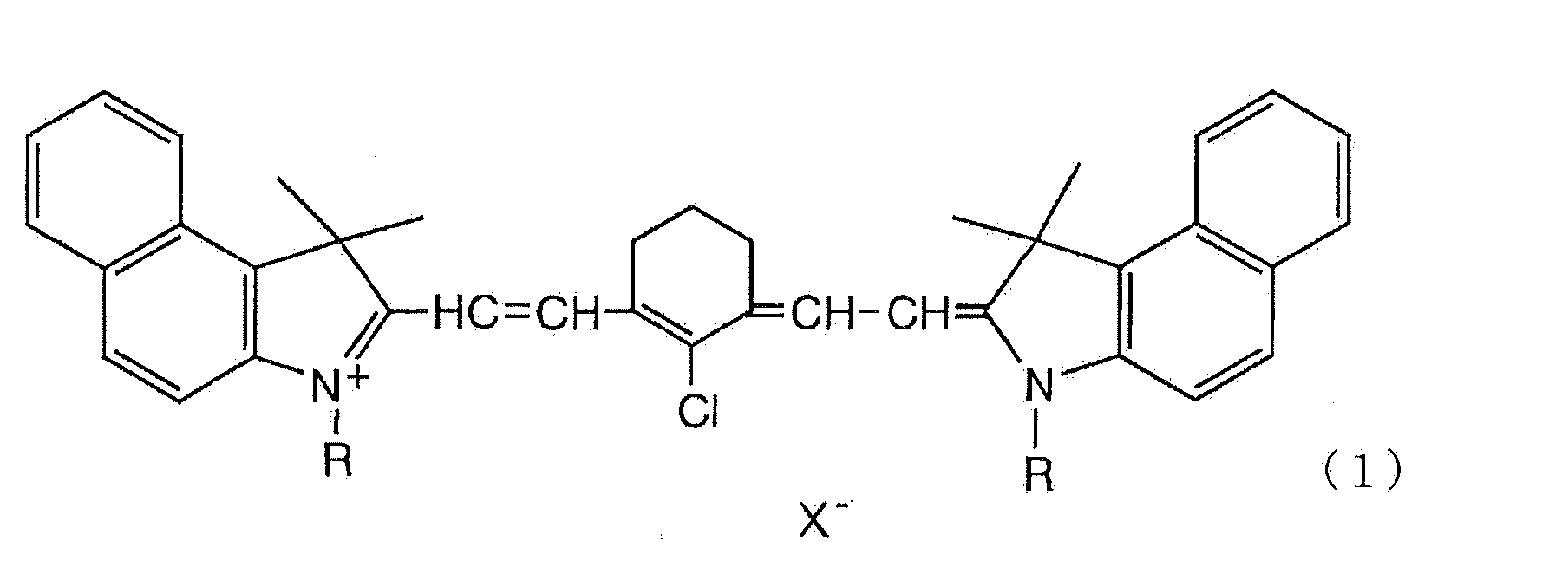
X- represents BF4 -, PF6 -, I- or NO3 -. - (2) The indolenine compound described in (1), wherein R
represents the following general formula (3):
- (3) An infrared absorber containing as an active ingredient the indolenine compound described in (1) or (2).
- (4) A toner containing an indolenine compound represented by
the following general formula (4):
wherein R represents a group represented by the following general formula (5):

X- represents an ion for neutralization of an electric charge. - (5) The toner described in (4), wherein R represents the
following general formula (6):
- (6) The toner described in (4) or (5), wherein X- represents BF4 -, PF6 -, I-, NO3 - or SbF6 -.
-
- The present invention will be described in detail.
- In the formula (4), R represents the formula (5), preferably the formula (6).
- "a" and "b" of the formula (5) and "c" of the formulas (5) and (6) each represent an integer, and a is 1 or 0; b and c each independently represent 1 or 2; and R1 represents an alkyl group having 4 or less carbon atoms.
- Specific examples of R include alkoxyalkyl groups such as a methoxymethyl group, a methoxyethyl group, an ethoxyethyl group, and a butoxyethyl group; and alkoxyalkoxyalkyl groups such as a methoxymethoxymethoxy group and an ethoxyethoxyethoxy group. Preferable are, for example, a methoxyethyl group, a butoxyethyl group, an ethoxyethoxyethyl group and the like.
- In the general formula (4), X- representing an ion for neutralization of an electric charge represents an organic or inorganic anion. In the case where X- is a monovalent anion, one mole is necessary and in the case where X- is a divalent anion, a half mole is necessary. Examples thereof include: organic ions such as a methanesulfonate ion, a benzenesulfonate ion, a p-toluenesulfonate ion, a methylsulfate ion, an ethylsulfate ion, a propylsulfate ion, a tetrafluoroborate ion, a tetraphenylborate ion, a hexafluorophosphate ion, a benzenesulfinate ion, an acetate ion, a lactate ion, a trifluoroacetate ion, a propionacetate ion, a benzoate ion, an oxalate ion, a succinate ion, a malonate ion, a oleate ion, a stearate ion, a citrate ion, a dihydrophosphate ion, a tin pentachlorate ion, a chlorosulfonate ion, a fluorosulfonate ion, a trifluoromethanesulfonate ion, a hexafluoroarsenate ion, a naphthalenemonosulfonate ion, a naphthalenedisulfonate ion, a chlorobenzesulfonate ion, a nitrobenzenesulfonate ion, a dodecylbenzenesulfonate ion, a benzenesulfonate ion, an ethanesulfonate ion, a trifluoromethanesulfonate ion, a tetraphenylborate ion, and a butyltriphenylborate; and inorganic ions such as halogen ions including a fluorine ion, a chlorine ion, a bromine ion and an iodine ion, a thiocyanate ion; a perchlorate ion, a periodate ion, a tetrafluoroborate ion, a hexafluorophosphate ion, a molybdate ion, a tungstate ion, a titanate ion, a vanadata ion, a phosphate ion, a borate ion, a nitrate ion, a hexafluoroantimonate ion, a molybdate ion, a tungstate ion, a titanate ion, and a zirconate ion. Among these inorganic ions, ones having a high decomposition temperature are preferable. More preferable are a tetrafluoroborate ion, a hexafluorophosphate ion, a hexafluoroantimonate ion,a nitate ion, an iodine ion and the like.
- Next, preferable examples of the compound represented by the general formula (4), although not particularly limited, include specific compounds described below.
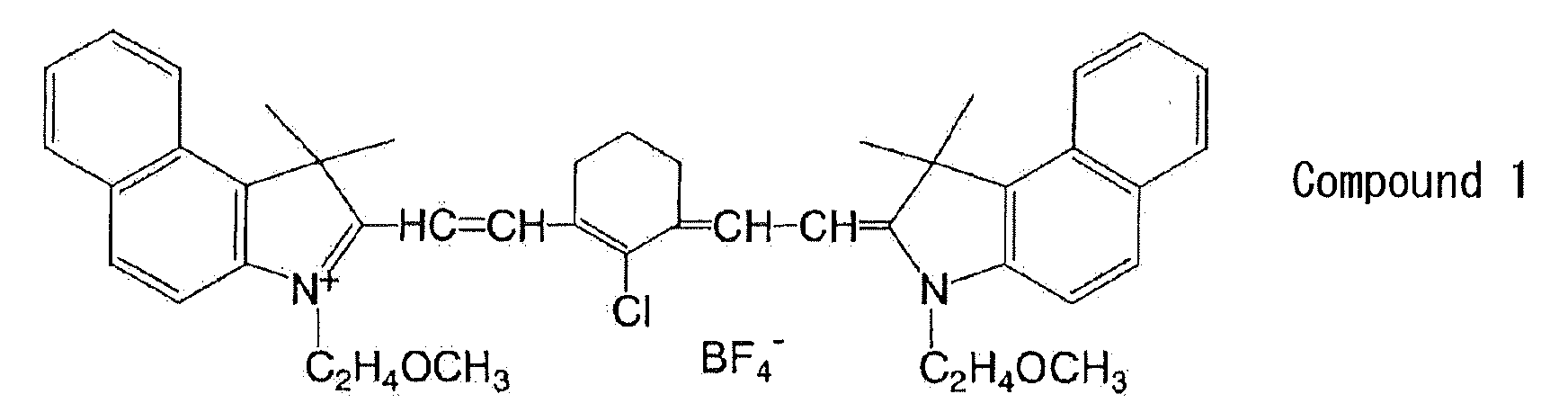
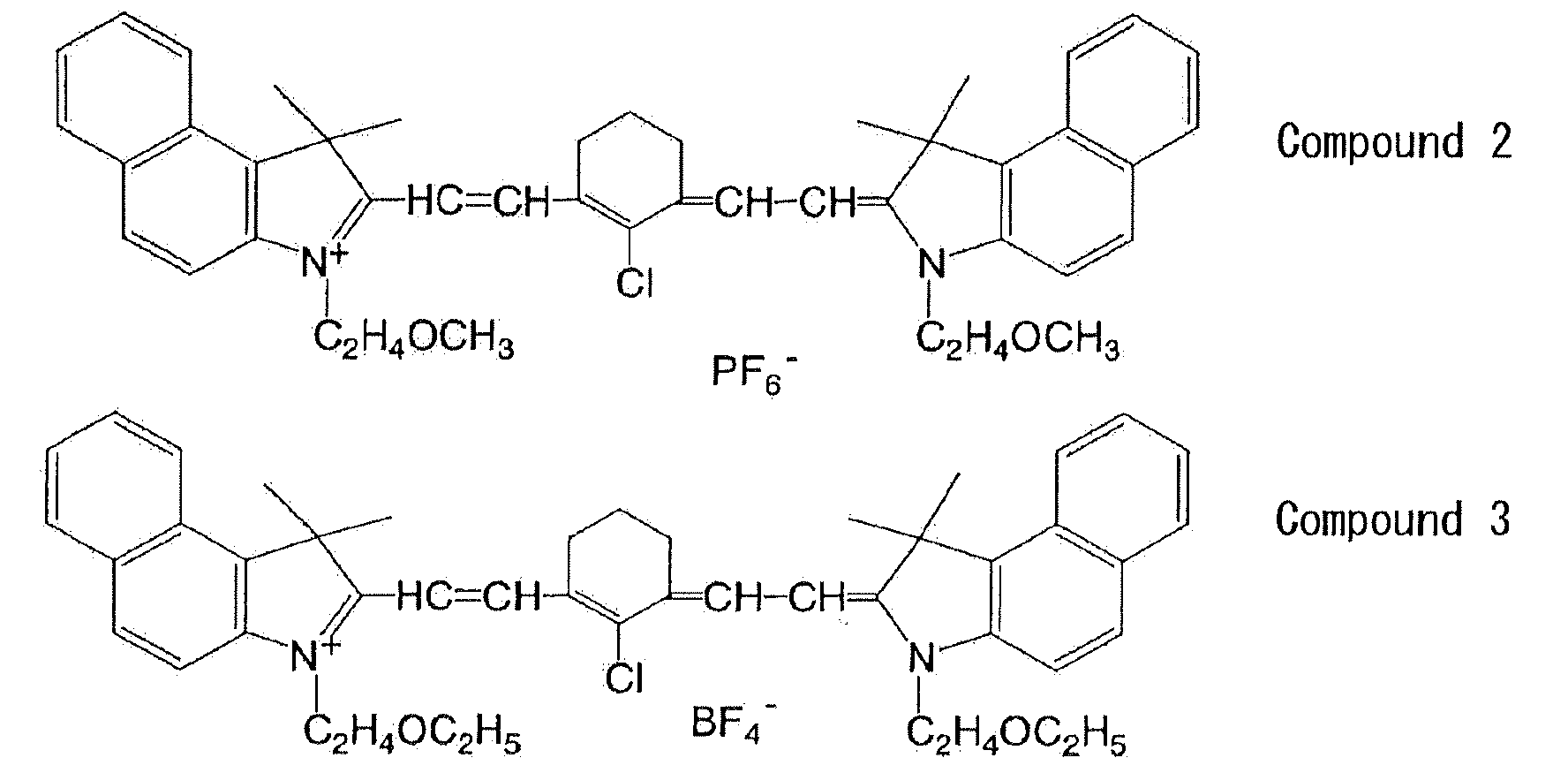

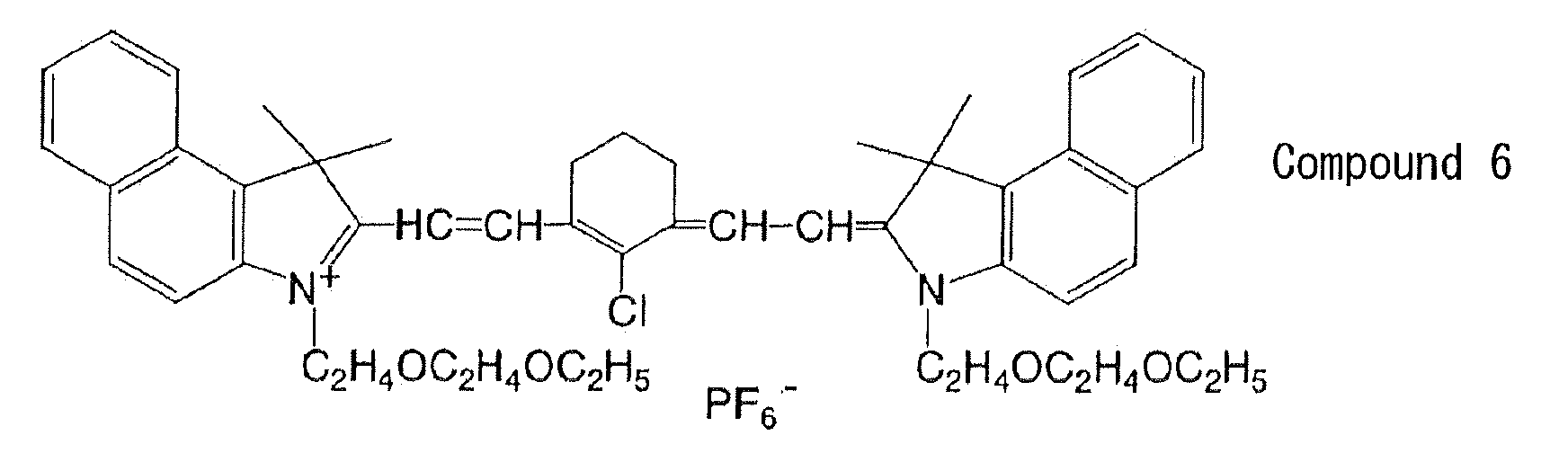

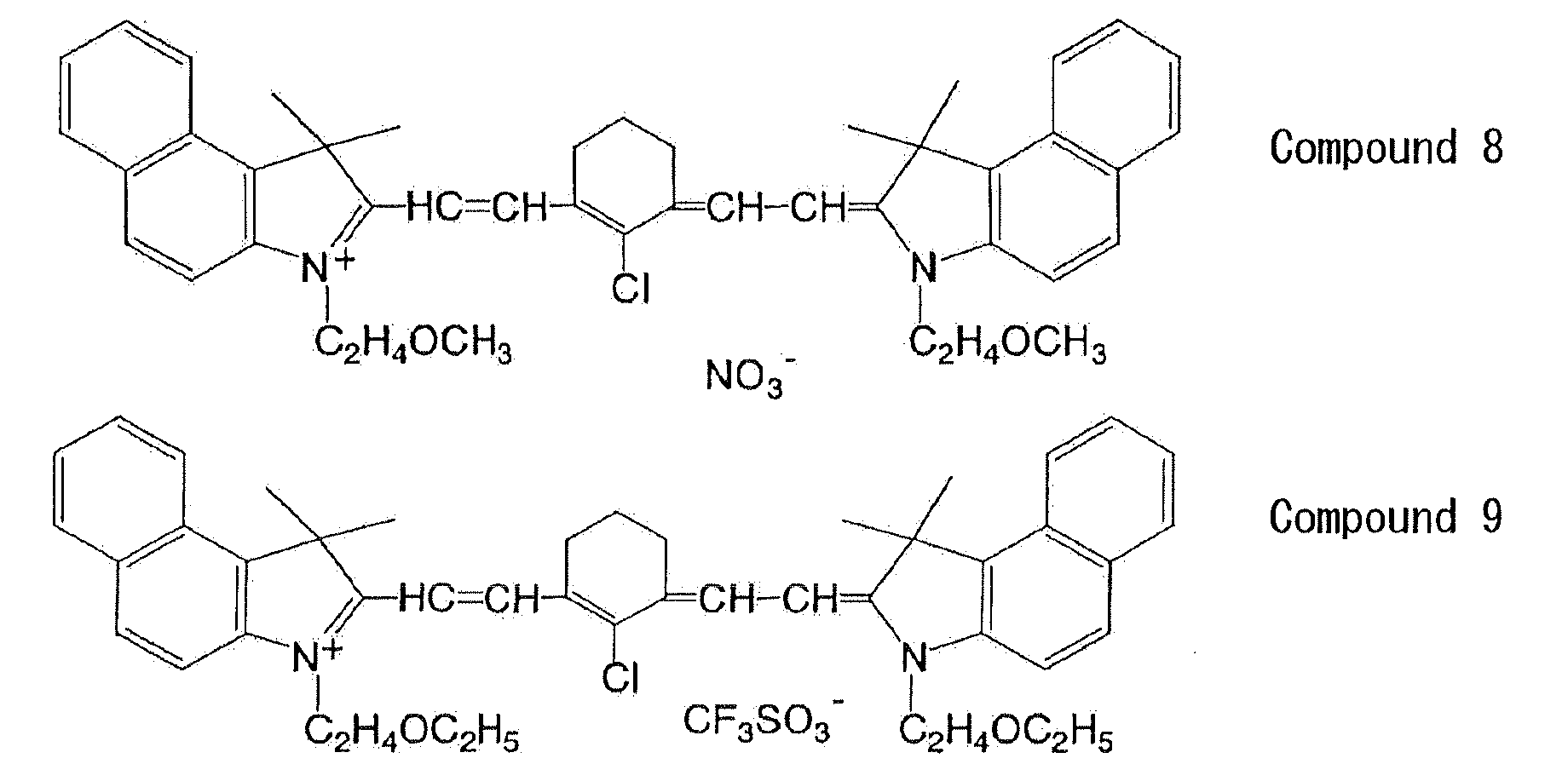

- The compound of present invention represented by the general formula (4) can be obtained, for example, by the following method in accordance with a method described in Japanese Patent Publication (KOKOKU) No. 5-37119.

- In the above synthesis route, R and X represent the above-described meanings, and M represents a metal, for example, an alkali metal ion or an alkaline earth metal ion for neutralizing an electric charge.
- The reaction method will be described in detail. In a solvent such as methanol, ethanol, isopropyl alcohol, glycol, and dimethylformamide, or acetic acid and acetic anhydride, raw material 1, raw material 2, and raw material 3 were charged and the reaction is allowed to continue usually for 1 to 12 hours at 50°C to 140°C to obtain a compound of interest. In this reaction, a base catalyst such as piperazine, piperidine and sodium acetate may be added as a catalyst depending on the case. Alternatively, raw materials 1 and 2 are reacted with each other by the above method to synthesize pigment skeleton, and then may be reacted with raw material 3.
- The compound of the present invention has high heat resistance, an absorbing ability in the near-infrared region, particularly 800 to 1100 nm, a high Molar extinction coefficient, and extremely low absorbance in a visible region (generally 400 to 750 nm). Therefore, the compound of the formula (4) according to the present invention is useful as a near-infrared absorber, and further useful for a toner for noncontact thermal fixing type such as flash fixing type.
- The toner of the present invention is composed of at least a binder resin, a compound of formula (4) according to the present invention, and a coloring agent. A toner particle can be produced by conventionally and publicly known methods such as a melting, kneading and crushing method or wet granulation method, using well-known binder resins, various coloring agents or the like, which are conventionally and commonly used. The detailed explanation thereof is described in Japanese Patent Application Laying Open (KOKAI) No. 63-161460, Japanese Patent Publication (KOKOKU) No. 7-23965, Japanese Patent Application Laying Open (KOKAI) No. 2000-214626, Japanese Patent Application Laying Open (KOKAI) No. 2000-214628, Japanese Patent Application Laying Open (KOKAI) No. 2002-156779 and the like.
- The compound of the present invention has features, that is, high heat resistance, a high molar extinction coefficient in the near-infrared region, in particular 800 to 1100 nm, and extremely low absorbance in a visible region (generally 400 to 750 nm). Thus, when the compound is used for a toner for a noncontact thermal fixing method such as flash fixing method, flash light can be efficiently converted into heat, thereby indicating that fixability becomes high. Further, since the amount of an infrared absorber to be used for a toner can be decreased, it is indicated that the color tone changes of a color toner caused by the infrared absorber are reduced and color images with excellent color reproducibility as well as that toner production cost is reduced.
- The present invention will hereinafter be described in more detail by referring to Examples, although it is not limited to these Examples. In the Examples, "parts" means "parts by weight" unless otherwise specified.
- 2.7 parts of 4,5-benzo-1-(2-methoxyethyl)-3,3-dimethyl-2-methyleneindoline and 0.8 parts of 2-chloro-1-formyl-3-hydroxymethylenecyclohexene were boiled in 4.0 parts of acetic anhydride for 1 hour under reflux, and then cooled to room temperature. Thereafter, the reaction solution was subjected to suction filtration to remove insoluble impurities. Next, the reaction solution was injected into 4.0 parts of water with 0.5 parts of sodium tetrafluoroborate dissolved therein, and precipitated crystals were filtrated by suction and recrystallized with 2.0 parts of DMF. The resultant crystals were washed with 2.0 parts of methanol, and dried, thereby obtaining 2.5 parts of the above-mentioned compound 1. The thus obtained compound 1 had the following physical properties. It should be noted that a value of thermogravimetry-differential thermal analysis (TG-DTA) is shown as a decomposition temperature.
- Maximum absorption wavelength: 820 nm (in methanol)
- Molar extinction coefficient: 270,000 (in methanol)
- Decomposition temperature: 227°C (TG-DTA)
-
- 2.7 parts of the above-mentioned compound 2 was obtained in the same manner as in Example 1, except that 0.7 parts of sodium hexafluorophosphate was used instead of sodium tetrafluoroborate. The obtained compound 2 had the following physical properties.
- Maximum absorption wavelength: 820 nm (in methanol)
- Molar extinction coefficient: 270,000 (in methanol)
- Decomposition temperature: 234°C (TG-DTA)
-
- 3.0 parts of the above-mentioned compound 7 was obtained in the same manner as in Example 1, except that 0.9 parts of potassium iodide was used instead of sodium tetrafluoroborate. The obtained compound 7 had the following physical properties.
- Maximum absorption wavelength: 820 nm (in methanol)
- Molar extinction coefficient: 270,000 (in methanol)
- Decomposition temperature: 214°C (TG-DTA)
-
- 2.7 parts of the above-mentioned compound 5 was obtained in the same manner as in Example 1, except that 3.1 parts of 4,5-benzo-1-(2-(2-ethoxy)ethoxyethyl)-3,3-dimethyl-2-methyleneindoline was used instead of 4,5-benzo-1-(2-methoxyethyl)-3,3-dimethyl-2-methyleneindo line. The obtained compound 5 had the following physical properties.
- Maximum absorption wavelength: 820 nm (in methanol)
- Molar extinction coefficient: 272,000 (in methanol)
- Decomposition temperature: 225°C (TG-DTA)
-
- 2. 6 parts of the above-mentioned compound 4 was obtained in the same manner as in Example 1, except that 2.9 parts of 4,5-benzo-1-(2-butoxyethyl)-3,3-dimethyl-2-methyleneindoline and 0.7 parts of sodium hexafluorophosphate were used instead of 4,5-benzo-1-(2-methoxyethyl)-3,3-dimethyl-2-methyleneindoline and sodium tetrafluoroborate, respectively. The obtained compound 4 had the following physical properties.
- Maximum absorption wavelength: 822 nm (in methanol)
- Molar extinction coefficient: 274,000 (in methanol)
- Decomposition temperature: 233°C (TG-DTA)
-
- 2.9 parts of the above-mentioned compound 11 was obtained in the same manner as in Example 1, except that 3.1 parts of 4,5-benzo-1-(2-(2-ethoxy)ethoxyethyl)-3,3-dimethyl-2-meth yleneindoline and 1.1 parts of sodium hexafluoroantimonate were used instead of 4,5-benzo-1-(2-methoxyethyl)-3,3-dimethyl-2-methyleneindoline and sodium tetrafluoroborate, respectively. The obtained compound 11 had the following physical properties.
- Maximum absorption wavelength: 820 nm (in methanol)
- Molar extinction coefficient: 272,000 (in methanol)
- Decomposition temperature: 226°C (TG-DTA)
-
- 2.3 parts of the above-mentioned compound 8 was obtained in the same manner as in Example 1, except that 0.5 parts of sodium nitrate was used instead of sodium tetrafluoroborate. The obtained compound 8 had the following physical properties.
- Maximum absorption wavelength: 820 nm (in methanol)
- Molar extinction coefficient: 270,000 (in methanol)
- Decomposition temperature: 212°C (TG-DTA)
-
- 2.5 parts of the following Comparative Example Compound 1 (a compound described in Japanese Patent Publication (KOKOKU) No. 5-37119) was obtained in the same manner as in Example 1, except that 2.2 parts of 1-(2-methoxyethyl)-3,3-dimethyl-2-methyleneindoline was used instead of 4,5-benzo-1-(2-methoxyethyl)-3,3-dimethyl-2-methyleneindoline. The obtained Comparative Example Compound 1 had the following physical properties.
- Maximum absorption wavelength: 780 nm (in methanol)
- Molar extinction coefficient: 249,000 (in methanol)
- Decomposition temperature: 210°C (TG-DTA)

-
- 2.2 parts of the following Comparative Example Compound 2 (a compound described in Japanese Patent Application Laying Open (KOKAI) No. 2001-105756) was obtained in the same manner as in Example 1, except that 2.5 parts of 4,5-benzo-1,3,3-trimethyl-2-methyleneindoline was used instead of 4,5-benzo-1-(2-methoxyethyl)-3,3-dimethyl-2-methyleneindoline. The obtained Comparative Example Compound 2 had the following physical properties.
- Maximum absorption wavelength: 814 nm (in methanol)
- Molar extinction coefficient: 248,000 (in methanol)
- Decomposition temperature: 242°C (TG-DTA)

-
- 2.0 parts of 4,4'-bis(diethylaminophenyl)ethylene and 1. 0 part of ortho triethyl formate were charged into 4.0 parts of acetic anhydride, and 0.4 parts of 42% fluoroboric acid was added dropwise thereto. The resultant mixture was boiled for 1 hour under reflux, and then cooled to room temperature. Thereafter, the reaction solution was subjected to suction filtration to remove insoluble impurities. The entire amount of the obtained filtrate was poured into 4.0 parts of water, and precipitated crystals were filtrated by suction, washed with 2.0 parts of methanol, and dried, thereby obtaining 2.0 parts of the following Comparative Example Compound 3 (a compound described in Japanese Patent Application Laying Open (KOKAI) No. 58-219090). The obtained Comparative Example Compound 3 had the following physical properties.
- Maximum absorption wavelength: 820 nm (in methanol)
- Molar extinction coefficient: 183,000 (in methanol)
- Decomposition temperature: 156°C (TG-DTA)

-
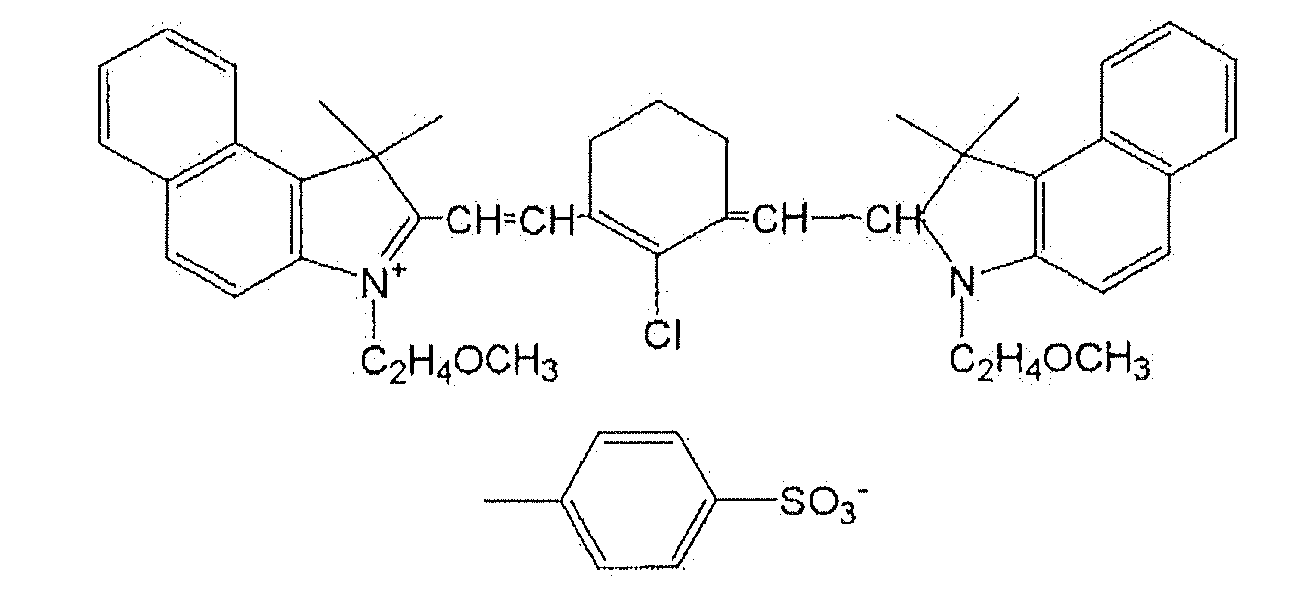
- 2.7 parts of the following compound was obtained in the same manner as in Example 1, except that 0.9 parts of sodium p-toluenesulfonate was used instead of sodium tetrafluoroborate. The following compound thus obtained had the following physical properties.
- Maximum absorption wavelength: 820 nm (in methanol)
- Molar extinction coefficient: 270,000 (in methanol)
- Decomposition temperature: 215°C (TG-DTA)
-
- Comparative Example 4 had 11% larger weight of organic anions than a cation thereof in Example 1. That is, absorbance per weight decreases by slightly over 10%, and the decomposition temperature also decreases as a common organic aniondecreases. Inproducing a toner of the present invention, when it is heated and kneaded with a resin, it is considered that this Comparative Example 4 regrettably has no advantages compared with an inorganic anion.
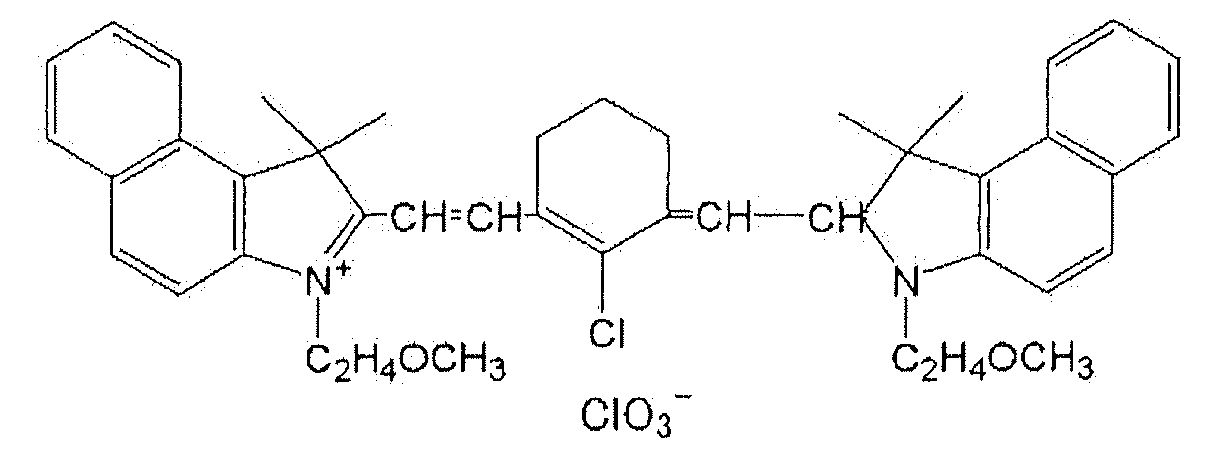
- 2.4 parts of the following compound was obtained in the same manner as in Example 1, except that 0.6 parts of potassium chlorate was used instead of sodium tetrafluoroborate. The following compound thus obtained had the following physical properties.
- Maximum absorption wavelength: 820 nm (in methanol)
- Molar extinction coefficient: 270,000 (in methanol)
- Decomposition temperature (chlorate ion): 158°C (TG-DTA)
-
- In addition, 2.4 parts of the following compound was obtained in the same manner as in Example 1, except that 0.6 parts of sodium perchlorate was used instead of sodium tetrafluoroborate. The following compound thus obtained had the following physical properties.
- Maximum absorption wavelength: 820 nm (in methanol)
- Molar extinction coefficient: 270,000 (in methanol)
- Decomposition temperature (perchlorateion): 230°C (TG-DTA)

-
- It is well known that chlorate and perchlorate ion forms are easily decomposed at a decomposition temperature. In the compound of the present invention, particularly a chlorate ion form has a remarkably low decomposition temperature. At that temperature, the weight decreased at once by 70% or more and radical decomposition was observed. In addition to dangers in compound production, these Comparative Examples are considered to have no advantage compared with other anions when heated and kneaded with a resin in producing the toner of the present invention.
- Table 1 described below shows comparison in absorbance at 600, 650 and 700 nm in methanol of compounds of Examples 1 to 7 with Comparative Example Compounds 1 to 3.
(comparison of spectral characteristics in 3 mg/L methanol solution) 600nm 650nm 700nm Example 1 0.014 0.052 0.147 Example 2 0.014 0.051 0.144 Example 3 0.013 0.048 0.134 Example 4 0.012 0.048 0.136 Example 5 0.016 0.047 0.126 Example 6 0.014 0.045 0.119 Example 7 0.014 0.053 0.148 (hereinafter described with a ratio (%) to Example 1) Comparative Example 1 0.024 0.089 0.274 (170%) (170%) (190%) Comparative Example 2 0.018 0.071 0.199 (130%) (140%) (140%) Comparative Example 3 0.213 0.262 0.164 (1520%) (500%) (120%) - The compound of the present invention is characterized by having a sharp absorption in the infrared region, a high extinction coefficient, and a high decomposition temperature.
- Further, according to Table 1, the compounds of the present invention has an extremely low absorption compared with the Comparative Example Compounds in the visible region, in particular the visible region close to the near infrared region, 600 nm to 700 nm. This difference indicates that the compounds of the present invention has much lower absorption in the visible region than the compounds for comparison and exert very small impact to the color tones of color toners. In addition, since the indolenine compound of the present invention has a high molar extinction coefficient, a toner can be obtained which has excellent fixing in noncontact thermal fixing method such as flash fixing method.
Claims (6)
- An indolenine compound represented by the following general formula (1):wherein R represents a group represented by the following general formula (2):

X- represents BF4 -, PF6 -, I- or NO3 -. - The indolenine compound according to claim 1, wherein R represents the following general formula (3):
- An infrared absorber containing as an active ingredient the indolenine compound according to claim 1 or 2.
- A toner containing an indolenine compound represented by the following general formula (4):wherein R represents a group represented by the following general formula (5):
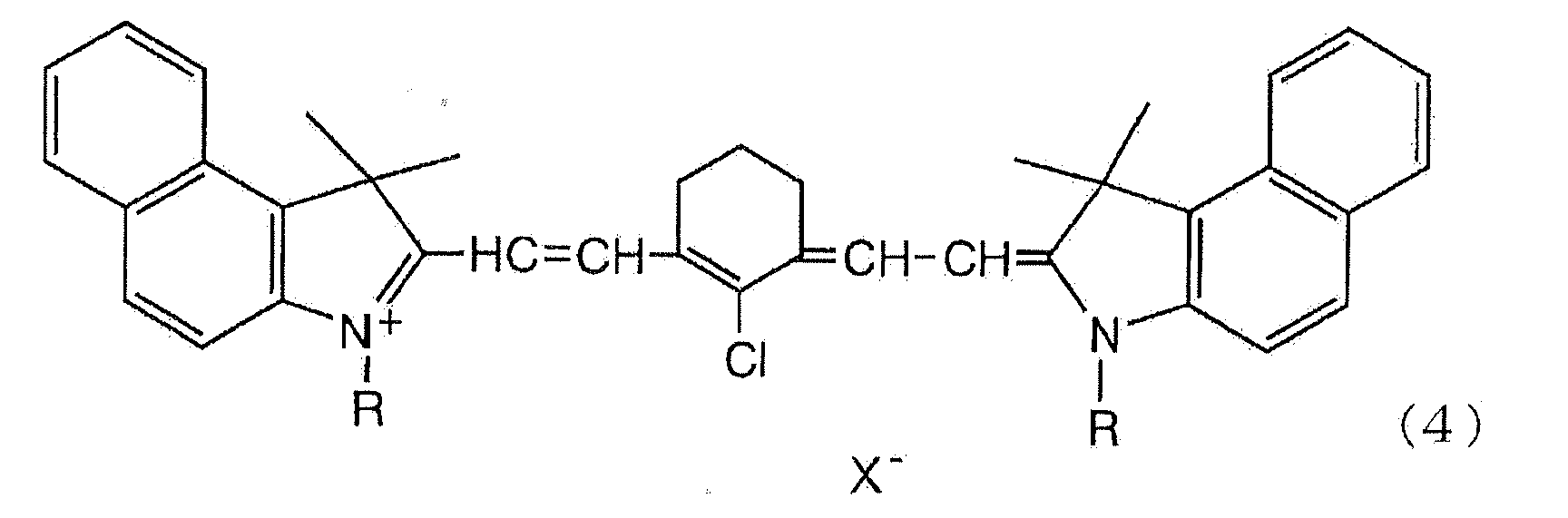
X- represents an ion for neutralization of an electric charge. - The toner according to claim 4, wherein R represents the following general formula (6):
- The toner according to claim 4 or 5, wherein X- represents BF4 -, PF6 -, I-, NO3 - or SbF6 -
Applications Claiming Priority (3)
| Application Number | Priority Date | Filing Date | Title |
|---|---|---|---|
| JP2002232715 | 2002-08-09 | ||
| JP2002232715 | 2002-08-09 | ||
| PCT/JP2003/009938 WO2004014857A1 (en) | 2002-08-09 | 2003-08-05 | Indolenine compound, near infrared absorber, and toner containing the same |
Publications (2)
| Publication Number | Publication Date |
|---|---|
| EP1541556A1 true EP1541556A1 (en) | 2005-06-15 |
| EP1541556A4 EP1541556A4 (en) | 2008-03-19 |
Family
ID=31711844
Family Applications (1)
| Application Number | Title | Priority Date | Filing Date |
|---|---|---|---|
| EP03784524A Withdrawn EP1541556A4 (en) | 2002-08-09 | 2003-08-05 | Indolenine compound, near infrared absorber, and toner containing the same |
Country Status (8)
| Country | Link |
|---|---|
| US (1) | US20060105257A1 (en) |
| EP (1) | EP1541556A4 (en) |
| JP (1) | JPWO2004014857A1 (en) |
| KR (1) | KR20050032593A (en) |
| CN (1) | CN1675182A (en) |
| AU (1) | AU2003252401A1 (en) |
| TW (1) | TW200413316A (en) |
| WO (1) | WO2004014857A1 (en) |
Cited By (1)
| Publication number | Priority date | Publication date | Assignee | Title |
|---|---|---|---|---|
| US8308886B2 (en) * | 2006-07-17 | 2012-11-13 | E I Du Pont De Nemours And Company | Donor elements and processes for thermal transfer of nanoparticle layers |
Families Citing this family (2)
| Publication number | Priority date | Publication date | Assignee | Title |
|---|---|---|---|---|
| EP2221014B1 (en) | 2009-02-23 | 2015-05-20 | Inion Oy | Implant, implantation tool and kit |
| US20110086302A1 (en) * | 2009-10-09 | 2011-04-14 | Xerox Corporation | Toner compositions and processes |
Family Cites Families (7)
| Publication number | Priority date | Publication date | Assignee | Title |
|---|---|---|---|---|
| JPS62103190A (en) * | 1985-10-30 | 1987-05-13 | Olympus Optical Co Ltd | Optical-information recording medium |
| US5605732A (en) * | 1992-01-06 | 1997-02-25 | Canon Kabushiki Kaisha | Aminium salt compound and optical recording medium |
| JP2715026B2 (en) * | 1992-01-13 | 1998-02-16 | 富士写真フイルム株式会社 | Thermal development diffusion transfer type color photosensitive material |
| JP2000214626A (en) * | 1999-01-25 | 2000-08-04 | Mitsui Chemicals Inc | Near infrared absorber for electrophotographic toner, and electrophotographic toner containing the absorber |
| JP3408177B2 (en) * | 1999-01-26 | 2003-05-19 | 株式会社日本触媒 | Non-contact fixing toner |
| JP2001080226A (en) * | 1999-09-17 | 2001-03-27 | Fuji Photo Film Co Ltd | Heat-sensitive lithographic printing plate precursor |
| JP2002362040A (en) * | 2001-06-04 | 2002-12-18 | Fuji Photo Film Co Ltd | Thermal transfer sheet and multicolor image forming method |
-
2003
- 2003-08-05 AU AU2003252401A patent/AU2003252401A1/en not_active Abandoned
- 2003-08-05 US US10/523,338 patent/US20060105257A1/en not_active Abandoned
- 2003-08-05 JP JP2004527336A patent/JPWO2004014857A1/en active Pending
- 2003-08-05 EP EP03784524A patent/EP1541556A4/en not_active Withdrawn
- 2003-08-05 KR KR1020057002010A patent/KR20050032593A/en not_active Withdrawn
- 2003-08-05 CN CNA038190230A patent/CN1675182A/en active Pending
- 2003-08-05 WO PCT/JP2003/009938 patent/WO2004014857A1/en not_active Ceased
- 2003-08-06 TW TW092121535A patent/TW200413316A/en unknown
Non-Patent Citations (3)
| Title |
|---|
| DATABASE WPI Week 200060 Derwent Publications Ltd., London, GB; AN 2000-621328 XP002463301 & JP 2000 214628 A (NIPPON SHOKUBAI CO LTD) 4 August 2000 (2000-08-04) * |
| DATABASE WPI Week 200063 Derwent Publications Ltd., London, GB; AN 2000-649485 XP002463300 & JP 2000 214626 A (MITSUI CHEM INC) 4 August 2000 (2000-08-04) * |
| See also references of WO2004014857A1 * |
Cited By (1)
| Publication number | Priority date | Publication date | Assignee | Title |
|---|---|---|---|---|
| US8308886B2 (en) * | 2006-07-17 | 2012-11-13 | E I Du Pont De Nemours And Company | Donor elements and processes for thermal transfer of nanoparticle layers |
Also Published As
| Publication number | Publication date |
|---|---|
| US20060105257A1 (en) | 2006-05-18 |
| TW200413316A (en) | 2004-08-01 |
| JPWO2004014857A1 (en) | 2005-12-02 |
| EP1541556A4 (en) | 2008-03-19 |
| KR20050032593A (en) | 2005-04-07 |
| WO2004014857A1 (en) | 2004-02-19 |
| CN1675182A (en) | 2005-09-28 |
| AU2003252401A1 (en) | 2004-02-25 |
Similar Documents
| Publication | Publication Date | Title |
|---|---|---|
| US20100274023A1 (en) | Novel intermediate compounds for the preparation of meso-substituted cyanine, merocyanine and oxonole dyes | |
| DE69230121T2 (en) | New phthalocyanine compounds, their manufacturing processes and the near infrared absorbing materials they contain | |
| JPS58182640A (en) | Electrophotographic receptor of composite type | |
| JP2812624B2 (en) | Novel fluorine-containing phthalocyanine compound, method for producing the same, and near-infrared absorbing material comprising the same | |
| JP2000147824A (en) | Near infrared absorber for electrophotographic toner and toner containing same | |
| US20060105257A1 (en) | Indolenine compound, near infrared absorber, and toner containing the same | |
| JP2805867B2 (en) | Electrophotographic photoreceptor | |
| JP2009029955A (en) | Naphthalocyanine coloring matter compound, production method thereof and near infrared absorbing material | |
| US7462711B2 (en) | U-oxo crosslinked dissimilar metal phthalocyanine compound and process for selectively producing the same | |
| US6248893B1 (en) | Non-heterocyclic oxonol infrared radiation sensitive compounds | |
| JPH11152416A (en) | Production of aminonaphthalocyanine compound | |
| JP2006002069A (en) | Merocyanine dye copolymer and use thereof | |
| JP3935538B2 (en) | POLYMETHINE COMPOUND, PROCESS FOR PRODUCING THE SAME, AND NEAR-INFRARED ABSORBING MATERIAL CONTAINING THE SAME | |
| JP3603478B2 (en) | Method for producing oxytitanium phthalocyanine and electrophotographic photoreceptor using the same | |
| DE3740421A1 (en) | MULTILAYERED, ELECTROPHOTOGRAPHIC RECORDING MATERIAL | |
| JP2001206873A (en) | Infrared light-sensitive oxonol compound | |
| JP2800224B2 (en) | Electrophotographic photoreceptor | |
| Corns | Novel near-infrared absorbing dyes | |
| JP3453856B2 (en) | Method for producing oxytitanium phthalocyanine and method for producing electrophotographic photoreceptor using the same | |
| JP3451751B2 (en) | Manufacturing method of electrophotographic photoreceptor | |
| WO2008038679A1 (en) | Phthalocyanine compound and process for production thereof | |
| JP2009057430A (en) | Phthalocyanine compound | |
| JPH09104829A (en) | Method for producing oxytitanium phthalocyanine and electrophotographic photoreceptor using the same | |
| JPS60248652A (en) | Novel squarium compound and its preparation | |
| JP2737976B2 (en) | Electrophotographic photoreceptor |
Legal Events
| Date | Code | Title | Description |
|---|---|---|---|
| PUAI | Public reference made under article 153(3) epc to a published international application that has entered the european phase |
Free format text: ORIGINAL CODE: 0009012 |
|
| 17P | Request for examination filed |
Effective date: 20050127 |
|
| AK | Designated contracting states |
Kind code of ref document: A1 Designated state(s): AT BE BG CH CY CZ DE DK EE ES FI FR GB GR HU IE IT LI LU MC NL PT RO SE SI SK TR |
|
| AX | Request for extension of the european patent |
Extension state: AL LT LV MK |
|
| DAX | Request for extension of the european patent (deleted) | ||
| RBV | Designated contracting states (corrected) |
Designated state(s): DE FR GB |
|
| RIN1 | Information on inventor provided before grant (corrected) |
Inventor name: YAMAMURA, SHIGEO Inventor name: TORINIWA, TOSHITAKA |
|
| A4 | Supplementary search report drawn up and despatched |
Effective date: 20080220 |
|
| RIC1 | Information provided on ipc code assigned before grant |
Ipc: C09B 23/01 20060101ALI20080211BHEP Ipc: G03G 9/08 20060101ALI20080211BHEP Ipc: C09K 3/00 20060101ALI20080211BHEP Ipc: C07D 209/60 20060101AFI20040302BHEP |
|
| STAA | Information on the status of an ep patent application or granted ep patent |
Free format text: STATUS: THE APPLICATION HAS BEEN WITHDRAWN |
|
| 18W | Application withdrawn |
Effective date: 20080403 |