TECHNICAL FIELD
The present invention relates to a method of combined
injection molding for molding a combined injection molding
product through injection molding of a secondary resin
molding product onto a primary resin molding product, as well
as to a combined injection mold. More particularly, the
invention relates to a method of combined injection molding
characterized in that portions at which the secondary resin
molding product is united with the primary resin molding
product with poor adhesion are compressed selectively and
locally, as well as a combined injection mold for producing
such a combined injection molding product.
BACKGROUND ART
Conventionally, a combined injection molding product
has been molded such that a primary resin molding product is
injection-molded, and a secondary resin is injected onto the
primary resin molding. Known methods of combined injection
molding include two-color molding processes such as a rotary
process, a core bag process, and a slide process.
In combined injection molding, ensuring adhesion and
air tightness of the secondary resin molding product to the
primary resin molding product is a very important technical
point in terms of prevention of breakage that could initiate
from an interface when pressure is applied to the inside of a
combined injection molding product, as well as in terms of
prevention of entry of water into the combined injection
molding product from the outside.
Conventionally, techniques for ensuring adhesion and
air tightness of the secondary resin molding product to the
primary resin molding product have been studied in relation
to (a) resin material to be molded and (b) molding apparatus
and molding method.
According to a known method in relation to (a), a
primary resin of a melting point lower than that of a
secondary resin is used, whereby the primary resin is melted
upon contact with the injected secondary resin.
According to a disclosed technique in relation to (b),
an entire region that is expected to be subjected to adhesion
or fusion is pressed or compressed by use of a mold mechanism
(see, for example, Japanese Patent Application Laid-Open
(kokai) No. 7-290500 (claim 1, FIG. 1) and Japanese Patent
Application Laid-Open (kokai) No. 9-11344 (claim 1, FIG. 3)).
However, in the case of a combined injection molding
product of a certain shape, these techniques have failed to
impart sufficient adhesion.
DISCLOSURE OF THE INVENTION
An object of the present invention is to provide a
combined injection molding product in which a primary resin
molding product and a secondary resin molding product attain
improved adhesion and air tightness.
The inventors of the present invention have conducted
extensive studies in an attempt to obtain a combined
injection molding product of improved adhesion and air
tightness and have found that adhesion and air tightness of
the combined injection molding product can be efficiently
improved when, in the course of combined injection molding,
vicinities of locations where adhesion becomes poor―such as
a portion located a long distance from a secondary resin gate,
and portions, such as bosses and ribs, projecting from the
surface of a secondary resin molding product―are locally
compressed by use of an ejector mechanism of an injection
molding machine or a mechanism provided on a mold for moving
a portion of the mold by means of fluid pressure, electrical
drive, or repulsion force of an elastic member such as a
spring. The present invention has been accomplished on the
basis of the findings.
Accordingly, invention 1 of the present invention
provides a method of combined injection molding for shaping a
combined injection molding product by forming, through
injection, a secondary resin molding product (2) onto a
primary resin molding product (1), which comprises applying a
compression pressure on a secondary resin molding product (2)
side, to thereby improve adhesion between the primary resin
molding product (1) and the secondary resin molding product
(2) and air tightness therebetween, characterized in that
portions at which the secondary resin molding product (2) is
united with the primary resin molding product (1) with poor
adhesion are compressed selectively and locally.
According to invention 2 of the present invention, in
the method of combined injection molding as described in
relation to invention 1 of the present invention, the
secondary resin molding product (2) has projecting portions
(4) ejecting outside, and the projecting portions (4) are
compressed locally.
According to invention 3 of the present invention, in
the method of combined injection molding as described in
relation to invention 1 of the present invention, the
projecting portions (4) are bosses or ribs.
According to invention 4 of the present invention, in
the method of combined injection molding as described in
relation to invention 2 of the present invention, the
projecting portions (4) are bosses or ribs.
According to invention 5 of the present invention, in
the method of combined injection molding as described in
relation to invention 1 of the present invention, in the case
where the secondary resin molding product (2) has a portion
(8) located a long distance from a secondary resin gate (7),
the portion located a long distance from the secondary resin
gate (7) is locally compressed.
According to invention 6 of the present invention, in
the method of combined injection molding as described in
relation to any one of invention 1 to invention 5 the present
invention, the starting time of pressing is within elapse of
20 seconds of surface hardening time after gate sealing time
of the secondary resin.
Invention 7 of the present invention provides an
injection mold used for the method of combined injection
molding as described in any one of invention 1 to invention 5
of the present invention and having a local pressing means
(6) for selectively and locally compressing portions at which
the secondary resin molding product (2) is united with the
primary resin molding product (1) with poor adhesion.
Invention 8 of the present invention provides an
injection mold used for the method of combined injection
molding as described in relation to invention 6 of the
present invention and having a local pressing means (6) for
selectively and locally compressing portions at which the
secondary resin molding product (2) is united with the
primary resin molding product (1) with poor adhesion.
BRIEF DESCRIPTION OF DRAWINGS
FIG. 1
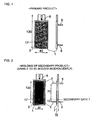
View showing a primary resin molding product according
to examples and a comparative example.
FIG. 2
View showing a combined injection molding product
according to examples and a comparative example.
FIG. 3
Plan view of a combined injection molding product
according to Example 1 or 2 as viewed from the secondary
resin molding product side.
FIG. 4
View showing the state of adhesion, as observed on an
ultrasonic analyzer, of a conventional combined injection
molding product involving a long distance of flow.
FIG. 5
View showing the state of adhesion, as observed on an
ultrasonic analyzer, of a conventional combined injection
molding product having projecting portions.
(Description of Reference Numerals)
1: primary resin molding product
2: secondary resin molding product
3: portion at which compression pressure is applied
4: projecting portion (not shown)
5: rib
6: local pressing means (not shown)
7: secondary resin gate
8: portion located a long distance from secondary resin gate
(portion A or C or rib B) (not shown)
9: primary resin gate
10: combined injection molding product
11: primary resin (not shown)
12: secondary resin (not shown)
17: through-hole for secondary resin gate
21: portion of good adhesion
22: portion of inferior adhesion
BEST MODE FOR CARRYING OUT THE INVENTION
In combined injection molding, an important point for
maintaining good adhesion of a secondary resin molding
product to a primary resin molding product is to melt the
uppermost surface of a hardened primary resin by means of
heat of a molten secondary resin so as to establish
sufficient fusion between the primary resin molding product
and the secondary resin molding product.
Another important point is that the interface between
the primary resin and the secondary resin must be free from
fusion fracture or separation which could result from
contraction or expansion of the resins in the course of
transition of the resins from a molten state to a hardened
state.
The present invention is characterized in that, in
order to carry out effective and sufficient compression,
pressure is locally applied in accordance with the local
hardening condition of the secondary resin and that, in order
to carry out more effective application of pressure, portions
corresponding to ribs and bosses, which encounter difficulty
in hardening of molten resin, are locally compressed.
A method of combined injection molding and a combined
injection mold according to the present invention will be
described hereinafter with reference to the drawings.
FIG. 2 is a plan view of a combined injection molding
product 10 as viewed from the secondary resin molding product
2 side, which is formed on a primary resin molding product 1
by injecting a secondary resin 12 from a secondary resin gate
7 in a mold filling manner to thereby yield the combined
injection molding product 10. In FIG. 3, a portion 8 located
a long distance of flow from the secondary resin gate 7 is a
portion 3 to be pressed. Reference numeral 5 denotes ribs
used to measure adhesion strength.
According to the findings of the present inventors, a
portion located a long distance of flow from a secondary
resin gate position involves the below problem. In the
course of flow of a molten secondary resin over a long
distance, a mold gradually removes heat from the molten
secondary resin, and thus the molten secondary resin
encounters difficulty in sufficiently melting the primary
resin. Also, as hardening of the molten secondary resin
progresses in the vicinity of the resin gate, propagation of
pressure for pressing the primary and secondary resins
against each other declines, and thus fusional adhesion
retards. Even when the melting is carried out, subsequent
contraction occurs to a great extent, thereby causing
occurrence of fusion fracture or separation. As a result,
sufficient adhesion cannot be obtained.
Basically, in order to apply pressure to a secondary
resin molding product, pressing must be started before the
secondary resin is completely hardened. In actual combined
injection molding, hardening starts from the stage where a
molten resin flows and comes into contact with a mold. Thus,
from the initial stage of flow of the molten resin, hardening
progresses in the vicinity of the resin gate. At the stage
where the molten resin reaches a near end destination of flow,
which corresponds to a near distal end of the secondary
molding product, hardening progresses to a certain extent in
the vicinity of the resin gate. Therefore, application of
pressure on the whole body of a combined injection molding
product encounters difficulty in achieving ensured adhesion
and air tightness. When pressing is carried out while the
resin fails to reach the end destination of flow, a
corresponding region that is not filled with resin is not
pressed; thus, pressing fails to yield the expected effect.
In a case involving a long distance of flow from the
secondary resin gate position or involving portions, such as
bosses and ribs, projecting outward from the surface of a
combined injection molding product, conventional combined
injection molding tends to be inferior in adhesion of the
secondary resin molding product to the primary resin product
as measured at positions corresponding to such portions.
FIG. 4 shows the state of adhesion of the secondary
resin molding product to the primary resin molding product as
observed on an ultrasonic analyzer, in the case of a combined
injection molding product involving a long distance of flow
from the secondary resin gate position. FIG. 5 shows the
state of adhesion of the secondary resin molding product to
the primary resin molding product as observed on the
ultrasonic analyzer, in the case of a combined injection
molding product having portions, such as bosses and ribs,
projecting from its surface. A portion 21 of good adhesion
is observed in black. Portions 22 of inferior adhesion are
observed in gradations ranging from white (represented by w)
to red (represented by r). The analysis results reveal that
adhesion is impaired with the distance of flow and that
projecting portions are inferior in adhesion.
Therefore, according to the present invention, a
portion 8 located in a long distance of flow from the
secondary resin gate position is locally compressed.
The portion 3 to be pressed, which is the above-mentioned
portion 8 to be locally compressed, is in a number
of one or more. The portion 8 may be locally compressed at a
plurality of positions.
A "position located in a long distance of flow from the
secondary resin gate" means that the position is located such
that the ratio between the distance to the position from the
secondary resin gate and the thickness d of a molding product
(L/d) is 20 or more. No upper limit is imposed on the ratio,
so long as short shot does not occur. When the ratio is less
than 20, pressing fails to yield a marked effect.
A portion to be compressed may be in a number of one or
more. No particular limitation is imposed on the area of the
portion to be compressed. However, because of limitations
associated with a drive mechanism, an excessively large area
reduces a pressing force, thereby leading to difficulty in
yielding the effect of pressing.
Preferably, a pressing force is equal to or greater
than a dwell pressure applied to resin. Preferably, a
pressing volume is near a contraction volume of the secondary
resin.
Preferably, the starting time of pressing is within
elapse of 20 seconds of gate hardening time (usually,
substantially equal to surface hardening time of resin filled
into the mold) after injection of the secondary resin; i.e.,
pressing is started within the period of time. If pressing
is started before the starting time of pressing, a pressing
force escapes from the unhardened gate and fails to be
sufficiently applied to the resin. If pressing is started
after the starting time of pressing, the resin surface is
hardened excessively, and thus the effect of pressing is not
sufficiently yielded.
FIG. 3 is a plan view of the combined injection molding
product 10 as viewed from the secondary resin molding product
2 side, which is formed on the primary resin molding product
1 by injecting the secondary resin 12 from the secondary
resin gate 7 in a mold filling manner to thereby yield the
combined injection molding product 10. In FIG. 3, portions A
and C and a rib B provided on the portion 8 located a long
distance of flow from the secondary resin gate 7 are portions
3 to be pressed, and the rib B also serves as a rib used to
measure adhesion strength.
Projecting portions 4, such as ribs and bosses,
projecting from the surface of the secondary molding product
are prone to involve fusion fracture or separation after
fusion of primary and secondary resins subsequent to
remelting of the primary resin as mentioned above and thus
tend to involve a drop in adhesion.
Specifically, the projecting portions 4 projecting
outward from the combined injection molding product are
portions, such as bosses and ribs, projecting from the
surface of the secondary molding product. Thus, a surface-depressing
phenomenon called a sink mark arises on the
interface between the primary resin and the secondary resin
at positions located behind the bosses and ribs. As a result,
fusion fracture or separation is prone to occur on the
interface between the primary and secondary resins.
Additionally, flow of the molten resin into mold cavities
corresponding to bosses and ribs causes resin orientation to
differ from that in a region where the secondary resin flows
in a planar manner. Thus, linear expansion varies locally,
also leading to fusion fracture or separation on the
interface between the primary and secondary resins.
Preferably, in order to carry out effective pressing,
portions to be compressed are mounded portions, such as ribs
and bosses, of a molding product; i.e., the projecting
portions 4. Formation of a mound on a molding product yields
the effect of increasing the thickness of the molding product,
whereby internal hardening of molten resin is slowed down.
Thus, pressing can be controlled under a wider range of
pressing conditions, thereby allowing effective pressing.
The portion 3 to be pressed is in a number of one or
more. Pressure may be applied locally at a plurality of
positions.
The projecting portions 4 have a height of 0.5 mm or
more.
In the case where a plurality of portions of inferior
adhesion are to be potentially formed, the starting time of
pressing is locally adjusted according to the local hardening
condition of the molten secondary resin, whereby high
adhesion can be obtained.
A mold for use in combined injection resin molding
according to the present invention is adapted to mold a
combined injection molding product by injecting the secondary
resin injection molding product 2 onto the primary resin
molding product 1 and to compress selectively and locally,
from the secondary resin molding product side, portions at
which the secondary resin molding product 2 is united with
the primary resin molding product 1 with poor adhesion.
A local pressing means 6 may be a means that utilizes
an ejector mechanism of an injection molding machine; for
example, an ejector pin, or a means for performing pressing
within a mold by means of a movable core that is driven oil-hydraulically,
pneumatically, or by spring force.
Resins usable in the present invention are
thermoplastic resins. Usable types of thermoplastic resin
include crystalline resin, noncrystalline resin,
biodegradable resin, nonbiodegradable resin, synthetic resin,
natural resin, general-purpose resin, engineering resin, and
polymer alloy.
Examples of thermoplastic resin include polyethylene
(PE), polypropylene (PP), polystyrene (PS), AS resin, ABS
resin, polyvinyl chloride (PVC), polyacrylonitrile (PAN),
(meth)acrylic resin, cellulose resin, polyurethane, and
elastomer.
Examples of engineering resin include aliphatic
polyamides such as nylon 6, nylon 6,6, nylon 12, and nylon
6,12; aromatic polyamides (PA); aromatic polyester resins
(such as polyethylene terephthalate (PET) and polybutylene
terephthalate (PBT)); polycarbonates (PC); polyacetal;
polyphenylene ether (PPO); polyphenylene sulfide (PPS);
liquid crystalline polymers such as liquid crystalline
polyester and liquid crystalline polyamide; and fluorine-containing
resin.
Usable biodegradable resins include aliphatic
polyesters derived from aliphatic dicarboxylic acid,
aliphatic diol, aliphatic hydroxycarboxylic acid, or
aliphatic polyester derived from a cyclic compound thereof,
and aliphatic polyesters which are derived therefrom by
increasing their molecular weight through linking of
diisocyanate or the like.
The primary resin and the secondary resin may be the
same resin or different resins. Employment of a working
temperature of the secondary resin higher than the hardening
temperature of the primary resin enhances adhesion.
The primary and secondary resins may contain various
fillers, stabilizers, and modifiers, which are of any shape,
such as fibrous, platelike, spherical, and indeterminate, and
are either inorganic or organic.
Applications of a combined injection resin molding
product according to the present invention include exterior
components, such as housings; electric components, such as
switches and connectors; mechanism components, such as levers,
gears, and cams; and hollow components.
(Examples)
The present invention will be described hereinafter in
detail by way of example, which should not be construed as
limiting the invention.
(Examples 1 and 2 and Comparative Example 1)
DURANEX 303RA (product of WinTech Polymer Ltd.; low-melting-point-type
glass-fiber-containing PBT resin of a
melting point of about 205°C) was used as the primary resin,
and DURANEX 3300 (product of WinTech Polymer Ltd.; ordinary-type
glass-fiber-containing PBT resin of a melting point of
about 225°C) was used as the secondary resin.
First, a primary resin molding product as shown in FIG.
1 was molded. The cooled-and-hardened primary resin molding
product was cooled to harden and was then placed in the
cavity of a mold. The secondary resin was injected onto the
primary resin molding product through a pin gate of a
diameter of 1.5 mm under the conditions of a cylinder
temperature of 270°C and an injection speed of 10 mm/s,
whereby the mold of a temperature of 80°C was filled with the
secondary resin. Thus, a combined injection molding product
as shown in FIG. 2 was obtained.
A product portion of the primary resin molding product
measures 130 mm (length) x 40 mm (width) x 3 mm (thickness).
A product portion of the secondary resin molding product
measures 100 mm (length) x 30 mm (width) x 2 mm (thickness).
The area of adhesion between the primary resin molding
product and the secondary resin molding product is 100 mm x
30 mm.
Reference numeral 9 denotes a primary resin gate, and
reference numeral 17 denotes a through-hole for a secondary
resin gate. Reference numeral 7 denotes the secondary resin
gate. Two ribs were provided on the primary resin molding
product, and two ribs were provided on the secondary resin
molding product. The ribs provided on the secondary resin
molding product are located 10 mm and 70 mm, respectively,
away from the secondary resin gate 7. The ribs provided on
the primary resin molding product are located behind the
corresponding ribs provided on the secondary resin molding
product.
In Example 1, local pressing was carried out by
utilization of the ejector mechanism of an injection molding
machine. As shown in FIG. 3, the position of local pressing
is position A, which is in a long distance of flow from the
secondary resin gate. The diameter of a portion to be
pressed is 10 mm; pressing force is 3,000 kg; and a pressing
stroke varies with time elapsing after injection. At the
elapse of 0 second after injection, the cavity is not
completely filled with resin, and thus pressing is not
carried out.
In Example 2, local pressing was carried out by
utilization of the ejector mechanism of the injection molding
machine. As shown in FIG. 3, the position of local pressing
is position B, at which the far-side rib, distant from the
secondary resin gate, of the secondary molding product is
located (the gate-side rib is not subjected to local
pressing). A portion to be pressed measures 15 mm x 1.5 mm
(rectangle); pressing force is 3,000 kg; and a pressing
stroke is 0.5 mm.
In Comparative Example 1, the entire surface of
adhesion was pressed. Full-surface pressing was carried out
in the mold-closing direction at a pressing force of 100 t
and a maximum pressing stroke of 0.1 mm.
The starting time of pressing is the starting time of
advancing the ejector pin and is represented by seconds as
measured after injection.
The ribs of the primary and secondary resin molding
products were pulled, and adhesion strength (maximum load)
was measured at the position of the far-side ribs.
Table 1 shows measurement results of the starting time
of pressing, pressing stroke, and adhesion strength.
In Table 1, EJ Stop1 means surface hardening time in
the case of pressing the portion A, and EJ Stop 2 means
surface hardening time in the case of pressing the rib B.
Table 2 shows measurement results of adhesion strength
in the case where the portions A and C are pressed.
| Starting time of pressing (position of compression) | Example 1 (portion A distant from secondary gate) | Example 2 (rib B distant from secondary gate) | Compar. Example 1 (full surface) |
| After injection (sec) | | Pressing stroke (mm) | Adhesion strength (N) | Pressing stroke (mm) | Adhesion strength (N) | Adhesion strength (N) |
| 0 | - | 0.00 | 1067 | 0.00 | 1185 | 1197 |
| 1.5 | | 0.40 | 1233 | 0.42 | 1280 | 1246 |
| 3 | gate seal | 0.38 | 1300 | 0.41 | 1325 | 1173 |
| 5 | | 0.35 | 1385 | 0.39 | 1538 | 1194 |
| 7.5 | | 0.30 | 1435 | 0.34 | 1638 | 1221 |
| 10 | EJ Stop1 | 0.00 | 1529 | 0.15 | 1749 | 1237 |
| 15 | EJ Stop2 | 0.00 | 1583 | 0.00 | 1937 | 1203 |
| 20 | | 0.00 | 1590 | 0.00 | 1950 | 1221 |
| 25 | | 0.00 | 1534 | 0.00 | 1902 | 1208 |
| 30 | | 0.00 | 1421 | 0.00 | 1856 | 1183 |
| 40 | | 0.00 | 1299 | 0.00 | 1645 | 1200 |
| 160 | | 0.00 | 1275 | 0.00 | 1403 | 1211 |
| | | Secondary molding product (2 mm) | Secondary molding product (1 mm) |
| | | Gate side | Far side from gate | Gate side | Far side from gate |
| Compression not used | | 2020 | 1067 | 390 | 192 |
| Compression used (10 seconds) | Portion A compressed | 2080 | 1529 | 411 | 304 |
| Portion C compressed | 2152 | 1205 | 472 | 243 |
As is apparent from the above results, as compared with
adhesion strength obtained by pressing the entire adhesion
surface as practiced conventionally, local pressing according
to the present invention provides enhanced adhesion strength.
In full-surface pressing, even when the starting time
of pressing is delayed, the effect of pressing does not
emerge for the following reason: delay in the starting time
promoted surface hardening, and thus pressing could not be
actually carried out. In order to solve such a problem
involved in the conventional method, the present invention
employs local pressing, which is carried out locally and thus
can be readily controlled. Thus, the present invention
improves adhesion strength of a molding product.
Even in practice of local pressing, delaying the
starting time of pressing to the greatest possible extent is
effective in terms of attainment of higher adhesion strength.
The local pressing method of the present invention,
particularly the method in which bosses, ribs, and the like
are pressed, allows delay in the starting time of pressing,
thereby improving adhesion strength.
In molding of crystalline thermoplastic resins as
employed in the embodiment, surface hardening starts at the
respective solidification points of the resins, whereby the
present method becomes more effective.
INDUSTRIAL APPLICABILITY
According to the present invention, portions at which
the secondary resin molding product is united with the
primary resin molding product with poor adhesion are pressed
selectively and locally, whereby pressing can be effectively
carried out.
Local pressing allows effective application of pressing
to portions whose adhesion is to be improved, irrespective of
surface hardening distribution of a molten resin at the time
of filling a mold with the resin, whereby adhesion can be
improved.
The present invention can provide a combined injection
molding product in which adhesion and air tightness of the
secondary resin molding product to the primary resin molding
product are improved.