EP1541176A1 - Adhesive patch - Google Patents
Adhesive patch Download PDFInfo
- Publication number
- EP1541176A1 EP1541176A1 EP03791199A EP03791199A EP1541176A1 EP 1541176 A1 EP1541176 A1 EP 1541176A1 EP 03791199 A EP03791199 A EP 03791199A EP 03791199 A EP03791199 A EP 03791199A EP 1541176 A1 EP1541176 A1 EP 1541176A1
- Authority
- EP
- European Patent Office
- Prior art keywords
- polymer
- patch
- content
- rubber
- adhesive layer
- Prior art date
- Legal status (The legal status is an assumption and is not a legal conclusion. Google has not performed a legal analysis and makes no representation as to the accuracy of the status listed.)
- Withdrawn
Links
Classifications
-
- A—HUMAN NECESSITIES
- A61—MEDICAL OR VETERINARY SCIENCE; HYGIENE
- A61K—PREPARATIONS FOR MEDICAL, DENTAL OR TOILETRY PURPOSES
- A61K9/00—Medicinal preparations characterised by special physical form
- A61K9/70—Web, sheet or filament bases ; Films; Fibres of the matrix type containing drug
-
- A—HUMAN NECESSITIES
- A61—MEDICAL OR VETERINARY SCIENCE; HYGIENE
- A61K—PREPARATIONS FOR MEDICAL, DENTAL OR TOILETRY PURPOSES
- A61K9/00—Medicinal preparations characterised by special physical form
- A61K9/70—Web, sheet or filament bases ; Films; Fibres of the matrix type containing drug
- A61K9/7023—Transdermal patches and similar drug-containing composite devices, e.g. cataplasms
- A61K9/703—Transdermal patches and similar drug-containing composite devices, e.g. cataplasms characterised by shape or structure; Details concerning release liner or backing; Refillable patches; User-activated patches
- A61K9/7038—Transdermal patches of the drug-in-adhesive type, i.e. comprising drug in the skin-adhesive layer
- A61K9/7046—Transdermal patches of the drug-in-adhesive type, i.e. comprising drug in the skin-adhesive layer the adhesive comprising macromolecular compounds
- A61K9/7053—Transdermal patches of the drug-in-adhesive type, i.e. comprising drug in the skin-adhesive layer the adhesive comprising macromolecular compounds obtained by reactions only involving carbon to carbon unsaturated bonds, e.g. polyvinyl, polyisobutylene, polystyrene
-
- A—HUMAN NECESSITIES
- A61—MEDICAL OR VETERINARY SCIENCE; HYGIENE
- A61K—PREPARATIONS FOR MEDICAL, DENTAL OR TOILETRY PURPOSES
- A61K31/00—Medicinal preparations containing organic active ingredients
- A61K31/33—Heterocyclic compounds
- A61K31/395—Heterocyclic compounds having nitrogen as a ring hetero atom, e.g. guanethidine or rifamycins
- A61K31/435—Heterocyclic compounds having nitrogen as a ring hetero atom, e.g. guanethidine or rifamycins having six-membered rings with one nitrogen as the only ring hetero atom
- A61K31/47—Quinolines; Isoquinolines
- A61K31/48—Ergoline derivatives, e.g. lysergic acid, ergotamine
-
- A—HUMAN NECESSITIES
- A61—MEDICAL OR VETERINARY SCIENCE; HYGIENE
- A61K—PREPARATIONS FOR MEDICAL, DENTAL OR TOILETRY PURPOSES
- A61K47/00—Medicinal preparations characterised by the non-active ingredients used, e.g. carriers or inert additives; Targeting or modifying agents chemically bound to the active ingredient
- A61K47/30—Macromolecular organic or inorganic compounds, e.g. inorganic polyphosphates
- A61K47/32—Macromolecular compounds obtained by reactions only involving carbon-to-carbon unsaturated bonds, e.g. carbomers, poly(meth)acrylates, or polyvinyl pyrrolidone
-
- A—HUMAN NECESSITIES
- A61—MEDICAL OR VETERINARY SCIENCE; HYGIENE
- A61K—PREPARATIONS FOR MEDICAL, DENTAL OR TOILETRY PURPOSES
- A61K9/00—Medicinal preparations characterised by special physical form
- A61K9/70—Web, sheet or filament bases ; Films; Fibres of the matrix type containing drug
- A61K9/7023—Transdermal patches and similar drug-containing composite devices, e.g. cataplasms
- A61K9/703—Transdermal patches and similar drug-containing composite devices, e.g. cataplasms characterised by shape or structure; Details concerning release liner or backing; Refillable patches; User-activated patches
- A61K9/7038—Transdermal patches of the drug-in-adhesive type, i.e. comprising drug in the skin-adhesive layer
- A61K9/7046—Transdermal patches of the drug-in-adhesive type, i.e. comprising drug in the skin-adhesive layer the adhesive comprising macromolecular compounds
- A61K9/7053—Transdermal patches of the drug-in-adhesive type, i.e. comprising drug in the skin-adhesive layer the adhesive comprising macromolecular compounds obtained by reactions only involving carbon to carbon unsaturated bonds, e.g. polyvinyl, polyisobutylene, polystyrene
- A61K9/7061—Polyacrylates
-
- A—HUMAN NECESSITIES
- A61—MEDICAL OR VETERINARY SCIENCE; HYGIENE
- A61K—PREPARATIONS FOR MEDICAL, DENTAL OR TOILETRY PURPOSES
- A61K9/00—Medicinal preparations characterised by special physical form
- A61K9/70—Web, sheet or filament bases ; Films; Fibres of the matrix type containing drug
- A61K9/7023—Transdermal patches and similar drug-containing composite devices, e.g. cataplasms
- A61K9/703—Transdermal patches and similar drug-containing composite devices, e.g. cataplasms characterised by shape or structure; Details concerning release liner or backing; Refillable patches; User-activated patches
- A61K9/7038—Transdermal patches of the drug-in-adhesive type, i.e. comprising drug in the skin-adhesive layer
- A61K9/7076—Transdermal patches of the drug-in-adhesive type, i.e. comprising drug in the skin-adhesive layer the adhesive comprising ingredients of undetermined constitution or reaction products thereof, e.g. rosin or other plant resins
-
- A—HUMAN NECESSITIES
- A61—MEDICAL OR VETERINARY SCIENCE; HYGIENE
- A61P—SPECIFIC THERAPEUTIC ACTIVITY OF CHEMICAL COMPOUNDS OR MEDICINAL PREPARATIONS
- A61P25/00—Drugs for disorders of the nervous system
- A61P25/14—Drugs for disorders of the nervous system for treating abnormal movements, e.g. chorea, dyskinesia
- A61P25/16—Anti-Parkinson drugs
Definitions
- the present invention relates to a patch, and more specifically to a patch containing pergolide.
- an oral administration method using a tablet, a capsule, a syrup or the like has been known as a method for administering pharmaceutical.
- an approach has been tried in which drugs are transdermally administrated using a patch.
- the administration method using a patch can overcome problems associated with the oral administration method and, in addition, has advantages such as a decrease in the administration frequency, improvement of compliance, ease of administration as well as ease of discontinuation thereof. Therefore, use of a patch is considered promising as a useful administration method for a drug, especially in a case where patients are elderly or children.
- the stratum corneum of the normal skin has a barrier function for inhibiting exogenous materials from penetrating into the body. Due to the barrier function, compounded medicinal ingredients are often not transdermally absorbed sufficiently when conventional patches are used. Further, since the stratum corneum has a high lipid solubility, the skin permeability of a drug is generally extremely low.
- the present invention was achieved in consideration of the problems included in the aforementioned conventional technique, and the object of the invention is to provide a patch that enables a high level to be achieved for both the skin absorption properties of the drug and the patch properties when pergolide and/or a pharmaceutically acceptable salt thereof is contained as a drug.
- the present inventors carried out concentrated studies to achieve the aforementioned object, and found that many of the acrylic polymers among polymer materials used in the conventional patch have a carboxyl group (-COOH) or a hydroxyl group (-OH) in the molecule as a functional group for crosslinking, and that it is very difficult to achieve compatibility between the skin permeability of a drug and the patch properties when using this kind of acrylic polymer.
- the patch of this invention is characterized in that it comprises a backing layer and an adhesive layer disposed on the backing layer and compounded with an adhesive base agent and pergolide and/or a pharmaceutically acceptable salt thereof, wherein the adhesive base agent comprises an acrylic polymer including no substantial carboxyl group and hydroxyl group in the molecule and having self-adhesion properties, and a rubber polymer, and a weight ratio of the content of the acrylic polymer is to the content of the rubber polymer from 1:1 to 1:9.
- the adhesive base agent comprises an acrylic polymer including no substantial carboxyl group and hydroxyl group in the molecule and having self-adhesion properties, and a rubber polymer, and a weight ratio of the content of the acrylic polymer is to the content of the rubber polymer from 1:1 to 1:9.
- the phrase "with self-adhesion properties" means that, when a polymer is formed into a film shape and a tack test (the rolling ball method, JIS Z 0237) is carried out using the film at normal temperature, the ball stops on the film.
- the adhesive base agent further comprises a basic nitrogen-including polymer including a basic nitrogen and having no self-adhesion property, and that the weight ratio of the total content of the acrylic polymer and the rubber polymer to the content of the basic nitrogen-including polymer is from 1:1 to 9:1.
- the basic nitrogen-including polymer is at least one kind selected from methyl methacrylate - butyl methacrylate - dimethylaminoethyl methacrylate terpolymer and polyvinyl acetal diethylamino acetate.
- the adhesive layer further comprises an alicyclic saturated hydrocarbon resin tackifier, wherein the weight ratio of the total content of the acrylic polymer and the rubber polymer to the tackifier is from 1:1 to 1:9.
- the acrylic polymer is at least one kind selected from: copolymer of polyacrylate including at least one selected from 2-ethylhexyl acrylate, butyl acrylate, diacetone acrylamide and tetraethylene glycol dimethacrylate, and polymethyl methacrylate; 2-ethylhexyl acrylate - N-vinyl-2-pyrrolidone - 1,6-hexane glycol dimethacrylate terpolymer; and 2-ethylhexyl acrylate - vinyl acetate copolymer.
- the rubber polymer is at least one kind selected from styrene-isoprene-styrene block copolymer, styrene-butadiene-styrene block copolymer, styrene-butadiene rubber, polyisobutylene, isoprene rubber and silicone rubber, and more preferably it is styrene-isoprene-styrene block copolymer.
- the acrylic polymer is at least one kind selected from 2-ethylhexyl acrylate - N-vinyl-2-pyrrolidone - 1,6-hexane glycol dimethacrylate terpolymer and 2-ethylhexyl acrylate - vinyl acetate copolymer; and that the rubber polymer is styrene-isoprene-styrene block copolymer.
- a mesylate salt of pergolide is compounded in the adhesive layer.
- the adhesive layer further comprises an organic acid, and more preferably the organic acid is acetic acid and/or a pharmaceutically acceptable salt thereof.
- the patch of the invention is a patch comprising a backing layer and an adhesive layer disposed on the backing layer and compounded with an adhesive base agent and pergolide and/or a pharmaceutically acceptable salt thereof, wherein the adhesive base agent comprises an acrylic polymer including no substantial carboxyl group and hydroxyl group and having self-adhesion properties, and a rubber polymer at a weight ratio of the content of the acrylic polymer to the content of the rubber polymer that is from 1:1 to 1:9.
- any one may be used without particular limitation insofar as it can support the adhesive layer, and a stretchable or an unstretchable backing layer may be used.
- a stretchable or an unstretchable backing layer may be used.
- one selected from woven cloth, nonwoven cloth and knitted cloth that have moisture permeability is preferable.
- Use of a backing layer having moisture permeability allows sweat accumulated between an affected part and the patch upon sticking to effuse effectively and makes it possible to prevent stuffiness and skin stimulation provided by the sweat.
- backing layer specific examples include cloth and nonwoven cloth, polyurethane, polyester, polypropylene, polyvinyl acetate, polyvinylidene chloride, polyethylene, polyethylene terephthalate and aluminum sheet, one made up to woven cloth, nonwoven cloth or knitted cloth from synthetic or natural fiber such as nylon, acrylic, cotton, rayon or acetate or a complex thereof, and further conjugated material of these and film having moisture permeability and the like.
- knitted cloth made of polyester is preferably used from the point of safeness, versatility and stretchability.
- Thickness of the backing layer according to the invention is not particularly limited, but a thickness in a range of from 5 to 1000 ⁇ m is preferable.
- a thickness of the backing layer lower than the lowest limit described above tends to decrease operation easiness upon sticking the patch and, on the other hand, that higher than the highest limit described above tends to decrease production easiness in the production process of the patch due to difficulty of cutting the backing layer or the patch, or the like.
- an adhesive layer compounded with an adhesive base agent and pergolide and/or a pharmaceutically acceptable salt thereof is disposed on the backing layer.
- the adhesive base agent according to the invention is an adhesive base agent that comprises an acrylic polymer including no substantial carboxyl group and hydroxyl group in the molecule and having self-adhesion properties (hereinafter, simply referred to as "acrylic polymer” depending on the case), and a rubber polymer.
- the acrylic polymer including no substantial carboxyl group (carboxylic acid group, - COOH) and hydroxyl group (-OH) in the molecule according to the invention means an acrylic polymer that has no carboxyl group or hydroxyl group in the molecule thereof that may become a functional group upon crosslinking.
- These polymers may be obtained by polymerizing monomers that have no carboxyl group and hydroxyl group.
- Examples of such monomers include methyl acrylate, ethyl acrylate, propyl acrylate, amyl acrylate, butyl acrylate, 2-ethylbutyl acrylate, hexyl acrylate, heptyl acrylate, octyl acrylate, nonyl acrylate, 2-ethylhexyl acrylate, decyl acrylate, dodecyl acrylate, tridecyl acrylate and, in addition, (meth)acrylic esters corresponding to targeted acrylic polymers, and the like.
- acrylic polymer according to the invention include:
- Examples of commercial acrylic polymers including no substantial carboxyl group and hydroxyl group and having self-adhesion properties include DURO-TAK87-2097 (having no functional group), DURO-TAK87-2194 (having no functional group) and DURO-TAK87-4098 (having no functional group) supplied by National Starch & Chemical, and the like.
- 2-ethylhexyl acrylate - N-vinyl-2-pyrrolidone - 1,6-hexaneglycol dimethacrylate terpolymer and/or 2-ethylhexyl acrylate - vinyl acetate copolymer is preferable because both the skin permeability of the drug and the patch properties tend to be enhanced more thereby.
- One kind of these acrylic polymers may be used independently or two or more kinds thereof may be used in combination.
- the viscosity-average molecular weight of the acrylic polymer according to the invention is preferably from 200000 to 1000000.
- a viscosity-average molecular weight of the acrylic polymer that is lower than the lowest limit described above tends to decrease patch properties (especially an adhesion property) and, on the other hand, that higher than the highest limit described above tends to decrease compatibility with other ingredients contained in the adhesive layer.
- rubber polymer refers to a natural or synthetic elastic polymer.
- Such rubber polymer include:
- the viscosity-average molecular weight of the rubber polymer according to the invention is preferably 30000-2500000, and more preferably 100000-1700000.
- a viscosity-average molecular weight that is lower than the lowest limit described above tends to decrease patch properties (especially an adhesion property) and, on the other hand, that higher than the highest limit described above tends to decrease compatibility with other ingredients contained in the adhesive layer.
- the weight ratio of the content of the acrylic polymer including no substantial carboxyl group and hydroxyl group in the molecule to the content of the rubber polymer is in a range from 1:1 to 1:9.
- the content of the acrylic polymer according to the invention is not particularly limited insofar as the weight ratio of the content thereof to the content of the rubber polymer is in the aforementioned range, it is preferably 0.2-60 % by weight, more preferably 0.5-50 % by weight, and furthermore preferably 1-40 % by weight relative to the total amount of the adhesive base agent.
- a compounding amount of the acrylic polymer that is lower than the lowest limit described above tends to decrease the skin permeability of the drug and, on the other hand, that higher than the highest limit described above tends to decrease the cohesive force of the adhesive layer.
- the compounding amount of the rubber polymer according to the invention is not particularly limited insofar as the weight ratio of the content thereof to the content of the acrylic polymer is in the aforementioned range, it is preferably 0.2-60 % by weight, more preferably 0.5-50 % by weight, and further preferably 1-40 % by weight relative to the total amount of the adhesive base agent.
- a compounding amount of the rubber polymer that is lower than the lowest limit described above tends to decrease the skin permeability of the drug and, on the other hand, that higher than the highest limit described above tends to decrease the adhesibility of the adhesive layer.
- the adhesive base agent according to the invention further comprises a basic nitrogen-including polymer including basic nitrogen and having no self-adhesion property (hereinafter, simply referred to as "a basic nitrogen-including polymer”), in addition to the acrylic polymer and the rubber polymer described above.
- a basic nitrogen-including polymer a basic nitrogen-including polymer including basic nitrogen and having no self-adhesion property
- a polymer including a functional group such as an amino group, an amide group, an imino group or an imido group may be used.
- the amino group may be any of a primary, a secondary and a tertiary group. Further, when the amino group is either secondary or tertiary, substituting alkyl groups may be linear or form a cycle.
- Examples of this kind of basic nitrogen-including polymer include a homopolymer or a copolymer of two or more kinds of polymerizable amines such as dialkylaminoalkyl (meth)acrylate including dimethylaminoethyl (meth)acrylate and diethylaminoethyl (meth)acrylate, and vinyl pyrrolidone, a copolymer of one kind or two or more kinds of the aforementioned polymerizable amines and another polymerizable monomer, and polyvinyl dialkylamino acetate such as polyvinyl acetal diethylamino acetate.
- polymerizable amines such as dialkylaminoalkyl (meth)acrylate including dimethylaminoethyl (meth)acrylate and diethylaminoethyl (meth)acrylate
- vinyl pyrrolidone a copolymer of one kind or two or more kinds of the aforementioned polymerizable
- Examples of the monomer capable of polymerizing with polymerizable amine include methyl acrylate, ethyl acrylate, propyl acrylate, butyl acrylate, isobutyl acrylate, hexyl acrylate, octyl acrylate, 2-ethylhexyl acrylate, decyl acrylate, isodecyl acrylate, lauryl acrylate, stearyl acrylate, methyl methacrylate, ethyl methacrylate, butyl methacrylate, isobutyl methacrylate, 2-ethylhexyl methacrylate, decyl methacrylate, isodecyl methacrylate, lauryl methacrylate and stearyl methacrylate.
- methyl methacrylate - butyl methacrylate - dimethylaminoethyl methacrylate terpolymer and polyvinyl acetal diethylamino acetate is preferable because it enables a higher level of compatibility with respect to the skin permeability of the drug and the patch properties.
- methyl methacrylate - butyl methacrylate - dimethylaminoethyl methacrylate terpolymer and polyvinyl acetal diethylamino acetate commercially available Eudragit E (trade name, manufactured by Röhm) and AEA (trade name, manufactured by SANKYO), respectively, and the like can be used.
- the viscosity-average molecular weight of the basic nitrogen-including polymer is preferably 100000-5000000, and more preferably 1000000-3000000.
- a viscosity-average molecular weight of the basic nitrogen-including polymer that is lower than the lowest limit described above tends to cause the effect of adding the basic nitrogen-including polymer (especially a cohesion property) to be insufficient and, on the other hand, that higher than the highest limit described above tends to decrease compatibility with other ingredients contained in the adhesive layer.
- the content of the basic nitrogen-including polymer is not particularly limited, but it is preferable that the weight ratio of the total content of the acrylic polymer and the rubber polymer to the basic nitrogen-including polymer is from 9:1 to 1:1.
- the content of the basic nitrogen-including polymer is less than one ninth of the total content of the acrylic polymer and the rubber polymer, an effect produced by the basic nitrogen-including polymer is liable to be insufficient with respect to enhancing the skin permeability of the drug.
- the content of the basic nitrogen-including polymer exceeds the total content of the acrylic polymer and the rubber polymer, the adhesion properties of the adhesive layer are liable to be reduced.
- the content of the basic nitrogen-including polymer is preferably 1-30 % by weight, and more preferably 5-20 % by weight relative to the total amount of the adhesive base agent.
- a content of the basic nitrogen-including polymer that is lower than the lower limit described above tends to decrease the skin permeability of the drug and, on the other hand, that higher than the highest limit described above tends to decrease the adhesion properties of the adhesive layer.
- the adhesive layer may further contain a rubber polymer such as ethylene-vinyl acetate copolymer (EVA, content of vinyl acetate: 5-60 % by weight) insofar as skin permeability of the drug and patch properties are not impaired.
- EVA ethylene-vinyl acetate copolymer
- the content of this kind of rubber polymer is preferably 0.05-1 % by weight relative to the total amount of the compounds contained in the adhesive layer.
- pergolide and/or a pharmaceutically acceptable salt thereof is compounded in the adhesive layer as an active ingredient.
- the salt may be either an inorganic salt or an organic salt, and mesylate salt (that is, pergolide mesylate) is especially preferable.
- a compounding amount of pergolide and/or a pharmaceutically acceptable salt thereof is preferably 0.1-50 % by weight, and more preferably 1-20 % by weight relative to the total amount of the compounds contained in the adhesive layer.
- a compounding amount of pergolide and/or a pharmaceutically acceptable salt thereof that is lower than the lowest limit described above tends to decrease the skin permeability of the drug.
- a compounding amount that is higher than the highest limit described above tends to decrease physical properties, because pergolide and/or a pharmaceutically acceptable salt thereof may not completely dissolve in the adhesive layer and instead crystallize to precipitate.
- the adhesive layer according to the invention is an adhesive layer comprising the aforementioned adhesive base agent and the drug and, in addition to these ingredients, it may further comprise a tackifier.
- the tackifer for use in the invention include rosin derivatives (rosin, rosin glycerine ester, hydrogenated rosin, hydrogenated rosin ester, rosin pentaerythritol ester and the like), alicyclic saturated hydrocarbon resin (Arkon P100 (manufactured by Arakawa Chemical Industries) and the like), aliphatic hydrocarbon resin (Quintone B-170 (manufactured by ZEON CORPORATION) and the like), terpene resin (Clearon P-125 (manufactured by Yasuhara Chemical) and the like), maleic acid resin and the like.
- hydrogenated rosin glycerine ester, aliphatic hydrocarbon resin and terpene resin are preferable, and alicyclic saturated hydrocarbon resin is especially prefer
- the compounding amount of the tackifier according to the invention is not particularly limited, but it is preferably 5-70 % by weight, more preferably 5-60 % by weight, and further preferably 10-50 % by weight relative to the total amount of the compounds contained in the adhesive layer.
- a compounding amount of the tackifier is lower than the lowest limit described above, the effect produced by compounding the tackifier tends to be insufficient with respect to enhancing the adhesibility of the patch and, on the other hand, a compounding amount higher than the highest limit described above tends to increase skin irritating properties when peeling off the patch.
- the weight ratio of the total content of the acrylic polymer and the rubber polymer to the content of the tackifier is from 1:1 to 1:9.
- both the skin permeability of pergolide and/or a pharmaceutically acceptable salt thereof and the patch properties are enhanced to a greater degree and adhesibility is also enhanced more, whereby a patch can be obtained in which sticking properties and skin irritating properties have been further improved.
- the adhesive layer further comprises, preferably, an organic acid.
- the organic acid include aliphatic (mono, di, tri) carboxylic acids (acetic acid, propionic acid, citric acid (including anhydrous citric acid), isobutyric acid, caproic acid, caprylic acid, lactic acid, maleic acid, pyruvic acid, oxalic acid, succinic acid, tartaric acid and the like), aromatic carboxylic acids (phthalic acid, salicylic acid, benzoic acid, acetyl salicylic acid and the like), alkyl sulfonic acids (methane sulfonic acid, ethane sulfonic acid, propyl sulfonic acid, butane sulfonic acid, polyoxyethylenealkylether sulfonic acid and the like), alkyl sulfonic acid derivatives (N-2-hydroxyethylpiperidine-N'-2-ethane sulfonic acid and the like),
- the content of the organic acid is not particularly limited, but it is preferably 0.01-20 % by weight, more preferably 0.1-15 % by weight, and further preferably 0.1-10 % by weight relative to the total amount of the compounds contained in the adhesive layer.
- a content of the organic acid is lower than the lowest limit described above, the effect produced by the organic acid tends to be insufficient with respect to enhancing the skin permeability of the drug and, on the other hand, a content that is higher than the highest limit described above tends to increase skin irritating properties.
- the adhesive layer according to the invention may further comprise an absorption enhancer.
- an absorption enhancer compounds conventionally recognized to have an absorption enhancing effect at the skin may be used, more specifically, the compounds include fatty acids, aliphatic alcohols, fatty acid esters, fatty acid amides, and fatty acid ethers having 6 to 20 carbons, aromatic organic acids, aromatic alcohols, aromatic organic acid esters and ethers, which may be saturated or unsaturated, and also may be linear, branched or cyclic.
- lactic acid esters acetic acid esters, monoterpenes, sesquiterpenes, Azone, Azone derivatives, glycerin fatty acid esters, propylene glycol fatty acid esters, sorbitan fatty acid esters (Span), polysorbates (Tween), polyethylene glycol fatty acid esters, polyoxyethylene hydrogenated castor oils (HCO), polyoxyethylene alkyl ethers, sucrose fatty acid esters or vegetable oils may be used as an absorption enhancer.
- glycerin fatty acid esters propylene glycol fatty acid esters, sorbitan fatty acid esters (Span), polysorbates (Tween), polyethylene glycol fatty acid esters, polyoxyethylene hydrogenated castor oils (HCO), polyoxyethylene alkyl ethers, sucrose fatty acid esters or vegetable oils
- HCO polyoxyethylene hydrogenated castor oils
- sucrose fatty acid esters or vegetable oils may be used as an absorption enhancer.
- preferable examples include caprylic acid, capric acid, caproic acid, lauric acid, myristic acid, palmitic acid, stearic acid, isostearic acid, oleic acid, linoleic acid, linolenic acid, lauryl alcohol, myristyl alcohol, oleyl alcohol, isostearyl alcohol, cetyl alcohol, methyl laurate, hexyl laurate, lauric acid diethanol amide, isopropyl myristate, myristyl myristate, octyldodecyl myristate, cehyl palmitate, salicylic acid, methyl salicylate, salicylic acid ethylene glycol, cinnamic acid, methyl cinnamate, cresol, cethyl lactate, lauryl lactate, ethyl acetate, propyl acetate, geraniol, thymol,
- lauryl alcohol myristyl alcohol, isostearyl alcohol, lauric acid diethanol amide, glycerin monocaprirate, glycerin monocaprate, glycerin monooleate, sorbitan monolaurate, propylene glycol monolaurate, polyoxyethylene lauryl ether and pirotiodecane are more preferable.
- One kind of these absorption enhancers may be used independently, or two or more kinds thereof may be used in combination.
- the content of the absorption enhancer is not particularly limited, it is preferably 0.01-20 % by weight, more preferably 0.05-10 % by weight, and further preferably 0.1-5 % by weight relative to the total amount of the compounds contained in the adhesive layer.
- a content of the absorption enhancer is lower than the lowest limit described above, the effect produced by the absorption enhancer tends to be insufficient with respect to enhancing the skin permeability of the drug and, on the other hand, a content that is higher than the highest limit described above tends to increase skin irritating properties such as edema.
- the adhesive layer according to the invention may further comprise a plasticizer.
- the plasticizer include petroleum oils (paraffin process oils, naphthene process oils, aromatic process oils and the like), squalane, squalene, vegetable oils (olive oil, camellia oil, castor oil, tall oil, peanut oil), silicone oil, liquid oils (polybutane, liquid isoprene rubber), liquid fatty acid esters (isopropyl myristate, hexyl laurate, diethyl sebacate, diisopropyl sebacate and the like), diethylene glycol, polyethylene glycol, propylene glycol, dipropylene glycol, triacetin, triethyl citrate, crotamiton and the like.
- plasticizers liquid paraffin, liquid polybutene, crotamiton, diethyl sebacate and hexyl laurate are especially preferable.
- One kind of these plasticizers may be used independently or two or more kinds thereof may be used in combination.
- the content of the plasticizer is not particularly limited, it is preferably 5-70 % by weight, more preferably 10-60 % by weight, and further preferably 10-50 % by weight relative to the total amount of the compounds contained in the adhesive layer.
- the content of the plasticizer is lower than the lower limit described above, the effect produced by compounding the plasticizer tends to be insufficient with respect to enhancing the cohesive force of the patch and, on the other hand, when the content is higher than the highest limit described above the skin permeability of the drug tends to be insufficient.
- the adhesive layer may be incorporated with an antioxidant, a filler, an ultraviolet absorbent or the like according to need.
- antioxidants include tocopherols and ester derivatives of these, ascorbic acid, ascorbyl stearate, nordihydroguaiaretic acid, dibutylhydroxytoluene (BHT) and butylhydroxyanisol.
- the filler include calcium carbonate, magnesium carbonate, silicates (such as aluminum silicate and magnesium silicate), silicic acid, barium sulfate, calcium sulfate, calcium zincate, zinc oxide and titanium oxide.
- silicates such as aluminum silicate and magnesium silicate
- the ultraviolet absorbent include p-aminobenzoic acid derivatives, anthranilic acid derivatives, salicylic acid derivatives, coumarin derivatives, amino acid-series compounds, imidazoline derivatives, pyrimidine derivatives and dioxane derivatives.
- the respective contents of the antioxidant, the filler and the ultraviolet absorbent are not particularly limited, but the total amount of the contents of the antioxidant, the filler and the ultraviolet absorbent is preferably 0-10 % by weight, more preferably 0-5 % by weight, and further preferably 0-2 % by weight relative to the total amount of the compounds contained in the adhesive layer.
- a manufacturing method for forming the adhesive layer having the aforementioned constitution on the backing layer is not particularly limited and, for example, the patch of the invention can be obtained by thermally melting a mixture of the adhesive base agent, pergolide and/or a pharmaceutically acceptable salt thereof and other ingredients described above that are added according to need, and then coating the molten mixture on the backing layer.
- the patch of the invention further comprises release liner on the adhesive layer, the thermally molten mixture is coated on the release liner followed by laying the backing layer on the coated side, or the thermally molten mixture is coated on the backing layer followed by laying the release liner on the coated side, to obtain the patch of the invention.
- a coating liquid prepared by dissolving the mixture in a solvent such as toluene, hexane or ethyl acetate to obtain the patch of the invention.
- the patch of the invention may be a patch provided with one adhesive layer, or one provided with two or more adhesive layers insofar as they do not impair the skin permeability of pergolide and/or a pharmaceutically acceptable salt thereof.
- the thickness of the adhesive layer according to the invention is not particularly limited, it is preferably 20-200 ⁇ m.
- the thickness of the adhesive layer is lower than the lowest limit described above the skin permeability of the drug tends to be insufficient and, on the other hand, a thickness that exceeds the highest limit described above tends to generate a phenomenon (adhesive agent remaining) in which the adhesive agent remains adhered to the skin after application.
- the patch of the invention comprises release liner
- specific examples of the release liner include film made of polyester such as polyethylene terephthalate, polyvinyl chloride, polyvinylidene chloride or the like, and laminate film of bond paper and polyolefin.
- polyester such as polyethylene terephthalate, polyvinyl chloride, polyvinylidene chloride or the like
- laminate film of bond paper and polyolefin it is preferable to provide silicone treatment to the side contacting the adhesive layer, because this facilitates ease of operation when peeling the release liner off the adhesive agent.
- Pergolide mesylate, acetic acid, sodium acetate, sorbitan monolaurate, isostearyl alcohol and liquid paraffin were charged in a mortar and mixed sufficiently.
- the mixture was added to a mixed liquid consisting of 2-ethylhexyl acrylate - vinyl acetate copolymer (polymer (A)), styrene-isoprene-styrene block copolymer (polymer (B)), methyl methacrylate - butyl methacrylate - dimethylaminoethyl methacrylate terpolymer (Eudragit E, polymer (C)), an alicyclic saturated hydrocarbon resin, heptane and ethyl acetate, to prepare a coating liquid for an adhesive layer.
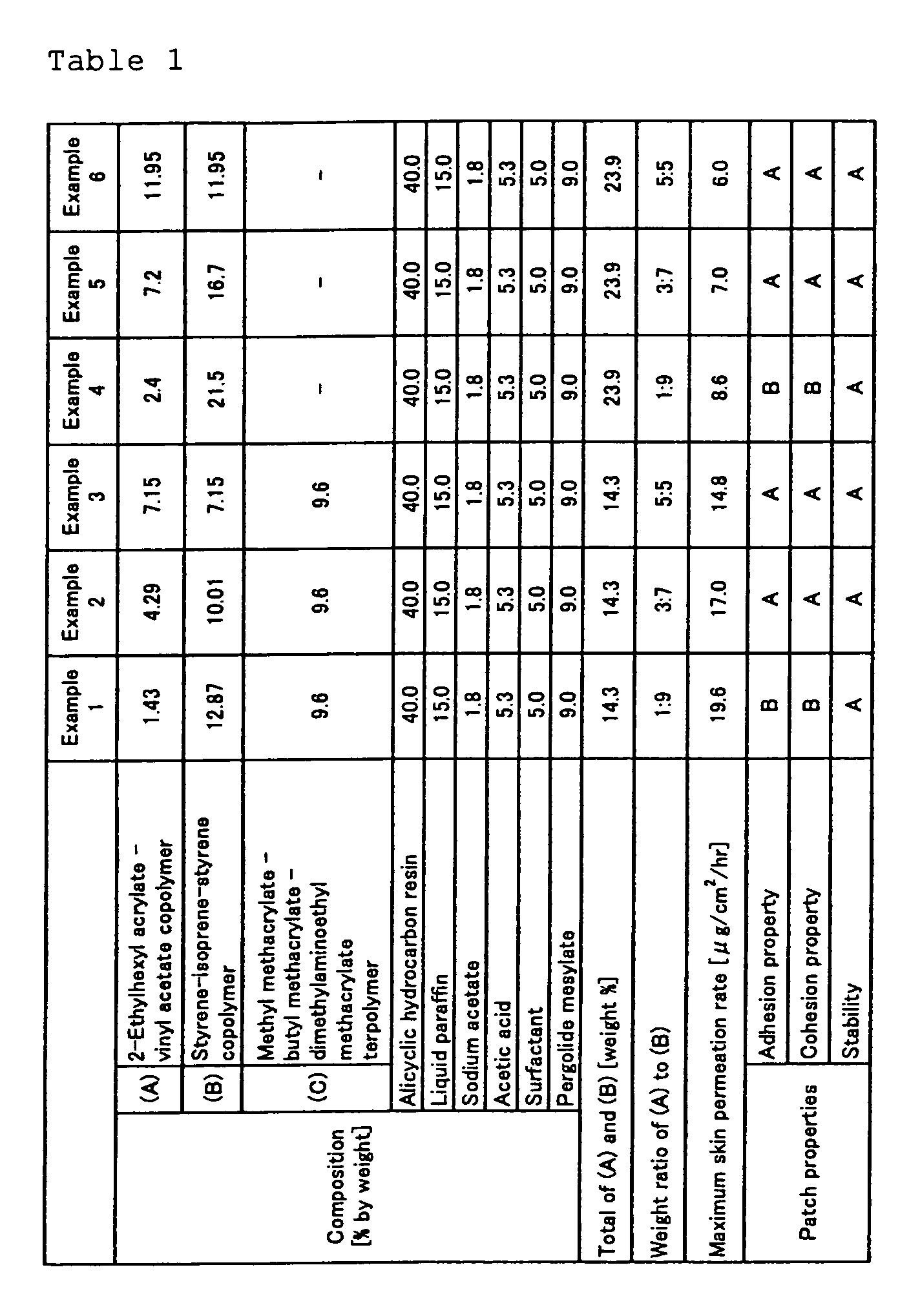
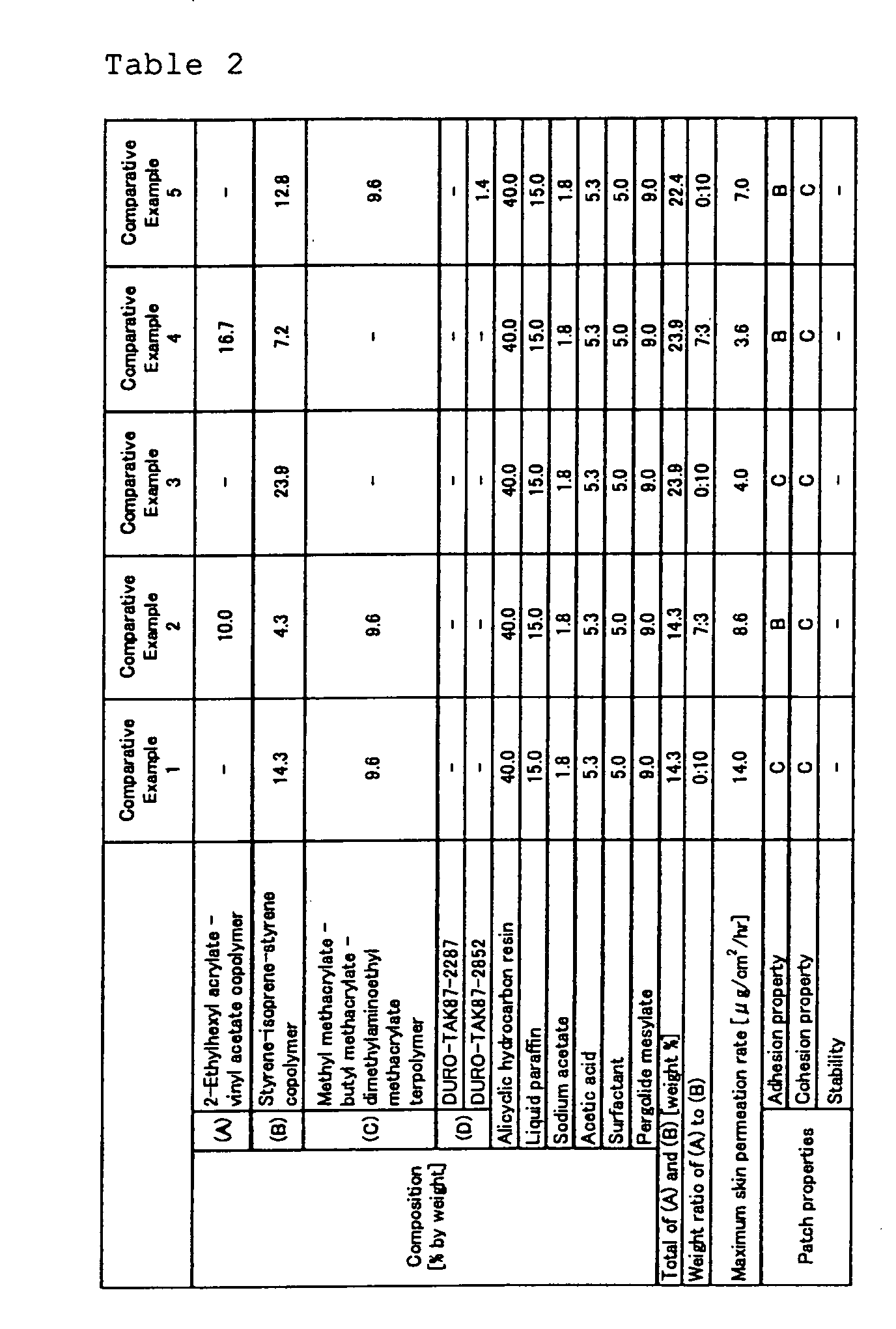
- contents of the respective ingredients are listed in Table 1.
- content of the surfactant (5.0 % by weight) means the total content of sorbitan monolaurate (2.0 % by weight) and isostearyl alcohol (3.0 % by weight).
- the obtained coating liquid was applied on a release liner made of polyethylene terephthalate and dried to remove the solvent to form an adhesive layer. Then, a backing layer in the form of knitted cloth made of polyester was laminated to the adhesive layer to obtain the desired patch.
- Examples 2-3 and Comparative Examples 1-2 patches were prepared in the same way as Example 1 except that the respective contents of 2-ethylhexyl acrylate - vinyl acetate copolymer and styreneisoprene-styrene block copolymer were determined as listed in Tables 1 and 2.
- Examples 4-6 and Comparative Examples 3-4 patches were prepared in the same way as Example 1 except that for each of the Examples and Comparative Examples methyl methacrylate - butyl methacrylate - dimethylaminoethyl methacrylate terpolymer was not used and the composition of the coating liquids for the adhesive layer was determined as listed in Tables 1 and 2.
- dorsal skin of a hairless mouse was extirpated and the skin was set to a flow-through cell, and the periphery of a receptor layer thereof was circulated with water at 37 °C, so that the dermis side became a receptor layer side.
- a patch application area of the formulation: 5 cm 2
- Normal saline was supplied to the receptor layer, and sampling of the receptor solution was carried out at a speed of 5mL/hour every 2 hours up to 24 hours.
- the flow volume was measured, and drug concentration was measured using high-performance liquid chromatography.
- the permeation rate for 1 hour was calculated to obtain a drug permeation rate per unit area of the skin at a steady state.
- the respective maximum values of the drug permeation rate (maximum skin permeation rate) obtained in the period from the start of the test to 24 hours are listed in Tables 1-3.
- a high level can be attained for both the skin absorption properties of the drug and the patch properties.
Landscapes
- Health & Medical Sciences (AREA)
- Engineering & Computer Science (AREA)
- Bioinformatics & Cheminformatics (AREA)
- Life Sciences & Earth Sciences (AREA)
- Chemical & Material Sciences (AREA)
- Public Health (AREA)
- Veterinary Medicine (AREA)
- Medicinal Chemistry (AREA)
- Pharmacology & Pharmacy (AREA)
- Animal Behavior & Ethology (AREA)
- General Health & Medical Sciences (AREA)
- Dermatology (AREA)
- Epidemiology (AREA)
- Neurosurgery (AREA)
- Biomedical Technology (AREA)
- Neurology (AREA)
- Botany (AREA)
- Psychology (AREA)
- Chemical Kinetics & Catalysis (AREA)
- General Chemical & Material Sciences (AREA)
- Nuclear Medicine, Radiotherapy & Molecular Imaging (AREA)
- Organic Chemistry (AREA)
- Inorganic Chemistry (AREA)
- Medicinal Preparation (AREA)
- Nitrogen Condensed Heterocyclic Rings (AREA)
- Pharmaceuticals Containing Other Organic And Inorganic Compounds (AREA)
Abstract
Description

Claims (11)
- A patch comprising a backing layer and an adhesive layer disposed on the backing layer and compounded with an adhesive base agent and pergolide and/or a pharmaceutically acceptable salt thereof, wherein the adhesive base agent comprises an acrylic polymer including no substantial carboxyl group and hydroxyl group in the molecule and having self-adhesion properties and a rubber polymer, and a weight ratio of the content of the acrylic polymer to the content of the rubber polymer is from 1:1 to 1:9.
- The patch according to claim 1, wherein the adhesive base agent further comprises a basic nitrogen-including polymer including a basic nitrogen and having no self-adhesion property, and a weight ratio of the total content of the acrylic polymer and the rubber polymer to the content of the basic nitrogen-including polymer is from 9:1 to 1:1.
- The patch according to claim 2, wherein the basic nitrogen-including polymer is at least one kind selected from methyl methacrylate - butyl methacrylate - dimethylaminoethyl methacrylate terpolymer and polyvinyl acetal diethylamino acetate.
- The patch according to any of claims 1-3, wherein the adhesive layer further comprises an alicyclic saturated hydrocarbon resin-based tackifier, and a weight ratio of the total content of acrylic polymer and the rubber polymer to the content of the tackifier is from 1:1 to 1:9.
- The patch according to any of claims 1-4, wherein the acrylic polymer is at least one kind selected from:copolymer of polyacrylate including at least one kind selected from 2-ethylhexyl acrylate, butyl acrylate, diacetone acrylamide and tetraethylene glycol dimethacrylate and polymethyl methacrylate;2-ethylhexyl acrylate - N-vinyl-2-pyrrolidone - 1,6-hexane glycol dimethacrylate terpolymer; and2-ethylhexyl acrylate - vinyl acetate copolymer.
- The patch according to any of claims 1-5, wherein the rubber polymer is at least one kind selected from styrene-isoprene-styrene block copolymer, styrene-butadiene-styrene block copolymer, styrene-butadiene rubber, polyisobutylene, isoprene rubber and silicone rubber.
- The patch according to any of claims 1-6, wherein the rubber polymer is styrene-isoprene-styrene block copolymer.
- The patch according to any of claims 1-7, wherein the acrylic polymer is at least one kind selected from 2-ethylhexyl acrylate - N-vinyl-2-pyrrolidone - 1,6-hexane glycol dimethacrylate terpolymer and 2-ethylhexyl acrylate - vinyl acetate copolymer, and the rubber polymer is styrene-isoprene-styrene block copolymer.
- The patch according to any of claims 1-8, wherein the adhesive layer is compounded with mesylate salt of pergolide.
- The patch according to any of claims 1-9, wherein the adhesive layer further comprises an organic acid.
- The patch according to claim 10, wherein the organic acid is acetic acid and/or a pharmaceutically acceptable salt thereof.
Applications Claiming Priority (3)
| Application Number | Priority Date | Filing Date | Title |
|---|---|---|---|
| JP2002249417 | 2002-08-28 | ||
| JP2002249417A JP4213432B2 (en) | 2002-08-28 | 2002-08-28 | Patch |
| PCT/JP2003/010091 WO2004019987A1 (en) | 2002-08-28 | 2003-08-07 | Adhesive patch |
Publications (2)
| Publication Number | Publication Date |
|---|---|
| EP1541176A1 true EP1541176A1 (en) | 2005-06-15 |
| EP1541176A4 EP1541176A4 (en) | 2010-11-24 |
Family
ID=31972576
Family Applications (1)
| Application Number | Title | Priority Date | Filing Date |
|---|---|---|---|
| EP03791199A Withdrawn EP1541176A4 (en) | 2002-08-28 | 2003-08-07 | Adhesive patch |
Country Status (7)
| Country | Link |
|---|---|
| US (1) | US20060110433A1 (en) |
| EP (1) | EP1541176A4 (en) |
| JP (1) | JP4213432B2 (en) |
| KR (1) | KR100971643B1 (en) |
| CN (1) | CN100411687C (en) |
| AU (1) | AU2003254874A1 (en) |
| WO (1) | WO2004019987A1 (en) |
Cited By (1)
| Publication number | Priority date | Publication date | Assignee | Title |
|---|---|---|---|---|
| EP2296748A4 (en) * | 2008-05-30 | 2011-09-28 | Senju Usa Inc | TRANSDERMAL MEDICAMENT DELIVERY SYSTEMS FOR KETOTIFES AND METHOD FOR THE TREATMENT OF EYE DISEASES |
Families Citing this family (21)
| Publication number | Priority date | Publication date | Assignee | Title |
|---|---|---|---|---|
| JP4792193B2 (en) * | 2002-08-28 | 2011-10-12 | 久光製薬株式会社 | Patch |
| JP4354678B2 (en) * | 2002-08-28 | 2009-10-28 | 久光製薬株式会社 | Patch |
| TW200514582A (en) * | 2003-10-31 | 2005-05-01 | Hisamitsu Pharmaceutical Co | Transdermal preparation and method for reducing side effect in pergolide therapy |
| ES2395290T3 (en) * | 2004-04-13 | 2013-02-11 | Nipro Patch Co., Ltd. | Skin-sensitive crosslinkable skin adhesive |
| JPWO2005115355A1 (en) * | 2004-05-28 | 2008-03-27 | 久光製薬株式会社 | Patch preparation |
| US8173155B2 (en) | 2004-06-01 | 2012-05-08 | Hisamitsu Pharmaceutical Co., Inc. | Adhesive patch |
| US7890950B1 (en) | 2005-05-31 | 2011-02-15 | Adobe Systems Incorporated | Software uninstallation that integrates transfer activation |
| DE602006020738D1 (en) | 2005-08-01 | 2011-04-28 | Hisamitsu Pharmaceutical Co | ADJUVANS OR PHARMACEUTICAL PREPARATION FOR TRANSDERMAL OR TRANSMUCOSAL ADMINISTRATION |
| WO2008050673A1 (en) * | 2006-10-27 | 2008-05-02 | Hisamitsu Pharmaceutical Co., Inc. | Adhesive skin patch |
| EP2123296B1 (en) * | 2007-01-31 | 2019-05-22 | Hisamitsu Pharmaceutical Co., Inc. | Adjuvant for transdermal or transmucosal administration and pharmaceutical preparation containing the same |
| DE102008013701A1 (en) * | 2008-03-11 | 2009-09-17 | Lts Lohmann Therapie-Systeme Ag | Transdermal therapeutic system with stabilized membrane |
| ES2574032T3 (en) * | 2009-09-07 | 2016-06-14 | Nipro Patch Co., Ltd. | Absorbable preparation transdermally |
| WO2015064710A1 (en) | 2013-10-31 | 2015-05-07 | 久光製薬株式会社 | Adjuvant composition, adjuvant preparation containing same, and kit |
| ES2753584T3 (en) * | 2014-12-22 | 2020-04-13 | Hisamitsu Pharmaceutical Co | Poultice |
| CN116887866A (en) | 2020-12-03 | 2023-10-13 | 巴特尔纪念研究院 | Polymer nanoparticle and DNA nanostructure compositions and methods for non-viral delivery |
| JP2024516108A (en) | 2021-04-07 | 2024-04-12 | バテル・メモリアル・インスティテュート | Rapid Design, Build, Test, and Learn Techniques for Identifying and Using Nonviral Carriers |
| KR102633741B1 (en) * | 2021-08-05 | 2024-02-06 | 주식회사 영우 | Dressing material with excellent adhesion and absorption |
| CN113476459A (en) * | 2021-08-16 | 2021-10-08 | 浙江鼎泰药业股份有限公司 | High-activity sustained-release analgesic patch and preparation process thereof |
| KR102646740B1 (en) * | 2021-10-15 | 2024-03-13 | 주식회사 영우 | Water-soluble adhesive dressing material |
| WO2025072751A1 (en) | 2023-09-29 | 2025-04-03 | Battelle Memorial Institute | Polymer nanoparticle compositions for in vivo expression of polypeptides |
| US12441996B2 (en) | 2023-12-08 | 2025-10-14 | Battelle Memorial Institute | Use of DNA origami nanostructures for molecular information based data storage systems |
Family Cites Families (11)
| Publication number | Priority date | Publication date | Assignee | Title |
|---|---|---|---|---|
| JPH04368323A (en) * | 1991-06-12 | 1992-12-21 | Sekisui Chem Co Ltd | Plaster |
| US5717062A (en) * | 1995-06-07 | 1998-02-10 | Beth Israel Hospital Association | Cyclic analogs of PTH and PTHrP |
| US6572879B1 (en) * | 1995-06-07 | 2003-06-03 | Alza Corporation | Formulations for transdermal delivery of pergolide |
| JP4346696B2 (en) * | 1996-05-28 | 2009-10-21 | 久光製薬株式会社 | Transdermal therapeutic device |
| JPH10167956A (en) * | 1996-12-11 | 1998-06-23 | Hisamitsu Pharmaceut Co Inc | Percutaneous administration preparation containing serotonin receptor antagonist |
| DE19821788C1 (en) * | 1998-05-15 | 1999-12-02 | Sanol Arznei Schwarz Gmbh | Transdermal therapeutic system (TTS) containing pergolide |
| CA2428181A1 (en) * | 2000-11-07 | 2002-05-16 | Hisamitsu Pharmaceutical Co., Inc. | Pharmaceutical preparation of percutaneous absorption type |
| CN1250206C (en) * | 2001-03-07 | 2006-04-12 | 久光制药株式会社 | patch |
| JP4404251B2 (en) * | 2001-08-10 | 2010-01-27 | 久光製薬株式会社 | Transdermal preparation |
| EP1421955A1 (en) * | 2001-08-10 | 2004-05-26 | Hisamitsu Pharmaceutical Co., Inc. | Percutaneous absorption preparations |
| JP4792193B2 (en) * | 2002-08-28 | 2011-10-12 | 久光製薬株式会社 | Patch |
-
2002
- 2002-08-28 JP JP2002249417A patent/JP4213432B2/en not_active Expired - Lifetime
-
2003
- 2003-08-07 AU AU2003254874A patent/AU2003254874A1/en not_active Abandoned
- 2003-08-07 WO PCT/JP2003/010091 patent/WO2004019987A1/en not_active Ceased
- 2003-08-07 EP EP03791199A patent/EP1541176A4/en not_active Withdrawn
- 2003-08-07 CN CNB038206846A patent/CN100411687C/en not_active Expired - Fee Related
- 2003-08-07 KR KR1020057002545A patent/KR100971643B1/en not_active Expired - Fee Related
- 2003-08-07 US US10/526,065 patent/US20060110433A1/en not_active Abandoned
Cited By (1)
| Publication number | Priority date | Publication date | Assignee | Title |
|---|---|---|---|---|
| EP2296748A4 (en) * | 2008-05-30 | 2011-09-28 | Senju Usa Inc | TRANSDERMAL MEDICAMENT DELIVERY SYSTEMS FOR KETOTIFES AND METHOD FOR THE TREATMENT OF EYE DISEASES |
Also Published As
| Publication number | Publication date |
|---|---|
| CN1678352A (en) | 2005-10-05 |
| CN100411687C (en) | 2008-08-20 |
| JP4213432B2 (en) | 2009-01-21 |
| WO2004019987A1 (en) | 2004-03-11 |
| US20060110433A1 (en) | 2006-05-25 |
| EP1541176A4 (en) | 2010-11-24 |
| JP2004083520A (en) | 2004-03-18 |
| AU2003254874A1 (en) | 2004-03-19 |
| KR20050056985A (en) | 2005-06-16 |
| KR100971643B1 (en) | 2010-07-22 |
Similar Documents
| Publication | Publication Date | Title |
|---|---|---|
| US8691267B2 (en) | Adhesive patch | |
| US20060110433A1 (en) | Adhesive patch | |
| US20040028724A1 (en) | Pharmaceutical preparation of percutaneous absorption type | |
| JPWO2002069942A1 (en) | Patch | |
| US7883719B2 (en) | Pasting agent | |
| JPWO2003013611A1 (en) | Transdermal formulation | |
| JP5632577B2 (en) | Patch | |
| US20250082591A1 (en) | Lidocaine-containing patch | |
| EP1547595B1 (en) | Patch for transdermal administration | |
| US20050163831A1 (en) | Patch for transdermal administration | |
| US20200405653A1 (en) | Methylphenidate-containing transdermal patch |
Legal Events
| Date | Code | Title | Description |
|---|---|---|---|
| PUAI | Public reference made under article 153(3) epc to a published international application that has entered the european phase |
Free format text: ORIGINAL CODE: 0009012 |
|
| 17P | Request for examination filed |
Effective date: 20050316 |
|
| AK | Designated contracting states |
Kind code of ref document: A1 Designated state(s): AT BE BG CH CY CZ DE DK EE ES FI FR GB GR HU IE IT LI LU MC NL PT RO SE SI SK TR |
|
| AX | Request for extension of the european patent |
Extension state: AL LT LV MK |
|
| DAX | Request for extension of the european patent (deleted) | ||
| RBV | Designated contracting states (corrected) |
Designated state(s): DE FR GB IT |
|
| A4 | Supplementary search report drawn up and despatched |
Effective date: 20101025 |
|
| 17Q | First examination report despatched |
Effective date: 20110223 |
|
| GRAP | Despatch of communication of intention to grant a patent |
Free format text: ORIGINAL CODE: EPIDOSNIGR1 |
|
| INTG | Intention to grant announced |
Effective date: 20160219 |
|
| RIN1 | Information on inventor provided before grant (corrected) |
Inventor name: AIDA, KAZUNOSUKE Inventor name: TERAHARA, TAKAAKI Inventor name: HIGO, NARUHITO Inventor name: TOSHIMITSU, ARATA |
|
| STAA | Information on the status of an ep patent application or granted ep patent |
Free format text: STATUS: THE APPLICATION IS DEEMED TO BE WITHDRAWN |
|
| 18D | Application deemed to be withdrawn |
Effective date: 20160630 |