Technical Field
-
The present invention relates to a phosphodiesterase 10A
(PDE10A) inhibitor which exhibits PDE10A inhibitory activity
and comprises a quinoline derivative or a pharmaceutically
acceptable salt thereof as an active ingredient which is useful
for treating and/or preventing various diseases caused by
enhancing the activity of PDE10A (for example, a neural disease
such as Parkinson's disease, Huntington disease or Alzheimer
disease, dyskinesia, hypogonadism, diabetes, an ischemic
heart disease, hypertension, an inflammatory disease, a
disease of the digestive system, an allergic disease,
osteoporosis, pain, a malignant tumor or the like).
Background Art
-
Cyclic nucleotides have been known to mediate cell
responses to various extracellular stimuli such as a stimulus
from G protein coupled receptors (GPCR). Phosphodiesterase
(PDE) plays an important role in regulation of the
intracellular concentration of these cyclic nucleotides by
hydrolyzing cyclic nucleotides such as 5',3'-cyclic adenosine
monophosphate (cAMP), 3',5'-cyclic guanosine monophosphate
(cGMP) and the like [Pharmac. Ther., vol. 51, p. 13 (1991)].
-
In tissues of vertebrates, various PDE subtypes have been
found, that hydrolyze cyclic nucleotides [Trend. Pharmacol.
Sci. vol. 11, p. 150 (1990), Physiol. Rev. vol. 75, p. 725 (1995),
Arch. Biochem. Biophys. vol. 322, p. 1 (1995), and Kidney
International, vol. 55, p. 29 (1999)]. These have been to date
classified into 11 families (PDE1~PDE11) according to
biochemical characteristics, enzymological characteristics,
homology of amino acid sequences by cloning of corresponding
cDNAs, sensitivity to inhibitors and the like.
-
Regarding PDE10A which is one of the PDE subtypes, the
expression of its mRNA has been identified in many tissues and
organs such as striatum, testis, kidney, thyroid gland,
pituitary gland, thalamus, cerebellum, heart, lungs and
placenta, cells such as aortic smooth muscle cells and aortic
endothelial cells, cells of cancers such as lung small cell
carcinoma, breast cancer and large bowel cancer, and the like.
Accordingly, the possibility that PDE10A is involved in
diseases related to these cells, tissues and organs has been
pointed out [J. Biol. Chem. vol. 274, p. 18438 (1999), Gene,
vol. 234, p. 109 (1999), WO 01/29199 and Japanese Published
Unexamined Patent Application No. 2001-161379].
-
From the view points of strong expression of mRNA of
PDE10A and its enzymatic activity in the striatum, this enzyme
is suggested to be involved, for example, onset or progression
of Parkinson's disease, Huntington disease and the like,
dyskinesia caused by long-term administration of L-DOPA
(L-3,4-dihydroxyphenylalanine), and the like For example, it
has been reported that in the striatum of model mice of
Huntington disease, the expression of mRNA of PDE10A is
different from that in the striatum of normal mice (WO
01/24781).
-
Further, PDE10A catalyzes hydrolysis from cGMP to GMP,
and this hydrolase is present in the cavernous body.
Accordingly, it is suggested that a PDE10A inhibitor possibly
improves, for example, men's impotence and women's
hypogonadism (Japanese Published Unexamined Patent
Application No. 2000-23682).
-
In view of the foregoing, it is expected that an inhibitor
having selectivity to PDE10A (PDE10A inhibitor) is useful for
treating and/or preventing various diseases caused by
enhancing the activity of PDE10A (for example, a neural disease
such as Parkinson' s disease, Huntington disease or Alzheimer' s
disease, dyskinesia, hypogonadism, diabetes, an ischemic
heart disease, hypertension, an inflammatory disease, a
disease of the digestive system, an allergic disease,
osteoporosis, pain or a malignant tumor), and has the
possibility as a treating agent with reduced side effects.
-
Meanwhile, it has been known that quinolinecarboxylic
acid derivatives represented by general formula (C)
(wherein R
a represents carboxy or the like, R
b and R
c, which
may be the same or different, each represent methyl, ethyl,
a hydrogen atom, a fluorine atom or the like, and R
d and R
e
each represent a hydrogen atom or R
d and R
e in combination
represent a sulfur atom)
are useful as a cancer chemotherapeutic agent (Japanese
Published Unexamined Patent Application No. 233661/90) and an
immunosuppressor (WO 92/00739).
-
Tetracyclic quinolinecarboxylic acid derivatives
(Japanese Published Unexamined Patent Application No.
231289/98) represented by general formula (D)
(wherein R
f represents carboxy or the like, X
a and X
b, which
may be the same or different, each represent a hydrogen atom,
lower alkyl or the like, and q represents an integer of from
1 to 4)
have been known, and it has been reported that the derivatives
have activity of inhibiting antibody production in
plaque-forming cells and an effect of preventing adjuvant
arthritis (WO 93/22286).
-
Moreover, 4-quinolinecarboxylic acid derivatives
represented by general formula (E)
(wherein R
ai represents a fluorine atom or the like, R
bi
represents methyl or the like, R
ci, R
di and R
ei, which may be
the same or different, each represent halogen, a hydrogen atom
or the like, and R
fi represents carboxy or its inorganic salt)
have been known. The 4-quinolinecarboxylic acid derivatives
have been reported as, for example, a dihydroorotic acid
dehydrogenase inhibitor [WO 01/24785, Pharm. Res., vol. 15,
p. 286 (1998) and Biochem. Pharmacol., vol. 40, p. 709 (1990)
and vol. 56, p. 1053 (1998)], a potassium channel opener
(Japanese Published Unexamined Patent Application No.
3144/96), an immunosuppressant [Japanese Published Unexamined
Patent Application No. 313428/89, Bioorg. Med. Chem. Lett.,
vol. 5, p. 1549 (1995), WO 91/19498 and WO 97/42953], an
antitumor agent (U.S. Patent No. 4680299, Japanese Published
Unexamined Patent Application No. 121923/90 and Japanese
Published Unexamined Patent Application No. 42367/85), an
antiinflammatory agent [J. Rheumatol. , vol. 18, p. 855 (1991)],
an antiviral agent [Antiviral. Res., vol. 20, p. 71 (1993) and
WO 01/24785] and an agent for treating skin and mucosal
epithelial diseases (Japanese Published Unexamined Patent
Application No. 72163/90).
Disclosure of the Invention
-
An object of the present invention is to provide a PDE10A
inhibitor which exhibits PDE10A inhibitory activity and
comprises a quinoline derivative or a pharmaceutically
acceptable salt thereof as an active ingredient which is useful
for treating and/or preventing various diseases caused by
enhancing the activity of PDE10A function (for example, a
neural disease such as Parkinson' s disease, Huntington disease
or Alzheimer's disease, dyskinesia, hypogonadism, diabetes,
an ischemic heart disease, hypertension, an inflammatory
disease, a disease of the digestive system, an allergic disease,
osteoporosis, pain, a malignant tumor or the like). Another
object of the present invention is to provide a quinoline
derivative or a pharmaceutically acceptable salt thereof which
is useful for treating and/or preventing various diseases
caused by enhancing the activity of PDE10A function.
-
The present invention relates to the following (1) to
(33).
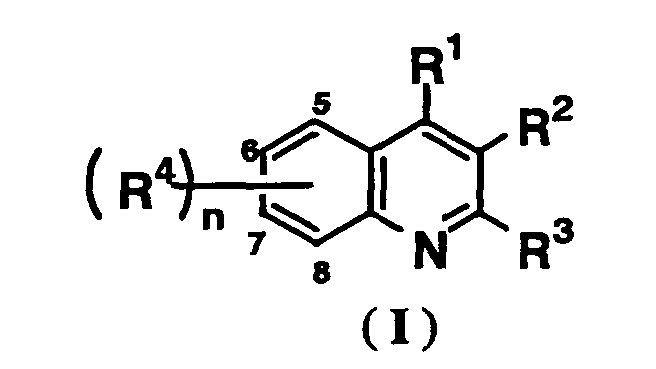
- (1) A phosphodiesterase 10A (PDE10A) inhibitor which
comprises a quinoline derivative represented by general
formula (I)
[wherein n represents an integer of from 1 to 4, R1 represents
substituted or unsubstituted lower alkyl, -C(=Y)R9 (wherein
Y represents an oxygen atom or a sulfur atom, and R9 represents
a hydrogen atom, hydroxy, substituted or unsubstituted lower
alkyl, substituted or unsubstituted lower alkoxy, substituted
or unsubstituted aryl, a substituted or unsubstituted
heterocyclic group, amino, mono-lower alkylamino or di-lower
alkylamino), hydroxy, halogen, cyano, amino, mono-lower
alkylamino or di-lower alkyl amino, R2 represents a hydrogen
atom, amino, nitro, substituted or unsubstituted lower alkyl,
substituted or unsubstituted lower alkoxy, -S(O)mR12 (wherein
R12 represents substituted or unsubstituted lower alkyl or
substituted or unsubstituted aryl, and m represents an integer
of from 0 to 2), mono-lower alkylamino or di-lower alkylamino,
R3 represents a hydrogen atom, halogen, hydroxy, substituted
or unsubstituted lower alkyl, substituted or unsubstituted
cycloalkyl, substituted or unsubstituted aryl or a substituted
or unsubstituted heterocyclic group, or R2 and R3 form a
substituted or unsubstituted condensed ring together with two
carbon atoms on roots thereof, and R4 represents a hydrogen
atom, halogen, cyano, amino, nitro, substituted or
unsubstituted lower alkyl, substituted or unsubstituted
cycloalkyl, substituted or unsubstituted lower alkoxy,
-S(O)maR12a (wherein R12a and ma have the same meanings as those
of the above-mentioned R12 and m respectively), -C(=Y1)R9a
(wherein Y1 and R9a have the same meanings as those of the
above-mentioned Y and R9 respectively), mono-lower alkylamino
or di-lower alkylamino, and when n is an integer of 2 or more,
R4s each may be the same or different],
or a pharmaceutically acceptable salt thereof as an active
ingredient. - (2) The PDE10A inhibitor according to above (1),
wherein R1 is substituted or unsubstituted lower alkyl,
-C(=Y)R9 (wherein Y and R9 have the same meanings as those
above-mentioned respectively), cyano or amino, and R2 is
substituted or unsubstituted lower alkyl.
- (3) The PDE10A inhibitor according to above (1),
wherein R1 is methyl, hydroxymethyl, acetyl, carboxy,
methoxycarbonyl, cyano or amino.
- (4) The PDE10A inhibitor according to any one of above
(1) to (3), wherein R3 is substituted or unsubstituted aryl
or a substituted or unsubstituted heterocyclic group.
- (5) The PDE10A inhibitor according to any one of above
(1) to (3), wherein R3 is substituted or unsubstituted
biphenylyl or substituted or unsubstituted piperazinyl.
- (6) The PDE10A inhibitor according to any one of above
(1) to (3), wherein R3 is substituted or unsubstituted
biphenyl-4-yl or substituted or unsubstituted piperazin-1-yl.
- (7) The PDE10A inhibitor according to any one of above
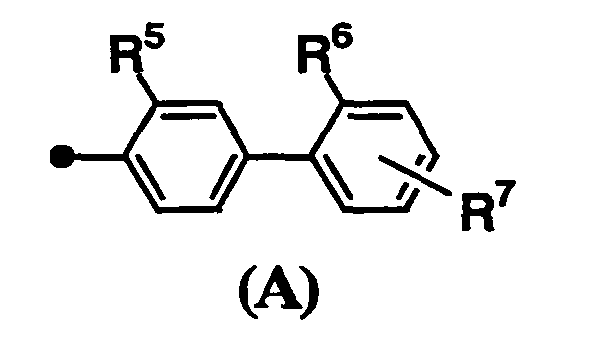
(1) to (3), wherein R3 is general formula (A)
[wherein R5, R6 and R7, which may be the same or different, each
represent a hydrogen atom, halogen, substituted or
unsubstituted lower alkyl, substituted or unsubstituted lower
alkoxy, aryl, substituted or unsubstituted lower alkanoyl or
a substituted or unsubstituted heterocyclic group]
or piperazin-1-yl having substituted or unsubstituted lower
alkyl or substituted or unsubstituted aryl as a substituent
on the 4-position. - (8) The PDE10A inhibitor according to any one of above
(1) to (7), wherein n is 1, and R4 is halogen.
- (9) A quinoline derivative represented by general
formula (IA)
[wherein n and R4 have the same meanings as those
above-mentioned respectively, R1A represents lower alkyl,
hydroxy lower alkyl, -C(=Y)R9A (wherein Y has the same meaning
as that above-mentioned, and R9A represents a hydrogen atom,
lower alkyl, lower alkoxy, amino, mono-lower alkylamino or
di-lower alkylamino), cyano, amino, mono-lower alkylamino or
di-lower alkylamino, R2A represents amino, nitro, substituted
or unsubstituted lower alkyl, substituted or unsubstituted
lower alkoxy, -S(O)mR12 (wherein R12 and m have the same meanings
as those above-mentioned respectively), mono-lower alkylamino
or di-lower alkylamino, and R3A represents a substituted or
unsubstituted heterocyclic group or substituted or
unsubstituted aryl, or R2A and R3A form cycloalkane condensed
with a substituted or unsubstituted benzene ring together with
two carbon atoms on roots thereof, provided that when R1A is
hydroxymethyl or -C(=O)R9B (wherein R9B represents a hydrogen
atom, ethyloxy, n-propylamino or diethylamino), R3A is not
4-cyclohexylphenyl, when R1A is hydroxymethyl or -C(=O)R9C
(wherein R9C represents methoxy, amino, mono-lower alkylamino
or di-lower alkylamino) and R2A is carboxyethyl or
methoxycarbonylethyl, R3A is not 4-(2-fluorophehyl)phenyl nor
biphenyl-4-yl, and when R1A is hydroxymethyl or -C(=O)R9D
(wherein R9D represents amino or lower alkoxy) and R2A is methyl,
R3A is not biphenyl-4-yl],
or a pharmaceutically acceptable salt thereof. - (10) The quinoline derivative or the pharmaceutically
acceptable salt thereof according to above (9), wherein R3A
is substituted or unsubstituted biphenylyl or substituted or
unsubstituted piperazin-1-yl.
- (11) The quinoline derivative or the pharmaceutically
acceptable salt thereof according to above (9), wherein R3A
is substituted or unsubstituted biphenylyl or piperazin-1-yl
having substituted or unsubstituted lower alkyl or substituted
or unsubstituted aryl as a substituent on the 4-position.
- (12) The quinoline derivative or the pharmaceutically
acceptable salt thereof according to above (9), wherein R3A
is piperazin-1-yl having substituted or unsubstituted aryl as
a substituent on the 4-position.
- (13) The quinoline derivative or the pharmaceutically
acceptable salt thereof according to any one of above (9) to
(12), wherein R1A is lower alkyl, hydroxy lower alkyl, -C(=O)R9E
(wherein R9A represents lower alkyl or lower alkoxy) or cyano,
and R2A is substituted or unsubstituted lower alkyl.
- (14) The quinoline derivative or the pharmaceutically
acceptable salt thereof according to any one of above (9) to
(13), wherein R1A is methyl, hydroxymethyl, acetyl,
methoxycarbonyl or cyano.
- (15) The quinoline derivative or the pharmaceutically
acceptable salt thereof according to any one of above (9) to
(14), wherein n is 1, and R4 is halogen.
- (16) A PDE10A inhibitor which comprises the quinoline
derivative or the pharmaceutically acceptable salt thereof
according to any one of above (9) to (15) as an active
ingredient.
- (17) An agent for treating and/or preventing a disease
caused by enhancing the activity of PDE10A, which comprises
the quinoline derivative or the pharmaceutically acceptable
salt thereof according to any one of above (9) to (15) as an
active ingredient.
- (18) An agent for treating and/or preventing dyskinesia,
which comprises the quinoline derivative or the
pharmaceutically acceptable salt thereof according to any one
of above (9) to (15) as an active ingredient.
- (19) An antitumor agent which comprises the quinoline
derivative or the pharmaceutically acceptable salt thereof
according to any one of above (9) to (15) as an active
ingredient.
- (20) An agent for treating and/or preventing dyskinesia,
which comprises a compound having PDE10A inhibitory activity
or a pharmaceutically acceptable salt thereof as an active
ingredient.
- (21) A pharmaceutical composition which comprises the
quinoline derivative or the pharmaceutically acceptable salt
thereof according to any one of above (9) to (15) as an active
ingredient.
- (22) Use of the quinoline derivative or the
pharmaceutically acceptable salt thereof according to any one
of above (1) to (8) for the manufacture of a PDE10A inhibitor.
- (23) Use of the quinoline derivative or the
pharmaceutically acceptable salt thereof according to any one
of above (9) to (15) for the manufacture of a PDE10A inhibitor.
- (24) Use of the quinoline derivative or the
pharmaceutically acceptable salt thereof according to any one
of above (1) to (8) for the manufacture of an agent for treating
and/or preventing a disease caused by enhancing the activity
of PDE10A.
- (25) Use of the quinoline derivative or the
pharmaceutically acceptable salt thereof according to any one
of above (9) to (15) for the manufacture of an agent for treating
and/or preventing a disease caused by enhancing the activity
of PDE10A.
- (26) Use of the quinoline derivative or the
pharmaceutically acceptable salt thereof according to any one
of above (9) to (15) for the manufacture of an agent for treating
and/or preventing dyskinesia.
- (27) Use of the quinoline derivative or the
pharmaceutically acceptable salt thereof according to any one
of above (9) to (15) for the manufacture of an antitumor agent.
- (28) A method for treating a disease caused by enhancing
the activity of PDE10A, which comprises administering an
effective amount of the quinoline derivative or the
pharmaceutically acceptable salt thereof according to any one
of above (1) to (8).
- (29) A method for treating a disease caused by enhancing
the activity of PDE10A, which comprises administering an
effective amount of the quinoline derivative or the
pharmaceutically acceptable salt thereof according to any one
of above (9) to (15).
- (30) A method for treating dyskinesia, which comprises
administering an effective amount of the quinoline derivative
or the pharmaceutically acceptable salt thereof according to
any one of above (9) to (15).
- (31) A method for treating a malignant tumor, which
comprises administering an effective amount of the quinoline
derivative or the pharmaceutically acceptable salt thereof
according to any one of above (9) to (15).
- (32) Use of a compound having PDE10A inhibitory
activity or a pharmaceutically acceptable salt thereof for the
manufacture of an agent for treating and/or preventing
dyskinesia.
- (33) A method for treating dyskinesia, which comprises
administering an effective amount of a compound having PDE10A
inhibitory activity or a pharmaceutically acceptable salt
thereof.
-
-
In the definitions for each group of general formulas
(I) and (IA):
- (i) Examples of the lower alkyl moiety of lower alkyl,
lower alkoxy, mono-lower alkylamino and di-lower alkylamino
include, for example, linear or branched alkyl having from 1
to 10 carbon atoms, such as methyl, ethyl, propyl, isopropyl,
butyl, isobutyl, sec-butyl, tert-butyl, pentyl, isopentyl,
neopentyl, hexyl, heptyl, octyl, isooctyl, nonyl, decyl and
the like. The two lower alkyl moieties in di-lower alkyl amino
may be the same or different.
- (ii) Examples of the cycloalkyl include, for example,
cycloalkyl having from 3 to 8 carbon atoms, such as cyclopropyl,
cyclobutyl, cyclopentyl, cyclohexyl, cycloheptyl, cyclooctyl
and the like.
- (iii) Examples of the alkylene moiety of hydroxy lower
alkyl include the same as the foregoing lower alkyl (i) from
which one hydrogen atom is removed.
- (iv) Examples of the lower alkanoyl include, for example,
linear or branched alkanoyl having from 1 to 7 carbon atoms,
such as formyl, acetyl, propionyl, butylyl, isobutylyl,
valeryl, isovaleryl, pivaloyl, hexanoyl, heptanoyl and the
like.
- (v) Examples of the aryl include, for example, aryl
having from 6 to 14 carbon atoms, such as phenyl, naphthyl,
anthryl and the like.
- (vi) Examples of the heterocyclic group include an
alicyclic heterocyclic group and an aromatic heterocyclic
group.
Examples of the aromatic heterocyclic group include a
5-membered or 6-membered monocyclic aromatic heterocyclic
group containing at least one atom selected from a nitrogen
atom, an oxygen atom and a sulfur atom, a dicyclic or tricyclic
condensed aromatic heterocyclic group comprising 3- to
8-membered rings and containing at least one atom selected from
a nitrogen atom, an oxygen atom and a sulfur atom, and the like,
for example, pyridyl, pyrazinyl, pyrimidinyl, pyridazinyl,
benzoimidazolyl, 2-oxobenzoimidazolyl, benzotriazolyl,
benzofuryl, benzothienyl, purinyl, benzooxazolyl,
benzothiazolyl, benzodioxolyl, indazolyl, indolyl,
isoindolyl, purinyl, quinolyl, isoquinolyl, phthalazinyl,
naphthyllysinyl, quinoxalinyl, pyrrolyl, pyrazolyl,
quinazolinyl, cinnolinyl, triazolyl, tetrazolyl, imidazolyl,
oxazolyl, isooxazolyl, thiazolyl, isothiazolyl, thienyl,
furyl and the like.Examples of the alicyclic heterocyclic group include a
5-membered or 6-membered monocyclic alicyclic heterocyclic
group containing at least one atom selected from a nitrogen
atom, an oxygen atom and a sulfur atom, a dicyclic or tricyclic
condensed alicyclic heterocyclic group comprising 3- to
8-membered rings and containing at least one atom selected from
a nitrogen atom, an oxygen atom and a sulfur atom, and the like,
for example, pyrrolidinyl, 2,5-dioxopyrrolidinyl,
thiazolidinyl, oxazolidinyl, piperidinyl, piperidino,
piperazinyl, homopiperazinyl, homopiperidyl, homopiperidino,
morpholinyl, morpholino, thiomorpholinyl, thiomorpholino,
pyranyl, tetrahydropyridyl, tetrahydropyranyl,
tetrahydrofuranyl, dihydrobenzofuranyl, tetrahydroquinolyl,
tetrahydroisoquinolyl, octahydroquinolyl, indolinyl and the
like.
- (vii) Halogen means each atom of fluorine, chlorine,
bromine and iodine.
- (viii) Example of the condensed ring formed together with
two carbon atoms on roots (thereof) include cycloalkane
condensed with a benzene ring and the like.
Examples of the cycloalkane moiety of the cycloalkane
condensed with a benzene ring include, for example,
cycloalkane having from 5 to 8 carbon atoms, such as
cyclopentane, cyclohexane, cycloheptane, cyclooctane and the
like. Examples of cycloalkane condensed with the benzene ring
include indane, 1,2,3,4-tetrahydronaphthalene,
6,7,8,9-tetrahydro-5H-benzocycloheptene,
5,6,7,8,9,10-hexahydrobenzocyclooctene and the like.
- (ix) The substituents in the substituted lower alkyl,
the substituted lower alkoxy, the substituted cycloalkyl and
the substituted lower alkanoyl may be the same or different,
and include, for example, 1 to 3 substituent(s), such as halogen,
hydroxy, carboxy, cyano, cycloalkyl, substituted or
unsubstituted lower alkoxy, substituted or unsubstituted
lower alkanoyl, substituted or unsubstituted aryl, a
substituted or unsubstituted heterocyclic group, -NR10R11
(wherein R10 and R11 may be the same or different and each
represents a hydrogen atom, substituted or unsubstituted lower
alkyl or substituted or unsubstituted aryl) and the like. The
position of the substituent(s) is not particularly limited.
Herein, the halogen, the cycloalkyl, the lower alkyl
moiety of the lower alkyl and the lower alkoxy, the lower
alkanoyl, the aryl and the heterocyclic group have the same
meanings as those of aforementioned halogen (vii), cycloalkyl
(ii), lower alkyl (i), lower alkanoyl (iv), aryl (v) and
heterocyclic group (vi) respectively.Also, herein the substituents (a) in the substituted
lower alkoxy, the substituted lower alkyl and the substituted
lower alkanoyl may be the same or different, and include, for
example, 1 to 3 substituent(s), such as hydroxy, halogen and
the like. And the substituents (b) in the substituted aryl
and the substituted heterocyclic group may be the same or
different, and include, for example, 1 to 3 substituent(s),
such as hydroxy, halogen, lower alkyl, lower alkoxy, lower
alkanoyl, aryl and the like. Herein, the halogen, the lower
alkyl, the lower alkyl moiety of the lower alkyl and the lower
alkoxy, the lower alkanoyl and the aryl have the same meanings
as those of aforementioned halogen (vii), lower alkyl (i),
lower alkanoyl (iv) and aryl (v) respectively.
- (x) The substituents of the substituted aryl may be the
same or different, and include, for example, 1 to 3
substituent(s), such as carboxy, hydroxy, halogen,
substituted or unsubstituted lower alkyl, substituted or
unsubstituted lower alkoxy, substituted or unsubstituted
lower alkanoyl, substituted or unsubstituted aryl, a
substituted or unsubstituted heterocyclic group and the like.
The position of the substituent(s) is not particularly
limited.
Herein, the halogen, the lower alkyl moiety of the lower
alkyl and the lower alkoxy, the lower alkanoyl, the aryl and
the heterocyclic group have the same meanings as those of
aforementioned halogen (vii), lower alkyl (i), lower alkanoyl
(iv), aryl (v) and heterocyclic group (vi) respectively. Also,
herein the substituents (c) in the substituted aryl include
a substituted or unsubstituted lower alkyl [the lower alkyl
has the same meaning as that of aforementioned lower alkyl (i),
and the substituents in the substituted lower alkyl have the
same meaning as that of the substituents (ix) listed in the
definition for substituents in the aforementioned substituted
lower alkyl] and the like as well as the group listed in the
definition for substituents (ix) in the aforementioned
substituted lower alkyl. Furthermore, herein the
substituents in the substituted lower alkyl, the substituted
lower alkoxy and the substituted lower alkanoyl have the same
meaning as that of substituents (a) in the aforementioned
substituted lower alkoxy and the like, and the substituents
in the substituted heterocyclic group have the same meaning
as that of substituents (c) in the aforementioned substituted
aryl.
- (xi) The substituents in the substituted heterocyclic
group, the substituted piperazinyl, the substituted
piperazin-1-yl, the substituted condensed ring formed
together with carbon atoms on roots (thereof), cycloalkane
condensed with a substituted benzene ring formed together with
two carbon atoms on roots thereof, the substituted biphenylyl
and the substituted biphenyl-4-yl may be the same or different,
and include 1 to 3 substituent(s) such as carboxy, hydroxy,
halogen, substituted or unsubstituted lower alkyl,
substituted or unsubstituted lower alkoxy, substituted or
unsubstituted lower alkanoyl, substituted or unsubstituted
aryl, a substituted or unsubstituted heterocyclic group and
the like. The position of the substituent(s) is not
particularly limited.
-
-
Herein, the halogen, the lower alkyl moiety of the lower
alkyl and the lower alkoxy, the lower alkanoyl, the aryl and
the heterocyclic group have the same meanings as those of the
aforementioned halogen (vii), lower alkyl (i), lower alkanoyl
(iv), aryl (v) and heterocyclic group (vi) respectively.
-
Also, herein the substituents in the substituted lower
alkyl, the substituted lower alkoxy and the substituted lower
alkanoyl have the same meanings as that of the groups (ix)
listed in the definition for substituents of the
aforementioned substituted lower alkyl and the like, and the
substituents in the substituted aryl and the substituted
heterocyclic group have the same meaning as that of
substituents (b) in the aforementioned substituted
heterocyclic group.
-
Compounds represented by formula (I) or formula (IA) are
referred to as compounds (I) or compounds (IA) respectively.
The compounds having the other numbers are referred in the same
manner.
-
A pharmaceutically acceptable salt of compound (I) or
(IA) includes acid addition salt, metal salt, ammonium salt,
organic amine addition salt, amino acid addition salt and the
like which is pharmaceutically acceptable.
-
Examples of the pharmaceutically acceptable acid
addition salt of compound (I) or compound (IA) include an
inorganic acid salt such as a hydrochloride, a hydrobromide,
a sulfate, a nitrate and a phosphate and the like, an organic
acid salt such as an acetate, a benzenesulfonate, a benzoate,
a citrate, a fumarate, a gluconate, a lactate, a maleate, a
malate, an oxalate, a methanesulfonate and a tartrate, and the
like. Example of the pharmaceutically acceptable metal salt
includes an alkali metal salt such as a sodium salt and a
potassium salt, an alkaline earth metal salt such as a magnesium
salt and a calcium salt, an aluminum salt, a zinc salt and the
like. Example of the pharmaceutically acceptable ammonium
salt includes a salt of ammonium, tetramethylammonium or the
like. Example of the pharmaceutically acceptable organic
amine addition salt includes an addition salt of morpholine,
piperidine or the like. Example of the pharmaceutically
acceptable amino acid addition salt includes an addition salt
of glycine, phenylalanine, lysine, aspartic acid, glutamic
acid or the like.
-
Next, processes for preparing compound (I) and compound
(IA) are described below.
-
In the preparing process as shown below, when the defined
groups change under the reaction conditions in the following
processes or the process is inappropriate in carrying out the
processes, the preparation can be easily carried out by
applying methods commonly used in organic synthetic chemistry,
for example, protection or deprotection of functional groups
[for example, Protective Groups in Organic Synthesis, third
edition, T. W. Greene, John Wiley & Sons Inc. (1999)] and the
like. Further, the order of the reaction step such as
introduction of a substituent may be changed if neccessary.
-
Compounds (I) can be prepared by, for example, the
following steps.
Process 1
-
Among compound (I), compound (I-a) in which R
1 is carboxy
and R
3 is R
3a [wherein R
3a represents substituted or
unsubstituted aryl (the aryl has the same meaning as that of
the aforementioned aryl (v) and the substituents in the
substituted aryl has the same meaning as that of the
substituents (x) in the aforementioned substituted aryl)
substituted or unsubstituted aryl (the aryl has the same
meaning as that of aforementioned aryl (v) and the substituents
in the substituted aryl has the same meaning as that of the
substituents (c) in the aforementioned substituted aryl)] can
be prepared by the following reaction steps.

[wherein Z represents substituted or unsubstituted
monohalogenated aryl (a halogen moiety of the monohalogenated
aryl means each atom of chlorine, bromine and iodine, the aryl
moiety of the monohalogenated aryl has the same meaning as that
of aforementioned aryl (v), and the substituents in the
substituted monohalogenated aryl has the same meaning as that
of the substituents (x) in the aforementioned substituted aryl
(excluding halogen)), or substituted or unsubstituted
trifluoromethanesulfonyloxyaryl (the aryl moiety of the
trifluoromethanesulfonyloxyaryl has the same meaning as that
of aforementioned aryl (v), the substituents in the
substituted trifluoromethanesulfonyloxyaryl has the same
meaning as that of the substituents (x) in the aforementioned
substituted aryl (excluding halogen)), R
8 represents
substituted or unsubstituted aryl (the aryl has the same
meaning as that of aforementioned aryl (v), and the
substituents in the substituted aryl has the same meaning as
that of the substituents (c) in the aforementioned substituted
aryl), and n, R
2, R
3a and R
4 have the same meanings as those
aforementioned respectively].
Step 1:
-
Compound (a) can be obtained by condensation of compound
(a-1) with 1 to 2 equivalents of compound (a-2) [see Pfitzinger
reaction: J. Org. Chem., vol. 18, p. 1209 (1953) and the like].
-
For example, compound (a-1) is reacted with 1 to 2
equivalents of compound (a-2) in a solvent such as ethanol or
methanol containing an aqueous solution of a base such as sodium
hydroxide, potassium hydroxide, aqueous ammonia or the like
at a temperature between 25°C and a boiling point of the solvent
used for 5 minutes to 24 hours. This reaction mixture is
acidified with a mineral acid such as hydrochloric acid or an
organic acid such as acetic acid, whereby compound (a) can be
obtained.
-
Compound (a-1) as a starting material can be obtained
by the method described in Adv. Het. Chem., vol. 18, p. 1 (1975)
and the like or similar methods thereto. Compound (a-2) in
which Z is monohalogenated aryl can be obtained by the method
described in J. Org. Chem., vol. 27, p. 70 (1962) and the like
or similar methods thereto. Compound (a-2) in which Z is
trifluoromethanesulfonyloxyaryl can be obtained as a
commercial product or by the method described in Japanese
Published Unexamined Patent Application No. 161075/82 and the
like, or similar methods thereto.
Step 2:
-
Compound (I-a) can be obtained by subjecting compound
(a) prepared in step 1 and a corresponding boronic acid reagent
(compound (a-3)) to the Suzuki-Miyaura reaction
(Suzuki-Miyaura reaction: see Chem. Rev., vol. 95, p. 2457
(1995) and the like).
-
For example, compound (I-a) is obtained by reacting
compound (a) with 1 to 2 equivalents of compound (a-3) in an
inert solvent in the presence of a palladium catalyst and 1
to 5 equivalents of a base at a temperature between 25°C and
a boiling point of the solvent used for 5 minutes to 24 hours.
-
Examples of the palladium catalyst include
bis(tri-o-tolylphosphine)palladium (II) dichloride,
bis(triphenylphosphine)palladium (II) dichloride,
tetrakis(triphenylphosphine)palladium and the like.
-
Examples of the base include pyridine, triethylamine,
potassium carbonate, sodium carbonate, sodium
hydrogencarbonate, sodium hydroxide and the like.
-
Examples of the inert solvent include methanol, ethanol,
chloroform, N,N-dimethylformamide (DMF), dioxane and the
like.
-
Compound (a-3) as a starting material can be obtained
as a commercial product or by the method described in
Organometallics, vol. 2, p. 1316 (1983) and the like, or similar
methods thereto.
Process 2
-
Among compound (I), compound (I-b) or compound (I-c) in
which R
1 is hydroxymethyl or methyl and R
3 is R
3a (wherein R
3a
has the same meanings as that above-mentioned) can be prepared
by the following reaction steps respectively.
[wherein Z, n, R
2, R
3a, R
4 and R
8 have the same meanings as those
above-mentioned respectively.]
Step 3:
-
Compound (b) can be obtained by conversion of a carboxyl
group of compound (a) prepared in step 1 to an ester such as
a methyl ester, an ethyl ester, a hydroxybenzotriazole ester
or the like by a method well known in the field of organic
synthetic chemistry [see Synthesis, p. 929 (1985) and the like]
and subsequent subjecting the resulting ester to a reduction
reaction [see Shin Jikken Kagaku Koza, 4th edition, 15
(Oxidation and Reduction II), Maruzen, pp. 158 and 179 (1977)
and the like].
-
For example, compound (a) is reacted with 1 to 2
equivalents of N,N-dimethylchloromethaneiminium chloride in
an inert solvent such as dichloromethane, 1,2-dichloroethane,
chloroform, DMF, dioxane or the like in the presence of 1 to
5 equivalents of a base at a temperature between -20°C and a
boiling point of the solvent used for 5 minutes to 24 hours
to obtain corresponding N,N-dimethylacyloxymethaneiminium
chloride. Examples of the base used here include pyridine,
triethylamine, N-methylmorpholine, potassium carbonate,
sodium carbonate, sodium hydrogencarbonate, sodium hydroxide
and the like. The resulting
N,N-dimethylacyloxymethaneiminium chloride is reacted with 1
to 2 equivalents of hydroxybenzotriazole monohydrate in a
solvent in the presence of 1 to 5 equivalents of a base at a
temperature between -20°C and a boiling point of the solvent
used for 5 minutes to 24 hours to obtain corresponding
hydroxybenzotriazole ester. Examples of the solvent used here
include dichloromethane, DMF and the like. Examples of the
base include pyridine, triethylamine, N-methylmorpholine,
potassium carbonate, sodium carbonate, sodium
hydrogencarbonate, sodium hydroxide and the like.
-
Compound (a) is, for example, treated with a
corresponding alcohol such as methanol, ethanol or the like
in the presence of an acid catalyst such as sulfuric acid or
the like without a solvent or in an inert solvent such as
dichloromethane, 1,2-dichloroethane, chloroform, DMF,
dioxane or the like to obtain a corresponding ester such as
a methyl ester, an ethyl ester or the like.
-
Also, Compound (a) is, for example, reacted with thionyl
chloride in the presence or absence of a base without a solvent
or in an inert solvent such as benzene, toluene or the like,
and then treated with a corresponding alcohol such as methanol,
ethanol or the like to obtain a corresponding ester such as
a methyl ester, an ethyl ester or the like.
-
Examples of the base used here include pyridine,
triethylamine, N-methylmorpholine, potassium carbonate,
sodium carbonate, sodium hydrogencarbonate, sodium hydroxide
and the like.
-
Then, the resulting hydroxybenzotriazole ester or the
resulting ester is treated in a protic polar solvent or an
aprotic solvent in the presence of, for example, 2 to 5
equivalents of a reducing agent at a temperature between 0°C
and a boiling point of the solvent used for 5 minutes to 24
hours to obtain compound (b).
-
Examples of the protic polar solvent include methanol,
ethanol, isopropyl alcohol and the like, and examples of the
aprotic solvent include tetrahydrofuran (THF), diethyl ether
and the like.
-
Examples of the reducing agent include sodium
borohydride, aluminum lithium hydride (LAH) and the like.
When LAH is used, an aprotic solvent is used preferably.
-
N,N-dimethylchloromethaneiminium chloride as a
starting material can be prepared from oxalyl chloride and DMF
by, for example, the method described in Synthesis, p. 929
(1985) and the like or similar methods thereto.
Step 4:
-
In a manner similar to that of step 2, compound (I-b)
can be obtained from compound (b) prepared in step 3 and
compound (a-3).
Step 5:
-
Compound (I-c) can be obtained by conversion of a
hydroxymethyl group of compound (I-b) prepared in step 4 to
a chloromethyl group [see Jikken Kagaku Koza, 4th edition, 19
(Organic Synthesis I Hydrocarbon Halogenated compound),
Maruzen, p. 444 (1992)] and subsequent subjecting the
resulting product to a reduction reaction [see Shin Jikken
Kagaku Koza, 4th edition, 15 (Oxidation and reduction II),
Maruzen, p. 181 (1977)].
-
For example, compound (I-b) is converted to a
corresponding chloromethyl derivative by a reaction with 5 to
10 equivalents of thionyl chloride at a temperature between
0°C and a boiling point of thionyl chloride for 5 minutes to
24 hours, and the chloromethyl derivative is then treated with
2 to 5 equivalents of sodium borohydride or the like in an inert
solvent at a temperature between 0°C and a boiling point of
the solvent used for 5 minutes to 24 hours to obtain compound
(I-c).
-
Examples of the inert solvent include dioxane and the
like.
Process 3
-
Among compound (I), compound (I-k) in which R3 is hydroxy
or halogen can be obtained by the method described in WO
97/00074 or a method corresponding thereto.
Process 4
-
Among compound (I), compound (I-d), compound (I-e) or
compound (I-f) in which R
1 is methoxycarbonyl, carboxy or
hydroxymethyl and R
3 is substituted or unsubstituted
piperazin-1-yl can be prepared by the following reaction
steps.
[wherein n, R
2 and R
4 have the same meanings as those
above-mentioned respectively, and R
3b represents substituted
or unsubstituted piperazin-1-yl (the substituent in the
substituted piperazin-1-yl has the same meaning as that of the
substituents (xi) in the substituted piperazin-1-yl).]
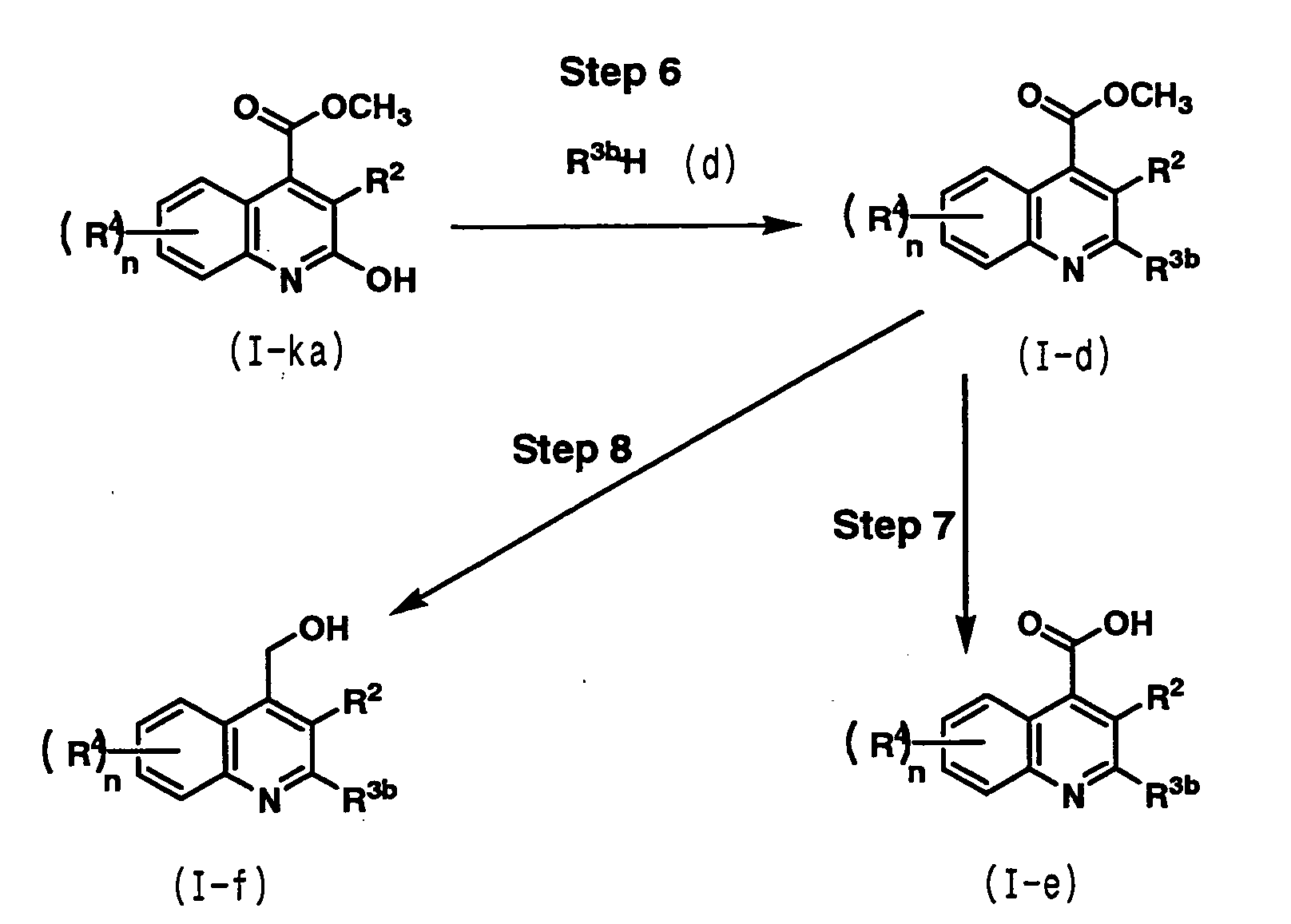
Step 6:
-
Among compound (I-k) prepared in process 3, a hydroxyl
group of compound (I-ka) in which R1 is methoxycarbonyl and
R3 is hydroxy is converted to a trifluoromethanesulfonyloxy
group by the method described in WO 97/00074 or by a method
corresponding thereto. The resulting
trifluromethanesulfonate is reacted with compound (d),
whereby compound (I-d) can be obtained.
-
For example, compound (I-ka) can be converted to a
trifluoromethanesulfonate derivative by a reaction with 1 to
3 equivalents of, for example, trifluoromethanesulfonic
anhydride in an inert solvent in the presence of 1 to 3
equivalents of a base at a temperature between 0°C and a boiling
point of the solvent used for 5 minutes to 24 hours. Examples
of the base used here include pyridine, triethylamine,
potassium carbonate, sodium carbonate, sodium
hydrogencarbonate, sodium hydroxide and the like. Examples
of the inert solvent include dichloromethane,
1,2-dichloroethane, chloroform, DMF, dioxane, acetonitrile
and the like. Subsequently, the trifluoromethanesulfonate
derivative is reacted with 1 to 3 equivalents of compound (d)
in an inert solvent in the presence of 1 to 3 equivalents of
a base at a temperature between 0°C and a boiling point of the
solvent used for 5 minutes to 24 hours to obtain compound (I-d).
Examples of the base used here include pyridine, triethylamine,
potassium carbonate, sodium carbonate, sodium
hydrogencarbonate, sodium hydroxide and the like. Examples
of the inert solvent include dichloromethane,
1,2-dichloroethane, chloroform, DMF, dioxane, acetonitrile
and the like.
-
Compound (d) as a starting material can be obtained as
a commercial product (Aldrich or the like).
Step 7:
-
Compound (I-e) can be prepared by subjecting compound
(I-d) to a hydrolysis reaction [see Jikken Kagaku Koza, 4th
edition, 22 (Organic Synthesis IV Acid·Amino acid·Peptide),
Maruzen, p. 7 (1992)].
-
For example, compound (I-d) is treated in a solvent
containing 1 to 1,000 equivalents of water in the presence of
1 to 10 equivalents of a base at a temperature between 0°C and
a boiling point of the solvent used for 5 minutes to 24 hours
to obtain compound (I-e).
-
Examples of the inert solvent include diethyl ether,
tetrahydrofuran (THF), toluene and the like.
-
Examples of the base include pyridine, triethylamine,
potassium carbonate, sodium carbonate, sodium
hydrogencarbonate, sodium hydroxide and the like.
Step 8:
-
Compound (I-f) can be obtained by subjecting compound
(I-d) to a reduction reaction [see Shin Jikken Kagaku Koza,
4th edition, 15 (Oxidation and Reduction II), Maruzen, pp.
158-179 (1977)].
-
For example, compound (I-d) is treated in an inert
solvent in the presence of 1 to 3 equivalents of a reducing
agent such as LAH or the like at a temperature between 0°C and
a boiling point of the solvent used for 5 minutes to 24 hours
to obtain compound (I-f).
-
Examples of the inert solvent include diethyl ether, THF,
toluene and the like.
Process 5
-
Among compound (I), compound (I-h), compound (I-i) or
compound (I-j) in which R
1 is carbamoyl, cyano or amino can
be prepared by the following steps respectively.
(wherein n, R
2, R
3 and R
4 have the same meanings as those
above-mentioned respectively.)
Step 9:
-
Compound (I-h) can be obtained by conversion of a
carboxyl group of compound (I-g) prepared by the method
described in Japanese Published Unexamined Patent Application
No. 231289/98, Japanese Published Unexamined Patent
Application No. 3144/96, WO 95/10505 and the like or similar
methods thereto to a chlorocarbonyl group and subsequent
treatment of the acid chloride with aqueous ammonia (see
Japanese Published Unexamined Patent Application No.
231289/98 and the like).
-
For example, compound (I-g) can be converted to an acid
chloride by a reaction with 1 to 10 equivalents of a
chlorinating agent in an inert solvent such as benzene, toluene
or the like in the presence or absence of a base at a temperature
between 0°C and a boiling point of the solvent or the
chlorinating agent used for 5 minutes to 24 hours. Examples
of the base used include pyridine, triethylamine, potassium
carbonate, sodium carbonate, sodium hydrogencarbonate, sodium
hydroxide and the like. Examples of the chlorinating agent
include thionyl chloride, phosphoryl chloride, oxalyl
chloride and the like.
-
Subsequently, the acid chloride is treated with 1 to 5
equivalents of aqueous ammonia in an inert solvent at a
temperature between 0°C and a boiling point of the solvent used
for 5 minutes to 24 hours to obtain compound (I-h). Examples
of the inert solvent include dichloromethane,
1,2-dichloroethane, chloroform, diethyl ether, THF, toluene,
DMF, dimethyl sulfoxide and the like.
Step 10:
-
Compound (I-i) can be obtained by treatment of compound
(I-h) with, for example, a chlorinating agent and the like [see
J. Am. Chem. Soc. vol., 70, p. 3315 (1948)].
-
For example, compound (I-h) is treated with 1 to 10
equivalents of a chlorinating agent at a temperature between
0°C and a boiling point of the chlorinating agent used for 5
minutes to 24 hours to obtain compound (I-i).
-
Examples of the chlorinating agent include thionyl
chloride, phosphoryl chloride, oxalyl chloride and the like.
Step 11:
-
Compound (I-j) can be obtained by treatment of the
carbamoyl group of compound (I-h) with, for example, a
hypochlorite, a hypobromite or the like [see Hoffman
Rearrangement: Jikken Kagaku Koza, 4th edition, 20 (Organic
Synthesis II Alcohol·Amine), Maruzen, p. 304 (1991)].
-
For example, compound (I-h) is treated with 1 to 5
equivalents of a hypochlorite, a hypobromite or the like in
a protic polar solvent at a temperature between 0°C and a boiling
point of the solvent used for 5 minutes to 24 hours to obtain
compound (I-j).
-
Examples of the protic polar solvent include water,
ethanol, methanol and the like.
Process 6
-
Among compound (I), a compound in which R1 is
methoxycarbonyl, hydroxymethyl or methyl can also be prepared
from compound (I-g) as a starting material used in process 5
by the methods described in steps 3 and 5 of process 2
respectively or similar methods thereto.
Process 7
-
Compound (I) can be prepared by, for example, the
following processes besides the processes described in above
processes 1 to 6.
-
For example, among compound (I), a compound in which R1
is substituted or unsubstituted lower alkyl, -C(=Y)R9 (wherein
Y and R9 have the same meanings as those above-mentioned
respectively), hydroxy, halogen, mono-lower alkylamino or
di-lower alkylamino can be prepared by the method described
in, for example, Japanese Published Unexamined Patent
Application No. 3144/96, WO 95/10505 and the like, a method
corresponding thereto or a process well known in the field of
organic chemistry.
-
Furthermore, among compound (I), a compound in which R2
and R3 form a substituted or unsubstituted condensed ring
together with two carbon atoms on roots thereof can be produced
by the method described in, for example, Bioorg. Med. Chem.
Lett., vol. 8, p. 307 (1998), Japanese Published Unexamined
Patent Application No. 306079/94 and the like, a method
corresponding thereto or a method well known in the field of
organic chemistry.
-
In compound (I), the intermediates and the starting
material, conversion of the functional groups and conversion
of the functional groups contained in the substituents can be
carried out according to other known methods [for example, the
method described in Comprehensive Organic Transformations,
second edition, R. C. Larock, John Wiley & Sons Inc. (1999)
and the like] besides the aforementioned steps.
-
Further, compound (I) having desired functional groups
on the desired positions can be obtained by carrying out a
appropriate combination of the aforementioned processes and
the like.
-
Also, compound (IA) can be prepared in the same manner
as in the aforementioned process for compounds (I).
-
The intermediates and the desired compounds in the
aforementioned processes can be isolated and purified by
subjecting to separation and purification methods ordinarily
used in organic synthetic chemistry, such as filtration,
extraction, washing, drying, concentration,
recrystallization, various chromatographies and the like.
The intermediates may be subjected to the next reaction without
particular purification.
-
Among compound (I) or (IA), stereoisomers such as a
geometric isomer and an optical isomer may be existed. All
possible isomers including these isomers and the mixtures of
the isomers at any ratios can be used in the PDE10A isomer of
the present invention.
-
To obtained a salt of compound (I) or (IA), when compound
(I) or (IA) are obtained as a salt form, it may be purified
as it is. When compound (I) or (IA) are obtained as a free
form, it may be dissolved or suspended in an appropriate solvent
and isolated and purified by addition of an acid or a base.
-
Compound (I) or (IA) and a pharmaceutically acceptable
salt thereof may be existed in the form of adducts with water
or various solvents. These adducts can also be used for the
PDE10 inhibitor of the present invention.
-
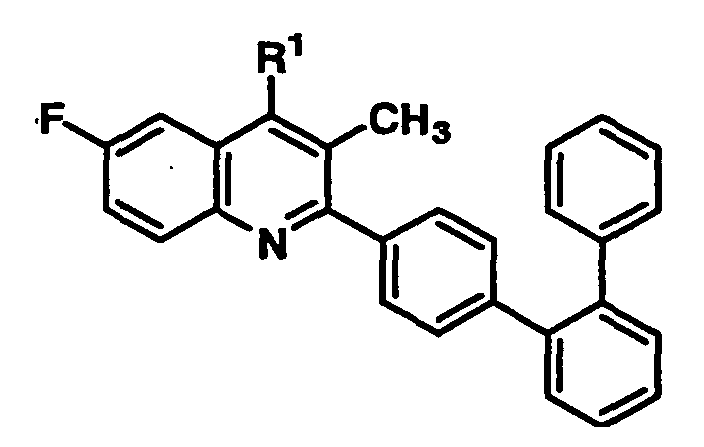
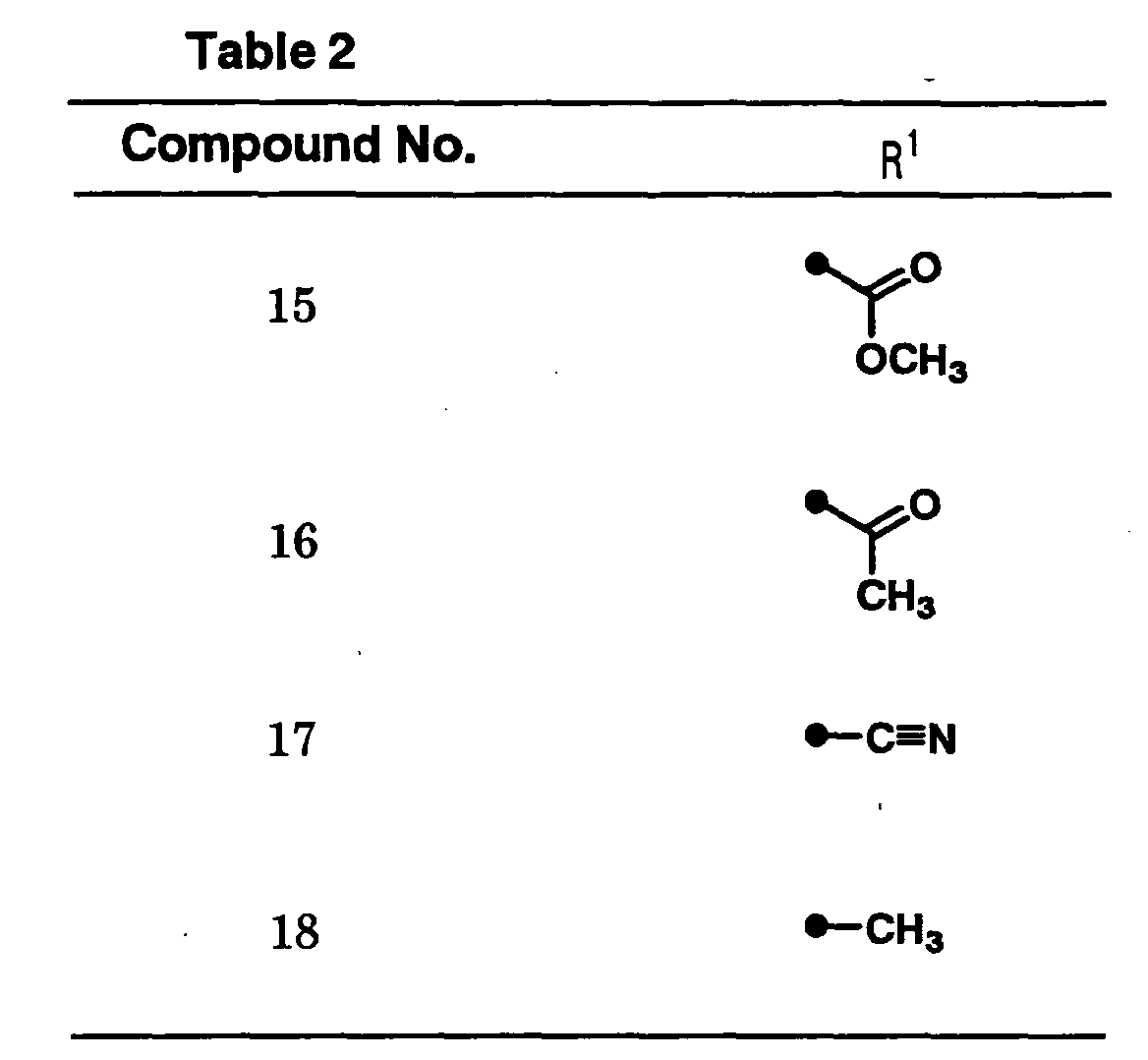
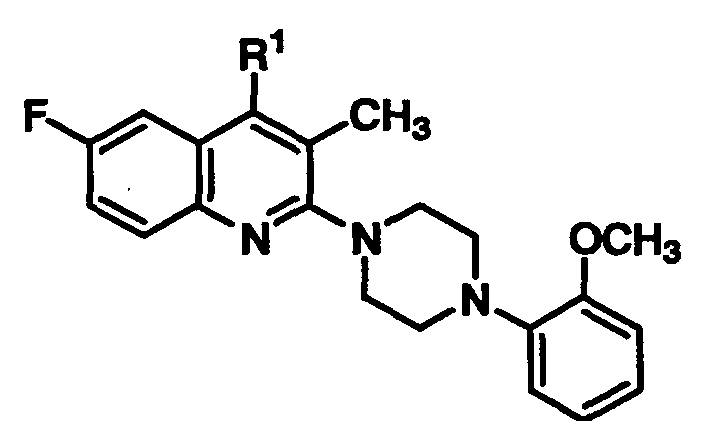
Specific examples of compound (IA) obtained in the
present invention are shown in Tables 1 to 3. However, the
compounds of the present invention are not limited thereto.
-
The compounds listed in Tables 1 to 3 are used for the
PDE inhibitor of the present invention, and specific examples
of compounds used in the present invention besides these
compounds are shown in Table 4. However, the compounds used
in the present invention are not limited thereto.
-
Next, pharmacological activities of typical compounds
(I) are specifically described by test examples.
Test Example 1:
Activity of inhibiting PDE10A activity ([3H]cAMP decomposition
inhibiting test)
-
PCR was performed using DNAs having base sequences
described in SEQ ID NO. 1 and SEQ ID NO. 2 as primers and human
kidney cDNA as a template to prepare a plasmid containing
amplified fragments. The plasmid was cleaved with restriction
endonucleases Pst I and Xba I to obtain a Pst I-Xba I fragment
of 0.7 kb.
-
Meanwhile, Est clone (Cosmo·Bio, Tokyo) of GenBank,
ACCESSION WO 4835 was cleaved with restriction endonucleases
Kpn I and Pst I to obtain a Kpn I-Pst I fragment of 1.5 kb.
-
The resulting Pst I-Xba I fragment of 0.7 kb and Kpn I-Pst
I fragment of 1.5 kb were subcloned in a Kpn I-Xba I site of
pBluescript II KS(-) (STRATAGENE, La Jolla, CA, USA) to
construct a plasmid having a cDNA fragment completely
including a catalyst region of PDE10A. Subsequently, the
plasmid was cleaved with restriction endonucleases Kpn I and
Not I to obtain a Kpn I-Not I fragment of 2.2 kb.
-
The resulting Kpn I-Not I fragment of 2.2 kb and a linker
having a BamH I-Kpn I cleavage surface prepared by synthetic
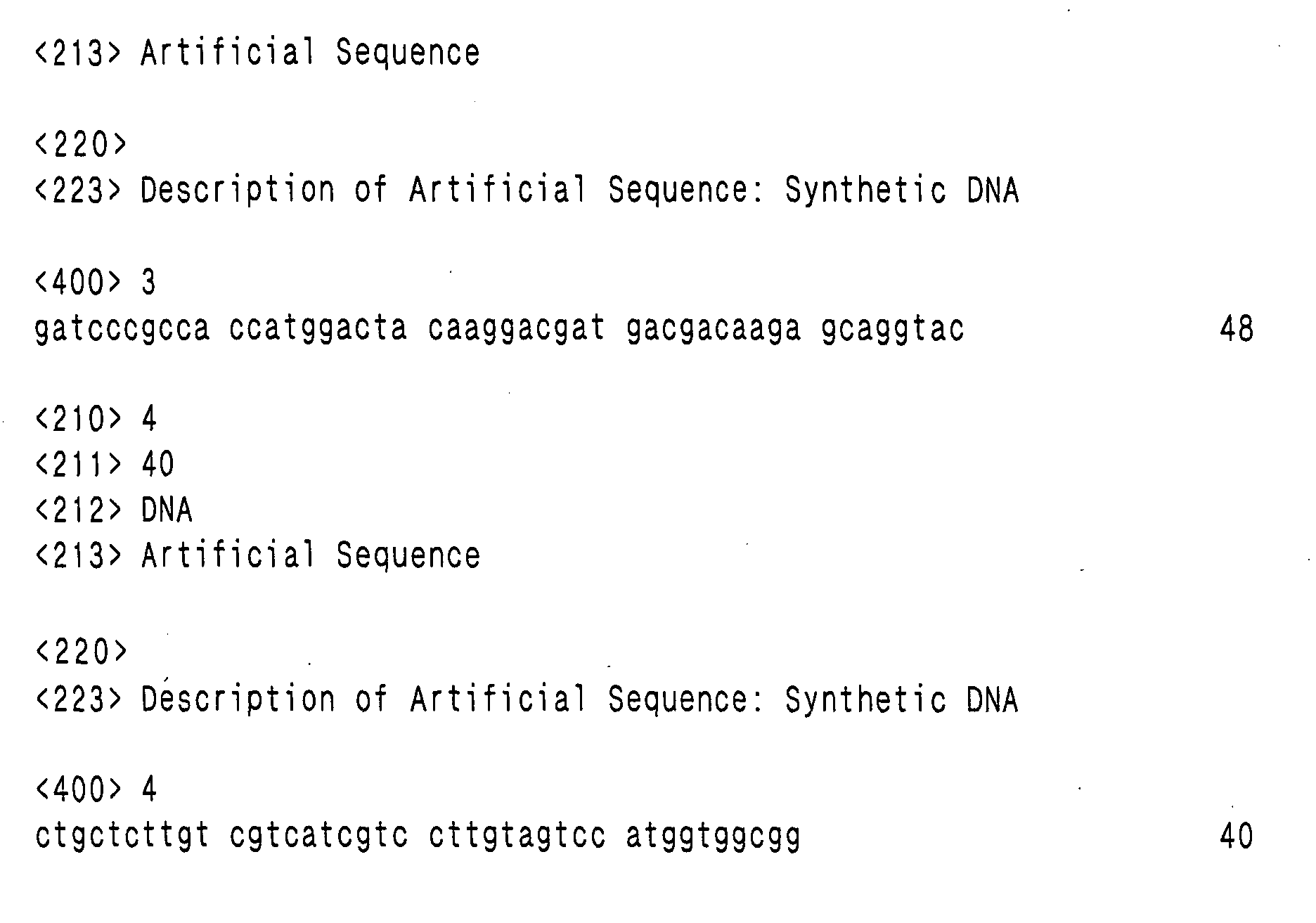
DNA having base sequences described in SEQ ID NOS. 3 and 4 were
subcloned in a BamH I-Not I site of pVL1393 (PharMingen, San
Diego, CA, USA) to obtain a plasmid for preparation of
Baculovirus. The plasmid contains a DNA encoding a peptide
in which methionine, FLAG tag and a peptide having a 64th to
779th amino acid sequence of PDE10A [GenBank, ACCESSION NP
006652: Gene, vol. 234, p. 109 (1999), J. Biol. Chem., vol.
274, p. 18438 (1999)] are bound in the order.
-
The above gene recombinational manipulation was
performed according to the method described in Molecular
Cloning, 2nd edition, Cold Spring Harbor Laboratory Press, New
York (1989).
-
The expression of PDE10A was conducted according to the
Baculovirus expression vector system manual (PharMingen)
using insect cells. As insect cells, Sf9 cells (Asahi
Technoglass, Tokyo) were used. Sf9 cells were infected with
a supernatant (co-transfection sup) containing PDE10A
expression virus prepared according to the manual, and
cultured at 27°C for 4 days. The cells were recovered, washed
with a phosphate-buffered saline (PBS), and then suspended in
an extraction solution [20 mmol/L Tris-acetate (pH 7.5), 2
mmol/L MgCl2, 1 mmol/L dithiothreitol, 1 mmol/L
ethylenediaminetetraacetic acid (EDTA), 0.25 mol/L sucrose,
250 unit/mL aprotinin, 40 µg/mL phenylmethylsulfonyl fluoride,
and 1 µg/mL pepstatin A]. The cells were disrupted in ice with
the maximum output under conditions of 5 seconds and five times
using an ultrasonic disruption machine (TOMY model UR-200R,
TOMY, Tokyo). A soluble fraction was obtained by
centrifugation under 10,000 rpm of the fraction at 4°C for 30
minutes, and the resulting soluble fraction was used for
measuring the PDE activity.
-
The PDE activity was measured according to the method
described in Methods Enzymol., vol. 159, p. 457 (1988).
-
Using [
3H]cAMP as a substrate, an enzyme reaction was
conducted in a reaction solution containing 300 µL of 50 mmol/L
N,N-bis(2-hydroxyethyl)-2-aminoethanesulfonic acid (pH 7.2),
1 mmol/L MgCl
2 and 0.1 mmol/L ethylene glycol-bis (β-aminoethyl
ether)-N,N,N',N'-tetraacetic acid: EGTA). The concentration
of the substrate was 0.2 µmol/L. To 95 µL of an enzyme dilute
solution were added 5 µL of a test compound (DMSO solution)
and 200 µL of a substrate solution. The mixture was incubated
at 30°C for 20 minutes, and then HCl was added to stop the
reaction. The reaction product (5'-AMP) was converted to
adenosine using 5'-nucleotidase, and separated the unreacted
product from the reactant by DEAE-Sephadex A-25 column
(Amersham Pharmacia Biotech, Uppsala, Sweden). The elute was
moved to scintillation vials, 6 mL of Ultima Gold (Packard
Instrument, Meriden, CT, USA) was added, and the radioactivity
was measured for 2 minutes using a liquid scintillation counter
(Beckman LS6500, Beckman, Tokyo). A non-catalytic hydrolysis
amount was an amount of [
3H]cAMP decomposition when an enzyme
dilute solution was not added. A decomposition amount by the
soluble fraction was obtained by subtracting the non-catalytic
hydrolysis amount from the total decomposition amount. The
inhibitory activity of [
3H]cAMP decomposition of test
compounds is shown in Table 5 as a [
3H]cAMP decomposition
inhibition rate (%) and a concentration (IC
50) at which to
inhibit [
3H]cAMP decomposition by 50%.
| Compound No. | [3H] cAMP decomposition Inhibition rate (%) (Test compound concentration 1 µmol/L) | IC50(nmol/L) |
| C | 99 | 0.9 |
| D | 99 | 11 |
| H | 97 | 47 |
| I | 99 | 5.5 |
| J | 99 | 16 |
| K | 90 | NT |
| L | 99 | 21 |
| M | 98 | 27 |
| N | 99 | 13 |
| O | 94 | 33 |
| 1 | 99 | 4.2 |
| 2 | 97 | 66 |
| 3 | 97 | 76 |
| 4 | 83 | NT |
| 6 | 91 | 98 |
| 7 | 97 | 34 |
| 8 | 68 | NT |
| 11 | 90 | 173 |
| 12 | 96 | 68 |
| 13 | 90 | 103 |
| 16 | 80 | NT |
| 17 | 70 | 373 |
| 18 | 97 | 4.8 |
| NT = not performed |
Test Example 2:
Test for activity to hyperkinesia in 6-hydroxydopamine
(6-OHDA)-treated rats
-
When the unilateral nigrostriatal pathway is lesioned
with 6-OHDA, sensitivity of dopamine receptors in the striatum
on the lesioned side is increased. When a dopamine activity
enhancing substance such as L-DOPA is administered thereto,
a rotating behavior takes place on the side opposite to the
lesioned side. This animal model has been long positioned as
an excellent test model of Parkinson's disease, and has been
used for research of therapeutic agent for Parkinson' s disease
[Neurol. Neurobiol. vol. 33, p. 1 (1987)]. Repetitive
administration of L-DOPA to 6-OHDA-treated rats has been
considered to be a similar model of dyskinesia which is a side
effect induced by long-term administration of L-DOPA as a
therapeutic agent for Parkinson's disease [Exp. Neurol. vol.
151, p. 334 (1998)].
-
In this test, 6-week-old male rats (strain's name: Cr
j:CD(SD)IGS) were purchased from Japan Charles River, and used
after conditioned breeding for 6 days. After the rat was
anesthetized with pentobarbital sodium (40 mg/kg, intravenous
administration), a solution which is dissolving 8 µg of
6-hydroxydopamine hydrobromide (6-OHDA hydrobromide) in 2 µL
of physiological saline containing 0.05% ascorbic acid was
injected in the medial forebrain bundle over 3 minutes to
destroy unilateral nigrostriatal pathway. For protecting
noradrenaline neurons, 25 mg/kg of deciprasmine hydrochloride
was intraperitoneally administered 30 minutes before
operation.
-
After 7 days from the injection of 6-OHDA, 0.1 mg/kg of
apomorphine which is a dopamine agonist was subcutaneously
administered to the rats. Individuals in which the rotating
behavior was observed were used in the following test as
Parkinson's disease model rats in which the lesion was
successful.
-
After withdrawal of the administration of apomorphine
for 14 days, L-DOPA and benserazide were orally administered
to the rats at doses of 100 mg/kg and 25 mg/kg respectively
to induce hyperkinesia. At this time, the number of rotations
was measured for 60 minutes immediately after the
administration. On the basis of the results of measuring the
number of rotations, the rats were divided into A group and
B group, each group consisting of 8 rats, such that there was
no statistically significant difference in average number of
rotations between the groups. In the measurement of the number
of rotations, an automatic rotation measuring device was used,
and rotation at 180° was estimated as 1 count. Consequently,
the average number of rotations for 60 minutes was 1,389 ± 196
in A group and 1,396 ± 212 in B group.
-
After 7 days from the dividing into groups, the number
of rotations for 60 minutes was measured by similar manner as
that of above-mentioned. A vehicle (0.5% methylcellulose
aqueous solution) was intraperitoneally administered to A
group, and 50 mg/kg of the test compound was intraperitoneally
administered to B group. Immediately after the administration,
30 mg/kg of L-DOPA and 7.5 mg/kg of benserazide were orally
administered to A and B groups, and the number of rotations
for 60 minutes was measured every 5 minutes.
-
In the vehicle administration group (A group), the total
number of rotations for 60 minutes was 1,298 ± 193. Meanwhile,
in the group (B group) to which compound 12 was administered,
it was 48 ± 20. The vehicle administration group and the test
compound administration group were statistically compared in
the total number of rotations by the student's test.
Consequently, the difference was a significant difference with
a significance level of less than 0.1%.
-
From the results above-mentioned, it was revealed that
the administration of compounds (I) inhibits hyperkinesia in
6-OHDA-treated rats. Therefore, it is considered that the
PDE10 A inhibitors including compounds (I) can reduce
dyskinesia.
Test Example 3: Cell growth inhibitory activity
-
Cell growth inhibitory activity of compound 12 was
examined on MDA-MB-231 (human breast cancer cell: American
Type Culture Collection) using an in-vitro cell growth assay
[3-(4,5-dimethylthiazol-2-yl)-2,5-diphenyl tetrazolium
bromide (MTT)]-type calorimetric assay [Leukemia, vol. 7, p.
1637, (1993)].
-
MDA-MB-231 (2.5 x 10
4 cells/mL, 270 µL) was inoculated
on a 48-well plate, and cultured overnight. In the culture,
Leibovitz's L-15 (Gibco) containing 10% fetal calf serum
(Hi-Clone), 0.05 units/mL of penicillin (Gibco) and 0.05 µg/mL
of streptomycin (Gibco) was used as a culture medium. 30 µL
of compound 12 dissolved in the same medium containing 0.1%
dimethyl sulfoxide (DMSO; Wako Pure Chemical Industries) was
added to each well. After 3 days of culture, 30 µL of MTT (Dojin
Kagaku Kenkyusho, adjusted to a concentration of 5 mg/mL with
PBS) was added to each well. After 4 hours of culture, 900
µL of DMSO was added to dissolve the cells. The cell solution
was moved to a 96-well plate in amounts of 200 µL each, and
fluorescence intensity OD
590-630 was measured with an automated
microplate reader EL340 (Biotech Instruments). The
inhibition rate of the cell growth was calculated from the
following equation, wherein OD (sample) is fluorescence
intensity (OD
590-630) of the group being added compound 12
(medium containing compound 12 and 0.1% DMSO), OD (control)
is fluorescence intensity (OD
590-630) of the group being absent
of compound 12 (medium containing 0.1% DMSO alone was added)
and OD (blank) is fluorescence intensity (OD
590-630) of the same
medium containing 0.1% DMSO.
-
Compound 12 showed 39% of inhibitory activity to growth
of MDA-MB-231 at 10 µmol/L.
-
From the results, it was suggested that compound (I) or
(IA), or the pharmaceutically acceptable salts thereof are
useful as an agent for treating human breast cancer.
-
In view of the above-mentioned, compound (I) or (IA),
or the pharmaceutically acceptable salts thereof have the
PDE10A inhibitory activity, and are considered to be useful
for treatment of various diseases caused by enhancing the
activity of PDE10A [for example, Parkinson' s disease, tremor,
dyskinesia (L-DOPA-induced dyskinesia, tardive dyskinesia,
myoclonus, tic or Tourette syndrome), Huntington disease,
dystonia, an anxiety disorder (panic attack and panic disorder,
phobia, obsessive compulsive disorder, post-traumatic stress
disorder, acute stress disorder, generalized anxiety disorder,
anxiety due to physical handicap or substance), a mood disorder
(depression, dysthymic disorder, bipolar disorder or mood
cyclothymia disorder), congitive impairment (aphasia, apraxia,
agnosia, delirium, dementia or amnesia), an emotional
disturbance disorder induced by drug abuse or stopping of drug
use, schizophrenia and its-related disorder (short-term
psychotic disorder, schizoid disorder, schizoid-emotional
disorder or delusional disorder), a cerebrovascular disease
(transient cerebral ischemic attack (TIA), ischemic attack,
intracranial hemorrhage or subarachnoidal hemorrhage), head
injury, hypogonadism (impotence), diabetes, a ischemic heart
disease (angina pectoris, acute coronary syndrome or old
myocardial infarction), a renal disease (acute renal
insufficiency, chronic renal insufficiency or
glomerulonephritis), peripheral a vascular disease
(peripheral arterial occlusion, occlusive thromboangiitis,
Raynaud disease and Raynaud phenomenon, acrocyanosis or
erythromelalgia), hypertension, urinary incontinence
(transient urinary incontinence or hemostatic urinary
incontinence), an autoimmune disease (chronic rheumatoid
arthritis, systemic lupus erythematosus, osteoarthritis,
multiple sclerosis or psoriasis), a pulmonary disease (chronic
obstructive pulmonary disease, chronic bronchitis, pulmonary
emphysema or asthma), an allergic disease (itching, contact
dermatitis, atopic dermatitis, allergic rhinitis or allergic
conjunctivitis), a disease of the digestive system,
osteoporosis, contraception, pain (acute postoperative pain,
cancer pain, neuropathic pain or phychogenic pain syndrome),
a malignant tumor or the like.]
-
Compound (I) or (IA), or the pharmaceutically acceptable
salt thereof can be administered by itself as it is, however,
preferably it is usually provided as various pharmaceutical
preparations. Further, these pharmaceutical preparations
are used in animals or humans.
-
The pharmaceutical preparations according to the
present invention can contain compound (I) or (IA), or the
pharmaceutically acceptable salt thereof as an active
ingredient either solely or as a mixture with any other active
ingredient for treatment. The pharmaceutical preparations
are prepared by mixing the active ingredient with one or more
of pharmaceutically acceptable carriers by any method well
known in the technical field of pharmaceutical science.
-
As for an administration route, it is preferred to use
the most effective administration route in treatment. Oral
administration or parenteral administration such as
intravenous administration and the like can be mentioned.
-
Examples of a dosage form include tablets, capsules,
injections and the like.
-
Examples of the carrier for preparations used include
lactose, mannitol, glucose, hydroxypropyl cellulose, starch,
magnesium stearate, sorbitan fatty acid ester, glyceric acid
ester, polyvinyl alcohol, distilled water for injection,
physiological saline, propylene glycol, polyethylene glycol,
ethanol and the like. Also, the pharmaceutical preparations
according to the present invention may further comprise
excipients, lubricants, binders, disintegrants, isotonic
agents emulsifying agents and the like.
-
Compound (I) or (IA), or the pharmaceutically acceptable
salt thereof is usually administered systemically or locally
in the oral or parenteral form when used for the above purposes.
The dose and the frequency of administration may vary with the
dosage form, the age and weight of patients, nature or severity
of the condition to be treated, and the like. Ordinarily, it
is preferable that it is administered at a dose of from 1 to
900 mg, preferably from 1 to 200 mg per day for an adult at
3 or 4 different times. However, the dose and the frequency
of administration may vary with the above various conditions
and the like.
Best Mode for Carrying Out the Invention
-
The present invention is illustrated more specifically
by referring to Examples and Reference Examples as followes.
However, the scope of the present invention is not limited to
these Examples.
-
In proton nuclear magnetic resonance spectrum (1H-NMR)
used in Reference Examples and Examples, description of
multiplicity of a signal which is ordinarily used is employed,
and br indicates a signal which is apparently broad.
Reference Example 1:
2-(4-Bromophenyl)-6-fluoro-3-methylquinoline-4-carboxylic acid (Compound A)
-
5-Fluroisatin(2.33 g, 14.08 mmol) and
4-bromopropiophenone(2.00 g, 9.39 mmol) were dissolved in 24
mL of ethanol, and 24 mL of a 6 mol/L potassium hydroxide aqueous
solution was added thereto. Then, the mixture was heated and
refluxed for overnight. After completion of the reaction, 150
mL of water and 39 mL of diethyl ether were added to the mixture,
and the mixture was extracted. The resulting aqueous layer
was stirred under ice cooling, and acetic acid was slowly added
to acidify the solution. Crystals precipitated were collected
by filtration, and washed with 20 mL of water to obtain 3.27
g of the title compound (compound A) as a white crystal (yield
97%).
1H NMR (δ ppm, DMSO-d6): 8.14 (dd, J=5.7, 9.2 Hz, 1H),
7.72 (d, J=8.4 Hz, 2H), 7.78-7.68 (m, 1H), 7.58 (d, J=8.4 Hz,
2H), 7.49 (dd, J=2.7, 9.9 Hz, 1H), 3.4 (brs. 1H), 2.39 (s, 3H)
Mass (m/z): 359 (M--1), 361 (M-+1)
IR (KBr): 1620, 1595, 1504, 1392, 1244, 1194, 1012,
991,831 cm-1
m.p.: >300°C
Reference Example 2:
6-Fluoro-3-methyl-2-([1,1':2',1"-terphenyl)-4-yl)quinoline-4-carboxylic acid (compound C)
-
Compound A (100 mg, 0.28 mmol) prepared in Reference
Example 1, 2-biphenylboric acid (66 mg, 0.34 mmol) and
bis(tri-o-tolylphosphine)palladium (II) dichloride (22 mg,
0.03 mmol) were dissolved in 4 mL of ethanol, and triethylamine
(0.12 mL, 0.83 mmol) was added thereto. The mixture was heated
and refluxed at 90°C for approximately 2 hours. After
completion of the reaction, the solvent was distilled off, and
to the resulting residue was added 50 mL of a 2 mol/L sodium
hydroxide aqueous solution and diethyl ether to wash the
residure. After the aqueous layer was filtered, the filtrate
was stirred under ice cooling, and acetic acid was slowly added
dropwise to the solution to neutralize. Crystals precipitated
were collected by filtration, and recrystallized from a
DMF-water mixed solvent to obtain 70 mg of the title compound
(compound C) as a white powder (yield 58%).
1H NMR (δ ppm, DMSO-d6): 8.13 (dd, J=5.7, 9.2 Hz, 1H),
7.70 (dt, J=3.0, 9.2 Hz, 1H), 7.51-7.45 (m, 8H), 7.29-7.17 (m,
7H), 2.36 (s, 3H)
Mass (m/z): 434 (M+1)
IR (KBr) : 3100, 2500, 1718, 1626, 1504, 1475, 1284, 1238,
1192, 1007, 989, 829, 750, 702 cm-1
m.p.: >300°C
-
The following Reference Examples 3 to 8 were performed
in the same manner as that of Reference Example 2 using
corresponding boronic acid respectively to obtain compounds
D to F and H to J.
Reference Example 3:
6-Fluoro-2-(2'-methoxybiphenyl-4-yl)-3-methylquinoline-4-carboxylic acid (compound D)
-
Yield: 70% (recrystallized from ethyl acetate; white
powder)
1H NMR (δ ppm, DMSO-d6): 8.14 (dd, J=5.4, 9.2 Hz, 1H),
7.76-7.60 (m, 5H), 7.49 (dd, J=2.4, 9.7 Hz, 1H), 7.41-7.36 (m,
2H), 7.16 (d, J=8.1 Hz, 1H), 7.07 (t, J=8.1 Hz, 1H), 3.82 (s,
3H), 2.48 (s, 3H)
Mass (m/z): 388 (M+1)
IR (KBr): 1626, 1599, 1506, 1489, 1234, 1190, 1028, 746,
737 cm-1
m.p.: 283-295°C
Reference Example 4:
6-Fluoro-2-(5'-fluoro-2'-methoxybiphenyl-4-yl)-3-methylquinoline-4-carboxylic acid (compound E)
-
Yield: 42% (recrystallized from ethyl acetate; white
powder)
1H NMR (δ ppm, DMSO-d6): 8.14 (dd, J=5.4, 9.2 Hz, 1H),
7.73-7.66 (m, 5H), 7.50 (dd, J=2.7, 9.7 Hz, 1H), 7.25 (dt, J=2.7,
9.2 Hz, 1H), 7.22-7.17 (m, 2H), 3.80 (s, 3H), 2.47 (s, 3H)
Mass (m/z): 406 (M+1)
IR (KBr): 1707, 1626, 1495, 1392, 1252, 1236, 1190, 1041,
721 cm-1
m.p.: >300°C
Reference Example 5
2-(2',4'-dimethoxybiphenyl-4-yl)-6-fluoro-3-methylquinoline-4-carboxylic acid (compound F)
-
Yield: 69% (recrystallized from ethyl acetate; white
powder)
1H NMR (δ ppm, DMSO-d6): 8.13 (dd, J=5.4, 9.2 Hz, 1H),
7.72 (dt, J=2.7, 9.2 Hz, 1H), 7.65-7.57 (m, 4H), 7.48 (dd, J=2.7,
9.7 Hz, 1H), 7.32 (d, J=8.4 Hz, 1H), 6.71 (d, J=2.7 Hz, 1H),
6.65 (dd, J=2.7, 8.4 Hz, 1H), 3.83 (s, 3H), 3.82 (s, 3H), 2.38
(s, 3H)
Mass (m/z): 418 (M+1)
IR (KBr): 2931, 2839, 1709, 1701, 1608, 1579, 1498, 1302,
1282, 1246, 1236, 1205, 1030, 821 cm-1
m.p.: >300°C
Reference Example 6:
6-Fluoro-3-methyl-2-(2'-methylbiphenyl-4-yl)quinoline-4-carboxylic acid (compound H)
-
Yield: 65% (recrystallized from an ethanol-water mixed
solvent; brown granular crystal)
1H NMR (δ ppm, DMSO-d6): 8.14 (dd, J=5.7, 9.2 Hz, 1H),
7.74-7.67 (m, 1H), 7.68 (d, J=8.4 Hz, 2H), 7.48 (d, J=8.4 Hz,
2H), 7.52-7.41 (m, 2H), 7.32-7.26 (m, 3H), 2.46 (s, 3H), 2.31
(s, 3H)
Mass (m/z): 372 (M+1)
IR (KBr) : 2990, 1714, 1709, 1504, 1485, 1387, 1236, 1192,
858, 825, 752, 716 cm-1
m.p.: 260°C (decomp.)
Reference Example 7:
2-(2'-Ethoxybiphenyl-4-yl)-6-fluoro-3-methylquinoline-4-carboxylic acid (compound I)
-
Yield: 23% (recrystallized from an ethanol-water mixed
solvent; white powder)
1H NMR (δ ppm, DMSO-d6): 8.13 (dd, J=5.4, 9.2 Hz, 1H),
7.75-7.61 (m, 5H), 7.48 (dd, J=2.4, 9.7 Hz, 1H), 7.42-7.30 (m,
2H), 7.15-7.00 (m, 2H), 4.09 (q, J=7.0 Hz, 2H), 2.46 (s, 3H),
1.31 (t, J=7.0 Hz, 3H)
Mass (m/z): 402 (M+1)
IR (KBr): 1626, 1487, 1394, 1236, 1043, 754 cm-1
m.p.: 225-227°C
Reference Example 8:
6-Fluoro-2-(2'-formylbiphenyl-4-yl)-3-methylquinoline-4-carboxylic acid (compound J)
-
Yield: 90% (recrystallized from an ethanol-water mixed
solvent; white powder)
1H NMR (δ ppm, DMSO-d6): 9.99 (s, 1H), 8.07 (dd, J=5.7,
9.2 Hz, 1H), 7.97 (dd, J=1.1, 9.2 Hz, 1H), 7.83-7.78 (m, 1H),
7.74 (d, J=8.4 Hz, 2H), 7.58 (d, J=8.4 Hz, 2H), 7.68-7.55 (m,
4H), 2.44 (s, 3H)
Mass (m/z): 386 (M+1)
IR (KBr): 1703, 1693, 1238, 1196, 1097, 991, 858, 769,
756, 719 cm-1
m.p.: >300°C
Reference Example 9:
6-Fluoro-2-(2'-hydroxymethylbiphenyl-4-yl)-3-methylquinoline-4-carboxylic acid (compound K)
-
Compound J (300 mg, 0.78 mmol) prepared in Reference
Example 8 was dissolved in 20 mL of methanol, and sodium
borohydride (12 mg, 0.31 mmol) which was dissolved in 0.5 mL
of water was slowly added dropwise to the solution at room
temperature. After the reaction mixture was heated and
refluxed at 60°C for 2 hours, the mixture was cooled to room
temperature, and 2 mL of a saturated aqueous solution of
ammonium chloride was added, and then the mixture was stirred
for 1 hour. After the solvent was distilled off, to the residue
were added 50 mL of water and 2 mol/L of hydrochloric acid to
neutralize. Crystals precipitated were collected by
filtration to obtain 174 mg of the title compound (compound
K) as a white powder (yield 58%).
1H NMR (δ ppm, DMSO-d6): 8.15 (dd, J=5.7, 9.4 Hz, 1H),
7.77-7.68 (m, 1H), 7.68 (d, J=8.1 Hz, 2H), 7.63-7.52 (m, 2H),
7.53 (d, J=8.1 Hz, 2H), 7.45-7.31 (m, 3H), 5.21 (brs, 1H), 4.48
(s, 2H), 2.48 (s, 3H)
Mass (m/z): 388 (M+1)
IR (KBr): 1620, 1504, 1356, 1296, 1248, 1196, 831 cm-1
m.p.: 258-260°C
Reference Example 10:
6-Fluoro-3-methyl-2-[2'-(4-phenylpiperazin-1-yl)methylbiphenyl-4-yl]quinoline-4-carboxylic acid (compound L)
-
Compound J (400 mg, 1.03 mmol) prepared in Reference
Example 8 was dissolved in 7 mL of dichloromethane, and
phenylpiperazine (0.24 mL, 1.57 mmol), sodium
triacetoxyborohydride (308 mg, 1. 45 mmol) and 0.5 mL of acetic
acid were added. The mixture was stirred overnight at room
temperature. After completion of the reaction, 100 mL of water
was added to the reaction mixture, and the solution was
extracted with 200 mL of chloroform. The organic layer was
dried over magnesium sulfate, and then the solvent was
distilled off. The resulting residue was recrystallized from
ethanol and a DMF-water mixed solvent to obtain 447 mg of the
title compound (compound L) as a white powder (yield 81%).
1H NMR (δ ppm, DMSO-d6): 8.13 (dd, J=5.7, 9.2 Hz, 1H),
7.68 (d, J=8.1 Hz, 2H), 7.74-7.58 (m, 2H), 7.57 (d, J=8.1 Hz,
2H), 7.49 (dd, J=2.7, 10.0 Hz, 1H), 7.45-7.34 (m, 3H), 7.18
(t, J=7.3 Hz, 2H), 6.89 (d, J=7.3 Hz, 2H), 6.75 (t, J=7.3 Hz,
1H), 3.59 (s, 2H), 3.10 (t, J=4.3 Hz, 4H), 2.54 (t, J=4.3 Hz,
4H), 2.44 (s, 3H)
Mass (m/z): 532 (M+1)
IR (KBr): 1599, 1498, 1396, 1338, 1234, 1184, 837, 768
cm-1
m.p.: 189-190°C
-
The following Reference Examples 11 and 12 were conducted
in the same manner as that of Reference Example 10 using
corresponding amines respectively to obtain compounds M and
N.
Reference Example 11:
6-Fluoro-3-methyl-2-(2'-morpholinomethylbiphenyl-4-yl)quinoline-4-carboxylic acid (compound M)
-
Yield: 80% (recrystallized from an ethanol-water mixed
solvent; pale yellow powder)
1H NMR (δ ppm, DMSO-d6): 8.14 (dd, J=5.9, 9.4 Hz, 1H),
7.75-7.69 (m, 1H), 7.67 (d, J=8.1 Hz, 2H), 7.56 (d, J=8.1 Hz,
2H), 7.56-7.48 (m, 2H), 7.43-7.32 (m, 3H), 3.55 (t, J=4.3 Hz,
4H), 3.50 (s, 2H), 2.49 (s, 3H), 2.34 (t, J=4.3 Hz, 4H)
Mass (m/z): 457 (M+1)
IR (KBr): 1626, 1604, 1601, 1495, 1385, 1333, 1230, 1186,
1134, 987, 829, 750 cm-1
m.p.: 163-165°C
Reference Example 12:
6-Fluoro-3-methyl-2-[(2'-phenylamino)methylbiphenyl-4-yl]quinoline-4-carboxylic
acid (compound N)
-
Yield: 64% (recrystallized from an ethanol-water mixed
solvent; white powder)
1H NMR (δ ppm, DMSO-d6): 8.15 (dd, J=5.4, 9.2 Hz, 1H),
7.75-7.69 (m, 1H), 7.70 (d, J=8.1 Hz, 2H), 7.57 (d, J=8.1 Hz,
2H), 7.54-7.48 (m, 2H), 7.40-7.36 (m, 3H), 7.00 (t, J=8.4 Hz,
2H), 6.48 (t, J=8.4 Hz, 2H), 6.46 (d, J=8.4 Hz, 1H), 4.21 (s,
2H), 2.45 (s, 3H)
Mass (m/z): 463 (M+1)
IR (KBr) : 1716, 1624, 1616, 1602, 1558, 1508, 1238, 1191,
750 cm-1
m.p.: 222-224°C
Reference Example 13:
6-Fluoro-3-methyl-2-([1,1':2',1"-terphenyl]-4-yl)quinone-4-carboxamide (compound O)
-
Compound C (615 mg, 1.42 mmol) prepared in Reference
Example 2 was slowly added to 6 mL of ice-cooled thionyl
chloride, and the mixture was stirred at room temperature for
2 hours. After completion of the reaction, thionyl chloride
was distilled off, and to the residue was added 50 mL of toluene,
and the solvent was distilled off again. To the resulting
residue were added 20 mL of THF, and 5 mL of aqueous ammonia
was slowly added under ice cooling, and then the mixture was
stirred at room temperature for 30 minutes. After completion
of the reaction, the solvent was distilled off. The resulting
residue was purified by silica gel column chromatography
(chloroform/methanol/aqueous ammonia = 100/10/1), and then
recrystallized from an ethanol-water mixed solvent to obtain
270 mg (0.625 mmol) of the title compound (compound O) as a
pale brown crystal (yield 44%).
1H NMR (δ ppm, CDCl3): 8.11 (dd, J=5.3, 9.2 Hz, 1H),
7.55-7.41 (m, 7H), 7.39 (d, J=8.3 Hz, 2H), 7.28 (d, J=8.3 Hz,
2H), 7.26-7.24 (m, 4H), 6.15 (brs, 1H), 5.90 (brs, 1H), 2.44
(s, 3H)
Mass (m/z): 433 (M+1)
IR (KBr): 1684, 1668, 1626, 1497, 1398, 1234, 831, 748
cm-1
m.p.: 243-246°C
Reference Example 14:
4-Amino-6-fluoro-3-methyl-2-([1,1':2',1"-terphenyl]-4-yl)quinoline
(compound P)
-
Bromine (0.046 mL, 0.90 mmol) and compound O (300 mg,
0.69 mmol) prepared in Reference Example 13 were added to 1.6
mL of an ice-cooled 17% potassium hydroxide aqueous solution
in the order. After homogenizing, the solution was stirred
at 70°C for 1 hour. After completion of the reaction, acetic
acid was added under ice cooling to acidify the solution.
Subsequently, the solution was neutralized with a 2 mol/L
sodium hydroxide aqueous solution. The resulting solution was
extracted with ethyl acetate. The organic layer was washed
with 100 mL of brine and with 100 mL of water, and dried over
magnesium sulfate. The solvent was distilled off, and the
resulting residue was recrystallized from an ethanol-water
mixed solvent to obtain 117 mg (0.29 mmol) of the title compound
(compound P) as a white crystal (yield 42%).
1H NMR (δ ppm, CDCl3): 8.03 (dd, J=5.4, 9.2 Hz, 1H),
7.49-7.32 (m, 5H), 7.38 (d, J=8.4 Hz, 2H), 7.27-7.19 (m, 6H),
7.25 (d, J=8.4 Hz, 2H), 4.62 (brs, 2H), 2.17 (s, 3H)
Mass (m/z): 405 (M+1)
IR (KBr): 1641, 1633, 1502, 1377, 1203, 1009, 850, 833,
748 cm-1
m.p.: 227-229°C
-
The following Examples 1 to 9 were conducted in the same
manner as that of Reference Example 2 using compound B prepared
in Example 21 which is described later and corresponding
boronic acid respectively to obtain compounds 1 to 9.
Example 1:
6-Fluoro-4-hydroxymethyl-3-methyl-2-([1,1':2',1"-terphenyl]-4-yl)quinoline (compound 1)
-
Yield: 48% (recrystallized from an ethanol-water mixed
solvent: white crystal)
1H NMR (δ ppm, DMSO-d6): 8.04 (dd, J=5.7, 9.2 Hz, 1H),
7.96 (dd, J=2.7, 11.1 Hz, 1H), 7.61 (dt, J=2.7, 8.4 Hz, 1H),
7.51 (d, J=3.0 Hz, 2H), 7.51-7.40 (m, 2H), 7.40 (d, J=8.4 Hz,
2H), 7.25 (d, J=3.0 Hz, 2H), 7.24 (d, J=8.4 Hz, 2H), 7.32-7.17
(m, 3H), 5.35 (t, J=5.7 Hz, 1H), 4.94 (d, J=5.7 Hz, 2H), 2.42
(s, 3H)
Mass (m/z): 420 (M+1)
IR (KBr): 3156, 1626, 1500, 1473, 1354, 1190, 1004, 831,
748, 702 cm-1
m.p.: 121-123°C
Example 2:
6-Fluoro-4-hydroxymethyl-2-(2'-methoxybiphenyl-4-yl)-3-methylquinoline (compound 2)
-
Yield: 42% (recrystallized from an ethanol-water mixed
solvent: white powder)
1H NMR (δ ppm, DMSO-d6): 8.04 (dd, J=5.9, 9.4 Hz, 1H),
7.99 (dd, J=3.0, 11.3 Hz, 1H), 7.66-7.57 (m, 5H), 7.41-7.35
(m, 2H), 7.17-7.05 (m, 2H), 5.38 (t, J=5.4 Hz, 1H), 4.98 (d,
J=5.4 Hz, 2H), 3.82 (s, 3H), 2.92 (s, 3H)
Mass (m/z): 374 (M+1)
IR (KBr): 1502, 1495, 1238, 1190, 1005, 829, 750 cm-1
m.p.: 178-179°C
Example 3:
2-(2'-Ethoxybiphenyl-4-yl)-6-fluoro-4-hydroxymethyl-3-methylquinoline
(compound 3)
-
Yield: 45% (recrystallized from ethanol: white powder)
1H NMR (δ ppm, DMSO-d6): 8.05 (dd, J=5.9, 9.4 Hz, 1H),
7.99 (dd, J=2.7, 11.1 Hz, 1H), 7.66 (d, J=8.1 Hz, 2H), 7.67-7.57
(m, 1H), 7.58 (d, J=8.1 Hz, 2H), 7.42-7.32 (m, 2H), 7.15-7.03
(m, 2H), 5.39 (t, J=5.4 Hz, 1H), 4.97 (d, J=5.4 Hz, 2H), 4.09
(q, J=7.0 Hz, 2H), 2.44 (s, 3H), 1.31 (t, J=7.0 Hz, 3H)
Mass (m/z): 388 (M+1)
IR (KBr): 1502, 1487, 1435, 1236, 1192, 1045, 1005, 750
cm-1
m.p.: 140-143°C
Example 4:
2-(3'-Ethoxybiphenyl-4-yl)-6-fluoro-4-hydroxymethyl-3-methylquinoline
(compound 4)
-
Yield: 51% (recrystallized from ethanol: white powder)
1H NMR (δ ppm, DMSO-d6): 8.05 (dd, J=5.9, 9.2 Hz, 1H),
7.99 (dd, J=2.7, 11.3 Hz, 1H), 7.80 (d, J=8.6 Hz, 2H), 7.64
(d, J=8.6 Hz, 2H), 7.41 (t, J=8.4 Hz, 1H), 7.32-7.26 (m, 3H),
6.95 (dd, J=1.6, 8.4 Hz, 1H), 5.39 (t, J=5.4 Hz, 1H), 4.98 (d,
J=5.4 Hz, 2H), 4.13 (q, J=7.0 Hz, 2H), 2.50 (s, 3H), 1.37 (t,
J=7.0 Hz, 3H)
Mass (m/z): 388 (M+1)
IR (KBr): 1604, 1581, 1504, 1485, 1300, 1209, 1190, 1053,
850, 843, 781 cm-1
m.p.: 199-200°C
Example 5:
2-(4'-Ethoxybiphenyl-4-yl)-6-fluoro-4-hydroxymethyl-3-methylquinoline
(compound 5)
-
Yield: 70% (recrystallized from ethanol: white powder)
1H NMR (δ ppm, DMSO-d6): 8.05 (dd, J=5.9, 7.2 Hz, 1H),
7.99 (dd, J=3.0, 11.1 Hz, 1H), 7.75 (d, J=8.1 Hz, 2H), 7.71-7.65
(m, 1H), 7.69 (d, J=8.6 Hz, 2H), 7.60 (d, J=8.1 Hz, 2H), 7.05
(d, J=8.6 Hz, 2H), 5.38 (t, J=5.4 Hz, 1H), 4.97 (d, J=5.4 Hz,
2H), 4.09 (q, J=7.0 Hz, 2H), 2.51 (s, 3H), 1.37 (t, J=7.0 Hz,
3H)
Mass (m/z): 388 (M+1)
IR (KBr): 1604, 1498, 1481, 1354, 1248, 1201, 1047, 829
cm-1
m.p.: 211-212°C
Example 6:
6-Fluoro-2-(2'-fluorobiphenyl-4-yl)-4-hydroxymethyl-3-methylquinoline
(compound 6)
-
Yield: 90% (recrystallized from ethanol: pale brown
powder)
1H NMR (δ ppm, DMSO-d6): 8.05 (dd, J=5.9, 9.2 Hz, 1H),
7.99 (dd, J=3.0, 11.3 Hz, 1H), 7.73-7.63 (m, 4H), 7.51-7.42
(m, 1H), 7.40-7.31 (m, 4H), 5.40 (t, J=5.4 Hz, 1H), 4.98 (d,
J=5.4 Hz, 2H), 2.52 (s, 3H)
Mass (m/z): 362 (M+1)
IR (KBr): 1485, 1238, 1194, 1007, 827, 748 cm-1
m.p.: 202-204°C
Example 7:
6-Fluoro-2-(5'-fluoro-2'-methoxybiphenyl-4-yl)-4-hydroxymethyl-3-methylquinoline (compound 7)
-
Yield: 72% (recrystallized from ethanol: pale brown
powder)
1H NMR (δ ppm, DMSO-d6): 8.04 (dd, J=5.7, 9.2 Hz, 1H),
7.98 (dd, J=2.7, 11.1 Hz, 1H), 7.64 (d, J=7.6 Hz, 2H), 7.63-7.58
(m, 1H), 7.59 (d, J=8.4 Hz, 2H), 7.28-7.13 (m, 3H), 5.37 (t,
J=5.4 Hz, 1H), 4.98 (d, J=5.4 Hz, 2H), 3.80 (s, 3H), 2.52 (s,
3H)
Mass (m/z): 392 (M+1)
IR (KBr): 1495, 1255, 1236, 1178, 1043, 1036, 1005, 843,
829 cm-1
m.p.: 202-203°C
Example 8
2-(2',4'-dimethoxybiphenyl-4-yl)-6-fluoro-4-hydroxymethyl-3-methylquinoline (compound 8)
-
Yield: 55% (recrystallized from ethanol: white powder)
1H NMR (δ ppm, DMSO-d6): 8.05 (dd, J=5.7, 8.9 Hz, 1H),
7.98 (dd, J=2.7, 11.3 Hz, 1H), 7.66-7.50 (m, 5H), 7.31 (d, J=8.4
Hz, 1H), 6.70 (d, J=2.4 Hz, 1H), 6.65 (dd, J=2.4, 8.4 Hz, 1H),
5.38 (t, J=5.4 Hz, 1H), 4.97 (d, J=5.4 Hz, 2H), 3.83 (s, 3H),
3.81 (s, 3H), 2.52 (s, 3H)
Mass (m/z): 404 (M+)
IR (KBr): 1608, 1497, 1238, 1209, 1162, 1053, 1030, 1005,
833 cm-1
m.p.: 205-207°C
Example 9
6-Fluoro-2-(2'-formylbiphenyl-4-yl)-4-hydroxymethyl-3-methylquinoline
(compound 9)
-
Yield: 95% (recrystallized from ethanol: pale brown
powder)
1H NMR (δ ppm, DMSO-d6): 10.00 (s, 1H), 8.10-7.95 (m, 3H),
7.81 (dd, J=6.2, 7.3 Hz, 1H), 7.66-7.63 (m, 3H), 7.65 (m, 4H),
5.41 (t, J=5.4 Hz, 1H), 5.00 (d, J=5.4 Hz, 2H), 2.54 (s, 3H)
Mass (m/z): 372 (M+1)
IR (KBr): 1693, 1597, 1504, 1446, 1236, 1194, 1005, 829,
750 cm-1
m.p.: 192-194°C
-
In the same manner as that of Reference Example 10,
compound 10, 11 and 13, and free bases of compound 12 and 14
were obtained from compound 9 prepared in Example 9 and
corresponding amine respectively.
Example 10:
6-Fluoro-4-hydroxymethyl-3-methyl-2-[2'-(methylamino)methylbiphenyl-4-yl]quinoline
(compound 10)
-
Yield: 11% (recrystallized from ethanol: pale brown
powder)
1H NMR (δ ppm, DMSO-d6): 8.07 (dd, J=5.9, 9.1 Hz, 1H),
7.99 (dd, J=2.7, 11.3 Hz, 1H), 7.63 (d, J=8.4 Hz, 2H), 7.54
(d, J=8.4 Hz, 2H), 7.69-7.53 (m, 2H), 7.44-7.31 (m, 3H), 5.41
(t, J=4.6 Hz, 1H), 4.98 (d, J=4.6 Hz, 2H), 3.71 (s, 2H), 2.51
(s, 3H), 2.29 (s, 3H)
Mass (m/z): 387 (M+1)
IR (KBr): 1610, 1336, 1250, 1199, 1024, 1005 cm-1
m.p.: 193-195°C
Example 11:
6-Fluoro-4-hydroxymethyl-3-methyl-2-[2'-(4-phenylpiperazin-1-yl)methylbiphenyl-4-yl]quinoline (compound 11)
-
Yield: 52% (recrystallized from ethanol: white powder)
1H NMR (δ ppm, DMSO-d6): 8.06 (dd, J=5.9, 9.2 Hz, 1H),
7.99 (dd, J=2.7, 10.8 Hz, 1H), 7.67-7.56 (m, 5H), 7.44-7.30
(m, 3H), 7.19 (d, J=8.4 Hz, 2H), 7.18 (t, J=8.4 Hz, 1H), 6.89
(d, J=8.4 Hz, 2H), 6.75 (d, J=7.3 Hz, 1H), 5.38 (d, J=5.4 Hz,
1H), 4.98 (d, J=5.4 Hz, 2H), 3.52 (s, 2H), 3.09 (t, J=4.3 Hz,
4H), 2.49 (s, 3H), 2.47 (t, J=4.3 Hz, 4H)
Mass (m/z): 518 (M+1)
IR (KBr) : 1599, 1504, 1497, 1452, 1352, 1228, 1189, 1007,
831, 764 cm-1
m.p.: 154-156°C
Example 12:
6-Fluoro-4-hydroxymethyl-3-methyl-2-(2'-morpholinomethylbiphenyl-4-yl)quinoline dihydrochloride (compound 12)
-
A 4 mol/L hydrochloric acid-ethyl acetate solution (338
µL, 1.35 mmol) was added to a free base of compound 12 prepared
in a manner as that of Reference Example 10, and the solvent
was distilled off. Then, the residue was recrystallized from
ethanol to obtain 91 mg (0.176 mmol) of the title compound
(compound 12) as a pale brown crystal (yield 65%).
1H NMR (as a free base) (δ ppm, DMSO-d6): 8.08 (dd, J=5.9, 9.2
Hz, 1H), 8.00 (dd, J=2.6, 11.1 Hz, 1H), 7.67-7.54 (m, 6H),
7.40-7.33 (m, 3H), 5.39 (t, J=4.6 Hz, 1H), 4.98 (d, J=4.6 Hz,
2H), 3.54 (t, J=4.3 Hz, 4H), 3.45 (s, 2H), 2.52 (s, 3H), 2.30
(t, J=4.3 Hz, 4H)
Mass (m/z): 443 (M+)
IR (KBr): 1614, 1261, 1250, 1124, 1024, 1018, 1007, 858,
849, 767 cm-1
m.p.: 190-192°C
Example 13:
6-Fluoro-4-hydroxymethyl-3-methyl-2-[2'-(phenylamino)methylbiphenyl-4-yl]quinoline
(compound 13)
-
Yield: 37% (recrystallized from ethanol: white powder)
1H NMR (δ ppm, DMSO-d6): 8.06 (dd, J=5.9, 9.2 Hz, 1H),
7.99 (dd, J=2.4, 11.3 Hz, 1H), 7.63 (d, J=8.6 Hz, 2H), 7.60-7.51
(m, 2H), 7.57 (d, J=8.6 Hz, 2H), 7.40-7.34 (m, 3H), 7.00 (t,
J=7.6 Hz, 2H), 6.51-6.48 (m, 1H), 6.48 (t, J=8.6 Hz, 2H), 6.15
(t, J=4.1 Hz, 1H), 5.39 (t, J=4.6 Hz, 1H), 4.98 (t, J=4.6 Hz,
2H), 4.21 (d, J=4.1 Hz, 2H), 2.51 (s, 3H)
Mass (m/z): 449 (M+1)
IR (KBr): 1601, 1508, 1504, 1477, 1361, 1275, 1196, 1014,
1005, 837, 746 cm-1
m.p.: 201-202°C
Example 14:
6-Fluoro-2-{2'-[(2-hydroxyethyl)amino]methylbiphenyl-4-yl}-4-hydroxymethyl-3-methylquinoline·dihydrochloride
(compound 14)
-
In a manner similar to that in Example 12, compound 14
was obtained from free base of compound 14 prepared in a manner
similar to that in Example 10.
Yield 37% (recrystallized from ethanol: white powder)
1H NMR (as a free base) (δ ppm, DMSO-d6): 8.07 (dd, J=5.9,
9.1 Hz, 1H), 7.99 (dd, J=2.7, 11.3 Hz, 1H), 7.67-7.50 (m, 2H),
7.58 (m, 4H), 7.42-7.29 (m, 3H), 4.99 (s, 2H), 3.70 (s, 2H),
3.42 (t, J=5.9 Hz, 2H), 2.54 (t, J=5.9 Hz, 2H), 2.51 (s, 3H)
Mass (m/z): 417 (M+1)
IR (KBr): 2340, 1608, 1578, 1508, 1458, 1336, 1252, 1203
cm-1
m.p.: 203-205°C
Example 15:
Methyl
6-fluoro-3-methyl-2-([1,1':2',1"-terphenyl]-4-yl)quinoline-4-carboxylate (compound 15)
-
Compound C (420 mg, 0.97 mmol) prepared in Reference
Example 1 was slowly added to 6 mL of ice-cooled thionyl
chloride, and the mixture was stirred at room temperature for
2 hours. After completion of the reaction, thionyl chloride
was distilled off, to the residue was added 50 mL of toluene,
and the solvent was distilled off again. To the resulting
residue was added 20 mL of THF, and 5 mL of methanol was slowly
added under ice cooling, then the mixture was stirred at room
temperature for 30 minutes. After completion of the reaction,
the solvent was distilled off, and the resulting residue was
purified by silica gel column chromatography (hexane/ethyl
acetate = 10/1), and then recrystallized from a methanol-water
mixed solvent to obtain 136 mg (0.304 mmol) of the title
compound (compound 15) as a pale brown crystal (yield 31%).
1H NMR (δ ppm, DMSO-d6): 8.15 (dd, J=5.4, 9.2 Hz, 1H),
7.72 (dd, J=2.7, 9.2 Hz, 1H), 7.53-7.43 (m, 7H), 7.29-7.16 (m,
7H), 4.06 (s, 3H), 2.33 (s. 3H)
Mass (m/z): 448 (M+1)
IR (KBr): 1734, 1699, 1653, 1558, 1540, 1522, 1508, 1473,
1458, 1223, 750 cm-1
m.p.: 164-165°C
Example 16:
4-Acetyl-6-fluoro-3-methyl-2-([1,1':2',1"-terphenyl]-4-yl)quinoline (compound 16)
-
Compound 15 (136 mg, 0.304 mmol) prepared in Example 15
was dissolved in 10 mL of THF under an argon atmosphere, and
the solution was cooled to -78°C. Then, a diethyl ether
solution of 1.03 mol/L methyllithium (0.89 mL, 0.91 mmol) was
slowly added. After completion of the reaction, to the mixture
was added 2 mL of a saturated aqueous solution of ammonium
chloride, and the mixture was warmed to room temperature. Then,
to the mixture was added 100 mL of water, and the mixture was
extracted with ethyl acetate. The solvent was distilled off,
and the resulting residue was recrystallized from ethanol to
obtain 85 mg (0.198 mmol) of the title compound (compound 16)
as a pale brown crystal (yield 65%).
1H NMR (δ ppm, DMSO-d6): 8.13 (dd, J=5.7, 9.2 Hz, 1H),
7.70 (dt, J=3.0, 9.2 Hz, 1H), 7.49 (d, J=7.7 Hz, 2H), 7.51-7.38
(m, 5H), 7.25 (d, J=7.7 Hz, 2H), 7.29-7.16 (m, 5H), 2.69 (s,
3H), 2.27 (s, 3H)
Mass (m/z): 432 (M+1)
IR (KBr) : 1708, 1234, 1200, 1007, 831, 779, 766, 748 cm-1
m.p.: 75-77°C
Example 17:
6-Fluoro-3-methyl-2-([1,1':2',1"-terphenyl]-4-yl)quinoline-4-carbonitrile (compound 17)
-
Compound O (300 mg, 0.65 mmol) prepared in Reference
Example 13 was added to 10 mL of phosphoryl chloride, and the
mixture was heated and refluxed for 2 hours. After completion
of the reaction, phosphoryl chloride was distilled off, and
to the mixture was added 50 mL of toluene, then the solvent
was distilled off again. To the resulting residue was added
100 mL of water and a saturated aqueous solution of sodium
hydrogencarbonate to neutralize the solution. Then, the
solution was extracted with chloroform. The solvent was
distilled off from the organic layer. The resulting residue
was purified by silica gel column chromatography (hexane/ethyl
acetate = 5/1), and then recrystallized from an ethanol-water
mixed solvent to obtain 95 mg (0.23 mmol) of the title compound
(compound 17) as a pale brown crystal (yield 35%).
1H NMR (δ ppm, DMSO-d6): 8.25 (dd, J=5.3, 9.2 Hz, 1H),
7.82 (dt, J=3.0, 8.9 Hz, 1H), 7.75 (dd, J=2.6, 8.9 Hz, 1H),
7.54 (d, J=8.3 Hz, 2H), 7.55-7.47 (m, 4H), 7.29-7.24 (m, 3H),
7.23 (d, J=8.3 Hz, 2H), 7.20-7.19 (m, 2H), 2.63 (s, 3H)
Mass (m/z): 415 (M+1)
IR (KBr): 2230, 1238, 1194, 989, 835, 766 cm-1
m.p.: 153-155°C
Example 18:
3,4-Dimethyl-6-fluoro-2-([1,1':2',1"-terphenyl]-4-yl)quinoline
(compound 18)
-
Compound 1 (250 mg, 0.60 mmol) prepared in Example 1 was
slowly added to 10 mL of ice-cooled thionyl chloride, and the
mixture was stirred at room temperature for 2 hours. After
completion of the reaction, thionyl chloride was distilled off,
and to the residue was added 50 mL of toluene, then the solvent
was distilled off again. To the resulting residue were added
5 mL of DMF and sodium borohydride (30 mg, 0.72 mmol) slowly
at room temperature, then the mixture was stirred at room
temperature for 30 minutes. After completion of the reaction,
to the mixture was added 2 mol/L hydrochloric acid to acidify
the solution. After to the solution was further added 100 mL
of water, the solution was extracted with ethyl acetate. The
organic layer was washed with 100 mL of brine and with 100 mL
of water, and dried over magnesium sulfate. The solvent was
distilled off, and the resulting residue was purified by silica
gel column chromatography (hexane/ethyl acetate = 10/1), and
then recrystallized from an ethanol-water mixed solvent to
obtain 152 mg (0.38 mmol) of the title compound (compound 18)
as a white crystal (yield 63%).
1H NMR (δ ppm, DMSO-d6): 8.09 (dd, J=5.6, 9.2 Hz, 1H),
7.61 (dd, J=2.6, 10.5 Hz, 1H), 7.38 (d, J=8.2 Hz, 2H), 7.51-7.37
(m, 4H), 7.26 (d, J=8.2 Hz, 2H), 7.28-7.20 (m, 6H), 2.62 (s,
3H), 2.35 (s, 3H)
Mass (m/z): 404 (M+1)
IR (KBr): 1498, 1473, 1234, 1188, 1005, 746 cm-1
m.p.: 194-195°C
Example 19:
Methyl
6-Fluoro-2-[4-(2-methoxyphenyl)piperazin-1-yl]-3-methylquinoline-4-carboxylate (compound 19)
-
Compound G (330 mg, 1. 40 mmol) synthesized by the method
described in WO 97/00074 and pyridine (125 µL, 1.54 mmol) were
added to 10 mL of ice-cooled dichloromethane, and 264 µL (1.54
mmol) of trifluoromethanesulfonic anhydride was further added
slowly. The reaction mixture was warmed to room temperature,
and stirred for 1 hour. After completion of the reaction, to
the reaction solution was added 100 mL of water, and the mixture
was extracted with 200 mL of dichloromethane. The organic
layer was washed with 100 mL of brine and with 100 mL of water,
and dried over magnesium sulfate. The solvent was distilled
off, and to the resulting residue was added 45 mL of
acetonitrile, then 2-methoxyphenylpiperazine (296 mg, 1.54
mmol) and triethylamine (390 mL, 2.80 mmol) were added in the
order, and the mixture was heated and refluxed for 2 hours.
After completion of the reaction, the solvent was distilled
off, and to the residue were added 100 mL of dichloromethane
and 100 mL of water, and the mixture was extracted with
dichloromethane. The organic layer was washed with 100 mL of
brine and with 100 mL of water, and dried over magnesium sulfate.
The solvent was distilled off. The resulting residue was
purified by silica gel column chromatography (hexane/ethyl
acetate = 10/1), and then recrystallized from an ethanol-water
mixed solvent to obtain 206 mg (0.50 mmol) of the title compound
(compound 19) as a white crystal (yield 36%).
1H NMR (δ ppm, CDCl3): 7.86 (dd, J=5.4, 9.2 Hz, 1H), 7.35
(dt. J=2.7, 8.4 Hz, 1H), 7.23 (dd, J=2.7, 10.0 Hz, 2H),
7.06-6.89 (m, 4H), 4.06 (s, 3H), 3.90 (s, 3H), 3.48 (t, J=4.3
Hz, 4H), 3.28 (t, J=4.3 Hz, 4H), 2.44 (s. 3H)
Mass (m/z): 410 (M+1)
IR (KBr): 2831, 2821, 1736, 1593, 1566, 1504, 1454, 1435,
1412, 1369, 1261, 1155, 1142, 1036, 1022, 1011, 752 cm-1
m.p.: 128-129°C
Example 20:
6-Fluoro-4-hydroxymethyl-2-[4-(2-methoxyphenyl)piperazin-1-yl]-3-methylquinoline (compound 20)
-
LAH (122 mg, 3.21 mmol) was added to 20 mL of ice-cooled
THF, and compound 19 (580 mg, 1.40 mmol) prepared in Example
19 was slowly added, then the mixture was warmed to room
temperature, and stirred for 1 hour. After completion of the
reaction, the reaction solution was ice-cooled, and 122 µL of
water, 122 µL of a 15% sodium hydroxide aqueous solution and
366 µL of water were added in the order. Then, the mixture
was warmed to room temperature, and stirred for 30 minutes.
After crystals precipitated were filtered-off, to the filtrate
was added 100 mL of water, and the mixture was extracted with
200 mL of dichloromethane. The organic layer was washed with
100 mL of brine and with 100 mL of water, and dried over
magnesium sulfate. The solvent was distilled off, and the
resulting residue was purified by silica gel column
chromatography (hexane/ethyl acetate = 10/1), and then
recrystallized from an ethanol-water mixed solvent to obtain
126 mg (0.33 mmol) of the title compound (compound 20) as a
white crystal (yield 24%).
1H NMR (δ ppm, CDCl3): 7.86 (dd, J=5.3, 9.2 Hz, 1H), 7.66
(dd, J=2.6, 10.8 Hz, 1H), 7.33 (dt, J=2.6, 9.2 Hz, 2H),
7.05-6.89 (m, 4H), 5.07 (d, J=5.4 Hz, 2H), 3.90 (s, 3H), 3.45
(t, J=4.0 Hz, 4H), 3.28 (t, J=4.0 Hz, 4H), 2.55 (s, 3H)
Mass (m/z): 382 (M+1)
IR (KBr): 1500, 1408, 1240, 1223, 1028, 1016, 833, 754
cm-1
m.p.: 190-191°C
Example 21:
2-(4-Bromophenyl)-6-fluoro-4-hydroxymethyl-3-methylquinoline (compound 21)
-
A mixed solution of 5 mL of DMF and 9 mL of dichloromethane
was cooled to -20°C under an argon atmosphere, and a solution
of oxalyl chloride (1.92 mL, 20.73 mmol) in 6 mL of
dichloromethane was slowly added using a dropping funnel.
After 20 minutes, a solution which was dissolving of compound
A (3.39 g, 9.42 mmol) prepared in Reference Example 1 in 5 mL
of DMF and N-methylmorpholine (2.07 mL, 18.84 mmol) were slowly
added to the reaction mixture using a dropping funnel in the
order. After the reaction mixture was stirred at -20°C for
20 minutes, hydroxybenzotriazole monohydrate (2.54 g, 18.81
mmol) and N-methylmorpholine (2.07 mL, 18.84 mmol) were added,
then the mixture was warmed to room temperature, and stirred
for 2 hours. Crystals precipitated were collected, washed
with 20 mL of water, and then suspended in 200 mL of isopropyl
alcohol. After the suspension was heated to 50°C, a solution
which was dissolving sodium borohydride (1.24 g, 33.04 mmol)
in 2 mL of water was slowly added dropwise. The mixture was
stirred at 50°C for 1 hour, and then allowed to cool to room
temperature with stirring. Crystals precipitated were
collected by filtration to obtain 1.52 g (4.39 mmol) of the
title compound (compound 12) as a white crystal (yield 47%).
1H NMR (δ ppm, DMSO-d6): 8.03 (dd, J=5.7, 9.2 Hz, 1H),
7.97 (dd, J=2.7, 11.1 Hz, 1H), 7.71 (d, J=9.2 Hz, 2H), 7.62
(dt, J=2.7, 9.2 Hz, 1H), 7.51 (d, J=9.2 Hz, 2H), 5.38 (t, J=5.4
Hz, 1H), 4.95 (d, J=5.4 Hz, 2H), 2.44 (s, 3H)
Mass (m/z): 347 (M++2), 345 (M+)
IR (KBr): 1626, 1489, 1361, 1238, 1193, 1003, 831 cm-1
m.p.: 222-240°C
Preparation Example 1: Tablets
-
Tablets comprising the following composition are
prepared in a conventional manner.
| Recipe | compound 12 | 20 mg |
| lactose | 143.4 mg |
| potato starch | 30 mg |
| hydroxypropyl cellulose | 6 mg |
| magnesium stearate | 0.6 mg |
| | | 200 mg |
Preparation Example 2: Capsules
-
Capsules comprising the following composition are
prepared in a conventional manner.
| Recipe | compound 1 | 20 mg |
| Avicel | 99.5 mg |
| magnesium stearate | 0.5 mg |
| | | 120 mg |
Preparation Example 3: Injection
-
An injection comprising the following composition is
prepared in a conventional manner.
| Recipe | compound 19 | 2 mg |
| purified soybean oil | 200 mg |
| purified yolk lecithin | 24 mg |
| glycerin for injection | 50 mg |
| distilled water for injection | 1.72 mL |
| | | 2.00 mL |
Industrial Applicability
-
The present invention provides a PDE10A inhibitor which
has PDE10A inhibitory activity and comprises a quinoline
derivative or a pharmaceutically acceptable salt thereof as
an active ingredient which is useful for treating and/or
preventing various diseases caused by enhancing the activity
of PDE10A function (for example, a neural disease such as
Parkinson' s disease, Huntington disease or Alzheimer disease,
dyskinesia, hypogonadism, diabetes, an ischemic heart disease,
hypertension, an inflammatory disease, a disease of the
digestive system, an allergic disease, osteoporosis, pain, a
malignant tumor or the like). Further it provides a quinoline
derivative or a pharmaceutically acceptable salt thereof which
is useful for treating and/or preventing various diseases
caused by enhancing the activity of PDE10A function.
"Sequence Listing Free Text"
-
- SEQ ID NO. 1 - Description of Artificial Sequence:
Synthetic DNA
- SEQ ID NO. 2 - Description of Artificial Sequence:
Synthetic DNA
- SEQ ID NO. 3 - Description of Artificial Sequence:
Synthetic DNA
- SEQ ID NO. 4 - Description of Artificial Sequence:
Synthetic DNA
-