EP1540787B1 - Semiconductor laser module with improved wavelength stability - Google Patents
Semiconductor laser module with improved wavelength stability Download PDFInfo
- Publication number
- EP1540787B1 EP1540787B1 EP03795059A EP03795059A EP1540787B1 EP 1540787 B1 EP1540787 B1 EP 1540787B1 EP 03795059 A EP03795059 A EP 03795059A EP 03795059 A EP03795059 A EP 03795059A EP 1540787 B1 EP1540787 B1 EP 1540787B1
- Authority
- EP
- European Patent Office
- Prior art keywords
- emission wavelength
- semiconductor laser
- wavelength
- laser module
- wavelengths
- Prior art date
- Legal status (The legal status is an assumption and is not a legal conclusion. Google has not performed a legal analysis and makes no representation as to the accuracy of the status listed.)
- Expired - Lifetime
Links
- 239000004065 semiconductor Substances 0.000 title claims description 17
- 230000003287 optical effect Effects 0.000 claims abstract description 11
- 238000002310 reflectometry Methods 0.000 claims description 24
- 239000003381 stabilizer Substances 0.000 claims description 2
- 239000000463 material Substances 0.000 abstract description 6
- 238000001228 spectrum Methods 0.000 description 14
- VYPSYNLAJGMNEJ-UHFFFAOYSA-N Silicium dioxide Chemical compound O=[Si]=O VYPSYNLAJGMNEJ-UHFFFAOYSA-N 0.000 description 4
- 230000001419 dependent effect Effects 0.000 description 4
- 230000007423 decrease Effects 0.000 description 3
- 239000000835 fiber Substances 0.000 description 3
- 239000011248 coating agent Substances 0.000 description 2
- 238000000576 coating method Methods 0.000 description 2
- 229910052681 coesite Inorganic materials 0.000 description 2
- 229910052906 cristobalite Inorganic materials 0.000 description 2
- 238000010586 diagram Methods 0.000 description 2
- 238000012986 modification Methods 0.000 description 2
- 230000004048 modification Effects 0.000 description 2
- 239000013307 optical fiber Substances 0.000 description 2
- 239000000377 silicon dioxide Substances 0.000 description 2
- 235000012239 silicon dioxide Nutrition 0.000 description 2
- 230000003595 spectral effect Effects 0.000 description 2
- 230000006641 stabilisation Effects 0.000 description 2
- 229910052682 stishovite Inorganic materials 0.000 description 2
- 229910052905 tridymite Inorganic materials 0.000 description 2
- 238000010521 absorption reaction Methods 0.000 description 1
- 230000007613 environmental effect Effects 0.000 description 1
- 238000010438 heat treatment Methods 0.000 description 1
- 238000005086 pumping Methods 0.000 description 1
- 238000011105 stabilization Methods 0.000 description 1
- 230000007704 transition Effects 0.000 description 1
Images
Classifications
-
- H—ELECTRICITY
- H01—ELECTRIC ELEMENTS
- H01S—DEVICES USING THE PROCESS OF LIGHT AMPLIFICATION BY STIMULATED EMISSION OF RADIATION [LASER] TO AMPLIFY OR GENERATE LIGHT; DEVICES USING STIMULATED EMISSION OF ELECTROMAGNETIC RADIATION IN WAVE RANGES OTHER THAN OPTICAL
- H01S5/00—Semiconductor lasers
- H01S5/02—Structural details or components not essential to laser action
- H01S5/028—Coatings ; Treatment of the laser facets, e.g. etching, passivation layers or reflecting layers
-
- H—ELECTRICITY
- H01—ELECTRIC ELEMENTS
- H01S—DEVICES USING THE PROCESS OF LIGHT AMPLIFICATION BY STIMULATED EMISSION OF RADIATION [LASER] TO AMPLIFY OR GENERATE LIGHT; DEVICES USING STIMULATED EMISSION OF ELECTROMAGNETIC RADIATION IN WAVE RANGES OTHER THAN OPTICAL
- H01S5/00—Semiconductor lasers
- H01S5/06—Arrangements for controlling the laser output parameters, e.g. by operating on the active medium
- H01S5/065—Mode locking; Mode suppression; Mode selection ; Self pulsating
- H01S5/0656—Seeding, i.e. an additional light input is provided for controlling the laser modes, for example by back-reflecting light from an external optical component
-
- H—ELECTRICITY
- H01—ELECTRIC ELEMENTS
- H01S—DEVICES USING THE PROCESS OF LIGHT AMPLIFICATION BY STIMULATED EMISSION OF RADIATION [LASER] TO AMPLIFY OR GENERATE LIGHT; DEVICES USING STIMULATED EMISSION OF ELECTROMAGNETIC RADIATION IN WAVE RANGES OTHER THAN OPTICAL
- H01S5/00—Semiconductor lasers
- H01S5/10—Construction or shape of the optical resonator, e.g. extended or external cavity, coupled cavities, bent-guide, varying width, thickness or composition of the active region
- H01S5/14—External cavity lasers
- H01S5/141—External cavity lasers using a wavelength selective device, e.g. a grating or etalon
-
- H—ELECTRICITY
- H01—ELECTRIC ELEMENTS
- H01S—DEVICES USING THE PROCESS OF LIGHT AMPLIFICATION BY STIMULATED EMISSION OF RADIATION [LASER] TO AMPLIFY OR GENERATE LIGHT; DEVICES USING STIMULATED EMISSION OF ELECTROMAGNETIC RADIATION IN WAVE RANGES OTHER THAN OPTICAL
- H01S5/00—Semiconductor lasers
- H01S5/10—Construction or shape of the optical resonator, e.g. extended or external cavity, coupled cavities, bent-guide, varying width, thickness or composition of the active region
- H01S5/14—External cavity lasers
- H01S5/146—External cavity lasers using a fiber as external cavity
Definitions
- This invention relates generally to Laser Diodes and more particularly to Pump Laser Diodes offering improved wavelength stability through use of Fabry-Perot cavity and Fiber Bragg Gratings.
- Laser diodes which are used as pumps at an operating wavelength of approximately 980nm in erbium-doped fiber amplifiers, are stabilized around this wavelength for efficient pumping.
- the emission wavelength of the laser with a conventional Fabry-Perot cavity formed by laser facets tends to change with the temperature of the laser. The temperature change can be environmental and/or induced by the Joule heating of the diode at increased forward currents.
- a semiconductor laser module comprising: a semiconductor laser diode incorporating a waveguide having a front coated laser facet and a back reflective coated laser facet which together form a Fabry-Perot cavity, and a wavelength stabilizer optically coupled to the Fabry-Perot cavity including a Bragg Grating (BG) or a Fiber Bragg Grating (FBG), characterised in that the back reflective coated laser facet is specially adapted to provide greater reflectivity at a required emission wavelength than at wavelengths greater than the emission wavelength so as to provide an output locked to the emission wavelength at higher temperatures than would otherwise be possible.
- BG Bragg Grating
- FBG Fiber Bragg Grating
- the mirror optical losses at the facets may accordingly be made to increase for wavelengths longer than the required emission wavelength, thus permitting the diode to be locked to the emission wavelength while operating at higher temperatures and providing wavelength stability.
- a stack of materials with different refractive indices is deposited on the back facet of the laser diode.
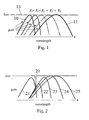
- Figure 1 is a chart illustrating the temperature-dependent gain spectra at threshold for a conventional Pump Laser Diode module.
- this chart illustrates that a) the laser threshold is reached when the gain of the laser reaches the loss value, b) the magnitude of the gain for a given current is a function of the wavelength, and c) as temperature increases, the gain spectrum broadens and the maximum of the gain spectrum shifts to longer wavelengths.
- the spectrum of the gain curve 10 for temperature TI is narrower than the spectrum of gain curve 11 at temperature T5.
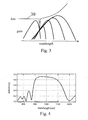
- the loss curve 20 is no longer a straight line. Instead, it has a narrow dip at the 980nm wavelength of FBG.
- the gain curves 21, 22 and 23 of Figure 2 all touch the loss curve at lower than maximum gain.
- the result is that the emission wavelength of the laser is equal to 980nm for each of these 3 wavelengths. In other words, the laser is locked to 980nm in a particular temperature range. It will be understood by those skilled in the art that the same principle is applicable to various emission wavelength regimes and semiconductor laser diode materials, i.e. InGaAsP, GaN, etc.
- the present invention changes the operating range of a pump diode laser.
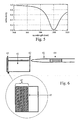
- an FBG is employed to provide an initial locking range and then the loss level of the pump laser is increased for longer wavelengths (e.g. higher temperatures). This is illustrated in the chart of Figure 3.
- spectra curves for a laser with FBG are shown with a modified loss curve 30.
- the loss level 30 is made to increase for wavelengths longer than the required emission wavelength, e.g. 980nm in the present embodiment. This provides an opportunity to pump the diode harder at higher temperatures to get enough gain for lasing at the FBG wavelength and still be below the loss level 30 even when the gain curve reaches its maximum.
- the laser diode can be locked to FBG wavelength in a wider temperature range.
- Figure 4 shows the change of reflectivity spectrum of a nine-layer Si/SiO2 stack in the wavelength region 940nm - 1020nm. In this, mirror reflectivity drops to zero over a 20nm wavelength span (i.e. from 980nm to 1000nm). This leads to a significant increase in the loss value for longer wavelengths of the required gain spectra. This loss increase suppresses unlocking of the FBG-coupled laser in a higher temperature range.
- FIG. 6 illustrates a block diagram of a laser diode having a Fabry-Perot cavity formed by coated laser facets according to the present invention.
- the waveguide 61 of the laser diode is provided with a front facet coating 62 adapted to receive light via an optical fiber coupler 63.
- Wavelength stabilisation is provided by means of a Fiber-Bragg grating 64.
- the waveguide 61 also includes a reflective back facet laser coating 65 formed from a dielectric mirror stack 67.
- the dielectric mirror stack 67 provides additional wavelength stabilization by modifying the reflectivity of the back facet, such that the back facet 65 offers a high reflectivity at the FBG operating wavelength and low reflectivity at wavelengths longer than the FBG-stabilized emission wavelength.
Landscapes
- Physics & Mathematics (AREA)
- Condensed Matter Physics & Semiconductors (AREA)
- General Physics & Mathematics (AREA)
- Electromagnetism (AREA)
- Optics & Photonics (AREA)
- Semiconductor Lasers (AREA)
Abstract
Description
- This invention relates generally to Laser Diodes and more particularly to Pump Laser Diodes offering improved wavelength stability through use of Fabry-Perot cavity and Fiber Bragg Gratings.
- Laser diodes, which are used as pumps at an operating wavelength of approximately 980nm in erbium-doped fiber amplifiers, are stabilized around this wavelength for efficient pumping. However, the emission wavelength of the laser with a conventional Fabry-Perot cavity formed by laser facets tends to change with the temperature of the laser. The temperature change can be environmental and/or induced by the Joule heating of the diode at increased forward currents.
- The document EP-A-0991153 discloses a semiconductor laser module comprising a laser diode with coated facets coupled to an optical fiber with a Fiber Bragg Grating.
- According to a first aspect of the present invention, there is provided a semiconductor laser module, comprising: a semiconductor laser diode incorporating a waveguide having a front coated laser facet and a back reflective coated laser facet which together form a Fabry-Perot cavity, and a wavelength stabilizer optically coupled to the Fabry-Perot cavity including a Bragg Grating (BG) or a Fiber Bragg Grating (FBG), characterised in that the back reflective coated laser facet is specially adapted to provide greater reflectivity at a required emission wavelength than at wavelengths greater than the emission wavelength so as to provide an output locked to the emission wavelength at higher temperatures than would otherwise be possible.
- The mirror optical losses at the facets may accordingly be made to increase for wavelengths longer than the required emission wavelength, thus permitting the diode to be locked to the emission wavelength while operating at higher temperatures and providing wavelength stability.
- In a development of the invention, a stack of materials with different refractive indices is deposited on the back facet of the laser diode.
- Other aspects and features of the present invention will become apparent to those ordinarily skilled in the art upon review of the following description of specific embodiments of the invention in conjunction with the accompanying figures.
- In order that the invention may be more fully understood, preferred embodiments of the invention will now be described, by way of example, with reference to the accompanying drawings, in which:
- Figure 1 is a graph illustrating the temperature-dependent gain spectra at threshold for a Fabry-Perot pump laser diode;
- Figure 2 is a graph illustrating the temperature-dependent gain spectra for a Fabry-Perot laser with Fiber Bragg Grating (FBG) feedback;
- Figure 3 is a graph illustrating a temperature-dependent gain spectra for a laser with FBG feedback and a modified loss curve;
- Figure 4 is a graph of a typical back facet reflectivity curve;
- Figure 5 is a graph of a wavelength-shifted reflectivity of a nine-layer Si/SiO2 stack; and
- Figure 6 is a diagram illustrating a semiconductor laser diode having a Fabry-Perot cavity formed by coated laser facets according to the present invention.
- Figure 1 is a chart illustrating the temperature-dependent gain spectra at threshold for a conventional Pump Laser Diode module. In general, this chart illustrates that a) the laser threshold is reached when the gain of the laser reaches the loss value, b) the magnitude of the gain for a given current is a function of the wavelength, and c) as temperature increases, the gain spectrum broadens and the maximum of the gain spectrum shifts to longer wavelengths. As an example, in Figure 1, the spectrum of the
gain curve 10 for temperature TI is narrower than the spectrum ofgain curve 11 at temperature T5. - Along with the gain maximum shifting to longer wavelengths with increasing temperature, the emission wavelength increases with increasing temperature. The magnitude of this shift for a temperature range of 0°C - 75°C could be as high as 40nm. This is not desirable for the pump laser diodes.
- To stabilize the laser diode emission at a given wavelength, say 980nm, a fiber Bragg grating (FBG) is used in the pump modules. In these modules part of the light launched from the pump module into the output fiber reflects back from the FBG into the laser. In a 980nm FBG pump laser, since FBG is reflective in only a very narrow wavelength range around 980nm, this reflection selectively decreases the laser output loss at this wavelength. This is schematically illustrated in Figure 2, which shows the threshold gain spectra for the laser with FBG.
- With the use of the FBG, the
loss curve 20 is no longer a straight line. Instead, it has a narrow dip at the 980nm wavelength of FBG. As a result, thegain curves - However, even with the use of FBG, the characteristics are more like those of Figure 1 for
curves - The present invention changes the operating range of a pump diode laser. In a preferred embodiment, an FBG is employed to provide an initial locking range and then the loss level of the pump laser is increased for longer wavelengths (e.g. higher temperatures). This is illustrated in the chart of Figure 3.
- In Figure 3, spectra curves for a laser with FBG are shown with a modified
loss curve 30. In this arrangement, theloss level 30 is made to increase for wavelengths longer than the required emission wavelength, e.g. 980nm in the present embodiment. This provides an opportunity to pump the diode harder at higher temperatures to get enough gain for lasing at the FBG wavelength and still be below theloss level 30 even when the gain curve reaches its maximum. Thus the laser diode can be locked to FBG wavelength in a wider temperature range. - Modification of the
loss level 30 can be achieved as follows. It is known that the loss in laser diode (a) is in general the sum of internal loss and mirror loss. This is described as:
wherein - ai
- is the internal loss
- am
- is the mirror loss
- L
- is cavity length
- R1
- is the reflectivity of the front mirror 62 (Figure 6) and
- R2
- is the reflectivity of back mirror 65 (Figure 6).
- Internal loss ai is mostly determined by free carrier absorption. It is relatively wavelength independent in the required spectral range. However, the mirror reflectivity can drastically depend on the wavelength. Consider the reflectivity R2 of the
back mirror 65 in Figure 6. Theback mirror 65 in a typical pump laser device can have a reflectivity R2 of approximately 0.9 - 0.98. To achieve this reflectivity a quarter-wavelength stack ofmaterials 67 with different refractive indices is deposited on theback facet 65 of the laser. An example of reflectivity spectrum for a seven-layer quarter-wavelength stack with design wavelength at 980nm is presented in Figure 4. - In Figure 4, the change of reflectivity is minimal at 980nm ± 20nm. This means that the loss level in this interval is practically wavelength-independent. But those skilled in the art will recognize that the transition from high to low reflectivity on this reflectivity curve is very steep both on the short and long wavelength shoulders of the curve. Thus, if these regions of steep reflectivity change fall to the spectral interval of interest, increasing losses for undesirable wavelengths is achieved. As an example, Figure 5 shows the reflectivity spectrum of a nine-layer Si/SiO2 stack in the wavelength region 940nm - 1020nm. In this, mirror reflectivity drops to zero over a 20nm wavelength span (i.e. from 980nm to 1000nm). This leads to a significant increase in the loss value for longer wavelengths of the required gain spectra. This loss increase suppresses unlocking of the FBG-coupled laser in a higher temperature range.
- Figure 6 illustrates a block diagram of a laser diode having a Fabry-Perot cavity formed by coated laser facets according to the present invention. The
waveguide 61 of the laser diode is provided with afront facet coating 62 adapted to receive light via anoptical fiber coupler 63. Wavelength stabilisation is provided by means of a Fiber-Bragg grating 64. Thewaveguide 61 also includes a reflective backfacet laser coating 65 formed from adielectric mirror stack 67. Thedielectric mirror stack 67 provides additional wavelength stabilization by modifying the reflectivity of the back facet, such that theback facet 65 offers a high reflectivity at the FBG operating wavelength and low reflectivity at wavelengths longer than the FBG-stabilized emission wavelength. - It will be recognized by those skilled in the art that other materials or materials with modified properties can be used for desired reflectivity modification at various wavelengths. In addition, with low front facet reflectivities, a slight decrease of back facet reflectivity, here at 980nm, does not bring noticeable decrease in the power emitted from the front facet.
Claims (10)
- A semiconductor laser module, comprising: a semiconductor laser diode incorporating a waveguide (61) having a front coated laser facet (62) and a back reflective coated laser facet (65) which together form a Fabry-Perot cavity, and a wavelength stabilizer optically coupled to the Fabry-Perot cavity including a Bragg Grating (BG) or a Fiber Bragg Grating (FBG) (65), characterised in that the back reflective coated laser facet (65) is specially adapted to provide greater reflectivity at a required emission wavelength than at wavelengths greater than the emission wavelength so as to provide an output locked to the emission wavelength at higher temperatures than would otherwise be possible.
- The semiconductor laser module according to Claim 1, wherein the required emission wavelength is a range of predetermined wavelengths.
- The semiconductor laser module according to Claim 1 or 2, wherein the back reflective coated laser facet (65) also provides greater reflectivity at the required emission wavelength than at wavelengths less than the emission wavelength.
- The semiconductor laser module according to any preceding claim, wherein the back reflective coated laser facet (65) has a mirror optical loss associated with it, and said mirror optical loss is increased for wavelengths longer than a predetermined emission wavelength.
- The semiconductor laser module according to Claim 4, wherein the mirror optical loss is also increased for wavelengths less than the predetermined emission wavelength.
- The semiconductor laser module according to any preceding claim, wherein the back reflective coated laser facet (65) has a mirror optical loss associated with it, and the mirror optical loss is increased at a wavelength that is not the emission wavelength.
- The semiconductor laser module according to Claim 6, wherein the mirror optical loss is increased at all wavelengths that are not the emission wavelength.
- The semiconductor laser module according to Claim 6, wherein the mirror optical loss is increased at all wavelengths greater than the emission wavelength.
- The semiconductor laser module according to Claim 6, wherein the mirror optical loss is increased at all wavelengths less than the emission wavelength.
- The semiconductor laser module according to any preceding claim, wherein the back reflective coated laser facet (65) comprises a dielectric mirror stack (67).
Applications Claiming Priority (3)
| Application Number | Priority Date | Filing Date | Title |
|---|---|---|---|
| US242497 | 1981-03-10 | ||
| US10/242,497 US6819702B2 (en) | 2002-09-11 | 2002-09-11 | Pump laser diode with improved wavelength stability |
| PCT/GB2003/003820 WO2004025795A1 (en) | 2002-09-11 | 2003-09-03 | Pump laser diode with improved wavelength stability |
Publications (2)
| Publication Number | Publication Date |
|---|---|
| EP1540787A1 EP1540787A1 (en) | 2005-06-15 |
| EP1540787B1 true EP1540787B1 (en) | 2007-05-16 |
Family
ID=31991422
Family Applications (1)
| Application Number | Title | Priority Date | Filing Date |
|---|---|---|---|
| EP03795059A Expired - Lifetime EP1540787B1 (en) | 2002-09-11 | 2003-09-03 | Semiconductor laser module with improved wavelength stability |
Country Status (5)
| Country | Link |
|---|---|
| US (1) | US6819702B2 (en) |
| EP (1) | EP1540787B1 (en) |
| AU (1) | AU2003260776A1 (en) |
| DE (1) | DE60313877D1 (en) |
| WO (1) | WO2004025795A1 (en) |
Cited By (1)
| Publication number | Priority date | Publication date | Assignee | Title |
|---|---|---|---|---|
| CN102292533A (en) * | 2009-01-26 | 2011-12-21 | 米歇尔·纳哈姆京 | CAES Power Plant Using Humidified Air in Bottom Cycle Expander |
Families Citing this family (30)
| Publication number | Priority date | Publication date | Assignee | Title |
|---|---|---|---|---|
| US7361171B2 (en) | 2003-05-20 | 2008-04-22 | Raydiance, Inc. | Man-portable optical ablation system |
| US8173929B1 (en) | 2003-08-11 | 2012-05-08 | Raydiance, Inc. | Methods and systems for trimming circuits |
| US9022037B2 (en) | 2003-08-11 | 2015-05-05 | Raydiance, Inc. | Laser ablation method and apparatus having a feedback loop and control unit |
| US8921733B2 (en) | 2003-08-11 | 2014-12-30 | Raydiance, Inc. | Methods and systems for trimming circuits |
| US20090310634A1 (en) * | 2004-04-27 | 2009-12-17 | Oclaro | Stabilized laser source with very high relative feedback and narrow bandwidth |
| US20070263676A1 (en) * | 2004-06-24 | 2007-11-15 | Koheras A/S | System Comprising a Low Phase Noise Waveguide Laser, a Method of Its Manufacturing and Its Use |
| US8135050B1 (en) | 2005-07-19 | 2012-03-13 | Raydiance, Inc. | Automated polarization correction |
| US7245419B2 (en) | 2005-09-22 | 2007-07-17 | Raydiance, Inc. | Wavelength-stabilized pump diodes for pumping gain media in an ultrashort pulsed laser system |
| US7308171B2 (en) | 2005-11-16 | 2007-12-11 | Raydiance, Inc. | Method and apparatus for optical isolation in high power fiber-optic systems |
| US7436866B2 (en) | 2005-11-30 | 2008-10-14 | Raydiance, Inc. | Combination optical isolator and pulse compressor |
| US8189971B1 (en) | 2006-01-23 | 2012-05-29 | Raydiance, Inc. | Dispersion compensation in a chirped pulse amplification system |
| US7444049B1 (en) | 2006-01-23 | 2008-10-28 | Raydiance, Inc. | Pulse stretcher and compressor including a multi-pass Bragg grating |
| US9130344B2 (en) | 2006-01-23 | 2015-09-08 | Raydiance, Inc. | Automated laser tuning |
| US8232687B2 (en) | 2006-04-26 | 2012-07-31 | Raydiance, Inc. | Intelligent laser interlock system |
| US7822347B1 (en) | 2006-03-28 | 2010-10-26 | Raydiance, Inc. | Active tuning of temporal dispersion in an ultrashort pulse laser system |
| JP2008244300A (en) * | 2007-03-28 | 2008-10-09 | Mitsubishi Electric Corp | Semiconductor laser |
| US7903326B2 (en) | 2007-11-30 | 2011-03-08 | Radiance, Inc. | Static phase mask for high-order spectral phase control in a hybrid chirped pulse amplifier system |
| US8125704B2 (en) | 2008-08-18 | 2012-02-28 | Raydiance, Inc. | Systems and methods for controlling a pulsed laser by combining laser signals |
| JP5484592B2 (en) * | 2010-01-08 | 2014-05-07 | オクラロ テクノロジー リミテッド | High linear power laser system |
| US9114482B2 (en) | 2010-09-16 | 2015-08-25 | Raydiance, Inc. | Laser based processing of layered materials |
| US8554037B2 (en) | 2010-09-30 | 2013-10-08 | Raydiance, Inc. | Hybrid waveguide device in powerful laser systems |
| GB2484334A (en) * | 2010-10-07 | 2012-04-11 | Oclaro Technology Ltd | Semiconductor laser device and method for stabilising the wavelength of a semiconductor laser device |
| US8573785B2 (en) * | 2010-11-23 | 2013-11-05 | Corning Incorporated | Wavelength-switched optical systems |
| US9184564B2 (en) * | 2013-06-07 | 2015-11-10 | Ngk Insulators, Ltd. | External resonator type light emitting system |
| US9331454B2 (en) | 2013-11-27 | 2016-05-03 | Ngk Insulators, Ltd. | External resonator type light emitting system |
| CN105765802B (en) | 2013-11-27 | 2020-01-07 | 日本碍子株式会社 | External resonator type light emitting device |
| US10186829B2 (en) | 2016-05-10 | 2019-01-22 | Ii-Vi Incorporated | Compact laser source with wavelength stabilized output |
| CN115461946B (en) * | 2020-04-24 | 2025-12-12 | Ams-欧司朗国际有限公司 | Semiconductor lasers and lidar systems incorporating semiconductor lasers, as well as laser systems |
| US20240243548A1 (en) * | 2023-01-18 | 2024-07-18 | Ii-Vi Delaware, Inc. | Multi-junction laser diode with improved wavelength stability |
| US12664999B1 (en) * | 2025-03-18 | 2026-06-23 | Seagate Technology Llc | Laser diode for heat-assisted magnetic recording, and related apparatuses, devices, systems, and methods |
Family Cites Families (10)
| Publication number | Priority date | Publication date | Assignee | Title |
|---|---|---|---|---|
| US4358851A (en) * | 1980-02-28 | 1982-11-09 | Xerox Corporation | Fiber optic laser device and light emitter utilizing the device |
| JPS58110087A (en) | 1981-12-24 | 1983-06-30 | Fujitsu Ltd | Semiconductor laser device |
| US5056099A (en) | 1990-09-10 | 1991-10-08 | General Dynamics Corp., Electronics Division | Rugate filter on diode laser for temperature stabilized emission wavelength |
| US5978400A (en) * | 1995-03-07 | 1999-11-02 | British Telecommunications Public Limited Company | Laser |
| US6021141A (en) * | 1996-03-29 | 2000-02-01 | Sdl, Inc. | Tunable blue laser diode |
| EP0898345A3 (en) * | 1997-08-13 | 2004-01-02 | Mitsubishi Chemical Corporation | Compound semiconductor light emitting device and method of fabricating the same |
| JPH11214799A (en) | 1998-01-26 | 1999-08-06 | Furukawa Electric Co Ltd:The | Semiconductor laser module |
| ITTO980306A1 (en) * | 1998-04-10 | 1999-10-10 | Cselt Centro Studi Lab Telec O | EXTERNAL CAVITY LASER MODULE WITH FIBER OPTIC REFLECTOR. |
| US6693946B2 (en) * | 2001-07-05 | 2004-02-17 | Lucent Technologies Inc. | Wavelength-tunable lasers |
| US6778583B2 (en) * | 2001-09-21 | 2004-08-17 | Adc Telecommunications, Inc. | Three-cavity stabilized laser system |
-
2002
- 2002-09-11 US US10/242,497 patent/US6819702B2/en not_active Expired - Lifetime
-
2003
- 2003-09-03 WO PCT/GB2003/003820 patent/WO2004025795A1/en not_active Ceased
- 2003-09-03 AU AU2003260776A patent/AU2003260776A1/en not_active Abandoned
- 2003-09-03 DE DE60313877T patent/DE60313877D1/en not_active Expired - Lifetime
- 2003-09-03 EP EP03795059A patent/EP1540787B1/en not_active Expired - Lifetime
Cited By (1)
| Publication number | Priority date | Publication date | Assignee | Title |
|---|---|---|---|---|
| CN102292533A (en) * | 2009-01-26 | 2011-12-21 | 米歇尔·纳哈姆京 | CAES Power Plant Using Humidified Air in Bottom Cycle Expander |
Also Published As
| Publication number | Publication date |
|---|---|
| EP1540787A1 (en) | 2005-06-15 |
| US6819702B2 (en) | 2004-11-16 |
| WO2004025795A1 (en) | 2004-03-25 |
| DE60313877D1 (en) | 2007-06-28 |
| AU2003260776A1 (en) | 2004-04-30 |
| US20040047390A1 (en) | 2004-03-11 |
Similar Documents
| Publication | Publication Date | Title |
|---|---|---|
| US6819702B2 (en) | Pump laser diode with improved wavelength stability | |
| EP0860917B1 (en) | Semiconductor laser module | |
| US5022042A (en) | High power laser array with stable wavelength | |
| US7103081B2 (en) | DFB laser with ar coating selected to provide wide temperature range of operation | |
| US8121169B2 (en) | Split control of front and rear DBR grating portions | |
| US6243404B1 (en) | Laser module with adjustable operating temperature range | |
| US6614822B2 (en) | Semiconductor laser devices, and semiconductor laser modules and optical communication systems using the same | |
| CA2285046A1 (en) | Semiconductor laser module | |
| EP1067644A1 (en) | Semiconductor laser module | |
| US7099361B2 (en) | Laser source with high relative feedback and method for making such a laser source | |
| US20020136254A1 (en) | Semiconductor laser devices, and semiconductor laser modules and optical communication systems using the same | |
| US6647046B1 (en) | Mode-selective facet layer for pump laser | |
| US20020097772A1 (en) | Stabilized optical pump laser | |
| EP0276071A2 (en) | Hybrid laser for optical communications | |
| EP1317034A2 (en) | Semiconductor laser comprising low reflectivity coatings | |
| KR100754956B1 (en) | Semiconductor laser device and laser system | |
| EP1780848B1 (en) | Signal band antireflection coating for laser diode pump facet | |
| Sumpf et al. | Comparison of electro-optical, spectral, and spatial beam parameters of 785 nm DBR tapered lasers with different grating lengths | |
| US20250055254A1 (en) | Semiconductor Laser | |
| US6952437B1 (en) | Laser with wide operating temperature range | |
| US7242698B2 (en) | Wavelength tunable laser with dispersive element | |
| KR101445675B1 (en) | Transmitter optical sub-assembly | |
| JP4595711B2 (en) | Semiconductor laser | |
| Theurer et al. | Investigation of bent DBR-RW Laser Diodes emitting at 785 nm | |
| Viheriälä et al. | High Peak Power Laser Diodes for Eye Safe LIDAR with Integrated Wavelength Locking Element |
Legal Events
| Date | Code | Title | Description |
|---|---|---|---|
| PUAI | Public reference made under article 153(3) epc to a published international application that has entered the european phase |
Free format text: ORIGINAL CODE: 0009012 |
|
| 17P | Request for examination filed |
Effective date: 20050407 |
|
| AK | Designated contracting states |
Kind code of ref document: A1 Designated state(s): AT BE BG CH CY CZ DE DK EE ES FI FR GB GR HU IE IT LI LU MC NL PT RO SE SI SK TR |
|
| AX | Request for extension of the european patent |
Extension state: AL LT LV MK |
|
| DAX | Request for extension of the european patent (deleted) | ||
| RBV | Designated contracting states (corrected) |
Designated state(s): DE FR GB |
|
| RAP1 | Party data changed (applicant data changed or rights of an application transferred) |
Owner name: BOOKHAM TECHNOLOGY PLC |
|
| RTI1 | Title (correction) |
Free format text: SEMICONDUCTOR LASER MODULE WITH IMPROVED WAVELENGTH STABILITY |
|
| GRAP | Despatch of communication of intention to grant a patent |
Free format text: ORIGINAL CODE: EPIDOSNIGR1 |
|
| GRAS | Grant fee paid |
Free format text: ORIGINAL CODE: EPIDOSNIGR3 |
|
| GRAA | (expected) grant |
Free format text: ORIGINAL CODE: 0009210 |
|
| AK | Designated contracting states |
Kind code of ref document: B1 Designated state(s): DE FR GB |
|
| REG | Reference to a national code |
Ref country code: GB Ref legal event code: FG4D |
|
| REF | Corresponds to: |
Ref document number: 60313877 Country of ref document: DE Date of ref document: 20070628 Kind code of ref document: P |
|
| EN | Fr: translation not filed | ||
| PLBE | No opposition filed within time limit |
Free format text: ORIGINAL CODE: 0009261 |
|
| STAA | Information on the status of an ep patent application or granted ep patent |
Free format text: STATUS: NO OPPOSITION FILED WITHIN TIME LIMIT |
|
| 26N | No opposition filed |
Effective date: 20080219 |
|
| PG25 | Lapsed in a contracting state [announced via postgrant information from national office to epo] |
Ref country code: DE Free format text: LAPSE BECAUSE OF FAILURE TO SUBMIT A TRANSLATION OF THE DESCRIPTION OR TO PAY THE FEE WITHIN THE PRESCRIBED TIME-LIMIT Effective date: 20070817 |
|
| GBPC | Gb: european patent ceased through non-payment of renewal fee |
Effective date: 20070903 |
|
| PG25 | Lapsed in a contracting state [announced via postgrant information from national office to epo] |
Ref country code: FR Free format text: LAPSE BECAUSE OF FAILURE TO SUBMIT A TRANSLATION OF THE DESCRIPTION OR TO PAY THE FEE WITHIN THE PRESCRIBED TIME-LIMIT Effective date: 20080111 |
|
| PG25 | Lapsed in a contracting state [announced via postgrant information from national office to epo] |
Ref country code: GB Free format text: LAPSE BECAUSE OF NON-PAYMENT OF DUE FEES Effective date: 20070903 |