EP1538876A2 - Equipment for collection and measurement of quadraphonic sound data and metadata as well as a corresponding recording procedure - Google Patents
Equipment for collection and measurement of quadraphonic sound data and metadata as well as a corresponding recording procedure Download PDFInfo
- Publication number
- EP1538876A2 EP1538876A2 EP04425909A EP04425909A EP1538876A2 EP 1538876 A2 EP1538876 A2 EP 1538876A2 EP 04425909 A EP04425909 A EP 04425909A EP 04425909 A EP04425909 A EP 04425909A EP 1538876 A2 EP1538876 A2 EP 1538876A2
- Authority
- EP
- European Patent Office
- Prior art keywords
- quadraphonic
- acoustic
- sound
- metadata
- recording
- Prior art date
- Legal status (The legal status is an assumption and is not a legal conclusion. Google has not performed a legal analysis and makes no representation as to the accuracy of the status listed.)
- Withdrawn
Links
Images


Classifications
-
- H—ELECTRICITY
- H04—ELECTRIC COMMUNICATION TECHNIQUE
- H04S—STEREOPHONIC SYSTEMS
- H04S3/00—Systems employing more than two channels, e.g. quadraphonic
-
- G—PHYSICS
- G11—INFORMATION STORAGE
- G11B—INFORMATION STORAGE BASED ON RELATIVE MOVEMENT BETWEEN RECORD CARRIER AND TRANSDUCER
- G11B20/00—Signal processing not specific to the method of recording or reproducing; Circuits therefor
- G11B20/00992—Circuits for stereophonic or quadraphonic recording or reproducing
-
- H—ELECTRICITY
- H04—ELECTRIC COMMUNICATION TECHNIQUE
- H04H—BROADCAST COMMUNICATION
- H04H60/00—Arrangements for broadcast applications with a direct linking to broadcast information or broadcast space-time; Broadcast-related systems
- H04H60/02—Arrangements for generating broadcast information; Arrangements for generating broadcast-related information with a direct linking to broadcast information or to broadcast space-time; Arrangements for simultaneous generation of broadcast information and broadcast-related information
- H04H60/04—Studio equipment; Interconnection of studios
-
- H—ELECTRICITY
- H04—ELECTRIC COMMUNICATION TECHNIQUE
- H04S—STEREOPHONIC SYSTEMS
- H04S3/00—Systems employing more than two channels, e.g. quadraphonic
- H04S3/002—Non-adaptive circuits, e.g. manually adjustable or static, for enhancing the sound image or the spatial distribution
-
- H—ELECTRICITY
- H04—ELECTRIC COMMUNICATION TECHNIQUE
- H04R—LOUDSPEAKERS, MICROPHONES, GRAMOPHONE PICK-UPS OR LIKE ACOUSTIC ELECTROMECHANICAL TRANSDUCERS; ELECTRIC HEARING AIDS; PUBLIC ADDRESS SYSTEMS
- H04R27/00—Public address systems
-
- H—ELECTRICITY
- H04—ELECTRIC COMMUNICATION TECHNIQUE
- H04S—STEREOPHONIC SYSTEMS
- H04S2420/00—Techniques used stereophonic systems covered by H04S but not provided for in its groups
- H04S2420/03—Application of parametric coding in stereophonic audio systems
-
- H—ELECTRICITY
- H04—ELECTRIC COMMUNICATION TECHNIQUE
- H04S—STEREOPHONIC SYSTEMS
- H04S7/00—Indicating arrangements; Control arrangements, e.g. balance control
- H04S7/30—Control circuits for electronic adaptation of the sound field
Definitions
- the present invention concerns the equipment and process for the collection (acquisition) of acoustic information using the measurement of quadraphonic sound data and metadata.
- the invention falls under the acoustics field and is applicable in all those cases in which the acoustic analysis of an environment is required, such as, for example, a concert hall, a recording studio or in an environment in which the data relative to natural events has to be measured.
- the equipment in question has the advantage of providing an objective assessment of the "quadraphonic high fidelity" during the reproduction phase. This is obtained since the data, which are coded during the recording session, are provided with metadata ("data about data") - for which a definition is given below - and enables new standards to be defined for the industrial process of storing and reproduction of the sound, based on fixed objective criteria which define its acoustic fidelity.
- quadrature sound defines the technological process by which the collection of four specific audio signals and their subsequent numerical processing enables identification, in a physically rigorous manner, of the mechanical status of a sound at every moment in time and in an arbitrary point in space in the field of sound.
- This identification is made possible by the recording of a particular set of solutions of the sound wave equations.
- This set which is also called the 4-momentum of the sound, is formed by four audio tracks which have particular transformation properties, in the acoustic space-time, constituting an entity which in mathematical physics is known by the name of four-vector.
- the components of the sound 4-momentum coincide, apart from a proportionality factor which depends on the elastic properties of the medium, with four acoustic magnitudes: the first is known by the name of acoustic pressure and the other three are the ordinary vectorial components of the acoustic speed of the particles of air in the three-dimensional physical space.
- the electro-acoustic transduction and the collection and storage of the four signals corresponding to these acoustic magnitudes, for the duration of the sound emission, defines the recording process of the sound event, according to the principles of quadraphonic sound.
- the quadraphonic sound process assumes that the physical nature of the sound may be completely described only in terms of pressure-velocity waves which are linked together, in a similar manner as for light which, as is known, may be physically described in terms of electro-magnetic waves.
- the recording of the four audio tracks corresponding to the sound 4-momentum ("data" of the quadraphonic sound) therefore constitutes the real physical code of the sound which may be subsequently reproduced by suitable "quadraphonic high fidelity systems" designed to resynthesize the recorded sound event, either really (by the electro-acoustic diffusion of the sound in the environment) or virtually (by the acoustic auralization process).
- the data coded during the recording session are provided with quadraphonic sound “metadata” ("data about data”) which must be collected and measured during the recording session itself.
- the quadraphonic sound "metadata” are obtained by the collection and storage of the signals corresponding to the spatial propagators of the quad-impulse (response to the quadraphonic sound pulse) of an ideal acoustic system associated to the real one and formed by: a) a point pulse source located in the field near the real source, b) the real environment where the real sound event takes place, c) the same quadraphonic microphone already used for the recording of the data and placed at the same point in the environment.
- the response to the quadraphonic sound pulse is numerically processed and, from this, indirect measurements are made of a set of primary energetic indicators of the acoustic field associated with the sound event.
- the response to the quadraphonic sound pulse together with the values of the indicators derived from it defines the quadraphonic sound metadata.
- the quadraphonic sound metadata contains all the information necessary for the localisation of ideal sources in virtual environments and the modification of the timbre characteristics of the sources with regard to the spectral characteristics of the environment itself (acoustic virtual reality).
- the metadata calculated from the response to the quadraphonic sound pulse is obtained in the form of "indicators", i.e. non-dimensional quantities between 0 and 1 obtained from various magnitudes characterising the transport of the acoustic energy in the pressure-velocity fields. These measure the extreme properties of the field: if a certain property corresponds to value 0, the extreme opposite property corresponds to value 1.
- these indicators are derived from various forms of processing of the signals, which correspond to the second order of the instantaneous acoustic magnitudes that define the sound quad-impulse recorded locally in a certain position of the sound environment (ideal listening point) and generated by an ideal acoustic pulse source placed in strategically selected positions to simulate the correct perception of the average spatial characteristics of the sound (origin of the sound, localisation of the source, apparent size of the source, average shape and dimensions of the environment, etc).
- the recording procedure is described below to make the invention more easily understandable.
- the procedure for recording the quadraphonic sound data starts by selecting the position of the quadraphonic microphone inside the acoustic environment in which the recording of any sound is to be made. There may be a wide range of reasons for the selection of the position and the series of operational decisions for the quadraphonic sound recording should be written as a sort of script which is available to the sound engineer who supervises the recording of the sound event.
- the quadraphonic microphone must function as an ideal probe for the synchronous acoustic-electrical transduction at each moment in time t of the 4 analogue signals of the instantaneous acoustic pressure and the three components of the instantaneous acoustic speed of the air particle for the entire duration of the sound event to be recorded.
- ⁇ 0 is the density of air in the absence of acoustic disturbance.
- the 4 audio tracks represented by expression (1) completely define, from a mechanical point of view, the sound event at the point r M .
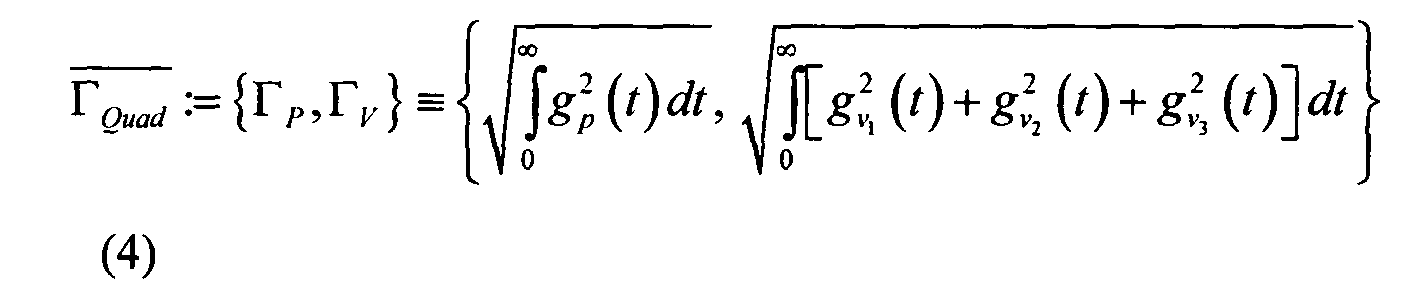
- ⁇ Quad ⁇ g p , g v1 ,g v2 , g v3 ⁇ which determines the convolution process (3) is formed by 4 sound signals corresponding to the 4 "pulse responses", of which the first, g p , is the acoustic pressure and the remaining three, g v1 ,g v2 ,g v3 , are the three components of the acoustic velocity.
- the four responses are the effect (sound event) received at the point r M as a result of a pulse type excitation (e.g. an ideal "gun shot”) which is mathematically represented by a space-time Dirac delta function: ⁇ (r S , t 0 ) .
- the Dirac delta function is the particular mathematical form which must be attributed to the acoustic pressure signal S p ( ⁇ ) generated by the virtual point source placed at the point r S at the specific time to when the shot occurs.
- ⁇ Quad is measured in the same position r M and by the same microphone used for the quadraphonic sound recording session, it constitutes the four-dimensional propagator of the acoustic field associated with the quadraphonic sound recording process.
- the quadraphonic propagator ⁇ Quad obtained as described above constitutes one of the elements of M Quad of the quadraphonic sound metadata which will be completely defined in the following point.
- the physical magnitude which best interprets the concept of energetic transport which occurs at a point of the field of sound is the acoustic intensity vector.
- S indicates the acoustic source (position r s ); 2a indicates four analogical signals and 3a indicates four digital signals.
- the device for the measurement of the quadraphonic propagator ⁇ Quad ⁇ ⁇ g p ,g v1 ,g v2 g v3 ⁇ shown in Fig. 2 is constituted by an element for the generation of the monophonic test signal 7 (sound pressure) with uniform spectral content; an acoustic-electrical transducer 8; an acoustic source in r s S1; a test environment: acoustic field in r M 9; a quadraphonic recording device 10; a processing system 11 which carries out the cross-correlation algorithm between the quadraphonic test-response signals; a storage element 12; 13 indicates the quadraphonic response to the test signal and 14 indicates the quadri-pulse ⁇ Quad .
- the block diagram in Fig. 3 relative to the processing (indirect measurement) of the quadraphonic metadata is constituted by:
Landscapes
- Engineering & Computer Science (AREA)
- Signal Processing (AREA)
- Physics & Mathematics (AREA)
- Acoustics & Sound (AREA)
- Measurement Of Mechanical Vibrations Or Ultrasonic Waves (AREA)
Abstract
Description
- as control parameters for any active electro-acoustic sound control devices
- for optimisation of the acoustic communication
- for noise reduction.



Claims (5)
- Equipment for the recording and measurement of quadraphonic sound data and metadata, characterised by the fact of being constituted by a device for quadraphonic sound recording, a device for the measurement of quadraphonic propagators, and a unit for the processing of acoustic data for the indirect measurement of acoustic metadata.
- Equipment for the recording and measurement of quadraphonic sound data and metadata as per Claim 1, characterised by the fact that the device for the recording of the acoustic data is constituted by a quadraphonic probe (1); an electro-acoustic transducer (2); a synchronous multichannel A/D converter (3); a data recording element (4); a data storage element (5); a data visualisation element (6) and an acoustic source S.
- Equipment for the recording and measurement of quadraphonic sound data and metadata as per Claims 1 and 2, characterised by the fact that the device for the measurement of the quadraphonic propagators is constituted by an acoustic source S 1 and by an element for the generation of the monophonic test signal (sound pressure) with uniform spectral content (7); an acoustic-electrical transducer (8); a test environment: acoustic field in rM (9) generated by the source S1; a quadraphonic recording device (10); a processing system which carries out the cross-correlation algorithm between the quadraphonic test-response signals (11); a storage element (12).
- Equipment for the recording and measurement of quadraphonic sound data and metadata as per Claims 1, 2 and 3, characterised by the fact that the measurements carried out are processes with a suitable program to obtain the indirect measurements of the acoustic metadata.
- Equipment for the recording and measurement of quadraphonic sound data and metadata as per Claims 1, 2, 3 and 4, characterised by the fact that the acoustic data may be used in the active electro-acoustic control of the sound, to optimise the acoustic communication and for the quadraphonic auralisation of the sound both in real and virtual environments.
Applications Claiming Priority (2)
| Application Number | Priority Date | Filing Date | Title |
|---|---|---|---|
| ITRM20030559 | 2003-12-03 | ||
| ITRM20030559 ITRM20030559A1 (en) | 2003-12-03 | 2003-12-03 | EQUIPMENT FOR DATA ACQUISITION AND MEASUREMENT E |
Publications (2)
| Publication Number | Publication Date |
|---|---|
| EP1538876A2 true EP1538876A2 (en) | 2005-06-08 |
| EP1538876A3 EP1538876A3 (en) | 2009-04-29 |
Family
ID=34452285
Family Applications (1)
| Application Number | Title | Priority Date | Filing Date |
|---|---|---|---|
| EP04425909A Withdrawn EP1538876A3 (en) | 2003-12-03 | 2004-12-02 | Equipment for collection and measurement of quadraphonic sound data and metadata as well as a corresponding recording procedure |
Country Status (2)
| Country | Link |
|---|---|
| EP (1) | EP1538876A3 (en) |
| IT (1) | ITRM20030559A1 (en) |
Family Cites Families (5)
| Publication number | Priority date | Publication date | Assignee | Title |
|---|---|---|---|---|
| US3890466A (en) * | 1973-02-01 | 1975-06-17 | Cbs Inc | Encoders for quadraphonic sound system |
| EP2009785B1 (en) * | 1998-04-14 | 2010-09-15 | Hearing Enhancement Company, Llc. | Method and apparatus for providing end user adjustment capability that accommodates hearing impaired and non-hearing impaired listener preferences |
| US7266501B2 (en) * | 2000-03-02 | 2007-09-04 | Akiba Electronics Institute Llc | Method and apparatus for accommodating primary content audio and secondary content remaining audio capability in the digital audio production process |
| GB2361098A (en) * | 2000-04-05 | 2001-10-10 | Sony Uk Ltd | Editing system and method using metadata |
| AU2002251896B2 (en) * | 2001-02-07 | 2007-03-22 | Dolby Laboratories Licensing Corporation | Audio channel translation |
-
2003
- 2003-12-03 IT ITRM20030559 patent/ITRM20030559A1/en unknown
-
2004
- 2004-12-02 EP EP04425909A patent/EP1538876A3/en not_active Withdrawn
Also Published As
| Publication number | Publication date |
|---|---|
| EP1538876A3 (en) | 2009-04-29 |
| ITRM20030559A1 (en) | 2005-06-04 |
Similar Documents
| Publication | Publication Date | Title |
|---|---|---|
| KR102370896B1 (en) | Acoustic holographic recording and playback system using metamaterial layer | |
| Lehnert et al. | Principles of binaural room simulation | |
| Das et al. | Room impulse response interpolation from a sparse set of measurements using a modal architecture | |
| JP5024792B2 (en) | Omnidirectional frequency directional acoustic device | |
| CN106255027B (en) | A kind of the sound quality Small Enclosure appraisal procedure and system of non-linear audio system | |
| CN101483797A (en) | Head-related transfer function generation method and apparatus for earphone acoustic system | |
| JP6508539B2 (en) | Sound field collecting apparatus and method, sound field reproducing apparatus and method, and program | |
| Yokoyama et al. | 6-channel recording/reproduction system for 3-dimensional auralization of sound fields | |
| JP2012509632A5 (en) | Converter and method for converting audio signals | |
| JP5000297B2 (en) | System and method for determining a representation of a sound field | |
| JP4293986B2 (en) | Method and system for representing a sound field | |
| Li et al. | Deep learning-based approach for identification and compensation of nonlinear distortions in parametric array loudspeakers | |
| CN119729331A (en) | Audio rendering method, storage medium and electronic device | |
| Klein | Directional room impulse response measurement | |
| Adriaensen | Acoustical impulse response measurement with ALIKI | |
| US12526601B2 (en) | Audio signal processing device generating room impulse response filter using machine learning model | |
| CN110930991B (en) | A far-field speech recognition model training method and device | |
| Bhattacharjee et al. | Sound zone control robust to sound speed change | |
| Okubo et al. | Three-dimensional sound wave propagation reproduction by CE-FDTD simulation applying actual radiation characteristics | |
| Kerimovs | Loudspeaker modelling with recurrent neural networks | |
| Horikoshi et al. | Time-Domain Sound Field Estimation Using 3D-CNN for Sound Field Reproduction | |
| Okubo et al. | Three-dimensional acoustic simulation using actual radiation characteristics with finite-difference time-domain method | |
| Miller | A Hybrid Method for Auralizing Vibroacoustic Systems and Evaluating Audio Fidelity/Sound Quality Using Machine Learning | |
| Sotiropoulou et al. | Comparison of acoustic experience of studio recordings and live concerts | |
| Edwards | Music performance acoustics and room shape: An investigation employing an images model of room acoustics |
Legal Events
| Date | Code | Title | Description |
|---|---|---|---|
| PUAI | Public reference made under article 153(3) epc to a published international application that has entered the european phase |
Free format text: ORIGINAL CODE: 0009012 |
|
| AK | Designated contracting states |
Kind code of ref document: A2 Designated state(s): AT BE BG CH CY CZ DE DK EE ES FI FR GB GR HU IE IS IT LI LT LU MC NL PL PT RO SE SI SK TR |
|
| AX | Request for extension of the european patent |
Extension state: AL BA HR LV MK YU |
|
| PUAL | Search report despatched |
Free format text: ORIGINAL CODE: 0009013 |
|
| AK | Designated contracting states |
Kind code of ref document: A3 Designated state(s): AT BE BG CH CY CZ DE DK EE ES FI FR GB GR HU IE IS IT LI LT LU MC NL PL PT RO SE SI SK TR |
|
| AX | Request for extension of the european patent |
Extension state: AL BA HR LV MK YU |
|
| AKX | Designation fees paid | ||
| STAA | Information on the status of an ep patent application or granted ep patent |
Free format text: STATUS: THE APPLICATION IS DEEMED TO BE WITHDRAWN |
|
| 18D | Application deemed to be withdrawn |
Effective date: 20090701 |
|
| REG | Reference to a national code |
Ref country code: DE Ref legal event code: 8566 |