EP1538788B1 - Smart scan for Bluetooth PAN devices - Google Patents
Smart scan for Bluetooth PAN devices Download PDFInfo
- Publication number
- EP1538788B1 EP1538788B1 EP04025582.0A EP04025582A EP1538788B1 EP 1538788 B1 EP1538788 B1 EP 1538788B1 EP 04025582 A EP04025582 A EP 04025582A EP 1538788 B1 EP1538788 B1 EP 1538788B1
- Authority
- EP
- European Patent Office
- Prior art keywords
- bluetooth device
- remote bluetooth
- scan
- cache
- entry
- Prior art date
- Legal status (The legal status is an assumption and is not a legal conclusion. Google has not performed a legal analysis and makes no representation as to the accuracy of the status listed.)
- Expired - Lifetime
Links
- 238000000034 method Methods 0.000 claims description 38
- 230000000737 periodic effect Effects 0.000 claims description 14
- 230000004044 response Effects 0.000 claims description 5
- 238000010586 diagram Methods 0.000 description 19
- 230000008569 process Effects 0.000 description 14
- 238000005516 engineering process Methods 0.000 description 7
- 230000006855 networking Effects 0.000 description 6
- 230000004048 modification Effects 0.000 description 4
- 238000012986 modification Methods 0.000 description 4
- 238000013459 approach Methods 0.000 description 3
- 230000001413 cellular effect Effects 0.000 description 3
- 238000005538 encapsulation Methods 0.000 description 3
- 239000008186 active pharmaceutical agent Substances 0.000 description 2
- 238000007630 basic procedure Methods 0.000 description 2
- 230000007958 sleep Effects 0.000 description 2
- 241001536563 Panus Species 0.000 description 1
- 230000006978 adaptation Effects 0.000 description 1
- 230000008901 benefit Effects 0.000 description 1
- 230000008859 change Effects 0.000 description 1
- 230000001934 delay Effects 0.000 description 1
- 230000001419 dependent effect Effects 0.000 description 1
- 230000000694 effects Effects 0.000 description 1
- 230000006872 improvement Effects 0.000 description 1
- 230000003287 optical effect Effects 0.000 description 1
- 230000002085 persistent effect Effects 0.000 description 1
- 230000011218 segmentation Effects 0.000 description 1
Images



Classifications
-
- H—ELECTRICITY
- H04—ELECTRIC COMMUNICATION TECHNIQUE
- H04W—WIRELESS COMMUNICATION NETWORKS
- H04W8/00—Network data management
- H04W8/005—Discovery of network devices, e.g. terminals
-
- H—ELECTRICITY
- H04—ELECTRIC COMMUNICATION TECHNIQUE
- H04W—WIRELESS COMMUNICATION NETWORKS
- H04W48/00—Access restriction; Network selection; Access point selection
- H04W48/16—Discovering, processing access restriction or access information
-
- H—ELECTRICITY
- H04—ELECTRIC COMMUNICATION TECHNIQUE
- H04W—WIRELESS COMMUNICATION NETWORKS
- H04W84/00—Network topologies
- H04W84/18—Self-organising networks, e.g. ad-hoc networks or sensor networks
-
- H—ELECTRICITY
- H04—ELECTRIC COMMUNICATION TECHNIQUE
- H04M—TELEPHONIC COMMUNICATION
- H04M1/00—Substation equipment, e.g. for use by subscribers
- H04M1/72—Mobile telephones; Cordless telephones, i.e. devices for establishing wireless links to base stations without route selection
- H04M1/724—User interfaces specially adapted for cordless or mobile telephones
- H04M1/72403—User interfaces specially adapted for cordless or mobile telephones with means for local support of applications that increase the functionality
- H04M1/72409—User interfaces specially adapted for cordless or mobile telephones with means for local support of applications that increase the functionality by interfacing with external accessories
- H04M1/72412—User interfaces specially adapted for cordless or mobile telephones with means for local support of applications that increase the functionality by interfacing with external accessories using two-way short-range wireless interfaces
-
- H—ELECTRICITY
- H04—ELECTRIC COMMUNICATION TECHNIQUE
- H04W—WIRELESS COMMUNICATION NETWORKS
- H04W76/00—Connection management
- H04W76/10—Connection setup
-
- H—ELECTRICITY
- H04—ELECTRIC COMMUNICATION TECHNIQUE
- H04W—WIRELESS COMMUNICATION NETWORKS
- H04W84/00—Network topologies
- H04W84/02—Hierarchically pre-organised networks, e.g. paging networks, cellular networks, WLAN [Wireless Local Area Network] or WLL [Wireless Local Loop]
- H04W84/10—Small scale networks; Flat hierarchical networks
Definitions
- the present invention relates generally to wireless networks for Bluetooth radio-equipped devices, and more particularly to techniques by which a Bluetooth device may discover and connect to other Bluetooth devices.
- Bluetooth is a short-range wireless technology that uses the 2.4 GHz Industrial, Scientific and Medical (ISM) band. Bluetooth is particularly intended for small mobile devices such as notebook computers, mobile phones, and personal digital assistants (PDAs). Pseudo-random frequency-hopping techniques are employed by communicating Bluetooth devices to minimize the effects of signal interference in the ISM band.
- the Bluetooth technology is set forth in detail in Bluetooth Special Interest Group (SIG), Specification of the Bluetooth System (hereinafter "the Bluetooth Specification”), Version 1.0, December 1, 1999 , and Version 1.2, November 5, 2003.
- SIG Bluetooth Special Interest Group
- the Bluetooth Personal Area Networking Profile provides a conceptual basis on which two or more Bluetooth-enabled devices can form and participate in personal area networks (PANs), allowing them to interoperate and exchange data.
- PANs personal area networks
- the PAN Profile describes three roles that a Bluetooth device may perform: Network Access Point (NAP), Group Ad-hoc Network (GN), and Personal Area Network User (PANU).
- NAP and GN correspond to services that may be used by a Bluetooth device operating as a client PANU.
- NAP”, “GN,” and “PANU” will be used hereinafter to refer to the Bluetooth-equipped node providing the respective NAP, GN or PANU service.
- a NAP is a device that contains one or more Bluetooth radio devices and acts as a bridge, proxy or router to a second network (such as a 10BaseT Ethernet LAN) with respect to one or more PANUs with a Bluetooth wireless connection to the NAP. Each such PANU thereby may gain access to the second network's shared resources.
- a GN is a collection of Bluetooth devices that interact with one another to form a self-contained temporary wireless network (or "piconet") without the use of additional networking hardware or infrastructure.
- data exchange is by way of the Bluetooth Network Encapsulation Protocol (BNEP), which provides for encapsulation of Ethernet packets. (See Bluetooth SIG, Bluetooth Network Encapsulation Protocol (BNEP) Specification, Version 1.0, February 14, 2003 .)
- One Bluetooth device may select another Bluetooth device in order to establish a connection to the second device.
- One desirable feature is for the first device to maintain a list of preferred devices or networks from which a selection can be made. While an application running on a Bluetooth device may make an explicit request to discover, select and form a connection to a particular Bluetooth device, applications merely requiring connectivity to enable their networked features benefit from the device having an automatic configuration service to establish connectivity.
- a common, unified automatic configuration service for the various wireless technologies available to a device is desirable. Certain features and embodiments of such a unified service have been disclosed in U.S. Patent Application Serial No. 10/693,655 , "Network and Interface Selection on a Computing Device Capable of Establishing Connections Via Multiple Network Communications Media," filed October 24, 2003, having certain inventors and an assignee in common with the present invention.
- Bluetooth technology is its relatively time-intensive device discovery phase of establishing a connection to an in-range Bluetooth device.
- an inquiry scan is performed at the Baseband level, the lowest layer of the Bluetooth networking protocol stack. Once a list of discovered devices has been obtained by way of an inquiry scan, a page scan can be performed with respect to a selected device. Following a page scan, a local device and remote device can enter a connection state.
- the inquiry process time is significantly longer than the page process time.
- the inquiry process may take up to 30.72 seconds under version 1.0 of the Bluetooth Specification, while the maximum time for the paging process is 2.56 seconds.
- the inquiry phase thus substantially dominates the time spent in scanning for in-range Bluetooth devices, and can lead to unacceptable delays for a device user waiting for a connection to occur over a local Bluetooth PAN device. It is desirable, then, to minimize the time spent in the inquiry scan phase when discovering, selecting and connecting to preferred Bluetooth devices.
- IEEE Standard for Information Technology Telecommunications and Information Exchange states that there are two major states used in a Bluetooth link controller: the standby state and the connection state. Further, there are seven sub-states, namely the page, the page scan, inquiry, inquiry scan, master response, slave response and inquiry response. These sub-states are interim states that are used to add new slaves to a piconet. In order to establish new connections, the procedures inquiry and paging are used.
- the page scan sub-state the unit listens for its own device access code for the duration of a scan window.
- the inquiry scan sub-state is very similar to the page scan sub-state. However, instead of scanning for the unit's device access code, the receiver scans for the inquiry access code long enough to completely scan for 16 inquiry.
- a system and method for discovering and connecting to a preferred remote Bluetooth device by a local Bluetooth device are provided.
- An inquiry scan cache and a page scan cache are maintained.
- the inquiry scan cache is refreshed by a periodic inquiry scan; in an embodiment, the inquiry scan cache is also updated when a remote Bluetooth device attempts to connect to the local Bluetooth device.
- the page scan cache is refreshed by way of an attempt to connect to the preferred device.
- a list of visible remote Bluetooth devices is produced by performing a page scan for each entry in the page scan cache, adding successful page scan attempts to the list, to which is concatenated the contents of the inquiry scan cache.
- the list of visible devices is formed and reported in response to polling by an automatic configuration service.
- the page scan cache holds a finite number of entries and is associated with an expiration policy. For each entry added to the page scan cache, an expiration time is set. If the periodic inquiry scan does not reveal the entry, the expiration time is reduced by a given amount; if the expiration time has occurred, the entry is removed from the page scan cache.
- the invention may be implemented as a user-mode PAN service component, and in association with a kernel-mode PAN driver.
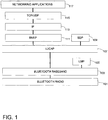
- FIG. 1 provides an illustration of components of the multi-layered Bluetooth network protocol stack in a PAN setting involving IP traffic over Bluetooth.
- Embodiments of the present invention are situated within Bluetooth radio-equipped computing devices that implement this protocol stack.
- the components of the Bluetooth protocol stack are described in detail in the Bluetooth Specification and associated documents of the Bluetooth SIG or else are well-known, and will only be described in brief here.
- the Baseband protocol 103 enables the physical link to form a piconet with one or more other Bluetooth devices. As mentioned above, the inquiry and paging processes take place at the Baseband layer 103.
- the Link Manager Protocol (LMP) 105 is responsible for link setup between Bluetooth nodes. LMP 105 handles the control and negotiation of packet sizes used when transmitting data. It also manages power modes and power consumption, as well as security features such as authentication and encryption.
- the LMP 105, Baseband 103 and Bluetooth radio 101 are typically implemented in Bluetooth hardware modules.
- L2CAP Logical Link Control and Adaptation Protocol
- L2CAP 107 provides connection-oriented and connectionless data services to upper layer protocols.
- L2CAP 107 implements a second link-layer protocol to address protocol multiplexing, segmentation, and reassembly.
- L2CAP serves as the Bluetooth data medium access control (MAC) layer.
- the Service Discovery Protocol 109 defines methods for discovering services available from or through Bluetooth devices.
- BNEP 111 encapsulates packets from various upper-layer network protocols, such as IPv4 and IPv6 113, so that they may be transported directly over the L2CAP 107. As illustrated in FIG. 1 , networking applications 117 are transported over TCP/UDP 115 and IP 113.
- BNEP 111 provides an Ethernet-like interface to the IP layer 113.
- FIGS. 2A and 2B illustrate exemplary topologies for the NAP PAN scenario and GN PAN scenario, respectively, as discussed above in the background section. Embodiments of the present invention may be practiced in either a NAP or a GN setting.
- FIG. 2A two NAP-based Bluetooth networks are depicted.
- a Bluetooth access point 207 has a wired connection to a LAN 208 which is in turn linked to an IP-based network 209, which may be, for example, a corporate intranet or the larger Internet. Access to these other networks 208, 209 through the NAP device 207 is provided to the notebook PANU devices 201, 203 and the PDA PANU device 205.
- the 2A comprises the notebook PANU device 215 and the cellular phone 213, functioning as a NAP.
- the cellular phone 213 has a wireless link by way of the cell tower 211 to a cellular WAN 210, such as the IP-based General Packet Radio Service (GPRS), which is linked to the IP network 209.
- GPRS General Packet Radio Service
- FIG. 2B depicts a GN-based piconet comprising eight Bluetooth-equipped devices: notebooks 217, 221, 223, 225, 229, 231, and PDAs 219, 227.
- the notebook 231 provides the GN service, here operating as the piconet master with respect to slave PANU devices 217, 219, 221, 223, 225, 227, 229.
- the seven slave devices represent the maximum number of active slaves in a piconet.
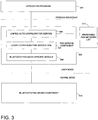
- FIG. 3 illustrates the architecture of an embodiment of a Bluetooth PANU implementation within the context of which the present invention may be practiced.
- the implementation comprises two basic components, a kernel-mode PAN driver 313 and a user-mode PAN service 303.
- the PAN service 303 provides for automatic connectivity to a remote Bluetooth device having an appropriate profile role and automates the task of configuring a network interface card in accordance with a set of rules saved by the user.
- the service 303 implements and extends API configuration primitives common to other wireless technologies in a unified autoconfiguration service 305 unifying multi-network roaming and rules engine heuristics to control all network connectivity interfaces being used.
- the autoconfiguration service 305 loads a preferred PAN remote network device list 311 from a repository. Connections are attempted to currently visible networks in the list 311 in the listed preference order.
- the autoconfiguration service 305 controls a PAN media-specific module 309 that is loaded by a layer 2 configuration service component 307.
- the media-specific module 309 abstracts away the functionality of the PAN driver 313 and provides the autoconfiguration service 305 with media-specific APIs for discovery of, attachment to and disconnecting from remote Bluetooth devices.
- the PAN driver 313 negotiates IP connectivity with a remote Bluetooth device.
- the driver 313 is an NDIS miniport driver for the Microsoft ® Windows platform.
- the driver 313 exposes an Ethernet interface on its upper path and interacts with Bluetooth L2CAP and Baseband levels on its lower path.
- the present invention is directed to a system and method for a "smart scan" for PAN devices.
- this smart scan can be performed by the PAN media-specific module 309, but the present invention is not limited to implementations so structured. Rather, the invention is applicable generally to local Bluetooth PAN devices that maintain lists of preferred networks.
- the invention will be described in the general context of a PAN service implementation similar to that presented in FIG. 3 . Those having skill in the art will recognize its broader applicability.
- An automated configuration service such as the unified autoconfiguration service 305 depicted in FIG. 3 , necessarily performs a periodic scan for visible network devices.
- the scanning period cannot be too long in duration, as visible remote device information can change quickly.
- the autoconfiguration service polls each device for a list of visible remote devices once every 90 seconds.
- a trivial approach would be to translate the scanning primitive exposed by the PAN media-specific module into a Baseband inquiry scan. However, because the inquiry process may take approximately 30 seconds for a complete list of visible remote Bluetooth devices, this trivial solution would result in poor data performance, given the disruptiveness of scans in the Bluetooth setting.
- FIG. 4 ignores the possibility of other wireless media-specific modules on the local host.
- FIG. 4 ignores the possibility of other wireless media-specific modules on the local host.
- the body of the procedure is entered.
- a scan for visible networks is undertaken, yielding a list of available remote devices.
- the preferred network is compared to each visible network. If the currently-examined preferred network matches the currently-examined visible network (step 405), a connection is made to the preferred network (step 407).
- step 409 If there is no match, and if there are unexamined networks remaining on the visible network list (step 409), the next visible network is considered (step 411), with the procedure returning to step 405. If all visible networks have been considered, and if all preferred networks have not been exhausted (step 413), the next network on the preferred network list is examined (step 415), with the procedure returning to step 405. If a match is found at step 405, or if there are no further remaining preferred networks (step 413), the procedure sleeps for 90 seconds (step 417) and then returns to step 401.
- the time required to scan for networks can be reduced if the local PAN device makes use of page scanning, which is device-specific. If the preferred list were known in advance, the local PAN device could then attempt to perform a page for each entry in the preferred list. However, this solution is not feasible. It would no longer be possible to discover new devices and add them to the list of preferred networks, whether or not an autoconfiguration service is used. Moreover, in the case of embodiments employing a unified autoconfiguration service, the Bluetooth media-specific module would break the abstraction of the unified service. Thus, a solution other than pure-inquiry or pure-page is required.
- FIG. 5 conceptually illustrates the architecture of a system in accordance with an embodiment of the present invention, making possible an efficient as well as practical approach to scanning for Bluetooth PAN network devices.
- Embodiments of the depicted system form part of a Bluetooth PAN media-specific module within a multi-technology autoconfiguration system, as illustrated in FIG. 3 .
- Other embodiments exist in association with such an autoconfiguration system, or with other kinds of network device configuration systems.
- a list of preferred networks 515 is stored in or by the system.
- two caches are maintained, a Page Scan Cache 505 and an Inquiry Scan Cache 507. Every attempt to connect to a remote Bluetooth device (as by way of the Bluetooth PAN media-specific module) will result in the specified network being added to the Page Scan Cache 505, if it was not already present in that cache. The connection request would then proceed in a normal fashion.
- the results of an inquiry scan are stored in the Inquiry Scan Cache 507.
- a periodic inquiry scan 509 is issued, refreshing the Inquiry Scan Cache 507, with the period being some predetermined, and relatively lengthy, time interval; in one embodiment the period is set at five minutes, but other durations may be chosen to achieve better performance.
- the PAN media-specific module directs a page scan to be performed for each entry in the Page Scan Cache 505. Successful attempts are added to the list of visible networks 511. The list of visible networks 511 is then concatenated with a copy of the current contents of the Inquiry Scan Cache 507 and the resulting list is reported as the visible list scan result 503.
- the system depicted in FIG. 5 ensures that the autoconfiguration service 501 always obtains accurate information about preferred networks, while information about non-preferred networks will be less accurate.
- the non-preferred networks are ideally of little importance to the autoconfiguration service 501, because in the typical scenario, discovery and addition of new networks to the list of preferred networks 515 occurs very rarely.
- the scanning time saved in relation to the trivial pure-inquiry-scan approach is approximately 66 percent over a period of five minutes.
- the number of entries in the Page Scan Cache 505 is limited to five (another suitable limit can be chosen for fine-tuned performance).
- the scanning time would then be approximately 6.4 seconds (5 * 1.28s).
- an expiration policy must be set so that roaming to other preferred but not yet visible networks is not disrupted.
- a relatively long predetermined default expiration time In one embodiment, a 30 minute expiry period is used; another suitable default expiration period can be chosen.
- the Page Scan Cache entry's expiration time is reduced by five minutes until the entry is removed from the cache. If there is a connection attempt to a network that was missed in the Page Scan Cache 505, this network will be added to the cache.
- the Inquiry Scan Cache 507 can also be populated by connection attempt on the part of a remote PAN device. This can be done even in embodiments of a PAN driver that fail incoming connection attempts; information about the peer is sent up to the PAN media-specific module so that it may be added to the Inquiry Scan Cache 507. This allows a peer to initiate a connection request which will then be processed by the autoconfiguration service 501 on its next network scan attempt. If the newly-added network was in the user's list of preferred networks 515, then the user need not wait for the next inquiry scan to detect it.
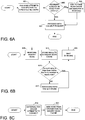
- FIGS. 6A, 6B, 6C , and 7 are flow diagrams generally illustrating the processes implied in the discussion above.
- the flow diagram of FIG. 6A illustrates the process by which the Page Scan Cache is refreshed in an embodiment of the invention.
- the PAN media-specific module attempts to connect to a particular network. If the network is already included as an entry in the Page Scan Cache (step 603), the connect request proceeds in step 607. If there was a miss in the Page Scan Cache, the network is added to the cache at step 605 with an expiration time of 30 minutes, and the connect request then proceeds in step 607.
- FIG. 6B illustrates the process by which a periodic inquiry scan is used in accordance with an embodiment of the invention.
- An inquiry scan is performed at step 609, and the results are used to populate the Inquiry Scan Cache in step 611.
- the Inquiry Scan Cache is examined at step 615 to determine whether the inquiry scan revealed the network corresponding to the Page Scan Cache entry being considered. If the Page Scan Cache entry is not in the Inquiry Scan Cache, the expiration time associated with the entry is reduced by five minutes at step 617.
- a waiting period (here set at five minutes) occurs at step 613 before the cycle begins again at step 609 with a new inquiry scan.
- the flow diagram of FIG. 6C illustrates the process by which the Inquiry Scan Cache is updated by way of an external PAN device connection attempt in accordance with an embodiment of the invention.
- an external PAN device attempts to connect to the local device.
- the PAN media-specific module on the local device adds information relating to the peer to the Inquiry Scan Cache.
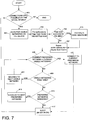
- the flow diagram of FIG. 7 is a modification of FIG. 4 , adding certain steps to the procedure by which an autoconfiguration service performs discovery of and connection to preferred networks.
- the modification follows the autoconfiguration service request for a scan of visible networks in step 403. For each entry in the Page Scan Cache, a page scan is attempted at step 701. If the page scan for a given entry is successful (step 703), the entry is added to the preliminary list of visible networks (step 705). At step 707, the resulting preliminary visible network list is concatenated with a copy of the contents of the Inquiry Scan Cache, and this concatenated list is reported to the autoconfiguration service.
- the remaining steps in the flow diagram of FIG. 7 are the same as those in the flow diagram of FIG. 4 and need not be described again here.
- computer-readable medium comprises any medium for temporary or persistent storage of data capable of being read by a suitable computing device, including a computing device functioning as a wireless Bluetooth radio-equipped host or network node.
- suitable computing device including a computing device functioning as a wireless Bluetooth radio-equipped host or network node.
- Examples of such computer-readable media include, without limitation, volatile and non-volatile primary memory, removable and non-removable magnetic disk storage, optical disk storage, and network interface media.
Landscapes
- Engineering & Computer Science (AREA)
- Computer Networks & Wireless Communication (AREA)
- Signal Processing (AREA)
- Databases & Information Systems (AREA)
- Computer Security & Cryptography (AREA)
- Mobile Radio Communication Systems (AREA)
- Small-Scale Networks (AREA)
Description
- The present invention relates generally to wireless networks for Bluetooth radio-equipped devices, and more particularly to techniques by which a Bluetooth device may discover and connect to other Bluetooth devices.
- Bluetooth is a short-range wireless technology that uses the 2.4 GHz Industrial, Scientific and Medical (ISM) band. Bluetooth is particularly intended for small mobile devices such as notebook computers, mobile phones, and personal digital assistants (PDAs). Pseudo-random frequency-hopping techniques are employed by communicating Bluetooth devices to minimize the effects of signal interference in the ISM band. The Bluetooth technology is set forth in detail in Bluetooth Special Interest Group (SIG), Specification of the Bluetooth System (hereinafter "the Bluetooth Specification"), Version 1.0, December 1, 1999, and Version 1.2, November 5, 2003.
- The Bluetooth Personal Area Networking Profile (hereinafter "the PAN Profile") provides a conceptual basis on which two or more Bluetooth-enabled devices can form and participate in personal area networks (PANs), allowing them to interoperate and exchange data. (See Bluetooth SIG, Personal Area Networking Profile, Version 1.0, February 14, 2003, incorporated herein in its entirety by reference.) The PAN Profile describes three roles that a Bluetooth device may perform: Network Access Point (NAP), Group Ad-hoc Network (GN), and Personal Area Network User (PANU). NAP and GN correspond to services that may be used by a Bluetooth device operating as a client PANU. "NAP", "GN," and "PANU" will be used hereinafter to refer to the Bluetooth-equipped node providing the respective NAP, GN or PANU service.
- In the Bluetooth context, a NAP is a device that contains one or more Bluetooth radio devices and acts as a bridge, proxy or router to a second network (such as a 10BaseT Ethernet LAN) with respect to one or more PANUs with a Bluetooth wireless connection to the NAP. Each such PANU thereby may gain access to the second network's shared resources. A GN is a collection of Bluetooth devices that interact with one another to form a self-contained temporary wireless network (or "piconet") without the use of additional networking hardware or infrastructure. In both the NAP and the GN scenarios, data exchange is by way of the Bluetooth Network Encapsulation Protocol (BNEP), which provides for encapsulation of Ethernet packets. (See Bluetooth SIG, Bluetooth Network Encapsulation Protocol (BNEP) Specification, Version 1.0, February 14, 2003.)
- There are a number of different ways in which one Bluetooth device may select another Bluetooth device in order to establish a connection to the second device. One desirable feature is for the first device to maintain a list of preferred devices or networks from which a selection can be made. While an application running on a Bluetooth device may make an explicit request to discover, select and form a connection to a particular Bluetooth device, applications merely requiring connectivity to enable their networked features benefit from the device having an automatic configuration service to establish connectivity. Moreover, a common, unified automatic configuration service for the various wireless technologies available to a device is desirable. Certain features and embodiments of such a unified service have been disclosed in
U.S. Patent Application Serial No. 10/693,655 - One drawback to Bluetooth technology is its relatively time-intensive device discovery phase of establishing a connection to an in-range Bluetooth device. In general, to discover new Bluetooth-capable devices (for which address and low-level state information is not already known), an inquiry scan is performed at the Baseband level, the lowest layer of the Bluetooth networking protocol stack. Once a list of discovered devices has been obtained by way of an inquiry scan, a page scan can be performed with respect to a selected device. Following a page scan, a local device and remote device can enter a connection state.
- Under the specifications for the Baseband in the Bluetooth Specification, the inquiry process time is significantly longer than the page process time. Depending on the underlying hardware and the number of discoverable devices within radio range, the inquiry process may take up to 30.72 seconds under version 1.0 of the Bluetooth Specification, while the maximum time for the paging process is 2.56 seconds. The inquiry phase thus substantially dominates the time spent in scanning for in-range Bluetooth devices, and can lead to unacceptable delays for a device user waiting for a connection to occur over a local Bluetooth PAN device. It is desirable, then, to minimize the time spent in the inquiry scan phase when discovering, selecting and connecting to preferred Bluetooth devices.
- "IEEE Standard for Information Technology Telecommunications and Information Exchange", IEEE Standard 802.15.1 part 15.1: Wireless medium access control and physical layer specifications for wireless personal area networks, states that there are two major states used in a Bluetooth link controller: the standby state and the connection state. Further, there are seven sub-states, namely the page, the page scan, inquiry, inquiry scan, master response, slave response and inquiry response. These sub-states are interim states that are used to add new slaves to a piconet. In order to establish new connections, the procedures inquiry and paging are used. In the page scan sub-state, the unit listens for its own device access code for the duration of a scan window. The inquiry scan sub-state is very similar to the page scan sub-state. However, instead of scanning for the unit's device access code, the receiver scans for the inquiry access code long enough to completely scan for 16 inquiry.
- It is the object of the present invention to shorten the time required to discover an appropriate Bluetooth device for connection. This object is solved by the subject matter of the independent claims. Preferred embodiments are defined by the dependent claims.
- The following provides a simplified summary of certain embodiments of the invention in order to provide a basic understanding of the invention. This summary is not an extensive overview of the invention. It is not intended to identify key or critical elements of the invention or to delineate the scope of the invention. Its sole purpose is to present some embodiments of the invention in a simplified form as a prelude to the more detailed description that is provided below.
- In accordance with embodiments of the invention, a system and method for discovering and connecting to a preferred remote Bluetooth device by a local Bluetooth device are provided. An inquiry scan cache and a page scan cache are maintained. The inquiry scan cache is refreshed by a periodic inquiry scan; in an embodiment, the inquiry scan cache is also updated when a remote Bluetooth device attempts to connect to the local Bluetooth device. The page scan cache is refreshed by way of an attempt to connect to the preferred device. Periodically, and more frequently than the periodic inquiry scan, a list of visible remote Bluetooth devices is produced by performing a page scan for each entry in the page scan cache, adding successful page scan attempts to the list, to which is concatenated the contents of the inquiry scan cache. In certain embodiments the list of visible devices is formed and reported in response to polling by an automatic configuration service.
- In accordance with an embodiment of the present invention, the page scan cache holds a finite number of entries and is associated with an expiration policy. For each entry added to the page scan cache, an expiration time is set. If the periodic inquiry scan does not reveal the entry, the expiration time is reduced by a given amount; if the expiration time has occurred, the entry is removed from the page scan cache.
- Computer-readable media embodying the aspects of the system and method summarized above are also provided. The invention may be implemented as a user-mode PAN service component, and in association with a kernel-mode PAN driver.
- Other features of the invention will become apparent from the following detailed description when taken in conjunction with the accompanying drawings, of which:
-
-
FIG. 1 is a block diagram providing an illustration of components of the Bluetooth network protocol stack in PAN setting; -
FIG. 2A is a diagram representing exemplary NAP PAN scenarios; -
FIG. 2B is a diagram representing an exemplary GN PAN scenario; -
FIG. 3 is a block diagram illustrating the architecture of an exemplary embodiment of a Bluetooth PAN implementation within the context of which the present invention may be practiced; -
FIG. 4 is a flow diagram illustrating a basic procedure by which an exemplary autoconfiguration service performs discovery of and connection to preferred networks, on which the present invention provides an improvement; -
FIG. 5 is a block diagram generally illustrating the architecture of an efficient and practical Bluetooth PAN smart scan in accordance with an embodiment of the present invention; -
FIG. 6A is a flow diagram generally illustrating a process by which a Page Scan Cache is refreshed in accordance with an embodiment of the present invention; -
FIG. 6B is a flow diagram generally illustrating a process by which a periodic inquiry scan is used in accordance with an embodiment of the present invention; -
FIG. 6C is a flow diagram generally illustrating a process by which an Inquiry Scan Cache is updated by way of an external PAN device connection attempt in accordance with an embodiment of the present invention; and -
FIG. 7 is a modification of the flow diagram ofFIG. 4 , in which steps have been added in accordance with an embodiment of the present invention. - In the following description, embodiments of the present invention will be described. For purposes of explanation, certain specific configurations and details are set forth in order to provide an adequate understanding of the presented embodiments. However, it will also be apparent to those having skill in the art that the present invention may be practiced without inclusion of those configurations and details. Furthermore, well-known features, and particularly features well-known to practitioners of ordinary skill in the computing and computer networking arts, may be omitted or simplified in order not to obscure the embodiment being described.
-
FIG. 1 provides an illustration of components of the multi-layered Bluetooth network protocol stack in a PAN setting involving IP traffic over Bluetooth. Embodiments of the present invention are situated within Bluetooth radio-equipped computing devices that implement this protocol stack. The components of the Bluetooth protocol stack are described in detail in the Bluetooth Specification and associated documents of the Bluetooth SIG or else are well-known, and will only be described in brief here. At the lowest level is the Bluetoothradio frequency layer 101. TheBaseband protocol 103 enables the physical link to form a piconet with one or more other Bluetooth devices. As mentioned above, the inquiry and paging processes take place at theBaseband layer 103. - The Link Manager Protocol (LMP) 105 is responsible for link setup between Bluetooth nodes.
LMP 105 handles the control and negotiation of packet sizes used when transmitting data. It also manages power modes and power consumption, as well as security features such as authentication and encryption. TheLMP 105,Baseband 103 andBluetooth radio 101 are typically implemented in Bluetooth hardware modules. - When a connection is established, the Logical Link Control and Adaptation Protocol (L2CAP) 107 provides connection-oriented and connectionless data services to upper layer protocols.
L2CAP 107 implements a second link-layer protocol to address protocol multiplexing, segmentation, and reassembly. L2CAP serves as the Bluetooth data medium access control (MAC) layer. TheService Discovery Protocol 109 defines methods for discovering services available from or through Bluetooth devices.BNEP 111 encapsulates packets from various upper-layer network protocols, such as IPv4 andIPv6 113, so that they may be transported directly over theL2CAP 107. As illustrated inFIG. 1 ,networking applications 117 are transported over TCP/UDP 115 andIP 113.BNEP 111 provides an Ethernet-like interface to theIP layer 113. -
FIGS. 2A and 2B illustrate exemplary topologies for the NAP PAN scenario and GN PAN scenario, respectively, as discussed above in the background section. Embodiments of the present invention may be practiced in either a NAP or a GN setting. InFIG. 2A two NAP-based Bluetooth networks are depicted. ABluetooth access point 207 has a wired connection to aLAN 208 which is in turn linked to an IP-basednetwork 209, which may be, for example, a corporate intranet or the larger Internet. Access to theseother networks NAP device 207 is provided to thenotebook PANU devices PDA PANU device 205. The other Bluetooth network depicted inFIG. 2A comprises thenotebook PANU device 215 and thecellular phone 213, functioning as a NAP. Thecellular phone 213 has a wireless link by way of thecell tower 211 to acellular WAN 210, such as the IP-based General Packet Radio Service (GPRS), which is linked to theIP network 209. -
FIG. 2B depicts a GN-based piconet comprising eight Bluetooth-equipped devices:notebooks PDAs notebook 231 provides the GN service, here operating as the piconet master with respect toslave PANU devices -
FIG. 3 illustrates the architecture of an embodiment of a Bluetooth PANU implementation within the context of which the present invention may be practiced. The implementation comprises two basic components, a kernel-mode PAN driver 313 and a user-mode PAN service 303. ThePAN service 303 provides for automatic connectivity to a remote Bluetooth device having an appropriate profile role and automates the task of configuring a network interface card in accordance with a set of rules saved by the user. In the depicted embodiment, theservice 303 implements and extends API configuration primitives common to other wireless technologies in aunified autoconfiguration service 305 unifying multi-network roaming and rules engine heuristics to control all network connectivity interfaces being used. In an initialization phase of thePAN service component 303, theautoconfiguration service 305 loads a preferred PAN remotenetwork device list 311 from a repository. Connections are attempted to currently visible networks in thelist 311 in the listed preference order. - The
autoconfiguration service 305 controls a PAN media-specific module 309 that is loaded by a layer 2configuration service component 307. The media-specific module 309 abstracts away the functionality of thePAN driver 313 and provides theautoconfiguration service 305 with media-specific APIs for discovery of, attachment to and disconnecting from remote Bluetooth devices. ThePAN driver 313 negotiates IP connectivity with a remote Bluetooth device. In an embodiment, thedriver 313 is an NDIS miniport driver for the Microsoft ® Windows platform. Thedriver 313 exposes an Ethernet interface on its upper path and interacts with Bluetooth L2CAP and Baseband levels on its lower path. - As explained in the background section above, scanning for available Bluetooth PAN network devices may be a fairly lengthy process depending on the underlying hardware. The present invention is directed to a system and method for a "smart scan" for PAN devices. In implementations of a PAN system of the sort illustrated in
FIG. 3 , this smart scan can be performed by the PAN media-specific module 309, but the present invention is not limited to implementations so structured. Rather, the invention is applicable generally to local Bluetooth PAN devices that maintain lists of preferred networks. For illustrative purposes, the invention will be described in the general context of a PAN service implementation similar to that presented inFIG. 3 . Those having skill in the art will recognize its broader applicability. - An automated configuration service, such as the
unified autoconfiguration service 305 depicted inFIG. 3 , necessarily performs a periodic scan for visible network devices. In order for it to be of practical use to a possibly mobile user wishing to connect to possibly mobile devices, the scanning period cannot be too long in duration, as visible remote device information can change quickly. On a local machine with multiple devices for wireless connectivity and with a representative implementation of a unified autoconfiguration service in association with which the present invention may be practiced, the autoconfiguration service polls each device for a list of visible remote devices once every 90 seconds. A trivial approach would be to translate the scanning primitive exposed by the PAN media-specific module into a Baseband inquiry scan. However, because the inquiry process may take approximately 30 seconds for a complete list of visible remote Bluetooth devices, this trivial solution would result in poor data performance, given the disruptiveness of scans in the Bluetooth setting. - The basic procedure by which the illustrative autoconfiguration service performs discovery of and connection to preferred networks is as follows:
       While connections are possible on a local device:
          Scan for visible networks on that device;
          For each preferred network,
             for each available network,
                if there is a match between the current
                   preferred network and the current visible
                   network,
                      connect to the preferred network;
          Sleep (90 seconds).
Claims (13)
- A system for discovering and connecting to a preferred remote Bluetooth device by a local Bluetooth device, comprising:an inquiry scan cache (507) that is refreshed by a periodic inquiry scan (509);a page scan cache (505) that is refreshed by way of an attempt to connect to the preferred remote Bluetooth device; anda list of visible remote Bluetooth devices (511) comprising entries in the inquiry scan cache, concatenated with each entry in the page scan cache that the local Bluetooth device successfully contacts by way of a periodic page scan performed more frequently than the periodic inquiry scan.
- The system of claim 1 wherein the preferred remote Bluetooth device provides a Network Access Point, NAP, service.
- The system of claim 1 wherein the preferred remote Bluetooth device provides a Group Ad-hoc Network, GN, service.
- The system of claim 1, further comprising an automatic configuration service component that polls for the list of visible remote Bluetooth devices.
- The system of claim 1 wherein the page scan cache holds a finite number of entries and is associated with an expiration policy.
- The system of claim 1 wherein the inquiry scan cache is updated by way of an attempt by a remote Bluetooth device to connect to the local Bluetooth device.
- A method for discovering and connecting to a preferred remote Bluetooth device by a local Bluetooth device, comprising:updating an inquiry scan cache (507) by way of a periodic inquiry scan (509);if an attempt is made to connect to the preferred remote Bluetooth device, updating a page scan cache (505) with a corresponding entry; andperiodically, and more frequently than the periodic inquiry scan, forming a list of visible remote Bluetooth devices, wherein forming the list of visible remote Bluetooth devices further comprises:for each entry in the page scan cache, performing a page scan, and, if the page scan was successful, adding the entry to the list of visible remote Bluetooth devices; andconcatenating entries in the inquiry scan cache to the list of visible remote Bluetooth devices.
- The method of claim 7 wherein the page scan cache holds a finite number of entries, the method further comprising, for each entry added to the page scan cache:setting an expiration time for the entry;if the periodic inquiry scan does not reveal the entry, reducing the expiration time; andif the expiration time has occurred, removing the entry from the page scan cache.
- The method of claim 7, further comprising:if a remote Bluetooth device attempts to connect to the local Bluetooth device, adding an entry for the remote Bluetooth device to the inquiry scan cache.
- The method of claim 7 wherein the preferred remote Bluetooth device provides a NAP service.
- The method of claim 7 wherein the preferred remote Bluetooth device provides a GN service.
- The method of claim 7 wherein forming a list of visible remote Bluetooth devices is in response to polling by an automatic configuration service.
- A computer-readable medium storing instructions that, when executed by a processor, cause the processor to perform the method of one of claims 7 to 12.
Applications Claiming Priority (2)
| Application Number | Priority Date | Filing Date | Title |
|---|---|---|---|
| US724843 | 2003-12-01 | ||
| US10/724,843 US8024487B2 (en) | 2003-12-01 | 2003-12-01 | Smart scan for wireless devices |
Publications (3)
| Publication Number | Publication Date |
|---|---|
| EP1538788A2 EP1538788A2 (en) | 2005-06-08 |
| EP1538788A3 EP1538788A3 (en) | 2010-06-16 |
| EP1538788B1 true EP1538788B1 (en) | 2017-03-15 |
Family
ID=34465731
Family Applications (1)
| Application Number | Title | Priority Date | Filing Date |
|---|---|---|---|
| EP04025582.0A Expired - Lifetime EP1538788B1 (en) | 2003-12-01 | 2004-10-27 | Smart scan for Bluetooth PAN devices |
Country Status (5)
| Country | Link |
|---|---|
| US (1) | US8024487B2 (en) |
| EP (1) | EP1538788B1 (en) |
| JP (1) | JP4754811B2 (en) |
| KR (1) | KR100877466B1 (en) |
| CN (1) | CN1645760B (en) |
Families Citing this family (43)
| Publication number | Priority date | Publication date | Assignee | Title |
|---|---|---|---|---|
| US7263078B2 (en) * | 2002-12-18 | 2007-08-28 | Microsoft Corporation | Method and apparatus for scanning in wireless computing devices |
| US7996505B2 (en) | 2003-10-24 | 2011-08-09 | Microsoft Corporation | Network and interface selection on a computing device capable of establishing connections via multiple network communications media |
| GB2427791B (en) * | 2005-06-30 | 2009-12-02 | Nokia Corp | Radio frequency scan |
| KR100653074B1 (en) * | 2005-12-02 | 2006-12-04 | 삼성전자주식회사 | Computer system and its control method |
| US20070268838A1 (en) * | 2006-05-16 | 2007-11-22 | Cisco Technology, Inc. | System and Method For Facilitating An Internet Protocol Based Personal Area Network |
| WO2007143720A2 (en) * | 2006-06-07 | 2007-12-13 | Avaya Technology Llc | Modular communication system for supporting wireless and wired telecommunication |
| US8346863B2 (en) * | 2006-08-15 | 2013-01-01 | International Business Machines Corporation | Contact initialization based upon automatic profile sharing between computing devices |
| KR101369425B1 (en) * | 2007-01-24 | 2014-03-04 | 엘지전자 주식회사 | Mobile Communication Terminal Enable of Short Distance Radio Frequency Communication and Operating Method for the Same |
| US8565779B2 (en) * | 2007-04-20 | 2013-10-22 | Novatel Wireless, Inc. | Position-based automatic configuration of portable device |
| KR100881223B1 (en) * | 2007-05-28 | 2009-02-05 | (주)케이티에프테크놀로지스 | Bluetooth device and method for dynamically adjusting query scan period, and recording medium recording program for implementing the same |
| US8369782B1 (en) * | 2007-08-13 | 2013-02-05 | Marvell International Ltd. | Bluetooth wideband scan mode |
| JP5248820B2 (en) * | 2007-08-15 | 2013-07-31 | キヤノン株式会社 | Communication apparatus and communication method thereof |
| US20090061862A1 (en) * | 2007-08-30 | 2009-03-05 | Alberth Jr William P | Peer to peer service discovery sharing |
| US8577305B1 (en) | 2007-09-21 | 2013-11-05 | Marvell International Ltd. | Circuits and methods for generating oscillating signals |
| US8588705B1 (en) | 2007-12-11 | 2013-11-19 | Marvell International Ltd. | System and method of determining Power over Ethernet impairment |
| US20090249219A1 (en) * | 2008-03-31 | 2009-10-01 | Best Steven F | Providing a Shared Desktop Interface of Multiple Computer Terminals |
| CN102067689B (en) | 2008-06-16 | 2016-11-09 | 马维尔国际贸易有限公司 | short-range wireless communication |
| US8600324B1 (en) | 2008-06-27 | 2013-12-03 | Marvell International Ltd | Circuit and method for adjusting a digitally controlled oscillator |
| US8472968B1 (en) | 2008-08-11 | 2013-06-25 | Marvell International Ltd. | Location-based detection of interference in cellular communications systems |
| US9026656B2 (en) * | 2008-11-04 | 2015-05-05 | Qualcomm Incorporated | Resource sharing over wireless personal area networks |
| US9288764B1 (en) | 2008-12-31 | 2016-03-15 | Marvell International Ltd. | Discovery-phase power conservation |
| US8472427B1 (en) | 2009-04-06 | 2013-06-25 | Marvell International Ltd. | Packet exchange arbitration for coexisting radios |
| CN102415161A (en) * | 2009-04-21 | 2012-04-11 | 诺基亚公司 | Wireless station connectivity information distribution |
| US8532041B1 (en) | 2009-04-24 | 2013-09-10 | Marvell International Ltd. | Method for transmitting information in a regulated spectrum and network configured to operate in the regulated spectrum |
| US20110021147A1 (en) * | 2009-07-21 | 2011-01-27 | Tout Walid R | System and method for determining connectivity status of short range wireless devices |
| US9066369B1 (en) | 2009-09-16 | 2015-06-23 | Marvell International Ltd. | Coexisting radio communication |
| US8767771B1 (en) | 2010-05-11 | 2014-07-01 | Marvell International Ltd. | Wakeup beacons for mesh networks |
| KR101616491B1 (en) | 2010-10-20 | 2016-04-28 | 마벨 월드 트레이드 리미티드 | Pre-association discovery |
| US8750278B1 (en) | 2011-05-26 | 2014-06-10 | Marvell International Ltd. | Method and apparatus for off-channel device invitation |
| US8983557B1 (en) | 2011-06-30 | 2015-03-17 | Marvell International Ltd. | Reducing power consumption of a multi-antenna transceiver |
| US9125216B1 (en) | 2011-09-28 | 2015-09-01 | Marvell International Ltd. | Method and apparatus for avoiding interference among multiple radios |
| US9215708B2 (en) | 2012-02-07 | 2015-12-15 | Marvell World Trade Ltd. | Method and apparatus for multi-network communication |
| US8892042B2 (en) * | 2012-06-08 | 2014-11-18 | Apple Inc. | Immediate connection following device discovery |
| US9450649B2 (en) | 2012-07-02 | 2016-09-20 | Marvell World Trade Ltd. | Shaping near-field transmission signals |
| US10813142B2 (en) | 2013-10-11 | 2020-10-20 | Ford Global Technologies, Llc | Apparatus of paging mobile devices |
| FR3032851A1 (en) * | 2015-02-13 | 2016-08-19 | Kerlink | METHOD FOR RESOLVING CORRESPONDING IP ADDRESS, SERVER AND COMPUTER PROGRAM |
| US10051003B2 (en) * | 2015-07-30 | 2018-08-14 | Apple Inc. | Privacy enhancements for wireless devices |
| US10541958B2 (en) | 2015-08-05 | 2020-01-21 | Facebook, Inc. | Controlling a device cloud |
| US10567479B2 (en) * | 2015-08-05 | 2020-02-18 | Facebook, Inc. | Managing a device cloud |
| JP6631087B2 (en) * | 2015-08-19 | 2020-01-15 | ヤマハ株式会社 | Control terminal, audio system and audio equipment control program |
| CN108684021B (en) * | 2018-03-20 | 2021-06-04 | 海信视像科技股份有限公司 | Bluetooth low-power-consumption communication method and device |
| CN112416617A (en) * | 2020-11-19 | 2021-02-26 | 青岛海尔科技有限公司 | Bluetooth device control method and device, storage medium, and electronic device |
| CN115643556B (en) * | 2022-10-25 | 2025-06-10 | 思澈科技(重庆)有限公司 | A Bluetooth PAN communication method and system based on Internet of Things operating system |
Family Cites Families (15)
| Publication number | Priority date | Publication date | Assignee | Title |
|---|---|---|---|---|
| KR100677078B1 (en) * | 1999-11-26 | 2007-02-01 | 삼성전자주식회사 | How to operate network between Bluetooth equipped devices |
| JP2002108733A (en) * | 2000-09-29 | 2002-04-12 | Toshiba Corp | Electronic device, network configuration method, and program storage medium |
| KR100655576B1 (en) * | 2000-10-25 | 2006-12-08 | 주식회사 케이티 | How to register Bluetooth ID using Bluetooth access point registration function |
| US20030060222A1 (en) * | 2001-09-25 | 2003-03-27 | Johan Rune | Network access point with auxiliary transceiver |
| KR100424764B1 (en) * | 2001-03-05 | 2004-03-30 | 삼성전자주식회사 | Method for detecting inquiry result using class of device in wireless link of short range mobile radio system |
| KR20040002416A (en) * | 2001-05-01 | 2004-01-07 | 코닌클리케 필립스 일렉트로닉스 엔.브이. | Radio communication arrangements |
| JP2003092578A (en) * | 2001-09-18 | 2003-03-28 | Fujitsu Ltd | Management device, processing device, device, and program |
| EP1437864A1 (en) * | 2001-10-16 | 2004-07-14 | Sony Corporation | Communication system and method, and information processing apparatus and method |
| US20030092386A1 (en) * | 2001-10-26 | 2003-05-15 | Gyorgy Miklos | Predictable communication establishment in ad-hoc wireless network |
| US7496065B2 (en) * | 2001-11-29 | 2009-02-24 | Telcordia Technologies, Inc. | Efficient piconet formation and maintenance in a Bluetooth wireless network |
| FI111891B (en) * | 2001-12-20 | 2003-09-30 | Nokia Corp | Identification of a terminal device |
| JP2003242541A (en) * | 2002-02-19 | 2003-08-29 | Toshiba Corp | Last train time notification method in station service system, mobile terminal in station service system, last train notification system in station service system, station service system |
| US20050088997A1 (en) | 2002-02-20 | 2005-04-28 | Diego Melpignano | Wireless communication arrangements with a discovery procedure |
| KR100472053B1 (en) * | 2002-02-23 | 2005-03-08 | 한국전자통신연구원 | Internet system using wireless Internet connection device with a bluetooth and method of operating the same |
| FI113123B (en) * | 2002-06-03 | 2004-02-27 | Nokia Corp | A method and apparatus for forming decentralized networks into ad hoc networks |
-
2003
- 2003-12-01 US US10/724,843 patent/US8024487B2/en active Active
-
2004
- 2004-10-27 EP EP04025582.0A patent/EP1538788B1/en not_active Expired - Lifetime
- 2004-11-12 KR KR1020040092437A patent/KR100877466B1/en not_active Expired - Fee Related
- 2004-11-24 JP JP2004339467A patent/JP4754811B2/en not_active Expired - Fee Related
- 2004-12-01 CN CN2004101006158A patent/CN1645760B/en not_active Expired - Fee Related
Non-Patent Citations (1)
| Title |
|---|
| None * |
Also Published As
| Publication number | Publication date |
|---|---|
| KR100877466B1 (en) | 2009-01-07 |
| JP2005176347A (en) | 2005-06-30 |
| US20050120119A1 (en) | 2005-06-02 |
| KR20050052989A (en) | 2005-06-07 |
| US8024487B2 (en) | 2011-09-20 |
| EP1538788A3 (en) | 2010-06-16 |
| CN1645760B (en) | 2013-06-26 |
| EP1538788A2 (en) | 2005-06-08 |
| CN1645760A (en) | 2005-07-27 |
| JP4754811B2 (en) | 2011-08-24 |
Similar Documents
| Publication | Publication Date | Title |
|---|---|---|
| US8024487B2 (en) | Smart scan for wireless devices | |
| CA2683998C (en) | Device detection and service discovery system and method for a mobile ad hoc communications network | |
| US7986655B2 (en) | Method for setting up a link between bluetooth devices in a bluetooth system | |
| US7356347B1 (en) | Efficient discovery of devices in a bluetooth environment | |
| CN100508489C (en) | Systems and methods for dynamic interface management | |
| US20060084417A1 (en) | Interface selection from multiple networks | |
| US9560184B2 (en) | Bypassing bluetooth discovery for devices in a special list | |
| WO2003003610A1 (en) | Ad hoc network discovery menu | |
| KR20050027919A (en) | Mechanism for improving connection control in peer-to-peer ad-hoc networks | |
| JP2005516538A (en) | Internet protocol-based wireless communication arrangement | |
| AU2007319632A1 (en) | IP layer-handoff using mobility domains and IP caching | |
| CN104838364A (en) | Discovering and connecting wireless devices without discoverability | |
| JP2013513308A (en) | Method and apparatus for coordinated multifunction communication in a wireless communication system | |
| WO2015058374A1 (en) | Systems and methods for application controlled network selection between narrowband and broadband wireless networks | |
| WO2002052793A1 (en) | Device roles and piconet connections | |
| US7269388B2 (en) | Bluetooth pan driver | |
| JP3771850B2 (en) | Method for performing service discovery, network device, and computer program element | |
| EP1633095B1 (en) | Transfer of a packet to a mobile communication terminal forming part of an adhoc network, through a core network | |
| EP1556966A2 (en) | Device detection and service discovery system and method for a mobile ad hoc communications network | |
| JP5715471B2 (en) | Wireless communication terminal | |
| JP2003283546A (en) | Wireless mobile router | |
| EP1864525B1 (en) | Method, device and system for managing a cache of network caches in a mobile | |
| CN107231704A (en) | Method for connecting network and device | |
| Tourrilhes | On-demand bluetooth: Experience integrating bluetooth in connection diversity | |
| Camp | Development of the Bluetooth version 1.0 specification |
Legal Events
| Date | Code | Title | Description |
|---|---|---|---|
| PUAI | Public reference made under article 153(3) epc to a published international application that has entered the european phase |
Free format text: ORIGINAL CODE: 0009012 |
|
| AK | Designated contracting states |
Kind code of ref document: A2 Designated state(s): AT BE BG CH CY CZ DE DK EE ES FI FR GB GR HU IE IT LI LU MC NL PL PT RO SE SI SK TR |
|
| AX | Request for extension of the european patent |
Extension state: AL HR LT LV MK |
|
| PUAL | Search report despatched |
Free format text: ORIGINAL CODE: 0009013 |
|
| AK | Designated contracting states |
Kind code of ref document: A3 Designated state(s): AT BE BG CH CY CZ DE DK EE ES FI FR GB GR HU IE IT LI LU MC NL PL PT RO SE SI SK TR |
|
| AX | Request for extension of the european patent |
Extension state: AL HR LT LV MK |
|
| 17P | Request for examination filed |
Effective date: 20101117 |
|
| 17Q | First examination report despatched |
Effective date: 20101221 |
|
| AKX | Designation fees paid |
Designated state(s): AT BE BG CH CY CZ DE DK EE ES FI FR GB GR HU IE IT LI LU MC NL PL PT RO SE SI SK TR |
|
| RAP1 | Party data changed (applicant data changed or rights of an application transferred) |
Owner name: MICROSOFT TECHNOLOGY LICENSING, LLC |
|
| REG | Reference to a national code |
Ref country code: DE Ref legal event code: R079 Ref document number: 602004050903 Country of ref document: DE Free format text: PREVIOUS MAIN CLASS: H04L0012560000 Ipc: H04W0008000000 |
|
| GRAP | Despatch of communication of intention to grant a patent |
Free format text: ORIGINAL CODE: EPIDOSNIGR1 |
|
| RIC1 | Information provided on ipc code assigned before grant |
Ipc: H04W 76/02 20090101ALN20160913BHEP Ipc: H04W 48/16 20090101ALN20160913BHEP Ipc: H04W 84/10 20090101ALN20160913BHEP Ipc: H04W 84/18 20090101ALN20160913BHEP Ipc: H04W 8/00 20090101AFI20160913BHEP Ipc: H04M 1/72 20060101ALN20160913BHEP |
|
| INTG | Intention to grant announced |
Effective date: 20160927 |
|
| RIC1 | Information provided on ipc code assigned before grant |
Ipc: H04W 84/18 20090101ALN20160916BHEP Ipc: H04M 1/72 20060101ALN20160916BHEP Ipc: H04W 48/16 20090101ALN20160916BHEP Ipc: H04W 76/02 20090101ALN20160916BHEP Ipc: H04W 84/10 20090101ALN20160916BHEP Ipc: H04W 8/00 20090101AFI20160916BHEP |
|
| GRAS | Grant fee paid |
Free format text: ORIGINAL CODE: EPIDOSNIGR3 |
|
| GRAA | (expected) grant |
Free format text: ORIGINAL CODE: 0009210 |
|
| AK | Designated contracting states |
Kind code of ref document: B1 Designated state(s): AT BE BG CH CY CZ DE DK EE ES FI FR GB GR HU IE IT LI LU MC NL PL PT RO SE SI SK TR |
|
| REG | Reference to a national code |
Ref country code: CH Ref legal event code: EP Ref country code: GB Ref legal event code: FG4D |
|
| REG | Reference to a national code |
Ref country code: IE Ref legal event code: FG4D |
|
| REG | Reference to a national code |
Ref country code: AT Ref legal event code: REF Ref document number: 876684 Country of ref document: AT Kind code of ref document: T Effective date: 20170415 |
|
| REG | Reference to a national code |
Ref country code: DE Ref legal event code: R096 Ref document number: 602004050903 Country of ref document: DE |
|
| REG | Reference to a national code |
Ref country code: NL Ref legal event code: FP |
|
| PG25 | Lapsed in a contracting state [announced via postgrant information from national office to epo] |
Ref country code: FI Free format text: LAPSE BECAUSE OF FAILURE TO SUBMIT A TRANSLATION OF THE DESCRIPTION OR TO PAY THE FEE WITHIN THE PRESCRIBED TIME-LIMIT Effective date: 20170315 Ref country code: GR Free format text: LAPSE BECAUSE OF FAILURE TO SUBMIT A TRANSLATION OF THE DESCRIPTION OR TO PAY THE FEE WITHIN THE PRESCRIBED TIME-LIMIT Effective date: 20170616 |
|
| REG | Reference to a national code |
Ref country code: AT Ref legal event code: MK05 Ref document number: 876684 Country of ref document: AT Kind code of ref document: T Effective date: 20170315 |
|
| PG25 | Lapsed in a contracting state [announced via postgrant information from national office to epo] |
Ref country code: BG Free format text: LAPSE BECAUSE OF FAILURE TO SUBMIT A TRANSLATION OF THE DESCRIPTION OR TO PAY THE FEE WITHIN THE PRESCRIBED TIME-LIMIT Effective date: 20170615 Ref country code: SE Free format text: LAPSE BECAUSE OF FAILURE TO SUBMIT A TRANSLATION OF THE DESCRIPTION OR TO PAY THE FEE WITHIN THE PRESCRIBED TIME-LIMIT Effective date: 20170315 |
|
| REG | Reference to a national code |
Ref country code: FR Ref legal event code: PLFP Year of fee payment: 14 |
|
| PG25 | Lapsed in a contracting state [announced via postgrant information from national office to epo] |
Ref country code: CZ Free format text: LAPSE BECAUSE OF FAILURE TO SUBMIT A TRANSLATION OF THE DESCRIPTION OR TO PAY THE FEE WITHIN THE PRESCRIBED TIME-LIMIT Effective date: 20170315 Ref country code: AT Free format text: LAPSE BECAUSE OF FAILURE TO SUBMIT A TRANSLATION OF THE DESCRIPTION OR TO PAY THE FEE WITHIN THE PRESCRIBED TIME-LIMIT Effective date: 20170315 Ref country code: IT Free format text: LAPSE BECAUSE OF FAILURE TO SUBMIT A TRANSLATION OF THE DESCRIPTION OR TO PAY THE FEE WITHIN THE PRESCRIBED TIME-LIMIT Effective date: 20170315 Ref country code: ES Free format text: LAPSE BECAUSE OF FAILURE TO SUBMIT A TRANSLATION OF THE DESCRIPTION OR TO PAY THE FEE WITHIN THE PRESCRIBED TIME-LIMIT Effective date: 20170315 Ref country code: EE Free format text: LAPSE BECAUSE OF FAILURE TO SUBMIT A TRANSLATION OF THE DESCRIPTION OR TO PAY THE FEE WITHIN THE PRESCRIBED TIME-LIMIT Effective date: 20170315 Ref country code: SK Free format text: LAPSE BECAUSE OF FAILURE TO SUBMIT A TRANSLATION OF THE DESCRIPTION OR TO PAY THE FEE WITHIN THE PRESCRIBED TIME-LIMIT Effective date: 20170315 Ref country code: RO Free format text: LAPSE BECAUSE OF FAILURE TO SUBMIT A TRANSLATION OF THE DESCRIPTION OR TO PAY THE FEE WITHIN THE PRESCRIBED TIME-LIMIT Effective date: 20170315 |
|
| PG25 | Lapsed in a contracting state [announced via postgrant information from national office to epo] |
Ref country code: PL Free format text: LAPSE BECAUSE OF FAILURE TO SUBMIT A TRANSLATION OF THE DESCRIPTION OR TO PAY THE FEE WITHIN THE PRESCRIBED TIME-LIMIT Effective date: 20170315 Ref country code: PT Free format text: LAPSE BECAUSE OF FAILURE TO SUBMIT A TRANSLATION OF THE DESCRIPTION OR TO PAY THE FEE WITHIN THE PRESCRIBED TIME-LIMIT Effective date: 20170717 |
|
| REG | Reference to a national code |
Ref country code: DE Ref legal event code: R097 Ref document number: 602004050903 Country of ref document: DE |
|
| PLBE | No opposition filed within time limit |
Free format text: ORIGINAL CODE: 0009261 |
|
| STAA | Information on the status of an ep patent application or granted ep patent |
Free format text: STATUS: NO OPPOSITION FILED WITHIN TIME LIMIT |
|
| PG25 | Lapsed in a contracting state [announced via postgrant information from national office to epo] |
Ref country code: DK Free format text: LAPSE BECAUSE OF FAILURE TO SUBMIT A TRANSLATION OF THE DESCRIPTION OR TO PAY THE FEE WITHIN THE PRESCRIBED TIME-LIMIT Effective date: 20170315 |
|
| 26N | No opposition filed |
Effective date: 20171218 |
|
| PG25 | Lapsed in a contracting state [announced via postgrant information from national office to epo] |
Ref country code: SI Free format text: LAPSE BECAUSE OF FAILURE TO SUBMIT A TRANSLATION OF THE DESCRIPTION OR TO PAY THE FEE WITHIN THE PRESCRIBED TIME-LIMIT Effective date: 20170315 |
|
| PG25 | Lapsed in a contracting state [announced via postgrant information from national office to epo] |
Ref country code: MC Free format text: LAPSE BECAUSE OF FAILURE TO SUBMIT A TRANSLATION OF THE DESCRIPTION OR TO PAY THE FEE WITHIN THE PRESCRIBED TIME-LIMIT Effective date: 20170315 |
|
| REG | Reference to a national code |
Ref country code: CH Ref legal event code: PL |
|
| REG | Reference to a national code |
Ref country code: IE Ref legal event code: MM4A |
|
| PG25 | Lapsed in a contracting state [announced via postgrant information from national office to epo] |
Ref country code: LU Free format text: LAPSE BECAUSE OF NON-PAYMENT OF DUE FEES Effective date: 20171027 Ref country code: CH Free format text: LAPSE BECAUSE OF NON-PAYMENT OF DUE FEES Effective date: 20171031 Ref country code: LI Free format text: LAPSE BECAUSE OF NON-PAYMENT OF DUE FEES Effective date: 20171031 |
|
| REG | Reference to a national code |
Ref country code: BE Ref legal event code: MM Effective date: 20171031 |
|
| PG25 | Lapsed in a contracting state [announced via postgrant information from national office to epo] |
Ref country code: BE Free format text: LAPSE BECAUSE OF NON-PAYMENT OF DUE FEES Effective date: 20171031 |
|
| REG | Reference to a national code |
Ref country code: FR Ref legal event code: PLFP Year of fee payment: 15 |
|
| PG25 | Lapsed in a contracting state [announced via postgrant information from national office to epo] |
Ref country code: IE Free format text: LAPSE BECAUSE OF NON-PAYMENT OF DUE FEES Effective date: 20171027 |
|
| PG25 | Lapsed in a contracting state [announced via postgrant information from national office to epo] |
Ref country code: HU Free format text: LAPSE BECAUSE OF FAILURE TO SUBMIT A TRANSLATION OF THE DESCRIPTION OR TO PAY THE FEE WITHIN THE PRESCRIBED TIME-LIMIT; INVALID AB INITIO Effective date: 20041027 |
|
| PG25 | Lapsed in a contracting state [announced via postgrant information from national office to epo] |
Ref country code: CY Free format text: LAPSE BECAUSE OF NON-PAYMENT OF DUE FEES Effective date: 20170315 |
|
| PG25 | Lapsed in a contracting state [announced via postgrant information from national office to epo] |
Ref country code: TR Free format text: LAPSE BECAUSE OF FAILURE TO SUBMIT A TRANSLATION OF THE DESCRIPTION OR TO PAY THE FEE WITHIN THE PRESCRIBED TIME-LIMIT Effective date: 20170315 |
|
| P01 | Opt-out of the competence of the unified patent court (upc) registered |
Effective date: 20230505 |
|
| PGFP | Annual fee paid to national office [announced via postgrant information from national office to epo] |
Ref country code: NL Payment date: 20230922 Year of fee payment: 20 Ref country code: GB Payment date: 20230920 Year of fee payment: 20 |
|
| PGFP | Annual fee paid to national office [announced via postgrant information from national office to epo] |
Ref country code: FR Payment date: 20230920 Year of fee payment: 20 |
|
| PGFP | Annual fee paid to national office [announced via postgrant information from national office to epo] |
Ref country code: DE Payment date: 20230920 Year of fee payment: 20 |
|
| REG | Reference to a national code |
Ref country code: DE Ref legal event code: R071 Ref document number: 602004050903 Country of ref document: DE |
|
| REG | Reference to a national code |
Ref country code: NL Ref legal event code: MK Effective date: 20241026 |
|
| REG | Reference to a national code |
Ref country code: GB Ref legal event code: PE20 Expiry date: 20241026 |
|
| PG25 | Lapsed in a contracting state [announced via postgrant information from national office to epo] |
Ref country code: GB Free format text: LAPSE BECAUSE OF EXPIRATION OF PROTECTION Effective date: 20241026 |
|
| PG25 | Lapsed in a contracting state [announced via postgrant information from national office to epo] |
Ref country code: GB Free format text: LAPSE BECAUSE OF EXPIRATION OF PROTECTION Effective date: 20241026 |