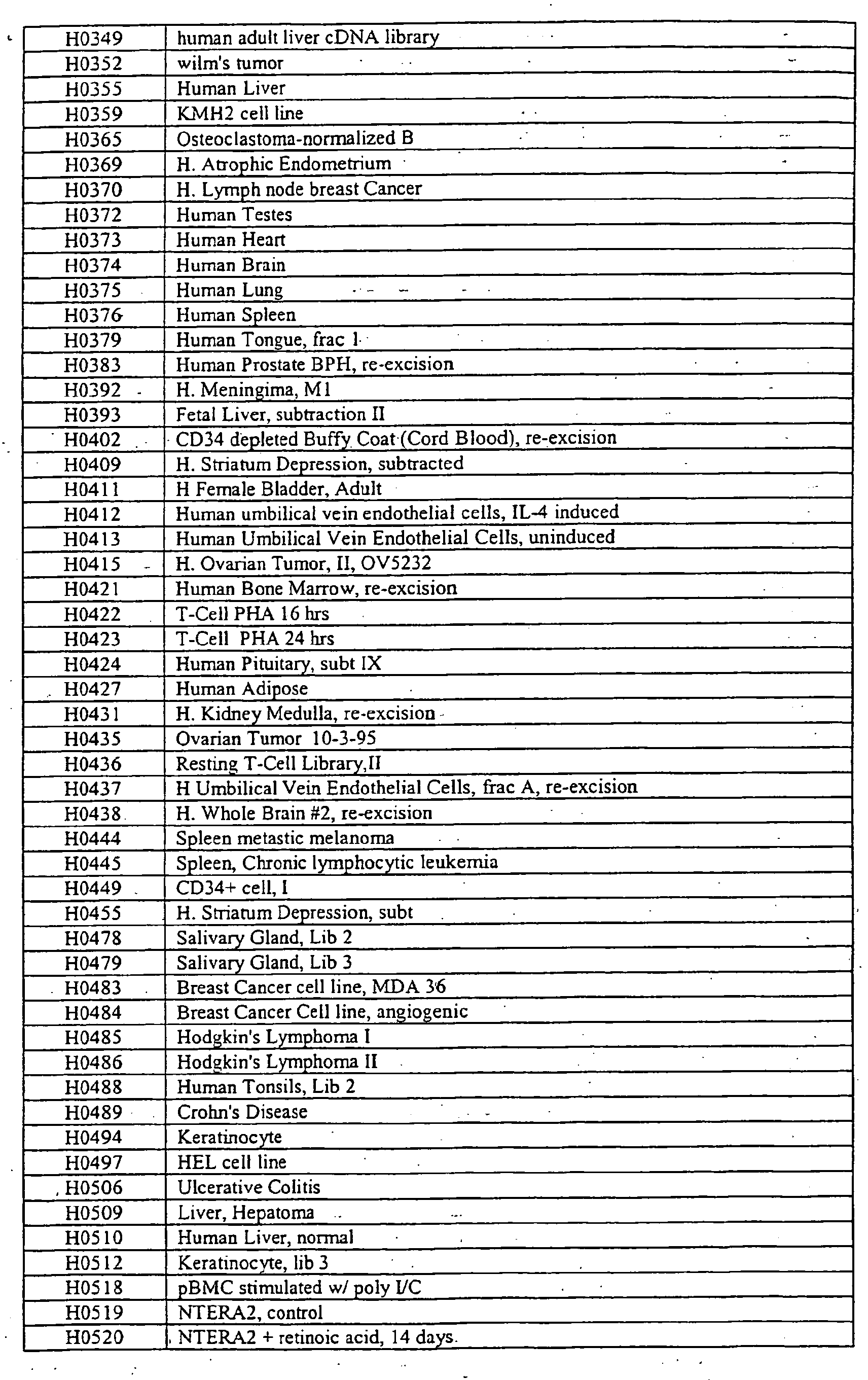
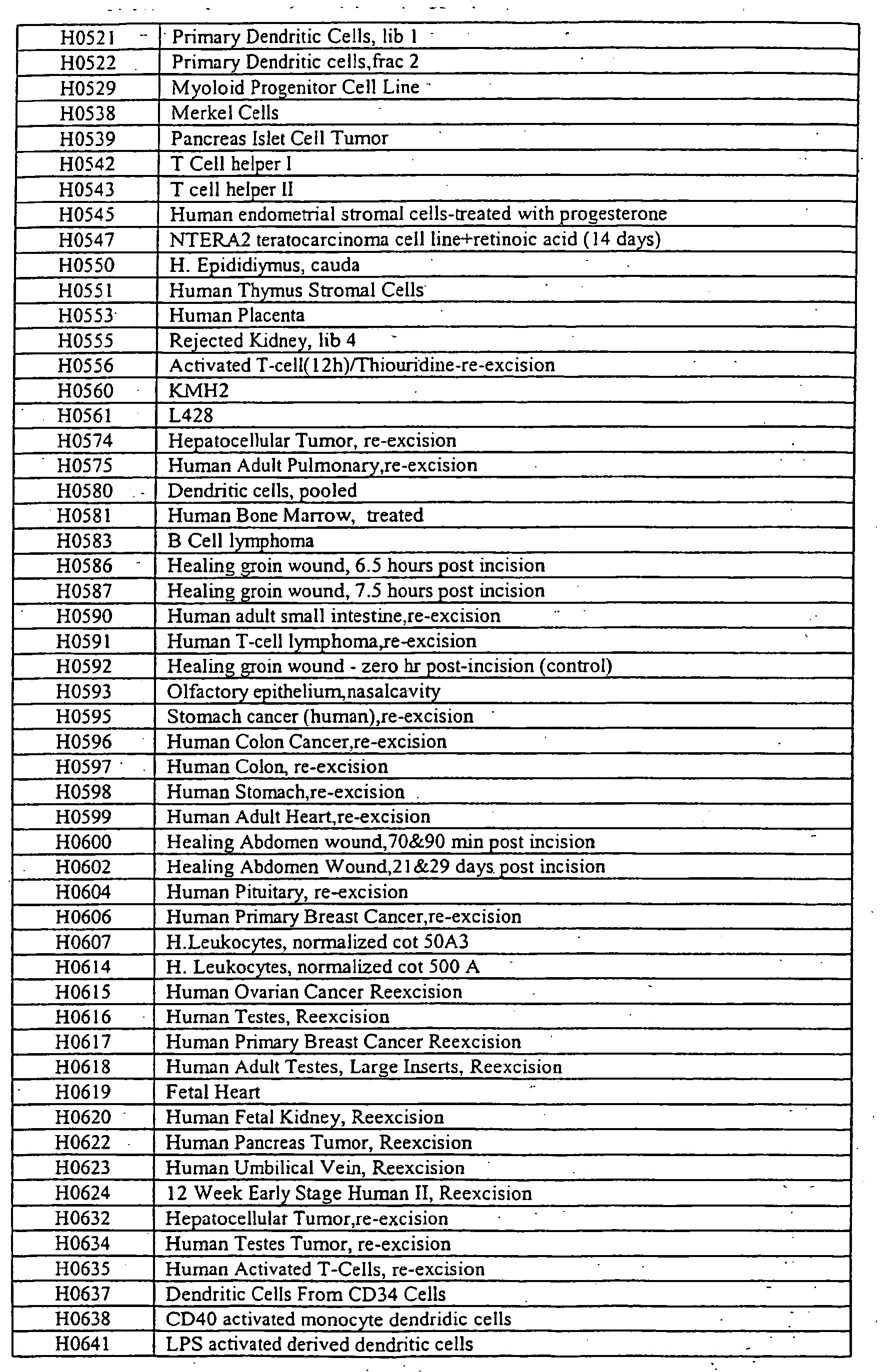
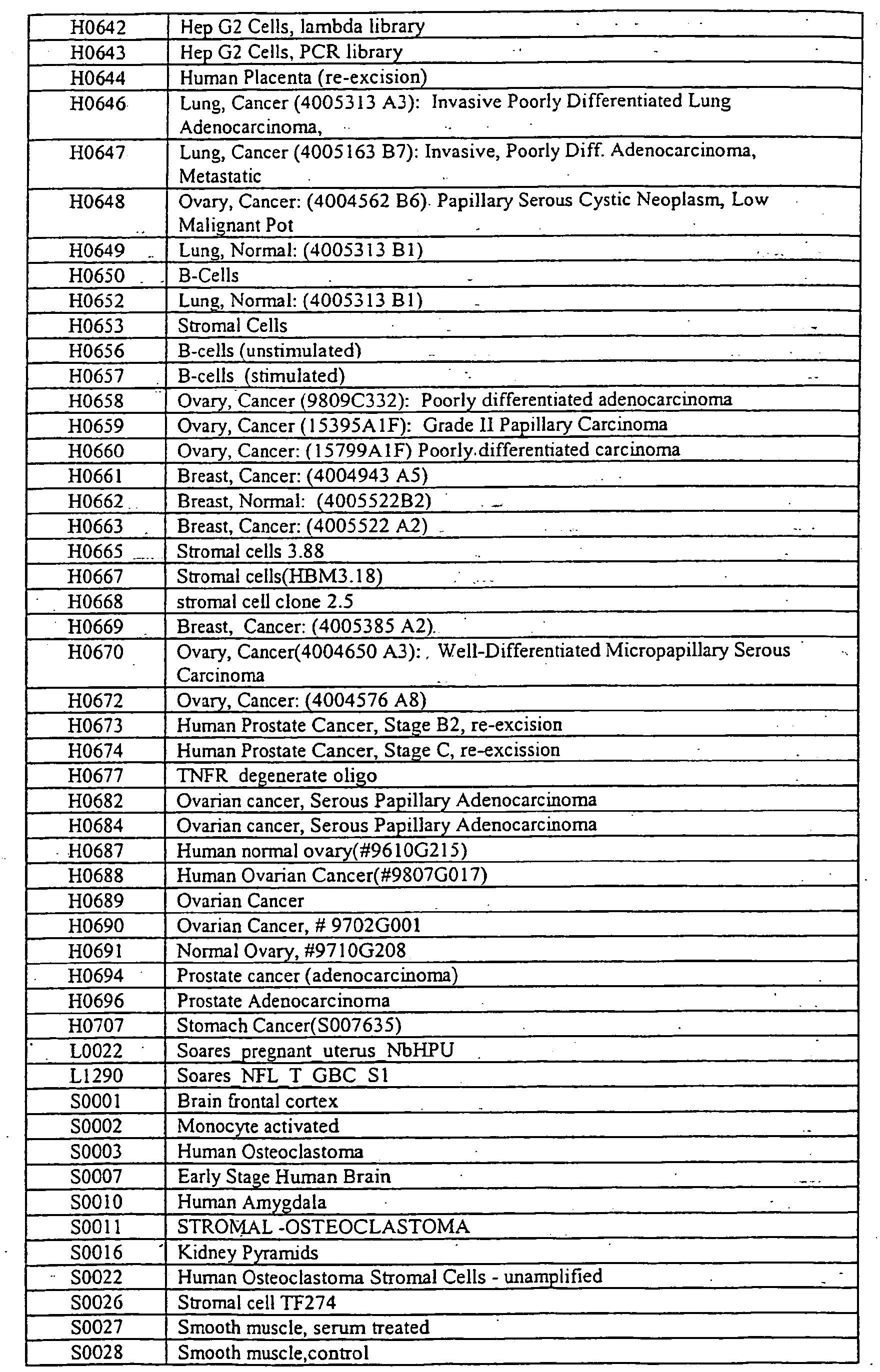
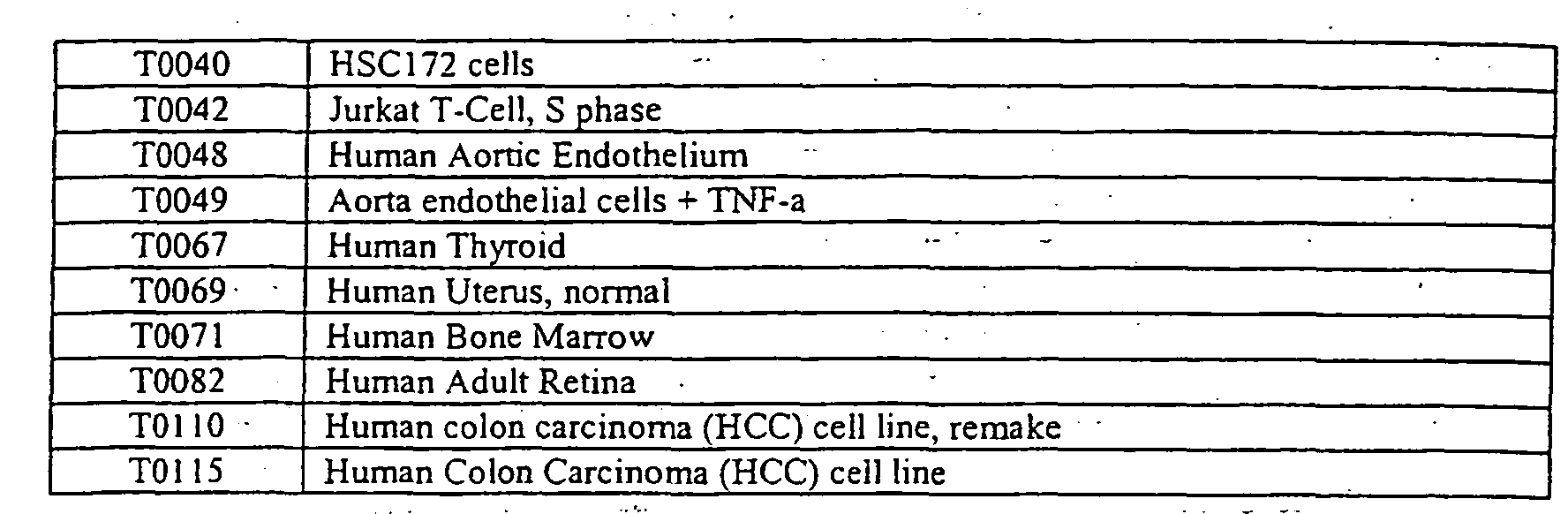
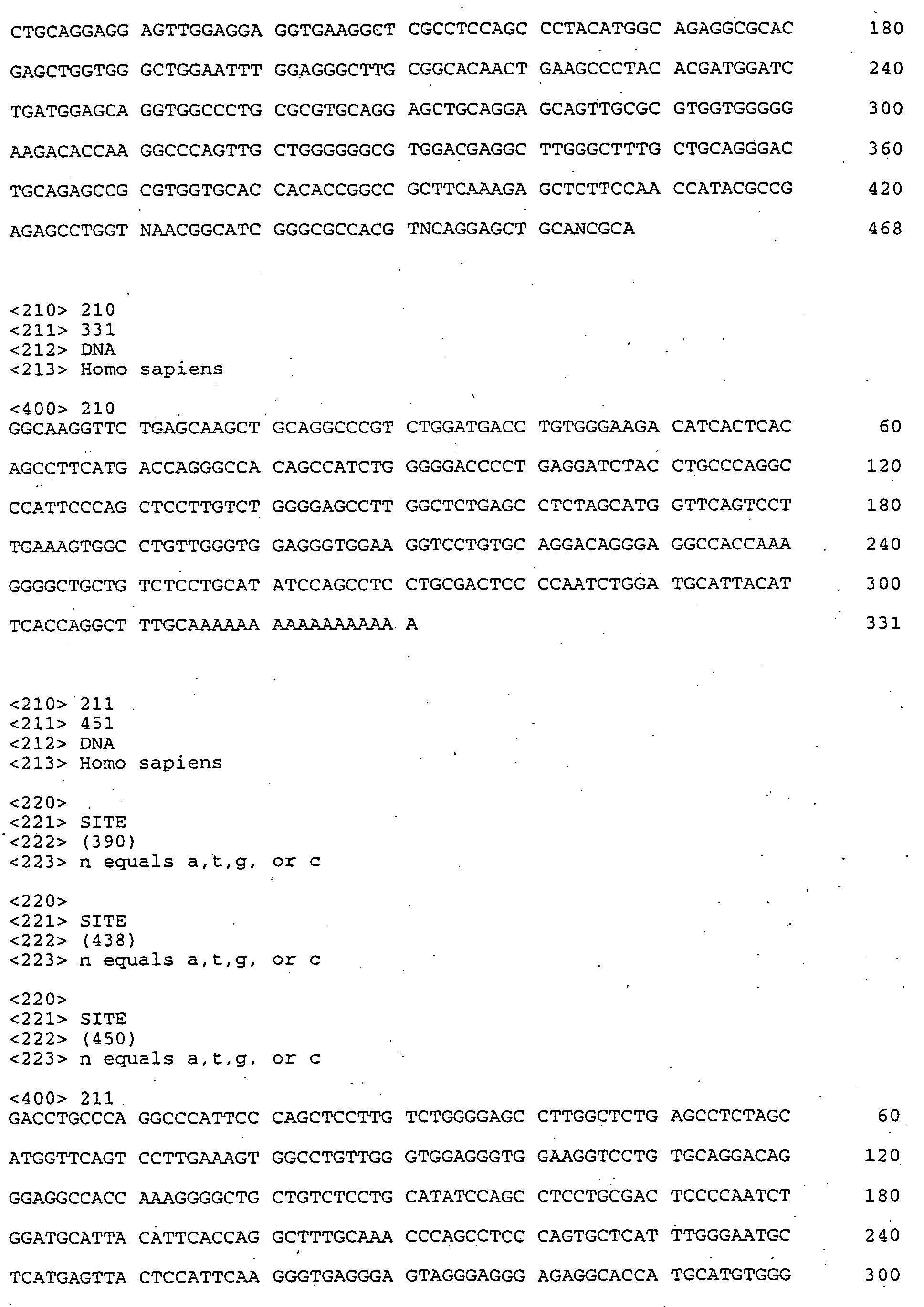
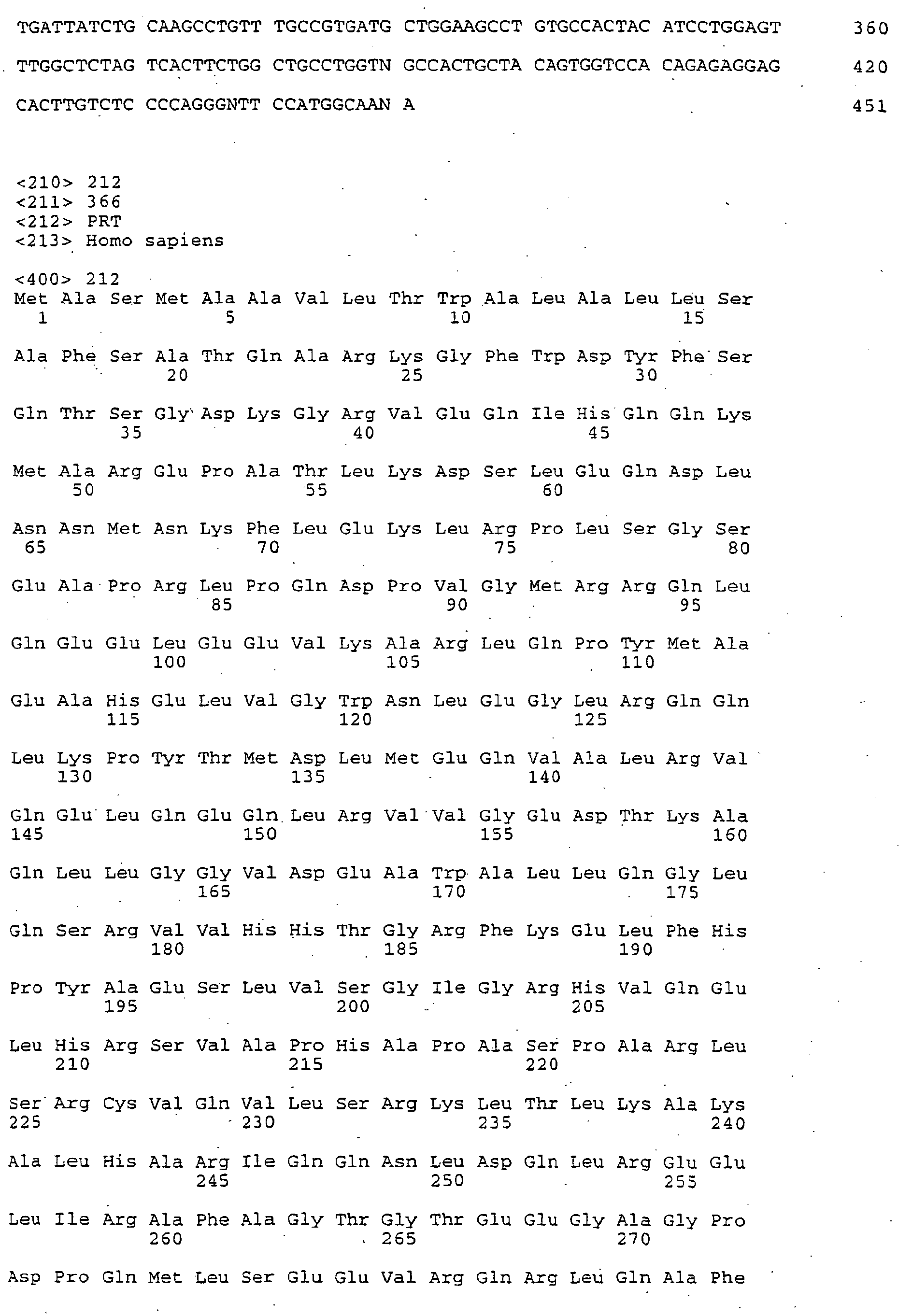
Field of the Invention
This invention relates to newly identified polynucleotides, polypeptides
encoded by these polynucleotides, antibodies that bind these polypeptides, uses of
such polynucleotides, polypeptides, and antibodies, and their production.
Background of the Invention
Unlike bacterium, which exist as a single compartment surrounded by a
membrane, human cells and other eucaryotes are subdivided by membranes into many
functionally distinct compartments. Each membrane-bounded compartment, or
organelle, contains different proteins essential for the function of the organelle. The
cell uses "sorting signals," which are amino acid motifs located within the protein, to
target proteins to particular cellular organelles.
One type of sorting signal, called a signal sequence, a signal peptide, or a
leader sequence, directs a class of proteins to an organelle called the endoplasmic
reticulum (ER). The ER separates the membrane-bounded proteins from all other
types of proteins. Once localized to the ER, both groups of proteins can be further
directed to another organelle called the Golgi apparatus. Here, the Golgi distributes
the proteins to vesicles, including secretory vesicles, the cell membrane, lysosomes,
and the other organelles.
Proteins targeted to the ER by a signal sequence can be released into the
extracellular space as a secreted protein. For example, vesicles containing secreted
proteins can fuse with the cell membrane and release their contents into the
extracellular space - a process called exocytosis. Exocytosis can occur constitutively
or after receipt of a triggering signal. In the latter case, the proteins are stored in
secretory vesicles (or secretory granules) until exocytosis is triggered. Similarly;
proteins residing on the cell membrane can also be secreted into the extracellular
space by proteolytic cleavage of a "linker" holding the protein to the membrane.
Despite the great progress made in recent years, only a small number of genes
encoding human secreted proteins have been identified. These secreted proteins
include the commercially valuable human insulin, interferon, Factor VIII, human
growth hormone, tissue plasminogen activator, and erythropoeitin. Thus, in light of
the pervasive role of secreted proteins in human physiology, a need exists for
identifying and characterizing novel human secreted proteins and the genes that
encode them. This knowledge will allow one to detect, to treat, and to prevent
medical diseases, disorders, and/or conditions by using secreted proteins or the genes
that encode them.
Summary of the Invention
The present invention relates to novel polynucleotides and the encoded
polypeptides. Moreover, the present invention relates to vectors, host cells,
antibodies, and recombinant and synthetic methods for producing the polypeptides
and polynucleotides. Also provided are diagnostic methods for detecting diseases,
disorders, and/or conditions related to the polypeptides and polynucleotides, and
therapeutic methods for treating such diseases, disorders, and/or conditions. The
invention further relates to screening methods for identifying binding partners of the
polypeptides.
Detailed Description
Definitions
The following definitions are provided to facilitate understanding of certain
terms used throughout this specification.
In the present invention, "isolated" refers to material removed from its original
environment (e.g., the natural environment if it is naturally occurring), and thus is
altered "by the hand of man" from its natural state. For example, an isolated
polynucleotide could be part of a vector or a composition of matter, or could be
contained within a cell, and still be "isolated" because that vector, composition of
matter, or particular cell is not the original environment of the polynucleotide. The
term "isolated" does not refer to genomic or cDNA libraries, whole cell total or
mRNA preparations, genomic DNA preparations (including those separated by
electrophoresis and transferred onto blots), sheared whole cell genomic DNA
preparations or other compositions where the art demonstrates no distinguishing
features of the polynucleotide/sequences of the present invention.
In the present invention, a "secreted" protein refers to those proteins capable of
being directed to the ER, secretory vesicles, or the extracellular space as a result of a
signal sequence, as well as those proteins released into the extracellular space without
necessarily containing a signal sequence. If the secreted protein is released into the
extracellular space, the secreted protein can undergo extracellular processing to
produce a "mature" protein. Release into the extracellular space can occur by many
mechanisms, including exocytosis and proteolytic cleavage.
In specific embodiments, the polynucleotides of the invention are at least 15,
at least 30, at least 50, at least 100, at least 125, at least 500, or at least 1000
continuous nucleotides but are less than or equal to 300 kb, 200 kb, 100 kb, 50 kb, 15
kb, 10 kb, 7.5 kb, 5 kb, 2.5 kb, 2.0 kb, or 1 kb, in length. In a further embodiment,
polynucleotides of the invention comprise a portion of the coding sequences, as
disclosed herein, but do not comprise all or a portion of any intron. In another
embodiment, the polynucleotides comprising coding sequences do not contain coding
sequences of a genomic flanking gene (i.e., 5' or 3' to the gene of interest in the
genome). In other embodiments, the polynucleotides of the invention do not contain
the coding sequence of more than 1000, 500, 250, 100, 50, 25, 20, 15, 10, 5, 4, 3, 2, or
1 genomic flanking gene(s).
As used herein, a "polynucleotide" refers to a molecule having a nucleic acid
sequence contained in SEQ ID NO:X or the cDNA contained within the clone
deposited with the ATCC. For example, the polynucleotide can contain the nucleotide
sequence of the full length cDNA sequence, including the 5' and 3' untranslated
sequences, the coding region, with or without the signal sequence, the secreted protein
coding region, as well as fragments, epitopes, domains, and variants of the nucleic
acid sequence. Moreover, as used herein, a "polypeptide" refers to a molecule having
the translated amino acid sequence generated from the polynucleotide as broadly
defined.
In the present invention, the full length sequence identified as SEQ ID NO:X
was often generated by overlapping sequences contained in multiple clones (contig
analysis). A representative clone containing all or most of the sequence for SEQ ID
NO:X was deposited with the American Type Culture Collection ("ATCC"). As
shown in Table 1, each clone is identified by a cDNA Clone ID (Identifier) and the
ATCC Deposit Number. The ATCC is located at 10801 University Boulevard,
Manassas, Virginia 20110-2209, USA. The ATCC deposit was made pursuant to the
terms of the Budapest Treaty on the international recognition of the deposit of
microorganisms for purposes of patent procedure.
A "polynucleotide" of the present invention also includes those
polynucleotides capable of hybridizing, under stringent hybridization conditions, to
sequences contained in SEQ ID NO:X, the complement thereof, or the cDNA within
the clone deposited with the ATCC. "Stringent hybridization conditions" refers to an
overnight incubation at 42 degree C in a solution comprising 50% formamide, 5x SSC
(750 mM NaCl, 75 mM trisodium citrate), 50 mM sodium phosphate (pH 7.6), 5x
Denhardt's solution, 10% dextran sulfate, and 20 µg/ml denatured, sheared salmon
sperm DNA, followed by washing the filters in 0.1x SSC at about 65 degree C.
Also contemplated are nucleic acid molecules that hybridize to the
polynucleotides of the present invention at lower stringency hybridization conditions.
Changes in the stringency of hybridization and signal detection are primarily
accomplished through the manipulation of formamide concentration (lower
percentages of formamide result in lowered stringency); salt conditions, or
temperature. For example, lower stringency conditions include an overnight
incubation at 37 degree C in a solution comprising 6X SSPE (20X SSPE = 3M NaCl;
0.2M NaH2PO4; 0.02M EDTA, pH 7.4), 0.5% SDS, 30% formamide, 100 ug/ml
salmon sperm blocking DNA; followed by washes at 50 degree C with 1XSSPE, 0.1 %
SDS. In addition, to achieve even lower stringency, washes performed following
stringent hybridization can be done at higher salt concentrations (e.g. 5X SSC).
Note that variations in the above conditions may be accomplished through the
inclusion and/or substitution of alternate blocking reagents used to suppress
background in hybridization experiments. Typical blocking reagents include
Denhardt's reagent, BLOTTO, heparin, denatured salmon sperm DNA, and
commercially available proprietary formulations. The inclusion of specific blocking
reagents may require modification of the hybridization conditions described above,
due to problems with compatibility.
Of course, a polynucleotide which hybridizes only to polyA+ sequences (such
as any 3' terminal polyA+tract of a cDNA shown in the sequence listing), or to a
complementary stretch of T (or U) residues, would not be included in the definition of
"polynucleotide," since such a polynucleotide would hybridize to any nucleic acid
molecule containing a poly (A) stretch or the complement thereof (e.g., practically
any double-stranded cDNA clone generated using oligo dT as a primer).
The polynucleotide of the present invention can be composed of any
polyribonucleotide or polydeoxribonucleotide, which may be unmodified RNA or
DNA or modified RNA or DNA. For example, polynucleotides can be composed of
single- and double-stranded DNA, DNA that is a mixture of single- and double-stranded
regions, single- and double-stranded RNA, and RNA that is mixture of
single- and double-stranded regions, hybrid molecules comprising DNA and RNA
that may be single-stranded or, more typically, double-stranded or a mixture of single-and
double-stranded regions. In addition, the polynucleotide can be composed of
triple-stranded regions comprising RNA or DNA or both RNA and DNA. A
polynucleotide may also contain one or more modified bases or DNA or RNA
backbones modified for stability or for other reasons. "Modified" bases include, for
example, tritylated bases and unusual bases such as inosine. A variety of
modifications can be made to DNA and RNA; thus, "polynucleotide" embraces
chemically, enzymatically, or metabolically modified forms.
The polypeptide of the present invention can be composed of amino acids
joined to each other by peptide bonds or modified peptide bonds, i.e., peptide
isosteres, and may contain amino acids other than the 20 gene-encoded amino acids.
The polypeptides may be modified by either natural processes, such as
posttranslational processing, or by chemical modification techniques which are well
known in the art. Such modifications are well described in basic texts and in more
detailed monographs, as well as in a voluminous research literature. Modifications
can occur anywhere in a polypeptide, including the peptide backbone, the amino acid
side-chains and the amino or carboxyl termini. It will be appreciated that the same
type of modification may be present in the same or varying degrees at several sites in
a given polypeptide. Also, a given polypeptide may contain many types of
modifications. Polypeptides may be branched , for example, as a result of
ubiquitination, and they may be cyclic, with or without branching. Cyclic, branched,
and branched cyclic polypeptides may result from posttranslation natural processes or
may be made by synthetic methods. Modifications include acetylation, acylation,
ADP-ribosylation, amidation, covalent attachment of flavin, covalent attachment of a
heme moiety, covalent attachment of a nucleotide or nucleotide derivative, covalent
attachment of a lipid or lipid derivative, covalent attachment of phosphotidylinositol,
cross-linking, cyclization, disulfide bond formation, demethylation, formation of
covalent cross-links, formation of cysteine, formation of pyroglutamate, formylation,
gamma-carboxylation, glycosylation, GPI anchor formation, hydroxylation,
iodination, methylation, myristoylation, oxidation, pegylation, proteolytic processing,
phosphorylation, prenylation, racemization, selenoylation, sulfation, transfer-RNA
mediated addition of amino acids to proteins such as arginylation, and ubiquitination.
(See, for instance, PROTEINS - STRUCTURE AND MOLECULAR PROPERTIES,
2nd Ed., T. E. Creighton, W. H. Freeman and Company, New York (1993);
POSTTRANSLATIONAL COVALENT MODIFICATION OF PROTEINS, B. C.
Johnson, Ed., Academic Press, New York, pgs. 1-12 (1983); Seifter et al., Meth
Enzymol 182:626-646 (1990); Rattan et al., Ann NY Acad Sci 663:48-62 (1992).)
"SEQ ID NO:X" refers to a polynucleotide sequence while "SEQ ID NO:Y"
refers to a polypeptide sequence, both sequences identified by an integer specified in
Table1.
"A polypeptide having biological activity" refers to polypeptides exhibiting
activity similar, but not necessarily identical to, an activity of a polypeptide of the
present invention, including mature forms, as measured in a particular biological
assay, with or without dose dependency. In the case where dose dependency does
exist, it need not be identical to that of the polypeptide, but rather substantially similar
to the dose-dependence in a given activity as compared to the polypeptide of the
present invention (i.e., the candidate polypeptide will exhibit greater activity or not
more than about 25-fold less and, preferably, not more than about tenfold less activity,
and most preferably, not more than about three-fold less activity relative to the
polypeptide of the present invention.)
Many proteins (and translated DNA sequences) contain regions where the
amino acid composition is highly biased toward a small subset of the available
residues. For example, membrane spanning domains and signal peptides (which are
also membrane spanning) typically contain long stretches where Leucine (L), Valine
(V), Alanine (A), and Isoleucine (I) predominate. Poly-Adenosine tracts (polyA) at
the end of cDNAs appear in forward translations as poly-Lysine (poly-K) and polyPhenylalanine
(poly-F) when the reverse complement is translated. These regions are
often referred to as "low complexity" regions.
Such regions can cause database similarity search programs such as BLAST to
find high-scoring sequence matches that do not imply true homology. The problem is
exacerbated by the fact that most weight matrices (used to score the alignments
generated by BLAST) give a match between any of group of hydrophobic-amino
acids (L,V and 1) that are commonly found in certain low complexity regions almost
as high a score as for exact matches.
In order to compensate for this, BLASTX.2 (version 2.0a5MP-WashU)
employs two filters ("seg" and "xnu") which "mask" the low complexity regions in a
particular sequence. These filters parse the sequence for such regions, and create a
new sequence in which the amino acids in the low complexity region have been
replaced with the character "X". This is then used as the input sequence (sometimes
referred to herein as "Query" and/or "Q") to the BLASTX program. While this regime
helps to ensure that high-scoring matches represent true homology, there is a negative
consequence in that the BLASTX program uses the query sequence that has been
masked by the filters to draw alignments.
Thus, a stretch of "X"s in an alignment shown in the following application
does not necessarily indicate that either the underlying DNA sequence or the
translated protein sequence is unknown or uncertain. Nor is the presence of such
stretches meant to indicate that the sequence is identical or not identical to the
sequence disclosed in the alignment of the present invention. Such stretches may
simply indicate that the BLASTX program masked amino acids in that region due to
the detection of a low complexity region, as defined above. In all cases, the reference
sequence(s) (sometimes referred to herein as "Subject", "Sbjct", and/or "S") indicated
in the specification, sequence table (Table 1), and/or the deposited clone is (are) the
definitive embodiment(s) of the present invention, and should not be construed as
limiting the present invention to the partial sequence shown in an alignment, unless
specifically noted otherwise herein.
Polynucleotides and Polypeptides of the Invention
FEATURES OF PROTEIN ENCODED BY GENE NO: 1
The translation product of this gene shares sequence homology with
alloreaction associated antigen (ARAg), or V7, a transmembrane protein with an
extracellular domain containing 7 immunoglobulin like domains. ARAg is present on
the surface of alloantigen activated CD8+ T cells, monocytes, granulocytes and
peripheral dendritic cells and can be used to screen potential immunosuppressants,
identify and isolate ARAg receptors and generate MAb for suppressing an immune
response. A mAb directed against V7 inhibits the proliferative response of T cells to
allogenic cells or immobilized anti-CD3 Ab, but not lectin mitogens, suggesting that
V7 plays a role in TCR/CD3-mediated T cell activation. Based on the sequence
similarity, the translation product of this clone is expected to share at least some
biological activities with T-cell activator proteins, and particularly V7. Such activities
are known in the art, some of which are described elsewhere herein (See, for example,
J. Immunol. 154 (9), 4434-4443 (1995); all the information available through this
reference is hereby incorporated herein by reference).
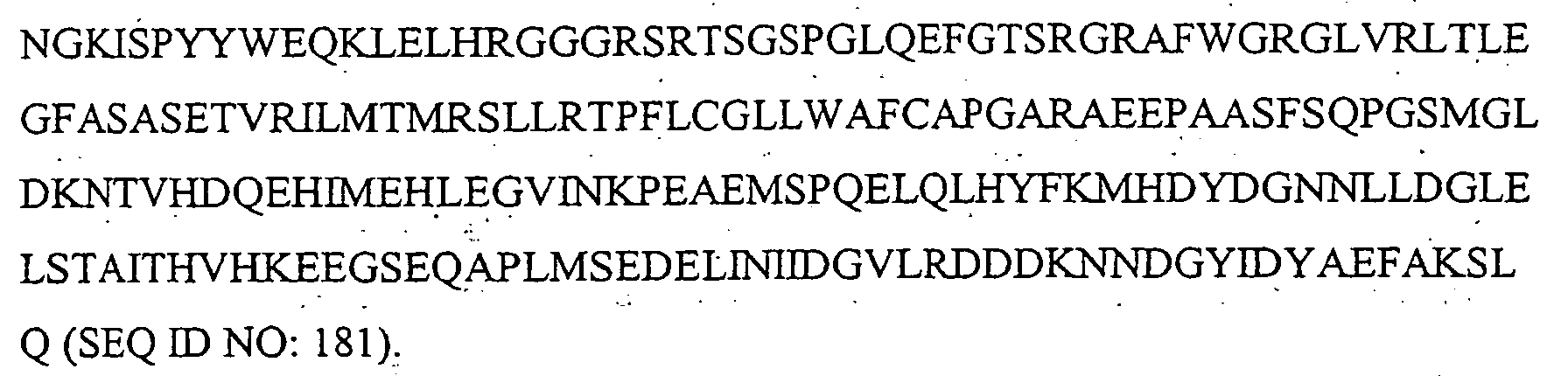
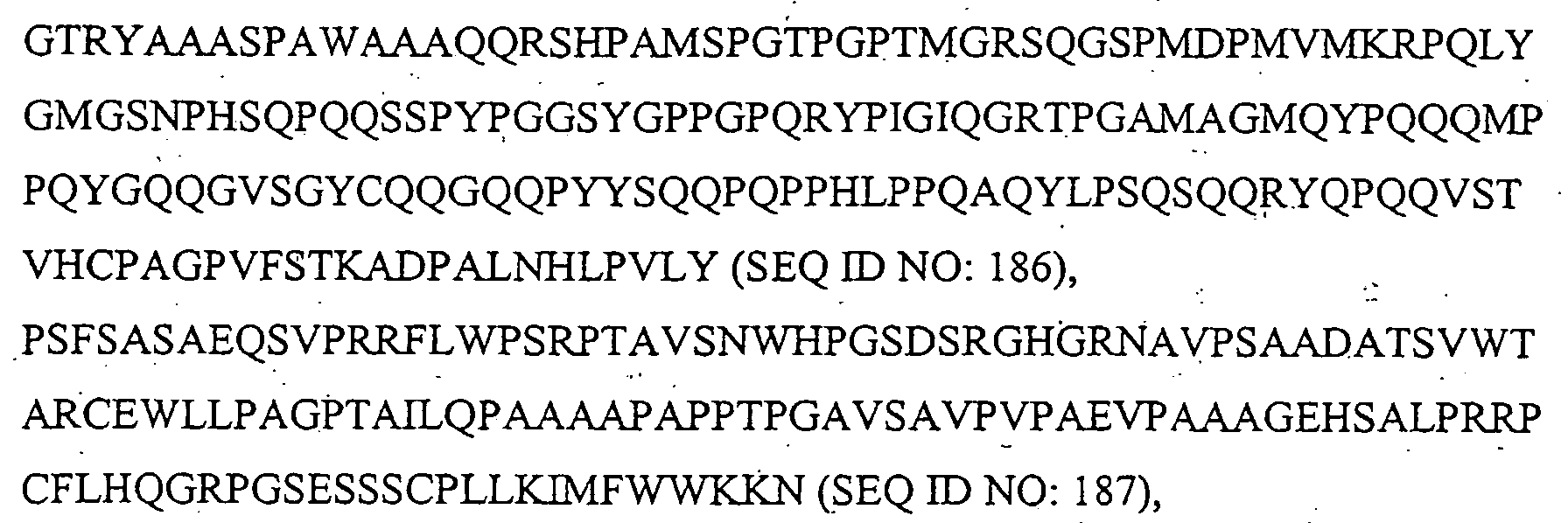
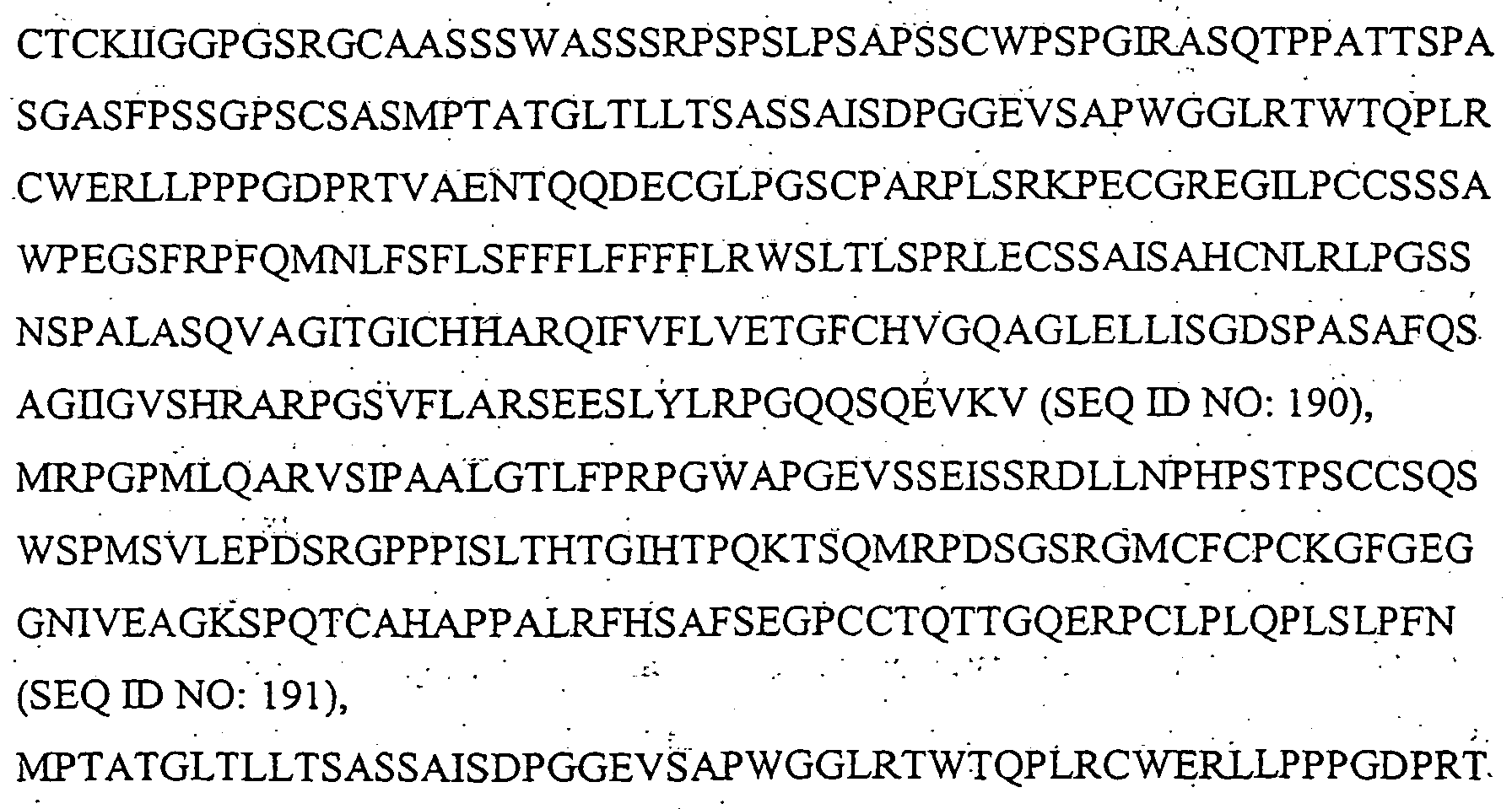
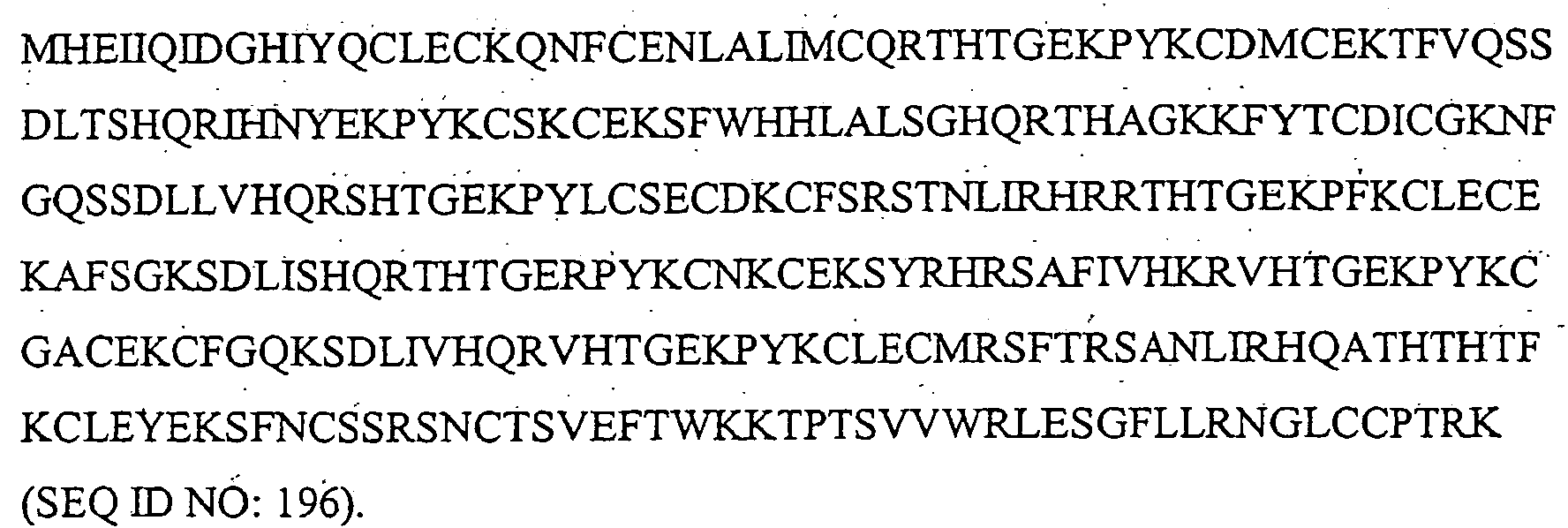
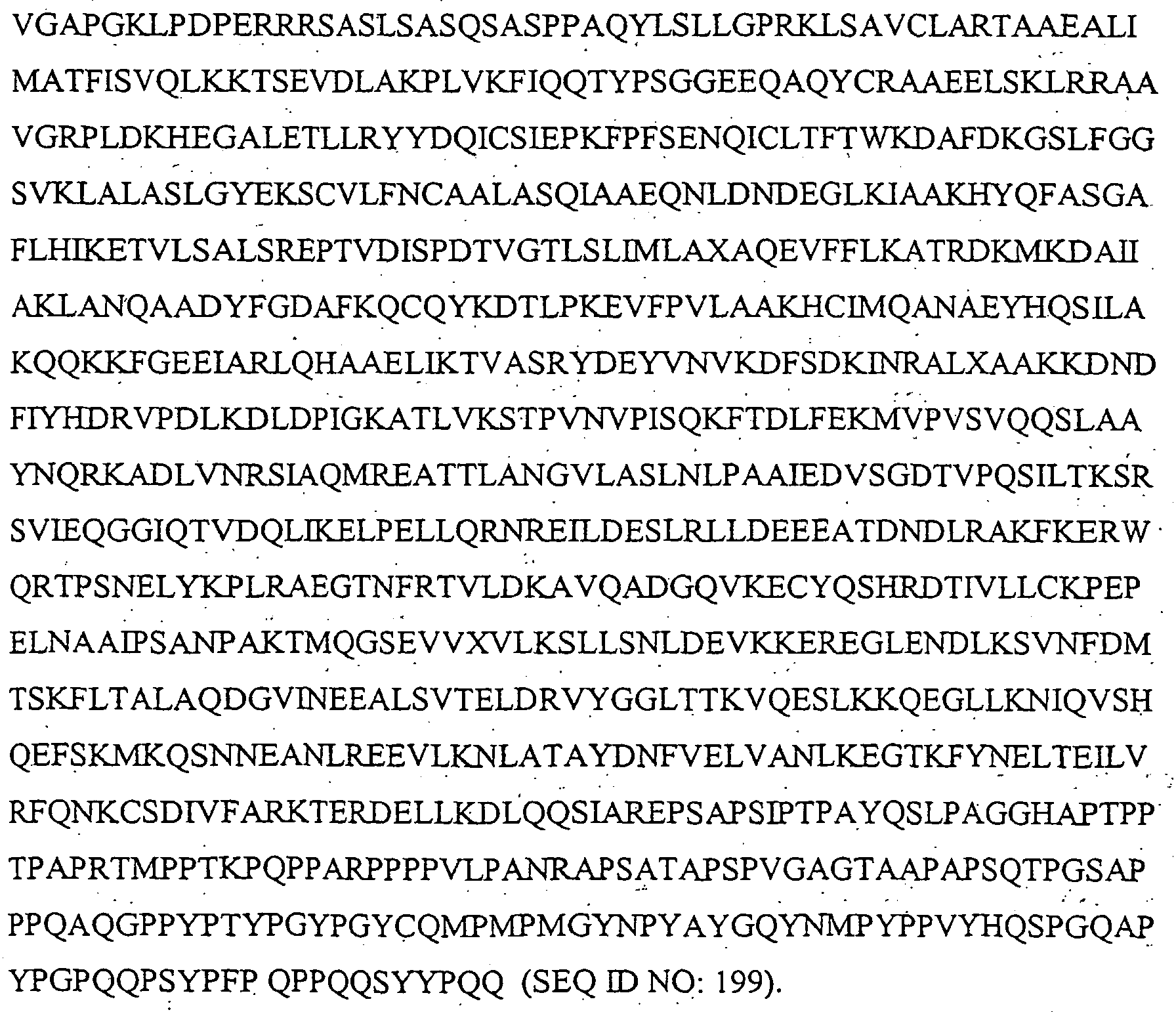
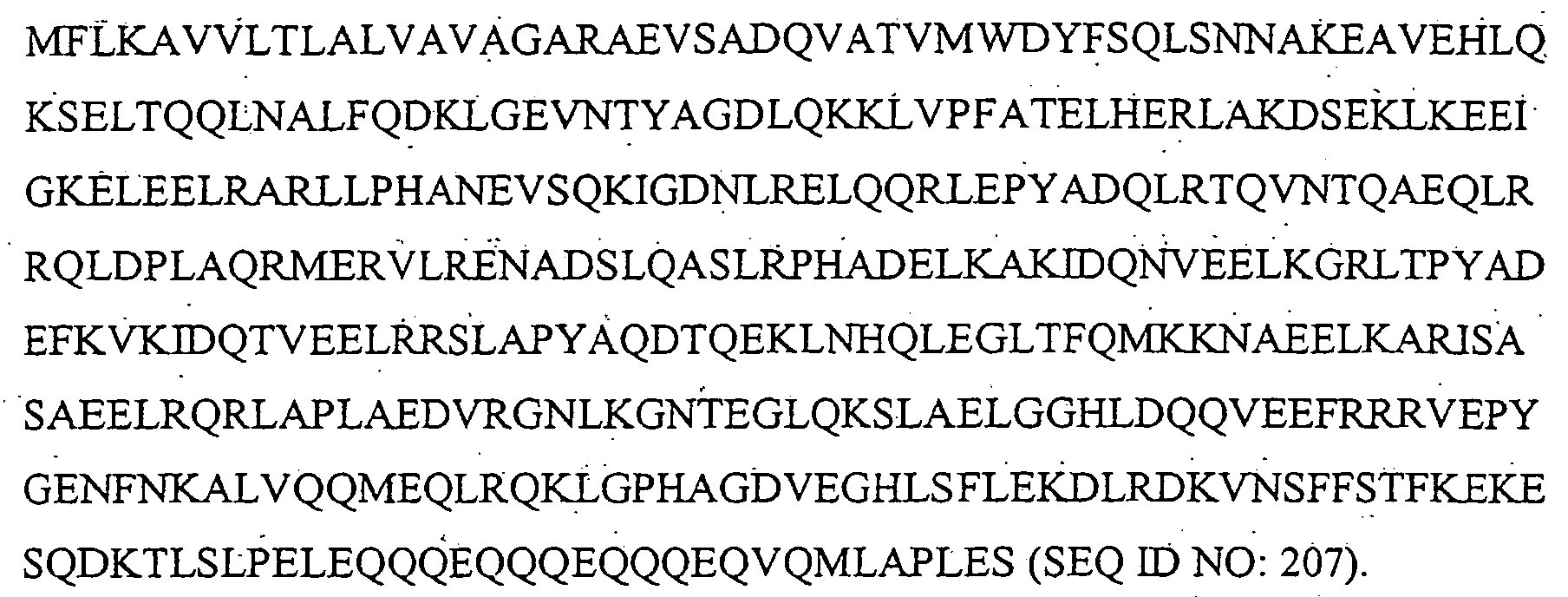
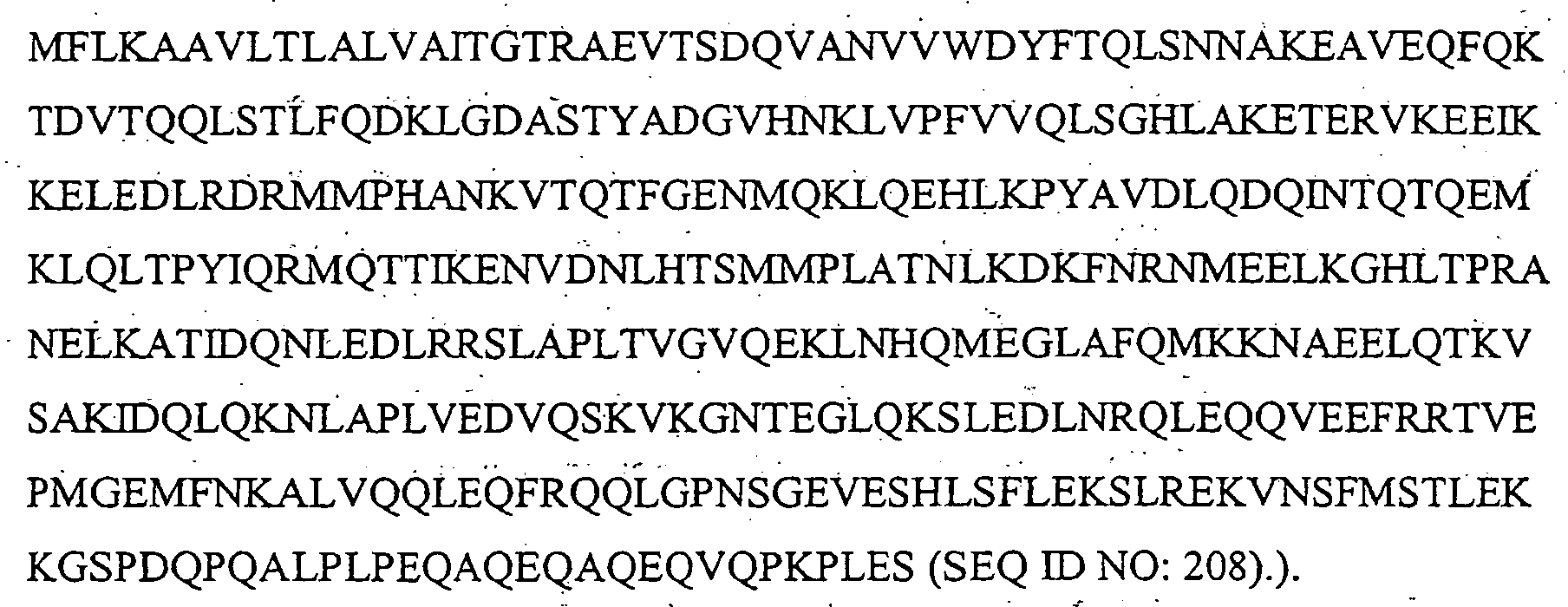
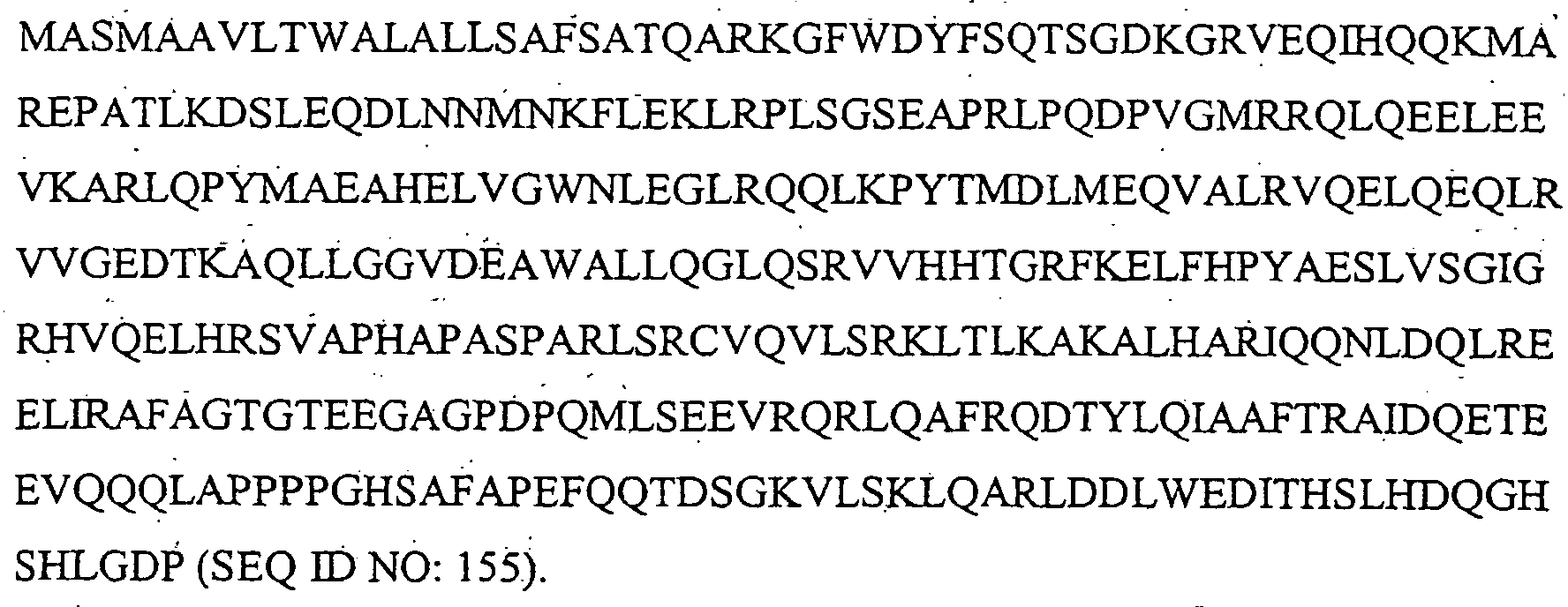
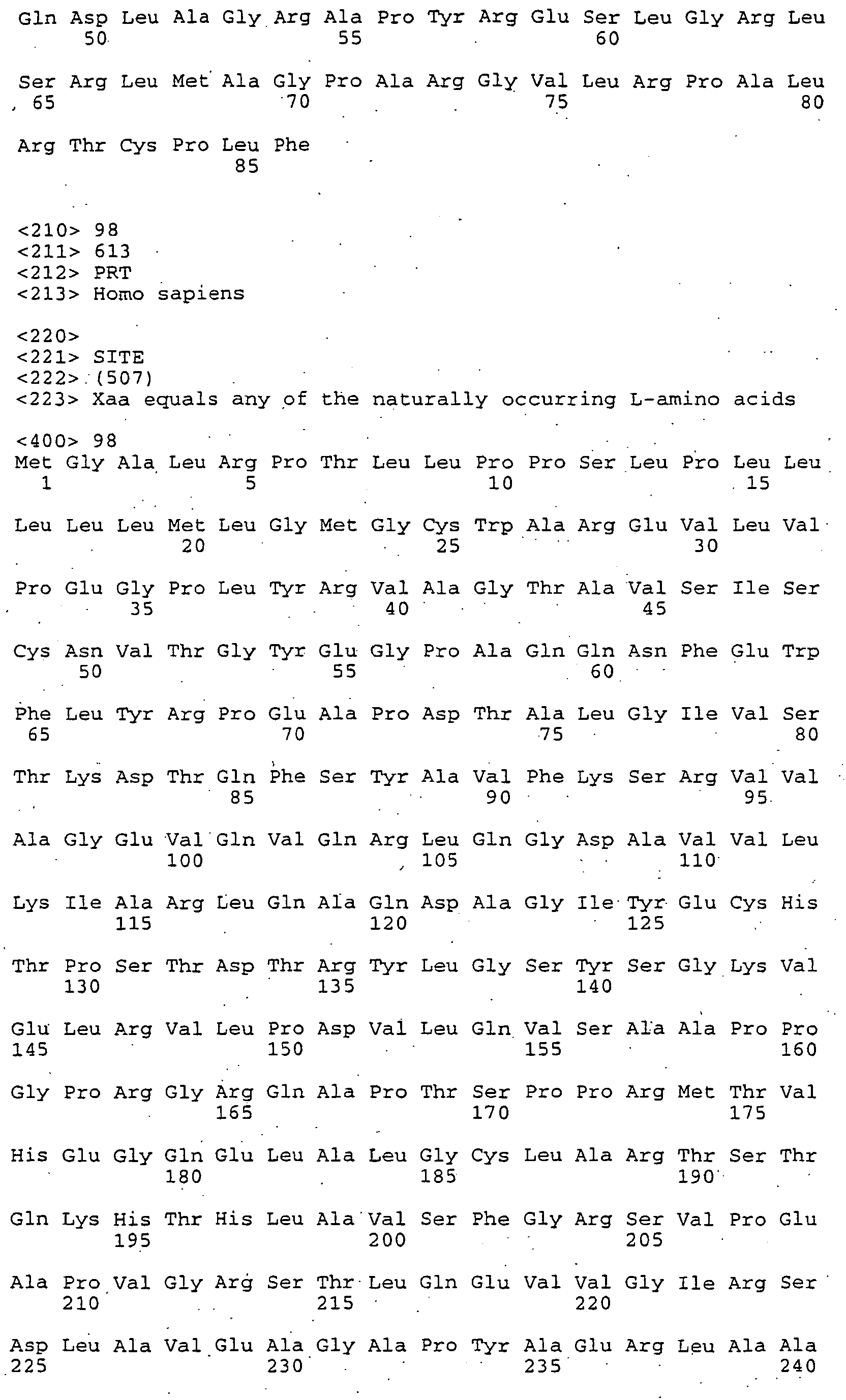
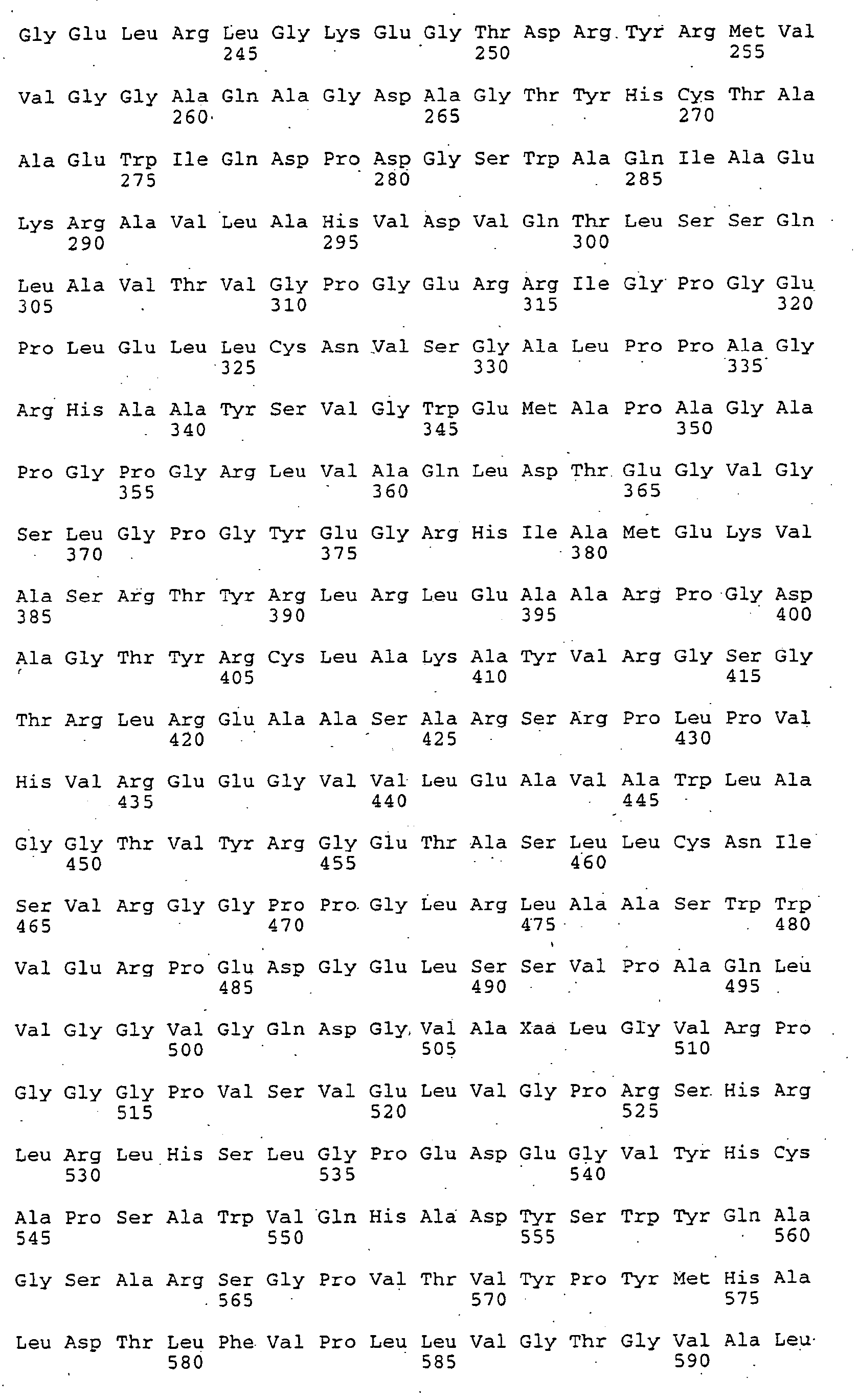
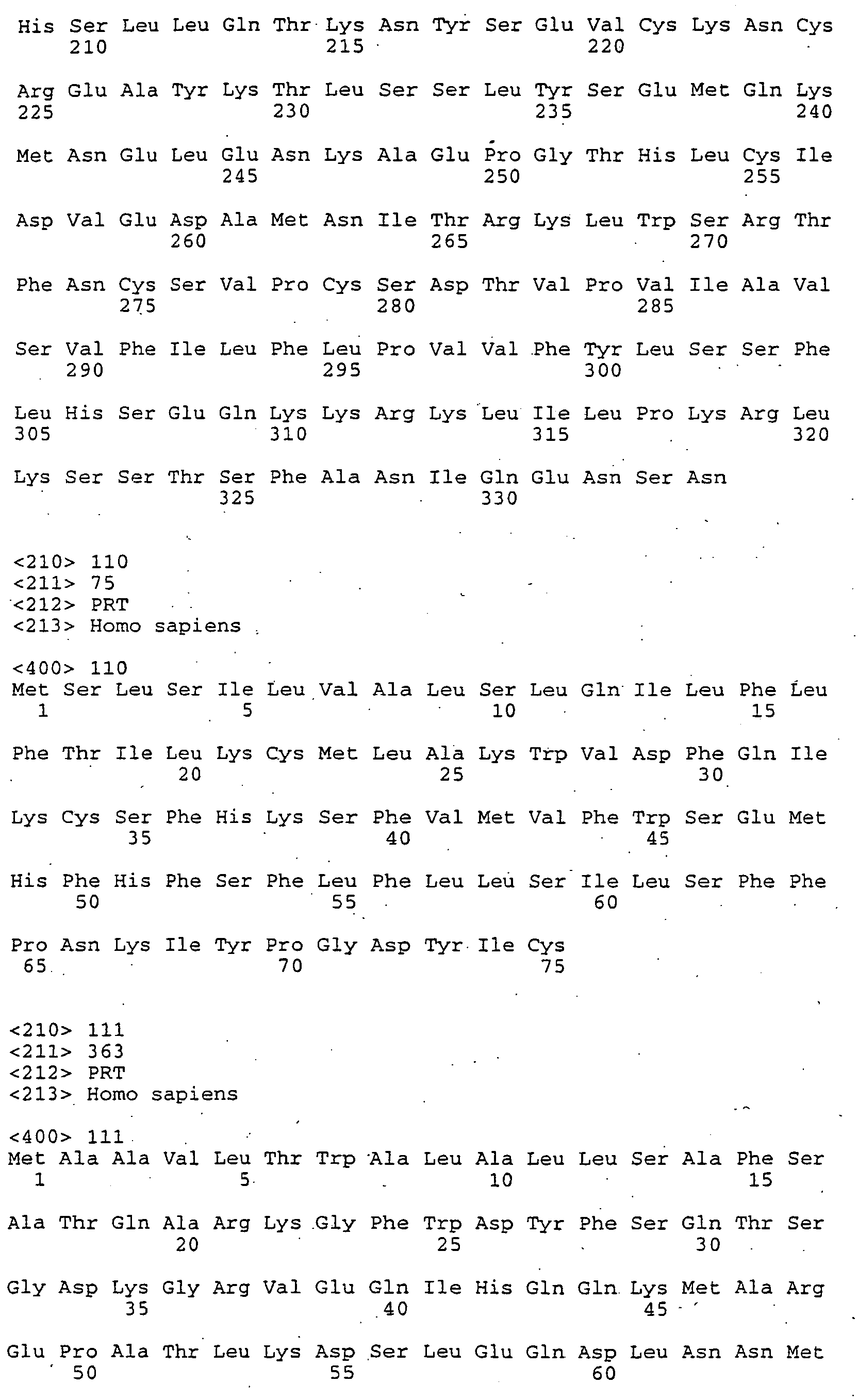
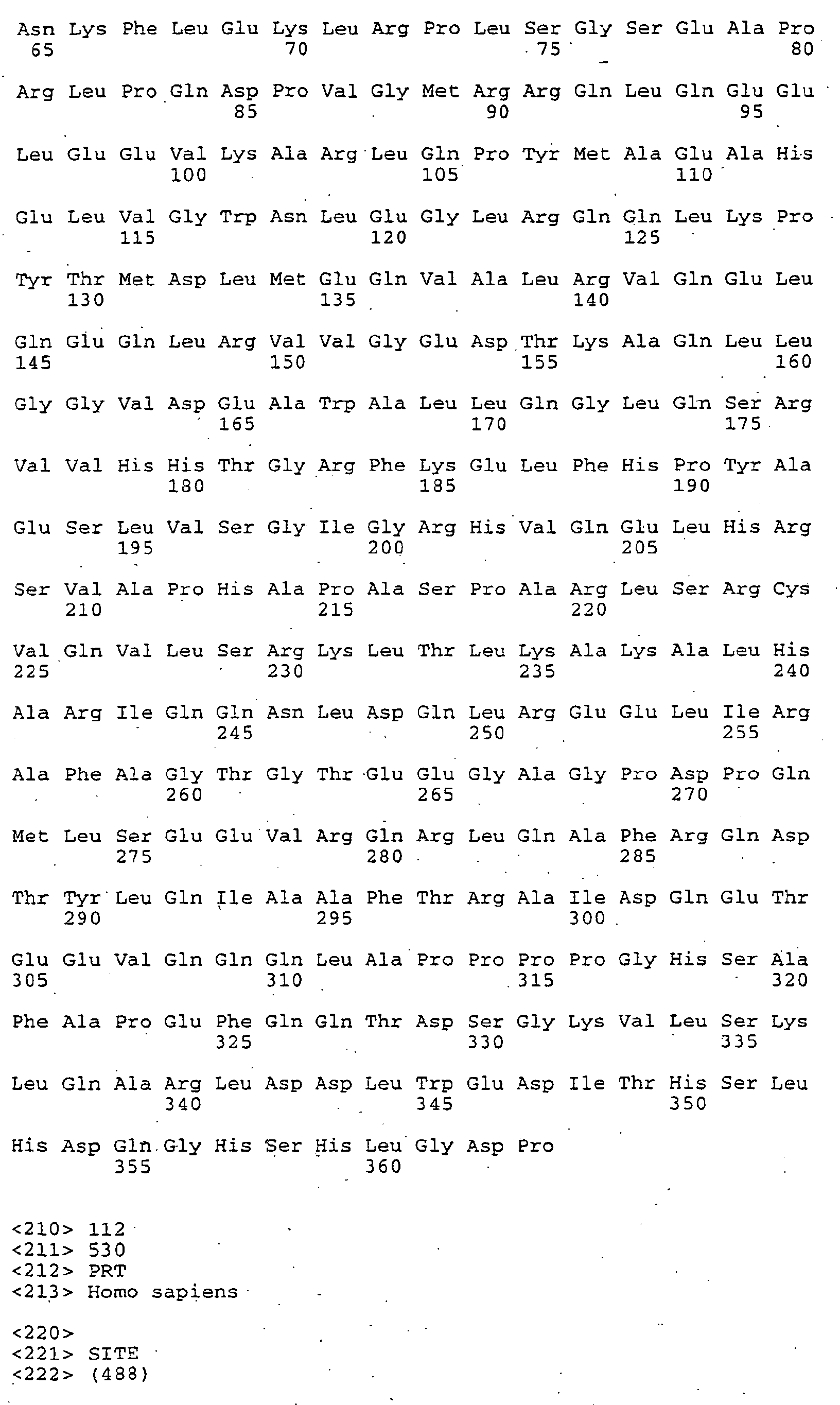
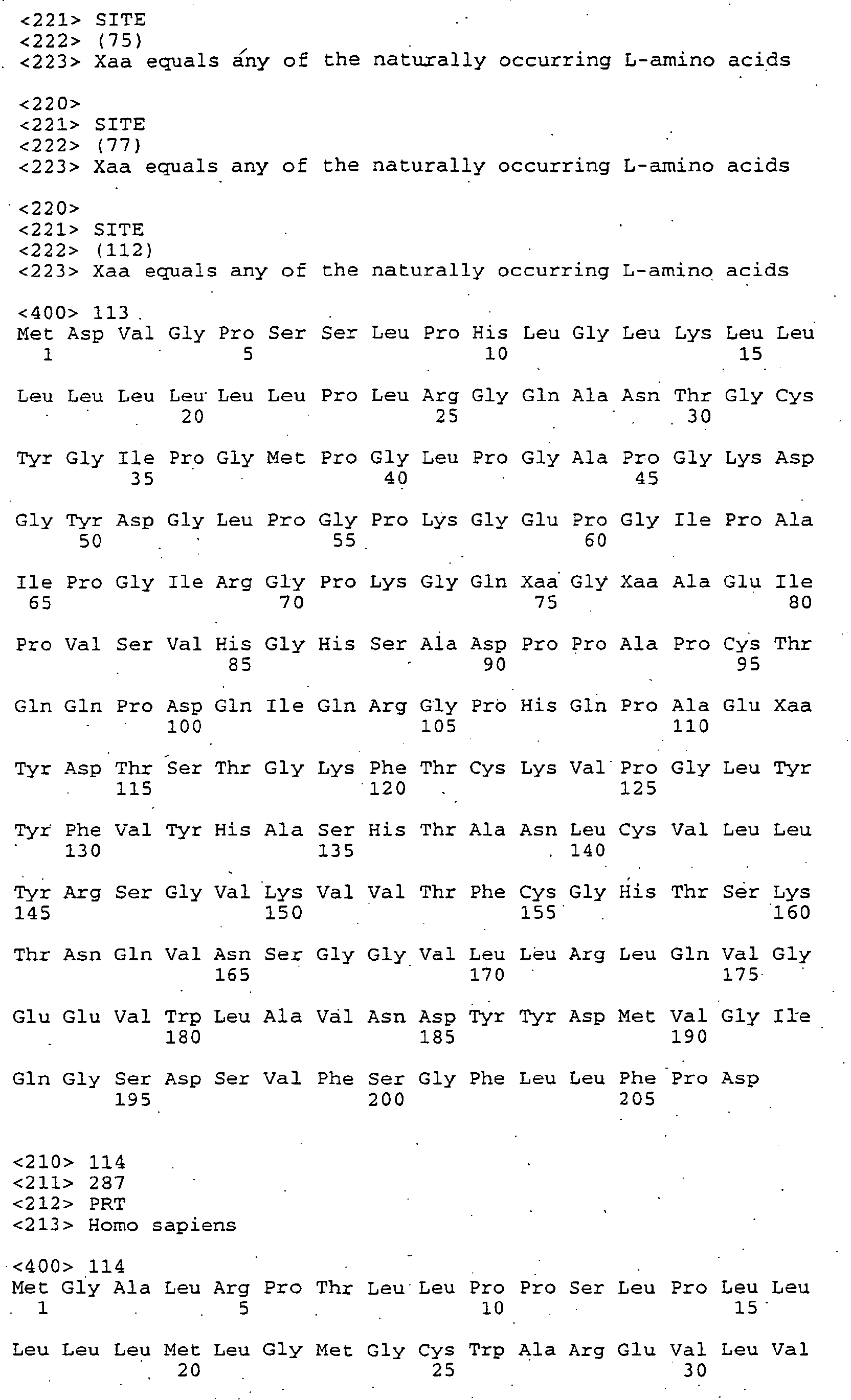
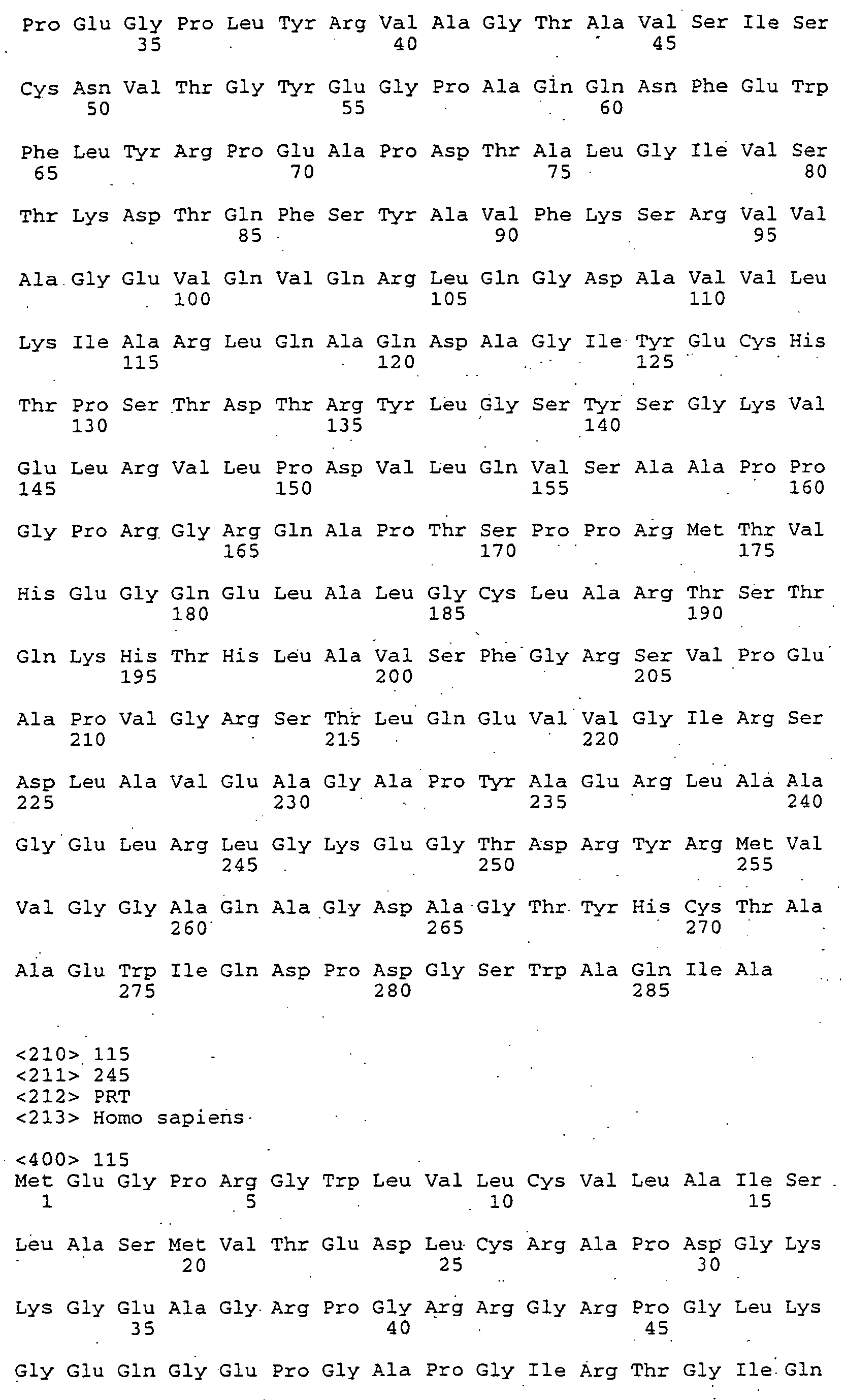
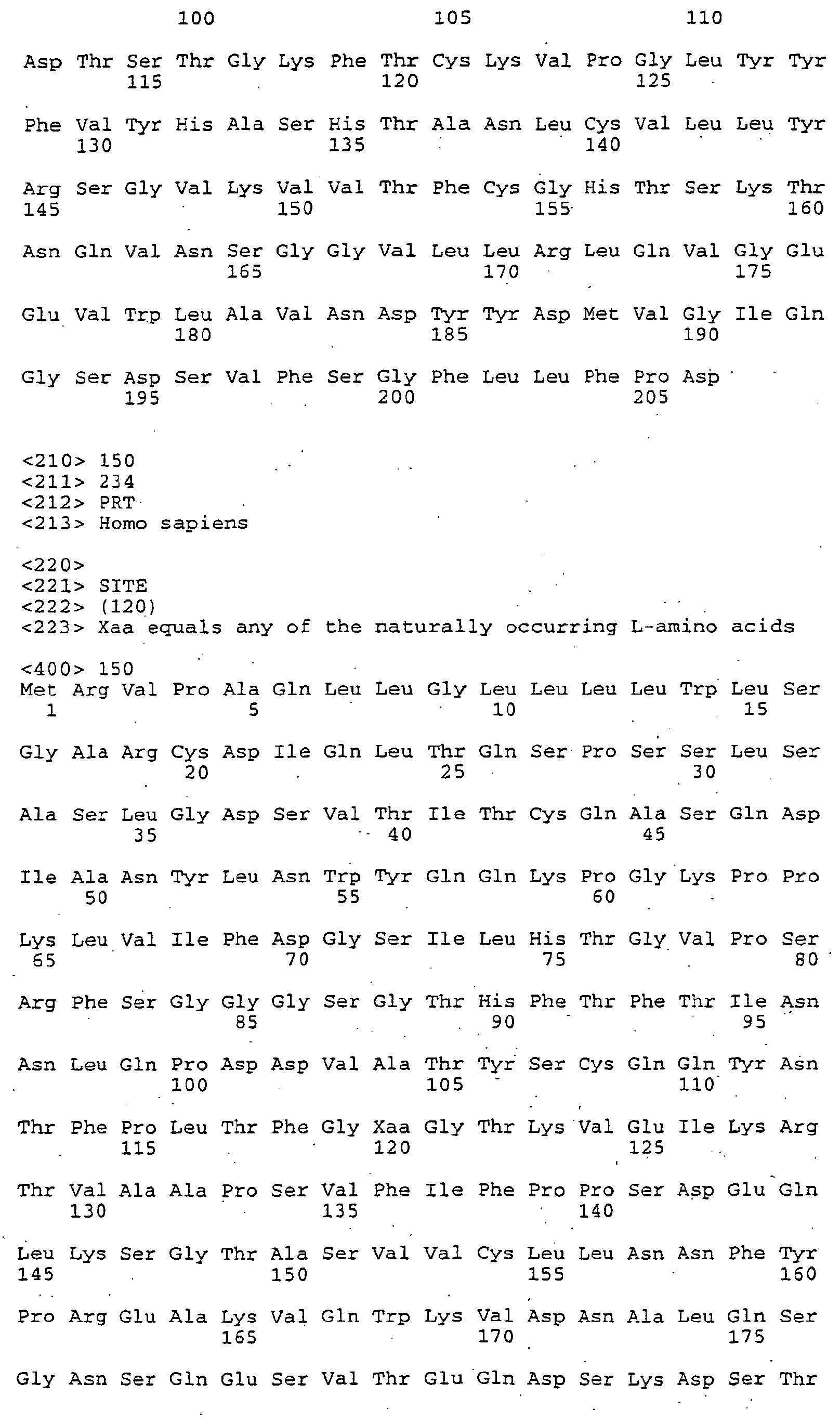
A preferred polypeptide variant of the invention comprises the following
amino acid sequence:
Moreover,
fragments and variants of these polypeptides (such as, for example, fragments as
described herein, polypeptides at least 80%, 85%, 90%, 95%, 96%, 97%, 98%, or
99% identical to these polypeptides and polypeptides encoded by the polynucleotide
which hybridizes, under stringent conditions, to the polynucleotide encoding these
polypeptides, or the complement there of are encompassed by the invention.
Antibodies that bind polypeptides of the invention are also encompassed by the
invention. Polynucleotides encoding these polypeptides are also encompassed by the
invention.
The polypeptide of this gene has been determined to have a transmembrane
domain at about amino acid position 580-596 of the amino acid sequence referenced
in Table 1 for this gene. Moreover, a cytoplasmic tail encompassing amino acids 597
to 648 of this protein has also been determined. Based upon these characteristics, it is
believed that the protein product of this gene shares structural features to type Ia
membrane proteins.
This gene is expressed primarily in brain and primary dendritic cells and to a
lesser extent in activated T cells, as well as several other tissues.
Polynucleotides and polypeptides of the invention are useful as reagents for
differential identification of the tissue(s) or cell type(s) present in a biological sample
and for diagnosis of diseases and conditions which include but are not limited to:
neurodegenerative disorders; immune system dysfunction; immunosuppression;
transplant rejection; graft versus host disease; inflammatory disorders; and
autoimmune diseases. Similarly, polypeptides and antibodies directed to these
polypeptides are useful in providing immunological probes for differential
identification of the tissue(s) or cell type(s). For a number of disorders of the above
tissues or cells, particularly of the brain, CNS,and immune system, expression of this
gene at significantly higher or lower levels may be routinely detected in certain tissues
or cell types (e.g., neural, immune, hematopoietic, and cancerous and wounded
tissues) or bodily fluids (e.g., lymph, serum, plasma, urine, synovial fluid and spinal
fluid) or another tissue or sample taken from an individual having such a disorder,
relative to the standard gene expression level, i.e., the expression level in healthy .
tissue or bodily fluid from an individual not having the disorder.
Preferred polypeptides of the present invention comprise, or alternatively
consist of, one or more immunogenic epitopes immunogenic epitopes shown in SEQ
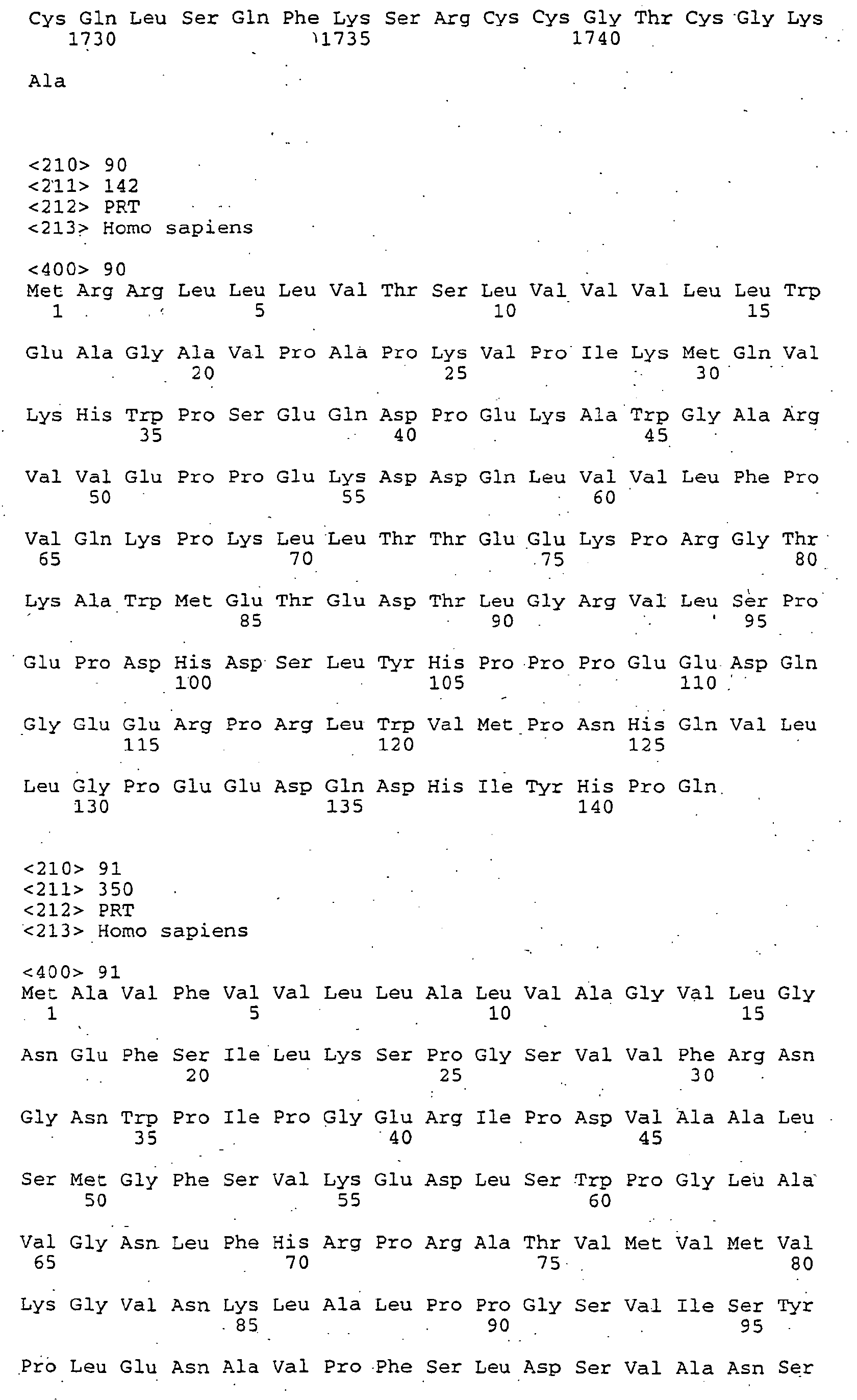
ID NO: 82 as residues: Thr-52 to Phe-62, Pro-130 to Arg-135, Pro-160 to Arg-173,
Thr-190 to His-195, Gly-246 to Arg-252, Arg-397 to Thr-403, Gly-414 to Arg-420,
Arg-483 to Glu-488, Arg-525 to Arg-530, Gly-535 to Val-541. Polynucleotides
encoding said polypeptides are also encompassed by the invention.
The tissue distribution in primary dendritic cells and activated T cells,
combined with the homology to ARAg or V7 indicates that polynucleotides and
polypeptides corresponding to this gene are useful for the diagnosis and/or treatment
of a variety of immune disorders. Previous studies have indicated that V7 or ARAg is
involved in T cell activation and in immune responses. Therefore, this gene may play
similar roles, and may be involved in inflammation, autoimmunity, susceptibility to
infection, tissue/graft rejection, and in the proliferation, survival, differentiation, or
activation of a variety of hematopoietic cell lineages. Similarly, expression at elevated
levels in the brain, and in other tissues, suggests that this protein may be involved in
the proliferation, stimulation, or differentiation of other cell lineages as well,
including neurons and mesenchymal cells. Representative uses are described in the
"Immune Activity" and "Infectious Disease" sections below, in Example 11, 13, 14,
16, 18, 19, 20, and 27, and elsewhere herein. Briefly, the expression of this gene
product indicates a role in regulating the proliferation; survival; differentiation; and/or
activation of hematopoietic cell lineages, including blood stem cells. This gene
product is involved in the regulation of cytokine production, antigen presentation, or
other processes suggesting a usefulness in the treatment of cancer (e.g. by boosting
immune responses). Since the gene is expressed in cells of lymphoid origin, the
natural gene product is involved in immune functions. Therefore it is also useful as an
agent for immunological disorders including arthritis, asthma, immunodeficiency
diseases such as AIDS, leukemia, rheumatoid arthritis, granulomatous disease,
inflammatory bowel disease, sepsis, acne, neutropenia, neutrophilia, psoriasis,
hypersensitivities, such as T-cell mediated cytotoxicity; immune reactions to
transplanted organs and tissues, such as host-versus-graft and graft-versus-host
diseases, or autoimmunity disorders, such as autoimmune infertility, lense tissue
injury, demyelination, systemic lupus erythematosis, drug induced hemolytic anemia,
rheumatoid arthritis, Sjogren's disease, and scleroderma. Moreover, the protein may
represent a secreted factor that influences the differentiation or behavior of other
blood cells, or that recruits hematopoietic cells to sites of injury. Thus, this gene
product is thought to be useful in the expansion of stem cells and committed
progenitors of various blood lineages, and in the differentiation and/or proliferation of
various cell types. Furthermore, the protein may also be used to determine biological
activity, raise antibodies, as tissue markers, to isolate cognate ligands or receptors, to
identify agents that modulate their interactions, in addition to its use as a nutritional
supplement. Protein, as well as, antibodies directed against the protein may show
utility as a tumor marker and/or immunotherapy targets for the above listed tissues.
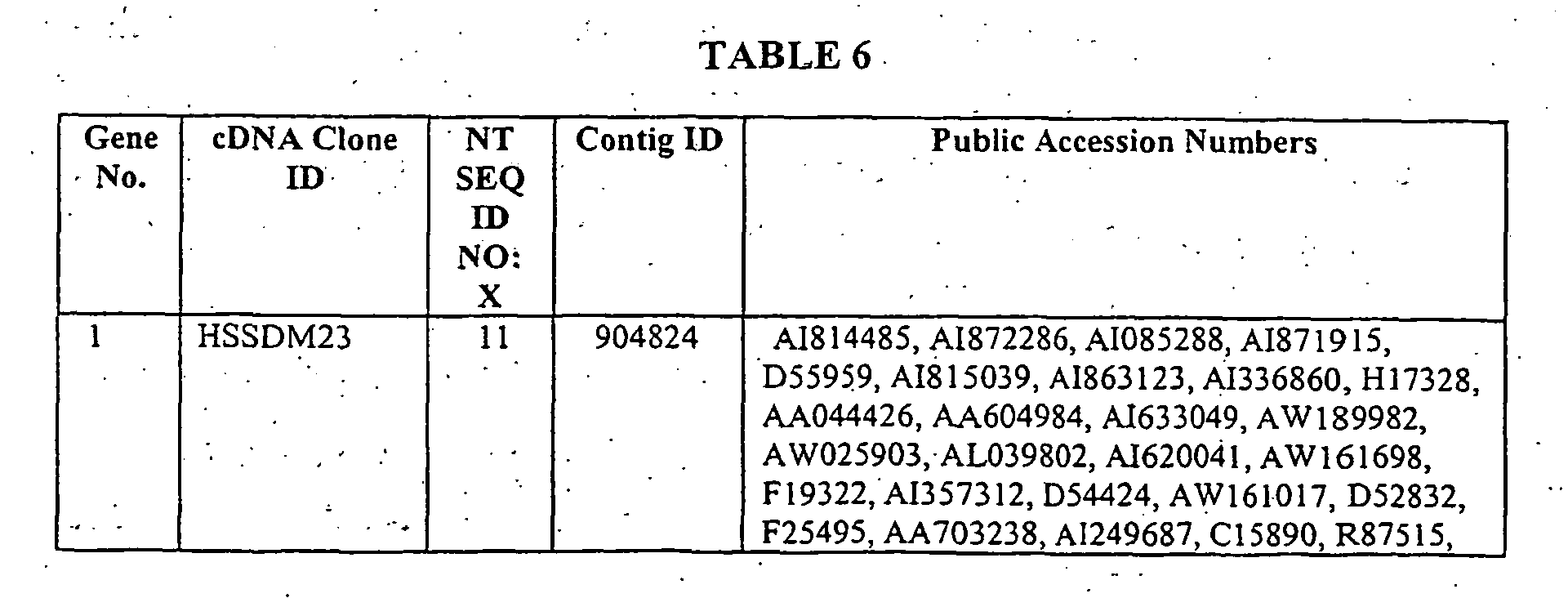
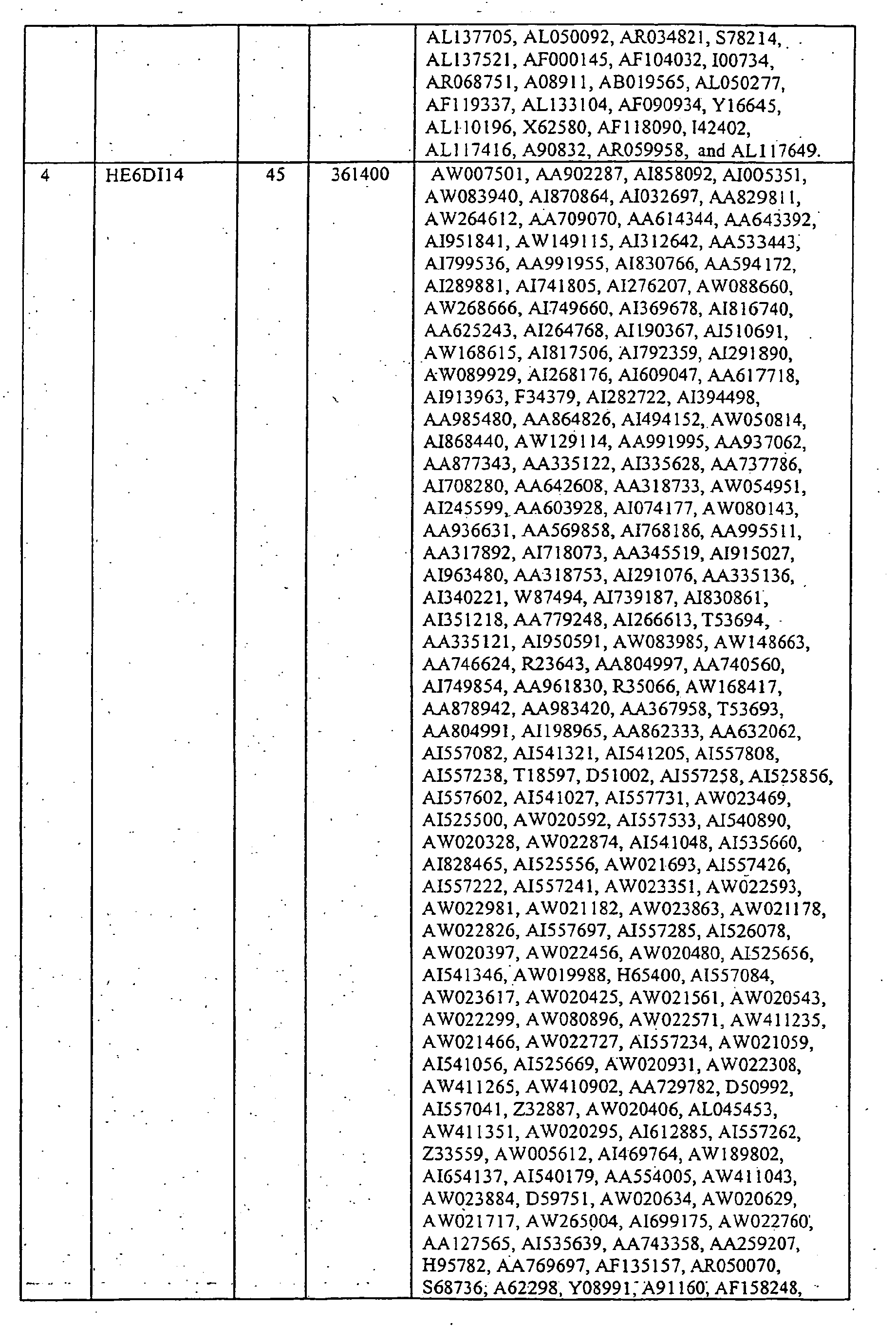
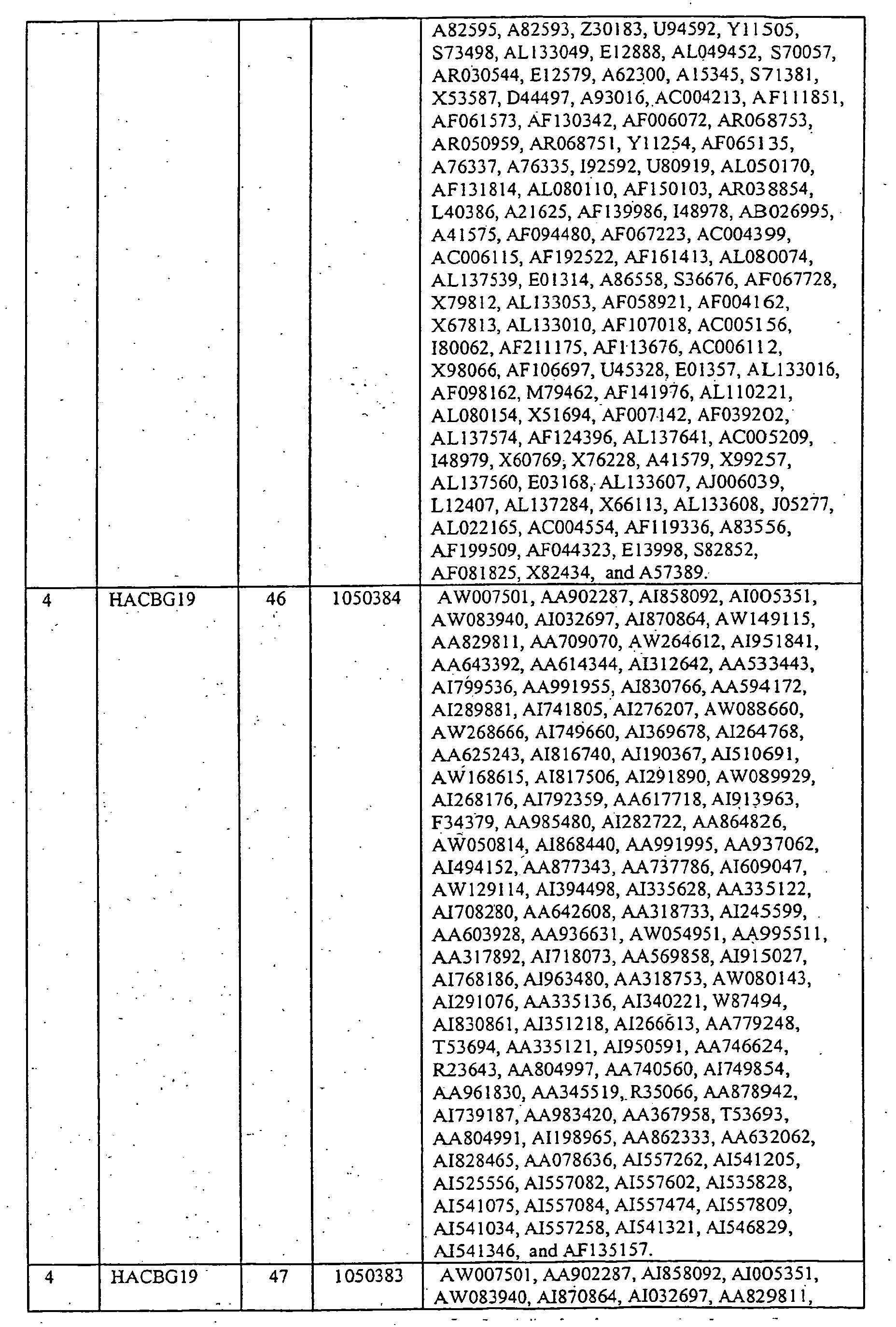
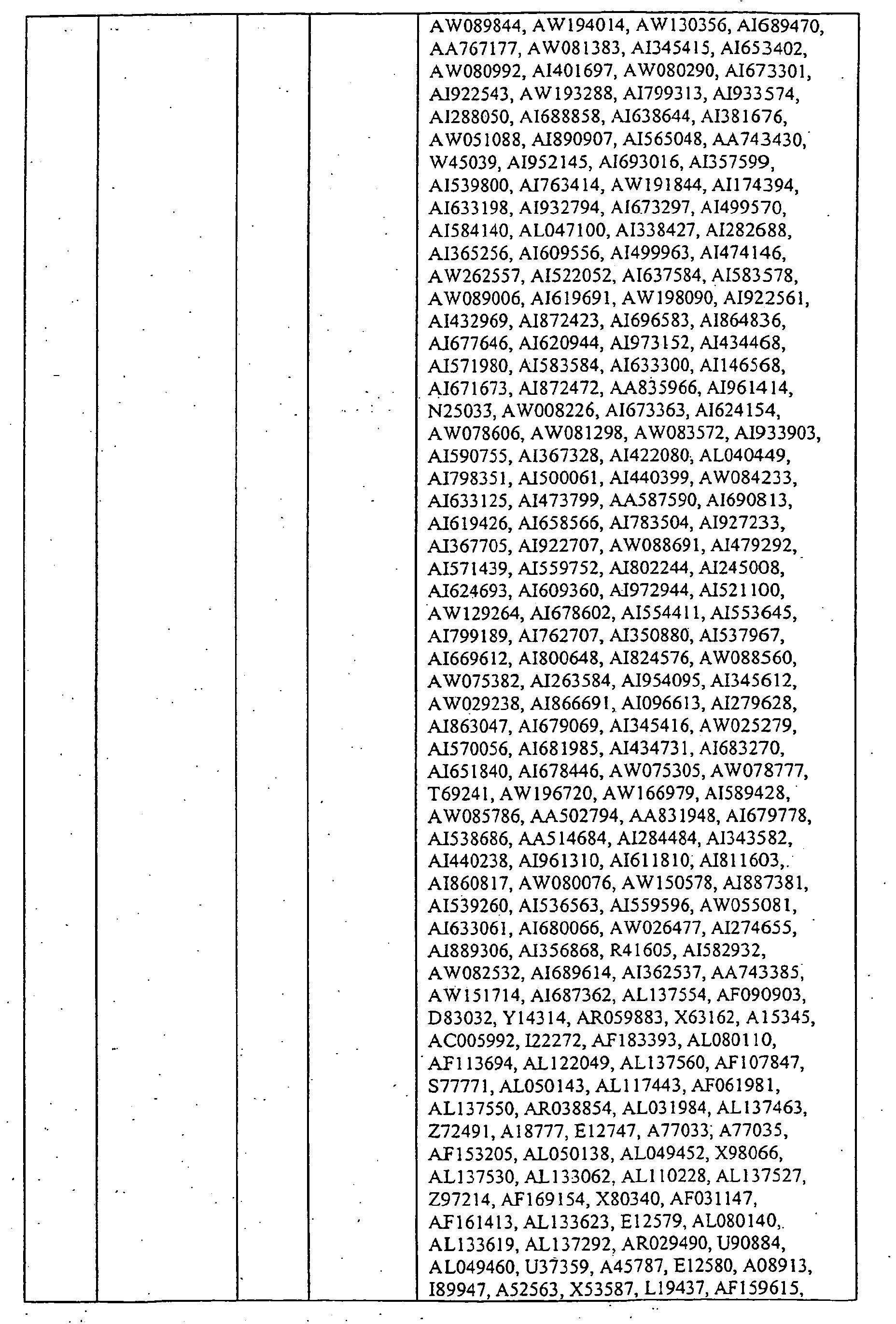
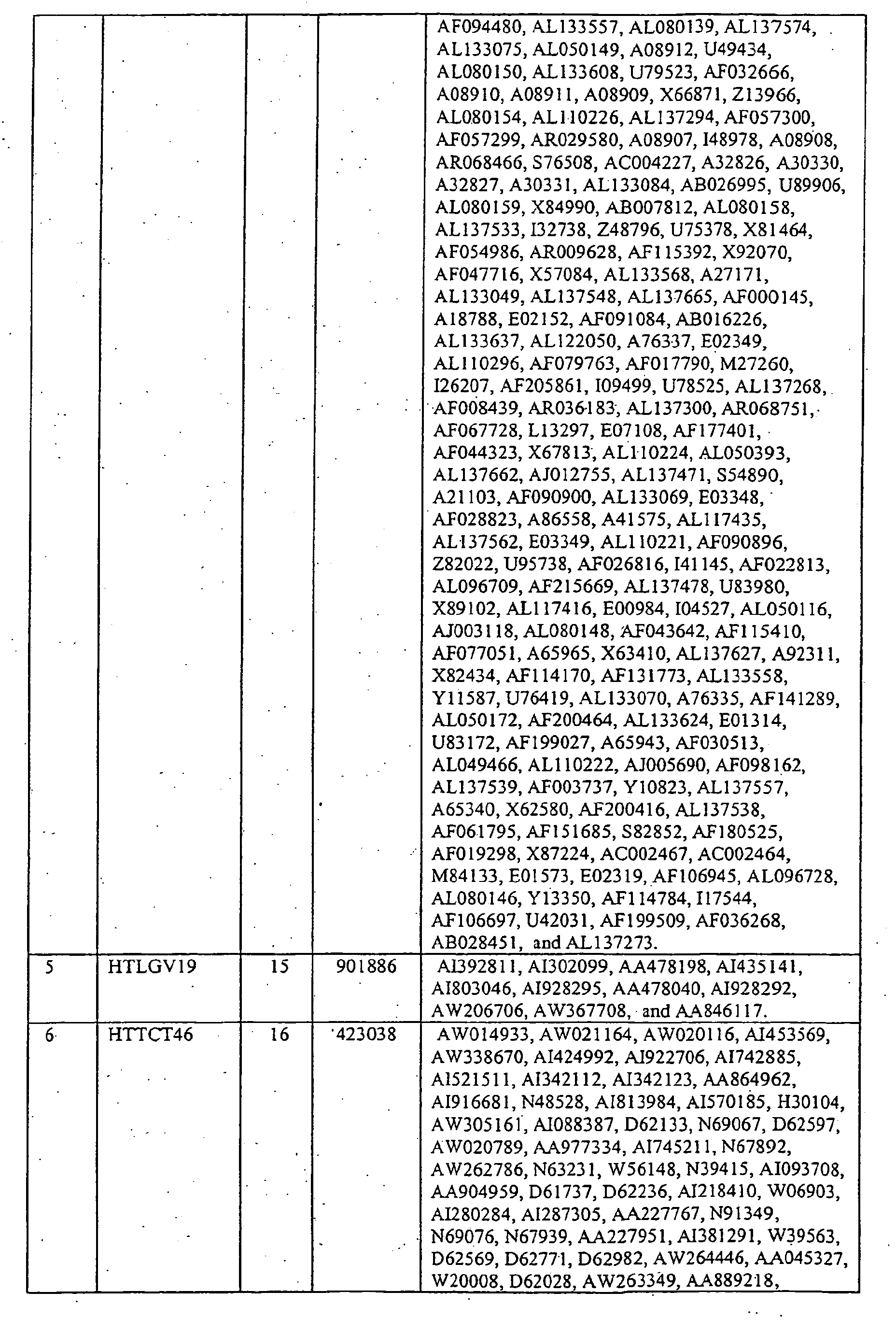
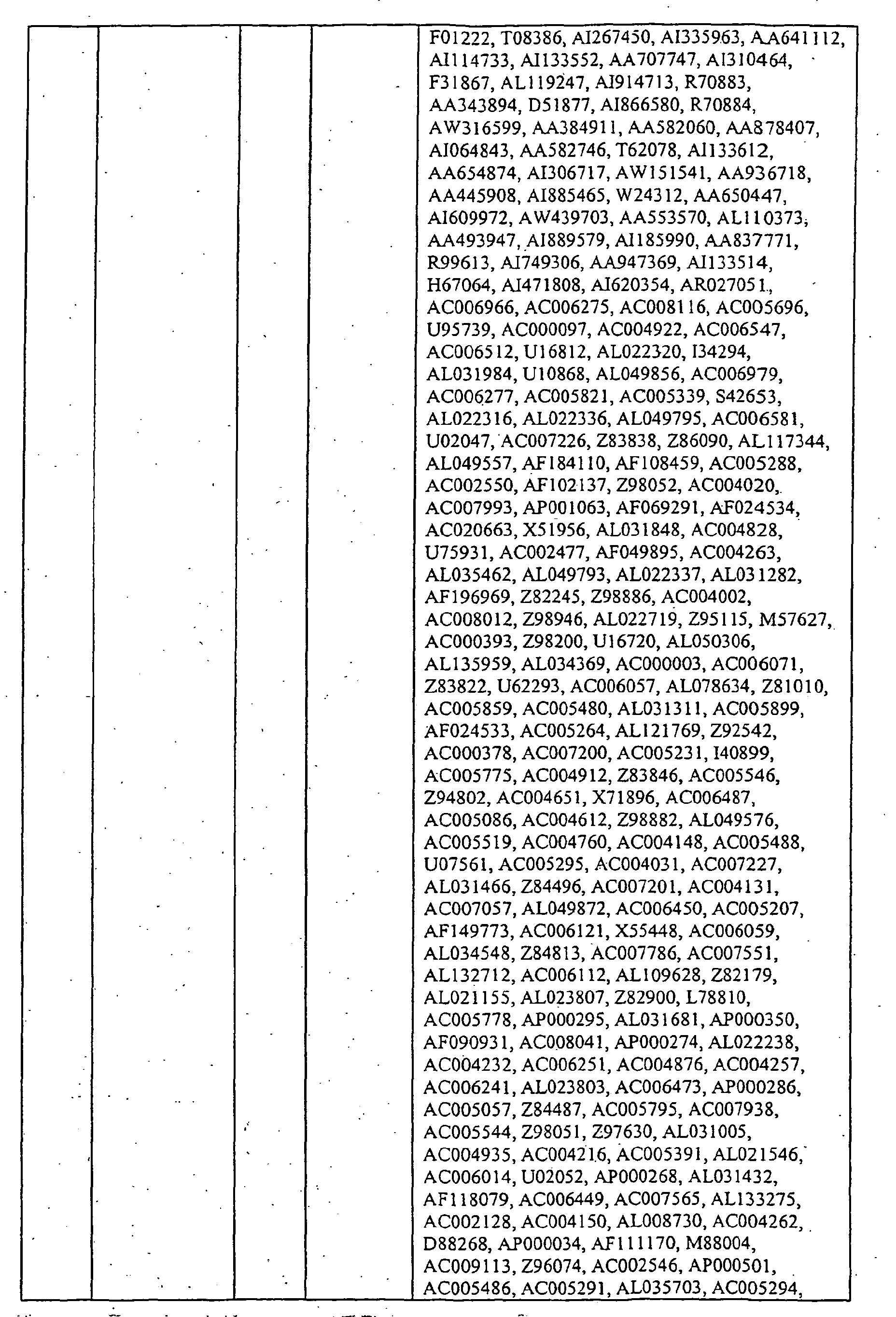
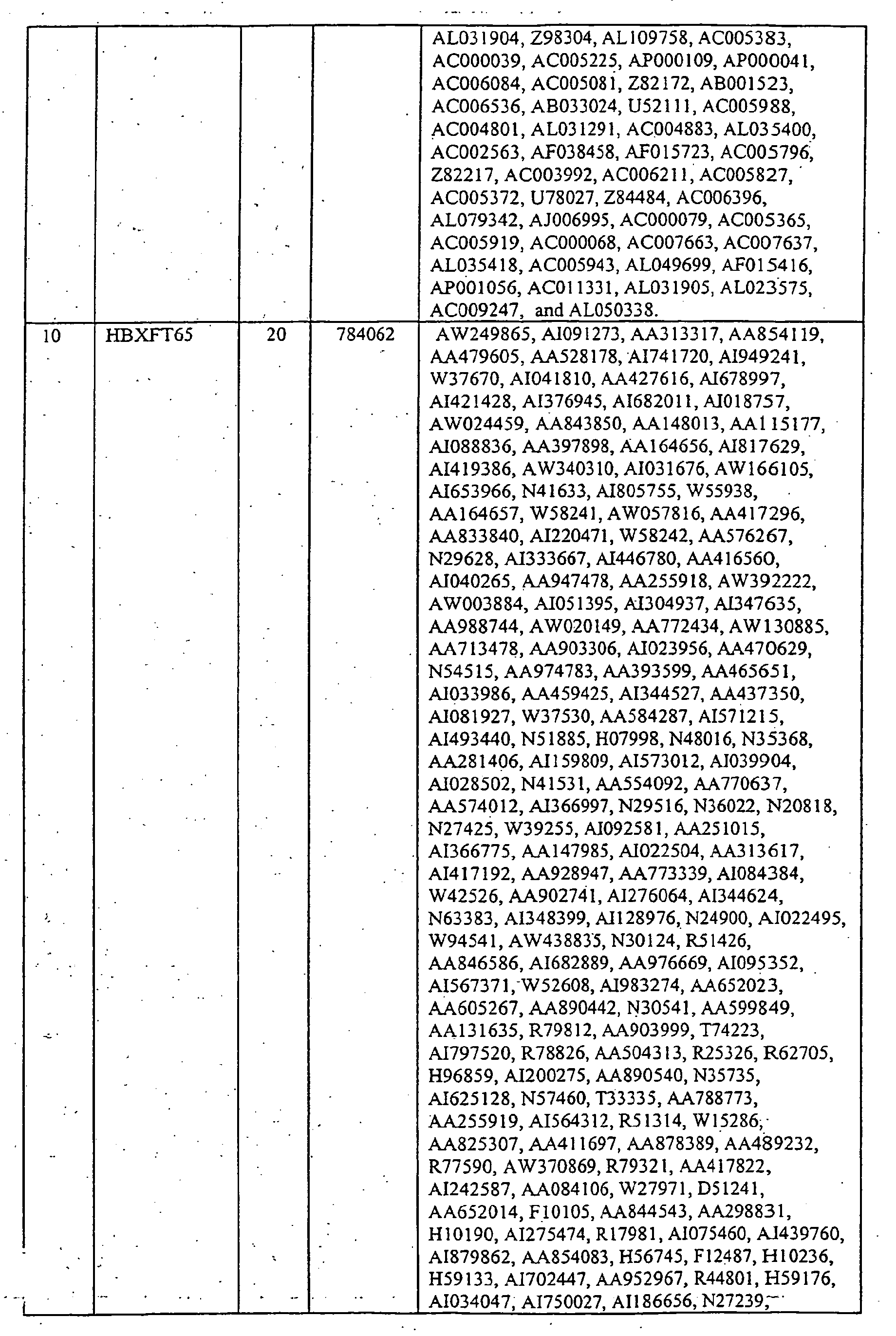
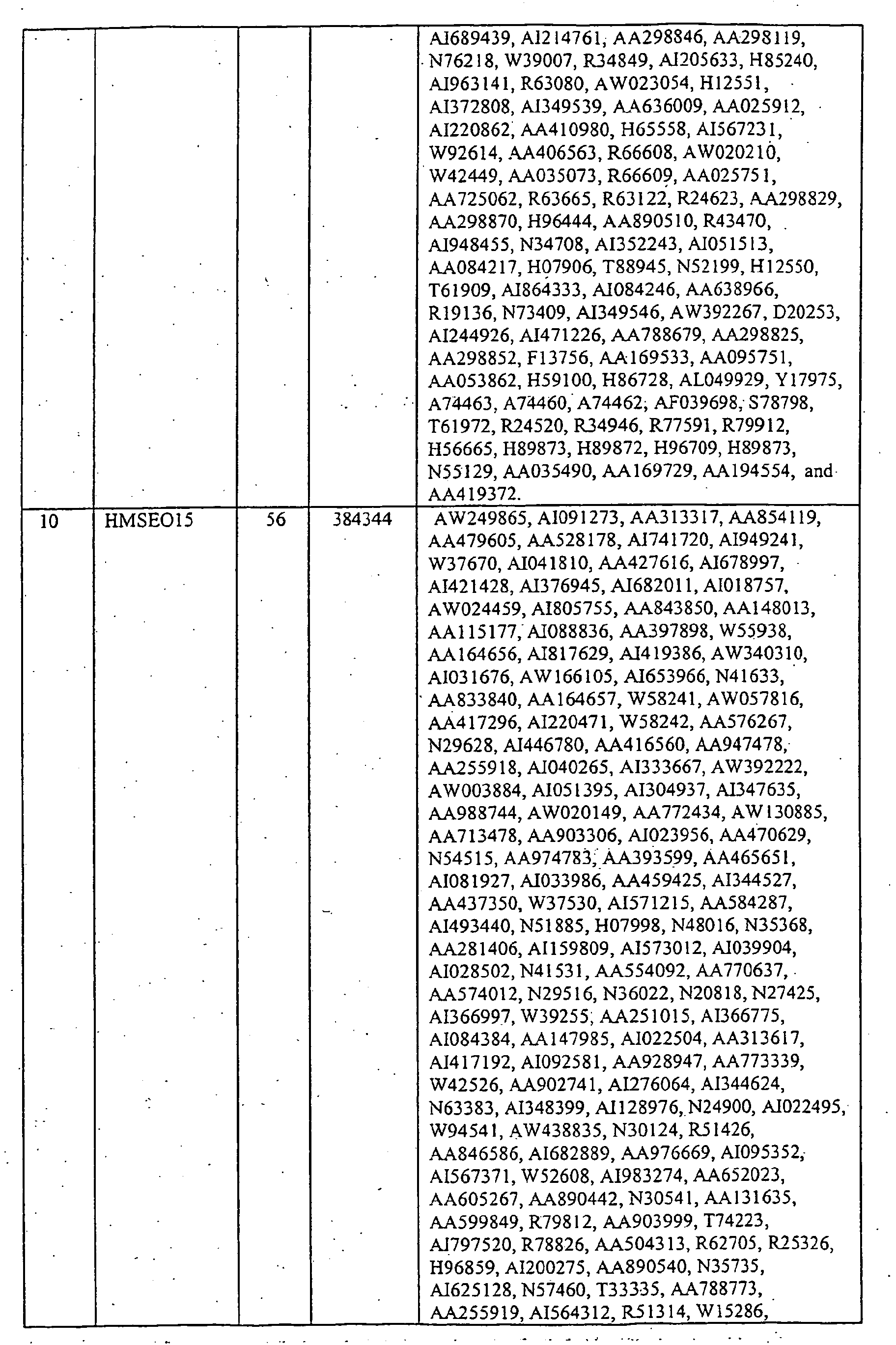
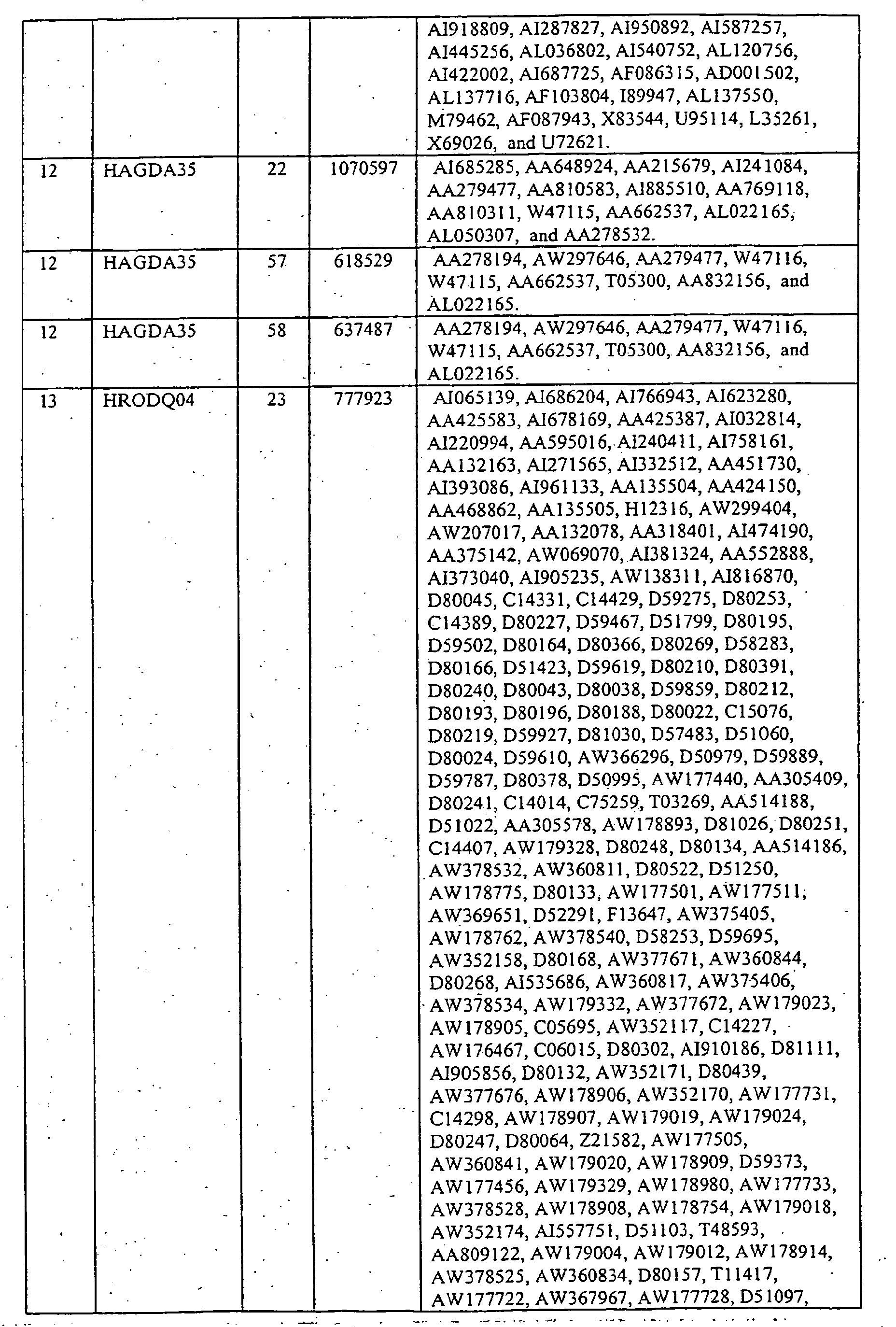
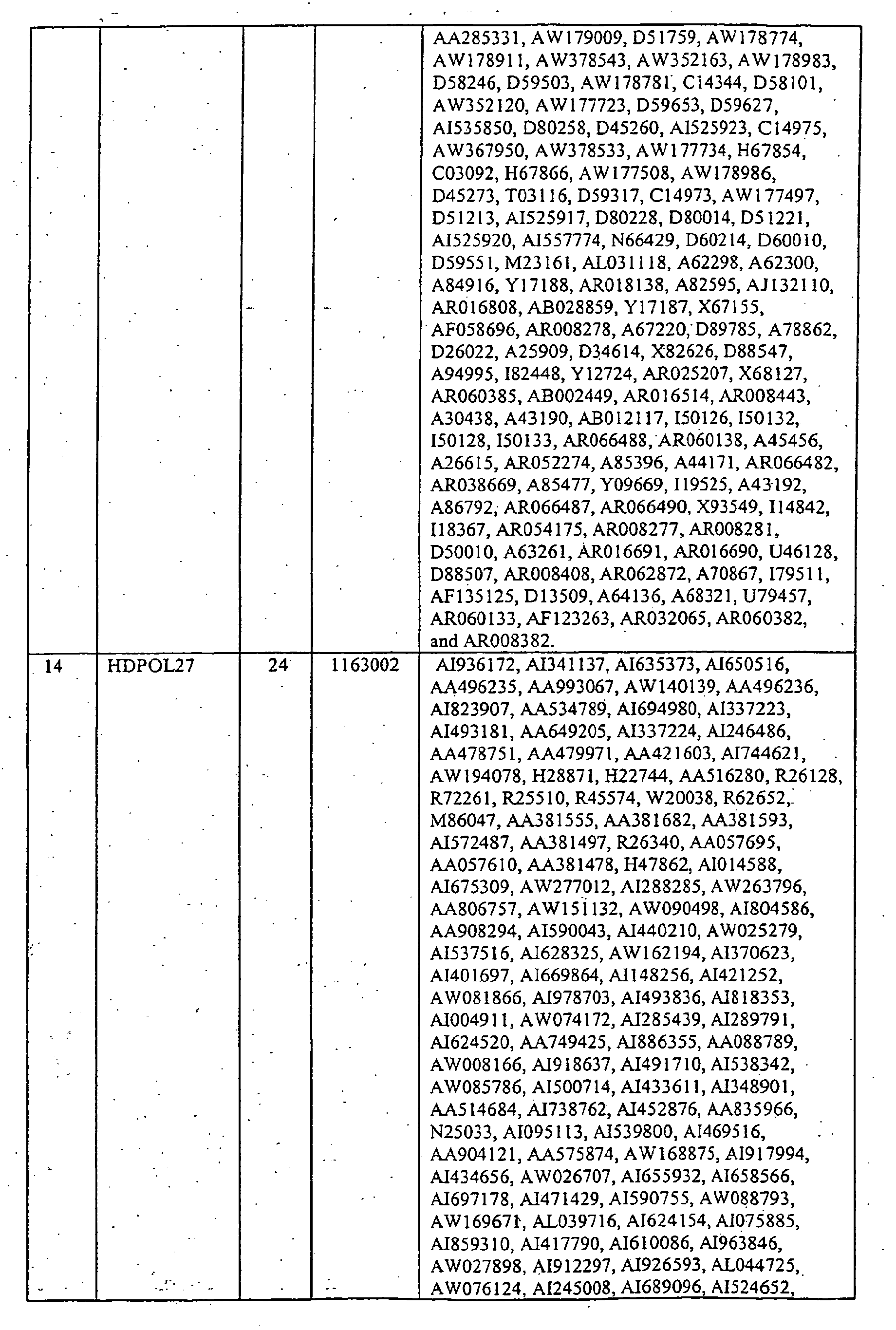
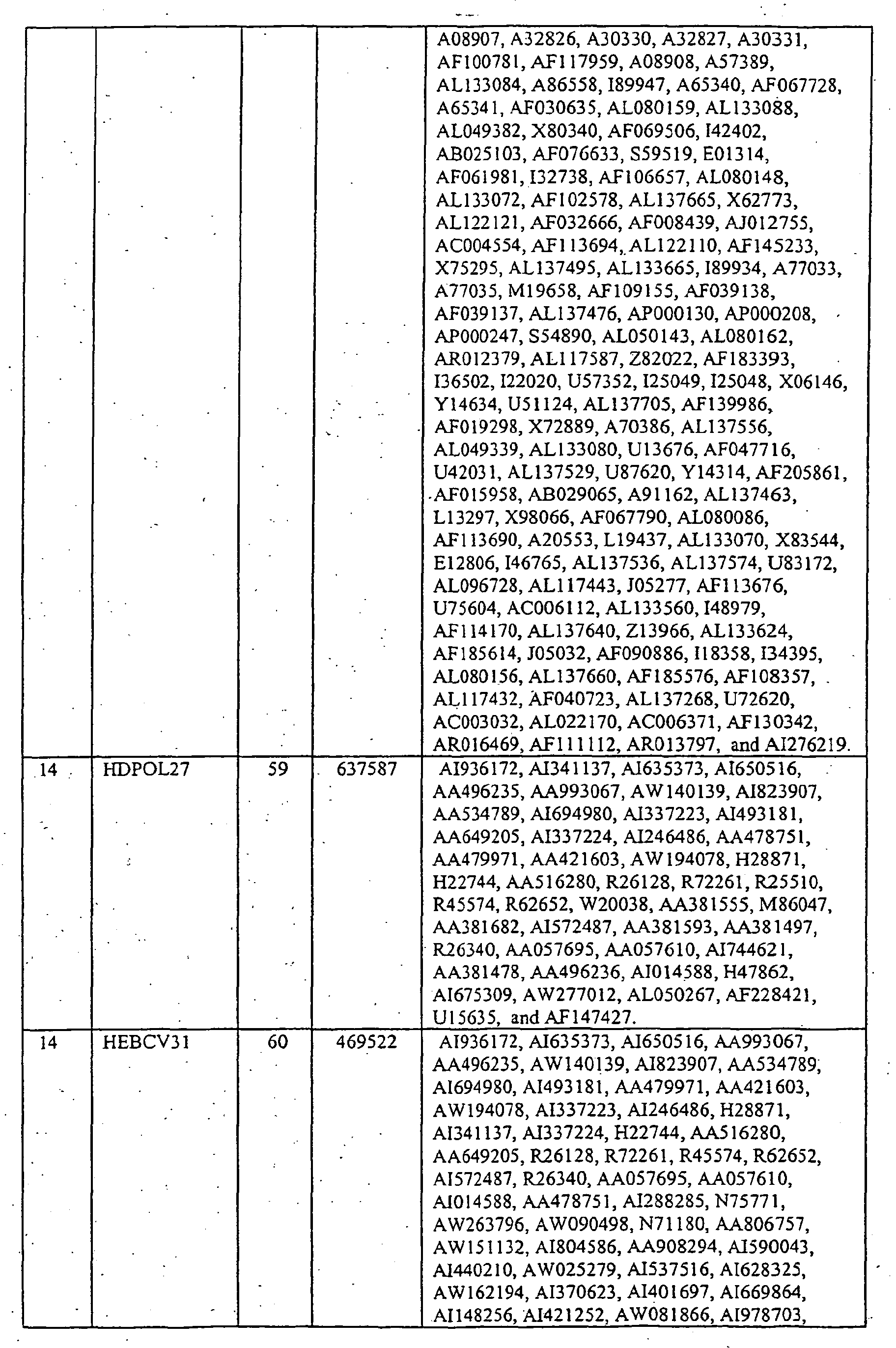
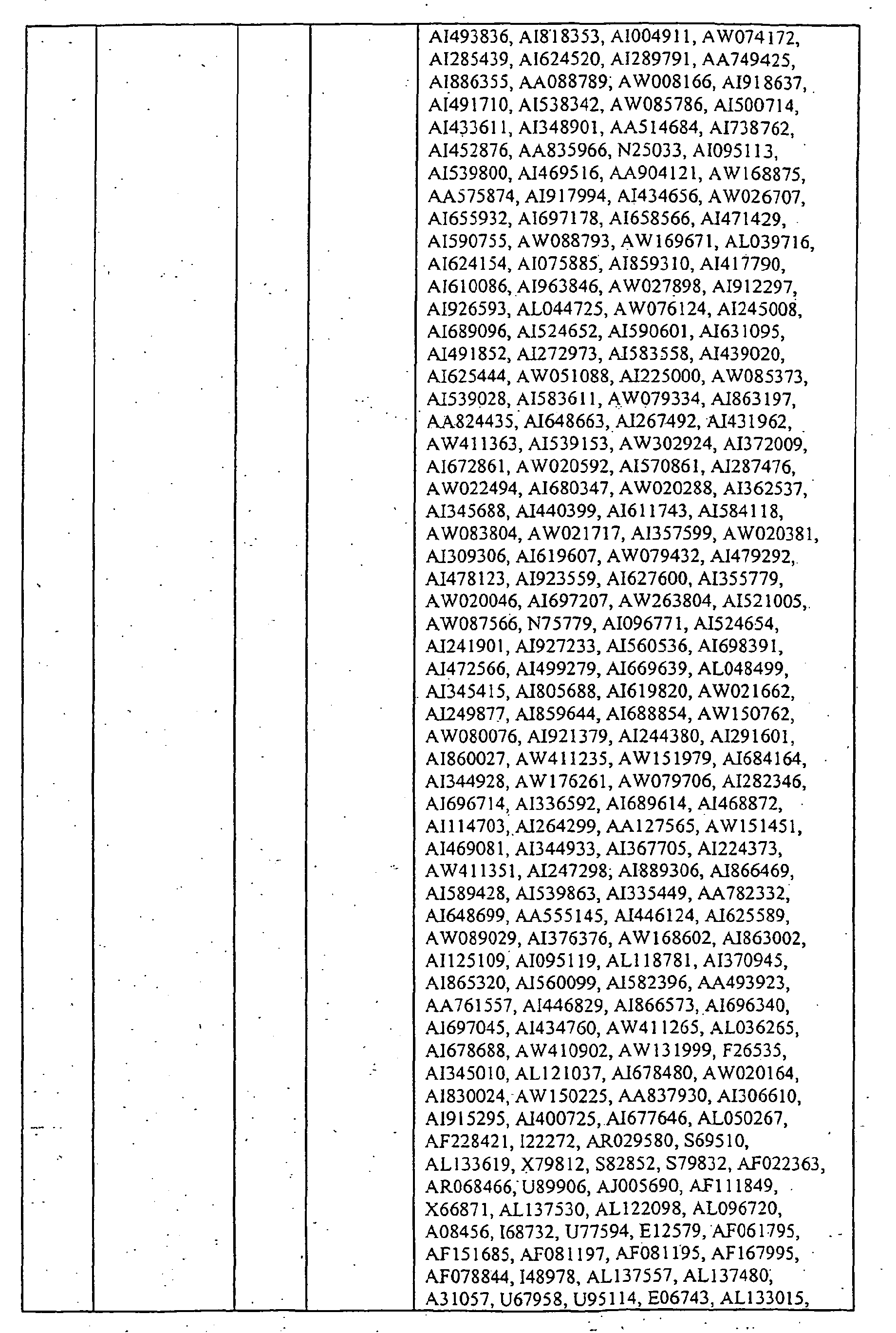
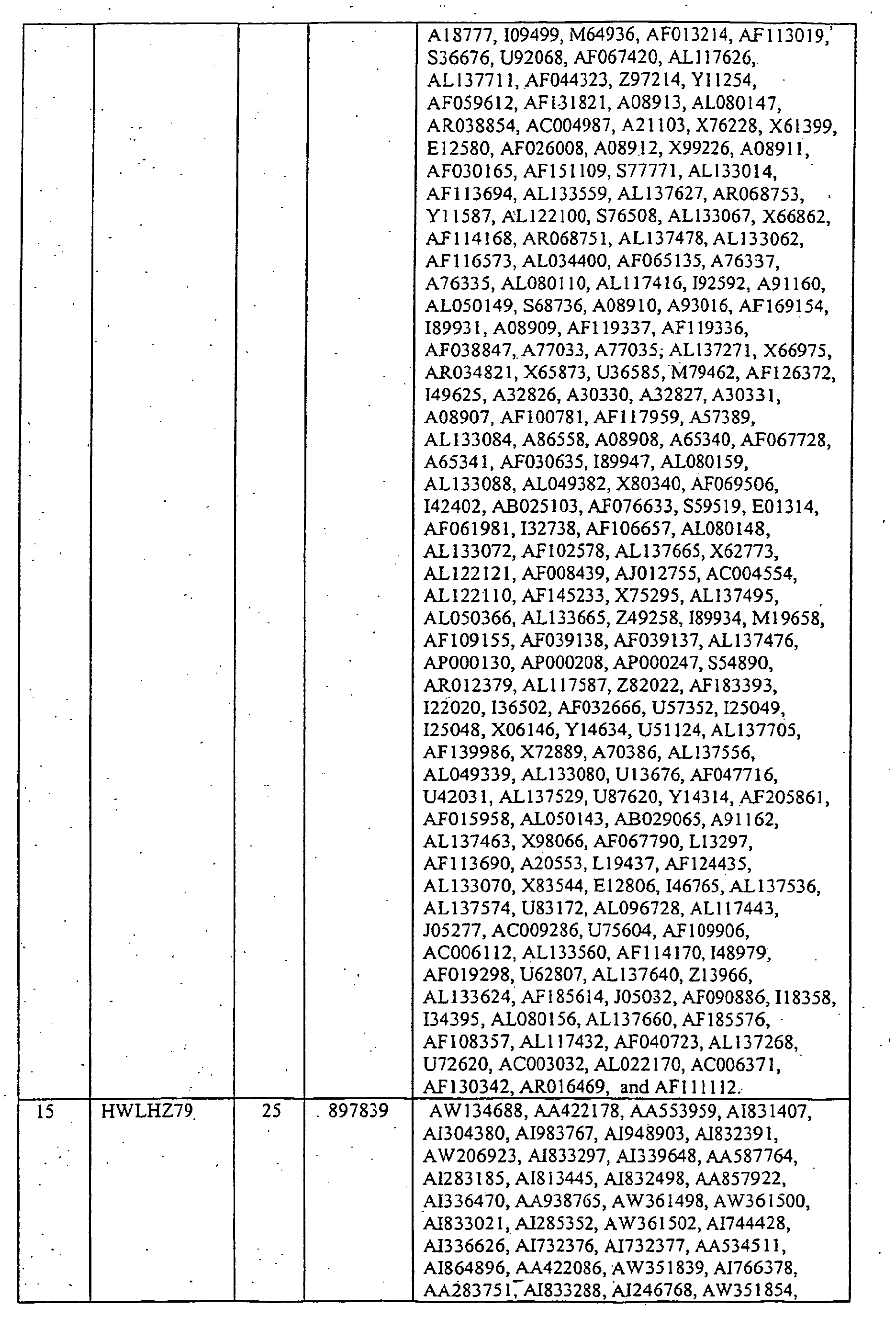
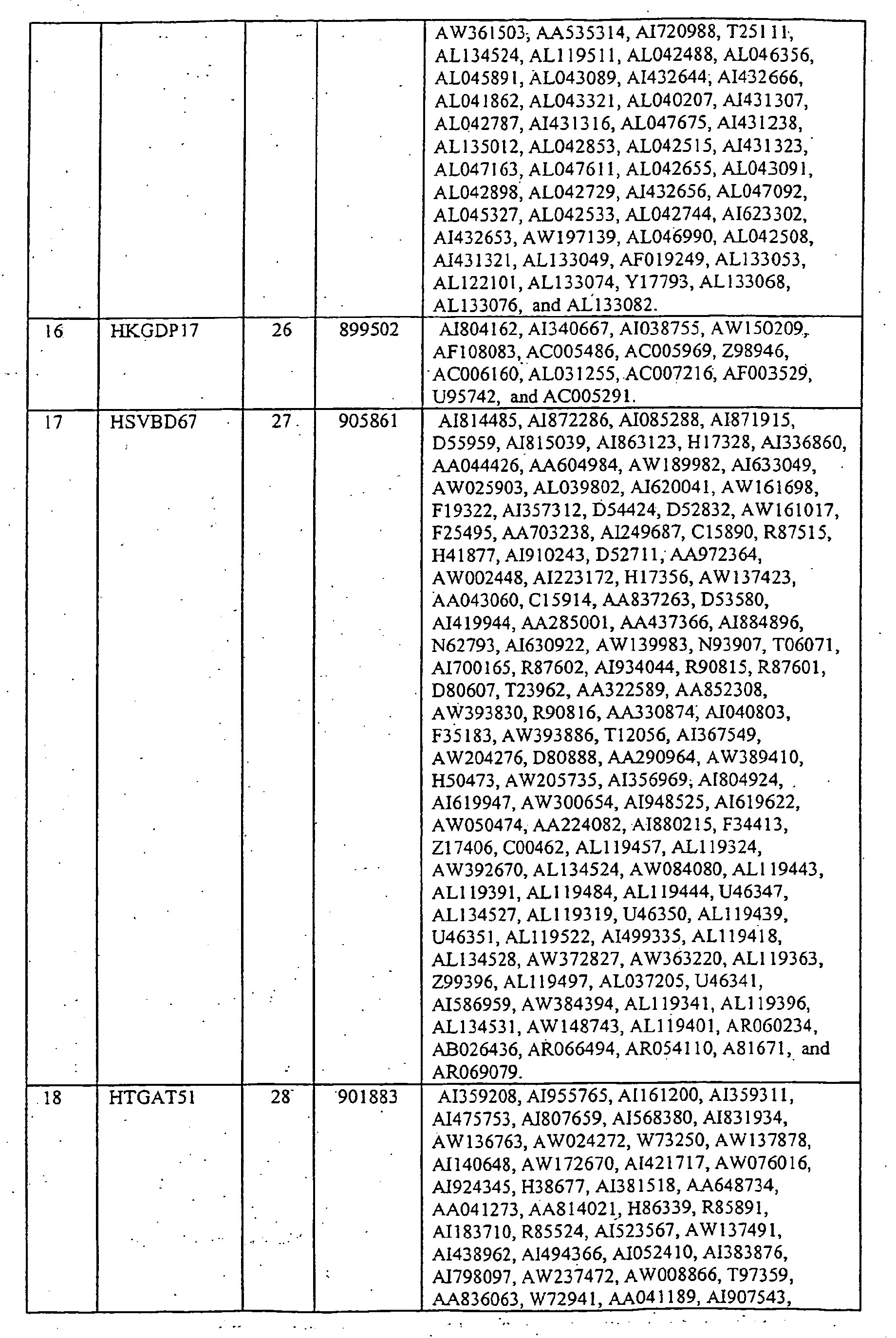
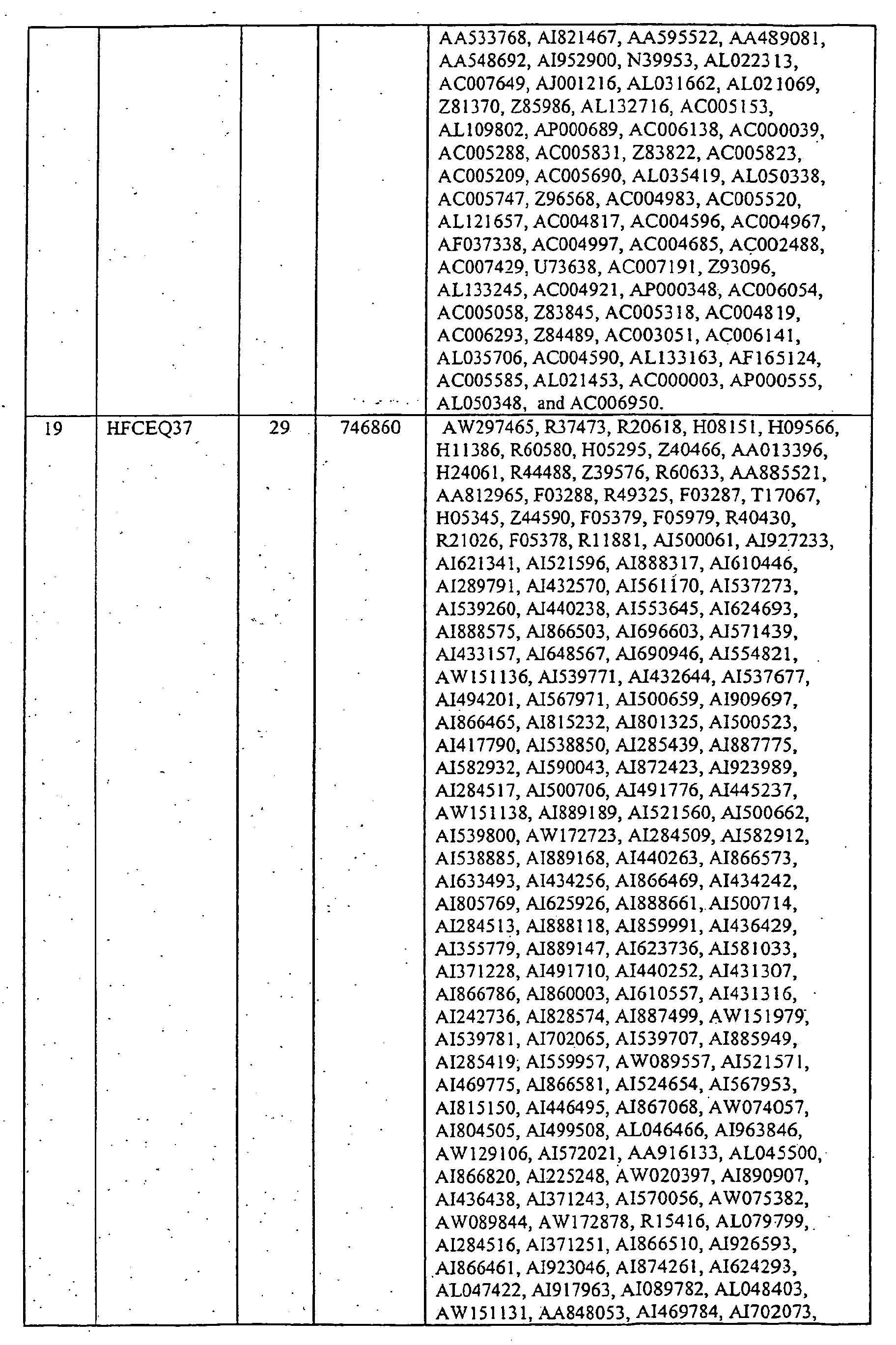
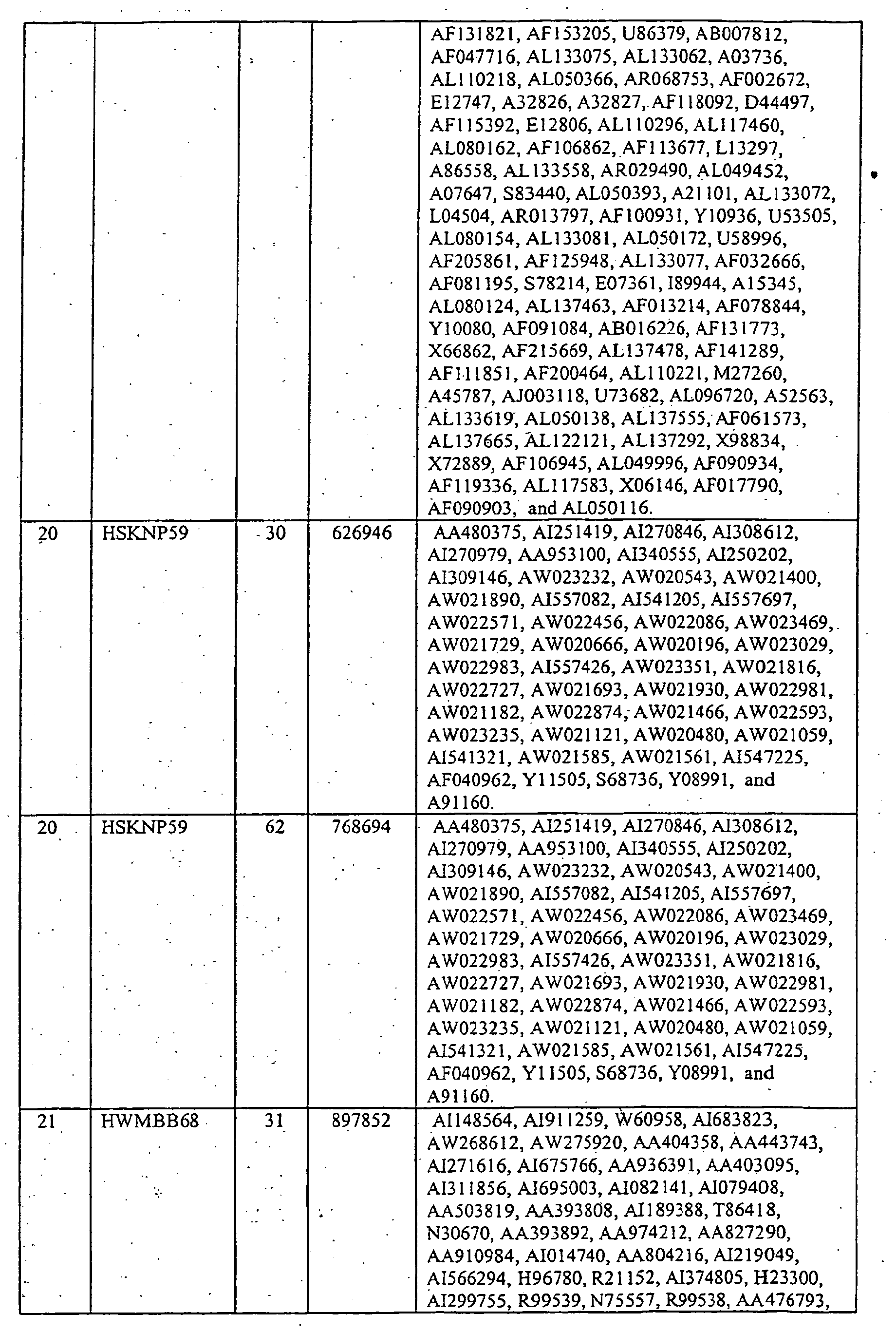
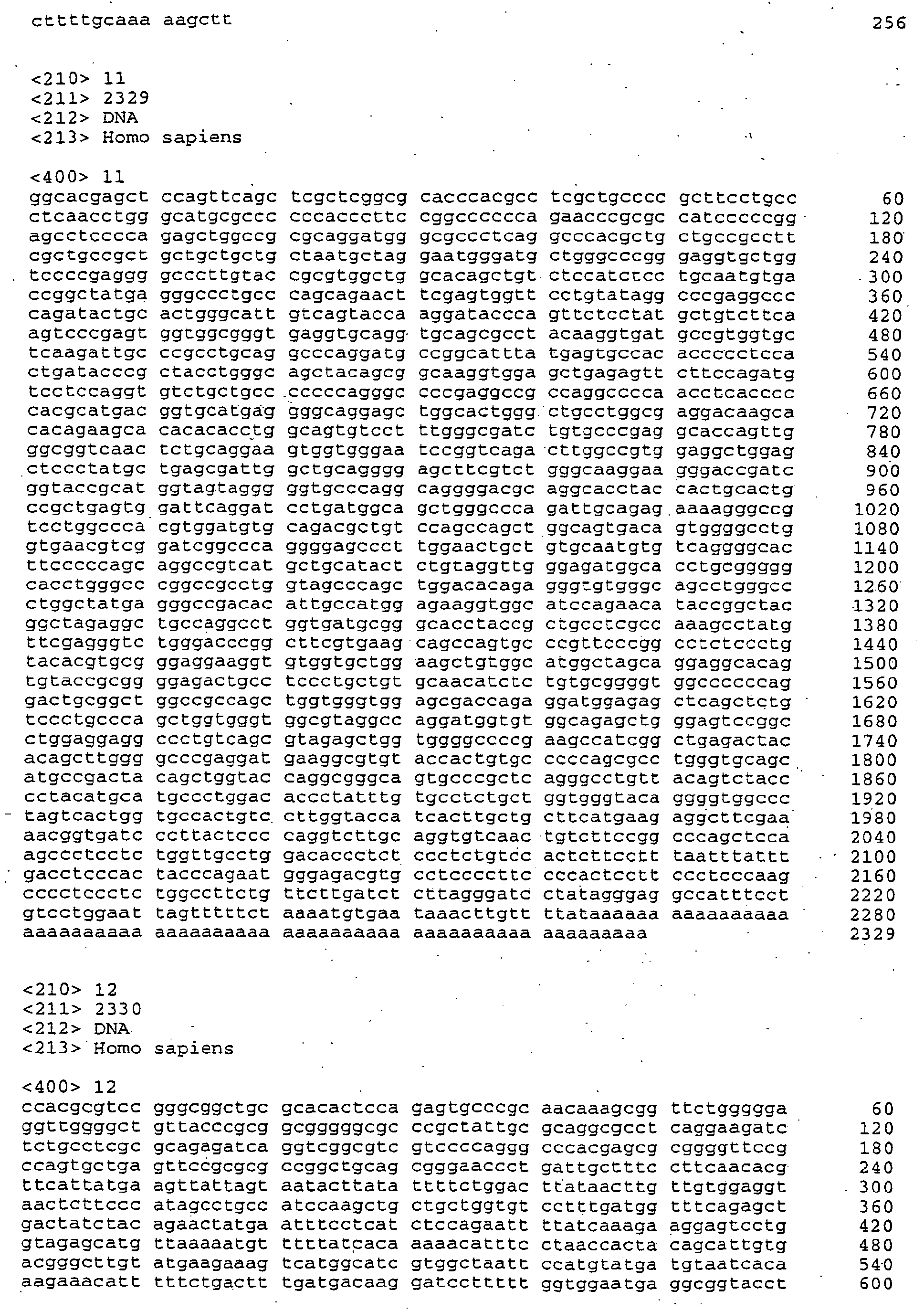
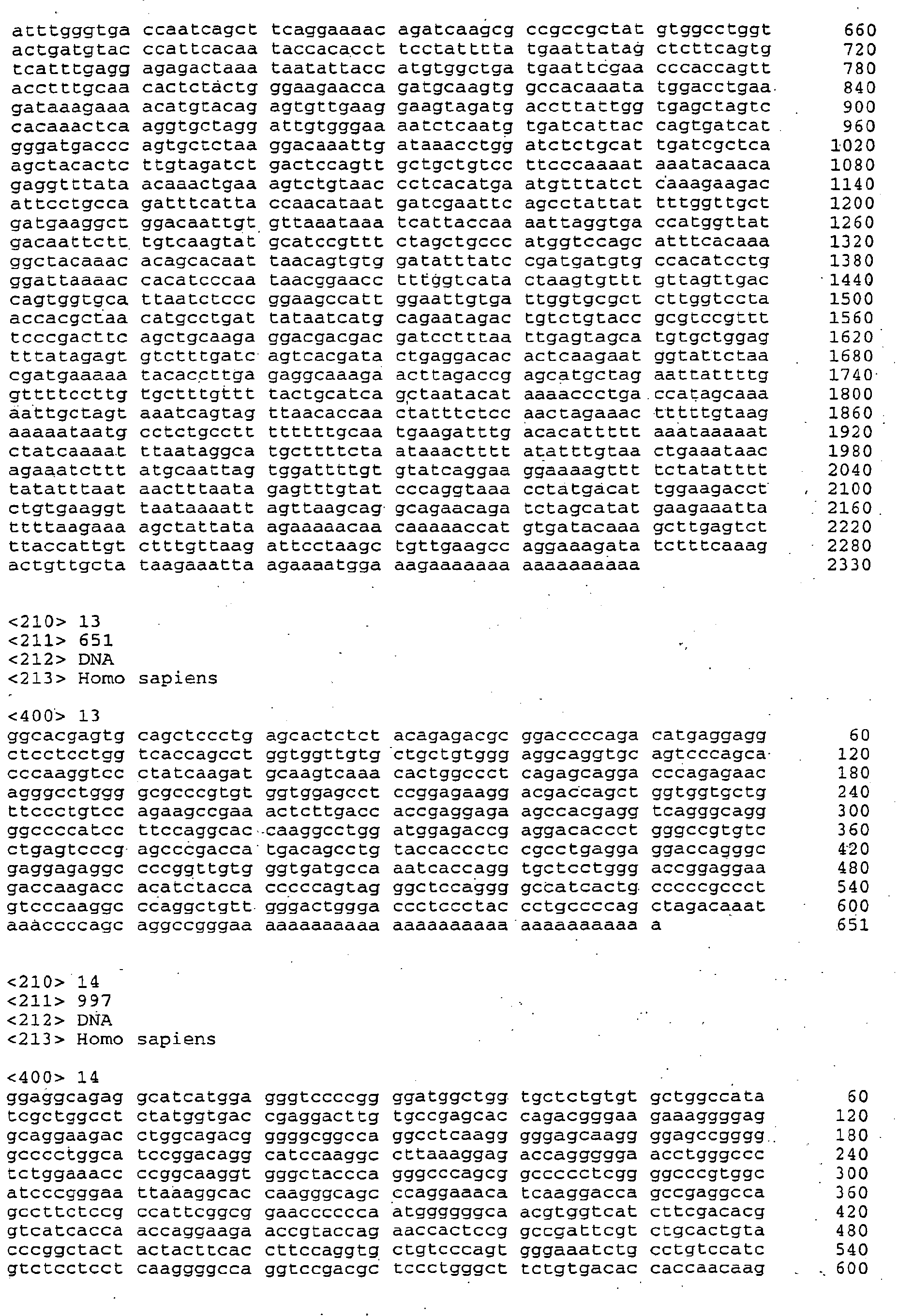
Many polynucleotide sequences, such as EST sequences, are publicly
available and accessible through sequence databases. Some of these sequences are
related to SEQ ID NO: 11 and may have been publicly available prior to conception of
the present invention. Preferably, such related polynucleotides are specifically
excluded from the scope of the present invention. To list every related sequence
would be cumbersome. Accordingly, preferably excluded from the present invention
are one or more polynucleotides comprising a nucleotide sequence described by the
general formula of a-b, where a is any integer between 1 to 2315 of SEQ ID NO:11, b
is an integer of 15 to 2329, where both a and b correspond to the positions of
nucleotide residues shown in SEQ ID NO:11, and where b is greater than or equal to a
+ 14.
FEATURES OF PROTEIN ENCODED BY GENE NO: 2
The translation product of this gene shares sequence homology with the PC-1
protein, that is a membrane glycoprotein that is selectively expressed on the surface of
antibody-secreting cells. It also displays homology with alkaline phosphodiesterase I,
and autotaxin, a tumor cell motility-stimulating protein. Based on the sequence
similarity, the translation product of this clone is expected to share at least some
biological activities with membrane glycoprotein and/or autotaxin proteins. Such
activities are known in the art, some of which are described elsewhere herein.
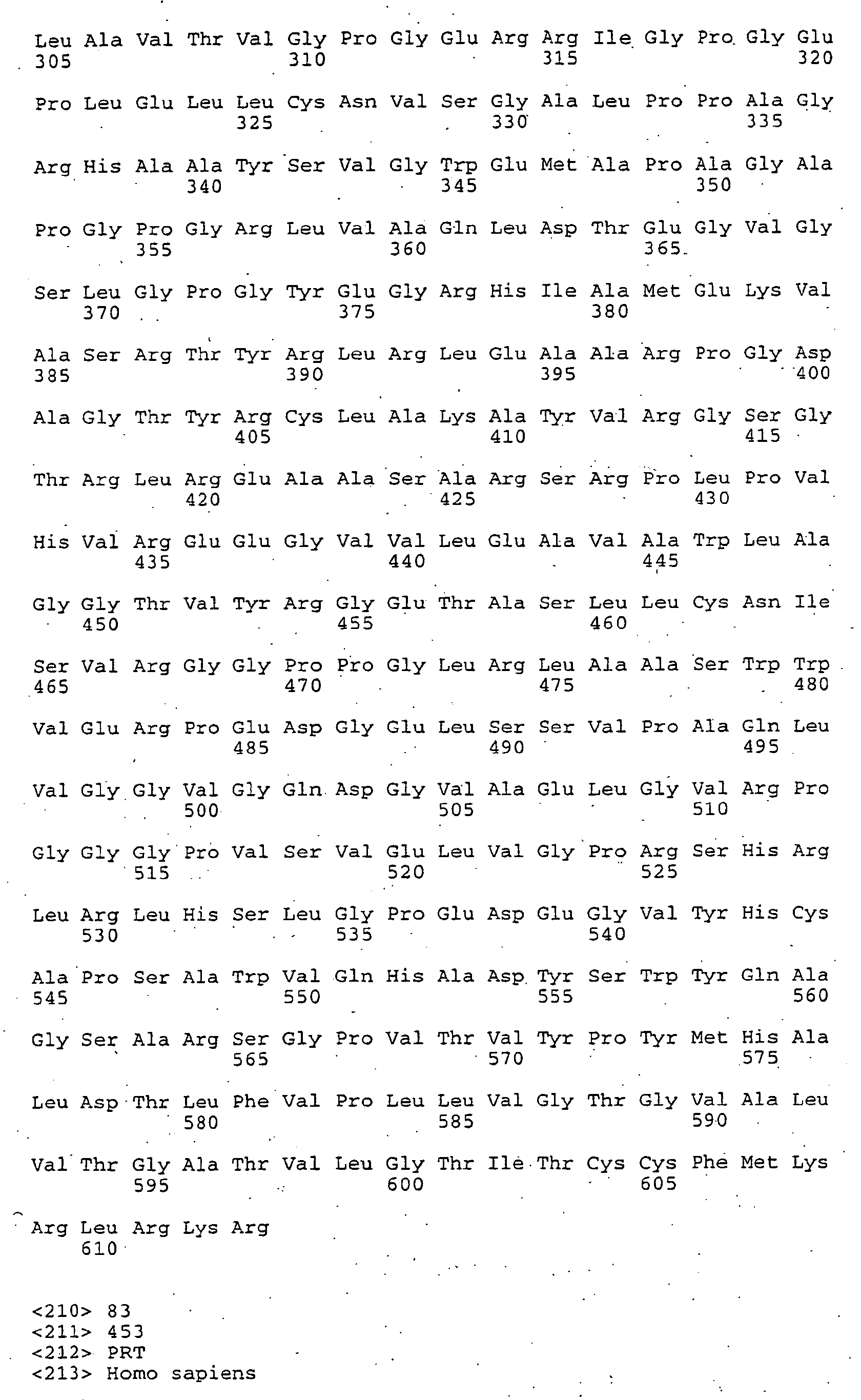
The polypeptide of this gene has been determined to have a transmembrane
domain at about amino acid position 411 - 427 of the amino acid sequence referenced
in Table 1 for this gene. Moreover, a cytoplasmic tail encompassing amino acids 428
to 453 of this protein has also been determined. Based upon these characteristics, it is
believed that the protein product of this gene shares structural features to type Ia
membrane proteins.
This gene is expressed primarily in human ovarian tumors.
Polynucleotides and polypeptides of the invention are useful as reagents for
differential identification of the tissue(s) or cell type(s) present in a biological sample
arid for diagnosis of diseases and conditions which include but are not limited to:
reproductive diseases and/or disorders, particularly ovarian cancer and tumor cell
metastasis. Similarly, polypeptides and antibodies directed to these polypeptides are
useful in providing immunological probes for differential identification of the tissue(s)
or cell type(s). For a number of disorders of the above tissues or cells, particularly of
the reproductive system, expression of this gene at significantly higher or lower levels
may be routinely detected in certain tissues or cell types (e.g., reproductive, ovarian,
and cancerous and wounded tissues) or bodily fluids (e.g., lymph, serum, plasma,
urine, synovial fluid and spinal fluid) or another tissue or sample taken from an
individual having such a disorder, relative to the standard gene expression level, i.e.,
the expression level in healthy tissue or bodily fluid from an individual not having the
disorder.
Preferred polypeptides of the present invention comprise, or alternatively
consist of, one or more immunogenic epitopes immunogenic epitopes shown in SEQ
ID NO: 83 as residues: Gly-17 to His-22, Lys-100 to Asp-109, Gln-124 to Ser-130,
Glu-186 to Glu-201, Asp-237 to Lys-247, His-304 to Ile-311, Asp-335 to Leu-342,
Ala-355 to Thr-364, Pro-382 to His-391, Gln-444 to Leu-451. Polynucleotides
encoding said polypeptides are also encompassed by the invention.
The tissue distribution in ovarian cancer and homology to autotaxin indicates
that polynucleotides and polypeptides corresponding to this gene are useful for the
diagnosis and/or treatment of cancer. Autotaxin is a tumor cell motility-stimulating
protein. The gene described herein in this patent application is only detected in
ovarian tumors. Therefore, it may represent a key player in the diagnosis or treatment
in particular of ovarian cancer, and possibly of cancers in general. It may particularly
represent a target for inhibitors to control the spread of such cancers. Similarly, the
expression within cellular sources marked by proliferating cells indicates this protein
may play a role in the regulation of cellular division, and may show utility in the
diagnosis, treatment, and/or prevention of developmental diseases and disorders,
including cancer, and other proliferative conditions. Representative uses are described
in the "Hyperproliferative Disorders" and "Regeneration" sections below and
elsewhere herein. Briefly, developmental tissues rely on decisions involving cell
differentiation and/or apoptosis in pattern formation. Dysregulation of apoptosis can
result in inappropriate suppression of cell death, as occurs in the development of some
cancers, or in failure to control the extent of cell death, as is believed to occur in
acquired immunodeficiency and certain neurodegenerative disorders, such as spinal
muscular atrophy (SMA). Alternatively, this gene product may be involved in the
pattern of cellular proliferation that accompanies early embryogenesis. Thus, aberrant
expression of this gene product in tissues - particularly adult tissues - may correlate
with patterns of abnormal cellular proliferation, such as found in various cancers.
Because of potential roles in proliferation and differentiation, this gene product may
have applications in the adult for tissue regeneration and the treatment of cancers. It
may also act as a morphogen to control cell and tissue type specification. Therefore,
the polynucleotides and polypeptides of the present invention are useful in treating,
detecting, and/or preventing said disorders and conditions, in addition to other types
of degenerative conditions. Thus this protein may modulate apoptosis or tissue
differentiation and would be useful in the detection, treatment, and/or prevention of
degenerative or proliferative conditions and diseases. The protein is useful in
modulating the immune response to aberrant polypeptides, as may exist in
proliferating and cancerous cells and tissues. The protein can also be used to gain new
insight into the regulation of cellular growth and proliferation. Furthermore, the
protein may also be used to determine biological activity, to raise antibodies, as tissue
markers, to isolate cognate ligands or receptors, to identify agents that modulate their
interactions, in addition to its use as a nutritional supplement. Protein, as well as,
antibodies directed against the protein may show utility as a tumor marker and/or
immunotherapy targets for the above listed tissues.
Many polynucleotide sequences, such as EST sequences, are publicly
available and accessible through sequence databases. Some of these sequences are
related to SEQ ID NO: 12 and may have been publicly available prior to conception of
the present invention. Preferably, such related polynucleotides are specifically
excluded from the scope of the present invention. To list every related sequence
would be cumbersome. Accordingly, preferably excluded from the present invention
are one or more polynucleotides comprising a nucleotide sequence described by the
general formula of a-b, where a is any integer between 1 to 2316 of SEQ ID NO:12, b
is an integer of 15 to 2330, where both a and b correspond to the positions of
nucleotide residues shown in SEQ ID NO:12, and where b is greater than or equal to a
+ 14.
FEATURES OF PROTEIN ENCODED BY GENE NO:3
The translation product of this gene shares sequence homology with murine
proline-rich acidic protein (Genbank Accession No: AAC24897).
This gene is expressed primarily in fetal liver and tumors of the liver
(hepatoma) and to a lesser extent in normal and malignant colon as well as breast
cancer.
Polynucleotides and polypeptides of the invention are useful as reagents for
differential identification of the tissue(s) or cell type(s) present in a biological sample
and for diagnosis of diseases and conditions which include but are not limited to:
inflammatory diseases and/or cancers of the liver, colon or breast. Similarly,
polypeptides and antibodies directed to these polypeptides are useful in providing
immunological probes for differential identification of the tissue(s) or cell type(s). For
a number of disorders of the above tissues or cells, particularly of the gastrointaestinal
or hepatic system, expression of this gene at significantly higher or lower levels may
be routinely detected in certain tissues or cell types (e.g., gastrointestinal, hepatic,
metabolic, reproductive, endocrine, and cancerous and wounded tissues) or bodily
fluids (e.g., lymph, breast milk, chyme, bile, serum, plasma, urine, synovial fluid and
spinal fluid) or another tissue or sample taken from an individual having such a
disorder, relative to the standard gene expression level, i.e., the expression level in
healthy tissue or bodily fluid from an individual not having the disorder.
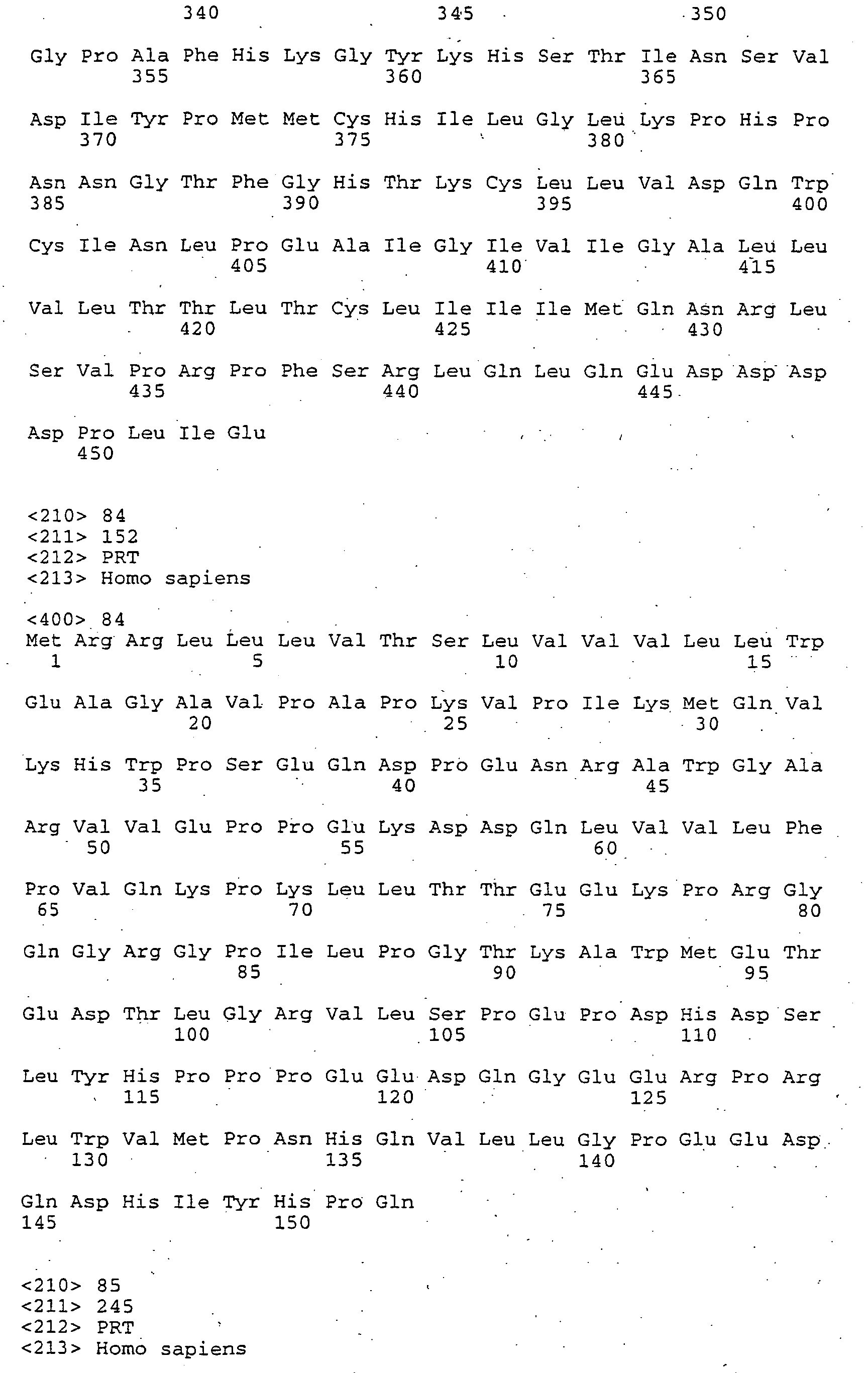
Preferred polypeptides of the present invention comprise, or alternatively
consist of, one or more immunogenic epitopes immunogenic epitopes shown in SEQ
ID NO: 84 as residues: Trp-35 to Trp-46, Pro-53 to Asp-58, Thr-74 to Arg-83, Pro-106
to Leu-113, Pro-116 to Arg-128, Pro-141 to Gln-152. Polynucleotides encoding
said polypeptides are also encompassed by the invention.
The tissue distribution in human colon tissue indicates that polynucleotides
and polypeptides corresponding to this gene are useful for diagnosis and or treatment
of tumors of the colon or liver or for inflammatory disorders of theses tissues such as
inflammatory bowel disease. Moreover, the protein product of this clone is useful for
the detection and treatment of liver disorders and cancers. Representative uses are
described in the "Hyperproliferative Disorders", "Infectious Disease", and "Binding
Activity" sections below, in Example 11, and 27, and elsewhere herein. Briefly, the
protein can be used for the detection, treatment, and/or prevention of hepatoblastoma,
jaundice, hepatitis, liver metabolic diseases and conditions that are attributable to the
differentiation of hepatocyte progenitor cells. In addition the expression in fetus
would suggest a useful role for the protein product in developmental abnormalities,
fetal deficiencies, pre-natal disorders and various would-healing models and/or tissue
trauma. The protein is useful for modulating the immune response to aberrant
polypeptides, as may exist in rapidly proliferating cells and tissues (e.g., colon, breast,
and liver cancer tissue). Furthermore, the protein may also be used to determine
biological activity, to raise antibodies, as tissue markers, to isolate cognate ligands or
receptors, to identify agents that modulate their interactions, in addition to its use as a
nutritional supplement. Protein, as well as, antibodies directed against the protein may
show utility as a tumor marker and/or immunotherapy targets for the above listed
tissues.
Many polynucleotide sequences, such as EST sequences, are publicly
available and accessible through sequence databases. Some of these sequences are
related to SEQ ID NO:13 and may have been publicly available prior to conception of
the present invention. Preferably, such related polynucleotides are specifically
excluded from the scope of the present invention. To list every related sequence
would be cumbersome. Accordingly, preferably excluded from the present invention
are one or more polynucleotides comprising a nucleotide sequence described by the
general formula of a-b, where a is any integer between 1 to 637 of SEQ ID NO:13, b
is an integer of 15 to 651, where both a and b correspond to the positions of nucleotide
residues shown in SEQ ID NO:13, and where b is greater than or equal to a + 14.
FEATURES OF PROTEIN ENCODED BY GENE NO: 4
The translation product of this gene shares sequence homology with the
human complement subcomponent Clq chain A precursor (see, e.g., GenBank
accession AAD32626), which is thought to be important in immune responses.
It has been discovered that this gene is expressed primarily in immune and
haemopoietic cells and to a lesser extent in various cancer cells:
Therefore, nucleic acids of the invention are useful as reagents for differential
identification of the tissue(s) or cell type(s) present in a biological sample and for
diagnosis of the following diseases and conditions: disorders of the immune and
haemopoietic systems and cancer. Similarly, polypeptides and antibodies directed to
those polypeptides are useful to provide immunological probes for differential
identification of the tissue(s) or cell type(s). For a number of disorders of the above
tissues or cells, particularly of the immune and haemopoietic systems, expression of
this gene at significantly higher or lower levels may be detected in certain tissues
(e.g., cancerous and wounded tissues) or bodily fluids (e.g., serum, plasma, urine,
synovial fluid or spinal fluid) taken from an individual having such a disorder, relative
to the standard gene expression level, i.e., the expression level in healthy tissue from
an individual not having the disorder.
Preferred polypeptides of the present invention comprise, or alternatively
consist of, one or more immunogenic epitopes immunogenic epitopes shown in SEQ
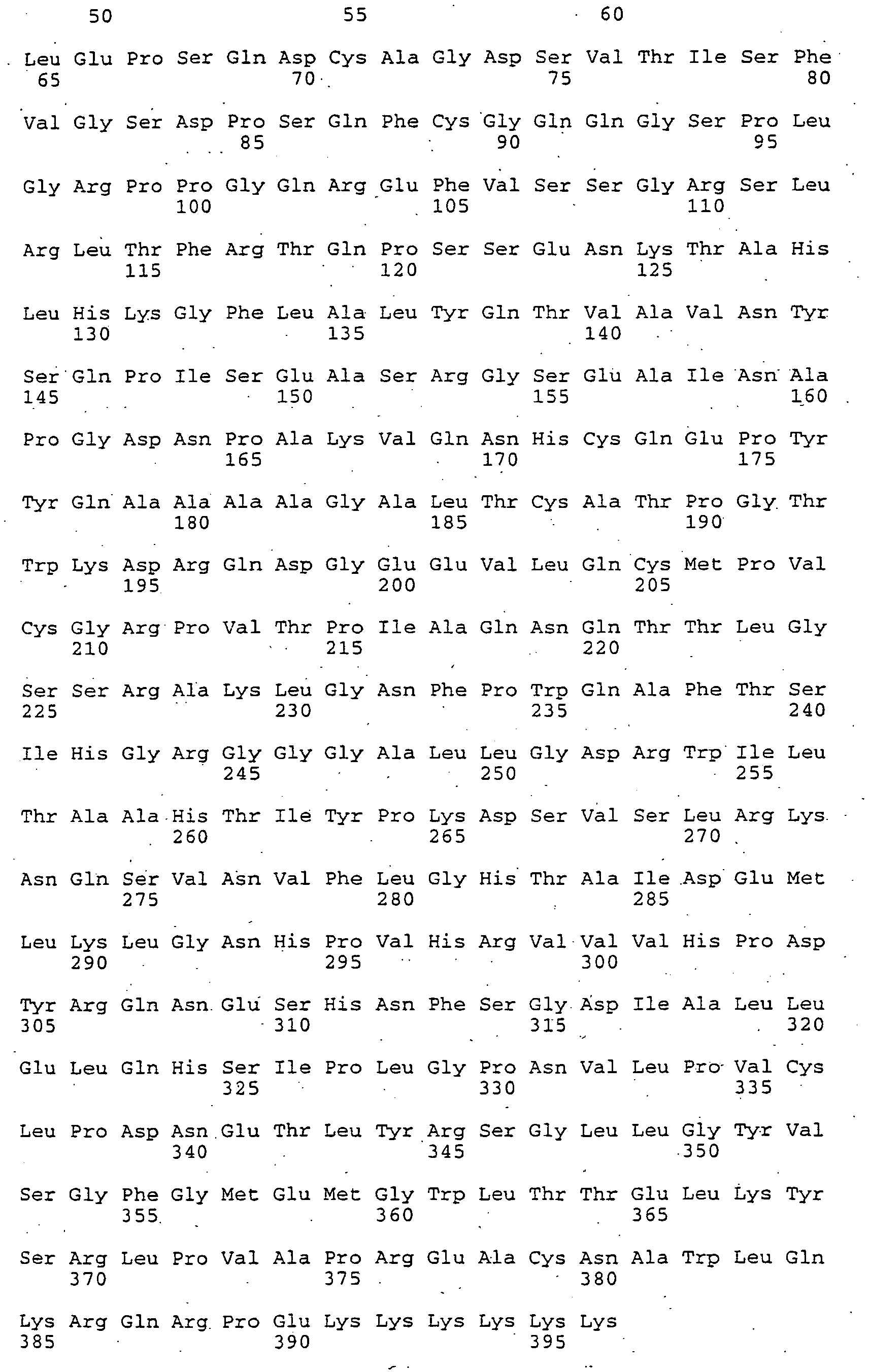
ID NO: 85 as residues: Pro-29 to Gly-46, Lys-48 to Gly-55, Lys-67 to Gly-80, Lys-100
to Pro-115, Arg-121 to Gly-127, Asn-139 to Gly-149, Ser-179 to Arg-185, Asp-191
to Gly-196, Lys-219 to Gly-224. Polynucleotides encoding said polypeptides are
also encompassed by the invention.
The tissue distribution and homology to complement subcomponent Clq chain
A precursor suggests that the protein product of this clone would be useful for
treatment and diagnosis of diseases of the immune and haemopoietic systems and
cancers. Representative uses are described in the "Immune Activity" and "Infectious
Disease" sections below, in Example 11, 13, 14, 16, 18, 19, 20, and 27, and elsewhere
herein. Briefly, the expression of this gene product indicates a role in regulating the
proliferation; survival; differentiation; and/or activation ofhematopoietic cell
lineages, including blood stem cells. This gene product is involved in the regulation of
cytokine production, antigen presentation, or other processes suggesting a usefulness
in the treatment of cancer (e.g. by boosting immune responses). Since the gene is
expressed in cells of lymphoid origin, the natural gene product is involved in immune
functions. Therefore it is also useful as an agent for immunological disorders
including arthritis, asthma, immunodeficiency diseases such as AIDS, leukemia,
rheumatoid arthritis, granulomatous disease, inflammatory bowel disease, sepsis,
acne, neutropenia, neutrophilia, psoriasis, hypersensitivities, such as T-cell mediated
cytotoxicity; immune reactions to transplanted organs and tissues, such as host-versus-graft
and graft-versus-host diseases, or autoimmunity disorders, such as
autoimmune infertility, lense tissue injury, demyelination, systemic lupus
erythematosis, drug induced hemolytic anemia, rheumatoid arthritis, Sjogren's disease,
and scleroderma.
Moreover, the protein may represent a secreted factor that influences the
differentiation or behavior of other blood cells, or that recruits hematopoietic cells to
sites of injury. Thus, this gene product is thought to be useful in the expansion of stem
cells and committed progenitors of various blood lineages, and in the differentiation
and/or proliferation of various cell types. Based upon the tissue distribution of this
protein, antagonists directed against this protein may be useful in blocking the activity
of this protein. Accordingly, preferred are antibodies which specifically bind a portion
of the translation product of this gene. Also provided is a kit for detecting tumors in
which expression of this protein occurs. Such a kit comprises in one embodiment an
antibody specific for the translation product of this gene bound to a solid support.
Also provided is a method of detecting these tumors in an individual which comprises
a step of contacting an antibody specific for the translation product of this gene to a
bodily fluid from the individual, preferably serum, and ascertaining whether antibody
binds to an antigen found in the bodily fluid. Preferably the antibody is bound to a
solid support and the bodily fluid is serum. The above embodiments, as well as other
treatments and diagnostic tests (kits and methods), are more particularly described
elsewhere herein. Furthermore, the protein may also be used to determine biological
activity, raise antibodies, as tissue markers, to isolate cognate ligands or receptors, to
identify agents that modulate their interactions, in addition to its use as a nutritional
supplement. Protein, as well as, antibodies directed against the protein may show
utility as a tumor marker
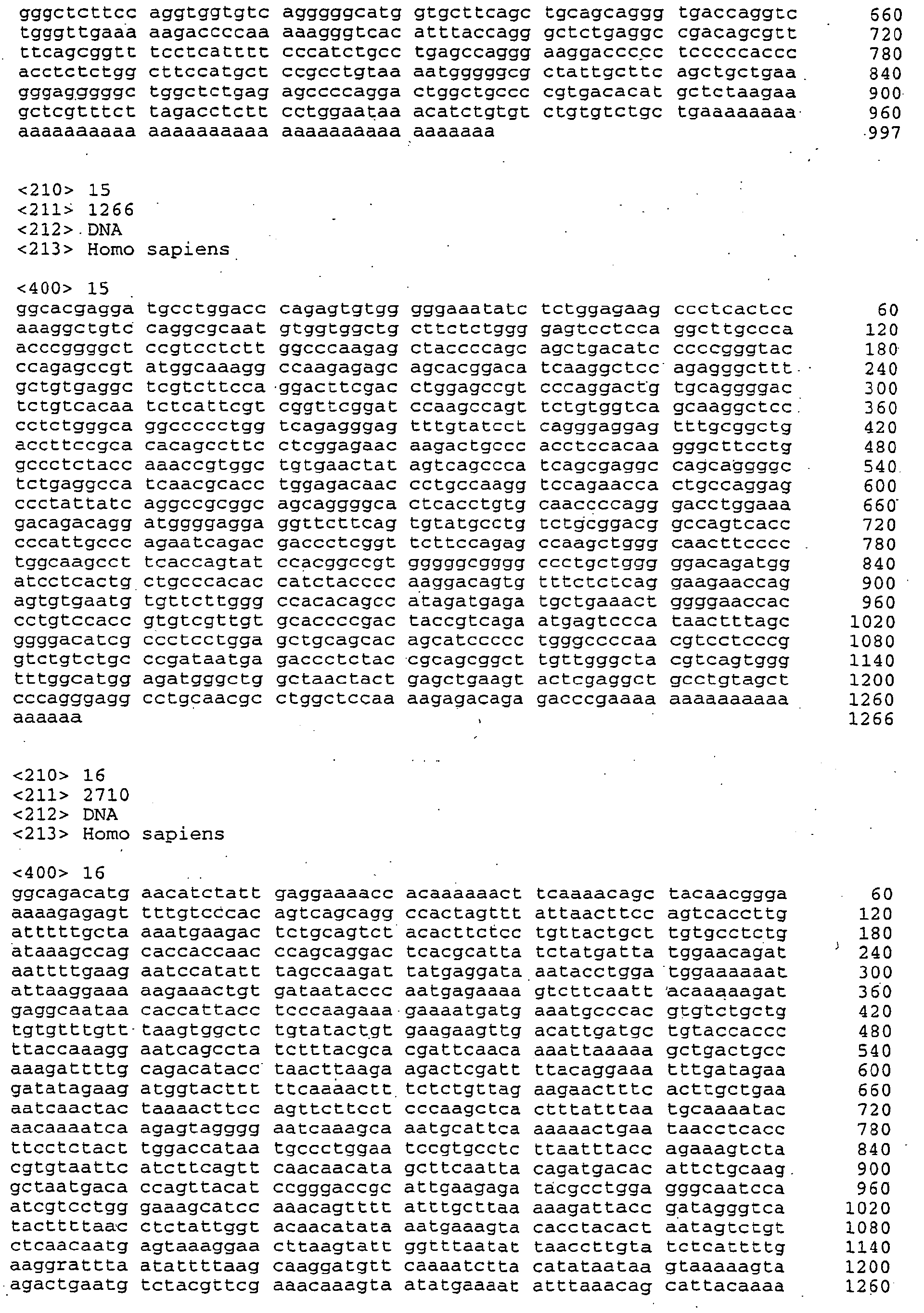
Many polynucleotide sequences, such as EST sequences, are publicly
available and accessible through sequence databases. Some of these sequences are
related to SEQ ID NO: 14 and may have been publicly available prior to conception of
the present invention. Preferably, such related polynucleotides are specifically
excluded from the scope of the present invention. To list every related sequence
would be cumbersome. Accordingly, preferably excluded from the present invention
are one or more polynucleotides comprising a nucleotide sequence described by the
general formula of a-b, where a is any integer between 1 to 983 of SEQ ID NO:14, b
is an integer of 15 to 997, where both a and b correspond to the positions of nucleotide
residues shown in SEQ ID NO: 14, and where b is greater than or equal to a + 14.
FEATURES OF PROTEIN ENCODED BY GENE NO: 5
The translation product of this gene shares sequence homology with, and is
believed to be a novel homolog of, the human complement C1r protein
(gb|AAA51851.1| human complement C1r [Homo sapiens]) an inactive precursor of a
serine protease which is thought to be important in activation of the complement
pathway in human immunity (See, for example, Biochemistry 25 (17), 4855-4863
(1986); all information within this reference is hereby incorporated herein by
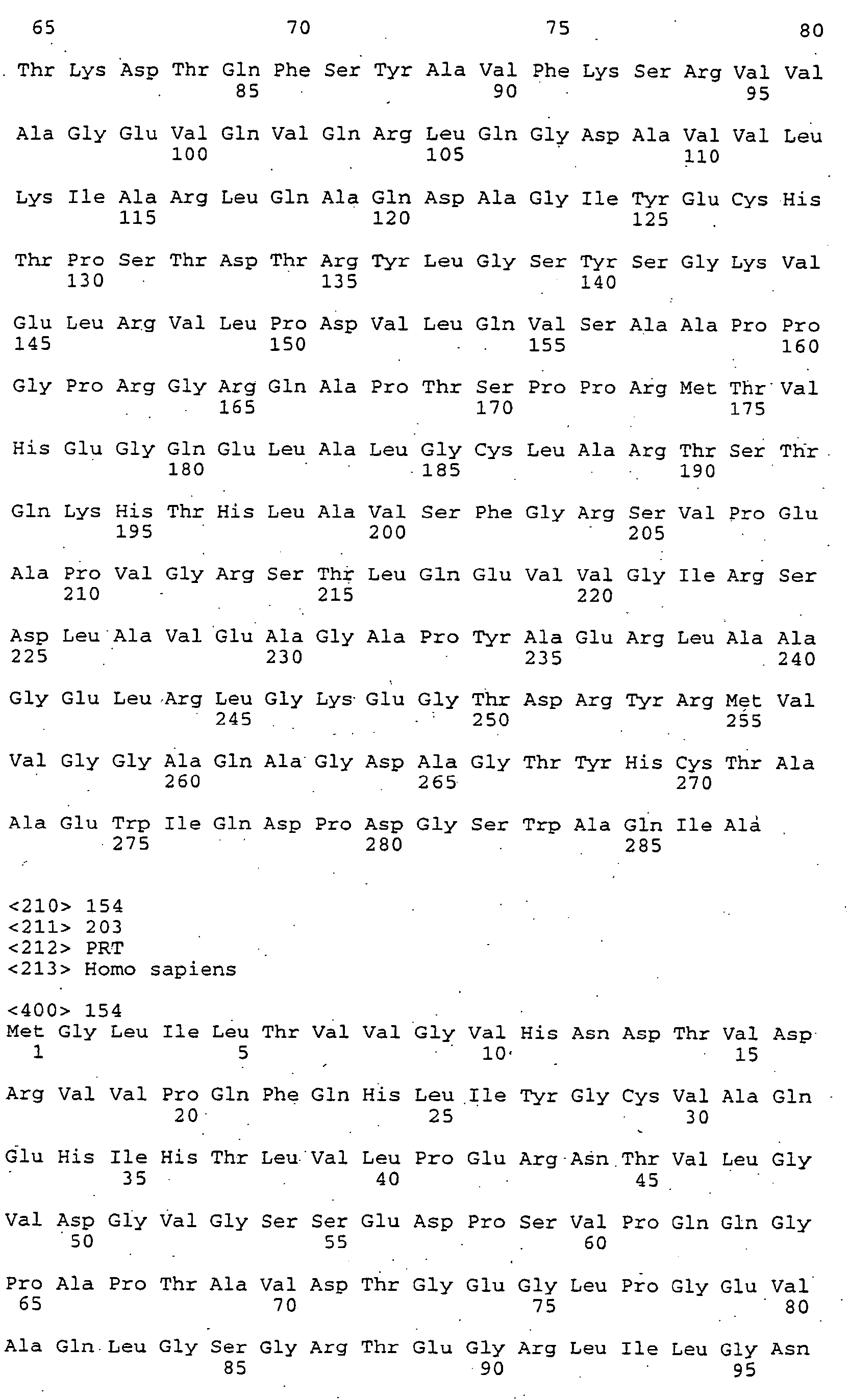
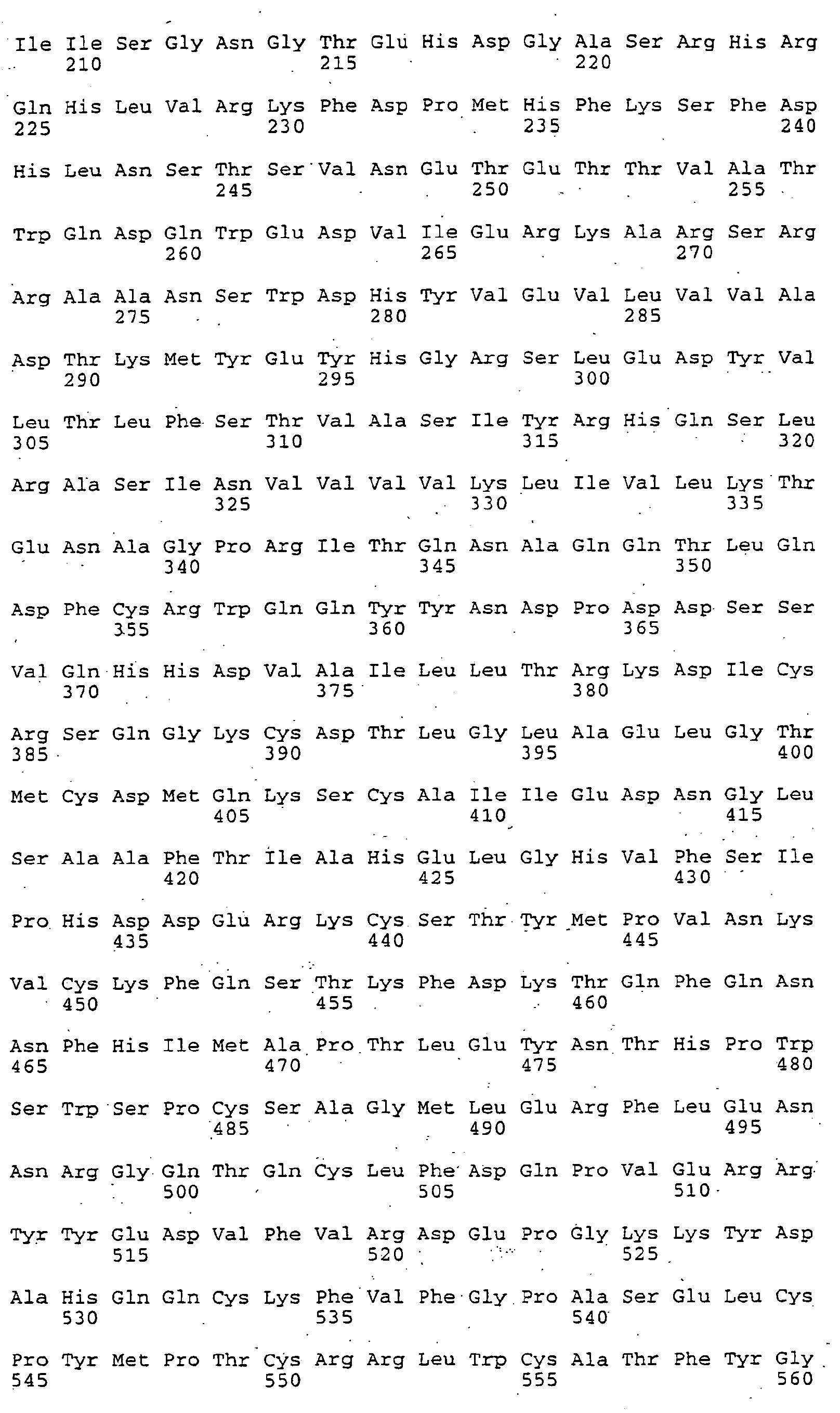
reference). The homologous regions are shown below:
Based on the sequence similarity, the translation product of this clone is expected to
share at least some biological activities with serine protease zymogens such as C1r.
Such activities are known in the art, some of which are described elsewhere herein.
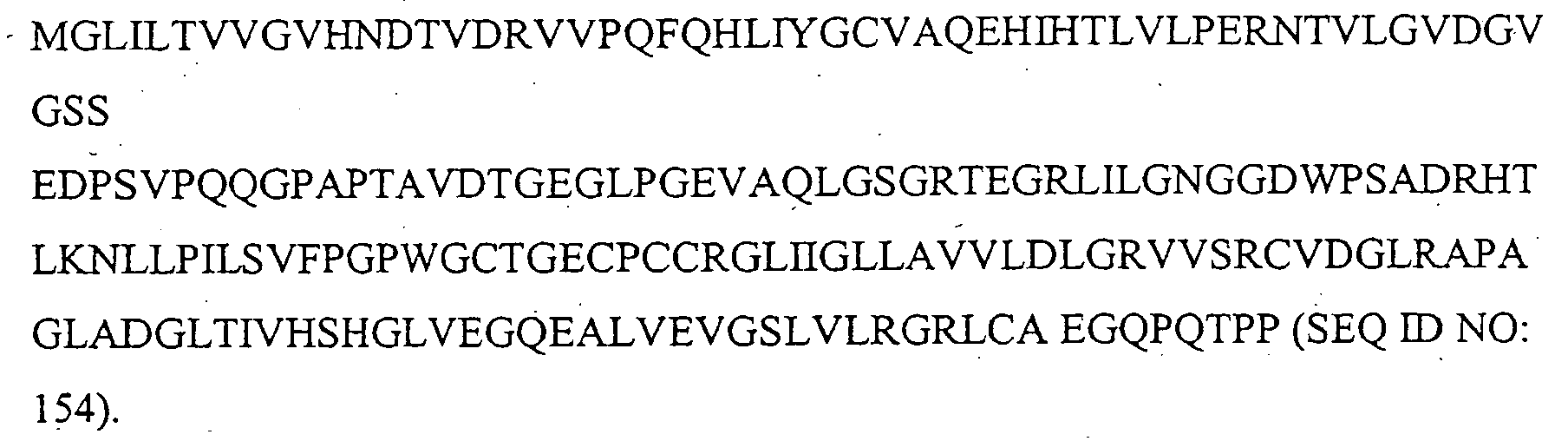
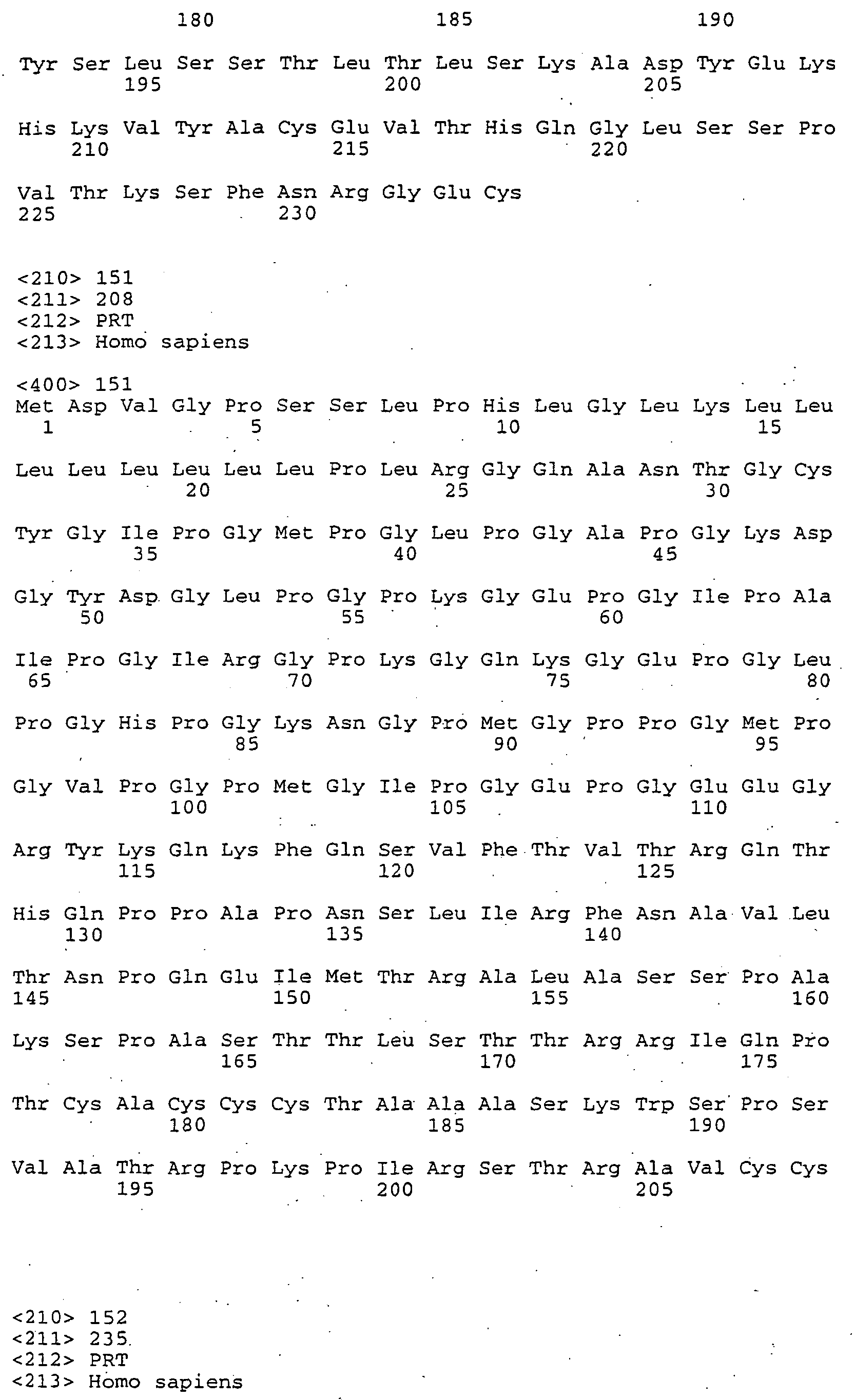
In specific embodiments, polypeptides of the invention comprise, or
alternatively consist of the following amino acid sequence:
Polynucleotides encoding these polypeptides are also encompassed by the
invention. Moreover, fragments and variants of these polypeptides (such as, for
example, fragments as described herein, polypeptides at least 80%, 85%, 90%, 95%,
96%, 97%, 98%, or 99% identical to these polypeptides and polypeptides encoded by
the polynucleotide which hybridizes, under stringent conditions, to the polynucleotide
encoding these polypeptides, or the complement there of are encompassed by the
invention. Antibodies that bind polypeptides of the invention are also encompassed by
the invention. Polynucleotides encoding these polypeptides are also encompassed by
the invention.
This gene is expressed primarily in kidney (e.g., fetal kidney, rejected Kidney
transplant, and cancerous kidney tissue) Human OB MG63 control fraction I
(osteosarcoma); Human Adult Testes, Large Inserts, Reexcision; and Rejected
Kidney, lib 4.
Polynucleotides and polypeptides of the invention are useful as reagents for
differential identification of the tissue(s) or cell type(s) present in a biological sample
and for diagnosis of diseases and conditions which include but are not limited to:
reproductive, and renal diseases and/or disorders, including immune suppression and
other diseases of the immune system. Similarly, polypeptides and antibodies directed
to these polypeptides are useful in providing immunological probes for differential
identification of the tissue(s) or cell type(s). For a number of disorders of the above
tissues or cells, particularly of the immune system, expression of this gene at
significantly higher or lower levels may be routinely detected in certain tissues or cell
types (e.g., immune,, renal, reproductive, and cancerous and wounded tissues) or
bodily fluids (e.g., lymph, serum, seminal fluid, plasma, urine, synovial fluid and
spinal fluid) or another tissue or sample taken from an individual having such a
disorder, relative to the standard gene expression level, i.e., the expression level in
healthy tissue or bodily fluid from an individual not having the disorder.
Preferred polypeptides of the present invention comprise, or alternatively
consist of, one or more immunogenic epitopes immunogenic epitopes shown in SEQ
ID NO: 86 as residues: Pro-32 to Lys-49, Glu-66 to Ala-72, Asp-84 to Gly-90, Arg-117
to Thr-126, Pro-161 to Tyr-176, Gly-191 to Glu-201, Leu-270 to Ser-275, Pro-303
to Ser-314, Asp-339 to Tyr-344, Gln-384 to Lys-396. Polynucleotides encoding
said polypeptides are also encompassed by the invention.
The homology of the translation product of this gene to the human C1r
indicates that polynucleotides and polypeptides corresponding to this gene are useful
for diagnosis and treatment of diseases of the immune system including AIDS and
other immune deficiencies, autoimmune disorders such as lupus, and other immune
disorders. Alternatively, the distribution in testicular tissue indicates that
polynucleotides and polypeptides corresponding to this gene are useful for the
treatment and diagnosis of conditions concerning proper testicular function (e.g.
endocrine function, sperm maturation), as well as cancer. Therefore, this gene product
is useful in the treatment of male infertility and/or impotence. This gene product is
also useful in assays designed to identify binding agents, as such agents (antagonists)
are useful as male contraceptive agents. Similarly, the protein is believed to be useful
in the treatment and/or diagnosis of testicular cancer. The testes are also a site of
active gene expression of transcripts that is expressed, particularly at low levels, in
other tissues of the body. Therefore, this gene product may be expressed in other
specific tissues or organs where it may play related functional roles in other processes,
such as hematopoiesis, inflammation, bone formation, and kidney function, to name a
few possible target indications. Alternatively, the tissue distribution in kidney
indicates that the protein product of this clone could be used in the treatment and/or
detection of kidney diseases including renal failure, nephritus, renal tubular acidosis,
proteinuria, pyuria, edema, pyelonephritis, hydronephritis, nephrotic syndrome, crush
syndrome, glomerulonephritis, hematuria, renal colic and kidney stones, in addition to
Wilm's Tumor Disease, and congenital kidney abnormalities such as horseshoe
kidney, polycystic kidney, and Falconi's syndrome. The protein is useful in
modulating the immune response to aberrant polypeptides (as may exist in rapidly
proliferating cells and tissues), and presents a novel therapeutic for hemophiliacs and
other patients presenting aberrant blood diseases and/or disorders. Furthermore, the
protein may also be used to determine biological activity, to raise antibodies, as tissue
markers, to isolate cognate ligands or receptors, to identify agents that modulate their
interactions, in addition to its use as a nutritional supplement. Protein, as well as,
antibodies directed against the protein may show utility as a tumor marker and/or
immunotherapy targets for the above listed tissues.
Many polynucleotide sequences, such as EST sequences, are publicly
available and accessible through sequence databases. Some of these sequences are
related to SEQ ID NO:15 and may have been publicly available prior to conception of
the present invention. Preferably, such related polynucleotides are specifically
excluded from the scope of the present invention. To list every related sequence
would be cumbersome. Accordingly, preferably excluded from the present invention
are one or more polynucleotides comprising a nucleotide sequence described by the
general formula of a-b, where a is any integer between 1 to 1252 of SEQ ID NO:15, b
is an integer of 15 to 1266, where both a and b correspond to the positions of
nucleotide residues shown in SEQ ED NO: 15, and where b is greater than or equal to a
+14.
FEATURES OF PROTEIN ENCODED BY GENE NO: 6
The translation product of this gene shares sequence homology with Bos
taurus mimecan (see GenBank accession AAB70264), which is though to be
important in connective tissues. Based on this homology it is expected that these
proteins will share some biological activity.
It has been discovered that this gene is expressed primarily in fetal tissues,
aorta, cochlea and to a lesser extent in a variety of other tissues and cell types.
Therefore, nucleic acids of the invention are useful as reagents for differential
identification of the tissue(s) or cell type(s) present in a biological sample and for
diagnosis of the following diseases and conditions: heart disease, restenosis,
atherosclerosis, stoke, angina, thrombosis, and wound healing, deafness and vertigo.
Similarly, polypeptides and antibodies directed to those polypeptides are useful to
provide immunological probes for differential identification of the tissue(s) or cell
type(s). For a number of disorders of the above tissues or cells, particularly of the
connective tissue, expression of this gene at significantly higher or lower levels may
be detected in certain tissues (e.g., immune, nervous, cancerous and wounded tissues)
or bodily fluids (e.g., serum, plasma, urine, synovial fluid or spinal fluid) taken from
an individual having such a disorder, relative to the standard gene expression level,
i.e., the expression level in healthy tissue from an individual not having the disorder.
Preferred polypeptides of the present invention comprise, or alternatively
consist of, one or more immunogenic epitopes immunogenic epitopes shown in SEQ
ID NO: 87 as residues: Pro-21 to Arg-28, Tyr-33 to Phe-38, Gln-45 to Glu-61, Pro-83
to Glu-90, Lys-195 to He-204, Thr-253 to Tyr-262. Polynucleotides encoding said
polypeptides are also encompassed by the invention.
Mimecan is a member of a group of small, leucine-rich proteoglycans
(SLRPs). These proteins share a common core structure which consists of a central
domain with varying numbers of leucine-rich repeats flanked by cysteine-rich
clusters. Seven members of SLRPs have been described so far. These include:
keratocan, lumican, fibromodulin, decorin, biglycan, and epiphycan. A seventh
member of the family, mimecan, is a proteoglycan expressed by many connective
tissues. It was originally isolated in a truncated form as a bone-associated
glycoprotein, osteoglycin. Mimecan has since been demonstrated to be expressed in a
variety of tissues, with and without keratan sulfate chains. Numerous examples
illustrate the ability of SLRPs to bind growth factors and/or growth factor receptors
and therefore to modulate cell proliferation and differentiation.
The tissue distribution and homology to mimecan suggests that the protein
product of this clone would be useful for the treatment and diagnosis of conditions
involving tissue repair and wound healing. Tissue repair may be indicated in cases of
injury to the skin or internal organs, ulceration, cellular necrosis or other conditions
involving healing of both diseased or non-diseased, traumatized tissue.
More specifically, the expression in aorta would suggest a role in
cardiovascular disorders such as, asthma, heart disease, restenosis, atherosclerosis,
stoke, angina and thrombosis. The expression in cochlea would suggest a potential use
in the treatment of conditions affecting the inner ear, such as deafness and vertigo.
Based upon the tissue distribution of this protein, antagonists directed against this
protein may be useful in blocking the activity of this protein. Accordingly, preferred
are antibodies which specifically bind a portion of the translation product of this gene.
Also provided is a kit for detecting tumors in which expression of this protein occurs.
Such a kit comprises in one embodiment an antibody specific for the translation
product of this gene bound to a solid support. Also provided is a method of detecting
these tumors in an individual which comprises a step of contacting an antibody
specific for the translation product of this gene to a bodily fluid from the individual,
preferably serum, and ascertaining whether antibody binds to an antigen found in the
bodily fluid. Preferably the antibody is bound to a solid support and the bodily fluid is
serum. The above embodiments, as well as other treatments and diagnostic tests (kits
and methods), are more particularly described elsewhere herein. In addition, because ,
of the implications of tissue regeneration, remoldeling and growth regulation, and in
light of the high degree of expression in fetal and cancerous tissues, the protein
product of this gene may have indications in the diagnosis and treatment of neoplasms
and cancer. Furthermore, the protein may also be used to determine biological
activity, to raise antibodies, as tissue markers, to isolate cognate ligands or receptors,
to identify agents that modulate their interactions, in addition to its use as a nutritional
supplement. Protein, as well as, antibodies directed against the protein may show
utility as a tumor marker and/or immunotherapy targets for the above listed tissues.
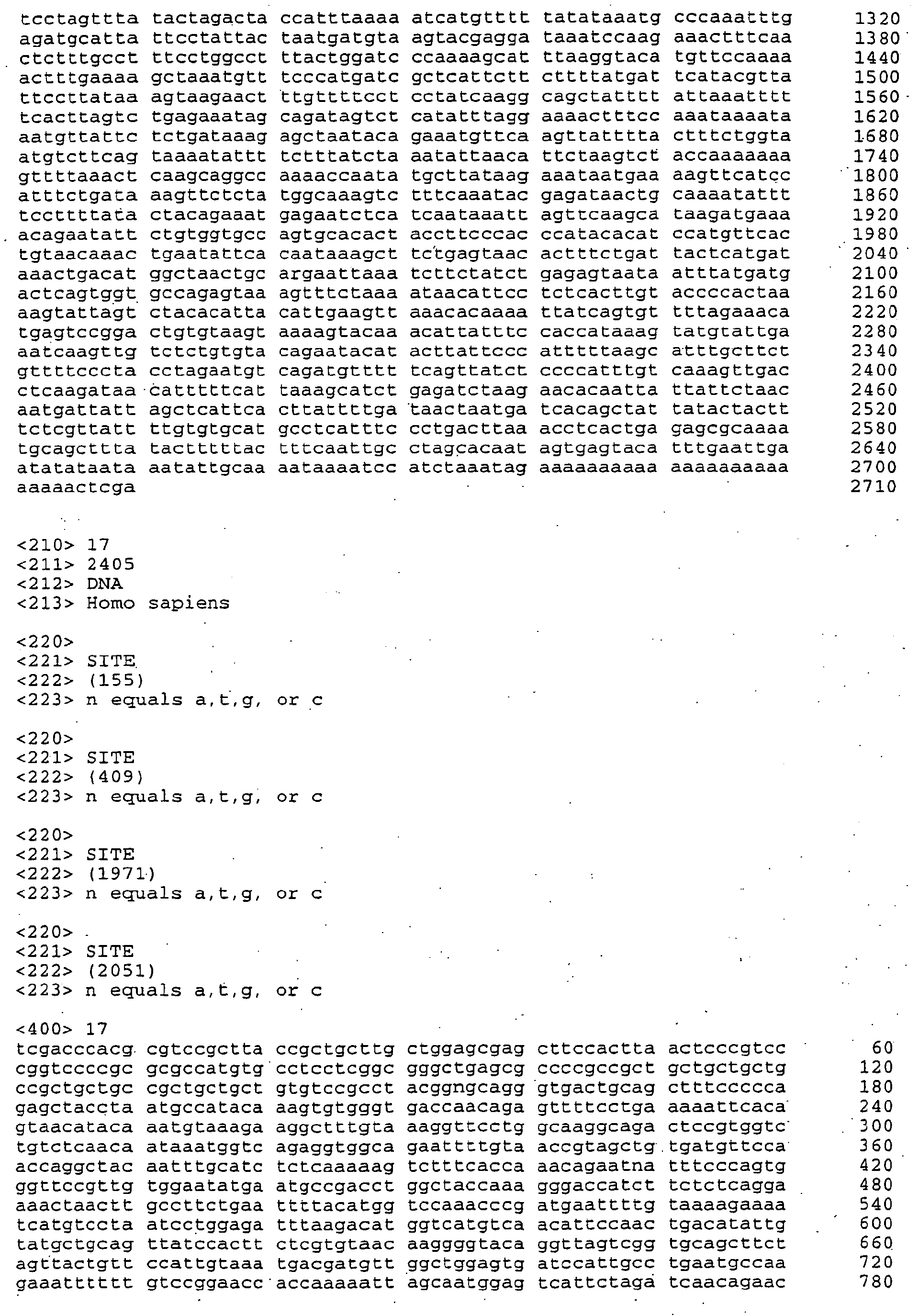
Many polynucleotide sequences, such as EST sequences, are publicly
available and accessible through sequence databases. Some of these sequences are
related to SEQ ID NO: 16 and may have been publicly available prior to conception of
the present invention. Preferably, such related polynucleotides are specifically
excluded from the scope of the present invention. To list every related sequence
would be cumbersome. Accordingly, preferably excluded from the present invention
are one or more polynucleotides comprising a nucleotide sequence described by the
general formula of a-b, where a is any integer between 1 to 2696 of SEQ ID NO:16, b
is an integer of 15 to 2710, where both a and b correspond to the positions of
nucleotide residues shown in SEQ ID NO:16, and where b is greater than or equal to a
+ 14.
FEATURES OF PROTEIN ENCODED BY GENE NO: 7
The translation product of this gene shares sequence homology with the rat
decay accelerating factor (see, e.g., GenBank accession AAC77439) which is thought
to be important in modifying the activity and cellular response of complement
proteins and thus attenuating complement mediated immune responses.
It has been discovered that this gene is expressed primarily in ovarian tumor.
Therefore, nucleic acids of the invention are useful as reagents for differential
identification of the tissue(s) or cell type(s) present in a biological sample and for
diagnosis of the following diseases and conditions: reproductive diseases and/or
disorders, particularly ovarian tumors. Similarly, polypeptides and antibodies directed
to those polypeptides are useful to provide immunological probes for differential
identification of the tissue(s) or cell type(s). For a number of disorders of the above
tissues or cells, particularly of the reproductive system, expression of this gene at
significantly higher or lower levels may be detected in certain tissues or cell types
(e.g., reproductive, ovarian, and cancerous and wounded tissues) or bodily fluids (e.g.,
lymph, amniotic fluid, serum, plasma, urine, synovial fluid or spinal fluid) taken from
an individual having such a disorder, relative to the standard gene expression level,
i.e., the expression level in healthy tissue from an individual not having the disorder.
The tissue distribution in ovarian tumor tissue indicates that polynucleotides
and polypeptides of the invention are useful for the detection, treatment, and/or
prevention of proliferative diseases and/or disorders, and particularly for ovarian
cancer. Moreover, the expression within cellular sources marked by proliferating cells
indicates this protein may play a role in the regulation of cellular division, and may
show utility in the diagnosis, treatment, and/or prevention of developmental diseases
and disorders, including cancer, and other proliferative conditions. Representative
uses are described in the "Hyperproliferative Disorders" and "Regeneration" sections
below and elsewhere herein. Briefly, developmental tissues rely on decisions
involving cell differentiation and/or apoptosis in pattern formation. Dysregulation of
apoptosis can result in inappropriate suppression of cell death, as occurs in the
development of some cancers, or in failure to control the extent of cell death, as is
believed to occur in acquired immunodeficiency and certain neurodegenerative
disorders, such as spinal muscular atrophy (SMA). Alternatively, this gene product
may be involved in the pattern of cellular proliferation that accompanies early
embryogenesis. Thus, aberrant expression of this gene product in tissues - particularly
adult tissues - may correlate with patterns of abnormal cellular proliferation, such as
found in various cancers. Because of potential roles in proliferation and
differentiation, this gene product may have applications in the adult for tissue
regeneration and the treatment of cancers. It may also act as a morphogen to control
cell and tissue type specification. Therefore, the polynucleotides and polypeptides of
the present invention are useful in treating, detecting, and/or preventing said disorders
and conditions, in addition to other types of degenerative conditions. Thus this protein
may modulate apoptosis or tissue differentiation and would be useful in the detection,
treatment, and/or prevention of degenerative or proliferative conditions and diseases.
The protein is useful in modulating the immune response to aberrant polypeptides, as
may exist in proliferating and cancerous cells and tissues. The protein can also be
used to gain new insight into the regulation of cellular growth and proliferation.
Based upon the tissue distribution of this protein, antagonists directed against
this protein may be useful in blocking the activity of this protein. Accordingly,
preferred are antibodies which specifically bind a portion of the translation product of
this gene. Also provided is a kit for detecting tumors in which expression of this
protein occurs. Such a kit comprises in one embodiment an antibody specific for the
translation product of this gene bound to a solid support. Also provided is a method of
detecting these tumors in an individual which comprises a step of contacting an
antibody specific for the translation product of this gene to a bodily fluid from the
individual, preferably serum, and ascertaining whether antibody binds to an antigen
found in the bodily fluid. Preferably the antibody is bound to a solid support and the
bodily fluid is serum. The above embodiments, as well as other treatments and
diagnostic tests (kits and methods), are more particularly described elsewhere herein.
Furthermore, the protein may also be used to determine biological activity, to raise
antibodies, as tissue markers, to isolate cognate ligands or receptors, to identify agents
that modulate their interactions, in addition to its use as a nutritional supplement.
Protein, as well as, antibodies directed against the protein may show utility as a tumor
marker and/or immunotherapy targets for the above listed tissues.
Many polynucleotide sequences, such as EST sequences, are publicly
available and accessible through sequence databases. Some of these sequences are
related to SEQ ID NO:17 and may have been publicly available prior to conception of
the present invention. Preferably, such related polynucleotides are specifically
excluded from the scope of the present invention. To list every related sequence
would be cumbersome. Accordingly, preferably excluded from the present invention
are one or more polynucleotides comprising a nucleotide sequence described by the
general formula of a-b, where a is any integer between 1 to 2391 of SEQ ID NO: 17, b
is an integer of 15 to 2405, where both a and b correspond to the positions of
nucleotide residues shown in SEQ ID NO: 17, and where b is greater than or equal to a
+ 14.
FEATURES OF PROTEIN ENCODED BY GENE NO: 8
Angiogenesis, the formation of new blood vessels from pre-existing
vasculature, is a tightly regulated process in normal adults. Under physiological
circumstances, growth of new capillaries is tightly controlled by an interplay of
growth regulatory proteins which act either to stimulate or to inhibit blood vessel
growth. Normally, the balance between these forces is tipped in favor of inhibition
and consequently blood vessel growth is restrained. Under certain pathological
circumstances, however, local inhibitory controls are unable to restrain the increased
activity of angiogenic inducers. Angiogenesis is a key step in the metastasis of cancer
(Folkman, Nature Med. 1:27-31 (1995)) and in abnormal wound healing,
inflammation, rheumatoid arthritis, psoriasis, and diabetic retinopathy, it is integral to
the pathology (Folkman et al., Science 235:442-447 (1987)), engendering the hope
that these pathological entities could be regulated by pharmacological and/or genetic
suppression of blood vessel growth (Iruela-Arispe et al., Thromb. Haem. 78:672-677
1997)).
Thrombospondin-1 (TSP-1) is a 450 kDa, anti-angiogenic adhesive
glycoprotein released from activated platelets and secreted by growing cells (reviewed
in Adams, Int. J. Biochem. Cell. Biol. 29:861-865 (1997)). TSP-1 is a homotrimer,
with each subunit comprised of a 1152 amino acid residue polypeptide, post-translationally
modified by N-linked glycosylation and beta-hydroxylation of
asparagine residues.
TSP-1 protein and mRNA levels are regulated by a variety of factors. TSP-1
protein levels are downregulated by IL-1 alpha and TNF alpha. TSP-1 mRNA and
protein levels are upregulated by polypeptide growth factors including PDGF, TGF-beta,
and bFGF (Bornstein, Faseb J 6: 3290-3299 (1992)) and are also regulated by
the level of expression of the p53 tumor suppressor gene product (Dameron et al.,
Science 265:1582-1584 (1994)). At least four other members of the thrombospondin
family have been identified: TSP-2, TSP-3, TSP-4, and TSP-5 (also called COMP).
There is a need in the art to identify other molecules involved in the regulation of
angiogenesis.
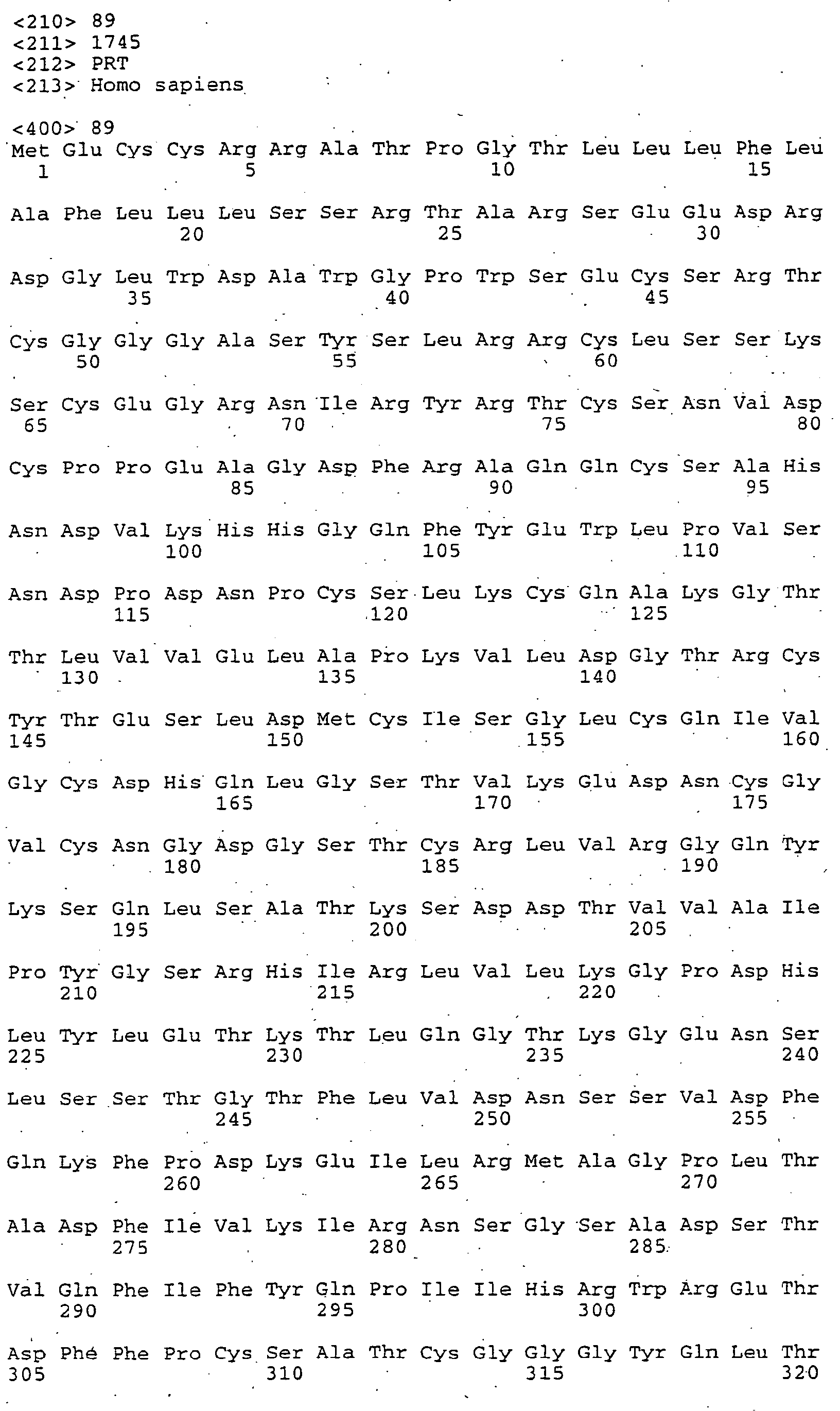
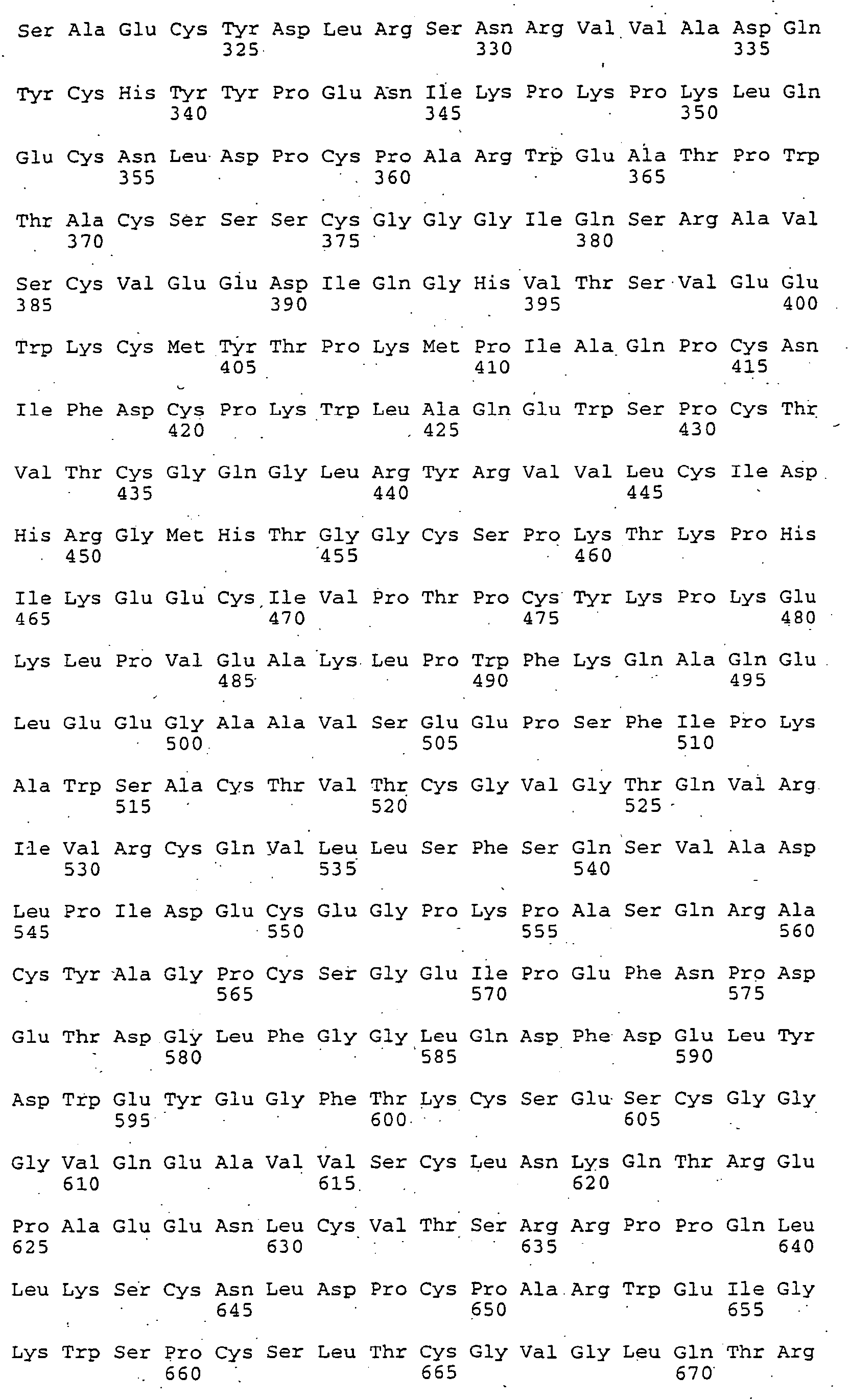
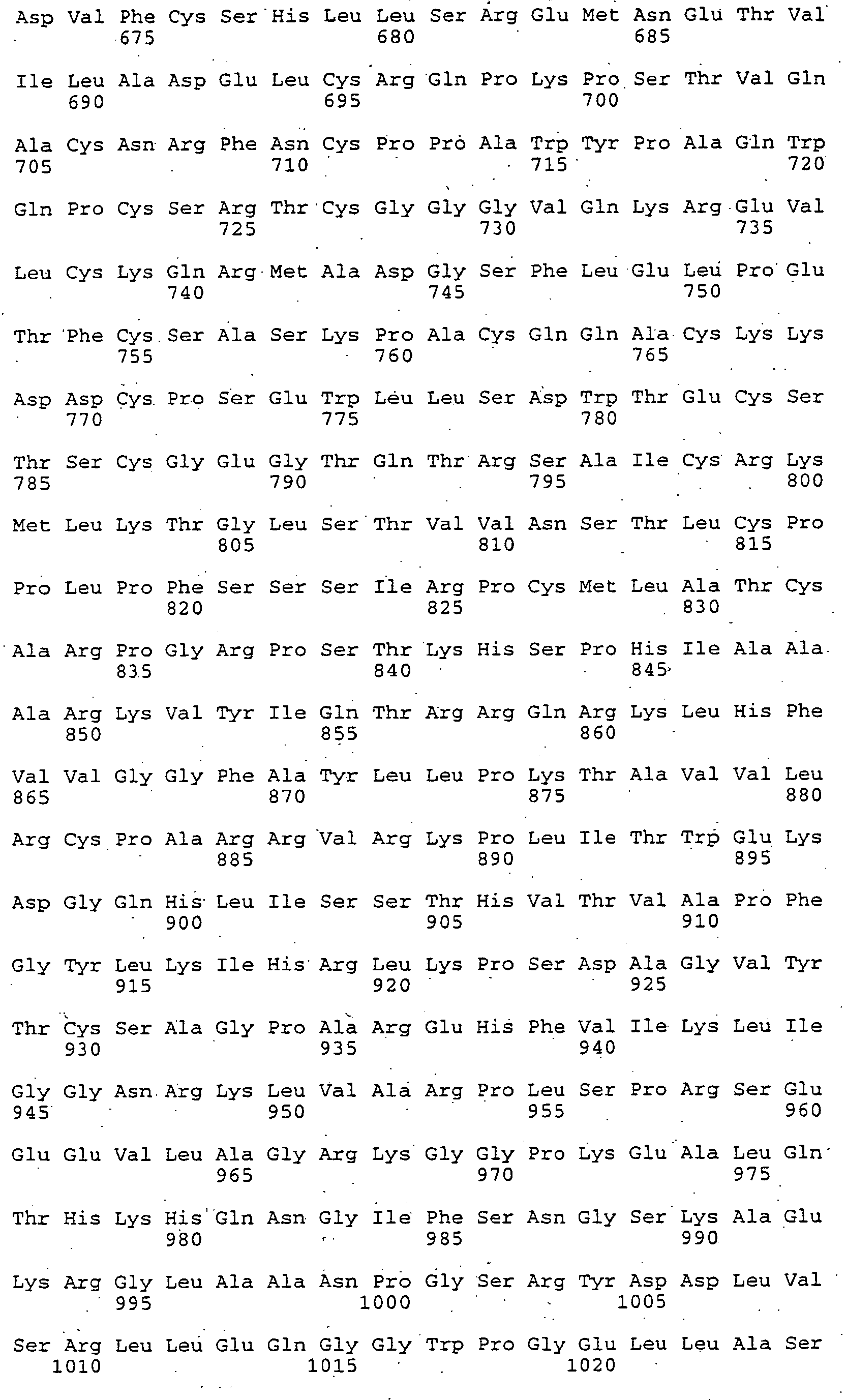
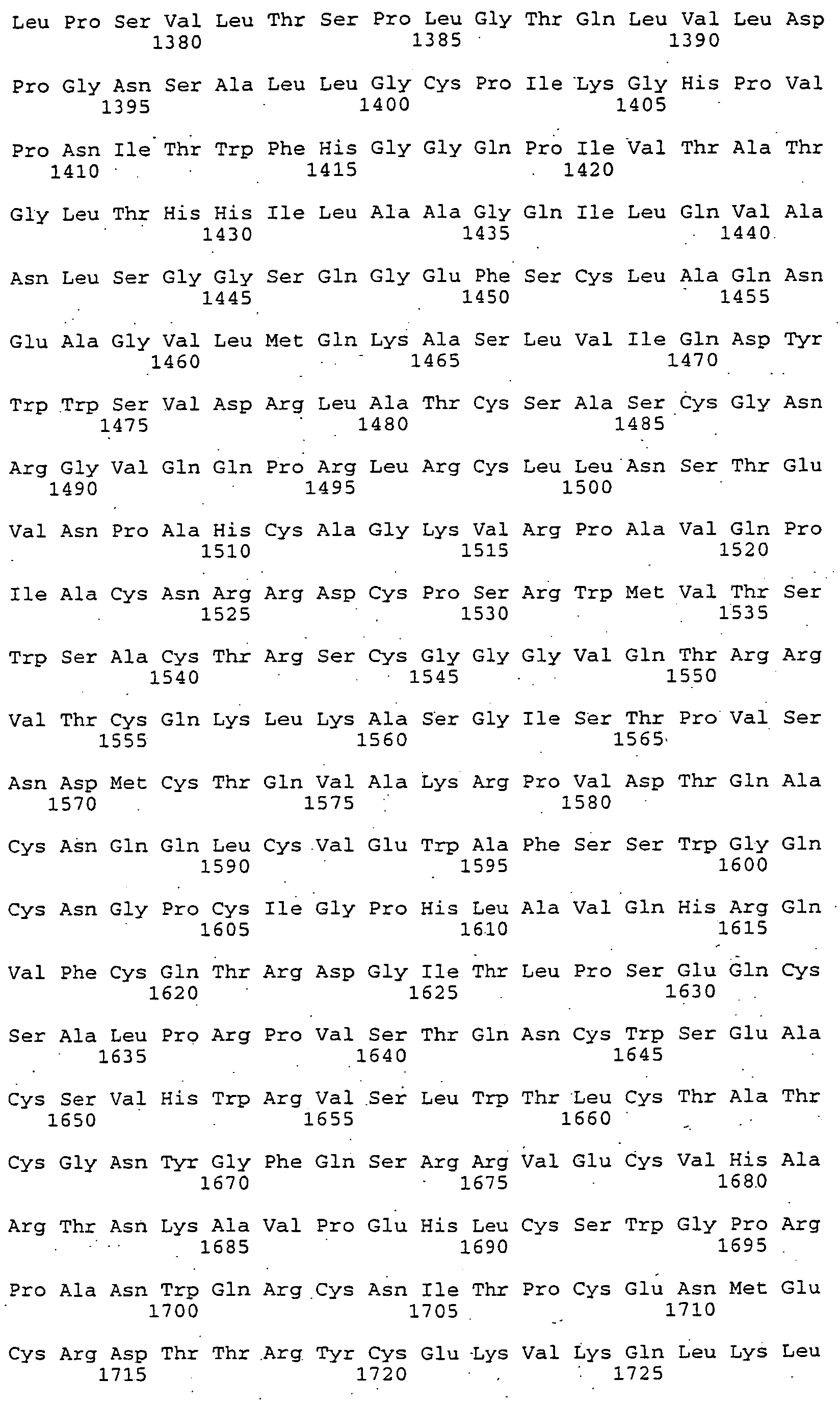
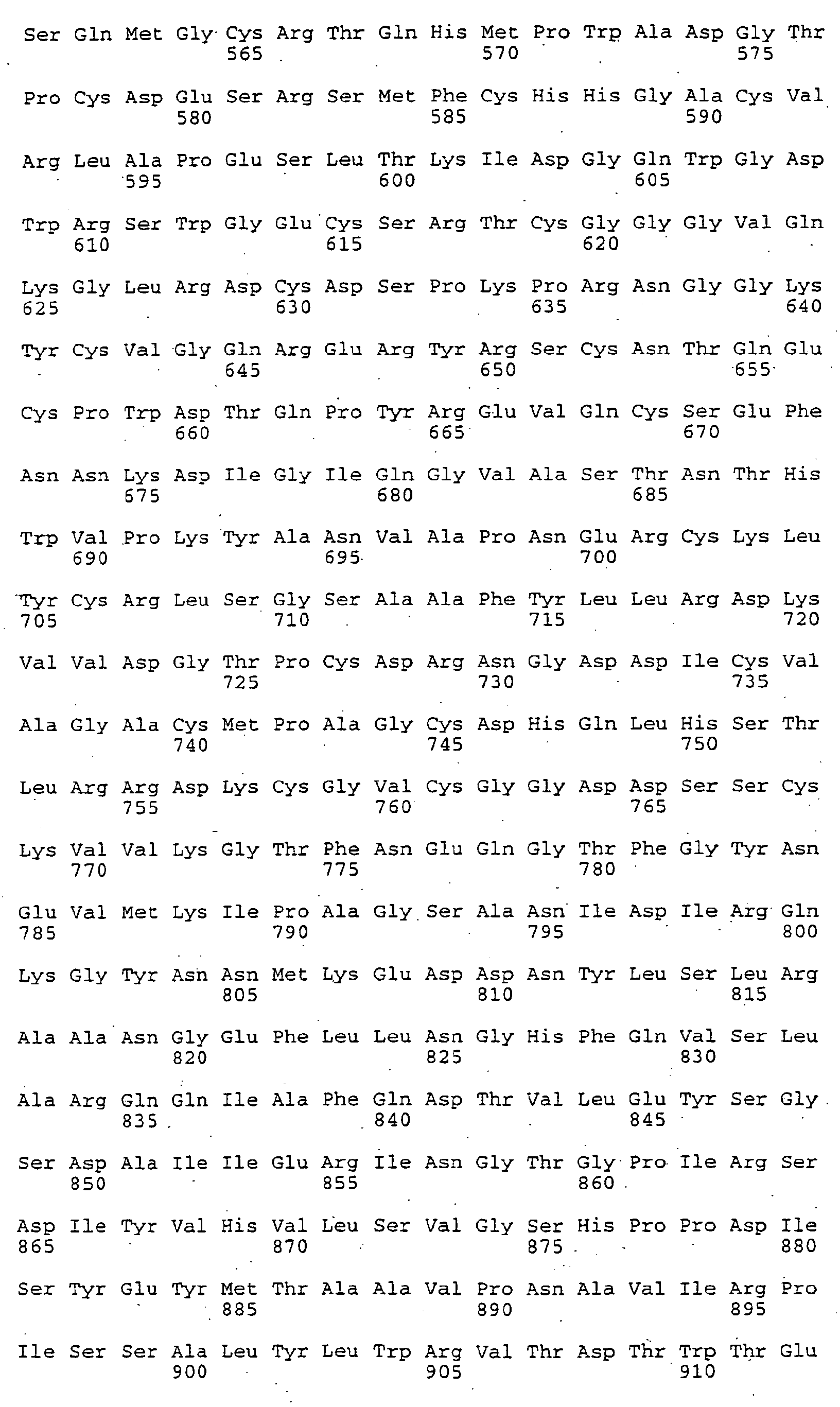
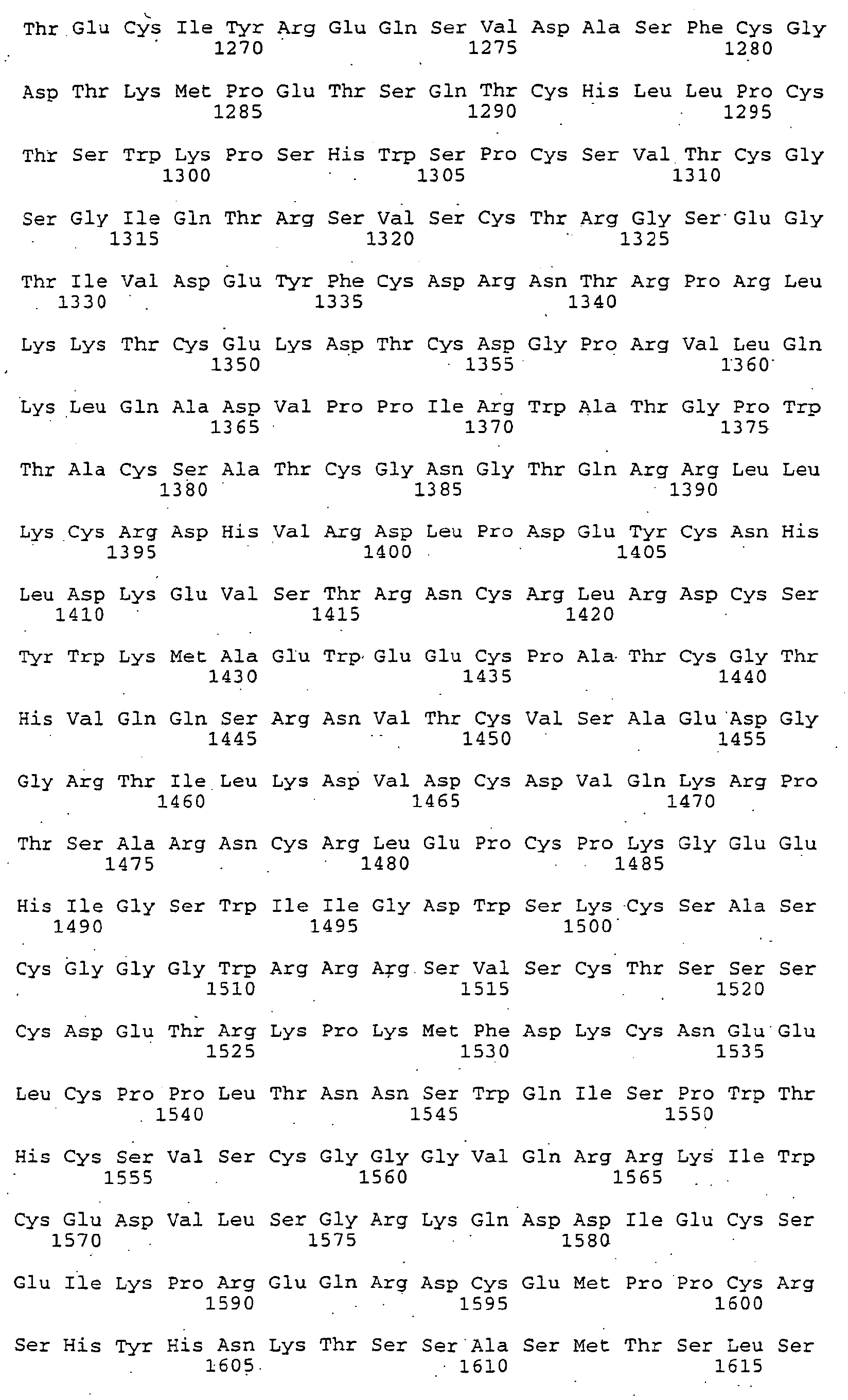
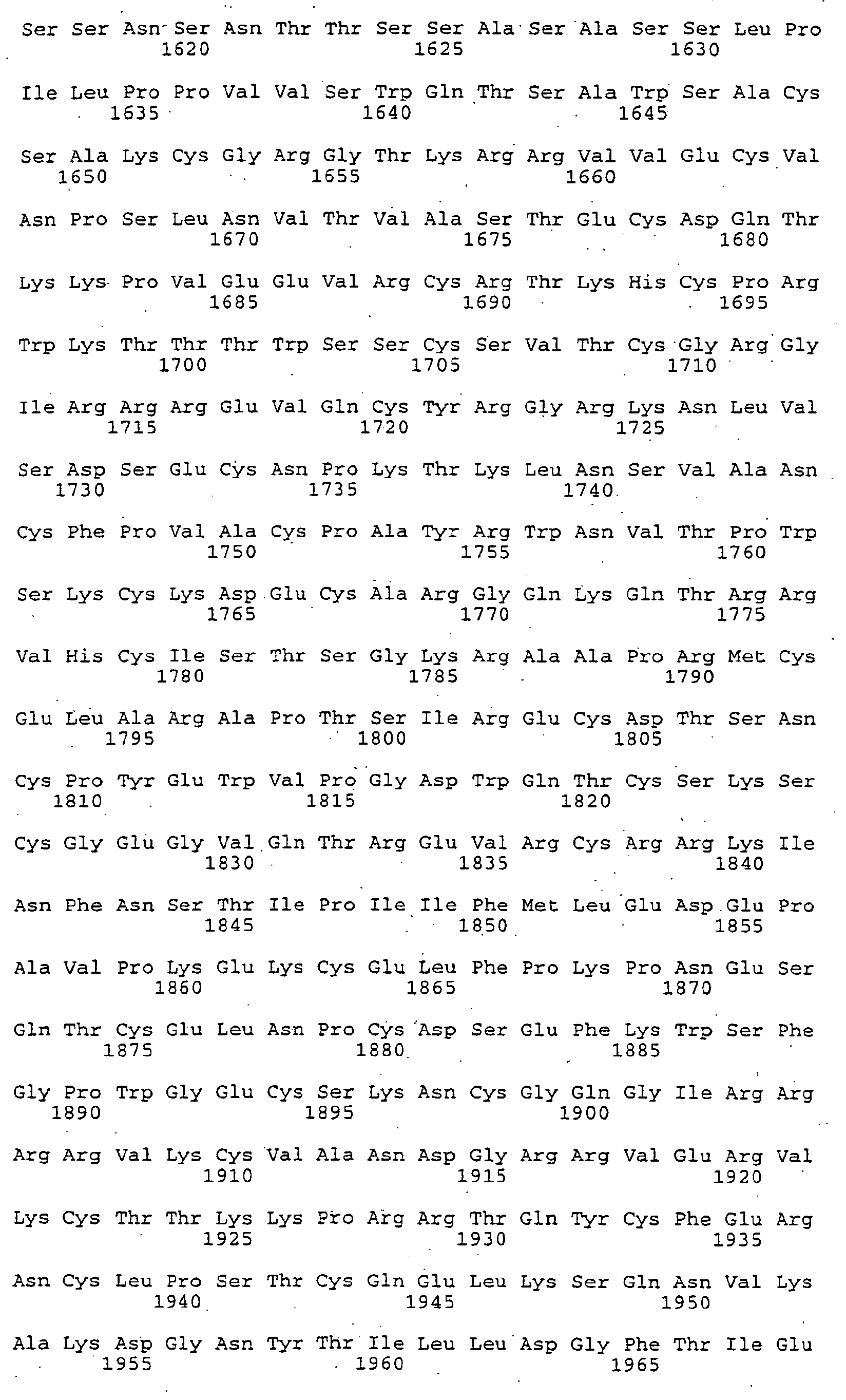
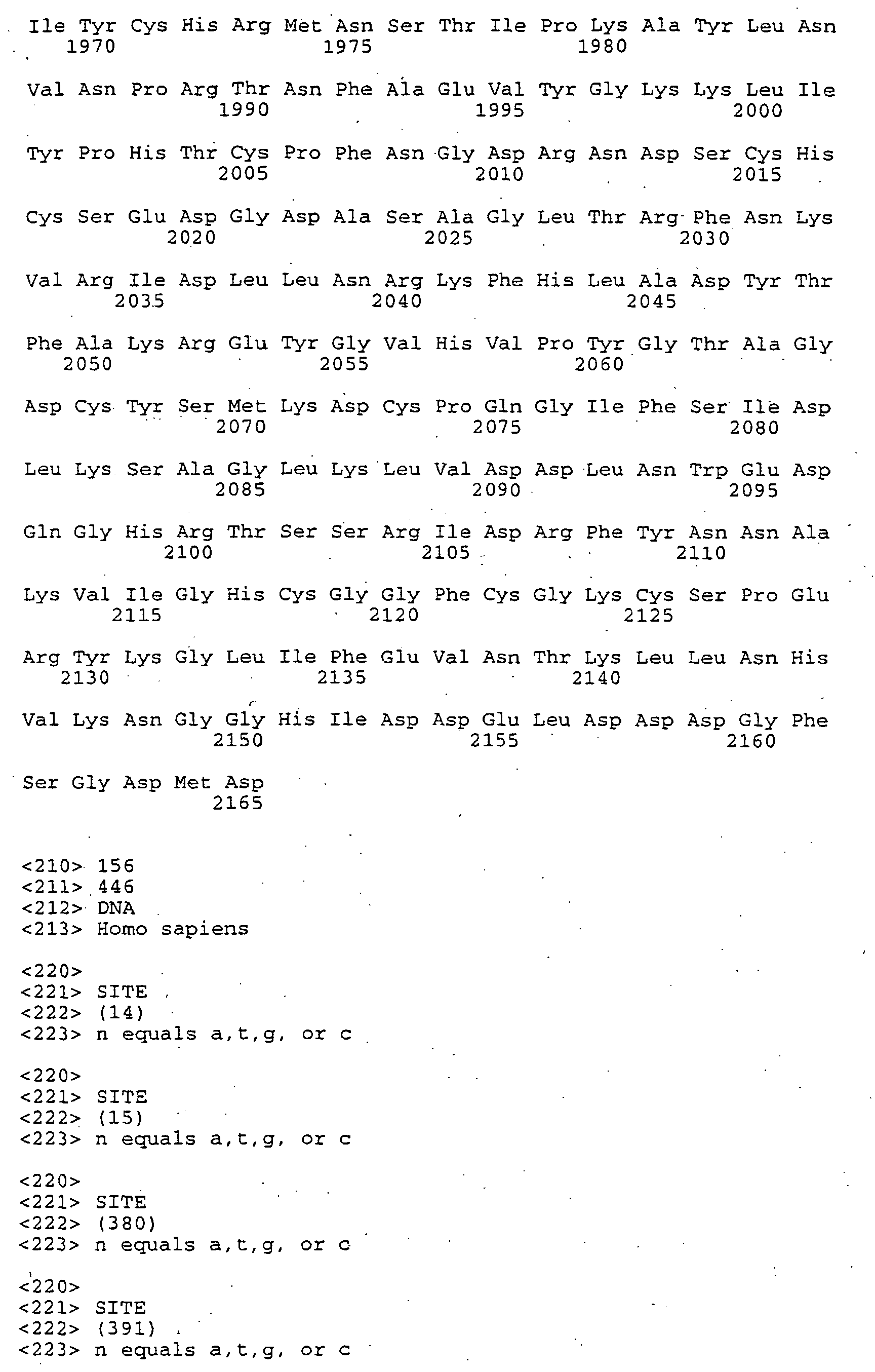
Figure 4A-4H shows the nucleotide sequence (SEQ ID NO:18) and the
deduced amino acid sequence (SEQ ID NO:89) of THRAP. The predicted leader
sequence located at about amino acid residues 1 to 28 is bolded in Figure 4A-4H.
Figure 4A-4H also shows 13 TSP-1-like domains (indicated by single underlined
amino acid residues), an IgG-like domain (indicated by bolded and double underlined
amino acid residues), and a proteinase inhibitor-like domain (indicated by double
underlined amino acid residues) of SEQ ID NO: 89. In this context "about" includes
the particularly recited ranges, larger or smaller by several (10, 9, 8, 7, 6, 5, 4, 3, 2, or
1) amino acids, at either extreme or at both extremes.
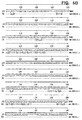
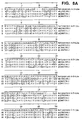
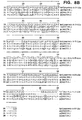
Figure 5A-5E shows the regions of identity between the amino acid sequence
of THRAP and the translation product of Thrombospondin-like protein
(Genbank accession CAB03121.1) determined by
BLAST analysis. Identical amino acids between the two polypeptides are boxed. By
examining the regions of boxed amino acids, the skilled artisan can readily identify
conserved domains between the two polypeptides. These conserved domains are
preferred embodiments of the present invention.
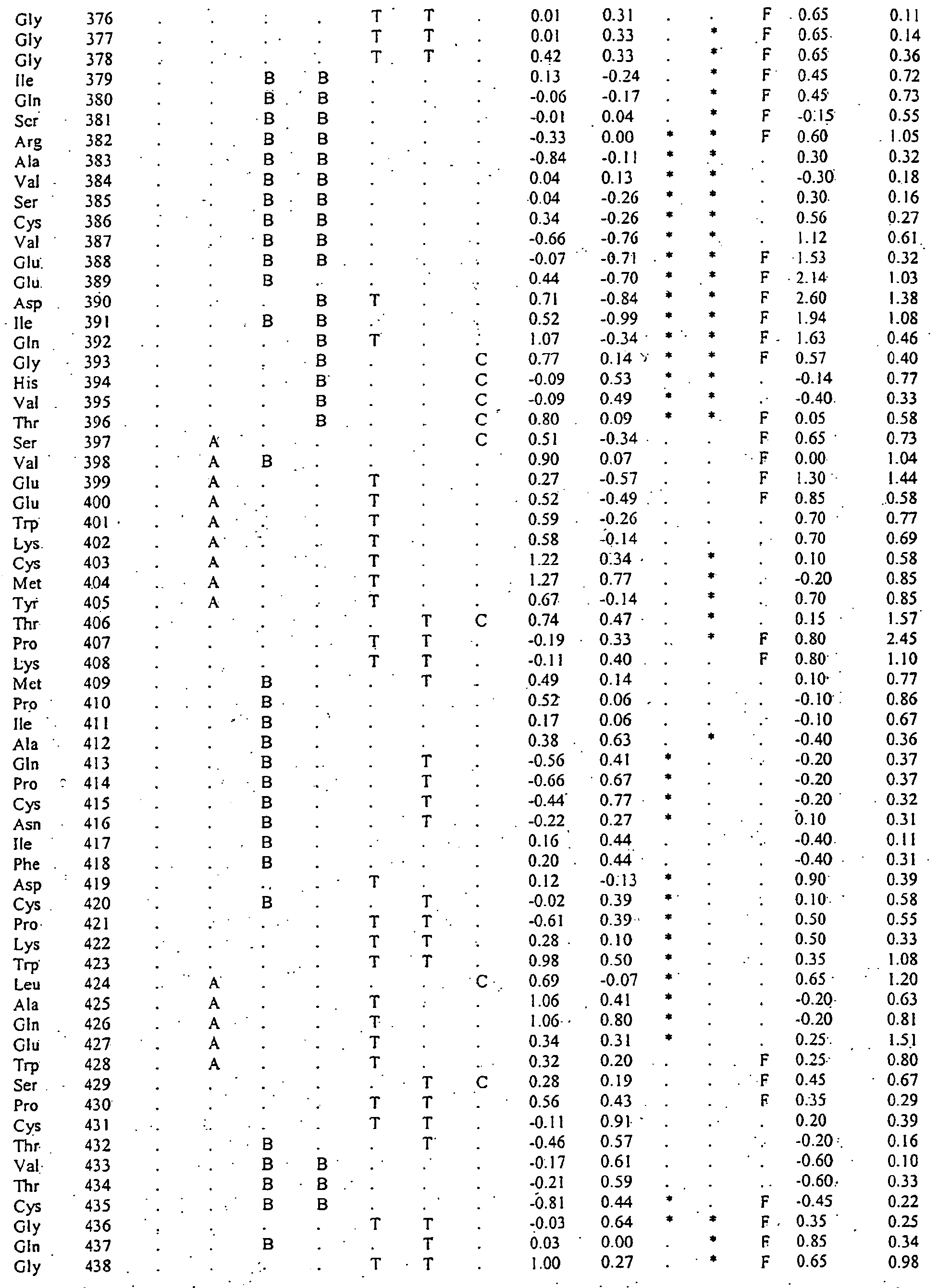
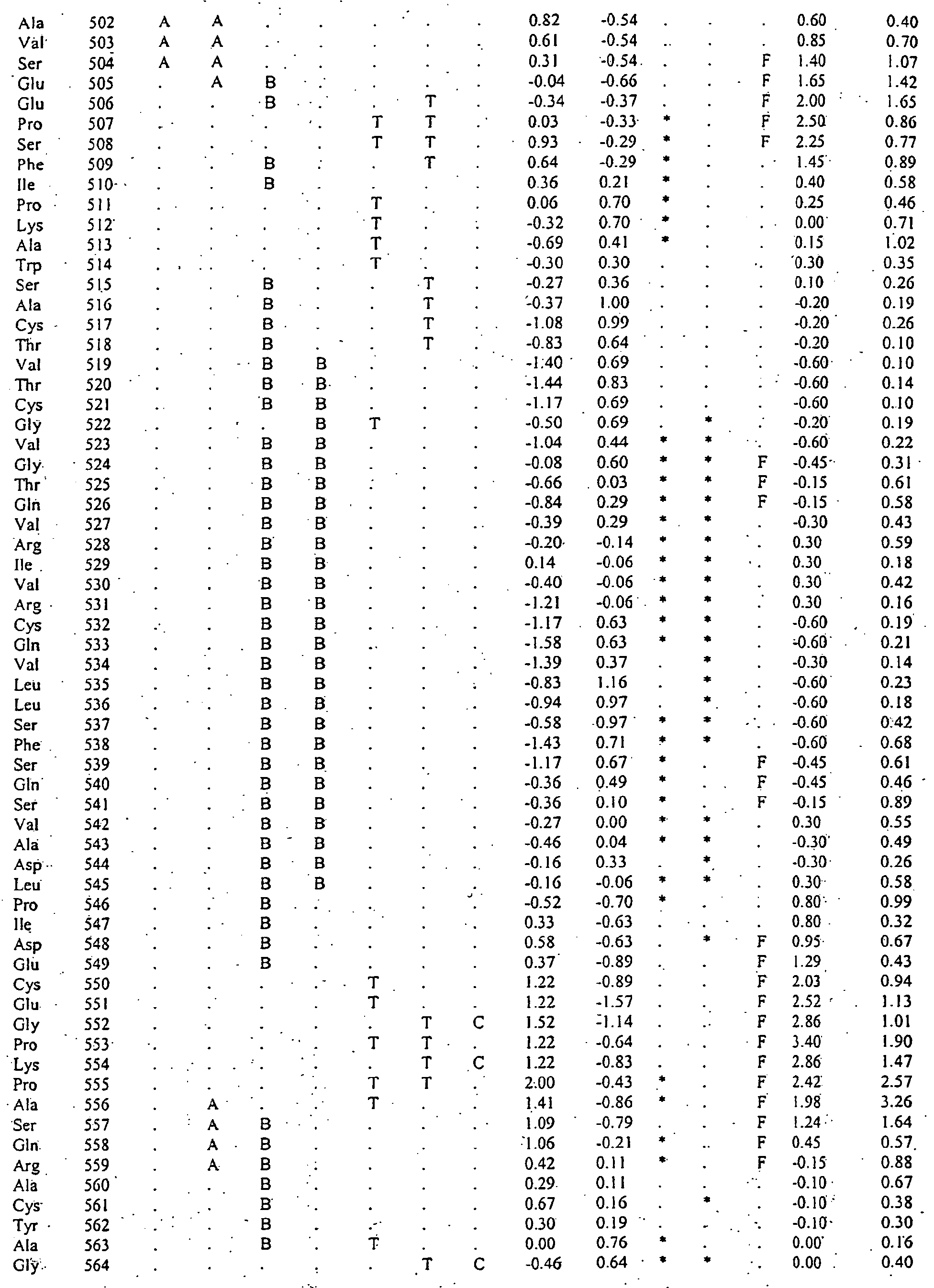
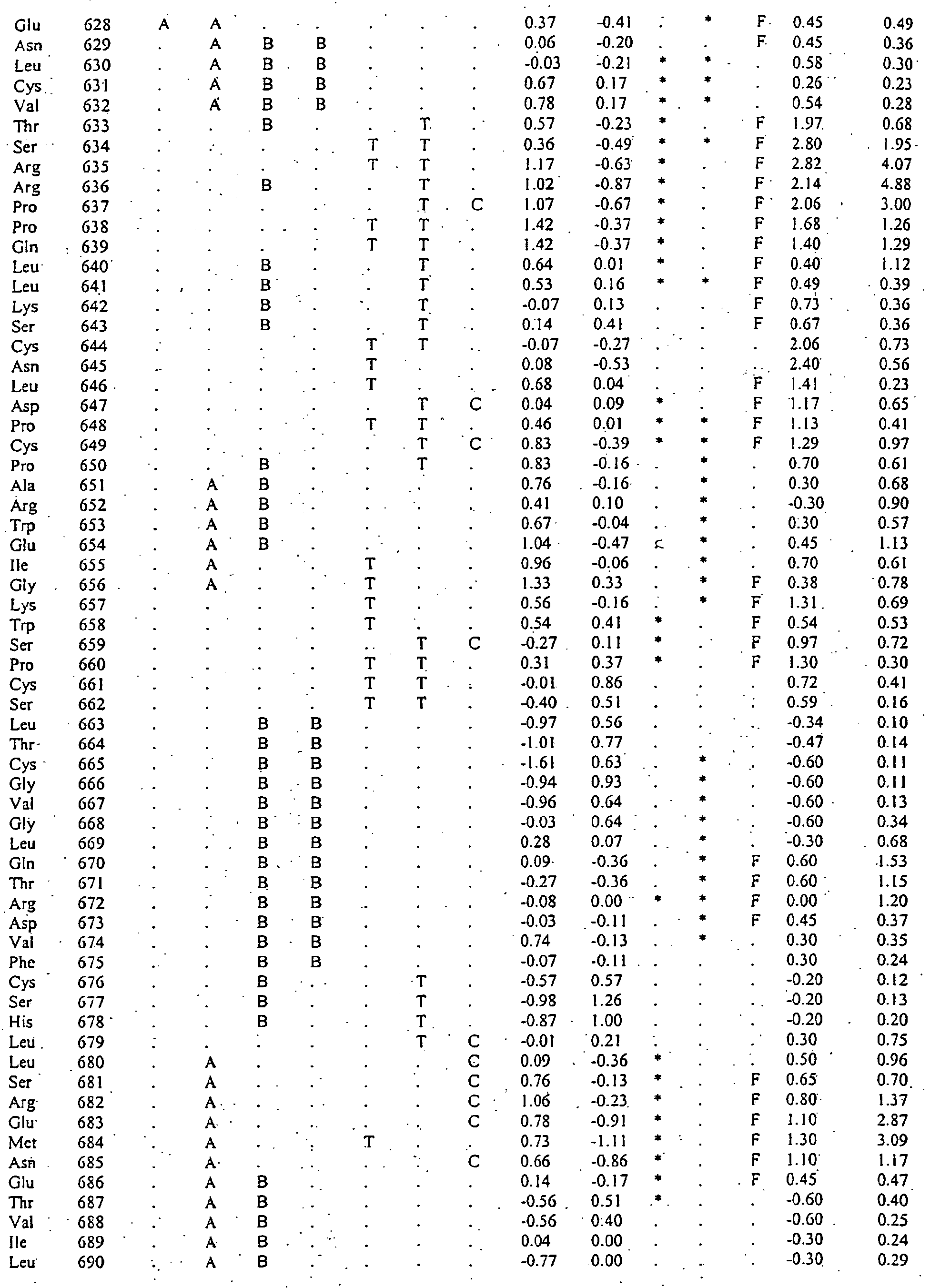
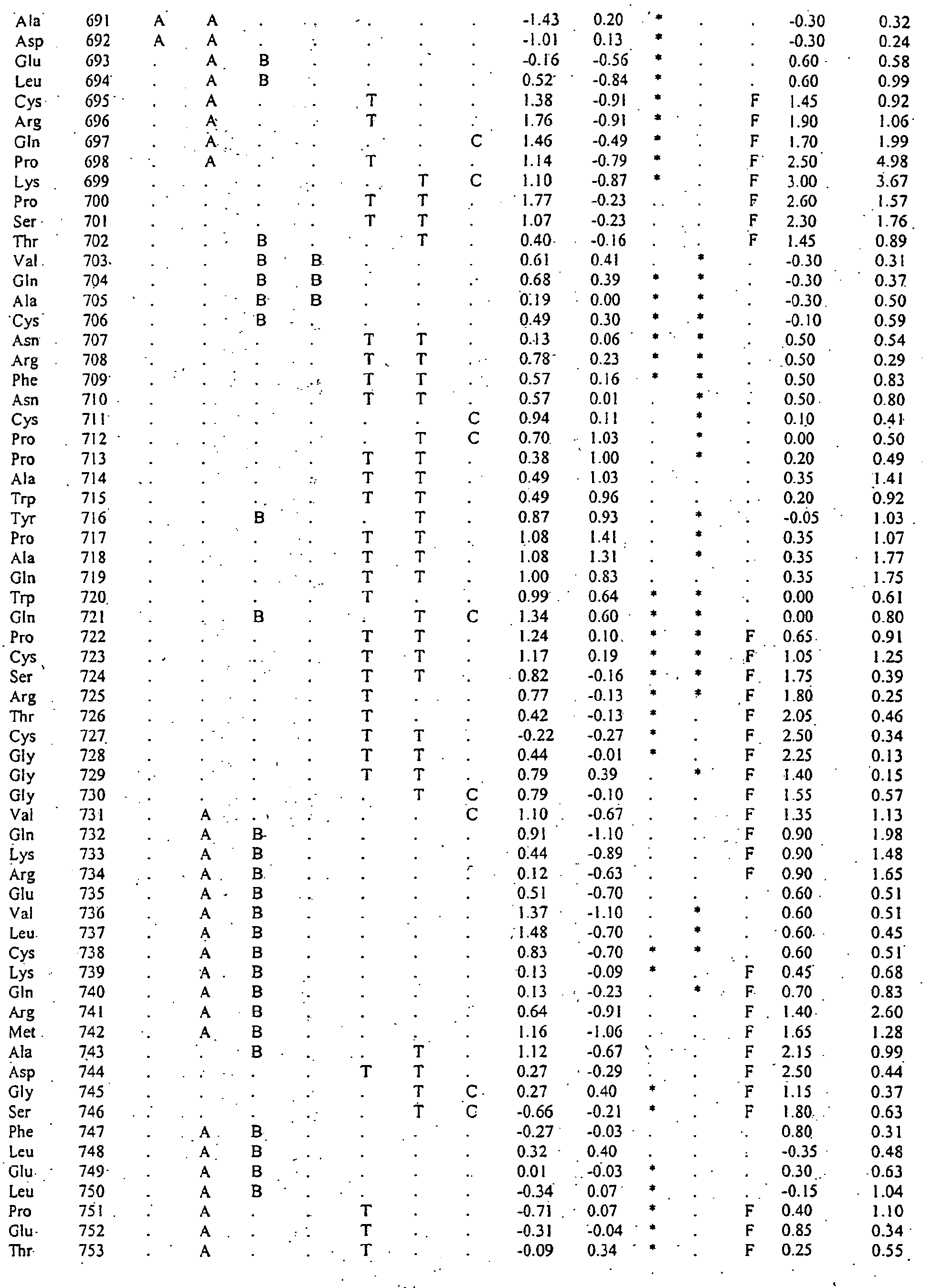
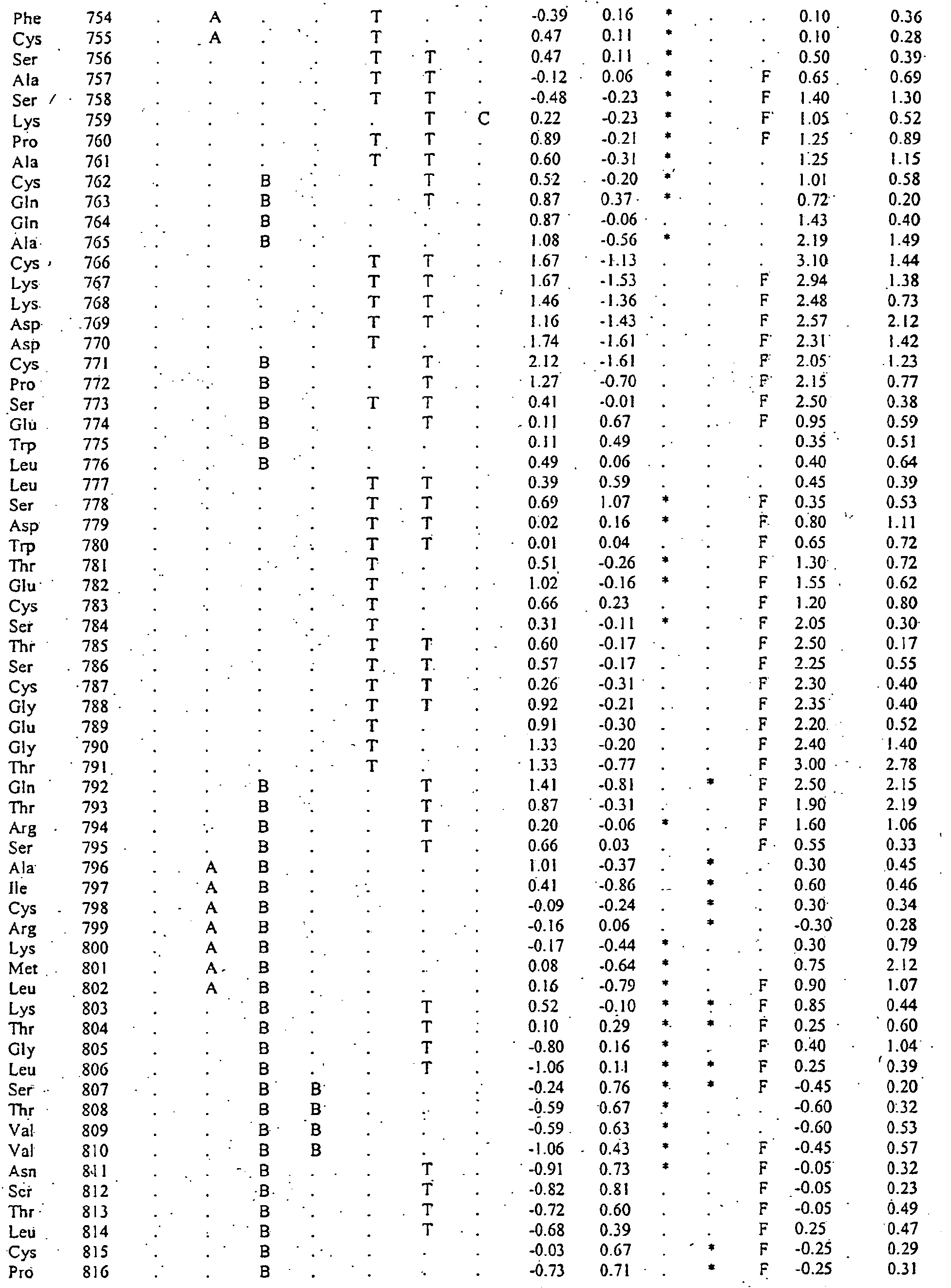
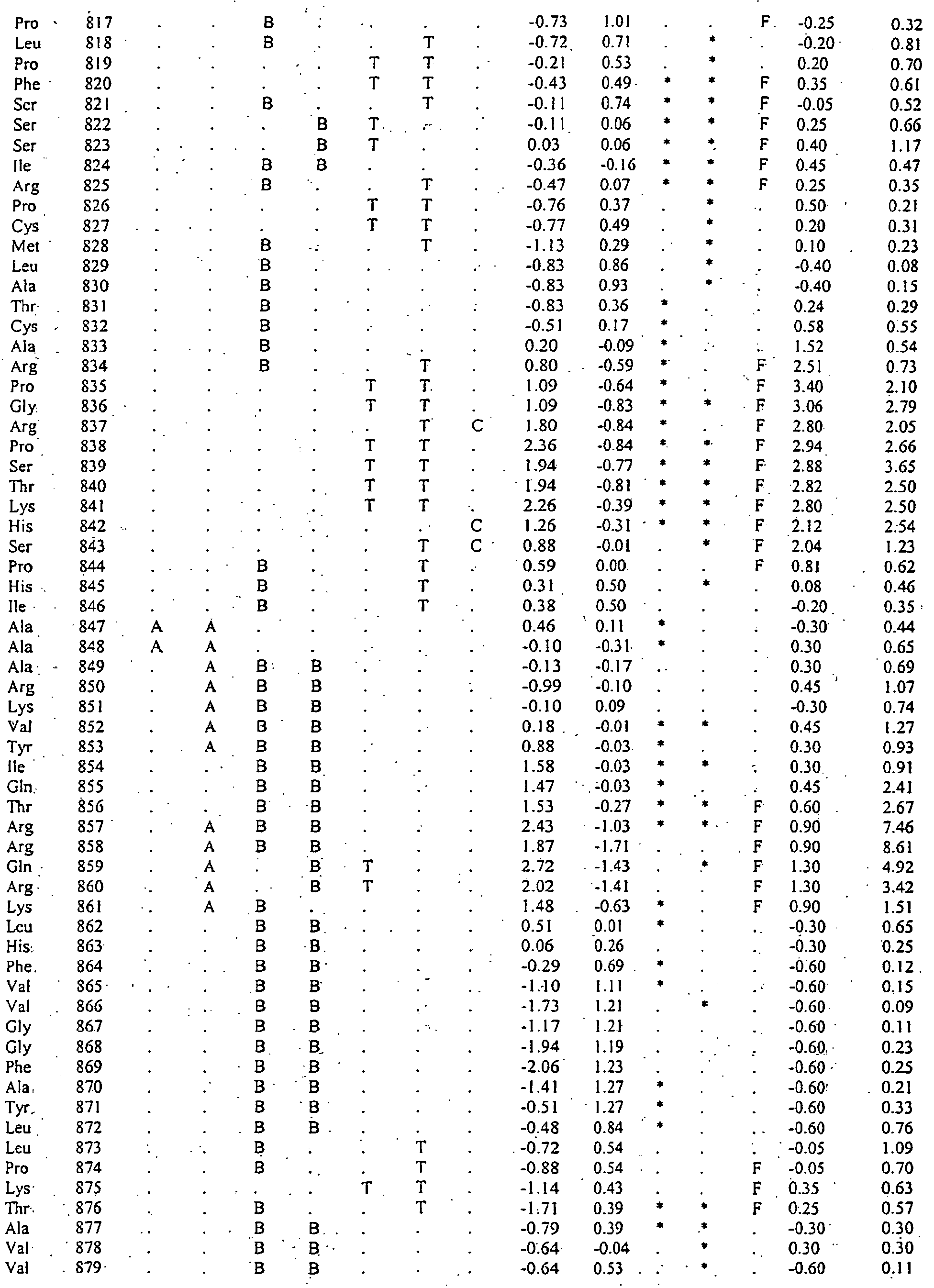
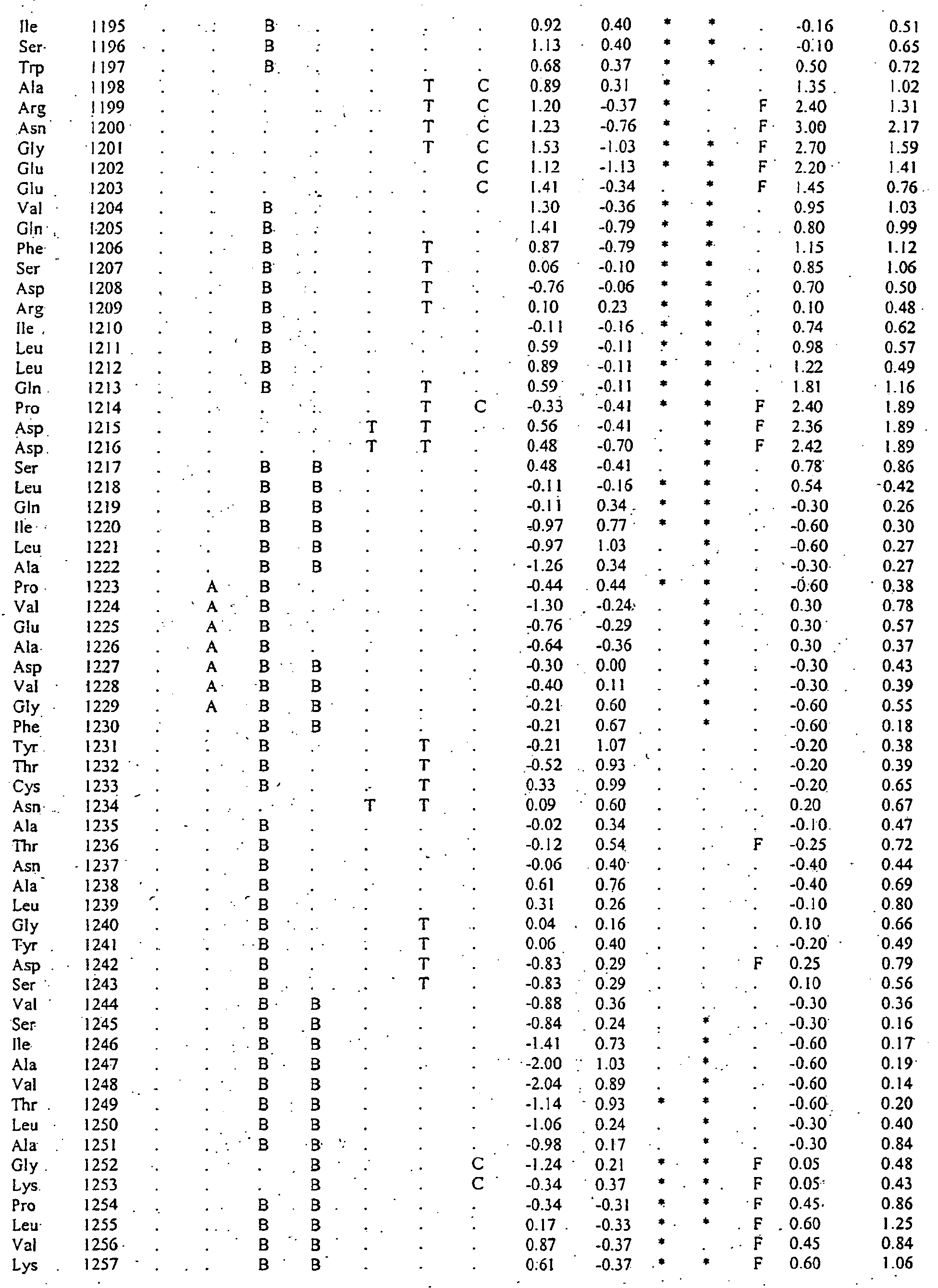
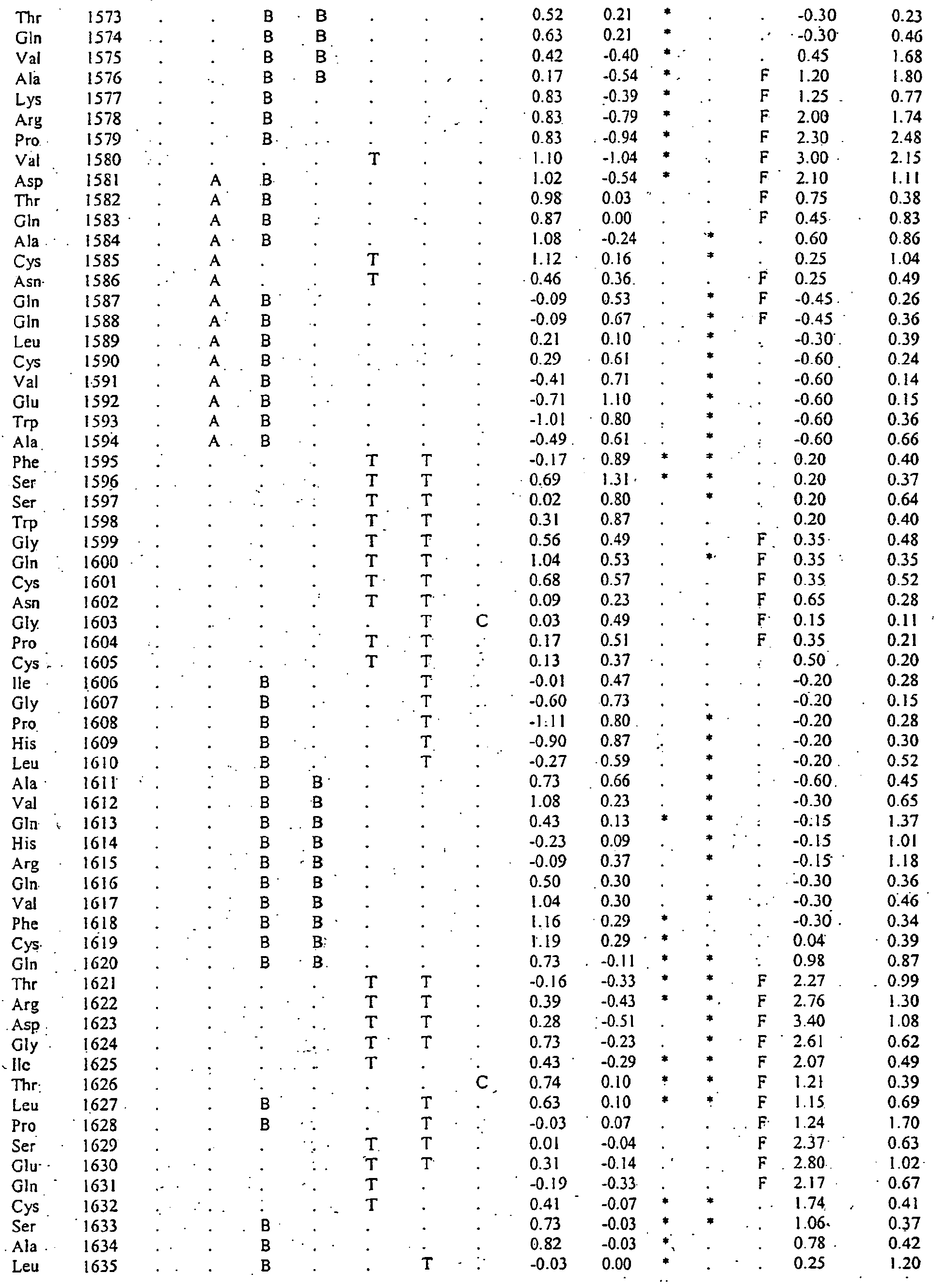
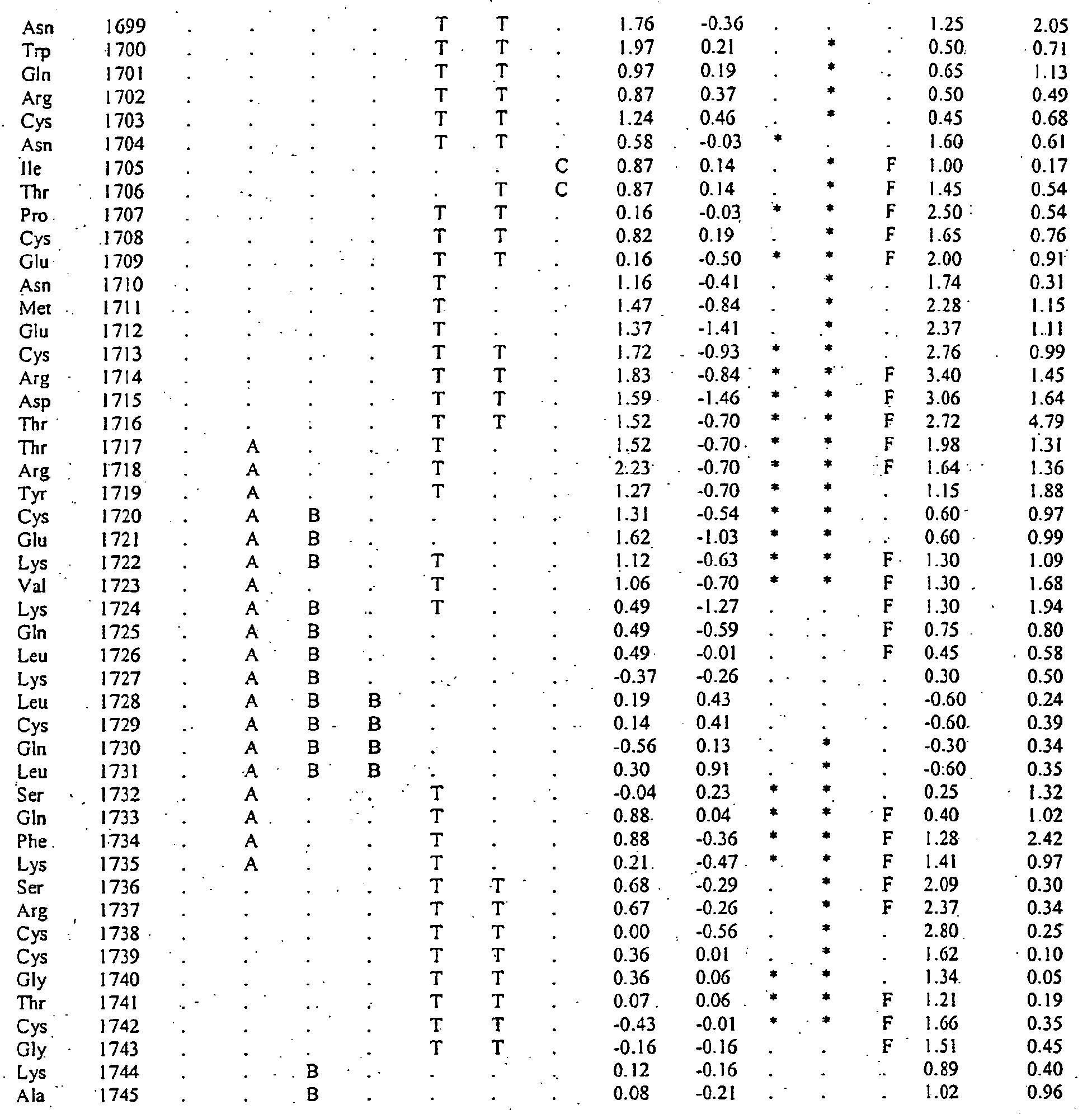
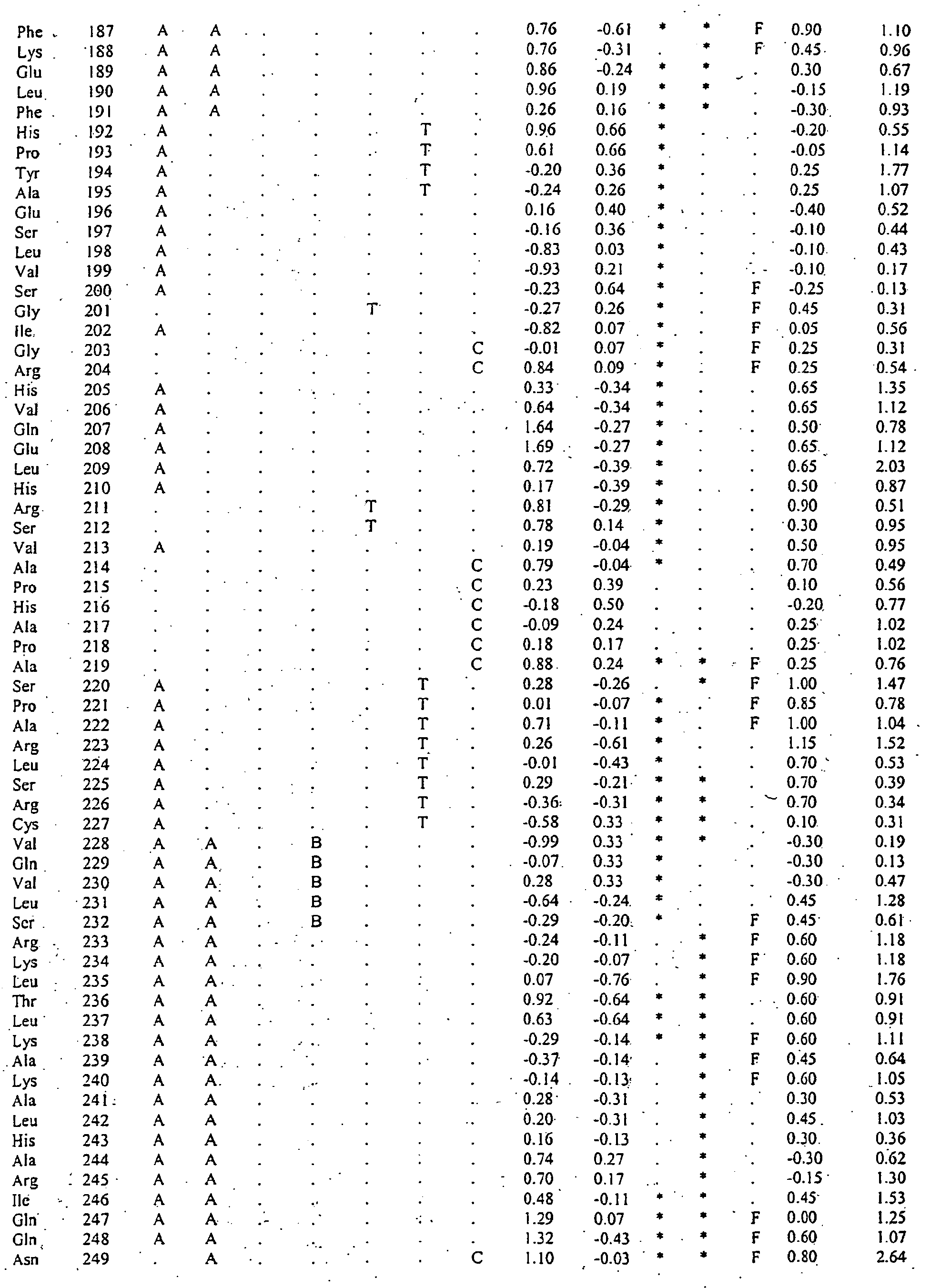
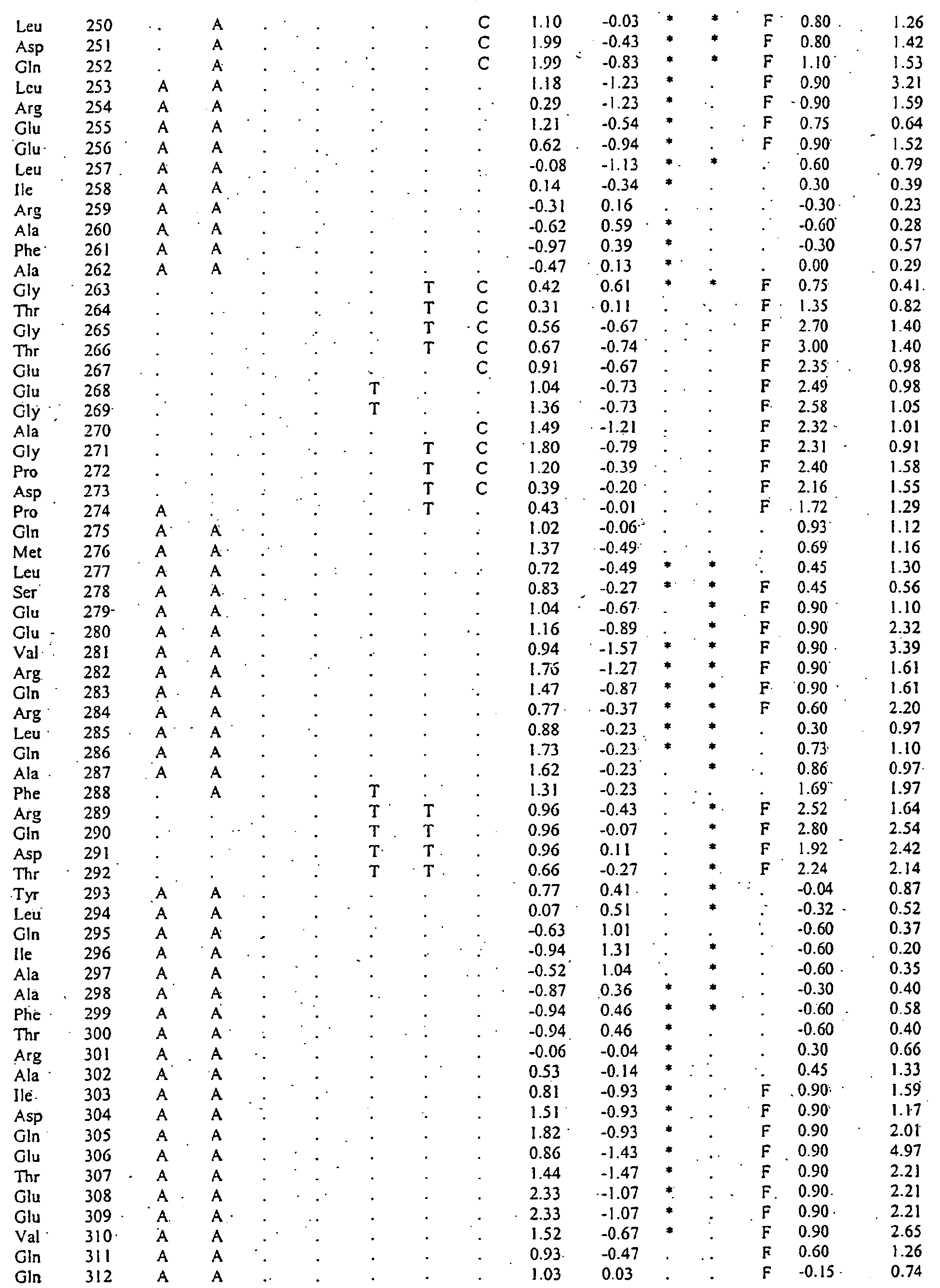
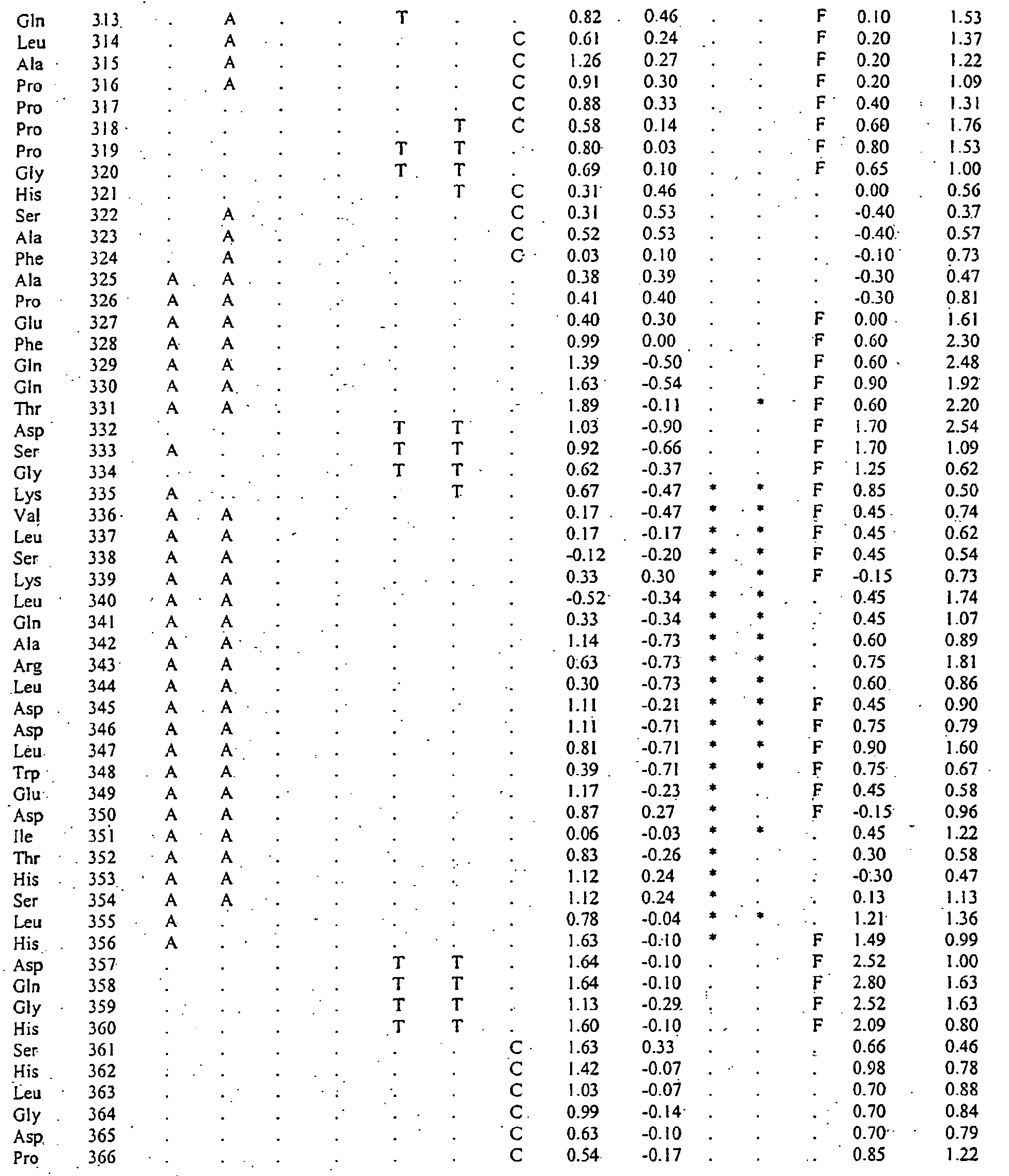
Figure 6 shows an analysis of the THRAP amino acid sequence. Alpha, beta,
turn and coil regions; hydrophilicity and hydrophobicity; amphipathic regions;
flexible regions; antigenic index and surface probability are shown, and all were
generated using the default settings. In the "Antigenic Index or Jameson-Wolf" graph,
the positive peaks indicate locations of the highly antigenic regions of the THRAP
protein, i.e., regions from which epitope-bearing peptides of the invention can be
obtained. The domains defined by these graphs are contemplated by the present
invention.
The data presented in Figure 6 are also represented in tabular form in Table 7.
The columns are labeled with the headings "Res", "Position", and Roman Numerals
I-XIV. The column headings refer to the following features of the amino acid
sequence presented in Figure 6, and Table 7: "Res": amino acid residue of SEQ ID
NO:89 and Figures 4A-4H; "Position": position of the corresponding residue within
SEQ ID NO:89 and Figures 4A-4H; I: Alpha, Regions - Garnier-Robson; II: Alpha,
Regions - Chou-Fasman; III: Beta, Regions - Garnier-Robson; IV: Beta, Regions -
Chou-Fasman; V: Turn, Regions - Garnier-Robson; VI: Turn, Regions -
Chou-Fasman; VII: Coil, Regions - Garnier-Robson; VIII: Hydrophilicity Plot -
Kyte-Doolittle; IX: Hydrophobicity Plot - Hopp-Woods; X: Alpha, Amphipathic
Regions - Eisenberg; XI: Beta, Amphipathic Regions - Eisenberg; XII: Flexible
Regions - Karplus-Schulz; XIII: Antigenic Index - Jameson-Wolf; and XIV: Surface
Probability Plot - Emini.
A clone (HOHCA60) containing all or most of the sequence for SEQ ID
NO:18 was deposited with the American Type Culture Collection ("ATCC") on
September 7, 1999, and was given the ATCC Deposit Number PTA-627. The ATCC
is located at 10801 University Boulevard, Manassas, VA 20110-2209, USA. The
ATCC deposit was made pursuant to the terms of the Budapest Treaty on the
international recognition of the deposit of microorganisms for purposes of patent
procedure. Clone HOHCA60 was isolated from a osteoblast II cDNA library. This
clone contains the entire coding region identified as SEQ ID NO:18. The deposited
clone contains a cDNA having a total of 5720 nucleotides, which encodes a predicted
open reading frame of 1745 amino acid residues. (See Figure 4A-4H.) The open
reading frame begins at a N-terminal methionine located at nucleotide position 67,
and ends at a stop codon at nucleotide position 5302. The predicted molecular weight
of the THRAP protein is about 191 kDa.
Subsequent Northern analysis also showed that this gene is expressed
primarily in testes, fetal tissue (e.g., lung, heart), synovial sarcoma, brain, immune
cells and tissues (e. g., lymph node, macrophage), colon, prostate, small intestine,
thyroid and to a lesser extent in many other tissues.
DOMAINS: It has also been discovered that THRAP (SEQ ID NO:89)
contains 13 TSP-1-like domains, an IgG-like domain, and a proteinase inhibitor-like
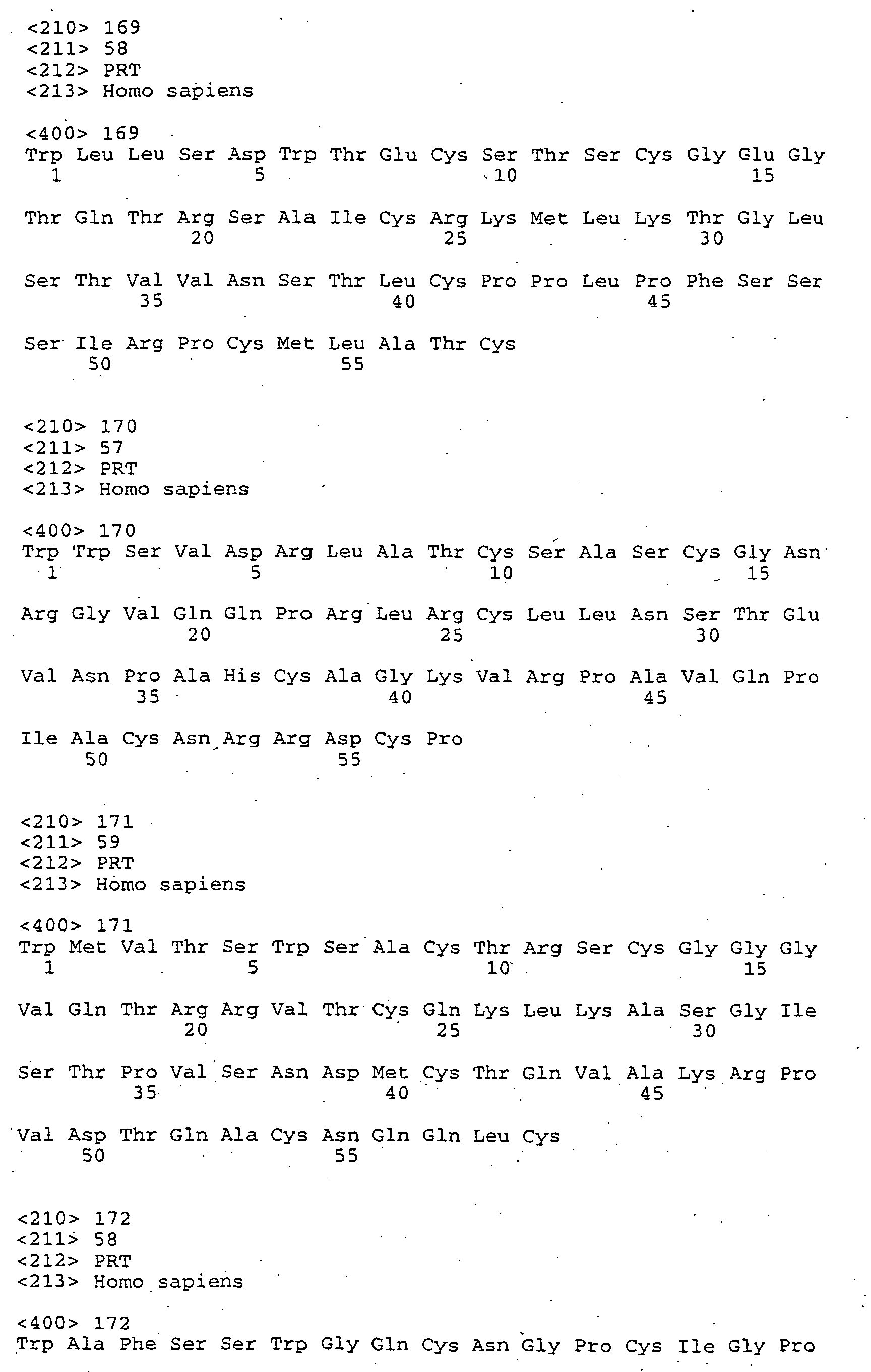
domain. More particularly, (a) a predicted TSP-1-like domain1 (SEQ ID NO:161)
located at about amino acids 33 to 82 of SEQ ID NO:89; (b) a predicted TSP-1-like
domain2 (SEQ ID NO: 162) located at about amino acids 301-360 of SEQ ID NO:89;
(c) a predicted TSP-1-like domain3 (SEQ ID NO:163) located at about amino acids
363-421 of SEQ ID NO:89, (d) a predicted TSP-1-like domain4 (SEQ ID NO:164)
located at about amino acids 423-475 of SEQ ID NO:89, (e) a predicted TSP-1-like
domain5 (SEQ ID NO: 165) located at about amino acids 514-566 of SEQ ID NO:89,
(f) a predicted TSP-1-like domain6 (SEQ ID NO:166) located at about amino acids
590-650 of SEQ ID NO:89, (g) a predicted TSP-1-like domain7 (SEQ ID NO:167)
located at about amino acids 653-712 SEQ ID NO:89, (h) a predicted TSP-1-like
domain8 (SEQ ID NO: 168) located at about amino acids 715-772 of SEQ ID NO:89,
(i) a predicted TSP-1-like domain9 (SEQ ID NO:169) located at about amino acids
775-832 of SEQ ID NO:89, (j) a predicted TSP-1-like domain10 (SEQ ID NO:170)
located at about amino acids 1473-1529 SEQ ID NO:89, (k) a predicted TSP-1-like
domain11 (SEQ ID NO:171) located at about amino acids 1532-1590 of SEQ ID
NO:89, (1) a predicted TSP-1-like domain 12 (SEQ ID NO; 1 72) located at about amino
acids 1593-1650 of SEQ ID NO:89; (m) a predicted TSP-1-like domain13 (SEQ ID
NO:173) located at about amino acids 1653-1708 SEQ ID NO:89, (n) a predicted
proteinase inhibitor domain (SEQ ID NO: 174) located at about amino acids 83-220 of
SEQ ID NO:89, and (o) a predicted IgG-like domain (SEQ ID NO:175) located at
about amino acids 1180-1471 of SEQ ID NO:89. In this context "about" includes the
particularly recited ranges, larger or smaller by several (10, 9, 8, 7, 6, 5, 4, 3, 2, or 1)
amino acids, at either extreme or at both extremes. These polypeptide fragments of
THRAP are specifically contemplated in the present invention.
SIGNAL SEQUENCE. Moreover, the encoded polypeptide has a THRAP
leader
sequence located at about amino acids 1-28. (See Figure 4A-4H.) Also shown in
Figure 4A-4H, the THRAP secreted protein encompasses about amino acid residues
29-1745. In this context "about" includes the particularly recited ranges, larger or
smaller by several (10, 9, 8, 7, 6, 5, 4, 3, 2, or 1) amino acids, at either extreme or at
both extremes. These polypeptide fragments of THRAP are specifically contemplated
in the present invention.
N-terminal deletions of the THRAP polypeptide can be described by the
general formula m-1745, where m is an integer from 2 to 1739 where m corresponds
to the position of the amino acid residue identified in SEQ ID NO:89. More in
particular, the invention provides polynucleotides encoding polypeptides comprising,
or alternatively consisting of, an amino acid sequence selected from the group: E-2 to
A-1745; C-3 to A-1745; C-4 to A-1745; R-5 to A-1745;R-6 to A-1745; A-7 to A-1745;
T-8 to A-1745; P-9 to A-1745; G-10 to A-1745; T-11 to A-1745; L-12 toA-1745;
L-13 to A-1745; L-14 to A-1745; F-15 to A-1745; L-16 to A-1745; A-17 to A-1745;
F-18 to A-1745;L-19 to A-1745; L-20 to A-1745; L-21 to A-1745; S-22 to A-1745;
S-23 to A-1745; R-24 to A-1745; T-25 toA-1745; A-26 to A-1745; R-27 to A-1745;
S-28 to A-1745; E-29 to A-1745; E-30 to A-1745; D-31 to A-1745;R-32 to A-1745;
D-33 to A-1745; G-34 to A-1745; L-35 to A-1745; W-36 to A-1745; D-37 to
A-1745; A-38 toA-1745; W-39 to A-1745; G-40 to A-1745; P-41 to A-1745; W-42 to
A-1745; S-43 to A-1745; E-44 to A-1745;C-45 to A-1745; S-46 to A-1745; R-47 to
A-1745; T-48 to A-1745; C-49 to A-1745; G-50 to A-1745; G-51 toA-1745; G-52 to
A-1745; A-53 to A-1745; S-54 to A-1745; Y-55 to A-1745; S-56 to A-1745; L-57 to
A-1745;R-58 to A-1745; R-59 to A-1745; C-60 to A-1745; L-61 to A-1745; S-62 to
A-1745; S-63 to A-1745; K-64 toA-1745; S-65 to A-1745; C-66 to A-1745; E-67 to
A-1745; G-68 to A-1745; R-69 to A-1745; N-70 to A-1745;I-71 to A-1745; R-72 to
A-1745; Y-73 to A-1745; R-74 to A-1745; T-75 to A-1745; C-76 to A-1745; S-77
toA-1745; N-78 to A-1745; V-79 to A-1745; D-80 to A-1745; C-81 to A-1745; P-82
to A-1745; P-83 to A-1745;E-84 to A-1745; A-85 to A-1745; G-86 to A-1745; D-87
to A-1745; F-88 to A-1745; R-89 to A-1745; A-90 toA-1745; Q-91 to A-1745; Q-92
to A-1745; C-93 to A-1745; S-94 to A-1745; A-95 to A-1745; H-96 to A-1745;N-97
to A-1745; D-98 to A-1745; V-99 to A-1745; K-100 to A-1745; H-101 to A-1745; H-102
to A-1745;G-103 to A-1745; Q-104 to A-1745; F-105 to A-1745; Y-106 to A-1745;
E-107 to A-1745; W-108 to A-1745;L-109 to A-1745; P-110 to A-1745; V-111
to A-1745; S-112 to A-1745; N-113 to A-1745; D-114 to A-1745;P-115 to A-1745;
D-116 to A-1745; N-117 to A-1745; P-118 to A-1745; C-119 to A-1745; S-120 to A-1745;L-121
to A-1745; K-122 to A-1745; C-123 to A-1745; Q-124 to A-1745; A-125
to A-1745; K-126 to A-1745;G-127 to A-1745; T-128 to A-1745; T-129 to A-1745;
L-130 to A-1745; V-131 to A-1745; V-132 to A-1745;E-133 to A-1745; L-134 to A-1745;
A-135 to A-1745; P-136 to A-1745; K-137 to A-1745; V-138 to A-1745;L-139
to A-1745; D-140 to A-1745; G-141 to A-1745; T-142 to A-1745; R-143 to A-1745;
C-144 to A-1745;Y-145 to A-1745; T-146 to A-1745; E-147 to A-1745; S-148 to A-1745;
L-149 to A-1745; D-150 to A-1745;M-151 to A-1745; C-152 to A-1745; I-153
to A-1745; S-154 to A-1745; G-155 to A-1745; L-156 to A-1745;C-157 to A-1745;
Q-158 to A-1745; I-159 to A-1745; V-160 to A-1745; G-161 to A-1745; C-162 to A-1745;D-163
to A-1745; H-164 to A-1745; Q-165 to A-1745; L-166 to A-1745; G-167
to A-1745; S-168 to A-1745;T-169 to A-1745; V-170 to A-1745; K-171 to A-1745;
E-172 to A-1745; D-173 to A-1745; N-174 to A-1745;C-175 to A-1745; G-176 to A-1745;
V-177 to A-1745; C-178 to A-1745; N-179 to A-1745; G-180 to A-1745;D-181
to A-1745; G-182 to A-1745; S-183 to A-1745; T-184 to A-1745; C-185 to A-1745;
R-186 to A-1745;L-187 to A-1745; V-188 to A-1745; R-189 to A-1745; G-190 to A-1745;
Q-191 to A-1745; Y-192 to A-1745;K-193 to A-1745; S-194 to A-1745; Q-195
to A-1745; L-196 to A-1745; S-197 to A-1745; A-198 to A-1745;T-199 to A-1745;
K-200 to A-1745; S-201 to A-1745; D-202 to A-1745; D-203 to A-1745; T-204 to A-1745;V-205
to A-1745; V-206 to A-1745; A-207 to A-1745; 1-208 to A-1745; P-209
to A-1745; Y-210 to A-1745;G-211 to A-1745; S-212 to A-1745; R-213 to A-1745;
H-214 to A-1745; 1-215 to A-1745; R-216 to A-1745;L-217 to A-1745; V-218 to A-1745;
L-219 to A-1745; K-220 to A-1745; G-221 to A-1745; P-222 to A-1745;D-223
to A-1745; H-224 to A-1745; L-225 to A-1745; Y-226 to A-1745; L-227 to A-1745;
E-228 to A-1745;T-229 to A-1745; K-230 to A-1745; T-231 to A-1745; L-232 to A-1745;
Q-233 to A-1745; G-234 to A-1745;T-235 to A-1745; K-236 to A-1745; G-237
to A-1745; E-238 to A-1745; N-239 to A-1745; S-240 to A-1745;L-241 to A-1745; S-242
to A-1745; S-243 to A-1745; T-244 to A-1745; G-245 to A-1745; T-246 to A-1745;F-247
to A-1745; L-248 to A-1745; V-249 to A-1745; D-250 to A-1745; N-251
to A-1745; S-252 to A-1745;S-253 to A-1745; V-254 to A-1745; D-255 to A-1745; F-256
to A-1745; Q-257 to A-1745; K-258 to A-1745;F-259 to A-1745; P-260 to A-1745;
D-261 to A-1745; K-262 to A-1745; E-263 to A-1745; I-264 to A-1745;L-265
to A-1745; R-266 to A-1745; M-267 to A-1745; A-268 to A-1745; G-269 to A-1745;
P-270 to A-1745;L-271 to A-1745; T-272 to A-1745; A-273 to A-1745; D-274 to A-1745;
F-275 to A-1745; I-276 to A-1745;V-277 to A-1745; K-278 to A-1745; 1-279 to
A-1745; R-280 to A-1745; N-281 to A-1745; S-282 to A-1745;G-283 to A-1745; S-284
to A-1745; A-285 to A-1745; D-286 to A-1745; S-287 to A-1745; T-288 to A-1745;V-289
to A-1745; Q-290 to A-1745; F-291 to A-1745; I-292 to A-1745; F-293
to A-1745; Y-294 to A-1745;Q-295 to A-1745; P-296 to A-1745; 1-297 to A-1745; I-298
to A-1745; H-299 to A-1745; R-300 to A-1745;W-301 to A-1745; R-302 to A-1745;
E-303 to A-1745; T-304 to A-1745; D-305 to A-1745; F-306 to A-1745;F-307
to A-1745; P-308 to A-1745; C-309 to A-1745; S-310 to A-1745; A-311 to A-1745;
T-312 to A-1745;C-313 to A-1745; G-314 to A-1745; G-315 to A-1745; G-316 to A-1745;
Y-317 to A-1745; Q-318 to A-1745;L-319 to A-1745; T-320 to A-1745; S-321
to A-1745; A-322 to A-1745; E-323 to A-1745; C-324 to A-1745;Y-325 to A-1745;
D-326 to A-1745; L-327 to A-1745; R-328 to A-1745; S-329 to A-1745; N-330 to A-1745;R-331
to A-1745; V-332 to A-1745; V-333 to A-1745; A-334 to A-1745; D-335
to A-1745;. Q-336 to A-1745;Y-337 to A-1745; C-338 to A-1745; H-339 to A-1745;
Y-340 to A-1745; Y-341 to A-1745; P-342 to A-1745;E-343 to A-1745; N-344 to A-1745;
1-345 to A-1745; K-346 to A-1745; P-347 to A-1745; K-348 to A-1745;P-349
to A-1745; K-350 to A-1745; L-351 to A-1745; Q-352 to A-1745; E-353 to A-1745;
C-354 to A-1745;N-355 to A-1745; L-356 to A-1745; D-357 to A-1745; P-358 to A-1745;
C-359 to A-1745; P-360 to A-1745;A-361 to A-1745; R-362 to A-1745; W-363
to A-1745; E-364 to A-1745; A-365 to A-1745; T-366 to A-1745;P-367 to A-1745;
W-368 to A-1745; T-369 to A-1745; A-370 to A-1745; C-371 to A-1745; S-372 to A-1745;S-373
to A-1745; S-374 to A-1745; C-375 to A-1745; G-376 to A-1745; G-377
to A-1745; G-378 to A-1745;I-379 to A-1745; Q-380 to A-1745; S-381 to A-1745; R-382
to A-1745; A-383 to A-1745; V-384 to A-1745;S-385 to A-1745; C-386 to A-1745;
V-387 to A-1745; E-388 to A-1745; E-389 to A-1745; D-390 to A-1745;I-391
to A-1745; Q-392 to A-1745; G-393 to A-1745; H-394 to A-1745; V-395 to A-1745;
T-396 to A-1745;S-397 to A-1745; V-398 to A-1745; E-399 to A-1745; E-400 to A-1745;
W-401 to A-1745; K-402 to A-1745;C-403 to A-1745; M-404 to A-1745; Y-405
to A-1745; T-406 to A-1745; P-407 to A-1745; K-408 to A-1745;M-409 to A-1745;
P-410 to A-1745; 1-411 to A-1745; A-412 to A-1745; Q-413 to A-1745; P-414
to A-1745;C-415 to A-1745; N-416 to A-1745; I-417 to A-1745; F-418 to A-1745; D-419
to A-1745; C-420 to A-1745;P-421 to A-1745; K-422 to A-1745; W-423 to A-1745;
L-424 to A-1745; A-425 to A-1745; Q-426 to A-1745;E-427 to A-1745; W-428
to A-1745; S-429 to A-1745; P-430 to A-1745; C-431 to A-1745; T-432 to A-1745;V-433
to A-1745; T-434 to A-1745; C-435 to A-1745; G-436 to A-1745; Q-437 to A-1745;
G-438 to A-1745;L-439 to A-1745; R-440 to A-1745; Y-441 to A-1745; R-442
to A-1745; V-443 to A-1745; V-444 to A-1745;L-445 to A-1745; C-446 to A-1745; I-447
to A-1745; D-448 to A-1745; H-449 to A-1745; R-450 to A-1745;G-451 to A-1745;
M-452 to A-1745; H-453 to A-1745; T-454 to A-1745; G-455 to A-1745; G-456
to A-1745;C-457 to A-1745; S-458 to A-1745; P-459 to A-1745; K-460 to A-1745;
T-461 to A-1745; K-462 to A-1745;P-463 to A-1745; H-464 to A-1745; I-465
to A-1745; K-466 to A-1745; E-467 to A-1745; E-468 to A-1745;C-469 to A-1745; I-470
to A-1745; V-471 to A-1745; P-472 to A-1745; T-473 to A-1745; P-474 to A-1745;C-475
to A-1745; Y-476 to A-1745; K-477 to A-1745; P-478 to A-1745; K-479
to A-1745; E-480 to A-1745;K-481 to A-1745; L-482 to A-1745; P-483 to A-1745;
V-484 to A-1745; E-485 to A-1745; A-486 to A-1745;K-487 to A-1745; L-488 to A-1745;
P-489 to A-1745; W-490 to A-1745; F-491 to A-1745; K-492 to A-1745;Q-493
to A-1745; A-494 to A-1745; Q-495 to A-1745; E-496 to A-1745; L-497 to A-1745;
E-498 to A-1745;E-499 to A-1745; G-500 to A-1745; A-501 to A-1745; A-502 to A-1745;
V-503 to A-1745; S-504 to A-1745;E-505 to A-1745; E-506 to A-1745; P-507
to A-1745; S-508 to A-1745; F-509 to A-1745; I-510 to A-1745;P-511 to A-1745; K-512
to A-1745; A-513 to A-1745; W-514 to A-1745; S-515 to A-1745; A-516 to A-1745;C-517
to A-1745; T-518 to A-1745; V-519 to A-1745; T-520 to A-1745; C-521
to A-1745; G-522 to A-1745;V-523 to A-1745; G-524 to A-1745; T-525 to A-1745;
Q-526 to A-1745; V-527 to A-1745; R-528 to A-1745;I-529 to A-1745; V-530 to A-1745;
R-531 to A-1745; C-532 to A-1745; Q-533 to A-1745; V-534 to A-1745;L-535
to A-1745; L-536 to A-1745; S-537 to A-1745; F-538 to A-1745; S-539 to A-1745;
Q-540 to A-1745;S-541 to A-1745; V-542 to A-1745; A-543 to A-1745; D-544 to A-1745;
L-545 to A-1745; P-546 to A-1745;I-547 to A-1745; D-548 to A-1745; E-549
to A-1745; C-550 to A-1745; E-551 to A-1745; G-552 to A-1745;P-553 to A-1745;
K-554 to A-1745; P-555 to A-1745; A-556 to A-1745; S-557 to A-1745; Q-558 to A-1745;R-559
to A-1745; A-560 to A-1745; C-561 to A-1745; Y-562 to A-1745; A-563
to A-1745; G-564 to A-1745;P-565 to A-1745; C-566 to A-1745; S-567 to A-1745;
G-568 to A-1745; E-569 to A-1745; I-570 to A-1745;P-571 to A-1745; E-572 to A-1745;
F-573 to A-1745; N-574 to A-1745; P-575 to A-1745; D-576 to A-1745;E-577
to A-1745; T-578 to A-1745; D-579 to A-1745; G-580 to A-1745; L-581 to A-1745;
F-582 to A-1745;G-583 to A-1745; G-584 to A-1745; L-585 to A-1745; Q-586 to A-1745;
D-587 to A-1745; F-588 to A-1745;D-589 to A-1745; E-590 to A-1745; L-591
to A-1745; Y-592 to A-1745; D-593 to A-1745; W-594 to A-1745;E-595 to A-1745;
Y-596 to A-1745; E-597 to A-1745; G-598 to A-1745; F-599 to A-1745; T-600 to A-1745;K-601
to A-1745; C-602 to A-1745; S-603 to A-1745; E-604 to A-1745; S-605
to A-1745; C-606 to A-1745;G-607 to A-1745; G-608 to A-1745; G-609 to A-1745;
V-610 to A-1745; Q-611 to A-1745; E-612 to A-1745; A-613 to A-1745; V-614 to A-1745;
V-615 to A-1745; S-616 to A-1745; C-617 to A-1745; L-618 to A-1745;N-619
to A-1745; K-620 to A-1745; Q-621 to A-1745; T-622 to A-1745; R-623 to A-1745;
E-624 to A-1745;P-625 to A-1745; A-626 to A-1745; E-627 to A-1745; E-628 to A-1745;
N-629 to A-1745; L-630 to A-1745;C-631 to A-1745; V-632 to A-1745; T-633
to A-1745; S-634 to A-1745; R-635 to A-1745; R-636 to A-1745;P-637 to A-1745; P-638
to A-1745; Q-639 to A-1745; L-640 to A-1745; L-641 to A-1745; K-642 to A-1745;S-643
to A-1745; C-644 to A-1745; N-645 to A-1745; L-646 to A-1745; D-647
to A-1745; P-648 to A-1745;C-649 to A-1745; P-650 to A-1745; A-651 to A-1745; R-652
to A-1745; W-653 to A-1745; E-654 to A-1745;I-655 to A-1745; G-656 to A-1745;
K-657 to A-1745; W-658 to A-1745; S-659 to A-1745; P-660 to A-1745;C-661
to A-1745; S-662 to A-1745; L-663 to A-1745; T-664 to A-1745; C-665 to A-1745;
G-666 to A-1745;V-667 to A-1745; G-668 to A-1745; L-669 to A-1745; Q-670 to A-1745;
T-671 to A-1745; R-672 to A-1745;D-673 to A-1745; V-674 to A-1745; F-675
to A-1745; C-676 to A-1745; S-677 to A-1745; H-678 to A-1745;L-679 to A-1745; L-680
to A-1745; S-681 to A-1745; R-682 to A-1745; E-683 to A-1745; M-684 to A-1745;N-685
to A-1745; E-686 to A-1745; T-687 to A-1745; V-688 to A-1745; I-689
to A-1745; L-690 to A-1745;A-691 to A-1745; D-692 to A-1745; E-693 to A-1745;
L-694 to A-1745; C-695 to A-1745; R-696 to A-1745;Q-697 to A-1745; P-698 to A-1745;
K-699 to A-1745; P-700 to A-1745; S-701 to A-1745; T-702 to A-1745;V-703
to A-1745; Q-704 to A-1745; A-705 to A-1745; C-706 to A-1745; N-707 to A-1745;
R-708 to A-1745;F-709 to A-1745; N-710 to A-1745; C-711 to A-1745; P-712 to A-1745;
P-713 to A-1745; A-714 to A-1745;W-715 to A-1745; Y-716 to A-1745; P-717
to A-1745; A-718 to A-1745; Q-719 to A-1745; W-720 to A-1745;Q-721 to A-1745;
P-722 to A-1745; C-723 to A-1745; S-724 to A-1745; R-725 to A-1745; T-726 to A-1745;C-727
to A-1745; G-728 to A-1745; G-729 to A-1745; G-730 to A-1745; V-731
to A-1745; Q-732 to A-1745;K-733 to A-1745; R-734 to A-1745; E-735 to A-1745;
V-736 to A-1745; L-737 to A-1745; C-738 to A-1745;K-739 to A-1745; Q-740 to A-1745;
R-741 to A-1745; M-742 to A-1745; A-743 to A-1745; D-744 to A-1745;G-745
to A-1745; S-746 to A-1745; F-747 to A-1745; L-748 to A-1745; E-749 to A-1745; L-750
to A-1745;P-751 to A-1745; E-752 to A-1745; T-753 to A-1745; F-754 to A-1745;
C-755 to A-1745; S-756 to A-1745;A-757 to A-1745; S-758 to A-1745; K-759
to A-1745; P-760 to A-1745; A-761 to A-1745; C-762 to A-1745;Q-763 to A-1745;
Q-764 to A-1745; A-765 to A-1745; C-766 to A-1745; K-767 to A-1745; K-768 to A-1745;D-769
to A-1745; D-770 to A-1745; C-771 to A-1745; P-772 to A-1745; S-773
to A-1745; E-774 to A-1745;W-775 to A-1745; L-776 to A-1745; L-777 to A-1745;
S-778 to A-1745; D-779 to A-1745; W-780 to A-1745;T-781 to A-1745; E-782 to A-1745;
C-783 to A-1745; S-784 to A-1745; T-785 to A-1745; S-786 to A-1745;C-787
to A-1745; G-788 to A-1745; E-789 to A-1745; G-790 to A-1745; T-791 to A-1745;
Q-792 to A-1745;T-793 to A-1745; R-794 to A-1745; S-795 to A-1745; A-796 to A-1745;
1-797 to A-1745; C-798 to A-1745;R-799 to A-1745; K-800 to A-1745; M-801
to A-1745; L-802 to A-1745; K-803 to A-1745; T-804 to A-1745;G-805 to A-1745;
L-806 to A-1745; S-807 to A-1745; T-808 to A-1745; V-809 to A-1745; V-810 to A-1745;N-811
to A-1745; S-812 to A-1745; T-813 to A-1745; L-814 to A-1745; C-815
to A-1745; P-816 to A-1745;P-817 to A-1745; L-818 to A-1745; P-819 to A-1745; F-820
to A-1745; S-821 to A-1745; S-822 to A-1745;S-823 to A-1745; I-824 to A-1745;
R-825 to A-1745; P-826 to A-1745; C-827 to A-1745; M-828 to A-1745;L-829 to A-1745;
A-830 to A-1745; T-831 to A-1745; C-832 to A-1745; A-833 to A-1745; R-834
to A-1745;P-835 to A-1745; G-836 to A-1745; R-837 to A-1745; P-838 to A-1745; S-839
to A-1745; T-840 to A-1745;K-841 to A-1745; H-842 to A-1745; S-843 to A-1745;
P-844 to A-1745; H-845 to A-1745; I-846 to A-1745;A-847 to A-1745; A-848
to A-1745; A-849 to A-1745; R-850 to A-1745; K-851 to A-1745; V-852 to A-1745;Y-853
to A-1745; I-854 to A-1745; Q-855 to A-1745; T-856 to A-1745; R-857
to A-1745; R-858 to A-1745;Q-859 to A-1745; R-860 to A-1745; K-861 to A-1745;
L-862 to A-1745; H-863 to A-1745; F-864 to A-1745;V-865 to A-1745; V-866 to A-1745;
G-867 to A-1745; G-868 to A-1745; F-869 to A-1745; A-870 to A-1745; Y-871
to A-1745; L-872 to A-1745; L-873 to A-1745; P-874 to A-1745; K-875 to A-1745;
T-876 to A-1745;A-877 to A-1745; V-878 to A-1745; V-879 to A-1745; L-880 to A-1745;
R-881 to A-1745; C-882 to A-1745;P-883 to A-1745; A-884 to A-1745; R-885
to A-1745; R-886 to A-1745; V-887 to A-1745; R-888 to A-1745;K-889 to A-1745;
P-890 to A-1745; L-891 to A-1745; I-892 to A-1745; T-893 to A-1745; W-894 to A-1745;E-895
to A-1745; K-896 to A-1745; D-897 to A-1745; G-898 to A-1745; Q-899
to A-1745; H-900 to A-1745;L-901 to A-1745; 1-902 to A-1745; S-903 to A-1745; S-904
to A-1745; T-905 to A-1745; H-906 to A-1745;V-907 to A-1745; T-908 to A-1745;
V-909 to A-1745; A-910 to A-1745; P-911 to A-1745; F-912 to A-1745;G-913
to A-1745; Y-914 to A-1745; L-915 to A-1745; K-916 to A-1745; I-917 to A-1745;
H-918 to A-1745;R-919 to A-1745; L-920 to A-1745; K-921 to A-1745; P-922 to A-1745;
S-923 to A-1745; D-924 to A-1745;A-925 to A-1745; G-926 to A-1745; V-927
to A-1745; Y-928 to A-1745; T-929 to A-1745; C-930 to A-1745;S-931 to A-1745;
A-932 to A-1745; G-933 to A-1745; P-934 to A-1745; A-935 to A-1745; R-936 to A-1745;E-937
to A-1745; H-938 to A-1745; F-939 to A-1745; V-940 to A-1745; 1-941
to A-1745; K-942 to A-1745;L-943 to A-1745; 1-944 to A-1745; G-945 to A-1745; G-946
to A-1745; N-947 to A-1745; R-948 to A-1745;K-949 to A-1745; L-950 to A-1745;
V-951 to A-1745; A-952 to A-1745; R-953 to A-1745; P-954 to A-1745;L-955
to A-1745; S-956 to A-1745; P-957 to A-1745; R-958 to A-1745; S-959 to A-1745; E-960
to A-1745;E-961 to A-1745; E-962 to A-1745; V-963 to A-1745; L-964 to A-1745;
A-965 to A-1745; G-966 to A-1745;R-967 to A-1745; K-968 to A-1745; G-969
to A-1745; G-970 to A-1745; P-971 to A-1745; K-972 to A-1745;E-973 to A-1745;
A-974 to A-1745; L-975 to A-1745; Q-976 to A-1745; T-977 to A-1745; H-978 to A-1745;
K-979 to A-1745; H-980 to A-1745; Q-981 to A-1745; N-982 to A-1745; G-983
to A-1745; I-984 to A-1745;F-985 to A-1745; S-986 to A-1745; N-987 to A-1745; G-988
to A-1745; S-989 to A-1745; K-990 to A-1745;A-991 to A-1745; E-992 to A-1745;
K-993 to A-1745; R-994 to A-1745; G-995 to A-1745; L-996 to A-1745;A-997
to A-1745; A-998 to A-1745; N-999 to A-1745; P-1000 to A-1745; G-1001 to A-1745;
S-1002 to A-1745; R-1003 to A-1745; Y-1004 to A-1745; D-1005 to A-1745;
D-1006 to A-1745; L-1007 to A-1745;V-1008 to A-1745; S-1009 to A-1745; R-1010
to A-1745; L-1011 to A-1745; L-1012 to A-1745; E-1013 toA-1745; Q-1014 to A-1745;
G-1015 to A-1745; G-1016 to A-1745; W-1017 to A-1745; P-1018 to A-1745;G-1019
to A-1745; E-1020 to A-1745; L-1021 to A-1745; L-1022 to A-1745; A-1023
to A-1745; S-1024 toA-1745; W-1025 to A-1745; E-1026 to A-1745; A-1027 to
A-1745; Q-1028 to A-1745; D-1029 to A-1745;S-1030 to A-1745; A-1031 to A-1745;
E-1032 to A-1745; R-1033 to A-1745; N-1034 to A-1745; T-1035 toA-1745; T-1036
to A-1745; S-1037 to A-1745; E-1038 to A-1745; E-1039 to A-1745; D-1040 to A-1745;P-1041
to A-1745; G-1042 to A-1745; A-1043 to A-1745; E-1044 to A-1745;
Q-1045 to A-1745; V-1046 toA-1745; L-1047 to A-1745; L-1048 to A-1745; H-1049
to A-1745; L-1050 to A-1745; P-1051 to A-1745;F-1052 to A-1745; T-1053 to A-1745;
M-1054 to A-1745; V-1055 to A-1745; T-1056 to A-1745; E-1057 toA-1745;
Q-1058 to A-1745; R-1059 to A-1745; R-1060 to A-1745; L-1061 to A-1745; D-1062
to A-1745;D-1063 to A-1745; I-1064 to A-1745; L-1065 to A-1745; G-1066 to A-1745;
N-1067 to A-1745; L-1068 toA-1745; S-1069 to A-1745; Q-1070 to A-1745;
Q-1071 to A-1745; P-1072 to A-1745; E-1073 to A-1745;E-1074 to A-1745; L-1075
to A-1745; R-1076 to A-1745; D-1077 to A-1745; L-1078 to A-1745; Y-1079 toA-1745;
S-1080 to A-1745; K-1081 to A-1745; H-1082 to A-1745; L-1083 to A-1745;
V-1084 to A-1745;A-1085 to A-1745; Q-1086 to A-1745; L-1087 to A-1745; A-1088
to A-1745; Q-1089 to A-1745; E-1090 toA-1745; I-1091 to A-1745; F-1092 to A-1745;
R-1093 to A-1745; S-1094 to A-1745; H-1095 to A- 1745;L- 1096 to A-1745; E-1097
to A-1745; H-1098 to A-1745; Q-1099 to A-1745; D-1100 to A-1745; T-1101
toA-1745; L-1102 to A-1745; L-1103 to A-1745; K-1104 to A-1745; P-1105 to A-1745;
S-1106 to A-1745;E-1107 to A-1745; R-1108 to A-1745; R-1109 to A-1745; T-1110
to A-1745; S-1111 to A-1745; P-1112 toA-1745; V-1113 to A-1745; T-1114 to
A-1745; L-1115 to A-1745; S-1116 to A-1745; P-1117 to A-1745;H-1118 to A-1745;
K-1119 to A-1745; H-1120 to A-1745; V-1121 to A-1745; S-1122 to A-1745; G-1123
toA-1745; F-1124 to A-1745; S-1125 to A-1745; S-1126 to A-1745; S-1127 to A-1745;
L-1128 to A-1745;R-1129 to A-1745; T-1130 to A-1745; S-1131 to A-1745; S-1132
to A-1745; T-1133 to A-1745; G-1134 toA-1745; D-1135 to A-1745; A-1136 to
A-1745; G-1137 to A-1745; G-1138 to A-1745; G-1139 to A-1745;S-1140 to A-1745;
R-1141 to A-1745; R-1142 to A-1745; P-1143 to A-1745; H-1144 to A-1745; R-1145
toA-1745; K-1146 to A-1745; P-1147 to A-1745; T-1148 to A-1745; 1-1149 to A-1745;
L-1150 to A-1745;R-1151 to A-1745; K-1152 to A-1745; 1-1153 to A-1745; S-1154
to A-1745; A-1155 to A-1745; A-1156 toA-1745; Q-1157 to A-1745; Q-1158 to
A-1745; L-1159 to A-1745; S-1160 to A-1745; A-1161 to A-1745;S-1162 to A-1745;
E-1163 to A-1745; V-1164 to A-1745; V-1165 to A-1745; T-1166 to A-1745; H-1167
toA-1745; L-1168 to A-1745; G-1169 to A-1745; Q-1170 to A-1745; T-1171 to A-1745;
V-1172 to A-1745;A-1173 to A-1745; L-1174 to A-1745; A-1175 to A-1745;
S-1176 to A-1745; G-1177 to A-1745; T-1178 toA-1745; L-1179 to A-1745; S-1180
to A-1745; V-1181 to A-1745; L-1182 to A-1745; L-1183 to A-1745;H-1184 to A-1745;
C-1185 to A-1745; E-1186 to A-1745; A-1187 to A-1745; I-1188 to A-1745;
G-1189 toA-1745; H-1190 to A-1745; P-1191 to A-1745; R-1192 to A-1745; P-1193
to A-1745; T-1194 to A-1745;I-1195 to A-1745; S-1196 to A-1745; W-1197 to A-1745;
A-1198 to A-1745; R-1199 to A-1745; N-1200 to A-1745; G-1201 to A-1745;
E-1202 to A-1745; E=1203 to A-1745; V-1204 to A-1745; Q-1205 to A-1745;F-1206
to A-1745; S-1207 to A-1745; D-1208 to A-1745; R-1209 to A-1745; 1-1210 to A-1745;
L-1211 to A-1745; L-1212 to A-1745; Q-1213 to A-1745; P-1214 to A-1745; D-1215
to A-1745; D-1216 to A-1745;S-1217 to A-1745; L-1218 to A-1745; Q-1219 to
A-1745; I-1220 to A-1745; L-1221 to A-1745; A-1222 toA-1745; P-1223 to A-1745;
V-1224 to A-1745; E-1225 to A-1745; A-1226 to A-1745; D-1227 to A-1745;V-1228
to A-1745; G-1229 to A-1745; F-1230 to A-1745; Y-1231 to A-1745;, T-1232 to A-1745;
C-1233 toA-1745; N-1234 to A-1745; A-1235 to A-1745; T-1236 to A-1745;
N-1237 to A-1745; A-1238 to A-1745;L-1239 to A-1745; G-1240 to A-1745; Y-1241
to A-1745; D-1242 to A-1745; S-1243 to A-1745; V-1244 toA-1745; S-1245 to A-1745;
I-1246 to A-1745; A-1247 to A-1745; V-1248 to A-1745; T-1249 to A-1745;L-1250
to A-1745; A-1251 to A-1745; G-1252 to A-1745; K-1253 to A-1745; P-1254 to
A-1745; L-1255 toA-1745; V-1256 to A-1745; K-1257 to A-1745; T-1258 to A-1745;
S-1259 to A-1745; R-1260 to A-1745;M-1261 to A-1745; T-1262 to A-1745; V-1263
to A-1745; I-1264 to A-1745; N-1265 to A-1745; T-1266 toA-1745; E-1267 to A-1745;
K-1268 to A-1745; P-1269 to A-1745; A-1270 to A-1745; V-1271 to A-1745;T-1272
to A-1745; V-1273 to A-1745; D-1274 to A-1745; I-1275 to A-1745; G-1276
to A-1745; S-1277 toA-1745; T-1278 to A-1745; I-1279 to A-1745; K-1280 to
A-1745; T-1281 to A-1745; V-1282 to A-1745;Q-1283 to A-1745; G-1284 to A-1745;
V-1285 to A-1745; N-1286 to A-1745; V-1287 to A-1745; T-1288 toA-1745; I-1289
to A-1745; N-1290 to A-1745; C-1291 to A-1745; Q-1292 to A-1745; V-1293 to A-1745;A-1294
to A-1745; G-1295 to A-1745; V-1296 to A-1745; P-1297 to A-1745;
E-1298 to A-1745; A-1299 to A-1745; E-1300 to A-1745; V-1301 to A-1745; T-1302
to A-1745; W-1303 to A-1745; F-1304 to A-1745;R-1305 to A-1745; N-1306 to A-1745;
K-1307 to A-1745; S-1308 to A-1745; K-1309 to A-1745; L-1310 toA-1745;
G-1311 to A-1745; S-1312 to A-1745; P-1313 to A-1745; H-1314 to A-1745; H-1315
to A-1745;L-1316 to A-1745; H-1317 to A-1745; E-1318 to A-1745; G-1319 to A-1745;
S-1320 to A-1745; L-1321 to A-1745; L-1322 to A-1745; L-1323 to A-1745; T-1324
to A-1745; N-1325 to A-1745; V-1326 to A-1745;S-1327 to A-1745; S-1328 to
A-1745; S-1329 to A-1745; D-1330 to A-1745; Q-1331 to A-1745; G-1332 toA-1745;
L-1333 to A-1745; Y-1334 to A-1745; S-1335 to A-1745; C-1336 to A-1745; R-1337
to A-1745;A-1338 to A-1745; A-1339 to A-1745; N-1340 to A-1745; L-1341 to A-1745;
H-1342 to A-1745; G-1343 toA-1745; E-1344 to A-1745; L-1345 to A-1745; T-1346
to A-1745; E-1347 to A-1745; S-1348 to A-1745;T-1349 to A-1745; Q-1350 to
A-1745; L-1351 to A-1745; L-1352 to A-1745; 1-1353 to A-1745; L-1354 toA-1745;
D-1355 to A-1745; P-1356 to A-1745; P-1357 to A-1745; Q-1358 to A-1745; V-1359
to A-1745;P-1360 to A-1745; T-1361 to A-1745; Q-1362 to A-1745; L-1363 to A-1745;
E-1364 to A-1745; D-1365 toA-1745; 1-1366 to A-1745; R-1367 to A-1745; A-1368
to A-1745; L-1369 to A-1745; L-1370 to A-1745;A-1371 to A-1745; A-1372 to
A-1745; T-1373 to A-1745; G-1374 to A-1745; P-1375 to A-1745; N-1376 toA-1745;
L-1377 to A-1745; P-1378 to A-1745; S-1379 to A-1745; V-1380 to A-1745; L-1381
to A-1745;T-1382 to A-1745; S-1383 to A-1745; P-1384 to A-1745; L-1385 to A-1745;
G-1386 to A-1745; T-1387 toA-1745; Q-1388 to A-1745; L-1389 to A-1745;
V-1390 to A-1745; L-1391 to A-1745; D-1392 to A-1745;P-1393 to A-1745; G-1394
to A-1745; N-1395 to A-1745; S-1396 to A-1745; A-1397 to A-1745; L-1398 toA-1745;
L-1399 to A-1745; G-1400 to A-1745; C-1401 to A-1745; P=1402 to A-1745; 1-1403
to A-1745;K-1404 to A-1745; G-1405 to A-1745; H-1406 to A-1745; P-1407 to
A-1745; V-1408 to A-1745; P-1409 toA-1745; N-1410 to A-1745; I-1411 to A-1745;
T-1412 to A-1745; W-1413 to A-1745; F-1414 to A-1745;H-1415 to A-1745; G-1416
to A-1745; G-1417 to A-1745; Q-1418 to A-1745; P-1419 to A-1745; 1-1420 toA-1745;
V-1421 to A-1745; T-1422 to A-1745; A-1423 to A-1745; T-1424 to A-1745;
G-1425 to A-1745;L-1426 to A-1745; T-1427 to A-1745; H-1428 to A-1745; H-1429
to A-1745; I-1430 to A-1745; L-1431 toA-1745; A-1432 to A-1745; A-1433 to A-1745;
G-1434 to A-1745; Q-1435 to A-1745; I-1436 to A-1745;L-1437 to A-1745; Q-1438
to A-1745; V-1439 to A-1745; A-1440 to A-1745; N-1441 to A-1745; L-1442
toA-1745; S-1443 to A-1745; G-1444 to A-1745; G-1445 to A-1745; S-1446 to A-1745;
Q-1447 to A-1745;G-1448 to A-1745; E-1449 to A-1745; F-1450 to A-1745; S-1451
to A-1745; C-1452 to A-1745; L-1453 toA-1745; A-1454 to A-1745; Q-1455 to
A-1745; N-1456 to A-1745; E-1457 to A-1745; A-1458 to A-1745;G-1459, to A-1745;
V-1460 to A-1745; L-1461 to A-1745; M-1462 to A-1745; Q-1463 to A-1745; K-1464
toA-1745; A-1465 to A-1745; S-1466 to A-1745; L-1467 to A-1745; V-1468 to
A-1745; I-1469 to A-1745;Q-1470 to A-1745; D-1471 to A-1745; Y-1472 to A-1745;
W-1473 to A-1745; W-1474 to A-1745; S-1475 to A-1745; V-1476 to A-1745; D-1477
to A-1745; R-1478 to A-1745; L-1479 to A-1745; A-1480 to A-1745; T-1481 to
A-1745; C-1482 to A-1745; S-1483 to A-1745; A-1484 to A-1745; S-1485 to A-1745;
C-1486 toA-1745; G-1487 to A-1745; N-1488 to A-1745; R-1489 to A-1745; G-1490
to A-1745; V-1491 to A-1745;Q-1492 to A-1745; Q-1493 to A-1745; P-1494 to A-1745;
R-1495 to A-1745; L-1496 to A-1745; R-1497 toA-1745; C-1498 to A-1745; L-1499
to A-1745; L-1500 to A-1745; N-1501 to A-1745; S-1502 to A-1745;T-1503 to
A-1745; E-1504 to A-1745; V-1505 to A-1745; N-1506 to A-1745; P-1507 to A-1745;
A-1508 toA-1745; H-1509 to A-1745; C-1510 to A-1745; A-1511 to A-1745;
G-1512 to A-1745; K-1513 to A-1745;V-1514 to A-1745; R-1515 to A-1745; P-1516
to A-1745; A-1517 to A-1745; V-1518 to A-1745; Q-1519 toA-1745; P-1520 to A-1745;
I-1521 to A-1745; A-1522 to A-1745; C-1523 to A-1745; N-1524 to A-1745;R-1525
to A-1745; R-1526 to A-1745; D-1527 to A-1745; C-1528 to A-1745; P-1529 to
A-1745; S-1530 toA-1745; R-1531 to A-1745; W-1532 to A-1745; M-1533 to A-1745;
V-1534 to A-1745; T-1535 to A-1745;S-1536 to A-1745; W-1537 to A-1745;
S-1538 to A-1745; A-1539 to A-1745; C-1540 to A-1745; T-1541 toA-1745; R-1542
to A-1745; S-1543 to A-1745; C-1544 to A-1745; G-1545 to A-1745; G-1546 to A-1745;G-1547
to A-1745; V-1548 to A-1745; Q-1549 to A-1745; T-1550 to A-1745;
R-1551 to A-1745; R-1552 to A-1745; V-1553 to A-1745; T-1554 to A-1745; C-1555
to A-1745; Q-1556 to A-1745; K-1557 to A-1745;L-1558 to A-1745; K-1559 to A-1745;
A-1560 to A-1745; S-1561 to A-1745; G-1562 to A-1745; 1-1563 to A-1745; S-1564
to A-1745; T-1565 to A-1745; P-1566 to A-1745; V-1567 to A-1745; S-1568 to
A-1745;N-1569 to A-1745; D-1570 to A-1745; M-1571 to A-1745; C-1572 to A-1745;
T-1573 to A-1745; Q-1574 to A-1745; V-1575 to A-1745; A-1576 to A-1745;
K-1577 to A-1745; R-1578 to A-1745; P-1579 to A-1745;V-1580 to A-1745; D-1581
to A-1745; T-1582 to A-1745; Q-1583 to A-1745; A-1584 to A-1745; C-1585 toA-1745;
N-1586 to A-1745; Q-1587 to A-1745; Q-1588 to A-1745; L-1589 to A-1745;
C-1590 to A-1745;V-1591 to A-1745; E-1592 to A-1745; W-1593 to A-1745; A-1594
to A-1745; F-1595 to A-1745; S-1596 toA-1745; S-1597 to A-1745; W-1598 to A-1745;
G-1599 to A-1745; Q-1600 to A-1745; C-1601 to A-1745;N-1602 to A-1745;
G-1603 to A-1745; P-1604 to A-1745; C-1605 to A-1745; I-1606 to A-1745; G-1607
toA-1745; P-1608 to A-1745; H-1609 to A-1745; L-1610 to A-1745; A-1611 to A-1745;
V-1612 to A-1745;Q-1613 to A-1745; H-1614 to A-1745; R-1615 to A-1745;
Q-1616 to A-1745; V-1617 to A-1745; F-1618 toA-1745; C-1619 to A-1745; Q-1620
to A-1745; T-1621 to A-1745; R-1622 to A-1745; D-1623 to A-1745;G-1624 to A-1745;
I-1625 to A-1745; T-1626 to A-1745; L-1627 to A-1745; P-1628 to A-1745; S-1629
toA-1745; E-1630 to A-1745; Q-1631 to A-1745; C-1632 to A-1745; S-1633 to
A-1745; A-1634 to A-1745;L-1635 to A-1745; P-1636 to A-1745; R-1637 to A-1745;
P-1638 to A-1745; V-1639 to A-1745; S-1640 toA-1745; T-1641 to A-1745; Q-1642
to A-1745; N-1643 to A-1745; C-1644 to A-1745; W-1645 to A-1745;S-1646 to A-1745;
E-1647 to A-1745; A-1648 to A-1745; C-1649 to A-1745; S-1650 to A-1745;
V-1651 toA-1745; H-1652 to A-1745; W-1653 to A-1745; R-1654 to A-1745; V-1655
to A-1745; S-1656 to A-1745;L-1657 to A-1745; W-1658 to A-1745; T-1659 to A-1745;
L-1660 to A-1745; C-1661 to A-1745; T-1662 toA-1745; A-1663 to A-1745; T-1664
to A-1745; C-1665 to A-1745; G-1666 to A-1745; N-1667 to A-1745;Y-1668 to
A-1745; G-1669 to A-1745; F-1670 to A-1745; Q-1671 to A-1745; S-1672 to A-1745;
R-1673 toA-1745; R-1674 to A-1745; V-1675 to A-1745; E-1676 to A-1745; C-1677
to A-1745; V-1678 to A-1745;H-1679 to A-1745; A-1680 to A-1745; R-1681 to A-1745;
T-1682 to A-1745; N-1683 to A-1745; K-1684 toA-1745; A-1685 to A-1745;
V-1686 to A-1745; P-1687 to A-1745; E-1688 to A-1745; H-1689 to A-1745;L-1690
to A-1745; C-1691 to A-1745; S-1692 to A-1745; W-1693 to A-1745; G-1694 to A-1745;
P-1695 toA-1745; R-1696 to A-1745; P-1697 to A-1745; A-1698 to A-1745; N-1699
to A-1745; W-1700 to A-1745;Q-1701 to A-1745; R-1702 to A-1745; C-1703 to
A-1745; N-1704 to A-1745; 1-1705 to A-1745; T-1706 toA-1745; P-1707 to A-1745;
C-1708 to A-1745; E-1709 to A-1745; N-1710 to A-1745; M-1711 to A-1745;E-1712
to A-1745; C-1713 to A-1745; R-1714 to A-1745; D-1715 to A-1745; T-1716 to A-1745;
T-1717 to A-1745; R-1718 to A-1745; Y-1719 to A-1745; C-1720 to A-1745; E-1721
to A-1745; K-1722 to A-1745;V-1723 to A-1745; K-1724 to A-1745; Q-1725 to
A-1745; L-1726 to A-1745; K-1727 to A-1745; L-1728 toA-1745; C-1729 to A-1745;
Q-1730 to A-1745; L-1731 to A-1745; S-1732 to A-1745; Q-1733 to A-1745;F-1734
to A-1745; K-1735 to A-1745; S-1736 to A-1745; R-1737 to A-1745; C-1738 to A-1745;
C-1739 toA-1745; and G-1740 to A-1745 of SEQ ID NO: 89. Polypeptides
encoded by these polynucleotides are also encompassed by the invention. Moreover,
fragments and variants of these polypeptides (such as, for example, fragments as
described herein, polypeptides at least 80%, 85%, 90%, 95%, 96%, 97%, 98%, or
99% identical to these polypeptides and polypeptides encoded by the polynucleotide
which hybridizes, under stringent conditions, to the polynucleotide encoding these
polypeptides, or the complement there of are encompassed by the invention.
Antibodies that bind polypeptides of the invention are also encompassed by the
invention. Polynucleotides encoding these polypeptides are also encompassed by the
invention.
The present invention further provides polypeptides having one or more
residues deleted from the carboxy terminus of the amino acid sequence of the THRAP
polypeptide shown in Figure 4A-4H (SEQ ID NO:89), as described by the general
formula 1-n, where n is an integer from 6 to 1745 where n corresponds to the position
of amino acid residue identified in SEQ ID NO:89. More in particular, the invention
provides polynucleotides encoding polypeptides comprising, or alternatively
consisting of, an amino acid sequence selected from the group: E-29 to K-1744;E-29
to G-1743; E-29 to C-1742; E-29 to T-1741; E-29 to G-1740; E-29 to C-1739; E-29to
C-1738; E-29 to R-1737; E-29 to S-1736; E-29 to K-1735; E-29 to F-1734; E-29 toQ-1733;
E-29 to S-1732; E-29 to L-1731; E-29 to Q-1730; E-29 to C-1729; E-29 toL-1728;
E-29 to K-1727; E-29 to L-1726; E-29 to Q-1725; E-29 to K-1724; E-29 toV-1723;
E-29 to K-1722; E-29 to E-1721; E-29 to C-1720; E-29 to Y-1719; E-29 toR-1718;
E-29 to T-1717; E-29 to T-1716; E-29 to D-1715; E-29 to R-1714; E-29 toC-1713;
E-29 to E-1712; E-29 to E-29711; E-29 to N-1710; E-29 to E-1709; E-29 toC-1708;
E-29 to P-1707; E-29 to T-1706; E-29 to I-1705; E-29 to N-1704; E-29 toC-1703;
E-29 to R-1702; E-29 to Q-1701; E-29 to W-1700; E-29 to N-1699; E-29 toA-1698;
E-29 to P-1697; E-29 to R-1696; E-29 to P-1695; E-29 to G-1694; E-29 toW-1693;
E-29 to S-1692; E-29 to C-1691; E-29 to L-1690; E-29 to H-1689; E-29 toE-1688;
E-29 to P-1687; E-29 to V-1686; E-29 to A-1685; E-29 to K-1684; E-29 toN-1683;
E-29 to T-1682; E-29 to R-1681; E-29 to A-1680; E-29 to H-1679; E-29 toV-1678;
E-29 to C-1677; E-29 to E-1676; E-29 to V-1675; E-29 to R-1674; E-29 toR-1673;
E-29 to S-1672; E-29 to Q-1671; E-29 to F-1670; E-29 to G-1669; E-29 toY-1668;
E-29 to N-1667; E-29 to G-1666; E-29 to C-1665; E-29 to T-1664; E-29 toA-1663;
E-29 to T-1662; E-29 to C-1661; E-29 to L-1660; E-29 to T-1659; E-29 toW-1658;
E-29 to L-1657; E-29 to S-1656; E-29 to V-1655; E-29 to R-1654; E-29 to W-1653;
E-29 to H-1652; E-29 to V-1651; E-29 to S-1650; E-29 to C-1649; E-29 toA-1648;
E-29 to E-1647; E-29 to S-1646; E-29 to W-1645; E-29 to C-1644; E-29 toN-1643;
E-29 to Q-1642; E-29 to T-1641; E-29 to S-1640; E-29 to V-1639; E-29 toP-1638;
E-29 to R-1637; E-29 to P-1636; E-29 to L-1635; E-29 to A-1634; E-29 toS-1633;
E-29 to C-1632; E-29 to Q-1631; E-29 to E-1630; E-29 to S-1629; E-29 toP-1628;
E-29 to L-1627; E-29 to T-1626; E-29 to I-1625; E-29 to G-1624; E-29 toD-1623;
E-29 to R-1622; E-29 to T-1621; E-29 to Q-1620; E-29 to C-1619; E-29 toF-1618;
E-29 to V-1617; E-29 to Q-1616; E-29 to R-1615; E-29 to H-1614; E-29 toQ-1613;
E-29 to V-1612; E-29 to A-1611; E-29 to L-1610; E-29 to H-1609; E-29 toP-1608;
E-29 to G-1607; E-29 to I-1606; E-29 to C-1605; E-29 to P-1604; E-29 toG-1603;
E-29 to N-1602; E-29 to C-1601; E-29 to Q-1600; E-29 to G-1599; E-29 toW-1598;
E-29 to S-1597; E-29 to S-1596; E-29 to F-1595; E-29 to A-1594; E-29 toW-1593;
E-29 to E-1592; E-29 to V-1591; E-29 to C-1590; E-29 to L-1589; E-29 toQ-1588;
E-29 to Q-1587; E-29 to N-1586; E-29 to C-1585; E-29 to A-1584; E-29 toQ-1583;
E-29 to T-1582; E-29 to D-1581; E-29 to V-1580; E-29 to P-1579; E-29 toR-1578;
E-29 to K-1577; E-29 to A-1576; E-29 to V-1575; E-29 to Q-1574; E-29 toT-1573;
E-29 to C-1572; E-29 to E-29571; E-29 to D-1570; E-29 to N-1569; E-29 toS-1568;
E-29 to V-1567; E-29 to P-1566; E-29 to T-1565; E-29 to S-1564; E-29 to I-1563;E-29
to G-1562; E-29 to S-1561; E-29 to A-1560; E-29 to K-1559; E-29 to L-1558;
E-29to K-1557; E-29 to Q-1556; E-29 to C-1555; E-29 to T-1554; E-29 to V-1553;
E-29 to R-1552; E-29 to R-1551; E-29 to T-1550; E-29 to Q-1549; E-29 to V-1548;
E-29 toG-1547; E-29 to G-1546; E-29 to G-1545; E-29 to C-1544; E-29 to S-1543;
E-29 toR-1542; E-29 to T-1541; E-29 to C-1540; E-29 to A-1539; E-29 to S-1538;
E-29 toW-1537; E-29 to S-1536; E-29 to T-1535; E-29 to V-1534; E-29 to E-29533;
E-29 toW-1532; E-29 to R-1531; E-29 to S-1530; E-29 to P-1529; E-29 to C-1528;
E-29 to D-1527; E-29 to R-1526; E-29 to R-1525; E-29 to N-1524; E-29 to C-1523;
E-29 to A-1522; E-29 to 1-1521; E-29 to P-1520; E-29 to Q-1519; E-29 to V-1518;
E-29 to A-1517; E-29 to P-1516; E-29 to R-1515; E-29 to V-1514; E-29 to K-1513;
E-29 to G-1512; E-29 to A-1511; E-29 to C-1510; E-29 to H-1509; E-29 to A-1508;
E-29 toP-1507; E-29 to N-1506; E-29 to V-1505; E-29 to E-1504; E-29 to T-1503;
E-29 toS-1502; E-29 to N-1501; E-29 to L-1500; E-29 to L-1499; E-29 to C-1498;
E-29 toR-1497; E-29 to L-1496; E-29 to R-1495; E-29 to P-1494; E-29 to Q-1493;
E-29 toQ-1492; E-29 to V-1491; E-29 to G-1490; E-29 to R-1489; E-29 to N-1488;
E-29 toG-1487; E-29 to C-1486; E-29 to S-1485; E-29 to A-1484; E-29 to S-1483;
E-29 toC-1482; E-29 to T-1481; E-29 to A-1480; E-29 to L-1479; E-29 to R-1478;
E-29 toD-1477; E-29 to V-1476; E-29 to S-1475; E-29 to W-1474; E-29 to W-1473;
E-29 toY-1472; E-29 to D-1471; E-29 to Q-1470; E-29 to I-1469; E-29 to V-1468;
E-29 toL-1467; E-29 to S-1466; E-29 to A-1465; E-29 to K-1464; E-29 to Q-1463;
E-29 toE-29462; E-29 to L-1461; E-29 to V-1460; E-29 to G-1459; E-29 to A-1458;
E-29 toE-1457; E-29 to N-1456; E-29 to Q-1455; E-29 to A-1454; E-29 to L-1453;
E-29 toC-1452; E-29 to S-1451; E-29 to F-1450; E-29 to E-1449; E-29 to G-1448;
E-29 toQ-1447; E-29 to S-1446; E-29 to G-1445; E-29 to G-1444; E-29 to S-1443;
E-29 toL-1442; E-29 to N-1441; E-29 to A-1440; E-29 to V-1439; E-29 to Q-1438;
E-29 toL-1437; E-29 to I-1436; E-29 to Q-1435; E-29 to G-1434; E-29 to A-1433;
E-29 toA-1432; E-29 to L-1431; E-29 to I-1430; E-29 to H-1429; E-29 to H-1428;
E-29 toT-1427; E-29 to L-1426; E-29 to G-1425; E-29 to T-1424; E-29 to A-1423;
E-29 toT-1422; E-29 to V-1421; E-29 to I-1420; E-29 to P-1419; E-29 to Q-1418;
E-29 toG-1417; E-29 to G-1416; E-29 to H-1415; E-29 to F-1414; E-29 to W-1413;
E-29 toT-1412; E-29 to I-1411; E-29 to N-1410; E-29 to P-1409; E-29 to V-1408;
E-29 toP-1407; E-29 to H-1406; E-29 to G-1405; E-29 to K-1404; E-29 to I-1403;
E-29 toP-1402; E-29 to C-1401; E-29 to G-1400; E-29 to L-1399; E-29 to L-1398;
E-29 toA-1397; E-29 to S-1396; E-29 to N-1395; E-29 to G-1394; E-29 to P-1393;
E-29 toD-1392; E-29 to L-1391; E-29 to V-1390; E-29 to L-1389; E-29 to Q-1388;
E-29 to T-1387; E-29 to G-1386; E-29 to L-1385; E-29 to P-1384; E-29 to S-1383;
E-29 toT-1382; E-29 to L-1381; E-29 to V-1380; E-29 to S-1379; E-29 to P-1378;
E-29 toL-1377; E-29 to N-1376; E-29 to P-1375; E-29 to G-1374; E-29 to T-1373;
E-29 toA-1372; E-29 to A-1371; E-29 to L-1370; E-29 to L-1369; E-29 to A-1368;
E-29 toR-1367; E-29 to I-1366; E-29 to D-1365; E-29 to E-1364; E-29 to L-1363;
E-29 toQ-1362; E-29 to T-1361; E-29 to P-1360; E-29 to V-1359; E-29 to Q-1358;
E-29 toP-1357; E-29 to P-1356; E-29 to D-1355; E-29 to L-1354; E-29 to I-1353;
E-29 toL-1352; E-29 to L-1351; E-29 to Q-1350; E-29 to T-1349; E-29 to S-1348;
E-29 toE-1347; E-29 to T-1346; E-29 to L-1345; E-29 to E-1344; E-29 to G-1343;
E-29 toH-1342; E-29 to L-1341; E-29 to N-1340; E-29 to A-1339; E-29 to A-1338;
E-29 toR-1337; E-29 to C-1336; E-29 to S-1335; E-29 to Y-1334; E-29 to L-1333;
E-29 toG-1332; E-29 to Q-1331; E-29 to D-1330; E-29 to S-1329; E-29 to S-1328;
E-29 toS-1327; E-29 to V-1326; E-29 to N-1325; E-29 to T-1324; E-29 to L-1323;
E-29 toL-1322; E-29 to L-1321; E-29 to S-1320; E-29 to G-1319; E-29 to E-1318;
E-29 toH-1317; E-29 to L-1316; E-29 to H-1315; E-29 to H-1314; E-29 to P-1313;
E-29 toS-1312; E-29 to G-1311; E-29 to L-1310; E-29 to K-1309; E-29 to S-1308;
E-29 toK-1307; E-29 to N-1306; E-29 to R-1305; E-29 to F-1304; E-29 to W-1303;
E-29 toT-1302; E-29 to V-1301; E-29 to E-1300; E-29 to A-1299; E-29 to E-1298;
E-29 toP-1297; E-29 to V-1296; E-29 to G-1295; E-29 to A-1294; E-29 to V-1293;
E-29 toQ-1292; E-29 to C-1291; E-29 to N-1290; E-29 to I-1289; E-29 to T-1288;
E-29 toV-1287; E-29 to N-1286; E-29 to V-1285; E-29 to G-1284; E-29 to Q-1283;
E-29 toV-1282; E-29 to T-1281; E-29 to K-1280; E-29 to 1-1279; E-29 to T-1278;
E-29 toS-1277; E-29 to G-1276; E-29 to I-1275; E-29 to D-1274; E-29 to V-1273;
E-29 toT-1272; E-29 to V-1271; E-29 to A-1270; E-29 to P-1269; E-29 to K-1268;
E-29 toE-1267; E-29 to T-1266; E-29 to N-1265; E-29 to 1-1264; E-29 to V-1263;
E-29 toT-1262; E-29 to E-29261; E-29 to R-1260; E-29 to S-1259; E-29 to T-1258;
E-29 toK-1257; E-29 to V-1256; E-29 to L-1255; E-29 to P-1254; E-29 to K-1253;
E-29 toG-1252; E-29 to A-1251; E-29 to L-1250; E-29 to T-1249; E-29 to V-1248;
E-29 toA-1247; E-29 to 1-1246; E-29 to S-1245; E-29 to V-1244; E-29 to S-1243;
E-29 toD-1242; E-29 to Y-1241; E-29 to G-1240; E-29 to L-1239; E-29 to A-1238;
E-29 toN-1237; E-29 to T-1236; E-29 to A-1235; E-29 to N-1234; E-29 to C-1233;
E-29 toT-1232; E-29 to Y-1231; E-29 to F-1230; E-29 to G-1229; E-29 to V-1228;
E-29 toD-1227; E-29 to A-1226; E-29 to E-1225; E-29 to V-1224; E-29 to P-1223;
E-29 toA-1222; E-29 to L-1221; E-29 to 1-1220; E-29 to Q-1219; E-29 to L-1218;
E-29 toS-1217; E-29 to D-1216; E-29 to.D-1215; E-29 to P-1214; E-29 to Q-1213;
E-29 toL-1212; E-29 to L-1211; E-29 to I-1210; E-29 to R-1209; E-29 to D-1208;
E-29 toS-1207; E-29 to F-1206; E-29 to Q-1205; E-29 to V-1204; E-29 to E-1203;
E-29 toE-1202; E-29 to G-1201; E-29 to N-1200; E-29 to R-1199; E-29 to A-1198;
E-29 toW-1197; E-29 to S-1196; E-29 to I-1195; E-29 to T-1194; E-29 to P-1193;
E-29 toR-1192; E-29 to P-1191; E-29 to H-1190; E-29 to G-1189; E-29 to I-1188;
E-29 to A-1187; E-29 to E-1186; E-29 to C-1185; E-29 to H-1184; E-29 to L-1183;
E-29 toL-1182; E-29 to V-1181; E-29 to S-1180; E-29 to L-1179; E-29 to T-1178;
E-29 toG-1177; E-29 to S-1176; E-29 to A-1175; E-29 to L-1174; E-29 to A-1173;
E-29 toV-1172; E-29 to T-1171; E-29 to Q-1170; E-29 to G-1169; E-29 to L-1168;
E-29 toH-1167; E-29 to T-1166; E-29 to V-1165; E-29 to V-1164; E-29 to E-1163;
E-29 toS-1162; E-29 to A-1161; E-29 to S-1160; E-29 to L-1159; E-29 to Q-1158;
E-29 toQ-1157; E-29 to A-1156; E-29 to A-1155; E-29 to S-1154; E-29 to I-1153;
E-29 toK-1152; E-29 to R-1151; E-29 to L-1150; E-29 to I-1149; E-29 to T-1148;
E-29 toP-1147; E-29 to K-1146; E-29 to R-1145; E-29 to H-1144; E-29 to P-1143;
E-29 toR-1142; E-29 to R-1141; E-29 to S-1140; E-29 to G-1139; E-29 to G-1138;
E-29 toG-1137; E-29 to A-1136; E-29 to D-1135; E-29 to G-1134; E-29 to T-1133;
E-29 toS-1132; E-29 to S-1131; E-29 to T-1130; E-29 to R-1129; E-29 to L-1128;
E-29 toS-1127; E-29 to S-1126; E-29 to S-1125; E-29 to F-1124; E-29 to G-1123;
E-29 toS-1122; E-29 to V-1121; E-29 to H-1120; E-29 to K-1119; E-29 to H-1118;
E-29 toP-1117; E-29 to S-1116; E-29 to L-1115; E-29 to T-1114; E-29 to V-1113;
E-29 toP-1112; E-29 to S-1111; E-29 to T-1110; E-29 to R-1109; E-29 to R-1108;
E-29 toE-1107; E-29 to S-1106; E-29 to P-1105; E-29 to K-1104; E-29 to L-1103;
E-29 toL-1102; E-29 to T-1101; E-29 to D-1100; E-29 to Q-1099; E-29 to H-1098;
E-29 toE-1097; E-29 to L-1096; E-29 to H-1095; E-29 to S-1094; E-29 to R-1093;
E-29 toF-1092; E-29 to I-1091; E-29 to E-1090; E-29 to Q-1089; E-29 to A-1088;
E-29 toL-1087; E-29 to Q-1086; E-29 to A-1085; E-29 to V-1084; E-29 to L-1083;
E-29 toH-1082; E-29 to K-1081; E-29 to S-1080; E-29 to Y-1079; E-29 to L-1078;
E-29 toD-1077; E-29 to R-1076; E-29 to L-1075; E-29 to E-1074; E-29 to E-1073;
E-29 toP-1072; E-29 to Q-1071; E-29 to Q-1070; E-29 to S-1069; E-29 to L-1068;
E-29 toN-1067; E-29 to G-1066; E-29 to L-1065; E-29 to 1-1064; E-29 to D-1063;
E-29 toD-1062; E-29 to L-1061; E-29 to R-1060; E-29 to R-1059; E-29 to Q-1058;
E-29 toE-1057; E-29 to T-1056; E-29 to V-1055; E-29 to E-29054; E-29 to T-1053;
E-29 toF-1052; E-29 to P-1051; E-29 to L-1050; E-29 to H-1049; E-29 to L-1048;
E-29 toL-1047; E-29 to V-1046; E-29 to Q-1045; E-29 to E-1044; E-29 to A-1043;
E-29 toG-1042; E-29 to P-1041; E-29 to D-1040; E-29 to E-1039; E-29 to E-1038;
E-29 toS-1037; E-29 to T-1036; E-29 to T-1035; E-29 to N-1034; E-29 to R-1033;
E-29 toE-1032; E-29 to A-1031; E-29 to S-1030; E-29 to D-1029; E-29 to Q-1028;
E-29 toA-1027; E-29 to E-1026; E-29 to W-1025; E-29 to S-1024; E-29 to A-1023;
E-29 toL-1022; E-29 to L-1021; E-29 to E-1020; E-29 to G-1019; E-29 to P-1018;
E-29 toW-1017; E-29 to G-1016; E-29 to G-1015; E-29 to Q-1014; E-29 to E-1013;
E-29 toL-1012; E-29 to L-1011; E-29 to R-1010; E-29 to S-1009; E-29 to V-1008;
E-29 toL-1007; E-29 to D-1006; E-29 to D-1005; E-29 to Y-1004; E-29 to R-1003;
E-29 toS-1002; E-29 to G-1001; E-29 to P-1000; E-29 to N-999; E-29 to A-998;
E-29 to A-997;E-29 to L-996; E-29 to G-995; E-29 to R-994; E-29 to K-993; E-29
to E-992; E-29 toA-991; E-29 to K-990; E-29 to S-989; E-29 to G-988; E-29 to N-987;
E-29 to S-986; E-29to F-985; E-29 to 1-984; E-29 to G-983; E-29 to N-982; E-29
to Q-981; E-29 to H-980;E-29 to K-979; E-29 to H-978; E-29 to T-977; E-29 to Q-976;
E-29 to L-975; E-29 toA-974; E-29 to E-973; E-29 to K-972; E-29 to P-971; E-29
to G-970; E-29 to G-969; E-29to K-968; E-29 to R-967; E-29 to G-966; E-29 to A-965;
E-29 to L-964; E-29 to V-963;E-29 to E-962; E-29 to E-961; E-29 to E-960; E-29
to S-959; E-29 to R-958; E-29 toP-957; E-29 to S-956; E-29 to L-955; E-29 to P-954;
E-29 to R-953; E-29 to A-952; E-29to V-951; E-29 to L-950; E-29 to K-949; E-29
to R-948; E-29 to N-947; E-29 to G-946;E-29 to G-945; E-29 to I-944; E-29 to L-943;
E-29 to K-942; E-29 to I-941; E-29 toV-940; E-29 to F-939; E-29 to H-938; E-29
to E-937; E-29 to R-936; E-29 to A-935; E-29to P-934; E-29 to G-933; E-29 to A-932;
E-29 to S-931; E-29 to C-930; E-29 to T-929;E-29 to Y-928; E-29 to V-927; E-29
to G-926; E-29 to A-925; E-29 to D-924; E-29 toS-923; E-29 to P-922; E-29 to K-921;
E-29 to L-920; E-29 to R-919; E-29 to H-918; E-29to I-917; E-29 to K-916; E-29
to L-915; E-29 to Y-914; E-29 to G-913; E-29 to F-912;E-29 to P-911; E-29 to A-910;
E-29 to V-909; E-29 to T-908; E-29 to V-907; E-29 toH-906; E-29 to T-905; E-29
to S-904; E-29 to S-903; E-29 to I-902; E-29 to L-901; E-29to H-900; E-29 to Q-899;
E-29 to G-898; E-29 to D-897; E-29 to K-896; E-29 to E-895;E-29 to W-894; E-29
to T-893; E-29 to I-892; E-29 to L-891; E-29 to P-890; E-29 toK-889; E-29 to R-888;
E-29 to V-887; E-29 to R-886; E-29 to R-885; E-29 to A-884; E-29to P-883; E-29
to C-882; E-29 to R-881; E-29 to L-880; E-29 to V-879; E-29 to V-878;E-29 to A-877;
E-29 to T-876; E-29 to K-875; E-29 to P-874; E-29 to L-873; E-29 toL-872; E-29
to Y-871; E-29 to A-870; E-29 to F-869; E-29 to G-868; E-29 to G-867; E-29to V-866;
E-29 to V-865; E-29 to F-864; E-29 to H-863; E-29 to L-862; E-29 to K-861;E-29
to R-860; E-29 to Q-859; E-29 to R-858; E-29 to R-857; E-29 to T-856; E-29 toQ-855;
E-29 to 1-854; E-29 to Y-853; E-29 to V-852; E-29 to K-851; E-29 to R-850; E-29to
A-849; E-29 to A-848; E-29to A-847; E-29 to I-846; E-29 to H-845; E-29 to P-844;E-29
to S-843; E-29 to H-842; E-29 to K-841; E-29 to T-840; E-29 to S-839; E-29
toP-838; E-29 to R-837; E-29 to G-836; E-29 to P-835; E-29 to R-834; E-29 to A-833;
E-29to C-832; E-29 to T-831; E-29 to A-830; E-29 to L-829; E-29 to M-828; E-29
to C-827;E-29 to P-826; E-29 to R-825; E-29 to 1-824; E-29 to S-823; E-29 to S-822;
E-29 to S-821;E-29 to F-820; E-29 to P-819; E-29 to L-818; E-29 to P-817; E-29
to P-816; E-29 to C-815; E-29 to L-814; E-29 to T-813; E-29 to S-812; E-29 to N-811;
E-29 to V-810; E-29to V-809; E-29 to T-808; E-29 to S-807; E-29 to L-806; E-29 to
G-805; E-29 to T-804;E-29 to K-803; E-29 to L-802; E-29 to M-801; E-29 to K-800;
E-29 to R-799; E-29 toC-798; E-29 to I-797; E-29 to A-796; E-29 to S-795; E-29 to
R-794; E-29 to T-793; E-29to Q-792; E-29 to T-791; E-29 to G-790; E-29 to E-789;
E-29 to G-788; E-29 to C-787;E-29 to S-786; E-29 to T-785; E-29 to S-784; E-29 to
C-783; E-29 to E-782; E-29 toT-781; E-29 to W-780; E-29 to D-779; E-29 to S-778;
E-29 to L-777; E-29 to L-776; E-29to W-775; E-29 to E-774; E-29 to S-773; E-29 to
P-772; E-29 to C-771; E-29 to D-770;E-29 to D-769; E-29 to K-768; E-29 to K-767;
E-29 to C-766; E-29 to A-765; E-29 toQ-764; E-29 to Q-763; E-29 to C-762; E-29 to
A-761; E-29 to P-760; E-29 to K-759; E-29to S-758; E-29 to A-757; E-29 to S-756;
E-29 to C-755; E-29 to F-754; E-29 to T-753;E-29 to E-752; E-29 to P-751; E-29 to
L-750; E-29 to E-749; E-29 to L-748; E-29 toF-747; E-29 to S-746; E-29 to G-745; E-29
to D-744; E-29 to A-743; E-29 to M-742; E-29to R-741; E-29 to Q-740; E-29 to
K-739; E-29 to C-738; E-29 to L-737; E-29 to V-736;E-29 to E-735; E-29 to R-734;
E-29 to K-733; E-29 to Q-732; E-29 to V-731; E-29 toG-730; E-29 to G-729; E-29 to
G-728; E-29 to C-727; E-29 to T-726; E-29 to R-725; E-29to S-724; E-29 to C-723;
E-29 to P-722; E-29 to Q-721; E-29 to W-720; E-29 to Q-719;E-29 to A-718; E-29 to
P-717; E-29 to Y-716; E-29 to W-715; E-29 to A-714; E-29 toP-713; E-29 to P-712;
E-29 to C-711; E-29 to N-7 10;. E-29 to F-709; E-29 to R-708; E-29to N-707; E-29 to
C-706; E-29 to A-705; E-29 to Q-704; E-29 to V-703; E-29 to T-702;E-29 to S-701;
E-29 to P-700; E-29 to K-699; E-29 to P-698; E-29 to Q-697; E-29 toR-696; E-29 to
C-695; E-29 to L-694; E-29 to E-693; E-29 to D-692; E-29 to A-691; E-29to L-690;
E-29 to 1-689; E-29 to V-688; E-29 to T-687; E-29 to E-686; E-29 to N-685;E-29 to
M-684; E-29 to E-683; E-29 to R-682; E-29 to S-681; E-29 to L-680; E-29 toL-679;
E-29 to H-678; E-29 to S-677; E-29 to C-676; E-29 to F-675; E-29 to V-674; E-29to
D-673; E-29 to R-672; E-29 to T-671; E-29 to Q-670; E-29 to L-669; E-29 to G-668;E-29
to V-667; E-29 to G-666; E-29 to C-665; E-29 to T-664; E-29 to L-663; E-29
toS-662; E-29 to C-661; E-29 to P-660; E-29 to S-659; E-29 to W-658; E-29 to K-657;
E-29to G-656; E-29 to I-655; E-29 to E-654; E-29 to W-653; E-29 to R-652; E-29
to A-651;E-29 to P-650; E-29 to C-649; E-29 to P-648; E-29 to D-647; E-29 to L-646;
E-29 toN-645; E-29 to C-644; E-29 to S-643; E-29 to K-642; E-29 to L-641; E-29
to L-640; E-29to Q-639; E-29 to P-638; E-29 to P-637; E-29 to R-636; E-29 to R-635;
E-29 to S-634;E-29 to T-633; E-29 to V-632; E-29 to C-631; E-29 to L-630; E-29
to N-629; E-29 toE-628; E-29 to E-627; E-29 to A-626; E-29 to P-625; E-29 to E-624;
E-29 to R-623; E-29to T-622; E-29 to Q-621; E-29 to K-620; E-29 to N-619; E-29
to L-618; E-29 to C-617;E-29 to S-616; E-29 to V-615; E-29 to V-614; E-29 to A-613;
E-29 to E-612; E-29 to Q-611; E-29 to V-610; E-29 to G-609; E-29 to G-608; E-29
to G-607; E-29 to C-606; E-29to S-605; E-29 to E-604; E-29 to S-603; E-29 to C-602;
E-29 to K-601; E-29 to T-600;E-29 to F-599; E-29 to G-598; E-29 to E-597; E-29
to Y-596; E-29 to E-595; E-29 to W-594; E-29 to D-593; E-29 to Y-592; E-29 to L-591;
E-29 to E-590; E-29 to D-589; E-29to F-588; E-29 to D-587; E-29 to Q-586; E-29
to L-585; E-29 to G-584; E-29 to G-583;E-29 to F-582; E-29 to L-581; E-29 to G-580;
E-29 to D-579; E-29 to T-578; E-29 toE-577; E-29 to D-576; E-29 to P-575; E-29
to N-574; E-29 to F-573; E-29 to E-572; E-29to P-571; E-29 to I-570; E-29 to E-569;
E-29 to G-568; E-29 to S-567; E-29 to C-566;E-29 to P-565; E-29 to G-564; E-29
to A-563; E-29 to Y-562; E-29 to C-561; E-29 toA-560; E-29 to R-559; E-29 to Q-558;
E-29 to S-557; E-29 to A-556; E-29 to P-555; E-29to K-554; E-29 to P-553; E-29
to G-552; E-29 to E-551; E-29 to C-550; E-29 to E-549;E-29 to D-548; E-29 to I-547;
E-29 to P-546; E-29 to L-545; E-29 to D-544; E-29 toA-543; E-29 to V-542; E-29
to S-541; E-29 to Q-540; E-29 to S-539; E-29 to F-538; E-29to S-537; E-29 to L-536;
E-29 to L-535; E-29 to V-534; E-29 to Q-533; E-29 to C-532;E-29 to R-531; E-29
to V-530; E-29 to I-529; E-29 to R-528; E-29 to V-527; E-29 toQ-526; E-29 to T-525;
E-29 to G-524; E-29 to V-523; E-29 to G-522; E-29 to C-521; E-29to T-520; E-29
to V-519; E-29 to T-518; E-29 to C-517; E-29 to A-516; E-29 to S-515;E-29 to W-514;
E-29 to A-513; E-29 to K-512; E-29 to P-511; E-29 to I-510; E-29 toF-509; E-29
to S-508; E-29 to P-507; E-29 to E-506; E-29 to E-505; E-29 to S-504; E-29to V-503;
E-29 to A-502; E-29 to A-501; E-29 to G-500; E-29 to E-499; E-29 to E-498;E-29 to
L-497; E-29 to E-496; E-29 to Q-495; E-29 to A-494; E-29 to Q-493; E-29 toK-492;
E-29 to F-491; E-29 to W-490; E-29 to P-489; E-29 to L-488; E-29 to K-487; E-29to
A-486; E-29 to E-485; E-29 to V-484; E-29 to P-483; E-29 to L-482; E-29 to K-481;E-29
to E-480; E-29 to K-479; E-29 to P-478; E-29 to K-477; E-29 to Y-476; E-29
toC-475; E-29 to P-474; E-29 to T-473; E-29 to P-472; E-29 to V-471; E-29 to I-470;
E-29to C-469; E-29 to E-468; E-29 to E-467; E-29 to K-466; E-29 to I-465; E-29
to H-464;E-29 to P-463; E-29 to K-462; E-29 to T-461; E-29 to K-460; E-29 to P-,
459; E-29 toS-458; E-29 to C-457; E-29 to G-456; E-29 to G-455; E-29 to T-454; E-29
to H-453; E-29to M-452; E-29 to G-451; E-29 to R-450; E-29 to H-449; E-29 to
D-448; E-29 to I-447;E-29 to C-446; E-29 to L-445; E-29 to V-444; E-29 to V-443;
E-29 to R-442; E-29 toY-441; E-29 to R-440; E-29 to L-439; E-29 to G-438; E-29 to
Q-437; E-29 to G-436; E-29to C-435; E-29 to T-434; E-29 to V-433; E-29 to T-432;
E-29 to C-431; E-29 to P-430;E-29 to S-429; E-29 to W-428; E-29 to E-427; E-29 to
Q-426; E-29 to A-425; E-29 toL-424; E-29 to W-423; E-29 to K-422; E-29 to P-421;
E-29 to C-420; E-29 to D-419; E-29to F-418; E-29 to I-417; E-29 to N-416; E-29 to
C-415; E-29 to P-414; E-29 to Q-413;E-29 to A-412; E-29 to I-411; E-29 to P-410; E-29
to M-409; E-29 to K-408; E-29 toP-407; E-29 to T-406; E-29 to Y-405; E-29 to M-404;
E-29 to C-403; E-29 to K-402; E-29to W-401; E-29 to E-400; E-29 to E-399; E-29
to V-398; E-29 to S-397; E-29 to T-396;E-29 to V-395; E-29 to H-394; E-29 to G-393;
E-29 to Q-392; E-29 to I-391; E-29 toD-390; E-29 to E-389; E-29 to E-388; E-29
to V-387; E-29 to C-386; E-29 to S-385; E-29to V-384; E-29 to A-383; E-29 to R-382;
E-29 to S-381; E-29 to Q-380; E-29 to I-379;E-29 to G-378; E-29 to G-377; E-29
to G-376; E-29 to C-375; E-29 to S-374; E-29 toS-373; E-29 to S-372; E-29 to C-371;
E-29 to A-370; E-29 to T-369; E-29 to W-368; E-29to P-367; E-29 to T-366; E-29
to A-365; E-29 to E-364; E-29 to W-363; E-29 to R-362;E-29 to A-361; E-29 to P-360;
E-29 to C-359; E-29 to P-358; E-29 to D-357; E-29 toL-356; E-29 to N-355; E-29
to C-354; E-29 to E-353; E-29 to Q-352; E-29 to L-351; E-29to K-350; E-29 to P-349;
E-29 to K-348; E-29 to P-347; E-29 to K-346; E-29 to I-345;E-29 to N-344; E-29
to E-343; E-29 to P-342; E-29 to Y-341; E-29 to Y-340; E-29 toH-339; E-29 to C-338;
E-29 to Y-337; E-29 to Q-336; E-29 to D-335; E-29 to A-334; E-29to V-333; E-29
to V-332; E-29 to R-331; E-29 to N-330; E-29 to S-329; E-29 to R-328;E-29 to L-327;
E-29 to D-326; E-29 to Y-325; E-29 to C-324; E-29 to E-323; E-29 toA-322; E-29
to S-321; E-29 to T-320; E-29 to L-319; E-29 to Q-318; E-29 to Y-317; E-29to G-316;
E-29 to G-315; E-29 to G-314; E-29 to C-313; E-29 to T-312; E-29 to A-311;E-29
to S-310; E-29 to C-309; E-29 to P-308; E-29 to F-307; E-29 to F-306; E-29 toD-305;
E-29 to T-304; E-29 to E-303; E-29 to R-302; E-29 to W-301; E-29 to R-300; E-29to
H-299; E-29 to I-298; E-29 to I-297; E-29 to P-296; E-29 to Q-295; E-29 to Y-294;
E-29to F-293; E-29 to 1-292; E-29 to F-291; E-29 to Q-290; E-29 to V-289; E-29
to T-288;E-29 to S-287; E-29 to D-286; E-29 to A-285; E-29 to S-284; E-29 to G-283;
E-29 toS-282; E-29 to N-281; E-29 to R-280; E-29 to I-279; E-29 to K-278; E-29
to V-277; E-29to I-276; E-29 to F-275; E-29 to D-274; E-29 to A-273; E-29 to T-272;
E-29 to L-271;E-29 to P-270; E-29 to G-269; E-29 to A-268; E-29 to M-267; E-29 to
R-266; E-29 toL-265; E-29 to 1-264; E-29 to E-263; E-29 to K-262; E-29 to D-261; E-29
to P-260; E-29 to F-259; E-29 to K-258; E-29 to Q-257; E-29 to F-256; E-29 to D-255;
E-29 to V-254;E-29 to S-253; E-29 to S-252; E-29 to N-251; E-29 to D-250; E-29
to V-249; E-29 toL-248; E-29 to F-247; E-29 to T-246; E-29 to G-245; E-29 to T-244;
E-29 to S-243; E-29to S-242; E-29 to L-241; E-29 to S-240; E-29 to N-239; E-29
to E-238; E-29 to G-237;E-29 to K-236; E-29 to T-235; E-29 to G-234; E-29 to Q-233;
E-29 to L-232; E-29 toT-231; E-29 to K-230; E-29 to T-229; E-29 to E-228; E-29
to L-227; E-29 to Y-226; E-29to L-225; E-29 to H-224; E-29 to D-223; E-29 to P-222;
E-29 to G-221; E-29 to K-220;E-29 to L-219; E-29 to V-218; E-29 to L-217; E-29
to R-216; E-29 to I-215; E-29 toH-214; E-29 to R-213; E-29 to S-212; E-29 to G-211;
E-29 to Y-210; E-29 to P-209; E-29to I-208; E-29 to A-207; E-29 to V-206; E-29
to V-205; E-29 to T-204; E-29 to D-203;E-29 to D-202; E-29 to S-201; E-29 to K-200;
E-29 to T-199; E-29 to A-198; E-29 toS-197; E-29 to L-196; E-29 to Q-195; E-29
to S-194; E-29 to K-193; E-29 to Y-192; E-29to Q-191; E-29 to G-190; E-29 to R-189;
E-29 to V-188; E-29 to L-187; E-29 to R-186;E-29 to C-185; E-29 to T-184; E-29
to S-183; E-29 to G-182; E-29 to D-181; E-29 toG-180; E-29 to N-179; E-29 to C-178;
E-29 to V-177; E-29 to G-176; E-29 to C-175; E-29to N-174; E-29 to D-173; E-29
to E-172; E-29 to K-171; E-29 to V-170; E-29 to T-169;E-29 to S-168; E-29 to G-167;
E-29 to L-166; E-29 to Q-165; E-29 to H-164; E-29 toD-163; E-29 to C-162; E-29
to G-161; E-29 to V-160; E-29 to I-159; E-29 to Q-158; E-29to C-157; E-29 to L-156;
E-29 to G-155; E-29 to S-154; E-29 to I-153; E-29 to C-152;E-29 to E-2951; E-29
to D-150; E-29 to L-149; E-29 to S-148; E-29 to E-147; E-29 toT-146; E-29 to Y-145;
E-29 to C-144; E-29 to R-143; E-29 to T-142; E-29 to G-141; E-29to D-140; E-29
to L-139; E-29 to V-138; E-29 to K-137; E-29 to P-136; E-29 to A-135;E-29 to L-134;
E-29 to E-133; E-29 to V-132; E-29 to V-131; E-29 to L-130; E-29 toT-129; E-29
to T-128; E-29 to G-127; E-29 to K-126; E-29 to A-125; E-29 to Q-124; E-29to C-123;
E-29 to K-122; E-29 to L-121; E-29 to S-120; E-29 to C-119; E-29 to P-118;E-29
to N- 117; E-29 to D- 116; E-29 to P-115; E-29 to D-114; E-29 to N- 113; E-29 toS-112;
E-29 to V-111; E-29 to P- 110; E-29 to L-109; E-29 to W-108; E-29 to E-107; E-29to
Y-106; E-29 to F-105; E-29 to Q-104; E-29 to G-103; E-29 to H-102; E-29 to H-101;E-29
to K-100; E-29 to V-99; E-29 to D-98; E-29 to N-97; E-29 to H-96; E-29 to
A-95;E-29 to S-94; E-29 to C-93; E-29 to Q-92; E-29 to Q-91; E-29 to A-90; E-29 to
R-89; E-29to F-88; E-29 to D-87; E-29 to G-86; E-29 to A-85; E-29 to E-84; E-29 to
P-83; E-29 toP-82; E-29 to C-81; E-29 to D-80; E-29 to V-79; E-29 to N-78; E-29 to
S-77; E-29 toC-76; E-29 to T-75; E-29 to R-74; E-29 to Y-73; E-29 to R-72; E-29 to
I-71; E-29 to N-70;E-29 to R-69; E-29 to G-68; E-29 to E-67; E-29 to C-66; E-29 to
S-65; E-29 to K-64; E-29to S-63; E-29 to S-62; E-29 to L-61; E-29 to C-60; E-29 to
R-59; E-29 to R-58; E-29 toL-57; E-29 to S-56; E-29 to Y-55; E-29 to S-54; E-29 to
A-53; E-29 to G-52; E-29 to G-51;E-29 to G-50; E-29 to C-49; E-29 to T-48; E-29 to
R-47; E-29 to S-46; E-29 to C-45; E-29to E-44; E-29 to S-43; E-29 to W-42; E-29 to
P-41; E-29 to G-40; E-29 to W-39; E-29 toA-38; E-29 to D-37; E-29 to W-36; E-29 to
L-35; E-29 to G-34; E-29 to D-33; E-29 toR-32; E-29 to D-31; or E-29 to E-3Q of
SEQ ID NO:89. Polypeptides encoded by these polynucleotides are also
encompassed by the invention. Moreover, fragments and variants of these
polypeptides (such as, for example, fragments as described herein, polypeptides at
least 80%, 85%, 90%, 95%, 96%, 97%, 98%, or 99% identical to these polypeptides
and polypeptides encoded by the polynucleotide which hybridizes, under stringent
conditions, to the polynucleotide encoding these polypeptides, or the complement
there of are encompassed by the invention. Antibodies that bind polypeptides of the
invention are also encompassed by the invention. Polynucleotides encoding these
polypeptides are also encompassed by the invention.
Moreover, a signal sequence may be added to these C-terminal contructs. For
example, amino acids 1-28 of SEQ ID NO:89, amino acids 2-28 of SEQ ID NO:89,
amino acids 3-28 of SEQ ID NO:89, amino acids 4-28 of SEQ ID NO:89, amino acids
5-28 of SEQ ID NO:89, amino acids 6-28 of SEQ ID NO:89, amino acids 7-28 of
SEQ ID NO:89, amino acids 8-28 of SEQ ID NO:89, amino acids 9-28 of SEQ ID
NO:89, amino acids 10-28 of SEQ ID NO:89, amino acids 11-28 of SEQ ID NO:89,
amino acids 12-28 of SEQ ID NO:89, amino acids 13-28 of SEQ ID NO:89, amino
acids 14-28 of SEQ ID NO:89, amino acids 15-28 of SEQ ID NO: 89, amino acids 16-28
of SEQ ID NO:89, amino acids 17-28 of SEQ ID NO:89, amino acids 18-28 of
SEQ ID NO:89, amino acids 19-28 of SEQ ID NO:89, amino acids 20-28 of SEQ ID
NO:89, amino acids 21-28 of SEQ ID NO:89, amino acids 22-28 of SEQ ID NO:89,
amino acids 23-28 of SEQ ID NO:89, amino acids 24-28 of SEQ ID NO:89, amino
acids 25-28 of SEQ ID NO:89, amino acids 26-28 of SEQ ID NO:89, or amino acids
27-28 of SEQ ID NO:89 can be added to the N-terminus of each C-terminal constructs
listed above.
In addition, any of the above listed N- or C-terminal deletions can be
combined to produce a N- and C-terminal deleted THRAP polypeptide. The
invention also provides polypeptides having one or more amino acids deleted from
both the amino and the carboxyl termini, which may be described generally as having
residues m-n of SEQ ID NO:89, where n and m are integers as described above. It is
understood, however, that any N- and C- terminal deletion mutant is at least,
preferably, 6 amino acids, 10 amino acids, 20 amino acids, or 50 amino acids in
length. Polynucleotides encoding these polypeptides are also encompassed by the
invention.
Moreover, the invention provides nucleic acid molecules having nucleotide
sequences related to extensive portions of SEQ ID NO:18 which have been
determined from the following related cDNA clones: HBINE55R (SEQ ID NO:156),
HOEEW19R (SEQ ID NO:157), HSLAS01R (SEQ ID NO:158), HORBP08R (SEQ
ID NO:159) and HAJBI67R (SEQ ID NO:160).
Also preferred polypeptide fragments of the invention comprise, or consist of,
the following fragments: TSP-1-like domain1; TSP-1-like domain1 and the proteinase
domain; TSP-1-like domain1, the proteinase domain, and the TSP-1-like domain2;
TSP-1-like domain1, the proteinase domain, and the TSP-1-like domain2 to TSP-1-like
domain3; TSP-1-like domain1, the proteinase domain, and the TSP-1-like
domain2 to TSP-1-like domain4; TSP-1-like domain1, the proteinase domain, and the
TSP-1-like domain2 to TSP-1-like domain5; TSP-1-like domain1, the proteinase
domain, and the TSP-1-like domain2 to TSP-1-like domain6; TSP-1-like domain1, the
proteinase domain, and the TSP-1-like domain2 to TSP-1-like domain7; TSP-1-like
domain1, the proteinase domain, and the TSP-1-like domain2 to TSP-1-like domain8;
TSP-1-like domain1, the proteinase domain, and the TSP-1-like domain2 to TSP-1-like
domain9; TSP-1-like domain1, the proteinase domain, the TSP-1-like domain2 to
TSP-1-like domain9, and the IgG-like domain; TSP-1-like domain1, the proteinase
domain, the TSP-1-like domain2 to TSP-1-Iike domain9, the IgG-like domain and the
TSP-1-like domain10; TSP-1-like domain1, the proteinase domain, the TSP-1-like
domain2 to TSP-1-like domain9, the IgG-like domain, the TSP-1-like domain 10 and
the TSP-1-like domain 1; TSP-1-like domain1, the proteinase domain, the TSP-1-Iike
domain2 to TSP-1-like domain9, the IgG-like domain, the TSP-1-like domain10 to the
TSP-1-like domain12; or TSP-1-like domain 1, the proteinase domain, the TSP-1-like
domain2 to TSP-1-like domain9, the IgG-like domain, and the TSP-1-like domain 10
to the TSP-1-like domain13.
Additionally, preferred polypeptide fragments of the invention comprise, or
consist of, the following fragments: the proteinase domain; the proteinase domain, and
the TSP-1-like domain2; the proteinase domain, and the TSP-1-like domain2 to TSP-1-like
domain3; the proteinase domain, and the TSP-1-like domain2 to TSP-1-like
domain4; the proteinase domain, and the TSP-1-like domain2 to TSP-1-like domain5;
the proteinase domain, and the TSP-1-like domain2 to TSP-1-like domain6; the
proteinase domain, and the TSP-1-like domain2 to TSP-1-like domain7; the
proteinase domain, and the TSP-1-like domain2 to TSP-1-like domain8; the
proteinase domain, and the TSP-1-like domain2 to TSP-1-like domain9; the
proteinase domain, the TSP-1-like domain2 to TSP-1-like domain9, and the IgG-like
domain; the proteinase domain, the TSP-1-like domain2 to TSP-1-like domain9, the
IgG-like domain and the TSP-1-like domain 10; the proteinase domain, the TSP-1-like
domain2 to TSP-1-like domain9, the IgG-like domain, the TSP-1-like domain10 and
the TSP-1-like domain11; the proteinase domain, the TSP-1-like domain2 to TSP-1-like
domain9, the IgG-like domain, the TSP-1-like domain10 to the TSP-1-like
domain12; or the proteinase domain, the TSP-1-like domain2 to TSP-1-like domain9,
the IgG-like domain, and the TSP-1-like domain10 to the TSP-1-like domain13.
Additionally, preferred polypeptide fragments of the invention comprise, or
consist of, the following fragments: TSP-1-like domain2; the TSP-1-like domain2 to
TSP-1-like domain3; the TSP-1-like domain2 to TSP-1-like domain4; the TSP-1-like
domain2 to TSP-1-like domain5; the TSP-1-like domain2 to TSP-1-like domain6; the
TSP-1-like domain2 to TSP-1-like domain7; the TSP-1-like domain2 to TSP-1-like
domain8; the TSP-1-like domain2 to TSP-1-like domain9; the TSP-1-like domain2 to
TSP-1-like domain9, and the IgG-like domain; the TSP-1-like domain2 to TSP-1-like
domain9, the IgG-like domain and the TSP-1-like domain 10; the TSP-1-like domain2
to TSP-1-like domain9, the IgG-like domain, the TSP-1-like domain 10 and the TSP-1-like
domain 11; the TSP-1-like domain2 to TSP-1-like domain9, the IgG-like
domain, the TSP-1-like domain 10 to the TSP-1-like domain 12; or the TSP-1-like
domain2 to TSP-1-like domain9, the IgG-like domain, and the TSP-1-like domain 10
to the TSP-1-like domain 13.
Additionally, preferred polypeptide fragments of the invention comprise, or
consist of, the following fragments: the TSP-1-like domain3; the TSP-1-like domain3
'to TSP-1-like domain4; the TSP-1-like domain3 to TSP-1-like domain5; the TSP-1-like
domain3 to TSP-1-like domain6; the TSP-1-like domain3 to TSP-1-like domain7;
the TSP-1-like domain3 to TSP-1-like domain8; the TSP-1-like domain3 to TSP-1-like
domain9; the TSP-1-like domain3 to TSP-1-like domain9, and the IgG-like
domain; the TSP-1-like domain3 to TSP-1-like domain9, the IgG-like domain and the
TSP-1-like domain10; the TSP-1-like domain3 to TSP-1-like domain9, the IgG-like
domain, the TSP-1-like domain10 and the TSP-1-like domain 11; the TSP-1-like
domain3 to TSP-1-like domain9, the IgG-like domain, the TSP-1-like domain10 to the
TSP-1-like domain12; or the TSP-1-like domain3 to TSP-1-like domain9, the IgG-like
domain, and the TSP-1-like domain10 to the TSP-1-like domain13.
Additionally, preferred polypeptide fragments of the invention comprise, or
consist of, the following fragments: the TSP-1-like domain4; the TSP-1-like domain4
to TSP-1-like domain5; the TSP-1-like domain4 to TSP-1-like domain6; the TSP-1-like
domain4 to TSP-1-like domain7; the TSP-1-like domain4 to TSP-1-like domain8;
the TSP-1-like domain4 to TSP-1-like domain9; the TSP-1-like domain4 to TSP-1-like
domain9, and the IgG-like domain; the TSP-1-like domain4 to TSP-1-like
domain9, the IgG-like domain and the TSP-1-like domain 10; the TSP-1-like domain4
to TSP-1-like domain9, the IgG-like domain, the TSP-1-like domain10 and the TSP-1-like
domain11; the TSP-1-like domain4 to TSP-1-like domain9, the IgG-like
domain, the TSP-1-like domain10 to the TSP-1-like domain12; or the TSP-1-like
domain4 to TSP-1-like domain9, the IgG-like domain, and the TSP-1-like domain10
to the TSP-1-like domain 13.
Additionally, preferred polypeptide fragments of the invention comprise, or
consist of, the following fragments: the TSP-1-like domain5; the TSP-1-like domain5
to TSP-1-like domain6; the TSP-1-like domain5 to TSP-1-like domain7; the TSP-1-like
domain5 to TSP-1-like domain8; the TSP-1-like domain5 to TSP-1-like domain9;
the TSP-1-like domain5 to TSP-1-like domain9, and the IgG-like domain; the. TSP-1-like
domain5 to TSP-1-like domain9, the IgG-like domain and the TSP-1-like
domain 10; the TSP-1-like domain5 to TSP-1-like domain9, the IgG-like domain, the
TSP-1-like domain10 and the TSP-1-like domain11; the TSP-1-like domain5 to TSP-1-like
domain9, the IgG-like domain, the TSP-1-like domain10 to the TSP-1-like
domain12; or the TSP-1-like domain5 to TSP-1-like domain9, the IgG-like domain,
and the TSP-1-like domain10 to the TSP-1-like domain13.
Additionally, preferred polypeptide fragments of the invention comprise, or
consist of, the following fragments: the TSP-1-like domain6; the TSP-1-like domain6
to TSP-1-like domain7; the TSP-1-like domain6 to TSP-1-like domain8; the TSP-1-like
domain6 to TSP-1-like domain9; the TSP-1-like domain6 to TSP-1-like domain9,
and the IgG-like domain; the TSP-1-like domain6 to TSP-1-like domain9, the IgG-like
domain and the TSP-1-like domainl10; the TSP-1-like domain6 to TSP-1-like
domain9, the IgG-like domain, the TSP-1-like domain 10 and the TSP-1-like
domain 11; the TSP-1-like domain6 to TSP-1-like domain9, the IgG-like domain, the
TSP-1-Iike domain10 to the TSP-1-like domain12; or the TSP-1-like domain6 to TSP-1-like
domain9, the IgG-like domain, and the TSP-1-like domain 10 to the TSP-1-like
domain 13.
Additionally, preferred polypeptide fragments of the invention comprise, or
consist of, the following fragments: the TSP-1-like domain7; the TSP-1-like domain7
to TSP-1-like domains; the TSP-1-like domain7 to TSP-1-like domain9; the TSP-1-like
domain7 to TSP-1-like domain9, and the IgG-like domain; the TSP-1-like
domain7 to TSP-1-like domain9, the IgG-like domain and the TSP-1-like domain10;
the TSP-1-like domain7 to TSP-1-like domain9, the IgG-like domain, the TSP-1-like
domain10 and the TSP-1-like domain11; the TSP-1-like domain7 to TSP-1-like
domain9, the IgG-like domain, the TSP-1-like domain10 to the TSP-1-like domain12;
or the TSP-1-like domain7 to TSP-1-like domain9, the IgG-like domain, and the TSP-1-like
domain10 to the TSP-1-like domain13.
Additionally, preferred polypeptide fragments of the invention comprise, or
consist of, the following fragments: the TSP-1-like domain8; the TSP-1-like domain8
to TSP-1-like domain9; the TSP-1-like domain8 to TSP-1-like domain9, and the IgG-like
domain; the TSP-1-like domain8 to TSP-1-like domain9, the IgG-like domain and
the TSP-1-like domain10; the TSP-1-like domain8 to TSP-1-like domain9, the IgG-like
domain, the TSP-1-like domain10 and the TSP-1-like domain11; the TSP-1-like
domain8 to TSP-1-like domain9, the IgG-like domain, the TSP-1-like domain10 to the
TSP-1-like domain12; or the TSP-1-like domain8 to TSP-1-like domain9, the IgG-like
domain, and the TSP-1-like domain10 to the TSP-1-like domain13.
Additionally, preferred polypeptide fragments of the invention comprise, or
consist of, the following fragments: the TSP-1-like domain9; TSP-1-like domain9 and
the IgG-like domain; the TSP-1-like domain9, the IgG-like domain and the TSP-1-like
domain10; the TSP-1-like domain9, the IgG-like domain, the TSP-1-like domain10
and the TSP-1-like domain11; the TSP-1-like domain9, the IgG-like domain, the TSP-1-like
domain10 to the TSP-1-like domain12; or the TSP-1-like domain9, the IgG-like
domain, and the TSP-1-like domain 10 to the TSP-1-Iike domain 13.
Additionally, preferred polypeptide fragments of the invention comprise, or
consist of, the following fragments: the IgG-like domain; the IgG-like domain and the
TSP-1-like domain 10; the IgG-like domain, the TSP-1-like domain 10 and the TSP-1-like
domain11; the IgG-like domain, the TSP-1-like domain 10 to the TSP-1-like
domain12; or the IgG-like domain, and the TSP-1-like domain10 to the TSP-1-like
domain13.
Additionally, preferred polypeptide fragments of the invention comprise, or
consist of, the following fragments: the TSP-1-like domain 10; the TSP-1-like
domain10 and the TSP-1-like domain11; the TSP-1-like domain 10 to the TSP-1-like
domain12; and the TSP-1-like domain 10 to the TSP-1-like domain13.
Additionally, preferred polypeptide fragments of the invention comprise, or
consist of, the following fragments: the TSP-1-like domain11; the TSP-1-like
domain 11 to the TSP-1-like domain12; and the TSP-1-like domain 11 to the TSP-1-like
domain 13.
Additionally, preferred polypeptide fragments of the invention comprise, or
consist of, the following fragment: the TSP-1-like domain 12; or the TSP-1-like
domain 12 to the TSP-1-like domain 13.
Additionally, preferred polypeptide fragments of the invention comprise, or
consist of, the following fragments: the TSP-1-like domain13.
Also included are a nucleotide sequence encoding a polypeptide consisting of
a portion of the complete THRAP amino acid sequence encoded by the cDNA clone
(HOHCA60) contained in ATCC Deposit No. PTA-627, where this portion excludes
any integer of amino acid residues from 1 to about 1735 amino acids from the amino
terminus of the complete amino acid sequence encoded by the cDNA clone contained
in ATCC Deposit No. PTA-627, or any integer of amino acid residues from 1 to about
1735 amino acids from the carboxy terminus, or any combination of the above amino
terminal and carboxy terminal deletions, of the complete amino acid sequence
encoded by the cDNA clone contained in ATCC Deposit No. PTA-627.
Polynucleotides encoding all of the above deletion mutant polypeptide forms are also
encompassed by the invention.
In additional embodiments, the polynucleotides of the invention encode
functional attributes of THRAP. Preferred embodiments of the invention in this
regard include fragments that comprise alpha-helix and alpha-helix forming regions
("alpha-regions"), beta-sheet and beta-sheet forming regions ("beta-regions"), turn and
turn-forming regions ("turn-regions"), coil and coil-forming regions ("coil-regions"),
hydrophilic regions, hydrophobic regions, alpha amphipathic regions, beta
amphipathic regions, flexible regions, surface-forming regions and high antigenic
index regions of THRAP.
The data representing the structural or functional attributes of THRAP set
forth in Figure 4A-4H and/or Table 7, as described above, was generated using the
various modules and algorithms of the DNA*STAR set on default parameters. In a
preferred embodiment, the data presented in columns VIII, IX, XIII, and XIV of Table
7 can be used to determine regions of THRAP which exhibit a high degree of
potential for antigenicity. Regions of high antigenicity are determined from the data
presented in columns VIII, IX, XIII, and/or IV by choosing values which represent
regions of the polypeptide which are likely to be exposed on the surface of the
polypeptide in an environment in which antigen recognition may occur in the process
of initiation of an immune response. The columns are labeled with the headings "Res",
"Position", and Roman Numerals I-XIV. The column headings refer to the following
features of the amino acid sequence presented in Figure 4A-H, and Table 7: "Res":
amino acid residue of SEQ ID NO: 89 and Figures 4A-4H; "Position": position of the
corresponding residue within SEQ ID NO: 89 and Figures 4A-4H; I: Alpha, Regions -
Gamier-Robson; II: Alpha, Regions - Chou-Fasman; III: Beta, Regions -
Garnier-Robson; IV: Beta, Regions - Chou-Fasman; V: Turn, Regions -
Gamier-Robson; VI: Turn, Regions - Chou-Fasman; VII: Coil, Regions -
Garnier-Robson; VIII: Hydrophilicity Plot - Kyte-Doolittle; IX: Hydrophobicity Plot -
Hopp-Woods; X: Alpha, Amphipathic Regions - Eisenberg; XI: Beta, Amphipathic
Regions - Eisenberg; XII: Flexible Regions - Karplus-Schulz; XIII: Antigenic Index -
Jameson-Wolf; and XIV: Surface Probability Plot - Emini.
Certain preferred regions in these regards are set out in Figure 6, but may, as
shown in Table 7, be represented or identified by using tabular representations of the
data presented in Figure 6. The DNA*STAR computer algorithm used to generate
Figure 6 (set on the original default parameters) was used to present the data in Figure
6 in a tabular format (See Table 7). The tabular format of the data in Figure 6 may be
used to easily determine specific boundaries of a preferred region.
The above-mentioned preferred regions set out in Figure 6 and in Table 7
include, but are not limited to, regions of the aforementioned types identified by
analysis of the amino acid sequence set out in Figure 4A-4H. As set out in Figure 6
and in Table 7, such preferred regions include Garnier-Robson alpha-regions,
beta-regions, turn-regions, and coil-regions, Chou-Fasman alpha-regions,
beta-regions, and coil-regions, Kyte-Doolittle hydrophilic regions and hydrophobic
regions, Eisenberg alpha- and beta-amphipathic regions, Karplus-Schulz flexible
regions, Emini surface-forming regions and Jameson-Wolf regions of high antigenic
index.
Also preferred are THRAP polypeptide variants. For example, site directed
changes at the amino acid level of THRAP (SEQ ID NO:89) can be made by
replacing a particular amino acid with a conservative amino acid. Preferred
conservative substitutions include: M1 replaced with A, G, I, L, S, T, or V; E2
replaced with D; R5 replaced with H, or K; R6 replaced with H, orK; A7 replaced
with G, I, L, S, T, M, or V; T8 replaced with A, G, I, L, S, M, or V;G10 replaced with
A, I, L, S, T, M, or V; T11 replaced with A, G, I, L, S, M, or V;L12 replaced with A,
G, I, S, T, M, or V; L13 replaced with A, G, I, S, T, M, or V;L14 replaced with A, G,
I, S, T, M, or V; F15 replaced with W, or Y; L16 replaced with A, G, I, S, T, M, or V;
A17 replaced with G, I, L, S, T, M, or V; F18 replaced with W, or Y; L19 replaced
with A, G, I, S, T, M, or V; L20 replaced with A, G, I, S,T,M, or V; L21 replaced
with A, G, I, S, T, M, or V; S22 replaced with A, G, I, L, T,M, or V; S23 replaced
with A, G, I, L, T, M, or V; R24 replaced with H, or K; T25replaced with A, G, I, L,
S, M, or V; A26 replaced with G, I, L, S, T, M, or V; R27replaced with H, or K; S28
replaced with A, G, I, L, T, M, or V; E29 replaced withD; E30 replaced with D; D31
replaced with E; R32 replaced with H, or K; D33replaced with E; G34 replaced with
A, I, L, S, T, M, or V; L35 replaced with A, G, I,S, T, M, or V; W36 replaced with F,
or Y; D37 replaced with E; A38 replaced withG, I, L, S, T, M, or V; W39 replaced
with F, or Y; G40 replaced with A, I, L, S, T, M,or V; W42 replaced with F, or Y; S43
replaced with A, G, I, L, T, M, or V; E44replaced with D; S46 replaced with A, G, I,
L, T, M, or V; R47 replaced with H, orK; T48 replaced with A, G, I, L, S, M, or V;
G50 replaced with A, I, L, S, T, M, or V;G51 replaced with A, I, L, S, T, M, or V;
G52 replaced with A, I, L, S, T, M, or V;A53 replaced with G, I, L, S, T, M, or V;
S54 replaced with A, G, I, L, T, M, or V;Y55 replaced with F, or W; S56 replaced
with A, G, I, L, T, M, or V; L57 replaced with A, G, I, S, T, M, or V; R58 replaced
with H, or K; R59 replaced with H, or K;L61 replaced with A, G, I, S, T, M, or V;
S62 replaced with A, G, I, L, T, M, or V;S63 replaced with A, G, I, L, T, M, or V;
K64 replaced with H, or R; S65 replaced with A, G, I, L, T, M, or V; E67 replaced
with D; G68 replaced with A, I, L, S, T, M,or V; R69 replaced with H, or K; N70
replaced with Q; 171 replaced with A, G, L, S,T, M, or V; R72 replaced with H, or K;
Y73 replaced with F, or W; R74 replaced with H, or K; T75 replaced with A, G, I, L,
S, M, or V; S77 replaced with A, G, I, L,T, M, or V; N78 replaced with Q; V79
replaced with A, G, I, L, S, T, or M; D80replaced with E; E84 replaced with D; A85
replaced with G, I, L, S, T, M, or V; G86replaced with A, I, L, S, T, M, or V; D87
replaced with E; F88 replaced with W, orY; R89 replaced with H, or K; A90 replaced
with G, I, L, S, T, M, or V; Q91replaced with N; Q92 replaced with N; S94 replaced
with A, G, I, L, T, M, or V; A95replaced with G, I, L, S, T, M, or V; H96 replaced
with K, or R; N97 replaced withQ; D98 replaced with E; V99 replaced with A, G, I,
L, S, T, or M; K100 replaced with H, or R; H101 replaced with K, or R; H102
replaced with K, or R; G103replaced with A, I, L, S, T, M, or V; Q104 replaced with
N; F105 replaced with W,or Y; Y106 replaced with F, or W; E107 replaced with D;
W108 replaced with F, orY; L109 replaced with A, G, I, S, T, M, or V; V 111 replaced
with A, G, I, L, S, T, orM; S 112 replaced with A, G, I, L, T, M, or V; N113 replaced
with Q; D114 replaced with E; D116 replaced with E; N117 replaced with Q; S120
replaced with A, G, I, L,T, M, or V; L121 replaced with A, G, I, S, T, M, or V; K122
replaced with H, or R;Q124 replaced with N; A125 replaced with G, I, L, S, T, M, or
V; K126 replaced with H, or R; G127 replaced with A, I, L, S, T, M, or V; T128
replaced with A, G, I,L, S, M, or V; T129 replaced with A, G, I, L, S, M, or V; L130
replaced with A, G,I,S, T, M, or V; V 131 replaced with A, G, I, L, S, T, or M; V132
replaced with A, G, I,L, S, T, or M; E133 replaced with D; L134 replaced with A, G,
I, S, T, M, or V;A135 replaced with G, I, L, S, T, M, or V; K137 replaced with H, or
R; V138replaced with A, G, I, L, S, T, or M; L139 replaced with A, G, I, S, T, M, or
V; D140replaced with E; G141 replaced with A, I, L, S, T, M, or V; T142 replaced
with A, G,I, L, S, M, or V; R143 replaced with H, or K; Y145 replaced with F, or W;
T146replaced with A, G, I, L, S, M, or V; E147 replaced with D; S148 replaced with
A, G,I, L, T, M, or V; L149 replaced with A, G, I, S, T, M, or V; D150 replaced with
E;M151 replaced with A, G, I, L, S, T, or V; I153 replaced with A, G, L, S, T, M, or
V;S154 replaced with A, G, I, L, T, M, or V; G155 replaced with A, I, L, S, T, M, or
V;L156 replaced with A, G, I, S, T, M, or V; Q158 replaced with N; I159 replaced
withA, G, L, S, T, M, or V; V160 replaced with A, G, I, L, S, T, or M; G161 replaced
withA, I, L, S, T, M, or V; D163 replaced with E; H164 replaced with K, or R;
Q165replaced with N; L166 replaced with A, G, I, S, T, M, or V; G167 replaced with
A, I,L, S, T, M, or V; S168 replaced with A, G, I, L, T, M, or V; T169 replaced with
A, G,I, L, S, M, or V; V170 replaced with A, G, I, L, S, T, or M; K171 replaced with
H, orR; E172 replaced with D; D173 replaced with E; N174 replaced with Q;
G176replaced with A, I, L, S, T, M, or V; V177 replaced with A, G, I, L, S, T, or M;
N179replaced with Q; G180 replaced with A, I, L, S, T, M, or V; D181 replaced with
E;G182 replaced with A, I, L, S, T, M, or V; S 183 replaced with A, G, I, L, T, M, or
V;T184 replaced with A, G, I, L, S, M, or V; R186 replaced with H, or K;
L187replaced with A, G, I, S, T, M, or V; V188 replaced with A, G, I, L, S, T, or M;
R189replaced with H, or K; G190 replaced with A, I, L, S, T, M, or V; Q191 replaced
with N; Y192 replaced with F, or W; K193 replaced with H, or R; S194 replaced with
A, G, I, L, T, M, or V; Q195 replaced with N; L196 replaced with A, G, I, S, T,M, or
V; S197 replaced with A, G, I, L, T, M, or V; A198 replaced with G, I, L, S, T,M, or
V; T199 replaced with A, G, I, L, S, M, or V; K200 replaced with H, or R;S201
replaced with A, G, I, L, T, M, or V; D202 replaced with E; D203 replaced with E;
T204 replaced with A, G, I, L, S, M, or V; V205 replaced with A, G, I, L, S,T, or M;
V206 replaced with A, G, I, L, S, T, or M; A207 replaced with G, I, L, S, T,M, or V;
1208 replaced with A, G, L, S, T, M, or V; Y210 replaced with F, or W;G211 replaced
with A, I, L, S, T, M, or V; S212 replaced with A, G, I, L, T, M, or V; R213 replaced
with H, or K; H214 replaced with K, or R; 1215 replaced with A, G,L, S, T, M, or V;
R216 replaced with H, or K; L217 replaced with A, G, I, S, T, M, orV; V218 replaced
with A, G, I, L, S, T, or M; L219 replaced with A, G, I, S, T, M, orV; K220 replaced
with H, or R; G221 replaced with,A, I, L, S, T, M, or V; D223replaced with E; H224
replaced with K, or R; L225 replaced with A, G, I, S, T, M, orV; Y226 replaced with
F, or W; L227 replaced with A, G, I, S, T, M, or V; E228replaced with D; T229
replaced with A, G, I, L, S, M, or V; K230 replaced with H,or R; T231 replaced with
A, G, I, L, S, M, or V; L232 replaced with A, G, I, S, T, M,or V; Q233 replaced with
N; G234 replaced with A, I, L, S, T, M, or V; T235replaced with A, G, I, L, S, M, or
V; K236 replaced with H, or R; G237 replaced with A, I, L, S, T, M, or V; E238
replaced with D; N239 replaced with Q; S240replaced with A, G, I, L, T, M, or V;
L241 replaced with A, G, I, S, T, M, or V; S242replaced with A, G, I, L, T, M, or V;
S243 replaced with A, G, I, L, T, M, or V; T244replaced with A, G, I, L, S, M, or V;
G245 replaced with A, I, L, S, T, M, or V; T246replaced with A, G, I, L, S, M, or V;
.F247 replaced with W, or Y; L248 replaced withA, G, I, S, T, M, or V; V249 replaced
with A, G, I, L, S, T, or M; D250 replaced withE; N251 replaced with Q; S252
replaced with A, G, I, L, T, M, or V; S253 replaced with A, G, I, L, T, M, or V; V254
replaced with A, G, I, L, S, T, or M; D255 replaced with E; F256 replaced with W, or
Y; Q257 replaced with N; K258 replaced with H,or R; F259 replaced with W, or Y;
D261 replaced with E; K262 replaced with H, orR; E263 replaced with D; I264
replaced with A, G, L, S, T, M, or V; L265 replaced with A, G, I, S, T, M, or V; R266
replaced with H, or K; M267 replaced with A, G, I,L, S, T, or V; A268 replaced with
G, I, L, S, T, M, or V; G269 replaced with A, I, L,S, T, M, or V; L271 replaced with
A, G, I, S, T, M, or V; T272 replaced with A, G, I,L, S, M, or V; A273 replaced with
G, I, L, S, T, M, or V; D274 replaced with E;F275 replaced with W, or Y; 1276
replaced with A, G, L, S, T, M, or V; V277replaced with A, G, I, L, S, T, or M; K278
replaced with H, or R; 1279 replaced withA, G, L, S, T, M, or V; R280 replaced with
H, or K; N281 replaced with Q; S282replaced with A, G, I, L, T, M, or V; G283
replaced with A, I, L, S, T, M, or V; S284replaced with A, G, I, L, T, M, or V; A285
replaced with G, I, L, S, T, M, or V; D286replaced with E; S287 replaced with A, G,
I, L, T, M, or V; T288 replaced with A, G,I, L, S, M, or V; V289 replaced with A, G,
I, L, S, T, or M; Q290 replaced with N;F291 replaced with W, or Y; I292 replaced
with A, G, L, S, T, M, or V; F293replaced with W, or Y; Y294 replaced with F, or W;
Q295 replaced with N; I297replaced with A, G, L, S, T, M, or V; I298 replaced with
A, G, L, S, T, M, or V; H299replaced with K, or R; R300 replaced with H, or K;
W301 replaced with F, or Y;R302 replaced with H, or K; E303 replaced with D; T304
replaced with A, G, I, L, S,M, or V; D305 replaced with E; F306 replaced with W, or
Y; F307 replaced with W,or'Y; S310 replaced with A, G, I, L, T, M, or V; A311
replaced with G, I, L, S, T, M,or V; T312 replaced with A, G, I, L, S, M, or V; G314
replaced with A, I, L, S, T, M,or V; G315 replaced with A, I, L, S, T, M, or V; G316
replaced with A, I, L, S, T, M,or V; Y317 replaced with F, or W; Q318 replaced with
N; L319 replaced with A, G,I, S, T, M, or V; T320 replaced with A, G, I, L, S, M, or
V; S321 replaced with A, G,I, L, T, M, or V; A322 replaced with G, I, L, S, T, M, or
V; E323 replaced with D;Y325 replaced with F, or W; D326 replaced with E; L327
replaced with A, G, I, S, T,M, or V; R328 replaced with H, or K; S329 replaced with
A, G, I, L, T, M, or V;N330 replaced with Q; R331 replaced with H, or K; V332
replaced with A, G, I, L,S, T, or M; V333 replaced with A, G; 1, L, S, T, or M; A334
replaced with G, I, L, S,T, M, or V; D335 replaced with E; Q336 replaced with N;
Y337 replaced with F, orW; H339 replaced with K, or R; Y340 replaced with F, or W;
Y341 replaced with F,or W; E343 replaced with D; N344 replaced with Q; 1345
replaced with A, G, L, S,T, M, or V; K346 replaced with H, or R; K348 replaced with
H, or R; K350 replaced with H, or R; L351 replaced with A, G, I, S, T, M, or V; Q352
replaced withN; E353 replaced with D; N355 replaced with Q; L356 replaced with A,
G, I, S, T,M, or V; D357 replaced with E; A361 replaced with G, I, L, S, T, M, or V;
R362replaced with H, or K; W363 replaced with F, or Y; E364 replaced with D;
A365replaced with G, I, L, S, T, M, or V; T366 replaced with A, G, I, L, S, M, or V;
W368replaced with F, or Y; T369 replaced with A, G, I, L, S, M, or V; A370 replaced
withG, I, L, S, T, M, or V; S372 replaced with A, G, I, L, T, M, or V; S373 replaced
withA, G, I, L, T, M, or V; S374 replaced with A, G, I, L, T, M, or V; G376 replaced
withA, I, L, S, T, M, or V; G377 replaced with A, I, L, S, T, M, or V; G378 replaced
withA, I, L, S, T, M, or V; 1379 replaced with A, G, L, S, T, M, or V; Q380 replaced
withN; S381 replaced with A, G, I, L, T, M, or V; R382 replaced with H, or K;
A383replaced with G, I, L, S, T, M, or V; V384 replaced with A, G, I, L, S, T, or M;
S385replaced with A, G, I, L, T, M, or V; V387 replaced with A, G, I, L, S, T, or M;
E388replaced with D; E389 replaced with D; D390 replaced with E; 1391 replaced
withA, G, L, S, T, M, or V; Q392 replaced with N; G393 replaced with A, I, L, S, T,
M,or V; H394 replaced with K, or R; V395 replaced with A, G, I, L, S, T, or M;
T396replaced with A, G, I, L, S, M, or V; S397 replaced with A, G, I, L, T, M, or V;
V398replaced with A, G, I, L, S, T, or M; E399 replaced with D; E400 replaced with
D;W401 replaced with F, or Y; K402 replaced with H, or R; M404 replaced with A,
G,I, L, S, T, or V; Y405 replaced with F, or W; T406 replaced with A, G, I, L, S, M,
orV; K408 replaced with H, or R; M409 replaced with A, G, I, L, S, T, or V;
1411replaced with A, G, L, S, T, M, or V; A412 replaced with G, I, L, S, T, M, or V;
Q413replaced with N; N416 replaced with Q; 1417 replaced with A, G, L, S, T, M, or
V;F418 replaced with W, or Y; D419 replaced with E; K422 replaced with H, or
R;W423 replaced with F, or Y; L424 replaced with A, G, I, S, T, M, or V;
A425replaced with G, I, L, S, T, M, or V; Q426 replaced with N; E427 replaced with
D;W428 replaced with F, or Y; S429 replaced with A, G, I, L, T, M, or V;
T432replaced with A, G, I, L, S, M, or V; V433 replaced with A, G, I, L, S, T, or M;
T434replaced with A, G, I, L, S, M, or V; G436 replaced with A, I, L, S, T, M, or V;
Q437replaced with N; G438 replaced with A, I, L, S, T, M, or V; L439 replaced with
A, G,I, S, T, M, or V; R440 replaced with H, or K; Y441 replaced with F, or W;
R442replaced with H, or K; V443 replaced with A, G, I, L, S, T, or M; V444 replaced
withA, G, I, L, S, T, or M; L445 replaced with A, G, I, S, T, M, or V; I447 replaced
withA, G, L, S, T, M, or V; D448 replaced with E; H449 replaced with K, or R;
R450replaced with H, or K; G451 replaced with A, I, L, S, T, M, or V; M452 replaced
with A, G, I, L, S, T, or V; H453 replaced with K, or R; T454 replaced with A, G, I,L,
S, M, or V; G455 replaced with A, I, L, S, T, M, or V; G456 replaced with A, I, L,S,
T, M, or V; S458 replaced with A, G, I, L, T, M, or V; K460 replaced with H, orR;
T461 replaced with A, G, I, L, S, M, or V; K462 replaced with H, or R; H464replaced
with K, or R; I465 replaced with A, G, L, S, T, M, or V; K466 replaced withH, or R;
E467 replaced with D; E468 replaced with D; I470 replaced with A, G, L,S, T, M, or
V; V471 replaced with A, G, I, L, S, T, or M; T473 replaced with A, G, I,L, S, M, or
V; Y476 replaced with F, or W; K477 replaced with H, or R; K479replaced with H, or
R; E480 replaced with D; K481 replaced with H, or R; L482replaced with A, G, I, S,
T, M, or V; V484 replaced with A, G, I, L, S, T, or M; E485replaced with D; A486
replaced with G, I, L, S, T, M, or V; K487 replaced with H,or R; L488 replaced with
A, G, I, S, T, M, or V; W490 replaced with F, or Y; F491 replaced with W, or Y; K492
replaced with H, or R; Q493 replaced with N; A494replaced with G, I, L, S, T, M, or
V; Q495 replaced with N; E496 replaced with D;L497 replaced with A, G, I, S, T, M,
or V; E498 replaced with D; E499 replaced withD; G500 replaced with A, I, L, S, T,
M, or V; A501 replaced with G, I, L, S, T, M, orV; A502 replaced with G, I, L, S, T,
M, or V; V503 replaced with A, G, I, L, S, T, orM; S504 replaced with A, G, I, L, T;
M, or V; E505 replaced with D; E506 replaced with D; S508 replaced with A, G, I, L,
T, M, or V; F509 replaced with W, or Y; 1510 replaced with A, G, L, S, T, M, or V;
K512 replaced with H, or R; A513 replaced with G, I, L, S, T, M, or V; W514
replaced with F, or Y; S515 replaced with A, G, I,L, T, M, or V; A516 replaced with
G, I, L, S, T, M, or V; T518 replaced with A, G, I,L, S, M, or V; V519 replaced with
A, G, I, L, S, T, or M; T520 replaced with A, G, I,L, S, M, or V; G522 replaced with
A, I, L, S, T, M, or V; V523 replaced with A, G, I,L, S, T, or M; G524 replaced with
A, I, L, S, T, M, or V; T525 replaced with A, G, I,L, S, M, or V; Q526 replaced with
N; V527 replaced with A, G, I, L, S, T, or M;R528 replaced with H, or K; 1529
replaced with A, G, L, S, T, M, or V; V530replaced with A, G, I, L, S, T, or M; R531
replaced with H, or K; Q533 replaced with N; V534 replaced with A, G, I, L, S, T, or
M; L535 replaced with A, G, I, S, T,M, or V; L536 replaced with A, G, I, S, T, M, or
V; S537 replaced with A, G, I, L, T,M, or V; F538 replaced with W, or Y; S539
replaced with A, G, I, L, T, M, or V;Q540 replaced with N; S541 replaced with A, G,
I, L, T, M, or V; V542 replaced with A, G, I, L, S, T, or M; A543 replaced with G, I,
L, S, T, M, or V; D544 replaced with E; L545 replaced with A, G, I, S, T, M, or V;
1547 replaced with A, G, L, S, T,M, or V; D548 replaced with E; E549 replaced with
D; E551 replaced with D; G552replaced with A, I, L, S, T, M, or V; K554 replaced
with H, or R; A556 replaced withG, I, L, S, T, M, or V; S557 replaced with A, G, I, L,
T, M, or V; Q558 replaced withN; R559 replaced with H, or K; A560 replaced with
G, I, L, S, T, M, or V; Y562replaced with F, or W; A563 replaced with G, I, L, S, T,
M, or V; G564 replaced with A, I, L, S, T, M, or V; S567 replaced with A, G, I, L, T,
M, or V; G568 replaced with A, I, L, S, T, M, or V; E569 replaced with D; I570
replaced with A, G, L, S, T,M, or V; E572 replaced with D; F573 replaced with W, or
Y; N574 replaced with Q;D576 replaced with E; E577 replaced with D; T578
replaced with A, G, I, L, S, M, or V; D579 replaced with E; G580 replaced with A, I,
L, S, T, M, or V; L581replaced with A, G, I, S, T, M, or V; F582 replaced with W, or
Y; G583 replaced with 4, I, L, S, T, M, or V; G584 replaced with A, I, L, S, T, M, or
V; L585 replaced with A, G, I, S, T, M, or V; Q586 replaced with N; D587 replaced
with E; F588replaced with W, or Y; D589 replaced. with E; E590 replaced with D;
L591 replaced with A, G, I, S, T, M, or V; Y592 replaced with F, or W; D593
replaced with E;W594 replaced with F, or Y; E595 replaced with D; Y596 replaced
with F, or W;E597 replaced with D; G598 replaced with A, I, L, S, T, M, or V; F599
replaced with W, or Y; T600 replaced with A, G, I, L, S, M, or V; K601 replaced with
H, or R;S603 replaced with A, G, I, L, T, M, or V; E604 replaced with D; S605
replaced withA, G, I, L, T, M, or V; G607 replaced with A, I, L, S, T, M, or V; G608
replaced withA, I, L, S, T, M, or V; G609 replaced with A, I, L, S, T, M, or V; V610
replaced withA, G, I, L, S, T, or M; Q611 replaced with N; E612 replaced with D;
A613 replaced with G, I, L, S, T, M, or V; V614 replaced with A, G, I, L, S, T, or M;
V615 replaced with A, G, I, L, S, T, or M; S616 replaced with A, G, I, L, T, M, or V;
L618 replaced with A, G, I, S, T, M, or V; N619 replaced with Q; K620 replaced with
H, or R;Q621 replaced with N; T622 replaced with A, G, I, L, S, M, or V; R623
replaced with H, or K; E624 replaced with D; A626 replaced with G, I, L, S, T, M, or
V; E627replaced with D; E628 replaced with D; N629 replaced with Q; L630
replaced withA, G, I, S, T, M, or V; V632 replaced with A, G, I, L, S, T, or M; T633
replaced withA, G, I, L, S, M, or V; S634 replaced with A, G, I, L, T, M, or V; R635
replaced withH, or K; R636 replaced with H, or K; Q639 replaced with N; L640
replaced with A,G, I, S, T, M, or V; L641 replaced with A, G, I, S, T, M, or V; K642
replaced with H,or R; S643 replaced with A, G, I, L, T, M, or V; N645 replaced with
Q; L646replaced with A, G, I, S, T, M, or V; D647 replaced with E; A651 replaced
with G, I,L, S, T, M, or V; R652 replaced with H, or K; W653 replaced with F, or Y;
E654replaced with D; I655 replaced with A, G, L, S, T, M, or V; G656 replaced with
A, I,L, S, T, M, or V; K657 replaced with H, or R; W658 replaced with F, or Y;
S659replaced with A; G, I, L, T, M, or V; S662 replaced with A, G, I, L, T, M, or V;
L663replaced with A, G, I, S, T, M, or V; T664 replaced with A, G, I, L, S, M, or V;
G666replaced with A, I, L, S, T, M, or V; V667 replaced with A, G, I, L, S, T, or M;
G668replaced with A, I, L, S, T, M, or V; L669 replaced with A, G, I, S, T, M, or V;
Q670replaced with N; T671 replaced with A, G, I, L, S, M, or V; R672 replaced with
H, orK; D673 replaced with E; V674 replaced with A, G, I, L, S, T, or M; F675
replaced with W, or Y; S677 replaced with A, G, I, L, T, M, or V; H678 replaced with
K, orR; L679 replaced with A, G, I, S, T, M, or V; L680 replaced with A, G, I, S, T,
M, orV; S681 replaced with A, G, I, L, T, M, or V; R682 replaced with H, or K;
E683replaced with D; M684 replaced with A, G, I, L, S, T, or V; N685 replaced with
Q;E686 replaced with D; T687 replaced with A, G, I, L, S, M, or V; V688 replaced
with A, G, I, L, S, T, or M; 1689 replaced with A, G, L, S, T, M, or V; L690 replaced
with A, G, I, S, T, M, or V; A691 replaced with G, I, L, S, T, M, or V; D692 replaced
with E; E693 replaced with D; L694 replaced with A, G, I, S, T,M, or V;
R696replaced with H, or K; Q697 replaced with N; K699 replaced with H, or R;
S701replaced with A, G, I, L, T, M, or V; T702 replaced with A, G, I, L, S, M, or V;
V703replaced with A, G, I, L, S, T, or M; Q704 replaced with N; A705 replaced with
G, I, L, S, T, M, or V; N707 replaced with Q; R708 replaced with H, or K; F709
replaced with W, or Y; N710 replaced with Q; A714 replaced with G, I, L, S, T, M, or
V;W715 replaced with F, or Y; Y716 replaced with F, or W; A718 replaced with G,
1,L, S, T, M, or V; Q719 replaced with N; W720 replaced with F, or Y; Q721 replaced
with N; S724 replaced with A, G, I, L, T, M, or V; R725 replaced with H, or K;T726
replaced with A, G, I, L, S, M, or V; G728 replaced with A, I, L, S, T, M, or V;G729
replaced with A, I, L, S, T, M, or V; G730 replaced with A, I, L, S, T, M, or V;V731
replaced with A, G, I, L, S, T, or M; Q732 replaced with N; K733 replaced with H, or
R; R734 replaced with H, or K; E735 replaced with D; V736 replaced with A, G, I, L,
S, T, or M; L737 replaced with A, G, I, S, T, M, or V; K739 replaced with H, or R;
Q740 replaced with N; R741 replaced with H, or K; M742 replaced with A, G, I, L, S,
T, or V; A743 replaced with G, I, L, S, T, M, or V; D744 replaced with E; G745
replaced with A, I, L, S, T, M, or V; S746 replaced with A, G, I, L, T,M, or V; F747
replaced with W, or Y; L748 replaced with A, G, I, S, T, M, or V;E749 replaced with
D; L750 replaced with A, G, I, S, T, M, or V; E752 replaced withD; T753 replaced
with A, G, I, L, S, M, or V; F754 replaced with W, or Y; S756replaced with A, G, I,
L, T, M, or V; A757 replaced with G, I, L, S, T, M, or V; S758replaced with A, G, I,
L, T, M, or V; K759 replaced with H, or R; A761 replaced with G, I, L, S, T, M, or V;
Q763 replaced with N; Q764 replaced with N; A765replaced with G, I, L, S, T, M, or
V; K767 replaced with H, or R; K768 replaced with H, or R; D769 replaced with E;
D770 replaced with E; S773 replaced with A,G, I, L, T, M, or V; E774 replaced with
D; W775 replaced with F, or Y; L776replaced with A, G, I, S, T, M, or V; L777
replaced with A, G, I, S, T, M, or V; S778replaced with A, G, I, L, T, M, or V; D779
replaced with E; W780 replaced with F,or Y; T781 replaced with A, G, I, L, S, M, or
V; E782 replaced with D; S784replaced with A, G, I, L, T, M, or V; T785 replaced
with A, G, I, L, S, M, or V; S786replaced with A, G, I, L, T, M, or V; G788 replaced
with A, I, L, S, T, M, or V; E789replaced with D; G790 replaced with A, I, L, S, T,
M, or V; T791 replaced with A, G,I, L, S, M, or V; Q792 replaced with N; T793
replaced with A, G, I, L, S, M, or V;R794 replaced with H, or K; S795 replaced with
A, G, I, L, T, M, or V; A796replaced with G, I, L, S, T, M, or V; I797 replaced with
A, G, L, S, T, M, or V; R799replaced with H, or K; K800 replaced with H, or R;
M801 replaced with A, G, I, L,S, T, or V; L802 replaced with A, G, I, S, T, M, or V;
K803 replaced with H, or R;T804 replaced with A, G, I, L, S, M, or V; G805 replaced
with A, I, L, S, T, M, or V;L806 replaced with A, G, I, S, T, M, or V; S807 replaced
with A, G, I, L, T, M, or V;T808 replaced with A, G, I, L, S, M, or V; V809 replaced
with A, G, I, L, S, T, or M;V810 replaced with A, G, I, L, S, T, or M; N811 replaced
with Q; S812 replaced with A, G, I, L, T, M, or V; T813 replaced with A, G, I, L, S,
M, or V; L814 replaced with A, G, I, S, T, M, or V; L818 replaced with A, G, I, S, T,
M, or V; F820 replaced with W, or Y; S821 replaced with A, G, I, L, T, M, or V;
S822 replaced with A, G, I,L, T, M, or V; S823 replaced with A, G, I, L, T, M, or V;
I824 replaced with A, G, L,S, T, M, or V; R825 replaced with H, or K; M828 replaced
with A, G, I, L, S, T, orV; L829 replaced with A, G, I, S, T, M, or V; A830 replaced
with G, I, L, S, T, M, orV; T831 replaced with A, G, I, L, S, M, or V; A833 replaced
with G, I, L, S, T, M, orV; R834 replaced with H, or K; G836 replaced with A, I, L, S,
T, M, or V; R837replaced with H, or K; S839 replaced with A, G, I, L, T, M, or V;
T840 replaced withA, G, I, L, S, M, or V; K841 replaced with H, or R; H842 replaced
with K, or R;S843 replaced with A, G, I, L, T, M, or V; H845 replaced with K, or R;
I846replaced with A, G, L, S, T, M, or V; A847 replaced with G, I, L, S, T, M, or V;
A848replaced with G, I, L, S, T, M, or V; A849 replaced with G, I, L, S, T, M, or V;
R850replaced with H, or K; K851 replaced with H, or R; V852 replaced with A, G, I,
L, S,T, or M; Y853 replaced with F, or W; I854 replaced with A, G, L, S, T, M, or
V;Q855 replaced with N; T856 replaced with A, G, I, L, S, M, or V; R857 replaced
with H, or K; R858 replaced with H, or K; Q859 replaced with N; R860 replaced with
H, or K; K861 replaced with H, or R; L862 replaced with A, G, I, S, T, M, or V;H863
replaced with K, or R; F864 replaced with W, or Y; V865 replaced with A, G,I, L, S,
T, or M; V866 replaced with A, G, I, L, S, T, or M; G867 replaced with A, I,L, S, T,
M, or V; G868 replaced with A, I, L, S, T, M, or V; F869 replaced with W,or Y; A870
replaced with G, I, L, S, T, M, or V; Y871 replaced with F, or W; L872replaced with
A, G, I, S, T, M, or V; L873 replaced with A, G, I, S, T, M, or V; K875replaced with
H, or R; T876 replaced with A, G, I, L, S, M, or V; A877 replaced withG, I, L, S, T,
M, or V; V878 replaced with A, G, I, L, S, T, or M; V879 replaced withA, G, I, L, S,
T, or M; L880 replaced with A, G, I, S, T, M, or V; R881 replaced withH, or K; A884
replaced with G, I, L, S, T, M, or V; R885 replaced with H, or K;R886 replaced with
H, or K; V887 replaced with A, G, I, L, S, T, or M; R888replaced with H, or K; K889
replaced with H, or R; L891 replaced with A, G, I, S, T,M, or V; I892 replaced with
A, G, L, S, T, M, or V; T893 replaced with A, G, I, L, S,M, or V; W894 replaced with
F, or Y; E895 replaced with D; K896 replaced with H,or R; D897 replaced with E;
G898 replaced with A, I, L, S, T, M, or V; Q899replaced with N; H900 replaced with
K, or R; L901 replaced with A, G, I, S, T, M,or V; 1902 replaced with A, G, L, S, T,
M, or V; S903 replaced with A, G, I, L, T, M,or V; S904 replaced with A, G, I, L, T,
M, or V; T905 replaced with A, G, I, L, S, M,or V; H906 replaced with K, or R; V907
replaced with A, G, I, L, S, T, or M; T908replaced with A, G, I, L, S, M, or V; V909
replaced with A, G, I, L, S, T, or M; A910replaced with G, I, L, S, T, M, or V; F912
replaced with W, or Y; G913 replaced with A, I, L, S, T, M, or V; Y914 replaced with
F, or W; L915 replaced with A, G, I,S, T, M, or V; K916 replaced with H, or R; 1917
replaced with A, G, L, S, T, M, orV; H918 replaced with K, or R; R919 replaced with
H, or K; L920 replaced with A,G, I, S, T, M, or V; K921 replaced with H, or R; S923
replaced with A, G, I, L, T, M,or V; D924 replaced with E; A925 replaced with G, I,
L, S, T, M, or V; G926replaced with A, I, L, S, T, M, or V; V927 replaced with A, G,
I, L, S, T, or M; Y928replaced with F, or W; T929 replaced with A, G, I, L, S, M, or
V; S931 replaced withA, G, I, L, T, M, or V; A932 replaced with G, I, L, S, T, M, or
V; G933 replaced withA, I, L, S, T, M, or V; A935 replaced with G, I, L, S, T, M, or
V; R936 replaced withH, or K; E937 replaced with D; H938 replaced with K, or R;
F939 replaced with W,or Y; V940 replaced with A, G, I, L, S, T, or M; 1941 replaced
with A, G, L, S, T, M,or V; K942 replaced with H, or R; L943 replaced with A, G, I,
S, T, M, or V; I944replaced with A, G, L, S, T, M, or V; G945 replaced with A, I, L,
S, T, M, or V; G946replaced with A, I, L, S, T, M, or V; N947 replaced with Q; R948
replaced with H, orK; K949 replaced with H, or R; L950 replaced with A, G, I, S, T,
M, or V; V951replaced with A, G, I, L, S, T, or M; A952 replaced with G, I, L, S, T,
M, or V; R953replaced with H, or K; L955 replaced with A, G, I, S, T, M, or V; S956
replaced withA, G, I, L, T, M, or V; R958 replaced with H, or K; S959 replaced with
A, G, I, L, T,M, or V; E960 replaced with D; E961 replaced with D; E962 replaced
with D; V963replaced with A, G, I, L, S, T, or M; L964 replaced with A, G, I, S, T,
M, or V; A965replaced with G, I, L, S, T, M, or V; G966 replaced with A, I, L, S, T,
M, or V; R967replaced with H, or K; K968 replaced with H, or R; G969 replaced with
A, I, L, S, T,M, or V; G970 replaced with A, I, L, S, T, M, or V; K972 replaced with
H, or R;E973 replaced with D; A974 replaced with G, I, L, S, T, M, or V; L975
replaced withA, G, 1, S, T, M, or V; Q976 replaced with N; T977 replaced with A, G,
I, L, S, M, orV; H978 replaced with K, or R; K979 replaced with H, or R; H980
replaced with K, or R; Q981 replaced with N; N982 replaced with Q; G983 replaced
with A, I, L, S,T, M, or V; 1984 replaced with A, G, L, S, T, M, or V; F985 replaced
with W, or Y;S986 replaced with A, G, I, L, T, M, or V; N987 replaced with Q; G988
replaced with A, I, L, S, T, M, or V; 5989 replaced with A, G, I, L, T, M, or V; K990
replaced with H, or R; A991 replaced with G, I, L, S, T, M, or V; E992 replaced with
D;K993 replaced with H, or R; R994 replaced with H, or K; G995 replaced with A,
I,L, S, T, M, or V; L996 replaced with A, G, I, S, T, M, or V; A997 replaced with G,
I,L, S, T, M, or V; A998 replaced with G, I, L, S, T, M, or V; N999 replaced with
Q;G1001 replaced with A, I, L, S, T, M, or V; S1002 replaced with A, G, I, L, T, M,
orV; R1003 replaced with H, or K; Y1004 replaced with F, or W; D1005 replaced
with E; D1006 replaced with E; L1007 replaced with A, G, I, S, T, M, or V;
V1008replaced with A, G, I, L, S, T, or M; S 1009 replaced with A, G, I, L, T, M, or
V;R1010 replaced with H, or K; L1011 replaced with A, G, I, S, T, M, or V;
L1012replaced with A, G, I, S, T, M, or V; E1013 replaced with D; Q1014 replaced
withN; G1015 replaced with A, I, L, S, T, M, or V; G1016 replaced with A, I, L, S, T,
M,or V; W1017 replaced with F, or Y; G1019 replaced with A, I, L, S, T, M, or
V;E1 020 replaced with D; L1021 replaced with A, G, I, S, T, M, or V; L1022
replaced with A, G, I, S, T, M, or V; A1023 replaced with G, I, L, S, T, M, or V;
S 1024replaced with A, G, I, L, T, M, or V; W 1025 replaced with F, or Y; E1026
replaced with D; A1027 replaced with G, I, L, S, T, M, or V; Q1028 replaced with N;
D1029replaced with E; S1030 replaced with A, G, I, L, T, M, or V; A1031 replaced
with G,I, L, S, T, M, or V; E1032 replaced with D; R1033 replaced with H, or K;
N1034replaced with Q; T1035 replaced with A, G, I, L, S, M, or V; T1036 replaced
with A,G, I, L, S, M, or V; S1037 replaced with A, G, I, L, T, M, or V; E1038
replaced withD; E1039 replaced with D; D1040 replaced with E; G1042 replaced with
A, I, L, S,T, M, or V; A1043 replaced with G, I, L, S, T, M, or V; E1044 replaced
with D;Q1045 replaced with N; V1046 replaced with A, G, I, L, S, T, or M; L1047
replaced with A, G, I, S, T, M, or V; L1048 replaced with A, G, I, S, T, M, or V;
H1049replaced with K, or R; L1050 replaced with A, G, I, S, T, M, or V; F1052
replaced with W, or Y; T1053 replaced with A, G, I, L, S, M, or V; M1054 replaced
with A,G, I, L, S, T, or V; V1055 replaced with A, G, I, L, S, T, or M; T1056 replaced
withA, G, I, L, S, M, or V; E1057 replaced with D; Q1058 replaced with N;
R1059replaced with H, or K; R1060 replaced with H, or K; L1061 replaced with A,
G, I, S,T, M, or V; D1062 replaced with E; D1063 replaced with E; I1064 replaced
with A,G, L, S, T, M, or V; L1065 replaced with A, G, I, S, T, M, or V; G1066
replaced withA, I, L, S, T, M, or V; N1067 replaced with Q; L1068 replaced with A,
G, I, S, T, M,or V; S1069 replaced with A, G, I, L, T, M, or V; Q1070 replaced with
N; Q1071replaced with N; E1073 replaced with D; E1074 replaced with D; L1075
replaced with A, G, I, S, T, M, or V; R1076 replaced with H, or K; D1077 replaced
with E;L1078 replaced with A, G, I, S, T, M, or V; Y1079 replaced with F, or W;
S1080replaced with A, G, I, L, T, M, or V; K1081 replaced with H, or R; H1082
replaced with K, or R; L1083 replaced with A, G, I, S, T, M, or V; V1084 replaced
with A, G,I, L, S, T, or M; A1085 replaced with G, I, L, S, T, M, or V; Q1086
replaced with N;L1087 replaced with A, G, I, S, T, M, or V; A1088 replaced with G,
I, L, S, T, M, orV; Q1089 replaced with N; E1090 replaced with D; 11091 replaced
with A, G, L, S,T, M, or V; F1092 replaced with W, or Y; R1093 replaced with H, or
K; S1094replaced with A, G, I, L, T, M, or V; H1095 replaced with K; or R; L1096
replaced with A, G, I, S, T, M, or V; E1097 replaced with D; H1098 replaced with K,
or R;Q1099 replaced with N; D1100 replaced with E; T1101 replaced with A, G, I, L,
S,M, or V; L1102 replaced with A, G, I, S, T, M, or V; L1103 replaced with A, G, I,
S,T, M, or V; K1104 replaced with H, or R; S 1106 replaced with A, G, I, L, T, M,
orV; E1107 replaced with D; R1108 replaced with H, or K; R1109 replaced with H,
orK; T1110 replaced with A, G, I, L, S, M, or V; S111 replaced with A, G, I, L, T,
M,or V; V1113 replaced with A, G, I, L, S, T, or M; T1114 replaced with A, G, I, L,
S,M, or V; L1115 replaced with A, G, I, S, T, M, or V; S1116 replaced with A, G, I,
L,T, M, or V; H1118 replaced with K, or R; K111-9 replaced with H, or R;
H1 120replaced with K, or R; V1121 replaced with A, G, I, L, S, T, or M; S1122
replaced with A, G, I, L, T, M, or V; G1123 replaced with A, I, L, S, T, M, or V;
F1124replaced with W, or Y; S1125 replaced with A, G, I, L, T, M, or V; S1126
replaced with A, G, I, L, T, M, or V; S1127 replaced with A, G, I, L, T, M, or V;
L1128replaced with A, G, I, S, T, M, or V; R1129 replaced with H, or K; T1130
replaced with A, G, I, L, S, M, or V; S1131 replaced with A, G, I, L, T, M, or V;
S1132 replaced with A, G, I, L, T, M, or V; T1133 replaced with A, G, I, L, S, M, or
V; G1134 replaced with A, I, L, S, T, M, or V; D1135 replaced with E; A1136
replaced with G, I, L, S, T, M, or V; G1137 replaced with A, I, L, S, T, M, or V;
G1138 replaced with A, I, L, S, T, M, or V; G1139 replaced with A, I, L, S, T, M, or
V;S1140 replaced with A, G, I, L, T, M, or V; R1141 replaced with H, or K;
R1142replaced with H, or K; H1144 replaced with K, or R; R1145 replaced with H, or
K;K1146 replaced with H, or R; T1148 replaced with A, G, I, L, S, M, or V;
I1149replaced with A, G, L, S, T, M, or V; L1150 replaced with A, G, I, S, T, M, or
V;R1151 replaced with H, or K; K1152 replaced with H, or R; I1153 replaced with
A,G, L, S, T, M, or V; S1154 replaced with A, G, I, L, T, M, or V; A1155 replaced
withG, I, L, S, T, M, or V; A1156 replaced with G, I, L, S, T, M, or V; Q1157
replaced with N; Q1158 replaced with N; L1159 replaced with A, G, I, S, T, M, or V;
S1160replaced with A, G, I, L, T, M, or V; A1161 replaced with G, I, L, S, T, M, or
V;S1162 replaced with A, G, I, L, T, M, or V; E1163 replaced with D; V1164
replaced with A, G, I, L, S, T, or M; V1165 replaced with A, G, I, L, S, T, or M;
T1166replaced with A, G, I, L, S, M, or V; H1167 replaced with K, or R; L1168
replaced with A, G, I, S, T, M, or V; G1169 replaced with A, I, L, S, T, M, or V;
Q1170replaced with N; T1171 replaced with A, G, I, L, S, M, or V; V1172 replaced
with A,G, I, L, S, T, or M; A1173 replaced with G, I, L, S, T, M, or V; L1174
replaced withA, G, I, S, T, M, or V; A1175 replaced with G, I, L, S, T, M, or V;
S1176 replaced with A, G, I, L, T, M, or V; G1177 replaced with A, I, L, S, T, M, or
V; T1178replaced with A, G, I, L, S, M, or V; L1179 replaced with A, G, I, S, T, M,
or V; S1180 replaced with A, G, I, L, T, M, or V; V1181 replaced with A, G, I, L, S,
T, orM; L1182 replaced with A, G, I, S, T, M, or V; L1183 replaced with A, G, I, S,
T, M,or V; H1184 replaced with K, or R; E1186 replaced with D; A1187 replaced
with G,I, L, S, T, M, or V; I1188 replaced with A, G, L, S, T, M, or V; G1189
replaced withA, I, L, S, T, M, or V; H1190 replaced with K; or R; R1192 replaced
with H, or K;T1194 replaced with A, G, I, L, S, M, or V; 11195 replaced with A, G, L,
S, T, M, orV; S1196 replaced with A, G, I, L, T, M, or V; W1197 replaced with F, or
Y; A1198replaced with G, I, L, S, T, M, or V; R1199 replaced with H, or K; N1200
replaced with Q; G1201 replaced with A, I, L, S, T, M, or V; E1202 replaced with D;
E1203replaced with D; V1204 replaced with A, G, I, L, S, T, or M; Q1205 replaced
withN; F1206 replaced with W, or Y; S1207 replaced with A, G, I, L, T, M, or V;
D1208replaced with E; R1209 replaced with H, orK; I1210 replaced with A, G, L, S,
T,M,or V; L1211 replaced with A, G, I, S, T, M, or V; L1212 replaced with A, G, I,
S, T,M, or V; Q1213 replaced with N; D1215 replaced with E; D1216 replaced with
E;S1217 replaced with A, G, I, L, T, M, or V; L1218 replaced with A, G, I, S, T, M,
or V; Q1219 replaced with N; I1220 replaced with A, G, L, S, T, M, or V;
L1221replaced with A, G, I, S, T, M, or V; A1222 replaced with G, I, L, S, T, M, or
V;V1224 replaced with A, G, I, L, S, T, or M; E1225 replaced with D; A1226
replaced with G, I, L, S, T, M, or V; D1227 replaced with E; V1228 replaced with A,
G, I, L,S, T, or M; G1229 replaced with A, I, L, S, T, M, or V; F1230 replaced with
W, orY; Y1231 replaced with F, or W; T1232 replaced with A, G, I, L, S, M, or V;
N1234replaced with Q; A1235 replaced with G, I, L, S, T, M, or V; T1236 replaced
with A,G, I, L, S, M, or V; N1237 replaced with Q; A1238 replaced with G, I, L, S, T,
M, orV; L1239 replaced with A, G, I, S, T, M, or V; G1240 replaced with A, I, L, S,
T, M,or V; Y1241 replaced with F, or W; D1242 replaced with E; S1243 replaced
with A,G, I, L, T, M, or V; V1244 replaced with A, G, I, L; S, T, or M; S1245
replaced withA, G, I, L, T, M,-or V; I1246 replaced with A, G, L, S, T, M, or V;
A1247 replaced with G, I, L, S, T, M, or V; V1248 replaced with A, G, I, L, S, T, or
M; T1249replaced with A, G, I, L, S, M, or V; L1250 replaced with A, G, I, S, T, M,
or V;A1251 replaced with G, I, L, S, T, M, or V; G1252 replaced with A, I, L, S, T,
M, orV; K1253 replaced with H, or R; L1255 replaced with A, G, I, S, T, M, or V;
V1256replaced with A, G, I, L, S, T, or M; K1257 replaced with H, or R; T1258
replaced with A, G, I, L, S, M, or V; S1259 replaced with A, G, I, L, T, M, or V;
R1260replaced with H, or K; M1261 replaced with A, G, I, L, S, T, or V; T1262
replaced with A, G, I, L, S, M, or V; V1263 replaced with A, G, I, L, S, T, or M;
I1264replaced with A, G, L, S, T, M, or V; N1265 replaced with Q; T1266 replaced
withA, G, I, L, S, M, or V; E1267 replaced with D; K1268 replaced with H, or R;
A1270replaced with G, I, L, S, T, M, or V; V1271 replaced with A, G, I, L, S, T, or
M;T1272 replaced with A, G, I, L, S, M, or V; V1273 replaced with A, G, I, L, S, T,
orM; D1274 replaced with E; I1275 replaced with A, G, L, S, T, M, or V;
G1276replaced with A, I, L, S, T, M, or V; S1277 replaced with A, G, I, L, T, M, or
V;T1278 replaced with A, G, I, L, S, M, or V; I1279 replaced with A, G, L, S, T, M,
orV; K1280 replaced with H, or R; T1281 replaced with A, G, I, L, S, M, or V;
V1282replaced with A, G, I, L, S, T, or M; Q1283 replaced with N; G1284 replaced
with A,I, L, S, T, M, or V; V1285 replaced with A, G, I, L, S, T, or M; N1286
replaced withQ; V1287 replaced with A, G, I, L, S, T, or M; T1288 replaced with A,
G, I, L, S, M,or V; I1289 replaced with A, G, L, S, T, M, or V; N1290 replaced with
Q; Q1292replaced with N; V1293 replaced with A, G, I, L, S, T, or M; A1294
replaced with G,I, L, S, T, M, or V; G1295 replaced with A, I, L, S, T, M, or V;
V1296 replaced withA, G, I, L, S, T, or M; E1298 replaced with D; A1299 replaced
with G, I, L, S, T, M,or V; E1300 replaced with D; V1301 replaced with A, G, I, L, S,
T, or M; T1302replaced with A, G, I, L, S, M, or V; W 1303 replaced with F, or Y;
F1304 replaced with W, or Y; R1305 replaced with H, or K; N1306 replaced with Q;
K1307replaced with H, or R; S 1308 replaced with A, G, I, L, T, M, or V; K1309
replaced with H, or R; L1310 replaced with A, G, I, S, T, M, or V; G1311 replaced
with A, I,L, S, T, M, or V; S 1312 replaced with A, G, I, L, T, M, or V; H1314
replaced with K,or R; H1315 replaced with K, or R; L1316 replaced with A, G, I, S,
T, M, or V;H1317 replaced with K, or R; E1318 replaced with D; G1319 replaced
with A, I, L,S, T, M, or V; S1320 replaced with A, G, I, L, T, M, or V; L1321
replaced with A, G,I, S, T, M, or V; L1322 replaced with A, G, I, S, T, M, or V;
L1323 replaced with A,G, I, S, T, M, or V; T1324 replaced with A, G, I, L, S, M, or
V; N1325 replaced withQ; V1326 replaced with A, G, I, L, S, T, or M; S1327
replaced with A, G, I, L, T, M,or V; S 1328 replaced with A, G, I, L, T, M, or V;
S1329 replaced with A, G, I, L, T,M, or V; D1330 replaced with E; Q1331 replaced
with N; G1332 replaced with A, I,L, S, T, M, or V; L1333 replaced with A, G, I, S, T,
M, or V; Y1334 replaced with F,or W; S1335 replaced with A, G, I, L, T, M, or V;
R1337 replaced with H, or K;A1338 replaced with G, I, L, S, T, M, or V; A1339
replaced with G, I, L, S, T, M, orV; N1340 replaced with Q; L1341 replaced with A,
G, I, S, T, M, or V; H1342replaced with K, or R; G1343 replaced with A, I, L, S, T,
M, or V; E1344 replaced with D; L1345 replaced with A, G, I, S, T, M, or V; T1346
replaced with A, G, I, L,S, M, or V; E1347 replaced with D; S 1348 replaced with A,
G, I, L, T, M, or V;T1349 replaced with A, G, I, L, S, M, or V; Q1350 replaced with
N; L1351 replaced with A, G, I, S, T, M, or V; L1352 replaced with A, G, I, S, T, M,
or V; I1353replaced with A, G, L, S, T, M, or V; L1354 replaced with A, G, I, S, T,
M, or V;D1355 replaced with E; Q1358 replaced with N; V1359 replaced with A, G,
I, L, S,T, or M; T1361 replaced with A, G, I, L, S, M, or V; Q1362 replaced with N;
L1363replaced with A, G, I, S, T, M, or V; E1364 replaced with D; D1365 replaced
with E;I1366 replaced with A, G, L, S, T, M, or V; R1367 replaced with H, or K;
A1368replaced with G, I, L, S, T, M, or V; L1369 replaced with A, G, I, S, T, M, or
V;L1370 replaced with A, G, I, S, T, M, or V; A1371 replaced with G, I, L, S, T, M,
orV; A1372 replaced with G, I, L, S, T, M, or V; T1373 replaced with A, G, I, L, S,
M,or V; G1374 replaced with A, I, L, S, T, M, or V; N1376 replaced with Q;
L1377replaced with A, G, I, S, T, M, or V; S 1379 replaced with A, G, I, L, T, M, or
V;V1380 replaced with A, G, I, L, S, T, or M; L1381 replaced with A, G, I, S, T, M,
orV; T1382 replaced with A, G, I, L, S, M, or V; S1383 replaced with A, G, I, L, T,
M,or V; L1385 replaced with A, G, I, S, T, M, or V; G1386 replaced with A, I, L, S,
T,M, or V; T1387 replaced with A, G, I, L, S, M, or V; Q1388 replaced with N;
L1389replaced with A, G, I, S, T, M, or V; V1390 replaced with A, G, I, L, S, T, or
M;L1391 replaced with A, G, I, S, T, M, or V; D1392 replaced with E; G1394
replaced with A, I, L, S, T, M, or V; N1395 replaced with Q; S1396 replaced with A,
G, I, L,T, M, or V; A1397 replaced with G, I, L, S, T, M, or V; L1398 replaced with
A, G, I,S, T, M, or V; L1399 replaced with A, G, I, S, T, M, or V; G1400 replaced
with A, I,L, S, T, M, or V; I1403 replaced with A, G, L, S, T, M, or V; K1404
replaced with H,or R; G1405 replaced with A, I, L, S, T, M, or V; H1406 replaced
with K, or R;V1408 replaced with A, G, I, L, S, T, or M; N1410 replaced with Q;
I1411 replaced with A, G, L, S, T, M, or V; T1412 replaced with A, G, I, L, S, M, or
V; W1413replaced with F, or Y; F1414 replaced with W, or Y; H1415 replaced with
K, or R;G1416 replaced with A, I, L, S, T, M, or V; G1417 replaced with A, I, L, S, T,
M, orV; Q1418 replaced with N; 11420 replaced with A, G, L, S, T, M, or V;
V1421replaced with A, G, I, L, S, T, or M; T1422 replaced with A, G, I, L, S, M, or
V;A1423 replaced with G, I, L, S, T, M, or V; T1424 replaced with A, G, I, L, S, M,
orV; G1425 replaced with A, I, L, S, T, M, or V; L1426 replaced with A, G, I, S, T,
M,or V; T1427 replaced with A, G, I, L, S, M, or V; H1428 replaced with K, or
R;H1429 replaced with K, or R; I1430 replaced with A, G, L, S, T, M, or V;
L1431 replaced with A, G, I, S, T, M, or V; A1432 replaced with G, I, L, S, T, M, or
V;A1433 replaced with G, I, L, S, T, M, or V; G1434 replaced with A, I, L, S, T, M,
orV; Q1435 replaced with N; I1436 replaced with A, G, L, S, T, M, or V;
L1437replaced with A, G, I, S, T, M, or V; Q1438 replaced'with N; V1439 replaced
with A, G, I, L, S, T, or M; A1440 replaced with G, I, L, S, T, M, or V; N1441
replaced withQ; L1442 replaced with A, G, I, S, T, M, or V; S1443 replaced with A,
G, I, L, T, M,or V; G1444 replaced with A, I, L, S, T, M, or V; G1445 replaced with
A,I,L,S, T,M, or V; S 1446 replaced with A, G, I, L, T, M, or V; Q1447 replaced
with N; G1448replaced with A, I, L, S, T, M, or V; E1449 replaced with D; F1450
replaced with W,or Y; S1451 replaced with A, G, I, L, T, M, or V; L1453 replaced
with A, G, I, S, T,M, or V; A1454 replaced with G, I, L, S, T, M, or V; Q1455
replaced with N; N1456replaced with Q; E1457 replaced with D; A1458 replaced
with G, I, L, S, T, M, or V;G1459 replaced with A, I, L, S, T, M, or V; V 1460
replaced with A, G, I, L, S, T, orM; L1461 replaced with A, G, I, S, T, M, or V;
M1462 replaced with A, G, I, L, S, T,or V; Q1463 replaced with N; K1464 replaced
with H, or R; A1465 replaced withG, I, L, S; T, M, or V; S 1466 replaced with A, G, I,
L, T, M, or V; L1467 replaced with A, G, I, S, T, M, or V; V1468 replaced with A, G,
I, L, S, T, or M; I1469replaced with A, G, L, S, T, M, or V; Q1470 replaced with N;
D1471 replaced withE; Y1472 replaced with F, or W; W1473 replaced with F, or Y;
W1474 replaced with F, or Y; S 1475 replaced with A, G, I, L, T, M, or V; V 1476
replaced with A, G,I, L, S, T, or M; D1477 replaced with E; R1478 replaced with H,
or K; L1479replaced with A, G, I, S, T, M, or V; A1480 replaced with G, I, L, S, T,
M, or V;T1481 replaced with A, G, I, L, S, M, or V; S1483 replaced with A, G, I, L,
T, M, orV; A 1484 replaced with G, I, L, S, T, M, or V; S 1485 replaced with A, G, I,
L, T, M,or V; G1487 replaced with A, I, L, S, T, M, or V; N1488 replaced with Q;
R1489replaced with H, or K; G1490 replaced with A, I, L, S, T, M, or V; V1491
replaced with A, G, I, L, S, T, or M; Q1492 replaced with N; Q1493 replaced with N;
R1495replaced with H, or K; L1496 replaced with A, G, I, S, T, M, or V; R1497
replaced with H, or K; L1499 replaced with A, G, I, S, T, M, or V; L1500 replaced
with A, G,I, S, T, M, or V; N1501 replaced with Q; S1502 replaced with A, G, I, L, T,
M, or V;T1503 replaced with A, G, I, L, S, M, or V; E1504 replaced with D; V1505
replaced with A, G, I, L, S, T, or M; N1506 replaced with Q; A1508 replaced with G,
I, L, S,T, M, or V; H1509 replaced with K, or R; A1511 replaced with G, I, L, S, T,
M, or V; G1512 replaced with A, I, L, S, T, M, or V; K1513 replaced with H, or R;
V1514 replaced with A, G, I, L, S, T, or M; R1515 replaced with H, or K; A1517
replaced with G, I, L, S, T, M, or V; V1518 replaced with A, G, I, L, S, T, or M;
Q1519replaced with N; I1521 replaced with A, G, L, S, T, M, or V; A1522 replaced
with G,I, L, S, T, M; or V; N1524 replaced with Q; R1525 replaced with H, or K;
R1526replaced with H, or K; D1527 replaced with E; S1530 replaced with A, G, I, L,
T, M,or V; R1531 replaced with H, or K; W1532 replaced with F, or Y; M1533
replaced with A, G, I, L, S, T, or V; V1534 replaced with A, G, I, L, S, T, or M;
T1535replaced with A, G, I, L, S, M, or V; S1536 replaced with A, G, I, L, T, M, or
V;W1537 replaced with F, or Y; S1538 replaced with A, G, I, L, T, M, or V;
A1539replaced with G, I, L, S, T, M, or V; T1541 replaced with A, G, I, L, S, M, or
V;R1542 replaced with H, or K; S1543 replaced with A, G, I, L, T, M, or V;
G1545replaced with A, I, L, S, T, M, or V; G1546 replaced with A, I, L, S, T, M, or
V;G1547 replaced with A, I, L, S, T, M, or V; V1548 replaced with A, G, I, L, S, T,
orM; Q1549 replaced with N; T1550 replaced with A, G, I, L, S, M, or V;
R1551replaced with H, or K; R1552 replaced with H, or K; V1553 replaced with A,
G, I, L,S, T, or M; T1554 replaced with A, G, I, L, S, M, or V; Q1556 replaced with
N;K1557 replaced with H, or R; L1558 replaced with A, G, I, S, T, M, or V;
K1559replaced with H, or R; A1560 replaced with G, I, L, S, T, M, or V; S1561
replaced with A, G, I, L, T, M, or V; G1562 replaced with A, I, L, S, T, M, or V;
I1563replaced with A, G, L, S, T, M, or V; S1564 replaced with A, G, I, L, T, M, or
V;T1565 replaced with A, G, I, L, S, M, or V; V1567 replaced with A, G, I, L, S, T,
orM; S 1568 replaced with A, G, I, L, T, M, or V; N1569 replaced with Q;
D1570replaced with E; M1571 replaced with A, G, I, L, S, T, or V; T1573 replaced
with A,G, I, L, S, M, or V; Q1574 replaced with N; V1575 replaced with A, G, I, L, S,
T, orM; A1576 replaced with G, I, L, S, T, M, or V; K1577 replaced with H, or R;
R1578replaced with H, or K; V1580 replaced with A, G, I, L, S, T, or M; D1581
replaced with E; T1582 replaced with A, G, I, L, S, M, or V; Q1583 replaced with N;
A1584replaced with G, I, L, S, T, M, or V; N1586 replaced with Q; Q1587 replaced
withN; Q1588 replaced with N; L1589 replaced with A, G, I, S, T, M, or V;
V1591replaced with A, G, I, L, S, T, or M; E1592 replaced with D; W1593 replaced
with F,or Y; A1594 replaced with G, I, L, S, T, M, or V; F1595 replaced with W, or
Y;S1596 replaced with A, G, I, L, T, M, or V; S1597 replaced with A, G, I, L, T, M,
orV; W1598 replaced with F, or Y; G1599 replaced with A, I, L, S, T, M, or V;
Q1600replaced with N; N1602 replaced with Q; G1603 replaced with A, I, L, S, T, M,
orV; I1606 replaced with A, G, L, S, T, M, or V; G1607 replaced with A, I, L, S, T,
M,or V; H1609 replaced with K, or R; L1610 replaced with A, G, I, S, T, M, or
V;A1611 replaced with G, I, L, S, T, M, or V; V1612 replaced with A, G, I, L, S, T,
orM; Q1613 replaced with N; H1614 replaced with K, or R; R1615 replaced with H,or
K; Q1616 replaced with N; V1617 replaced with A, G, I, L, S, T, or M;
F1618replaced with W, or Y; Q1620 replaced with N; T1621 replaced with A, G, I, L,
S,M, or V; R1622 replaced with H, or K; D1623 replaced with E; G1624 replaced
with A, I, L, S, T, M, or V; I1625 replaced with A, G, L, S, T, M, or V;
T1626replaced with A, G, I, L, S, M, or V; L1627 replaced with A, G, I, S, T, M, or
V;S1629 replaced with A, G, I, L, T, M, or V; E1630 replaced with D; Q1631
replaced with N; S1633 replaced with A, G, I, L, T, M, or V; A1634 replaced with G,
I, L, S,T, M, or V; L1635 replaced with A, G, I, S, T, M, or V; R1637 replaced with
H, orK; V1639 replaced with A, G, I, L, S, T, or M; S1640 replaced with A, G, I, L,
T, M,or V; T1641 replaced with A, G, I, L, S, M, or V; Q1642 replaced with N;
N1643 replaced with Q; W 1645 replaced with F, or Y; S1646 replaced with A, G, I, L,
T, M,or V; E1647 replaced with D; A1648 replaced with G, I, L, S, T, M, or V;
S1650 replaced with A, G, I, L, T, M, or V; V1651 replaced with A, G, I, L, S, T, or
M;H1652 replaced with K, or R; W1653 replaced with F, or Y; R1654 replaced
withH, or K; V1655 replaced with A, G, I, L, S, T, or M; S1656 replaced with A, G, I,
L,T, M, or V; L1657 replaced with A, G, I, S, T, M, or V; W1658 replaced with F,
orY; T1659 replaced with A, G, I, L, S, M, or V; L1660 replaced with A, G, I, S, T,
M, or V; T1662 replaced with A, G, I, L, S, M, or V; A1663 replaced with G, I, L, S,
T,M, or V; T1664 replaced with A, G, I, L, S, M, or V; G1666 replaced with A, I, L,
S,T, M, or V; N1667 replaced with Q; Y1668 replaced with F, or W; G1669 replaced
with A, I, L, S, T, M, or V; F1670 replaced with W, or Y; Q1671 replaced with
N;S1672 replaced with A, G, I, L, T, M, or V; R1673 replaced with H, or K;
R1674replaced with H, or K; V1675 replaced with A, G, I, L, S, T, or M; E1676
replaced with D; V1678 replaced with A, G, I, L, S, T, or M; H1679 replaced with K,
or R;A1680 replaced with G, I, L, S, T, M, or V; R1681 replaced with H, or K;
T1682replaced with A, G, I, L, S, M, or V; N1683 replaced with Q; K1684 replaced
withH, or R; A1685 replaced with G, I, L, S, T, M, or V; V1686 replaced with A, G, I,
L,S, T, or M; E1688 replaced with D; H1689 replaced with K, or R; L1690 replaced
with A, G, I, S, T, M, or V; S1692 replaced with A, G, I, L, T, M, or V;
W1693replaced with F, or Y; G1694 replaced with A, I, L, S, T, M, or V; R1696
replaced with H, or K; A1698 replaced with G, I, L, S, T, M, or V; N1699 replaced
with Q;W1700 replaced with F, or Y; Q1701 replaced with N; R1702 replaced with
H, orK; N1704 replaced with Q; I1705 replaced with A, G, L, S, T, M, or V;
T1706replaced with A, G, I, L, S, M, or V; E1709 replaced with D; N1710 replaced
withQ; M1711 replaced with A, G, I, L, S, T, or V; E1712 replaced with D;
R1714replaced with H, or K; D1715 replaced with E; T1716 replaced with A, G, I, L,
S, M,or V; T1717 replaced with A, G, I, L, S, M, or V; R1718 replaced with H, or
K;Y1719 replaced with F, or W; E1721 replaced with D; K1722 replaced with H, orR;
V1723 replaced with A, G, I, L, S, T, or M; K1724 replaced with H, or R;
Q1725replaced with N; L1726 replaced with A, G, I, S, T, M, or V; K1727 replaced
with H,or R; L1728 replaced with A, G, I, S, T, M, or V; Q1730 replaced with N;
L1731 replaced with A, G, I, S, T, M, or V; S1732 replaced with A, G, I, L, T, M, or
V;Q1733 replaced with N; F1734 replaced with W, or Y; K1735 replaced with H,
orR; S1736 replaced with A, G, I, L, T, M, or V; R1737 replaced with H, or K;
G1740replaced with A, I, L, S, T, M, or V; T1741 replaced with A, G, I, L, S, M, or
V;G1743 replaced with A, I, L, S, T, M, or V; K1744 replaced with H, or R; or A1745
replaced with G, I, L, S, T, M, or V.
The resulting constructs can be routinely screened for activities or functions
described throughout the specification and known in the art. Preferably, the resulting
constructs have an increased THRAP activity or function, while the remaining
THRAP activities or functions are maintained. More preferably, the resulting
constructs have more than one increased THRAP activity or function, while the
remaining THRAP activities or functions are maintained.
Besides conservative amino acid substitution, non-conservative substitutions
are also prefered. For example, preferred non-conservative substitutions of THRAP
(SEQ ID NO:89) include: M1 replaced with D, E, H, K, R, N, Q, F, W, Y, P, or C; E2
replaced with H, K, R, A, G, I, L, S, T, M, V, N, Q, F, W, Y, P, or C; C3 replaced with
D, E, H, K, R, A, G, I, L, S, T, M, V, N, Q,F, W, Y, or P; C4 replaced with D, E, H,
K, R, A, G, I, L, S, T, M, V, N, Q, F, W, Y,or P; R5 replaced with D, E, A, G, I, L, S,
T, M, V, N, Q, F, W, Y, P, or C; R6replaced with D, E, A, G, I, L, S, T, M, V, N, Q,
F, W, Y, P, or C; A7 replaced with D,E, H, K, R, N, Q, F, W, Y, P, or C; T8 replaced
with D, E, H, K, R, N, Q, F, W, Y, P,or C; P9 replaced with D, E, H, K, R, A, G, I, L,
S, T, M, V, N, Q, F, W, Y, or C; G10replaced with D, E, H, K, R, N, Q, F, W, Y, P, or
C; T11 replaced with D, E, H, K, R,N, Q, F, W, Y, P, or C; L12 replaced with D, E,
H, K, R, N, Q, F, W, Y, P, or C; L13replaced with D, E, H, K, R, N, Q, F, W, Y, P, or
C; L14 replaced with D, E, H, K, R,N, Q, F, W, Y, P, or C; F15 replaced with D, E,
H, K, R, N, Q, A, G, I, L, S, T, M, V,P, or C; L16 replaced with D, E, H, K, R, N, Q,
F, W, Y, P, or C; A17 replaced withD, E, H, K, R, N, Q, F, W, Y, P, or C; F18
replaced with D, E, H, K, R, N, Q, A, G, I,L, S, T, M, V, P, or C; L19 replaced with
D, E, H, K, R, N, Q, F, W, Y, P, or C; L20replaced with D, E, H, K, R, N, Q, F, W, Y,
P, or C; L21 replaced with D, E, H, K, R,N, Q, F, W, Y, P, or C; S22 replaced with D,
E, H, K, R, N, Q, F, W, Y, P, or C; S23replaced with D, E, H, K, R, N, Q, F, W, Y, P,
or C; R24 replaced with D, E, A, G, I,L, S, T, M, V, N, Q, F, W, Y, P, or C; T25
replaced with D, E, H, K, R, N, Q, F, W, Y,P, or C; A26 replaced with D, E, H, K, R,
N, Q, F, W, Y, P, or C; R27 replaced withD, E, A, G, I, L, S, T, M, V, N, Q, F, W, Y,
P, or C; S28 replaced with D, E, H, K, R,N, Q, F, W, Y, P, or C; E29 replaced with H,
K, R, A, G, I, L, S, T, M, V, N, Q, F, W,Y, P, or C; E30 replaced with H, K, R, A, G,
I, L, S, T, M, V, N, Q, F, W, Y, P, or C;D31 replaced with H, K, R, A, G, I, L, S, T,
M, V, N, Q, F, W, Y, P, or C; R32replaced with D, E, A, G, I, L, S, T, M, V, N, Q, F,
W, Y, P, or C; D33 replaced withH, K, R, A, G, I, L, S, T, M, V, N, Q, F, W, Y, P, or
C; G34 replaced with D, E, H, K,R, N, Q, F, W, Y, P, or C; L35 replaced with D, E,
H, K, R, N, Q, F, W, Y, P, or C;W36 replaced with D, E, H, K, R, N, Q, A, G, I, L, S,
T, M, V, P, or C; D37 replaced with H, K, R, A, G, I, L, S, T, M, V, N, Q, F, W, Y, P,
or C; A38 replaced with D, E,H, K, R, N, Q, F, W, Y, P, or C; W39 replaced with D,
E, H, K, R, N, Q, A, G, I, L, S,T, M, V, P, or C; G40 replaced with D, E, H, K, R, N,
Q, F, W, Y, P, or C; P41 replaced with D, E, H, K, R, A, G, I, L, S, T, M, V, N, Q, F,
W, Y, or C; W42replaced with D, E, H, K, R, N, Q, A, G, I, L, S, T, M, V, P, or C;
S43 replaced withD, E, H, K, R, N, Q, F, W, Y, P, or C; E44 replaced with H, K, R,
A, G, I, L, S, T, M,V, N, Q, F, W, Y, P, or C; C45 replaced with D, E, H, K, R, A, G,
I, L, S, T, M, V, N,Q, F, W, Y, or P; S46 replaced with D, E, H, K, R, N, Q, F, W, Y,
P, or C; R47replaced with D, E, A, G, I, L, S, T, M, V, N, Q, F, W, Y, P, or C; T48
replaced withD, E, H, K, R, N, Q, F, W, Y, P, or C; C49 replaced with D, E, H, K, R,
A, G, I, L, S,T, M, V, N, Q, F, W, Y, or P; G50 replaced with D, E, H, K, R, N, Q, F,
W, Y, P, orC; G51 replaced with D, E, H, K, R, N, Q, F, W, Y, P, or C; G52 replaced
with D, E,H, K, R, N, Q, F, W, Y, P, or C; A53 replaced with D, E, H, K, R, N, Q, F,
W, Y, P,or C; S54 replaced with D, E, H, K, R, N, Q, F, W, Y, P, or C; Y55 replaced
with D,E, H, K, R, N, Q, A, G, I, L, S, T, M, V, P, or C; S56 replaced with D, E, H, K,
R, N, Q, F, W, Y, P, or C; L57 replaced with D, E, H, K, R, N, Q, F, W, Y, P, or C;
R58replaced with D, E, A, G, I, L, S, T, M, V, N, Q, F, W, Y, P, or C; R59 replaced
withD, E, A, G, I, L, S, T, M, V, N, Q, F, W, Y, P, or C; C60 replaced with D, E, H,
K, R,A, G, I, L, S, T, M, V, N, Q, F, W, Y, or P; L61 replaced with D, E, H, K, R, N,
Q, F,W, Y, P, or C; S62 replaced with D, E, H, K, R, N, Q, F, W, Y, P, or C; S63
replaced with D, E, H, K, R, N, Q, F, W, Y, P, or C; K64 replaced with D, E, A, G, I,
L, S, T,M, V, N, Q, F, W, Y, P, or C; S65 replaced with D, E, H, K, R, N, Q, F, W, Y,
P, orC; C66 replaced with D, E, H, K, R, A, G, I, L, S, T, M, V, N, Q, F, W, Y, or P;
E67replaced with H, K, R, A, G, I, L, S, T, M, V, N, Q, F, W, Y, P, or C; G68
replaced with D, E, H, K, R, N, Q, F, W, Y, P, or C; R69 replaced with D, E, A, G, I,
L, S, T,M, V, N, Q, F, W, Y, P, or C; N70 replaced with D, E, H, K, R, A, G, I, L, -S,
T, M, V,F, W, Y, P, or C; I71 replaced with D, E, H, K, R, N, Q, F, W, Y, P, or C;
R72replaced with D, E, A, G, I, L, S, T, M, V, N, Q, F, W, Y, P, or C; Y73 replaced
withD, E, H, K, R, N, Q, A, G, I, L, S, T, M, V, P, or C; R74 replaced with D, E, A,
G, I, L,S, T, M, V, N, Q, F, W, Y, P, or C; T75 replaced with D, E, H, K, R, N, Q, F,
W, Y, P, or C; C76 replaced with D, E, H, K, R, A, G, I, L, S, T, M, V, N, Q, F, W, Y,
or P;S77 replaced with D, E, H, K, R, N, Q, F, W, Y, P, or C; N78 replaced with D, E,
H,K, R, A, G, I, L, S, T, M, V, F, W, Y, P, or C; V79 replaced with D, E, H, K, R, N,
Q, F, W, Y, P, or C; D80 replaced with H, K, R, A, G, I, L, S, T, M, V, N, Q, F, W, Y,
P,or C; C81 replaced with D, E, H, K, R, A, G, I, L, S, T, M, V, N, Q, F, W, Y, or
P;P82 replaced with D, E, H, K, R, A, G, I, L, S, T, M, V, N, Q, F, W, Y, or C;
P83replaced with D, E, H, K, R, A, G, I, L, S, T, M, V, N, Q, F, W, Y, or C; E84
replaced with H, K, R, A, G, I, L, S, T, M, V, N, Q, F, W, Y, P, or C; A85 replaced
with D, E,H, K, R, N, Q, F, W, Y, P, or C; G86 replaced with D, E, H, K, R, N, Q, F,
W, Y, P,or C; D87 replaced with H, K, R, A, G, I, L, S, T, M, V, N, Q, F, W, Y, P, or
C; F88replaced with D, E, H, K, R, N, Q, A, G, I, L, S, T, M, V, P, or C; R89 replaced
withD, E, A, G, I, L, S, T, M, V, N, Q, F, W, Y, P, or C; A90 replaced with D, E, H,
K, R,N, Q, F, W, Y, P, or C; Q91 replaced with D, E, H, K, R, A, G, I, L, S, T, M, V,
F, W,Y, P, or C; Q92 replaced with D, E, H, K, R, A, G, I, L, S, T, M, V, F, W, Y, P,
or C;C93 replaced with D, E, H, K, R, A, G, I, L, S, T, M, V, N, Q, F, W, Y, or P;
S94replaced with D, E, H, K, R, N, Q, F, W, Y, P, or C; A95 replaced with D, E, H,
K, R,N, Q, F, W, Y, P, or C; H96 replaced with D, E; A, G, I, L, S, T, M, V, N, Q, F,
W, Y,P, or C; N97 replaced with D, E, H, K, R, A, G, I, L, S, T, M, V, F, W, Y, P, or
C;D98 replaced with H, K, R, A, G, I, L, S, T, M, V, N, Q, F, W, Y, P, or C;
V99replaced with D, E, H, K, R, N, Q, F, W, Y, P, or C; K100 replaced with D, E, A,
G, I,L, S, T, M, V, N, Q, F, W, Y, P, or C; H101 replaced with D, E, A, G, I, L, S, T,
M, V,N, Q, F, W, Y, P, or C; H102 replaced with D, E, A, G, I, L, S, T, M, V, N, Q,
F, W,Y, P, or C; G103 replaced with D, E, H, K, R, N, Q, F, W, Y, P, or C; Q104
replaced with D, E, H, K, R, A, G, I, L, S, T, M, V, F, W, Y, P, or C; F105 replaced
with D, E,H, K, R, N, Q, A, G, I, L, S, T, M, V, P, or C; Y106 replaced with D, E, H,
K, R, N, Q,A, G, I, L, S, T, M, V, P, or C; E107 replaced with H, K, R, A, G, I, L, S,
T, M, V, N,Q, F, W, Y, P, or C; W108 replaced with D, E, H, K, R, N, Q, A, G, I, L,
S, T, M, V,P, or C; L109 replaced with D, E, H, K, R, N, Q, F, W, Y, P, or C; P110
replaced with D, E, H, K, R, A, G, I, L, S, T, M, V, N, Q, F, W, Y, or C; V111
replaced with D,E, H, K, R, N, Q, F, W, Y, P, or C; S 112 replaced with D, E, H, K, R,
N, Q, F, W, Y, P, or C; N113 replaced with D, E, H, K, R, A, G, I, L, S, T, M, V, F,
W, Y, P, or C;D114 replaced with H, K, R, A; G, I, L, S, T, M, V, N, Q, F, W, Y, P,
or C; P115replaced with D, E, H, K, R, A, G, I, L, S, T, M, V, N, Q, F, W, Y, or C;
D116replaced with H, K, R, A, G, I, L, S, T, M, V, N, Q, F, W, Y, P, or C; N117
replaced with D, E, H, K, R, A, G, I, L, S, T, M, V, F, W, Y, P, or C; P118 replaced
with D, E,H, K, R, A, G, I, L, S, T, M, V, N, Q, F, W, Y, or C; C119 replaced with D,
E, H, K, R, A, G, I, L, S, T, M, V, N, Q, F, W, Y, or P; S 120 replaced with D, E, H, K,
R, N, Q,F, W, Y, P, or C; L121 replaced with D, E, H, K, R, N, Q, F, W, Y, P, or C;
K122 replaced with D, E, A, G, I, L, S, T, M, V, N, Q, F, W, Y, P, or C; C123
replaced withD, E, H, K, R, A, G, I, L, S, T, M, V, N, Q, F, W, Y, or P; Q124
replaced with D, E,H, K, R, A, G, I, L, S, T, M, V, F, W, Y, P, or C; A125 replaced
with D, E, H, K, R, N,Q, F, W, Y, P, or C; K126 replaced with D, E, A, G, I, L, S, T,
M, V, N, Q, F, W, Y, P,or C; G127 replaced with D, E, H, K, R, N, Q, F, W, Y, P, or
C; T128 replaced withD, E, H, K, R, N, Q, F, W, Y, P, or C; T129 replaced with D, E,
H, K, R, N, Q, F, W,Y, P, or C; L130 replaced with D, E, H, K, R, N, Q, F, W, Y, P,
or C; V131 replaced with D, E, H, K, R, N, Q, F, W, Y, P, or C; V132 replaced with
D, E, H, K, R, N, Q, F, W, Y, P, or C; E133 replaced with H, K, R, A, G, I, L, S, T, M,
V, N, Q, F, W, Y, P,or C; L134 replaced with D, E, H, K, R, N, Q, F, W, Y, P, or C;
A135 replaced withD, E, H, K, R, N, Q, F, W, Y, P, or C; P136 replaced with D, E, H,
K, R, A, G, I, L, S,T, M, V, N, Q, F, W, Y, or C; K137 replaced with D, E, A, G, I, L,
S, T, M, V, N, Q, F, W, Y, P, or C; V138 replaced with D, E, H, K, R, N, Q, F, W, Y,
P, or C; L139replaced with D, E, H, K, R, N, Q, F, W, Y, P, or C; D140 replaced with
H, K, R, A,G, I, L, S, T, M, V, N, Q, F, W, Y, P, or C; G141 replaced with D, E, H,
K, R, N, Q,F, W, Y, P, or C; T,142 replaced with D, E, H, K, R, N, Q, F, W, Y, P, or
C; R143replaced with D, E, A, G, I, L, S, T, M, V, N, Q, F, W, Y, P, or C; C144
replaced withD, E, H, K, R, A, G, I, L, S, T, M, V, N, Q, F, W, Y, or P; Y145
replaced with D, E, H,K, R, N, Q, A, G, I, L, S, T, M, V, P, or C; T146 replaced with
D, E, H, K, R, N, Q, F,W, Y, P, or C; E147 replaced with H, K, R, A, G, I, L, S, T, M,
V, N, Q, F, W, Y, P, orC; S148 replaced with D, E, H, K, R, N, Q, F, W, Y, P, or C;
L149 replaced with D,E, H, K, R, N, Q, F, W, Y, P, or C; D150 replaced with H, K,
R, A, G, I, L, S, T, M,V, N, Q, F, W, Y, P, or C; M 151 replaced with D, E, H, K, R,
N, Q, F, W, Y, P, or C;C152 replaced with D, E, H, K, R, A, G, I, L, S, T, M, V, N, Q,
F, W, Y, or P; I153replaced with D, E, H, K, R, N, Q, F, W, Y, P, or C; S154 replaced
with D, E, H, K, R, N, Q, F, W, Y, P, or C; G155 replaced with D, E, H, K, R, N, Q, F,
W, Y, P, or C;L156 replaced with D, E, H, K, R, N, Q, F, W, Y, P, or C; C157
replaced with D, E,H, K, R, A, G, I, L, S, T, M, V, N, Q, F, W, Y, or P; Q158
replaced with D, E, H, K,R, A, G, I, L, S, T, M, V, F, W, Y, P, or C; I159 replaced
with D, E, H, K, R, N, Q, F,W, Y, P, or C; V160 replaced with D, E, H, K, R, N, Q, F,
W, Y, P, or C; G161replaced with D, E, H, K, R, N, Q, F, W, Y, P, or C; C162
replaced with D, E, H, K,R, A, G, I, L, S, T, M, V, N, Q, F, W, Y, or P; D163
replaced with H, K, R, A, G, I, L,S, T, M, V, N, Q, F, W, Y, P, or C; H164 replaced
with D, E, A, G, I, L, S, T, M, V, N,Q, F, W, Y, P, or C; Q165 replaced with D, E, H,
K, R, A, G, I, L, S, T, M, V, F, W,Y, P, or C; L166 replaced with D, E, H, K, R, N, Q,
F, W, Y, P, or C; G167 replaced with D, E, H, K, R, N, Q, F, W, Y, P, or C; S 168
replaced with D, E, H, K, R, N, Q, F, W, Y, P, or C; T169 replaced with D, E, H, K, R,
N, Q, F, W, Y, P, or C; V170replaced with D, E, H, K, R, N, Q, F, W, Y, P, or C;
K171 replaced with D, E, A, G, I,L, S, T, M, V, N, Q, F, W, Y, P, or C; E172 replaced
with H, K, R, A, G, I, L, S, T, M,V, N, Q, F, W, Y, P, or C; D173 replaced with H, K,
R, A, G, I, L, S, T, M, V, N, Q, F, W, Y, P, or C; N174 replaced with D, E, H, K, R, A,
G, I, L, S, T, M, V, F, W, Y, P,or C; C175 replaced with D, E, H, K, R, A, G, I, L, S,
T, M, V, N, Q, F, W, Y, or P;G176 replaced with D, E, H, K, R, N, Q, F, W, Y, P, or
C; V177 replaced with D, E,H, K, R, N, Q, F, W, Y, P, or C; C178 replaced with D,
E, H, K, R, A, G, I, L, S, T, M, V, N, Q, F, W, Y, or P; N179 replaced with D, E, H, K,
R, A, G, I, L, S, T, M, V,F, W, Y, P, or C; G180 replaced with D, E, H, K, R, N, Q, F,
W, Y, P, or C; D 181 replaced with H, K, R, A, G, I, L, S, T, M, V, N, Q, F, W, Y, P,
or C; G182 replaced with D, E, H, K, R, N, Q, F, W, Y, P, or C; S 183 replaced with
D, E, H, K, R, N, Q,F, W, Y, P, or C; T184 replaced with D, E, H, K, R, N, Q, F, W,
Y, P, or C; C185replaced with D, E, H, K, R, A, G, I, L, S, T, M, V, N, Q, F, W, Y, or
P; R186replaced with D, E, A, G, I, L, S, T, M, V, N, Q, F, W, Y, P, or C; L187
replaced withD, E, H, K, R, N, Q, F, W, Y, P, or C; V188 replaced with D, E, H, K,
R, N, Q, F, W,Y, P, or C; R189 replaced with D, E, A, G, I, L, S, T, M, V, N, Q, F,
W, Y, P, or C;G190 replaced with D, E, H, K, R, N, Q, F, W, Y, P, or C; Q191
replaced with D, E,H, K, R, A, G, I, L, S, T, M, V, F, W, Y, P, or C; Y192 replaced
with D, E, H, K, R, N,Q, A, G, I, L, S, T, M, V, P, or C; K193 replaced with D, E, A,
G, I, L, S, T, M, V, N, Q, F, W, Y, P, or C; S194 replaced with D, E, H, K, R, N, Q, F,
W, Y, P, or C; Q195replaced with D, E, H, K, R, A, G, I, L, S, T, M, V, F, W, Y, P, or
C; L196 replaced with D, E, H, K, R, N, Q, F, W, Y, P, or C; S 197 replaced with D,
E, H, K, R, N, Q, F, W, Y, P, or C; A198 replaced with D, E, H, K, R, N, Q, F, W, Y,
P, or C; T199replaced with D, E, H, K, R, N, Q, F, W, Y, P, or C; K200 replaced with
D, E, A, G, I,L, S, T, M, V, N, Q, F, W, Y, P, or C; S201 replaced with D, E, H, K, R,
N, Q, F, W,Y, P, or C; D202 replaced with H, K, R, A, G, I, L, S, T, M, V, N, Q, F,
W, Y, P, or C;D203 replaced with H, K, R, A,G, I, L, S, T, M, V, N, Q, F, W, Y, P,
or C; T204replaced with D, E, H, K, R, N, Q, F, W, Y, P, or C; V205 replaced with D,
E, H, K,R, N, Q, F, W, Y, P, or C; V206 replaced with D, E, H, K, R, N, Q, F, W, Y,
P, or C;A207 replaced with D, E, H, K, R, N, Q, F, W, Y, P, or C; 1208 replaced with
D, E,H, K, R, N, Q, F, W, Y, P, or C; P209 replaced with D, E, H, K, R, A, G, I, L, S,
T, M,V, N, Q, F, W, Y, or C; Y210 replaced with D, E, H, K, R, N, Q, A, G, I, L, S,
T, M,V, P, or C; G211 replaced with D, E, H, K, R, N, Q, F, W, Y, P, or C; S212
replaced with D, E, H, K, R, N, Q, F, W, Y, P, or C; R213 replaced with D, E, A, G, I,
L, S, T,M, V, N, Q, F, W, Y, P, or C; H214 replaced with D, E, A, G, I, L, S, T, M, V,
N, Q,F, W, Y, P, or C; I215 replaced with D, E, H, K, R, N, Q, F, W, Y, P, or C;
R216replaced with D, E, A, G, I, L, S, T, M, V, N, Q, F, W, Y, P, or C; L217 replaced
withD, E, H, K, R, N, Q, F, W, Y, P, or C; V218 replaced with D, E, H, K, R, N, Q, F,
W,Y, P, or C; L219 replaced with D, E, H, K, R, N, Q, F, W, Y, P, or C; K220
replaced with D, E, A, G, I, L, S, T, M, V, N, Q, F, W, Y, P, or C; G221 replaced with
D, E, H,K, R, N, Q, F, W, Y, P, or C; P222 replaced with D, E, H, K, R, A, G, I, L, S,
T, M, V, N, Q, F, W, Y, or C; D223 replaced with H, K, R, A, G, I, L, S, T, M, V, N,
Q, F, W,Y, P, or C; H224 replaced with D, E, A, G, I, L, S, T, M, V, N, Q, F, W, Y, P,
or C;L225 replaced with D, E, H, K, R, N, Q, F, W, Y, P, or C; Y226 replaced with D,
E,H, K, R, N, Q, A, G, I, L, S, T, M, V, P, or C; L227 replaced with D, E, H, K, R, N,
Q,F,W, Y, P, or C; E228 replaced with H, K, R, A, G, I, L, S, T, M, V, N, Q, F, W,
Y, P,or C; T229 replaced with D, E, H, K, R, N, Q, F, W, Y, P, or C; K230 replaced
withD, E, A, G, I, L, S, T, M, V, N, Q, F, W, Y, P, or C; T231 replaced with D, E, H,
K, R,N, Q, F, W, Y, P, or C; L232 replaced with D, E, H, K, R, N, Q, F, W, Y, P, or
C;Q233 replaced with D, E, H, K, R, A, G, I, L, S, T, M, V, F, W, Y, P, or C;
G234replaced with D, E, H, K, R, N, Q, F, W, Y, P, or C; T235 replaced with D, E, H,
K,R, N, Q, F, W, Y, P, or C; K236 replaced with D, E, A, G, I, L, S, T, M, V, N, Q,
F,W, Y, P, or C; G237 replaced with D, E, H, K, R, N, Q, F, W, Y, P, or C;
E238replaced with H, K, R, A, G, I, L, S, T, M, V, N, Q, F, W, Y, P, or C; N239
replaced with D, E, H, K, R, A, G, I, L, S, T, M, V, F, W, Y, P, or C; S240 replaced
with D, E,H, K, R, N, Q, F, W, Y, P, or C; L241 replaced with D, E, H, K, R, N, Q, F,
W, Y, P,or C; S242 replaced with D, E, H, K, R, N, Q, F, W, Y, P, or C; S243
replaced withD, E, H, K, R, N, Q, F, W, Y, P, or C; T244 replaced with D, E, H, K, R,
N, Q, F, W,Y, P, or C; G245 replaced with D, E, H, K, R, N, Q, F, W, Y, P, or C;
T246 replaced with D, E, H, K, R, N, Q, F, W, Y, P, or C; F247 replaced with D, E,
H, K, R, N, Q,A, G, I, L, S, T, M, V, P, or C; L248 replaced with D, E, H, K, R, N, Q,
F, W, Y, P, orC; V249 replaced with D, E, H, K; R, N, Q, F, W, Y, P, or C; D250
replaced with H,K, R, A, G, I, L, S, T, M, V, N, Q, F, W, Y, P, or C; N251 replaced
with D, E, H, K,R, A, G, I, L, S, T, M, V, F, W, Y, P, or C; S252 replaced with D, E,
H, K, R, N, Q, F,W, Y, P, or C; S253 replaced with D, E, H, K, R, N, Q, F, W, Y, P,
or C; V254replaced with D, E, H, K, R, N, Q, F, W, Y, P, or C; D255 replaced with
H, K, R, A,G, I, L, S, T, M, V, N, Q, F, W, Y, P, or C; F256 replaced with D, E, H, K,
R, N, Q, A,G, I, L, S, T, M, V, P, or C; Q257 replaced with D, E, H, K, R, A, G, I, L,
S; T, M, V,F, W, Y, P, or C; K258 replaced with D, E, A, G, I, L, S, T, M, V, N, Q, F,
W, Y, P, orC; F259 replaced with D, E, H, K, R, N, Q, A, G, I, L, S, T, M, V, P, or C;
P260replaced with D, E, H, K, R; A, G, I, L, S, T, M, V, N, Q, F, W, Y, or C;
D261replaced with H, K, R, A, G, I, L, S, T, M, V, N, Q, F, W, Y, P, or C; K262
replaced with D, E, A, G, I, L, S, T, M, V, N, Q, F, W, Y, P, or C; E263 replaced with
H, K, R,A, G, I, L, S, T, M, V, N, Q, F, W, Y, P, or C; I264 replaced with D, E, H, K,
R, N, Q, F, W, Y, P, or C; L265 replaced with D, E, H, K, R, N, Q, F, W, Y, P, or C;
R266replaced with D, E, A, G, I, L, S, T, M, V, N, Q, F, W, Y, P, or C; M267
replaced withD, E, H, K, R, N, Q, F, W, Y, P, or C; A268 replaced with D, E, H, K,
R, N, Q, F, W,Y, P, or C; G269 replaced with D, E, H, K, R, N, Q, F, W, Y, P, or C;
P270 replaced with D, E, H, K, R, A, G, I, L, S, T, M, V, N, Q, F, W, Y, or C; L271
replaced with D,E, H, K, R, N, Q, F, W, Y, P, or C; T272 replaced with D, E, H, K, R,
N, Q, F, W, Y,P, or C; A273 replaced with D, E, H, K, R, N, Q, F, W, Y, P, or C;
D274 replaced with H, K, R, A, G, I, L, S, T, M, V, N, Q, F, W, Y, P, or C; F275
replaced with D, E,H, K, R, N, Q, A, G, I, L, S, T, M, V, P, or C; 1276 replaced with
D, E, H, K, R, N, Q,F, W, Y, P, or C; V277 replaced with D, E, H, K, R, N, Q, F, W,
Y, P, or C; K278replaced with D, E, A, G, I, L, S, T, M, V, N, Q, F, W, Y, P, or C;
I279 replaced withD, E, H, K, R, N, Q, F, W, Y, P, or C; R280 replaced with D, E, A,
G, I, L, S, T, M, V,N, Q, F, W, Y, P, or C; N281 replaced with D, E, H, K, R, A, G, I,
L, S, T, M, V, F, W, Y, P, or C; S282 replaced with D, E, H, K, R, N, Q, F, W, Y, P, or
C; G283replaced with D, E, H, K, R, N, Q, F, W, Y, P, or C; S284 replaced with D, E,
H, K, R, N, Q, F, W, Y, P, or C; A285 replaced with D, E, H, K, R, N, Q, F, W, Y, P,
or C;D286 replaced with H, K, R, A, G, I, L, S, T, M, V, N, Q, F, W, Y, P, or C;
S287replaced with D, E, H, K, R, N, Q, F, W, Y, P, or C; T288 replaced with D, E, H,
K,R, N, Q, F, W, Y, P, or C; V289 replaced with D, E, H, K, R, N, Q, F, W, Y, P, or
C;Q290 replaced with D, E, H, K, R, A, G, I, L, S, T, M, V, F, W, Y, P, or C;
F291replaced with D, E, H, K, R, N, Q, A, G, I, L, S, T, M, V, P, or C; 1292 replaced
with D, E, H, K, R, N, Q, F, W, Y, P, or C; F293 replaced with D, E, H, K, R, N, Q, A,
G,I, L, S, T, M, V, P, or C; Y294 replaced with D, E, H, K, R, N, Q, A, G, I, L, S, T,
M,V, P, or C; Q295 replaced with D, E, H, K, R, A, G, I, L, S, T, M, V, F, W, Y, P, or
C;P296 replaced with D, E, H, K, R, A, G, I, L, S, T, M, V, N, Q, F, W, Y, or C;
I297replaced with D, E, H, K, R, N, Q, F, W, Y, P, or C; I298 replaced with D, E, H,
K, R,N, Q, F, W, Y, P, or C; H299 replaced with D, E, A, G, I, L, S, T, M, V, N, Q, F,
W,Y, P, or C; R300 replaced with D, E, A, G, I, L, S, T, M, V, N, Q, F, W, Y, P, or
C;W301 replaced with D, E, H, K, R, N, Q, A, G, I, L, S, T, M, V, P, or C;
R302replaced with D, E, A, G, I, L, S, T, M, V, N, Q, F, W, Y, P, or C; E303 replaced
withH, K, R, A, G, I, L, S, T, M, V, N, Q, F, W, Y, P, or C; T304 replaced with D, E,
H, K,R, N, Q, F, W, Y, P, or C; D305 replaced with H, K, R, A, G, I, L, S, T, M, V,
N, Q,F, W, Y, P, or C; F306 replaced with D, E, H, K, R, N, Q, A, G, I, L, S, T, M, V,
P, orC; F307 replaced with D, E, H, K, R, N, Q, A, G, I, L, S, T, M, V, P, or C;
P308replaced with D, E, H, K, R, A, G, I, L, S, T, M, V, N, Q, F, W, Y, or C;
C309replaced with D, E, H, K, R, A, G, I, L, S, T, M, V, N, Q, F, W, Y, or P;
S310replaced with D, E, H, K, R, N, Q, F, W, Y, P, or C; A311 replaced with D, E, H,
K,R, N, Q, F, W, Y, P, or C; T312 replaced with D, E, H, K; R, N, Q, F, W, Y, P, or
C;C313 replaced with D, E, H, K, R, A, G, I, L, S, T, M, V, N, Q, F, W, Y, or P;
G314replaced with D, E, H, K, R, N, Q, F, W, Y, P, or C; G315 replaced with D, E,
H, K,R, N, Q, F, W, Y, P, or C; G316 replaced with D, E, H, K, R, N, Q, F, W, Y, P,
or C;Y317 replaced with D, E, H, K, R, N, Q, A, G, I, L, S, T, M, V, P, or C;
Q318replaced with D, E, H, K, R, A, G, I, L, S, T, M, V, F, W, Y, P, or C; L319
replaced with D, E, H, K, R, N, Q, F, W, Y, P, or C; T320 replaced with D, E, H, K,
R, N, Q, F, W, Y, P, or C; S321 replaced with D, E, H, K, R, N, Q, F, W, Y, P, or C;
A322replaced with D, E, H, K, R, N, Q, F, W, Y, P, or C; E323 replaced with H, K,
R, A,G, I, L, S, T, M, V, N, Q, F, W, Y, P, or C; C324 replaced with D, E, H, K, R, A,
G, I,L, S, T, M, V, N, Q, F, W, Y, or P; Y325 replaced with D, E, H, K, R, N, Q, A,
G, I, L,S, T, M, V, P, or C; D326 replaced with H, K, R, A, G, I, L, S, T, M, V, N, Q,
F, W,Y, P, or C; L327 replaced with D, E, H, K, R, N, Q, F, W, Y, P, or C; R328
replaced with D, E, A, G, I, L, S, T, M, V, N, Q, F, W, Y, P, or C; S329 replaced with
D, E, H,K, R, N, Q, F, W, Y, P, or C; N330 replaced with D, E, H, K, R, A, G, I, L, S,
T, M,V, F, W, Y, P, or C; R331 replaced with D, E, A, G, I, L, S, T, M, V, N, Q, F,
W, Y, P,or C; V332 replaced with D, E, H, K, R, N, Q, F, W, Y, P, or C; V333
replaced withD, E, H, K, R, N, Q, F, W, Y, P, or C; A334 replaced with D, E, H, K,
R, N, Q, F, W,Y, P, or C; D335 replaced with H, K, R, A, G, I, L, S, T, M, V, N, Q, F,
W, Y, P, or C;Q336 replaced with D, E, H, K, R, A, G, I, L, S, T, M, V, F, W, Y, P, or
C; Y337replaced with D, E, H, K, R, N, Q, A, G, I, L, S, T, M, V, P, or C; C338
replaced withD, E, H, K, R, A, G, I, L, S, T, M, V, N, Q, F, W, Y, or P; H339
replaced with D, E, A,G, I, L, S, T, M, V, N, Q, F, W, Y, P, or C; Y340 replaced with
D, E, H, K, R, N, Q, A, G, I, L, S, T, M, V, P, or C; Y341 replaced with D, E, H, K, R,
N, Q, A, G, I, L, S, T,M, V, P, or C; P342 replaced with D, E, H, K, R, A, G, I, L, S,
T, M, V, N, Q, F, W,Y, or C; E343 replaced with H, K, R, A, G, I, L, S, T, M, V, N,
Q, F, W, Y, P, or C;N344 replaced with D, E, H, K, R, A, G, I, L, S, T, M, V, F, W,
Y, P, or C; I345replaced with D, E, H, K, R, N, Q, F, W, Y, P, or C; K346 replaced
with D, E, A, G, I,L, S, T, M, V, N, Q, F, W, Y, P, or C; P347 replaced with D, E, H,
K, R, A, G, I, L, S,T, M, V, N, Q, F, W, Y, or C; K348 replaced with D, E, A, G, I, L,
S, T, M, V, N, Q,F, W, Y, P, or C; P349 replaced with D, E, H, K, R, A, G, I, L, S, T,
M, V, N, Q, F,W, Y, or C; K350 replaced with D, E, A, G, I, L, S, T, M, V, N, Q, F,
W, Y, P, or C;L351 replaced with D, E, H, K, R, N, Q, F, W, Y, P, or C; Q352
replaced with D, E,H, K, R, A, G, I, L, S, T, M, V, F, W, Y, P, or C; E353 replaced
with H, K, R, A, G, I,L, S, T, M, V, N, Q, F, W, Y, P, or C; C354 replaced with D, E,
H, K, R, A, G, I, L, S,T, M, V, N, Q, F, W, Y, or P; N355 replaced with D, E, H, K,
R, A, G, I, L, S, T, M,V, F, W, Y, P, or C; L356 replaced with D, E, H, K, R, N, Q, F,
W, Y, P, or C; D357replaced with H, K, R, A, G, I, L, S, T, M, V, N, Q, F, W, Y, P,
or C; P358 replaced with D, E, H, K, R, A, G, I, L, S, T, M, V, N, Q, F, W, Y, or C;
C359 replaced with D, E, H, K, R, A, G, I, L, S, T, M, V, N, Q, F, W, Y, or P; P360
replaced with D, E, H, K, R, A, G, I, L, S, T, M, V, N, Q, F, W, Y, or C; A361
replaced with D, E, H, K, R, N, Q, F, W, Y, P, or C; R362 replaced with D, E, A, G, I,
L, S, T, M, V, N, Q, F, W, Y, P,or C; W363 replaced with D, E, H, K, R, N, Q, A, G,
I, L, S, T, M, V, P, or C; E364replaced with H, K, R, A, G, I, L, S, T, M, V, N, Q, F,
W, Y, P, or C; A365 replaced with D, E, H, K, R, N, Q, F, W, Y, P, or C; T366
replaced with D, E, H, K, R, N, Q,F,W, Y, P, or C; P367 replaced with D, E, H, K, R,
A, G, I, L, S, T, M, V, N, Q, F,W, Y, or C; W368 replaced with D, E, H, K, R, N, Q,
A, G, 1, L, S, T, M, V, P, or C;T369 replaced with D, E, H, K, R, N, Q, F, W, Y, P, or
C; A370 replaced with D, E,H, K, R, N, Q, F, W, Y, P, or C; C371 replaced with D,
E, H, K, R, A, G, I, L, S, T,M, V, N, Q, F, W, Y, or P; S372 replaced with D, E, H, K,
R, N, Q, F, W, Y, P, or C;S373 replaced with D, E, H, K, R, N, Q, F, W, Y, P, or C;
S374 replaced with D, E,H, K, R, N, Q, F, W, Y, P, or C; C375 replaced with D, E, H,
K, R, A, G, I, L, S, T,M, V, N, Q, F, W, Y, or P; G376 replaced with D, E, H, K, R,
N, Q, F, W, Y, P, or C;G377 replaced with D, E, H, K, R, N, Q, F, W, Y, P, or C;
G378 replaced with D, E,H, K, R, N, Q, F, W, Y, P, or C; I379 replaced with D, E, H,
K, R, N, Q, F, W, Y, P,or C; Q380 replaced with D, E, H, K, R, A, G, I, L, S, T, M, V,
F, W, Y, P, or C;S381 replaced with D, E, H, K, R, N, Q, F, W, Y, P, or C; R382
replaced with D, E,A, G, I, L, S, T, M, V, N, Q, F, W, Y, P, or C; A383 replaced with
D, E, H, K, R, N, Q, F, W, Y, P, or C; V384 replaced with D, E, H, K, R, N, Q, F, W,
Y, P, or C; S385replaced with D, E, H, K, R, N, Q, F, W, Y, P, or C; C386 replaced
with D, E, H, K,R, A, G, I, L, S, T, M, V, N, Q, F, W, Y, or P; V387 replaced with D,
E, H, K, R, N,Q, F, W, Y, P, or C; E388 replaced with H, K, R, A, G, I, L, S, T, M, V,
N, Q, F, W,Y,P, or C; E389 replaced with H, K, R, A, G, I, L, S, T, M, V, N, Q, F,
W,Y, P, or C;D390 replaced with H, K, R, A, G, I, L, S, T, M, V, N, Q, F, W, Y, P,
or C; 1391 replaced with D, E, H, K, R, N, Q, F, W, Y, P, or C; Q392 replaced with D,
E, H, K,R, A, G, I, L, S, T, M, V, F, W, Y, P, or C; G393 replaced with D, E, H, K, R,
N, Q, F,W, Y, P, or C; H394 replaced with D, E, A, G, I, L, S, T, M, V, N, Q, F, W,
Y, P, orC; V395 replaced with D, E, H, K, R, N, Q, F, W, Y, P, or C; T396 replaced
with D,E, H, K, R, N, Q, F, W, Y, P, or C; S397 replaced with D, E, H, K, R, N, Q, F,
W, Y,P, or C; V398 replaced with D, E, H, K, R, N, Q, F, W, Y, P, or C; E399
replaced with H, K, R, A, G, I, L, S, T, M, V, N, Q, F, W, Y, P, or C; E400 replaced
with H, K,R, A, G, I, L, S, T, M, V, N, Q, F, W, Y, P, or C; W401 replaced with D, E,
H, K, R,N, Q, A,G, I, L, S, T, M, V, P, or C; K402 replaced with D, E,A, G, I, L, S,
T, M, V,N, Q, F, W, Y, P, or C; C403 replaced with D, E, H, K, R, A, G, I, L, S, T,
M, V, N,Q, F, W, Y, or P; M404 replaced with D, E, H, K, R, N, Q, F, W, Y, P, or C;
Y405replaced with D, E, H, K, R, N, Q, A, G, I, L, S, T, M, V, P, or C; T406 replaced
withD, E, H, K, R, N, Q, F, W, Y, P, or C; P407 replaced with D, E, H, K, R, A, G, I,
L; S,T, M, V, N, Q, F, W, Y, or C; K408 replaced with D, E, A, G, I, L, S, T, M, V,
N, Q, F, W, Y, P, or C; M409 replaced with D, E, H, K, R, N, Q, F, W, Y, P, or C;
P410replaced with D, E, H, K, R, A, G, I, L, S, T, M, V, N, Q, F, W, Y, or C; I411-replaced
with D, E, H, K, R, N, Q, F, W, Y, P, or C; A412 replaced with D, E, H, K,
R, N, Q, F, W, Y, P, or C; Q413 replaced with D, E, H, K, R, A, G, I, L, S, T, M, V, F,
W, Y, P,or C; P414 replaced with D, E, H, K, R, A, G, I, L, S, T, M, V, N, Q, F, W,
Y, or C;C415 replaced with D, E, H, K, R, A, G, I, L, S, T, M, V, N, Q, F, W, Y, or P;
N416replaced with D, E, H, K, R, A, G, I, L, S, T, M, V, F, W, Y, P, or C; I417
replaced with D, E, H, K, R, N, Q, F, W, Y, P, or C; F418 replaced with D, E, H, K,
R, N, Q,A, G, I, L, S, T, M, V, P, or C; D419 replaced with H, K, R, A, G, I, L, S, T,
M, V, N,Q, F, W, Y, P, or C; C420 replaced with D, E, H, K, R, A, G, I, L, S, T, M,
V, N, Q, F,W, Y, or P; P421 replaced with D, E, H, K, R, A, G, I, L, S, T, M, V, N, Q,
F, W, Y, or C; K422 replaced with D, E, A, G, I, L, S, T, M, V, N, Q, F, W, Y, P, or C;
W423replaced with D, E, H, K, R, N, Q, A, G, I, L, S, T, M, V, P, or C; L424
replaced withD, E, H, K, R, N, Q, F, W, Y, P, or C; A425 replaced with D, E, H, K,
R, N, Q, F, W,Y, P, or C; Q426 replaced with D, E, H, K, R, A, G, I, L, S, T, M, V, F,
W, Y, P, or C;E427 replaced with H, K, R, A, G, I, L, S, T, M, V, N, Q, F, W, Y, P, or
C; W428replaced with D, E, H, K, R, N, Q, A, G, I; L, S, T, M, V, P, or C; S429
replaced withD, E, H, K, R, N, Q, F, W, Y, P, or C; P430 replaced with D, E, H, K, R,
A, G, I, L, S,T, M, V, N, Q, F, W, Y, or C; C431 replaced with D, E, H, K, R, A, G, I,
L, S, T, M,V, N, Q, F, W, Y, or P; T432 replaced with D, E, H, K, R, N, Q, F, W, Y,
P, or C;V433 replaced with D, E, H, K, R, N, Q, F, W, Y, P, or C; T434 replaced with
D, E,H, K, R, N, Q, F, W, Y, P, or C; C435 replaced with D, E, H, K, R, A, G, I, L, S,
T,M, V, N, Q, F, W, Y, or P; G436 replaced with D, E, H, K, R, N, Q, F, W, Y, P, or
C;Q437 replaced with D, E, H, K, R, A, G, I, L, S, T, M, V, F, W, Y, P, or C;
G438replaced with D, E, H, K, R, N, Q, F, W, Y, P, or C; L439 replaced with D, E, H,
K,R, N, Q, F, W, Y, P, or C; R440 replaced with D, E, A, G, I, L, S, T, M, V, N, Q,
F,W, Y, P, or C; Y441 replaced with D, E, H, K, R, N, Q, A, G, I, L, S, T, M, V, P, or
C;R442 replaced with D, E, A, G, I, L, S, T, M, V, N, Q, F, W, Y, P, or C;
V443replaced with D, E, H, K, R, N, Q, F, W, Y, P, or C; V444 replaced with D, E,
H, K,R, N, Q, F, W, Y, P, or C; L445 replaced with D, E, H, K, R, N, Q, F, W, Y, P,
or C;C446 replaced with D, E, H, K, R, A, G, I, L, S, T, M, V, N, Q, F, W, Y, or P;
I447replaced with D, E, H, K, R, N, Q, F, W, Y, P, or C; D448 replaced with H, K, R,
A,G, I, L, S, T, M, V, N, Q, F, W, Y, P, or C; H449 replaced with D, E, A, G, I, L, S,
T,M, V, N, Q, F, W, Y, P, or C; R450 replaced with D, E, A, G, I, L, S, T, M, V,-N,
Q,F, W, Y, P, or C; G451 replaced with D, E, H, K, R, N, Q, F, W, Y, P, or C;
M452replaced with D, E, H, K, R, N, Q, F, W, Y, P, or C; H453 replaced with D, E,
A, G, I,L, S, T, M, V, N, Q, F, W, Y, P, or C; T454 replaced with D, E, H, K, R, N, Q,
F, W,Y, P, or C; G455 replaced with D, E, H, K, R, N, Q, F, W, Y, P, or C; G456
replaced with D, E, H, K, R, N, Q, F, W, Y, P, or C; C457 replaced with D, E, H, K,
R, A, G, I,L, S, T, M, V, N, Q, F, W, Y, or P; S458 replaced with D, E, H, K, R, N, Q,
F, W, Y,P, or C; P459 replaced with D, E, H, K, R, A, G, I, L, S, T, M, V, N, Q, F, W,
Y, or C;K460 replaced with D, E, A, G, I, L, S, T, M, V, N, Q, F, W, Y, P, or C;
T461replaced with D, E, H, K, R, N, Q, F, W, Y, P, or C; K462 replaced with D, E, A,
G, I,L, S, T, M, V, N, Q, F, W, Y, P, or C; P463 replaced with D, E, H, K, R, A, G, I,
L, S,T, M, V, N, Q, F, W, Y, or C; H464 replaced with D, E, A, G, I, L, S, T, M, V,
N, Q,F, W, Y, P, or C; 1465 replaced with D, E, H, K, R, N, Q, F, W, Y, P, or C;
K466replaced with D, E, A, G, I, L, S, T, M, V, N, Q, F, W, Y, P, or C; E467 replaced
withH, K, R, A, G, I, L, S, T, M, V, N, Q, F, W, Y, P, or C; E468 replaced with H, K,
R, A,G, I, L, S, T, M, V, N, Q, F, W, Y, P, or C; C469 replaced with D, E, H, K, R, A,
G, I,L, S, T, M, V, N, Q, F, W, Y, or P; I470 replaced with D, E, H, K, R, N, Q, F, W,
Y,P, or C; V471 replaced with D, E, H, K, R, N, Q, F, W, Y, P, or C; P472 replaced
with D, E, H, K, R, A, G, I, L, S, T, M, V, N, Q, F, W, Y, or C; T473 replaced with
D,E, H, K, R, N, Q, F, W, Y, P, or C; P474 replaced with D, E, H, K, R, A, G, I, L, S,
T,M, V, N, Q, F, W, Y, or C; C475 replaced with D, E, H, K, R, A, G, I, L, S, T, M,
V,N, Q, F, W, Y, or P; Y476 replaced with D, E, H, K, R, N, Q, A, G, I, L, S, T, M,
V, P,or C; K477 replaced with D, E, A, G, I, L, S, T, M, V, N, Q, F, W, Y, P, or C;
P478replaced with D, E, H, K, R, A, G, I, L, S, T, M, V, N, Q, F, W, Y, or C;
K479replaced with D, E, A, G, I, L, S, T, M, V, N, Q, F, W, Y, P, or C; E480 replaced
withH, K, R, A, G, I, L, S, T, M, V, N, Q, F, W, Y, P, or C; K481 replaced with D, E,
A,G, I, L, S, T, M, V, N, Q, F, W, Y, P, or C; L482 replaced with D, E, H, K, R, N, Q,
F,W, Y, P, or C; P483 replaced with D, E, H, K, R, A, G, I, L, S, T, M, V, N, Q, F,
W,Y, or C; V484 replaced with D, E, H, K, R, N, Q, F, W, Y, P, or C; E485 replaced
with H, K, R, A, G, I, L, S, T, M, V, N, Q, F, W, Y, P, or C; A486 replaced with D,
E,H, K, R, N, Q, F, W, Y, P, or C; K487 replaced with D, E, A, G, I, L, S, T, M, V,
N,Q, F, W, Y, P, or C; L488 replaced with D, E, H, K, R, N, Q, F, W, Y, P, or C;
P489replaced with D, E, H, K, R, A, G, I, L, S, T, M, V, N, Q, F, W, Y, or C;
W490replaced with D, E, H, K, R, N, Q, A, G, I, L, S, T, M, V, P, or C; F491
replaced withD, E, H, K, R, N, Q, A, G, I, L, S, T, M, V, P, or C; K492 replaced with
D, E, A, G, I,L, S, T, M, V, N, Q, F, W, Y, P, or C; Q493 replaced with D, E, H, K, R,
A, G, I, L, S,T, M, V, F, W, Y, P, or C; A494 replaced with D, E, H, K, R, N, Q, F,
W, Y, P, or C;Q495 replaced with D, E, H, K, R, A, G, I, L, S, T, M, V, F, W, Y, P, or
C; E496replaced with H, K, R, A, G, I, L, S, T, M, V, N, Q, F, W, Y, P, or C; L497
replaced with D, E, H, K, R, N, Q, F, W, Y, P, or C; E498 replaced with H, K, R, A,
G, I, L, S,T, M, V, N, Q, F, W, Y, P, or C; E499 replaced with H, K, R, A, G, I, L, S,
T, M, V,N, Q, F, W, Y, P, or C; G500 replaced with D, E, H, K, R, N, Q, F, W, Y, P,
or C;A501 replaced with D, E, H, K, R, N, Q, F, W, Y, P, or C; A502 replaced with
D, E,H, K, R, N, Q, F, W, Y, P, or C; V503 replaced with D, E, H, K, R, N, Q, F, W,
Y, P,or C; S504 replaced with D, E, H, K, R, N, Q, F, W, Y, P, or C; E505 replaced
withH, K, R, A, G, I, L, S, T, M, V, N, Q, F, W, Y, P, or C; E506 replaced with H, K,
R, A,G, I, L, S, T, M, V, N, Q, F, W, Y, P, or C; P507 replaced with D, E, H, K, R, A,
G, I,L, S, T, M, V, N, Q, F, W, Y, or C; S508 replaced with D, E, H, K, R, N, Q, F,
W, Y,P, or C; F509 replaced with D, E, H, K, R, N, Q, A, G, I, L, S, T, M, V, P, or C;
I510replaced with D, E, H, K, R, N, Q, F, W, Y, P, or C; P511 replaced with D, E, H,
K,R, A, G, I, L, S, T, M, V, N, Q, F, W, Y, or C; K512 replaced with D, E, A, G, I, L,
S,T, M, V, N, Q, F, W, Y, P, or C; A513 replaced with D, E, H, K, R, N, Q, F, W, Y,
P, or C; W514 replaced with D, E, H, K, R, N, Q, A, G, I, L, S, T, M, V, P, or C;
S515replaced with D, E, H, K, R, N, Q, F, W, Y, P, or C; A516 replaced with D, E, H,
K, R, N, Q, F, W, Y, P, or C; C517 replaced with D, E, H, K, R, A, G, I, L, S, T, M, V,
N, Q, F, W, Y, or P; T518 replaced with D, E, H, K, R, N, Q, F, W, Y, P, or C;
V519replaced with D, E, H, K, R, N, Q, F, W, Y, P, or C; T520 replaced with D, E, H,
K,R, N, Q, F, W, Y, P, or C; C521 replaced with D, E, H, K, R, A, G, I, L, S, T, M, V,
N, Q, F, W, Y, or P; G522 replaced with D, E, H, K, R, N, Q, F, W, Y, P, or C;
V523replaced with D, E, H, K, R, N, Q, F, W,.Y, P, or C; G524 replaced with D, E,
H, K,R, N, Q, F, W, Y, P, or C; T525 replaced with D, E, H, K, R, N, Q, F, W, Y, P,
or C;Q526 replaced with D, E, H, K, R, A, G, I, L, S, T, M, V, F, W, Y, P, or C;
V527replaced with D, E, H, K, R, N, Q, F, W, Y, P, or C; R528 replaced with D, E,
A, G, I,L, S, T, M, V, N, Q, F, W, Y, P, or C; 1529 replaced with D, E, H, K, R, N, Q,
F, W,Y, P, or C; V530 replaced with D, E, H, K, R, N, Q, F, W, Y, P, or C; R531
replaced with D, E, A, G, I, L, S, T, M, V, N, Q, F, W, Y, P, or C; C532 replaced with
D, E, H,K, R, A, G, I, L, S, T, M, V, N, Q, F, W, Y, or P; Q533 replaced with D, E, H,
K, R,A, G, I, L, S, T, M, V, F, W, Y, P, or C; V534 replaced with D, E, H, K, R, N, Q,
F,W, Y, P, or C; L535 replaced with D, E, H, K, R, N, Q, F, W, Y, P, or C;
L536replaced with D, E, H, K, R, N, Q, F, W, Y, P, or C; S537 replaced with D, E, H,
K,R, N, Q, F, W, Y, P, or C; F538 replaced with D, E, H, K, R, N, Q, A, G, I, L, S, T,
M,V, P, or C; S539 replaced with D, E, H, K, R, N, Q, F, W, Y, P, or C; Q540
replaced with D, E, H, K, R, A, G, I, L, S, T, M, V, F, W, Y, P, or C; S541 replaced
with D, E,H, K, R, N, Q, F, W, Y, P, or C; V542 replaced with D, E, H, K, R, N, Q, F,
W, Y, P,or C; A543 replaced with D, E, H, K, R, N, Q, F, W, Y, P, or C; D544
replaced withH, K, R, A, G, I, L, S, T, M, V, N, Q, F, W, Y, P, or C; L545 replaced
with D, E, H, K,R, N, Q, F, W, Y, P, or C; P546 replaced with D, E, H, K, R, A, G, I,
L, S, T, M, V, N,Q, F, W, Y, or C; 1547 replaced with D, E, H, K, R, N, Q, F, W, Y,
P, or C; D548replaced with H, K, R, A, G, I, L, S, T, M, V, N, Q, F, W, Y, P, or C;
E549 replaced with H, K, R, A, G, I, L, S, T, M, V, N, Q, F, W, Y, P, or C; C550
replaced with D, E,H, K, R, A, G, I, L, S, T, M, V, N, Q, F, W, Y, or P; E551 replaced
with H, K, R, A,G, I, L, S, T, M, V, N, Q, F, W, Y, P, or C; G552 replaced with D, E,
H, K, R, N, Q, F, W, Y, P, or C; P553 replaced with D, E, H, K, R, A, G, I, L, S, T, M,
V, N, Q, F,W, Y, or C; K554 replaced with D, E, A, G, I, L, S, T, M, V, N, Q, F, W,
Y, P, or C;P555 replaced with D, E, H, K, R, A, G, I, L, S, T, M, V, N, Q, F, W, Y, or
C; A556replaced with D, E, H, K, R, N, Q, F, W, Y, P, or C; S557 replaced with D, E,
H, K,R, N, Q, F, W, Y, P, or C; Q558 replaced with D, E, H, K, R, A, G, I, L, S, T, M,
V, F,W, Y, P, or C; R559 replaced with D, E, A, G, I, L, S, T, M, V, N, Q, F, W, Y, P,
or C;A560 replaced with D, E, H, K, R, N, Q, F, W, Y, P, or C; C561 replaced with D,
E,H, K, R, A, G, I, L, S, T, M, V, N, Q, F, W, Y, or P; Y562 replaced with D, E, H, K,
R, N, Q, A, G, I, L, S, T, M, V, P, or C; A563 replaced with D, E, H, K, R, N, Q, F,
W,Y, P, or C; G564 replaced with D, E, H, K, R, N, Q, F, W, Y, P, or C; P565
replaced with D, E, H, K, R, A, G, I, L, S, T, M, V, N, Q, F, W, Y, or C; C566
replaced with D,E, H, K, R, A, G, I, L, S, T, M, V, N, Q, F, W, Y, or P; S567 replaced
with D, E, H, K,R, N, Q, F, W, Y, P, or C; G568 replaced with D, E, H, K, R, N, Q, F,
W; Y, P, or C;E569 replaced with H, K, R, A, G, I, L, S, T, M, V, N, Q, F, W, Y, P, or
C; 1570replaced with D, E, H, K, R, N, Q, F, W, Y, P, or C; P571 replaced with D, E,
H, K,R, A, G, I, L, S, T, M, V, N, Q, F, W, Y, or C; E572 replaced with H, K, R, A,
G, I, L,S, T, M, V, N, Q, F, W, Y, P, or C; F573 replaced with D, E, H, K, R, N, Q, A,
G, I, L,S, T, M, V, P, or C; N574 replaced with D, E, H, K, R, A, G, I, L, S, T, M, V,
F, W, Y,P, or C; P575 replaced with D, E, H, K, R, A, G, I, L, S, T, M, V, N, Q, F, W,
Y, or C;D576 replaced with H, K, R, A, G, I, L, S, T, M, V, N, Q, F, W, Y, P, or C;
E577replaced with H, K, R, A, G, I, L, S, T, M, V, N, Q, F, W, Y, P, or C; T578
replaced with D, E, H, K, R, N, Q, F, W, Y, P, or C; D579 replaced with H, K, R, A,
G, I, L, S,T, M, V, N, Q, F, W, Y, P, or C; G580 replaced with D, E, H, K, R, N, Q, F,
W, Y, P,or C; L581 replaced with D, E, H, K, R, N, Q, F, W, Y, P, or C; F582
replaced withD, E, H, K, R, N, Q, A, G, I, L, S, T, M, V, P, or C; G583 replaced with
D, E, H, K, R,N, Q, F, W, Y, P, or C; G584 replaced with D, E, H, K, R, N, Q, F, W,
Y, P, or C;L585 replaced with D, E, H, K, R, N, Q, F, W, Y, P, or C; Q586 replaced
with D, E,H, K, R, A, G, I, L, S, T, M, V, F, W, Y, P, or C; D587 replaced with H, K,
R, A, G, I,L, S, T, M, V, N, Q, F, W, Y, P, or C; F588 replaced with D, E, H, K, R, N,
Q, A, G, I,L, S, T, M, V, P, or C; D589 replaced with H, K, R, A, G, I, L, S, T, M, V,
N, Q, F,W, Y, P, or C; E590 replaced with H, K, R, A, G, I, L, S, T,M, V, N, Q, F,
W, Y, P, orC; L591 replaced with D, E, H, K, R, N, Q, F, W, Y, P, or C; Y592
replaced with D,E, H, K, R, N, Q, A, G, I, L, S, T, M, V, P, or C; D593 replaced with.
H, K; R, A, G, I,L, S, T, M, V, N, Q, F, W, Y, P, or C; W594 replaced with D, E, H,
K, R, N, Q, A, G,I, L, S, T, M, V, P, or C; E595 replaced with H, K, R, A, G, I, L, S,
T, M, V, N, Q, F,W, Y, P, or C; Y596 replaced with D, E, H, K, R, N, Q, A, G, I, L,
S, T, M, V, P, or C;E597 replaced with H, K, R, A, G, I, L, S, T, M, V, N, Q, F, W, Y,
P, or C; G598replaced with D, E, H, K, R, N, Q, F, W, Y, P, or C; F599 replaced with
D, E, H, K,R, N, Q, A, G, I, L, S, T, M, V, P, or C; T600 replaced with D, E, H, K, R,
N, Q, F,W, Y, P, or C; K601 replaced with D, E, A, G, I, L, S, T, M, V, N, Q, F, W,
Y, P, orC; C602 replaced with D, E, H, K, R, A, G, I, L, S, T, M, V, N, Q, F, W, Y, or
P;S603 replaced with D, E, H, K, R, N, Q, F, W, Y, P, or C; E604 replaced with H,
K,R, A, G, I, L, S, T, M, V, N, Q, F, W, Y, P, or C; S605 replaced with D, E, H, K, R,
N,Q, F, W, Y, P, or C; C606 replaced with D, E, H, K, R, A, G, I, L, S, T, M, V, N, Q,
F,W, Y, or P; G607 replaced with D, E, H, K, R, N, Q, F, W, Y, P, or C; G608
replaced with D, E, H, K, R, N, Q, F, W, Y, P, or C; G609 replaced with D, E, H, K,
R, N, Q,F, W, Y, P, or C; V610 replaced with D, E; H, K, R, N, Q, F, W, Y, P, or C;
Q611replaced with D, E, H, K, R, A, G, I, L, S, T, M, V, F, W, Y, P, or C; E612
replaced with H, K, R, A, G, I, L, S, T, M, V, N, Q, F, W, Y, P, or C; A613 replaced
with D, E,H, K, R, N, Q, F, W, Y, P, or C; V614 replaced with D, E, H, K, R, N, Q, F,
W, Y, P,or C; V615 replaced with D, E, H, K, R, N, Q, F, W, Y, P, or C; S616
replaced withD, E, H, K, R, N, Q, F, W, Y, P, or C; C617. replaced with D, E, H, K, R,
A, G, I, L, S,T, M, V, N, Q, F, W, Y, or P; L618 replaced with D, E, H, K, R, N, Q, F,
W, Y, P, orC; N619 replaced with D, E, H, K, R, A, G, I, L, S, T, M, V, F, W, Y, P, or
C; K620replaced with D, E, A, G, I, L, S, T, M, V, N, Q, F, W, Y, P, or C; Q621
replaced withD, E, H, K, R, A, G, I, L, S, T, M, V, F, W, Y, P, or C; T622 replaced
with D, E, H, K,R, N, Q, F, W, Y, P, or C; R623 replaced with D, E, A, G, I, L, S, T,
M, V, N, Q, F,W, Y, P, or C; E624 replaced with H, K, R, A, G, I, L, S, T, M, V, N,
Q, F, W, Y, P, orC; P625 replaced with D, E, H, K, R, A, G, I, L, S, T, M, V, N, Q, F,
W, Y, or C;A626 replaced with D, E, H, K, R, N, Q, F, W, Y, P, or C; E627 replaced
with H, K,R, A, G, I, L, S, T, M, V, N, Q, F, W, Y, P, or C; E628 replaced with H, K,
R, A, G, I,L, S, T, M, V, N, Q, F, W, Y, P, or C; N629 replaced with D, E, H, K, R, A,
G, I, L, S,T, M, V, F, W, Y, P, or C; L630 replaced with D, E, H, K, R, N, Q, F, W, Y,
P, or C;C631 replaced with D, E, H, K, R, A, G, I, L, S, T, M, V, N, Q, F, W, Y, or P;
V632replaced with D, E, H, K, R, N, Q, F, W, Y, P, or C; T633 replaced with D, E, H,
K,R, N, Q, F, W, Y, P, or C; S634 replaced with D, E, H, K, R, N, Q, F, W, Y, P, or
C;R635 replaced with D, E, A, G, I, L, S, T, M, V, N, Q, F, W, Y, P, or C;
R636replaced with D, E, A, G, I, L, S, T, M, V, N, Q, F, W, Y, P, or C; P637 replaced
withD, E, H, K, R, A, G, I, L, S, T, M, V, N, Q, F, W, Y, or C; P638 replaced with D,
E, H,K, R, A, G, I, L, S, T, M, V, N, Q, F, W, Y, or C; Q639 replaced with D, E, H,
K, R,A, G, I, L, S, T, M, V, F, W, Y, P, or C; L640 replaced with D, E, H, K, R, N, Q,
F,W, Y, P, or C; L641 replaced with D, E, H, K, R, N, Q, F, W, Y, P, or C;
K642replaced with D, E, A, G, I, L, S, T, M, V, N, Q, F, W, Y, P, or C; 5643, replaced
withD, E, H, K, R, N, Q, F, W, Y, P, or C; C644 replaced with D, E, H, K, R, A, G, I,
L, S,T, M, V, N, Q, F, W, Y, or P; N645 replaced with D, E, H, K, R, A, G, I, L, S, T,
M,V, F, W, Y, P, or C; L646 replaced with D, E, H, K, R, N, Q, F, W, Y, P, or C;
D647replaced with H, K, R, A, G, I, L, S, T, M, V, N, Q, F, W, Y, P, or C; P648
replaced with D, E, H, K, R, A, G, I, L, S, T, M, V, N, Q, F., W, Y, or C; C649
replaced with D,E, H, K, R, A, G, I, L, S, T, M, V, N, Q, F, W, Y, or P; P650 replaced
with D, E, H, K,R, A, G, I, L, S, T, M, V, N, Q, F, W,'Y, or C; A651 replaced with D,
E, H, K, R, N,Q, F, W, Y, P, or C; R652 replaced with D, E, A, G, I, L, S, T, M, V, N,
Q, F, W, Y, P,or C; W653 replaced with D, E, H, K, R, N, Q, A, G, I, L, S, T, M, V,
P, or C; E654replaced with H, K, R, A, G, I, L, S, T, M, V, N, Q, F, W, Y, P, or C;
165.5 replaced with D, E, H, K, R, N, Q, F, W, Y; P, or C; G656 replaced with D, E, H,
K, R, N, Q,F, W, Y, P, or C; K657 replaced with D, E, A, G, I, L, S, T, M, V, N, Q, F,
W, Y, P, orC; W658 replaced with D, E, H, K, R, N, Q, A, G, I, L, S, T, M, V, P, or
C; S659replaced with D, E, H, K, R, N, Q, F, W, Y, P, or C; P660 replaced with D, E,
H, K,R, A, G, I, L, S, T, M, V, N, Q, F, W, Y, or C; C661 replaced with D, E, H, K,
R, A,G, I, L, S, T, M, V, N, Q, F, W, Y, or P; S662 replaced with D, E, H, K, R, N, Q,
F,W, Y, P, or C; L663 replaced with D, E, H, K, R, N, Q, F, W, Y, P, or C;
T664replaced with D, E, H, K, R, N, Q, F, W, Y, P, or C; C665 replaced with D, E, H,
K,R, A, G, I, L, S, T, M, V, N, Q, F, W, Y, or P; G666 replaced with D, E, H, K, R,
N,Q, F, W, Y, P, or C; V667 replaced with D, E, H, K, R, N, Q, F, W, Y, P, or C;
G668replaced with D, E, H, K, R, N, Q, F, W, Y, P, or C; L669 replaced with D, E, H,
K,R, N, Q, F, W, Y, P, or C; Q670 replaced with D, E, H, K, R, A, G, I, L, S, T, M, V,
F,W, Y, P; or C; T671 replaced with D, E, H, K, R, N, Q, F, W, Y, P, or C;
R672replaced with D, E, A, G, I, L, S, T, M, V, N, Q, F, W, Y, P, or C; D673
replaced withH, K; R, A, G, I, L, S, T, M, V, N, Q, F, W, Y, P, or C; V674 replaced
with D, E, H,K, R, N, Q, F, W, Y, P, or C; F675 replaced with D, E, H, K, R, N, Q, A,
G, I, L, S, T,M, V, P, or C; C676 replaced with D, E, H, K, R, A, G, I, L, S, T, M, V,
N, Q, F, W,Y, or P; S677 replaced with D, E, H, K, R, N, Q, F, W, Y, P, or C; H678
replaced with D, E, A, G, I, L, S, T, M, V, N, Q, F, W, Y, P, or C; L679 replaced with
D, E, H,K, R, N, Q, F, W, Y, P, or C; L680 replaced with D, E, H, K, R, N, Q, F, W,
Y, P, orC; S681 replaced with D, E, H, K, R, N, Q, F, W, Y, P, or C; R682 replaced
with D,E, A, G, I, L, S, T, M, V, N, Q, F, W, Y, P, or C; E683 replaced with H, K, R,
A, G, I,L, S, T, M, V, N, Q, F, W, Y, P, or C; M684 replaced with D, E, H, K, R, N,
Q, F, W,Y, P, or C; N685 replaced with D, E, H, K, R, A, G, I, L, S, T, M, V, F, W,
Y, P, or C;E686 replaced with H, K, R, A, G, I, L, S, T, M, V, N, Q, F, W, Y, P, or C;
T687replaced with D, E, H, K, R, N, Q, F, W, Y, P, or C; V688 replaced with D, E, H,
K,R, N, Q, F, W, Y, P, or C; 1689 replaced with D, E, H, K, R, N, Q, F, W, Y, P, or
C;L690 replaced with D, E, H, K, R, N, ,Q, F, W, Y, P, or C; A691 replaced with D,
E,H, K, R, N, Q, F, W, Y, P, or C; D692 replaced with H, K, R, A, G, I, L, S, T, M,
V,N, Q, F, W, Y, P, or C; E693 replaced with H, K, R, A, G, I, L, S, T, M, V, N, Q,
F,W, Y, P, or C; L694 replaced with D, E, H, K, R, N, Q, F, W, Y, P, or C;
C695replaced with D, E, H, K, R, A, G, I, L, S, T, M, V, N, Q, F, W, Y, or P;
R696replaced with D, E, A, G, I, L, S, T, M, V, N, Q, F, W, Y, P, or C; Q697
replaced withD, E, H, K, R, A, G, I, L, S, T, M, V, F, W, Y, P, or C; P698 replaced
with D, E, H, K,R, A, G, I, L, S, T, M, V, N, Q, F, W, Y, or C; K699 replaced with D,
E, A, G, I, L, S,T, M, V, N, Q, F, W, Y, P, or C; P700 replaced with D, E, H, K, R, A,
G, I, L, S, T, M,V, N, Q, F, W, Y, or C; S701 replaced with D, E, H, K, R, N, Q, F,
W, Y, P, or C;T702 replaced with D, E, H, K, R, N, Q, F, W, Y, P, or C; V703
replaced with D, E,H, K, R, N, Q, F, W, Y, P, or C; Q704 replaced with D, E, H, K,
R, A, G, I, L, S, T,M, V, F, W, Y, P, or C; A705 replaced with D, E, H, K, R, N, Q, F,
W, Y, P, or C;C706 replaced with D, E, H, K, R, A, G, I, L, S, T, M, V, N, Q, F, W,
Y, or P; N707replaced with D, E, H, K, R, A, G, I, L, S, T, M, V, F, W, Y, P, or C;
R708 replaced with D, E, A, G, I, L, S, T, M, V, N, Q, F, W, Y, P, or C; F709 ,
replaced with D, E, H,K, R, N, Q, A, G, I, L, S, T, M, V, P, or C; N710 replaced with
D, E, H, K, R, A, G; I,L, S, T, M, V, F, W, Y, P, or C; C711 replaced with D, E, H, K,
R, A, G, I, L, S, T, M,V, N, Q, F, W, Y, or P; P712 replaced with D, E, H, K, R, A, G,
I, L, S, T, M, V, N, Q,F, W, Y, or C; P713 replaced with D, E, H, K, R, A, G, I, L, S,
T, M, V, N, Q, F, W,Y, or C; A714 replaced with D, E, H, K, R, N, Q, F, W, Y, P, or
C; W715 replaced with D, E, H, K, R, N, Q, A, G, I, L, S, T, M, V, P, or C; Y716
replaced with D, E, H,K, R, N, Q, A, G, I, L, S, T, M, V, P, or C; P717 replaced with
D, E, H, K, R, A, G, I,L, S, T, M, V, N, Q, F, W, Y, or C; A718 replaced with D, E,
H, K, R, N, Q, F, W, Y,P, or C; Q719 replaced with D, E, H, K, R, A, G, I, L, S, T, M,
V, F, W, Y, P, or C;W720 replaced with D, E, H, K, R, N, Q, A, G, I, L, S, T, M, V,
P, or C; Q721 replaced with D, E, H, K, R, A, G, I, L, S, T, M, V, F, W, Y, P, or C;
P722 replaced with D, E, H, K, R, A, G, I, L, S, T, M, V, N, Q, F, W, Y, or C; C723
replaced with D,E, H, K, R, A, G, I, L, S, T, M, V, N, Q, F, W, Y, or P; S724 replaced
with D, E, H, K,R, N, Q, F, W, Y, P, or C; R725 replaced with D, E, A, G, I, L, S, T,
M, V, N, Q, F,W, Y, P, or C; T726 replaced withD, E, H, K, R, N, Q, F, W,Y, P, or
C; C727replaced with D, E, H, K, R, A, G, I, L, S, T, M, V, N, Q, F, W, Y, or P;
G728replaced with D, E, H, K, R, N, Q, F, W, Y, P, or C; G729 replaced with D, E,
H, K,R, N, Q, F, W, Y, P, or C; G730 replaced with D, E, H, K, R, N, Q, F, W, Y, P,
or C;V731 replaced with D, E, H, K, R, N, Q, F, W, Y, P, or C; Q732 replaced with
D, E,H, K, R, A, G, I, L, S, T, M, V, F, W, Y, P, or C; K733 replaced with D, E, A, G,
I, L,S, T, M, V, N, Q, F, W; Y, P, or C; R734 replaced with D, E, A, G, I, L, S,T, M,
V, N,Q, F, W, Y, P, or C; E735 replaced with H, K, R, A, G, I, L, S, T, M, V, N, Q, F,
W,Y, P, or C; V736 replaced with D, E, H, K, R, N, Q, F, W, Y, P, or C; L737
replaced with D, E, H, K, R, N, Q, F, W, Y, P, or C; C738 replaced with D, E, H, K,
R, A, G, I,L, S, T, M, V, N, Q, F, W, Y, or P; K739 replaced with D, E, A, G, I, L, S,
T, M, V, N,Q,F, W, Y, P, or C; Q740 replaced with D, E, H, K, R, A, G, I, L, S, T,
M, V, F, W,Y, P, or C; R741 replaced with D, E, A, G, I, L, S, T, M, V, N, Q, F, W,
Y, P, or C;M742 replaced with D, E, H, K, R, N, Q, F, W, Y, P, or C; A743 replaced
with D, E,H, K, R, N, Q, F, W, Y, P, or C; D744 replaced with H, K, R, A, G, I, L, S,
T, M, V,N, Q, F, W, Y, P, or C; G745 replaced with D, E, H, K, R, N, Q, F, W, Y, P,
or C;S746 replaced with D, E, H, K, R, N, Q, F, W, Y, P, or C; F747 replaced with D,
E,H, K, R, N, Q, A, G, I, L, S, T, M, V, P, or C; L748 replaced with D, E, H, K, R, N,
Q,F, W, Y, P, or C; E749 replaced with H, K, R, A, G, I, L, S, T, M, V, N, Q, F, W,
Y, P,or C; L750 replaced with D, E, H, K, R, N, Q, F, W, Y, P, or C; P751 replaced
withD, E, H, K, R, A, G, I, L, S, T, M, V, N, Q, F, W, Y, or C; E752 replaced with H,
K,R, A, G, I, L, S, T, M, V, N, Q, F, W, Y, P, or C; T753 replaced with D, E, H, K, R,
N,Q, F, W, Y, P, or C; F754 replaced with D, E, H, K, R, N, Q, A, G, I, L, S, T, M, V,
P,or C; C755 replaced with D, E, H, K, R, A, G, I, L, S, T, M, V, N, Q, F, W, Y, or
P;S756 replaced with D, E, H, K, R, N, Q, F, W, Y, P, or C; A757 replaced with D,
E,H, K, R, N, Q, F, W, Y, P, or C; S758 replaced with D, E, H, K, R, N, Q, F, W, Y,
P,or C; K759 replaced with D, E, A, G, I, L, S, T, M, V, N, Q, F, W, Y, P, or C;
P760replaced with D, E, H, K, R, A, G, I, L, S, T, M, V, N, Q, F, W, Y, or C;
A761 replaced with D, E, H, K, R, N, Q, F, W, Y, P, or C; C762 replaced with D, E,
H R, A, G, I, L, S, T, M, V, N, Q, F, W, Y, or P; Q763 replaced with D, E, H, K,
R, A,G, I, L, S, T, M, V, F, W, Y, P, or C; Q764 replaced with D, E, H, K, R, A, G, I,
L, S,T, M, V, F, W, Y, P, or C; A765 replaced with D, E, H, K, R, N, Q, F, W, Y, P,
or C;C766 replaced with D, E, H, K, R, A, G, I, L, S, T, M, V, N, Q, F, W, Y, or P;
K767replaced with D, E, A, G, I, L, S, T, M, V, N, Q, F, W, Y, P, or C; K768
replaced withD, E, A, G, I, L, S, T, M, V, N, Q, F, W, Y, P, or C; D769 replaced with
H, K, R, A,G, I, L, S, T, M, V, N, Q, F, W, Y, P, or C; D770 replaced with H, K, R,
A, G, I, L, S,T, M, V, N, Q, F, W, Y, P, or C; C771 replaced with D, E, H, K, R, A, G,
I, L, S, T,M, V, N, Q, F, W, Y, or P; P772 replaced with D, E, H, K, R, A, G, I, L, S,
T, M, V,N, Q, F, W, Y, or C; S773 replaced with D, E, H, K, R, N, Q, F, W, Y, P, or
C; E774replaced with H, K, R, A, G, I, L, S, T, M, V, N, Q, F, W, Y, P, or C; W775
replaced with D, E, H, K, R, N, Q, A, G, I, L, S, T, M, V, P, or C; L776 replaced with
D, E, H,K, R, N, Q, F, W, Y, P, or C; L777 replaced with D, E, H, K, R, N, Q, F, W,
Y, P, orC; S778 replaced with D, E, H, K, R, N, Q, F, W, Y, P, or C; D779 replaced
with H,K, R, A, G, I, L, S, T, M, V, N, Q, F, W, Y, P, or C; W780 replaced with D, E,
H, K,R, N, Q, A, G, I, L, S, T, M, V, P, or C; T781 replaced with D, E, H, K, R, N, Q,
F,W, Y, P, or C; E782 replaced with H, K, R, A, G, I, L, S, T, M, V, N, Q, F, W, Y, P,
orC; C783 replaced with D, E, H, K, R, A, G, I, L, S, T, M, V, N, Q, F, W, Y, or
P;S784 replaced with D, E, H, K, R, N, Q, F, W, Y, P, or C; T785 replaced with D,
E,H, K, R, N, Q, F, W, Y, P, or C; S786 replaced with D, E, H, K, R, N, Q, F, W, Y,
P,or C; C787 replaced with D, E, H, K, R, A, G, I, L, S, T, M, V, N, Q, F, W, Y, or
P;G788 replaced with D, E, H, K, R, N, Q, F, W, Y, P, or C; E789 replaced with H,
K,R, A, G, I, L, S, T, M, V, N, Q, F, W, Y, P; or C; G790 replaced with D, E, H, K,
R,N, Q, F, W, Y, P, or C; T791 replaced with D, E, H, K, R, N, Q, F, W, Y, P, or
C;Q792 replaced with D, E, H, K, R, A, G, I, L, S, T, M, V, F, W, Y, P, or C;
T793replaced with D, E, H, K, R, N, Q, F, W, Y, P, or C; R794 replaced with D, E, A,
G, I,L, S, T, M, V, N, Q, F, W, Y, P, or C; S795 replaced with D, E, H, K, R, N, Q, F,
W,Y, P, or C; A796 replaced with D, E, H, K, R, N, Q, F, W, Y, P, or C; 1797
replaced with D, E, H, K, R, N, Q, F, W, Y, P, or C; C798 replaced with D, E, H, K,
R, A, G, I,L, S, T, M, V, N, Q, F, W, Y, or P; R799 replaced with D, E, A, G, I, L, S,
T, M, V, N,Q, F, W, Y, P, or C; K800 replaced with D, E, A, G, I, L, S, T, M, V, N,
Q, F, W, Y, P,or C; M801 replaced with D, E, H, K, R, N, Q, F, W, Y, P, or C; L802
replaced withD, E, H, K, R, N, Q, F, W, Y, P, or C; K803 replaced with D, E, A, G, I,
L, S, T, M, V,N, Q, F, W, Y, P, or C; T804 replaced with D, E, H, K, R, N, Q, F, W,
Y, P, or C;G805 replaced with D, E, H, K, R, N, Q, F, W, Y, P, or C; L806 replaced
with D, E,H, K, R, N, Q, F, W, Y, P, or C; S807 replaced with D, E, H, K, R, N, Q, F,
W, Y, P,or C; T808 replaced with D, E, H, K, R, N, Q, F, W,Y, P, or C; V809
replaced withD, E, H, K, R, N, Q, F, W, Y, P, or C; V810 replaced with D, E, H, K,
R, N, Q, F, W,Y, P, or C; N811 replaced with D, E, H, K, R, A, G, I, L, S, T, M, V, F,
W, Y, P,or C;S812 replaced with D, E, H, K, R, N, Q, F, W, Y, P, or C; T813
replaced with D, E,H, K, R, N, Q, F, W, Y, P, or C; L814 replaced with D, E, H, K, R,
N, Q, F, W, Y, P,or C; C815 replaced with D, E, H, K, R, A, G, I, L, S, T, M, V, N, Q,
F, W, Y, or P;P816 replaced with D, E, H, K, R, A, G, I, L, S, T, M, V, N, Q, F, W, Y,
or C; P817replaced with D, E, H, K, R, A, G, I, L, S, T, M, V, N, Q, F, W, Y, or C;
L818replaced with D, E, H, K, R, N, Q, F, W, Y, P, or C; P819 replaced with D, E, H,
K,R, A, G, I, L, S, T, M, V, N, Q, F, W, Y, or C; F820 replaced with D, E, H, K, R,
N,Q, A, G, I, L, S, T, M, V, P, or C; S821 replaced with D, E, H, K, R, N, Q, F, W, Y,
P,or C; S822 replaced with D, E, H, K, R, N, Q, F, W, Y, P, or C; S823 replaced
withD, E, H, K, R, N, Q, F, W, Y, P, or C; 1824 replaced with D, E, H, K, R, N, Q, F,
W,Y, P, or C; R825 replaced with D, E, A, G, I, L, S, T, M, V, N, Q, F, W, Y, P, or
C;P826 replaced with D, E, H, K, R, A, G, I, L, S, T, M, V, N, Q, F, W, Y, or C;
C827replaced with D, E, H, K, R, A, G, I, L, S, T, M, V, N, Q, F, W, Y, or P;
M828replaced with D, E, H, K, R, N, Q, F, W, Y, P, or C; L829 replaced with D, E,
H, K,R, N, Q, F, W, Y, P, or C; A830 replaced with D, E, H, K, R, N, Q, F, W, Y, P,
or C;T831 replaced with D, E, H, K, R, N, Q, F, W, Y, P, or C; C832 replaced with D,
E,H, K, R, A, G, I, L, S, T, M, V, N, Q, F, W, Y, or P; A833 replaced with D, E, H,
K,R, N, Q, F, W, Y, P, or C; R834 replaced with D, E, A, G, I, L, S, T, M, V, N, Q,
F,W, Y, P, or C; P835 replaced with D, E, H, K, R, A, G, I, L, S, T, M, V, N, Q, F,
W,Y, or C; G836 replaced with D, E, H, K, R, N, Q, F, W, Y, P, or C; R837 replaced
with D, E, A, G, I, L, S, T, M, V, N, Q, F, W, Y, P, or C; P838 replaced with D, E,
H,K, R, A, G, I, L, S, T, M, V, N, Q, F, W, Y, or C; S839 replaced with D, E, H, K,
R,N, Q, F, W, Y, P, or C; T840 replaced with D, E, H, K, R, N, Q, F, W, Y, P, or
C;K841 replaced with D, E, A, G, I, L, S, T, M, V, N, Q, F, W, Y, P, or C;
H842replaced with D, E, A, G, I, L, S, T, M, V, N, Q, F, W, Y, P, or C; S843 replaced
withD, E, H, K, R, N, Q, F, W, Y, P, or C; P844 replaced with D, E, H, K, R, A, G, I,
L, S,T, M, V, N, Q, F, W, Y, or C; H845 replaced with D, E, A, G, I, L, S, T, M, V,
N, Q,F, W, Y, P, or C; 1846 replaced with D, E, H, K, R, N, Q, F, W, Y, P, or C;
A847replaced with D, E, H, K, R, N, Q, F, W, Y, P, or C; A848 replaced with D, E,
H, K,R, N, Q, F, W, Y, P, or C; A849 replaced with D, E, H, K, R, N, Q, F, W, Y, P,
or C;R850 replaced with D, E, A, G, I, L, S, T, M, V, N, Q, F, W, Y, P, or C;
K851replaced with D, E, A, G, I, L, S, T, M, V, N, Q, F, W, Y, P, or C; V852
replaced with D, E, H, K, R, N, Q, F, W, Y, P, or C; Y853 replaced with D, E, H, K,
R, N, Q, A, G,I, L, S, T, M, V, P, or C; 1854 replaced with D, E, H, K, R, N, Q, F, W,
Y, P, or C;Q855 replaced with D, E, H, K, R, A, G, I, L, S, T, M, V, F, W, Y, P, or C;
T856replaced with D, E, H, K, R, N, Q, F, W, Y, P, or C; R857 replaced with D, E, A,
G, I,L, S, T, M, V, N, Q, F, W, Y, P, or C; R858 replaced with D, E, A, G, I, L, S, T,
M, V,N, Q, F, W, Y, P, or C; Q859 replaced with D, E, H, K, R, A, G, I, L, S, T, M,
V, F,W, Y, P, or C; R860 replaced with D, E, A, G, I, L, S, T, M, V, N, Q, F, W, Y, P,
or C;K861 replaced with D, E, A, G, I, L, S, T, M, V, N, Q, F, W, Y, P, or C;
L862replaced with D, E, H, K, R, N, Q, F, W, Y, P, or C; H863 replaced with D, E, A,-G,
I,L, S, T, M, V, N, Q, F, W, Y, P, or C; F864 replaced with D, E, H, K, R, N, Q, A,
G, I,L, S, T, M, V, P, or C;V865 replaced with D, E, H, K, R, N, Q, F, W, Y, P, or
C;V866 replaced with D, E, H, K, R, N, Q, F, W, Y, P, or C; G867 replaced with D,
E,H, K, R, N, Q, F, W, Y, P, or C; G868 replaced with D, E, H, K, R, N, Q, F, W, Y,
P,or C; F869 replaced with D, E, H, K, R, N, Q, A, G, I, L, S, T, M, V, P, or C;
A870replaced with D, E, H, K, R, N, Q, F, W, Y, P, or C; Y871 replaced with D, E,
H, K,R, N, Q, A, G, I, L, S, T, M, V, P, or C; L872 replaced with D, E, H, K, R, N, Q,
F,W, Y, P, or C; L873 replaced with D, E, H, K, R, N, Q, F, W, Y, P, or C;
P874replaced with D, E, H, K, R, A, G, I, L, S, T, M, V, N, Q, F, W, Y, or C;
K875replaced with D, E, A, G, I, L, S, T, M, V, N, Q, F, W, Y, P, or C; T876 replaced
withD, E, H, K, R, N, Q, F, W, Y, P, or C; A877 replaced with D, E, H, K, R, N, Q, F,
W,Y, P, or C; V878 replaced with D, E, H, K, R, N, Q, F, W, Y, P, or C; V879
replaced with D, E, H, K, R, N, Q, F, W, Y, P, or C; L880 replaced with D, E, H, K,
R, N, Q,F, W, Y, P, or C; R881 replaced with D, E, A, G, I, L, S, T, M, V, N, Q, F,
W, Y, P, orC; C882 replaced with D, E, H, K, R, A, G, I, L, S, T, M, V, N, Q, F, W,
Y, or P;P883 replaced with D, E, H, K, R, A, G, I, L, S, T, M, V, N, Q, F, W, Y, or C;
A884replaced with D, E, H, K, R, N, Q, F, W, Y, P, or C; R885 replaced with D, E,
A, G, I,L, S, T, M, V, N, Q, F, W, Y, P, or C; R886 replaced with D, E, A, G, I, L, S,
T, M, V,N, Q, F, W, Y, P, or C; V887 replaced with D, E, H, K, R, N, Q, F, W, Y, P, I
or C;R888 replaced with D, E, A, G, I, L, S, T, M, V, N, Q, F, W, Y, P, or C;
K889replaced with D, E, A, G, I, L, S, T, M, V, N, Q, F, W, Y, P, or C; P890 replaced
withD, E, H, K, R, A, G, I, L, S, T, M, V, N, Q, F, W, Y, or C; L891 replaced with D,
E, H,K, R, N, Q, F, W, Y, P, or C; 1892 replaced with D, E, H, K, R, N, Q, F, W, Y, P,
orC; T893 replaced with D, E, H, K, R, N, Q, F, W, Y, P, or C; W894 replaced with
D,E, H, K, R, N, Q, A, G, I, L, S, T, M, V, P, or C; E895 replaced with H, K, R, A, G,
I,L, S, T, M, V, N, Q, F, W, Y, P, or C; K896 replaced with D, E, A, G, I, L, S, T, M,
V,N, Q, F, W, Y, P, or C; D897 replaced with H, K, R, A, G, I, L, S, T, M, V, N, Q,
F,W, Y, P, or C; G898 replaced with D, E, H, K, R, N, Q, F, W, Y, P, or C;
Q899replaced with D, E, H, K, R, A, G, I, L, S, T, M, V, F, W, Y, P, or C; H900
replaced with D, E, A, G, I, L, S, T, M, V, N, Q, F, W, Y, P, or C; L901 replaced with
D, E, H,K, R, N, Q, F, W, Y, P, or C; 1902 replaced with D, E, H, K, R, N, Q, F, W,
Y, P, orC; S903 replaced with D, E, H, K, R, N, Q, F, W, Y, P, or C; S904 replaced
with D,E, H, K, R, N, Q, F, W, Y, P, or C; T905 replaced with D, E, H, K, R, N, Q, F,
W, Y,P, or C; H906 replaced with D, E, A, G, I, L, S, T, M, V, N, Q, F, W, Y, P, or
C;V907 replaced with D, E, H, K, R, N, Q, F, W, Y, P, or C; T908 replaced with D,
E,H, K, R, N,Q, F, W, Y, P, or C; V909 replaced with D, E, H, K, R, N, Q, F, W, Y,
P,or C;A910 replaced with D, E, H, K, R, N, Q, F, W, Y, P, or C; P911 replaced
withD, E, H, K, R, A, G, I, L, S, T, M, V, N, Q, F, W, Y, or C; F912 replaced with D,
E, H,K, R, N, Q, A, G, I, L, S, T, M, V, P, or C; G913 replaced with D, E, H, K, R, N,
Q, F,W, Y, P, or C; Y914 replaced with D, E, H, K, R, N, Q, A, G, I, L, S, T, M, V, P,
or C;L915 replaced with D, E, H, K, R, N, Q, F, W, Y, P, or C; K916 replaced with D,
E,A, G, I, L, S, T, M, V, N, Q, F, W, Y, P, or C; 1917 replaced with D, E, H, K, R, N,
Q,F, W, Y, P, or C; H918 replaced with D, E, A, G, I, L, S, T, M, V, N, Q, F, W, Y, P,
orC; R919 replaced with D, E, A, G, I, L, S, T, M, V, N, Q, F, W, Y, P, or C;
L920replaced with D, E, H, K, R, N, Q, F, W, Y, P, or C; K921 replaced with D, E, A,
G, I,L, S, T, M, V, N, Q, F, W, Y, P, or C; P922 replaced with D, E, H, K, R, A, G, I,
L, S,T, M, V, N, Q, F, W, Y, or C; S923 replaced with D, E, H, K, R, N, Q, F, W, Y,
P, orC; D924 replaced with H, K, R, A, G, I, L, S, T, M, V, N, Q, F, W, Y, P, or C;
A925replaced with D, E, H, K, R, N, Q, F, W, Y, P, or C; G926 replaced with D, E,
H, K,R, N, Q, F, W, Y, P, or C; V927 replaced with D, E, H, K, R, N, Q, F, W, Y, P,
or C;Y928 replaced with D, E, H, K, R, N, Q, A, G, I, L, S, T, M, V, P, or C;
T929replaced with D, E, H, K, R, N, Q, F, W, Y, P, or C; C930 replaced with D, E, H,
K,R, A, G, I, L, S, T, M, V, N, Q, F, W, Y, or P; S931 replaced with D, E, H, K, R, N,
Q,F, W, Y, P, or C; A932 replaced with D, E, H, K, R, N, Q, F, W, Y, P, or C;
G933replaced with D, E, H, K, R, N, Q, F, W, Y, P, or C; P934 replaced with D, E, H,
K,R, A, G, I, L, S, T, M, V, N, Q, F, W, Y, or C; A935 replaced with D, E, H, K, R,
N,Q, F, W, Y, P, or C; R936 replaced with D, E, A, G, I, L, S, T, M, V, N, Q, F, W,
Y, P,or C; E937 replaced with H, K, R, A, G, I, L, S, T, M, V, N, Q, F, W, Y, P, or
C;H938 replaced with D, E, A, G, I, L, S, T, M, V, N, Q, F, W, Y, P, or C;
F939replaced with D, E, H, K, R, N, Q, A, G, I, L, S, T, M, V, P, or C; V940 replaced
withD, E, H, K, R, N, Q, F, W, Y, P, or C; 1941 replaced with D, E, H, K, R, N, Q, F,
W,Y, P, or C; K942 replaced with D, E, A, G, I, L, S, T, M, V, N, Q, F, W, Y, P, or
C;L943 replaced with D, E, H, K, R, N, Q, F, W, Y, P, or C; 1944 replaced with D,
E,H, K, R, N, Q, F, W, Y, P, or C; G945 replaced with D, E, H, K, R, N, Q, F, W, Y,
P,or C; G946 replaced with D, E, H, K, R, N, Q, F, W, Y, P, or C; N947 replaced
withD, E, H, K, R, A, G, I, L, S,T, M, V, F, W, Y, P, or C; R948 replaced with D, E,
A, G,I, L, S, T, M, V, N, Q, F, W, Y, P, or C; K949 replaced with D, E, A, G, I, L, S,
T, M,V, N, Q, F, W, Y, P, or C; L950 replaced with D, E, H, K, R, N, Q, F, W, Y, P,
or C;V951 replaced with D, E, H, K, R, N, Q, F, W, Y, P, or C; A952 replaced with
D, E,H, K, R, N, Q, F, W, Y, P, or C; R953 replaced with D, E, A, G, I, L, S, T, M, V,
N,Q, F, W, Y, P, or C; P954 replaced with D, E, H, K, R, A, G, I, L, S, T, M, V, N, Q,
F,W, Y, or C; L955 replaced with D, E, H, K, R, N, Q, F, W, Y, P, or C; S956
replaced with D, E, H, K, R, N, Q, F, W, Y, P, or C; P957 replaced with D, E, H, K,
R, A, G, I,L, S, T, M, V, N, Q, F, W, Y, or C; R958 replaced with D, E, A, G, I, L, S,
T, M, V, N,Q, F, W, Y, P, or C; S959 replaced with D, E, H, K, R, N, Q, F, W, Y, P,
or C; E960replaced with H, K, R, A, G, I, L, S, T, M, V, N, Q, F, W, Y, P, or C; E961
replaced with H, K, R, A, G, I, L, S, T, M, V, N, Q, F, W, Y, P, or C; E962 replaced
with H, K,R, A, G, I, L, S, T, M, V, N, Q, F, W, Y, P, or C; V963 replaced with D, E,
H, K, R, N,Q, F, W, Y, P, or C; L964 replaced with D, E, H, K, R, N, Q, F, W, Y, P,
or C; A965replaced with D, E, H, K, R, N, Q, F, W, Y, P, or C; G966 replaced with
D, E, H, K,R, N, Q, F, W, Y, P, or C; R967 replaced with D, E, A, G, I, L, S, T, M, V,
N, Q, F,W, Y, P, or C; K968 replaced with D, E, A, G, I, L, S, T, M, V, N, Q, F, W,
Y, P, orC; G969 replaced with D, E, H, K, R, N, Q, F, W, Y, P, or C; G970 replaced
with D,E, H, K, R, N, Q, F, W, Y, P, or C; P971 replaced with D, E, H, K, R, A, G, I,
L, S, T,M, V, N, Q, F, W, Y, or C; K972 replaced with D, E, A, G, I, L, S, T, M, V,
N, Q, F,W, Y, P, or C; E973 replaced with H, K, R, A; G, I, L, S, T, M, V, N, Q, F,
W, Y, P; orC; A974 replaced with D, E, H, K, R, N, Q, F, W, Y, P, or C; L975
replaced with D,E, H, K, R, N, Q, F, W, Y, P, or C; Q976 replaced with D, E, H, K,
R, A, G, I, L, S, T,M, V, F, W, Y, P, or C; T977 replaced with D, E, H, K, R, N, Q, F,
W, Y, P, or C;H978 replaced with D, E, A, G, I, L, S, T, M, V, N, Q, F, W, Y, P, or C;
K979replaced with D, E, A, G, I, L, S, T, M, V, N, Q, F, W, Y, P, or C; H980
replaced withD, E, A, G, I, L, S, T, M, V, N, Q, F, W, Y, P, or C; Q981 replaced with
D;E, H, K, R,A, G, I, L, S, T, M, V, F, W, Y, P, or C; N982 replaced with D, E, H, K,
R, A, G, I, L,S, T, M, V, F, W, Y, P, or C; G983 replaced with D, E, H, K, R, N, Q, F,
W, Y, P, orC; 1984 replaced with D, E, H, K, R, N, Q, F, W, Y, P, or C; F985 replaced
with D,E, H, K, R, N, Q, A, G, I, L, S, T, M, V, P, or C; S986 replaced with D, E, H,
K, R, N,Q, F, W, Y, P, or C; N987 replaced with D, E, H, K, R, A, G, I, L, S, T, M, V,
F, W,Y, P, or C; G988 replaced with D, E, H, K, R, N, Q, F, W, Y, P, or C; 5989
replaced with D, E, H, K, R, N, Q, F, W, Y, P, or C; K990 replaced with D, E, A, G, I,
L, S, T,M, V, N, Q, F, W, Y, P, or C; A991 replaced with D, E, H, K, R, N, Q, F, W,
Y, P, orC; E992 replaced with H, K, R, A, G, I, L, S, T, M, V, N, Q, F, W, Y, P, or C;
K993replaced with D, E, A, G, I, L, S, T, M, V, N, Q, F, W, Y, P, or C; R994
replaced withD, E, A, G, I, L, S, T, M, V, N, Q, F, W, Y, P, or C; G995 replaced with
D, E, H, K, R,N, Q, F, W, Y, P, or C; L996 replaced with D, E, H, K, R, N, Q, F, W,
Y, P, or C;A997 replaced with D, E, H, K, R, N, Q, F, W, Y, P, or C; A998 replaced
with D, E,H, K, R, N, Q, F, W, Y, P, or C; N999 replaced with D, E, H, K, R, A, G, I,
L, S, T,M, V, F, W, Y, P, or C; P1000 replaced with D, E, H, K, R, A, G, I, L, S, T,
M, V, N,Q, F, W, Y, or C; G1001 replaced with D, E, H, K, R, N, Q, F, W, Y, P, or C;
S1002replaced with D, E, H, K, R, N, Q, F, W, Y, P, or C; R1003 replaced with D, E,
A, G,I, L, S, T, M, V, N, Q, F, W, Y, P, or C; Y1004 replaced with D, E, H, K, R, N,
Q, A,G, I, L, S, T, M, V, P, or C; D1005 replaced with H, K, R, A, G, I, L, S, T, M, V,
N,Q, F, W, Y, P, or C; D1006 replaced with H, K, R, A, G, I, L, S, T, M, V, N, Q, F,
W,Y, P, or C; L1007 replaced with D, E, H, K, R, N, Q, F, W, Y, P, or C;
V1008replaced with D, E, H, K, R, N, Q, F, W, Y, P, or C; S1009 replaced with D, E,
H, K,R, N, Q, F, W, Y, P, or C; R1010 replaced with D, E, A, G, I, L, S, T, M, V, N,
Q, F,W, Y, P, or C; L1011 replaced with D, E, H, K, R, N, Q, F, W, Y, P, or C;
L1012replaced with D, E, H, K, R, N, Q, F, W, Y, P, or C; E1013 replaced with H, K,
R, A,G, I, L, S, T, M, V, N, Q, F, W, Y, P, or C; Q1014 replaced with D, E, H, K, R,
A, G,I, L, S, T, M, V, F, W, Y, P, or C; G1015 replaced with D, E, H, K, R, N, Q, F,
W, Y,P, or C; G1016 replaced with D, E, H, K, R, N, Q, F, W, Y, P, or C; W1017
replaced with D, E, H, K, R, N, Q, A, G, I, L, S, T, M, V, P, or C; P1018 replaced
with D, E, H,K, R, A, G, I, L, S, T, M, V, N, Q, F, W, Y, or C; G1019 replaced with
D, E, H, K, R,N, Q, F, W, Y, P, or C; E1020 replaced with H,K, R, A, G, I, L, S, T,
M, V, N, Q, F,W, Y, P, or C; L1021 replaced with D, E, H,K, R, N, Q, F, W, Y, P, or
C; L1022replaced with D, E, H, K, R, N, Q, F, W, Y, P, or C; A1023 replaced with D,
E, H, K,R, N, Q, F, W, Y, P, or C; S1024 replaced with D, E, H, K, R, N, Q, F, W, Y,
P, or C;W1025 replaced with D, E, H, K, R, N, Q, A, G, I, L, S, T, M, V, P, or C;
E1026replaced with H, K, R, A, G, I, L, S, T, M, V, N, Q, F, W, Y, P, or C; A1027
replaced with D, E, H, K, R, N, Q, F, W, Y, P, or C; Q1028 replaced with D, E, H, K,
R, A, G,I, L, S, T, M, V, F, W, Y, P, or C; D1029 replaced with H, K, R, A, G, I, L,.S,
T, M, V,N, Q, F, W, Y, P, or C; S1030 replaced with D, E, H, K, R, N, Q, F, W, Y, P,
or C;A1031 replaced with D, E, H, K, R, N, Q, F, W, Y, P, or C; E1032 replaced with
H,K, R, A, G, I, L, S, T, M, V, N, Q, F, W, Y, P, or C; R1033 replaced with D, E, A,
G,I, L, S, T, M, V, N, Q, F, W, Y, P, or C; N1034 replaced with D, E, H, K, R, A, G,
I,L, S, T, M, V, F, W, Y, P, or C; T1035 replaced with D, E, H, K, R, N, Q, F, W, Y,
P,or C; T1036 replaced with D, E, H, K, R, N, Q, F, W, Y, P, or C; S1037 replaced
with D, E, H, K, R, N, Q, F, W, Y, P, or C; E1038 replaced with H, K, R, A, G, I, L,S,
T, M, V, N, Q, F, W, Y, P, or C; E1039 replaced with H, K, R, A, G, I, L, S, T, M,V,
N, Q, F, W, Y, P, or C; D1040 replaced with H, K, R, A, G, I, L, S, T, M, V, N, Q,F,
W, Y, P, or C; P1041 replaced with D, E, H, K, R, A, G, I, L, S, T, M, V, N, Q, F,W,
Y, or C; G1042 replaced with D, E, H, K; R, N, Q, F, W, Y, P, or C; A1043replaced
with D, E, H, K, R, N, Q, F, W, Y, P, or C; E1044 replaced with H, K, R, A,G, I, L, S,
T, M, V, N, Q, F, W, Y, P, or C; Q 1045 replaced with D, E, H, K, R, A, G,I, L, S, T,.
M, V, F, W, Y, P, or C; V1046 replaced with D, E, H, K, R, N, Q, F, W, Y,P, or C;
L1047 replaced with D, E, H, K, R, N, Q, F, W, Y, P, or C; L1048 replaced with D, E,
H, K, R, N, Q, F, W, Y, P, or C; H1049 replaced with D, E, A, G, I, L, S, T,M, V, N,
Q, F, W, Y, P, or C; L1050 replaced with D, E, H, K, R, N, Q, F, W, Y, P, orC; P1051
replaced with D, E, H, K, R, A, G, I, L, S, T, M, V, N, Q, F, W, Y, or C;F1052
replaced with D, E, H, K, R, N, Q, A, G, I, L, S, T, M, V, P, or C; T1053replaced with
D, E, H, K, R, N, Q, F, W, Y, P, or C; M1054 replaced with D, E, H, K,R, N, Q, F, W,
Y, P, or C; V1055 replaced with D, E, H, K, R, N, Q, F, W, Y, P, or C;T1056 replaced
with D, E, H, K, R, N, Q, F, W, Y, P, or C; E1057 replaced with H,K, R, A, G, I, L, S,
T, M, V, N, Q, F, W, Y, P, or C; Q1058 replaced with D, E, H, K,R, A, G, I, L, S, T,
M, V, F, W, Y, P, or C; R1059 replaced with D, E, A, G, I, L, S, T,M, V, N, Q, F, W,
Y, P, or C; R1060 replaced with D, E, A, G; I, L, S, T, M, V, N, Q,F, W, Y, P, or C;
L1061 replaced with D, E, H, K, R, N, Q, F, W, Y, P, or C; D1062replaced with H, K,
R, A, G, I, L, S, T, M, V, N, Q, F, W, Y, P, or C; D1063 replaced with H, K, R, A, G,
I, L, S, T, M, V, N, Q, F, W, Y, P, or C; 11,064 replaced with D, E,H, K, R, N, Q, F,
W, Y, P, or C; L1065 replaced with D, E, H, K, R, N, Q, F, W, Y, P,or C; G1066
replaced with D, E, H, K, R, N, Q, F, W, Y, P, or C; N1067 replaced with D, E, H, K,
R, A, G, I, L, S, T, M, V, F, W, Y, P, or C; L1068 replaced with D, E,H, K, R, N, Q,
F, W, Y, P, or C; S1069 replaced with D, E, H, K, R, N, Q, F, W, Y, P,or C; Q1070
replaced with D, E, H, K, R, A, G, I, L, S, T, M, V, F, W, Y, P, or C;Q1071 replaced
with b, E, H, K, R, A, G, I, L, S, T, M, V, F, W, Y, P, or C; P1072replaced with D, E,
H, K, R, A, G, I, L, S, T, M, V, N, Q, F, W, Y, or C; E1073replaced with H, K, R, A,
G, I, L, S, T, M, V, N, Q, F, W, Y, P, or C; E1074 replaced with H, K, R, A, G, I, L,
S, T, M, V, N, Q, F, W, Y, P, or C; L1075 replaced with D,E, H, K, R, N, Q, F, W, Y,
P, or C; R1076 replaced with D, E, A, G, I, L, S, T, M, V,N, Q, F, W, Y, P, or C;
D1077 replaced with H, K, R, A, G, I, L, S, T, M,.V, N, Q, F,W, Y, P, or C; L1078
replaced with D, E, H, K, R, N, Q, F, W, Y, P, or C; Y1079replaced with D, E, H, K,
R, N, Q, A, G, I, L, S, T, M, V, P, or C; S1080 replaced with D, E, H, K, R, N, Q, F,
W, Y, P, or C; K1081 replaced with D, E, A, G, I, L, S, T,M, V, N, Q, F, W, Y, P, or
C; H1082 replaced with D, E, A, G, I, L, S, T, M, V, N, Q,F, W, Y, P, or C; L1083
replaced with D, E, H, K, R, N, Q, F, W, Y, P, or C; V1084replaced with D, E, H, K,
R, N, Q, F, W, Y, P, or C; A1085 replaced with D, E, H, K,R, N, Q, F, W, Y, P, or C;
Q1086 replaced with D, E, H, K, R, A, G, I, L, S, T, M, V,F, W, Y, P, or C; L1087
replaced with D, E, H, K, R, N, Q, F, W, Y, P, or C; A1088replaced with D, E, H, K,
R, N, Q, F, W, Y, P, or C; Q1089 replaced with D, E, H, K,R, A, G, I, L, S, T, M, V,
F, W, Y, P, or C; E1090 replaced with H, K, R, A, G, I, L, S,T, M, V, N, Q, F, W, Y,
P, or C; I1091 replaced with D, E, H, K, R, N, Q, F, W, Y, P,or C; F1092 replaced
with D, E, H, K, R, N, Q, A, G, I, L, S, T, M, V, P, or C; R1093replaced with D, E, A,
G, I, L, S, T, M, V, N, Q, F, W, Y, P, or C; S1094 replaced with D, E, H, K, R, N, Q,
F, W, Y, P, or C; H1095 replaced with D, E, A, G, I, L, S, T,M, V, N, Q, F, W, Y, P,
or C; L1096 replaced with D, E, H, K, R, N, Q, F, W, Y, P, orC; E1097 replaced with
H, K, R, A, G, I, L, S, T, M, V, N, Q, F, W, Y, P, or C;H1098 replaced with D, E, A,
G, I, L, S, T, M, V, N, Q, F, W, Y, P, or C; Q1099replaced with D, E, H, K, R, A, G,
I, L, S, T, M, V, F, W, Y, P, or C; D1100 replaced with H, K, R, A, G, I, L, S, T, M,
V, N, Q, F, W, Y, P, or C; T1101 replaced with D,E, H, K, R, N, Q, F, W, Y, P, or C;
L1102 replaced with D, E, H, K, R, N, Q, F, W, Y,P, or C; L1103 replaced with D, E,
H, K, R, N, Q, F, W, Y, P, or C; K1104 replaced with D, E, A, G, I, L, S, T, M, V, N,
Q, F, W, Y, P, or C; P1105 replaced with D, E, H,K, R, A, G, I, L, S, T, M, V, N, Q,
F, W, Y, or C; S1106 replaced with D, E, H, K, R,N, Q, F, W, Y, P, or C; E1107
replaced with H, K, R, A, G, I, L, S, T, M, V, N, Q, F,W, Y, P, or C; R1108 replaced
with D, E, A, G, I, L, S, T, M, V, N, Q, F, W, Y, P, or C; R1109 replaced with D, E, A,
G, I, L, S, T, M, V, N, Q, F, W, Y, P, or C; T1110 replaced with D, E, H, K, R, N, Q,
F, W, Y, P, or C; S1111 replaced with D, E, H, K,R, N, Q, F, W, Y, P, or C; P1112
replaced with D, E, H, K, R, A, G, I, L, S, T, M, V,N, Q, F, W, Y, or C; V1113
replaced with D, E, H, K, R, N, Q, F, W, Y, P, or C;T1114 replaced with D, E, H, K,
R, N, Q, F, W, Y, P, or C; L1115 replaced with D,E, H, K, R, N, Q, F, W, Y, P, or C;
S1116 replaced with D, E, H, K, R, N, Q, F, W, Y,P, or C; P1117 replaced with D, E,
H, K, R, A, G, I, L, S, T, M, V, N, Q, F, W, Y, orC; H1118 replaced with D, E, A, G,
I, L, S, T, M, V, N, Q, F, W, Y, P, or C; K1119replaced with D, E, A, G, I, L, S, T, M,
V, N, Q, F, W, Y, P, or C; H1120 replaced with D, E, A, G, I, L, S, T, M, V, N, Q, F,
W, Y, P, or C; V 1121 replaced with D, E,H, K, R, N, Q, F, W, Y, P, or C; S1122
replaced with D, E, H, K, R, N, Q, F, W, Y, P,or C; G1123 replaced with D, E, H, K,
R, N, Q, F, W, Y, P, or C; F1124 replaced with D, E, H, K, R, N, Q, A, G, I, L, S, T,
M, V, P, or C; S1125 replaced with D, E, H,K, R, N, Q, F, W, Y, P, or C; S1126
replaced with D, E, H, K, R, N, Q, F, W, Y, P, orC; S1127 replaced with D, E, H, K,
R, N, Q, F, W, Y, P, or C; L1128 replaced with D, E, H, K, R, N, Q, F, W, Y, P, or C;
R1129 replaced with D, E, A, G, I, L, S, T, M,V, N, Q, F, W, Y, P, or C; T1130
replaced with D, E, H, K, R, N, Q, F, W, Y, P, or C;S1131 replaced with D, E, H, K,
R, N, Q, F, W, Y, P, or C; S1132 replaced with D,E, H, K, R, N, Q, F, W, Y, P, or C;
T1133 replaced with D, E, H, K, R, N, Q, F, W, Y,P, or C; G1134 replaced with D, E,
H, K, R, N, Q, F, W, Y, P, or C; D1135 replaced with H, K, R, A, G, I, L, S, T, M, V,
N, Q, F, W, Y, P, or C; A1 136 replaced with D,E, H, K, R, N, Q, F, W, Y, P, or C;
G1137 replaced with D, E, H, K, R, N, Q, F, W,Y, P, or C; G1138 replaced with D, E,
H, K, R, N, Q, F, W, Y, P, or C; G1139replaced with D, E, H, K, R, N, Q, F, W, Y, P,
or C; S1140 replaced with D, E, H, K,R, N, Q, F, W, Y, P, or C; R1141 replaced with
D, E, A, G, I, L, S, T, M, V, N, Q, F,W, Y, P, or C; R1142 replaced with D, E, A, G,
I, L, S, T, M, V, N, Q, F, W, Y, P, orC; P1143 replaced with D, E, H, K, R, A, G, I, L,
S, T, M, V, N, Q, F, W, Y, or C;H1144 replaced with D, E, A, G, I, L, S, T, M, V, N,
Q, F, W, Y, P, or C; R1145 replaced with D, E, A, G, I, L, S, T, M, V, N, Q, F, W, Y,
P, or C; K1146 replaced with D, E, A, G, I, L, S, T, M, V, N, Q, F, W, Y, P, or C;
P1147 replaced with D, E, H,K, R, A, G, I, L, S, T, M, V, N, Q, F, W, Y, or C; T1148
replaced with D, E, H, K, R,N, Q, F, W, Y, P, or C; I1149 replaced with D, E, H, K,
R, N, Q, F, W, Y, P, or C; L1150 replaced with D, E, H, K, R, N, Q, F, W, Y, P, or C;
R1151 replaced with D,E, A, G, I, L, S, T, M, V, N, Q, F, W, Y, P, or C; K1152
replaced with D, E, A, G, I, L,S, T, M, V, N, Q, F, W, Y, P, or C; I1153 replaced with
D, E, H, K, R, N, Q, F, W, Y,P, or C; S1154 replaced with D, E, H, K, R, N, Q, F, W,
Y, P, or C; A1155 replaced with D, E, H, K, R, N, Q, F, W, Y, P, or C; A1156
replaced with D, E, H, K, R, N, Q,F, W, Y, P, or C; Q1157 replaced with D, E, H, K,
R, A, G, I, L, S, T, M, V, F, W, Y,P, or C; Q1158 replaced with D, E, H, K, R, A, G,
I, L, S, T, M, V, F, W, Y, P, or C;L1159 replaced with D, E, H, K, R, N, Q, F, W, Y,
P, or C; S1160 replaced with D,E, H, K, R, N, Q, F, W, Y, P, or C; A1161 replaced
with D, E, H, K, R, N, Q, F, W, Y,P, or C; S1162 replaced with D, E, H, K, R, N, Q,
F, W, Y, P, or C; E1163 replaced with H, K, R, A, G, I, L, S, T, M, V, N, Q, F, W, Y,
P, or C; V1164 replaced with D,E, H, K, R, N, Q, F, W, Y, P, or C; V1165 replaced
with D, E, H, K, R, N, Q, F, W, Y,P, or C; T1166 replaced with D, E, H, K, R, N, Q,
F, W, Y, P, or C; H1167 replaced with D, E, A, G, I, L, S, T, M, V, N, Q, F, W, Y, P,
or C; L1168 replaced with D, E, H,K, R, N, Q, F, W, Y, P, or C; G1169 replaced with
D, E, H, K, R, N, Q, F, W, Y, P, or C; Q1170 replaced with D, E, H, K, R, A, G, I, L,
S, T, M, V, F, W, Y, P, or C; T1171replaced with D, E, H, K, R, N, Q, F, W, Y,P, or
C; V1172 replaced with D, E, H, K,R, N, Q, F, W, Y, P, or C; A1173 replaced with D,
E, H, K, R, N, Q, F, W, Y, P, or C;L1174 replaced with D, E, H, K, R, N, Q, F, W, Y,
P, or C; A1175 replaced with D,E, H, K, R, N, Q, F, W, Y, P, or C; S1176 replaced
with D, E, H, K, R, N, Q, F, W, Y,P, or C; G1177 replaced with D, E, H, K, R, N, Q,
F, W, Y, P, or C; T1178 replaced with D, E, H, K, R, N, Q, F, W, Y, P, or C; L1179
replaced with D, E, H, K, R, N, Q,F, W, Y, P, or C; S1180 replaced with D, E, H, K,
R, N, Q, F, W, Y, P, or C; V1181replaced with D, E, H, K, R, N, Q, F, W, Y, P, or C;
L1182 replaced with D, E, H, K,R, N, Q, F, W, Y, P, or C; L1183 replaced with D, E,
H, K, R, N, Q, F, W, Y, P, or C; H1184 replaced with D, E, A, G, I, L, S, T, M, V, N,
Q, F, W, Y, P, or C; C1185 replaced with D, E, H, K, R, A, G, I, L, S, T, M, V, N, Q,
F, W, Y, or P; E1186 replaced with H, K, R, A, G, I, L, S, T, M, V, N, Q, F, W, Y, P,
or C; A1187 replaced with D, E, H, K, R, N, Q, F, W, Y, P, or C; I1188 replaced with
D, E, H, K, R, N, Q, F, W, Y, P, or C; G1189 replaced with D, E, H, K, R, N, Q, F, W,
Y, P, or C; H1190 reptaced with D, E, A, G, I, L, S, T, M, V, N, Q, F, W, Y, P, or C;
P1191 replaced with D, E, H, K, R, A, G, I, L, S, T, M, V, N, Q, F, W, Y, or C;
R1192 replaced withD, E, A, G, I, L, S, T, M, V, N, Q, F, W, Y, P, or C; P1193
replaced with D, E, H, K,R, A, G, I, L, S, T, M, V, N, Q, F, W, Y, or C; T1194
replaced with D, E, H, K, R, N,Q, F, W, Y, P, or C; I1195 replaced with D, E, H, K,
R, N, Q, F, W, Y, P, or C;S1196 replaced with D, E, H, K, R, N, Q, F, W, Y, P, or C;
W1197 replaced with D,E, H, K, R, N, Q, A, G, I, L, S, T, M, V, P, or C; A1198
replaced with D, E, H, K, R,N, Q, F, W, Y, P, or C; R1199 replaced with D, E, A, G,
I, L, S, T, M, V, N, Q, F, W,Y, P, or C; N1200 replaced with D, E, H, K, R, A, G, I,
L, S, T, M, V, F, W, Y, P, orC; G1201 replaced with D, E, H, K, R, N, Q, F, W, Y, P,
or C; E1202 replaced withH, K, R, A, G, I, L, S, T, M, V, N, Q, F, W, Y, P, or C;
E1203 replaced with H, K, R,A, G, I, L, S, T, M, V, N, Q, F, W, Y, P, or C; V1204
replaced with D, E, H, K, R, N, Q, F, W, Y, P, or C; Q1205 replaced with D, E, H, K,
R, A, G, I, L, S, T, M, V, F, W,Y, P, or C; F1206 replaced with D, E, H, K, R, N, Q,
A, G, I, L, S, T, M, V, P, or C;S 1207 replaced with D, E, H, K, R, N, Q, F, W, Y, P,
or C; D1208 replaced with H,K, R, A, G, I, L, S, T, M, V, N, Q, F, W, Y, P, or C;
R1209 replaced with D, E, A, G,I, L, S, T, M, V, N, Q, F, W, Y, P, or C; I1210
replaced with D, E, H, K, R, N, Q, F,W, Y, P, or C; L1211 replaced with D, E, H, K,
R, N, Q, F, W, Y, P, or C; L1212replaced with D, E, H, K; R, N, Q, F, W, Y, P, or C;
Q1213 replaced with D, E, H, K,R, A, G, I, L, S, T, M, V, F, W, Y, P, or C; P1214
replaced with D, E, H, K, R, A, G, I,L, S, T, M, V, N, Q, F, W, Y, or C; D1215
replaced with H, K, R, A, G, I, L, S, T, M,V, N, Q, F, W, Y, P, or C; D1216 replaced
with H, K, R, A, G, I, L, S, T, M, V, N, Q,F, W, Y, P, or C; S1217 replaced with D, E,
H, K, R, N, Q, F, W, Y, P, or C; L1218replaced with D, E, H, K, R, N, Q, F, W, Y, P,
or C; Q1219 replaced with D, E, H, K,R, A, G, I, L, S, T, M, V, F, W, Y, P, or C;
11220 replaced with D, E, H, K, R, N, Q, F,W, Y, P, or C; L1221 replaced with D, E,
H, K, R, N, Q, F, W, Y, P, or C; A1222replaced with D, E, H, K, R, N, Q, F, W, Y, P,
or C; P1223 replaced with D, E; H, K,R, A, G, I, L, S, T, M, V, N, Q, F, W, Y, or C;
V1224 replaced with D, E, H, K, R, N, Q, F, W, Y, P, or C; E1225 replaced with H, K,
R, A, G, I, L, S, T, M, V, N, Q, F, W,Y, P, or C; A1226 replaced with D, E, H, K, R,
N, Q, F, W, Y, P, or C; D1227replaced with H, K, R, A, G, I, L, S, T, M, V, N, Q, F,
W, Y, P, or C; V1228 replaced with D, E, H, K, R, N, Q, F, W, Y, P, or C; G1229
replaced with D, E, H, K, R, N, Q,F, W, Y, P, or C; F1230 replaced with D, E, H, K,
R, N, Q, A, G, I, L, S, T, M, V, P,or C; Y1231 replaced with D, E, H, K, R, N, Q, A,
G, I, L, S, T, M, V, P, or C; T1232replaced with D, E, H, K, R, N, Q, F, W, Y, P, or
C; C1233 replaced with D, E, H, K,R, A, G, I, L, S, T, M, V, N, Q, F, W, Y, or P;
N1234 replaced with D, E, H, K, R, A,G, I, L, S, T, M, V, F, W, Y, P, or C; A1235
replaced with D, E, H, K, R, N, Q, F, W,Y, P, or C; T1236 replaced with D, E, H, K,
R, N, Q, F, W, Y, P, or C; N1237replaced with D, E, H, K, R, A, G, I, L, S, T, M, V,
F, W, Y, P, or C; A1238 replaced with D, E, H, K, R, N, Q, F, W, Y, P, or C; L1239
replaced with D, E, H, K, R, N, Q,F, W, Y, P, or C; G1240 replaced with D, E, H, K,
R, N, Q, F, W, Y, P, or C; Y1241replaced with D, E, H, K, R, N, Q, A, G, I, L, S, T,
M, V, P, or C; D 1242 replaced with H, K, R, A, G, I, L, S, T, M, V, N, Q, F, W, Y, P,
or C; S1243 replaced with D,E, H, K, R, N, Q, F, W, Y, P, or C; V1244 replaced with
D, E, H, K, R, N, Q, F, W, Y,P, or C; S1245 replaced with D, E, H, K, R, N, Q, F, W,
Y, P, or C; I1246 replaced with D, E, H, K, R, N, Q, F; W, Y, P, or C; A1247 replaced
with D, E, H, K, R, N, Q, F, W, Y, P, or C; V1248 replaced with D, E, H, K, R, N, Q,
F, W, Y, P, or C; T1249 replaced with D, E, H, K, R, N, Q, F, W, Y, P, or C; L1250
replaced with D, E, H, K,R, N, Q, F, W, Y, P, or C; A1251 replaced with D, E, H, K,
R, N, Q, F, W, Y, P, or C; G1252 replaced with D, E, H, K, R, N, Q, F, W, Y, P, or C;
K1253 replaced with D,E, A, G, I, L, S, T, M, V,N, Q, F, W, Y, P, or C; P1254
replaced with D, E, H, K, R,A, G, I, L, S, T, M, V, N, Q, F, W, Y, or C; L1255
replaced with D, E, H, K, R, N, Q,F, W, Y, P, or C; V1256 replaced with D, E, H, K,
R, N, Q, F, W, Y, P, or C; K1257replaced with D, E, A, G, I, L, S, T, M, V, N, Q, F,
W, Y, P, or C; T1258 replaced with D, E, H, K, R, N, Q, F, W, Y, P, or C; S1259
replaced with D, E, H, K, R, N, Q,F, W, Y, P, or C; R1260 replaced with D, E, A, G,
I, L, S, T, M, V, N, Q, F, W, Y, P,or C; M1261 replaced with D, E, H, K, R, N, Q, F,
W, Y, P, or C; T1262 replaced with D, E, H, K, R, N, Q, F, W, Y, P, or C; V1263
replaced with D, E, H, K, R, N, Q, F, W, Y, P, or C; I1264 replaced with D, E, H, K,
R, N, Q, F, W, Y, P, or C; N1265 replaced with D, E, H, K, R, A, G, I, L, S, T, M, V,
F, W, Y, P, or C; T1266 replaced with D, E, H, K, R, N, Q, F, W, Y, P, or C; E1267
replaced with H, K, R, A, G, I, L, S, T, M, V, N, Q, F, W, Y, P, or C; K1268 replaced
with D, E, A, G, I, L, S, T, M, V,N, Q, F, W, Y, P, or C; P1269 replaced with D, E, H,
K, R, A, G, I, L, S, T, M, V, N,Q, F, W, Y, or C; A1270 replaced with D, E, H, K, R,
N, Q, F, W, Y, P, or C; V1271replaced with D, E, H, K, R, N, Q, F, W, Y, P, or C;
T1272 replaced with D, E, H, K,R, N, Q, F, W, Y, P, or C; V1273 replaced with D, E,
H, K, R, N, Q, F, W, Y, P, or C; D1274 replaced with H, K, R, A, G, I, L, S, T, M, V,
N, Q, F, W, Y, P, or C; I1275replaced with D, E, H, K, R, N, Q, F, W, Y, P, or C;
G1276 replaced with D, E, H, K,R, N, Q, F, W, Y, P, or C; S1277 replaced with D, E,
H, K, R, N, Q, F, W, Y, P, or C; T1278 replaced with D, E, H, K, R, N, Q, F, W, Y, P,
or C; I1279 replaced with D, E,H, K, R, N, Q, F, W, Y, P, or C; K1280 replaced with
D, E, A, G, I, L, S, T, M, V, N,Q, F, W, Y, P, or C; T1281 replaced with D, E, H, K,
R, N, Q, F, W, Y, P, or C;V1282 replaced with D, E, H, K, R, N, Q, F, W, Y, P, or C;
Q1283 replaced with D,E, H, K, R, A, G, I, L, S, T, M, V, F, W, Y, P, or C; G1284
replaced with D, E, H, K,R, N, Q, F, W, Y, P, or C; V1285 replaced with D, E, H, K,
R, N, Q, F, W, Y, P, or C;N1286 replaced with D, E, H, K, R, A, G, I, L, S, T, M, V,
F, W, Y, P, or C; V1287 replaced with D, E, H, K, R, N, Q, F, W, Y, P, or C; T1288
replaced with D, E, H, K,R, N, Q, F, W, Y, P, or C; I1289 replaced with D, E, H, K,
R, N, Q, F, W, Y, P, or C;N1290 replaced with D, E, H, K, R, A, G, I, L, S, T, M, V,
F, W, Y, P, or C; C1291replaced with D, E, H, K, R, A, G, I, L, S, T, M, V, N, Q, F,
W, Y, or P; Q1292 replaced with D, E, H, K, R, A, G, I, L, S, T, M, V, F, W, Y, P, or
C; V1293 replaced with D, E, H, K, R, N, Q, F, W, Y, P, or C; A1294 replaced with
D, E, H, K, R, N, Q,F, W, Y, P, or C; G1295 replaced with D, E, H, K, R, N, Q, F, W,
Y, P, or C; V 1296replaced with D, E, H, K, R, N, Q, F, W, Y, P, or C; P1297 replaced
with D, E, H, K,R, A, G, I, L, S, T, M, V, N, Q, F, W, Y, or C; E1298 replaced with
H, K, R, A, G, I,L, S, T, M, V, N, Q, F, W, Y, P, or C; A1299 replaced with D, E, H,
K, R, N, Q, F, W,Y, P, or C; E1300 replaced with H, K, R, A, G, I, L, S, T, M, V, N,
Q, F, W, Y, P, orC; V1301 replaced with D, E, H, K, R, N, Q, F, W, Y, P, or C;
T1302 replaced withD, E, H, K, R, N, Q, F, W, Y, P, or C; W 1303 replaced with D, E,
H, K, R, N, Q, A,G, I, L, S, T, M, V, P, or C; F1304 replaced with D, E, H, K, R, N,
Q, A, G, I, L, S, T,M, V, P, or C; R1305 replaced with D, E, A, G, I, L, S, T, M, V, N,
Q, F, W, Y, P, orC; N1306 replaced with D, E, H, K, R, A, G, I, L, S, T, M, V, F, W,
Y, P, or C;K1307 replaced with D, E, A, G, I, L, S, T, M, V, N, Q, F, W, Y, P, or C;
S1308 replaced with D, E, H, K, R, N, Q, F, W, Y, P, or C; K1309 replaced with D, E,
A, G,I, L, S, T, M, V, N, Q, F, W, Y, P, or C; L1310 replaced with D, E, H, K, R, N,
Q, F,W, Y, P, or C; G1311 replaced with D, E, H, K, R, N, Q, F, W, Y, P, or C;
S1312 replaced with D, E, H, K, R, N, Q, F, W, Y, P, or C; P1313 replaced with D, E,
H, K,R, A, G, I, L, S, T, M, V, N, Q, F, W, Y, or C; H 1314 replaced with D, E, A, G,
I, L, S,T, M, V, N, Q, F, W, Y, P, or C; H1315 replaced with D, E, A, G, I, L, S, T, M,
V, N,Q, F, W, Y, P, or C; L1316 replaced with D, E, H, K, R, N, Q, F, W, Y, P, or
C;H1317 replaced with D, E, A, G, I, L, S, T, M, V, N, Q, F, W, Y, P, or C;
E1318replaced with H, K, R, A, G, I, L, S, T, M, V, N, Q; F, W, Y, P, or C; G1319
replaced with D, E, H, K, R, N, Q, F, W, Y, P, or C; S1320 replaced with D, E, H, K,
R, N, Q,F, W, Y, P, or C; L1321 replaced with D, E, H, K, R, N, Q, F, W, Y, P, or C;
L1322replaced with D, E, H, K, R, N, Q, F, W, Y, P, or C; L1323 replaced with D, E,
H, K,R, N, Q, F, W, Y, P, or C; T1324 replaced with D, E, H, K, R, N, Q, F, W, Y, P,
or C;N1325 replaced with D, E, H, K, R, A, G, I, L, S, T, M, V, F, W, Y, P, or C;
V1326 replaced with D, E, H, K, R, N, Q, F, W, Y, P, or C; S1327 replaced with D, E,
H, K,R, N, Q, F, W, Y, P, or C; S1328 replaced with D, E, H, K, R, N, Q, F, W, Y, P,
or C; S1329 replaced with D, E, H, K, R, N, Q, F, W, Y, P, or C; D 1330 replaced with
H,K, R, A, G, I, L, S, T, M, V, N, Q, F, W, Y, P, or C; Q1331 replaced with D, E, H,
K,R, A, G, I, L, S, T, M, V, F, W, Y, P, or C; G1332 replaced with D, E, H, K, R, N,
Q, F, W, Y, P, or C; L1333 replaced with D, E, H, K, R, N, Q, F, W, Y, P, or C;
Y1334 replaced with D, E, H, K, R, N, Q, A, G, I, L, S, T, M, V; P, or C; S1335
replaced with D, E, H, K, R, N, Q, F, W, Y, P,.or C; C1336 replaced with D, E, H, K,
R, A, G,I, L, S, T, M, V, N, Q, F, W, Y, or P; R1337 replaced with D, E, A, G, I, L, S,
T, M, V,N, Q, F, W, Y, P, or C; A1338 replaced with D, E, H, K, R, N, Q, F, W, Y, P,
or C;A1339 replaced with D, E, H, K, R, N, Q, F, W, Y, P, or C; N1340 replaced with
D,E, H, K, R, A, G, I, L, S, T, M, V, F, W, Y, P, or C; L1341 replaced with D, E, H,
K,R, N, Q, F, W, Y, P, or C; H1342 replaced with D, E, A, G, I, L, S, T, M, V, N, Q,
F,W, Y, P, or C; G1343 replaced with D, E, H, K, R, N, Q, F, W, Y, P, or C;
E1344replaced with H, K, R, A, G, I, L, S, T, M, V, N, Q, F, W, Y, P, or C; L1345
replaced with D, E, H, K, R, N, Q, F, W, Y, P, or C; T1346 replaced with D, E, H, K,
R, N, Q, F, W, Y, P, or C; E1347 replaced with H, K, R, A, G, I, L, S, T, M, V, N, Q,
F, W, Y,P, or C; S1348 replaced with D, E, H, K, R, N, Q, F, W, Y, P, or C; T1349
replaced with D, E, H, K, R, N, Q, F, W, Y, P, or C; Q1350 replaced with D, E, H, K,
R, A, G,I, L, S, T, M, V, F, W, Y, P, or C; L1351 replaced with D, E, H, K, R, N, Q,
F, W, Y,P, or C; L1352 replaced with D, E, H, K, R, N, Q, F, W, Y, P, or C; I1353
replaced with D, E, H, K, R, N, Q, F, W, Y, P, or C; L1354 replaced with D, E, H, K,
R, N, Q, F, W, Y, P, or C; D1355 replaced with H, K, R, A, G, I, L, S, T, M, V, N, Q,
F, W, Y,P, or C; P1356 replaced with D, E, H, K, R, A, G, I, L, S, T, M, V, N, Q, F,
W, Y, orC; P1357 replaced with D, E, H, K, R, A, G, I, L, S, T, M, V, N, Q, F, W, Y,
or C;Q1358 replaced with D, E, H, K, R, A, G, I, L, S, T, M, V, F, W, Y, P, or C;
V1359replaced with D, E, H, K, R, N, Q, F, W, Y, P, or C; P1360 replaced with D, E,
H, K,R, A, G, I, L, S, T, M, V, N, Q, F, W, Y, or C; T1361 replaced with D, E, H, K,
R, N,Q, F, W, Y, P, or C; Q1362 replaced with D, E, H, K, R, A, G, I, L, S, T, M, V,
F, W,Y, P, or C; L1363 replaced with D, E, H, K, R, N, Q, F, W, Y, P, or C;
E1364replaced with H, K, R, A, G, I, L, S, T, M, V, N, Q, F, W, Y, P, or C; D1365
replaced with H, K, R, A, G, I, L, S, T, M, V, N, Q, F, W, Y, P, or C; I1366 replaced
with D, E,H, K, R, N, Q, F, W, Y, P, or C; R1367 replaced with D, E, A, G, I, L, S, T,
M, V, N,Q, F, W, Y, P, or C; A 1368 replaced with D, E, H, K, R, N, Q, F, W, Y, P, or
C;L1369 replaced with D, E, H, K, R, N, Q, F, W, Y, P, or C; L1370 replaced with
D,E, H, K, R, N, Q, F, W, Y, P, or C; A1371 replaced with D, E, H, K, R, N, Q, F, W,
Y,P, or C; A1372 replaced with D, E, H, K, R, N, Q, F, W, Y, P, or C; T1373 replaced
with D, E, H, K, R, N, Q, F, W, Y, P, or C; G1374 replaced with D, E, H, K, R, N,
Q, F, W, Y, P, or C; P 1375 replaced with D, E, H, K, R, A, G, I, L, S, T, M, V, N, Q,
F,W, Y, or C; N1376 replaced with D, E, H, K, R, A, G, I, L, S, T, M, V, F, W, Y, P,
orC; L1377 replaced with D, E, H, K, R, N, Q, F, W, Y, P, or C; P1378 replaced
withD, E, H, K, R, A, G, I, L, S, T, M, V, N, Q, F, W, Y, or C; S1379 replaced with
D, E,H, K; R, N, Q, F, W, Y, P, or C; V1380 replaced with D, E, H, K, R, N, Q, F, W,
Y, P,or C; L1381 replaced with D, E, H, K, R, N, Q, F, W, Y, P, or C; T1382 replaced
with D, E, H, K, R, N, Q, F, W, Y, P, or C; S1383 replaced with D, E, H, K, R, N,
Q,F, W, Y, P, or C; P1384 replaced with D, E, H, K, R, A, G, I, L, S, T, M, V, N, Q,
F,W, Y, or C; L1385 replaced With D, E, H, K, R, N, Q, F, W, Y, P, or C;
G1386replaced with D, E, H, K, R, N, Q, F, W, Y, P, or C; T1387 replaced with D, E,
H, K,R, N, Q, F, W, Y, P, or C; Q1388 replaced with D, E, H, K, R, A, G, I, L, S, T,
M, V,F, W, Y, P, or C; L1389 replaced with D, E, H, K, R, N, Q, F, W, Y, P, or C;
V1390replaced with D, E, H, K, R, N, Q, F, W, Y, P, or C; L1391 replaced with D, E,
H, K, R, N, Q, F, W, Y, P, or C; D1392 replaced with H, K, R, A, G, I, L, S, T, M, V,
N, Q, F, W, Y, P, or C; P1393 replaced with D, E, H, K, R, A, G, I, L, S, T, M, V, N,
Q, F,W, Y, or C; G1394 replaced with D, E, H, K, R, N, Q, F, W, Y, P, or C;
N1395 replaced with D, E, H, K, R, A, G, I, L, S, T, M, V, F, W, Y, P, or C; S1396
replaced with D, E, H, K, R, N, Q, F, W, Y, P, or C; A1397 replaced with D, E, H, K,
R, N, Q, F, W, Y, P, or C; L1398 replaced with D, E, H, K, R, N, Q, F, W, Y, P, or C;
L1399 replaced with D, E, H, K, R, N, Q, F, W, Y, P, or C; G1400 replaced with D, E,
H, K, R, N, Q, F, W, Y, P, or C; C1401 replaced with D, E, H, K, R, A, G, I, L, S, T,
M, V,N, Q, F, W, Y, or P; P 1402 replaced with D, E, H, K, R, A, G, I, L, S, T, M, V,
N, Q, F, W, Y, or C; I1403 replaced with D, E, H, K, R, N, Q, F, W, Y, P, or C;
K1404 replaced with D, E, A, G, I, L, S, T, M, V, N, Q, F, W, Y, P, or C; G1405
replaced with D, E, H, K, R, N, Q, F, W, Y, P, or C; H1406 replaced with D, E, A, G,
I, L, S, T,M, V, N, Q, F, W, Y, P, or C; P1407 replaced with D, E, H, K, R, A, G, I, L,
S, T, M,V, N, Q, F, W, Y, or C; V1408 replaced with D, E, H, K, R, N, Q, F, W, Y, P,
or C;P1409 replaced with D, E, H, K, R, A, G, I, L, S, T, M, V, N, Q, F, W, Y, or
C;N1410 replaced with D, E, H, K, R, A, G, I, L, S, T, M, V, F, W, Y, P, or C;
I1411 replaced with D, E, H, K, R, N, Q, F, W, Y, P, or C; T1412 replaced with D, E,
H, K,R, N, Q, F, W, Y, P, or C; W1413 replaced with D, E, H, K, R, N, Q, A, G, I, L,
S, T,M, V, P, or C; F1414 replaced with D, E, H, K, R, N, Q, A, G, I, L, S, T, M, V,
P, orC; H1415 replaced with D, E, A, G, I, L, S, T, M, V, N, Q, F, W, Y, P, or C;
G1416replaced with D, E, H, K, R, N, Q, F, W, Y, P, or C; G1417 replaced with D, E,
H, K,R, N, Q, F, W, Y, P, or C; Q1418 replaced with D, E, H, K, R, A, G, I, L, S, T,
M, V,F, W, Y, P, or C; P 1419 replaced with D, E, H, K, R, A, G, I, L, S, T, M, V, N,
Q, F,W, Y, or C; 11420 replaced with D, E, H, K, R, N, Q, F, W, Y, P, or C;
V1421replaced with D, E, H, K, R, N, Q, F, W, Y, P, or C; T1422 replaced with D, E,
H, K,R, N, Q, F, W, Y, P, or C; A1423 replaced with D, E, H, K, R, N, Q, F, W, Y, P,
or C;T1424 replaced with D, E, H, K, R, N, Q, F, W, Y, P, or C; G1425 replaced with
D,E, H, K, R, N, Q, F,. W, Y, P, or C; L1426 replaced with D, E, H, K, R, N, Q, F, W,
Y,P, or C; T1427 replaced with D, E, H, K, R, N, Q, F, W, Y, P, or C; H1428 replaced
with D, E, A, G, I, L, S, T, M, V, N, Q, F, W, Y, P, or C; H1429 replaced with D,
E,A, G, I, L, S, T, M, V, N, Q, F, W, Y, P, or C; I1430 replaced with D, E, H, K, R,
N, Q, F, W, Y, P, or C; L1431 replaced with D, E, H, K, R, N, Q, F, W, Y, P, or
C;A1432 replaced with D, E, H, K, R, N, Q, F, W, Y, P, or C; A1433 replaced with
D,E, H, K, R, N, Q, F, W, Y, P, or C; G1434 replaced with D, E, H, K, R, N, Q, F,
W,Y, P, or C; Q1435 replaced with D, E, H, K, R, A, G, I, L, S, T, M, V, F, W, Y, P,
orC; 11436 replaced with D, E, H, K, R, N, Q, F, W, Y, P, or C; L1437 replaced
withD, E, H, K, R, N, Q, F, W, Y, P, or C; Q1438 replaced with D, E, H, K, R, A, G,
I, L,S, T, M, V, F, W, Y, P, or C; V1439 replaced with D, E, H, K, R, N, Q, F, W, Y,
P, orC; A1440 replaced with D, E, H, K, R, N, Q, F, W, Y, P, or C; N1441 replaced
withD, E, H, K, R, A, G, I, L, S, T, M, V, F, W, Y, P, or C; L1442 replaced with D, E,
H, K, R, N, Q, F, W, Y, P, or C; S1443 replaced with D, E, H, K, R, N, Q, F, W, Y, P,
or C; G1444 replaced with D, E, H, K, R, N, Q, F, W, Y, P, or C; G1445 replaced
withD, E, H, K, R, N, Q, F, W, Y, P, or C; S 1446 replaced with D, E, H, K, R, N, Q,
F,W, Y, P, or C; Q1447 replaced with D, E, H, K, R, A, G, I, L, S, T, M, V, F, W, Y,
P,or C; G1448 replaced with D, E, H, K, R, N, Q, F, W, Y, P, or C; E1449 replaced
with H, K, R, A, G, I, L, S, T, M, V, N, Q, F, W, Y, P, or C; F1450 replaced with D,E,
H, K, R, N, Q, A, G, I, L, S, T, M, V, P, or C; S 1451 replaced with D, E, H, K, R,N,
Q, F, W, Y, P, or C; C1452 replaced with D, E, H, K, R, A, G, I, L, S, T, M, V, N, Q,
F, W, Y, or P; L1453 replaced with D, E, H, K, R, N, Q, F, W, Y, P, or C;
A1454replaced with D, E, H, K, R, N, Q, F, W, Y, P, or C; Q1455 replaced with D, E,
H, K,R, A, G, I, L, S, T, M, V, F, W, Y, P, or C; N1456 replaced with D, E, H, K, R,
A, G,I, L, S, T, M, V, F, W, Y, P, or C; E1457 replaced with H, K, R, A, G, I, L, S, T,
M, V,N, Q, F, W, Y, P, or C; A1458 replaced with D, E, H, K, R, N, Q, F, W, Y, P, or
C;G1459 replaced with D, E, H, K, R, N, Q, F, W, Y, P, or C; V1460 replaced with
D,E, H, K, R, N, Q, F, W, Y, P, or C; L1461 replaced with D, E, H, K, R, N, Q, F, W,
Y,P, or C; M1462 replaced with D, E, H, K, R, N, Q, F, W, Y, P, or C; Q1463
replaced with D, E, H, K, R, A, G, I, L, S, T, M, V, F, W, Y, P, or C; K1464 replaced
with D,E, A, G, I, L, S, T, M, V, N, Q, F, W, Y, P, or C; A1465 replaced with D, E,
H, K, R,N, Q, F, W, Y, P, or C; S 1466 replaced with D, E, H, K, R, N, Q, F, W, Y, P,
or C;L1467 replaced with D, E, H, K, R, N, Q, F, W, Y, P, or C; V1468 replaced with
D,E, H, K, R, N, Q, F, W, Y, P, or C; I1469 replaced with D, E, H, K, R, N, Q, F, W,
Y,P, or C; Q1470 replaced with D, E, H, K, R, A, G, I, L, S, T, M, V, F, W, Y, P, or
C;D1471 replaced with H, K, R, A, G, I, L, S, T, M, V, N, Q, F, W, Y, P, or C;
Y1472replaced with D, E, H, K, R, N, Q, A, G, I, L, S, T, M, V, P, or C; W1473
replaced with D, E, H, K, R, N, Q, A, G, I, L, S, T, M, V, P, or C; W1474 replaced
with D, E,H, K, R, N, Q, A, G, I, L, S, T, M, V, P, or C; S 1475 replaced with D, E, H,
K, R, N, Q, F, W, Y, P, or C; V1476 replaced with D, E, H, K, R, N, Q, F, W, Y, P, or
C;D1477 replaced with H, K, R, A, G, I, L, S, T, M, V, N, Q, F, W, Y, P, or C;
R1478replaced with D, E, A, G, I, L, S, T, M, V, N, Q, F, W, Y, P, or C; L1479
replaced with D, E, H, K, R, N, Q, F, W, Y, P, or C; A1480 replaced with D, E, H, K,
R, N, Q, F, W, Y, P, or C; T1481 replaced with D, E, H, K, R, N, Q, F, W, Y, P, or C;
C1482 replaced with D, E, H, K, R, A, G, I, L, S, T, M, V, N, Q, F, W, Y, or P;
S1483replaced with D, E, H, K, R, N, Q, F, W, Y, P, or C; A1484 replaced with D, E,
H, K,R, N, Q, F, W, Y, P, or C; S1485 replaced with D, E, H, K, R, N, Q, F, W, Y, P,
or C;C1486 replaced with D, E, H, K, R, A, G, I, L, S, T, M, V, N, Q, F, W, Y, or
P;G1487 replaced with D, E, H, K, R, N, Q, F, W, Y, P, or C; N1488 replaced with
D,E, H, K, R, A, G, I, L, S, T, M, V, F, W, Y, P, or C; R1489 replaced with D, E, A,
G, I,L, S, T, M, V, N, Q, F, W, Y, P, or C; G1490 replaced with D, E, H, K, R, N, Q,
F,W, Y, P, or C; V1491 replaced with D, E, H, K, R, N, Q, F, W, Y, P, or C;
Q1492replaced with D, E, H, K, R, A, G, I; L, S, T, M, V, F, W, Y, P, or C; Q1493
replaced with D, E, H, K, R, A, G, I, L, S, T, M, V, F, W, Y, P, or C; P1494 replaced
with D, E,H, K, R, A, G, I, L, S, T, M, V, N, Q, F, W, Y, or C; R1495 replaced with
D; E, A, G,I, L, S, T, M, V, N, Q, F, W, Y, P, or C; L1496 replaced with D, E, H, K,
R, N, Q, F,W, Y, P, or C; R1497 replaced with D, E, A, G, I, L, S, T,. M, V, N, Q, F,
W, Y, P, orC; C1498 replaced with D, E, H, K, R, A, G, I, L, S, T, M, V, N, Q, F, W,
Y, or P;L1499 replaced with D, E, H, K, R, N, Q, F, W, Y, P, or C; L1500 replaced
with D,E, H, K, R, N, Q, F, W, Y, P, or C; N1501 replaced with D, E, H, K, R, A, G,
I, L, S,T, M, V, F, W, Y, P, or C; S1502 replaced with D, E, H, K, R, N, Q, F, W, Y,
P, or C; T1503 replaced with D, E, H, K, R, N, Q, F, W, Y, P, or C; E1504 replaced
with H,K, R, A, G, I, L, S, T, M, V, N, Q, F, W, Y, P, or C; V1505 replaced with D,
E, H, K,R, N, Q, F, W, Y, P, or C; N1506 replaced with D, E, H, K, R, A, G, I, L, S,
T, M, V,F, W, Y, P, or C; P1507 replaced with D, E, H, K, R, A, G, I, L, S, T, M, V,
N, Q, F,W, Y, or C; A1508 replaced with D, E, H, K, R, N, Q, F, W, Y, P, or C;
H1509replaced with D, E, A, G, I, L, S, T, M, V, N, Q, F, W, Y, P, or C; C1510
replaced with D, E, H, K, R, A, G, I, L, S, T, M, V, N, Q, F, W, Y, or P; A1511
replaced withD, E, H, K, R, N, Q, F, W, Y, P, or C; G 1512 replaced with D, E, H, K,
R, N, Q, F,W,Y, P, or C; K1513 replaced with D, E, A, G, I, L, S, T, M, V, N, Q, F,
W, Y, P, orC; V 1514 replaced with D, E, H, K, R, N, Q, F, W, Y, P, or C; R1515
replaced withD, E, A, G, I, L, S, T, M, V, N, Q, F, W, Y, P, or C; P1516 replaced with
D, E, H, K,R, A, G, I, L, S, T, M, V, N, Q, F, W, Y, or C; A1517 replaced with D, E,
H, K, R, N,Q, F, W, Y, P, or C; V1518 replaced with D, E, H, K; R, N, Q, F, W, Y, P,
or C;Q1519 replaced with D, E, H, K, R, A, G, I, L, S, T, M, V, F, W, Y, P, or C;
P1520replaced with D, E, H, K, R, A, G, I, L, S, T, M, V, N, Q, F, W, Y, or C;
I1521 replaced with D, E, H, K, R, N, Q, F, W, Y, P, or C; A1522 replaced with D, E,
H, K,R, N, Q, F, W, Y, P, or C; C1523 replaced with D, E, H, K, R, A, G, I, L, S, T,
M, V,N, Q, F, W, Y, or P; N1524 replaced with D, E, H, K, R, A, G, I, L, S, T, M, V,
F, W,Y, P, or C; R1525 replaced with D, E, A, G, I, L, S, T, M, V, N, Q, F, W, Y, P,
or C; R1526 replaced with D, E, A, G, I, L, S, T, M, V, N, Q, F, W, Y, P, or C;
D1527 replaced with H, K, R, A, G, I, L, S, T, M, V, N, Q, F, W, Y, P, or C; C1528
replaced with D, E, H, K, R, A, G, I, L, S, T, M, V, N, Q, F, W, Y, or P; P1529
replaced with D, E, H, K, R, A, G, I, L, S, T, M, V, N, Q, F, W, Y, or C; S1530
replaced with D, E, H, K, R, N, Q, F, W, Y, P, or C; R1531 replaced with D, E, A, G,
I, L, S, T, M, V, N, Q, F, W, Y, P, or C; W1532 replaced with D, E, H, K, R, N, Q, A,
G, I, L, S, T, M, V,P, or C; M1533 replaced with D, E, H, K, R, N, Q, F, W, Y, P, or
C; V1534 replaced with D, E, H, K, R, N, Q, F, W, Y, P, or C; T1535 replaced with
D, E, H, K, R, N, Q, F, W, Y, P, or C; S1536 replaced with D, E, H, K, R, N, Q, F, W,
Y, P, or C; W1537 replaced with D, E, H, K, R, N, Q, A, G, I, L, S, T, M, V, P, or C;
S1538 replaced with D, E, H, K, R, N, Q, F, W, Y, P, or C; A1539 replaced with D, E,
H, K, R, N, Q, F, W, Y, P, or C; C1540 replaced with D, E, H, K, R, A, G, I, L, S, T,
M, V, N, Q, F,W, Y, or P; T1541 replaced with D, E, H, K, R, N, Q, F, W, Y, P, or C;
R1542 replaced with D, E, A, G, I, L, S, T, M, V, N, Q, F, W, Y, P, or C; S1543
replaced with D, E, H, K, R, N, Q, F, W, Y, P, or C; C1544 replaced with D, E, H, K,
R, A, G,I, L, S, T, M, V, N, Q, F, W, Y, or P; G1545 replaced with D, E, H, K, R, N,
Q, F, W,Y, P, or C; G1546 replaced with D, E, H, K, R, N, Q, F, W, Y, P, or C;
G1547replaced with D, E, H, K, R, N, Q, F, W, Y, P, or C; V1548 replaced with D, E,
H, K,R, N, Q, F, W, Y, P, or C; Q1549 replaced with D, E, H, K, R, A, G, I, L, S, T,
M, V,F, W, Y, P, or C; T1550 replaced with D, E, H, K, R, N, Q, F, W, Y, P, or C;
R1551replaced with D, E, A, G, I, L, S, T, M, V, N, Q, F, W, Y, P, or C; R1552
replaced with D, E, A, G, I, L, S, T, M, V, N, Q, F, W, Y, P, or C; V 1553 replaced
with D, E,H, K, R, N, Q, F, W, Y, P, or C; T1554 replaced with D, E, H, K, R, N, Q,
F, W, Y, P,or C; C1555 replaced with D, E, H, K, R, A, G, I, L, S, T, M, V, N, Q, F,
W, Y, or P;Q1556 replaced with D, E, H, K, R, A, G, I, L, S, T, M, V, F, W, Y, P, or
C; K1557 replaced with D, E, A, G, I, L, S, T, M, V, N, Q, F, W, Y, P, or C; L1558
replaced with D, E, H, K, R, N, Q, F, W, Y, P, or C; K1559 replaced with D, E, A, G,
I, L, S, T,M, V, N, Q, F, W, Y, P, or C; A1560 replaced with D, E, H, K, R, N, Q, F,
W, Y, P, or C; S1561 replaced with D, E, H, K, R, N, Q, F, W, Y, P, or C; G1562
replaced with D, E, H, K, R, N, Q, F, W, Y, P, or C; I1563 replaced with D, E, H, K,
R, N, Q,F, W, Y, P, or C; S1564 replaced with D, E, H, K, R, N, Q, F, W, Y, P, or C;
T1565replaced with D, E, H, K, R, N, Q, F, W, Y, P, or C; P1566 replaced with D, E,
H, K,R, A, G, I, L, S, T, M, V, N, Q, F, W, Y, or C; V 1567 replaced with D, E, H, K,
R, N,Q, F, W, Y, P, or C; S 1568 replaced with D, E, H, K, R, N, Q, F, W, Y, P, or
C;N1569 replaced with D, E, H, K, R, A, G, I, L, S, T, M, V, F, W, Y, P, or C;
D1570replaced with H, K, R, A, G, I, L, S, T, M, V, N, Q, F, W, Y, P, or C; M1571
replaced with D, E, H, K, R, N, Q, F,.W, Y, P, or C; C1572 replaced with D, E, H, K,
R, A, G,I, L, S, T, M, V, N, Q, F, W, Y, or P; T1573 replaced with D, E, H, K, R, N,
Q, F, W,Y, P, or C; Q1574 replaced with D, E, H, K, R, A, G, I, L, S, T, M, V, F, W,
Y, P, orC; V1575 replaced with D, E, H, K, R, N, Q, F, W, Y, P, or C; A1576
replaced withD, E, H, K, R, N, Q, F, W, Y, P, or C; K1577 replaced with D, E, A, G,
I, L, S, T, M,V, N, Q, F, W, Y, P, or C; R1578 replaced with D, E, A, G, I, L, S, T, M,
V, N, Q, F,W, Y, P, or C; P1579 replaced with D, E, H, K, R, A, G, I, L, S, T, M, V,
N, Q, F, W,Y, or C; V1580 replaced with D, E, H, K, R, N, Q, F, W, Y, P, or C;
D1581 replaced with H, K, R, A, G, I, L, S, T, M, V, N, Q, F, W, Y, P, or C; T1582
replaced with D,E, H, K, R, N, Q, F, W, Y, P, or C; Q1583 replaced with D, E, H, K,
R, A, G, I, L, S,T, M, V, F, W, Y, P, or C; A1584 replaced with D, E, H, K, R, N, Q,
F, W, Y, P, or C;C1585 replaced with D, E, H, K, R, A, G, I, L; S, T, M, V, N, Q, F,
W, Y, or P;N1586 replaced with D, E, H, K, R, A, G, I, L, S, T, M, V, F, W, Y, P, or
C; Q1587replaced with D, E, H, K, R, A, G, I, L, S, T, M, V, F, W, Y, P, or C; Q1588
replaced with D, E, H, K, R, A, G, I, L, S, T, M, V, F, W, Y, P, or C; L1589 replaced
with D, E,H, K, R, N, Q, F, W, Y, P, or C; C1590 replaced with D, E, H, K, R, A, G,
I, L, S, T,M, V, N, Q, F, W, Y, or P; V1591 replaced with D, E, H, K, R, N, Q, F, W,
Y, P, orC; E1592 replaced with H, K, R, A, G, I, L, S, T, M, V, N, Q, F, W, Y, P, or
C;W1593 replaced with D, E, H, K, R, N, Q, A, G, I, L, S, T, M, V, P, or C;
A1594replaced with D, E, H, K, R, N, Q, F, W, Y, P, or C; F1595 replaced with D, E,
H, K,R, N, Q, A, G, I, L, S, T, M, V, P, or C; S1596 replaced with D, E, H, K, R, N,
Q, F,W, Y, P, or C; S 1597 replaced with D, E, H, K, R, N, Q, F, W, Y, P, or C;
W1598replaced with D, E, H, K, R, N, Q, A, G, I, L, S, T, M, V, P, or C; G1599
replaced with D, E, H, K, R, N, Q, F, W, Y, P, or C; Q1600 replaced with D, E, H, K,
R, A, G,I, L, S, T, M, V, F, W, Y, P, or C; C1601 replaced with D, E, H, K, R, A, G,
I, L, S, T,M, V, N, Q, F, W, Y, or P; N1602 replaced with D, E, H, K, R, A, G, I, L, S,
T, M, V,F, W, Y, P, or C; G1603 replaced with D, E, H, K, R, N, Q, F, W, Y, P, or C;
P 1604replaced with D, E, H, K, R, A, G, I, L, S, T, M, V, N, Q, F, W, Y, or C;
C1605replaced with D, E, H, K, R, A, G, I, L, S, T, M,V, N, Q, F, W, Y, or P;
I1606replaced with D, E, H, K, R, N, Q, F, W, Y, P, or C; G1607 replaced with D, E,
H, K,R, N, Q, F, W, Y, P, or C; P1608 replaced with D, E, H, K, R, A, G, I, L, S, T,
M, V,N, Q, F, W, Y, or C; H1609 replaced with D, E, A, G, I, L, S, T, M, V, N, Q, F,
W, Y,P, or C; L1610 replaced with D, E, H, K, R, N, Q, F, W, Y, P, or C; A1611
replaced with D, E, H, K, R, N, Q, F, W, Y, P, or C; V1612 replaced with D, E, H, K,
R, N, Q,F, W, Y, P, or C; Q1613 replaced with D, E, H, K, R, A, G, I, L, S, T, M, V,
F, W, Y,P, or C; H1614 replaced with D, E, A, G, I, L, S, T, M, V, N, Q, F, W, Y, P,
or C;R 1615 replaced with D, E, A, G, I, L, S, T, M, V, N, Q, F, W, Y, P, or C;
Q1616replaced with D, E, H, K, R, A, G, I, L, S, T, M, V, F, W, Y, P, or C; V 1617
replaced with D, E, H, K, R, N, Q, F, W, Y, P, or C; F1618 replaced with D, E, H, K,
R, N, Q,A, G, I, L, S, T, M, V, P, or C; C1619 replaced with D, E, H, K, R, A, G, I, L,
S, T, M,V, N, Q, F, W, Y, or P; Q1620 replaced with D, E, H, K, R, A, G, I, L, S, T,
M, V, F,W, Y, P, or C; T1621 replaced with D, E, H, K, R, N, Q, F, W, Y, P, or C;
R1622replaced with D, E, A, G, I, L, S, T, M, V, N, Q, F, W, Y, P, or C; D1623
replaced with H, K, R, A, G, I, L, S, T, M, V, N, Q, F, W, Y, P, or C; G1624 replaced
with D,E, H, K, R, N, Q, F, W, Y, P, or C; I1625 replaced with D, E, H, K, R, N, Q, F,
W, Y,P, or C; T1626 replaced with D, E, H, K, R, N, Q, F, W, Y, P, or C; L1627
replaced with D, E, H, K, R, N, Q, F, W, Y, P, or C; P1628 replaced with D, E, H, K,
R, A, G,I, L, S, T, M, V, N, Q, F, W, Y, or C; S1629 replaced with D, E, H, K, R, N,
Q, F, W,Y, P, or C; E1630 replaced with H, K, R, A, G, I, L, S, T, M, V, N, Q, F, W,
Y, P, orC; Q1631 replaced with D, E, H, K, R, A, G, I, L, S, T, M, V, F, W, Y, P, or
C;C1632 replaced with D, E, H, K, R, A, G, I, L, S, T, M, V, N, Q, F, W, Y, or P;
S1633replaced with D, E, H, K, R, N, Q, F, W, Y, P, or C; A1634 replaced with D, E,
H, K,R, N, Q, F, W, Y, P, or C; L1635 replaced with D, E, H, K, R, N, Q, F, W, Y, P,
or C;P1636 replaced with D, E, H, K, R, A, G, I, L, S, T, M, V, N, Q, F, W, Y, or
C;R1637 replaced with D, E, A, G, I, L, S, T, M, V, N, Q, F, W, Y, P, or C;
P1638replaced with D, E, H, K, R, A, G, I, L, S, T, M, V, N, Q, F, W, Y, or C;
V1639replaced with D, E, H, K, R, N, Q, F, W, Y, P, or C; S1640 replaced with D, E,
H, K,R, N, Q, F, W, Y, P, or C; T1641 replaced with D, E, H, K, R, N, Q, F, W, Y, P,
or C;Q1642 replaced with D, E, H, K, R, A, G, I, L, S, T, M, V, F, W, Y, P, or C;
N1643replaced with D, E, H, K, R, A, G, I, L, S, T, M, V, F, W, Y, P, or C; C1644
replaced with D, E, H, K, R, A, G, I, L, S, T, M, V, N, Q, F, W, Y, or P; W1645
replaced withD; E, H, K, R, N, Q, A, G, I, L, S, T, M, V, P, or C; S 1646 replaced with
D, E, H, K,R, N, Q, F, W, Y, P, or C; E1647 replaced with H, K, R, A, G, I, L, S, T,
M, V, N, Q,F, W, Y, P, or C; A1648 replaced with D, E, H, K, R, N, Q, F, W, Y, P, or
C; C1649replaced with D, E, H, K, R, A, G, I, L, S, T, M, V, N, Q, F, W, Y, or P;
S1650replaced with D, E, H, K,R, N, Q, F, W, Y, P, or C; V1651 replaced with D, E,
H, K,R, N, Q, F, W, Y, P, or C; H1652 replaced with D, E, A, G, I, L, S, T, M, V, N,
Q, F,W, Y, P, or C; W1653 replaced with D, E, H, K, R, N, Q, A, G, I, L, S, T, M, V,
P, orC; R1654 replaced with D, E, A, G, I, L, S, T, M, V, N, Q, F, W,. Y, P, or C;
V1655replaced with D, E, H, K, R, N, Q, F, W, Y, P, or C; S1656 replaced with D, E,
H, K,R, N, Q, F, W, Y, P, or C; L1657 replaced with D, E, H, K, R, N, Q, F, W, Y, P,
or C;W 1658 replaced with D, E, H, K, R, N, Q, A, G, I, L, S, T, M, V, P, or C;
T1659replaced with D, E, H, K, R, N, Q, F, W, Y, P, or C; L1660 replaced with D, E,
H, K,R, N, Q, F, W, Y, P, or C; C1661 replaced with D, E, H, K, R, A, G, I, L, S, T,
M, V,N, Q, F, W, Y, or P; T1662 replaced with D, E, H, K, R, N, Q, F, W, Y, P, or
C;A1663 replaced with D, E, H, K, R, N, Q, F, W, Y, P, or C; T1664 replaced with
D,E, H, K, R, N, Q, F, W, Y, P, or C; C1665 replaced with D, E, H, K, R, A, G, I, L,
S,T, M, V, N, Q, F, W, Y, or P; G1666 replaced with D, E, H, K, R, N, Q, F, W, Y,
P,or C; N1667 replaced with D, E, H, K, R, A, G, I; L, S, T, M, V, F, W, Y, P, or
C;Y1668 replaced with D, E, H, K, R, N, Q, A, G, I, L, S, T, M; V, P, or C;
G1669replaced with D; E, H, K, R, N, Q, F, W, Y, P, or C; F1670 replaced with D, E,
H, K,R, N, Q, A, G, I, L, S, T, M, V, P, or C; Q1671 replaced with D, E, H, K, R, A,
G, I, L,S, T, M, V, F, W, Y, P, or C; S 1672 replaced with D, E, H, K, R, N, Q, F, W,
Y, P, orC; R1673 replaced with D, E, A, G, I, L, S, T, M, V, N, Q, F, W, Y, P, or C;
R1674replaced with D, E, A, G, I, L, S, T, M, V, N, Q, F, W, Y, P, or C; V1675
replaced with D, E, H, K, R, N, Q, F, W, Y, P, or C; E1676 replaced with H, K, R, A,
G, I, L,S, T, M, V, N, Q, F, W, Y, P, or C; C1677 replaced with D, E, H, K, R, A, G;
I, L, S,T, M, V, N, Q, F, W, Y, or P; V1678 replaced with D, E, H, K, R, N, Q, F, W,
Y, P, orC; H1679 replaced with D, E, A, G, I, L, S, T, M, V, N, Q, F, W, Y, P, or C;
A1680replaced with D, E, H, K, R, N, Q, F, W, Y, P, or C; R1681 replaced with D, E,
A, G,I, L, S, T, M, V, N, Q, F, W, Y, P, or C; T1682 replaced with D, E, H, K, R, N,
Q, F,W, Y, P, or C; N1683 replaced with D, E, H, K, R, A, G, I, L, S, T, M, V, F, W,
Y, P,or C; K1684 replaced with D, E, A, G, I, L, S, T, M, V, N, Q, F, W, Y, P, or
C;A1685 replaced with D, E, H, K, R, N, Q, F, W, Y, P, or C; V1686 replaced with
D,E, H, K, R, N, Q, F, W, Y, P, or C; P1687 replaced with D, E, H, K, R, A, G, I, L,
S,T, M, V, N, Q, F, W, Y, or C; E1688 replaced with H, K, R, A, G, I, L, S, T, M, V,
N,Q, F, W, Y, P, or C; H1689 replaced with D, E, A, G, I, L, S, T, M, V, N, Q, F, W,
Y,P, or C; L1690 replaced with D, E, H, K, R, N, Q, F, W, Y, P, or C; C1691 replaced
with D, E, H, K, R, A, G, I, L, S, T, M, V, N; Q, F, W, Y, or P; S1692 replaced withD,
E, H, K, R, N, Q, F, W, Y, P, or C; W1693 replaced with D, E, H, K, R, N, Q, A, G, I,
L, S, T, M, V, P, or C; G1694 replaced with D, E, H, K, R, N, Q, F, W, Y, P, orC;
P1695 replaced with D, E, H, K, R, A, G, I, L, S, T, M, V, N, Q, F, W, Y, or C;R1696
replaced with D, E, A, G, I, L, S, T, M, V, N, Q, F, W, Y, P, or C; P1697replaced with
D, E, H, K, R, A, G, I, L, S, T, M, V, N, Q, F, W, Y, or C; A1698replaced with D, E,
H, K, R, N, Q, F, W, Y, P, or C; N1699 replaced with D, E, H, K,R, A, G, I, L, S, T,
M, V, F, W, Y, P, or C; W1700 replaced with D, E, H, K, R, N, Q,A, G, I, L, S, T, M,
V, P, or C; Q1701 replaced with D, E, H, K, R, A, G, I, L, S, T, M,V, F, W, Y, P, or
C; R1702 replaced with D, E, A, G, I, L, S, T, M, V, N, Q, F, W, Y,P, or C; C1703
replaced with D, E, H, K, R, A, G, I, L, S, T, M, V, N, Q, F, W, Y, orP; N1704
replaced with D, E, H, K, R, A, G, I, L, S, T, M, V, F, W, Y, P, or C; I1705replaced
with D, E, H, K, R, N, Q, F, W, Y, P; or C; T1706 replaced with D, E, H, K,R, N, Q,
F, W, Y, P, or C; P1707 replaced with D, E, H, K, R, A, G, I, L, S, T, M, V,N, Q, F,
W, Y, or C; C1708 replaced with D, E, H, K, R, A, G, I, L, S, T, M, V, N, Q,F, W, Y,
or P; E1709 replaced with H, K, R, A, G, I, L, S, T, M, V, N, Q, F, W, Y, P,or C;
N1710 replaced with D, E, H, K, R, A, G, I, L, S, T, M, V, F, W, Y, P, or C;M1711
replaced with D, E, H, K, R, N, Q, F, W, Y, P, or C; E1712 replaced with H,K, R, A,
G, I, L, S, T, M, V, N, Q, F, W, Y, P, or C; C1713 replaced with D, E, H, K,R, A, G,
I, L, S, T, M, V, N, Q, F, W, Y, or P; R1714 replaced with D, E, A, G, I, L, S, T, M, V,
N, Q, F, W, Y, P, or C; D1715 replaced with H, K, R, A, G, I, L, S, T, M, V,N, Q, F,
W, Y, P, or C; T1716 replaced with D, E, H, K, R, N, Q, F, W, Y, P, or C;T1717
replaced with D, E, H, K, R, N, Q, F, W, Y, P, or C; R1718 replaced with D,E, A, G,
I, L, S; T, M, V, N, Q, F, W, Y, P, or C; Y1719 replaced with D, E, H, K, R,N, Q, A,
G, I, L, S, T, M, V, P, or C; C 1720 replaced with D, E, H, K, R, A, G, I, L, S,T, M, V,
N, Q, F, W, Y, or P; E1721 replaced with H, K, R, A; G, I, L, S, T, M, V, N,Q, F, W,
Y, P, or C; K1722 replaced with D, E, A, G, I, L, S, T, M, V, N, Q, F, W, Y,P, or C;
V1723 replaced with D, E, H, K, R, N, Q, F, W, Y, P, or C; K1724 replaced with D,
E, A, G, I, L, S, T, M, V, N, Q, F, W, Y, P, or C; Q1725 replaced with D, E,H, K, R,
A, G, I, L, S, T, M, V, F, W, Y, P, or C; L1726 replaced with D, E, H, K, R,N, Q, F,
W, Y, P, or C; K1727 replaced with D, E, A, G, I, L, S, T, M, V, N, Q, F, W,Y, P, or
C; L1728 replaced with D, E, H, K, R, N, Q, F, W, Y, P, or C; C1729replaced with D,
E, H, K, R, A, G, I, L, S, T, M, V, N; Q, F, W, Y, or P; Q1730replaced with D, E, H,
K, R, A, G, I, L, S, T, M, V, F, W, Y, P, or C; L1731 replaced with D, E, H, K, R, N,
Q, F, W, Y, P, or C; S1732 replaced with D, E, H, K, R, N, Q,F, W, Y, P, or C; Q1733
replaced with D, E, H, K, R, A, G, I, L, S, T, M, V, F, W, Y,P, or C; F1734 replaced
with D, E, H, K, R, N, Q, A, G, I, L, S, T, M, V, P, or C;K1735 replaced with D, E, A,
G, I, L, S, T, M, V, N, Q, F, W, Y, P, or C; S1736 replaced with D, E, H, K, R, N, Q,
F, W, Y, P, or C; R1737 replaced with D, E, A, G,I, L, S, T, M, V, N, Q, F, W, Y, P,
or C; C1738 replaced with D, E, H, K, R, A, G, I, L,S, T, M, V, N, Q, F, W, Y, or P;
C1739 replaced with D, E, H, K, R, A, G, I, L, S, T,M, V, N, Q, F, W, Y, or P; G1740
replaced with D, E, H, K, R, N, Q, F, W, Y, P, orC; T1741 replaced with D, E, H, K,
R, N, Q, F, W, Y, P, or C; C1742 replaced withD, E, H, K, R, A, G, I, L, S, T, M, V,
N, Q, F, W, Y, or P; G1743 replaced with D, E,H, K, R, N, Q, F, W, Y, P, or C;
K1744 replaced with D, E, A, G, I, L; S, T, M, V, N,Q, F, W, Y, P, or C; or A1745
replaced with D, E, H, K, R, N, Q, F, W, Y, P, or C. Moreover, fragments and variants
of these polypeptides (such as, for example, fragments as described herein,
polypeptides at least 80%, 85%, 90%, 95%, 96%, 97%, 98%, or 99% identical to
these polypeptides and polypeptides encoded by the polynucleotide which hybridizes,
under stringent conditions, to the polynucleotide encoding these polypeptides , or the
complement there of are encompassed by the invention. Antibodies that bind
polypeptides of the invention are also encompassed by the invention. Polynucleotides
encoding these polypeptides are also encompassed by the invention.
The resulting constructs can be routinely screened for activities or functions
described throughout the specification and known in the art. Preferably, the resulting
constructs have an decreased THRAP activity or function, while the remaining
THRAP activities or functions are maintained. More preferably, the resulting
constructs have more than one decreased THRAP activity or function, while the
remaining THRAP activities or functions are maintained.
Therefore, polynucleotides and polypeptides of the invention are useful as
reagents for differential identification of the tissue(s) or cell type(s) present in a
biological sample and for diagnosis of diseases and conditions which include but are
not limited to: prostate cancer, cancer of the gastrointestinal tract, disorders of the
uterus, neurological disorders, synovial sarcoma, immune disorders, tumor growth,
and/or cancer, in general. Similarly, polypeptides and antibodies directed to these
polypeptides are useful in providing immunological probes for differential
identification of the tissue(s) or cell type(s). For a number of disorders of the above
tissues or cells, particularly of the immune, neural, gastrointestinal, bone, skeletal,
connective, and/or reproductive system, expression of this gene at significantly higher
or lower levels may be routinely detected in certain tissues or cell types (e.g., immune
, neural, gastrointestinal, bone, skeletal, connective, reprductive, cancerous and
wounded tissues) or bodily fluids (e.g., lymph, serum, plasma, urine, amniotic fluid,
semen, synovial fluid and spinal fluid) or another tissue or sample taken from an
individual having such a disorder, relative to the standard gene expression level, i.e.,
the expression level in healthy tissue or bodily fluid from an individual not having the
disorder.
Preferred polypeptides of the present invention comprise, or alternatively
consist of, one or more of the immunogenic epitopes shown in SEQ ID NO: 89 as
residues: Cys-3 to Pro-9, Arg-24 to Leu-35, Pro-41 to Gly-50, Lys-64 to Ser-77, Cys-93
to His-102, Ser-112 to Cys-119, Thr-142 to Ser-148, Val-170 to Gly-176, Arg-189
to Gln-195, Thr-235 to Leu-241, Arg-300 to Asp-305, Tyr-325 to Asn-330, Pro-342 to
Asn-355, His-449 to Cys-457, Pro-459 to Lys-466, Pro-474 to Leu-482, Lys-492 to
Leu-497, Glu-549 to Ser-557, Phe-573 to Gly-580, Tyr-596 to Cys-606, Asn-619 to
Glu-627, Ser-634 to Leu-640, Trp-653 to Trp-658, Cys-695 to Ser-701, Pro-722 to
Cys-727, Ala-765 to Ser-773, Thr-781 to Arg-794, Pro-835 to Pro-844, Thr-856 to
Lys-861, Pro-883 to Arg-888, Leu-955 to Glu-960, Arg-967 to Ile-984, Asn-987 to
Gly-995, Pro-1000 to Leu-1007, Gln-1028 to Gly-1042, Thr-1056 to Asp-1062, Leu-1068
to Tyr-1079, Pro-1105 to Ser-1111, Leu-1128 to Thr-1148, Arg-1305 to Gly-1311,
Ser-1327 to Gly-1332, Cys-1486 to Arg-1495, Cys-1523 to Ser-1530, Gly-1666
to Arg-1674, Arg-1681 to Val-1686, Pro-1695 to Asn-1704, Pro-1707 to Arg-1718,
Gln-1733 to Cys-1738. Polynucleotides encoding these polypeptides are also
encompassed by the invention. Antibodies that bind one or more of these epitopes,
domains described herein, or other polypeptides of the invention are specifically, but
nonexclusively preferred.
The ubiquitous tissue distribution, the homology to thrombospondin-related
protein, and the presence of multiple TSP-1-like domains indicates that the THRAP
polypeptide and/or fragments of the present invention possess anti-angiogenic activity
and, therefore, can be used in the treatment, diagnosis, and/or prevention of solid
tumors of many tissues including, but not limited to the prostate, lung, breast, ovarian,
stomach, pancreas, larynx, esophagus, testes, liver, parotid, biliary tract, colon,
rectum, cervix, uterus, endometrium, kidney, bladder, thyroid cancer. Additionally,
the THRAP polypeptide and/or fragments of the present invention can be used in the
treatment, diagnosis, and/or prevention of primary tumors and metastases;
melanomas; glioblastoma; Kaposi's sarcoma; leiomyosarcoma; non-small cell lung
cancer; colorectal cancer; advanced malignancies; and blood born tumors such as
leukemias.
Additionally, the THRAP polypeptide and/or fragments of the present
invention possess anti-angiogenic activity and, therefore, can be used in the treatment,
diagnosis, and/or prevention of other disorders, besides cancers, which involve
angiogenesis. These disorders include, but are not limited to: benign tumors, for
example hemangiomas, acoustic neuromas, neurofibromas, trachomas, and pyogenic
granulomas; artheroscleric plaques; ocular angiogenic diseases, for example, diabetic
retinopathy, retinopathy of prematurity, macular degeneration, corneal graft rejection,
neovascular glaucoma, retrolental fibroplasia, rubeosis, restenosis, retinoblastoma,
uvietis and Pterygia (abnormal blood vessel growth) of the eye; rheumatoid arthritis;
psoriasis; delayed wound healing; endometriosis; vasculogenesis; granulations;
hypertrophic scars (keloids); nonunion fractures; scleroderma; trachoma; vascular
adhesions; myocardial angiogenesis; coronary collaterals; cerebral collaterals;
arteriovenous malformations; ischemic limb angiogenesis; Osler-Webber Syndrome;
plaque neovascularization; telangiectasia; hemophiliac joints; angiofibroma;
fibromuscular dysplasia; wound granulation; Crohn's disease; and/or atherosclerosis.
Moreover, the ubiquitous tissue distribution and the presence of proteinase
inhibitor-like domains indicates that the THRAP polypeptide and/or fragments of the
present invention are useful as a proteinase inhibitor.
The tissue distribution in brain and homology to thrombospondin-related
protein indicates that the THRAP polypeptide and/or fragments of the present
invention are useful for the detection, treatment, and/or prevention of
neurodegenerative disease states, behavioral disorders, or inflammatory conditions.
Representative uses are described in the "Regeneration" and "Hyperproliferative
Disorders" sections below, in Example 11, 15, and 18, and elsewhere herein. Briefly,
the uses include, but are not limited to the detection, treatment, and/or prevention of
Alzheimer's Disease, Parkinson's Disease, Huntington's Disease, Tourette Syndrome,
meningitis, encephalitis, demyelinating diseases, peripheral neuropathies, neoplasia,
trauma, congenital malformations, spinal cord injuries, ischemia and infarction,
aneurysms, hemorrhages, schizophrenia, mania, dementia, paranoia, obsessive
compulsive disorder, depression, panic disorder, leaming disabilities, ALS, psychoses,
autism, and altered behaviors, including disorders in feeding, sleep patterns, balance,
and perception. In addition, elevated expression of this gene product in regions of the
brain indicates it may play a role in normal neural function. Potentially, THRAP
polypeptide and/or fragments of the present invention may be involved in synapse
formation, neurotransmission, learning, cognition, homeostasis,' or neuronal
differentiation or survival.
The tissue distribution in immune cells and tissues (e.g., macrophage, and
lymph node) and homology to thrombospondin-related protein indicates that the
THRAP polypeptide and/or fragments of the present invention are useful for the
detection, treatment, and/or prevention of a variety of immune system disorders.
Representative uses are described in the "Immune Activity" and "Infectious Disease"
sections below, in Example 11, 13, 14, 16, 18, 19, 20, and 27, and elsewhere herein.
Briefly, the expression of this THRAP polypeptide and/or fragments of the present
invention indicates a role in regulating the proliferation; survival; differentiation;
and/or activation of hematopoietic cell lineages, including blood stem cells. This gene
product is involved in the regulation of cytokine production, antigen presentation, or
other processes suggesting a usefulness in the treatment of cancer (e.g. by boosting
immune responses). Since the gene is expressed in cells of lymphoid origin, the
natural gene product is involved in immune functions. Therefore it is also useful as an
agent for immunological disorders including arthritis, asthma, immunodeficiency
diseases such as AIDS, leukemia, rheumatoid arthritis, granulomatous disease,
inflammatory bowel disease, sepsis, acne, neutropenia, neutrophilia, psoriasis,
hypersensitivities, such as T-cell mediated cytotoxicity; immune reactions to
transplanted organs and tissues, such as host-versus-graft and graft-versus-host
diseases, or autoimmunity disorders, such' as autoimmune infertility, lense tissue
injury, demyelination, systemic lupus erythematosis, drug induced hemolytic anemia,
rheumatoid arthritis, Sjogren's disease, and scleroderma. Moreover, the protein may
represent a secreted factor that influences the differentiation or behavior of other
blood cells, or that recruits hematopoietic cells to sites of injury. Thus, this gene
product is thought to be useful in the expansion of stem cells and committed
progenitors of various blood lineages, and in the differentiation and/or proliferation of
various cell types. The expression within fetal tissue and other cellular sources
marked by proliferating cells and homology to thrombospondin-related proteins
indicates this protein may play a role in the regulation of cellular division, and may
show utility in the diagnosis, treatment, and/or prevention of developmental diseases
and disorders, including cancer, and other proliferative conditions. Representative
uses are described in the "Hyperproliferative Disorders" and "Regeneration" sections
below and elsewhere herein. Briefly, developmental tissues rely on decisions
involving cell differentiation and/or apoptosis in pattern formation. Dysregulation of
apoptosis can result in inappropriate suppression of cell death, as occurs in the
development of some cancers, or in failure to control the extent of cell death, as is
believed to occur in acquired immunodeficiency and certain neurodegenerative
disorders, such as spinal muscular atrophy (SMA). Because of potential roles in
proliferation and differentiation, this gene product may have applications in the adult
for tissue regeneration and the treatment of cancers. It may also act as a morphogen
to control cell and tissue type specification. Therefore, the polynucleotides and
polypeptides of the present invention are useful in treating, detecting, and/or
preventing said disorders and conditions, in addition to other, types of degenerative
conditions. Thus the THRAP polypeptide and/or fragments of the present invention
may modulate apoptosis or tissue differentiation and would be useful in the detection,
treatment, and/or prevention of degenerative or proliferative conditions and diseases.
The THRAP polypeptide and/or fragments of the present invention are useful in
modulating the immune response to aberrant polypeptides, as may exist in
proliferating and cancerous cells and tissues. The THRAP polypeptide and/or
fragments of the present invention can also be used to gain new insight into the.
regulation of cellular growth and proliferation.
Additionally, the secreted protein can also be used to determine biological
activity, to raise antibodies, as tissue markers, to isolate cognate ligands or receptors,
to identify agents that modulate their interactions, and as nutritional supplements. It
may also have a very wide range of biological activities. Representative uses are
described in the "Chemotaxis" and "Binding Activity" sections below, in Examples
11, 12, 13, 14, 15, 16, 18, 19, and 20, and elsewhere herein. Briefly, the THRAP
polypeptide and/or fragments of the present invention may possess the following
activities: cytokine, cell proliferation/differentiation modulating activity or induction
of other cytokines; immunostimulating/immunosuppressant activities (e.g. for treating
human immunodeficiency virus infection, cancer, autoimmune diseases and allergy);
regulation of hematopoiesis (e.g. for treating anemia or as adjunct to chemotherapy);
stimulation or growth of bone, cartilage, tendons, ligaments and/or nerves (e.g. for
treating wounds, stimulation of follicle stimulating hormone (for control of fertility);
chemotactic and chemokinetic activities (e.g. for treating infections, tumors);
hemostatic or thrombolytic activity (e.g. for treating hemophilia, cardiac infarction
etc.); anti-inflammatory activity (e.g. for treating septic shock, Crohn's disease); as
antimicrobials; for treating psoriasis or other hyperproliferative diseases; for
regulation of metabolism, and behavior. Also contemplated is the use of the
corresponding nucleic acid in gene therapy procedures. Polynucleotides of the
invention may also be employed in gene therapy. Representative uses are of gene
therapy are described in the section "Gene Therapy" below and elsewhere herein.
Additionally, the expression of this gene product in synovium and homology
to thrombospondin-related protein would suggest a role in the detection and treatment
of disorders and conditions afflicting the skeletal system, in particular osteoporosis,
bone cancer, connective tissue disorders (e.g. arthritis, trauma, tendonitis,
chrondomalacia and inflammation). The THRAP polypeptide and/or fragments of the
present invention are also useful in the diagnosis or treatment of various autoimmune
disorders (i.e., rheumatoid arthritis, lupus, scleroderma, and dermatomyositis),
dwarfism, spinal deformation, joint abnormalities, and chondrodysplasias (i.e.
spondyloepiphyseal dysplasia congenita, familial osteoarthritis, Atelosteogenesis type
II, metaphyseal chondrodysplasia type Schmid, etc.). Furthermore, the THRAP
polypeptide and/or fragments of the present invention may also be used to determine
biological activity, to raise antibodies, as tissue markers, to isolate cognate ligands or
receptors, to identify agents that modulate their interactions, in addition to its use as a
nutritional supplement. Protein, as well as, antibodies directed against the protein
may show utility as a tumor marker and/or immunotherapy targets for the above listed
tissues.
Many polynucleotide sequences, such as EST sequences, are publicly
available and accessible through sequence databases. Some of these sequences are
related to SEQ ID NO:18 and may have been publicly available prior to conception of
the present invention: Preferably, such related polynucleotides are specifically
excluded from the scope of the present invention. To list every related sequence
would be cumbersome. However, preferably excluded from the present invention
includes Genseq accession numbers Y35899, X97684, and X97583 (WO/9931236),
which are hereby incorporated by reference in its entirety. Preferably, such related
polynucleotides are specifically excluded from the scope of the present invention. To
list every related sequence would be cumbersome. Accordingly, preferably excluded
from the present invention are one or more polynucleotides comprising a nucleotide
sequence described by the general formula of a-b, where a is any integer between 1 to
5706 of SEQ ID NO: 18, b is an integer of 15 to 5720, where both a and b correspond
to the positions of nucleotide residues shown in SEQ ID NO:18, and where b is
greater than or equal to a + 14.
FEATURES OF PROTEIN ENCODED BY GENE NO: 9
The translation product of this gene shares sequence homology with the mouse
uterine-specific proline-rich acidic protein which may play an important role in
pregnancy. Based on the sequence similarity, the translation product of this clone is
expected to share at least some biological activities with proline-rich acidic proteins.
Such activities are known in the art, some of which are described elsewhere herein.
This gene is expressed primarily in colon cancer and to a lesser extent in fetal
liver and spleen.
Polynucleotides and polypeptides of the invention are useful as reagents for
differential identification of the tissue(s) or cell type(s) present in a biological sample
and for diagnosis of diseases and conditions which include but are,not limited to:
colon cancer; digestive disorders; hematopoietic disorders; immune system
dysfunction; inflammation; inflammatory bowel disease. Similarly, polypeptides and
antibodies directed to these polypeptides are useful in providing immunological
probes for differential identification of the tissue(s) or cell type(s). For a number of
disorders of the above tissues or cells, particularly of the colon and immune system,
expression of this gene at significantly higher or lower levels may be routinely
detected in certain tissues or cell types (e.g., cancerous and wounded tissues) or bodily
fluids (e.g., serum, plasma, urine, synovial fluid and spinal fluid) or another tissue or
sample taken from an individual having such a disorder, relative to the standard gene
expression level, i.e., the expression level in healthy tissue or bodily fluid from an
individual not having the disorder.
Preferred polypeptides of the present invention comprise, or alternatively
consist of, one or more immunogenic epitopes immunogenic epitopes shown in SEQ
ID NO: 90 as residues: Trp-35 to Trp-45, Pro-52 to Asp-57, Thr-73 to Thr-80, Pro-96
to Leu-103, Pro-106 to Arg-118, Pro-131 to Gln-142. Polynucleotides encoding said
polypeptides are also encompassed by the invention.
The tissue distribution in colon cancer cells and tissues, combined with the
homology to the mouse proline-rich acidic protein indicates that polynucleotides and
polypeptides corresponding to this gene are useful for the diagnosis and/or treatment
of disorders of the colon, including colon cancer. Elevated levels of this transcript in
various colon tumors suggests that it may represent an important diagnostic or
causative agent in the development or progression of colon cancer. Alternately,
expression in the colon may be indicative of roles in normal colon or digestive
function. Similarly, expression of this transcript in hematopoietic cells and tissues,
such as fetal liver suggests that it may play a role in the proliferation, differentiation,
survival, or activation of a variety of blood cell lineages. Furthermore, the protein may
also be used to determine biological activity, to raise antibodies, as tissue markers, to
isolate cognate ligands or receptors, to identify agents that modulate their interactions,
in addition to its use as a nutritional supplement. Protein, as well as, antibodies
directed against the protein may show utility as a tumor marker and/or
immunotherapy targets for the above listed tissues.
Many polynucleotide sequences, such as EST sequences, are publicly
available and accessible through sequence databases. Some of these sequences are
related to SEQ ID NO: 19 and may have been publicly available prior to conception of
the present invention. Preferably, such related polynucleotides are specifically
excluded from the scope of the present invention. To list every related sequence
would be cumbersome. Accordingly, preferably excluded from the present invention
are one or more polynucleotides comprising a nucleotide sequence described by the
general formula of a-b, where a is any integer between 1 to 691 of SEQ ID NO:19, b
is an integer of 15 to 705, where both a and b correspond to the positions of nucleotide
residues shown in SEQ ID NO: 19, and where b is greater than or equal to a + 14.
FEATURES OF PROTEIN ENCODED BY GENE NO: 10
The translation product of this gene shares sequence homology with bovine
vacuolar ATP synthase membrane sector associated protein (see, e.g., Genbank
Accession No. sp|P81134|VATN_BOVIN; all references available through this
accession are hereby incorporated by reference in their entirety herein). Vacuolar
ATPase is composed of at least 10 subunits and is believed to be responsible for
acidifying a variety of intracellular compartments in eukaryotic cells.
The polypeptide encoded by this gene has been determined to have a
transmembrane domain at about amino acid position 307 to about 323 of the amino
acid sequence referenced in Table 1 for this gene. Moreover, a cytoplasmic tail
encompassing about amino acids 324 to about 350 of this protein has also been
determined. Based upon these characteristics, it is believed that the protein product of
this gene shares structural features to type Ia membrane proteins.
It has been discovered that this gene is expressed primarily in dendritic cells,
human osteoclastoma, placenta, fetal liver spleen, infant brain, colon tumor,
pancreatic tumor, and ovarian tumor.
Therefore, nucleic acids of the invention are useful as reagents for differential
identification of the tissue(s) or cell type(s) present in a biological sample and for
diagnosis of the following diseases and conditions: immune, skeletal, developmental,
reproductive, and/or neural diseases or disorders. Similarly, polypeptides and
antibodies directed to those polypeptides are useful to provide immunological probes
for differential identification of the tissue(s) or cell type(s). For a number of disorders
of the above tissues or cells, particularly of the immune, hematopoeitic, and/or
integumentary system(s), expression of this gene at significantly higher or lower
levels may be detected in certain tissues or cell types (e.g., immune, skeletal,
developmental, reproductive, neural, and cancerous and wounded tissues) or bodily
fluids (e.g., lymph, serum, plasma, urine, synovial fluid or spinal fluid) taken from an
individual having such a disorder, relative to the standard gene expression level, i.e.,
the expression level in healthy tissue from an individual not having the disorder.
Preferred polypeptides of the present invention comprise, or alternatively
consist of, one or more immunogenic epitopes immunogenic epitopes shown in SEQ
ID NO:91 as residues: Gln-153 to Ser-163, Ser-172 to Glu-178, Ala-204 to Asp-210,
Ile-222 to Ala-236, Lys-284 to Ser-291, Met-342 to Arg-348. Polynucleotides
encoding said polypeptides are also encompassed by the invention.
The tissue distribution in immune cells and tissues indicates that
polynucleotides and/or polypeptides corresponding to this gene would be useful for
the treatment, prevention, detection and/or diagnosis of hematopoietic related
disorders such as anemia, pancytopenia, leukopenia, thrombocytopenia or leukemia
since stromal cells are important in the production of cells of hematopoietic lineages.
Representative uses are described in the "Immune Activity" and "Infectious Disease"
sections below, in Example 11, 13, 14, 16, 18, 19, 20, and 27, and elsewhere herein.
Briefly, the uses include bone marrow cell ex-vivo culture, bone marrow
transplantation, bone marrow reconstitution, radiotherapy or chemotherapy of
neoplasia. Polynucleotides and/or polypeptides of the invention may also be involved
in lymphopoiesis, and therefore, would be useful in treating, preventing, detecting
and/or diagnosing immune disorders such as infection, inflammation, allergy,
immunodeficiency etc. In addition, this gene product may have commercial utility in
the expansion of stem cells and committed progenitors of various blood lineages, and
in the differentiation and/or proliferation of various cell types.
Alternatively, polynucleotides and/or polypeptides corresponding to this gene
would be useful in detecting, diagnosing, treating, and/or preventing congenital
disorders (i.e., nevi, moles, freckles, Mongolian spots, hemangiomas, port-wine
syndrome), integumentary tumors (i.e., keratoses, Bowen's disease, basal cell
carcinoma, squamous cell carcinoma, malignant melanoma, Paget's disease, mycosis
fungoides, and Kaposi's sarcoma), injuries and inflammation of the skin (i.e., wounds,
rashes, prickly heat disorder, psoriasis, dermatitis), atherosclerosis, uticaria, eczema,
photosensitivity, autoimmune disorders (i.e., lupus erythematosus, vitiligo,
dermatomyositis, morphea, scleroderma, pemphigoid, and pemphigus), keloids, striae,
erythema, petechiae, purpura, and xanthelasma. In addition, such disorders may
predispose increased susceptibility to viral and bacterial infections of the skin (i.e.,
cold sores, warts, chickenpox, molluscum contagiosum, herpes zoster, boils, cellulitis,
erysipelas, impetigo, tinea, althlete's foot, and ringworm). Moreover, the protein
product of this clone may also be useful for the treatment or diagnosis of various
connective tissue disorders (i.e., arthritis, trauma, tendonitis, chrondomalacia and
inflammation, etc.), autoimmune disorders (i.e., rheumatoid arthritis, lupus,
scleroderma, dermatomyositis, etc.), dwarfism, spinal deformation, joint
abnormalities, amd chondrodysplasias (i.e., spondyloepiphyseal dysplasia congenita,
familial osteoarthritis, Atelosteogenesis type II, metaphyseal chondrodysplasia type
Schmid). The predicted membrane localization indicates that polynucleotides and/or
polypeptides corresponding to this gene would be a good target for antagonists,
particularly small molecules or antibodies, which block functional activity (such as,
for example, transport function; complex formation; binding of the receptor by its
cognate ligand(s); signalling function). Accordingly, preferred are antibodies and or
small molecules which specifically bind an extracellular portion of the translation
product of this gene. The extracellular regions can be ascertained from the
information regarding the transmembrane domains as set out above. Also provided is
a kit for detecting tumors in which expression of this protein occurs (such as, for
example, ovarian cancer). Such a kit comprises in one embodiment an antibody
specific for the translation product of this gene bound to a solid support. Also
provided is a method of detecting these tumors in an individual which comprises a
step of contacting an antibody specific for the translation product of this gene to a
bodily fluid from the individual, preferably serum, and ascertaining whether antibody
binds to an antigen found in the bodily fluid. Preferably the antibody is bound to a
solid support and the bodily fluid is serum. The above embodiments, as well as other
treatments and diagnostic tests (kits and methods), are more particularly described
elsewhere herein. Furthermore, the protein may also be used to determine biological
activity, to raise antibodies, as tissue markers, to isolate cognate ligands or receptors,
to identify agents that modulate their interactions, in addition to its use as a nutritional
supplement. Protein, as well as, antibodies directed against the protein may show
utility as a tumor marker and/or immunotherapy targets for the above listed tissues.
Many polynucleotide sequences, such as EST sequences, are publicly
available, and accessible through sequence databases. Some of these sequences are
related to SEQ IID NO:20 and may have been publicly available prior to conception of
the present invention. Preferably, such related polynucleotides are specifically
excluded from the scope of the present invention. To list every related sequence
would be cumbersome. Accordingly, preferably excluded from the present invention
are one or more polynucleotides comprising a nucleotide sequence described by the
general formula of a-b, where a is any integer between 1 to 2094 of SEQ ID NO:20 b
is an integer of 15 to 2108, where both a and b correspond to the positions of
nucleotide residues shown in SEQ IID NO:20, and where b is greater than or equal to a
+ 14.
FEATURES OF PROTEIN ENCODED BY GENE NO: 11
In specific embodiments, polypeptides of the invention comprise, or
alternatively consist of, an a'mirio acid sequence selected from the group consisting of:
MKPATASALLLLLLGLAWTQGSHGWGADASSLQKRAGRADQPGAGWQEVA
(SEQ ID NO: 176), MKPATASALLLLLLGLAWTQGSHGWGADASSLQKRA
GRADQPGAGWQEVAAVTSKNYNYNQHAYPTA (SEQ ID NO: 177), MKPATA
SALLLLLLGLAWTQGSHGWGADASSLQKRAGRADQPGAGWQEVAAVTS
KNYNYNQHAYPTAYGGKYSVKTPAKGGVS (SEQ ID NO: 178), and MAGGG
SCNFQELQLQPACVSHCLWWEVLSQDPCKGGSLTFFLGFPGATWPAAVGEVL
VGNFLQPPPRPRKALVVRELLPLAPSLCQPWPGCHTSVS (SEQ ID NO: 179).
Polynucleotides encoding these polypeptides are also encompassed by the invention.
Moreover, fragments and variants of these polypeptides (such as, for example,
fragments as described herein, polypeptides at least 80%, 85%, 90%, 95%, 96%, 97%,
98%, or 99% identical to these polypeptides and polypeptides encoded by the
polynucleotide which hybridizes, under stringent conditions, to the polynucleotide
encoding these polypeptides, or the complement there of are encompassed by the
invention. Antibodies that bind polypeptides of the invention are also encompassed by
the invention. Polynucleotides encoding these polypeptides are also encompassed by
the invention.
This gene is expressed primarily in fetal heart, healing wounds, and
keratinocytes.
Polynucleotides and polypeptides of the invention are useful as reagents for
differential identification of the tissue(s) or cell type(s) present in a biological sample
and for diagnosis of diseases and conditions which include but are not limited to:
developmental, cardiovascular, and integumentary diseases and/or disorders,
particularly vascular disorders and impaired wound healing. Similarly, polypeptides
and antibodies directed to these polypeptides are useful in providing immunological
probes for differential identification of the tissue(s) or cell type(s). For a number of
disorders of the above tissues or cells, particularly of the integumentary and immune
systems, expression of this gene at significantly higher or lower levels may be
routinely detected in certain tissues or cell types (e.g., developmental, cardiovascular,
integumentary, and cancerous and wounded tissues) or bodily fluids (e.g., serum,
plasma, urine, synovial fluid and spinal fluid) or another tissue or sample taken from
an individual having such a disorder, relative to the standard gene expression level,
i.e., the expression level in healthy tissue or bodily fluid from an individual not having
the disorder.
Preferred polypeptides of the present invention comprise, or alternatively
consist of, one or more immunogenic epitopes immunogenic epitopes shown in SEQ
ID NO: 92 as residues: Ser-31 to Gly-45, Ser-54 to Gln-61, Ala-67 to Val-74.
Polynucleotides encoding said polypeptides are also encompassed by the invention.
The tissue distribution in fetal heart indicates that polynucleotides and
polypeptides corresponding to this gene are useful for the detection and/or treatment
of vascular disorders including heart disease, myocardial infarction, ischemia, stroke,
tumorogenesis, wound healing, ulcerative colitis, and skin disorders including
psoriasis.
The tissue distribution in keratinocytes and healing wounds indicates that the
protein product of this clone is useful for the treatment, diagnosis, and/or prevention
of various skin disorders. Representative uses are described in the "Biological
Activity", "Hyperproliferative Disorders", "Infectious Disease", and "Regeneration"
sections below, in Example 11, 19, and 20, and elsewhere herein. Briefly, the protein
is useful in detecting, treating, and/or preventing congenital disorders (i.e. nevi,
moles, freckles, Mongolian spots, hemangiomas, port-wine syndrome), integumentary
tumors (i.e. keratoses, Bowen's disease, basal cell carcinoma, squamous cell
carcinoma, malignant melanoma, Paget's disease, mycosis fungoides, and Kaposi's
sarcoma), injuries and inflammation of the skin (i.e.wounds, rashes, prickly heat
disorder, psoriasis, dermatitis), atherosclerosis, uticaria, eczema, photosensitivity,
autoimmune disorders (i.e. lupus erythematosus, vitiligo, dermatomyositis, morphea,
scleroderma, pemphigoid, and pemphigus), keloids, striae, erythema, petechiae,
purpura, and xanthelasma. In addition, such disorders may predispose increased
susceptibility to viral and bacterial infections of the skin (i.e. cold sores, warts,
chickenpox, molluscum contagiosum, herpes zoster, boils, cellulitis, erysipelas,
impetigo, tinea, athletes foot, and ringworm).
Moreover, the protein product of this clone may also be useful for the
treatment or diagnosis of various connective tissue disorders (i.e., arthritis, trauma,
tendonitis, chrondomalacia and inflammation, etc.), autoimmune disorders (i.e.,
rheumatoid arthritis, lupus, scleroderma, dermatomyositis, etc.), dwarfism, spinal
deformation, joint abnormalities, amd chondrodysplasias (i.e. spondyloepiphyseal
dysplasia congenita, familial osteoarthritis, Atelosteogenesis type II, metaphyseal
chondrodysplasia type Schmid). Furthermore, the protein may also be used to
determine biological activity, to raise antibodies, as tissue markers, to isolate cognate
ligands or receptors, to identify agents that modulate their interactions, in addition to
its use as a nutritional supplement. Protein, as well as, antibodies directed against the
protein may show utility as a tumor marker and/or immunotherapy targets for the
above listed tissues.
Many polynucleotide sequences, such as EST sequences, are publicly
available and accessible through sequence databases. Some of these sequences are
related to SEQ ID NO:21 and may have been publicly available prior to conception of
the present invention. Preferably, such related polynucleotides are specifically
excluded from the scope of the present invention. To list every related sequence
would be cumbersome. Accordingly, preferably excluded from the present invention
are one or more polynucleotides comprising a nucleotide sequence described by the
general formula of a-b, where a is any integer between 1 to 661 of SEQ ID NO:2 1, b
is an integer of 15 to 675, where both a and b correspond to the positions of nucleotide
residues shown in SEQ ID NO:21, and where b is greater than or equal to a + 14.
FEATURES OF PROTEIN ENCODED BY GENE NO: 12
Translation products corresponding to this gene share sequence homology
with sodium hydrogen exchanger proteins(See, e.g., Genbank Accession AAC39643),
which are thought to be involved in the electroneutral exchange of protons for Na+
and K+ across the mitochondrial inner membrane contributing to organellar volume
and Ca2+ homeostasis Based on the sequence similarity, the translation product of
this clone is expected to share at least some biological activities with sodium
hydrogen exchanger proteins. Such activities are known in the art, some of which are
described elsewhere herein.
The polypeptide of this gene has been determined to have potential
transmembrane domains at about amino acid position 19-35, 50-66, 158-174, 201-217,
235-251, 271-285, 320-336, 387-403, 430-446, and 456-472 of the amino acid
sequence referenced in Table 1 for this gene. Based upon these characteristics, it is
believed that the protein product of this gene shares structural features to type IIIb
membrane proteins.
In a specific embodiment, polypeptides comprising the amino acid sequence of
the open reading frame upstream of the predicted signal peptide are contemplated by
the present invention. Specifically, polypeptides of the invention comprise, or
alternatively consist of the following amino acid sequence:
Polynucleotides encoding these polypeptides are also encompassed by the
invention. Moreover, fragments and variants of these polypeptides (such as, for
example, fragments as described herein, polypeptides at least 80%, 85%, 90%, 95%,
96%, 97%, 98%, or 99% identical to these polypeptides and polypeptides encoded by
the polynucleotide which hybridizes, under stringent conditions, to the polynucleotide
encoding these polypeptides, or the complement there of are encompassed by the
invention. Antibodies that bind polypeptides of the invention are also encompassed by
the invention. Polynucleotides encoding these polypeptides are also encompassed by
the invention.
It has been discovered that this gene is expressed primarily in germinal center
B cell, and other cells of the immune system (e.g., thymus stromal cells, bone marrow
stromal cells, dendritic cells and T cells) and to a lesser extent in stromal cells and
brain.
Therefore, nucleic acids of the invention are useful as reagents for differential
identification of the tissue(s) or cell type(s) present in a biological sample and for
diagnosis of the following diseases and conditions: including arthritis, asthma,
immunodeficiency diseases and leukemia. Similarly, polypeptides and antibodies
directed to those polypeptides are useful to provide immunological probes for
differential identification of the tissue(s) or cell type(s). For a number of disorders of
the above tissues or cells, particularly of the immune, expression of this gene at
significantly higher or lower levels may be detected in certain tissues (e.g., cancerous
and wounded tissues) or bodily fluids (e.g., serum, plasma, urine, synovial fluid or
spinal fluid) taken from an individual having such a disorder, relative to the standard
gene expression level, i.e., the expression level in healthy tissue from an individual
not having the disorder.
Preferred polypeptides of the present invention comprise, or alternatively
consist of, one or more immunogenic epitopes immunogenic epitopes shown in SEQ
ID NO: 93 as residues: Leu-4 to Ser-18. Polynucleotides encoding said polypeptides
are also encompassed by the invention.
The homology of this gene to a sodium/hydrogen exchanger protein suggests
that this gene is involved in cellular metabolism and maintaining Calcium
homeostasis. The balance of calcium in the cell is extremely important with regards to
signal transduction. Thus, expression of this gene in cells of the immune and nervous
systems indicates that this gene may have a role in helping cells respond to
extracellular signals to proliferate, differentiate, migrate, survive or die. Accordingly,
the polynucleotides and/or polypeptides corresponding to this gene (and/or antibodies
raised against those polypeptides) would be useful for treatment/detection of immune
disorders such as arthritis, asthma, immune deficiency diseases such as AIDS, and
leukemia, allergy, graft rejection, systemic lupus erythematosus (SLE), rheumatoid
arthritis (RA) and other autoimmune conditions, infections, chronic variable immune
deficiency (CVID) and other immune deficiency syndromes, respiratory distress
syndrome and inflammation, neoplasms of the immune/hematopoietic system
including leukemias, lymphomas and other proliferative disorders such as multiple
myeloma, Hodgkin's and non-Hodgkin's lymphoma, and myelodypsplastic
syndromes.
Further, the expression of this gene in the nervous system of the human
indicates that the polynucleotides and/or polypeptides corresponding to this gene,
(and/or antibodies raised against those polypeptides) are useful in the detection,
diagnosis and treatment of neurological conditions such as manic depression,
Alzheimer's, Huntington's, and Parkinson's disease, Tourettes's syndrome and other
neurodegenerative diseases including but not limited to, demyelinating diseases,
epilepsy, headache, migraine, CNS infections, neurological trauma and neural
regrowth following trauma, CNS neoplasms, stroke and reperfusion injury following
stroke. It may also be useful for the treatment and diagnosis of learning and cognitive
diseases, depression, dementia, pyschosis, mania, bipolar syndromes, schizophrenia
and other psychiatric conditions. Potentially, this gene product is involved in synapse
formation, neurotransmission, learning, cognition, homeostasis, or neuronal
differentiation or survival.
The polynucleotides and/or polypeptides corresponding to this gene
antibodies raised against those polypeptides) would be useful for
in the treatment/detection of thymus disorders such as Graves Di
thyroiditis, hyperthyroidism and hypothyroidism; and in the treatn.
pineal gland disorders such as the circadian rhythm disturbances associated with shift
work, jet lag, blindness, insomnia and old age.
Based upon the tissue distribution of this protein, antagonists directed against
this protein may be useful in blocking the activity of this protein. Accordingly,
preferred are antibodies which specifically bind a portion of the translation product of
this gene. Also provided is a kit for detecting tumors in which expression of this
protein occurs. Such a kit comprises in one embodiment an antibody specific for the
translation product of this gene bound to a solid support. Also provided is a method of
detecting these tumors in an individual which comprises a step of contacting an
antibody specific for the translation product of this gene to a bodily fluid from the
individual, preferably serum, and ascertaining whether antibody binds to an antigen
found in the bodily fluid. Preferably the antibody is bound to a solid support and the
bodily fluid is serum. The above embodiments, as well as other treatments and
diagnostic tests (kits and methods), are more particularly described elsewhere herein.
Furthermore, the protein may also be used to determine biological activity, to raise
antibodies, as tissue markers, to isolate cognate ligands or receptors, to identify agents
that modulate their interactions, in addition to its use as a nutritional supplement.
Protein, as well as, antibodies directed against the protein may show utility as a tumor
marker and/or immunotherapy targets for the above listed tissues.
Many polynucleotide sequences, such as EST sequences, are publicly
available and accessible through sequence databases. Some of these sequences are
related to SEQ ID NO:22 and may have been publicly available prior to conception of
the present invention. Preferably, such related polynucleotides are specifically
excluded from the scope of the present invention. To list every related sequence
would be cumbersome. Accordingly, preferably excluded from the present invention
are one or more polynucleotides comprising a nucleotide sequence described by the
general formula of a-b, where a is any integer between 1 to 1567 of SEQ ID NO:22, b
is an integer of 15 to 1581, where both and b correspond to the positions of
nucleotide residues shown in SEQ ID NO:22, and where b is greater than or equal to a
+14.
FEATURES OF PROTEIN ENCODED BY GENE NO: 13
The translation product of this gene shares sequence homology with a novel
protein with a calcium binding motif (See, e.g., Genbank Accession number J30027)
which may be important in calcium mediated signaling events. Based on the sequence
similarity, the translation product of this clone is expected to share at least some
biological activities with calcium binding proteins. Such activities are-known in the
art, some of which are described elsewhere herein.
In a specific embodiment, polypeptides comprising the amino acid sequence of
the open reading frame upstream of the predicted signal peptide are contemplated by
the present invention. Specifically, polypeptides of the invention comprise, or
alternatively consist of the following amino acid sequence:
Polynucleotides encoding these polypeptides are also
encompassed by the invention. Moreover, fragments and variants of these
polypeptides (such as, for example, fragments as described herein, polypeptides at
least 80%, 85%, 90%, 95%, 96%, 97%, 98%, or 99% identical to these polypeptides
and polypeptides encoded by the polynucleotide which hybridizes, under stringent
conditions, to the polynucleotide encoding these polypeptides, or the complement
there of are encompassed by the invention. Antibodies that bind polypeptides of the
invention are also encompassed by the invention. Polynucleotides encoding these
polypeptides are also encompassed by the invention.
In specific embodiments, polypeptides of the invention comprise, or
alternatively consist of, an amino acid sequence selected from the group consisting of:
and
Polynucleotides encoding these polypeptides are also encompassed by the invention.
Moreover, fragments and variants of these polypeptides (such as, for example,
fragments as described herein, polypeptides at least 80%, 85%, 90%, 95%, 96%, 97%,
98%, or 99% identical to these polypeptides and polypeptides encoded by the
polynucleotide which hybridizes, under stringent conditions, to the polynucleotide
encoding these polypeptides, or the complement there of are encompassed by the
invention. Antibodies that bind polypeptides of the invention are also encompassed by
the invention. Polynucleotides encoding these polypeptides are also encompassed by
the invention.
It has been discovered that this gene is expressed primarily in bone marrow
stroma and arthritic bone and to a lesser extent in pregnant uterus, retina, brain,
dendritic cells and several other tissues and cell lines.
Therefore, nucleic acids of the invention are useful as reagents for differential
identification of the tissue(s) or cell type(s) present in a biological sample and for
diagnosis of the following diseases and conditions: osteoporosis, osteoarthritis or
other bone related diseases. Similarly, polypeptides and antibodies directed to those
polypeptides are useful to provide immunological probes for differential identification
of the tissue(s) or cell type(s). For a number of disorders of the above tissues or cells,
particularly of the skeletal system and blood forming tissues, expression of this gene
at significantly higher or lower levels may be detected in certain tissues (e.g.,
cancerous and wounded tissues) or bodily fluids (e.g., serum, plasma, urine, synovial
fluid or spinal fluid) taken from an individual having such a disorder, relative to the
standard gene expression level, i.e., the expression level in healthy tissue from an
individual not having the disorder.
Preferred polypeptides of the present invention comprise, or alternatively
consist of, one or more immunogenic epitopes immunogenic epitopes shown in SEQ
ID NO: 94 as residues: Ala-24 to Pro-29, Asp-42 to Glu-50, Asp-81 to Asn-86, Lys-102
to Gln-108, Arg-126 to Tyr-135. Polynucleotides encoding said polypeptides are
also encompassed by the invention.
The tissue distribution and homology to calcium binding proteins suggests that
the protein product of this clone would be useful for diagnosis, treatment and
monitoring of diseases of the bone and joints including osteoporosis, osteoarthritis,
bone cancers, and diseases of the bone marrow leading to alterations in the cells of the
circulatory system. Based upon the tissue distribution of this protein, antagonists
directed against this protein may be useful in blocking the activity of this protein.
Accordingly, preferred are antibodies which specifically bind a portion of the
translation product of this gene. Also provided is a kit for detecting tumors in which
expression of this protein occurs. Such a kit comprises in one embodiment an
antibody specific for the translation product of this gene bound to a solid support.
Also provided is a method of detecting these tumors in an individual which comprises
a step of contacting an antibody specific for the translation product of this gene to a
bodily fluid from the individual, preferably serum, and ascertaining whether antibody
binds to an antigen found in the bodily fluid. Preferably the antibody is bound to a
solid support and the bodily fluid is serum. The above embodiments, as well as other
treatments and diagnostic tests (kits and methods), are more particularly described
elsewhere herein. Furthermore, the protein may also be used to determine biological
activity, to raise antibodies, as tissue markers, to isolate cognate ligands or receptors,
to identify agents that modulate their interactions, in addition to its use as a nutritional
supplement. Protein, as well as, antibodies directed against the protein may show
utility as a tumor marker and/or immunotherapy targets for the above listed tissues.
Many polynucleotide sequences, such as EST sequences, are publicly
available and accessible through sequence databases. Some of these sequences are
related to SEQ ID NO:23 and may have been publicly available prior to conception of
the present invention. Preferably, such related polynucleotides are specifically
excluded from the scope of the present invention. To list every related sequence
would be cumbersome. Accordingly, preferably excluded from the present invention
are one or more polynucleotides comprising a nucleotide sequence described by the
general formula of a-b, where a is any integer between 1 to 908 of SEQ ID NO:23, b
is an integer of 15 to 922, where both a and b correspond to the positions of nucleotide
residues shown in SEQ ID NO:23, and where b is greater than or equal to a + 14.
FEATURES OF PROTEIN ENCODED BY GENE NO: 14
The translation product of this gene appears to be the human homolog of a
mouse interferon-gamma (IFN-g)-induced protein expressed in peritoneal
macrophages (see GenBank accession AAA66219, and Lafuse et al. (J. Leukocyte
Biol. 57(3):477-83). When tested against T-cells, polypeptides of the present
invention stimulated IL, 5 release.
It has been discovered that this gene is expressed in bone marrow, activated T-cells
and monocytes, as well as in fetal tissues, placenta, infant brain, corneal stromal
cells, and a number of cancerous tissues (including ovary and colon cancers, and T-cell
lymphoma).
Therefore, nucleic acids of the invention are useful as reagents for differential
identification of the tissue(s) or cell type(s) present in a biological sample and for
diagnosis of the following diseases and conditions: neurological, immune and
hematopoietic disorders as well as developmental and proliferative disorders,
including cancer. Similarly, polypeptides and antibodies directed to those
polypeptides are useful to provide immunological probes for differential identification
of the tissue(s) or cell type(s). For a number of disorders of the above tissues or cells,
particularly of the immune , haemopoietic and central nervous system, expression of
this gene at significantly higher or lower levels may be detected in certain tissues
(e.g., bone marrow, neural, immune, cancerous and wounded tissues) or bodily fluids
(e.g., lymph, serum, plasma, urine, synovial fluid or spinal fluid) taken from an
individual having such a disorder, relative to the standard gene expression level, i.e.,
the expression level in healthy tissue from an individual not having the disorder.
Preferred polypeptides of the present invention comprise, or alternatively
consist of, one or more immunogenic epitopes immunogenic epitopes shown in SEQ
ID NO: 95 as residues: Met-1 to Ala-28, Pro-40 to Glu-48, Ile-68 to Ile-73, Gly-183 to
Glu-188, Pro-286 to Ser-295, Val-301 to Gly-307, Asp-311 to His-321.
Polynucleotides encoding said polypeptides are also encompassed by the invention.
The tissue distribution and homology to a mouse interferon-induced gene
suggests that the protein product of this clone would be useful for treatment and
diagnosis of disorders of the immune and hematopoietic systems, as well as
neurological disorders, including epilepsy, Alzheimer's Disease, Parkinson's Disease,
Huntington's Disease, Tourette Syndrome, meningitis, encephalitis, demyelinating
diseases, peripheral neuropathies, neoplasia, trauma, congenital malformations, spinal
cord injuries, ischemia and infarction, aneurysms, hemorrhages, schizophrenia, mania,
dementia, paranoia, obsessive compulsive disorder, depression, panic disorder,
learning disabilities, ALS, psychoses, autism, and altered behaviors, including
disorders in feeding, sleep patterns, balance, and perception. Representative uses are
described in the "Immune Activity" and "Infectious Disease" sections below, in
Example 11, 13, 14, 16, 18, 19, 20, and 27, and elsewhere herein. Briefly, the
expression of this gene product indicates a role in regulating the proliferation;
survival; differentiation; and/or activation of hematopoietic cell lineages, including
blood stem cells. This gene product is involved in the regulation of cytokine
production, antigen presentation, or other processes suggesting a usefulness in the
treatment of cancer (e.g. by boosting immune responses). Since the gene is expressed
in cells of lymphoid origin, the natural gene product is involved in immune functions.
Therefore it is also useful as an agent for immunological disorders including arthritis,
asthma, immunodeficiency diseases such as AIDS, leukemia, rheumatoid arthritis,
granulomatous disease, inflammatory bowel disease, sepsis, acne, neutropenia,
neutrophilia, psoriasis, hypersensitivities, such as T-cell mediated cytotoxicity;
immune reactions to transplanted organs and tissues, such as host-versus-graft and
graft-versus-host diseases, or autoimmunity disorders, such as autoimmune infertility,
lense tissue injury, demyelination, systemic lupus erythematosis, drug induced
hemolytic anemia, Sjogren's disease, and scleroderma. Moreover, the protein may
represent a secreted factor that influences the differentiation or behavior of other
blood cells, or that recruits hematopoietic cells to sites of injury. Thus, this gene
product is thought to be useful in the expansion of stem cells and committed
progenitors of various blood lineages, and in the differentiation and/or proliferation of
various cell types. Based upon the tissue distribution of this protein, antagonists
directed against this protein may be useful in blocking the activity of this protein.
Accordingly, preferred are antibodies which specifically bind a portion of the
translation product of this gene. Also provided is a kit for detecting tumors in which
expression of this protein occurs. Such a kit comprises in one embodiment an
antibody specific for the translation product of this gene bound to a solid support.
Also provided is a method of detecting these tumors in an individual which comprises
a step of contacting an antibody specific for the translation product of this gene to a
bodily fluid from the individual, preferably serum, and ascertaining whether antibody
binds to an antigen found in the bodily fluid. Preferably the antibody is bound to a
solid support and the bodily fluid is serum. The above embodiments, as well as other
treatments and diagnostic tests (kits and methods), are more particularly described
elsewhere herein. Furthermore, the protein may also be used to determine biological
activity, raise antibodies, as tissue markers, to isolate cognate ligands or receptors, to
identify agents that modulate their interactions, in addition to its use as a nutritional
supplement. The expression of this gene in highly proliferative tissues (e.g. fetus,
placental, infant brain, cancers) suggests that translation products of this gene may be
involved in cell differentiation and/or proliferation. Therefore, protein, as well as
antibodies directed against the protein, may show utility as tumor markers and/or
immunotherapy targets for the above listed tissues.
Many polynucleotide sequences, such as EST sequences, are publicly
available and accessible through sequence databases. Some of these sequences are
related to SEQ ID NO:24 and may have been publicly available prior to conception of
the present invention. Preferably, such related polynucleotides are specifically
excluded from the scope of the present invention. To list every related sequence
would be cumbersome. Accordingly, preferably excluded from the present invention
are one or more polynucleotides comprising a nucleotide sequence described by the
general formula of a-b, where a is any integer between 1 to 2274 of SEQ ID NO:24, b
is an integer of 15 to 2288, where both a and b correspond to the positions of
nucleotide residues shown in SEQ ID NO:24, and where b is greater than or equal to a
+ 14.
FEATURES OF PROTEIN ENCODED BY GENE NO: 15
The polypeptide of this gene has been determined to have a transmembrane
domain at about amino acid position 3-19 of the amino acid sequence referenced in
Table 1 for this gene. Moreover, a cytoplasmic tail encompassing amino acids 20-81
of this protein has also been determined. Based upon these characteristics, it is
believed that the protein product of this gene shares structural features to type Ib
membrane proteins.
In specific embodiments, polypeptides of the invention comprise, or
alternatively consists of, the following amino acid sequence:
Moreover, fragments and variants of these polypeptides
(such as, for example, fragments as described herein, polypeptides at least 80%, 85%,
90%, 95%, 96%, 97%, 98%, or 99% identical to these polypeptides and polypeptides
encoded by the polynucleotide which hybridizes, under stringent conditions, to the
polynucleotide encoding these polypeptides, or the complement there of are
encompassed by the invention. Antibodies that bind polypeptides of the invention are
also encompassed by the invention. Polynucleotides encoding these polypeptides are
also encompassed by the invention.
This gene is expressed primarily in colon and to a lesser extent in prostate,
dendritic cells, healing groin wound, keratinocytes, and ovary.
Polynucleotides and polypeptides of the invention are useful as reagents for
differential identification of the tissue(s) or cell type(s) present in a biological sample.
and for diagnosis of diseases and conditions which include but are not limited to:
gastrointestinal system, colorectal cancer, reproductive system. Similarly,
polypeptides and antibodies directed to these polypeptides are useful in providing
immunological probes for differential identification of the tissue(s) or cell type(s). For
a number of disorders of the above tissues or cells, particularly of the gastrointestinal
system, reproductive and immune system expression of this gene at significantly
higher or lower levels may be routinely detected in certain tissues or cell types (e.g.,
immune, cancerous and wounded tissues) or bodily fluids (e.g., serum, plasma, urine,
synovial fluid and spinal fluid) or another tissue or sample taken from an individual
having such a disorder, relative to the standard gene expression level, i.e., the
expression level in healthy tissue or bodily fluid from an individual not having the
disorder.
Preferred polypeptides of the present invention comprise, or alternatively
consist of, one or more immunogenic epitopes immunogenic epitopes shown in SEQ
ID NO: 96 as residues: Thr-22 to Cys-40, Val-44 to His-56. Polynucleotides encoding
said polypeptides are also encompassed by the invention.
The tissue distribution in colon, colon cancer and ovary tumor indicates that
polynucleotides and polypeptides corresponding to this gene are useful for diagnosis,
treatment and/or detection of tumors, especially of the intestine, such as, carcinoid
tumors, lymphomas, cancer of the colon and cancer of the rectum, as well as cancers
of the ovary and other tissues where the expression has been indicated. The expression
in the colon and ovary tissues, and immune cells may indicate the gene or its products
can be used to treat and/or diagnose other disorders of the gastrointestinal,
reproductive, and immune including inflammatory disorders such as, diverticular
colon disease (DCD), inflammatory colonic disease, Crohn's disease (CD), non-
inflammatory bowel disease (non-IBD) colonic inflammation; ulcerative disorders
such as, ulcerative colitis (UC), amebic colitis, eosinophilic colitis; noncancerous
tumors, such as, polyps in the colon, adenomas, leiomyomas, lipomas, and angiomas.
Furthermore, the protein may also be used to determine biological activity, to raise
antibodies, as tissue markers, to isolate cognate ligands or receptors, to identify agents
that modulate their interactions, in addition to its use as a nutritional supplement.
Protein, as well as, antibodies directed against the protein may show utility as a tumor
marker and/or immunotherapy targets for the above listed tissues.
Many polynucleotide sequences, such as EST sequences, are publicly
available and accessible through sequence databases. Some of these sequences are
related to SEQ ID NO:25 and may have been publicly available prior to conception of
the present invention. Preferably, such related polynucleotides are specifically
excluded from the scope of the present invention. To list every related sequence
would be cumbersome. Accordingly, preferably excluded from the present invention
are one or more polynucleotides comprising a nucleotide sequence described by the
general formula of a-b, where a is any integer between 1 to 894 of SEQ ID NO:25, b
is an integer of 15 to 908, where both a and b correspond to the positions of nucleotide
residues shown in SEQ ID NO:25, and where b is greater than or equal to a + 14.
FEATURES OF PROTEIN ENCODED BY GENE NO: 16
This gene is expressed primarily in developing lung, hemangiopericytoma and
merkel cells.
Polynucleotides and polypeptides of the invention are useful as reagents for
differential identification of the tissue(s) or cell type(s) present in biological sample
and for diagnosis of diseases and conditions which include but are not limited to:
disorders of the skin, peripheral neuropathy, diseases of the lung, and cancers,
particularly of the connective tissues (for example, involving pericytes) and soft
tissues. Similarly, polypeptides and antibodies directed to these polypeptides are
useful in providing immunological probes for differential identification of the tissue(s)
or cell type(s). For a number of disorders of the above tissues or cells, particularly of
the skin, pulmonary, and peripheral nervous systems, expression of this gene at
significantly higher or lower levels may be routinely detected in certain tissues or cell
types (e.g., pulmonary, cancerous and wounded tissues) or bodily fluids (e.g., lymph,
serum, plasma, urine, synovial fluid and spinal fluid) or another tissue or sample taken
from an individual having such a disorder, relative to the standard gene expression
level, i.e., the expression level in healthy tissue or bodily fluid from an individual not
having the disorder.
Preferred polypeptides of the present invention comprise, or alternatively
consist of, one or more immunogenic epitopes immunogenic epitopes shown in SEQ
ID NO: 97 as residues: Ala-55 to Ser-60. Polynucleotides encoding said polypeptides
are also encompassed by the invention.
The tissue distribution in Merkel cells indicates that polynucleotides and
polypeptides corresponding to this gene are useful for treatment of disorders involving
sensory innervation such as peripheral neuropathy and sensory loss associated with
leprosy. Moreover, the protein product of this clone is useful for the detection,
treatment, and/or prevention of neurodegenerative disease states, behavioral disorders,
or inflammatory conditions. Representative uses are described in the "Regeneration"
and "Hyperproliferative Disorders" sections below, in Example 11, 15, and 18, and
elsewhere herein. Briefly, the uses include, but are not limited to the detection,
treatment, and/or prevention of Alzheimer' Disease, Parkinson's Disease,
Huntington's Disease, Tourette Syndrome, meningitis, encephalitis, demyelinating
diseases, peripheral neuropathies, neoplasia, trauma, congenital malformations, spinal
cord injuries, ischemia and infarction, aneurysms, hemorrhages, schizophrenia, mania,
dementia, paranoia, obsessive compulsive disorder, depression, panic disorder,
learning disabilities, ALS, psychoses, autism, and altered behaviors, including
disorders in feeding, sleep patterns, balance, and perception. In addition, elevated
expression of this gene product in regions of the brain indicates it plays a role in
normal neural function. Potentially, this gene product is involved in synapse
formation, neurotransmission, learning, cognition, homeostasis, or neuronal
differentiation or survival.
Alternatively, the protein is useful for the treatment of disorders involving loss
of lung function such as emphysema, ARDS, and cystic fibrosis. The protein is also
useful for the treatment, detection, and/or prevention of pain disorders. The tissue
distribution in Merkel cells also indicates that polynucleotides and polypeptides
corresponding to this gene are useful for treatment of disorders involving: the skin
(particularly, but not limited to, skin cancer); the lungs (for example lung cancer); and
pericytes (particularly, but riot limited to, hemangiopericytoma). Furthermore, the
protein may also be used to determine biological activity, to raise antibodies, as tissue
markers, to isolate cognate ligands or receptors, to identify agents that modulate their
interactions, in addition to its use as a nutritional supplement. Protein, as well as,
antibodies directed against the protein may show utility as a tumor marker and/or
immunotherapy targets for the above listed tissues.
Many polynucleotide sequences, such as EST sequences, are publicly
available and accessible through sequence databases. Some of these sequences are
related to SEQ ID NO:26 and may have been publicly available prior to conception of
the present invention. Preferably, such related polynucleotides are specifically
excluded from the scope of the present invention. To list every related sequence
would be cumbersome. Accordingly, preferably excluded from the present invention
are one or more polynucleotides comprising a nucleotide sequence described by the
general formula of a-b, where a is any integer between 1 to 2076 of SEQ ID NO:26, b
is an integer of 15 to 2090, where both a and b correspond to the positions of
nucleotide residues shown in SEQ ID NO:26, and where b is greater than or equal to a
+ 14.
FEATURES OF PROTEIN ENCODED BY GENE NO: 17
A supernatant from a transfection of this gene has been shown to induce
transcription in Jurkat T-cells by the SEAP assay. Specifically, when tested against
Jurkat T-cell lines, supematants removed from cells containing this gene activated the
GAS (gamma activating sequence) promoter element. Thus, it is likely that this gene
activates T-cells, and to a lesser extent, in immune and hematopoietic cells and tissue
cell types, through the Jak-Stat signal transduction pathway. GAS is a promoter
element found upstream of many genes which are involved in the Jak-STAT pathway.
The Jak-STAT pathway is a large, signal transduction pathway involved in the
differentiation and proliferation of cells. Therefore, activation of the Jak-STAT
pathway, reflected by the binding of the GAS element, can be used to indicate
proteins involved in the proliferation and differentiation of cells.
In specific embodiments, polypeptides of the invention comprise, or
alternatively consists of, the following amino acid sequence:
Moreover, fragments and variants
of these polypeptides (such as, for example, fragments as described herein,
polypeptides at least 80%, 85%, 90%, 95%, 96%, 97%, 98%, or 99% identical to
these polypeptides and polypeptides encoded by the polynucleotide which hybridizes,
under stringent conditions, to the polynucleotide encoding these polypeptides , or the
complement there of are encompassed by the invention. Antibodies that bind
polypeptides of the invention are also encompassed by the invention. Polynucleotides
encoding these polypeptides are also encompassed by the invention.
This gene is expressed primarily in neurological tissue (including cerebellum,
adult brain, epileptic frontal cortex, corpus colosum, and fetal brain) and to a lesser
extent in T-cells and other immunological tissues, as well as a variety of tumors and
other normal adult and fetal tissues.
Polynucleotides and polypeptides of the invention are useful as reagents for
differential identification of the tissue(s) or cell type(s) present in a biological sample
and for diagnosis of diseases and conditions which include but are not limited to:
neural diseases and/or disorders, particularly cancer and other proliferative disorders.
Similarly, polypeptides and antibodies directed to these polypeptides are useful in
providing immunological probes for differential identification of the tissue(s) or cell
type(s). For number of disorders of the above tissues or cells, particularly of the
neurological and immune systems, expression of this gene at significantly higher or
lower levels may be routinely detected in certain tissues or cell types (e.g., neural,
immune, hematopoietic, and cancerous and wounded tissues) or bodily fluids (e.g.,
lymph, serum, plasma, urine, synovial fluid and spinal fluid) or another tissue or
sample taken from an individual having such a disorder, relative to the standard gene
expression level, i.e., the expression level in healthy tissue or bodily fluid from an
individual not having the disorder.
Preferred polypeptides of the present invention comprise, or alternatively
consist of, one or more immunogenic epitopes immunogenic epitopes shown in SEQ
ID NO: 98 as residues: Thr-52 to Phe-62, Pro-130 to Arg-135, Pro-160 to Arg-173,
Thr-190 to His-195, Gly-246 to Arg-252, Arg-397 to Thr-403, Gly-414 to Arg-420,
Arg-483 to Glu-488. Polynucleotides encoding said polypeptides are also
encompassed by the invention.
The tissue distribution in neurological tissue indicates that polynucleotides and
polypeptides corresponding to this gene are useful for diagnosis and treatment of
cancer and other proliferative disorders, particularly of neural and immune tissues.
Representative uses are described in the "Regeneration" and Hyperproliferative
Disorders" sections below, in Example 11, 15, and 18, and elsewhere herein. Briefly,
the uses include, but are not limited to the detection, treatment, and/or prevention of
Alzheimer's Disease, Parkinson's Disease, Huntington's Disease, Tourette Syndrome,
meningitis, encephalitis, demyelinating diseases, peripheral neuropathies, neoplasia,
trauma, congenital malformations, spinal cord injuries, ischemia and infarction,
aneurysms, hemorrhages, schizophrenia, mania, dementia, paranoia,-obsessive
compulsive disorder, depression, panic disorder, learning disabilities, ALS, psychoses,
autism, and altered behaviors, including disorders in feeding, sleep patterns, balance,
and perception. In addition, elevated expression of this gene product in regions of the
brain indicates it plays a role in normal neural function. Potentially, this gene product
is involved in synapse formation, neurotransmission, learning, cognition, homeostasis,
or neuronal differentiation or survival. Furthermore, the protein may also be used to
determine biological activity, to raise antibodies, as tissue markers, to isolate cognate
ligands or receptors, to identify agents that modulate their interactions, in addition to
its use as a nutritional supplement. Protein, as well as, antibodies directed against the
protein may show utility as a tumor marker and/or immunotherapy targets for the
above listed tissues.
Many polynucleotide sequences, such as EST sequences, are publicly
available and accessible through sequence databases. Some of these sequences are
related to SEQ ID NO:27 and may have been publicly available prior to conception of
the present invention. Preferably, such related polynucleotides are specifically
excluded from the scope of the present invention. To list every related sequence
would be cumbersome. Accordingly, preferably excluded from the present invention
are one or more polynucleotides comprising a nucleotide sequence described by the
general formula of a-b, where a is any integer between 1 to 2341 of SEQ ID NO:27, b
is an integer of 15 to 2355, where both a and b correspond to the positions of
nucleotide residues shown in SEQ ID NO:27, and where b is greater than or equal to a
+ 14.
FEATURES OF PROTEIN ENCODED BY GENE NO: 18
Supernatants from cells expressing this gene stimulate T cells and or NK cells
to secrete interferon-gamma. Interferon gamma is an immunomodulatory cytokine
that, for example, regulates inflammation and inhibits Th2 immune responses.
In specific embodiments, polypeptides of the invention comprise, or
alternatively consist of, an amino acid sequence selected from the group consisting of:
and/or
Polynucleotides encoding these
polypeptides are also encompassed by the invention. Moreover, fragments and
variants of these polypeptides (such as, for example, fragments as described herein,
polypeptides at least 80%, 85%, 90%, 95%, 96%, 97%, 98%, or 99% identical to
these polypeptides and polypeptides encoded by the polynucleotide which hybridizes,
under stringent conditions, to the polynucleotide encoding these polypeptides, or the
complement there of are encompassed by the invention. Antibodies that bind
polypeptides of the invention are also encompassed by the invention. Polynucleotides
encoding these polypeptides are also encompassed by the invention.
This gene is expressed primarily in glioblastoma and fetal tissues (including
fetal heart, fetal lung and fetal liver/spleen) and to a lesser extent in retina, germinal
center B cells (from chronic lymphocytic leukemia and germinal center), and
apoptotic T-cells.
Polynucleotides and polypeptides of the invention are useful as reagents for
differential identification of the tissue(s) or cell type(s) present in a biological sample
and for diagnosis of diseases and conditions which include but are not limited to:
neural, developmental, and immune diseases and/or disorders, particularly cancer and
other proliferative disorders, including glioblastoma. Similarly, polypeptides and
antibodies directed to these polypeptides are useful in providing immunological
probes for differential identification of the tissue(s) or cell type(s). For a number of
disorders of the above tissues or cells, particularly of the brain and fetal tissues,
expression of this gene at significantly higher or lower levels may be routinely
detected in certain tissues or cell types (e.g., neural, developmental, immune, and
cancerous and wounded tissues) or bodily fluids (e.g., lymph, amniotic fluid, serum,
plasma, urine, synovial fluid and spinal fluid) or another tissue or sample taken from
an individual having such a disorder, relative to the standard gene expression level,
i.e., the expression level in healthy tissue or bodily fluid from an individual not having
the disorder.
The tissue distribution in neural tissues indicates that polynucleotides and
polypeptides corresponding to this gene are useful for diagnosis and treatment of
cancer and other proliferative disorders, particularly of the brain and fetal tissue.
Representative uses are described in the "Regeneration" and "Hyperproliferative
Disorders" sections below, in Example 11, 15, and 18, and elsewhere herein. Briefly,
the uses include, but are not limited to the detection, treatment, and/or prevention of
Alzheimer's Disease, Parkinson's Disease, Huntington's Disease, Tourette Syndrome,
meningitis, encephalitis, demyelinating diseases, peripheral neuropathies, neoplasia,
trauma, congenital malformations, spinal cord injuries, ischemia and infarction,
aneurysms, hemorrhages, schizophrenia, mania, dementia, paranoia, obsessive
compulsive disorder, depression, panic disorder, learning disabilities, ALS, psychoses,
autism, and altered behaviors, including disorders in feeding, sleep patterns, balance,
and perception. In addition, elevated expression of this gene product in regions of the
brain indicates it plays a role in normal neural function. Potentially, this gene product
is involved in synapse formation, neurotransmission, learning, cognition, homeostasis,
or neuronal differentiation or survival. Alternatively, the expression within
developmental tissues indicates that the protein may play a role in the regulation of
cellular division, and may show utility in the diagnosis, treatment, and/or prevention
of developmental diseases and disorders, including cancer, and other proliferative
conditions.
Additionally, the homology of the ability of this gene to stimulate the secretion
of interferon-gamma indicates that the polynucleotides and/or polypeptides
corresponding to this gene (and/or antibodies raised against those polypeptides) are
useful for the diagnosis and treatment of diseases and disorders associated with the
immune system, including, but not limited to, allergy, asthma, graft rejection,
systemic lupus erythematosus (SLE), rheumatoid arthritis (RA) and other autoimmune
conditions, infections, AIDS, chronic variable immune deficiency (CVID) and other
immune deficiency syndromes, respiratory distress syndrome and inflammation,
neoplasms of the immune/hematopoietic system including leukemias, lymphomas and
other proliferative disorders such as multiple myeloma, Hodgkin's and non-Hodgkin's
lymphoma, and myelodypsplastic syndromes. The polynucleotides and/or
polypeptides corresponding to this gene (and/or antibodies raised against those
polypeptides) may also be useful for stimulating the immune response to bolster the
immune response to diseases such as cancer or infection.
Furthermore, the protein may also be used to determine biological activity, to
raise antibodies, as tissue markers, to isolate cognate ligands or receptors, to identify
agents that modulate their interactions, in addition to its use as a nutritional
supplement. Protein, as well as, antibodies directed against the protein may show
utility as a tumor marker and/or immunotherapy targets for the above listed tissues.
Many polynucleotide sequences, such as EST sequences, are publicly
available and accessible through sequence databases. Some of these sequences are
related to SEQ ID NO:28 and may have been publicly available prior to conception of
the present invention. Preferably, such related polynucleotides are specifically
excluded from the scope of the present invention. To list every related sequence
would be cumbersome. Accordingly, preferably excluded from the present invention
are one or more polynucleotides comprising a nucleotide sequence described by the
general formula of a-b, where a is any integer between 1 to 1666 of SEQ ID NO:28, b
is an integer of 15 to 1680, where both a and b correspond to the positions of
nucleotide residues shown in SEQ ID NO:28, and where b is greater than or equal to a
+ 14.
FEATURES OF PROTEIN ENCODED BY GENE NO: 19
Contact of MVEC cells with supernatant expressing the product of this gene
was shown to increase the expression of a soluble adhesion molecule, specifically,
ICAM-1. Thus it is likely that the product of this gene is involved in the activation of
MVEC, in addition to other endothelial cell-lines or tissue cell types. Thus,
polynucleotides and polypeptides related to this gene have uses which include, but are
not limited to, activating vascular endothelial cells, such as during an inflammatory
response.
The polypeptide encoded by this gene has been determined to have a
transmembrane domain at about amino acid position 61 to about 77 of the amino acid
sequence referenced in Table 1 for this gene. Moreover, a cytoplasmic tail
encompassing about amino acids 1 to about 60 of this protein has also been
determined. Based upon these characteristics, it is believed that the protein product of
this gene shares structural features to type II membrane proteins.
It has been discovered that this gene is expressed primarily in Soares infant
brain 1NIB and to a lesser extent in normalized infant brain cDNA.
Therefore, nucleic acids of the invention are useful as reagents for differential
identification of the tissue(s) or cell type(s) present in a biological sample and for
diagnosis of the following diseases and conditions: neurodevelopmental and/or
neurodegenerative diseases or disorders. Similarly, polypeptides and antibodies
directed to those polypeptides are useful to provide immunological probes for
differential identification of the tissue(s) or cell type(s). For a number of disorders of
the above tissues or cells, particularly of the central nervous system, expression of this
gene at significantly higher or lower levels may be detected in certain tissues (e.g.,
nervous, neural, neuronal, cancerous and wounded tissues) or bodily fluids (e.g.,
serum, plasma, urine, lymph, synovial fluid or spinal fluid) taken from an individual
having such a disorder, relative to the standard gene expression level, i.e., the
expression level in healthy tissue from an individual not having the disorder,
Preferred polypeptides of the present invention comprise, or alternatively
consist of, one or more immunogenic epitopes immunogenic epitopes shown in SEQ
ID NO: 100 as residues: Leu-27 to Glu-32. Polynucleotides encoding said
polypeptides are also encompassed by the invention.
The tissue distribution in fetal brain indicates that polynucleotides and/or
polypeptides corresponding to this gene would be useful for the detection, diagnosis,
treatment, and/or prevention of neurodegenerative disease states, behavioral disorders,
or inflammatory conditions. Representative uses are described in the "Regeneration"
and "Hyperproliferative Disorders" sections below, in Example 11, 15, and 18, and
elsewhere herein. Briefly, the uses include, but are not limited to the detection,
diagnosis, treatment, and/or prevention of Alzheimer's Disease, Parkinson's Disease,
Huntington's Disease, Tourette Syndrome, meningitis, encephalitis, demyelinating
diseases, peripheral neuropathies, neoplasia, trauma, congenital malformations, spinal
cord injuries, ischemia and infarction, aneurysms, hemorrhages, schizophrenia, mania,
dementia, paranoia, obsessive compulsive disorder, depression, panic disorder,
learning disabilities, ALS, psychoses, autism, and altered behaviors, including
disorders in feeding, sleep patterns, balance, and perception.
In addition, elevated expression of polynucleotides and/or polypeptides
corresponding to this gene in regions of the brain indicates that polynucleotides and/or
polypeptides of the invention may play a role in normal neural function. Potentially,
polynucleotides and/or polypeptides of the invention are involved in synapse
formation, neurotransmission, learning, cognition, homeostasis, or neuronal
differentiation or survival.
The predicted membrane localization indicates that polynucleotides and/or
polypeptides corresponding to this gene would be a good target for antagonists,
particularly small molecules or antibodies, which block functional activity (such as,
for example, binding of the receptor by its cognate ligand(s); transport function;
signalling function). Accordingly, preferred are antibodies and or small molecules
which specifically bind an extracellular portion of the translation product of this gene.
The extracellular regions can be ascertained from the information regarding the
transmembrane domains as set out'above. Also provided is a kit for detecting tumors
in which expression of polynucleotides and/or polypeptides corresponding to this gene
occurs. Such a kit comprises in one embodiment an antibody specific for
polynucleotides and/or polypeptides corresponding to this gene bound to a solid
support. Also provided is a method of detecting these tumors in an individual which
comprises a step of contacting an antibody specific for the translation product of this
gene to a bodily fluid from the individual, preferably serum, and ascertaining whether
antibody binds to an antigen found in the bodily fluid. Preferably the antibody is
bound to a solid support and the bodily fluid is serum. The above embodiments, as
well as other treatments and diagnostic tests (kits and methods), are more particularly
described elsewhere herein. Furthermore, the protein may also be used to determine
biological activity, to raise antibodies, as tissue markers, to isolate cognate ligands or
receptors, to identify agents that modulate their interactions, in addition to its use as a
nutritional supplement. Protein, as well as, antibodies directed against the protein may
show utility'as a tumor marker and/or immunotherapy targets for the above listed
tissues.
Many polynucleotide sequences, such as EST sequences, are publicly
available and accessible through sequence databases. Some of these sequences are
related to SEQ ID NO:29 and may have been publicly available prior to conception of
the present invention. Preferably, such related polynucleotides are specifically
excluded from the scope of the present invention. To list every related sequence
would be cumbersome. Accordingly, preferably excluded from the present invention
are one or more polynucleotides comprising a nucleotide sequence described by the
general formula of a-b, where a is any integer between 1 to 1604 of SEQ ID NO:29, b
is an integer of 15 to 1618, where both a and b correspond to the positions of
nucleotide residues shown in SEQ ID NO:29, and where b is greater than or equal to a
+ 14.
FEATURES OF PROTEIN ENCODED BY GENE NO: 20
The translation product of this gene shares sequence homology with, and is
believed to be a novel homolog of, GDNF. GDNF, neurturin (see, e.g., Genbank
Accession No. gb|AAC50898.1|; all references available through this accession are
hereby incorporated in their entirety by reference herein), persephin (see, e.g.,
Genbank Accession No. gb|AAC39640.1| (AF040962); all references available
through this accession are hereby incorporated in their entirety by reference herein)
and related family members serve useful roles as survival factors for neurons,
particularly dopaminergic neurons. They can also have neurotrophic effects on
neurons. GDNF and Neurturin (NTN) can each activate the MAP kinase signalling
pathway in cultured sympathetic neurons and support the survival of sympathetic
neurons, as well as of sensory neurons of the nodose and dorsal root ganglia.
Persephin, like GDNF and NTN, promotes the survival of ventral midbrain
dopaminergic neurons in culture and prevents their degeneration after 6-hydroxydopamine
treatment in vivo. Persephin also supports the survival of motor
neurons in culture and in vivo after sciatic nerve axotomy and, like GDNF, promotes
ureteric bud branching. However, in contrast to GDNF and NTN, persephin does not
support peripheral neurons. Fibroblasts transfected with Ret and one of the
coreceptors GFRalpha-1 or GFRalpha-2 do not respond to persephin, suggesting that
persephin utilizes additional, or different, receptor components than GDNF and NTN.
For these reasons, they may play key roles in mediating outcome of
neurodegenerative disorders, such asamyotrophic lateral sclerosis (ALS) and
Parkinson's disease. Potentially, it may turn out that GDNF-like molecules (i.e., novel
family members) will exert survival, proliferation, or trophic effects on other cell
types besides neurons. Thus, based on the sequence similarity, the translation product
of this clone is expected to share at least some biological activities with GDNF family
member proteins. Such activities are known in the art, some of which are described
elsewhere herein.
It has been discovered that this gene is expressed primarily in smooth muscle.
Therefore, nucleic acids of the invention are useful as reagents for differential
identification of the tissue(s) or cell type(s) present in a biological sample and for
diagnosis of the following diseases and conditions: neural and vascular diseases
and/or disorders. Similarly, polypeptides and antibodies directed to those polypeptides
are useful to provide immunological probes for differential identification of the
tissue(s) or cell type(s). For a number of disorders of the above tissues or cells,
particularly of the CNS, PNS, and vacscular systems, expression of this gene at
significantly higher or lower levels may be detected in certain tissues (e.g., vascular,
neural, and cancerous and wounded tissues) or bodily fluids (e.g., lymph, serum,
plasma, urine, synovial fluid or spinal fluid) taken from an individual having such a
disorder, relative to the standard gene expression level, i.e., the expression level in
healthy tissue from an individual not having the disorder.
Preferred polypeptides of the present invention comprise, or alternatively
consist of, one or more immunogenic epitopes immunogenic epitopes shown in SEQ
ID NO: 101 as residues: Pro-75 to Cys-84. Polynucleotides encoding said
polypeptides are also encompassed by the invention.
The homology to GDNF indicates that polynucleotides and/or polypeptides
corresponding to this gene would be useful for the detection, diagnosis, treatment,
and/or prevention of neurodegenerative disease states, behavioral disorders, or
inflammatory conditions. Representative uses are described in the "Regeneration" and
"Hyperproliferative Disorders" sections below, in Example 11, 15, and 18, and
elsewhere herein. Briefly, the uses include, but are not limited to the detection,
diagnosis, treatment, and/or prevention of Alzheimer's Disease, Parkinson's Disease,
Huntington's Disease, Tourette Syndrome, meningitis, encephalitis, demyelinating
diseases, peripheral neuropathies, neoplasia, trauma, congenital malformations, spinal
cord injuries, ischemia and infarction, aneurysms, hemorrhages, schizophrenia, mania,
dementia, paranoia, obsessive compulsive disorder, depression, panic disorder,
learning disabilities, ALS, psychoses, autism, and altered behaviors, including
disorders in feeding, sleep patterns, balance, and perception. In addition, elevated
expression of this gene product in regions of the brain indicates it plays a role in
normal neural function. Potentially, this gene product is involved in synapse
formation, neurotransmission, learning, cognition, homeostasis, or neuronal
differentiation or survival. Moreover, the protein is useful in the detection, treatment,
and/or prevention of a variety of vascular disorders and conditions, which include, but
are not limited to miscrovascular disease, vascular leak syndrome, aneurysm, stroke,
embolism, thrombosis, coronary artery disease, arteriosclerosis, and/or
atherosclerosis. Furthermore, the protein may also be used to determine biological
activity, to raise antibodies, as tissue markers, to isolate cognate ligands or receptors,
to identify agents that modulate their interactions, in addition to its use as a nutritional
supplement. Protein, as well as, antibodies directed against the protein may show
utility as a tumor marker and/or immunotherapy targets for the above listed tissues.
Many polynucleotide sequences, such as EST sequences, are publicly
available and accessible through sequence databases. Some of these sequences are
related to SEQ ID NO:30 and may have been publicly available prior to conception of
the present invention: Preferably, such related polynucleotides are specifically
excluded from the scope of the present invention. To list every related sequence
would be cumbersome. Accordingly, preferably excluded from the present invention
are one or more polynucleotides comprising a nucleotide sequence described by the
general formula of a-b, where a is any integer between 1 to 959 of SEQ ID NO:30, b
is an integer of 15 to 973, where both a and b correspond to the positions of nucleotide
residues shown in SEQ ID NO:30, and where b is greater than or equal to a + 14.
FEATURES OF PROTEIN ENCODED BY GENE NO:21
The translation product of this clone shares sequence homology to the NADH
oxidoreductase complex I subunit of Caenorhabditis elegans (See Genbank Accession
No. gi|5019819|gb|AAD37863.1|AF143152_1 and Nucleic Acids Res. 27 (17), 3424-3432
(1999); all information contained within this accession and publication is hereby
incorporated herein by reference). Based on the sequence similarity, the translation
product of this clone is expected to share at least some biological activities with
NADH oxidoreductase proteins. Such activities are known in the art, some of which
are described elsewhere herein.
The polypeptide of this gene has been determined to have five transmembrane
domains at about amino acid position 62 - 78, 95 - 111, 113 - 129, 149 - 165, and 169
- 185 of the amino acid sequence referenced in Table 1 for this gene. Based upon
these characteristics, it is believed that the protein product of this gene shares
structural features to type IIIa membrane proteins.
A preferred polypeptide fragment of the invention comprises the following
amino acid sequence:
Polynucleotides
encoding these polypeptides are also provided.
This gene is expressed primarily in fetal liver spleen and to a lesser extent in
most tissues and/or cell types examined.
Polynucleotides and polypeptides of the invention are useful as reagents for
differential identification of the tissue(s) or cell type(s) present in a biological sample
and for diagnosis of diseases and conditions which include but are not limited to:
hematopoietic and immune diseases and/or disorders, particularly multiple myeloma,
leukemia, and hemophilia. Similarly, polypeptides and antibodies directed to these
polypeptides are useful in providing immunological probes for differential
identification of the tissue(s) or cell type(s). For a number of disorders of the above
tissues or cells, particularly of the immune and hematopoietic systems, expression of
this gene at significantly higher or lower levels may be routinely detected in certain
tissues or cell types (e.g., hematopoietic, immune, developmental, and cancerous and
wounded tissues) or bodily fluids (e.g., lymph, amniotic fluid, serum, plasma, urine,
synovial fluid and spinal fluid) or another tissue or sample taken from an individual
having such a disorder, relative to the standard gene expression level, i.e., the
expression level in healthy tissue or bodily fluid from an individual not having the
disorder.
Preferred polypeptides of the present invention comprise, or alternatively
consist of, one or more immunogenic epitopes immunogenic epitopes shown in SEQ
ID NO: 102 as residues: Gly-88 to Arg-93, Ser-133 to Tyr-138, Phe-189 to Gly-195,
Thr-211 to Gly-227. Polynucleotides encoding said polypeptides are also
encompassed by the invention.
The tissue distribution enrichment in fetal liver spleen indicates that
polynucleotides and polypeptides corresponding to this gene are useful for the
treatment and/or detection of immune and/or hematopoietic disorders including
arthritis, asthma, immunodeficiency diseases, leukemia, transplant rejection, and
microbial infections. Representative uses are described in the "Immune Activity" and
"Infectious Disease" sections below, in Example 11, 13, 14, 16, 18, 19, 20, and 27,
and elsewhere herein. Briefly, the expression of this gene product indicates a role in
regulating the proliferation; survival; differentiation; and/or activation of
hematopoietic cell lineages, including blood stem cells. This gene product is involved
in the regulation of cytokine production, antigen presentation, or other processes
suggesting a usefulness in the treatment of cancer (e.g. by boosting immune
responses). Since the gene is expressed in cells of lymphoid origin, the natural gene
product is involved in immune functions. Therefore it is also useful as an agent for
immunological disorders including arthritis, asthma, immunodeficiency diseases such
as AIDS, leukemia, rheumatoid arthritis, granulomatous disease, inflammatory bowel
disease, sepsis, acne, neutropenia, neutrophilia, psoriasis, hypersensitivities, such as
T-cell mediated cytotoxicity; immune reactions to transplanted organs and tissues,
such as host-versus-graft and graft-versus-host diseases, or autoimmunity disorders,
such as autoimmune infertility, lense tissue injury, demyelination, systemic lupus
erythematosis, drug induced hemolytic anemia, rheumatoid arthritis, Sjogren's disease,
and scleroderma. Moreover, the protein may represent a secreted factor that influences
the differentiation or behavior of other blood cells, or that recruits hematopoietic cells
to sites of injury. Thus, this gene product is thought to be useful in the expansion of
stem cells and committed progenitors of various blood lineages, and in the
differentiation and/or proliferation of various cell types. Additionally this gene's.
homology to the NADH oxidoreductase complex I subunit protein indicates that this
gene may play a role in cellular metabolism. Thus, the polynucleotides and/or
polypeptides corresponding to this gene (and/or antibodies raised against those
polypeptides) may be useful in detecting, diagnosing, and or treating complex I
deficiencies. Furthermore, the protein may also be used to determine biological
activity, raise antibodies, as tissue markers, to isolate cognate ligands or receptors, to
identify agents that modulate their interactions, in addition to its use as a nutritional
supplement. Protein, as well as, antibodies directed against the protein may show
utility as a tumor marker and/or immunotherapy targets for the above listed tissues.
Many polynucleotide sequences, such as EST sequences, are publicly
available and accessible through sequence databases. Some of these sequences are
related to SEQ ID-NO:31 and may have been publicly available prior to conception of
the present invention. Preferably, such related polynucleotides are specifically
excluded from the scope of the present invention. To list every related sequence
would be cumbersome. Accordingly, preferably excluded from the present invention
are one or more polynucleotides comprising a nucleotide sequence described by the
general formula of a-b, where a is any integer between 1 to 1175 of SEQ ID NO:31, b
is an integer of 15 to 1189, where both a and b correspond to the positions of
nucleotide residues shown in SEQ ID NO:31, and where b is greater than or equal to a
+ 14.
FEATURES OF PROTEIN ENCODED BY GENE NO: 22
In specific embodiments, polypeptides of the invention comprise, or
alternatively consists of, an amino acid sequence selected from the group:
and
and
Moreover,
fragments and variants of these polypeptides (such as, for example, fragments as
described herein, polypeptides at least 80%, 85%, 90%, 95%, 96%, 97%, 98%, or
99% identical to these polypeptides and polypeptides encoded by the polynucleotide
which hybridizes, under stringent conditions, to the polynucleotide encoding these
polypeptides, or the complement there of are encompassed by the invention.
Antibodies that bind polypeptides of the invention are also encompassed by the
invention. Polynucleotides encoding these polypeptides are also encompassed by the
invention.
This gene is expressed primarily in Soares adult brain N2b4HB55Y and to a
lesser extent in epididymus, scares testis NHT, macrophage, and dendritic cells,
placenta, tonsils, helper T-cells, embryo, and amniotic cells.
Polynucleotides and polypeptides of the invention are useful as reagents for
differential identification of the tissue(s) or cell type(s) present in a biological sample
and for diagnosis of diseases and conditions which include but are not limited to:
neurodegenerative and immune disorders. Similarly, polypeptides and antibodies
directed to these polypeptides are useful in providing immunological probes for
differential identification of the tissue(s) or cell type(s). For a number of disorders of
the above tissues or cells, particularly of the central nervous system and immune
system, expression of this gene at significantly higher or lower levels may be
routinely detected in certain tissues or cell types (e.g., nueral, immune, cancerous and
wounded tissues) or bodily fluids (e.g., serum, plasma, urine, synovial fluid and spinal
fluid) or another tissue or sample taken from an individual having such a disorder,
relative to the standard gene expression level, i.e., the expression level in healthy
tissue or bodily fluid from an individual not having the disorder.
Preferred polypeptides of the present invention comprise, or alternatively
consist of, one or more immunogenic epitopes immunogenic epitopes shown in SEQ
ID NO: 103 as residues: Tyr-2 to Trp-7, Arg-42 to Thr-50. Polynucleotides encoding
said polypeptides are also encompassed by the invention.
The tissue distribution in brain indicates the protein product of this clone is
useful for the detection, treatment, and/or prevention ofneurodegenerative disease
states, behavioral disorders, or inflammatory conditions. Representative uses are
described in the "Regeneration" and "Hyperproliferative Disorders" sections below, in
Example 11, 15, and 18, and elsewhere herein. Briefly, the uses include, but are not
limited to the detection, treatment, and/or prevention of Alzheimer's Disease,
Parkinson's Disease, Huntington's Disease, Tourette Syndrome, meningitis,
encephalitis, demyelinating diseases, peripheral neuropathies, neoplasia, trauma,
congenital malformations, spinal cord injuries, ischemia and infarction, aneurysms,
hemorrhages, schizophrenia, mania, dementia, paranoia, obsessive compulsive
disorder, depression, panic disorder, learning disabilities, ALS, psychoses, autism, and
altered behaviors, including disorders in feeding, sleep patterns, balance, and
perception. In addition, elevated expression of this gene product in regions of the
brain indicates it plays a role in normal neural function. Potentially, this gene product
is involved in synapse formation, neurotransmission, learning, cognition, homeostasis,
or neuronal differentiation or survival.
The tissue distribution in immune cells (e.g., T-cells and macrophage)
indicates the protein product of this clone is useful for the diagnosis and treatment of a
variety of immune system disorders. Representative uses are described in the
"Immune Activity" and "Infectious Disease" sections below, in Example 11, 13, 14,
16, 18, 19, 20, and 27, and elsewhere herein. Briefly, the expression of this gene
product indicates a role in regulating the proliferation; survival; differentiation; and/or
activation of hematopoietic cell lineages, including blood stem cells. This gene
product is involved in the regulation of cytokine production, antigen presentation, or
other processes suggesting a usefulness in the treatment of cancer (e.g. by boosting
immune responses). Since the gene is expressed in cells of lymphoid origin, the
natural gene product is involved in immune functions. Therefore it is also useful as an
agent for immunological disorders including arthritis, asthma, immunodeficiency
diseases such as AIDS, leukemia, rheumatoid arthritis, granulomatous disease,
inflammatory bowel disease, sepsis, acne, neutropenia, neutrophilia, psoriasis,
hypersensitivities, such as T-cell mediated cytotoxicity; immune reactions to
transplanted organs and tissues, such as host-versus-graft and graft-versus-host
diseases, or autoimmunity disorders, such as autoimmune infertility, lense tissue
injury, demyelination, systemic lupus erythematosis, drug induced hemolytic anemia,
rheumatoid arthritis, Sjogren's disease, and scleroderma. Moreover, the protein may
represent a secreted factor that influences the differentiation or behavior of other
blood cells, or that recruits hematopoietic cells to sites of injury. Thus, this gene
product is thought to be useful in the expansion of stem cells and committed
progenitors of various blood lineages, and in the differentiation and/or proliferation of
various cell types. Furthermore, the protein may also be used to determine biological
activity, raise antibodies, as tissue markers, to isolate cognate ligands or receptors, to
identify agents that modulate their interactions, in addition to its use as a nutritional
supplement. Protein, as well as, antibodies directed against the protein may show
utility as a tumor marker and/or immunotherapy targets for the above listed tissues.
Many polynucleotide sequences, such as EST sequences, are publicly
available and accessible through sequence databases. Some of these sequences are
related to SEQ ID NO:32 and may have been publicly available prior to conception of
the present invention. Preferably, such related polynucleotides are specifically
excluded from the scope of the present invention. To list every related sequence
would be cumbersome. Accordingly, preferably excluded from the present invention
are one or more polynucleotides comprising a nucleotide sequence described by the
general formula of a-b, where a is any integer between 1 to 1898 of SEQ ID NO:32, b
is an integer of 15 to 1912, where both a and b correspond to the positions of
nucleotide residues shown in SEQ ID NO:32, and where b is greater than or equal to a
+ 14.
FEATURES OF PROTEIN ENCODED BY GENE NO: 23
The translation product of this gene shares sequence homology with zinc
finger proteins (see, e.g., Genbank Accession numbers CAA17278.1 and AAC51180;
all references available through this accession are hereby incorporated by reference
herein.). Additionally, the translation product of this gene shares sequence homology
with OTIC 18 brain-specific nucleosome assembly protein and BRCA1-associated
protein (see, e.g., Genseq accession numbers W37504 and W52187, respectively)
which are important for diagnosis or therapy of hereditary disease and cancers,
particularly of the brain, ovaries, and breast.
In specific embodiments, polypeptides of the invention comprise, or
alternatively consists of, an amino acid sequence selected from the group:
and
Moreover, fragments and variants of these polypeptides (such as,
for example, fragments as described herein, polypeptides at least 80%, 85%, 90%,
95%, 96%, 97%, 98%, or 99% identical to these polypeptides and polypeptides
encoded by the polynucleotide which hybridizes, under stringent conditions, to the
polynucleotide encoding these polypeptides) are encompassed by the invention.
Antibodies that bind polypeptides of the invention are also encompassed by the
invention. Polynucleotides encoding these polypeptides are also encompassed by the
invention.
This gene is expressed primarily in brain frontal cortex, ovary, skin, dendritic
cells, skin, bone marrow and to a lesser extent in colon.
Polynucleotides and polypeptides of the invention are useful as reagents for
differential identification of the tissue(s) or cell type(s) present in a biological sample
and for diagnosis of diseases and conditions which include but are not limited to:
ovarian cancer, brain cancer, neurodegenerative and immune disorders. Similarly,
polypeptides and antibodies directed to these polypeptides are useful in providing
immunological probes for differential identification of the tissue(s) or cell type(s). For
a number of disorders of the above tissues or cells, particularly of the central nervous
system, ovaries, colon, and immune cells, expression of this gene at significantly
higher or lower levels may be routinely detected in certain tissues or cell types (e.g.,
immune, ovarian, neural, cancerous and wounded tissues) or bodily fluids (e.g.,
scrum, plasma, urine, synovial fluid and spinal fluid) or another tissue or sample taken
from an individual having such a disorder, relative to the standard gene expression
level, i.e., the expression level in healthy tissue or bodily fluid from an individual not
having the disorder.
The tissue distribution in brain and homology to OTIC 18 indicates the protein
product of this clone is useful for the detection, treatment, and/or prevention of
neurodegenerative disease states, behavioral disorders, inflammatory conditions, or
brain cancer. Representative uses are described in the "Regeneration" and
"Hyperproliferative Disorders" sections below, in Example 11, 15, and 18, and
elsewhere herein. Briefly, the uses include, but are not limited to the detection,
treatment, and/or prevention of Alzheimer's Disease, Parkinson's Disease,
Huntington's Disease, Tourette Syndrome, meningitis, encephalitis, demyelinating
diseases, peripheral neuropathies, neoplasia, trauma, congenital malformations, spinal
cord injuries, ischemia and infarction, aneurysms, hemorrhages, schizophrenia, mania,
dementia, paranoia, obsessive compulsive disorder, depression, panic disorder,
learning disabilities, ALS, psychoses, autism, and altered behaviors, including
disorders in feeding, sleep patterns, balance, and perception. In addition, elevated
expression of this gene product in regions of the brain indicates it plays a role in
normal neural function. Potentially, this gene product is involved in synapse
formation, neurotransmission, learning, cognition, homeostasis, or neuronal
differentiation or survival. The tissue distribution in ovaries and homology to
BRCA1-associated protein indicates that polynucleotides and polypeptides
corresponding to this gene are useful for detection, treatment, and/or prevention of
ovarian and/or breast cancer.
The tissue distribution in bone marrow and dendritic cells indicates the protein
product of this clone is useful for the diagnosis and treatment of a variety of immune
system disorders. Representative uses are described in the "Immune Activity" and
"Infectious Disease" sections below, in Example 11, 13, 14, 16, 18, 19, 20, and 27,
and elsewhere herein. Briefly, the expression of this gene product indicates a role in
regulating the proliferation; survival; differentiation; and/or activation of
hematopoietic cell lineages, including blood stem cells. This gene product is involved
in the regulation of cytokine production, antigen presentation, or other processes
suggesting a usefulness in the treatment of cancer (e.g. by boosting immune
responses). Since the gene is expressed in cells of lymphoid origin, the natural gene
product is involved in immune functions. Therefore it is also useful as an agent for
immunological disorders including arthritis, asthma, immunodeficiency diseases such
as AIDS, leukemia, rheumatoid arthritis, granulomatous disease, inflammatory bowel
disease, sepsis, acne, neutropenia, neutrophilia, psoriasis, hypersensitivities, such as
T-cell mediated cytotoxicity; immune reactions to transplanted organs and tissues,
such as host-versus-graft and graft-versus-host diseases, or autoimmunity disorders,
such as autoimmune infertility, lense tissue injury, demyelination, systemic lupus
erythematosis, drug induced hemolytic anemia, rheumatoid arthritis, Sjogren's disease,
and scleroderma. Moreover, the protein may represent a secreted factor that influences
the differentiation or behavior of other blood cells, or that recruits hematopoietic cells
to sites of injury. Thus, this gene product is thought to be useful in the expansion of
stem cells and committed progenitors of various blood lineages, and in the
differentiation and/or proliferation of various cell types. Furthermore, the protein may
also be used to determine biological activity, raise antibodies, as tissue markers, to
isolate cognate ligands or receptors, to identify agents that modulate their interactions,
in addition to its use as a nutritional supplement. Protein, as well as, antibodies
directed against the protein may show utility as a tumor marker and/or
immunotherapy targets for the above listed tissues.
Many polynucleotide sequences, such as EST sequences, are publicly
available and accessible through sequence databases. Some of these sequences are
related to SEQ ID NO:33 and may have been publicly available prior to conception of
the present invention. Preferably, such related polynucleotides are specifically
excluded from the scope of the present invention. To list every related sequence
would be cumbersome. Accordingly, preferably excluded from the present invention
are one or more polynucleotides comprising a nucleotide sequence described by the
general formula of a-b, where a is any integer between 1 to 2380 of SEQ ID NO:33, b
is an integer of 15 to 2394, where both a and b correspond to the positions of
nucleotide residues shown in SEQ ID NO:33, and where b is greater than or equal to a
+ 14.
FEATURES OF PROTEIN ENCODED BY GENE NO: 24
The polypeptide of this gene has been determined to have a transmembrane
domain at about amino acid position 2-18 of the amino acid sequence referenced in
Table 1 for this gene. Moreover, a cytoplasmic tail encompassing amino acids 19-49
of this protein has also been determined. Based upon these characteristics, it is
believed that the protein product of this gene shares structural features to type Ib
membrane proteins.
Preferred polypeptides comprise the following amino acid sequence:
Also preferred are the polynucleotides encoding these
polypeptides.
This gene is expressed primarily in brain frontal cortex
Polynucleotides and polypeptides of the invention are useful as reagents for
differential identification of the tissue(s) or cell type(s) present in a biological sample
and for diagnosis of diseases and conditions which include but are not limited to:
neurological conditions. Similarly, polypeptides and antibodies directed to these
polypeptides are useful in providing immunological probes for differential
identification of the tissue(s) or cell type(s). For a number of disorders of the above
tissues or cells, particularly of the nervous system, expression of this gene at
significantly higher or lower levels may be routinely detected in certain tissues or cell
types (e.g., neural, cancerous and wounded tissues) or bodily fluids (e.g., serum,
plasma, urine, synovial fluid and spinal fluid) or another tissue or sample taken from
an individual having such a disorder, relative to the standard gene expression level,
i.e., the expression level in healthy tissue or bodily fluid from an individual not having
the disorder.
The tissue distribution in brain indicates the protein product of this clone is
useful for the detection, treatment, and/or prevention of neurodegenerative disease
states, behavioral disorders, or inflammatory conditions. Representative uses are
described in the "Regeneration" and "Hyperproliferative Disorders" sections below, in
Example 11, 15, and 18, and elsewhere herein. Briefly, the uses include, but are not
limited to the detection, treatment, and/or prevention of Alzheimer's Disease,
Parkinson's Disease, Huntington's Disease, Tourette Syndrome, meningitis,
encephalitis, demyelinating diseases, peripheral neuropathies, neoplasia, trauma,
congenital malformations, spinal cord injuries, ischemia and infarction, aneurysms,
hemorrhages, schizophrenia, mania, dementia, paranoia, obsessive compulsive
disorder, depression, panic disorder, learning disabilities, ALS, psychoses, autism, and
altered behaviors, including disorders in feeding, sleep patterns, balance, and
perception. In addition, elevated expression of this gene product in regions of the
brain indicates it plays a role in normal neural function. Potentially, this gene product
is involved in synapse formation, neurotransmission, learning, cognition, homeostasis,
or neuronal differentiation or survival. Furthermore, the protein may also be used to
determine biological activity, to raise antibodies, as tissue markers, to isolate cognate
ligands or receptors, to identify agents that modulate their interactions, in addition to
its use as a nutritional supplement. Protein, as well as, antibodies directed against the
protein may show utility as a tumor marker and/or immunotherapy targets for the
above listed tissues.
Many polynucleotide sequences, such as EST sequences, are publicly
available and accessible through sequence databases. Some of these sequences are
related to SEQ ID NO:34 and may have been publicly available prior to conception of
the present invention. Preferably, such related polynucleotides are specifically
excluded from the scope of the present invention. To list every related sequence
would be cumbersome. Accordingly, preferably excluded from the present invention
are one or more polynucleotides comprising a nucleotide sequence described by the
general formula ofa-b, where a is any integer between 1 to 2104 of SEQ ID NO:34, b
is an integer of 15 to 2118, where both a and b correspond to the positions of
nucleotide residues shown in SEQ ID NO:34, and where b is greater than or equal to a
+ 14.
FEATURES OF PROTEIN ENCODED BY GENE NO: 25
The translation product of this gene shares sequence homology with Alix from
Mus musculus, which is thought to be important in activation of apoptosis. According
to Vito, et. al, J.Biol Chem (1999) Mouse ALIX (or AIP1 according to the authors'
nomenclature) interacts with ALG-2 and is required for the calcium dependent step of
apoptosis.
In specific embodiments, polypeptides of the invention comprise, or
alternatively consist of the following amino acid sequence selected from the group
consisting of:
Polynucleotides encoding
these polypeptides are also encompassed by the invention. Moreover, fragments and
variants of these polypeptides (such as, for example, fragments as described herein,
polypeptides at least 80%, 85%, 90%, 95%, 96%, 97%, 98%, or 99% identical to
these polypeptides and polypeptides encoded by the polynucleotide which hybridizes,
under stringent conditions, to the polynucleotide encoding these polypeptides, or the
complement there of are encompassed by the invention. Antibodies that bind
polypeptides of the invention are also encompassed by the invention. Polynucleotides
encoding these polypeptides are also encompassed by the invention.
In specific embodiments, polypeptides of the invention comprise, or
alternatively consist of the following amino acid sequence:
Polynucleotides encoding these polypeptides are also encompassed by the invention.
Moreover, fragments and variants of these polypeptides (such as, for example,
fragments as described herein, polypeptides at least 80%, 85%, 90%, 95%, 96%, 97%,
98%, or 99% identical to these polypeptides and polypeptides encoded by the
polynucleotide which hybridizes, under stringent conditions, to the polynucleotide
encoding these polypeptides, or the complement there of are encompassed by the
invention. Antibodies that bind polypeptides of the invention are also encompassed by
the invention. Polynucleotides encoding these polypeptides are also encompassed by
the invention.
The gene encoding the disclosed cDNA is believed to reside on chromosome
3. Accordingly, polynucleotides related to this invention are useful as a marker in
linkage analysis for chromosome 3.
This gene is expressed primarily in prostate cancer, osteoblasts, microvascular
endothelial cells, umbilical vein, breast, fetal cochlea, pancreas tumor, fetal heart,
testes , 8 week whole embryo, fetal liver spleen, and primary dendritic cells and to a
lesser extent in a variety of normal and transformed adult and fetal tissues and cell
lines.
Polynucleotides and polypeptides of the invention are useful as reagents for
differential identification of the tissue(s) or cell type(s) present in a biological sample
and for diagnosis of diseases and conditions which include but are not limited to:
vascular, hematopoietic, reproductive, and developmental diseases and/or disorders,
particularly cancer and other proliferative disorders. Similarly, polypeptides and
antibodies directed to these polypeptides are useful in providing immunological
probes for differential identification of the tissue(s) or cell type(s). For a number of
disorders of the above tissues or cells, particularly of the prostate skeletal system,
breast, pancreas, testes, and the immune system, expression of this gene at
significantly higher or lower levels may be routinely detected in certain tissues or cell
types (e.g., vascular, hematopoietic, and developmental, and cancerous and wounded
tissues) or bodily fluids (e.g., lymph, serum, amniotic fluid, seminal fluid, plasma,
urine, synovial fluid and spinal fluid) or another tissue or sample taken from an
individual having such a disorder, relative to the standard gene expression level, i.e.,
the expression level in healthy tissue or bodily fluid from an individual not having the
disorder.
Preferred polypeptides of the present invention comprise, or alternatively
consist of, one or more immunogenic epitopes immunogenic epitopes shown in SEQ
ID NO: 106 as residues: Thr-28 to Gln-36, Gln-138 to Gly-145. Polynucleotides
encoding said polypeptides are also encompassed by the invention.
The tissue distribution in microvascular endothelial cells and umbilical vein,
combined with the homology to the Alix protein, a factor which is required for
apoptosis, indicates that polynucleotides and polypeptides corresponding to this gene
are useful for treatment and diagnosis of cancer and other proliferative disorders,
especially prostate cancer, since such a protein product could potentially be used to
induce programmed cell death in tumors. Moreover, this protein may represent a
protein which is constitutively down regulated in proliferative cells and tissues, and
primarily in vascular tissues. Thus, agonizes of this protein may inhibit
vascularization in tumors by returning the cellular control of this protein to basal, non-transformed
levels. Moreover, the protein is useful in the detection, treatment, and/or
prevention of a variety of vascular disorders and conditions, which include, but are
not limited to miscrovascular disease, vascular leak syndrome, aneurysm, stroke,
embolism, thrombosis, coronary artery disease, arteriosclerosis, and/or
atherosclerosis. Furthermore, the protein may also be used to determine biological
activity, to raise antibodies, as tissue markers, to isolate cognate ligands or receptors,
to identify agents that modulate their interactions, in addition to its use as a nutritional
supplement. Protein, as well as, antibodies directed against the protein may show
utility as a tumor marker and/or immunotherapy targets for the above listed tissues.
Many polynucleotide sequences, such as EST sequences, are publicly
available and accessible through sequence databases. Some of these sequences are
related to SEQ ID NO:35 and may have been publicly available prior to conception of
the present invention. Preferably, such related polynucleotides are specifically
excluded from the scope of the present invention. To list every related sequence
would be cumbersome. Accordingly, preferably excluded from the present invention
are one or more polynucleotides comprising a nucleotide sequence described by the
general formula of a-b, where a is any integer between 1 to 6051 of SEQ ID NO:35, b
is an integer of 15 to 6065, where both a and b correspond to the positions of
nucleotide residues shown in SEQ ID NO:35, and where b is greater than or equal to a
+ 14.
FEATURES OF PROTEIN ENCODED BY GENE NO: 26
In specific embodiments, polypeptides of the invention comprise, or
alternatively consists of, the following amino acid sequence:
Moreover, fragments and variants of these polypeptides (such as, for example,
fragments as described herein, polypeptides at least 80%, 85%, 90%, 95%, 96%,
97%, 98%, or 99% identical to these polypeptides and polypeptides encoded by the
polynucleotide which hybridizes, under stringent conditions, to the polynucleotide
encoding these polypeptides , or the complement there of are encompassed by the
invention. Antibodies that bind polypeptides of the invention are also encompassed by
the invention. Polynucleotides encoding these polypeptides are also encompassed by
the invention:
The polypeptide of this gene has been determined to have a transmembrane
domain at about amino acid position 13-29 of the amino acid sequence referenced in
Table 1 for this gene. Moreover, a cytoplasmic tail encompassing amino acids 30-56
of this protein has also been determined. Based upon these characteristics, it is
believed that the protein product of this gene shares structural features to type Ia
membrane proteins.
This gene is expressed primarily in fetal tissue (e.g., liver, spleen), prostate,
brain, colon, bone marrow and T-cells.
Polynucleotides and polypeptides of the invention are useful as reagents for
differential identification of the tissue(s) or cell type(s) present in a biological sample
and for diagnosis of diseases and conditions which include but are not limited to:
developmental, immune, and neurodegenerative disorders. Similarly, polypeptides
and antibodies directed to these polypeptides are useful in providing immunological
probes for differential identification of the tissue(s) or cell type(s). For a number of
disorders of the above tissues or cells, particularly of the central nervous system and
immune system, expression of this gene at significantly higher or lower levels may be
routinely detected in certain tissues or cell types (e.g., neural, immune, cancerous and
wounded tissues) or bodily fluids (e.g., serum, plasma, urine, synovial fluid and spinal
fluid) or another tissue or sample taken from an individual having such a disorder,
relative to the standard gene expression level, i.e., the expression level in healthy
tissue or bodily fluid from an individual not having the disorder.
Preferred polypeptides of the present invention comprise, or alternatively
consist of, one or more immunogenic epitopes immunogenic epitopes shown in SEQ
ID NO: 107 as residues: Thr-39 to Leu-53. Polynucleotides encoding said
polypeptides are also encompassed by the invention.
The tissue distribution in brain indicates the protein product of this clone is
useful for the detection, treatment, and/or prevention of neurodegenerative disease
states, behavioral disorders, or inflammatory conditions. Representative uses are
described in the "Regeneration" and "Hyperproliferative Disorders" sections below, in
Example 11, 15, and 18, and elsewhere herein. Briefly, the uses include, but are not
limited to the detection, treatment, and/or prevention of Alzheimer's Disease,
Parkinson's Disease, Huntington's Disease, Tourette Syndrome, meningitis,
encephalitis, demyelinating diseases, peripheral neuropathies, neoplasia, trauma,
congenital malformations, spinal cord injuries, ischemia and infarction, aneurysms,
hemorrhages, schizophrenia, mania, dementia, paranoia, obsessive compulsive
disorder, depression, panic disorder, learning disabilities, ALS, psychoses, autism, and
altered behaviors, including disorders in feeding, sleep patterns, balance, and
perception. In addition, elevated expression of this gene product in regions of the
brain indicates it plays a role in normal neural function. Potentially, this gene product
is involved in synapse formation, neurotransmission, learning, cognition, homeostasis,
or neuronal differentiation or survival.
The tissue distribution in immune cells (e.g., T-cells) and bone marrow
indicates the protein product of this clone is useful for the diagnosis and treatment of a
variety of immune system disorders. Representative uses are described in the
"Immune Activity" and "Infectious Disease" sections below, in Example 11, 13, 14,
16, 18, 19, 20, and 27, and elsewhere herein. Briefly, the expression of this gene '
product indicates a role in regulating the proliferation; survival; differentiation; and/or
activation of hematopoietic cell lineages, including blood stem cells. This gene
product is involved in the regulation of cytokine production, antigen presentation, or
other processes suggesting a usefulness in the treatment of cancer (e.g. by boosting
immune responses). Since the gene is expressed in cells of lymphoid origin, the
natural gene product is involved in immune functions. Therefore it is also useful as an
agent for immunological disorders including arthritis, asthma, immunodeficiency
diseases such as AIDS, leukemia, rheumatoid arthritis, granulomatous disease,
inflammatory bowel disease, sepsis, acne, neutropenia, neutrophilia, psoriasis,
hypersensitivities, such as T-cell mediated cytotoxicity; immune reactions to
transplanted organs and tissues, such as host-versus-graft and graft-versus-host
diseases, or autoimmunity disorders, such as autoimmune infertility, lense tissue
injury, demyelination; systemic lupus erythematosis, drug induced hemolytic anemia,
rheumatoid arthritis, Sjogren's disease, and scleroderma. Moreover, the protein may
represent a secreted factor that influences the differentiation or behavior of other
blood cells, or that recruits hematopoietic cells to sites of injury. Thus, this gene
product is thought to be useful in the expansion of stem cells and committed
progenitors of various blood lineages, and in the differentiation and/or proliferation of
various cell types.
Moreover, the expression within fetal tissue and other cellular sources marked
by proliferating cells indicates this protein may play a role in the regulation of cellular
division, and may show utility in the diagnosis, treatment, and/or prevention of
developmental diseases and disorders, including cancer, and other proliferative
conditions. Representative uses are described in the "Hyperproliferative Disorders"
and "Regeneration" sections below and elsewhere herein. Briefly, developmental
tissues rely on decisions involving cell differentiation and/or apoptosis in pattern
formation. Dysregulation of apoptosis can result in inappropriate suppression of cell
death, as occurs in the development of some cancers, or in failure to control the extent
of cell death, as is believed to occur in acquired immunodeficiency and certain
neurodegenerative disorders, such as spinal muscular atrophy (SMA). Because of
potential roles in proliferation and differentiation, this gene product may have
applications in the adult for tissue regeneration and the treatment of cancers. It may
also act as a morphogen to control cell and tissue type specification. Therefore, the
polynucleotides and polypeptides of the present invention are useful in treating,
detecting, and/or preventing said disorders and conditions, in addition to other types
of degenerative conditions. Thus this protein may modulate apoptosis or tissue
differentiation and would be useful in the detection, treatment, and/or prevention of
degenerative or proliferative conditions and diseases. The protein is useful in
modulating the immune response to aberrant polypeptides, as may exist in
proliferating and cancerous cells and tissues. The protein can also be used to gain new
insight into the regulation of cellular growth and proliferation. Furthermore, the
protein may also be used to determine biological activity, to raise antibodies, as tissue
markers, to isolate cognate ligands or receptors, to identify agents that modulate their
interactions, in addition to its use as a nutritional supplement. Protein, as well as,
antibodies directed against the protein may show utility as a tumor marker and/or
immunotherapy targets for the above listed tissues.
Many polynucleotide sequences; such as EST sequences, are publicly
available and accessible through sequence databases. Some of these sequences are
related to SEQ ID NO:36 and may have been publicly available prior to conception of
the present invention. Preferably, such related polynucleotides are specifically
excluded from the scope of the present invention. To list every related sequence
would be cumbersome. Accordingly, preferably excluded from the present invention
are one or more polynucleotides comprising a nucleotide sequence described by the
general formula of a-b, where a is any integer between 1 to 1351 of SEQ ID NO:36, b
is an integer of 15 to 1365, where both a and b correspond to the positions of
nucleotide residues shown in SEQ ID NO:36, and where b is greater than or equal to a
+14.
FEATURES OF PROTEIN ENCODED BY GENE NO: 27
This invention relates to newly identified Lipocolon polynucleotides,
polypeptides encoded by such polynucleotides, the use of such polynucleotides and
polypeptides, as well as the production of such polynucleotides and polypeptides. The
polypeptide of the present invention has been putatively identified as a human
lipocalin homolog derived from colon carcinoma cDNA library. More particularly, the
polypeptide of the present invention has been putatively identified as a human
lipocalin colon carcinoma-derived protein, sometimes hereafter referred to as
"Lipocolon" and/or "LPC". The invention also relates to inhibiting the action of such
polypeptides.
The lipocalin protein family is a large group of small extracellular proteins.
The family demonstrates great diversity at the sequence level, though most lipocalins
share three characteristic conserved sequence motifs. The kernel lipocalins represent a
more divergent family member as they share only a single conserved sequence motif.
Belying this sequence dissimilarity, lipocalin crystal structures are highly conserved
and comprise a single eight-stranded continuously hydrogen-bonded antiparallel beta-barrel,
which encloses an internal ligand-binding site. Together with two other
families of ligand-binding proteins, the fatty-acid-binding proteins (FABPs) and the
avidins, the lipocalins form part of an overall structural superfamily: the calycins.
Members of the lipocalin family are characterized by several common
molecular-recognition properties: the ability to bind a range of small hydrophobic
molecules, binding to specific cell-surface receptors and the formation of complexes
with soluble macromolecules. The varied biological functions of the lipocalins are
mediated by one or more of these properties. In the past, the lipocalins have been
classified as transport proteins; however, it is now clear that the lipocalins exhibit
great functional diversity, with roles in retinol transport, invertebrate cryptic
coloration, olfaction and pheromone transport, and prostaglandin synthesis. These
general properties suggest such proteins as appropriate transporters transferring
biologically hazardous molecules in a safe and controlled manner between cells.
Moreover, many lipocalins have been implicated in the regulation of cell homeostasis:
apolipoprotein D, quiescience specific protein, purpurin, alpha-1-microglobulin, and
NGAL. This combination of direct and indirect evidence indicates that the lipocalin
protein family is involved, in a quite general way, in the mediation of cell regulation
and that many presently functionless family members might act in this way.
The lipocalins have also been implicated in the regulation of cell homoeostasis
and the modulation of the immune response, and, as carrier proteins, to act in the
general clearance of endogenous and exogenous compounds. Roles for lipocalins in
cell regulation have been proposed. Recently, NGAL (Neutrophil gelatinase-associated
lipocalin) has been attributed to the pathogenesis of certain pathologic
conditions in the colonic mucosa (See Nielsen BS, et al., Gut Mar;38(3):414-20;
which is hereby incorporated herein). Interestingly, NGAL was found in a variety of
normal and pathological human tissues. Neoplastic human tissues showed a very
heterogeneous expression of NGAL protein. High NGAL levels were found in
adenocarcinomas of lung, colon and pancreas. In contrast, renal cell carcinomas of
various subtypes and prostate cancers contained low NGAL levels. Lymphomas and
thymic tumours were negative for NGAL immuno-labeling.
Certain lipocalins are able to induce strong allergic responses. The molecular
mimicry between lipocalin allergens and endogenous lipocalins at the T-cell level
may explain why the immune response against lipocalins is Th2-dominated and
results in allergy. This view is supported by recent studies of autoimmune and
parasitic diseases and peptide analogues. The literature has intriguing references to
members of the lipocalin family. For example, experiments have shown that the serum
measurement of a protein from the neutrophil, human neutrophil lipocalin (HNL), is a
superior means to distinguish acute bacterial and viral infections. Prostaglandin (PG)
D2 is recognized as the most potent endogenous sleep-promoting substance whose
action mechanism is the best characterized among the various sleep-substances thus
far reported. Lipocalin-type PGD synthase is dominantly produced in the arachnoid
membrane and choroid plexus of the brain, and is secreted into the CSF to become
beta-trace, a major protein component of the CSF. The PGD synthase as well as the
PGD2 thus produced circulates in the ventricular system, subarachnoidal space, and
extracellular space in the brain system. PGD2 then interacts with DP receptors in the
chemosensory region of the ventro-medial surface of the rostral basal forebrain to
initiate the signal to promote sleep probably via the activation of adenosine A2A
receptive neurons.
The polypeptide of the present invention has been putatively identified as a
member of the lipocalin family and has been termed Lipocolon ("LPC"). This
identification has been made as a result of amino acid sequence homology to lipocalin
of Bufo marinus, prostaglandin D synthase, and cpl-1 proteins of Xenopus laevis, in
combination with its isolation from a human colon carcinoma cDNA library.
Figure 1 shows the nucleotide (SEQ ID NO:37) and deduced amino acid
sequence (SEQ ID NO:201) of LPC. Predicted amino acids from about 48 to about 62
constitute the predicted lipocalin motif II (amino acid residues from about 48 to about
62 in SEQ ID NO:201) and are represented by the underlined amino acid regions;
amino acids from about 77 to about 92 constitute the lipocalin motif III (amino acid
residues from about 77 to about 92 in SEQ ID NO:201) and are represented by the
double underlined amino acids.
Figure 2 shows the regions of similarity between the amino acid sequences of
the Lipocolon (LPC) protein (SEQ ID NO:201), the lipocalin of Bufo marinus,
emb|CAA48138.1 (SEQ ID NO: 202); the Xenopus prostaglandin D synthase,
dbj|BAA12075.1 (SEQ ID NO: 203); and the Xenopus cpl-1 proteins,
emb|CAA59132.1(SEQ ID NO:204).
Figure 3 shows an analysis of the Lipocolon (LPC) amino acid sequence.
Alpha, beta, turn and coil regions; hydrophilicity and hydrophobicity; amphipathic
regions; flexible regions; antigenic index and surface probability are shown.
A polynucleotide encoding a polypeptide of the present invention is obtained
from human colon adenocarcinoma, colon carcinoma, and cervical adenocarcinoma
tissues, in addition to HeLa S3 cell line cells. The polynucleotide of this invention was
discovered in a human colon carcinoma cDNA library. Its translation product has
homology to the characteristic lipocalin domains. As shown in Figure 1 and Figure 2,
LCP has two lipocalin domains (the lipocalin domains comprise amino acids 48 - 62
and/or 77 - 92 of SEQ ID NO:201; which correspond to amino acids 48 - 62 and/or
77 - 92 of Figure 1) with strong conservation between other members of the lipocalin
family. The polynucleotide contains an open reading frame encoding a portion of the
LPC polypeptide of 123 amino acids. LCP exhibits a high degree of homology at the
amino acid level to the lipocalin of Bufo marinus, prostaglandin D synthase and cpl-1
proteins of Xenopus laevis (as shown in Figure 2).
The present invention provides isolated nucleic acid molecules comprising a
polynucleotide encoding the LCP polypeptide having the amino acid sequence shown
in Figure 1 (SEQ ID NO:201), which was determined by sequencing a gened cDNA,
gene HWNFG66. The nucleotide sequence shown in Figure 1 (SEQ ID NO:37) was
obtained by sequencing a cDNA gene (HWNFG66), which was deposited on
September 27, 1999 at the American Type Culture Collection, and given Accession
Number PTA-797. The deposited gene (HWNFG66) is inserted in the pSport plasmid
(Life Technologies, Rockville, MD) using the SalI/NotI restriction endonuclease
cleavage sites.
The present invention is further directed to fragments of the isolated nucleic
acid molecules described herein. By a fragment of an isolated DNA molecule having
the nucleotide sequence of the deposited cDNA or the nucleotide sequence shown in
SEQ ID NO:37 is intended DNA fragments at least about 15nt, and more preferably at
least about 20 nt, still more preferably at least about 30 nt, and even more preferably,
at least about 40 nt in length which are useful as diagnostic probes and primers as
discussed herein. Of course, larger fragments 50-1500 nt in length are also useful
according to the present invention, as are fragments corresponding to most, if not all,
of the nucleotide sequence of the deposited cDNA or as shown in SEQ ID NO:37. By
a fragment at least 20 nt in length, for example, is intended fragments which include
20 or more contiguous bases from the nucleotide sequence of the deposited cDNA or
the nucleotide sequence as shown in SEQ ID NO:37 (Figure 1). In this context
"about" includes the particularly recited size, larger or smaller by several (5, 4, 3, 2, or
1) nucleotides, at either terminus or at both termini.
Representative examples of LCP polynucleotide fragments of the invention
include, for example, fragments that comprise, or alternatively, consist of, sequence
from about nucleotide 1 to about 50, from about 51 to about 100, from about 101 to
about 150, from about 151 to about 200, from about 201 to about 250, from about 251
to about 300, from about 301 to about 350, from about 351 to about 400, from about
401 to about 450, from about 451 to about 500, from about 501 to about 550, from
about 551 to about 570, from about 1 to about 236, from about 144 to about 188, from
about 231 to about 276 of SEQ ID NO:37 (Figure 1), or the complementary strand
thereto, or the cDNA contained in the deposited gene. In this context "about" includes
the particularly recited ranges, larger or smaller by several (5, 4, 3, 2, or 1)
nucleotides, at either terminus or at both termini.
Preferred nucleic acid fragments of the present invention include nucleic acid
molecules encoding a member selected from the group: a polypeptide comprising or
alternatively, consisting of, any one of the lipocalcin domains (amino acid residues
from about 48 to about 62 and/or 77 to about 92 in Figure 1 (amino acids from about
48 to about 62 and/or 77 to about 92 in SEQ ID NO:201). Since the location of these
domains have been predicted by computer analysis, one of ordinary skill would
appreciate that the amino acid residues constituting these domains may vary slightly
(e.g., by about 1 to 15 amino acid residues) depending on the criteria used to define
each domain.
In additional embodiments, the polynucleotides of the invention encode
functional attributes of LCP. Preferred embodiments of the invention in this regard
include fragments that comprise alpha-helix and alpha-helix forming regions ("alpha-regions"),
beta-sheet and beta-sheet forming regions ("beta-regions"), turn and turn-forming
regions ("turn-regions"), coil and coil-forming regions ("coil-regions"),
hydrophilic regions, hydrophobic regions, alpha amphipathic regions, beta
amphipathic regions, flexible regions, surface-forming regions and high antigenic
index regions of LCP.
The data representing the structural or functional attributes of LCP set forth in
Figure 3 and/or Table 8, as described above, was generated using the various modules
and algorithms of the DNA*STAR set on default parameters. In a preferred
embodiment, the data presented in columns VIII, IX, XIII, and XIV of Table 8 can be
used to determine regions of LCP which exhibit a high degree of potential for
antigenicity. Regions of high antigenicity are determined from the data presented in
columns VIII, IX, XIII, and/or XIV by choosing values which represent regions of the
polypeptide which are likely to be exposed on the surface of the polypeptide in an
environment in which antigen recognition may occur in the process of initiation of an
immune response.
Certain preferred regions in these regards are set out in Figure 3, but may, as
shown in Table 8, be represented or identified by using tabular representations of the
data presented in Figure 3. The DNA*STAR computer algorithm used to generate
Figure 3 (set on the original default parameters) was used to present the data in Figure
3 in a tabular format (See Table 8). The tabular format of the data in Figure 3 is used
to easily determine specific boundaries of a preferred region.
The above-mentioned preferred regions set out in Figure 3 and in Table 8
include, but are not limited to, regions of the aforementioned types identified by
analysis of the amino acid sequence set out in Figure 1. As set out in Figure 3 and in
Table 8, such preferred regions include Garnier-Robson alpha-regions, beta-regions,
turn-regions, and coil-regions, Chou-Fasman alpha-regions, beta-regions, and turn-regions,
Kyte-Doolittle hydrophilic regions and Hopp-Woods hydrophobic regions,
Eisenberg alpha- and beta-amphipathic regions, Karplus-Schulz flexible regions,
Jameson-Wolf regions of high antigenic index and Emini surface-forming regions.
Even if deletion of one or more amino acids from the N-terminus of a protein
results in modification of loss of one or more biological functions of the protein, other
functional activities (e.g., biological activities, ability to multimerize, etc.) may still be
retained. For example, the ability of shortened LCP muteins to induce and/or bind to
antibodies which recognize the complete or mature forms of the polypeptides
generally will be retained when less than the majority of the residues of the complete
or mature polypeptide are removed from the N-terininus. Whether a particular
polypeptide lacking N-terminal residues of a complete polypeptide retains such
immunologic activities can readily be determined by routine methods described herein
and otherwise known in the art: It is not unlikely that an LCP mutein with a large
number of deleted N-terminal amino acid residues may retain some biological or
immunogenic activities. In fact, peptides composed of as few as six LCP amino acid
residues may often evoke an immune response.
Accordingly, the present invention further provides polypeptides having one or
more residues deleted from the amino terminus of the LCP amino acid sequence
shown in Figure 1, up to the proline residue at position number 117 and
polynucleotides encoding such polypeptides. In particular, the present invention
provides polypeptides comprising the amino acid sequence of residues n1-123 of
Figure 1, where n1 is an integer from 2 to 117 corresponding to the position of the
amino acid residue in Figure 1 (which is identical to the sequence shown as SEQ ID
NO:201).
In another embodiment, N-terminal deletions of the LCP polypeptide can be
described by the general formula n2-123, where n2 is a number from 2 to 117,
corresponding to the position of amino acid identified in Figure 1. N-terminal
deletions of the LCP polypeptide of the invention shown as SEQ ID NO:201 (Figure
1) include polypeptides comprising, or alternatively consisting of, the amino acid
sequence of residues: I-2 to P-117; R-3 to P-117; P-4 to P-117; T-5 to P-117; E-6 to
P-117; E-7 to P-117; G-8 to P-117; G-9 to P-117; L-10 to P-117; H-11 to P-117; V-12
to P-117; H-13 to P-117; M-14 to P-117; E-15 to P-117; F-16 to P-117; P-17 to P-117;
G-18 to P-117; A-19 to P-117; D-20 to P-117; G-21 to P-117; C-22 to P-117; N-23 to
P-117; Q-24 to P-117; V-25 to P-117; D-26 to P-117; A-27 to P-117; E-28 to P-117;
Y-29 to P-117; L-30 to P-117;-K-31 to P-117; V-32 to P-117; G-33 to P-117; S-34 to
P-117; E-35 to P-117; G-36 to P-117; H-37 to P-117; F-38 to P-117; R-39 to P-117;
V-40 to P-117;P-41 to P-117; A-42 to P-117;L-43 to P-117;G-44 to P-117;Y-45 to
P-117; L-46 to P-117; D-47 to P-117; V-48 to P-117; R-49 to P-117; I-50 to P-117; V-51
to P-117; D-52 to-P-117; T-53 to P-117; D-54 to P-117; Y-55 to P-117; S-56 to P-117;
S-57 to P-117; F-58 to P-117; A-59 to P-117; V-60 to P-117; L-61 to P-117; Y-62
to P-117; I-63 to P-117; Y-64 to P-117; K-65 to P-117; E-66 to P-117; L-67 to P-117;
E-68 to P-117; G-69 to P-117; A-70 to P-117; L-71 to P-117; S-72 to P-117; T-73
to P-117; M-74 to P-117; V-75 to P-117; Q-76 to P-117; L-77 to P-117; Y-78 to P-117;
S-79 to P-117; R-80 to P-117; T-81 to P-117; Q-82 to P-117; D-83 to P-117; V-84
to P-117; S-85 to P-117; P-86 to P-117; Q-87 to P-117; A-88 to P-117; L-89 to P-117;
K-90 to P-117; A-91 to P-117; F-92 to P-117; Q-93 to P-117; D-94 to P-117; F-95
to P-117; Y-96 to P-117; P-97 to P-117; T-98 to P-117; L-99 to P-117; G-100 to P-117;
L-101 to P-117; P-102 to P-117; E-103 to P-117; D-104 to P-117; M-105 to P-117;
M-106 to P-117; V-107 to P-117, M-108 to P-117; L-109 to P-117; P-110 to P-117;
Q-111 to P-117; or S-112 to P-117; of SEQ ID NO:201 (Figure 1). Polypeptides
encoded by these polynucleotides are also encompassed by the invention. Moreover,
fragments and variants of these polypeptides (such as, for example, fragments as
described herein, polypeptides at least 80%, 85%, 90%, 95%, 96%, 97%, 98%, or
99% identical to these polypeptides and polypeptides encoded by the polynucleotide
which hybridizes, under stringent conditions, to the polynucleotide encoding these
polypeptides, or the complement there of are encompassed by the invention.
Antibodies that these bind polypeptides of the invention are also encompassed by the
invention. Polynucleotides encoding these polypeptides are also encompassed by the
invention.
Also as mentioned above, even if deletion of one or more amino acids from
the C-terminus of a protein results in modification or loss of one or more biological
functions of the protein, other functional activities (e.g., biological activities (e.g.,
ability to illicit mitogenic activity, induce differentiation of normal or malignant cells,
bind to retinal, bind to retinoic acid, ability to bind small lipophilic molecules, etc.),
ability to multimerize, ability to bind small lipophilic molecules receptors may still be
retained. For example the ability of the shortened LCP mutein to induce and/or bind to
antibodies which recognize the complete or mature forms of the polypeptide generally
will be retained when less than the majority of the residues of the complete or mature
polypeptide are removed from the C-terminus. Whether a particular polypeptide
lacking C-terminal residues of a complete polypeptide retains such immunologic
activities can readily be determined by routine methods described herein and
otherwise known in the art. It is not unlikely that an LCP mutein with a large number
of deleted C-terminal amino acid residues may retain some biological or
immunogenic activities. In fact, peptides composed of as few as six LCP amino acid
residues may often evoke an immune response.
Accordingly, the present invention further provides polypeptides having one or'
more residues deleted from the carboxy terminus of the amino acid sequence of the
LCP polypeptide shown in Figure 1, up to the glutamine residue at position number 7,
and polynucleotides encoding such polypeptides. In particular, the present invention
provides polypeptides comprising the amino acid sequence of residues 1-ml of Figure
1, where m1 is an integer from 7 to 117 corresponding to the position of the amino
acid residue in Figure 1.
Moreover, the invention provides polynucleotides encoding polypeptides
comprising, or alternatively consisting of, the amino acid sequence of C-terminal
deletioris of the LCP polypeptide of the invention shown as SEQ ID NO:201 (Figure
1) include polypeptides comprising the amino acid sequence of residues: A-1 to N-116;
A-1 to C-115; A-1 to A-114; A-1 to D-113; A-1 to S-112; A-1 to Q-1 11; A-1 to
P-110; A-1 to L-109; A-1 to M-108; A-1 to V-107; A-1 to M-106; A-1 to M-105; A-1
to D-104; A-1 to E-103; A-1 to P-102; A-1 to L-101; A-1 to G-100; A-1 to L-99; A-1
to T-98; A-1 to P-97; A-1 to Y-96; A-1 to F-95; A-1 to D-94; A-1 to Q-93; A-1 to F-92;
A-1 to A-91; A-1 to K-90; A-1 to L-89; A-1 to A-88; A-1 to Q-87; A-1 to P-86;
A-1 to S-85; A-1 to V-84; A-1 to D-83; A-1 to Q-82; A-1 to T-81; A-1 to R-80; A-1
to S-79; A-1 to Y-78; A-1 to L-77; A-1 to Q-76; A-1 to V-75; A-1 to M-74; A-1 to T-73;
A-1 to S-72; A-1 to L-71; A-1 to A-70; A-1 to G-69; A-1 to E-68; A-1 to L-67; A-1
to E-66; A-1 to K-65; A-1 to Y-64; A-1 to I-63; A-1 to Y-62; A-1 to L-61; A-1 to
V-60; A-1 to A-59; A-1 to F-58; A-1 to S-57; A-1 to S-56; A-1 to Y-55; A-1 to D-54;.
A-1 to T-53; A-1 to D-52; A-1 to V-51; A-1 to 1-50; A-1 to R-49; A-1 to V-48; A-1 to
D-47; A-1 to L-46; A-1 to Y-45; A-1 to G-44; A-1 to L-43; A-1 to A-42; A-1 to P-41;
A-1 to V-40; A-1 to R-39; A-1 to F-38; A-1 to H-37; A-1 to G-36; A-1 to E-35; A-1
to S-34; A-1 to G-33; A-1 to V-32; A-1 to K-31; A-1 to L-30; A-1 to Y-29; A-1 to E-28;
A-1 to A-27; A-1 to D-26; A-1 to V-25; A-1 to Q-24; A-1 to N-23; A-1 to C-22;
A-1 to G-21; A- to D-20; A-1 to A-19; A-1 to G-18; A-1 to P-17; A-1 to F-16; A-1
to E-15; A-1 to M-14; A-1 to H-13; A-1 to V-12; A-1 to H- 11; A-1 to L-10; A-1 to G-9;
A-1 to G-8; or A-1 to E-7 of SEQ ID NO:201 (figure 1). Polypeptides encoded by
these polynucleotides are also encompassed by the invention. Moreover, fragments
and variants of these polypeptides (such as, for example, fragments as described
herein, polypeptides at least 80%, 85%, 90%, 95%, 96%, 97%, 98%, or 99% identical
to these polypeptides and polypeptides encoded by the polynucleotide which
hybridizes, under stringent conditions, to the polynucleotide encoding these
polypeptides, or the complement there of are encompassed by the invention.
Antibodies that these bind polypeptides of the invention are also encompassed by the
invention. Polynucleotides encoding these polypeptides are also encompassed by the
invention.
Based on the sequence similarity to lipocalin of Bufo marinus, and the
prostaglandin D synthase and cpl-1 proteins of Xenopus laevis, translation product of
this gene is expected to share at least some biological activities with lipocalin motif-containing
proteins, and specifically lipocalin, cpl-1, and prostaglandin D synthase.
proteins. Such activities are known in the art, some of which are described elsewhere
herein.
Specifically, polynucleotides and polypeptides of the invention are also useful
for modulating the differentiation of normal and malignant cells; binding to and
activating small lipophilic molecules (e.g., retinal, retinoic acid, D/L thyroxine, etc.),
modulating the synthesis of prostaglandin D, hormones, etc., and modulating the
proliferation and/or dedifferentiation of cancer and neoplastic cells, particularly
adenocarcinoma. Polynucleotides and polypeptides of the invention may represent a
diagnostic marker for colon adenocarcinoma, and adenocarcinoma in general. The
full-length protein should be a secreted protein, based upon homology to the lipocalin
family.
Therefore, it is secreted into serum, urine, or feces and thus the levels is
assayable from patient samples. Assuming specific expression levels are reflective of
the presence of adenocarcinoma, this would provide a convenient diagnostic for early
detection. In addition, expression of this gene product may also be linked to the
progression of the disease, and therefore may itself actually represent a therapeutic or
therapeutic target for the treatment of cancer. Therefore, based upon the tissue
distribution of this protein in adenocarcinoma cells and tissues, antagonists directed
against this protein is useful in blocking the activity of this protein. Accordingly,
preferred are antibodies which specifically bind a portion of the translation product of
this gene.
Also provided is a kit for detecting tumors in which expression of this protein
occurs. Such a kit comprises in one embodiment an antibody specific for the
translation product of this gene bound to a solid support. Also provided is a method of
detecting these tumors in an individual which comprises a step of contacting an
antibody specific for the translation product of this gene to a bodily fluid from the
individual, preferably serum, lymph, urine, seminal fluid, or feces and ascertaining
whether antibody binds to an antigen found in the bodily fluid. Preferably the
antibody is bound to a solid support and the bodily fluid is serum. The above
embodiments, as well as other treatments and diagnostic tests (kits and methods), are
more particularly described elsewhere herein. Polynucleotides and polypeptides of the
invention may play an important role in the pathogenesis of human cancers and
cellular transformation, particularly those of the gastrointestinal, endocrine, and
immune systems, and specifically of colon adenocarcinoma, cervical adenocarcinoma,
and blood cells. Polynucleotides and polypeptides of the invention may also be
involved in the pathogenesis of developmental abnormalities based upon its potential
effects on proliferation and differentiation of cells and tissue cell types. Due to the
potential proliferating and differentiating activity of said polynucleotides and
polypeptides, the invention is useful as a therapeutic agent in inducing tissue
regeneration, for treating inflammatory conditions (e.g., inflammatory bowel
syndrome, diverticulitis, etc.). Moreover, the invention is useful in modulating the
immune response to aberrant polypeptides, as may exist in rapidly proliferating cells
and tissue cell types, particularly in adenocarcinoma cells, and other cancers.
This gene is expressed primarily in colon adenocarcinoma, cervical
adenocarcinoma, and cell line HeLa S3.
Therefore, polynucleotides and polypeptides of the invention are useful as
reagents for differential identification of the tissue(s) or cell type(s) present in a
biological sample and for diagnosis of diseases and conditions which include but are
not limited to: proliferative diseases and/or disorders, particularly adenocarcinomas.
Similarly, polypeptides and antibodies directed to these polypeptides are useful in
providing immunological probes for differential identification of the tissue(s) or cell
type(s). For a number of disorders of the above tissues or cells, particularly of the
gastrointestinal, endocrine, and immune systems, expression of this gene at
significantly higher or lower levels is routinely detected in certain tissues or cell types
(e.g., gastrointestinal, reproductive, endocrine, immune, and cancerous and wounded
tissues) or bodily fluids (e.g., lymph, serum, plasma, urine, synovial fluid and spinal
fluid) or another tissue or sample taken from an individual having such a disorder,
relative to the standard gene expression level, i.e., the expression level in healthy
tissue or bodily fluid from an individual not having the disorder.
Preferred polypeptides of the present invention comprise immunogenic
epitopes shown in SEQ ID NO: 108 as residues: Ser-66 to Ser-72, Pro-104 to Pro-110
(amino acid residues Ser-79 to Ser-85, Pro-117 to 123 of SEQ ID NO:201).
Polynucleotides encoding said polypeptides are also encompassed by the invention as
are antibodies that bind said epitopes, domains, or other polypeptides of the invention.
The tissue distribution in colon adenocarcinoma indicates polynucleotides and
polypeptides corresponding to this gene are useful for the diagnosis and treatment of a
variety of immune system disorders. Representative uses are described in the
"Immune Activity" and "infectious disease" sections below, in Example 11, 13, 14,
16, 18, 19, 20, and 27, and elsewhere herein. Briefly, the expression of this gene
product indicates a role in regulating the proliferation; survival; differentiation; and/or
activation of hematopoietic cell lineages, including blood stem cells. This gene
product is involved in the regulation of cytokine production, antigen presentation, or
other processes suggesting a usefulness in the treatment of cancer (e.g. by boosting
immune responses).
Since the gene is expressed in cells of lymphoid origin, the natural gene
product is involved in immune functions. Therefore it is also useful as an agent for
immunological disorders including arthritis, asthma, immunodeficiency diseases such
as AIDS, leukemia, rheumatoid arthritis, granulomatous Disease, inflammatory bowel
disease, sepsis, acne, neutropenia, neutrophilia, psoriasis, hypersensitivities, such as
T-cell mediated cytotoxicity; immune reactions to transplanted organs and tissues,
such as host-versus-graft and graft-versus-host diseases, or autoimmunity disorders,
such as autoimmune infertility, lense tissue injury, demyelination, systemic lupus
erythematosis, drug induced hemolytic anemia, rheumatoid arthritis, Sjogren's
Disease, and scleroderma. Moreover, the protein may represent a secreted factor that
influences the differentiation or behavior of other blood cells, or that recruits
hematopoietic cells to sites of injury. Thus, this gene product is thought to be useful in
the expansion of stem cells and committed progenitors of various blood lineages, and
in the differentiation and/or proliferation of various cell types. The protein product of
this gene is thought to be involved in allergy and Th2 mediated responses. Therefore,
antagonists of this protein is useful therapeutically for the treatment, detection, and/or
prevention of allergic responses, inhibiting eosinophil and basophil activation and
release of mediators, and toxic shock syndromes.
Alternatively, the expression within cellular sources marked by proliferating
cells indicates this protein may play a role in the regulation of cellular division, and
may show utility in the diagnosis, treatment, and/or prevention of developmental
diseases and disorders, including cancer, and other proliferative conditions.
Representative uses are described in the "Hyperproliferative Disorders" and
"Regeneration" sections below and elsewhere herein. Briefly, developmental tissues
rely on decisions involving cell differentiation and/or apoptosis in pattern formation.
Dysregulation of apoptosis can result in inappropriate suppression of cell
death, as occurs in the development of some cancers, or in failure to control the extent
of cell death, as is believed to occur in acquired immunodeficiency and certain
neurodegenerative disorders, such as spinal muscular atrophy (SMA).
Alternatively, this gene product is involved in the pattern of cellular
proliferation that accompanies early embryogenesis. Thus, aberrant expression of this
gene product in tissues - particularly adult tissues - may correlate with patterns of
abnormal cellular proliferation, such as found in various cancers. In addition, other
lipocalin family members, specifically cp11, have been associated with playing a key
role in early embryonic development. Through homology, it is expected that
polypeptides and polynucleotides of the present invention may also play similar roles.
Because of potential roles in proliferation and differentiation, this gene product may
have applications in the adult for tissue regeneration and the treatment of cancers. It
may also act as a morphogen to control cell and tissue type specification. Therefore,
the polynucleotides and polypeptides of the present invention are useful in treating,
detecting, and/or preventing said disorders and conditions, in addition to other types
of degenerative conditions. Thus this protein may modulate apoptosis or tissue
differentiation and is useful in the detection, treatment; and/or prevention of
degenerative or proliferative conditions and diseases.
The protein is useful in modulating the immune response to aberrant
polypeptides, as may exist in proliferating and cancerous cells and tissues. The protein
can also be used to gain new insight into the regulation of cellular growth and
proliferation. Furthermore, the protein may also be used to determine biological
activity, to raise antibodies, as tissue markers, to isolate cognate ligands or receptors,
to identify agents that modulate their interactions, in addition to its use as a nutritional
supplement. Protein, as well as, antibodies directed against the protein may show
utility as a tumor marker and/or immunotherapy targets for the above listed tissues.
Many polynucleotide sequences, such as EST sequences, are publicly
available and accessible through sequence databases. Some of these sequences are
related to SEQ ID NO:37 and may have been publicly available prior to conception of
the present invention. Preferably, such related polynucleotides are specifically
excluded from the scope of the present invention. To list every related sequence
would be cumbersome. Accordingly, preferably excluded from the present invention
are one or more polynucleotides comprising a nucleotide sequence described by the
general formula of a-b, where a is any integer between 1 to 556 of SEQ ID NO:37, b
is an integer of 15 to 570, where both a and b correspond to the positions of nucleotide
residues shown in SEQ ID NO: 37, and where b is greater than or equal to a + 14.
FEATURES OF PROTEIN ENCODED BY GENE NO: 28
The gene encoding the disclosed cDNA is believed to reside on chromosome
6. Accordingly, polynucleotides related to this invention are useful as a marker in
linkage analysis for chromosome 6.
In specific embodiments, polypeptides of the invention comprise, or
alternatively consists of, the following amino acid sequence:
and
Moreover,
fragments and variants of these polypeptides (such as, for example, fragments as
described herein, polypeptides at least 80%, 85%, 90%, 95%, 96%, 97%, 98%, or
99% identical to these polypeptides and polypeptides encoded by the polynucleotide
which hybridizes, under stringent conditions, to the polynucleotide encoding these
polypeptides) are encompassed by the invention. Antibodies that bind polypeptides of
the invention are also encompassed by the invention. Polynucleotides encoding these
polypeptides are also encompassed by the invention.
This gene is expressed primarily in osteoclastoma, T-cell, pineal gland,
adipose tissue, placenta, dendritic cells, fetal tissue (e.g., heart) and to a lesser extent
in many other tissues.
Polynucleotides and polypeptides of the invention are useful as reagents for
differential identification of the tissue(s) or cell type(s) present in a biological sample
and for diagnosis of diseases and conditions which include but are not limited to:
immune disorders. Similarly, polypeptides and antibodies directed to these
polypeptides are useful in providing immunological probes for differential
identification of the tissue(s) or cell type(s). For a number of disorders of the above
tissues or cells, particularly of the immune system, expression of this gene at
significantly higher or lower levels may be routinely detected in certain tissues or cell
types (e.g., immune, cancerous and wounded tissues) or bodily fluids (e.g., serum,
plasma, urine, synovial fluid and spinal fluid) or another tissue or sample taken from
an individual having such a disorder, relative to the standard gene expression level,
i.e., the expression level in healthy tissue or bodily fluid from an individual not having
the disorder.
Preferred polypeptides of the present invention comprise, or alternatively
consist of, one or more immunogenic epitopes immunogenic epitopes shown in SEQ
ID NO: 109 as residues: Glu-2 to Ser-13, Pro-75 to Leu-80. Polynucleotides encoding
said polypeptides are also encompassed by the invention.
The tissue distribution in immune cells (e.g., T-cells) indicates the protein
product of this clone is useful for the diagnosis and treatment of a variety of immune
system disorders. Representative uses are described in the "Immune Activity" and
"Infectious Disease" sections below, in Example 11, 13, 14, 16, 18, 19, 20, and 27,
and elsewhere herein. Briefly, the expression of this gene product indicates a role in
regulating the proliferation; survival; differentiation; and/or activation of
hematopoietic cell lineages, including blood stem cells. This gene product is involved
in the regulation of cytokine production, antigen presentation, or other processes
suggesting a usefulness in the treatment of cancer (e.g. by boosting immune
responses). Since the gene is expressed in cells of lymphoid origin, the natural gene
product is involved in immune functions. Therefore it is also useful as an agent for
immunological disorders including arthritis, asthma, immunodeficiency diseases such
as AIDS, leukemia, rheumatoid arthritis, granulomatous disease, inflammatory bowel
disease, sepsis, acne, neutropenia, neutrophilia, psoriasis, hypersensitivities, such as
T-cell mediated cytotoxicity; immune reactions to transplanted organs and tissues,
such as host-versus-graft and graft-versus-host diseases, or autoimmunity disorders,
such as autoimmune infertility, lense tissue injury, demyelination, systemic lupus
erythematosis, drug induced hemolytic anemia, rheumatoid arthritis, Sjogren's disease,
and scleroderma. Moreover, the protein may represent a secreted factor that influences
the differentiation or behavior of other blood cells, or that recruits hematopoietic cells
to sites of injury. Thus, this gene product is thought to be useful in the expansion of
stem cells and committed progenitors of various blood lineages, and in the
differentiation and/or proliferation of various cell types. Furthermore, the protein may
also be.used to determine biological activity, raise antibodies, as tissue markers, to
isolate cognate ligands or receptors, to identify agents that modulate their interactions,
in addition to its use as a nutritional supplement. Protein, as well as, antibodies
directed against the protein may show utility as a tumor marker and/or
immunotherapy targets for the above listed tissues.
Many polynucleotide sequences, such as EST sequences, are publicly
available and accessible through sequence databases. Some of these sequences are
related to SEQ ID NO:38 and may have been publicly available prior to conception of
the present invention. Preferably, such related polynucleotides are specifically
excluded from the scope of the present invention. To list every related sequence
would be cumbersome. Accordingly, preferably excluded from the present invention
are one or more polynucleotides comprising a nucleotide sequence described by the
general formula of a-b, where a is any integer between 1 to 321.5 of SEQ ID NO:38, b
is an integer of 15 to 3229, where both a and b correspond to the positions of
nucleotide residues shown in SEQ ID NO:38, and where b is greater than or equal to a
+ 14.
FEATURES OF PROTEIN ENCODED BY GENE NO: 29
The polypeptide of this gene has been determined to have a transmembrane
domain at about amino acid position 3-19 of the amino acid sequence referenced in
Table 1 for this gene. Moreover, a cytoplasmic tail encompassing amino acids 20-75
of this protein has also been determined. Based upon these characteristics, it is
believed that the protein product of this gene shares structural features to type Ib
membrane proteins.
This gene is expressed primarily in parathyroid tumor, brain, placenta, ovarian
cancer, healing groin wound, osteoclastoma and to a lesser extent in many other
tissues.
Polynucleotides and polypeptides of the invention are useful as reagents for
differential identification of the tissue(s) or cell type(s) present in a biological sample
and for diagnosis of diseases and conditions which include but are not limited to:
ovarian cancer, neurological disorders, and/or parathyroid cancer. Similarly,
polypeptides and antibodies directed to these polypeptides are useful in providing
immunological probes for differential identification of the tissue(s) or cell type(s). For
a number of disorders of the above tissues or cells, particularly of the female
reproductive system, endocrine and exocrine system, expression of this gene at
significantly higher or lower levels may be routinely detected in certain tissues or cell
types (e.g., ovaries, cancerous and wounded tissues) or bodily fluids (e.g., serum,
plasma, urine, synovial fluid and spinal fluid) or another tissue or sample taken from
an individual having such a disorder, relative to the standard gene expression level,
i.e., the expression level in healthy tissue or bodily fluid from an individual not having
the disorder.
The tissue distribution in parathyroid tumor and ovarian cancer tissue indicates
the protein product of this clone would be useful for the detection, treatment, and/or
prevention of various endocrine and reproductive disorders and cancers.
Representative uses are described in the "Biological Activity", "Hyperproliferative
Disorders", and "Binding Activity" sections below, in Example 11, 17, 18, 19, 20 and
27, and elsewhere herein. Briefly, the protein can be used for the detection, treatment,
and/or prevention of Addison's disease, Cushing's Syndrome, and disorders and/or
cancers of the pancreas (e.g. diabetes mellitus), adrenal cortex, ovaries, pituitary (e.g.,
hyper-, hypopituitarism), thyroid (e.g. hyper-, hypothyroidism), parathyroid (e.g.
hyper-,hypoparathyroidism) , hypothallamus, and testes. Furthermore, the protein may
also be used to determine biological activity, to raise antibodies, as tissue markers, to
isolate cognate ligands or receptors, to identify agents that modulate their interactions,
in addition to its use as a nutritional supplement. Protein, as well as, antibodies
directed against the protein may show utility as a tumor marker and/or
immunotherapy targets for the above listed tissues.
Many polynucleotide sequences, such as EST sequences, are publicly
available and accessible through sequence databases. Some of these sequences are
related to SEQ ID NO:39 and may have been publicly available prior to conception of
the present invention. Preferably, such related polynucleotides are specifically
excluded from the scope of the present invention. To list every related sequence
would be cumbersome. Accordingly, preferably excluded from the present invention
are one or more polynucleotides comprising a nucleotide sequence described by the
general formula of a-b, where a is any integer between 1 to 497 of SEQ ID NO:39, b
is an integer of 15 to 511, where both a and b correspond to the positions of nucleotide
residues shown in SEQ ID NO:39, and where b is greater than or equal to a + 14.
FEATURES OF PROTEIN ENCODED BY GENE NO: 30
The translation product of this gene shares sequence homology with
apolipoprotein A-IV (see, e.g., Genbank Accession Nos. emb|CAA1 1020.1|
(AJ222966) and gb|AAA35379.1|; all references available through these accessions
are hereby incorporated in their entirety by reference herein). (Genbank Accession
Nos. emb CAA11020.1 polypeptide sequence:
Genbank Accession Nos. gb AAA35379.1:
Genbank Accession No. gb AAA37214.1:
This invention relates to newly identified Apolipoprotein polynucleotides,
polypeptides encoded by such polynucleotides, the use of such polynucleotides and
polypeptides, as well as the production of such polynucleotides and polypeptides. The
polypeptide of the present invention has been putatively identified as a human
apolipoprotein A-IV homolog derived from a normal human liver cDNA library,
sometimes hereafter referred to as "Apolipoprotein A-IV-Like" and/or "ApoA-IV-L".
The invention also relates to inhibiting the action of such polypeptides.
Apolipoproteins are protein constituents of plasma lipid transport particles.
ApoA-IV is associated with triglyceride-rich lipoproteins and HDL, and also occurs in
a lipoprotein-free form. It has been proposed to play a role in reverse cholesterol
transport on the basis of in vitro properties. It has been demonstrated that apoA-IV
can bind to hepatocytes. Since it appears that the expression of our homolog, apoA-IV-L,
is liver-enriched, if not liver-specific, perhaps there is some "hand-off"
mechanism, whereby HDL/cholesterol is transported to the liver by apoA-IV and
transferred to apoA-IV-L for elimination from the liver. Therefore, apoA-IV-L is
intimately involved in cholesterol metabolism, cholesterol transport, and removal of
cholesterol from the body. The ApoA-IV protein has also been attributed to
regulating food-intake (J Nutr. 1999 Aug; 129(8):1503-6).
In transgenic mice that are expressing apoA-IV in the liver, it appears that
apoA-IV can protect against atherosclerosis by a mechanism that does not involve an
increase in HDL cholesterol concentration. Therefore, perhaps our homolog, apoA-IV-L
can also provide protection against atherosclerosis.
Studies have demonstrated that dietary fat clearance is modulated by genetic
variation in the apolipoprotein A-IV gene locus. For example, the A-IV-347Ser
polymorphism is associated with the variability in low density lipoprotein (LDL)-cholesterol
response to dietary therapy, A putative polymorphism has been
specifically identified within the present invention (a serine to isoleucine
polymorphism at amino acid residue 258 of Figures 7A-B (amino acid residue 258 of
SEQ ID NO: 212). Perhaps this possible polymorphism, or others as yet undetected in
the gene locus for apoA-IV-L may likewise provide a diagnostic for altered
lipid/cholesterol/bile metabolism.
Interestingly, other apolipoproteins, specifically apolipoprotein(a) ("apo(a)") is
a recognized cardiovascular risk factor. Apo(a) is characterized by a high genetic
polymorphism with at least 34 isoforms in plasma. Recent studies have shown that in
atherothrombosis apo(a) polymorphism could play a role independent of Lp(a) levels.
In particular, apo(a) phenotypes seem to have their highest predictive value for
coronary heart disease, when apo(a) isoforms are detected by high resolution
phenotyping methods and when an adequate operative cut-off of apo(a) polymorphism
is used. A strong association between apo(a) phenotypes and coronary heart disease
has been also found in hypertensive, diabetic, and uremic patients. Moreover, apo(a)
phenotypes seem to correlate well with the severity of coronary atherosclerosis and
the age of clinical onset of coronary heart disease. These studies suggest that apo(a)
polymorphism may have a great clinical usefulness in a primary prevention setting,
since apo(a) phenotypes could be used together with Lp(a) levels as strong genetic
predictors of atherothrombosis. The analysis of apo(a) polymorphism appears to be
particularly useful in healthy subjects with a family history of atherothrombotic
diseases, in patients with diseases at high cardiovascular risk (diabetes, hypertension,
hypercholesterolemia) and in subjects with conditions modifying Lp(a) levels
(Cardiologia. 1999 Apr;44(4):347-54, and Am J Cardiol. 1999 May 13;83(9B):3F-12F).
Thus, it is anticipated that at the present apolipoprotein A-IV-like protein,
and/or polymorphisms thereof, may portray similar clinical phenotypes, whose
expression levels may also serve as a diagnostic for cardiovascular diseases and/or
disorders, if not also for liver diseases and/or disorders.
The polypeptide of the present invention has been putatively identified as a
member of the apolipoprotein family and has been termed Apolipoprotein A-IV-Like
protein ("ApoA-IV-L"). This identification has been made as a result of amino acid
sequence homology to the apolipoprotein A-IV of Sus scrofa (emb|CAA1 11020.1), the
human apolipoprotein A-IV (gb|AAA51744.1), and the mouse apolipoprotein A-IV
(gb|AAA37214.1).
Figures 7A-B show the nucleotide (SEQ ID NO: 40) and deduced amino acid
sequence (SEQ ID NO: 212) of ApoA-IV-L. Predicted amino acids from about 1 to
about 23 constitute the predicted signal sequence (amino acid, residues from about 1 to
about 23 in SEQ ID NO: 212) and are represented by the underlined amino acid
regions; and nucleic acid residues from about 781 to about 885 (nucleic acid residues
from about 781 to about 885 in SEQ ID NO:212 which contitutes the putative
polymorphism domain as is represented by the double underlined nucleic acids; and
amino acid 258 which constitutes a putative Serine to Isoleucine polymorphism
(amino acid residue 258 in SEQ ID NO155 and is represented by the bold amino acid.
Figure 8A-8B shows the regions of similarity between the amino acid
sequences of the Apolipoprotein A-IV-Like (ApoA-IV-L) protein (SEQ ID NO:212)
the apolipoprotein A-IV of Sus scrofa (SEQ ID NO: 206), the human apolipoprotein
A-IV (SEQ ID NO: 207), and the mouse apolipoprotein A-IV (SEQ ID NO: 208).
Figure 9 shows an analysis of the Apolipoprotein A-IV-Like (ApoA-IV-L)
amino acid sequence. Alpha, beta, turn and coil regions; hydrophilicity and
hydrophobicity; amphipathic regions; flexible regions; antigenic index and surface
probability are shown.
A polynucleotide encoding a polypeptide of the present invention is obtained
from human normal liver, hepatoma, and pancreas tumor tissues. ' The polynucleotide
of this invention was discovered in a human normal liver cDNA library. As shown in
Figures 7A-B and Figure 8, ApoA-IV-L has strong conservation between other
members of the apolipoprotein A-IV family. The polynucleotide contains an open
reading frame encoding the full-length apolipoprotein A-IV polypeptide of 366 amino
acids, and a predicted molecular weight of 41.237 kilodaltons. ApoA-IV-L exhibits a
high degree of homology at the amino acid level to the the apolipoprotein A-IV of Sus
scrofa, the human apolipoprotein A-IV, and the mouse apolipoprotein A-IV (as shown
in Figure 8).
The present invention provides isolated nucleic acid molecules comprising a
polynucleotide encoding the ApoA-IV-L polypeptide having the amino acid sequence
shown in Figures 7A-B (SEQ ID NO: 212). The nucleotide sequence shown in
Figures 7A-B (SEQ ID NO: 40) was obtained by sequencing a cDNA gene
(HLDRR08), which was deposited on September 27, 1999 at the American Type
Culture Collection, and given Accession Number PTA-796. The deposited gene
(HLDRR08) is inserted in the pCMV Sport 3.0 plasmid (Life Technologies,
Rockville, MD) using the SalI/NotI restriction endonuclease cleavage sites.
The present invention is further directed to fragments of the isolated nucleic.
acid molecules described herein. By a fragment of an isolated DNA molecule having
the nucleotide sequence of the deposited cDNA or the nucleotide sequence shown in
SEQ ID NO: 40 is intended DNA fragments at least about 15nt, and more preferably
at least about 20 nt, still more preferably at least about 30 nt, and even more
preferably, at least about 40 nt in length which are useful as diagnostic probes and
primers as discussed herein. Of course, larger fragments 50-1500 nt in length are also
useful according to the present invention, as are fragments corresponding to most, if
not all, of the nucleotide sequence of the deposited cDNA or as shown in SEQ ID NO:
40. By a fragment at least 20 nt in length, for example, is intended fragments which
include 20 or more contiguous bases from the nucleotide sequence of the deposited
cDNA or the nucleotide sequence as shown in SEQ ID NO: 40. In this context "about"
includes the particularly recited size, larger or smaller by several (5, 4, 3, 2, or 1)
nucleotides, at either terminus or at both termini.
Representative examples of ApoA-IV-L polynucleotide fragments of the
invention include, for example, fragments that comprise, or
Alternatively, consist of, a sequence from about nucleotide 1 to about 50, from
about 51 to about 100, from about 101 to about 150, from about 151 to about 200,
from about 201 to about 250, from about 251 to about 300, from about 301 to about
350, from about 351 to about 400, from about 401 to about 450, from about 451 to
about 500, from about 501 to about 550, from about 551 to about 600, from about 601
to about 650, from about 651 to about 700, from about 701 to about 750, from about
751 to about 800, from about 801 to about 850, from about 851 to about 900, from
about 901 to about 950, from about 951 to about 1000, from about 1001 to about
1050, from about 1051 to about 1100, from about 1101 to about 1150, from about
1151 to about 1200, from about 1201 to about 1250, from about 1251 to about 1300,
from about 1301 to about 1350, from about 1351 to about 1393, from about 64 to
about 129, from about 67 to about 1161, and from about 130 to about 1161 of SEQ ID
NO: 40 (Figures 7A-B), or the complementary strand thereto, or the cDNA contained
in the deposited gene. In this context "about" includes the particularly recited ranges,
larger or smaller by several (5, 4, 3, 2, or 1) nucleotides, at either terminus or at both
termini.
Alternatively, consisting of, the predicted mature apolipoprotein A-IV-L
(amino acid residues from about 24 to about 366 in Figures 7A-B (amino acids from
about 24 to about 366 in SEQ ID NO: 212); the full-length apolipoprotein A-IV-L
(amino acid residues from about 1 to about 366 in Figures 7A-B (amino acid residues
from about 1 to about 366 in SEQ ID NO: 212); the full-length apolipoprotein A-IV-L.
minus the start methionin (amino acid residues from about 2 to about 366 in Figures
7A-B (amino acid residues from about 2 to about 366 in SEQ ID NO: 212). In this
context "about" includes the particularly recited ranges, larger or smaller by several
(5, 4, 3, 2, or 1) nucleotides, at either terminus or at both termini.
Alternatively, consist of, the putative polymorphic domain, and specifically
polynucleotide fragments having a sequence from about nucleotide 825 to about 846,
from about 822 to about 849, from about 820 to about 852, from about 817 to about
855, from about 814 to about 858, from about 811 to about 861, from about 808 to
about 864, from about 805 to about 867, from about 802 to about 870, from about 799
to about 873, from about 796 to about 876, from about 793 to about 879, from about
790 to about 882, from about 787 to about 885, from about 784 to about 888, and
from about 781 to about 891 of SEQ ID NO: 40 (Figures 7A-B). In this context
"about" includes the particularly recited ranges, larger or smaller by several (5, 4, 3, 2,
or 1) nucleotides, at either terminus or at both termini, and potentially as many as 10,
20, 30, 40, 50, or 100 nucleotides, at either terminus or at both termini. Such
polynucleotide fragments could be used diagnostically to identify individuals,
organisms, and/or cells at risk for metabolic, liver, and cardiovascular diseases and/or
disorders through the application of such fragments in modern RFLP and SSLP
polymorphism analysis. The methodology of such an analysis would readily be
apparent to the skilled artisan. Though a few examples are referenced in Methods
Mol Biol. 1998;110:1-34, J Clin Lab Anal. 1999;13(5):205-208, and Am. J. Hum.
Genet. 44:388-396.
In additional embodiments, the polynucleotides of the invention encode
functional attributes of ApoA-IV-L. Preferred embodiments of the invention in this
regard include fragments that comprise alpha-helix and alpha-helix forming regions
("alpha-regions"), beta-sheet and beta-sheet forming regions ("beta-regions"), turn and
turn-forming regions ("turn-regions"), coil and coil-forming regions ("coil-regions"),
hydrophilic regions, hydrophobic regions, alpha amphipathic regions, beta
amphipathic regions, flexible regions, surface-forming regions and high antigenic
index regions of ApoA-IV-L.
The data representing the structural or functional attributes of ApoA-IV-L set
forth in Figure 9 and/or Table 9, as described above, was generated using the various
modules and algorithms of the DNA*STAR set on default parameters. In a preferred
embodiment, the data presented in columns VIII, IX, XIII, and XIV of Table 9 can be
used to determine regions of ApoA-IV-L which exhibit a high degree of potential for
antigenicity. Regions of high antigenicity are determined from the data presented in
columns VIII, IX, XIII, and/or XIV by choosing values which represent regions of the
polypeptide which are likely to be exposed on the surface of the polypeptide in an
environment in which antigen recognition may occur in the process of initiation of an
immune response.
Certain preferred regions in these regards are set out in Figure 9, but may, as
shown in Table 9, be represented or identified by using tabular representations of the
data presented in Figure 9. The DNA*STAR computer algorithm used to generate
Figure 9 (set on the original default parameters) was used to present the data in Figure
9 in a tabular format (See Table 9). The tabular format of the data in Figure 9 is used
to easily determine specific boundaries of a preferred region.
The above-mentioned preferred regions set out in Figure 9 and in Table 9
include, but are not limited to, regions of the aforementioned types identified by
analysis of the amino acid sequence set out in Figure 7A-7B. As set out in Figure 9
and in Table 9, such preferred regions include Gamier-Robson alpha-regions, beta-regions,
turn-regions, and coil-regions, Chou-Fasman alpha-regions, beta-regions, and
turn-regions, Kyte-Doolittle hydrophilic regions and Hopp-Woods hydrophobic
regions, Eisenberg alpha- and beta-amphipathic regions, Karplus-Schulz flexible
regions, Jameson-Wolf regions of high antigenic index and Emini surface-forming
regions.
Even if deletion of one or more amino acids from the N-terminus of a protein
results in modification of loss of one or more biological functions of the protein, other
functional activities (e.g., biological activities, ability to multimerize, etc.) may still be
retained. For example, the ability of shortened ApoA-IV-L muteins to induce and/or
bind to antibodies which recognize the complete or mature forms of the polypeptides
generally will be retained when less than the majority of the residues of the complete
or mature polypeptide are removed from the N-terminus. Whether a particular
polypeptide lacking N-terminal residues of a complete polypeptide retains such
immunologic activities can readily be determined by routine methods described herein
' and otherwise known in the art. It is not unlikely that an ApoA-IV-L mutein with a
large number of deleted N-terminal amino acid residues may retain some biological or
immunogenic activities. In fact, peptides composed of as few as six ApoA-IV-L
amino acid residues may often evoke an immune response.
Accordingly, the present invention further provides polypeptides having one or
more residues deleted from the amino terminus of the ApoA-IV-L amino acid
sequence shown in Figure 7A-7B, up to the serine residue at position number 361 and
polynucleotides encoding such polypeptides. In particular, the present invention
provides polypeptides comprising the amino acid sequence of residues n1-366 of
Figure 7A-7B, where n1 is an integer from 2 to 361 corresponding to the position of
the amino acid residue in Figure 7A-7B (which is identical to the sequence shown as
SEQ ID NO: 212).
In another embodiment, N-terminal deletions of the ApoA-IV-L polypeptide
can be described by the general formula n2-361, where n2 is a number from 2 to 361,
corresponding to the position of amino acid identified in Figure 7A-7B. N-terminal
deletions of the ApoA-IV-L polypeptide of the invention shown as SEQ ID NO: 212
include polypeptides comprising the amino acid sequence of residues: N-terminal
deletions of the ApoA-IV-L polypeptide of the invention shown as SEQ ID NO: 212
include polypeptides comprising, or alternatively consisting of; the amino acid
sequence of residues: A-2 to P-366; S-3 to P-366; M-4 to P-366;A-5 to P-366; A-6 to
P-366; V-7 to P-366; L-8 to P-366; T-9 toP-366; W-10 to P-366; A-11 to P-366; L-12
to P-366; A-13 toP-366; L-14 to P-366; L-15 to P-366; S-16 to P-366; A-17 toP-366;
F-18 to P-366; S-19 to P-366; A-20 to P-366; T-21 toP-366; Q-22 to P-366; A-23 to
P-366; R-24 to P-366; K-25 toP-366; G-26 to P-366; F-27 to P-366; W-28 to P-366;
D-29 toP-366; Y-30 to P-366; F-31 to P-366; S-32 to P-366; Q-33 toP-366; T-34 to P-366;
S-35 to P-366; G-36 to P-366; D-37 toP-366; K-38 to P-366; G-39 to P-366; R-40
to P-366; V-41 toP-366; E-42 to P-366; Q-43 to P-366; 1-44 to P-366; H-45 toP-366;
Q-46 to P-366; Q-47 to P-366; K-48 to P-366; M-49 toP-366; A-50 to P-366; R-51
to P-366; E-52 to P-366; P-53 toP-366; A-54 to P-366; T-55 to P-366; L-56 to P-366;
K-57 toP-366; D-58 to P-366; S-59 to P-366; L-60 to P-366; E-61 toP-366; Q-62
to P-366; D-63 to P-366; L-64 to P-366; N-65 toP-366; N-66 to P-366; M-67 to P-366;
N-68 to P-366; K-69 toP-366; F-70 to P-366; L-71 to P-366; E-72 to P-366; K-73
toP-366; L-74 to P-366; R-75 to P-366; P-76 to P-366; L-77 toP-366; S-78 to P-366;
G-79 to P-366; S-80 to P-366; E-81 toP-366; A-82 to P-366; P-83 to P-366; R-84
to P-366; L-85 toP-366; P-86 to P-366; Q-87 to P-366; D-88 to P-366; P-89 toP-366;
V-90 to P-366; G-91 to P-366; M-92 to P-366; R-93 toP-366; R-94 to P-366; Q-95 to
P-366; L-96 to P-366; Q-97 toP-366; E-98 to P-366; E-99 to P-366; L-100 to P-366;.
E-101 toP-366; E-102 to P-366; V-103 to P-366; K-104 to P-366; A-105 toP-366; R-106
to P-366; L-107 to P-366; Q-108 to P-366; P-109 toP-366; Y-110 to P-366; M-111
to P-366; A-112 to P-366; E-113 toP-366; A-114 to P-366; H-115 to P-366; E-116
to P-366; L-117 toP-366; V-118 to P-366; G-119 to P-366; W-120 to P-366; N-121
to P-366; L-122 to P-366; E-123 to P-366; G-124 to P-366; L-125to P-366; R-126
to P-366; Q-127 to P-366; Q-128 to P-366; L-129to P-366; K-130 to P-366; P-131 to
P-366; Y-132 to P-366; T-133to P-366; M-134 to P-366; D-135 to P-366; L-136 to P-366;
M-137 to P-366; E-138 to P-366; Q-139 to P-366; V-140 to P-366; A-141 to P-366;
L-142 to P-366; R-143 to P-366; V-144 to P-366;Q-145 to P-366; E-146 to P-366;
L-147 to P-366; Q-148 to P-366; E-149 to P-366; Q-150 to P-366; L-151 to P-366;
R-152 to P-366;V-153 to P-366; V-154 to P-366; G-155 to P-366; E-156 to P-366;D-157
to P-366; T-158 to P-366; K-159 to P-366; A-160 to P-366; Q-161 to P-366;
L-162 to P-366; L-163 to P-366; G-164 to P-366; G-165 to P-366; V-166 to P-366;
D-167 to P-366; E-168 to P-366;A-169 to P-366; W-170 to P-366; A-171 to P-366;
L-172 to P-366;L-173 to P-366; Q-174 to P-366; G-175 to P-366; L-176 to P-366;Q-177
to P-366; S-178 to P-366; R-179 to P-366; V-180 to P-366; V-181 to P-366;
H-182 to P-366; H-183 to P-366; T-184 to P-366;G-185 to P-366; R-186 to P-366;
F-187 to P-366; K-188 to P-366;E-189 to P-366; L-190 to P-366; F-191 to P-366;
H-192 to P-366; P-193 to P-366; Y-194 to P-366; A-195 to P-366; E-196 to P-366;S-197
to P-366; L-198 to P-366; V-199 to P-366; S-200 to P-366;G-201 to P-366;
1-202 to P-366; G-203 to P-366; R-204 to P-366;H-205 to P-366; V-206 to P-366; Q-207
to P-366; E-208 to P-366;L-209 to P-366; H-210 to P-366; R-211 to P-366; S-212
to P-366; V-213 to P-366; A-214 to P-366; P-215 to P-366; H-216 to P-366; A-217 to
P-366; P-218 to P-366; A-219 to P-366; S-220 to P-366; P-221 to P-366; A-222 to P-366;
R-223 to P-366; L-224 to P-366;S-225 to P-366; R-226 to P-366; C-227 to P-366;
V-228 to P-366; Q-229 to P-366; V-230 to P-366; L-231 to P-366; S-232 to P-366;R-233
to P-366; K-234 to P-366;-L-235 to P-366; T-236 to P-366;L-237 to P-366;
K-238 to P-366; A-239 to P-366; K-240 to P-366;A-241 to P-366; L-242 to P-366; H-243
to P-366; A-244 to P-366;R-245 to P-366; I-246 to P-366; Q-247 to P-366; Q-248
to P-366;N-249 to P-366; L-250 to P-366; D-251 to P-366; Q-252 to P-366; L-253 to
P-366; R-254 to P-366; E-255 to P-366; E-256 to P-366; L-257 to P-366; I-258 to P-366;
R-259 to P-366; A-260 to P-366; F-261 to P-366; A-262 to P-366; G-263 to P-366;
T-264 to P-366;G-265 to P-366; T-266 to P-366; E-267 to P-366; E-268 to P-366;G-269
to P-366; A-270 to P-366; G-271 to P-366; P-272 to P-366;D-273 to P-366;
P-274 to P-366; Q-275 to P-366; M-276 to P-366;L-277 to P-366; S-278 to P-366;
E-279 to P-366; E-280 to P-366; V-281 to P-366; R-282 to P-366; Q-283 to P-366;
R-284 to P-366;L-285 to P-366; Q-286 to P-366; A-287 to P-366; F-288 to P-366;R-289
to P-366; Q-290 to P-366; D-291 to P-366; T-292 to P-366;Y-293 to P-366;
L-294 to P-366; Q-295 to P-366; 1-296 to P-366;A-297 to P-366; A-298 to P-366;
F-299 to P-366; T-300 to P-366;R-301 to P-366; A-302 to P-366; 1-303 to P-366;
D-304 to P-366; Q-305 to P-366; E-306 to P-366; T-307 to P-366; E-308 to P-366;E-309
to P-366; V-310 to P-366; Q-311 to P-366; Q-312 to P-366; Q-313 to P-366; L-314
to P-366; A-315 to P-366; P-316 to P-366; P-317 to P-366; P-318 to P-366; P-319
to P-366; G-320 to P-366; H-321 to P-366; S-322 to P-366; A-323 to P-366; F-324 to
P-366;A-325 to P-366; P-326 to P-366; E-327 to P-366; F-328 to P-366;Q-329 to P-366;
Q-330 to P-366; T-331 to P-366; D-332 to P-366;S-333 to P-366; G-334 to P-366;
K-335 to P-366; -V-336 to P-366;L-337 to P-366; S-338 to P-366; K-339 to P-366;
L-340 to P-366;Q-341 to P-366; A-342 to P-366; R-343 to P-366; L-344 to P-366;D-345
to P-366; D-346 to P-366; L-347 to P-366; W-348 to P-366;E-349 to P-366;
D-350 to P-366; I-351 to P-366; T-352 to P-366;H-353 to P-366; S-354 to P-366;
L-355 to P-366; H-356 to P-366;D-357 to P-366; Q-358 to P-366; G-359 to P-366; H-360
to P-366; or S-361 to P-366; of SEQ ID NO: 212. Polypeptides encoded by these
polynucleotides are also encompassed by the invention. Moreover, fragments and
variants of these polypeptides (such as, for example, fragments as described herein,
polypeptides at least 80%, 85%, 90%, 95%, 96%, 97%, 98%, or 99% identical to
these polypeptides and polypeptides encoded by the polynucleotide which hybridizes,
under stringent conditions, to the polynucleotide encoding these polypeptides or the
complement there of are encompassed by the invention. Antibodies that these bind
polypeptides of the invention are also encompassed by the invention. Polynucleotides
encoding these polypeptides are also encompassed by the invention.
Also as mentioned above, even if deletion of one or more amino acids from
the C-terminus of a protein results in modification or loss of one or more biological.
functions of the protein, other functional activities (e.g., biological activities (e.g.,
ability to transport lipids, cholesterol transport, metabolize lipoprotein, etc.), ability to
multimerize, and the ability to activate lecithin cholestrol actltransferase may still be
retained. For example the ability of the shortened ApoA-IV-L mutein to induce
and/or bind to antibodies which recognize the complete or mature forms of the
polypeptide generally will be retained when less than the majority of the residues of
the complete or mature polypeptide are removed from the C-terminus. Whether a
particular polypeptide lacking C-ferminal residues of a complete polypeptide retains
such immunologic activities can readily be determined by routine methods described
herein and otherwise known in the art. It is not unlikely that an ApoA-IV-L mutein
with a large number of deleted C-terminal amino acid residues may retain some
biological or immunogenic activities. In fact, peptides composed of as few as six
ApoA-IV-L amino acid residues may often evoke an immune response.
Preferred polypeptides of the invention comprise the following amino acid
sequence:
Polynucleotides encoding these polypeptides are also
encompassed by the invention. Moreover, fragments and variants of these
polypeptides (such as, for example, fragments as described herein, polypeptides at
least 80%, 85%, 90%, 95%, 96%, 97%, 98%, or 99% identical to these polypeptides
and polypeptides encoded by the polynucleotide which hybridizes, under stringent
conditions, to the polynucleotide encoding these polypeptides , or the complement
there of are encompassed by the invention. Antibodies that these bind polypeptides of
the invention are also encompassed by the invention. Polynucleotides encoding these
polypeptides are also encompassed by the invention.
In another embodiment, the polypepitide sequence illustrated in Table I for
this gene (SEQ ID NO:96) represents a potential alternative secreted form of the
protein. Based upon the location of the start methionine of this polypeptide sequence
with respect to the start methionine of the sequence shown in Figures 7A-B (SEQ ID
NO: 212), it is unclear which start methionine the cell will utilize during expression.
Thus, both SEQ ID NO: 212 and SEQ ID NO:96 are contemplated by the present
invention.
Accordingly, the present invention further provides polypeptides having one or
more residues deleted from the carboxy terminus of the amino acid sequence of the
ApoA-IV-L polypeptide shown in Figure 7A-7B, up to the valine residue at position
number 7, and polynucleotides encoding such polypeptides. In particular, the present
invention provides polypeptides comprising the amino acid sequence of residues 1-ml
of Figure 7A-7B, where ml is an integer from 7 to 336 corresponding to the position
of the amino acid residue in Figure 7A-7B.
Moreover, the invention provides polynucleotides encoding polypeptides
comprising, or alternatively consisting of, the amino acid sequence of C-terminal
deletions of the ApoA-IV-L polypeptide of the invention shown as SEQ ID NO: 212
(Figures 7A-B) include polypeptides comprising, or alternatively consisting of the
amino acid sequence of residues: M-1 to D-365; M-1 to G-364; M-1 toL-363; M-1 to
H-362; M-1 to S-361; M-1 to H-360; M-1 to G-359;M-1 to Q-358; M-1 to D-357; M-1
to H-356; M-1 to L-355; M-1 toS-354; M-1 to H-353; M-1 to T-352; M-1 to I-351;
M-1 to D-350;M-1 to E-349; M-1 to W-348; M-1 to L-347; M-1 to D-346; M-1 toD-345;
M-1 to L-344; M-1 to R-343; M-1 to A-342; M-1 to-Q-341;M-1 to L-340; M-1 to
K-339; M-1 to S-338; M-1 to L-337; M-1 toV-336; M-1 to K-335; M-1 to G-334; M-1
to S-333; M-1 to D-332;M-1 to T-331; M-1 to Q-330; M-1 to Q-329; M-1 to F-328;
M-1 toE-327; M-1 to P-326; M-1 to A-325; M-1 to F-324; M-1 to A-323;M-1 to S-322;
M-1 to H-321; M-1 to G-320; M-1 to P-319; M-1 toP-318; M-1 to P-317; M-1 to
P-316; M-1 to A-315; M-1 to L-314;M-1 to Q-313; M-1 to Q-312; M-1 to Q-311; M-1
to V-310; M-1 toE-309; M-1 to E-308; M-1 to T-307; M-1 to E-306; M-1 to Q-305;M-1
to D-304; M-1 to 1-303; M-1 to A-302; M-1 to R-301; M-1 toT-300; M-1 to
F-299; M-1 to A-298; M-1 to A-297; M-1 to I-296;M-1 to Q-295; M-1 to L-294; M-1
to Y-293; M-1 to T-292; M-1 toD-291; M-1 to Q-290; M-1 to R-289; M-1 to F-288;
M-1 to A-287;M-1 to Q-286; M-1 to L-285; M-1 to R-284; M-1 to Q-283; M-1 toR-282;
M-1 to V-281; M-1 to E-280; M-1 to E-279; M-1 to S-278;M-1 to L-277; M-1 to
M-276; M-1 to Q-275; M-1 to P-274; M-1 toD-273; M-1 to P-272; M-1 to G-271; M-1
to A-270; M-1 to G-269;M-1 to E-268; M-1 to E-267; M-1 to T-266; M-1 to G-265;.
M-1 to T-264; M-1 to G-263; M-1 to A-262; M-1 to F-261; M-1 to A-260;M-1 to R-259;
M-1 to I-258; M-1 to L-257; M-1 to E-256; M-1 toE-255; M-1 to R-254; M-1 to
L-253; M-1 to Q-252; M-1 to D-251;M-1 to L-250; M-1 to N-249; M-1 to Q-248; M-1
to Q-247; M-1 toI-246; M-1 to R-245; M-1 to A-244; M-1 to H-243; M-1 to L-242;M-1
to A-241; M-1 to K-240; M-1 to A-239; M-1 to K-238; M-1 toL-237; M-1 to
T-236; M-1 to L-235; M-1 to K-234; M-1 to R-233;M-1 to S-232; M-1 to L-231; M-1
to V-230; M-1 to Q-229; M-1 to V-228; M-1 to C-227; M-1 to R-226; M-1 to S-225;
M-1 to L-224;M-1 to R-223; M-1 to A-222; M-1 to P-221; M-1 to S-220; M-1 toA-219;
M-1 to P-218; M-1 to A-217; M-1 to H-216; M-1 to P-215;M-1 to A-214; M-1 to
V-213; M-1 to S-212; M-1 to R-211; M-1 toH-210; M-1 to L-209; M-1 to E-208; M-1
to Q-207; M-1 to V-206; M-1 to H-205; M-1 to R-204; M-1 to G-203; M-1 to I-202;
M-1 to G-201; M-1 to S-200; M-1 to V-199; M-1 to L-198; M-1 to S-197; M-1 to E-196;
M-1 to A-195; M-1 to Y-194; M-1 to P-193; M-1 to H-192; M-1 to F-191; M-1 to
L-190; M-1 to E-189; M-1 to K-188; M-1 to F-187; M-1 to R-186; M-1 to G-185; M-1
to T-184; M-1 to H-183; M-1 to H-182; M-1 to V-181; M-1 to V-180; M-1 to R-179;M-1
to S-178; M-1 to Q-177; M-1 to L-176; M-1 to G-175; M-1 to Q-174; M-1 to
L-173; M-1 to L-172; M-1 to A-171; M-1 to W-170;M-1 to A-169; M-1 to E-168; M-1
to D-167; M-1 to V-166; M-1 to G-165; M-1 to G-164; M-1 to L-163; M-1 to L-162;
M-1 to Q-161; M-1 to A-160; M-1 to K-159; M-1 to T-158; M-1 to D-157; M-1 to E-156;
M-1 to G-155; M-1 to V-154; M-1 to V-153; M-1 to R-152;M-1 to L-151; M-1
to Q-150; M-1 to E-149; M-1 to Q-148; M-1 to L-147; M-1 to E-146; M-1 to Q-145;
M-1 to V-144; M-1 to R-143; M-1 to L-142; M-1 to A-141; M-1 to V-140; M-1 to Q-139;
M-1 to E-138; M-1 to M-137; M-1 to L-136; M-1 to D-135; M-1 to M-134; M-1
to T-133; M-1 to Y-132; M-1 to P-131; M-1 to K-130; M-1 to L-129; M-1 to Q-128;
M-1 to Q-127; M-1 to R-126; M-1 to L-125; M-1 to G-124; M-1 to E-123; M-1 to L-122;
M-1 to N-121; M-1 to W-120; M-1 to G-119; M-1 to V-118; M-1 to L-117; M-1
to E-116;M-1 to H-115; M-1 to A-114; M-1 to E-113; M-1 to A-112; M-1 to M-111;
M-1 to Y-110; M-1 to P-109; M-1 to Q-108; M-1 to L-107;M-1 to R-106; M-1 to A-105;
M-1 to K-104; M-1 to V-103; M-1 to E-102; M-1 to E-101; M-1 to L-100; M-1 to
E-99; M-1 to E-98; M-1 to Q-97; M-1 to L-96; M-1 to Q-95; M-1 to R-94; M-1 toR-93;
M-1 to M-92; M-1 to G-91; M-1 to V-90; M-1 to P-89; M-1 to D-88; M-1 to Q-87;
M-1 to P-86; M-1 to L-85; M-1 to R-84;M-1 to P-83; M-1 to A-82; M-1 to E-81;.M-1
to S-80; M-1 toG-79; M-1 to S-78; M-1 to L-77; M-1 to P-76; M-1 to R-75; M-1 to L-74;
M-1 to K-73; M-1 to E-72; M-1 to L-71; M-1 to F-70; M-1 to K-69; M-1 to N-68;
M-1 to M-67; M-1 to N-66; M-1 to N-65;M-1 to L-64; M-1 to D-63; M-1 to Q-62; M-1
to E-61; M-1 to L-60;M-1 to S-59; M-1 to D-58; M-1 to K-57; M-1 to L-56; M-1
toT-55; M-1 to A-54; M-1 to P-53; M-1 to E-52; M-1 to R-51; M-1 to A-50; M-1 to
M-49; M-1 to K-48; M-1 to Q-47; M-1 to Q-46; M-1 to H-45; M-1 to I-44; M-1 to Q-43;
M-1 to E-42; M-1 to V-41; M-1 to R-40; M-1 to G-39; M-1 to K-38; M-1 to D-37;
M-1 to G-36;M-1 to S-35; M-1 to T-34; M-1 to Q-33; M-1 to S-32; M-1 to F-31;M-1
to Y-30; M-1 to D-29; M-1 to W-28; M-1 to F-27; M-1 to G-26; M-1 to K-25; M-1 to
R-24; M-1 to A-23; M-1 to Q-22; M-1 to T-21; M-1 to A-20; M-1 to S-19; M-1 to F-18;
M-1 to A-17; M-1 to S-16; M-1 to L-15; M-1 to L-14; M-1 to A-13; M-1 to L-12;
M-1 to A-11; M-1 to W-10; M-1 to T-9; M-1 to L-8; M-1 to V-7; and M-1 to A-6; of
SEQ ID NO: 212. Polypeptides encoded by these polynucleotides are also
encompassed by the invention.
Moreover, the invention provides polynucleotides encoding polypeptides
comprising, or alternatively consisting of, the following amino acid sequences of C-terminal
deletions of the mature ApoA-IV-L polypeptide of the invention shown as
SEQ ID NO: 212 (Figures 7A-B):
R-24 toD-365; R-24 to G-364; R-24 to L-363; R-24 to H-362; R-24 to S-361; R-24
toH-360; R-24 to G-359; R-24 to Q-358; R-24 to D-357; R-24 to H-356; R-24 toL-355;
R-24 to S-354; R-24 to H-353; R-24 to T-352; R-24 to 1-351; R-24 toD-350; R-24
to E-349; R-24 to W-348; R-24 to L-347; R-24 to, D-346; R-24 toD-345; R-24 to
L-344; R-24 to R-343; R-24 to A-342; R-24, to Q-341; R-24 toL-340; R-24 to K-339;
R-24 to S-338; R-24 to L-337; R-24 to V-336; R-24 toK-335; R-24 to G-334; R-24 to
S-333; R-24 to D-332; R-24 to T-331; R-24 to Q-330; R-24 to Q-329; R-24 to F-328;-R-24
to E-327; R-24 to P-326; R-24 toA-325; R-24 to F-324; R-24 to A-323; R-24 to
S-322; R-24 to H-321;.R-24 toG-320; R-24 to P-319; R-24 to P-318; R-24 to P-317;
R-24 to P-316; R-24 toA-315; R-24 to L-314; R-24 to Q-313; R-24 to Q-312; R-24 to
Q-311; R-24 to V-310; R-24 to E-309; R-24 to E-308; R-24 to T-307; R-24 to E-306;
R-24 toQ-305; R-24 to D-304; R-24 to I-303; R-24 to A-302; R-24 to R-301; R-24
toT-300; R-24 to F-299; R-24 to A-298; R-24 to A-297; R-24 to I-296; R-24 toQ-295;
R-24 to L-294; R-24 to Y-293; R-24 to T-292; R-24 to D-291; R-24 toQ-290; R-24 to
R-289; R-24 to F-288; R-24 to A-287; R-24 to Q-286; R-24 toL-285; R-24 to R-284;
R-24 to Q-283; R-24 to R-282; R-24 to V-281; R-24 toE-280; R-24 to E-279; R-24 to
S-278; R-24 to L-277; R-24 to M-276; R-24 toQ-275; R-24 to P-274; R-24 to D-273;
R-24 to P-272; R-24 to G-271; R-24 toA-270; R-24 to G-269; R-24 to E-268; R-24 to
E-267; R-24 to T-266; R-24 toG-265; R-24 to T-264; R-24 to G-263; R-24 to A-262;
R-24 to F-261; R-24 toA-260; R-24 to R-259; R-24 to 1-258; R-24 to L-257; R-24 to
E-256; R-24 toE-255; R-24 to R-254; R-24 to L-253; R-24 to Q-252; R-24 to D-251;
R-24 toL-250; R-24 to N-249; R-24 to Q-248; R-24 to Q-247; R-24 to I-246; R-24
toR-245; R-24 to A-244; R-24 to H-243; R-24 to L-242; R-24 to A-241; R-24 toK-240;
R-24 to A-239; R-24 to K-238; R-24 to L-237; R-24 to T-236; R-24 toL-235; R-24
to K-234; R-24 to R-233; R-24 to S-232; R-24 to L-231; R-24 toV-230; R-24 to Q-229;
R-24 to V-228; R-24 to C-227; R-24 to R-226; R-24 toS-225; R-24 to L-224; R-24
to R-223; R-24 to A-222; R-24 to P-221; R-24 toS-220; R-24 to A-219; R-24 to P-218;
R-24 to A-217; R-24 to H-216; R-24 toP-215; R-24 to A-214; R-24 to V-213; R-24
to S-212; R-24 to R-211; R-24 toH-210; R-24 to L-209; R-24 to E-208; R-24 to Q-207;
R-24 to V-206; R-24 toH-205; R-24 to R-204; R-24 to G-203; R-24 to I-202; R-24
to G-201; R-24 toS-200; R-24 to V-199; R-24 to L-198; R-24 to S-197; R-24 to E-196;
R-24 toA-195; R-24 to Y-194; R-24 to P-193; R-24 to H-192; R-24 to F-191; R-24
toL-190; R-24 to E-189; R=24 to K-188; R-24 to F-187; R-24 to R-186; R-24 toG-185;
R-24 to T-184; R-24 to H-183; R-24 to H-182; R-24 to V-181; R-24 toV-180; R-24
to R-179; R-24 to S-178; R-24 to Q-177; R-24 to L-176; R-24 toG-175; R-24 to Q-174;
R-24 to L-173; R-24 to L-172; R-24 to A-171; R-24 toW-170; R-24 to A-169; R-24
to E-168; R-24 to D-167; R-24 to V-166; R-24 toG-165; R-24 to G-164; R-24 to L-163;
R-24 to L-162; R-24 to Q-161; R-24 toA-160; R-24 to K-159; R-24 to T-158; R-24
to D-157; R-24 to E-156; R-24 toG-155; R-24 to V-154; R-24 to V-153; R-24 to
R-152; R-24 to L-151; R-24 toQ-150; R-24 to E-149; R-24 to Q-148; R-24 to L-147;
R-24 to E-146; R-24 toQ-145; R-24 to V-144; R-24 to R-143; R-24 to L-142; R-24 to
A-141; R-24 toV-140; R-24 to Q-139; R-24 to E-138; R-24 to M-137; R-24 to L-136;
R-24 toD-135; R-24 to M-134; R-24 to T-133; R-24 to Y-132; R-24 to P-131; R-24
toK-130; R-24 to L-129; R-24 to Q-128; R-24 to Q-127; R-24 to R-126; R-24 toL-125;
R-24 to G-124; R-24 to E-123; R-24 to L-122; R-24 to N-121; R-24 toW-120; R-24
to G-119; R-24 to V-118; R-24 to L- 117; R-24 to E-116; R-24 toH-115; R-24 to A-114;
R-24 to E-113; R-24 to A-112; R-24 to M-111; R-24 to Y-110; R-24 to P-109; R-24
to Q-108; R-24 to L-107; R-24 to R-106; R-24 to A-105; R-24 to K-104; R-24 to
V-103; R-24 to E-102; R-24 to E-101; R-24 to L-100; R-24 to E-99; R-24 to E-98; R-24
to Q-97; R-24 to L-96; R-24 to Q-95; R-24 to R-94; R-24 to R-93; R-24 to M-92;
R-24 to G-91; R-24 to V-90; R-24 to P-89; R-24 to D-88; R-24 to Q-87; R-24 to P-86;
R-24 to L-85; R-24 to R-84; R-24 to P-83; R-24 to A-82; R-24 to E-81; R-24 to S-80;
R-24 to G-79; R-24 to S-78; R-24 to L-77; R-24 to P-76; R-24 to R-75; R-24 to L-74;
R-24 to K-73; R-24 toE-72; R-24 to L-71; R-24 to F-70; R-24 to K-69; R-24 to N-68;
R-24 to M-67; R-24to N-66; R-24 to N-65; R-24 to L-64; R-24 to D-63; R-24 to Q-62;
R-24 to E-61;R-24 to L-60; R-24 to S-59; R-24 to D-58; R-24 to K-57; R-24 to L-56;
R-24 toT-55; R-24 to A-54; R-24 to P-53; R-24 to E-52; R-24 to R-51; R-24 to A-50;
R-24to M-49; R-24 to K-48; R-24 to Q-47; R-24 to Q-46; R-24 to H-45; R-24 to
1-44;R-24 to Q-43; R-24 to E-42; R-24 to V-41; R-24 to R-40; R-24 to G-39; R-24
toK-38; R-24 to D-37; R-24 to G-36; R-24 to S-35; R-24 to T-34; R-24 to Q-33; R-24to
S-32; R-24 to F-31; R-24 to Y-30; of SEQ ID NO: 212. Polypeptides encoded by
these polynucleotides are also encompassed by the invention. Moreover, fragments
and variants of these polypeptides (such as, for example, fragments as described
herein, polypeptides at least 80%, 85%, 90%, 95%, 96%, 97%, 98%, or 99% identical
to these polypeptides and polypeptides encoded by the polynucleotide which
hybridizes, under stringent conditions, to the polynucleotide encoding these
polypeptides , or the complement there of are encompassed by the invention.
Antibodies that bind polypeptides of the invention are also encompassed by the
invention. Polynucleotides encoding these polypeptides are also encompassed by the
invention.
In addition, the invention provides nucleic acid molecules having nucleotide
sequences related to extensive portions of SEQ ID NO: 19 which have been
determined from the following related cDNA genes: HLDOE40R (SEQ ID NO:209),
HLDOU12R (SEQ ID NO:210), and HLDBC83RA (SEQ ID NO:21 1).
Based on the sequence similarity to apolipoprotein A-IV of Sus scrofa, the
human apolipoprotein A-IV, and the mouse apolipoprotein A-IV, translation product
of this gene is expected to share at least some biological activities with
apolipoproteins, and specifically apolipoprotein A-IV proteins. Such activities are
known in the art, some of which are described elsewhere herein.
Specifically, polynucleotides and polypeptides of the invention are useful for
the treatment, detection, and/or prevention of lipid transport & lipoprotein metabolism
disorders. Polynucleotides and polypeptides are proposed to be associated with
triglyceride-rich lipoproteins & HDL and may play a role in reverse cholesterol
transport (cholesterol transport from tissues back to the liver for elimination). Thus,
polynucleotides and polypeptides of the invention are useful for treating, detecting,
and/or preventing hypercholesterolemia and related disorders. Polynucleotides and
polypeptides of the invention are useful for activating lecithin cholesterol
acyltransferase and the promotion of cholesterol efflux from cholesterol-preloaded
cells. Polymorphisms in apoA-IV are associated with variability in low density
lipoprotein (LDL)-cholesterol response to dietary therapy. Moreover, the levels of
such polymorphisms (of the 32 currently known to exist in plasma) also appear to
correlate with increased incidence and risk for coronary heart diseas. Thus,
polynucleotides and polypeptides of the invention are useful for the treatment,
detection, and/or prevention of cardiovascular diseases and/or disorders, particularly
in the protection against atherogenesis in mice. Polynucleotides and polypeptides of
the invention are useful as a satiating factor for controlling appetite and long-term
regulation of food intake and body weight (chronic ingestion of a high fat diet blunts
apoA-IV response to lipid feeding and may explain why chronic ingestion of a high
fat diet predisposes animals and human to obesity).
Polynucleotides and polypeptides of the invention is involved in bile
metabolism and is useful in the treatment, detection, and/or prevention of metabolism
diseases and/or disorders, particularly for lipid metabolism and lipid emulsification.
As inferred above, expression levels and/or polymorphisms in apoA-IV-L may
represent diagnostic markers for such conditions as variability in low density
lipoprotein (LDL)-cholesterol response to dietary therapy or bile disorders.
Polynucleotides and polypeptides of the invention may represent a diagnostic
marker for atherogenesis, atherosclerosis, aberrant cholesteral/LDL/HDL plasma level
regulation, obesity, hepatoma, liver diseases and/or disorders, metabolic diseases
and/or disorders, obesity, and cardiovascular disease, in general. The full-length
protein should be a secreted protein, based upon homology to the apolipoprotein
family. Therefore, it is secreted into serum, urine, or feces and thus the levels is
assayable from patient samples. Assuming specific expression levels are reflective of
the presence of metabolic dysfunction (e.g., aberrant cholesterol/LDL/HDL levels,
bile synthesis dysfunction, lipoprotein metabolism dysfunction, etc.), this would
provide a convenient diagnostic for early detection. In addition, expression of this
gene product may also be linked to the progression of metabolic disease, and therefore
may itself actually represent a therapeutic or therapeutic target for the treatment of
cancer.
Therefore, based upon the tissue distribution of this protein in liver, hepatoma,
and pancreatic cells and tissues, in combination with its homology to apolipoproteins,
indicates that this protein represents a novel, central player in lipid transport and
metabolism. Therefore, antagonists directed against this protein is useful in blocking
the activity of this protein. Accordingly, preferred are antibodies which specifically
bind a portion of the translation product of this gene.
Also provided is a kit for detecting tumors in which expression of this protein
occurs. Such a kit comprises in one embodiment an antibody specific for the
translation product of this gene bound to a solid support. Also provided is a method of
detecting these tumors in an individual which comprises a step of contacting an
antibody specific for the translation product of this gene to a bodily fluid from the
individual,preferably serum, lymph, urine, seminal fluid, or feces and ascertaining
whether antibody binds to an antigen found in the bodily fluid. Preferably the
antibody is bound to a solid support and the bodily fluid is serum. The above
embodiments, as well as other treatments and diagnostic tests (kits and methods), are
more particularly described elsewhere herein.
Polynucleotides and polypeptides of the invention may play an important role
in the pathogenesis of human cancers and cellular transformation, particularly those of
the gastrointestinal, endocrine, and metabolic systems, and specifically of hepatoma
and pancreatic cancers. Polynucleotides and polypeptides of the invention may also be
involved in the pathogenesis of developmental abnormalities based upon its potential
effects on proliferation and differentiation of cells and tissue cell types. Due to the
potential proliferating and differentiating activity of said polynucleotides and
polypeptides, the invention is useful as a therapeutic agent in inducing tissue
regeneration, for treating inflammatory conditions (e.g., inflammatory bowel
syndrome, diverticulitis, etc.). Moreover, the invention is useful in modulating the
immune response to aberrant polypeptides, as may exist in rapidly proliferating cells
and tissue cell types, particularly in hepatoma cells, tissues, and other cancers.
The tissue distribution in hepatoma. Liver, and pancreatic cancer indicates
polynucleotides and polypeptides corresponding to this gene are useful for the
diagnosis and treatment of a variety of metabolic and liver disorders. Representative
uses are described in the "Hyperproliferative Disorders", "infectious disease", and
"Binding Activity" sections below, in Example 11, and 27, and elsewhere herein.
Briefly, the protein can be used for the detection, treatment, and/or prevention of
hepatoblastoma, jaundice, hepatitis, liver metabolic diseases and conditions that are
attributable to the differentiation of hepatocyte progenitor cells.
Alternatively, the expression within cellular sources marked by proliferating
cells indicates this protein may play a role in the regulation of cellular division, and
may show utility in the diagnosis, treatment, and/or prevention of developmental
diseases and disorders, including cancer, and other proliferative conditions.
Representative uses are described in the "Hyperproliferative Disorders" and
"Regeneration" sections below and elsewhere herein: Briefly, developmental tissues
rely on decisions involving cell differentiation and/or apoptosis in pattern formation.
Dysregulation of apoptosis can result in inappropriate suppression of cell
death, as occurs in the development of some cancers, or in failure to control the extent
of cell death, as is believed to occur in acquired immunodeficiency and certain
neurodegenerative disorders, such as spinal muscular atrophy (SMA).
Alternatively, this gene product is involved in the pattern of cellular
proliferation that accompanies early embryogenesis. Thus, aberrant expression of this
gene product in tissues - particularly adult tissues - may correlate with patterns of
abnormal cellular proliferation, such as found in various cancers. In addition, other
lipocalin family members, specifically cp11, have been associated with playing a key
role in early embryonic development. Through homology, it is expected that
polypeptides and polynucleotides of the present invention may also play similar roles.
Because of potential roles in proliferation and differentiation, this gene product may
have applications in the adult for tissue regeneration and the treatment of cancers. It
may also act as a morphogen to control cell and tissue type specification. Therefore,
the polynucleotides and polypeptides of the present invention are useful in treating,
detecting, and/or preventing said disorders and conditions, in addition to other types
of degenerative conditions.
Thus this protein may modulate apoptosis or tissue differentiation and is useful
in the detection, treatment, and/or prevention of degenerative or proliferative
conditions and diseases. The protein is useful in modulating the immune response to
aberrant polypeptides, as may exist in proliferating and cancerous cells and tissues.
The protein can also be used to gain new insight into the regulation of cellular growth
and proliferation. Furthermore, the protein may also be used to determine biological
activity, to raise antibodies, as tissue markers, to isolate cognate ligands or receptors,
to identify agents that modulate their interactions, in addition to its use as a nutritional
supplement. Protein, as well as, antibodies directed against the protein may show
utility as a tumor marker and/or immunotherapy targets for the above listed tissues.
Preferred polypeptides of the present invention comprise, or alternatively
consist of, one or more immunogenic epitopes immunogenic epitopes shown in SEQ
ID NO: 111 as residues: Gln-19 to Trp-25, Tyr-27 to Arg-37, His-42 to Glu-49, Asp-55
to Asn-65, Glu-78 to Gln-84, Arg-91 to Glu-98, Glu-120 to Tyr-129, Gln-244 to
Arg-251, Glu-265 to Gln-272, Ile-300 to Pro-313, Glu-324 to Gly-331.
Polynucleotides encoding said polypeptides are also encompassed by the invention.
Many polynucleotide sequences, such as EST sequences, are publicly
available and accessible through sequence databases. Some of these sequences are
related to SEQ ID NO:40 and may have been publicly available prior to conception of
the present invention. Preferably, such related polynucleotides are specifically
excluded from the scope of the present invention. To list every related sequence
would be cumbersome. Accordingly, preferably excluded from the present invention
are one or more polynucleotides comprising a nucleotide sequence described by the
general formula of a-b, where a is any integer between 1 to 1379 of SEQ ID NO:40, b
is an integer of 15 to 1393, where both a and b correspond to the positions of
nucleotide residues shown in SEQ ID NO:40, and where b is greater than or equal to a
+14.
FEATURES OF PROTEIN ENCODED BY GENE NO: 31
The gene encoding the disclosed cDNA is believed to reside on chromosome
14. Accordingly, polynucleotides related to this invention are useful as a marker in
linkage analysis for chromosome 14.
It has been discovered that this gene is expressed in normal colon, colon
cancer, and ulcerative colitis. This gene is also expressed in normal breast tissue,
breast lymph node, breast cancer, bone marrow, thymus, and tonsils.
Therefore, nucleic acids of the invention are useful as reagents for differential
identification of the tissue(s) or cell type(s) present in a biological sample and for
diagnosis of the following diseases and conditions: gastrointestinal, hematopoietic,
immunological, and proliferative diseases and/or disorders, particularly colon cancer,
and other cancers. Similarly, polypeptides and antibodies directed to those
polypeptides are useful to provide immunological probes for differential identification
of the tissue(s) or cell type(s). For a number of disorders of the above tissues or cells,
particularly of the gastrointestinal, hematopoietic, and immune systems, expression of
this gene at significantly higher or lower levels may be detected in certain tissues or
cell types (e.g., bone marrow, gastrointestinal, digestive, immune, breast, cancerous
and wounded tissues) or bodily fluids (e.g., lymph, bile, chyme, serum, plasma, urine,
synovial fluid or spinal fluid) taken from an individual having such a disorder, relative
to the standard gene expression level, i.e., the expression level in healthy tissue from
an individual not having the disorder.
Preferred polypeptides of the present invention comprise, or alternatively
consist of, one or more immunogenic epitopes immunogenic epitopes shown in SEQ
ID NO: 112 as residues: Asp-73 to Asn-79, Ser-90 to Lys-97, Leu-105 to Ala-111,
Tyr-127 to Gln-133, Ser-143 to Lys-148, Ser-156 to Gly-161, Arg-192 to Gly-202,
Leu-204 to Ser-209, Lys-229 to Asp-237, Pro-248 to Cys-264, Val-312 to Asp-319,
Pro-336 to Thr-342, Lys-362 to Pro-369, Gly-408 to Tyr-417, Ser-422 to Thr-430,
Asp-445 to Thr-451. Polynucleotides encoding said polypeptides are also
encompassed by the invention.
The tissue distribution in ulcerative colitis and colon cancer tissues indicates
that polynucleotides and polypeptides of the invention, as well as antibodies directed
to polypeptides of the invention, are useful in the treatment, detection, and/or
prevention of gastrointestinal disorders, including inflammatory bowel disorders and
proliferative diseases, particularly colon cancer. Furthermore, the expression of this
gene in bone marrow, thymus, lymph node, and tonsil tissues suggests that
polynucleotides and polypeptides of the invention, as well as antibodies directed to
polypeptides of the invention, are useful in the detection, treatment, and/or prevention
of hematopoietic and immunological disorders. Moreover, the expression within
cellular sources marked by proliferating cells indicates this protein may play a role in
the regulation of cellular division, and may show utility in the diagnosis, treatment,
and/or prevention of developmental diseases and disorders, including cancer, and
other proliferative conditions, including colon and breast cancers. Representative uses
are described in the "Hyperproliferative Disorders" and "Regeneration" sections
below and elsewhere herein. Briefly, developmental tissues rely on decisions
involving cell differentiation and/or apoptosis in pattern formation. Dysregulation of
apoptosis can result in inappropriate suppression of cell death, as occurs in the
development of some cancers, or in failure to control the extent of cell death, as is
believed to occur in acquired immunodeficiency and certain neurodegenerative
disorders, such as spinal muscular atrophy (SMA). Alternatively, this gene product
may be involved in the pattern of cellular proliferation that accompanies early
embryogenesis. Thus, aberrant expression of this gene product in tissues - particularly
adult tissues - may correlate with patterns of abnormal cellular proliferation, such as
found in various cancers. Because of potential roles in proliferation and
differentiation, this gene product may have applications in the adult for tissue
regeneration and the treatment of cancers. It may also act as a morphogen to control
cell and tissue type specification. Therefore, the polynucleotides and polypeptides of
the present invention are useful in treating, detecting, and/or preventing said disorders
and conditions, in addition to other types of degenerative conditions. Thus this protein
may modulate apoptosis or tissue differentiation and would be useful in the detection,
treatment, and/or prevention of degenerative or proliferative conditions and diseases.
The protein is useful in modulating the immune response to aberrant polypeptides, as
may exist in proliferating and cancerous cells and tissues. The protein can also be
used to gain new insight into the regulation of cellular growth and proliferation. Based
upon the tissue distribution of this protein, antagonists directed against this protein
may be useful in blocking the activity of this protein. Accordingly, preferred are
antibodies which specifically bind a portion of the translation product of this gene.
Also provided is a kit for detecting tumors in which expression of this protein occurs.
Such a kit comprises in one embodiment an antibody specific for the translation
product of this gene bound to a solid support. Also provided is a method of detecting
these tumors in an individual which comprises a step of contacting an antibody
specific for the translation product of this gene to a bodily fluid from the individual,
preferably serum, and ascertaining whether antibody binds to an antigen found in the
bodily fluid. Preferably the antibody is bound to a solid support and the bodily fluid is
serum. The above embodiments, as well as other treatments and diagnostic tests (kits
and methods), are more particularly described elsewhere herein. Furthermore, the
protein may also be used to determine biological activity, to raise antibodies, as tissue
markers, to isolate cognate ligands or receptors, to identify agents that modulate their
interactions, in addition to its use as a nutritional supplement. Protein, as well as,
antibodies directed against the protein may show utility as a tumor marker and/or
immunotherapy targets for the above listed tissues.
Many polynucleotide sequences, such as EST sequences, are publicly
available and accessible through sequence databases. Some of these sequences are
related to SEQ ID NO:41 and may have been publicly available prior to conception of
the present invention. Preferably, such related polynucleotides are specifically
excluded from the scope of the present invention. To list every related sequence
would be cumbersome. Accordingly, preferably excluded from the present invention
are one or more polynucleotides comprising a nucleotide sequence described by the
general formula of a-b, where a is any integer between 1 to 1637 of SEQ ID NO:41, b
is an integer of 15 to 1651, where both a and b correspond to the positions of
nucleotide residues shown in SEQ ID NO:41, and where b is greater than or equal to a
+ 14.
FEATURES OF PROTEIN ENCODED BY GENE NO: 32
The translation product of this gene shares sequence homology with
complement subcomponent C1q chain C precursor (see Genbank accession S14351),
which is thought to be important in immune responses.
It has been discovered that this gene is expressed primarily in immune and
haemopoietic cells and to a lesser extent in various cancer cells.
Therefore, nucleic acids of the invention are useful as reagents for differential
identification of the tissue(s) or cell type(s) present in a biological sample and for
diagnosis of the following diseases and conditions: disorders of the immune and
haemopoietic systems and cancer. Similarly, polypeptides and antibodies directed to
those polypeptides are useful to provide immunological probes for differential
identification of the tissue(s) or cell type(s): For a number of disorders of the above
tissues or cells, particularly of the immune and haemopoietic systems, expression of
this gene at significantly higher or lower levels may be detected in certain tissues
(e.g., cancerous and wounded tissues) or bodily fluids (e.g., serum, plasma, urine,
synovial fluid or spinal fluid) taken from an individual having such a disorder, relative
to the standard gene expression level, i.e., the expression level in healthy tissue from
an individual not having the disorder.
Preferred polypeptides of the present invention comprise, or alternatively
consist of, one or more immunogenic epitopes immunogenic epitopes shown in SEQ
ID NO: 113 as residues: Arg-25 to Gly-31, Pro-45 to Gly-52. Polynucleotides
encoding said polypeptides are also encompassed by the invention.
The tissue distribution and homology to complement subcomponent C1q chain
C precursor suggests that the protein product of this clone would be useful for
treatment and diagnosis of diseases of the immune and haemopoietic systems and
cancers. Representative uses are described in the "Immune Activity" and "Infectious
Disease" sections below, in Example 11, 13, 14, 16, 18, 19, 20, and 27, and elsewhere
herein. Briefly, the expression of this gene product indicates a role in regulating the
proliferation; survival; differentiation; and/or activation of hematopoietic cell
lineages, including blood stem cells. This gene product is involved in the regulation of
cytokine production, antigen presentation, or other processes suggesting a usefulness
in the treatment of cancer (e.g. by boosting immune responses): Since the gene is
expressed in cells of lymphoid origin, the natural gene product is involved in immune
functions. Therefore it is also useful as an agent for immunological disorders
including arthritis, asthma, immunodeficiency diseases such as AIDS, leukemia,
rheumatoid arthritis, granulomatous disease, inflammatory bowel disease, sepsis,
acne, neutropenia, neutrophilia, psoriasis, hypersensitivities, such as T-cell mediated
cytotoxicity; immune reactions to transplanted organs and tissues, such as host-versus-graft
and graft-versus-host diseases, or autoimmunity disorders, such as
autoimmune infertility, lense tissue injury, demyelination, systemic lupus
erythematosis, drug induced hemolytic anemia, rheumatoid arthritis, Sjogren's disease,
and scleroderma. Moreover, the protein may represent a secreted factor that influences
the differentiation or behavior of other blood cells, or that recruits hematopoietic cells
to sites of injury. Thus, this gene product is thought to be useful in the expansion of
stem cells and committed progenitors of various blood lineages, and in the
diffierentiation and/or proliferation of various cell types. Based upon the tissue
distribution of this protein, antagonists directed against this protein may be useful in
blocking the activity of this protein. Accordingly, preferred are antibodies which
specifically bind a portion of the translation product of this gene. Also provided is a
kit for detecting tumors in which expression of this protein occurs. Such a kit
comprises in one embodiment an antibody specific for the translation product of this
gene bound to a solid support. Also provided is a method of detecting these tumors in
an individual which comprises a step of contacting an antibody specific for the
translation product of this gene to a bodily fluid from the individual, preferably serum,
and ascertaining whether antibody binds to an antigen found in the bodily fluid.
Preferably the antibody is bound to a solid support and the bodily fluid is serum. The
above embodiments, as well as other treatments and diagnostic tests (kits and
methods), are more particularly described elsewhere herein. Furthermore, the protein
may also be used to determine biological activity, raise antibodies, as tissue markers,
to isolate cognate ligands or receptors, to identify agents that modulate their
interactions, in addition to its use as a nutritional supplement. Protein, as well as,
antibodies directed against the protein may show utility as a tumor marker
Many polynucleotide sequences, such as EST sequences, are publicly
available and accessible through sequence databases. Some of these sequences are
related to SEQ ID NO:42 and may have been publicly available prior to conception of
the present invention. Preferably, such related polynucleotides are specifically
excluded from the scope of the present invention. To list every related sequence
would be cumbersome. Accordingly, preferably excluded from the present invention
are one or more polynucleotides comprising a nucleotide sequence described by the
general formula of a-b, where a is any integer between 1 to 1094 of SEQ ID NO: 42, b
is an integer of 15 to 1108, where both a and b correspond to the positions of
nucleotide residues shown in SEQ ID NO: 42, and where b is greater than or equal to a
+ 14.

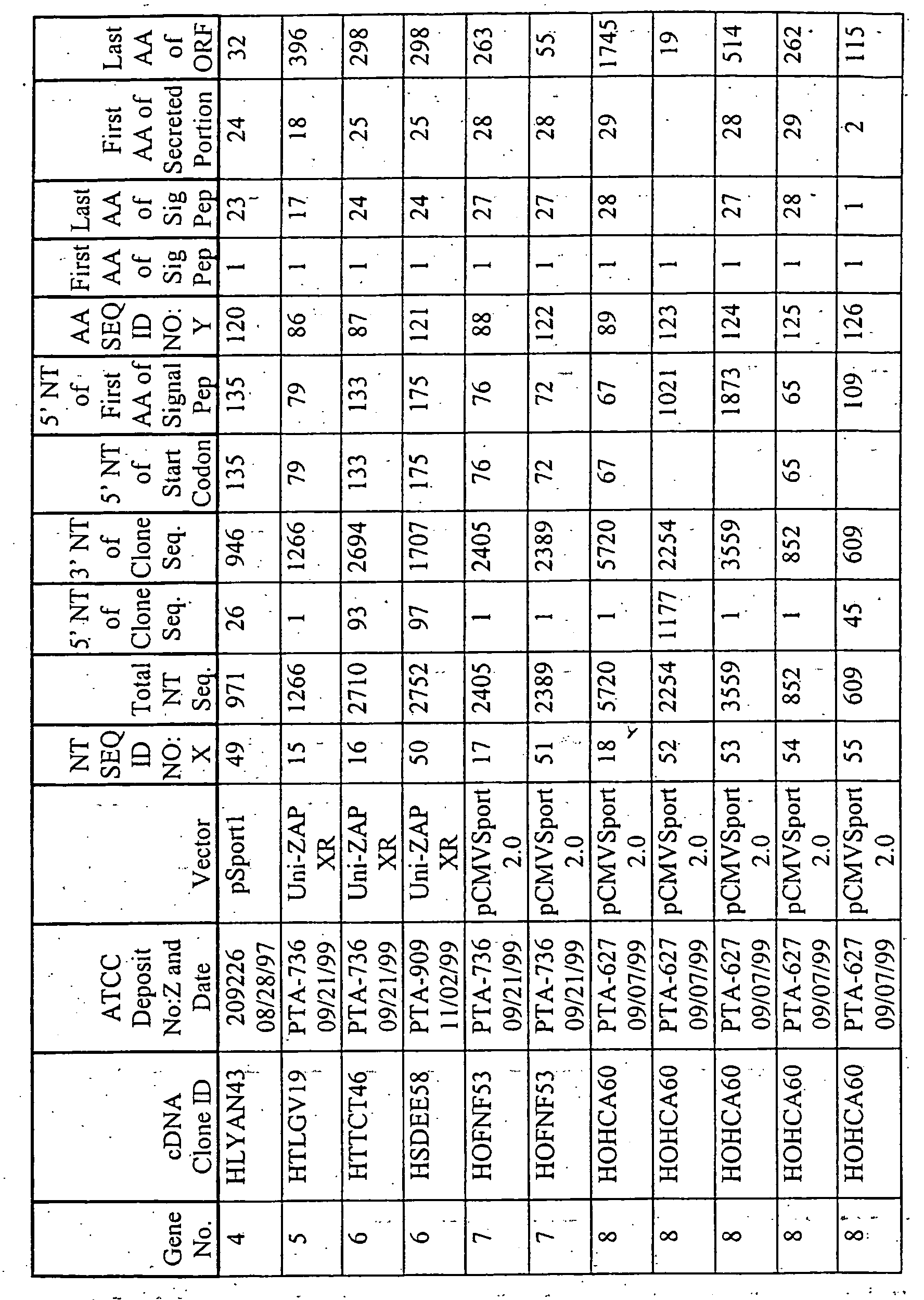
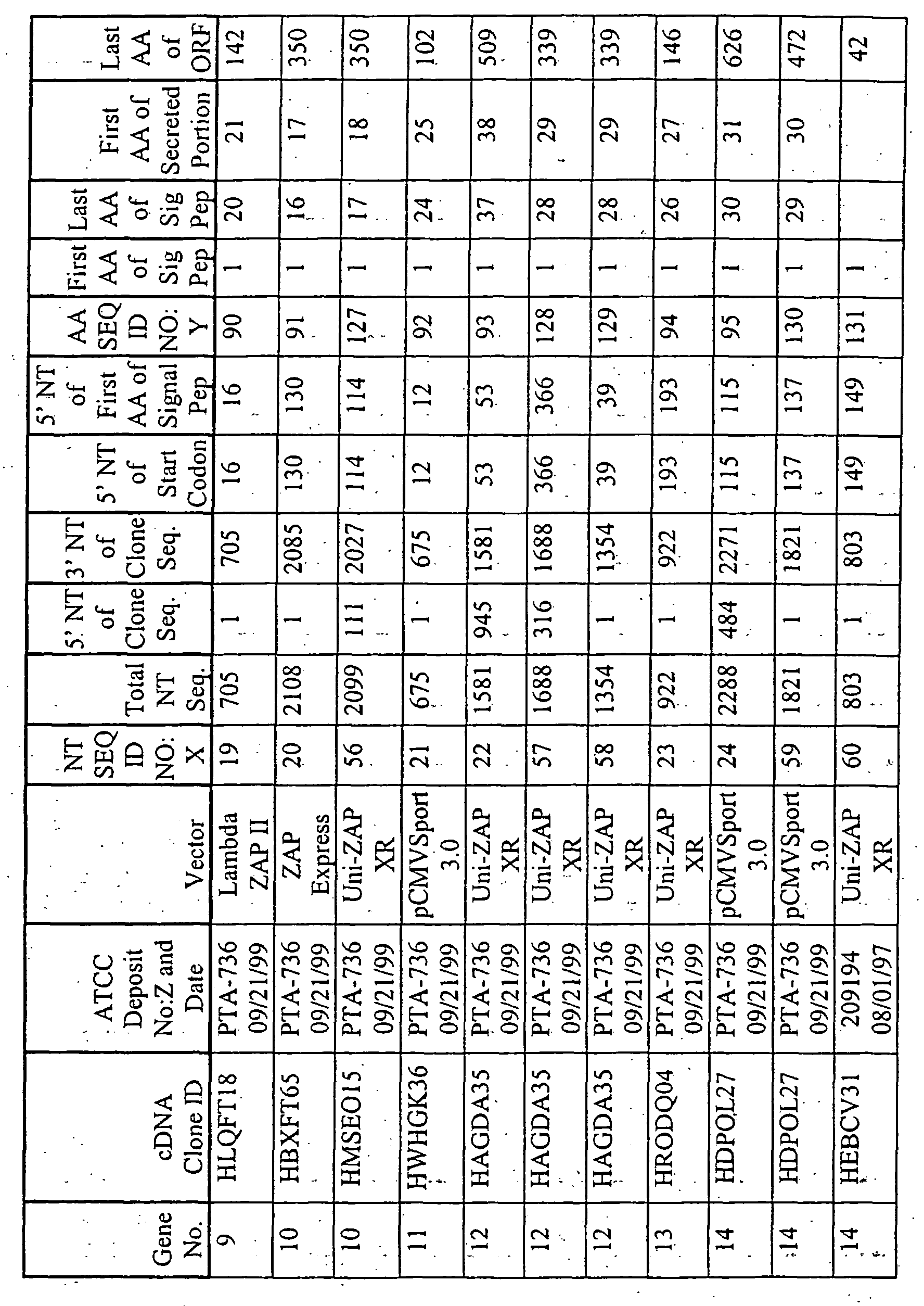


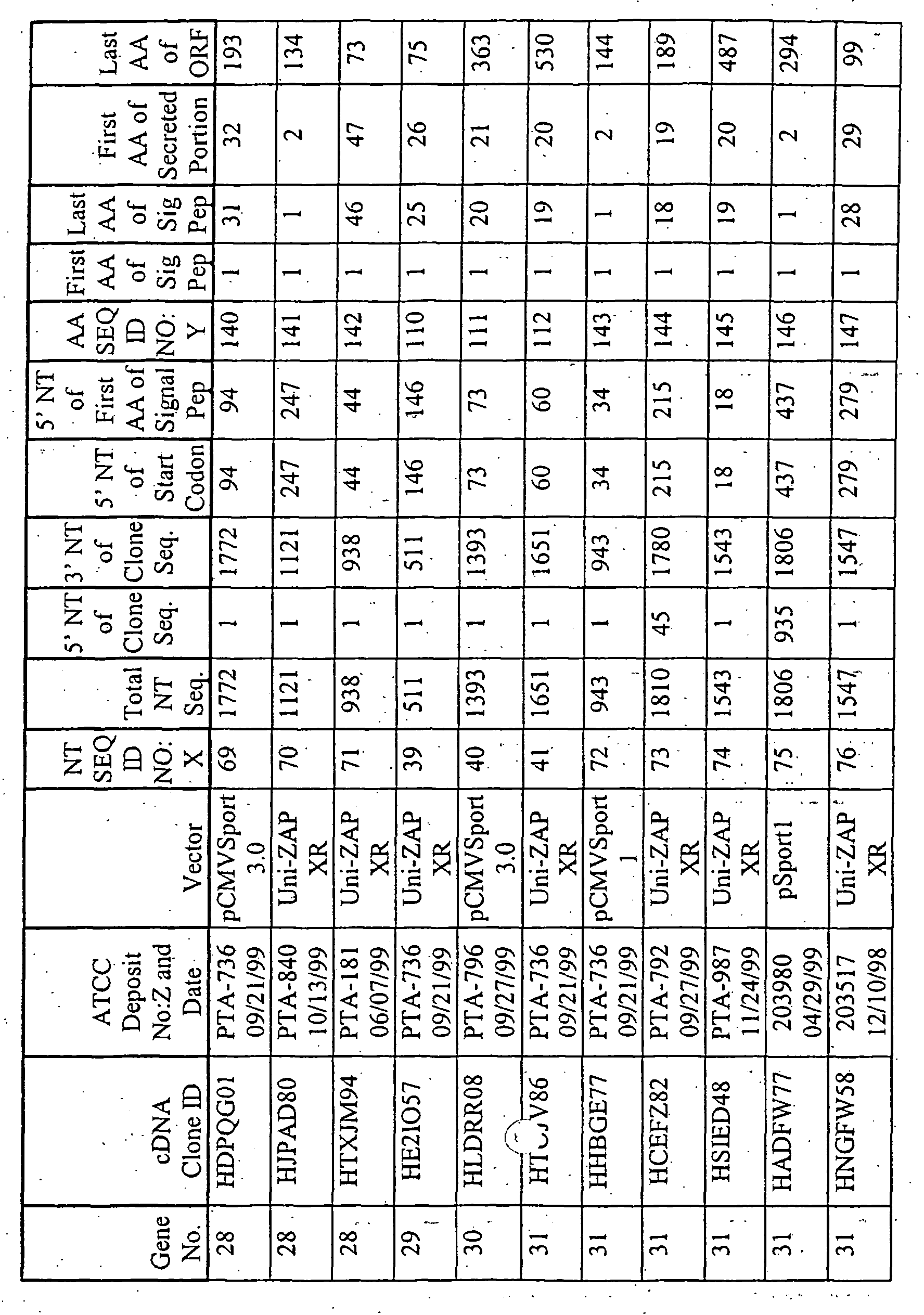
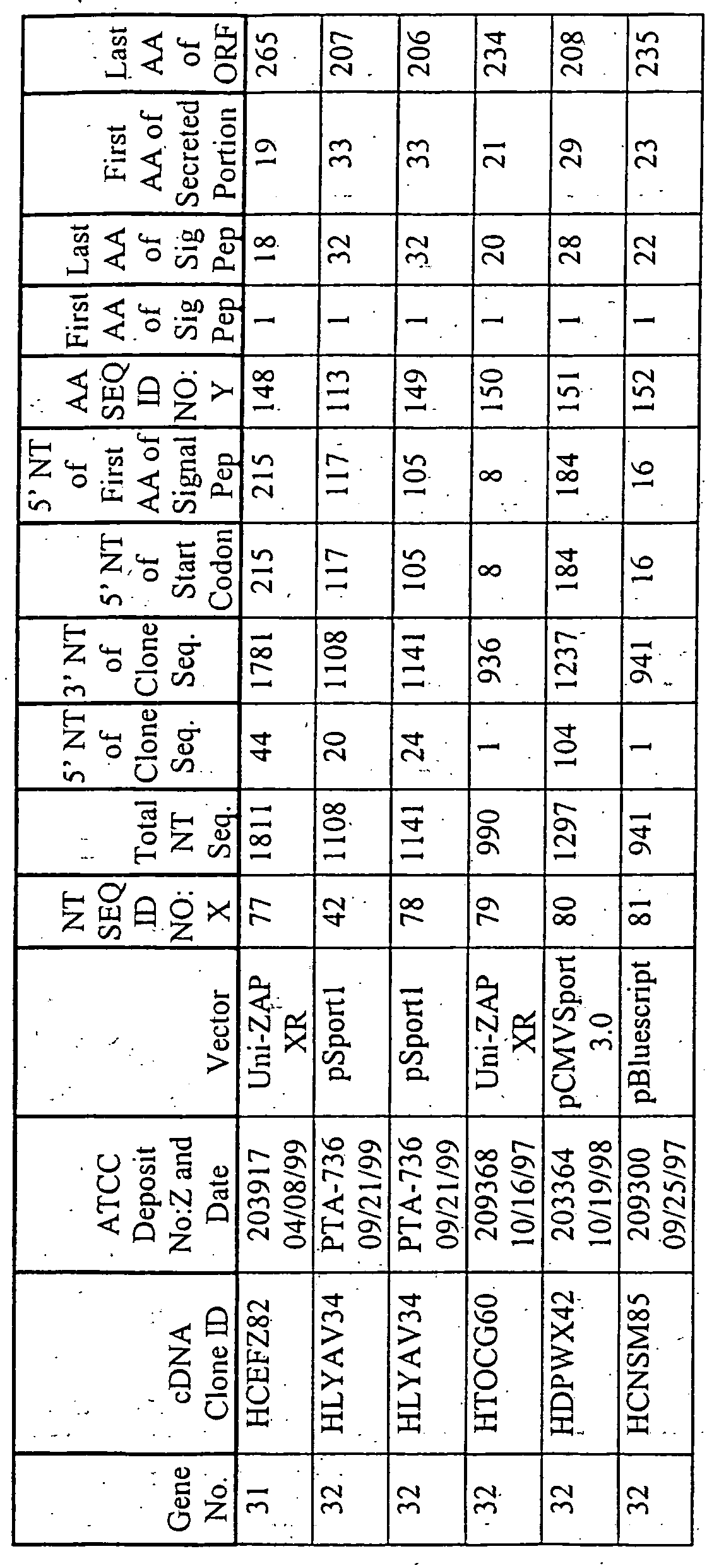
Table 1 summarizes the information corresponding to each "Gene No." described
above. The nucleotide sequence identified as "NT SEQ ID NO:X" was assembled
from partially homologous ("overlapping") sequences obtained from the "cDNA
clone ID" identified in Table 1 and, in some cases, from additional related DNA
clones. The overlapping sequences were assembled into a single contiguous sequence
of high redundancy (usually three to five overlapping sequences at each nucleotide
position), resulting in a final sequence identified as SEQ ID NO:X.
The cDNA Clone ID was deposited on the date and given the corresponding
deposit number listed in "ATCC Deposit No:Z and Date." Some of the deposits
contain multiple different clones corresponding to the same gene. "Vector" refers to
the type of vector contained in the cDNA Clone ID.
"Total NT Seq." refers to the total number of nucleotides in the contig
identified by "Gene No." The deposited clone may contain all or most of these
sequences, reflected by the nucleotide position indicated as "5' NT of Clone Seq."
and the "3' NT of Clone Seq." of SEQ ID NO:X. The nucleotide position of SEQ ID
NO:X of the putative start codon (methionine) is identified as "5' NT of Start Codon."
Similarly, the nucleotide position of SEQ ID NO:X of the predicted signal sequence
is identified as "5' NT of First AA of Signal Pep."
The translated amino acid sequence, beginning with the methionine, is
identified as "AA SEQ ED NO:Y," although other reading frames can also be easily
translated using known molecular biology techniques. The polypeptides produced by
these alternative open reading frames are specifically contemplated by the present
invention.
The first and last amino acid position of SEQ ID NO:Y of the predicted signal
peptide is identified as "First AA of Sig Pep" and "Last AA of Sig Pep." The
predicted first amino acid position of SEQ ID NO:Y of the secreted portion is
identified as "Predicted First AA of Secreted Portion." Finally, the amino acid
position of SEQ ID NO:Y of the last amino acid in the open reading frame is
identified as "Last AA of ORF."
SEQ ID NO:X (where X may be any of the polynucleotide sequences
disclosed in the sequence listing) and the translated SEQ ID NO:Y (where Y may be
any of the polypeptide sequences disclosed in the sequence listing) are sufficiently ,
accurate and otherwise suitable for a variety of uses well known in the art and
described further below. For instance, SEQ ID NO:X is useful for designing nucleic
acid hybridization probes that will detect nucleic acid sequences contained in SEQ ID
NO:X or the cDNA contained in the deposited clone. These probes will also
hybridize to nucleic acid molecules in biological samples, thereby enabling a variety
of forensic and diagnostic methods of the invention. Similarly, polypeptides'
identified from SEQ ID NO:Y may be used, for example, to generate antibodies
which bind specifically to proteins containing the polypeptides and the secreted
proteins encoded by.the cDNA clones identified in Table 1.
Nevertheless, DNA sequences generated by sequencing reactions can contain
sequencing errors. The errors exist as misidentified nucleotides, or as insertions or
deletions of nucleotides in the generated DNA sequence. The erroneously inserted or
deleted nucleotides cause frame shifts in the reading frames of the predicted amino
acid sequence. In these cases, the predicted amino acid sequence diverges from the
actual amino acid sequence, even though the generated DNA sequence may be greater
than 99.9% identical to the actual DNA sequence (for example, one base insertion or
deletion in an open reading frame of over 1000 bases).
Accordingly, for those applications requiring precision in the nucleotide
sequence or the amino acid sequence, the present invention provides not only the
generated nucleotide sequence identified as SEQ ID NO:X and the predicted
translated amino acid sequence identified as SEQ ID NO:Y, but also a sample of
plasmid DNA containing a human cDNA of the invention deposited with the ATCC,
as set forth in Table 1. The nucleotide sequence of each deposited clone can readily
be determined by sequencing the deposited clone in accordance with known methods.
The predicted amino acid sequence can then be verified from such deposits.
Moreover, the amino acid sequence of the protein encoded by a particular clone can
also be directly determined by peptide sequencing or by expressing the protein in a
suitable host cell containing the deposited human cDNA, collecting the protein, and
determining its sequence.
The present invention also relates to the genes corresponding to SEQ ID
NO:X, SEQ ID NO:Y, or the deposited clone. The corresponding gene can be
isolated in accordance with known methods using the sequence information disclosed
herein. Such methods include preparing probes or primers from the disclosed
sequence and identifying or amplifying the corresponding gene from appropriate
sources of genomic material.
Also provided in the present invention are allelic variants, orthologs, and/or
species homologs. Procedures known in the art can be used to obtain full-length
genes, allelic variants, splice variants, full-length coding portions, orthologs, and/or
species homologs of genes corresponding to SEQ ID NO:X, SEQ ID NO:Y, or a
deposited clone, using information from the sequences disclosed herein,or the clones
deposited with the ATCC. For example, allelic variants and/or species homologs may
be isolated and identified by making suitable probes or primers from the sequences
provided herein and screening a suitable nucleic acid source for allelic variants and/or
the desired homologue.
Table 2 summarizes the expression profile of polynucleotides corresponding to the
clones disclosed in Table 1. The first column provides a unique clone identifier,
"Clone ID", for a cDNA clone related to each contig sequence disclosed in Table 1:
Column 2, "Library Codes" shows the expression profile of tissue and/or cell line
libraries which express the polynucleotides of the invention. Each Library Code in
column 2 represents a tissue/cell source identifier code corresponding to the Library
Code and Library description provided in Table 4. Expression of these
polynucleotides was not observed in the other tissues and/or cell libraries tested. One
of skill in the art could routinely use this information to identify tissues which show a
predominant expression pattern of the corresponding polynucleotide of the invention
or to identify polynucleotides which show predominant and/or specific tissue
expression.
Table 3, column 1, provides a nucleotide sequence identifier, "SEQ ID
NO:X," that matches a nucleotide SEQ ID NO:X disclosed in Table 1, column 5.
Table 3, column 2, provides the chromosomal location, "Cytologic Band or
Chromosome," of polynucleotides corresponding to SEQ ID NO:X. Chromosomal
location was determined by finding exact matches to EST and cDNA sequences
contained in the NCBI (National Center for Biotechnology Information) UniGene
database. Given a presumptive chromosomal location, disease locus association was
determined by' comparison with the Morbid Map, derived from Online Mendelian
Inheritance in Man (Online Mendelian Inheritance in Man, OMIM™. McKusick-Nathans
Institute for Genetic Medicine, Johns Hopkins University (Baltimore, MD)
and National Center for Biotechnology Information, National Library of Medicine
(Bethesda; MD) 2000. World Wide Web URL: http://www.ncbi.nlh.nih.gov/omin/).
If the putative chromosomal location of the Query overlapped with the chromosomal
location of a Morbid Map entry, the OMIM reference identification number of the
morbid map entry is provided in Table 3, column 3, labelled "OMIM ID." A key to
the OMIM reference identification numbers is provided in Table 5.
Table 4 provides a key to the Library Code disclosed in Table 2. Column 1
provides the Library Code disclosed in Table 2, column 2. Column 2 provides a
description of the tissue or cell source from which the corresponding library was
derived.
Table 5 provides a key to the OMIM reference identification numbers
disclosed in Table 3, column 3. OMIM reference identification numbers (Column 1)
were derived from Online Mendelian Inheritance in Man (Online Mendelian
Inheritance in Man, OMIM. McKusick-Nathans Institute for Genetic Medicine, Johns
Hopkins University (Baltimore, MD) and National Center for Biotechnology
Information, National Library of Medicine, (Bethesda, MD) 2000. World Wide Web
URL: http://www.ncbi.nlm.nih.gov/omim/). Column 2 provides diseases associated
with the cytologic band disclosed in Table 3, column 2, as determined using the
Morbid Map database.
The polypeptides of the invention can be prepared in any suitable manner.
Such polypeptides include isolated naturally occurring polypeptides, recombinantly
produced polypeptides, synthetically produced polypeptides, or polypeptides
produced by a combination of these methods. Means for preparing such polypeptides
are well understood in the art.
The polypeptides may be in the form of the secreted protein, including the
mature form; or may be a part of a larger protein, such as a fusion protein (see below).
It is often advantageous to include an additional amino acid sequence which contains
secretory or leader sequences, pro-sequences, sequences which aid in purification ,
such as multiple histidine residues, or an additional sequence for stability during
recombinant production.
The polypeptides of the present invention are preferably provided in an
isolated form, and preferably are substantially purified. A recombinantly produced
version of a polypeptide, including the secreted polypeptide, can be substantially
purified using techniques described herein or otherwise known in the art, such as, for
example, by the one-step method described in Smith and Johnson, Gene 67:31-40
(1988). Polypeptides of the invention also can be purified from natural, synthetic or
recombinant sources using techniques described herein or otherwise known in the art,
such as, for example, antibodies of the invention raised against the secreted protein.
The present invention provides a polynucleotide comprising, or alternatively
consisting of, the nucleic acid sequence of SEQ ID NO:X, and/or a cDNA contained
in ATCC deposit Z. The present invention also provides a polypeptide comprising, or
alternatively, consisting of, the polypeptide sequence of SEQ ID NO:Y and/or a
polypeptide encoded by the cDNA contained in ATCC deposit Z. Polynucleotides
encoding a polypeptide comprising, or alternatively consisting of the polypeptide
sequence of SEQ ID NO:Y and/or a polypeptide sequence encoded by the cDNA
contained in ATCC deposit Z are also encompassed by the invention.
Signal Sequences
The present invention also encompasses mature forms of the polypeptide
having the polypeptide sequence of SEQ ID NO:Y and/or the polypeptide sequence
encoded by the cDNA in a deposited clone. Polynucleotides encoding the mature
forms (such as, for example, the polynucleotide sequence in SEQ ID NO:X and/or the
polynucleotide sequence contained in the cDNA of a deposited clone) are also
encompassed by the invention. According to the signal hypothesis, proteins secreted
by mammalian cells have a signal or secretary leader sequence which is cleaved from
the mature protein once export of the growing protein chain across the rough
endoplasmic reticulum has been initiated. Most mammalian cells and even insect
cells cleave secreted proteins with the same specificity. However, in some cases,
cleavage of a secreted protein is not entirely uniform, which results in two or more
mature species of the protein. Further, it has long been known that cleavage
specificity of a secreted protein is ultimately determined by the primary structure of
the complete protein, that is, it is inherent in the amino acid sequence of the
polypeptide.
Methods for predicting whether a protein has a signal sequence, as well as the
cleavage point for that sequence, are available. For instance, the method of
McGeoch, Virus Res. 3:271-286 (1985), uses the information from a short N-terminal
charged region and a subsequent uncharged region of the complete (uncleaved)
protein. The method of von Heinje, Nucleic Acids Res. 14:4683-4690 (1986) uses the
information from the residues surrounding the cleavage site, typically residues -13 to
+2, where +1 indicates the amino terminus of the secreted protein. The accuracy of
predicting the cleavage points of known mammalian secretory proteins for each of
these methods is in the range of 75-80%. (von Heinje, supra.) However, the two
methods do not always produce the same predicted cleavage point(s) for a given
protein.
In the present case, the deduced amino acid sequence of the secreted
polypeptide was analyzed by a computer program called SignalP (Henrik Nielsen et
al., Protein Engineering 10: 1-6 (1997)), which predicts the cellular location of a
protein based on the amino acid sequence. As part of this computational prediction of
localization, the methods of McGeoch and von Heinje are incorporated. The analysis
of the amino acid sequences of the secreted proteins described herein by this program
provided the results shown in Table 1.
As one of ordinary skill would appreciate, however, cleavage sites sometimes
vary from organism to organism and cannot be predicted with absolute certainty:
Accordingly, the present invention provides secreted polypeptides having a sequence
shown in SEQ ID NO:Y which have an N-terminus beginning within 5 residues (i.e.,
+ or - 5 residues) of the predicted cleavage point. Similarly, it is also recognized that
in some cases, cleavage of the signal sequence from a secreted protein is not entirely
uniform, resulting in more than one secreted species. These polypeptides, and the
polynucleotides encoding such polypeptides, are contemplated by the present
invention.
Moreover, the signal sequence identified by the above analysis may not
necessarily predict the naturally occurring signal sequence. For example, the
naturally occurring signal sequence may be further upstream from the predicted signal
sequence. However, it is likely that the predicted signal sequence will be capable of
directing the secreted protein to the ER. Nonetheless, the present invention provides
the mature protein produced by expression of the polynucleotide sequence of SEQ ID
NO:X and/or the polynucleotide sequence contained in the cDNA of a deposited
clone, in a mammalian cell (e.g., COS cells, as desribed below). These polypeptides,
and the polynucleotides encoding such polypeptides, are contemplated by the present
invention.
Polynucleotide and Polypeptide Variants
The present invention is directed to variants of the polynucleotide sequence
disclosed in SEQ ID NO:X, the complementary strand thereto, and/or the cDNA
sequence contained in a deposited clone.
The present invention also encompasses variants of the polypeptide sequence
disclosed in SEQ ID NO:Y and/or encoded by a deposited clone.
"Variant" refers to a polynucleotide or polypeptide differing from the
polynucleotide or polypeptide of the present invention, but retaining essential
properties thereof. Generally, variants are overall closely similar, and, in many
regions, identical to the polynucleotide or polypeptide of the present invention.
The present invention is also directed to nucleic acid molecules which
comprise, or alternatively consist of, a nucleotide sequence which is at least 80%,
85%, 90%, 95%, 96%, 97%, 98% or 99% identical to, for example, the nucleotide
coding sequence in SEQ ID NO:X or the complementary strand thereto, the
nucleotide coding sequence contained in a deposited cDNA clone or the
complementary strand thereto, a nucleotide sequence encoding the polypeptide of
SEQ ID NO:Y, a nucleotide sequence encoding the polypeptide encoded by the
cDNA contained in a deposited clone, and/or polynucleotide fragments of any of
these nucleic acid molecules (e.g., those fragments described herein).
Polynucleotides which hybridize to these nucleic acid molecules under stringent
hybridization conditions or lower stringency conditions are also encompassed by the
invention, as are polypeptides encoded by these polynucleotides.
The present invention is also directed to polypeptides which comprise, or
alternatively consist of, an amino acid sequence which is at least 80%, 85%, 90%,
95%, 96%, 97%, 98%, 99% identical to, for example, the polypeptide sequence
shown in SEQ ID NO:Y, the polypeptide sequence encoded by the cDNA contained
in a deposited clone, and/or polypeptide fragments of any of these polypeptides (e.g.,
those fragments described herein).
By a nucleic acid having a nucleotide sequence at least, for example, 95%
"identical" to a reference nucleotide sequence of the present invention, it is intended
that the nucleotide sequence of the nucleic acid is identical to the reference sequence
except that the nucleotide sequence may include up to five point mutations per each
100 nucleotides of the reference nucleotide sequence encoding the polypeptide. In
other words, to obtain a nucleic acid having a nucleotide sequence at least 95%
identical to a reference nucleotide sequence, up to 5% of the nucleotides in the
reference sequence may be deleted or substituted with another nucleotide, or a
number of nucleotides up to 5% of the total nucleotides in the reference sequence may
be inserted into the reference sequence. The query sequence may be an entire
sequence shown in Table 1, the ORF (open reading frame), or any fragment specified
as described herein.
As a practical matter, whether any particular nucleic acid molecule or
polypeptide is at least 80%, 85%, 90%, 95%, 96%, 97%, 98% or 99% identical to a
nucleotide sequence of the presence invention can be determined conventionally
using known computer programs. A preferred method for determining the best
overall match between a query sequence (a sequence of the present invention) and a
subject sequence, also referred to as a global sequence alignment, can be determined
using the FASTDB computer program based on the algorithm of Brutlag et al. (Comp.
App. Biosci. 6:237-245(1990)). In a sequence alignment the query and subject
sequences are both DNA sequences. An RNA sequence can be compared by
converting U's to T's. The result of said global sequence alignment is in percent
identity. Preferred parameters used in a FASTDB alignment of DNA sequences to
calculate percent identiy are: Matrix=Unitary, k-tuple=4, Mismatch Penalty=1,
Joining Penalty=30, Randomization Group Length=0, Cutoff Score=1, Gap
Penalty=5, Gap Size Penalty 0.05, Window Size=500 or the lenght of the subject
nucleotide sequence, whichever is shorter.
If the subject sequence is shorter than the query sequence because of 5' or 3'
deletions, not because of internal deletions, a manual correction must be made to the
results. This is because the FASTDB program does not account for 5' and 3'
truncations of the subject sequence when calculating percent identity. For subject
sequences truncated at the 5' or 3' ends, relative to the query sequence, the percent
identity is corrected by calculating the number of bases of the query sequence that are
5' and 3' of the subject sequence, which are not matched/aligned, as a percent of the
total bases of the query sequence. Whether a nucleotide is matched/aligned is
determined by results of the FASTDB sequence alignment. This percentage is then
subtracted from the percent identity, calculated by the above FASTDB program using
the specified parameters, to arrive at a final percent identity score. This corrected
score is what is used for the purposes of the present invention. Only bases outside the
5' and 3' bases of the subject sequence, as displayed by the FASTDB alignment,
which are not matched/aligned with the query sequence, are calculated for the
purposes of manually adjusting the percent identity score.
For example, a 90 base subject sequence is aligned to a 100 base query
sequence to determine percent identity. The deletions occur at the 5' end of the
subject sequence and therefore, the FASTDB alignment does not show a
matched/alignment of the first 10 bases at 5' end. The 10 unpaired bases represent.
10% of the sequence (number of bases at the 5' and 3' ends not matched/total number
of bases in the query sequence) so 10% is subtracted from the percent identity score
calculated by the FASTDB program. If the remaining 90 bases were perfectly
matched the final percent identity would be 90%. In another example, a 90 base
subject sequence is compared with a 100 base query sequence. This time the
deletions are internal deletions so that there are no bases on the 5' or 3' of the subject
sequence which are not matched/aligned with the query. In this case the percent
identity calculated by FASTDB is not manually corrected. Once again, only bases 5'
and 3' of the subject sequence which are not matched/aligned with the query sequence
are manually corrected for. No other manual corrections are to made for the purposes
of the present invention.
By a polypeptide having an amino acid sequence at least, for example, 95%
"identical" to a query amino acid sequence of the present invention, it is intended that
the amino acid sequence of the subject polypeptide is identical to the query sequence
except that the subject polypeptide sequence may include up to five amino acid
alterations per each 100 amino acids of the query amino acid sequence. In other
words, to obtain a polypeptide having an amino acid sequence at least 95% identical
to a query amino acid sequence, up to 5% of the amino acid residues in the subject
sequence may be inserted, deleted, (indels) or substituted with another amino acid.
These alterations of the reference sequence may occur at the amino or carboxy
terminal positions of the reference amino acid sequence or anywhere between those
terminal positions, interspersed either individually among residues in the reference
sequence or in one or more contiguous groups within the reference sequence.
As a practical matter, whether any particular polypeptide is at least 80%, 85%,
90%, 95%, 96%, 97%, 98% or 99% identical to, for instance, an amino acid
sequences shown in Table 1 (SEQ ID NO:Y) or to the amino acid sequence encoded
by cDNA contained in a deposited clone can be determined conventionally using
known computer programs. A preferred method for determing the best overall match
between a query sequence (a sequence of the present invention) and a subject
sequence, also referred to as a global sequence alignment, can be determined using
the FASTDB computer program based on the algorithm of Brutlag et al. (Comp. App.
Biosci. 6:237-245(1990)). In a sequence alignment the query and subject sequences
are either both nucleotide sequences or both amino acid sequences. The result of said
global sequence alignment is in percent identity. Preferred parameters used in a
FASTDB amino acid alignment are: Matrix=PAM 0, k-tuple=2, Mismatch
Penalty=1, Joining Penalty=20, Randomization Group Length=0, Cutoff Score=1,
Window Size=sequence length, Gap Penalty=5, Gap Size Penalty=0.05, Window
Size=500 or the length of the subject amino acid sequence, whichever is shorter.
If the subject sequence is shorter than the query sequence due to N- or C-terminal
deletions, not because of internal deletions, a manual correction must be
made to the results. This is because the FASTDB program does not account for N-and
C-terminal truncations of the subject sequence when calculating global percent
identity. For subject sequences truncated at the N- and C-termini, relative to the
query sequence, the percent identity is corrected by calculating the number of residues
of the query sequence that are N- and C-terminal of the subject sequence, which are
not matched/aligned with a corresponding subject residue, as a percent of the total
bases of the query sequence. Whether a residue is matched/aligned is determined by
results of the FASTDB sequence alignment. This percentage is then subtracted from
the percent identity, calculated by the above FASTDB program using the specified
parameters, to arrive at a final percent identity score. This final percent identity score
is what is used for the purposes of the present invention. Only residues to the N- and
C-termini of the subject sequence, which are not matched/aligned with the query
sequence, are considered for the purposes of manually adjusting the percent identity
score. That is, only query residue positions outside the farthest N- and C-terminal
residues of the subject sequence.
For example, a 90 amino acid residue subject sequence is aligned with a 100
residue query sequence to determine percent identity. The deletion occurs at the N-terminus
of the subject sequence and therefore, the FASTDB alignment does not
show a matching/alignment of the first 10 residues at the N-terminus. The 10
unpaired residues represent 10% of the sequence (number of residues at the N- and C-termini
not matched/total number of residues in the query sequence) so 10% is
subtracted from the percent identity score calculated by the FASTDB program. If the
remaining 90 residues were perfectly matched the final percent identity would be
90%. In another example, a 90 residue subject sequence is compared with a 100
residue query sequence. This time the deletions are internal deletions so there are no
residues at the N- or C-termini of the subject sequence which are not matched/aligned
with the query. In this case the percent identity calculated by FASTDB is not
manually corrected. Once again, only residue positions outside the N- and C-terminal
ends of the subject sequence, as displayed in the FASTDB alignment, which are not
matched/aligned with the query sequnce are manually corrected for. No other manual
corrections are to made for the purposes of the present invention.
The variants may contain alterations in the coding regions, non-coding
regions, or both. Especially preferred are polynucleotide variants containing
alterations which produce silent substitutions, additions, or deletions, but do not alter
the properties or activities of the encoded polypeptide. Nucleotide variants produced
by silent substitutions due to the degeneracy of the genetic code are preferred.
Moreover, variants in which 5-10, 1-5, or 1-2 amino acids are substituted, deleted, or
added in any combination are also preferred. Polynucleotide variants can be produced
for a variety of reasons, e.g., to optimize codon expression for a particular host :
(change codons in the human mRNA to those preferred by a bacterial host such as E.
coli).
Naturally occurring variants are called "allelic variants," and refer to one of
several alternate forms of a gene occupying a given locus on a chromosome of an
organism. (Genes II, Lewin, B., ed., John Wiley & Sons, New York (1985).) These
allelic variants can vary at either the polynucleotide and/or polypeptide level and are
included in the present invention. Alternatively, non-naturally occurring variants may
be produced by mutagenesis techniques or by direct synthesis.
Using known methods of protein engineering and recombinant DNA
technology, variants may be generated to improve or alter the characteristics of the
polypeptides of the present invention. For instance, one or more amino acids can be
deleted from the N-terminus or C-terminus of the secreted protein without substantial
loss of biological function. The authors of Ron et al., J. Biol. Chem. 268: 2984-2988
(1993), reported variant KGF proteins having heparin binding activity even after
deleting 3, 8, or 27 amino-terminal amino acid residues. Similarly, Interferon gamma
exhibited up to ten times higher activity after deleting 8-10 amino acid residues from
the carboxy terminus of this protein. (Dobeli et al., J. Biotechnology 7:199-216
(1988).)
Moreover, ample evidence demonstrates that variants often retain biological
activity similar to that of the naturally occurring protein. For example, Gayle and
coworkers (J. Biol. Chem 268:22105-22111 (1993)) conducted extensive mutational
analysis of human cytokine IL-1a. They used random mutagenesis to generate over
3,500 individual IL-1 a mutants that averaged 2.5 amino acid changes per variant over
the entire length of the molecule. Multiple mutations were examined at every
possible amino acid position. The investigators found that "[m]ost of the molecule
could be altered with little effect on either [binding or biological activity]." (See,
Abstract.) In fact, only 23 unique amino acid sequences, out of more than 3,500
nucleotide sequences examined, produced a protein that significantly differed in
activity from wild-type.
Furthermore, even if deleting one or more amino acids from the N-terminus or
C-terminus of a polypeptide results in modification or loss of one or more biological
functions, other biological activities may still be retained. For example, the ability of
a deletion variant to induce and/or to bind antibodies which recognize the secreted
form will likely be retained when less than the majority of the residues of the secreted
form are removed from the N-terminus or C-terminus. Whether a particular
polypeptide lacking N- or C-terminal residues of a protein retains such immunogenic
activities can readily be determined by routine methods described herein and
otherwise known in the art.
Thus, the invention further includes polypeptide variants which show
substantial biological activity. Such variants include deletions, insertions,
inversions, repeats, and substitutions selected according to general rules known in the
art so as have little effect on activity. For example, guidance concerning how to make
phenotypically silent amino acid substitutions is provided in Bowie et al., Science
247:1306-1310 (1990), wherein the authors indicate that there are two main strategies
for studying the tolerance of an amino acid sequence to change.
The first strategy exploits the tolerance of amino acid substitutions by natural
selection during the process of evolution. By comparing amino acid sequences in
different species, conserved amino acids can be identified. These conserved amino
acids are likely important for protein function. In contrast, the amino acid positions
where substitutions have been tolerated by natural selection indicates that these
positions are not critical for protein function. Thus, positions tolerating amino acid
substitution could be modified while still maintaining biological activity of the
protein.
The second strategy uses genetic engineering to introduce amino acid changes
at specific positions of a cloned gene to identify regions critical for protein function.
For example, site directed mutagenesis or alanine-scanning mutagenesis (introduction
of single alanine mutations at every residue in the molecule) can be used.
(Cunningham and Wells, Science 244:1081-1085 (1989).) The resulting mutant
molecules can then be tested for biological activity.
As the authors state, these two strategies have revealed that proteins are
surprisingly tolerant of amino acid substitutions. The authors further indicate which
amino acid changes are likely to be permissive at certain amino acid positions in the
protein. For example, most buried (within the tertiary structure of the protein) amino
acid residues require nonpolar side chains, whereas few features of surface side chains
are generally conserved. Moreover, tolerated conservative amino acid substitutions
involve replacement of the aliphatic or hydrophobic amino acids Ala, Val, Leu and
Ile; replacement of the hydroxyl residues Ser and Thr, replacement of the acidic
residues Asp and Glu; replacement of the amide residues Asn and Gln, replacement of
the basic residues Lys, Arg, and His; replacement of the aromatic residues Phe, Tyr,
and Trp, and replacement of the small-sized amino acids Ala, Ser, Thr, Met, and Gly.
Besides conservative amino acid substitution, variants of the present invention
include (i) substitutions with one or more of the non-conserved amino acid residues,
where the substituted amino acid residues may or may not be one encoded by the
genetic code, or (ii) substitution with one or more of amino acid residues having a
substituent group, or (iii) fusion of the mature polypeptide with another compound,
such as a compound to increase the stability and/or solubility of the polypeptide (for
example, polyethylene glycol), or (iv) fusion of the polypeptide with additional amino
acids, such as, for example, an IgG Fc fusion region peptide, or leader or secretory
sequence, or a sequence facilitating purification or (v) fusion of the polypeptide with
another compound, such as albumin (including, but not limited to, recombinant
albumin (see, e.g., U.S. Patent No. 5,876,969, issued March 2, 1999, EP Patent 0 413
622, and U.S. Patent No. 5,766,883, issued June 16, 1998, herein incorporated by
reference in their entirety)). Such variant polypeptides are deemed to be within the
scope of those skilled in the art from the teachings herein.
For example, polypeptide variants containing amino acid substitutions of
charged amino acids with other charged or neutral amino acids may produce proteins
with improved characteristics, such as less aggregation. Aggregation of
pharmaceutical formulations both reduces activity and increases clearance due to the
aggregate's immunogenic activity. (Pinckard et al., Clin. Exp. Immunol. 2:331-340
(1967); Robbins et al., Diabetes 36: 838-845 (1987); Cleland et al., Crit. Rev.
Therapeutic Drug Carrier Systems 10:307-377 (1993).)
A further embodiment of the invention relates to a polypeptide which
comprises the amino acid sequence of the present invention having an amino acid
sequence which contains at least one amino acid substitution, but not more than 50
amino acid substitutions, even more preferably, not more than 40 amino acid
substitutions, still more preferably, not more than 30 amino acid substitutions, and
still even more preferably, not more than 20 amino acid substitutions. Of course, in
order of ever-increasing preference, it is highly preferable for a peptide or polypeptide
to have an amino acid sequence which comprises the amino acid sequence of the
present invention, which contains at least one, but not more than 10, 9, 8, 7, 6, 5, 4, 3,
2 or 1 amino acid substitutions. In specific embodiments, the number of additions,
substitutions, and/or deletions in the amino acid sequence of the present invention or
fragments thereof (e.g., the mature form and/or other fragments described herein), is
1-5, 5-10, 5-25, 5-50, 10-50 or 50-150, conservative amino acid substitutions are
preferable.
Polynucleotide and Polypeptide Fragments
The present invention is also directed to polynucleotide fragments of the
polynucleotides of the invention.
In the present invention, a "polynucleotide fragment" refers to a short
polynucleotide having a nucleic acid sequence which: is a portion of that contained in
a deposited clone, or encoding the polypeptide encoded by the cDNA in a deposited
clone; is a portion of that shown in SEQ ID NO:X or the complementary strand
thereto, or is a portion of a polynucleotide sequence encoding the polypeptide of SEQ
ID NO:Y. The nucleotide fragments of the invention are preferably at least about 15
nt, and more preferably at least about 20 nt, still more preferably at least about 30 nt,
and even more preferably, at least about 40 nt, at least about 50 nt, at least about 75
nt, or at least about 150 nt in length. A fragment "at least 20 nt in length," for
example, is intended to include 20 or more contiguous bases from the cDNA
sequence contained in a deposited clone or the nucleotide sequence shown in SEQ ID
NO:X. In this context "about" includes the particularly recited value, a value larger
or smaller by several (5, 4, 3, 2, or 1) nucleotides, at either terminus or at both
termini. These nucleotide fragments have uses that include, but are not limited to, as
diagnostic probes and primers as discussed herein. Of course, larger fragments (e.g.,
50, 150, 500, 600, 2000 nucleotides) are preferred.
Moreover, representative examples of polynucleotide fragments of the
invention, include, for example, fragments comprising, or alternatively consisting of,
a sequence from about nucleotide number 1-50,51-100, 101-150, 151-200, 201-250,
251-300, 301-350, 351-400, 401-450, 451-500, 501-550, 551-600, 651-700, 701-750,
751-800, 800-850, 851-900, 901-950, 951-1000, 1001-1050, 1051-1100, 1101-1150,
1151-1200, 1201-1250, 1251-1300, 1301-1350, 1351-1400, 1401-1450, 1451-1500,
1501-1550, 1551-1600, 1601-1650, 1651-1700, 1701-1750, 1751-1800, 1801-1850,
1851-1900, 1901-1950, 1951-2000, or 2001 to the end of SEQ ID NO:X, or the
complementary, strand thereto, or the cDNA contained in a deposited clone. In this
context "about" includes the particularly recited ranges, and ranges larger or smaller
by several (5, 4, 3, 2, or 1) nucleotides, at either terminus or at both termini.
Preferably, these fragments encode a polypeptide which has biological activity. More
preferably, these polynucleotides can be used as probes or primers as discussed
herein. Polynucleotides which hybridize to these nucleic acid molecules under
stringent hybridization conditions or lower stringency conditions are also
encompassed by the invention, as are polypeptides encoded by these polynucleotides.
In the present invention, a "polypeptide fragment" refers to an amino acid
sequence which is a portion of that contained in SEQ ID NO:Y or encoded by the
cDNA contained in a deposited clone. Protein (polypeptide) fragments may be "freestanding,"
or comprised within a larger polypeptide of which the fragment forms a
part or region, most preferably as a single continuous region. Representative
examples of polypeptide fragments of the invention, include, for example, fragments
comprising, or alternatively consisting of, from about amino acid number 1-20, 21-40,
41-60, 61-80, 81-100, 102-120, 121-140, 141-160, or 161 to the end of the coding
region. Moreover, polypeptide fragments can be about 20, 30, 40, 50, 60, 70, 80, 90,
100, 110, 120, 130, 140, or 150 amino acids in length. In this context "about"
includes the particularly recited ranges or values, and ranges or values larger or
smaller by several (5, 4, 3, 2, or 1) amino acids, at either extreme or at both extremes.
Polynucleotides encoding these polypeptides are also encompassed by the invention.
Preferred polypeptide fragments include the secreted protein as well as the
mature form. Further preferred polypeptide fragments include the secreted protein or
the mature form having a continuous series of deleted residues from the amino or the
carboxy terminus, or both. For example, any number of amino acids, ranging from 1-60,
can be deleted from the amino terminus of either the secreted polypeptide or the
mature form. Similarly, any number of amino acids, ranging from 1-30, can be
deleted from the carboxy terminus of the secreted protein or mature form.
Furthermore, any combination of the above amino and carboxy terminus deletions are
preferred. Similarly, polynucleotides encoding these polypeptide fragments are also
preferred.
Also preferred are polypeptide and polynucleotide fragments characterized by
structural or functional domains, such as fragments that comprise alpha-helix and
alpha-helix forming regions, beta-sheet and beta-sheet-forming regions, turn and turn-forming
regions, coil and coil-forming regions, hydrophilic regions, hydrophobic
regions, alpha amphipathic regions, beta amphipathic regions, flexible regions,
surface-forming regions, substrate binding region, and high antigenic index regions.
Polypeptide fragments of SEQ ID NO:Y falling within conserved domains are
specifically contemplated by the present invention. Moreover, polynucleotides
encoding these domains are also contemplated.
Other preferred polypeptide fragments are biologically active fragments.
Biologically active fragments are those exhibiting activity similar, but not necessarily
identical, to an activity of the polypeptide of the present invention. The biological
activity of the fragments may include an improved desired activity, or a decreased
undesirable activity. Polynucleotides encoding these polypeptide fragments are also
encompassed by the invention.
Preferably, the polynucleotide fragments of the invention encode a
polypeptide which demonstrates a functional activity. By a polypeptide
demonstrating a "functional activity" is meant, a polypeptide capable of displaying
one or more known functional activities associated with a full-length (complete)
polypeptide of invention protein. Such functional activities include, but are not
limited to, biological activity, antigenicity [ability to bind (or compete with a
polypeptide of the invention for binding) to an antibody to the polypeptide of the
invention], immunogenicity (ability to generate antibody which binds to a polypeptide
of the invention), ability to form multimers with polypeptides of the invention, and
ability to bind to a receptor or ligand for a polypeptide of the invention.
The functional activity of polypeptides of the invention, and fragments,
variants derivatives, and analogs thereof, can be assayed by various methods.
For example, in one embodiment where one is assaying for the ability to bind
or compete with full-length polypeptide of the invention for binding to an antibody of
the polypeptide of the invention, various immunoassays known in the art can be used,
including but not limited to, competitive and non-competitive assay systems using
techniques such as radioimmunoassays, ELISA (enzyme linked immunosorbent
assay), '''sandwich'' immunoassays, immunoradiometric assays, gel diffusion
precipitation reactions, immuriodiffusion assays, in situ immunoassays (using
colloidal gold, enzyme or radioisotope labels, for example), western blots,
precipitation reactions, agglutination assays (e.g., gel agglutination assays,
hemagglutination assays), complement fixation assays, immunofluorescence assays,
protein A assays, and immunoelectrophoresis assays, etc. In one embodiment,
antibody binding is detected by detecting a label on the primary antibody. In another
embodiment, the primary antibody is detected by detecting binding of a secondary
antibody or reagent to the primary antibody. In a further embodiment, the secondary
antibody is labeled. Many means are known in the art for detecting binding in an
immunoassay and are within the scope of the present invention.
In another embodiment, where a ligand for a polypeptide of the invention
identified, or the ability of a polypeptide fragment, variant or derivative of the
invention to multimerize is being evaluated, binding can be assayed, e.g., by means
well-known in the art, such as, for example, reducing and non-reducing gel'
chromatography, protein affinity chromatography, and affinity blotting. See
generally, Phizicky, E., et al., 1995, Microbiol. Rev: 59:94-123. In another
embodiment, physiological correlates of binding of a polypeptide of the invention to
its substrates (signal transduction) can be assayed.
In addition, assays' described herein (see Examples) and otherwise known in
the art may routinely be applied to measure the ability of polypeptides of the
invention and fragments, variants derivatives and analogs thereof to elicit related
biological activity related to that of the polypeptide of the invention (either in vitro or
in vivo). Other methods will be known to the skilled artisan and are within the scope
of the invention.
Epitopes and Antibodies
The present invention encompasses polypeptides comprising, or alternatively
consisting of, an epitope of the polypeptide having an amino acid sequence of SEQ ID
NO:Y, or an epitope of the polypeptide sequence encoded by a polynucleotide
sequence contained in ATCC deposit No. Z or encoded by a polynucleotide that
hybridizes to the complement of the sequence of SEQ ID NO:X or contained in
ATCC deposit No. Z under stringent hybridization conditions or lower stringency
hybridization conditions as defined supra. The present invention further encompasses
polynucleotide sequences encoding an epitope of a polypeptide sequence of the
invention (such as, for example, the sequence disclosed in SEQ ID NO:X),
polynucleotide sequences of the complementary strand of a polynucleotide sequence
encoding an epitope of the invention, and polynucleotide sequences which hybridize
to the complementary strand under stringent hybridization conditions or lower
stringency hybridization conditions defined supra.
The term "epitopes," as used herein, refers to portions of polypeptide having
antigenic or immunogenic activity in an animal, preferably a mammal, and most
preferably in a human. In a preferred embodiment, the present invention
encompasses a polypeptide comprising an epitope, as well as the polynucleotide
encoding this polypeptide. An "immunogenic epitope," as used herein, is defined as
a portion of a protein that elicits an antibody response in an animal, as determined by
any method known in the art, for example, by the methods for generating. antibodies
described infra. (See, for example, Geysen et al., Proc. Natl. Acad. Sci. USA
81:3998- 4002 (1983)). The term "antigenic epitope," as used herein, is defined as a
portion of a protein to which an antibody can immunospecifically bind its antigen as
determined by any method well known in the art, for example, by the immunoassays
described herein. Immunospecific binding excludes non-specific binding but does not
necessarily exclude cross- reactivity with other antigens. Antigenic epitopes need not
necessarily be immunogenic.
Fragments which function as epitopes may be produced by any conventional
means. (See, e.g., Houghten, Proc. Natl. Acad. Sci. USA 82:5131-5135 (1985),
further described in U.S. Patent No. 4,631,211).
In the present invention, antigenic epitopes preferably contain a sequence of at
least 4, at least 5, at least 6, at least 7, more preferably at least 8, at least 9, at least 10,
at least 11, at least 12, at least 13, at least 14, at least 15, at least 20, at least 25, at
least 30, at least 40, at least 50, and, most preferably, between about 15 to about 30
amino acids. Preferred polypeptides comprising immunogenic or antigenic epitopes
are at least 10, 15, 20, 25, 30, 35, 40, 45, 50, 55, 60, 65, 70, 75, 80, 85, 90, 95, or 100
amino acid residues in length. Additional non-exclusive preferred antigenic epitopes
include the antigenic epitopes disclosed herein, as well as portions thereof. Antigenic
epitopes are useful, for example, to raise antibodies, including monoclonal antibodies,
that specifically bind the epitope. Preferred antigenic epitopes include the antigenic
epitopes disclosed herein, as well as any combination of two, three, four, five or more
of these antigenic epitopes. Antigenic epitopes can be used as the target molecules in
immunoassays. (See, for instance, Wilson et al., Cell 37:767-778 (1984); Sutcliffe et
al., Science 219:660-666 (1983)).
Similarly, immunogenic epitopes can be used, for example, to induce
antibodies according to methods well known in the art. (See, for instance, Sutcliffe
et al., supra; Wilson et al., supra; Chow et al., Proc. Natl. Acad. Sci. USA 82:910-914;
and Bittle et al., J. Gen. Virol. 66:2347-2354 (1985). Preferred immunogenic
epitopes include the immunogenic epitopes disclosed herein, as well as any
combination of two, three, four, five or more of these immunogenic epitopes. The
polypeptides comprising one or more immunogenic epitopes may be presented for
eliciting an antibody response together with a carrier protein, such as an albumin, to
an animal system (such as rabbit or mouse), or, if the polypeptide is of sufficient
length (at least about 25 amino acids), the polypeptide may be presented'without a
carrier. However, immunogenic epitopes comprising as few as 8 to 10 amino acids
have been shown to be sufficient to raise antibodies capable of binding to, at the very
least, linear epitopes in a denatured polypeptide (e.g., in Western blotting).
Epitope-bearing polypeptides of the present invention may be used to induce
antibodies according to methods well known in the art including, but not limited to,
in vivo immunization, in vitro immunization, and phage display methods: See, e.g.,
Sutcliffe et al., supra; Wilson et al., supra, and Bittle et al., J. Gen. Virol., 66:2347-2354
(1985). If in vivo immunization is used, animals may be immunized with free
peptide; however, anti-peptide antibody titer may be boosted by coupling the peptide
to a macromolecular carrier, such as keyhole limpet hemacyanin (KLH) or tetanus
toxoid. For instance, peptides containing cysteine residues may be coupled to a
carrier using a linker such as maleimidobenzoyl- N-hydroxysuccinimide ester (MBS),
while other peptides may be coupled to carriers using a more general linking agent
such as glutaraldehyde. Animals such as rabbits, rats and mice are immunized with
either free-or carrier- coupled peptides, for instance, by intraperitoneal and/or
intradermal injection of emulsions containing about 100 µg of peptide or carrier
protein and Freund's adjuvant or any other adjuvant known for stimulating an
immune response. Several booster injections may be needed, for instance, at
intervals of about two weeks, to provide a useful titer of anti-peptide antibody which
can be detected, for example, by ELISA assay using free peptide adsorbed to a solid
surface. The titer of anti-peptide antibodies in serum from an immunized animal may
be increased by selection of anti-peptide antibodies, for instance, by adsorption to the
peptide on a solid support and elution of the selected antibodies according to methods
well known in the art.
As one of skill in the art will appreciate, and as discussed above, the
polypeptides of the present invention comprising an immunogenic or antigenic
epitope can be fused to other polypeptide sequences. For example, the polypeptides
of the present invention may be fused with the constant domain of immunoglobulins
(IgA, IgE, IgG, IgM), or portions thereof (CH1, CH2, CH3, or any combination
thereof and portions thereof), or albumin (including but not limited to recombinant
albumin (see, e.g., U.S. Patent No. 5,876,969, issued March 2, 1999, EP Patent 0 413
622, and U.S. Patent No. 5,766,883, issued June 16, 1998, herein incorporated by
reference in their entirety)), resulting in chimeric polypeptides. Such fusion proteins
may facilitate purification and may increase half-life in vivo. This has been shown
for chimeric proteins consisting of the first two domains of the human CD4-polypeptide
and various domains of the constant regions of the heavy or light chains
of mammalian immunoglobulins. See, e.g., EP 394,827; Traunecker et al., Nature,
331:84-86 (1988). Enhanced delivery of an antigen across the epithelial barrier to the
immune system has been demonstrated for antigens (e.g., insulin) conjugated to an
FcRn binding partner such as IgG or Fc fragments (see, e.g., PCT Publications WO
96/22024 and WO 99/04813). IgG Fusion proteins that have a disulfide-linked
dimeric structure due to the IgG portion desulfide bonds have also been found to be
more efficient in binding and neutralizing other molecules than monomeric
polypeptides or fragments thereof alone. See, e.g., Fountoulakis et al., J. Biochem.,
270:3958-3964 (1995). Nucleic acids encoding the above epitopes can also be
recombined with a gene of interest as an epitope tag (e.g., the hemagglutinin ("HA")
tag or flag tag) to aid in detection and purification of the expressed polypeptide. For
example, a system described by Janknecht et al. allows for the ready purification of
non-denatured fusion proteins expressed in human cell lines (Janknecht et al., 1991,
Proc. Natl. Acad. Sci. USA 88:8972- 897). In this system, the gene of interest is
subcloned into a vaccinia recombination plasmid such that the open reading frame of
the gene is translationally fused to an amino-terminal tag consisting of six histidine
residues. The tag serves as a matrix binding domain for the fusion protein. Extracts
from cells infected with the recombinant vaccinia virus are loaded onto Ni2+
nitriloacetic acid-agarose column and histidine-tagged proteins can be selectively
eluted with imidazole-containing buffers.
Additional fusion proteins of the invention may be generated through the
techniques of gene-shuffling, motif-shuffling, exon-shuffling, and/or codon-shuffling
(collectively referred to as "DNA shuffling"). DNA shuffling may be employed to
modulate the activities of polypeptides of the invention, such methods can be used to
generate polypeptides with altered activity, as well as agonists and antagonists of the
polypeptides. See, generally, U.S. Patent Nos. 5,605,793; 5,811,238; 5,830,721;
5,834,252; and 5,837,458, and Patten et al., Curr. Opinion Biotechnol. 8:724-33
(1997); Harayama, Trends-Biotechnol. 16(2):76-82 (1998); Hansson, et al., J. Mol.
Biol. 287:265-76 (1999); and Lorenzo and Blasco, Biotechniques 24(2):308- 13
(1998) (each of these patents and publications are hereby'incorporated by reference in
its entirety). In one embodiment, alteration of polynucleotides corresponding to SEQ
ID NO:X and the polypeptides encoded by these polynucleotides may be achieved by
DNA shuffling. DNA shuffling involves the assembly of two or more DNA
segments by homologous or site-specific recombination to generate variation in the
polynucleotide sequence. In another embodiment, polynucleotides of the invention,
or the encoded polypeptides, may be altered by being subjected to random
mutagenesis by error-prone PCR, random nucleotide insertion or other methods prior
to recombination. In another embodiment, one or more components, motifs, sections,
parts, domains, fragments, etc., of a polynucleotide encoding a polypeptide of the
invention may be recombined with one or more components, motifs, sections, parts,
domains, fragments, etc. of one or more heterologous molecules.
Antibodies
Further polypeptides of the invention relate to antibodies and T-cell antigen
receptors (TCR) which immunospecifically bind a polypeptide, polypeptide fragment,
or variant of SEQ ID NO:Y, and/or an epitope, of the present invention (as
determined by immunoassays well known in the art for assaying specific antibody-antigen
binding). Antibodies of the invention include, but are not limited to,
polyclonal, monoclonal, multispecific, human, humanized or chimeric antibodies,
single chain antibodies, Fab fragments, F(ab') fragments, fragments produced by a
Fab expression library, anti-idiotypic (anti-Id) antibodies (including, e.g., anti-Id
antibodies to antibodies of the invention), and epitope-binding fragments of any of
the above. The term "antibody," as used herein, refers to immunoglobulin molecules
and immunologically active portions of immunoglobulin molecules, i.e., molecules,
that contain an antigen binding site that immunospecifically binds an antigen. The
immunoglobulin molecules of the invention can be of any type (e.g., IgG, IgE, IgM,
IgD, IgA and IgY); class (e.g., IgG1, IgG2, IgG3, IgG4, IgA1 and IgA2) or subclass
of immunoglobulin molecule. In preferred embodiments, the immunoglobulin
molecules of the invention are IgG1. In other preferred embodiments, the
immunoglobulin molecules of the invention are IgG4.
Most preferably the antibodies are human antigen-binding antibody fragments
of the present invention and include, but are not limited to, Fab, Fab' and F(ab')2, Fd,
single-chain Fvs (scFv), single-chain antibodies, disulfide-linked Fvs (sdFv) and
fragments comprising either a VL or VH domain. Antigen-binding antibody
fragments, including single-chain antibodies, may comprise the variable region(s)
alone or in combination with the entirety or a portion of the following: hinge region,
CH1, CH2, and CH3 domains. Also included in the invention are antigen-binding
fragments also comprising any combination of variable region(s) with a hinge region,
CH1, CH2; and CH3 domains. The antibodies of the invention may be from any
animal origin including birds and mammals. Preferably, the antibodies are human,
murine (e.g., mouse and rat), donkey, ship rabbit, goat, guinea pig, camel, horse, or
chicken. As used herein, "human" antibodies include antibodies having the amino
acid sequence of a human immunoglobulin and include antibodies isolated from
human immunoglobulin libraries or from animals transgenic for one or more human
immunoglobulin and that do not express endogenous immunoglobulins, as described
infra and, for example in, U.S. Patent No. 5,939,598 by Kucherlapati et al.
The antibodies of the present invention may be monospecific, bispecific,
trispecific or of greater multispecificity. Multispecific antibodies may be specific for
different epitopes of a polypeptide of the present invention or may be specific for both
a polypeptide of the present invention as well as for a heterologous epitope, such as a
heterologous polypeptide or solid support material. See, e.g., PCT publications WO
93/17715; WO 92/08802; WO 91/00360; WO 92/05793; Tutt, et al., J. Immunol.
147:60-69 (1991); U.S. Patent Nos. 4,474,893; 4,714,681; 4,925,648; 5,573,920;
5,601,819; Kostelny et al., J. Immunol. 148:1547-1553 (1.992).,
Antibodies of the present invention may be described or specified in terms of
the epitope(s) or portion(s) of a polypeptide of the present invention which they
recognize or specifically bind. The epitope(s) or.polypeptide portion(s) may be
specified as described herein, e.g., by N-terminal and C-terminal positions, by size in
contiguous amino acid residues, or listed in the Tables and Figures. Antibodies which
specifically bind any epitope or polypeptide of the present invention may also be
excluded. Therefore, the present invention includes antibodies that specifically bind
polypeptides of the present invention, and allows for the exclusion of the same.
Antibodies of the present invention may also be described or specified in
terms of their cross-reactivity. Antibodies that do not bind any other analog,
ortholog, or homolog of a polypeptide of the present invention are included.
Antibodies that bind polypeptides with at least 95%, at least 90%, at least 85%, at
least 80%, at least 75%, at least 70%, at least 65%, at least 60%, at least 55%, and at
least 50% identity (as calculated using methods known in the art and described
herein) to a polypeptide of the present invention are also included in the present
invention. In specific embodiments, antibodies of the present invention cross-react
with murine, rat and/or rabbit homologs of human proteins and the corresponding
epitopes thereof. Antibodies that do not bind polypeptides with less than 95%, less
than 90%, less than 85%, less than 80%, less than 75%, less than 70%, less than 65%,
less than 60%, less than 55%, and less than 50% identity (as calculated using
methods known in the art and described herein) to a polypeptide of the present
invention are also included in the present invention. In a specific embodiment, the
above-described cross-reactivity is with respect to any single specific antigenic or
immunogenic polypeptide, or combination(s) of 2, 3, 4, 5, or more of the specific
antigenic and/or immunogenic polypeptides disclosed herein. Further included in the
present invention are antibodies which bind polypeptides encoded by polynucleotides
which hybridize to a polynucleotide of the present invention under stringent
hybridization conditions (as described herein). Antibodies of the present invention
may also be described or specified in terms of their binding affinity to a polypeptide
of the invention. Preferred binding affinities include those with a dissociation
constant or Kd less than 5 X 10⁻² M, 10-2 M, 5 X 10⁻³ M, 10-3 M, 5 X 10⁻⁴ M, 10-4 M,
5 X 10⁻⁵ M, 10-5 M, 5 X 10⁻⁶ M, 10-6M, 5 X 10⁻⁷ M, 107 M, 5 X 10⁻⁸ M, 10-8 M, 5 X
10-9 M, 10-9 M, 5 X 10⁻¹⁰ M, 10-10 M, 5 X 10-11 M,10-11 M, 5 X 10-12 M, 5 X
10-13 M, 10-13 M, 5 X 10-14 M, 5 X 10-14 M, 5 X 10-15 M, or 10-15 M.
The invention also provides antibodies that competitively inhibit binding of an
antibody to an epitope of the invention as determined by any method known in the art
for determining competitive binding, for example, the immunoassays described
herein. In preferred embodiments, the antibody competitively inhibits binding to the
epitope by at least 95%, at least 90%, at least 85 %, at least 80%, at least 75%, at least
70%, at least 60%, or at least 50%.
Antibodies of the present invention may act as agonists or antagonists of the
polypeptides of the present invention. For example, the present invention includes
antibodies which disrupt the receptor/ligand interactions with the polypeptides of the
invention either partially or fully. Preferrably, antibodies of the present invention
bind an antigenic epitope disclosed herein, or a portion thereof. The invention
features both receptor-specific antibodies and ligand-specific antibodies. The
invention also features receptor-specific antibodies which do not prevent ligand
binding but prevent receptor activation. Receptor activation (i.e., signaling) may be
determined by techniques described herein or otherwise known in the art. For
example, receptor activation can be determined by detecting the phosphorylation
(e.g., tyrosine or serine/threonine) of the receptor or its substrate by
immunoprecipitation followed by western blot analysis (for example, as described
supra). In specific embodiments, antibodies are provided that inhibit ligand activity
or receptor activity by at least 95%, at least 90%, at least 85%, at least 80%, at least
75%, at least 70%, at least 60%, or at least 50% of the activity in absence of the
antibody.
The invention also features receptor-specific antibodies which both prevent
ligand binding and receptor activation as well as antibodies that recognize the
receptor-ligand complex, and, preferably, do not specifically recognize the unbound
receptor or the unbound ligand. Likewise, included in the invention are neutralizing'
antibodies which bind the ligand and prevent binding of the ligand to the receptor, as
well as antibodies which bind the ligand, thereby preventing receptor activation, but
do not prevent the ligand from binding the receptor. Further included in the invention
are antibodies which activate the receptor. These antibodies may act as receptor
agonists, i.e., potentiate or activate either all or a subset of the biological activities of
the ligand-mediated receptor activation, for example, by inducing dimerization of the
receptor. The antibodies may be specified as agonists, antagonists or inverse agonists
for biological activities comprising the specific biological activities of the peptides of
the invention disclosed herein. The above antibody agonists can be made using
methods known in the art. See, e.g., PCT publication WO 96/40281; U.S. Patent No.
5,811,097; Deng et al., Blood 92(6):1981-1988 (1998); Chen et al., Cancer Res.
58(16):3668-3678 (1998); Harrop et al., J. Immunol. 161(4):1786-1794 (1998); Zhu
et al., Cancer Res. 58(15):3209-3214 (1998); Yoon et al., J. Immunol. 160(7):3170-3179
(1998); Prat et al., J. Cell. Sci. 111(Pt2):237-247 (1998); Pitard et al., J.
Immunol. Methods 205(2):177-190 (1997); Liautard et al., Cytokine 9(4):233-241
(1997); Carlson et al., J. Biol. Chem. 272(17):11295-11301 (1997); Taryman et al.,
Neuron 14(4):755-762 (1995); Muller et al., Structure 6(9):1153-1167 (1998);
Bartunek et al., Cytokine 8(1):14-20 (1996) (which are all incorporated by reference
herein in their entireties).
Antibodies of the present invention may be used, for example, but not limited
to, to purify, detect, and target the polypeptides of the present invention, including
both in vitro and in vivo diagnostic and therapeutic methods. For example, the
antibodies have use in immunoassays for qualitatively and quantitatively measuring
levels of the polypeptides of the present invention in biological samples. See, e.g.,
Harlow et al., Antibodies: A Laboratory Manual, (Cold Spring Harbor Laboratory
Press, 2nd ed. 1988) (incorporated by reference herein in its entirety).
As discussed in more detail below, the antibodies of the present invention may
be used either alone or in combination with other compositions. The antibodies may
further be recombinantly fused to a heterologous polypeptide at the N- or C-terminus
or chemically conjugated (including covalently and non-covalently conjugations) to
polypeptides or other compositions. For example, antibodies of the present invention
may be recombinantly fused or conjugated to molecules useful as labels in detection
assays and effector molecules such as heterologous polypeptides, drugs,
radionuclides, or toxins. See, e.g., PCT publications WO 92/08495; WO 91/14438;
WO 89/12624; U.S. Patent No. 5,314,995; and EP 396,387.
The antibodies of the invention include derivatives that are modified, i.e, by
the covalent attachment of any type of molecule to the antibody such that covalent
attachment does not prevent the antibody from generating an anti-idiotypic response.
For example, but riot by way of limitation, the antibody derivatives include
antibodies that have been modified, e.g., by glycosylation, acetylation, pegylation,
phosphylation, amidation, derivatization by known protecting/blocking groups,
proteolytic cleavage, linkage to a cellular ligand or other protein, etc. Any of
numerous chemical modifications may be carried out by known techniques,
including, but not limited to specific chemical cleavage, acetylation, formylation,
metabolic synthesis of tunicamycin, etc. Additionally, the derivative may contain
one or more non-classical amino acids.
The antibodies of the present invention may be generated by any suitable
method known in the art. Polyclonal antibodies to an antigen-of- interest can be
produced by various procedures well known in the art. For example, a polypeptide of
the invention can be administered to various host animals including, but not limited
to, rabbits, mice, rats, etc. to induce the production of sera containing polyclonal
antibodies specific for the antigen. Various adjuvants may be used to increase the
immunological response, depending on the host species, and include but are not
limited to, Freund's (complete and incomplete), mineral gels such as aluminum
hydroxide, surface active substances such as lysolecithin, pluronic polyols,
polyanions, peptides, oil emulsions, keyhole limpet hemocyanins, dinitrophenol, and
potentially useful human adjuvants such as BCG (bacille Calmette-Guerin) and
corynebacterium parvum. Such adjuvants are also well known in the art.
Monoclonal antibodies can be prepared using a wide variety of techniques
known in the art including the use of hybridoma, recombinant, and phage display
technologies, or a combination thereof. For example, monoclonal antibodies'can be
produced using hybridoma techniques including those known in the art and taught,
for example, in Harlow et al., Antibodies: A Laboratory Manual, (Cold Spring Harbor
Laboratory Press, 2nd ed. 1988); Hammerling, et al., in: Monoclonal Antibodies and
T-Cell Hybridomas 563-681 (Elsevier, N.Y., 1981) (said references incorporated by
reference in their entireties). The term "monoclonal antibody" as used herein is not
limited to antibodies produced through hybridoma technology. The term
"monoclonal antibody" refers to an antibody that is derived from a single clone,
including any eukaryotic, prokaryotic, or phage clone, and not the method by which it
is produced.
Methods for producing and screening for specific antibodies using hybridoma
technology are routine and well known in the art and are discussed in detail in the
Examples (e.g., Example 16). In a non-limiting example, mice can be immunized
with a polypeptide of the invention or a cell expressing such peptide. Once an
immune response is detected, e.g., antibodies specific for the antigen are detected in
the mouse serum, the mouse spleen is harvested and splenocytes isolated. The
splenocytes are then fused by well known techniques to any suitable myeloma cells,
for example cells from cell line SP20 available from the ATCC. Hybridomas are
selected and cloned by limited dilution. The hybridoma clones are then assayed by
methods known in the art for cells that secrete antibodies capable of binding a
polypeptide of the invention. Ascites fluid, which generally contains high levels of
antibodies, can be generated by immunizing mice with positive hybridoma clones.
Accordingly, the present invention provides methods of generating
monoclonal antibodies as well as antibodies produced by the method comprising
culturing a hybridoma cell secreting an antibody of the invention wherein, preferably,
the hybridoma is generated by fusing splenocytes isolated from a mouse immunized
with an antigen of the invention with myeloma cells and then screening the
hybridomas resulting from the fusion for hybridoma clones that secrete an antibody
able to bind a polypeptide of the invention.
Antibody fragments which recognize specific epitopes may be generated by
known techniques. For example, Fab and F(ab')2 fragments of the invention may be
produced by proteolytic cleavage of immunoglobulin molecules, using enzymes such
as papain (to produce Fab fragments) or pepsin (to produce F(ab')2 fragments).
F(ab')2 fragments contain the variable region, the light chain constant region and the
CH1 domain of the heavy chain.
For example, the antibodies of the present invention can also be generated
using various phage display methods known in the art. In phage display methods,
functional antibody domains are displayed on the surface of phage particles which
carry the polynucleotide sequences encoding them. In a particular embodiment; such
phage can be utilized to display antigen binding domains expressed from a repertoire
or combinatorial antibody library (e.g., human or murine). Phage expressing an
antigen binding domain that binds the antigen of interest can be selected or identified
with antigen, e.g., using labeled antigen or antigen bound or captured to a solid
surface or bead. Phage used in these methods are typically filamentous phage
including fd and M13 binding domains expressed from phage with Fab, Fv or
disulfide stabilized Fv antibody domains recombinantly fused to either the phage
gene III or gene VIII protein. Examples of phage display methods that can be used to
make the antibodies of the present invention include those disclosed in Brinkman et
al., J. Immunol. Methods 182:41-50 (1995); Ames et al., J. Immunol. Methods
184:177-186 (1995); Kettleborough et al., Eur. J. Immunol. 24:952-958 (1994); Persic
et al., Gene 187 9-18 (1997); Burton et al., Advances in Immunology 57:191-280
(1994); PCT application No. PCT/GB91/01134; PCT publications WO 90/02809;
WO 91/10737; WO 92/01047; WO 92/18619; WO 93/11236; WO 95/15982; WO
95/20401; and U.S. Patent Nos. 5,698,426; 5,223,409; 5,403,484; 5,580,717;
5,427,908; 5,750,753; 5,821,047; 5,571,698; 5,427,908; 5,516,637; 5,780,225;
5,658,727; 5,733,743 and 5,969,108; each of which is incorporated herein by
reference in its entirety.
As described in the above references, after phage selection, the antibody
coding regions from the phage can be isolated and used to generate whole antibodies,
including human antibodies, or any other desired antigen binding fragment, and
expressed in any desired host, including mammalian cells, insect cells, plant cells,
yeast, and bacteria, e.g., as described in detail below. For example, techniques to
recombinantly produce Fab, Fab' and F(ab')2 fragments can also be employed using
methods known in the art such as those disclosed in PCT publication WO 92/22324;
Mullinax et al., BioTechniques 12(6):864-869 (1992); and Sawai et al., AJRI 34:26-34
(1995); and Better et al., Science 240:1041-1043 (1988) (said references
incorporated by reference in their entireties).
Examples of techniques which can be used to produce single-chain Fvs and
antibodies include those described in U.S. Patents 4,946,778 and 5,258,498; Huston
et al., Methods in Enzymology 203:46-88 (1991); Shu et al., PNAS 90:7995-7999
(1993); and Skerra et al., Science 240:1038-1040 (1988). For some uses, including
in vivo use of antibodies in humans and in vitro detection assays, it may be preferable
to use chimeric, humanized, or human antibodies. A chimeric antibody is a molecule
in which different portions of the antibody are derived from different animal species,
such as antibodies having a variable region derived from a murine monoclonal
antibody and a human immunoglobulin constant region. Methods for producing
chimeric antibodies are known in the art. See e.g., Morrison, Science 229:1202
(1985); Oi et al., BioTechniques 4:214 (1986); Gillies et al., (1989) J. Immunol.
Methods 125:191-202; U.S. Patent Nos. 5,807,715; 4,816,567; and 4,816397, which
are incorporated herein by reference in their entirety. Humanized antibodies are
antibody molecules from non-human species antibody that binds the desired antigen
having one or more complementarity determining regions (CDRs) from the non-human
species and a framework regions from a human immunoglobulin molecule.
Often, framework residues in the human framework regions will be substituted with
the corresponding residue from the CDR donor antibody to alter, preferably improve,
antigen binding. These framework substitutions are identified by methods well
known in the art, e.g., by modeling of the interactions of the CDR and framework
residues to identify framework residues important for antigen binding and sequence
comparison to identify unusual framework residues at particular positions. (See, e.g.,
Queen et al., U.S. Patent No. 5,585,089; Riechmann et al., Nature 332:323 (1988),
which are incorporated herein by reference in their entireties.) Antibodies can be
humanized using a variety of techniques known in the art including, for example,
CDR-grafting(EP 239,400; PCT publication WO 91/09967; U.S. Patent Nos.
5,225,539; 5,530,101; and 5,585,089), veneering or resurfacing (EP 592,106; EP
519,596; Padlan, Molecular Immunology 28(4/5):489-498 (1991); Studnicka et al.,
Protein Engineering 7(6):805-814 (1994); Roguska. et al., PNAS 91:969-973 (1994)),
and chain shuffling (U.S. Patent No. 5,565,332).
Completely human antibodies are particularly desirable for therapeutic
treatment of human patients. Human antibodies can be made by a variety of methods
known in the art including phage display methods described above using antibody
libraries derived from human immunoglobulin sequences. See also, U.S. Patent Nos.
4,444,887 and 4,716,111; and PCT publications WO 98/46645, WO 98/50433, WO
98/24893, WO 98/16654, WO 96/34096, WO 96/33735, and WO 91/10741; each of
which is incorporated herein by reference in its entirety.
Human antibodies can also be produced using transgenic mice which are
incapable of expressing functional endogenous immunoglobulins, but which can
express human immunoglobulin genes. For example, the human heavy and light
chain immunoglobulin gene complexes may be introduced randomly or by
homologous recombination into mouse embryonic stem cells. Alternatively, the
human variable region, constant region, and diversity region may be introduced into
mouse embryonic stem cells in addition to the human heavy and light chain genes.
The mouse heavy and light chain immunoglobulin genes may be rendered non-functional
separately or simultaneously with the introduction of human
immunoglobulin loci by homologous recombination. In particular, homozygous
deletion of the JH region prevents endogenous antibody production. The modified
embryonic stem cells are expanded and microinjected into blastocysts to produce
chimeric mice. The chimeric mice are then bred to produce homozygous offspring.
which express human antibodies. The transgenic mice are immunized in the normal
fashion with a selected antigen, e.g., all or a portion of a polypeptide of the invention.
Monoclonal antibodies directed against the antigen can be obtained from the
immunized, transgenic mice using conventional hybridoma technology. The human
immunoglobulin transgenes harbored by the transgenic mice rearrange during B cell
differentiation, and subsequently undergo class switching and somatic mutation.
Thus, using such a technique, it is possible to produce therapeutically useful IgG, IgA,
IgM and IgE antibodies. For an overview of this technology for producing human
antibodies, see Lonberg and Huszar, Int. Rev. Immunol. 13:65-93 (1995). For a
detailed discussion of this technology for producing human antibodies and human
monoclonal antibodies arid protocols for producing such antibodies, see, e.g., PCT
publications WO 98/24893; WO 92/01047; WO 96/34096; WO 96/33735; European
Patent No. 0 598 877; U.S. Patent Nos. 5,413,923; 5,625,126; 5,633,425; 5,569,825;
5,661,016; 5,545,806; 5,814,318; 5,885,793; 5,916,771; and 5,939,598, which are
incorporated by reference herein in their entirety. In addition, companies such as
Abgenix, Inc. (Freemont, CA) and Genpharm (San Jose, CA) can be engaged to
provide human antibodies directed against a selected antigen using technology similar
to that described above.
Completely human antibodies which recognize a selected epitope can be
generated using a technique referred to as "guided selection." In this approach a
selected non-human monoclonal antibody, e.g., a mouse antibody, is used to guide the
selection of a completely human antibody recognizing the same epitope. (Jespers et
al., Bio/technology 12:899-903 (1988)).
Further, antibodies to the polypeptides of the invention can, in turn, be utilized
to generate anti-idiotype antibodies that "mimic" polypeptides of the invention using
techniques well known to those skilled in the art. (See, e.g., Greenspan & Bona,
FASEB J. 7(5):437-444; (1989) and Nissinoff, J. Immunol. 147(8):2429-2438
(1991)). For example, antibodies which bind to and competitively inhibit polypeptide
multimerization and/or binding of a polypeptide of the invention to a ligand can be
used to generate anti-idiotypes that "mimic" the polypeptide multimerization and/or
binding domain and, as a consequence, bind to and neutralize polypeptide and/or its
ligand. Such neutralizing anti-idiotypes or Fab fragments of such anti-idiotypes can
be used in therapeutic regimens to neutralize polypeptide ligand. For example, such
anti-idiotypic antibodies can be used to bind a polypeptide of the invention and/or to
bind its ligands/receptors, and thereby block its biological activity.
Polynucleotides Encoding Antibodies
The invention further provides polynucleotides comprising a nucleotide
sequence encoding an antibody of the invention and fragments thereof. The
invention also encompasses polynucleotides that hybridize under stringent or lower
stringency hybridization conditions, e.g., as defined supra, to polynucleotides that
encode an antibody, preferably, that specifically binds to a polypeptide of the
invention, preferably, an antibody that binds to a polypeptide having the amino acid
sequence of SEQ ID NO:Y.
The polynucleotides may be obtained, and the nucleotide sequence of the
polynucleotides determined, by any method known in the art. For example, if the
nucleotide sequence of the antibody is known, a polynucleotide encoding the antibody
may be assembled from chemically synthesized oligonucleotides (e.g., as described
in Kutmeier et al., BioTechniques 17:242 (1994)), which, briefly, involves the
synthesis of overlapping oligonucleotides containing portions of the sequence
encoding the antibody, annealing and ligating of those oligonucleotides; and then
amplification of the ligated oligonucleotides by PCR.
Alternatively, a polynucleotide encoding an antibody may be generated from
nucleic acid from a suitable source. If a clone containing a nucleic acid encoding a
particular antibody is not available, but the sequence of the antibody molecule is
known, a nucleic acid encoding the immunoglobulin may be chemically synthesized
or obtained from a suitable source (e.g., an antibody cDNA library, or a cDNA library
generated from, or nucleic acid, preferably poly A+ RNA, isolated from, any tissue
or cells expressing the antibody, such as hybridoma cells selected to express an
antibody of the invention) by PCR amplification using synthetic primers hybridizable
to the 3' and 5' ends of the sequence or by cloning using an oligonucleotide probe
specific for the particular gene sequence to identify, e.g., a cDNA clone from a
cDNA library that encodes the antibody. Amplified nucleic acids generated by PCR
may then be cloned into replicable cloning vectors using any method well known in
the art.
Once the nucleotide sequence and corresponding amino acid sequence of the
antibody is determined, the nucleotide sequence of the antibody may be manipulated
using methods well known in the art for the manipulation of nucleotide sequences,
e.g., recombinant DNA techniques, site directed mutagenesis, PCR, etc. (see, for
example, the techniques described in Sambrook et al., 1990, Molecular Cloning, A
Laboratory Manual, 2d Ed., Cold Spring Harbor Laboratory, Cold Spring Harbor,
NY and Ausubel et al., eds., 1998, Current Protocols in Molecular Biology, John
Wiley & Sons, NY, which are both incorporated by reference herein in their
entireties ), to generate antibodies having a different amino acid sequence, for
example to create amino acid substitutions, deletions, and/or insertions.
In a specific embodiment, the amino acid sequence of the heavy and/or light
chain variable domains may be inspected to identify the sequences of the
complementarity determining regions (CDRs) by methods that are well know in the
art, e.g., by comparison to known amino acid sequences of other heavy and light
chain variable regions to determine the regions of sequence hypervariability. Using
routine recombinant DNA techniques, one or more of the CDRs may be inserted
within framework regions, e.g., into human framework regions to humanize a non-human
antibody, as described supra. The framework regions may be naturally
occurring or consensus framework regions, and preferably human framework regions
(see, e.g., Chothia et al., J. Mol. Biol. 278: 457-479 (1998) for a listing of human
framework regions). Preferably, the polynucleotide generated by the combination of
the framework regions and CDRs encodes an antibody that specifically binds a
polypeptide of the invention. Preferably, as discussed supra, one or more amino acid
substitutions may be made within the framework regions, and, preferably, the amino
acid substitutions improve binding of the antibody to its antigen. Additionally, such
methods may be used to make amino acid substitutions or deletions of one or more
variable region cysteine residues participating in an intrachain disulfide bond to
generate antibody molecules lacking one or more intrachain disulfide bonds. Other
alterations to the polynucleotide are encompassed by the present invention and within
the skill of the art.
In addition, techniques developed for the production of "chimeric antibodies"
(Morrison et al., Proc. Natl. Acad. Sci. 81:851-855 (1984); Neuberger et al., Nature
312:604-608 (1984); Takeda et al., Nature 314:452-454 (1985)) by splicing genes
from a mouse antibody molecule of appropriate antigen specificity together with
genes from a human antibody molecule of appropriate biological activity can be used.
As described supra, a chimeric antibody is a molecule in which different portions are
derived from different animal species, such as those having a variable region derived
from a murine mAb and a human immunoglobulin constant region, e.g., humanized
antibodies.
Alternatively, techniques described for the production of single chain
antibodies (U.S. Patent No. 4,946,778; Bird, Science 242:423- 42 (1988); Huston et
al., Proc. Natl. Acad. Sci. USA 85:5879-5883 (1988); and Ward et al., Nature
334:544-54 (1989)) can be adapted to produce single chain antibodies. Single chain
antibodies are formed by linking the heavy and light chain fragments of the Fv region
via an amino acid bridge, resulting in a single chain polypeptide. Techniques for the
assembly of functional Fv fragments in E. coli may also be used (Skerra et al.,
Science 242:1038-1041 (1988)).
Methods of Producing Antibodies
The antibodies of the invention can be produced by any method known in the
art for the synthesis of antibodies, in particular, by chemical synthesis or preferably,
by recombinant expression techniques.
Recombinant expression of an antibody of the invention, or fragment,
derivative or analog thereof, (e.g., a heavy or light chain of an antibody of the
invention or a single chain antibody of the invention), requires construction of an
expression vector containing a polynucleotide that encodes the antibody. Once a
polynucleotide encoding an antibody molecule or a heavy or light chain of an
antibody, or portion thereof (preferably containing the heavy or light chain variable
domain), of the invention has been obtained, the vector for the production of the
antibody molecule may be produced by recombinant DNA technology using
techniques well known in the art. Thus, methods for preparing a protein by
expressing a polynucleotide containing an antibody encoding nucleotide sequence are
described herein. Methods which are well known to those skilled in the art can be
used to construct expression vectors containing antibody coding sequences and
appropriate transcriptional and translational control signals. These methods include,
for example, in vitro recombinant DNA techniques, synthetic techniques, and in vivo
genetic recombination. The invention, thus, provides replicable vectors comprising a
nucleotide sequence encoding an antibody molecule of the invention, or a heavy or
light chain thereof, or a heavy or light chain variable domain, operably linked to a
promoter. Such vectors may include the nucleotide sequence encoding the constant
region of the antibody molecule (see, e.g., PCT Publication WO86/05807; PCT
Publication WO 89/01036; and U.S. Patent No. 5,122,464) and the variable domain of
the antibody may be cloned into such a vector for expression of the entire heavy or
light chain.
The expression vector is transferred to a host cell by conventional techniques
and the transfected cells are then cultured by conventional techniques to produce an
antibody of the invention. Thus, the invention includes host cells containing a
polynucleotide encoding an antibody of the invention, or a heavy or light chain
thereof, or a single chain antibody of the invention, operably linked to a heterologous
promoter. In preferred embodiments for the expression of double-chained antibodies,
vectors encoding both the heavy and light chains may be co-expressed in the host cell
for expression of the entire immunoglobulin molecule, as detailed below.
A variety of host-expression vector systems may be utilized to express the
antibody molecules of the invention. Such host-expression systems represent
vehicles by which the coding sequences of interest may be produced and subsequently
purified, but also represent cells which may, when transformed or transfected with
the appropriate nucleotide coding sequences, express an antibody molecule of the
invention in situ. These include but are not limited to microorganisms such as
bacteria (e.g., E. coli, B. subtilis) transformed with recombinant bacteriophage DNA,
plasmid DNA or cosmid DNA expression vectors containing antibody coding
sequences; yeast (e.g., Saccharomyces, Pichia) transformed with recombinant yeast
expression vectors containing antibody coding sequences; insect cell systems
infected with recombinant virus expression vectors (e.g., baculovirus) containing
antibody coding sequences; plant cell systems infected with recombinant virus
expression vectors (e.g., cauliflower mosaic virus, CaMV; tobacco mosaic virus,
TMV) or transformed with recombinant plasmid expression vectors (e.g., Ti plasmid)
containing antibody coding sequences; or mammalian cell systems (e.g., COS, CHO,
BHK, 293, 3T3 cells) harboring recombinant expression constructs containing
promoters derived from the genome of mammalian cells (e.g.; metallothionein
promoter) or from mammalian viruses (e.g., the adenovirus late promoter; the
vaccinia virus 7.5K promoter). Preferably, bacterial cells such as Escherichia coli,
and more preferably, eukaryotic cells, especially for the expression of whole
recombinant antibody molecule, are used for the expression of a recombinant
antibody molecule. For example, mammalian cells such as Chinese hamster ovary
cells (CHO), in conjunction with a vector such as the major intermediate early gene
promoter element from human cytomegalovirus is an effective expression system for
antibodies (Foecking et al., Gene 45:101 (1986); Cockett et al., Bio/'Technology 8:2
(1990)).
In bacterial systems, a number of expression vectors may be advantageously
selected depending upon the use intended for the antibody molecule being expressed.
For example, when a large quantity of such a protein is to be produced, for the
generation of pharmaceutical compositions of an antibody molecule, vectors which
direct the expression of high levels of fusion protein products that are readily purified
may be desirable. Such vectors include, but are not limited, to the E. coli expression
vector pUR278 (Ruther et al., EMBO J. 2:1791 (1983)), in which the antibody coding
sequence may be ligated individually into the vector in frame with the lac Z coding
region so that a fusion protein is produced; pIN vectors (Inouye & Inouye,. Nucleic
Acids Res. 13:3101-3109 (1985); Van Heeke & Schuster, J. Biol. Chem. 24:5503-5509
(1989)); and the like. pGEX vectors may also be used to express foreign
polypeptides as fusion proteins with glutathione S-transferase (GST). In general, such
fusion proteins are soluble and can easily be purified from lysed cells by adsorption
and binding to matrix glutathione-agarose beads followed by elution in the presence
of free glutathione. The pGEX vectors are designed to include thrombin or factor Xa
protease cleavage sites so that the cloned target gene product can be released from the
GST moiety.
In an insect system, Autographa californica nuclear polyhedrosis virus
(AcNPV) is used as a vector to express foreign genes. The virus grows in
Spodoptera frugiperda cells. The antibody coding sequence may be cloned
individually into non-essential regions (for example the. polyhedrin gene) of the virus
and placed under control of an AcNPV promoter (for example the polyhedrin
promoter).
In mammalian host cells, a number of viral-based expression systems may be
utilized. In cases where an adenovirus is used as an expression vector, the antibody
coding sequence of interest may be ligated to an adenovirus transcription/translation
control complex, e.g., the late promoter and tripartite leader sequence. This chimeric
gene may then be inserted in the adenovirus genome by in vitro or in vivo
recombination. Insertion in a non- essential region of the viral genome (e.g., region
E1 or E3) will result in a recombinant virus that is viable and capable of expressing
the antibody molecule in infected hosts. (e.g., see Logan & Shenk, Proc. Natl. Acad.
Sci. USA 81:355-359 (1984)). Specific initiation signals may also be required for
efficient translation of inserted antibody coding sequences. These signals include the
ATG initiation codon and adjacent sequences. Furthermore, the initiation codon
must be in phase with the reading frame of the desired coding sequence to ensure
translation of the entire insert. These exogenous translational control signals and
initiation codons can be of a variety of origins, both natural and synthetic. The
efficiency of expression may be enhanced by the inclusion of appropriate
transcription enhancer elements, transcription terminators, etc. (see Bittner et al.,
Methods in Enzymol. 153:51-544 (1987)).
In addition, a host cell strain may be chosen which modulates the expression
of the inserted sequences, or modifies and processes the gene product in the specific
fashion desired. Such modifications (e.g., glycosylation) and processing (e.g.,
cleavage) of protein products may be important for the function of the protein.
Different host cells have characteristic and specific mechanisms for the post-translational
processing and modification of proteins and gene products. Appropriate
cell lines or host systems can be chosen to ensure the correct modification and
processing of the foreign protein expressed. To this end, eukaryotic host cells which
possess the cellular machinery for proper processing of the primary transcript,
glycosylation, and phosphorylation of the gene product may be used. Such
mammalian host cells include but are not limited to CHO, VERY, BHK, Hela, COS,
MDCK, 293, 3T3, WI38, and in particular, breast cancer cell lines such as, for
example, BT483, Hs578T, HTB2, BT20 and T47D, and normal mammary gland cell
line such as, for example, CRL7030 and Hs578Bst.
For long-term, high-yield production of recombinant proteins, stable
expression is preferred. For example, cell lines which stably express the antibody
molecule may be engineered. Rather than using expression vectors which contain
viral origins of replication, host cells can be transformed with DNA controlled by
appropriate expression control elements (e.g., promoter, enhancer, sequences,
transcription terminators, polyadenylation sites, etc.), and a selectable marker.
Following the introduction of the foreign DNA, engineered cells may be allowed to
grow for 1-2 days in an enriched media, and then are switched to a selective media.
The selectable marker in the recombinant plasmid confers resistance to the selection
and allows cells to stably integrate the plasmid into their chromosomes and grow to
form foci which in turn can be cloned and expanded into cell lines. This method may
advantageously be used to engineer cell lines which express the antibody molecule.
Such engineered cell lines may be particularly useful in screening and evaluation of
compounds that interact directly or indirectly with the antibody molecule.
A number of selection systems may be used, including but not limited to the
herpes simplex virus thymidine kinase (Wigler et al., Cell 11:223 (1977)),
hypoxanthine-guanine phosphoribosyltransferase (Szybalska & Szybalski, Proc. Natl.
Acad. Sci. USA 48:202 (1992)), and adenine phosphoribosyltransferase (Lowy et al.,
Cell 22:817 (1980)) genes can be employed in tk-, hgprt- or aprt- cells, respectively.
Also, antimetabolite resistance can be used as the basis of selection for the following
genes: dhfr, which confers resistance to methotrexate (Wigler et al., Natl. Acad. Sci.
USA 77:357 (1980); O'Hare et al., Proc. Natl. Acad. Sci. USA 78:1527 (1981)); gpt,
which confers resistance-to mycophenolic acid (Mulligan & Berg, Proc. Natl. Acad.
Sci. USA 78:2072 (1981)); neo, which confers resistance to the aminoglycoside G-418
Clinical Pharmacy 12:488-505; Wu and Wu, Biotherapy 3:87-95 (1991);
Tolstoshev, Ann. Rev. Pharmacol. Toxicol. 32:573-596 (1993); Mulligan, Science
260:926-932 (1993); and Morgan and Anderson, Ann. Rev. Biochem. 62:1.91-217
(1993); May, 1993, TIB TECH 11(5):155-215); and hygro, which confers resistance
to hygromycin (Santerre et al., Gene 30:147 (1984)). Methods commonly known in
the art of recombinant DNA technology may be routinely applied to select the desired
recombinant clone, and such methods are described, for example, in Ausubel et al.
(eds.), Current Protocols in Molecular Biology, John Wiley & Sons, NY (1993);
Kriegler, Gene Transfer and Expression, A Laboratory Manual, Stockton Press, NY
(1990); and in Chapters 12 and 13, Dracopoli et al. (eds), Current Protocols in
Human Genetics, John Wiley & Sons, NY (1994); Colberre-Garapin et al., J. Mol.
Biol. 150:1 (1981), which are incorporated by reference herein in their entireties.
The expression levels of an antibody molecule can be increased by vector
amplification (for a review, see Bebbington and Hentschel, The use of vectors based
on gene amplification for the expression of cloned genes in mammalian cells in DNA
cloning, Vol. 3. (Academic Press, New York, 1987)). When a marker in the vector
system expressing antibody is amplifiable, increase in the level of inhibitor present in
culture of host cell will increase the number of copies of the marker gene. Since the
amplified region is associated with the antibody gene, production of the antibody will
also increase (Crouse et al., Mol. Cell. Biol. 3:257 (1983)).
The host cell may be co-transfected with two expression vectors of the
invention, the first vector encoding a heavy chain derived polypeptide and the second
vector encoding a light chain derived polypeptide. The two vectors may contain
identical selectable markers which enable equal expression of heavy and light chain
polypeptides. Alternatively, a single vector may be used which encodes, and is
capable of expressing, both heavy and light chain polypeptides. In such situations,
the light chain should be placed before the heavy chain to avoid an excess of toxic
free heavy chain (Proudfbot, Nature 322:52 (1986); Kohler, Proc. Natl. Acad. Sci.
USA 77:2197 (1980)). The coding sequences for the heavy and light chains may
comprise cDNA or genomic DNA.
Once an antibody molecule of the invention has been produced by an animal,
chemically synthesized, or recombinantly expressed, it may be purified by any
method known in the art for purification of an immunoglobulin molecule, for
example, by chromatography (e.g., ion exchange, affinity, particularly by affinity for
the specific antigen after Protein A, and sizing column chromatography),
centrifugation, differential solubility, or by any other standard technique for the
purification of proteins. In addition, the antibodies of the present invention or
fragments thereof can be fused to heterologous polypeptide sequences described
herein or otherwise known in the art, to facilitate purification.
The present invention encompasses antibodies recombinantly fused or
chemically conjugated (including both covalently and bon-covalently conjugations)
to a polypeptide (or portion thereof, preferably at least 10, 20, 30, 40, 50, 60, 70, 80,
90 or 100 amino acids of the polypeptide) of the present invention to generate fusion
proteins. The fusion does not necessarily need to be direct, but may occur through
linker sequences. The antibodies maybe specific for antigens other than polypeptides
(or portion thereof, preferably at least 10, 20, 30, 40, 50, 60, 70, 80, 90 or 100 amino
acids of the polypeptide) of the present invention. For example, antibodies may be
used to target the polypeptides of the present invention to particular cell types, either
in vitro or in vivo, by fusing or conjugating the polypeptides of the present invention
to antibodies specific for particular cell surface receptors. Antibodies fused or
conjugated to the polypeptides of the present invention may also be used in in vitro
immunoassays and purification methods using methods known in the art. See e.g.,
Harbor et al., supra, and PCT publication WO 93/21232; EP 439,095; Naramura et
al., Immunol. Lett. 39:91-99 (1994); U.S. Patent 5,474,981; Gillies et al., PNAS
89:1428-1432 (1992); Fell et al., J. Immunol. 146:2446-2452(1991), which are
incorporated by reference in their entireties.
The present invention further includes compositions comprising the
polypeptides of the present invention fused or conjugated to antibody domains other
than the variable regions. For example, the polypeptides of the present invention may
be fused or conjugated to an antibody Fc region, or portion thereof. The antibody
portion fused to a polypeptide of the present invention may comprise the constant
region, hinge region, CH1 domain, CH2 domain, and CH3 domain or any
combination of whole domains or portions thereof. The polypeptides may also be
fused or conjugated to the above antibody portions to form multimers. For example,
Fc portions fused to the polypeptides of the present invention can form dimers
through disulfide bonding between the Fc portions. Higher multimeric forms can be
made by fusing the polypeptides to portions of IgA and IgM. Methods for fusing or
conjugating the polypeptides of the present invention to antibody portions are known
in the art. See, e.g., U.S. Patent Nos. 5,336,603; 5,622,929; 5,359,046; 5,349,053;
5,447,851; 5,112,946; EP 307,434; EP 367,166; PCT publications WO 96/04388;-WO
91/06570; Ashkenazi et al., Proc. Natl. Acad. Sci. USA 88:10535-10539 (1991);
Zheng et al., J. Immunol. 154:5590-5600 (1995); and Vil et al., Proc. Natl. Acad. Sci.
USA 89:11337- 11341(1992) (said references incorporated by reference in their
entireties).
As discussed, supra, the polypeptides corresponding to a polypeptide,
polypeptide fragment, or a variant of SEQ ID NO:Y may be fused or conjugated to
the above antibody portions to increase the in vivo half life of the polypeptides or for
use in immunoassays using methods known in the art. Further, the polypeptides
corresponding to SEQ ID NO:Y may be fused or conjugated to the above antibody
portions to facilitate purification. One reported example describes chimeric proteins
consisting of the first two domains of the human CD4-polypeptide and various
domains of the constant regions of the heavy or light chains of mammalian
immunoglobulins. (EP 394,827; Traunecker et al., Nature 331:84-86 (1988). The
polypeptides of the present invention fused or conjugated to an antibody having
disulfide- linked dimeric structures (due to the IgG) may also be more efficient in
binding and neutralizing other molecules, than the monomeric secreted protein or
protein fragment alone. (Fountoulakis et al., J. Biochem. 270:3958-3964 (1995)). In
many cases, the Fc part in a fusion protein is beneficial in therapy and diagnosis, and
thus can result in, for example, improved pharmacokinetic properties. (EP A
232,262). Alternatively, deleting the Fc part after the fusion protein has been
expressed, detected, and purified, would be desired. For example, the Fc portion may
hinder therapy and diagnosis if the fusion protein is used as an antigen for
immunizations. In drug discovery, for example, human proteins, such as hIL-5, have
been fused with Fc portions for the purpose of high-throughput screening assays to
identify antagonists of hIL-5. (See, Bennett ef al., J. Molecular Recognition 8:52-58
(1995); Johanson et al., J. Biol. Chem. 270:9459-9471 (1995).
Moreover, the antibodies or fragments thereof of the present invention can be
fused to marker sequences, such as a peptide to facilitate purification. In preferred
embodiments, the marker amino acid sequence is a hexa-histidine peptide, such as the
tag provided in a pQE vector (QIAGEN; Inc., 9259 Eton Avenue, Chatsworth, CA,
91311), among others, many of which are commercially available. As described in
Gentz et al., Proc. Natl. Acad. Sci. USA 86:821-824 (1989), for instance, hexa-histidine
provides for convenient purification of the fusion protein. Other peptide tags
useful for purification include, but are not limited to, the "HA" tag, which
corresponds to an epitope derived from the influenza hemagglutinin protein (Wilson
et al., Cell 37:767 (1984)) and the "flag" tag.
The present invention further encompasses antibodies or fragments thereof
conjugated to a diagnostic or therapeutic agent. The antibodies can be used
diagnostically to, for example, monitor the development or progression of a tumor as
part of a clinical testing procedure to, e.g., determine the efficacy of a given
treatment regimen. Detection can be facilitated by coupling the antibody to a
detectable substance. Examples of detectable substances include various enzymes,
prosthetic groups, fluorescent materials, luminescent materials, bioluminescent
materials, radioactive materials, positron emitting metals using various positron
emission tomographies, and nonradioactive paramagnetic metal ions. The detectable
substance may be coupled or conjugated either directly to the antibody (or fragment
thereof) or indirectly, through an intermediate (such as, for example, a linker known
in the art) using techniques known in the art. See, for example, U.S. Patent No.
4,741,900 for metal ions which can be conjugated to antibodies for use as diagnostics
according to the present invention. Examples of suitable enzymes include horseradish
peroxidase, alkaline phosphatase, beta-galactosidase, or acetylcholinesterase;
examples of suitable prosthetic group complexes include streptavidin/biotin and
avidin/biotin; examples of suitable fluorescent materials include umbelliferone,
fluorescein, fluorescein isothiocyanate, rhodamine, dichlorotriazinylamine
fluorescein, dansyl chloride or phycoerythrin; an example of a luminescent material
includes luminol; examples of bioluminescent materials include luciferase, luciferin,
and aequorin; and examples of suitable radioactive material include 125I, 131I, 111In
or 99Tc.
Further, an antibody or fragment thereof may be conjugated to a therapeutic
moiety such as a cytotoxin, e.g., a cytostatic or cytocidal agent, a therapeutic agent or
a radioactive metal ion, e.g., alpha-emitters such as, for example, 213Bi. A cytotoxin
or cytotoxic agent includes any agent that is detrimental to cells. Examples include
paclitaxol, cytochalasin B, gramicidin D, ethidium bromide, emetine, mitomycin,
etoposide, tenoposide, vincristine, vinblastine, colchicin, doxorubicin, daunorubicin,
dihydroxy anthracin dione, mitoxantrone, mithramycin, actinomycin D, 1-dehydrotestosterone,
glucocorticoids, procaine, tetracaine, lidocaine, propranolol, and
puromycin and analogs or homologs thereof. Therapeutic agents include, but are not
limited to, antimetabolites (e.g., methotrexate, 6-mercaptopurine, 6-thioguanine,
cytarabine, 5-fluorouracil decarbazine), alkylating agents (e.g., mechlorethamine,
thioepa chlorambucil, melphalan, carmustine (BSNU) and lomustine (CCNU),
cyclothosphamide, busulfan, dibromomannitol, streptozotocin, mitomycin C, and cis-dichlorodiamine
platinum (II) (DDP) cisplatin), anthracyclines (e.g., daunorubicin
(formerly daunomycin) and doxorubicin), antibiotics (e.g., dactinomycin (formerly
actinomycin), bleomycin, mithramycin, and anthramycin (AMC)), and anti-mitotic
agents (e.g., vincristine and vinblastine).
The conjugates of the invention can be used for modifying a given biological
response, the therapeutic agent or drug moiety is not to be construed as limited to
classical chemical therapeutic agents. For example, the drug moiety may be a protein
or polypeptide possessing a desired biological activity. Such proteins may include,
for example, a toxin such as abrin, ricin A, pseudomonas exotoxin, or diphtheria
toxin; a protein such as tumor necrosis factor, a-interferon, ß-interferon, nerve growth
factor, platelet derived growth factor, tissue plasminogen activator, an apoptotic
agent, e.g., TNF-alpha, TNF-beta, AIM I (See, International Publication No. WO
97/33899), AIM II (See, International Publication No. WO 97/34911), Fas Ligand
(Takahashi et al., Int. Immunol., 6:1567-1574 (1994)), VEGI (See, International
Publication No. WO 99/23105), a thrombotic agent or an anti- angiogenic agent, e.g.,
angiostatin or endostatin; or, biological response modifiers such as, for example,
lymphokines, interleukin-1 ("IL-1"), interleukin-2 ("IL-2"), interleukin-6 ("IL-6"),
granulocyte macrophage colony stimulating factor ("GM-CSF"), granulocyte colony
stimulating factor ("G-CSF"), or other growth factors.
Antibodies may also be attached to solid supports, which are particularly
useful for immunoassays or purification of the target antigen. Such solid supports
include, but are not limited to, glass, cellulose, polyacrylamide, nylon, polystyrene,
polyvinyl chloride or polypropylene.
Techniques for conjugating such therapeutic moiety to antibodies are well
known, see, e.g., Arnon et al., "Monoclonal Antibodies For Immunotargeting Of
Drugs In Cancer Therapy", in Monoclonal Antibodies And Cancer Therapy, Reisfeld
et al. (eds.), pp. 243-56 (Alan R. Liss, Inc. 1985); Hellstrom et al., "Antibodies For
Drug Delivery", in Controlled Drug Delivery (2nd Ed.), Robinson et al. (eds.), pp.
623-53 (Marcel Dekker, Inc. 1987); Thorpe, "Antibody Carriers Of Cytotoxic Agents
In Cancer Therapy: A Review", in Monoclonal Antibodies '84: Biological And
Clinical Applications, Pinchera et al. (eds.), pp. 475-506 (1985); "Analysis, Results,
And Future Prospective Of The Therapeutic Use Of Radiolabeled Antibody In
Cancer Therapy", in Monoclonal Antibodies For Cancer Detection And Therapy,
Baldwin et al. (eds.), pp. 303-16 (Academic Press 1985), and Thorpe et al., "The
Preparation And Cytotoxic Properties Of Antibody-Toxin Conjugates", Immunol.
Rev. 62:119-58 (1982).
Alternatively, an antibody can be conjugated to a second antibody to form an
antibody heteroconjugate as described by Segal in U.S. Patent No. 4,676,980, which
is incorporated herein by reference in its entirety.
An antibody, with or without a therapeutic moiety conjugated to it,
administered alone or in combination with cytotoxic factor(s) and/or cytokine(s) can
be used as a therapeutic.
Immunophenotyping
The antibodies of the invention may be utilized for immunophenotyping of
cell lines and biological samples. The translation product of the gene of the present
invention may be useful as a cell specific marker, or more specifically as a cellular
marker that is differentially expressed at various stages of differentiation and/or
maturation of particular cell types. Monoclonal antibodies directed against a specific
epitope, or combination of epitopes, will allow for the screening of cellular
populations expressing the marker. Various techniques can be utilized using
monoclonal antibodies to screen for cellular populations expressing the marker(s), and
include magnetic separation using antibody-coated magnetic beads, "panning" with
antibody attached to a solid matrix (i.e., plate), and flow cytometry (See, e.g., U.S.
Patent 5,985,660; and Morrison et al., Cell, 96:737-49 (1999)).
These techniques allow for the screening of particular populations of cells,
such as might be found with hematological malignancies (i.e. minimal residual
disease (MRD) in acute leukemic patients) and "non-self" cells in transplantations to
prevent Graft-versus-Host Disease (GVHD). Alternatively, these techniques allow for
the screening of hematopoietic stem and progenitor cells capable of undergoing
proliferation and/or differentiation, as might be found in human umbilical cord blood.
Assays For Antibody Binding
The antibodies of the invention may be assayed for immunospecific binding
by any method known in the art. The immunoassays which can be used include but
are not limited to competitive and non-competitive assay systems using techniques
such as western blots, radioimmunoassays, ELISA (enzyme linked immunosorbent
assay), "sandwich" immunoassays, immunoprecipitation assays, precipitin reactions,
gel diffusion precipitin reactions, iminunodiffusion assays, agglutination assays,
complement-fixation assays, immunoradiometric assays, fluorescent immunoassays,
protein A immunoassays, to name but a few. Such assays are routine and well
known in the art (see, e.g., Ausubel et al, eds, 1994, Current Protocols in Molecular
Biology, Vol. 1, John Wiley & Sons, Inc., New York, which is incorporated by
reference herein in its entirety). Exemplary immunoassays are described briefly
below (but are not intended by way of limitation).
Immunoprecipitation protocols generally comprise lysing a population of cells
in a lysis buffer such as RIPA buffer (1% NP-40 or Triton X- 100, 1 % sodium
deoxycholate, 0.1% SDS, 0.15 M NaCl, 0.01 M sodium phosphate at pH 7.2, 1%
Trasylol) supplemented with protein phosphatase and/or protease inhibitors (e.g.,
EDTA, PMSF, aprotinin, sodium vanadate), adding the antibody of interest to the cell
lysate, incubating for a period of time (e. g., 1-4 hours) at 4° C, adding protein A
and/or protein G sepharose beads to the cell lysate, incubating for about an hour or
more at 4° C, washing the beads in lysis buffer and resuspending the beads in
SDS/sample buffer. The ability of the antibody of interest to immunoprecipitate a
particular antigen can be assessed by, e.g., western blot analysis. One of skill in the
art would be knowledgeable as to the parameters that can be modified to increase the
binding of the antibody to an antigen and decrease the background (e.g., pre-clearing
the cell lysate with sepharose beads). For further discussion regarding
immunoprecipitation protocols see, e.g., Ausubel et al, eds, 1994, Current Protocols in
Molecular Biology, Vol. 1, John Wiley & Sons, Inc., New York at 10.16.1.
Western blot analysis generally comprises preparing protein samples,
electrophoresis of the protein samples in a polyacrylamide gel (e.g., 8%- 20% SDS-PAGE
depending on the molecular weight of the antigen), transferring the protein
sample from the polyacrylamide gel to a membrane such as nitrocellulose, PVDF or
nylon, blocking the membrane in blocking solution (e.g., PBS with 3% BSA or non-fat
milk), washing the membrane in washing buffer (e.g., PBS-Tween 20), blocking
the membrane with primary antibody (the antibody of interest) diluted in blocking
buffer, washing the membrane in washing buffer, blocking the membrane with a
secondary antibody (which recognizes the primary antibody, e.g., an anti-human
antibody) conjugated to an enzymatic substrate (e.g., horseradish peroxidase or
alkaline phosphatase) or radioactive molecule (e.g., 32P or 1251) diluted in blocking
buffer, washing the membrane in wash buffer, and detecting the presence of the
antigen. One of skill in the art would be knowledgeable as to the parameters that can
be modified to increase the signal detected and to reduce the background noise. For
further discussion regarding western blot protocols see, e.g., Ausubel et al, eds, 1994,
Current Protocols in Molecular. Biology, Vol. 1, John Wiley & Sons, Inc., New York
at 10.8.1.
ELISAs comprise preparing antigen, coating the well of a 96 well microtiter
plate with the antigen, adding the antibody of interest conjugated to a detectable
compound such as an enzymatic substrate (e.g., horseradish peroxidase or alkaline
phosphatase) to the well and incubating for a period of time, and detecting the
presence of the antigen. In ELISAs the antibody of interest does not have to be
conjugated to a detectable compound; instead, a second antibody (which recognizes
the antibody of interest) conjugated to a detectable compound may be added to the
well. Further, instead of coating the well with the antigen, the antibody may be
coated to the well. In this case, a second antibody conjugated to a detectable
compound may be added following the addition of the antigen of interest to the
coated well. One of skill in the art would be knowledgeable as to the parameters that
can be modified to increase the signal detected as well as other variations of ELISAs
known in the art. For further discussion regarding ELISAs see, e.g., Ausubel et al,
eds, 1994, Current Protocols in Molecular Biology, Vol. 1, John Wiley & Sons, Inc.,
New York at 11.2.1.
The binding affinity of an antibody to an antigen and the off-rate of an
antibody-antigen interaction can be determined by competitive binding assays. One
example of a competitive binding assay is a radioimmunoassay comprising the
incubation of labeled antigen (e.g., 3H or 125I) with the antibody of interest in the
presence of increasing amounts of unlabeled antigen, and the detection of the
antibody bound to the labeled antigen. The affinity of the antibody of interest for a
particular antigen and the binding off-rates can be determined from the data by
scatchard plot analysis. Competition with a second antibody can also be determined
using radioimmunoassays. In this case, the antigen is incubated with antibody of
interest conjugated to a labeled compound (e.g., 3H or 1251) in the presence of
increasing amounts of an unlabeled second antibody.
Therapeutic Uses
The present invention is further directed to antibody-based therapies which
involve administering antibodies of the invention to an animal, preferably a mammal,
and most preferably a human, patient for treating one or more of the disclosed
diseases, disorders, or conditions. Therapeutic compounds of the invention include,
but are not limited to, antibodies of the invention (including fragments, analogs and
derivatives thereof as described herein) and nucleic acids encoding antibodies of the
invention (including fragments, analogs and derivatives thereof and anti-idiotypic
antibodies as described herein). The antibodies of the invention can be used to treat,
inhibit or prevent diseases, disorders or conditions associated with aberrant expression
and/or activity of a polypeptide of the invention, including, but not limited to, any
one or more of the diseases, disorders, or conditions described herein. The treatment
and/or prevention of diseases, disorders, or conditions associated with aberrant
expression and/or activity of a polypeptide of the invention includes, but is not
limited to, alleviating symptoms associated with those diseases, disorders or
conditions. Antibodies of the invention may be provided in pharmaceutically
acceptable compositions as known in the art or as described herein.
A summary of the ways in which the antibodies of the present invention may
be used therapeutically includes binding polynucleotides or polypeptides of the
present invention locally or systemically in the body or by direct cytotoxicity of the
antibody, e.g. as mediated by complement (CDC) or by effector cells (ADCC).
Some of these approaches are described in more detail below. Armed with the
teachings provided herein, one of ordinary skill in the art will know how to use the
antibodies of the present invention for diagnostic, monitoring or therapeutic purposes
without undue experimentation.
The antibodies of this invention may be advantageously utilized in
combination with other monoclonal or chimeric antibodies, or with lymphokines or
hematopoietic growth factors (such as, e.g., IL-2, IL-3 and IL-7), for example, which
serve to increase the number or activity of effector cells which interact with the
antibodies.
The antibodies of the invention may be administered alone or in combination
with other types of treatments (e.g., radiation therapy, chemotherapy, hormonal
therapy, immunotherapy and anti-tumor agents). Generally, administration of
products of a species origin or species reactivity (in the case of antibodies) that is the
same species as that of the patient is preferred. Thus, in a preferred embodiment,
human antibodies, fragments derivatives, analogs, or nucleic acids, are administered
to a human patient for therapy or prophylaxis.
It is preferred to use high affinity and/or potent in vivo inhibiting and/or
neutralizing antibodies against polypeptides or polynucleotides of the present
invention, fragments or regions thereof, for both immunoassays directed to and
therapy of disorders related to polynucleotides or polypeptides, including fragments
thereof, of the present invention. Such antibodies, fragments, or regions, will
preferably have an affinity for polynucleotides or polypeptides of the invention,
including fragments thereof. Preferred binding affinities include those with a
dissociation constant or Kd less than 5 X 10⁻² M, 10-2 M, 5 X 10⁻³ M, 10-3 M, 5 X 10⁻⁴ M,
10-4 M, 5 X 10⁻⁵ M, 10-5 M, 5 X 10⁻⁶ M, 10-6 M, 5 X 10⁻⁷ M, 10-7 M, 5 X 10⁻⁸ M,
10-8 M, 5 X 10⁻⁹ M, 10-9 M, 5 X 10⁻¹⁰ M, 10-10 M, 5 X 10-11 M, 10-11 M, 5 X 10-12 M,
10-12 M, 5 X 10-13 M, 10-13 M, 5 X 10-14 M, 10-14 M, 5 X 10-15 M, and 10-15 M.
Gene Therapy
In a specific embodiment, nucleic acids comprising sequences encoding
antibodies or functional derivatives thereof, are administered to treat, inhibit or
prevent a disease or disorder associated with aberrant expression and/or activity of a
polypeptide of the invention, by way of gene therapy. Gene therapy refers to therapy
performed by the administration to a subject of an expressed or expressible nucleic
acid. In this embodiment of the invention, the nucleic acids produce their encoded
protein that mediates a therapeutic effect.
Any of the methods for gene therapy available in the art can be used according
to the present invention. Exemplary methods are described below.
For general reviews of the methods of gene therapy, see Goldspiel et al.,
Clinical Pharmacy 12:488-505 (1993); Wu and Wu, Biotherapy 3:87-95 (1991);
Tolstoshev, Ann. Rev. Pharmacol. Toxicol. 32:573-596-(1993); Mulligan, Science
260:926-932 (1993); and Morgan and Anderson, Ann. Rev. Biochem. 62:191-217
(1993); May, TIBTECH 11(5):155-215 (1993). Methods commonly known in the art
of recombinant DNA technology which can be used are described in Ausubel et al.
(eds.), Current Protocols in Molecular Biology, John Wiley & Sons, NY (1993); and
Kriegler, Gene Transfer and Expression, A Laboratory Manual, Stockton Press, NY
(1990).
In a preferred aspect, the compound comprises nucleic acid sequences
encoding an antibody, said nucleic acid sequences being part of expression vectors
that express the antibody or fragments or chimeric proteins or heavy or light chains
thereof in a suitable host. In particular, such nucleic acid sequences have promoters
operably linked to the antibody coding region, said promoter being inducible or
constitutive, and, optionally, tissue- specific. In another particular embodiment,
nucleic acid molecules are used in which the antibody coding sequences and any other
desired sequences are flanked by regions that promote homologous recombination at a
desired site in the genome, thus providing for intrachromosomal expression of the
antibody encoding nucleic acids (Koller and Smithies, Proc. Natl. Acad. Sci. USA
86:8932-8935 (1989); Zijlstra et al., Nature 342:435-438 (1989). In specific
embodiments, the expressed antibody molecule is a single chain antibody;
alternatively, the nucleic acid sequences include sequences encoding both the heavy
and light chains, or fragments thereof, of the antibody.
Delivery of the nucleic acids into a patient may be either direct, in which case
the patient is directly exposed to the nucleic acid or nucleic acid- carrying vectors, or
indirect, in which case, cells are first transformed with the nucleic acids in vitro, then
transplanted info the patient. These two approaches are known, respectively, as in
vivo or ex vivo gene therapy.
In a specific embodiment, the nucleic acid sequences are directly administered
in vivo, where it is expressed to produce the encoded product. This can be
accomplished by any of numerous methods known in the art, e.g., by constructing
them as part of an appropriate nucleic acid expression vector and administering it so
that they become intracellular, e.g., by infection using defective or attenuated
retrovirals or other viral vectors (see U.S. Patent No. 4,980,286), or by direct
injection of naked DIVA, or by use of microparticle bombardment (e.g., a gene gun;
Biolistic, Dupont), or coating with lipids or cell-surface receptors or transfecting
agents, encapsulation in liposomes, microparticles, or microcapsules, or by
administering them in linkage to a peptide which is known to enter the nucleus, by
administering it in linkage to a ligand subject to receptor-mediated endocytosis (see,
e.g., Wu and Wu, J. Biol. Chem. 262:4429-4432 (1987)) (which can be used to target
cell types specifically expressing the receptors), etc. In another embodiment, nucleic
acid-ligand complexes can be formed in which the ligand comprises a fusogenic viral
peptide to disrupt endosomes, allowing the nucleic acid to avoid lysosomal
degradation. In yet another embodiment, the nucleic acid can be targeted in vivo for
cell specific uptake and expression, by targeting a specific receptor (see, e.g., PCT
Publications WO 92/06180; WO 92/22635; WO92/20316; WO93/14188, WO
93/20221). Alternatively, the nucleic acid can be introduced intracellularly and
incorporated within host cell DNA for expression, by homologous recombination
(Koller and Smithies, Proc. Natl. Acad: Sci. USA 86:8932-8935 (1989); Zijlstra et al.,
Nature 342:435-438 (1989)).
In a specific embodiment, viral vectors that contains nucleic acid sequences
encoding an antibody of the invention are used. For example, a retroviral vector can
be used (see Miller et al., Meth. Enzymol. 217:581-599 (1993)). These retroviral
vectors contain the components necessary for the correct packaging of the viral.
genome and integration into the host cell DNA. The nucleic acid sequences encoding
the antibody to be used in gene therapy are cloned into one or more vectors, which
facilitates delivery of the gene into a patient. More detail about retroviral vectors can
be found in Boesen et al., Biotherapy 6:291-302 (1994), which describes the use of a
retroviral vector to deliver the mdr1 gene to hematopoietic stem cells in order to
make the stem cells more resistant to chemotherapy. Other references illustrating the
use of retroviral vectors in gene therapy are: Clowes et al., J. Clin. Invest. 93:644-651
(1994); Kiem et al., Blood 83:1467-1473 (1994); Salmons and Gunzberg, Human
Gene Therapy 4:129-141 (1993); and Grossman and Wilson, Curr. Opin. in Genetics
and Devel. 3:110-114 (1993).
Adenoviruses are other viral vectors that can be used in gene therapy.
Adenoviruses are especially attractive vehicles for delivering genes to respiratory
epithelia. Adenoviruses naturally infect respiratory epithelia where they cause a mild
disease. Other targets for adenovirus-based delivery systems are liver, the central
nervous system, endothelial cells, and muscle. Adenoviruses have the advantage of
being capable of infecting non-dividing cells. Kozarsky and Wilson, Current
Opinion in Genetics and Development 3:499-503 (1993) present a review of
adenovirus-based gene therapy. Bout et al., Human Gene Therapy 5:3-10 (1994)
demonstrated the use of adenovirus vectors to transfer genes to the respiratory
epithelia of rhesus monkeys. Other instances of the use of adenoviruses in gene
therapy can be found in Rosenfeld et al., Science 252:431-434 (1991); Rosenfeld et
al., Cell 68:143- 155 (1992); Mastrangeli et al., J. Clin. Invest. 91:225-234 (1993);
PCT Publication WO94/12649; and Wang, et al., Gene Therapy 2:775-783 (1995). In
a preferred embodiment, adenovirus vectors are used.
Adeno-associated virus (AAV) has also been proposed for use in gene therapy
(Walsh et al., Proc. Soc. Exp. Biol. Med. 204:289-300 (1993); U.S. Patent No.
5,436,146).
Another approach to gene therapy involves transferring a gene to cells in
tissue culture by such methods as electroporation, lipofection, calcium phosphate
mediated transfection, or viral infection. Usually, the method of transfer includes the
transfer of a selectable marker to the cells. The cells are then placed under selection
to isolate those cells that have taken up and are expressing the transferred gene.
Those cells are then delivered to a patient.
In this embodiment, the nucleic acid is introduced into a cell prior to
administration in vivo of the resulting recombinant cell. Such introduction can be
carried out by any method known in the art, including but not limited to transfection,
electroporation, microinjection, infection with a viral or bacteriophage vector
containing the nucleic acid sequences, cell fusion, chromosome-mediated gene
transfer, microcell-mediated gene transfer, spheroplast fusion, etc. Numerous
techniques are known in the art for the introduction of foreign genes into cells (see,
e.g., Loeffler and Behr, Meth. Enzymol. 217:599-618 (1993); Cohen et al., Meth.
Enzymol. 217:618-644 (1993); Cline, Pharmac. Ther. 29:69-92m (1985) and may be
used in accordance with the present invention, provided that the necessary
developmental and physiological functions of the recipient cells are not disrupted.
The technique should provide for the stable transfer of the nucleic acid to the cell, so
that the nucleic acid is expressible by the cell and preferably heritable and
expressible by its cell progeny.
The resulting recombinant cells can be delivered to a patient by various
methods known in the art. Recombinant blood cells (e.g., hematopoietic stem or
progenitor cells) are preferably administered intravenously. The amount of cells
envisioned for use depends on the desired effect, patient state, etc., and can be
determined by one skilled in the art.
Cells into which a nucleic acid can be introduced for purposes of gene therapy
encompass any desired, available cell type, and include but are not limited to
epithelial cells, endothelial cells, keratinocytes, fibroblasts, muscle cells, hepatocytes;
blood cells such as Tlymphocytes, Blymphocytes, monocytes, macrophages,
neutrophils, eosinophils, megakaryocytes, granulocytes; various stem or progenitor
cells, in particular hematopoietic stem or progenitor cells, e.g., as obtained from bone
marrow, umbilical cord blood, peripheral blood, fetal liver, etc.
In a preferred embodiment, the cell used for gene therapy is autologous to the
patient.
In an embodiment in which recombinant cells are used in gene therapy,
nucleic acid sequences encoding an antibody are introduced into the cells such that
they are expressible by the cells or their progeny, and the recombinant cells are then
administered in vivo for therapeutic effect. In a specific embodiment, stem or
progenitor cells are used. Any stem and/or progenitor cells which can be isolated and
maintained in vitro can potentially be used in accordance with this embodiment of
the present invention (see e.g. PCT Publication WO 94/08598; Stemple and
Anderson, Cell 71:973-985 (1992); Rheinwald, Meth. Cell Bio. 21A:229 (1980); and
Pittelkow and Scott, Mayo Clinic Proc. 61:771 (1986)).
In a specific embodiment, the nucleic acid to be introduced for purposes of
gene therapy comprises an inducible promoter operably linked to the coding region,
such that expression of the nucleic acid is controllable bycontrolling the presence or
absence of the appropriate inducer of transcription.
Demonstration of Therapeutic or Prophylactic Activity
The compounds or pharmaceutical compositions of the invention are
preferably tested in vitro, and then in vivo for the desired therapeutic or prophylactic
activity, prior to use in humans. For example, in vitro assays to demonstrate the
therapeutic or prophylactic utility of a compound or pharmaceutical composition
include, the effect of a compound on a cell line or a patient tissue sample. The effect
of the compound or composition on the cell line and/or tissue sample can be
determined utilizing techniques known to those of skill in the art including, but not
limited to, rosette formation assays and cell lysis assays. In accordance with the
invention, in vitro assays which can be used to determine whether administration of a
specific compound is indicated, include in vitro cell culture assays in which a patient
tissue sample is grown in culture, and exposed to or otherwise administered a
compound, and the effect of such compound upon the tissue sample is observed.
Therapeutic/Prophylactic Administration and Composition
The invention provides methods of treatment, inhibition and prophylaxis by
administration to a subject of an effective amount of a compound or pharmaceutical
composition of the invention, preferably an antibody of the invention. In a preferred
aspect, the compound is substantially purified (e.g., substantially free from
substances that limit its effect or produce undesired side-effects). The subject is
preferably an animal, including but not limited to animals such as cows, pigs, horses,
chickens, cats, dogs, etc., and is preferably a mammal, and most preferably human.
Formulations and methods of administration that can be employed when the
compound comprises a nucleic acid or an immunoglobulin are described above;
additional appropriate formulations and routes of administration can be selected from
among those described herein below.
Various delivery systems are known and can be used to administer a
compound of the invention, e.g., encapsulation in liposomes, microparticles,
microcapsules, recombinant cells capable of expressing the compound, receptor-mediated
endocytosis (see, e.g., Wu and Wu, J. Biol. Chem. 262:4429-4432 (1987)),
construction of a nucleic acid as part of a retroviral or other vector, etc. Methods of
introduction include but are not limited to intradermal, intramuscular, intraperitoneal,
intravenous, subcutaneous, intranasal, epidural, and oral routes. The compounds or
compositions may be administered by any convenient route, for example by infusion
or bolus injection, by absorption through epithelial or mucocutaneous linings (e.g.,
oral mucosa, rectal and intestinal mucosa, etc.) and maybe administered together
with other biologically active agents. Administration can be systemic or local. In
addition, it may be desirable to introduce the pharmaceutical compounds or
compositions of the invention into the central nervous system by any suitable route,
including intraventricular and intrathecal injection; intraventricular injection may be
facilitated by an intraventricular catheter, for example, attached to a reservoir, such
as an Ommaya reservoir. Pulmonary administration can also be employed, e.g., by
use of an inhaler or nebulizer, and formulation with an aerosolizing agent.
In a specific embodiment, it may be desirable to administer the pharmaceutical
compounds or compositions of the invention locally to the area in need of treatment;
this may be achieved by, for example, and not by way of limitation, local infusion
during surgery, topical application, e.g., in conjunction with a wound dressing after
surgery, by injection, by means of a catheter, by means of a suppository, or by means
of an implant, said implant being of a porous, non-porous, or gelatinous material,
including membranes, such as sialastic membranes, or fibers. Preferably, when
administering a protein, including an antibody, of the invention, care must be taken to
use materials to which the protein does not absorb.
In another embodiment, the compound or composition can be delivered in a
vesicle, in particular a liposome (see Langer, Science 249:1527-1533 (1990); Treat et
al., in Liposomes in the Therapy of Infectious Disease and Cancer, Lopez-Berestein
and Fidler (eds.), Liss, New York, pp. 353- 365 (1989); Lopez-Berestein, ibid., pp.
317-327; see generally ibid.)
In yet another embodiment, the compound or composition can be delivered in
a controlled release system. In one embodiment, a pump may be used (see Langer,
supra; Sefton, CRC Crit. Ref. Biomed. Eng. 14:201 (1987); Buchwald et al., Surgery
88:507 (1980); Saudek et al., N. Engl. J. Med. 321:574 (1989)). In another
embodiment, polymeric materials can be used (see Medical Applications of
Controlled Release, Langer and Wise (eds.), CRC Pres., Boca Raton, Florida (1974);
Controlled Drug Bioavailability, Drug Product Design and Performance, Smolen and
Ball (eds.), Wiley, New York (1984); Ranger and Peppas, J., Macromol. Sci. Rev.
Macromol. Chem. 23:61 (1983); see also Levy et al., Science 228:190 (1985); During
et al., Ann. Neurol. 25:351 (1989); Howard et al., J.Neurosurg. 71:105 (1989)). In yet
another embodiment, a controlled release system can be placed in proximity of the
therapeutic target, i.e., the brain, thus requiring only a fraction of the systemic dose
(see, e.g., Goodson, in Medical Applications of Controlled Release, supra, vol. 2, pp.
115-138 (1984)).
Other controlled release systems are discussed in the review by Langer
(Science 249:1527-1533 (1990)).
In a specific embodiment where the compound of the invention is a nucleic
acid encoding a protein, the nucleic acid can be administered in vivo to promote
expression of its encoded protein, by constructing it as part of an appropriate nucleic
acid expression vector and administering it so that it becomes intracellular, e.g., by
use of a retroviral vector (see U.S. Patent No. 4,980,286), or by direct injection, or by
use of microparticle bombardment (e.g., a gene gun; Biolistic, Dupont), or coating
with lipids or cell-surface receptors or transfecting agents, or by administering it in
linkage to a homeobox- like peptide which is known to enter the nucleus (see e.g.,
Joliot et al., Proc. Natl. Acad. Sci. USA 88:1864-1868 (1991)), etc: Alternatively, a
nucleic acid can be introduced intracellularly arid incorporated within host cell DNA
for expression, by homologous recombination.
The present invention also provides pharmaceutical compositions. Such
compositions comprise a therapeutically effective amount of a compound, and a
pharmaceutically acceptable carrier. In a specific embodiment, the term
"pharmaceutically acceptable" means approved by a regulatory agency of the Federal
or a state government or listed in the U.S. Pharmacopeia or other generally recognized
pharmacopeia for use in animals, and more particularly in humans. The term
"carrier" refers to a diluent, adjuvant, excipient, or vehicle with which the therapeutic
is administered. Such pharmaceutical carriers can be sterile liquids, such as water
and oils, including those of petroleum, animal, vegetable or synthetic origin, such as
peanut oil, soybean oil, mineral oil, sesame oil and the like. Water is a preferred
carrier when the pharmaceutical composition is administered intravenously. Saline
solutions and aqueous dextrose and glycerol solutions can also be employed as liquid
carriers; particularly for injectable solutions. Suitable pharmaceutical excipients
include starch, glucose, lactose, sucrose, gelatin, malt, rice, flour, chalk, silica gel,
sodium stearate, glycerol monostearate, talc, sodium chloride, dried skim milk,
glycerol, propylene, glycol, water; ethanol and the like. The composition, if desired,
can also contain minor amounts of wetting or emulsifying agents, or pH buffering
agents. These compositions can take the form of solutions, suspensions, emulsion,
tablets, pills, capsules, powders, sustained-release formulations and the like. The
composition can be formulated as a suppository, with traditional binders and carriers
such as triglycerides. Oral formulation can include standard carriers such as
pharmaceutical grades of mannitol, lactose, starch, magnesium stearate, sodium
saccharine, cellulose, magnesium carbonate, etc. Examples of suitable
pharmaceutical carriers are described in "Remington's Pharmaceutical Sciences" by
E.W. Martin. Such compositions will contain a therapeutically effective amount of
the compound, preferably in purified form, together with a suitable amount of carrier
so as to provide the form for proper administration to the patient. The formulation
should suit the mode of administration.
In preferred embodiment, the composition is formulated in accordance with
routine procedures as a pharmaceutical composition adapted for intravenous
administration to human beings. Typically, compositions for intravenous
administration are solutions in sterile isotonic aqueous buffer. Where necessary, the
composition may also include a solubilizing agent and a local anesthetic such as
lignocaine to ease pain at the site of the injection. Generally, the ingredients are
supplied either separately or mixed together in unit dosage form, for example, as a dry
lyophilized powder or water free concentrate in a hermetically sealed container such
as an ampoule or sachette indicating the quantity.of active agent. Where the
composition is to be administered by infusion, it can be dispensed with an infusion
bottle containing sterile pharmaceutical grade water or saline. Where the composition
is administered by injection, an ampoule of sterile water for injection or saline can be
provided so that the ingredients may be mixed prior to administration.
The compounds of the invention can be formulated as neutral or salt forms.
Pharmaceutically acceptable salts include those formed with anions such as those
derived from hydrochloric, phosphoric, acetic, oxalic, tartaric acids, etc., and those
formed with cations such as those derived from sodium, potassium, ammonium,
calcium, ferric hydroxides, isopropylamine, triethylamine, 2-ethylamino ethanol,
histidine, procaine, etc.
The amount of the compound of the invention which will be effective in the
treatment, inhibition and prevention of a disease or disorder associated with aberrant
expression and/or activity of a polypeptide of the invention can be determined by
standard clinical techniques. In addition, in vitro assays may optionally be employed
to help identify optimal dosage ranges. The precise dose to be employed in the
formulation will also depend on the route of administration, and the seriousness of
the disease or disorder, and should be decided according to the judgment of the
practitioner and each patient's circumstances. Effective doses may be extrapolated
from dose-response curves derived from in vitro or animal model test systems.
For antibodies, the dosage administered to a patient is typically 0.1mg/kg to
100 mg/kg of the patient's body weight. Preferably, the dosage administered to a
patient is between 0.1 mg/kg and 20 mg/kg of the patient's body weight, more
preferably 1 mg/kg to 10 mg/kg of the patient's body weight. Generally, human
antibodies have a longer half-life within the human body than antibodies from other
species due to the immune response to the foreign polypeptides. Thus, lower dosages
of human antibodies and less frequent administration is often possible. Further, the
dosage and frequency of administration of antibodies of the invention may be
reduced by enhancing uptake and tissue penetration (e.g., into the brain) of the
antibodies by modifications such as, for example, lipidation.
The invention also provides a pharmaceutical pack or kit comprising one or
more containers filled with one or more of the ingredients of the pharmaceutical
compositions of the invention. Optionally associated with such container(s) can be a
notice in the form prescribed by a governmental agency regulating the manufacture,
use or sale of pharmaceuticals or biological products, which notice reflects approval
by the agency of manufacture, use or sale for human administration.
Diagnosis and Imaging
Labeled antibodies, and derivatives and analogs thereof, which specifically
bind to a polypeptide of interest can be used for diagnostic purposes to detect,
diagnose, or monitor diseases, disorders, and/or conditions associated with the
aberrant expression and/or activity of a polypeptide of the invention. The invention
provides for the detection of aberrant expression of a polypeptide of interest,
comprising (a) assaying the expression of the polypeptide of interest in cells or body
fluid of an individual using one or more antibodies specific to the polypeptide interest
and (b) comparing the level of gene expression with a standard gene expression level,
whereby an increase or decrease in the assayed polypeptide gene expression level
compared to the standard expression level is indicative of aberrant expression.
The invention provides a diagnostic assay for diagnosing a disorder,
comprising (a) assaying the expression of the polypeptide of interest in cells or body
fluid of an individual using one or more antibodies specific to the polypeptide interest
and (b) comparing the level of gene expression with a standard gene expression level,
whereby an increase or decrease in the assayed polypeptide gene expression level
compared to the standard expression level is indicative of a particular disorder. With
respect to cancer, the presence of a relatively high amount of transcript in biopsied
tissue from an individual may indicate a predisposition for the development of the
disease, or may provide a means for detecting the disease prior to the appearance of
actual clinical symptoms. A more definitive diagnosis of this type may allow health
professionals to employ preventative measures or aggressive treatment earlier
thereby preventing the development or further progression of the cancer.
Antibodies of the invention can be used to assay protein levels in a biological
sample using classical immunohistological methods known to those of skill in the art
(e.g., see Jalkanen, et al., J. Cell. Biol. 101:976-985 (1985); Jalkanen, et al., J. Cell.
Biol. 105:3087-3096 (1987)). Other antibody-based methods useful for detecting
protein gene expression include immunoassays, such as the enzyme linked
immunosorbent assay (ELISA) and the radioimmunoassay (RIA). Suitable antibody
assay labels are known in the art and include enzyme labels, such as, glucose oxidase;
radioisotopes, such as iodine (1251, 1211), carbon (14C); sulfur (35S), tritium (3H),
indium (112In), and technetium (99Tc); luminescent labels, such as luminol; and
fluorescent labels, such as fluorescein and rhodamine, and biotin.
One aspect of the invention is the detection and diagnosis of a disease or
disorder associated with aberrant expression of a polypeptide of interest in an animal,
preferably a mammal and most preferably a human. In one embodiment, diagnosis
comprises: a) administering (for example, parenterally, subcutaneously, or
intraperitoneally) to a subject an effective amount of a labeled molecule which
specifically binds to the polypeptide of interest; b) waiting for a time interval
following the administering for permitting the labeled molecule to preferentially
concentrate at sites in the subject where the polypeptide is expressed (and for
unbound labeled molecule to be cleared to background level); c) determining
background level; and d) detecting the labeled molecule in the subject, such that
detection of labeled molecule above the background level indicates that the subject
has a particular disease or disorder associated with aberrant expression of the
polypeptide of interest. Background level can be determined by various methods
including, comparing the amount of labeled molecule detected to a standard value
previously determined for a particular system.
It will be understood in the art that the size of the subject and the imaging
system used will determine the quantity of imaging moiety needed to produce
diagnostic images. In the case of a radioisotope moiety, for a human subject, the
quantity of radioactivity injected will normally range from about 5 to 20 millicuries of
99mTc. The labeled antibody or antibody fragment will then preferentially
accumulate at the location of cells which contain the specific protein. In vivo tumor
imaging is described in S.W. Burchiel et al., "Immunopharmacokinetics of
Radiolabeled Antibodies and Their Fragments." (Chapter 13 in Tumor Imaging:
The Radiochemical Detection of Cancer, S.W. Burchiel and B. A. Rhodes, eds.,
Masson Publishing Inc. (1982).
Depending on several variables, including the type of label used and the mode
of administration, the time interval following the administration for permitting the
labeled molecule to preferentially concentrate at sites in the subject and for unbound
labeled molecule to be cleared to background level is 6 to 48 hours or 6 to 24 hours or
6 to 12 hours. In another embodiment the time interval following administration is 5
to 20 days or 5 to 10 days.
In an embodiment, monitoring of the disease or disorder is carried out by
repeating the method for diagnosing the disease or disease, for example, one month
after initial diagnosis, six months after initial diagnosis, one year after initial
diagnosis, etc.
Presence of the labeled molecule can be detected in the patient using methods
known in the art for in vivo scanning. These methods depend upon the type.of label
used. Skilled artisans will be able to determine the appropriate method for detecting a
particular label.. Methods and devices that may be used in the diagnostic methods of
the invention include, but are not limited to, computed tomography (CT), whole body
scan such as position emission tomography (PET), magnetic resonance imaging
(MRI), and sonography.
In a specific embodiment, the molecule is labeled with a radioisotope and is
detected in the patient using a radiation responsive surgical instrument (Thurston et
al., U.S. Patent No. 5,441,050). In another embodiment, the molecule is labeled with
a fluorescent compound and is detected in the patient using a fluorescence responsive
scanning instrument. In another embodiment, the molecule is labeled with a positron
emitting metal and is detected in the patent using positron emission-tomography. In
yet another embodiment, the molecule is labeled with a paramagnetic label and is
detected in a patient using magnetic resonance imaging (MRI).
Kits
The present invention provides kits that can be used in the above methods. In
one embodiment, a kit comprises an antibody of the invention, preferably a purified
antibody, in one or more containers. In a specific embodiment, the kits of the present
invention contain a substantially isolated polypeptide comprising an epitope which is
specifically immunoreactive with an antibody included in the kit. Preferably, the kits
of the present invention further comprise a control antibody which does not react with
the polypeptide of interest. In another specific embodiment, the kits of the present
invention contain a means for detecting the binding of an antibody to a polypeptide of
interest (e.g., the antibody may be conjugated to a detectable substrate such as a
fluorescent compound, an enzymatic substrate, a radioactive compound or a
luminescent compound, or a second antibody which recognizes the first antibody may
be conjugated to a detectable substrate).
In another specific embodiment of the present invention, the kit is a diagnostic
kit for use in screening serum containing antibodies specific against proliferative
and/or cancerous polynucleotides and polypeptides. Such a kit may include a control
antibody that does not react with the polypeptide of interest. Such a kit may include a
substantially isolated polypeptide antigen comprising an epitope which is specifically
immunoreactive with at least one anti-polypeptide antigen antibody. Further, such a
kit includes means for detecting the binding of said antibody to the antigen (e.g., the
antibody may be conjugated to a fluorescent compound such as fluorescein or
rhodamine which can be detected by flow cytometry). In specific embodiments, the
kit may include a recombinantly produced or chemically synthesized polypeptide
antigen. The polypeptide antigen of the kit may also be attached to a solid support.
In a more specific embodiment the detecting means of the above-described kit
includes a solid support to which said polypeptide antigen is attached. Such a kit may
also include a non-attached reporter-labeled anti-human antibody. In this
embodiment, binding of the antibody to the polypeptide antigen can be detected by
binding of the said reporter-labeled antibody.
In an additional embodiment, the invention includes a diagnostic kit for use in
screening serum containing antigens of the polypeptide of the invention. The
diagnostic kit includes a substantially isolated antibody specifically immunoreactive
with polypeptide or polynucleotide antigens, and means for detecting the binding of
the polynucleotide or polypeptide antigen to the antibody. In one embodiment, the
antibody is attached to a solid support. In a specific embodiment, the antibody may be
a monoclonal antibody. The detecting means of the kit may include a second, labeled
monoclonal antibody. Alternatively, or in addition, the detecting means may include
a labeled, competing antigen.
In one diagnostic configuration, test serum is reacted with a solid phase
reagent having a surface-bound antigen obtained by the methods of the present
invention. After binding with specific antigen antibody to the reagent and removing
unbound serum components by washing, the reagent is reacted with reporter-labeled
anti-human antibody to bind reporter to the reagent in proportion to the amount of
bound anti-antigen antibody on the solid support. The reagent is again washed to
remove unbound labeled antibody, and the amount of reporter associated with the
reagent is determined. Typically, the reporter is an enzyme which is detected by
incubating the solid phase in the presence of a suitable fluorometric, luminescent or
colorimetric substrate St. Louis, MO).
The solid surface reagent in the above assay is prepared by known techniques
for attaching protein material to solid support material, such as polymeric beads, dip
sticks, 96-well plate or filter material. These attachment methods generally include
non-specific adsorption of the protein to the support or covalent attachment of the '
protein, typically through a free amine group, to a chemically reactive group on the
solid support, such as an activated carboxyl, hydroxyl, or aldehyde group.
Alternatively, streptavidin coated plates can be used in conjunction with biotinylated
antigen(s).
Thus, the invention provides an assay system or kit for carrying out this
diagnostic method. The kit generally includes a support with surface bound
recombinant antigens, and a reporter-labeled anti-human antibody for detecting
surface-bound anti-antigen antibody.
Fusion Proteins
Any polypeptide of the present invention can be used to generate fusion
proteins. For example, the polypeptide of the present invention, when fused to a
second protein, can be used as an antigenic tag. Antibodies raised against the
polypeptide of the present invention can be used to indirectly detect the second
protein by binding to the polypeptide. Moreover, because secreted proteins target
cellular locations based on trafficking signals, the polypeptides of the present
invention can be used as targeting molecules once fused to other proteins.
Examples of domains that can be fused to polypeptides of the present
invention include not only heterologous signal sequences, but also other heterologous
functional regions. The fusion does not necessarily need to be direct, but may occur
through linker sequences.
Moreover, fusion proteins may also be engineered to improve characteristics
of the polypeptide of the present invention. For instance, a region of additional amino
acids, particularly charged amino acids, may be added to the N-terminus of the
polypeptide to improve stability and persistence during purification from the host cell
or subsequent handling and storage. Also, peptide moieties may be added to the
polypeptide to facilitate purification. Such regions may be removed prior to final
preparation of the polypeptide. The addition of peptide moieties to facilitate handling
of polypeptides are familiar and routine techniques in the art.
Moreover, polypeptides of the present invention, including fragments, and
specifically epitopes, can be combined with parts of the constant domain of
immunoglobulins (IgA, IgE, IgG, IgM) or portions thereof (CH1, CH2, CH3, and any
combination thereof, including both entire domains and portions thereof), resulting in
chimeric polypeptides. These fusion proteins facilitate purification and show an
increased half-life in vivo. One reported example describes chimeric proteins
consisting of the first two domains of the human CD4-polypeptide and various
domains of the constant regions of the heavy or light chains of mammalian
immunoglobulins. (EP A 394,827; Traunecker et al., Nature 331:84-86 (1988).).
Fusion proteins having disulfide-linked dimeric structures (due to the IgG) can also be
more efficient in binding and neutralizing other molecules, than the monomeric
secreted protein or protein fragment alone. (Fountoulakis et al., J. Biochem.
270:3958-3964 (1995).) Polynucleotides comprising or alternatively consisting of
nucleic acids which encode these fusion proteins are also encompassed by the
invention.
Similarly, EP-A-0 464 533 (Canadian counterpart 2045869) discloses fusion
proteins comprising various portions of constant region of immunoglobulin molecules
together with another human protein or part thereof. In many cases, the Fc part in a
fusion protein is beneficial in therapy and diagnosis, and thus can result in, for
example, improved pharmacokinetic properties. (EP-A 0232 262.) Alternatively,
deleting the Fc part after the fusion protein has been expressed, detected, and purified,
would be desired. For example, the Fc portion may hinder therapy and diagnosis if
the fusion protein is used as an antigen for immunizations. In drug discovery, for
example, human proteins, such as hIL-5, have been fused with Fc portions for the
purpose of high-throughput screening assays to identify antagonists of hIL-5. (See,
D. Bennett et al., J. Molecular Recognition 8:52-58 (1995); K. Johanson et al., J. Biol.
Chem. 270:9459-9471 (1995).)
Moreover, the polypeptides of the present invention can be fused to marker
sequences, such as a peptide which facilitates purification of the fused polypeptide.
In preferred embodiments, the marker amino acid sequence is a hexa-histidine
peptide, such as the tag provided in a pQE vector (QIAGEN, Inc., 9259 Eton Avenue,
Chatsworth, CA, 91311), among others, many of which are commercially available.
As described in Gentz et al., Proc. Natl. Acad. Sci. USA 86:821-824 (1989), for
instance, hexa-histidine provides for convenient purification of the fusion protein.
Another peptide tag useful for purification, the "HA" tag, corresponds to an epitope
derived from the influenza hemagglutinin protein. (Wilson et al., Cell 37:767
(1984).)
Thus, any of these above fusions can be engineered using the polynucleotides
or the polypeptides of the present invention.
Vectors, Host Cells, and Protein Production
The present invention also relates to vectors containing the polynucleotide of
the present invention, host cells, and the production of polypeptides by recombinant
techniques. The vector may be, for example, a phage, plasmid, viral, or retroviral
vector. Retroviral vectors may be replication competent or replication defective. In
the latter case, viral propagation generally will occur only in complementing host
cells.
The polynucleotides may be joined to a vector containing a selectable marker
for propagation in a host. Generally, a plasmid vector is introduced in a precipitate,
such as a calcium phosphate precipitate, or in a complex with a charged lipid. If the
vector is a virus, it may be packaged in vitro using an appropriate packaging cell line
and then transduced into host cells.
The polynucleotide insert should be operatively linked to an appropriate
promoter, such as the phage lambda PL promoter, the E. coli lac, trp, phoA and tac
promoters, the SV40 early and late promoters and promoters of retroviral LTRs, to
name a few. Other suitable promoters will be known to the skilled artisan. The
expression constructs will further contain sites for transcription initiation, termination,
and, in the transcribed region, a ribosome binding site for translation. The coding
portion of the transcripts expressed by the constructs will preferably include a
translation initiating codon at the beginning and a termination codon (UAA, UGA or
UAG) appropriately positioned at the end of the polypeptide to be translated.
As indicated, the expression vectors will preferably include at least one
selectable marker. Such markers include dihydrofolate reductase, G418 or neomycin
resistance for eukaryotic cell culture and tetracycline, kanamycin or ampicillin
resistance genes for culturing in E. coli and other bacteria. Representative examples
of appropriate hosts include, but are not limited to, bacterial cells, such as E. coli,
Streptomyces and Salmonella typhimurium cells; fungal cells, such as yeast cells
(e.g., Saccharomyces cerevisiae or Pichia pastoris (ATCC Accession No. 201178));
insect cells such as Drosophila S2 and Spodoptera Sf9 cells; animal cells such as
CHO, COS, 293, and Bowes melanoma cells; and plant cells. Appropriate culture
mediums and conditions for the above-described host cells are known in the art.
Among vectors preferred for use in bacteria include pQE70, pQE60 and pQE-9,
available from QIAGEN, Inc.; pBluescript vectors, Phagescript vectors, pNH8A,
pNH16a, pNH18A, pNH46A, available from Stratagene Cloning Systems, Inc.; and
ptrc99a, pKK223-3, pKK233-3, pDR540, pRIT5 available from Pharmacia Biotech,
Inc. Among preferred eukaryotic vectors are pWLNEO, pSV2CAT, pOG44, pXT1
and pSG available from Stratagene; and pSVK3, pBPV, pMSG and pSVL available
from Pharmacia. Preferred expression vectors for use in yeast systems include, but are
not limited to pYES2, pYD1, pTEF1/Zeo, pYES2/GS, pPICZ,pGAPZ, pGAPZalph,
pPIC9, pPIC3.5, pHIL-D2, pHIL-S1, pPIC3.5K, pPIC9K, and PAO815 (all available
from Invitrogen, Carlbad, CA). Other suitable vectors will be readily apparent to the
skilled artisan.
Introduction of the construct into the host cell can be effected by calcium
phosphate transfection, DEAE-dextran mediated transfection, cationic lipid-mediated
transfection, electroporation, transduction, infection, or other methods. Such methods
are described in many standard laboratory manuals, such as Davis et al., Basic
Methods In Molecular Biology (1986). It is specifically contemplated that the
polypeptides of the present invention may in fact be expressed by a host cell lacking a
recombinant vector.
A polypeptide of this invention can be recovered and purified from
recombinant cell cultures by well-known methods including ammonium sulfate or
ethanol precipitation, acid extraction, anion or cation exchange chromatography,
phosphocellulose chromatography, hydrophobic interaction chromatography, affinity
chromatography, hydroxylapatite chromatography and lectin chromatography. Most
preferably, high performance liquid chromatography ("HPLC") is employed for
purification.
Polypeptides of the present invention, and preferably the secreted form, can
also be recovered from: products purified from natural sources, including bodily
fluids, tissues and cells, whether directly isolated or cultured; products of chemical
synthetic procedures; and products produced by recombinant techniques from a
prokaryotic or eukaryotic host, including, for example, bacterial, yeast, higher plant,
insect, and mammalian cells. Depending upon the host employed in a recombinant
production procedure, the polypeptides of the present invention may be glycosylated
or may be non-glycosylated. In addition, polypeptides of the invention may also
include an initial modified methionine residue, in some cases as a result of host- .
mediated processes. Thus, it is well known in the art that the N-terminal methionine
encoded by the translation initiation codon generally is removed with high efficiency
from any protein after translation in all eukaryotic cells. While the N-terminal
methionine on most proteins also is efficiently removed in most prokaryotes, for some
proteins, this prokaryotic removal process is inefficient, depending on the nature of
the amino acid to which the N-terminal methionine is covalently linked.
In one embodiment, the yeast Pichia pastoris is used to express the
polypeptide of the present invention in a eukaryotic system. Pichia pastoris is a
methylotrophic yeast which can metabolize methanol as its sole carbon source. A
main step in the methanol metabolization pathway is the oxidation of methanol to
formaldehyde using O2. This reaction is catalyzed by the enzyme alcohol oxidase. In
order to metabolize methanol as its sole carbon source, Pichia pastoris must generate
high levels of alcohol oxidase due, in part, to the relatively low affinity of alcohol
oxidase for O2. Consequently, in a growth medium depending on methanol as a main
carbon source, the promoter region of one of the two alcohol oxidase genes (AOX1) is
highly active. In the presence of methanol, alcohol oxidase produced from the AOX1
gene comprises up to approximately 30% of the total soluble protein in Pichia
pastoris. See, Ellis, S.B., et al., Mol. Cell. Biol. 5:1111-21 (1985); Koutz, P.J, et al.,
Yeast 5:167-77 (1989); Tschopp, J.F., et al., Nucl. Acids Res. 15:3859-76 (1987).
Thus, a heterologous coding sequence, such as, for example, a polynucleotide of the
present invention, under the transcriptional regulation of all or part of the AOX1
regulatory sequence is expressed at exceptionally high levels in Pichia yeast grown in
the presence of methanol.
In one example, the plasmid vector pPIC9K is used to express DNA encoding
a polypeptide of the invention, as set forth herein, in a Pichea yeast system essentially
as described in "Pichia Protocols: Methods in Molecular Biology," D.R: Higgins and
J. Cregg, eds. The Humana Press, Totowa, NJ, 1998. This expression vector allows
expression and secretion of a protein of the invention by virtue of the strong AOX1
promoter linked to the Pichia pastoris alkaline phosphatase (PHO) secretory signal
peptide (i.e, leader) located upstream of a multiple cloning site.
Many other yeast, vectors could be used in place of pPIC9K, such as, pYES2,
pYD1, pTEF1/Zeo, pYES2/GS; pPICZ, pGAPZ; pGAPZalpha, pPIC9, pPIC3.5,
pHIL-D2, pHIL-S1, pPIC3.5K, and PAO815, as one skilled in the art would readily
appreciate, as long as the proposed expression construct provides appropriately
located signals for transcription, translation, secretion (if desired), and the like,
including an in-frame AUG as required.
In another embodiment, high-level expression of a heterologous coding
sequence, such as, for example, a polynucleotide of the present invention, may be
achieved by cloning the heterologous polynucleotide of the invention into an
expression vector such as, for example, pGAPZ or pGAPZalpha, and growing the
yeast culture in the absence of methanol.
In addition to encompassing host cells containing the vector constructs
discussed herein, the invention also encompasses primary, secondary, and
immortalized host cells of vertebrate origin, particularly mammalian origin, that have
been engineered to delete or replace endogenous genetic material (e.g., coding
sequence), and/or to include genetic material (e.g., heterologous polynucleotide
sequences) that is operably associated with the polynucleotides of the invention, and
which activates, alters, and/or amplifies endogenous polynucleotides. For example,
techniques known in the art may be used to operably associate heterologous control
regions (e.g., promoter and/or enhancer) and endogenous polynucleotide sequences
via homologous recombination, resulting in the formation of a new transcription unit
(see, e.g., U.S. Patent No. 5,641,670, issued June 24, 1997; U.S. Patent No.
5,733,761, issued March 31, 1998; International Publication No. WO 96/29411,
published September 26, 1996; International Publication No. WO 94/12650,
published August 4, 1994; Koller et al., Proc. Natl. Acad. Sci. USA 86:8932-8935
(1989); and Zijlstra et al., Nature 342:435-438 (1989), the disclosures of each of
which are incorporated by reference in their entireties).
In addition, polypeptides of the invention can be chemically synthesized using
techniques known in the art (e.g., see Creighton, 1983, Proteins: Structures and
Molecular Principles, W.H. Freeman & Co., N.Y., and Hunkapiller et al., Nature,
310:105-111 (1984)). For example, a polypeptide corresponding to a fragment of a
polypeptide sequence of the invention can be synthesized by use of a peptide
synthesizer. Furthermore, if desired, nonclassical amino acids or chemical amino acid
analogs can be introduced as a substitution or addition into the polypeptide sequence.
Non-classical amino acids include, but are not limited to, to the D-isomers of the
common amino acids, 2,4-diaminobutyric acid, a-amino isobutyric acid, 4-aminobutyric
acid, Abu, 2-amino butyric acid, g-Abu, e-Ahx, 6-amino hexanoic acid,
Aib, 2-amino isobutyric acid, 3-amino propionic acid, omithine, norleucine,
norvaline, hydroxyproline, sarcosine, citrulline, homocitrulline, cysteic acid, t-butylglycine,
t-butylalanine, phenylglycine, cyclohexylalanine, b-alanine, fluoroamino
acids, designer amino acids such as b-methyl amino acids, Ca-methyl amino
acids, Na-methyl amino acids, and amino acid analogs in general. Furthermore, the
amino acid can be D (dextrorotary) or L (levorotary).
The invention encompasses polypeptides which are differentially modified
during or after translation, e.g., by glycosylation, acetylation, phosphorylation,
amidation, derivatization by known protecting/blocking groups, proteolytic cleavage,
linkage to an antibody molecule or other cellular ligand, etc. Any of numerous
chemical modifications may be carried out by known techniques, including but not
limited, to specific chemical cleavage by cyanogen bromide, trypsin, chymotrypsin,
papain, V8 protease, NaBH4; acetylation, formylation, oxidation, reduction; metabolic
synthesis in the presence of tunicamycin; etc.
Additional post-translational modifications encompassed by the invention
include, for example, e.g., N-linked or O-linked carbohydrate chains, processing of
N-terminal or C-terminal ends), attachment of chemical moieties to the amino acid.
backbone, chemical modifications of N-linked or O-linked carbohydrate chains, and
addition or deletion of an N-terminal methionine residue as a result of procaryotic
host cell expression. The polypeptides may also be modified with a detectable label,
such as an enzymatic, fluorescent, isotopic or affinity label to allow for detection and
isolation of the protein.
Also provided by the invention are chemically modified derivatives of the
polypeptides of the invention which may provide additional advantages such as
increased solubility, stability and circulating time of the polypeptide, or decreased
immunogenicity (see U.S. Patent NO: 4,179,337). The chemical moieties for
derivitization may be selected from water soluble polymers such as polyethylene
glycol, ethylene glycol/propylene glycol copolymers, carboxymethylcellulose,
dextran, polyvinyl alcohol and the like. The polypeptides may be modified at random
positions within the molecule, or at predetermined positions within the molecule and
may include one, two, three or more attached chemical moieties.
The polymer may be of any molecular weight, and may be branched or
unbranched. For polyethylene glycol, the preferred molecular weight is between
about 1 kDa and about 100 kDa (the term "about" indicating that in preparations of
polyethylene glycol, some molecules will weigh more, some less, than the stated
molecular weight) for ease in handling and manufacturing. Other sizes may be used,
depending on the desired therapeutic profile (e.g., the duration of sustained release
desired, the effects, if any on biological activity, the ease in handling, the degree or
lack of antigenicity and other known effects of the polyethylene glycol to a
therapeutic protein or analog). For example, the polyethylene glycol may have an
average molecular weight of about 200, 500, 1000, 1500, 2000, 2500, 3000, 3500,
4000, 4500, 5000, 5500, 6000, 6500, 7000, 7500, 8000, 8500, 9000, 9500, 10,000,
10,500, 11,000, 11,500, 12,000, 12,500, 13,000, 13,500, 14,000, 14,500, 15,000,
15,500, 16,000, 16,500, 17,000, 17,500, 18,000, 18,500, 19,000, 19,500, 20,000,
25,000, 30,000, 35,000, 40,000, 50,000, 55,000, 60,000, 65,000, 70,000, 75,000,
80,000, 85,000, 90,000, 95,000, or 100,000 kDa.
As noted above, the polyethylene glycol may have a branched structure.
Branched polyethylene glycols are described, for example, in U.S. Patent No.
5,643,575; Morpurgo et al., Appl. Biochem. Biotechnol. 56:59-72 (1996); Vorobjev et
al., Nucleosides Nucleotides 18:2745-2750 (1999); and Caliceti et al., Bioconjug.
Chem. 10:638-646 (1999), the disclosures of each of which are incorporated herein by
reference.
The polyethylene glycol molecules (or other chemical moieties) should be
attached to the protein with consideration of effects on functional or antigenic
domains of the protein. There are a number of attachment methods available to those
skilled in the art, e.g., EP 0 401 384, herein incorporated by reference (coupling PEG
to G-CSF), see also Malik et al., Exp. Hematol. 20:1028-1035 (1992) (reporting
pegylation of GM-CSF using tresyl chloride). For example, polyethylene glycol may
be covalently bound through amino acid residues via a reactive group, such as, a free
amino or carboxyl group. Reactive groups are those to which an activated
polyethylene glycol molecule may be bound. The amino acid residues having a free
amino group may include lysine residues and the N-terminal amino acid residues;
those having a free carboxyl group may include aspartic acid residues glutamic acid
residues and the C-terminal amino acid residue. Sulfhydryl groups may also be used
as a reactive group for attaching the polyethylene glycol molecules. Preferred for
therapeutic purposes is attachment at an amino group, such as attachment at the
N-terminus or lysine group.
As suggested above, polyethylene glycol may be attached to proteins via
linkage to any of a number of amino acid residues. For example, polyethylene glycol
can be linked to a proteins via covalent bonds to lysine, histidine, aspartic acid,
glutamic acid, or cysteine residues. One or more reaction chemistries may be
employed to attach polyethylene glycol to specific amino acid residues (e.g., lysine,
histidine, aspartic acid, glutamic acid, or cysteine) of the protein or to more than one
type of amino acid residue (e.g., lysine, histidine, aspartic acid, glutamic acid,
cysteine and combinations thereof) of the protein.
One may specifically desire proteins chemically modified at the N-terminus.
Using polyethylene glycol as an illustration of the present composition, one may
select from a variety of polyethylene glycol molecules (by molecular weight,
branching, etc.), the proportion of polyethylene glycol molecules to protein
(polypeptide) molecules in the reaction mix, the type of pegylation reaction to be
performed, and the method of obtaining the selected N-terminally pegylated protein.
The method of obtaining the N-terminally pegylated preparation (i.e., separating this
moiety from other monopegylated moieties if necessary) may be by purification of the
N-terminally pegylated material from a population of pegylated protein molecules.
Selective proteins chemically modified at the N-terminus modification may be
accomplished by reductive alkylation which exploits differential reactivity of different
types of primary amino groups (lysine versus the N-terminal) available for
derivatization in a particular protein. Under the appropriate reaction conditions,
substantially selective derivatization of the protein at the N-terminus with a carbonyl
group containing polymer is achieved.
As indicated above, pegylation of the proteins of the invention may be
accomplished by any number of means. For example, polyethylene glycol may be
attached to the protein either directly or by an intervening linker. Linkerless systems
for attaching polyethylene glycol to proteins are described in Delgado et al., Crit. Rev.
Thera. Drug Carrier Sys. 9:249-304 (1992); Francis et al., Intern. J of Hematol.
68:1-18 (1998); U.S. Patent No. 4,002,531; U.S. Patent No. 5,349,052; WO 95/06058;
and WO 98/32466, the disclosures of each of which are incorporated herein by
reference.
One system for attaching polyethylene glycol directly to amino acid residues .
of proteins without an intervening linker employs tresylated MPEG, which is
produced by the modification of monmethoxy polyethylene glycol (MPEG) using
tresylchloride (ClSO2CH2CF3). Upon reaction of protein with tresylated MPEG,
polyethylene glycol is directly attached to amine groups of the protein. Thus, the
invention includes protein-polyethylene glycol conjugates produced by reacting
proteins of the invention with a polyethylene glycol molecule having a
2,2,2-trifluoreothane sulphohyl group.
Polyethylene glycol can also be attached to proteins using a number of
different intervening linkers. For example, U.S. Patent No. 5,612,460, the entire
disclosure of which is incorporated herein by reference, discloses urethane linkers for
connecting polyethylene glycol to proteins. Protein-polyethylene glycol conjugates
wherein the polyethylene glycol is attached to the protein by a linker can also be
produced by reaction of proteins with compounds such as MPEG-succinimidylsuccinate,
MPEG activated with 1,1'-carbonyldiimidazole, MPEG-2,4,5-trichloropenylcarbonate,
MPEG-p-nitrophenolcarbonate, and various MPEG-succinate
derivatives. A number additional polyethylene glycol derivatives and
reaction chemistries for attaching polyethylene glycol to proteins are described in
WO 98/32466, the entire disclosure of which is incorporated herein by reference.
Pegylated protein products produced using the reaction chemistries set out herein are
included within the scope of the invention.
The number of polyethylene glycol moieties attached to each protein of the
invention (i.e., the degree of substitution) may also vary. For example, the pegylated
proteins of the invention may be linked, on average, to 1, 2, 3, 4, 5, 6, 7, 8, 9, 10, 12,
15, 17, 20, or more polyethylene glycol molecules. Similarly, the average degree of
substitution within ranges such as 1-3, 2-4, 3-5, 4-6, 5-7, 6-8, 7-9, 8-10, 9-11, 10-12,
11-13, 12-14, 13-15, 14-16, 15-17, 16-18, 17-19, or 18-20 polyethylene glycol
moieties per protein molecule. Methods for determining the degree of substitution are
discussed, for example, in Delgado et al., Crit. Rev. Thera. Drug Carrier Sys. 9:249-304
(1992).
The polypeptides of the invention may be in monomers or multimers (i.e.,
dimers, trimers, tetramers and higher multimers). Accordingly, the present invention
relates to monomers and multimers of the polypeptides of the invention, their
preparation, and compositions (preferably, Therapeutics) containing them. In specific
embodiments, the polypeptides of the invention are monomers, dimers, trimers or
tetramers. In additional embodiments, the multimers of the invention are at least
dimers, at least trimers, or at least tetramers.
Multimers encompassed by the invention may be homomers or heteromers.
As used herein, the term homomer, refers to a multimer containing only polypeptides
corresponding to the amino acid sequence of SEQ ID NO: Y or encoded by the cDNA
contained in a deposited clone (including fragments, variants, splice variants, and
fusion proteins, corresponding to these polypeptides as described herein). These
homomers may contain polypeptides having identical or different amino acid
sequences. In a specific embodiment, a homomer of the invention is a multimer
containing only polypeptides having an identical amino acid sequence. In another
specific embodiment, a homomer of the invention is a multimer containing
polypeptides having different amino acid sequences. In specific embodiments, the
multimer of the invention is a homodimer (e.g., containing polypeptides having
identical or different amino acid sequences) or a homotrimer (e.g., containing
polypeptides having identical and/or different amino acid sequences). In additional
embodiments, the homomeric multimer of the invention is at least a homodimer, at
least a homotrimer; or at least a homotetramer.
As used herein, the term heteromer refers to a multimer containing one or
more heterologous polypeptides (i.e., polypeptides of different proteins) in addition to
the polypeptides of the invention. In a specific embodiment, the multimer of the
invention is a heterodimer, a heterotrimer, or a heterotetramer. In additional
embodiments, the heteromeric multimer of the invention is at least a heterodimer, at
least a heterotrimer, or at least a heterotetramer.
Multimers of the invention may be the result of hydrophobic, hydrophilic;
ionic and/or covalent associations and/or may be indirectly linked, by for example,
liposome formation. Thus, in one embodiment, multimers of the invention, such as,
for example, homodimers or homotrimers, are formed when polypeptides of the
invention contact one another in solution. In another embodiment, heteromultimers of
the invention, such as, for example, heterotrimers or heterotetramers, are formed
when polypeptides of the invention contact antibodies to the polypeptides of the
invention (including antibodies to the heterologous polypeptide sequence in a fusion
protein of the invention) in solution. In other embodiments, multimers of the
invention are formed by covalent associations with and/or between the polypeptides
of the invention. Such covalent associations may involve one or more amino acid
residues contained in the polypeptide sequence (e.g., that recited in the sequence
listing, or contained in the polypeptide encoded by a deposited clone). In one
instance, the covalent associations are cross-linking between cysteine residues located
within the polypeptide sequences which interact in the native (i.e., naturally
occurring) polypeptide. In another instance, the covalent associations are the
consequence of chemical or recombinant manipulation. Alternatively, such covalent
associations may involve one or more amino acid residues contained in the
heterologous polypeptide sequence in a fusion protein of the invention.
In one example, covalent associations are between the heterologous sequence
contained in a fusion protein of the invention (see, e.g., US Patent Number
5,478,925). In a specific example, the covalent associations are between the
heterologous sequence contained in an Fc fusion protein of the invention (as
described herein). In another specific example, covalent associations of fusion
proteins of the invention are between heterologous polypeptide sequence from
another protein that is capable of forming covalently associated multimers, such as for
example, oseteoprotegerin (see, e.g., International Publication NO: WO 98/49305, the
contents of which are herein incorporated by reference in its entirety). In another
embodiment, two or more polypeptides of the invention are joined through peptide
linkers. Examples include those peptide linkers described in U.S. Pat. No. 5,073,627
(hereby incorporated by reference). Proteins comprising multiple polypeptides of the
invention separated by peptide linkers may be produced using conventional
recombinant DNA technology.
Another method for preparing multimer polypeptides of the invention involves
use of polypeptides of the invention fused to a leucine zipper or isoleucine zipper
polypeptide sequence. Leucine zipper and isoleucine zipper domains are polypeptides
that promote multimerization of the proteins in which they are found. Leucine
zippers were originally identified in several DNA-binding proteins (Landschulz et al.,
Science 240:1759, (1988)), and have since been found in a variety of different
proteins. Among the known leucine zippers are naturally occurring peptides and
derivatives thereof that dimerize or trimerize. Examples of leucine zipper domains
suitable for producing soluble multimeric proteins of the invention are those described
in PCT application WO 94/10308, hereby incorporated by reference. Recombinant
fusion proteins comprising a polypeptide of the invention fused to a polypeptide
sequence that dimerizes or trimerizes in solution are expressed in suitable host cells,
and the resulting soluble multimeric fusion protein is recovered from the culture
supernatant using techniques known in the art.
Trimeric polypeptides of the invention may offer the advantage of enhanced
biological activity. Preferred leucine zipper moieties and isoleucine moieties are
those that preferentially form trimers. One example is a leucine zipper derived from
lung surfactant protein D (SPD), as described in Hoppe et al. (FEBS Letters 344:191,
(1994)) and in U.S. patent application Ser. No. 08/446,922, hereby incorporated by
reference. Other peptides derived from naturally occurring trimeric proteins may be
employed in preparing trimeric polypeptides of the invention.
In another example, proteins of the invention are associated by interactions
between Flag® polypeptide sequence contained in fusion proteins of the invention
containing Flag® polypeptide seuqence. In a further embodiment, associations
proteins of the invention are associated by interactions between heterologous
polypeptide sequence contained in Flag® fusion proteins of the invention and anti-Flag®
antibody.
The multimers of the invention may be generated using chemical techniques
known in the art. For example, polypeptides desired to be contained in the multimers
of the invention may be chemically cross-linked using linker molecules and linker
molecule length optimization techniques known in the art (see, e.g., US Patent
Number 5,478,925, which is herein incorporated by reference in its entirety).
Additionally, multimers of the invention may be generated using techniques known in
the art to form one or more inter-molecule cross-links between the cysteine residues
located within the sequence of the polypeptides desired to be contained in the
multimer (see, e.g., US Patent Number 5,478,925, which is herein incorporated by
reference in its entirety). Further, polypeptides of the invention may be routinely
modified by the addition of cysteine or biotin to the C terminus or N-terminus of the
polypeptide and techniques known in the art may be applied to generate multimers
containing one or more of these modified polypeptides (see, e.g., US Patent Number
5,478,925, which is herein incorporated by reference in its entirety). Additionally,
techniques known in the art may be applied to generate liposomes containing the
polypeptide components desired to be contained in the multimer of the invention (see,
e.g., US Patent Number 5,478,925, which is herein incorporated by reference in its
entirety).
Alternatively, multimers of the invention may be generated using genetic
engineering techniques known in the art. In one embodiment, polypeptides contained
in multimers of the invention are produced recombinantly using fusion protein
technology described herein or otherwise known in the art (see, e.g., US Patent
Number 5,478,925, which is herein incorporated by reference in its entirety). In a
specific embodiment, polynucleotides coding for a homodimer of the invention are
generated by ligating a polynucleotide sequence encoding a polypeptide of the
invention to a sequence encoding a linker polypeptide and then further to a synthetic
polynucleotide encoding the translated product of the polypeptide in the reverse
orientation from the original C-terminus to the N-terminus (lacking the leader
sequence) (see, e.g., US Patent Number 5,478,925, which is herein incorporated by
reference in its entirety). In another embodiment, recombinant techniques described
herein or otherwise known in the art are applied to generate recombinant polypeptides
of the invention which contain a transmembrane domain (or hyrophobic or signal
peptide) and which can be incorporated by membrane reconstitution techniques into
liposomes (see, e.g., US Patent Number 5,478,925, which is herein incorporated by
reference in its entirety).
Uses of the Polynucleotides
Each of the polynucleotides identified herein can be used in numerous ways as
reagents. The following description should be considered exemplary and utilizes
known techniques.
The polynucleotides of the present invention are useful for chromosome
identification. There exists an ongoing need to identify new chromosome markers,
since few chromosome marking reagents, based on actual sequence data (repeat
polymorphisms), are presently available. Each polynucleotide of the present
invention can be used as a chromosome marker.
Briefly, sequences can be mapped to chromosomes by preparing PCR primers
(preferably 15-25 bp) from the sequences shown in SEQ ID NO:X. Primers can be
selected using computer analysis so that primers do not span more than one predicted
exon in the genomic DNA. These primers are then used for PCR screening of
somatic cell hybrids containing individual human chromosomes. Only those hybrids
containing the human gene corresponding to the SEQ ID NO:X will yield an
amplified fragment.
Similarly, somatic hybrids provide a rapid method of PCR mapping the
polynucleotides to particular chromosomes. Three or more clones can be assigned per
day using a single thermal cycler. Moreover, sublocalization of the polynucleotides
can be achieved with panels of specific chromosome fragments. Other gene mapping
strategies that can be used include in situ hybridization, prescreening with labeled
flow-sorted chromosomes, preselection by hybridization to construct chromosome
specific-cDNA libraries and computer mapping-techniques (See, e.g., Shuler, Trends
Biotechnol 16:456-459 (1998) which is hereby incorporated by reference in its
entirety).
Precise chromosomal location of the polynucleotides can also be achieved
using fluorescence in situ hybridization (FISH) of a metaphase chromosomal spread.
This technique uses polynucleotides as short as 500 or 600 bases; however,
polynucleotides 2,000-4,000 bp are preferred. For a review of this technique, see
Verma et al., "Human Chromosomes: a Manual of Basic Techniques," Pergamon
Press, New York (1988).
For chromosome mapping, the polynucleotides can be used individually (to
mark a single chromosome or a single site on that chromosome) or in panels (for
marking multiple sites and/or multiple chromosomes).
The polynucleotides of the present invention would likewise be useful for
radiation hybrid mapping, HAPPY mapping, and long range restriction mapping. For
a review of these techniques and others known in the art, see, e.g., Dear, "Genome
Mapping: A Practical Approach," IRL Press at Oxford University Press, London
(1997); Aydin, J. Mol. Med. 77:691-694 (1999); Hacia et al., Mol. Psychiatry 3:483-492
(1998); Herrick et al., Chromosome Res. 7:409-423 (1999); Hamilton et al.,
Methods Cell Biol. 62:265-280 (2000); and/or Ott, J. Hered. 90:68-70 (1999) each of
which is hereby incorporated by reference in its entirety.
Once a polynucleotide has been mapped to a precise chromosomal location,
the physical position of the polynucleotide can be used in linkage analysis. Linkage
analysis establishes coinheritance between a chromosomal location and presentation
of a particular disease. (Disease mapping data are found, for example, in V.
McKusick, Mendelian Inheritance in Man (available on line through Johns Hopkins
University Welch Medical Library).) Assuming 1 megabase mapping resolution and
one gene per 20 kb, a cDNA precisely localized to a chromosomal region associated
with the disease could be one of 50-500 potential causative genes.
Thus, once coinheritance is established, differences in the polynucleotide and
the corresponding gene between affected and unaffected individuals can be examined.
First, visible structural alterations in the chromosomes, such as deletions or
translocations, are examined in chromosome spreads or by PCR. If no structural
alterations exist, the presence of point mutations are ascertained. Mutations observed
in some or all affected individuals, but not in normal individuals, indicates that the
mutation may cause the disease. However, complete sequencing of the polypeptide
and the corresponding gene from several normal individuals is required to distinguish
the mutation from a polymorphism. If a new polymorphism is identified, this
polymorphic polypeptide can be used for further linkage analysis.
Furthermore, increased or decreased expression of the gene in affected
individuals as compared to unaffected individuals can be assessed using
polynucleotides of the present invention. Any of these alterations (altered expression,
chromosomal rearrangement, or mutation) can be used as a diagnostic or prognostic
marker.
Thus, the invention also provides a diagnostic method useful during diagnosis
of a disorder, involving measuring the expression level of polynucleotides of the
present invention in cells or body fluid from an individual and comparing the
measured gene expression level with a standard level of polynucleotide expression
level, whereby an increase or decrease in the gene expression level compared to the
standard is indicative of a disorder.
In still another embodiment, the invention includes a kit for analyzing samples
for the presence of proliferative and/or cancerous polynucleotides derived from a test
subject. In a general embodiment, the kit includes at least one polynucleotide probe
containing a nucleotide sequence that will specifically hybridize with a
polynucleotide of the present invention and a suitable container. In a specific
embodiment, the kit includes two polynucleotide probes defining an internal region of
the polynucleotide of the present invention, where each probe has one strand
containing a 31'mer-end internal to the region. In a further embodiment, the probes
may be useful as primers for polymerase chain reaction amplification.
Where a diagnosis of a disorder, has already been made according to
conventional methods, the present invention is useful as a prognostic indicator,
whereby patients exhibiting enhanced or depressed polynucleotide of the present
invention expression will experience a worse clinical outcome relative to patients
expressing the gene at a level nearer the standard level.
By "measuring the expression level of polynucleotide of the present
invention" is intended qualitatively or quantitatively measuring or estimating the level
of the polypeptide of the present invention or the level of the mRNA encoding the
polypeptide in a first biological sample either directly (e.g., by determining or
estimating absolute protein level or mRNA level) or relatively (e.g., by comparing to
the polypeptide level or mRNA level in a second biological sample). Preferably, the
polypeptide level or mRNA level in the first biological sample is measured or
estimated and compared to a standard polypeptide level or mRNA level, the standard
being taken from a second biological sample obtained from an individual not having
the disorder or being determined by averaging levels from a population of individuals
not having a disorder. As will be appreciated in the art, once a standard polypeptide
level or mRNA level is known, it can be used repeatedly as a standard for
comparison.
By "biological sample" is intended any biological sample obtained from an
individual, body fluid, cell line, tissue culture, or other source which contains the
polypeptide of the present invention or mRNA. As indicated, biological samples
include body fluids (such as semen, lymph, sera, plasma, urine, synovial fluid and
spinal fluid) which contain the polypeptide of the present invention, and other tissue
sources found to express the polypeptide of the present invention. Methods for
obtaining tissue biopsies and body fluids from mammals are well known in the art.
Where the biological sample is to include mRNA, a tissue biopsy is the preferred
source.
The method(s) provided above may preferrably be applied in a diagnostic
method and/or kits in which polynucleotides and/or polypeptides are attached to a
solid support. In one exemplary method, the support may be a "gene chip" or a
"biological chip" as described in US Patents 5,837,832, 5,874,219, and 5,856,174.
Further, such a gene chip with polynucleotides of the present invention attached may
be used to identify polymorphisms between the polynucleotide sequences, with
polynucleotides isolated from a test subject. The knowledge of such polymorphisms
(i.e. their location, as well as, their existence) would be beneficial in identifying
disease loci for many disorders, including cancerous diseases and conditions. Such a
method is described in US Patents 5,858,659 and 5,856,104. The US Patents
referenced supra are hereby incorporated by reference in their entirety herein.
The present invention encompasses polynucleotides of the present invention
that are chemically synthesized, or reproduced as peptide nucleic acids (PNA), or
according to other methods known in the art. The use of PNAs would serve as the
preferred form if the polynucleotides are incorporated onto a solid support, or gene
chip. For the purposes of the present invention, a peptide nucleic acid (PNA) is a
polyamide type of DNA analog and the monomeric units for adenine, guanine,
thymine and cytosine are available commercially (Perceptive Biosystems). Certain
components of DNA, such as phosphorus, phosphorus oxides, or deoxyribose
derivatives, are not present in PNAs. As disclosed by P. E. Nielsen, M. Egholm, R. H.
Berg and O. Buchardt, Science 254, 1497 (1991); and M. Egholm, O. Buchardt,
L.Christensen, C. Behrens, S. M. Freier, D. A. Driver, R. H. Berg, S. K. Kim, B.
Norden, and P. E. Nielsen, Nature 365, 666 (1993), PNAs bind specifically and
tightly to complementary DNA strands and are not degraded by nucleases. In fact,
PNA binds more strongly to DNA than DNA itself does. This is probably because
there is no electrostatic repulsion between the two' strands, and also the polyamide
backbone is more flexible. Because of this, PNA/DNA duplexes bind under a wider
range of stringency conditions than DNA/DNA duplexes, making it easier to perform
multiplex hybridization. Smaller probes can be used than with DNA due to the strong
binding. In addition, it is more likely that single base mismatches can be determined
with PNA/DNA hybridization because a single mismatch in a PNA/DNA 15-mer
lowers the melting point (T.sub.m) by 8°-20° C, vs. 4°-16° C for the DNA/DNA 15-mer
duplex. Also, the absence of charge groups in PNA means that hybridization can
be done at low ionic strengths and reduce possible interference by salt during the
analysis.
The present invention is useful for detecting cancer in mammals. In particular
the invention is useful during diagnosis of pathological cell proliferative neoplasias
which include, but are not limited to: acute myelogenous leukemias including acute
monocytic leukemia, acute myeloblastic leukemia, acute promyelocytic leukemia,
acute myelomonocytic leukemia, acute erythroleukemia, acute megakaryocytic
leukemia, and acute undifferentiated leukemia, etc.; and chronic myelogenous
leukemias including chronic myelomonocytic leukemia, chronic granulocytic
leukemia, etc. Preferred mammals include monkeys, apes, cats, dogs, cows, pigs,
horses, rabbits and humans. Particularly preferred are humans.
Pathological cell proliferative diseases, disorders, and/or conditions are often
associated with inappropriate activation of proto-oncogenes. (Gelmann, E. P. et al.,
"The Etiology of Acute Leukemia: Molecular Genetics and Viral Oncology," in
Neoplastic Diseases of the Blood, Vol 1., Wiernik, P. H. et al. eds., 161-182 (1985)).
Neoplasias are now believed to result from the qualitative alteration of a normal
cellular gene product, or from the quantitative modification of gene expression by
insertion into the chromosome of a viral sequence, by chromosomal translocation of a
gene to a more actively transcribed region, or by some other mechanism. (Gelmann
et al., supra) It is likely that mutated or altered expression of specific genes is
involved in the pathogenesis of some leukemias, among other tissues and cell types.
(Gelmann et al., supra) Indeed, the human counterparts of the oncogenes involved in
some animal neoplasias have been amplified or translocated in some cases of human
leukemia and carcinoma. (Gelmann et al., supra)
For example, c-myc expression is highly amplified in the non-lymphocytic leukemia
cell line. HL-60. When HL-60 cells are chemically induced to stop proliferation, the
level of c-myc is found to be downregulated. (International Publication Number WO
91/15580) However, it has been shown that exposure of HL-60 cells to a DNA
construct that is complementary to the 5' end of c-myc or c-myb blocks translation of
the corresponding mRNAs which downregulates expression of the c-myc or c-myb
proteins and causes arrest of cell proliferation and differentiation of the treated cells.
(International Publication Number WO 91/15580; Wickstrom et al., Proc. Natl. Acad.
Sci. 85:1028 (1988); Anfossi et al., Proc. Natl. Acad. Sci. 86:3379 (1989)). However,
the skilled artisan would appreciate the present invention's usefulness would not be
limited to treatment of proliferative diseases, disorders, and/or conditions of
hematopoietic cells and tissues, in light of the numerous cells and cell types of
varying origins which are known to exhibit proliferative phenotypes.
In addition to the foregoing, a polynucleotide can be used to control gene
expression through triple helix formation or antisense DNA or RNA. Antisense
techniques are discussed, for example, in Okano, J. Neurochem. 56: 560 (1991);
"Oligodeoxynucleotides as Antisense Inhibitors of Gene Expression,CRCPress, Boca
Raton, FL (1988). Triple helix formation is discussed in, for instance Lee et al.,
Nucleic Acids Research 6: 3073 (1979); Cooney et al., Science 241: 456 (1988); and
Dervan et al., Science 251: 1360 (1991). Both methods rely on binding of the
polynucleotide to a complementary DNA or RNA. For these techniques, preferred
polynucleotides are usually oligonucleotides 20 to 40 bases in length and
complementary to either the region of the gene involved in transcription (triple helix -
see Lee et al., Nucl. Acids Res. 6:3073 (1979); Cooney et al., Science 241:456
(1988); and Dervan et al., Science 251:1360 (1991)) or to the mRNA itself (antisense
- Okano, J. Neurochem. 56:560 (1991); Oligodeoxy-nucleotides as Antisense
Inhibitors of Gene Expression, CRC Press, Boca Raton, FL (1988).) Triple helix
formation optimally results in a shut-off of RNA transcription from DNA, while
antisense RNA hybridization blocks translation of an mRNA molecule into
polypeptide. Both techniques are effective in model systems, and the information
disclosed herein can be used to design antisense or triple helix polynucleotides in an
effort to treat or prevent disease.
Polynucleotides of the present invention are also useful in gene therapy. One
goal of gene therapy is to insert a normal gene into an organism having a defective
gene, in an effort to correct the genetic defect. The polynucleotides disclosed in the
present invention offer a means of targeting such genetic defects in a highly accurate
manner. Another goal is to insert a new gene that was not present in the host genome,
thereby producing a new trait in the host cell.
The polynucleotides are also useful for identifying individuals from minute
biological samples. The United States military, for example, is considering the use of
restriction fragment length polymorphism (RFLP) for identification of its personnel.
In this technique, an individual's genomic DNA is digested with one or more
restriction enzymes, and probed on a Southern blot to yield unique bands for
identifying personnel. This method does not suffer from the current limitations of
"Dog Tags" which can be lost, switched, or stolen, making positive identification
difficult. The polynucleotides of the present invention can be used as additional DNA
markers for RFLP.
The polynucleotides of the present invention can also be used as an alternative
to RFLP, by determining the actual base-by-base DNA sequence of selected portions
of an individual's genome. These sequences can be used to prepare PCR primers for
amplifying and isolating such selected DNA, which can then be sequenced. Using
this technique, individuals can be identified because each individual will have a
unique set of DNA sequences. Once an unique ID database is established for an
individual, positive identification of that individual, living or dead, can be made from
extremely small tissue samples.
Forensic biology also benefits from using DNA-based identification
techniques as disclosed herein. DNA sequences taken from very small biological
samples such as tissues, e.g., hair or skin, or body fluids, e.g., blood, saliva, semen,
synovial fluid, amniotic fluid, breast milk, lymph, pulmonary sputum or
surfactant, urine, fecal matter, etc., can be amplified using PCR. In one prior art
technique, gene sequences amplified from polymorphic loci, such as DQa class II
HLA gene, are used in forensic biology to identify individuals. (Erlich, H., PCR
Technology, Freeman and Co. (1992).) Once these specific polymorphic loci are
amplified, they are digested with one or more restriction enzymes, yielding an
identifying set of bands on a Southern blot probed with DNA corresponding to the
DQa class II HLA gene. Similarly, polynucleotides of the present invention can be
used as polymorphic markers for forensic purposes.
There is also a need for reagents capable of identifying the source of a
particular tissue. Such need arises, for example, in forensics when presented with
tissue of unknown origin. Appropriate reagents can comprise, for example, DNA
probes or primers specific to particular tissue prepared from the sequences of the
present invention. Panels of such reagents can identify tissue by species and/or by
organ type. In a similar fashion, these reagents can be used to screen tissue cultures
for contamination.
In the very least, the polynucleotides of the present invention can be used as
molecular weight markers on Southern gels, as diagnostic probes for the presence of a
specific mRNA in a particular cell type, as a probe to "subtract-out" known sequences
in the process of discovering novel polynucleotides, for selecting and making
oligomers for attachment to a "gene chip" or other support, to raise anti-DNA
antibodies using DNA immunization techniques, and as an antigen to elicit an
immune response.
Uses of the Polypeptides
Each of the polypeptides identified herein can be used in numerous ways. The
following description should be considered exemplary and utilizes known techniques.
A polypeptide of the present invention can be used to assay protein levels in a
biological sample using antibody-based techniques. For example, protein expression
in tissues can be studied with classical immunohistological methods. (Jalkanen, M.,
et al., J. Cell. Biol. 101:976-985 (1985); Jalkanen, M., et al., J. Cell . Biol. 105:3087-3096
(1987).) Other antibody-based methods useful for detecting protein gene
expression include immunoassays, such as the enzyme linked immunosorbent assay
(ELISA) and the radioimmunoassay (RIA). Suitable antibody assay labels are known
in the art and include enzyme labels, such as, glucose oxidase, and radioisotopes, such
as iodine (125I, 121I), carbon (14C), sulfur (35S), tritium (3H), indium (112In), and
technetium (99mTc), and fluorescent labels, such as fluorescein and rhodamine, and
biotin.
In addition to assaying secreted protein levels in a biological sample, proteins
can also be detected in vivo by imaging. Antibody labels or markers for in vivo
imaging of protein include those detectable by X-radiography, NMR or ESR. For X-radiography,
suitable labels include radioisotopes such as barium or cesium, which
emit detectable radiation but are not overtly harmful to the subject. Suitable markers
for NMR and ESR include those with a detectable characteristic spin, such as
deuterium, which may be incorporated into the antibody by labeling of nutrients for
the relevant hybridoma.
A protein-specific antibody or antibody fragment which has been labeled with
an appropriate detectable imaging moiety, such as a radioisotope (for example, 131I,
112In, 99mTc), a radio-opaque substance, or a material detectable by nuclear
magnetic resonance, is introduced (for example, parenterally, subcutaneously, or
intraperitoneally) into the mammal. It will be understood in the art that the size of the
subject and the imaging system used will determine the quantity of imaging moiety
needed to produce diagnostic images. In the case of a radioisotope moiety, for a
human subject, the quantity of radioactivity injected will normally range from about 5
to 20 millicuries of 99mTc. The labeled antibody or antibody fragment will then
preferentially accumulate at the location of cells which contain the specific protein.
In vivo tumor imaging is described in S.W. Burchiel et al., "Immunopharmacokinetics
of Radiolabeled Antibodies and Their Fragments." (Chapter 13 in Tumor Imaging:
The Radiochemical Detection of Cancer, S.W. Burchiel and B. A. Rhodes, eds.,
Masson Publishing Inc. (1982).)
Thus, the invention provides a diagnostic method of a disorder, which
involves (a) assaying the expression of a polypeptide of the present invention in cells
or body fluid of an individual; (b) comparing the level of gene expression with a
standard gene expression level, whereby an increase or decrease in the assayed
polypeptide gene expression level compared to the standard expression level is
indicative of a disorder. With respect to cancer, the presence of a relatively high
amount of transcript in biopsied tissue from an individual may indicate a
predisposition for the development of the disease, or may provide a means for
detecting the disease prior to the appearance of actual clinical symptoms. A more
definitive diagnosis of this type may allow health professionals to employ
preventative measures or aggressive treatment earlier thereby preventing the
development or further progression of the cancer.
Moreover, polypeptides of the present invention can be used to treat, prevent,
and/or diagnose disease. For example, patients can be administered a polypeptide of
the present invention in an effort to replace absent or decreased levels of the
polypeptide (e.g., insulin), to supplement absent or decreased levels of a different
polypeptide (e.g., hemoglobin S for hemoglobin B, SOD, catalase, DNA repair
proteins), to inhibit the activity of a polypeptide (e.g., an oncogene or tumor
supressor), to activate the activity of a polypeptide (e.g., by binding to a receptor), to
reduce the activity of a membrane bound receptor by competing with it for free ligand
(e.g., soluble TNF receptors used in reducing inflammation), or to bring about a
desired response (e.g., blood vessel growth inhibition, enhancement of the immune
response to proliferative cells or tissues).
Similarly, antibodies directed to a polypeptide of the present invention can
also be used to treat, prevent, and/or diagnose disease. For example, administration of
an antibody directed to a polypeptide of the present invention can bind and reduce
overproduction of the polypeptide. Similarly, administration of an antibody can
activate the polypeptide, such as by binding to a polypeptide bound to a membrane
(receptor).
At the very least, the polypeptides of the present invention can be used as
molecular weight markers on SDS-PAGE gels or on molecular sieve gel filtration
columns using methods well known to those of skill in the.art. Polypeptides can also
be used to raise antibodies, which in turn are used to measure protein expression from
a recombinant cell, as a way of assessing transformation of the host cell. Moreover,
the polypeptides of the present invention can be used to test the following biological
activities.
Gene Therapy Methods
Another aspect of the present invention is to gene therapy methods for
treatingor preventing disorders, diseases and conditions. The gene therapy methods
relate to the introduction of nucleic acid (DNA, RNA and antisense DNA or RNA)
sequences into an animal to achieve expression of a polypeptide of the present
invention. This method requires a polynucleotide which codes for a polypeptide of the
invention that operatively linked to a promoter and any other genetic elements
necessary for the expression of the polypeptide by the target tissue. Such gene therapy
and delivery techniques are known in the art, see, for example, WO90/11092, which
is herein incorporated by reference.
Thus, for example, cells from a patient may be engineered with a
polynucleotide (DNA or RNA) comprising a promoter operably linked to a
polynucleotide of the invention ex vivo, with the engineered cells then being provided
to a patient to be treated with the polypeptide. Such methods are well-known in the
art. For example, see Belldegrun et al., J. Natl. Cancer Inst., 85:207-216 (1993);
Ferrantini et al., Cancer Research, 53:107-1112 (1993); Ferrantini et al., J.
Immunology 153: 4604-4615 (1994); Kaido, T., et al., Int. J. Cancer 60: 221-229
(1995); Ogura et al., Cancer Research 50: 5102-5106 (1990); Santodonato, et al.,
Human Gene Therapy 7:1-10 (1996); Santodonato, et al., Gene Therapy 4:1246-1255
(1997); and Zhang, et al., Cancer Gene Therapy 3: 31-38 (1996)), which are herein
incorporated by reference. In one embodiment, the cells which are engineered are
arterial cells. The arterial cells may be reintroduced into the patient through direct
injection to the artery, the tissues surrounding the artery, or through catheter injection.
As discussed in more detail below, the polynucleotide constructs can be
delivered by any method that delivers injectable materials to the cells of an animal,
such as, injection into the interstitial space of tissues (heart, muscle, skin, lung, liver,
and the like). The polynucleotide constructs may be delivered in a pharmaceutically
acceptable liquid or aqueous carrier.
In one embodiment, the polynucleotide of the invention is delivered as a naked
polynucleotide. The term "naked" polynucleotide, DNA or RNA refers to sequences
that are free from any delivery vehicle that acts to assist, promote or facilitate entry
into the cell, including viral sequences, viral particles, liposome formulations,
lipofectin or precipitating agents and the like. However, the polynucleotides of the
invention can also be delivered in liposome formulations and lipofectin formulations
and the like can be prepared by methods well known to those skilled in the art. Such
methods are described, for example, in U.S. Patent Nos. 5,593,972, 5,589,466, and
5,580,859, which are herein incorporated by reference.
The polynucleotide vector constructs of the invention used in the gene
therapy method are preferably constructs that will not integrate into the host genome
nor will they contain sequences that allow for replication. Appropriate vectors
include pWLNEO, pSV2CAT, pOG44, pXT1 and pSG available from Stratagene;
pSVK3, pBPV, pMSG and pSVL available from Pharmacia; and pEF1/V5,
pcDNA3.1, and pRc/CMV2 available from Invitrogen. Other suitable vectors will be
readily apparent to the skilled artisan.
Any strong promoter known to those skilled in the art can be used for driving
the expression of polynucleotide sequence of the invention. Suitable promoters
include adenoviral promoters, such as the adenoviral major late promoter; or
heterologous promoters, such as the cytomegalovirus (CMV) promoter; the
respiratory syncytial virus (RSV) promoter; inducible promoters, such as the MMT
promoter, the metallothionein promoter; heat shock promoters; the albumin promoter;
the ApoAI promoter; human globin promoters; viral thymidine kinase promoters,
such as the Herpes Simplex thymidine kinase promoter; retroviral LTRs; the b-actin
promoter; and human growth hormone promoters. The promoter also may be the
native promoter for the polynucleotides of the invention.
Unlike other gene therapy techniques, one major advantage of introducing
naked nucleic acid sequences into target cells is the transitory nature of the
polynucleotide synthesis in the cells. Studies have shown that non-replicating DNA
sequences can be introduced into cells to provide production of the desired
polypeptide for periods of up to six months.
The polynucleotide construct of the invention can be delivered to the interstitial
space of tissues within the an animal, including of muscle, skin, brain, lung, liver,
spleen, bone marrow, thymus, heart, lymph, blood, bone, cartilage, pancreas, kidney,
gall bladder, stomach, intestine, testis, ovary, uterus, rectum, nervous system, eye,
gland, and connective tissue. Interstitial space of the tissues comprises the intercellular,
fluid, mucopolysaccharide matrix among the reticular fibers of organ tissues, elastic
fibers in the walls of vessels or chambers, collagen fibers of fibrous tissues, or that
same matrix within connective tissue ensheathing muscle cells or in the lacunae of
bone. It is similarly the space occupied by the plasma of the circulation and the lymph
fluid of the lymphatic channels. Delivery to the interstitial space of muscle tissue is
preferred for the reasons discussed below. They may be conveniently delivered by
injection into the tissues comprising these cells. They are preferably delivered to and
expressed in persistent, non-dividing cells which are differentiated, although delivery
and expression may be achieved in non-differentiated or less completely differentiated
cells, such as, for example, stem cells of blood or skin fibroblasts. In vivo muscle cells
are particularly competent in their ability to take up and express polynucleotides.
For the nakednucleic acid sequence injection, an effective dosage amount of
DNA or RNA will be in the range of from about 0.05 mg/kg body weight to about 50
mg/kg body weight. Preferably the dosage will be from about 0.005 mg/kg to about 20
mg/kg and more preferably from about 0.05 mg/kg to about 5 mg/kg. Of course, as
the artisan of ordinary skill will appreciate, this dosage will vary according to the
tissue site of injection. The appropriate and effective dosage of nucleic acid sequence
can readily be determined by those of ordinary skill in the art and may depend on the
condition being treated and the route of administration.
The preferred route of administration is by the parenteral route of injection
into the interstitial space of tissues. However, other parenteral routes may also be
used, such as, inhalation of an aerosol formulation particularly for delivery to lungs or
bronchial tissues, throat or mucous membranes of the nose. In addition, naked DNA
constructs can be delivered to arteries during angioplasty by the catheter used in the
procedure.
The naked polynucleotides are delivered by any method known in the art,
including, but not limited to, direct needle injection at the delivery site, intravenous
injection, topical administration, catheter infusion, and so-called "gene guns". These
delivery methods are known in the art.
The constructs may also be delivered with delivery vehicles such as viral
sequences, viral particles, liposome formulations, lipofectin, precipitating agents, etc.
Such methods of delivery are known in the art.
In certain embodiments, the polynucleotide constructs of the invention are
complexed in a liposome preparation. Liposomal preparations for use in the instant
invention include cationic (positively charged), anionic (negatively charged) and
neutral preparations. However, cationic liposomes are particularly preferred because a
tight charge complex can be formed between the cationic liposome and the
polyanionic nucleic acid. Cationic liposomes have been shown to mediate
intracellular delivery of plasmid DNA (Felgner et al., Proc. Natl. Acad. Sci. USA ,
84:7413-7416 (1987), which is herein incorporated by reference); mRNA (Malone et
al., Proc. Natl. Acad. Sci. USA , 86:6077-6081 (1989), which is herein incorporated
by reference); and purified transcription factors (Debs et al., J. Biol. Chem.,
265:10189-10192 (1990), which is herein incorporated by reference), in functional
form.
Cationic liposomes are readily available. For example,
N[1-2,3-dioleyloxy)propyl]-N,N,N-triethylammonium (DOTMA) liposomes are
particularly useful and are available under the trademark Lipofectin, from GIBCO
BRL, Grand Island, N.Y. (See, also, Felgner et al., Proc. Natl Acad. Sci. USA,
84:7413-7416 (1987), which is herein incorporated by reference). Other commercially
available liposomes include transfectace (DDAB/DOPE) and DOTAP/DOPE
(Boehringer).
Other cationic liposomes can be prepared from readily available materials
using techniques well known in the art. See, e.g. PCT Publication NO: WO 90/11092
(which is herein incorporated by reference) for a description of the synthesis of
DOTAP (1,2-bis(oleoyloxy)-3-(trimethylammonio)propane) liposomes. Preparation
of DOTMA liposomes is explained in the literature, see, e.g., Felgner et al., Proc.
Natl. Acad. Sci. USA, 84:7413-7417, which is herein incorporated by reference.
Similar methods can be used to prepare liposomes from other cationic lipid materials.
Similarly, anionic and neutral liposomes are readily available, such as from
Avanti Polar Lipids (Birmingham, Ala.), or can be easily prepared using readily
available materials. Such materials include phosphatidyl, choline, cholesterol,
phosphatidyl ethanolamine, dioleoylphosphatidyl choline (DOPC),
dioleoylphosphatidyl glycerol (DOPG), dioleoylphoshatidyl ethanolamine (DOPE),
among others. These materials can also be mixed with the DOTMA and DOTAP
starting materials in appropriate ratios. Methods for making liposomes using these
materials are well known in the art.
For example, commercially dioleoylphosphatidyl choline (DOPC),
dioleoylphosphatidyl glycerol (DOPG), and dioleoylphosphatidyl ethanolamine
(DOPE) can be used in various combinations to make conventional liposomes, with or
without the addition of cholesterol. Thus, for example, DOPG/DOPC vesicles can be
prepared by drying 50 mg each of DOPG and DOPC under a stream of nitrogen gas
into a sonication vial. The sample is placed under a vacuum pump overnight and is
hydrated the following day with deionized water. The sample is then sonicated for 2
hours in a capped vial, using a Heat Systems model 350 sonicator equipped with an
inverted cup (bath type) probe at the maximum setting while the bath is circulated at
15EC. Alternatively, negatively charged vesicles can be prepared without sonication
to produce multilamellar vesicles or by extrusion through nucleopore membranes to
produce unilamellar vesicles of discrete size. Other methods are known and available
to those of skill in the art.
The liposomes can comprise multilamellar vesicles (MLVs), small unilamellar
vesicles (SUVs), or large unilamellar vesicles (LUVs), with SUVs being preferred.
The various liposome-nucleic acid complexes are prepared using methods well known
in the art. See, e.g., Straubinger et al., Methods of Immunology, 101:512-527 (1983),
which is herein incorporated by reference. For example, MLVs containing nucleic
acid can be prepared by depositing a thin film of phospholipid on the walls of a glass
tube and subsequently hydrating with a solution of the material to be encapsulated.
SUVs are prepared by extended sonication of MLVs to produce a homogeneous
population of unilamellar liposomes. The material to be entrapped is added to a
suspension of preformed MLVs and then sonicated. When using liposomes containing
cationic lipids, the dried lipid film is resuspended in an appropriate solution such as
sterile water or an isotonic buffer solution such as 10 mM Tris/NaCl, sonicated, and
then the preformed liposomes are mixed directly with the DNA. The liposome and
DNA form a very stable complex due to binding of the positively charged liposomes
to the cationic DNA. SUVs find use with small nucleic acid fragments. LUVs are
prepared by a number of methods, well known in the art. Commonly used methods
include Ca2+-EDTA chelation (Papahadjopoulos et al., Biochim. Biophys. Acta,
394:483 (1975); Wilson et al., Cell , 17:77 (1979)); ether injection (Deamer et al.,
Biochim. Biophys. Acta, 443:629 (1976); Ostro et al., Biochem. Biophys. Res.
Commun., 76:836 (1977); Fraley et al., Proc. Natl. Acad. Sci. USA, 76:3348 (1979));
detergent dialysis (Enoch et al., Proc. Natl. Acad. Sci. USA , 76:145 (1979)); and
reverse-phase evaporation (REV) (Fraley et al., J. Biol. Chem., 255:10431 (1980);
Szoka et al., Proc. Natl. Acad. Sci. USA , 75:145 (1978); Schaefer-Ridder et al.,
Science, 215:166 (1982)), which are herein incorporated by reference.
Generally, the ratio of DNA to liposomes will be from about 10:1 to about
1:10. Preferably, the ration will be from about 5:1 to about 1:5. More preferably, the
ration will be about 3:1 to about 1:3. Still more preferably, the ratio will be about 1:1.
U.S. Patent NO: 5,676,954 (which is herein incorporated by reference) reports
on the injection of genetic material, complexed with cationic liposomes carriers, into
mice. U.S. Patent Nos. 4,897,355, 4,946,787, 5,049,386, 5,459,127, 5,589,466,
5,693,622, 5,580,859, 5,703,055, and international publication NO: WO 94/9469
(which are herein incorporated by reference) provide cationic lipids for use in
transfecting DNA into cells and mammals. U.S. Patent Nos. 5,589,466, 5,693,622,
5,580,859, 5,703,055, and international publication NO: WO 94/9469 (which are
herein incorporated by reference) provide methods for delivering DNA-cationic lipid
complexes to mammals.
In certain embodiments, cells are engineered, ex vivo or in vivo, using a
retroviral particle containing RNA which comprises a sequence encoding
polypeptides of the invention. Retroviruses from which the retroviral plasmid vectors
may be derived include, but are not limited to, Moloney Murine Leukemia Virus,
spleen necrosis virus, Rous sarcoma Virus, Harvey Sarcoma Virus, avian leukosis
virus, gibbon ape leukemia virus, human immunodeficiency virus, Myeloproliferative
Sarcoma Virus, and mammary tumor virus.
The retroviral plasmid vector is employed to transduce packaging cell lines to
form producer cell lines. Examples of packaging cells which may be transfected
include, but are not limited to, the PE501, PA317, R-2, R-AM, PA12, T19-14X, VT-19-17-H2,
RCRE, RCRIP, GP+E-86, GP+envAm12, and DAN cell lines as described
in Miller, Human Gene Therapy , 1:5-14 (1990), which is incorporated herein by
reference in its entirety. The vector may transduce the packaging cells through any
means known in the art. Such means include, but are not limited to, electroporation,
the use of liposomes, and CaPO4 precipitation. In one alternative, the retroviral
plasmid vector may be encapsulated into a liposome, or coupled to a lipid, arid then
administered to a host.
The producer cell line generates infectious retroviral vector particles which
include polynucleotide encoding polypeptides of the invention. Such retroviral vector
particles then may be employed, to transduce eukaryotic cells, either in vitro or in
vivo. The transduced eukaryotic cells will express polypeptides of the invention.
In certain other embodiments, cells are engineered, ex vivo or in vivo, with
polynucleotides of the invention contained in an adenovirus vector. Adenovirus can
be manipulated such that it encodes and expresses polypeptides of the invention, and
at the same time is inactivated in terms of its ability to replicate in a normal lytic viral
life cycle. Adenovirus expression is achieved without integration of the viral DNA
into the host cell chromosome, thereby alleviating concerns about insertional
mutagenesis. Furthermore, adenoviruses have been used as live enteric vaccines for
many years with an excellent safety profile (Schwartzet al., Am. Rev. Respir. Dis.,
109:233-238 (1974)). Finally, adenovirus mediated gene transfer has been
demonstrated in a number of instances including transfer of alpha-1-antitrypsin and
CFTR to the lungs of cotton rats (Rosenfeld et al.,Science , 252:431-434 (1991);
Rosenfeld et al., Cell, 68:143-155 (1992)). Furthermore, extensive studies to attempt
to establish adenovirus as a causative agent in human cancer were uniformly negative
(Green et al. Proc. Natl. Acad. Sci. USA, 76:6606 (1979)).
Suitable adenoviral vectors useful in the present invention are described, for
example, in Kozarsky and Wilson, Curr. Opin. Genet. Devel., 3:499-503 (1993);
Rosenfeld et al., Cell, 68:143-155 (1992); Engelhardt et al., Human Genet. Ther.,
4:759-769 (1993); Yang et al., Nature Genet., 7:362-369 (1994); Wilson et al.,
Nature, 365:691-692 (1993); and U.S. Patent NO: 5,652,224, which are herein
incorporated by reference. For example, the adenovirus vector Ad2 is useful and can
be grown in human 293 cells. These cells contain the E1 region of adenovirus and
constitutively express E1a and E1b, which complement the defective adenoviruses by
providing the products of the genes deleted from the vector. In addition to Ad2, other
varieties of adenovirus (e.g., Ad3, Ad5, and Ad7) are also useful in the present
invention.
Preferably, the adenoviruses used in the present invention are replication
deficient. Replication deficient adenoviruses require the aid of a helper virus and/or
packaging cell line to form infectious particles. The resulting virus is capable of
infecting cells and can express a polynucleotide of interest which is operably linked to
a promoter, but cannot replicate in most cells. Replication deficient adenoviruses
may be deleted in one or more of all or a portion of the following genes: E1a, E1b,
E3, E4, E2a, or L1 through L5.
In certain other embodiments, the cells are engineered, ex vivo or in vivo,
using an adeno-associated virus (AAV). AAVs are naturally occurring defective
viruses that require helper viruses to produce infectious particles (Muzyczka, Curr.
Topics in Microbiol. Immunol., 158:97 (1992)). It is also one of the few viruses that
may integrate its DNA into non-dividing cells. Vectors containing as little as 300 base
pairs of AAV can be packaged and can integrate, but space for exogenous DNA is
limited to about 4.5 kb. Methods for producing and using such AAVs are known in
the art. See, for example, U.S. Patent Nos. 5,139,941, 5,173,414, 5,354,678,
5,436,146, 5,474,935, 5,478,745, and 5,589,377.
For example, an appropriate AAV vector for use in the present invention will
include all the sequences necessary for DNA replication, encapsidation, and host-cell
integration. The polynucleotide construct containing polynucleotides of the invention
is inserted into the AAV vector using standard cloning methods, such as those found
in Sambrook et al., Molecular Cloning: A Laboratory Manual, Cold Spring Harbor
Press (1989). The recombinant AAV vector is then transfected into packaging cells
which are infected with a helper virus, using any standard technique, including
lipofection, electroporation, calcium phosphate precipitation, etc. Appropriate helper
viruses include adenoviruses, cytomegaloviruses, vaccinia viruses, or herpes viruses.
Once the packaging cells are transfected and infected, they will produce infectious
AAV viral particles which contain the polynucleotide construct of the invention.
These viral particles are then used to transduce eukaryotic cells, either ex vivo or in
vivo. The transduced cells will contain the polynucleotide construct integrated into its
genome, and will express the desired gene product.
Another method of gene therapy involves operably associating heterologous
control regions and endogenous polynucleotide sequences (e.g. encoding the
polypeptide sequence of interest) via homologous recombination (see, e.g., U.S.
Patent NO: 5,641,670, issued June 24, 1997; International Publication NO: WO
96/29411, published September 26, 1996; International Publication NO: WO
94/12650, published August 4, 1994; Koller et al., Proc. Natl. Acad. Sci. USA,
86:8932-8935 (1989); and Zijlstra et al., Nature, 342:435-438 (1989). This method
involves the activation of a gene which is present in the target cells, but which is not
normally expressed in the cells, or is expressed at a lower level than desired.
Polynucleotide constructs are made, using standard techniques known in the
art, which contain the promoter with targeting sequences flanking the promoter.
Suitable promoters are described herein. The targeting sequence is sufficiently
complementary to an endogenous sequence to permit homologous recombination of
the promoter-targeting sequence with the endogenous sequence. The targeting
sequence will be sufficiently near the 5' end of the desired endogenous
polynucleotide sequence so the promoter will be operably linked to the endogenous
sequence upon homologous recombination.
The promoter and the targeting sequences can be amplified using PCR.
Preferably, the amplified promoter contains distinct restriction enzyme sites on the 5'
and 3' ends. Preferably, the 3' end of the first targeting sequence contains the same
restriction enzyme site as the 5' end of the amplified promoter and the 5' end of the
second targeting sequence contains the same restriction site as the 3' end of the
amplified promoter. The amplified promoter and targeting sequences are digested
and ligated together.
The promoter-targeting sequence construct is delivered to the cells, either as
naked polynucleotide, or in conjunction with transfection-facilitating agents, such as
liposomes, viral sequences, viral particles, whole viruses, lipofection, precipitating
agents, etc., described in more detail above. The P promoter-targeting sequence can
be delivered by any method, included direct needle injection, intravenous injection,
topical administration, catheter infusion, particle accelerators, etc. The methods are
described in more detail below.
The promoter-targeting sequence construct is taken up by cells. Homologous
recombination between the construct and the endogenous sequence takes place, such
that an endogenous sequence is placed under the control of the promoter. The
promoter then drives the expression of the endogenous sequence.
The polynucleotides encoding polypeptides of the present invention may be
administered along with other polynucleotides encoding other angiongenic proteins.
Angiogenic proteins include, but are not limited to, acidic and basic fibroblast growth
factors, VEGF-1, VEGF-2 (VEGF-C), VEGF-3 (VEGF-B), epidermal growth factor
alpha and beta, platelet-derived endothelial cell growth factor, platelet-derived growth
factor, tumor necrosis factor alpha, hepatocyte growth factor, insulin like growth
factor, colony stimulating factor, macrophage colony stimulating factor,
granulocyte/macrophage colony stimulating factor, and nitric oxide synthase.
Preferably, the polynucleotide encoding a polypeptide of the invention
contains a secretory signal sequence that facilitates secretion of the protein.
Typically, the signal sequence is positioned in the coding region of the polynucleotide
to be expressed towards or at the 5' end of the coding region. The signal sequence
may be homologous or heterologous to the polynucleotide of interest and may be
homologous or heterologous to the cells to be transfected. Additionally, the signal
sequence may be chemically synthesized using methods known in the art.
Any mode of administration of any of the above-described polynucleotides
constructs can be used so long as the mode results in the expression of one or more
molecules in an amount sufficient to provide a therapeutic effect. This includes direct
needle injection, systemic injection, catheter infusion, biolistic injectors, particle
accelerators (i.e., "gene guns"), gelfoam sponge depots, other commercially available
depot materials, osmotic pumps (e.g., Alza minipumps), oral or suppositorial solid
(tablet or pill) pharmaceutical formulations, and decanting or topical applications
during surgery. For example, direct injection of naked calcium
phosphate-precipitated plasmid into rat liver and rat spleen or a protein-coated
plasmid into the portal vein has resulted in gene expression of the foreign gene in the
rat livers. (Kaneda et al., Science, 243:375 (1989)).
A preferred method of local administration is by direct injection. Preferably, a
recombinant molecule of the present invention complexed with a delivery vehicle is
administered by direct injection into or locally within the area of arteries.
Administration of a composition locally within the area of arteries refers to injecting
the composition centimeters and preferably, millimeters within arteries.
Another method of local administration is to contact a polynucleotide
construct of the present invention in or around a surgical wound. For example, a
patient can undergo surgery and the polynucleotide construct can be coated on the
surface of tissue inside the wound or the construct can be injected into areas of tissue
inside the wound.
Therapeutic compositions useful in systemic administration, include
recombinant molecules of the present invention complexed to a targeted delivery
vehicle of the present invention. Suitable delivery vehicles for use with systemic
administration comprise liposomes comprising ligands for targeting the vehicle to a
particular site.
Preferred methods of systemic administration, include intravenous injection,
aerosol, oral and percutaneous (topical) delivery. Intravenous injections can be
performed using methods standard in the art. Aerosol delivery can also be performed
using methods standard in the art (see, for example, Stribling et al., Proc. Natl. Acad.
Sci. USA , 189:11277-11281 (1992), which is incorporated herein by reference). Oral
delivery can be performed by complexing a polynucleotide construct of the present
invention to a carrier capable of withstanding degradation by digestive enzymes in the
gut of an animal. Examples of such carriers, include plastic capsules or tablets, such
as those known in the art. Topical delivery can be performed by mixing a
polynucleotide construct of the present invention with a lipophilic reagent (e.g.,
DMSO) that is capable of passing into the skin.
Determining an effective amount of substance to be delivered can depend
upon a number of factors including, for example, the chemical structure and
biological activity of the substance, the age and weight of the animal, the precise
condition requiring treatment and its severity, and the route of administration. The
frequency of treatments depends upon a number of factors, such as the amount of
polynucleotide constructs administered per dose, as well as the health and history of
the subject. The precise amount, number of doses, and timing of doses will be
determined by the attending physician or veterinarian. Therapeutic compositions of
the present invention can be administered to any animal, preferably to mammals and
birds. Preferred mammals include humans, dogs, cats, mice, rats, rabbits sheep, cattle,
horses and pigs, with humans being particularly
Biological Activities
The polynucleotides or polypeptides, or agonists or antagonists of the present
invention can be used in assays to test for one or more biological activities. If these
polynucleotides and polypeptides do exhibit activity in a particular assay, it is likely
that these molecules may be involved in the diseases associated with the biological
activity. Thus, the polynucleotides or polypeptides, or agonists or antagonists could
be used to treat the associated disease.
Immune Activity
Polynucleotides, polypeptides, antibodies, and/or agonists or antagonists of the
present invention may be useful in treating, preventing, and/or diagnosing diseases,
disorders, and/or conditions of the immune system, by, for example, activating or
inhibiting the proliferation, differentiation, or mobilization (chemotaxis) of immune
cells. Immune cells develop through a process called hematopoiesis, producing
myeloid (platelets, red blood cells, neutrophils, and macrophages) and lymphoid (B
and T lymphocytes) cells from pluripotent stem cells. The etiology of these immune
diseases, disorders, and/or conditions may be genetic, somatic, such as cancer and
some autoimmune diseases, acquired (e.g., by chemotherapy or toxins), or infectious.
Moreover, polynucleotides, polypeptides, antibodies, and/or agonists or antagonists of
the present invention can be used as a marker or detector of a particular immune
system disease or disorder.
Polynucleotides, polypeptides, antibodies, and/or agonists or antagonists of the
present invention may be useful in treating, preventing, and/or diagnosing diseases,
disorders, and/or conditions of hematopoietic cells. Polynucleotides, polypeptides,
antibodies, and/or agonists or antagonists of the present invention could be used to
increase differentiation and proliferation of hematopoietic cells, including the
pluripotent stem cells, in an effort to treat or prevent those diseases, disorders, and/or
conditions associated with a decrease in certain (or many) types hematopoietic cells.
Examples of immunologic deficiency syndromes include, but are not limited to:
blood protein diseases, disorders, and/or conditions (e.g., agammaglobulinemia,
dysgammaglobulinemia), ataxia telangiectasia, common variable immunodeficiency,
Digeorge Syndrome, HIV infection, HTLV-BLV infection, leukocyte adhesion
deficiency syndrome, lymphopenia, phagocyte bactericidal dysfunction, severe
combined immunodeficiency (SCIDs), Wiskott-Aldrich Disorder, anemia,
thrombocytopenia, or hemoglobinuria.
Moreover, polynucleotides, polypeptides, antibodies, and/or agonists or
antagonists of the present invention could also be used to modulate hemostatic (the
stopping of bleeding) or thrombolytic activity (clot formation). For example, by
increasing hemostatic or thrombolytic activity, polynucleotides or polypeptides,
and/or agonists or antagonists of the present invention could be used to treat or
prevent blood coagulation diseases, disorders, and/or conditions (e.g.,
afibrinogenemia, factor deficiencies), blood platelet diseases, disorders, and/or
conditions (e.g., thrombocytopenia), or wounds resulting from trauma, surgery, or
other causes. Alternatively, polynucleotides, polypeptides, antibodies, and/or agonists
or antagonists of the present invention that can decrease hemostatic or thrombolytic
activity could be used to inhibit or dissolve clotting. These molecules could be
important in the treatment or prevention of heart attacks (infarction), strokes, or
scarring.
The polynucleotides, polypeptides, antibodies, and/or agonists or antagonists
of the present invention may be useful in treating, preventing, and/or diagnosing
autoimmune disorders. Many autoimmune disorders result from inappropriate
recognition of self as foreign material by immune cells. This inappropriate
recognition results in an immune response leading to the destruction of the host tissue.
Therefore, the administration of polynucleotides and polypeptides of the invention
that can inhibit an immune response, particularly the proliferation, differentiation, or
chemotaxis of T-cells, may be an effective therapy in preventing autoimmune
disorders.
Autoimmune diseases or disorders that may be treated, prevented, and/or
diagnosed by polynucleotides, polypeptides, antibodies, and/or agonists or antagonists
of the present invention include, but are not limited to, one or more of the following:
autoimmune hemolytic anemia, autoimmune neonatal thrombocytopenia, idiopathic
thrombocytopenia purpura, autoimmunocytopenia, hemolytic anemia,
antiphospholipid syndrome, dermatitis, allergic encephalomyelitis, myocarditis,
relapsing polychondritis, rheumatic heart disease, glomerulonephritis (e.g, IgA
nephropathy), Multiple Sclerosis, Neuritis, Uveitis Ophthalmia,
Polyendocrinopathies, Purpura (e.g., Henloch-Scoenlein purpura), Reiter's Disease,
Stiff-Man Syndrome, Autoimmune Pulmonary Inflammation, Autism, Guillain-Barre
Syndrome, insulin dependent diabetes mellitis, and autoimmune inflammatory eye,
autoimmune thyroiditis, hypothyroidism (i.e., Hashimoto's thyroiditis, systemic lupus
erhythematosus, Goodpasture's syndrome, Pemphigus, Receptor autoimmunities such
as, for example, (a) Graves' Disease, (b) Myasthenia Gravis, and (c) insulin
resistance, autoimmune hemolytic anemia, autoimmune thrombocytopenic purpura,
rheumatoid arthritis, schleroderma with anti-collagen antibodies, mixed connective
tissue disease, polymyositis/dermatomyositis, pernicious anemia, idiopathic Addison's
disease, infertility, glomerulonephritis such as primary glomerulonephritis and IgA
nephropathy, bullous pemphigoid, Sjogren's syndrome, diabetes millitus, and
adrenergic drug resistance (including adrenergic drug resistance with asthma or cystic
fibrosis), chronic active hepatitis, primary biliary cirrhosis, other endocrine gland
failure, vitiligo, vasculitis, post-MI, cardiotomy syndrome, urticaria, atopic dermatitis,
asthma, inflammatory myopathies, and other inflammatory, granulamatous,
degenerative, and atrophic disorders
Additional autoimmune disorders (that are probable) that may be treated,
prevented, and/or diagnosed with the compositions of the invention include, but are
not limited to, rheumatoid arthritis (often characterized, e.g., by immune complexes in
joints), scleroderma with anti-collagen antibodies (often characterized, e.g., by
nucleolar and other nuclear antibodies), mixed connective tissue disease (often
characterized, e.g., by antibodies to extractable nuclear antigens (e.g.,
ribonucleoprotein)), polymyositis (often characterized, e.g., by nonhistone ANA),
pernicious anemia (often characterized, e.g., by antiparietal cell, microsomes, and
intrinsic factor antibodies), idiopathic Addison's disease (often characterized, e.g., by
humoral and cell-mediated adrenal cytotoxicity, infertility (often characterized, e.g.,
by antispermatozoal antibodies), glomerulonephritis (often characterized, e.g., by
glomerular basement membrane antibodies or immune complexes), bullous
pemphigoid (often characterized, e.g., by IgG and complement in basement
membrane), Sjogren's syndrome (often characterized, e.g., by multiple tissue
antibodies, and/or a specific nonhistone ANA (SS-B)), diabetes millitus (often
characterized, e.g., by cell-mediated and humoral islet cell antibodies), and adrenergic
drug resistance (including adrenergic drug resistance with asthma or cystic fibrosis)
(often characterized, e.g., by beta-adrenergic receptor antibodies).
Additional autoimmune disorders (that are possible) that may be treated,
prevented, and/or diagnosed with the compositions of the invention include, but are
not limited to, chronic active hepatitis (often characterized, e.g., by smooth muscle
antibodies), primary biliary cirrhosis (often characterized, e.g., by mitchondrial
antibodies), other endocrine gland failure (often characterized, e.g., by specific tissue
antibodies in some cases), vitiligo (often characterized, e.g., by melanocyte
antibodies), vasculitis (often characterized, e.g., by Ig and complement in vessel walls
and/or low serum complement), post-MI (often characterized, e.g., by myocardial
antibodies), cardiotomy syndrome (often characterized, e.g., by myocardial
antibodies), urticaria (often characterized, e.g., by IgG and IgM antibodies to IgE),
atopic dermatitis (often characterized, e.g., by IgG and IgM antibodies to IgE), asthma
(often characterized, e.g., by IgG and IgM antibodies to IgE), and many other
inflammatory, granulamatous, degenerative, and atrophic disorders.
In a preferred embodiment, the autoimmune diseases and disorders and/or
conditions associated with the diseases and disorders recited above are treated,
prevented, and/or diagnosed using for example, antagonists or agonists, polypeptides
or polynucleotides, or antibodies of the present invention.
In a preferred embodiment polynucleotides, polypeptides, antibodies, and/or
agonists or antagonists of the present invention could be used as an agent to boost
immunoresponsiveness among B cell and/or T cell immunodeficient individuals.
B cell immunodeficiencies that may be ameliorated or treated by
administering the polypeptides or polynucleotides of the invention, and/or agonists
thereof, include, but are not limited to, severe combined immunodeficiency (SCID)-X
linked, SCID-autosomal, adenosine deaminase deficiency (ADA deficiency), X-linked
agammaglobulinemia (XLA), Bruton's disease, congenital
agammaglobulinemia, X-linked infantile agammaglobulinemia, acquired
agammaglobulinemia, adult onset agammaglobulinemia, late-onset
agammaglobulinemia, dysgammaglobulinemia, hypogammaglobulinemia, transient
hypogammaglobulinemia of infancy, unspecified hypogammaglobulinemia,
agammaglobulinemia, common variable immunodeficiency (CVI) (acquired),
Wiskott-Aldrich Syndrome (WAS), X-linked immunodeficiency with hyper IgM, non
X-linked immunodeficiency with hyper IgM, selective IgA deficiency, IgG subclass
deficiency (with or without IgA deficiency), antibody deficiency with normal or
elevated Igs, immunodeficiency with thymoma, Ig heavy chain deletions, kappa
chain deficiency, B cell lymphoproliferative disorder (BLPD), selective IgM
immunodeficiency, recessive agammaglobulinemia (Swiss type), reticular
dysgenesis, neonatal neutropenia, severe congenital leukopenia, thymic
alymophoplasia-aplasia or dysplasia with immunodeficiency, ataxia-telangiectasia,
short limbed dwarfism, X-linked lymphoproliferative syndrome (XLP), Nezelof
syndrome-combined immunodeficiency with Igs, purine nucleoside phosphorylase
deficiency (PNP), MHC Class II deficiency (Bare Lymphocyte Syndrome) and
severe combined immunodeficiency.
T cell deficiencies that may be ameliorated or treated by administering the
polypeptides or polynucleotides of the invention, and/or agonists thereof include, but
are not limited to, for example, DiGeorge anomaly, thymic hypoplasia, third and
fourth pharyngeal pouch syndrome, 22q11.2 deletion, chronic mucocutaneous
candidiasis, natural killer cell deficiency (NK), idiopathic CD4+ T-lymphocytopenia,
immunodeficiency with predominant T cell defect (unspecified), and unspecified
immunodeficiency of cell mediated immunity. In specific embodiments, DiGeorge
anomaly or conditions associated with DiGeorge anomaly are ameliorated or treated
by, for example, administering the polypeptides or polynucleotides of the invention,
or antagonists or agonists thereof.
Other immunodeficiencies that may be ameliorated or treated by administering
polypeptides or polynucleotides of the invention, and/or agonists thereof, include, but
are not limited to, severe combined immunodeficiency (SCID; e.g., X-linked SCID,
autosomal SCID, and adenosine deaminase deficiency), ataxia-telangiectasia,
Wiskott-Aldrich syndrome, short-limber dwarfism, X-linked lymphoproliferative
syndrome (XLP), Nezelof syndrome (e.g., purine nucleoside phosphorylase
deficiency), MHC Class II deficiency. In specific embodiments, ataxia-telangiectasia
or conditions associated with ataxia-telangiectasia are ameliorated or treated by
administering the polypeptides or polynucleotides of the invention, and/or agonists
thereof.
In a specific preferred embodiment, rheumatoid arthritis is treated, prevented,
and/or diagnosed using polynucleotides, polypeptides, antibodies, and/or agonists or
antagonists of the present invention. In another specific preferred embodiment,
systemic lupus erythemosus is treated, prevented, and/or, diagnosed using
polynucleotides, polypeptides, antibodies, and/or agonists or antagonists of the
present invention. In another specific preferred embodiment, idiopathic
thrombocytopenia purpura is treated, prevented, and/or diagnosed using
polynucleotides, polypeptides, antibodies, and/or agonists or antagonists of the
present invention. In another specific preferred embodiment IgA nephropathy is
treated, prevented, and/or diagnosed using polynucleotides, polypeptides, antibodies,
and/or agonists or antagonists of the present invention. In a preferred embodiment, the
autoimmune diseases and disorders and/or conditions associated with the diseases and
disorders recited above are treated, prevented, and/or diagnosed using antibodies
against the protein of the invention.
Similarly, allergic reactions and conditions, such as asthma (particularly
allergic asthma) or other respiratory problems, may also be treated, prevented, and/or
diagnosed using polypeptides, antibodies, or polynucleotides of the invention, and/or
agonists or antagonists thereof. Moreover, these molecules can be used to treat,
prevent, and/or diagnose anaphylaxis, hypersensitivity to an antigenic molecule, or
blood group incompatibility.
Moreover, inflammatory conditions may also be treated, diagnosed, and/or
prevented with polynucleotides, polypeptides, antibodies, and/or agonists or
antagonists of the present invention. Such inflammatory conditions include, but are
not limited to, for example, respiratory disorders (such as, e.g., asthma and allergy);
gastrointestinal disorders (such as, e.g., inflammatory bowel disease); cancers (such
as, e.g., gastric, ovarian, lung, bladder, liver, and breast); CNS disorders (such as, e.g.,
multiple sclerosis, blood-brain barrier permeability, ischemic brain injury and/or
stroke, traumatic brain injury, neurodegenerative disorders (such as, e.g., Parkinson's
disease and Alzheimer's disease), AIDS-related dementia, and prion disease);
cardiovascular disorders (such as, e.g., atherosclerosis, myocarditis, cardiovascular
disease, and cardiopulmonary bypass complications); as well as many additional
diseases, conditions; and disorders that are characterized by inflammation (such as,
e.g., chronic hepatitis (B and C), rheumatoid arthritis, gout, trauma, septic shock,
pancreatitis, sarcoidosis, dermatitis, renal ischemia-reperfusion injury, Grave's
disease; systemic lupus erythematosis, diabetes mellitus (i.e., type 1 diabetes), and
allbgenic transplant rejection).
In specific embodiments, polypeptides, antibodies, or polynucleotides of the
invention, and/or agonists or antagonists thereof, are useful to treat, diagnose, and/or
prevent transplantation rejections, graft-versus-host disease, autoimmune and
inflammatory diseases (e.g., immune complex-induced vasculitis, glomerulonephritis,
hemolytic anemia, myasthenia gravis, type II collagen-induced arthritis, experimental
allergic and hyperacute xenograft rejection, rheumatoid arthritis, and systemic lupus
erythematosus (SLE). Organ rejection occurs by host immune cell destruction of the
transplanted tissue through an immune response. Similarly, an immune response is
also involved in GVHD, but, in this case, the foreign transplanted immune cells
destroy the host tissues. Polypeptides, antibodies, or polynucleotides of the invention,
and/or agonists or antagonists thereof, that inhibit an immune.response, particularly
the activation, proliferation, differentiation, or chemotaxis of T-cells, may be an
effective therapy in preventing organ rejection or GVHD.
Similarly, polynucleotides, polypeptides, antibodies, and/or agonists or
antagonists of the present invention may also be used to modulate and/or diagnose
inflammation. For example, since polypeptides, antibodies, or polynucleotides of the
invention, and/or agonists or antagonists of the invention may inhibit the activation,
proliferation and/or differentiation of cells involved in an inflammatory response,
these molecules can be used to treat, diagnose, or prognose, inflammatory conditions,
both chronic and acute conditions, including, but not limited to, inflammation
associated with infection (e.g., septic shock, sepsis, or systemic inflammatory
response syndrome (SIRS)), ischemia-reperfusion injury, endotoxin lethality, arthritis,
complement-mediated hyperacute rejection, nephritis, cytokine or chemokine induced
lung injury, inflammatory bowel disease, Crohn's disease, and resulting from over
production of cytokines (e.g., TNF or IL-1.).
Polypeptides, antibodies, polynucleotides and/or agonists or antagonists of the
invention can be used to treat, detect, and/or prevent infectious agents. For example,
by increasing the immune response, particularly increasing the proliferation activation
and/or differentiation of B and/or T cells, infectious diseases may be treated, detected,
and/or prevented. The immune response may be increased by either enhancing an
existing immune response, or by initiating a new immune response. Alternatively,
polynucleotides, polypeptides, antibodies, and/or agonists or antagonists of the
present invention may also directly inhibit the infectious agent (refer to section of
application listing infectious agents, etc), without necessarily eliciting an immune
response.
Additional preferred embodiments of the invention include, but are not limited
to, the use of,polypeptides, antibodies, polynucleotides and/or agonists or antagonists
in the following applications:
Administration to an animal (e.g., mouse, rat, rabbit, hamster, guinea pig, pigs,
micro-pig, chicken, camel, goat, horse, cow, sheep, dog, cat, non-human primate, and
human, most preferably human) to boost the immune system to produce increased
quantities of one or more antibodies (e.g., IgG, IgA, IgM, and IgE), to induce higher
affinity antibody production (e.g., IgG, IgA, IgM, and IgE), and/or to increase an
immune response.
Administration to an animal (including, but not limited to, those listed above,
and also including transgenic animals) incapable of producing functional endogenous
antibody molecules or having an otherwise compromised endogenous immune
system, but which is capable of producing human immunoglobulin molecules by
means of a reconstituted or partially reconstituted immune system from another
animal (see, e.g., published PCT Application Nos. WO98/24893, WO/9634096,
WO/9633735, and WO/9110741.
A vaccine adjuvant that enhances immune responsiveness to specific antigen.
An adjuvant to enhance tumor-specific immune responses.
An adjuvant to enhance anti-viral immune responses. Anti-viral immune
responses that may be enhanced using the compositions of the invention as an
adjuvant, include virus and virus associated diseases or symptoms described herein or
otherwise known in the art. In specific embodiments, the compositions of the
invention are used as an adjuvant to enhance an immune response to a virus, disease,
or symptom selected from the group consisting of: AIDS, meningitis, Dengue, EBV,
and hepatitis (e.g., hepatitis B). In another specific embodiment, the compositions of
the invention are used as an adjuvant to enhance an immune response to a virus,
disease, or symptom selected from the group consisting of: HIV/AIDS, Respiratory
syncytial virus, Dengue, Rotavirus, Japanese B encephalitis, Influenza A and B,
Parainfluenza, Measles, Cytomegalovirus, Rabies, Junin, Chikungunya, Rift Valley
fever, Herpes simplex, and yellow fever.
An adjuvant to enhance anti-bacterial or anti-fungal immune responses. Antibacterial
or anti-fungal immune responses that may be enhanced using the
compositions of the invention as an adjuvant, include bacteria or fungus and bacteria
or fungus associated diseases or symptoms described herein or otherwise known in
the art. In specific embodiments, the compositions of the invention are used as an
adjuvant to enhance an immune response to a bacteria or fungus, disease, or symptom
selected from the group consisting of: tetanus, Diphtheria, botulism, and meningitis
type B. In another specific embodiment, the compositions of the invention are used as
an adjuvant to enhance an immune response to a bacteria or fungus, disease, or
symptom selected from the group consisting of: Vibrio cholerae, Mycobacterium
leprae, Salmonella typhi, Salmonella paratyphi, Meisseria meningitidis,
Streptococcus pneumoniae, Group B streptococcus, Shigella spp., Enterotoxigenic
Escherichia coli, Enterohemorrhagic E. coli, Borrelia burgdorferi, and Plasmodium
(malaria).
An adjuvant to enhance anti-parasitic immune responses. Anti-parasitic
immune responses that may be enhanced using the compositions of the invention as
an adjuvant, include parasite and parasite associated diseases or symptoms described
herein or otherwise known in the art. In specific embodiments, the compositions of
the invention are used as an adjuvant to enhance an immune response to a parasite. In
another specific embodiment, the compositions of the invention are used as an
adjuvant to enhance an immune response to Plasmodium (malaria).
As a stimulator of B cell responsiveness to pathogens.
As an activator of T cells.
As an agent that elevates the immune status of an individual prior to their
receipt of immunosuppressive therapies.
As an agent to induce higher affinity antibodies.
As an agent to increase serum immunoglobulin concentrations.
As an agent to accelerate recovery of immunocompromised individuals.
As an agent to boost immunoresponsiveness among aged populations.
As an immune system enhancer prior to, during,. or after bone marrow
transplant and/or other transplants (e.g., allogeneic or xenogeneic organ
transplantation). With respect to transplantation, compositions of the invention may
be administered prior to, concomitant with, and/or after transplantation. In a specific
embodiment, compositions of the invention are administered after transplantation,
prior to the beginning of recovery of T-cell populations. In another specific
embodiment, compositions of the invention are first administered after transplantation
after the beginning of recovery of T cell populations, but prior to full recovery of B
cell populations,
As an agent to boost immunoresponsiveness among individuals having an
acquired loss of B cell function. Conditions resulting in an acquired loss of B cell
function that may be ameliorated or treated by administering the polypeptides,
antibodies, polynucleotides and/or agonists or antagonists thereof, include, but are
not limited to, HIV Infection, AIDS, bone marrow transplant, and B cell chronic
lymphocytic leukemia (CLL).
As an agent to boost immunoresponsiveness among individuals having a
temporary immune deficiency. Conditions resulting in a temporary immune
deficiency that may be ameliorated or treated by administering the polypeptides,
antibodies, polynucleotides and/or agonists or antagonists thereof, include, but are
not limited to, recovery from viral infections (e.g., influenza), conditions associated
with malnutrition, recovery from infectious mononucleosis, or conditions associated
with stress, recovery from measles, recovery from blood transfusion, recovery from
surgery.
As a regulator of antigen presentation by monocytes, dendritic cells, and/or
B-cells. In one embodiment, polynucleotides, polypeptides, antibodies, and/or
agonists or antagonists of the present invention enhance antigen presentation or
antagonizes antigen presentation in vitro or in vivo. Moreover, in related
embodiments, said enhancement or antagonization of antigen presentation may be
useful as an anti-tumor treatment or to modulate the immune system.
As an agent to direct an individuals immune system towards development of a
humoral response (i.e. TH2) as opposed to a TH1 cellular response.
As means to induce tumor proliferation and thus make it more susceptible to
anti-neoplastic agents. For example, multiple myeloma is a slowly dividing disease
and is thus refractory to virtually all anti-neoplastic regimens. If these cells were
forced to proliferate more rapidly their susceptibility profile would likely change.
As a stimulator of B cell production in pathologies such as AIDS, chronic
lymphocyte disorder and/or Common Variable Immunodificiency.
As a therapy for generation and/or regeneration of lymphoid tissues following
surgery, trauma or genetic defect.
As a gene-based therapy for genetically inherited disorders resulting in
immuno-incompetence such as observed among SCID patients.
As an antigen for the generation of antibodies to inhibit or enhance immune
mediated responses against polypeptides of the invention.
As a means of activating T cells.
As a means of activating monocytes/macrophages to defend against parasitic
diseases that effect monocytes such as Leshmania.
As pretreatment of bone marrow samples prior to transplant. Such treatment
would increase B cell representation and thus accelerate recover.
As a means of regulating secreted cytokines that are elicited by polypeptides
of the invention.
Additionally, polypeptides or polynucleotides of the invention, and/or agonists
thereof, may be used to treat or prevent IgE-mediated allergic reactions. Such allergic
reactions include, but are not limited to, asthma, rhinitis, and eczema.
All of the above described applications as they may apply to veterinary
medicine.
Antagonists of the invention include, for example, binding and/or inhibitory
antibodies, antisense nucleic acids, or ribozymes. These would be expected to reverse
many of the activities of the ligand described above as well as find clinical or
practical application as:
A means of blocking various aspects of immune responses to foreign agents or
self. Examples include autoimmune disorders such as lupus, and arthritis, as well as
immunoresponsiveness to skin allergies, inflammation, bowel disease, injury and
pathogens.
A therapy for preventing the B cell proliferation and Ig secretion associated
with autoimmune diseases such as idiopathic thrombocytopenic purpura, systemic
lupus erythiamatosus and MS.
An inhibitor of B and/or T cell migration in endothelial cells. This activity
disrupts tissue architecture or cognate responses and is useful, for example in
disrupting immune responses, and blocking sepsis.
An inhibitor of graft versus host disease or transplant rejection.
A therapy for B cell. and/or T cell malignancies such as ALL, Hodgkins
disease, non-Hodgkins lymphoma, Chronic lymphocyte leukemia, plasmacytomas,
multiple myeloma, Burkitt's lymphoma, and EBV-transformed diseases.
A therapy for chronic hypergammaglobulinemeia evident in such diseases as
monoclonalgammopathy of undetermined significance (MGUS), Waldenstrom's
disease, related idiopathic monoclonalgammopathies, and plasmacytomas.
A therapy for decreasing cellular proliferation of Large B-cell Lymphomas.
A means of decreasing the involvement of B cells and Ig associated with
Chronic Myelogenous Leukemia.
An immunosuppressive agent(s).
Polynucleotides, polypeptides, antibodies, and/or agonists or antagonists of the
present invention may be used to modulate IgE concentrations in vitro or in vivo.
In another embodiment, administration of polypeptides, antibodies,
polynucleotides and/or agonists or antagonists of the invention, may be used to treat
or prevent IgE-mediated allergic reactions including, but not limited to, asthma,
rhinitis, and eczema.
The agonists and antagonists may be employed in a composition with a
pharmaceutically acceptable carrier, e.g., as described herein.
The agonists or antagonists may be employed for instance to inhibit
polypeptide chemotaxis and activation of macrophages and their precursors, and of
neutrophils, basophils, B lymphocytes and some T-cell subsets, e.g., activated and
CD8 cytotoxic T cells and natural killer cells, in certain auto-immune and chronic
inflammatory and infective diseases. Examples of autoimmune diseases are described
herein and include multiple sclerosis, and insulin-dependent diabetes. The
antagonists or agonists may also be employed to treat infectious diseases including
silicosis, sarcoidosis, idiopathic pulmonary fibrosis by, for example, preventing the
recruitment and activation of mononuclear phagocytes. They may also be employed
to treat idiopathic hyper-eosinophilic syndrome by, for example, preventing
eosinophil production and migration. The antagonists or agonists or may also be
employed for treating atherosclerosis, for example, by preventing monocyte
infiltration in the artery wall.
Antibodies against polypeptides of the invention may be employed to treat
ARDS.
Agonists and/or antagonists of the invention also have uses in stimulating
wound and tissue repair, stimulating angiogenesis, stimulating the repair of vascular
or lymphatic diseases or disorders. Additionally, agonists and antagonists of the
invention may be used to stimulate the regeneration of mucosal surfaces.
In a specific embodiment, polynucleotides or polypeptides, and/or agonists
thereof are used to treat or prevent a disorder characterized by primary or acquired
immunodeficiency, deficient serum immunoglobulin production, recurrent infections,
and/or immune system dysfunction. Moreover, polynucleotides or polypeptides,
and/or agonists thereof may be used to treat or prevent infections of the joints, bones,
skin, and/or parotid glands, blood-borne infections (e.g., sepsis, meningitis, septic
arthritis, and/or osteomyelitis), autoimmune diseases (e.g., those disclosed herein),
inflammatory disorders, and malignancies, and/or any disease or disorder or condition
associated with these infections, diseases, disorders and/or malignancies) including,
but not limited to, CVID, other primary immune deficiencies, HIV disease, CLL,
recurrent bronchitis, sinusitis, otitis media, conjunctivitis, pneumonia, hepatitis,
meningitis, herpes zoster (e.g., severe herpes zoster), and/or pneumocystis camii.
In another embodiment, polynucleotides, polypeptides, antibodies, and/or
agonists or antagonists of the present invention are used to treat, and/or diagnose an
individual having common variable immunodeficiency disease ("CVID"; also known
as "acquired agammaglobulinemia" and "acquired hypogammaglobulinemia") or a
subset of this disease.
In a specific embodiment, polynucleotides, polypeptides, antibodies, and/or
agonists or antagonists of the present invention maybe used to treat, diagnose, and/or
prevent (1) cancers or neoplasms and (2) autoimmune cell or tissue-related cancers or
neoplasms. In a preferred embodiment, polynucleotides, polypeptides, antibodies,
and/or agonists or antagonists of the present invention conjugated to a toxin or a
radioactive isotope, as described herein, may be used to treat, diagnose, and/or
prevent acute myelogeneous leukemia. In a further preferred embodiment,
polynucleotides, polypeptides, antibodies, and/or agonists or antagonists of the
present invention conjugated to a toxin or a radioactive isotope, as described herein,
may be used to treat, diagnose, and/or prevent, chronic myelogeneous leukemia,
multiple myeloma, non-Hodgkins lymphoma, and/or Hodgkins disease.
In another specific embodiment, polynucleotides or polypeptides, and/or
agonists or antagonists of the invention may_ be used to treat, diagnose, prognose,
and/or prevent selective IgA deficiency, myeloperoxidase deficiency, C2 deficiency,
ataxia-telangiectasia, DiGeorge anomaly, common variable immunodeficiency (CVI),
X-linked agammaglobulinemia, severe combined immunodeficiency (SCID), chronic
granulomatous disease (CGD), and Wiskott-Aldrich syndrome.
Examples of autoimmune disorders that can be treated or detected are described
above and also include, but are not limited to: Addison's Disease, hemolytic anemia,
antiphospholipid syndrome, rheumatoid arthritis, dermatitis, allergic
encephalomyelitis, glomerulonephritis, Goodpasture's Syndrome, Graves' Disease,
Multiple Sclerosis, Myasthenia Gravis, Neuritis, Ophthalmia, Bullous Pemphigoid,
Pemphigus, Polyendocrinopathies, Purpura, Reiter's Disease, Stiff-Man Syndrome,
Autoimmune Thyroiditis, Systemic Lupus Erythematosus, Autoimmune Pulmonary
Inflammation, Guillain-Barre Syndrome, insulin dependent diabetes mellitis, and
autoimmune inflammatory eye disease.
In a preferred embodiment, the autoimmune diseases and disorders and/or
conditions associated with the diseases and disorders recited above are treated,
prognosed, prevented, and/or diagnosed using antibodies against the polypeptide of
the invention.
As an agent to boost immunoresponsiveness among B cell immunodeficient
individuals, such as, for example, an individual who has undergone a partial or
complete splenectomy.
Additionally, polynucleotides, polypeptides, and/or antagonists of the
invention may affect apoptosis, and therefore, would be useful in treating a number of
diseases associated with increased cell survival or the inhibition of apoptosis. For
example, diseases associated with increased cell survival or the inhibition of apoptosis
that could be treated or detected by polynucleotides, polypeptides, and/or antagonists
of the invention, include cancers (such as follicular lymphomas, carcinomas with p53
mutations, and hormone-dependent tumors, including, but not limited to colon cancer,
cardiac tumors, pancreatic cancer, melanoma, retinoblastoma, glioblastoma, lung
cancer, intestinal cancer, testicular cancer, stomach cancer, neuroblastoma, myxoma,
myoma, lymphoma, endothelioma, osteoblastoma, osteoclastoma, osteosarcoma,
chondrosarcoma, adenoma, breast cancer, prostate cancer, Kaposi's sarcoma and
ovarian cancer); autoimmune disorders (such as, multiple sclerosis, Sjogren's
syndrome, Hashimoto's thyroiditis, biliary cirrhosis, Behcet's disease, Crohn's
disease, polymyositis, systemic lupus erythematosus and immune-related
glomerulonephritis and rheumatoid arthritis) and viral infections (such as herpes
viruses, pox viruses and adenoviruses), inflammation, graft v. host disease, acute graft
rejection, and chronic graft rejection. In preferred embodiments, polynucleotides,
polypeptides, and/or antagonists'of the invention are used to inhibit growth,
progression, and/or metastisis of cancers, in particular those listed above.
Additional diseases or conditions associated with increased cell survival that
could be treated or detected by polynucleotides, polypeptides, and/or antagonists of
the invention, include, but are not limited to, progression, and/or metastases of
malignancies and related disorders such as leukemia (including acute leukemias (e.g.,
acute lymphocytic leukemia, acute myelocytic leukemia (including myeloblastic,
'promyelocytic, myelomonocytic, monocytic, and erythroleukemia)) and chronic
leukemias (eg., chronic myelocytic (granulocytic) leukemia and chronic lymphocytic
leukemia)), polycythemia vera, lymphomas (e.g., Hodgkin's disease and
non-Hodgkin's disease), multiple myeloma, Waldenstrom's macroglobulinemia, heavy
chain disease, and solid tumors including, but not limited to, sarcomas and
carcinomas such as fibrosarcoma, myxosarcoma, liposarcoma, chondrosarcoma,
osteogenic sarcoma, chordoma, angiosarcoma, endotheliosatcoma,
lymphangiosarcoma, lymphangioendotheliosarcoma, synovioma, mesothelioma,
Ewing's tumor, leiomyosarcoma, rhabdomyo sarcoma, colon carcinoma, pancreatic
cancer, breast cancer, ovarian cancer, prostate cancer, squamous cell carcinoma, basal
cell carcinoma, adenocarcinoma, sweat gland carcinoma, sebaceous gland carcinoma,
papillary carcinoma, papillary adenocarcinomas, cystadenocarcinoma, medullary
carcinoma, bronchogenic carcinoma, renal cell carcinoma, hepatoma, bile duct
carcinoma, choriocarcinoma, seminoma, embryonal carcinoma, Wilm's tumor,
cervical cancer, testicular tumor, lung carcinoma, small cell lung carcinoma, bladder
carcinoma, epithelial carcinoma, glioma, astrocytoma, medulloblastoma,
craniopharyngioma, ependymoma, pinealoma, hemangioblastoma, acoustic neuroma,
oligodendroglioma, menangioma, melanoma, neuroblastoma, and retinoblastoma.
Diseases associated with increased apoptosis that could be treated or detected
by polynucleotides, polypeptides, and/or antagonists of the invention, include AIDS;
neurodegenerative disorders (such as Alzheimer's disease, Parkinson's disease,
Amyotrophic lateral sclerosis, Retinitis pigmentosa, Cerebellar degeneration and
brain tumor or prior associated disease); autoimmune disorders (such as, multiple
sclerosis, Sjogren's syndrome, Hashimoto's thyroiditis, biliary cirrhosis, Behcet's
disease, Crohn's disease, polymyositis, systemic lupus erythematosus and immune-related
glomerulonephritis and rheumatoid arthritis) myelodysplastic syndromes (such
as aplastic anemia), graft v. host disease, ischemic injury (such as that caused by
myocardial infarction, stroke and reperfusion injury), liver injury (e.g., hepatitis
related liver injury, ischemia/reperfusion injury, cholestosis (bile duct injury) and
liver cancer); toxin-induced liver disease (such as that caused by alcohol), septic
shock, cachexia and anorexia.
Hyperproliferative diseases and/or disorders that could be detected and/or
treated by polynucleotides, polypeptides, and/or antagonists of the invention, include,
but are not limited to neoplasms located in the: liver, abdomen, bone, breast, digestive
system, pancreas, peritoneum, endocrine glands (adrenal, parathyroid, pituitary,
testicles, ovary, thymus, thyroid), eye, head and neck, nervous (central and
peripheral), lymphatic system, pelvic, skin, soft tissue, spleen, thoracic, and
urogenital.
Similarly, other hyperproliferative disorders can also be treated or detected by
polynucleotides, polypeptides, and/or antagonists of the invention. Examples of such
hyperproliferative disorders include, but are not limited to:
hypergammaglobulinemia, lymphoproliferative disorders, paraproteinemias, purpura,
sarcoidosis, Sezary Syndrome, Waldenstron's Macroglobulinemia, Gaucher's
Disease, histiocytosis, and any other hyperproliferative disease, besides neoplasia,
located in an organ system listed above.
Hyperproliferative Disorders
A polynucleotides or polypeptides, or agonists or antagonists of the invention
can be used to treat, prevent, and/or diagnose hyperproliferative diseases, disorders,
and/or conditions, including neoplasms. A polynucleotides or polypeptides, or
agonists or antagonists of the present invention may inhibit the proliferation of the
disorder through direct or indirect interactions. Alternatively, a polynucleotides or
polypeptides, or agonists or antagonists of the present invention may proliferate other
cells which can inhibit the hyperproliferative disorder.
For example, by increasing an immune response, particularly increasing
antigenic qualities of the hyperproliferative disorder or by proliferating,
differentiating, or mobilizing T-cells, hyperproliferative diseases, disorders, and/or
conditions can be treated, prevented, and/or diagnosed. This immune response may
be increased by either enhancing an existing immune response, or by initiating a new
immune response. Alternatively, decreasing an immune response may also be a
method of treating, preventing, and/or diagnosing hyperproliferative diseases,
disorders, and/or conditions, such as a chemotherapeutic agent.
Examples of hyperproliferative diseases, disorders, and/or conditions that can
be treated, prevented, and/or diagnosed by polynucleotides or polypeptides, or
agonists or antagonists of the present invention include, but are not limited to
neoplasms located in the: colon, abdomen, bone, breast, digestive system, liver,
pancreas, peritoneum, endocrine glands (adrenal, parathyroid, pituitary, testicles,
ovary, thymus, thyroid), eye, head and neck, nervous (central and peripheral),
lymphatic system, pelvic, skin, soft tissue, spleen, thoracic, and urogenital.
Similarly, other hyperproliferative diseases, disorders, and/or conditions can
also be treated, prevented, and/or diagnosed by a polynucleotides or polypeptides, or
agonists or antagonists of the present invention. Examples of such hyperproliferative
diseases, disorders, and/or conditions include, but are not limited to:
hypergammaglobulinemia, lymphoproliferative diseases, disorders, and/or conditions,
paraproteinemias, purpura, sarcoidosis, Sezary Syndrome, Waldenstron's
Macroglobulinemia, Gaucher's Disease, histiocytosis, and any other
hyperproliferative disease, besides neoplasia, located in an organ system listed above.
One preferred embodiment utilizes polynucleotides of the present invention to
inhibit aberrant cellular division, by gene therapy using the present invention, and/or
protein fusions or fragments thereof.
Thus, the present invention provides a method for treating or preventing cell
proliferative diseases, disorders, and/or conditions by inserting into an abnormally
proliferating cell a polynucleotide of the present invention, wherein said
polynucleotide represses said expression.
Another embodiment of the present invention provides a method of treating or
preventing cell-proliferative, diseases, disorders, and/or conditions in individuals
comprising administration of one or more active gene copies of the present invention
to an abnormally proliferating cell or cells. In a preferred embodiment,
polynucleotides of the present invention is a DNA construct comprising a
recombinant. expression vector effective in expressing a DNA sequence encoding said
polynucleotides. In another preferred embodiment of the present invention, the DNA
construct encoding the poynucleotides of the present invention is inserted into cells to
be treated utilizing a retrovirus, or more preferrably an adenoviral vector (See G J.
Nabel, et. al., PNAS 1999 96: 324-326, which is hereby incorporated by reference).
In a most preferred embodiment, the viral vector is defective and will not transform
non-proliferating cells, only proliferating cells. Moreover, in a preferred
embodiment, the polynucleotides of the present invention inserted into proliferating
cells either alone, or in combination with or fused to other polynucleotides, can then
be modulated via an external stimulus (i.e. magnetic, specific small molecule,
chemical, or drug administration, etc.), which acts upon the promoter upstream of said
polynucleotides to induce expression of the encoded protein product. As such the
beneficial therapeutic affect of the present invention may be expressly modulated (i.e.
to increase, decrease, or inhibit expression of the present invention) based upon said'
external stimulus.
Polynucleotides of the present invention may be useful in repressing
expression of oncogenic genes or antigens. By "repressing expression of the
oncogenic genes " is intended the suppression of the transcription of the gene, the
degradation of the gene transcript (pre-message RNA), the inhibition of splicing, the
destruction of the messenger RNA, the prevention of the post-translational
modifications of the protein, the destruction of the protein, or the inhibition of the
normal function of the protein.
For local administration to abnormally proliferating cells, polynucleotides of
the present invention may be administered by any method known to those of skill in
the art including, but not limited to transfection, electroporation, microinjection of
cells, or in vehicles such as liposomes, lipofectin, or as naked polynucleotides, or any
other method described throughout the specification. The polynucleotide of the
present invention may be delivered by known gene delivery systems such as, but not
limited to, retroviral vectors (Gilboa, J. Virology 44:845 (1982); Hocke, Nature
320:275 (1986); Wilson, et al., Proc. Natl. Acad. Sci. U.S.A. 85:3014), vaccinia virus
system (Chakrabarty et al., Mol. Cell Biol. 5:3403 (1985) or other efficient DNA
delivery systems (Yates et al., Nature 313:812 (1985)) known to those skilled in the
art. These references are exemplary only and are hereby incorporated by reference.
In order to specifically deliver or transfect cells which are abnormally proliferating
and spare non-dividing cells, it is preferable to utilize a retrovirus, or adenoviral (as
described in the art and elsewhere herein) delivery system known to those of skill in
the art. Since host DNA replication is required for retroviral DNA to integrate and
the retrovirus will be unable to self replicate due to the lack of the retrovirus genes
needed for its life cycle. Utilizing such a retroviral delivery system for
polynucleotides of the present invention will target said gene and constructs to
abnormally proliferating cells and will spare the non-dividing normal cells.
The polynucleotides of the present invention may be delivered directly to cell
proliferative disorder/disease sites in internal organs, body cavities and the like by use
of imaging devices used to guide an injecting needle directly to the disease site. The
polynucleotides of the present invention may also be administered to disease sites at
the time of surgical intervention.
By "cell proliferative disease" is meant any human or animal disease or
disorder, affecting any one or any combination of organs, cavities, or body parts,
which is characterized by single or multiple local abnormal proliferations of cells,
groups of cells, or tissues, whether benign or malignant.
Any amount of the polynucleotides of the present invention may be
administered as long as it has a biologically inhibiting effect on the proliferation of
the treated cells. Moreover, it is possible to administer more than one of the
polynucleotide of the present invention simultaneously to the same site. By
"biologically inhibiting" is meant partial or total growth inhibition as well as
decreases in the rate of proliferation or growth of the cells. The biologically
inhibitory dose may be determined by assessing the effects of the polynucleotides of
the present invention on target malignant or abnormally proliferating cell growth in
tissue culture, tumor growth in animals and cell cultures, or any other method known
to one of ordinary skill in the art.
The present invention is further directed to antibody-based therapies which
involve administering of anti-polypeptides and anti-polynucleotide antibodies to a
mammalian, preferably human, patient for treating, preventing, and/or diagnosing one
or more of the described diseases, disorders, and/or conditions. Methods for
producing anti-polypeptides and anti-polynucleotide antibodies polyclonal and
monoclonal antibodies are described in detail elsewhere herein. Such antibodies may
be provided in pharmaceutically acceptable compositions as known in the art or as
described herein.
A summary of the ways in which the antibodies of the present invention may
be used therapeutically includes binding polynucleotides or polypeptides of the
present invention locally or systemically in the body or by direct cytotoxicity of the
antibody, e.g. as mediated by complement (CDC) or by effector cells (ADCC). Some
of these approaches are described in more detail below. Armed with the teachings
provided herein, one of ordinary skill in the art will know how to use the antibodies of
the present invention for diagnostic, monitoring or therapeutic purposes without
undue experimentation.
In particular, the antibodies, fragments and derivatives of the present invention
are useful for treating, preventing, and/or diagnosing a subject having or developing
cell proliferative and/or differentiation diseases, disorders, and/or conditions as
described herein. Such treatment comprises administering a single or multiple doses
of the antibody, or a fragment, derivative, or a conjugate thereof.
The antibodies of this invention may be advantageously utilized in
combination with other monoclonal or chimeric antibodies, or with lymphokines or
hematopoietic growth factors, for example, which serve to increase the number or
activity of effector cells which interact with the antibodies.
It is preferred to use high affinity and/or potent in vivo inhibiting and/or
neutralizing antibodies against polypeptides or polynucleotides of the present
invention, fragments or regions thereof, for both immunoassays directed to and
therapy of diseases, disorders, and/or conditions related to polynucleotides 'or
polypeptides, including fragements thereof, of the present invention. Such antibodies,
fragments, or regions, will preferably have an affinity for polynucleotides or
polypeptides, including fragements thereof. Preferred binding affinities include those
with a dissociation constant or Kd less than 5X10⁻⁶M, 10-6M, 5X10⁻⁷M, 10-7M, 5X10⁻⁸M,
10-8M, 5X10⁻⁹M, 10-9M, 5X10⁻¹⁰M, 10-10M, 5X10-11M, 10-11M, 5X10-12M, 10-12M,
5X10-13M, 10-13M, 5X10-14M, 10-14 M, 5X10-15M, and 10-15M.
Moreover, polypeptides of the present invention are useful in inhibiting the
angiogenesis of proliferative cells or tissues, either alone, as a protein fusion, or in
combination with other polypeptides directly or indirectly, as described elsewhere
herein. In a most preferred embodiment, said anti-angiogenesis effect may be
achieved indirectly, for example, through the inhibition of hematopoietic, tumor-specific
cells, such as tumor-associated macrophages (See Joseph IB, et al. J Natl
Cancer Insf, 90(21):1648-53 (1998), which is hereby incorporated by reference).
Antibodies directed to polypeptides or polynucleotides of the present invention may
also result in inhibition of angiogenesis directly, or indirectly (See Witte L, et al.,
Cancer Metastasis Rev. 17(2):155-61 (1998), which is hereby incorporated by
reference)).
Polypeptides, including protein fusions, of the present invention, or fragments
thereof may be useful in inhibiting proliferative cells or tissues through the induction
of apoptosis. Said polypeptides may act either directly, or indirectly to induce
apoptosis of proliferative cells and tissues, for example in the activation of a death-domain
receptor, such as tumor necrosis factor (TNF) receptor-1, CD95 (Fas/APO-1),
TNF-receptor-related apoptosis-mediated protein (TRAMP) and TNF-related
apoptosis-inducing ligand (TRAIL) receptor-1 and -2 (See Schulze-Osthoff K, et.al.,
Eur J Biochem 254(3):439-59 (1998), which is hereby incorporated by reference).
Moreover, in another preferred embodiment of the present invention, said
polypeptides may induce apoptosis through other mechanisms, such as in the
activation of other proteins which will activate apoptosis, or through stimulating the
expression of said proteins, either alone or in combination with small molecule drugs
or adjuviants, such as apoptonin, galectins, thioredoxins, antiinflammatory proteins
(See for example, Mutat Res 400(1-2):447-55 (1998), Med Hypotheses.50(5):423-33
(1998), Chem Biol Interact. Apr 24;111-112:23-34 (1998), J Mol Med.76(6):402-12
(1998), Int J Tissue React;20(1):3-15 (1998), which are all hereby incorporated by
reference).
Polypeptides, including protein fusions to, or fragments thereof, of the present
invention are useful in inhibiting the metastasis of proliferative cells or tissues.
Inhibition may occur as a direct result of administering polypeptides, or antibodies
directed to said polypeptides as described elsewere herein, or indirectly, such as
activating the expression of proteins known to inhibit metastasis, for example alpha 4
integrins, (See, e.g., Curr Top Microbiol Immunol 1998;231:125-41, which is hereby
incorporated by reference). Such thereapeutic affects of the present invention may be
achieved either alone, or in combination with small molecule drugs or adjuvants.
In another embodiment, the invention provides a method of delivering
compositions containing the polypeptides of the invention (e.g., compositions
containing' polypeptides or polypeptide antibodes associated with heterologous
polypeptides, heterologous nucleic acids, toxins, or prodrugs) to targeted cells
expressing the polypeptide of the present invention. Polypeptides or polypeptide
antibodes of the invention may be associated with with heterologous polypeptides,
heterologous nucleic acids, toxins, or prodrugs via hydrophobic, hydrophilic, ionic
and/or covalent interactions.
Polypeptides, protein fusions to, or fragments thereof, of the present invention are
useful in enhancing the immunogenicity and/or antigenicity of proliferating cells or
tissues, either directly, such as would occur if the polypeptides of the present
invention 'vaccinated' the immune response to respond to proliferative antigens and
immunogens, or indirectly, such as in activating the expression of proteins known to
enhance the immune response (e.g. chemokines), to said antigens and immunogens.
Cardiovascular Disorders
Polynucleotides or polypeptides, or agonists or antagonists of the invention
may be used to treat, prevent, and/or diagnose cardiovascular diseases, disorders,
and/or conditions, including peripheral artery disease, such as limb ischemia.
Cardiovascular diseases, disorders, and/or conditions include cardiovascular
abnormalities, such as arterio-arterial fistula, arteriovenous fistula, cerebral
arteriovenous malformations, congenital heart defects, pulmonary atresia, and
Scimitar Syndrome. Congenital heart defects include aortic coarctation, cor
triatriatum, coronary vessel anomalies, crisscross heart, dextrocardia, patent ductus
arteriosus, Ebstein's anomaly, Eisenmenger complex, hypoplastic left heart syndrome,
levocardia, tetralogy of fallot, transposition of great vessels, double outlet right
ventricle, tricuspid atresia, persistent truncus arteriosus, and heart septal defects, such
as aortopulmonary septal defect, endocardial cushion defects, Lutembacher's
Syndrome, trilogy of Faltot, ventricular heart septal defects.
Cardiovascular diseases, disorders, and/or conditions also include heart
disease, such as arrhythmias, carcinoid heart disease, high cardiac output, low cardiac
output, cardiac tamponade, endocarditis (including bacterial), heart aneurysm, cardiac
arrest, congestive heart failure, congestive cardiomyopathy, paroxysmal dyspnea,
cardiac edema, heart hypertrophy, congestive cardiomyopathy, left ventricular
hypertrophy, right ventricular hypertrophy, post-infarction heart rupture, ventricular
septal rupture, heart valve diseases, myocardial diseases, myocardial ischemia,
pericardial effusion, pericarditis (including constrictive and tuberculous),
pneumopericardium, postpericardiotomy syndrome, pulmonary heart disease,
rheumatic heart disease, ventricular dysfunction, hyperemia, cardiovascular
pregnancy complications, Scimitar Syndrome, cardiovascular syphilis, and
cardiovascular tuberculosis.
Arrhythmias include sinus arrhythmia, atrial fibrillation, atrial flutter,
bradycardia, extrasystole, Adams-Stokes Syndrome, bundle-branch block, sinoatrial
block, long QT syndrome, parasystole, Lown-Ganong-Levine Syndrome, Mahaim-type
pre-excitation syndrome, Wolff-Parkinson-White syndrome, sick sinus
syndrome, tachycardias, and ventricular fibrillation. Tachycardias include
paroxysmal tachycardia, supraventricular tachycardia, accelerated idioventricular
rhythm, atrioventricular nodal reentry tachycardia, ectopic atrial tachycardia, ectopic
junctional tachycardia, sinoatrial nodal reentry tachycardia, sinus tachycardia,
Torsades de Pointes, and ventricular tachycardia.
Heart valve disease include aortic valve insufficiency, aortic valve stenosis,
hear murmurs, aortic valve prolapse, mitral valve prolapse, tricuspid valve prolapse,
mitral valve insufficiency, mitral valve stenosis; pulmonary atresia, pulmonary valve
insufficiency, pulmonary valve stenosis, tricuspid atresia, tricuspid valve
insufficiency, and tricuspid valve stenosis.
Myocardial diseases include alcoholic cardiomyopathy, congestive
cardiomyopathy, hypertrophic cardiomyopathy, aortic subvalvular stenosis,
pulmonary subvalvular stenosis, restrictive cardiomyopathy, Chagas cardiomyopathy,
endocardial fibroelastosis, endomyocardial fibrosis, Kearns Syndrome, myocardial
reperfusion injury, and myocarditis.
Myocardial ischemias include coronary disease, such as angina pectoris,
coronary aneurysm, coronary arteriosclerosis, coronary thrombosis, coronary
vasospasm, myocardial infarction and myocardial stunning.
Cardiovascular diseases also include vascular diseases such as aneurysms,
angiodysplasia, angiomatosis, bacillary angiomatosis, Hippel-Lindau Disease,
Klippel-Trenaunay-Weber Syndrome, Sturge-Weber Syndrome, angioneurotic edema,
aortic diseases, Takayasu's Arteritis, aortitis, Leriche's Syndrome, arterial occlusive
diseases, arteritis, enarteritis, polyarteritis nodosa, cerebrovascular diseases, disorders,
and/or conditions, diabetic angiopathies, diabetic retinopathy, embolisms, thrombosis,
erythromelalgia, hemorrhoids, hepatic veno-occlusive disease, hypertension,
hypotension, ischemia, peripheral' vascular diseases, phlebitis, pulmonary veno-occlusive
disease, Raynaud's disease, CREST syndrome, retinal vein occlusion,
Scimitar syndrome, superior vena cava syndrome, telangiectasia, atacia telangiectasia,
hereditary hemorrhagic telangiectasia, varicocele, varicose veins, varicose ulcer,
vasculitis, and venous insufficiency.
Aneurysms include dissecting aneurysms, false aneurysms, infected
aneurysms, ruptured aneurysms, aortic aneurysms, cerebral aneurysms, coronary
aneurysms, heart aneurysms, and iliac aneurysms.
Arterial occlusive diseases include arteriosclerosis, intermittent claudication,
carotid stenosis, fibromuscular dysplasias, mesenteric vascular occlusion, Moyamoya
disease, renal artery obstruction, retinal artery occlusion, and thromboangiitis
obliterans.
Cerebrovascular diseases, disorders, and/or conditions include carotid artery
diseases, cerebral amyloid angiopathy, cerebral aneurysm, cerebral anoxia, cerebral
arteriosclerosis, cerebral arteriovenous malformation, cerebral artery diseases,
cerebral embolism and thrombosis, carotid artery thrombosis, sinus thrombosis,
Wallenberg's syndrome, cerebral hemorrhage, epidural hematoma, subdural
hematoma, subaraxhnoid hemorrhage, cerebral infarction, cerebral ischemia
(including transient), subclavian steal syndrome, periventricular leukomalacia,
vascular headache, cluster headache, migraine, and vertebrobasilar insufficiency.
Embolisms include air embolisms, amniotic fluid embolisms, cholesterol
embolisms, blue toe syndrome, fat embolisms, pulmonary embolisms, and
thromoboembolisms. Thrombosis include coronary thrombosis, hepatic vein
thrombosis, retinal vein occlusion, carotid artery thrombosis, sinus thrombosis,
Wallenberg's syndrome, and thrombophlebitis.
Ischemia includes cerebral ischemia, ischemic colitis, compartment
syndromes, anterior compartment syndrome, myocardial ischemia, reperfusion
injuries, and peripheral limb ischemia. Vasculitis includes aortitis, arteritis, Behcet's
Syndrome, Churg-Strauss Syndrome, mucocutaneous lymph node syndrome,
thromboangiitis obliterans, hypersensitivity vasculitis, Schoenlein-Henoch purpura,
allergic cutaneous vasculitis, and Wegener's granulomatosis.
Polynucleotides or polypeptides, or agonists or antagonists of the invention,
are especially effective for the treatment of critical limb ischemia and coronary
disease.
Polypeptides may be administered, using any method known in the art,
including, but not limited to, direct needle injection at the delivery site, intravenous
injection, topical administration, catheter infusion, biolistic injectors, particle
accelerators, gelfoam sponge depots, other commercially available depot materials,
osmotic pumps, oral or suppositorial solid pharmaceutical formulations, decanting or
topical applications-during surgery, aerosol delivery. Such methods are known in the
art. Polypeptides of the invention may be administered as part of a Therapeutic,
described in more detail below. Methods of delivering polynucleotides of the
invention are described in more detail herein.
Anti-Angiogenesis Activity
The naturally occurring balance between endogenous stimulators and
inhibitors of angiogenesis is 'one in which inhibitory influences predominate.
Rastinejad et al., Cell 56:345-355 (1989). In those rare instances in which
neovascularization occurs under normal physiological conditions, such as wound
healing, organ regeneration, embryonic development, and female reproductive
processes, angiogenesis is stringently regulated and spatially and temporally
delimited. Under conditions of pathological angiogenesis such as that characterizing
solid tumor growth, these regulatory controls fail. Unregulated angiogenesis becomes
pathologic and sustains progression of many neoplastic and non-neoplastic diseases.
A number of serious diseases are dominated by abnormal neovascularization
including solid tumor growth and metastases, arthritis, some types of eye diseases,
disorders, and/or conditions, and psoriasis. See, e.g., reviews by Moses et al.,
Biotech. 9:630-634 (1991); Folkman et al., N. Engl. J. Med., 333:1757-1763 (1995);
Auerbach et al., J. Microvasc. Res. 29:401-411 (1985); Folkman, Advances in
Cancer Research, eds. Klein and Weinhouse, Academic Press, New York, pp. 175-203
(1985); Patz, Am. J. Opthalmol. 94:715-743 (1982); and Folkman et al., Science
221:719-725 (1983). In a number of pathological conditions, the process of
angiogenesis contributes to the disease state. For example, significant data have
accumulated which suggest that the growth of solid tumors is dependent on
angiogenesis. Folkman and Klagsbrun, Science 235:442-447 (1987).
The present invention provides for treatment of diseases, disorders, and/or
conditions associated with neovascularization by administration of the
polynucleotides and/or polypeptides of the invention, as well as agonists or
antagonists of the present invention. Malignant and metastatic conditions which can
be treated with the polynucleotides and polypeptides, or agonists or antagonists of the
invention include, but are not limited to, malignancies, solid tumors, and cancers
described herein and otherwise known in the art (for a review of such disorders, see
Fishman et al., Medicine, 2d Ed., J. B. Lippincott Co., Philadelphia (1985)).Thus, the
present invention provides a method of treating, preventing, and/or diagnosing an
angiogenesis-related disease and/or disorder, comprising administering to an
individual in need thereof a therapeutically effective amount of a polynucleotide,
polypeptide, antagonist and/or agonist of the invention. For example,
polynucleotides, polypeptides, antagonists and/or agonists may be utilized in a variety
of additional methods in order to therapeutically treator prevent a cancer or tumor.
Cancers which may be treated, prevented, and/or diagnosed with polynucleotides,
polypeptides, antagonists and/or agonists include, but are not limited to solid tumors,
including prostate, lung, breast, ovarian, stomach, pancreas, larynx, esophagus, testes,
liver, parotid, biliary tract, colon, rectum, cervix; uterus, endometrium, kidney,
bladder, thyroid cancer; primary tumors and metastases; melanomas; glioblastoma;
Kaposi's sarcoma; leiomyosarcoma; non- small cell lung cancer; colorectal cancer;
advanced. malignancies; and blood born tumors such as leukemias. For example,
polynucleotides, polypeptides, antagonists and/or agonists may be delivered topically,
in order to treat or prevent cancers such as skin cancer, head and neck tumors, breast
tumors, and Kaposi's sarcoma.
Within yet other aspects, polynucleotides, polypeptides, antagonists and/or
agonists may be utilized to treat superficial forms of bladder cancer by, for example,
intravesical administration. Polynucleotides, polypeptides, antagonists and/or agonists
may be delivered directly into the tumor, or near the tumor site, via injection or a
catheter. Of course, as the artisan of ordinary skill will appreciate, the appropriate
mode of administration will vary according to the cancer to be treated. Other modes
of delivery are discussed herein.
Polynucleotides, polypeptides, antagonists and/or agonists may be useful in
treating, preventing, and/or diagnosing other diseases, disorders, and/or conditions,
besides cancers, which involve angiogenesis. These diseases, disorders, and/or
conditions include, but are not limited to: benign tumors, for example hemangiomas,
acoustic neuromas, neurofibromas, trachomas, and pyogenic granulomas;
artheroscleric plaques; ocular angiogenic diseases, for example, diabetic retinopathy,
retinopathy of prematurity, macular degeneration, corneal graft rejection, neovascular
glaucoma, retrolental fibroplasia, rubeosis, retinoblastoma, uvietis and Pterygia
(abnormal blood vessel growth) of the eye; rheumatoid arthritis; psoriasis; delayed
wound healing; endometriosis; vasculogenesis; granulations; hypertrophic scars
(keloids); nonunion fractures; scleroderma; trachoma; vascular adhesions; myocardial
angiogenesis; coronary collaterals; cerebral collaterals; arteriovenous malformations;
ischemic limb angiogenesis; Osler-Webber Syndrome; plaque neovascularization;
telangiectasia; hemophiliac joints; angiofibroma; fibromuscular dysplasia; wound
granulation; Crohn's disease; and atherosclerosis.
For example, within one aspect of the present invention methods are provided
for treating, preventing, and/or diagnosing hypertrophic scars and keloids, comprising
the step of administering a polynucleotide, polypeptide, antagonist and/or agonist of
the invention to a hypertrophic scar or keloid.
Within one embodiment of the present invention polynucleotides,
polypeptides, antagonists and/or agonists are directly injected into a hypertrophic scar
or keloid, in order to prevent the progression of these lesions. This therapy is of
particular value in the prophylactic treatment of conditions which are known to result
in the development of hypertrophic scars and keloids (e.g., burns), and is preferably
initiated after the proliferative phase has had time to progress (approximately 14 days
after the initial injury), but before hypertrophic scar or keloid development. As noted
above, the present invention also provides methods for treating, preventing, and/or
diagnosing neovascular diseases of the eye, including for example, corneal
neovascularization, neovascular glaucoma, proliferative diabetic retinopathy,
retrolental fibroplasia and macular degeneration.
Moreover, Ocular diseases, disorders, and/or conditions associated with
neovascularization which can be treated, prevented, and/or diagnosed with the
polynucleotides and polypeptides of the present invention (including agonists and/or
antagonists) include, but are not limited to: neovascular glaucoma, diabetic
retinopathy, retinoblastoma, retrolental fibroplasia, uveitis, retinopathy of prematurity
macular degeneration, corneal graft neovascularization, as well as other eye
inflammatory diseases, ocular tumors and diseases associated with choroidal or iris
neovascularization. See, e.g., reviews by Waltman et al., Am. J. Ophthal. 85:704-710
(1978) and Gartner et al., Surv. Ophthal. 22:291-312 (1978).
Thus, within one aspect of the present invention methods are provided for
treating or preventing neovascular diseases of the eye such as corneal
neovascularization (including corneal graft neovascularization), comprising the step
of administering to a patient a therapeutically effective amount of a compound (as
described above) to the cornea, such that the formation of blood vessels is inhibited.
Briefly, the cornea is a tissue which normally lacks blood vessels. In certain
pathological conditions however, capillaries may extend into the cornea from the
pericorneal vascular plexus of the limbus. When the cornea becomes vascularized, it
also becomes clouded, resulting in a decline in the patient's visual acuity. Visual loss
may become complete if the cornea completely opacitates. A wide variety of
diseases; disorders, and/or conditions can result in corneal neovascularization,
including for example, corneal infections (e.g., trachoma, herpes simplex keratitis,
leishmaniasis and onchocerciasis), immunological processes (e.g., graft rejection and
Stevens-Johnson's syndrome), alkali burns, trauma, inflammation (of any cause),
toxic and nutritional deficiency states, and as a complication of wearing contact
lenses.
Within particularly preferred embodiments of the invention, may be prepared
for topical administration in saline (combined with any of the preservatives and
antimicrobial agents commonly used in ocular preparations), and administered in
eyedrop form. The solution or suspension may be prepared in its pure form and
administered several times daily. Alternatively, anti-angiogenic compositions,
prepared as described above, may also be administered directly to the cornea. Within
preferred embodiments, the anti-angiogenic composition is prepared with a muco-adhesive
polymer which binds to cornea. Within further embodiments, the anti-angiogenic
factors or anti-angiogenic compositions may be utilized as an adjunct to
conventional steroid therapy. Topical therapy may also be useful prophylactically in
corneal lesions which are known to have a high probability of inducing an angiogenic
response (such as chemical bums). In these instances the treatment, likely in
combination with steroids, may be instituted immediately to help prevent subsequent
complications.
Within other embodiments, the compounds described above may be injected
directly into the corneal stroma by an ophthalmologist under microscopic guidance.
The preferred site of injection may vary with the morphology of the individual lesion,
but the goal of the administration would be to place the composition at the advancing
front of the vasculature (i.e., interspersed between the blood vessels and the normal
cornea). In most cases this would involve perilimbic comeal injection to "protect" the
cornea from the advancing blood vessels. This method may also be utilized shortly
after a comeal insult in order to prophylactically prevent corneal neovascularization.
In this situation the material could be injected in the perilimbic cornea interspersed
between the corneal lesion and its undesired potential limbic blood supply. Such
methods may also be utilized in a similar fashion to prevent capillary invasion of
transplanted corneas. In a sustained-release form injections might only be required 2-3
times per year. A steroid could also be added to the injection solution to reduce
inflammation resulting from the injection itself.
Within another aspect of the present invention, methods are provided for
treating or preventing neovascular glaucoma, comprising the step of administering to
a patient a therapeutically effective amount of a polynucleotide, polypeptide,
antagonist and/or agonist to the eye, such that the formation of blood vessels is
inhibited. In one embodiment, the compound may be administered topically to the
eye in order to treat or prevent early forms of neovascular glaucoma. Within other
embodiments, the compound may be implanted by injection into the region of the
anterior chamber angle. Within other embodiments, the compound may also be
placed in any location such that the compound is continuously released into the
aqueous humor. Within another aspect of the present invention, methods are provided
for treating or preventing proliferative diabetic retinopathy, comprising the step of
administering to a patient a therapeutically effective amount of a polynucleotide,
polypeptide, antagonist and/or agonist to the eyes, such that the formation of blood
vessels is inhibited.
Within particularly preferred embodiments of the invention, proliferative
diabetic retinopathy may be treated by injection into the aqueous humor or the
vitreous, in order to increase the local concentration of the polynucleotide,
polypeptide, antagonist and/or agonist in the retina. Preferably, this treatment should
be initiated prior to the acquisition of severe disease requiring photocoagulation.
Within another aspect of the present invention, methods are provided for
treating or preventing retrolental fibroplasia, comprising the step of administering to a
patient a therapeutically effective amount of a polynucleotide, polypeptide, antagonist
and/or agonist to the eye, such that the formation of blood vessels is inhibited. The
compound may be administered topically, via intravitreous injection and/or via
intraocular implants.
Additionally, diseases, disorders, and/or conditions which can be treated,
prevented, and/or diagnosed with the polynucleotides, polypeptides, agonists and/or
agonists include, but are not limited to, hemangioma; arthritis, psoriasis,
angiofibroma, atherosclerotic plaques, delayed wound healing, granulations,
hemophilic joints, hypertrophic scars, nonunion fractures, Osler-Weber syndrome,
pyogenic granuloma, scleroderma, trachoma, and vascular adhesions.
Moreover, diseases, disorders, and/or conditions and/or states, which can be
treated, prevented, and/or diagnosed with the the polynucleotides, polypeptides,
agonists and/or agonists include, but are not limited to, solid tumors, blood born
tumors such as leukemias, tumor metastasis, Kaposi's sarcoma, benign tumors, for
example hemangiomas, acoustic neuromas, neurofibromas, trachomas, and pyogenic
granulomas, rheumatoid arthritis, psoriasis, ocular angiogenic diseases, for example,
diabetic retinopathy, retinopathy of prematurity, macular degeneration, corneal graft
rejection, neovascular glaucoma, retrolental fibroplasia, rubeosis, retinoblastoma, and
uvietis, delayed wound healing, endometripsis, vascluogenesis, granulations,
hypertrophic scars (keloids), nonunion fractures, scleroderma, trachoma, vascular
adhesions, myocardial angiogenesis, coronary collaterals, cerebral collaterals,
arteriovenous malformations, ischemic limb angiogenesis, Osler-Webber Syndrome,
plaque neovascularization, telangiectasia, hemophiliac joints, angiofibroma
fibromuscular dysplasia, wound granulation, Crohn's disease, atherosclerosis, birth
control agent by preventing vascularization required for embryo implantation
controlling menstruation, diseases that have angiogenesis as a pathologic consequence
such as cat scratch disease (Rochele minalia quintosa), ulcers (Helicobacter pylori),
Bartonellosis and bacillary angiomatosis.
In one aspect of the birth control method, an amount of the compound
sufficient to block embryo implantation is administered before or after intercourse and
fertilization have occurred, thus providing an effective method of birth control,
possibly a "morning after" method. Polynucleotides, polypeptides, agonists and/or
agonists may also be used in controlling menstruation or administered as either a
peritoneal lavage fluid or for peritoneal implantation in the treatment of
endometriosis.
Polynucleotides, polypeptides, agonists and/or agonists of the present
invention may be incorporated into surgical sutures in order to prevent stitch
granulomas.
Polynucleotides, polypeptides, agonists and/or agonists may be utilized in a
wide variety of surgical procedures. For example, within one aspect of the present
invention a compositions (in the form of, for example, a spray or film) may be utilized
to coat or spray an area prior to removal of a tumor, in order to isolate normal
surrounding tissues from malignant tissue, and/or to prevent the spread of disease to
surrounding tissues. Within other aspects of the present invention, compositions (e.g.,
in the form of a spray) may be delivered via endoscopic procedures in order to coat
tumors, or inhibit angiogenesis in a desired locale. Within yet other aspects of the
present invention, surgical meshes which have been coated with anti- angiogenic
compositions of the present invention may be utilized in any procedure wherein a
surgical mesh might be utilized. For example, within one embodiment of the
invention a surgical mesh laden with an anti-angiogenic composition may be utilized
during abdominal cancer resection surgery (e.g., subsequent to colon resection) in
order to provide support to the structure, and to release an amount of the anti-angiogenic
factor.
Within further aspects of the present invention, methods are provided for
treating tumor excision sites, comprising administering a polynucleotide, polypeptide,
agonist and/or agonist to the resection margins of a tumor subsequent to excision,
such that the local recurrence of cancer and the formation of new blood vessels at the
site is inhibited. Within one embodiment of the invention, the anti-angiogenic
compound is administered directly to the tumor excision site (e.g., applied by
swabbing, brushing or otherwise coating the resection margins of the tumor with the
anti-angiogenic compound). Alternatively, the anti-angiogenic compounds may be
incorporated into known surgical pastes prior to administration. Within particularly
preferred embodiments of the invention, the anti-angiogenic compounds are applied
after hepatic resections for malignancy, and after neurosurgical operations.
Within one aspect of the present invention, polynucleotides, polypeptides,
agonists and/or agonists may be administered to the resection margin of a wide
variety of tumors, including for example, breast, colon, brain and hepatic tumors. For
example, within one embodiment of the invention, anti-angiogenic compounds may
be administered to the site of a neurological tumor subsequent to excision, such that
the formation of new blood vessels at the site are inhibited.
The polynucleotides, polypeptides, agonists and/or agonists of the present
invention may also be administered along with other anti-angiogenic factors.
Representative examples of other anti-angiogenic factors include: Anti-Invasive
Factor, retinoic acid and derivatives thereof, paclitaxel, Suramin, Tissue Inhibitor of
Metalloproteinase-1, Tissue Inhibitor of Metalloproteinase-2, Plasminogen Activator
Inhibitor-1, Plasminogen Activator Inhibitor-2, and various forms of the lighter "d
group" transition metals.
Lighter "d group" transition metals include, for example, vanadium,
molybdenum, tungsten, titanium, niobium, and tantalum species. Such transition
metal species may form transition metal complexes. Suitable complexes of the
above-mentioned transition metal species include oxo transition metal complexes.
Representative examples of vanadium complexes include oxo vanadium
complexes such as vanadate and vanadyl complexes. Suitable vanadate complexes
include metavanadate and orthovanadate complexes such as, for example, ammonium
metavanadate, sodium metavanadate, and sodium orthovanadate. Suitable vanadyl
complexes include, for example, vanadyl acetylacetonate and vanadyl sulfate
including vanadyl sulfate hydrates such as vanadyl sulfate mono- and trihydrates.
Representative examples of tungsten and molybdenum complexes also include
oxo complexes. Suitable oxo tungsten complexes include tungstate and tungsten
oxide complexes. Suitable tungstate complexes include ammonium tungstate,
calcium tungstate, sodium tungstate dihydrate, and tungstic acid. Suitable tungsten
oxides include tungsten (IV) oxide and tungsten (VI) oxide. Suitable oxo
molybdenum complexes include molybdate, molybdenum oxide, and molybdenyl
complexes. Suitable molybdate complexes include ammonium molybdate and its
hydrates, sodium molybdate and its hydrates, and potassium molybdate and its
hydrates. Suitable molybdenum oxides include molybdenum (VI) oxide, molybdenum
(VI) oxide, and molybdic acid. Suitable molybdenyl complexes include, for example,
molybdenyl acetylacetonate. Other suitable tungsten and molybdenum complexes
include hydroxo derivatives derived from, for example, glycerol, tartaric acid, and
sugars.
A wide variety of other anti-angiogenic factors may also be utilized within the
context of the present invention. Representative examples include platelet factor 4;
protamine sulphate; sulphated chitin derivatives (prepared from queen crab shells),
(Murata et al., Cancer Res. 51:22-26, 1991); Sulphated Polysaccharide Peptidoglycan
Complex (SP- PG) (the function of this compound may be enhanced by the presence
of steroids such as estrogen, and tamoxifen citrate); Staurosporine; modulators of
matrix metabolism, including for example, proline analogs, cishydroxyproline, d,L-3,4-dehydroproline,
Thiaproline, alpha,alpha-dipyridyl, aminopropionitrile fumarate;
4-propyl-5-(4-pyridinyl)-2(3H)-oxazolone; Methotrexate; Mitoxantrone; Heparin;
Interferons; 2 Macroglobulin-serum; ChIMP-3 (Pavloff et al., J. Bio. Chem.
267:17321-17326, 1992); Chymostatin (Tomkinson et al., Biochem J. 286:475-480,
1992); Cyclodextrin Tetradecasulfate; Eponemycin; Camptothecin; Fumagillin
(Ingber et al., Nature 348:555-557, 1990); Gold Sodium Thiomalate ("GST";
Matsubara and Ziff, J. Clin. Invest. 79:1440-1446, 1987); anticollagenase-serum;
alpha2-antiplasmin (Holmes et al., J. Biol. Chem. 262(4):1659-1664, 1987);
Bisantrene (National Cancer Institute); Lobenzarit disodium (N-(2)-carboxyphenyl-4-chloroanthronilic
acid disodium or "CCA"; Takeuchi et al., Agents Actioris 36:312-316,
1992); Thalidomide; Angostatic steroid; AGM-1470; carboxynaminolmidazole;
and metalloproteiriase inhibitors such as BB94.
Diseases at the Cellular Level
Diseases associated with increased cell survival or the inhibition of apoptosis
that could be treated, prevented, and/or diagnosed by the polynucleotides or
polypeptides and/or antagonists or agonists of the invention, include cancers (such as
follicular lymphomas, carcinomas with p53 mutations, and hormone-dependent
tumors, including, but not limited to colon cancer, cardiac tumors, pancreatic cancer,
melanoma, retinoblastoma, glioblastoma, lung cancer, intestinal cancer, testicular
cancer, stomach cancer, neuroblastoma, myxoma, myoma, lymphoma, endothelioma,
osteoblastoma, osteoclastoma, osteosarcoma, chondrosarcoma, adenoma, breast
cancer, prostate cancer, Kaposi's sarcoma and ovarian cancer); autoimmune diseases,
disorders, and/or conditions (such as, multiple sclerosis, Sjogren's syndrome,
Hashimoto's thyroiditis, biliary cirrhosis, Behcet's disease, Crohn's disease,
polymyositis, systemic lupus erythematosus and immune-related glomerulonephritis
and rheumatoid arthritis) and viral infections (such as herpes viruses, pox viruses and
adenoviruses), inflammation, graft v. host disease, acute graft rejection, and chronic
graft rejection. In preferred embodiments, the polynucleotides or polypeptides, and/or
agonists or antagonists of the invention are used to inhibit growth, progression, and/or
metasis of cancers, in particular those listed above.
Additional diseases or conditions associated with increased cell survival that
could be treated, prevented or diagnosed by the polynucleotides or polypeptides, or
agonists or antagonists of the invention, include, but are not limited to, progression,
and/or metastases of malignancies and related disorders such as leukemia (including
acute leukemias (e.g., acute lymphocytic leukemia, acute myelocytic leukemia
(including myeloblastic, promyelocytic, myelomonocytic, monocytic, and
erythroleukemia)) and chronic leukemias (e.g., chronic myelocytic (granulocytic)
leukemia and chronic lymphocytic leukemia)), polycythemia vera, lymphomas (e.g.,
Hodgkin's disease and non-Hodgkin's disease), multiple myeloma, Waldenstrom's
macroglobulinemia, heavy chain disease, and solid tumors including, but not limited
to, sarcomas and carcinomas such as fibrosarcoma, myxosarcoma, liposarcoma,
chondrosarcoma, osteogenic sarcoma, chordoma, angiosarcoma, endotheliosarcoma,
lymphangiosarcoma, lymphangioendotheliosarcoma, synovioma, mesothelioma,
Ewing's tumor, leiomyosarcoma, rhabdomyosarcoma, colon carcinoma, pancreatic
cancer, breast cancer, ovarian cancer, prostate cancer, squamous cell carcinoma, basal
cell carcinoma, adenocarcinoma, sweat gland carcinoma, sebaceous gland carcinoma,
papillary carcinoma, papillary adenocarcinomas, cystadenocarcinoma, medullary
carcinoma, bronchogenic carcinoma, renal cell carcinoma, hepatoma, bile duct
carcinoma, choriocarcinoma, seminoma, embryonal carcinoma, Wilm's tumor,
cervical cancer, testicular tumor, lung carcinoma, small cell lung carcinoma, bladder
carcinoma, epithelial carcinoma, glioma, astrocytoma, medulloblastoma,
craniopharyngioma, ependymoma, pinealoma, hemangioblastoma, acoustic neuroma,
oligodendroglioma, menangioma, melanoma, neuroblastoma, and retinoblastoma.
Diseases associated with increased apoptosis that could be treated, prevented,
and/or diagnosed by the polynucleotides or polypeptides, and/or agonists or
antagonists of the invention, include AIDS; neurodegenerative diseases, disorders,
and/or conditions (such as. Alzheimer's disease, Parkinson's disease, Amyotrophic
lateral sclerosis, Retinitis pigmentosa, Cerebellar degeneration and brain tumor or
prior associated disease); autoimmune diseases, disorders, and/or conditions (such as,
multiple sclerosis, Sjogren's syndrome, Hashimoto's thyroiditis, biliary cirrhosis,
Behcet's disease, Crohn's disease, polymyositis, systemic lupus erythematosus and
immune-related glomerulonephritis and rheumatoid arthritis) myelodysplastic
syndromes (such as aplastic anemia), graft v. host disease, ischemic injury (such as
that caused by myocardial infarction, stroke and reperfusion injury), liver injury (e.g.,
hepatitis related liver injury, ischemia/reperfusion injury, cholestosis (bile duct injury)
and liver cancer); toxin-induced liver disease (such as that caused by alcohol), septic
shock, cachexia and anorexia.
Wound Healing and Epithelial Cell Proliferation
In accordance with yet a further aspect of the present invention; there is
provided a process for utilizing the polynucleotides or polypeptides, and/or agonists
or antagonists of the invention, for therapeutic purposes, for example, to stimulate
epithelial cell proliferation and basal keratinocytes for the purpose of wound healing,
and to stimulate hair follicle production and healing of dermal wounds.
Polynucleotides or polypeptides, as well as agonists or antagonists of the invention;
may be clinically useful in stimulating wound healing including surgical wounds,
excisional wounds, deep wounds involving damage of the dermis and epidermis, eye
tissue wounds, dental tissue wounds, oral cavity wounds, diabetic ulcers, dermal
ulcers, cubitus ulcers, arterial ulcers, venous stasis ulcers, burns resulting from heat
exposure or chemicals, and other abnormal wound healing conditions such as uremia,
malnutrition, vitamin deficiencies and complications associted with systemic
treatment with steroids, radiation therapy and antineoplastic drugs and
antimetabolites. Polynucleotides or polypeptides, and/or agonists or antagonists of
the invention, could be used to promote dermal reestablishment subsequent to dermal
loss
The polynucleotides or polypeptides, and/or agonists or antagonists of the
invention, could be used to increase the adherence of skin grafts to a wound bed and
to stimulate re-epithelialization from the wound bed. The following are a non-exhaustive
list of grafts that polynucleotides or polypeptides, agonists or antagonists
of the invention, could be used to increase adherence to a wound bed: autografts,
artificial skin, allografts, autodermic graft, autoepdermic grafts, avacular grafts, Blair-Brown
grafts, bone graft, brephoplastic grafts, cutis graft, delayed graft, dermic graft,
epidermic graft, fascia graft, full thickness graft, heterologous graft, xenograft,
homologous graft, hyperplastic graft, lamellar graft, mesh graft, mucosal graft, Ollier-Thiersch
graft, omenpal graft, patch graft, pedicle graft, penetrating graft, split skin
graft, thick split graft. The polynucleotides or polypeptides, and/or agonists or
antagonists of the invention, can be used to promote skin strength and to improve the
appearance of aged skin.
It is believed that the polynucleotides or polypeptides, and/or agonists or
antagonists of the invention, will also produce changes in hepatocyte proliferation,
and epithelial cell proliferation in the lung, breast, pancreas, stomach, small intesting,
and large intestine. The polynucleotides or polypeptides, and/or agonists or
antagonists of the invention, could promote proliferation of epithelial cells such as
sebocytes, hair follicles, hepatocytes, type II pneumocytes, mucin-producing goblet
cells, and other epithelial cells and their progenitors contained within the skin, lung,
liver, and gastrointestinal tract. The polynucleotides or polypeptides, and/or agonists
or antagonists of the invention, may promote proliferation of endothelial cells,
keratinocytes, and basal keratinocytes.
The polynucleotides or polypeptides, and/or agonists or antagonists of the
invention, could also be used to reduce the side effects of gut toxicity that result from
radiation, chemotherapy treatments or viral infections. The polynucleotides or
polypeptides, and/or agonists or antagonists of the invention, may have a
cytoprotective effect on the small intestine mucosa. The polynucleotides or
polypeptides, and/or agonists or antagonists of the invention, may also stimulate
healing of mucositis (mouth ulcers) that result from, chemotherapy and viral
infections.
The polynucleotides or polypeptides, and/or agonists or antagonists of the
invention, could further be used in full regeneration of skin in full and partial
thickness skin defects, including burns, (i.e., repopulation of hair follicles, sweat
glands, and sebaceous glands), treatment of other skin defects such as psoriasis. The
polynucleotides or polypeptides, and/or agonists or antagonists of the invention, could
be used to treat epidermolysis bullosa, a defect in adherence of the epidermis to the
underlying dermis which results in frequent, open and painful blisters by accelerating
reepithelialization of these lesions. The polynucleotides or polypeptides, and/or
agonists or antagonists of the invention, could also be used to treat gastric and
doudenal ulcers and help heal by scar formation of the mucosal lining and
regeneration of glandular mucosa and duodenal mucosal lining more rapidly.
Inflamamatory bowel diseases, such as Crohn's disease and ulcerative colitis, are
diseases which result in destruction of the mucosal surface of the small or large
intestine, respectively. Thus, the polynucleotides or polypeptides, and/or agonists or
antagonists of the invention, could be used to promote the resurfacing of the mucosal'
surface to aid more rapid healing and to prevent progression of inflammatory bowel
disease. Treatment with the polynucleotides or polypeptides, and/or agonists or
antagonists of the invention, is expected to have a significant effect on the production
of mucus throughout the gastrointestinal tract and could be used to protect the
intestinal mucosa from injurious substances that are ingested or following surgery.
The polynucleotides or polypeptides, and/or agonists or antagonists of the invention,
could be used to treat diseases associate with the under expression of the
polynucleotides of the invention.
Moreover, the polynucleotides or polypeptides, and/or agonists or antagonists of
the invention, could be used to prevent and heal damage to the lungs due to various
pathological states. A growth factor such as the polynucleotides or polypeptides,
and/or agonists or antagonists of the invention, which could stimulate proliferation
and differentiation and promote the repair of alveoli and brochiolar epithelium to
prevent or treat acute or chronic lung damage. For example, emphysema, which
results in the progressive loss of aveoli, and inhalation injuries, i.e., resulting from
smoke inhalation and bums, that cause necrosis of the bronchiolar epithelium and
alveoli could be effectively treated, prevented, and/or diagnosed using the
polynucleotides or polypeptides, and/or agonists or antagonists of the invention.
Also, the polynucleotides or polypeptides, and/or agonists or antagonists of the
invention, could be used to stimulate the proliferation of'and differentiation of type II
pneumocytes, which may help treat or prevent disease such as hyaline membrane
diseases, such as infant respiratory distress syndrome and bronchopulmonary
displasia, in premature infants.
The polynucleotides or polypeptides, and/or agonists or antagonists of the
invention, could stimulate the proliferation and differentiation of hepatocytes and,
thus, could be used to alleviate or treat liver diseases and pathologies such as
fulminant liver failure caused by cirrhosis, liver damage caused by viral hepatitis and
toxic substances (i.e., acetaminophen, carbon tetraholoride and other hepatotoxins
known in the art).
In addition, the polynucleotides or polypeptides, and/or agonists or antagonists
of the invention, could be used treat or prevent the onset of diabetes mellitus. In
patients with newly diagnosed Types I and II diabetes, where some islet cell function
remains, the polynucleotides or polypeptides, and/or agonists or antagonists of the
invention, could be used to maintain the islet function so as to alleviate, delay or
prevent permanent manifestation of the disease. Also, the polynucleotides or
polypeptides, and/or agonists or antagonists of the invention, could be used as an
auxiliary in islet cell transplantation to improve or promote islet cell function.
Neurological Diseases
Nervous system diseases, disorders, and/or conditions, which can be treated,
prevented, and/or diagnosed with the compositions of the invention (e.g.,
polypeptides, polynucleotides, and/or agonists or antagonists), include, but are not
limited to, nervous system injuries, and diseases, disorders, and/or conditions which
result in either a disconnection of axons, a diminution or degeneration of neurons, or
demyelination. Nervous system lesions which may be treated, prevented, and/or
diagnosed in a patient (including human and non-human mammalian patients)
according to the invention, include but are not limited to, the following lesions of
either the central (including spinal cord, brain) or peripheral nervous systems: (1)
ischemic lesions, in which a lack of oxygen in a portion of the nervous system results
in neuronal injury or death, including cerebral infarction or ischemia, or spinal cord
infarction or ischemia; (2) traumatic lesions, including lesions caused by physical
injury or associated with surgery, for example, lesions which sever a portion of the
nervous system, or compression injuries; (3) malignant lesions, in which a portion of
the nervous system is destroyed or injured by malignant tissue which is either a
nervous system associated malignancy or a malignancy derived from non-nervous
system tissue; (4) infectious lesions, in which a portion of the nervous system is
destroyed or injured as a result of infection, for example, by an abscess or associated
with infection by human immunodeficiency virus, herpes zoster, or herpes simplex
virus or with Lyme disease, tuberculosis, syphilis; (5) degenerative lesions, in which
a portion of the nervous system is destroyed or injured as a result of a degenerative
process including but not limited to degeneration associated with Parkinson's disease,
Alzheimer's disease, Huntington's chorea, or amyotrophic lateral sclerosis (ALS); (6)
lesions associated with nutritional diseases, disorders, and/or conditions, in which a
portion of the nervous system is destroyed or injured by a nutritional disorder or
disorder of metabolism including but not limited to, vitamin B12 deficiency, folic
acid deficiency, Wernicke disease, tobacco-alcohol amblyopia, Marchiafava-Bignami
disease (primary degeneration of the corpus callosum), and alcoholic cerebellar
degeneration; (7) neurological lesions associated with systemic diseases including,
but not limited to, diabetes (diabetic neuropathy, Bell's palsy), systemic lupus
erythematosus, carcinoma, or sarcoidosis; (8) lesions caused by toxic substances
including alcohol, lead, or particular neurotoxins; and (9) demyelinated lesions in
which a portion of the nervous system is destroyed or injured by a demyelinating
disease including, but not limited to, multiple sclerosis, human immunodeficiency
virus-associated myelopathy, transverse myelopathy or various etiologies, progressive
multifocal leukoencephalopathy, and central pontine myelinolysis.
In a preferred embodiment, the polypeptides, polynucleotides, or agonists or
antagonists of the invention are used to protect neural cells from the damaging effects
of cerebral hypoxia. According to this embodiment, the compositions of the
invention are used to treat, prevent, and/or diagnose neural cell injury associated with
cerebral hypoxia. In one aspect of this embodiment, the polypeptides,
polynucleotides, or agonists or antagonists of the invention are used to treat, prevent,
and/or diagnose neural cell injury associated with cerebral ischemia. In another
aspect of this embodiment, the polypeptides, polynucleotides, or agonists or
antagonists of the invention are used to treat, prevent, and/or diagnose neural cell
injury associated with cerebral infarction. In another aspect of this embodiment, the
polypeptides, polynucleotides, or agonists or antagonists of the invention are used to
treat, prevent, and/or diagnose or prevent neural cell injury associated with a stroke.
In a further aspect of this embodiment, the polypeptides, polynucleotides, or agonists
or antagonists of the invention are used to treat, prevent, and/or diagnose neural cell
injury associated with a heart attack.
The compositions of the invention which.are useful for treating or preventing
a nervous system disorder may be selected by testing for biological activity in
promoting the survival or differentiation of neurons. For example, and not by way of
limitation, compositions of the invention which elicit any of the following effects may
be useful according to the invention: (1) increased survival time of neurons in culture;
(2) increased sprouting of neurons in culture or in vivo; (3) increased production of a
neuron-associated molecule in culture or in vivo, e.g., choline acetyltransferase or
acetylcholinesterase with respect to motor neurons; or (4) decreased symptoms of
neuron dysfunction in vivo. Such effects may be measured by any method known in
the art. In preferred, non-limiting embodiments, increased survival of neurons may
routinely be measured using a method set forth herein or otherwise known in the art,
such as, for example, the method set forth in Arakawa et al. (J. Neurosci.
10:3507-3515 (1990)); increased sprouting of neurons may be detected by,methods
known in the art, such as, for example, the methods set forth in Pestronk et al. (Exp.
Neurol. 70:65-82 (1980)) or Brown et al. (Ann. Rev. Neurosci. 4:17-42 (1981));
increased production of neuron-associated molecules may be measured by bioassay,
enzymatic assay, antibody binding, Northern blot assay, etc., using techniques known
in the art and depending on the molecule to be measured; and motor neuron
dysfunction may be measured by assessing the physical manifestation of motor
neuron disorder, e.g., weakness, motor neuron conduction velocity, or functional
disability.
In specific embodiments, motor neuron diseases, disorders, and/or conditions
that may be treated, prevented, and/or diagnosed according to the invention include,
but are not limited to, diseases, disorders, and/or conditions such as infarction,
infection, exposure to toxin, trauma, surgical damage, degenerative disease or
malignancy that may affect motor neurons as well as other components of the nervous
system, as well as diseases, disorders, and/or conditions that selectively affect neurons
such as amyotrophic lateral sclerosis, and including, but not limited to, progressive
spinal muscular atrophy, progressive bulbar palsy, primary lateral sclerosis, infantile
and juvenile muscular atrophy, progressive bulbar paralysis of childhood (Fazio-Londe
syndrome), poliomyelitis and the post polio syndrome, and Hereditary
Motorsensory Neuropathy (Charcot-Marie-Tooth Disease).
Further, polypeptides or polynucleotides of the invention may play a role in
neuronal survival; synapse formation; conductance; neural differentiation, etc. Thus,
compositions of the invention (including polynucleotides, polypeptides, and agonists
or antagonists) may be used to diagnose and/or treat or prevent diseases or disorders
associated with these roles, including, but not limited to, learning and/or cognition
disorders. The compositions of the invention may also be useful in the treatment or
prevention of neurodegenerative disease states and/or behavioural disorders. Such
neurodegenerative disease states and/or behavioral disorders include, but are not
limited to, Alzheimers Disease, Parkinsons Disease, Huntingtons Disease, Tourette
Syndrome, schizophrenia, mania, dementia, paranoia, obsessive compulsive disorder,
panic disorder, learning disabilities, ALS, psychoses, autism, and altered behaviors,
including disorders in feeding, sleep patterns, balance, and perception. In addition,
compositions of the invention may also play a role in the treatment, prevention and/or
detection of developmental disorders associated with the developing embryo, or
sexually-linked disorders.
Additionally, polypeptides, polynucleotides and/or agonists or antagonists of
the invention, may be useful in protecting neural cells from diseases, damage,
disorders, or injury, associated with cerebrovascular disorders including, but not
limited to, carotid artery diseases (e.g., carotid artery thrombosis, carotid stenosis; or
Moyamoya Disease), cerebral amyloid angiopathy, cerebral aneurysm, cerebral
anoxia, cerebral arteriosclerosis, cerebral arteriovenous malformations, cerebral artery
diseases, cerebral embolism and thrombosis (e.g., carotid artery thrombosis, sinus
thrombosis, or Wallenberg's Syndrome), cerebral hemorrhage (e.g., epidural or
subdural hematoma, or subarachnoid hemorrhage), cerebral infarction, cerebral
ischemia (e.g., transient cerebral ischemia, Subclavian Steal Syndrome, or
vertebrobasilar insufficiency), vascular dementia (e.g., multi-infarct), leukomalacia,
periventricular, and vascular headache (e.g., cluster headache or migraines).
In accordance with yet a further aspect of the present invention, there is
provided a process for utilizing polynucleotides or polypeptides, as well as agonists or
antagonists 'of the present invention, for therapeutic purposes, for example, to
stimulate neurological cell. proliferation and/or differentiation. Therefore,
polynucleotides, polypeptides, agonists and/or antagonists of the invention may be
used to treat and/or detect neurologic diseases. Moreover, polynucleotides or
polypeptides, or agonists or antagonists of the invention, can be used as a marker or
detector of a particular nervous system disease or disorder.
Examples of neurologic diseases which can be treated or detected with
polynucleotides, polypeptides, agonists, and/or antagonists of the present invention
include brain diseases, such as metabolic brain diseases which includes
phenylketonuria such as maternal phenylketonuria, pyruvate carboxylase deficiency,
pyruvate dehydrogenase complex deficiency, Wemicke's Encephalopathy, brain
edema, brain neoplasms such as cerebellar neoplasms which include infratentorial
neoplasms, cerebral ventricle neoplasms such as choroid plexus neoplasms,
hypothalamic neoplasms, supratentorial neoplasms, canavan disease, cerebellar
diseases such as cerebellar ataxia which include spinocerebellar degeneration such as
ataxia telangiectasia, cerebellar dyssynergia, Friederich's Ataxia, Machado-Joseph
Disease, olivopontocerebellar atrophy, cerebellar neoplasms such as infratentorial
neoplasms, diffuse cerebral sclerosis such as encephalitis periaxialis, globoid cell
leukodystrophy, metachromatic leukodystrophy and subacute sclerosing
panencephalitis.
Additional neurologic diseases which can be treated or detected with
polynucleotides, polypeptides, agonists, and/or antagonists of the present invention
include cerebrovascular disorders (such as carotid artery diseases which include
carotid artery thrombosis, carotid stenosis and Moyamoya Disease), cerebral amyloid
angiopathy, cerebral aneurysm, cerebral anoxia, cerebral arteriosclerosis, cerebral
arteriovenous malformations, cerebral artery diseases, cerebral embolism and
thrombosis such as carotid artery thrombosis, sinus thrombosis and Wallenberg's
Syndrome, cerebral hemorrhage such as epidural hematoma, subdural hematoma and
subarachnoid hemorrhage, cerebral infarction, cerebral ischemia such as transient
cerebral ischemia, Subclavian Steal Syndrome and vertebrobasilar insufficiency,
vascular dementia such as multi-infarct dementia, periventricular leukomalacia,
vascular headache such as cluster headache and migraine.
Additional neurologic diseases which can be treated or detected with
polynucleotides, polypeptides, agonists, and/or antagonists of the present invention
include dementia such as AIDS Dementia Complex, presence dementia such as
Alzheimer's Disease and Creutzfeldt-Jakob Syndrome, senile dementia such as
Alzheimer's Disease and progressive supranuclear palsy, vascular dementia such as
multi-infarct dementia, encephalitis which include encephalitis periaxialis, viral
encephalitis such as epidemic encephalitis, Japanese Encephalitis, St. Louis
Encephalitis, tick-borne encephalitis and West Nile Fever, acute disseminated
encephalomyelitis, meningoencephalitis such as uveomeningoencephalitic syndrome,
Postencephalitic Parkinson Disease and subacute sclerosing panencephalitis,
encephalomalacia such as periventricular leukomalacia, epilepsy such as generalized
epilepsy which includes infantile spasms, absence epilepsy, myoclonic epilepsy which
includes MERRF Syndrome, tonic-clonic epilepsy, partial epilepsy such as complex
partial epilepsy, frontal lobe epilepsy and temporal lobe epilepsy, post-traumatic
epilepsy, status epilepticus such as Epilepsia Partialis Continua, and Hallervorden-Spatz
Syndrome.
Additional neurologic diseases which can be treated or detected with
polynucleotides, polypeptides, agonists, and/or antagonists of the present invention
include hydrocephalus such as Dandy-Walker Syndrome and normal pressure
hydrocephalus, hypothalamic diseases such as hypothalamic neoplasms, cerebral
malaria, narcolepsy which includes cataplexy, bulbar poliomyelitis, cerebri
pseudotumor, Rett Syndrome, Reye's Syndrome, thalamic diseases; cerebral
toxoplasmosis, intracranial tuberculoma and Zellweger Syndrome, central nervous
system infections such as AIDS Dementia Complex, Brain Abscess, subdural
empyema, encephalomyelitis such as Equine Encephalomyelitis, Venezuelan Equine
Encephalomyelitis, Necrotizing Hemorrhagic Encephalomyelitis, Visna, and cerebral
malaria.
Additional neurologic diseases which can be treated or detected with
polynucleotides, polypeptides, agonists, and/or antagonists of the present invention
include meningitis such as arachnoiditis, aseptic meningtitis such as viral meningtitis
which includes lymphocytic choriomeningitis, Bacterial meningtitis which includes
Haemophilus Meningtitis, Listeria Meningtitis, Meningococcal Meningtitis such as
Waterhouse-Friderichsen Syndrome, Pneumococcal Meningtitis and meningeal
tuberculosis, fungal meningitis such as Cryptococcal Meningtitis, subdural effusion,
meningoencephalitis such as uvemeningoencephalitic syndrome, myelitis such as
transverse myelitis, neurosyphilis such as tabes dorsalis, poliomyelitis which includes
bulbar poliomyelitis and postpoliomyelitis syndrome, prion diseases (such as
Creutzfeldt-Jakob Syndrome, Bovine Spongiform Encephalopathy, Gerstmann-Straussler
Syndrome, Kuru, Scrapie), and cerebral toxoplasmosis.
Additional neurologic diseases which can be treated or detected with
polynucleotides, polypeptides, agonists, and/or antagonists of the present invention
include central nervous system neoplasms such as brain neoplasms that include
cerebellar neoplasms such as infratentorial neoplasms, cerebral ventricle neoplasms
such as choroid plexus neoplasms, hypothalamic neoplasms and supratentorial
neoplasms, meningeal neoplasms, spinal cord neoplasms which include epidural
neoplasms, demyelinating diseases such as Canavan Diseases, diffuse cerebral
sceloris which includes adrenoleukodystrophy, encephalitis periaxialis, globoid cell
leukodystrophy, diffuse cerebral sclerosis such as metachromatic leukodystrophy,
allergic encephalomyelitis, necrotizing hemorrhagic encephalomyelitis, progressive
multifocal leukoencephalopathy, multiple sclerosis, central pontine myelinolysis,
transverse myelitis, neuromyelitis optica, Scrapie, Swayback, Chronic Fatigue
Syndrome, Visna, High Pressure Nervous Syndrome, Meningism, spinal cord diseases
such as amyotonia congenita, amyotrophic lateral sclerosis, spinal muscular atrophy
such as Werdnig-Hoffmann Disease, spinal cord compression, spinal cord neoplasms
such as epidural neoplasms, syringomyelia, Tabes Dorsalis, Stiff-Man Syndrome,
mental retardation such as Angelman Syndrome, Cri-du-Chat Syndrome, De Lange's
Syndrome, Down Syndrome, Gangliosidoses such as gangliosidoses G(M1), Sandhoff
Disease, Tay-Sachs Disease, Hartnup Disease, homocystinuria, Laurence-Moon-Biedl
Syndrome, Lesch-Nyhan Syndrome, Maple Syrup Urine Disease, mucolipidosis
such as fucosidosis, neuronal ceroid-lipofuscinosis, oculocerebrorenal syndrome,
phenylketonuria such as maternal phenylketonuria, Prader-Willi Syndrome, Rett
Syndrome, Rubinstein-Taybi Syndrome, Tuberous Sclerosis, WAGR Syndrome,
nervous system abnormalities such as holoprosencephaly, neural tube defects such as
anencephaly which includes hydrangencephaly, Arnold-Chairi Deformity,
encephalocele, meningocele, meningomyelocele, spinal dysraphism such as spina
bifida cystica and spina bifida occulta.
Additional neurologic diseases which can be treated or detected with
polynucleotides, polypeptides, agonists, and/or antagonists of the present invention
include hereditary motor and sensory neuropathies which include Charcot-Marie
Disease, Hereditary optic atrophy, Refsum's Disease, hereditary spastic paraplegia,
Werdnig-Hoffmann Disease, Hereditary Sensory and Autonomic Neuropathies such
as Congenital Analgesia and Familial Dysautonomia, Neurologic manifestations (such
as agnosia that include Gerstmann's Syndrome, Amnesia such as retrograde amnesia,
apraxia, neurogenic bladder, cataplexy, communicative disorders such as hearing
disorders that includes deafness, partial hearing loss, loudness recruitment and
tinnitus, language disorders such as aphasia which include agraphia, anomia, broca
aphasia, and Wernicke Aphasia, Dyslexia such as Acquired Dyslexia, language
development disorders, speech disorders such as aphasia which includes anomia,
broca aphasia and Wernicke Aphasia, articulation disorders, communicative disorders
such as speech disorders which include dysarthria, echolalia, mutism and stuttering,
voice disorders such as aphonia and hoarseness, decerebrate state, delirium,
fasciculation, hallucinations, meningism, movement disorders such as angelman
syndrome, ataxia, athetosis, chorea, dystonia, hypokinesia, muscle hypotonia,
myoclonus, tic, torticollis and tremor, muscle hypertonia such as muscle rigidity such
as stiff-man syndrome, muscle spasticity, paralysis such as facial paralysis which
includes Herpes Zoster Oticus, Gastroparesis, Hemiplegia, ophthalmoplegia such as
diplopia, Duane's Syndrome, Horner's Syndrome, Chronic progressive external
ophthalmoplegia such as Kearns Syndrome, Bulbar Paralysis, Tropical Spastic
Paraparesis, Paraplegia such as Brown-Sequard Syndrome, quadriplegia, respiratory
paralysis and vocal cord paralysis, paresis, phantom limb, taste disorders such as
ageusia and dysgeusia, vision disorders such as amblyopia, blindness, color vision
defects, diplopia, hemianopsia, scotoma and subnormal vision, sleep disorders such as
hypersomnia which includes Kleine-Levin Syndrome, insomnia, and somnambulism,
spasm such as trismus, unconsciousness such as coma, persistent vegetative state and
syncope and vertigo, neuromuscular diseases such as amyotonia congenita,
amyotrophic lateral sclerosis, Lambert-Eaton Myasthenic Syndrome, motor neuron
disease, muscular atrophy such as spinal muscular atrophy, Charcot-Marie Disease
and Werdnig-Hoffmann Disease, Postpoliomyelitis Syndrome, Muscular Dystrophy,
Myasthenia Gravis, Myotonia Atrophica, Myotonia Confenita, Nemaline Myopathy,
Familial Periodic Paralysis, Multiplex Paramyloclonus, Tropical Spastic Paraparesis
and Stiff-Man Syndrome, peripheral nervous system diseases such as acrodynia,
amyloid neuropathies, autonomic nervous system diseases such as Adie's Syndrome,
Barre-Lieou Syndrome, Familial Dysautonomia, Homer's Syndrome, Reflex
Sympathetic Dystrophy and Shy-Drager Syndrome, Cranial Nerve Diseases such as
Acoustic Nerve Diseases such as Acoustic Neuroma which includes
Neurofibromatosis 2, Facial Nerve Diseases such as Facial Neuralgia, Melkersson-Rosenthal
Syndrome, ocular motility disorders which includes amblyopia, nystagmus,
oculomotor nerve paralysis, ophthalmoplegia such as Duane's Syndrome, Horner's
Syndrome, Chronic Progressive External Ophthalmoplegia which includes Kearns
Syndrome, Strabismus such as Esotropia and Exotropia, Oculomotor Nerve Paralysis,
Optic Nerve Diseases such as Optic Atrophy which includes Hereditary Optic-Atrophy,
Optic Disk Drusen, Optic Neuritis such as Neuromyelitis Optica,
Papilledema, Trigeminal Neuralgia, Vocal Cord Paralysis, Demyelinating Diseases
such as Neuromyelitis Optica and Swayback, and Diabetic neuropathies such as
diabetic foot.
Additional neurologic diseases which can be treated or detected with
polynucleotides, polypeptides, agonists, and/or antagonists of the present invention
include nerve compression syndromes such as carpal tunnel syndrome, tarsal tunnel
syndrome, thoracic outlet syndrome such as cervical rib syndrome, ulnar nerve
compression syndrome, neuralgia such as causalgia, cervico-brachial neuralgia, facial
neuralgia and trigeminal neuralgia, neuritis such as experimental allergic neuritis,
optic neuritis, polyneuritis, polyradiculoneuritis and radiculities such as
polyradiculitis, hereditary motor and sensory neuropathies such as Charcot-Marie
Disease, Hereditary Optic Atrophy, Refsum's Disease, Hereditary Spastic Paraplegia
and Werdnig-Hoffmann Disease, Hereditary Sensory and Autonomic Neuropathies
which include Congenital Analgesia and Familial Dysautonomia, POEMS Syndrome,
Sciatica, Gustatory Sweating and Tetany).
Infectious Disease
A polypeptide or polynucleotide and/or agonist or antagonist of the present
invention can be used to treat, prevent, and/or diagnose infectious agents. For
example, by increasing the immune response, particularly increasing the proliferation
and differentiation of B and/or T cells, infectious diseases may be treated, prevented,
and/or diagnosed. The immune response may be increased by either enhancing an
existing immune response, or by initiating a new immune response. Alternatively,
polypeptide or polynucleotide and/or agonist or antagonist of the present invention
may also directly inhibit the infectious agent, without necessarily eliciting an immune
response.
Viruses are one example of an infectious agent that can cause disease or
symptoms that can be treated, prevented, and/or diagnosed by a polynucleotide or
polypeptide and/or agonist or antagonist of the present invention. Examples of
viruses, include, but are not limited to Examples of viruses, include, but are not
limited to the following DNA and RNA viruses and viral families: Arbovirus,
Adenoviridae, Arenaviridae, Arterivirus, Birnaviridae, Bunyaviridae, Caliciviridae,
Circoviridae, Coronaviridae, Dengue, EBV, HIV, Flaviviridae, Hepadnaviridae
(Hepatitis), Herpesviridae (such as, Cytomegalovirus, Herpes Simplex, Herpes
Zoster), Mononegavirus (e.g., Paramyxoviridae, Morbillivirus, Rhabdoviridae),
Orthomyxoviridae (e.g., Influenza A, Influenza B, and parainfluenza), Papiloma
virus, Papovaviridae, Parvoviridae, Picomaviridae, Poxviridae (such as Smallpox or
Vaccinia), Reoviridae (e.g., Rotavirus), Retroviridae (HTLV-I, HTLV-II, Lentivirus),
and Togaviridae (e.g., Rubivirus). Viruses falling within these families can cause a
variety of diseases or symptoms, including, but not limited to: arthritis, bronchiollitis,
respiratory syncytial virus, encephalitis, eye infections (e.g., conjunctivitis, keratitis),
chronic fatigue syndrome, hepatitis (A, B, C, E, Chronic Active, Delta), Japanese B
encephalitis, Junin, Chikungunya, Rift Valley fever, yellow fever, meningitis,
opportunistic infections (e.g., AIDS), pneumonia, Burkitt's Lymphoma, chickenpox,
hemorrhagic fever, Measles, Mumps, Parainfluenza, Rabies, the common cold, Polio,
leukemia, Rubella, sexually transmitted diseases, skin diseases (e.g., Kaposi's, warts),
and viremia. polynucleotides or polypeptides, or agonists or antagonists of the
invention, can be used to treat, prevent, and/or diagnose any of these symptoms or
diseases. In specific embodiments, polynucleotides, polypeptides, or agonists or
antagonists of the invention are used to treat, prevent, and/or diagnose: meningitis,
Dengue, EBV, and/or hepatitis (e.g., hepatitis B). In an additional specific
embodiment polynucleotides, polypeptides, or agonists or antagonists of the invention
are used to treat patients nonresponsiye to one or more other commercially available
hepatitis vaccines. In a further specific embodiment polynucleotides, polypeptides, or
agonists or antagonists of the invention are used to treat, prevent, and/or diagnose
AIDS.
Similarly, bacterial or fungal agents that can cause disease or symptoms and
that can be treated, prevented, and/or diagnosed by a polynucleotide or polypeptide
and/or agonist or antagonist of the present invention include, but not limited to,
include, but not limited to, the following Gram-Negative and Gram-positive bacteria
and bacterial families and fungi: Actinomycetales (e.g., Corynebacterium,
Mycobacterium, Norcardia), Cryptococcus neoformans, Aspergillosis, Bacillaceae
(e.g., Anthrax, Clostridium), Bacteroidaceae, Blastomycosis, Bordetella, Borrelia
(e.g., Borrelia burgdorferi), Brucellosis, Candidiasis, Campylobacter,
Coccidioidomycosis, Cryptococcosis, Dermatocycoses, E. coli (e.g., Enterotoxigenic
E. coli and Enterohemorrhagic E. coli), Enterobacteriaceae (Klebsiella, Salmonella
(e.g., Salmonella typhi, and Salmonella paratyphi), Serratia, Yersinia), Erysipelothrix,
Helicobacter, Legionellosis, Leptospirosis, Listeria, Mycoplasmatales,
Mycobacterium leprae, Vibrio cholerae, Neisseriaceae (e.g., Acinetobacter,
Gonorrhea, Menigococcal), Meisseria meningitidis, Pasteurellacea Infections (e.g.,
Actinobacillus, Heamophilus (e.g., Heamophilus influenza type B), Pasteurella),
Pseudomonas, Rickettsiaceae, Chlamydiaceae, Syphilis, Shigella spp.,
Staphylococcal, Meningiococcal, Pneumococcal and Streptococcal (e.g.,
Streptococcus pneumoniae and Group B Streptococcus). These bacterial or fungal
families can cause the following diseases or symptoms, including, but not limited to:
bacteremia, endocarditis, eye infections (conjunctivitis, tuberculosis; uveitis),
gingivitis, opportunistic infections (e.g., AIDS related infections), paronychia,
prosthesis-related infections, Reiter's Disease, respiratory tract infections, such as
Whooping Cough or Empyema, sepsis, Lyme Disease, Cat-Scratch Disease,
Dysentery, Paratyphoid Fever, food poisoning, Typhoid, pneumonia, Gonorrhea,
meningitis (e.g., mengitis types A and B), Chlamydia, Syphilis, Diphtheria, Leprosy,
Paratuberculosis, Tuberculosis, Lupus, Botulism, gangrene, tetanus, impetigo,
Rheumatic Fever, Scarlet Fever, sexually transmitted diseases, skin diseases (e.g.,
cellulitis, dermatocycoses), toxemia, urinary tract infections, wound infections.
Polynucleotides or polypeptides, agonists or antagonists of the invention, can be used
to treat, prevent, and/or diagnose any of these symptoms or diseases. In specific
embodiments, polynucleotides, polypeptides, agonists or antagonists of the invention
are used to treat, prevent, and/or diagnose: tetanus, Diptheria, botulism, and/or
meningitis type B.
Moreover, parasitic agents causing disease or symptoms that can be treated,
prevented, and/or diagnosed by a polynucleotide or polypeptide and/or agonist or
antagonist of the present invention include, but not limited to, the following families
or class: Amebiasis, Babesiosis, Coccidiosis, Cryptosporidiosis, Dientamoebiasis,
Dourine, Ectoparasitic, Giardiasis, Helminthiasis, Leishmaniasis, Theileriasis,
Toxoplasmosis, Trypanosomiasis, and Trichomonas and Sporozoans (e.g.,
Plasmodium virax, Plasmodium falciparium, Plasmodium malariae and Plasmodium
ovale). These parasites can cause a variety of diseases or symptoms, including, but
not limited to: Scabies, Trombiculiasis; eye infections, intestinal disease (e.g.,
dysentery, giardiasis), liver disease, lung disease, opportunistic infections (e.g., AIDS
related), malaria, pregnancy complications, and toxoplasmosis. polynucleotides or
polypeptides, or agonists or antagonists of the invention, can be used totreat, prevent,
and/or diagnose any of these symptoms or diseases. In specific embodiments,
polynucleotides, polypeptides, or agonists or antagonists of the invention are used to
treat, prevent, and/or diagnose malaria.
Preferably, treatment or prevention using a polypeptide or polynucleotide
and/or agonist or antagonist of the present invention could either be by administering
an effective amount of a polypeptide to the patient, or by removing cells from the
patient, supplying the cells with a polynucleotide of the present invention, and
returning the engineered cells to the patient (ex vivo therapy). Moreover, the
polypeptide or polynucleotide of the present invention can be used as an antigen in a
vaccine to raise an immune response against infectious disease.
Regeneration
A polynucleotide or polypeptide and/or agonist or antagonist of the present
invention can be used to differentiate, proliferate, and attract cells, leading to the
regeneration of tissues. (See, Science 276:59-87 (1997).) The regeneration of tissues
could be used to repair, replace, or protect tissue damaged by congenital defects,
trauma (wounds, burns, incisions, or ulcers), age, disease (e.g. osteoporosis,
osteocarthritis, periodontal disease, liver failure), surgery, including cosmetic plastic
surgery, fibrosis, reperfusion injury, or systemic cytokine damage.
Tissues that could be regenerated using the present invention include organs
(e.g., pancreas, liver, intestine, kidney, skin, endothelium), muscle (smooth, skeletal
or cardiac), vasculature (including vascular and lymphatics), nervous, hematopoietic,
and skeletal (bone, cartilage, tendon, and ligament) tissue. Preferably, regeneration
occurs without or decreased scarring. Regeneration also may include angiogenesis.
Moreover, a polynucleotide or polypeptide and/or agonist or antagonist of the
present invention may increase regeneration of tissues difficult to heal. For example,
increased tendon/ligament regeneration would quicken recovery time after damage.
A polynucleotide or polypeptide and/or agonist or antagonist of the present invention
could also be used prophylactically in an effort to avoid damage. Specific diseases
that could be treated, prevented, and/or diagnosed include of tendinitis, carpal tunnel
syndrome, and other tendon or ligament defects. A further example of tissue
regeneration of non-healing wounds includes pressure ulcers, ulcers associated with
vascular insufficiency, surgical, and traumatic wounds.
Similarly, nerve and brain tissue could also be regenerated by using a
polynucleotide or polypeptide and/or agonist or antagonist of the present invention to
proliferate and differentiate nerve cells. Diseases that could be treated, prevented,
and/or diagnosed using this method include central and peripheral nervous system
diseases, neuropathies, or mechanical and traumatic diseases, disorders, and/or
conditions (e.g., spinal cord disorders, head trauma, cerebrovascular disease, and
stoke). Specifically, diseases associated with peripheral nerve injuries, peripheral
neuropathy (e.g., resulting from chemotherapy or other medical therapies), localized
neuropathies, and central nervous system diseases (e.g., Alzheimer's disease,
Parkinson's disease, Huntington's disease, amyotrophic lateral sclerosis, and Shy-Drager
syndrome), could all be treated, prevented, and/or diagnosed using the
polynucleotide or polypeptide and/or agonist or antagonist of the present invention.
Chemotaxis
A polynucleotide or polypeptide and/or agonist or antagonist of the present
invention may have chemotaxis activity. A chemotaxic molecule attracts or mobilizes
cells (e.g., monocytes, fibroblasts, neutrophils, T-cells, mast cells, eosinophils,
epithelial and/or endothelial cells) to a particular site in the body, such as
inflammation, infection, or site of hyperproliferation. The mobilized cells can then
fight off and/or heal the particular trauma or abnormality.
A polynucleotide or polypeptide and/or agonist or antagonist of the present
invention may increase chemotaxic activity of particular cells. These chemotactic
molecules can then be used to treat, prevent, and/or diagnose inflammation, infection,
hyperproliferative diseases, disorders, and/or conditions, or any immune system
disorder by increasing the number of cells targeted to a particular location in the body.
For example, chemotaxic molecules can be used to treat, prevent, and/or diagnose
wounds and other trauma to tissues by attracting immune cells to the injured location.
Chemotactic molecules of the present invention can also attract fibroblasts, which can
be used to treat, prevent, and/or diagnose wounds.
It is also contemplated that a polynucleotide or polypeptide and/or agonist or
antagonist of the present invention may inhibit chemotactic activity. These molecules
could also be used totreat, prevent, and/or diagnose diseases, disorders, and/or
conditions. Thus, a polynucleotide or polypeptide and/or agonist or antagonist of the
present invention could be used as an inhibitor of chemotaxis.
Binding Activity
A polypeptide of the present invention may be used to screen for molecules
that bind to the polypeptide or for molecules to which the polypeptide binds. The
binding of the polypeptide and the molecule may activate (agonist), increase, inhibit
(antagonist), or decrease activity of the polypeptide or the molecule bound. Examples
of such molecules include antibodies, oligonucleotides, proteins (e.g., receptors),or
small molecules.
Preferably, the molecule is closely related to the natural ligand of the
polypeptide, e.g., a fragment of the ligand, or a natural substrate, a ligand, a structural
or functional mimetic. (See, Coligan et al., Current Protocols in Immunology
1(2):Chapter 5 (1991).) Similarly, the molecule can be closely related to the natural
receptor to which the polypeptide binds, or at least, a fragment of the receptor capable
of being bound by the polypeptide (e.g., active site). In either case, the molecule can
be rationally designed using known techniques.
Preferably, the screening for these molecules involves producing appropriate
cells which express the polypeptide, either as a secreted protein or on the cell
membrane. Preferred cells include cells from mammals, yeast, Drosophila, or E. coli.
Cells expressing the polypeptide (or cell membrane containing the expressed
polypeptide) are then preferably contacted with a test compound potentially
containing the molecule to observe binding, stimulation, or inhibition of activity of
either the polypeptide or the molecule.
The assay may simply test binding of a candidate compound to the
polypeptide, wherein binding is detected by a label, or in an assay involving
competition with a labeled competitor. Further, the assay may test whether the
candidate compound results in a signal generated by binding to the polypeptide.
Alternatively, the assay can be carried out using cell-free preparations,
polypeptide/molecule affixed to a solid support, chemical libraries, or natural product
mixtures. The assay may also simply comprise the steps of mixing a candidate
compound with a solution containing a polypeptide, measuring polypeptide/molecule
activity or binding, and comparing the polypeptide/molecule activity or binding to a
standard.
Preferably, an ELISA, assay can measure polypeptide level or activity in a
sample (e.g., biological sample) using a monoclonal or polyclonal antibody. The
antibody can measure polypeptide level or activity by either binding, directly or
indirectly, to the polypeptide or by competing with the polypeptide for a substrate.
Additionally, the receptor to which a polypeptide of the invention binds can be
identified by numerous methods known to those of skill in the art, for example, ligand
panning and FACS sorting (Coligan, et al., Current Protocols in Immun., 1(2),
Chapter 5, (1991)). For example, expression cloning is employed wherein
polyadenylated RNA is prepared from a cell responsive to the polypeptides, for
example, NIH3T3 cells which are known to contain multiple receptors for the FGF
family proteins, and SC-3 cells, and a cDNA library created from this RNA is divided
into pools and used to transfect COS cells or other cells that are not responsive to the
polypeptides. Transfected cells which are grown on glass slides are exposed to the
polypeptide of the present invention, after they have been labelled. The polypeptides
can be labeled by a variety of means including iodination or inclusion of a recognition
site for a site-specific protein kinase.
Following fixation and incubation, the slides are subjected to autoradiographic
analysis. Positive pools are identified and sub-pools are prepared and re-transfected
using an iterative sub-pooling and re-screening process, eventually
yielding a single clones that encodes the putative receptor.
As an alternative approach for receptor identification, the labeled polypeptides
can be photoaffinity linked with cell membrane or extract preparations that express
the receptor molecule. Cross-linked material is resolved by PAGE analysis and
exposed to X-ray film. The labeled complex containing the receptors of the
polypeptides can be excised, resolved into peptide fragments, and subjected to protein
microsequencing. The amino acid sequence obtained from microsequencing would
be used to design a set of degenerate oligonucleotide probes to screen a cDNA library
to identify the genes encoding the putative receptors.
Moreover, the techniques of gene-shuffling, motif-shuffling, exon-shuffling,
and/or codon-shuffling (collectively referred to as "DNA shuffling") may be
employed to modulate the activities of polypeptides of the invention thereby
effectively generating agonists and antagonists of polypeptides of the invention. See
generally, U.S. Patent Nos. 5,605,793, 5,811,238, 5,830,721, 5,834,252, and
5,837,458, and Patten, P. A., et al., Curr. Opinion Biotechnol. 8:724-33 (1997);
Harayama, S. Trends Biotechnol. 16(2):76-82 (1998); Hansson, L. O., et al., J. Mol.
Biol. 287:265-76 (1999); and Lorenzo, M. M. and Blasco, R. Biotechniques
24(2):308-13 (1998) (each of these patents and publications are hereby incorporated
by reference). In one embodiment, alteration of polynucleotides and corresponding
polypeptides of the invention may be achieved by DNA shuffling. DNA shuffling
involves the assembly of two or more DNA segments into a desired polynucleotide
sequence of the invention molecule by homologous, or site-specific, recombination.
In another embodiment, polynucleotides and corresponding polypeptides of the
invention may be alterred by being subjected to random mutagenesis by error-prone
PCR, random nucleotide insertion or other methods prior to recombination. In
another embodiment, one or more components, motifs, sections, parts, domains,
fragments, etc., of the polypeptides of the invention may be recombined with one or
more components, motifs, sections, parts, domains, fragments, etc. of one or more
heterologous molecules. In preferred embodiments, the heterologous molecules are
family members. In further preferred embodiments, the heterologous molecule is a
growth factor such as, for example, platelet-derived growth factor (PDGF),
insulin-like growth factor (IGF-I), transforming growth factor (TGF)-alpha, epidermal
growth factor (EGF), fibroblast growth factor (FGF), TGF-beta, bone morphogenetic
protein (BMP)-2, BMP-4, BMP-5, BMP-6, BMP-7, activins A and B,
decapentaplegic(dpp), 60A, OP-2, dorsalin, growth differentiation factors (GDFs),
nodal, MIS, inhibin-alpha, TGF-beta1, TGF-beta2, TGF-beta3, TGF-beta5, and glial-derived
neurotrophic factor (GDNF).
Other preferred fragments are biologically active fragments of the
polypeptides of the invention. Biologically active fragments are those exhibiting
activity similar, but not necessarily identical, to an activity of the polypeptide. The
biological activity of the fragments may include an improved desired activity, or a
decreased undesirable activity.
Additionally, this invention provides a method of screening compounds to
identify those which modulate the action of the polypeptide of the present invention.
An example of such an assay comprises combining a mammalian fibroblast cell, a the
polypeptide of the present invention, the compound to be screened and 3[H]
thymidine under cell culture conditions where the fibroblast cell would normally
proliferate. A control assay may be performed in the absence of the compound to be
screened and compared to the amount of fibroblast proliferation in the presence of the
compound to determine if the compound stimulates proliferation by determining the
uptake of 3[H] thymidine in each case. The amount of fibroblast cell proliferation is
measured by liquid scintillation chromatography which measures the incorporation of
3[H] thymidine. Both agonist and antagonist compounds may be identified by this
procedure.
In another method, a mammalian cell or membrane preparation expressing a
receptor for a polypeptide of the present invention is incubated with a labeled
polypeptide of the present invention in the presence of the compound. The ability of
the compound to enhance or block this interaction could then be measured.
Alternatively, the response of a known second messenger system following
interaction of a compound to be screened and the receptor is measured and the ability
of the compound to bind to the receptor and elicit a second messenger response is
measured to determine if the compound is a potential agonist or antagonist. Such
second messenger systems include but are not limited to, cAMP guanylate cyclase,
ion channels or phosphoinositide hydrolysis.
All of these above assays can be used as diagnostic or prognostic markers.
The molecules discovered using these assays can be used to treat, prevent, and/or
diagnose disease or to bring about a particular result in a patient (e.g., blood vessel
growth) by activating or inhibiting the polypeptide/molecule. Moreover, the assays
can discover agents which may inhibit or enhance the production of the polypeptides
of the invention from suitably manipulated cells or tissues. Therefore, the invention
includes a method of identifying compounds which bind to the polypeptides of the
invention comprising the steps of: (a) incubating a candidate binding compound with
the polypeptide; and (b) determining if binding has occurred. Moreover, the
invention includes a method of identifying agonists/antagonists comprising the steps
of: (a) incubating a candidate compound with the polypeptide, (b) assaying a
biological activity, and (b) determining if a biological activity of the polypeptide has
been altered.
Also, one could identify molecules bind a polypeptide of the invention
experimentally by using the beta-pleated sheet regions contained in the polypeptide
sequence of the protein. Accordingly, specific embodiments of the invention are
directed to polynucleotides encoding polypeptides which comprise, or alternatively
consist of, the amino acid sequence of each beta pleated sheet regions in a disclosed
polypeptide sequence. Additional embodiments of the invention are directed to
polynucleotides encoding polypeptides which comprise, or alternatively consist of,
any combination or all of contained in the polypeptide sequences of the invention.
Additional preferred embodiments of the invention are directed to polypeptides which
comprise, or alternatively consist of, the amino acid sequence of each of the beta
pleated sheet regions in one of the polypeptide sequences of the invention. Additional
embodiments of the invention are directed to polypeptides which comprise, or
alternatively consist of, any combination or all of the beta pleated sheet regions in one
of the polypeptide sequences of the invention.
Targeted Delivery
In another embodiment, the invention provides a method of delivering
compositions to targeted cells expressing a receptor for a polypeptide of the invention,
or cells expressing a cell bound form of a polypeptide of the invention.
As discussed herein, polypeptides or antibodies of the invention may be
associated with heterologous polypeptides, heterologous nucleic acids, toxins, or
prodrugs via hydrophobic, hydrophilic, ionic and/or covalent interactions. In one
embodiment, the invention provides a method for the specific delivery of
compositions of the invention to cells by administering polypeptides of the invention
(including antibodies) that are associated with heterologous polypeptides or nucleic
acids. In one example, the invention provides a method for delivering a therapeutic
protein into the targeted cell. In another example, the invention provides a method for
delivering a single stranded nucleic acid (e.g., antisense or ribozymes) or double
stranded nucleic acid (e.g., DNA that can integrate into the cell's genome or replicate
episomally and that can be transcribed) into the targeted cell.
In another embodiment, the invention provides a method for the specific
destruction of cells (e.g., the destruction of tumor cells) by administering polypeptides
of the invention (e.g., polypeptides of the invention or antibodies of the invention) in
association with toxins or cytotoxic prodrugs.
By "toxin" is meant compounds that bind and activate endogenous cytotoxic
effector systems, radioisotopes, holotoxins, modified toxins, catalytic subunits of
toxins, or any molecules or enzymes not normally present in or on the surface of a cell
that under defined conditions cause the cell's death. Toxins that may be used
according to the methods of the invention include, but are not limited to, radioisotopes
known in the art, compounds such as, for example, antibodies (or complement fixing
containing portions thereof) that bind an inherent or induced endogenous cytotoxic
effector system, thymidine kinase, endonuclease, RNAse, alpha toxin, ricin, abrin,
Pseudomonas exotoxin A, diphtheria toxin, saporin, momordin, gelonin, pokeweed
antiviral protein, alpha-sarcin and cholera toxin. By "cytotoxic prodrug" is meant a
non-toxic compound that is converted by an enzyme, normally present in the cell, into
a cytotoxic compound. Cytotoxic prodrugs that may be used according to the
methods of the invention include, but are not limited to, glutamyl derivatives of
benzoic acid mustard alkylating agent, phosphate derivatives of etoposide or
mitomycin C, cytosine arabinoside, daunorubisin, and phenoxyacetamide derivatives
of doxorubicin.
Drug Screening
Further contemplated is the use of the polypeptides of the present invention, or
the polynucleotides encoding these polypeptides, to screen for molecules which
modify the activities of the polypeptides of the present invention. Such a method
would include contacting the polypeptide of the present invention with a selected
compound(s) suspected of having antagonist or agonist activity, and assaying the
activity of these polypeptides following binding.
This invention is particularly useful for screening therapeutic compounds by
using the polypeptides of the present invention, or binding fragments thereof, in any
of a variety of drug screening techniques. The polypeptide or fragment employed in
such a test may be affixed to a solid support, expressed on a cell surface, free in
solution, or located intracellularly. One method of drug screening utilizes eukaryotic
or prokaryotic host cells which are stably transformed with recombinant nucleic acids
expressing the polypeptide or fragment. Drugs are screened against such transformed
cells in competitive binding assays. One may measure, for example, the formulation
of complexes between the agent being tested and a polypeptide of the present
invention.
Thus, the present invention provides methods of screening for drugs or any
other agents which affect activities mediated by the polypeptides of the present
invention. These methods comprise contacting such an agent with a polypeptide of the
present invention or a fragment thereof and assaying for the presence of a complex
between the agent and the polypeptide or a fragment thereof, by methods well known
in the art. In such a competitive binding assay, the agents to screen are typically
labeled. Following incubation, free agent is separated from that present in bound
form, and the amount of free or uncomplexed label is a measure of the ability of a
particular agent to bind to the polypeptides of the present invention.
Another technique for drug screening provides high throughput screening for
compounds having suitable binding affinity to the polypeptides of the present
invention, and is described in great detail in European Patent Application 84/03564,
published on September 13, 1984, which is incorporated herein by reference herein.
Briefly stated; large numbers of different small peptide test compounds are
synthesized on a solid substrate, such as plastic pins or some other surface. The
peptide test compounds are reacted with polypeptides of the present invention and
washed. Bound polypeptides are then detected by methods well known in the art.
Purified polypeptides are coated directly onto plates for use in the aforementioned
drug screening techniques. In addition, non-neutralizing antibodies may be used to
capture the peptide and immobilize it on the solid support.
This invention also contemplates the use of competitive drug screening assays
in which neutralizing antibodies capable of binding polypeptides of the present
invention specifically compete with a test compound for binding to the polypeptides
or fragments thereof. In this manner, the antibodies are used to detect the presence of
any peptide which shares one or more antigenic epitopes with a polypeptide of the
invention.
Polypeptides of the Invention Binding Peptides and Other Molecules
The invention also encompasses screening methods for identifying
polypeptides and nonpolypeptides that bind polypeptides of the invention, and the
polypeptide of the invention binding molecules identified thereby. These binding
molecules are useful, for example, as agonists and antagonists of the polypeptides of
the invention. Such agonists and antagonists can be used, in accordance with the
invention, in the therapeutic embodiments described in detail, below.
This method comprises the steps of:
a. contacting a polypeptide of the invention with a plurality of molecules; and
b. identifying a molecule that binds the polypeptide of the invention.
The step of contacting the polypeptide of the invention with the plurality of
molecules may be effected in a number of ways. For example, one may contemplate
immobilizing the polypeptide of the invention on a solid support and bringing a
solution of the plurality of molecules in contact with the immobilized polypeptide of
the invention. Such a procedure would be akin to an affinity chromatographic process,
with the affinity matrix being comprised of the immobilized polypeptide of the
invention. The molecules having a selective affinity for the polypeptide of the
invention can then be purified by affinity selection. The nature of the solid support,
process for attachment of the polypeptide of the invention to the solid support,
solvent, and conditions of the affinity isolation or selection are largely conventional
and well known to those of ordinary skill in the art.
Alternatively, one may also separate a plurality of polypeptides into
substantially separate fractions comprising a subset of or individual polypeptides. For
instance, one can separate the plurality of polypeptides by gel electrophoresis, column
chromatography, or like method known to those of ordinary skill for the separation of
polypeptides. The individual polypeptides can also be produced by a transformed host
cell in such a way as to be expressed on or about its outer surface (e.g., a recombinant
phage). Individual isolates can then be "probed" by the polypeptide of the invention,
optionally in the presence of an inducer should one be required for expression, to
determine if any selective affinity interaction takes place between the polypeptide of
the invention and the individual clone. Prior to contacting the polypeptide of the
invention with each fraction comprising individual polypeptides, the polypeptides
could first be transferred to a solid support for additional convenience. Such a solid
support may simply be a piece of filter membrane, such as one made of nitrocellulose
or nylon. In this manner, positive clones could be identified from a collection of
transformed host cells of an expression library, which harbor a DNA construct
encoding a polypeptide having a selective affinity for a polypeptide of the invention.
Furthermore, the amino acid sequence of the polypeptide having a selective affinity
for the polypeptide of the invention can be determined directly by conventional means
or the coding sequence of the DNA encoding the polypeptide can frequently be
determined more conveniently. The primary sequence can then be deduced from the
corresponding DNA sequence. If the amino acid sequence is to be determined from
the polypeptide itself, one may use microsequencing techniques. The sequencing
technique may include mass spectroscopy.
In certain situations, it may be desirable to wash away any unbound
polypeptide of the invention, or alternatively, unbound polypeptides, from a mixture
of the polypeptide of the invention and the plurality of polypeptides prior to
attempting to determine or to detect the presence of a selective affinity interaction.
Such a wash step may be particularly desirable when the polypeptide of the invention
or the plurality of polypeptides is bound to a solid support.
The plurality of molecules provided according to this method may be provided
by way of diversity libraries, such as random or combinatorial peptide or nonpeptide
libraries which can be screened for molecules that specifically bind to a polypeptide
of the invention. Many libraries are known in the art that can be used, e.g., chemically
synthesized libraries, recombinant (e.g., phage display libraries), and in vitro
translation-based libraries. Examples of chemically synthesized libraries are
described in Fodor et al., 1991, Science 251:767-773; Houghten et al., 1991, Nature
354:84-86; Lam et al., 1991, Nature 354:82-84; Medynski, 1994, Bio/Technology
12:709-710;Gallop et al., 1994, J. Medicinal Chemistry 37(9):1233-1251; Ohlineyer
et al., 1993, Proc. Natl. Acad. Sci. USA 90:10922-10926; Erb et al., 1994, Proc. Natl.
Acad. Sci. USA 91:11422-11426; Houghten et al., 1992, Biotechniques 13:412;
Jayawickreme et al., 1994, Proc. Natl. Acad. Sci. USA 91:1614-1618; Salmon et al.,
1993, Proc. Natl. Acad. Sci. USA 90:11708-11712; PCT Publication No. WO
93/20242; and Brenner and Lerner, 1992, Proc. Natl. Acad. Sci. USA 89:5381-5383.
Examples of phage display libraries are described in Scott and Smith, 1990,
Science 249:386-390; Devlin et al., 1990, Science, 249:404-406; Christian, R. B., et
al., 1992, J. Mol. Biol. 227:711-718); Lenstra, 1992, J. Immunol. Meth. 152:149-157;
Kay et al., 1993, Gene 128:59-65; and PCT Publication No. WO 94/18318 dated Aug.
18, 1994.
In vitro translation-based libraries include but are not limited to those
described in PCT Publication No. WO 91/05058 dated Apr. 18, 1991; and Mattheakis
et al., 1994, Proc. Natl. Acad. Sci. USA 91:9022-9026.
By way of examples of nonpeptide libraries, a benzodiazepine library (see
e.g., Bunin et al., 1994, Proc. Natl. Acad. Sci. USA 91:4708-4712) can be adapted for
use. Peptoid libraries (Simon et al., 1992, Proc. Natl. Acad. Sci. USA 89:9367-9371)
can also be used. Another example of a library that can be used, in which the amide
functionalities in peptides have been permethylated to generate a chemically
transformed combinatorial library, is described by Ostresh et al. (1994, Proc. Natl.
Acad. Sci. USA 91:11138-11142).
The variety of non-peptide libraries that are useful in the present invention is
great. For example, Ecker and Crooke, 1995, Bio/Technology 13:351-360 list
benzodiazepines, hydantoins, piperazinediones, biphenyls, sugar analogs, beta-mercaptoketones,
arylacetic acids, acylpiperidines, benzopyrans, cubanes, xanthines,
aminimides, and oxazolones as among the chemical species that form the basis of
various libraries.
Non-peptide libraries can be classified broadly into two types: decorated
monomers and oligomers. Decorated monomer libraries employ a relatively simple
scaffold structure upon which a variety functional groups is added. Often the scaffold
will be a molecule with a known useful pharmacological activity. For example, the
scaffold might be the benzodiazepine structure.
Non-peptide oligomer libraries utilize a large number of monomers that are
assembled together in ways that create new shapes that depend on the order of the
monomers. Among the monomer units that have been used are carbamates,
pyrrolinones, and morpholinos. Peptoids, peptide-like oligomers in which the side
chain is attached to the alpha amino group rather than the alpha carbon, form the basis
of another version of non-peptide oligomer libraries. The first non-peptide oligomer
libraries utilized a single type of monomer and thus contained a repeating backbone.
Recent libraries have utilized more than one monomer, giving the libraries added
flexibility.
Screening the libraries can be accomplished by any of a variety of commonly
known methods. See, e.g., the following references, which disclose screening of
peptide libraries: Parmley and Smith, 1989, Adv. Exp. Med. Biol. 251:215-218; Scott
and Smith, 1990, Science 249:386-390; Fowlkes et al., 1992; BioTechniques 13:422-427;
Oldenburg et al., 1992, Proc. Natl. Acad. Sci. USA 89:5393-5397; Yu et al.,
1994, Cell 76:933-945; Staudt et al., 1988, Science 241:577-580; Bock et al., 1992,
Nature 355:564-566; Tuerk et al., 1992, Proc. Natl. Acad. Sci. USA 89:6988-6992;
Ellington et al., 1992, Nature 355:850-852; U.S. Pat. No. 5,096,815, U.S. Pat. No.
5,223,409, and U.S. Pat. No. 5,198,346, all to Ladner et al.; Rebar and Pabo, 1993,
Science 263:671-673; and CT Publication No. WO 94/18318.
In a specific embodiment, screening to identify a molecule that binds a
polypeptide of the invention can be carried out by contacting the library members
with a polypeptide of the invention immobilized on a solid phase and harvesting those
library members that bind to the polypeptide of the invention. Examples of such
screening methods, termed "panning" techniques are described by way of example in
Parmley and Smith, 1988, Gene 73:305-318; Fowlkes et al., 1992, BioTechniques
13:422-427; PCT Publication No. WO 94/18318; and in references cited herein.
In another embodiment, the two-hybrid system for selecting interacting
proteins in yeast (Fields and Song, 1989, Nature 340:245-246; Chien et al., 1991,
Proc. Natl. Acad. Sci. USA 88:9578-9582) can be used to identify molecules that
specifically bind to a polypeptide of the invention.
Where the polypeptide of the invention binding molecule is a polypeptide, the
polypeptide can be conveniently selected from any peptide library, including random
peptide libraries, combinatorial peptide libraries, or biased peptide libraries. The term
"biased" is used herein to mean that the method of generating the library is
manipulated so as to restrict one or more parameters that govern the diversity of the
resulting collection of molecules, in this case peptides.
Thus, a truly random peptide library would generate a collection of peptides in
which the probability of finding a particular amino acid at a given position of the
peptide is the same for all 20 amino acids. A bias can be introduced into the library,
however, by specifying, for example, that a lysine occur every fifth amino acid or that
positions 4, 8, and 9 of a decapeptide library be fixed to include only arginine.
Clearly, many types of biases can be contemplated, and the present invention is not
restricted to any particular bias. Furthermore, the present invention contemplates
specific types of peptide libraries, such as phage displayed peptide libraries and those
that utilize a DNA construct comprising a lambda phage vector with a DNA insert.
As mentioned above, in the case of a polypeptide of the invention binding
molecule that is a polypeptide, the polypeptide may have about 6 to less than about 60
amino acid residues, preferably about 6 to about 10 amino acid residues, and most
preferably, about 6 to about 22 amino acids. In another embodiment, a polypeptide of
the invention binding polypeptide has in the range of 15-100 amino acids, or 20-50
amino acids.
The selected polypeptide of the invention binding polypeptide can be obtained
by chemical synthesis or recombinant expression.
Antisense And Ribozyme (Antagonists)
In specific embodiments, antagonists according to the present invention are
nucleic acids corresponding to the sequences contained in SEQ ID NO:X, or the
complementary strand thereof, and/or to nucleotide sequences contained a deposited
clone. In one embodiment, antisense sequence is generated infernally by the
organism, in another embodiment, the antisense sequence is separately administered
(see, for example, O'Connor, Neurochem., 56:560 (1991). Oligodeoxynucleotides as
Anitsense Inhibitors of Gene Expression, CRC Press, Boca Raton, FL (1988).
Antisense technology can be used to control gene expression through antisense DNA
or RNA, or through triple-helix formation. Antisense techniques are discussed for
example, in Okano, Neurochem., 56:560 (1991); Oligodeoxynucleotides as Antisense
Inhibitors of Gene Expression, CRC Press, Boca Raton, FL (1988). Triple helix
formation is discussed in, for instance, Lee et al., Nucleic Acids Research, 6:3073
(1979); Cooney et al., Science, 241:456 (1988); and Dervan et al., Science, 251:1300
(1991). The methods are based on binding of a polynucleotide to a complementary
DNA or RNA.
For example, the use of c-myc and c-myb antisense RNA constructs to inhibit
the growth of the non-lymphocytic leukemia cell line HL-60 and other cell lines was
previously described. (Wickstrom et al. (1988); Anfossi et al. (1989)). These
experiments were performed in vitro by incubating cells with the oligoribonucleotide.
A similar procedure for in vivo use is described in WO 91/15580. Briefly, a pair of
oligonucleotides for a given antisense RNA is produced as follows: A sequence
complimentary to the first 15 bases of the open reading frame is flanked by an EcoR1.
site on the 5 end and a HindIII site on the 3 end. Next, the pair of oligonucleotides is
heated at 90°C for one minute and then annealed in 2X ligation buffer (20mM TRIS
HCl pH 7.5, 10mM MgCl2, 10MM dithiothreitol (DTT) and 0.2 mM ATP) and then
ligated to the EcoR1/Hind III site of the retroviral. vector PMV7 (WO 91/15580).
For example, the 5' coding portion of a polynucleotide that encodes the mature
polypeptide of the present invention may be used to design an antisense RNA
oligonucleotide of from about 10 to 40 base pairs in length. A DNA oligonucleotide
is designed to be complementary to a region of the gene involved in transcription
thereby preventing transcription and the production of the receptor. The antisense
RNA oligonucleotide hybridizes to the mRNA in vivo and blocks translation of the
mRNA molecule into receptor polypeptide.
In one embodiment, the antisense nucleic acid of the invention is produced
intracellularly by transcription from an exogenous sequence. For example, a vector or
a portion thereof, is transcribed, producing an antisense nucleic acid (RNA) of the
invention. Such a vector would contain a sequence encoding the antisense nucleic
acid of the invention. Such a vector can remain episomal or become chromosomally
integrated, as long as it can be transcribed to produce the desired antisense RNA.
Such vectors can be constructed by recombinant DNA technology methods standard
in the art. Vectors can be plasmid, viral, or others known in the art, used for
replication and expression in vertebrate cells. Expression of the sequence encoding a
polypeptide of the invention, or fragments thereof, can be by any promoter known in
the art to act in vertebrate, preferably human cells. Such promoters can be inducible
or constitutive. Such promoters include, but are not limited to, the SV40 early
promoter region (Bernoist and Chambon, Nature, 29:304-310 (1981), the promoter
contained in the 3' long terminal repeat of Rous sarcoma virus (Yamamoto et al.,
Cell, 22:787-797 (1980), the herpes thymidine promoter (Wagner et al., Proc. Natl.
Acad. Sci. U.S.A., 78:1441-1445 (1981), the regulatory sequences of the
metallothionein gene (Brinster et al., Nature, 296:39-42 (1982)), etc.
The antisense nucleic acids of the invention comprise a sequence
complementary to at least a portion of an RNA transcript of a gene of interest.
However, absolute complementarity, although preferred, is not required. A sequence
"complementary to at least a portion of an RNA," referred to herein, means a
sequence having sufficient complementarity to be able to hybridize with the RNA,
forming a stable duplex; in the case of double stranded antisense nucleic acids of the
invention, a single strand of the duplex DNA may thus be tested, or triplex formation
may be assayed. The ability to hybridize will depend on both the degree of
complementarity and the length of the antisense nucleic acid Generally, the larger the
hybridizing nucleic acid, the more base mismatches with a RNA sequence of the
invention it may contain and still form a stable duplex (or triplex as the case may be).
One skilled in the art can ascertain a tolerable degree of mismatch by use of standard
procedures to determine the melting point of the hybridized complex.
Oligonucleotides that are complementary to the 5' end of the message, e.g.,
the 5' untranslated sequence up to and including the AUG initiation codon, should
work most efficiently at inhibiting translation. However, sequences complementary
to the 3' untranslated sequences of mRNAs have been shown to be effective at
inhibiting translation of mRNAs as well. See generally, Wagner, R., Nature,
372:333-335 (1994). Thus, oligonucleotides complementary to either the 5' - or 3'-non-
translated, non-coding regions of a polynucleotide sequence of the invention
could be used in an antisense approach to inhibit translation of endogenous mRNA.
Oligonucleotides complementary to the 5' untranslated region of the mRNA should
include the complement of the AUG start codon. Antisense oligonucleotides
complementary to mRNA coding regions are less efficient inhibitors of translation but
could be used in accordance with the invention. Whether designed to hybridize to the
5' -, 3' - or coding region of mRNA, antisense nucleic acids should be at least six
nucleotides in length, and are preferably oligonucleotides ranging from 6 to about 50
nucleotides in length. In specific aspects the oligonucleotide is at least 10
nucleotides, at least 17 nucleotides, at least 25 nucleotides or at least 50 nucleotides.
The polynucleotides of the invention can be DNA or RNA or chimeric
mixtures or derivatives or modified versions thereof, single-stranded or double-stranded.
The oligonucleotide can be modified at the base moiety, sugar moiety, or
phosphate backbone, for example, to improve stability of the molecule, hybridization,
etc. The oligonucleotide may include other appended groups such as peptides (e.g.,
for targeting host cell receptors in vivo), or agents facilitating transport across the cell
membrane (see, e.g., Letsinger et al., Proc. Natl. Acad. Sci. U.S.A. 86:6553-6556
(1989); Lemaitre et al., Proc. Natl. Acad. Sci., 84:648-652 (1987); PCT Publication
NO: WO88/09810, published December 15, 1988) or the blood-brain barrier (see,
e.g., PCT Publication NO: WO89/10134, published April 25, 1988), hybridization-triggered
cleavage agents. (See, e.g., Krol et al., BioTechniques, 6:958-976 (1988))
or intercalating agents. (See, e.g., Zon, Pharm. Res., 5:539-549 (1988)). To this end,
the oligonucleotide may be conjugated to another molecule, e.g., a peptide,
hybridization triggered cross-linking agent, transport agent, hybridization-triggered
cleavage agent, etc.
The antisense oligonucleotide may comprise at least one modified base moiety
which is selected from the group including, but not limited to, 5-fluorouracil,
5-bromouracil, 5-chlorouracil, 5-iodouracil, hypoxanthine, xantine, 4-acetylcytosine,
5-(carboxyhydroxylmethyl) uracil, 5-carboxymethylaminomethyl-2-thiouridine,
5-carboxymethylaminomethyluracil, dihydrouracil, beta-D-galactosylqueosine,
inosine, N6-isopentenyladenine, 1-methylguanine, 1-methylinosine,
2,2-dimethylguanine, 2-methyladenine, 2-methylguanine, 3-methylcytosine,
5-methylcytosine, N6-adenine, 7-methylguanine, 5-methylaminomethyluracil,
5-methoxyaminomethyl-2-thiouracil, beta-D-mannosylqueosine,
5'-methoxycarboxymethyluracil, 5-methoxyuracil, 2-methylthio-N6-isopentenyladenine,
uracil-5-oxyacetic acid (v), wybutoxosine, pseudouracil,
queosine, 2-thiocytosine, 5-methyl-2-thiouracil, 2-thiouracil, 4-thiouracil,
5-methyluracil, uracil-5-oxyacetic acid methylester, uracil-5-oxyacetic acid (v),
5-methyl-2-thiouracil, 3-(3-amino-3-N-2-carboxypropyl) uracil, (acp3)w, and
2,6-diaminopurine.
The antisense oligonucleotide may also comprise at least one modified sugar
moiety selected from the group including, but not limited to, arabinose,
2-fluoroarabinose, xylulose, and hexose.
In yet another embodiment, the antisense oligonucleotide comprises at least
one modified phosphate backbone selected from the group including, but not limited
to, a phosphorothioate, a phosphorodithioate, a phosphoramidothioate, a
phosphoramidate, a phosphordiamidate, a methylphosphonate, an alkyl
phosphotriester, and a formacetal or analog thereof.
In yet another embodiment, the antisense oligonucleotide is an a-anomeric
oligonucleotide. An a-anomeric oligonucleotide forms specific double-stranded
hybrids with complementary RNA in which, contrary to the usual b-units, the strands
run parallel to each other (Gautier et al., Nucl. Acids Res., 15:6625-6641 (1987)).
The oligonucleotide is a 2-0-methylribonucleotide (Inoue et al., Nucl. Acids Res.,
15:6131-6148 (1987)), or a chimeric RNA-DNA analogue (Inoue et al., FEBS Lett.
215:327-330 (1987)).
Polynucleotides of the invention may be synthesized by standard methods
known in the art, e.g. by use of an automated DNA synthesizer (such as are
commercially available from Biosearch, Applied Biosystems, etc.). As examples,
phosphorothioate oligonucleotides may be synthesized by the method of Stein et al.
(Nucl. Acids Res., 16:3209 (1988)), methylphosphonate oligonucleotides can be
prepared by use of controlled pore glass polymer supports (Sarin et al., Proc. Natl.
Acad. Sci. U.S.A., 85:7448-7451 (1988)), etc.
While antisense nucleotides complementary to the coding region sequence of
the invention could be used, those complementary to the transcribed untranslated
region are most preferred.
Potential antagonists according to the invention also include catalytic RNA, or
a ribozyme (See, e.g., PCT International Publication WO 90/11364, published
October 4, 1990; Sarver et al, Science, 247:1222-1225 (1990). While ribozymes that
cleave mRNA at site specific recognition sequences can be used to destroy mRNAs
corresponding to the polynucleotides of the invention, the use of hammerhead
ribozymes is preferred. Hammerhead ribozymes cleave mRNAs at locations dictated
by flanking regions that form complementary base pairs with the target mRNA. The
sole requirement is that the target mRNA have the following sequence of two bases:
5'-UG-3'. The construction and production of hammerhead ribozymes is well
known in the art and is described more fully in Haseloff and Gerlach, Nature,
334:585-591 (1988). There are numerous potential hammerhead ribozyme cleavage
sites within each nucleotide sequence disclosed in the sequence listing. Preferably,
the ribozyme is engineered so that the cleavage recognition site is located near the 5'
end of the mRNA corresponding to the polynucleotides of the invention; i.e., to
increase efficiency and minimize the intracellular accumulation of non-functional
mRNA transcripts.
As in the antisense approach, the ribozymes of the invention can be composed
of modified oligonucleotides (e.g. for improved stability, targeting, etc.) and should
be delivered to cells which express the polynucleotides of the invention in vivo.
DNA constructs encoding the ribozyme may be introduced into the cell in the same
manner as described above for the introduction of antisense encoding DNA. A
preferred method of delivery involves using a DNA construct "encoding" the
ribozyme under the control of a strong constitutive promoter, such as, for example,
pol III or pol II promoter, so that transfected cells will produce sufficient quantities of
the ribozyme to destroy endogenous messages and inhibit translation. Since
ribozymes unlike antisense molecules, are catalytic, a lower intracellular
concentration is required for efficiency.
Antagonist/agonist compounds may be employed to inhibit the cell growth
and proliferation effects of the polypeptides of the present invention on neoplastic
cells and tissues, i.e. stimulation of angiogenesis of tumors, and, therefore, retard or
prevent abnormal cellular growth and proliferation, for example, in tumor formation
or growth.
The antagonist/agonist may also be employed to prevent hyper-vascular
diseases, and prevent the proliferation of epithelial lens cells after extracapsular
cataract surgery. Prevention of the mitogenic activity of the polypeptides of the
present invention may also be desirous in cases such as restenosis after balloon
angioplasty.
The antagonist/agonist may also be employed to prevent the growth of scar
tissue during wound healing.
The antagonist/agonist may also be employed to treat, prevent, and/or
diagnose the diseases described herein.
Thus, the invention provides a method of treating or preventing diseases,
disorders, and/or conditions, including but not limited to the diseases, disorders,
and/or conditions listed throughout this application, associated with overexpression of
a polynucleotide of the present invention by administering to a patient (a) an antisense
molecule directed to the polynucleotide of the present invention, and/or (b) a
ribozyme directed to the polynucleotide of the present invention.
invention, and/or (b) a ribozyme directed to the polynucleotide of the present
invention
Other Activities
The polypeptide of the present invention, as a result of the ability to stimulate
vascular endothelial cell growth, may be employed in treatment for stimulating re-vascularization
of ischemic tissues due to various disease conditions such as
thrombosis, arteriosclerosis, and other cardiovascular conditions. These polypeptide
may also be employed to stimulate angiogenesis and limb regeneration, as discussed
above.
The polypeptide may also be employed for treating wounds due to injuries,
burns, post-operative tissue repair, and ulcers since they are mitogenic to various cells
of different origins, such as fibroblast cells and skeletal muscle cells, and therefore,
facilitate the repair or replacement of damaged or diseased tissue.
The polypeptide of the present invention may also be employed stimulate
neuronal growth and to treat, prevent, and/or diagnose neuronal damage which occurs
in certain neuronal disorders or neuro-degenerative conditions such as Alzheimer's
disease, Parkinson's disease, and AIDS-related complex. The polypeptide of the
invention may have the ability to stimulate chondrocyte growth, therefore, they may
be employed to enhance bone and periodontal regeneration and aid in tissue
transplants or bone grafts.
The polypeptide of the present invention may be also be employed to prevent
skin aging due to sunburn by stimulating keratihocyte growth.
The polypeptide of the invention may also be employed for preventing hair
loss, since FGF family members activate hair-forming cells and promotes melanocyte
growth. Along the same lines, the polypeptides of the present invention may be
employed to stimulate growth and differentiation of hematopoietic cells and bone
marrow cells when used in combination with other cytokines.
The polypeptide of the invention may also be employed to maintain organs
before transplantation or for supporting cell culture of primary tissues.
The polypeptide of the present invention may also be employed for inducing
tissue of mesodermal origin to differentiate in early embryos.
The polypeptide or polynucleotides and/or agonist or antagonists of the
present invention may also increase or decrease the differentiation or proliferation of
embryonic stem cells, besides, as discussed above, hematopoietic lineage.
The polypeptide or polynucleotides and/or agonist or antagonists of the
present invention may also be used to modulate mammalian characteristics, such as
body height, weight, hair color, eye color, skin, percentage of adipose tissue,
pigmentation, size, and shape (e.g., cosmetic surgery). Similarly, polypeptides or
polynucleotides and/or agonist or antagonists of the present invention may be used to
modulate mammalian metabolism affecting catabolism, anabolism, processing,
utilization, and storage of energy.
Polypeptide or polynucleotides and/or agonist or antagonists of the present
invention may be used to change a mammal's mental state or physical state by
influencing biorhythms, caricadic rhythms, depression (including depressive diseases,
disorders, and/or conditions), tendency for violence, tolerance for pain, reproductive
capabilities (preferably by Activin or Inhibin-like activity), hormonal or endocrine
levels, appetite, libido, memory, stress, or other cognitive qualities.
Polypeptide or polynucleotides and/or agonist or antagonists of the present
invention may also be used as a food additive or preservative, such as to increase or
decrease storage capabilities, fat content, lipid, protein, carbohydrate, vitamins,
minerals, cofactors or other nutritional components.
Other Preferred Embodiments
Other preferred embodiments of the claimed invention include an isolated
nucleic acid molecule comprising a nucleotide sequence which is at least 95%
identical to a sequence of at least about 50 contiguous nucleotides in the nucleotide
sequence of SEQ ID NO:X wherein X is any integer as defined in Table 1.
Also preferred is a nucleic acid molecule wherein said sequence of contiguous
nucleotides is included in the nucleotide sequence of SEQ ID NO:X in the range of
positions beginning with the nucleotide at about the position of the 5' Nucleotide of
the Clone Sequence and ending with the nucleotide at about the position of the 3'
Nucleotide of the Clone Sequence as defined for SEQ ID NO:X in Table 1.
Also preferred is a nucleic acid molecule wherein said sequence of contiguous
nucleotides is included in the nucleotide sequence of SEQ ID NO:X in the range of
positions beginning with the nucleotide at about the position of the 5' Nucleotide of
the Start Codon and ending with the nucleotide at about the position of the 3'
Nucleotide of the Clone Sequence as defined for SEQ ID NO:X in Table 1.
Similarly preferred is a nucleic acid molecule wherein said sequence of
contiguous nucleotides is included in the nucleotide sequence of SEQ ID NO:X in the
range of positions beginning with the nucleotide at about the position of the 5'
Nucleotide of the First Amino Acid of the Signal Peptide and ending with the
nucleotide at about the position of the 3' Nucleotide of the Clone Sequence as
defined for SEQ ID NO:X in Table 1.
Also preferred is an isolated nucleic acid molecule comprising a nucleotide
sequence which is at least 95% identical to a sequence of at least about 150
contiguous nucleotides in the nucleotide sequence of SEQ ID NO:X.
Further preferred is an isolated nucleic acid molecule comprising a nucleotide
sequence which is at least 95% identical to a sequence of at least about 500
contiguous nucleotides in the nucleotide sequence of SEQ ID NO:X.
A further preferred embodiment is a nucleic acid molecule comprising a
nucleotide sequence which is at least 95% identical to the nucleotide sequence of SEQ
ID NO:X beginning with the nucleotide at about the position of the 5' Nucleotide of
the First Amino Acid of the Signal Peptide and ending with the nucleotide at about
the position of the 3' Nucleotide of the Clone Sequence as defined for SEQ ID NO:X
in Table 1.
A further preferred embodiment is an isolated nucleic acid molecule
comprising a nucleotide sequence which is at least 95% identical to the complete
nucleotide sequence of SEQ ID NO:X.
Also preferred is an isolated nucleic acid molecule which hybridizes under
stringent hybridization conditions to a nucleic acid molecule, wherein said nucleic
acid molecule which hybridizes does not hybridize under stringent hybridization
conditions to a nucleic acid molecule having a nucleotide sequence consisting of only
A residues or of only T residues.
Also preferred is a composition of matter comprising a DNA molecule which
comprises a human cDNA clone identified by a cDNA Clone Identifier in Table 1,
which DNA molecule is contained in the material deposited with the American Type
Culture Collection and given the ATCC Deposit Number shown in,Table 1 for said
cDNA Clone Identifier.
Also preferred is an isolated nucleic acid molecule comprising a nucleotide
sequence which is at least 95% identical to a sequence of at least 50 contiguous
nucleotides in the nucleotide sequence of a human cDNA clone identified by a cDNA
Clone Identifier in Table 1, which DNA molecule is contained in the deposit given the
ATCC Deposit Number shown in Table 1.
Also preferred is an isolated nucleic acid molecule, wherein said sequence of
at least 50 contiguous nucleotides is included in the nucleotide sequence of the
complete open reading frame sequence encoded by said human cDNA clone.
Also preferred is an isolated nucleic acid molecule comprising a nucleotide
sequence which is at least 95% identical to sequence of at least 150 contiguous
nucleotides in the nucleotide sequence encoded by said human cDNA clone.
A further preferred embodiment is an isolated nucleic acid molecule
comprising nucleotide sequence which is at least 95% identical to sequence of at
least 500 contiguous nucleotides in the nucleotide sequence encoded by said human
cDNA clone.
A further preferred embodiment is an isolated nucleic acid molecule
comprising a nucleotide sequence which is at least 95% identical to the complete
nucleotide sequence encoded by said human cDNA clone.
A further preferred embodiment is a method for detecting in a biological
sample a nucleic acid molecule comprising a nucleotide sequence which is at least
95% identical to a sequence of at least 50 contiguous nucleotides in a sequence
selected from the group consisting of: a nucleotide sequence of SEQ ID NO:X
wherein X is any integer as defined in Table 1; and a nucleotide sequence encoded by
a human cDNA clone identified by a cDNA Clone Identifier in Table 1 and contained
in the deposit with the ATCC Deposit Number shown for said cDNA clone in Table
1; which method comprises a step of comparing a nucleotide sequence of at least one
nucleic acid molecule in said sample with a sequence selected from said group and
determining whether the sequence of said nucleic acid molecule in said sample is at
least 95% identical to said selected sequence.
Also preferred is the above method wherein said step of comparing sequences
comprises determining the extent of nucleic acid hybridization between nucleic acid
molecules in said sample and a nucleic acid molecule comprising said sequence
selected from said group. Similarly, also preferred is the above method wherein said
step of comparing sequences is performed by comparing the nucleotide sequence
determined from a nucleic acid molecule in said sample with said sequence selected
from said group. The nucleic acid molecules can comprise DNA molecules or RNA
molecules.
A further preferred embodiment is a method for identifying the species, tissue
or cell type of a biological sample which method comprises a step of detecting nucleic
acid molecules in said sample, if any, comprising a nucleotide sequence that is at least
95% identical to a sequence of at least 50 contiguous nucleotides in a sequence
selected from the group consisting of: a nucleotide sequence of SEQ ID NO:X
wherein X is any integer as defined in Table 1; and a nucleotide sequence encoded by
a human cDNA clone identified by a cDNA Clone Identifier in Table 1 and contained
in the deposit with the ATCC Deposit Number shown for said cDNA clone in Table
1.
The method for identifying the species, tissue or cell type of a biological
sample can comprise a step of detecting nucleic acid molecules comprising a
nucleotide sequence in a panel of at least two nucleotide sequences, wherein at least
one sequence in said panel is at least 95% identical to a sequence of at least 50
contiguous nucleotides in a sequence selected from said group.
Also preferred is a method for diagnosing in a subject a pathological condition
associated with abnormal structure or expression of a gene encoding a secreted
protein identified in Table 1, which method comprises a step of detecting in a
biological sample obtained from said subject nucleic acid molecules, if any,
comprising a nucleotide sequence that is at least 95% identical to a sequence of at
least 50 contiguous nucleotides in a sequence selected from the group consisting of: a
nucleotide sequence of SEQ ID, NO:X wherein X is any integer as defined in Table 1;
and a nucleotide sequence encoded by a human cDNA clone identified by a cDNA
Clone Identifier in Table 1 and contained in the deposit with the ATCC Deposit
Number shown for said cDNA clone in Table 1.
The method for diagnosing a pathological condition can comprise a step of
detecting nucleic acid molecules comprising a nucleotide sequence in a panel of at
least two nucleotide sequences, wherein at least one sequence in said panel is at least
95% identical to a sequence of at least 50 contiguous nucleotides in a sequence
selected from said group.
Also preferred is a composition of matter comprising isolated nucleic acid
molecules wherein the nucleotide sequences of said nucleic acid molecules comprise
a panel of at least two nucleotide sequences, wherein at least one sequence in said
panel is at least 95% identical to a sequence of at least 50 contiguous nucleotides in a
sequence selected from the group consisting of: a nucleotide sequence of SEQ ID
NO:X wherein X is any integer as defined in Table 1; and a nucleotide sequence
encoded by a human cDNA clone identified by a cDNA Clone Identifier in Table 1
and contained in the deposit with the ATCC Deposit Number shown for said cDNA
clone in Table 1. The nucleic acid molecules can comprise DNA molecules or RNA
molecules.
Also preferred is an isolated polypeptide comprising an amino acid sequence
at least 90% identical to a sequence of at least about 10 contiguous amino acids in the
amino acid sequence of SEQ ID NO:Y wherein Y is any integer as defined in Table 1.
Also preferred is a polypeptide, wherein said sequence of contiguous amino
acids is included in the amino acid sequence of SEQ ID NO:Y in the range of
positions beginning with the residue at about the position of the First Amino Acid of
the Secreted Portion and ending with the residue at about the Last Amino Acid of the
Open Reading Frame as set forth for SEQ ID NO:Y in Table 1.
Also preferred is an isolated polypeptide comprising an amino acid sequence
at least 95% identical to a sequence of at least about 30 contiguous amino acids in the
amino acid sequence of SEQ ID NO:Y.
Further preferred is an isolated polypeptide comprising an amino acid
sequence at least 95% identical to a sequence of at least about 100 contiguous amino
acids in the amino acid sequence of SEQ ID NO:Y.
Further preferred is an isolated polypeptide comprising an amino acid
sequence at least 95% identical to the complete amino acid sequence of SEQ ID
NO:Y.
Further preferred is an isolated polypeptide comprising an amino acid
sequence at least 90% identical to a sequence of at least about 10 contiguous amino
acids in the complete amino acid sequence of a secreted protein encoded by a human
cDNA clone identified by a cDNA Clone Identifier in Table 1 and contained in the
deposit with the ATCC Deposit Number shown for said cDNA clone in Table 1.
Also preferred is a polypeptide wherein said sequence of contiguous amino
acids is included in the amino acid sequence of a secreted portion of the secreted
protein encoded by a human cDNA clone identified by a cDNA Clone Identifier in
Table 1 and contained in the deposit with the ATCC Deposit Number shown for said
cDNA clone in Table 1.
Also preferred is an isolated polypeptide comprising an amino acid sequence
at least 95% identical to a sequence of at least about 30 contiguous amino acids in the
amino acid sequence of the secreted portion of the protein encoded by a human cDNA
clone identified by a cDNA Clone Identifier in Table 1 and contained in the deposit
with the ATCC Deposit Number shown for said cDNA clone in Table 1.
Also preferred is an isolated polypeptide comprising an amino acid sequence
at least 95% identical to a sequence of at least about 100 contiguous amino acids in
the amino acid sequence of the secreted portion of the protein encoded by a human
cDNA clone identified by a cDNA Clone Identifier in Table 1 and contained in the
deposit with the ATCC Deposit Number shown for said cDNA clone in Table 1.
Also preferred is an isolated polypeptide comprising an amino acid sequence
at least 95% identical to the amino acid sequence of the secreted portion of the protein
encoded by a human cDNA clone identified by a cDNA Clone Identifier in Table 1
and contained in the deposit with the ATCC Deposit Number shown for said cDNA
clone in Table 1.
Further preferred is an isolated antibody which binds specifically to a
polypeptide comprising an amino acid sequence that is at least 90% identical to a
sequence of at least 10 contiguous amino acids in a sequence selected from the group
consisting of: an amino acid sequence of SEQ ID NO: Y wherein Y is any integer as
defined in Table 1; and a complete amino acid sequence of a protein encoded by a
human cDNA clone identified by a cDNA Clone Identifier in Table 1 and contained
in the deposit with the ATCC Deposit Number shown for said cDNA clone in Table
1.
Further preferred is a method for detecting in a biological sample a
polypeptide comprising an amino acid sequence which is at least 90% identical to a
sequence of at least 10 contiguous amino acids in a sequence selected from the group
consisting of: an amino acid sequence of SEQ ID NO:Y wherein Y is any integer as
defined in Table 1; and a complete amino acid sequence of a protein encoded by a
human cDNA clone identified by a cDNA Clone Identifier in Table 1 and contained
in the deposit with the ATCC Deposit Number shown for said cDNA clone in Table
1; which method comprises a step of comparing an amino acid sequence of at least
one polypeptide molecule in said sample with a sequence selected from said group
and determining whether the sequence of said polypeptide molecule in said sample is
at least 90% identical to said sequence of at least 10 contiguous amino acids.
Also preferred is the above method wherein said step of comparing an amino
acid sequence of at least one polypeptide molecule in said sample with a sequence
selected from said group comprises determining the extent of specific binding of
polypeptides in said sample to an antibody which binds specifically to a polypeptide
comprising an amino acid sequence that is at least 90% identical to a sequence of at
least 10 contiguous amino acids in a sequence selected from the group consisting of:
an amino acid sequence of SEQ ID NO:Y wherein Y is any integer as defined in
Table 1; and a complete amino acid sequence of a protein encoded by a human cDNA
clone identified by a cDNA Clone Identifier in Table 1 and contained in the deposit
with the ATCC Deposit Number shown for said cDNA clone in Table 1.
Also preferred is the above method wherein said step of comparing sequences
is performed by comparing the amino acid sequence determined from a polypeptide
molecule in said sample with said sequence selected from said group.
Also preferred is a method for identifying the species, tissue or cell type of a
biological' sample which method comprises a step of detecting polypeptide molecules
in said sample, if any, comprising an amino acid sequence that is at least 90%
identical to a sequence of at least 10 contiguous amino acids in a sequence selected
from the group consisting of: an amino acid sequence of SEQ ID NO: Y wherein Y is
any integer as defined in Table 1; and a complete amino acid sequence of a secreted
protein encoded by a human cDNA clone identified by a cDNA Clone Identifier in
Table 1 and contained in the deposit with the ATCC Deposit Number shown for said
cDNA clone in Table 1.
Also preferred is the above method for identifying the species, tissue or cell
type of a biological sample, which method comprises a step of detecting polypeptide
molecules comprising an amino acid sequence in a panel of at least two amino acid
sequences, wherein at least one sequence in said panel is at least 90% identical to a
sequence of at least 10 contiguous amino acids in a sequence selected from the above
group.
Also preferred is a method for diagnosing in a subject a pathological condition
associated with abnormal structure or expression of a gene encoding a secreted
protein identified in Table 1, which method comprises a step of detecting in a
biological sample obtained from said subject polypeptide molecules comprising an
amino acid sequence in a panel of at least two amino acid sequences, wherein at least
one sequence in said panel is at least 90% identical to a sequence of at least 10
contiguous amino acids in a sequence selected from the group consisting of: an amino
acid sequence of SEQ ID NO:Y wherein Y is any integer as defined in Table 1; and a
complete amino acid sequence of a secreted protein encoded by a human cDNA clone
identified by a cDNA Clone Identifier in Table 1 and contained in the deposit with the
ATCC Deposit Number shown for said cDNA clone in Table 1.
In any of these methods, the step of detecting said polypeptide molecules
includes using an antibody.
Also preferred is an isolated nucleic acid molecule comprising a nucleotide
sequence which is at least 95% identical to a nucleotide sequence encoding a
polypeptide wherein said polypeptide comprises an amino acid sequence that is at
least 90% identical to a sequence of at least 10 contiguous amino acids in a sequence
selected from the group consisting of: an amino acid sequence of SEQ ID NO:Y
wherein Y is any integer as defined in Table 1; and a complete amino acid sequence
of a secreted protein encoded by a human cDNA clone identified by a cDNA Clone
Identifier in Table 1 and contained in the deposit with the ATCC Deposit Number
shown for said cDNA clone in Table 1.
Also preferred is an isolated nucleic acid molecule, wherein said nucleotide
sequence encoding a polypeptide has been optimized for expression of said
polypeptide in a prokaryotic host.
Also preferred is an isolated nucleic acid molecule, wherein said polypeptide
comprises an amino acid sequence selected from the group consisting of: an amino
acid sequence of SEQ ID NO:Y wherein Y is any integer as defined in Table 1; and a
complete amino acid sequence of a secreted protein encoded by a human cDNA clone
identified by a cDNA Clone Identifier in Table 1 and contained in the deposit with the
ATCC Deposit Number shown for said cDNA clone in Table 1.
Further preferred is a method of making a recombinant vector comprising
inserting any of the above isolated nucleic acid molecule into a vector. Also preferred
is the recombinant vector produced by this method. Also preferred is a method of
making a recombinant host cell comprising introducing the vector into a host cell, as
well as the recombinant host cell produced by this method.
Also preferred is a method of making an isolated polypeptide comprising
culturing this recombinant host cell under conditions such that said polypeptide is
expressed and recovering said polypeptide. Also preferred is this method of making
an isolated polypeptide, wherein said recombinant host cell is a eukaryotic cell and
said polypeptide is a secreted portion of a human secreted protein comprising an
amino acid sequence selected from the group consisting of: an amino acid sequence of
SEQ ID NO:Y beginning with the residue at the position of the First Amino Acid of
the Secreted Portion of SEQ ID NO:Y wherein Y is an integer set forth in Table 1 and
said position of the First Amino Acid of the Secreted Portion of SEQ ID NO:Y is
defined in Table 1; and an amino acid sequence of a secreted portion of a protein
encoded by a human cDNA clone identified by a cDNA Clone Identifier in Table 1
and contained in the deposit with the ATCC Deposit Number shown for said cDNA
clone in Table 1. The isolated polypeptide produced by this method is also preferred.
Also preferred is a method of treatment of an individual in need of an
increased level of a secreted protein activity, which method comprises administering
to such an individual a pharmaceutical composition comprising an amount of an
isolated polypeptide, polynucleotide, or antibody of the claimed invention effective to
increase the level of said protein activity in said individual.
The above-recited applications have uses in a wide variety of hosts. Such
hosts include, but are not limited to, human, murine, rabbit, goat, guinea pig, camel,
horse, mouse, rat, hamster, pig, micro-pig, chicken, goat, cow, sheep, dog, cat, non-human
primate, and human. In specific embodiments, the host is a mouse, rabbit,
goat, guinea pig, chicken, rat, hamster, pig, sheep, dog or cat. In preferred
embodiments, the host is a mammal. In most preferred embodiments, the host is a
human.
In specific embodiments of the invention, for each "Contig ID" listed in the
fourth column of Table 6, preferably excluded are one or more polynucleotides
comprising, or alternatively consisting of, a nucleotide sequence referenced in the
fifth column of Table 6 and described by the general formula of a-b, whereas a and b
are uniquely determined for the corresponding SEQ ID NO:X referred to in column 3
of Table 6. Further specific embodiments are directed to polynucleotide sequences
excluding one, two, three, four, or more of the specific polynucleotide sequences
referred to in the fifth column of Table 6. In no way is this listing meant to encompass
all of the sequences which may be excluded by the general formula, it is just a
representative example. All references available through these accessions are hereby
incorporated by reference in their entirety.
Having generally described the invention, the same will be more readily
understood by reference to the following examples, which are provided by way of
illustration and are not intended as limiting.
Examples
Example 1: Isolation of a Selected cDNA Clone From the Deposited Sample
Each cDNA clone in a cited ATCC deposit is contained in a plasmid vector.
Table 1 identifies the vectors used to construct the cDNA library from which each
clone was isolated. In many cases, the vector used to construct the library is a phage
vector from which a plasmid has been excised. The table immediately below
correlates the related plasmid for each phage vector used in constructing the cDNA
library. For example, where a particular clone is identified in Table 1 as being
isolated in the vector "Lambda Zap," the corresponding deposited clone is in
"pBluescript."
| Vector Used to Construct Library Plasmid | Corresponding Deposited |
| Lambda Zap | pBluescript (pBS) |
| Uni-Zap XR | pBluescript (pBS) |
| Zap Express | pBK |
| lafmid BA | plafmid BA |
| pSport1 | pSport1 |
| pCMVSport 2.0 | pCMVSport 2.0 |
| pCMVSport 3.0 | pCMVSport 3.0 |
| pCR®2.1 | pCR®2.1 |
Vectors Lambda Zap (U.S. Patent Nos. 5,128,256 and 5,286,636), Uni-Zap
XR (U.S. Patent Nos. 5,128, 256 and 5,286,636), Zap Express (U.S. Patent Nos.
5,128,256 and 5,286,636), pBluescript (pBS) (Short, J. M. et al., Nucleic Acids Res.
16:7583-7600 (1988); Alting-Mees, M. A. and Short, J.M., Nucleic Acids Res.
17:9494 (1989)) and pBK (Alting-Mees, M. A. et al., Strategies 5:58-61 (1992)) are
commercially available from Stratagene Cloning Systems, Inc., 11011 N. Torrey
Pines Road, La Jolla, CA, 92037. pBS contains an ampicillin resistance gene and
pBK contains a neomycin resistance gene. Both can be transformed into E. coli strain
XL-1 Blue, also available from Stratagene. pBS comes in 4 forms SK+, SK-, KS+
and KS. The S and K refers to the orientation of the polylinker to the T7 and T3
primer sequences which flank the polylinker region ("S" is for SacI and "K" is for
KpnI which are the first sites on each respective end of the linker). "+" or "-" refer to
the orientation of the f1 origin of replication ("ori"), such that in one orientation,
single stranded rescue initiated from the f1 ori generates sense strand DNA and in the
other, antisense.
Vectors pSport1, pCMVSport 2.0 and pCMVSport 3.0, were obtained from
Life Technologies, Inc., P. O. Box 6009, Gaithersburg, MD 20897. All Sport vectors
contain an ampicillin resistance gene and may be transformed into E. coli strain
DH10B, also available from Life Technologies. (See, for instance, Gruber, C, E., et
al., Focus 15:59 (1993).) Vector lafmid BA (Bento Soares, Columbia University,
NY) contains an ampicillin resistance gene and can be transformed into E. coli strain
XL-1 Blue. Vector pCR® 2.1, which is available from Invitrogen, 1600 Faraday
Avenue, Carlsbad, CA 92008, contains an ampicillin resistance gene and may be
transformed into E. coli strain DH10B, available from Life Technologies. (See, for
instance, Clark, J. M., Nuc. Acids Res. 16:9677-9686 (1988) and Mead, D. et al.,
Bio/Technology 9: (1991).) Preferably, a polynucleotide of the present invention
does not comprise the phage vector sequences identified for the particular clone in
Table 1, as well as the corresponding plasmid vector sequences designated above.
The deposited material in the sample assigned the ATCC Deposit Number
cited in Table 1 for any given cDNA clone also may contain one or more additional
plasmids, each comprising a cDNA clone different from that given clone. Thus,
deposits sharing the same ATCC Deposit Number contain at least a plasmid for each
cDNA clone identified in Table 1. Typically, each ATCC deposit sample cited in
Table 1 comprises a mixture of approximately equal amounts (by weight) of about 50
plasmid DNAs, each containing a different cDNA clone; but such a deposit sample
may include plasmids for more or less than 50 cDNA clones, up to about 500 cDNA
clones.
Two approaches can be used to isolate a particular clone from the deposited
sample of plasmid DNAs cited for that clone in Table 1. First, a plasmid is directly
isolated by screening the clones using a polynucleotide probe corresponding to SEQ
ID NO:X.
Particularly, a specific polynucleotide with 30-40 nucleotides is synthesized
using an Applied Biosystems DNA synthesizer according to the sequence reported.
The oligonucleotide is labeled, for instance, with 32P-γ-ATP using T4 polynucleotide
kinase and purified according to routine methods. (E.g., Maniatis et al., Molecular
Cloning: A Laboratory Manual, Cold Spring Harbor Press, Cold Spring, NY (1982).)
The plasmid mixture is transformed into a suitable host, as indicated above (such as
XL-1 Blue (Stratagene)) using techniques known to those of skill in the art, such as
those provided by the vector supplier or in related publications or patents cited above.
The transformants are plated on 1.5% agar plates (containing the appropriate selection
agent, e.g., ampicillin) to a density of about 150 transformants (colonies) per plate.
These plates are screened using Nylon membranes according to routine methods for
bacterial colony screening (e.g., Sambrook et al., Molecular Cloning: A Laboratory
Manual, 2nd Edit., (1989), Cold Spring Harbor Laboratory Press, pages 1.93 to
1.104), or other techniques known to those of skill in the art.
Alternatively, two primers of 17-20 nucleotides derived from both ends of the
SEQ ID NO:X (i.e., within the region of SEQ ID NO:X bounded by the 5' NT and
the 3' NT of the clone defined in Table 1) are synthesized and used to amplify the
desired cDNA using the deposited cDNA plasmid as a template. The polymerase
chain reaction is carried out under routine conditions, for instance, in 25 ul of reaction
mixture with 0.5 ug of the above cDNA template. convenient reaction mixture is
1.5-5 mM MgCl2, 0.01% (w/v) gelatin, 20 uM each of dATP, dCTP, dGTP, dTTP, 25
pmol of each primer and 0.25 Unit of Taq polymerase. Thirty five cycles of PCR
(denaturation at 94 degree C for 1 min; annealing at 55 degree C for 1 min; elongation
at 72 degree C for 1 min) are performed with a Perkin-Elmer Cetus automated
thermal cycler. The amplified product is analyzed by agarose gel electrophoresis and
the DNA band with expected molecular weight is excised and purified. The PCR
product is verified to be the selected sequence by subcloning and sequencing the
DNA product.
Several methods are available for the identification of the 5' or 3' non-coding
portions of a gene which may not be present in the deposited clone. These methods
include but are not limited to, filter probing, clone enrichment using specific probes,
and protocols similar or identical to 5' and 3' "RACE" protocols which are well
known in the art. For instance, a method similar to 5' RACE is available for
generating the missing 5' end of a desired full-length transcript. (Fromont-Racine et
al., Nucleic Acids Res. 21(7):1683-1684 (1993).)
Briefly, a specific RNA oligonucleotide is ligated to the 5' ends of a
population of RNA presumably containing full-length gene RNA transcripts. A
primer set containing a primer specific to the ligated RNA oligonucleotide and a
primer specific to a known sequence of the gene of interest is used to PCR amplify
the 5' portion of the desired full-length gene. This amplified product may then be
sequenced and used to generate the full length gene.
This above method starts with total RNA isolated from the desired source,
although poly-A+ RNA can be used. The RNA preparation can then be treated with
phosphatase if necessary to eliminate 5' phosphate groups on degraded or damaged
RNA which may interfere with the later RNA ligase step. The phosphatase should
then be inactivated and the RNA treated with tobacco acid pyrophosphatase in order
to remove the cap structure present at the 5' ends of messenger RNAs. This reaction
leaves a 5' phosphate group at the 5' end of the cap cleaved RNA which can then be
ligated to an RNA oligonucleotide using T4 RNA ligase.
This modified RNA preparation is used as a template for first strand cDNA
synthesis using a gene specific oligonucleotide. The first strand synthesis reaction is
used as a template for PCR amplification of the desired 5' end using a primer specific
to the ligated RNA oligonucleotide and a primer specific to the known sequence of
the gene of interest. The resultant product is then sequenced and analyzed to confirm
that the 5' end sequence belongs to the desired gene.
Example 2: Isolation of Genomic Clones Corresponding to a Polynucleotid e
A human genomic P1 library (Genomic Systems, Inc.) is screened by PCR
using primers selected for the cDNA sequence corresponding to SEQ IID NO:X.,
according to the method described in Example 1. (See also, Sambrook.)
Example 3: Tissue Distribution of Polypeptide
Tissue distribution of mRNA expression of polynucleotides of the present
invention is determined using protocols for Northern blot analysis, described by,
among others, Sambrook et al. For example, a cDNA probe produced by the method
described in Example 1 is labeled with P32 using the rediprime™ DNA labeling
system (Amersham Life Science), according to manufacturer's instructions. After
labeling, the probe is purified using CHROMA SPIN-100™ column (Clontech
Laboratories, Inc.), according to manufacturer's protocol number PT 1200-1. The
purified labeled probe is then used to examine various human tissues for mRNA
expression.
Multiple Tissue Northern (MTN) blots containing various human tissues (H)
or human immune system tissues (IM) (Clontech) are examined with the labeled
probe using ExpressHybTM hybridization solution (Clontech) according to
manufacturer's protocol number PT1190-1. Following hybridization and washing, the
blots are mounted and exposed to film at -70 degree C overnight, and the films
developed according to standard procedures.
Example 4: Chromosomal Mapping of the Polynucleotides
An oligonucleotide primer set is designed according to the sequence at the 5'
end of SEQ ID NO:X. This primer preferably spans about 100 nucleotides. This
primer set is then used in a polymerase chain reaction under the following set of
conditions : 30 seconds,95 degree C;1 minute, 56 degree C; 1 minute, 70 degree C.
This cycle is repeated 32 times followed by one 5 minute cycle at 70 degree C.
Human, mouse, and hamster DNA is used as template in addition to a somatic cell
hybrid panel containing individual chromosomes orchromosome fragments (Bios,
Inc). The reactions is analyzed on either 8% polyacrylamide gels or 3.5 % agarose
gels. Chromosome mapping is determined by the presence of an approximately 100
bp PCR fragment in the particular somatic-cell hybrid.
Example 5: Bacterial Expression of a Polypeptide
A polynucleotide encoding a polypeptide of the present invention is amplified
using PCR oligonucleotide primers corresponding to the 5' and 3' ends of the DNA
sequence, as outlined in Example 1, to synthesize insertion fragments. The primers
used to amplify the cDNA insert should preferably contain restriction sites, such as
BamHI and XbaI, at the 5' end of the primers in order to clone the amplified product
into the expression vector. For example, BamHI and XbaI correspond to the
restriction enzyme sites on the bacterial expression vector pQE-9. (Qiagen, Inc.,
Chatsworth, CA). This plasmid vector encodes antibiotic resistance (Ampr), a
bacterial origin of replication (ori), an IPTG-regulatable promoter/operator (P/O), a
ribosome binding site (RBS), a 6-histidine tag (6-His), and restriction enzyme cloning
sites.
The pQE-9 vector is digested with BamHI and XbaI and the amplified
fragment is ligated into the pQE-9 vector maintaining the reading frame initiated at
the bacterial RBS. The ligation mixture is then used to transform the E. coli strain
M15/rep4 (Qiagen, Inc.) which contains multiple copies of the plasmid pREP4, which
expresses the lacI repressor and also confers kanamycin resistance (KanΓ).
Transformants are identified by their ability to grow on LB plates and
ampicillin/kanamycin resistant colonies are selected. Plasmid DNA is isolated and
confirmed by restriction analysis.
Clones containing the desired constructs are grown overnight (O/N) in liquid
culture in LB media supplemented with both Amp (100 ug/ml) and Kan (25 ug/ml).
The O/N culture is used to inoculate a large culture at a ratio of 1:100 to 1:250. The
cells are grown to an optical density 600 (O.D.6oo) of between 0.4 and 0.6. IPTG.
(Isopropyl-B-D-thiogalacto pyranoside) is then added to a final concentration of 1
mM. IPTG induces by inactivating the IacI repressor, clearing the P/O leading to
increased gene expression.
Cells are grown for an extra 3 to 4 hours. Cells are then harvested by
centrifugation (20 mins at 6000Xg). The cell pellet is solubilized in the chaotropic
agent 6 Molar Guanidine HCl by stirring for 3-4 hours at 4 degree C. The cell debris
is removed by centrifugation, and the supernatant containing the polypeptide is loaded
onto a nickel-nitrilo-tri-acetic acid ("Ni-NTA") affinity resin column (available from
QIAGEN, Inc., supra). Proteins with a 6 x His tag bind to the Ni-NTA resin with
high affinity and can be purified in a simple one-step procedure (for details see: The
QlAexpressionist (1995) QIAGEN, Inc., supra).
Briefly, the supernatant is loaded onto the column in 6 M guanidine-HCI, pH
8, the column is first washed with 10 volumes of 6 M guanidine-HCl, pH 8, then
washed with 10 volumes of 6 M guanidine-HCl pH 6, and finally the polypeptide is
eluted with 6 M guanidine-HCl, pH 5.
The purified protein is then renatured by dialyzing it against phosphate-buffered
saline (PBS) or 50 mM Na-acetate, pH 6 buffer plus 200 mM NaCl.
Alternatively, the protein can be successfully refolded while immobilized on the Ni-NTA
column. The recommended conditions are as follows: renature using a linear
6M-1M urea gradient in 500 mM NaCl, 20% glycerol, 20 mM Tris/HCl pH 7.4,
containing protease inhibitors. The renaturation should be performed over a period of
1.5 hours or more. After renaturation the proteins are eluted by the addition of 250
mM immidazole. Immidazole is removed by a final dialyzing step against PBS or 50
mM sodium acetate pH 6 buffer plus 200 mM NaCl. The purified protein is stored at
4 degree C or frozen at -80 degree C.
In addition to the above expression vector, the present invention further
includes an expression vector comprising phage operator and promoter elements
operatively linked to a polynucleotide of the present invention, called pHE4a. (ATCC
Accession Number 209645, deposited on February 25, 1998.) This vector contains:
1) a neomycinphosphotransferase gene as a selection marker, 2) an E. coli origin of
replication, 3) a T5 phage promoter sequence, 4) two lac operator sequences, 5) a
Shine-Delgarno sequence, and 6) the lactose operon repressor gene (lacIq). The
origin of replication (oriC) is derived from pUC19 (LTI, Gaithersburg, MD). The
promoter sequence and operator sequences are made synthetically.
DNA can be inserted into the pHEa by restricting the vector with NdeI and
XbaI, BamHI, XhoI, or Asp718, running the restricted product on a gel, and isolating
the larger fragment (the stuffer fragment should be about 310 base pairs). The DNA
insert is generated according to the PCR protocol described in Example 1, using PCR
primers having restriction sites for NdeI (5' primer) and XbaI, BamHI, Xhol, or
Asp718 (3' primer). The PCR insert is gel purified and restricted with compatible
enzymes. The insert and vector are ligated according to standard protocols.
The engineered vector could easily be substituted in the above protocol to
express protein in a bacterial system.
Example 6: Purification of a Polypeptide from an Inclusion Body
The following alternative method can be used to purify a polypeptide
expressed in E coli when it is present in the form of inclusion bodies. Unless
otherwise specified, all of the following steps are conducted at 4-10 degree C.
Upon completion of the production phase of the E. coli fermentation, the cell
culture is cooled to 4-10 degree C and the cells harvested by continuous
centrifugation at 15,000 rpm (Heraeus Sepatech). On the basis of the expected yield
of protein per unit weight of cell paste and the amount of purified protein required, an
appropriate amount of cell paste, by weight, is suspended in a buffer solution
containing 100 mM Tris, 50 mM EDTA, pH 7.4. The cells are dispersed to a
homogeneous suspension using a high shear mixer.
The cells are then lysed by passing the solution through a microfluidizer
(Microfuidics, Corp. or APV Gaulin, Inc.) twice at 4000-6000 psi. The homogenate
is then mixed with NaCl solution to a final concentration of 0.5 M NaCI, followed by
centrifugation at 7000 xg for 15 min. The resultant pellet is washed again using 0.5M
NaCl, 100 mM Tris, 50 mM EDTA, pH 7.4.
The resulting washed inclusion bodies are solubilized with 1.5 M guanidine
hydrochloride (GuHCl) for 2-4 hours. After 7000 xg centrifugation for 15 min., the
pellet is discarded and the polypeptide containing supernatant is incubated at 4 degree
C overnight to allow further GuHCl extraction.
Following high speed centrifugation (30,000 xg) to remove insoluble particles,
the GuHCl solubilized protein is refolded by quickly mixing the GuHCl extract with
20 volumes of buffer containing 50 mM sodium, pH 4.5, 150 mM NaCl, 2 mM EDTA
by vigorous stirring. The refolded diluted protein solution is kept at 4 degree C
without mixing for 12 hours prior to further purification steps.
To clarify the refolded polypeptide solution, a previously prepared tangential
filtration unit equipped with 0.16 um membrane filter with appropriate surface area
(e.g., Filtron), equilibrated with 40 mM sodium acetate, pH 6.0 is employed. The
filtered sample is loaded onto a cation exchange resin (e.g., Poros HS-50, Perseptive
Biosystems). The column is washed with 40 mM sodium acetate, pH 6.0 and eluted
with 250 mM, 500 mM, 1000 mM, and 1500 mM NaCl in the same buffer, in a
stepwise manner. The absorbance at 280 nm of the effluent is continuously
monitored. Fractions are collected and further analyzed by SDS-PAGE.
Fractions containing the polypeptide are then pooled and mixed with 4
volumes of water. The diluted sample is then loaded onto a previously prepared set of
tandem columns of strong anion (Poros HQ-50, Perseptive Biosystems) and weak
anion (Poros CM-20, Perseptive Biosystems) exchange resins. The columns are
equilibrated with 40 mM sodium acetate, pH 6.0. Both columns are washed with 40
mM sodium acetate, pH 6.0, 200 mM NaCI. The CM-20 column is then eluted using
a 10 column volume linear gradient ranging from 0.2 M NaCl, 50 mM sodium
acetate, pH 6.0 to 1.0 M NaCl, 50 mM sodium acetate, pH 6.5. Fractions are
collected under constant A280 monitoring of the effluent. Fractions containing the
polypeptide (determined, for instance, by 16% SDS-PAGE) are then pooled.
The resultant polypeptide should exhibit greater than 95% purity after the
above refolding and purification steps. No major contaminant bands should be
observed from Commassie blue stained 16% SDS-PAGE gel when 5 ug of purified
protein is loaded. The purified protein can also be tested for endotoxin/LPS
contamination, and typically the LPS content is less than 0.1 ng/ml according to LAL
assays.
Example 7: Cloning and Expression of a Polypeptide in a Baculovirus
Expression System
In this example, the plasmid shuttle vector pA2 is used to insert a
polynucleotide into a baculovirus to express a polypeptide. This expression vector
contains the strong polyhedrin promoter of the Autographa californica nuclear
polyhedrosis virus (AcMNPV) followed by convenient restriction sites such as
BamHI, Xba I and Asp718. The polyadenylation site of the simian virus 40 ("SV40")
is used for efficient polyadenylation. For easy selection of recombinant virus, the
plasmid contains the beta-galactosidase gene from E. coli under control of a weak
Drosophila promoter in the same orientation, followed by the polyadenylation signal
of the polyhedrin gene. The inserted genes are flanked on both sides by viral
sequences for cell-mediated homologous recombination with wild-type viral DNA to
generate a viable virus that express the cloned polynucleotide.
Many other baculovirus vectors can be used in place of the vector above, such
as pAc373, pVL941, and pAcIM1, as one skilled in the art would readily appreciate,
as long as the construct provides appropriately located signals for transcription,
translation, secretion and the like, including a signal peptide and an in-frame AUG as
required. Such vectors are described, for instance, in Luckow et al., Virology 170:31-39(1989).
Specifically, the cDNA sequence contained in the deposited clone, including
the AUG initiation codon and the naturally associated leader sequence identified in
Table 1, is amplified using the PCR protocol described in Example 1. If the naturally
occurring signal sequence is used to produce the secreted protein, the pA2 vector does
not need a second signal peptide. Alternatively, the vector can be modified (pA2 GP)
to include a baculovirus leader sequence, using the standard methods described in
Summers et al., "A Manual of Methods, for Baculovirus Vectors and Insect Cell
Culture Procedures," Texas Agricultural Experimental Station Bulletin No. 1555
(1987).
The amplified fragment is isolated from a 1 % agarose gel using a
commercially available kit ("Geneclean," BIO 101 Inc., La Jolla, Ca.). The fragment
then is digested with appropriate restriction enzymes and again purified on a 1%
agarose gel.
The plasmid is digested with the corresponding restriction enzymes and
optionally, can be dephosphorylated using calf intestinal phosphatase, using routine
procedures known in the art. The DNA is then isolated from a 1% agarose gel using a
commercially available kit ("Geneclean" BIO 101 Inc., La Jolla, Ca.)
The fragment and the dephosphorylated plasmid are ligated together with T4
DNA ligase. E. coli HB101 or other suitable E. coli hosts such as XL-1 Blue
(Stratagene Cloning Systems, La Jolla, CA) cells are transformed with the ligation
mixture and spread on culture plates. Bacteria containing the plasmid are identified
by digesting DNA from individual colonies and analyzing the digestion product by
gel electrophoresis. The sequence of the cloned fragment is confirmed by DNA
sequencing.
Five ug of a plasmid containing the polynucleotide is co-transfected with 1.0
ug of a commercially available linearized baculovirus DNA ("BaculoGold™
baculovirus DNA", Pharmingen, San Diego, CA), using the lipofection method
described by Felgner et al., Proc. Natl. Acad. Sci. USA 84:7413-7417 (1987). One ug
of BaculoGoldT™ virus DNA and 5 ug of the plasmid are mixed in a sterile well of a
microtiter plate containing 50 ul of serum-free Grace's medium (Life Technologies
Inc., Gaithersburg, MD). Afterwards, 10 ul Lipofectin plus 90 ul Grace's medium are
added, mixed and incubated for 15 minutes at room temperature. Then the
transfection mixture is added drop-wise to Sf9 insect cells (ATCC CRL 1711) seeded
in a 35 mm tissue culture plate with 1 ml Grace's medium without serum. The plate is
then incubated for 5 hours at 27 degrees C. The transfection solution is then removed
from the plate and 1 ml of Grace's insect medium supplemented with 10% fetal calf
serum is added. Cultivation is then continued at 27 degrees C for four days.
After four days the supernatant is collected and a plaque assay is performed,
as described by Summers and Smith, supra. An agarose gel with "Blue Gal" (Life
Technologies Inc., Gaithersburg) is used to allow easy identification and isolation of
gal-expressing clones, which produce blue-stained plaques. (A detailed description of
a "plaque assay" of this type can also be found in the user's guide for insect cell
culture and baculovirology distributed by Life Technologies Inc., Gaithersburg, page
9-10.) After appropriate incubation, blue stained plaques are picked with the tip of a
micropipettor (e.g., Eppendorf). The agar containing the recombinant viruses is then
resuspended in a microcentrifuge tube containing 200 ul of Grace's medium and the
suspension containing the recombinant baculovirus is used to infect Sf9 cells seeded
in 35 mm dishes. Four days later the supernatants of these culture dishes are
harvested and then they are stored at 4 degree C.
To verify the expression of the polypeptide, Sf9 cells are grown in Grace's
medium supplemented with 10% heat-inactivated FBS. The cells are infected with
the recombinant baculovirus containing the polynucleotide at a multiplicity of
infection ("MOI") of about 2. If radiolabeled proteins are desired, 6 hours later the
medium is removed and is replaced with SF900 II medium minus methionine and
cysteine (available from Life Technologies Inc., Rockville, MD). After 42 hours, 5
uCi of 35S-methionine and 5 uCi 35S-cysteine (available from Amersham) are added.
The cells are further incubated for 16 hours and then are harvested by centrifugation.
The proteins in the supernatant as well as the intracellular proteins are analyzed by
SDS-PAGE followed by autoradiography (if radiolabeled).
Microsequencing of the amino acid sequence of the amino terminus of
purified protein may be used to determine the amino terminal sequence of the
produced protein.
Example 8: Expression of a Polypeptide in Mammalian Cells
The polypeptide of the present invention can be expressed in a mammalian
cell. A typical mammalian expression vector contains a promoter element, which
mediates the initiation of transcription of mRNA, a protein coding sequence, and
signals required for the termination of transcription and polyadenylation of the
transcript. Additional elements include enhancers, Kozak sequences and intervening
sequences flanked by donor and acceptor sites for RNA splicing. Highly efficient
transcription is achieved with the early and late promoters from SV40, the long
terminal repeats (LTRs) from Retroviruses, e.g., RSV, HTLVI, HIVI and the early
promoter of the cytomegalovirus (CMV). However, cellular elements can also be
used (e.g., the human actin promoter).
Suitable expression vectors for use in practicing the present invention include,
for example, vectors such as pSVL and pMSG (Pharmacia, Uppsala, Sweden),
pRSVcat (ATCC 37152), pSV2dhfr (ATCC 37146), pBC12MI (ATCC 67109),
pCMVSport 2.0, and pCMVSport 3.0. Mammalian host cells that could be used
include, human Hela, 293, H9 and Jurkat cells, mouse NIH3T3 and C127 cells. Cos 1,
Cos 7 and CV1, quail QC1-3 cells, mouse L cells and Chinese hamster ovary (CHO)
cells.
Alternatively, the polypeptide can be expressed in stable cell lines containing
the polynucleotide integrated into a chromosome. The co-transfection with a
selectable marker such as dhfr, gpt, neomycin, hygromycin allows the identification,
and isolation of the transfected cells.
The transfected gene can also be amplified to express large amounts of the
encoded protein. The DHFR (dihydrofolate reductase) marker is useful in developing
cell lines that carry several hundred or even several thousand copies of the gene of
interest. (See, e.g., Alt, F. W., et al., J. Biol. Chem. 253:1357-1370 (1978); Hamlin, J.
L. and Ma, C., Biochem. et Biophys. Acta, 1097:107-143 (1990); Page, M. J. and
Sydenham, M. A., Biotechnology 9:64-68 (1991).) Another useful selection marker
is the enzyme glutamine synthase (GS) (Murphy et al., Biochem J. 227:277-279
(1991); Bebbington et al., Bio/Technology 10:169-175 (1992). Using these markers,
the mammalian cells are grown in selective medium and the cells with the highest
resistance are selected. These cell lines contain the amplified gene(s) integrated into a
chromosome. Chinese hamster ovary (CHO) and NSO cells are often used for the
production of proteins.
Derivatives of the plasmid pSV2-dhfr (ATCC Accession No. 37146), the
expression vectors pC4 (ATCC Accession No. 209646) and pC6 (ATCC Accession
No. 209647) contain the strong promoter (LTR) of the Rous Sarcoma Virus (Cullen et
al., Molecular and Cellular Biology, 438-447 (March, 1985)) plus a fragment of the
CMV-enhancer (Boshart et al., Cell 41:521-530 (1985).) Multiple cloning sites, e.g.,
with the restriction enzyme cleavage sites BamHI, XbaI and Asp718, facilitate, the
cloning of the gene of interest. The vectors also contain the 3' intron, the
polyadenylation and termination signal of the rat preproinsulin gene, and the mouse
DHFR gene under control of the SV40 early promoter.
Specifically, the plasmid pC6, for example, is digested with appropriate
restriction enzymes and then dephosphorylated using calf intestinal phosphates by
procedures known in the art. The vector is then isolated from a 1% agarose gel.
A polynucleotide of the present invention is amplified according to the
protocol outlined in Example 1. If the naturally occurring signal sequence is used to
produce the secreted protein, the vector does not need a second signal peptide.
Alternatively, if the naturally occurring signal sequence is not used, the vector can be
modified to include a heterologous signal sequence. (See, e.g., WO 96/34891.)
The amplified fragment is isolated from a 1% agarose gel using a
commercially available kit ("Geneclean," BIO 101 Inc., La Jolla, Ca.). The fragment
then is digested with appropriate restriction enzymes and again purified on a 1%
agarose gel.
The amplified fragment is then digested with the same restriction enzyme and
purified on a 1% agarose gel. The isolated fragment and the dephosphorylated vector
are then ligated with T4 DNA ligase. E. coli HB101 or XL-1 Blue cells are then
transformed and bacteria are identified that contain the fragment inserted into plasmid
pC6 using, for instance, restriction enzyme analysis.
Chinese hamster ovary cells lacking an active DHFR gene is used for
transfection. Five µg of the expression plasmid pC6 a pC4 is cotransfected with 0.5
ug of the plasmid pSVneo using lipofectin (Felgner et al., supra). The plasmid pSV2-neo
contains a dominant selectable marker, the neo gene from Tn5 encoding an
enzyme that confers resistance to a group of antibiotics including G418. The cells are
seeded in alpha minus MEM supplemented with 1 mg/ml G418. After 2 days, the
cells are trypsinized and seeded in hybridoma cloning plates (Greiner, Germany) in
alpha minus MEM supplemented with 10, 25, or 50 ng/ml of metothrexate plus 1
mg/ml G418. After about 10-14 days single clones are trypsinized and then seeded in
6-well petri dishes or 10 ml flasks using different concentrations of methotrexate (50
nM, 100 nM, 200 nM, 400 nM, 800 nM). Clones growing at the highest
concentrations of methotrexate are then transferred to new 6-well plates containing
even higher concentrations of methotrexate (1 uM, 2 uM, 5 uM, 10 mM, 20 mM).
The same procedure is repeated until clones are obtained which grow at a
concentration of 100 - 200 uM. Expression of the desired gene product is analyzed,
for instance, by SDS-PAGE and Western blot or by reversed phase HPLC analysis.
Example 9: Protein Fusions
The polypeptides of the present invention are preferably fused to other
proteins. These fusion proteins can be used for a variety of applications. For
example, fusion of the present polypeptides to His-tag, HA-tag, protein A, IgG
domains, and maltose binding protein facilitates purification. (See Example 5; see
also EP A 394,827; Traunecker, et al., Nature 331:84-86 (1988).) Similarly, fusion to
IgG-1, IgG-3, and albumin increases the halflife time in vivo. Nuclear localization
signals fused to the polypeptides of the present invention can target the protein to a
specific subcellular localization, while covalent heterodimer or homodimers can
increase or decrease the activity of a fusion protein. Fusion proteins can also create
chimeric molecules having more than one function. Finally, fusion proteins can
increase solubility and/or stability of the fused protein compared to the non-fused
protein. All of the types of fusion proteins described above can be made by
modifying the following protocol, which outlines the fusion of a polypeptide to an
IgG molecule, or the protocol described in Example 5.
Briefly, the human Fc portion of the IgG molecule can be PCR amplified,
using primers that span the 5' and 3' ends of the sequence described below. These
primers also should have convenient restriction enzyme sites that will facilitate
cloning into an expression vector, preferably a mammalian expression vector.
For example, if pC4 (Accession No. 209646) is used, the human Fc portion
can be ligated into the BamHI cloning site. Note that the 3' BamHI site should be
destroyed. Next, the vector containing the human Fc portion is re-restricted with
BamHI, linearizing the vector, and a polynucleotide of the present invention, isolated
by the PCR protocol described in Example 1, is ligated into this BamHI site. Note
that the polynucleotide is cloned without a stop codon, otherwise a fusion protein will
not be produced.
If the naturally occurring signal sequence is used to produce the secreted
protein, pC4 does not need a second signal peptide. Alternatively, if the naturally
occurring signal sequence is not used, the vector can be modified to include a
heterologous signal sequence. (See, e.g., WO 96/34891.)
Human IgG Fc region:
Example 10: Production of an Antibody from a Polypeptide
The antibodies of the present invention can be prepared by a variety of
methods. (See, Current Protocols, Chapter 2.) As one example of such methods, cells
expressing a polypeptide of the present invention is administered to an animal to
induce the production of sera containing polyclonal antibodies. In a preferred
method, a preparation of the secreted protein is prepared and purified to render it
substantially free of natural contaminants. Such a preparation is then introduced into
an animal in order to produce polyclonal antisera of greater specific activity.
In the most preferred method, the antibodies of the present invention are
monoclonal antibodies (or protein binding fragments thereof). Such monoclonal
antibodies can be prepared using hybridoma technology. (Kohler et al., Nature
256:495 (1975); Kohler et al., Eur. J. Immunol.. 6:511 (1976); Köhler et al., Eur. J.
Immunol. 6:292 (1976); Hammerling et al., in: Monoclonal Antibodies and T-Cell
Hybridomas, Elsevier, N.Y., pp. 563-681 (1981).) In general, such procedures
involve immunizing an animal (preferably a mouse) with polypeptide or, more
preferably, with a secreted polypeptide-expressing cell. Such cells may be cultured in
any suitable tissue culture medium; however, it is preferable to culture cells in Earle's
modified Eagle's medium supplemented with 10% fetal bovine serum (inactivated at
about 56 degrees C), and supplemented with about 10 g/l of nonessential amino acids,
about 1,000 U/ml of penicillin, and about 100 ug/ml of streptomycin.
The splenocytes of such mice are extracted and fused with a suitable myeloma
cell line. Any suitable myeloma cell line may be employed in accordance with the
present invention; however, it is preferable to employ the parent myeloma cell line
(SP2O), available from the ATCC. After fusion, the resulting hybridoma cells are
selectively maintained in HAT medium, and then cloned by limiting dilution as
described by Wands et al. (Gastroenterology 80:225-232 (1981).) The hybridoma
cells obtained through such a selection are then assayed to identify clones which
secrete antibodies capable of binding the polypeptide.
Alternatively, additional antibodies capable of binding to the polypeptide can
be produced in a two-step procedure using anti-idiotypic antibodies. Such a method
makes use of the fact that antibodies are themselves antigens, and therefore, it is
possible to obtain an antibody which binds to a second antibody. In accordance with
this method, protein specific antibodies are used to immunize an animal, preferably a
mouse. The splenocytes of such an animal are then used to produce hybridoma cells,
and the hybridoma cells are screened to identify clones which produce an antibody
whose ability to bind to the protein-specific antibody can be blocked by the
polypeptide. Such antibodies comprise anti-idiotypic antibodies to the protein-specific
antibody and can be used to immunize an animal to induce formation of
further protein-specific antibodies.
It will be appreciated that Fab and F(ab')2 and other fragments of the
antibodies of the present invention may be used according to the methods disclosed
herein. Such fragments are typically produced by proteolytic cleavage, using
enzymes such as papain (to produce Fab fragments) or pepsin (to produce F(ab')2
fragments). Alternatively, secreted protein-binding fragments can be produced
through the application of recombinant DNA technology or through synthetic
chemistry.
For in vivo use of antibodies in humans, it may be preferable to use
"humanized" chimeric monoclonal antibodies. Such antibodies can be produced
using genetic constructs derived from hybridoma cells producing the monoclonal
antibodies described above. Methods for producing chimeric antibodies are known in
the art. (See, for review, Morrison, Science 229:1202 (1985); Oi et al.,
BioTechniques 4:214 (1986); Cabilly et al., U.S. Patent No. 4,816,567; Taniguchi et
al., EP 171496; Morrison et al., EP 173494; Neuberger et al., WO 8601533; Robinson
et al., WO 8702671; Boulianne et al., Nature 312:643 (1984); Neuberger et al., Nature
314:268 (1985).)
Example 11: Production Of Secreted Protein For High-Throughput Screening
Assays
The following protocol produces a supernatant containing a polypeptide to be
tested. This supernatant can then be used in the Screening Assays described herein.
First, dilute Poly-D-Lysine (644 587 Boehringer-Mannheim) stock solution
(1mg/ml in PBS) 1:20 in PBS (w/o calcium or magnesium 17-516F Biowhittaker) for
a working solution of 50ug/ml. Add 200 ul of this solution to each well (24 well
plates) and incubate at RT for 20 minutes. Be sure to distribute the solution over each
well (note: a 12-channel pipetter may be used with tips on every other channel).
Aspirate off the Poly-D-Lysine solution and rinse with 1ml PBS (Phosphate Buffered
Saline). The PBS should remain in the well until just prior to plating the cells and
plates may be poly-lysine coated in advance for up to two weeks.
Plate 293T cells (do not carry cells past P+20) at 2 x 10⁵ cells/well in .5ml
DMEM(Dulbecco's Modified Eagle Medium)(with 4.5 G/L glucose and L-glutamine
(12-604F Biowhittaker))/10% heat inactivated FBS(14-503F Biowhittaker)/1x
Penstrep(17-602E Biowhittaker). Let the cells grow overnight.
The next day, mix together in a sterile solution basin: 300 ul Lipofectamine
(18324-012 Gibco/BRL) and 5ml Optimem I (31985070 Gibco/BRL)/96-well plate.
With a small volume multi-channel pipetter, aliquot approximately 2ug of an
expression vector containing a polynucleotide insert, produced by the methods
described in Examples 8 or 9, into an appropriately labeled 96-well round bottom
plate. With a multi-channel pipetter, add 50ul of the Lipofectamine/Optimem I
mixture to each well. Pipette up and down gently to mix. Incubate at RT 15-45
minutes. After about 20 minutes, use a multi-channel pipetter to add 150ul Optimem
I to each well. As a control, one plate of vector DNA lacking an insert should be
transfected with each set of transfections.
Preferably, the transfection should be performed by tag-teaming the following
tasks. By tag-teaming, hands on time is cut in half, and the cells do not spend too
much time on PBS. First, person A aspirates off the media from four 24-well plates
of cells, and then person B rinses each well with .5-1ml PBS. Person A then aspirates
off PBS rinse, and person B, using a12-channel pipetter with tips on every other
channel, adds the 200ul of DNA/Lipofectamine/Optimem I complex to the odd wells
first, then to the even wells, to each row on the 24-well plates. Incubate at 37 degrees
C for 6 hours.
While cells are incubating, prepare appropriate media, either 1%BSA in
DMEM with 1x penstrep, or CHO-5 media (116.6 mg/L of CaCl2 (anhyd); 0.00130
mg/L CuSO4-5H2O; 0.050 mg/L of Fe(NO3)3-9H2O; 0.417 mg/L of FeSO4-7H2O;
311.80 mg/L of Kcl; 28.64 mg/L of MgCl2; 48.84 mg/L of MgSO4; 6995.50 mg/L of
NaCl; 2400.0 mg/L of NaHCO3; 62.50 mg/L of NaH2PO4-H2O; 71.02 mg/L of
Na2HPO4; .4320 mg/L of ZnSO4-7H2O; 002 mg/L of Arachidonic Acid; 1.022 mg/L
of Cholesterol; .070 mg/L of DL-alpha-Tocopherol-Acetate; 0.0520 mg/L of Linoleic
Acid; 0.010 mg/L of Linolenic Acid; 0.010 mg/L of Myristic Acid; 0.010 mg/L of
Oleic Acid; 0.010 mg/L of Palmitric Acid; 0.010 mg/L of Palmitic Acid; 100 mg/L of
Pluronic F-68; 0.010 mg/L of Stearic Acid; 2.20 mg/L of Tween 80; 4551 mg/L of D-Glucose;
130.85 mg/ml of L- Alanine; 147.50 mg/ml of L-Arginine-HCL; 7.50 mg/ml
of L-Asparagine-H2O; 6.65 mg/ml of L-Aspartic Acid; 29.56 mg/ml of L-Cystine- .
2HCL-H20; 31.29 mg/ml of L-Cystine-2HCL; 7.35 mg/ml of L-Glutamic Acid; 365.0
mg/ml of L-Glutamine; 18.75 mg/ml of Glycine; 52.48 mg/ml of L-Histidine-HCL-H20;
106.97 mg/ml of L-Isoleucine; 111.45 mg/ml ofL-Leucine; 163.75 mg/ml of L-Lysine
HCL; 32.34 mg/ml of L-Methionine; 68.48 mg/ml of L-Phenylalainine; 40.0
mg/ml of L-Proline; 26.25 mg/ml of L-Serine; 101,05 mg/ml of L-Threonine; 19.22
mg/ml of L-Tryptophan; 91.79 mg/ml ofL-Tryrosine-2Na-2H20; 99.65 mg/ml of L-Valine;
0.0035 mg/L of Biotin; 3.24 mg/L of D-Ca Pantothenate; 11.78 mg/L of
Choline Chloride; 4.65 mg/L of Folic Acid; 15.60 mg/L of i-Inositol; 3.02 mg/L of
Niacinamide; 3.00 mg/L of Pyridoxal HCL; 0.031 mg/L of Pyridoxine HCL; 0.319
mg/L of Riboflavin; 3.17 mg/L of Thiamine HCL; 0.365 mg/L of Thymidine; and
0.680 mg/L of Vitamin B12; 25 mM of HEPES Buffer; 2.39 mg/L ofNa
Hypoxanthine; 0.105 mg/L of Lipoic Acid; 0.081 mg/L of Sodium Putrescine-2HCL;
55.0 mg/L of Sodium Pyruvate; 0.0067 mg/L of Sodium Selenite; 20uM of
Ethanolamine; 0.122 mg/L of Ferric Citrate; 41.70 mg/L of Methyl-B-Cyclodextrin
complexed with Linoleic Acid; 33.33 mg/L of Methyl-B-Cyclodextrin complexed
with Oleic Acid; and 10 mg/L of Methyl-B-Cyclodextrin complexed with Retinal)
with 2mm glutamine and 1x penstrep. (BSA (81-068-3 Bayer) 100gm dissolved in 1L
DMEM for a 10% BSA stock solution). Filter the media and collect 50 ul for
endotoxin assay in 15ml polystyrene conical.
The transfection reaction is terminated, preferably by tag-teaming, at the end
of the incubation period. Person A aspirates off the transfection media, while person
B adds 1.5ml appropriate media to each well. Incubate at 37 degrees C for 45 or 72
hours depending on the media used: 1%BSA for 45 hours or CHO-5 for 72 hours.
On day four, using a 300ul multichannel pipetter, aliquot 600ul in one 1ml
deep well plate and the remaining supernatant into a 2ml deep well. The supernatants
from each well can then be used in the assays described in Examples 13-20.
It is specifically understood that when activity is obtained in any of the assays
described below using a supernatant, the activity originates from either the
polypeptide directly (e.g., as a secreted protein) or by the polypeptide inducing
expression of other proteins, which are then secreted into the supernatant. Thus, the
invention further provides a method of identifying the protein in the supernatant
characterized by an activity in a particular assay.
Example 12: Construction of GAS Reporter Construct
One signal transduction pathway involved in the differentiation and
proliferation of cells is called the Jaks-STATs pathway. Activated proteins in the
Jaks-STATs pathway bind to gamma activation site "GAS" elements or interferon-sensitive
responsive element ("ISRE"), located in the promoter of many genes. The
binding of a protein to these elements alter the expression of the associated gene.
GAS and ISRE elements are recognized by a class of transcription factors
called Signal Transducers and Activators of Transcription, or "STATs." There are six
members of the STATs family. Stat1 and Stat3 are present in many cell types, as is
Stat2 (as response to IFN-alpha is widespread). Stat4 is more restricted and is not in
many cell types though it has been found in T helper class I, cells after treatment with
IL-12. Stat5 was originally called mammary growth factor, but has been found at
higher concentrations in other cells including myeloid cells. It can be activated in
tissue culture cells by many cytokines.
The STATs are activated to translocate from the cytoplasm to the nucleus
upon tyrosine phosphorylation by a set of kinases known as the Janus Kinase ("Jaks")
family. Jaks represent a distinct family of soluble tyrosine kinases and include Tyk2,
Jak1, Jak2, and Jak3. These kinases display significant sequence similarity and are
generally catalytically inactive in resting cells.
The Jaks are activated by a wide range of receptors summarized in the Table
below. (Adapted from review by Schidler and Darnell, Ann. Rev. Biochem. 64:621-51
(1995).) A cytokine receptor family, capable of activating Jaks, is divided into two
groups: (a) Class 1 includes receptors for IL-2, IL-3, IL-4, IL-6, IL-7, IL-9, IL-11, IL-12,
IL-15, Epo, PRL, GH, G-CSF, GM-CSF, LIF, CNTF, and thrombopoietin; and (b)
Class 2 includes IFN-a, IFN-g, and IL-10. The Class 1 receptors share a conserved
cysteine motif (a set of four conserved cysteines and one tryptophan) and a WSXWS
motif (a membrane proximal region encoding Trp-Ser-Xxx-Trp-Ser (SEQ ID NO:2)).
Thus, on binding of a ligand to a receptor, Jaks are activated, which in turn
activate STATs, which then translocate and bind to GAS elements. This entire
process is encompassed in the Jaks-STATs signal transduction pathway.
Therefore, activation of the Jaks-STATs pathway, reflected by the binding of
the GAS or the ISRE element, can be used to indicate proteins involved in the
proliferation and differentiation of cells. For example, growth factors and cytokines
are known to activate the Jaks-STATs pathway. (See Table below.). Thus, by using
GAS elements linked to reporter molecules, activators of the Jaks-STATs pathway
can be identified.
| | JAKs | STATS | GAS(elements) or ISRE |
| Ligand | tvk2 | Jak1 | Jak2 | Jak3 |
| IFN family |
| IFN-a/B ' | + | + | - | - | 1,2,3 | ISRE |
| IFN-g. | | + | + | - | 1 | GAS (IRF1>Lys6>IFP) |
| 11-10 | + | ? | ? | - | 1,3 |
| gp130 family |
| IL-6 (Pleiotrophic) | + | + | + | ? | 1,3 | GAS (IRF1>Lys6>IFP) |
| 11-11 (Pleiotrophic) | ? ? | + | ? | ? | 1,3 |
| OnM(Pleiotrophic) | ? | + | + | ? | 1,3 |
| LIF(Pleiptrophic) | ? | + | + | ? | 1,3 |
| CNTF(Pleiotrophic) | -/+ | + | + | ? | 1,3 |
| G-CSF(Pleiotrophic) | ? | + | ? | ? | 1,3 |
| IL-12(Pleiotrophic) | + | - | + | + | 1,3 |
| g-C family |
| IL-2 (lymphocytes) | - | - + | - | + | 1,3,5 | GAS |
| IL-4 (lymph/myeloid) | - | + | - | + | 6 | GAS (IRFI = IFP >>Ly6)(IgH) |
| IL-7 (lymphocytes) | - - | + | - - | + | 5 | GAS |
| IL-9 (lymphocytes) | - - | + | - | + | 5 | GAS |
| IL-13 (lymphocyte) | - | + | ? | ? | 6 | GAS |
| IL-15 | ? | + | ? | + | 5 | GAS |
| gp140 family |
| IL-3 (myeloid) | - | - | + | - | 5 | GAS (IRF1 >IFP>>Ly6) |
| IL-5 (myeloid) | - | - | + | - | 5 | GAS |
| GM-CSF (myeloid) | - | - | + | - | 5 | GAS |
| Growth hormone family |
| GH | ? | - | + | - | 5 |
| PRL | ? | +/- | + | - | 1,3,5 |
| EPO | ? | - | + | - | 5 | GAS(B-CAS>IRF1=IFP>>Ly6) |
| Receptor Tyrosine Kinases |
| EGF | ? | + | + | - | 1,3 | GAS (IRF1) |
| PDGF | ? | + | + | - | 1,3 |
| CSF-1 | ? | + | + | - - | 1,3 | GAS (not IRF1) |
To construct a synthetic GAS containing promoter element, which is used in
the Biological Assays described in Examples 13-14, a PCR based strategy is
employed to generate a GAS-SV40 promoter sequence. The 5' primer contains four
tandem copies of the GAS binding site found in the IRF1 promoter and previously
demonstrated to bind STATs upon induction with a range of cytokines (Rothman et
al., Immunity 1:457-468 (1994).), although other GAS or ISRE elements can be used
instead. The 5' primer also contains 18bp of sequence complementary to the SV40
early promoter sequence and is flanked with an XhoI site. The sequence of the 5'
primer is:
The downstream primer is complementary to the SV40 promoter and is
flanked with a Hind III site: 5':GCGGCAAGCTTTTTGCAAAGCCTAGGC:3'
(SEQ ID NO:4)
PCR amplification is performed using the SV40 promoter template present in
the B-gal:promoter plasmid obtained from Clontech. The resulting PCR fragment is
digested with XhoI/Hind III and subcloned into BLSK2-. (Stratagene.) Sequencing
with forward and reverse primers confirms that the insert contains the following
sequence:
With this GAS promoter element linked to the SV40 promoter, a GAS:SEAP2
reporter construct is next engineered. Here, the reporter molecule is a secreted
alkaline phosphatase, or "SEAP." Clearly, however, any reporter molecule can be
instead of SEAP, in this or in any of the other Examples. Well known reporter
molecules that can be used instead of SEAP include chloramphenicol
acetyltransferase (CAT), luciferase, alkaline phosphatase, B-galactosidase, green
fluorescent protein (GFP), or any protein detectable by an antibody.
The above sequence confirmed synthetic GAS-SV40 promoter element is
subcloned into the pSEAP-Promoter vector obtained from Clontech using HindIII and
Xhol, effectively replacing the SV40 promoter with the amplified GAS:SV40
promoter element, to create the GAS-SEAP vector. However, this vector does not
contain a neomycin resistance gene, and therefore, is not preferred for mammalian
expression systems.
Thus, in order to generate mammalian stable cell lines expressing the GAS-SEAP
reporter, the GAS-SEAP cassette is removed from the GAS-SEAP vector using
SalI and NotI, and inserted into a backbone vector containing the neomycin resistance
gene, such as pGFP-1 (Clontech), using these restriction sites in the multiple cloning
site, to create the GAS-SEAP/Neo vector. Once this vector is transfected into
mammalian cells, this vector can then be used as a reporter molecule for GAS binding
as described in Examples 13-14.
Other constructs can be made using the above description and replacing GAS
with a different promoter sequence. For example, construction of reporter molecules
containing NFK-B'and EGR promoter sequences are described in Examples 15 and
16. However, many other promoters can be substituted using the protocols described
in these Examples. For instance, SRE, IL-2, NFAT, or Osteocalcin promoters can be
substituted, alone or in combination (e.g., GAS/NF-KB/EGR, GAS/NF-KB, I1-2/NFAT,
or NF-KB/GAS). Similarly, other cell lines can be used to test reporter
construct activity, such as HELA (epithelial), HUVEC (endothelial), Reh (B-cell),
Saos-2 (osteoblast), HUVAC (aortic), or Cardiomyocyte.
Example 13: High-Throughput Screening Assay for T-cell Activity.
The following protocol is used to assess T-cell activity by identifying factors,
and determining whether supemate containing a polypeptide of the invention
proliferates and/or differentiates T-cells. T-cell activity is assessed using the
GAS/SEAP/Neo construct produced in Example 12. Thus, factors that increase SEAP
activity indicate the ability to activate the Jaks-STATS signal transduction pathway.
The T-cell used in this assay is Jurkat T-cells (ATCC Accession No. TIB-152),
although Molt-3 cells (ATCC Accession No. CRL-1552) and Molt-4 cells (ATCC
Accession No. CRL-1582) cells can also be used.
Jurkat T-cells are lymphoblastic CD4+ Th1 helper cells. In order to generate
stable cell lines, approximately 2 million Jurkat cells are transfected with the GAS-SEAP/neo
vector using DMRIE-C (Life Technologies)(transfection procedure
described below). The transfected cells are seeded to a density of approximately
20,000 cells per well and transfectants resistant to 1 mg/ml genticin selected.
Resistant colonies are expanded and then tested for their response to increasing
concentrations of interferon gamma. The dose response of a selected clone is
demonstrated.
Specifically, the following protocol will yield sufficient cells for 75 wells
containing 200 ul of cells, Thus, it is either scaled up, or performed in multiple to
generate sufficient cells for multiple 96 well plates. Jurkat cells are maintained in
RPMI + 10% serum with 1% Pen-Strep. Combine 2.5 mls of OPTI-MEM (Life
Technologies) with 10 ug of plasmid DNA in a T25 flask. Add 2.5 ml OPTI-MEM
containing 50 ul of DMRIE-C and incubate at room temperature for 15-45 mins.
During the incubation period, count cell concentration, spin down the required
number of cells (107 per transfection), and resuspend in OPTI-MEM to a final
concentration of 107 cells/ml. Then add 1ml of 1 × 10⁷ cells in OPTI-MEM to T25
flask and incubate at 37 degrees C for 6 hrs. After the incubation, add 10 ml of RPMI
+ 15% serum.
The Jurkat:GAS-SEAP stable reporter lines are maintained in RPMI + 10%
serum, 1 mg/ml Genticin, and 1% Pen-Strep. These cells are treated with
supernatants containing polypeptides of the invention and/or induced polypeptides of
the invention as produced by the protocol described in Example 11.
On the day of treatment with the supernatant, the cells should be washed and
resuspended in fresh RPMI + 10% serum to a density of 500,000 cells per ml. The
exact number of cells required will depend on the number of supernatants being
screened. For one 96 well plate, approximately 10 million cells (for 10 plates, 100
million cells) are required.
Transfer the cells to a triangular reservoir boat, in order to dispense the cells
into a 96 well dish, using a 12 channel pipette. Using a 12 channel pipette, transfer
200 ul of cells into each well (therefore adding 100, 000 cells per well).
After all the plates have been seeded, 50 ul of the supernatants are transferred
directly from the 96 well plate containing the supernatants into each well using a 12
channel pipette. In addition, a dose of exogenous interferon gamma (0.1, 1.0, 10 ng)
is added to wells H9, H10, and H11 to serve as additional positive controls for the
assay.
The 96 well dishes containing Jurkat cells treated with supernatants are placed
in an incubator for 48 hrs (note: this time is variable between 48-72 hrs). 35 ul
samples from each well are then transferred to an opaque 96 well plate using a 12
channel pipette. The opaque plates should be covered (using sellopherie covers) and
stored at -20 degrees C until SEAP assays are performed according to Example 17.
The plates containing the remaining treated cells are placed at 4 degrees C and serve
as a source of material for repeating the assay on a specific well if desired.
As a positive control, 100 Unit/ml interferon gamma can be used which is
known to activate Jurkat T cells. Over 30 fold induction is typically observed in the
positive control wells.
The above protocol may be used in the generation of both transient, as well as,
stable transfected cells, which would be apparent to those of skill in the art.
Example 14: High-Throughput Screening Assay Identifying Myeloid Activity
The following protocol is used to assess myeloid activity by determining
whether polypeptides of the invention proliferates and/or differentiates myeloid cells.
Myeloid cell activity is assessed using the GAS/SEAP/Neo construct produced in
Example 12. Thus, factors that increase SEAP activity indicate the ability to activate
the Jaks-STATS signal transduction pathway. The myeloid cell used in this assay is
U937, a pre-monocyte cell line, although TF-1, HL60, or KG1 can be used.
To transiently transfect U937 cells with the GAS/SEAP/Neo construct
produced in Example 12, a DEAE-Dextran method (Kharbanda et. al., 1994, Cell
Growth & Differentiation, 5:259-265) is used. First, harvest 2x10e7 U937 cells and
wash with PBS. The U937 cells are usually grown in RPMI 1640 medium containing
10% heat-inactivated fetal bovine serum (FBS) supplemented with 100 units/ml
penicillin and 100 mg/ml streptomycin.
Next, suspend the cells in 1 ml of 20 mM Tris-HCl (pH 7.4) buffer containing
0.5 mg/ml DEAE-Dextran, 8 ug GAS-SEAP2 plasmid DNA, 140 mM NaCl, 5 mM
KCI, 375 uM Na2HPO4.7H2O, 1 mM MgCl2, and 675 uM CaCl2. Incubate at 37
degrees C for 45 min.
Wash the cells with RPMI 1640 medium containing 10% FBS and then
resuspend in 10 ml complete medium and incubate at 37 degrees C for 36 hr.
The GAS-SEAP/U937 stable cells are obtained by growing the cells in 400
ug/ml G418. The G418-free medium is used for routine growth but every one to two
months, the cells should be re-grown in 400 wg/ml G418 for couple of passages.
These cells are tested by harvesting 1x10⁸ cells (this is enough for ten 96-well
plates assay) and wash with PBS. Suspend the cells in 200 ml above described
growth medium, with a final density of 5x15 cells/ml. Plate 200 ul cells per well in
the 96-well plate (or 1x10⁵ cells/well).
Add 50 ul of the supernatant prepared by the protocol described in Example
11. Incubate at 37 degrees C for 48 to 72 hr. As a positive control, 100 Unit/ml
interferon gamma can be used which is known to activate U937 cells. Over 30 fold
induction is typically observed in the positive control wells. SEAP assay the
supernatant according to the protocol described in Example 17.
Example 15: High-Throughput Screening Assay Identifying Neuronal Activity.
When cells undergo differentiation and proliferation, a group of genes are
activated through many different signal transduction pathways. One of these genes,
EGR1 (early growth response gene 1), is induced in various tissues and cell types
upon activation. The promoter of EGR1 is responsible for such induction. Using the
EGR1 promoter linked to reporter molecules, activation of cells can be assessed.
Particularly, the following protocol is used to assess neuronal activity in PC12
cell lines. PC12 cells (rat phenochromocytoma cells) are known to proliferate and/or
differentiate by activation with a number of mitogens, such as TPA (tetradecanoyl
phorbol acetate), NGF (nerve growth factor), and EGF (epidermal growth factor).
The EGR1 gene expression is activated during this treatment. Thus, by stably
transfecting PC 12 cells with a construct containing an EGR promoter linked to SEAP
reporter, activation of PC12 cells can be assessed.
The EGR/SEAP reporter construct can be assembled by the following
protocol. The EGR-1 promoter sequence (-633 to +1)(Sakamoto K et al., Oncogene
6:867-871 (1991)) can be PCR amplified from human genomic DNA using the
following primers:
Using the GAS:SEAP/Neo vector produced in Example 12, EGR1 amplified
product can then be inserted into this vector. Linearize the GAS:SEAP/Neo vector
using restriction enzymes XhoI/HindIII, removing the GAS/SV40 stuffer. Restrict the
EGR1 amplified product with these same enzymes. Ligate the vector and the EGR1
promoter.
To prepare 96 well-plates for cell culture, two mls of a coating solution (1:30
dilution of collagen type I (Upstate Biotech Inc. Cat#08-115) in 30% ethanol (filter
sterilized)) is added per one 10 cm plate or 50 ml per well of the 96-well plate, and
allowed to air dry for 2 hr.
PC12 cells are routinely grown in RPMI-1640 medium (Bio Whittaker)
containing 10% horse serum (JRH BIOSCIENCES, Cat. # 12449-78P), 5% heat-inactivated
fetal bovine serum (FBS) supplemented with 100 units/ml penicillin and
100 ug/ml streptomycin on a precoated 10 cm tissue culture dish. One to four split is
done every three to four days. Cells are removed from the plates by scraping and
resuspended with pipetting up and down for more than 15 times.
Transfect the EGR/SEAP/Neo construct into PC12 using the Lipofectamine
protocol described in Example 11. EGR-SEAP/PC12 stable cells are obtained by
growing the cells in 300 ug/ml G418. The G418-free medium is used for routine
growth but every one to two months, the cells should be re-grown in 300 ug/ml G418
for couple of passages.
To assay for neuronal activity, a 10 cm plate with cells around 70 to 80%
confluent is screened by removing the old medium. Wash the cells once with PBS
(Phosphate buffered saline). Then starve the cells in low serum medium (RPMI-1640
containing 1% horse serum and 0.5% FBS with antibiotics) overnight.
The next morning, remove the medium and wash the cells with PBS. Scrape
off the cells from the plate, suspend the cells well in 2 ml low serum medium. Count
the cell number and add more low serum medium to reach final cell density as 5x10⁵
cells/ml.
Add 200 ul of the cell suspension to each well of 96-well plate (equivalent to
1x10⁵ cells/well). Add 50 ul supernatant produced by Example 11, 37°C for 48 to 72
hr. As a positive control, a growth factor known to activate PC12 cells through EGR
can be used, such as 50 ng/ul of Neuronal Growth Factor (NGF). Over fifty-fold
induction of SEAP is typically seen in the positive control wells. SEAP assay the
supernatant according to Example 17.
Example 16: High-Throughput Screening Assay for T-cell Activity
NF-KB (Nuclear Factor KB) is a transcription factor activated by a wide
variety of agents including the inflammatory cytokines IL-1 and TNF, CD30 and
CD40, lymphotoxin-alpha and lymphotoxin-beta, by exposure to LPS or thrombin,
and by expression of certain viral gene products. As a transcription factor, NF-KB
regulates the expression of genes involved in immune cell activation, control of
apoptosis (NF- KB appears to shield cells from apoptosis), B and T-cell development,
anti-viral and antimicrobial responses, and multiple stress responses.
In non-stimulated conditions, NF- KB is retained in the cytoplasm with I-KB
(Inhibitor KB). However, upon stimulation, I- KB is phosphorylated and degraded,
causing NF- KB to shuttle to the nucleus, thereby activating transcription of target
genes. Target genes activated by NF-KB include IL-2, IL-6, GM-CSF, ICAM-1 and
class 1 MHC.
Due to its central role and ability to respond to a range of stimuli, reporter
constructs utilizing the NF-KB promoter element are used to screen the supernatants
produced in Example 11. Activators or inhibitors of NF-KB would be useful in
treating diseases. For example, inhibitors of NF-KB could be used to treat those
diseases related to the acute or chronic activation of NF-KB, such as rheumatoid
arthritis.
To construct a vector containing the NF-KB promoter element, a PCR based
strategy is employed. The upstream primer contains four tandem copies of the NF-KB
binding site (GGGGACTTTCCC) (SEQ ID NO:8),18 bp of sequence
complementary to the 5' end of the SV40 early promoter sequence, and is flanked
with an XhoI site:
The downstream primer is complementary to the 3' end of the SV40 promoter
and is flanked with a Hind III site:
PCR amplification is performed using the SV40 promoter template present in
the pB-gal:promoter plasmid obtained from Clontech. The resulting-PCR fragment is
digested with XhoI and Hind III and subcloned into BLSK2-. (Stratagene)
Sequencing with the T7 and T3 primers confirms the insert contains the following
sequence:
Next, replace the SV40 minimal promoter element present in the pSEAP2-promoter
plasmid (Clontech) with this NF-KB/SV40 fragment using XhoI and
HindIII. However, this vector does not contain a neomycin resistance gene, and
therefore, is not preferred for mammalian expression systems.
In order to generate stable mammalian cell lines, the NF-KB/SV40/SEAP
cassette is removed from the above NF-KB/SEAP vector using restriction enzymes
SalI and NotI, and inserted into a vector containing neomycin resistance. Particularly,
the NF-KB/SV40/SEAP cassette was inserted into pGFP-1 (Clontech), replacing the
GFP gene, after restricting pGFP-1 with SalI and NotI.
Once NF-KB/SV40/SEAP/Neo vector is created, stable Jurkat T-cells are
created and maintained according to the protocol described in Example 13. Similarly,
the method for assaying supernatants with these stable Jurkat T-cells is also described
in Example 13. As a positive control, exogenous TNF alpha (0.1,1, 10 ng) is added to
wells H9, H10, and H11, with a 5-10 fold activation typically observed.
Example 17: Assay for SEAP Activity
As a reporter molecule for the assays described in Examples 13-16, SEAP
activity is assayed using the Tropix Phospho-light Kit (Cat. BP-400) according to the
following general procedure. The Tropix Phospho-light Kit supplies the Dilution,
Assay, and Reaction Buffers used below.
Prime a dispenser with the 2.5x Dilution Buffer and dispense 15 ul of 2.5x
dilution buffer into Optiplates containing 35 ul of a supernatant. Seal the plates with
a plastic sealer and incubate at 65 degree C for 30 min. Separate the Optiplates to
avoid uneven heating.
Cool the samples to room temperature for 15 minutes. Empty the dispenser
and prime with the Assay Buffer. Add 50 ml Assay Buffer and incubate at room
temperature 5 min. Empty the dispenser and prime with the Reaction Buffer (see the
table below). Add 50 ul Reaction Buffer and incubate at room temperature for 20
minutes. Since the intensity of the chemilumiriescent signal is time dependent, and it
takes about 10 minutes to read 5 plates on luminometer, one should treat 5 plates at
each time and start the second set 10 minutes later.
Read the relative light unit in the luminometer. Set H12 as blank, and print
the results. An increase in chemiluminescence indicates reporter activity.
| Reaction Buffer Formulation: |
| # of plates | Rxn buffer diluent (ml) | CSPD (ml) |
| 10 | 60 | 3 |
| 11 | 65 | 3.25 |
| 12 | 70 | 3.5 |
| 13 | 75 | 3.75 |
| 14 | 80 | 4 |
| 15 | 85 | 4.25 |
| 16 | 90 | 4.5 |
| 17 | 95 | 4.75 |
| 18 | 100 | 5 |
| 19 | 105 | 5.25 |
| 20 | 110 | 5.5 |
| 21 | 115 | 5.75 |
| 22 | 120 | 6 |
| 23 | 125 | 6.25 |
| 24 | 130 | 6.5 |
| 25 | 135 | 6.75 |
| 26 | 140 | 7 |
| 27 | 145 | 7.25 |
| 28 | 150 | 7.5 |
| 29 | 155 | 7.75 |
| 30 | 160 | 8 |
| 31 | 165 | 8.25 |
| 32 | 170 | 8.5 |
| 33 | 175 | 8.75. |
| 34 | 180 | 9 |
| 35 | 185 | 9.25 |
| 36 | 190 | 9.5 |
| 37 | 195 | 9.75 |
| 38 | 200 | 10 |
| 39 | ' 205 | 10.25 |
| 40 | 210 | 10.5 |
| 41 | 215 | 10.75 |
| 42 | 220 | 11 |
| 43 | 225 | 11.25 |
| 44 | 230 | 11.5 |
| 45 | 235 | 11.75 |
| 46 | 240 | 12 |
| 47 | 245 | 12.25 |
| 48 | 250 | 12.5 |
| 49 | 255 | 12.75 |
| 50 | 260 | 13 |
Binding of a ligand to a receptor is known to alter intracellular levels of small
molecules, such as calcium, potassium, sodium, and pH, as well as alter membrane
potential. These alterations can be measured in an assay to identify supernatants.
which bind to receptors of a particular cell. Although the following protocol
describes an assay for calcium, this protocol can easily be modified to detect changes
in potassium, sodium, pH, membrane potential, or any other small molecule which is
detectable by a fluorescent probe.
The following assay uses Fluorometric Imaging Plate Reader ("FLIPR") to
measure changes in fluorescent molecules (Molecular Probes) that bind small
molecules. Clearly, any fluorescent molecule detecting a small molecule can be used
instead of the calcium fluorescent molecule, fluo-4 (Molecular Probes, Inc.; catalog
no. F-14202), used here.
For adherent cells, seed the cells at 10,000 -20,000 cells/well in a Co-star
black 96-well plate with clear bottom. The plate is incubated in a CO2 incubator for
20 hours. The adherent cells are washed two times in Biotek washer with 200 ul of
HBSS (Hank's Balanced Salt Solution) leaving 100 ul of buffer after the final wash.
A stock solution of 1 mg/ml fluo-4 is made in 10% pluronic acid DMSO. To
load the cells with fluo-4 , 50 ul of 12 ug/ml fluo-4 is added to each well. The plate
is incubated at 37 degrees C in a CO2 incubator for 60 min. The plate is washed four
times in the Biotek washer with HBSS leaving 100 ul of buffer.
For non-adherent cells, the cells are spun down from culture media. Cells are
re-suspended to 2-5x10⁶ cells/ml with HBSS in a 50-ml conical tube. 4 ul of 1 mg/ml
fluo-4 solution in 10% pluronic acid DMSO is added to each ml of cell suspension.
The tube is then placed in a 37 degrees C water bath for 30-60 min. The cells are
washed twice with HBSS, resuspended to 1x10⁶ cells/ml, and dispensed into a
microplate, 100 ul/well. The plate is centrifuged at 1000 rpm for 5 min. The plate is
then washed once in Denley CellWash with 200 ul, followed by an aspiration step to
100 ul final volume.
For a non-cell based assay, each well contains a fluorescent molecule, such as
fluo-4. The supernatant is added to the well, and a change in fluorescence is
detected.
To measure the fluorescence of intracellular calcium, the FLIPR is set for the
following parameters: (1) System gain is 300-800 mW; (2) Exposure time is 0.4
second; (3) Camera F/stop is F/2; (4) Excitation is 488 nm; (5) Emission is 530 nm;
and (6) Sample addition is 50 ul. Increased emission at 530 nm indicates an
extracellular signaling event which has resulted in an increase in the intracellular
Ca++ concentration.
Example 19: High-Throughput Screening Assay Identifying Tyrosine Kinase
Activity
The Protein Tyrosine Kinases (PTK) represent a diverse group of
transmembrane and cytoplasmic kinases. Within the Receptor Protein Tyrosine
Kinase RPTK) group are receptors for a range of mitogenic and metabolic growth
factors including the PDGF, FGF, EGF, NGF, HGF and Insulin receptor subfamilies.
In addition there are a large family of RPTKs for which the corresponding ligand is
unknown. Ligands for RPTKs include mainly secreted small proteins, but also
membrane-bound and extracellular matrix proteins.
Activation of RPTK by ligands involves ligand-mediated receptor
dimerization, resulting in transphosphorylation of the receptor subunits and activation
of the cytoplasmic tyrosine kinases. The cytoplasmic tyrosine kinases include
receptor associated tyrosine kinases of the src-family (e.g., src, yes, Ick, lyn, fyn) and
non-receptor linked and cytosolic protein tyrosine kinases, such as the Jak family,
members of which mediate signal transduction triggered by the cytokine superfamily
of receptors (e.g., the Interleukins, Interferons, GM-CSF, and Leptin).
Because of the wide range of known factors capable of stimulating tyrosine
kinase activity, the identification of novel human secreted proteins capable of
activating tyrosine kinase signal transduction pathways are of interest. Therefore, the
following protocol is designed to identify those novel human secreted proteins
capable of activating the tyrosine kinase signal transduction pathways.
Seed target cells (e.g., primary keratinocytes) at a density of approximately
25,000 cells per well in a 96 well Loprodyne Silent Screen Plates purchased from
Nalge Nunc (Naperville, IL). The plates are sterilized with two 30 minute rinses with
100% ethanol, rinsed with water and dried overnight. Some plates are coated for 2 hr
with 100 ml of cell culture grade type I collagen (50 mg/ml), gelatin (2%) or
polylysine (50 mg/ml), all of which can be purchased from Sigma Chemicals (St.
Louis, MO) or 10% Matrigel purchased from Becton Dickinson (Bedford,MA), or
calf serum, rinsed with PBS and stored at 4 degree C. Cell growth on these plates is
assayed by seeding 5,000 cells/well in growth medium and indirect quantitation of
cell number through use of alamarBlue as described by the manufacturer Alamar
Biosciences, Inc. (Sacramento, CA) after 48 hr. Falcon plate covers #3071 from
Becton Dickinson (Bedford,MA) are used to cover the Loprodyne Silent Screen
Plates. Falcon Microtest III cell culture plates can also be used in some proliferation
experiments.
To prepare extracts, A431 cells are seeded onto the nylon membranes of
Loprodyne plates (20,000/200ml/well) and cultured overnight in complete medium.
Cells are quiesced by incubation in serum-free basal medium for 24 hr. After 5-20
minutes treatment with EGF (60hg/ml) or 50 ul of the supernatant produced in
Example 11, the medium was removed and 100 ml of extraction buffer ((20 mM
HEPES pH 7.5, 0.15 M NaCl, 1% Triton X-100; 0.1% SDS, 2 mM Na3VO4, 2 mM
Na4P2O7 and a cocktail of protease inhibitors (# 1836170) obtained from
Boeheringer Mannheim (Indianapolis, IN) is added to each well and the plate is
shaken on a rotating shaker for 5 minutes at 4 degrees C. The plate is then placed in a
vacuum transfer manifold and the extract filtered through the 0.45 mm membrane
bottoms of each well using house vacuum. Extracts are collected in a 96-well
catch/assay plate in the bottom of the vacuum manifold and immediately placed on
ice. To obtain extracts clarified by centrifugation, the content of each well, after
detergent solubilization for 5 minutes, is removed and centrifuged for 15 minutes at 4
degrees C at 16,000 x g.
Test the filtered extracts for levels of tyrosine kinase activity. Although many
methods of detecting tyrosine kinase activity are known, one method is described
here.
Generally, the tyrosine kinase activity of a supernatant is evaluated by
determining its ability to phosphorylate a tyrosine residue on a specific substrate (a
biotinylated peptide). Biotinylated peptides that can be used for this purpose include
PSK1 (corresponding to amino acids 6-20 of the cell division kinase cdc2-p34) and
PSK2 (corresponding to amino acids 1-17 of gastrin). Both peptides are substrates for
a range of tyrosine kinases and are available from Boehringer Mannheim.
The tyrosine kinase reaction is set up by adding the following components in
order. First, add 10ul of 5uM Biotinylated Peptide, then 10ul ATP/Mg2+ (5mM
ATP/50mM MgCl2), then 10ul of 5x Assay Buffer (40mM imidazole hydrochloride,
pH7.3,40 mM beta-glycerophosphate, 1mM EGTA, 100mM MgCl2, 5 mM MnCl2,
0.5 mg/ml BSA), then 5ul of Sodium Vanadate(1mM), and then 5ul of water. Mix the
components gently and preincubate the reaction mix at 30 degrees C for 2 min. Initial
the reaction by adding 10ul of the control enzyme or the filtered supernatant.
The tyrosine kinase assay reaction is then terminated by adding 10 ul of
120mm EDTA and place the reactions on ice.
Tyrosine kinase activity is determined by transferring 50 ul aliquot of reaction
mixture to a microtiter plate (MTP) module and incubating at 37 degrees C for 20
min. This allows the streptavadin coated 96 well plate to associate with the
biotinylated peptide. Wash the MTP module with 300ul/well of PBS four times.
Next add 75 ul of anti-phospotyrosine antibody conjugated to horse radish
peroxidase(anti-P-Tyr-POD(0.5u/ml)) to each well and incubate at 37 degrees C for
one hour. Wash the well as above.
Next add 100ul of peroxidase substrate solution (Boehringer Mannheim) and
incubate at room temperature for at least 5 mins (up to 30 min). Measure the
absorbance of the sample at 405 nm by using ELISA reader. The level of bound
peroxidase activity is quantitated using an ELISA reader and reflects the level of
tyrosine kinase activity.
Example 20: High-Throughput Screening Assay Identifying Phosphorylation
Activity
As a potential alternative and/or compliment to the assay of protein tyrosine
kinase activity described in Example 19, an assay which detects activation
(phosphorylation) of major intracellular signal transduction intermediates can also be
used. For example, as described below one particular assay can detect tyrosine
phosphorylation of the Erk-1 and Erk-2 kinases. However, phosphorylation of other
molecules, such as Raf, JNK, p38 MAP, Map kinase kinase (MEK), MEK kinase,
Src, Muscle specific kinase (MuSK), IRAK, Tec, and Janus, as well as any other
phosphoserine, phosphotyrosine, or phosphothreonine molecule, can be detected by
substituting these molecules for Erk-1 or Erk-2 in the following assay.
Specifically, assay plates are made by coating the wells of a 96-well ELISA
plate with 0.1ml of protein G (1ug/ml) for 2 hr at room temp, (RT). The plates are
then rinsed with PBS and blocked with 3% BSA/PBS for 1 hr at RT. The protein G
plates are then treated with 2 commercial monoclonal antibodies (100ng/well) against
Erk-1 and Erk-2 (1hr at RT) (Santa Cruz Biotechnology). (To detect other molecules,
this step can easily be modified by substituting a monoclonal antibody detecting any
of the above described molecules.) After 3-5 rinses with PBS, the plates are stored at
4 degrees C until use.
A431 cells are seeded at 20,000/well in a 96-well Loprodyne filterplate and
cultured overnight in growth medium. The cells are then starved for 48 hr in basal
medium (DMEM) and then treated with EGF (6ng/well) or 50 ul of the supernatants
obtained in Example 11 for 5-20 minutes. The cells are then solubilized and extracts
filtered directly into the assay plate.
After incubation with the extract for 1 hr at RT, the wells are again rinsed. As
a positive control, a commercial preparation of MAP kinase (10ng/well) is used in
place of A431 extract. Plates are then treated with a commercial polyclonal (rabbit)
antibody (1ug/ml) which specifically recognizes the phosphorylated epitope of the
Erk-1 and Erk-2 kinases (1hr at RT). This antibody is biotinylated by standard
procedures. The bound polyclonal antibody is then quantitated by successive
incubations with Europium-streptavidin and Europium fluorescence enhancing
reagent in the Wallac DELFIA instrument (time-resolved fluorescence). An increased
fluorescent signal over background indicates a phosphorylation.
Example 21: Method of Determining Alterations in a Gene Corresponding to a
Polynucleotide
RNA isolated from entire families or individual patients presenting with a
phenotype of interest (such as a disease) is be isolated. cDNA is then generated from
these RNA samples using protocols known in the art. (See, Sambrook.) The cDNA
is then used as a template for PCR, employing primers surrounding regions of interest
in SEQ ID NO:X. Suggested PCR conditions consist of 35 cycles at 95 degrees C for
30 seconds; 60-120 seconds at 52-58 degrees C; and 60-120 seconds at 70 degrees C,
using buffer solutions described in Sidransky et al., Science 252:706 (1991).
PCR products are then sequenced using primers labeled at their 5' end with T4
polynucleotide kinase, employing SequiTherm Polymerase. (Epicentre
Technologies). The intron-exon borders of selected exons is also determined and
genomic PCR products analyzed to confirm the results. PCR products harboring
suspected mutations is then cloned and sequenced to validate the results of the direct
sequencing.
PCR products is cloned into T-tailed vectors as described in Holton et al.,
Nucleic Acids Research, 19:1156 (1991) and sequenced with T7 polymerase (United
States Biochemical). Affected individuals are identified by mutations not present in
unaffected individuals.
Genomic rearrangements are also observed as a method of determining
alterations in a gene corresponding to a polynucleotide. Genomic clones isolated
according to Example 2 are nick-translated with digoxigenindeoxy-uridine 5'-triphosphate
(Boehringer Manheim), and FISH performed as described in Johnson et
al., Methods Cell Biol. 35:73-99 (1991). Hybridization with the labeled probe is
carried out using a vast excess of human cot-1 DNA for specific hybridization to the
corresponding genomic locus.
Chromosomes are counterstained with 4,6-diamino-2-phenylidole and
propidium iodide, producing a combination of C- and R-bands. Aligned images for
precise mapping are obtained using a triple-band filter set (Chroma Technology,
Brattleboro, VT) in combination with a cooled charge-coupled device camera
(Photometrics, Tucson, AZ) and variable excitation wavelength filters. (Johnson et
al., Genet. Anal. Tech. Appl., 8:75 (1991).) Image collection, analysis and
chromosomal fractional length measurements are performed using the ISee Graphical
Program System. (Inovision Corporation, Durham, NC.) Chromosome alterations of
the genomic region hybridized by the probe are identified as insertions, deletions, and
translocations. These alterations are used as a diagnostic marker for an associated
disease.
Example 22: Method of Detecting Abnormal Levels of a Polypeptide in a
Biological Sample
A polypeptide of the present invention can be detected in a biological sample,
and if an increased or decreased level of the polypeptide is detected, this polypeptide
is a marker for a particular phenotype. Methods of detection are numerous, and thus,
it is understood that one skilled in the art can modify the following assay to fit their
particular needs.
For example, antibody-sandwich ELISAs are used to detect polypeptides in a
sample, preferably a biological sample. Wells of a microtiter plate are coated with
specific antibodies, at a final concentration of 0.2 to 10 ug/ml. The antibodies are
either monoclonal or polyclonal and are produced by the method described in
Example 10. The wells are blocked so that non-specific binding of the polypeptide to
the well is reduced.
The coated wells are then incubated for > 2 hours at RT with a sample
containing the polypeptide. Preferably, serial dilutions of the sample should be used
to validate results. The plates are then washed three times with deionized or distilled
water to remove unbounded polypeptide.
Next, 50 ul of specific antibody-alkaline phosphatase conjugate, at a
concentration of 25-400 ng, is added and incubated for 2 hours at room temperature.
The plates are again washed three times with deionized or distilled water to remove
unbounded conjugate.
Add 75 ul of 4-methylumbelliferyl phosphate (MUP) or p-nitrophenyl
phosphate (NPP) substrate solution to each well and incubate 1 hour at room
temperature. Measure the reaction by a microtiter plate reader. Prepare a standard
curve, using serial dilutions of a control sample, and plot polypeptide concentration
on the X-axis (log scale) and fluorescence or absorbance of the Y-axis (linear scale).
Interpolate the concentration of the polypeptide in the sample using the standard
curve.
Example 23: Formulation
The invention also provides methods of treatment and/or prevention diseases,
disorders, and/or conditions (such as; for example, any one or more of the diseases or
disorders disclosed herein) by administration to a subject of an effective amount of a
Therapeutic. By therapeutic is meant a polynucleotides or polypeptides of the
invention (including fragments and variants), agonists or antagonists thereof, and/or
antibodies thereto, in combination with a pharmaceutically acceptable carrier type
(e.g., a sterile carrier).
The Therapeutic will be formulated and dosed in a fashion consistent with
good medical practice, taking into account the clinical condition of the individual
patient (especially the side effects of treatment with the Therapeutic alone), the site of
delivery, the method of administration, the scheduling of administration, and other
factors known to practitioners. The "effective amount" for purposes herein is thus
determined by such considerations.
As a general proposition, the total pharmaceutically effective amount of the
Therapeutic administered parenterally per dose will be in the range of about
1ug/kg/day to 10 mg/kg/day of patient body weight, although, as noted above, this
will be subject to therapeutic discretion. More preferably, this dose is at least 0.01
mg/kg/day, and most preferably for humans between about 0.01 and 1 mg/kg/day for
the hormone. If given continuously, the Therapeutic is typically administered at a
dose rate of about 1 ug/kg/hour to about 50 ug/kg/hour, either by 1-4 injections per
day or by continuous subcutaneous infusions, for example, using a mini-pump. An
intravenous bag solution may also be employed. The length of treatment needed to
observe changes and the interval following treatment for responses to occur appears
to vary depending on the desired effect.
Therapeutics can be are administered orally, rectally, parenterally,
intracistemally, intravaginally, intraperitoneally, topically (as by powders, ointments,
gels, drops or transdermal patch), bucally, or as an oral or nasal spray.
"Pharmaceutically acceptable carrier" refers to a non-toxic solid, semisolid or liquid
filler, diluent, encapsulating material or formulation auxiliary of any. The term
"parenteral" as used herein refers to modes of administration which include
intravenous, intramuscular, intraperitoneal, intrasternal, subcutaneous and
intraarticular injection and infusion.
Therapeutics of the invention are also suitably administered by sustained-release
systems. Suitable examples of sustained-release Therapeutics are
administered orally, rectally, parenterally, intracistemally, intravaginally,
intraperitoneally, topically (as by powders, ointments, gels, drops or transdermal
patch), bucally, or as an oral or nasal spray. "Pharmaceutically acceptable carrier"
refers to a non-toxic solid, semisolid or liquid filler, diluent, encapsulating material or
formulation auxiliary of any type. The term "parenteral" as used herein refers to
modes of administration which include intravenous, intramuscular, intraperitoneal,
intrastemal, subcutaneous and intraarticular injection and infusion.
Therapeutics of the invention are also suitably administered by sustained-release
systems. Suitable examples of sustained-release Therapeutics include suitable
polymeric materials (such as, for example, semi-permeable polymer matrices in the
form of shaped articles, e.g., films, or mirocapsules), suitable hydrophobic materials
(for example as an emulsion in an acceptable oil) or ion exchange resins, and
sparingly soluble derivatives (such as, for example, a sparingly soluble salt).
Sustained-release matrices include polylactides (U.S. Pat. No. 3,773,919, EP
58,481), copolymers of L-glutamic acid and gamma-ethyl-L-glutamate (Sidman et al.,
Biopolymers 22:547-556 (1983)), poly (2- hydroxyethyl methacrylate) (Langer et al.,
J. Biomed. Mater. Res. 15:167-277 (1981), and Langer, Chem. Tech. 12:98-105
(1982)), ethylene vinyl acetate (Langer et al., Id.) or poly-D- (-)-3-hydroxybutyric
acid (EP 133,988).
Sustained-release Therapeutics also include liposomally entrapped
Therapeutics of the invention (see generally, Langer, Science 249:1527-1533 (1990);
Treat et al., in Liposomes in the Therapy of Infectious Disease and Cancer, Lopez-Berestein
and Fidler (eds.), Liss, New York, pp. 317 -327 and 353-365 (1989)).
Liposomes containing the Therapeutic are prepared by methods known per se: DE
3,218,121; Epstein et al., Proc. Nail. Acad. Sci. (USA) 82:3688-3692 (1985); Hwang
et al., Proc. Natl. Acad. Sci.(USA) 77:4030-4034 (1980); EP 52,322; EP 36,676; EP
88,046; EP 143,949; EP 142,641; Japanese Pat. Appl. 83-118008; U.S. Pat. Nos.
4,485,045 and 4,544,545; and EP 102,324. Ordinarily, the liposomes are of the small
(about 200-800 Angstroms) unilamellar type in which the lipid content is greater than
about 30 mol. percent cholesterol, the selected proportion being adjusted for the
optimal Therapeutic.
In yet an additional embodiment, the Therapeutics of the invention are
delivered by way of a pump (see Langer, supra; Sefton, CRC Crit. Ref. Biomed. Eng.
14:201 (1987); Buchwald et al., Surgery 88:507 (1980); Saudek et al., N. Engl. J.
Med. 321:574 (1989)).
Other controlled release systems are discussed in the review by Langer
(Science 249:1527-1533 (1990)).
For parenteral administration, in one embodiment, the Therapeutic is
formulated generally by mixing it at the desired degree of purity, in a unit dosage
injectable form (solution, suspension, or emulsion), with a pharmaceutically
acceptable carrier, i.e., one that is non-toxic to recipients at the dosages and
concentrations employed and is compatible with other ingredients of the formulation.
For example, the formulation preferably does not include oxidizing agents and other
compounds that are known to be deleterious to the Therapeutic.
Generally, the formulations are prepared by contacting the Therapeutic
uniformly and intimately with liquid carriers or finely divided solid carriers or both.
Then, if necessary, the product is shaped into the desired formulation. Preferably the
carrier is a parenteral carrier, more preferably a solution that is isotonic with the blood
of the recipient. Examples of such carrier vehicles include water, saline, Ringer's
solution, and dextrose solution. Non-aqueous vehicles such as fixed oils and ethyl
oleate are also useful herein, as well as liposomes.
The carrier suitably contains minor amounts of additives such as substances
that enhance isotonicity and chemical stability. Such materials are non-toxic to
recipients at the dosages and concentrations employed, and include buffers such as
phosphate, citrate, succinate, acetic acid, and other organic acids or their salts;
antioxidants such as ascorbic acid; low molecular weight (less than about ten
residues) polypeptides, e.g., polyarginine or tripeptides; proteins, such as serum
albumin, gelatin, or immunoglobulins; hydrophilic polymers such as
polyvinylpyrrolidone; amino acids, such as glycine, glutamic acid, aspartic acid, or
arginine; monosaccharides, disaccharides, and other carbohydrates including cellulose
or its derivatives, glucose, manose, or dextrins; chelating agents such as EDTA; sugar
alcohols such as mannitol or sorbitol; counterions such as sodium; and/or nonionic
surfactants such as polysorbates, poloxamers, or PEG.
The Therapeutic is typically formulated in such vehicles at a concentration of
about 0.1 mg/ml to 100 mg/ml, preferably 1-10 mg/ml, at a pH of about 3 to 8. It will
be understood that the use of certain of the foregoing excipients, carriers, or
stabilizers will result in the formation of polypeptide salts.
Any pharmaceutical used for therapeutic administration can be sterile.
Sterility is readily accomplished by filtration through sterile filtration membranes
(e.g., 0.2 micron membranes). Therapeutics generally are placed into a container
having a sterile access port, for example, an intravenous solution bag or vial having a
stopper pierceable by a hypodermic injection needle.
Therapeutics ordinarily will be stored in unit or multi-dose containers, for
example, sealed ampoules or vials, as an aqueous solution or as a lyophilized
formulation for reconstitution. As an example of a lyophilized formulation, 10-ml
vials are filled with 5 ml of sterile-filtered 1% (w/v) aqueous Therapeutic solution,
and the resulting mixture is lyophilized. The infusion solution is prepared by
reconstituting the lyophilized Therapeutic using bacteriostatic Water-for-Injection.
The invention also provides a pharmaceutical pack or kit comprising one or
more containers filled with one or more of the ingredients of the Therapeutics of the
invention. Associated with such container(s) can be a notice in the form prescribed by
a governmental agency regulating the manufacture, use or sale of pharmaceuticals or
biological products, which notice reflects approval by the agency of manufacture, use
or sale for human administration. In addition, the Therapeutics may be employed in
conjunction with other therapeutic compounds.
The Therapeutics of the invention may be administered alone or in
combination with adjuvants. Adjuvants that may be administered with the
Therapeutics of the invention include, but are not limited to, alum, alum plus
deoxycholate (ImmunoAg), MTP-PE (Biocine Corp.), QS21 (Genentech, Inc.), BCG,
and MPL. In a specific embodiment, Therapeutics of the invention are administered
in combination with alum. In another specific embodiment, Therapeutics of the
invention are administered in combination with QS-21. Further adjuvants that may be
administered with the Therapeutics of the invention include, but are not limited to,
Monophosphoryl lipid immunomodulator, AdjuVax 100a, QS-21, QS-18, CRL1005,
Aluminum salts, MF-59, and Virosomal adjuvant technology. Vaccines that may be
administered with the Therapeutics of the invention include, but are riot limited to,
vaccines directed toward protection against MMR (measles, mumps, rubella), polio,
varicella, tetanus/diptheria, hepatitis A; hepatitis B, haemophilus influenzae B,
whooping cough, pneumonia, influenza, Lyme's Disease, rotavirus, cholera, yellow
fever, Japanese encephalitis, poliomyelitis, rabies, typhoid fever, and pertussis.
Combinations may be administered either concomitantly, e.g., as an admixture,
separately but simultaneously or concurrently; or sequentially. This includes
presentations in which the combined agents are administered together as a therapeutic
mixture, and also procedures in which the combined agents are administered
separately but simultaneously, e.g., as through separate intravenous lines into the
same individual. Administration "in combination" further includes the separate
administration of one of the compounds or agents given first, followed by the second.
The Therapeutics of the invention may be administered alone or in
combination with other therapeutic agents. Therapeutic agents that may be
administered in combination with the Therapeutics of the invention, include but not
limited to, other members of the TNF family, chemotherapeutic agents, antibiotics,
steroidal and non-steroidal anti-inflammatories, conventional immunotherapeutic
agents, cytokines and/or growth factors. Combinations may be administered either
concomitantly, e.g., as an admixture, separately but simultaneously or concurrently;
or sequentially. This includes presentations in which the combined agents are
administered together as a therapeutic mixture, and also procedures in which the
combined agents are administered separately but simultaneously, e.g., as through
separate intravenous lines into the same individual. Administration "in combination"
further includes the separate administration of one of the compounds or agents given
first, followed by the second.
In one embodiment; the Therapeutics of the invention are administered in
combination with members of the TNF family. TNF, TNF-related - or TNF-like
molecules that may be administered with the Therapeutics of the invention include,
but are not limited to, soluble forms of TNF-alpha, lymphotoxin-alpha (LT-alpha,
also known as TNF-beta), LT-beta (found in complex heterotrimer LT-alpha2-beta),
OPGL, FasL, CD27L, CD30L, CD40L, 4-lBBL, DcR3, OX40L, TNF-gamma
(International Publication No. WO 96/14328), AIM-I (International Publication No.
WO 97/33899), endokine-alpha (International Publication No. WO 98/07880), TR6
(International Publication No. WO 98/30694), OPG, and neutrokine-alpha
(International Publication No. WO 98/18921, OX40, and nerve growth factor (NGF),
and soluble forms of Fas, CD30, CD27, CD40 and 4-IBB, TR2 (International
Publication No. WO 96/34095), DR3 (International Publication No. WO 97/33904),
DR4 (International Publication No. WO 98/32856), TR5 (International Publication
No. WO 98/30693), TR6 (International Publication No. WO 98/30694), TR7
(International Publication No. WO 98/41629), TRANK, TR9 (International
Publication No. WO 98/56892),TR10 (International Publication No. WO 98/54202),
312C2 (International Publication No. WO 98/06842), and TR12, and soluble forms
CD154, CD70, and CD153.
In certain embodiments, Therapeutics of the invention are administered in
combination with antiretroviral agents, nucleoside reverse transcriptase inhibitors,
non-nucleoside reverse transcriptase inhibitors, and/or protease inhibitors.
Nucleoside reverse transcriptase inhibitors that may be administered in combination
with the Therapeutics of the invention, include, but are not limited to, RETROVIR™
(zidovudine/AZT), VIDEX™ (didanosine/ddI), HIVID™ (zalcifabine/ddC), ZERIT™
(stavudine/d4T), EPIVIR™ (lamivudine/3TC), and COMBIVIR™
(zidovudine/lamivudine). Non-nucleoside reverse transcriptase inhibitors that may
be administered in combination with the Therapeutics of the invention, include, but
are not limited to, VIRAMUNE™ (nevirapine), RESCRIPTOR™ (delavirdine), and
SUSTIVA™ (efavirenz). Protease inhibitors, that may be administered in
combination with the Therapeutics of the invention, include, but are not limited to,
CRIXIVAN™ (indinavir), NORVIR™ (ritonavir), INVIRASE™ (saquinavir), and
VIRACEPT™ (nelfinavir). In a specific embodiment, antiretroviral agents,
nucleoside reverse transcriptase inhibitors, non-nucleoside reverse transcriptase
inhibitors, and/or protease inhibitors may be used in any combination with
Therapeutics of the invention to treat AIDS and/or to prevent or treat HIV infection.
In other embodiments, Therapeutics of the invention may be administered in
combination with anti-opportunistic infection agents. Anti-opportunistic agents that
may be administered in combination with the Therapeutics of the invention, include,
but are not limited to, TRIMETHOPRIM-SULFAMETHOXAZOLE™,
DAPSONET™, PENTAMIDINE™, ATOVAQUONE™, ISONIAZID™,
RIFAMPIN™, PYRAZINAMIDE™, ETHAMBUTOL™, RIFABUTIN™,
CLARITHROMYCIN™, AZITHROMYCIN™, GANCICLOVIR™,
FOSCARNET™, CIDOFOVIR™, FLUCONAZOLE™, ITRACONAZOLE™,
KETOCONAZOLE™, ACYCLOVIR™, FAMCICOLVIR™, PYRIMETHAMINE™,
LEUCOVORIN™, NEUPOGEN™ (filgrastim/G-CSF), and LEUKINE™
(sargramostim/GM-CSF). In a specific embodiment, Therapeutics of the invention
are used in any combination with TRIMETHOPRIM-SULFAMETHOXAZOLE™,
DAPSONE™, PENTAMIDINE™, and/or ATOVAQUONE™ to prophylactically
treat or prevent an opportunistic Pneumocystis carinii pneumonia infection. In
another specific embodiment, Therapeutics of the invention are used in any
combination with ISONIAZID™, RIFAMPIN™, PYRAZINAMIDE™, and/or
ETHAMBUTOL™ to prophylactically treat or prevent an opportunistic
Mycobacterium avium complex infection. In another specific embodiment,
Therapeutics of the invention are used in any combination with RIFABUTIN™,
CLARITHROMYCIN™, and/or AZITHROMYCIN™ to prophylactically treat or
prevent an opportunistic Mycobacterium tuberculosis infection. In another specific
embodiment, Therapeutics of the invention are used in any combination with
GANCICLOVIR™, FOSCARNET™, and/or CIDOFOVIR™ to prophylactically treat
or prevent an opportunistic cytomegalovirus infection. In another specific
embodiment, Therapeutics of the invention, are used in any combination with
FLUCONAZOLE™, ITRACONAZOLE™, and/or KETOCONAZOLE™ to
prophylactically treat or prevent an opportunistic fungal infection. In another
specific embodiment, Therapeutics of the invention are used in any combination with
ACYCLOVIR™ and/or FAMCICOLVIR™ to prophylactically treat or prevent an
opportunistic herpes simplex virus type I and/or type II infection. In another specific
embodiment, Therapeutics of the invention are used in any combination with
PYRIMETHAMINE™ and/or LEUCOVORIN™ to prophylactically treat or prevent
an opportunistic Toxoplasma gondii infection. In another specific embodiment,
Therapeutics of the invention are used in any combination with LEUCOVORIN™
and/or NEUPOGEN™ to prophylactically treat or prevent an opportunistic bacterial
infection.
In a further embodiment, the Therapeutics of the invention are administered
in combination with an antiviral agent. Antiviral agents that may be administered
with the Therapeutics of the invention include, but are not limited to, acyclovir,
ribavirin, amantadine, and remantidine.
In a further embodiment, the Therapeutics of the invention are administered
in combination with an antibiotic agent. Antibiotic agents that may be administered
with the Therapeutics of the invention include, but are not limited to, amoxicillin,
beta-lactamases, aminoglycosides, beta-lactam (glycopeptide), beta-lactamases,
Clindamycin, chloramphenicol, cephalosporins, ciprofloxacin, ciprofloxacin,
erythromycin, fluoroquinolones, macrolides, metronidazole, penicillins, quinolones,
rifampin, streptomycin, sulfonamide, tetracyclines, trimethoprim, trimethoprim-sulfamthoxazole,
and vancomycin.
Conventional nonspecific immunosuppressive agents, that may be
administered in combination with the Therapeutics of the invention include, but are
not limited to, steroids, cyclosporine, cyclosporine analogs, cyclophosphamide
methylprednisone, prednisone, azathioprine, FK-506, 15-deoxyspergualin, and other
immunosuppressive agents that act by suppressing the function of responding T cells.
In specific embodiments, Therapeutics of the invention are administered in
combination with immunosuppressants. Immunosuppressants preparations that may
be administered with the Therapeutics of the invention include, but are not limited to,
ORTHOCLONE™ (OKT3), SANDIMMUNE™/NEORAL™/SANGDYA™
(cyclosporin), PROGRAF™ (tacrolimus), CELLCEPT™ (mycophenolate),
Azathioprine, glucorticosteroids, and RAPAMUNE™ (sirolimus). In a specific
embodiment, immunosuppressants may be used to prevent rejection of organ or bone
marrow transplantation.
In an additional embodiment, Therapeutics of the invention are administered
alone or in combination with one or more intravenous immune globulin preparations.
Intravenous immune globulin preparations that may be administered with the
Therapeutics of the invention include, but not limited to, GAMMAR™,
IVEEGAM™, SANDOGLOBULIN™, GAMMAGARD S/D™, and GAMIMUNE™.
In a specific embodiment, Therapeutics of the invention are administered in
combination with intravenous immune globulin preparations in transplantation
therapy (e.g., bone marrow transplant).
In an additional embodiment, the Therapeutics of the invention are
administered alone or in combination with an anti-inflammatory agent. Antiinflammatory
agents that may be administered with the Therapeutics of the invention
include, but are not limited to, glucocorticoids and the nonsteroidal anti-inflammatories,
aminoarylcarboxylic acid derivatives, arylacetic acid derivatives,
arylbutyric acid derivatives, arylcarboxylic acids; arylpropionic acid derivatives,
pyrazoles, pyrazolones; salicylic acid derivatives, thiazinecarboxamides, e-acetamidocaproic
acid, S-adenosylmethionine, 3-amino-4-hydroxybutyric acid,
amixetrine, bendazac, benzydamine, bucolome, difenpiramide, ditazol, emorfazone,
guaiazulene, nabumetone, nimesulide, orgotein, oxaceprol, paranyline, perisoxal,
pifoxime, proquazone, proxazole, and tenidap.
In another embodiment, compostions of the invention are administered in
combination with a chemotherapeutic agent. Chemotherapeutic agents that may be
administered with the Therapeutics of the invention include, but are not limited to,
antibiotic derivatives (e.g., doxorubicin, bleomycin, daunorubicin, and
dactinomycin); antiestrogens (e.g., tamoxifen); antimetabolites (e.g., fluorouracil, 5-FU,
methotrexate, floxuridine, interferon alpha-2b, glutamic acid, plicamycin,
mercaptopurine, and 6-thioguanine); cytotoxic agents (e.g., carmustine, BCNU,
lomustine, CCNU, cytosine arabinoside, cyclophosphamide, estramustine,
hydroxyurea, procarbazine, mitomycin, busulfan, cis-platin, and vincristine sulfate);
hormones (e.g., medroxyprogesterone, estramustine phosphate sodium, ethinyl
estradiol, estradiol, megestrol acetate, methyltestosterone, diethylstilbestrol
diphosphate, chlorotrianisene, and testolactone); nitrogen mustard derivatives (e.g.,
mephalen, chorambucil, mechlorethamine (nitrogen mustard) and thiotepa); steroids
and combinations (e.g., bethamethasone sodium phosphate); and others (e.g.,
dicarbazine, asparaginase, mitotane, vincristine sulfate, vinblastine sulfate, and
etoposide).
In a specific embodiment, Therapeutics of the invention are administered in
combination with CHOP (cyclophosphamide, doxorubicin, vincristine, and
prednisone) or any combination of the components of CHOP. In another
embodiment, Therapeutics of the invention are administered in combination with
Rituximab. In a further embodiment, Therapeutics of the invention are administered
with Rituxmab and CHOP, or Rituxmab and any combination of the components of
CHOP.
In an additional embodiment, the Therapeutics of the invention are
administered in combination with cytokines. Cytokines that may be administered
with the Therapeutics of the invention include, but are not limited to, IL2, IL3, IL4,
IL5, IL6, IL7, IL10, IL12, IL13, IL15, anti-CD40, CD40L, IFN-gamma and TNF-alpha.
In another embodiment, Therapeutics of the invention may be administered
with any interleukin, including, but not limited to, IL-1 alpha, IL-1 beta, IL-2, IL-3,
IL-4, IL-5, IL-6, IL-7, IL-8, IL-9, IL-10, IL-I1, IL-12, IL-13, IL-14, IL-15, IL-16,
IL-17, IL-18, IL-19, IL-20, and IL-21.
In an additional embodiment, the Therapeutics of the invention are
administered in combination with angiogenic proteins. Angiogenic proteins that may
be administered with the Therapeutics of the invention include, but are not limited to;
Glioma Derived Growth Factor (GDGF), as disclosed in European Patent Number
EP-399816; Platelet Derived Growth Factor-A (PDGF-A), as disclosed in European
Patent Number EP-682110; Platelet Derived Growth Factor-B (PDGF-B), as
disclosed in European Patent Number EP-282317; Placental Growth Factor (PlGF), as
disclosed in International Publication Number WO 92/06194; Placental Growth
Factor-2 (PlGF-2), as disclosed in Hauser et al., Gorwth Factors, 4:259-268 (1993);
Vascular Endothelial Growth Factor (VEGF), as disclosed in International Publication
Number WO 90/13649; Vascular Endothelial Growth Factor-A (VEGF-A), as
disclosed in European Patent Number EP-506477; Vascular Endothelial Growth
Factor-2 (VEGF-2), as disclosed in International Publication Number WO 96/39515;
Vascular Endothelial Growth Factor B (VEGF-3); Vascular Endothelial Growth
Factor B-186 (VEGF-B186), as disclosed in International Publication Number WO
96/26736; Vascular Endothelial Growth Factor-D (VEGF-D), as disclosed in
International Publication Number WO 98/02543; Vascular Endothelial Growth
Factor-D (VEGF-D), as disclosed in International Publication Number WO 98/07832;
and Vascular Endothelial Growth Factor-E (VEGF-E), as disclosed in German Patent
Number DE19639601. The above mentioned references are incorporated herein by
reference herein.
In an additional embodiment, the Therapeutics of the invention are
administered in combination with hematopoietic growth factors. Hematopoietic
growth factors that may be administered with the Therapeutics of the invention
include, but are not limited to, LEUKINE™ (SARGRAMOSTIM™) and
NEUPOGENT™ (FILGRASTIM™).
In an additional embodiment, the Therapeutics of the invention are
administered in combination with Fibroblast Growth Factors. Fibroblast Growth
Factors that may be administered with the Therapeutics of the invention include, but
are not limited to, FGF-1, FGF-2, FGF-3, FGF-4, FGF-5, FGF-6, FGF-7, FGF-8,
FGF-9, FGF-10, FGF-11, FGF-12, FGF-13, FGF-14, and FGF-15.
In additional embodiments, the Therapeutics of the invention are administered
in combination with other therapeutic or prophylactic regimens, such as, for example,
radiation therapy.
Example 24: Method of Treating Decreased Levels of the Polypeptide
The present invention relates to a method for treating an individual in need of
an increased level of a polypeptide of the invention in the body comprising
administering to such an individual a composition comprising a therapeutically
effective amount of an agonist of the invention (including polypeptides of the
invention). Moreover, it will be appreciated that conditions caused by a decrease in
the standard or normal expression level of a secreted protein in an individual can be
treated by administering the polypeptide of the present invention, preferably in the
secreted form. Thus, the invention also provides a method of treatment of an
individual in need of an increased level of the polypeptide comprising administering
to such an individual a Therapeutic comprising an amount of the polypeptide to
increase the activity level of the polypeptide in such an individual.
For example, a patient with decreased levels of a polypeptide receives a daily
dose 0.1-100 ug/kg of the polypeptide for six consecutive days. Preferably, the
polypeptide is in the secreted form. The exact details of the dosing scheme, based on
administration and formulation, are provided in Example 23.
Example 25: Method of Treating Increased Levels of the Polypeptide
The present invention also relates to a method of treating an individual in need
of a decreased level of a polypeptide of the invention in the body comprising
administering to such an individual a composition comprising a therapeutically
effective amount of an antagonist of the invention (including polypeptides and
antibodies of the invention).
In one example, antisense technology is used to inhibit production of a
polypeptide of the present invention: This technology is one example of a method of
decreasing levels of a polypeptide, preferably a secreted form, due to a variety of
etiologies, such as cancer. For example, a patient diagnosed with abnormally
increased levels of a polypeptide is administered intravenously antisense
polynucleotides at 0.5, 1.0, 1.5, 2.0 and 3.0 mg/kg day for 21 days. This treatment is
repeated after a 7-day rest period if the treatment was well tolerated. The formulation
of the antisense polynucleotide is provided in Example 23.
Example 26: Method of Treatment Using Gene Therapy-Ex Vivo
One method of gene therapy transplants fibroblasts, which are capable of
expressing a polypeptide, onto a patient. Generally, fibroblasts are obtained from a
subject by skin biopsy. The resulting tissue is placed in tissue-culture medium and
separated into small pieces. Small chunks of the tissue are placed on a wet surface of
a tissue culture flask, approximately ten pieces are placed in each flask: The flask is
turned upside down, closed tight and left at room temperature over night. After 24
hours at room temperature, the flask is inverted and the chunks of tissue remain fixed
to the bottom of the flask and fresh media (e.g., Ham's F12 media, with 10% FBS,
penicillin and streptomycin) is added. The flasks are then incubated at 37 degree C
for approximately one week.
At this time, fresh media is added and subsequently changed every several
days. After an additional two weeks in culture, a monolayer of fibroblasts emerge.
The monolayer is trypsinized and scaled into larger flasks.
pMV-7 (Kirschmeier, P.T. et al., DNA, 7:219-25 (1988)), flanked by the long
terminal repeats of the Moloney murine sarcoma virus, is digested with EcoRI and
HindIII and subsequently treated with calf intestinal phosphatase. The linear vector is
fractionated on agarose gel and purified, using glass beads.
The cDNA encoding a polypeptide of the present invention can be amplified
using PCR primers which correspond to the 5' and 3' end sequences respectively as set
forth in Example 1 using primers and having appropriate restriction sites and
initiation/stop codons, if necessary. Preferably, the 5' primer contains an EcoRI site
and the 3' primer includes a HindIII site. Equal quantities of the Moloney murine
sarcoma virus linear backbone and the amplified EcoRI and HindIII fragment are
added together, in the presence of T4 DNA ligase. The resulting mixture is
maintained under conditions appropriate for ligation of the two fragments. The
ligation mixture is then used to transform bacteria HB101, which are then plated onto
agar containing kanamycin for the purpose of confirming that the vector has the gene
of interest properly inserted.
The amphotropic pA317 or GP+am12 packaging cells are grown in tissue
culture to confluent density in Dulbecco's Modified Eagles Medium (DMEM) with
10% calf serum (CS), penicillin and streptomycin. The MSV vector containing the
gene is then added to the media and the packaging cells transduced with the vector.
The packaging cells now produce infectious viral particles containing the gene (the
packaging cells are now referred to as producer cells).
Fresh media is added to the transduced producer cells, and subsequently, the
media is harvested from a 10 cm plate of confluent producer cells. The spent media,
containing the infectious viral particles, is filtered through a millipore filter to remove
detached producer cells and this media is then used to infect fibroblast cells. Media is
removed from a sub-confluent plate of fibroblasts and quickly replaced with the
media from the producer cells. This media is removed and replaced with fresh media.
If the titer of virus is high, then virtually all fibroblasts will be infected and no
selection is required. If the titer is very low, then it is necessary to use a retroviral
vector that has a selectable marker, such as neo or his. Once the fibroblasts have been
efficiently infected, the fibroblasts are analyzed to determine whether protein is
produced.
The engineered fibroblasts are then transplanted onto the host, either alone or
after having been grown to confluence on cytodex 3 microcarrier beads.
Example 27: Gene Therapy Using Endogenous Genes Corresponding To
Polynucleotides of the Invention
Another method of gene therapy according to the present invention involves
operably associating the endogenous polynucleotide sequence of the invention with a
promoter via homologous recombination as described, for example, in U.S. Patent
NO: 5,641,670, issued June 24, 1997; International Publication NO: WO 96/29411,
published September 26, 1996; International Publication NO: WO 94/12650,
published August 4, 1994; Koller et al., Proc. Natl. Acad. Sci. USA, 86:8932-8935
(1989); and Zijlstra et al., Nature, 342:435-438 (1989). This method involves the
activation of a gene which is present in the target cells, but which is not expressed in
the cells, or is expressed at a lower level than desired.
Polynucleotide constructs are made which contain a promoter and targeting
sequences, which are homologous to the 5' non-coding sequence of endogenous
polynucleotide sequence, flanking the promoter. The targeting sequence will be
sufficiently near the 5' end of the polynucleotide sequence so the promoter will be
operably linked to the endogenous sequence upon homologous recombination. The
promoter and the targeting sequences can be amplified using PCR. Preferably, the
amplified promoter contains distinct restriction enzyme sites on the 5' and 3' ends.
Preferably, the 3' end of the first targeting sequence contains the same restriction
enzyme site as the 5' end of the amplified promoter and the 5' end of the second
targeting sequence contains the same restriction site as the 3' end of the amplified
promoter.
The amplified promoter and the amplified targeting sequences are digested
with the appropriate restriction enzymes and subsequently treated with calf intestinal
phosphatase. The digested promoter and digested targeting sequences are added
together in the presence of T4 DNA ligase. The resulting mixture is maintained under
conditions appropriate for ligation of the two fragments. The construct is size
fractionated on an agarose gel then purified by phenol extraction and ethanol
precipitation.
In this Example, the polynucleotide constructs are administered as naked
polynucleotides via electroporation. However, the polynucleotide constructs may also
be administered with transfection-facilitating agents, such as liposomes, viral
sequences, viral particles, precipitating agents, etc. Such methods of delivery are
known in the art.
Once the cells are transfected, homologous recombination will take place
which results in the promoter being operably linked to the endogenous polynucleotide
sequence. This results in the expression of polynucleotide corresponding to the
polynucleotide in the cell. Expression may be detected by immunological staining, or
any other method known in the art.
Fibroblasts are obtained from a subject by skin biopsy. The resulting tissue is
placed in DMEM + 10% fetal calf serum. Exponentially growing or early stationary
phase fibroblasts are trypsinized and rinsed from the plastic surface with nutrient
medium. An aliquot of the cell suspension is removed for counting, and the remaining
cells are subjected to centrifugation. The supernatant is aspirated and the pellet is
resuspended in 5 ml of electroporation buffer (20 mM HEPES pH 7.3, 137 mM NaCl,
5 mM KCl, 0.7 mM Na2 HPO4, 6 mM dextrose). The cells are recentrifuged, the
supernatant aspirated, and the cells resuspended in electroporation buffer containing 1
mg/ml acetylated bovine serum albumin. The final cell suspension contains
approximately 3X10⁶ cells/ml. Electroporation should be performed immediately
following resuspension.
Plasmid DNA is prepared according to standard techniques. For example, to
construct a plasmid for targeting to the locus corresponding to the polynucleotide of
the invention, plasmid pUC18 (MBI Fermentas, Amherst, NY) is digested with
HindIII. The CMV promoter is amplified by PCR with an Xbal site on the 5' end and
a BamHI site on the 3'end. Two non-coding sequences are amplified via PCR: one
non-coding sequence (fragment 1) is amplified with a HindIII site at the 5' end and an
Xba site at the 3'end; the other non-coding sequence (fragment 2) is amplified with a
BamHI site at the 5'end and a HindIII site at the 3'end. The CMV promoter and the
fragments (1 and 2) are digested with the appropriate enzymes (CMV promoter - XbaI
and BamHI; fragment 1 - XbaI; fragment 2 - BamHI) and ligated together. The
resulting ligation product is digested with HindIII, and ligated with the HindIII-digested
pUC18 plasmid.
Plasmid DNA is added to a sterile cuvette with a 0.4 cm electrode gap
(Bio-Rad). The final DNA concentration is generally at least 120 µg/ml. 0.5 ml of the
cell suspension (containing approximately 1.5.X106 cells) is then added to the cuvette,
and the cell suspension and DNA solutions are gently mixed. Electroporation is
performed with a Gene-Pulser apparatus (Bio-Rad). Capacitance and voltage are set at
960 µF and 250-300 V, respectively. As voltage increases, cell survival decreases, but
the percentage of surviving cells that stably incorporate the introduced DNA into their
genome increases dramatically. Given these parameters, a pulse time of
approximately 14-20 mSec should be observed.
Electroporated cells are maintained at room temperature for approximately 5
min, and the contents of the cuvette are then gently removed with a sterile transfer
pipette. The cells are added directly to 10 ml of prewarmed nutrient media (DMEM
with 15% calf serum) in a 10 cm dish and incubated at 37 degree C. The following
day, the media is aspirated and replaced with 10 ml of fresh media and incubated for a
further 16-24 hours.
The engineered fibroblasts are then injected into the host, either alone or after
having been grown to confluence on cytodex, 3 microcarrier beads. The fibroblasts
now produce the protein product. The fibroblasts can then be introduced into a
patient as described above.
Example 28: Method of Treatment Using Gene Therapy - In Vivo
Another aspect of the present invention is using in vivo gene therapy methods
to treat disorders, diseases and conditions. The gene therapy method relates to the
introduction of naked nucleic acid (DNA, RNA, and antisense DNA or RNA)
sequences into an animal to increase or decrease the expression of the polypeptide.
The polynucleotide of the present invention may be operatively linked to a promoter
or any other genetic elements necessary for the expression of the polypeptide by the
target tissue. Such gene, therapy and delivery techniques and methods are known in
the art, see, for example, WO90/11092, WO98/11779; U.S. Patent NO. 5693622,
5705151, 5580859; Tabata et al., Cardiovasc. Res. 35(3):470-479 (1997); Chao et al.,
Pharmacol. Res. 35(6):517-522 (1997); Wolff, Neuromuscul. Disord. 7(5):314-318
(1997); Schwartz et al., Gene Ther. 3(5):405-411 (1996); Tsurumi et al., Circulation
94(12):3281-3290 (1996) (incorporated herein by reference).
The polynucleotide constructs may be delivered by any method that delivers
injectable materials to the cells of an animal, such as, injection into the interstitial
space of tissues (heart, muscle, skin, lung, liver, intestine and the like). The
polynucleotide constructs can be delivered in a pharmaceutically acceptable liquid or
aqueous carrier.
The term "naked" polynucleotide, DNA or RNA, refers to sequences that are
free from any delivery vehicle that acts to assist, promote, or facilitate entry into the
cell, including viral sequences, viral particles, liposome formulations, lipofectin or
precipitating agents and the like. However, the polynucleotides of the present
invention may also be delivered in liposome formulations (such as those taught in
Felgner P.L. et al. (1995) Ann. NY Acad. Sci. 772:126-139 and Abdallah B. et al.
(1995) Biol. Cell 85(1):1-7) which can be prepared by methods well known to those
skilled in the art.
The polynucleotide vector constructs used in the gene therapy method are
preferably constructs that will not integrate into the host genome nor will they contain
sequences that allow for replication. Any strong promoter known to those skilled in
the art can be used for driving the expression of DNA. Unlike other gene therapies
techniques, one major advantage of introducing naked nucleic acid sequences into
target cells is the transitory nature of the polynucleotide synthesis in the cells. Studies
have shown that non-replicating DNA sequences can be introduced into cells to
provide production of the desired polypeptide for periods of up to six months.
The polynucleotide construct can be delivered to the interstitial space of
tissues within the an animal, including of muscle, skin, brain, lung, liver, spleen, bone
marrow, thymus, heart, lymph, blood, bone, cartilage, pancreas, kidney, gall bladder,
stomach, intestine, testis, ovary, uterus, rectum, nervous system, eye, gland, and
connective tissue. Interstitial space of the tissues comprises the intercellular fluid,
mucopolysaccharide matrix among the reticular fibers of organ tissues, elastic fibers
in the walls of vessels or chambers, collagen fibers of fibrous tissues, or that same
matrix within connective tissue ensheathing muscle cells or in the lacunae of bone. It
is similarly the space occupied by the plasma of the circulation and the lymph fluid of
the lymphatic channels. Delivery to the interstitial space of muscle tissue is preferred
for the reasons discussed below. They may be conveniently delivered by injection
into the tissues comprising these cells. They are preferably delivered to and
expressed in persistent, non-dividing cells which are differentiated, although delivery
and expression may be achieved in non-differentiated or less completely
differentiated cells, such as, for example, stem cells of blood or skin fibroblasts. In
vivo muscle cells are particularly competent in their ability to take up and express
polynucleotides.
For the naked polynucleotide injection, an effective dosage amount of DNA or
RNA will be in the range of from about 0.05 g/kg body weight to about 50 mg/kg
body weight. Preferably the dosage will be from about 0.005 mg/kg to about 20
mg/kg and more preferably from about 0.05 mg/kg to about 5 mg/kg. Of course, as
the artisan of ordinary skill will appreciate, this dosage will vary according, to the
tissue site of injection. The appropriate and effective dosage of nucleic acid sequence
can readily be determined by those of ordinary skill in the art and may depend on the
condition being treated and the route of administration. The preferred route of
administration is by the parenteral route of injection into the interstitial space of
tissues. However, other parenteral routes may also be used, such as, inhalation of an
aerosol formulation particularly for delivery to lungs or bronchial tissues, throat or
mucous membranes of the nose. In addition, naked polynucleotide constructs can be
delivered to arteries during angioplasty by the catheter used in the procedure.
The dose response effects of injected polynucleotide in muscle in vivo is
determined as follows. Suitable template DNA for production of mRNA coding for
polypeptide of the present invention is prepared in accordance with a standard
recombinant DNA methodology. The template DNA, which may be either circular or
linear, is either used as naked DNA or complexed with liposomes. The quadriceps
muscles of mice are then injected with various amounts of the template DNA.
Five to six week old female and male Balb/C mice are anesthetized by
intraperitoneal injection with 0.3 ml of 2.5% Avertin. A 1.5 cm incision is made on
the anterior thigh, and the quadriceps muscle is directly visualized. The template
DNA is injected in 0.1 ml of carrier in a 1 cc syringe through a 27 gauge needle over
one minute, approximately 0.5 cm from the distal insertion site of the muscle into the
knee and about 0.2 cm deep. A suture is placed over the injection site for future
localization, and the skin is closed with stainless steel clips.
After an appropriate incubation time (e.g., 7 days) muscle extracts are
prepared by excising the entire quadriceps. Every fifth 15 um cross-section of the
individual quadriceps muscles is histochemically stained for protein expression. A
time course for protein expression may be done in a similar fashion except that
quadriceps from different mice are harvested at different times. Persistence of DNA
in muscle following injection may be determined by Southern blot analysis after
preparing total cellular DNA and HIRT supernatants from injected and control mice.
The results of the above experimentation in mice can be use to extrapolate proper
dosages and other treatment parameters in humans and other animals using naked
DNA.
Example 29: Transgenic Animals.
The polypeptides of the invention can also be expressed in transgenic animals.
Animals of any species, including, but not limited to, mice, rats, rabbits, hamsters,
guinea pigs, pigs, micro-pigs, goats, sheep, cows and non-human primates, e.g.,
baboons, monkeys, and chimpanzees may be used to generate transgenic animals. In a
specific embodiment, techniques described herein or otherwise known in the art, are
used to express polypeptides of the invention in humans, as part of a gene therapy
protocol.
Any technique known in the art may be used to introduce the transgene (i.e.,
polynucleotides of the invention) into animals to produce the founder lines of
transgenic animals. Such techniques include, but are not limited to, pronuclear
microinjection (Paterson et al., Appl. Microbiol. Biotechnol. 40:691-698 (1994);
Carver et al., Biotechnology (NY) 11:1263-1270 (1993); Wright et al., Biotechnology
(NY) 9:830-834 (1991); and Hoppe et al., U.S. Pat. No. 4,873,191 (1989)); retrovirus
mediated gene transfer into germ lines (Van der Putten et al., Proc. Natl. Acad. Sci.,
USA 82:6148-6152 (1985)), blastocysts or embryos; gene targeting in embryonic
stem cells (Thompson et al., Cell 56:313-321 (1989)); electroporation of cells or
embryos (Lo, 1983, Mol Cell. Biol. 3:1803-1814 (1983)); introduction of the
polynucleotides of the invention using a gene gun (see, e:g., Ulmer et al., Science
259:1745 (1993); introducing nucleic acid constructs into embryonic pleuripotent
stem cells and transferring the stem cells back into the blastocyst; and sperm-mediated
gene transfer (Lavitrano et al., Cell 57:717-723 (1989); etc. For a review of
such techniques, see Gordon, "Transgenic Animals," Intl. Rev. Cytol. 115:171-229
(1989), which is incorporated by reference herein in its entirety.
Any technique known in the art may be used to produce transgenic clones
containing polynucleotides of the invention, for example, nuclear transfer into
enucleated oocytes of nuclei from cultured embryonic, fetal, or adult cells induced to
quiescence (Campell et al., Nature 380:64-66 (1996); Wilmut et al., Nature 385:810-813
(1997)).
The present invention provides for transgenic animals that carry the transgene
in all their cells, as well as animals which carry the transgene in some, but not all their
cells, i.e., mosaic animals or chimeric. The transgene may be integrated as a single
transgene or as multiple copies such as in concatamers, e.g., head-to-head tandems or
head-to-tail tandems. The transgene may also be selectively introduced into and
activated in a particular cell type by following, for example, the teaching of Lasko et
al. (Lasko et al., Proc. Natl. Acad. Sci. USA 89:6232-6236 (1992)). The regulatory
sequences required for such a cell-type specific activation will depend upon the
particular cell type of interest, and will be apparent to those of skill in the art. When
it is desired that the polynucleotide transgene be integrated into the chromosomal site
of the endogenous gene, gene targeting is preferred. Briefly, when such a technique is
to be utilized, vectors containing some nucleotide sequences homologous to the
endogenous gene are designed for the purpose of integrating, via homologous
recombination with chromosomal sequences, into and disrupting the function of the
nucleotide sequence of the endogenous gene. The transgene may also be selectively
introduced into a particular cell type, thus inactivating the endogenous gene in only
that cell type, by following, for example, the teaching of Gu et al. (Gu et al., Science
265:103-106 (1994)). The regulatory sequences required for such a cell-type specific
inactivation will depend upon the particular cell type of interest, and will be apparent
to those of skill in the art.
Once transgenic animals have been generated, the expression of the
recombinant gene may be assayed utilizing standard techniques. Initial screening
may be accomplished by Southern blot analysis or PCR techniques to analyze animal
tissues to verify that integration of the transgene has taken place. The level of mRNA
expression of the transgene in the tissues of the transgenic animals may also be
assessed using techniques which include, but are not limited to, Northern blot analysis
of tissue samples obtained from the animal, in situ hybridization analysis, and reverse
transcriptase-PCR (rt-PCR). Samples of transgenic gene-expressing tissue may also
be evaluated immunocytochemically or immunohistochemically using antibodies
specific for the transgene product.
Once the founder animals are produced, they may be bred, inbred, outbred, or
crossbred to produce colonies of the particular animal. Examples of such breeding
strategies include, but are not limited to: outbreeding of founder animals with more
than one integration site in order to establish separate lines; inbreeding of separate
lines in order to produce compound transgenics that express the transgene at higher
levels because of the effects of additive expression of each transgene; crossing of
heterozygous transgenic animals to produce animals homozygous for a given
integration site in order to both augment expression and eliminate the need for
screening of animals by DNA analysis; crossing of separate homozygous lines to
produce compound heterozygous or homozygous lines; and breeding to place the
transgene on a distinct background that is appropriate for an experimental model of
interest.
Transgenic animals of the invention have uses which include, but are not
limited to, animal model systems useful in elaborating the biological function of
polypeptides of the present invention, studying diseases, disorders, and/or conditions
associated with aberrant expression, and in screening for compounds effective in
ameliorating such diseases, disorders, and/or conditions.
Example 30: Knock-Out Animals.
Endogenous gene expression can also be reduced by inactivating or "knocking
out" the gene and/or its promoter using targeted homologous recombination. (E.g.,
see Smithies et al., Nature 317:230-234 (1985); Thomas & Capecchi, Cell 51:503-512
(1987); Thompson et al., Cell 5:313-321 (1989); each of which is incorporated by
reference herein in its entirety). For example, a mutant, non-functional
polynucleotide of the invention (or a completely unrelated DNA sequence) flanked by
DNA homologous to the endogenous polynucleotide sequence (either the coding
regions or regulatory regions of the gene) can be used, with or without a selectable
marker and/or a negative selectable marker, to transfect cells that express
polypeptides of the invention in vivo. In another embodiment, techniques known in
the art are used to generate knockouts in cells that contain, but do not express the gene
of interest. Insertion of the DNA construct, via targeted homologous recombination,
results in inactivation of the targeted gene. Such approaches are particularly suited in
research and agricultural fields where modifications to embryonic stem cells can be
used to generate animal offspring with an inactive targeted gene (e.g., see Thomas &
Capecchi 1987 and Thompson 1989, supra). However this approach can be routinely
adapted for use in humans provided the recombinant DNA constructs are directly
administered or targeted to the required site in vivo using appropriate viral vectors that
will be apparent to those of skill in the art.
In further embodiments of the invention, cells that are genetically engineered
to express the polypeptides of the invention, or alternatively, that are genetically
engineered not to express the polypeptides of the' invention (e.g., knockouts) are
administered to a patient in vivo. Such cells may be obtained from the patient (i.e.,
animal, including human) or an MHC compatible donor and can include, but are not
limited to fibroblasts, bone marrow cells, blood cells (e.g., lymphocytes), adipocytes,
muscle cells, endothelial cells etc. The cells are genetically engineered in vitro using
recombinant DNA techniques to introduce the coding sequence of polypeptides of the
invention into the cells, or alternatively, to disrupt the coding sequence and/or
endogenous regulatory sequence associated with the polypeptides of the invention,
e.g., by transduction (using viral vectors, and preferably vectors that integrate the
transgene into the cell genome) or transfection procedures, including, but not limited
to, the use of plasmids, cosmids, YACs, naked DNA, electroporation, liposomes, etc.
The coding sequence of the polypeptides of the invention can be placed under the
control of a strong constitutive or inducible promoter or promoter/enhancer to achieve
expression, and preferably secretion, of the polypeptides of the invention. The
engineered cells which express and preferably secrete the polypeptides of the
invention can be introduced into the patient systemically, e.g., in the circulation, or
intraperitoneally.
Alternatively, the cells can be incorporated into a matrix and implanted in the
body, e.g., genetically engineered fibroblasts can be implanted as part of a skin graft;
genetically engineered endothelial cells can be implanted as part of a lymphatic or
vascular graft. (See, for example, Anderson et al. U.S. Patent No. 5,399,349; and
Mulligan & Wilson, U.S. Patent No. 5,460,959 each of which is incorporated by
reference herein in its entirety).
When the cells to be administered are non-autologous or non-MHC
compatible cells, they can be administered using well known techniques which
prevent the development of a host immune response against the introduced cells. For
example, the cells may be introduced in an encapsulated form which, while allowing
for an exchange of components with the immediate extracellular environment, does
not allow the introduced cells to be recognized by the host immune system.
Transgenic and "knock-out" animals of the invention have uses which include,
but are not limited to, animal model systems useful in elaborating the biological
function of polypeptides of the present invention, studying diseases, disorders, and/or
conditions associated with aberrant expression, and in screening for compounds
effective in ameliorating such diseases, disorders, and/or conditions.
Example 31 Production of an Antibody
a) Hybridoma Technology
The antibodies of the present invention can be prepared by a variety of
methods. (See, Current Protocols, Chapter 2.) As one example of such methods,
cells expressing polypeptide(s) of the invention are administered to an animal to
induce the production of sera containing polyclonal antibodies. In a preferred method,
a preparation of polypeptide(s) of the invention is prepared and purified to render it
substantially free of natural contaminants. Such a preparation is then introduced into
an animal in order to produce polyclonal antisera of greater specific activity.
Monoclonal antibodies specific for polypeptide(s) of the invention are
prepared using hybridoma technology. (Kohler et al., Nature 256:495(1975); Kohler
et al., Eur. J. Immunol. 6:511 (1976); Kohler et al., Eur. J. Immunol. 6:292 (1976);
Hammerling et al., in Monoclonal Antibodies and T-Cell Hybridomas, Elseyier,
N.Y., pp. 563-681 (1981)). In general, an animal (preferably a mouse) is immunized
with polypeptide(s) of the invention, or, more preferably, with a secreted polypeptide-expressing
cell. Such polypeptide-expressing cells are cultured in any suitable tissue
culture medium, preferably in Earle's modified Eagle's medium supplemented with
10% fetal bovine serum (inactivated at about 56°C), and supplemented with about 10
g/l of nonessential amino acids, about 1,000 U/ml of penicillin, and about 100 µg/ml
of streptomycin.
The splenocytes of such mice are extracted and fused with a suitable myeloma
cell line: Any suitable myeloma cell line may be employed in accordance with the
present invention; however, it is preferable to employ the parent myeloma cell line
(SP2O), available from the ATCC. After fusion, the resulting hybridoma cells are
selectively maintained in HAT medium, and then cloned by limiting dilution as
described by Wands et al. (Gastroenterology 80:225-232 (1981)). The hybridoma
cells obtained through such a selection are then assayed to identify clones which
secrete antibodies capable of binding the polypeptide(s) of the invention.
Alternatively, additional antibodies capable of binding polypeptide(s) of the
invention can be produced in a two-step procedure using anti-idiotypic antibodies.
Such a method makes use of the fact that antibodies are themselves antigens, and
therefore, it is possible to obtain an antibody which binds to a second antibody. In
accordance with this method, protein specific antibodies are used to immunize an
animal, preferably a mouse. The splenocytes of such an animal are then used to
produce hybridoma cells, and the hybridoma cells are screened to identify clones
which produce an antibody whose ability to bind to the polypeptide(s) of the
invention protein-specific antibody can be blocked by polypeptide(s) of the invention.
Such antibodies comprise anti-idiotypic antibodies to the polypeptide(s) of the
invention protein-specific antibody and are used to immunize an animal to induce
formation of further polypeptide(s) of the invention protein-specific antibodies.
For in vivo use of antibodies in humans, an antibody is "humanized". Such
antibodies can be produced using genetic constructs derived from hybridoma cells
producing the monoclonal antibodies described above. Methods for producing
chimeric and humanized antibodies are known in the art and are discussed herein.
(See, for review, Morrison, Science 229:1202 (1985); Oi et al., BioTechniques 4:214
(1986); Cabilly et al., U.S. Patent No. 4,816,567; Taniguchi et al., EP 171496;
Morrison et al., EP 173494; Neuberger et al., WO 8601533; Robinson et al., WO
8702671; Boulianne et al., Nature 312:643 (1984); Neuberger et al., Nature 314:268
(1985).)
b) Isolation Of Antibody Fragments Directed
polypeptide(s) of the invention From A Library Of scFvs.
Naturally occurring V-genes isolated from human PBLs are constructed into a
library of antibody fragments which contain reactivities against polypeptide(s) of the
invention to which the donor may or may not have been exposed (see e.g., U.S. Patent
5,885,793 incorporated herein by reference in its entirety).
Rescue of the Library. A library of scFvs is constructed from the RNA of
human PBLs as described in PCT publication WO 92/01047. To rescue phage
displaying antibody fragments, approximately 109 E. coil harboring the phagemid are
used to inoculate 50 ml of 2xTY containing 1% glucose and 100 µg/ml of ampicillin
(2xTY-AMP-GLU) and grown to an O.D. of 0.8 with shaking. Five ml of this culture
is used to innoculate 50 ml of 2xTY-AMP-GLU, 2 x 10⁸ TU of delta gene 3 helper
(M13 delta gene III, see PCT publication WO 92/01047) are added and the culture
incubated at 37°C for 45 minutes without shaking and then at 37°C for 45 minutes
with shaking. The culture is centrifuged at 4000 r.p.m. for 10 min. and the pellet
resuspended in 2 liters of 2xTY containing 100 µg/ml ampicillin and 50 ug/ml
kanamycin and grown overnight. Phage are prepared as described in PCT publication
WO 92/01047.
M13 delta gene III is prepared as follows: M13 delta gene III helper phage
does not encode gene III protein, hence the phage(mid) displaying antibody
fragments have a greater avidity of binding to antigen. Infectious M13 delta gene III
particles are made by growing the helper phage in cells harboring a pUC19 derivative
supplying the wild type gene III protein during phage morphogenesis. The culture is
incubated for 1 hour at 37° C without shaking and then for a further hour at 37°C with
shaking. Cells are spun down (IEC-Centra 8,400 r.p.m. for 10 min), resuspended in
300 ml 2xTY broth containing 100 µg ampicillin/ml and 25 µg kanamycin/ml (2xTY-AMP-KAN)
and grown overnight, shaking at 37°C. Phage particles are purified and
concentrated from the culture medium by two PEG-precipitations (Sambrook et al.,
1990), resuspended in 2 ml PBS and passed through a 0.45 µm filter (Minisart NML;
Sartorius) to give a final concentration of approximately 1013 transducing units/ml
(ampicillin-resistant clones).
Panning of the Library. Immunotubes (Nunc) are coated overnight in PBS
with 4 ml of either 100 µg/ml or 10 µg/ml of a polypeptide of the present invention.
Tubes are blocked with 2% Marvel-PBS for 2 hours at 37°C and then washed 3 times
in PBS. Approximately 1013 TU of phage is applied to the'tube and incubated for 30
minutes at room temperature tumbling on an over and under turntable and then left to
stand for another 1.5 hours. Tubes are washed 10 times with PBS 0.1 % Tween-20
and 10 times with PBS. Phage are eluted by adding 1 ml of 100 mM triethylamine and
rotating 15 minutes on an under and over turntable after which the solution is
immediately neutralized with 0.5 ml of 1.0M Tris-HCl, pH 7.4. Phage are then used
to infect 10 ml of mid-log E. coli TG 1 by incubating eluted phage with bacteria for 30
minutes at 37°C. The E. coli are then plated on TYE plates containing 1% glucose
and 100 µg/ml ampicillin. The resulting bacterial library is then rescued with delta
gene 3 helper phage as described above to prepare phage for a subsequent round of
selection. This process is then repeated for a total of 4 rounds of affinity purification
with tube-washing increased to 20 times with PBS, 0.1% Tween-20 and 20 times with
PBS for rounds 3 and 4.
Characterization of Binders. Eluted phage from the 3rd and 4th rounds of
selection are used to infect E. coli HB 2151 and soluble scFv is produced (Marks, et
al., 1991) from single colonies for assay. ELISAs are performed with microtitre
plates coated with either 10 pg/ml of the polypeptide of the present invention in 50
mM bicarbonate pH 9.6. Clones positive in ELISA are further characterized by PCR
fingerprinting (see, e.g., PCT publication WO 92/01047) and then by sequencing.
These ELISA positive clones may also be further characterized by techniques known
in the art, such as, for example, epitope mapping, binding affinity, receptor signal
transduction, ability to block or competitively inhibit antibody/antigen binding, and
competitive agonistic or antagonistic activity.
Example 32: Assays Detecting Stimulation or Inhibition of B cell Proliferation
and Differentiation
Generation of functional humoral immune responses requires both soluble and
cognate signaling between B-lineage cells and their microenvironment. Signals may
impart a positive stimulus that allows a B-lineage cell to continue its programmed
development, or a negative stimulus that instructs the cell to arrest its current
developmental pathway. To date, numerous stimulatory and inhibitory signals have been
found to influence B cell responsiveness including IL-2, IL-4, IL-5, IL-6, IL-7, IL10, IL-13,
IL-14 and IL-15. Interestingly, these signals are by themselves weak effectors but can,
in combination with various co-stimulatory proteins, induce activation, proliferation,
differentiation, homing, tolerance and death among B cell populations.
One of the best studied classes of B-cell co-stimulatory proteins is the TNF-superfamily.
Within this family CD40, CD27, and CD30 along with their respective
ligands CD154, CD70, and CD153 have been found to regulate a variety of immune
responses. Assays which allow for the detection and/or observation of the proliferation
and differentiation of these B-cell populations and their precursors are valuable tools in
determining the effects various proteins may have on these B-cell populations in terms of
proliferation and differentiation. Listed below are two assays designed to allow for the
detection of the differentiation, proliferation, or inhibition of B-cell populations and their
precursors.
In Vitro Assay- Purified polypeptides of the invention, or truncated forms
thereof, is assessed for its ability to induce activation, proliferation, differentiation or
inhibition and/or death in B-cell populations and their precursors. The activity of the
polypeptides of the invention on purified human tonsillar B cells, measured
qualitatively over the dose range from 0.1 to 10,000 ng/mL, is assessed in a standard
B-lymphocyte co-stimulation assay in which purified tonsillar B cells are cultured in
the presence of either formalin-fixed Staphylococcus aureus Cowan I (SAC) or
immobilized anti-human IgM antibody as the priming agent. Second signals such as
IL-2 and IL-15 synergize with SAC and IgM crosslinking to elicit B cell proliferation
as measured by tritiated-thymidine incorporation. Novel synergizing agents can be
readily identified using this assay. The assay involves isolating human tonsillar B
cells by magnetic bead (MACS) depletion of CD3-positive cells. The resulting cell
population is greater than 95% B cells as assessed by expression of CD45R(B220).
Various dilutions of each sample are placed into individual wells of a 96-well plate
to which are added 105 B-cells suspended in culture medium (RPMI 1640 containing 10%
FBS, 5 X 10⁻⁵ M 2ME, 100U/ml penicillin, 10ug/ml streptomycin, and 10-5 dilution of
SAC) in a total volume of 150ul. Proliferation or inhibition is quantitated by a 20h pulse
1uCi/well) with 3H-thymidine (6.7 Ci/mM) beginning 72h post factor addition. The
positive and negative controls are IL2 and medium respectively.
In Vivo Assay- BALB/c mice are injected (i.p.) twice per day with buffer
only, or 2 mg/Kg of a polypeptide of the invention, or truncated forms thereof. Mice
receive this treatment for 4 consecutive days, at which time they are sacrificed and
various tissues and serum collected for analyses. Comparison of H&E sections from
normal spleens and spleens treated with polypeptides of the invention identify the
results of the activity of the polypeptides on spleen cells, such as the diffusion of peri-arterial
lymphatic sheaths, and/or significant increases in the nucleated cellularity of
the red pulp regions, which may indicate the activation of the differentiation and
proliferation of B-cell populations. Immunohistochemical studies using a B cell
marker, anti-CD45R(B220), are used to determine whether any physiological changes
to splenic cells, such as splenic disorganization, are due to increased B-cell
representation within loosely defined B-cell zones that infiltrate established T-cell
regions:
Flow cytometric analyses of the spleens from mice treated with polypeptide is used
to indicate whether the polypeptide specifically increases the proportion of ThB+,
CD45R(B220)dull B cells over that which is observed in control mice.
Likewise, a predicted consequence of increased mature B-cell representation in
vivo is a relative increase in serum Ig titers. Accordingly, serum IgM and IgA levels are
compared between buffer and polypeptide-treated mice.
The studies described in this example tested activity of a polypeptide of the
invention. However, one skilled in the art could easily modify the exemplified studies to
test the activity of polynucleotides of the invention (e.g., gene therapy), agonists, and/or
antagonists of polynucleotides or polypeptides of the invention.
Example 33: T Cell Proliferation Assay
Proliferation assay for Resting PBLs.
A CD3-induced proliferation assay is performed on PBMCs and is measured by the
uptake of 3H-thymidine. The assay is performed as follows. Ninety-six well plates are coated
with 100 microliters per well of mAb to CD3 (HIT3a, Pharmingen) or isotype-matched control
mAb (B33.1) overnight at 4 C (1 microgram/ml in .05M bicarbonate buffer, pH 9.5), then washe
three times with PBS. PBMC are isolated by F/H gradient centrifugation from human peripheral
blood and added to quadruplicate wells (5 x 10⁴/well) of mAb coated plates in RPMI containing
10% FCS and P/S in the presence of varying concentrations of TNF Delta and/or TNF Epsilon
protein (total volume 200 microliters). Relevant protein buffer and medium alone are controls.
After 48 hr. culture at 37 C, plates are spun for 2 min. at 1000 rpm and 100 microliters of
supernatant is removed and stored -20 C for measurement of IL-2 (or other cytokines) if effect o
proliferation is observed. Wells are supplemented with 100 microliters of medium containing 0.
microcuries of 3H-thymidine and cultured at 37 C for 18-24 hr. Wells are harvested and
incorporation of 3H-thymidine used as a measure of proliferation. Anti-CD3 alone is the positive
control for proliferation. IL-2 (100 U/ml) is also used as a control which enhances proliferation.
Control antibody which does not induce proliferation of T cells is used as the negative controls
for the effects of TNF Delta and/or TNF Epsilon proteins.
Alternatively, a proliferation assay on resting PBL (peripheral blood
lymphocytes) is measured by the up-take of 3H-thymidine. The assay is performed as
follows. PBMC are isolated by Ficoll (LSM, ICN Biotechnologies, Aurora, Ohio)
gradient centrifugation from human peripheral blood, and are cultured overnight in
10% (Fetal Calf Serum, Biofluids, Rockville, MD)/RPMI (Gibco BRL, Gaithersburg,
MD). This overnight incubation period allows the adherent cells to attach to the
plastic, which results in a lower background in the assay as there are fewer cells that
can act as antigen presenting cells or that might be producing growth factors. The
following day the non-adherent cells are collected, washed and used in the
proliferation assay. The assay is performed in a 96 well plate using 2 x10⁴ cells/well
in a final volume of 200 microliters. The supernatants (e.g., CHO or 293T
supernatants) expressing the protein of interest are tested at a 30% final dilution,
therefore 60ul are added to 140ul of 10% FCS/RPMI containing the cells. Control
supernatants are used at the same final dilution and express the following proteins:
vector (negative control), IL-2 (*), IFNγ, TNFα, IL-10 and TR2. In addition to the
control supernatants, recombinant human IL-2 (R & D Systems, Minneapolois, MN)
at a final concentration of 100ng/ml is also used. After 24 hours of culture, each well
is pulsed with 1uCi of 3H-thymidine (Nen, Boston, MA). Cells are then harvested 20
hours following pulsing and incorporation of 3H-thymidine is used as a measure of
proliferation. Results are expressed as an average of triplicate samples plus or minus
standard error.
Costimulation assay.
A costimulation assay on resting PBL (peripheral blood lymphocytes) is
performed in the presence of immobilized antibodies to CD3 and CD28. The use of
antibodies specific for the invariant regions of CD3 mimic the induction of T cell
activation that would occur through stimulation of the T cell receptor by an antigen.
Cross-linking of the TCR (first signal) in the absence of a costimulatory signal
(second signal) causes very low induction of proliferation and will eventually result in
a state of "anergy", which is characterized by the absence of growth and inability to
produce cytokines. The addition of a costimulatory signal such as an antibody to
CD28, which mimics the action of the costimulatory molecule. B7-1 expressed on
activated APCs, results in enhancement of T cell responses including cell survival and
production of IL-2. Therefore this type of assay allows to detect both positive and
negative effects caused by addition of supernatants expressing the proteins of interest
on T cell proliferation.
The assay is performed as follows. Ninety-six well plates are coated with
100ng/ml anti-CD3 and 5ug/ml anti-CD28 (Pharmingen, San Diego, CA) in a final
volume of 100ul and incubated overnight at 4C. Plates are washed twice with PBS
before use. PBMC are isolated by Ficoll (LSM, ICN Biotechnologies, Aurora, Ohio)
gradient centrifugation from human peripheral blood, and are cultured overnight in
10% FCS(Fetal Calf Serum, Biofluids, Rockville, MD)/RPMI (Gibco BRL,
Gaithersburg, MD). This overnight incubation period allows the adherent cells to
attach to the plastic, which results in a lower background in the assay as there are
fewer cells that can act as antigen presenting cells or that might be producing growth
factors. The following day the non adherent cells are collected, washed and used in
the proliferation assay. The assay is performed in a 96 well plate using 2x10⁴
cells/well in a final volume of 200ul. The supernatants (e.g., CHO or 293T
supernatants) expressing the protein of interest are tested'at a 30% final dilution,
therefore 60ul are added to 140ul of 10% FCS/RPMI containing the cells. Control
supernatants are used at the same final dilution and express the following proteins:
vector only (negative control), IL-2, IFNγ, TNFα, IL-10 and TR2. In addition to the
control supernatants recombinant human IL-2 (R & D Systems, Minneapolis, MN) at
a final concentration of 10ng/ml is also used. After 24 hours of culture, each well is
pulsed with 1 uCi of 3H-thymidine (Nen, Boston, MA). Cells are then harvested 20
hours following pulsing and incorporation of 3H-thymidine is used as a measure of
proliferation. Results are expressed as an average of triplicate samples plus or minus
standard error.
Costimulation assay: IFN γ and IL-2 ELISA
The assay is performed as follows. Twenty-four well plates are coated with either
300ng/ml or 600ng/ml anti-CD3 and 5ug/ml anti-CD28 (Pharmingen, San Diego, CA)
in a final volume of 500ul and incubated overnight at 4C. Plates are washed twice
with PBS before use. PBMC are isolated by Ficoll (LSM, ICN Biotechnologies,
Aurora, Ohio) gradient centrifugation from human peripheral blood, and are cultured
overnight in 10% FCS(Fetal Calf Serum, Biofluids, Rockville, MD)/RPMI (Gibco
BRL, Gaithersburg, MD). This overnight incubation period allows the adherent cells
to attach to the plastic, which results in a lower background in the assay as there are
fewer cells that can act as antigen presenting cells or that might be producing growth
factors. The following day the non adherent cells are collected, washed and used in
the costimulation assay. The assay is performed in the pre-coated twenty-four well
plate using 1 x 10⁵ cells/well in a final volume of 900ul. The supernatants (293T
supernatants) expressing the protein of interest are tested at a 30% final dilution,
therefore 300ul are added to 600ul of 10% FCS/RPMI containing the cells. Control
supernatants are used at the same final dilution and express the following proteins:
vector only(negative control), IL-2, IFNγ, IL-12 and IL-18. In addition to the control
supernatants recombinant human IL-2 (all cytokines were purchased from R & D
Systems, Minneapolis, MN) at a final concentration of 10ng/ml, IL-12 at a final
concentration of 1ng/ml and IL-18 at a final concentration of 50ng/ml are also used.
Controls and unknown samples are tested in duplicate. Supernatant samples (250ul)
are collected 2 days and 5 days after the beginning of the assay. ELISAs to test for
IFNγ and IL-2 secretion are performed using kits purchased from R & D Systems,
(Minneapolis, MN). Results are expressed as an average of duplicate samples plus or
minus standard error.
Proliferation assay for preactivated-resting T cells.
A proliferation assay on preactivated-resting T cells is performed on cells that
are previously activated with the lectin phytohemagglutinin (PHA). Lectins are
polymeric plant proteins that can bind to residueson T cell surface glycoproteins
including the TCR and act as polyclonal activators. PBLs treated with PHA and then
cultured in the presence of low doses of IL-2 resemble effector T cells. These cells
are generally more sensitive to further activation induced by growth factors such as
IL-2. This is due to the expression of high affinity IL-2 receptors that allows this
population to respond to amounts of IL-2 that are 100 fold lower than what would
have an effect on a naive T cell. Therefore the use of this type of cells might enable
to detect the effect of very low doses of an unknown growth factor, that would not be
sufficient to induce proliferation on resting (naive ) T cells.
The assay is performed as follows. PBMC are isolated by F/H gradient
centrifugation from human peripheral blood, and are cultured in 10% FCS(Fetal Calf
Serum, Biofluids, Rockville, MD)/RPMI (Gibco BRL, Gaithersburg, MD) in the
presence of 2ug/ml PHA (Sigma, Saint Louis, MO) for three days. The cells are then
washed in PBS and cultured in 10% FCS/RPMI in the presence of 5ng/ml of human
recombinant IL-2 (R & D Systems, Minneapolis, MN) for 3 days. The cells are
washed and rested in starvation medium (1%FCS/RPMI) for16 hours prior to the
beginning of the proliferation assay. An aliquot of the cells is analyzed by FACS to
determine the percentage ofT cells (CD3 positive cells) present; this usually ranges
between 93-97% depending on the donor. The assay is performed in a 96 well plate
using 2 x10⁴ cells/well in a final volume of 200ul. The supernatants (e.g., CHO or
293T supernatants) expressing the protein of interest are tested at a 30% final dilution,
therefore 60ul are added to 140ul of in10% FCS/RPMI containing the cells. Control
supernatants are used at the same final dilution and express the following proteins:
vector (negative control), IL-2, IFNγ, TNFα, IL-10 and TR2. In addition to the
control supernatants recombinant human IL-2 at a final concentration of 10ng/ml is
also used. After 24 hours of culture, each well is pulsed with 1uCi of 3H-thymidine(Nen,
Boston, MA). Cells are then harvested 20 hours following pulsing
and incorporation of 3H-thymidine is used as a measure of proliferation. Results are
expressed as an average of triplicate samples plus or minus standard error.
The studies described in this example test activity of polypeptides of the
invention. However, one skilled in the art could easily modify the exemplified studies
to test the activity of polynucleotides of the invention (e.g., gene therapy), agonists,
and/or antagonists of polynucleotides or polypeptides of the invention.
Example 34: Effect of Polypeptides of the Invention on the Expression of MHC
Class II, Costimulatory and Adhesion Molecules and Cell Differentiation of
Monocytes and Monocyte-Derived Human Dendritic Cells
Dendritic cells are generated by the expansion of proliferating precursors found in
the peripheral blood: adherent PBMC or elutriated monocytic fractions are cultured for 7-10
days with GM-CSF (50 ng/ml) and IL-4 (20 ng/ml). These dendritic cells have the
characteristic phenotype of immature cells (expression of CD1, CD80; CD86, CD40 and
MHC class II antigens). Treatment with activating factors, such as TNF-α, causes a rapid
change in surface phenotype (increased expression of MHC class I and II, costimulatory
and adhesion molecules, downregulation of FCγRII, upregulation of CD83). These
changes correlate with increased antigen-presenting capacity and with functional
maturation of the dendritic cells.
FACS analysis of surface antigens is performed as follows. Cells are treated 1-3
days with increasing concentrations of polypeptides of the invention or LPS (positive
control), washed with PBS containing 1% BSA and 0.02 mM sodium azide, and then
incubated with 1:20 dilution of appropriate FITC- or PE-labeled monoclonal antibodies
for 30 minutes at 4 degrees C. After an additional wash, the labeled cells are analyzed by
flow cytometry on a FACScan (Becton Dickinson).
Effect on the production of cytokines. Cytokines generated by dendritic cells,
in particular IL-12, are important in the initiation of T-cell dependent immune
responses. IL-12 strongly influences the development of Th1 helper T-cell immune
response, and induces cytotoxic T and NK cell function. An ELISA is used to
measure the IL-12 release as follows. Dendritic cells (106/ml) are treated with
increasing concentrations of polypeptides of the invention for 24 hours. LPS (100
ng/ml) is added to the cell culture as positive control. Supernatants from the cell
cultures are then collected and analyzed for IL-12 content using commercial ELISA
kit (e..g, R & D Systems (Minneapolis, MN)). The standard protocols provided with
the kits are used.
Effect on the expression of MHC Class II, costimulatory arid adhesion
molecules. Three major families of cell surface antigens can be identified on
monocytes: adhesion molecules, molecules involved in antigen presentation, and Fc
receptor. Modulation of the expression of MHC class II antigens and other
costimulatory molecules, such as B7 and ICAM-1, may result in changes in the
antigen presenting capacity of monocytes and ability to induce T cell activation..
Increase expression of Fc receptors may correlate with improved monocyte cytotoxic
activity, cytokine release and phagocytosis.
FACS analysis is used to examine the surface antigens as follows. Monocytes
are treated 1-5 days with increasing concentrations of polypeptides of the invention or
LPS (positive control), washed with PBS containing 1% BSA and 0.02 mM sodium
azide, and then incubated with 1:20 dilution of appropriate FITC- or PE-labeled
monoclonal antibodies for 30 minutes at 4 degreesC. After an additional wash, the
labeled cells are analyzed by flow cytometry on a FACScan (Becton Dickinson).
Monocyte activation and/or increased survival. Assays for molecules that
activate (or alternatively, inactivate) monocytes and/or increase monocyte survival (or
alternatively, decrease monocyte survival) are known in the art and may routinely be
applied to determine whether a molecule of the invention functions as an inhibitor or
activator of monocytes. Polypeptides, agonists, or antagonists of the invention can be
screened using the three assays described below. For each of these assays, Peripheral
blood mononuclear cells (PBMC) are purified from single donor leukopacks
(American Red Cross; Baltimore, MD) by centrifugation through a Histopaque
gradient (Sigma). Monocytes are isolated from PBMC by counterflow centrifugal
elutriation.
Monocyte Survival Assay. Human peripheral blood monocytes progressively
lose viability when cultured in absence of serum or other stimuli. Their death result
from internally regulated process (apoptosis). Addition to the culture of activating
factors, such as TNF-alpha dramatically improves cell survival and prevents DNA
fragmentation. Propidium iodide (PI) staining is used to measure apoptosis as
follows. Monocytes are cultured for 48 hours in polypropylene tubes in serum-free
medium (positive control), in the presence of 100 ng/ml TNF-alpha (negative
control), and in the presence of varying concentrations of the compound to be tested.
Cells are suspended at a concentration of 2 x 10⁶/ml in PBS containing PI at a final
concentration of 5 µg/ml, and then incubaed at room temperature for 5 minutes before
FACScan analysis. PI uptake has been demonstrated to correlate with DNA
fragmentation in this experimental paradigm.
Effect on cytokine release. An important function of monocytes/macrophages
is their regulatory activity on other cellular populations of the immune system through
the release of cytokines after stimulation. An ELISA to measure cytokine release is
performed as follows. Human monocytes are incubated at a density of 5×10⁵ cells/ml
with increasing concentrations of the a polypeptide of the invention and under the
same conditions, but in the absence of the polypeptide. For IL-12 production, the
cells are primed overnight with IFN (100 U/ml) in presence of a polypeptide of the
invention. LPS (10 ng/ml) is then added. Conditioned media are collected after 24h
and kept frozen until use. Measurement of TNF-alpha, IL-10, MCP-1 and IL-8 is then
performed using a commercially available ELISA kit (e..g, R & D Systems
(Minneapolis, MN)) and applying the standard protocols provided with the kit.
Oxidative burst. Purified monocytes are plated in 96-w plate at 2-1x10⁵
cell/well. Increasing concentrations of polypeptides of the invention are added to the
wells in a total volume of 0.2 ml culture medium (RPMI 1640 + 10% FCS, glutamine
and antibiotics). After 3 days incubation, the plates are centrifuged and the medium is
removed from the wells. To the macrophage monolayers, 0.2 ml per well of phenol
red solution (140 mM NaCl, 10 mM potassium phosphate buffer pH 7.0, 5.5 mM
dextrose, 0.56 mM phenol red and 19 U/ml of HRPO) is added, together with the
stimulant (200 nM PMA). The plates are incubated at 37°C for 2 hours and the
reaction is stopped by adding 20 µl 1N NaOH per well. The absorbance is read at 610
nm. To calculate the amount of H2O2 produced by the macrophages, a standard curve
of solution of known molarity is performed for each experiment.
The studies described in this example tested activity of a polypeptide of the
invention. However, one skilled in the art could easily modify the exemplified studies
to test the activity of polypeptides, polynucleotides (e.g., gene therapy), agonists,
and/or antagonists of the invention.
Example 35: Biological Effects of Polypeptides of the Invention
Astrocyte and Neuronal Assays.
Recombinant polypeptides of the invention, expressed in Escherichia coli and
purified as described above, can be tested for activity in promoting the survival, neurite
outgrowth, or phenotypic differentiation of cortical neuronal cells and for inducing the
proliferation of glial fibrillary acidic protein immunopositive cells, astrocytes. The
selection of cortical cells for the bioassay is based on the prevalent expression of FGF-1
and FGF-2 in cortical structures and on the previously reported enhancement of cortical
neuronal survival resulting from FGF-2 treatment. A thymidine incorporation assay, for
example, can be used to elucidate a polypeptide of the invention's activity on these cells.
Moreover, previous reports describing the biological effects of FGF-2 (basic FGF)
on cortical or hippocampal neurons in vitro have demonstrated increases in both neuron
survival and neurite outgrowth (Walicke et al., "Fibroblast growth factor promotes
survival of dissociated hippocampal neurons and enhances neurite extension." Proc. Natl.
Acad Sci. USA 83:3012-3016. (1986), assay herein incorporated by reference in its
entirety). However, reports from experiments done on PC-12 cells suggest that these two
responses are not necessarily synonymous and may depend on not only which FGF is
being tested but also on which receptor(s) are expressed on the target cells. Using the
primary cortical neuronal culture paradigm, the ability of a polypeptide of the invention to
induce neurite outgrowth can be compared to the response achieved with FGF-2 using, for
example, a thymidine incorporation assay.
Fibroblast and endothelial cell assays
Human lung fibroblasts are obtained from Clonetics. (San Diego, CA) and
maintained in growth media from Clonetics. Dermal microvascular endothelial cells are
obtained from Cell Applications (San Diego, CA). For proliferation assays, the human
lung fibroblasts and dermal microvascular endothelial cells can be cultured at 5,000
cells/well in a 96-well plate for one day in growth medium. The cells are then incubated
for one day in 0.1% BSA basal medium. After replacing the medium with fresh 0.1 % BSA
medium, the cells are incubated with the test proteins for 3 days. Alamar Blue (Alamar
Biosciences, Sacramento, CA) is added to each well to a final concentration of 10%. The
cells are incubated for 4 hr. Cell viability is measured by reading in a CytoFluor
fluorescence reader. For the PGE2 assays, the human lung fibroblasts are cultured at
5,000 cells/well in a 96-well plate for one day. After a medium change to 0.1% BSA
basal medium, the cells are incubated with FGF-2 or polypeptides of the invention with or
without IL-1α for 24 hours. The supernatants are collected and assayed for PGE2 by EIA
kit (Cayman, Ann Arbor, MI). For the IL-6 assays, the human lung fibroblasts are
cultured at 5,000 cells/well in a 96-well plate for one day. After a medium change to
0.1% BSA basal medium, the cells are incubated with FGF-2 or with or without
polypeptides of the invention IL-1α for 24 hours. The supernatants are collected and
assayed for IL-6 by ELISA kit (Endogen, Cambridge, MA).
Human lung fibroblasts are cultured with FGF-2 or polypeptides of the invention
for 3 days in basal medium before the addition of Alamar Blue to assess effects on growth
of the fibroblasts. FGF-2 should show a stimulation at 10 - 2500 ng/ml which can be used
to compare stimulation with polypeptides of the invention.
Parkinson Models.
The loss of motor function in Parkinson's disease is attributed to a deficiency of
striatal dopamine resulting from the degeneration of the nigrostriatal dopaminergic
projection neurons. An animal model for Parkinson's that has been extensively
characterized involves the systemic administration of 1-methyl-4 phenyl 1,2,3,6-tetrahydropyridine
(MPTP). In the CNS, MPTP is taken-up by astrocytes and catabolized
by monoamine oxidase B to 1-methyl-4-phenyl pyridine (MPP+) and released.
Subsequently, MPP+ is actively accumulated in dopaminergic neurons by the high-affinity
reuptake transporter for dopamine. MPP+ is then concentrated in mitochondria by the
electrochemical gradient and selectively inhibits nicotidamide adenine disphosphate:
ubiquinone oxidoreductionase (complex I), thereby interfering with electron transport and
eventually generating oxygen radicals.
It has been demonstrated in tissue culture paradigms that FGF-2 (basic FGF) has
trophic activity towards nigral dopaminergic neurons (Ferrari et al., Dev. Biol. 1989).
Recently, Dr. Unsicker's group has demonstrated that administering FGF-2 in gel foam
implants in the striatum results in the near complete protection of nigral dopaminergic
neurons from the toxicity associated with MPTP exposure (Otto and Unsicker, J.
Neuroscience, 1990).
Based on the data with FGF-2, polypeptides of the invention can be evaluated to
determine whether it has an action similar to that of FGF-2 in enhancing dopaminergic
neuronal survival in vitro and it can also be tested in vivo for protection of dopaminergic
neurons in the striatum from the damage associated with MPTP treatment. The potential
effect of a polypeptide of the invention is first examined in vitro in a dopaminergic
neuronal cell culture paradigm. The cultures are prepared by dissecting the midbrain floor
plate from gestation day 14 Wistar rat embryos. The tissue is dissociated with trypsin and
seeded at a density of 200,000 cells/cm2 on polyorthinine-laminin coated glass coverslips.
The cells are maintained in Dulbecco's Modified Eagle's medium and F12 medium
containing hormonal supplements (N1). The cultures are fixed with paraformaldehyde
after 8 days in vitro and are processed for tyrosine hydroxylase, a specific marker for
dopminergic neurons, immunohistochemical staining. Dissociated cell cultures are
prepared from embryonic rats. The culture medium is changed every third day and the
factors are also added at that time.
Since the dopaminergic neurons are isolated from animals at gestation day 14, a
developmental time which is past the stage when the dopaminergic precursor cells are
proliferating, an increase in the number of tyrosine hydroxylase immunopositive neurons
would represent an increase in the number of dopaminergic neurons surviving in vitro.
Therefore, if a polypeptide of the invention acts to prolong the survival of dopaminergic
neurons, it would suggest that the polypeptide may be involved in Parkinson's Disease.
The studies described in this example tested activity of a polypeptide of the
invention. However, one skilled in the art could easily modify the exemplified studies to
test the activity of polynucleotides (e.g., gene therapy), agonists, and/or antagonists of the
invention.
Example 36: The Effect of Polypeptides of the Invention on the Growth of
Vascular Endothelial Cells
On day 1, human umbilical vein endothelial cells (HUVEC) are seeded at 2-5x10⁴
cells/35 mm dish density in M199 medium containing 4% fetal bovine serum (FBS), 16
units/ml heparin, and 50 units/ml endothelial cell growth supplements (ECGS,
Biotechnique, Inc.). On day 2, the medium is replaced with M199 containing 10% FBS, 8
units/ml heparin. A polypeptide having the amino acid sequence of SEQ ID NO:Y, and
positive controls, such as VEGF and basic FGF (bFGF) are added, at varying
concentrations. On days 4 and 6, the medium is replaced. On day 8, cell number is
determined with a Coulter Counter.
An increase in the number of HUVEC cells indicates that the polypeptide of the
invention may proliferate vascular endothelial cells.
The studies described in this example tested activity of a polypeptide of the
invention. However, one skilled in the art could easily modify the exemplified studies to
test the activity of polynucleotides (e.g., gene therapy), agonists, and/or antagonists of the
invention.
Example 37: Stimulatory Effect of Polypeptides of the Invention on the
Proliferation of Vascular Endothelial Cells
For evaluation of mitogenic activity of growth factors, the colorimetric MTS
(3-(4,5-dimethylthiazol-2-yl)-5-(3-carboxymethoxyphenyl)-2-(4-sulfophenyl)2H-tetrazolium)
assay with the electron coupling reagent PMS (phenazine methosulfate) was
performed (CellTiter 96 AQ, Promega). Cells are seeded in a 96-well plate (5,000
cells/well) in 0.1 mL serum-supplemented medium and are allowed to attach overnight.
After serum-starvation for 12 hours in 0.5% FBS, conditions (bFGF, VEGF165 or a
polypeptide of the invention in 0.5% FBS) with or without Heparin (8 U/ml) are added to
wells for 48 hours. 20 mg of MTS/PMS mixture (1:0.05) are added per well and allowed
to incubate for 1 hour at 37°C before measuring the absorbance at 490 nm in an ELISA
plate reader. Background absorbance from control wells (some media, no cells) is
subtracted, and seven wells are performed in parallel for each condition. See, Leak et al.
In Vitro Cell. Dev. Biol. 30A:512-518 (1994).
The studies described in this example tested activity of a polypeptide of the
invention. However, one skilled in the art could easily modify the exemplified studies to
test the activity of polynucleotides (e.g., gene therapy), agonists, and/or antagonists of the
invention.
Example 38: Inhibition of PDGF-induced Vascular Smooth Muscle Cell
Proliferation Stimulatory Effect
HAoSMC proliferation can be measured, for example, by BrdUrd incorporation.
Briefly, subconfluent, quiescent cells grown on the 4-chamber slides are transfected with
CRP or FITC-labeled AT2-3LP. Then, the cells are pulsed with 10% calf serum and 6
mg/ml BrdUrd. After 24 h, immunocytochemistry is performed by using BrdUrd Staining
Kit (Zymed Laboratories). In brief, the cells are incubated with the biotinylated mouse
anti-BrdUrd antibody at 4 degrees C for 2 h after being exposed to denaturing solution and
then incubated with the streptavidin-peroxidase and diaminobenzidine. After
counterstaining with hematoxylin, the cells are mounted for microscopic examination, and
the BrdUrd-positive cells are counted. The BrdUrd index is calculated as a percent of the
BrdUrd-positive cells to the total cell number. In addition, the simultaneous detection of
the' BrdUrd staining (nucleus) and the FITC uptake (cytoplasm) is performed - for
individual cells by the concomitant use of bright field illumination and dark field-UV
fluorescent illumination. See, Hayashida et al., J. Biol. Chem. 6:271(36):21985-21992
(1996).
The studies described in this example tested activity of a polypeptide of the
invention. However, one skilled in the art could easily modify the exemplified studies to
test the activity of polynucleotides (e.g., gene therapy), agonists, and/or antagonists of the
invention.
Example 39: Stimulation of Endothelial Migration
This example will be used to explore the possibility that a polypeptide of the
invention may stimulate lymphatic endothelial cell migration.
Endothelial cell migration assays are performed using a 48 well microchemotaxis
chamber (Neuroprobe Inc., Cabin John, MD; Falk, W., et al., J. Immunological Methods
1980;33:239-247). Polyvinylpyrrolidone-free polycarbonate filters with a pore size of 8
um (Nucleopore Corp. Cambridge, MA) are coated with 0.1% gelatin for at least 6 hours
at room temperature and dried under sterile air. Test substances are diluted to appropriate
concentrations in M199 supplemented with 0.25% bovine serum albumin (BSA), and 25
ul of the final dilution is placed in the lower chamber of the modified Boyden apparatus.
Subconfluent, early passage (2-6) HUVEC or BMEC cultures are washed and trypsinized
for the minimum time required to achieve cell detachment. After placing the filter
between lower and upper chamber, 2.5 x 10⁵ cells suspended in 50 ul M199 containing 1 %
FBS are seeded in the upper compartment. The apparatus is then incubated for 5 hours at
37°C in a humidified chamber with 5% CO2 to allow cell migration. After the incubation
period, the filter is removed and the upper side of the filter with the non-migrated cells is
scraped with a rubber policeman. The filters are fixed with methanol and stained with a
Giemsa solution (Diff-Quick, Baxter, McGraw Park, IL). Migration is quantified by
counting cells of three random high-power fields (40x) in each well, and all groups are
performed in quadruplicate.
The studies described in this example tested activity of a polypeptide of the
invention. However, one skilled in the art could easily modify the exemplified studies to
test the activity of polynucleotides (e.g., gene therapy), agonists, and/or antagonists of the
invention.
Example 40: Stimulation of Nitric Oxide Production by Endothelial Cells
Nitric oxide released by the vascular endothelium is believed to be a mediator of
vascular endothelium relaxation. Thus, activity of a polypeptide of the invention can be
assayed by determining nitric oxide production by endothelial cells in response to the
polypeptide.
Nitric oxide is measured in 96-well plates of confluent microvascular endothelial
cells after 24 hours starvation and a subsequent 4 hr exposure to various levels of a
positive control (such as VEGF-1) and the polypeptide of the invention. Nitric oxide in
the medium is determined by use of the Griess reagent to measure total nitrite after
reduction of nitric oxide-derived nitrate by nitrate reductase. The effect of the polypeptide
of the invention on nitric oxide release is examined on HUVEC.
Briefly, NO release from cultured HUVEC monolayer is measured with a NO-specific
polarographic electrode connected to a NO meter (Iso-NO, World Precision
Instruments Inc.) (1049). Calibration of the NO elements is performed according to the
following equation:
2KNO2+2KI+2H2SO462NO+I2+2H2O+2K2SO4
The standard calibration curve is obtained by adding graded concentrations of
KNO2 (0, 5, 10, 25, 50, 100, 250, and 500 nmol/L) into the calibration solution containing
KI and H2SO4. The specificity of the Iso-NO electrode to NO is previously determined by
measurement of NO from authentic NO gas (1050). The culture medium is removed and
HUVECs are washed twice with Dulbecco's phosphate buffered saline. The cells are then
bathed in 5 ml of filtered Krebs-Henseleit solution in 6-well plates, and the cell plates are
kept on a slide warmer (Lab Line Instruments Inc.) To maintain the temperature at. 37°C.
The NO sensor probe is inserted vertically into the wells, keeping the tip of the electrode 2
mm under the surface of the solution, before addition of the different conditions.
S-nitroso acetyl penicillamin (SNAP) is used as a positive control. The amount of
released NO is expressed as picomoles per 1x10⁶ endothelial cells. All values reported are
means of four to six measurements in each group (number of cell culture wells). See,
Leak et al. Biochem. and Biophys. Res. Comm. 217:96-105 (1995).
The studies described in this example tested activity of polypeptides of the
invention. However, one skilled in the art could easily modify the exemplified studies to
test the activity of polynucleotides (e.g., gene therapy), agonists, and/or antagonists of the
invention.
Example 41: Effect of Polypepides of the Invention on Cord Formation in
Angiogenesis
Another step in angiogenesis is cord formation, marked by differentiation of
endothelial-cells. This bioassay measures the ability of microvascular endothelial cells to
form capillary-like structures (hollow structures) when cultured in vitro.
CADMEC (microvascular endothelial cells) are purchased from Cell Applications,
Inc. as proliferating (passage 2) cells and are cultured in Cell Applications' CADMEC
Growth Medium and used at passage 5. For the in vitro angiogenesis assay, the wells of a
48-well cell culture plate are coated with Cell Applications' Attachment Factor Medium
(200 ml/well) for 30 min. at 37°C. CADMEC are seeded onto the coated wells at 7,500
cells/well and cultured overnight in Growth Medium. The Growth Medium is then
replaced with 300 mg Cell Applications' Chord Formation Medium containing control
buffer or a polypeptide of the invention (0.1 to 100 ng/ml) and the cells are cultured for,an
additional 48 hr. The numbers and lengths of the capillary-like chords are quantitated
through use of the Boeckeler VIA-170 video image analyzer. All assays are done in
triplicate.
Commercial (R&D) VEGF (50 ng/ml) is used as a positive control. b-esteradiol (1
ng/ml) is used as a negative control. The appropriate buffer (without protein) is also
utilized as a control.
The studies described in this example tested activity of a polypeptide of the
invention. However, one skilled in the art could easily modify the exemplified studies to
test the activity of polynucleotides (e.g., gene therapy), agonists, and/or antagonists of the
invention.
Example 42: Angiogenic Effect on Chick Chorioallantoic Membrane
Chick chorioallantoic membrane (CAM) is a well-established system to examine
angiogenesis. Blood vessel formation on CAM is easily visible and quantifiable. The
ability of polypeptides of the invention to stimulate angiogenesis in CAM can be
examined.
Fertilized eggs of the White Leghorn chick (Gallus gallus) and the Japanese qual
(Coturnix coturnix) are incubated at 37.8°C and 80% humidity. Differentiated CAM of
16-day-old chick and 13-day-old qual embryos is studied with the following methods.
On Day 4 of development, a window is made into the egg shell of chick eggs. The
embryos are checked for normal development and the eggs sealed with cellotape. They
are further incubated until Day 13. Thermanox coverslips (Nunc, Naperville, IL) are cut
into disks of about 5 mm in diameter. Sterile and salt-free growth factors are dissolved in
distilled water and about 3.3 mg/ 5 ml are pipetted on the disks. After air-drying, the
inverted disks are applied on CAM. After 3 days, the specimens are fixed in 3%
glutaraldehyde and 2% formaldehyde and rinsed in 0.12 M sodium cacodylate buffer.
They are photographed with a stereo microscope [Wild M8] and embedded for semi- and
ultrathin sectioning as described above. Controls are performed with carrier disks alone.
The studies described in this example tested activity of a polypeptide of the
invention. However, one skilled in the art could easily modify the exemplified studies to
test the activity of polynucleotides (e.g., gene therapy), agonists, and/or antagonists of the
invention.
Example 43: Angiogenesis Assay Using a Matrigel Implant in Mouse
In vivo angiogenesis assay of a polypeptide of the invention measures the ability of
an existing capillary network to form new vessels in an implanted capsule of murine
extracellular matrix material (Matrigel). The protein is mixed with the liquid Matrigel at 4
degree C and the mixture is then injected subcutaneously in mice where it solidifies. After
7 days, the solid "plug" of Matrigel is removed and examined for the presence of new
blood vessels. Matrigel is purchased from Becton Dickinson Labware/Collaborative
Biomedical Products.
When thawed at 4 degree the Matrigel material is a liquid. The Matrigel is
mixed with a polypeptide of the invention at 150 ng/ml at 4 degrees C and drawn into cold
3 ml syringes. Female C57B1/6 mice approximately 8 weeks old are injected with the
mixture of Matrigel and experimental protein at 2 sites at the midventral aspect of the
abdomen (0.5 ml/site). After 7 days, the mice are sacrificed by cervical dislocation, the
Matrigel plugs are removed and cleaned (i.e., all clinging membranes and fibrous tissue is
removed). Replicate whole plugs are fixed in neutral buffered 10% formaldehyde,
embedded in paraffin and used to produce sections for histological examination after
staining with Masson's Trichrome. Cross sections from 3 different regions of each plug
are processed. Selected sections are stained for the presence ofvWF. The positive control
for this assay is bovine basic FGF (150 ng/ml). Matrigel alone is used to determine basal
levels of angiogenesis.
The studies described in this example tested activity of a polypeptide of the
invention. However, one skilled in the art could easily modify the exemplified studies to
test the activity of polynucleotides (e.g., gene therapy), agonists, and/or antagonists of the
invention.
Example 44: Rescue of Ischemia in Rabbit Lower Limb Model
To study the in vivo effects of polynucleotides and polypeptides of the invention
on ischemia, a rabbit hindlimb ischemia model is created by surgical removal of one
femoral arteries as described previously (Takeshita et al., Am J. Pathol 147:1649-1660
(1995)). The excision of the femoral artery results in retrograde propagation of thrombus
and occlusion of the external iliac artery. Consequently, blood flow to the ischemic limb
is dependent upon collateral vessels originating from the internal iliac artery (Takeshitaet
al. Am J. Pathol 147:1.649-1660 (1995)). An interval of 10 days is allowed for post-operative
recovery of rabbits and development of endogenous collateral vessels. At 10
day post-operatively (day 0), alter performing a baseline angiogram, the internal iliac
artery of the ischemic limb is transfected with 500 mg naked expression plasmid
containing a polynucleotide of the invention by arterial gene transfer technology using a
hydrogel-coated balloon catheter as described (Riessen et al. Hum Gene Ther. 4:749-758
(1993); Leclerc et al. J Clin. Invest. 90: 936-944 (1992)). When a polypeptide of the
invention is used in the treatment, a single bolus of 500 mg polypeptide of the invention or
control is delivered into the internal iliac artery of the ischemic limb over a period of 1
min. through an infusion catheter. On day 30, various parameters are measured in these
rabbits: (a) BP ratio - The blood pressure ratio of systolic pressure of the ischemic limb to
that of normal limb; (b) Blood Flow and Flow Reserve - Resting FL: the blood flow
during undilated condition and Max FL: the blood flow during fully dilated condition (also
an indirect measure of the blood vessel amount) and Flow Reserve is reflected by the ratio
of max FL: resting FL; (c) Angiographic Score - This is measured by the angiogram of
collateral vessels. A score is determined by the percentage of circles in an overlaying grid
that with crossing opacified arteries divided by the total number m the rabbit thigh; (d)
Capillary density - The number of collateral capillaries determined in light microscopic
sections taken from hindlimbs.
The studies described in this example tested activity of polynucleotides and
polypeptides of the invention. However, one skilled in the art could easily modify the
exemplified studies to test the agonists; and/or antagonists of the invention.
Example 45: Effect of Polypeptides of the Invention on Vasodilation
Since dilation of vascular endothelium is important in reducing blood pressure, the
ability of polypeptides of the invention to affect the blood pressure in spontaneously
hypertensive rats (SHR) is examined. Increasing doses (0, 10, 30, 100, 300, and 900
mg/kg) of the polypeptides of the invention are administered to 13-14 week old
spontaneously hypertensive rats (SHR). Data are expressed as the mean +/- SEM.
Statistical analysis are performed with a paired t-test and statistical significance is defined
as p<0.05 vs. the response to buffer alone.
The studies described in this example tested activity of a polypeptide of the
invention. However, one skilled in the art could easily modify the exemplified studies to
test the activity of polynucleotides (e.g., gene therapy), agonists, and/or antagonists of the
invention.
Example 46: Rat Ischemic Skin Flap Model
The evaluation parameters include skin blood flow, skin temperature, and factor
VIII immunohistochemistry or endothelial alkaline phosphatase reaction. Expression of
polypeptides of the invention, during the skin ischemia, is studied using in situ
hybridization.
The study in this model is divided into three parts as follows:
The experimental protocol includes:
The studies described in this example tested activity of a polypeptide of the
invention. However, one skilled in the art could easily modify the exemplified studies to
test the activity of polynucleotides (e.g., gene therapy), agonists, and/or antagonists of the
invention.
Example 47: Peripheral Arterial Disease Model
Angiogenic therapy using a polypeptide of the invention is a novel therapeutic
strategy to obtain restoration of blood flow around the ischemia in case of peripheral
arterial diseases. The experimental protocol includes:
The studies described in this example tested activity of a polypeptide of the
invention. However, one skilled in the art could easily modify the exemplified studies to
test the activity of polynucleotides (e.g., gene therapy), agonists, and/or antagonists of the
invention.
Example 48: Ischemic Myocardial Disease Model
A polypeptide of the invention is evaluated as a potent mitogen capable of
stimulating the development of collateral vessels, and restructuring new vessels after
coronary artery occlusion. Alteration of expression of the polypeptide is investigated in
situ. The experimental protocol includes:
The studies described in this example tested activity of a polypeptide of the
invention. However, one skilled in the art could easily modify the exemplified studies to
test the activity of polynucleotides (e.g., gene therapy), agonists, and/or antagonists of the
invention.
Example 49: Rat Corneal Wound Healing Model
This animal model shows the effect of a polypeptide of the invention on
neovascularization. The experimental protocol includes:
The studies described in this example tested activity of a polypeptide of the
invention. However, one skilled in the art could easily modify the exemplified studies to
test the activity of polynucleotides (e.g., gene therapy), agonists, and/or antagonists of the
invention.
Example 50: Diabetic Mouse and Glucocorticoid-Impaired Wound Healing
Models
A. Diabetic db+/db+ Mouse Model.
To demonstrate that a polypeptide of the invention accelerates the healing process,
the genetically diabetic mouse model of wound healing is used. The full thickness wound
healing model in the db+/db+ mouse is a well characterized, clinically relevant and
reproducible model of impaired wound healing. Healing of the diabetic wound is
dependent on formation of granulation tissue and re-epithelialization rather than
contraction (Gartner, M.H. et al., J. Surg. Res. 52:389 (1992); Greenhalgh, D.G. et al.,
Am. J. Pathol. 136:1235 (1990)).
The diabetic animals have many of the characteristic features observed in Type II
diabetes mellitus. Homozygous (db+/db+) mice are obese in comparison to their normal
heterozygous (db+/+m) littermates. Mutant diabetic (db+/db+) mice have a single
autosomal recessive mutation on chromosome 4 (db+) (Coleman et al. Proc. Natl. Acad.
Sci. USA 77:283-293 (1982)). Animals show polyphagia, polydipsia and polyuria.
Mutant diabetic mice (db+/db+) have elevated blood glucose, increased or normal insulin
levels, and suppressed cell-mediated immunity (Mandel et al., J. Immunol. 120:1375
(1978); Debray-Sachs, M. et al., Clin. Exp. Immunol. 51(1):1-7 (1983); Leiter et al., Am.
J. of Pathol. 114:46-55 (1985)). Peripheral neuropathy, myocardial complications, and
microvascular lesions, basement membrane thickening and glomerular filtration
abnormalities have been described in these animals (Norido, F. et al., Exp. Neurol.
83(2):221-232 (1984); Robertson et al., Diabeles 29(1):60-67 (1980); Giacomelli et al.,
Lab Invest. 40(4) :460-473 (1979); Coleman, D.L., Diabetes 31 (Suppl):1-6 (1982)). These
homozygous diabetic mice develop hyperglycemia that is resistant to insulin analogous to
human type II diabetes (Mandel et al., J. Immunol. 120:1375-1377 (1978)).
The characteristics observed in these animals suggests that healing in this model
may be similar to the healing observed in human diabetes (Greenhalgh, et al., Am. J. of
Pathol. 136:1235-1246 (1990)).
Genetically diabetic female C57BL/KsJ (db+/db+) mice and their non-diabetic
(db+/+m) heterozygous littermates are used in this study (Jackson Laboratories). The
animals are purchased at 6 weeks of age and are 8 weeks old' at the beginning of the study.
Animals are individually housed and received food and water ad libitum. All
manipulations are performed using aseptic techniques. The experiments are conducted
according to the rules and guidelines of Human Geriome Sciences, Inc. Institutional
Animal Care and Use Committee and the Guidelines for the Care and Use of Laboratory
Animals.
Wounding protocol is performed according to previously reported methods
(Tsuboi, R. and Rifkin, D.B., J. Exp. Med. 172:245-251 (1990)). Briefly, on the day of
wounding, animals are anesthetized with an intraperitoneal injection of Avertin (0.01
mg/mL), 2,2,2-tribromoethanol and 2-methyl-2-butanol dissolved in deionized water.. The
dorsal region of the animal is shaved and the skin washed with 70% ethanol solution and
iodine. The surgical area is dried with sterile gauze prior to wounding. An 8 mm. full-thickness
wound is then created using a Keyes tissue punch. Immediately following
wounding, the surrounding skin is gently stretched to eliminate wound expansion. The
wounds are left open for the duration of the experiment. Application of the treatment is
given topically for 5 consecutive days commencing on the day of wounding. Prior to
treatment, wounds are gently cleansed with sterile saline and gauze sponges.
Wounds are visually examined and photographed at a fixed distance at the day of
surgery and at two day intervals thereafter. Wound closure is determined by daily
measurement on days 1-5 and on day 8. Wounds are measured horizontally and vertically
using a calibrated Jameson caliper. Wounds are considered healed if granulation tissue is
no longer visible and the wound is covered by a continuous epithelium.
A polypeptide of the invention is administered using at a range different doses,
from 4mg to 500mg per wound per day for 8 days in vehicle. Vehicle control groups
received 50mL of vehicle solution.
Animals are euthanized on day 8 with an intraperitoneal injection of sodium
pentobarbital (300mg/kg). The wounds and surrounding skin are then harvested for
histology and immunohistochemistry. Tissue specimens are placed in 10% neutral
buffered formalin in tissue cassettes between biopsy sponges for further processing.
Three groups of 10 animals each (5 diabetic and 5 non-diabetic controls) are
evaluated: 1) Vehicle placebo control, 2) untreated group,'and 3) treated group.
Wound closure is analyzed by measuring the area in the vertical and horizontal
axis and obtaining the total square area of the wound. Contraction is then estimated by
establishing the differences between the initial wound area (day 0) and that of post
treatment (day 8). The wound area on day 1 is 64mm2, the corresponding size of the
dermal punch. Calculations are made using the following formula:
[Open area on day 8] - [Open area on day 1] / [Open area on day 1]
Specimens are fixed in 10% buffered formalin and paraffin embedded blocks are
sectioned perpendicular to the wound surface (5mm) and cut using a Reichert-Jung
microtome. Routine hematoxylin-eosin (H&E) staining is performed on cross-sections of
bisected wounds. Histologic examination of the wounds are used to assess whether the
healing process and the morphologic appearance of the repaired skin is altered by
treatment with a polypeptide of the invention. This assessment included verification of
the presence of cell accumulation, inflammatory cells, capillaries, fibroblasts, re-epithelialization
and epidermal maturity (Greenhalgh, D.G. et al., Am. J. Pathol. 136:1235
(1990)). A calibrated lens micrometer is used by a blinded observer.
Tissue sections are also stained immunohistochemically with a polyclonal rabbit
anti-human keratin antibody using ABC Elite detection system. Human skin is used as a
positive tissue control while non-immune IgG is used as a negative control. Keratinocyte
growth is determined by evaluating the extent of reepithelialization of the wound using a
calibrated lefts micrometer.
Proliferating cell nuclear antigen/cyclin (PCNA)in skin specimens is demonstrated
by using anti-PCNA antibody (1:50) with an ABC Elite detection system. Human colon
cancer can serve as a positive tissue control and human brain tissue can be used as a
negative tissue control. Each specimen includes a section with omission of the primary
antibody and substitution with non-immune mouse IgG. Ranking of these sections is
based on the extent of proliferation on a scale of 0-8, the lower side of the scale reflecting
slight proliferation to the higher side reflecting intense proliferation.
Experimental data are analyzed using an unpaired t test. A p value of < 0.05 is
considered significant.
B. Steroid Impaired Rat Model
The inhibition of wound healing by steroids has been well documented in various
in vitro and in vivo systems (Wahl, Glucocorticoids and Wound healing. In: AntiInflammatory
Steroid Action: Basic and Clinical Aspects. 280-302 (1989); Wahlet al., J.
Immunol. 115: 476-481 (1975); Werb et al., J. Exp. Med. 147:1684-1694 (1978)).
Glucocorticoids retard wound healing by inhibiting angiogenesis, decreasing vascular
permeability (Ebert et al., An. Intern. Med. 37:701-705 (1952)), fibroblast proliferation,
and collagen synthesis (Beck et al., Growth Factors. 5: 295-304 (1991); Haynes et al.,
J. Clin. Invest. 61: 703-797 (1978)) and producing a transient reduction of circulating
monocytes (Haynes et al., J. Clin. Invest. 61: 703-797 (1978); Wahl, "Glucocorticoids and
wound healing", In: Antiinflammatory Steroid Action: Basic and Clinical Aspects,
Academic Press, New York, pp. 280-302 (1989)). The systemic administration of steroids
to impaired wound healing is a well establish phenomenon in rats (Beck et al., Growth
Factors. 5: 295-304 (1991); Haynes et al., J. Clin. Invest. 61: 703-797 (1978); Wahl,
"Glucocorticoids and wound healing", In: Antiinflammatory Steroid Action: Basic and
Clinical Aspects, Academic Press, New York, pp. 280-302 (1989); Pierce et al., Proc.
Natl. Acad. Sci. USA 86: 2229-2233 (1989)).
To demonstrate that a polypeptide of the invention can accelerate the healing
process, the effects of multiple topical applications of the polypeptide on full thickness
excisional skin wounds in rats in which healing has been impaired by the systemic
administration of methylprednisolone is assessed.
Young adult male Sprague Dawley rats weighing 250-300 g (Charles River
Laboratories) are used in this example. The animals are purchased at 8 weeks of age and
are 9 weeks old at the beginning of the study. The healing response of rats is impaired by
the systemic administration of methylprednisolone (17mg/kg/rat intramuscularly) at the
time of wounding. Animals are individually housed and received food and water ad
libitum. All manipulations are performed using aseptic techniques. This study is
conducted according to the rules and guidelines of Human Genome Sciences, Inc.
Institutional Animal Care and Use Committee and the Guidelines for the Care and Use of
Laboratory Animals.
The wounding protocol is followed according to section A, above. On the day of
wounding, animals are anesthetized with an intramuscular injection of ketamine (50
mg/kg) and xylazine (5 mg/kg). The dorsal region of the animal is shaved and the skin
washed with 70% ethanol and iodine solutions. The surgical area is dried with sterile
gauze prior to wounding. An 8 mm full-thickness wound is created using a Keyes tissue
punch. The wounds are left open for the duration of the experiment. Applications of the
testing materials are given topically once a day for 7 consecutive days commencing on the
day of wounding and subsequent to methylprednisolone administration. Prior to
treatment, wounds are gently cleansed with sterile saline and gauze sponges.
Wounds are visually examined and photographed at a fixed distance at the day of
wounding and at the end of treatment. Wound closure is determined by daily measurement
on days 1-5 and on day 8. Wounds are measured horizontally and vertically using a
calibrated Jameson caliper. Wounds are considered healed if granulation tissue is no
longer visible and the wound is covered by a continuous epithelium.
The polypeptide of the invention is administered using at a range different doses,
from 4mg to 500mg per wound per day for 8 days in vehicle. Vehicle control groups
received 50mL of vehicle solution.
Animals are euthanized on day 8 with an intraperitoneal injection of sodium
pentobarbital (300mg/kg). The wounds and surrounding skin are then harvested for
histology. Tissue specimens are placed in 10% neutral buffered formalin in tissue
cassettes between biopsy sponges for further processing.
Four groups of 10 animals each (5 with methylprednisolone and 5 without
glucocorticoid) are evaluated: 1) Untreated group 2) Vehicle placebo control 3) treated
groups.
Wound closure is analyzed by measuring the area in the vertical and horizontal
axis and obtaining the total area of the wound. Closure is then estimated by establishing
the differences between the initial wound area (day 0) and that of post treatment (day 8).
The wound area on day 1 is 64mm2, the corresponding size of the dermal punch.
Calculations are made using the following formula:
[Open area on day 8]- [Open area on day 1] / [Open area on day 1]
Specimens are fixed in 10% buffered formalin and paraffin embedded blocks are
sectioned perpendicular to the wound surface (5mm) and cut using an Olympus
microtome. Routine hematoxylin-eosin (H&E) staining is performed on cross-sections of
bisected wounds. Histologic examination of the wounds allows assessment of whether the
healing process and the morphologic appearance of the repaired skin is improved by
treatment with a polypeptide of the invention. A calibrated lens micrometer is used by a
blinded observer to determine the distance of the wound gap.
Experimental data are analyzed using an unpaired t test. A p value of < 0.05 is
considered significant.
The studies described in this example tested activity of a polypeptide of the
invention. However, one skilled in the art could easily modify the exemplified studies to
test the activity of polynucleotides (e.g., gene therapy), agonists, and/or antagonists of the
invention.
Example 51: Lymphadema Animal Model
or The purpose of this experimental approach is to create an appropriate and
consistent lymphedema model for testing the therapeutic effects of a polypeptide of the
invention in lymphangiogenesis and re-establishment of the lymphatic circulatory system
in the rat hind limb. Effectiveness is measured by swelling volume of the affected limb,
quantification of the amount of lymphatic vasculature, total blood plasma protein, and
histopathology. Acute lymphedema is observed for 7-10 days. Perhaps more importantly,
the chronic progress of the edema is followed for up to 3-4 weeks.
Prior to beginning surgery, blood sample is drawn for protein concentration
analysis. Male rats weighing approximately ~350g are dosed with Pentobarbital.
Subsequently, the right legs are shaved from knee to hip. The shaved area is swabbed
with gauze soaked in 70% EtOH. Blood is. drawn for serum total protein testing.
Circumference and volumetric measurements are made prior to injecting dye into paws
after marking 2 measurement levels (0.5 cm above heel, at mid-pt of dorsal paw). The
intradermal dorsum of both right and left paws are injected with 0.05 ml of 1% Evan's
Blue. Circumference and volumetric measurements are then made following injection of
dye into paws.
Using the knee joint as a landmark, a mid-leg inguinal incision is made
circumferentially allowing the femoral vessels to be located. Forceps and hemostats are
used to dissect and separate the skin flaps. After locating the femoral vessels, the
lymphatic vessel that runs along side and underneath the vessel(s) is located. The main
lymphatic vessels in this area are then electrically coagulated suture ligated.
Using a microscope, muscles in back of the leg (near the semitendinosis and
adductors) are bluntly dissected. The popliteal lymph node is then located. The 2
proximal and 2 distal lymphatic vessels and distal blood supply of the popliteal node are
then and ligated by suturing. The popliteal lymph node, and any accompanying adipose
tissue, is then removed by cutting connective tissues.
Care is taken to control any mild bleeding resulting from this procedure. After
lymphatics are occluded, the skin flaps are sealed by using liquid skin (Vetbond). (AJ
Buck). The separated skin edges are sealed to the underlying muscle tissue while leaving
a gap of ~0.5 cm around the leg. Skin also may be anchored by suturing to underlying
muscle when necessary.
To avoid infection, animals are housed individually with mesh (no bedding).
Recovering animals are checked daily through the optimal edematous peak, which
typically occurred by day 5-7. The plateau edematous peak are then observed. To
evaluate the intensity of the lymphedema, the circumference and volumes of 2 designated
places on each paw before operation and daily for 7 days are measured. The effect plasma
proteins on lymphedema is determined and whether protein analysis is a useful testing
perimeter is also investigated. The weights of both control and edematous limbs are
evaluated at 2 places. Analysis is performed in a blind manner .
Circumference Measurements: Under brief gas anesthetic to prevent limb
movement, a cloth tape is used to measure limb circumference. Measurements are done at
the ankle bone and dorsal paw by 2 different people then those 2 readings are averaged.
Readings are taken from both control and edematous limbs.
Volumetric Measurements: On the day of surgery, animals are anesthetized with
Pentobarbital and are tested prior to surgery. For daily volumetrics animals are under
brief halothane anesthetic (rapid immobilization and quick recovery), both legs are shaved
and equally marked using waterproof marker on legs. Legs are first dipped in water, then
dipped into instrument to each marked level then measured by Buxco edema
software(Chen/Victor). Data is recorded by one person, while the other is dipping the
limb to marked area.
Blood-plasma protein measurements: Blood is drawn, spun, and serum separated
prior to surgery and then at conclusion for total protein and Ca2+ comparison.
Limb Weight Comparison: After drawing blood, the animal is prepared for tissue
collection. The limbs are amputated using a quillitine, then both experimental and control
legs are cut at the ligature and weighed. A second weighing is done as the tibio-cacaneal
joint is disarticulated and the foot is weighed.
Histological Preparations: The transverse muscle located behind the knee
(popliteal) area is dissected and arranged in a metal mold, filled with freezeGel, dipped
into cold methylbutane, placed into labeled sample bags at - 80EC until sectioning. Upon
sectioning, the muscle is observed under fluorescent microscopy for lymphatics.
The studies described in this example tested activity of a polypeptide of the
invention. However, one skilled in the art could easily modify the exemplified studies to
test the activity of polynucleotides (e.g., gene therapy), agonists, and/or antagonists of the
invention.
Example 52: Suppression of TNF alpha-induced adhesion molecule expression
by a Polypeptide of the Invention
The recruitment of lymphocytes to areas of inflammation and angiogenesis
involves specific receptor-ligand interactions between cell surface adhesion molecules
(CAMS) on lymphocytes and the vascular endothelium. The adhesion process, in both
normal and pathological settings, follows a multi-step cascade that involves intercellular
adhesion molecule-1 (ICAM-1), vascular cell adhesion molecule-1 (VCAM-1), and
endothelial leukocyte adhesion molecule-1 (E-selectin) expression on endothelial cells
(EC). The expression of these molecules and others on the vascular endothelium
determines the efficiency with which leukocytes may adhere to the local vasculature and
extravasate into the local tissue during the development of an inflammatory response. The
local concentration of cytokines and growth factor participate in the modulation of the
expression of these CAMS.
Tumor necrosis factor alpha (TNF-a), a potent proinflammatory cytokine, is a
stimulator of all three CAMs on endothelial cells and may be involved in a wide variety of
inflammatory responses, often resulting in a pathological outcome.
The potential of a polypeptide of the invention to mediate a suppression of TNF-a
induced CAM expression can be examined. A modified ELISA assay which uses ECs as a
solid phase absorbent is employed to measure the amount of CAM expression on TNF-a
treated ECs when co-stimulated with a member of the FGF family of proteins.
To perform the experiment, human umbilical vein endothelial cell (HUVEC)
cultures are obtained from pooled cord harvests and maintained in growth medium (EGM-2;
Clonetics, San Diego, CA) supplemented with 10% FCS and 1%
penicillin/streptomycin in a 37 degree C humidified incubator containing 5% CO2.
HUVECs are seeded in 96-well plates at concentrations of 1 x 10⁴ cells/well in EGM
medium at 37 degree C for 18-24 hrs or until confluent. The monolayers are subsequently
washed 3 times with a serum-free solution of RPMI-1640 supplemented with 100 U/ml:
penicillin and 100 mg/ml streptomycin, and treated with a given cytokine and/or growth
factor(s) for 24 h at 37 degree C. Following incubation, the cells are then evaluated for
CAM expression.
Human Umbilical Vein Endothelial cells (HUVECs) are grown in a standard 96
well plate to confluence. Growth medium is removed from the cells and replaced with 90
ul of 199 Medium (10% FBS). Samples for testing and positive or negative controls are
added to the plate in triplicate (in 10 ul volumes). Plates are incubated at 37 degree C for
either 5 h (selectin and integrin expression) or 24 h (integrin expression only). Plates are
aspirated to remove medium and 100 µl of 0.1% paraformaldehyde-PBS(with Ca++ and
Mg++) is added to each well. Plates are held at 4°C for 30 min.
Fixative is then removed from the wells and wells are washed 1X with
PBS(+Ca,Mg)+0.5% BSA and drained. Do not allow the wells to dry. Add 10 µl of
diluted primary antibody to the test and control wells. Anti-ICAM-1-Biotin, Anti-VCAM-1-Biotin
and Anti-E-selectin-Biotin are used at a concentration of 10 µg/ml (1:10 dilution
of 0.1 mg/ml stock antibody). Cells are incubated at 37°C for 30 min. in a humidified
environment. Wells are washed X3 with PBS(+Ca,Mg)+0.5% BSA.
Then add 20 µl of diluted ExtrAvidin-Alkaline Phosphotase (1:5,000 dilution) to
each well and incubated at 37°C for 30 min. Wells are washed X3 with
PBS(+Ca,Mg)+0.5% BSA. 1 tablet of p-Nitropheriol Phosphate pNPP is dissolved in 5 ml
of glycine buffer (pH 10.4). 100 µl of pNPP substrate in glycine buffer is added to each
test well. Standard wells in triplicate are prepared from the working dilution of the
ExtrAvidin-Alkaline Phosphotase in glycine buffer: 1:5,000 (100) 10-0.5 > 10-1 > 10-1.5.5
µl of each dilution is added to triplicate wells and the resulting AP content in each well is
5.50 ng, 1.74. ng, 0.55 ng, 0.18 ng. 100 µl of pNNP reagent must then be added to each of
the standard wells. The plate must be incubated at 37°C for 4h. A volume of 50 µl of 3M
NaOH is added to all wells. The results are quantified on a plate reader at 405 nm. The
background subtraction option is used on blank wells filled with glycine buffer only. The
template is set up to indicate the concentration of AP-conjugate in each standard well [
5.50 ng; 1.74 ng; 0.55 ng; 0.18 ng]. Results are indicated as amount of bound AP-conjugate
in each sample.
The studies described in this example tested activity of a pblypeptide of the
invention. However, one skilled in the art could easily modify the exemplified studies to
test the activity of polynucleotides (e.g., gene therapy), agonists, and/or antagonists of the
invention.
Example 53 : Assay for the Stimulation of Bone Marrow CD34+ Cell
Proliferation
This assay is based on the ability of human CD34+ to proliferate in the
presence of hematopoietic growth factors and evaluates the ability of isolated
polypeptides expressed in mammalian cells to stimulate proliferation of CD34+ cells.
It has been previously shown that most mature precursors will respond to only
a single signal. More immature precursors require at least two signals to respond.
Therefore, to test the effect of polypeptides on hematopoietic activity of a wide range
of progenitor cells, the assay contains a given polypeptide in the presence or absence
of other hematopoietic growth factors. Isolated cells are cultured for 5 days in the
presence of Stem Cell Factor (SCF) in combination with tested sample. SCF alone
has a very limited effect on the proliferation of bone marrow (BM) cells, acting in
such conditions only as a "survival" factor. However, combined with any factor
exhibiting stimulatory effect on these cells (e.g., IL-3), SCF will cause a synergistic
effect. Therefore, if the tested polypeptide has a stimulatory effect on a hematopoietic
progenitors, such activity can be easily detected. Since normal BM cells have a low
level of cycling cells, it is likely that any inhibitory effect of a given polypeptide, or
agonists or antagonists thereof, might not be detected. Accordingly, assays for an
inhibitory effect on progenitors is preferably tested in cells that are first subjected to
in vitro stimulation with SCF+IL+3, and then contacted with the compound that is
being evaluated for inhibition of such induced proliferation.
Briefly, CD34+ cells are isolated using methods known in the art. The cells
are thawed and resuspended in medium (QBSF 60 serum-free medium with 1% L-glutamine
(500ml) Quality Biological, Inc., Gaithersburg, MD Cat# 160-204-101).
After several gentle centrifugation steps at 200 x g, cells are allowed to rest for one
hour. The cell count is adjusted to 2.5 x 10⁵ cells/ml. During this time, 100 µl of
sterile water is added to the peripheral wells of a 96-well plate. The cytokines that
can be tested with a given polypeptide in this assay is rhSCF (R&D Systems,
Minneapolis, MN, Cat# 255-SC) at 50 ng/ml alone and in combination with rhSCF
and rhIL-3 (R&D Systems, Minneapolis, MN, Cat# 203-ML) at 30 ng/ml. After one
hour, 10 µl of prepared cytokines, 50 µl SID (supernatants at 1:2 dilution = 50 µl) and
20 µl of diluted cells are added to the media which is already present in the wells to
allow for a final total volume of 100 µl. The plates are then placed in a 37°C/5% CO2
incubator for five days.
Eighteen hours before the assay is harvested, 0.5 µCi/well of [3H] Thymidine
is added in a 10 µl volume to each well to determine the proliferation rate. The
experiment is terminated by harvesting the cells from each 96-well plate to a filtermat
using the Tomtec Harvester 96. After harvesting, the filtermats are dried, trimmed
and placed into OmniFilter assemblies consisting of one OmniFilter plate and one
OmniFilter Tray. 60 µl Microscint is added to each well and the plate sealed with
TopSeal-A press-on sealing film A bar code 15 sticker is affixed to the first plate for
counting. The sealed plates is then loaded and the level of radioactivity determined
via the Packard Top Count and the printed data collected for analysis. The level of
radioactivity reflects the amount of cell proliferation.
The studies described in this example test the activity of a given polypeptide
to stimulate bone marrow CD34+ cell proliferation. One skilled in the art could
easily modify the exemplified studies to test the activity of polynucleofides (e.g., gene
therapy), antibodies, agonists, and/or antagonists and fragments and variants thereof.
As a nonlimiting example, potential antagonists tested in this assay would be expected
to inhibit cell proliferation in the presence of cytokines and/or to increase the
inhibition of cell proliferation in the presence of cytokines and a given polypeptide.
In contrast, potential agonists tested in this assay would be expected to enhance cell
proliferation and/or to decrease the inhibition of cell proliferation in the presence of
cytokines and a given polypeptide.
The ability of a gene to stimulate the proliferation of bone marrow CD34+
cells indicates that polynucleotides and polypeptides corresponding to the gene are
useful for the diagnosis and treatment of disorders affecting the immune system and
hematopoiesis. Representative uses are described in the "Immune Activity" and
"Infectious Disease" sections above, and elsewhere herein.
Example 54: Assay for Extracellular Matrix Enhanced Cell Response (EMECR)
The objective of the Extracellular Matrix Enhanced Cell Response (EMECR)
assay is to identify gene products (e.g., isolated polypeptides) that act on the
hematopoietic stem cells in the context of the extracellular matrix (ECM) induced
signal.
Cells respond to the regulatory factors in the context of signal(s) received
from the surrounding microenvironment. For example, fibroblasts, and endothelial
and epithelial stem cells fail to replicate in the absence of signals from the ECM.
Hematopoietic stem cells can undergo self-renewal in the bone marrow, but riot in in
vitro suspension culture. The ability of stem cells to undergo self-renewal in vitro is
dependent upon their interaction with the stromal cells and the ECM protein
fibronectin (fn). Adhesion of cells to fn is mediated by the α5.β1 and α4.β1 integrin
receptors, which are expressed by human and mouse hematopoietic stem cells. The
factor(s) which integrate with the ECM environment and responsible for stimulating
stem cell self-renewal has not yet been identified. Discovery of such factors should
be of great interest in gene therapy and bone marrow transplant applications
Briefly, polystyrene, non tissue culture treated, 96-well plates are coated with
fn fragment at a coating concentration of 0.2 µg/ cm2. Mouse bone marrow cells are
plated (1,000 cells/well ) in 0.2 ml of serum-free medium. Cells cultured in the
presence of IL-3 ( 5 ng/ml) + SCF ( 50 ng/ml ) would serve as the positive control,
conditions under which little self-renewal but pronounced differentiation of the stem
cells is to be expected. Gene products are tested with appropriate negative controls in
the presence and absence of SCF(5.0 ng/ml), where test factor supernates represent
10% of the total assay volume. The plated cells are then allowed to grow by
incubating in a low oxygen environment (5% CO2, 7% O2, and 88% N2) tissue
culture incubator for 7 days. The number of proliferating cells within the wells is
then quantitated by measuring thymidine incorporation into cellular DNA.
Verification of the positive hits in the assay will require phenotypic characterization
of the cells, which can be accomplished by scaling up of the culture system and using
appropriate antibody reagents against cell surface antigens and FACScan.
One skilled in the art could easily modify the exemplified studies to test the
activity of polynucleotides (e.g., gene therapy), antibodies, agonists, and/or
antagonists and fragments and variants thereof.
If a particular gene product is found to be a stimulator of hematopoietic
progenitors, polynucleotides and polypeptides corresponding to the gene may be
useful for the diagnosis and treatment of disorders affecting the immune system and
hematopoiesis. Representative uses are described in the "Immune Activity" and
"Infectious Disease" sections above, and elsewhere herein. The gene product may
also be useful in the expansion of stem cells and committed progenitors of various
blood lineages, and in the differentiation and/or proliferation of various cell types.
Additionally, the polynucleotides and/or polypeptides of the gene of interest
and/or agonists and/or antagonists thereof, may also be employed to inhibit the
proliferation and differentiation of hematopoietic cells and therefore may be
employed to protect bone marrow stem cells from chemotherapeutic agents during
chemotherapy. This antiproliferative effect may allow administration of higher doses
of chemotherapeutic agents and, therefore, more effective chemotherapeutic
treatment.
Moreover, polynucleotides and polypeptides corresponding to the gene of
interest may also be useful for the treatment and diagnosis of hematopoietic related
disorders such as, for example, anemia, pancytopenia, leukopenia, thrombocytopenia
or leukemia since stromal cells are important in the production of cells of
hematopoietic lineages. The uses include bone marrow cell ex-vivo culture, bone
marrow transplantation, bone marrow reconstitution, radiotherapy or chemotherapy of
neoplasia.
Example 55: Human Dermal Fibroblast and Aortic Smooth Muscle Cell
Proliferation
The polypeptide of interest is added to cultures of normal human dermal
fibroblasts (NHDF) and human aortic smooth muscle cells (AoSMC) and two co-assays
are performed with each sample. The first assay examines the effect of the
polypeptide of interest on the proliferation of normal human dermal fibroblasts
(NHDF) or aortic smooth muscle cells (AoSMC). Aberrant growth of fibroblasts or
smooth muscle cells is a part of several pathological processes, including fibrosis, and
restenosis. The second assay examines IL6 production by both NHDF and SMC. IL6
production is an indication of functional activation. Activated cells will have
increased production of a number of cytokines and other factors, which can result in a
proinflammatory or immunomodulatory outcome. Assays are run with and without
co-TNFa stimulation, in order to check for costimulatory or inhibitory activity.
Briefly, on day 1, 96-well black plates are set up with 1000 cells/well (NHDF)
or 2000 cells/well (AoSMC) in 100 µl culture media. NHDF culture media contains:
Clonetics FB basal media, 1mg/ml hFGF, 5mg/ml insulin, 50mg/ml gentamycin,
2%FBS, while AoSMC culture media contains Clonetics SM basal media, 0.5 µg/ml
hEGF, 5mg/ml insulin, 1µg/ml hFGF, 50mg/ml gentamycin, 50 µg/ml Amphotericin
B, 5%FBS. After incubation @ 37°C for at least 4-5 hours culture media is aspirated
and replaced with growth arrest media. Growth arrest media for NHDF contains
fibroblast basal media, 50mg/ml gentamycin, 2% FBS, while growth arrest media for
AoSMC contains SM basal media, 50mg/ml gentamycin, 50µg/ml Amphotericin B,
0.4% FBS. Incubate at 37C until day 2.
On day 2, serial dilutions and templates of the polypeptide of interest are
designed which should always include media controls and known-protein controls.
For both stimulation and inhibition experiments, proteins are diluted in growth arrest
media. For inhibition experiments, TNFa is added to a final concentration of 2ng/ml
(NHDF) or 5ng/ml (AoSMC). Then add 1/3 vol media containing controls or
supernatants and incubate at 37C/5% CO2 until day 5.
Transfer 60µl from each well to another labeled 96-well plate, cover with a
plate-sealer, and store at 4C until Day 6 (for IL6 ELISA). To the remaining 100 µl in
the cell culture plate, aseptically add Alamar Blue in an amount equal to 10% of the
culture volume (10µl). Return plates to incubator for 3 to 4 hours. Then measure
fluorescence with excitation at 530nm and emission at 590nm using the CytoFluor.
This yields the growth stimulation/inhibition data.
On day 5, the IL6 ELISA is performed by coating a 96 well plate with 50-100
ul/well of Anti-Human IL6 Monoclonal antibody diluted in PBS, pH 7.4, incubate ON
at room temperature.
On day 6, empty the plates into the sink and blot on paper towels. Prepare
Assay Buffer containing PBS with 4% BSA. Block the plates with 200 µl/well of
Pierce Super Block blocking buffer in PBS for 1-2 hr and then wash plates with wash
buffer (PBS, 0.05% Tween-20). Blot plates on paper towels. Then add 50 µl/well of
diluted Anti-Human IL-6 Monoclonal, Biotin-labeled antibody at 0.50 mg/ml. Make
dilutions of IL-6 stock in media (30, 10, 3, 1, 0.3, 0 ng/ml). Add duplicate samples to
top row of plate. Cover the plates and incubate for 2 hours at RT on shaker.
Wash plates with wash buffer and blot on paper towels. Dilute EU-labeled.
Streptavidin 1:1000 in Assay buffer, and add 100 µl/well. Cover the plate and
incubate 1 h at RT. Wash plates with wash buffer. Blot on paper towels.
Add 100 µl/well of Enhancement Solution. Shake for 5 minutes: Read the
plate on the Wallac DELFIA Fluorometer. Readings from triplicate samples in each
assay were tabulated and averaged.
A positive result in this assay suggests AoSMC cell proliferation and that the
gene product of interest may be involved in dermal fibroblast proliferation and/or
smooth muscle cell proliferation. A positive result also suggests many potential uses
of polypeptides, polynucleotides, agonists and/or antagonists of the gene/gene product
of interest. For example, inflammation and immune responses, wound healing, and
angiogenesis, as detailed throughout this specification. Particularly, polypeptides of
the gene product and polynucleotides of the gene may be used in wound healing and
dermal regeneration, as well as the promotion of vasculargenesis, both of the blood
vessels and lymphatics. The growth of vessels can be used in the treatment of, for
example, cardiovascular diseases. Additionally, antagonists of polypeptides of the
gene product and polynucleotides of the gene may be useful in treating diseases,
disorders, and/or conditions which involve angiogenesis by acting as an anti-vascular
(e.g., anti-angiogenesis). These diseases, disorders, and/or conditions are known in
the art and/or are described herein, such as, for example, malignancies, solid tumors,
benign tumors, for example hemangiomas, acoustic neuromas, neurofibromas,
trachomas, and pyogenic granulomas; artheroscleric plaques; ocular angiogenic
diseases, for example, diabetic retinopathy, retinopathy of prematurity, macular
degeneration, corneal graft rejection, neovascular glaucoma, retrolental fibroplasia,
rubeosis, retinoblastoma, uvietis and Pterygia (abnormal blood vessel growth) of the
eye; rheumatoid arthritis; psoriasis; delayed wound healing; endometriosis;
vasculogenesis; granulations; hypertrophic scars (keloids); nonunion fractures;
scleroderma; trachoma; vascular adhesions; myocardial angiogenesis; coronary
collaterals; cerebral collaterals; arteriovenous malformations; ischemic limb
angiogenesis; Osler-Webber Syndrome; plaque neovascularization; telangiectasia;
hemophiliac joints; angiofibroma; fibromuscular dysplasia; wound granulation;
Crohn's disease; and atherosclerosis. Moreover, antagonists of polypeptides of the
gene product and polynucleotides of the gene may be useful in treating anti-hyperproliferative
diseases and/or anti-inflammatory known in the art and/or
described herein.
One skilled in the art could easily modify the exemplified studies to test the
activity of polynucleotides (e.g., gene therapy), antibodies, agonists, and/or
antagonists and fragments and variants thereof.
Example 56: Cellular Adhesion Molecule (CAM) Expression on Endothelial
Cells
The recruitment of lymphocytes to areas of inflammation and angiogenesis
involves specific receptor-ligand interactions between cell surface adhesion molecules
(CAMS) on lymphocytes and the vascular endothelium: The adhesion process, in
both normal and pathological settings, follows a multi-step cascade that involves
intercellular adhesion molecule-1 (ICAM-1), vascular cell adhesion molecule-1
(VCAM-1), and endothelial leukocyte adhesion molecule-1 (E-selectin) expression on
endothelial cells (EC). The expression of these molecules and others on the vascular
endothelium determines the efficiency with which leukocytes may adhere to the local
vasculature and extravasate into the local tissue during the development of an
inflammatory response. The local concentration of cytokines and growth factor
participate in the modulation of the expression of these CAMS.
Briefly, endothelial cells (e.g., Human Umbilical Vein Endothelial cells
(HUVECs)) are grown in a standard 96 well plate to confluence, growth medium is
removed from the cells and replaced with 100 µl of 199 Medium (10% fetal bovine
serum (FBS)). Samples for testing and positive or negative controls are added to the
plate in triplicate (in 10 µl volumes). Plates are then incubated at 37°C for either 5 h
(selectin and integrin expression) or 24 h (integrin expression only). Plates are
aspirated to remove medium and 100 ul of 0.1% paraformaldehyde-PBS(with Ca++
and Mg++) is added to each well. Plates are held at 4°C for 30 min. Fixative is
removed from the wells and wells are washed 1X with PBS(+Ca,Mg) + 0.5% BSA
and drained. 10 µl of diluted primary antibody is added to the test and control wells.
Anti-ICAM-1-Biotin, Anti-VCAM-1-Biotin and Anti-E-selectin-Biotin are used at a
concentration of 10 µg/ml (1:10 dilution of 0.1 mg/ml stock antibody). Cells are
incubated at 37°C for 30 min. in a humidified environment. Wells are washed three
times with PBS(+Ca,Mg) + 0.5% BSA. 20 µl of diluted ExtrAvidin-Alkaline
Phosphotase (1:5,000 dilution, refered to herein as the working dilution) are added to
each well and incubated at 37°C for 30 min. Wells are washed three times with
PBS(+Ca,Mg)+0.5% BSA. Dissolve 1 tablet of p-Nitrophenol Phosphate pNPP per 5
ml of glycine buffer (pH 10.4). 100 µl of pNPP substrate in glycine buffer is added to
each test well. Standard wells in triplicate are prepared from the working dilution of
the ExtrAvidin-Alkaline Phosphotase in glycine buffer: 1:5,000 (100) > 10-0.5 > 10-1 >
10-1.5. 5 µl of each dilution is added to triplicate wells and the resulting AP content in
each well is 5.50 ng, 1.74 ng, 0.55 ng, 0.18 ng. 100 µl of pNNP reagent is then
added to each of the standard wells. The plate is incubated at 37°C for 4h. A volume
of 50 µl of 3M NaOH is added to all wells. The plate is read on a plate reader at 405
nm using the background subtraction option on blank wells filled with glycine buffer
only. Additionally, the template is set up to indicate the concentration of AP-conjugate
in each standard well [5.50 ng; 1.74 ng; 0.55 ng; 0.18 ng]. Results are
indicated as amount of bound AP-conjugate in each sample.
Example 57: Alamar Blue Endothelial Cells Proliferation Assay
This assay may be used to quantitatively determine protein mediated
inhibition of bFGF-induced proliferation of Bovine Lymphatic Endothelial Cells
(LECs), Bovine Aortic Endothelial Cells (BAECs) or Human Microvascular Uterine
Myometrial Cells (UTMECs). This assay incorporates a fluorometric growth
indicator based on detection of metabolic activity. A standard Alamar Blue
Proliferation Assay is prepared in EGM-2MV with 10 ng /ml of bFGF added as a
source of endothelial cell stimulation. This assay may be used with a variety of
endothelial cells with slight changes in growth medium and cell concentration.
Dilutions of the protein batches to be tested are diluted as appropriate. Serum-free
medium (GIBCO SFM) without bFGF is used as a non-stimulated control and
Angiostatin or TSP-1 are included as a known inhibitory controls.
Briefly, LEC, BAECs or UTMECs are seeded in growth media at a density of
5000 to 2000 cells/well in a 96 well plate and placed at 37-C overnight. After the
overnight incubation of the cells, the growth media is removed and replaced with
GIBCO EC-SFM. The cells are treated with the appropriate dilutions of the protein of
interest or control protein sample(s) (prepared in SFM in triplicate wells with
additional bFGF to a concentration of 10 ng/ ml. Once the cells have been treated
with the samples, the plate(s) is/are placed back in the 37° C incubator for three days.
After three days 1.0 ml of stock alamar blue (Biosource Cat# DAL1100) is added to
each well and the plate(s) is/are placed back in the 37°C incubator for four hours. The
plate(s) are then read at 530nm excitation and 590nm emission using the CytoFluor
fluorescence reader. Direct output is recorded in relative fluorescence units.
Alamar blue is an oxidation-reduction indicator that both fluoresces and
changes color in response to chemical reduction of growth medium resulting from cell
growth. As cells grow in culture, innate metabolic activity results in a chemical
reduction of the immediate surrounding environment. Reduction related to growth
causes the indicator to change from oxidized (non-fluorescent blue) form to reduced
(fluorescent red) form. i.e. stimulated proliferation will produce a stronger signal and
inhibited proliferation will produce a weaker signal and the total signal is proportional
to the total number of cells as well as their metabolic activity. The background level
of activity is observed with the starvation medium alone. This is compared to the
output observed from the positive control samples (bFGF in growth medium) and
protein dilutions.
Example 58: Detection of Inhibition of a Mixed Lymphocyte Reaction
This assay can be used to detect and evaluate inhibition of a Mixed
Lymphocyte Reaction (MLR) by gene products (e.g., isolated polypeptides).
Inhibition of a MLR may be due to a direct effect on cell proliferation and viability,
modulation of costimulatory molecules on interacting cells, modulation of
adhesiveness between lymphocytes and accessory cells, or modulation of cytokine
production by accessory cells. Multiple cells may be targeted by these polypeptides
since the peripheral blood mononuclear fraction used in this assay includes T, B and
natural killer lymphocytes, as well as monocytes and dendritic cells.
Polypeptides of interest found to inhibit the MLR may find application in
diseases associated with lymphocyte and monocyte activation or proliferation. These
include, but are not limited to, diseases such as asthma, arthritis, diabetes,
inflammatory skin conditions, psoriasis, eczema, systemic lupus erythematosus,
multiple sclerosis, glomerulonephritis, inflammatory bowel disease; crohn's disease,
ulcerative colitis, arteriosclerosis, cirrhosis, graft vs. host disease, host vs. graft
disease, hepatitis, leukemia and lymphoma.
Briefly, PBMCs from human donors are purified by density gradient
centrifugation using Lymphocyte Separation Medium (LSM®, density 1.0770 g/ml,
Organon Teknika Corporation, West Chester, PA). PBMCs from two donors are
adjusted to 2 x 10⁶ cells/ml in RPMI-1640 (Life Technologies; Grand Island, NY)
supplemented with 10% FCS and 2 mM glutamine. PBMCs from a third donor is
adjusted to 2 x 10⁵ cells/ml. Fifty microliters of PBMCs from each donor is added to
wells of a 96-well round bottom microtiter plate. Dilutions of test materials (50 µl) is
added in triplicate to microtiter wells. Test samples (of the protein of interest) are
added for final dilution of 1:4; rhulL-2 (R&D Systems, Minneapolis, MN, catalog
number 202-IL) is added to a final concentration of 1 µg/ml; anti-CD4 mAb (R&D
Systems, clone 34930.11, catalog number MAB379) is added to a final concentration
of 10 µg/ml. Cells are cultured for 7-8 days at 37°C in 5% CO2, and 1 µC of [3H]
thymidine is added to wells for the last 16 hrs of culture. Cells are harvested and
thymidine incorporation determined using a Packard TopCount. Data is expressed as
the mean and standard deviation of triplicate determinations.
Samples of the protein of interest are screened in separate experiments and
compared to the negative control treatment, anti-CD4 mAb, which inhibits
proliferation of lymphocytes and the positive control treatment, IL-2 (either as
recombinant material or supernatant), which enhances proliferation of lymphocytes.
One skilled in the art could easily modify the exemplified studies to test the
activity of polynucleotides (e.g., gene therapy), antibodies, agonists, and/or
antagonists and fragments and variants thereof.
It will be clear that the invention may be practiced otherwise than as
particularly described in the foregoing description and examples. Numerous
modifications and variations of the present invention are possible in light of the above
teachings and, therefore, are within the scope of the appended claims.
The entire disclosure of each document cited (including patents, patent
applications, journal articles, abstracts, laboratory manuals, books, or other
disclosures) in the Background of the Invention, Detailed Description, and Examples
is hereby incorporated herein by reference. Further, the hard copy of the sequence
listing submitted herewith and the corresponding computer readable form are both
incorporated herein by reference in their entireties. Additionally, the content of U.S.
provisional application Serial No. 60/155, 709 is hereby incorporated by reference in
its entirety.
The applicant requests that, until either a Canadian patent has been issued on the basis of an
application or the application has been refused, or is abandoned and no longer subject to
reinstatement, or is withdrawn, the Commissioner of Patents only authorizes the furnishing of
a sample of the deposited biological material referred to in the application to an independent
expert nominated by the Commissioner, the applicant must, by a written statement, inform the
International Bureau accordingly before completion of technical preparations for publication
of the international application.
NORWAY
The applicant hereby requests that the application has been laid open to public inspection (by
the Norwegian Patent Office), or has been finally decided upon by the Norwegian Patent'
Office without having been laid open inspection, the furnishing of a sample shall only be
effected to an expert-in the art. The request to this-effect shall be filed by the applicant with
the Norwegian Patent Office not later than at the time when the application is made available
to the public under Sections 22 and 33(3) of the Norwegian Patents Act. If such a request has
been filed by the applicant, any request made by a third party for the furnishing of a sample
shall indicate the expert to be used. That expert may be any person entered on the list of
recognized experts drawn up by the Norwegian Patent Office or any person approved by the
applicant in the individual case.
AUSTRALIA
The applicant hereby gives notice that the furnishing of a sample of a microorganism shall
only be effected prior to the grant of a patent, or prior to the lapsing, refusal or withdrawal of
the application, to a person who is a skilled addressee without an interest in the invention
(Regulation 3.25(3) of the Australian Patents Regulations).
FINLAND
The applicant hereby requests that, until the application has been laid open to public
inspection (by the National Board of Patents and Regulations), or has been finally decided
upon by the National Board of Patents and Registration without having been laid open to
public inspection, the furnishing of a sample shall only be effected to an expert in the art.
UNITED KINGDOM
The applicant hereby requests that the furnishing of a sample of a microorganism shall only
be made available to an expert. The request to this effect must be filed by the applicant with
the International Bureau before the completion of the technical preparations for the
international publication of the application.
DENMARK
The applicant hereby requests that, until the application has been laid open to public
inspection (by the Danish Patent Office), or has been finally decided upon by the Danish
Patent office without having been laid open to public inspection, the furnishing of a sample
shall only be effected to an expert in the art. The request to this effect shall be filed by the
applicant with the Danish Patent Office not later that at the time when the application is made
available to the public under Sections 22 arid 33(3) of the Danish Patents Act. If such a
request has been filed by the applicant, any request made by a third party for the furnishing of
a sample shall indicate the expert to be used. That expert may be any person entered on a list
of recognized experts drawn up by the Danish Patent Office or any person by the applicant in
the individual case.
SWEDEN
The applicant hereby requests that, until the application has been laid open to public
inspection (by the Swedish Patent Office), or has been finally decided upon by the Swedish
Patent Office without having been laid open to public inspection, the furnishing of a sample
shall only be effected to an expert in the art. The request to this effect shall be filed by the
applicant with the International Bureau before the expiration of 16 months from the priority
date (preferably on the Form PCT/RO/134 reproduced in annex Z of Volume I of the PCT
Applicant's Guide). If such a request has been filed by the applicant any request made by a
third party for the furnishing of a sample shall indicate the expert to be used. That expert may
be any person entered on a list of recognized experts drawn up by the Swedish Patent Office
or any person approved by a applicant in the individual case.
NETHERLANDS
The applicant hereby requests that until the date of a grant of a Netherlands patent or until the
date on which the application is refused or withdrawn or lapsed, the microorganism shall be
made available as provided in the 31F( 1) of the Patent Rules only by the issue of a sample to
an expert. The request to this effect must be furnished by the applicant with the Netherlands
Industrial Property Office before the date on which the application is made available to the
public under Section 22C or Section 25 of the Patents Act of the Kingdom of the Netherlands,
whichever of the two dates occurs earlier.
The applicant requests that, until either a Canadian patent has been issued on the basis of an
application or the application has been refused, or is abandoned and no longer subject to
reinstatement, or is withdrawn, the Commissioner of Patents only authorizes the furnishing of
a sample of the deposited biological material referred to in the application to an independent
expert nominated by the Commissioner, the applicant must, by a written statement, inform the
International Bureau accordingly before completion of technical preparations for publication
of the international application.
NORWAY
The applicant hereby requests that the application has been laid open to public inspection (by
the Norwegian Patent Office), or has been finally decided upon by the Norwegian Patent
Office without having been laid open inspection, the furnishing of a sample shall only be
effected to an expert in the art. The request to this effect shall be filed by the applicant with
the Norwegian Patent Office not later than at the time when the application is made available
to the public under Sections 22 and 33(3) of the Norwegian Patents Act. If such a request has
been filed by the applicant, any request made by a third party for the furnishing of a sample
shall indicate the expert to be used. That expert may be any person entered on the list of
recognized experts drawn up by the Norwegian Patent Office or any person approved by the
applicant in the individual case.
AUSTRALIA
The applicant hereby gives notice that the furnishing of a sample of a microorganism shall
only be effected prior to the grant of a patent, or prior to the lapsing, refusal or withdrawal of
the application, to a person who is a skilled addressee without an interest in the invention
(Regulation 3.25(3) of the Australian Patents Regulations).
FINLAND
The applicant hereby requests that, until the application has been laid open to public
inspection (by the National Board of Patents and Regulations), or has been finally decided
upon by the National Board of Patents and Registration without having been laid open to
public inspection, the furnishing of a sample shall only be effected to an expert in the art.
UNITED KINGDOM
The applicant hereby requests that the furnishing of a sample of a microorganism shall only
be made available to an expert. The request to this effect must be filed by the applicant with
the International Bureau before the completion of the technical preparations for the
international publication of the application.
DENMARK
The applicant hereby requests that, until the application has been laid open to public
inspection (by the Danish Patent Office), or has been finally decided upon by the Danish
Patent office without having been laid open to public inspection, the furnishing of a sample
shall only be effected to an expert in the art. The request to this effect shall be filed by the
applicant with the Danish Patent Office not later that at the time when the application is made
available to the public under Sections 22 and 33(3) of the Danish Patents Act. If such a
request has been filed by the applicant, any request made by a third party for the furnishing of
a sample shall indicate the expert to be used. That expert may be any person entered on a list
of recognized experts drawn up by the Danish Patent Office or any person by the applicant in
the individual case.
SWEDEN
The applicant hereby requests that, until the application has been laid open to public
inspection (by the Swedish Patent Office), or has been finally decided upon by the Swedish
Patent Office without having been laid open to public inspection, the furnishing of a sample
shall only be effected to an expert in the art. The request to this effect shall be filed by the
applicant with the International Bureau before the expiration of 16 months from the priority
date (preferably on the Form PCT/RO/ 134 reproduced in annex Z of Volume I of the PCT
Applicant's Guide). If such a request has been filed by the applicant any request made by a
third party for the furnishing of a sample shall indicate the expert to be used. That expert may
be any person entered on a list of recognized experts drawn up by the Swedish Patent Office
or any person approved by a applicant in the individual case.
NETHERLANDS
The applicant hereby requests that until the date of a grant of a Netherlands patent or until the
date on which the application is refused or withdrawn or lapsed, the microorganism shall be
made available as provided in the 31F(1) of the Patent Rules only by the issue of a sample to
an expert. The request to this effect must be furnished by the applicant with the Netherlands
Industrial Property Office before the date on which the application is made available to. the
public under Section 22C or Section 25 of the Patents Act of the Kingdom of the Netherlands,
whichever of the two dates occurs earlier.
The applicant requests that, until either a Canadian patent has been issued on the basis of an
application or the application has been refused, or is abandoned and no longer subject to
reinstatement, or is withdrawn, the Commissioner of Patents only authorizes the furnishing of
a sample of the deposited biological material referred to in the application to an independent
expert nominated by the Commissioner, the applicant must, by a written statement, inform the
International Bureau accordingly before completion of technical preparations for publication
of the international application.
NORWAY
The applicant hereby requests that the application has been laid open to public inspection (by
the Norwegian Patent Office), or has been finally decided upon by the Norwegian Patent
Office without having been laid open inspection, the furnishing of a sample shall only be
effected to an expert in the art. The request to this effect shall be filed by the applicant with
the Norwegian Patent Office not later than at the time when the application is made available
to the public under Sections 22 and 33(3) of the Norwegian Patents Act. If such a request has
been filed by the applicant, any request made by a third party for the furnishing of a sample
shall indicate the expert to be used. That expert may be any person entered on the list of
recognized experts drawn up by the Norwegian Patent Office or any person approved by the
applicant in the individual case.
AUSTRALIA
The applicant hereby gives notice that the furnishing of a sample of a microorganism shall
only be effected prior to the grant of a patent, or prior to the lapsing, refusal or withdrawal of
the application, to a person who is a skilled addressee without an interest in the invention
(Regulation 3.25(3) of the Australian Patents Regulations).
FINLAND
The applicant hereby requests that, until the application has been laid open to public
inspection (by the National Board of Patents and Regulations), or has been finally decided
upon by the National Board of Patents and Registration without having been laid open to
public inspection, the furnishing of a sample shall only be effected to an expert in the art.
UNITED KINGDOM
The applicant hereby requests that the furnishing of a sample of a microorganism shall only
be made available to an expert. The request to this effect must be filed by the applicant with
the International Bureau before the completion of the technical preparations for the
international publication of the application.
DENMARK
The applicant hereby requests that, until the application has been laid open to public
inspection (by the Danish Patent Office), or.has been finally decided upon by the Danish
Patent office without having been laid open to public inspection, the furnishing of a sample
shall only be effected to an expert in the art. The request to this effect shall be filed by the
applicant with the Danish Patent Office not later that at the time when the application is made
available to the public under Sections 22 and 33(3) of the Danish Patents Act. If such a
request has been filed by the applicant, any request made by a third party for the furnishing of
a sample shall indicate the expert to be used. That expert may be any person entered on a list
of recognized experts drawn up by the Danish Patent Office or any person by the applicant in
the individual case.
SWEDEN
The applicant hereby requests that, until the application has been laid open to public
inspection (by the Swedish Patent Office), or has been finally decided upon by the Swedish
Patent Office without having been laid open to public inspection, the furnishing of a sample
shall only be effected to an expert in the art. The request to this effect shall be filed by the
applicant with the International Bureau before the expiration of 16 months from the priority
date (preferably on the Form PCT/RO/134 reproduced in annex Z of Volume I of the PCT
Applicant's Guide). If such a request has been filed by the applicant any request made by a
third party for the furnishing of a sample shall indicate the expert to be used. That expert may
be any person entered on a list of recognized experts drawn up by the Swedish Patent Office
or any person approved by a applicant in the individual case.
NETHERLANDS
The applicant hereby requests that until the date of a grant of a Netherlands patent or until the
date on which the application is refused or withdrawn or lapsed, the microorganism shall be
made available as provided in the 31F(1) of the Patent Rules only by the issue of a sample to
an expert. The request to this effect must be furnished by the applicant with the Netherlands
Industrial Property Office before the date on which the application is made available to the
public under Section 22C or Section 25 of the Patents Act of the Kingdom of the Netherlands,
whichever of the two dates occurs earlier.
The applicant requests that, until either a Canadian patent has been issued on the basis of an
application or the application has been refused, or is abandoned and no longer subject to
reinstatement, or is withdrawn, the Commissioner of Patents only authorizes the furnishing of
a sample of the deposited biological material referred to in the application to an independent
expert nominated by the Commissioner, the applicant must, by a written statement, inform the
International Bureau accordingly before completion of technical preparations for publication
of the international application.
NORWAY
The applicant hereby requests that the application has been laid open to public inspection (by
the Norwegian Patent Office), or has been finally decided upon by the Norwegian Patent
Office without having been laid open inspection, the furnishing of a sample shall only be
effected to an expert in the art. The request to this effect shall be filed by the applicant with
the Norwegian Patent Office not later than at the time when the application is made available
to the public under Sections 22 and 33(3) of the Norwegian Patents Act. If such a request has,
been filed by the applicant, any request made by a third party for the furnishing of a sample
shall indicate the expert to be used. That expert may be any. person entered on the list of
recognized experts drawn up by the Norwegian Patent Office or any person approved by the
applicant in the individual case.
AUSTRALIA
The applicant hereby gives notice that the furnishing of a sample of a microorganism shall
only be effected prior to the grant of a patent, or prior to the lapsing, refusal or withdrawal of
the application, to a person who is a skilled addressee without an interest in the invention
(Regulation 3.25(3) of the Australian Patents Regulations).
FINLAND
The applicant hereby requests that, until the application has been laid open to public
inspection (by the National Board of Patents and Regulations), or has been finally decided
upon by the National Board of Patents and Registration without having been laid open to
public inspection, the furnishing of a sample shall only be effected to an expert in the art.
UNITED KINGDOM
The applicant hereby requests that the furnishing of a sample of a microorganism shall only
be made available to an expert. The request to this effect must be filed by the applicant with
the International Bureau before the completion of the technical preparations for the
international publication of the application.
DENMARK
The applicant hereby requests that, until the application has been laid open to public
inspection (by the Danish Patent Office), or has been finally decided upon by the Danish
Patent office without having been laid open to public inspection, the furnishing of a sample
shall only be effected to an expert in the art. The request to this effect shall be filed by the
applicant with the Danish Patent Office not later that at the time when the application is made
available to the public under Sections 22 and 33(3) of the Danish Patents Act. If such a
request has been filed by the applicant, any request made by a third party for the furnishing of
a sample shall indicate the expert to be used. That expert may be any person entered on a list
of recognized experts drawn up by the Danish Patent Office or any person by the applicant in
the individual case.
SWEDEN
The applicant hereby requests that, until the application has been laid open to public
inspection (by the Swedish Patent Office), or has been finally decided upon by the Swedish
Patent Office without having been laid open to public inspection, the furnishing of a sample
shall only be effected to an expert in the art. The request to this effect shall be filed by the
applicant with the International Bureau before the expiration of 16 months from the priority
date (preferably on the Form PCT/RO/134 reproduced in annex Z of Volume I of the PCT
Applicants Guide). If such a request has been filed by the applicant any request made by a
third party for the furnishing of a sample shall indicate the expert to be used. That expert may
be any person entered on a list of recognized experts drawn up by the Swedish Patent Office
or any person approved by a applicant in the individual case.
NETHERLANDS
The applicant hereby requests that until the date of a grant of a Netherlands patent or until the
date on which the application is refused or withdrawn or lapsed, the microorganism shall be
made available as provided in the 31F(1) of the Patent Rules only by the issue of a sample to
an expert. The request to this effect must be furnished by the applicant with the Netherlands
Industrial Property Office before the date on which the application is made available to the
public under Section 22C or Section 25 of the Patents Act of the Kingdom of the Netherlands,
whichever of the two dates occurs earlier.
The applicant requests that, until either a Canadian patent has been issued on the basis of an
application or the application has been refused, or is abandoned and no longer subject to
reinstatement, or is withdrawn, the Commissioner of Patents only authorizes the furnishing of
a sample of the deposited biological material referred to in the application to an independent
expert nominated by the Commissioner, the applicant must, by a written statement, inform the
International Bureau accordingly before completion of technical preparations for publication
of the international application.
NORWAY
The applicant hereby requests that the application has been laid open to public inspection (by
the Norwegian Patent Office), or has been finally decided upon by the Norwegian Patent
Office without having been laid open inspection, the furnishing of a sample shall only be
effected to an expert in the art. The request to this effect shall be filed by the applicant with
the Norwegian Patent Office not later than at the time when the application is made available
to the public under Sections 22 and 33(3) of the Norwegian Patents Act. If such a request has
been filed by the applicant, any request made by a third party for the furnishing of a sample
shall indicate the expert to be used. That expert may be any person entered on the list of
recognized experts drawn up by the Norwegian Patent Office or any person approved by the
applicant in the individual case.
AUSTRALIA
The applicant hereby gives notice that the furnishing of a sample of a microorganism shall
only be effected prior to the grant of a patent, or prior to the lapsing, refusal or withdrawal of
the application, to a person who is a skilled addressee without an interest in the invention
(Regulation 3.25(3) of the Australian Patents Regulations).
FINLAND
The applicant hereby requests that, until the application has been laid open to public
inspection (by the National Board of Patents and Regulations), or has been finally decided
upon by the National Board of Patents and Registration without having been laid open to
public inspection, the furnishing of a sample shall only be effected to an expert in the art.
UNITED KINGDOM
The applicant hereby requests that the furnishing of a sample of a microorganism shall only
be made available to an expert. The request to this effect must be filed by the applicant with
the International Bureau before the completion of the technical preparations for the
international publication of the application.
DENMARK
The applicant hereby requests that, until the application has been laid open to public
inspection (by the Danish Patent Office), or has been finally decided upon by the Danish
Patent office without having been laid open to public inspection, the furnishing of a sample
shall only be effected to an expert in the art. The request to this effect shall be filed by the
applicant with the Danish Patent Office not later that at the time when the application is made
available to the public under Sections 22 and 33(3) of the Danish Patents Act. If such a
request has been filed by the applicant, any request made by a third party for the furnishing of
a sample shall indicate the expert to be used. That expert may be any person entered on a list
of recognized experts drawn up by the Danish Patent Office or any person by the applicant in
the individual case.
SWEDEN
The applicant hereby requests that, until the application has been laid open to public
inspection (by the Swedish Patent Office), or has been finally decided upon by the Swedish
Patent Office without having been laid open to public inspection, the furnishing of a sample
shall only be effected to an expert in the art. The request to this effect shall be filed by the
applicant with the International Bureau before the expiration of 16 months from the priority
date (preferably on the Form PCT/RO/134 reproduced in annex Z of Volume I of the PCT
Applicant's Guide). If such a request has been filed by the applicant any request made by a
third party for the furnishing of a sample shall indicate the expert to be used. That expert may
be any person entered on a list of recognized experts drawn up by the Swedish Patent Office
or any person approved by a applicant in the individual case.
NETHERLANDS
The applicant hereby requests that until the date of a grant of a Netherlands patent or until the
date on which the application is refused or withdrawn or lapsed, the microorganism shall be
made available as provided in the 31F(1) of the Patent Rules only by the issue of a sample to
an expert. The request to this effect must be furnished by the applicant with the Netherlands
Industrial Property Office before the date on which the application is made available to the
public under Section 22C or Section 25 of the Patents Act of the Kingdom of the Netherlands,
whichever of the two dates occurs earlier.
The applicant requests that, until either a Canadian patent has been issued on the basis of an
application or the application has been refused, or is abandoned and no longer subject to
reinstatement, or is withdrawn, the Commissioner of Patents only authorizes the furnishing of
a sample of the deposited biological material referred to in the application to an independent
expert nominated by the Commissioner, the applicant must, by a written statement, inform the
International Bureau accordingly before completion of technical preparations for publication
of the international application.
NORWAY
The applicant hereby requests that the application has been laid open to public inspection (by
the Norwegian Patent Office), or has been finally decided upon by the Norwegian Patent
Office without having been laid open inspection, the furnishing of a sample shall only be
effected to an expert in the art. The request to this effect shall be filed by the applicant with
the Norwegian Patent Office not later than at the time when the application is made available
to the public under Sections 22 and 33(3) of the Norwegian Patents Act. If such a request has
been filed by the applicant, any request made by a third party for the furnishing of a sample
shall indicate the expert to be used. That expert may be any person entered on the list of
recognized experts drawn up by the Norwegian Patent Office or any person approved by the
applicant in the individual case.
AUSTRALIA
The applicant hereby gives notice that the furnishing of a sainple of a microorganism shall
only be effected prior to the grant of a patent, or prior to the lapsing, refusal or withdrawal of
the application, to a person who is a skilled addressee without an interest in the invention
(Regulation 3.25(3) of the Australian Patents Regulations).
FINLAND
The applicant hereby requests that, until the application has been laid open to public
inspection (by the National Board of Patents and Regulations), or has been finally decided
upon by the National Board of Patents and Registration without having been laid open to
public inspection, the furnishing of a sample shall only be effected to an expert in the art.
UNITED KINGDOM
The applicant hereby requests that the furnishing of a sample of a microorganism shall only
be made available to an expert. The request to this effect must be filed by the applicant with
the International Bureau before the completion of the technical preparations for the
international publication of the application.
DENMARK
The applicant hereby requests that, until the application has been laid open to public
inspection (by the Danish Patent Office), or has been finally decided upon by the Danish
Patent office without having been laid open to public inspection, the furnishing of a sample
shall only be effected to an expert in the art. The request to this effect shall be filed by the
applicant with the Danish Patent Office not later that at the time when the application is made
available to the public under Sections 22 and 33(3) of the Danish Patents Act. If such a
request has been filed by the applicant, any request made by a third party for the furnishing of
a sample shall indicate the expert to be used. That expert may be any person entered on a list
of recognized experts drawn up by the Danish Patent Office or any person by the applicant in
the individual case.
SWEDEN
The applicant hereby requests that, until the application has been laid open to public
inspection (by the Swedish Patent Office), or has been finally decided upon by the Swedish
Patent Office without having been laid open to public inspection, the furnishing of a sample
shall only be effected to an expert in the art. The request to this effect shall be filed by the
applicant with the International Bureau before the expiration of 16 months from the priority
date (preferably on the Form PCT/RO/134 reproduced in annex Z of Volume I of the PCT
Applicant's Guide). If such a request has been filed by the applicant any request made by a
third party for the furnishing of a sample shall indicate the expert to be used. That expert may
be any person entered on a list of recognized experts drawn up by the Swedish Patent Office
or any person approved by a applicant in the individual case.
NETHERLANDS
The applicant hereby requests that until the date of a grant of a Netherlands patent or until the
date on which the application is refused or withdrawn or lapsed, the microorganism shall be
made available as provided in the 31F(1) of the Patent Rules only by the issue of a sample to
an expert. The request to this effect must be furnished by the applicant with the Netherlands
Industrial Property Office before the date on which the application is made available to the
public under Section 22C or Section 25 of the Patents Act of the Kingdom of the Netherlands,
whichever of the two dates occurs earlier.
The applicant requests that, until either a Canadian patent has been issued on the basis of an
application or the application has been refused, or is abandoned and no longer subject to
reinstatement, or is withdrawn, the Commissioner of Patents only authorizes the furnishing of
a sample of the deposited biological material referred to in the application to an independent
expert nominated by the Commissioner, the applicant must, by a written statement, inform the
International Bureau accordingly before completion of technical preparations for publication
of the international application.
NORWAY
The applicant hereby requests that the application has been laid open to public inspection (by
the Norwegian Patent Office), or has been finally decided upon by the Norwegian Patent
Office without having been laid open inspection, the furnishing of a sample shall only be
effected to an expert in the art. The request to this effect shall be filed by the applicant with
the Norwegian Patent Office not later than at the time when the application is made available
to the public under Sections 22 and 33(3) of the Norwegian Patents Act. If such a request has
been filed by the applicant, any request made by a third party for the furnishing of a sample
shall indicate the expert to be used. That expert may be any person entered on the list of
recognized experts drawn up by the Norwegian Patent Office or any person approved by the
applicant in the individual case.
AUSTRALIA
The applicant hereby gives notice that the furnishing of a sample of a microorganism shall
only be effected prior to the grant of a patent, or prior to the lapsing, refusal or withdrawal of
the application, to a person who is a skilled addressee without an interest in the invention
(Regulation 3.25(3) of the Australian Patents Regulations).
FINLAND
The applicant hereby requests that, until the application has been laid open to public
inspection (by the National Board of Patents and Regulations), or has been finally decided
upon by the National Board of Patents and Registration without having been laid open to
public inspection, the furnishing of a sample shall only be effected to an expert in the art.
UNITED KINGDOM
The applicant hereby requests that the furnishing of a sample of a microorganism shall only
be made available to an expert. The request to this effect must be filed by the applicant with
the International Bureau before the completion of the technical preparations for the
international publication of the application.
DENMARK
The applicant hereby requests that, until the application has been laid open to public
inspection (by the Danish Patent Office), or has been finally decided upon by the Danish
Patent office without having been laid open to public inspection, the furnishing of a sample
shall only be effected to an expert in the art. The request to this effect shall be filed by the
applicant with the Danish Patent Office not later that at the time when the application is made
available to the public under Sections 22 and 33(3) of the Danish Patents Act. If such a
request has been filed by the applicant, any request made by a third party for the furnishing of
a sample shall indicate the expert to be used. That expert may be any person entered on a list
of recognized experts drawn up by the Danish Patent Office or any person by the applicant in
the individual case.
SWEDEN
The applicant hereby requests that, until the application has been laid open to public
inspection (by the Swedish Patent Office), or has been finally decided upon by the Swedish
Patent Office without having been laid open to public inspection, the furnishing of a sample
shall only be effected to an expert in the art. The request to this effect shall be filed by the
applicant with the International Bureau before the expiration of 16 months from the priority
date (preferably on the Form PCT/RO/134 reproduced in annex Z of Volume I of the PCT
Applicant's Guide). If such a request has been filed by the applicant any request made by a
third party for the furnishing of a sample shall indicate the expert to be used. That expert may
be any person entered on a list of recognized experts drawn up by the Swedish Patent Office
or any person approved by a applicant in the individual case.
NETHERLANDS
The applicant hereby requests that until the date of a grant of a Netherlands patent or until the
date on which the application is refused or withdrawn or lapsed, the microorganism shall be
made available as provided in the 31F(1) of the Patent Rules only by the issue of a sample to
an expert. The request to this effect must be furnished by the applicant with the Netherlands
Industrial Property Office before the date on which the application is made available to the
public under Section 22C or Section 25 of the Patents Act of the Kingdom of the Netherlands,
whichever of the two dates occurs earlier.
The applicant requests that, until either a Canadian patent has been issued on the basis of an
application or the application has been refused, or is abandoned and no longer subject to
reinstatement, or is withdrawn, the Commissioner of Patents only authorizes the furnishing of
a sample of the deposited biological material referred to in the application to an independent
expert nominated by the Commissioner, the applicant must, by a written statement, inform the
International Bureau accordingly before completion of technical preparations for publication
of the international application.
NORWAY
The applicant hereby requests that the application has been laid open to public inspection (by
the Norwegian Patent Office), or has been finally decided upon by the Norwegian Patent
Office without having been laid open inspection, the furnishing of a sample shall only be
effected to an expert in the art. The request to this effect shall be filed by the applicant with
the Norwegian Patent Office not later than at the time when the application is made available
to the public under Sections 22 and 33(3) of the Norwegian Patents Act. If such a request has
been filed by the applicant, any request made by a third party for the furnishing of a sample
shall indicate the expert to be used. That expert may be any person entered on the list of
recognized experts drawn up by the Norwegian Patent Office or any person approved by the
applicant in the individual case.
AUSTRALIA
The applicant hereby gives notice that the furnishing of a sample of a microorganism shall
only be effected prior to the grant of a patent, or prior to the lapsing, refusal or withdrawal of
the application, to a person who is a skilled addressee without an interest in the invention
(Regulation 3.25(3) of the Australian Patents Regulations).
FINLAND
The applicant hereby requests that, until the application has been laid open to public
inspection (by the National Board of Patents and Regulations), or has been finally decided
upon by the National Board of Patents and Registration without having been laid open to
public inspection, the furnishing of a sample shall only be effected to an expert in the art.
UNITED KINGDOM
The applicant hereby requests that the furnishing of a sample of a microorganism shall only
be made available to an expert. The request to this effect must be filed by the applicant with
the International Bureau before the completion of the technical preparations for the
international publication of the application.
DENMARK
The applicant hereby requests that, until the application has been laid open to public
inspection (by the Danish Patent Office), or has been finally decided upon by the Danish
Patent office without having been laid open to public inspection, the furnishing of a sample
shall only be effected to an expert in the art. The request to this effect shall be filed by the
applicant with the Danish Patent Office not later that at the time when the application is made
available to the public under Sections 22 and 33(3) of the Danish Patents Act. If such a
request has been filed by the applicant, any request made by a third party for the furnishing of
a sample shall indicate the expert to be used. That expert may be any person entered on a list
of recognized experts drawn up by the Danish Patent Office or any person by the applicant in
the individual case.
SWEDEN
The applicant hereby requests that, until the application has been laid open to public
inspection (by the Swedish Patent Office), or has been finally decided upon by the Swedish
Patent Office without having been laid open to public inspection, the furnishing of a sample
shall only be effected to an expert in the art. The request to this effect shall be filed by the
applicant with the International Bureau before the expiration of 16 months from the priority
date (preferably on the Form PCT/RO/134 reproduced in annex Z of Volume I of the PCT
Applicant's Guide). If such a request has been filed by the applicant any request made by a
third party for the furnishing of a sample shall indicate the expert to be used. That expert may
be any person entered on a list of recognized experts drawn up by the Swedish Patent Office
or any person approved by a applicant in the individual case.
NETHERLANDS
The applicant hereby requests that until the date of a grant of a Netherlands patent or until the
date on which the application is refused or withdrawn or lapsed, the microorganism shall be
made available as provided in the 31F(1) of the Patent Rules only by the issue of a sample to
an expert. The request to this effect must be furnished by the applicant with the Netherlands
Industrial Property Office before the date on which the application is made available to the
public under Section 22C or Section 25 of the Patents Act of the Kingdom of the Netherlands,
whichever of the two dates occurs earlier.
The applicant requests that, until either a Canadian patent has been issued on the basis of an
application or the application has been refused, or is abandoned and no longer subject to
reinstatement, or is withdrawn, the Commissioner of Patents only authorizes the furnishing of
a sample of the deposited biological material referred to in the application to an independent
expert nominated by the Commissioner, the applicant must, by a written statement, inform the
International Bureau accordingly before completion of technical preparations for publication
of the international application.
NORWAY
The applicant hereby requests that the application has been laid open to public inspection (by
the Norwegian Patent Office), or has been finally decided upon by the Norwegian Patent
Office without having been laid open inspection, the furnishing of a sample shall only be
effected to an expert in the art. The request to this effect shall be filed by the applicant with
the Norwegian Patent Office not later than at the time when the application is made available
to the public under Sections 22 and 33(3) of the Norwegian Patents Act.. If such a request has
been filed by the applicant, any request made by a third party for the furnishing of a sample
shall indicate the expert to be used. That expert may be any person entered on the list of
recognized experts drawn up by the Norwegian Patent Office or any person approved by the
applicant in the individual case.
AUSTRALIA
The applicant hereby gives notice that the furnishing of a sample of a microorganism shall
only be effected prior to the grant of a patent, or prior to the lapsing, refusal or withdrawal of
the application, to a person who is a skilled addressee without an interest in the invention
(Regulation 3.25(3) of the Australian Patents Regulations).
FINLAND
The applicant hereby requests that, until the application has been laid open to public
inspection (by the National Board of Patents and Regulations), or has been finally decided
upon by the National Board of Patents and Registration without having been laid open to
public inspection, the furnishing of a sample shall only be effected to an expert in the art.
UNITED KINGDOM
The applicant hereby requests that the furnishing of a sample of a microorganism shall only
be made available to an expert. The request to this effect must be filed by the applicant with
the International Bureau before the completion of the technical preparations for the
international publication of the application.
DENMARK
The applicant hereby requests that, until the application has been laid open to public
inspection (by the Danish Patent Office), or has been finally decided upon by the Danish
Patent office without having been laid open to public inspection, the furnishing of a sample
shall only be effected to an expert in the art. The request to this effect shall be filed by the
applicant with the Danish Patent Office not later that at the time when the application is made
available to the public under Sections 22 and 33(3) of the Danish Patents Act. If such a
request has been filed by the applicant, any request made by a third party for the furnishing of
a sample shall indicate the expert to be used. That expert may be any person entered on a list
of recognized experts drawn up by the Danish Patent Office or any person by the applicant in
the individual case.
SWEDEN
The applicant hereby requests that, until the application has been laid open to public
inspection (by the Swedish Patent Office), or has been finally decided upon by the Swedish
Patent Office without having been laid open to public inspection, the furnishing of a sample
shall only be effected to an expert in the art. The request to this effect,shall be filed by the
applicant with the International Bureau before the expiration of 16 months from the priority
date (preferably on the Form PCT/RO/134 reproduced in annex Z of Volume I of the PCT
Applicant' Guide). If such a request has been filed by the applicant any request made by a
third party for the furnishing of a sample shall indicate the expert to be used. That expert may
be any person entered on a list of recognized experts drawn up by the Swedish Patent Office
or any person approved by a applicant in the individual case.
NETHERLANDS
The applicant hereby requests that until the date of a grant of a Netherlands patent or until the
date on which the application is refused or withdrawn or lapsed, the microorganism shall be
made available as provided in the 31F(1) of the Patent Rules only by the issue of a sample to
an expert. The request to this effect must be furnished by the applicant with the Netherlands
Industrial Property Office before the date on which the application is made available to the
public under Section 22C or Section 25 of the Patents Act of the Kingdom of the Netherlands,
whichever of the two dates occurs earlier.
The applicant requests that, until either a Canadian patent has been issued on the basis of an
application or the application has been refused, or is abandoned and no longer subject to
reinstatement, or is withdrawn, the Commissioner of Patents only authorizes the furnishing of
a sample of the deposited biological material referred to in the application to an independent
expert nominated by the Commissioner, the applicant must, by a written statement, inform the
International Bureau accordingly before completion of technical preparations for publication
of the international application.
NORWAY
The applicant hereby requests that the application has been laid open to public inspection (by
the Norwegian Patent Office), or has been finally decided upon by the Norwegian Patent
Office without having been laid open inspection, the furnishing of a sample shall only be
effected to an expert in the art. The request to this effect shall be filed by the applicant with
the Norwegian Patent Office not_ later than at the time when the application is made available
to the public under Sections 22 and 33(3) of the Norwegian Patents Act. If such a request has
been filed by the applicant, any request made by a third party for the furnishing of a sample
shall indicate the expert to be used. That expert may be any person entered on the list of
recognized experts drawn up by the Norwegian Patent Office or any person approved by the
applicant in the individual case.
AUSTRALIA
The applicant hereby gives notice that the furnishing of a sample of a microorganism shall
only be effected prior to the grant of a patent, or prior to the lapsing, refusal or withdrawal of
the application, to a person who is a skilled addressee without an interest in the invention
(Regulation 3.25(3) of the Australian Patents Regulations).
FINLAND
The applicant hereby requests that, until the application has been laid open to public
inspection (by the National Board of Patents and Regulations), or has been finally decided
upon by the National Board of Patents and Registration without having been laid open to
public inspection, the furnishing of a sample shall only be effected to an expert in the art.
UNITED KINGDOM
The applicant hereby requests that the furnishing of a sample of a microorganism shall only
be made available to an expert. The request to this effect must be filed by the applicant with
the International Bureau before the completion of the technical preparations for the
international publication of the application.
DENMARK
The applicant hereby requests that, until the application has been laid open to public
inspection (by the Danish Patent Office), or has been finally decided upon by the Danish
Patent office without having been laid open to public inspection, the furnishing of a sample
shall only be effected to an expert in the art: The request to this effect shall be filed by the
applicant with the Danish Patent Office not later that at the time when the application is made
available to the public under Sections 22 and 33(3) of the Danish Patents Act. If such a
request has been filed by the applicant, any request made by a third party for the furnishing of
a sample shall indicate the expert to be used. That expert may be any person entered on a list
of recognized experts drawn up by the Danish Patent Office or any person by the applicant in
the individual case.
SWEDEN
The applicant hereby requests that, until the application has been laid open to public
inspection (by the Swedish Patent Office), or has been finally decided upon by the Swedish
Patent Office without having been laid open to public inspection, the furnishing of a sample
shall only be effected to an expert in the art. The request to this effect shall be filed by the
applicant with the International Bureau before the expiration of 16 months from the priority
date (preferably on the Form PCT/RO/134 reproduced in annex Z of Volume I of the PCT
Applicant's Guide). If such a request has been filed by the applicant any request made by a
third party for the furnishing of a sample shall indicate the expert to be used. That expert may
be any person entered on a list of recognized experts drawn up by the Swedish Patent Office
or any person approved by a applicant in the individual case.
NETHERLANDS
The applicant hereby requests that until the date of a grant of a Netherlands patent or until the
date on which the application is refused or withdrawn or lapsed, the microorganism shall be
made available as provided in the 31F(1) of the Patent Rules only by the issue of a sample to
an expert. The request to this effect must be furnished by the applicant with the Netherlands
Industrial Property Office before the date on which the application is made available to the
public under Section 22C or Section 25 of the Patents Act of the Kingdom of the Netherlands,
whichever of the two dates occurs earlier.
The applicant requests that, until either a Canadian patent has been issued on the basis of an
application or the application has been refused, or is abandoned and no longer subject to
reinstatement, or is withdrawn, the Commissioner of Patents only authorizes the furnishing of
a sample of the deposited biological material referred to in the application to an independent
expert nominated by the Commissioner, the applicant must, by a written statement, inform the
International Bureau accordingly before completion of technical preparations for publication
of the international application.
NORWAY
The applicant hereby requests that the application has been laid open to public inspection (by
the Norwegian Patent Office), or has been finally decided upon by the Norwegian Patent
Office without having been laid open inspection, the furnishing of a sample shall only be
effected to an expert in the art. The request to this effect shall be filed by the applicant with
the Norwegian Patent Office not later than at the time when the application is made available
to the public under Sections 22 and 33(3) of the Norwegian Patents Act. If such a request has
been filed by the applicant, any request made by a third party for the furnishing of a sample
shall indicate the expert to be used. That expert may be any person entered on the list of
recognized experts drawn up by the Norwegian Patent Office or any person approved by the
applicant in the individual case.
AUSTRALIA
The applicant hereby gives notice that the furnishing of a sample of a microorganism shall
only be effected prior to the grant of a patent, or prior to the lapsing, refusal or withdrawal of
the application, to a person who is a skilled addressee without an interest in the invention
(Regulation 3.25(3) of the Australian Patents Regulations).
FINLAND
The applicant hereby requests that, until the application has been laid open to public
inspection (by the National Board of Patents and Regulations), or has been finally decided
upon by the National Board of Patents and Registration without having been laid open to
public inspection, the furnishing of a sample shall only be effected to an expert in the art.
UNITED KINGDOM
The applicant hereby requests that the furnishing of a sample of a microorganism shall only
be made available to an expert. The request to this effect must be filed by the applicant with
the International Bureau before the completion of the technical preparations for the
international publication of the application.
DENMARK
The applicant hereby requests that, until the application has been laid open to public
inspection (by the Danish Patent Office), or has been finally decided upon by the Danish
Patent office without having been laid open to public inspection, the furnishing of a sample
shall only be effected to an expert in the art. The request to this effect shall be filed by the
applicant with the Danish Patent Office not later that at the time when the application is made
available to the public under Sections 22 and 33(3) of the Danish Patents Act. If such a
request has been filed by the applicant, any request made by a third party for the furnishing of
a sample shall indicate the expert to be used. That expert may be any person entered on a list
of recognized experts drawn up by the Danish Patent Office or any person by the applicant in
the individual case.
SWEDEN
The applicant hereby requests that, until the application has been laid open to public
inspection (by the Swedish Patent Office), or has been finally decided upon by the Swedish
Patent Office without having been laid open to public inspection, the furnishing of a sample
shall only be effected to an expert in the art. The request to this effect shall be filed by the
applicant with the International Bureau before the expiration of 16 months from the priority
date (preferably on the Form PCT/RO/134 reproduced in annex Z of Volume I of the PCT
Applicant's Guide). If such a request has been filed by the applicant any request made by a
third party for the furnishing of a sample shall indicate the expert to be used. That expert may
be any person entered on a list of recognized experts drawn up by the Swedish Patent Office
or any person approved by a applicant in the individual case.
NETHERLANDS
The applicant hereby requests that until the date of a grant of a Netherlands patent or until the
date on which the application is refused or withdrawn or lapsed, the microorganism shall be
made available as provided in the 31F(1) of the Patent Rules only by the issue of a sample to
an expert. The request to this effect must be furnished by the applicant with the Netherlands
Industrial Property Office before the date on which the application is made available to the
public under Section 22C or Section 25 of the Patents Act of the Kingdom of the Netherlands,
whichever of the two dates occurs earlier.
The applicant requests that, until either a Canadian patent has been issued on the basis of an
application or the application has been refused, or is abandoned and no longer subject to
reinstatement, or is withdrawn, the Commissioner of Patents only authorizes the furnishing of
a sample of the deposited biological material referred to in the application to an independent
expert nominated by the Commissioner, the applicant must, by a written statement, inform the
International Bureau accordingly before completion of technical preparations for publication
of the international application.
NORWAY
The applicant hereby requests that the application has been laid open to public inspection (by
the Norwegian Patent Office), or has been finally decided upon by the Norwegian Patent
Office without having been laid open inspection, the furnishing of a sample shall only be
effected to an expert in the art. The request to this effect shall be filed by the applicant with
the Norwegian Patent Office not later than at the time when the application is made available
to the public under Sections 22 and 33(3) of the Norwegian Patents Act. If such a request has
been filed by the applicant, any request made by a third party for the furnishing of a sample
shall indicate the expert to be used. That expert may be any person entered on the list of
recognized experts drawn up by the Norwegian Patent Office or any person approved by the
applicant in the individual case.
AUSTRALIA
The applicant hereby gives notice that the furnishing of a sample of a microorganism shall
only be effected prior to the grant of a patent, or prior to the lapsing, refusal or withdrawal of
the application, to a person who is a skilled addressee without an interest in the invention
(Regulation 3.25(3) of the Australian Patents Regulations).
FINLAND
The applicant hereby requests that, until the application has been laid open to public
inspection (by the National Board of Patents and Regulations), or has been finally decided
upon by the National Board of Patents and Registration without having been laid open to
public inspection, the furnishing of a sample shall only be effected to an expert in the art.
UNITED KINGDOM
The applicant hereby requests that the furnishing of a sample of a microorganism shall only
be made available to an expert. The request to this effect must be filed by the applicant with
the International Bureau before the completion of the technical preparations for the
international publication of the application.
DENMARK
The applicant hereby requests that, until the application has been laid open to public
inspection (by the Danish Patent Office), or has been finally decided upon by the Danish
Patent office without having been laid open to public inspection, the furnishing of a sample
shall only be effected to an expert in the art. The request to this effect shall be filed by the
applicant with the Danish Patent Office not later that at the time when the application is made
available to the public under Sections 22 and 33(3) of the Danish Patents Act. If such a
request has been filed by the applicant, any request made by a third party for the furnishing of
a sample shall indicate the expert to be used. That expert may be any person entered on a list
of recognized experts drawn up by the Danish Patent Office or any person by the applicant in
the individual case.
SWEDEN
The applicant hereby requests that, until the application has been laid open to public
inspection (by the Swedish Patent Office), or has been finally decided upon by the Swedish
Patent Office without having been laid open to public inspection, the furnishing of a sample
shall only be effected to an expert in the art. The request to this effect shall be filed by the
applicant with the International Bureau before the expiration of 16 months from the priority
date (preferably on the Form PCT/RO/134 reproduced in annex Z of Volume I of the PCT
Applicant's Guide), If such a request has been filed by the applicant any request made by a
third party for the furnishing of a sample shall indicate the expert to be used. That expert may
be any person entered on a list of recognized experts drawn up by the Swedish Patent Office
or any person approved by a applicant in the individual case.
NETHERLANDS
The applicant hereby requests that until the date of a grant of a Netherlands patent or until the
date on which the application is refused or withdrawn or lapsed, the microorganism shall be
made available as provided in the 31F(1) of the Patent Rules only by the issue of a sample to
an expert. The request to this effect must be furnished by the applicant with the Netherlands
Industrial Property Office before the date on which the application is made available to the
public under Section 22C or Section 25 of the Patents Act of the Kingdom of the Netherlands,
whichever of the two dates occurs earlier.
The applicant requests that, until either a Canadian patent has been issued on the basis of an
application or the application has been refused, or is abandoned and no longer subject to
reinstatement, or is withdrawn, the Commissioner of Patents only authorizes the furnishing of
a sample of the deposited biological material referred to in the application to an independent
expert nominated by the Commissioner, the applicant must, by a written statement, inform the
International Bureau accordingly before completion of technical preparations for publication
of the international application.
NORWAY
The applicant hereby requests that the application has been laid open to public inspection (by
the Norwegian Patent Office), or has been finally decided upon by the Norwegian Patent
Office without having been laid open inspection, the furnishing of a sample shall only be
effected to an expert in the art. The request to this effect shall be filed by the applicant with
the Norwegian Patent Office not later than at the time when the application is made available
to the public under Sections 22 and 33(3) of the Norwegian Patents Act. If such a request has
been filed by the applicant, any request made by a third party for the furnishing of a sample
shall indicate the expert to be used. That expert may be any person entered on the list of
recognized experts drawn up by the Norwegian Patent Office or any person approved by the
applicant in the individual case.
AUSTRALIA
The applicant hereby gives notice that the furnishing of a sample of a microorganism shall
only be effected prior to the grant of a patent, or prior to the lapsing, refusal or withdrawal of
the application, to a person who is a skilled addressee without an interest in the invention
(Regulation 3.25(3) of the Australian Patents Regulations).
FINLAND
The applicant hereby requests that, until the application has been laid open to public
inspection (by the National Board of Patents and Regulations), or has been finally decided
upon by the National Board of Patents and Registration without having been laid open to
public inspection, the furnishing of a sample shall only be effected to an expert in the art.
UNITED KINGDOM
The applicant hereby requests that the furnishing of a sample of a microorganism shall only
be made available to an expert. The request to this effect must be filed by the applicant with
the International Bureau before the completion of the technical preparations for the
international publication of the application.
DENMARK
The applicant hereby requests that, until the application has been laid open to public
inspection (by the Danish Patent Office), or has been finally decided upon by the Danish
Patent office without having been laid open to public inspection, the furnishing of a sample
shall only be effected to an expert in the art. The request to this effect shall be filed by the
applicant with the Danish Patent Office not later that at the time when the' application is made
available to the public under Sections 22 and 33(3) of the Danish Patents Act. If such a
request has been filed by the applicant, any request made by a third party for the furnishing of
a sample shall indicate the expert to be used. That expert may be any person entered on a list
of recognized experts drawn up by the Danish Patent Office or any person by the applicant in
the individual case.
SWEDEN
The applicant hereby requests that, until the application has been laid open to public
inspection (by the Swedish Patent Office), or has been finally decided upon by the Swedish
Patent Office without having been laid open to public inspection, the furnishing of a sample
shall only be effected to an expert in the art. The request to this effect shall be filed by the
applicant with the International Bureau before the expiration of 16 months from the priority
date (preferably on the Form PCT/RO/134 reproduced in annex Z of Volume I of the PCT
Applicant's Guide). If such a request has been filed by the applicant any request made by a
third party for the furnishing of a sample shall indicate the expert to be used. That expert may
be any person entered on a list of recognized experts drawn up by the Swedish Patent Office
or any person approved by a applicant in the individual case.
NETHERLANDS
The applicant hereby requests that until the date of a grant of a Netherlands patent or until the
date on which the application is refused or withdrawn or lapsed, the microorganism shall be
made available as provided in the 31F(1) of the Patent Rules only by the issue of a sample to
an expert. The request to this effect must be furnished by the applicant with the Netherlands
Industrial Property Office before the date on which the application is made available to the
public under Section 22C or Section 25 of the Patents Act of the Kingdom of the Netherlands,
whichever of the two dates occurs earlier.
The applicant requests that, until either a Canadian patent has been issued on the basis of an
application or the application has been refused, or is abandoned and no longer subject to
reinstatement, or is withdrawn, the Commissioner of Patents only authorizes the furnishing of
a sample of the deposited biological material referred to in the application to an independent
expert nominated by the Commissioner, the applicant must, by a written statement, inform the
International Bureau accordingly before completion of technical preparations for publication
of the international application.
NORWAY
The applicant hereby requests that the application has been laid open to public inspection (by
the Norwegian Patent Office), or has been finally decided upon by the Norwegian Patent
Office without having been laid open inspection, the furnishing of a sample shall only be
effected to an expert in the art. The request to this effect shall be filed by the applicant with
the Norwegian Patent Office not later than at the time when the application is made available
to the public under Sections 22 and 33(3) of the Norwegian Patents Act. If such a request has
been filed by the applicant, any request made by a third party for the furnishing of a sample
shall indicate the expert to be used. That expert may be any person entered on the list of
recognized experts drawn up by the Norwegian Patent Office or any person approved by the
applicant in the individual case.
AUSTRALIA
The applicant hereby gives notice that the furnishing of a sample of a microorganism shall
only be effected prior to the grant of a patent, or prior to the lapsing, refusal or withdrawal of
the application, to a person who is a skilled addressee without an interest in the invention
(Regulation 3.25(3) of the Australian Patents Regulations).
FINLAND
The applicant hereby requests that, until the application has been laid open to public
inspection (by the National Board of Patents and Regulations), or has been finally decided
upon by the National Board of Patents and Registration without having been laid open to
public inspection, the furnishing of a sample shall only be effected to an expert in the art.
UNITED KINGDOM
The applicant hereby requests that the furnishing of a sample of a microorganism shall only
be made available to an expert. The request to this effect must be filed by the applicant with
the International Bureau before the completion of the technical preparations for the
international publication of the application.
DENMARK
The applicant hereby requests that, until the application has been laid open to public
inspection (by the Danish Patent Office), or has been finally decided upon by the Danish
Patent office without having been laid open to public inspection, the furnishing of a sample
shall only be effected to an expert in the art. The request to this effect shall be filed by the
applicant with the Danish Patent Office not later that at the time when the application is made
available to the public under Sections 22 and 33(3) of the Danish Patents Act. If such a
request has been filed by the applicant, any request made by a third party for the furnishing of
a sample shall indicate the expert to be used. That expert may be any person entered on a list
of recognized experts drawn up by the Danish Patent Office or any person by the applicant in
the individual case.
SWEDEN
The applicant hereby requests that, until the application has been laid open to public
inspection (by the Swedish Patent Office), or has been finally decided upon by the Swedish
Patent Office without having been laid open to public inspection, the furnishing of a sample
shall only be effected to an expert in the art. The request to this effect shall be filed by the
applicant with the International Bureau before the expiration of 16 months from the priority
date (preferably on the Form PCT/RO/134 reproduced in annex Z of Volume I of the PCT
Applicant's Guide). If such a request has been filed by the applicant any request made by a
third party for the furnishing of a sample shall indicate the expert to be used. That expert may
be any person entered on a list of recognized experts drawn up by the Swedish Patent Office
.or any person approved by a applicant in the individual case.
NETHERLANDS
The applicant hereby requests that until the date of a grant of a Netherlands patent or until the
date on which the application is refused or withdrawn or lapsed, the microorganism shall be
made available as provided in the 31F(1) of the Patent Rules only by the issue of a sample to
an expert. The request to this effect must be furnished by the applicant with the Netherlands
Industrial Property Office before the date on which the application is made available to the
public under Section 22C or Section 25 of the Patents Act of the Kingdom of the Netherlands,
whichever of the two dates occurs earlier.
The applicant requests that, until either a Canadian patent has been issued on the basis of an
application or the application has been refused, or is abandoned and no longer subject to
reinstatement, or is withdrawn, the Commissioner of Patents only authorizes the furnishing of
a sample of the deposited biological material referred to in the application to an independent
expert nominated by the Commissioner, the applicant must, by a written statement, inform the
International Bureau accordingly before completion of technical preparations for publication
of the international application.
NORWAY
The applicant hereby requests that the application has been laid open to public inspection (by
the Norwegian Patent Office), or has been finally decided upon by the Norwegian Patent
Office without having been laid open inspection, the furnishing of a sample shall only be
effected to an expert in the art. The request to this effect shall be filed by the applicant with
the Norwegian Patent Office not later than at the time when the application is made available
to the public under Sections 22 and 33(3) of the Norwegian Patents Act. If such a request has
been filed by the applicant, any request made by a third party for the furnishing of a sample
shall indicate the expert to be used. That expert may be any person entered on the list of
recognized experts drawn up by the Norwegian Patent Office or any person approved by the
applicant in the individual case.
AUSTRALIA
The applicant hereby gives notice that the furnishing of a sample of a microorganism shall
only be effected prior to the grant of a patent, or prior to the lapsing, refusal or withdrawal of
the application, to a person who is a skilled addressee without an interest in the invention
(Regulation 3.25(3) of the Australian Patents Regulations).
FINLAND
The applicant hereby requests that, until the application has been laid open to public
inspection (by the National Board of Patents and Regulations), or has been finally decided
upon by the National Board of Patents and Registration without having been laid open to
public inspection, the furnishing of a sample shall only be effected to an expert in the art.
UNITED KINGDOM
The applicant hereby requests that the furnishing of a sample of a microorganism shall only
be made available to an expert. The request to this effect must be filed by the applicant with
the International Bureau before the completion of the technical preparations for the
international publication of the application.
DENMARK
The applicant hereby requests that, until the application has been laid open to public
inspection (by the Danish Patent Office), or has been finally decided upon by the Danish
Patent office without having been laid open to public inspection, the furnishing of a sample
shall only be effected to an expert in the art. The request to this effect shall be filed by the
applicant with the Danish Patent Office not later that at the time when the application is made
available to the public under Sections 22 and 33(3) of the Danish Patents Act. If such a
request has been filed by the applicant, any request made by a third party for the furnishing of
a sample shall indicate the expert to be used. That expert may be any person entered on a list
of recognized experts drawn up by the Danish Patent Office or any person by the applicant in
the individual case.
SWEDEN
The applicant hereby requests that, until the application has been laid open to public
inspection (by the Swedish Patent Office), or has been finally decided upon by the Swedish
Patent Office without having been laid open to public inspection, the furnishing of a sample
shall only be effected to an expert in the art. The request to this effect shall be filed by the
applicant with the International Bureau before the expiration of 16 months from the priority
date (preferably on the Form PCT/RO/134. reproduced in annex Z of Volume I of the PCT
Applicant's Guide). If such a request has been filed by the applicant any request made by a
third party for the furnishing of a sample shall indicate the expert to be used. That expert may
be any person entered on a list of recognized experts drawn up by the Swedish Patent Office
or any person approved by a applicant in the individual case.
NETHERLANDS
The applicant hereby requests that until the date of a grant of a Netherlands patent or until the
date on which the application is refused or withdrawn or lapsed, the microorganism shall be
made available as provided in the 31F(1) of the Patent Rules only by the issue of a sample to
an expert. The request to this effect must be furnished by the applicant with the Netherlands
Industrial Property Office before the date on which the application is made available to the
public under Section 22C or Section 25 of the Patents Act of the Kingdom of the Netherlands,
whichever of the two dates occurs earlier.
The applicant requests that, until either a Canadian patent has been issued on the basis of an
application or the application has been refused, or is abandoned and no longer subject to
reinstatement, or is withdrawn, the Commissioner of Patents only authorizes the furnishing of
a sample of the deposited biological material referred to in the application to an independent
expert nominated by the Commissioner, the applicant must, by a written statement, inform the
International Bureau accordingly before completion of technical preparations for publication
of the international application.
NORWAY
The applicant hereby requests that the application has been laid open to public inspection (by
the Norwegian Patent Office), or has been finally decided upon by the Norwegian Patent
Office without having been laid open inspection, the furnishing of a sample shall only be
effected to an expert in the art. The request to this effect shall be filed by the applicant with
the Norwegian Patent Office not later than at the time when the application is made available
to the public under Sections 22 and 33(3) of the Norwegian Patents Act. If such a request has
been filed by the applicant, any request made by a third party for the furnishing of a sample
shall indicate the expert to be used. That expert may be any person entered on the list of
recognized experts drawn up by the Norwegian Patent Office or any person approved by the
applicant in the individual case.
AUSTRALIA
The applicant hereby gives notice that the furnishing of a sample of a microorganism shall
only be effected prior to the grant of a patent, or prior to the lapsing, refusal or withdrawal of
the application, to a person who is a skilled addressee without an interest in the invention
(Regulation 3.25(3) of the Australian Patents Regulations).
FINLAND
The applicant hereby requests that, until the application has been laid open to public
inspection (by the National Board of Patents and Regulations), or has been finally decided
upon by the National Board of Patents and Registration without having been laid open to
public inspection, the furnishing of a sample shall only be effected to an expert in the art.
UNITED KINGDOM
The applicant hereby requests that the furnishing of a sample of a microorganism shall only
be made available to an expert. The request to this effect must be filed by the applicant with
the International Bureau before the completion of the technical preparations for the
international publication of the application.
DENMARK
The applicant hereby requests that, until the application has been laid open to public
inspection (by the Danish Patent Office), or has been finally decided upon by the Danish
Patent office without having been laid open to public inspection, the furnishing of a sample
shall only be effected to an expert in the art. The request to this effect shall be filed by the
applicant with the Danish Patent Office not later that at the time when the application is made
available to the public under Sections 22 and 33(3) of the Danish Patents Act. If such a
request has been filed by the applicant, any request made by a third party for the furnishing of
a sample shall indicate the expert to be used. That expert may be any person entered on a list
of recognized experts drawn up by the Danish Patent Office or any person by the applicant in
the individual case.
SWEDEN
The applicant hereby requests that, until the application has been laid open to public
inspection (by the Swedish Patent Office), or has been finally decided upon by the Swedish
Patent Office without having been laid open to public inspection, the furnishing of a sample
shall only be effected to an expert in the art. The request to this effect shall be filed by the
applicant with the International Bureau before the expiration of 16 months from the priority
date (preferably on the Form PCT/RO/134 reproduced in annex Z of Volume I of the PCT
Applicant's Guide). If such a request has been filed by the applicant any request made by a
third party for the furnishing of a sample shall indicate the expert to be used. That expert may
be any person entered on a list of recognized experts drawn up by the Swedish Patent Office
or any person approved by a applicant in the individual case.
NETHERLANDS
The applicant hereby requests that until the date of a grant of a Netherlands patent or until the
date on which the application is refused or withdrawn or lapsed, the microorganism shall be
made available as provided in the 31F(1) of the Patent Rules only by the issue of a sample to
an expert. The request to this effect must be furnished by the applicant with the Netherlands
Industrial Property Office before the date on which the application is made available to the
public under Section 22C or Section 25 of the Patents Act of the Kingdom of the Netherlands,
whichever of the two dates occurs earlier.
The applicant requests that, until either a Canadian patent has been issued on the basis of an
application or the application has been refused, or is abandoned and no longer subject to
reinstatement, or is withdrawn, the Commissioner of Patents only authorizes the furnishing of
a sample of the deposited biological material referred to in the application to an independent
expert nominated by the Commissioner, the applicant must, by a written statement, inform the
International Bureau accordingly before completion of technical preparations for publication
of the international application.
NORWAY
The applicant hereby requests that the application has been laid open to public inspection (by
the Norwegian Patent Office), or has been finally decided upon by the Norwegian Patent
Office without having been laid open inspection, the furnishing of a sample shall only be
effected to an expert in the art. The request to this effect shall be filed by the applicant with
the Norwegian Patent Office not later than at the time when the application is made available
to the public under Sections 22 and 33(3) of the Norwegian Patents Act. If such a request has
been filed by the applicant, any request made by a third party for the furnishing of a sample
shall indicate the expert to be used. That expert may be any person entered on the list of
recognized experts drawn up by the Norwegian Patent Office or any person approved by the
applicant in the individual case.
AUSTRALIA
The applicant hereby gives notice that the furnishing of a sample of a microorganism shall
only be effected prior to the grant of a patent, or prior to the lapsing, refusal or withdrawal of
the application, to a person who is a skilled addressee without an interest in the invention
(Regulation 3.25(3) of the Australian Patents Regulations).
FINLAND
The applicant hereby requests that, until the application has been laid open to public
inspection (by the National Board of Patents and Regulations), or has been finally decided
upon by the National Board of Patents and Registration without having been laid open to
public inspection, the furnishing of a sample shall only be effected to an expert in the art.
UNITED KINGDOM
The applicant hereby requests that the furnishing of a sample of a microorganism shall only
be made available to an expert. The request to this effect must be filed by the applicant with
the International Bureau before the completion of the technical preparations for the
international publication of the application.
DENMARK
The applicant hereby requests that, until the application has been laid open to public
inspection (by the Danish,Patent Office), or has been finally decided upon by the Danish
Patent office without having been laid open to public inspection, the furnishing of a sample
shall only be effected to an expert in the art. The request to this effect shall be filed by the
applicant with the Danish Patent Office not later that at the time when the application is made
available to the public under Sections 22 and 33(3) of the Danish Patents Act. If such a
request has been filed by the applicant, any request made by a third party for the furnishing of
a sample shall indicate the expert to be used. That expert may be any person entered on a list
of recognized experts drawn up by the Danish Patent Office or any person by the applicant in
the individual case.
SWEDEN
The applicant hereby requests that, until the application has been laid open to public
inspection (by the Swedish Patent Office), or has been finally decided upon by the Swedish
Patent Office without having been laid open to public inspection, the furnishing of a sample
shall only be effected to an expert in the art. The request to this effect shall be filed by the
applicant with the International Bureau before the expiration of 16 months from the priority
date (preferably on the Form PCT/RO/134 reproduced in annex Z of Volume I of the PCT
Applicant's Guide). If such a request has been filed by the applicant any request made by a
third party for the furnishing of a sample shall indicate the expert to be used. That expert may
be any person entered on a list of recognized experts drawn up by the Swedish Patent Office
or any person approved by a applicant in the individual case.
NETHERLANDS
The applicant hereby requests that until the date of a grant of a Netherlands patent or until the
date on which the application is refused or withdrawn or lapsed, the microorganism shall be
made available as provided in the 31F(1) of the Patent Rules only by the issue of a sample to
an expert. The request to this effect must be furnished by the applicant with the Netherlands
Industrial Property Office before the date on which the application is made available to the
public under Section 22C or Section 25 of the Patents Act of the Kingdom of the Netherlands,
whichever of the two dates occurs earlier.
The applicant requests that, until either a Canadian patent has been issued on the basis of an
application or the application has been refused, or is abandoned and no longer subject to
reinstatement, or is withdrawn, the Commissioner of Patents only authorizes the furnishing of
a sample of the deposited biological material referred to in the application to an independent
expert nominated by the Commissioner, the applicant must, by a written statement, inform the
International Bureau accordingly before completion of technical preparations for publication
of the international application.
NORWAY
The applicant hereby requests that the application has been laid open to public inspection (by
the Norwegian Patent Office), or has been finally decided upon by the Norwegian Patent
Office without having been laid open inspection, the furnishing of a sample shall only be
effected to an expert in the art. The request to this effect shall be filed by the applicant with
the Norwegian Patent Office not later than at the time when the application is made available
to the public under Sections 22 and 33(3) of the Norwegian Patents Act. If such a request has
been filed by the applicant, any request made by a third party for the furnishing of a sample
shall indicate the expert to be used. That expert may be any person entered on the list of
recognized experts drawn up by the Norwegian Patent Office or any person approved by the
applicant in the individual case.
AUSTRALIA
The applicant hereby gives notice that the furnishing of a sample of a microorganism shall
only be effected prior to the grant of a patent, or prior to the lapsing, refusal or withdrawal of
the application, to a person who is a skilled addressee without an interest in the invention
(Regulation 3.25(3) of the Australian Patents Regulations).
FINLAND
The applicant hereby requests that, until the application has been laid open to public
inspection (by the National Board of Patents and Regulations), or has been finally decided
upon by the National Board of Patents and Registration without having been laid open to
public inspection, the furnishing of a sample shall only be effected to an expert in the art.
UNITED KINGDOM
The applicant hereby requests that the furnishing of a sample of a microorganism shall only
be made available to an expert. The request to this effect must be filed by the applicant with
the International Bureau before the completion of the technical preparations for the
international publication of the application.
DENMARK
The applicant hereby requests that, until the application has been laid open to public
inspection (by the Danish Patent Office), or has been finally decided upon by the Danish
Patent office without having been laid open to public inspection, the furnishing of a sample
shall only be effected to an expert in the art. The request to this effect shall be filed by the
applicant with the Danish Patent Office not later that at the time when the application is made
available to the public under Sections 22 and 33(3) of the Danish Patents Act: If such a
request has been filed by the applicant, any request made by a third party for the furnishing of
a sample shall indicate the expert to be used. That expert may be any person entered on a list
of recognized experts drawn up by the Danish Patent, Office or any person by the applicant in
the individual case.
SWEDEN
The applicant hereby requests that, until the application has been laid open to public
inspection (by the Swedish Patent Office), or has been finally decided upon by the Swedish
Patent Office without having been laid open to public inspection, the furnishing of a sample
shall only be effected to an expert in the art. The request to this effect shall be filed by the
applicant with the International Bureau before the expiration of 16 months from the priority
date (preferably on the Form PCT/RO/134 reproduced in annex Z of Volume I of the PCT
Applicant's Guide). If such a request has been filed by the applicant any request made by a
third party for the furnishing of a sample shall indicate the expert to be used. That expert may
be any person entered on a list of recognized experts drawn up by the Swedish Patent Office
or any person approved by a applicant in the individual case.
NETHERLANDS
The applicant hereby requests that until the date of a grant of a Netherlands patent or until the
date on which the application is refused or withdrawn or lapsed, the microorganism shall be
made available as provided in the 31F(1) of the Patent Rules only by the issue of a sample to
an expert. The request to this effect must be furnished by the applicant with the Netherlands
Industrial Property Office before the date on which the application is made available to the
public under Section 22C or Section 25 of the Patents Act of the Kingdom of the Netherlands,
whichever of the two dates occurs earlier.
The applicant requests that, until either a Canadian patent has been issued on the basis of an
application or the application has been refused, or is abandoned and no longer subject to
reinstatement, or is withdrawn, the Commissioner of Patents only authorizes the furnishing of
a sample of the deposited biological material referred to in the application to an independent
expert nominated by the Commissioner, the applicant must, by a written statement, inform the
International Bureau accordingly before completion of technical preparations for publication
of the international application.
NORWAY
The applicant hereby requests that the application has been laid open to public inspection (by
the Norwegian Patent Office), or has been finally decided upon by the Norwegian Patent
Office without having been laid open inspection, the furnishing of a sample shall only be
effected to an expert in the art. The request to this effect shall be filed by the applicant with
the Norwegian Patent Office not later than at the time when the application is made available
to the public under Sections 22 and 33(3) of the Norwegian Patents Act. If such a request has
been filed by the applicant, any request made by a third party for the furnishing of a sample
shall indicate the expert to be used. That expert may be any person entered on the list of
recognized experts drawn up by the Norwegian Patent Office or any person approved by the
applicant in the individual case.
AUSTRALIA
The applicant hereby gives notice that the furnishing of a sample of a microorganism shall
only be effected prior to the grant of a patent, or prior to the lapsing, refusal or withdrawal of
the application, to a person who is a skilled addressee without an interest in the invention
(Regulation 3.25(3) of the Australian Patents Regulations).
FINLAND
The applicant hereby requests that, until the application has been laid open to public
inspection (by the National Board of Patents and Regulations), or has been finally decided
upon by the National Board of Patents and Registration without having been laid open to
public inspection, the furnishing of a sample shall only be effected to an expert in the art.
UNITED KINGDOM
The applicant hereby requests that the furnishing of a sample of a microorganism shall only
be made available to an expert. The request to this effect must be filed by the applicant with
the International Bureau before the completion of the technical preparations for the
international publication of the application.
DENMARK
The applicant hereby requests that, until the application has been laid open to public
inspection (by the Danish Patent Office), or has been finally decided upon by the Danish
Patent office without having been laid open to public inspection, the furnishing of a sample
shall only be effected to an expert in the art. The request to this effect shall be filed by the
applicant with the Danish Patent Office not later that at the time when the application is made
available to the public under Sections 22 and 33(3) of the Danish Patents Act. If such a
request has been filed by the applicant, any request made by a third party for the furnishing of
a sample shall indicate the expert to be used. That expert may be any person entered on a list
of recognized experts drawn up by the Danish Patent Office or any person by the applicant in
the individual case.
SWEDEN
The applicant hereby requests that, until the application has been laid open to public
inspection (by the Swedish Patent Office), or has been finally decided upon by the Swedish
Patent Office without having been laid open to public inspection, the furnishing of a sample
shall only be effected to an expert in the art. The request to this effect shall be filed by the
applicant with the International Bureau before the expiration of 16 months from the priority
date (preferably on the Form PCT/RO/134 reproduced in annex Z of Volume I of the PCT
Applicant's Guide). If such a request has been filed by the applicant any request made by a
third party for the furnishing of a sample shall indicate the expert to be used. That expert may
be any person entered on a list of recognized experts drawn up by the Swedish Patent Office
or any person approved by a applicant in the individual case.
NETHERLANDS
The applicant hereby requests that until the date of a grant of a Netherlands patent or until the
date on which the application is refused or withdrawn or lapsed, the microorganism shall be
made available as provided in the 31F(1) of the Patent Rules only by the issue of a sample to
an expert. The request to this effect must be furnished by the applicant with the Netherlands
Industrial Property Office before the date on which the application is made available to the
public under Section 22C or Section 25 of the Patents Act of the Kingdom of the Netherlands,
whichever of the two dates occurs earlier.
The applicant requests that, until either a Canadian patent has been issued on the basis of an
application or the application has been refused, or is abandoned and no longer subject to
reinstatement, or is withdrawn, the Commissioner of Patents only authorizes the furnishing of
a sample of the deposited biological material referred to in the application to an independent
expert nominated by the Commissioner, the applicant must, by a written statement, inform the
International Bureau accordingly before completion of technical preparations for publication
of the international application.
NORWAY
The applicant hereby requests that the application has been laid open to public inspection (by
the Norwegian Patent Office), or has been finally decided upon by the Norwegian Patent
Office without having been laid open inspection, the furnishing of a sample shall only be
effected to an expert in the art. The request to this effect shall be filed by the applicant with
the Norwegian Patent Office not later than at the time when the application is made available
to the public under Sections 22 and 33(3) of the Norwegian Patents Act. If such a request has
been filed by the applicant, any request made by a third party for the furnishing of a sample
shall indicate the expert to be used. That expert may be any person entered on the list of
recognized experts drawn up by the Norwegian Patent Office or any person approved by the
applicant in the individual case.
AUSTRALIA
The applicant hereby gives notice that the furnishing of a sample of a microorganism shall
only be effected prior to the grant of a patent, or prior to the lapsing, refusal or withdrawal of
the application, to a person who is a skilled addressee without an interest in the invention
(Regulation 3.25(3) of the Australian Patents Regulations).
FINLAND
The applicant hereby requests that, until the application has been laid open to public
inspection (by the National Board of Patents and Regulations), or has been finally decided
upon by the National Board of Patents and Registration without having been laid open to
public inspection, the furnishing of a sample shall only be effected to an expert in the art.
UNITED KINGDOM
The applicant hereby requests that the furnishing of a sample of a microorganism shall only
be made available to an expert. The request to this effect must be filed by the applicant with
the International Bureau before the completion of the technical preparations for the
international publication of the application.
DENMARK
The applicant hereby requests that, until the application has been laid open to public
inspection (by the Danish Patent Office), or has been finally decided upon by the Danish
Patent office without having been laid open to public inspection, the furnishing of a sample
shall only be effected to an expert in the art. The request to this effect shall be filed by the
applicant with the Danish Patent Office not later that at the time when the application is made
available to the public under Sections 22 and 33(3) of the Danish Patents Act. If such a
request has been filed by the applicant, any request made by a third party for the furnishing of
a sample shall indicate the expert to be used. That expert may be any person entered on a list
of recognized experts drawn up by the Danish Patent Office or any person by the applicant in
the individual case.
SWEDEN
The applicant hereby requests that, until the application has been laid open to public
inspection (by the Swedish Patent Office), or has been finally decided upon by the Swedish
Patent Office without having been laid open to public inspection, the furnishing of a sample
shall only be effected to an expert in the art. The request to this effect shall be filed by the
applicant with the International Bureau before the expiration of 16 months from the priority
date (preferably on the Form PCT/RO/134 reproduced in annex Z of Volume I of the PCT
Applicant's Guide). If such a request has been filed by the applicant any request made by a
third party for the furnishing of a sample shall indicate the expert to be used. That expert may
be any person entered on a list of recognized experts drawn up by the Swedish Patent Office
or any person approved by a applicant in the individual case.
NETHERLANDS
The applicant hereby requests that until the date of a grant of a Netherlands patent or until the
date on which the application is refused or withdrawn or lapsed, the microorganism shall be
made available as provided in the 31F(1) of the Patent Rules only by the issue of a sample to
an expert. The request to this effect must be furnished by the applicant with the Netherlands
Industrial Property Office before the date on which the application is made available to the
public under Section 22C or Section 25 of the Patents Act of the Kingdom of the Netherlands,
whichever of the two dates occurs earlier.
The applicant requests that, until either a Canadian patent has been issued on the basis of an
application or the application has been refused, or is abandoned and no longer subject to
reinstatement, or is withdrawn, the Commissioner of Patents only authorizes the furnishing of
a sample of the deposited biological material referred to in the application to an independent
expert nominated by the Commissioner, the applicant must, by a written statement, inform the
International Bureau accordingly before completion of technical preparations for publication
of the international application.
NORWAY
The applicant hereby requests that the application has been laid open to public inspection (by
the Norwegian Patent Office), or has been finally decided upon by the Norwegian Patent
Office without having been laid open inspection, the furnishing of a sample shall only be
effected to an expert in the art. The request to this effect shall be filed by the applicant with
the Norwegian Patent Office not later than at the time when the application is made available
to the public under Sections 22 and 33(3) of the Norwegian Patents Act. If such a request has
been filed by the applicant, any request made by a third party for the furnishing of a sample
shall indicate the expert to be used. That expert may be any person entered on the list of
recognized experts drawn up by the Norwegian Patent Office or any person approved by the
applicant in the individual case.
AUSTRALIA
The applicant hereby gives notice that the furnishing of a sample of a microorganism shall
only be effected prior to the grant of a patent, or prior to the lapsing, refusal or withdrawal of
the application, to a person who is a skilled addressee without an interest in the invention
(Regulation 3.25(3) of the Australian Patents Regulations).
FINLAND
The applicant hereby requests that, until the application has been laid open to public
inspection (by the National Board of Patents and Regulations), or has been finally decided
upon by the National Board of Patents and Registration without having been laid open to
public inspection, the furnishing of a sample shall only be effected to an expert in the art.
UNITED KINGDOM
The applicant hereby requests that the furnishing of a sample of a microorganism shall only
be made available to an expert. The request to this effect must be filed by the applicant with
the International Bureau before the completion of the technical preparations for the
international publication of the application.
DENMARK
The applicant hereby requests that, until the application has been laid open to public
inspection (by the Danish Patent Office), or has been finally decided upon by the Danish
Patent office without having been laid open to public inspection; the furnishing of a sample
shall only be effected to an expert in the art. The request to this effect shall be filed by the
applicant with the Danish Patent Office not later that at the time when the application is made
available to the public under Sections 22 and 33(3) of the Danish Patents Act. If such a
request has been filed by the applicant, any request made by a third party for the furnishing of
a sample shall indicate the expert to be used. That expert may be any person entered on a list
of recognized experts drawn up by the Danish Patent Office or any person by the applicant in
the individual case.
SWEDEN
The applicant hereby requests that, until the application has been laid open to public
inspection (by the Swedish Patent Office), or has been finally decided upon by the Swedish
Patent Office without having been laid open to public inspection, the furnishing of a sample
shall only be effected to an expert in the art. The request to this effect shall be filed by the
applicant with the International Bureau before the expiration of 16 months from the priority
date (preferably on the Form PCT/RO/134 reproduced in annex Z of Volume I of the PCT
Applicant's Guide). If such a request has been filed by the applicant any request made by a
third party for the furnishing of a sample shall indicate the expert to be used. That expert may
be any person entered on a list of recognized experts drawn up by the Swedish Patent Office
or any person approved by a applicant in the individual case.
NETHERLANDS
The applicant hereby requests that until the date of a grant of a Netherlands patent or until the
date on which the application is refused or withdrawn or lapsed, the microorganism shall be
made available as provided in the 31F(1) of the Patent Rules only by the issue of a sample to
an expert. The request to this effect must be furnished by the applicant with the Netherlands
Industrial Property Office before the date on which the application is made available to the
public under Section 22C or Section 25 of the Patents Act of the Kingdom of the Netherlands,
whichever of the two dates occurs earlier.